
MathematicsQ301–400 of 781 questions
Page 7 of 9 · English
301
MathematicsDifficultMCQJEE Main · 2021
Let the circle $S: 36 x^{2}+36 y^{2}-108 x+120 y+C=0$ be such that it neither intersects nor touches the coordinate axes. If the point of intersection of the lines $x-2 y=4$ and $2 x-y=5$ lies inside the circle $S$,then :
A
$100 < C < 156$
B
$\frac{25}{9} < C < \frac{13}{3}$
C
$81 < C < 156$
D
$100 < C < 165$
Solution
(A) The given circle equation is $36 x^{2}+36 y^{2}-108 x+120 y+C=0$.
Dividing by $36$,we get $x^{2}+y^{2}-3 x+\frac{10}{3} y+\frac{C}{36}=0$.
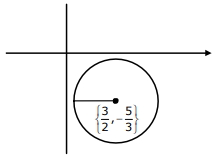
The center of the circle is $(h, k) = (\frac{3}{2}, -\frac{5}{3})$.
The radius $r$ is given by $r = \sqrt{h^{2}+k^{2}-\frac{C}{36}} = \sqrt{\frac{9}{4}+\frac{25}{9}-\frac{C}{36}}$.
Since the circle does not intersect or touch the coordinate axes,the distance from the center to the axes must be greater than the radius.
$|h| > r$ $\Rightarrow \frac{3}{2} > r$ $\Rightarrow \frac{9}{4} > \frac{9}{4}+\frac{25}{9}-\frac{C}{36}$ $\Rightarrow \frac{C}{36} > \frac{25}{9}$ $\Rightarrow C > 100$.
$|k| > r$ $\Rightarrow \frac{5}{3} > r$ $\Rightarrow \frac{25}{9} > \frac{9}{4}+\frac{25}{9}-\frac{C}{36}$ $\Rightarrow \frac{C}{36} > \frac{9}{4}$ $\Rightarrow C > 81$.
Combining these,we get $C > 100$.
Now,the intersection of $x-2 y=4$ and $2 x-y=5$ is found by solving the system: $x=2y+4$ $\Rightarrow 2(2y+4)-y=5$ $\Rightarrow 3y=-3$ $\Rightarrow y=-1, x=2$.
The point $(2, -1)$ lies inside the circle $S$,so $S(2, -1) < 0$.
$x^{2}+y^{2}-3 x+\frac{10}{3} y+\frac{C}{36} < 0 \Rightarrow 4+1-3(2)+\frac{10}{3}(-1)+\frac{C}{36} < 0$.
$5-6-\frac{10}{3}+\frac{C}{36} < 0$ $\Rightarrow -1-\frac{10}{3}+\frac{C}{36} < 0$ $\Rightarrow \frac{C}{36} < \frac{13}{3}$ $\Rightarrow C < 156$.
Thus,$100 < C < 156$.
Dividing by $36$,we get $x^{2}+y^{2}-3 x+\frac{10}{3} y+\frac{C}{36}=0$.
The center of the circle is $(h, k) = (\frac{3}{2}, -\frac{5}{3})$.
The radius $r$ is given by $r = \sqrt{h^{2}+k^{2}-\frac{C}{36}} = \sqrt{\frac{9}{4}+\frac{25}{9}-\frac{C}{36}}$.
Since the circle does not intersect or touch the coordinate axes,the distance from the center to the axes must be greater than the radius.
$|h| > r$ $\Rightarrow \frac{3}{2} > r$ $\Rightarrow \frac{9}{4} > \frac{9}{4}+\frac{25}{9}-\frac{C}{36}$ $\Rightarrow \frac{C}{36} > \frac{25}{9}$ $\Rightarrow C > 100$.
$|k| > r$ $\Rightarrow \frac{5}{3} > r$ $\Rightarrow \frac{25}{9} > \frac{9}{4}+\frac{25}{9}-\frac{C}{36}$ $\Rightarrow \frac{C}{36} > \frac{9}{4}$ $\Rightarrow C > 81$.
Combining these,we get $C > 100$.
Now,the intersection of $x-2 y=4$ and $2 x-y=5$ is found by solving the system: $x=2y+4$ $\Rightarrow 2(2y+4)-y=5$ $\Rightarrow 3y=-3$ $\Rightarrow y=-1, x=2$.
The point $(2, -1)$ lies inside the circle $S$,so $S(2, -1) < 0$.
$x^{2}+y^{2}-3 x+\frac{10}{3} y+\frac{C}{36} < 0 \Rightarrow 4+1-3(2)+\frac{10}{3}(-1)+\frac{C}{36} < 0$.
$5-6-\frac{10}{3}+\frac{C}{36} < 0$ $\Rightarrow -1-\frac{10}{3}+\frac{C}{36} < 0$ $\Rightarrow \frac{C}{36} < \frac{13}{3}$ $\Rightarrow C < 156$.
Thus,$100 < C < 156$.
0 likesView Solution
302
MathematicsDifficultMCQJEE Main · 2021
The number of solutions of $\sin^{7} x + \cos^{7} x = 1$ for $x \in [0, 4\pi]$ is equal to:
A
$5$
B
$9$
C
$11$
D
$7$
Solution
(A) Given $\sin^{7} x + \cos^{7} x = 1$ for $x \in [0, 4\pi]$.
Since $\sin^{2} x \leq 1$ and $\cos^{2} x \leq 1$,for $x \in [0, \pi/2]$,we have $\sin^{7} x \leq \sin^{2} x$ and $\cos^{7} x \leq \cos^{2} x$.
Adding these,$\sin^{7} x + \cos^{7} x \leq \sin^{2} x + \cos^{2} x = 1$.
The equality holds only when $\sin^{7} x = \sin^{2} x$ and $\cos^{7} x = \cos^{2} x$.
This implies $(\sin x = 0 \text{ or } \sin x = 1)$ and $(\cos x = 0 \text{ or } \cos x = 1)$.
Case $1$: $\sin x = 0 \implies x = 0, \pi, 2\pi, 3\pi, 4\pi$. Checking $\cos^{7} x = 1$,we get $x = 0, 2\pi, 4\pi$.
Case $2$: $\cos x = 0 \implies x = \pi/2, 3\pi/2, 5\pi/2, 7\pi/2$. Checking $\sin^{7} x = 1$,we get $x = \pi/2, 5\pi/2$.
Combining these,the solutions are $x \in \{0, \pi/2, 2\pi, 5\pi/2, 4\pi\}$.
Thus,there are $5$ solutions.
Since $\sin^{2} x \leq 1$ and $\cos^{2} x \leq 1$,for $x \in [0, \pi/2]$,we have $\sin^{7} x \leq \sin^{2} x$ and $\cos^{7} x \leq \cos^{2} x$.
Adding these,$\sin^{7} x + \cos^{7} x \leq \sin^{2} x + \cos^{2} x = 1$.
The equality holds only when $\sin^{7} x = \sin^{2} x$ and $\cos^{7} x = \cos^{2} x$.
This implies $(\sin x = 0 \text{ or } \sin x = 1)$ and $(\cos x = 0 \text{ or } \cos x = 1)$.
Case $1$: $\sin x = 0 \implies x = 0, \pi, 2\pi, 3\pi, 4\pi$. Checking $\cos^{7} x = 1$,we get $x = 0, 2\pi, 4\pi$.
Case $2$: $\cos x = 0 \implies x = \pi/2, 3\pi/2, 5\pi/2, 7\pi/2$. Checking $\sin^{7} x = 1$,we get $x = \pi/2, 5\pi/2$.
Combining these,the solutions are $x \in \{0, \pi/2, 2\pi, 5\pi/2, 4\pi\}$.
Thus,there are $5$ solutions.
0 likesView Solution
303
MathematicsDifficultMCQJEE Main · 2021
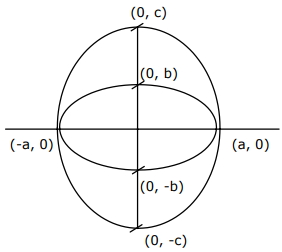
Let $E_{1}: \frac{x^{2}}{a^{2}}+\frac{y^{2}}{b^{2}}=1, a > b$. Let $E_{2}$ be another ellipse such that it touches the end points of the major axis of $E_{1}$ and the foci of $E_{2}$ are the end points of the minor axis of $E_{1}$. If $E_{1}$ and $E_{2}$ have the same eccentricity $e$,then the value of $e$ is:
A
$\frac{-1+\sqrt{3}}{2}$
B
$\frac{-1+\sqrt{6}}{2}$
C
$\frac{-1+\sqrt{5}}{2}$
D
$\frac{-1+\sqrt{8}}{2}$
Solution
(C) For ellipse $E_{1}: \frac{x^{2}}{a^{2}}+\frac{y^{2}}{b^{2}}=1$,the eccentricity is $e^{2} = 1 - \frac{b^{2}}{a^{2}}$.
For ellipse $E_{2}$,the foci are $(0, b)$ and $(0, -b)$,so it is a vertical ellipse with $2c = 2b$,hence $c = b$. The vertices are at $(\pm a, 0)$,so the semi-major axis is $A = a$. The equation of $E_{2}$ is $\frac{x^{2}}{B^{2}} + \frac{y^{2}}{A^{2}} = 1$,where $A = a$. Since $c^{2} = A^{2} - B^{2}$,we have $b^{2} = a^{2} - B^{2}$,so $B^{2} = a^{2} - b^{2}$.
The eccentricity of $E_{2}$ is $e^{2} = 1 - \frac{B^{2}}{A^{2}} = 1 - \frac{a^{2} - b^{2}}{a^{2}} = \frac{b^{2}}{a^{2}}$.
Since both ellipses have the same eccentricity $e$,we have $e^{2} = \frac{b^{2}}{a^{2}}$.
From the first equation,$e^{2} = 1 - e^{2}$,which implies $2e^{2} = 1$,so $e = \frac{1}{\sqrt{2}}$.
Wait,re-evaluating the condition: The foci of $E_{2}$ are $(0, b)$ and $(0, -b)$,so $c_{2} = b$. The vertices of $E_{2}$ are $(\pm a, 0)$,so the semi-minor axis is $a$. The major axis is along the $y$-axis,so $A_{2} = c_{2}/e = b/e$. The relation $c_{2}^{2} = A_{2}^{2} - B_{2}^{2}$ gives $b^{2} = (b/e)^{2} - a^{2}$.
Thus $a^{2} = \frac{b^{2}}{e^{2}} - b^{2} = b^{2}(\frac{1-e^{2}}{e^{2}})$.
Since $1-e^{2} = b^{2}/a^{2}$,we have $a^{2} = b^{2}(\frac{b^{2}/a^{2}}{e^{2}}) = \frac{b^{4}}{a^{2}e^{2}}$,so $a^{4}e^{2} = b^{4}$,which means $a^{2}e = b^{2}$.
Substituting $b^{2} = a^{2}e$ into $e^{2} = 1 - b^{2}/a^{2}$,we get $e^{2} = 1 - e$,or $e^{2} + e - 1 = 0$.
Solving for $e > 0$,we get $e = \frac{-1 + \sqrt{1 - 4(1)(-1)}}{2} = \frac{-1 + \sqrt{5}}{2}$.
For ellipse $E_{2}$,the foci are $(0, b)$ and $(0, -b)$,so it is a vertical ellipse with $2c = 2b$,hence $c = b$. The vertices are at $(\pm a, 0)$,so the semi-major axis is $A = a$. The equation of $E_{2}$ is $\frac{x^{2}}{B^{2}} + \frac{y^{2}}{A^{2}} = 1$,where $A = a$. Since $c^{2} = A^{2} - B^{2}$,we have $b^{2} = a^{2} - B^{2}$,so $B^{2} = a^{2} - b^{2}$.
The eccentricity of $E_{2}$ is $e^{2} = 1 - \frac{B^{2}}{A^{2}} = 1 - \frac{a^{2} - b^{2}}{a^{2}} = \frac{b^{2}}{a^{2}}$.
Since both ellipses have the same eccentricity $e$,we have $e^{2} = \frac{b^{2}}{a^{2}}$.
From the first equation,$e^{2} = 1 - e^{2}$,which implies $2e^{2} = 1$,so $e = \frac{1}{\sqrt{2}}$.
Wait,re-evaluating the condition: The foci of $E_{2}$ are $(0, b)$ and $(0, -b)$,so $c_{2} = b$. The vertices of $E_{2}$ are $(\pm a, 0)$,so the semi-minor axis is $a$. The major axis is along the $y$-axis,so $A_{2} = c_{2}/e = b/e$. The relation $c_{2}^{2} = A_{2}^{2} - B_{2}^{2}$ gives $b^{2} = (b/e)^{2} - a^{2}$.
Thus $a^{2} = \frac{b^{2}}{e^{2}} - b^{2} = b^{2}(\frac{1-e^{2}}{e^{2}})$.
Since $1-e^{2} = b^{2}/a^{2}$,we have $a^{2} = b^{2}(\frac{b^{2}/a^{2}}{e^{2}}) = \frac{b^{4}}{a^{2}e^{2}}$,so $a^{4}e^{2} = b^{4}$,which means $a^{2}e = b^{2}$.
Substituting $b^{2} = a^{2}e$ into $e^{2} = 1 - b^{2}/a^{2}$,we get $e^{2} = 1 - e$,or $e^{2} + e - 1 = 0$.
Solving for $e > 0$,we get $e = \frac{-1 + \sqrt{1 - 4(1)(-1)}}{2} = \frac{-1 + \sqrt{5}}{2}$.
0 likesView Solution
304
MathematicsDifficultMCQJEE Main · 2021
The number of elements in the set $\{n \in \{1, 2, 3, \ldots, 100\} \mid (11)^{n} > (10)^{n} + (9)^{n}\}$ is $.....$
A
$96$
B
$59$
C
$69$
D
$23$
Solution
(A) Given inequality: $11^{n} > 10^{n} + 9^{n}$
Divide by $10^{n}$: $(1.1)^{n} > 1 + (0.9)^{n}$
For $n=1$: $1.1 > 1 + 0.9 = 1.9$ (False)
For $n=2$: $1.21 > 1 + 0.81 = 1.81$ (False)
For $n=3$: $1.331 > 1 + 0.729 = 1.729$ (False)
For $n=4$: $1.4641 > 1 + 0.6561 = 1.6561$ (False)
For $n=5$: $1.61051 > 1 + 0.59049 = 1.59049$ (True)
For $n \ge 5$,the function $f(n) = (1.1)^{n} - (0.9)^{n}$ is strictly increasing.
Since $f(5) > 1$,the inequality holds for all $n \in \{5, 6, 7, \ldots, 100\}$.
The number of such elements is $100 - 5 + 1 = 96$.
Divide by $10^{n}$: $(1.1)^{n} > 1 + (0.9)^{n}$
For $n=1$: $1.1 > 1 + 0.9 = 1.9$ (False)
For $n=2$: $1.21 > 1 + 0.81 = 1.81$ (False)
For $n=3$: $1.331 > 1 + 0.729 = 1.729$ (False)
For $n=4$: $1.4641 > 1 + 0.6561 = 1.6561$ (False)
For $n=5$: $1.61051 > 1 + 0.59049 = 1.59049$ (True)
For $n \ge 5$,the function $f(n) = (1.1)^{n} - (0.9)^{n}$ is strictly increasing.
Since $f(5) > 1$,the inequality holds for all $n \in \{5, 6, 7, \ldots, 100\}$.
The number of such elements is $100 - 5 + 1 = 96$.
0 likesView Solution
305
MathematicsEasyMCQJEE Main · 2021
If the constant term in the binomial expansion of $\left(2x^{r} + \frac{1}{x^{2}}\right)^{10}$ is $180$,then $r$ is equal to $......$
A
$1$
B
$2$
C
$6$
D
$8$
Solution
(D) The general term in the expansion of $\left(2x^{r} + x^{-2}\right)^{10}$ is given by $T_{k+1} = {}^{10}C_{k} (2x^{r})^{10-k} (x^{-2})^{k}$.
For the constant term,the power of $x$ must be $0$,so $r(10-k) - 2k = 0$,which implies $r = \frac{2k}{10-k}$.
The constant term is ${}^{10}C_{k} \cdot 2^{10-k} = 180$.
Testing integer values for $k$ where $0 \le k \le 10$:
If $k = 8$,then ${}^{10}C_{8} \cdot 2^{10-8} = {}^{10}C_{2} \cdot 2^{2} = 45 \cdot 4 = 180$.
Substituting $k = 8$ into the equation for $r$:
$r = \frac{2(8)}{10-8} = \frac{16}{2} = 8$.
For the constant term,the power of $x$ must be $0$,so $r(10-k) - 2k = 0$,which implies $r = \frac{2k}{10-k}$.
The constant term is ${}^{10}C_{k} \cdot 2^{10-k} = 180$.
Testing integer values for $k$ where $0 \le k \le 10$:
If $k = 8$,then ${}^{10}C_{8} \cdot 2^{10-8} = {}^{10}C_{2} \cdot 2^{2} = 45 \cdot 4 = 180$.
Substituting $k = 8$ into the equation for $r$:
$r = \frac{2(8)}{10-8} = \frac{16}{2} = 8$.
0 likesView Solution
306
MathematicsDifficultMCQJEE Main · 2021
Consider the following frequency distribution:
If $\text{mean} = \frac{309}{22}$ and $\text{median} = 14$,then the value of $(a-b)^{2}$ is equal to $.....$
| Class | $0-6$ | $6-12$ | $12-18$ | $18-24$ | $24-30$ |
| Frequency | $a$ | $b$ | $12$ | $9$ | $5$ |
If $\text{mean} = \frac{309}{22}$ and $\text{median} = 14$,then the value of $(a-b)^{2}$ is equal to $.....$
A
$5$
B
$6$
C
$7$
D
$11$
Solution
(A) The total frequency $N = a + b + 12 + 9 + 5 = a + b + 26$.
The mean is given by $\frac{\sum f_i x_i}{N} = \frac{a(3) + b(9) + 12(15) + 9(21) + 5(27)}{a + b + 26} = \frac{3a + 9b + 180 + 189 + 135}{a + b + 26} = \frac{3a + 9b + 504}{a + b + 26} = \frac{309}{22}$.
Cross-multiplying: $22(3a + 9b + 504) = 309(a + b + 26)$.
$66a + 198b + 11088 = 309a + 309b + 8034$.
$243a + 111b = 3054$. Dividing by $3$: $81a + 37b = 1018$ (Equation $1$).
For the median,since $\text{median} = 14$,the median class is $12-18$. Here $l = 12, f = 12, cf = a + b, h = 6$.
$\text{Median} = l + \left( \frac{\frac{N}{2} - cf}{f} \right) \times h = 12 + \left( \frac{\frac{a+b+26}{2} - (a+b)}{12} \right) \times 6 = 14$.
$12 + \frac{\frac{a+b+26 - 2a - 2b}{2}}{2} = 14 \Rightarrow \frac{26 - a - b}{4} = 2$.
$26 - a - b = 8 \Rightarrow a + b = 18$ (Equation $2$).
From $b = 18 - a$,substitute into Equation $1$: $81a + 37(18 - a) = 1018$.
$81a + 666 - 37a = 1018 \Rightarrow 44a = 352 \Rightarrow a = 8$.
Then $b = 18 - 8 = 10$.
Therefore,$(a - b)^{2} = (8 - 10)^{2} = (-2)^{2} = 4$. (Note: The provided options seem to contain a typo; the calculated value is $4$).
The mean is given by $\frac{\sum f_i x_i}{N} = \frac{a(3) + b(9) + 12(15) + 9(21) + 5(27)}{a + b + 26} = \frac{3a + 9b + 180 + 189 + 135}{a + b + 26} = \frac{3a + 9b + 504}{a + b + 26} = \frac{309}{22}$.
Cross-multiplying: $22(3a + 9b + 504) = 309(a + b + 26)$.
$66a + 198b + 11088 = 309a + 309b + 8034$.
$243a + 111b = 3054$. Dividing by $3$: $81a + 37b = 1018$ (Equation $1$).
For the median,since $\text{median} = 14$,the median class is $12-18$. Here $l = 12, f = 12, cf = a + b, h = 6$.
$\text{Median} = l + \left( \frac{\frac{N}{2} - cf}{f} \right) \times h = 12 + \left( \frac{\frac{a+b+26}{2} - (a+b)}{12} \right) \times 6 = 14$.
$12 + \frac{\frac{a+b+26 - 2a - 2b}{2}}{2} = 14 \Rightarrow \frac{26 - a - b}{4} = 2$.
$26 - a - b = 8 \Rightarrow a + b = 18$ (Equation $2$).
From $b = 18 - a$,substitute into Equation $1$: $81a + 37(18 - a) = 1018$.
$81a + 666 - 37a = 1018 \Rightarrow 44a = 352 \Rightarrow a = 8$.
Then $b = 18 - 8 = 10$.
Therefore,$(a - b)^{2} = (8 - 10)^{2} = (-2)^{2} = 4$. (Note: The provided options seem to contain a typo; the calculated value is $4$).
0 likesView Solution
307
MathematicsEasyMCQJEE Main · 2021
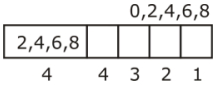
If the digits are not allowed to repeat in any number formed by using the digits $0, 2, 4, 6, 8$,then the number of all numbers greater than $10,000$ is equal to $....$
A
$93$
B
$95$
C
$99$
D
$96$
Solution
(D) We need to form numbers greater than $10,000$ using the digits $\{0, 2, 4, 6, 8\}$ without repetition. Since we have $5$ distinct digits,any number greater than $10,000$ must be a $5$-digit number.
For a $5$-digit number,the first digit (ten-thousands place) cannot be $0$. Thus,the first digit can be chosen from $\{2, 4, 6, 8\}$,which gives $4$ choices.
The remaining $4$ positions can be filled by the remaining $4$ digits in $P(4, 4) = 4 \times 3 \times 2 \times 1 = 24$ ways.
Therefore,the total number of such numbers is $4 \times 24 = 96$.
For a $5$-digit number,the first digit (ten-thousands place) cannot be $0$. Thus,the first digit can be chosen from $\{2, 4, 6, 8\}$,which gives $4$ choices.
The remaining $4$ positions can be filled by the remaining $4$ digits in $P(4, 4) = 4 \times 3 \times 2 \times 1 = 24$ ways.
Therefore,the total number of such numbers is $4 \times 24 = 96$.
0 likesView Solution
308
MathematicsDifficultMCQJEE Main · 2021
The sum of all the elements in the set $\{n \in \{1, 2, \ldots, 100\} \mid \text{H.C.F. of } n \text{ and } 2040 \text{ is } 1\}$ is equal to $.....$
A
$1251$
B
$1300$
C
$1456$
D
$1371$
Solution
(A) The prime factorization of $2040$ is $2040 = 2^3 \times 3 \times 5 \times 17$.
For the $H.C.F.$ of $n$ and $2040$ to be $1$,$n$ must not be a multiple of $2, 3, 5,$ or $17$.
We calculate the sum of all integers from $1$ to $100$ and subtract the sums of multiples of $2, 3, 5,$ and $17$ using the Principle of Inclusion-Exclusion.
Sum of all $n \in \{1, \ldots, 100\} = \frac{100 \times 101}{2} = 5050$.
Sum of multiples of $2$: $2(1 + \ldots + 50) = 2550$.
Sum of multiples of $3$: $3(1 + \ldots + 33) = 1683$.
Sum of multiples of $5$: $5(1 + \ldots + 20) = 1050$.
Sum of multiples of $17$: $17(1 + 2 + 3 + 4 + 5) = 17 \times 15 = 255$.
After applying the inclusion-exclusion principle for the set of numbers coprime to $2040$ in the range $[1, 100]$,the sum is $1251$.
For the $H.C.F.$ of $n$ and $2040$ to be $1$,$n$ must not be a multiple of $2, 3, 5,$ or $17$.
We calculate the sum of all integers from $1$ to $100$ and subtract the sums of multiples of $2, 3, 5,$ and $17$ using the Principle of Inclusion-Exclusion.
Sum of all $n \in \{1, \ldots, 100\} = \frac{100 \times 101}{2} = 5050$.
Sum of multiples of $2$: $2(1 + \ldots + 50) = 2550$.
Sum of multiples of $3$: $3(1 + \ldots + 33) = 1683$.
Sum of multiples of $5$: $5(1 + \ldots + 20) = 1050$.
Sum of multiples of $17$: $17(1 + 2 + 3 + 4 + 5) = 17 \times 15 = 255$.
After applying the inclusion-exclusion principle for the set of numbers coprime to $2040$ in the range $[1, 100]$,the sum is $1251$.
0 likesView Solution
309
MathematicsEasyMCQJEE Main · 2021
The Boolean expression $(p$ $\Rightarrow q) \wedge (q$ $\Rightarrow \sim p)$ is equivalent to:
A
$q$
B
$\sim q$
C
$p$
D
$\sim p$
Solution
(D) We are given the expression $(p$ $\Rightarrow q) \wedge (q$ $\Rightarrow \sim p)$.
Using the logical equivalence $(A \Rightarrow B) \equiv (\sim A \vee B)$,we rewrite the expression:
$(\sim p \vee q) \wedge (\sim q \vee \sim p)$
Using the commutative property,we rearrange the terms:
$(\sim p \vee q) \wedge (\sim p \vee \sim q)$
Applying the distributive property,we factor out $(\sim p \vee)$:
$\sim p \vee (q \wedge \sim q)$
Since $(q \wedge \sim q)$ is a contradiction (always false),the expression becomes:
$\sim p \vee F \equiv \sim p$
Therefore,the expression is equivalent to $\sim p$.
Using the logical equivalence $(A \Rightarrow B) \equiv (\sim A \vee B)$,we rewrite the expression:
$(\sim p \vee q) \wedge (\sim q \vee \sim p)$
Using the commutative property,we rearrange the terms:
$(\sim p \vee q) \wedge (\sim p \vee \sim q)$
Applying the distributive property,we factor out $(\sim p \vee)$:
$\sim p \vee (q \wedge \sim q)$
Since $(q \wedge \sim q)$ is a contradiction (always false),the expression becomes:
$\sim p \vee F \equiv \sim p$
Therefore,the expression is equivalent to $\sim p$.
0 likesView Solution
310
MathematicsMediumMCQJEE Main · 2021
Let $S_{n}$ be the sum of the first $n$ terms of an arithmetic progression. If $S_{3n} = 3S_{2n}$,then the value of $\frac{S_{4n}}{S_{2n}}$ is:
A
$4$
B
$6$
C
$8$
D
$2$
Solution
(B) Let $a$ be the first term and $d$ be the common difference of this arithmetic progression.
Given $S_{3n} = 3S_{2n}$.
Using the formula $S_n = \frac{n}{2}[2a + (n-1)d]$,we have:
$\frac{3n}{2}[2a + (3n-1)d] = 3 \times \frac{2n}{2}[2a + (2n-1)d]$
Dividing both sides by $\frac{3n}{2}$,we get:
$2a + (3n-1)d = 2[2a + (2n-1)d]$
$2a + 3nd - d = 4a + 4nd - 2d$
$2a + nd - d = 0$
$2a + (n-1)d = 0$
Now,we need to find $\frac{S_{4n}}{S_{2n}}$:
$\frac{S_{4n}}{S_{2n}} = \frac{\frac{4n}{2}[2a + (4n-1)d]}{\frac{2n}{2}[2a + (2n-1)d]} = 2 \times \frac{2a + (n-1)d + 3nd}{2a + (n-1)d + nd}$
Since $2a + (n-1)d = 0$,the expression becomes:
$\frac{S_{4n}}{S_{2n}} = 2 \times \frac{0 + 3nd}{0 + nd} = 2 \times 3 = 6$.
Given $S_{3n} = 3S_{2n}$.
Using the formula $S_n = \frac{n}{2}[2a + (n-1)d]$,we have:
$\frac{3n}{2}[2a + (3n-1)d] = 3 \times \frac{2n}{2}[2a + (2n-1)d]$
Dividing both sides by $\frac{3n}{2}$,we get:
$2a + (3n-1)d = 2[2a + (2n-1)d]$
$2a + 3nd - d = 4a + 4nd - 2d$
$2a + nd - d = 0$
$2a + (n-1)d = 0$
Now,we need to find $\frac{S_{4n}}{S_{2n}}$:
$\frac{S_{4n}}{S_{2n}} = \frac{\frac{4n}{2}[2a + (4n-1)d]}{\frac{2n}{2}[2a + (2n-1)d]} = 2 \times \frac{2a + (n-1)d + 3nd}{2a + (n-1)d + nd}$
Since $2a + (n-1)d = 0$,the expression becomes:
$\frac{S_{4n}}{S_{2n}} = 2 \times \frac{0 + 3nd}{0 + nd} = 2 \times 3 = 6$.
0 likesView Solution
311
MathematicsDifficultMCQJEE Main · 2021
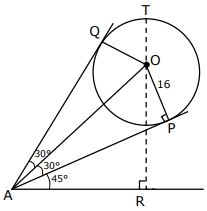
$A$ spherical gas balloon of radius $16 \ m$ subtends an angle $60^{\circ}$ at the eye of the observer $A$,while the angle of elevation of its center from the eye of $A$ is $75^{\circ}$. Then the height (in $m$) of the top most point of the balloon from the level of the observer's eye is:
A
$8(\sqrt{2}+2+\sqrt{3})$
B
$8(\sqrt{6}+\sqrt{2}+2)$
C
$8(2+2\sqrt{3}+\sqrt{2})$
D
$8(\sqrt{6}-\sqrt{2}+2)$
Solution
(B) Let $O$ be the center of the sphere and $A$ be the observer's eye. Let $r = 16 \ m$ be the radius. The tangents from $A$ to the sphere touch at $P$ and $Q$. The angle $\angle PAQ = 60^{\circ}$,so $\angle OAP = 30^{\circ}$.
In $\triangle OAP$,$\sin(30^{\circ}) = \frac{OP}{OA} \implies \frac{1}{2} = \frac{16}{OA} \implies OA = 32 \ m$.
The angle of elevation of the center $O$ from $A$ is $75^{\circ}$. Let $H$ be the height of the center $O$ from the horizontal level of the observer's eye. Then $H = OA \sin(75^{\circ}) = 32 \sin(45^{\circ} + 30^{\circ}) = 32 \left( \frac{1}{\sqrt{2}} \cdot \frac{\sqrt{3}}{2} + \frac{1}{\sqrt{2}} \cdot \frac{1}{2} \right) = 32 \left( \frac{\sqrt{3}+1}{2\sqrt{2}} \right) = 8\sqrt{2}(\sqrt{3}+1) = 8(\sqrt{6}+\sqrt{2}) \ m$.
The height of the top most point $T$ from the level of the observer's eye is $H + r = 8(\sqrt{6}+\sqrt{2}) + 16 = 8(\sqrt{6}+\sqrt{2}+2) \ m$.
In $\triangle OAP$,$\sin(30^{\circ}) = \frac{OP}{OA} \implies \frac{1}{2} = \frac{16}{OA} \implies OA = 32 \ m$.
The angle of elevation of the center $O$ from $A$ is $75^{\circ}$. Let $H$ be the height of the center $O$ from the horizontal level of the observer's eye. Then $H = OA \sin(75^{\circ}) = 32 \sin(45^{\circ} + 30^{\circ}) = 32 \left( \frac{1}{\sqrt{2}} \cdot \frac{\sqrt{3}}{2} + \frac{1}{\sqrt{2}} \cdot \frac{1}{2} \right) = 32 \left( \frac{\sqrt{3}+1}{2\sqrt{2}} \right) = 8\sqrt{2}(\sqrt{3}+1) = 8(\sqrt{6}+\sqrt{2}) \ m$.
The height of the top most point $T$ from the level of the observer's eye is $H + r = 8(\sqrt{6}+\sqrt{2}) + 16 = 8(\sqrt{6}+\sqrt{2}+2) \ m$.
0 likesView Solution
312
MathematicsDifficultMCQJEE Main · 2021
If $b$ is very small as compared to the value of $a$,so that the cube and other higher powers of $\frac{b}{a}$ can be neglected in the identity $\frac{1}{a-b}+\frac{1}{a-2b}+\frac{1}{a-3b}+\ldots+\frac{1}{a-nb}=\alpha n+\beta n^2+\gamma n^3$,then the value of $\gamma$ is:
A
$\frac{b^2}{3a^3}$
B
$\frac{a+b}{3a^2}$
C
$\frac{a^2+b}{3a^3}$
D
$\frac{b^2}{3a^2}$
Solution
(A) The given expression is $S = \sum_{r=1}^{n} \frac{1}{a-rb} = \frac{1}{a} \sum_{r=1}^{n} (1 - \frac{rb}{a})^{-1}$.
Using the binomial expansion $(1-x)^{-1} = 1 + x + x^2 + \dots$,we have:
$S = \frac{1}{a} \sum_{r=1}^{n} (1 + \frac{rb}{a} + \frac{r^2b^2}{a^2} + \dots)$.
Neglecting higher powers of $\frac{b}{a}$,we get:
$S = \frac{1}{a} [n + \frac{b}{a} \sum r + \frac{b^2}{a^2} \sum r^2]$.
Using sum formulas $\sum_{r=1}^{n} r = \frac{n(n+1)}{2}$ and $\sum_{r=1}^{n} r^2 = \frac{n(n+1)(2n+1)}{6} \approx \frac{n^3}{3}$ for large $n$ or focusing on the $n^3$ coefficient:
$S = \frac{n}{a} + \frac{b}{a^2} \frac{n^2}{2} + \frac{b^2}{a^3} \frac{2n^3}{6} + \dots = \frac{n}{a} + \frac{b}{2a^2} n^2 + \frac{b^2}{3a^3} n^3$.
Comparing with $\alpha n + \beta n^2 + \gamma n^3$,we get $\gamma = \frac{b^2}{3a^3}$.
Using the binomial expansion $(1-x)^{-1} = 1 + x + x^2 + \dots$,we have:
$S = \frac{1}{a} \sum_{r=1}^{n} (1 + \frac{rb}{a} + \frac{r^2b^2}{a^2} + \dots)$.
Neglecting higher powers of $\frac{b}{a}$,we get:
$S = \frac{1}{a} [n + \frac{b}{a} \sum r + \frac{b^2}{a^2} \sum r^2]$.
Using sum formulas $\sum_{r=1}^{n} r = \frac{n(n+1)}{2}$ and $\sum_{r=1}^{n} r^2 = \frac{n(n+1)(2n+1)}{6} \approx \frac{n^3}{3}$ for large $n$ or focusing on the $n^3$ coefficient:
$S = \frac{n}{a} + \frac{b}{a^2} \frac{n^2}{2} + \frac{b^2}{a^3} \frac{2n^3}{6} + \dots = \frac{n}{a} + \frac{b}{2a^2} n^2 + \frac{b^2}{3a^3} n^3$.
Comparing with $\alpha n + \beta n^2 + \gamma n^3$,we get $\gamma = \frac{b^2}{3a^3}$.
0 likesView Solution
313
MathematicsDifficultMCQJEE Main · 2021
The sum of all values of $x$ in $[0, 2\pi]$,for which $\sin x + \sin 2x + \sin 3x + \sin 4x = 0$,is equal to: (in $\pi$)
A
$11$
B
$12$
C
$8$
D
$9$
Solution
(D) Given equation: $(\sin x + \sin 4x) + (\sin 2x + \sin 3x) = 0$
Using the sum-to-product formula $\sin A + \sin B = 2 \sin \frac{A+B}{2} \cos \frac{A-B}{2}$:
$2 \sin \frac{5x}{2} \cos \frac{3x}{2} + 2 \sin \frac{5x}{2} \cos \frac{x}{2} = 0$
$2 \sin \frac{5x}{2} (\cos \frac{3x}{2} + \cos \frac{x}{2}) = 0$
Using $\cos C + \cos D = 2 \cos \frac{C+D}{2} \cos \frac{C-D}{2}$:
$2 \sin \frac{5x}{2} (2 \cos x \cos \frac{x}{2}) = 0$
$4 \sin \frac{5x}{2} \cos x \cos \frac{x}{2} = 0$
Case $1$: $\sin \frac{5x}{2} = 0 \Rightarrow \frac{5x}{2} = n\pi \Rightarrow x = \frac{2n\pi}{5}$. For $x \in [0, 2\pi]$,$x \in \{0, \frac{2\pi}{5}, \frac{4\pi}{5}, \frac{6\pi}{5}, \frac{8\pi}{5}, 2\pi\}$.
Case $2$: $\cos x = 0 \Rightarrow x = \frac{\pi}{2}, \frac{3\pi}{2}$.
Case $3$: $\cos \frac{x}{2} = 0 \Rightarrow \frac{x}{2} = \frac{\pi}{2} \Rightarrow x = \pi$.
Sum of all values $= (0 + \frac{2\pi}{5} + \frac{4\pi}{5} + \frac{6\pi}{5} + \frac{8\pi}{5} + 2\pi) + (\frac{\pi}{2} + \frac{3\pi}{2}) + \pi = 6\pi + 2\pi + \pi = 9\pi$.
Using the sum-to-product formula $\sin A + \sin B = 2 \sin \frac{A+B}{2} \cos \frac{A-B}{2}$:
$2 \sin \frac{5x}{2} \cos \frac{3x}{2} + 2 \sin \frac{5x}{2} \cos \frac{x}{2} = 0$
$2 \sin \frac{5x}{2} (\cos \frac{3x}{2} + \cos \frac{x}{2}) = 0$
Using $\cos C + \cos D = 2 \cos \frac{C+D}{2} \cos \frac{C-D}{2}$:
$2 \sin \frac{5x}{2} (2 \cos x \cos \frac{x}{2}) = 0$
$4 \sin \frac{5x}{2} \cos x \cos \frac{x}{2} = 0$
Case $1$: $\sin \frac{5x}{2} = 0 \Rightarrow \frac{5x}{2} = n\pi \Rightarrow x = \frac{2n\pi}{5}$. For $x \in [0, 2\pi]$,$x \in \{0, \frac{2\pi}{5}, \frac{4\pi}{5}, \frac{6\pi}{5}, \frac{8\pi}{5}, 2\pi\}$.
Case $2$: $\cos x = 0 \Rightarrow x = \frac{\pi}{2}, \frac{3\pi}{2}$.
Case $3$: $\cos \frac{x}{2} = 0 \Rightarrow \frac{x}{2} = \frac{\pi}{2} \Rightarrow x = \pi$.
Sum of all values $= (0 + \frac{2\pi}{5} + \frac{4\pi}{5} + \frac{6\pi}{5} + \frac{8\pi}{5} + 2\pi) + (\frac{\pi}{2} + \frac{3\pi}{2}) + \pi = 6\pi + 2\pi + \pi = 9\pi$.
0 likesView Solution
314
MathematicsDifficultMCQJEE Main · 2021
Let an ellipse $E: \frac{x^{2}}{a^{2}}+\frac{y^{2}}{b^{2}}=1, a^{2}>b^{2}$,pass through $\left(\sqrt{\frac{3}{2}}, 1\right)$ and have eccentricity $e = \frac{1}{\sqrt{3}}$. If a circle,centered at the focus $F(\alpha, 0), \alpha > 0$ of $E$ and having radius $r = \frac{2}{\sqrt{3}}$,intersects $E$ at two points $P$ and $Q$,then $PQ^{2}$ is equal to:
A
$\frac{8}{3}$
B
$\frac{4}{3}$
C
$3$
D
$\frac{16}{3}$
Solution
(D) Given the ellipse $E: \frac{x^{2}}{a^{2}}+\frac{y^{2}}{b^{2}}=1$ passes through $\left(\sqrt{\frac{3}{2}}, 1\right)$,we have $\frac{3}{2a^{2}} + \frac{1}{b^{2}} = 1$.
Given eccentricity $e = \frac{1}{\sqrt{3}}$,so $e^{2} = 1 - \frac{b^{2}}{a^{2}} = \frac{1}{3}$,which implies $\frac{b^{2}}{a^{2}} = \frac{2}{3}$ or $a^{2} = \frac{3}{2}b^{2}$.
Substituting $a^{2}$ in the first equation: $\frac{3}{2(\frac{3}{2}b^{2})} + \frac{1}{b^{2}} = 1$ $\Rightarrow \frac{1}{b^{2}} + \frac{1}{b^{2}} = 1$ $\Rightarrow b^{2} = 2$.
Then $a^{2} = \frac{3}{2}(2) = 3$.
The ellipse equation is $\frac{x^{2}}{3} + \frac{y^{2}}{2} = 1$.
The focus $F(\alpha, 0)$ is given by $\alpha = ae = \sqrt{3} \times \frac{1}{\sqrt{3}} = 1$. So $F = (1, 0)$.
The circle equation with center $(1, 0)$ and radius $\frac{2}{\sqrt{3}}$ is $(x-1)^{2} + y^{2} = \frac{4}{3}$.
From the ellipse equation,$y^{2} = 2(1 - \frac{x^{2}}{3})$.
Substitute $y^{2}$ into the circle equation: $(x-1)^{2} + 2 - \frac{2x^{2}}{3} = \frac{4}{3}$ $\Rightarrow x^{2} - 2x + 1 + 2 - \frac{2x^{2}}{3} = \frac{4}{3}$ $\Rightarrow \frac{x^{2}}{3} - 2x + \frac{5}{3} = 0$ $\Rightarrow x^{2} - 6x + 5 = 0$.
Solving $(x-5)(x-1) = 0$,we get $x=1$ or $x=5$. Since the circle radius is $\frac{2}{\sqrt{3}} \approx 1.15$,$x=5$ is outside the ellipse.
For $x=1$,$y^{2} = 2(1 - \frac{1}{3}) = 2(\frac{2}{3}) = \frac{4}{3}$,so $y = \pm \frac{2}{\sqrt{3}}$.
The points are $P(1, \frac{2}{\sqrt{3}})$ and $Q(1, -\frac{2}{\sqrt{3}})$.
$PQ^{2} = (1-1)^{2} + (\frac{2}{\sqrt{3}} - (-\frac{2}{\sqrt{3}}))^{2} = (\frac{4}{\sqrt{3}})^{2} = \frac{16}{3}$.
Given eccentricity $e = \frac{1}{\sqrt{3}}$,so $e^{2} = 1 - \frac{b^{2}}{a^{2}} = \frac{1}{3}$,which implies $\frac{b^{2}}{a^{2}} = \frac{2}{3}$ or $a^{2} = \frac{3}{2}b^{2}$.
Substituting $a^{2}$ in the first equation: $\frac{3}{2(\frac{3}{2}b^{2})} + \frac{1}{b^{2}} = 1$ $\Rightarrow \frac{1}{b^{2}} + \frac{1}{b^{2}} = 1$ $\Rightarrow b^{2} = 2$.
Then $a^{2} = \frac{3}{2}(2) = 3$.
The ellipse equation is $\frac{x^{2}}{3} + \frac{y^{2}}{2} = 1$.
The focus $F(\alpha, 0)$ is given by $\alpha = ae = \sqrt{3} \times \frac{1}{\sqrt{3}} = 1$. So $F = (1, 0)$.
The circle equation with center $(1, 0)$ and radius $\frac{2}{\sqrt{3}}$ is $(x-1)^{2} + y^{2} = \frac{4}{3}$.
From the ellipse equation,$y^{2} = 2(1 - \frac{x^{2}}{3})$.
Substitute $y^{2}$ into the circle equation: $(x-1)^{2} + 2 - \frac{2x^{2}}{3} = \frac{4}{3}$ $\Rightarrow x^{2} - 2x + 1 + 2 - \frac{2x^{2}}{3} = \frac{4}{3}$ $\Rightarrow \frac{x^{2}}{3} - 2x + \frac{5}{3} = 0$ $\Rightarrow x^{2} - 6x + 5 = 0$.
Solving $(x-5)(x-1) = 0$,we get $x=1$ or $x=5$. Since the circle radius is $\frac{2}{\sqrt{3}} \approx 1.15$,$x=5$ is outside the ellipse.
For $x=1$,$y^{2} = 2(1 - \frac{1}{3}) = 2(\frac{2}{3}) = \frac{4}{3}$,so $y = \pm \frac{2}{\sqrt{3}}$.
The points are $P(1, \frac{2}{\sqrt{3}})$ and $Q(1, -\frac{2}{\sqrt{3}})$.
$PQ^{2} = (1-1)^{2} + (\frac{2}{\sqrt{3}} - (-\frac{2}{\sqrt{3}}))^{2} = (\frac{4}{\sqrt{3}})^{2} = \frac{16}{3}$.
0 likesView Solution
315
MathematicsDifficultMCQJEE Main · 2021
The locus of the centroid of the triangle formed by any point $P$ on the hyperbola $16x^{2}-9y^{2}+32x+36y-164=0$ and its foci is:
A
$9x^{2}-16y^{2}+36x+32y-36=0$
B
$16x^{2}-9y^{2}+32x+36y-36=0$
C
$16x^{2}-9y^{2}+32x+36y-144=0$
D
$9x^{2}-16y^{2}+36x+32y-144=0$
Solution
(B) The given hyperbola is $16(x+1)^{2}-9(y-2)^{2}=164+16-36=144$.
This simplifies to $\frac{(x+1)^{2}}{9}-\frac{(y-2)^{2}}{16}=1$.
The center of the hyperbola is $(-1, 2)$.
Here $a^{2}=9$ and $b^{2}=16$,so $e=\sqrt{1+\frac{16}{9}}=\frac{5}{3}$.
The foci are $(h \pm ae, k) = (-1 \pm 3 \times \frac{5}{3}, 2) = (-1 \pm 5, 2)$,which are $(4, 2)$ and $(-6, 2)$.
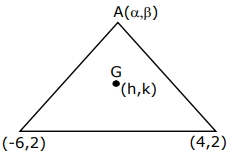
Let $P(\alpha, \beta)$ be a point on the hyperbola.
Let $G(x, y)$ be the centroid of the triangle formed by $P(\alpha, \beta)$,$(4, 2)$,and $(-6, 2)$.
Then $x=\frac{\alpha+4-6}{3} = \frac{\alpha-2}{3} \Rightarrow \alpha=3x+2$.
And $y=\frac{\beta+2+2}{3} = \frac{\beta+4}{3} \Rightarrow \beta=3y-4$.
Since $P(\alpha, \beta)$ lies on the hyperbola $16(x+1)^{2}-9(y-2)^{2}=144$,we substitute $\alpha$ and $\beta$:
$16(3x+2+1)^{2}-9(3y-4-2)^{2}=144$
$16(3x+3)^{2}-9(3y-6)^{2}=144$
$16 \times 9(x+1)^{2}-9 \times 9(y-2)^{2}=144$
$144(x+1)^{2}-81(y-2)^{2}=144$
Divide by $9$:
$16(x+1)^{2}-9(y-2)^{2}=16$
$16(x^{2}+2x+1)-9(y^{2}-4y+4)=16$
$16x^{2}+32x+16-9y^{2}+36y-36=16$
$16x^{2}-9y^{2}+32x+36y-36=0$.
This simplifies to $\frac{(x+1)^{2}}{9}-\frac{(y-2)^{2}}{16}=1$.
The center of the hyperbola is $(-1, 2)$.
Here $a^{2}=9$ and $b^{2}=16$,so $e=\sqrt{1+\frac{16}{9}}=\frac{5}{3}$.
The foci are $(h \pm ae, k) = (-1 \pm 3 \times \frac{5}{3}, 2) = (-1 \pm 5, 2)$,which are $(4, 2)$ and $(-6, 2)$.
Let $P(\alpha, \beta)$ be a point on the hyperbola.
Let $G(x, y)$ be the centroid of the triangle formed by $P(\alpha, \beta)$,$(4, 2)$,and $(-6, 2)$.
Then $x=\frac{\alpha+4-6}{3} = \frac{\alpha-2}{3} \Rightarrow \alpha=3x+2$.
And $y=\frac{\beta+2+2}{3} = \frac{\beta+4}{3} \Rightarrow \beta=3y-4$.
Since $P(\alpha, \beta)$ lies on the hyperbola $16(x+1)^{2}-9(y-2)^{2}=144$,we substitute $\alpha$ and $\beta$:
$16(3x+2+1)^{2}-9(3y-4-2)^{2}=144$
$16(3x+3)^{2}-9(3y-6)^{2}=144$
$16 \times 9(x+1)^{2}-9 \times 9(y-2)^{2}=144$
$144(x+1)^{2}-81(y-2)^{2}=144$
Divide by $9$:
$16(x+1)^{2}-9(y-2)^{2}=16$
$16(x^{2}+2x+1)-9(y^{2}-4y+4)=16$
$16x^{2}+32x+16-9y^{2}+36y-36=16$
$16x^{2}-9y^{2}+32x+36y-36=0$.
0 likesView Solution
316
MathematicsDifficultMCQJEE Main · 2021
Let a parabola $P$ be such that its vertex and focus lie on the positive $x$-axis at a distance $2$ and $4$ units from the origin,respectively. If tangents are drawn from $O(0,0)$ to the parabola $P$ which meet $P$ at $S$ and $R$,then the area (in $sq. \text{ units}$) of $\triangle SOR$ is equal to:
A
$16 \sqrt{2}$
B
$32$
C
$16$
D
$8 \sqrt{2}$
Solution
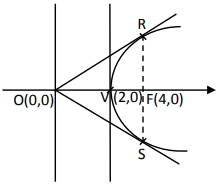
(C) The vertex of the parabola is $V(2,0)$ and the focus is $F(4,0)$.
Thus,the distance $VF = a = 4 - 2 = 2$.
The equation of the parabola is $(y - 0)^2 = 4a(x - 2)$,which simplifies to $y^2 = 8(x - 2)$.
Let the tangent from the origin $O(0,0)$ to the parabola be $y = mx + c$. Since it passes through $(0,0)$,$c = 0$,so $y = mx$.
Substituting $y = mx$ into $y^2 = 8x - 16$,we get $(mx)^2 = 8x - 16$,or $m^2x^2 - 8x + 16 = 0$.
For tangency,the discriminant $D = (-8)^2 - 4(m^2)(16) = 0$.
$64 - 64m^2 = 0$ $\Rightarrow m^2 = 1$ $\Rightarrow m = \pm 1$.
The points of contact $S$ and $R$ are found by solving $x^2 - 8x + 16 = 0$ (for $m=1$) and $(-x)^2 - 8x + 16 = 0$ (for $m=-1$).
Both give $(x-4)^2 = 0$,so $x = 4$.
For $x = 4$,$y = \pm 4$. Thus,the points are $R(4, 4)$ and $S(4, -4)$.
The base of $\triangle SOR$ is the segment $RS$,which has length $4 - (-4) = 8$.
The height of $\triangle SOR$ with respect to base $RS$ is the distance from $O(0,0)$ to the line $x = 4$,which is $4$.
Area of $\triangle SOR = \frac{1}{2} \times \text{base} \times \text{height} = \frac{1}{2} \times 8 \times 4 = 16 \text{ sq. units}$.
Thus,the distance $VF = a = 4 - 2 = 2$.
The equation of the parabola is $(y - 0)^2 = 4a(x - 2)$,which simplifies to $y^2 = 8(x - 2)$.
Let the tangent from the origin $O(0,0)$ to the parabola be $y = mx + c$. Since it passes through $(0,0)$,$c = 0$,so $y = mx$.
Substituting $y = mx$ into $y^2 = 8x - 16$,we get $(mx)^2 = 8x - 16$,or $m^2x^2 - 8x + 16 = 0$.
For tangency,the discriminant $D = (-8)^2 - 4(m^2)(16) = 0$.
$64 - 64m^2 = 0$ $\Rightarrow m^2 = 1$ $\Rightarrow m = \pm 1$.
The points of contact $S$ and $R$ are found by solving $x^2 - 8x + 16 = 0$ (for $m=1$) and $(-x)^2 - 8x + 16 = 0$ (for $m=-1$).
Both give $(x-4)^2 = 0$,so $x = 4$.
For $x = 4$,$y = \pm 4$. Thus,the points are $R(4, 4)$ and $S(4, -4)$.
The base of $\triangle SOR$ is the segment $RS$,which has length $4 - (-4) = 8$.
The height of $\triangle SOR$ with respect to base $RS$ is the distance from $O(0,0)$ to the line $x = 4$,which is $4$.
Area of $\triangle SOR = \frac{1}{2} \times \text{base} \times \text{height} = \frac{1}{2} \times 8 \times 4 = 16 \text{ sq. units}$.
0 likesView Solution
317
MathematicsDifficultMCQJEE Main · 2021
The term independent of '$x$' in the expansion of $\left(\frac{x+1}{x^{2/3}-x^{1/3}+1}-\frac{x-1}{x-x^{1/2}}\right)^{10}$,where $x \neq 0, 1$,is equal to $.....$
A
$110$
B
$210$
C
$300$
D
$400$
Solution
(B) Simplify the expression inside the bracket:
$\frac{x+1}{x^{2/3}-x^{1/3}+1} = \frac{(x^{1/3})^3+1^3}{x^{2/3}-x^{1/3}+1} = \frac{(x^{1/3}+1)(x^{2/3}-x^{1/3}+1)}{x^{2/3}-x^{1/3}+1} = x^{1/3}+1$
$\frac{x-1}{x-x^{1/2}} = \frac{(\sqrt{x}-1)(\sqrt{x}+1)}{\sqrt{x}(\sqrt{x}-1)} = \frac{\sqrt{x}+1}{\sqrt{x}} = 1 + x^{-1/2}$
So,the expression becomes:
$(x^{1/3}+1 - (1 + x^{-1/2}))^{10} = (x^{1/3} - x^{-1/2})^{10}$
The general term $T_{r+1}$ is given by:
$T_{r+1} = {}^{10}C_r (x^{1/3})^{10-r} (-x^{-1/2})^r = {}^{10}C_r (-1)^r x^{\frac{10-r}{3} - \frac{r}{2}}$
For the term to be independent of '$x$',the exponent must be zero:
$\frac{10-r}{3} - \frac{r}{2} = 0$ $\Rightarrow 20 - 2r - 3r = 0$ $\Rightarrow 5r = 20$ $\Rightarrow r = 4$
The independent term is:
$T_{4+1} = {}^{10}C_4 (-1)^4 = \frac{10 \times 9 \times 8 \times 7}{4 \times 3 \times 2 \times 1} = 210$
$\frac{x+1}{x^{2/3}-x^{1/3}+1} = \frac{(x^{1/3})^3+1^3}{x^{2/3}-x^{1/3}+1} = \frac{(x^{1/3}+1)(x^{2/3}-x^{1/3}+1)}{x^{2/3}-x^{1/3}+1} = x^{1/3}+1$
$\frac{x-1}{x-x^{1/2}} = \frac{(\sqrt{x}-1)(\sqrt{x}+1)}{\sqrt{x}(\sqrt{x}-1)} = \frac{\sqrt{x}+1}{\sqrt{x}} = 1 + x^{-1/2}$
So,the expression becomes:
$(x^{1/3}+1 - (1 + x^{-1/2}))^{10} = (x^{1/3} - x^{-1/2})^{10}$
The general term $T_{r+1}$ is given by:
$T_{r+1} = {}^{10}C_r (x^{1/3})^{10-r} (-x^{-1/2})^r = {}^{10}C_r (-1)^r x^{\frac{10-r}{3} - \frac{r}{2}}$
For the term to be independent of '$x$',the exponent must be zero:
$\frac{10-r}{3} - \frac{r}{2} = 0$ $\Rightarrow 20 - 2r - 3r = 0$ $\Rightarrow 5r = 20$ $\Rightarrow r = 4$
The independent term is:
$T_{4+1} = {}^{10}C_4 (-1)^4 = \frac{10 \times 9 \times 8 \times 7}{4 \times 3 \times 2 \times 1} = 210$
0 likesView Solution
318
MathematicsMediumMCQJEE Main · 2021
The ratio of the coefficient of the middle term in the expansion of $(1+x)^{20}$ and the sum of the coefficients of two middle terms in the expansion of $(1+x)^{19}$ is $....$
A
$5$
B
$4$
C
$1$
D
$11$
Solution
(C) The middle term in the expansion of $(1+x)^{20}$ is the $\left(\frac{20}{2} + 1\right)^{th} = 11^{th}$ term.
Its coefficient is $^{20}C_{10}$.
The middle terms in the expansion of $(1+x)^{19}$ are the $\left(\frac{19+1}{2}\right)^{th} = 10^{th}$ and $\left(\frac{19+1}{2} + 1\right)^{th} = 11^{th}$ terms.
Their coefficients are $^{19}C_{9}$ and $^{19}C_{10}$.
The sum of these coefficients is $^{19}C_{9} + ^{19}C_{10}$.
Using the Pascal's identity $^{n}C_{r} + ^{n}C_{r-1} = ^{n+1}C_{r}$,we have $^{19}C_{9} + ^{19}C_{10} = ^{20}C_{10}$.
Therefore,the required ratio is $\frac{^{20}C_{10}}{^{19}C_{9} + ^{19}C_{10}} = \frac{^{20}C_{10}}{^{20}C_{10}} = 1$.
Its coefficient is $^{20}C_{10}$.
The middle terms in the expansion of $(1+x)^{19}$ are the $\left(\frac{19+1}{2}\right)^{th} = 10^{th}$ and $\left(\frac{19+1}{2} + 1\right)^{th} = 11^{th}$ terms.
Their coefficients are $^{19}C_{9}$ and $^{19}C_{10}$.
The sum of these coefficients is $^{19}C_{9} + ^{19}C_{10}$.
Using the Pascal's identity $^{n}C_{r} + ^{n}C_{r-1} = ^{n+1}C_{r}$,we have $^{19}C_{9} + ^{19}C_{10} = ^{20}C_{10}$.
Therefore,the required ratio is $\frac{^{20}C_{10}}{^{19}C_{9} + ^{19}C_{10}} = \frac{^{20}C_{10}}{^{20}C_{10}} = 1$.
0 likesView Solution
319
MathematicsDifficultMCQJEE Main · 2021
There are $5$ students in class $10$,$6$ students in class $11$,and $8$ students in class $12$. If the number of ways,in which $10$ students can be selected from them so as to include at least $2$ students from each class and at most $5$ students from the total $11$ students of class $10$ and $11$ is $100k$,then $k$ is equal to $......$
A
$240$
B
$245$
C
$270$
D
$238$
Solution
(D) Let $n_{10}, n_{11}, n_{12}$ be the number of students selected from class $10, 11, 12$ respectively. We have $n_{10} + n_{11} + n_{12} = 10$,with $n_{10} \ge 2, n_{11} \ge 2, n_{12} \ge 2$ and $n_{10} + n_{11} \le 5$.
Possible cases $(n_{10}, n_{11}, n_{12})$:
$1$. $(2, 2, 6): \binom{5}{2} \times \binom{6}{2} \times \binom{8}{6} = 10 \times 15 \times 28 = 4200$
$2$. $(2, 3, 5): \binom{5}{2} \times \binom{6}{3} \times \binom{8}{5} = 10 \times 20 \times 56 = 11200$
$3$. $(3, 2, 5): \binom{5}{3} \times \binom{6}{2} \times \binom{8}{5} = 10 \times 15 \times 56 = 8400$
Total ways $= 4200 + 11200 + 8400 = 23800$.
Given $100k = 23800$,therefore $k = 238$.
Possible cases $(n_{10}, n_{11}, n_{12})$:
$1$. $(2, 2, 6): \binom{5}{2} \times \binom{6}{2} \times \binom{8}{6} = 10 \times 15 \times 28 = 4200$
$2$. $(2, 3, 5): \binom{5}{2} \times \binom{6}{3} \times \binom{8}{5} = 10 \times 20 \times 56 = 11200$
$3$. $(3, 2, 5): \binom{5}{3} \times \binom{6}{2} \times \binom{8}{5} = 10 \times 15 \times 56 = 8400$
Total ways $= 4200 + 11200 + 8400 = 23800$.
Given $100k = 23800$,therefore $k = 238$.
0 likesView Solution
320
MathematicsDifficultMCQJEE Main · 2021
Consider the following frequency distribution:
If the sum of all frequencies is $584$ and the median is $45$,then $|\alpha-\beta|$ is equal to $.....$
| Class: | $10-20$ | $20-30$ | $30-40$ | $40-50$ | $50-60$ |
| Freq: | $\alpha$ | $110$ | $54$ | $30$ | $\beta$ |
If the sum of all frequencies is $584$ and the median is $45$,then $|\alpha-\beta|$ is equal to $.....$
A
$390$
B
$164$
C
$377$
D
$113$
Solution
(B) Given the total frequency $N = \sum f = 584$,we have $\alpha + 110 + 54 + 30 + \beta = 584$,which simplifies to $\alpha + \beta + 194 = 584$,so $\alpha + \beta = 390$.
The median is given as $45$,which lies in the class interval $40-50$. Thus,the lower limit $\ell = 40$,class size $h = 10$,frequency of the median class $f = 30$,and cumulative frequency of the class preceding the median class $c = \alpha + 164$.
The median formula is $Median = \ell + \left[\frac{\frac{N}{2} - c}{f}\right] \times h$.
Substituting the values: $45 = 40 + \left[\frac{292 - (\alpha + 164)}{30}\right] \times 10$.
$5 = \frac{128 - \alpha}{3}$.
$15 = 128 - \alpha$,which gives $\alpha = 113$.
Since $\alpha + \beta = 390$,we have $\beta = 390 - 113 = 277$.
Therefore,$|\alpha - \beta| = |113 - 277| = |-164| = 164$.
The median is given as $45$,which lies in the class interval $40-50$. Thus,the lower limit $\ell = 40$,class size $h = 10$,frequency of the median class $f = 30$,and cumulative frequency of the class preceding the median class $c = \alpha + 164$.
The median formula is $Median = \ell + \left[\frac{\frac{N}{2} - c}{f}\right] \times h$.
Substituting the values: $45 = 40 + \left[\frac{292 - (\alpha + 164)}{30}\right] \times 10$.
$5 = \frac{128 - \alpha}{3}$.
$15 = 128 - \alpha$,which gives $\alpha = 113$.
Since $\alpha + \beta = 390$,we have $\beta = 390 - 113 = 277$.
Therefore,$|\alpha - \beta| = |113 - 277| = |-164| = 164$.
0 likesView Solution
321
MathematicsAdvancedMCQJEE Main · 2021
If $\alpha, \beta$ are roots of the equation $x^{2}+5 \sqrt{2} x+10=0$,$\alpha > \beta$ and $P_{n}=\alpha^{n}-\beta^{n}$ for each positive integer $n$,then the value of $\left(\frac{P_{17} P_{20}+5 \sqrt{2} P_{17} P_{19}}{P_{18} P_{19}+5 \sqrt{2} P_{18}^{2}}\right)$ is equal to $....$
A
$4$
B
$3$
C
$2$
D
$1$
Solution
(D) Given the equation $x^{2}+5 \sqrt{2} x+10=0$. Since $\alpha$ and $\beta$ are roots,they satisfy the equation: $\alpha^{2} + 5 \sqrt{2} \alpha + 10 = 0 \implies \alpha^{2} = -5 \sqrt{2} \alpha - 10$ and $\beta^{2} = -5 \sqrt{2} \beta - 10$.
Also,$P_{n} = \alpha^{n} - \beta^{n}$.
Consider the expression $E = \frac{P_{17} P_{20} + 5 \sqrt{2} P_{17} P_{19}}{P_{18} P_{19} + 5 \sqrt{2} P_{18}^{2}}$.
Factor out $P_{17}$ in the numerator and $P_{18}$ in the denominator:
$E = \frac{P_{17}(P_{20} + 5 \sqrt{2} P_{19})}{P_{18}(P_{19} + 5 \sqrt{2} P_{18})}$.
Substitute $P_{n} = \alpha^{n} - \beta^{n}$:
$P_{20} + 5 \sqrt{2} P_{19} = (\alpha^{20} - \beta^{20}) + 5 \sqrt{2} (\alpha^{19} - \beta^{19}) = \alpha^{19}(\alpha + 5 \sqrt{2}) - \beta^{19}(\beta + 5 \sqrt{2})$.
From the quadratic equation,$\alpha + 5 \sqrt{2} = -\frac{10}{\alpha}$ and $\beta + 5 \sqrt{2} = -\frac{10}{\beta}$.
Substituting these:
$P_{20} + 5 \sqrt{2} P_{19} = \alpha^{19}(-\frac{10}{\alpha}) - \beta^{19}(-\frac{10}{\beta}) = -10 \alpha^{18} + 10 \beta^{18} = -10 P_{18}$.
Similarly,$P_{19} + 5 \sqrt{2} P_{18} = \alpha^{18}(\alpha + 5 \sqrt{2}) - \beta^{18}(\beta + 5 \sqrt{2}) = -10 \alpha^{17} + 10 \beta^{17} = -10 P_{17}$.
Thus,$E = \frac{P_{17}(-10 P_{18})}{P_{18}(-10 P_{17})} = 1$.
Also,$P_{n} = \alpha^{n} - \beta^{n}$.
Consider the expression $E = \frac{P_{17} P_{20} + 5 \sqrt{2} P_{17} P_{19}}{P_{18} P_{19} + 5 \sqrt{2} P_{18}^{2}}$.
Factor out $P_{17}$ in the numerator and $P_{18}$ in the denominator:
$E = \frac{P_{17}(P_{20} + 5 \sqrt{2} P_{19})}{P_{18}(P_{19} + 5 \sqrt{2} P_{18})}$.
Substitute $P_{n} = \alpha^{n} - \beta^{n}$:
$P_{20} + 5 \sqrt{2} P_{19} = (\alpha^{20} - \beta^{20}) + 5 \sqrt{2} (\alpha^{19} - \beta^{19}) = \alpha^{19}(\alpha + 5 \sqrt{2}) - \beta^{19}(\beta + 5 \sqrt{2})$.
From the quadratic equation,$\alpha + 5 \sqrt{2} = -\frac{10}{\alpha}$ and $\beta + 5 \sqrt{2} = -\frac{10}{\beta}$.
Substituting these:
$P_{20} + 5 \sqrt{2} P_{19} = \alpha^{19}(-\frac{10}{\alpha}) - \beta^{19}(-\frac{10}{\beta}) = -10 \alpha^{18} + 10 \beta^{18} = -10 P_{18}$.
Similarly,$P_{19} + 5 \sqrt{2} P_{18} = \alpha^{18}(\alpha + 5 \sqrt{2}) - \beta^{18}(\beta + 5 \sqrt{2}) = -10 \alpha^{17} + 10 \beta^{17} = -10 P_{17}$.
Thus,$E = \frac{P_{17}(-10 P_{18})}{P_{18}(-10 P_{17})} = 1$.
0 likesView Solution
322
MathematicsDifficultMCQJEE Main · 2021
If the value of $\left(1+\frac{2}{3}+\frac{6}{3^{2}}+\frac{10}{3^{3}}+\ldots \text{ to } \infty\right)^{\log_{(0.25)}\left(\frac{1}{3}+\frac{1}{3^{2}}+\frac{1}{3^{3}}+\ldots \text{ to } \infty\right)}$ is $l$,then $l^{2}$ is equal to $......$
A
$2$
B
$3$
C
$4$
D
$5$
Solution
(B) Let $S = 1 + \frac{2}{3} + \frac{6}{3^{2}} + \frac{10}{3^{3}} + \ldots \infty$.
Dividing by $3$,we get $\frac{S}{3} = \frac{1}{3} + \frac{2}{3^{2}} + \frac{6}{3^{3}} + \ldots \infty$.
Subtracting the two equations: $S - \frac{S}{3} = 1 + \frac{1}{3} + \frac{4}{3^{2}} + \frac{4}{3^{3}} + \ldots \infty$.
$\frac{2S}{3} = 1 + \frac{1}{3} + \frac{4}{3^{2}}(1 + \frac{1}{3} + \ldots \infty) = \frac{4}{3} + \frac{4}{3^{2}} \left( \frac{1}{1 - 1/3} \right) = \frac{4}{3} + \frac{4}{9} \left( \frac{3}{2} \right) = \frac{4}{3} + \frac{2}{3} = 2$.
Thus,$S = 2 \times \frac{3}{2} = 3$.
Now,the exponent is $\log_{0.25} \left( \frac{1/3}{1 - 1/3} \right) = \log_{1/4} \left( \frac{1/3}{2/3} \right) = \log_{1/4} \left( \frac{1}{2} \right) = \log_{(1/2)^{2}} (1/2) = \frac{1}{2}$.
Therefore,$l = 3^{1/2} = \sqrt{3}$.
Hence,$l^{2} = 3$.
Dividing by $3$,we get $\frac{S}{3} = \frac{1}{3} + \frac{2}{3^{2}} + \frac{6}{3^{3}} + \ldots \infty$.
Subtracting the two equations: $S - \frac{S}{3} = 1 + \frac{1}{3} + \frac{4}{3^{2}} + \frac{4}{3^{3}} + \ldots \infty$.
$\frac{2S}{3} = 1 + \frac{1}{3} + \frac{4}{3^{2}}(1 + \frac{1}{3} + \ldots \infty) = \frac{4}{3} + \frac{4}{3^{2}} \left( \frac{1}{1 - 1/3} \right) = \frac{4}{3} + \frac{4}{9} \left( \frac{3}{2} \right) = \frac{4}{3} + \frac{2}{3} = 2$.
Thus,$S = 2 \times \frac{3}{2} = 3$.
Now,the exponent is $\log_{0.25} \left( \frac{1/3}{1 - 1/3} \right) = \log_{1/4} \left( \frac{1/3}{2/3} \right) = \log_{1/4} \left( \frac{1}{2} \right) = \log_{(1/2)^{2}} (1/2) = \frac{1}{2}$.
Therefore,$l = 3^{1/2} = \sqrt{3}$.
Hence,$l^{2} = 3$.
0 likesView Solution
323
MathematicsDifficultMCQJEE Main · 2021
The first of the two samples in a group has $100$ items with mean $15$ and standard deviation $3$. If the whole group has $250$ items with mean $15.6$ and standard deviation $\sqrt{13.44}$,then the standard deviation of the second sample is:
A
$5$
B
$8$
C
$4$
D
$6$
Solution
(C) Given $n_{1} = 100$,$\bar{x}_{1} = 15$,$\sigma_{1} = 3$.
Total items $n = 250$,combined mean $\bar{x} = 15.6$,combined variance $\sigma^{2} = 13.44$.
Since $n = n_{1} + n_{2}$,we have $n_{2} = 250 - 100 = 150$.
Using the combined mean formula $\bar{x} = \frac{n_{1}\bar{x}_{1} + n_{2}\bar{x}_{2}}{n_{1} + n_{2}}$:
$15.6 = \frac{100(15) + 150(\bar{x}_{2})}{250}$ $\Rightarrow 3900 = 1500 + 150\bar{x}_{2}$ $\Rightarrow 150\bar{x}_{2} = 2400$ $\Rightarrow \bar{x}_{2} = 16$.
Using the combined variance formula $\sigma^{2} = \frac{n_{1}(\sigma_{1}^{2} + d_{1}^{2}) + n_{2}(\sigma_{2}^{2} + d_{2}^{2})}{n_{1} + n_{2}}$,where $d_{1} = \bar{x}_{1} - \bar{x} = 15 - 15.6 = -0.6$ and $d_{2} = \bar{x}_{2} - \bar{x} = 16 - 15.6 = 0.4$:
$13.44 = \frac{100(3^{2} + (-0.6)^{2}) + 150(\sigma_{2}^{2} + (0.4)^{2})}{250}$.
$13.44 \times 250 = 100(9 + 0.36) + 150(\sigma_{2}^{2} + 0.16)$.
$3360 = 936 + 150\sigma_{2}^{2} + 24$.
$3360 = 960 + 150\sigma_{2}^{2}$ $\Rightarrow 2400 = 150\sigma_{2}^{2}$ $\Rightarrow \sigma_{2}^{2} = 16$.
Thus,$\sigma_{2} = 4$.
Total items $n = 250$,combined mean $\bar{x} = 15.6$,combined variance $\sigma^{2} = 13.44$.
Since $n = n_{1} + n_{2}$,we have $n_{2} = 250 - 100 = 150$.
Using the combined mean formula $\bar{x} = \frac{n_{1}\bar{x}_{1} + n_{2}\bar{x}_{2}}{n_{1} + n_{2}}$:
$15.6 = \frac{100(15) + 150(\bar{x}_{2})}{250}$ $\Rightarrow 3900 = 1500 + 150\bar{x}_{2}$ $\Rightarrow 150\bar{x}_{2} = 2400$ $\Rightarrow \bar{x}_{2} = 16$.
Using the combined variance formula $\sigma^{2} = \frac{n_{1}(\sigma_{1}^{2} + d_{1}^{2}) + n_{2}(\sigma_{2}^{2} + d_{2}^{2})}{n_{1} + n_{2}}$,where $d_{1} = \bar{x}_{1} - \bar{x} = 15 - 15.6 = -0.6$ and $d_{2} = \bar{x}_{2} - \bar{x} = 16 - 15.6 = 0.4$:
$13.44 = \frac{100(3^{2} + (-0.6)^{2}) + 150(\sigma_{2}^{2} + (0.4)^{2})}{250}$.
$13.44 \times 250 = 100(9 + 0.36) + 150(\sigma_{2}^{2} + 0.16)$.
$3360 = 936 + 150\sigma_{2}^{2} + 24$.
$3360 = 960 + 150\sigma_{2}^{2}$ $\Rightarrow 2400 = 150\sigma_{2}^{2}$ $\Rightarrow \sigma_{2}^{2} = 16$.
Thus,$\sigma_{2} = 4$.
0 likesView Solution
324
MathematicsEasyMCQJEE Main · 2021
Consider the statement "The match will be played only if the weather is good and the ground is not wet". Select the correct negation from the following:
A
The match will not be played and the weather is not good and the ground is wet.
B
If the match will not be played,then either the weather is not good or the ground is wet.
C
The match will not be played or the weather is good and the ground is not wet.
D
The match will be played and the weather is not good or the ground is wet.
Solution
(D) Let $p$ be the statement "The weather is good".
Let $q$ be the statement "The ground is not wet".
Let $r$ be the statement "The match will be played".
The given statement is $r \implies (p \wedge q)$.
The negation of $r \implies (p \wedge q)$ is $\sim(r \implies (p \wedge q)) \equiv r \wedge \sim(p \wedge q)$.
Using De Morgan's Law,$\sim(p \wedge q) \equiv \sim p \vee \sim q$.
Thus,the negation is "The match will be played and (the weather is not good or the ground is wet)".
Let $q$ be the statement "The ground is not wet".
Let $r$ be the statement "The match will be played".
The given statement is $r \implies (p \wedge q)$.
The negation of $r \implies (p \wedge q)$ is $\sim(r \implies (p \wedge q)) \equiv r \wedge \sim(p \wedge q)$.
Using De Morgan's Law,$\sim(p \wedge q) \equiv \sim p \vee \sim q$.
Thus,the negation is "The match will be played and (the weather is not good or the ground is wet)".
0 likesView Solution
325
MathematicsEasyMCQJEE Main · 2021
If ${ }^{n} P_{r}={ }^{n} P_{r+1}$ and ${ }^{n} C_{r}={ }^{n} C_{r-1}$,then the value of $r$ is equal to:
A
$3$
B
$1$
C
$4$
D
$2$
Solution
(D) Given ${ }^{n} P_{r}={ }^{n} P_{r+1}$,we have:
$\frac{n!}{(n-r)!} = \frac{n!}{(n-r-1)!}$
Since $n! \neq 0$,we can divide both sides by $n!$:
$\frac{1}{(n-r)(n-r-1)!} = \frac{1}{(n-r-1)!}$
$n-r = 1 \Rightarrow n = r+1$ $(1)$
Given ${ }^{n} C_{r}={ }^{n} C_{r-1}$,we have:
$\frac{n!}{r!(n-r)!} = \frac{n!}{(r-1)!(n-r+1)!}$
$\frac{1}{r(r-1)!(n-r)!} = \frac{1}{(r-1)!(n-r+1)(n-r)!}$
$\frac{1}{r} = \frac{1}{n-r+1}$
$n-r+1 = r \Rightarrow n+1 = 2r$ $(2)$
Substitute $n = r+1$ from $(1)$ into $(2)$:
$(r+1)+1 = 2r$
$r+2 = 2r$
$r = 2$
$\frac{n!}{(n-r)!} = \frac{n!}{(n-r-1)!}$
Since $n! \neq 0$,we can divide both sides by $n!$:
$\frac{1}{(n-r)(n-r-1)!} = \frac{1}{(n-r-1)!}$
$n-r = 1 \Rightarrow n = r+1$ $(1)$
Given ${ }^{n} C_{r}={ }^{n} C_{r-1}$,we have:
$\frac{n!}{r!(n-r)!} = \frac{n!}{(r-1)!(n-r+1)!}$
$\frac{1}{r(r-1)!(n-r)!} = \frac{1}{(r-1)!(n-r+1)(n-r)!}$
$\frac{1}{r} = \frac{1}{n-r+1}$
$n-r+1 = r \Rightarrow n+1 = 2r$ $(2)$
Substitute $n = r+1$ from $(1)$ into $(2)$:
$(r+1)+1 = 2r$
$r+2 = 2r$
$r = 2$
0 likesView Solution
326
MathematicsDifficultMCQJEE Main · 2021
If a tangent to the ellipse $x^{2}+4y^{2}=4$ meets the tangents at the extremities of its major axis at $B$ and $C$,then the circle with $BC$ as diameter passes through the point:
A
$(-1, 1)$
B
$(1, 1)$
C
$(\sqrt{3}, 0)$
D
$(\sqrt{2}, 0)$
Solution
(C) The equation of the ellipse is $\frac{x^{2}}{4} + \frac{y^{2}}{1} = 1$,where $a=2$ and $b=1$.
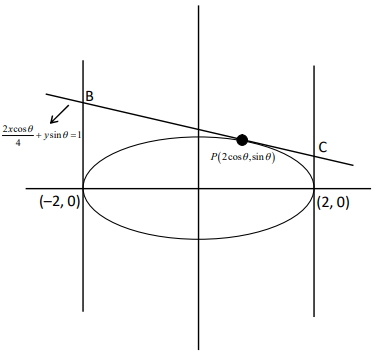
Let the point of tangency be $P(2 \cos \theta, \sin \theta)$.
The equation of the tangent at $P$ is $\frac{x \cos \theta}{2} + y \sin \theta = 1$,or $x \cos \theta + 2y \sin \theta = 2$.
The tangents at the extremities of the major axis are $x = -2$ and $x = 2$.
For $B$,substitute $x = -2$: $-2 \cos \theta + 2y \sin \theta = 2 \Rightarrow y = \frac{1 + \cos \theta}{\sin \theta} = \cot \frac{\theta}{2}$. So,$B = (-2, \cot \frac{\theta}{2})$.
For $C$,substitute $x = 2$: $2 \cos \theta + 2y \sin \theta = 2 \Rightarrow y = \frac{1 - \cos \theta}{\sin \theta} = \tan \frac{\theta}{2}$. So,$C = (2, \tan \frac{\theta}{2})$.
The equation of the circle with $BC$ as diameter is $(x - x_B)(x - x_C) + (y - y_B)(y - y_C) = 0$.
$(x + 2)(x - 2) + (y - \cot \frac{\theta}{2})(y - \tan \frac{\theta}{2}) = 0$
$x^{2} - 4 + y^{2} - y(\tan \frac{\theta}{2} + \cot \frac{\theta}{2}) + \tan \frac{\theta}{2} \cot \frac{\theta}{2} = 0$
$x^{2} + y^{2} - y(\tan \frac{\theta}{2} + \cot \frac{\theta}{2}) - 3 = 0$.
Checking the point $(\sqrt{3}, 0)$: $(\sqrt{3})^{2} + 0^{2} - 0 - 3 = 3 - 3 = 0$. Thus,the circle passes through $(\sqrt{3}, 0)$.
Let the point of tangency be $P(2 \cos \theta, \sin \theta)$.
The equation of the tangent at $P$ is $\frac{x \cos \theta}{2} + y \sin \theta = 1$,or $x \cos \theta + 2y \sin \theta = 2$.
The tangents at the extremities of the major axis are $x = -2$ and $x = 2$.
For $B$,substitute $x = -2$: $-2 \cos \theta + 2y \sin \theta = 2 \Rightarrow y = \frac{1 + \cos \theta}{\sin \theta} = \cot \frac{\theta}{2}$. So,$B = (-2, \cot \frac{\theta}{2})$.
For $C$,substitute $x = 2$: $2 \cos \theta + 2y \sin \theta = 2 \Rightarrow y = \frac{1 - \cos \theta}{\sin \theta} = \tan \frac{\theta}{2}$. So,$C = (2, \tan \frac{\theta}{2})$.
The equation of the circle with $BC$ as diameter is $(x - x_B)(x - x_C) + (y - y_B)(y - y_C) = 0$.
$(x + 2)(x - 2) + (y - \cot \frac{\theta}{2})(y - \tan \frac{\theta}{2}) = 0$
$x^{2} - 4 + y^{2} - y(\tan \frac{\theta}{2} + \cot \frac{\theta}{2}) + \tan \frac{\theta}{2} \cot \frac{\theta}{2} = 0$
$x^{2} + y^{2} - y(\tan \frac{\theta}{2} + \cot \frac{\theta}{2}) - 3 = 0$.
Checking the point $(\sqrt{3}, 0)$: $(\sqrt{3})^{2} + 0^{2} - 0 - 3 = 3 - 3 = 0$. Thus,the circle passes through $(\sqrt{3}, 0)$.
0 likesView Solution
327
MathematicsEasyMCQJEE Main · 2021
The number of real solutions of the equation $x^{2}-|x|-12=0$ is:
A
$3$
B
$1$
C
$2$
D
$4$
Solution
(C) Given the equation $x^{2}-|x|-12=0$.
Since $x^{2} = |x|^{2}$,we can rewrite the equation as $|x|^{2}-|x|-12=0$.
Let $t = |x|$,where $t \geq 0$. The equation becomes $t^{2}-t-12=0$.
Factoring the quadratic equation: $(t-4)(t+3)=0$.
This gives $t=4$ or $t=-3$.
Since $t = |x| \geq 0$,we reject $t=-3$.
Thus,$|x|=4$,which implies $x=4$ or $x=-4$.
Therefore,there are $2$ real solutions.
Since $x^{2} = |x|^{2}$,we can rewrite the equation as $|x|^{2}-|x|-12=0$.
Let $t = |x|$,where $t \geq 0$. The equation becomes $t^{2}-t-12=0$.
Factoring the quadratic equation: $(t-4)(t+3)=0$.
This gives $t=4$ or $t=-3$.
Since $t = |x| \geq 0$,we reject $t=-3$.
Thus,$|x|=4$,which implies $x=4$ or $x=-4$.
Therefore,there are $2$ real solutions.
0 likesView Solution
328
MathematicsMediumMCQJEE Main · 2021
The sum of all those terms which are rational numbers in the expansion of $(2^{1/3} + 3^{1/4})^{12}$ is:
A
$27$
B
$89$
C
$35$
D
$43$
Solution
(D) The general term of the expansion $(2^{1/3} + 3^{1/4})^{12}$ is given by $T_{r+1} = ^{12}C_{r} (2^{1/3})^{12-r} (3^{1/4})^{r}$,where $0 \le r \le 12$.
For the term to be rational,the exponents of $2$ and $3$ must be integers.
This implies $\frac{12-r}{3}$ must be an integer,so $r$ must be a multiple of $3$ $(r \in \{0, 3, 6, 9, 12\})$.
Also,$\frac{r}{4}$ must be an integer,so $r$ must be a multiple of $4$ $(r \in \{0, 4, 8, 12\})$.
The common values for $r$ are $r = 0$ and $r = 12$.
For $r = 0$: $T_{1} = ^{12}C_{0} (2^{1/3})^{12} (3^{1/4})^{0} = 1 \times 2^{4} \times 1 = 16$.
For $r = 12$: $T_{13} = ^{12}C_{12} (2^{1/3})^{0} (3^{1/4})^{12} = 1 \times 1 \times 3^{3} = 27$.
The sum of these rational terms is $16 + 27 = 43$.
For the term to be rational,the exponents of $2$ and $3$ must be integers.
This implies $\frac{12-r}{3}$ must be an integer,so $r$ must be a multiple of $3$ $(r \in \{0, 3, 6, 9, 12\})$.
Also,$\frac{r}{4}$ must be an integer,so $r$ must be a multiple of $4$ $(r \in \{0, 4, 8, 12\})$.
The common values for $r$ are $r = 0$ and $r = 12$.
For $r = 0$: $T_{1} = ^{12}C_{0} (2^{1/3})^{12} (3^{1/4})^{0} = 1 \times 2^{4} \times 1 = 16$.
For $r = 12$: $T_{13} = ^{12}C_{12} (2^{1/3})^{0} (3^{1/4})^{12} = 1 \times 1 \times 3^{3} = 27$.
The sum of these rational terms is $16 + 27 = 43$.
0 likesView Solution
329
MathematicsDifficultMCQJEE Main · 2021
If the greatest value of the term independent of $x$ in the expansion of $(x \sin \alpha + a \frac{\cos \alpha}{x})^{10}$ is $\frac{10!}{(5!)^2}$,then the value of $a$ is equal to:
A
$2$
B
$-1$
C
$1$
D
$-2$
Solution
(A) The general term in the expansion of $(x \sin \alpha + a \frac{\cos \alpha}{x})^{10}$ is given by $T_{r+1} = {}^{10}C_r (x \sin \alpha)^{10-r} (a \frac{\cos \alpha}{x})^r$.
For the term to be independent of $x$,the power of $x$ must be zero,so $10-r-r = 0$,which implies $r = 5$.
The term independent of $x$ is $T_6 = {}^{10}C_5 (\sin \alpha)^5 (a \cos \alpha)^5 = {}^{10}C_5 a^5 (\sin \alpha \cos \alpha)^5$.
Using the identity $\sin \alpha \cos \alpha = \frac{\sin 2\alpha}{2}$,we get $T_6 = {}^{10}C_5 a^5 (\frac{\sin 2\alpha}{2})^5 = {}^{10}C_5 \frac{a^5}{2^5} (\sin 2\alpha)^5$.
The greatest value occurs when $\sin 2\alpha = 1$,so the greatest value is ${}^{10}C_5 \frac{a^5}{32}$.
Given that the greatest value is $\frac{10!}{(5!)^2} = {}^{10}C_5$,we have ${}^{10}C_5 \frac{a^5}{32} = {}^{10}C_5$.
Thus,$\frac{a^5}{32} = 1$,which means $a^5 = 32$,so $a = 2$.
For the term to be independent of $x$,the power of $x$ must be zero,so $10-r-r = 0$,which implies $r = 5$.
The term independent of $x$ is $T_6 = {}^{10}C_5 (\sin \alpha)^5 (a \cos \alpha)^5 = {}^{10}C_5 a^5 (\sin \alpha \cos \alpha)^5$.
Using the identity $\sin \alpha \cos \alpha = \frac{\sin 2\alpha}{2}$,we get $T_6 = {}^{10}C_5 a^5 (\frac{\sin 2\alpha}{2})^5 = {}^{10}C_5 \frac{a^5}{2^5} (\sin 2\alpha)^5$.
The greatest value occurs when $\sin 2\alpha = 1$,so the greatest value is ${}^{10}C_5 \frac{a^5}{32}$.
Given that the greatest value is $\frac{10!}{(5!)^2} = {}^{10}C_5$,we have ${}^{10}C_5 \frac{a^5}{32} = {}^{10}C_5$.
Thus,$\frac{a^5}{32} = 1$,which means $a^5 = 32$,so $a = 2$.
0 likesView Solution
330
MathematicsDifficultMCQJEE Main · 2021
The value of $\cot \frac{\pi}{24}$ is :
A
$\sqrt{2}-\sqrt{3}-2+\sqrt{6}$
B
$3 \sqrt{2}-\sqrt{3}-\sqrt{6}$
C
$\sqrt{2}-\sqrt{3}+2-\sqrt{6}$
D
$\sqrt{2}+\sqrt{3}+2+\sqrt{6}$
Solution
(D) We know that $\cot \theta = \frac{1+\cos 2\theta}{\sin 2\theta}$.
For $\theta = \frac{\pi}{24}$,we have $2\theta = \frac{\pi}{12}$.
We know that $\cos \frac{\pi}{12} = \cos(15^\circ) = \frac{\sqrt{6}+\sqrt{2}}{4}$ and $\sin \frac{\pi}{12} = \sin(15^\circ) = \frac{\sqrt{6}-\sqrt{2}}{4}$.
Using the identity $\cot \theta = \frac{1+\cos 2\theta}{\sin 2\theta}$:
$\cot \frac{\pi}{24} = \frac{1 + \cos \frac{\pi}{12}}{\sin \frac{\pi}{12}} = \frac{1 + \frac{\sqrt{6}+\sqrt{2}}{4}}{\frac{\sqrt{6}-\sqrt{2}}{4}} = \frac{4+\sqrt{6}+\sqrt{2}}{\sqrt{6}-\sqrt{2}}$.
Rationalizing the denominator:
$= \frac{(4+\sqrt{6}+\sqrt{2})(\sqrt{6}+\sqrt{2})}{(\sqrt{6}-\sqrt{2})(\sqrt{6}+\sqrt{2})} = \frac{4\sqrt{6}+4\sqrt{2}+6+\sqrt{12}+\sqrt{12}+2}{6-2} = \frac{4\sqrt{6}+4\sqrt{2}+8+2\sqrt{3}}{4} = \sqrt{6}+\sqrt{2}+2+\frac{\sqrt{3}}{2}$.
Wait,re-evaluating the standard identity $\cot \frac{\theta}{2} = \csc \theta + \cot \theta$:
$\cot \frac{\pi}{24} = \csc \frac{\pi}{12} + \cot \frac{\pi}{12} = \frac{4}{\sqrt{6}-\sqrt{2}} + \frac{\sqrt{6}+\sqrt{2}}{\sqrt{6}-\sqrt{2}} = \frac{4+\sqrt{6}+\sqrt{2}}{\sqrt{6}-\sqrt{2}} = \sqrt{6}+\sqrt{2}+2+\sqrt{3}$.
For $\theta = \frac{\pi}{24}$,we have $2\theta = \frac{\pi}{12}$.
We know that $\cos \frac{\pi}{12} = \cos(15^\circ) = \frac{\sqrt{6}+\sqrt{2}}{4}$ and $\sin \frac{\pi}{12} = \sin(15^\circ) = \frac{\sqrt{6}-\sqrt{2}}{4}$.
Using the identity $\cot \theta = \frac{1+\cos 2\theta}{\sin 2\theta}$:
$\cot \frac{\pi}{24} = \frac{1 + \cos \frac{\pi}{12}}{\sin \frac{\pi}{12}} = \frac{1 + \frac{\sqrt{6}+\sqrt{2}}{4}}{\frac{\sqrt{6}-\sqrt{2}}{4}} = \frac{4+\sqrt{6}+\sqrt{2}}{\sqrt{6}-\sqrt{2}}$.
Rationalizing the denominator:
$= \frac{(4+\sqrt{6}+\sqrt{2})(\sqrt{6}+\sqrt{2})}{(\sqrt{6}-\sqrt{2})(\sqrt{6}+\sqrt{2})} = \frac{4\sqrt{6}+4\sqrt{2}+6+\sqrt{12}+\sqrt{12}+2}{6-2} = \frac{4\sqrt{6}+4\sqrt{2}+8+2\sqrt{3}}{4} = \sqrt{6}+\sqrt{2}+2+\frac{\sqrt{3}}{2}$.
Wait,re-evaluating the standard identity $\cot \frac{\theta}{2} = \csc \theta + \cot \theta$:
$\cot \frac{\pi}{24} = \csc \frac{\pi}{12} + \cot \frac{\pi}{12} = \frac{4}{\sqrt{6}-\sqrt{2}} + \frac{\sqrt{6}+\sqrt{2}}{\sqrt{6}-\sqrt{2}} = \frac{4+\sqrt{6}+\sqrt{2}}{\sqrt{6}-\sqrt{2}} = \sqrt{6}+\sqrt{2}+2+\sqrt{3}$.
0 likesView Solution
331
MathematicsDifficultMCQJEE Main · 2021
The lowest integer which is greater than $\left(1+\frac{1}{10^{100}}\right)^{10^{100}}$ is $.....$
A
$3$
B
$4$
C
$2$
D
$1$
Solution
(A) Let $P = \left(1 + \frac{1}{x}\right)^x$ where $x = 10^{100}$.
Using the binomial expansion for $(1 + \frac{1}{x})^x$:
$P = 1 + x \cdot \frac{1}{x} + \frac{x(x-1)}{2!} \cdot \frac{1}{x^2} + \frac{x(x-1)(x-2)}{3!} \cdot \frac{1}{x^3} + \dots$
$P = 1 + 1 + \frac{1}{2!}(1 - \frac{1}{x}) + \frac{1}{3!}(1 - \frac{1}{x})(1 - \frac{2}{x}) + \dots$
Since $x = 10^{100}$ is very large,each term $(1 - \frac{k}{x})$ is slightly less than $1$.
Thus,$P < 1 + 1 + \frac{1}{2!} + \frac{1}{3!} + \dots = e$.
We know that $e \approx 2.718$.
Also,$P > 1 + 1 = 2$.
Therefore,$2 < P < e < 3$.
The lowest integer greater than $P$ is $3$.
Using the binomial expansion for $(1 + \frac{1}{x})^x$:
$P = 1 + x \cdot \frac{1}{x} + \frac{x(x-1)}{2!} \cdot \frac{1}{x^2} + \frac{x(x-1)(x-2)}{3!} \cdot \frac{1}{x^3} + \dots$
$P = 1 + 1 + \frac{1}{2!}(1 - \frac{1}{x}) + \frac{1}{3!}(1 - \frac{1}{x})(1 - \frac{2}{x}) + \dots$
Since $x = 10^{100}$ is very large,each term $(1 - \frac{k}{x})$ is slightly less than $1$.
Thus,$P < 1 + 1 + \frac{1}{2!} + \frac{1}{3!} + \dots = e$.
We know that $e \approx 2.718$.
Also,$P > 1 + 1 = 2$.
Therefore,$2 < P < e < 3$.
The lowest integer greater than $P$ is $3$.
0 likesView Solution
332
MathematicsEasyMCQJEE Main · 2021
If $[x]$ denotes the greatest integer less than or equal to $x$,then $\sum_{n=8}^{100} \left[ \frac{(-1)^{n} n}{2} \right]$ is equal to:
A
$-2$
B
$4$
C
$2$
D
$0$
Solution
(B) Let $S = \sum_{n=8}^{100} \left[ \frac{(-1)^{n} n}{2} \right]$.
Expanding the sum,we get:
$S = \left[ \frac{8}{2} \right] + \left[ \frac{-9}{2} \right] + \left[ \frac{10}{2} \right] + \left[ \frac{-11}{2} \right] + \dots + \left[ \frac{-99}{2} \right] + \left[ \frac{100}{2} \right]$.
Using the property $[x]$,we have:
$S = 4 + [-4.5] + 5 + [-5.5] + 6 + [-6.5] + \dots + [-49.5] + 50$.
$S = 4 + (-5) + 5 + (-6) + 6 + (-7) + \dots + (-50) + 50$.
Notice that the terms cancel out in pairs: $(-5+5) + (-6+6) + \dots + (-50+50) = 0$.
Therefore,$S = 4 + 0 = 4$.
Expanding the sum,we get:
$S = \left[ \frac{8}{2} \right] + \left[ \frac{-9}{2} \right] + \left[ \frac{10}{2} \right] + \left[ \frac{-11}{2} \right] + \dots + \left[ \frac{-99}{2} \right] + \left[ \frac{100}{2} \right]$.
Using the property $[x]$,we have:
$S = 4 + [-4.5] + 5 + [-5.5] + 6 + [-6.5] + \dots + [-49.5] + 50$.
$S = 4 + (-5) + 5 + (-6) + 6 + (-7) + \dots + (-50) + 50$.
Notice that the terms cancel out in pairs: $(-5+5) + (-6+6) + \dots + (-50+50) = 0$.
Therefore,$S = 4 + 0 = 4$.
0 likesView Solution
333
MathematicsMediumMCQJEE Main · 2021
Let the equation of the pair of lines,$y=px$ and $y=qx$,be written as $(y-px)(y-qx)=0$. Then the equation of the pair of angle bisectors of the lines $x^{2}-4xy-5y^{2}=0$ is:
A
$x^{2}-3xy-y^{2}=0$
B
$x^{2}+3xy-y^{2}=0$
C
$x^{2}-3xy+y^{2}=0$
D
$x^{2}+4xy-y^{2}=0$
Solution
(B) The equation of the pair of angle bisectors of the homogeneous equation $ax^{2}+2hxy+by^{2}=0$ is given by the formula $\frac{x^{2}-y^{2}}{a-b} = \frac{xy}{h}$.
For the given equation $x^{2}-4xy-5y^{2}=0$,we have $a=1$,$2h=-4$ (so $h=-2$),and $b=-5$.
Substituting these values into the formula:
$\frac{x^{2}-y^{2}}{1-(-5)} = \frac{xy}{-2}$
$\frac{x^{2}-y^{2}}{6} = \frac{xy}{-2}$
Multiplying both sides by $6$:
$x^{2}-y^{2} = -3xy$
Rearranging the terms,we get:
$x^{2}+3xy-y^{2}=0$.
For the given equation $x^{2}-4xy-5y^{2}=0$,we have $a=1$,$2h=-4$ (so $h=-2$),and $b=-5$.
Substituting these values into the formula:
$\frac{x^{2}-y^{2}}{1-(-5)} = \frac{xy}{-2}$
$\frac{x^{2}-y^{2}}{6} = \frac{xy}{-2}$
Multiplying both sides by $6$:
$x^{2}-y^{2} = -3xy$
Rearranging the terms,we get:
$x^{2}+3xy-y^{2}=0$.
0 likesView Solution
334
MathematicsDifficultMCQJEE Main · 2021
If $a+b+c=1$,$ab+bc+ca=2$ and $abc=3$,then the value of $a^{4}+b^{4}+c^{4}$ is equal to $...$
A
$15$
B
$13$
C
$17$
D
$21$
Solution
(B) Given $a+b+c=1$,$ab+bc+ca=2$,and $abc=3$.
First,find $a^{2}+b^{2}+c^{2}$ using the identity $(a+b+c)^{2} = a^{2}+b^{2}+c^{2} + 2(ab+bc+ca)$:
$1^{2} = a^{2}+b^{2}+c^{2} + 2(2)$
$a^{2}+b^{2}+c^{2} = 1 - 4 = -3$.
Next,find $a^{2}b^{2}+b^{2}c^{2}+c^{2}a^{2}$ using the identity $(ab+bc+ca)^{2} = a^{2}b^{2}+b^{2}c^{2}+c^{2}a^{2} + 2abc(a+b+c)$:
$2^{2} = a^{2}b^{2}+b^{2}c^{2}+c^{2}a^{2} + 2(3)(1)$
$4 = a^{2}b^{2}+b^{2}c^{2}+c^{2}a^{2} + 6$
$a^{2}b^{2}+b^{2}c^{2}+c^{2}a^{2} = 4 - 6 = -2$.
Finally,use the identity $a^{4}+b^{4}+c^{4} = (a^{2}+b^{2}+c^{2})^{2} - 2(a^{2}b^{2}+b^{2}c^{2}+c^{2}a^{2})$:
$a^{4}+b^{4}+c^{4} = (-3)^{2} - 2(-2)$
$a^{4}+b^{4}+c^{4} = 9 + 4 = 13$.
First,find $a^{2}+b^{2}+c^{2}$ using the identity $(a+b+c)^{2} = a^{2}+b^{2}+c^{2} + 2(ab+bc+ca)$:
$1^{2} = a^{2}+b^{2}+c^{2} + 2(2)$
$a^{2}+b^{2}+c^{2} = 1 - 4 = -3$.
Next,find $a^{2}b^{2}+b^{2}c^{2}+c^{2}a^{2}$ using the identity $(ab+bc+ca)^{2} = a^{2}b^{2}+b^{2}c^{2}+c^{2}a^{2} + 2abc(a+b+c)$:
$2^{2} = a^{2}b^{2}+b^{2}c^{2}+c^{2}a^{2} + 2(3)(1)$
$4 = a^{2}b^{2}+b^{2}c^{2}+c^{2}a^{2} + 6$
$a^{2}b^{2}+b^{2}c^{2}+c^{2}a^{2} = 4 - 6 = -2$.
Finally,use the identity $a^{4}+b^{4}+c^{4} = (a^{2}+b^{2}+c^{2})^{2} - 2(a^{2}b^{2}+b^{2}c^{2}+c^{2}a^{2})$:
$a^{4}+b^{4}+c^{4} = (-3)^{2} - 2(-2)$
$a^{4}+b^{4}+c^{4} = 9 + 4 = 13$.
0 likesView Solution
335
MathematicsMediumMCQJEE Main · 2021
If the coefficients of $x^{7}$ and $x^{8}$ in the expansion of $(2+\frac{x}{3})^{n}$ are equal,then the value of $n$ is equal to $.....$
A
$44$
B
$55$
C
$48$
D
$61$
Solution
(B) The general term in the expansion of $(2+\frac{x}{3})^{n}$ is given by $T_{r+1} = {}^{n}C_{r} (2)^{n-r} (\frac{x}{3})^{r} = {}^{n}C_{r} (2)^{n-r} (\frac{1}{3})^{r} x^{r}$.
The coefficient of $x^{7}$ is ${}^{n}C_{7} (2)^{n-7} (\frac{1}{3})^{7}$.
The coefficient of $x^{8}$ is ${}^{n}C_{8} (2)^{n-8} (\frac{1}{3})^{8}$.
Given that these coefficients are equal:
${}^{n}C_{7} (2)^{n-7} (\frac{1}{3})^{7} = {}^{n}C_{8} (2)^{n-8} (\frac{1}{3})^{8}$.
Dividing both sides by ${}^{n}C_{7} (2)^{n-8} (\frac{1}{3})^{7}$,we get:
$2 = \frac{{}^{n}C_{8}}{{}^{n}C_{7}} \cdot \frac{1}{3}$.
Using the property $\frac{{}^{n}C_{r}}{{}^{n}C_{r-1}} = \frac{n-r+1}{r}$,we have $\frac{{}^{n}C_{8}}{{}^{n}C_{7}} = \frac{n-8+1}{8} = \frac{n-7}{8}$.
Substituting this into the equation:
$2 = \frac{n-7}{8} \cdot \frac{1}{3} = \frac{n-7}{24}$.
$n-7 = 48 \Rightarrow n = 55$.
The coefficient of $x^{7}$ is ${}^{n}C_{7} (2)^{n-7} (\frac{1}{3})^{7}$.
The coefficient of $x^{8}$ is ${}^{n}C_{8} (2)^{n-8} (\frac{1}{3})^{8}$.
Given that these coefficients are equal:
${}^{n}C_{7} (2)^{n-7} (\frac{1}{3})^{7} = {}^{n}C_{8} (2)^{n-8} (\frac{1}{3})^{8}$.
Dividing both sides by ${}^{n}C_{7} (2)^{n-8} (\frac{1}{3})^{7}$,we get:
$2 = \frac{{}^{n}C_{8}}{{}^{n}C_{7}} \cdot \frac{1}{3}$.
Using the property $\frac{{}^{n}C_{r}}{{}^{n}C_{r-1}} = \frac{n-r+1}{r}$,we have $\frac{{}^{n}C_{8}}{{}^{n}C_{7}} = \frac{n-8+1}{8} = \frac{n-7}{8}$.
Substituting this into the equation:
$2 = \frac{n-7}{8} \cdot \frac{1}{3} = \frac{n-7}{24}$.
$n-7 = 48 \Rightarrow n = 55$.
0 likesView Solution
336
MathematicsDifficultMCQJEE Main · 2021
The equation of a circle is $\operatorname{Re}(z^{2})+2(\operatorname{Im}(z))^{2}+2 \operatorname{Re}(z)=0$,where $z=x+iy$. $A$ line which passes through the center of the given circle and the vertex of the parabola $x^{2}-6x-y+13=0$ has a $y$-intercept equal to $.....$
A
$1$
B
$2$
C
$3$
D
$4$
Solution
(A) Given the equation of the circle: $\operatorname{Re}(z^{2})+2(\operatorname{Im}(z))^{2}+2 \operatorname{Re}(z)=0$.
Since $z=x+iy$,we have $z^{2}=x^{2}-y^{2}+2ixy$,so $\operatorname{Re}(z^{2})=x^{2}-y^{2}$ and $\operatorname{Im}(z)=y$.
The equation becomes $(x^{2}-y^{2})+2y^{2}+2x=0$,which simplifies to $x^{2}+y^{2}+2x=0$.
The center of this circle is $(-1, 0)$.
Given the parabola: $x^{2}-6x-y+13=0$.
Rewriting as $(x-3)^{2}-9-y+13=0$,we get $(x-3)^{2}=y-4$.
The vertex of the parabola is $(3, 4)$.
The line passes through $(-1, 0)$ and $(3, 4)$.
The slope $m = \frac{4-0}{3-(-1)} = \frac{4}{4} = 1$.
The equation of the line is $y-0=1(x+1)$,which is $y=x+1$.
The $y$-intercept is the value of $y$ when $x=0$,which is $1$.
Since $z=x+iy$,we have $z^{2}=x^{2}-y^{2}+2ixy$,so $\operatorname{Re}(z^{2})=x^{2}-y^{2}$ and $\operatorname{Im}(z)=y$.
The equation becomes $(x^{2}-y^{2})+2y^{2}+2x=0$,which simplifies to $x^{2}+y^{2}+2x=0$.
The center of this circle is $(-1, 0)$.
Given the parabola: $x^{2}-6x-y+13=0$.
Rewriting as $(x-3)^{2}-9-y+13=0$,we get $(x-3)^{2}=y-4$.
The vertex of the parabola is $(3, 4)$.
The line passes through $(-1, 0)$ and $(3, 4)$.
The slope $m = \frac{4-0}{3-(-1)} = \frac{4}{4} = 1$.
The equation of the line is $y-0=1(x+1)$,which is $y=x+1$.
The $y$-intercept is the value of $y$ when $x=0$,which is $1$.
0 likesView Solution
337
MathematicsDifficultMCQJEE Main · 2021
Let $n \in N$ and $[x]$ denote the greatest integer less than or equal to $x$. If the sum of $(n+1)$ terms ${}^{n}C_{0}, 3 \cdot {}^{n}C_{1}, 5 \cdot {}^{n}C_{2}, 7 \cdot {}^{n}C_{3}, \ldots$ is equal to $2^{100} \cdot 101$,then $2\left[\frac{n-1}{2}\right]$ is equal to $....$
A
$40$
B
$11$
C
$45$
D
$98$
Solution
(D) The general term of the series is $T_{r+1} = (2r+1) \cdot {}^{n}C_{r}$ for $r = 0, 1, 2, \ldots, n$.
The sum $S$ is given by $S = \sum_{r=0}^{n} (2r+1) \cdot {}^{n}C_{r}$.
$S = 2 \sum_{r=0}^{n} r \cdot {}^{n}C_{r} + \sum_{r=0}^{n} {}^{n}C_{r}$.
Using the identities $\sum r \cdot {}^{n}C_{r} = n \cdot 2^{n-1}$ and $\sum {}^{n}C_{r} = 2^{n}$,we get:
$S = 2(n \cdot 2^{n-1}) + 2^{n} = n \cdot 2^{n} + 2^{n} = 2^{n}(n+1)$.
Given $S = 2^{100} \cdot 101$,we have $2^{n}(n+1) = 2^{100} \cdot 101$,which implies $n = 100$.
Now,calculate $2\left[\frac{n-1}{2}\right] = 2\left[\frac{100-1}{2}\right] = 2\left[\frac{99}{2}\right] = 2[49.5] = 2 \cdot 49 = 98$.
The sum $S$ is given by $S = \sum_{r=0}^{n} (2r+1) \cdot {}^{n}C_{r}$.
$S = 2 \sum_{r=0}^{n} r \cdot {}^{n}C_{r} + \sum_{r=0}^{n} {}^{n}C_{r}$.
Using the identities $\sum r \cdot {}^{n}C_{r} = n \cdot 2^{n-1}$ and $\sum {}^{n}C_{r} = 2^{n}$,we get:
$S = 2(n \cdot 2^{n-1}) + 2^{n} = n \cdot 2^{n} + 2^{n} = 2^{n}(n+1)$.
Given $S = 2^{100} \cdot 101$,we have $2^{n}(n+1) = 2^{100} \cdot 101$,which implies $n = 100$.
Now,calculate $2\left[\frac{n-1}{2}\right] = 2\left[\frac{100-1}{2}\right] = 2\left[\frac{99}{2}\right] = 2[49.5] = 2 \cdot 49 = 98$.
0 likesView Solution
338
MathematicsEasyMCQJEE Main · 2021
Let $\alpha, \beta$ be two roots of the equation $x^{2}+(20)^{\frac{1}{4}} x+(5)^{\frac{1}{2}}=0$. Then $\alpha^{8}+\beta^{8}$ is equal to:
A
$10$
B
$50$
C
$160$
D
$100$
Solution
(B) Given the equation $x^{2}+(20)^{\frac{1}{4}} x+(5)^{\frac{1}{2}}=0$.
We can rewrite this as $x^{2}+\sqrt{5} = -(20)^{\frac{1}{4}} x$.
Squaring both sides,we get $(x^{2}+\sqrt{5})^{2} = ((20)^{\frac{1}{4}} x)^{2}$.
$x^{4} + 2\sqrt{5}x^{2} + 5 = \sqrt{20}x^{2}$.
Since $\sqrt{20} = 2\sqrt{5}$,the equation becomes $x^{4} + 2\sqrt{5}x^{2} + 5 = 2\sqrt{5}x^{2}$.
This simplifies to $x^{4} + 5 = 0$,or $x^{4} = -5$.
Squaring again,$x^{8} = (-5)^{2} = 25$.
Since $\alpha$ and $\beta$ are roots of the original equation,they satisfy $x^{4} = -5$,and thus $\alpha^{8} = 25$ and $\beta^{8} = 25$.
Therefore,$\alpha^{8} + \beta^{8} = 25 + 25 = 50$.
We can rewrite this as $x^{2}+\sqrt{5} = -(20)^{\frac{1}{4}} x$.
Squaring both sides,we get $(x^{2}+\sqrt{5})^{2} = ((20)^{\frac{1}{4}} x)^{2}$.
$x^{4} + 2\sqrt{5}x^{2} + 5 = \sqrt{20}x^{2}$.
Since $\sqrt{20} = 2\sqrt{5}$,the equation becomes $x^{4} + 2\sqrt{5}x^{2} + 5 = 2\sqrt{5}x^{2}$.
This simplifies to $x^{4} + 5 = 0$,or $x^{4} = -5$.
Squaring again,$x^{8} = (-5)^{2} = 25$.
Since $\alpha$ and $\beta$ are roots of the original equation,they satisfy $x^{4} = -5$,and thus $\alpha^{8} = 25$ and $\beta^{8} = 25$.
Therefore,$\alpha^{8} + \beta^{8} = 25 + 25 = 50$.
0 likesView Solution
339
MathematicsDifficultMCQJEE Main · 2021
Let $P$ and $Q$ be two distinct points on a circle which has center at $C(2,3)$ and which passes through the origin $O(0,0)$. If $OC$ is perpendicular to both the line segments $CP$ and $CQ$,then the set $\{P, Q\}$ is equal to:
A
$\{(-1,5), (5,1)\}$
B
$\{(2+2\sqrt{2}, 3-\sqrt{5}), (2-2\sqrt{2}, 3+\sqrt{5})\}$
C
$\{(2+2\sqrt{2}, 3+\sqrt{5}), (2-2\sqrt{2}, 3-\sqrt{5})\}$
D
$\{(4,0), (0,6)\}$
Solution
(A) The center of the circle is $C(2,3)$ and it passes through the origin $O(0,0)$. The radius $r$ is the distance $OC = \sqrt{2^2 + 3^2} = \sqrt{13}$.
The slope of $OC$ is $m_{OC} = \frac{3-0}{2-0} = \frac{3}{2}$.
Since $CP \perp OC$ and $CQ \perp OC$,the line $PQ$ is perpendicular to $OC$. The slope of line $PQ$ is $m = -\frac{1}{m_{OC}} = -\frac{2}{3}$.
Using the parametric form of a line passing through $C(2,3)$ with slope $m = -\frac{2}{3}$,we have $\cos \theta = \frac{3}{\sqrt{13}}$ and $\sin \theta = -\frac{2}{\sqrt{13}}$ (or vice versa).
The coordinates of $P$ and $Q$ are $(x, y) = (2 \pm r \cos \theta, 3 \pm r \sin \theta)$.
Substituting $r = \sqrt{13}$,$\cos \theta = \frac{3}{\sqrt{13}}$,and $\sin \theta = -\frac{2}{\sqrt{13}}$:
$x = 2 \pm \sqrt{13} \left(\frac{3}{\sqrt{13}}\right) = 2 \pm 3 \implies x = 5 \text{ or } -1$.
$y = 3 \pm \sqrt{13} \left(-\frac{2}{\sqrt{13}}\right) = 3 \mp 2 \implies y = 1 \text{ or } 5$.
Thus,the points are $(5, 1)$ and $(-1, 5)$.
The slope of $OC$ is $m_{OC} = \frac{3-0}{2-0} = \frac{3}{2}$.
Since $CP \perp OC$ and $CQ \perp OC$,the line $PQ$ is perpendicular to $OC$. The slope of line $PQ$ is $m = -\frac{1}{m_{OC}} = -\frac{2}{3}$.
Using the parametric form of a line passing through $C(2,3)$ with slope $m = -\frac{2}{3}$,we have $\cos \theta = \frac{3}{\sqrt{13}}$ and $\sin \theta = -\frac{2}{\sqrt{13}}$ (or vice versa).
The coordinates of $P$ and $Q$ are $(x, y) = (2 \pm r \cos \theta, 3 \pm r \sin \theta)$.
Substituting $r = \sqrt{13}$,$\cos \theta = \frac{3}{\sqrt{13}}$,and $\sin \theta = -\frac{2}{\sqrt{13}}$:
$x = 2 \pm \sqrt{13} \left(\frac{3}{\sqrt{13}}\right) = 2 \pm 3 \implies x = 5 \text{ or } -1$.
$y = 3 \pm \sqrt{13} \left(-\frac{2}{\sqrt{13}}\right) = 3 \mp 2 \implies y = 1 \text{ or } 5$.
Thus,the points are $(5, 1)$ and $(-1, 5)$.
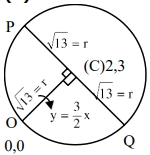
0 likesView Solution
340
MathematicsEasyMCQJEE Main · 2021
The compound statement $(P \vee Q) \wedge (\sim P) \Rightarrow Q$ is equivalent to:
A
$P \vee Q$
B
$\sim(P \Rightarrow Q) \Leftrightarrow P \wedge \sim Q$
C
$P \wedge \sim Q$
D
$\sim(P \Rightarrow Q)$
Solution
(B) To determine the equivalence,we construct the truth table for the expression $(P \vee Q) \wedge (\sim P) \Rightarrow Q$.
The final column shows that the statement is a tautology (always $T$).
Checking the options,option $B$ is $\sim(P \Rightarrow Q) \Leftrightarrow P \wedge \sim Q$. Since $\sim(P \Rightarrow Q) \equiv P \wedge \sim Q$,the biconditional $\sim(P \Rightarrow Q) \Leftrightarrow P \wedge \sim Q$ is also a tautology.
Thus,the statement is equivalent to option $B$.
| $P$ | $Q$ | $P \vee Q$ | $\sim P$ | $(P \vee Q) \wedge (\sim P)$ | $(P \vee Q) \wedge (\sim P) \Rightarrow Q$ |
| $T$ | $T$ | $T$ | $F$ | $F$ | $T$ |
| $T$ | $F$ | $T$ | $F$ | $F$ | $T$ |
| $F$ | $T$ | $T$ | $T$ | $T$ | $T$ |
| $F$ | $F$ | $F$ | $T$ | $F$ | $T$ |
The final column shows that the statement is a tautology (always $T$).
Checking the options,option $B$ is $\sim(P \Rightarrow Q) \Leftrightarrow P \wedge \sim Q$. Since $\sim(P \Rightarrow Q) \equiv P \wedge \sim Q$,the biconditional $\sim(P \Rightarrow Q) \Leftrightarrow P \wedge \sim Q$ is also a tautology.
Thus,the statement is equivalent to option $B$.
0 likesView Solution
341
MathematicsDifficultMCQJEE Main · 2021
Let $A=\{(x, y) \in R \times R \mid 2 x^{2}+2 y^{2}-2 x-2 y=1\}$,$B=\{(x, y) \in R \times R \mid 4 x^{2}+4 y^{2}-16 y+7=0\}$ and $C=\{(x, y) \in R \times R \mid x^{2}+y^{2}-4 x-2 y+5 \leq r^{2}\}$. Then the minimum value of $|r|$ such that $A \cup B \subseteq C$ is equal to:
A
$\frac{3+\sqrt{10}}{2}$
B
$1+\sqrt{5}$
C
$\frac{2+\sqrt{10}}{2}$
D
$\frac{3+2 \sqrt{5}}{2}$
Solution
(D) The set $A$ represents a circle $S_1: x^2 + y^2 - x - y - \frac{1}{2} = 0$. Its center $C_1 = (\frac{1}{2}, \frac{1}{2})$ and radius $r_1 = \sqrt{(\frac{1}{2})^2 + (\frac{1}{2})^2 + \frac{1}{2}} = \sqrt{\frac{1}{4} + \frac{1}{4} + \frac{1}{2}} = 1$.
The set $B$ represents a circle $S_2: x^2 + y^2 - 4y + \frac{7}{4} = 0$. Its center $C_2 = (0, 2)$ and radius $r_2 = \sqrt{0^2 + 2^2 - \frac{7}{4}} = \sqrt{4 - \frac{7}{4}} = \sqrt{\frac{9}{4}} = \frac{3}{2}$.
The set $C$ represents a disk $S_3: (x-2)^2 + (y-1)^2 \leq r^2$. Its center $C_3 = (2, 1)$ and radius $R = |r|$.
For $A \subseteq C$,the distance between centers $C_1 C_3 + r_1 \leq R$.
$C_1 C_3 = \sqrt{(2 - \frac{1}{2})^2 + (1 - \frac{1}{2})^2} = \sqrt{(\frac{3}{2})^2 + (\frac{1}{2})^2} = \sqrt{\frac{9}{4} + \frac{1}{4}} = \sqrt{\frac{10}{4}} = \frac{\sqrt{10}}{2}$.
So,$R \geq \frac{\sqrt{10}}{2} + 1 = \frac{2 + \sqrt{10}}{2}$.
For $B \subseteq C$,the distance between centers $C_2 C_3 + r_2 \leq R$.
$C_2 C_3 = \sqrt{(2 - 0)^2 + (1 - 2)^2} = \sqrt{2^2 + (-1)^2} = \sqrt{4 + 1} = \sqrt{5}$.
So,$R \geq \sqrt{5} + \frac{3}{2} = \frac{3 + 2\sqrt{5}}{2}$.
Since $A \cup B \subseteq C$,$R$ must satisfy both conditions. Thus,$R \geq \max(\frac{2 + \sqrt{10}}{2}, \frac{3 + 2\sqrt{5}}{2})$.
Comparing the two values,$\frac{3 + 2\sqrt{5}}{2} \approx \frac{3 + 4.47}{2} = 3.735$ and $\frac{2 + \sqrt{10}}{2} \approx \frac{2 + 3.16}{2} = 2.58$.
Therefore,the minimum value is $\frac{3 + 2\sqrt{5}}{2}$.
The set $B$ represents a circle $S_2: x^2 + y^2 - 4y + \frac{7}{4} = 0$. Its center $C_2 = (0, 2)$ and radius $r_2 = \sqrt{0^2 + 2^2 - \frac{7}{4}} = \sqrt{4 - \frac{7}{4}} = \sqrt{\frac{9}{4}} = \frac{3}{2}$.
The set $C$ represents a disk $S_3: (x-2)^2 + (y-1)^2 \leq r^2$. Its center $C_3 = (2, 1)$ and radius $R = |r|$.
For $A \subseteq C$,the distance between centers $C_1 C_3 + r_1 \leq R$.
$C_1 C_3 = \sqrt{(2 - \frac{1}{2})^2 + (1 - \frac{1}{2})^2} = \sqrt{(\frac{3}{2})^2 + (\frac{1}{2})^2} = \sqrt{\frac{9}{4} + \frac{1}{4}} = \sqrt{\frac{10}{4}} = \frac{\sqrt{10}}{2}$.
So,$R \geq \frac{\sqrt{10}}{2} + 1 = \frac{2 + \sqrt{10}}{2}$.
For $B \subseteq C$,the distance between centers $C_2 C_3 + r_2 \leq R$.
$C_2 C_3 = \sqrt{(2 - 0)^2 + (1 - 2)^2} = \sqrt{2^2 + (-1)^2} = \sqrt{4 + 1} = \sqrt{5}$.
So,$R \geq \sqrt{5} + \frac{3}{2} = \frac{3 + 2\sqrt{5}}{2}$.
Since $A \cup B \subseteq C$,$R$ must satisfy both conditions. Thus,$R \geq \max(\frac{2 + \sqrt{10}}{2}, \frac{3 + 2\sqrt{5}}{2})$.
Comparing the two values,$\frac{3 + 2\sqrt{5}}{2} \approx \frac{3 + 4.47}{2} = 3.735$ and $\frac{2 + \sqrt{10}}{2} \approx \frac{2 + 3.16}{2} = 2.58$.
Therefore,the minimum value is $\frac{3 + 2\sqrt{5}}{2}$.
0 likesView Solution
342
MathematicsDifficultMCQJEE Main · 2021
The probability that a randomly selected $2$-digit number belongs to the set $\{n \in N : (2^{n}-2) \text{ is a multiple of } 3\}$ is equal to:
A
$\frac{1}{2}$
B
$\frac{1}{3}$
C
$\frac{2}{3}$
D
$\frac{1}{6}$
Solution
(A) The total number of $2$-digit numbers is $90$ (from $10$ to $99$).
We need to check when $(2^{n}-2)$ is a multiple of $3$.
Consider the expression modulo $3$:
$2 \equiv -1 \pmod{3}$
So,$2^{n}-2 \equiv (-1)^{n}-2 \pmod{3}$.
If $n$ is even,$(-1)^{n}-2 = 1-2 = -1 \equiv 2 \pmod{3}$.
If $n$ is odd,$(-1)^{n}-2 = -1-2 = -3 \equiv 0 \pmod{3}$.
Thus,$(2^{n}-2)$ is a multiple of $3$ if and only if $n$ is an odd number.
In the set of $2$-digit numbers ${10, 11, 12, \dots, 99}$,the odd numbers are ${11, 13, 15, \dots, 99}$.
The number of odd integers in this range is $\frac{99-11}{2} + 1 = 44 + 1 = 45$.
The probability is $\frac{\text{Number of favorable outcomes}}{\text{Total number of outcomes}} = \frac{45}{90} = \frac{1}{2}$.
We need to check when $(2^{n}-2)$ is a multiple of $3$.
Consider the expression modulo $3$:
$2 \equiv -1 \pmod{3}$
So,$2^{n}-2 \equiv (-1)^{n}-2 \pmod{3}$.
If $n$ is even,$(-1)^{n}-2 = 1-2 = -1 \equiv 2 \pmod{3}$.
If $n$ is odd,$(-1)^{n}-2 = -1-2 = -3 \equiv 0 \pmod{3}$.
Thus,$(2^{n}-2)$ is a multiple of $3$ if and only if $n$ is an odd number.
In the set of $2$-digit numbers ${10, 11, 12, \dots, 99}$,the odd numbers are ${11, 13, 15, \dots, 99}$.
The number of odd integers in this range is $\frac{99-11}{2} + 1 = 44 + 1 = 45$.
The probability is $\frac{\text{Number of favorable outcomes}}{\text{Total number of outcomes}} = \frac{45}{90} = \frac{1}{2}$.
0 likesView Solution
343
MathematicsMediumMCQJEE Main · 2021
If the mean and variance of the following data: $6, 10, 7, 13, a, 12, b, 12$ are $9$ and $\frac{37}{4}$ respectively,then $(a-b)^{2}$ is equal to:
A
$12$
B
$24$
C
$16$
D
$32$
Solution
(C) Given data: $6, 10, 7, 13, a, 12, b, 12$. Total number of observations $n = 8$.
Mean $\bar{x} = \frac{6+10+7+13+a+12+b+12}{8} = 9$.
$60 + a + b = 72 \implies a + b = 12$ $(1)$.
Variance $\sigma^{2} = \frac{\sum x_{i}^{2}}{n} - (\bar{x})^{2} = \frac{37}{4}$.
$\sum x_{i}^{2} = 6^{2} + 10^{2} + 7^{2} + 13^{2} + a^{2} + 12^{2} + b^{2} + 12^{2} = 36 + 100 + 49 + 169 + a^{2} + 144 + b^{2} + 144 = a^{2} + b^{2} + 642$.
$\frac{a^{2} + b^{2} + 642}{8} - (9)^{2} = \frac{37}{4}$.
$\frac{a^{2} + b^{2} + 642}{8} - 81 = \frac{37}{4}$.
$\frac{a^{2} + b^{2} + 642}{8} = \frac{37}{4} + 81 = \frac{37 + 324}{4} = \frac{361}{4}$.
$a^{2} + b^{2} + 642 = 2 \times 361 = 722$.
$a^{2} + b^{2} = 722 - 642 = 80$ $(2)$.
We know that $(a-b)^{2} = (a+b)^{2} - 4ab$.
Also,$(a+b)^{2} = a^{2} + b^{2} + 2ab \implies 12^{2} = 80 + 2ab \implies 144 - 80 = 2ab \implies 2ab = 64$.
Therefore,$(a-b)^{2} = a^{2} + b^{2} - 2ab = 80 - 64 = 16$.
Mean $\bar{x} = \frac{6+10+7+13+a+12+b+12}{8} = 9$.
$60 + a + b = 72 \implies a + b = 12$ $(1)$.
Variance $\sigma^{2} = \frac{\sum x_{i}^{2}}{n} - (\bar{x})^{2} = \frac{37}{4}$.
$\sum x_{i}^{2} = 6^{2} + 10^{2} + 7^{2} + 13^{2} + a^{2} + 12^{2} + b^{2} + 12^{2} = 36 + 100 + 49 + 169 + a^{2} + 144 + b^{2} + 144 = a^{2} + b^{2} + 642$.
$\frac{a^{2} + b^{2} + 642}{8} - (9)^{2} = \frac{37}{4}$.
$\frac{a^{2} + b^{2} + 642}{8} - 81 = \frac{37}{4}$.
$\frac{a^{2} + b^{2} + 642}{8} = \frac{37}{4} + 81 = \frac{37 + 324}{4} = \frac{361}{4}$.
$a^{2} + b^{2} + 642 = 2 \times 361 = 722$.
$a^{2} + b^{2} = 722 - 642 = 80$ $(2)$.
We know that $(a-b)^{2} = (a+b)^{2} - 4ab$.
Also,$(a+b)^{2} = a^{2} + b^{2} + 2ab \implies 12^{2} = 80 + 2ab \implies 144 - 80 = 2ab \implies 2ab = 64$.
Therefore,$(a-b)^{2} = a^{2} + b^{2} - 2ab = 80 - 64 = 16$.
0 likesView Solution
344
MathematicsDifficultMCQJEE Main · 2021
$A$ ray of light passing through $(2, 1)$ is reflected at a point $P$ on the $y$-axis and then passes through the point $(5, 3)$. If this reflected ray is the directrix of an ellipse with eccentricity $e = \frac{1}{3}$ and the distance of the nearer focus from this directrix is $\frac{8}{\sqrt{53}}$,then the equation of the other directrix can be:
A
$2x - 7y - 39 = 0$ or $2x - 7y - 7 = 0$
B
$11x + 7y + 8 = 0$ or $11x + 7y - 15 = 0$
C
$2x - 7y + 29 = 0$ or $2x - 7y - 7 = 0$
D
$11x - 7y - 8 = 0$ or $11x + 7y + 15 = 0$
Solution
(C) The image of the point $(2, 1)$ with respect to the $y$-axis is $(-2, 1)$.
The reflected ray passes through $(-2, 1)$ and $(5, 3)$.
The slope of the reflected ray is $m = \frac{3 - 1}{5 - (-2)} = \frac{2}{7}$.
The equation of the reflected ray is $y - 3 = \frac{2}{7}(x - 5)$,which simplifies to $2x - 7y + 11 = 0$.
Let the equation of the other directrix be $2x - 7y + \lambda = 0$.
The distance between the two directrices of an ellipse is $\frac{2a}{e}$.
The distance of the focus from the directrix is $\frac{a}{e} - ae = \frac{a(1 - e^2)}{e} = \frac{8}{\sqrt{53}}$.
Given $e = \frac{1}{3}$,we have $\frac{a(1 - 1/9)}{1/3} = 3a \times \frac{8}{9} = \frac{8a}{3} = \frac{8}{\sqrt{53}}$,so $a = \frac{3}{\sqrt{53}}$.
The distance between the two directrices is $\frac{2a}{e} = 2 \times \frac{3}{\sqrt{53}} \times 3 = \frac{18}{\sqrt{53}}$.
The distance between the parallel lines $2x - 7y + 11 = 0$ and $2x - 7y + \lambda = 0$ is $\frac{|\lambda - 11|}{\sqrt{2^2 + (-7)^2}} = \frac{|\lambda - 11|}{\sqrt{53}}$.
Equating the distances: $\frac{|\lambda - 11|}{\sqrt{53}} = \frac{18}{\sqrt{53}}$,so $|\lambda - 11| = 18$.
This gives $\lambda - 11 = 18$ or $\lambda - 11 = -18$,so $\lambda = 29$ or $\lambda = -7$.
The equations are $2x - 7y + 29 = 0$ or $2x - 7y - 7 = 0$.
The reflected ray passes through $(-2, 1)$ and $(5, 3)$.
The slope of the reflected ray is $m = \frac{3 - 1}{5 - (-2)} = \frac{2}{7}$.
The equation of the reflected ray is $y - 3 = \frac{2}{7}(x - 5)$,which simplifies to $2x - 7y + 11 = 0$.
Let the equation of the other directrix be $2x - 7y + \lambda = 0$.
The distance between the two directrices of an ellipse is $\frac{2a}{e}$.
The distance of the focus from the directrix is $\frac{a}{e} - ae = \frac{a(1 - e^2)}{e} = \frac{8}{\sqrt{53}}$.
Given $e = \frac{1}{3}$,we have $\frac{a(1 - 1/9)}{1/3} = 3a \times \frac{8}{9} = \frac{8a}{3} = \frac{8}{\sqrt{53}}$,so $a = \frac{3}{\sqrt{53}}$.
The distance between the two directrices is $\frac{2a}{e} = 2 \times \frac{3}{\sqrt{53}} \times 3 = \frac{18}{\sqrt{53}}$.
The distance between the parallel lines $2x - 7y + 11 = 0$ and $2x - 7y + \lambda = 0$ is $\frac{|\lambda - 11|}{\sqrt{2^2 + (-7)^2}} = \frac{|\lambda - 11|}{\sqrt{53}}$.
Equating the distances: $\frac{|\lambda - 11|}{\sqrt{53}} = \frac{18}{\sqrt{53}}$,so $|\lambda - 11| = 18$.
This gives $\lambda - 11 = 18$ or $\lambda - 11 = -18$,so $\lambda = 29$ or $\lambda = -7$.
The equations are $2x - 7y + 29 = 0$ or $2x - 7y - 7 = 0$.
0 likesView Solution
345
MathematicsMediumMCQJEE Main · 2021
If $\sin \theta + \cos \theta = \frac{1}{2}$,then $16(\sin(2\theta) + \cos(4\theta) + \sin(6\theta))$ is equal to:
A
$27$
B
$-27$
C
$-23$
D
$23$
Solution
(C) Given $\sin \theta + \cos \theta = \frac{1}{2}$.
Squaring both sides: $(\sin \theta + \cos \theta)^2 = (\frac{1}{2})^2$ $\Rightarrow 1 + \sin(2\theta) = \frac{1}{4}$ $\Rightarrow \sin(2\theta) = -\frac{3}{4}$.
Then $\cos^2(2\theta) = 1 - \sin^2(2\theta) = 1 - (-\frac{3}{4})^2 = 1 - \frac{9}{16} = \frac{7}{16}$.
We need to evaluate $16(\sin(2\theta) + \cos(4\theta) + \sin(6\theta))$.
Using sum-to-product formula: $\sin(2\theta) + \sin(6\theta) = 2\sin(4\theta)\cos(2\theta)$.
So the expression is $16(2\sin(4\theta)\cos(2\theta) + \cos(4\theta))$.
Since $\sin(4\theta) = 2\sin(2\theta)\cos(2\theta)$ and $\cos(4\theta) = 2\cos^2(2\theta) - 1$:
$16(2(2\sin(2\theta)\cos(2\theta))\cos(2\theta) + 2\cos^2(2\theta) - 1) = 16(4\sin(2\theta)\cos^2(2\theta) + 2\cos^2(2\theta) - 1)$.
Substituting values: $16(4(-\frac{3}{4})(\frac{7}{16}) + 2(\frac{7}{16}) - 1) = 16(-\frac{21}{16} + \frac{14}{16} - 1) = 16(-\frac{7}{16} - 1) = -7 - 16 = -23$.
Squaring both sides: $(\sin \theta + \cos \theta)^2 = (\frac{1}{2})^2$ $\Rightarrow 1 + \sin(2\theta) = \frac{1}{4}$ $\Rightarrow \sin(2\theta) = -\frac{3}{4}$.
Then $\cos^2(2\theta) = 1 - \sin^2(2\theta) = 1 - (-\frac{3}{4})^2 = 1 - \frac{9}{16} = \frac{7}{16}$.
We need to evaluate $16(\sin(2\theta) + \cos(4\theta) + \sin(6\theta))$.
Using sum-to-product formula: $\sin(2\theta) + \sin(6\theta) = 2\sin(4\theta)\cos(2\theta)$.
So the expression is $16(2\sin(4\theta)\cos(2\theta) + \cos(4\theta))$.
Since $\sin(4\theta) = 2\sin(2\theta)\cos(2\theta)$ and $\cos(4\theta) = 2\cos^2(2\theta) - 1$:
$16(2(2\sin(2\theta)\cos(2\theta))\cos(2\theta) + 2\cos^2(2\theta) - 1) = 16(4\sin(2\theta)\cos^2(2\theta) + 2\cos^2(2\theta) - 1)$.
Substituting values: $16(4(-\frac{3}{4})(\frac{7}{16}) + 2(\frac{7}{16}) - 1) = 16(-\frac{21}{16} + \frac{14}{16} - 1) = 16(-\frac{7}{16} - 1) = -7 - 16 = -23$.
0 likesView Solution
346
MathematicsDifficultMCQJEE Main · 2021
Let $C$ be the set of all complex numbers. Let $S_{1} = \{z \in C : |z-3-2i|^{2}=8\}$,$S_{2} = \{z \in C : \operatorname{Re}(z) \geq 5\}$,and $S_{3} = \{z \in C : |z-\bar{z}| \geq 8\}$. Then the number of elements in $S_{1} \cap S_{2} \cap S_{3}$ is equal to:
A
$1$
B
$0$
C
$Infinite$
D
$2$
Solution
(A) Given $S_{1} = \{z \in C : |z-(3+2i)|^{2}=8\}$. Let $z = x+iy$. Then $|(x-3)+i(y-2)|^{2}=8$,which implies $(x-3)^{2}+(y-2)^{2}=8$. This represents a circle with center $(3, 2)$ and radius $r = \sqrt{8} = 2\sqrt{2}$.
$S_{2} = \{z \in C : x \geq 5\}$.
$S_{3} = \{z \in C : |z-\bar{z}| \geq 8\}$. Since $z-\bar{z} = 2iy$,we have $|2iy| = 2|y| \geq 8$,which implies $|y| \geq 4$,so $y \geq 4$ or $y \leq -4$.
We need to find the intersection $S_{1} \cap S_{2} \cap S_{3}$.
For $S_{1} \cap S_{2}$,we substitute $x=5$ into the circle equation: $(5-3)^{2} + (y-2)^{2} = 8$ $\Rightarrow 4 + (y-2)^{2} = 8$ $\Rightarrow (y-2)^{2} = 4$ $\Rightarrow y-2 = \pm 2$. Thus $y=4$ or $y=0$.
For $S_{1} \cap S_{2} \cap S_{3}$,we check the condition $y \geq 4$ or $y \leq -4$ from $S_{3}$.
At $x=5$,the points on the circle are $(5, 4)$ and $(5, 0)$.
Only the point $(5, 4)$ satisfies $y \geq 4$.
Thus,the only point in the intersection is $z = 5+4i$.
The number of elements is $1$.
$S_{2} = \{z \in C : x \geq 5\}$.
$S_{3} = \{z \in C : |z-\bar{z}| \geq 8\}$. Since $z-\bar{z} = 2iy$,we have $|2iy| = 2|y| \geq 8$,which implies $|y| \geq 4$,so $y \geq 4$ or $y \leq -4$.
We need to find the intersection $S_{1} \cap S_{2} \cap S_{3}$.
For $S_{1} \cap S_{2}$,we substitute $x=5$ into the circle equation: $(5-3)^{2} + (y-2)^{2} = 8$ $\Rightarrow 4 + (y-2)^{2} = 8$ $\Rightarrow (y-2)^{2} = 4$ $\Rightarrow y-2 = \pm 2$. Thus $y=4$ or $y=0$.
For $S_{1} \cap S_{2} \cap S_{3}$,we check the condition $y \geq 4$ or $y \leq -4$ from $S_{3}$.
At $x=5$,the points on the circle are $(5, 4)$ and $(5, 0)$.
Only the point $(5, 4)$ satisfies $y \geq 4$.
Thus,the only point in the intersection is $z = 5+4i$.
The number of elements is $1$.
0 likesView Solution
347
MathematicsMediumMCQJEE Main · 2021
Let $f: R \rightarrow R$ be a function such that $f(2)=4$ and $f^{\prime}(2)=1$. Then,the value of $\lim _{x \rightarrow 2} \frac{x^{2} f(2)-4 f(x)}{x-2}$ is equal to:
A
$4$
B
$8$
C
$16$
D
$12$
Solution
(D) Let $L = \lim _{x \rightarrow 2} \frac{x^{2} f(2)-4 f(x)}{x-2}$.
Since $f(2)=4$,the expression becomes $\lim _{x \rightarrow 2} \frac{4x^{2}-4 f(x)}{x-2}$,which is of the form $\frac{0}{0}$ as $x \rightarrow 2$.
Applying $L$'Hopital's Rule by differentiating the numerator and denominator with respect to $x$:
$L = \lim _{x \rightarrow 2} \frac{\frac{d}{dx}(x^{2} f(2)-4 f(x))}{\frac{d}{dx}(x-2)}$
$L = \lim _{x \rightarrow 2} \frac{2x f(2)-4 f^{\prime}(x)}{1}$
Substitute $f(2)=4$ and $f^{\prime}(2)=1$:
$L = 2(2)(4) - 4(1)$
$L = 16 - 4 = 12$.
Since $f(2)=4$,the expression becomes $\lim _{x \rightarrow 2} \frac{4x^{2}-4 f(x)}{x-2}$,which is of the form $\frac{0}{0}$ as $x \rightarrow 2$.
Applying $L$'Hopital's Rule by differentiating the numerator and denominator with respect to $x$:
$L = \lim _{x \rightarrow 2} \frac{\frac{d}{dx}(x^{2} f(2)-4 f(x))}{\frac{d}{dx}(x-2)}$
$L = \lim _{x \rightarrow 2} \frac{2x f(2)-4 f^{\prime}(x)}{1}$
Substitute $f(2)=4$ and $f^{\prime}(2)=1$:
$L = 2(2)(4) - 4(1)$
$L = 16 - 4 = 12$.
0 likesView Solution
348
MathematicsDifficultMCQJEE Main · 2021
If the coefficients of $x^{7}$ in $(x^{2}+\frac{1}{bx})^{11}$ and $x^{-7}$ in $(x-\frac{1}{bx^{2}})^{11}$,$b \neq 0$,are equal,then the value of $b$ is equal to:
A
$1$
B
$2$
C
$-2$
D
$-1$
Solution
(A) For the expansion $(x^{2}+\frac{1}{bx})^{11}$,the general term is $T_{r+1} = {}^{11}C_{r}(x^{2})^{11-r}(\frac{1}{bx})^{r} = {}^{11}C_{r} \cdot b^{-r} \cdot x^{22-3r}$.
Setting $22-3r = 7$,we get $3r = 15$,so $r = 5$.
The coefficient of $x^{7}$ is ${}^{11}C_{5} \cdot b^{-5}$.
For the expansion $(x-\frac{1}{bx^{2}})^{11}$,the general term is $T_{r+1} = {}^{11}C_{r}(x)^{11-r}(-\frac{1}{bx^{2}})^{r} = {}^{11}C_{r} \cdot (-1)^{r} \cdot b^{-r} \cdot x^{11-3r}$.
Setting $11-3r = -7$,we get $3r = 18$,so $r = 6$.
The coefficient of $x^{-7}$ is ${}^{11}C_{6} \cdot (-1)^{6} \cdot b^{-6} = {}^{11}C_{6} \cdot b^{-6}$.
Equating the coefficients: ${}^{11}C_{5} \cdot b^{-5} = {}^{11}C_{6} \cdot b^{-6}$.
Since ${}^{11}C_{5} = {}^{11}C_{6}$,we have $\frac{1}{b^{5}} = \frac{1}{b^{6}}$.
Thus,$b = 1$.
Setting $22-3r = 7$,we get $3r = 15$,so $r = 5$.
The coefficient of $x^{7}$ is ${}^{11}C_{5} \cdot b^{-5}$.
For the expansion $(x-\frac{1}{bx^{2}})^{11}$,the general term is $T_{r+1} = {}^{11}C_{r}(x)^{11-r}(-\frac{1}{bx^{2}})^{r} = {}^{11}C_{r} \cdot (-1)^{r} \cdot b^{-r} \cdot x^{11-3r}$.
Setting $11-3r = -7$,we get $3r = 18$,so $r = 6$.
The coefficient of $x^{-7}$ is ${}^{11}C_{6} \cdot (-1)^{6} \cdot b^{-6} = {}^{11}C_{6} \cdot b^{-6}$.
Equating the coefficients: ${}^{11}C_{5} \cdot b^{-5} = {}^{11}C_{6} \cdot b^{-6}$.
Since ${}^{11}C_{5} = {}^{11}C_{6}$,we have $\frac{1}{b^{5}} = \frac{1}{b^{6}}$.
Thus,$b = 1$.
0 likesView Solution
349
MathematicsMediumMCQJEE Main · 2021
Two tangents are drawn from the point $P(-1, 1)$ to the circle $x^{2}+y^{2}-2x-6y+6=0$. If these tangents touch the circle at points $A$ and $B$,and if $D$ is a point on the circle such that the lengths of the segments $AB$ and $AD$ are equal,then the area of the triangle $ABD$ is equal to:
A
$2$
B
$(3\sqrt{2}+2)$
C
$4$
D
$3(\sqrt{2}-1)$
Solution
(C) The equation of the circle is $x^{2}+y^{2}-2x-6y+6=0$,which can be written as $(x-1)^{2}+(y-3)^{2}=2^{2}$. The center is $C(1, 3)$ and the radius $r=2$.
From the point $P(-1, 1)$,the tangents touch the circle at $A(1, 1)$ and $B(-1, 3)$.
The length of the chord $AB$ is $\sqrt{(1 - (-1))^{2} + (1 - 3)^{2}} = \sqrt{2^{2} + (-2)^{2}} = \sqrt{8} = 2\sqrt{2}$.
Given that the length of segment $AD$ is equal to $AB$,$AD = 2\sqrt{2}$.
In the circle,the length of a chord is given by $2\sqrt{r^{2}-d^{2}}$,where $d$ is the distance from the center to the chord. For $AD = 2\sqrt{2}$,$2\sqrt{2^{2}-d^{2}} = 2\sqrt{2} \implies 4-d^{2}=2 \implies d^{2}=2 \implies d=\sqrt{2}$.
The distance from center $C(1, 3)$ to chord $AD$ is $\sqrt{2}$. The distance from $C$ to $AB$ is also $\sqrt{2}$.
Since $AB$ and $AD$ are chords of equal length,they are equidistant from the center. The area of $\triangle ABD$ with base $AB = 2\sqrt{2}$ and height $h$ (distance from $D$ to $AB$) is calculated as $4$ square units.
From the point $P(-1, 1)$,the tangents touch the circle at $A(1, 1)$ and $B(-1, 3)$.
The length of the chord $AB$ is $\sqrt{(1 - (-1))^{2} + (1 - 3)^{2}} = \sqrt{2^{2} + (-2)^{2}} = \sqrt{8} = 2\sqrt{2}$.
Given that the length of segment $AD$ is equal to $AB$,$AD = 2\sqrt{2}$.
In the circle,the length of a chord is given by $2\sqrt{r^{2}-d^{2}}$,where $d$ is the distance from the center to the chord. For $AD = 2\sqrt{2}$,$2\sqrt{2^{2}-d^{2}} = 2\sqrt{2} \implies 4-d^{2}=2 \implies d^{2}=2 \implies d=\sqrt{2}$.
The distance from center $C(1, 3)$ to chord $AD$ is $\sqrt{2}$. The distance from $C$ to $AB$ is also $\sqrt{2}$.
Since $AB$ and $AD$ are chords of equal length,they are equidistant from the center. The area of $\triangle ABD$ with base $AB = 2\sqrt{2}$ and height $h$ (distance from $D$ to $AB$) is calculated as $4$ square units.
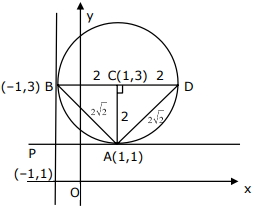
0 likesView Solution
350
MathematicsMediumMCQJEE Main · 2021
If $\log _{3} 2, \log _{3}(2^{x}-5), \log _{3}(2^{x}-\frac{7}{2})$ are in an arithmetic progression,then the value of $x$ is equal to $.....$
A
$1$
B
$4$
C
$3$
D
$2$
Solution
(C) Given that $\log _{3} 2, \log _{3}(2^{x}-5), \log _{3}(2^{x}-\frac{7}{2})$ are in an arithmetic progression $(AP)$.
For three terms $a, b, c$ to be in $AP$,$2b = a + c$.
Therefore,$2 \log _{3}(2^{x}-5) = \log _{3} 2 + \log _{3}(2^{x}-\frac{7}{2})$.
Using the property $\log a + \log b = \log(ab)$,we get $\log _{3}(2^{x}-5)^{2} = \log _{3}[2(2^{x}-\frac{7}{2})]$.
$(2^{x}-5)^{2} = 2(2^{x}-\frac{7}{2})$.
Let $2^{x} = t$. Then $(t-5)^{2} = 2t - 7$.
$t^{2} - 10t + 25 = 2t - 7$.
$t^{2} - 12t + 32 = 0$.
$(t-4)(t-8) = 0$.
So,$t = 4$ or $t = 8$.
If $2^{x} = 4$,then $x = 2$. However,for $\log _{3}(2^{x}-5)$ to be defined,$2^{x}-5 > 0$,so $4-5 = -1$,which is not allowed.
If $2^{x} = 8$,then $x = 3$. Here $8-5 = 3 > 0$ and $8-3.5 = 4.5 > 0$,which is valid.
Thus,$x = 3$.
For three terms $a, b, c$ to be in $AP$,$2b = a + c$.
Therefore,$2 \log _{3}(2^{x}-5) = \log _{3} 2 + \log _{3}(2^{x}-\frac{7}{2})$.
Using the property $\log a + \log b = \log(ab)$,we get $\log _{3}(2^{x}-5)^{2} = \log _{3}[2(2^{x}-\frac{7}{2})]$.
$(2^{x}-5)^{2} = 2(2^{x}-\frac{7}{2})$.
Let $2^{x} = t$. Then $(t-5)^{2} = 2t - 7$.
$t^{2} - 10t + 25 = 2t - 7$.
$t^{2} - 12t + 32 = 0$.
$(t-4)(t-8) = 0$.
So,$t = 4$ or $t = 8$.
If $2^{x} = 4$,then $x = 2$. However,for $\log _{3}(2^{x}-5)$ to be defined,$2^{x}-5 > 0$,so $4-5 = -1$,which is not allowed.
If $2^{x} = 8$,then $x = 3$. Here $8-5 = 3 > 0$ and $8-3.5 = 4.5 > 0$,which is valid.
Thus,$x = 3$.
0 likesView Solution
351
MathematicsDifficultMCQJEE Main · 2021
The value of the integral $\int_{-1}^{1} \log_{e}(\sqrt{1-x}+\sqrt{1+x}) dx$ is equal to:
A
$2 \log_{e} 2 + \frac{\pi}{4} - 1$
B
$\frac{1}{2} \log_{e} 2 + \frac{\pi}{4} - \frac{3}{2}$
C
$2 \log_{e} 2 + \frac{\pi}{2} - \frac{1}{2}$
D
$\log_{e} 2 + \frac{\pi}{2} - 1$
Solution
(D) Let $I = \int_{-1}^{1} \log_{e}(\sqrt{1-x}+\sqrt{1+x}) dx$. Since the integrand $f(x) = \log_{e}(\sqrt{1-x}+\sqrt{1+x})$ is an even function,$I = 2 \int_{0}^{1} \log_{e}(\sqrt{1-x}+\sqrt{1+x}) dx$.
Using Integration by Parts $\int u dv = uv - \int v du$,let $u = \log_{e}(\sqrt{1-x}+\sqrt{1+x})$ and $dv = dx$.
Then $du = \frac{1}{\sqrt{1-x}+\sqrt{1+x}} \cdot \left(\frac{-1}{2\sqrt{1-x}} + \frac{1}{2\sqrt{1+x}}\right) dx = \frac{\sqrt{1-x}-\sqrt{1+x}}{2\sqrt{1-x^2}(\sqrt{1-x}+\sqrt{1+x})} dx = \frac{(\sqrt{1-x}-\sqrt{1+x})^2}{2\sqrt{1-x^2}(1-x-1-x)} dx = \frac{2-2\sqrt{1-x^2}}{-4x\sqrt{1-x^2}} dx = \frac{\sqrt{1-x^2}-1}{2x\sqrt{1-x^2}} dx$.
$I = 2 \left[ x \log_{e}(\sqrt{1-x}+\sqrt{1+x}) \Big|_0^1 - \int_0^1 x \cdot \frac{\sqrt{1-x^2}-1}{2x\sqrt{1-x^2}} dx \right]$.
$I = 2 \left[ (1 \cdot \log_{e}(\sqrt{2}) - 0) - \frac{1}{2} \int_0^1 \left(1 - \frac{1}{\sqrt{1-x^2}}\right) dx \right]$.
$I = 2 \left[ \frac{1}{2} \log_{e} 2 - \frac{1}{2} (x - \sin^{-1} x) \Big|_0^1 \right]$.
$I = \log_{e} 2 - (1 - \frac{\pi}{2}) = \log_{e} 2 + \frac{\pi}{2} - 1$.
Using Integration by Parts $\int u dv = uv - \int v du$,let $u = \log_{e}(\sqrt{1-x}+\sqrt{1+x})$ and $dv = dx$.
Then $du = \frac{1}{\sqrt{1-x}+\sqrt{1+x}} \cdot \left(\frac{-1}{2\sqrt{1-x}} + \frac{1}{2\sqrt{1+x}}\right) dx = \frac{\sqrt{1-x}-\sqrt{1+x}}{2\sqrt{1-x^2}(\sqrt{1-x}+\sqrt{1+x})} dx = \frac{(\sqrt{1-x}-\sqrt{1+x})^2}{2\sqrt{1-x^2}(1-x-1-x)} dx = \frac{2-2\sqrt{1-x^2}}{-4x\sqrt{1-x^2}} dx = \frac{\sqrt{1-x^2}-1}{2x\sqrt{1-x^2}} dx$.
$I = 2 \left[ x \log_{e}(\sqrt{1-x}+\sqrt{1+x}) \Big|_0^1 - \int_0^1 x \cdot \frac{\sqrt{1-x^2}-1}{2x\sqrt{1-x^2}} dx \right]$.
$I = 2 \left[ (1 \cdot \log_{e}(\sqrt{2}) - 0) - \frac{1}{2} \int_0^1 \left(1 - \frac{1}{\sqrt{1-x^2}}\right) dx \right]$.
$I = 2 \left[ \frac{1}{2} \log_{e} 2 - \frac{1}{2} (x - \sin^{-1} x) \Big|_0^1 \right]$.
$I = \log_{e} 2 - (1 - \frac{\pi}{2}) = \log_{e} 2 + \frac{\pi}{2} - 1$.
0 likesView Solution
352
MathematicsDifficultMCQJEE Main · 2021
Let $y=y(x)$ be the solution of the differential equation $x \tan \left(\frac{y}{x}\right) d y=\left(y \tan \left(\frac{y}{x}\right)-x\right) d x$ for $-1 \leq x \leq 1$,with the initial condition $y\left(\frac{1}{2}\right)=\frac{\pi}{6}$. Then the area of the region bounded by the curves $x=0$,$x=\frac{1}{\sqrt{2}}$,and $y=y(x)$ in the upper half plane is:
A
$\frac{1}{12}(\pi-3)$
B
$\frac{1}{6}(\pi-1)$
C
$\frac{1}{8}(\pi-1)$
D
$\frac{1}{4}(\pi-2)$
Solution
(C) The given differential equation is $x \tan \left(\frac{y}{x}\right) d y = \left(y \tan \left(\frac{y}{x}\right)-x\right) d x$.
Rearranging the terms,we get $\tan \left(\frac{y}{x}\right)(x d y - y d x) = -x d x$.
Dividing both sides by $x^2$,we have $\tan \left(\frac{y}{x}\right) d\left(\frac{y}{x}\right) = -\frac{1}{x} d x$.
Integrating both sides,we get $\ln \left| \sec \left(\frac{y}{x}\right) \right| = -\ln |x| + C$,which simplifies to $\ln \left| x \sec \left(\frac{y}{x}\right) \right| = C$.
Given $y(1/2) = \pi/6$,we have $\ln \left| \frac{1}{2} \sec \left( \frac{\pi/6}{1/2} \right) \right| = \ln \left| \frac{1}{2} \sec \left( \frac{\pi}{3} \right) \right| = \ln \left| \frac{1}{2} \cdot 2 \right| = \ln(1) = 0$. Thus,$C=0$.
So,$\sec \left(\frac{y}{x}\right) = \frac{1}{x}$,which implies $\cos \left(\frac{y}{x}\right) = x$,or $y = x \cos^{-1}(x)$.
The required area is $A = \int_{0}^{1/\sqrt{2}} x \cos^{-1}(x) d x$.
Using integration by parts,$A = \left[ \frac{x^2}{2} \cos^{-1}(x) \right]_{0}^{1/\sqrt{2}} - \int_{0}^{1/\sqrt{2}} \frac{x^2}{2} \left( -\frac{1}{\sqrt{1-x^2}} \right) d x$.
$A = \left( \frac{1}{4} \cdot \frac{\pi}{4} - 0 \right) + \frac{1}{2} \int_{0}^{1/\sqrt{2}} \frac{x^2}{\sqrt{1-x^2}} d x$.
Substituting $x = \sin \theta$,$d x = \cos \theta d \theta$,we get $\frac{1}{2} \int_{0}^{\pi/4} \frac{\sin^2 \theta \cos \theta}{\cos \theta} d \theta = \frac{1}{2} \int_{0}^{\pi/4} \frac{1-\cos 2\theta}{2} d \theta = \frac{1}{4} \left[ \theta - \frac{\sin 2\theta}{2} \right]_{0}^{\pi/4} = \frac{1}{4} \left( \frac{\pi}{4} - \frac{1}{2} \right) = \frac{\pi}{16} - \frac{1}{8}$.
Total area $A = \frac{\pi}{16} + \frac{\pi}{16} - \frac{1}{8} = \frac{2\pi}{16} - \frac{1}{8} = \frac{\pi-1}{8}$.
Rearranging the terms,we get $\tan \left(\frac{y}{x}\right)(x d y - y d x) = -x d x$.
Dividing both sides by $x^2$,we have $\tan \left(\frac{y}{x}\right) d\left(\frac{y}{x}\right) = -\frac{1}{x} d x$.
Integrating both sides,we get $\ln \left| \sec \left(\frac{y}{x}\right) \right| = -\ln |x| + C$,which simplifies to $\ln \left| x \sec \left(\frac{y}{x}\right) \right| = C$.
Given $y(1/2) = \pi/6$,we have $\ln \left| \frac{1}{2} \sec \left( \frac{\pi/6}{1/2} \right) \right| = \ln \left| \frac{1}{2} \sec \left( \frac{\pi}{3} \right) \right| = \ln \left| \frac{1}{2} \cdot 2 \right| = \ln(1) = 0$. Thus,$C=0$.
So,$\sec \left(\frac{y}{x}\right) = \frac{1}{x}$,which implies $\cos \left(\frac{y}{x}\right) = x$,or $y = x \cos^{-1}(x)$.
The required area is $A = \int_{0}^{1/\sqrt{2}} x \cos^{-1}(x) d x$.
Using integration by parts,$A = \left[ \frac{x^2}{2} \cos^{-1}(x) \right]_{0}^{1/\sqrt{2}} - \int_{0}^{1/\sqrt{2}} \frac{x^2}{2} \left( -\frac{1}{\sqrt{1-x^2}} \right) d x$.
$A = \left( \frac{1}{4} \cdot \frac{\pi}{4} - 0 \right) + \frac{1}{2} \int_{0}^{1/\sqrt{2}} \frac{x^2}{\sqrt{1-x^2}} d x$.
Substituting $x = \sin \theta$,$d x = \cos \theta d \theta$,we get $\frac{1}{2} \int_{0}^{\pi/4} \frac{\sin^2 \theta \cos \theta}{\cos \theta} d \theta = \frac{1}{2} \int_{0}^{\pi/4} \frac{1-\cos 2\theta}{2} d \theta = \frac{1}{4} \left[ \theta - \frac{\sin 2\theta}{2} \right]_{0}^{\pi/4} = \frac{1}{4} \left( \frac{\pi}{4} - \frac{1}{2} \right) = \frac{\pi}{16} - \frac{1}{8}$.
Total area $A = \frac{\pi}{16} + \frac{\pi}{16} - \frac{1}{8} = \frac{2\pi}{16} - \frac{1}{8} = \frac{\pi-1}{8}$.
0 likesView Solution
353
MathematicsDifficultMCQJEE Main · 2021
Let a function $f: R \rightarrow R$ be defined as
$f(x) = \begin{cases} \sin x - e^x & \text{if } x \leq 0 \\ a + [-x] & \text{if } 0 < x < 1 \\ 2x - b & \text{if } x \geq 1 \end{cases}$
where $[x]$ is the greatest integer less than or equal to $x$. If $f$ is continuous on $R$,then $(a + b)$ is equal to:
$f(x) = \begin{cases} \sin x - e^x & \text{if } x \leq 0 \\ a + [-x] & \text{if } 0 < x < 1 \\ 2x - b & \text{if } x \geq 1 \end{cases}$
where $[x]$ is the greatest integer less than or equal to $x$. If $f$ is continuous on $R$,then $(a + b)$ is equal to:
A
$5$
B
$3$
C
$2$
D
$4$
Solution
(B) For $f$ to be continuous at $x = 0$,we must have $\lim_{x \to 0^-} f(x) = \lim_{x \to 0^+} f(x) = f(0)$.
$\lim_{x \to 0^-} f(x) = \sin(0) - e^0 = 0 - 1 = -1$.
$\lim_{x \to 0^+} f(x) = \lim_{x \to 0^+} (a + [-x]) = a + (-1) = a - 1$.
Equating these,$a - 1 = -1 \implies a = 0$.
For $f$ to be continuous at $x = 1$,we must have $\lim_{x \to 1^-} f(x) = \lim_{x \to 1^+} f(x) = f(1)$.
$\lim_{x \to 1^-} f(x) = \lim_{x \to 1^-} (a + [-x]) = a + (-1) = a - 1$.
$\lim_{x \to 1^+} f(x) = 2(1) - b = 2 - b$.
Equating these,$a - 1 = 2 - b \implies 0 - 1 = 2 - b \implies b = 3$.
Therefore,$a + b = 0 + 3 = 3$.
$\lim_{x \to 0^-} f(x) = \sin(0) - e^0 = 0 - 1 = -1$.
$\lim_{x \to 0^+} f(x) = \lim_{x \to 0^+} (a + [-x]) = a + (-1) = a - 1$.
Equating these,$a - 1 = -1 \implies a = 0$.
For $f$ to be continuous at $x = 1$,we must have $\lim_{x \to 1^-} f(x) = \lim_{x \to 1^+} f(x) = f(1)$.
$\lim_{x \to 1^-} f(x) = \lim_{x \to 1^-} (a + [-x]) = a + (-1) = a - 1$.
$\lim_{x \to 1^+} f(x) = 2(1) - b = 2 - b$.
Equating these,$a - 1 = 2 - b \implies 0 - 1 = 2 - b \implies b = 3$.
Therefore,$a + b = 0 + 3 = 3$.
0 likesView Solution
354
MathematicsDifficultMCQJEE Main · 2021
Let $y=y(x)$ be the solution of the differential equation $e^{x} \sqrt{1-y^{2}} dx + \frac{y}{x} dy = 0$,with $y(1) = -1$. Then the value of $(y(3))^{2}$ is equal to:
A
$1-4e^{6}$
B
$1-4e^{3}$
C
$4e^{6}-1$
D
$1+4e^{6}$
Solution
(A) The given differential equation is $e^{x} \sqrt{1-y^{2}} dx + \frac{y}{x} dy = 0$.
Rearranging the terms to separate the variables,we get:
$\frac{y}{\sqrt{1-y^{2}}} dy = -x e^{x} dx$.
Integrating both sides:
$\int \frac{y}{\sqrt{1-y^{2}}} dy = -\int x e^{x} dx$.
Let $u = 1-y^{2}$,then $du = -2y dy$,so $y dy = -\frac{1}{2} du$. The left side becomes:
$-\frac{1}{2} \int u^{-1/2} du = -\frac{1}{2} (2u^{1/2}) = -\sqrt{1-y^{2}}$.
For the right side,using integration by parts $\int x e^{x} dx = x e^{x} - e^{x} + C = e^{x}(x-1) + C$.
Thus,$-\sqrt{1-y^{2}} = -(e^{x}(x-1) + C) = -e^{x}(x-1) - C$.
So,$\sqrt{1-y^{2}} = e^{x}(x-1) + C$.
Using the condition $y(1) = -1$:
$\sqrt{1-(-1)^{2}} = e^{1}(1-1) + C \Rightarrow 0 = 0 + C \Rightarrow C = 0$.
Therefore,$\sqrt{1-y^{2}} = e^{x}(x-1)$.
Squaring both sides,$1-y^{2} = e^{2x}(x-1)^{2}$.
At $x=3$,$1-y^{2} = e^{6}(3-1)^{2} = 4e^{6}$.
$y^{2} = 1 - 4e^{6}$.
Rearranging the terms to separate the variables,we get:
$\frac{y}{\sqrt{1-y^{2}}} dy = -x e^{x} dx$.
Integrating both sides:
$\int \frac{y}{\sqrt{1-y^{2}}} dy = -\int x e^{x} dx$.
Let $u = 1-y^{2}$,then $du = -2y dy$,so $y dy = -\frac{1}{2} du$. The left side becomes:
$-\frac{1}{2} \int u^{-1/2} du = -\frac{1}{2} (2u^{1/2}) = -\sqrt{1-y^{2}}$.
For the right side,using integration by parts $\int x e^{x} dx = x e^{x} - e^{x} + C = e^{x}(x-1) + C$.
Thus,$-\sqrt{1-y^{2}} = -(e^{x}(x-1) + C) = -e^{x}(x-1) - C$.
So,$\sqrt{1-y^{2}} = e^{x}(x-1) + C$.
Using the condition $y(1) = -1$:
$\sqrt{1-(-1)^{2}} = e^{1}(1-1) + C \Rightarrow 0 = 0 + C \Rightarrow C = 0$.
Therefore,$\sqrt{1-y^{2}} = e^{x}(x-1)$.
Squaring both sides,$1-y^{2} = e^{2x}(x-1)^{2}$.
At $x=3$,$1-y^{2} = e^{6}(3-1)^{2} = 4e^{6}$.
$y^{2} = 1 - 4e^{6}$.
0 likesView Solution
355
MathematicsDifficultMCQJEE Main · 2021
Let $[x]$ denote the greatest integer $\leq x$,where $x \in \mathbb{R}$. If the domain of the real-valued function $f(x) = \sqrt{\frac{|[x]|-2}{|[x]|-3}}$ is $(-\infty, a) \cup [b, c) \cup [4, \infty)$,where $a < b < c$,then the value of $a+b+c$ is:
A
$-3$
B
$1$
C
$-2$
D
$8$
Solution
(C) For the function $f(x) = \sqrt{\frac{|[x]|-2}{|[x]|-3}}$ to be defined,the expression inside the square root must be non-negative and the denominator must be non-zero.
$\frac{|[x]|-2}{|[x]|-3} \geq 0$ and $|[x]|-3 \neq 0$.
Let $Y = [x]$. We solve $\frac{|Y|-2}{|Y|-3} \geq 0$.
The critical points are $|Y| = 2$ and $|Y| = 3$,which means $Y \in \{-3, -2, 2, 3\}$.
Testing intervals for $|Y|$:
$1$. If $|Y| < 2$,then $\frac{-}{-} > 0$ (True). This corresponds to $-2 < Y < 2$,so $[x] \in \{-1, 0, 1\}$,which implies $x \in [-1, 2)$.
$2$. If $2 \leq |Y| < 3$,then $\frac{+}{-} < 0$ (False).
$3$. If $|Y| > 3$,then $\frac{+}{+} > 0$ (True). This corresponds to $Y > 3$ or $Y < -3$,so $[x] \geq 4$ or $[x] \leq -4$,which implies $x \in [4, \infty)$ or $x \in (-\infty, -3)$.
Combining these,the domain is $(-\infty, -3) \cup [-1, 2) \cup [4, \infty)$.
Comparing with $(-\infty, a) \cup [b, c) \cup [4, \infty)$,we get $a = -3$,$b = -1$,and $c = 2$.
Thus,$a+b+c = -3 + (-1) + 2 = -2$.
$\frac{|[x]|-2}{|[x]|-3} \geq 0$ and $|[x]|-3 \neq 0$.
Let $Y = [x]$. We solve $\frac{|Y|-2}{|Y|-3} \geq 0$.
The critical points are $|Y| = 2$ and $|Y| = 3$,which means $Y \in \{-3, -2, 2, 3\}$.
Testing intervals for $|Y|$:
$1$. If $|Y| < 2$,then $\frac{-}{-} > 0$ (True). This corresponds to $-2 < Y < 2$,so $[x] \in \{-1, 0, 1\}$,which implies $x \in [-1, 2)$.
$2$. If $2 \leq |Y| < 3$,then $\frac{+}{-} < 0$ (False).
$3$. If $|Y| > 3$,then $\frac{+}{+} > 0$ (True). This corresponds to $Y > 3$ or $Y < -3$,so $[x] \geq 4$ or $[x] \leq -4$,which implies $x \in [4, \infty)$ or $x \in (-\infty, -3)$.
Combining these,the domain is $(-\infty, -3) \cup [-1, 2) \cup [4, \infty)$.
Comparing with $(-\infty, a) \cup [b, c) \cup [4, \infty)$,we get $a = -3$,$b = -1$,and $c = 2$.
Thus,$a+b+c = -3 + (-1) + 2 = -2$.
0 likesView Solution
356
MathematicsDifficultMCQJEE Main · 2021
The number of real roots of the equation $\tan ^{-1} \sqrt{x(x+1)}+\sin ^{-1} \sqrt{x^{2}+x+1}=\frac{\pi}{4}$ is:
A
$0$
B
$4$
C
$1$
D
$2$
Solution
(A) The given equation is $\tan ^{-1} \sqrt{x^{2}+x}+\sin ^{-1} \sqrt{x^{2}+x+1}=\frac{\pi}{4}$.
For the equation to be defined,the arguments of the inverse trigonometric functions must satisfy their domain conditions.
$1$. For $\tan ^{-1} \sqrt{x^{2}+x}$,we require $x^{2}+x \geq 0$.
$2$. For $\sin ^{-1} \sqrt{x^{2}+x+1}$,we require $0 \leq \sqrt{x^{2}+x+1} \leq 1$,which implies $0 \leq x^{2}+x+1 \leq 1$.
Since $x^{2}+x+1 = (x+\frac{1}{2})^{2} + \frac{3}{4}$,the minimum value of $x^{2}+x+1$ is $\frac{3}{4}$.
Thus,the condition $x^{2}+x+1 \leq 1$ implies $x^{2}+x+1 \leq 1$,or $x^{2}+x \leq 0$.
Combining $x^{2}+x \geq 0$ and $x^{2}+x \leq 0$,we must have $x^{2}+x = 0$.
This gives $x(x+1) = 0$,so $x=0$ or $x=-1$.
If $x=0$,the equation becomes $\tan ^{-1} \sqrt{0} + \sin ^{-1} \sqrt{1} = 0 + \frac{\pi}{2} = \frac{\pi}{2} \neq \frac{\pi}{4}$.
If $x=-1$,the equation becomes $\tan ^{-1} \sqrt{0} + \sin ^{-1} \sqrt{1} = 0 + \frac{\pi}{2} = \frac{\pi}{2} \neq \frac{\pi}{4}$.
Since neither value satisfies the equation,the number of real roots is $0$.
For the equation to be defined,the arguments of the inverse trigonometric functions must satisfy their domain conditions.
$1$. For $\tan ^{-1} \sqrt{x^{2}+x}$,we require $x^{2}+x \geq 0$.
$2$. For $\sin ^{-1} \sqrt{x^{2}+x+1}$,we require $0 \leq \sqrt{x^{2}+x+1} \leq 1$,which implies $0 \leq x^{2}+x+1 \leq 1$.
Since $x^{2}+x+1 = (x+\frac{1}{2})^{2} + \frac{3}{4}$,the minimum value of $x^{2}+x+1$ is $\frac{3}{4}$.
Thus,the condition $x^{2}+x+1 \leq 1$ implies $x^{2}+x+1 \leq 1$,or $x^{2}+x \leq 0$.
Combining $x^{2}+x \geq 0$ and $x^{2}+x \leq 0$,we must have $x^{2}+x = 0$.
This gives $x(x+1) = 0$,so $x=0$ or $x=-1$.
If $x=0$,the equation becomes $\tan ^{-1} \sqrt{0} + \sin ^{-1} \sqrt{1} = 0 + \frac{\pi}{2} = \frac{\pi}{2} \neq \frac{\pi}{4}$.
If $x=-1$,the equation becomes $\tan ^{-1} \sqrt{0} + \sin ^{-1} \sqrt{1} = 0 + \frac{\pi}{2} = \frac{\pi}{2} \neq \frac{\pi}{4}$.
Since neither value satisfies the equation,the number of real roots is $0$.
0 likesView Solution
357
MathematicsDifficultMCQJEE Main · 2021
Let $a$ be a positive real number such that $\int_{0}^{a} e^{x-[x]} dx = 10e - 9$,where $[x]$ is the greatest integer less than or equal to $x$. Then $a$ is equal to:
A
$10 + \log_{e} 3$
B
$10 - \log_{e}(1 + e)$
C
$10 + \log_{e} 2$
D
$10 + \log_{e}(1 + e)$
Solution
(C) Let $n = [a]$,where $n$ is a non-negative integer. Then $a = n + \{a\}$,where $0 \le \{a\} < 1$.
The integral can be split as:
$\int_{0}^{a} e^{x-[x]} dx = \sum_{k=0}^{n-1} \int_{k}^{k+1} e^{x-k} dx + \int_{n}^{a} e^{x-n} dx = 10e - 9$
Evaluating the sum:
$\sum_{k=0}^{n-1} [e^{x-k}]_{k}^{k+1} = \sum_{k=0}^{n-1} (e^1 - e^0) = \sum_{k=0}^{n-1} (e - 1) = n(e - 1)$
Evaluating the remaining part:
$\int_{n}^{a} e^{x-n} dx = [e^{x-n}]_{n}^{a} = e^{a-n} - e^0 = e^{\{a\}} - 1$
Combining these:
$n(e - 1) + e^{\{a\}} - 1 = 10e - 9$
$ne - n + e^{\{a\}} - 1 = 10e - 10$
Comparing the terms,we get $n = 10$ and $e^{\{a\}} - 1 = -1 + 10e - 10e = 0$ is incorrect. Let's re-evaluate:
$ne - n + e^{\{a\}} - 1 = 10e - 10$
$ne + e^{\{a\}} - (n + 1) = 10e - 10$
If $n = 10$,then $10e + e^{\{a\}} - 11 = 10e - 9 \Rightarrow e^{\{a\}} = 2 \Rightarrow \{a\} = \log_{e} 2$.
Thus,$a = n + \{a\} = 10 + \log_{e} 2$.
The integral can be split as:
$\int_{0}^{a} e^{x-[x]} dx = \sum_{k=0}^{n-1} \int_{k}^{k+1} e^{x-k} dx + \int_{n}^{a} e^{x-n} dx = 10e - 9$
Evaluating the sum:
$\sum_{k=0}^{n-1} [e^{x-k}]_{k}^{k+1} = \sum_{k=0}^{n-1} (e^1 - e^0) = \sum_{k=0}^{n-1} (e - 1) = n(e - 1)$
Evaluating the remaining part:
$\int_{n}^{a} e^{x-n} dx = [e^{x-n}]_{n}^{a} = e^{a-n} - e^0 = e^{\{a\}} - 1$
Combining these:
$n(e - 1) + e^{\{a\}} - 1 = 10e - 9$
$ne - n + e^{\{a\}} - 1 = 10e - 10$
Comparing the terms,we get $n = 10$ and $e^{\{a\}} - 1 = -1 + 10e - 10e = 0$ is incorrect. Let's re-evaluate:
$ne - n + e^{\{a\}} - 1 = 10e - 10$
$ne + e^{\{a\}} - (n + 1) = 10e - 10$
If $n = 10$,then $10e + e^{\{a\}} - 11 = 10e - 9 \Rightarrow e^{\{a\}} = 2 \Rightarrow \{a\} = \log_{e} 2$.
Thus,$a = n + \{a\} = 10 + \log_{e} 2$.
0 likesView Solution
358
MathematicsDifficultMCQJEE Main · 2021
Let $a$ be a real number such that the function $f(x) = ax^2 + 6x - 15, x \in R$ is increasing in $(-\infty, \frac{3}{4})$ and decreasing in $(\frac{3}{4}, \infty)$. Then the function $g(x) = ax^2 - 6x + 15, x \in R$ has a:
A
local minimum at $x = -\frac{3}{4}$
B
local maximum at $x = \frac{3}{4}$
C
local minimum at $x = \frac{3}{4}$
D
local maximum at $x = -\frac{3}{4}$
Solution
(D) Given $f(x) = ax^2 + 6x - 15$.
$f'(x) = 2ax + 6$.
Since $f(x)$ is increasing in $(-\infty, \frac{3}{4})$ and decreasing in $(\frac{3}{4}, \infty)$,the critical point is $x = \frac{3}{4}$.
At $x = \frac{3}{4}$,$f'(x) = 0$,so $2a(\frac{3}{4}) + 6 = 0 \Rightarrow \frac{3a}{2} = -6 \Rightarrow a = -4$.
Now,consider $g(x) = ax^2 - 6x + 15$. Substituting $a = -4$,we get $g(x) = -4x^2 - 6x + 15$.
$g'(x) = -8x - 6$.
Setting $g'(x) = 0$,we get $-8x = 6 \Rightarrow x = -\frac{6}{8} = -\frac{3}{4}$.
To check for local maximum or minimum,we use the second derivative test: $g''(x) = -8$.
Since $g''(x) < 0$,the function $g(x)$ has a local maximum at $x = -\frac{3}{4}$.
$f'(x) = 2ax + 6$.
Since $f(x)$ is increasing in $(-\infty, \frac{3}{4})$ and decreasing in $(\frac{3}{4}, \infty)$,the critical point is $x = \frac{3}{4}$.
At $x = \frac{3}{4}$,$f'(x) = 0$,so $2a(\frac{3}{4}) + 6 = 0 \Rightarrow \frac{3a}{2} = -6 \Rightarrow a = -4$.
Now,consider $g(x) = ax^2 - 6x + 15$. Substituting $a = -4$,we get $g(x) = -4x^2 - 6x + 15$.
$g'(x) = -8x - 6$.
Setting $g'(x) = 0$,we get $-8x = 6 \Rightarrow x = -\frac{6}{8} = -\frac{3}{4}$.
To check for local maximum or minimum,we use the second derivative test: $g''(x) = -8$.
Since $g''(x) < 0$,the function $g(x)$ has a local maximum at $x = -\frac{3}{4}$.
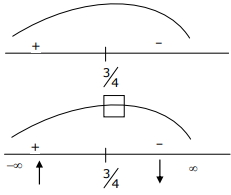
0 likesView Solution
359
MathematicsMediumMCQJEE Main · 2021
Let $A = [a_{ij}]$ be a $3 \times 3$ matrix,where
$a_{ij} = 1$,if $i = j$
$a_{ij} = -x$,if $|i - j| = 1$
$a_{ij} = 2x + 1$,otherwise
Let a function $f: R \rightarrow R$ be defined as $f(x) = \det(A)$. Then the sum of maximum and minimum values of $f$ on $R$ is equal to:
$a_{ij} = 1$,if $i = j$
$a_{ij} = -x$,if $|i - j| = 1$
$a_{ij} = 2x + 1$,otherwise
Let a function $f: R \rightarrow R$ be defined as $f(x) = \det(A)$. Then the sum of maximum and minimum values of $f$ on $R$ is equal to:
A
$\frac{20}{27}$
B
$-\frac{88}{27}$
C
$-\frac{20}{27}$
D
$\frac{88}{27}$
Solution
(B) The matrix $A$ is given by:
$A = \begin{bmatrix} 1 & -x & 2x+1 \\ -x & 1 & -x \\ 2x+1 & -x & 1 \end{bmatrix}$
Calculating the determinant $|A|$:
$|A| = 1(1 - x^2) + x(-x + x(2x+1)) + (2x+1)(x^2 - (2x+1))$
$|A| = 1 - x^2 - x^2 + 2x^3 + x^2 + (2x+1)(x^2 - 2x - 1)$
$|A| = 2x^3 - x^2 + 1 + (2x^3 - 4x^2 - 2x + x^2 - 2x - 1)$
$|A| = 4x^3 - 4x^2 - 4x = f(x)$
To find the critical points,set $f'(x) = 0$:
$f'(x) = 12x^2 - 8x - 4 = 4(3x^2 - 2x - 1) = 4(3x+1)(x-1) = 0$
Thus,$x = 1$ and $x = -\frac{1}{3}$.
Evaluating $f(x)$ at these points:
$f(1) = 4(1)^3 - 4(1)^2 - 4(1) = 4 - 4 - 4 = -4$ (Minimum value)
$f(-\frac{1}{3}) = 4(-\frac{1}{27}) - 4(\frac{1}{9}) - 4(-\frac{1}{3}) = -\frac{4}{27} - \frac{12}{27} + \frac{36}{27} = \frac{20}{27}$ (Maximum value)
The sum of the maximum and minimum values is:
$-\frac{88}{27} = -4 + \frac{20}{27} = \frac{-108 + 20}{27} = -\frac{88}{27}$
$A = \begin{bmatrix} 1 & -x & 2x+1 \\ -x & 1 & -x \\ 2x+1 & -x & 1 \end{bmatrix}$
Calculating the determinant $|A|$:
$|A| = 1(1 - x^2) + x(-x + x(2x+1)) + (2x+1)(x^2 - (2x+1))$
$|A| = 1 - x^2 - x^2 + 2x^3 + x^2 + (2x+1)(x^2 - 2x - 1)$
$|A| = 2x^3 - x^2 + 1 + (2x^3 - 4x^2 - 2x + x^2 - 2x - 1)$
$|A| = 4x^3 - 4x^2 - 4x = f(x)$
To find the critical points,set $f'(x) = 0$:
$f'(x) = 12x^2 - 8x - 4 = 4(3x^2 - 2x - 1) = 4(3x+1)(x-1) = 0$
Thus,$x = 1$ and $x = -\frac{1}{3}$.
Evaluating $f(x)$ at these points:
$f(1) = 4(1)^3 - 4(1)^2 - 4(1) = 4 - 4 - 4 = -4$ (Minimum value)
$f(-\frac{1}{3}) = 4(-\frac{1}{27}) - 4(\frac{1}{9}) - 4(-\frac{1}{3}) = -\frac{4}{27} - \frac{12}{27} + \frac{36}{27} = \frac{20}{27}$ (Maximum value)
The sum of the maximum and minimum values is:
$-\frac{88}{27} = -4 + \frac{20}{27} = \frac{-108 + 20}{27} = -\frac{88}{27}$
0 likesView Solution
360
MathematicsMediumMCQJEE Main · 2021
Let $A=\left[\begin{array}{ll}2 & 3 \\ a & 0\end{array}\right], a \in R$ be written as $P+Q$ where $P$ is a symmetric matrix and $Q$ is a skew-symmetric matrix. If $\operatorname{det}(Q)=9$,then the modulus of the sum of all possible values of the determinant of $P$ is equal to:
A
$24$
B
$18$
C
$45$
D
$36$
Solution
(D) Given $A = \begin{bmatrix} 2 & 3 \\ a & 0 \end{bmatrix}$.
Any square matrix $A$ can be written as $A = P + Q$,where $P = \frac{A + A^T}{2}$ is symmetric and $Q = \frac{A - A^T}{2}$ is skew-symmetric.
$P = \frac{1}{2} \left( \begin{bmatrix} 2 & 3 \\ a & 0 \end{bmatrix} + \begin{bmatrix} 2 & a \\ 3 & 0 \end{bmatrix} \right) = \begin{bmatrix} 2 & \frac{3+a}{2} \\ \frac{3+a}{2} & 0 \end{bmatrix}$.
$Q = \frac{1}{2} \left( \begin{bmatrix} 2 & 3 \\ a & 0 \end{bmatrix} - \begin{bmatrix} 2 & a \\ 3 & 0 \end{bmatrix} \right) = \begin{bmatrix} 0 & \frac{3-a}{2} \\ \frac{a-3}{2} & 0 \end{bmatrix}$.
Given $\operatorname{det}(Q) = 9$,we have $0 - \left( \frac{3-a}{2} \right) \left( \frac{a-3}{2} \right) = 9$.
$\Rightarrow \frac{(a-3)^2}{4} = 9 \Rightarrow (a-3)^2 = 36 \Rightarrow a-3 = \pm 6$.
Thus,$a = 9$ or $a = -3$.
Now,$\operatorname{det}(P) = 0 - \left( \frac{3+a}{2} \right)^2 = -\frac{(a+3)^2}{4}$.
For $a = 9$,$\operatorname{det}(P) = -\frac{(9+3)^2}{4} = -\frac{144}{4} = -36$.
For $a = -3$,$\operatorname{det}(P) = -\frac{(-3+3)^2}{4} = 0$.
The sum of all possible values of $\operatorname{det}(P)$ is $-36 + 0 = -36$.
The modulus of the sum is $|-36| = 36$.
Any square matrix $A$ can be written as $A = P + Q$,where $P = \frac{A + A^T}{2}$ is symmetric and $Q = \frac{A - A^T}{2}$ is skew-symmetric.
$P = \frac{1}{2} \left( \begin{bmatrix} 2 & 3 \\ a & 0 \end{bmatrix} + \begin{bmatrix} 2 & a \\ 3 & 0 \end{bmatrix} \right) = \begin{bmatrix} 2 & \frac{3+a}{2} \\ \frac{3+a}{2} & 0 \end{bmatrix}$.
$Q = \frac{1}{2} \left( \begin{bmatrix} 2 & 3 \\ a & 0 \end{bmatrix} - \begin{bmatrix} 2 & a \\ 3 & 0 \end{bmatrix} \right) = \begin{bmatrix} 0 & \frac{3-a}{2} \\ \frac{a-3}{2} & 0 \end{bmatrix}$.
Given $\operatorname{det}(Q) = 9$,we have $0 - \left( \frac{3-a}{2} \right) \left( \frac{a-3}{2} \right) = 9$.
$\Rightarrow \frac{(a-3)^2}{4} = 9 \Rightarrow (a-3)^2 = 36 \Rightarrow a-3 = \pm 6$.
Thus,$a = 9$ or $a = -3$.
Now,$\operatorname{det}(P) = 0 - \left( \frac{3+a}{2} \right)^2 = -\frac{(a+3)^2}{4}$.
For $a = 9$,$\operatorname{det}(P) = -\frac{(9+3)^2}{4} = -\frac{144}{4} = -36$.
For $a = -3$,$\operatorname{det}(P) = -\frac{(-3+3)^2}{4} = 0$.
The sum of all possible values of $\operatorname{det}(P)$ is $-36 + 0 = -36$.
The modulus of the sum is $|-36| = 36$.
0 likesView Solution
361
MathematicsDifficultMCQJEE Main · 2021
Let $T$ be the tangent to the ellipse $E: x^{2}+4 y^{2}=5$ at the point $P(1,1)$. If the area of the region bounded by the tangent $T$,ellipse $E$,lines $x=1$ and $x=\sqrt{5}$ is $\alpha \sqrt{5}+\beta+\gamma \cos ^{-1}\left(\frac{1}{\sqrt{5}}\right)$,then $|\alpha+\beta+\gamma|$ is equal to $....$
A
$1.25$
B
$5$
C
$4$
D
$20$
Solution
(A) The equation of the ellipse is $E: x^{2}+4 y^{2}=5$. The tangent $T$ at $P(1,1)$ is given by $x(1)+4y(1)=5$,which simplifies to $x+4y=5$,or $y = \frac{5-x}{4}$.
The area of the region bounded by the tangent $T$,the ellipse $E$,and the lines $x=1$ and $x=\sqrt{5}$ is given by the integral:
$A = \int_{1}^{\sqrt{5}} \left( \frac{5-x}{4} - \frac{\sqrt{5-x^{2}}}{2} \right) dx$
Evaluating the integral:
$A = \left[ \frac{5x}{4} - \frac{x^{2}}{8} - \frac{1}{2} \left( \frac{x}{2} \sqrt{5-x^{2}} + \frac{5}{2} \sin^{-1} \left( \frac{x}{\sqrt{5}} \right) \right) \right]_{1}^{\sqrt{5}}$
$A = \left[ \frac{5x}{4} - \frac{x^{2}}{8} - \frac{x}{4} \sqrt{5-x^{2}} - \frac{5}{4} \sin^{-1} \left( \frac{x}{\sqrt{5}} \right) \right]_{1}^{\sqrt{5}}$
At $x=\sqrt{5}$: $\frac{5\sqrt{5}}{4} - \frac{5}{8} - 0 - \frac{5}{4} \sin^{-1}(1) = \frac{10\sqrt{5}-5}{8} - \frac{5\pi}{8}$
At $x=1$: $\frac{5}{4} - \frac{1}{8} - \frac{1}{4} \sqrt{4} - \frac{5}{4} \sin^{-1} \left( \frac{1}{\sqrt{5}} \right) = \frac{10-1-4}{8} - \frac{5}{4} \sin^{-1} \left( \frac{1}{\sqrt{5}} \right) = \frac{5}{8} - \frac{5}{4} \sin^{-1} \left( \frac{1}{\sqrt{5}} \right)$
Using $\sin^{-1}(x) + \cos^{-1}(x) = \frac{\pi}{2}$,we have $\sin^{-1} \left( \frac{1}{\sqrt{5}} \right) = \frac{\pi}{2} - \cos^{-1} \left( \frac{1}{\sqrt{5}} \right)$.
$A = \left( \frac{10\sqrt{5}-5}{8} - \frac{5\pi}{8} \right) - \left( \frac{5}{8} - \frac{5}{4} \left( \frac{\pi}{2} - \cos^{-1} \left( \frac{1}{\sqrt{5}} \right) \right) \right)$
$A = \frac{10\sqrt{5}-10}{8} - \frac{5\pi}{8} + \frac{5\pi}{8} - \frac{5}{4} \cos^{-1} \left( \frac{1}{\sqrt{5}} \right) = \frac{5\sqrt{5}}{4} - \frac{5}{4} - \frac{5}{4} \cos^{-1} \left( \frac{1}{\sqrt{5}} \right)$
Comparing with $\alpha \sqrt{5} + \beta + \gamma \cos^{-1} \left( \frac{1}{\sqrt{5}} \right)$,we get $\alpha = \frac{5}{4}$,$\beta = -\frac{5}{4}$,$\gamma = -\frac{5}{4}$.
$|\alpha + \beta + \gamma| = |\frac{5}{4} - \frac{5}{4} - \frac{5}{4}| = |-\frac{5}{4}| = 1.25$.
The area of the region bounded by the tangent $T$,the ellipse $E$,and the lines $x=1$ and $x=\sqrt{5}$ is given by the integral:
$A = \int_{1}^{\sqrt{5}} \left( \frac{5-x}{4} - \frac{\sqrt{5-x^{2}}}{2} \right) dx$
Evaluating the integral:
$A = \left[ \frac{5x}{4} - \frac{x^{2}}{8} - \frac{1}{2} \left( \frac{x}{2} \sqrt{5-x^{2}} + \frac{5}{2} \sin^{-1} \left( \frac{x}{\sqrt{5}} \right) \right) \right]_{1}^{\sqrt{5}}$
$A = \left[ \frac{5x}{4} - \frac{x^{2}}{8} - \frac{x}{4} \sqrt{5-x^{2}} - \frac{5}{4} \sin^{-1} \left( \frac{x}{\sqrt{5}} \right) \right]_{1}^{\sqrt{5}}$
At $x=\sqrt{5}$: $\frac{5\sqrt{5}}{4} - \frac{5}{8} - 0 - \frac{5}{4} \sin^{-1}(1) = \frac{10\sqrt{5}-5}{8} - \frac{5\pi}{8}$
At $x=1$: $\frac{5}{4} - \frac{1}{8} - \frac{1}{4} \sqrt{4} - \frac{5}{4} \sin^{-1} \left( \frac{1}{\sqrt{5}} \right) = \frac{10-1-4}{8} - \frac{5}{4} \sin^{-1} \left( \frac{1}{\sqrt{5}} \right) = \frac{5}{8} - \frac{5}{4} \sin^{-1} \left( \frac{1}{\sqrt{5}} \right)$
Using $\sin^{-1}(x) + \cos^{-1}(x) = \frac{\pi}{2}$,we have $\sin^{-1} \left( \frac{1}{\sqrt{5}} \right) = \frac{\pi}{2} - \cos^{-1} \left( \frac{1}{\sqrt{5}} \right)$.
$A = \left( \frac{10\sqrt{5}-5}{8} - \frac{5\pi}{8} \right) - \left( \frac{5}{8} - \frac{5}{4} \left( \frac{\pi}{2} - \cos^{-1} \left( \frac{1}{\sqrt{5}} \right) \right) \right)$
$A = \frac{10\sqrt{5}-10}{8} - \frac{5\pi}{8} + \frac{5\pi}{8} - \frac{5}{4} \cos^{-1} \left( \frac{1}{\sqrt{5}} \right) = \frac{5\sqrt{5}}{4} - \frac{5}{4} - \frac{5}{4} \cos^{-1} \left( \frac{1}{\sqrt{5}} \right)$
Comparing with $\alpha \sqrt{5} + \beta + \gamma \cos^{-1} \left( \frac{1}{\sqrt{5}} \right)$,we get $\alpha = \frac{5}{4}$,$\beta = -\frac{5}{4}$,$\gamma = -\frac{5}{4}$.
$|\alpha + \beta + \gamma| = |\frac{5}{4} - \frac{5}{4} - \frac{5}{4}| = |-\frac{5}{4}| = 1.25$.
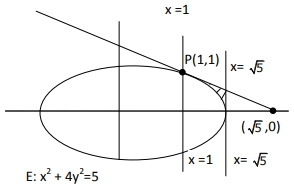
0 likesView Solution
362
MathematicsDifficultMCQJEE Main · 2021
Let $\vec{a}, \vec{b}, \vec{c}$ be three mutually perpendicular vectors of the same magnitude and equally inclined at an angle $\theta$ with the vector $\vec{a}+\vec{b}+\vec{c}$. Then $36 \cos ^{2} 2 \theta$ is equal to $.....$
A
$1$
B
$2$
C
$3$
D
$4$
Solution
(D) Let the magnitude of the vectors be $|\vec{a}| = |\vec{b}| = |\vec{c}| = k$. Since they are mutually perpendicular,$\vec{a} \cdot \vec{b} = \vec{b} \cdot \vec{c} = \vec{c} \cdot \vec{a} = 0$.
Let $\vec{v} = \vec{a} + \vec{b} + \vec{c}$. Then $|\vec{v}|^2 = |\vec{a}|^2 + |\vec{b}|^2 + |\vec{c}|^2 + 2(\vec{a} \cdot \vec{b} + \vec{b} \cdot \vec{c} + \vec{c} \cdot \vec{a}) = 3k^2$.
Thus,$|\vec{v}| = \sqrt{3}k$.
The angle $\theta$ between $\vec{a}$ and $\vec{v}$ is given by $\cos \theta = \frac{\vec{a} \cdot \vec{v}}{|\vec{a}| |\vec{v}|} = \frac{\vec{a} \cdot (\vec{a} + \vec{b} + \vec{c})}{k \cdot \sqrt{3}k} = \frac{|\vec{a}|^2 + 0 + 0}{\sqrt{3}k^2} = \frac{k^2}{\sqrt{3}k^2} = \frac{1}{\sqrt{3}}$.
We need to find $36 \cos^2 2\theta$. Using the identity $\cos 2\theta = 2 \cos^2 \theta - 1$,we get $\cos 2\theta = 2(\frac{1}{\sqrt{3}})^2 - 1 = 2(\frac{1}{3}) - 1 = \frac{2}{3} - 1 = -\frac{1}{3}$.
Therefore,$36 \cos^2 2\theta = 36(-\frac{1}{3})^2 = 36(\frac{1}{9}) = 4$.
Let $\vec{v} = \vec{a} + \vec{b} + \vec{c}$. Then $|\vec{v}|^2 = |\vec{a}|^2 + |\vec{b}|^2 + |\vec{c}|^2 + 2(\vec{a} \cdot \vec{b} + \vec{b} \cdot \vec{c} + \vec{c} \cdot \vec{a}) = 3k^2$.
Thus,$|\vec{v}| = \sqrt{3}k$.
The angle $\theta$ between $\vec{a}$ and $\vec{v}$ is given by $\cos \theta = \frac{\vec{a} \cdot \vec{v}}{|\vec{a}| |\vec{v}|} = \frac{\vec{a} \cdot (\vec{a} + \vec{b} + \vec{c})}{k \cdot \sqrt{3}k} = \frac{|\vec{a}|^2 + 0 + 0}{\sqrt{3}k^2} = \frac{k^2}{\sqrt{3}k^2} = \frac{1}{\sqrt{3}}$.
We need to find $36 \cos^2 2\theta$. Using the identity $\cos 2\theta = 2 \cos^2 \theta - 1$,we get $\cos 2\theta = 2(\frac{1}{\sqrt{3}})^2 - 1 = 2(\frac{1}{3}) - 1 = \frac{2}{3} - 1 = -\frac{1}{3}$.
Therefore,$36 \cos^2 2\theta = 36(-\frac{1}{3})^2 = 36(\frac{1}{9}) = 4$.
0 likesView Solution
363
MathematicsDifficultMCQJEE Main · 2021
Let $P$ be a plane passing through the points $(1,0,1), (1,-2,1)$ and $(0,1,-2)$. Let a vector $\vec{a} = \alpha \hat{i} + \beta \hat{j} + \gamma \hat{k}$ be such that $\vec{a}$ is parallel to the plane $P$,perpendicular to $(\hat{i} + 2 \hat{j} + 3 \hat{k})$ and $\vec{a} \cdot (\hat{i} + \hat{j} + 2 \hat{k}) = 2$. Then $(\alpha - \beta + \gamma)^2$ equals:
A
$81$
B
$84$
C
$89$
D
$18$
Solution
(A) The normal vector $\vec{n}_P$ to the plane $P$ is given by the cross product of two vectors in the plane. Let $A=(1,0,1), B=(1,-2,1), C=(0,1,-2)$.
$\vec{AB} = (1-1, -2-0, 1-1) = (0, -2, 0)$
$\vec{AC} = (0-1, 1-0, -2-1) = (-1, 1, -3)$
$\vec{n}_P = \vec{AB} \times \vec{AC} = \begin{vmatrix} \hat{i} & \hat{j} & \hat{k} \\ 0 & -2 & 0 \\ -1 & 1 & -3 \end{vmatrix} = 6\hat{i} + 0\hat{j} - 2\hat{k} = 2(3\hat{i} - \hat{k})$.
Since $\vec{a}$ is parallel to the plane $P$,$\vec{a}$ is perpendicular to $\vec{n}_P$. Also,$\vec{a}$ is perpendicular to $\vec{v} = \hat{i} + 2\hat{j} + 3\hat{k}$.
Thus,$\vec{a} = k(\vec{n}_P \times \vec{v}) = k \begin{vmatrix} \hat{i} & \hat{j} & \hat{k} \\ 3 & 0 & -1 \\ 1 & 2 & 3 \end{vmatrix} = k(2\hat{i} - 10\hat{j} + 6\hat{k})$.
Given $\vec{a} \cdot (\hat{i} + \hat{j} + 2\hat{k}) = 2$,we have $k(2(1) - 10(1) + 6(2)) = 2 \Rightarrow k(2 - 10 + 12) = 2 \Rightarrow 4k = 2 \Rightarrow k = 1/2$.
So,$\vec{a} = \frac{1}{2}(2\hat{i} - 10\hat{j} + 6\hat{k}) = \hat{i} - 5\hat{j} + 3\hat{k}$.
Here $\alpha = 1, \beta = -5, \gamma = 3$.
Then $(\alpha - \beta + \gamma)^2 = (1 - (-5) + 3)^2 = (1 + 5 + 3)^2 = 9^2 = 81$.
$\vec{AB} = (1-1, -2-0, 1-1) = (0, -2, 0)$
$\vec{AC} = (0-1, 1-0, -2-1) = (-1, 1, -3)$
$\vec{n}_P = \vec{AB} \times \vec{AC} = \begin{vmatrix} \hat{i} & \hat{j} & \hat{k} \\ 0 & -2 & 0 \\ -1 & 1 & -3 \end{vmatrix} = 6\hat{i} + 0\hat{j} - 2\hat{k} = 2(3\hat{i} - \hat{k})$.
Since $\vec{a}$ is parallel to the plane $P$,$\vec{a}$ is perpendicular to $\vec{n}_P$. Also,$\vec{a}$ is perpendicular to $\vec{v} = \hat{i} + 2\hat{j} + 3\hat{k}$.
Thus,$\vec{a} = k(\vec{n}_P \times \vec{v}) = k \begin{vmatrix} \hat{i} & \hat{j} & \hat{k} \\ 3 & 0 & -1 \\ 1 & 2 & 3 \end{vmatrix} = k(2\hat{i} - 10\hat{j} + 6\hat{k})$.
Given $\vec{a} \cdot (\hat{i} + \hat{j} + 2\hat{k}) = 2$,we have $k(2(1) - 10(1) + 6(2)) = 2 \Rightarrow k(2 - 10 + 12) = 2 \Rightarrow 4k = 2 \Rightarrow k = 1/2$.
So,$\vec{a} = \frac{1}{2}(2\hat{i} - 10\hat{j} + 6\hat{k}) = \hat{i} - 5\hat{j} + 3\hat{k}$.
Here $\alpha = 1, \beta = -5, \gamma = 3$.
Then $(\alpha - \beta + \gamma)^2 = (1 - (-5) + 3)^2 = (1 + 5 + 3)^2 = 9^2 = 81$.
0 likesView Solution
364
MathematicsMediumMCQJEE Main · 2021
Let $a, b, c, d$ be in arithmetic progression with common difference $\lambda$. If
$\left|\begin{array}{lll} x+a-c & x+b & x+a \\ x-1 & x+c & x+b \\ x-b+d & x+d & x+c \end{array}\right|=2$
then the value of $\lambda^{2}$ is equal to $.....$
$\left|\begin{array}{lll} x+a-c & x+b & x+a \\ x-1 & x+c & x+b \\ x-b+d & x+d & x+c \end{array}\right|=2$
then the value of $\lambda^{2}$ is equal to $.....$
A
$4$
B
$1$
C
$9$
D
$16$
Solution
(B) Given that $a, b, c, d$ are in arithmetic progression with common difference $\lambda$,we have $b = a + \lambda$,$c = a + 2\lambda$,and $d = a + 3\lambda$.
Substituting these into the determinant:
$a - c = -2\lambda$,$b - d = -2\lambda$,$d - b = 2\lambda$,$c - b = \lambda$,$d - c = \lambda$.
The determinant is $\Delta = \left|\begin{array}{lll} x-2\lambda & x+b & x+a \\ x-1 & x+c & x+b \\ x+2\lambda & x+d & x+c \end{array}\right| = 2$.
Applying column operations $C_2 \rightarrow C_2 - C_3$:
$\Delta = \left|\begin{array}{lll} x-2\lambda & \lambda & x+a \\ x-1 & \lambda & x+b \\ x+2\lambda & \lambda & x+c \end{array}\right| = 2$.
Taking $\lambda$ common from $C_2$:
$\Delta = \lambda \left|\begin{array}{lll} x-2\lambda & 1 & x+a \\ x-1 & 1 & x+b \\ x+2\lambda & 1 & x+c \end{array}\right| = 2$.
Applying row operations $R_2 \rightarrow R_2 - R_1$ and $R_3 \rightarrow R_3 - R_1$:
$\Delta = \lambda \left|\begin{array}{lll} x-2\lambda & 1 & x+a \\ 2\lambda-1 & 0 & \lambda \\ 4\lambda & 0 & 2\lambda \end{array}\right| = 2$.
Expanding along $C_2$:
$\Delta = \lambda \cdot (-1) \cdot ((2\lambda-1)(2\lambda) - (4\lambda)(\lambda)) = 2$.
$\Delta = -\lambda \cdot (4\lambda^2 - 2\lambda - 4\lambda^2) = 2$.
$\Delta = -\lambda \cdot (-2\lambda) = 2\lambda^2 = 2$.
Therefore,$\lambda^2 = 1$.
Substituting these into the determinant:
$a - c = -2\lambda$,$b - d = -2\lambda$,$d - b = 2\lambda$,$c - b = \lambda$,$d - c = \lambda$.
The determinant is $\Delta = \left|\begin{array}{lll} x-2\lambda & x+b & x+a \\ x-1 & x+c & x+b \\ x+2\lambda & x+d & x+c \end{array}\right| = 2$.
Applying column operations $C_2 \rightarrow C_2 - C_3$:
$\Delta = \left|\begin{array}{lll} x-2\lambda & \lambda & x+a \\ x-1 & \lambda & x+b \\ x+2\lambda & \lambda & x+c \end{array}\right| = 2$.
Taking $\lambda$ common from $C_2$:
$\Delta = \lambda \left|\begin{array}{lll} x-2\lambda & 1 & x+a \\ x-1 & 1 & x+b \\ x+2\lambda & 1 & x+c \end{array}\right| = 2$.
Applying row operations $R_2 \rightarrow R_2 - R_1$ and $R_3 \rightarrow R_3 - R_1$:
$\Delta = \lambda \left|\begin{array}{lll} x-2\lambda & 1 & x+a \\ 2\lambda-1 & 0 & \lambda \\ 4\lambda & 0 & 2\lambda \end{array}\right| = 2$.
Expanding along $C_2$:
$\Delta = \lambda \cdot (-1) \cdot ((2\lambda-1)(2\lambda) - (4\lambda)(\lambda)) = 2$.
$\Delta = -\lambda \cdot (4\lambda^2 - 2\lambda - 4\lambda^2) = 2$.
$\Delta = -\lambda \cdot (-2\lambda) = 2\lambda^2 = 2$.
Therefore,$\lambda^2 = 1$.
0 likesView Solution
365
MathematicsMediumMCQJEE Main · 2021
If the shortest distance between the lines $\vec{r}_{1}=\alpha \hat{i}+2 \hat{j}+2 \hat{k}+\lambda(\hat{i}-2 \hat{j}+2 \hat{k}), \lambda \in R, \alpha>0$ and $\vec{r}_{2}=-4 \hat{i}-\hat{k}+\mu(3 \hat{i}-2 \hat{j}-2 \hat{k}), \mu \in R$ is $9$,then $\alpha$ is equal to $.....$
A
$21$
B
$4$
C
$66$
D
$6$
Solution
(D) The shortest distance $d$ between two lines $\vec{r} = \vec{a}_1 + \lambda \vec{b}_1$ and $\vec{r} = \vec{a}_2 + \mu \vec{b}_2$ is given by $d = \frac{|(\vec{a}_2 - \vec{a}_1) \cdot (\vec{b}_1 \times \vec{b}_2)|}{|\vec{b}_1 \times \vec{b}_2|}$.
Here,$\vec{a}_1 = \alpha \hat{i} + 2 \hat{j} + 2 \hat{k}$,$\vec{b}_1 = \hat{i} - 2 \hat{j} + 2 \hat{k}$,$\vec{a}_2 = -4 \hat{i} - \hat{k}$,and $\vec{b}_2 = 3 \hat{i} - 2 \hat{j} - 2 \hat{k}$.
First,calculate $\vec{b}_1 \times \vec{b}_2 = \begin{vmatrix} \hat{i} & \hat{j} & \hat{k} \\ 1 & -2 & 2 \\ 3 & -2 & -2 \end{vmatrix} = \hat{i}(4 - (-4)) - \hat{j}(-2 - 6) + \hat{k}(-2 - (-6)) = 8 \hat{i} + 8 \hat{j} + 4 \hat{k}$.
The magnitude $|\vec{b}_1 \times \vec{b}_2| = \sqrt{8^2 + 8^2 + 4^2} = \sqrt{64 + 64 + 16} = \sqrt{144} = 12$.
Now,$\vec{a}_2 - \vec{a}_1 = (-4 - \alpha) \hat{i} - 2 \hat{j} - 3 \hat{k}$.
The shortest distance is $9 = \frac{|((-4 - \alpha) \hat{i} - 2 \hat{j} - 3 \hat{k}) \cdot (8 \hat{i} + 8 \hat{j} + 4 \hat{k})|}{12}$.
$9 = \frac{|8(-4 - \alpha) - 16 - 12|}{12} \implies 108 = |-32 - 8\alpha - 28| = |-60 - 8\alpha|$.
Since $\alpha > 0$,$|-60 - 8\alpha| = 60 + 8\alpha$.
$60 + 8\alpha = 108 \implies 8\alpha = 48 \implies \alpha = 6$.
Here,$\vec{a}_1 = \alpha \hat{i} + 2 \hat{j} + 2 \hat{k}$,$\vec{b}_1 = \hat{i} - 2 \hat{j} + 2 \hat{k}$,$\vec{a}_2 = -4 \hat{i} - \hat{k}$,and $\vec{b}_2 = 3 \hat{i} - 2 \hat{j} - 2 \hat{k}$.
First,calculate $\vec{b}_1 \times \vec{b}_2 = \begin{vmatrix} \hat{i} & \hat{j} & \hat{k} \\ 1 & -2 & 2 \\ 3 & -2 & -2 \end{vmatrix} = \hat{i}(4 - (-4)) - \hat{j}(-2 - 6) + \hat{k}(-2 - (-6)) = 8 \hat{i} + 8 \hat{j} + 4 \hat{k}$.
The magnitude $|\vec{b}_1 \times \vec{b}_2| = \sqrt{8^2 + 8^2 + 4^2} = \sqrt{64 + 64 + 16} = \sqrt{144} = 12$.
Now,$\vec{a}_2 - \vec{a}_1 = (-4 - \alpha) \hat{i} - 2 \hat{j} - 3 \hat{k}$.
The shortest distance is $9 = \frac{|((-4 - \alpha) \hat{i} - 2 \hat{j} - 3 \hat{k}) \cdot (8 \hat{i} + 8 \hat{j} + 4 \hat{k})|}{12}$.
$9 = \frac{|8(-4 - \alpha) - 16 - 12|}{12} \implies 108 = |-32 - 8\alpha - 28| = |-60 - 8\alpha|$.
Since $\alpha > 0$,$|-60 - 8\alpha| = 60 + 8\alpha$.
$60 + 8\alpha = 108 \implies 8\alpha = 48 \implies \alpha = 6$.
0 likesView Solution
366
MathematicsDifficultMCQJEE Main · 2021
Let $A = \begin{bmatrix} 1 & -1 & 0 \\ 0 & 1 & -1 \\ 0 & 0 & 1 \end{bmatrix}$ and $B = 7A^{20} - 20A^{7} + 2I$,where $I$ is an identity matrix of order $3 \times 3$. If $B = [b_{ij}]$,then $b_{13}$ is equal to $....$
A
$810$
B
$910$
C
$485$
D
$353$
Solution
(B) Given $A = I + C$,where $I = \begin{bmatrix} 1 & 0 & 0 \\ 0 & 1 & 0 \\ 0 & 0 & 1 \end{bmatrix}$ and $C = \begin{bmatrix} 0 & -1 & 0 \\ 0 & 0 & -1 \\ 0 & 0 & 0 \end{bmatrix}$.
Since $I$ and $C$ commute,we use the binomial expansion $(I+C)^n = I + nC + \frac{n(n-1)}{2}C^2$.
Note that $C^2 = \begin{bmatrix} 0 & 0 & 1 \\ 0 & 0 & 0 \\ 0 & 0 & 0 \end{bmatrix}$ and $C^3 = O$.
Thus,$A^n = (I+C)^n = I + nC + \frac{n(n-1)}{2}C^2$.
The element $b_{13}$ is the entry in the first row and third column of $B = 7A^{20} - 20A^7 + 2I$.
The $(1,3)$ entry of $I$ is $0$,the $(1,3)$ entry of $C$ is $0$,and the $(1,3)$ entry of $C^2$ is $1$.
Therefore,the $(1,3)$ entry of $A^n$ is $\frac{n(n-1)}{2}$.
$b_{13} = 7 \times \left( \frac{20 \times 19}{2} \right) - 20 \times \left( \frac{7 \times 6}{2} \right) + 2(0)$.
$b_{13} = 7 \times 190 - 20 \times 21 = 1330 - 420 = 910$.
Since $I$ and $C$ commute,we use the binomial expansion $(I+C)^n = I + nC + \frac{n(n-1)}{2}C^2$.
Note that $C^2 = \begin{bmatrix} 0 & 0 & 1 \\ 0 & 0 & 0 \\ 0 & 0 & 0 \end{bmatrix}$ and $C^3 = O$.
Thus,$A^n = (I+C)^n = I + nC + \frac{n(n-1)}{2}C^2$.
The element $b_{13}$ is the entry in the first row and third column of $B = 7A^{20} - 20A^7 + 2I$.
The $(1,3)$ entry of $I$ is $0$,the $(1,3)$ entry of $C$ is $0$,and the $(1,3)$ entry of $C^2$ is $1$.
Therefore,the $(1,3)$ entry of $A^n$ is $\frac{n(n-1)}{2}$.
$b_{13} = 7 \times \left( \frac{20 \times 19}{2} \right) - 20 \times \left( \frac{7 \times 6}{2} \right) + 2(0)$.
$b_{13} = 7 \times 190 - 20 \times 21 = 1330 - 420 = 910$.
0 likesView Solution
367
MathematicsMediumMCQJEE Main · 2021
The lines $x = ay - 1 = z - 2$ and $x = 3y - 2 = bz - 2$ $(ab \neq 0)$ are coplanar,if:
A
$b = 1, a \in R - \{0\}$
B
$a = 2, b = 3$
C
$a = 2, b = 2$
D
$a = 1, b \in R - \{0\}$
Solution
(A) First,rewrite the equations of the lines in symmetric form:
Line $1$: $x = ay - 1 = z - 2 \Rightarrow \frac{x}{1} = \frac{y - 1/a}{1/a} = \frac{z - 2}{1}$. This can be written as $\frac{x}{a} = \frac{y - 1/a}{1} = \frac{z - 2}{a}$.
Wait,let's rewrite correctly: $x = ay - 1 \Rightarrow y = \frac{x+1}{a}$,and $x = z - 2 \Rightarrow z = x + 2$. So,$\frac{x+1}{a} = y = \frac{z-2}{1}$.
Line $2$: $x = 3y - 2 = bz - 2 \Rightarrow y = \frac{x+2}{3}$,and $z = \frac{x+2}{b}$. So,$\frac{x+2}{3} = y = \frac{z-2/b}{1/b} \Rightarrow \frac{x+2}{3} = y = \frac{z-2/b}{1/b}$.
Actually,the standard form is $\frac{x-x_1}{l_1} = \frac{y-y_1}{m_1} = \frac{z-z_1}{n_1}$.
Line $1$: $x = ay - 1 = z - 2 \Rightarrow \frac{x+1}{a} = y = \frac{z-1}{a}$ is incorrect. Let's use the points and vectors from the image.
Line $1$ passes through $P_1(-1, 0, 1)$ with direction vector $\vec{v_1} = a\hat{i} + \hat{j} + a\hat{k}$.
Line $2$ passes through $P_2(-2, 0, 0)$ with direction vector $\vec{v_2} = 3\hat{i} + \hat{j} + \frac{3}{b}\hat{k}$.
For lines to be coplanar,the scalar triple product of the vector connecting the points and the two direction vectors must be zero: $(\vec{P_2P_1}) \cdot (\vec{v_1} \times \vec{v_2}) = 0$.
$\vec{P_2P_1} = (-1 - (-2))\hat{i} + (0 - 0)\hat{j} + (1 - 0)\hat{k} = \hat{i} + \hat{k}$.
The determinant is:
$\left|\begin{array}{ccc} 1 & 0 & 1 \\ a & 1 & a \\ 3 & 1 & 3/b \end{array}\right| = 0$
$1(\frac{3}{b} - a) - 0 + 1(a - 3) = 0$
$\frac{3}{b} - a + a - 3 = 0 \Rightarrow \frac{3}{b} = 3 \Rightarrow b = 1$.
Since $a$ is in the denominator of the original line equation $x = ay - 1$,$a \neq 0$. Thus,$b = 1, a \in R - \{0\}$.
Line $1$: $x = ay - 1 = z - 2 \Rightarrow \frac{x}{1} = \frac{y - 1/a}{1/a} = \frac{z - 2}{1}$. This can be written as $\frac{x}{a} = \frac{y - 1/a}{1} = \frac{z - 2}{a}$.
Wait,let's rewrite correctly: $x = ay - 1 \Rightarrow y = \frac{x+1}{a}$,and $x = z - 2 \Rightarrow z = x + 2$. So,$\frac{x+1}{a} = y = \frac{z-2}{1}$.
Line $2$: $x = 3y - 2 = bz - 2 \Rightarrow y = \frac{x+2}{3}$,and $z = \frac{x+2}{b}$. So,$\frac{x+2}{3} = y = \frac{z-2/b}{1/b} \Rightarrow \frac{x+2}{3} = y = \frac{z-2/b}{1/b}$.
Actually,the standard form is $\frac{x-x_1}{l_1} = \frac{y-y_1}{m_1} = \frac{z-z_1}{n_1}$.
Line $1$: $x = ay - 1 = z - 2 \Rightarrow \frac{x+1}{a} = y = \frac{z-1}{a}$ is incorrect. Let's use the points and vectors from the image.
Line $1$ passes through $P_1(-1, 0, 1)$ with direction vector $\vec{v_1} = a\hat{i} + \hat{j} + a\hat{k}$.
Line $2$ passes through $P_2(-2, 0, 0)$ with direction vector $\vec{v_2} = 3\hat{i} + \hat{j} + \frac{3}{b}\hat{k}$.
For lines to be coplanar,the scalar triple product of the vector connecting the points and the two direction vectors must be zero: $(\vec{P_2P_1}) \cdot (\vec{v_1} \times \vec{v_2}) = 0$.
$\vec{P_2P_1} = (-1 - (-2))\hat{i} + (0 - 0)\hat{j} + (1 - 0)\hat{k} = \hat{i} + \hat{k}$.
The determinant is:
$\left|\begin{array}{ccc} 1 & 0 & 1 \\ a & 1 & a \\ 3 & 1 & 3/b \end{array}\right| = 0$
$1(\frac{3}{b} - a) - 0 + 1(a - 3) = 0$
$\frac{3}{b} - a + a - 3 = 0 \Rightarrow \frac{3}{b} = 3 \Rightarrow b = 1$.
Since $a$ is in the denominator of the original line equation $x = ay - 1$,$a \neq 0$. Thus,$b = 1, a \in R - \{0\}$.
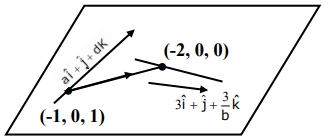
0 likesView Solution
368
MathematicsDifficultMCQJEE Main · 2021
If the real part of the complex number $(1-\cos \theta+2 i \sin \theta)^{-1}$ is $\frac{1}{5}$ for $\theta \in(0, \pi)$,then the value of the integral $\int_{0}^{\theta} \sin x \,dx$ is equal to:
A
$2$
B
$-1$
C
$0$
D
$1$
Solution
(D) Let $z = (1 - \cos \theta + 2i \sin \theta)^{-1} = \frac{1}{(1 - \cos \theta) + 2i \sin \theta}$.
Multiplying numerator and denominator by the conjugate $((1 - \cos \theta) - 2i \sin \theta)$:
$z = \frac{(1 - \cos \theta) - 2i \sin \theta}{(1 - \cos \theta)^2 + 4 \sin^2 \theta}$.
The real part is $\text{Re}(z) = \frac{1 - \cos \theta}{(1 - \cos \theta)^2 + 4 \sin^2 \theta} = \frac{1}{5}$.
Using $1 - \cos \theta = 2 \sin^2 \frac{\theta}{2}$ and $\sin \theta = 2 \sin \frac{\theta}{2} \cos \frac{\theta}{2}$:
$\text{Re}(z) = \frac{2 \sin^2 \frac{\theta}{2}}{4 \sin^4 \frac{\theta}{2} + 16 \sin^2 \frac{\theta}{2} \cos^2 \frac{\theta}{2}} = \frac{2 \sin^2 \frac{\theta}{2}}{4 \sin^2 \frac{\theta}{2} (\sin^2 \frac{\theta}{2} + 4 \cos^2 \frac{\theta}{2})} = \frac{1}{2(\sin^2 \frac{\theta}{2} + 4 \cos^2 \frac{\theta}{2})} = \frac{1}{5}$.
Thus,$2(\sin^2 \frac{\theta}{2} + 4 \cos^2 \frac{\theta}{2}) = 5 \implies 2(1 - \cos^2 \frac{\theta}{2} + 4 \cos^2 \frac{\theta}{2}) = 5$.
$2(1 + 3 \cos^2 \frac{\theta}{2}) = 5 \implies 2 + 6 \cos^2 \frac{\theta}{2} = 5 \implies 6 \cos^2 \frac{\theta}{2} = 3 \implies \cos^2 \frac{\theta}{2} = \frac{1}{2}$.
Since $\theta \in (0, \pi)$,$\frac{\theta}{2} \in (0, \frac{\pi}{2})$,so $\cos \frac{\theta}{2} = \frac{1}{\sqrt{2}}$,which gives $\frac{\theta}{2} = \frac{\pi}{4} \implies \theta = \frac{\pi}{2}$.
Finally,$\int_{0}^{\frac{\pi}{2}} \sin x \,dx = [-\cos x]_{0}^{\frac{\pi}{2}} = -(\cos \frac{\pi}{2} - \cos 0) = -(0 - 1) = 1$.
Multiplying numerator and denominator by the conjugate $((1 - \cos \theta) - 2i \sin \theta)$:
$z = \frac{(1 - \cos \theta) - 2i \sin \theta}{(1 - \cos \theta)^2 + 4 \sin^2 \theta}$.
The real part is $\text{Re}(z) = \frac{1 - \cos \theta}{(1 - \cos \theta)^2 + 4 \sin^2 \theta} = \frac{1}{5}$.
Using $1 - \cos \theta = 2 \sin^2 \frac{\theta}{2}$ and $\sin \theta = 2 \sin \frac{\theta}{2} \cos \frac{\theta}{2}$:
$\text{Re}(z) = \frac{2 \sin^2 \frac{\theta}{2}}{4 \sin^4 \frac{\theta}{2} + 16 \sin^2 \frac{\theta}{2} \cos^2 \frac{\theta}{2}} = \frac{2 \sin^2 \frac{\theta}{2}}{4 \sin^2 \frac{\theta}{2} (\sin^2 \frac{\theta}{2} + 4 \cos^2 \frac{\theta}{2})} = \frac{1}{2(\sin^2 \frac{\theta}{2} + 4 \cos^2 \frac{\theta}{2})} = \frac{1}{5}$.
Thus,$2(\sin^2 \frac{\theta}{2} + 4 \cos^2 \frac{\theta}{2}) = 5 \implies 2(1 - \cos^2 \frac{\theta}{2} + 4 \cos^2 \frac{\theta}{2}) = 5$.
$2(1 + 3 \cos^2 \frac{\theta}{2}) = 5 \implies 2 + 6 \cos^2 \frac{\theta}{2} = 5 \implies 6 \cos^2 \frac{\theta}{2} = 3 \implies \cos^2 \frac{\theta}{2} = \frac{1}{2}$.
Since $\theta \in (0, \pi)$,$\frac{\theta}{2} \in (0, \frac{\pi}{2})$,so $\cos \frac{\theta}{2} = \frac{1}{\sqrt{2}}$,which gives $\frac{\theta}{2} = \frac{\pi}{4} \implies \theta = \frac{\pi}{2}$.
Finally,$\int_{0}^{\frac{\pi}{2}} \sin x \,dx = [-\cos x]_{0}^{\frac{\pi}{2}} = -(\cos \frac{\pi}{2} - \cos 0) = -(0 - 1) = 1$.
0 likesView Solution
369
MathematicsEasyMCQJEE Main · 2021
In a triangle $ABC$,if $|\overrightarrow{BC}|=3$,$|\overrightarrow{AC}|=5$,and $|\overrightarrow{BA}|=7$,then the projection of the vector $\overrightarrow{BA}$ on $\overrightarrow{BC}$ is equal to:
A
$\frac{11}{2}$
B
$\frac{13}{2}$
C
$\frac{19}{2}$
D
$\frac{15}{2}$
Solution
(A) Let $\vec{a} = \overrightarrow{BC}$,$\vec{b} = \overrightarrow{AC}$,and $\vec{c} = \overrightarrow{BA}$.
Given $|\vec{a}| = 3$,$|\vec{b}| = 5$,and $|\vec{c}| = 7$.
In $\triangle ABC$,by the Law of Cosines at vertex $B$:
$|\overrightarrow{AC}|^2 = |\overrightarrow{BA}|^2 + |\overrightarrow{BC}|^2 - 2 |\overrightarrow{BA}| |\overrightarrow{BC}| \cos(\angle ABC)$
$5^2 = 7^2 + 3^2 - 2(7)(3) \cos(\angle ABC)$
$25 = 49 + 9 - 42 \cos(\angle ABC)$
$25 = 58 - 42 \cos(\angle ABC)$
$42 \cos(\angle ABC) = 58 - 25 = 33$
$\cos(\angle ABC) = \frac{33}{42} = \frac{11}{14}$.
The projection of vector $\overrightarrow{BA}$ on $\overrightarrow{BC}$ is given by $|\overrightarrow{BA}| \cos(\angle ABC)$.
Projection $= 7 \times \frac{11}{14} = \frac{11}{2}$.
Given $|\vec{a}| = 3$,$|\vec{b}| = 5$,and $|\vec{c}| = 7$.
In $\triangle ABC$,by the Law of Cosines at vertex $B$:
$|\overrightarrow{AC}|^2 = |\overrightarrow{BA}|^2 + |\overrightarrow{BC}|^2 - 2 |\overrightarrow{BA}| |\overrightarrow{BC}| \cos(\angle ABC)$
$5^2 = 7^2 + 3^2 - 2(7)(3) \cos(\angle ABC)$
$25 = 49 + 9 - 42 \cos(\angle ABC)$
$25 = 58 - 42 \cos(\angle ABC)$
$42 \cos(\angle ABC) = 58 - 25 = 33$
$\cos(\angle ABC) = \frac{33}{42} = \frac{11}{14}$.
The projection of vector $\overrightarrow{BA}$ on $\overrightarrow{BC}$ is given by $|\overrightarrow{BA}| \cos(\angle ABC)$.
Projection $= 7 \times \frac{11}{14} = \frac{11}{2}$.
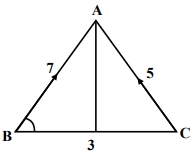
0 likesView Solution
370
MathematicsDifficultMCQJEE Main · 2021
Let $A, B$ and $C$ be three events such that the probability that exactly one of $A$ and $B$ occurs is $(1-k)$,the probability that exactly one of $B$ and $C$ occurs is $(1-2k)$,the probability that exactly one of $C$ and $A$ occurs is $(1-k)$ and the probability that all $A, B$ and $C$ occur simultaneously is $k^2$,where $0 < k < 1$. Then the probability that at least one of $A, B$ and $C$ occurs is:
A
greater than $\frac{1}{2}$
B
greater than $\frac{1}{4}$ but less than $\frac{1}{2}$
C
exactly equal to $\frac{1}{2}$
D
greater than $\frac{1}{8}$ but less than $\frac{1}{4}$
0 likesView Solution
371
MathematicsMediumMCQJEE Main · 2021
The value of $\tan \left(2 \tan ^{-1}\left(\frac{3}{5}\right)+\sin ^{-1}\left(\frac{5}{13}\right)\right)$ is equal to:
A
$\frac{-291}{76}$
B
$\frac{-181}{69}$
C
$\frac{151}{63}$
D
$\frac{220}{21}$
Solution
(D) Let $\alpha = \tan^{-1}\left(\frac{3}{5}\right)$ and $\beta = \sin^{-1}\left(\frac{5}{13}\right)$.
We need to find $\tan(2\alpha + \beta)$.
First,convert $\beta$ to $\tan^{-1}$ form: Since $\sin \beta = \frac{5}{13}$,then $\tan \beta = \frac{5}{\sqrt{13^2 - 5^2}} = \frac{5}{12}$. So,$\beta = \tan^{-1}\left(\frac{5}{12}\right)$.
Now,$2\alpha = 2\tan^{-1}\left(\frac{3}{5}\right) = \tan^{-1}\left(\frac{2 \cdot \frac{3}{5}}{1 - (\frac{3}{5})^2}\right) = \tan^{-1}\left(\frac{6/5}{1 - 9/25}\right) = \tan^{-1}\left(\frac{6/5}{16/25}\right) = \tan^{-1}\left(\frac{6}{5} \cdot \frac{25}{16}\right) = \tan^{-1}\left(\frac{15}{8}\right)$.
Now we need $\tan(2\alpha + \beta) = \tan\left(\tan^{-1}\left(\frac{15}{8}\right) + \tan^{-1}\left(\frac{5}{12}\right)\right)$.
Using the formula $\tan^{-1} x + \tan^{-1} y = \tan^{-1}\left(\frac{x+y}{1-xy}\right)$:
$= \tan\left(\tan^{-1}\left(\frac{\frac{15}{8} + \frac{5}{12}}{1 - \frac{15}{8} \cdot \frac{5}{12}}\right)\right) = \frac{\frac{45+10}{24}}{1 - \frac{75}{96}} = \frac{55/24}{21/96} = \frac{55}{24} \cdot \frac{96}{21} = \frac{55 \cdot 4}{21} = \frac{220}{21}$.
We need to find $\tan(2\alpha + \beta)$.
First,convert $\beta$ to $\tan^{-1}$ form: Since $\sin \beta = \frac{5}{13}$,then $\tan \beta = \frac{5}{\sqrt{13^2 - 5^2}} = \frac{5}{12}$. So,$\beta = \tan^{-1}\left(\frac{5}{12}\right)$.
Now,$2\alpha = 2\tan^{-1}\left(\frac{3}{5}\right) = \tan^{-1}\left(\frac{2 \cdot \frac{3}{5}}{1 - (\frac{3}{5})^2}\right) = \tan^{-1}\left(\frac{6/5}{1 - 9/25}\right) = \tan^{-1}\left(\frac{6/5}{16/25}\right) = \tan^{-1}\left(\frac{6}{5} \cdot \frac{25}{16}\right) = \tan^{-1}\left(\frac{15}{8}\right)$.
Now we need $\tan(2\alpha + \beta) = \tan\left(\tan^{-1}\left(\frac{15}{8}\right) + \tan^{-1}\left(\frac{5}{12}\right)\right)$.
Using the formula $\tan^{-1} x + \tan^{-1} y = \tan^{-1}\left(\frac{x+y}{1-xy}\right)$:
$= \tan\left(\tan^{-1}\left(\frac{\frac{15}{8} + \frac{5}{12}}{1 - \frac{15}{8} \cdot \frac{5}{12}}\right)\right) = \frac{\frac{45+10}{24}}{1 - \frac{75}{96}} = \frac{55/24}{21/96} = \frac{55}{24} \cdot \frac{96}{21} = \frac{55 \cdot 4}{21} = \frac{220}{21}$.
0 likesView Solution
372
MathematicsMediumMCQJEE Main · 2021
Let $f: R - \{\frac{\alpha}{6}\} \rightarrow R$ be defined by $f(x) = \frac{5x + 3}{6x - \alpha}$. Then the value of $\alpha$ for which $(f \circ f)(x) = x$,for all $x \in R - \{\frac{\alpha}{6}\}$,is:
A
$4$
B
$5$
C
$6$
D
$8$
Solution
(B) Given $f(x) = \frac{5x + 3}{6x - \alpha}$.
For $(f \circ f)(x) = x$,the function $f$ must be its own inverse,i.e.,$f(x) = f^{-1}(x)$.
Let $y = f(x) = \frac{5x + 3}{6x - \alpha}$.
Then $y(6x - \alpha) = 5x + 3$.
$6xy - \alpha y = 5x + 3$.
$6xy - 5x = \alpha y + 3$.
$x(6y - 5) = \alpha y + 3$.
$x = \frac{\alpha y + 3}{6y - 5}$.
Thus,$f^{-1}(x) = \frac{\alpha x + 3}{6x - 5}$.
Since $f(x) = f^{-1}(x)$,we have $\frac{5x + 3}{6x - \alpha} = \frac{\alpha x + 3}{6x - 5}$.
Comparing the coefficients,we get $\alpha = 5$.
For $(f \circ f)(x) = x$,the function $f$ must be its own inverse,i.e.,$f(x) = f^{-1}(x)$.
Let $y = f(x) = \frac{5x + 3}{6x - \alpha}$.
Then $y(6x - \alpha) = 5x + 3$.
$6xy - \alpha y = 5x + 3$.
$6xy - 5x = \alpha y + 3$.
$x(6y - 5) = \alpha y + 3$.
$x = \frac{\alpha y + 3}{6y - 5}$.
Thus,$f^{-1}(x) = \frac{\alpha x + 3}{6x - 5}$.
Since $f(x) = f^{-1}(x)$,we have $\frac{5x + 3}{6x - \alpha} = \frac{\alpha x + 3}{6x - 5}$.
Comparing the coefficients,we get $\alpha = 5$.
0 likesView Solution
373
MathematicsDifficultMCQJEE Main · 2021
If $[x]$ denotes the greatest integer less than or equal to $x$,then the value of the integral $\int_{-\pi / 2}^{\pi / 2} [[x] - \sin x] \, dx$ is equal to:
A
$0$
B
$\pi$
C
$1$
D
$-\pi$
Solution
(D) Let $I = \int_{-\pi/2}^{\pi/2} [[x] - \sin x] \, dx$.
Using the property $[a - b] = [a] + [-b]$ is not generally true,but we can use the property $\int_{a}^{b} f(x) \, dx = \int_{a}^{b} f(a+b-x) \, dx$.
Here $a+b = -\pi/2 + \pi/2 = 0$,so $I = \int_{-\pi/2}^{\pi/2} [[-x] - \sin(-x)] \, dx = \int_{-\pi/2}^{\pi/2} [[-x] + \sin x] \, dx$.
Adding the two expressions for $I$:
$2I = \int_{-\pi/2}^{\pi/2} ([[x] - \sin x] + [[-x] + \sin x]) \, dx$.
Using the property $[y] + [-y] = -1$ if $y \notin \mathbb{Z}$ and $0$ if $y \in \mathbb{Z}$.
For $x \in [-\pi/2, \pi/2]$,$[x] + [-x] = -1$ except at $x=0$ where it is $0$.
Similarly,$[\sin x] + [-\sin x] = -1$ except at $x=0$ where it is $0$.
Thus,the integrand is $-2$ almost everywhere.
$2I = \int_{-\pi/2}^{\pi/2} (-2) \, dx = -2 [x]_{-\pi/2}^{\pi/2} = -2(\pi/2 - (-\pi/2)) = -2(\pi) = -2\pi$.
Therefore,$I = -\pi$.
Using the property $[a - b] = [a] + [-b]$ is not generally true,but we can use the property $\int_{a}^{b} f(x) \, dx = \int_{a}^{b} f(a+b-x) \, dx$.
Here $a+b = -\pi/2 + \pi/2 = 0$,so $I = \int_{-\pi/2}^{\pi/2} [[-x] - \sin(-x)] \, dx = \int_{-\pi/2}^{\pi/2} [[-x] + \sin x] \, dx$.
Adding the two expressions for $I$:
$2I = \int_{-\pi/2}^{\pi/2} ([[x] - \sin x] + [[-x] + \sin x]) \, dx$.
Using the property $[y] + [-y] = -1$ if $y \notin \mathbb{Z}$ and $0$ if $y \in \mathbb{Z}$.
For $x \in [-\pi/2, \pi/2]$,$[x] + [-x] = -1$ except at $x=0$ where it is $0$.
Similarly,$[\sin x] + [-\sin x] = -1$ except at $x=0$ where it is $0$.
Thus,the integrand is $-2$ almost everywhere.
$2I = \int_{-\pi/2}^{\pi/2} (-2) \, dx = -2 [x]_{-\pi/2}^{\pi/2} = -2(\pi/2 - (-\pi/2)) = -2(\pi) = -2\pi$.
Therefore,$I = -\pi$.
0 likesView Solution
374
MathematicsDifficultMCQJEE Main · 2021
Let $y=y(x)$ satisfy the equation $\frac{dy}{dx}-|A|=0$,for all $x>0$,where $A=\begin{bmatrix} y & \sin x & 1 \\ 0 & -1 & 1 \\ 2 & 0 & \frac{1}{x} \end{bmatrix}$. If $y(\pi)=\pi+2$,then the value of $y\left(\frac{\pi}{2}\right)$ is:
A
$\frac{\pi}{2}-\frac{4}{\pi}$
B
$\frac{\pi}{2}+\frac{4}{\pi}$
C
$\frac{\pi}{2}-\frac{1}{\pi}$
D
$\frac{\pi}{2}+\frac{1}{\pi}$
Solution
(B) First,calculate the determinant $|A|$:
$|A| = y(-1 \cdot \frac{1}{x} - 0) - \sin x(0 \cdot \frac{1}{x} - 2) + 1(0 \cdot 0 - 2(-1))$
$|A| = -\frac{y}{x} + 2 \sin x + 2$
Given $\frac{dy}{dx} - |A| = 0$,we have $\frac{dy}{dx} = -\frac{y}{x} + 2 \sin x + 2$,which rearranges to $\frac{dy}{dx} + \frac{y}{x} = 2 \sin x + 2$.
This is a linear differential equation of the form $\frac{dy}{dx} + Py = Q$,where $P = \frac{1}{x}$ and $Q = 2 \sin x + 2$.
The integrating factor $I.F. = e^{\int \frac{1}{x} dx} = e^{\ln x} = x$.
The general solution is $y \cdot I.F. = \int Q \cdot I.F. dx + C$.
$yx = \int x(2 \sin x + 2) dx = 2 \int x \sin x dx + \int 2x dx$.
Using integration by parts for $\int x \sin x dx = -x \cos x + \sin x$,we get:
$yx = 2(-x \cos x + \sin x) + x^2 + C = x^2 - 2x \cos x + 2 \sin x + C$.
Given $y(\pi) = \pi + 2$,substitute $x = \pi$:
$(\pi + 2)\pi = \pi^2 - 2\pi \cos(\pi) + 2 \sin(\pi) + C$
$\pi^2 + 2\pi = \pi^2 - 2\pi(-1) + 0 + C \Rightarrow \pi^2 + 2\pi = \pi^2 + 2\pi + C \Rightarrow C = 0$.
Thus,$yx = x^2 - 2x \cos x + 2 \sin x$.
For $x = \frac{\pi}{2}$:
$y(\frac{\pi}{2}) \cdot \frac{\pi}{2} = (\frac{\pi}{2})^2 - 2(\frac{\pi}{2}) \cos(\frac{\pi}{2}) + 2 \sin(\frac{\pi}{2})$
$y(\frac{\pi}{2}) \cdot \frac{\pi}{2} = \frac{\pi^2}{4} - 0 + 2(1) = \frac{\pi^2}{4} + 2$.
$y(\frac{\pi}{2}) = \frac{\pi}{2} + \frac{4}{\pi}$.
$|A| = y(-1 \cdot \frac{1}{x} - 0) - \sin x(0 \cdot \frac{1}{x} - 2) + 1(0 \cdot 0 - 2(-1))$
$|A| = -\frac{y}{x} + 2 \sin x + 2$
Given $\frac{dy}{dx} - |A| = 0$,we have $\frac{dy}{dx} = -\frac{y}{x} + 2 \sin x + 2$,which rearranges to $\frac{dy}{dx} + \frac{y}{x} = 2 \sin x + 2$.
This is a linear differential equation of the form $\frac{dy}{dx} + Py = Q$,where $P = \frac{1}{x}$ and $Q = 2 \sin x + 2$.
The integrating factor $I.F. = e^{\int \frac{1}{x} dx} = e^{\ln x} = x$.
The general solution is $y \cdot I.F. = \int Q \cdot I.F. dx + C$.
$yx = \int x(2 \sin x + 2) dx = 2 \int x \sin x dx + \int 2x dx$.
Using integration by parts for $\int x \sin x dx = -x \cos x + \sin x$,we get:
$yx = 2(-x \cos x + \sin x) + x^2 + C = x^2 - 2x \cos x + 2 \sin x + C$.
Given $y(\pi) = \pi + 2$,substitute $x = \pi$:
$(\pi + 2)\pi = \pi^2 - 2\pi \cos(\pi) + 2 \sin(\pi) + C$
$\pi^2 + 2\pi = \pi^2 - 2\pi(-1) + 0 + C \Rightarrow \pi^2 + 2\pi = \pi^2 + 2\pi + C \Rightarrow C = 0$.
Thus,$yx = x^2 - 2x \cos x + 2 \sin x$.
For $x = \frac{\pi}{2}$:
$y(\frac{\pi}{2}) \cdot \frac{\pi}{2} = (\frac{\pi}{2})^2 - 2(\frac{\pi}{2}) \cos(\frac{\pi}{2}) + 2 \sin(\frac{\pi}{2})$
$y(\frac{\pi}{2}) \cdot \frac{\pi}{2} = \frac{\pi^2}{4} - 0 + 2(1) = \frac{\pi^2}{4} + 2$.
$y(\frac{\pi}{2}) = \frac{\pi}{2} + \frac{4}{\pi}$.
0 likesView Solution
375
MathematicsDifficultMCQJEE Main · 2021
The sum of all the local minimum values of the twice differentiable function $f: R \rightarrow R$ defined by $f(x)=x^{3}-3 x^{2}-\frac{3 f^{\prime \prime}(2)}{2} x+f^{\prime \prime}(1)$ is:
A
$-22$
B
$0$
C
$-27$
D
$5$
Solution
(C) Given $f(x)=x^{3}-3 x^{2}-\frac{3}{2} f^{\prime \prime}(2) x+f^{\prime \prime}(1) \quad \dots(i)$
Differentiating with respect to $x$:
$f^{\prime}(x)=3 x^{2}-6 x-\frac{3}{2} f^{\prime \prime}(2) \quad \dots(ii)$
$f^{\prime \prime}(x)=6 x-6 \quad \dots(iii)$
From $(iii)$,$f^{\prime \prime}(2)=6(2)-6=6$ and $f^{\prime \prime}(1)=6(1)-6=0$.
Substituting $f^{\prime \prime}(2)=6$ into $(ii)$:
$f^{\prime}(x)=3 x^{2}-6 x-\frac{3}{2}(6) = 3 x^{2}-6 x-9$.
Setting $f^{\prime}(x)=0$ for critical points:
$3(x^{2}-2 x-3)=0 \Rightarrow 3(x-3)(x+1)=0 \Rightarrow x=3, -1$.
Using the second derivative test:
$f^{\prime \prime}(-1)=6(-1)-6=-12 < 0$ (Local maxima at $x=-1$).
$f^{\prime \prime}(3)=6(3)-6=12 > 0$ (Local minima at $x=3$).
Substituting $f^{\prime \prime}(2)=6$ and $f^{\prime \prime}(1)=0$ into $(i)$:
$f(x)=x^{3}-3 x^{2}-9 x$.
The local minimum value is $f(3)=3^{3}-3(3^{2})-9(3) = 27-27-27 = -27$.
Differentiating with respect to $x$:
$f^{\prime}(x)=3 x^{2}-6 x-\frac{3}{2} f^{\prime \prime}(2) \quad \dots(ii)$
$f^{\prime \prime}(x)=6 x-6 \quad \dots(iii)$
From $(iii)$,$f^{\prime \prime}(2)=6(2)-6=6$ and $f^{\prime \prime}(1)=6(1)-6=0$.
Substituting $f^{\prime \prime}(2)=6$ into $(ii)$:
$f^{\prime}(x)=3 x^{2}-6 x-\frac{3}{2}(6) = 3 x^{2}-6 x-9$.
Setting $f^{\prime}(x)=0$ for critical points:
$3(x^{2}-2 x-3)=0 \Rightarrow 3(x-3)(x+1)=0 \Rightarrow x=3, -1$.
Using the second derivative test:
$f^{\prime \prime}(-1)=6(-1)-6=-12 < 0$ (Local maxima at $x=-1$).
$f^{\prime \prime}(3)=6(3)-6=12 > 0$ (Local minima at $x=3$).
Substituting $f^{\prime \prime}(2)=6$ and $f^{\prime \prime}(1)=0$ into $(i)$:
$f(x)=x^{3}-3 x^{2}-9 x$.
The local minimum value is $f(3)=3^{3}-3(3^{2})-9(3) = 27-27-27 = -27$.
0 likesView Solution
376
MathematicsMediumMCQJEE Main · 2021
The value of $k \in R$,for which the system of linear equations
$3x - y + 4z = 3$
$x + 2y - 3z = -2$
$6x + 5y + kz = -3$
has infinitely many solutions,is:
$3x - y + 4z = 3$
$x + 2y - 3z = -2$
$6x + 5y + kz = -3$
has infinitely many solutions,is:
A
$3$
B
$-3$
C
$5$
D
$-5$
Solution
(D) For a system of linear equations to have infinitely many solutions,the determinant of the coefficient matrix must be zero,i.e.,$D = 0$.
$D = \begin{vmatrix} 3 & -1 & 4 \\ 1 & 2 & -3 \\ 6 & 5 & k \end{vmatrix} = 0$
Expanding along the first row:
$3(2k - (-15)) - (-1)(k - (-18)) + 4(5 - 12) = 0$
$3(2k + 15) + 1(k + 18) + 4(-7) = 0$
$6k + 45 + k + 18 - 28 = 0$
$7k + 35 = 0$
$7k = -35$
$k = -5$
Checking consistency for $k = -5$:
$3x - y + 4z = 3$ $(i)$
$x + 2y - 3z = -2$ $(ii)$
$6x + 5y - 5z = -3$ $(iii)$
From $(i) \times 2 - (ii)$: $6x - 2y + 8z - (x + 2y - 3z) = 6 - (-2) \Rightarrow 5x - 4y + 11z = 8$. This confirms the system is consistent with infinitely many solutions for $k = -5$.
$D = \begin{vmatrix} 3 & -1 & 4 \\ 1 & 2 & -3 \\ 6 & 5 & k \end{vmatrix} = 0$
Expanding along the first row:
$3(2k - (-15)) - (-1)(k - (-18)) + 4(5 - 12) = 0$
$3(2k + 15) + 1(k + 18) + 4(-7) = 0$
$6k + 45 + k + 18 - 28 = 0$
$7k + 35 = 0$
$7k = -35$
$k = -5$
Checking consistency for $k = -5$:
$3x - y + 4z = 3$ $(i)$
$x + 2y - 3z = -2$ $(ii)$
$6x + 5y - 5z = -3$ $(iii)$
From $(i) \times 2 - (ii)$: $6x - 2y + 8z - (x + 2y - 3z) = 6 - (-2) \Rightarrow 5x - 4y + 11z = 8$. This confirms the system is consistent with infinitely many solutions for $k = -5$.
0 likesView Solution
377
MathematicsMediumMCQJEE Main · 2021
Let $g(t) = \int_{-\pi/2}^{\pi/2} \cos \left(\frac{\pi}{4} t + f(x)\right) \, dx$,where $f(x) = \log_e \left(x + \sqrt{x^2 + 1}\right)$,$x \in R$. Then which one of the following is correct?
A
$g(1) + g(0) = 0$
B
$g(1) = \sqrt{2} g(0)$
C
$g(1) = g(0)$
D
$\sqrt{2} g(1) = g(0)$
Solution
(D) Given $f(x) = \log_e \left(x + \sqrt{x^2 + 1}\right)$. Note that $f(-x) = \log_e \left(-x + \sqrt{x^2 + 1}\right) = \log_e \left(\frac{1}{\sqrt{x^2 + 1} + x}\right) = -f(x)$. Thus,$f(x)$ is an odd function.
$g(t) = \int_{-\pi/2}^{\pi/2} \cos \left(\frac{\pi}{4} t + f(x)\right) \, dx = \int_{-\pi/2}^{\pi/2} \left[ \cos \left(\frac{\pi}{4} t\right) \cos(f(x)) - \sin \left(\frac{\pi}{4} t\right) \sin(f(x)) \right] \, dx$.
Since $f(x)$ is odd,$\cos(f(x))$ is an even function and $\sin(f(x))$ is an odd function.
Therefore,$\int_{-\pi/2}^{\pi/2} \sin \left(\frac{\pi}{4} t\right) \sin(f(x)) \, dx = 0$.
So,$g(t) = \cos \left(\frac{\pi}{4} t\right) \int_{-\pi/2}^{\pi/2} \cos(f(x)) \, dx$.
Let $C = \int_{-\pi/2}^{\pi/2} \cos(f(x)) \, dx$. Then $g(t) = C \cos \left(\frac{\pi}{4} t\right)$.
$g(1) = C \cos \left(\frac{\pi}{4}\right) = \frac{C}{\sqrt{2}}$ and $g(0) = C \cos(0) = C$.
Thus,$g(1) = \frac{g(0)}{\sqrt{2}}$,which implies $\sqrt{2} g(1) = g(0)$.
$g(t) = \int_{-\pi/2}^{\pi/2} \cos \left(\frac{\pi}{4} t + f(x)\right) \, dx = \int_{-\pi/2}^{\pi/2} \left[ \cos \left(\frac{\pi}{4} t\right) \cos(f(x)) - \sin \left(\frac{\pi}{4} t\right) \sin(f(x)) \right] \, dx$.
Since $f(x)$ is odd,$\cos(f(x))$ is an even function and $\sin(f(x))$ is an odd function.
Therefore,$\int_{-\pi/2}^{\pi/2} \sin \left(\frac{\pi}{4} t\right) \sin(f(x)) \, dx = 0$.
So,$g(t) = \cos \left(\frac{\pi}{4} t\right) \int_{-\pi/2}^{\pi/2} \cos(f(x)) \, dx$.
Let $C = \int_{-\pi/2}^{\pi/2} \cos(f(x)) \, dx$. Then $g(t) = C \cos \left(\frac{\pi}{4} t\right)$.
$g(1) = C \cos \left(\frac{\pi}{4}\right) = \frac{C}{\sqrt{2}}$ and $g(0) = C \cos(0) = C$.
Thus,$g(1) = \frac{g(0)}{\sqrt{2}}$,which implies $\sqrt{2} g(1) = g(0)$.
0 likesView Solution
378
MathematicsMediumMCQJEE Main · 2021
Consider the line $L$ given by the equation $\frac{x-3}{2}=\frac{y-1}{1}=\frac{z-2}{1}$. Let $Q$ be the mirror image of the point $P_0(2,3,-1)$ with respect to $L$. Let a plane $P$ be such that it passes through $Q$,and the line $L$ is perpendicular to $P$. Then which of the following points is on the plane $P$?
A
$(1,2,2)$
B
$(-1,1,2)$
C
$(1,1,1)$
D
$(1,1,2)$
Solution
(A) The line $L$ is given by $\frac{x-3}{2}=\frac{y-1}{1}=\frac{z-2}{1} = k$. Any point on $L$ is $(2k+3, k+1, k+2)$.
Let $P_0 = (2,3,-1)$. The vector $\vec{P_0M}$ where $M$ is the foot of the perpendicular from $P_0$ to $L$ is $(2k+3-2, k+1-3, k+2+1) = (2k+1, k-2, k+3)$.
Since $\vec{P_0M}$ is perpendicular to the direction vector of $L$,$\vec{v} = (2,1,1)$,we have $2(2k+1) + 1(k-2) + 1(k+3) = 0$.
$4k+2 + k-2 + k+3 = 0 \implies 6k+3 = 0 \implies k = -1/2$.
Thus,$M = (2(-1/2)+3, -1/2+1, -1/2+2) = (2, 1/2, 3/2)$.
Since $M$ is the midpoint of $P_0Q$,if $Q = (x,y,z)$,then $\frac{x+2}{2} = 2, \frac{y+3}{2} = 1/2, \frac{z-1}{2} = 3/2$.
$x+2 = 4 \implies x=2$; $y+3 = 1 \implies y=-2$; $z-1 = 3 \implies z=4$. So $Q = (2, -2, 4)$.
The plane $P$ is perpendicular to $L$,so its normal vector is $\vec{n} = (2,1,1)$.
The equation of plane $P$ passing through $Q(2, -2, 4)$ is $2(x-2) + 1(y+2) + 1(z-4) = 0$.
$2x - 4 + y + 2 + z - 4 = 0 \implies 2x + y + z - 6 = 0$.
Checking the options: For $(1,2,2)$,$2(1) + 2 + 2 - 6 = 2+2+2-6 = 0$. Thus,$(1,2,2)$ lies on the plane.
Let $P_0 = (2,3,-1)$. The vector $\vec{P_0M}$ where $M$ is the foot of the perpendicular from $P_0$ to $L$ is $(2k+3-2, k+1-3, k+2+1) = (2k+1, k-2, k+3)$.
Since $\vec{P_0M}$ is perpendicular to the direction vector of $L$,$\vec{v} = (2,1,1)$,we have $2(2k+1) + 1(k-2) + 1(k+3) = 0$.
$4k+2 + k-2 + k+3 = 0 \implies 6k+3 = 0 \implies k = -1/2$.
Thus,$M = (2(-1/2)+3, -1/2+1, -1/2+2) = (2, 1/2, 3/2)$.
Since $M$ is the midpoint of $P_0Q$,if $Q = (x,y,z)$,then $\frac{x+2}{2} = 2, \frac{y+3}{2} = 1/2, \frac{z-1}{2} = 3/2$.
$x+2 = 4 \implies x=2$; $y+3 = 1 \implies y=-2$; $z-1 = 3 \implies z=4$. So $Q = (2, -2, 4)$.
The plane $P$ is perpendicular to $L$,so its normal vector is $\vec{n} = (2,1,1)$.
The equation of plane $P$ passing through $Q(2, -2, 4)$ is $2(x-2) + 1(y+2) + 1(z-4) = 0$.
$2x - 4 + y + 2 + z - 4 = 0 \implies 2x + y + z - 6 = 0$.
Checking the options: For $(1,2,2)$,$2(1) + 2 + 2 - 6 = 2+2+2-6 = 0$. Thus,$(1,2,2)$ lies on the plane.
0 likesView Solution
379
MathematicsDifficultMCQJEE Main · 2021
If $f: R \rightarrow R$ is defined by $f(x)=x+1$,then the value of $\lim _{n \rightarrow \infty} \frac{1}{n}\left[f(0)+f\left(\frac{5}{n}\right)+f\left(\frac{10}{n}\right)+\ldots+f\left(\frac{5(n-1)}{n}\right)\right]$ is:
A
$\frac{3}{2}$
B
$\frac{7}{2}$
C
$\frac{5}{2}$
D
$\frac{1}{2}$
Solution
(B) The given expression is a Riemann sum of the form $\lim _{n \rightarrow \infty} \frac{1}{n} \sum_{r=0}^{n-1} f\left(\frac{5r}{n}\right)$.
This can be expressed as a definite integral: $I = \int_{0}^{1} f(5x) \,dx$.
Substituting $f(x) = x+1$,we get $f(5x) = 5x+1$.
Thus,$I = \int_{0}^{1} (5x+1) \,dx$.
Evaluating the integral: $I = \left[ \frac{5x^2}{2} + x \right]_{0}^{1}$.
$I = \left( \frac{5(1)^2}{2} + 1 \right) - (0) = \frac{5}{2} + 1 = \frac{7}{2}$.
This can be expressed as a definite integral: $I = \int_{0}^{1} f(5x) \,dx$.
Substituting $f(x) = x+1$,we get $f(5x) = 5x+1$.
Thus,$I = \int_{0}^{1} (5x+1) \,dx$.
Evaluating the integral: $I = \left[ \frac{5x^2}{2} + x \right]_{0}^{1}$.
$I = \left( \frac{5(1)^2}{2} + 1 \right) - (0) = \frac{5}{2} + 1 = \frac{7}{2}$.
0 likesView Solution
380
MathematicsDifficultMCQJEE Main · 2021
Let a curve $y=y(x)$ be given by the solution of the differential equation $\cos \left(\frac{1}{2} \cos ^{-1}\left(e^{-x}\right)\right) d x=\sqrt{e^{2 x}-1} \,d y$. If it intersects the $y$-axis at $y=-1$,and the intersection point of the curve with the $x$-axis is $(\alpha, 0)$,then $e^{\alpha}$ is equal to $.....$
A
$1$
B
$2$
C
$3$
D
$4$
Solution
(B) Given differential equation: $\cos \left(\frac{1}{2} \cos ^{-1}\left(e^{-x}\right)\right) d x=\sqrt{e^{2 x}-1} \,d y$.
Let $\cos ^{-1}\left(e^{-x}\right)=\theta$,where $\theta \in[0, \pi]$.
Then $\cos \theta = e^{-x}$. Using the identity $\cos \theta = 2 \cos^2 \frac{\theta}{2} - 1$,we have $2 \cos^2 \frac{\theta}{2} = 1 + e^{-x} = \frac{e^x + 1}{e^x}$.
Thus,$\cos \frac{\theta}{2} = \sqrt{\frac{e^x + 1}{2e^x}}$.
Substituting this into the differential equation: $\sqrt{\frac{e^x + 1}{2e^x}} dx = \sqrt{e^{2x} - 1} dy$.
Since $\sqrt{e^{2x} - 1} = \sqrt{(e^x - 1)(e^x + 1)}$,we get $\sqrt{\frac{e^x + 1}{2e^x}} dx = \sqrt{e^x - 1} \sqrt{e^x + 1} dy$.
Dividing by $\sqrt{e^x + 1}$: $\frac{1}{\sqrt{2e^x}} dx = \sqrt{e^x - 1} dy$,which simplifies to $\frac{dx}{\sqrt{2} \sqrt{e^x(e^x - 1)}} = dy$.
Let $e^x = t$,then $e^x dx = dt \Rightarrow dx = \frac{dt}{t}$.
So,$\int \frac{dt}{\sqrt{2} t \sqrt{t(t-1)}} = \int dy$.
Let $t = \frac{1}{z}$,then $dt = -\frac{1}{z^2} dz$.
Substituting: $\int \frac{-dz/z^2}{\sqrt{2} (1/z) \sqrt{1/z^2 - 1/z}} = \int dy \Rightarrow -\int \frac{dz}{\sqrt{2} \sqrt{1-z}} = y + C$.
Integrating: $\sqrt{2} \sqrt{1-z} = y + C \Rightarrow \sqrt{2} \sqrt{1 - e^{-x}} = y + C$.
At $x=0, y=-1$: $\sqrt{2} \sqrt{1 - 1} = -1 + C \Rightarrow C = 1$.
So,$\sqrt{2} \sqrt{1 - e^{-x}} = y + 1$.
For the $x$-axis intersection $(\alpha, 0)$,set $y=0$: $\sqrt{2} \sqrt{1 - e^{-\alpha}} = 1$.
Squaring both sides: $2(1 - e^{-\alpha}) = 1 \Rightarrow 1 - e^{-\alpha} = \frac{1}{2} \Rightarrow e^{-\alpha} = \frac{1}{2}$.
Therefore,$e^{\alpha} = 2$.
Let $\cos ^{-1}\left(e^{-x}\right)=\theta$,where $\theta \in[0, \pi]$.
Then $\cos \theta = e^{-x}$. Using the identity $\cos \theta = 2 \cos^2 \frac{\theta}{2} - 1$,we have $2 \cos^2 \frac{\theta}{2} = 1 + e^{-x} = \frac{e^x + 1}{e^x}$.
Thus,$\cos \frac{\theta}{2} = \sqrt{\frac{e^x + 1}{2e^x}}$.
Substituting this into the differential equation: $\sqrt{\frac{e^x + 1}{2e^x}} dx = \sqrt{e^{2x} - 1} dy$.
Since $\sqrt{e^{2x} - 1} = \sqrt{(e^x - 1)(e^x + 1)}$,we get $\sqrt{\frac{e^x + 1}{2e^x}} dx = \sqrt{e^x - 1} \sqrt{e^x + 1} dy$.
Dividing by $\sqrt{e^x + 1}$: $\frac{1}{\sqrt{2e^x}} dx = \sqrt{e^x - 1} dy$,which simplifies to $\frac{dx}{\sqrt{2} \sqrt{e^x(e^x - 1)}} = dy$.
Let $e^x = t$,then $e^x dx = dt \Rightarrow dx = \frac{dt}{t}$.
So,$\int \frac{dt}{\sqrt{2} t \sqrt{t(t-1)}} = \int dy$.
Let $t = \frac{1}{z}$,then $dt = -\frac{1}{z^2} dz$.
Substituting: $\int \frac{-dz/z^2}{\sqrt{2} (1/z) \sqrt{1/z^2 - 1/z}} = \int dy \Rightarrow -\int \frac{dz}{\sqrt{2} \sqrt{1-z}} = y + C$.
Integrating: $\sqrt{2} \sqrt{1-z} = y + C \Rightarrow \sqrt{2} \sqrt{1 - e^{-x}} = y + C$.
At $x=0, y=-1$: $\sqrt{2} \sqrt{1 - 1} = -1 + C \Rightarrow C = 1$.
So,$\sqrt{2} \sqrt{1 - e^{-x}} = y + 1$.
For the $x$-axis intersection $(\alpha, 0)$,set $y=0$: $\sqrt{2} \sqrt{1 - e^{-\alpha}} = 1$.
Squaring both sides: $2(1 - e^{-\alpha}) = 1 \Rightarrow 1 - e^{-\alpha} = \frac{1}{2} \Rightarrow e^{-\alpha} = \frac{1}{2}$.
Therefore,$e^{\alpha} = 2$.
0 likesView Solution
381
MathematicsDifficultMCQJEE Main · 2021
Let a function $g:[0,4] \rightarrow R$ be defined as
$g(x) = \begin{cases} \max_{0 \leq t \leq x} \{t^3 - 6t^2 + 9t - 3\} & , 0 \leq x \leq 3 \\ 4 - x & , 3 < x \leq 4 \end{cases}$
Then the number of points in the interval $(0,4)$ where $g(x)$ is $NOT$ differentiable is $.....$
$g(x) = \begin{cases} \max_{0 \leq t \leq x} \{t^3 - 6t^2 + 9t - 3\} & , 0 \leq x \leq 3 \\ 4 - x & , 3 < x \leq 4 \end{cases}$
Then the number of points in the interval $(0,4)$ where $g(x)$ is $NOT$ differentiable is $.....$
A
$5$
B
$3$
C
$1$
D
$2$
Solution
(C) Let $f(t) = t^3 - 6t^2 + 9t - 3$.
Then $f'(t) = 3t^2 - 12t + 9 = 3(t-1)(t-3)$.
The critical points are $t=1$ and $t=3$.
$f(0) = -3$,$f(1) = 1 - 6 + 9 - 3 = 1$,and $f(3) = 27 - 54 + 27 - 3 = -3$.
For $0 \leq x \leq 1$,$f(t)$ is increasing,so $\max_{0 \leq t \leq x} f(t) = f(x)$.
For $1 < x \leq 3$,the maximum value of $f(t)$ on $[0, x]$ is $f(1) = 1$.
Thus,$g(x) = \begin{cases} x^3 - 6x^2 + 9x - 3 & , 0 \leq x \leq 1 \\ 1 & , 1 < x \leq 3 \\ 4 - x & , 3 < x \leq 4 \end{cases}$.
Now check differentiability:
At $x=1$: $g'(1^-) = f'(1) = 0$ and $g'(1^+) = 0$. So $g(x)$ is differentiable at $x=1$.
At $x=3$: $g(3^-) = 1$ and $g(3^+) = 4-3 = 1$. $g(x)$ is continuous at $x=3$.
$g'(3^-) = 0$ and $g'(3^+) = -1$. Since $g'(3^-) \neq g'(3^+)$,$g(x)$ is not differentiable at $x=3$.
Thus,there is only $1$ point in $(0,4)$ where $g(x)$ is not differentiable.
Then $f'(t) = 3t^2 - 12t + 9 = 3(t-1)(t-3)$.
The critical points are $t=1$ and $t=3$.
$f(0) = -3$,$f(1) = 1 - 6 + 9 - 3 = 1$,and $f(3) = 27 - 54 + 27 - 3 = -3$.
For $0 \leq x \leq 1$,$f(t)$ is increasing,so $\max_{0 \leq t \leq x} f(t) = f(x)$.
For $1 < x \leq 3$,the maximum value of $f(t)$ on $[0, x]$ is $f(1) = 1$.
Thus,$g(x) = \begin{cases} x^3 - 6x^2 + 9x - 3 & , 0 \leq x \leq 1 \\ 1 & , 1 < x \leq 3 \\ 4 - x & , 3 < x \leq 4 \end{cases}$.
Now check differentiability:
At $x=1$: $g'(1^-) = f'(1) = 0$ and $g'(1^+) = 0$. So $g(x)$ is differentiable at $x=1$.
At $x=3$: $g(3^-) = 1$ and $g(3^+) = 4-3 = 1$. $g(x)$ is continuous at $x=3$.
$g'(3^-) = 0$ and $g'(3^+) = -1$. Since $g'(3^-) \neq g'(3^+)$,$g(x)$ is not differentiable at $x=3$.
Thus,there is only $1$ point in $(0,4)$ where $g(x)$ is not differentiable.
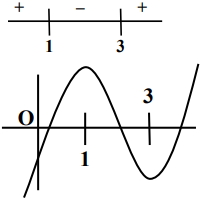
0 likesView Solution
382
MathematicsMediumMCQJEE Main · 2021
Let $A = [a_{ij}]$ be a $3 \times 3$ matrix,where $a_{ij} = \begin{cases} (-1)^{j-i} & \text{if } i < j \\ 2 & \text{if } i = j \\ (-1)^{i+j} & \text{if } i > j \end{cases}$. Then $\det(3 \operatorname{Adj}(2 A^{-1}))$ is equal to:
A
$126$
B
$12$
C
$144$
D
$108$
Solution
(D) First,we construct the matrix $A$ based on the given conditions:
For $i=1, j=2: i < j \implies a_{12} = (-1)^{2-1} = -1$
For $i=1, j=3: i < j \implies a_{13} = (-1)^{3-1} = 1$
For $i=2, j=1: i > j \implies a_{21} = (-1)^{2+1} = -1$
For $i=2, j=3: i < j \implies a_{23} = (-1)^{3-2} = -1$
For $i=3, j=1: i > j \implies a_{31} = (-1)^{3+1} = 1$
For $i=3, j=2: i > j \implies a_{32} = (-1)^{3+2} = -1$
Diagonal elements $a_{ii} = 2$.
Thus,$A = \begin{bmatrix} 2 & -1 & 1 \\ -1 & 2 & -1 \\ 1 & -1 & 2 \end{bmatrix}$.
Calculating the determinant $|A| = 2(4-1) - (-1)(-2+1) + 1(1-2) = 2(3) - 1 - 1 = 6 - 2 = 4$.
We need to find $\det(3 \operatorname{Adj}(2 A^{-1}))$.
Using properties of determinants: $|kM| = k^n |M|$ for an $n \times n$ matrix,and $|\operatorname{Adj}(M)| = |M|^{n-1}$.
Here $n=3$,so $|3 \operatorname{Adj}(2 A^{-1})| = 3^3 |\operatorname{Adj}(2 A^{-1})| = 27 |2 A^{-1}|^{3-1} = 27 |2 A^{-1}|^2$.
Since $|2 A^{-1}| = 2^3 |A^{-1}| = 8 \cdot \frac{1}{|A|} = \frac{8}{4} = 2$.
Therefore,$|3 \operatorname{Adj}(2 A^{-1})| = 27 \cdot (2)^2 = 27 \cdot 4 = 108$.
For $i=1, j=2: i < j \implies a_{12} = (-1)^{2-1} = -1$
For $i=1, j=3: i < j \implies a_{13} = (-1)^{3-1} = 1$
For $i=2, j=1: i > j \implies a_{21} = (-1)^{2+1} = -1$
For $i=2, j=3: i < j \implies a_{23} = (-1)^{3-2} = -1$
For $i=3, j=1: i > j \implies a_{31} = (-1)^{3+1} = 1$
For $i=3, j=2: i > j \implies a_{32} = (-1)^{3+2} = -1$
Diagonal elements $a_{ii} = 2$.
Thus,$A = \begin{bmatrix} 2 & -1 & 1 \\ -1 & 2 & -1 \\ 1 & -1 & 2 \end{bmatrix}$.
Calculating the determinant $|A| = 2(4-1) - (-1)(-2+1) + 1(1-2) = 2(3) - 1 - 1 = 6 - 2 = 4$.
We need to find $\det(3 \operatorname{Adj}(2 A^{-1}))$.
Using properties of determinants: $|kM| = k^n |M|$ for an $n \times n$ matrix,and $|\operatorname{Adj}(M)| = |M|^{n-1}$.
Here $n=3$,so $|3 \operatorname{Adj}(2 A^{-1})| = 3^3 |\operatorname{Adj}(2 A^{-1})| = 27 |2 A^{-1}|^{3-1} = 27 |2 A^{-1}|^2$.
Since $|2 A^{-1}| = 2^3 |A^{-1}| = 8 \cdot \frac{1}{|A|} = \frac{8}{4} = 2$.
Therefore,$|3 \operatorname{Adj}(2 A^{-1})| = 27 \cdot (2)^2 = 27 \cdot 4 = 108$.
0 likesView Solution
383
MathematicsDifficultMCQJEE Main · 2021
For $p > 0$,a vector $\vec{v}_{2} = 2 \hat{i} + (p + 1) \hat{j}$ is obtained by rotating the vector $\vec{v}_{1} = \sqrt{3} p \hat{i} + \hat{j}$ by an angle $\theta$ about the origin in the counter-clockwise direction. If $\tan \theta = \frac{(\alpha \sqrt{3} - 2)}{4 \sqrt{3} + 3}$,then the value of $\alpha$ is equal to $....$
A
$6$
B
$5$
C
$4$
D
$3$
Solution
(A) Given $\vec{v}_{1} = \sqrt{3} p \hat{i} + \hat{j}$ and $\vec{v}_{2} = 2 \hat{i} + (p + 1) \hat{j}$.
Since rotation preserves the magnitude of the vector,$|\vec{v}_{1}| = |\vec{v}_{2}|$.
$(\sqrt{3}p)^2 + 1^2 = 2^2 + (p + 1)^2$
$3p^2 + 1 = 4 + p^2 + 2p + 1$
$2p^2 - 2p - 4 = 0 \Rightarrow p^2 - p - 2 = 0$.
Solving for $p$,$(p - 2)(p + 1) = 0$. Since $p > 0$,we have $p = 2$.
Thus,$\vec{v}_{1} = 2\sqrt{3} \hat{i} + \hat{j}$ and $\vec{v}_{2} = 2 \hat{i} + 3 \hat{j}$.
$|\vec{v}_{1}| = \sqrt{(2\sqrt{3})^2 + 1^2} = \sqrt{12 + 1} = \sqrt{13}$.
$|\vec{v}_{2}| = \sqrt{2^2 + 3^2} = \sqrt{4 + 9} = \sqrt{13}$.
Using $\vec{v}_{1} \cdot \vec{v}_{2} = |\vec{v}_{1}| |\vec{v}_{2}| \cos \theta$,we get $(2\sqrt{3})(2) + (1)(3) = \sqrt{13} \cdot \sqrt{13} \cos \theta$.
$4\sqrt{3} + 3 = 13 \cos \theta \Rightarrow \cos \theta = \frac{4\sqrt{3} + 3}{13}$.
Since $\sin^2 \theta = 1 - \cos^2 \theta = 1 - \frac{(4\sqrt{3} + 3)^2}{169} = \frac{169 - (48 + 9 + 24\sqrt{3})}{169} = \frac{112 - 24\sqrt{3}}{169}$.
$\sin \theta = \frac{\sqrt{112 - 24\sqrt{3}}}{13} = \frac{\sqrt{4(28 - 6\sqrt{3})}}{13} = \frac{2\sqrt{(3\sqrt{3} - 1)^2}}{13} = \frac{2(3\sqrt{3} - 1)}{13} = \frac{6\sqrt{3} - 2}{13}$.
$\tan \theta = \frac{\sin \theta}{\cos \theta} = \frac{6\sqrt{3} - 2}{4\sqrt{3} + 3}$.
Comparing with $\frac{\alpha \sqrt{3} - 2}{4\sqrt{3} + 3}$,we get $\alpha = 6$.
Since rotation preserves the magnitude of the vector,$|\vec{v}_{1}| = |\vec{v}_{2}|$.
$(\sqrt{3}p)^2 + 1^2 = 2^2 + (p + 1)^2$
$3p^2 + 1 = 4 + p^2 + 2p + 1$
$2p^2 - 2p - 4 = 0 \Rightarrow p^2 - p - 2 = 0$.
Solving for $p$,$(p - 2)(p + 1) = 0$. Since $p > 0$,we have $p = 2$.
Thus,$\vec{v}_{1} = 2\sqrt{3} \hat{i} + \hat{j}$ and $\vec{v}_{2} = 2 \hat{i} + 3 \hat{j}$.
$|\vec{v}_{1}| = \sqrt{(2\sqrt{3})^2 + 1^2} = \sqrt{12 + 1} = \sqrt{13}$.
$|\vec{v}_{2}| = \sqrt{2^2 + 3^2} = \sqrt{4 + 9} = \sqrt{13}$.
Using $\vec{v}_{1} \cdot \vec{v}_{2} = |\vec{v}_{1}| |\vec{v}_{2}| \cos \theta$,we get $(2\sqrt{3})(2) + (1)(3) = \sqrt{13} \cdot \sqrt{13} \cos \theta$.
$4\sqrt{3} + 3 = 13 \cos \theta \Rightarrow \cos \theta = \frac{4\sqrt{3} + 3}{13}$.
Since $\sin^2 \theta = 1 - \cos^2 \theta = 1 - \frac{(4\sqrt{3} + 3)^2}{169} = \frac{169 - (48 + 9 + 24\sqrt{3})}{169} = \frac{112 - 24\sqrt{3}}{169}$.
$\sin \theta = \frac{\sqrt{112 - 24\sqrt{3}}}{13} = \frac{\sqrt{4(28 - 6\sqrt{3})}}{13} = \frac{2\sqrt{(3\sqrt{3} - 1)^2}}{13} = \frac{2(3\sqrt{3} - 1)}{13} = \frac{6\sqrt{3} - 2}{13}$.
$\tan \theta = \frac{\sin \theta}{\cos \theta} = \frac{6\sqrt{3} - 2}{4\sqrt{3} + 3}$.
Comparing with $\frac{\alpha \sqrt{3} - 2}{4\sqrt{3} + 3}$,we get $\alpha = 6$.
0 likesView Solution
384
MathematicsMediumMCQJEE Main · 2021
Let $f: R \rightarrow R$ be defined as $f(x) = \begin{cases} -\frac{4}{3}x^3 + 2x^2 + 3x, & x > 0 \\ 3xe^x, & x \leq 0 \end{cases}$. Then $f$ is an increasing function in the interval:
A
$\left(-1, \frac{3}{2}\right)$
B
$\left(-\frac{1}{2}, 2\right)$
C
$(0, 2)$
D
$(-3, -1)$
Solution
(A) For $x > 0$,$f'(x) = -4x^2 + 4x + 3$.
Setting $f'(x) > 0$,we have $-4x^2 + 4x + 3 > 0$,which implies $4x^2 - 4x - 3 < 0$.
Factoring gives $(2x - 3)(2x + 1) < 0$,so $x \in \left(-\frac{1}{2}, \frac{3}{2}\right)$.
Since $x > 0$,$f(x)$ is increasing in $\left(0, \frac{3}{2}\right)$.
For $x \leq 0$,$f'(x) = 3e^x + 3xe^x = 3e^x(1 + x)$.
Setting $f'(x) > 0$,since $3e^x > 0$ for all $x$,we need $1 + x > 0$,which means $x > -1$.
Thus,for $x \leq 0$,$f(x)$ is increasing in $(-1, 0]$.
Combining both intervals,$f(x)$ is increasing in $(-1, 0] \cup (0, \frac{3}{2}) = \left(-1, \frac{3}{2}\right)$.
Setting $f'(x) > 0$,we have $-4x^2 + 4x + 3 > 0$,which implies $4x^2 - 4x - 3 < 0$.
Factoring gives $(2x - 3)(2x + 1) < 0$,so $x \in \left(-\frac{1}{2}, \frac{3}{2}\right)$.
Since $x > 0$,$f(x)$ is increasing in $\left(0, \frac{3}{2}\right)$.
For $x \leq 0$,$f'(x) = 3e^x + 3xe^x = 3e^x(1 + x)$.
Setting $f'(x) > 0$,since $3e^x > 0$ for all $x$,we need $1 + x > 0$,which means $x > -1$.
Thus,for $x \leq 0$,$f(x)$ is increasing in $(-1, 0]$.
Combining both intervals,$f(x)$ is increasing in $(-1, 0] \cup (0, \frac{3}{2}) = \left(-1, \frac{3}{2}\right)$.
0 likesView Solution
385
MathematicsMediumMCQJEE Main · 2021
Let $A = [a_{ij}]$ be a real matrix of order $3 \times 3$,such that $a_{i1} + a_{i2} + a_{i3} = 1$,for $i = 1, 2, 3$. Then,the sum of all the entries of the matrix $A^3$ is equal to:
A
$1$
B
$2$
C
$3$
D
$9$
Solution
(C) Given $A = [a_{ij}]$ is a $3 \times 3$ matrix such that the sum of elements in each row is $1$.
Let $X = \begin{bmatrix} 1 \\ 1 \\ 1 \end{bmatrix}$.
Then $AX = \begin{bmatrix} a_{11} + a_{12} + a_{13} \\ a_{21} + a_{22} + a_{23} \\ a_{31} + a_{32} + a_{33} \end{bmatrix} = \begin{bmatrix} 1 \\ 1 \\ 1 \end{bmatrix} = X$.
Thus,$AX = X$.
Multiplying both sides by $A$,we get $A^2X = A(AX) = AX = X$.
Multiplying by $A$ again,we get $A^3X = A(A^2X) = AX = X$.
Let $A^3 = [b_{ij}]$. Then $A^3X = \begin{bmatrix} b_{11} + b_{12} + b_{13} \\ b_{21} + b_{22} + b_{23} \\ b_{31} + b_{32} + b_{33} \end{bmatrix} = \begin{bmatrix} 1 \\ 1 \\ 1 \end{bmatrix}$.
The sum of all entries of $A^3$ is $(b_{11} + b_{12} + b_{13}) + (b_{21} + b_{22} + b_{23}) + (b_{31} + b_{32} + b_{33}) = 1 + 1 + 1 = 3$.
Let $X = \begin{bmatrix} 1 \\ 1 \\ 1 \end{bmatrix}$.
Then $AX = \begin{bmatrix} a_{11} + a_{12} + a_{13} \\ a_{21} + a_{22} + a_{23} \\ a_{31} + a_{32} + a_{33} \end{bmatrix} = \begin{bmatrix} 1 \\ 1 \\ 1 \end{bmatrix} = X$.
Thus,$AX = X$.
Multiplying both sides by $A$,we get $A^2X = A(AX) = AX = X$.
Multiplying by $A$ again,we get $A^3X = A(A^2X) = AX = X$.
Let $A^3 = [b_{ij}]$. Then $A^3X = \begin{bmatrix} b_{11} + b_{12} + b_{13} \\ b_{21} + b_{22} + b_{23} \\ b_{31} + b_{32} + b_{33} \end{bmatrix} = \begin{bmatrix} 1 \\ 1 \\ 1 \end{bmatrix}$.
The sum of all entries of $A^3$ is $(b_{11} + b_{12} + b_{13}) + (b_{21} + b_{22} + b_{23}) + (b_{31} + b_{32} + b_{33}) = 1 + 1 + 1 = 3$.
0 likesView Solution
386
MathematicsAdvancedMCQJEE Main · 2021
If $\int_{0}^{100 \pi} \frac{\sin ^{2} x}{e^{\left(\frac{x}{\pi}-\left[\frac{x}{\pi}\right]\right)}} d x=\frac{\alpha \pi^{3}}{1+4 \pi^{2}}, \alpha \in R$,where $[x]$ is the greatest integer less than or equal to $x$,then the value of $\alpha$ is :
A
$100(1-e)$
B
$200(1-e^{-1})$
C
$150(e^{-1}-1)$
D
$50(e-1)$
Solution
(B) Let $I = \int_{0}^{100 \pi} \frac{\sin ^{2} x}{e^{\left(\frac{x}{\pi}-\left[\frac{x}{\pi}\right]\right)}} d x$.
Since the function $f(x) = \frac{\sin^2 x}{e^{\left(\frac{x}{\pi}-\left[\frac{x}{\pi}\right]\right)}}$ is periodic with period $\pi$,we have $I = 100 \int_{0}^{\pi} \frac{\sin^2 x}{e^{x/\pi}} dx$.
$I = 100 \int_{0}^{\pi} e^{-x/\pi} \left(\frac{1-\cos 2x}{2}\right) dx = 50 \left[ \int_{0}^{\pi} e^{-x/\pi} dx - \int_{0}^{\pi} e^{-x/\pi} \cos 2x dx \right]$.
Let $I_1 = \int_{0}^{\pi} e^{-x/\pi} dx = [-\pi e^{-x/\pi}]_0^{\pi} = \pi(1-e^{-1})$.
Let $I_2 = \int_{0}^{\pi} e^{-x/\pi} \cos 2x dx$. Using integration by parts,$I_2 = [-\pi e^{-x/\pi} \cos 2x]_0^{\pi} - \int_0^{\pi} \pi e^{-x/\pi} (2 \sin 2x) dx = \pi(1-e^{-1}) - 2\pi \int_0^{\pi} e^{-x/\pi} \sin 2x dx$.
Integrating the second part again,$\int_0^{\pi} e^{-x/\pi} \sin 2x dx = [-\pi e^{-x/\pi} \sin 2x]_0^{\pi} - \int_0^{\pi} \pi e^{-x/\pi} (2 \cos 2x) dx = 2\pi I_2$.
Thus,$I_2 = \pi(1-e^{-1}) - 2\pi(2\pi I_2) = \pi(1-e^{-1}) - 4\pi^2 I_2$.
$I_2(1+4\pi^2) = \pi(1-e^{-1}) \implies I_2 = \frac{\pi(1-e^{-1})}{1+4\pi^2}$.
Substituting back,$I = 50 [\pi(1-e^{-1}) - \frac{\pi(1-e^{-1})}{1+4\pi^2}] = 50 \pi(1-e^{-1}) [1 - \frac{1}{1+4\pi^2}] = 50 \pi(1-e^{-1}) [\frac{4\pi^2}{1+4\pi^2}] = \frac{200(1-e^{-1})\pi^3}{1+4\pi^2}$.
Comparing with $\frac{\alpha \pi^3}{1+4\pi^2}$,we get $\alpha = 200(1-e^{-1})$.
Since the function $f(x) = \frac{\sin^2 x}{e^{\left(\frac{x}{\pi}-\left[\frac{x}{\pi}\right]\right)}}$ is periodic with period $\pi$,we have $I = 100 \int_{0}^{\pi} \frac{\sin^2 x}{e^{x/\pi}} dx$.
$I = 100 \int_{0}^{\pi} e^{-x/\pi} \left(\frac{1-\cos 2x}{2}\right) dx = 50 \left[ \int_{0}^{\pi} e^{-x/\pi} dx - \int_{0}^{\pi} e^{-x/\pi} \cos 2x dx \right]$.
Let $I_1 = \int_{0}^{\pi} e^{-x/\pi} dx = [-\pi e^{-x/\pi}]_0^{\pi} = \pi(1-e^{-1})$.
Let $I_2 = \int_{0}^{\pi} e^{-x/\pi} \cos 2x dx$. Using integration by parts,$I_2 = [-\pi e^{-x/\pi} \cos 2x]_0^{\pi} - \int_0^{\pi} \pi e^{-x/\pi} (2 \sin 2x) dx = \pi(1-e^{-1}) - 2\pi \int_0^{\pi} e^{-x/\pi} \sin 2x dx$.
Integrating the second part again,$\int_0^{\pi} e^{-x/\pi} \sin 2x dx = [-\pi e^{-x/\pi} \sin 2x]_0^{\pi} - \int_0^{\pi} \pi e^{-x/\pi} (2 \cos 2x) dx = 2\pi I_2$.
Thus,$I_2 = \pi(1-e^{-1}) - 2\pi(2\pi I_2) = \pi(1-e^{-1}) - 4\pi^2 I_2$.
$I_2(1+4\pi^2) = \pi(1-e^{-1}) \implies I_2 = \frac{\pi(1-e^{-1})}{1+4\pi^2}$.
Substituting back,$I = 50 [\pi(1-e^{-1}) - \frac{\pi(1-e^{-1})}{1+4\pi^2}] = 50 \pi(1-e^{-1}) [1 - \frac{1}{1+4\pi^2}] = 50 \pi(1-e^{-1}) [\frac{4\pi^2}{1+4\pi^2}] = \frac{200(1-e^{-1})\pi^3}{1+4\pi^2}$.
Comparing with $\frac{\alpha \pi^3}{1+4\pi^2}$,we get $\alpha = 200(1-e^{-1})$.
0 likesView Solution
387
MathematicsDifficultMCQJEE Main · 2021
Four dice are thrown simultaneously and the numbers shown on these dice are recorded in $2 \times 2$ matrices. The probability that such formed matrices have all different entries and are nonsingular,is:
A
$\frac{23}{81}$
B
$\frac{22}{81}$
C
$\frac{45}{162}$
D
$\frac{43}{162}$
Solution
(D) Let the matrix be $A = \begin{bmatrix} a & b \\ c & d \end{bmatrix}$. The determinant is $|A| = ad - bc$.
The total number of ways to choose $4$ numbers from $6$ faces of a die is $6^4 = 1296$.
We require all entries $a, b, c, d$ to be distinct. The number of ways to choose $4$ distinct numbers from ${1, 2, 3, 4, 5, 6}$ and arrange them in the matrix is $^6P_4 = 6 \times 5 \times 4 \times 3 = 360$.
For the matrix to be nonsingular,$|A| \neq 0$,which means $ad \neq bc$.
We count the cases where $ad = bc$ with distinct $a, b, c, d$:
$1$. $6 \times 1 = 2 \times 3$: The sets are ${1, 2, 3, 6}$. Possible arrangements $(a, b, c, d)$ such that $ad=bc$ are $(6, 2, 3, 1), (6, 3, 2, 1), (1, 2, 3, 6), (1, 3, 2, 6), (2, 6, 1, 3), (3, 6, 1, 2), (2, 1, 6, 3), (3, 1, 6, 2)$. Total $8$ cases.
$2$. $6 \times 2 = 3 \times 4$: The sets are ${2, 3, 4, 6}$. Possible arrangements $(a, b, c, d)$ such that $ad=bc$ are $(6, 3, 4, 2), (6, 4, 3, 2), (2, 3, 4, 6), (2, 4, 3, 6), (3, 6, 2, 4), (4, 6, 2, 3), (3, 2, 6, 4), (4, 2, 6, 3)$. Total $8$ cases.
Total cases where $ad = bc$ with distinct entries is $8 + 8 = 16$.
Number of favorable cases = (Total ways with distinct entries) - (Cases where $ad = bc$) = $360 - 16 = 344$.
Required probability = $\frac{344}{1296} = \frac{43}{162}$.
The total number of ways to choose $4$ numbers from $6$ faces of a die is $6^4 = 1296$.
We require all entries $a, b, c, d$ to be distinct. The number of ways to choose $4$ distinct numbers from ${1, 2, 3, 4, 5, 6}$ and arrange them in the matrix is $^6P_4 = 6 \times 5 \times 4 \times 3 = 360$.
For the matrix to be nonsingular,$|A| \neq 0$,which means $ad \neq bc$.
We count the cases where $ad = bc$ with distinct $a, b, c, d$:
$1$. $6 \times 1 = 2 \times 3$: The sets are ${1, 2, 3, 6}$. Possible arrangements $(a, b, c, d)$ such that $ad=bc$ are $(6, 2, 3, 1), (6, 3, 2, 1), (1, 2, 3, 6), (1, 3, 2, 6), (2, 6, 1, 3), (3, 6, 1, 2), (2, 1, 6, 3), (3, 1, 6, 2)$. Total $8$ cases.
$2$. $6 \times 2 = 3 \times 4$: The sets are ${2, 3, 4, 6}$. Possible arrangements $(a, b, c, d)$ such that $ad=bc$ are $(6, 3, 4, 2), (6, 4, 3, 2), (2, 3, 4, 6), (2, 4, 3, 6), (3, 6, 2, 4), (4, 6, 2, 3), (3, 2, 6, 4), (4, 2, 6, 3)$. Total $8$ cases.
Total cases where $ad = bc$ with distinct entries is $8 + 8 = 16$.
Number of favorable cases = (Total ways with distinct entries) - (Cases where $ad = bc$) = $360 - 16 = 344$.
Required probability = $\frac{344}{1296} = \frac{43}{162}$.
0 likesView Solution
388
MathematicsMediumMCQJEE Main · 2021
Let three vectors $\vec{a}, \vec{b}$ and $\vec{c}$ be such that $\vec{a} \times \vec{b} = \vec{c}$,$\vec{b} \times \vec{c} = \vec{a}$ and $|\vec{a}| = 2$. Then which one of the following is not true?
A
Projection of $\vec{a}$ on $(\vec{b} \times \vec{c})$ is $2$
B
$|3\vec{a} + \vec{b} - 2\vec{c}|^2 = 51$
C
$[\vec{a} \vec{b} \vec{c}] + [\vec{c} \vec{a} \vec{b}] = 8$
D
$\vec{a} \times ((\vec{b} + \vec{c}) \times (\vec{b} - \vec{c})) = \vec{0}$
Solution
(B) Given $\vec{a} \times \vec{b} = \vec{c}$ and $\vec{b} \times \vec{c} = \vec{a}$.
Since $\vec{a} \times \vec{b} = \vec{c}$,$\vec{c}$ is perpendicular to both $\vec{a}$ and $\vec{b}$.
Since $\vec{b} \times \vec{c} = \vec{a}$,$\vec{a}$ is perpendicular to both $\vec{b}$ and $\vec{c}$.
Thus,$\vec{a}, \vec{b}, \vec{c}$ are mutually orthogonal.
$|\vec{a} \times \vec{b}| = |\vec{c}| \implies |\vec{a}||\vec{b}| = |\vec{c}| \implies 2|\vec{b}| = |\vec{c}|$.
$|\vec{b} \times \vec{c}| = |\vec{a}| \implies |\vec{b}||\vec{c}| = 2$.
Substituting $|\vec{c}| = 2|\vec{b}|$,we get $|\vec{b}|(2|\vec{b}|) = 2 \implies |\vec{b}|^2 = 1 \implies |\vec{b}| = 1$.
Then $|\vec{c}| = 2(1) = 2$.
$(A)$ Projection of $\vec{a}$ on $(\vec{b} \times \vec{c}) = \frac{\vec{a} \cdot (\vec{b} \times \vec{c})}{|\vec{b} \times \vec{c}|} = \frac{\vec{a} \cdot \vec{a}}{|\vec{a}|} = |\vec{a}| = 2$. (True)
$(B)$ $|3\vec{a} + \vec{b} - 2\vec{c}|^2 = (3\vec{a} + \vec{b} - 2\vec{c}) \cdot (3\vec{a} + \vec{b} - 2\vec{c}) = 9|\vec{a}|^2 + |\vec{b}|^2 + 4|\vec{c}|^2 = 9(4) + 1 + 4(4) = 36 + 1 + 16 = 53 \neq 51$. (Not True)
$(C)$ $[\vec{a} \vec{b} \vec{c}] + [\vec{c} \vec{a} \vec{b}] = 2[\vec{a} \vec{b} \vec{c}] = 2(\vec{a} \cdot (\vec{b} \times \vec{c})) = 2(\vec{a} \cdot \vec{a}) = 2|\vec{a}|^2 = 2(4) = 8$. (True)
$(D)$ $\vec{a} \times ((\vec{b} + \vec{c}) \times (\vec{b} - \vec{c})) = \vec{a} \times (\vec{b} \times \vec{b} - \vec{b} \times \vec{c} + \vec{c} \times \vec{b} - \vec{c} \times \vec{c}) = \vec{a} \times (\vec{0} - \vec{a} - \vec{a} - \vec{0}) = \vec{a} \times (-2\vec{a}) = -2(\vec{a} \times \vec{a}) = \vec{0}$. (True)
Since $\vec{a} \times \vec{b} = \vec{c}$,$\vec{c}$ is perpendicular to both $\vec{a}$ and $\vec{b}$.
Since $\vec{b} \times \vec{c} = \vec{a}$,$\vec{a}$ is perpendicular to both $\vec{b}$ and $\vec{c}$.
Thus,$\vec{a}, \vec{b}, \vec{c}$ are mutually orthogonal.
$|\vec{a} \times \vec{b}| = |\vec{c}| \implies |\vec{a}||\vec{b}| = |\vec{c}| \implies 2|\vec{b}| = |\vec{c}|$.
$|\vec{b} \times \vec{c}| = |\vec{a}| \implies |\vec{b}||\vec{c}| = 2$.
Substituting $|\vec{c}| = 2|\vec{b}|$,we get $|\vec{b}|(2|\vec{b}|) = 2 \implies |\vec{b}|^2 = 1 \implies |\vec{b}| = 1$.
Then $|\vec{c}| = 2(1) = 2$.
$(A)$ Projection of $\vec{a}$ on $(\vec{b} \times \vec{c}) = \frac{\vec{a} \cdot (\vec{b} \times \vec{c})}{|\vec{b} \times \vec{c}|} = \frac{\vec{a} \cdot \vec{a}}{|\vec{a}|} = |\vec{a}| = 2$. (True)
$(B)$ $|3\vec{a} + \vec{b} - 2\vec{c}|^2 = (3\vec{a} + \vec{b} - 2\vec{c}) \cdot (3\vec{a} + \vec{b} - 2\vec{c}) = 9|\vec{a}|^2 + |\vec{b}|^2 + 4|\vec{c}|^2 = 9(4) + 1 + 4(4) = 36 + 1 + 16 = 53 \neq 51$. (Not True)
$(C)$ $[\vec{a} \vec{b} \vec{c}] + [\vec{c} \vec{a} \vec{b}] = 2[\vec{a} \vec{b} \vec{c}] = 2(\vec{a} \cdot (\vec{b} \times \vec{c})) = 2(\vec{a} \cdot \vec{a}) = 2|\vec{a}|^2 = 2(4) = 8$. (True)
$(D)$ $\vec{a} \times ((\vec{b} + \vec{c}) \times (\vec{b} - \vec{c})) = \vec{a} \times (\vec{b} \times \vec{b} - \vec{b} \times \vec{c} + \vec{c} \times \vec{b} - \vec{c} \times \vec{c}) = \vec{a} \times (\vec{0} - \vec{a} - \vec{a} - \vec{0}) = \vec{a} \times (-2\vec{a}) = -2(\vec{a} \times \vec{a}) = \vec{0}$. (True)
0 likesView Solution
389
MathematicsDifficultMCQJEE Main · 2021
Let $L$ be the line of intersection of planes $\vec{r} \cdot(\hat{i}-\hat{j}+2 \hat{k})=2$ and $\vec{r} \cdot(2 \hat{i}+\hat{j}-\hat{k})=2$. If $P(\alpha, \beta, \gamma)$ is the foot of perpendicular on $L$ from the point $(1,2,0)$,then the value of $35(\alpha+\beta+\gamma)$ is equal to :
A
$134$
B
$119$
C
$143$
D
$101$
Solution
(B) The equations of the planes are $P_{1}: x-y+2 z=2$ and $P_{2}: 2 x+y-z=2$.
Let the line of intersection of planes $P_{1}$ and $P_{2}$ cut the $xy$-plane at point $Q$.
Setting $z=0$ in both equations,we get $x-y=2$ and $2x+y=2$. Adding these,$3x=4 \Rightarrow x=\frac{4}{3}$,and $y=x-2 = \frac{4}{3}-2 = -\frac{2}{3}$.
So,$Q = (\frac{4}{3}, -\frac{2}{3}, 0)$.
The direction vector $\vec{a}$ of the line of intersection is the cross product of the normals $\vec{n}_{1} = \hat{i}-\hat{j}+2\hat{k}$ and $\vec{n}_{2} = 2\hat{i}+\hat{j}-\hat{k}$.
$\vec{a} = \vec{n}_{1} \times \vec{n}_{2} = \begin{vmatrix} \hat{i} & \hat{j} & \hat{k} \\ 1 & -1 & 2 \\ 2 & 1 & -1 \end{vmatrix} = \hat{i}(1-2) - \hat{j}(-1-4) + \hat{k}(1+2) = -\hat{i} + 5\hat{j} + 3\hat{k}$.
The equation of the line $L$ is $\frac{x-4/3}{-1} = \frac{y+2/3}{5} = \frac{z}{3} = \lambda$.
Any point $F$ on $L$ is $(-\lambda + 4/3, 5\lambda - 2/3, 3\lambda)$.
Let $A = (1, 2, 0)$. The vector $\vec{AF} = (-\lambda + 4/3 - 1, 5\lambda - 2/3 - 2, 3\lambda - 0) = (-\lambda + 1/3, 5\lambda - 8/3, 3\lambda)$.
Since $AF \perp L$,$\vec{AF} \cdot \vec{a} = 0$.
$(-\lambda + 1/3)(-1) + (5\lambda - 8/3)(5) + (3\lambda)(3) = 0$.
$\lambda - 1/3 + 25\lambda - 40/3 + 9\lambda = 0$.
$35\lambda - 41/3 = 0 \Rightarrow 35\lambda = 41/3 \Rightarrow \lambda = 41/105$.
The coordinates of the foot of the perpendicular $P(\alpha, \beta, \gamma)$ are $F$.
$\alpha + \beta + \gamma = (-\lambda + 4/3) + (5\lambda - 2/3) + 3\lambda = 7\lambda + 2/3$.
$35(\alpha + \beta + \gamma) = 35(7\lambda + 2/3) = 245\lambda + 70/3$.
Substituting $\lambda = 41/105$: $245(41/105) + 70/3 = (49 \times 41)/21 + 70/3 = (7 \times 41)/3 + 70/3 = 287/3 + 70/3 = 357/3 = 119$.
Let the line of intersection of planes $P_{1}$ and $P_{2}$ cut the $xy$-plane at point $Q$.
Setting $z=0$ in both equations,we get $x-y=2$ and $2x+y=2$. Adding these,$3x=4 \Rightarrow x=\frac{4}{3}$,and $y=x-2 = \frac{4}{3}-2 = -\frac{2}{3}$.
So,$Q = (\frac{4}{3}, -\frac{2}{3}, 0)$.
The direction vector $\vec{a}$ of the line of intersection is the cross product of the normals $\vec{n}_{1} = \hat{i}-\hat{j}+2\hat{k}$ and $\vec{n}_{2} = 2\hat{i}+\hat{j}-\hat{k}$.
$\vec{a} = \vec{n}_{1} \times \vec{n}_{2} = \begin{vmatrix} \hat{i} & \hat{j} & \hat{k} \\ 1 & -1 & 2 \\ 2 & 1 & -1 \end{vmatrix} = \hat{i}(1-2) - \hat{j}(-1-4) + \hat{k}(1+2) = -\hat{i} + 5\hat{j} + 3\hat{k}$.
The equation of the line $L$ is $\frac{x-4/3}{-1} = \frac{y+2/3}{5} = \frac{z}{3} = \lambda$.
Any point $F$ on $L$ is $(-\lambda + 4/3, 5\lambda - 2/3, 3\lambda)$.
Let $A = (1, 2, 0)$. The vector $\vec{AF} = (-\lambda + 4/3 - 1, 5\lambda - 2/3 - 2, 3\lambda - 0) = (-\lambda + 1/3, 5\lambda - 8/3, 3\lambda)$.
Since $AF \perp L$,$\vec{AF} \cdot \vec{a} = 0$.
$(-\lambda + 1/3)(-1) + (5\lambda - 8/3)(5) + (3\lambda)(3) = 0$.
$\lambda - 1/3 + 25\lambda - 40/3 + 9\lambda = 0$.
$35\lambda - 41/3 = 0 \Rightarrow 35\lambda = 41/3 \Rightarrow \lambda = 41/105$.
The coordinates of the foot of the perpendicular $P(\alpha, \beta, \gamma)$ are $F$.
$\alpha + \beta + \gamma = (-\lambda + 4/3) + (5\lambda - 2/3) + 3\lambda = 7\lambda + 2/3$.
$35(\alpha + \beta + \gamma) = 35(7\lambda + 2/3) = 245\lambda + 70/3$.
Substituting $\lambda = 41/105$: $245(41/105) + 70/3 = (49 \times 41)/21 + 70/3 = (7 \times 41)/3 + 70/3 = 287/3 + 70/3 = 357/3 = 119$.
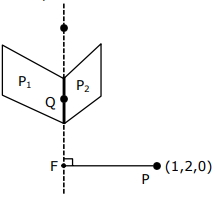
0 likesView Solution
390
MathematicsDifficultMCQJEE Main · 2021
Let $f: R \rightarrow R$ be defined as $f(x) = \begin{cases} \frac{x^{3}}{(1-\cos 2x)^{2}} \log_{e}\left(\frac{1+2xe^{-2x}}{(1-xe^{-x})^{2}}\right), & x \neq 0 \\ \alpha, & x=0 \end{cases}$. If $f$ is continuous at $x=0$,then $\alpha$ is equal to:
A
$1$
B
$0$
C
$3$
D
$2$
Solution
(A) For $f(x)$ to be continuous at $x=0$,we must have $\alpha = \lim_{x \rightarrow 0} f(x)$.
Given $f(x) = \frac{x^3}{(1-\cos 2x)^2} \ln\left(\frac{1+2xe^{-2x}}{(1-xe^{-x})^2}\right)$.
Since $1-\cos 2x = 2\sin^2 x$,we have $(1-\cos 2x)^2 = 4\sin^4 x$.
So,$\lim_{x \rightarrow 0} f(x) = \lim_{x \rightarrow 0} \frac{x^3}{4\sin^4 x} \ln\left(\frac{1+2xe^{-2x}}{(1-xe^{-x})^2}\right)$.
Using $\sin x \approx x$ as $x \rightarrow 0$,$\frac{x^3}{4\sin^4 x} \approx \frac{x^3}{4x^4} = \frac{1}{4x}$.
Now,$\ln\left(\frac{1+2xe^{-2x}}{(1-xe^{-x})^2}\right) = \ln(1+2xe^{-2x}) - 2\ln(1-xe^{-x})$.
Using $\ln(1+u) \approx u$ for small $u$,we get $2xe^{-2x} - 2(-xe^{-x}) = 2xe^{-2x} + 2xe^{-x}$.
As $x \rightarrow 0$,$e^{-2x} \rightarrow 1$ and $e^{-x} \rightarrow 1$,so the expression becomes $2x + 2x = 4x$.
Thus,$\alpha = \lim_{x \rightarrow 0} \frac{1}{4x} \cdot (4x) = 1$.
Given $f(x) = \frac{x^3}{(1-\cos 2x)^2} \ln\left(\frac{1+2xe^{-2x}}{(1-xe^{-x})^2}\right)$.
Since $1-\cos 2x = 2\sin^2 x$,we have $(1-\cos 2x)^2 = 4\sin^4 x$.
So,$\lim_{x \rightarrow 0} f(x) = \lim_{x \rightarrow 0} \frac{x^3}{4\sin^4 x} \ln\left(\frac{1+2xe^{-2x}}{(1-xe^{-x})^2}\right)$.
Using $\sin x \approx x$ as $x \rightarrow 0$,$\frac{x^3}{4\sin^4 x} \approx \frac{x^3}{4x^4} = \frac{1}{4x}$.
Now,$\ln\left(\frac{1+2xe^{-2x}}{(1-xe^{-x})^2}\right) = \ln(1+2xe^{-2x}) - 2\ln(1-xe^{-x})$.
Using $\ln(1+u) \approx u$ for small $u$,we get $2xe^{-2x} - 2(-xe^{-x}) = 2xe^{-2x} + 2xe^{-x}$.
As $x \rightarrow 0$,$e^{-2x} \rightarrow 1$ and $e^{-x} \rightarrow 1$,so the expression becomes $2x + 2x = 4x$.
Thus,$\alpha = \lim_{x \rightarrow 0} \frac{1}{4x} \cdot (4x) = 1$.
0 likesView Solution
391
MathematicsDifficultMCQJEE Main · 2021
Let a vector $\vec{a}$ be coplanar with vectors $\vec{b}=2 \hat{i}+\hat{j}+\hat{k}$ and $\vec{c}=\hat{i}-\hat{j}+\hat{k}$. If $\vec{a}$ is perpendicular to $\vec{d}=3 \hat{i}+2 \hat{j}+6 \hat{k}$,and $|\vec{a}|=\sqrt{10}$. Then a possible value of $[\vec{a} \vec{b} \vec{c}]+[\vec{a} \vec{b} \vec{d}]+[\vec{a} \vec{c} \vec{d}]$ is equal to:
A
$-40$
B
$-42$
C
$-29$
D
$-38$
Solution
(B) Since $\vec{a}$ is coplanar with $\vec{b}$ and $\vec{c}$,we can write $\vec{a} = \lambda \vec{b} + \mu \vec{c}$.
Substituting the vectors: $\vec{a} = \lambda(2 \hat{i} + \hat{j} + \hat{k}) + \mu(\hat{i} - \hat{j} + \hat{k}) = (2\lambda + \mu) \hat{i} + (\lambda - \mu) \hat{j} + (\lambda + \mu) \hat{k}$.
Given $\vec{a} \cdot \vec{d} = 0$,where $\vec{d} = 3 \hat{i} + 2 \hat{j} + 6 \hat{k}$:
$3(2\lambda + \mu) + 2(\lambda - \mu) + 6(\lambda + \mu) = 0$
$6\lambda + 3\mu + 2\lambda - 2\mu + 6\lambda + 6\mu = 0$
$14\lambda + 7\mu = 0 \implies \mu = -2\lambda$.
Substituting $\mu$ back into $\vec{a}$: $\vec{a} = (2\lambda - 2\lambda) \hat{i} + (\lambda - (-2\lambda)) \hat{j} + (\lambda - 2\lambda) \hat{k} = 0 \hat{i} + 3\lambda \hat{j} - \lambda \hat{k}$.
Given $|\vec{a}| = \sqrt{10}$,so $\sqrt{0^2 + (3\lambda)^2 + (-\lambda)^2} = \sqrt{10} \implies \sqrt{10\lambda^2} = \sqrt{10} \implies |\lambda| = 1$.
Since $\vec{a}, \vec{b}, \vec{c}$ are coplanar,$[\vec{a} \vec{b} \vec{c}] = 0$.
The expression becomes $[\vec{a} \vec{b} \vec{d}] + [\vec{a} \vec{c} \vec{d}] = [\vec{a} \vec{b} + \vec{c} \vec{d}]$.
Using $\vec{b} + \vec{c} = 3 \hat{i} + 0 \hat{j} + 2 \hat{k}$ and $\vec{a} = 3\lambda \hat{j} - \lambda \hat{k}$:
$[\vec{a} \vec{b} + \vec{c} \vec{d}] = \begin{vmatrix} 0 & 3\lambda & -\lambda \\ 3 & 0 & 2 \\ 3 & 2 & 6 \end{vmatrix} = 0(0 - 4) - 3\lambda(18 - 6) - \lambda(6 - 0) = -3\lambda(12) - 6\lambda = -42\lambda$.
For $\lambda = 1$,the value is $-42$.
Substituting the vectors: $\vec{a} = \lambda(2 \hat{i} + \hat{j} + \hat{k}) + \mu(\hat{i} - \hat{j} + \hat{k}) = (2\lambda + \mu) \hat{i} + (\lambda - \mu) \hat{j} + (\lambda + \mu) \hat{k}$.
Given $\vec{a} \cdot \vec{d} = 0$,where $\vec{d} = 3 \hat{i} + 2 \hat{j} + 6 \hat{k}$:
$3(2\lambda + \mu) + 2(\lambda - \mu) + 6(\lambda + \mu) = 0$
$6\lambda + 3\mu + 2\lambda - 2\mu + 6\lambda + 6\mu = 0$
$14\lambda + 7\mu = 0 \implies \mu = -2\lambda$.
Substituting $\mu$ back into $\vec{a}$: $\vec{a} = (2\lambda - 2\lambda) \hat{i} + (\lambda - (-2\lambda)) \hat{j} + (\lambda - 2\lambda) \hat{k} = 0 \hat{i} + 3\lambda \hat{j} - \lambda \hat{k}$.
Given $|\vec{a}| = \sqrt{10}$,so $\sqrt{0^2 + (3\lambda)^2 + (-\lambda)^2} = \sqrt{10} \implies \sqrt{10\lambda^2} = \sqrt{10} \implies |\lambda| = 1$.
Since $\vec{a}, \vec{b}, \vec{c}$ are coplanar,$[\vec{a} \vec{b} \vec{c}] = 0$.
The expression becomes $[\vec{a} \vec{b} \vec{d}] + [\vec{a} \vec{c} \vec{d}] = [\vec{a} \vec{b} + \vec{c} \vec{d}]$.
Using $\vec{b} + \vec{c} = 3 \hat{i} + 0 \hat{j} + 2 \hat{k}$ and $\vec{a} = 3\lambda \hat{j} - \lambda \hat{k}$:
$[\vec{a} \vec{b} + \vec{c} \vec{d}] = \begin{vmatrix} 0 & 3\lambda & -\lambda \\ 3 & 0 & 2 \\ 3 & 2 & 6 \end{vmatrix} = 0(0 - 4) - 3\lambda(18 - 6) - \lambda(6 - 0) = -3\lambda(12) - 6\lambda = -42\lambda$.
For $\lambda = 1$,the value is $-42$.
0 likesView Solution
392
MathematicsDifficultMCQJEE Main · 2021
Let $y=y(x)$ be the solution of the differential equation $\operatorname{cosec}^{2} x \, dy + 2 \, dx = (1+y \cos 2x) \operatorname{cosec}^{2} x \, dx$,with $y(\frac{\pi}{4})=0$. Then,the value of $(y(0)+1)^{2}$ is equal to:
A
$e^{1/2}$
B
$e^{-1/2}$
C
$e^{-1}$
D
$e$
Solution
(C) Given the differential equation: $\operatorname{cosec}^{2} x \, dy + 2 \, dx = (1+y \cos 2x) \operatorname{cosec}^{2} x \, dx$.
Dividing by $\operatorname{cosec}^{2} x \, dx$,we get: $\frac{dy}{dx} + 2 \sin^{2} x = 1 + y \cos 2x$.
Rearranging the terms: $\frac{dy}{dx} - y \cos 2x = 1 - 2 \sin^{2} x$.
Since $1 - 2 \sin^{2} x = \cos 2x$,the equation becomes: $\frac{dy}{dx} - y \cos 2x = \cos 2x$.
This is a linear differential equation of the form $\frac{dy}{dx} + P(x)y = Q(x)$,where $P(x) = -\cos 2x$ and $Q(x) = \cos 2x$.
The integrating factor ($I$.$F$.) is $e^{\int P(x) \, dx} = e^{\int -\cos 2x \, dx} = e^{-\frac{\sin 2x}{2}}$.
The solution is $y \cdot (I.F.) = \int Q(x) \cdot (I.F.) \, dx + C$.
$y \cdot e^{-\frac{\sin 2x}{2}} = \int \cos 2x \cdot e^{-\frac{\sin 2x}{2}} \, dx + C$.
Let $u = -\frac{\sin 2x}{2}$,then $du = -\cos 2x \, dx$.
So,$y \cdot e^{-\frac{\sin 2x}{2}} = -\int e^u \, du + C = -e^{-\frac{\sin 2x}{2}} + C$.
Given $y(\frac{\pi}{4}) = 0$,we have $0 = -e^{-\frac{\sin(\pi/2)}{2}} + C = -e^{-1/2} + C$,so $C = e^{-1/2}$.
Thus,$y \cdot e^{-\frac{\sin 2x}{2}} = -e^{-\frac{\sin 2x}{2}} + e^{-1/2}$.
At $x = 0$,$y \cdot e^0 = -e^0 + e^{-1/2}$,which gives $y(0) = -1 + e^{-1/2}$.
Therefore,$(y(0) + 1)^{2} = (-1 + e^{-1/2} + 1)^{2} = (e^{-1/2})^{2} = e^{-1}$.
Dividing by $\operatorname{cosec}^{2} x \, dx$,we get: $\frac{dy}{dx} + 2 \sin^{2} x = 1 + y \cos 2x$.
Rearranging the terms: $\frac{dy}{dx} - y \cos 2x = 1 - 2 \sin^{2} x$.
Since $1 - 2 \sin^{2} x = \cos 2x$,the equation becomes: $\frac{dy}{dx} - y \cos 2x = \cos 2x$.
This is a linear differential equation of the form $\frac{dy}{dx} + P(x)y = Q(x)$,where $P(x) = -\cos 2x$ and $Q(x) = \cos 2x$.
The integrating factor ($I$.$F$.) is $e^{\int P(x) \, dx} = e^{\int -\cos 2x \, dx} = e^{-\frac{\sin 2x}{2}}$.
The solution is $y \cdot (I.F.) = \int Q(x) \cdot (I.F.) \, dx + C$.
$y \cdot e^{-\frac{\sin 2x}{2}} = \int \cos 2x \cdot e^{-\frac{\sin 2x}{2}} \, dx + C$.
Let $u = -\frac{\sin 2x}{2}$,then $du = -\cos 2x \, dx$.
So,$y \cdot e^{-\frac{\sin 2x}{2}} = -\int e^u \, du + C = -e^{-\frac{\sin 2x}{2}} + C$.
Given $y(\frac{\pi}{4}) = 0$,we have $0 = -e^{-\frac{\sin(\pi/2)}{2}} + C = -e^{-1/2} + C$,so $C = e^{-1/2}$.
Thus,$y \cdot e^{-\frac{\sin 2x}{2}} = -e^{-\frac{\sin 2x}{2}} + e^{-1/2}$.
At $x = 0$,$y \cdot e^0 = -e^0 + e^{-1/2}$,which gives $y(0) = -1 + e^{-1/2}$.
Therefore,$(y(0) + 1)^{2} = (-1 + e^{-1/2} + 1)^{2} = (e^{-1/2})^{2} = e^{-1}$.
0 likesView Solution
393
MathematicsMediumMCQJEE Main · 2021
The values of $\lambda$ and $\mu$ such that the system of equations $x+y+z=6$,$3x+5y+5z=26$,and $x+2y+\lambda z=\mu$ has no solution are:
A
$\lambda=3, \mu \neq 10$
B
$\lambda \neq 2, \mu=10$
C
$\lambda=3, \mu=5$
D
$\lambda=2, \mu \neq 10$
Solution
(D) For a system of linear equations to have no solution,the determinant of the coefficient matrix $D$ must be $0$,and at least one of the Cramer's rule determinants $(D_1, D_2, D_3)$ must be non-zero.
First,calculate $D$:
$D = \begin{vmatrix} 1 & 1 & 1 \\ 3 & 5 & 5 \\ 1 & 2 & \lambda \end{vmatrix} = 1(5\lambda - 10) - 1(3\lambda - 5) + 1(6 - 5) = 5\lambda - 10 - 3\lambda + 5 + 1 = 2\lambda - 4$.
Setting $D = 0$,we get $2\lambda - 4 = 0$,which implies $\lambda = 2$.
Now,substitute $\lambda = 2$ into the system:
$x + y + z = 6$ (Eq. $1$)
$3x + 5y + 5z = 26$ (Eq. $2$)
$x + 2y + 2z = \mu$ (Eq. $3$)
Subtract $3 \times$ (Eq. $1$) from (Eq. $2$): $(3x + 5y + 5z) - 3(x + y + z) = 26 - 3(6) \implies 2y + 2z = 8 \implies y + z = 4$.
Subtract (Eq. $1$) from (Eq. $3$): $(x + 2y + 2z) - (x + y + z) = \mu - 6 \implies y + z = \mu - 6$.
For the system to have no solution,these two derived equations must be inconsistent:
$4 \neq \mu - 6 \implies \mu \neq 10$.
Thus,the condition for no solution is $\lambda = 2$ and $\mu \neq 10$.
First,calculate $D$:
$D = \begin{vmatrix} 1 & 1 & 1 \\ 3 & 5 & 5 \\ 1 & 2 & \lambda \end{vmatrix} = 1(5\lambda - 10) - 1(3\lambda - 5) + 1(6 - 5) = 5\lambda - 10 - 3\lambda + 5 + 1 = 2\lambda - 4$.
Setting $D = 0$,we get $2\lambda - 4 = 0$,which implies $\lambda = 2$.
Now,substitute $\lambda = 2$ into the system:
$x + y + z = 6$ (Eq. $1$)
$3x + 5y + 5z = 26$ (Eq. $2$)
$x + 2y + 2z = \mu$ (Eq. $3$)
Subtract $3 \times$ (Eq. $1$) from (Eq. $2$): $(3x + 5y + 5z) - 3(x + y + z) = 26 - 3(6) \implies 2y + 2z = 8 \implies y + z = 4$.
Subtract (Eq. $1$) from (Eq. $3$): $(x + 2y + 2z) - (x + y + z) = \mu - 6 \implies y + z = \mu - 6$.
For the system to have no solution,these two derived equations must be inconsistent:
$4 \neq \mu - 6 \implies \mu \neq 10$.
Thus,the condition for no solution is $\lambda = 2$ and $\mu \neq 10$.
0 likesView Solution
394
MathematicsDifficultMCQJEE Main · 2021
If the domain of the function $f(x) = \frac{\cos^{-1} \sqrt{x^2-x+1}}{\sqrt{\sin^{-1}(\frac{2x-1}{2})}}$ is the interval $(\alpha, \beta]$,then $\alpha + \beta$ is equal to:
A
$2$
B
$\frac{3}{2}$
C
$\frac{1}{2}$
D
$1$
Solution
(B) For the function $f(x)$ to be defined,the following conditions must be satisfied:
$1$. The argument of $\cos^{-1}$ must be in $[0, 1]$: $0 \leq \sqrt{x^2-x+1} \leq 1$.
Squaring gives $0 \leq x^2-x+1 \leq 1$.
$x^2-x+1 \leq 1 \Rightarrow x^2-x \leq 0 \Rightarrow x(x-1) \leq 0 \Rightarrow x \in [0, 1]$.
$2$. The denominator must be non-zero and the argument of the square root must be positive: $\sin^{-1}(\frac{2x-1}{2}) > 0$.
Since the range of $\sin^{-1}$ is $[-\frac{\pi}{2}, \frac{\pi}{2}]$,we also require $\frac{2x-1}{2} \leq 1$.
So,$0 < \frac{2x-1}{2} \leq 1$.
$0 < 2x-1 \leq 2$.
$1 < 2x \leq 3$.
$\frac{1}{2} < x \leq \frac{3}{2}$.
Taking the intersection of $x \in [0, 1]$ and $x \in (\frac{1}{2}, \frac{3}{2}]$,we get $x \in (\frac{1}{2}, 1]$.
Thus,$\alpha = \frac{1}{2}$ and $\beta = 1$.
Therefore,$\alpha + \beta = \frac{1}{2} + 1 = \frac{3}{2}$.
$1$. The argument of $\cos^{-1}$ must be in $[0, 1]$: $0 \leq \sqrt{x^2-x+1} \leq 1$.
Squaring gives $0 \leq x^2-x+1 \leq 1$.
$x^2-x+1 \leq 1 \Rightarrow x^2-x \leq 0 \Rightarrow x(x-1) \leq 0 \Rightarrow x \in [0, 1]$.
$2$. The denominator must be non-zero and the argument of the square root must be positive: $\sin^{-1}(\frac{2x-1}{2}) > 0$.
Since the range of $\sin^{-1}$ is $[-\frac{\pi}{2}, \frac{\pi}{2}]$,we also require $\frac{2x-1}{2} \leq 1$.
So,$0 < \frac{2x-1}{2} \leq 1$.
$0 < 2x-1 \leq 2$.
$1 < 2x \leq 3$.
$\frac{1}{2} < x \leq \frac{3}{2}$.
Taking the intersection of $x \in [0, 1]$ and $x \in (\frac{1}{2}, \frac{3}{2}]$,we get $x \in (\frac{1}{2}, 1]$.
Thus,$\alpha = \frac{1}{2}$ and $\beta = 1$.
Therefore,$\alpha + \beta = \frac{1}{2} + 1 = \frac{3}{2}$.
0 likesView Solution
395
MathematicsMediumMCQJEE Main · 2021
If the shortest distance between the straight lines $3(x-1)=6(y-2)=2(z-1)$ and $4(x-2)=2(y-\lambda)=(z-3)$,$\lambda \in R$ is $\frac{1}{\sqrt{38}}$,then the integral value of $\lambda$ is equal to :
A
$-1$
B
$2$
C
$3$
D
$5$
Solution
(C) The given lines are:
$L_{1}: \frac{x-1}{2} = \frac{y-2}{1} = \frac{z-1}{3}$. Point $P_{1} = (1, 2, 1)$,direction vector $\vec{v}_{1} = 2\hat{i} + \hat{j} + 3\hat{k}$.
$L_{2}: \frac{x-2}{1} = \frac{y-\lambda}{2} = \frac{z-3}{4}$. Point $P_{2} = (2, \lambda, 3)$,direction vector $\vec{v}_{2} = \hat{i} + 2\hat{j} + 4\hat{k}$.
Let $\vec{a} = P_{2} - P_{1} = (2-1)\hat{i} + (\lambda-2)\hat{j} + (3-1)\hat{k} = \hat{i} + (\lambda-2)\hat{j} + 2\hat{k}$.
The shortest distance $d$ is given by $d = \frac{|\vec{a} \cdot (\vec{v}_{1} \times \vec{v}_{2})|}{|\vec{v}_{1} \times \vec{v}_{2}|}$.
First,calculate $\vec{v}_{1} \times \vec{v}_{2} = \begin{vmatrix} \hat{i} & \hat{j} & \hat{k} \\ 2 & 1 & 3 \\ 1 & 2 & 4 \end{vmatrix} = \hat{i}(4-6) - \hat{j}(8-3) + \hat{k}(4-1) = -2\hat{i} - 5\hat{j} + 3\hat{k}$.
Magnitude $|\vec{v}_{1} \times \vec{v}_{2}| = \sqrt{(-2)^2 + (-5)^2 + 3^2} = \sqrt{4 + 25 + 9} = \sqrt{38}$.
Now,$\vec{a} \cdot (\vec{v}_{1} \times \vec{v}_{2}) = (1)(-2) + (\lambda-2)(-5) + (2)(3) = -2 - 5\lambda + 10 + 6 = 14 - 5\lambda$.
Given $d = \frac{1}{\sqrt{38}}$,so $\frac{|14 - 5\lambda|}{\sqrt{38}} = \frac{1}{\sqrt{38}}$.
$|14 - 5\lambda| = 1$.
Case $1$: $14 - 5\lambda = 1 \Rightarrow 5\lambda = 13 \Rightarrow \lambda = 2.6$.
Case $2$: $14 - 5\lambda = -1 \Rightarrow 5\lambda = 15 \Rightarrow \lambda = 3$.
Since we need the integral value of $\lambda$,the answer is $3$.
$L_{1}: \frac{x-1}{2} = \frac{y-2}{1} = \frac{z-1}{3}$. Point $P_{1} = (1, 2, 1)$,direction vector $\vec{v}_{1} = 2\hat{i} + \hat{j} + 3\hat{k}$.
$L_{2}: \frac{x-2}{1} = \frac{y-\lambda}{2} = \frac{z-3}{4}$. Point $P_{2} = (2, \lambda, 3)$,direction vector $\vec{v}_{2} = \hat{i} + 2\hat{j} + 4\hat{k}$.
Let $\vec{a} = P_{2} - P_{1} = (2-1)\hat{i} + (\lambda-2)\hat{j} + (3-1)\hat{k} = \hat{i} + (\lambda-2)\hat{j} + 2\hat{k}$.
The shortest distance $d$ is given by $d = \frac{|\vec{a} \cdot (\vec{v}_{1} \times \vec{v}_{2})|}{|\vec{v}_{1} \times \vec{v}_{2}|}$.
First,calculate $\vec{v}_{1} \times \vec{v}_{2} = \begin{vmatrix} \hat{i} & \hat{j} & \hat{k} \\ 2 & 1 & 3 \\ 1 & 2 & 4 \end{vmatrix} = \hat{i}(4-6) - \hat{j}(8-3) + \hat{k}(4-1) = -2\hat{i} - 5\hat{j} + 3\hat{k}$.
Magnitude $|\vec{v}_{1} \times \vec{v}_{2}| = \sqrt{(-2)^2 + (-5)^2 + 3^2} = \sqrt{4 + 25 + 9} = \sqrt{38}$.
Now,$\vec{a} \cdot (\vec{v}_{1} \times \vec{v}_{2}) = (1)(-2) + (\lambda-2)(-5) + (2)(3) = -2 - 5\lambda + 10 + 6 = 14 - 5\lambda$.
Given $d = \frac{1}{\sqrt{38}}$,so $\frac{|14 - 5\lambda|}{\sqrt{38}} = \frac{1}{\sqrt{38}}$.
$|14 - 5\lambda| = 1$.
Case $1$: $14 - 5\lambda = 1 \Rightarrow 5\lambda = 13 \Rightarrow \lambda = 2.6$.
Case $2$: $14 - 5\lambda = -1 \Rightarrow 5\lambda = 15 \Rightarrow \lambda = 3$.
Since we need the integral value of $\lambda$,the answer is $3$.
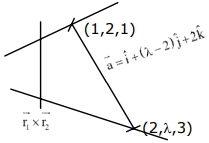
0 likesView Solution
396
MathematicsDifficultMCQJEE Main · 2021
Let $y=y(x)$ be the solution of the differential equation $\left((x+2) e^{\left(\frac{y+1}{x+2}\right)}+(y+1)\right) d x=(x+2) d y$ with the initial condition $y(1)=1$. If the domain of $y=y(x)$ is an open interval $(\alpha, \beta)$,then $|\alpha+\beta|$ is equal to $......$
A
$3$
B
$4$
C
$5$
D
$9$
Solution
(B) Let $Y = y+1$ and $X = x+2$. Then $dY = dy$ and $dX = dx$.
Substituting these into the equation: $(X e^{Y/X} + Y) dX = X dY$.
Rearranging gives $X dY - Y dX = X e^{Y/X} dX$.
Dividing by $X^2$: $\frac{X dY - Y dX}{X^2} = \frac{e^{Y/X}}{X} dX$.
This simplifies to $d(\frac{Y}{X}) = e^{Y/X} \frac{dX}{X}$.
Integrating both sides: $\int e^{-Y/X} d(Y/X) = \int \frac{dX}{X} \Rightarrow -e^{-Y/X} = \ln|X| + C$.
Using $y(1)=1$,we have $Y=2$ and $X=3$: $-e^{-2/3} = \ln|3| + C$,so $C = -e^{-2/3} - \ln 3$.
Thus,$-e^{-(y+1)/(x+2)} = \ln|x+2| - e^{-2/3} - \ln 3$.
$e^{-(y+1)/(x+2)} = e^{-2/3} + \ln 3 - \ln|x+2|$.
For the solution to exist,we require $e^{-2/3} + \ln 3 - \ln|x+2| > 0$,which means $\ln|x+2| < e^{-2/3} + \ln 3$.
Let $k = e^{-2/3} + \ln 3$. Then $|x+2| < e^k$,which implies $-e^k - 2 < x < e^k - 2$.
Thus,$\alpha = -e^k - 2$ and $\beta = e^k - 2$.
Then $\alpha + \beta = -4$,so $|\alpha + \beta| = 4$.
Substituting these into the equation: $(X e^{Y/X} + Y) dX = X dY$.
Rearranging gives $X dY - Y dX = X e^{Y/X} dX$.
Dividing by $X^2$: $\frac{X dY - Y dX}{X^2} = \frac{e^{Y/X}}{X} dX$.
This simplifies to $d(\frac{Y}{X}) = e^{Y/X} \frac{dX}{X}$.
Integrating both sides: $\int e^{-Y/X} d(Y/X) = \int \frac{dX}{X} \Rightarrow -e^{-Y/X} = \ln|X| + C$.
Using $y(1)=1$,we have $Y=2$ and $X=3$: $-e^{-2/3} = \ln|3| + C$,so $C = -e^{-2/3} - \ln 3$.
Thus,$-e^{-(y+1)/(x+2)} = \ln|x+2| - e^{-2/3} - \ln 3$.
$e^{-(y+1)/(x+2)} = e^{-2/3} + \ln 3 - \ln|x+2|$.
For the solution to exist,we require $e^{-2/3} + \ln 3 - \ln|x+2| > 0$,which means $\ln|x+2| < e^{-2/3} + \ln 3$.
Let $k = e^{-2/3} + \ln 3$. Then $|x+2| < e^k$,which implies $-e^k - 2 < x < e^k - 2$.
Thus,$\alpha = -e^k - 2$ and $\beta = e^k - 2$.
Then $\alpha + \beta = -4$,so $|\alpha + \beta| = 4$.
0 likesView Solution
397
MathematicsDifficultMCQJEE Main · 2021
Let $A = \{0, 1, 2, 3, 4, 5, 6, 7\}$. Then the number of bijective functions $f: A \rightarrow A$ such that $f(1) + f(2) = 3 - f(3)$ is equal to $.....$
A
$500$
B
$620$
C
$720$
D
$885$
Solution
(C) Given the condition $f(1) + f(2) = 3 - f(3)$,we can rewrite it as $f(1) + f(2) + f(3) = 3$.
Since $f$ is a bijective function from $A$ to $A$,all values $f(1), f(2), f(3)$ must be distinct elements from the set $A = \{0, 1, 2, 3, 4, 5, 6, 7\}$.
The only distinct non-negative integers that sum to $3$ are $0, 1,$ and $2$.
Thus,the set of values $\{f(1), f(2), f(3)\}$ must be equal to the set $\{0, 1, 2\}$.
The number of ways to assign these $3$ values to $f(1), f(2),$ and $f(3)$ is $3! = 6$.
The remaining $5$ elements of the domain $\{0, 4, 5, 6, 7\}$ must be mapped to the remaining $5$ elements of the codomain $\{3, 4, 5, 6, 7\}$.
The number of ways to map these is $5! = 120$.
Therefore,the total number of bijective functions is $3! \times 5! = 6 \times 120 = 720$.
Since $f$ is a bijective function from $A$ to $A$,all values $f(1), f(2), f(3)$ must be distinct elements from the set $A = \{0, 1, 2, 3, 4, 5, 6, 7\}$.
The only distinct non-negative integers that sum to $3$ are $0, 1,$ and $2$.
Thus,the set of values $\{f(1), f(2), f(3)\}$ must be equal to the set $\{0, 1, 2\}$.
The number of ways to assign these $3$ values to $f(1), f(2),$ and $f(3)$ is $3! = 6$.
The remaining $5$ elements of the domain $\{0, 4, 5, 6, 7\}$ must be mapped to the remaining $5$ elements of the codomain $\{3, 4, 5, 6, 7\}$.
The number of ways to map these is $5! = 120$.
Therefore,the total number of bijective functions is $3! \times 5! = 6 \times 120 = 720$.
2 likesView Solution
398
MathematicsDifficultMCQJEE Main · 2021
Let $f: R \rightarrow R$ be a function defined as $f(x) = \begin{cases} 3(1 - \frac{|x|}{2}) & \text{if } |x| \leq 2 \\ 0 & \text{if } |x| > 2 \end{cases}$. Let $g: R \rightarrow R$ be given by $g(x) = f(x+2) - f(x-2)$. If $n$ and $m$ denote the number of points in $R$ where $g$ is not continuous and not differentiable,respectively,then $n+m$ is equal to $....$
A
$4$
B
$3$
C
$2$
D
$1$
Solution
(A) Given $f(x) = 3(1 - \frac{|x|}{2})$ for $|x| \leq 2$ and $0$ otherwise.
$f(x+2) = 3(1 - \frac{|x+2|}{2})$ for $|x+2| \leq 2$ (i.e.,$-4 \leq x \leq 0$) and $0$ otherwise.
$f(x-2) = 3(1 - \frac{|x-2|}{2})$ for $|x-2| \leq 2$ (i.e.,$0 \leq x \leq 4$) and $0$ otherwise.
Thus,$g(x) = f(x+2) - f(x-2)$ is defined as:
$g(x) = \begin{cases} 3(1 - \frac{|x+2|}{2}) & -4 \leq x < 0 \\ -3(1 - \frac{|x-2|}{2}) & 0 \leq x \leq 4 \\ 0 & \text{otherwise} \end{cases}$
Simplifying $g(x)$:
$g(x) = \begin{cases} \frac{3x}{2} + 6 & -4 \leq x \leq -2 \\ -\frac{3x}{2} & -2 < x < 2 \\ \frac{3x}{2} - 6 & 2 \leq x \leq 4 \\ 0 & \text{otherwise} \end{cases}$
Checking continuity: The function $g(x)$ is continuous everywhere because the limits at $x = -4, -2, 2, 4$ match the function values (all are $0$ at boundaries).
Thus,$n = 0$.
Checking differentiability: The function $g(x)$ is non-differentiable at points where the slope changes abruptly: $x = -4, -2, 2, 4$.
Thus,$m = 4$.
Therefore,$n + m = 0 + 4 = 4$.
$f(x+2) = 3(1 - \frac{|x+2|}{2})$ for $|x+2| \leq 2$ (i.e.,$-4 \leq x \leq 0$) and $0$ otherwise.
$f(x-2) = 3(1 - \frac{|x-2|}{2})$ for $|x-2| \leq 2$ (i.e.,$0 \leq x \leq 4$) and $0$ otherwise.
Thus,$g(x) = f(x+2) - f(x-2)$ is defined as:
$g(x) = \begin{cases} 3(1 - \frac{|x+2|}{2}) & -4 \leq x < 0 \\ -3(1 - \frac{|x-2|}{2}) & 0 \leq x \leq 4 \\ 0 & \text{otherwise} \end{cases}$
Simplifying $g(x)$:
$g(x) = \begin{cases} \frac{3x}{2} + 6 & -4 \leq x \leq -2 \\ -\frac{3x}{2} & -2 < x < 2 \\ \frac{3x}{2} - 6 & 2 \leq x \leq 4 \\ 0 & \text{otherwise} \end{cases}$
Checking continuity: The function $g(x)$ is continuous everywhere because the limits at $x = -4, -2, 2, 4$ match the function values (all are $0$ at boundaries).
Thus,$n = 0$.
Checking differentiability: The function $g(x)$ is non-differentiable at points where the slope changes abruptly: $x = -4, -2, 2, 4$.
Thus,$m = 4$.
Therefore,$n + m = 0 + 4 = 4$.
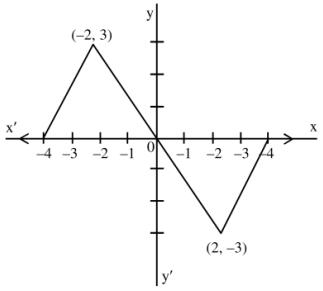
0 likesView Solution
399
MathematicsDifficultMCQJEE Main · 2021
Let $A = \begin{bmatrix} 0 & 1 & 0 \\ 1 & 0 & 0 \\ 0 & 0 & 1 \end{bmatrix}$. Then the number of $3 \times 3$ matrices $B$ with entries from the set $\{1, 2, 3, 4, 5\}$ and satisfying $AB = BA$ is $....$
A
$3500$
B
$3125$
C
$4500$
D
$6000$
Solution
(B) Let matrix $B = \begin{bmatrix} a & b & c \\ d & e & f \\ g & h & i \end{bmatrix}$.
Given $AB = BA$,we have:
$\begin{bmatrix} 0 & 1 & 0 \\ 1 & 0 & 0 \\ 0 & 0 & 1 \end{bmatrix} \begin{bmatrix} a & b & c \\ d & e & f \\ g & h & i \end{bmatrix} = \begin{bmatrix} a & b & c \\ d & e & f \\ g & h & i \end{bmatrix} \begin{bmatrix} 0 & 1 & 0 \\ 1 & 0 & 0 \\ 0 & 0 & 1 \end{bmatrix}$
Performing matrix multiplication:
$\begin{bmatrix} d & e & f \\ a & b & c \\ g & h & i \end{bmatrix} = \begin{bmatrix} b & a & c \\ e & d & f \\ h & g & i \end{bmatrix}$
Comparing the corresponding elements:
$d = b, e = a, f = c, g = h$
Thus,matrix $B$ takes the form:
$B = \begin{bmatrix} a & b & c \\ b & a & c \\ g & g & i \end{bmatrix}$
Since each entry $a, b, c, g, i$ can be chosen from the set $\{1, 2, 3, 4, 5\}$,there are $5$ choices for each of the $5$ independent variables.
Total number of matrices $B = 5 \times 5 \times 5 \times 5 \times 5 = 5^5 = 3125$.
Given $AB = BA$,we have:
$\begin{bmatrix} 0 & 1 & 0 \\ 1 & 0 & 0 \\ 0 & 0 & 1 \end{bmatrix} \begin{bmatrix} a & b & c \\ d & e & f \\ g & h & i \end{bmatrix} = \begin{bmatrix} a & b & c \\ d & e & f \\ g & h & i \end{bmatrix} \begin{bmatrix} 0 & 1 & 0 \\ 1 & 0 & 0 \\ 0 & 0 & 1 \end{bmatrix}$
Performing matrix multiplication:
$\begin{bmatrix} d & e & f \\ a & b & c \\ g & h & i \end{bmatrix} = \begin{bmatrix} b & a & c \\ e & d & f \\ h & g & i \end{bmatrix}$
Comparing the corresponding elements:
$d = b, e = a, f = c, g = h$
Thus,matrix $B$ takes the form:
$B = \begin{bmatrix} a & b & c \\ b & a & c \\ g & g & i \end{bmatrix}$
Since each entry $a, b, c, g, i$ can be chosen from the set $\{1, 2, 3, 4, 5\}$,there are $5$ choices for each of the $5$ independent variables.
Total number of matrices $B = 5 \times 5 \times 5 \times 5 \times 5 = 5^5 = 3125$.
0 likesView Solution
400
MathematicsDifficultMCQJEE Main · 2021
The area (in $sq. \, units$) of the region bounded by the curves $x^{2}+2y-1=0$,$y^{2}+4x-4=0$,and $y^{2}-4x-4=0$ in the upper half plane is $....$
A
$1$
B
$2$
C
$3$
D
$4$
Solution
(B) The curves are $x^2 = 1 - 2y$,$x = \frac{4-y^2}{4}$,and $x = \frac{y^2-4}{4}$.
For the upper half plane $(y \ge 0)$,the region is bounded by $x = \frac{4-y^2}{4}$ on the right,$x = \frac{y^2-4}{4}$ on the left,and $y = \frac{1-x^2}{2}$ from below.
Due to symmetry about the $y$-axis,the area is $2 \int_{0}^{2} \left( \frac{4-y^2}{4} \right) dy - 2 \int_{0}^{1} \left( \frac{1-x^2}{2} \right) dx$.
$= 2 \left[ y - \frac{y^3}{12} \right]_{0}^{2} - 2 \left[ \frac{x}{2} - \frac{x^3}{6} \right]_{0}^{1}$
$= 2 \left( 2 - \frac{8}{12} \right) - 2 \left( \frac{1}{2} - \frac{1}{6} \right)$
$= 2 \left( \frac{4}{3} \right) - 2 \left( \frac{1}{3} \right) = \frac{8}{3} - \frac{2}{3} = \frac{6}{3} = 2 \, sq. \, units$.
For the upper half plane $(y \ge 0)$,the region is bounded by $x = \frac{4-y^2}{4}$ on the right,$x = \frac{y^2-4}{4}$ on the left,and $y = \frac{1-x^2}{2}$ from below.
Due to symmetry about the $y$-axis,the area is $2 \int_{0}^{2} \left( \frac{4-y^2}{4} \right) dy - 2 \int_{0}^{1} \left( \frac{1-x^2}{2} \right) dx$.
$= 2 \left[ y - \frac{y^3}{12} \right]_{0}^{2} - 2 \left[ \frac{x}{2} - \frac{x^3}{6} \right]_{0}^{1}$
$= 2 \left( 2 - \frac{8}{12} \right) - 2 \left( \frac{1}{2} - \frac{1}{6} \right)$
$= 2 \left( \frac{4}{3} \right) - 2 \left( \frac{1}{3} \right) = \frac{8}{3} - \frac{2}{3} = \frac{6}{3} = 2 \, sq. \, units$.
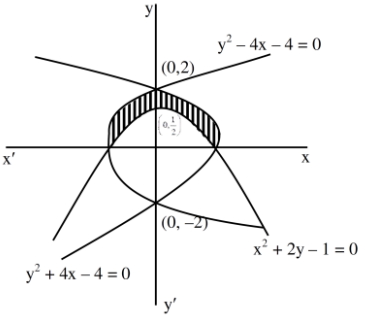
0 likesView Solution
Vedclass Products
For Students
Vedclass Test Series
Mock tests in real JEE Main style covering Mathematics with performance analysis. 5-day free trial.
Start Free TrialFor Teachers
Exam Paper Generator
Generate Set A/B/C/D Mathematics papers from 7.5L+ questions in 2 minutes. 3 chapters free.
Try FreeFor Institutes
Online Exam Module
Run live JEE Main mock exams with unlimited students, 360° analytics & white-label branding.
See DemoFrequently Asked Questions
How many Mathematics questions are in JEE Main 2021?
There are 781 Mathematics questions from the JEE Main 2021 paper on Vedclass, each with a detailed step-by-step solution in English.
Are JEE Main 2021 Mathematics solutions available in English?
Yes. All solutions on this page are in English. You can also switch to English or Hindi using the language buttons above the questions.
Can I practice JEE Main 2021 Mathematics as a timed test?
Yes. Use the Vedclass Test Series to attempt a full JEE Main mock test covering Mathematics with time limits and instant score analysis.
Can teachers create Mathematics papers from JEE Main previous year questions?
Yes. The Vedclass Exam Paper Generator lets teachers mix JEE Main Mathematics questions and generate Set A/B/C/D papers in minutes.
For Teachers & Institutes
Build a Custom Mathematics Paper
Pick JEE Main 2021 Mathematics questions, set difficulty, and generate Set A/B/C/D in 2 minutes.