
ChemistryQ151–250 of 521 questions
Page 4 of 6 · English
151
ChemistryMCQJEE Main · 2019
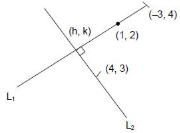
Suppose that the points $(h, k)$,$(1, 2)$,and $(-3, 4)$ lie on the line $L_1$. If a line $L_2$ passing through the points $(h, k)$ and $(4, 3)$ is perpendicular to $L_1$,then $\frac{k}{h}$ equals
A
$-\frac{1}{7}$
B
$\frac{1}{3}$
C
$3$
D
$0$
Solution
(B) The slope of line $L_1$ passing through $(1, 2)$ and $(-3, 4)$ is $m_1 = \frac{4 - 2}{-3 - 1} = \frac{2}{-4} = -\frac{1}{2}$.
Since $(h, k)$ lies on $L_1$,the slope of the line segment joining $(h, k)$ and $(1, 2)$ must also be $-\frac{1}{2}$.
Thus,$\frac{k - 2}{h - 1} = -\frac{1}{2}$ $\Rightarrow 2k - 4 = -h + 1$ $\Rightarrow h + 2k = 5$.
Line $L_2$ passes through $(h, k)$ and $(4, 3)$,so its slope is $m_2 = \frac{3 - k}{4 - h}$.
Since $L_2 \perp L_1$,$m_1 \times m_2 = -1$ $\Rightarrow -\frac{1}{2} \times \frac{3 - k}{4 - h} = -1$ $\Rightarrow \frac{3 - k}{4 - h} = 2$.
$3 - k = 8 - 2h \Rightarrow 2h - k = 5$.
We have the system of equations:
$1) h + 2k = 5$
$2) 2h - k = 5$
Multiplying equation $(2)$ by $2$,we get $4h - 2k = 10$.
Adding this to equation $(1)$: $(h + 2k) + (4h - 2k) = 5 + 10$ $\Rightarrow 5h = 15$ $\Rightarrow h = 3$.
Substituting $h = 3$ into $2h - k = 5$: $2(3) - k = 5$ $\Rightarrow 6 - k = 5$ $\Rightarrow k = 1$.
Therefore,$\frac{k}{h} = \frac{1}{3}$.
Since $(h, k)$ lies on $L_1$,the slope of the line segment joining $(h, k)$ and $(1, 2)$ must also be $-\frac{1}{2}$.
Thus,$\frac{k - 2}{h - 1} = -\frac{1}{2}$ $\Rightarrow 2k - 4 = -h + 1$ $\Rightarrow h + 2k = 5$.
Line $L_2$ passes through $(h, k)$ and $(4, 3)$,so its slope is $m_2 = \frac{3 - k}{4 - h}$.
Since $L_2 \perp L_1$,$m_1 \times m_2 = -1$ $\Rightarrow -\frac{1}{2} \times \frac{3 - k}{4 - h} = -1$ $\Rightarrow \frac{3 - k}{4 - h} = 2$.
$3 - k = 8 - 2h \Rightarrow 2h - k = 5$.
We have the system of equations:
$1) h + 2k = 5$
$2) 2h - k = 5$
Multiplying equation $(2)$ by $2$,we get $4h - 2k = 10$.
Adding this to equation $(1)$: $(h + 2k) + (4h - 2k) = 5 + 10$ $\Rightarrow 5h = 15$ $\Rightarrow h = 3$.
Substituting $h = 3$ into $2h - k = 5$: $2(3) - k = 5$ $\Rightarrow 6 - k = 5$ $\Rightarrow k = 1$.
Therefore,$\frac{k}{h} = \frac{1}{3}$.
0 likesView Solution
152
ChemistryMCQJEE Main · 2019
Given that the slope of the tangent to a curve $y = y(x)$ at any point $(x, y)$ is $\frac{2y}{x^2}$. If the curve passes through the centre of the circle $x^2 + y^2 - 2x - 2y = 0$,then its equation is
A
$x \ln |y| = x - 1$
B
$x \ln |y| = -2(x - 1)$
C
$x^2 \ln |y| = -2(x - 1)$
D
$x \ln |y| = 2(x - 1)$
Solution
(D) The slope of the tangent is given by $\frac{dy}{dx} = \frac{2y}{x^2}$.
Separating the variables,we get $\frac{dy}{y} = \frac{2}{x^2} dx$.
Integrating both sides,$\int \frac{dy}{y} = \int 2x^{-2} dx$,which gives $\ln |y| = -\frac{2}{x} + C$.
The circle equation is $x^2 + y^2 - 2x - 2y = 0$,which can be written as $(x-1)^2 + (y-1)^2 = 2$. The centre is $(1, 1)$.
Since the curve passes through $(1, 1)$,we substitute $x = 1$ and $y = 1$ into the equation: $\ln |1| = -\frac{2}{1} + C$,so $0 = -2 + C$,which implies $C = 2$.
Thus,the equation is $\ln |y| = -\frac{2}{x} + 2$.
Multiplying by $x$,we get $x \ln |y| = -2 + 2x = 2(x - 1)$.
Separating the variables,we get $\frac{dy}{y} = \frac{2}{x^2} dx$.
Integrating both sides,$\int \frac{dy}{y} = \int 2x^{-2} dx$,which gives $\ln |y| = -\frac{2}{x} + C$.
The circle equation is $x^2 + y^2 - 2x - 2y = 0$,which can be written as $(x-1)^2 + (y-1)^2 = 2$. The centre is $(1, 1)$.
Since the curve passes through $(1, 1)$,we substitute $x = 1$ and $y = 1$ into the equation: $\ln |1| = -\frac{2}{1} + C$,so $0 = -2 + C$,which implies $C = 2$.
Thus,the equation is $\ln |y| = -\frac{2}{x} + 2$.
Multiplying by $x$,we get $x \ln |y| = -2 + 2x = 2(x - 1)$.
0 likesView Solution
153
ChemistryDifficultMCQJEE Main · 2019
Magnesium powder burns in air to give
A
$MgO$ and $Mg(NO_3)_2$
B
$MgO$ and $Mg_3N_2$
C
$MgO$ only
D
$Mg(NO_3)_2$ and $Mg_3N_2$
Solution
(B) When magnesium powder is burnt in air,it reacts with both oxygen and nitrogen present in the atmosphere.
$2Mg(s) + O_2(g) \to 2MgO(s)$
$3Mg(s) + N_2(g) \to Mg_3N_2(s)$
Therefore,the products formed are $MgO$ and $Mg_3N_2$.
$2Mg(s) + O_2(g) \to 2MgO(s)$
$3Mg(s) + N_2(g) \to Mg_3N_2(s)$
Therefore,the products formed are $MgO$ and $Mg_3N_2$.
0 likesView Solution
154
ChemistryMediumMCQJEE Main · 2019
Consider the van der Waals constants,$a$ and $b,$ for the following gases.
Which gas is expected to have the highest critical temperature?
| Gas | $Ar$ | $Ne$ | $Kr$ | $Xe$ |
| $a \ (atm \ dm^6 \ mol^{-2})$ | $1.3$ | $0.2$ | $5.1$ | $4.1$ |
| $b \ (10^{-2} \ dm^3 \ mol^{-1})$ | $3.2$ | $1.7$ | $1.0$ | $5.0$ |
Which gas is expected to have the highest critical temperature?
A
$Ar$
B
$Xe$
C
$Kr$
D
$Ne$
Solution
(C) The critical temperature $(T_c)$ of a gas is given by the formula $T_c = \frac{8a}{27Rb}$.
To find the gas with the highest $T_c$,we need to calculate the ratio $\frac{a}{b}$ for each gas:
$Ar: \frac{1.3}{3.2} \approx 0.406$
$Ne: \frac{0.2}{1.7} \approx 0.118$
$Kr: \frac{5.1}{1.0} = 5.1$
$Xe: \frac{4.1}{5.0} = 0.82$
Since $Kr$ has the highest $\frac{a}{b}$ ratio,it will have the highest critical temperature.
To find the gas with the highest $T_c$,we need to calculate the ratio $\frac{a}{b}$ for each gas:
$Ar: \frac{1.3}{3.2} \approx 0.406$
$Ne: \frac{0.2}{1.7} \approx 0.118$
$Kr: \frac{5.1}{1.0} = 5.1$
$Xe: \frac{4.1}{5.0} = 0.82$
Since $Kr$ has the highest $\frac{a}{b}$ ratio,it will have the highest critical temperature.
0 likesView Solution
155
ChemistryAdvancedMCQJEE Main · 2019
Among the following,the molecule expected to be stabilized by anion formation is
A
$F_2$
B
$C_2$
C
$O_2$
D
$NO$
Solution
(B) The stability of a molecule upon anion formation depends on the change in bond order. If the electron enters a bonding molecular orbital,the bond order increases,leading to stabilization. If it enters an antibonding orbital,the bond order decreases,leading to destabilization.
For $C_2$: The electronic configuration is $\sigma 1s^2 \sigma^* 1s^2 \sigma 2s^2 \sigma^* 2s^2 \pi 2p_y^2 \pi 2p_z^2$. Bond order = $(8-4)/2 = 2$.
For $C_2^-$: The configuration is $\sigma 1s^2 \sigma^* 1s^2 \sigma 2s^2 \sigma^* 2s^2 \pi 2p_y^2 \pi 2p_z^2 \sigma 2p_x^1$. Bond order = $(9-4)/2 = 2.5$.
Since the bond order increases from $2$ to $2.5$,$C_2$ is stabilized by anion formation.
For $C_2$: The electronic configuration is $\sigma 1s^2 \sigma^* 1s^2 \sigma 2s^2 \sigma^* 2s^2 \pi 2p_y^2 \pi 2p_z^2$. Bond order = $(8-4)/2 = 2$.
For $C_2^-$: The configuration is $\sigma 1s^2 \sigma^* 1s^2 \sigma 2s^2 \sigma^* 2s^2 \pi 2p_y^2 \pi 2p_z^2 \sigma 2p_x^1$. Bond order = $(9-4)/2 = 2.5$.
Since the bond order increases from $2$ to $2.5$,$C_2$ is stabilized by anion formation.
0 likesView Solution
156
ChemistryDifficultMCQJEE Main · 2019
Among the following,the set of parameters that represents path functions is:
$(a) \ q + w$
$(b) \ q$
$(c) \ w$
$(d) \ H - TS$
$(a) \ q + w$
$(b) \ q$
$(c) \ w$
$(d) \ H - TS$
A
$(b)$ and $(c)$
B
$(b), (c)$ and $(d)$
C
$(a), (b)$ and $(c)$
D
$(a)$ and $(d)$
Solution
(A) Path functions are properties whose values depend on the path taken to reach a state,not just the initial and final states.
$q$ (heat) and $w$ (work) are path functions.
$q + w$ represents the change in internal energy $(\Delta U)$,which is a state function.
$H - TS$ represents the Gibbs free energy $(G)$,which is a state function.
Therefore,only $q$ and $w$ are path functions.
$q$ (heat) and $w$ (work) are path functions.
$q + w$ represents the change in internal energy $(\Delta U)$,which is a state function.
$H - TS$ represents the Gibbs free energy $(G)$,which is a state function.
Therefore,only $q$ and $w$ are path functions.
0 likesView Solution
157
ChemistryDifficultMCQJEE Main · 2019
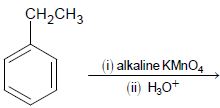
The major product of the following reaction is:
A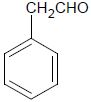
B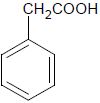
C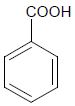
D
Solution
(D) The reaction of alkylbenzenes with alkaline $KMnO_4$ followed by acidification $(H_3O^+)$ is a standard oxidation reaction.
Regardless of the length of the alkyl side chain,as long as there is at least one benzylic hydrogen atom,the entire side chain is oxidized to a carboxylic acid group $(-COOH)$ attached to the benzene ring.
In this case,ethylbenzene $(C_6H_5-CH_2CH_3)$ undergoes oxidation to form benzoic acid $(C_6H_5COOH)$.
Regardless of the length of the alkyl side chain,as long as there is at least one benzylic hydrogen atom,the entire side chain is oxidized to a carboxylic acid group $(-COOH)$ attached to the benzene ring.
In this case,ethylbenzene $(C_6H_5-CH_2CH_3)$ undergoes oxidation to form benzoic acid $(C_6H_5COOH)$.
0 likesView Solution
158
ChemistryDifficultMCQJEE Main · 2019
The organic compound that gives the following qualitative analysis is:
| Test | Inference |
|---|---|
| $a$. Dil. $HCl$ | Insoluble |
| $b$. $NaOH$ solution | Soluble |
| $c$. $Br_2/\text{water}$ | Decolourization |
A
Cyclohexanol
B
Phenol
C
Cyclohexylamine
D
Aniline
Solution
(B) The given qualitative analysis indicates the following properties of the compound:
$1$. Insoluble in dilute $HCl$: This suggests the compound is not basic (like an amine).
$2$. Soluble in $NaOH$ solution: This indicates the compound is acidic (like a phenol or carboxylic acid).
$3$. Decolourization of $Br_2/\text{water}$: This indicates the presence of an unsaturated system or a highly activated aromatic ring (like phenol,which forms $2,4,6-\text{tribromophenol}$).
Comparing these properties:
- Cyclohexanol is neutral and does not dissolve in $NaOH$.
- Phenol is acidic,dissolves in $NaOH$ to form sodium phenoxide,and reacts with bromine water to decolourise it.
- Cyclohexylamine is basic and dissolves in $HCl$.
- Aniline is basic and dissolves in $HCl$.
Therefore,the compound is Phenol.
$1$. Insoluble in dilute $HCl$: This suggests the compound is not basic (like an amine).
$2$. Soluble in $NaOH$ solution: This indicates the compound is acidic (like a phenol or carboxylic acid).
$3$. Decolourization of $Br_2/\text{water}$: This indicates the presence of an unsaturated system or a highly activated aromatic ring (like phenol,which forms $2,4,6-\text{tribromophenol}$).
Comparing these properties:
- Cyclohexanol is neutral and does not dissolve in $NaOH$.
- Phenol is acidic,dissolves in $NaOH$ to form sodium phenoxide,and reacts with bromine water to decolourise it.
- Cyclohexylamine is basic and dissolves in $HCl$.
- Aniline is basic and dissolves in $HCl$.
Therefore,the compound is Phenol.
0 likesView Solution
159
ChemistryMediumMCQJEE Main · 2019
Excessive release of $CO_2$ into the atmosphere results in
A
formation of smog
B
depletion of ozone
C
global warming
D
polar vortex
Solution
(C) Carbon dioxide is very important for maintaining the climate which is suitable for our survival.
$CO_2$ has the property of trapping heat from the sun. So,higher the level of carbon dioxide,the higher will be the heat trapped.
This leads to the rise in the temperature of the earth,resulting in global warming.
Therefore,we can say excessive release of $CO_2$ into the atmosphere results in global warming.
$CO_2$ has the property of trapping heat from the sun. So,higher the level of carbon dioxide,the higher will be the heat trapped.
This leads to the rise in the temperature of the earth,resulting in global warming.
Therefore,we can say excessive release of $CO_2$ into the atmosphere results in global warming.
0 likesView Solution
160
ChemistryMediumMCQJEE Main · 2019
The correct $IUPAC$ name of the following compound is
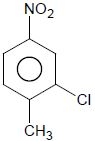
A
$5-$chloro$-4-$methyl$-1-$nitrobenzene
B
$2-$methyl$-5-$nitro$-1-$chlorobenzene
C
$3-$chloro$-4-$methyl$-1-$nitrobenzene
D
$2-$chloro$-1-$methyl$-4-$nitrobenzene
Solution
(D) To name the given compound according to $IUPAC$ rules,we identify the parent chain as the benzene ring.
We assign the lowest possible locants to the substituents.
Here,the substituents are a methyl group $(-CH_3)$,a chloro group $(-Cl)$,and a nitro group $(-NO_2)$.
Assigning position $1$ to the methyl group,the chloro group is at position $2$ and the nitro group is at position $4$.
Following alphabetical order for substituents (chloro,methyl,nitro),the name is $2-$chloro$-1-$methyl$-4-$nitrobenzene.
We assign the lowest possible locants to the substituents.
Here,the substituents are a methyl group $(-CH_3)$,a chloro group $(-Cl)$,and a nitro group $(-NO_2)$.
Assigning position $1$ to the methyl group,the chloro group is at position $2$ and the nitro group is at position $4$.
Following alphabetical order for substituents (chloro,methyl,nitro),the name is $2-$chloro$-1-$methyl$-4-$nitrobenzene.
0 likesView Solution
161
ChemistryMCQJEE Main · 2019
The element having the greatest difference between its first and second ionization energies is
A
$Ca$
B
$K$
C
$Ba$
D
$Sc$
Solution
(B) The first ionization energy $(IE_1)$ is the energy required to remove the first electron,and the second ionization energy $(IE_2)$ is the energy required to remove the second electron.
For $K$ $(Z=19)$,the electronic configuration is $[Ar] 4s^1$.
After losing one electron,$K^+$ acquires the stable noble gas configuration of Argon $([Ar])$.
Removing a second electron from this stable configuration requires a very large amount of energy,leading to a huge difference between $IE_1$ and $IE_2$ compared to the other elements listed.
For $K$ $(Z=19)$,the electronic configuration is $[Ar] 4s^1$.
After losing one electron,$K^+$ acquires the stable noble gas configuration of Argon $([Ar])$.
Removing a second electron from this stable configuration requires a very large amount of energy,leading to a huge difference between $IE_1$ and $IE_2$ compared to the other elements listed.
1 likesView Solution
162
ChemistryMediumMCQJEE Main · 2019
For the reaction,$N_{2(g)} + 3H_{2(g)} \to 2NH_{3(g)}$,identify dihydrogen $(H_2)$ as the limiting reagent in the following reaction mixtures.
A
$14 \ g$ of $N_2 + 4 \ g$ of $H_2$
B
$56 \ g$ of $N_2 + 10 \ g$ of $H_2$
C
$28 \ g$ of $N_2 + 6 \ g$ of $H_2$
D
$35 \ g$ of $N_2 + 8 \ g$ of $H_2$
Solution
(B) The balanced chemical equation is $N_{2(g)} + 3H_{2(g)} \to 2NH_{3(g)}$.
According to the stoichiometry,$1 \ mole$ of $N_2$ $(28 \ g)$ reacts with $3 \ moles$ of $H_2$ $(6 \ g)$.
For option $A$: $14 \ g$ of $N_2$ $(0.5 \ mole)$ requires $1.5 \ moles$ of $H_2$ $(3 \ g)$. Since $4 \ g$ of $H_2$ is present,$H_2$ is in excess.
For option $B$: $56 \ g$ of $N_2$ $(2 \ moles)$ requires $6 \ moles$ of $H_2$ $(12 \ g)$. Since only $10 \ g$ of $H_2$ $(5 \ moles)$ is available,$H_2$ is the limiting reagent.
For option $C$: $28 \ g$ of $N_2$ $(1 \ mole)$ requires $3 \ moles$ of $H_2$ $(6 \ g)$. Since $6 \ g$ of $H_2$ is present,it is a stoichiometric mixture.
For option $D$: $35 \ g$ of $N_2$ $(1.25 \ moles)$ requires $3.75 \ moles$ of $H_2$ $(7.5 \ g)$. Since $8 \ g$ of $H_2$ is present,$H_2$ is in excess.
According to the stoichiometry,$1 \ mole$ of $N_2$ $(28 \ g)$ reacts with $3 \ moles$ of $H_2$ $(6 \ g)$.
For option $A$: $14 \ g$ of $N_2$ $(0.5 \ mole)$ requires $1.5 \ moles$ of $H_2$ $(3 \ g)$. Since $4 \ g$ of $H_2$ is present,$H_2$ is in excess.
For option $B$: $56 \ g$ of $N_2$ $(2 \ moles)$ requires $6 \ moles$ of $H_2$ $(12 \ g)$. Since only $10 \ g$ of $H_2$ $(5 \ moles)$ is available,$H_2$ is the limiting reagent.
For option $C$: $28 \ g$ of $N_2$ $(1 \ mole)$ requires $3 \ moles$ of $H_2$ $(6 \ g)$. Since $6 \ g$ of $H_2$ is present,it is a stoichiometric mixture.
For option $D$: $35 \ g$ of $N_2$ $(1.25 \ moles)$ requires $3.75 \ moles$ of $H_2$ $(7.5 \ g)$. Since $8 \ g$ of $H_2$ is present,$H_2$ is in excess.
0 likesView Solution
163
ChemistryDifficultMCQJEE Main · 2019
The major product of the following reaction is $CH_3-C\equiv CH \xrightarrow[(ii) \ DI]{(i) \ DCl \ (1 \ equiv)}$
A
$CH_3CD(I)CHD(Cl)$
B
$CH_3C(I)(Cl)CHD_2$
C
$CH_3CD_2CH(Cl)(I)$
D
$CH_3CD(Cl)CHD(I)$
Solution
(B) The reaction proceeds via electrophilic addition to the alkyne.
Step $1$: The addition of $DCl$ $(1 \ equiv)$ to $CH_3-C\equiv CH$ follows Markovnikov's rule. The electrophile $D^+$ adds to the terminal carbon to form the more stable secondary carbocation, followed by the attack of $Cl^-$. This yields $CH_3-C(Cl)=CHD$.
Step $2$: The addition of $DI$ to the alkene $CH_3-C(Cl)=CHD$ follows Markovnikov's rule. The electrophile $D^+$ adds to the carbon already bearing the deuterium (to form a stable carbocation adjacent to the chlorine atom), followed by the attack of $I^-$. This results in the geminal dihalo-dideutero product $CH_3-C(I)(Cl)-CHD_2$.
Step $1$: The addition of $DCl$ $(1 \ equiv)$ to $CH_3-C\equiv CH$ follows Markovnikov's rule. The electrophile $D^+$ adds to the terminal carbon to form the more stable secondary carbocation, followed by the attack of $Cl^-$. This yields $CH_3-C(Cl)=CHD$.
Step $2$: The addition of $DI$ to the alkene $CH_3-C(Cl)=CHD$ follows Markovnikov's rule. The electrophile $D^+$ adds to the carbon already bearing the deuterium (to form a stable carbocation adjacent to the chlorine atom), followed by the attack of $I^-$. This results in the geminal dihalo-dideutero product $CH_3-C(I)(Cl)-CHD_2$.
0 likesView Solution
164
ChemistryMediumMCQJEE Main · 2019
For any given series of spectral lines of atomic hydrogen,let $\Delta \bar{\nu} = \Delta \bar{\nu}_{\max} - \Delta \bar{\nu}_{\min}$ be the difference in maximum and minimum wavenumbers in $cm^{-1}$. The ratio $\Delta \bar{\nu}_{\text{Lyman}} / \Delta \bar{\nu}_{\text{Balmer}}$ is
A
$5:4$
B
$4:1$
C
$9:4$
D
$27:5$
Solution
(C) The wavenumber is given by $\bar{\nu} = R_H \left[ \frac{1}{n_1^2} - \frac{1}{n_2^2} \right]$.
For any series,$\Delta \bar{\nu} = \bar{\nu}_{\max} - \bar{\nu}_{\min} = R_H \left[ \frac{1}{n_1^2} - \frac{1}{n_1+1^2} \right] - R_H \left[ \frac{1}{n_1^2} - \frac{1}{\infty^2} \right] = R_H \left[ \frac{1}{\infty^2} - \frac{1}{(n_1+1)^2} \right] = \frac{R_H}{(n_1+1)^2}$.
For the Lyman series,$n_1 = 1$,so $\Delta \bar{\nu}_{\text{Lyman}} = \frac{R_H}{(1+1)^2} = \frac{R_H}{4}$.
For the Balmer series,$n_1 = 2$,so $\Delta \bar{\nu}_{\text{Balmer}} = \frac{R_H}{(2+1)^2} = \frac{R_H}{9}$.
Therefore,the ratio is $\frac{\Delta \bar{\nu}_{\text{Lyman}}}{\Delta \bar{\nu}_{\text{Balmer}}} = \frac{R_H/4}{R_H/9} = \frac{9}{4}$.
For any series,$\Delta \bar{\nu} = \bar{\nu}_{\max} - \bar{\nu}_{\min} = R_H \left[ \frac{1}{n_1^2} - \frac{1}{n_1+1^2} \right] - R_H \left[ \frac{1}{n_1^2} - \frac{1}{\infty^2} \right] = R_H \left[ \frac{1}{\infty^2} - \frac{1}{(n_1+1)^2} \right] = \frac{R_H}{(n_1+1)^2}$.
For the Lyman series,$n_1 = 1$,so $\Delta \bar{\nu}_{\text{Lyman}} = \frac{R_H}{(1+1)^2} = \frac{R_H}{4}$.
For the Balmer series,$n_1 = 2$,so $\Delta \bar{\nu}_{\text{Balmer}} = \frac{R_H}{(2+1)^2} = \frac{R_H}{9}$.
Therefore,the ratio is $\frac{\Delta \bar{\nu}_{\text{Lyman}}}{\Delta \bar{\nu}_{\text{Balmer}}} = \frac{R_H/4}{R_H/9} = \frac{9}{4}$.
0 likesView Solution
165
ChemistryDifficultMCQJEE Main · 2019
The increasing order of reactivity of the following compounds towards aromatic electrophilic substitution reaction is:
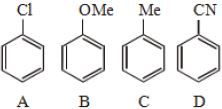
A
$D < A < C < B$
B
$A < B < C < D$
C
$D < C < A < B$
D
$B < C < A < D$
Solution
(A) The reactivity of aromatic compounds towards electrophilic substitution depends on the electron density of the benzene ring. Electron-donating groups $(EDG)$ increase reactivity,while electron-withdrawing groups $(EWG)$ decrease it.
$A$: Chlorobenzene ($-Cl$ group has $-I$ effect and $+R$ effect; overall,it is deactivating but ortho/para directing).
$B$: Anisole ($-OMe$ group has strong $+R$ effect,making it highly activating).
$C$: Toluene ($-Me$ group has $+I$ and hyperconjugation effect,making it activating).
$D$: Benzonitrile ($-CN$ group has strong $-R$ and $-I$ effects,making it strongly deactivating).
Comparing the effects:
$B$ (strong $+R$) > $C$ (hyperconjugation) > $A$ (deactivating $-I > +R$) > $D$ (strong $-R$ and $-I$).
Thus,the increasing order of reactivity is $D < A < C < B$.
$A$: Chlorobenzene ($-Cl$ group has $-I$ effect and $+R$ effect; overall,it is deactivating but ortho/para directing).
$B$: Anisole ($-OMe$ group has strong $+R$ effect,making it highly activating).
$C$: Toluene ($-Me$ group has $+I$ and hyperconjugation effect,making it activating).
$D$: Benzonitrile ($-CN$ group has strong $-R$ and $-I$ effects,making it strongly deactivating).
Comparing the effects:
$B$ (strong $+R$) > $C$ (hyperconjugation) > $A$ (deactivating $-I > +R$) > $D$ (strong $-R$ and $-I$).
Thus,the increasing order of reactivity is $D < A < C < B$.
0 likesView Solution
166
ChemistryDifficultMCQJEE Main · 2019
$C_{60}$,an allotrope of carbon,contains:
A
$20$ hexagons and $12$ pentagons.
B
$12$ hexagons and $20$ pentagons.
C
$18$ hexagons and $14$ pentagons.
D
$16$ hexagons and $16$ pentagons.
Solution
(A) The $C_{60}$ molecule,also known as Buckminsterfullerene,has a truncated icosahedron structure.
It consists of $60$ carbon atoms arranged in a cage-like structure.
This structure is composed of $20$ hexagonal rings and $12$ pentagonal rings.
Therefore,the correct option is $A$.
It consists of $60$ carbon atoms arranged in a cage-like structure.
This structure is composed of $20$ hexagonal rings and $12$ pentagonal rings.
Therefore,the correct option is $A$.
0 likesView Solution
167
ChemistryDifficultMCQJEE Main · 2019
The correct order of the oxidation states of nitrogen in $NO$,$N_2O$,$NO_2$,and $N_2O_3$ is:
A
$N_2O < N_2O_3 < NO < NO_2$
B
$NO_2 < NO < N_2O_3 < N_2O$
C
$NO_2 < N_2O_3 < NO < N_2O$
D
$N_2O < NO < N_2O_3 < NO_2$
Solution
(D) To find the oxidation state of nitrogen $(N)$ in each compound:
$1$. In $N_2O$: $2x + (-2) = 0 \implies x = +1$
$2$. In $NO$: $x + (-2) = 0 \implies x = +2$
$3$. In $N_2O_3$: $2x + 3(-2) = 0 \implies 2x = 6 \implies x = +3$
$4$. In $NO_2$: $x + 2(-2) = 0 \implies x = +4$
Comparing the oxidation states: $+1 < +2 < +3 < +4$.
Therefore,the correct order is $N_2O < NO < N_2O_3 < NO_2$.
$1$. In $N_2O$: $2x + (-2) = 0 \implies x = +1$
$2$. In $NO$: $x + (-2) = 0 \implies x = +2$
$3$. In $N_2O_3$: $2x + 3(-2) = 0 \implies 2x = 6 \implies x = +3$
$4$. In $NO_2$: $x + 2(-2) = 0 \implies x = +4$
Comparing the oxidation states: $+1 < +2 < +3 < +4$.
Therefore,the correct order is $N_2O < NO < N_2O_3 < NO_2$.
0 likesView Solution
168
ChemistryMCQJEE Main · 2019
The major product of the following reaction is
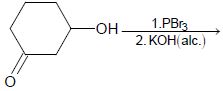
A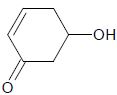
B
C
D
Solution
(B) The reaction proceeds in two steps:
$1$. Treatment of $3$-hydroxycyclohexan-$1$-one with $PBr_3$ replaces the hydroxyl group $(-OH)$ with a bromine atom $(-Br)$ to form $3$-bromocyclohexan-$1$-one.
$2$. Treatment of $3$-bromocyclohexan-$1$-one with alcoholic $KOH$ $(alc. KOH)$ induces a dehydrohalogenation reaction (an $E2$ elimination).
The base abstracts a proton from the $\alpha$-carbon relative to the bromine,leading to the formation of a double bond between the $\alpha$ and $\beta$ carbons.
This results in the formation of the conjugated enone,$cyclohex-2-en-1-one$.
$1$. Treatment of $3$-hydroxycyclohexan-$1$-one with $PBr_3$ replaces the hydroxyl group $(-OH)$ with a bromine atom $(-Br)$ to form $3$-bromocyclohexan-$1$-one.
$2$. Treatment of $3$-bromocyclohexan-$1$-one with alcoholic $KOH$ $(alc. KOH)$ induces a dehydrohalogenation reaction (an $E2$ elimination).
The base abstracts a proton from the $\alpha$-carbon relative to the bromine,leading to the formation of a double bond between the $\alpha$ and $\beta$ carbons.
This results in the formation of the conjugated enone,$cyclohex-2-en-1-one$.
0 likesView Solution
169
ChemistryMCQJEE Main · 2019
If the standard deviation of the numbers $-1, 0, 1, k$ is $\sqrt{5}$ where $k > 0,$ then $k$ is equal to
A
$4\sqrt{\frac{5}{3}}$
B
$\sqrt{6}$
C
$2\sqrt{6}$
D
$2\sqrt{\frac{10}{3}}$
Solution
(C) The formula for standard deviation is $\sigma = \sqrt{\frac{\sum (x_i - \bar{x})^2}{n}}$.
Given numbers are $-1, 0, 1, k$. The mean $\bar{x} = \frac{-1 + 0 + 1 + k}{4} = \frac{k}{4}$.
The variance $\sigma^2 = 5$. Thus,$\frac{(-1 - \frac{k}{4})^2 + (0 - \frac{k}{4})^2 + (1 - \frac{k}{4})^2 + (k - \frac{k}{4})^2}{4} = 5$.
Expanding the terms: $\frac{(1 + \frac{k}{2} + \frac{k^2}{16}) + \frac{k^2}{16} + (1 - \frac{k}{2} + \frac{k^2}{16}) + (\frac{3k}{4})^2}{4} = 5$.
$\frac{2 + \frac{3k^2}{16} + \frac{9k^2}{16}}{4} = 5$.
$\frac{2 + \frac{12k^2}{16}}{4} = 5$.
$2 + \frac{3k^2}{4} = 20$.
$\frac{3k^2}{4} = 18$.
$k^2 = 24$.
Since $k > 0$,$k = \sqrt{24} = 2\sqrt{6}$.
Given numbers are $-1, 0, 1, k$. The mean $\bar{x} = \frac{-1 + 0 + 1 + k}{4} = \frac{k}{4}$.
The variance $\sigma^2 = 5$. Thus,$\frac{(-1 - \frac{k}{4})^2 + (0 - \frac{k}{4})^2 + (1 - \frac{k}{4})^2 + (k - \frac{k}{4})^2}{4} = 5$.
Expanding the terms: $\frac{(1 + \frac{k}{2} + \frac{k^2}{16}) + \frac{k^2}{16} + (1 - \frac{k}{2} + \frac{k^2}{16}) + (\frac{3k}{4})^2}{4} = 5$.
$\frac{2 + \frac{3k^2}{16} + \frac{9k^2}{16}}{4} = 5$.
$\frac{2 + \frac{12k^2}{16}}{4} = 5$.
$2 + \frac{3k^2}{4} = 20$.
$\frac{3k^2}{4} = 18$.
$k^2 = 24$.
Since $k > 0$,$k = \sqrt{24} = 2\sqrt{6}$.
0 likesView Solution
170
ChemistryMCQJEE Main · 2019
If the function $f$ defined on $\left( \frac{\pi }{6}, \frac{\pi }{3} \right)$ by $f(x) = \begin{cases} \frac{\sqrt{2} \cos x - 1}{\cot x - 1}, & x \neq \frac{\pi}{4} \\ k, & x = \frac{\pi}{4} \end{cases}$ is continuous,then $k$ is equal to
A
$1$
B
$2$
C
$\frac{1}{2}$
D
$\frac{1}{\sqrt{2}}$
Solution
(C) For the function to be continuous at $x = \frac{\pi}{4}$,the limit of $f(x)$ as $x \to \frac{\pi}{4}$ must equal $f\left(\frac{\pi}{4}\right)$.
$\lim_{x \to \frac{\pi}{4}} f(x) = f\left(\frac{\pi}{4}\right) = k$
$\lim_{x \to \frac{\pi}{4}} \frac{\sqrt{2} \cos x - 1}{\cot x - 1} = k$
Since this is a $\frac{0}{0}$ form,we apply $L$'Hospital's Rule:
$\lim_{x \to \frac{\pi}{4}} \frac{\frac{d}{dx}(\sqrt{2} \cos x - 1)}{\frac{d}{dx}(\cot x - 1)} = k$
$\lim_{x \to \frac{\pi}{4}} \frac{-\sqrt{2} \sin x}{-\csc^2 x} = k$
$\lim_{x \to \frac{\pi}{4}} \sqrt{2} \sin x \cdot \sin^2 x = k$
$\lim_{x \to \frac{\pi}{4}} \sqrt{2} \sin^3 x = k$
Substituting $x = \frac{\pi}{4}$:
$k = \sqrt{2} \left(\frac{1}{\sqrt{2}}\right)^3 = \sqrt{2} \cdot \frac{1}{2\sqrt{2}} = \frac{1}{2}$
$\lim_{x \to \frac{\pi}{4}} f(x) = f\left(\frac{\pi}{4}\right) = k$
$\lim_{x \to \frac{\pi}{4}} \frac{\sqrt{2} \cos x - 1}{\cot x - 1} = k$
Since this is a $\frac{0}{0}$ form,we apply $L$'Hospital's Rule:
$\lim_{x \to \frac{\pi}{4}} \frac{\frac{d}{dx}(\sqrt{2} \cos x - 1)}{\frac{d}{dx}(\cot x - 1)} = k$
$\lim_{x \to \frac{\pi}{4}} \frac{-\sqrt{2} \sin x}{-\csc^2 x} = k$
$\lim_{x \to \frac{\pi}{4}} \sqrt{2} \sin x \cdot \sin^2 x = k$
$\lim_{x \to \frac{\pi}{4}} \sqrt{2} \sin^3 x = k$
Substituting $x = \frac{\pi}{4}$:
$k = \sqrt{2} \left(\frac{1}{\sqrt{2}}\right)^3 = \sqrt{2} \cdot \frac{1}{2\sqrt{2}} = \frac{1}{2}$
0 likesView Solution
171
ChemistryDifficultMCQJEE Main · 2019
During compression of a spring,the work done is $10 \ kJ$ and $2 \ kJ$ escaped to the surroundings as heat. The change in internal energy,$\Delta U$ (in $kJ$),is
A
$8$
B
$12$
C
$-12$
D
$-8$
Solution
(A) According to the first law of thermodynamics,$\Delta U = q + w$.
Work is done on the system during compression,so $w = +10 \ kJ$.
Heat is released to the surroundings,so $q = -2 \ kJ$.
Therefore,$\Delta U = -2 \ kJ + 10 \ kJ = +8 \ kJ$.
Work is done on the system during compression,so $w = +10 \ kJ$.
Heat is released to the surroundings,so $q = -2 \ kJ$.
Therefore,$\Delta U = -2 \ kJ + 10 \ kJ = +8 \ kJ$.
0 likesView Solution
172
ChemistryDifficultMCQJEE Main · 2019
The amorphous form of silica is
A
quartz
B
kieselguhr
C
cristobalite
D
tridymite
Solution
(B) Silica $(SiO_2)$ exists in both crystalline and amorphous forms. Quartz,cristobalite,and tridymite are crystalline forms of silica. Kieselguhr is an amorphous form of silica,which is a diatomaceous earth.
0 likesView Solution
173
ChemistryDifficultMCQJEE Main · 2019
Which one of the following about an electron occupying the $1s$ orbital in a hydrogen atom is incorrect? (The Bohr radius is represented by $a_0$)
A
The electron can be found at a distance $2a_0$ from the nucleus
B
The probability density of finding the electron is maximum at the nucleus
C
The magnitude of potential energy is double that of its kinetic energy on an average
D
The total energy of the electron is maximum when it is at a distance $a_0$ from the nucleus
Solution
(D) For a hydrogen atom,the total energy $(E)$ of an electron in an orbital is constant and depends only on the principal quantum number $(n)$.
$E = -K.E = \frac{P.E}{2}$,which implies $|P.E| = 2 \times |K.E|$. Thus,option $C$ is correct.
The probability density for a $1s$ orbital is given by $\psi^2 = \frac{1}{\pi a_0^3} e^{-2r/a_0}$. This value is maximum at $r = 0$ (the nucleus),so option $B$ is correct.
The electron can be found at any distance $r$ from the nucleus,including $2a_0$,although the probability density decreases exponentially with distance. Thus,option $A$ is correct.
The total energy of the electron in a specific orbital is constant and does not change with its instantaneous distance from the nucleus. Therefore,the statement that the total energy is maximum at $a_0$ is incorrect.
$E = -K.E = \frac{P.E}{2}$,which implies $|P.E| = 2 \times |K.E|$. Thus,option $C$ is correct.
The probability density for a $1s$ orbital is given by $\psi^2 = \frac{1}{\pi a_0^3} e^{-2r/a_0}$. This value is maximum at $r = 0$ (the nucleus),so option $B$ is correct.
The electron can be found at any distance $r$ from the nucleus,including $2a_0$,although the probability density decreases exponentially with distance. Thus,option $A$ is correct.
The total energy of the electron in a specific orbital is constant and does not change with its instantaneous distance from the nucleus. Therefore,the statement that the total energy is maximum at $a_0$ is incorrect.
0 likesView Solution
174
ChemistryMediumMCQJEE Main · 2019
The correct statements among $I$ to $III$ regarding group $13$ element oxides are,
$I$. Boron trioxide is acidic
$II$. Oxides of aluminium and gallium are amphoteric
$III$. Oxides of indium and thallium are basic
$I$. Boron trioxide is acidic
$II$. Oxides of aluminium and gallium are amphoteric
$III$. Oxides of indium and thallium are basic
A
$I, II$ and $III$
B
$II$ and $III$ only
C
$I$ and $III$ only
D
$I$ and $II$ only
Solution
(A) $B_2O_3$ is acidic in nature.
$Al_2O_3$ and $Ga_2O_3$ are amphoteric in nature.
$In_2O_3$ and $Tl_2O_3$ are basic in nature.
As we move down the group $13$,the metallic character of the elements increases,which leads to a transition from acidic to amphoteric and finally to basic oxides.
$Al_2O_3$ and $Ga_2O_3$ are amphoteric in nature.
$In_2O_3$ and $Tl_2O_3$ are basic in nature.
As we move down the group $13$,the metallic character of the elements increases,which leads to a transition from acidic to amphoteric and finally to basic oxides.
0 likesView Solution
175
ChemistryDifficultMCQJEE Main · 2019
Among the following species,the diamagnetic molecule is
A
$O_2$
B
$NO$
C
$B_2$
D
$CO$
Solution
(D) According to Molecular Orbital Theory $(MOT)$,the electronic configuration of $CO$ ($14$ electrons) is: $\sigma 1s^2, \sigma^* 1s^2, \sigma 2s^2, \sigma^* 2s^2, \pi 2p_x^2 = \pi 2p_y^2, \sigma 2p_z^2$.
Since all electrons are paired,$CO$ is diamagnetic.
In contrast,$O_2$ ($16$ electrons) has two unpaired electrons in $\pi^* 2p$ orbitals,$NO$ ($15$ electrons) has one unpaired electron,and $B_2$ ($10$ electrons) has two unpaired electrons in $\pi 2p$ orbitals.
Since all electrons are paired,$CO$ is diamagnetic.
In contrast,$O_2$ ($16$ electrons) has two unpaired electrons in $\pi^* 2p$ orbitals,$NO$ ($15$ electrons) has one unpaired electron,and $B_2$ ($10$ electrons) has two unpaired electrons in $\pi 2p$ orbitals.
0 likesView Solution
176
ChemistryAdvancedMCQJEE Main · 2019
At a given temperature $T$,gases $Ne$,$Ar$,$Xe$,and $Kr$ are found to deviate from ideal gas behaviour. Their equation of state is given as $P = \frac{RT}{V - b}$ at $T$. Here,$b$ is the van der Waals constant. Which gas will exhibit a steeper increase in the plot of $Z$ (compression factor) versus $P$?
A
$Ne$
B
$Ar$
C
$Xe$
D
$Kr$
Solution
(C) The given equation of state is $P(V - b) = RT$.
Expanding this,we get $PV - Pb = RT$.
Dividing by $RT$,we obtain $\frac{PV}{RT} - \frac{Pb}{RT} = 1$.
Since the compression factor $Z = \frac{PV}{RT}$,the equation becomes $Z = 1 + \frac{Pb}{RT}$.
This shows that $Z$ increases linearly with $P$ with a slope of $\frac{b}{RT}$.
Therefore,the gas with the largest van der Waals constant $b$ will exhibit the steepest increase in the plot of $Z$ versus $P$.
The magnitude of $b$ depends on the size of the gas molecules,which follows the order $Ne < Ar < Kr < Xe$.
Thus,$Xe$ has the largest value of $b$ and will show the steepest increase.
Expanding this,we get $PV - Pb = RT$.
Dividing by $RT$,we obtain $\frac{PV}{RT} - \frac{Pb}{RT} = 1$.
Since the compression factor $Z = \frac{PV}{RT}$,the equation becomes $Z = 1 + \frac{Pb}{RT}$.
This shows that $Z$ increases linearly with $P$ with a slope of $\frac{b}{RT}$.
Therefore,the gas with the largest van der Waals constant $b$ will exhibit the steepest increase in the plot of $Z$ versus $P$.
The magnitude of $b$ depends on the size of the gas molecules,which follows the order $Ne < Ar < Kr < Xe$.
Thus,$Xe$ has the largest value of $b$ and will show the steepest increase.
0 likesView Solution
177
ChemistryDifficultMCQJEE Main · 2019
The structures of beryllium chloride $(BeCl_2)$ in the solid state and vapour phase,respectively,are
A
chain and dimeric
B
chain and chain
C
dimeric and dimeric
D
dimeric and chain
Solution
(A) In the solid state,$BeCl_2$ exists as a polymeric chain structure where each $Be$ atom is surrounded by four $Cl$ atoms.
In the vapour phase,at high temperatures (approx. $1200 \ K$),$BeCl_2$ exists as a dimeric structure $(Be_2Cl_4)$,which dissociates into a linear monomeric structure at even higher temperatures (approx. $1800 \ K$).
In the vapour phase,at high temperatures (approx. $1200 \ K$),$BeCl_2$ exists as a dimeric structure $(Be_2Cl_4)$,which dissociates into a linear monomeric structure at even higher temperatures (approx. $1800 \ K$).
0 likesView Solution
178
ChemistryMCQJEE Main · 2019
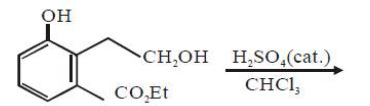
The major product of the following reaction is
A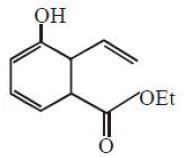
B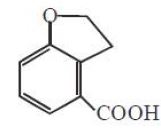
C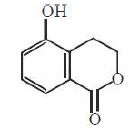
D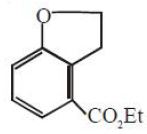
Solution
(D) The reaction involves the acid-catalyzed cyclization of the given hydroxy-ester.
$1$. First,the ester group $(-CO_2Et)$ undergoes acid-catalyzed hydrolysis in the presence of $H_2SO_4$ to form a carboxylic acid group $(-COOH)$.
$2$. Subsequently,an intramolecular esterification (lactonization) occurs between the phenolic hydroxyl group (or the primary alcohol group,but here the structure favors the formation of a cyclic ester involving the primary alcohol) and the carboxylic acid group.
$3$. The primary alcohol group $(-CH_2CH_2OH)$ reacts with the carboxylic acid group $(-COOH)$ to form a cyclic ester (lactone).
$4$. The final product is a cyclic ester formed by the condensation of the alcohol and the acid,which is represented by option $D$.
$1$. First,the ester group $(-CO_2Et)$ undergoes acid-catalyzed hydrolysis in the presence of $H_2SO_4$ to form a carboxylic acid group $(-COOH)$.
$2$. Subsequently,an intramolecular esterification (lactonization) occurs between the phenolic hydroxyl group (or the primary alcohol group,but here the structure favors the formation of a cyclic ester involving the primary alcohol) and the carboxylic acid group.
$3$. The primary alcohol group $(-CH_2CH_2OH)$ reacts with the carboxylic acid group $(-COOH)$ to form a cyclic ester (lactone).
$4$. The final product is a cyclic ester formed by the condensation of the alcohol and the acid,which is represented by option $D$.
0 likesView Solution
179
ChemistryMediumMCQJEE Main · 2019
The layer of atmosphere between $10 \, km$ to $50 \, km$ above the sea level is called as
A
troposphere
B
mesosphere
C
stratosphere
D
thermosphere
Solution
(C) The atmosphere is divided into layers based on temperature variations with altitude.
The layer extending from approximately $10 \, km$ to $50 \, km$ above sea level is known as the stratosphere.
The layer extending from approximately $10 \, km$ to $50 \, km$ above sea level is known as the stratosphere.
0 likesView Solution
180
ChemistryMediumMCQJEE Main · 2019
$HF$ has the highest boiling point among hydrogen halides because it has:
A
lowest dissociation enthalpy
B
strongest van der Waals interactions
C
strongest hydrogen bonding
D
lowest ionic character
Solution
(C) $HF$ exhibits strong intermolecular hydrogen bonding.
Due to the high electronegativity of the $F$ atom compared to $H$,a significant dipole is created,leading to strong hydrogen bonds.
These strong intermolecular forces require more energy to overcome,resulting in the highest boiling point among hydrogen halides ($HCl$,$HBr$,$HI$).
Due to the high electronegativity of the $F$ atom compared to $H$,a significant dipole is created,leading to strong hydrogen bonds.
These strong intermolecular forces require more energy to overcome,resulting in the highest boiling point among hydrogen halides ($HCl$,$HBr$,$HI$).
0 likesView Solution
181
ChemistryMCQJEE Main · 2019
The synonym for water gas when used in the production of methanol is
A
syn gas
B
natural gas
C
fuel gas
D
laughing gas
Solution
(A) Water gas is a mixture of $CO$ and $H_2$.
It is also known as synthesis gas or $syn$ gas because it is used in the industrial synthesis of methanol and other organic compounds.
It is also known as synthesis gas or $syn$ gas because it is used in the industrial synthesis of methanol and other organic compounds.
0 likesView Solution
182
ChemistryEasyMCQJEE Main · 2019
The regions of the atmosphere,where clouds form and where we live,respectively,are
A
Troposphere and Stratosphere
B
Troposphere and Troposphere
C
Stratosphere and Stratosphere
D
Stratosphere and Troposphere
Solution
(B) The $Troposphere$ is the lowest layer of the atmosphere,extending from the Earth's surface up to about $10-15 \ km$.
It is the region where most weather phenomena,including cloud formation,occur.
Since humans and other living organisms reside on the Earth's surface,we also live within the $Troposphere$.
Therefore,both cloud formation and human life occur in the $Troposphere$.
It is the region where most weather phenomena,including cloud formation,occur.
Since humans and other living organisms reside on the Earth's surface,we also live within the $Troposphere$.
Therefore,both cloud formation and human life occur in the $Troposphere$.
0 likesView Solution
183
ChemistryMediumMCQJEE Main · 2019
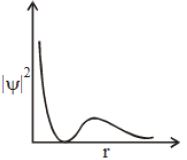
The graph between $|\psi|^2$ and $r$ (radial distance) is shown below. This represents
A
$1s$ orbital
B
$3s$ orbital
C
$2s$ orbital
D
$2p$ orbital
Solution
(C) For an $s$-orbital,the probability density $|\psi|^2$ is maximum at the nucleus $(r=0)$.
The number of radial nodes is given by the formula $n-l-1$.
For the $2s$ orbital,the number of radial nodes is $2-0-1 = 1$.
The graph shows one radial node (where the curve touches the $r$-axis),which is characteristic of the $2s$ orbital.
Therefore,the graph represents the $2s$ orbital.
The number of radial nodes is given by the formula $n-l-1$.
For the $2s$ orbital,the number of radial nodes is $2-0-1 = 1$.
The graph shows one radial node (where the curve touches the $r$-axis),which is characteristic of the $2s$ orbital.
Therefore,the graph represents the $2s$ orbital.
0 likesView Solution
184
ChemistryDifficultMCQJEE Main · 2019
Consider the following table:
$a$ and $b$ are van der Waals constants. The correct statement about the gases is:
| Gas | $a / (kPa \cdot dm^6 \cdot mol^{-2})$ | $b / (dm^3 \cdot mol^{-1})$ |
|---|---|---|
| $A$ | $642.32$ | $0.05196$ |
| $B$ | $155.21$ | $0.04136$ |
| $C$ | $431.91$ | $0.05196$ |
| $D$ | $155.21$ | $0.4382$ |
$a$ and $b$ are van der Waals constants. The correct statement about the gases is:
A
Gas $C$ will occupy more volume than gas $A$; gas $B$ will be lesser compressible than gas $D$.
B
Gas $C$ will occupy lesser volume than gas $A$; gas $B$ will be more compressible than gas $D$.
C
Gas $C$ will occupy lesser volume than gas $A$; gas $B$ will be lesser compressible than gas $D$.
D
Gas $C$ will occupy more volume than gas $A$; gas $B$ will be more compressible than gas $D$.
Solution
(D) The constant $a$ represents the magnitude of intermolecular forces of attraction. $A$ higher value of $a$ implies stronger attraction,which pulls molecules closer,resulting in a smaller volume occupied.
For gases $A$ and $C$,$b$ is the same $(0.05196)$. Since $a_A (642.32) > a_C (431.91)$,gas $A$ has stronger intermolecular forces and occupies less volume than gas $C$. Thus,gas $C$ occupies more volume than gas $A$.
For gases $B$ and $D$,$a$ is the same $(155.21)$. The constant $b$ represents the excluded volume per mole. $A$ smaller value of $b$ means the molecules occupy less space,making the gas more compressible.
Since $b_B (0.04136) < b_D (0.4382)$,gas $B$ is more compressible than gas $D$.
For gases $A$ and $C$,$b$ is the same $(0.05196)$. Since $a_A (642.32) > a_C (431.91)$,gas $A$ has stronger intermolecular forces and occupies less volume than gas $C$. Thus,gas $C$ occupies more volume than gas $A$.
For gases $B$ and $D$,$a$ is the same $(155.21)$. The constant $b$ represents the excluded volume per mole. $A$ smaller value of $b$ means the molecules occupy less space,making the gas more compressible.
Since $b_B (0.04136) < b_D (0.4382)$,gas $B$ is more compressible than gas $D$.
0 likesView Solution
185
ChemistryMCQJEE Main · 2019
During the change of $O_2$ to $O_2^-$,the incoming electron goes to the orbital
A
$\pi_{2p_y}$
B
$\pi_{2p_x}$
C
${\pi^*}_{2p_x}$
D
${\sigma ^*}_{2p_z}$
Solution
(C) The electronic configuration of $O_2$ ($16$ electrons) is: $KK \sigma_{2s}^2 \sigma_{2s}^{*2} \sigma_{2p_z}^2 \pi_{2p_x}^2 \pi_{2p_y}^2 \pi_{2p_x}^{*1} \pi_{2p_y}^{*1}$.
When $O_2$ changes to $O_2^-$ ($17$ electrons),the incoming electron enters the next available lowest energy molecular orbital,which is the antibonding orbital ${\pi^*}_{2p_x}$ or ${\pi^*}_{2p_y}$.
According to the molecular orbital diagram,the incoming electron occupies the ${\pi^*}_{2p_x}$ orbital.
When $O_2$ changes to $O_2^-$ ($17$ electrons),the incoming electron enters the next available lowest energy molecular orbital,which is the antibonding orbital ${\pi^*}_{2p_x}$ or ${\pi^*}_{2p_y}$.
According to the molecular orbital diagram,the incoming electron occupies the ${\pi^*}_{2p_x}$ orbital.
0 likesView Solution
186
ChemistryMediumMCQJEE Main · 2019
The principle of column chromatography is
A
Differential absorption of the substances on the solid phase.
B
Differential adsorption of the substances on the solid phase.
C
Gravitational force.
D
Capillary action.
Solution
(B) Column chromatography is based on the principle of differential adsorption of substances on the solid stationary phase.
As the mixture moves through the column,different components are adsorbed to different extents,leading to their separation.
Therefore,option $B$ is correct.
As the mixture moves through the column,different components are adsorbed to different extents,leading to their separation.
Therefore,option $B$ is correct.
0 likesView Solution
187
ChemistryDifficultMCQJEE Main · 2019
At $300 \ K$ and $1 \ \text{atm}$ pressure,$10 \ mL$ of a hydrocarbon required $55 \ mL$ of $O_2$ for complete combustion,and $40 \ mL$ of $CO_2$ is formed. The formula of the hydrocarbon is
A
$C_4H_{10}$
B
$C_4H_6$
C
$C_4H_7Cl$
D
$C_4H_8$
Solution
(B) The combustion reaction for a hydrocarbon $C_xH_y$ is given by:
$C_xH_y + (x + \frac{y}{4})O_2 \to xCO_2 + \frac{y}{2}H_2O$
According to Avogadro's Law,at constant temperature and pressure,the volume of gases is proportional to their moles.
Given: Volume of $C_xH_y = 10 \ mL$,Volume of $O_2 = 55 \ mL$,Volume of $CO_2 = 40 \ mL$.
From the stoichiometry:
$10x = 40 \implies x = 4$
$10(x + \frac{y}{4}) = 55$
$x + \frac{y}{4} = 5.5$
Substituting $x = 4$:
$4 + \frac{y}{4} = 5.5$
$\frac{y}{4} = 1.5$
$y = 6$
Thus,the formula of the hydrocarbon is $C_4H_6$.
$C_xH_y + (x + \frac{y}{4})O_2 \to xCO_2 + \frac{y}{2}H_2O$
According to Avogadro's Law,at constant temperature and pressure,the volume of gases is proportional to their moles.
Given: Volume of $C_xH_y = 10 \ mL$,Volume of $O_2 = 55 \ mL$,Volume of $CO_2 = 40 \ mL$.
From the stoichiometry:
$10x = 40 \implies x = 4$
$10(x + \frac{y}{4}) = 55$
$x + \frac{y}{4} = 5.5$
Substituting $x = 4$:
$4 + \frac{y}{4} = 5.5$
$\frac{y}{4} = 1.5$
$y = 6$
Thus,the formula of the hydrocarbon is $C_4H_6$.
0 likesView Solution
188
ChemistryMCQJEE Main · 2019
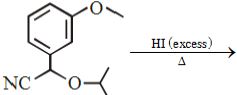
The major product of the following reaction is
A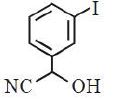
B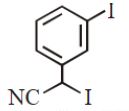
C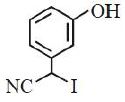
D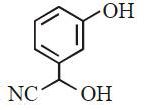
Solution
(C) The reaction involves the cleavage of ethers with excess $HI$.
$1$. The oxygen atoms are protonated by $H^+$.
$2$. The methoxy group attached to the benzene ring is cleaved to form a phenol and $CH_3I$.
$3$. The other ether linkage is cleaved by $I^-$ via an $S_N1$ or $S_N2$ mechanism (depending on the stability of the carbocation) to form an alcohol and an alkyl iodide.
$4$. In this specific case,the benzylic position is stabilized by the cyano group,allowing the formation of the iodo product at that position.
$5$. The final product is $3$-hydroxyphenyl-cyano-iodomethane.
$1$. The oxygen atoms are protonated by $H^+$.
$2$. The methoxy group attached to the benzene ring is cleaved to form a phenol and $CH_3I$.
$3$. The other ether linkage is cleaved by $I^-$ via an $S_N1$ or $S_N2$ mechanism (depending on the stability of the carbocation) to form an alcohol and an alkyl iodide.
$4$. In this specific case,the benzylic position is stabilized by the cyano group,allowing the formation of the iodo product at that position.
$5$. The final product is $3$-hydroxyphenyl-cyano-iodomethane.
0 likesView Solution
189
ChemistryDifficultMCQJEE Main · 2019
The increasing order of the reactivity of the following compounds towards electrophilic aromatic substitution reaction is:
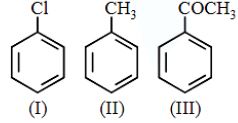
A
$III < I < II$
B
$III < II < I$
C
$II < I < III$
D
$I < III < II$
Solution
(A) The reactivity of aromatic compounds towards electrophilic aromatic substitution depends on the electron density of the benzene ring. Electron-donating groups increase reactivity,while electron-withdrawing groups decrease it.
$I$: Chlorobenzene ($Cl$ is a deactivating group due to its strong $-I$ effect,though it is ortho/para directing).
$II$: Toluene ($-CH_3$ is an activating group due to $+I$ and hyperconjugation).
$III$: Acetophenone ($-COCH_3$ is a strongly deactivating group due to $-I$ and $-M$ effects).
Comparing the effects:
$II$ (activating) > $I$ (weakly deactivating) > $III$ (strongly deactivating).
Therefore,the increasing order of reactivity is $III < I < II$.
$I$: Chlorobenzene ($Cl$ is a deactivating group due to its strong $-I$ effect,though it is ortho/para directing).
$II$: Toluene ($-CH_3$ is an activating group due to $+I$ and hyperconjugation).
$III$: Acetophenone ($-COCH_3$ is a strongly deactivating group due to $-I$ and $-M$ effects).
Comparing the effects:
$II$ (activating) > $I$ (weakly deactivating) > $III$ (strongly deactivating).
Therefore,the increasing order of reactivity is $III < I < II$.
0 likesView Solution
190
ChemistryDifficultMCQJEE Main · 2019
$A$ process will be spontaneous at all temperatures if
A
$\Delta H < 0$ and $\Delta S < 0$
B
$\Delta H < 0$ and $\Delta S > 0$
C
$\Delta H > 0$ and $\Delta S > 0$
D
$\Delta H > 0$ and $\Delta S < 0$
Solution
(B) For a process to be spontaneous,the change in Gibbs free energy must be negative,i.e.,$\Delta G < 0$.
We use the Gibbs-Helmholtz equation: $\Delta G = \Delta H - T\Delta S$.
For the process to be spontaneous at all temperatures $(T)$,the term $\Delta G$ must remain negative regardless of the value of $T$.
If $\Delta H < 0$ (exothermic) and $\Delta S > 0$ (increase in entropy),then $\Delta G = (\text{negative}) - T(\text{positive})$.
Since $T$ is always positive in Kelvin,$\Delta G$ will always be negative at all temperatures.
We use the Gibbs-Helmholtz equation: $\Delta G = \Delta H - T\Delta S$.
For the process to be spontaneous at all temperatures $(T)$,the term $\Delta G$ must remain negative regardless of the value of $T$.
If $\Delta H < 0$ (exothermic) and $\Delta S > 0$ (increase in entropy),then $\Delta G = (\text{negative}) - T(\text{positive})$.
Since $T$ is always positive in Kelvin,$\Delta G$ will always be negative at all temperatures.
0 likesView Solution
191
ChemistryDifficultMCQJEE Main · 2019
Consider the following statements:
$(a)$ The $pH$ of a mixture containing $400 \, mL$ of $0.1 \, M \, H_2SO_4$ and $400 \, mL$ of $0.1 \, M \, NaOH$ will be approximately $1.3$.
$(b)$ Ionic product of water is temperature dependent.
$(c)$ $A$ monobasic acid with $K_a = 10^{-5}$ has a $pH = 5$. The degree of dissociation of this acid is $50 \%$.
$(d)$ The Le Chatelier's principle is not applicable to common-ion effect.
The correct statements are:
$(a)$ The $pH$ of a mixture containing $400 \, mL$ of $0.1 \, M \, H_2SO_4$ and $400 \, mL$ of $0.1 \, M \, NaOH$ will be approximately $1.3$.
$(b)$ Ionic product of water is temperature dependent.
$(c)$ $A$ monobasic acid with $K_a = 10^{-5}$ has a $pH = 5$. The degree of dissociation of this acid is $50 \%$.
$(d)$ The Le Chatelier's principle is not applicable to common-ion effect.
The correct statements are:
A
$(a)$ and $(b)$
B
$(a), (b)$ and $(c)$
C
$(b)$ and $(c)$
D
$(a), (b)$ and $(d)$
Solution
(B) $(a) \, H_2SO_4 + 2NaOH \to Na_2SO_4 + 2H_2O$
Initial millimoles of $H_2SO_4 = 400 \times 0.1 = 40 \, mmol$.
Initial millimoles of $NaOH = 400 \times 0.1 = 40 \, mmol$.
Since $1 \, mol \, H_2SO_4$ reacts with $2 \, mol \, NaOH$,$20 \, mmol$ of $H_2SO_4$ will react with $40 \, mmol$ of $NaOH$.
Remaining $H_2SO_4 = 40 - 20 = 20 \, mmol$.
Total volume $= 800 \, mL$.
$[H^{+}] = \frac{20 \times 2}{800} = \frac{40}{800} = 0.05 \, M = 5 \times 10^{-2} \, M$.
$pH = -\log(5 \times 10^{-2}) = 2 - \log(5) = 2 - 0.699 \approx 1.3$. Thus,$(a)$ is correct.
$(b)$ The ionic product of water $(K_w)$ is an equilibrium constant,which is temperature dependent. Thus,$(b)$ is correct.
$(c)$ For a monobasic acid,$K_a = \frac{c\alpha^2}{1-\alpha} = \frac{[H^{+}]\alpha}{1-\alpha}$. Given $K_a = 10^{-5}$ and $pH = 5$ $([H^{+}] = 10^{-5})$,we have $10^{-5} = \frac{10^{-5} \cdot \alpha}{1-\alpha}$,which gives $1-\alpha = \alpha$,so $\alpha = 0.5$ or $50 \%$. Thus,$(c)$ is correct.
$(d)$ The common-ion effect is a direct application of Le Chatelier's principle. Thus,$(d)$ is incorrect.
Initial millimoles of $H_2SO_4 = 400 \times 0.1 = 40 \, mmol$.
Initial millimoles of $NaOH = 400 \times 0.1 = 40 \, mmol$.
Since $1 \, mol \, H_2SO_4$ reacts with $2 \, mol \, NaOH$,$20 \, mmol$ of $H_2SO_4$ will react with $40 \, mmol$ of $NaOH$.
Remaining $H_2SO_4 = 40 - 20 = 20 \, mmol$.
Total volume $= 800 \, mL$.
$[H^{+}] = \frac{20 \times 2}{800} = \frac{40}{800} = 0.05 \, M = 5 \times 10^{-2} \, M$.
$pH = -\log(5 \times 10^{-2}) = 2 - \log(5) = 2 - 0.699 \approx 1.3$. Thus,$(a)$ is correct.
$(b)$ The ionic product of water $(K_w)$ is an equilibrium constant,which is temperature dependent. Thus,$(b)$ is correct.
$(c)$ For a monobasic acid,$K_a = \frac{c\alpha^2}{1-\alpha} = \frac{[H^{+}]\alpha}{1-\alpha}$. Given $K_a = 10^{-5}$ and $pH = 5$ $([H^{+}] = 10^{-5})$,we have $10^{-5} = \frac{10^{-5} \cdot \alpha}{1-\alpha}$,which gives $1-\alpha = \alpha$,so $\alpha = 0.5$ or $50 \%$. Thus,$(c)$ is correct.
$(d)$ The common-ion effect is a direct application of Le Chatelier's principle. Thus,$(d)$ is incorrect.
0 likesView Solution
192
ChemistryDifficultMCQJEE Main · 2019
The correct order of catenation is
A
$C > Sn > Si \approx Ge$
B
$Ge > Sn > Si > C$
C
$Si > Sn > C > Ge$
D
$C > Si > Ge \approx Sn$
Solution
(D) The order of catenation is based on the self-linking property through covalent bonding.For group $14$ elements,the bond energy decreases as the atomic size increases,which leads to a decrease in the strength of catenation.The correct order is $C > Si > Ge \approx Sn$.In $C$,there is strong $2p-2p$ overlapping,followed by $3p-3p$ in $Si$,and so on.The extent of overlapping decreases as: $2p-2p > 3p-3p > 4p-4p \approx 5p-5p$.
0 likesView Solution
193
ChemistryDifficultMCQJEE Main · 2019
The isoelectronic set of ions is
A
$Li^{+}, Na^{+}, O^{2-}$ and $F^{-}$
B
$F^{-}, Li^{+}, Na^{+}$ and $Mg^{2+}$
C
$N^{3-}, O^{2-}, F^{-}$ and $Na^{+}$
D
$N^{3-}, Li^{+}, Mg^{2+}$ and $O^{2-}$
Solution
(C) Isoelectronic species are those which have the same number of electrons.
For $N^{3-}$: $7 + 3 = 10$ electrons.
For $O^{2-}$: $8 + 2 = 10$ electrons.
For $F^{-}$: $9 + 1 = 10$ electrons.
For $Na^{+}$: $11 - 1 = 10$ electrons.
Since all these ions have $10$ electrons,they form an isoelectronic set.
Therefore,option $C$ is correct.
For $N^{3-}$: $7 + 3 = 10$ electrons.
For $O^{2-}$: $8 + 2 = 10$ electrons.
For $F^{-}$: $9 + 1 = 10$ electrons.
For $Na^{+}$: $11 - 1 = 10$ electrons.
Since all these ions have $10$ electrons,they form an isoelectronic set.
Therefore,option $C$ is correct.
0 likesView Solution
194
ChemistryDifficultMCQJEE Main · 2019
The alloy used in the construction of aircraft is
A
$Mg-Mn$
B
$Mg-Zn$
C
$Mg-Al$
D
$Mg-Sn$
Solution
(C) The alloy used in the construction of aircraft is $Mg-Al$ (Magnalium).
Magnalium is an alloy of aluminium with $5-30\%$ magnesium.
It is used in aircraft construction because it is lighter,stronger,and more corrosion-resistant than pure aluminium.
Magnalium is an alloy of aluminium with $5-30\%$ magnesium.
It is used in aircraft construction because it is lighter,stronger,and more corrosion-resistant than pure aluminium.
0 likesView Solution
195
ChemistryMCQJEE Main · 2019
All the pairs $(x, y)$ that satisfy the inequality $2^{\sqrt{\sin^2 x - 2\sin x + 5}} \cdot \frac{1}{4^{\sin^2 y}} \leq 1$ also satisfy the equation:
A
$2|\sin x| = 3\sin y$
B
$\sin x = |\sin y|$
C
$2\sin x = \sin y$
D
$\sin x = 2\sin y$
Solution
(B) The given inequality is $2^{\sqrt{\sin^2 x - 2\sin x + 5}} \cdot 4^{-\sin^2 y} \leq 1$.
This can be rewritten as $2^{\sqrt{(\sin x - 1)^2 + 4}} \leq 4^{\sin^2 y} = 2^{2\sin^2 y}$.
Since the base $2 > 1$,we have $\sqrt{(\sin x - 1)^2 + 4} \leq 2\sin^2 y$.
We know that $(\sin x - 1)^2 \geq 0$,so $\sqrt{(\sin x - 1)^2 + 4} \geq \sqrt{4} = 2$.
Also,we know that $\sin^2 y \leq 1$,so $2\sin^2 y \leq 2$.
Thus,the inequality $2 \leq \sqrt{(\sin x - 1)^2 + 4} \leq 2\sin^2 y \leq 2$ holds only if both sides are equal to $2$.
This implies $\sin x - 1 = 0 \Rightarrow \sin x = 1$ and $\sin^2 y = 1 \Rightarrow |\sin y| = 1$.
Since $\sin x = 1$ and $|\sin y| = 1$,it follows that $\sin x = |\sin y|$.
This can be rewritten as $2^{\sqrt{(\sin x - 1)^2 + 4}} \leq 4^{\sin^2 y} = 2^{2\sin^2 y}$.
Since the base $2 > 1$,we have $\sqrt{(\sin x - 1)^2 + 4} \leq 2\sin^2 y$.
We know that $(\sin x - 1)^2 \geq 0$,so $\sqrt{(\sin x - 1)^2 + 4} \geq \sqrt{4} = 2$.
Also,we know that $\sin^2 y \leq 1$,so $2\sin^2 y \leq 2$.
Thus,the inequality $2 \leq \sqrt{(\sin x - 1)^2 + 4} \leq 2\sin^2 y \leq 2$ holds only if both sides are equal to $2$.
This implies $\sin x - 1 = 0 \Rightarrow \sin x = 1$ and $\sin^2 y = 1 \Rightarrow |\sin y| = 1$.
Since $\sin x = 1$ and $|\sin y| = 1$,it follows that $\sin x = |\sin y|$.
0 likesView Solution
196
ChemistryDifficultMCQJEE Main · 2019
The difference between $\Delta H$ and $\Delta U$ $(\Delta H - \Delta U),$ when the combustion of one mole of heptane $(l)$ is carried out at a temperature $T$ is equal to (in $,RT$)
A
$-4$
B
$-3$
C
$3$
D
$4$
Solution
(A) The combustion reaction for one mole of heptane $(C_7H_{16})$ is:
$C_7H_{16(l)} + 11O_{2(g)} \to 7CO_{2(g)} + 8H_2O_{(l)}$
Calculate the change in the number of gaseous moles $(\Delta n_g)$:
$\Delta n_g = \sum n_{p(g)} - \sum n_{r(g)}$
$\Delta n_g = 7 - 11 = -4$
Using the relation $\Delta H = \Delta U + \Delta n_g RT$:
$\Delta H - \Delta U = \Delta n_g RT$
Substituting the value of $\Delta n_g$:
$\Delta H - \Delta U = -4\,RT$
$C_7H_{16(l)} + 11O_{2(g)} \to 7CO_{2(g)} + 8H_2O_{(l)}$
Calculate the change in the number of gaseous moles $(\Delta n_g)$:
$\Delta n_g = \sum n_{p(g)} - \sum n_{r(g)}$
$\Delta n_g = 7 - 11 = -4$
Using the relation $\Delta H = \Delta U + \Delta n_g RT$:
$\Delta H - \Delta U = \Delta n_g RT$
Substituting the value of $\Delta n_g$:
$\Delta H - \Delta U = -4\,RT$
0 likesView Solution
197
ChemistryMediumMCQJEE Main · 2019
The ratio of the shortest wavelength of two spectral series of the hydrogen spectrum is found to be about $9$. The spectral series are
A
Lyman and Paschen
B
Brackett and Pfund
C
Paschen and Pfund
D
Balmer and Brackett
Solution
(A) The shortest wavelength $(\lambda)$ for a spectral series is given by the Rydberg formula: $\frac{1}{\lambda} = R_H \times Z^2 \times (\frac{1}{n_1^2} - \frac{1}{n_2^2})$.
For the shortest wavelength,$n_2 = \infty$,so $\frac{1}{\lambda} = \frac{R_H}{n_1^2}$.
Thus,$\lambda = \frac{n_1^2}{R_H}$.
The ratio of the shortest wavelengths of two series with lower energy levels $n_1$ and $n_2$ is $\frac{\lambda_2}{\lambda_1} = \frac{n_2^2}{n_1^2} = 9$.
This implies $\frac{n_2}{n_1} = 3$.
For the Lyman series,$n_1 = 1$. For the Paschen series,$n_2 = 3$.
Therefore,the ratio is $\frac{3^2}{1^2} = 9$. The series are Lyman and Paschen.
For the shortest wavelength,$n_2 = \infty$,so $\frac{1}{\lambda} = \frac{R_H}{n_1^2}$.
Thus,$\lambda = \frac{n_1^2}{R_H}$.
The ratio of the shortest wavelengths of two series with lower energy levels $n_1$ and $n_2$ is $\frac{\lambda_2}{\lambda_1} = \frac{n_2^2}{n_1^2} = 9$.
This implies $\frac{n_2}{n_1} = 3$.
For the Lyman series,$n_1 = 1$. For the Paschen series,$n_2 = 3$.
Therefore,the ratio is $\frac{3^2}{1^2} = 9$. The series are Lyman and Paschen.
0 likesView Solution
198
ChemistryAdvancedMCQJEE Main · 2019
The correct statements among $(a)$ to $(d)$ are:
$(a)$ Saline hydrides produce $H_2$ gas when reacted with $H_2O$.
$(b)$ Reaction of $LiAlH_4$ with $BF_3$ leads to $B_2H_6$.
$(c)$ $PH_3$ and $CH_4$ are electron-rich and electron-precise hydrides,respectively.
$(d)$ $HF$ and $CH_4$ are called as molecular hydrides.
$(a)$ Saline hydrides produce $H_2$ gas when reacted with $H_2O$.
$(b)$ Reaction of $LiAlH_4$ with $BF_3$ leads to $B_2H_6$.
$(c)$ $PH_3$ and $CH_4$ are electron-rich and electron-precise hydrides,respectively.
$(d)$ $HF$ and $CH_4$ are called as molecular hydrides.
A
$(c)$ and $(d)$ only
B
$(a), (b)$ and $(c)$ only
C
$(a), (b), (c)$ and $(d)$
D
$(a), (c)$ and $(d)$ only
Solution
(C) Saline (ionic) hydrides react with water to produce $H_2$ gas: $MH + H_2O \rightarrow MOH + H_2$. This is correct.
$(b)$ The reaction $3LiAlH_4 + 4BF_3 \rightarrow 2B_2H_6 + 3LiF + 3AlF_3$ is a standard method for the preparation of diborane. This is correct.
$(c)$ $PH_3$ has a lone pair on phosphorus,making it an electron-rich hydride. $CH_4$ has exactly the number of electrons required for bonding,making it an electron-precise hydride. This is correct.
$(d)$ Molecular hydrides are formed by $p$-block elements and are covalent in nature. Both $HF$ and $CH_4$ are covalent molecular hydrides. This is correct.
Therefore,all statements $(a), (b), (c),$ and $(d)$ are correct.
$(b)$ The reaction $3LiAlH_4 + 4BF_3 \rightarrow 2B_2H_6 + 3LiF + 3AlF_3$ is a standard method for the preparation of diborane. This is correct.
$(c)$ $PH_3$ has a lone pair on phosphorus,making it an electron-rich hydride. $CH_4$ has exactly the number of electrons required for bonding,making it an electron-precise hydride. This is correct.
$(d)$ Molecular hydrides are formed by $p$-block elements and are covalent in nature. Both $HF$ and $CH_4$ are covalent molecular hydrides. This is correct.
Therefore,all statements $(a), (b), (c),$ and $(d)$ are correct.
0 likesView Solution
199
ChemistryMediumMCQJEE Main · 2019
Air pollution that occurs in sunlight is
A
oxidising smog
B
acid rain
C
reducing smog
D
fog
Solution
(A) Photochemical smog occurs in the presence of sunlight and has a high concentration of oxidising agents like $O_3$ and $NO_2$. Therefore,it is also known as oxidising smog.
0 likesView Solution
200
ChemistryDifficultMCQJEE Main · 2019
$A$ hydrated solid $X$ on heating initially gives a monohydrated compound $Y$. $Y$ upon heating above $373 \ K$ leads to an anhydrous white powder $Z$. $X$ and $Z$,respectively,are
A
Washing soda and soda ash.
B
Washing soda and dead burnt plaster.
C
Baking soda and dead burnt plaster.
D
Baking soda and soda ash.
Solution
(A) $X$ is washing soda,which is $Na_2CO_3 \cdot 10H_2O$.
On heating,it loses $9$ molecules of water to form monohydrated compound $Y$ $(Na_2CO_3 \cdot H_2O)$.
Upon further heating above $373 \ K$,$Y$ loses the remaining water molecule to form anhydrous $Na_2CO_3$,known as soda ash $(Z)$.
Thus,$X$ is washing soda and $Z$ is soda ash.
On heating,it loses $9$ molecules of water to form monohydrated compound $Y$ $(Na_2CO_3 \cdot H_2O)$.
Upon further heating above $373 \ K$,$Y$ loses the remaining water molecule to form anhydrous $Na_2CO_3$,known as soda ash $(Z)$.
Thus,$X$ is washing soda and $Z$ is soda ash.
0 likesView Solution
201
ChemistryDifficultMCQJEE Main · 2019
The vapour pressures of pure liquids $A$ and $B$ are $400$ and $600\, mm\, Hg$,respectively at $298\, K$. On mixing the two liquids,the sum of their initial volumes is equal to the volume of the final mixture. The mole fraction of liquid $B$ is $0.5$ in the mixture. The vapour pressure of the final solution,the mole fractions of components $A$ and $B$ in vapour phase,respectively are
A
$500\, mm\, Hg, 0.4, 0.6$
B
$500\, mm\, Hg, 0.5, 0.5$
C
$450\, mm\, Hg, 0.5, 0.5$
D
$450\, mm\, Hg, 0.4, 0.6$
Solution
(A) According to Raoult's Law,the total vapour pressure of the solution is given by $P_{total} = X_A P_A^o + X_B P_B^o$.
Given $X_B = 0.5$,therefore $X_A = 1 - 0.5 = 0.5$.
$P_{total} = (0.5 \times 400) + (0.5 \times 600) = 200 + 300 = 500\, mm\, Hg$.
Now,the mole fraction of component $A$ in the vapour phase $(Y_A)$ is calculated as $Y_A = \frac{P_A}{P_{total}} = \frac{X_A P_A^o}{P_{total}} = \frac{0.5 \times 400}{500} = 0.4$.
Similarly,the mole fraction of component $B$ in the vapour phase $(Y_B)$ is $Y_B = 1 - Y_A = 1 - 0.4 = 0.6$.
Thus,the values are $500\, mm\, Hg, 0.4, 0.6$.
Given $X_B = 0.5$,therefore $X_A = 1 - 0.5 = 0.5$.
$P_{total} = (0.5 \times 400) + (0.5 \times 600) = 200 + 300 = 500\, mm\, Hg$.
Now,the mole fraction of component $A$ in the vapour phase $(Y_A)$ is calculated as $Y_A = \frac{P_A}{P_{total}} = \frac{X_A P_A^o}{P_{total}} = \frac{0.5 \times 400}{500} = 0.4$.
Similarly,the mole fraction of component $B$ in the vapour phase $(Y_B)$ is $Y_B = 1 - Y_A = 1 - 0.4 = 0.6$.
Thus,the values are $500\, mm\, Hg, 0.4, 0.6$.
0 likesView Solution
202
ChemistryDifficultMCQJEE Main · 2019
Given that $E_{O_2/H_2O}^o = +1.23 \ V$; $E_{S_2O_8^{2-}/SO_4^{2-}}^o = 2.05 \ V$; $E_{Br_2/Br^-}^o = +1.09 \ V$; $E_{Au^{3+}/Au}^o = 1.4 \ V$. The strongest oxidizing agent is
A
$O_2$
B
$S_2O_8^{2-}$
C
$Au^{3+}$
D
$Br_2$
Solution
(B) The strength of an oxidizing agent is directly proportional to its standard reduction potential $(E^o)$.
Comparing the given values:
$E_{O_2/H_2O}^o = +1.23 \ V$
$E_{S_2O_8^{2-}/SO_4^{2-}}^o = +2.05 \ V$
$E_{Br_2/Br^-}^o = +1.09 \ V$
$E_{Au^{3+}/Au}^o = +1.40 \ V$
Since $S_2O_8^{2-}$ has the highest standard reduction potential $(+2.05 \ V)$,it is the strongest oxidizing agent.
Comparing the given values:
$E_{O_2/H_2O}^o = +1.23 \ V$
$E_{S_2O_8^{2-}/SO_4^{2-}}^o = +2.05 \ V$
$E_{Br_2/Br^-}^o = +1.09 \ V$
$E_{Au^{3+}/Au}^o = +1.40 \ V$
Since $S_2O_8^{2-}$ has the highest standard reduction potential $(+2.05 \ V)$,it is the strongest oxidizing agent.
0 likesView Solution
203
ChemistryDifficultMCQJEE Main · 2019
Which of the following amines can be prepared by Gabriel phthalimide reaction?
A
$t-$butylamine
B
$n-$butylamine
C
neo-pentylamine
D
triethylamine
Solution
(B) The Gabriel phthalimide synthesis is used for the preparation of primary aliphatic amines.
In this reaction,potassium phthalimide reacts with an alkyl halide $(R-X)$ to form an $N-$alkylphthalimide,which on hydrolysis gives a primary amine $(R-NH_2)$.
This reaction involves an $S_N2$ mechanism. Therefore,it works best with primary alkyl halides.
Secondary and tertiary alkyl halides undergo elimination reactions instead of substitution,and aryl halides do not undergo this reaction due to the partial double bond character of the $C-X$ bond.
Among the given options,$n-$butylamine is a primary amine derived from a primary alkyl halide ($n-$butyl bromide),which readily undergoes $S_N2$ substitution.
$t-$butylamine (tertiary) and triethylamine (tertiary) cannot be prepared by this method.
Thus,the correct answer is $n-$butylamine.
In this reaction,potassium phthalimide reacts with an alkyl halide $(R-X)$ to form an $N-$alkylphthalimide,which on hydrolysis gives a primary amine $(R-NH_2)$.
This reaction involves an $S_N2$ mechanism. Therefore,it works best with primary alkyl halides.
Secondary and tertiary alkyl halides undergo elimination reactions instead of substitution,and aryl halides do not undergo this reaction due to the partial double bond character of the $C-X$ bond.
Among the given options,$n-$butylamine is a primary amine derived from a primary alkyl halide ($n-$butyl bromide),which readily undergoes $S_N2$ substitution.
$t-$butylamine (tertiary) and triethylamine (tertiary) cannot be prepared by this method.
Thus,the correct answer is $n-$butylamine.
0 likesView Solution
204
ChemistryDifficultMCQJEE Main · 2019
The given ligand is:
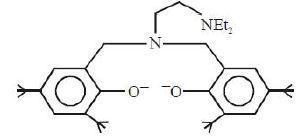
A
tridentate
B
bidentate
C
tetradentate
D
hexadentate
Solution
(C) The ligand structure contains one tertiary amine nitrogen atom,two phenolate oxygen atoms,and one diethylamino nitrogen atom.
Counting the potential donor sites:
$1$. One central tertiary amine nitrogen $(N)$.
$2$. Two phenolate oxygen atoms $(O^-)$.
$3$. One terminal diethylamino nitrogen atom $(NEt_2)$.
Thus,there are a total of $4$ donor atoms available for coordination.
Therefore,the ligand is tetradentate.
Counting the potential donor sites:
$1$. One central tertiary amine nitrogen $(N)$.
$2$. Two phenolate oxygen atoms $(O^-)$.
$3$. One terminal diethylamino nitrogen atom $(NEt_2)$.
Thus,there are a total of $4$ donor atoms available for coordination.
Therefore,the ligand is tetradentate.
0 likesView Solution
205
ChemistryMediumMCQJEE Main · 2019
Maltose on treatment with dilute $HCl$ gives:
A
$D$-Glucose
B
$D$-Fructose
C
$D$-Galactose
D
$D$-Glucose and $D$-Fructose
Solution
(A) Maltose is a disaccharide composed of two $D$-glucose units linked by an $\alpha$-glycosidic linkage between $C_1$ of one glucose unit and $C_4$ of another.
Upon hydrolysis with dilute acid (like $HCl$),the glycosidic bond is broken,yielding two molecules of $D$-glucose.
The reaction is: $\text{Maltose} + H_2O \xrightarrow{H^+} 2 \text{ } D\text{-glucose}$.
Upon hydrolysis with dilute acid (like $HCl$),the glycosidic bond is broken,yielding two molecules of $D$-glucose.
The reaction is: $\text{Maltose} + H_2O \xrightarrow{H^+} 2 \text{ } D\text{-glucose}$.
0 likesView Solution
206
ChemistryMediumMCQJEE Main · 2019
With respect to an ore,the Ellingham diagram helps to predict the feasibility of its:
A
Electrolysis
B
Thermal reduction
C
Vapour phase refining
D
Zone refining
Solution
(B) The Ellingham diagram,which represents the plots of $\Delta G$ versus $T$,helps in predicting the feasibility of the thermal reduction of metal oxides using a suitable reducing agent.
0 likesView Solution
207
ChemistryEasyMCQJEE Main · 2019
The statement that is $INCORRECT$ about the interstitial compounds is
A
they have metallic conductivity
B
they have high melting points
C
they are chemically reactive
D
they are very hard
Solution
(C) Interstitial compounds are formed when small atoms like $H$,$C$,or $N$ are trapped inside the crystal lattice of transition metals.
These compounds typically exhibit high melting points,high hardness,and retain metallic conductivity.
However,they are generally chemically inert,not reactive.
Therefore,the statement that they are chemically reactive is $INCORRECT$.
These compounds typically exhibit high melting points,high hardness,and retain metallic conductivity.
However,they are generally chemically inert,not reactive.
Therefore,the statement that they are chemically reactive is $INCORRECT$.
0 likesView Solution
208
ChemistryDifficultMCQJEE Main · 2019
The major product of the following reaction is:
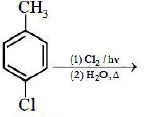
A
$4-$chlorobenzyl alcohol
B
$4-$chlorobenzal chloride
C
$4-$chlorobenzaldehyde
D
$4-$chlorobenzoic acid
Solution
(A) The reaction of $4$-chlorotoluene with $Cl_2$ in the presence of $h\nu$ (sunlight) is a free radical substitution reaction that occurs at the benzylic position.
Step $1$: Free radical chlorination of $4$-chlorotoluene gives $4$-chlorobenzyl chloride $(Cl-C_6H_4-CH_2Cl)$.
Step $2$: Hydrolysis of $4$-chlorobenzyl chloride with water $(H_2O, \Delta)$ replaces the chlorine atom with a hydroxyl group to form $4$-chlorobenzyl alcohol $(Cl-C_6H_4-CH_2OH)$.
Therefore,the major product is $4$-chlorobenzyl alcohol.
Step $1$: Free radical chlorination of $4$-chlorotoluene gives $4$-chlorobenzyl chloride $(Cl-C_6H_4-CH_2Cl)$.
Step $2$: Hydrolysis of $4$-chlorobenzyl chloride with water $(H_2O, \Delta)$ replaces the chlorine atom with a hydroxyl group to form $4$-chlorobenzyl alcohol $(Cl-C_6H_4-CH_2OH)$.
Therefore,the major product is $4$-chlorobenzyl alcohol.
1 likesView Solution
209
ChemistryDifficultMCQJEE Main · 2019
The major product obtained in the following reaction is
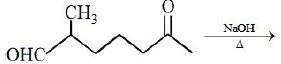
A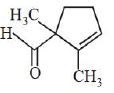
B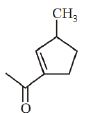
C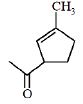
D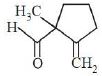
Solution
(B) The given reaction is an intramolecular aldol condensation of $6$-oxoheptanal.
In the presence of a base $(NaOH)$ and heat $(\Delta)$,the enolate ion formed at the $\alpha$-carbon of the ketone attacks the carbonyl carbon of the aldehyde.
This leads to the formation of a five-membered ring.
Subsequent dehydration (loss of $H_2O$) results in the formation of the $\alpha,\beta$-unsaturated carbonyl compound.
The major product is $3$-methylcyclopent$-2-$en$-1-$one derivative,which corresponds to option $B$.
In the presence of a base $(NaOH)$ and heat $(\Delta)$,the enolate ion formed at the $\alpha$-carbon of the ketone attacks the carbonyl carbon of the aldehyde.
This leads to the formation of a five-membered ring.
Subsequent dehydration (loss of $H_2O$) results in the formation of the $\alpha,\beta$-unsaturated carbonyl compound.
The major product is $3$-methylcyclopent$-2-$en$-1-$one derivative,which corresponds to option $B$.
0 likesView Solution
210
ChemistryDifficultMCQJEE Main · 2019
For a reaction scheme $A$ $\xrightarrow{k_1} B$ $\xrightarrow{k_2} C$,if the rate of formation of $B$ is set to be zero,then the concentration of $B$ is given by:
A
$\left( \frac{k_1}{k_2} \right) [A]$
B
$\left( k_1 - k_2 \right) [A]$
C
$k_1 k_2 [A]$
D
$\left( k_1 + k_2 \right) [A]$
Solution
(A) Applying the steady state approximation to the intermediate $B$:
The rate of change of concentration of $B$ is given by: $\frac{d[B]}{dt} = k_1 [A] - k_2 [B]$
According to the steady state approximation,the rate of formation of $B$ is set to zero: $\frac{d[B]}{dt} = 0$
Therefore,$0 = k_1 [A] - k_2 [B]$
Rearranging the equation to solve for $[B]$:
$k_2 [B] = k_1 [A]$
$[B] = \left( \frac{k_1}{k_2} \right) [A]$
The rate of change of concentration of $B$ is given by: $\frac{d[B]}{dt} = k_1 [A] - k_2 [B]$
According to the steady state approximation,the rate of formation of $B$ is set to zero: $\frac{d[B]}{dt} = 0$
Therefore,$0 = k_1 [A] - k_2 [B]$
Rearranging the equation to solve for $[B]$:
$k_2 [B] = k_1 [A]$
$[B] = \left( \frac{k_1}{k_2} \right) [A]$
0 likesView Solution
211
ChemistryAdvancedMCQJEE Main · 2019
Calculate the standard cell potential (in $V$) of the cell in which the following reaction takes place:
$Fe^{2+}_{(aq)} + Ag^{+}_{(aq)} \to Fe^{3+}_{(aq)} + Ag_{(s)}$
Given that:
$E^o_{Ag^{+}/Ag} = x \ V$
$E^o_{Fe^{2+}/Fe} = y \ V$
$E^o_{Fe^{3+}/Fe} = z \ V$
$Fe^{2+}_{(aq)} + Ag^{+}_{(aq)} \to Fe^{3+}_{(aq)} + Ag_{(s)}$
Given that:
$E^o_{Ag^{+}/Ag} = x \ V$
$E^o_{Fe^{2+}/Fe} = y \ V$
$E^o_{Fe^{3+}/Fe} = z \ V$
A
$x - z$
B
$x + y - z$
C
$x - y$
D
$x + 2y - 3z$
Solution
(D) The cell reaction is: $Fe^{2+}_{(aq)} + Ag^{+}_{(aq)} \to Fe^{3+}_{(aq)} + Ag_{(s)}$
Given standard reduction potentials:
$(1)$ $Ag^{+} + e^{-} \to Ag$,$E^o = x \ V$,$\Delta G^o_1 = -nFE^o = -1 \cdot F \cdot x = -Fx$
$(2)$ $Fe^{2+} + 2e^{-} \to Fe$,$E^o = y \ V$,$\Delta G^o_2 = -2Fy$
$(3)$ $Fe^{3+} + 3e^{-} \to Fe$,$E^o = z \ V$,$\Delta G^o_3 = -3Fz$
We need to find the $\Delta G^o$ for the reaction: $Fe^{2+} \to Fe^{3+} + e^{-}$
This can be obtained by: (Reaction $2$) - (Reaction $3$)
$\Delta G^o_{oxidation} = \Delta G^o_2 - \Delta G^o_3 = -2Fy - (-3Fz) = 3Fz - 2Fy$
For the total cell reaction:
$Fe^{2+} + Ag^{+} \to Fe^{3+} + Ag$
$\Delta G^o_{cell} = \Delta G^o_{oxidation} + \Delta G^o_1 = (3Fz - 2Fy) + (-Fx) = -F(x + 2y - 3z)$
Since $\Delta G^o_{cell} = -nFE^o_{cell}$ and $n = 1$:
$-FE^o_{cell} = -F(x + 2y - 3z)$
$E^o_{cell} = x + 2y - 3z \ V$
Given standard reduction potentials:
$(1)$ $Ag^{+} + e^{-} \to Ag$,$E^o = x \ V$,$\Delta G^o_1 = -nFE^o = -1 \cdot F \cdot x = -Fx$
$(2)$ $Fe^{2+} + 2e^{-} \to Fe$,$E^o = y \ V$,$\Delta G^o_2 = -2Fy$
$(3)$ $Fe^{3+} + 3e^{-} \to Fe$,$E^o = z \ V$,$\Delta G^o_3 = -3Fz$
We need to find the $\Delta G^o$ for the reaction: $Fe^{2+} \to Fe^{3+} + e^{-}$
This can be obtained by: (Reaction $2$) - (Reaction $3$)
$\Delta G^o_{oxidation} = \Delta G^o_2 - \Delta G^o_3 = -2Fy - (-3Fz) = 3Fz - 2Fy$
For the total cell reaction:
$Fe^{2+} + Ag^{+} \to Fe^{3+} + Ag$
$\Delta G^o_{cell} = \Delta G^o_{oxidation} + \Delta G^o_1 = (3Fz - 2Fy) + (-Fx) = -F(x + 2y - 3z)$
Since $\Delta G^o_{cell} = -nFE^o_{cell}$ and $n = 1$:
$-FE^o_{cell} = -F(x + 2y - 3z)$
$E^o_{cell} = x + 2y - 3z \ V$
1 likesView Solution
212
ChemistryDifficultMCQJEE Main · 2019
The structure of Nylon $-6$ is
A
$-[ (CH_2)_4 - CO - NH ]_n$
B
$-[ CO - (CH_2)_6 - NH ]_n$
C
$-[ CO - (CH_2)_5 - NH ]_n$
D
$-[ (CH_2)_6 - CO - NH ]_n$
Solution
(C) Nylon $-6$ is synthesized by the ring-opening polymerization of caprolactam at $533 \ K$ in an inert atmosphere of $N_2$.
The repeating unit of Nylon $-6$ contains $6$ carbon atoms in total ($5$ from the methylene groups and $1$ from the carbonyl group).
The structure is represented as $-[ CO - (CH_2)_5 - NH ]_n$.
The repeating unit of Nylon $-6$ contains $6$ carbon atoms in total ($5$ from the methylene groups and $1$ from the carbonyl group).
The structure is represented as $-[ CO - (CH_2)_5 - NH ]_n$.
0 likesView Solution
213
ChemistryDifficultMCQJEE Main · 2019
Which of the following compounds will show the maximum 'enol' content?
A
$CH_3COCH_3$
B
$CH_3COCH_2CONH_2$
C
$CH_3COCH_2COCH_3$
D
$CH_3COCH_2COOC_2H_5$
Solution
(C) The 'enol' content is determined by the stability of the resulting enol form.
$CH_3COCH_2COCH_3$ (acetylacetone) is a $\beta$-diketone.
It contains an active methylene group $(-CH_2-)$ flanked by two electron-withdrawing carbonyl groups.
The enol form of acetylacetone is highly stabilized by:
$1$. Conjugation between the $C=C$ double bond and the $C=O$ carbonyl group.
$2$. Intramolecular hydrogen bonding,which forms a stable $6$-membered ring structure.
Due to these factors,$CH_3COCH_2COCH_3$ exhibits the maximum 'enol' content among the given options.
$CH_3COCH_2COCH_3$ (acetylacetone) is a $\beta$-diketone.
It contains an active methylene group $(-CH_2-)$ flanked by two electron-withdrawing carbonyl groups.
The enol form of acetylacetone is highly stabilized by:
$1$. Conjugation between the $C=C$ double bond and the $C=O$ carbonyl group.
$2$. Intramolecular hydrogen bonding,which forms a stable $6$-membered ring structure.
Due to these factors,$CH_3COCH_2COCH_3$ exhibits the maximum 'enol' content among the given options.
0 likesView Solution
214
ChemistryDifficultMCQJEE Main · 2019
$0.27 \ g$ of a long chain fatty acid was dissolved in $100 \ cm^3$ of hexane. $10 \ mL$ of this solution was added dropwise to the surface of water in a round watch glass. Hexane evaporates and a monolayer is formed. The distance from edge to centre of the watch glass is $10 \ cm$. What is the height of the monolayer? [Density of fatty acid $= 0.9 \ g \ cm^{-3}, \pi = 3$]
A
$10^{-4} \ m$
B
$10^{-8} \ m$
C
$10^{-2} \ m$
D
$10^{-6} \ m$
Solution
(D) Total mass of fatty acid $= 0.27 \ g$ in $100 \ mL$ of solution.
Mass of fatty acid in $10 \ mL$ of solution $= 0.27 \times \frac{10}{100} = 0.027 \ g$.
Volume of fatty acid $= \frac{\text{Mass}}{\text{Density}} = \frac{0.027 \ g}{0.9 \ g \ cm^{-3}} = 0.03 \ cm^3$.
Area of the monolayer on the watch glass $= \pi r^2 = 3 \times (10 \ cm)^2 = 300 \ cm^2$.
Height of the monolayer $= \frac{\text{Volume}}{\text{Area}} = \frac{0.03 \ cm^3}{300 \ cm^2} = 10^{-4} \ cm$.
Converting to meters: $10^{-4} \ cm = 10^{-4} \times 10^{-2} \ m = 10^{-6} \ m$.
Mass of fatty acid in $10 \ mL$ of solution $= 0.27 \times \frac{10}{100} = 0.027 \ g$.
Volume of fatty acid $= \frac{\text{Mass}}{\text{Density}} = \frac{0.027 \ g}{0.9 \ g \ cm^{-3}} = 0.03 \ cm^3$.
Area of the monolayer on the watch glass $= \pi r^2 = 3 \times (10 \ cm)^2 = 300 \ cm^2$.
Height of the monolayer $= \frac{\text{Volume}}{\text{Area}} = \frac{0.03 \ cm^3}{300 \ cm^2} = 10^{-4} \ cm$.
Converting to meters: $10^{-4} \ cm = 10^{-4} \times 10^{-2} \ m = 10^{-6} \ m$.
0 likesView Solution
215
ChemistryMediumMCQJEE Main · 2019
The Mond process is used for the
A
Extraction of $Mo$
B
Extraction of $Zn$
C
Purification of $Zr$ and $Ti$
D
Purification of $Ni$
Solution
(D) The Mond process is used for the refining of nickel $(Ni)$ based on the principle of formation of a volatile carbonyl complex.
The chemical reactions involved are:
$\mathop {Ni}\limits_{\text{impure}} + 4CO_{(g)} \xrightarrow{330-350 \ K} Ni(CO)_{4(g)}$
$Ni(CO)_{4(g)} \xrightarrow{450-470 \ K} \mathop {Ni_{(s)}}\limits_{\text{pure}} + 4CO_{(g)}$
The chemical reactions involved are:
$\mathop {Ni}\limits_{\text{impure}} + 4CO_{(g)} \xrightarrow{330-350 \ K} Ni(CO)_{4(g)}$
$Ni(CO)_{4(g)} \xrightarrow{450-470 \ K} \mathop {Ni_{(s)}}\limits_{\text{pure}} + 4CO_{(g)}$
0 likesView Solution
216
ChemistryDifficultMCQJEE Main · 2019
The calculated spin-only magnetic moments $(BM)$ of the species $[Fe(CN)_6]^{4-}$ and $[Fe(H_2O)_6]^{2+}$,respectively,are:
A
$0$ and $5.92$
B
$2.84$ and $5.92$
C
$4.9$ and $0$
D
$0$ and $4.9$
Solution
(D) For $[Fe(CN)_6]^{4-}$: $Fe$ is in $+2$ oxidation state $(3d^6)$. $CN^-$ is a strong field ligand,causing pairing of electrons. The configuration is $t_{2g}^6 e_g^0$. Number of unpaired electrons $(n)$ = $0$. Magnetic moment $\mu = \sqrt{0(0+2)} = 0 \ BM$.
For $[Fe(H_2O)_6]^{2+}$: $Fe$ is in $+2$ oxidation state $(3d^6)$. $H_2O$ is a weak field ligand,no pairing occurs. The configuration is $t_{2g}^4 e_g^2$. Number of unpaired electrons $(n)$ = $4$. Magnetic moment $\mu = \sqrt{4(4+2)} = \sqrt{24} \approx 4.9 \ BM$.
For $[Fe(H_2O)_6]^{2+}$: $Fe$ is in $+2$ oxidation state $(3d^6)$. $H_2O$ is a weak field ligand,no pairing occurs. The configuration is $t_{2g}^4 e_g^2$. Number of unpaired electrons $(n)$ = $4$. Magnetic moment $\mu = \sqrt{4(4+2)} = \sqrt{24} \approx 4.9 \ BM$.
0 likesView Solution
217
ChemistryMediumMCQJEE Main · 2019
Fructose and glucose can be distinguished by
A
Benedict’s test
B
Fehling’s test
C
Barfoed’s test
D
Seliwanoff’s test
Solution
(D) Seliwanoff's test is used to distinguish between aldoses (like glucose) and ketoses (like fructose).
In this test,ketoses undergo dehydration more rapidly than aldoses to form furfural derivatives,which react with resorcinol to produce a deep red color.
Glucose is an aldose,while fructose is a ketose,making this the correct test for differentiation.
In this test,ketoses undergo dehydration more rapidly than aldoses to form furfural derivatives,which react with resorcinol to produce a deep red color.
Glucose is an aldose,while fructose is a ketose,making this the correct test for differentiation.
0 likesView Solution
218
ChemistryDifficultMCQJEE Main · 2019
Polysubstitution is a major drawback in
A
Friedel-Crafts alkylation
B
Reimer-Tiemann reaction
C
Acetylation of aniline
D
Friedel-Crafts acylation
Solution
(A) Polysubstitution is a major drawback of Friedel-Crafts alkylation.
This occurs because the alkyl group introduced on the benzene ring is electron-donating in nature,which increases the electron density of the ring.
Consequently,the ring becomes more reactive towards further electrophilic substitution,leading to the formation of polyalkylated products.
This occurs because the alkyl group introduced on the benzene ring is electron-donating in nature,which increases the electron density of the ring.
Consequently,the ring becomes more reactive towards further electrophilic substitution,leading to the formation of polyalkylated products.
0 likesView Solution
219
ChemistryDifficultMCQJEE Main · 2019
For the solution of the gases $w$,$x$,$y$ and $z$ in water at $298 \ K$,the Henry's law constants $(K_H)$ are $0.5$,$2$,$35$ and $40 \ kbar$,respectively. The correct plot for the given data is
A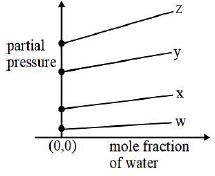
B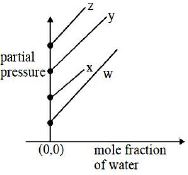
C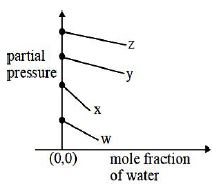
D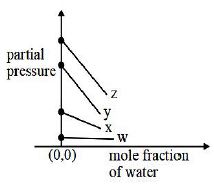
Solution
(C) According to Henry's law,the partial pressure of a gas $(P_{gas})$ is related to its mole fraction $(X_{gas})$ as: $P_{gas} = K_H \cdot X_{gas}$.
Since $X_{gas} + X_{H_2O} = 1$,we have $X_{gas} = 1 - X_{H_2O}$.
Substituting this into the equation: $P_{gas} = K_H(1 - X_{H_2O}) = K_H - K_H \cdot X_{H_2O}$.
This is a linear equation of the form $y = mx + c$,where $y = P_{gas}$,$x = X_{H_2O}$,slope $m = -K_H$,and intercept $c = K_H$.
As the mole fraction of water $(X_{H_2O})$ increases,the partial pressure of the gas decreases linearly.
The intercept on the y-axis is $K_H$. The values of $K_H$ are $0.5$,$2$,$35$,and $40 \ kbar$ for $w$,$x$,$y$,and $z$ respectively.
Therefore,the intercept increases in the order $w < x < y < z$.
The slope is $-K_H$,meaning the lines have negative slopes,and the magnitude of the slope increases as $K_H$ increases.
Looking at the options,the graph in Option $C$ shows lines with negative slopes where the y-intercepts increase in the order $w < x < y < z$.
Since $X_{gas} + X_{H_2O} = 1$,we have $X_{gas} = 1 - X_{H_2O}$.
Substituting this into the equation: $P_{gas} = K_H(1 - X_{H_2O}) = K_H - K_H \cdot X_{H_2O}$.
This is a linear equation of the form $y = mx + c$,where $y = P_{gas}$,$x = X_{H_2O}$,slope $m = -K_H$,and intercept $c = K_H$.
As the mole fraction of water $(X_{H_2O})$ increases,the partial pressure of the gas decreases linearly.
The intercept on the y-axis is $K_H$. The values of $K_H$ are $0.5$,$2$,$35$,and $40 \ kbar$ for $w$,$x$,$y$,and $z$ respectively.
Therefore,the intercept increases in the order $w < x < y < z$.
The slope is $-K_H$,meaning the lines have negative slopes,and the magnitude of the slope increases as $K_H$ increases.
Looking at the options,the graph in Option $C$ shows lines with negative slopes where the y-intercepts increase in the order $w < x < y < z$.
0 likesView Solution
220
ChemistryDifficultMCQJEE Main · 2019
The major product obtained in the following reaction is:
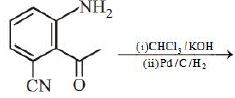
A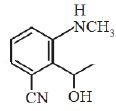
B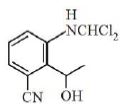
C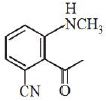
D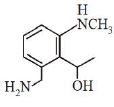
Solution
(D) The reaction sequence is as follows:
$1$. The starting material is $2$-amino-$3$-cyano-benzaldehyde.
$2$. Treatment with $CHCl_3/KOH$ (carbylamine reaction) converts the $-NH_2$ group into an isocyanide group $(-NC)$.
$3$. Subsequent reduction with $Pd/C/H_2$ reduces the isocyanide $(-NC)$ to a methylamino group $(-NHCH_3)$,the aldehyde group $(-CHO)$ to a secondary alcohol $(-CH(OH)CH_3)$,and the nitrile group $(-CN)$ to a primary amine $(-CH_2NH_2)$.
$1$. The starting material is $2$-amino-$3$-cyano-benzaldehyde.
$2$. Treatment with $CHCl_3/KOH$ (carbylamine reaction) converts the $-NH_2$ group into an isocyanide group $(-NC)$.
$3$. Subsequent reduction with $Pd/C/H_2$ reduces the isocyanide $(-NC)$ to a methylamino group $(-NHCH_3)$,the aldehyde group $(-CHO)$ to a secondary alcohol $(-CH(OH)CH_3)$,and the nitrile group $(-CN)$ to a primary amine $(-CH_2NH_2)$.
0 likesView Solution
221
ChemistryDifficultMCQJEE Main · 2019
The compound that inhibits the growth of tumors is
A
$trans-[Pd(Cl)_2(NH_3)_2]$
B
$trans-[Pt(Cl)_2(NH_3)_2]$
C
$cis-[Pd(Cl)_2(NH_3)_2]$
D
$cis-[Pt(Cl)_2(NH_3)_2]$
Solution
(D) $cis-[PtCl_2(NH_3)_2]$,commonly known as cisplatin,is used in chemotherapy to inhibit the growth of tumors.
0 likesView Solution
222
ChemistryDifficultMCQJEE Main · 2019
Consider the $bcc$ unit cells of the solid $1$ and $2$ with the position of atoms as shown below. The radius of atom $B$ is twice that of atom $A$. The unit cell edge length is $50\%$ more in solid $2$ than in $1$. What is the approximate packing efficiency in solid $2$? $........... \%$
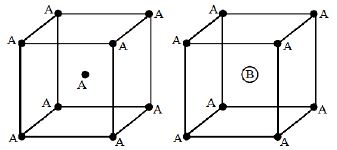
A
$90$
B
$75$
C
$65$
D
$45$
Solution
(A) In a $bcc$ unit cell,the body diagonal is $\sqrt{3}a$,where $a$ is the edge length.
Along the body diagonal,the atoms are in contact: $2r_A + 2r_B = \sqrt{3}a$.
Given $r_B = 2r_A$,so $2r_A + 2(2r_A) = \sqrt{3}a$,which gives $6r_A = \sqrt{3}a$,or $a = 2\sqrt{3}r_A$.
The packing efficiency is given by the ratio of the volume of atoms to the volume of the unit cell.
Volume of atoms = $8 \times (\frac{1}{8}) \times \frac{4}{3}\pi r_A^3 + 1 \times \frac{4}{3}\pi r_B^3 = \frac{4}{3}\pi r_A^3 + \frac{4}{3}\pi (2r_A)^3 = \frac{4}{3}\pi r_A^3 (1 + 8) = 12\pi r_A^3$.
Volume of unit cell = $a^3 = (2\sqrt{3}r_A)^3 = 8 \times 3\sqrt{3} r_A^3 = 24\sqrt{3} r_A^3$.
Packing efficiency = $\frac{12\pi r_A^3}{24\sqrt{3} r_A^3} \times 100 = \frac{\pi}{2\sqrt{3}} \times 100 \approx \frac{3.14159}{3.464} \times 100 \approx 90.6\%$.
Since the packing efficiency depends only on the ratio of radii and the structure type,it is independent of the absolute edge length. Thus,the packing efficiency in solid $2$ is approximately $90\%$.
Along the body diagonal,the atoms are in contact: $2r_A + 2r_B = \sqrt{3}a$.
Given $r_B = 2r_A$,so $2r_A + 2(2r_A) = \sqrt{3}a$,which gives $6r_A = \sqrt{3}a$,or $a = 2\sqrt{3}r_A$.
The packing efficiency is given by the ratio of the volume of atoms to the volume of the unit cell.
Volume of atoms = $8 \times (\frac{1}{8}) \times \frac{4}{3}\pi r_A^3 + 1 \times \frac{4}{3}\pi r_B^3 = \frac{4}{3}\pi r_A^3 + \frac{4}{3}\pi (2r_A)^3 = \frac{4}{3}\pi r_A^3 (1 + 8) = 12\pi r_A^3$.
Volume of unit cell = $a^3 = (2\sqrt{3}r_A)^3 = 8 \times 3\sqrt{3} r_A^3 = 24\sqrt{3} r_A^3$.
Packing efficiency = $\frac{12\pi r_A^3}{24\sqrt{3} r_A^3} \times 100 = \frac{\pi}{2\sqrt{3}} \times 100 \approx \frac{3.14159}{3.464} \times 100 \approx 90.6\%$.
Since the packing efficiency depends only on the ratio of radii and the structure type,it is independent of the absolute edge length. Thus,the packing efficiency in solid $2$ is approximately $90\%$.
0 likesView Solution
223
ChemistryDifficultMCQJEE Main · 2019
The number of water molecule $(s)$ not coordinated to copper ion directly in $CuSO_4 \cdot 5H_2O$ is
A
$1$
B
$3$
C
$2$
D
$4$
Solution
(A) The chemical formula of copper sulfate pentahydrate is written as $[Cu(H_2O)_4]SO_4 \cdot H_2O$.
In this structure,$4$ water molecules are directly coordinated to the central $Cu^{2+}$ ion as ligands.
The $5^{th}$ water molecule is held by hydrogen bonding in the crystal lattice and is not directly coordinated to the copper ion.
In this structure,$4$ water molecules are directly coordinated to the central $Cu^{2+}$ ion as ligands.
The $5^{th}$ water molecule is held by hydrogen bonding in the crystal lattice and is not directly coordinated to the copper ion.
0 likesView Solution
224
ChemistryDifficultMCQJEE Main · 2019
The one that will show optical activity is: $(en = \text{ethane-}1,2\text{-diamine})$
A
$trans-[Co(en)_2Cl_2]^+$
B
$cis-[Co(en)_2Cl_2]^+$
C
$[Cr(en)_3]^{3+}$
D
$trans-[Co(NH_3)_4Cl_2]^+$
Solution
(B) Optical activity in coordination compounds is shown by complexes that lack a plane of symmetry or center of inversion (i.e.,they are chiral).
$1$. $trans-[Co(en)_2Cl_2]^+$ has a plane of symmetry,so it is optically inactive.
$2$. $cis-[Co(en)_2Cl_2]^+$ lacks a plane of symmetry and is chiral,thus it shows optical activity.
$3$. $[Cr(en)_3]^{3+}$ is a tris-chelated complex. While it is chiral,the question asks for the one that shows optical activity among the given options. Both $cis-[Co(en)_2Cl_2]^+$ and $[Cr(en)_3]^{3+}$ are optically active. However,in standard multiple-choice contexts for this specific question,$cis-[Co(en)_2Cl_2]^+$ is the classic example of a geometric isomer that exhibits optical activity.
$4$. $trans-[Co(NH_3)_4Cl_2]^+$ has a plane of symmetry,so it is optically inactive.
Therefore,$cis-[Co(en)_2Cl_2]^+$ is the correct answer.
$1$. $trans-[Co(en)_2Cl_2]^+$ has a plane of symmetry,so it is optically inactive.
$2$. $cis-[Co(en)_2Cl_2]^+$ lacks a plane of symmetry and is chiral,thus it shows optical activity.
$3$. $[Cr(en)_3]^{3+}$ is a tris-chelated complex. While it is chiral,the question asks for the one that shows optical activity among the given options. Both $cis-[Co(en)_2Cl_2]^+$ and $[Cr(en)_3]^{3+}$ are optically active. However,in standard multiple-choice contexts for this specific question,$cis-[Co(en)_2Cl_2]^+$ is the classic example of a geometric isomer that exhibits optical activity.
$4$. $trans-[Co(NH_3)_4Cl_2]^+$ has a plane of symmetry,so it is optically inactive.
Therefore,$cis-[Co(en)_2Cl_2]^+$ is the correct answer.
0 likesView Solution
225
ChemistryDifficultMCQJEE Main · 2019
Liquid $M$ and liquid $N$ form an ideal solution. The vapour pressures of pure liquids $M$ and $N$ are $450 \ mmHg$ and $700 \ mmHg,$ respectively at the same temperature. Then the correct statement is: ( $x_M =$ mole fraction of $M$ in solution; $x_N =$ mole fraction of $N$ in solution; $y_M =$ mole fraction of $M$ in vapour phase; $y_N =$ mole fraction of $N$ in vapour phase)
A
$\frac{x_M}{x_N} > \frac{y_M}{y_N}$
B
$\frac{x_M}{x_N} = \frac{y_M}{y_N}$
C
$(x_M - y_M) < (x_N - y_N)$
D
$\frac{x_M}{x_N} < \frac{y_M}{y_N}$
Solution
(A) Given: $P_M^o = 450 \ mmHg$ and $P_N^o = 700 \ mmHg$.
According to Raoult's law,the partial pressures are $P_M = x_M P_M^o = 450 x_M$ and $P_N = x_N P_N^o = 700 x_N$.
In the vapour phase,the mole fractions are given by $y_M = \frac{P_M}{P_T}$ and $y_N = \frac{P_N}{P_T}$,where $P_T$ is the total pressure.
Therefore,the ratio $\frac{y_M}{y_N} = \frac{P_M}{P_N} = \frac{450 x_M}{700 x_N} = \frac{450}{700} \times \frac{x_M}{x_N}$.
Since $\frac{450}{700} < 1$,it follows that $\frac{y_M}{y_N} < \frac{x_M}{x_N}$,which implies $\frac{x_M}{x_N} > \frac{y_M}{y_N}$.
According to Raoult's law,the partial pressures are $P_M = x_M P_M^o = 450 x_M$ and $P_N = x_N P_N^o = 700 x_N$.
In the vapour phase,the mole fractions are given by $y_M = \frac{P_M}{P_T}$ and $y_N = \frac{P_N}{P_T}$,where $P_T$ is the total pressure.
Therefore,the ratio $\frac{y_M}{y_N} = \frac{P_M}{P_N} = \frac{450 x_M}{700 x_N} = \frac{450}{700} \times \frac{x_M}{x_N}$.
Since $\frac{450}{700} < 1$,it follows that $\frac{y_M}{y_N} < \frac{x_M}{x_N}$,which implies $\frac{x_M}{x_N} > \frac{y_M}{y_N}$.
0 likesView Solution
226
ChemistryDifficultMCQJEE Main · 2019
The degenerate orbitals of $[Cr(H_2O)_6]^{3+}$ are
A
$d_{xz}$ and $d_{yz}$
B
$d_{x^2-y^2}$ and $d_{xy}$
C
$d_{yz}$ and $d_{z^2}$
D
$d_{z^2}$ and $d_{xz}$
Solution
(A) In an octahedral complex like $[Cr(H_2O)_6]^{3+}$,the five $d$-orbitals split into two sets due to the crystal field: the $t_{2g}$ set and the $e_g$ set.
The $t_{2g}$ set consists of three degenerate orbitals: $d_{xy}$,$d_{yz}$,and $d_{xz}$.
The $e_g$ set consists of two degenerate orbitals: $d_{x^2-y^2}$ and $d_{z^2}$.
Among the given options,$d_{xz}$ and $d_{yz}$ belong to the same degenerate set $(t_{2g})$.
The $t_{2g}$ set consists of three degenerate orbitals: $d_{xy}$,$d_{yz}$,and $d_{xz}$.
The $e_g$ set consists of two degenerate orbitals: $d_{x^2-y^2}$ and $d_{z^2}$.
Among the given options,$d_{xz}$ and $d_{yz}$ belong to the same degenerate set $(t_{2g})$.
0 likesView Solution
227
ChemistryDifficultMCQJEE Main · 2019
An aerosol is a type of colloid in which.......
A
solid is dispersed in gas
B
gas is dispersed in solid
C
liquid is dispersed in water
D
gas is dispersed in liquid
Solution
(A) An aerosol is a colloidal system in which a solid or liquid is dispersed in a gas.
Examples include fog (liquid in gas) and smoke (solid in gas).
Examples include fog (liquid in gas) and smoke (solid in gas).
0 likesView Solution
228
ChemistryDifficultMCQJEE Main · 2019
The given plots represent the variation of the concentration of a reactant $R$ with time for two different reactions $(i)$ and $(ii).$ The respective orders of the reactions are
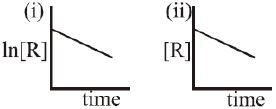
A
$1, 0$
B
$0, 1$
C
$1, 1$
D
$0, 2$
Solution
(A) For reaction $(i)$,the plot is $\ln [R]$ versus time,which is a straight line with a negative slope. The integrated rate equation for a first-order reaction is $\ln [R]_t = -Kt + \ln [R]_0$. This matches the form $y = mx + c$,where $y = \ln [R]_t$ and $x = t$. Thus,reaction $(i)$ is of first order.
For reaction $(ii)$,the plot is $[R]$ versus time,which is a straight line with a negative slope. The integrated rate equation for a zero-order reaction is $[R]_t = -Kt + [R]_0$. This matches the form $y = mx + c$,where $y = [R]_t$ and $x = t$. Thus,reaction $(ii)$ is of zero order.
Therefore,the orders of reactions $(i)$ and $(ii)$ are $1$ and $0$ respectively.
For reaction $(ii)$,the plot is $[R]$ versus time,which is a straight line with a negative slope. The integrated rate equation for a zero-order reaction is $[R]_t = -Kt + [R]_0$. This matches the form $y = mx + c$,where $y = [R]_t$ and $x = t$. Thus,reaction $(ii)$ is of zero order.
Therefore,the orders of reactions $(i)$ and $(ii)$ are $1$ and $0$ respectively.
0 likesView Solution
229
ChemistryDifficultMCQJEE Main · 2019
Aniline dissolved in dilute $HCl$ is reacted with sodium nitrite at $0\,^oC$. This solution was added dropwise to a solution containing an equimolar mixture of aniline and phenol in dilute $HCl$. The structure of the major product is
A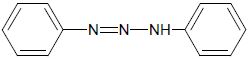
B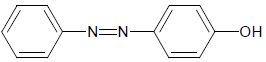
C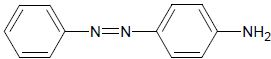
D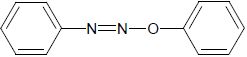
Solution
(A) $1$. Aniline reacts with $NaNO_2$ and $HCl$ at $0\,^oC$ to form benzenediazonium chloride $(C_6H_5N_2^+Cl^-)$.
$2$. When this diazonium salt is added to a mixture of aniline and phenol in dilute $HCl$,the medium is acidic.
$3$. In an acidic medium,the amino group of aniline is protonated to form an anilinium ion $(-NH_3^+)$,which is deactivating and does not undergo coupling.
$4$. However,the diazonium salt reacts with aniline to form a diazoamino compound $(C_6H_5-N=N-NH-C_6H_5)$ in a slightly acidic or neutral medium,but in the presence of dilute $HCl$,the reaction with aniline is suppressed.
$5$. The coupling reaction with phenol occurs in a basic medium. Since the medium is acidic,the coupling reaction is generally slow or inhibited for both.
$6$. However,among the given options,the formation of the diazoamino compound $(C_6H_5-N=N-NH-C_6H_5)$ is the characteristic reaction of benzenediazonium chloride with aniline in the presence of dilute $HCl$ (where the aniline is not fully protonated or the reaction is kinetically favored).
$7$. Therefore,the major product formed is the diazoamino compound.
$2$. When this diazonium salt is added to a mixture of aniline and phenol in dilute $HCl$,the medium is acidic.
$3$. In an acidic medium,the amino group of aniline is protonated to form an anilinium ion $(-NH_3^+)$,which is deactivating and does not undergo coupling.
$4$. However,the diazonium salt reacts with aniline to form a diazoamino compound $(C_6H_5-N=N-NH-C_6H_5)$ in a slightly acidic or neutral medium,but in the presence of dilute $HCl$,the reaction with aniline is suppressed.
$5$. The coupling reaction with phenol occurs in a basic medium. Since the medium is acidic,the coupling reaction is generally slow or inhibited for both.
$6$. However,among the given options,the formation of the diazoamino compound $(C_6H_5-N=N-NH-C_6H_5)$ is the characteristic reaction of benzenediazonium chloride with aniline in the presence of dilute $HCl$ (where the aniline is not fully protonated or the reaction is kinetically favored).
$7$. Therefore,the major product formed is the diazoamino compound.
0 likesView Solution
230
ChemistryMediumMCQJEE Main · 2019
The ore that contains the metal in the form of fluoride is
A
sphalerite
B
malachite
C
magnetite
D
cryolite
Solution
(D) The chemical formula of cryolite is $Na_3[AlF_6]$.
It is a fluoride ore of aluminum.
It is a fluoride ore of aluminum.
0 likesView Solution
231
ChemistryDifficultMCQJEE Main · 2019
The major product of the following reaction is $CH_3CH=CHCO_2CH_3 \xrightarrow{LiAlH_4}$
A
$CH_3CH_2CH_2CHO$
B
$CH_3CH=CHCH_2OH$
C
$CH_3CH_2CH_2CO_2CH_3$
D
$CH_3CH_2CH_2CH_2OH$
Solution
(B) $LiAlH_4$ is a strong reducing agent that selectively reduces the ester group $(-CO_2CH_3)$ to a primary alcohol $(-CH_2OH)$ while leaving the carbon-carbon double bond $(C=C)$ unaffected.
Therefore,the product is $CH_3CH=CHCH_2OH$.
Therefore,the product is $CH_3CH=CHCH_2OH$.
0 likesView Solution
232
ChemistryDifficultMCQJEE Main · 2019
The osmotic pressure of a dilute solution of an ionic compound $XY$ in water is four times that of a solution of $0.01\, M\, BaCl_2$ in water. Assuming complete dissociation of the given ionic compounds in water,the concentration of $XY$ (in $mol\, L^{-1}$) in solution is
A
$4 \times 10^{-4}$
B
$6 \times 10^{-2}$
C
$16 \times 10^{-4}$
D
$4 \times 10^{-2}$
Solution
(B) The osmotic pressure $\pi$ is given by the formula $\pi = iCRT$,where $i$ is the van't Hoff factor,$C$ is the molar concentration,$R$ is the gas constant,and $T$ is the temperature.
For $XY$,which dissociates as $XY \rightarrow X^+ + Y^-$,the van't Hoff factor $i = 2$.
For $BaCl_2$,which dissociates as $BaCl_2 \rightarrow Ba^{2+} + 2Cl^-$,the van't Hoff factor $i = 3$.
Given that $\pi_{XY} = 4 \times \pi_{BaCl_2}$,we have:
$2 \times C_{XY} \times RT = 4 \times (3 \times 0.01 \times RT)$
$2 \times C_{XY} = 0.12$
$C_{XY} = 0.06\, M = 6 \times 10^{-2}\, mol\, L^{-1}$.
For $XY$,which dissociates as $XY \rightarrow X^+ + Y^-$,the van't Hoff factor $i = 2$.
For $BaCl_2$,which dissociates as $BaCl_2 \rightarrow Ba^{2+} + 2Cl^-$,the van't Hoff factor $i = 3$.
Given that $\pi_{XY} = 4 \times \pi_{BaCl_2}$,we have:
$2 \times C_{XY} \times RT = 4 \times (3 \times 0.01 \times RT)$
$2 \times C_{XY} = 0.12$
$C_{XY} = 0.06\, M = 6 \times 10^{-2}\, mol\, L^{-1}$.
0 likesView Solution
233
ChemistryDifficultMCQJEE Main · 2019
The major product of the following reaction is:
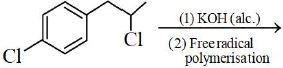
A
$A$ polymer with a phenol group attached to the backbone.
B
$A$ polymer with a chlorine atom on the benzene ring and a methyl group on the backbone.
C
$A$ polymer with a chlorine atom on the benzene ring and no methyl group on the backbone.
D
$A$ polymer with a chlorine atom on the benzene ring and a methyl group on the backbone (different structure).
Solution
(B) Step $1$: Dehydrohalogenation of $1-(4-chlorophenyl)-2-chloropropane$ with alcoholic $KOH$ leads to the formation of $1-(4-chlorophenyl)prop-1-ene$ via an $E2$ elimination mechanism.
Step $2$: The resulting alkene,$1-(4-chlorophenyl)prop-1-ene$,undergoes free radical polymerization to form the corresponding polymer. The structure of the polymer is formed by the addition of the monomer units,resulting in a backbone with a methyl group and a $4-chlorophenyl$ substituent on adjacent carbons.
Step $2$: The resulting alkene,$1-(4-chlorophenyl)prop-1-ene$,undergoes free radical polymerization to form the corresponding polymer. The structure of the polymer is formed by the addition of the monomer units,resulting in a backbone with a methyl group and a $4-chlorophenyl$ substituent on adjacent carbons.
0 likesView Solution
234
ChemistryDifficultMCQJEE Main · 2019
The standard Gibbs energy for the given cell reaction in $kJ \, mol^{-1}$ at $298 \, K$ is $Zn_{(s)} + Cu^{2+}_{(aq)} \to Zn^{2+}_{(aq)} + Cu_{(s)}$,given $E^o = 2 \, V$ at $298 \, K$ [Faraday's constant $F = 96500 \, C \, mol^{-1}$].
A
$-192$
B
$384$
C
$-384$
D
$192$
Solution
(C) The formula for standard Gibbs energy is $\Delta G^o = -nFE^o$.
Here,$n = 2$ (number of electrons transferred in the redox reaction).
$F = 96500 \, C \, mol^{-1}$.
$E^o = 2 \, V$.
Substituting the values: $\Delta G^o = -2 \times 96500 \times 2 = -386000 \, J \, mol^{-1} = -386 \, kJ \, mol^{-1}$.
Given the options,the closest value is $-384 \, kJ \, mol^{-1}$,which is obtained if $F$ is approximated as $96000 \, C \, mol^{-1}$.
Here,$n = 2$ (number of electrons transferred in the redox reaction).
$F = 96500 \, C \, mol^{-1}$.
$E^o = 2 \, V$.
Substituting the values: $\Delta G^o = -2 \times 96500 \times 2 = -386000 \, J \, mol^{-1} = -386 \, kJ \, mol^{-1}$.
Given the options,the closest value is $-384 \, kJ \, mol^{-1}$,which is obtained if $F$ is approximated as $96000 \, C \, mol^{-1}$.
0 likesView Solution
235
ChemistryDifficultMCQJEE Main · 2019
Which of the following statements is not true about sucrose?
A
The glycosidic linkage is present between $C_1$ of $\alpha$-glucose and $C_1$ of $\beta$-fructose.
B
It is a non-reducing sugar.
C
It is also named as invert sugar.
D
On hydrolysis it produces glucose and fructose.
Solution
(A) Sucrose is a disaccharide formed by a glycosidic linkage between $C_1$ of $\alpha$-$D$-glucose and $C_2$ of $\beta$-$D$-fructose. Since both anomeric carbons are involved in the linkage,it is a non-reducing sugar. Upon hydrolysis,it yields an equimolar mixture of glucose and fructose,which is known as invert sugar. Therefore,the statement that the linkage is between $C_1$ of $\alpha$-glucose and $C_1$ of $\beta$-fructose is incorrect.
0 likesView Solution
236
ChemistryDifficultMCQJEE Main · 2019
Match the catalyst (Column-$I$) with products (Column-$II$)
| Column-$I$ Catalyst | Column-$II$ Product |
| $(a)$ $V_2O_5$ | $(i)$ Polyethylene |
| $(b)$ $TiCl_4/Al(Me)_3$ | $(ii)$ Ethanal |
| $(c)$ $PdCl_2$ | $(iii)$ $H_2SO_4$ |
| $(d)$ Iron oxide | $(iv)$ $NH_3$ |
A
$a-iii, b-i, c-ii, d-iv$
B
$a-iv, b-iii, c-ii, d-i$
C
$a-ii, b-iii, c-i, d-iv$
D
$a-iii, b-iv, c-i, d-ii$
Solution
(A) $V_2O_5$ is used as a catalyst in the Contact process for the manufacture of $H_2SO_4$.
$TiCl_4/Al(Me)_3$ is the Ziegler-Natta catalyst used in the polymerization of ethene to form Polyethylene.
$PdCl_2$ is used in the Wacker process for the oxidation of ethene to Ethanal.
Iron oxide is used as a catalyst in the Haber process for the production of $NH_3$.
Therefore,the correct matching is: $(a-iii, b-i, c-ii, d-iv)$.
$TiCl_4/Al(Me)_3$ is the Ziegler-Natta catalyst used in the polymerization of ethene to form Polyethylene.
$PdCl_2$ is used in the Wacker process for the oxidation of ethene to Ethanal.
Iron oxide is used as a catalyst in the Haber process for the production of $NH_3$.
Therefore,the correct matching is: $(a-iii, b-i, c-ii, d-iv)$.
0 likesView Solution
237
ChemistryDifficultMCQJEE Main · 2019
Increasing order of reactivity of the following compounds for $S_N1$ substitution is:
$(a)$ $(CH_3)_2CH-CH_2Cl$
$(b)$ $CH_3CH_2Cl$
$(c)$ $CH_3O-C_6H_4-CH_2Cl$
$(d)$ $C_6H_5-CH_2Cl$
$(a)$ $(CH_3)_2CH-CH_2Cl$
$(b)$ $CH_3CH_2Cl$
$(c)$ $CH_3O-C_6H_4-CH_2Cl$
$(d)$ $C_6H_5-CH_2Cl$
A
$(b) < (c) < (d) < (a)$
B
$(a) < (b) < (d) < (c)$
C
$(b) < (a) < (d) < (c)$
D
$(b) < (c) < (a) < (d)$
Solution
(C) The reactivity of compounds towards $S_N1$ substitution depends on the stability of the carbocation intermediate formed after the departure of the leaving group $(Cl^-)$.
$1$. The carbocations formed are:
$(a)$ $(CH_3)_2CH-CH_2^+$ (primary carbocation with branching)
$(b)$ $CH_3CH_2^+$ (primary carbocation)
$(c)$ $CH_3O-C_6H_4-CH_2^+$ (benzylic carbocation stabilized by $+M$ effect of $-OCH_3$ group)
$(d)$ $C_6H_5-CH_2^+$ (benzylic carbocation stabilized by resonance)
$2$. Stability order of carbocations:
$CH_3O-C_6H_4-CH_2^+ > C_6H_5-CH_2^+ > (CH_3)_2CH-CH_2^+ > CH_3CH_2^+$
$3$. Since reactivity $\propto$ stability of carbocation,the increasing order of reactivity is:
$(b) < (a) < (d) < (c)$
$1$. The carbocations formed are:
$(a)$ $(CH_3)_2CH-CH_2^+$ (primary carbocation with branching)
$(b)$ $CH_3CH_2^+$ (primary carbocation)
$(c)$ $CH_3O-C_6H_4-CH_2^+$ (benzylic carbocation stabilized by $+M$ effect of $-OCH_3$ group)
$(d)$ $C_6H_5-CH_2^+$ (benzylic carbocation stabilized by resonance)
$2$. Stability order of carbocations:
$CH_3O-C_6H_4-CH_2^+ > C_6H_5-CH_2^+ > (CH_3)_2CH-CH_2^+ > CH_3CH_2^+$
$3$. Since reactivity $\propto$ stability of carbocation,the increasing order of reactivity is:
$(b) < (a) < (d) < (c)$
0 likesView Solution
238
ChemistryMediumMCQJEE Main · 2019
The one that is not a carbonate is
A
bauxite
B
siderite
C
calamine
D
malachite
Solution
(A) The chemical formulas for the given ores are:
$1$. Bauxite: $Al_2O_3 \cdot 2H_2O$ (an oxide ore).
$2$. Siderite: $FeCO_3$ (a carbonate ore).
$3$. Calamine: $ZnCO_3$ (a carbonate ore).
$4$. Malachite: $CuCO_3 \cdot Cu(OH)_2$ (a carbonate ore).
Therefore,bauxite is the only ore listed that is not a carbonate.
$1$. Bauxite: $Al_2O_3 \cdot 2H_2O$ (an oxide ore).
$2$. Siderite: $FeCO_3$ (a carbonate ore).
$3$. Calamine: $ZnCO_3$ (a carbonate ore).
$4$. Malachite: $CuCO_3 \cdot Cu(OH)_2$ (a carbonate ore).
Therefore,bauxite is the only ore listed that is not a carbonate.
0 likesView Solution
239
ChemistryDifficultMCQJEE Main · 2019
The major products $A$ and $B$ for the following reactions are,respectively:

A
Product $A$ is a cyanohydrin and $B$ is an amine.
B
Product $A$ is a substituted cyclohexanone with a cyano group and $B$ is a substituted cyclohexanol with an amine group.
C
Product $A$ is a cyanohydrin and $B$ is a substituted cyclohexanol with an amine group.
D
Product $A$ is a substituted cyclohexanone with a cyano group and $B$ is a substituted cyclohexanone with an amine group.
Solution
(B) $1$. In the first step,the reaction of $2-(2-iodoethyl)cyclohexanone$ with $KCN$ in $DMSO$ proceeds via an $S_N2$ mechanism. The $CN^-$ nucleophile replaces the iodide ion,resulting in $2-(2-cyanoethyl)cyclohexanone$ as product $A$.
$2$. In the second step,the catalytic hydrogenation of product $A$ using $H_2/Pd$ reduces both the ketone group to a secondary alcohol and the nitrile group to a primary amine. Thus,product $B$ is $2-(3-aminopropyl)cyclohexanol$.
$2$. In the second step,the catalytic hydrogenation of product $A$ using $H_2/Pd$ reduces both the ketone group to a secondary alcohol and the nitrile group to a primary amine. Thus,product $B$ is $2-(3-aminopropyl)cyclohexanol$.
0 likesView Solution
240
ChemistryDifficultMCQJEE Main · 2019
The maximum possible denticities of the ligand shown below towards a common transition metal ion and an inner-transition metal ion,respectively,are:
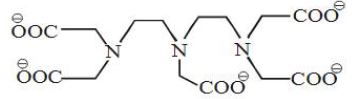
A
$6$ and $8$
B
$8$ and $6$
C
$8$ and $8$
D
$6$ and $6$
Solution
(A) The ligand shown is diethylenetriaminepentaacetate $(DTPA^{5-})$.
It contains $3$ nitrogen atoms and $5$ carboxylate oxygen atoms capable of coordination.
For common transition metal ions,the maximum coordination number is typically $6$,so the ligand acts as a hexadentate ligand (denticity = $6$).
For inner-transition metal ions (like lanthanides),the coordination number can be higher (up to $8$ or $9$) due to their larger size and availability of more vacant orbitals,allowing the ligand to act as an octadentate ligand (denticity = $8$).
It contains $3$ nitrogen atoms and $5$ carboxylate oxygen atoms capable of coordination.
For common transition metal ions,the maximum coordination number is typically $6$,so the ligand acts as a hexadentate ligand (denticity = $6$).
For inner-transition metal ions (like lanthanides),the coordination number can be higher (up to $8$ or $9$) due to their larger size and availability of more vacant orbitals,allowing the ligand to act as an octadentate ligand (denticity = $8$).
0 likesView Solution
241
ChemistryDifficultMCQJEE Main · 2019
The peptide that gives positive ceric ammonium nitrate and carbylamine tests is
A
$Lys - Asp$
B
$Ser - Lys$
C
$Gln - Asp$
D
$Asp - Gln$
Solution
(B) The ceric ammonium nitrate test is used to detect the presence of an alcoholic $-OH$ group. Among the given amino acids,$Serine$ $(Ser)$ contains an alcoholic $-OH$ group.
The carbylamine test is used to detect the presence of a primary amine $(-NH_2)$ group. Among the given amino acids,$Lysine$ $(Lys)$ contains a primary amine group in its side chain.
Therefore,the peptide $Ser - Lys$ will give a positive result for both tests.
The carbylamine test is used to detect the presence of a primary amine $(-NH_2)$ group. Among the given amino acids,$Lysine$ $(Lys)$ contains a primary amine group in its side chain.
Therefore,the peptide $Ser - Lys$ will give a positive result for both tests.
0 likesView Solution
242
ChemistryMediumMCQJEE Main · 2019
Assertion: For the extraction of iron,haematite ore is used.
Reason: Haematite is a carbonate ore of iron.
Reason: Haematite is a carbonate ore of iron.
A
Only the reason is correct
B
Both the assertion and reason are correct and the reason is the correct explanation for the assertion
C
Only the assertion is correct
D
Both the assertion and reason are correct,but the reason is not the correct explanation for the assertion
Solution
(C) The extraction of $Fe$ is primarily done from haematite ore $(Fe_2O_3)$,which is an oxide ore,not a carbonate ore.
Therefore,the assertion is correct,but the reason is incorrect.
Therefore,the assertion is correct,but the reason is incorrect.
0 likesView Solution
243
ChemistryDifficultMCQJEE Main · 2019
$10 \, mL$ of $1 \, mM$ surfactant solution forms a monolayer covering $0.24 \, cm^2$ on a polar substrate. If the polar head is approximated as a cube, what is its edge length?
A
$2.0 \, pm$
B
$2.0 \, nm$
C
$1.0 \, pm$
D
$0.1 \, nm$
Solution
(A) Calculate the number of moles of surfactant: $n = \frac{M \times V \, (mL)}{1000} = \frac{10^{-3} \times 10}{1000} = 10^{-8} \, mol$.
Calculate the number of molecules: $N = n \times N_A = 10^{-8} \times 6 \times 10^{23} = 6 \times 10^{15} \, \text{molecules}$.
Area covered by one molecule $(a^2)$: $a^2 = \frac{\text{Total Area}}{\text{Number of molecules}} = \frac{0.24 \, cm^2}{6 \times 10^{15}} = 0.04 \times 10^{-15} \, cm^2 = 4 \times 10^{-17} \, cm^2$.
Calculate edge length $(a)$: $a = \sqrt{4 \times 10^{-17} \, cm^2} = 2 \times 10^{-8.5} \, cm \approx 6.32 \times 10^{-9} \, cm$.
Re-evaluating based on standard approximation: If $N_A = 6 \times 10^{23}$, $a^2 = \frac{0.24}{10^{-5} \times 6 \times 10^{23}} = 4 \times 10^{-20} \, cm^2$.
$a = \sqrt{4 \times 10^{-20}} = 2 \times 10^{-10} \, cm = 2 \times 10^{-12} \, m = 2 \, pm$.
Calculate the number of molecules: $N = n \times N_A = 10^{-8} \times 6 \times 10^{23} = 6 \times 10^{15} \, \text{molecules}$.
Area covered by one molecule $(a^2)$: $a^2 = \frac{\text{Total Area}}{\text{Number of molecules}} = \frac{0.24 \, cm^2}{6 \times 10^{15}} = 0.04 \times 10^{-15} \, cm^2 = 4 \times 10^{-17} \, cm^2$.
Calculate edge length $(a)$: $a = \sqrt{4 \times 10^{-17} \, cm^2} = 2 \times 10^{-8.5} \, cm \approx 6.32 \times 10^{-9} \, cm$.
Re-evaluating based on standard approximation: If $N_A = 6 \times 10^{23}$, $a^2 = \frac{0.24}{10^{-5} \times 6 \times 10^{23}} = 4 \times 10^{-20} \, cm^2$.
$a = \sqrt{4 \times 10^{-20}} = 2 \times 10^{-10} \, cm = 2 \times 10^{-12} \, m = 2 \, pm$.
0 likesView Solution
244
ChemistryDifficultMCQJEE Main · 2019
Consider the given plot of enthalpy of the following reaction between $A$ and $B$: $A + B \to C + D$. Identify the incorrect statement.
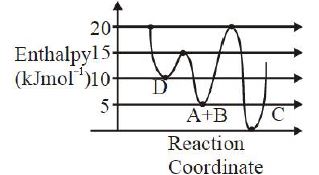
A
$C$ is the thermodynamically stable product.
B
Formation of $A$ and $B$ from $C$ has the highest enthalpy of activation.
C
$D$ is the kinetically stable product.
D
Activation enthalpy to form $C$ is $5\,kJ\,mol^{-1}$ less than that to form $D$.
Solution
(D) From the graph:
Enthalpy of $(A+B) = 5\,kJ\,mol^{-1}$.
Enthalpy of $D = 10\,kJ\,mol^{-1}$.
Enthalpy of $C = 0\,kJ\,mol^{-1}$.
Activation energy for $(A+B \to D) = 15 - 5 = 10\,kJ\,mol^{-1}$.
Activation energy for $(A+B \to C) = 20 - 5 = 15\,kJ\,mol^{-1}$.
Activation energy for $(C \to A+B) = 20 - 0 = 20\,kJ\,mol^{-1}$.
Activation energy for $(D \to A+B) = 15 - 10 = 5\,kJ\,mol^{-1}$.
Comparing the activation energies,the formation of $(A+B)$ from $C$ has the highest activation energy $(20\,kJ\,mol^{-1})$.
$C$ is the most stable product (lowest enthalpy).
$D$ is formed faster (lower activation energy),so it is the kinetically stable product.
Activation enthalpy to form $C$ $(15\,kJ\,mol^{-1})$ is $5\,kJ\,mol^{-1}$ more than that to form $D$ $(10\,kJ\,mol^{-1})$.
Therefore,statement $D$ is incorrect.
Enthalpy of $(A+B) = 5\,kJ\,mol^{-1}$.
Enthalpy of $D = 10\,kJ\,mol^{-1}$.
Enthalpy of $C = 0\,kJ\,mol^{-1}$.
Activation energy for $(A+B \to D) = 15 - 5 = 10\,kJ\,mol^{-1}$.
Activation energy for $(A+B \to C) = 20 - 5 = 15\,kJ\,mol^{-1}$.
Activation energy for $(C \to A+B) = 20 - 0 = 20\,kJ\,mol^{-1}$.
Activation energy for $(D \to A+B) = 15 - 10 = 5\,kJ\,mol^{-1}$.
Comparing the activation energies,the formation of $(A+B)$ from $C$ has the highest activation energy $(20\,kJ\,mol^{-1})$.
$C$ is the most stable product (lowest enthalpy).
$D$ is formed faster (lower activation energy),so it is the kinetically stable product.
Activation enthalpy to form $C$ $(15\,kJ\,mol^{-1})$ is $5\,kJ\,mol^{-1}$ more than that to form $D$ $(10\,kJ\,mol^{-1})$.
Therefore,statement $D$ is incorrect.
0 likesView Solution
245
ChemistryDifficultMCQJEE Main · 2019
$A$ solution of $Ni(NO_3)_2$ is electrolysed between platinum electrodes using $0.1 \ F$ electricity. How many moles of $Ni$ will be deposited at the cathode?
A
$0.20$
B
$0.05$
C
$0.10$
D
$0.15$
Solution
(B) The reduction reaction at the cathode is: $Ni^{2+} + 2e^- \rightarrow Ni(s)$.
According to the reaction,$2 \ F$ of electricity is required to deposit $1 \ mole$ of $Ni$.
Therefore,the number of moles of $Ni$ deposited by $0.1 \ F$ of electricity is calculated as:
$\text{Moles of } Ni = \frac{0.1 \ F}{2 \ F/mole} = 0.05 \ moles$.
According to the reaction,$2 \ F$ of electricity is required to deposit $1 \ mole$ of $Ni$.
Therefore,the number of moles of $Ni$ deposited by $0.1 \ F$ of electricity is calculated as:
$\text{Moles of } Ni = \frac{0.1 \ F}{2 \ F/mole} = 0.05 \ moles$.
0 likesView Solution
246
ChemistryDifficultMCQJEE Main · 2019
In the following reaction:
$\text{Carbonyl compound} + MeOH \xleftarrow[HCl]{} \text{acetal}$
The rate of the reaction is the highest for:
$\text{Carbonyl compound} + MeOH \xleftarrow[HCl]{} \text{acetal}$
The rate of the reaction is the highest for:
A
Acetone as substrate and methanol in stoichiometric amount
B
Propanal as substrate and methanol in stoichiometric amount
C
Acetone as substrate and methanol in excess
D
Propanal as substrate and methanol in excess
Solution
(D) The rate of nucleophilic addition reaction follows the order: $\text{Aldehydes} > \text{Ketones}$.
Only aldehydes react with alcohols to form acetals under these conditions.
Furthermore,an excess of $MeOH$ is required to shift the equilibrium towards the forward direction according to Le Chatelier's principle.
Only aldehydes react with alcohols to form acetals under these conditions.
Furthermore,an excess of $MeOH$ is required to shift the equilibrium towards the forward direction according to Le Chatelier's principle.
0 likesView Solution
247
ChemistryDifficultMCQJEE Main · 2019
Which of the following potential energy $(PE)$ diagrams represents the $S_N^1$ reaction?
A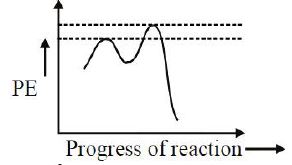
B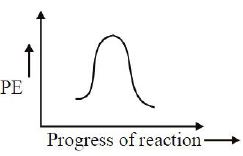
C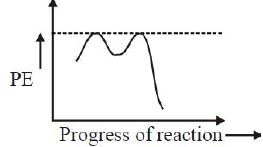
D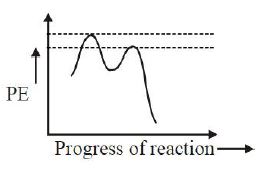
Solution
(A) The $S_N^1$ reaction is a two-step mechanism involving the formation of a carbocation intermediate.
In the first step,the leaving group departs to form a carbocation,which is the rate-determining step and has a higher activation energy.
In the second step,the nucleophile attacks the carbocation,which has a lower activation energy.
Therefore,the potential energy diagram must show two peaks,where the first transition state $(T.S. I)$ is higher in energy than the second transition state $(T.S. II)$.
In the first step,the leaving group departs to form a carbocation,which is the rate-determining step and has a higher activation energy.
In the second step,the nucleophile attacks the carbocation,which has a lower activation energy.
Therefore,the potential energy diagram must show two peaks,where the first transition state $(T.S. I)$ is higher in energy than the second transition state $(T.S. II)$.
0 likesView Solution
248
ChemistryMediumMCQJEE Main · 2019
The maximum number of possible oxidation states of actinoids are shown by
A
berkelium $(Bk)$ and californium $(Cf)$
B
nobelium $(No)$ and lawrencium $(Lr)$
C
actinium $(Ac)$ and thorium $(Th)$
D
neptunium $(Np)$ and plutonium $(Pu)$
Solution
(D) The actinoids exhibit a range of oxidation states due to the comparable energies of the $5f$,$6d$,and $7s$ orbitals.
Neptunium $(Np)$ and plutonium $(Pu)$ exhibit the maximum number of oxidation states among the actinoids,reaching up to $+7$.
This wide range is possible because the energy levels of the $5f$,$6d$,and $7s$ orbitals are very close,allowing a larger number of electrons to participate in bond formation.
Neptunium $(Np)$ and plutonium $(Pu)$ exhibit the maximum number of oxidation states among the actinoids,reaching up to $+7$.
This wide range is possible because the energy levels of the $5f$,$6d$,and $7s$ orbitals are very close,allowing a larger number of electrons to participate in bond formation.
0 likesView Solution
249
ChemistryDifficultMCQJEE Main · 2019
Molal depression constant for a solvent is $4.0 \, K \, kg \, mol^{-1}$. The depression in the freezing point of the solvent for $0.03 \, mol \, kg^{-1}$ solution of $K_2SO_4$ is .............. $K$ (Assume complete dissociation of the electrolyte).
A
$0.12$
B
$0.36$
C
$0.18$
D
$0.24$
Solution
(B) The formula for depression in freezing point is $\Delta T_f = i \cdot K_f \cdot m$.
Given:
$K_f = 4.0 \, K \, kg \, mol^{-1}$
$m = 0.03 \, mol \, kg^{-1}$
For $K_2SO_4$,the dissociation is $K_2SO_4 \rightarrow 2K^+ + SO_4^{2-}$.
Thus,the van't Hoff factor $i = 3$.
Substituting the values:
$\Delta T_f = 3 \times 4.0 \times 0.03 = 0.36 \, K$.
Given:
$K_f = 4.0 \, K \, kg \, mol^{-1}$
$m = 0.03 \, mol \, kg^{-1}$
For $K_2SO_4$,the dissociation is $K_2SO_4 \rightarrow 2K^+ + SO_4^{2-}$.
Thus,the van't Hoff factor $i = 3$.
Substituting the values:
$\Delta T_f = 3 \times 4.0 \times 0.03 = 0.36 \, K$.
0 likesView Solution
250
ChemistryDifficultMCQJEE Main · 2019
Noradrenaline is a/an
A
Neurotransmitter
B
Antidepressant
C
Antihistamine
D
Antacid
Solution
(A) Noradrenaline is an organic chemical in the catecholamine family that functions in the brain and body as a hormone and a neurotransmitter.
0 likesView Solution
Vedclass Products
For Students
Vedclass Test Series
Mock tests in real JEE Main style covering Chemistry with performance analysis. 5-day free trial.
Start Free TrialFor Teachers
Exam Paper Generator
Generate Set A/B/C/D Chemistry papers from 7.5L+ questions in 2 minutes. 3 chapters free.
Try FreeFor Institutes
Online Exam Module
Run live JEE Main mock exams with unlimited students, 360° analytics & white-label branding.
See DemoFrequently Asked Questions
How many Chemistry questions are in JEE Main 2019?
There are 521 Chemistry questions from the JEE Main 2019 paper on Vedclass, each with a detailed step-by-step solution in English.
Are JEE Main 2019 Chemistry solutions available in English?
Yes. All solutions on this page are in English. You can also switch to English or Hindi using the language buttons above the questions.
Can I practice JEE Main 2019 Chemistry as a timed test?
Yes. Use the Vedclass Test Series to attempt a full JEE Main mock test covering Chemistry with time limits and instant score analysis.
Can teachers create Chemistry papers from JEE Main previous year questions?
Yes. The Vedclass Exam Paper Generator lets teachers mix JEE Main Chemistry questions and generate Set A/B/C/D papers in minutes.
For Teachers & Institutes
Build a Custom Chemistry Paper
Pick JEE Main 2019 Chemistry questions, set difficulty, and generate Set A/B/C/D in 2 minutes.