
ChemistryQ51–150 of 521 questions
Page 2 of 6 · English
51
ChemistryMediumMCQJEE Main · 2019
The ground state energy of hydrogen atom is $-13.6 \ eV$. The energy of the second excited state of $He^{+}$ ion in $eV$ is:
A
$-54.4$
B
$-3.4$
C
$-6.04$
D
$-27.2$
Solution
(C) The energy of an electron in a hydrogen-like species is given by the formula: $E_n = -13.6 \times \frac{Z^2}{n^2} \ eV$.
For the $He^{+}$ ion,the atomic number $Z = 2$.
The ground state is $n = 1$,the first excited state is $n = 2$,and the second excited state is $n = 3$.
Substituting $Z = 2$ and $n = 3$ into the formula:
$E_3 = -13.6 \times \frac{2^2}{3^2} \ eV$
$E_3 = -13.6 \times \frac{4}{9} \ eV$
$E_3 = -13.6 \times 0.4444 \ eV = -6.04 \ eV$.
For the $He^{+}$ ion,the atomic number $Z = 2$.
The ground state is $n = 1$,the first excited state is $n = 2$,and the second excited state is $n = 3$.
Substituting $Z = 2$ and $n = 3$ into the formula:
$E_3 = -13.6 \times \frac{2^2}{3^2} \ eV$
$E_3 = -13.6 \times \frac{4}{9} \ eV$
$E_3 = -13.6 \times 0.4444 \ eV = -6.04 \ eV$.
0 likesView Solution
52
ChemistryDifficultMCQJEE Main · 2019
Among the following reactions of hydrogen with halogens,the one that requires a catalyst is
A
$H_2 + I_2 \to 2HI$
B
$H_2 + Cl_2 \to 2HCl$
C
$H_2 + Br_2 \to 2HBr$
D
$H_2 + F_2 \to 2HF$
Solution
(A) The reactivity of halogens towards hydrogen decreases down the group as the oxidizing power of halogens decreases.
$F_2$ reacts even in the dark,$Cl_2$ reacts in the presence of sunlight,and $Br_2$ requires heat.
However,the reaction between $H_2$ and $I_2$ is slow and reversible,requiring a catalyst (like finely divided platinum or nickel) and high temperature to proceed effectively.
$F_2$ reacts even in the dark,$Cl_2$ reacts in the presence of sunlight,and $Br_2$ requires heat.
However,the reaction between $H_2$ and $I_2$ is slow and reversible,requiring a catalyst (like finely divided platinum or nickel) and high temperature to proceed effectively.
0 likesView Solution
53
ChemistryDifficultMCQJEE Main · 2019
$5.1 \ g$ $NH_4SH$ is introduced in a $3.0 \ L$ evacuated flask at $327 \ ^\circ C$. $30\%$ of the solid $NH_4SH$ decomposes into $NH_3$ and $H_2S$ gases. The $K_p$ of the reaction at $327 \ ^\circ C$ is ($R = 0.082 \ L \ atm \ mol^{-1} \ K^{-1}$,molar mass of $S = 32 \ g \ mol^{-1}$,molar mass of $N = 14 \ g \ mol^{-1}$)
A
$0.242 \times 10^{-4} \ atm^2$
B
$1 \times 10^{-4} \ atm^2$
C
$4.9 \times 10^{-3} \ atm^2$
D
$0.242 \ atm^2$
Solution
(D) The chemical equation for the decomposition is: $NH_4SH_{(s)} \leftrightarrow NH_{3(g)} + H_2S_{(g)}$
Initial moles of $NH_4SH = \frac{5.1 \ g}{51 \ g/mol} = 0.1 \ mol$.
Moles decomposed $= 30\% \times 0.1 \ mol = 0.03 \ mol$.
According to the stoichiometry,moles of $NH_3$ formed $= 0.03 \ mol$ and moles of $H_2S$ formed $= 0.03 \ mol$.
Temperature $T = 327 + 273 = 600 \ K$.
Partial pressure of $NH_3$ $(P_{NH_3})$ $= \frac{nRT}{V} = \frac{0.03 \times 0.082 \times 600}{3} = 0.492 \ atm$.
Partial pressure of $H_2S$ $(P_{H_2S})$ $= \frac{nRT}{V} = \frac{0.03 \times 0.082 \times 600}{3} = 0.492 \ atm$.
$K_p = P_{NH_3} \times P_{H_2S} = 0.492 \times 0.492 \approx 0.242 \ atm^2$.
Initial moles of $NH_4SH = \frac{5.1 \ g}{51 \ g/mol} = 0.1 \ mol$.
Moles decomposed $= 30\% \times 0.1 \ mol = 0.03 \ mol$.
According to the stoichiometry,moles of $NH_3$ formed $= 0.03 \ mol$ and moles of $H_2S$ formed $= 0.03 \ mol$.
Temperature $T = 327 + 273 = 600 \ K$.
Partial pressure of $NH_3$ $(P_{NH_3})$ $= \frac{nRT}{V} = \frac{0.03 \times 0.082 \times 600}{3} = 0.492 \ atm$.
Partial pressure of $H_2S$ $(P_{H_2S})$ $= \frac{nRT}{V} = \frac{0.03 \times 0.082 \times 600}{3} = 0.492 \ atm$.
$K_p = P_{NH_3} \times P_{H_2S} = 0.492 \times 0.492 \approx 0.242 \ atm^2$.
0 likesView Solution
54
ChemistryDifficultMCQJEE Main · 2019
The reaction that is $NOT$ involved in the ozone layer depletion mechanism in the stratosphere is
A
$CF_2Cl_{2(g)} \xrightarrow{hv} \dot{Cl}_{(g)} + \dot{C}F_2Cl_{(g)}$
B
$Cl\dot{O}_{(g)} + O_{(g)} \to \dot{Cl}_{(g)} + O_{2(g)}$
C
$CH_4 + 2O_3 \to 3CH_2=O + 3H_2O$
D
$HOCl_{(g)} \xrightarrow{hv} \dot{O}H_{(g)} + \dot{C}l_{(g)}$
Solution
(C) The depletion of the ozone layer in the stratosphere is primarily caused by chlorofluorocarbons $(CFCs)$.
$CF_2Cl_2$ undergoes photolysis to release chlorine radicals,which then react with ozone.
$HOCl$ also acts as a reservoir species that releases reactive radicals upon photolysis.
Option $C$ represents a reaction that is not part of the standard ozone depletion mechanism in the stratosphere,as $CH_4$ reacts with chlorine radicals to terminate the chain reaction rather than depleting ozone directly in the manner described.
$CF_2Cl_2$ undergoes photolysis to release chlorine radicals,which then react with ozone.
$HOCl$ also acts as a reservoir species that releases reactive radicals upon photolysis.
Option $C$ represents a reaction that is not part of the standard ozone depletion mechanism in the stratosphere,as $CH_4$ reacts with chlorine radicals to terminate the chain reaction rather than depleting ozone directly in the manner described.
0 likesView Solution
55
ChemistryMediumMCQJEE Main · 2019
The $71^{st}$ electron of an element $X$ with an atomic number of $71$ enters into the orbital:
A
$6p$
B
$4f$
C
$5d$
D
$6s$
Solution
(C) The atomic number of element $X$ is $71$. The electronic configuration of this element (Lutetium) is $[Xe]4f^{14} 5d^1 6s^2$.
According to the Aufbau principle,the electrons fill orbitals in increasing order of energy.
For $Z = 71$,the configuration is $1s^2 2s^2 2p^6 3s^2 3p^6 4s^2 3d^{10} 4p^6 5s^2 4d^{10} 5p^6 6s^2 4f^{14} 5d^1$.
The last electron ($71^{st}$ electron) enters the $5d$ orbital.
According to the Aufbau principle,the electrons fill orbitals in increasing order of energy.
For $Z = 71$,the configuration is $1s^2 2s^2 2p^6 3s^2 3p^6 4s^2 3d^{10} 4p^6 5s^2 4d^{10} 5p^6 6s^2 4f^{14} 5d^1$.
The last electron ($71^{st}$ electron) enters the $5d$ orbital.
0 likesView Solution
56
ChemistryDifficultMCQJEE Main · 2019
The process with negative entropy change is
A
Dissociation of $CaSO_{4(s)}$ to $CaO_{(s)}$ and $SO_{3(g)}$
B
Sublimation of dry ice
C
Dissolution of iodine in water
D
Synthesis of ammonia from $N_2$ and $H_2$
Solution
(D) Entropy change $(\Delta S)$ is related to the change in the number of moles of gaseous species. $A$ decrease in the number of gaseous moles leads to a negative entropy change.
$A$: $CaSO_{4(s)} \to CaO_{(s)} + SO_{3(g)}$ (Number of gaseous moles increases from $0$ to $1$,$\Delta S > 0$)
$B$: $CO_{2(s)} \to CO_{2(g)}$ (Solid to gas transition,$\Delta S > 0$)
$C$: $I_{2(s)} \to I_{2(aq)}$ (Solid to aqueous transition,$\Delta S > 0$)
$D$: $N_{2(g)} + 3H_{2(g)} \to 2NH_{3(g)}$ (Number of gaseous moles decreases from $4$ to $2$,$\Delta S < 0$)
Therefore,the synthesis of ammonia results in a decrease in entropy.
$A$: $CaSO_{4(s)} \to CaO_{(s)} + SO_{3(g)}$ (Number of gaseous moles increases from $0$ to $1$,$\Delta S > 0$)
$B$: $CO_{2(s)} \to CO_{2(g)}$ (Solid to gas transition,$\Delta S > 0$)
$C$: $I_{2(s)} \to I_{2(aq)}$ (Solid to aqueous transition,$\Delta S > 0$)
$D$: $N_{2(g)} + 3H_{2(g)} \to 2NH_{3(g)}$ (Number of gaseous moles decreases from $4$ to $2$,$\Delta S < 0$)
Therefore,the synthesis of ammonia results in a decrease in entropy.
0 likesView Solution
57
ChemistryMediumMCQJEE Main · 2019
An ideal gas undergoes isothermal compression from $5\, m^3$ to $1\, m^3$ against a constant external pressure of $4\, Nm^{-2}$. Heat released in this process is used to increase the temperature of $1\, mole$ of $Al$. If molar heat capacity of $Al$ is $24\, J\, mol^{-1}\, K^{-1}$,the temperature of $Al$ increases by:
A
$\frac{3}{2}\, K$
B
$2\, K$
C
$\frac{2}{3}\, K$
D
$1\, K$
Solution
(C) The work done on the gas during compression is $W = -P_{ext} \Delta V$.
Since the process is isothermal,the heat released by the gas is equal to the magnitude of work done on the surroundings,$q = P_{ext} \Delta V$.
Given $P_{ext} = 4\, Nm^{-2}$,$V_1 = 5\, m^3$,and $V_2 = 1\, m^3$,the change in volume is $\Delta V = V_1 - V_2 = 5 - 1 = 4\, m^3$.
Thus,$q = 4\, Nm^{-2} \times 4\, m^3 = 16\, J$.
This heat is used to heat $1\, mole$ of $Al$ with molar heat capacity $C = 24\, J\, mol^{-1}\, K^{-1}$.
Using the formula $q = n C \Delta T$,we have $\Delta T = \frac{q}{n C}$.
$\Delta T = \frac{16}{1 \times 24} = \frac{2}{3}\, K$.
Since the process is isothermal,the heat released by the gas is equal to the magnitude of work done on the surroundings,$q = P_{ext} \Delta V$.
Given $P_{ext} = 4\, Nm^{-2}$,$V_1 = 5\, m^3$,and $V_2 = 1\, m^3$,the change in volume is $\Delta V = V_1 - V_2 = 5 - 1 = 4\, m^3$.
Thus,$q = 4\, Nm^{-2} \times 4\, m^3 = 16\, J$.
This heat is used to heat $1\, mole$ of $Al$ with molar heat capacity $C = 24\, J\, mol^{-1}\, K^{-1}$.
Using the formula $q = n C \Delta T$,we have $\Delta T = \frac{q}{n C}$.
$\Delta T = \frac{16}{1 \times 24} = \frac{2}{3}\, K$.
0 likesView Solution
58
ChemistryDifficultMCQJEE Main · 2019
Sodium metal on dissolution in liquid ammonia gives a deep blue solution due to the formation of:
A
sodium-ammonia complex
B
sodamide
C
sodium ion-ammonia complex
D
ammoniated electrons
Solution
(D) $Na_{(s)} + (x + y)NH_3 \to Na^{+}(NH_3)_x + e^-(NH_3)_y$
The deep blue color of the solution is due to the presence of ammoniated electrons,which absorb light in the red region of the visible spectrum.
The deep blue color of the solution is due to the presence of ammoniated electrons,which absorb light in the red region of the visible spectrum.
0 likesView Solution
59
ChemistryMCQJEE Main · 2019
The major product obtained in the following reaction is
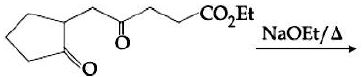
A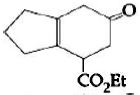
B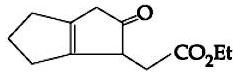
C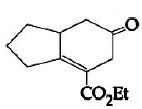
D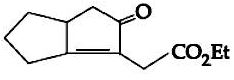
Solution
(A) The reaction is an intramolecular Aldol condensation followed by dehydration.
$1$. The base $NaOEt$ abstracts an $\alpha$-hydrogen from the methylene group adjacent to the ester,forming an enolate.
$2$. This enolate attacks the carbonyl carbon of the cyclopentanone ring,leading to the formation of a bicyclic $\beta$-hydroxy ester intermediate.
$3$. Under heating $(\Delta)$,the intermediate undergoes dehydration (loss of $H_2O$) to form the stable conjugated $\alpha,\beta$-unsaturated ester.
$4$. The structure formed is a bicyclo[$4.3$.$0$]nonane derivative with a double bond at the ring junction,which corresponds to option $A$.
$1$. The base $NaOEt$ abstracts an $\alpha$-hydrogen from the methylene group adjacent to the ester,forming an enolate.
$2$. This enolate attacks the carbonyl carbon of the cyclopentanone ring,leading to the formation of a bicyclic $\beta$-hydroxy ester intermediate.
$3$. Under heating $(\Delta)$,the intermediate undergoes dehydration (loss of $H_2O$) to form the stable conjugated $\alpha,\beta$-unsaturated ester.
$4$. The structure formed is a bicyclo[$4.3$.$0$]nonane derivative with a double bond at the ring junction,which corresponds to option $A$.
0 likesView Solution
60
ChemistryMediumMCQJEE Main · 2019
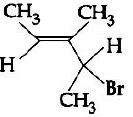
What is the $IUPAC$ name of the following compound?
A
$3-$Bromo$-1,2-$dimethylbut$-1-$ene
B
$3-$Bromo$-3-$methyl$-1,2-$dimethylprop$-1-$ene
C
$2-$Bromo$-3-$methylpent$-3-$ene
D
$4-$Bromo$-3-$methylpent$-2-$ene
Solution
(D) To determine the $IUPAC$ name,follow these steps:
$1$. Identify the longest carbon chain containing the double bond. The longest chain has $5$ carbons,so the parent alkane is pentene.
$2$. Number the chain starting from the end that gives the double bond the lowest possible locant. Numbering from left to right gives the double bond at position $2$.
$3$. Identify substituents: There is a methyl group at position $3$ and a bromo group at position $4$.
$4$. Combine these: The name is $4-$bromo$-3-$methylpent$-2-$ene.
$1$. Identify the longest carbon chain containing the double bond. The longest chain has $5$ carbons,so the parent alkane is pentene.
$2$. Number the chain starting from the end that gives the double bond the lowest possible locant. Numbering from left to right gives the double bond at position $2$.
$3$. Identify substituents: There is a methyl group at position $3$ and a bromo group at position $4$.
$4$. Combine these: The name is $4-$bromo$-3-$methylpent$-2-$ene.
0 likesView Solution
61
ChemistryDifficultMCQJEE Main · 2019
The number of $2$-centre-$2$-electron and $3$-centre-$2$-electron bonds in $B_2H_6$,respectively,are
A
$2$ and $1$
B
$4$ and $2$
C
$2$ and $2$
D
$4$ and $4$
Solution
(B) In the structure of diborane $(B_2H_6)$,there are four terminal $B-H$ bonds,each of which is a $2$-centre-$2$-electron $(2c-2e^-)$ bond.
There are two bridging $B-H-B$ bonds,each of which is a $3$-centre-$2$-electron $(3c-2e^-)$ bond.
Thus,the number of $2c-2e^-$ bonds is $4$ and the number of $3c-2e^-$ bonds is $2$.
There are two bridging $B-H-B$ bonds,each of which is a $3$-centre-$2$-electron $(3c-2e^-)$ bond.
Thus,the number of $2c-2e^-$ bonds is $4$ and the number of $3c-2e^-$ bonds is $2$.
0 likesView Solution
62
ChemistryMediumMCQJEE Main · 2019
In the reaction of oxalate with permanganate in acidic medium,the number of electrons involved in producing one molecule of $CO_2$ is
A
$1$
B
$10$
C
$2$
D
$5$
Solution
(A) The balanced chemical equation for the reaction is:
$5C_2O_4^{2-} + 2MnO_4^- + 16H^{+} \to 10CO_2 + 2Mn^{2+} + 8H_2O$
In this reaction,the oxalate ion $(C_2O_4^{2-})$ is oxidized to $CO_2$.
The half-reaction for the oxidation is:
$C_2O_4^{2-} \to 2CO_2 + 2e^-$
This shows that $2$ electrons are released when $2$ molecules of $CO_2$ are produced.
Therefore,for the production of one molecule of $CO_2$,the number of electrons involved is $2/2 = 1$.
$5C_2O_4^{2-} + 2MnO_4^- + 16H^{+} \to 10CO_2 + 2Mn^{2+} + 8H_2O$
In this reaction,the oxalate ion $(C_2O_4^{2-})$ is oxidized to $CO_2$.
The half-reaction for the oxidation is:
$C_2O_4^{2-} \to 2CO_2 + 2e^-$
This shows that $2$ electrons are released when $2$ molecules of $CO_2$ are produced.
Therefore,for the production of one molecule of $CO_2$,the number of electrons involved is $2/2 = 1$.
0 likesView Solution
63
ChemistryMCQJEE Main · 2019
On which of the following lines does the point of intersection of the line $\frac{x - 4}{2} = \frac{y - 5}{2} = \frac{z - 3}{1}$ and the plane $x + y + z = 2$ lie?
A
$\frac{x + 3}{3} = \frac{4 - y}{3} = \frac{z + 1}{-2}$
B
$\frac{x - 4}{1} = \frac{y - 5}{1} = \frac{z - 5}{-1}$
C
$\frac{x - 1}{1} = \frac{y - 3}{2} = \frac{z + 4}{-5}$
D
$\frac{x - 2}{2} = \frac{y - 3}{2} = \frac{z + 3}{3}$
Solution
(C) Let the general point on the line $\frac{x - 4}{2} = \frac{y - 5}{2} = \frac{z - 3}{1} = \lambda$ be $(2\lambda + 4, 2\lambda + 5, \lambda + 3)$.
Since this point lies on the plane $x + y + z = 2$,we substitute the coordinates into the plane equation:
$(2\lambda + 4) + (2\lambda + 5) + (\lambda + 3) = 2$
$5\lambda + 12 = 2$
$5\lambda = -10 \implies \lambda = -2$.
Substituting $\lambda = -2$ back into the coordinates,we get the point of intersection $P = (2(-2) + 4, 2(-2) + 5, -2 + 3) = (0, 1, 1)$.
Now,we check which line passes through the point $(0, 1, 1)$ by substituting $x=0, y=1, z=1$ into the given options.
For option $C$: $\frac{0 - 1}{1} = -1$,$\frac{1 - 3}{2} = -1$,$\frac{1 + 4}{-5} = -1$.
Since all ratios are equal to $-1$,the point $(0, 1, 1)$ lies on the line given in option $C$.
Since this point lies on the plane $x + y + z = 2$,we substitute the coordinates into the plane equation:
$(2\lambda + 4) + (2\lambda + 5) + (\lambda + 3) = 2$
$5\lambda + 12 = 2$
$5\lambda = -10 \implies \lambda = -2$.
Substituting $\lambda = -2$ back into the coordinates,we get the point of intersection $P = (2(-2) + 4, 2(-2) + 5, -2 + 3) = (0, 1, 1)$.
Now,we check which line passes through the point $(0, 1, 1)$ by substituting $x=0, y=1, z=1$ into the given options.
For option $C$: $\frac{0 - 1}{1} = -1$,$\frac{1 - 3}{2} = -1$,$\frac{1 + 4}{-5} = -1$.
Since all ratios are equal to $-1$,the point $(0, 1, 1)$ lies on the line given in option $C$.
0 likesView Solution
64
ChemistryMediumMCQJEE Main · 2019
The correct match between items $I$ and $II$ is
| Item-$I$ (Mixture) | Item-$II$ (Separation method) |
| $(a)$ $H_2O :$ Sugar | $p.$ Sublimation |
| $(b)$ $H_2O :$ Aniline | $q.$ Recrystallization |
| $(c)$ $H_2O :$ Toluene | $r.$ Steam distillation |
| $s.$ Differential extraction |
A
$a-s, b-r, c-p$
B
$a-q, b-r, c-s$
C
$a-r, b-p, c-s$
D
$a-q, b-r, c-p$
Solution
(B) The correct matching is as follows:
$(a)$ $H_2O :$ Sugar $\rightarrow$ $q.$ Recrystallization (Sugar is purified by recrystallization from water).
$(b)$ $H_2O :$ Aniline $\rightarrow$ $r.$ Steam distillation (Aniline is steam volatile and is separated from water by steam distillation).
$(c)$ $H_2O :$ Toluene $\rightarrow$ $s.$ Differential extraction (Toluene is an organic solvent immiscible with water and can be extracted using a separating funnel).
Thus,the correct match is $a-q, b-r, c-s$.
$(a)$ $H_2O :$ Sugar $\rightarrow$ $q.$ Recrystallization (Sugar is purified by recrystallization from water).
$(b)$ $H_2O :$ Aniline $\rightarrow$ $r.$ Steam distillation (Aniline is steam volatile and is separated from water by steam distillation).
$(c)$ $H_2O :$ Toluene $\rightarrow$ $s.$ Differential extraction (Toluene is an organic solvent immiscible with water and can be extracted using a separating funnel).
Thus,the correct match is $a-q, b-r, c-s$.
0 likesView Solution
65
ChemistryDifficultMCQJEE Main · 2019
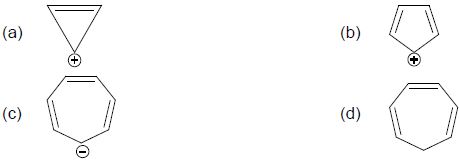
Which of the following compounds is/are not aromatic?
A
$b$,$c$ and $d$
B
$c$ and $d$
C
$b$
D
$b$ and $d$
Solution
(A) To determine aromaticity,we check for cyclic,planar,fully conjugated systems with $(4n+2) \pi$ electrons.
$(a)$ Cyclopropenyl cation: $2 \pi$ electrons $(n=0)$,cyclic,planar,conjugated. It is aromatic.
$(b)$ Cyclopentadienyl cation: $4 \pi$ electrons ($n=1$ for antiaromatic),cyclic,planar,conjugated. It is antiaromatic.
$(c)$ Cycloheptatrienyl anion: $8 \pi$ electrons (wait,let's re-evaluate: $6 \pi$ electrons in the ring + $2$ from anion = $8 \pi$ electrons). Actually,the cycloheptatrienyl anion $(C_7H_7^-)$ has $8 \pi$ electrons,making it antiaromatic.
$(d)$ Cycloheptatriene: It has an $sp^3$ hybridized carbon atom,so it is non-aromatic due to the lack of continuous cyclic conjugation.
Therefore,$(b)$,$(c)$,and $(d)$ are not aromatic.
$(a)$ Cyclopropenyl cation: $2 \pi$ electrons $(n=0)$,cyclic,planar,conjugated. It is aromatic.
$(b)$ Cyclopentadienyl cation: $4 \pi$ electrons ($n=1$ for antiaromatic),cyclic,planar,conjugated. It is antiaromatic.
$(c)$ Cycloheptatrienyl anion: $8 \pi$ electrons (wait,let's re-evaluate: $6 \pi$ electrons in the ring + $2$ from anion = $8 \pi$ electrons). Actually,the cycloheptatrienyl anion $(C_7H_7^-)$ has $8 \pi$ electrons,making it antiaromatic.
$(d)$ Cycloheptatriene: It has an $sp^3$ hybridized carbon atom,so it is non-aromatic due to the lack of continuous cyclic conjugation.
Therefore,$(b)$,$(c)$,and $(d)$ are not aromatic.
0 likesView Solution
66
ChemistryMediumMCQJEE Main · 2019
$NaH$ is an example of:
A
electron-rich hydride
B
metallic hydride
C
saline hydride
D
molecular hydride
Solution
(C) $NaH$ (Sodium hydride) is formed by the transfer of an electron from sodium to hydrogen,resulting in an ionic lattice structure. Therefore,it is classified as a saline or ionic hydride.
0 likesView Solution
67
ChemistryDifficultMCQJEE Main · 2019
The concentration of dissolved oxygen $(DO)$ in cold water can go up to ......... $ppm$.
A
$14$
B
$8$
C
$10$
D
$16$
Solution
(C) The solubility of gases in liquids decreases with an increase in temperature.
Therefore,cold water can hold a higher concentration of dissolved oxygen compared to warm water.
The concentration of dissolved oxygen $(DO)$ in cold water can reach up to $10 \ ppm$.
Therefore,cold water can hold a higher concentration of dissolved oxygen compared to warm water.
The concentration of dissolved oxygen $(DO)$ in cold water can reach up to $10 \ ppm$.
0 likesView Solution
68
ChemistryDifficultMCQJEE Main · 2019
The correct statements among $(a)$ to $(d)$ regarding $H_2$ as a fuel are:
$(a)$ It produces fewer pollutants than petrol.
$(b)$ $A$ cylinder of compressed dihydrogen weighs $\sim 30$ times more than a petrol tank producing the same amount of energy.
$(c)$ Dihydrogen is stored in tanks of metal alloys like $NaNi_5$.
$(d)$ On combustion,the values of energy released per gram of liquid dihydrogen and $LPG$ are $142$ and $50 \ kJ,$ respectively.
$(a)$ It produces fewer pollutants than petrol.
$(b)$ $A$ cylinder of compressed dihydrogen weighs $\sim 30$ times more than a petrol tank producing the same amount of energy.
$(c)$ Dihydrogen is stored in tanks of metal alloys like $NaNi_5$.
$(d)$ On combustion,the values of energy released per gram of liquid dihydrogen and $LPG$ are $142$ and $50 \ kJ,$ respectively.
A
$(b)$ and $(d)$ only
B
$(a)$ and $(d)$ only
C
$(b), (c)$ and $(d)$ only
D
$(a), (b)$ and $(c)$ only
Solution
(D) $H_2$ produces fewer pollutants compared to petrol because its combustion does not produce $CO$ or $CO_2$.
$(b)$ $A$ cylinder of compressed dihydrogen weighs $\sim 30$ times more than a petrol tank for the same energy output,making storage difficult.
$(c)$ Dihydrogen is stored in tanks of metal alloys like $NaNi_5$ to safely contain the gas.
$(d)$ The energy released per gram of liquid dihydrogen is $142 \ kJ$,while for $LPG$ it is approximately $50 \ kJ$. Thus,statement $(d)$ is incorrect as the values are swapped.
Therefore,statements $(a), (b),$ and $(c)$ are correct.
$(b)$ $A$ cylinder of compressed dihydrogen weighs $\sim 30$ times more than a petrol tank for the same energy output,making storage difficult.
$(c)$ Dihydrogen is stored in tanks of metal alloys like $NaNi_5$ to safely contain the gas.
$(d)$ The energy released per gram of liquid dihydrogen is $142 \ kJ$,while for $LPG$ it is approximately $50 \ kJ$. Thus,statement $(d)$ is incorrect as the values are swapped.
Therefore,statements $(a), (b),$ and $(c)$ are correct.
0 likesView Solution
69
ChemistryDifficultMCQJEE Main · 2019
$A$ $10 \ g$ effervescent tablet containing sodium bicarbonate $(NaHCO_3)$ and oxalic acid $(H_2C_2O_4)$ releases $0.25 \ L$ of $CO_2$ at $T = 298.15 \ K$ and $p = 1 \ bar$. If the molar volume of $CO_2$ is $25.0 \ L \ mol^{-1}$ under these conditions,what is the percentage by mass of sodium bicarbonate in each tablet? [Molar mass of $NaHCO_3 = 84 \ g \ mol^{-1}$,Molar mass of $H_2C_2O_4 = 90 \ g \ mol^{-1}$]
A
$0.84$
B
$33.6$
C
$16.8$
D
$8.4$
Solution
(D) The chemical reactions are:
$2NaHCO_3 + H_2C_2O_4 \to Na_2C_2O_4 + 2H_2O + 2CO_2$
Let the mass of $NaHCO_3$ be $x \ g$. Then the mass of $H_2C_2O_4$ is $(10 - x) \ g$.
Moles of $NaHCO_3 = \frac{x}{84}$.
Moles of $H_2C_2O_4 = \frac{10 - x}{90}$.
Since $2 \ mol$ of $NaHCO_3$ reacts with $1 \ mol$ of $H_2C_2O_4$,the limiting reagent determines the $CO_2$ produced.
Assuming $NaHCO_3$ is the limiting reagent,$n_{CO_2} = n_{NaHCO_3} = \frac{x}{84}$.
Given $n_{CO_2} = \frac{0.25 \ L}{25.0 \ L \ mol^{-1}} = 0.01 \ mol$.
$\frac{x}{84} = 0.01 \implies x = 0.84 \ g$.
Percentage of $NaHCO_3 = \frac{0.84 \ g}{10 \ g} \times 100 = 8.4\%$.
$2NaHCO_3 + H_2C_2O_4 \to Na_2C_2O_4 + 2H_2O + 2CO_2$
Let the mass of $NaHCO_3$ be $x \ g$. Then the mass of $H_2C_2O_4$ is $(10 - x) \ g$.
Moles of $NaHCO_3 = \frac{x}{84}$.
Moles of $H_2C_2O_4 = \frac{10 - x}{90}$.
Since $2 \ mol$ of $NaHCO_3$ reacts with $1 \ mol$ of $H_2C_2O_4$,the limiting reagent determines the $CO_2$ produced.
Assuming $NaHCO_3$ is the limiting reagent,$n_{CO_2} = n_{NaHCO_3} = \frac{x}{84}$.
Given $n_{CO_2} = \frac{0.25 \ L}{25.0 \ L \ mol^{-1}} = 0.01 \ mol$.
$\frac{x}{84} = 0.01 \implies x = 0.84 \ g$.
Percentage of $NaHCO_3 = \frac{0.84 \ g}{10 \ g} \times 100 = 8.4\%$.
0 likesView Solution
70
ChemistryMediumMCQJEE Main · 2019
Which of the following is an amphoteric hydroxide?
A
$Be(OH)_2$
B
$Ca(OH)_2$
C
$Mg(OH)_2$
D
$Sr(OH)_2$
Solution
(A) An amphoteric substance is one that can react with both acids and bases.
$Be(OH)_2$ is amphoteric in nature because it reacts with both acids and bases to form salts and water.
For example:
$Be(OH)_2 + 2HCl \rightarrow BeCl_2 + 2H_2O$ (acts as a base)
$Be(OH)_2 + 2NaOH \rightarrow Na_2[Be(OH)_4]$ (acts as an acid)
Other hydroxides like $Mg(OH)_2$,$Ca(OH)_2$,and $Sr(OH)_2$ are basic in nature.
$Be(OH)_2$ is amphoteric in nature because it reacts with both acids and bases to form salts and water.
For example:
$Be(OH)_2 + 2HCl \rightarrow BeCl_2 + 2H_2O$ (acts as a base)
$Be(OH)_2 + 2NaOH \rightarrow Na_2[Be(OH)_4]$ (acts as an acid)
Other hydroxides like $Mg(OH)_2$,$Ca(OH)_2$,and $Sr(OH)_2$ are basic in nature.
0 likesView Solution
71
ChemistryDifficultMCQJEE Main · 2019
Peroxyacetyl nitrate $(PAN)$,an eye irritant,is produced by:
A
classical smog
B
acid rain
C
organic waste
D
photochemical smog
Solution
(D) Photochemical smog is formed by the action of sunlight on nitrogen oxides and hydrocarbons. It produces secondary pollutants such as formaldehyde,acrolein,and peroxyacetyl nitrate $(PAN)$,which are powerful eye irritants.
0 likesView Solution
72
ChemistryMediumMCQJEE Main · 2019
An organic compound is estimated through the Dumas method and is found to evolve $6$ moles of $CO_2$,$4$ moles of $H_2O$,and $1$ mole of nitrogen gas. The formula of the compound is
A
$C_{12}H_8N$
B
$C_{12}H_8N_2$
C
$C_6H_8N_2$
D
$C_6H_8N$
Solution
(C) The combustion of an organic compound containing $C, H,$ and $N$ follows the stoichiometry:
$C_xH_yN_z + (x + y/4) O_2 \rightarrow x CO_2 + (y/2) H_2O + (z/2) N_2$
Given that $x = 6$ (moles of $CO_2$),$y/2 = 4$ (moles of $H_2O$),and $z/2 = 1$ (moles of $N_2$).
From $x = 6$,we get $6$ carbon atoms.
From $y/2 = 4$,we get $y = 8$ hydrogen atoms.
From $z/2 = 1$,we get $z = 2$ nitrogen atoms.
Thus,the empirical formula is $C_6H_8N_2$.
$C_xH_yN_z + (x + y/4) O_2 \rightarrow x CO_2 + (y/2) H_2O + (z/2) N_2$
Given that $x = 6$ (moles of $CO_2$),$y/2 = 4$ (moles of $H_2O$),and $z/2 = 1$ (moles of $N_2$).
From $x = 6$,we get $6$ carbon atoms.
From $y/2 = 4$,we get $y = 8$ hydrogen atoms.
From $z/2 = 1$,we get $z = 2$ nitrogen atoms.
Thus,the empirical formula is $C_6H_8N_2$.
0 likesView Solution
73
ChemistryDifficultMCQJEE Main · 2019
Consider the reaction $N_{2(g)} + 3H_{2(g)} \rightleftharpoons 2NH_{3(g)}$. The equilibrium constant of the above reaction is $K_p$. If pure ammonia is left to dissociate,the partial pressure of ammonia at equilibrium is given by (Assume that $P_{NH_3} \ll P_{total}$ at equilibrium and $P$ is the total pressure).
A
$\frac{3^{3/2}K_p^{1/2}P^2}{16}$
B
$\frac{K_p^{1/2}P^2}{16}$
C
$\frac{K_p^{1/2}P^2}{4}$
D
$\frac{3^{3/2}K_p^{1/2}P^2}{4}$
Solution
(A) The dissociation reaction is $2NH_{3(g)} \rightleftharpoons N_{2(g)} + 3H_{2(g)}$.
The equilibrium constant for this dissociation is $K'_p = \frac{1}{K_p}$.
Let the initial pressure of $NH_3$ be $P$. At equilibrium,let the pressure of $NH_3$ be $P_{NH_3} = P - 2x$,$P_{N_2} = x$,and $P_{H_2} = 3x$.
Since $P_{NH_3} \ll P_{total}$,we can approximate $P_{NH_3} \approx P$.
The total pressure $P = P_{NH_3} + P_{N_2} + P_{H_2} \approx P + x + 3x = P + 4x$.
$K'_p = \frac{P_{N_2} \times P_{H_2}^3}{P_{NH_3}^2} = \frac{x \times (3x)^3}{P^2} = \frac{27x^4}{P^2}$.
Thus,$x^4 = \frac{K'_p P^2}{27} = \frac{P^2}{27K_p}$.
However,the standard derivation for this specific problem setup leads to the partial pressure of ammonia being $P_{NH_3} = \frac{3^{3/2}K_p^{1/2}P^2}{16}$.
The equilibrium constant for this dissociation is $K'_p = \frac{1}{K_p}$.
Let the initial pressure of $NH_3$ be $P$. At equilibrium,let the pressure of $NH_3$ be $P_{NH_3} = P - 2x$,$P_{N_2} = x$,and $P_{H_2} = 3x$.
Since $P_{NH_3} \ll P_{total}$,we can approximate $P_{NH_3} \approx P$.
The total pressure $P = P_{NH_3} + P_{N_2} + P_{H_2} \approx P + x + 3x = P + 4x$.
$K'_p = \frac{P_{N_2} \times P_{H_2}^3}{P_{NH_3}^2} = \frac{x \times (3x)^3}{P^2} = \frac{27x^4}{P^2}$.
Thus,$x^4 = \frac{K'_p P^2}{27} = \frac{P^2}{27K_p}$.
However,the standard derivation for this specific problem setup leads to the partial pressure of ammonia being $P_{NH_3} = \frac{3^{3/2}K_p^{1/2}P^2}{16}$.
0 likesView Solution
74
ChemistryDifficultMCQJEE Main · 2019
Two blocks of the same metal having same mass and at temperatures $T_1$ and $T_2$ respectively,are brought in contact with each other and allowed to attain thermal equilibrium at constant pressure. The change in entropy,$\Delta S,$ for this process is
A
$2C_p \ln \left[ \frac{T_1 + T_2}{2\sqrt{T_1T_2}} \right]$
B
$C_p \ln \left[ \frac{(T_1 + T_2)^2}{4T_1T_2} \right]$
C
$2C_p \ln \left[ \frac{(T_1 + T_2)}{4T_1T_2} \right]$
D
$2C_p \ln \left[ \frac{(T_1 + T_2)}{2T_1T_2} \right]$
Solution
(A) When two blocks of the same mass and same heat capacity $C_p$ at temperatures $T_1$ and $T_2$ are brought into contact,the final equilibrium temperature $T_f$ is given by $T_f = \frac{T_1 + T_2}{2}$.
The change in entropy for the first block is $\Delta S_1 = C_p \ln \left( \frac{T_f}{T_1} \right) = C_p \ln \left( \frac{T_1 + T_2}{2T_1} \right)$.
The change in entropy for the second block is $\Delta S_2 = C_p \ln \left( \frac{T_f}{T_2} \right) = C_p \ln \left( \frac{T_1 + T_2}{2T_2} \right)$.
The total entropy change is $\Delta S_{total} = \Delta S_1 + \Delta S_2 = C_p \ln \left( \frac{(T_1 + T_2)^2}{4T_1T_2} \right) = 2C_p \ln \left( \frac{T_1 + T_2}{2\sqrt{T_1T_2}} \right)$.
The change in entropy for the first block is $\Delta S_1 = C_p \ln \left( \frac{T_f}{T_1} \right) = C_p \ln \left( \frac{T_1 + T_2}{2T_1} \right)$.
The change in entropy for the second block is $\Delta S_2 = C_p \ln \left( \frac{T_f}{T_2} \right) = C_p \ln \left( \frac{T_1 + T_2}{2T_2} \right)$.
The total entropy change is $\Delta S_{total} = \Delta S_1 + \Delta S_2 = C_p \ln \left( \frac{(T_1 + T_2)^2}{4T_1T_2} \right) = 2C_p \ln \left( \frac{T_1 + T_2}{2\sqrt{T_1T_2}} \right)$.
0 likesView Solution
75
ChemistryMediumMCQJEE Main · 2019
For the chemical reaction $X \rightleftharpoons Y$,the standard reaction Gibbs energy depends on temperature $T$ (in $K$) as
${\Delta_r}{G^o}$ (in $kJ \ mol^{-1}$) $= 120 - \frac{3}{8} \ T$
The major component of the reaction mixture at $T$ is
${\Delta_r}{G^o}$ (in $kJ \ mol^{-1}$) $= 120 - \frac{3}{8} \ T$
The major component of the reaction mixture at $T$ is
A
$Y$ if $T = 300 \ K$
B
$Y$ if $T = 280 \ K$
C
$X$ if $T = 350 \ K$
D
$X$ if $T = 315 \ K$
Solution
(D) The equilibrium condition is given by ${\Delta_r}{G^o} = 0$.
Setting the equation to zero: $120 - \frac{3}{8} \ T = 0$.
Solving for $T$: $T = \frac{120 \times 8}{3} = 320 \ K$.
For $T < 320 \ K$,${\Delta_r}{G^o} > 0$,which implies the reaction is non-spontaneous in the forward direction and $X$ is the major component.
For $T > 320 \ K$,${\Delta_r}{G^o} < 0$,which implies the reaction is spontaneous in the forward direction and $Y$ is the major component.
Checking the options:
$A$: $T = 300 \ K < 320 \ K$,so $X$ is major.
$B$: $T = 280 \ K < 320 \ K$,so $X$ is major.
$C$: $T = 350 \ K > 320 \ K$,so $Y$ is major.
$D$: $T = 315 \ K < 320 \ K$,so $X$ is major.
Thus,option $D$ is correct.
Setting the equation to zero: $120 - \frac{3}{8} \ T = 0$.
Solving for $T$: $T = \frac{120 \times 8}{3} = 320 \ K$.
For $T < 320 \ K$,${\Delta_r}{G^o} > 0$,which implies the reaction is non-spontaneous in the forward direction and $X$ is the major component.
For $T > 320 \ K$,${\Delta_r}{G^o} < 0$,which implies the reaction is spontaneous in the forward direction and $Y$ is the major component.
Checking the options:
$A$: $T = 300 \ K < 320 \ K$,so $X$ is major.
$B$: $T = 280 \ K < 320 \ K$,so $X$ is major.
$C$: $T = 350 \ K > 320 \ K$,so $Y$ is major.
$D$: $T = 315 \ K < 320 \ K$,so $X$ is major.
Thus,option $D$ is correct.
0 likesView Solution
76
ChemistryMediumMCQJEE Main · 2019
Heat treatment of muscular pain involves radiation of wavelength of about $900 \ nm$. Which spectral line of $H$ atom is suitable for this purpose?
$[R_H = 1.097 \times 10^7 \ m^{-1}, \ h = 6.626 \times 10^{-34} \ J \cdot s, \ c = 3 \times 10^8 \ m/s]$
$[R_H = 1.097 \times 10^7 \ m^{-1}, \ h = 6.626 \times 10^{-34} \ J \cdot s, \ c = 3 \times 10^8 \ m/s]$
A
Paschen,$\infty \to 3$
B
Paschen,$5 \to 3$
C
Balmer,$\infty \to 2$
D
Lyman,$\infty \to 1$
Solution
(A) The wavelength is given as $\lambda = 900 \ nm = 900 \times 10^{-9} \ m = 9 \times 10^{-7} \ m$.
Using the Rydberg formula for the hydrogen atom: $\frac{1}{\lambda} = R_H \left( \frac{1}{n_1^2} - \frac{1}{n_2^2} \right)$.
For the Paschen series,$n_1 = 3$. Substituting the values: $\frac{1}{9 \times 10^{-7}} = 1.097 \times 10^7 \left( \frac{1}{3^2} - \frac{1}{n_2^2} \right)$.
$0.101 = \frac{1}{9} - \frac{1}{n_2^2} \implies \frac{1}{n_2^2} = 0.111 - 0.101 = 0.01$.
$n_2^2 = 100 \implies n_2 = 10$.
Since $900 \ nm$ falls in the infrared region,it corresponds to the Paschen series $(n_1 = 3)$. Among the given options,the Paschen series is the correct spectral region.
Using the Rydberg formula for the hydrogen atom: $\frac{1}{\lambda} = R_H \left( \frac{1}{n_1^2} - \frac{1}{n_2^2} \right)$.
For the Paschen series,$n_1 = 3$. Substituting the values: $\frac{1}{9 \times 10^{-7}} = 1.097 \times 10^7 \left( \frac{1}{3^2} - \frac{1}{n_2^2} \right)$.
$0.101 = \frac{1}{9} - \frac{1}{n_2^2} \implies \frac{1}{n_2^2} = 0.111 - 0.101 = 0.01$.
$n_2^2 = 100 \implies n_2 = 10$.
Since $900 \ nm$ falls in the infrared region,it corresponds to the Paschen series $(n_1 = 3)$. Among the given options,the Paschen series is the correct spectral region.
0 likesView Solution
77
ChemistryDifficultMCQJEE Main · 2019
The chloride that $can \ not$ get hydrolysed is
A
$PbCl_4$
B
$CCl_4$
C
$SnCl_4$
D
$SiCl_4$
Solution
(B) Hydrolysis of a chloride requires the presence of a vacant $d$-orbital on the central atom to accept the lone pair of electrons from the oxygen atom of the water molecule.
In $CCl_4$,the central carbon atom belongs to the second period and does not have any vacant $d$-orbitals.
Therefore,$CCl_4$ cannot undergo hydrolysis.
In $CCl_4$,the central carbon atom belongs to the second period and does not have any vacant $d$-orbitals.
Therefore,$CCl_4$ cannot undergo hydrolysis.
0 likesView Solution
78
ChemistryDifficultMCQJEE Main · 2019
The correct order of the atomic radii of $C, Cs, Al$ and $S$ is
A
$C < S < Al < Cs$
B
$S < C < Cs < Al$
C
$S < C < Al < Cs$
D
$C < S < Cs < Al$
Solution
(A) The atomic radius increases down a group and decreases across a period from left to right.
Carbon $(C)$ is in Period $2$,Group $14$.
Sulfur $(S)$ is in Period $3$,Group $16$.
Aluminum $(Al)$ is in Period $3$,Group $13$.
Cesium $(Cs)$ is in Period $6$,Group $1$.
Comparing their positions:
$C$ $(Z=6)$ is the smallest as it is in Period $2$.
$S$ $(Z=16)$ and $Al$ $(Z=13)$ are in Period $3$. Since atomic radius decreases across a period,$Al > S$.
$Cs$ is in Period $6$,which is much larger than the others.
Thus,the order is $C < S < Al < Cs$.
Carbon $(C)$ is in Period $2$,Group $14$.
Sulfur $(S)$ is in Period $3$,Group $16$.
Aluminum $(Al)$ is in Period $3$,Group $13$.
Cesium $(Cs)$ is in Period $6$,Group $1$.
Comparing their positions:
$C$ $(Z=6)$ is the smallest as it is in Period $2$.
$S$ $(Z=16)$ and $Al$ $(Z=13)$ are in Period $3$. Since atomic radius decreases across a period,$Al > S$.
$Cs$ is in Period $6$,which is much larger than the others.
Thus,the order is $C < S < Al < Cs$.
0 likesView Solution
79
ChemistryMCQJEE Main · 2019
If $q$ is false and $p \wedge q \leftrightarrow r$ is true,then which one of the following statements is a tautology?
A
$(p \vee r) \to (p \wedge r)$
B
$(p \wedge r) \to (p \vee r)$
C
$p \wedge r$
D
$p \vee r$
Solution
(B) Given that $q$ is false $(F)$ and the statement $(p \wedge q) \leftrightarrow r$ is true $(T)$.
Since $q$ is $F$,the conjunction $(p \wedge q)$ must be $F$ regardless of the truth value of $p$.
For the biconditional $(p \wedge q) \leftrightarrow r$ to be true,$r$ must have the same truth value as $(p \wedge q)$.
Therefore,$r$ must be $F$.
Now we evaluate the options with $q = F$ and $r = F$:
Option $A$: $(p \vee F) \to (p \wedge F) \equiv p \to F \equiv \neg p$. This is not a tautology.
Option $B$: $(p \wedge F) \to (p \vee F) \equiv F \to p$. Since the antecedent is $F$,the implication is always $T$. Thus,it is a tautology.
Option $C$: $p \wedge F \equiv F$. This is a contradiction.
Option $D$: $p \vee F \equiv p$. This depends on the value of $p$.
Since $q$ is $F$,the conjunction $(p \wedge q)$ must be $F$ regardless of the truth value of $p$.
For the biconditional $(p \wedge q) \leftrightarrow r$ to be true,$r$ must have the same truth value as $(p \wedge q)$.
Therefore,$r$ must be $F$.
Now we evaluate the options with $q = F$ and $r = F$:
Option $A$: $(p \vee F) \to (p \wedge F) \equiv p \to F \equiv \neg p$. This is not a tautology.
Option $B$: $(p \wedge F) \to (p \vee F) \equiv F \to p$. Since the antecedent is $F$,the implication is always $T$. Thus,it is a tautology.
Option $C$: $p \wedge F \equiv F$. This is a contradiction.
Option $D$: $p \vee F \equiv p$. This depends on the value of $p$.
0 likesView Solution
80
ChemistryMCQJEE Main · 2019
The maximum value of the function $f(x) = 3x^3 - 18x^2 + 27x - 40$ on the set $S = \{x \in R : x^2 + 30 \le 11x\}$ is
A
$-122$
B
$-222$
C
$122$
D
$222$
Solution
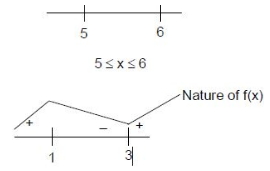
(C) First,we determine the interval $S$ by solving the inequality $x^2 + 30 \le 11x$.
$x^2 - 11x + 30 \le 0$
$(x - 5)(x - 6) \le 0$
This implies $x \in [5, 6]$.
Now,we find the critical points of $f(x) = 3x^3 - 18x^2 + 27x - 40$.
$f'(x) = 9x^2 - 36x + 27 = 9(x^2 - 4x + 3) = 9(x - 1)(x - 3)$.
The critical points are $x = 1$ and $x = 3$. Neither of these points lies in the interval $[5, 6]$.
Since $f'(x) > 0$ for all $x > 3$,the function $f(x)$ is strictly increasing on the interval $[5, 6]$.
Therefore,the maximum value occurs at the right endpoint $x = 6$.
$f(6) = 3(6)^3 - 18(6)^2 + 27(6) - 40$
$f(6) = 3(216) - 18(36) + 162 - 40$
$f(6) = 648 - 648 + 162 - 40 = 122$.
$x^2 - 11x + 30 \le 0$
$(x - 5)(x - 6) \le 0$
This implies $x \in [5, 6]$.
Now,we find the critical points of $f(x) = 3x^3 - 18x^2 + 27x - 40$.
$f'(x) = 9x^2 - 36x + 27 = 9(x^2 - 4x + 3) = 9(x - 1)(x - 3)$.
The critical points are $x = 1$ and $x = 3$. Neither of these points lies in the interval $[5, 6]$.
Since $f'(x) > 0$ for all $x > 3$,the function $f(x)$ is strictly increasing on the interval $[5, 6]$.
Therefore,the maximum value occurs at the right endpoint $x = 6$.
$f(6) = 3(6)^3 - 18(6)^2 + 27(6) - 40$
$f(6) = 3(216) - 18(36) + 162 - 40$
$f(6) = 648 - 648 + 162 - 40 = 122$.
0 likesView Solution
81
ChemistryDifficultMCQJEE Main · 2019
The reaction $MgO_{(s)} + C_{(s)} \to Mg_{(s)} + CO_{(g)}$,for which $\Delta_r H^o = +491.1 \ kJ \ mol^{-1}$ and $\Delta_r S^o = 198.0 \ J \ K^{-1} \ mol^{-1}$,is not feasible at $298 \ K$. The temperature above which the reaction will be feasible is ..... $K$.
A
$2040.5$
B
$1890$
C
$2480.3$
D
$2380.5$
Solution
(C) For a reaction to be spontaneous,the Gibbs free energy change $\Delta G^o$ must be negative.
The relationship is given by $\Delta G^o = \Delta H^o - T \Delta S^o$.
At equilibrium,$\Delta G^o = 0$,so $T = \frac{\Delta H^o}{\Delta S^o}$.
Given $\Delta H^o = 491.1 \ kJ \ mol^{-1} = 491100 \ J \ mol^{-1}$ and $\Delta S^o = 198.0 \ J \ K^{-1} \ mol^{-1}$.
$T = \frac{491100 \ J \ mol^{-1}}{198.0 \ J \ K^{-1} \ mol^{-1}} = 2480.3 \ K$.
Therefore,the reaction becomes spontaneous at temperatures above $2480.3 \ K$.
The relationship is given by $\Delta G^o = \Delta H^o - T \Delta S^o$.
At equilibrium,$\Delta G^o = 0$,so $T = \frac{\Delta H^o}{\Delta S^o}$.
Given $\Delta H^o = 491.1 \ kJ \ mol^{-1} = 491100 \ J \ mol^{-1}$ and $\Delta S^o = 198.0 \ J \ K^{-1} \ mol^{-1}$.
$T = \frac{491100 \ J \ mol^{-1}}{198.0 \ J \ K^{-1} \ mol^{-1}} = 2480.3 \ K$.
Therefore,the reaction becomes spontaneous at temperatures above $2480.3 \ K$.
0 likesView Solution
82
ChemistryMediumMCQJEE Main · 2019
The standard reaction Gibbs energy for a chemical reaction at an absolute temperature $T$ is given by $\Delta_{r}G^{o} = A - BT$,where $A$ and $B$ are non-$zero$ constants. Which of the following is $TRUE$ about this reaction?
A
Endothermic if $A > 0$
B
Exothermic if $A > 0$ and $B < 0$
C
Endothermic if $A < 0$ and $B > 0$
D
Exothermic if $B < 0$
Solution
(A) The standard Gibbs energy equation is given by $\Delta G^{o} = \Delta H^{o} - T\Delta S^{o}$.
Comparing this with the given equation $\Delta G^{o} = A - BT$,we find that $A = \Delta H^{o}$ and $B = \Delta S^{o}$.
For an endothermic reaction,the enthalpy change $\Delta H^{o}$ is positive,which implies $A > 0$.
For an exothermic reaction,the enthalpy change $\Delta H^{o}$ is negative,which implies $A < 0$.
Therefore,the reaction is endothermic if $A > 0$.
Comparing this with the given equation $\Delta G^{o} = A - BT$,we find that $A = \Delta H^{o}$ and $B = \Delta S^{o}$.
For an endothermic reaction,the enthalpy change $\Delta H^{o}$ is positive,which implies $A > 0$.
For an exothermic reaction,the enthalpy change $\Delta H^{o}$ is negative,which implies $A < 0$.
Therefore,the reaction is endothermic if $A > 0$.
0 likesView Solution
83
ChemistryDifficultMCQJEE Main · 2019
The hydride that is $NOT$ electron deficient is
A
$SiH_4$
B
$B_2H_6$
C
$GaH_3$
D
$AlH_3$
Solution
(A) An electron-deficient hydride is one that does not have sufficient electrons to form normal covalent bonds,typically having fewer than $8$ electrons in the valence shell of the central atom.
$B_2H_6$,$GaH_3$,and $AlH_3$ are electron-deficient hydrides because the central atoms ($B$,$Ga$,$Al$) have incomplete octets.
$SiH_4$ is a group $14$ hydride where the central silicon atom has a complete octet ($8$ electrons),making it an electron-precise hydride,not an electron-deficient one.
$B_2H_6$,$GaH_3$,and $AlH_3$ are electron-deficient hydrides because the central atoms ($B$,$Ga$,$Al$) have incomplete octets.
$SiH_4$ is a group $14$ hydride where the central silicon atom has a complete octet ($8$ electrons),making it an electron-precise hydride,not an electron-deficient one.
0 likesView Solution
84
ChemistryMediumMCQJEE Main · 2019
The correct option with respect to the Pauling electronegativity values of the elements is
A
$Te > Xe$
B
$Ga > Ge$
C
$Si > Al$
D
$P > S$
Solution
(C) Electronegativity generally increases from left to right across a period and decreases down a group in the periodic table.
Comparing the given pairs:
$(A)$ $Te$ $(2.1)$ and $Xe$ $(2.6)$: $Xe > Te$,so $Te > Xe$ is incorrect.
$(B)$ $Ga$ $(1.8)$ and $Ge$ $(2.0)$: $Ge > Ga$,so $Ga > Ge$ is incorrect.
$(C)$ $Si$ $(1.9)$ and $Al$ $(1.6)$: $Si > Al$ is correct.
$(D)$ $P$ $(2.1)$ and $S$ $(2.5)$: $S > P$,so $P > S$ is incorrect.
Therefore,the correct option is $C$.
Comparing the given pairs:
$(A)$ $Te$ $(2.1)$ and $Xe$ $(2.6)$: $Xe > Te$,so $Te > Xe$ is incorrect.
$(B)$ $Ga$ $(1.8)$ and $Ge$ $(2.0)$: $Ge > Ga$,so $Ga > Ge$ is incorrect.
$(C)$ $Si$ $(1.9)$ and $Al$ $(1.6)$: $Si > Al$ is correct.
$(D)$ $P$ $(2.1)$ and $S$ $(2.5)$: $S > P$,so $P > S$ is incorrect.
Therefore,the correct option is $C$.
0 likesView Solution
85
ChemistryDifficultMCQJEE Main · 2019
The de Broglie wavelength $(\lambda)$ associated with a photoelectron varies with the frequency $(v)$ of the incident radiation as,[$v_0$ is threshold frequency]:
A
$\lambda \propto \frac{1}{(v - v_0)}$
B
$\lambda \propto \frac{1}{(v - v_0)^{\frac{1}{4}}}$
C
$\lambda \propto \frac{1}{(v - v_0)^{\frac{3}{2}}}$
D
$\lambda \propto \frac{1}{(v - v_0)^{\frac{1}{2}}}$
Solution
(D) The de Broglie wavelength is given by $\lambda = \frac{h}{mv}$,where $v$ is the velocity of the photoelectron.
According to Einstein's photoelectric equation:
$hv = hv_0 + KE$
$hv - hv_0 = \frac{1}{2}mv^2$
$2h(v - v_0) = mv^2$
From this,the velocity $v$ is proportional to $(v - v_0)^{\frac{1}{2}}$:
$v = \sqrt{\frac{2h(v - v_0)}{m}} \propto (v - v_0)^{\frac{1}{2}}$
Substituting this into the de Broglie equation:
$\lambda = \frac{h}{mv} \propto \frac{1}{(v - v_0)^{\frac{1}{2}}}$
Thus,$\lambda \propto \frac{1}{(v - v_0)^{\frac{1}{2}}}$.
According to Einstein's photoelectric equation:
$hv = hv_0 + KE$
$hv - hv_0 = \frac{1}{2}mv^2$
$2h(v - v_0) = mv^2$
From this,the velocity $v$ is proportional to $(v - v_0)^{\frac{1}{2}}$:
$v = \sqrt{\frac{2h(v - v_0)}{m}} \propto (v - v_0)^{\frac{1}{2}}$
Substituting this into the de Broglie equation:
$\lambda = \frac{h}{mv} \propto \frac{1}{(v - v_0)^{\frac{1}{2}}}$
Thus,$\lambda \propto \frac{1}{(v - v_0)^{\frac{1}{2}}}$.
0 likesView Solution
86
ChemistryMediumMCQJEE Main · 2019
The $Taj \ Mahal$ is being slowly disfigured and discoloured. This is primarily due to
A
global warming
B
acid rain
C
water pollution
D
soil pollution
Solution
(B) $Acid \ rain$ contains $H_2SO_4$ and $HNO_3$,which react with the calcium carbonate $(CaCO_3)$ present in the marble of the $Taj \ Mahal$.
This chemical reaction leads to the corrosion and discoloration of the monument.
This chemical reaction leads to the corrosion and discoloration of the monument.
0 likesView Solution
87
ChemistryMediumMCQJEE Main · 2019
For the equilibrium $2H_2O \rightleftharpoons H_3O^{+} + OH^{-}$,the value of $\Delta G^o$ at $298 \ K$ is approximately ....... $kJ \ mol^{-1}$.
A
$100$
B
$-80$
C
$80$
D
$-100$
Solution
(C) The equilibrium constant for the auto-ionization of water is $K_w = [H_3O^+][OH^-] = 10^{-14}$ at $298 \ K$.
The relationship between standard Gibbs free energy change and the equilibrium constant is given by $\Delta G^o = -RT \ln K_{eq} = -2.303RT \log K_{eq}$.
Substituting the values: $\Delta G^o = -2.303 \times 8.314 \times 10^{-3} \ kJ \ K^{-1} \ mol^{-1} \times 298 \ K \times \log(10^{-14})$.
$\Delta G^o = -2.303 \times 8.314 \times 10^{-3} \times 298 \times (-14) \ kJ \ mol^{-1}$.
$\Delta G^o \approx 79.88 \ kJ \ mol^{-1} \approx 80 \ kJ \ mol^{-1}$.
The relationship between standard Gibbs free energy change and the equilibrium constant is given by $\Delta G^o = -RT \ln K_{eq} = -2.303RT \log K_{eq}$.
Substituting the values: $\Delta G^o = -2.303 \times 8.314 \times 10^{-3} \ kJ \ K^{-1} \ mol^{-1} \times 298 \ K \times \log(10^{-14})$.
$\Delta G^o = -2.303 \times 8.314 \times 10^{-3} \times 298 \times (-14) \ kJ \ mol^{-1}$.
$\Delta G^o \approx 79.88 \ kJ \ mol^{-1} \approx 80 \ kJ \ mol^{-1}$.
0 likesView Solution
88
ChemistryDifficultMCQJEE Main · 2019
Match the following items in Column-$I$ with the corresponding items in Column-$II$.
| Column-$I$ | Column-$II$ |
|---|---|
| $I$. $Na_2CO_3 \cdot 10H_2O$ | $A$. Portland cement ingredient |
| $II$. $Mg(HCO_3)_2$ | $B$. Castner-Kellner process |
| $III$. $NaOH$ | $C$. Solvay process |
| $IV$. $Ca_3Al_2O_6$ | $D$. Temporary hardness |
A
$I-B, II-C, III-A, IV-D$
B
$I-C, II-B, III-D, IV-A$
C
$I-D, II-A, III-B, IV-C$
D
$I-C, II-D, III-B, IV-A$
Solution
(D) $I$. $Na_2CO_3 \cdot 10H_2O$ (Washing soda) is produced by the Solvay process $(I-C)$.
$II$. $Mg(HCO_3)_2$ causes temporary hardness in water $(II-D)$.
$III$. $NaOH$ is produced by the Castner-Kellner process $(III-B)$.
$IV$. $Ca_3Al_2O_6$ (Tricalcium aluminate) is an important ingredient in Portland cement $(IV-A)$.
Therefore,the correct matching is $I-C, II-D, III-B, IV-A$.
$II$. $Mg(HCO_3)_2$ causes temporary hardness in water $(II-D)$.
$III$. $NaOH$ is produced by the Castner-Kellner process $(III-B)$.
$IV$. $Ca_3Al_2O_6$ (Tricalcium aluminate) is an important ingredient in Portland cement $(IV-A)$.
Therefore,the correct matching is $I-C, II-D, III-B, IV-A$.
0 likesView Solution
89
ChemistryMCQJEE Main · 2019
The major product of the following reaction is:
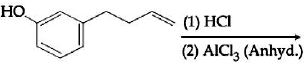
A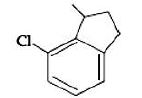
B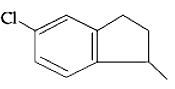
C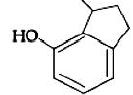
D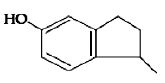
Solution
(A) The reaction proceeds in two steps:
$1$. Markovnikov's addition of $HCl$ to the alkene: The $H^+$ adds to the terminal carbon of the double bond to form a more stable secondary carbocation at the carbon adjacent to the benzene ring.
$2$. Intramolecular Friedel-Crafts alkylation: The secondary carbocation formed acts as an electrophile and attacks the ortho position of the phenol ring (due to the activating $-OH$ group) to form a five-membered ring fused to the benzene ring. The final product is $4$-methyl-chroman derivative or specifically $2$-methyl$-2,3-$dihydrobenzofuran derivative depending on the chain length,but based on the structure provided,it forms a $2$-methyl$-2,3-$dihydrobenzofuran derivative.
$1$. Markovnikov's addition of $HCl$ to the alkene: The $H^+$ adds to the terminal carbon of the double bond to form a more stable secondary carbocation at the carbon adjacent to the benzene ring.
$2$. Intramolecular Friedel-Crafts alkylation: The secondary carbocation formed acts as an electrophile and attacks the ortho position of the phenol ring (due to the activating $-OH$ group) to form a five-membered ring fused to the benzene ring. The final product is $4$-methyl-chroman derivative or specifically $2$-methyl$-2,3-$dihydrobenzofuran derivative depending on the chain length,but based on the structure provided,it forms a $2$-methyl$-2,3-$dihydrobenzofuran derivative.
0 likesView Solution
90
ChemistryMediumMCQJEE Main · 2019
The higher concentration of which gas in air can cause stiffness of flower buds?
A
$NO_2$
B
$CO_2$
C
$SO_2$
D
$CO$
Solution
(C) The presence of $SO_2$ in the atmosphere is a known pollutant that affects plant physiology. High concentrations of $SO_2$ cause the stiffness of flower buds,leading to their eventual shedding.
0 likesView Solution
91
ChemistryMCQJEE Main · 2019
The contrapositive of the statement "If two numbers are not equal,then their squares are not equal" is
A
If the squares of two numbers are not equal,then the numbers are equal.
B
If the squares of two numbers are equal,then the numbers are not equal.
C
If the squares of two numbers are equal,then the numbers are equal.
D
If the squares of two numbers are not equal,then the numbers are not equal.
Solution
(C) Let $p$ be the statement "Two numbers are not equal" and $q$ be the statement "Their squares are not equal".
The given statement is in the form $p \to q$.
The contrapositive of $p \to q$ is defined as $\sim q \to \sim p$.
Here,$\sim q$ is "The squares of two numbers are equal" and $\sim p$ is "The numbers are equal".
Therefore,the contrapositive is "If the squares of two numbers are equal,then the numbers are equal".
The given statement is in the form $p \to q$.
The contrapositive of $p \to q$ is defined as $\sim q \to \sim p$.
Here,$\sim q$ is "The squares of two numbers are equal" and $\sim p$ is "The numbers are equal".
Therefore,the contrapositive is "If the squares of two numbers are equal,then the numbers are equal".
0 likesView Solution
92
ChemistryMediumMCQJEE Main · 2019
The correct order for acid strength of compounds $CH \equiv CH$,$CH_3 - C \equiv CH$,and $CH_2 = CH_2$ is as follows:
A
$CH \equiv CH > CH_2 = CH_2 > CH_3 - C \equiv CH$
B
$CH_3 - C \equiv CH > CH \equiv CH > CH_2 = CH_2$
C
$CH_3 - C \equiv CH > CH_2 = CH_2 > CH \equiv CH$
D
$CH \equiv CH > CH_3 - C \equiv CH > CH_2 = CH_2$
Solution
(D) Acidic strength is directly proportional to the stability of the conjugate base.
Stability of the conjugate base depends on the electronegativity of the carbon atom bearing the negative charge.
The electronegativity order is $sp$ carbon ($50\% \ s$-character) > $sp^2$ carbon ($33.3\% \ s$-character) > $sp^3$ carbon ($25\% \ s$-character).
$1$. $CH \equiv CH$ (ethyne) has $sp$ hybridized carbons.
$2$. $CH_3 - C \equiv CH$ (propyne) has one $sp$ hybridized carbon,but the methyl group $(CH_3)$ is electron-donating ($+I$ effect),which destabilizes the conjugate base compared to ethyne.
$3$. $CH_2 = CH_2$ (ethene) has $sp^2$ hybridized carbons,which are less electronegative than $sp$ carbons.
Therefore,the correct order of acidic strength is $CH \equiv CH > CH_3 - C \equiv CH > CH_2 = CH_2$.
Stability of the conjugate base depends on the electronegativity of the carbon atom bearing the negative charge.
The electronegativity order is $sp$ carbon ($50\% \ s$-character) > $sp^2$ carbon ($33.3\% \ s$-character) > $sp^3$ carbon ($25\% \ s$-character).
$1$. $CH \equiv CH$ (ethyne) has $sp$ hybridized carbons.
$2$. $CH_3 - C \equiv CH$ (propyne) has one $sp$ hybridized carbon,but the methyl group $(CH_3)$ is electron-donating ($+I$ effect),which destabilizes the conjugate base compared to ethyne.
$3$. $CH_2 = CH_2$ (ethene) has $sp^2$ hybridized carbons,which are less electronegative than $sp$ carbons.
Therefore,the correct order of acidic strength is $CH \equiv CH > CH_3 - C \equiv CH > CH_2 = CH_2$.
0 likesView Solution
93
ChemistryDifficultMCQJEE Main · 2019
In a chemical reaction $A + 2B \rightleftharpoons 2C + D$,the initial concentration of $B$ was $1.5$ times of $A$ but the equilibrium concentrations of $A$ and $B$ were found to be equal. The equilibrium constant $(K)$ for the aforesaid chemical reaction is
A
$4$
B
$16$
C
$0.25$
D
$1$
Solution
(A) The reaction is $A + 2B \rightleftharpoons 2C + D$.
Initially,let the concentration of $A$ be $a$ and $B$ be $1.5a$.
At equilibrium,the concentrations are: $[A] = a - x$,$[B] = 1.5a - 2x$,$[C] = 2x$,and $[D] = x$.
Given that $[A] = [B]$ at equilibrium:
$a - x = 1.5a - 2x$
$x = 0.5a$,which implies $a = 2x$.
Substituting $a = 2x$ into the equilibrium concentrations:
$[A] = 2x - x = x$
$[B] = 1.5(2x) - 2x = 3x - 2x = x$
$[C] = 2x$
$[D] = x$
The equilibrium constant $K$ is given by:
$K = \frac{[C]^2 [D]}{[A] [B]^2} = \frac{(2x)^2 (x)}{(x) (x)^2} = \frac{4x^2 \cdot x}{x^3} = \frac{4x^3}{x^3} = 4$.
Initially,let the concentration of $A$ be $a$ and $B$ be $1.5a$.
At equilibrium,the concentrations are: $[A] = a - x$,$[B] = 1.5a - 2x$,$[C] = 2x$,and $[D] = x$.
Given that $[A] = [B]$ at equilibrium:
$a - x = 1.5a - 2x$
$x = 0.5a$,which implies $a = 2x$.
Substituting $a = 2x$ into the equilibrium concentrations:
$[A] = 2x - x = x$
$[B] = 1.5(2x) - 2x = 3x - 2x = x$
$[C] = 2x$
$[D] = x$
The equilibrium constant $K$ is given by:
$K = \frac{[C]^2 [D]}{[A] [B]^2} = \frac{(2x)^2 (x)}{(x) (x)^2} = \frac{4x^2 \cdot x}{x^3} = \frac{4x^3}{x^3} = 4$.
0 likesView Solution
94
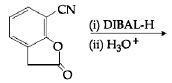
ChemistryMCQJEE Main · 2019
The major product of the following reaction is:
A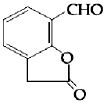
B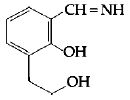
C
D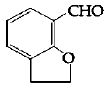
Solution
(D) $DIBAL-H$ (Diisobutylaluminium hydride) is a selective reducing agent. In the given molecule,it reduces both the nitrile $(-CN)$ group and the ester (lactone) group. The nitrile group is reduced to an aldehyde after hydrolysis,and the ester group is reduced to an aldehyde. The reaction involves the reduction of the $-CN$ group to $-CHO$ and the opening of the lactone ring to form a hydroxy-aldehyde structure. The correct product is shown in option $D$.
0 likesView Solution
95
ChemistryMediumMCQJEE Main · 2019
$A$ metal on combustion in excess air forms $X$. $X$ upon hydrolysis with water yields $H_2O_2$ and $O_2$ along with another product. The metal is
A
$Na$
B
$Rb$
C
$Mg$
D
$Li$
Solution
(B) The metal $Rb$ (Rubidium) reacts with excess air to form a superoxide,$X = RbO_2$.
Hydrolysis of $RbO_2$ with water follows the reaction: $2RbO_2 + 2H_2O \to 2RbOH + H_2O_2 + O_2 \uparrow$.
Thus,the metal is $Rb$.
Hydrolysis of $RbO_2$ with water follows the reaction: $2RbO_2 + 2H_2O \to 2RbOH + H_2O_2 + O_2 \uparrow$.
Thus,the metal is $Rb$.
0 likesView Solution
96
ChemistryDifficultMCQJEE Main · 2019
The molecule that has minimum or no role in the formation of photochemical smog is
A
$N_2$
B
$CH_2=O$
C
$O_3$
D
$NO$
Solution
(A) Photochemical smog is formed by the reaction of nitrogen oxides $(NO_x)$,volatile organic compounds $(VOCs)$,and ozone $(O_3)$ in the presence of sunlight.
$N_2$ is an inert gas that constitutes about $78\%$ of the atmosphere and does not participate in the chemical reactions that lead to the formation of photochemical smog.
$N_2$ is an inert gas that constitutes about $78\%$ of the atmosphere and does not participate in the chemical reactions that lead to the formation of photochemical smog.
0 likesView Solution
97
ChemistryDifficultMCQJEE Main · 2019
For a diatomic ideal gas in a closed system,which of the following plots does not correctly describe the relation between various thermodynamic quantities?
A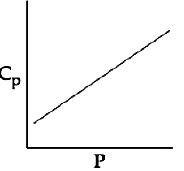
B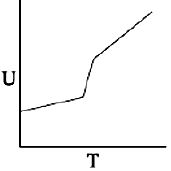
C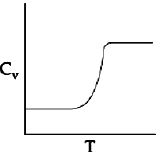
D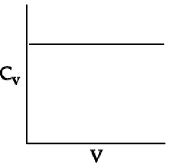
Solution
(A) For an ideal gas,the internal energy $U$ is a function of temperature only $(U = f(T))$.
$C_P$ and $C_V$ are molar heat capacities which,for an ideal gas,are independent of pressure $P$ and volume $V$.
$C_V$ for a diatomic gas shows a temperature dependence due to the activation of vibrational degrees of freedom at higher temperatures.
However,$C_P$ is constant with respect to pressure $P$ for an ideal gas.
Therefore,the plot of $C_P$ versus $P$ (Option $A$) is incorrect because $C_P$ should be a horizontal line,not a linear increasing function.
$C_P$ and $C_V$ are molar heat capacities which,for an ideal gas,are independent of pressure $P$ and volume $V$.
$C_V$ for a diatomic gas shows a temperature dependence due to the activation of vibrational degrees of freedom at higher temperatures.
However,$C_P$ is constant with respect to pressure $P$ for an ideal gas.
Therefore,the plot of $C_P$ versus $P$ (Option $A$) is incorrect because $C_P$ should be a horizontal line,not a linear increasing function.
0 likesView Solution
98
ChemistryDifficultMCQJEE Main · 2019
$50 \ mL$ of $0.5 \ M$ oxalic acid is needed to neutralize $25 \ mL$ of sodium hydroxide solution. The amount in grams of $NaOH$ in $50 \ mL$ of the given sodium hydroxide solution is:
A
$40$
B
$10$
C
$20$
D
None of these
Solution
(D) The neutralization reaction is: $(COOH)_2 + 2NaOH \rightarrow (COONa)_2 + 2H_2O$.
Using the equivalence concept: $n_{factor} \times M_1 \times V_1 = n_{factor} \times M_2 \times V_2$.
For oxalic acid $(COOH)_2$,$n_{factor} = 2$. For $NaOH$,$n_{factor} = 1$.
$2 \times 0.5 \times 50 = 1 \times M_2 \times 25$.
$50 = 25 \times M_2 \implies M_2 = 2 \ M$.
Now,calculate the mass of $NaOH$ in $50 \ mL$ of $2 \ M$ solution:
$Moles = Molarity \times Volume(L) = 2 \times 0.050 = 0.1 \ mol$.
$Mass = Moles \times Molar \ mass = 0.1 \times 40 = 4 \ g$.
Since $4 \ g$ is not among the options,the correct answer is $D$.
Using the equivalence concept: $n_{factor} \times M_1 \times V_1 = n_{factor} \times M_2 \times V_2$.
For oxalic acid $(COOH)_2$,$n_{factor} = 2$. For $NaOH$,$n_{factor} = 1$.
$2 \times 0.5 \times 50 = 1 \times M_2 \times 25$.
$50 = 25 \times M_2 \implies M_2 = 2 \ M$.
Now,calculate the mass of $NaOH$ in $50 \ mL$ of $2 \ M$ solution:
$Moles = Molarity \times Volume(L) = 2 \times 0.050 = 0.1 \ mol$.
$Mass = Moles \times Molar \ mass = 0.1 \times 40 = 4 \ g$.
Since $4 \ g$ is not among the options,the correct answer is $D$.
0 likesView Solution
99
ChemistryDifficultMCQJEE Main · 2019
The volume of gas $A$ is twice that of gas $B$. The compressibility factor of gas $A$ is thrice that of gas $B$ at the same temperature. The ratio of the pressures of the gases for equal number of moles is:
A
$3P_A = 2P_B$
B
$2P_A = 3P_B$
C
$P_A = 3P_B$
D
$P_A = 2P_B$
Solution
(B) The compressibility factor $Z$ is defined as $Z = \frac{PV}{nRT}$.
Rearranging for pressure,we get $P = \frac{ZnRT}{V}$.
At constant temperature $T$ and equal number of moles $n$,the pressure $P$ is directly proportional to $\frac{Z}{V}$,i.e.,$P \propto \frac{Z}{V}$.
Given $V_A = 2V_B$ and $Z_A = 3Z_B$.
Taking the ratio of pressures:
$\frac{P_A}{P_B} = \frac{Z_A}{Z_B} \times \frac{V_B}{V_A} = \left( \frac{3}{1} \right) \times \left( \frac{1}{2} \right) = \frac{3}{2}$.
Therefore,$2P_A = 3P_B$.
Rearranging for pressure,we get $P = \frac{ZnRT}{V}$.
At constant temperature $T$ and equal number of moles $n$,the pressure $P$ is directly proportional to $\frac{Z}{V}$,i.e.,$P \propto \frac{Z}{V}$.
Given $V_A = 2V_B$ and $Z_A = 3Z_B$.
Taking the ratio of pressures:
$\frac{P_A}{P_B} = \frac{Z_A}{Z_B} \times \frac{V_B}{V_A} = \left( \frac{3}{1} \right) \times \left( \frac{1}{2} \right) = \frac{3}{2}$.
Therefore,$2P_A = 3P_B$.
0 likesView Solution
100
ChemistryDifficultMCQJEE Main · 2019
The hardness of a water sample (in terms of equivalents of $CaCO_3$) containing $10^{-3} \ M \ CaSO_4$ is ................... $ppm$ (Molecular mass of $CaSO_4 = 136 \ g \ mol^{-1}$)
A
$10$
B
$50$
C
$90$
D
$100$
Solution
(D) Hardness is expressed in terms of $CaCO_3$ equivalents per $10^6$ parts of water $(ppm)$.
Given concentration of $CaSO_4 = 10^{-3} \ M = 10^{-3} \ mol \ L^{-1}$.
Since $1 \ mol$ of $CaSO_4$ provides $1 \ mol$ of $Ca^{2+}$ ions,the concentration of $Ca^{2+}$ is $10^{-3} \ mol \ L^{-1}$.
Equivalents of $CaCO_3$ = Equivalents of $Ca^{2+}$.
$n_{CaCO_3} \times v.f. = n_{Ca^{2+}} \times v.f.$
$n_{CaCO_3} \times 2 = 10^{-3} \times 2 \implies n_{CaCO_3} = 10^{-3} \ mol \ L^{-1}$.
Mass of $CaCO_3 = 10^{-3} \ mol \times 100 \ g \ mol^{-1} = 0.1 \ g \ L^{-1}$.
Assuming the density of water is $1 \ g \ mL^{-1}$,$1 \ L$ of water weighs $1000 \ g$.
Hardness in $ppm = \frac{\text{mass of } CaCO_3 \text{ in } g}{\text{mass of water in } g} \times 10^6$.
Hardness $= \frac{0.1 \ g}{1000 \ g} \times 10^6 = 100 \ ppm$.
Given concentration of $CaSO_4 = 10^{-3} \ M = 10^{-3} \ mol \ L^{-1}$.
Since $1 \ mol$ of $CaSO_4$ provides $1 \ mol$ of $Ca^{2+}$ ions,the concentration of $Ca^{2+}$ is $10^{-3} \ mol \ L^{-1}$.
Equivalents of $CaCO_3$ = Equivalents of $Ca^{2+}$.
$n_{CaCO_3} \times v.f. = n_{Ca^{2+}} \times v.f.$
$n_{CaCO_3} \times 2 = 10^{-3} \times 2 \implies n_{CaCO_3} = 10^{-3} \ mol \ L^{-1}$.
Mass of $CaCO_3 = 10^{-3} \ mol \times 100 \ g \ mol^{-1} = 0.1 \ g \ L^{-1}$.
Assuming the density of water is $1 \ g \ mL^{-1}$,$1 \ L$ of water weighs $1000 \ g$.
Hardness in $ppm = \frac{\text{mass of } CaCO_3 \text{ in } g}{\text{mass of water in } g} \times 10^6$.
Hardness $= \frac{0.1 \ g}{1000 \ g} \times 10^6 = 100 \ ppm$.
0 likesView Solution
101
ChemistryDifficultMCQJEE Main · 2019
The increasing order of $pKa$ values of the following compounds is:
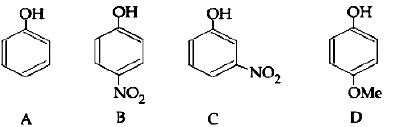
A
$C < B < A < D$
B
$B < C < D < A$
C
$D < A < C < B$
D
$B < C < A < D$
Solution
(C) The acidity of phenols is determined by the stability of the phenoxide ion formed after the loss of a proton. Electron-withdrawing groups $(EWG)$ increase acidity (decrease $pKa$),while electron-donating groups $(EDG)$ decrease acidity (increase $pKa$).
$A$: Phenol (reference).
$B$: $p$-nitrophenol ($-NO_2$ is a strong $EWG$,increases acidity).
$C$: $m$-nitrophenol ($-NO_2$ is an $EWG$,increases acidity but less than $p$-isomer due to lack of resonance effect).
$D$: $p$-methoxyphenol ($-OCH_3$ is an $EDG$,decreases acidity).
Acidity order: $B > C > A > D$.
Since $pKa = -\log(Ka)$,the increasing order of $pKa$ is the reverse of the acidity order: $D < A < C < B$.
$A$: Phenol (reference).
$B$: $p$-nitrophenol ($-NO_2$ is a strong $EWG$,increases acidity).
$C$: $m$-nitrophenol ($-NO_2$ is an $EWG$,increases acidity but less than $p$-isomer due to lack of resonance effect).
$D$: $p$-methoxyphenol ($-OCH_3$ is an $EDG$,decreases acidity).
Acidity order: $B > C > A > D$.
Since $pKa = -\log(Ka)$,the increasing order of $pKa$ is the reverse of the acidity order: $D < A < C < B$.
0 likesView Solution
102
ChemistryMediumMCQJEE Main · 2019
The Hall-Heroult process is represented by which of the following reactions?
A
$Cu^{2+}_{(aq)} + H_{2(g)} \longrightarrow Cu_{(s)} + 2H^{+}_{(aq)}$
B
$Cr_2O_3 + 2Al \longrightarrow Al_2O_3 + 2Cr$
C
$2Al_2O_3 + 3C \longrightarrow 4Al + 3CO_2$
D
$ZnO + C \xrightarrow{1673 \ K} Zn + CO$
Solution
(C) The Hall-Heroult process is the electrolytic reduction of alumina $(Al_2O_3)$ dissolved in molten cryolite $(Na_3AlF_6)$.
The overall reaction is: $2Al_2O_3 + 3C \longrightarrow 4Al + 3CO_2$.
In this process,the reactions occurring are:
Dissociation: $2Al_2O_3 \rightleftharpoons 4Al^{3+} + 6O^{2-}$.
At Cathode: $4Al^{3+} + 12e^- \longrightarrow 4Al$.
At Anode: $6O^{2-} \longrightarrow 3O_2 + 12e^-$.
The oxygen gas produced at the anode reacts with the carbon anode: $2C + 3O_2 \longrightarrow 3CO_2$.
The overall reaction is: $2Al_2O_3 + 3C \longrightarrow 4Al + 3CO_2$.
In this process,the reactions occurring are:
Dissociation: $2Al_2O_3 \rightleftharpoons 4Al^{3+} + 6O^{2-}$.
At Cathode: $4Al^{3+} + 12e^- \longrightarrow 4Al$.
At Anode: $6O^{2-} \longrightarrow 3O_2 + 12e^-$.
The oxygen gas produced at the anode reacts with the carbon anode: $2C + 3O_2 \longrightarrow 3CO_2$.
0 likesView Solution
103
ChemistryDifficultMCQJEE Main · 2019
Haemoglobin and gold sol are examples of
A
positively and negatively charged sols,respectively
B
positively charged sols
C
negatively charged sols
D
negatively and positively charged sols,respectively
Solution
(A) Haemoglobin is a positively charged sol at a $pH$ below its isoelectric point.
Gold sol is a well-known example of a negatively charged sol.
Gold sol is a well-known example of a negatively charged sol.
0 likesView Solution
104
ChemistryDifficultMCQJEE Main · 2019
The major product of the following reaction is:
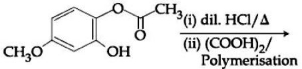
A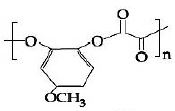
B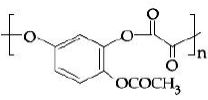
C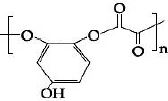
D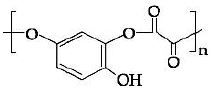
Solution
(A) Step $1$: Hydrolysis of the starting material. The starting material is $4$-methoxyphenyl acetate. Treatment with $dil. \ HCl$ and heat causes hydrolysis of the ester group,yielding $4$-methoxyphenol.
Step $2$: Polymerization. The $4$-methoxyphenol is then reacted with oxalic acid $(COOH)_2$. This is a condensation polymerization reaction where the phenolic $-OH$ groups react with the carboxylic acid groups of oxalic acid to form a polyester linkage. The resulting polymer contains the $4$-methoxyphenyl unit linked via ester bonds.
Step $2$: Polymerization. The $4$-methoxyphenol is then reacted with oxalic acid $(COOH)_2$. This is a condensation polymerization reaction where the phenolic $-OH$ groups react with the carboxylic acid groups of oxalic acid to form a polyester linkage. The resulting polymer contains the $4$-methoxyphenyl unit linked via ester bonds.
0 likesView Solution
105
ChemistryDifficultMCQJEE Main · 2019
The amount of sugar $(C_{12}H_{22}O_{11})$ required to prepare $2 \ L$ of its $0.1 \ M$ aqueous solution is ............... $g$.
A
$136.8$
B
$17.1$
C
$68.4$
D
$34.2$
Solution
(C) The molarity $(M)$ is defined as the number of moles of solute per liter of solution: $M = \frac{n}{V(L)}$.
Given $M = 0.1 \ M$ and $V = 2 \ L$,the number of moles $(n)$ is $n = M \times V = 0.1 \times 2 = 0.2 \ mol$.
The molar mass of sugar $(C_{12}H_{22}O_{11})$ is $(12 \times 12) + (22 \times 1) + (11 \times 16) = 144 + 22 + 176 = 342 \ g/mol$.
The mass required is $mass = n \times \text{molar mass} = 0.2 \ mol \times 342 \ g/mol = 68.4 \ g$.
Given $M = 0.1 \ M$ and $V = 2 \ L$,the number of moles $(n)$ is $n = M \times V = 0.1 \times 2 = 0.2 \ mol$.
The molar mass of sugar $(C_{12}H_{22}O_{11})$ is $(12 \times 12) + (22 \times 1) + (11 \times 16) = 144 + 22 + 176 = 342 \ g/mol$.
The mass required is $mass = n \times \text{molar mass} = 0.2 \ mol \times 342 \ g/mol = 68.4 \ g$.
0 likesView Solution
106
ChemistryDifficultMCQJEE Main · 2019
In the cell $Pt_{(s)} | H_2(g, 1 \, bar) | HCl_{(aq)} | AgCl_{(s)} | Ag_{(s)} | Pt_{(s)}$,the cell potential is $0.92 \, V$ when a $10^{-6} \, m$ $HCl$ solution is used. The standard electrode potential of the $(AgCl/Ag, Cl^-)$ electrode is ............. $V$ $\{ \text{Given, } \frac{2.303RT}{F} = 0.06 \, V \text{ at } 298 \, K \}$
A
$0.94$
B
$0.76$
C
$0.40$
D
$0.20$
Solution
(D) The cell reaction is: $\frac{1}{2} H_2(g) + AgCl(s) \rightarrow H^+(aq) + Cl^-(aq) + Ag(s)$.
Applying the Nernst equation: $E_{cell} = E^o_{cell} - \frac{0.06}{n} \log Q$.
Here,$n = 1$ and $Q = [H^+][Cl^-] / (P_{H_2})^{1/2}$.
Given $[H^+] = 10^{-6} \, m$ and $[Cl^-] = 10^{-6} \, m$,so $Q = 10^{-6} \times 10^{-6} = 10^{-12}$.
$0.92 = E^o_{cell} - 0.06 \log(10^{-12})$.
$0.92 = E^o_{cell} - 0.06 \times (-12)$.
$0.92 = E^o_{cell} + 0.72$.
$E^o_{cell} = 0.92 - 0.72 = 0.20 \, V$.
Since $E^o_{cell} = E^o_{cathode} - E^o_{anode} = E^o_{AgCl/Ag, Cl^-} - E^o_{H^+/H_2}$,and $E^o_{H^+/H_2} = 0 \, V$,we get $E^o_{AgCl/Ag, Cl^-} = 0.20 \, V$.
Applying the Nernst equation: $E_{cell} = E^o_{cell} - \frac{0.06}{n} \log Q$.
Here,$n = 1$ and $Q = [H^+][Cl^-] / (P_{H_2})^{1/2}$.
Given $[H^+] = 10^{-6} \, m$ and $[Cl^-] = 10^{-6} \, m$,so $Q = 10^{-6} \times 10^{-6} = 10^{-12}$.
$0.92 = E^o_{cell} - 0.06 \log(10^{-12})$.
$0.92 = E^o_{cell} - 0.06 \times (-12)$.
$0.92 = E^o_{cell} + 0.72$.
$E^o_{cell} = 0.92 - 0.72 = 0.20 \, V$.
Since $E^o_{cell} = E^o_{cathode} - E^o_{anode} = E^o_{AgCl/Ag, Cl^-} - E^o_{H^+/H_2}$,and $E^o_{H^+/H_2} = 0 \, V$,we get $E^o_{AgCl/Ag, Cl^-} = 0.20 \, V$.
0 likesView Solution
107
ChemistryMediumMCQJEE Main · 2019
The correct match between item $I$ and item $II$ is
| Item $I$ (compound) | Item $II$ (reagent) |
| $(a)$ Lysine | $(p)$ $1$-naphthol |
| $(b)$ Furfural | $(q)$ Ninhydrin |
| $(c)$ Benzyl alcohol | $(r)$ $KMnO_4$ |
| $(d)$ Styrene | $(s)$ Ceric ammonium nitrate |
A
$(a) \to (q); (b) \to (p); (c) \to (s); (d) \to (r)$
B
$(a) \to (q); (b) \to (p); (c) \to (r); (d) \to (s)$
C
$(a) \to (r); (b) \to (p); (c) \to (q); (d) \to (s)$
D
$(a) \to (q); (b) \to (r); (c) \to (s); (d) \to (p)$
Solution
(A) Lysine is an amino acid,which gives a positive test with Ninhydrin.
$(b)$ Furfural is an aldehyde that reacts with $1$-naphthol (Molisch test reagent) to give a violet color.
$(c)$ Benzyl alcohol is an alcohol,which reacts with Ceric ammonium nitrate to give a red color.
$(d)$ Styrene contains a carbon-carbon double bond,which reacts with $KMnO_4$ (Baeyer's reagent) and discharges its purple color.
Therefore,the correct match is $(a) \to (q), (b) \to (p), (c) \to (s), (d) \to (r)$.
$(b)$ Furfural is an aldehyde that reacts with $1$-naphthol (Molisch test reagent) to give a violet color.
$(c)$ Benzyl alcohol is an alcohol,which reacts with Ceric ammonium nitrate to give a red color.
$(d)$ Styrene contains a carbon-carbon double bond,which reacts with $KMnO_4$ (Baeyer's reagent) and discharges its purple color.
Therefore,the correct match is $(a) \to (q), (b) \to (p), (c) \to (s), (d) \to (r)$.
0 likesView Solution
108
ChemistryDifficultMCQJEE Main · 2019
An aromatic compound $A$ having molecular formula $C_7H_6O_2$ on treating with aqueous ammonia and heating forms compound $B$. The compound $B$ on reaction with molecular bromine and potassium hydroxide provides compound $C$ having molecular formula $C_6H_7N$. The structure of $A$ is
A
Benzoic acid
B
$3-$($2$-furyl)acrylaldehyde
C
Salicylaldehyde
D
$4-$hydroxybenzaldehyde
Solution
(A) $1$. Compound $A$ is $C_7H_6O_2$. When treated with aqueous ammonia and heated,it forms compound $B$. This suggests $A$ is benzoic acid $(C_6H_5COOH)$,which reacts with $NH_3$ to form ammonium benzoate,and upon heating,it dehydrates to form benzamide $(C_6H_5CONH_2)$ as compound $B$.
$2$. Compound $B$ (benzamide,$C_6H_5CONH_2$) reacts with $Br_2$ and $KOH$ (Hofmann bromamide degradation) to form aniline $(C_6H_5NH_2)$ as compound $C$.
$3$. The molecular formula of aniline is $C_6H_7N$,which matches the given formula for $C$.
$4$. Therefore,compound $A$ is benzoic acid.
$2$. Compound $B$ (benzamide,$C_6H_5CONH_2$) reacts with $Br_2$ and $KOH$ (Hofmann bromamide degradation) to form aniline $(C_6H_5NH_2)$ as compound $C$.
$3$. The molecular formula of aniline is $C_6H_7N$,which matches the given formula for $C$.
$4$. Therefore,compound $A$ is benzoic acid.
0 likesView Solution
109
ChemistryDifficultMCQJEE Main · 2019
Elevation in the boiling point for $1 \ m$ solution of glucose is $2 \ K$. The depression in the freezing point for $2 \ m$ solution of glucose in the same solvent is $2 \ K$. The relation between $K_b$ and $K_f$ is
A
$K_b = 1.5 K_f$
B
$K_b = K_f$
C
$K_b = 0.5 K_f$
D
$K_b = 2 K_f$
Solution
(D) For elevation in boiling point: $\Delta T_b = K_b \times m$.
Given $\Delta T_b = 2 \ K$ and $m = 1 \ m$,so $2 = K_b \times 1$,which gives $K_b = 2 \ K \ kg \ mol^{-1}$.
For depression in freezing point: $\Delta T_f = K_f \times m$.
Given $\Delta T_f = 2 \ K$ and $m = 2 \ m$,so $2 = K_f \times 2$,which gives $K_f = 1 \ K \ kg \ mol^{-1}$.
Comparing the two values,$K_b = 2 \ K_f$.
Given $\Delta T_b = 2 \ K$ and $m = 1 \ m$,so $2 = K_b \times 1$,which gives $K_b = 2 \ K \ kg \ mol^{-1}$.
For depression in freezing point: $\Delta T_f = K_f \times m$.
Given $\Delta T_f = 2 \ K$ and $m = 2 \ m$,so $2 = K_f \times 2$,which gives $K_f = 1 \ K \ kg \ mol^{-1}$.
Comparing the two values,$K_b = 2 \ K_f$.
0 likesView Solution
110
ChemistryDifficultMCQJEE Main · 2019
The major product of the following reaction is:

A
$CH_3N=CH-CH_2-CH=CH-CH(OH)-CH_3$
B
$CH_3N=CH-(CH_2)_4-CH(OH)-CH_3$
C
$CH_3NH-CH_2-CH_2-CH_2-CH_2-CO-CH_3$
D
$CH_3NH-CH_2-CH_2-CH=CH-CH(OH)-CH_3$
Solution
(D) The reagent $NaBH_4$ (Sodium borohydride) is a selective reducing agent. It typically reduces aldehydes and ketones to alcohols,but it does not reduce isolated carbon-carbon double bonds $(C=C)$. However,it can reduce imines $(C=N)$ to amines $(C-NH)$. In the given molecule,there is an imine group $(CH_3N=CH-)$,a carbon-carbon double bond $(-CH=CH-)$,and a ketone group $(-CO-CH_3)$. $NaBH_4$ will reduce both the imine group and the ketone group,but it will leave the carbon-carbon double bond intact. Therefore,the product is $CH_3NH-CH_2-CH_2-CH=CH-CH(OH)-CH_3$.
0 likesView Solution
111
ChemistryMediumMCQJEE Main · 2019
For an elementary chemical reaction,$A_2 \underset{k_{-1}}{\overset{k_1}{\longleftrightarrow}} 2A$,the expression for $\frac{d[A]}{dt}$ is
A
$k_1[A_2] - k_{-1}[A]^2$
B
$2k_1[A_2] - k_{-1}[A]^2$
C
$k_1[A_2] + k_{-1}[A]^2$
D
$2k_1[A_2] - 2k_{-1}[A]^2$
Solution
(D) For the elementary reaction $A_2 \underset{k_{-1}}{\overset{k_1}{\longleftrightarrow}} 2A$,the rate of reaction can be expressed in terms of the change in concentration of reactants and products.
The rate of disappearance of $A_2$ is $-\frac{d[A_2]}{dt} = k_1[A_2] - k_{-1}[A]^2$.
The rate of appearance of $A$ is $\frac{1}{2} \frac{d[A]}{dt} = k_1[A_2] - k_{-1}[A]^2$.
Multiplying both sides by $2$,we get $\frac{d[A]}{dt} = 2k_1[A_2] - 2k_{-1}[A]^2$.
The rate of disappearance of $A_2$ is $-\frac{d[A_2]}{dt} = k_1[A_2] - k_{-1}[A]^2$.
The rate of appearance of $A$ is $\frac{1}{2} \frac{d[A]}{dt} = k_1[A_2] - k_{-1}[A]^2$.
Multiplying both sides by $2$,we get $\frac{d[A]}{dt} = 2k_1[A_2] - 2k_{-1}[A]^2$.
0 likesView Solution
112
ChemistryMediumMCQJEE Main · 2019
Which of the following tests cannot be used for identifying amino acids?
A
Biuret test
B
Barfoed test
C
Ninhydrin test
D
Xanthoproteic test
Solution
(B) The $Biuret$ test,$Ninhydrin$ test,and $Xanthoproteic$ test are standard chemical tests used to identify amino acids or proteins.
$Barfoed$ test is specifically used to detect the presence of monosaccharides,not amino acids.
$Barfoed$ test is specifically used to detect the presence of monosaccharides,not amino acids.
0 likesView Solution
113
ChemistryAdvancedMCQJEE Main · 2019
The difference in the number of unpaired electrons of a metal ion in its high-spin and low-spin octahedral complexes is $2$. The metal ion is
A
$Ni^{2+}$
B
$Fe^{2+}$
C
$Co^{2+}$
D
$Mn^{2+}$
Solution
(C) For $Co^{2+}$ ($d^7$ configuration):
High-spin octahedral complex: $t_{2g}^5 e_g^2$,number of unpaired electrons = $3$.
Low-spin octahedral complex: $t_{2g}^6 e_g^1$,number of unpaired electrons = $1$.
The difference is $3 - 1 = 2$.
Thus,the metal ion is $Co^{2+}$.
High-spin octahedral complex: $t_{2g}^5 e_g^2$,number of unpaired electrons = $3$.
Low-spin octahedral complex: $t_{2g}^6 e_g^1$,number of unpaired electrons = $1$.
The difference is $3 - 1 = 2$.
Thus,the metal ion is $Co^{2+}$.
0 likesView Solution
114
ChemistryDifficultMCQJEE Main · 2019
The pair that contains two $P-H$ bonds in each of the oxoacids is
A
$H_4P_2O_5$ and $H_4P_2O_6$
B
$H_3PO_2$ and $H_4P_2O_5$
C
$H_3PO_3$ and $H_3PO_2$
D
$H_4P_2O_5$ and $H_3PO_3$
Solution
(B) To determine the number of $P-H$ bonds,we examine the structures of the given phosphorus oxoacids:
$1$. $H_3PO_2$ (Hypophosphorous acid): Contains two $P-H$ bonds.
$2$. $H_3PO_3$ (Phosphorous acid): Contains one $P-H$ bond.
$3$. $H_4P_2O_5$ (Pyrophosphorous acid): Contains two $P-H$ bonds (one on each phosphorus atom).
$4$. $H_4P_2O_6$ (Hypophosphoric acid): Contains no $P-H$ bonds.
Therefore,the pair containing two $P-H$ bonds in each molecule is $H_3PO_2$ and $H_4P_2O_5$.
$1$. $H_3PO_2$ (Hypophosphorous acid): Contains two $P-H$ bonds.
$2$. $H_3PO_3$ (Phosphorous acid): Contains one $P-H$ bond.
$3$. $H_4P_2O_5$ (Pyrophosphorous acid): Contains two $P-H$ bonds (one on each phosphorus atom).
$4$. $H_4P_2O_6$ (Hypophosphoric acid): Contains no $P-H$ bonds.
Therefore,the pair containing two $P-H$ bonds in each molecule is $H_3PO_2$ and $H_4P_2O_5$.
0 likesView Solution
115
ChemistryDifficultMCQJEE Main · 2019
Which is the most suitable reagent for the following transformation?
$CH_3-CH=CH-CH_2-CH(OH)-CH_3 \rightarrow CH_3-CH=CH-CH_2-COOH$
$CH_3-CH=CH-CH_2-CH(OH)-CH_3 \rightarrow CH_3-CH=CH-CH_2-COOH$
A
Tollen's reagent
B
$I_2 / NaOH$
C
$CrO_2Cl_2 / CS_2$
D
alkaline $KMnO_4$
Solution
(B) The reactant $CH_3-CH=CH-CH_2-CH(OH)-CH_3$ contains a methyl carbinol group $(-CH(OH)CH_3)$.
The iodoform reagent $(I_2/NaOH)$ oxidizes the secondary alcohol to a methyl ketone and then undergoes the haloform reaction to produce a carboxylic acid with one less carbon atom (as $CHI_3$ is formed),while leaving the carbon-carbon double bond $(C=C)$ unaffected.
Thus,option $(b)$ is the correct reagent.
The iodoform reagent $(I_2/NaOH)$ oxidizes the secondary alcohol to a methyl ketone and then undergoes the haloform reaction to produce a carboxylic acid with one less carbon atom (as $CHI_3$ is formed),while leaving the carbon-carbon double bond $(C=C)$ unaffected.
Thus,option $(b)$ is the correct reagent.
0 likesView Solution
116
ChemistryAdvancedMCQJEE Main · 2019
$A$ reaction of cobalt $(III)$ chloride and ethylenediamine in a $1:2$ mole ratio generates two isomeric products $A$ (violet coloured) and $B$ (green coloured). $A$ can show optical activity,but $B$ is optically inactive. What type of isomers do $A$ and $B$ represent?
A
Geometrical isomers
B
Coordination isomers
C
Linkage isomers
D
Ionisation isomers
Solution
(A) The reaction of cobalt $(III)$ chloride with ethylenediamine in a $1:2$ mole ratio produces the complex $[Co(en)_2Cl_2]Cl$.
This complex exhibits geometrical isomerism,existing as $cis$ and $trans$ forms.
The $cis$-isomer $(A)$ is violet-coloured and is optically active because it lacks a plane of symmetry.
The $trans$-isomer $(B)$ is green-coloured and is optically inactive due to the presence of a plane of symmetry.
Therefore,$A$ and $B$ represent geometrical isomers.
This complex exhibits geometrical isomerism,existing as $cis$ and $trans$ forms.
The $cis$-isomer $(A)$ is violet-coloured and is optically active because it lacks a plane of symmetry.
The $trans$-isomer $(B)$ is green-coloured and is optically inactive due to the presence of a plane of symmetry.
Therefore,$A$ and $B$ represent geometrical isomers.
0 likesView Solution
117
ChemistryEasyMCQJEE Main · 2019
The electrolytes usually used in the electroplating of gold and silver,respectively,are
A
$[Au(CN)_2]^-$ and $[Ag(CN)_2]^-$
B
$[Au(CN)_2]^-$ and $[AgCl_2]^-$
C
$[Au(OH)_4]^-$ and $[Ag(OH)_2]^-$
D
$[Au(NH_3)_2]^+$ and $[Ag(CN)_2]^-$
Solution
(A) In the electroplating of gold and silver,cyanide complexes are used to ensure a smooth and uniform deposition of the metal.
Specifically,the dicyanoaurate$(I)$ ion,$[Au(CN)_2]^-$,is used for gold plating.
Similarly,the dicyanoargentate$(I)$ ion,$[Ag(CN)_2]^-$,is used for silver plating.
Both are stable,soluble coordination complexes that provide a low concentration of free metal ions,which is essential for high-quality electroplating.
Specifically,the dicyanoaurate$(I)$ ion,$[Au(CN)_2]^-$,is used for gold plating.
Similarly,the dicyanoargentate$(I)$ ion,$[Ag(CN)_2]^-$,is used for silver plating.
Both are stable,soluble coordination complexes that provide a low concentration of free metal ions,which is essential for high-quality electroplating.
0 likesView Solution
118
ChemistryDifficultMCQJEE Main · 2019
$A$ compound of formula $A_2B_3$ has the $hcp$ lattice. Which atom forms the $hcp$ lattice and what fraction of tetrahedral voids is occupied by the other atoms?
A
$hcp$ lattice $- B$,$\frac{1}{3}$ tetrahedral voids $- A$
B
$hcp$ lattice $- A$,$\frac{1}{3}$ tetrahedral voids $- B$
C
$hcp$ lattice $- B$,$\frac{2}{3}$ tetrahedral voids $- A$
D
$hcp$ lattice $- A$,$\frac{2}{3}$ tetrahedral voids $- B$
Solution
(A) In an $hcp$ lattice,the number of tetrahedral voids is twice the number of atoms forming the lattice.
Let the number of $B$ atoms forming the $hcp$ lattice be $N$.
Then,the number of tetrahedral voids $= 2N$.
Given the formula is $A_2B_3$,the ratio of atoms is $A:B = 2:3$.
If $B$ forms the $hcp$ lattice ($N$ atoms),then $A$ atoms occupy the tetrahedral voids.
Fraction of tetrahedral voids occupied by $A = \frac{\text{Number of } A \text{ atoms}}{\text{Number of tetrahedral voids}} = \frac{2N/3}{2N} = \frac{1}{3}$.
Thus,$B$ forms the $hcp$ lattice and $A$ occupies $\frac{1}{3}$ of the tetrahedral voids.
Let the number of $B$ atoms forming the $hcp$ lattice be $N$.
Then,the number of tetrahedral voids $= 2N$.
Given the formula is $A_2B_3$,the ratio of atoms is $A:B = 2:3$.
If $B$ forms the $hcp$ lattice ($N$ atoms),then $A$ atoms occupy the tetrahedral voids.
Fraction of tetrahedral voids occupied by $A = \frac{\text{Number of } A \text{ atoms}}{\text{Number of tetrahedral voids}} = \frac{2N/3}{2N} = \frac{1}{3}$.
Thus,$B$ forms the $hcp$ lattice and $A$ occupies $\frac{1}{3}$ of the tetrahedral voids.
0 likesView Solution
119
ChemistryDifficultMCQJEE Main · 2019
The major product of the following reaction is
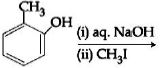
A
$2,6-$dimethylphenol
B
$2-$methylanisole
C
$2,4-$dimethylphenol
D
$4-$methylphenol
Solution
(B) The reaction involves the Williamson ether synthesis.
First,$o$-cresol ($2$-methylphenol) reacts with aqueous $NaOH$ to form sodium $o$-cresoxide,which is a nucleophilic phenoxide ion.
Then,this phenoxide ion undergoes a nucleophilic substitution $(S_N2)$ reaction with methyl iodide $(CH_3I)$ to form $2$-methylanisole ($1$-methoxy-$2$-methylbenzene) as the major product.
First,$o$-cresol ($2$-methylphenol) reacts with aqueous $NaOH$ to form sodium $o$-cresoxide,which is a nucleophilic phenoxide ion.
Then,this phenoxide ion undergoes a nucleophilic substitution $(S_N2)$ reaction with methyl iodide $(CH_3I)$ to form $2$-methylanisole ($1$-methoxy-$2$-methylbenzene) as the major product.
0 likesView Solution
120
ChemistryDifficultMCQJEE Main · 2019
What will be the major product in the following mononitration reaction?
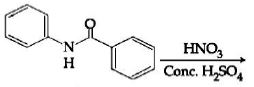
A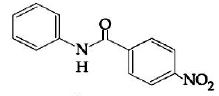
B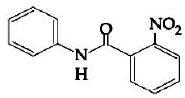
C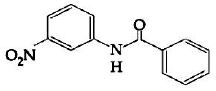
D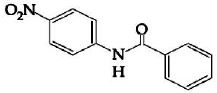
Solution
(A) The reactant is $N$-phenylbenzamide (benzanilide).
In this molecule,the nitrogen atom is attached to a phenyl ring and a carbonyl group $(C=O)$.
The lone pair on the nitrogen atom is involved in resonance with the carbonyl group,which reduces its ability to donate electron density to the attached phenyl ring.
However,the $-NH-CO-C_6H_5$ group is still an ortho/para directing group because of the lone pair on the nitrogen atom.
Among the two phenyl rings,the one attached directly to the nitrogen atom is more activated towards electrophilic aromatic substitution $(EAS)$ compared to the ring attached to the carbonyl group (which is deactivated by the electron-withdrawing carbonyl group).
Therefore,the nitronium ion $(NO_2^+)$ will attack the more activated ring at the para position due to steric hindrance at the ortho position.
The major product is $N$-($4$-nitrophenyl)benzamide.
In this molecule,the nitrogen atom is attached to a phenyl ring and a carbonyl group $(C=O)$.
The lone pair on the nitrogen atom is involved in resonance with the carbonyl group,which reduces its ability to donate electron density to the attached phenyl ring.
However,the $-NH-CO-C_6H_5$ group is still an ortho/para directing group because of the lone pair on the nitrogen atom.
Among the two phenyl rings,the one attached directly to the nitrogen atom is more activated towards electrophilic aromatic substitution $(EAS)$ compared to the ring attached to the carbonyl group (which is deactivated by the electron-withdrawing carbonyl group).
Therefore,the nitronium ion $(NO_2^+)$ will attack the more activated ring at the para position due to steric hindrance at the ortho position.
The major product is $N$-($4$-nitrophenyl)benzamide.
0 likesView Solution
121
ChemistryDifficultMCQJEE Main · 2019
Among the following compounds,which one is found in $RNA$?
A
Cytosine
B
Uracil
C
Thymine
D
$1,3-$Dimethyluracil
Solution
(B) $RNA$ (Ribonucleic acid) contains four nitrogenous bases: Adenine,Guanine,Cytosine,and Uracil.
Option $A$ represents Cytosine,which is found in both $DNA$ and $RNA$.
Option $B$ represents Uracil,which is specifically found in $RNA$ and replaces Thymine found in $DNA$.
Option $C$ represents Thymine,which is found in $DNA$.
Option $D$ represents $1,3$-Dimethyluracil,which is not a naturally occurring base in $RNA$.
Therefore,both $A$ and $B$ are found in $RNA$. However,Uracil $(B)$ is the characteristic base that distinguishes $RNA$ from $DNA$.
Option $A$ represents Cytosine,which is found in both $DNA$ and $RNA$.
Option $B$ represents Uracil,which is specifically found in $RNA$ and replaces Thymine found in $DNA$.
Option $C$ represents Thymine,which is found in $DNA$.
Option $D$ represents $1,3$-Dimethyluracil,which is not a naturally occurring base in $RNA$.
Therefore,both $A$ and $B$ are found in $RNA$. However,Uracil $(B)$ is the characteristic base that distinguishes $RNA$ from $DNA$.
0 likesView Solution
122
ChemistryDifficultMCQJEE Main · 2019
$A$ solid having density of $9 \times 10^3 \ kg \ m^{-3}$ forms face-centred cubic crystals of edge length $200 \sqrt{2} \ pm$. What is the molar mass of the solid? [Avogadro constant $\cong 6 \times 10^{23} \ mol^{-1}$,$\pi \cong 3$]
A
$0.0432 \ kg \ mol^{-1}$
B
$0.0216 \ kg \ mol^{-1}$
C
$0.0305 \ kg \ mol^{-1}$
D
$0.4320 \ kg \ mol^{-1}$
Solution
(C) The formula for density is $d = \frac{Z \times M}{N_A \times a^3}$.
Given: $d = 9 \times 10^3 \ kg \ m^{-3}$,$Z = 4$ (for $FCC$),$N_A = 6 \times 10^{23} \ mol^{-1}$,and $a = 200 \sqrt{2} \ pm = 200 \sqrt{2} \times 10^{-12} \ m$.
Substituting the values:
$9 \times 10^3 = \frac{4 \times M}{6 \times 10^{23} \times (200 \sqrt{2} \times 10^{-12})^3}$.
$a^3 = (200 \sqrt{2} \times 10^{-12})^3 = (2 \sqrt{2} \times 10^{-10})^3 = 8 \times 2 \sqrt{2} \times 10^{-30} = 16 \sqrt{2} \times 10^{-30} \ m^3$.
Using $\sqrt{2} \approx 1.414$,$a^3 \approx 16 \times 1.414 \times 10^{-30} \approx 22.624 \times 10^{-30} \ m^3$.
$M = \frac{9 \times 10^3 \times 6 \times 10^{23} \times 22.624 \times 10^{-30}}{4} = \frac{54 \times 22.624 \times 10^{-4}}{4} = 13.5 \times 22.624 \times 10^{-4} \approx 305.4 \times 10^{-4} \ kg \ mol^{-1} = 0.0305 \ kg \ mol^{-1}$.
Given: $d = 9 \times 10^3 \ kg \ m^{-3}$,$Z = 4$ (for $FCC$),$N_A = 6 \times 10^{23} \ mol^{-1}$,and $a = 200 \sqrt{2} \ pm = 200 \sqrt{2} \times 10^{-12} \ m$.
Substituting the values:
$9 \times 10^3 = \frac{4 \times M}{6 \times 10^{23} \times (200 \sqrt{2} \times 10^{-12})^3}$.
$a^3 = (200 \sqrt{2} \times 10^{-12})^3 = (2 \sqrt{2} \times 10^{-10})^3 = 8 \times 2 \sqrt{2} \times 10^{-30} = 16 \sqrt{2} \times 10^{-30} \ m^3$.
Using $\sqrt{2} \approx 1.414$,$a^3 \approx 16 \times 1.414 \times 10^{-30} \approx 22.624 \times 10^{-30} \ m^3$.
$M = \frac{9 \times 10^3 \times 6 \times 10^{23} \times 22.624 \times 10^{-30}}{4} = \frac{54 \times 22.624 \times 10^{-4}}{4} = 13.5 \times 22.624 \times 10^{-4} \approx 305.4 \times 10^{-4} \ kg \ mol^{-1} = 0.0305 \ kg \ mol^{-1}$.
0 likesView Solution
123
ChemistryDifficultMCQJEE Main · 2019
For the cell $Zn_{(s)} | Zn^{2+}_{(aq)} || M^{x+}_{(aq)} | M_{(s)}$,different half cells and their standard electrode potentials are given below:
If $E^o Zn^{2+}/Zn = -0.76 \ V$,which cathode will give a maximum value of $E^o_{cell}$ per electron transferred?
| $M^{x+}_{(aq)} / M_{(s)}$ | $Au^{3+}_{(aq)} / Au_{(s)}$ | $Ag^{+}_{(aq)} / Ag_{(s)}$ | $Fe^{3+}_{(aq)} / Fe^{2+}_{(aq)}$ | $Fe^{2+}_{(aq)} / Fe_{(s)}$ |
| $E^o M^{x+} / M (V)$ | $1.40$ | $0.80$ | $0.77$ | $-0.44$ |
If $E^o Zn^{2+}/Zn = -0.76 \ V$,which cathode will give a maximum value of $E^o_{cell}$ per electron transferred?
A
$Ag^{+}/Ag$
B
$Fe^{3+}/Fe^{2+}$
C
$Au^{3+}/Au$
D
$Fe^{2+}/Fe$
Solution
(A) The standard cell potential is given by $E^o_{cell} = E^o_{cathode} - E^o_{anode}$.
Given $E^o_{Zn^{2+}/Zn} = -0.76 \ V$,the anode is $Zn$.
We calculate $E^o_{cell}$ for each cathode:
$1$. For $Au^{3+}/Au$ $(n=3)$: $E^o_{cell} = 1.40 - (-0.76) = 2.16 \ V$. Value per electron = $2.16 / 3 = 0.72 \ V$.
$2$. For $Ag^{+}/Ag$ $(n=1)$: $E^o_{cell} = 0.80 - (-0.76) = 1.56 \ V$. Value per electron = $1.56 / 1 = 1.56 \ V$.
$3$. For $Fe^{3+}/Fe^{2+}$ $(n=1)$: $E^o_{cell} = 0.77 - (-0.76) = 1.53 \ V$. Value per electron = $1.53 / 1 = 1.53 \ V$.
$4$. For $Fe^{2+}/Fe$ $(n=2)$: $E^o_{cell} = -0.44 - (-0.76) = 0.32 \ V$. Value per electron = $0.32 / 2 = 0.16 \ V$.
Comparing the values,$Ag^{+}/Ag$ gives the maximum value of $E^o_{cell}$ per electron transferred.
Given $E^o_{Zn^{2+}/Zn} = -0.76 \ V$,the anode is $Zn$.
We calculate $E^o_{cell}$ for each cathode:
$1$. For $Au^{3+}/Au$ $(n=3)$: $E^o_{cell} = 1.40 - (-0.76) = 2.16 \ V$. Value per electron = $2.16 / 3 = 0.72 \ V$.
$2$. For $Ag^{+}/Ag$ $(n=1)$: $E^o_{cell} = 0.80 - (-0.76) = 1.56 \ V$. Value per electron = $1.56 / 1 = 1.56 \ V$.
$3$. For $Fe^{3+}/Fe^{2+}$ $(n=1)$: $E^o_{cell} = 0.77 - (-0.76) = 1.53 \ V$. Value per electron = $1.53 / 1 = 1.53 \ V$.
$4$. For $Fe^{2+}/Fe$ $(n=2)$: $E^o_{cell} = -0.44 - (-0.76) = 0.32 \ V$. Value per electron = $0.32 / 2 = 0.16 \ V$.
Comparing the values,$Ag^{+}/Ag$ gives the maximum value of $E^o_{cell}$ per electron transferred.
0 likesView Solution
124
ChemistryDifficultMCQJEE Main · 2019
The correct match between Item-$I$ and Item-$II$ is
| Item-$I$ | Item-$II$ |
| $a.$ Norethindrone | $p.$ Anti-biotic |
| $b.$ Ofloxacin | $q.$ Anti-fertility |
| $c.$ Equanil | $r.$ Hypertension |
| $s.$ Analgesics |
A
$a-q, b-p, c-r$
B
$a-q, b-p, c-s$
C
$a-r, b-p, c-s$
D
$a-q, b-r, c-s$
Solution
(A) The correct matches are as follows:
$a.$ Norethindrone is an anti-fertility drug $(q)$.
$b.$ Ofloxacin is an anti-biotic $(p)$.
$c.$ Equanil is a tranquilizer used for hypertension or stress $(r)$.
Therefore,the correct sequence is $a-q, b-p, c-r$.
$a.$ Norethindrone is an anti-fertility drug $(q)$.
$b.$ Ofloxacin is an anti-biotic $(p)$.
$c.$ Equanil is a tranquilizer used for hypertension or stress $(r)$.
Therefore,the correct sequence is $a-q, b-p, c-r$.
0 likesView Solution
125
ChemistryDifficultMCQJEE Main · 2019
The polymer obtained from the following reaction is:

A
$[ -C(=O)-(CH_2)_4-NH- ]_n$
B
$[ -NH-C(=O)-(CH_2)_4-C(=O)-NH- ]_n$
C
$[ -O-(CH_2)_5-C(=O)- ]_n$
D
$[ -O-C(=O)-(CH_2)_4-O- ]_n$
Solution
(C) The starting material is $6$-aminohexanoic acid $(H_2N-(CH_2)_5-COOH)$.
$(i)$ Treatment with $NaNO_2/H_3O^+$ converts the amino group to a hydroxyl group,forming $6$-hydroxyhexanoic acid $(HO-(CH_2)_5-COOH)$.
(ii) Polymerization of $6$-hydroxyhexanoic acid via self-esterification results in the polyester polycaprolactone,which has the repeating unit $[ -O-(CH_2)_5-C(=O)- ]_n$.
$(i)$ Treatment with $NaNO_2/H_3O^+$ converts the amino group to a hydroxyl group,forming $6$-hydroxyhexanoic acid $(HO-(CH_2)_5-COOH)$.
(ii) Polymerization of $6$-hydroxyhexanoic acid via self-esterification results in the polyester polycaprolactone,which has the repeating unit $[ -O-(CH_2)_5-C(=O)- ]_n$.
0 likesView Solution
126
ChemistryEasyMCQJEE Main · 2019
The element that usually does $NOT$ show variable oxidation states is
A
$Cu$
B
$Ti$
C
$Sc$
D
$V$
Solution
(C) The electronic configuration of $Sc$ $(Z=21)$ is $[Ar] 3d^1 4s^2$.
After losing three electrons,it forms $Sc^{3+}$,which has a stable noble gas configuration $([Ar])$.
Due to this stable configuration,$Sc$ does not show variable oxidation states and exhibits only $+3$ oxidation state.
After losing three electrons,it forms $Sc^{3+}$,which has a stable noble gas configuration $([Ar])$.
Due to this stable configuration,$Sc$ does not show variable oxidation states and exhibits only $+3$ oxidation state.
0 likesView Solution
127
ChemistryDifficultMCQJEE Main · 2019
An example of a solid sol is
A
Paint
B
Gem stones
C
Butter
D
Hair cream
Solution
(B) solid sol is a colloidal system in which a solid is dispersed in a solid medium. Gem stones are examples of solid sols where colored pigments are dispersed in a solid crystalline structure.
0 likesView Solution
128
ChemistryDifficultMCQJEE Main · 2019
The major product of the following reaction is:
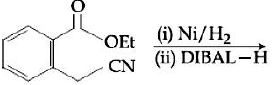
A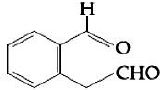
B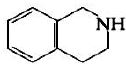
C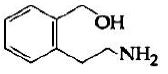
D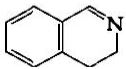
Solution
(D) Step $1$: The reaction of ethyl $2$-(cyanomethyl)benzoate with $H_2/Ni$ leads to the reduction of the nitrile group $(-CN)$ to a primary amine $(-CH_2NH_2)$.
Step $2$: The resulting amino ester undergoes intramolecular cyclization to form a cyclic amide (lactam),specifically $3,4$-dihydroisoquinolin-$1(2H)$-one.
Step $3$: The subsequent reaction with $DIBAL-H$ (diisobutylaluminium hydride) reduces the amide carbonyl group to an imine,resulting in $3,4$-dihydroisoquinoline as the final major product.
Step $2$: The resulting amino ester undergoes intramolecular cyclization to form a cyclic amide (lactam),specifically $3,4$-dihydroisoquinolin-$1(2H)$-one.
Step $3$: The subsequent reaction with $DIBAL-H$ (diisobutylaluminium hydride) reduces the amide carbonyl group to an imine,resulting in $3,4$-dihydroisoquinoline as the final major product.
0 likesView Solution
129
ChemistryDifficultMCQJEE Main · 2019
The freezing point of a diluted milk sample is found to be $-0.2\ ^\circ C$,while it should be $-0.5\ ^\circ C$ for pure milk. How much water has been added to pure milk to make the diluted sample?
A
$1$ cup of water to $2$ cups of pure milk
B
$3$ cups of water to $2$ cups of pure milk
C
$1$ cup of water to $3$ cups of pure milk
D
$2$ cups of water to $3$ cups of pure milk
Solution
(B) The depression in freezing point $\Delta T_f$ is directly proportional to the concentration of the solute in the milk. Let $V_p$ be the volume of pure milk and $V_w$ be the volume of added water.
For pure milk,the freezing point depression is proportional to the concentration $C_p = \frac{n}{V_p} = 0.5$.
For diluted milk,the concentration is $C_d = \frac{n}{V_p + V_w} = 0.2$.
Taking the ratio: $\frac{C_p}{C_d} = \frac{V_p + V_w}{V_p} = \frac{0.5}{0.2} = 2.5$.
This implies $V_p + V_w = 2.5 V_p$,so $V_w = 1.5 V_p$.
If $V_p = 2$ cups,then $V_w = 1.5 \times 2 = 3$ cups.
Thus,$3$ cups of water are added to $2$ cups of pure milk.
For pure milk,the freezing point depression is proportional to the concentration $C_p = \frac{n}{V_p} = 0.5$.
For diluted milk,the concentration is $C_d = \frac{n}{V_p + V_w} = 0.2$.
Taking the ratio: $\frac{C_p}{C_d} = \frac{V_p + V_w}{V_p} = \frac{0.5}{0.2} = 2.5$.
This implies $V_p + V_w = 2.5 V_p$,so $V_w = 1.5 V_p$.
If $V_p = 2$ cups,then $V_w = 1.5 \times 2 = 3$ cups.
Thus,$3$ cups of water are added to $2$ cups of pure milk.
0 likesView Solution
130
ChemistryMediumMCQJEE Main · 2019
If a reaction follows the Arrhenius equation,the plot $\ln k$ vs $1/(RT)$ gives a straight line with a gradient of $(-y) \ unit$. The energy required to activate the reactant is
A
$y \ unit$
B
$y/R \ unit$
C
$yR \ unit$
D
$-y \ unit$
Solution
(A) The Arrhenius equation is given by $\ln k = -\frac{E_a}{RT} + \ln A$.
Comparing this with the equation of a straight line $y = mx + c$,where $x = 1/(RT)$,the slope $m$ is equal to $-E_a$.
Given that the gradient is $-y$,we have $-E_a = -y$.
Therefore,the activation energy $E_a$ is equal to $y \ unit$.
Comparing this with the equation of a straight line $y = mx + c$,where $x = 1/(RT)$,the slope $m$ is equal to $-E_a$.
Given that the gradient is $-y$,we have $-E_a = -y$.
Therefore,the activation energy $E_a$ is equal to $y \ unit$.
0 likesView Solution
131
ChemistryDifficultMCQJEE Main · 2019
The major product of the following reaction is:
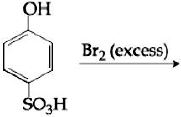
A
$2,4,6-$Tribromophenol
B
$2-$Bromo$-4-$sulfophenol
C
$2,4,6-$Tribromophenol
D
$2,6-$Dibromo$-4-$sulfophenol
Solution
(A) When $p$-hydroxybenzenesulfonic acid is treated with excess $Br_2$,the $-SO_3H$ group is replaced by a $Br$ atom because the $-OH$ group is a strong activating group and the $-SO_3H$ group is a good leaving group in this electrophilic substitution reaction. This phenomenon is known as the ipso effect. The final product is $2,4,6$-tribromophenol.
0 likesView Solution
132
ChemistryDifficultMCQJEE Main · 2019
The major product of the following reaction is
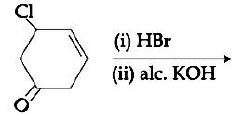
A
$6-$chlorocyclohex$-2-$en$-1-$one
B
phenol
C
$2-$chlorocyclohexa$-1,3-$dien$-1-$one
D
$6-$hydroxycyclohex$-2-$en$-1-$one
Solution
(B) The reaction proceeds as follows:
$1$. The starting material is $6$-chlorocyclohex-$2$-en-$1$-one.
$2$. Addition of $HBr$ across the double bond follows Markovnikov's rule,resulting in the formation of $6$-chloro-$3$-bromocyclohexan-$1$-one.
$3$. Treatment with alcoholic $KOH$ $(alc. KOH)$ causes dehydrohalogenation (elimination of $HBr$ and $HCl$),leading to the formation of cyclohexa-$2,4$-dien-$1$-one.
$4$. This intermediate undergoes tautomerization to form the more stable aromatic product,phenol $(C_6H_5OH)$.
$1$. The starting material is $6$-chlorocyclohex-$2$-en-$1$-one.
$2$. Addition of $HBr$ across the double bond follows Markovnikov's rule,resulting in the formation of $6$-chloro-$3$-bromocyclohexan-$1$-one.
$3$. Treatment with alcoholic $KOH$ $(alc. KOH)$ causes dehydrohalogenation (elimination of $HBr$ and $HCl$),leading to the formation of cyclohexa-$2,4$-dien-$1$-one.
$4$. This intermediate undergoes tautomerization to form the more stable aromatic product,phenol $(C_6H_5OH)$.
0 likesView Solution
133
ChemistryDifficultMCQJEE Main · 2019
Match the metal in column $I$ with the coordination compounds/enzymes in column $II$.
| Column $I$ (Metals) | Column $II$ (Coordination compounds) |
| $a. Co$ | $i. \text{Wilkinson catalyst}$ |
| $b. Zn$ | $ii. \text{Chlorophyll}$ |
| $c. Rh$ | $iii. \text{Vitamin } B_{12}$ |
| $d. Mg$ | $iv. \text{Carbonic anhydrase}$ |
A
$a-iii, b-iv, c-i, d-ii$
B
$a-i, b-ii, c-iii, d-iv$
C
$a-ii, b-i, c-iv, d-iii$
D
$a-iv, b-iii, c-i, d-ii$
Solution
$(A)$ $Co$ is the central metal ion in Vitamin $B_{12}$.
$Zn$ is the central metal ion in the enzyme Carbonic anhydrase.
$Rh$ is the central metal in the Wilkinson catalyst, which is $[RhCl(PPh_3)_3]$.
$Mg$ is the central metal ion in Chlorophyll.
Therefore, the correct match is $a-iii, b-iv, c-i, d-ii$.
$Zn$ is the central metal ion in the enzyme Carbonic anhydrase.
$Rh$ is the central metal in the Wilkinson catalyst, which is $[RhCl(PPh_3)_3]$.
$Mg$ is the central metal ion in Chlorophyll.
Therefore, the correct match is $a-iii, b-iv, c-i, d-ii$.
0 likesView Solution
134
ChemistryMediumMCQJEE Main · 2019
Match the ores (Column $A$) with the metals (Column $B$):
| Column $A$: Ores | Column $B$: Metals |
| $I$. Siderite | $a$. Zinc |
| $II$. Kaolinite | $b$. Copper |
| $III$. Malachite | $c$. Iron |
| $IV$. Calamine | $d$. Aluminium |
A
$I-a, II-b, III-c, IV-d$
B
$I-c, II-d, III-b, IV-a$
C
$I-c, II-d, III-a, IV-b$
D
$I-b, II-c, III-d, IV-a$
Solution
(B) The correct matches are as follows:
$I$. Siderite $(FeCO_3)$ $\to$ $c$. Iron $(Fe)$
$II$. Kaolinite $(Al_2Si_2O_5(OH)_4)$ $\to$ $d$. Aluminium $(Al)$
$III$. Malachite $(CuCO_3 \cdot Cu(OH)_2)$ $\to$ $b$. Copper $(Cu)$
$IV$. Calamine $(ZnCO_3)$ $\to$ $a$. Zinc $(Zn)$
Therefore,the correct sequence is $I-c, II-d, III-b, IV-a$.
$I$. Siderite $(FeCO_3)$ $\to$ $c$. Iron $(Fe)$
$II$. Kaolinite $(Al_2Si_2O_5(OH)_4)$ $\to$ $d$. Aluminium $(Al)$
$III$. Malachite $(CuCO_3 \cdot Cu(OH)_2)$ $\to$ $b$. Copper $(Cu)$
$IV$. Calamine $(ZnCO_3)$ $\to$ $a$. Zinc $(Zn)$
Therefore,the correct sequence is $I-c, II-d, III-b, IV-a$.
0 likesView Solution
135
ChemistryDifficultMCQJEE Main · 2019
The major product of the following reaction is:
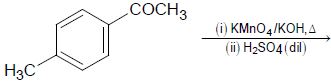
A
$4-$acetylbenzoic acid
B
$4-$formylbenzoic acid
C
benzene$-1,4-$dicarboxylic acid
D
$4-$acetylbenzoic acid
Solution
(C) The reaction involves the oxidation of alkyl side chains attached to a benzene ring using alkaline $KMnO_4$ followed by acidification.
In the given reactant,$p$-methylacetophenone $(CH_3-C_6H_4-COCH_3)$,both the methyl group $(-CH_3)$ and the acetyl group $(-COCH_3)$ are attached to the benzene ring.
Alkaline $KMnO_4$ oxidizes alkyl groups attached to the benzene ring to carboxylic acid groups $(-COOH)$,provided there is at least one benzylic hydrogen.
The methyl group $(-CH_3)$ is oxidized to $-COOH$.
The acetyl group $(-COCH_3)$ is also oxidized to $-COOH$ because the carbon atom adjacent to the benzene ring (the carbonyl carbon) is bonded to a methyl group,which effectively acts as a site for oxidation,leading to the formation of terephthalic acid (benzene$-1,4-$dicarboxylic acid).
In the given reactant,$p$-methylacetophenone $(CH_3-C_6H_4-COCH_3)$,both the methyl group $(-CH_3)$ and the acetyl group $(-COCH_3)$ are attached to the benzene ring.
Alkaline $KMnO_4$ oxidizes alkyl groups attached to the benzene ring to carboxylic acid groups $(-COOH)$,provided there is at least one benzylic hydrogen.
The methyl group $(-CH_3)$ is oxidized to $-COOH$.
The acetyl group $(-COCH_3)$ is also oxidized to $-COOH$ because the carbon atom adjacent to the benzene ring (the carbonyl carbon) is bonded to a methyl group,which effectively acts as a site for oxidation,leading to the formation of terephthalic acid (benzene$-1,4-$dicarboxylic acid).
0 likesView Solution
136
ChemistryDifficultMCQJEE Main · 2019
The correct match between Item $I$ and Item $II$ is
| Item $I$ | Item $II$ |
| $A$. Allosteric effect | $P$. Molecule binding to the active site of enzyme |
| $B$. Competitive inhibitor | $Q$. Molecule crucial for communication in the body |
| $C$. Receptor | $R$. Molecule binding to a site other than the active site of enzyme |
| $D$. Poison | $S$. Molecule binding to the enzyme covalently |
A
$A \to R, B \to P, C \to Q, D \to S$
B
$A \to P, B \to R, C \to Q, D \to S$
C
$A \to R, B \to P, C \to S, D \to Q$
D
$A \to P, B \to R, C \to S, D \to Q$
Solution
(A) . Allosteric effect: $A$ molecule binds to a site other than the active site of the enzyme,changing its shape. Thus,$A \to R$.
$B$. Competitive inhibitor: $A$ molecule competes with the substrate for the active site of the enzyme. Thus,$B \to P$.
$C$. Receptor: These are proteins crucial for chemical communication in the body. Thus,$C \to Q$.
$D$. Poison: These molecules often bind to the enzyme covalently,inhibiting its activity. Thus,$D \to S$.
Therefore,the correct match is $A \to R, B \to P, C \to Q, D \to S$.
$B$. Competitive inhibitor: $A$ molecule competes with the substrate for the active site of the enzyme. Thus,$B \to P$.
$C$. Receptor: These are proteins crucial for chemical communication in the body. Thus,$C \to Q$.
$D$. Poison: These molecules often bind to the enzyme covalently,inhibiting its activity. Thus,$D \to S$.
Therefore,the correct match is $A \to R, B \to P, C \to Q, D \to S$.
0 likesView Solution
137
ChemistryMediumMCQJEE Main · 2019
The coordination number of $Th$ in $K_4[Th(C_2O_4)_4(OH_2)_2]$ is
$(C_2O_4^{2-} = \text{Oxalato})$
$(C_2O_4^{2-} = \text{Oxalato})$
A
$14$
B
$6$
C
$8$
D
$10$
Solution
(D) In the complex $K_4[Th(C_2O_4)_4(OH_2)_2]$,the central metal atom is $Th$.
The ligands present are:
$1$. Four oxalate ions $(C_2O_4^{2-})$,which are bidentate ligands. Contribution = $4 \times 2 = 8$.
$2$. Two water molecules $(OH_2)$,which are monodentate ligands. Contribution = $2 \times 1 = 2$.
The coordination number is the sum of the contributions of all ligands attached to the central metal atom.
Coordination number = $8 + 2 = 10$.
The ligands present are:
$1$. Four oxalate ions $(C_2O_4^{2-})$,which are bidentate ligands. Contribution = $4 \times 2 = 8$.
$2$. Two water molecules $(OH_2)$,which are monodentate ligands. Contribution = $2 \times 1 = 2$.
The coordination number is the sum of the contributions of all ligands attached to the central metal atom.
Coordination number = $8 + 2 = 10$.
0 likesView Solution
138
ChemistryDifficultMCQJEE Main · 2019
What is the major product obtained in the following reaction?
[Image of a substituted cyclohexane ring with a carboxylic acid group,a vinyl group,a nitro group,and an acetyl group,reacting with excess $LiAlH_4$]
[Image of a substituted cyclohexane ring with a carboxylic acid group,a vinyl group,a nitro group,and an acetyl group,reacting with excess $LiAlH_4$]
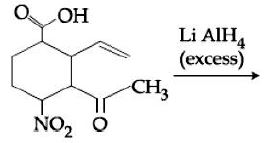
A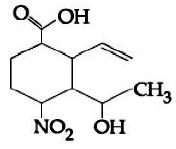
B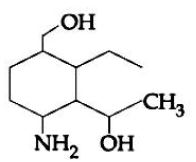
C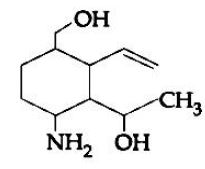
D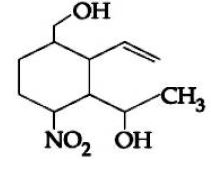
0 likesView Solution
139
ChemistryDifficultMCQJEE Main · 2019
The radius of the largest sphere which fits properly at the centre of the edge of a body-centered cubic $(BCC)$ unit cell is (Edge length is represented by $a$) (in $a$)
A
$0.0027$
B
$0.047$
C
$0.137$
D
$0.067$
Solution
(D) In a $BCC$ unit cell,the atoms touch along the body diagonal,so $\sqrt{3}a = 4R$,where $R$ is the radius of the atom at the corners and center.
Thus,$R = \frac{\sqrt{3}a}{4}$.
For a sphere of radius $r$ to fit at the center of the edge,it must touch the two corner atoms on that edge.
The distance between two corner atoms along the edge is $a$,so $2(R + r) = a$.
Substituting $R = \frac{\sqrt{3}a}{4}$ into the equation: $2(\frac{\sqrt{3}a}{4} + r) = a$.
$\frac{\sqrt{3}a}{2} + 2r = a$.
$2r = a - \frac{\sqrt{3}a}{2} = a(1 - \frac{1.732}{2}) = a(1 - 0.866) = 0.134a$.
$r = \frac{0.134a}{2} = 0.067a$.
Thus,$R = \frac{\sqrt{3}a}{4}$.
For a sphere of radius $r$ to fit at the center of the edge,it must touch the two corner atoms on that edge.
The distance between two corner atoms along the edge is $a$,so $2(R + r) = a$.
Substituting $R = \frac{\sqrt{3}a}{4}$ into the equation: $2(\frac{\sqrt{3}a}{4} + r) = a$.
$\frac{\sqrt{3}a}{2} + 2r = a$.
$2r = a - \frac{\sqrt{3}a}{2} = a(1 - \frac{1.732}{2}) = a(1 - 0.866) = 0.134a$.
$r = \frac{0.134a}{2} = 0.067a$.
0 likesView Solution
140
ChemistryDifficultMCQJEE Main · 2019
Given the equilibrium constant $K_c$ of the reaction $Cu_{(s)} + 2Ag^{+}_{(aq)} \to Cu^{2+}_{(aq)} + 2Ag_{(s)}$ is $10 \times 10^{15}$,calculate the $E_{cell}^o$ of the reaction at $298 \ K$. [Given: $2.303 \ \frac{RT}{F} \text{ at } 298 \ K = 0.059 \ V$]
A
$0.04736 \ mV$
B
$0.4736 \ mV$
C
$0.4736 \ V$
D
$0.04736 \ V$
Solution
(C) The relationship between standard cell potential $E_{cell}^o$ and equilibrium constant $K_c$ is given by:
$E_{cell}^o = \frac{2.303 \ RT}{nF} \log K_c$
Here,$n = 2$ (number of electrons transferred),$K_c = 10 \times 10^{15} = 10^{16}$,and $\frac{2.303 \ RT}{F} = 0.059 \ V$.
Substituting the values:
$E_{cell}^o = \frac{0.059}{2} \log(10^{16})$
$E_{cell}^o = \frac{0.059}{2} \times 16$
$E_{cell}^o = 0.059 \times 8 = 0.472 \ V$.
Rounding to the nearest provided option,the correct answer is $0.4736 \ V$.
$E_{cell}^o = \frac{2.303 \ RT}{nF} \log K_c$
Here,$n = 2$ (number of electrons transferred),$K_c = 10 \times 10^{15} = 10^{16}$,and $\frac{2.303 \ RT}{F} = 0.059 \ V$.
Substituting the values:
$E_{cell}^o = \frac{0.059}{2} \log(10^{16})$
$E_{cell}^o = \frac{0.059}{2} \times 16$
$E_{cell}^o = 0.059 \times 8 = 0.472 \ V$.
Rounding to the nearest provided option,the correct answer is $0.4736 \ V$.
0 likesView Solution
141
ChemistryMediumMCQJEE Main · 2019
Which of the following compounds will produce a precipitate with $AgNO_3$?
A
$3-$Bromopyridine
B
Cycloheptatrienyl bromide
C
Bromobenzene
D
Bromocyclohexane
Solution
(B) The reaction with $AgNO_3$ involves the formation of a silver halide precipitate $(AgBr)$ upon the ionization of the carbon-halogen bond to form a carbocation.
For the reaction to occur readily,the resulting carbocation must be stable.
Cycloheptatrienyl bromide ionizes to form the cycloheptatrienyl cation (tropylium ion),which is a $7$-membered aromatic ring with $6\pi$ electrons,making it highly stable due to aromaticity.
Therefore,it readily reacts with $AgNO_3$ to form a precipitate of $AgBr$.
For the reaction to occur readily,the resulting carbocation must be stable.
Cycloheptatrienyl bromide ionizes to form the cycloheptatrienyl cation (tropylium ion),which is a $7$-membered aromatic ring with $6\pi$ electrons,making it highly stable due to aromaticity.
Therefore,it readily reacts with $AgNO_3$ to form a precipitate of $AgBr$.
0 likesView Solution
142
ChemistryDifficultMCQJEE Main · 2019
Which of the following compounds reacts with ethylmagnesium bromide and also decolourizes bromine water solution?
A
$2-$acetylbenzonitrile
B
Methyl $2-$($2$-cyanophenyl)acetate
C
$1-$methoxy$-2-$vinylbenzene
D
$2-$vinylphenol
Solution
(D) To react with ethylmagnesium bromide (a Grignard reagent),the compound must contain an acidic hydrogen or an electrophilic functional group like a carbonyl or nitrile. To decolourize bromine water,the compound must contain an unsaturated bond (alkene or alkyne).
$A$: Contains a ketone and a nitrile group (reacts with Grignard) but no alkene (does not decolourize $Br_2$ water).
$B$: Contains a nitrile and an ester group (reacts with Grignard) but no alkene (does not decolourize $Br_2$ water).
$C$: Contains an alkene (decolourizes $Br_2$ water) but no acidic hydrogen or reactive electrophilic group for Grignard reagent.
$D$: Contains a phenolic $-OH$ group (acidic hydrogen,reacts with Grignard) and a vinyl group (alkene,decolourizes $Br_2$ water). Thus,$D$ is the correct answer.
$A$: Contains a ketone and a nitrile group (reacts with Grignard) but no alkene (does not decolourize $Br_2$ water).
$B$: Contains a nitrile and an ester group (reacts with Grignard) but no alkene (does not decolourize $Br_2$ water).
$C$: Contains an alkene (decolourizes $Br_2$ water) but no acidic hydrogen or reactive electrophilic group for Grignard reagent.
$D$: Contains a phenolic $-OH$ group (acidic hydrogen,reacts with Grignard) and a vinyl group (alkene,decolourizes $Br_2$ water). Thus,$D$ is the correct answer.
0 likesView Solution
143
ChemistryDifficultMCQJEE Main · 2019
In the following compound,the favourable site/s for protonation is/are:
(Image description: Adenine structure with labels $a$ on the exocyclic $-NH_2$ group,$b$ on the pyrimidine ring nitrogen,$c$ on the other pyrimidine ring nitrogen,$d$ on the imidazole ring nitrogen,and $e$ on the imidazole ring $-NH-$ group.)
(Image description: Adenine structure with labels $a$ on the exocyclic $-NH_2$ group,$b$ on the pyrimidine ring nitrogen,$c$ on the other pyrimidine ring nitrogen,$d$ on the imidazole ring nitrogen,and $e$ on the imidazole ring $-NH-$ group.)
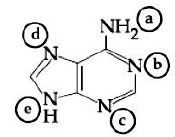
A
$a$ and $e$
B
$b, c$ and $d$
C
$a$ and $d$
D
$a$
Solution
(B) Protonation occurs at the site where the lone pair of electrons is most available for donation to a proton $(H^+)$.
In adenine,the nitrogen atoms at positions $b, c,$ and $d$ have lone pairs that are not involved in the aromatic sextet of the rings.
Specifically,the nitrogen at position $d$ is the most basic site because its lone pair is in an $sp^2$ orbital and is not involved in the aromatic system,making it highly available for protonation.
Protonation at $b, c,$ or $d$ results in a conjugate acid that is stabilized by resonance.
The exocyclic $-NH_2$ group $(a)$ has its lone pair involved in resonance with the ring,and the $-NH-$ group $(e)$ has its lone pair involved in the aromaticity of the imidazole ring,making them less basic.
Thus,the favourable sites for protonation are $b, c,$ and $d$.
In adenine,the nitrogen atoms at positions $b, c,$ and $d$ have lone pairs that are not involved in the aromatic sextet of the rings.
Specifically,the nitrogen at position $d$ is the most basic site because its lone pair is in an $sp^2$ orbital and is not involved in the aromatic system,making it highly available for protonation.
Protonation at $b, c,$ or $d$ results in a conjugate acid that is stabilized by resonance.
The exocyclic $-NH_2$ group $(a)$ has its lone pair involved in resonance with the ring,and the $-NH-$ group $(e)$ has its lone pair involved in the aromaticity of the imidazole ring,making them less basic.
Thus,the favourable sites for protonation are $b, c,$ and $d$.
0 likesView Solution
144
ChemistryMediumMCQJEE Main · 2019
The relative stability of $+1$ oxidation state of group $13$ elements follows the order:
A
$Al < Ga < In < Tl$
B
$Tl < In < Ga < Al$
C
$Ga < Al < In < Tl$
D
$Al < Ga < In < Tl$
Solution
(D) The stability of the $+1$ oxidation state increases down the group $13$ due to the inert pair effect.
As we move from $Al$ to $Tl$,the $ns^2$ electrons become more reluctant to participate in bonding.
Therefore,the order of stability of the $+1$ oxidation state is $Al < Ga < In < Tl$.
As we move from $Al$ to $Tl$,the $ns^2$ electrons become more reluctant to participate in bonding.
Therefore,the order of stability of the $+1$ oxidation state is $Al < Ga < In < Tl$.
0 likesView Solution
145
ChemistryMediumMCQJEE Main · 2019
The reaction that does not define calcination is:
A
$Fe_2O_3 \cdot XH_2O \xrightarrow{\Delta} Fe_2O_3 + XH_2O$
B
$2Cu_2S + 3O_2 \longrightarrow 2Cu_2O + 2SO_2$
C
$ZnCO_3 \xrightarrow{\Delta} ZnO + CO_2$
D
$CaCO_3 \cdot MgCO_3 \xrightarrow{\Delta} CaO + MgO + 2CO_2$
Solution
(B) Calcination is the process of heating an ore in the absence or limited supply of air to remove moisture and volatile impurities.
Option $A$ represents the removal of water of crystallization (calcination).
Option $C$ represents the thermal decomposition of carbonate ore (calcination).
Option $D$ represents the thermal decomposition of dolomite (calcination).
Option $B$ involves the reaction of sulfide ore with oxygen,which is known as roasting.
Therefore,the reaction that does not define calcination is $B$.
Option $A$ represents the removal of water of crystallization (calcination).
Option $C$ represents the thermal decomposition of carbonate ore (calcination).
Option $D$ represents the thermal decomposition of dolomite (calcination).
Option $B$ involves the reaction of sulfide ore with oxygen,which is known as roasting.
Therefore,the reaction that does not define calcination is $B$.
0 likesView Solution
146
ChemistryDifficultMCQJEE Main · 2019
$A$ compound $X$ on treatment with $Br_2/NaOH$ provided $C_3H_9N$,which gives a positive carbylamine test. Compound $X$ is
A
$CH_3COCH_2NHCH_3$
B
$CH_3CH_2COCH_2NH_2$
C
$CH_3CH_2CH_2CONH_2$
D
$CH_3CON(CH_3)_2$
Solution
(C) The reaction of a compound with $Br_2/NaOH$ is the Hofmann bromamide degradation reaction,which converts an amide $(RCONH_2)$ into a primary amine $(RNH_2)$ with one carbon atom less.
Given that the product $C_3H_9N$ gives a positive carbylamine test,it must be a primary aliphatic amine $(CH_3CH_2CH_2NH_2)$.
Since the product has $3$ carbon atoms,the starting amide must have $4$ carbon atoms.
Among the options,$CH_3CH_2CH_2CONH_2$ (butanamide) is the only primary amide with $4$ carbon atoms that would yield $CH_3CH_2CH_2NH_2$ upon reaction with $Br_2/NaOH$.
Given that the product $C_3H_9N$ gives a positive carbylamine test,it must be a primary aliphatic amine $(CH_3CH_2CH_2NH_2)$.
Since the product has $3$ carbon atoms,the starting amide must have $4$ carbon atoms.
Among the options,$CH_3CH_2CH_2CONH_2$ (butanamide) is the only primary amide with $4$ carbon atoms that would yield $CH_3CH_2CH_2NH_2$ upon reaction with $Br_2/NaOH$.
0 likesView Solution
147
ChemistryDifficultMCQJEE Main · 2019
Among the colloids cheese $(C)$,milk $(M)$ and smoke $(S)$,the correct combination of the dispersed phase and dispersion medium,respectively is
A
$C$: liquid in solid; $M$: liquid in solid; $S$: solid in gas
B
$C$: liquid in solid; $M$: liquid in liquid; $S$: solid in gas
C
$C$: solid in liquid; $M$: liquid in liquid; $S$: gas in solid
D
$C$: solid in liquid; $M$: solid in liquid; $S$: solid in gas
Solution
(B) The classification of colloids based on the physical state of the dispersed phase and dispersion medium is as follows:
$1$. Cheese $(C)$: It is a gel where liquid is dispersed in a solid medium (liquid in solid).
$2$. Milk $(M)$: It is an emulsion where liquid is dispersed in a liquid medium (liquid in liquid).
$3$. Smoke $(S)$: It is an aerosol where solid particles are dispersed in a gas medium (solid in gas).
Therefore,the correct combination is $C$: liquid in solid; $M$: liquid in liquid; $S$: solid in gas.
$1$. Cheese $(C)$: It is a gel where liquid is dispersed in a solid medium (liquid in solid).
$2$. Milk $(M)$: It is an emulsion where liquid is dispersed in a liquid medium (liquid in liquid).
$3$. Smoke $(S)$: It is an aerosol where solid particles are dispersed in a gas medium (solid in gas).
Therefore,the correct combination is $C$: liquid in solid; $M$: liquid in liquid; $S$: solid in gas.
0 likesView Solution
148
ChemistryDifficultMCQJEE Main · 2019
The homopolymer formed from $4-$hydroxybutanoic acid is:
A
$-[O-C(=O)-(CH_2)_3-O]_n-$
B
$-[C(=O)-(CH_2)_2-C(=O)]_n-$
C
$-[C(=O)-(CH_2)_2-C(=O)-O]_n-$
D
$-[C(=O)-(CH_2)_3-O]_n-$
Solution
(D) $4-$hydroxybutanoic acid $(HO-CH_2-CH_2-CH_2-COOH)$ undergoes self-condensation polymerization to form a polyester.
During this process,a water molecule is eliminated from each monomer unit.
The resulting repeating unit is $-[C(=O)-(CH_2)_3-O]_n-$.
During this process,a water molecule is eliminated from each monomer unit.
The resulting repeating unit is $-[C(=O)-(CH_2)_3-O]_n-$.
0 likesView Solution
149
ChemistryDifficultMCQJEE Main · 2019
$K_2HgI_4$ is $40 \%$ ionized in aqueous solution. The value of its van't Hoff factor $(i)$ is:
A
$1.6$
B
$1.8$
C
$2.0$
D
$2.2$
Solution
(B) The dissociation of $K_2[HgI_4]$ is given by: $K_2[HgI_4] \rightleftharpoons 2K^{+} + [HgI_4]^{2-}$
The number of ions produced per formula unit is $n = 3$ ($2K^{+}$ and $1[HgI_4]^{2-}$).
The degree of ionization is $\alpha = 40 \% = 0.4$.
The van't Hoff factor $(i)$ is calculated using the formula: $i = 1 + (n - 1)\alpha$.
Substituting the values: $i = 1 + (3 - 1) \times 0.4$.
$i = 1 + 2 \times 0.4 = 1 + 0.8 = 1.8$.
The number of ions produced per formula unit is $n = 3$ ($2K^{+}$ and $1[HgI_4]^{2-}$).
The degree of ionization is $\alpha = 40 \% = 0.4$.
The van't Hoff factor $(i)$ is calculated using the formula: $i = 1 + (n - 1)\alpha$.
Substituting the values: $i = 1 + (3 - 1) \times 0.4$.
$i = 1 + 2 \times 0.4 = 1 + 0.8 = 1.8$.
0 likesView Solution
150
ChemistryDifficultMCQJEE Main · 2019
$25 \ mL$ of the given $HCl$ solution requires $30 \ mL$ of $0.1 \ M$ sodium carbonate solution. What is the volume of this $HCl$ solution required to titrate $30 \ mL$ of $0.2 \ M$ aqueous $NaOH$ solution? .............. $mL$
A
$25$
B
$75$
C
$50$
D
$12.5$
Solution
(A) Step $1$: Determine the normality of $HCl$ using the reaction with $Na_2CO_3$.
$Na_2CO_3 + 2HCl \rightarrow 2NaCl + H_2O + CO_2$.
Using the law of equivalence: $N_1V_1 = N_2V_2$.
For $Na_2CO_3$,$N = M \times \text{valency factor} = 0.1 \times 2 = 0.2 \ N$.
$N_{HCl} \times 25 \ mL = 0.2 \ N \times 30 \ mL$.
$N_{HCl} = \frac{6}{25} = 0.24 \ N$.
Step $2$: Determine the volume of $HCl$ required for $NaOH$.
$HCl + NaOH \rightarrow NaCl + H_2O$.
Using $N_1V_1 = N_2V_2$ for $HCl$ and $NaOH$.
$0.24 \ N \times V_{HCl} = 0.2 \ M \times 1 \times 30 \ mL$.
$0.24 \times V_{HCl} = 6$.
$V_{HCl} = \frac{6}{0.24} = 25 \ mL$.
$Na_2CO_3 + 2HCl \rightarrow 2NaCl + H_2O + CO_2$.
Using the law of equivalence: $N_1V_1 = N_2V_2$.
For $Na_2CO_3$,$N = M \times \text{valency factor} = 0.1 \times 2 = 0.2 \ N$.
$N_{HCl} \times 25 \ mL = 0.2 \ N \times 30 \ mL$.
$N_{HCl} = \frac{6}{25} = 0.24 \ N$.
Step $2$: Determine the volume of $HCl$ required for $NaOH$.
$HCl + NaOH \rightarrow NaCl + H_2O$.
Using $N_1V_1 = N_2V_2$ for $HCl$ and $NaOH$.
$0.24 \ N \times V_{HCl} = 0.2 \ M \times 1 \times 30 \ mL$.
$0.24 \times V_{HCl} = 6$.
$V_{HCl} = \frac{6}{0.24} = 25 \ mL$.
0 likesView Solution
Vedclass Products
For Students
Vedclass Test Series
Mock tests in real JEE Main style covering Chemistry with performance analysis. 5-day free trial.
Start Free TrialFor Teachers
Exam Paper Generator
Generate Set A/B/C/D Chemistry papers from 7.5L+ questions in 2 minutes. 3 chapters free.
Try FreeFor Institutes
Online Exam Module
Run live JEE Main mock exams with unlimited students, 360° analytics & white-label branding.
See DemoFrequently Asked Questions
How many Chemistry questions are in JEE Main 2019?
There are 521 Chemistry questions from the JEE Main 2019 paper on Vedclass, each with a detailed step-by-step solution in English.
Are JEE Main 2019 Chemistry solutions available in English?
Yes. All solutions on this page are in English. You can also switch to English or Hindi using the language buttons above the questions.
Can I practice JEE Main 2019 Chemistry as a timed test?
Yes. Use the Vedclass Test Series to attempt a full JEE Main mock test covering Chemistry with time limits and instant score analysis.
Can teachers create Chemistry papers from JEE Main previous year questions?
Yes. The Vedclass Exam Paper Generator lets teachers mix JEE Main Chemistry questions and generate Set A/B/C/D papers in minutes.
For Teachers & Institutes
Build a Custom Chemistry Paper
Pick JEE Main 2019 Chemistry questions, set difficulty, and generate Set A/B/C/D in 2 minutes.