
ChemistryQ251–273 of 521 questions
Page 6 of 6 · English
251
ChemistryDifficultMCQJEE Main · 2019
Glucose and Galactose have identical configurations at all positions except position:
A
$C-4$
B
$C-3$
C
$C-5$
D
$C-2$
Solution
(A) Glucose and Galactose are epimers at the $C-4$ position.
In $D$-glucose,the hydroxyl group $(-OH)$ at $C-4$ is in the equatorial position (in the Haworth projection,it is below the plane).
In $D$-galactose,the hydroxyl group $(-OH)$ at $C-4$ is in the axial position (in the Haworth projection,it is above the plane).
Therefore,they differ in configuration only at the $C-4$ carbon atom.
In $D$-glucose,the hydroxyl group $(-OH)$ at $C-4$ is in the equatorial position (in the Haworth projection,it is below the plane).
In $D$-galactose,the hydroxyl group $(-OH)$ at $C-4$ is in the axial position (in the Haworth projection,it is above the plane).
Therefore,they differ in configuration only at the $C-4$ carbon atom.
0 likesView Solution
252
ChemistryMediumMCQJEE Main · 2019
Which of the following statements is not true about $RNA$?
A
It has always double stranded $\alpha - \text{helix}$ structure
B
It is present in the nucleus of the cell
C
It controls the synthesis of protein
D
It usually does not replicate
Solution
(A) $RNA$ is typically single-stranded and does not form a double-stranded $\alpha - \text{helix}$ structure like $DNA$. Therefore,the statement that it always has a double-stranded $\alpha - \text{helix}$ structure is incorrect.
0 likesView Solution
253
ChemistryDifficultMCQJEE Main · 2019
The increasing order of the $pK_b$ of the following compounds is:
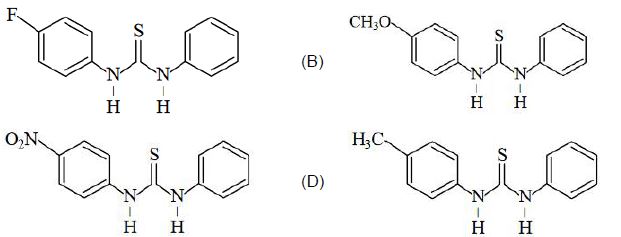
A
$(c) < (a) < (d) < (b)$
B
$(b) < (d) < (a) < (c)$
C
$(a) < (c) < (d) < (b)$
D
$(b) < (d) < (c) < (a)$
Solution
(A) The $pK_b$ value is inversely proportional to the basic strength of the compound.
Basic strength depends on the availability of the lone pair on the nitrogen atom.
Electron-donating groups $(EDG)$ increase basicity (decrease $pK_b$),while electron-withdrawing groups $(EWG)$ decrease basicity (increase $pK_b$).
The substituents on the phenyl ring are: $(A) -F$ ($EWG$ by inductive effect),$(B) -OCH_3$ ($EDG$ by resonance),$(C) -NO_2$ (strong $EWG$),$(D) -CH_3$ ($EDG$ by hyperconjugation).
Basicity order: $(B) > (D) > (A) > (C)$.
Since $pK_b$ is inversely proportional to basicity,the increasing order of $pK_b$ is: $(C) < (A) < (D) < (B)$.
Basic strength depends on the availability of the lone pair on the nitrogen atom.
Electron-donating groups $(EDG)$ increase basicity (decrease $pK_b$),while electron-withdrawing groups $(EWG)$ decrease basicity (increase $pK_b$).
The substituents on the phenyl ring are: $(A) -F$ ($EWG$ by inductive effect),$(B) -OCH_3$ ($EDG$ by resonance),$(C) -NO_2$ (strong $EWG$),$(D) -CH_3$ ($EDG$ by hyperconjugation).
Basicity order: $(B) > (D) > (A) > (C)$.
Since $pK_b$ is inversely proportional to basicity,the increasing order of $pK_b$ is: $(C) < (A) < (D) < (B)$.
0 likesView Solution
254
ChemistryDifficultMCQJEE Main · 2019
Given:
$Co^{3+} + e^- \longrightarrow Co^{2+}; E^o = 1.81 \ V$
$Pb^{4+} + 2e^- \longrightarrow Pb^{2+}; E^o = + 1.67 \ V$
$Ce^{4+} + e^- \longrightarrow Ce^{3+}; E^o = + 1.61 \ V$
$Bi^{3+} + 3e^- \longrightarrow Bi; E^o = + 0.20 \ V$
Oxidizing power of the species will increase in the order:
$Co^{3+} + e^- \longrightarrow Co^{2+}; E^o = 1.81 \ V$
$Pb^{4+} + 2e^- \longrightarrow Pb^{2+}; E^o = + 1.67 \ V$
$Ce^{4+} + e^- \longrightarrow Ce^{3+}; E^o = + 1.61 \ V$
$Bi^{3+} + 3e^- \longrightarrow Bi; E^o = + 0.20 \ V$
Oxidizing power of the species will increase in the order:
A
$Ce^{4+} < Pb^{4+} < Bi^{3+} < Co^{3+}$
B
$Co^{3+} < Pb^{4+} < Ce^{4+} < Bi^{3+}$
C
$Bi^{3+} < Ce^{4+} < Pb^{4+} < Co^{3+}$
D
$Co^{3+} < Ce^{4+} < Bi^{3+} < Pb^{4+}$
Solution
(C) The oxidizing power of a species is directly proportional to its standard reduction potential $(E^o)$.
Comparing the given values:
$Bi^{3+} (E^o = +0.20 \ V) < Ce^{4+} (E^o = +1.61 \ V) < Pb^{4+} (E^o = +1.67 \ V) < Co^{3+} (E^o = +1.81 \ V)$.
Therefore,the order of increasing oxidizing power is $Bi^{3+} < Ce^{4+} < Pb^{4+} < Co^{3+}$.
Comparing the given values:
$Bi^{3+} (E^o = +0.20 \ V) < Ce^{4+} (E^o = +1.61 \ V) < Pb^{4+} (E^o = +1.67 \ V) < Co^{3+} (E^o = +1.81 \ V)$.
Therefore,the order of increasing oxidizing power is $Bi^{3+} < Ce^{4+} < Pb^{4+} < Co^{3+}$.
0 likesView Solution
255
ChemistryDifficultMCQJEE Main · 2019
The major product of the following reaction is:
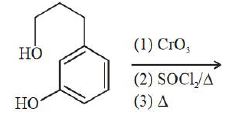
A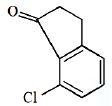
B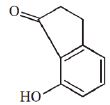
C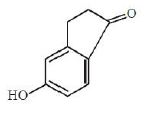
D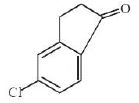
Solution
(C) Step $1$: Oxidation of the primary alcohol group with $CrO_3$ yields a carboxylic acid group. The phenolic $-OH$ group remains unaffected under these conditions.
Step $2$: Treatment with $SOCl_2/\Delta$ converts the carboxylic acid into an acid chloride $(-COCl)$.
Step $3$: Heating $(\Delta)$ induces a Friedel-Crafts acylation reaction. The acid chloride group undergoes intramolecular cyclization with the ortho-position of the phenol ring to form a cyclic ketone (indanone derivative).
The final product is a $5$-hydroxy-indanone derivative.
Step $2$: Treatment with $SOCl_2/\Delta$ converts the carboxylic acid into an acid chloride $(-COCl)$.
Step $3$: Heating $(\Delta)$ induces a Friedel-Crafts acylation reaction. The acid chloride group undergoes intramolecular cyclization with the ortho-position of the phenol ring to form a cyclic ketone (indanone derivative).
The final product is a $5$-hydroxy-indanone derivative.
0 likesView Solution
256
ChemistryDifficultMCQJEE Main · 2019
Complete removal of both the axial ligands (along the $z-$ axis) from an octahedral complex leads to which of the following splitting patterns? (relative orbital energies not on scale)
A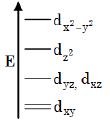
B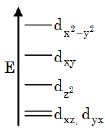
C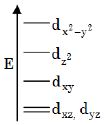
D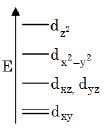
Solution
(B) In an octahedral complex,the ligands are present along the $x, y,$ and $z$ axes.
When the two ligands along the $z-$ axis are removed,the complex becomes square planar.
The ligands now exert repulsion only along the $x$ and $y$ axes.
Consequently,the orbitals with components along the $x$ and $y$ axes ($d_{x^2-y^2}$ and $d_{xy}$) will experience higher repulsion and thus have higher energy.
The $d_{z^2}$ orbital,having no ligand interaction along the $z-$ axis,will decrease significantly in energy.
The $d_{xz}$ and $d_{yz}$ orbitals will also decrease in energy but remain higher than $d_{z^2}$ due to their interaction with the $x$ and $y$ ligands.
The correct splitting pattern for a square planar complex is $d_{x^2-y^2} > d_{xy} > d_{z^2} > d_{xz}, d_{yz}$,which corresponds to the pattern shown in image $821-b1769$.
When the two ligands along the $z-$ axis are removed,the complex becomes square planar.
The ligands now exert repulsion only along the $x$ and $y$ axes.
Consequently,the orbitals with components along the $x$ and $y$ axes ($d_{x^2-y^2}$ and $d_{xy}$) will experience higher repulsion and thus have higher energy.
The $d_{z^2}$ orbital,having no ligand interaction along the $z-$ axis,will decrease significantly in energy.
The $d_{xz}$ and $d_{yz}$ orbitals will also decrease in energy but remain higher than $d_{z^2}$ due to their interaction with the $x$ and $y$ ligands.
The correct splitting pattern for a square planar complex is $d_{x^2-y^2} > d_{xy} > d_{z^2} > d_{xz}, d_{yz}$,which corresponds to the pattern shown in image $821-b1769$.
0 likesView Solution
257
ChemistryDifficultMCQJEE Main · 2019
What will be the major product when $m$-cresol is reacted with propargyl bromide $(HC \equiv C-CH_2Br)$ in the presence of $K_2CO_3$ in acetone?
A
$3-$methylphenyl prop$-2-$ynyl ether
B
$2-$propargyl$-5-$methylphenol
C
$2-$propargyl$-3-$methylphenol
D
$4-$propargyl$-3-$methylphenol
Solution
(A) $m$-Cresol reacts with $K_2CO_3$ to form the phenoxide ion ($m$-methylphenoxide).
This phenoxide ion acts as a nucleophile in an $S_N2$ reaction with propargyl bromide $(HC \equiv C-CH_2Br)$.
The oxygen atom of the phenoxide ion attacks the electrophilic carbon of the propargyl bromide,displacing the bromide ion.
This results in the formation of an ether linkage,yielding $3$-methylphenyl prop-$2$-ynyl ether as the major product.
This phenoxide ion acts as a nucleophile in an $S_N2$ reaction with propargyl bromide $(HC \equiv C-CH_2Br)$.
The oxygen atom of the phenoxide ion attacks the electrophilic carbon of the propargyl bromide,displacing the bromide ion.
This results in the formation of an ether linkage,yielding $3$-methylphenyl prop-$2$-ynyl ether as the major product.
0 likesView Solution
258
ChemistryDifficultMCQJEE Main · 2019
Which one of the following is likely to give a precipitate with $AgNO_3$ solution?
A
$CH_2=CHCl$
B
$CHCl_3$
C
$(CH_3)_3CCl$
D
$CCl_4$
Solution
(C) $(CH_3)_3CCl$ undergoes ionization to form a stable $tert$-butyl carbocation $(CH_3)_3C^+$ and a chloride ion $Cl^-$.
The $Cl^-$ ion reacts with $Ag^+$ ions from $AgNO_3$ to form a white precipitate of $AgCl$.
Other compounds like $CH_2=CHCl$ (vinyl chloride) have partial double bond character due to resonance,and $CHCl_3$ and $CCl_4$ are covalent and do not easily ionize to give $Cl^-$ ions under these conditions.
The $Cl^-$ ion reacts with $Ag^+$ ions from $AgNO_3$ to form a white precipitate of $AgCl$.
Other compounds like $CH_2=CHCl$ (vinyl chloride) have partial double bond character due to resonance,and $CHCl_3$ and $CCl_4$ are covalent and do not easily ionize to give $Cl^-$ ions under these conditions.
0 likesView Solution
259
ChemistryMediumMCQJEE Main · 2019
Benzene diazonium chloride on reaction with aniline in the presence of dilute hydrochloric acid gives:
A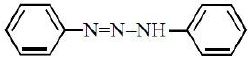
B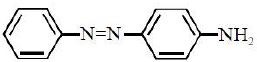
C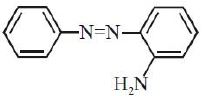
D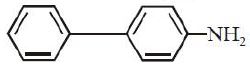
Solution
(B) When benzene diazonium chloride reacts with aniline in the presence of dilute $HCl$ at a low temperature $(273-278 \ K)$,an electrophilic substitution reaction occurs at the para-position of the aniline ring. This process is known as coupling reaction,which yields $p$-aminoazobenzene,a yellow-colored dye.
0 likesView Solution
260
ChemistryDifficultMCQJEE Main · 2019
The coordination numbers of $Co$ and $Al$ in $[Co(Cl)(en)_2]Cl$ and $K_3[Al(C_2O_4)_3]$,respectively,are ($en =$ ethane$-1,2-$diamine).
A
$6$ and $6$
B
$5$ and $3$
C
$3$ and $3$
D
$5$ and $6$
Solution
(D) The coordination number is defined as the number of ligand donor atoms to which the metal is directly bonded.
$en$ (ethane$-1,2-$diamine) is a bidentate ligand,meaning it occupies $2$ coordination sites.
In $[Co(Cl)(en)_2]Cl$,the coordination number of $Co$ is $1(Cl) + 2(2 \times en) = 5$.
$C_2O_4^{2-}$ (oxalate) is also a bidentate ligand.
In $K_3[Al(C_2O_4)_3]$,the coordination number of $Al$ is $3(C_2O_4) \times 2 = 6$.
Therefore,the coordination numbers are $5$ and $6$.
$en$ (ethane$-1,2-$diamine) is a bidentate ligand,meaning it occupies $2$ coordination sites.
In $[Co(Cl)(en)_2]Cl$,the coordination number of $Co$ is $1(Cl) + 2(2 \times en) = 5$.
$C_2O_4^{2-}$ (oxalate) is also a bidentate ligand.
In $K_3[Al(C_2O_4)_3]$,the coordination number of $Al$ is $3(C_2O_4) \times 2 = 6$.
Therefore,the coordination numbers are $5$ and $6$.
0 likesView Solution
261
ChemistryMediumMCQJEE Main · 2019
Which of the given statements is $INCORRECT$ about glycogen?
A
It is present in some yeast and fungi
B
It is present in animal cells
C
Only $\alpha -$ linkages are present in the molecule
D
It is a straight chain polymer similar to amylose
Solution
(D) Glycogen is a highly branched polysaccharide,not a straight chain polymer. It is often referred to as animal starch. It consists of $\alpha -D-$glucose units linked by $\alpha -1,4-$glycosidic bonds in the linear chains and $\alpha -1,6-$glycosidic bonds at the branch points. Therefore,the statement that it is a straight chain polymer similar to amylose is $INCORRECT$.
0 likesView Solution
262
ChemistryDifficultMCQJEE Main · 2019
The ratio of the number of atoms present in a simple cubic,body-centered cubic,and face-centered cubic unit cell is,respectively:
A
$1 : 2 : 4$
B
$4 : 2 : 3$
C
$4 : 2 : 1$
D
$8 : 1 : 6$
Solution
(A) In a simple cubic unit cell,the number of atoms is $1$.
In a body-centered cubic $(BCC)$ unit cell,the number of atoms is $2$.
In a face-centered cubic $(FCC)$ unit cell,the number of atoms is $4$.
Therefore,the ratio is $1 : 2 : 4$.
In a body-centered cubic $(BCC)$ unit cell,the number of atoms is $2$.
In a face-centered cubic $(FCC)$ unit cell,the number of atoms is $4$.
Therefore,the ratio is $1 : 2 : 4$.
0 likesView Solution
263
ChemistryDifficultMCQJEE Main · 2019
Thermal decomposition of a $Mn$ compound $(X)$ at $513 \ K$ results in compound $Y$,$MnO_2$ and a gaseous product. $MnO_2$ reacts with $NaCl$ and concentrated $H_2SO_4$ to give a pungent gas $Z$. Identify $X, Y$ and $Z$.
A
$K_2MnO_4, KMnO_4$ and $SO_2$
B
$K_3MnO_4, K_2MnO_4$ and $Cl_2$
C
$K_2MnO_4, KMnO_4$ and $Cl_2$
D
$KMnO_4, K_2MnO_4$ and $Cl_2$
Solution
(D) The thermal decomposition of potassium permanganate $(KMnO_4)$ at $513 \ K$ is given by:
$2KMnO_4 (X) \xrightarrow{513 \ K} K_2MnO_4 (Y) + MnO_2 + O_2 (g)$
Thus,$X = KMnO_4$ and $Y = K_2MnO_4$.
$MnO_2$ reacts with $NaCl$ and concentrated $H_2SO_4$ to produce chlorine gas,which is a pungent gas:
$MnO_2 + 4NaCl + 4H_2SO_4 \to MnCl_2 + 4NaHSO_4 + 2H_2O + Cl_2 (Z)$
Thus,$Z = Cl_2$.
Therefore,the correct sequence is $X = KMnO_4, Y = K_2MnO_4, Z = Cl_2$.
$2KMnO_4 (X) \xrightarrow{513 \ K} K_2MnO_4 (Y) + MnO_2 + O_2 (g)$
Thus,$X = KMnO_4$ and $Y = K_2MnO_4$.
$MnO_2$ reacts with $NaCl$ and concentrated $H_2SO_4$ to produce chlorine gas,which is a pungent gas:
$MnO_2 + 4NaCl + 4H_2SO_4 \to MnCl_2 + 4NaHSO_4 + 2H_2O + Cl_2 (Z)$
Thus,$Z = Cl_2$.
Therefore,the correct sequence is $X = KMnO_4, Y = K_2MnO_4, Z = Cl_2$.
0 likesView Solution
264
ChemistryDifficultMCQJEE Main · 2019
An 'Assertion' $(A)$ and a 'Reason' $(R)$ are given below. Choose the correct answer from the following options.
Assertion $(A)$: Vinyl halides do not undergo nucleophilic substitution easily.
Reason $(R)$: Even though the intermediate carbocation is stabilized by loosely held $p-$ electrons,the cleavage is difficult because of strong bonding.
Assertion $(A)$: Vinyl halides do not undergo nucleophilic substitution easily.
Reason $(R)$: Even though the intermediate carbocation is stabilized by loosely held $p-$ electrons,the cleavage is difficult because of strong bonding.
A
Both $(A)$ and $(R)$ are correct statements but $(R)$ is not the correct explanation of $(A)$
B
Both $(A)$ and $(R)$ are wrong statements
C
Both $(A)$ and $(R)$ are correct statements and $(R)$ is the correct explanation of $(A)$
D
$(A)$ is a correct statement but $(R)$ is a wrong statement.
Solution
(D) Vinyl halides $(CH_2=CH-X)$ do not undergo nucleophilic substitution reactions easily because of the partial double bond character between the carbon and the halogen atom due to resonance.
The reason provided is incorrect because the intermediate carbocation formed from vinyl halides is highly unstable,not stabilized,and the $C-X$ bond is strong due to $sp^2$ hybridization and resonance,making cleavage difficult.
Therefore,$(A)$ is a correct statement,but $(R)$ is a wrong statement.
The reason provided is incorrect because the intermediate carbocation formed from vinyl halides is highly unstable,not stabilized,and the $C-X$ bond is strong due to $sp^2$ hybridization and resonance,making cleavage difficult.
Therefore,$(A)$ is a correct statement,but $(R)$ is a wrong statement.
0 likesView Solution
265
ChemistryDifficultMCQJEE Main · 2019
The compound used in the treatment of lead poisoning is
A
$EDTA$
B
$Cis-platin$
C
$D-penicillamine$
D
$Desferrioxime \ B$
Solution
(A) . $EDTA$ (ethylene diamine tetraacetate) is used for the treatment of lead poisoning.
$B$. $Cis-platin$ is used as an anti-cancer drug.
$C$. $D-penicillamine$ is used for copper poisoning.
$D$. $Desferrioxime \ B$ is used for iron poisoning.
$B$. $Cis-platin$ is used as an anti-cancer drug.
$C$. $D-penicillamine$ is used for copper poisoning.
$D$. $Desferrioxime \ B$ is used for iron poisoning.
0 likesView Solution
266
ChemistryMediumMCQJEE Main · 2019
The pair that has similar atomic radii is
A
$Ti$ and $Hf$
B
$Mn$ and $Re$
C
$Sc$ and $Ni$
D
$Mo$ and $W$
Solution
(D) Due to the lanthanoid contraction, the elements of the $5d$ series have atomic radii very similar to those of the corresponding elements of the $4d$ series. $Mo$ ($4d$ series) and $W$ ($5d$ series) exhibit this phenomenon, resulting in similar atomic radii.
0 likesView Solution
267
ChemistryMediumMCQJEE Main · 2019
Which of the following statements is correct?
A
Leaching of bauxite using concentrated $NaOH$ solution gives sodium aluminate and sodium silicate.
B
The Hall-Heroult process is used for the production of aluminium and iron.
C
The blistered appearance of copper during the metallurgical process is due to the evolution of $CO_2$.
D
Pig iron is obtained from cast iron.
Solution
(A) In the leaching of bauxite $(Al_2O_3 \cdot 2H_2O)$,the ore contains impurities like $SiO_2$,$Fe_2O_3$,and $TiO_2$.
When treated with concentrated $NaOH$ solution,$Al_2O_3$ dissolves to form sodium aluminate $(Na[Al(OH)_4])$ and $SiO_2$ dissolves to form sodium silicate $(Na_2SiO_3)$.
Thus,option $A$ is correct.
Option $B$ is incorrect because the Hall-Heroult process is used only for aluminium.
Option $C$ is incorrect because the blistered appearance of copper is due to the evolution of $SO_2$ gas,not $CO_2$.
Option $D$ is incorrect because cast iron is obtained from pig iron.
When treated with concentrated $NaOH$ solution,$Al_2O_3$ dissolves to form sodium aluminate $(Na[Al(OH)_4])$ and $SiO_2$ dissolves to form sodium silicate $(Na_2SiO_3)$.
Thus,option $A$ is correct.
Option $B$ is incorrect because the Hall-Heroult process is used only for aluminium.
Option $C$ is incorrect because the blistered appearance of copper is due to the evolution of $SO_2$ gas,not $CO_2$.
Option $D$ is incorrect because cast iron is obtained from pig iron.
0 likesView Solution
268
ChemistryDifficultMCQJEE Main · 2019
$NO_2$ required for a reaction is produced by the decomposition of $N_2O_5$ in $CCl_4$ as per the equation $2N_2O_{5(g)} \to 4NO_{2(g)} + O_{2(g)}$. The initial concentration of $N_2O_5$ is $3.00 \, mol \, L^{-1}$ and it is $2.75 \, mol \, L^{-1}$ after $30 \, minutes$. The rate of formation of $NO_2$ is ............... $mol \, L^{-1} \, min^{-1}$
A
$1.667 \times 10^{-2}$
B
$4.167 \times 10^{-3}$
C
$8.333 \times 10^{-3}$
D
$2.083 \times 10^{-3}$
Solution
(A) The given reaction is $2N_2O_{5(g)} \to 4NO_{2(g)} + O_{2(g)}$.
Rate of reaction is given by: $\text{Rate} = -\frac{1}{2} \frac{\Delta [N_2O_5]}{\Delta t} = \frac{1}{4} \frac{\Delta [NO_2]}{\Delta t}$.
Change in concentration of $N_2O_5$ is $\Delta [N_2O_5] = 2.75 - 3.00 = -0.25 \, mol \, L^{-1}$.
Time interval $\Delta t = 30 \, min$.
Rate of disappearance of $N_2O_5 = -\frac{\Delta [N_2O_5]}{\Delta t} = -\frac{-0.25}{30} = 8.333 \times 10^{-3} \, mol \, L^{-1} \, min^{-1}$.
From the stoichiometry,$\frac{1}{4} \frac{\Delta [NO_2]}{\Delta t} = -\frac{1}{2} \frac{\Delta [N_2O_5]}{\Delta t}$.
Therefore,$\frac{\Delta [NO_2]}{\Delta t} = 2 \times (-\frac{\Delta [N_2O_5]}{\Delta t}) = 2 \times 8.333 \times 10^{-3} = 1.667 \times 10^{-2} \, mol \, L^{-1} \, min^{-1}$.
Rate of reaction is given by: $\text{Rate} = -\frac{1}{2} \frac{\Delta [N_2O_5]}{\Delta t} = \frac{1}{4} \frac{\Delta [NO_2]}{\Delta t}$.
Change in concentration of $N_2O_5$ is $\Delta [N_2O_5] = 2.75 - 3.00 = -0.25 \, mol \, L^{-1}$.
Time interval $\Delta t = 30 \, min$.
Rate of disappearance of $N_2O_5 = -\frac{\Delta [N_2O_5]}{\Delta t} = -\frac{-0.25}{30} = 8.333 \times 10^{-3} \, mol \, L^{-1} \, min^{-1}$.
From the stoichiometry,$\frac{1}{4} \frac{\Delta [NO_2]}{\Delta t} = -\frac{1}{2} \frac{\Delta [N_2O_5]}{\Delta t}$.
Therefore,$\frac{\Delta [NO_2]}{\Delta t} = 2 \times (-\frac{\Delta [N_2O_5]}{\Delta t}) = 2 \times 8.333 \times 10^{-3} = 1.667 \times 10^{-2} \, mol \, L^{-1} \, min^{-1}$.
0 likesView Solution
269
ChemistryDifficultMCQJEE Main · 2019
The correct name of the following polymer is
$[-CH_2-C(CH_3)_2-]_n$
$[-CH_2-C(CH_3)_2-]_n$
A
Polyisoprene
B
Polytert-butylene
C
Polyisobutane
D
Polyisobutylene
Solution
(D) The given structure is the repeating unit of a polymer formed from the monomer isobutylene $(CH_2=C(CH_3)_2)$.
Upon polymerization,the double bond breaks to form a chain,resulting in the polymer polyisobutylene.
Upon polymerization,the double bond breaks to form a chain,resulting in the polymer polyisobutylene.
0 likesView Solution
270
ChemistryDifficultMCQJEE Main · 2019
Heating of $2-$chloro$-1-$phenylbutane with $EtOK/EtOH$ gives $X$ as the major product. Reaction of $X$ with $Hg(OAc)_2/H_2O$ followed by $NaBH_4$ gives $Y$ as the major product. $Y$ is
A
$1-$phenylbutan$-2-$ol
B
$2-$phenylbutan$-2-$ol
C
$1-$phenylbutane
D
$2-$phenylbutan$-1-$ol
Solution
(A) Step $1$: Dehydrohalogenation of $2-$chloro$-1-$phenylbutane with $EtOK/EtOH$ (a strong base) proceeds via the $E2$ mechanism to form the more stable conjugated alkene,$1-$phenylbut$-1-$ene $(X)$,as the major product.
Step $2$: The reaction of $1-$phenylbut$-1-$ene $(X)$ with $Hg(OAc)_2/H_2O$ followed by $NaBH_4$ is an Oxymercuration-Demercuration $(OMDM)$ reaction.
Step $3$: $OMDM$ follows the Markovnikov addition rule,where the $-OH$ group attaches to the more substituted carbon atom of the double bond.
Step $4$: In $1-$phenylbut$-1-$ene $(Ph-CH=CH-CH_2-CH_3)$,the carbon at position $1$ is attached to a phenyl group,making it more substituted than the carbon at position $2$. Therefore,the $-OH$ group adds to the $C1$ position,yielding $1-$phenylbutan$-1-$ol as the major product $Y$.
Step $2$: The reaction of $1-$phenylbut$-1-$ene $(X)$ with $Hg(OAc)_2/H_2O$ followed by $NaBH_4$ is an Oxymercuration-Demercuration $(OMDM)$ reaction.
Step $3$: $OMDM$ follows the Markovnikov addition rule,where the $-OH$ group attaches to the more substituted carbon atom of the double bond.
Step $4$: In $1-$phenylbut$-1-$ene $(Ph-CH=CH-CH_2-CH_3)$,the carbon at position $1$ is attached to a phenyl group,making it more substituted than the carbon at position $2$. Therefore,the $-OH$ group adds to the $C1$ position,yielding $1-$phenylbutan$-1-$ol as the major product $Y$.
0 likesView Solution
271
ChemistryDifficultMCQJEE Main · 2019
Among the following,the $INCORRECT$ statement about colloids is
A
The range of diameters of colloidal particles is between $1$ and $1000 \ nm$
B
The osmotic pressure of a colloidal solution is of higher order than the true solution at the same concentration
C
They can scatter light
D
They are larger than small molecules and have high molar mass
Solution
(B) Colloidal particles are aggregates of molecules or ions with diameters ranging from $1 \ nm$ to $1000 \ nm$.
Because colloidal particles are much larger than the solute particles in a true solution,the number of particles in a given mass of colloid is much smaller than in a true solution.
Since osmotic pressure is a colligative property and depends on the number of particles,the osmotic pressure of a colloidal solution is of a lower order than that of a true solution at the same concentration.
Therefore,the statement in option $B$ is $INCORRECT$.
Because colloidal particles are much larger than the solute particles in a true solution,the number of particles in a given mass of colloid is much smaller than in a true solution.
Since osmotic pressure is a colligative property and depends on the number of particles,the osmotic pressure of a colloidal solution is of a lower order than that of a true solution at the same concentration.
Therefore,the statement in option $B$ is $INCORRECT$.
0 likesView Solution
272
ChemistryDifficultMCQJEE Main · 2019
$A$ solution is prepared by dissolving $0.6 \ g$ of urea (molar mass $= 60 \ g \ mol^{-1}$) and $1.8 \ g$ of glucose (molar mass $= 180 \ g \ mol^{-1}$) in $100 \ mL$ of water at $27 \ ^oC$. The osmotic pressure of the solution is : ............. $atm$ $(R = 0.08206 \ L \ atm \ K^{-1} \ mol^{-1})$
A
$8.2$
B
$1.64$
C
$4.92$
D
$2.46$
Solution
(C) The osmotic pressure $\pi$ is given by the formula $\pi = CRT$,where $C$ is the total molarity of the solution.
First,calculate the moles of urea: $n_{\text{urea}} = \frac{0.6 \ g}{60 \ g \ mol^{-1}} = 0.01 \ mol$.
Next,calculate the moles of glucose: $n_{\text{glucose}} = \frac{1.8 \ g}{180 \ g \ mol^{-1}} = 0.01 \ mol$.
Total moles of solute $= 0.01 + 0.01 = 0.02 \ mol$.
The volume of the solution is $100 \ mL = 0.1 \ L$.
Total molarity $C = \frac{0.02 \ mol}{0.1 \ L} = 0.2 \ M$.
Temperature $T = 27 \ ^oC = 27 + 273 = 300 \ K$.
Now,calculate osmotic pressure: $\pi = 0.2 \ mol \ L^{-1} \times 0.08206 \ L \ atm \ K^{-1} \ mol^{-1} \times 300 \ K$.
$\pi = 0.2 \times 0.08206 \times 300 = 4.9236 \ atm$.
First,calculate the moles of urea: $n_{\text{urea}} = \frac{0.6 \ g}{60 \ g \ mol^{-1}} = 0.01 \ mol$.
Next,calculate the moles of glucose: $n_{\text{glucose}} = \frac{1.8 \ g}{180 \ g \ mol^{-1}} = 0.01 \ mol$.
Total moles of solute $= 0.01 + 0.01 = 0.02 \ mol$.
The volume of the solution is $100 \ mL = 0.1 \ L$.
Total molarity $C = \frac{0.02 \ mol}{0.1 \ L} = 0.2 \ M$.
Temperature $T = 27 \ ^oC = 27 + 273 = 300 \ K$.
Now,calculate osmotic pressure: $\pi = 0.2 \ mol \ L^{-1} \times 0.08206 \ L \ atm \ K^{-1} \ mol^{-1} \times 300 \ K$.
$\pi = 0.2 \times 0.08206 \times 300 = 4.9236 \ atm$.
0 likesView Solution
273
ChemistryMediumMCQJEE Main · 2019
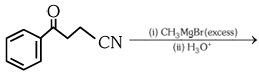
The major product of the following reaction is
A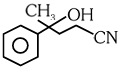
B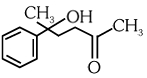
C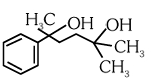
D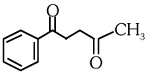
Solution
(B) The starting material is $3$-benzoylpropanenitrile. It contains both a ketone and a nitrile functional group.
When treated with excess $CH_3MgBr$,the Grignard reagent attacks both the carbonyl carbon of the ketone and the carbon of the nitrile group.
$1$. The ketone group reacts with one equivalent of $CH_3MgBr$ to form a tertiary alcohol after workup.
$2$. The nitrile group reacts with another equivalent of $CH_3MgBr$ to form an imine intermediate,which upon hydrolysis $(H_3O^+)$ yields a ketone.
Therefore,the final product is $5$-hydroxy-$5$-phenylhexan-$2$-one.
When treated with excess $CH_3MgBr$,the Grignard reagent attacks both the carbonyl carbon of the ketone and the carbon of the nitrile group.
$1$. The ketone group reacts with one equivalent of $CH_3MgBr$ to form a tertiary alcohol after workup.
$2$. The nitrile group reacts with another equivalent of $CH_3MgBr$ to form an imine intermediate,which upon hydrolysis $(H_3O^+)$ yields a ketone.
Therefore,the final product is $5$-hydroxy-$5$-phenylhexan-$2$-one.
0 likesView Solution
Vedclass Products
For Students
Vedclass Test Series
Mock tests in real JEE Main style covering Chemistry with performance analysis. 5-day free trial.
Start Free TrialFor Teachers
Exam Paper Generator
Generate Set A/B/C/D Chemistry papers from 7.5L+ questions in 2 minutes. 3 chapters free.
Try FreeFor Institutes
Online Exam Module
Run live JEE Main mock exams with unlimited students, 360° analytics & white-label branding.
See DemoFrequently Asked Questions
How many Chemistry questions are in JEE Main 2019?
There are 521 Chemistry questions from the JEE Main 2019 paper on Vedclass, each with a detailed step-by-step solution in English.
Are JEE Main 2019 Chemistry solutions available in English?
Yes. All solutions on this page are in English. You can also switch to English or Hindi using the language buttons above the questions.
Can I practice JEE Main 2019 Chemistry as a timed test?
Yes. Use the Vedclass Test Series to attempt a full JEE Main mock test covering Chemistry with time limits and instant score analysis.
Can teachers create Chemistry papers from JEE Main previous year questions?
Yes. The Vedclass Exam Paper Generator lets teachers mix JEE Main Chemistry questions and generate Set A/B/C/D papers in minutes.
For Teachers & Institutes
Build a Custom Chemistry Paper
Pick JEE Main 2019 Chemistry questions, set difficulty, and generate Set A/B/C/D in 2 minutes.