
ChemistryQ201–298 of 521 questions
Page 5 of 6 · English
201
ChemistryMediumMCQJEE Main · 2019
Which of these factors does not govern the stability of a conformation in acyclic compounds?
A
Torsional strain
B
Angle strain
C
Steric interactions
D
Electrostatic forces of interaction
Solution
(B) In acyclic compounds,the bond angles are generally free to rotate,and the carbon atoms can adopt geometries that minimize angle strain. Therefore,angle strain is not a factor that governs the stability of different conformations in acyclic compounds. Conversely,torsional strain,steric interactions,and electrostatic forces are significant factors that determine the relative stability of conformations in acyclic systems.
0 likesView Solution
202
ChemistryMediumMCQJEE Main · 2019
For the reaction,$2SO_{2(g)} + O_{2(g)} \to 2SO_{3(g)}$
$\Delta H = -57.2 \ kJ \ mol^{-1}$ and $K_C = 1.7 \times 10^{16}$
Which of the following statement is $INCORRECT$?
$\Delta H = -57.2 \ kJ \ mol^{-1}$ and $K_C = 1.7 \times 10^{16}$
Which of the following statement is $INCORRECT$?
A
The equilibrium constant is large suggestive of reaction going to completion and so no catalyst is required.
B
The equilibrium will shift in forward direction as the pressure increases.
C
The equilibrium constant decreases as the temperature increases.
D
The addition of inert gas at constant volume will not affect the equilibrium constant.
Solution
(A) In option $(A)$,the equilibrium constant is large,which suggests the reaction goes to completion,but this does not imply that no catalyst is required; catalysts are often used to increase the rate of reaction.
In option $(B)$,$\Delta n_g = 2 - (2 + 1) = -1$. Since $\Delta n_g < 0$,an increase in pressure will shift the reaction in the forward direction according to Le Chatelier's principle.
In option $(C)$,as the reaction is exothermic $(\Delta H < 0)$,an increase in temperature will decrease the equilibrium constant.
In option $(D)$,the equilibrium constant is a function of temperature only; therefore,the addition of an inert gas at constant volume does not affect the equilibrium constant.
Hence,option $(A)$ is the incorrect statement.
In option $(B)$,$\Delta n_g = 2 - (2 + 1) = -1$. Since $\Delta n_g < 0$,an increase in pressure will shift the reaction in the forward direction according to Le Chatelier's principle.
In option $(C)$,as the reaction is exothermic $(\Delta H < 0)$,an increase in temperature will decrease the equilibrium constant.
In option $(D)$,the equilibrium constant is a function of temperature only; therefore,the addition of an inert gas at constant volume does not affect the equilibrium constant.
Hence,option $(A)$ is the incorrect statement.
0 likesView Solution
203
ChemistryDifficultMCQJEE Main · 2019
Points $I$,$II$ and $III$ in the following plot respectively correspond to ($V_{mp}:$ most probable velocity).
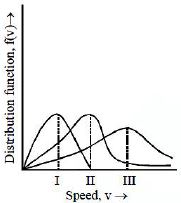
A
$V_{mp}$ of $N_2$ $(300 \ K)$; $V_{mp}$ of $H_2$ $(300 \ K)$; $V_{mp}$ of $O_2$ $(400 \ K)$
B
$V_{mp}$ of $H_2$ $(300 \ K)$; $V_{mp}$ of $N_2$ $(300 \ K)$; $V_{mp}$ of $O_2$ $(400 \ K)$
C
$V_{mp}$ of $O_2$ $(400 \ K)$; $V_{mp}$ of $N_2$ $(300 \ K)$; $V_{mp}$ of $H_2$ $(300 \ K)$
D
$V_{mp}$ of $N_2$ $(300 \ K)$; $V_{mp}$ of $O_2$ $(400 \ K)$; $V_{mp}$ of $H_2$ $(300 \ K)$
Solution
(D) The most probable velocity is given by the formula $V_{mp} = \sqrt{\frac{2RT}{M}}$,which implies $V_{mp} \propto \sqrt{\frac{T}{M}}$.
Calculating the relative values for the given gases:
$1$. For $N_2$ $(300 \ K)$: $\sqrt{\frac{300}{28}} \approx \sqrt{10.71} \approx 3.27$
$2$. For $O_2$ $(400 \ K)$: $\sqrt{\frac{400}{32}} = \sqrt{12.5} \approx 3.53$
$3$. For $H_2$ $(300 \ K)$: $\sqrt{\frac{300}{2}} = \sqrt{150} \approx 12.25$
Comparing these values,we get $V_{mp}(N_2, 300 \ K) < V_{mp}(O_2, 400 \ K) < V_{mp}(H_2, 300 \ K)$.
Thus,point $I$ corresponds to $N_2$ $(300 \ K)$,point $II$ corresponds to $O_2$ $(400 \ K)$,and point $III$ corresponds to $H_2$ $(300 \ K)$.
Calculating the relative values for the given gases:
$1$. For $N_2$ $(300 \ K)$: $\sqrt{\frac{300}{28}} \approx \sqrt{10.71} \approx 3.27$
$2$. For $O_2$ $(400 \ K)$: $\sqrt{\frac{400}{32}} = \sqrt{12.5} \approx 3.53$
$3$. For $H_2$ $(300 \ K)$: $\sqrt{\frac{300}{2}} = \sqrt{150} \approx 12.25$
Comparing these values,we get $V_{mp}(N_2, 300 \ K) < V_{mp}(O_2, 400 \ K) < V_{mp}(H_2, 300 \ K)$.
Thus,point $I$ corresponds to $N_2$ $(300 \ K)$,point $II$ corresponds to $O_2$ $(400 \ K)$,and point $III$ corresponds to $H_2$ $(300 \ K)$.
0 likesView Solution
204
ChemistryDifficultMCQJEE Main · 2019
The $pH$ of a $0.02 \ M \ NH_4Cl$ solution will be [given $K_b \ (NH_4OH) = 10^{-5}$ and $\log \ 2 = 0.301$ ]
A
$2.65$
B
$5.35$
C
$4.35$
D
$4.65$
Solution
(B) $NH_4Cl$ is a salt of a strong acid $(HCl)$ and a weak base $(NH_4OH)$.
The formula for the $pH$ of such a salt solution is:
$pH = \frac{1}{2} [pK_w - pK_b - \log C]$
Given:
$C = 0.02 \ M = 2 \times 10^{-2} \ M$
$K_b = 10^{-5} \implies pK_b = 5$
$K_w = 10^{-14} \implies pK_w = 14$
Substituting the values:
$pH = \frac{1}{2} [14 - 5 - \log(2 \times 10^{-2})]$
$pH = \frac{1}{2} [9 - (\log 2 + \log 10^{-2})]$
$pH = \frac{1}{2} [9 - (0.301 - 2)]$
$pH = \frac{1}{2} [9 - (-1.699)]$
$pH = \frac{1}{2} [10.699]$
$pH = 5.3495 \approx 5.35$
The formula for the $pH$ of such a salt solution is:
$pH = \frac{1}{2} [pK_w - pK_b - \log C]$
Given:
$C = 0.02 \ M = 2 \times 10^{-2} \ M$
$K_b = 10^{-5} \implies pK_b = 5$
$K_w = 10^{-14} \implies pK_w = 14$
Substituting the values:
$pH = \frac{1}{2} [14 - 5 - \log(2 \times 10^{-2})]$
$pH = \frac{1}{2} [9 - (\log 2 + \log 10^{-2})]$
$pH = \frac{1}{2} [9 - (0.301 - 2)]$
$pH = \frac{1}{2} [9 - (-1.699)]$
$pH = \frac{1}{2} [10.699]$
$pH = 5.3495 \approx 5.35$
0 likesView Solution
205
ChemistryDifficultMCQJEE Main · 2019
The minimum amount of $O_2\,(g)$ consumed per gram of reactant is for the reaction: (Given atomic mass: $Fe = 56, O = 16, Mg = 24, P = 31, C = 12, H = 1$)
A
$C_3H_{8(g)} + 5O_{2(g)} \to 3CO_{2(g)} + 4H_2O_{(l)}$
B
$P_{4(s)} + 5O_{2(g)} \to P_4O_{10(s)}$
C
$4Fe_{(s)} + 3O_{2(g)} \to 2Fe_2O_{3(s)}$
D
$2Mg_{(s)} + O_{2(g)} \to 2MgO_{(s)}$
Solution
(C) To find the amount of $O_2$ consumed per gram of reactant,we calculate the mass of $O_2$ required for $1 \ g$ of each reactant:
$(A)$ $C_3H_8$: Molar mass $= 3(12) + 8(1) = 44 \ g/mol$. $1 \ mol$ $C_3H_8$ reacts with $5 \ mol$ $O_2$ $(160 \ g)$. $O_2$ per gram $= 160/44 \approx 3.64 \ g$.
$(B)$ $P_4$: Molar mass $= 4(31) = 124 \ g/mol$. $1 \ mol$ $P_4$ reacts with $5 \ mol$ $O_2$ $(160 \ g)$. $O_2$ per gram $= 160/124 \approx 1.29 \ g$.
$(C)$ $Fe$: Molar mass $= 56 \ g/mol$. $4 \ mol$ $Fe$ $(224 \ g)$ react with $3 \ mol$ $O_2$ $(96 \ g)$. $O_2$ per gram $= 96/224 \approx 0.43 \ g$.
$(D)$ $Mg$: Molar mass $= 24 \ g/mol$. $2 \ mol$ $Mg$ $(48 \ g)$ react with $1 \ mol$ $O_2$ $(32 \ g)$. $O_2$ per gram $= 32/48 \approx 0.67 \ g$.
Comparing the values,the minimum amount of $O_2$ is consumed in reaction $(C)$.
$(A)$ $C_3H_8$: Molar mass $= 3(12) + 8(1) = 44 \ g/mol$. $1 \ mol$ $C_3H_8$ reacts with $5 \ mol$ $O_2$ $(160 \ g)$. $O_2$ per gram $= 160/44 \approx 3.64 \ g$.
$(B)$ $P_4$: Molar mass $= 4(31) = 124 \ g/mol$. $1 \ mol$ $P_4$ reacts with $5 \ mol$ $O_2$ $(160 \ g)$. $O_2$ per gram $= 160/124 \approx 1.29 \ g$.
$(C)$ $Fe$: Molar mass $= 56 \ g/mol$. $4 \ mol$ $Fe$ $(224 \ g)$ react with $3 \ mol$ $O_2$ $(96 \ g)$. $O_2$ per gram $= 96/224 \approx 0.43 \ g$.
$(D)$ $Mg$: Molar mass $= 24 \ g/mol$. $2 \ mol$ $Mg$ $(48 \ g)$ react with $1 \ mol$ $O_2$ $(32 \ g)$. $O_2$ per gram $= 32/48 \approx 0.67 \ g$.
Comparing the values,the minimum amount of $O_2$ is consumed in reaction $(C)$.
0 likesView Solution
206
ChemistryMCQJEE Main · 2019
If the tangent to the curve $y = \frac{x}{x^2 - 3}$,$x \in R$,$(x \neq \pm \sqrt{3})$ at a point $(\alpha, \beta) \neq (0, 0)$ on it is parallel to the line $2x + 6y - 11 = 0$,then:
A
$|2\alpha + 6\beta| = 11$
B
$|2\alpha + 6\beta| = 19$
C
$|6\alpha + 2\beta| = 19$
D
$|6\alpha + 2\beta| = 9$
Solution
(C) The slope of the tangent to the curve $y = \frac{x}{x^2 - 3}$ at $(\alpha, \beta)$ is given by $\frac{dy}{dx} = \frac{(x^2 - 3)(1) - x(2x)}{(x^2 - 3)^2} = \frac{-x^2 - 3}{(x^2 - 3)^2}$.
At point $(\alpha, \beta)$,the slope is $m = \frac{-\alpha^2 - 3}{(\alpha^2 - 3)^2}$.
The given line is $2x + 6y - 11 = 0$,which can be written as $y = -\frac{1}{3}x + \frac{11}{6}$. The slope of this line is $-\frac{1}{3}$.
Since the tangent is parallel to the line,$\frac{-\alpha^2 - 3}{(\alpha^2 - 3)^2} = -\frac{1}{3}$.
$3(\alpha^2 + 3) = (\alpha^2 - 3)^2 \Rightarrow 3\alpha^2 + 9 = \alpha^4 - 6\alpha^2 + 9 \Rightarrow \alpha^4 - 9\alpha^2 = 0$.
Since $\alpha \neq 0$,we have $\alpha^2 = 9$,so $\alpha = \pm 3$.
If $\alpha = 3$,$\beta = \frac{3}{3^2 - 3} = \frac{3}{6} = \frac{1}{2}$.
If $\alpha = -3$,$\beta = \frac{-3}{(-3)^2 - 3} = \frac{-3}{6} = -\frac{1}{2}$.
For $(\alpha, \beta) = (3, 1/2)$,$|6\alpha + 2\beta| = |6(3) + 2(1/2)| = |18 + 1| = 19$.
For $(\alpha, \beta) = (-3, -1/2)$,$|6\alpha + 2\beta| = |6(-3) + 2(-1/2)| = |-18 - 1| = 19$.
At point $(\alpha, \beta)$,the slope is $m = \frac{-\alpha^2 - 3}{(\alpha^2 - 3)^2}$.
The given line is $2x + 6y - 11 = 0$,which can be written as $y = -\frac{1}{3}x + \frac{11}{6}$. The slope of this line is $-\frac{1}{3}$.
Since the tangent is parallel to the line,$\frac{-\alpha^2 - 3}{(\alpha^2 - 3)^2} = -\frac{1}{3}$.
$3(\alpha^2 + 3) = (\alpha^2 - 3)^2 \Rightarrow 3\alpha^2 + 9 = \alpha^4 - 6\alpha^2 + 9 \Rightarrow \alpha^4 - 9\alpha^2 = 0$.
Since $\alpha \neq 0$,we have $\alpha^2 = 9$,so $\alpha = \pm 3$.
If $\alpha = 3$,$\beta = \frac{3}{3^2 - 3} = \frac{3}{6} = \frac{1}{2}$.
If $\alpha = -3$,$\beta = \frac{-3}{(-3)^2 - 3} = \frac{-3}{6} = -\frac{1}{2}$.
For $(\alpha, \beta) = (3, 1/2)$,$|6\alpha + 2\beta| = |6(3) + 2(1/2)| = |18 + 1| = 19$.
For $(\alpha, \beta) = (-3, -1/2)$,$|6\alpha + 2\beta| = |6(-3) + 2(-1/2)| = |-18 - 1| = 19$.
0 likesView Solution
207
ChemistryDifficultMCQJEE Main · 2019
The correct statement among the following is:
A
$(SiH_3)_3N$ is planar and less basic than $(CH_3)_3N$
B
$(SiH_3)_3N$ is planar and more basic than $(CH_3)_3N$
C
$(SiH_3)_3N$ is pyramidal and less basic than $(CH_3)_3N$
D
$(SiH_3)_3N$ is pyramidal and more basic than $(CH_3)_3N$
Solution
(A) In $(SiH_3)_3N$,the lone pair of electrons on the nitrogen atom is involved in $p\pi-d\pi$ back-bonding with the vacant $d$-orbitals of the silicon atoms.
This results in the molecule adopting a planar geometry ($sp^2$ hybridization).
Because the lone pair is delocalized into the $d$-orbitals of silicon,it is not readily available for donation,making $(SiH_3)_3N$ much less basic than $(CH_3)_3N$,where the lone pair is localized on the nitrogen atom.
This results in the molecule adopting a planar geometry ($sp^2$ hybridization).
Because the lone pair is delocalized into the $d$-orbitals of silicon,it is not readily available for donation,making $(SiH_3)_3N$ much less basic than $(CH_3)_3N$,where the lone pair is localized on the nitrogen atom.
0 likesView Solution
208
ChemistryMediumMCQJEE Main · 2019
The correct set of species responsible for the photochemical smog is
A
$NO$,$NO_2$,$O_3$ and hydrocarbons
B
$CO_2$,$NO_2$,$SO_2$ and hydrocarbons
C
$N_2$,$NO_2$ and hydrocarbons
D
$N_2$,$O_2$,$O_3$ and hydrocarbons
Solution
(A) Photochemical smog is formed by the action of sunlight on nitrogen oxides ($NO$,$NO_2$) and hydrocarbons released from automobiles and factories.
These pollutants react in the presence of sunlight to produce secondary pollutants like ozone $(O_3)$,formaldehyde,acrolein,and peroxyacetyl nitrate $(PAN)$.
Therefore,the primary species responsible for its formation are $NO$,$NO_2$,$O_3$,and hydrocarbons.
These pollutants react in the presence of sunlight to produce secondary pollutants like ozone $(O_3)$,formaldehyde,acrolein,and peroxyacetyl nitrate $(PAN)$.
Therefore,the primary species responsible for its formation are $NO$,$NO_2$,$O_3$,and hydrocarbons.
0 likesView Solution
209
ChemistryDifficultMCQJEE Main · 2019
The major product$(s)$ obtained in the following reaction is/are:
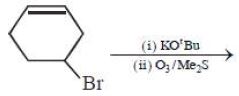
A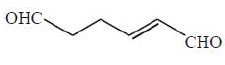
B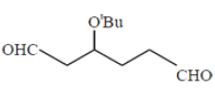
C
D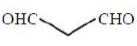
Solution
(C) Step $1$: The reaction of $3$-bromocyclohexene with $KO^tBu$ (a strong,bulky base) undergoes an $E2$ elimination reaction to form $1,3$-cyclohexadiene.
Step $2$: The subsequent reaction with $O_3/Me_2S$ is a reductive ozonolysis of $1,3$-cyclohexadiene.
Step $3$: Reductive ozonolysis of $1,3$-cyclohexadiene cleaves both double bonds to yield two molecules of glyoxal $(OHC-CHO)$ and one molecule of succinaldehyde $(OHC-CH_2-CH_2-CHO)$.
However,based on the provided options,the product is a mixture of $OHC-CH_2-CH_2-CHO$ and $OHC-CHO$.
Step $2$: The subsequent reaction with $O_3/Me_2S$ is a reductive ozonolysis of $1,3$-cyclohexadiene.
Step $3$: Reductive ozonolysis of $1,3$-cyclohexadiene cleaves both double bonds to yield two molecules of glyoxal $(OHC-CHO)$ and one molecule of succinaldehyde $(OHC-CH_2-CH_2-CHO)$.
However,based on the provided options,the product is a mixture of $OHC-CH_2-CH_2-CHO$ and $OHC-CHO$.
0 likesView Solution
210
ChemistryMediumMCQJEE Main · 2019
The major product of the following addition reaction is: $CH_3-CH=CH_2 \xrightarrow{Cl_2/H_2O}$
A
$CH_3-CH(Cl)-CH_2-OH$
B
$CH_3-CH(OH)-CH_2-Cl$
C
$CH_3-CO-CH_3$
D
$CH_3-CH-CH_2-O$ (epoxide)
Solution
(B) In the addition of chlorine water $(Cl_2/H_2O)$ to an alkene (halohydrin formation),the reaction proceeds via a cyclic chloronium ion intermediate.
The nucleophile $(H_2O)$ then attacks the more substituted carbon atom because it carries a greater partial positive charge in the transition state.
This results in the formation of $1$-chloropropan-$2$-ol as the major product.
$CH_3-CH=CH_2 + Cl_2 + H_2O \rightarrow CH_3-CH(OH)-CH_2-Cl + HCl$
The nucleophile $(H_2O)$ then attacks the more substituted carbon atom because it carries a greater partial positive charge in the transition state.
This results in the formation of $1$-chloropropan-$2$-ol as the major product.
$CH_3-CH=CH_2 + Cl_2 + H_2O \rightarrow CH_3-CH(OH)-CH_2-Cl + HCl$
0 likesView Solution
211
ChemistryDifficultMCQJEE Main · 2019
The correct sequence of thermal stability of the following carbonates is:
A
$MgCO_3 < CaCO_3 < SrCO_3 < BaCO_3$
B
$BaCO_3 < CaCO_3 < SrCO_3 < MgCO_3$
C
$MgCO_3 < SrCO_3 < CaCO_3 < BaCO_3$
D
$BaCO_3 < SrCO_3 < CaCO_3 < MgCO_3$
Solution
(A) The thermal stability of alkaline earth metal carbonates increases as the size of the cation increases down the group.
As the size of the cation increases,the polarizing power of the cation decreases,which makes the $M-O$ bond stronger and the carbonate ion more stable.
Therefore,the order of thermal stability is $MgCO_3 < CaCO_3 < SrCO_3 < BaCO_3$.
As the size of the cation increases,the polarizing power of the cation decreases,which makes the $M-O$ bond stronger and the carbonate ion more stable.
Therefore,the order of thermal stability is $MgCO_3 < CaCO_3 < SrCO_3 < BaCO_3$.
0 likesView Solution
212
ChemistryDifficultMCQJEE Main · 2019
The group number,number of valence electrons,and valency of an element with atomic number $15$,respectively,are
A
$15, 5$ and $3$
B
$15, 6$ and $2$
C
$16, 5$ and $2$
D
$16, 6$ and $3$
Solution
(A) The electronic configuration of an element with atomic number $15$ is $1s^2, 2s^2, 2p^6, 3s^2, 3p^3$.
Since the valence shell is the $3rd$ shell $(n=3)$,the number of valence electrons is $2 + 3 = 5$.
For $p$-block elements,the group number is calculated as $10 + \text{valence electrons} = 10 + 5 = 15$.
The valency is calculated as $8 - \text{valence electrons} = 8 - 5 = 3$.
Thus,the group number is $15$,the number of valence electrons is $5$,and the valency is $3$.
Since the valence shell is the $3rd$ shell $(n=3)$,the number of valence electrons is $2 + 3 = 5$.
For $p$-block elements,the group number is calculated as $10 + \text{valence electrons} = 10 + 5 = 15$.
The valency is calculated as $8 - \text{valence electrons} = 8 - 5 = 3$.
Thus,the group number is $15$,the number of valence electrons is $5$,and the valency is $3$.
0 likesView Solution
213
ChemistryDifficultMCQJEE Main · 2019
The metal that gives hydrogen gas upon treatment with both acid as well as base is
A
iron
B
magnesium
C
zinc
D
mercury
Solution
(C) Amphoteric metals react with both acids and bases to liberate hydrogen gas.
Zinc $(Zn)$ is an amphoteric metal.
Reaction with acid: $Zn + 2HCl \rightarrow ZnCl_2 + H_2 \uparrow$
Reaction with base: $Zn + 2NaOH \rightarrow Na_2ZnO_2 + H_2 \uparrow$
Zinc $(Zn)$ is an amphoteric metal.
Reaction with acid: $Zn + 2HCl \rightarrow ZnCl_2 + H_2 \uparrow$
Reaction with base: $Zn + 2NaOH \rightarrow Na_2ZnO_2 + H_2 \uparrow$
0 likesView Solution
214
ChemistryMediumMCQJEE Main · 2019
The electrons are more likely to be found
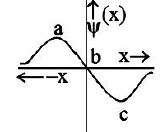
A
in the region $a$ and $b$
B
in the region $a$ and $c$
C
only in the region $a$
D
only in the region $c$
Solution
(B) The probability of finding an electron in an atom is given by the square of the wave function,$\psi^2$.
In the given graph,the regions $a$ and $c$ represent the peaks of the $\psi^2$ curve,where the probability density is maximum.
Therefore,electrons are most likely to be found in regions $a$ and $c$.
In the given graph,the regions $a$ and $c$ represent the peaks of the $\psi^2$ curve,where the probability density is maximum.
Therefore,electrons are most likely to be found in regions $a$ and $c$.
0 likesView Solution
215
ChemistryMediumMCQJEE Main · 2019
An example of a disproportionation reaction is
A
$2KMnO_4 \longrightarrow K_2MnO_4 + MnO_2 + O_2$
B
$2NaBr + Cl_2 \longrightarrow 2NaCl + Br_2$
C
$2CuBr \longrightarrow CuBr_2 + Cu$
D
$2MnO_4^- + 10I^{-} + 16H^{+} \longrightarrow 2Mn^{2+} + 5I_2 + 8H_2O$
Solution
(C) disproportionation reaction is a redox reaction in which the same element is simultaneously oxidized and reduced.
In the reaction $2CuBr \longrightarrow CuBr_2 + Cu$,the copper ion $Cu^{+}$ in $CuBr$ undergoes disproportionation.
The oxidation state of $Cu$ changes from $+1$ in $CuBr$ to $+2$ in $CuBr_2$ (oxidation) and to $0$ in $Cu$ (reduction).
Thus,the reaction is $2Cu^{+} \longrightarrow Cu^{2+} + Cu$.
In the reaction $2CuBr \longrightarrow CuBr_2 + Cu$,the copper ion $Cu^{+}$ in $CuBr$ undergoes disproportionation.
The oxidation state of $Cu$ changes from $+1$ in $CuBr$ to $+2$ in $CuBr_2$ (oxidation) and to $0$ in $Cu$ (reduction).
Thus,the reaction is $2Cu^{+} \longrightarrow Cu^{2+} + Cu$.
0 likesView Solution
216
ChemistryDifficultMCQJEE Main · 2019
$5 \, mol$ of $AB_2$ weigh $125 \times 10^{-3} \, kg$ and $10 \, mol$ of $A_2B_2$ weigh $300 \times 10^{-3} \, kg$. The molar mass of $A$ $(M_A)$ and molar mass of $B$ $(M_B)$ in $kg \, mol^{-1}$ are:
A
$M_A = 50 \times 10^{-3}$ and $M_B = 25 \times 10^{-3}$
B
$M_A = 10 \times 10^{-3}$ and $M_B = 5 \times 10^{-3}$
C
$M_A = 5 \times 10^{-3}$ and $M_B = 10 \times 10^{-3}$
D
$M_A = 25 \times 10^{-3}$ and $M_B = 50 \times 10^{-3}$
Solution
(C) Molar mass is the mass of $1 \, mol$ of a substance.
For $AB_2$: Molar mass $= \frac{125 \times 10^{-3} \, kg}{5 \, mol} = 25 \times 10^{-3} \, kg \, mol^{-1}$.
So,$M_A + 2M_B = 25 \times 10^{-3} \quad (i)$.
For $A_2B_2$: Molar mass $= \frac{300 \times 10^{-3} \, kg}{10 \, mol} = 30 \times 10^{-3} \, kg \, mol^{-1}$.
So,$2M_A + 2M_B = 30 \times 10^{-3} \quad (ii)$.
Subtracting equation $(i)$ from $(ii)$:
$(2M_A + 2M_B) - (M_A + 2M_B) = (30 - 25) \times 10^{-3}$.
$M_A = 5 \times 10^{-3} \, kg \, mol^{-1}$.
Substituting $M_A$ in equation $(i)$:
$5 \times 10^{-3} + 2M_B = 25 \times 10^{-3}$.
$2M_B = 20 \times 10^{-3}$.
$M_B = 10 \times 10^{-3} \, kg \, mol^{-1}$.
For $AB_2$: Molar mass $= \frac{125 \times 10^{-3} \, kg}{5 \, mol} = 25 \times 10^{-3} \, kg \, mol^{-1}$.
So,$M_A + 2M_B = 25 \times 10^{-3} \quad (i)$.
For $A_2B_2$: Molar mass $= \frac{300 \times 10^{-3} \, kg}{10 \, mol} = 30 \times 10^{-3} \, kg \, mol^{-1}$.
So,$2M_A + 2M_B = 30 \times 10^{-3} \quad (ii)$.
Subtracting equation $(i)$ from $(ii)$:
$(2M_A + 2M_B) - (M_A + 2M_B) = (30 - 25) \times 10^{-3}$.
$M_A = 5 \times 10^{-3} \, kg \, mol^{-1}$.
Substituting $M_A$ in equation $(i)$:
$5 \times 10^{-3} + 2M_B = 25 \times 10^{-3}$.
$2M_B = 20 \times 10^{-3}$.
$M_B = 10 \times 10^{-3} \, kg \, mol^{-1}$.
0 likesView Solution
217
ChemistryDifficultMCQJEE Main · 2019
The basic structural unit of feldspar,zeolites,mica and asbestos is
A
$[ - Si(R)_2 - O - ]_n$ (where $R = Me$)
B
$(SiO_3)^{2-}$
C
$SiO_2$
D
$(SiO_4)^{4-}$
Solution
(D) The minerals feldspar,zeolites,mica,and asbestos are all classified as silicate minerals.
The fundamental structural unit of all silicate minerals is the tetrahedral $(SiO_4)^{4-}$ anion,where one silicon atom is bonded to four oxygen atoms.
The fundamental structural unit of all silicate minerals is the tetrahedral $(SiO_4)^{4-}$ anion,where one silicon atom is bonded to four oxygen atoms.
0 likesView Solution
218
ChemistryDifficultMCQJEE Main · 2019
Enthalpy of sublimation of iodine is $24 \ cal \ g^{-1}$ at $200 \ ^oC$. If specific heat of $I_{2(s)}$ and $I_{2(vap)}$ are $0.055$ and $0.031 \ cal \ g^{-1} K^{-1}$ respectively,then enthalpy of sublimation of iodine at $250 \ ^oC$ in $cal \ g^{-1}$ is
A
$2.85$
B
$11.4$
C
$5.7$
D
$22.8$
Solution
(D) Using Kirchhoff's equation: $\Delta H_2 = \Delta H_1 + \Delta C_P (T_2 - T_1)$.
Given: $\Delta H_1 = 24 \ cal \ g^{-1}$,$T_1 = 200 + 273 = 473 \ K$,$T_2 = 250 + 273 = 523 \ K$.
$\Delta C_P = C_P(vap) - C_P(solid) = 0.031 - 0.055 = -0.024 \ cal \ g^{-1} K^{-1}$.
$\Delta H_2 = 24 + (-0.024) \times (523 - 473)$.
$\Delta H_2 = 24 - 0.024 \times 50$.
$\Delta H_2 = 24 - 1.2 = 22.8 \ cal \ g^{-1}$.
Given: $\Delta H_1 = 24 \ cal \ g^{-1}$,$T_1 = 200 + 273 = 473 \ K$,$T_2 = 250 + 273 = 523 \ K$.
$\Delta C_P = C_P(vap) - C_P(solid) = 0.031 - 0.055 = -0.024 \ cal \ g^{-1} K^{-1}$.
$\Delta H_2 = 24 + (-0.024) \times (523 - 473)$.
$\Delta H_2 = 24 - 0.024 \times 50$.
$\Delta H_2 = 24 - 1.2 = 22.8 \ cal \ g^{-1}$.
0 likesView Solution
219
ChemistryMediumMCQJEE Main · 2019
An organic compound $A$ is oxidized with $Na_2O_2$ followed by boiling with $HNO_3$. The resultant solution is then treated with ammonium molybdate to yield a yellow precipitate. Based on the above observation,the element present in the given compound is:
A
Phosphorus
B
Sulphur
C
Nitrogen
D
Fluorine
Solution
(A) The process described is the Lassaigne's test modification or a standard qualitative analysis for phosphorus. $1$. The organic compound is fused with sodium peroxide $(Na_2O_2)$ to convert phosphorus into phosphate $(PO_4^{3-})$. $2$. Boiling with $HNO_3$ removes excess peroxide and ensures the phosphorus is in the phosphate form. $3$. Upon adding ammonium molybdate $(NH_4)_2MoO_4$ in the presence of $HNO_3$,a canary yellow precipitate of ammonium phosphomolybdate $(NH_4)_3PO_4 \cdot 12MoO_3$ is formed. $4$. Therefore,the element present is phosphorus.
0 likesView Solution
220
ChemistryDifficultMCQJEE Main · 2019
What is the molar solubility of $Al(OH)_3$ in $0.2 \ M \ NaOH$ solution? Given that,the solubility product of $Al(OH)_3 = 2.4 \times 10^{-24}$.
A
$3 \times 10^{-19}$
B
$12 \times 10^{-21}$
C
$12 \times 10^{-23}$
D
$3 \times 10^{-22}$
Solution
(D) The dissociation of $Al(OH)_3$ is given by: $Al(OH)_3 \rightleftharpoons Al^{3+} + 3OH^-$
$K_{sp} = [Al^{3+}][OH^-]^3$
In $0.2 \ M \ NaOH$,the concentration of $OH^-$ is $0.2 \ M$ (assuming complete dissociation of $NaOH$ and neglecting the contribution from $Al(OH)_3$ due to the common ion effect).
Let $s$ be the molar solubility of $Al(OH)_3$.
Then $[Al^{3+}] = s$ and $[OH^-] = 0.2 + 3s \approx 0.2$.
Substituting these values into the $K_{sp}$ expression:
$2.4 \times 10^{-24} = s(0.2)^3$
$2.4 \times 10^{-24} = s(0.008)$
$s = \frac{2.4 \times 10^{-24}}{0.008} = 3 \times 10^{-22} \ M$.
$K_{sp} = [Al^{3+}][OH^-]^3$
In $0.2 \ M \ NaOH$,the concentration of $OH^-$ is $0.2 \ M$ (assuming complete dissociation of $NaOH$ and neglecting the contribution from $Al(OH)_3$ due to the common ion effect).
Let $s$ be the molar solubility of $Al(OH)_3$.
Then $[Al^{3+}] = s$ and $[OH^-] = 0.2 + 3s \approx 0.2$.
Substituting these values into the $K_{sp}$ expression:
$2.4 \times 10^{-24} = s(0.2)^3$
$2.4 \times 10^{-24} = s(0.008)$
$s = \frac{2.4 \times 10^{-24}}{0.008} = 3 \times 10^{-22} \ M$.
0 likesView Solution
221
ChemistryDifficultMCQJEE Main · 2019
But$-2-$ene on reaction with alkaline $KMnO_4$ at elevated temperature followed by acidification will give:
A
One molecule of $CH_3CHO$ and one molecule of $CH_3COOH$
B
$2$ molecules of $CH_3CHO$
C
$2$ molecules of $CH_3COOH$
D
$CH_3-CH(OH)-CH(OH)-CH_3$
Solution
(C) When but$-2-$ene $(CH_3-CH=CH-CH_3)$ reacts with alkaline $KMnO_4$ at an elevated temperature,the double bond undergoes oxidative cleavage.
Each $=CH-CH_3$ fragment is oxidized to $CH_3COOH$ (acetic acid).
Therefore,two molecules of acetic acid are formed.
$CH_3-CH=CH-CH_3$ $\xrightarrow[\Delta]{alk. KMnO_4} 2CH_3COOK$ $\xrightarrow{H^+} 2CH_3COOH$
Each $=CH-CH_3$ fragment is oxidized to $CH_3COOH$ (acetic acid).
Therefore,two molecules of acetic acid are formed.
$CH_3-CH=CH-CH_3$ $\xrightarrow[\Delta]{alk. KMnO_4} 2CH_3COOK$ $\xrightarrow{H^+} 2CH_3COOH$
0 likesView Solution
222
ChemistryMediumMCQJEE Main · 2019
An ideal gas is allowed to expand from $1 \, L$ to $10 \, L$ against a constant external pressure of $1 \, bar$. The work done in $kJ$ is
A
$-0.9$
B
$-9$
C
$-2$
D
$+10$
Solution
(A) The work done during expansion against a constant external pressure is given by the formula: $W = -P_{ext} \cdot \Delta V$.
Given: $P_{ext} = 1 \, bar$, $V_1 = 1 \, L$, $V_2 = 10 \, L$.
$\Delta V = V_2 - V_1 = 10 \, L - 1 \, L = 9 \, L$.
$W = -1 \, bar \cdot 9 \, L = -9 \, bar \cdot L$.
Since $1 \, bar \cdot L = 100 \, J$, then $W = -9 \times 100 \, J = -900 \, J$.
Converting to $kJ$: $W = -900 \, J / 1000 = -0.9 \, kJ$.
Given: $P_{ext} = 1 \, bar$, $V_1 = 1 \, L$, $V_2 = 10 \, L$.
$\Delta V = V_2 - V_1 = 10 \, L - 1 \, L = 9 \, L$.
$W = -1 \, bar \cdot 9 \, L = -9 \, bar \cdot L$.
Since $1 \, bar \cdot L = 100 \, J$, then $W = -9 \times 100 \, J = -900 \, J$.
Converting to $kJ$: $W = -900 \, J / 1000 = -0.9 \, kJ$.
0 likesView Solution
223
ChemistryMCQJEE Main · 2019
Let a random variable $X$ have a binomial distribution with mean $8$ and variance $4$. If $P(X \le 2) = \frac{k}{2^{16}}$,then $k$ is equal to
A
$17$
B
$137$
C
$1$
D
$121$
Solution
(B) Given that the mean of the binomial distribution is $np = 8$ and the variance is $npq = 4$.
Dividing the variance by the mean,we get $q = \frac{npq}{np} = \frac{4}{8} = \frac{1}{2}$.
Since $p + q = 1$,we have $p = 1 - \frac{1}{2} = \frac{1}{2}$.
Substituting $p = \frac{1}{2}$ into $np = 8$,we get $n \times \frac{1}{2} = 8$,which implies $n = 16$.
The probability mass function is $P(X = r) = ^{16}C_r (\frac{1}{2})^r (\frac{1}{2})^{16-r} = ^{16}C_r (\frac{1}{2})^{16}$.
We need to find $P(X \le 2) = P(X=0) + P(X=1) + P(X=2)$.
$P(X \le 2) = \frac{^{16}C_0 + ^{16}C_1 + ^{16}C_2}{2^{16}}$.
Calculating the combinations: $^{16}C_0 = 1$,$^{16}C_1 = 16$,and $^{16}C_2 = \frac{16 \times 15}{2} = 120$.
Summing these values: $1 + 16 + 120 = 137$.
Thus,$P(X \le 2) = \frac{137}{2^{16}}$.
Comparing this with $\frac{k}{2^{16}}$,we get $k = 137$.
Dividing the variance by the mean,we get $q = \frac{npq}{np} = \frac{4}{8} = \frac{1}{2}$.
Since $p + q = 1$,we have $p = 1 - \frac{1}{2} = \frac{1}{2}$.
Substituting $p = \frac{1}{2}$ into $np = 8$,we get $n \times \frac{1}{2} = 8$,which implies $n = 16$.
The probability mass function is $P(X = r) = ^{16}C_r (\frac{1}{2})^r (\frac{1}{2})^{16-r} = ^{16}C_r (\frac{1}{2})^{16}$.
We need to find $P(X \le 2) = P(X=0) + P(X=1) + P(X=2)$.
$P(X \le 2) = \frac{^{16}C_0 + ^{16}C_1 + ^{16}C_2}{2^{16}}$.
Calculating the combinations: $^{16}C_0 = 1$,$^{16}C_1 = 16$,and $^{16}C_2 = \frac{16 \times 15}{2} = 120$.
Summing these values: $1 + 16 + 120 = 137$.
Thus,$P(X \le 2) = \frac{137}{2^{16}}$.
Comparing this with $\frac{k}{2^{16}}$,we get $k = 137$.
0 likesView Solution
224
ChemistryMediumMCQJEE Main · 2019
The $INCORRECT$ match in the following is
A
$\Delta G^o < 0, K > 1$
B
$\Delta G^o < 0, K < 1$
C
$\Delta G^o = 0, K = 1$
D
$\Delta G^o > 0, K < 1$
Solution
(B) The relationship between standard Gibbs free energy change $(\Delta G^o)$ and the equilibrium constant $(K)$ is given by the equation: $\Delta G^o = -RT \ln K$ or $\Delta G^o = -2.303 \, RT \log K$.
$1$. If $\Delta G^o < 0$,then $\ln K > 0$,which implies $K > 1$ (Spontaneous reaction).
$2$. If $\Delta G^o = 0$,then $\ln K = 0$,which implies $K = 1$ (Equilibrium).
$3$. If $\Delta G^o > 0$,then $\ln K < 0$,which implies $K < 1$ (Non-spontaneous reaction).
Therefore,the match $\Delta G^o < 0, K < 1$ is $INCORRECT$.
$1$. If $\Delta G^o < 0$,then $\ln K > 0$,which implies $K > 1$ (Spontaneous reaction).
$2$. If $\Delta G^o = 0$,then $\ln K = 0$,which implies $K = 1$ (Equilibrium).
$3$. If $\Delta G^o > 0$,then $\ln K < 0$,which implies $K < 1$ (Non-spontaneous reaction).
Therefore,the match $\Delta G^o < 0, K < 1$ is $INCORRECT$.
0 likesView Solution
225
ChemistryDifficultMCQJEE Main · 2019
The $INCORRECT$ statement is:
A
$LiNO_3$ decomposes on heating to give $LiNO_2$ and $O_2$.
B
Lithium is least reactive with water among the alkali metals.
C
$LiCl$ crystallises from aqueous solution as $LiCl \cdot 2H_2O$.
D
Lithium is the strongest reducing agent among the alkali metals.
Solution
(A) The thermal decomposition of $LiNO_3$ is given by: $2LiNO_3 \xrightarrow{\Delta} Li_2O + 2NO_2 + \frac{1}{2}O_2$.
Thus,it produces $Li_2O$ (lithium oxide),not $LiNO_2$ (lithium nitrite).
Therefore,the statement in option $A$ is $INCORRECT$.
Thus,it produces $Li_2O$ (lithium oxide),not $LiNO_2$ (lithium nitrite).
Therefore,the statement in option $A$ is $INCORRECT$.
0 likesView Solution
226
ChemistryDifficultMCQJEE Main · 2019
The $C-C$ bond length is maximum in
A
graphite
B
$C_{70}$
C
diamond
D
$C_{60}$
Solution
(C) In $diamond$, each carbon atom is $sp^3$ hybridized and forms four single $C-C$ sigma bonds.
The bond length of a pure $C-C$ single bond is $154 \ pm$.
In $graphite$ and fullerenes ($C_{60}$, $C_{70}$), the carbon atoms are $sp^2$ hybridized, resulting in resonance and partial double bond character.
Partial double bond character leads to a shorter bond length (approximately $141.5 \ pm$ in graphite).
Therefore, the $C-C$ bond length is maximum in diamond.
The bond length of a pure $C-C$ single bond is $154 \ pm$.
In $graphite$ and fullerenes ($C_{60}$, $C_{70}$), the carbon atoms are $sp^2$ hybridized, resulting in resonance and partial double bond character.
Partial double bond character leads to a shorter bond length (approximately $141.5 \ pm$ in graphite).
Therefore, the $C-C$ bond length is maximum in diamond.
0 likesView Solution
227
ChemistryDifficultMCQJEE Main · 2019
$A \xrightarrow{Ag_2O} \text{ppt}$
$A$ $\xrightarrow{Hg^{2+} / H^{+}} B$ $\xrightarrow{NaBH_4} C$ $\xrightarrow{conc. HCl / ZnCl_2} \text{Turbidity within 5 minutes}$.
Consider the following reactions,'$A$' is:
$A$ $\xrightarrow{Hg^{2+} / H^{+}} B$ $\xrightarrow{NaBH_4} C$ $\xrightarrow{conc. HCl / ZnCl_2} \text{Turbidity within 5 minutes}$.
Consider the following reactions,'$A$' is:
A
$CH_2=CH_2$
B
$CH_3-C \equiv CH$
C
$CH \equiv CH$
D
$CH_3-C \equiv C-CH_3$
Solution
(B) reacts with $Ag_2O$ to give a precipitate,indicating it is a terminal alkyne.
$A$ undergoes hydration $(Hg^{2+}/H^{+})$ to form $B$,which is reduced by $NaBH_4$ to $C$.
$C$ gives turbidity with Lucas reagent $(conc. HCl / ZnCl_2)$ within $5 \text{ minutes}$,indicating $C$ is a secondary alcohol.
$CH_3-C \equiv CH (A) \xrightarrow{Ag_2O} CH_3-C \equiv CAg \downarrow (\text{ppt})$
$CH_3-C \equiv CH (A)$ $\xrightarrow{Hg^{2+}/H^{+}} CH_3-COCH_3 (B)$ $\xrightarrow{NaBH_4} CH_3-CH(OH)-CH_3 (C)$
$CH_3-CH(OH)-CH_3 (C) \xrightarrow{conc. HCl / ZnCl_2} CH_3-CH(Cl)-CH_3 + H_2O$ (Turbidity within $5 \text{ minutes}$).
$A$ undergoes hydration $(Hg^{2+}/H^{+})$ to form $B$,which is reduced by $NaBH_4$ to $C$.
$C$ gives turbidity with Lucas reagent $(conc. HCl / ZnCl_2)$ within $5 \text{ minutes}$,indicating $C$ is a secondary alcohol.
$CH_3-C \equiv CH (A) \xrightarrow{Ag_2O} CH_3-C \equiv CAg \downarrow (\text{ppt})$
$CH_3-C \equiv CH (A)$ $\xrightarrow{Hg^{2+}/H^{+}} CH_3-COCH_3 (B)$ $\xrightarrow{NaBH_4} CH_3-CH(OH)-CH_3 (C)$
$CH_3-CH(OH)-CH_3 (C) \xrightarrow{conc. HCl / ZnCl_2} CH_3-CH(Cl)-CH_3 + H_2O$ (Turbidity within $5 \text{ minutes}$).
0 likesView Solution
228
ChemistryMediumMCQJEE Main · 2019
In which one of the following equilibria,$K_p \neq K_c$?
A
$2NO_{(g)} \rightleftharpoons N_{2(g)} + O_{2(g)}$
B
$2C_{(s)} + O_{2(g)} \rightleftharpoons 2CO_{(g)}$
C
$NO_{2(g)} + SO_{2(g)} \rightleftharpoons NO_{(g)} + SO_{3(g)}$
D
$2HI_{(g)} \rightleftharpoons H_{2(g)} + I_{2(g)}$
Solution
(B) The relationship between $K_p$ and $K_c$ is given by the equation $K_p = K_c(RT)^{\Delta n_g}$,where $\Delta n_g$ is the change in the number of moles of gaseous products and reactants.
If $\Delta n_g = 0$,then $K_p = K_c$.
If $\Delta n_g \neq 0$,then $K_p \neq K_c$.
Let us calculate $\Delta n_g$ for each option:
$(A)$ $2NO_{(g)} \rightleftharpoons N_{2(g)} + O_{2(g)}$: $\Delta n_g = (1 + 1) - 2 = 0$.
$(B)$ $2C_{(s)} + O_{2(g)} \rightleftharpoons 2CO_{(g)}$: $\Delta n_g = 2 - 1 = 1 \neq 0$.
$(C)$ $NO_{2(g)} + SO_{2(g)} \rightleftharpoons NO_{(g)} + SO_{3(g)}$: $\Delta n_g = (1 + 1) - (1 + 1) = 0$.
$(D)$ $2HI_{(g)} \rightleftharpoons H_{2(g)} + I_{2(g)}$: $\Delta n_g = (1 + 1) - 2 = 0$.
Since $\Delta n_g \neq 0$ only in option $(B)$,$K_p \neq K_c$ for this reaction.
If $\Delta n_g = 0$,then $K_p = K_c$.
If $\Delta n_g \neq 0$,then $K_p \neq K_c$.
Let us calculate $\Delta n_g$ for each option:
$(A)$ $2NO_{(g)} \rightleftharpoons N_{2(g)} + O_{2(g)}$: $\Delta n_g = (1 + 1) - 2 = 0$.
$(B)$ $2C_{(s)} + O_{2(g)} \rightleftharpoons 2CO_{(g)}$: $\Delta n_g = 2 - 1 = 1 \neq 0$.
$(C)$ $NO_{2(g)} + SO_{2(g)} \rightleftharpoons NO_{(g)} + SO_{3(g)}$: $\Delta n_g = (1 + 1) - (1 + 1) = 0$.
$(D)$ $2HI_{(g)} \rightleftharpoons H_{2(g)} + I_{2(g)}$: $\Delta n_g = (1 + 1) - 2 = 0$.
Since $\Delta n_g \neq 0$ only in option $(B)$,$K_p \neq K_c$ for this reaction.
0 likesView Solution
229
ChemistryDifficultMCQJEE Main · 2019
The primary pollutant that leads to photochemical smog is
A
acrolein
B
nitrogen oxides
C
ozone
D
sulphur dioxide
Solution
(B) $NO_2$ and hydrocarbons are the primary precursors of photochemical smog. Nitrogen oxides $(NO_x)$ are released into the atmosphere by automobiles and factories,which then react with hydrocarbons in the presence of sunlight to form photochemical smog.
0 likesView Solution
230
ChemistryDifficultMCQJEE Main · 2019
The molar solubility of $Cd(OH)_2$ is $1.84 \times 10^{-5} \ M$ in water. The expected solubility of $Cd(OH)_2$ in a buffer solution of $pH = 12$ is
A
$6.23 \times 10^{-11} \ M$
B
$1.84 \times 10^{-9} \ M$
C
$\frac{2.49}{1.84} \times 10^{-9} \ M$
D
$2.49 \times 10^{-10} \ M$
Solution
(D) The solubility product constant $K_{sp}$ for $Cd(OH)_2$ is given by $K_{sp} = 4s^3$,where $s$ is the molar solubility in water.
$K_{sp} = 4 \times (1.84 \times 10^{-5})^3$.
Given $pH = 12$,we have $pOH = 14 - 12 = 2$.
Therefore,$[OH^-] = 10^{-2} \ M$.
Using the expression $K_{sp} = [Cd^{2+}][OH^-]^2$,we substitute the values:
$4 \times (1.84 \times 10^{-5})^3 = [Cd^{2+}] \times (10^{-2})^2$.
$[Cd^{2+}] = \frac{4 \times (1.84)^3 \times 10^{-15}}{10^{-4}}$.
$[Cd^{2+}] = 4 \times 6.2295 \times 10^{-11} \approx 2.49 \times 10^{-10} \ M$.
$K_{sp} = 4 \times (1.84 \times 10^{-5})^3$.
Given $pH = 12$,we have $pOH = 14 - 12 = 2$.
Therefore,$[OH^-] = 10^{-2} \ M$.
Using the expression $K_{sp} = [Cd^{2+}][OH^-]^2$,we substitute the values:
$4 \times (1.84 \times 10^{-5})^3 = [Cd^{2+}] \times (10^{-2})^2$.
$[Cd^{2+}] = \frac{4 \times (1.84)^3 \times 10^{-15}}{10^{-4}}$.
$[Cd^{2+}] = 4 \times 6.2295 \times 10^{-11} \approx 2.49 \times 10^{-10} \ M$.
0 likesView Solution
231
ChemistryMediumMCQJEE Main · 2019
$25 \ g$ of an unknown hydrocarbon upon burning produces $88 \ g$ of $CO_2$ and $9 \ g$ of $H_2O$. This unknown hydrocarbon contains:
A
$24 \ g$ of carbon and $1 \ g$ of hydrogen
B
$22 \ g$ of carbon and $3 \ g$ of hydrogen
C
$18 \ g$ of carbon and $7 \ g$ of hydrogen
D
$20 \ g$ of carbon and $5 \ g$ of hydrogen
Solution
(A) The combustion reaction of a hydrocarbon $C_xH_y$ is given by: $C_xH_y + (x + y/4)O_2 \to xCO_2 + (y/2)H_2O$.
Mass of $C$ in $88 \ g$ of $CO_2 = (12/44) \times 88 = 24 \ g$.
Mass of $H$ in $9 \ g$ of $H_2O = (2/18) \times 9 = 1 \ g$.
Total mass of hydrocarbon = Mass of $C$ + Mass of $H = 24 \ g + 1 \ g = 25 \ g$.
Thus,the hydrocarbon contains $24 \ g$ of carbon and $1 \ g$ of hydrogen.
Mass of $C$ in $88 \ g$ of $CO_2 = (12/44) \times 88 = 24 \ g$.
Mass of $H$ in $9 \ g$ of $H_2O = (2/18) \times 9 = 1 \ g$.
Total mass of hydrocarbon = Mass of $C$ + Mass of $H = 24 \ g + 1 \ g = 25 \ g$.
Thus,the hydrocarbon contains $24 \ g$ of carbon and $1 \ g$ of hydrogen.
0 likesView Solution
232
ChemistryDifficultMCQJEE Main · 2019
The decreasing order of electrical conductivity of the following aqueous solutions is:
$0.1 \ M$ Formic acid $(a)$
$0.1 \ M$ Acetic acid $(b)$
$0.1 \ M$ Benzoic acid $(c)$
$0.1 \ M$ Formic acid $(a)$
$0.1 \ M$ Acetic acid $(b)$
$0.1 \ M$ Benzoic acid $(c)$
A
$a > c > b$
B
$c > a > b$
C
$c > b > a$
D
$a > b > c$
Solution
(A) Electrical conductivity of an aqueous solution depends on the concentration of ions produced.
Greater the acidic strength (higher $K_a$ value),greater will be the degree of dissociation and hence higher electrical conductivity.
The $K_a$ values at $298 \ K$ are:
Formic acid $(HCOOH)$: $1.8 \times 10^{-4}$
Benzoic acid $(C_6H_5COOH)$: $6.5 \times 10^{-5}$
Acetic acid $(CH_3COOH)$: $1.8 \times 10^{-5}$
Since the order of acidic strength is Formic acid > Benzoic acid > Acetic acid,the order of electrical conductivity is $a > c > b$.
Greater the acidic strength (higher $K_a$ value),greater will be the degree of dissociation and hence higher electrical conductivity.
The $K_a$ values at $298 \ K$ are:
Formic acid $(HCOOH)$: $1.8 \times 10^{-4}$
Benzoic acid $(C_6H_5COOH)$: $6.5 \times 10^{-5}$
Acetic acid $(CH_3COOH)$: $1.8 \times 10^{-5}$
Since the order of acidic strength is Formic acid > Benzoic acid > Acetic acid,the order of electrical conductivity is $a > c > b$.
0 likesView Solution
233
ChemistryMediumMCQJEE Main · 2019
Among the following,the energy of $2s$ orbital is lowest in
A
$K$
B
$Na$
C
$H$
D
$Li$
Solution
(A) The energy of an orbital in a multi-electron system depends on the effective nuclear charge $(Z_{eff})$.
As the nuclear charge $(Z)$ increases,the attraction between the nucleus and the electrons increases,which stabilizes the orbital and lowers its energy.
Among the given elements,the atomic numbers are: $H$ $(Z=1)$,$Li$ $(Z=3)$,$Na$ $(Z=11)$,and $K$ $(Z=19)$.
Since $K$ has the highest nuclear charge $(Z=19)$,the $2s$ orbital in $K$ experiences the strongest attraction,resulting in the lowest energy.
As the nuclear charge $(Z)$ increases,the attraction between the nucleus and the electrons increases,which stabilizes the orbital and lowers its energy.
Among the given elements,the atomic numbers are: $H$ $(Z=1)$,$Li$ $(Z=3)$,$Na$ $(Z=11)$,and $K$ $(Z=19)$.
Since $K$ has the highest nuclear charge $(Z=19)$,the $2s$ orbital in $K$ experiences the strongest attraction,resulting in the lowest energy.
0 likesView Solution
234
ChemistryDifficultMCQJEE Main · 2019
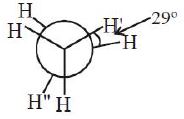
In the following Newman projection of the skew conformation of ethane,the dihedral angle between $H'$ and $H''$ is $......^\circ$. (in $^\circ$)
A
$58$
B
$120$
C
$149$
D
$151$
Solution
(C) The dihedral angle is the angle between the $C-H$ bonds on adjacent carbon atoms.
In the given Newman projection,the angle between the front $C-H'$ bond and the back $C-H''$ bond is calculated by considering the standard staggered angle of $120^\circ$ between adjacent bonds and the deviation shown.
From the geometry,the dihedral angle between $H'$ and $H''$ is the sum of the angle between the bonds in the staggered conformation $(120^\circ)$ and the given deviation angle $(29^\circ)$.
Dihedral angle $= 120^\circ + 29^\circ = 149^\circ$.
In the given Newman projection,the angle between the front $C-H'$ bond and the back $C-H''$ bond is calculated by considering the standard staggered angle of $120^\circ$ between adjacent bonds and the deviation shown.
From the geometry,the dihedral angle between $H'$ and $H''$ is the sum of the angle between the bonds in the staggered conformation $(120^\circ)$ and the given deviation angle $(29^\circ)$.
Dihedral angle $= 120^\circ + 29^\circ = 149^\circ$.
0 likesView Solution
235
ChemistryDifficultMCQJEE Main · 2019
The $IUPAC$ name of the following compound is:
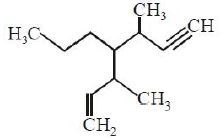
A
$3, 5-$dimethyl$-4-$propylhept$-1-$en$-6-$yne
B
$3-$methyl$-4-(1-$methylprop$-2-$ynyl)$-1-$heptene
C
$3-$methyl$-4-(3-$methylprop$-1-$enyl)$-1-$heptyne
D
$3, 5-$dimethyl$-4-$propylhept$-6-$en$-1-$yne
Solution
(A) $1$. Identify the longest carbon chain containing both the double and triple bonds. The chain has $7$ carbons,so the parent alkane is heptane.
$2$. Number the chain from the end that gives the lowest locants to the multiple bonds. Starting from the double bond end,the double bond is at $C-1$ and the triple bond is at $C-6$. If we start from the other end,the triple bond is at $C-1$ and the double bond is at $C-6$. According to $IUPAC$ rules,when both double and triple bonds are present,the double bond gets priority for the lowest number if they are at equivalent positions. Thus,the chain is numbered from the alkene end.
$3$. The substituents are two methyl groups at positions $3$ and $5$,and a propyl group at position $4$.
$4$. Combining these,the name is $3, 5-$dimethyl$-4-$propylhept$-1-$en$-6-$yne.
$2$. Number the chain from the end that gives the lowest locants to the multiple bonds. Starting from the double bond end,the double bond is at $C-1$ and the triple bond is at $C-6$. If we start from the other end,the triple bond is at $C-1$ and the double bond is at $C-6$. According to $IUPAC$ rules,when both double and triple bonds are present,the double bond gets priority for the lowest number if they are at equivalent positions. Thus,the chain is numbered from the alkene end.
$3$. The substituents are two methyl groups at positions $3$ and $5$,and a propyl group at position $4$.
$4$. Combining these,the name is $3, 5-$dimethyl$-4-$propylhept$-1-$en$-6-$yne.
0 likesView Solution
236
ChemistryDifficultMCQJEE Main · 2019
In comparison to boron,beryllium has
A
greater nuclear charge and greater first ionisation enthalpy
B
lesser nuclear charge and lesser first ionisation enthalpy
C
greater nuclear charge and lesser first ionisation enthalpy
D
lesser nuclear charge and greater first ionisation enthalpy
Solution
(D) The atomic number of beryllium $(Be)$ is $4$ and boron $(B)$ is $5$.
Since $B$ has a higher atomic number than $Be$,it has a greater nuclear charge.
The electronic configuration of $Be$ is $1s^2 2s^2$ (fully filled $s$-orbital),while $B$ is $1s^2 2s^2 2p^1$.
Due to the stable fully filled $2s$-orbital in $Be$,it requires more energy to remove an electron compared to $B$.
Therefore,$Be$ has a lesser nuclear charge and a greater first ionisation enthalpy compared to $B$.
Since $B$ has a higher atomic number than $Be$,it has a greater nuclear charge.
The electronic configuration of $Be$ is $1s^2 2s^2$ (fully filled $s$-orbital),while $B$ is $1s^2 2s^2 2p^1$.
Due to the stable fully filled $2s$-orbital in $Be$,it requires more energy to remove an electron compared to $B$.
Therefore,$Be$ has a lesser nuclear charge and a greater first ionisation enthalpy compared to $B$.
0 likesView Solution
237
ChemistryDifficultMCQJEE Main · 2019
The temporary hardness of a water sample is due to compound $X$. Boiling this sample converts $X$ to compound $Y$. $X$ and $Y$,respectively,are
A
$Mg(HCO_3)_2$ and $MgCO_3$
B
$Ca(HCO_3)_2$ and $CaO$
C
$Mg(HCO_3)_2$ and $Mg(OH)_2$
D
$Ca(HCO_3)_2$ and $Ca(OH)_2$
Solution
(C) Temporary hardness in water is caused by the presence of magnesium or calcium bicarbonates.
For magnesium bicarbonate,the reaction upon boiling is:
$Mg(HCO_3)_{2(aq)} \xrightarrow{\Delta} Mg(OH)_{2(s)} + 2CO_{2(g)}$.
Here,$X$ is $Mg(HCO_3)_2$ and $Y$ is $Mg(OH)_2$.
Thus,the correct option is $C$.
For magnesium bicarbonate,the reaction upon boiling is:
$Mg(HCO_3)_{2(aq)} \xrightarrow{\Delta} Mg(OH)_{2(s)} + 2CO_{2(g)}$.
Here,$X$ is $Mg(HCO_3)_2$ and $Y$ is $Mg(OH)_2$.
Thus,the correct option is $C$.
0 likesView Solution
238
ChemistryEasyMCQJEE Main · 2019
The element having the greatest difference between its first and second ionization energies is:
A
$Ca$
B
$Sc$
C
$Ba$
D
$K$
Solution
(D) The first ionization energy $(IE_1)$ of an element is the energy required to remove the first electron,and the second ionization energy $(IE_2)$ is the energy required to remove the second electron.
For alkali metals like potassium $(K)$,the electronic configuration is $[Ar] 4s^1$.
After the removal of the first electron,it achieves the stable noble gas configuration of argon $([Ar])$.
Removing the second electron requires breaking this stable octet,which demands a very high amount of energy.
Therefore,the difference between $IE_2$ and $IE_1$ is exceptionally large for alkali metals compared to alkaline earth metals or transition metals.
For alkali metals like potassium $(K)$,the electronic configuration is $[Ar] 4s^1$.
After the removal of the first electron,it achieves the stable noble gas configuration of argon $([Ar])$.
Removing the second electron requires breaking this stable octet,which demands a very high amount of energy.
Therefore,the difference between $IE_2$ and $IE_1$ is exceptionally large for alkali metals compared to alkaline earth metals or transition metals.
0 likesView Solution
239
ChemistryMediumMCQJEE Main · 2019
The synonym for water gas when used in the production of methanol is:
A
natural gas
B
fuel gas
C
laughing gas
D
syn gas
Solution
(D) An equimolar mixture of $CO$ and $H_{2}$ is obtained when steam is passed over red hot coke. This mixture is commonly known as synthesis gas or $syn \ gas$.
The reaction is:
$H_{2}O_{(g)} + C_{(s)} \rightarrow CO_{(g)} + H_{2(g)}$
The reaction is:
$H_{2}O_{(g)} + C_{(s)} \rightarrow CO_{(g)} + H_{2(g)}$
0 likesView Solution
240
ChemistryEasyMCQJEE Main · 2019
The correct order of hydration enthalpies of alkali metal ions is
A
$Li ^{+} > Na ^{+} > K ^{+} > Cs ^{+} > Rb ^{+}$
B
$Na ^{+} > Li ^{+} > K ^{+} > Rb ^{+} > Cs ^{+}$
C
$Na ^{+} > Li ^{+} > K ^{+} > Cs ^{+} > Rb ^{+}$
D
$Li ^{+} > Na ^{+} > K ^{+} > Rb ^{+} > Cs ^{+}$
Solution
(D) The size of alkali metal ions increases down the group as follows: $Li ^{+} < Na ^{+} < K ^{+} < Rb ^{+} < Cs ^{+}$.
Hydration enthalpy is inversely proportional to the ionic size $(Hydration \ Enthalpy \ \propto \ \frac{1}{\text{ionic size}})$.
Therefore,the smaller the ion,the higher its hydration enthalpy.
Thus,the correct order of hydration enthalpies is $Li ^{+} > Na ^{+} > K ^{+} > Rb ^{+} > Cs ^{+}$.
Hydration enthalpy is inversely proportional to the ionic size $(Hydration \ Enthalpy \ \propto \ \frac{1}{\text{ionic size}})$.
Therefore,the smaller the ion,the higher its hydration enthalpy.
Thus,the correct order of hydration enthalpies is $Li ^{+} > Na ^{+} > K ^{+} > Rb ^{+} > Cs ^{+}$.
0 likesView Solution
241
ChemistryMediumMCQJEE Main · 2019
During the change of $O_{2}$ to $O_{2}^{-}$,the incoming electron goes to the orbital:
A
$\pi 2 p_{y}$
B
$\sigma^{*} 2 p_{z}$
C
$\pi^{*} 2 p_{x}$
D
$\pi 2 p_{x}$
Solution
(C) The electronic configuration of $O_{2}$ ($16$ electrons) is: $\sigma 1s^{2} \sigma^{*} 1s^{2} \sigma 2s^{2} \sigma^{*} 2s^{2} \sigma 2p_{z}^{2} \pi 2p_{x}^{2} = \pi 2p_{y}^{2} \pi^{*} 2p_{x}^{1} = \pi^{*} 2p_{y}^{1}$.
When an electron is added to $O_{2}$ to form $O_{2}^{-}$,the incoming electron enters the lowest energy vacant or half-filled molecular orbital,which is the $\pi^{*}$ antibonding orbital.
Thus,the electron enters the $\pi^{*} 2p_{x}$ or $\pi^{*} 2p_{y}$ orbital.
Therefore,option $(C)$ is correct.
When an electron is added to $O_{2}$ to form $O_{2}^{-}$,the incoming electron enters the lowest energy vacant or half-filled molecular orbital,which is the $\pi^{*}$ antibonding orbital.
Thus,the electron enters the $\pi^{*} 2p_{x}$ or $\pi^{*} 2p_{y}$ orbital.
Therefore,option $(C)$ is correct.
0 likesView Solution
242
ChemistryMediumMCQJEE Main · 2019
In which of the following processes,the bond order increases and paramagnetic character changes to diamagnetic one?
A
$O_2 \rightarrow O_2^{2-}$
B
$NO \rightarrow NO^{+}$
C
$N_2 \rightarrow N_2^{+}$
D
$O_2 \rightarrow O_2^{+}$
Solution
(B) The electronic configuration of $NO$ ($15$ electrons) is $\sigma 1s^2, \sigma^* 1s^2, \sigma 2s^2, \sigma^* 2s^2, \sigma 2p_z^2, \pi 2p_x^2 = \pi 2p_y^2, \pi^* 2p_x^1$. It has one unpaired electron,so it is paramagnetic. Bond order $= (10-5)/2 = 2.5$.
After losing one electron,$NO^{+}$ ($14$ electrons) has the configuration $\sigma 1s^2, \sigma^* 1s^2, \sigma 2s^2, \sigma^* 2s^2, \sigma 2p_z^2, \pi 2p_x^2 = \pi 2p_y^2$. It has no unpaired electrons,so it is diamagnetic. Bond order $= (10-4)/2 = 3$.
Thus,in the process $NO \rightarrow NO^{+}$,the bond order increases from $2.5$ to $3$ and the character changes from paramagnetic to diamagnetic.
After losing one electron,$NO^{+}$ ($14$ electrons) has the configuration $\sigma 1s^2, \sigma^* 1s^2, \sigma 2s^2, \sigma^* 2s^2, \sigma 2p_z^2, \pi 2p_x^2 = \pi 2p_y^2$. It has no unpaired electrons,so it is diamagnetic. Bond order $= (10-4)/2 = 3$.
Thus,in the process $NO \rightarrow NO^{+}$,the bond order increases from $2.5$ to $3$ and the character changes from paramagnetic to diamagnetic.
0 likesView Solution
243
ChemistryMCQJEE Main · 2019
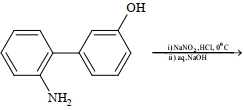
The major product of the following reaction is
A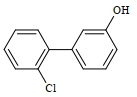
B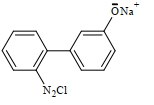
C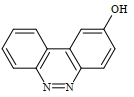
D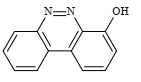
Solution
(D) The reaction proceeds in two steps:
$1$. Diazotization: The primary aromatic amine group $(-NH_2)$ reacts with $NaNO_2$ and $HCl$ at $0-5 \ ^\circ C$ to form a diazonium salt $(-N_2^+Cl^-)$.
$2$. Intramolecular Coupling: In the presence of aqueous $NaOH$,the phenolic $-OH$ group is deprotonated to form a phenoxide ion,which is a strong activating group. This phenoxide ion then undergoes an intramolecular electrophilic aromatic substitution (coupling) with the diazonium group to form a cyclic azo compound.
$1$. Diazotization: The primary aromatic amine group $(-NH_2)$ reacts with $NaNO_2$ and $HCl$ at $0-5 \ ^\circ C$ to form a diazonium salt $(-N_2^+Cl^-)$.
$2$. Intramolecular Coupling: In the presence of aqueous $NaOH$,the phenolic $-OH$ group is deprotonated to form a phenoxide ion,which is a strong activating group. This phenoxide ion then undergoes an intramolecular electrophilic aromatic substitution (coupling) with the diazonium group to form a cyclic azo compound.
0 likesView Solution
244
ChemistryMCQJEE Main · 2019
$A$ particle of mass $m$ and charge $q$ is in an electric and magnetic field,given by $\vec{E} = 2 \hat{i} + 3 \hat{j}$ and $\vec{B} = 4 \hat{j} + 6 \hat{k}$. The charged particle is shifted from the origin to the point $P(1, 1)$ along a straight path. The magnitude of the total work done on it is: (in $q$)
A
$0.35$
B
$0.15$
C
$2.5$
D
$5$
Solution
(D) The total work done on the particle is the sum of the work done by the electric field and the magnetic field.
Work done by the magnetic field on a moving charge is always zero because the magnetic force $\vec{F}_m = q(\vec{v} \times \vec{B})$ is always perpendicular to the velocity $\vec{v}$.
Thus,the total work done is equal to the work done by the electric field.
The work done by the electric field is given by $W = \vec{F}_e \cdot \vec{d} = q \vec{E} \cdot \vec{d}$.
The displacement vector is $\vec{d} = (1 - 0) \hat{i} + (1 - 0) \hat{j} = \hat{i} + \hat{j}$.
Substituting the values: $W = q(2 \hat{i} + 3 \hat{j}) \cdot (\hat{i} + \hat{j})$.
$W = q(2 \times 1 + 3 \times 1) = 5q$.
Therefore,the magnitude of the total work done is $5q$.
Work done by the magnetic field on a moving charge is always zero because the magnetic force $\vec{F}_m = q(\vec{v} \times \vec{B})$ is always perpendicular to the velocity $\vec{v}$.
Thus,the total work done is equal to the work done by the electric field.
The work done by the electric field is given by $W = \vec{F}_e \cdot \vec{d} = q \vec{E} \cdot \vec{d}$.
The displacement vector is $\vec{d} = (1 - 0) \hat{i} + (1 - 0) \hat{j} = \hat{i} + \hat{j}$.
Substituting the values: $W = q(2 \hat{i} + 3 \hat{j}) \cdot (\hat{i} + \hat{j})$.
$W = q(2 \times 1 + 3 \times 1) = 5q$.
Therefore,the magnitude of the total work done is $5q$.
0 likesView Solution
245
ChemistryMCQJEE Main · 2019
The maximum value of the function $f(x)=3x^3-18x^2+27x-40$ on the set $S=\{x \in R : x^2+30 \leq 11x\}$ is
A
$122$
B
$-122$
C
$-222$
D
$222$
Solution
(A) First,we determine the set $S$ by solving the inequality $x^2+30 \leq 11x$.
$x^2-11x+30 \leq 0$
$(x-5)(x-6) \leq 0$
Thus,$S = [5, 6]$.
Next,we find the derivative of $f(x) = 3x^3-18x^2+27x-40$:
$f'(x) = 9x^2-36x+27 = 9(x^2-4x+3) = 9(x-1)(x-3)$.
For $x \in [5, 6]$,both $(x-1)$ and $(x-3)$ are positive,so $f'(x) > 0$.
Since $f'(x) > 0$ on the interval $[5, 6]$,the function $f(x)$ is strictly increasing on this interval.
Therefore,the maximum value occurs at the right endpoint $x=6$.
$f(6) = 3(6)^3 - 18(6)^2 + 27(6) - 40$
$f(6) = 3(216) - 18(36) + 162 - 40$
$f(6) = 648 - 648 + 162 - 40 = 122$.
$x^2-11x+30 \leq 0$
$(x-5)(x-6) \leq 0$
Thus,$S = [5, 6]$.
Next,we find the derivative of $f(x) = 3x^3-18x^2+27x-40$:
$f'(x) = 9x^2-36x+27 = 9(x^2-4x+3) = 9(x-1)(x-3)$.
For $x \in [5, 6]$,both $(x-1)$ and $(x-3)$ are positive,so $f'(x) > 0$.
Since $f'(x) > 0$ on the interval $[5, 6]$,the function $f(x)$ is strictly increasing on this interval.
Therefore,the maximum value occurs at the right endpoint $x=6$.
$f(6) = 3(6)^3 - 18(6)^2 + 27(6) - 40$
$f(6) = 3(216) - 18(36) + 162 - 40$
$f(6) = 648 - 648 + 162 - 40 = 122$.
0 likesView Solution
246
ChemistryMCQJEE Main · 2019
The logical statement $[\sim(\sim p \vee q) \vee (p \wedge r)] \wedge (\sim q \wedge r)$ is equivalent to
A
$(p \wedge r) \wedge \sim q$
B
$(p \wedge \sim q) \vee r$
C
$\sim p \vee r$
D
$\sim p \wedge r$
Solution
(A) Given expression: $[\sim(\sim p \vee q) \vee (p \wedge r)] \wedge (\sim q \wedge r)$
Applying De Morgan's law: $[(p \wedge \sim q) \vee (p \wedge r)] \wedge (\sim q \wedge r)$
Applying Distributive law: $[p \wedge (\sim q \vee r)] \wedge (\sim q \wedge r)$
Applying Associative law: $p \wedge [(\sim q \vee r) \wedge (\sim q \wedge r)]$
Since $(\sim q \vee r) \wedge (\sim q \wedge r) = (\sim q \wedge r)$,the expression becomes: $p \wedge (\sim q \wedge r)$
Rearranging using Commutative law: $(p \wedge r) \wedge \sim q$
Applying De Morgan's law: $[(p \wedge \sim q) \vee (p \wedge r)] \wedge (\sim q \wedge r)$
Applying Distributive law: $[p \wedge (\sim q \vee r)] \wedge (\sim q \wedge r)$
Applying Associative law: $p \wedge [(\sim q \vee r) \wedge (\sim q \wedge r)]$
Since $(\sim q \vee r) \wedge (\sim q \wedge r) = (\sim q \wedge r)$,the expression becomes: $p \wedge (\sim q \wedge r)$
Rearranging using Commutative law: $(p \wedge r) \wedge \sim q$
0 likesView Solution
247
ChemistryMCQJEE Main · 2019
The logical statement $(\sim(\sim p \vee q) \vee(p \wedge r)) \wedge(\sim q \wedge r)$ is equivalent to
A
$\sim p \vee r$
B
$(p \wedge \sim q) \vee r$
C
$(p \wedge r) \wedge \sim q$
D
$(\sim p \wedge \sim q) \wedge r$
Solution
(C) Given expression: $[(\sim(\sim p \vee q)) \vee (p \wedge r)] \wedge (\sim q \wedge r)$
Using De Morgan's law,$\sim(\sim p \vee q) \equiv (p \wedge \sim q)$.
So,the expression becomes: $[(p \wedge \sim q) \vee (p \wedge r)] \wedge (\sim q \wedge r)$
Applying the Distributive law: $[p \wedge (\sim q \vee r)] \wedge (\sim q \wedge r)$
Using the Associative and Commutative laws: $p \wedge [(\sim q \vee r) \wedge (\sim q \wedge r)]$
Since $(\sim q \vee r) \wedge (\sim q \wedge r) \equiv (\sim q \wedge r)$ by the Absorption law:
The expression simplifies to: $p \wedge (\sim q \wedge r)$
Which is equivalent to: $(p \wedge r) \wedge \sim q$
Using De Morgan's law,$\sim(\sim p \vee q) \equiv (p \wedge \sim q)$.
So,the expression becomes: $[(p \wedge \sim q) \vee (p \wedge r)] \wedge (\sim q \wedge r)$
Applying the Distributive law: $[p \wedge (\sim q \vee r)] \wedge (\sim q \wedge r)$
Using the Associative and Commutative laws: $p \wedge [(\sim q \vee r) \wedge (\sim q \wedge r)]$
Since $(\sim q \vee r) \wedge (\sim q \wedge r) \equiv (\sim q \wedge r)$ by the Absorption law:
The expression simplifies to: $p \wedge (\sim q \wedge r)$
Which is equivalent to: $(p \wedge r) \wedge \sim q$
0 likesView Solution
248
ChemistryMCQJEE Main · 2019
Let a random variable $X$ have a Binomial distribution with mean $8$ and variance $4$. If $P(X \leq 2) = \frac{k}{2^{16}}$,then $k$ is equal to:
A
$121$
B
$17$
C
$137$
D
$1$
Solution
(C) For a Binomial distribution,the mean is given by $np = 8$ and the variance is given by $npq = 4$.
Dividing the variance by the mean,we get $q = \frac{4}{8} = \frac{1}{2}$.
Since $p + q = 1$,we have $p = 1 - \frac{1}{2} = \frac{1}{2}$.
Substituting $p = \frac{1}{2}$ into $np = 8$,we get $n \times \frac{1}{2} = 8$,so $n = 16$.
Now,$P(X \leq 2) = P(X=0) + P(X=1) + P(X=2)$.
Using the formula $P(X=r) = {}^{n}C_{r} p^{r} q^{n-r}$,we have:
$P(X \leq 2) = {}^{16}C_{0} (\frac{1}{2})^{0} (\frac{1}{2})^{16} + {}^{16}C_{1} (\frac{1}{2})^{1} (\frac{1}{2})^{15} + {}^{16}C_{2} (\frac{1}{2})^{2} (\frac{1}{2})^{14}$
$P(X \leq 2) = ({}^{16}C_{0} + {}^{16}C_{1} + {}^{16}C_{2}) (\frac{1}{2})^{16}$
Calculating the combinations:
${}^{16}C_{0} = 1$
${}^{16}C_{1} = 16$
${}^{16}C_{2} = \frac{16 \times 15}{2} = 120$
Sum $= 1 + 16 + 120 = 137$.
Thus,$P(X \leq 2) = \frac{137}{2^{16}}$.
Comparing this with $\frac{k}{2^{16}}$,we get $k = 137$.
Dividing the variance by the mean,we get $q = \frac{4}{8} = \frac{1}{2}$.
Since $p + q = 1$,we have $p = 1 - \frac{1}{2} = \frac{1}{2}$.
Substituting $p = \frac{1}{2}$ into $np = 8$,we get $n \times \frac{1}{2} = 8$,so $n = 16$.
Now,$P(X \leq 2) = P(X=0) + P(X=1) + P(X=2)$.
Using the formula $P(X=r) = {}^{n}C_{r} p^{r} q^{n-r}$,we have:
$P(X \leq 2) = {}^{16}C_{0} (\frac{1}{2})^{0} (\frac{1}{2})^{16} + {}^{16}C_{1} (\frac{1}{2})^{1} (\frac{1}{2})^{15} + {}^{16}C_{2} (\frac{1}{2})^{2} (\frac{1}{2})^{14}$
$P(X \leq 2) = ({}^{16}C_{0} + {}^{16}C_{1} + {}^{16}C_{2}) (\frac{1}{2})^{16}$
Calculating the combinations:
${}^{16}C_{0} = 1$
${}^{16}C_{1} = 16$
${}^{16}C_{2} = \frac{16 \times 15}{2} = 120$
Sum $= 1 + 16 + 120 = 137$.
Thus,$P(X \leq 2) = \frac{137}{2^{16}}$.
Comparing this with $\frac{k}{2^{16}}$,we get $k = 137$.
0 likesView Solution
249
ChemistryEasyMCQJEE Main · 2019
Hinsberg's reagent is
A
$C_6H_5SO_2Cl$
B
$C_6H_5COCl$
C
$SOCl_2$
D
$(COCl)_2$
Solution
(A) Hinsberg's reagent is $C_6H_5SO_2Cl$,which is known as benzene sulphonyl chloride.
It is used to distinguish between primary,secondary,and tertiary amines.
It is used to distinguish between primary,secondary,and tertiary amines.
0 likesView Solution
250
ChemistryDifficultMCQJEE Main · 2019
What would be the molality of $20\%$ (mass/mass) aqueous solution of $KI$? (Molar mass of $KI = 166 \, g \, mol^{-1}$)
A
$1.08$
B
$1.48$
C
$1.51$
D
$1.35$
Solution
(C) $20\% \, w/w$ aqueous solution of $KI$ means $20 \, g$ of $KI$ is present in $100 \, g$ of solution.
Mass of solute $(KI) = 20 \, g$.
Mass of solvent (water) $= 100 \, g - 20 \, g = 80 \, g = 0.08 \, kg$.
Molar mass of $KI = 166 \, g \, mol^{-1}$.
Molality $(m) = \frac{\text{moles of solute}}{\text{mass of solvent in } kg}$.
Moles of $KI = \frac{20 \, g}{166 \, g \, mol^{-1}} \approx 0.1205 \, mol$.
Molality $(m) = \frac{0.1205 \, mol}{0.08 \, kg} = 1.506 \, mol \, kg^{-1} \approx 1.51 \, m$.
Mass of solute $(KI) = 20 \, g$.
Mass of solvent (water) $= 100 \, g - 20 \, g = 80 \, g = 0.08 \, kg$.
Molar mass of $KI = 166 \, g \, mol^{-1}$.
Molality $(m) = \frac{\text{moles of solute}}{\text{mass of solvent in } kg}$.
Moles of $KI = \frac{20 \, g}{166 \, g \, mol^{-1}} \approx 0.1205 \, mol$.
Molality $(m) = \frac{0.1205 \, mol}{0.08 \, kg} = 1.506 \, mol \, kg^{-1} \approx 1.51 \, m$.
0 likesView Solution
251
ChemistryDifficultMCQJEE Main · 2019
Which of the following compounds is a constituent of the polymer $[HN-CO-NH-CH_2]_n$?
A
Formaldehyde
B
Ammonia
C
Methylamine
D
$N$-methyl urea
Solution
(A) The given structure $[HN-CO-NH-CH_2]_n$ represents the repeating unit of Urea-Formaldehyde resin.
It is formed by the condensation polymerization of Urea $(NH_2-CO-NH_2)$ and Formaldehyde $(HCHO)$.
Thus,Formaldehyde is one of its constituents.
It is formed by the condensation polymerization of Urea $(NH_2-CO-NH_2)$ and Formaldehyde $(HCHO)$.
Thus,Formaldehyde is one of its constituents.
0 likesView Solution
252
ChemistryDifficultMCQJEE Main · 2019
The correct statements among $I$ to $III$ are:
$I$. Valence bond theory cannot explain the color exhibited by transition metal complexes.
$II$. Valence bond theory can predict quantitatively the magnetic properties of transition metal complexes.
$III$. Valence bond theory cannot distinguish ligands as weak and strong field ones.
$I$. Valence bond theory cannot explain the color exhibited by transition metal complexes.
$II$. Valence bond theory can predict quantitatively the magnetic properties of transition metal complexes.
$III$. Valence bond theory cannot distinguish ligands as weak and strong field ones.
A
$I$ and $II$ only
B
$I$,$II$ and $III$
C
$I$ and $III$ only
D
$II$ and $III$ only
Solution
(C) $(I)$ Valence Bond Theory $(VBT)$ does not explain the color exhibited by transition metal complexes because the splitting of $d-$orbitals is explained by Crystal Field Theory $(CFT)$.
$(II)$ $VBT$ cannot predict the magnetic properties of transition metal complexes quantitatively; it only provides qualitative information.
$(III)$ $VBT$ does not distinguish between strong field and weak field ligands.
Therefore,statements $I$ and $III$ are correct.
$(II)$ $VBT$ cannot predict the magnetic properties of transition metal complexes quantitatively; it only provides qualitative information.
$(III)$ $VBT$ does not distinguish between strong field and weak field ligands.
Therefore,statements $I$ and $III$ are correct.
0 likesView Solution
253
ChemistryMediumMCQJEE Main · 2019
In an acid-base titration,$0.1 \ M \ HCl$ solution was added to the $NaOH$ solution of unknown strength. Which of the following correctly shows the change of $pH$ of the titration mixture in this experiment?
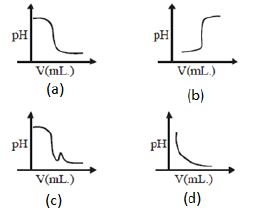
A
Graph $(a)$
B
Graph $(b)$
C
Graph $(c)$
D
Graph $(d)$
Solution
(A) In this titration,a strong acid $(HCl)$ is added to a strong base $(NaOH)$.
Initially,the solution contains $NaOH$,so the $pH$ is high (basic).
As $HCl$ is added,the $pH$ decreases gradually.
Near the equivalence point,there is a sharp drop in $pH$ because the concentration of $OH^-$ ions decreases rapidly.
After the equivalence point,the solution becomes acidic due to excess $HCl$,and the $pH$ levels off at a low value.
Graph $(a)$ correctly represents this sigmoidal decrease in $pH$ as the volume of the acid titrant increases.
Initially,the solution contains $NaOH$,so the $pH$ is high (basic).
As $HCl$ is added,the $pH$ decreases gradually.
Near the equivalence point,there is a sharp drop in $pH$ because the concentration of $OH^-$ ions decreases rapidly.
After the equivalence point,the solution becomes acidic due to excess $HCl$,and the $pH$ levels off at a low value.
Graph $(a)$ correctly represents this sigmoidal decrease in $pH$ as the volume of the acid titrant increases.
0 likesView Solution
254
ChemistryDifficultMCQJEE Main · 2019
$p$-Hydroxybenzophenone upon reaction with bromine in carbon tetrachloride gives
A
$3-$Bromo$-4-$hydroxybenzophenone
B
$2-$Bromo$-4-$hydroxybenzophenone
C
$4-$($4$-Bromophenyl)hydroxybenzene
D
$3-$Bromo$-4-$hydroxybenzophenone
Solution
(D) The reaction of $p$-hydroxybenzophenone with $Br_2$ in $CCl_4$ is an electrophilic aromatic substitution reaction.
In $p$-hydroxybenzophenone,there are two benzene rings. One ring is attached to a carbonyl group $(-CO-)$,which is an electron-withdrawing group ($-R$ effect),deactivating the ring towards electrophilic aromatic substitution $(EAS)$.
The other ring is attached to a hydroxyl group $(-OH)$,which is a strong electron-donating group ($+R$ effect),activating the ring towards $EAS$.
The $-OH$ group is ortho/para directing. Since the para position is already occupied by the carbonyl group,the incoming electrophile $(Br^+)$ will attack the ortho position relative to the $-OH$ group.
Thus,the product formed is $3$-bromo-$4$-hydroxybenzophenone.
In $p$-hydroxybenzophenone,there are two benzene rings. One ring is attached to a carbonyl group $(-CO-)$,which is an electron-withdrawing group ($-R$ effect),deactivating the ring towards electrophilic aromatic substitution $(EAS)$.
The other ring is attached to a hydroxyl group $(-OH)$,which is a strong electron-donating group ($+R$ effect),activating the ring towards $EAS$.
The $-OH$ group is ortho/para directing. Since the para position is already occupied by the carbonyl group,the incoming electrophile $(Br^+)$ will attack the ortho position relative to the $-OH$ group.
Thus,the product formed is $3$-bromo-$4$-hydroxybenzophenone.
0 likesView Solution
255
ChemistryDifficultMCQJEE Main · 2019
The species that can have a $trans$-isomer is: ($en = \text{ethane-}1,2\text{-diamine}$,$ox = \text{oxalate}$)
A
$[Pt(en)Cl_2]$
B
$[Pt(en)_2Cl_2]^{2+}$
C
$[Cr(en)_2(ox)]^+$
D
$[Zn(en)Cl_2]$
Solution
(B) For a complex to exhibit $cis-trans$ isomerism,it must have at least two identical ligands in different spatial arrangements.
$A$. $[Pt(en)Cl_2]$ is a square planar complex of the type $[M(AA)X_2]$. It shows $cis-trans$ isomerism.
$B$. $[Pt(en)_2Cl_2]^{2+}$ is an octahedral complex of the type $[M(AA)_2X_2]$. It shows $cis-trans$ isomerism.
$C$. $[Cr(en)_2(ox)]^+$ is an octahedral complex of the type $[M(AA)_3]$. It does not show $cis-trans$ isomerism.
$D$. $[Zn(en)Cl_2]$ is a tetrahedral complex. Tetrahedral complexes do not show geometric isomerism.
However,in the context of standard chemistry problems,$[Pt(en)_2Cl_2]^{2+}$ is the classic example of an octahedral complex exhibiting $trans$-isomerism as shown in the provided image.
$A$. $[Pt(en)Cl_2]$ is a square planar complex of the type $[M(AA)X_2]$. It shows $cis-trans$ isomerism.
$B$. $[Pt(en)_2Cl_2]^{2+}$ is an octahedral complex of the type $[M(AA)_2X_2]$. It shows $cis-trans$ isomerism.
$C$. $[Cr(en)_2(ox)]^+$ is an octahedral complex of the type $[M(AA)_3]$. It does not show $cis-trans$ isomerism.
$D$. $[Zn(en)Cl_2]$ is a tetrahedral complex. Tetrahedral complexes do not show geometric isomerism.
However,in the context of standard chemistry problems,$[Pt(en)_2Cl_2]^{2+}$ is the classic example of an octahedral complex exhibiting $trans$-isomerism as shown in the provided image.
0 likesView Solution
256
ChemistryDifficultMCQJEE Main · 2019
The major product of the following reaction is:
$CH_3-CH(OH)-CH_2-CH_2-NH_2 \xrightarrow[triethylamine]{ethyl\ formate\ (1\ equiv)}$
$CH_3-CH(OH)-CH_2-CH_2-NH_2 \xrightarrow[triethylamine]{ethyl\ formate\ (1\ equiv)}$
A
$CH_3-CH(OH)-CH=CH_2$
B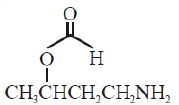
C
$CH_3-CH=CH-CH_2-NH_2$
D
$CH_3-CH(OH)-CH_2-CH_2-NH-CHO$
Solution
(D) Amines are more nucleophilic than alcohols.
Therefore, the $-NH_2$ group reacts preferentially with ethyl formate $(HCOOC_2H_5)$ to form the formamide derivative $CH_3-CH(OH)-CH_2-CH_2-NH-CHO$.
Therefore, the $-NH_2$ group reacts preferentially with ethyl formate $(HCOOC_2H_5)$ to form the formamide derivative $CH_3-CH(OH)-CH_2-CH_2-NH-CHO$.
0 likesView Solution
257
ChemistryAdvancedMCQJEE Main · 2019
Consider the hydrated ions of $Ti^{2+}$,$V^{2+}$,$Ti^{3+}$,and $Sc^{3+}$. The correct order of their spin-only magnetic moments is
A
$Ti^{3+} < Ti^{2+} < Sc^{3+} < V^{2+}$
B
$Sc^{3+} < Ti^{3+} < Ti^{2+} < V^{2+}$
C
$V^{2+} < Ti^{2+} < Ti^{3+} < Sc^{3+}$
D
$Sc^{3+} < Ti^{3+} < V^{2+} < Ti^{2+}$
Solution
(B) The spin-only magnetic moment $(\mu)$ is calculated using the formula $\mu = \sqrt{n(n+2)} \ B.M.$,where $n$ is the number of unpaired electrons.
$1. Sc^{3+} (Z=21): [Ar] 3d^0$. Number of unpaired electrons $(n) = 0$. $\mu = 0 \ B.M.$
$2. Ti^{3+} (Z=22): [Ar] 3d^1$. Number of unpaired electrons $(n) = 1$. $\mu = \sqrt{1(1+2)} = \sqrt{3} \ B.M. \approx 1.73 \ B.M.$
$3. Ti^{2+} (Z=22): [Ar] 3d^2$. Number of unpaired electrons $(n) = 2$. $\mu = \sqrt{2(2+2)} = \sqrt{8} \ B.M. \approx 2.83 \ B.M.$
$4. V^{2+} (Z=23): [Ar] 3d^3$. Number of unpaired electrons $(n) = 3$. $\mu = \sqrt{3(3+2)} = \sqrt{15} \ B.M. \approx 3.87 \ B.M.$
Comparing the values: $0 < 1.73 < 2.83 < 3.87$.
Therefore,the correct order is $Sc^{3+} < Ti^{3+} < Ti^{2+} < V^{2+}$.
$1. Sc^{3+} (Z=21): [Ar] 3d^0$. Number of unpaired electrons $(n) = 0$. $\mu = 0 \ B.M.$
$2. Ti^{3+} (Z=22): [Ar] 3d^1$. Number of unpaired electrons $(n) = 1$. $\mu = \sqrt{1(1+2)} = \sqrt{3} \ B.M. \approx 1.73 \ B.M.$
$3. Ti^{2+} (Z=22): [Ar] 3d^2$. Number of unpaired electrons $(n) = 2$. $\mu = \sqrt{2(2+2)} = \sqrt{8} \ B.M. \approx 2.83 \ B.M.$
$4. V^{2+} (Z=23): [Ar] 3d^3$. Number of unpaired electrons $(n) = 3$. $\mu = \sqrt{3(3+2)} = \sqrt{15} \ B.M. \approx 3.87 \ B.M.$
Comparing the values: $0 < 1.73 < 2.83 < 3.87$.
Therefore,the correct order is $Sc^{3+} < Ti^{3+} < Ti^{2+} < V^{2+}$.
0 likesView Solution
258
ChemistryMediumMCQJEE Main · 2019
Amylopectin is composed of
A
$\alpha-D$-glucose,$C_1-C_4$ and $C_2-C_6$ linkages
B
$\beta-D$-glucose,$C_1-C_4$ and $C_2-C_6$ linkages
C
$\alpha-D$-glucose,$C_1-C_4$ and $C_1-C_6$ linkages
D
$\beta-D$-glucose,$C_1-C_4$ and $C_1-C_6$ linkages
Solution
(C) Amylopectin is a branched-chain polysaccharide that acts as a homopolymer of $\alpha-D$-glucose units.
It consists of a linear chain formed by $\alpha-D$-glucose units linked through $C_1-C_4$ glycosidic bonds.
Additionally,branching occurs at certain points where $\alpha-D$-glucose units are linked through $C_1-C_6$ glycosidic bonds.
It consists of a linear chain formed by $\alpha-D$-glucose units linked through $C_1-C_4$ glycosidic bonds.
Additionally,branching occurs at certain points where $\alpha-D$-glucose units are linked through $C_1-C_6$ glycosidic bonds.
0 likesView Solution
259
ChemistryDifficultMCQJEE Main · 2019
$A$ gas undergoes physical adsorption on a surface and follows the given Freundlich adsorption isotherm equation $\frac{x}{m} = k p^{0.5}$. Adsorption of the gas increases with
A
Increase in $p$ and decrease in $T$
B
Increase in $p$ and increase in $T$
C
Decrease in $p$ and increase in $T$
D
Decrease in $p$ and decrease in $T$
Solution
(A) The Freundlich adsorption isotherm is given by $\frac{x}{m} = k p^{1/n}$.
According to the given equation $\frac{x}{m} = k p^{0.5}$,the extent of adsorption $\frac{x}{m}$ is directly proportional to the square root of pressure $p$.
Therefore,an increase in pressure $p$ leads to an increase in the extent of adsorption.
Physical adsorption is an exothermic process,which means it releases heat.
According to Le Chatelier's principle,for an exothermic process,a decrease in temperature $T$ favors the forward reaction,thereby increasing the extent of adsorption.
Thus,adsorption increases with an increase in $p$ and a decrease in $T$.
According to the given equation $\frac{x}{m} = k p^{0.5}$,the extent of adsorption $\frac{x}{m}$ is directly proportional to the square root of pressure $p$.
Therefore,an increase in pressure $p$ leads to an increase in the extent of adsorption.
Physical adsorption is an exothermic process,which means it releases heat.
According to Le Chatelier's principle,for an exothermic process,a decrease in temperature $T$ favors the forward reaction,thereby increasing the extent of adsorption.
Thus,adsorption increases with an increase in $p$ and a decrease in $T$.
0 likesView Solution
260
ChemistryDifficultMCQJEE Main · 2019
$A$ bacterial infection in an internal wound grows as $N(t) = N_0 \exp(t)$,where the time $t$ is in hours. $A$ dose of antibiotic,taken orally,needs $1 \ hour$ to reach the wound. Once it reaches there,the bacterial population decreases as $\frac{dN}{dt} = -5N^2$. What will be the plot of $\frac{N_0}{N}$ vs. $t$ after $1 \ hour$?
A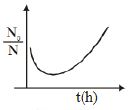
B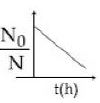
C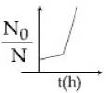
D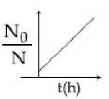
Solution
(A) For $t \le 1 \ hour$,the population grows as $N(t) = N_0 \exp(t)$. Thus,$\frac{N_0}{N} = \exp(-t)$. This is a decreasing exponential function.
For $t > 1 \ hour$,the population follows $\frac{dN}{dt} = -5N^2$. Integrating this from $t=1$ to $t$,we get $\int_{N_1}^{N} \frac{dN}{N^2} = \int_{1}^{t} -5 dt$,where $N_1 = N_0 \exp(1)$.
This gives $[-\frac{1}{N}]_{N_1}^{N} = -5(t-1)$,so $\frac{1}{N} - \frac{1}{N_1} = 5(t-1)$.
Multiplying by $N_0$,we get $\frac{N_0}{N} = \frac{N_0}{N_1} + 5N_0(t-1) = \exp(-1) + 5N_0(t-1)$.
This is a linear function with a positive slope for $t > 1$. Therefore,the plot of $\frac{N_0}{N}$ vs. $t$ decreases until $t=1$ and then increases linearly.
For $t > 1 \ hour$,the population follows $\frac{dN}{dt} = -5N^2$. Integrating this from $t=1$ to $t$,we get $\int_{N_1}^{N} \frac{dN}{N^2} = \int_{1}^{t} -5 dt$,where $N_1 = N_0 \exp(1)$.
This gives $[-\frac{1}{N}]_{N_1}^{N} = -5(t-1)$,so $\frac{1}{N} - \frac{1}{N_1} = 5(t-1)$.
Multiplying by $N_0$,we get $\frac{N_0}{N} = \frac{N_0}{N_1} + 5N_0(t-1) = \exp(-1) + 5N_0(t-1)$.
This is a linear function with a positive slope for $t > 1$. Therefore,the plot of $\frac{N_0}{N}$ vs. $t$ decreases until $t=1$ and then increases linearly.
0 likesView Solution
261
ChemistryDifficultMCQJEE Main · 2019
Three complexes,$[CoCl(NH_3)_5]^{2+} (I)$,$[Co(NH_3)_5H_2O]^{3+} (II)$ and $[Co(NH_3)_6]^{3+} (III)$ absorb light in the visible region. The correct order of the wavelength of light absorbed by them is
A
$II > I > III$
B
$III > II > I$
C
$I > II > III$
D
$III > I > II$
Solution
(C) The energy of absorbed light $(E)$ is inversely proportional to the wavelength $(\lambda)$ of the absorbed light,i.e.,$E = \frac{hc}{\lambda}$.
The energy of absorption corresponds to the Crystal Field Splitting Energy ($CFSE$ or $\Delta_o$),which depends on the strength of the ligands.
The spectrochemical series order for the ligands is $Cl^- < H_2O < NH_3$.
Comparing the complexes:
$(I) [CoCl(NH_3)_5]^{2 }$ has $Cl^-$ as a ligand.
$(II) [Co(NH_3)_5H_2O]^{3 }$ has $H_2O$ as a ligand.
$(III) [Co(NH_3)_6]^{3 }$ has $NH_3$ as a ligand.
Since $NH_3$ is a stronger ligand than $H_2O$,and $H_2O$ is stronger than $Cl^-$,the order of $CFSE$ is $(III) > (II) > (I)$.
Since $E \propto \Delta_o$,the order of energy absorbed is $(III) > (II) > (I)$.
Since $\lambda \propto \frac{1}{E}$,the order of wavelength absorbed is $(I) > (II) > (III)$.
The energy of absorption corresponds to the Crystal Field Splitting Energy ($CFSE$ or $\Delta_o$),which depends on the strength of the ligands.
The spectrochemical series order for the ligands is $Cl^- < H_2O < NH_3$.
Comparing the complexes:
$(I) [CoCl(NH_3)_5]^{2 }$ has $Cl^-$ as a ligand.
$(II) [Co(NH_3)_5H_2O]^{3 }$ has $H_2O$ as a ligand.
$(III) [Co(NH_3)_6]^{3 }$ has $NH_3$ as a ligand.
Since $NH_3$ is a stronger ligand than $H_2O$,and $H_2O$ is stronger than $Cl^-$,the order of $CFSE$ is $(III) > (II) > (I)$.
Since $E \propto \Delta_o$,the order of energy absorbed is $(III) > (II) > (I)$.
Since $\lambda \propto \frac{1}{E}$,the order of wavelength absorbed is $(I) > (II) > (III)$.
0 likesView Solution
262
ChemistryDifficultMCQJEE Main · 2019
The major products of the following reaction are:

A
$CH_3OH$ and $HCO_2H$
B
$\text{Benzyl alcohol and Formic acid}$
C
$\text{Benzyl alcohol and Benzoic acid}$
D
$\text{Methanol and Benzoic acid}$
Solution
(B) The given reaction is a cross-Cannizzaro reaction between benzaldehyde $(C_6H_5CHO)$ and formaldehyde $(HCHO)$.
In a cross-Cannizzaro reaction,the more reactive carbonyl compound (formaldehyde) is oxidized to the corresponding acid (formate ion,which gives formic acid $HCOOH$ upon acidification),and the less reactive carbonyl compound (benzaldehyde) is reduced to the corresponding alcohol (benzyl alcohol,$C_6H_5CH_2OH$).
Therefore,the products are benzyl alcohol and formic acid.
In a cross-Cannizzaro reaction,the more reactive carbonyl compound (formaldehyde) is oxidized to the corresponding acid (formate ion,which gives formic acid $HCOOH$ upon acidification),and the less reactive carbonyl compound (benzaldehyde) is reduced to the corresponding alcohol (benzyl alcohol,$C_6H_5CH_2OH$).
Therefore,the products are benzyl alcohol and formic acid.
0 likesView Solution
263
ChemistryDifficultMCQJEE Main · 2019
Match the refining methods (Column $I$) with metals (Column $II$).
| Column $I$ (Refining methods) | Column $II$ (Metals) |
| $(I)$ Liquation | $(a)$ $Zr$ |
| $(II)$ Zone refining | $(b)$ $Ni$ |
| $(III)$ Mond process | $(c)$ $Sn$ |
| $(IV)$ Van Arkel Method | $(d)$ $Ga$ |
A
$I-b, II-c, III-d, IV-a$
B
$I-b, II-d, III-a, IV-c$
C
$I-c, II-a, III-b, IV-d$
D
$I-c, II-d, III-b, IV-a$
Solution
(D) The correct matches are as follows:
$I$. Liquation is used for metals with low melting points like $Sn$.
$II$. Zone refining is used for semiconductors like $Ga$.
$III$. Mond process is specifically used for the refining of $Ni$.
$IV$. Van Arkel method is used for refining metals like $Zr$ and $Ti$.
Therefore,the correct matching is $I-c, II-d, III-b, IV-a$.
$I$. Liquation is used for metals with low melting points like $Sn$.
$II$. Zone refining is used for semiconductors like $Ga$.
$III$. Mond process is specifically used for the refining of $Ni$.
$IV$. Van Arkel method is used for refining metals like $Zr$ and $Ti$.
Therefore,the correct matching is $I-c, II-d, III-b, IV-a$.
0 likesView Solution
264
ChemistryDifficultMCQJEE Main · 2019
Ethylamine $(C_2H_5NH_2)$ can be obtained from $N$-ethylphthalimide on treatment with:
A
$CaH_2$
B
$H_2O$
C
$NaBH_4$
D
$NH_2NH_2$
Solution
(D) The conversion of $N$-ethylphthalimide to ethylamine is the final step of the Gabriel phthalimide synthesis.
This reaction involves the hydrolysis of $N$-ethylphthalimide using an aqueous base (like $NaOH$) followed by acidification,or more commonly,treatment with hydrazine $(NH_2NH_2)$ to cleave the phthalimide ring and release the primary amine.
In the context of the provided options,$NH_2NH_2$ is the standard reagent used to liberate the primary amine from the $N$-substituted phthalimide.
This reaction involves the hydrolysis of $N$-ethylphthalimide using an aqueous base (like $NaOH$) followed by acidification,or more commonly,treatment with hydrazine $(NH_2NH_2)$ to cleave the phthalimide ring and release the primary amine.
In the context of the provided options,$NH_2NH_2$ is the standard reagent used to liberate the primary amine from the $N$-substituted phthalimide.
0 likesView Solution
265
ChemistryDifficultMCQJEE Main · 2019
The major product of the following reaction is $CH_3-CH(CH_3)-CH(Br)-CH_3 \xrightarrow{CH_3OH}$
A
$CH_3-C(CH_3)(OCH_3)-CH_2-CH_3$
B
$CH_3-CH(CH_3)-CH=CH_2$
C
$CH_3-C(CH_3)=CH-CH_3$
D
$CH_3-CH(CH_3)-CH(OCH_3)-CH_3$
Solution
(A) The reaction of $2$-bromo-$3$-methylbutane with methanol $(CH_3OH)$ proceeds via an $S_N1$ mechanism.
First,the $Br^-$ ion leaves to form a secondary carbocation $CH_3-CH(CH_3)-C^+H-CH_3$.
This carbocation undergoes a $1,2$-hydride shift to form a more stable tertiary carbocation $CH_3-C^+(CH_3)-CH_2-CH_3$.
Finally,the nucleophile $CH_3OH$ attacks the tertiary carbocation,followed by deprotonation,to yield $2$-methoxy-$2$-methylbutane $(CH_3-C(CH_3)(OCH_3)-CH_2-CH_3)$ as the major product.
First,the $Br^-$ ion leaves to form a secondary carbocation $CH_3-CH(CH_3)-C^+H-CH_3$.
This carbocation undergoes a $1,2$-hydride shift to form a more stable tertiary carbocation $CH_3-C^+(CH_3)-CH_2-CH_3$.
Finally,the nucleophile $CH_3OH$ attacks the tertiary carbocation,followed by deprotonation,to yield $2$-methoxy-$2$-methylbutane $(CH_3-C(CH_3)(OCH_3)-CH_2-CH_3)$ as the major product.
0 likesView Solution
266
ChemistryMediumMCQJEE Main · 2019
Which of the following is a condensation polymer?
A
Nylon $6,6$
B
Neoprene
C
Buna $-S$
D
Teflon
Solution
(A) Nylon $-6,6$ is a condensation polymer formed by the reaction between hexamethylene diamine and adipic acid with the elimination of water molecules.
Buna $-S$,Teflon,and Neoprene are examples of addition polymers.
Buna $-S$,Teflon,and Neoprene are examples of addition polymers.
0 likesView Solution
267
ChemistryDifficultMCQJEE Main · 2019
Consider the statements $S_1$ and $S_2$:
$S_1$: Conductivity always increases with decrease in the concentration of electrolyte.
$S_2$: Molar conductivity always increases with decrease in the concentration of electrolyte.
The correct option among the following is
$S_1$: Conductivity always increases with decrease in the concentration of electrolyte.
$S_2$: Molar conductivity always increases with decrease in the concentration of electrolyte.
The correct option among the following is
A
$S_1$ is wrong and $S_2$ is correct
B
Both $S_1$ and $S_2$ are wrong
C
$S_1$ is correct and $S_2$ is wrong
D
Both $S_1$ and $S_2$ are correct
Solution
(A) Conductivity $(K)$ is defined as the conductance of a unit volume of solution. As the concentration of an electrolyte decreases,the number of ions per unit volume decreases,leading to a decrease in conductivity. Thus,$S_1$ is incorrect.
Molar conductivity $(\lambda_m)$ is defined as $\lambda_m = \frac{K}{C}$. As the concentration $(C)$ decreases,the volume of solution containing one mole of electrolyte increases significantly,which outweighs the decrease in conductivity $(K)$. Consequently,molar conductivity increases with a decrease in concentration. Thus,$S_2$ is correct.
Molar conductivity $(\lambda_m)$ is defined as $\lambda_m = \frac{K}{C}$. As the concentration $(C)$ decreases,the volume of solution containing one mole of electrolyte increases significantly,which outweighs the decrease in conductivity $(K)$. Consequently,molar conductivity increases with a decrease in concentration. Thus,$S_2$ is correct.
0 likesView Solution
268
ChemistryDifficultMCQJEE Main · 2019
The increasing rate of $S_N1$ reaction in the following compounds is:
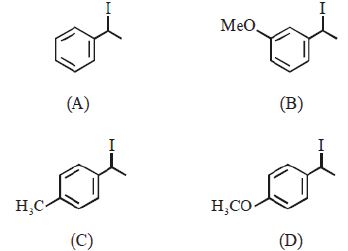
A
$A < B < C < D$
B
$A < B < D < C$
C
$B < A < D < C$
D
$B < A < C < D$
Solution
(D) The rate of $S_N1$ reaction is directly proportional to the stability of the carbocation intermediate formed after the loss of the leaving group $(I^-)$.
$(A)$ The carbocation is a secondary benzylic carbocation.
$(B)$ The $-OCH_3$ group is at the meta position. It exerts a strong $-I$ effect and no resonance effect on the carbocation. This destabilizes the carbocation compared to $(A)$.
$(C)$ The $-CH_3$ group is at the para position. It provides stability through $+I$ and hyperconjugation effects.
$(D)$ The $-OCH_3$ group is at the para position. It provides significant stability through the $+M$ (resonance) effect,which outweighs its $-I$ effect.
Comparing the stability: The meta-methoxy substituted carbocation $(B)$ is the least stable due to the $-I$ effect. The unsubstituted benzylic carbocation $(A)$ is next. The para-methyl substituted carbocation $(C)$ is more stable due to hyperconjugation. The para-methoxy substituted carbocation $(D)$ is the most stable due to the strong $+M$ effect.
Therefore,the order of increasing rate is $B < A < C < D$.
$(A)$ The carbocation is a secondary benzylic carbocation.
$(B)$ The $-OCH_3$ group is at the meta position. It exerts a strong $-I$ effect and no resonance effect on the carbocation. This destabilizes the carbocation compared to $(A)$.
$(C)$ The $-CH_3$ group is at the para position. It provides stability through $+I$ and hyperconjugation effects.
$(D)$ The $-OCH_3$ group is at the para position. It provides significant stability through the $+M$ (resonance) effect,which outweighs its $-I$ effect.
Comparing the stability: The meta-methoxy substituted carbocation $(B)$ is the least stable due to the $-I$ effect. The unsubstituted benzylic carbocation $(A)$ is next. The para-methyl substituted carbocation $(C)$ is more stable due to hyperconjugation. The para-methoxy substituted carbocation $(D)$ is the most stable due to the strong $+M$ effect.
Therefore,the order of increasing rate is $B < A < C < D$.
0 likesView Solution
269
ChemistryMediumMCQJEE Main · 2019
The oxoacid of sulphur that does not contain a bond between sulphur atoms is
A
$H_2S_2O_3$
B
$H_2S_2O_4$
C
$H_2S_2O_7$
D
$H_2S_4O_6$
Solution
(C) To determine which oxoacid does not contain a $S-S$ bond,we examine their structures:
$1$. $H_2S_2O_3$ (Thiosulphuric acid): Contains a $S-S$ bond $(HO-SO_2-SH)$.
$2$. $H_2S_2O_4$ (Dithionous acid): Contains a $S-S$ bond $(HO-SO-SO-OH)$.
$3$. $H_2S_2O_7$ (Pyrosulphuric acid or Oleum): Its structure is $HO-SO_2-O-SO_2-OH$. It contains a $S-O-S$ linkage,not a $S-S$ bond.
$4$. $H_2S_4O_6$ (Tetrathionic acid): Contains a chain of sulphur atoms ($S-S-S-S$ linkage).
Therefore,$H_2S_2O_7$ is the correct answer.
$1$. $H_2S_2O_3$ (Thiosulphuric acid): Contains a $S-S$ bond $(HO-SO_2-SH)$.
$2$. $H_2S_2O_4$ (Dithionous acid): Contains a $S-S$ bond $(HO-SO-SO-OH)$.
$3$. $H_2S_2O_7$ (Pyrosulphuric acid or Oleum): Its structure is $HO-SO_2-O-SO_2-OH$. It contains a $S-O-S$ linkage,not a $S-S$ bond.
$4$. $H_2S_4O_6$ (Tetrathionic acid): Contains a chain of sulphur atoms ($S-S-S-S$ linkage).
Therefore,$H_2S_2O_7$ is the correct answer.
0 likesView Solution
270
ChemistryDifficultMCQJEE Main · 2019
At room temperature,a dilute solution of urea is prepared by dissolving $0.60 \ g$ of urea in $360 \ g$ of water. If the vapour pressure of pure water at this temperature is $35 \ mm \ Hg$,the lowering of vapour pressure will be: .............. $mm \ Hg$ (molar mass of urea $= 60 \ g \ mol^{-1}$)
A
$0.027$
B
$0.031$
C
$0.028$
D
$0.017$
Solution
(D) The lowering of vapour pressure is given by the formula: $\Delta p = p^o \cdot X_{solute}$
Given:
$p^o = 35 \ mm \ Hg$
$w_{urea} = 0.60 \ g$,$M_{urea} = 60 \ g \ mol^{-1}$
$w_{water} = 360 \ g$,$M_{water} = 18 \ g \ mol^{-1}$
Calculate moles of solute $(n)$ and solvent $(N)$:
$n = \frac{0.60}{60} = 0.01 \ mol$
$N = \frac{360}{18} = 20 \ mol$
Calculate mole fraction of solute $(X_{solute})$:
$X_{solute} = \frac{n}{n + N} = \frac{0.01}{0.01 + 20} = \frac{0.01}{20.01} \approx 0.00049975$
Calculate lowering of vapour pressure $(\Delta p)$:
$\Delta p = 35 \times 0.00049975 \approx 0.01749 \ mm \ Hg$
Rounding to the nearest value,we get $0.017 \ mm \ Hg$.
Given:
$p^o = 35 \ mm \ Hg$
$w_{urea} = 0.60 \ g$,$M_{urea} = 60 \ g \ mol^{-1}$
$w_{water} = 360 \ g$,$M_{water} = 18 \ g \ mol^{-1}$
Calculate moles of solute $(n)$ and solvent $(N)$:
$n = \frac{0.60}{60} = 0.01 \ mol$
$N = \frac{360}{18} = 20 \ mol$
Calculate mole fraction of solute $(X_{solute})$:
$X_{solute} = \frac{n}{n + N} = \frac{0.01}{0.01 + 20} = \frac{0.01}{20.01} \approx 0.00049975$
Calculate lowering of vapour pressure $(\Delta p)$:
$\Delta p = 35 \times 0.00049975 \approx 0.01749 \ mm \ Hg$
Rounding to the nearest value,we get $0.017 \ mm \ Hg$.
0 likesView Solution
271
ChemistryDifficultMCQJEE Main · 2019
The major product obtained in the given reaction is:

A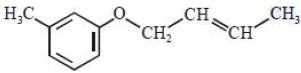
$A$
B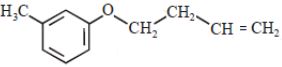
$B$
C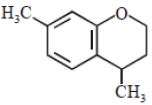
$C$
D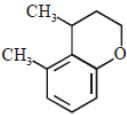
$D$
Solution
(D) The given reaction is an intramolecular Friedel-Crafts alkylation.
$AlCl_3$ acts as a Lewis acid and reacts with the chlorine atom to form a carbocation at the secondary carbon position.
This carbocation then undergoes an electrophilic aromatic substitution on the benzene ring.
Since the oxygen atom is ortho/para directing,the cyclization occurs at the ortho position relative to the ether linkage,leading to the formation of a six-membered ring fused to the benzene ring.
Thus,the major product is the structure shown in option $D$.
$AlCl_3$ acts as a Lewis acid and reacts with the chlorine atom to form a carbocation at the secondary carbon position.
This carbocation then undergoes an electrophilic aromatic substitution on the benzene ring.
Since the oxygen atom is ortho/para directing,the cyclization occurs at the ortho position relative to the ether linkage,leading to the formation of a six-membered ring fused to the benzene ring.
Thus,the major product is the structure shown in option $D$.
0 likesView Solution
272
ChemistryDifficultMCQJEE Main · 2019
The correct order of the first ionization enthalpies is:
A
$Mn < Ti < Zn < Ni$
B
$Zn < Ni < Mn < Ti$
C
$Ti < Mn < Zn < Ni$
D
$Ti < Mn < Ni < Zn$
Solution
(D) The first ionization enthalpy generally increases across a period from left to right due to an increase in effective nuclear charge.
For the $3d$ series elements $(Ti, Mn, Ni, Zn)$,the general trend is $Ti < Mn < Ni < Zn$.
$Ti$ $([Ar] 3d^2 4s^2)$ has the lowest ionization enthalpy,while $Zn$ $([Ar] 3d^{10} 4s^2)$ has the highest due to its stable,fully-filled $d$-orbital configuration.
For the $3d$ series elements $(Ti, Mn, Ni, Zn)$,the general trend is $Ti < Mn < Ni < Zn$.
$Ti$ $([Ar] 3d^2 4s^2)$ has the lowest ionization enthalpy,while $Zn$ $([Ar] 3d^{10} 4s^2)$ has the highest due to its stable,fully-filled $d$-orbital configuration.
0 likesView Solution
273
ChemistryDifficultMCQJEE Main · 2019
For the reaction of $H_2$ with $I_2$,the rate constant is $2.5 \times 10^{-4} \ dm^3 \ mol^{-1} \ s^{-1}$ at $327 \ ^oC$ and $1.0 \ dm^3 \ mol^{-1} \ s^{-1}$ at $527 \ ^oC$. The activation energy for the reaction,in $kJ \ mol^{-1}$ is: $(R = 8.314 \ J \ K^{-1} \ mol^{-1})$
A
$72$
B
$166$
C
$150$
D
$59$
Solution
(B) The Arrhenius equation is given by: $\log \frac{K_2}{K_1} = \frac{E_a}{2.303 \ R} \left( \frac{T_2 - T_1}{T_1 T_2} \right)$
Given:
$K_1 = 2.5 \times 10^{-4} \ dm^3 \ mol^{-1} \ s^{-1}$,$T_1 = 327 + 273 = 600 \ K$
$K_2 = 1.0 \ dm^3 \ mol^{-1} \ s^{-1}$,$T_2 = 527 + 273 = 800 \ K$
$R = 8.314 \ J \ K^{-1} \ mol^{-1}$
Substituting the values:
$\log \left( \frac{1}{2.5 \times 10^{-4}} \right) = \frac{E_a}{2.303 \times 8.314} \left( \frac{800 - 600}{600 \times 800} \right)$
$\log (4000) = \frac{E_a}{19.147} \left( \frac{200}{480000} \right)$
$3.602 = \frac{E_a}{19.147} \times 4.167 \times 10^{-4}$
$E_a = \frac{3.602 \times 19.147}{4.167 \times 10^{-4}} \approx 165500 \ J \ mol^{-1} = 165.5 \ kJ \ mol^{-1} \approx 166 \ kJ \ mol^{-1}$
Given:
$K_1 = 2.5 \times 10^{-4} \ dm^3 \ mol^{-1} \ s^{-1}$,$T_1 = 327 + 273 = 600 \ K$
$K_2 = 1.0 \ dm^3 \ mol^{-1} \ s^{-1}$,$T_2 = 527 + 273 = 800 \ K$
$R = 8.314 \ J \ K^{-1} \ mol^{-1}$
Substituting the values:
$\log \left( \frac{1}{2.5 \times 10^{-4}} \right) = \frac{E_a}{2.303 \times 8.314} \left( \frac{800 - 600}{600 \times 800} \right)$
$\log (4000) = \frac{E_a}{19.147} \left( \frac{200}{480000} \right)$
$3.602 = \frac{E_a}{19.147} \times 4.167 \times 10^{-4}$
$E_a = \frac{3.602 \times 19.147}{4.167 \times 10^{-4}} \approx 165500 \ J \ mol^{-1} = 165.5 \ kJ \ mol^{-1} \approx 166 \ kJ \ mol^{-1}$
0 likesView Solution
274
ChemistryMediumMCQJEE Main · 2019
In chromatography,which of the following statements is incorrect for $R_f$?
A
$R_f$ value depends on the type of chromatography.
B
The value of $R_f$ cannot be more than one.
C
Higher $R_f$ value means higher adsorption.
D
$R_f$ value is dependent on the mobile phase.
Solution
(C) The $R_f$ (retention factor) value is defined as the ratio of the distance traveled by the solute to the distance traveled by the solvent front.
Since the solute cannot travel further than the solvent front,the $R_f$ value is always $\le 1$.
$A$ higher $R_f$ value indicates that the substance has a greater affinity for the mobile phase and a lower affinity for the stationary phase (i.e.,lower adsorption).
Therefore,the statement "Higher $R_f$ value means higher adsorption" is incorrect.
Since the solute cannot travel further than the solvent front,the $R_f$ value is always $\le 1$.
$A$ higher $R_f$ value indicates that the substance has a greater affinity for the mobile phase and a lower affinity for the stationary phase (i.e.,lower adsorption).
Therefore,the statement "Higher $R_f$ value means higher adsorption" is incorrect.
0 likesView Solution
275
ChemistryDifficultMCQJEE Main · 2019
The $INCORRECT$ statement is:
A
The spin-only magnetic moments of $[Fe(H_2O)_6]^{2+}$ and $[Cr(H_2O)_6]^{2+}$ are nearly similar.
B
The spin-only magnetic moment of $[Ni(NH_3)_4(H_2O)_2]^{2+}$ is $2.83 \ BM$.
C
The gemstone,ruby,has $Cr^{3+}$ ions occupying the octahedral sites of beryl.
D
The color of $[CoCl(NH_3)_5]^{2+}$ is violet as it absorbs the yellow light.
Solution
(C) Ruby is a gemstone composed of aluminium oxide $(Al_2O_3)$ in which some $Al^{3+}$ ions are replaced by $Cr^{3+}$ ions in octahedral sites.
Statement $C$ is incorrect because ruby is a variety of corundum $(Al_2O_3)$,not beryl.
Beryl is the mineral associated with emeralds.
Therefore,the statement claiming $Cr^{3+}$ occupies sites in beryl is false.
Statement $C$ is incorrect because ruby is a variety of corundum $(Al_2O_3)$,not beryl.
Beryl is the mineral associated with emeralds.
Therefore,the statement claiming $Cr^{3+}$ occupies sites in beryl is false.
0 likesView Solution
276
ChemistryMediumMCQJEE Main · 2019
The correct statement is:
A
Zincite is a carbonate ore.
B
Aniline is a froth stabilizer.
C
Zone refining process is used for the refining of titanium.
D
Sodium cyanide cannot be used in the metallurgy of silver.
Solution
(B) In the froth flotation process,collectors like pine oil,fatty acids,and xanthates are added to the suspension of powdered ore in water to make the mineral particles preferentially wetted by oil. Froth stabilizers like cresols and aniline are added to stabilize the froth. Therefore,the statement that aniline is a froth stabilizer is correct. Zincite $(ZnO)$ is an oxide ore,not a carbonate ore. Titanium is refined using the Van Arkel method,not zone refining. Sodium cyanide $(NaCN)$ is used in the leaching process for the extraction of silver.
0 likesView Solution
277
ChemistryDifficultMCQJEE Main · 2019
The increasing order of nucleophilicity of the following nucleophiles is: $a. CH_3CO_2^-$,$b. H_2O$,$c. CH_3SO_3^-$,$d. OH^-$
A
$(b) < (c) < (a) < (d)$
B
$(a) < (d) < (c) < (b)$
C
$(d) < (a) < (c) < (b)$
D
$(b) < (c) < (d) < (a)$
Solution
(A) Nucleophilicity is the ability of a species to donate an electron pair to an electrophile.
For charged species,the nucleophilicity is generally higher than for neutral species.
Among the given species,$H_2O$ is a neutral molecule and is the weakest nucleophile.
Comparing the anions,$CH_3SO_3^-$ is a very weak nucleophile because the negative charge is delocalized over three oxygen atoms,making it a stable conjugate base of a strong acid.
$CH_3CO_2^-$ has the negative charge delocalized over two oxygen atoms,making it a stronger nucleophile than $CH_3SO_3^-$.
$OH^-$ is the strongest nucleophile among these as the charge is localized on a single oxygen atom.
Thus,the increasing order is $(b) < (c) < (a) < (d)$.
For charged species,the nucleophilicity is generally higher than for neutral species.
Among the given species,$H_2O$ is a neutral molecule and is the weakest nucleophile.
Comparing the anions,$CH_3SO_3^-$ is a very weak nucleophile because the negative charge is delocalized over three oxygen atoms,making it a stable conjugate base of a strong acid.
$CH_3CO_2^-$ has the negative charge delocalized over two oxygen atoms,making it a stronger nucleophile than $CH_3SO_3^-$.
$OH^-$ is the strongest nucleophile among these as the charge is localized on a single oxygen atom.
Thus,the increasing order is $(b) < (c) < (a) < (d)$.
0 likesView Solution
278
ChemistryDifficultMCQJEE Main · 2019
The correct match between Item-$I$ and Item-$II$ is
| Item-$I$ | Item-$II$ |
| $(a)$ High density polythene | $(I)$ Peroxide catalyst |
| $(b)$ Polyacrylonitrile | $(II)$ Condensation at high temperature and pressure |
| $(c)$ Novolac | $(III)$ Ziegler-Natta catalyst |
| $(d)$ Nylon-$6$ | $(IV)$ Acid or base catalyst |
A
$a \to III, b \to I, c \to II, d \to IV$
B
$a \to IV, b \to II, c \to I, d \to III$
C
$a \to II, b \to IV, c \to I, d \to III$
D
$a \to III, b \to I, c \to IV, d \to II$
Solution
(D) High density polythene is prepared using Ziegler-Natta catalyst $(III)$.
$(b)$ Polyacrylonitrile is prepared by addition polymerization using peroxide catalyst $(I)$.
$(c)$ Novolac is a linear polymer of phenol and formaldehyde prepared using acid or base catalyst $(IV)$.
$(d)$ Nylon-$6$ is prepared by heating caprolactam at high temperature and pressure $(II)$.
Therefore,the correct match is $a \to III, b \to I, c \to IV, d \to II$.
$(b)$ Polyacrylonitrile is prepared by addition polymerization using peroxide catalyst $(I)$.
$(c)$ Novolac is a linear polymer of phenol and formaldehyde prepared using acid or base catalyst $(IV)$.
$(d)$ Nylon-$6$ is prepared by heating caprolactam at high temperature and pressure $(II)$.
Therefore,the correct match is $a \to III, b \to I, c \to IV, d \to II$.
0 likesView Solution
279
ChemistryDifficultMCQJEE Main · 2019
The major product $Y$ in the following reaction is:
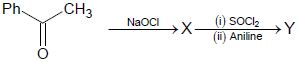
A
B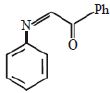
C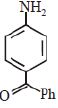
D
Solution
(A) $1$. The reaction of acetophenone $(PhCOCH_3)$ with $NaOCl$ is a haloform reaction,which converts the methyl ketone group into a carboxylate salt,followed by acidification to give benzoic acid $(PhCOOH)$ as product $X$.
$2$. Benzoic acid $(PhCOOH)$ reacts with $SOCl_2$ to form benzoyl chloride $(PhCOCl)$.
$3$. Benzoyl chloride then reacts with aniline $(PhNH_2)$ via a nucleophilic acyl substitution reaction to form $N$-phenylbenzamide $(PhCONHPh)$ as the major product $Y$.
$2$. Benzoic acid $(PhCOOH)$ reacts with $SOCl_2$ to form benzoyl chloride $(PhCOCl)$.
$3$. Benzoyl chloride then reacts with aniline $(PhNH_2)$ via a nucleophilic acyl substitution reaction to form $N$-phenylbenzamide $(PhCONHPh)$ as the major product $Y$.
0 likesView Solution
280
ChemistryDifficultMCQJEE Main · 2019
The highest possible oxidation states of uranium and plutonium,respectively,are
A
$6$ and $4$
B
$7$ and $6$
C
$4$ and $6$
D
$6$ and $7$
Solution
(D) The electronic configuration of $U$ $(Z=92)$ is $[Rn] 5f^3 6d^1 7s^2$. The highest oxidation state shown by $U$ is $+6$.
The electronic configuration of $Pu$ $(Z=94)$ is $[Rn] 5f^6 7s^2$. The highest oxidation state shown by $Pu$ is $+7$.
The electronic configuration of $Pu$ $(Z=94)$ is $[Rn] 5f^6 7s^2$. The highest oxidation state shown by $Pu$ is $+7$.
0 likesView Solution
281
ChemistryAdvancedMCQJEE Main · 2019
Compound $A$ $(C_9H_{10}O)$ shows a positive iodoform test. Oxidation of $A$ with $KMnO_4/KOH$ gives acid $B$ $(C_8H_6O_4)$. The anhydride of $B$ is used for the preparation of phenolphthalein. Compound $A$ is:
A
$2-$Methylacetophenone
B
$3-$Methylacetophenone
C
$2-$Ethylbenzaldehyde
D
$4-$Methylacetophenone
Solution
(A) $1$. Compound $A$ $(C_9H_{10}O)$ gives a positive iodoform test,which indicates the presence of a $CH_3CO-$ group attached to a carbon or hydrogen atom.
$2$. Oxidation of $A$ with $KMnO_4/KOH$ yields acid $B$ $(C_8H_6O_4)$.
$3$. The anhydride of $B$ is used to prepare phenolphthalein,which identifies $B$ as phthalic acid (benzene$-1,2-$dicarboxylic acid).
$4$. For $A$ to oxidize to phthalic acid,it must have two alkyl groups at the ortho positions of the benzene ring,one of which is an acetyl group $(CH_3CO-)$ and the other is a methyl group $(CH_3-)$.
$5$. Therefore,$A$ is $2$-methylacetophenone.
$2$. Oxidation of $A$ with $KMnO_4/KOH$ yields acid $B$ $(C_8H_6O_4)$.
$3$. The anhydride of $B$ is used to prepare phenolphthalein,which identifies $B$ as phthalic acid (benzene$-1,2-$dicarboxylic acid).
$4$. For $A$ to oxidize to phthalic acid,it must have two alkyl groups at the ortho positions of the benzene ring,one of which is an acetyl group $(CH_3CO-)$ and the other is a methyl group $(CH_3-)$.
$5$. Therefore,$A$ is $2$-methylacetophenone.
0 likesView Solution
282
ChemistryMediumMCQJEE Main · 2019
The noble gas that does not occur in the atmosphere is
A
$He$
B
$Rn$
C
$Ne$
D
$Kr$
Solution
(B) The noble gases are $He$,$Ne$,$Ar$,$Kr$,$Xe$,and $Rn$.
All noble gases except $Rn$ (Radon) are present in the atmosphere.
$Rn$ is a radioactive element formed by the radioactive decay of radium $(^{226}_{88}Ra \rightarrow ^{222}_{86}Rn + ^{4}_{2}He)$.
Therefore,$Rn$ does not occur in the atmosphere.
All noble gases except $Rn$ (Radon) are present in the atmosphere.
$Rn$ is a radioactive element formed by the radioactive decay of radium $(^{226}_{88}Ra \rightarrow ^{222}_{86}Rn + ^{4}_{2}He)$.
Therefore,$Rn$ does not occur in the atmosphere.
0 likesView Solution
283
ChemistryDifficultMCQJEE Main · 2019
The crystal field stabilization energy $(CFSE)$ of $[Fe(H_2O)_6]Cl_2$ and $K_2[NiCl_4]$,respectively,are
A
$ -0.4 \, \Delta_o$ and $ -0.8 \, \Delta_t$
B
$ -0.4 \, \Delta_o$ and $ -1.2 \, \Delta_t$
C
$ -2.4 \, \Delta_o$ and $ -1.2 \, \Delta_t$
D
$ -0.6 \, \Delta_o$ and $ -0.8 \, \Delta_t$
Solution
(A) $1$. For $[Fe(H_2O)_6]Cl_2$: The central metal ion is $Fe^{2+}$,which has a $d^6$ configuration. $H_2O$ is a weak field ligand,so the configuration is $t_{2g}^4 e_g^2$. The $CFSE$ is calculated as: $CFSE = [-0.4 \times 4 + 0.6 \times 2] \, \Delta_o = [-1.6 + 1.2] \, \Delta_o = -0.4 \, \Delta_o$.
$2$. For $K_2[NiCl_4]$: The central metal ion is $Ni^{2+}$,which has a $d^8$ configuration. It forms a tetrahedral complex $[NiCl_4]^{2-}$. The configuration is $e^4 t_2^4$. The $CFSE$ for a tetrahedral complex is calculated as: $CFSE = [-0.6 \times n_e + 0.4 \times n_{t2}] \, \Delta_t = [-0.6 \times 4 + 0.4 \times 4] \, \Delta_t = [-2.4 + 1.6] \, \Delta_t = -0.8 \, \Delta_t$.
$3$. Therefore,the values are $-0.4 \, \Delta_o$ and $-0.8 \, \Delta_t$.
$2$. For $K_2[NiCl_4]$: The central metal ion is $Ni^{2+}$,which has a $d^8$ configuration. It forms a tetrahedral complex $[NiCl_4]^{2-}$. The configuration is $e^4 t_2^4$. The $CFSE$ for a tetrahedral complex is calculated as: $CFSE = [-0.6 \times n_e + 0.4 \times n_{t2}] \, \Delta_t = [-0.6 \times 4 + 0.4 \times 4] \, \Delta_t = [-2.4 + 1.6] \, \Delta_t = -0.8 \, \Delta_t$.
$3$. Therefore,the values are $-0.4 \, \Delta_o$ and $-0.8 \, \Delta_t$.
0 likesView Solution
284
ChemistryDifficultMCQJEE Main · 2019
The correct option among the following is:
A
Colloidal particles in lyophobic sols can be precipitated by electrophoresis.
B
Brownian motion in colloidal solution is faster if the viscosity of the solution is very high.
C
Colloidal medicines are more effective because they have small surface area.
D
Addition of alum to water makes it unfit for drinking.
Solution
(A) In electrophoresis,colloidal particles move towards the oppositely charged electrode and get neutralized,leading to precipitation. Thus,option $(A)$ is correct.
Brownian motion decreases as viscosity increases.
Colloidal medicines are more effective due to their large surface area.
Addition of alum to water is a standard process for purification (coagulation of impurities).
Brownian motion decreases as viscosity increases.
Colloidal medicines are more effective due to their large surface area.
Addition of alum to water is a standard process for purification (coagulation of impurities).
0 likesView Solution
285
ChemistryDifficultMCQJEE Main · 2019
Which one of the following graphs between molar conductivity $(\Lambda_m)$ versus $\sqrt{C}$ is correct?
A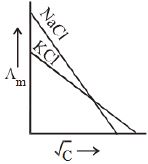
B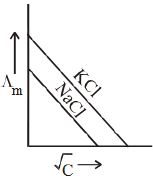
C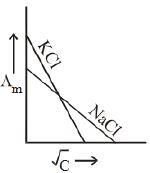
D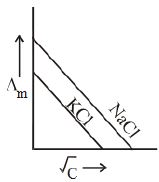
Solution
(B) The molar conductivity $(\Lambda_m)$ of strong electrolytes follows the Kohlrausch equation: $\Lambda_m = \Lambda_m^0 - A\sqrt{C}$.
Both $NaCl$ and $KCl$ are strong electrolytes.
The limiting molar conductivity $(\Lambda_m^0)$ for $KCl$ is higher than that of $NaCl$ because the ionic mobility of $K^+$ is greater than that of $Na^+$ due to smaller hydration of $K^+$ ions.
Since both are $1:1$ electrolytes,the slope $A$ is approximately the same for both,meaning the lines are parallel.
Therefore,the graph where the $KCl$ line is above the $NaCl$ line and they are parallel is correct,which corresponds to option $(B)$.
Both $NaCl$ and $KCl$ are strong electrolytes.
The limiting molar conductivity $(\Lambda_m^0)$ for $KCl$ is higher than that of $NaCl$ because the ionic mobility of $K^+$ is greater than that of $Na^+$ due to smaller hydration of $K^+$ ions.
Since both are $1:1$ electrolytes,the slope $A$ is approximately the same for both,meaning the lines are parallel.
Therefore,the graph where the $KCl$ line is above the $NaCl$ line and they are parallel is correct,which corresponds to option $(B)$.
0 likesView Solution
286
ChemistryDifficultMCQJEE Main · 2019
$1 \ g$ of non-volatile non-electrolyte solute is dissolved in $100 \ g$ of two different solvents $A$ and $B$ whose ebullioscopic constants are in the ratio of $1 : 5$. The ratio of the elevation in their boiling points,$\frac{\Delta T_b (A)}{\Delta T_b (B)}$ is
A
$5:1$
B
$10:1$
C
$1:5$
D
$1:0.2$
Solution
(C) The elevation in boiling point is given by the formula: $\Delta T_b = K_b \times m$,where $K_b$ is the ebullioscopic constant and $m$ is the molality of the solution.
Since the mass of the solute $(1 \ g)$ and the mass of the solvent $(100 \ g)$ are the same for both solvents $A$ and $B$,the molality $m$ is the same for both solutions $(m_A = m_B)$.
Therefore,the ratio of the elevation in boiling points is directly proportional to the ratio of their ebullioscopic constants:
$\frac{\Delta T_b (A)}{\Delta T_b (B)} = \frac{K_{b(A)}}{K_{b(B)}}$.
Given that the ratio of the ebullioscopic constants is $\frac{K_{b(A)}}{K_{b(B)}} = \frac{1}{5}$,the ratio of the elevation in boiling points is $1:5$.
Since the mass of the solute $(1 \ g)$ and the mass of the solvent $(100 \ g)$ are the same for both solvents $A$ and $B$,the molality $m$ is the same for both solutions $(m_A = m_B)$.
Therefore,the ratio of the elevation in boiling points is directly proportional to the ratio of their ebullioscopic constants:
$\frac{\Delta T_b (A)}{\Delta T_b (B)} = \frac{K_{b(A)}}{K_{b(B)}}$.
Given that the ratio of the ebullioscopic constants is $\frac{K_{b(A)}}{K_{b(B)}} = \frac{1}{5}$,the ratio of the elevation in boiling points is $1:5$.
0 likesView Solution
287
ChemistryDifficultMCQJEE Main · 2019
Which of the following is $NOT$ a correct method for the preparation of benzylamine $(C_6H_5CH_2NH_2)$ from cyanobenzene $(C_6H_5CN)$?
A
$i$. $HCl/H_2O$ $ii$. $NaBH_4$
B
$i$. $LiAlH_4$ $ii$. $H_3O^{+}$
C
$i$. $SnCl_2 + HCl(gas)$ $ii$. $NaBH_4$
D
$H_2/Ni$
Solution
(A) Cyanobenzene $(C_6H_5CN)$ can be reduced to benzylamine $(C_6H_5CH_2NH_2)$ using strong reducing agents like $LiAlH_4$ or catalytic hydrogenation $(H_2/Ni)$.
Option $A$ involves $HCl/H_2O$ (hydrolysis) which converts the nitrile to a carboxylic acid,and $NaBH_4$ is not strong enough to reduce nitriles to amines.
Option $C$ involves the Stephen reduction $(SnCl_2/HCl)$ which typically reduces nitriles to imines,and $NaBH_4$ is not the standard reagent to complete this specific conversion to a primary amine.
Therefore,options $A$ and $C$ are not standard methods for this preparation.
Option $A$ involves $HCl/H_2O$ (hydrolysis) which converts the nitrile to a carboxylic acid,and $NaBH_4$ is not strong enough to reduce nitriles to amines.
Option $C$ involves the Stephen reduction $(SnCl_2/HCl)$ which typically reduces nitriles to imines,and $NaBH_4$ is not the standard reagent to complete this specific conversion to a primary amine.
Therefore,options $A$ and $C$ are not standard methods for this preparation.
0 likesView Solution
288
ChemistryDifficultMCQJEE Main · 2019
The number of pentagons in $C_{60}$ and trigons (triangles) in white phosphorus,respectively,are
A
$12$ and $3$
B
$20$ and $4$
C
$12$ and $4$
D
$20$ and $3$
Solution
(C) $C_{60}$ (Buckminsterfullerene) has a truncated icosahedron structure consisting of $20$ hexagons and $12$ pentagons.
White phosphorus $(P_4)$ exists as a tetrahedral molecule where each phosphorus atom is bonded to the other three,forming $4$ triangular faces.
White phosphorus $(P_4)$ exists as a tetrahedral molecule where each phosphorus atom is bonded to the other three,forming $4$ triangular faces.
0 likesView Solution
289
ChemistryMediumMCQJEE Main · 2019
Number of stereo centers present in linear and cyclic structures of glucose are respectively
A
$4$ and $5$
B
$5$ and $5$
C
$4$ and $4$
D
$5$ and $4$
Solution
(A) In the linear structure of $D$-glucose $(CHO-(CHOH)_4-CH_2OH)$,there are $4$ chiral carbons (stereo centers) at positions $C_2, C_3, C_4,$ and $C_5$.
In the cyclic structure of $\alpha-D$-glucose,the formation of the hemiacetal linkage creates a new chiral center at the anomeric carbon $(C_1)$.
Thus,the cyclic structure has $5$ stereo centers ($C_1, C_2, C_3, C_4,$ and $C_5$).
In the cyclic structure of $\alpha-D$-glucose,the formation of the hemiacetal linkage creates a new chiral center at the anomeric carbon $(C_1)$.
Thus,the cyclic structure has $5$ stereo centers ($C_1, C_2, C_3, C_4,$ and $C_5$).
0 likesView Solution
290
ChemistryDifficultMCQJEE Main · 2019
The major product '$Y$' in the following reaction is
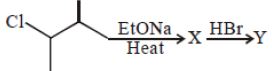
A
$2-$bromo$-3-$methylbutane
B
$2-$bromo$-2-$methylbutane
C
$1-$bromo$-3-$methylbutane
D
$2-$bromo$-3-$methylbutane (same as $A$)
Solution
(B) The reaction starts with $2$-chloro-$3$-methylbutane.
Treatment with $EtONa$ (a strong base) and heat leads to an $E2$ elimination reaction.
The major product formed is the more substituted alkene,which is $2$-methylbut-$2$-ene (Saytzeff product).
Subsequent addition of $HBr$ to $2$-methylbut-$2$-ene follows Markovnikov's rule,where the $H^+$ adds to the carbon with more hydrogens and the $Br^-$ adds to the more substituted carbon.
This results in the formation of $2$-bromo-$2$-methylbutane as the major product '$Y$'.
Treatment with $EtONa$ (a strong base) and heat leads to an $E2$ elimination reaction.
The major product formed is the more substituted alkene,which is $2$-methylbut-$2$-ene (Saytzeff product).
Subsequent addition of $HBr$ to $2$-methylbut-$2$-ene follows Markovnikov's rule,where the $H^+$ adds to the carbon with more hydrogens and the $Br^-$ adds to the more substituted carbon.
This results in the formation of $2$-bromo-$2$-methylbutane as the major product '$Y$'.
0 likesView Solution
291
ChemistryDifficultMCQJEE Main · 2019
The mole fraction of a solvent in an aqueous solution of a solute is $0.8$. The molality (in $mol \ kg^{-1}$) of the aqueous solution is:
A
$13.88 \times 10^{-2}$
B
$13.88 \times 10^{-1}$
C
$13.88$
D
$13.88 \times 10^{-3}$
Solution
(C) Given: Mole fraction of solvent $(X_{solvent})$ = $0.8$.
Since it is an aqueous solution,the solvent is water $(H_2O)$,with molar mass $M_{solvent} = 18 \ g \ mol^{-1}$.
Mole fraction of solute $(X_{solute})$ = $1 - X_{solvent} = 1 - 0.8 = 0.2$.
Let the total number of moles be $n_{total} = 1$. Then $n_{solute} = 0.2 \ mol$ and $n_{solvent} = 0.8 \ mol$.
Mass of solvent = $n_{solvent} \times M_{solvent} = 0.8 \ mol \times 18 \ g \ mol^{-1} = 14.4 \ g = 0.0144 \ kg$.
Molality $(m)$ = $\frac{n_{solute}}{\text{Mass of solvent in } kg} = \frac{0.2 \ mol}{0.0144 \ kg} = 13.88 \ mol \ kg^{-1}$.
Since it is an aqueous solution,the solvent is water $(H_2O)$,with molar mass $M_{solvent} = 18 \ g \ mol^{-1}$.
Mole fraction of solute $(X_{solute})$ = $1 - X_{solvent} = 1 - 0.8 = 0.2$.
Let the total number of moles be $n_{total} = 1$. Then $n_{solute} = 0.2 \ mol$ and $n_{solvent} = 0.8 \ mol$.
Mass of solvent = $n_{solvent} \times M_{solvent} = 0.8 \ mol \times 18 \ g \ mol^{-1} = 14.4 \ g = 0.0144 \ kg$.
Molality $(m)$ = $\frac{n_{solute}}{\text{Mass of solvent in } kg} = \frac{0.2 \ mol}{0.0144 \ kg} = 13.88 \ mol \ kg^{-1}$.
0 likesView Solution
292
ChemistryDifficultMCQJEE Main · 2019
The major products of the following reaction are:
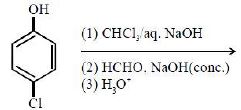
A
$4-$chlorosalicylic acid and methanol
B
$2-$hydroxy$-5-$chlorobenzyl alcohol and formic acid
C
$2-$hydroxy$-5-$chlorobenzyl alcohol and formic acid
D
$4-$chlorosalicylic acid and methanol
Solution
(B) The reaction proceeds in two main steps:
$1$. Reimer-Tiemann reaction: $4$-chlorophenol reacts with $CHCl_3$ and aqueous $NaOH$ to form $5$-chloro$-2-$hydroxybenzaldehyde.
$2$. Cannizzaro reaction: The aldehyde formed reacts with $HCHO$ and concentrated $NaOH$ (cross-Cannizzaro reaction). The aldehyde is reduced to the corresponding alcohol ($5$-chloro$-2-$hydroxybenzyl alcohol),and $HCHO$ is oxidized to sodium formate $(HCOONa)$.
$3$. Acidification: Finally,treatment with $H_3O^+$ converts the phenoxide and formate salt into $5$-chloro$-2-$hydroxybenzyl alcohol and formic acid $(HCOOH)$.
$1$. Reimer-Tiemann reaction: $4$-chlorophenol reacts with $CHCl_3$ and aqueous $NaOH$ to form $5$-chloro$-2-$hydroxybenzaldehyde.
$2$. Cannizzaro reaction: The aldehyde formed reacts with $HCHO$ and concentrated $NaOH$ (cross-Cannizzaro reaction). The aldehyde is reduced to the corresponding alcohol ($5$-chloro$-2-$hydroxybenzyl alcohol),and $HCHO$ is oxidized to sodium formate $(HCOONa)$.
$3$. Acidification: Finally,treatment with $H_3O^+$ converts the phenoxide and formate salt into $5$-chloro$-2-$hydroxybenzyl alcohol and formic acid $(HCOOH)$.
0 likesView Solution
293
ChemistryDifficultMCQJEE Main · 2019
The complex ion that will lose its crystal field stabilization energy upon oxidation of its metal to $+3$ state is
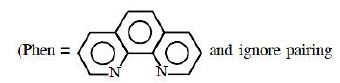
A
$[Ni(phen)_3]^{2+}$
B
$[Zn(phen)_3]^{2+}$
C
$[Co(phen)_3]^{2+}$
D
$[Fe(phen)_3]^{2+}$
Solution
(D) The Crystal Field Stabilization Energy $(CFSE)$ for an octahedral complex is given by $CFSE = (-0.4n_{t2g} + 0.6n_{eg})\Delta_o$.
For $[Fe(phen)_3]^{2+}$,the central metal is $Fe^{2+}$ ($d^6$ configuration). Since $phen$ is a strong field ligand,it forms a low-spin complex with $t_{2g}^6 e_g^0$ configuration.
$CFSE = (-0.4 \times 6 + 0.6 \times 0)\Delta_o = -2.4\Delta_o$.
Upon oxidation to $Fe^{3+}$ ($d^5$ configuration),the complex becomes $[Fe(phen)_3]^{3+}$ with $t_{2g}^5 e_g^0$ configuration.
$CFSE = (-0.4 \times 5 + 0.6 \times 0)\Delta_o = -2.0\Delta_o$.
However,the question implies a significant loss or change in stability. Let's check $[Co(phen)_3]^{2+}$ $(d^7)$: $t_{2g}^6 e_g^1$ $(CFSE = -1.8\Delta_o)$. Oxidation to $Co^{3+}$ $(d^6)$: $t_{2g}^6 e_g^0$ $(CFSE = -2.4\Delta_o)$.
Actually,for $Fe^{2+}$ $(d^6)$ to $Fe^{3+}$ $(d^5)$,the loss of an electron from the $t_{2g}$ orbital significantly reduces the stabilization energy. Thus,$[Fe(phen)_3]^{2+}$ is the correct answer.
For $[Fe(phen)_3]^{2+}$,the central metal is $Fe^{2+}$ ($d^6$ configuration). Since $phen$ is a strong field ligand,it forms a low-spin complex with $t_{2g}^6 e_g^0$ configuration.
$CFSE = (-0.4 \times 6 + 0.6 \times 0)\Delta_o = -2.4\Delta_o$.
Upon oxidation to $Fe^{3+}$ ($d^5$ configuration),the complex becomes $[Fe(phen)_3]^{3+}$ with $t_{2g}^5 e_g^0$ configuration.
$CFSE = (-0.4 \times 5 + 0.6 \times 0)\Delta_o = -2.0\Delta_o$.
However,the question implies a significant loss or change in stability. Let's check $[Co(phen)_3]^{2+}$ $(d^7)$: $t_{2g}^6 e_g^1$ $(CFSE = -1.8\Delta_o)$. Oxidation to $Co^{3+}$ $(d^6)$: $t_{2g}^6 e_g^0$ $(CFSE = -2.4\Delta_o)$.
Actually,for $Fe^{2+}$ $(d^6)$ to $Fe^{3+}$ $(d^5)$,the loss of an electron from the $t_{2g}$ orbital significantly reduces the stabilization energy. Thus,$[Fe(phen)_3]^{2+}$ is the correct answer.
0 likesView Solution
294
ChemistryDifficultMCQJEE Main · 2019
Peptization is defined as:
A
The process of converting soluble particles to form a colloidal solution.
B
The process of converting a precipitate into a colloidal solution.
C
The process of converting a colloidal solution into a precipitate.
D
The process of bringing colloidal molecules into a true solution.
Solution
(B) Peptization is the process of converting a freshly prepared precipitate into a colloidal solution by adding a suitable electrolyte,known as a peptizing agent.
0 likesView Solution
295
ChemistryMediumMCQJEE Main · 2019
Which of the following is a thermosetting polymer?
A
$PVC$
B
Bakelite
C
Buna $-N$
D
Nylon $6$
Solution
(B) Thermosetting polymers are cross-linked polymers that undergo extensive cross-linking in molds during molding,which makes them hard and infusible.
Bakelite is a classic example of a thermosetting polymer,formed by the condensation reaction of phenol and formaldehyde.
Bakelite is a classic example of a thermosetting polymer,formed by the condensation reaction of phenol and formaldehyde.
0 likesView Solution
296
ChemistryDifficultMCQJEE Main · 2019
An element has a face-centred cubic $(fcc)$ structure with a cell edge of $a$. The distance between the centres of two nearest tetrahedral voids in the lattice is
A
$\frac{a}{2}$
B
$\sqrt{2}a$
C
$\frac{3}{2}a$
D
$a$
Solution
(A) In an $fcc$ lattice,there are $8$ tetrahedral voids,each located on the body diagonals at a distance of $\frac{1}{4}$ of the body diagonal length from each corner.
Each body diagonal has a length of $\sqrt{3}a$.
The distance of each tetrahedral void from the nearest corner is $\frac{\sqrt{3}a}{4}$.
There are two tetrahedral voids on each body diagonal.
The distance between these two nearest tetrahedral voids is $\frac{\sqrt{3}a}{4} + \frac{\sqrt{3}a}{4} = \frac{\sqrt{3}a}{2}$ is incorrect; let us re-evaluate.
The distance between two nearest tetrahedral voids is the distance between the two voids located on the same body diagonal,which is $\frac{\sqrt{3}a}{2}$ is not correct. Actually,the distance between two nearest tetrahedral voids is $\frac{a}{2}$.
Each body diagonal has a length of $\sqrt{3}a$.
The distance of each tetrahedral void from the nearest corner is $\frac{\sqrt{3}a}{4}$.
There are two tetrahedral voids on each body diagonal.
The distance between these two nearest tetrahedral voids is $\frac{\sqrt{3}a}{4} + \frac{\sqrt{3}a}{4} = \frac{\sqrt{3}a}{2}$ is incorrect; let us re-evaluate.
The distance between two nearest tetrahedral voids is the distance between the two voids located on the same body diagonal,which is $\frac{\sqrt{3}a}{2}$ is not correct. Actually,the distance between two nearest tetrahedral voids is $\frac{a}{2}$.
0 likesView Solution
297
ChemistryMediumMCQJEE Main · 2019
The idea of the froth floatation method came from a person $X$ and this method is related to the process $Y$ of ores. $X$ and $Y$,respectively,are
A
washer woman and concentration
B
fisher woman and concentration
C
fisher man and reduction
D
washer man and reduction
Solution
(B) The froth floatation process is a method used for the concentration of sulphide ores.
It is said that the idea of this process was inspired by a fisherwoman who noticed that sulphide minerals,being hydrophobic,float on water while gangue particles sink,similar to how oily substances float on water.
Thus,$X$ is a fisherwoman and $Y$ is the concentration of ores.
It is said that the idea of this process was inspired by a fisherwoman who noticed that sulphide minerals,being hydrophobic,float on water while gangue particles sink,similar to how oily substances float on water.
Thus,$X$ is a fisherwoman and $Y$ is the concentration of ores.
0 likesView Solution
298
ChemistryDifficultMCQJEE Main · 2019
In the following reaction; $x A \longrightarrow y B$
$\log_{10} \left[ -\frac{d[A]}{dt} \right] = \log_{10} \left[ \frac{d[B]}{dt} \right] + 0.3010$
$'A'$ and $'B'$ respectively can be
$\log_{10} \left[ -\frac{d[A]}{dt} \right] = \log_{10} \left[ \frac{d[B]}{dt} \right] + 0.3010$
$'A'$ and $'B'$ respectively can be
A
$C_2H_2$ and $C_6H_6$
B
$n-\text{Butane}$ and $\text{Iso-butane}$
C
$N_2O_4$ and $NO_2$
D
$C_2H_4$ and $C_4H_8$
Solution
(D) The rate expression for the reaction $x A \longrightarrow y B$ is given by: $-\frac{1}{x} \frac{d[A]}{dt} = \frac{1}{y} \frac{d[B]}{dt}$.
Given the equation: $\log_{10} \left[ -\frac{d[A]}{dt} \right] = \log_{10} \left[ \frac{d[B]}{dt} \right] + 0.3010$.
Since $\log_{10}(2) \approx 0.3010$,we can write: $\log_{10} \left[ -\frac{d[A]}{dt} \right] = \log_{10} \left[ 2 \times \frac{d[B]}{dt} \right]$.
Taking antilog on both sides: $-\frac{d[A]}{dt} = 2 \frac{d[B]}{dt}$,which implies $-\frac{1}{2} \frac{d[A]}{dt} = \frac{d[B]}{dt}$.
Comparing this with the general rate expression,we get $x = 2$ and $y = 1$.
Thus,the reaction is $2 A \longrightarrow B$. For $A = C_2H_4$ and $B = C_4H_8$,the reaction is $2 C_2H_4 \longrightarrow C_4H_8$.
Given the equation: $\log_{10} \left[ -\frac{d[A]}{dt} \right] = \log_{10} \left[ \frac{d[B]}{dt} \right] + 0.3010$.
Since $\log_{10}(2) \approx 0.3010$,we can write: $\log_{10} \left[ -\frac{d[A]}{dt} \right] = \log_{10} \left[ 2 \times \frac{d[B]}{dt} \right]$.
Taking antilog on both sides: $-\frac{d[A]}{dt} = 2 \frac{d[B]}{dt}$,which implies $-\frac{1}{2} \frac{d[A]}{dt} = \frac{d[B]}{dt}$.
Comparing this with the general rate expression,we get $x = 2$ and $y = 1$.
Thus,the reaction is $2 A \longrightarrow B$. For $A = C_2H_4$ and $B = C_4H_8$,the reaction is $2 C_2H_4 \longrightarrow C_4H_8$.
0 likesView Solution
Vedclass Products
For Students
Vedclass Test Series
Mock tests in real JEE Main style covering Chemistry with performance analysis. 5-day free trial.
Start Free TrialFor Teachers
Exam Paper Generator
Generate Set A/B/C/D Chemistry papers from 7.5L+ questions in 2 minutes. 3 chapters free.
Try FreeFor Institutes
Online Exam Module
Run live JEE Main mock exams with unlimited students, 360° analytics & white-label branding.
See DemoFrequently Asked Questions
How many Chemistry questions are in JEE Main 2019?
There are 521 Chemistry questions from the JEE Main 2019 paper on Vedclass, each with a detailed step-by-step solution in English.
Are JEE Main 2019 Chemistry solutions available in English?
Yes. All solutions on this page are in English. You can also switch to English or Hindi using the language buttons above the questions.
Can I practice JEE Main 2019 Chemistry as a timed test?
Yes. Use the Vedclass Test Series to attempt a full JEE Main mock test covering Chemistry with time limits and instant score analysis.
Can teachers create Chemistry papers from JEE Main previous year questions?
Yes. The Vedclass Exam Paper Generator lets teachers mix JEE Main Chemistry questions and generate Set A/B/C/D papers in minutes.
For Teachers & Institutes
Build a Custom Chemistry Paper
Pick JEE Main 2019 Chemistry questions, set difficulty, and generate Set A/B/C/D in 2 minutes.