
MathematicsQ51–71 of 121 questions
Page 2 of 2 · English
51
MathematicsDifficultMCQJEE Main · 2018
Let $p, q$ and $r$ be real numbers $(p \ne q, r \ne 0)$ such that the roots of the equation $\frac{1}{x + p} + \frac{1}{x + q} = \frac{1}{r}$ are equal in magnitude but opposite in sign. Then the sum of squares of these roots is equal to:
A
$p^2 + q^2 + r^2$
B
$p^2 + q^2$
C
$2(p^2 + q^2)$
D
$\frac{p^2 + q^2}{2}$
Solution
(B) Given the equation: $\frac{1}{x + p} + \frac{1}{x + q} = \frac{1}{r}$
Simplify the left side: $\frac{x + q + x + p}{(x + p)(x + q)} = \frac{1}{r}$
Cross-multiply: $r(2x + p + q) = x^2 + (p + q)x + pq$
Rearrange into standard quadratic form: $x^2 + (p + q - 2r)x + (pq - pr - qr) = 0$
Let the roots be $\alpha$ and $\beta$. Since the roots are equal in magnitude but opposite in sign,$\alpha = -\beta$,which implies $\alpha + \beta = 0$.
From the sum of roots formula for a quadratic equation $ax^2 + bx + c = 0$,the sum of roots is $-b/a$. Thus,$-(p + q - 2r) = 0$,which means $p + q = 2r$.
The sum of squares of the roots is $\alpha^2 + \beta^2 = (\alpha + \beta)^2 - 2\alpha\beta$.
Since $\alpha + \beta = 0$,this simplifies to $\alpha^2 + \beta^2 = -2\alpha\beta$.
From the product of roots formula,$\alpha\beta = pq - pr - qr$.
Substituting $\alpha\beta$: $\alpha^2 + \beta^2 = -2(pq - pr - qr) = -2pq + 2pr + 2qr$.
Since $2r = p + q$,substitute $2pr + 2qr = 2r(p + q) = (p + q)(p + q) = p^2 + 2pq + q^2$.
Therefore,$\alpha^2 + \beta^2 = -2pq + (p^2 + 2pq + q^2) = p^2 + q^2$.
Simplify the left side: $\frac{x + q + x + p}{(x + p)(x + q)} = \frac{1}{r}$
Cross-multiply: $r(2x + p + q) = x^2 + (p + q)x + pq$
Rearrange into standard quadratic form: $x^2 + (p + q - 2r)x + (pq - pr - qr) = 0$
Let the roots be $\alpha$ and $\beta$. Since the roots are equal in magnitude but opposite in sign,$\alpha = -\beta$,which implies $\alpha + \beta = 0$.
From the sum of roots formula for a quadratic equation $ax^2 + bx + c = 0$,the sum of roots is $-b/a$. Thus,$-(p + q - 2r) = 0$,which means $p + q = 2r$.
The sum of squares of the roots is $\alpha^2 + \beta^2 = (\alpha + \beta)^2 - 2\alpha\beta$.
Since $\alpha + \beta = 0$,this simplifies to $\alpha^2 + \beta^2 = -2\alpha\beta$.
From the product of roots formula,$\alpha\beta = pq - pr - qr$.
Substituting $\alpha\beta$: $\alpha^2 + \beta^2 = -2(pq - pr - qr) = -2pq + 2pr + 2qr$.
Since $2r = p + q$,substitute $2pr + 2qr = 2r(p + q) = (p + q)(p + q) = p^2 + 2pq + q^2$.
Therefore,$\alpha^2 + \beta^2 = -2pq + (p^2 + 2pq + q^2) = p^2 + q^2$.
0 likesView Solution
52
MathematicsDifficultMCQJEE Main · 2018
If an angle $A$ of a $\Delta ABC$ satisfies $5 \cos A + 3 = 0$,then the roots of the quadratic equation $9x^2 + 27x + 20 = 0$ are
A
$sin A, sec A$
B
$sec A, tan A$
C
$tan A, cos A$
D
$sec A, cot A$
Solution
(B) Given the quadratic equation $9x^2 + 27x + 20 = 0$.
Using the quadratic formula $x = \frac{-b \pm \sqrt{b^2 - 4ac}}{2a}$,we get:
$x = \frac{-27 \pm \sqrt{27^2 - 4 \times 9 \times 20}}{2 \times 9} = \frac{-27 \pm \sqrt{729 - 720}}{18} = \frac{-27 \pm 3}{18}$.
Thus,the roots are $x_1 = \frac{-24}{18} = -\frac{4}{3}$ and $x_2 = \frac{-30}{18} = -\frac{5}{3}$.
Given $5 \cos A + 3 = 0$,we have $\cos A = -\frac{3}{5}$.
Then $\sec A = \frac{1}{\cos A} = -\frac{5}{3}$.
Since $\cos A$ is negative,$A$ is an obtuse angle in the second quadrant,so $\tan A$ is negative.
$\tan A = -\sqrt{\sec^2 A - 1} = -\sqrt{(-\frac{5}{3})^2 - 1} = -\sqrt{\frac{25}{9} - 1} = -\sqrt{\frac{16}{9}} = -\frac{4}{3}$.
Comparing the roots,the roots are $\sec A$ and $\tan A$.
Using the quadratic formula $x = \frac{-b \pm \sqrt{b^2 - 4ac}}{2a}$,we get:
$x = \frac{-27 \pm \sqrt{27^2 - 4 \times 9 \times 20}}{2 \times 9} = \frac{-27 \pm \sqrt{729 - 720}}{18} = \frac{-27 \pm 3}{18}$.
Thus,the roots are $x_1 = \frac{-24}{18} = -\frac{4}{3}$ and $x_2 = \frac{-30}{18} = -\frac{5}{3}$.
Given $5 \cos A + 3 = 0$,we have $\cos A = -\frac{3}{5}$.
Then $\sec A = \frac{1}{\cos A} = -\frac{5}{3}$.
Since $\cos A$ is negative,$A$ is an obtuse angle in the second quadrant,so $\tan A$ is negative.
$\tan A = -\sqrt{\sec^2 A - 1} = -\sqrt{(-\frac{5}{3})^2 - 1} = -\sqrt{\frac{25}{9} - 1} = -\sqrt{\frac{16}{9}} = -\frac{4}{3}$.
Comparing the roots,the roots are $\sec A$ and $\tan A$.
0 likesView Solution
53
MathematicsDifficultMCQJEE Main · 2018
The coefficient of $x^2$ in the expansion of the product $(2 - x^2)((1 + 2x + 3x^2)^6 + (1 - 4x^2)^6)$ is
A
$106$
B
$107$
C
$155$
D
$108$
Solution
(A) Let $f(x) = (1 + 2x + 3x^2)^6 + (1 - 4x^2)^6$.
We need the coefficient of $x^2$ in $(2 - x^2)f(x)$.
This is equal to $2 \times (\text{coefficient of } x^2 \text{ in } f(x)) - 1 \times (\text{constant term in } f(x))$.
First,find the constant term in $f(x)$:
Constant term $= (1 + 2(0) + 3(0)^2)^6 + (1 - 4(0)^2)^6 = 1^6 + 1^6 = 2$.
Next,find the coefficient of $x^2$ in $f(x)$:
For $(1 + 2x + 3x^2)^6$,using the multinomial expansion or binomial expansion $(1 + (2x + 3x^2))^6 = 1 + 6(2x + 3x^2) + \binom{6}{2}(2x)^2 + \dots = 1 + 12x + 18x^2 + 15(4x^2) + \dots = 1 + 12x + 78x^2 + \dots$
The coefficient of $x^2$ is $78$.
For $(1 - 4x^2)^6$,the expansion is $1 + 6(-4x^2) + \dots = 1 - 24x^2 + \dots$
The coefficient of $x^2$ is $-24$.
Thus,the coefficient of $x^2$ in $f(x)$ is $78 - 24 = 54$.
Finally,the coefficient of $x^2$ in $(2 - x^2)f(x)$ is $2(54) - 1(2) = 108 - 2 = 106$.
We need the coefficient of $x^2$ in $(2 - x^2)f(x)$.
This is equal to $2 \times (\text{coefficient of } x^2 \text{ in } f(x)) - 1 \times (\text{constant term in } f(x))$.
First,find the constant term in $f(x)$:
Constant term $= (1 + 2(0) + 3(0)^2)^6 + (1 - 4(0)^2)^6 = 1^6 + 1^6 = 2$.
Next,find the coefficient of $x^2$ in $f(x)$:
For $(1 + 2x + 3x^2)^6$,using the multinomial expansion or binomial expansion $(1 + (2x + 3x^2))^6 = 1 + 6(2x + 3x^2) + \binom{6}{2}(2x)^2 + \dots = 1 + 12x + 18x^2 + 15(4x^2) + \dots = 1 + 12x + 78x^2 + \dots$
The coefficient of $x^2$ is $78$.
For $(1 - 4x^2)^6$,the expansion is $1 + 6(-4x^2) + \dots = 1 - 24x^2 + \dots$
The coefficient of $x^2$ is $-24$.
Thus,the coefficient of $x^2$ in $f(x)$ is $78 - 24 = 54$.
Finally,the coefficient of $x^2$ in $(2 - x^2)f(x)$ is $2(54) - 1(2) = 108 - 2 = 106$.
0 likesView Solution
54
MathematicsDifficultMCQJEE Main · 2018
The least positive integer $n$ for which $\left( \frac{1 + i\sqrt{3}}{1 - i\sqrt{3}} \right)^n = 1$ is?
A
$2$
B
$6$
C
$5$
D
$3$
Solution
(D) Let $z = \frac{1 + i\sqrt{3}}{1 - i\sqrt{3}}$.
Multiplying the numerator and denominator by the conjugate of the denominator $(1 + i\sqrt{3})$:
$z = \frac{(1 + i\sqrt{3})(1 + i\sqrt{3})}{(1 - i\sqrt{3})(1 + i\sqrt{3})} = \frac{1 + 2i\sqrt{3} + (i\sqrt{3})^2}{1^2 + (\sqrt{3})^2} = \frac{1 + 2i\sqrt{3} - 3}{1 + 3} = \frac{-2 + 2i\sqrt{3}}{4} = \frac{-1 + i\sqrt{3}}{2}$.
We recognize this as $\omega$,where $\omega = \frac{-1 + i\sqrt{3}}{2}$ is a complex cube root of unity.
Thus,$z = \omega$.
The equation becomes $\omega^n = 1$.
The smallest positive integer $n$ for which $\omega^n = 1$ is $n = 3$.
Multiplying the numerator and denominator by the conjugate of the denominator $(1 + i\sqrt{3})$:
$z = \frac{(1 + i\sqrt{3})(1 + i\sqrt{3})}{(1 - i\sqrt{3})(1 + i\sqrt{3})} = \frac{1 + 2i\sqrt{3} + (i\sqrt{3})^2}{1^2 + (\sqrt{3})^2} = \frac{1 + 2i\sqrt{3} - 3}{1 + 3} = \frac{-2 + 2i\sqrt{3}}{4} = \frac{-1 + i\sqrt{3}}{2}$.
We recognize this as $\omega$,where $\omega = \frac{-1 + i\sqrt{3}}{2}$ is a complex cube root of unity.
Thus,$z = \omega$.
The equation becomes $\omega^n = 1$.
The smallest positive integer $n$ for which $\omega^n = 1$ is $n = 3$.
0 likesView Solution
55
MathematicsDifficultMCQJEE Main · 2018
$\mathop {\lim }\limits_{x \to 0} \frac{{{{(27 + x)}^{\frac{1}{3}}}} - 3}{{9 - {{(27 + x)}^{\frac{2}{3}}}}}$ equals.
A
$-\frac{1}{3}$
B
$\frac{1}{6}$
C
$-\frac{1}{6}$
D
$\frac{1}{3}$
Solution
(C) Let $L = \mathop {\lim }\limits_{x \to 0} \frac{{{{(27 + x)}^{\frac{1}{3}}} - 3}}{{9 - {{(27 + x)}^{\frac{2}{3}}}}}$
Substituting $x = 0$,we get the indeterminate form $\frac{0}{0}$.
Applying $L$'Hospital's rule by differentiating the numerator and denominator with respect to $x$:
$L = \mathop {\lim }\limits_{x \to 0} \frac{{\frac{d}{{dx}}({{(27 + x)}^{\frac{1}{3}}} - 3)}}{{\frac{d}{{dx}}(9 - {{(27 + x)}^{\frac{2}{3}}})}}$
$L = \mathop {\lim }\limits_{x \to 0} \frac{{\frac{1}{3}{{(27 + x)}^{ - \frac{2}{3}}}}}{{ - \frac{2}{3}{{(27 + x)}^{ - \frac{1}{3}}}}}$
$L = \mathop {\lim }\limits_{x \to 0} -\frac{1}{2} {(27 + x)}^{ - \frac{2}{3} + \frac{1}{3}}$
$L = -\frac{1}{2} {(27)}^{ - \frac{1}{3}} = -\frac{1}{2} \times \frac{1}{3} = -\frac{1}{6}$
Substituting $x = 0$,we get the indeterminate form $\frac{0}{0}$.
Applying $L$'Hospital's rule by differentiating the numerator and denominator with respect to $x$:
$L = \mathop {\lim }\limits_{x \to 0} \frac{{\frac{d}{{dx}}({{(27 + x)}^{\frac{1}{3}}} - 3)}}{{\frac{d}{{dx}}(9 - {{(27 + x)}^{\frac{2}{3}}})}}$
$L = \mathop {\lim }\limits_{x \to 0} \frac{{\frac{1}{3}{{(27 + x)}^{ - \frac{2}{3}}}}}{{ - \frac{2}{3}{{(27 + x)}^{ - \frac{1}{3}}}}}$
$L = \mathop {\lim }\limits_{x \to 0} -\frac{1}{2} {(27 + x)}^{ - \frac{2}{3} + \frac{1}{3}}$
$L = -\frac{1}{2} {(27)}^{ - \frac{1}{3}} = -\frac{1}{2} \times \frac{1}{3} = -\frac{1}{6}$
0 likesView Solution
56
MathematicsDifficultMCQJEE Main · 2018
If a circle $C,$ whose radius is $3,$ touches the circle $x^2 + y^2 + 2x - 4y - 4 = 0$ externally at the point $(2, 2),$ then the length of the intercept cut by circle $C$ on the $x-$axis is equal to
A
$\sqrt{5}$
B
$2\sqrt{3}$
C
$3\sqrt{2}$
D
$2\sqrt{5}$
Solution
(D) The given circle is $x^2 + y^2 + 2x - 4y - 4 = 0.$
Its center is $O_1 = (-1, 2)$ and its radius $r_1 = \sqrt{(-1)^2 + 2^2 - (-4)} = \sqrt{1 + 4 + 4} = 3.$
Let the center of circle $C$ be $O_2 = (h, k)$ and its radius be $r_2 = 3.$
Since the circles touch externally at $P(2, 2),$ the point $P$ divides the line segment $O_1O_2$ internally in the ratio $r_1 : r_2 = 3 : 3 = 1 : 1.$
Thus,$P$ is the midpoint of $O_1O_2.$
$(2, 2) = \left( \frac{-1 + h}{2}, \frac{2 + k}{2} \right).$
Solving for $h$ and $k$:
$-1 + h = 4 \Rightarrow h = 5$
$2 + k = 4 \Rightarrow k = 2$
So,the center of circle $C$ is $(5, 2).$
The equation of circle $C$ is $(x - 5)^2 + (y - 2)^2 = 3^2,$ which simplifies to $x^2 - 10x + 25 + y^2 - 4y + 4 = 9,$ or $x^2 + y^2 - 10x - 4y + 20 = 0.$
The length of the intercept cut by this circle on the $x-$axis is given by $2\sqrt{g^2 - c},$ where $g = -5$ and $c = 20.$
Length $= 2\sqrt{(-5)^2 - 20} = 2\sqrt{25 - 20} = 2\sqrt{5}.$
Its center is $O_1 = (-1, 2)$ and its radius $r_1 = \sqrt{(-1)^2 + 2^2 - (-4)} = \sqrt{1 + 4 + 4} = 3.$
Let the center of circle $C$ be $O_2 = (h, k)$ and its radius be $r_2 = 3.$
Since the circles touch externally at $P(2, 2),$ the point $P$ divides the line segment $O_1O_2$ internally in the ratio $r_1 : r_2 = 3 : 3 = 1 : 1.$
Thus,$P$ is the midpoint of $O_1O_2.$
$(2, 2) = \left( \frac{-1 + h}{2}, \frac{2 + k}{2} \right).$
Solving for $h$ and $k$:
$-1 + h = 4 \Rightarrow h = 5$
$2 + k = 4 \Rightarrow k = 2$
So,the center of circle $C$ is $(5, 2).$
The equation of circle $C$ is $(x - 5)^2 + (y - 2)^2 = 3^2,$ which simplifies to $x^2 - 10x + 25 + y^2 - 4y + 4 = 9,$ or $x^2 + y^2 - 10x - 4y + 20 = 0.$
The length of the intercept cut by this circle on the $x-$axis is given by $2\sqrt{g^2 - c},$ where $g = -5$ and $c = 20.$
Length $= 2\sqrt{(-5)^2 - 20} = 2\sqrt{25 - 20} = 2\sqrt{5}.$
0 likesView Solution
57
MathematicsDifficultMCQJEE Main · 2018
Let $P$ be a point on the parabola $x^2 = 4y$. If the distance of $P$ from the centre of the circle $x^2 + y^2 + 6x + 8 = 0$ is minimum,then the equation of the tangent to the parabola at $P$ is:
A
$x + 4y - 2 = 0$
B
$x + 2y = 0$
C
$x + y + 1 = 0$
D
$x - y + 3 = 0$
Solution
(C) Let the point $P$ on the parabola $x^2 = 4y$ be $(2t, t^2)$.
The given circle is $x^2 + y^2 + 6x + 8 = 0$. Its centre $C$ is $(-3, 0)$.
For the distance $PC$ to be minimum,the line $PC$ must be the normal to the parabola at $P$.
The slope of the tangent to the parabola at $P(2t, t^2)$ is $\frac{dy}{dx} = \frac{x}{2} = t$.
Therefore,the slope of the normal at $P$ is $-\frac{1}{t}$.
The slope of the line $PC$ connecting $P(2t, t^2)$ and $C(-3, 0)$ is $\frac{t^2 - 0}{2t - (-3)} = \frac{t^2}{2t + 3}$.
Equating the slopes: $\frac{t^2}{2t + 3} = -\frac{1}{t}$.
$t^3 = -2t - 3 \Rightarrow t^3 + 2t + 3 = 0$.
By inspection,$t = -1$ is a root: $(-1)^3 + 2(-1) + 3 = -1 - 2 + 3 = 0$.
For $t = -1$,the point $P$ is $(2(-1), (-1)^2) = (-2, 1)$.
The slope of the tangent at $P$ is $t = -1$.
The equation of the tangent at $(-2, 1)$ is $y - 1 = -1(x + 2)$.
$y - 1 = -x - 2 \Rightarrow x + y + 1 = 0$.
The given circle is $x^2 + y^2 + 6x + 8 = 0$. Its centre $C$ is $(-3, 0)$.
For the distance $PC$ to be minimum,the line $PC$ must be the normal to the parabola at $P$.
The slope of the tangent to the parabola at $P(2t, t^2)$ is $\frac{dy}{dx} = \frac{x}{2} = t$.
Therefore,the slope of the normal at $P$ is $-\frac{1}{t}$.
The slope of the line $PC$ connecting $P(2t, t^2)$ and $C(-3, 0)$ is $\frac{t^2 - 0}{2t - (-3)} = \frac{t^2}{2t + 3}$.
Equating the slopes: $\frac{t^2}{2t + 3} = -\frac{1}{t}$.
$t^3 = -2t - 3 \Rightarrow t^3 + 2t + 3 = 0$.
By inspection,$t = -1$ is a root: $(-1)^3 + 2(-1) + 3 = -1 - 2 + 3 = 0$.
For $t = -1$,the point $P$ is $(2(-1), (-1)^2) = (-2, 1)$.
The slope of the tangent at $P$ is $t = -1$.
The equation of the tangent at $(-2, 1)$ is $y - 1 = -1(x + 2)$.
$y - 1 = -x - 2 \Rightarrow x + y + 1 = 0$.
0 likesView Solution
58
MathematicsDifficultMCQJEE Main · 2018
The mean and the standard deviation $(s.d.)$ of five observations are $9$ and $0,$ respectively. If one of the observations is changed such that the mean of the new set of five observations becomes $10,$ then their $s.d.$ is?
A
$0$
B
$4$
C
$2$
D
$1$
Solution
(C) Given that the mean $\bar{x} = 9$ and standard deviation $\sigma = 0$ for $n = 5$ observations.
Since $\sigma = 0,$ all five observations must be equal to the mean.
Thus,the observations are $9, 9, 9, 9, 9.$
Let the new observation be $x_5'$ after changing one value. The sum of the other four observations is $9 \times 4 = 36.$
The new mean is given as $10,$ so $\frac{36 + x_5'}{5} = 10.$
$36 + x_5' = 50 \Rightarrow x_5' = 14.$
The new set of observations is $9, 9, 9, 9, 14.$
The new standard deviation $\sigma_{new} = \sqrt{\frac{\sum (x_i - \bar{x}_{new})^2}{n}}.$
$\sigma_{new} = \sqrt{\frac{4(9 - 10)^2 + (14 - 10)^2}{5}} = \sqrt{\frac{4(1) + 16}{5}} = \sqrt{\frac{20}{5}} = \sqrt{4} = 2.$
Since $\sigma = 0,$ all five observations must be equal to the mean.
Thus,the observations are $9, 9, 9, 9, 9.$
Let the new observation be $x_5'$ after changing one value. The sum of the other four observations is $9 \times 4 = 36.$
The new mean is given as $10,$ so $\frac{36 + x_5'}{5} = 10.$
$36 + x_5' = 50 \Rightarrow x_5' = 14.$
The new set of observations is $9, 9, 9, 9, 14.$
The new standard deviation $\sigma_{new} = \sqrt{\frac{\sum (x_i - \bar{x}_{new})^2}{n}}.$
$\sigma_{new} = \sqrt{\frac{4(9 - 10)^2 + (14 - 10)^2}{5}} = \sqrt{\frac{4(1) + 16}{5}} = \sqrt{\frac{20}{5}} = \sqrt{4} = 2.$
0 likesView Solution
59
MathematicsDifficultMCQJEE Main · 2018
The sum of the first $20$ terms of the series $1 + \frac{3}{2} + \frac{7}{4} + \frac{15}{8} + \frac{31}{16} + \dots$ is?
A
$38 + \frac{1}{2^{20}}$
B
$39 + \frac{1}{2^{19}}$
C
$39 + \frac{1}{2^{20}}$
D
$38 + \frac{1}{2^{19}}$
Solution
(D) The given series is $1 + \frac{3}{2} + \frac{7}{4} + \frac{15}{8} + \dots$
The $n$-th term $T_n$ can be written as $T_n = \frac{2^n - 1}{2^{n-1}} = 2 - \frac{1}{2^{n-1}}$ for $n \ge 1$.
The sum of the first $20$ terms is $S_{20} = \sum_{n=1}^{20} (2 - \frac{1}{2^{n-1}})$.
$S_{20} = \sum_{n=1}^{20} 2 - \sum_{n=1}^{20} \frac{1}{2^{n-1}}$.
$S_{20} = 2(20) - (1 + \frac{1}{2} + \frac{1}{4} + \dots + \frac{1}{2^{19}})$.
The second part is a geometric progression with $a = 1$,$r = \frac{1}{2}$,and $n = 20$.
Sum $= \frac{1(1 - (1/2)^{20})}{1 - 1/2} = 2(1 - \frac{1}{2^{20}}) = 2 - \frac{1}{2^{19}}$.
Therefore,$S_{20} = 40 - (2 - \frac{1}{2^{19}}) = 38 + \frac{1}{2^{19}}$.
The $n$-th term $T_n$ can be written as $T_n = \frac{2^n - 1}{2^{n-1}} = 2 - \frac{1}{2^{n-1}}$ for $n \ge 1$.
The sum of the first $20$ terms is $S_{20} = \sum_{n=1}^{20} (2 - \frac{1}{2^{n-1}})$.
$S_{20} = \sum_{n=1}^{20} 2 - \sum_{n=1}^{20} \frac{1}{2^{n-1}}$.
$S_{20} = 2(20) - (1 + \frac{1}{2} + \frac{1}{4} + \dots + \frac{1}{2^{19}})$.
The second part is a geometric progression with $a = 1$,$r = \frac{1}{2}$,and $n = 20$.
Sum $= \frac{1(1 - (1/2)^{20})}{1 - 1/2} = 2(1 - \frac{1}{2^{20}}) = 2 - \frac{1}{2^{19}}$.
Therefore,$S_{20} = 40 - (2 - \frac{1}{2^{19}}) = 38 + \frac{1}{2^{19}}$.
0 likesView Solution
60
MathematicsDifficultMCQJEE Main · 2018
If the length of the latus rectum of an ellipse is $4 \ units$ and the distance between a focus and its nearest vertex on the major axis is $\frac{3}{2} \ units$,then its eccentricity is?
A
$\frac{1}{2}$
B
$\frac{2}{3}$
C
$\frac{1}{9}$
D
$\frac{1}{3}$
Solution
(D) Let the ellipse be $\frac{x^2}{a^2} + \frac{y^2}{b^2} = 1$ where $a > b$.
The distance between a focus $(ae, 0)$ and its nearest vertex $(a, 0)$ is $a(1 - e) = \frac{3}{2}$.
Thus,$a - ae = \frac{3}{2}$,which implies $ae = a - \frac{3}{2}$.
The length of the latus rectum is $\frac{2b^2}{a} = 4$,so $b^2 = 2a$.
Using the relation $b^2 = a^2(1 - e^2)$,we have $2a = a^2(1 - e^2)$,which simplifies to $1 - e^2 = \frac{2}{a}$,or $e^2 = 1 - \frac{2}{a}$.
From $ae = a - \frac{3}{2}$,squaring both sides gives $a^2e^2 = (a - \frac{3}{2})^2$.
Substituting $e^2 = 1 - \frac{2}{a}$,we get $a^2(1 - \frac{2}{a}) = a^2 - 3a + \frac{9}{4}$.
$a^2 - 2a = a^2 - 3a + \frac{9}{4}$.
$a = \frac{9}{4}$.
Now,$e^2 = 1 - \frac{2}{a} = 1 - \frac{2}{9/4} = 1 - \frac{8}{9} = \frac{1}{9}$.
Therefore,$e = \frac{1}{3}$.
The distance between a focus $(ae, 0)$ and its nearest vertex $(a, 0)$ is $a(1 - e) = \frac{3}{2}$.
Thus,$a - ae = \frac{3}{2}$,which implies $ae = a - \frac{3}{2}$.
The length of the latus rectum is $\frac{2b^2}{a} = 4$,so $b^2 = 2a$.
Using the relation $b^2 = a^2(1 - e^2)$,we have $2a = a^2(1 - e^2)$,which simplifies to $1 - e^2 = \frac{2}{a}$,or $e^2 = 1 - \frac{2}{a}$.
From $ae = a - \frac{3}{2}$,squaring both sides gives $a^2e^2 = (a - \frac{3}{2})^2$.
Substituting $e^2 = 1 - \frac{2}{a}$,we get $a^2(1 - \frac{2}{a}) = a^2 - 3a + \frac{9}{4}$.
$a^2 - 2a = a^2 - 3a + \frac{9}{4}$.
$a = \frac{9}{4}$.
Now,$e^2 = 1 - \frac{2}{a} = 1 - \frac{2}{9/4} = 1 - \frac{8}{9} = \frac{1}{9}$.
Therefore,$e = \frac{1}{3}$.
0 likesView Solution
61
MathematicsDifficultMCQJEE Main · 2018
Two different families $A$ and $B$ are blessed with an equal number of children. There are $3$ tickets to be distributed amongst the children of these families so that no child gets more than one ticket. If the probability that all the tickets go to the children of family $B$ is $\frac{1}{12}$,then the number of children in each family is?
A
$4$
B
$6$
C
$3$
D
$5$
Solution
(D) Let the number of children in each family be $x$.
The total number of children in both families is $2x$.
We are distributing $3$ tickets among $2x$ children such that no child gets more than one ticket.
The total number of ways to choose $3$ children out of $2x$ is $^{2x}C_{3}$.
The number of ways to choose $3$ children from family $B$ (which has $x$ children) is $^{x}C_{3}$.
The probability that all $3$ tickets go to children of family $B$ is given by:
$P = \frac{^{x}C_{3}}{^{2x}C_{3}} = \frac{1}{12}$
Expanding the combinations:
$\frac{\frac{x(x-1)(x-2)}{3!}}{\frac{2x(2x-1)(2x-2)}{3!}} = \frac{1}{12}$
$\frac{x(x-1)(x-2)}{2x(2x-1)(2x-2)} = \frac{1}{12}$
$\frac{(x-1)(x-2)}{2(2x-1) \cdot 2(x-1)} = \frac{1}{12}$
$\frac{x-2}{4(2x-1)} = \frac{1}{12}$
$\frac{x-2}{2x-1} = \frac{4}{12} = \frac{1}{3}$
$3(x-2) = 2x-1$
$3x - 6 = 2x - 1$
$x = 5$
Thus,the number of children in each family is $5$.
The total number of children in both families is $2x$.
We are distributing $3$ tickets among $2x$ children such that no child gets more than one ticket.
The total number of ways to choose $3$ children out of $2x$ is $^{2x}C_{3}$.
The number of ways to choose $3$ children from family $B$ (which has $x$ children) is $^{x}C_{3}$.
The probability that all $3$ tickets go to children of family $B$ is given by:
$P = \frac{^{x}C_{3}}{^{2x}C_{3}} = \frac{1}{12}$
Expanding the combinations:
$\frac{\frac{x(x-1)(x-2)}{3!}}{\frac{2x(2x-1)(2x-2)}{3!}} = \frac{1}{12}$
$\frac{x(x-1)(x-2)}{2x(2x-1)(2x-2)} = \frac{1}{12}$
$\frac{(x-1)(x-2)}{2(2x-1) \cdot 2(x-1)} = \frac{1}{12}$
$\frac{x-2}{4(2x-1)} = \frac{1}{12}$
$\frac{x-2}{2x-1} = \frac{4}{12} = \frac{1}{3}$
$3(x-2) = 2x-1$
$3x - 6 = 2x - 1$
$x = 5$
Thus,the number of children in each family is $5$.
0 likesView Solution
62
MathematicsDifficultMCQJEE Main · 2018
If $p \rightarrow (p \wedge \neg q)$ is false,then the truth values of $p$ and $q$ are respectively
A
$F, T$
B
$T, T$
C
$F, F$
D
$T, F$
Solution
(B) The implication $p \rightarrow (p \wedge \neg q)$ is false only when the antecedent $p$ is $T$ and the consequent $(p \wedge \neg q)$ is $F$.
Since $p$ is $T$,the expression $(p \wedge \neg q)$ becomes $(T \wedge \neg q)$.
For $(T \wedge \neg q)$ to be $F$,$\neg q$ must be $F$,which implies $q$ is $T$.
Therefore,the truth values are $p = T$ and $q = T$.
Since $p$ is $T$,the expression $(p \wedge \neg q)$ becomes $(T \wedge \neg q)$.
For $(T \wedge \neg q)$ to be $F$,$\neg q$ must be $F$,which implies $q$ is $T$.
Therefore,the truth values are $p = T$ and $q = T$.
0 likesView Solution
63
MathematicsMediumMCQJEE Main · 2018
If the curves $y^2 = 6x$ and $9x^2 + by^2 = 16$ intersect each other at right angles,then the value of $b$ is
A
$4$
B
$\frac{7}{2}$
C
$6$
D
$\frac{9}{2}$
Solution
(D) Let the point of intersection be $(x_1, y_1)$.
For the curve $y^2 = 6x$,differentiating with respect to $x$ gives $2y \frac{dy}{dx} = 6$,so $\frac{dy}{dx} = \frac{3}{y_1}$. Let this be $m_1 = \frac{3}{y_1}$.
For the curve $9x^2 + by^2 = 16$,differentiating with respect to $x$ gives $18x + 2by \frac{dy}{dx} = 0$,so $\frac{dy}{dx} = -\frac{9x_1}{by_1}$. Let this be $m_2 = -\frac{9x_1}{by_1}$.
Since the curves intersect at right angles,$m_1 \times m_2 = -1$,which implies $(\frac{3}{y_1}) \times (-\frac{9x_1}{by_1}) = -1$,so $\frac{27x_1}{by_1^2} = 1$. Since $y_1^2 = 6x_1$,we have $\frac{27x_1}{b(6x_1)} = 1$,which simplifies to $\frac{27}{6b} = 1$,so $b = \frac{27}{6} = \frac{9}{2}$.
For the curve $y^2 = 6x$,differentiating with respect to $x$ gives $2y \frac{dy}{dx} = 6$,so $\frac{dy}{dx} = \frac{3}{y_1}$. Let this be $m_1 = \frac{3}{y_1}$.
For the curve $9x^2 + by^2 = 16$,differentiating with respect to $x$ gives $18x + 2by \frac{dy}{dx} = 0$,so $\frac{dy}{dx} = -\frac{9x_1}{by_1}$. Let this be $m_2 = -\frac{9x_1}{by_1}$.
Since the curves intersect at right angles,$m_1 \times m_2 = -1$,which implies $(\frac{3}{y_1}) \times (-\frac{9x_1}{by_1}) = -1$,so $\frac{27x_1}{by_1^2} = 1$. Since $y_1^2 = 6x_1$,we have $\frac{27x_1}{b(6x_1)} = 1$,which simplifies to $\frac{27}{6b} = 1$,so $b = \frac{27}{6} = \frac{9}{2}$.
0 likesView Solution
64
MathematicsEasyMCQJEE Main · 2018
If $(p \wedge \sim q) \wedge (p \wedge r) \rightarrow \sim p \vee q$ is false,then the truth values of $p, q$ and $r$ are respectively
A
$T, T, T$
B
$F, F, F$
C
$T, F, T$
D
$F, T, F$
Solution
(C) The implication $A \rightarrow B$ is false only when $A$ is true and $B$ is false.
Given $(p \wedge \sim q) \wedge (p \wedge r) \rightarrow \sim p \vee q \equiv F$.
This implies $(p \wedge \sim q) \wedge (p \wedge r) \equiv T$ and $\sim p \vee q \equiv F$.
From $\sim p \vee q \equiv F$,we get $\sim p \equiv F$ and $q \equiv F$,which means $p \equiv T$ and $q \equiv F$.
Now substitute these into the first part: $(T \wedge \sim F) \wedge (T \wedge r) \equiv T$.
$(T \wedge T) \wedge (T \wedge r) \equiv T$.
$T \wedge (T \wedge r) \equiv T$.
This requires $T \wedge r \equiv T$,which implies $r \equiv T$.
Thus,the truth values are $p = T, q = F, r = T$.
Given $(p \wedge \sim q) \wedge (p \wedge r) \rightarrow \sim p \vee q \equiv F$.
This implies $(p \wedge \sim q) \wedge (p \wedge r) \equiv T$ and $\sim p \vee q \equiv F$.
From $\sim p \vee q \equiv F$,we get $\sim p \equiv F$ and $q \equiv F$,which means $p \equiv T$ and $q \equiv F$.
Now substitute these into the first part: $(T \wedge \sim F) \wedge (T \wedge r) \equiv T$.
$(T \wedge T) \wedge (T \wedge r) \equiv T$.
$T \wedge (T \wedge r) \equiv T$.
This requires $T \wedge r \equiv T$,which implies $r \equiv T$.
Thus,the truth values are $p = T, q = F, r = T$.
0 likesView Solution
65
MathematicsEasyMCQJEE Main · 2018
If the mean of the data $7, 8, 9, 7, 8, 7, \lambda, 8$ is $8$,then the variance of the data is:
A
$2$
B
$\frac{7}{8}$
C
$\frac{9}{8}$
D
$1$
Solution
(D) Given the mean of the data $7, 8, 9, 7, 8, 7, \lambda, 8$ is $8$.
Mean $= \frac{7+8+9+7+8+7+\lambda+8}{8} = 8$
$\Rightarrow \frac{54+\lambda}{8} = 8$
$\Rightarrow 54+\lambda = 64$
$\Rightarrow \lambda = 10$
Now,the data set is $7, 8, 9, 7, 8, 7, 10, 8$.
Variance $(\sigma^2) = \frac{1}{n} \sum (x_i - \bar{x})^2$
Variance $= \frac{(7-8)^2 + (8-8)^2 + (9-8)^2 + (7-8)^2 + (8-8)^2 + (7-8)^2 + (10-8)^2 + (8-8)^2}{8}$
Variance $= \frac{(-1)^2 + 0^2 + 1^2 + (-1)^2 + 0^2 + (-1)^2 + 2^2 + 0^2}{8}$
Variance $= \frac{1 + 0 + 1 + 1 + 0 + 1 + 4 + 0}{8} = \frac{8}{8} = 1$.
Mean $= \frac{7+8+9+7+8+7+\lambda+8}{8} = 8$
$\Rightarrow \frac{54+\lambda}{8} = 8$
$\Rightarrow 54+\lambda = 64$
$\Rightarrow \lambda = 10$
Now,the data set is $7, 8, 9, 7, 8, 7, 10, 8$.
Variance $(\sigma^2) = \frac{1}{n} \sum (x_i - \bar{x})^2$
Variance $= \frac{(7-8)^2 + (8-8)^2 + (9-8)^2 + (7-8)^2 + (8-8)^2 + (7-8)^2 + (10-8)^2 + (8-8)^2}{8}$
Variance $= \frac{(-1)^2 + 0^2 + 1^2 + (-1)^2 + 0^2 + (-1)^2 + 2^2 + 0^2}{8}$
Variance $= \frac{1 + 0 + 1 + 1 + 0 + 1 + 4 + 0}{8} = \frac{8}{8} = 1$.
0 likesView Solution
66
MathematicsDifficultMCQJEE Main · 2018
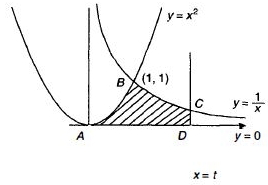
If the area of the region bounded by the curves $y = x^2$,$y = \frac{1}{x}$ and the lines $y = 0$ and $x = t$ $(t > 1)$ is $1 \, \text{sq. unit}$,then $t$ is equal to
A
$\frac{4}{3}$
B
$e^{2/3}$
C
$\frac{3}{2}$
D
$e^{3/2}$
Solution
(B) The intersection point of the curves $y = x^2$ and $y = \frac{1}{x}$ is found by setting $x^2 = \frac{1}{x}$,which gives $x^3 = 1$,so $x = 1$. Thus,the intersection point is $(1, 1)$.
The area of the region bounded by the curves $y = x^2$,$y = \frac{1}{x}$,the $x$-axis $(y = 0)$,and the line $x = t$ $(t > 1)$ is given by the sum of two integrals:
$\text{Area} = \int_0^1 x^2 \, dx + \int_1^t \frac{1}{x} \, dx$
Evaluating the integrals:
$\text{Area} = \left[ \frac{x^3}{3} \right]_0^1 + \left[ \ln(x) \right]_1^t$
$\text{Area} = \left( \frac{1}{3} - 0 \right) + (\ln(t) - \ln(1))$
Since $\ln(1) = 0$,we have:
$\text{Area} = \frac{1}{3} + \ln(t)$
Given that the area is $1 \, \text{sq. unit}$:
$\frac{1}{3} + \ln(t) = 1$
$\ln(t) = 1 - \frac{1}{3} = \frac{2}{3}$
Taking the exponential of both sides:
$t = e^{2/3}$
The area of the region bounded by the curves $y = x^2$,$y = \frac{1}{x}$,the $x$-axis $(y = 0)$,and the line $x = t$ $(t > 1)$ is given by the sum of two integrals:
$\text{Area} = \int_0^1 x^2 \, dx + \int_1^t \frac{1}{x} \, dx$
Evaluating the integrals:
$\text{Area} = \left[ \frac{x^3}{3} \right]_0^1 + \left[ \ln(x) \right]_1^t$
$\text{Area} = \left( \frac{1}{3} - 0 \right) + (\ln(t) - \ln(1))$
Since $\ln(1) = 0$,we have:
$\text{Area} = \frac{1}{3} + \ln(t)$
Given that the area is $1 \, \text{sq. unit}$:
$\frac{1}{3} + \ln(t) = 1$
$\ln(t) = 1 - \frac{1}{3} = \frac{2}{3}$
Taking the exponential of both sides:
$t = e^{2/3}$
0 likesView Solution
67
MathematicsDifficultMCQJEE Main · 2018
If the function $f$ defined as $f(x) = \frac{1}{x} - \frac{k - 1}{e^{2x} - 1}$,$x \neq 0$,is continuous at $x = 0$,then the ordered pair $(k, f(0))$ is equal to?
A
$(3, 1)$
B
$(3, 2)$
C
$\left( \frac{1}{3}, 2 \right)$
D
$(2, 1)$
Solution
(A) If the function is continuous at $x = 0$,then $\lim_{x \to 0} f(x)$ must exist and $f(0) = \lim_{x \to 0} f(x)$.
Now,$\lim_{x \to 0} f(x) = \lim_{x \to 0} \left( \frac{1}{x} - \frac{k - 1}{e^{2x} - 1} \right)$.
$= \lim_{x \to 0} \left( \frac{e^{2x} - 1 - (k - 1)x}{x(e^{2x} - 1)} \right)$.
Using the expansion $e^{2x} = 1 + 2x + \frac{(2x)^2}{2!} + \frac{(2x)^3}{3!} + \dots$,we get:
$= \lim_{x \to 0} \frac{(1 + 2x + 2x^2 + \dots) - 1 - kx + x}{x(2x + 2x^2 + \dots)}$.
$= \lim_{x \to 0} \frac{(3 - k)x + 2x^2 + \dots}{2x^2 + 2x^3 + \dots}$.
For the limit to exist,the coefficient of $x$ in the numerator must be zero,so $3 - k = 0$,which gives $k = 3$.
Substituting $k = 3$,the limit becomes $\lim_{x \to 0} \frac{2x^2 + \dots}{2x^2 + 2x^3 + \dots} = \frac{2}{2} = 1$.
Therefore,$f(0) = 1$,and the ordered pair is $(3, 1)$.
Now,$\lim_{x \to 0} f(x) = \lim_{x \to 0} \left( \frac{1}{x} - \frac{k - 1}{e^{2x} - 1} \right)$.
$= \lim_{x \to 0} \left( \frac{e^{2x} - 1 - (k - 1)x}{x(e^{2x} - 1)} \right)$.
Using the expansion $e^{2x} = 1 + 2x + \frac{(2x)^2}{2!} + \frac{(2x)^3}{3!} + \dots$,we get:
$= \lim_{x \to 0} \frac{(1 + 2x + 2x^2 + \dots) - 1 - kx + x}{x(2x + 2x^2 + \dots)}$.
$= \lim_{x \to 0} \frac{(3 - k)x + 2x^2 + \dots}{2x^2 + 2x^3 + \dots}$.
For the limit to exist,the coefficient of $x$ in the numerator must be zero,so $3 - k = 0$,which gives $k = 3$.
Substituting $k = 3$,the limit becomes $\lim_{x \to 0} \frac{2x^2 + \dots}{2x^2 + 2x^3 + \dots} = \frac{2}{2} = 1$.
Therefore,$f(0) = 1$,and the ordered pair is $(3, 1)$.
0 likesView Solution
68
MathematicsDifficultMCQJEE Main · 2018
Let $N$ denote the set of all natural numbers. Define two binary relations on $N$ as $R_1 = \{(x,y) \in N \times N : 2x + y = 10\}$ and $R_2 = \{(x,y) \in N \times N : x + 2y = 10\}$. Then
A
Both $R_1$ and $R_2$ are transitive relations
B
Both $R_1$ and $R_2$ are symmetric relations
C
Range of $R_2$ is $\{1, 2, 3, 4\}$
D
Range of $R_1$ is $\{2, 4, 8\}$
Solution
(C) Given relations on $N$ are:
$R_1 = \{(x,y) \in N \times N : 2x + y = 10\}$
$R_2 = \{(x,y) \in N \times N : x + 2y = 10\}$
For $R_1$,we solve $y = 10 - 2x$ for $x, y \in N$:
If $x=1, y=8$; if $x=2, y=6$; if $x=3, y=4$; if $x=4, y=2$.
So,$R_1 = \{(1,8), (2,6), (3,4), (4,2)\}$.
The range of $R_1$ is $\{2, 4, 6, 8\}$. Thus,option $D$ is incorrect.
$R_1$ is not symmetric because $(1,8) \in R_1$ but $(8,1) \notin R_1$.
$R_1$ is not transitive because $(3,4) \in R_1$ and $(4,2) \in R_1$,but $(3,2) \notin R_1$.
For $R_2$,we solve $x = 10 - 2y$ for $x, y \in N$:
If $y=1, x=8$; if $y=2, x=6$; if $y=3, x=4$; if $y=4, x=2$.
So,$R_2 = \{(8,1), (6,2), (4,3), (2,4)\}$.
The range of $R_2$ is $\{1, 2, 3, 4\}$.
Thus,option $C$ is correct.
$R_2$ is not symmetric because $(8,1) \in R_2$ but $(1,8) \notin R_2$.
$R_2$ is not transitive because $(4,3) \in R_2$ and $(3,y) \notin R_2$ (as no $y$ exists for $x=3$ in $R_2$).
$R_1 = \{(x,y) \in N \times N : 2x + y = 10\}$
$R_2 = \{(x,y) \in N \times N : x + 2y = 10\}$
For $R_1$,we solve $y = 10 - 2x$ for $x, y \in N$:
If $x=1, y=8$; if $x=2, y=6$; if $x=3, y=4$; if $x=4, y=2$.
So,$R_1 = \{(1,8), (2,6), (3,4), (4,2)\}$.
The range of $R_1$ is $\{2, 4, 6, 8\}$. Thus,option $D$ is incorrect.
$R_1$ is not symmetric because $(1,8) \in R_1$ but $(8,1) \notin R_1$.
$R_1$ is not transitive because $(3,4) \in R_1$ and $(4,2) \in R_1$,but $(3,2) \notin R_1$.
For $R_2$,we solve $x = 10 - 2y$ for $x, y \in N$:
If $y=1, x=8$; if $y=2, x=6$; if $y=3, x=4$; if $y=4, x=2$.
So,$R_2 = \{(8,1), (6,2), (4,3), (2,4)\}$.
The range of $R_2$ is $\{1, 2, 3, 4\}$.
Thus,option $C$ is correct.
$R_2$ is not symmetric because $(8,1) \in R_2$ but $(1,8) \notin R_2$.
$R_2$ is not transitive because $(4,3) \in R_2$ and $(3,y) \notin R_2$ (as no $y$ exists for $x=3$ in $R_2$).
0 likesView Solution
69
MathematicsDifficultMCQJEE Main · 2018
If $\int {\frac{{\tan x}}{{1 + \tan x + {{\tan }^2}x}}dx} = x - \frac{K}{{\sqrt A }}{\tan ^{ - 1}}\left( {\frac{{K\tan x + 1}}{{\sqrt A }}} \right) + C,$ ($C$ is a constant of integration),then the ordered pair $(K, A)$ is equal to
A
$(2, 3)$
B
$(2, 1)$
C
$(-2, 1)$
D
$(-2, 3)$
Solution
(A) Let $I = \int \frac{\tan x}{1 + \tan x + \tan^2 x} dx$.
We can rewrite the numerator as $\frac{1}{2} [ (1 + \tan x + \tan^2 x) - (1 - \tan x + \tan^2 x) ]$ is not ideal,so let's use the identity: $\tan x = \frac{1}{2} (1 + \tan x + \tan^2 x) - \frac{1}{2} (1 - \tan x + \tan^2 x)$.
Alternatively,note that $\int \frac{\tan x}{1 + \tan x + \tan^2 x} dx = \int \frac{\tan x + 1 + \tan^2 x - (1 + \tan^2 x)}{1 + \tan x + \tan^2 x} dx = \int 1 dx - \int \frac{\sec^2 x}{1 + \tan x + \tan^2 x} dx$.
Let $I = x - \int \frac{\sec^2 x}{1 + \tan x + \tan^2 x} dx$.
Substitute $\tan x = t$,so $\sec^2 x dx = dt$.
$I = x - \int \frac{dt}{t^2 + t + 1} = x - \int \frac{dt}{(t + 1/2)^2 + 3/4}$.
Using the formula $\int \frac{dx}{x^2 + a^2} = \frac{1}{a} \tan^{-1}(\frac{x}{a}) + C$,we get:
$I = x - \frac{1}{\sqrt{3}/2} \tan^{-1} \left( \frac{t + 1/2}{\sqrt{3}/2} \right) + C = x - \frac{2}{\sqrt{3}} \tan^{-1} \left( \frac{2t + 1}{\sqrt{3}} \right) + C$.
Substituting $t = \tan x$,we have $I = x - \frac{2}{\sqrt{3}} \tan^{-1} \left( \frac{2 \tan x + 1}{\sqrt{3}} \right) + C$.
Comparing this with the given form $x - \frac{K}{\sqrt{A}} \tan^{-1} \left( \frac{K \tan x + 1}{\sqrt{A}} \right) + C$,we find $K = 2$ and $A = 3$.
Thus,the ordered pair $(K, A)$ is $(2, 3)$.
We can rewrite the numerator as $\frac{1}{2} [ (1 + \tan x + \tan^2 x) - (1 - \tan x + \tan^2 x) ]$ is not ideal,so let's use the identity: $\tan x = \frac{1}{2} (1 + \tan x + \tan^2 x) - \frac{1}{2} (1 - \tan x + \tan^2 x)$.
Alternatively,note that $\int \frac{\tan x}{1 + \tan x + \tan^2 x} dx = \int \frac{\tan x + 1 + \tan^2 x - (1 + \tan^2 x)}{1 + \tan x + \tan^2 x} dx = \int 1 dx - \int \frac{\sec^2 x}{1 + \tan x + \tan^2 x} dx$.
Let $I = x - \int \frac{\sec^2 x}{1 + \tan x + \tan^2 x} dx$.
Substitute $\tan x = t$,so $\sec^2 x dx = dt$.
$I = x - \int \frac{dt}{t^2 + t + 1} = x - \int \frac{dt}{(t + 1/2)^2 + 3/4}$.
Using the formula $\int \frac{dx}{x^2 + a^2} = \frac{1}{a} \tan^{-1}(\frac{x}{a}) + C$,we get:
$I = x - \frac{1}{\sqrt{3}/2} \tan^{-1} \left( \frac{t + 1/2}{\sqrt{3}/2} \right) + C = x - \frac{2}{\sqrt{3}} \tan^{-1} \left( \frac{2t + 1}{\sqrt{3}} \right) + C$.
Substituting $t = \tan x$,we have $I = x - \frac{2}{\sqrt{3}} \tan^{-1} \left( \frac{2 \tan x + 1}{\sqrt{3}} \right) + C$.
Comparing this with the given form $x - \frac{K}{\sqrt{A}} \tan^{-1} \left( \frac{K \tan x + 1}{\sqrt{A}} \right) + C$,we find $K = 2$ and $A = 3$.
Thus,the ordered pair $(K, A)$ is $(2, 3)$.
0 likesView Solution
70
MathematicsDifficultMCQJEE Main · 2018
Let $X$ be a set with exactly $5$ elements and $Y$ be a set with exactly $7$ elements. If $\alpha$ is the number of one-one functions from $X$ to $Y$ and $\beta$ is the number of onto functions from $Y$ to $X$,then the value of $\frac{1}{5!}(\beta-\alpha)$ is.
A
$119$
B
$115$
C
$110$
D
$120$
Solution
(A) The number of one-one functions $\alpha$ from a set $X$ $(|X|=5)$ to a set $Y$ $(|Y|=7)$ is given by $P(7, 5) = \frac{7!}{2!} = 7 \times 6 \times 5 \times 4 \times 3 = 2520$.
Alternatively,$\alpha = {}^{7}C_{5} \times 5! = 21 \times 120 = 2520$.
For onto functions $\beta$ from $Y$ $(|Y|=7)$ to $X$ $(|X|=5)$,we use the formula for the number of onto functions: $m! \times S(n, m)$,where $S(n, m)$ is the Stirling number of the second kind.
$\beta = 5! \times S(7, 5) = 120 \times \frac{1}{2!} \sum_{k=0}^{5} (-1)^{5-k} {}^{5}C_{k} k^{7} = 120 \times 140 = 16800$.
Now,calculate $\frac{1}{5!}(\beta - \alpha) = \frac{16800 - 2520}{120} = \frac{14280}{120} = 119$.
Alternatively,$\alpha = {}^{7}C_{5} \times 5! = 21 \times 120 = 2520$.
For onto functions $\beta$ from $Y$ $(|Y|=7)$ to $X$ $(|X|=5)$,we use the formula for the number of onto functions: $m! \times S(n, m)$,where $S(n, m)$ is the Stirling number of the second kind.
$\beta = 5! \times S(7, 5) = 120 \times \frac{1}{2!} \sum_{k=0}^{5} (-1)^{5-k} {}^{5}C_{k} k^{7} = 120 \times 140 = 16800$.
Now,calculate $\frac{1}{5!}(\beta - \alpha) = \frac{16800 - 2520}{120} = \frac{14280}{120} = 119$.
0 likesView Solution
71
MathematicsEasyMCQJEE Main · 2018
Let $y=y(x)$ be the solution of the differential equation $\sin x \frac{dy}{dx}+y \cos x=4x, x \in(0, \pi)$. If $y\left(\frac{\pi}{2}\right)=0$,then $y\left(\frac{\pi}{6}\right)$ is equal to
A
$-\frac{4}{9} \pi^2$
B
$\frac{4}{9 \sqrt{3}} \pi^2$
C
$\frac{-8}{9 \sqrt{3}} \pi^2$
D
$-\frac{8}{9} \pi^2$
Solution
(D) The given differential equation is $\sin x \frac{dy}{dx} + y \cos x = 4x$.
Dividing by $\sin x$,we get $\frac{dy}{dx} + y \cot x = \frac{4x}{\sin x}$.
This is a linear differential equation of the form $\frac{dy}{dx} + Py = Q$,where $P = \cot x$ and $Q = \frac{4x}{\sin x}$.
The integrating factor ($I$.$F$.) is $e^{\int P dx} = e^{\int \cot x dx} = e^{\ln|\sin x|} = \sin x$.
The general solution is $y \cdot (I.F.) = \int Q \cdot (I.F.) dx + C$.
Substituting the values,$y \sin x = \int \frac{4x}{\sin x} \cdot \sin x dx + C = \int 4x dx + C = 2x^2 + C$.
Thus,$y = \frac{2x^2 + C}{\sin x}$.
Given $y(\frac{\pi}{2}) = 0$,we have $0 = \frac{2(\frac{\pi}{2})^2 + C}{\sin(\frac{\pi}{2})} = \frac{\pi^2}{2} + C$,so $C = -\frac{\pi^2}{2}$.
The particular solution is $y = \frac{2x^2 - \frac{\pi^2}{2}}{\sin x}$.
Evaluating at $x = \frac{\pi}{6}$,$y(\frac{\pi}{6}) = \frac{2(\frac{\pi}{6})^2 - \frac{\pi^2}{2}}{\sin(\frac{\pi}{6})} = \frac{\frac{2\pi^2}{36} - \frac{\pi^2}{2}}{1/2} = 2 \left( \frac{\pi^2}{18} - \frac{\pi^2}{2} \right) = 2 \left( \frac{\pi^2 - 9\pi^2}{18} \right) = 2 \left( \frac{-8\pi^2}{18} \right) = -\frac{8}{9} \pi^2$.
Dividing by $\sin x$,we get $\frac{dy}{dx} + y \cot x = \frac{4x}{\sin x}$.
This is a linear differential equation of the form $\frac{dy}{dx} + Py = Q$,where $P = \cot x$ and $Q = \frac{4x}{\sin x}$.
The integrating factor ($I$.$F$.) is $e^{\int P dx} = e^{\int \cot x dx} = e^{\ln|\sin x|} = \sin x$.
The general solution is $y \cdot (I.F.) = \int Q \cdot (I.F.) dx + C$.
Substituting the values,$y \sin x = \int \frac{4x}{\sin x} \cdot \sin x dx + C = \int 4x dx + C = 2x^2 + C$.
Thus,$y = \frac{2x^2 + C}{\sin x}$.
Given $y(\frac{\pi}{2}) = 0$,we have $0 = \frac{2(\frac{\pi}{2})^2 + C}{\sin(\frac{\pi}{2})} = \frac{\pi^2}{2} + C$,so $C = -\frac{\pi^2}{2}$.
The particular solution is $y = \frac{2x^2 - \frac{\pi^2}{2}}{\sin x}$.
Evaluating at $x = \frac{\pi}{6}$,$y(\frac{\pi}{6}) = \frac{2(\frac{\pi}{6})^2 - \frac{\pi^2}{2}}{\sin(\frac{\pi}{6})} = \frac{\frac{2\pi^2}{36} - \frac{\pi^2}{2}}{1/2} = 2 \left( \frac{\pi^2}{18} - \frac{\pi^2}{2} \right) = 2 \left( \frac{\pi^2 - 9\pi^2}{18} \right) = 2 \left( \frac{-8\pi^2}{18} \right) = -\frac{8}{9} \pi^2$.
0 likesView Solution
Vedclass Products
For Students
Vedclass Test Series
Mock tests in real JEE Main style covering Mathematics with performance analysis. 5-day free trial.
Start Free TrialFor Teachers
Exam Paper Generator
Generate Set A/B/C/D Mathematics papers from 7.5L+ questions in 2 minutes. 3 chapters free.
Try FreeFor Institutes
Online Exam Module
Run live JEE Main mock exams with unlimited students, 360° analytics & white-label branding.
See DemoFrequently Asked Questions
How many Mathematics questions are in JEE Main 2018?
There are 121 Mathematics questions from the JEE Main 2018 paper on Vedclass, each with a detailed step-by-step solution in English.
Are JEE Main 2018 Mathematics solutions available in English?
Yes. All solutions on this page are in English. You can also switch to English or Hindi using the language buttons above the questions.
Can I practice JEE Main 2018 Mathematics as a timed test?
Yes. Use the Vedclass Test Series to attempt a full JEE Main mock test covering Mathematics with time limits and instant score analysis.
Can teachers create Mathematics papers from JEE Main previous year questions?
Yes. The Vedclass Exam Paper Generator lets teachers mix JEE Main Mathematics questions and generate Set A/B/C/D papers in minutes.
For Teachers & Institutes
Build a Custom Mathematics Paper
Pick JEE Main 2018 Mathematics questions, set difficulty, and generate Set A/B/C/D in 2 minutes.