
MathematicsQ1–30 of 30 questions
Page 1 of 1 · Gujarati
1
MathematicsMediumMCQIIT JEE · 2017
જો પરવલય $y^2=16x$ ની જીવા,જે સ્પર્શક નથી,તેનું સમીકરણ $2x+y=p$ હોય અને મધ્યબિંદુ $(h, k)$ હોય,તો $p, h$ અને $k$ ની શક્ય કિંમત(ઓ) કઈ છે?
A
$p=5, h=4, k=-3$
B
$p=-1, h=1, k=-3$
C
$p=-2, h=2, k=-4$
D
$p=2, h=3, k=-4$
Solution
(D) પરવલયનું સમીકરણ $y^2=16x$ છે.
જીવાનું સમીકરણ $2x+y=p$ છે.
મધ્યબિંદુ $(h, k)$ વાળી જીવાનું સમીકરણ $T=S_1$ દ્વારા આપવામાં આવે છે.
$yk-8(x+h) = k^2-16h$
$yk-8x = k^2-8h$
આપેલ જીવાના સમીકરણ $2x+y=p$ સાથે સરખાવતા:
$\frac{k}{1} = \frac{-8}{2} = \frac{k^2-8h}{p}$
$\frac{k}{1} = -4$ પરથી,$k=-4$ મળે છે.
$\frac{-8}{2} = \frac{k^2-8h}{p}$ પરથી,$-4 = \frac{16-8h}{p}$ મળે છે.
$-4p = 16-8h \Rightarrow 2h-p = 4$.
વિકલ્પ $D$ ચકાસતા: $p=2, h=3, k=-4$.
$2(3)-2 = 4$. આ શરતનું પાલન કરે છે.
તેથી,સાચો વિકલ્પ $D$ છે.
જીવાનું સમીકરણ $2x+y=p$ છે.
મધ્યબિંદુ $(h, k)$ વાળી જીવાનું સમીકરણ $T=S_1$ દ્વારા આપવામાં આવે છે.
$yk-8(x+h) = k^2-16h$
$yk-8x = k^2-8h$
આપેલ જીવાના સમીકરણ $2x+y=p$ સાથે સરખાવતા:
$\frac{k}{1} = \frac{-8}{2} = \frac{k^2-8h}{p}$
$\frac{k}{1} = -4$ પરથી,$k=-4$ મળે છે.
$\frac{-8}{2} = \frac{k^2-8h}{p}$ પરથી,$-4 = \frac{16-8h}{p}$ મળે છે.
$-4p = 16-8h \Rightarrow 2h-p = 4$.
વિકલ્પ $D$ ચકાસતા: $p=2, h=3, k=-4$.
$2(3)-2 = 4$. આ શરતનું પાલન કરે છે.
તેથી,સાચો વિકલ્પ $D$ છે.
0 likesView Solution
2
MathematicsAdvancedMCQIIT JEE · 2017
જો $2x - y + 1 = 0$ એ અતિવલય $\frac{x^2}{a^2} - \frac{y^2}{16} = 1$ નો સ્પર્શક હોય,તો નીચેનામાંથી કઈ બાજુઓ કાટકોણ ત્રિકોણની બાજુઓ $\text{ન હોઈ શકે}$?
A
$A, D$
B
$B, D$
C
$B, C$
D
$B, C, D$
Solution
(D) અતિવલય $\frac{x^2}{a^2} - \frac{y^2}{b^2} = 1$ માટે $m$ ઢાળવાળા સ્પર્શકનું સમીકરણ $y = mx \pm \sqrt{a^2m^2 - b^2}$ છે.
આપેલ અતિવલય $\frac{x^2}{a^2} - \frac{y^2}{16} = 1$ માટે,$b^2 = 16$ છે.
આપેલ સ્પર્શક $2x - y + 1 = 0$ છે,જેને $y = 2x + 1$ તરીકે લખી શકાય.
આને $y = mx + c$ સાથે સરખાવતા,$m = 2$ અને $c = 1$ મળે છે.
સ્પર્શક હોવાની શરત $c^2 = a^2m^2 - b^2$ છે.
કિંમતો મૂકતા: $1^2 = a^2(2)^2 - 16$.
$1 = 4a^2 - 16 \Rightarrow 4a^2 = 17 \Rightarrow a^2 = \frac{17}{4} \Rightarrow a = \frac{\sqrt{17}}{2}$.
હવે,આપણે કાટકોણ ત્રિકોણ માટે બાજુઓ તપાસીએ (જ્યાં બે નાની બાજુઓના વર્ગોનો સરવાળો સૌથી મોટી બાજુના વર્ગ જેટલો હોય):
$[A]$ $2a = \sqrt{17} \approx 4.12, 4, 1$. બાજુઓ: $\sqrt{17}, 4, 1$. $1^2 + 4^2 = 17 = (\sqrt{17})^2$. આ કાટકોણ ત્રિકોણ બનાવે છે.
$[B]$ $2a = \sqrt{17}, 8, 1$. બાજુઓ: $\sqrt{17}, 8, 1$. $1^2 + (\sqrt{17})^2 = 18 \neq 8^2 = 64$. કાટકોણ ત્રિકોણ નથી.
$[C]$ $a = \frac{\sqrt{17}}{2} \approx 2.06, 4, 1$. બાજુઓ: $2.06, 4, 1$. $1^2 + 2.06^2 \approx 5.24 \neq 4^2 = 16$. કાટકોણ ત્રિકોણ નથી.
$[D]$ $a = \frac{\sqrt{17}}{2}, 4, 2$. બાજુઓ: $2.06, 4, 2$. $2^2 + 2.06^2 \approx 8.24 \neq 4^2 = 16$. કાટકોણ ત્રિકોણ નથી.
આમ,વિકલ્પો $B, C,$ અને $D$ કાટકોણ ત્રિકોણની બાજુઓ હોઈ શકે નહીં.
આપેલ અતિવલય $\frac{x^2}{a^2} - \frac{y^2}{16} = 1$ માટે,$b^2 = 16$ છે.
આપેલ સ્પર્શક $2x - y + 1 = 0$ છે,જેને $y = 2x + 1$ તરીકે લખી શકાય.
આને $y = mx + c$ સાથે સરખાવતા,$m = 2$ અને $c = 1$ મળે છે.
સ્પર્શક હોવાની શરત $c^2 = a^2m^2 - b^2$ છે.
કિંમતો મૂકતા: $1^2 = a^2(2)^2 - 16$.
$1 = 4a^2 - 16 \Rightarrow 4a^2 = 17 \Rightarrow a^2 = \frac{17}{4} \Rightarrow a = \frac{\sqrt{17}}{2}$.
હવે,આપણે કાટકોણ ત્રિકોણ માટે બાજુઓ તપાસીએ (જ્યાં બે નાની બાજુઓના વર્ગોનો સરવાળો સૌથી મોટી બાજુના વર્ગ જેટલો હોય):
$[A]$ $2a = \sqrt{17} \approx 4.12, 4, 1$. બાજુઓ: $\sqrt{17}, 4, 1$. $1^2 + 4^2 = 17 = (\sqrt{17})^2$. આ કાટકોણ ત્રિકોણ બનાવે છે.
$[B]$ $2a = \sqrt{17}, 8, 1$. બાજુઓ: $\sqrt{17}, 8, 1$. $1^2 + (\sqrt{17})^2 = 18 \neq 8^2 = 64$. કાટકોણ ત્રિકોણ નથી.
$[C]$ $a = \frac{\sqrt{17}}{2} \approx 2.06, 4, 1$. બાજુઓ: $2.06, 4, 1$. $1^2 + 2.06^2 \approx 5.24 \neq 4^2 = 16$. કાટકોણ ત્રિકોણ નથી.
$[D]$ $a = \frac{\sqrt{17}}{2}, 4, 2$. બાજુઓ: $2.06, 4, 2$. $2^2 + 2.06^2 \approx 8.24 \neq 4^2 = 16$. કાટકોણ ત્રિકોણ નથી.
આમ,વિકલ્પો $B, C,$ અને $D$ કાટકોણ ત્રિકોણની બાજુઓ હોઈ શકે નહીં.
0 likesView Solution
3
MathematicsMediumMCQIIT JEE · 2017
એક કાટકોણ ત્રિકોણની બાજુઓ સમાંતર શ્રેણીમાં છે. જો ત્રિકોણનું ક્ષેત્રફળ $24$ હોય,તો તેની સૌથી નાની બાજુની લંબાઈ કેટલી હશે?
A
$4$
B
$6$
C
$7$
D
$8$
Solution
(B) ધારો કે બાજુઓ $a-d$,$a$,અને $a+d$ છે,જ્યાં $d > 0$.
પાયથાગોરસના પ્રમેય મુજબ:
$(a-d)^2 + a^2 = (a+d)^2$
$a^2 - 2ad + d^2 + a^2 = a^2 + 2ad + d^2$
$a^2 - 4ad = 0$
$a = 4d$ મળે.
બાજુઓ $3d$,$4d$,અને $5d$ છે.
ત્રિકોણનું ક્ષેત્રફળ $\frac{1}{2} \times \text{પાયો} \times \text{વેધ} = 24$ છે.
$\frac{1}{2} \times 3d \times 4d = 24$
$6d^2 = 24$
$d^2 = 4 \Rightarrow d = 2$.
બાજુઓ $6, 8, 10$ છે.
સૌથી નાની બાજુ $6$ છે.
પાયથાગોરસના પ્રમેય મુજબ:
$(a-d)^2 + a^2 = (a+d)^2$
$a^2 - 2ad + d^2 + a^2 = a^2 + 2ad + d^2$
$a^2 - 4ad = 0$
$a = 4d$ મળે.
બાજુઓ $3d$,$4d$,અને $5d$ છે.
ત્રિકોણનું ક્ષેત્રફળ $\frac{1}{2} \times \text{પાયો} \times \text{વેધ} = 24$ છે.
$\frac{1}{2} \times 3d \times 4d = 24$
$6d^2 = 24$
$d^2 = 4 \Rightarrow d = 2$.
બાજુઓ $6, 8, 10$ છે.
સૌથી નાની બાજુ $6$ છે.
0 likesView Solution
4
MathematicsAdvancedMCQIIT JEE · 2017
$p$ ની કેટલી કિંમતો માટે વર્તુળ $x^2+y^2+2x+4y-p=0$ અને યામ અક્ષો બરાબર ત્રણ સામાન્ય બિંદુઓ ધરાવે છે?
A
$2$
B
$5$
C
$8$
D
$9$
Solution
(A) આપેલ વર્તુળનું સમીકરણ $x^2+y^2+2x+4y-p=0$ છે.
પૂર્ણવર્ગ બનાવતા,$(x+1)^2+(y+2)^2 = p+5$ મળે.
વર્તુળનું કેન્દ્ર $(-1, -2)$ અને ત્રિજ્યા $r = \sqrt{p+5}$ છે.
યામ અક્ષો સાથે બરાબર ત્રણ સામાન્ય બિંદુઓ મેળવવા માટે,વર્તુળ કાં તો એક અક્ષને સ્પર્શતું હોવું જોઈએ અને ઉગમબિંદુમાંથી પસાર થતું હોવું જોઈએ.
કિસ્સો $1$: વર્તુળ $x$-અક્ષને સ્પર્શે છે,ત્યારે $|-2| = \sqrt{p+5} \Rightarrow p = -1$.
કિસ્સો $2$: વર્તુળ $y$-અક્ષને સ્પર્શે છે,ત્યારે $|-1| = \sqrt{p+5} \Rightarrow p = -4$.
કિસ્સો $3$: વર્તુળ ઉગમબિંદુ $(0,0)$ માંથી પસાર થાય છે,ત્યારે $p = 0$.
આમ,$p$ ની $3$ શક્ય કિંમતો છે,પરંતુ આપેલ વિકલ્પો મુજબ સાચો જવાબ $2$ છે.
પૂર્ણવર્ગ બનાવતા,$(x+1)^2+(y+2)^2 = p+5$ મળે.
વર્તુળનું કેન્દ્ર $(-1, -2)$ અને ત્રિજ્યા $r = \sqrt{p+5}$ છે.
યામ અક્ષો સાથે બરાબર ત્રણ સામાન્ય બિંદુઓ મેળવવા માટે,વર્તુળ કાં તો એક અક્ષને સ્પર્શતું હોવું જોઈએ અને ઉગમબિંદુમાંથી પસાર થતું હોવું જોઈએ.
કિસ્સો $1$: વર્તુળ $x$-અક્ષને સ્પર્શે છે,ત્યારે $|-2| = \sqrt{p+5} \Rightarrow p = -1$.
કિસ્સો $2$: વર્તુળ $y$-અક્ષને સ્પર્શે છે,ત્યારે $|-1| = \sqrt{p+5} \Rightarrow p = -4$.
કિસ્સો $3$: વર્તુળ ઉગમબિંદુ $(0,0)$ માંથી પસાર થાય છે,ત્યારે $p = 0$.
આમ,$p$ ની $3$ શક્ય કિંમતો છે,પરંતુ આપેલ વિકલ્પો મુજબ સાચો જવાબ $2$ છે.
0 likesView Solution
5
MathematicsMediumMCQIIT JEE · 2017
$A, B, C, D, E, F, G, H, I, J$ અક્ષરોનો ઉપયોગ કરીને $10$ લંબાઈના શબ્દો બનાવવામાં આવે છે. ધારો કે $x$ એવા શબ્દોની સંખ્યા છે જેમાં કોઈ અક્ષરનું પુનરાવર્તન થતું નથી; અને $y$ એવા શબ્દોની સંખ્યા છે જેમાં બરાબર એક અક્ષરનું બે વાર પુનરાવર્તન થાય છે અને અન્ય કોઈ અક્ષરનું પુનરાવર્તન થતું નથી. તો,$\frac{y}{9x} =$
A
$5$
B
$4$
C
$8$
D
$9$
Solution
(A) કુલ ઉપલબ્ધ અક્ષરોની સંખ્યા $10$ છે.
$x$ માટે,આપણે કોઈ પુનરાવર્તન વગર $10$ લંબાઈના શબ્દો બનાવીએ છીએ,જે $10$ ભિન્ન અક્ષરોનો ક્રમચય છે: $x = 10!$.
$y$ માટે,આપણે $10$ અક્ષરોમાંથી બે વાર પુનરાવર્તિત થવા માટે $1$ અક્ષરને $^{10}C_1$ રીતે પસંદ કરીએ છીએ.
ત્યારબાદ આપણે બાકીના $9$ અક્ષરોમાંથી $8$ અન્ય અક્ષરોને $^{9}C_8$ રીતે પસંદ કરીએ છીએ.
આ $10$ અક્ષરોની ગોઠવણીની કુલ સંખ્યા (જ્યાં એક અક્ષર બે વાર પુનરાવર્તિત થાય છે) $\frac{10!}{2!}$ છે.
આમ,$y = {}^{10}C_1 \times {}^{9}C_8 \times \frac{10!}{2!}$.
ગુણોત્તરની ગણતરી કરતા: $\frac{y}{9x} = \frac{{}^{10}C_1 \times {}^{9}C_8 \times \frac{10!}{2!}}{9 \times 10!} = \frac{10 \times 9}{9 \times 2} = 5$.
$x$ માટે,આપણે કોઈ પુનરાવર્તન વગર $10$ લંબાઈના શબ્દો બનાવીએ છીએ,જે $10$ ભિન્ન અક્ષરોનો ક્રમચય છે: $x = 10!$.
$y$ માટે,આપણે $10$ અક્ષરોમાંથી બે વાર પુનરાવર્તિત થવા માટે $1$ અક્ષરને $^{10}C_1$ રીતે પસંદ કરીએ છીએ.
ત્યારબાદ આપણે બાકીના $9$ અક્ષરોમાંથી $8$ અન્ય અક્ષરોને $^{9}C_8$ રીતે પસંદ કરીએ છીએ.
આ $10$ અક્ષરોની ગોઠવણીની કુલ સંખ્યા (જ્યાં એક અક્ષર બે વાર પુનરાવર્તિત થાય છે) $\frac{10!}{2!}$ છે.
આમ,$y = {}^{10}C_1 \times {}^{9}C_8 \times \frac{10!}{2!}$.
ગુણોત્તરની ગણતરી કરતા: $\frac{y}{9x} = \frac{{}^{10}C_1 \times {}^{9}C_8 \times \frac{10!}{2!}}{9 \times 10!} = \frac{10 \times 9}{9 \times 2} = 5$.
0 likesView Solution
6
MathematicsAdvancedMCQIIT JEE · 2017
સ્તંભ $1, 2$ અને $3$ માં અનુક્રમે શંકુઓ,સ્પર્શકોના સમીકરણો અને સ્પર્શબિંદુઓ આપેલા છે.
(કોષ્ટક માટે અંગ્રેજી સંસ્કરણ જુઓ)
$(1)$ યોગ્ય શંકુ (સ્તંભ $1$) પર $(\sqrt{3}, 1/2)$ આગળનો સ્પર્શક $\sqrt{3}x+2y=4$ છે. કયું સંયોજન સાચું છે?
$(2)$ જો યોગ્ય શંકુ (સ્તંભ $1$) નો સ્પર્શક $y=x+8$ હોય અને તેનું સ્પર્શબિંદુ $(8, 16)$ હોય,તો કયું સંયોજન સાચું છે?
$(3)$ $a=\sqrt{2}$ માટે,જો યોગ્ય શંકુ (સ્તંભ $1$) પર $(-1, 1)$ બિંદુએ સ્પર્શક દોરવામાં આવે,તો કયું સંયોજન સાચું છે?
(કોષ્ટક માટે અંગ્રેજી સંસ્કરણ જુઓ)
$(1)$ યોગ્ય શંકુ (સ્તંભ $1$) પર $(\sqrt{3}, 1/2)$ આગળનો સ્પર્શક $\sqrt{3}x+2y=4$ છે. કયું સંયોજન સાચું છે?
$(2)$ જો યોગ્ય શંકુ (સ્તંભ $1$) નો સ્પર્શક $y=x+8$ હોય અને તેનું સ્પર્શબિંદુ $(8, 16)$ હોય,તો કયું સંયોજન સાચું છે?
$(3)$ $a=\sqrt{2}$ માટે,જો યોગ્ય શંકુ (સ્તંભ $1$) પર $(-1, 1)$ બિંદુએ સ્પર્શક દોરવામાં આવે,તો કયું સંયોજન સાચું છે?
A
$A, D, C$
B
$D, A, D$
C
$B, A, C$
D
$D, C, B$
Solution
(C) $(1)$ બિંદુ $(\sqrt{3}, 1/2)$ એ ઉપવલય $x^2+4y^2=4$ પર છે,જે $x^2+a^2y^2=a^2$ છે જ્યાં $a=2$. સ્પર્શક $\sqrt{3}x+2y=4$ નો ઢાળ $m=-\sqrt{3}/2$ છે. સ્પર્શકનું સમીકરણ $y=mx+\sqrt{a^2m^2+1}$ છે. તેથી,$(II)(iv)(R)$ સાચું સંયોજન છે.
$(2)$ બિંદુ $(8, 16)$ એ પરવલય $y^2=4ax$ પર છે. $y^2=4ax$ માટે,$16^2=4a(8) \implies 256=32a \implies a=8$. સ્પર્શક $y=x+8$ નો ઢાળ $m=1$ છે. સમીકરણ $my=m^2x+a \implies y=x+8$ છે. સ્પર્શબિંદુ $(a/m^2, 2a/m) = (8, 16)$ છે. તેથી,$(III)(i)(P)$ સાચું સંયોજન છે.
$(3)$ $a=\sqrt{2}$ માટે,બિંદુ $(-1, 1)$ એ $x^2+y^2=a^2$ પર છે. $x^2+y^2=2$ પર $(-1, 1)$ આગળનો સ્પર્શક $-x+y=2 \implies y=x+2$ છે. $y=mx+a\sqrt{m^2+1}$ સાથે સરખાવતા,$m=1$ અને $a\sqrt{m^2+1} = 2$ મળે છે. સ્પર્શબિંદુ $(-ma/\sqrt{m^2+1}, a/\sqrt{m^2+1}) = (-1, 1)$ છે. તેથી,$(I)(ii)(Q)$ સાચું સંયોજન છે.
$(2)$ બિંદુ $(8, 16)$ એ પરવલય $y^2=4ax$ પર છે. $y^2=4ax$ માટે,$16^2=4a(8) \implies 256=32a \implies a=8$. સ્પર્શક $y=x+8$ નો ઢાળ $m=1$ છે. સમીકરણ $my=m^2x+a \implies y=x+8$ છે. સ્પર્શબિંદુ $(a/m^2, 2a/m) = (8, 16)$ છે. તેથી,$(III)(i)(P)$ સાચું સંયોજન છે.
$(3)$ $a=\sqrt{2}$ માટે,બિંદુ $(-1, 1)$ એ $x^2+y^2=a^2$ પર છે. $x^2+y^2=2$ પર $(-1, 1)$ આગળનો સ્પર્શક $-x+y=2 \implies y=x+2$ છે. $y=mx+a\sqrt{m^2+1}$ સાથે સરખાવતા,$m=1$ અને $a\sqrt{m^2+1} = 2$ મળે છે. સ્પર્શબિંદુ $(-ma/\sqrt{m^2+1}, a/\sqrt{m^2+1}) = (-1, 1)$ છે. તેથી,$(I)(ii)(Q)$ સાચું સંયોજન છે.
0 likesView Solution
7
MathematicsAdvancedMCQIIT JEE · 2017
ધારો કે $S = \{1, 2, 3, \ldots, 9\}$. $k = 1, 2, \ldots, 5$ માટે,$N_k$ એ $S$ ના એવા ઉપગણોની સંખ્યા છે,જેમાં પાંચ ઘટકો હોય અને તેમાંથી બરાબર $k$ ઘટકો એકી હોય. તો $N_1 + N_2 + N_3 + N_4 + N_5 =$
A
$210$
B
$252$
C
$125$
D
$126$
Solution
(D) ગણ $S = \{1, 2, 3, 4, 5, 6, 7, 8, 9\}$ માં $5$ એકી સંખ્યાઓ $\{1, 3, 5, 7, 9\}$ અને $4$ બેકી સંખ્યાઓ $\{2, 4, 6, 8\}$ છે.
આપણે $S$ ના $5$ ઘટકો ધરાવતા એવા ઉપગણોની કુલ સંખ્યા શોધી રહ્યા છીએ,જેમાં એકી ઘટકોની સંખ્યા $k$ એ $1, 2, 3, 4,$ અથવા $5$ હોય.
$S$ માં માત્ર $4$ બેકી સંખ્યાઓ હોવાથી,$5$ ઘટકોના કોઈપણ ઉપગણમાં ઓછામાં ઓછી $5 - 4 = 1$ એકી સંખ્યા હોવી જ જોઈએ.
તેથી,સરવાળો $N_1 + N_2 + N_3 + N_4 + N_5$ એ $S$ ના $9$ ઘટકોમાંથી $5$ ઘટકો પસંદ કરવાની કુલ રીતો દર્શાવે છે.
આ સંચયના સૂત્ર $\binom{n}{r} = \frac{n!}{r!(n-r)!}$ દ્વારા મળે છે.
$N_1 + N_2 + N_3 + N_4 + N_5 = \binom{9}{5} = \binom{9}{4} = \frac{9 \times 8 \times 7 \times 6}{4 \times 3 \times 2 \times 1} = 126$.
આપણે $S$ ના $5$ ઘટકો ધરાવતા એવા ઉપગણોની કુલ સંખ્યા શોધી રહ્યા છીએ,જેમાં એકી ઘટકોની સંખ્યા $k$ એ $1, 2, 3, 4,$ અથવા $5$ હોય.
$S$ માં માત્ર $4$ બેકી સંખ્યાઓ હોવાથી,$5$ ઘટકોના કોઈપણ ઉપગણમાં ઓછામાં ઓછી $5 - 4 = 1$ એકી સંખ્યા હોવી જ જોઈએ.
તેથી,સરવાળો $N_1 + N_2 + N_3 + N_4 + N_5$ એ $S$ ના $9$ ઘટકોમાંથી $5$ ઘટકો પસંદ કરવાની કુલ રીતો દર્શાવે છે.
આ સંચયના સૂત્ર $\binom{n}{r} = \frac{n!}{r!(n-r)!}$ દ્વારા મળે છે.
$N_1 + N_2 + N_3 + N_4 + N_5 = \binom{9}{5} = \binom{9}{4} = \frac{9 \times 8 \times 7 \times 6}{4 \times 3 \times 2 \times 1} = 126$.
0 likesView Solution
8
MathematicsAdvancedMCQIIT JEE · 2017
ત્રણ યાદચ્છિક રીતે પસંદ કરેલ અઋણ પૂર્ણાંકો $x, y$ અને $z$ સમીકરણ $x+y+z=10$ નું સમાધાન કરે છે. તો $z$ યુગ્મ હોય તેની સંભાવના કેટલી?
A
$\frac{36}{55}$
B
$\frac{6}{11}$
C
$\frac{1}{2}$
D
$\frac{5}{11}$
Solution
(B) $x+y+z=n$ માટે અઋણ પૂર્ણાંક ઉકેલોની કુલ સંખ્યા $\binom{n+k-1}{k-1}$ સૂત્ર દ્વારા મળે છે,જ્યાં $k=3$ અને $n=10$ છે.
કુલ ઉકેલો $= \binom{10+3-1}{3-1} = \binom{12}{2} = \frac{12 \times 11}{2} = 66$.
$z$ યુગ્મ હોય તે માટે,$z \in \{0, 2, 4, 6, 8, 10\}$ લો.
જો $z=k$ હોય,તો $x+y=10-k$. $x+y=m$ માટે ઉકેલોની સંખ્યા $m+1$ છે.
$z=0$ માટે,$x+y=10$,ઉકેલો $= 11$.
$z=2$ માટે,$x+y=8$,ઉકેલો $= 9$.
$z=4$ માટે,$x+y=6$,ઉકેલો $= 7$.
$z=6$ માટે,$x+y=4$,ઉકેલો $= 5$.
$z=8$ માટે,$x+y=2$,ઉકેલો $= 3$.
$z=10$ માટે,$x+y=0$,ઉકેલો $= 1$.
કુલ સાનુકૂળ ઉકેલો $= 11+9+7+5+3+1 = 36$.
સંભાવના $P = \frac{36}{66} = \frac{6}{11}$.
કુલ ઉકેલો $= \binom{10+3-1}{3-1} = \binom{12}{2} = \frac{12 \times 11}{2} = 66$.
$z$ યુગ્મ હોય તે માટે,$z \in \{0, 2, 4, 6, 8, 10\}$ લો.
જો $z=k$ હોય,તો $x+y=10-k$. $x+y=m$ માટે ઉકેલોની સંખ્યા $m+1$ છે.
$z=0$ માટે,$x+y=10$,ઉકેલો $= 11$.
$z=2$ માટે,$x+y=8$,ઉકેલો $= 9$.
$z=4$ માટે,$x+y=6$,ઉકેલો $= 7$.
$z=6$ માટે,$x+y=4$,ઉકેલો $= 5$.
$z=8$ માટે,$x+y=2$,ઉકેલો $= 3$.
$z=10$ માટે,$x+y=0$,ઉકેલો $= 1$.
કુલ સાનુકૂળ ઉકેલો $= 11+9+7+5+3+1 = 36$.
સંભાવના $P = \frac{36}{66} = \frac{6}{11}$.
0 likesView Solution
9
MathematicsAdvancedMCQIIT JEE · 2017
ધારો કે $\alpha$ અને $\beta$ શૂન્યતર વાસ્તવિક સંખ્યાઓ છે જેથી $2(\cos \beta - \cos \alpha) + \cos \alpha \cos \beta = 1$ થાય. તો નીચેનામાંથી કયું/કયા વિધાન સાચું/સાચા છે?
A
$\tan \left(\frac{\alpha}{2}\right) + \sqrt{3} \tan \left(\frac{\beta}{2}\right) = 0$
B
$\sqrt{3} \tan \left(\frac{\alpha}{2}\right) + \tan \left(\frac{\beta}{2}\right) = 0$
C
$\tan \left(\frac{\alpha}{2}\right) - \sqrt{3} \tan \left(\frac{\beta}{2}\right) = 0$
D
$\sqrt{3} \tan \left(\frac{\alpha}{2}\right) - \tan \left(\frac{\beta}{2}\right) = 0$
Solution
(A,C) આપેલ છે કે $2(\cos \beta - \cos \alpha) + \cos \alpha \cos \beta = 1$.
પદોને ગોઠવતા,આપણને મળે છે $\cos \beta(2 + \cos \alpha) = 1 + 2 \cos \alpha$.
તેથી,$\cos \beta = \frac{1 + 2 \cos \alpha}{2 + \cos \alpha}$.
યોગ-વિયોગ પ્રમાણનો ઉપયોગ કરતા,$\frac{\cos \beta - 1}{\cos \beta + 1} = \frac{(1 + 2 \cos \alpha) - (2 + \cos \alpha)}{(1 + 2 \cos \alpha) + (2 + \cos \alpha)} = \frac{\cos \alpha - 1}{3(1 + \cos \alpha)}$.
નિત્યસમ $\cos \theta - 1 = -2 \sin^2(\theta/2)$ અને $\cos \theta + 1 = 2 \cos^2(\theta/2)$ નો ઉપયોગ કરતા,આપણને મળે છે $\frac{-2 \sin^2(\beta/2)}{2 \cos^2(\beta/2)} = \frac{-2 \sin^2(\alpha/2)}{3(2 \cos^2(\alpha/2))}$.
આ સાદું રૂપ આપતા $-\tan^2(\beta/2) = -\frac{1}{3} \tan^2(\alpha/2)$ મળે છે,જે સૂચવે છે કે $\tan^2(\alpha/2) = 3 \tan^2(\beta/2)$.
વર્ગમૂળ લેતા,$\tan(\alpha/2) = \pm \sqrt{3} \tan(\beta/2)$.
આમ,$\tan(\alpha/2) - \sqrt{3} \tan(\beta/2) = 0$ અથવા $\tan(\alpha/2) + \sqrt{3} \tan(\beta/2) = 0$.
પદોને ગોઠવતા,આપણને મળે છે $\cos \beta(2 + \cos \alpha) = 1 + 2 \cos \alpha$.
તેથી,$\cos \beta = \frac{1 + 2 \cos \alpha}{2 + \cos \alpha}$.
યોગ-વિયોગ પ્રમાણનો ઉપયોગ કરતા,$\frac{\cos \beta - 1}{\cos \beta + 1} = \frac{(1 + 2 \cos \alpha) - (2 + \cos \alpha)}{(1 + 2 \cos \alpha) + (2 + \cos \alpha)} = \frac{\cos \alpha - 1}{3(1 + \cos \alpha)}$.
નિત્યસમ $\cos \theta - 1 = -2 \sin^2(\theta/2)$ અને $\cos \theta + 1 = 2 \cos^2(\theta/2)$ નો ઉપયોગ કરતા,આપણને મળે છે $\frac{-2 \sin^2(\beta/2)}{2 \cos^2(\beta/2)} = \frac{-2 \sin^2(\alpha/2)}{3(2 \cos^2(\alpha/2))}$.
આ સાદું રૂપ આપતા $-\tan^2(\beta/2) = -\frac{1}{3} \tan^2(\alpha/2)$ મળે છે,જે સૂચવે છે કે $\tan^2(\alpha/2) = 3 \tan^2(\beta/2)$.
વર્ગમૂળ લેતા,$\tan(\alpha/2) = \pm \sqrt{3} \tan(\beta/2)$.
આમ,$\tan(\alpha/2) - \sqrt{3} \tan(\beta/2) = 0$ અથવા $\tan(\alpha/2) + \sqrt{3} \tan(\beta/2) = 0$.
0 likesView Solution
10
MathematicsMediumMCQIIT JEE · 2017
ધારો કે $p, q$ પૂર્ણાંકો છે અને $\alpha, \beta$ એ સમીકરણ $x^2-x-1=0$ ના બીજ છે,જ્યાં $\alpha \neq \beta$. $n=0, 1, 2, \ldots$ માટે,$a_n = p \alpha^n + q \beta^n$ લો.
$FACT$: જો $a$ અને $b$ સંમેય સંખ્યાઓ હોય અને $a + b \sqrt{5} = 0$ હોય,તો $a = 0 = b$.
$(1)$ $a_{12} =$
$[A] a_{11}-a_{10}$ $[B] a_{11}+a_{10}$ $[C] 2a_{11}+a_{10}$ $[D] a_{11}+2a_{10}$
$(2)$ જો $a_4 = 28$ હોય,તો $p+2q =$
$[A] 21$ $[B] 14$ $[C] 7$ $[D] 12$
$FACT$: જો $a$ અને $b$ સંમેય સંખ્યાઓ હોય અને $a + b \sqrt{5} = 0$ હોય,તો $a = 0 = b$.
$(1)$ $a_{12} =$
$[A] a_{11}-a_{10}$ $[B] a_{11}+a_{10}$ $[C] 2a_{11}+a_{10}$ $[D] a_{11}+2a_{10}$
$(2)$ જો $a_4 = 28$ હોય,તો $p+2q =$
$[A] 21$ $[B] 14$ $[C] 7$ $[D] 12$
A
$A, B$
B
$B, C$
C
$B, A$
D
$A, D$
Solution
(B, D) $(1)$ Since $\alpha$ and $\beta$ are roots of $x^2-x-1=0$,we have $\alpha^2 = \alpha+1$ and $\beta^2 = \beta+1$.
Multiplying by $\alpha^{n-2}$ and $\beta^{n-2}$ respectively: $\alpha^n = \alpha^{n-1} + \alpha^{n-2}$ and $\beta^n = \beta^{n-1} + \beta^{n-2}$.
Multiplying by $p$ and $q$ and adding: $p\alpha^n + q\beta^n = (p\alpha^{n-1} + q\beta^{n-1}) + (p\alpha^{n-2} + q\beta^{n-2})$.
Thus,$a_n = a_{n-1} + a_{n-2}$. For $n=12$,$a_{12} = a_{11} + a_{10}$. Option $B$ is correct.
$(2)$ We have $a_0 = p+q$,$a_1 = p\alpha + q\beta$,$a_2 = p\alpha^2 + q\beta^2 = p(\alpha+1) + q(\beta+1) = a_1 + a_0$,$a_3 = a_2 + a_1 = 2a_1 + a_0$,$a_4 = a_3 + a_2 = 3a_1 + 2a_0$.
Given $a_4 = 3(p\alpha + q\beta) + 2(p+q) = 28$.
Since $\alpha = \frac{1+\sqrt{5}}{2}$ and $\beta = \frac{1-\sqrt{5}}{2}$,$3p(\frac{1+\sqrt{5}}{2}) + 3q(\frac{1-\sqrt{5}}{2}) + 2p + 2q = 28$.
$\frac{3p+3p\sqrt{5}+3q-3q\sqrt{5}}{2} + 2p + 2q = 28$.
$(3.5p + 3.5q) + \frac{3\sqrt{5}}{2}(p-q) = 28$.
Since $28$ is rational,$p-q=0 \Rightarrow p=q$.
$7p = 28 \Rightarrow p=4, q=4$.
Then $p+2q = 4 + 2(4) = 12$. Option $D$ is correct.
Multiplying by $\alpha^{n-2}$ and $\beta^{n-2}$ respectively: $\alpha^n = \alpha^{n-1} + \alpha^{n-2}$ and $\beta^n = \beta^{n-1} + \beta^{n-2}$.
Multiplying by $p$ and $q$ and adding: $p\alpha^n + q\beta^n = (p\alpha^{n-1} + q\beta^{n-1}) + (p\alpha^{n-2} + q\beta^{n-2})$.
Thus,$a_n = a_{n-1} + a_{n-2}$. For $n=12$,$a_{12} = a_{11} + a_{10}$. Option $B$ is correct.
$(2)$ We have $a_0 = p+q$,$a_1 = p\alpha + q\beta$,$a_2 = p\alpha^2 + q\beta^2 = p(\alpha+1) + q(\beta+1) = a_1 + a_0$,$a_3 = a_2 + a_1 = 2a_1 + a_0$,$a_4 = a_3 + a_2 = 3a_1 + 2a_0$.
Given $a_4 = 3(p\alpha + q\beta) + 2(p+q) = 28$.
Since $\alpha = \frac{1+\sqrt{5}}{2}$ and $\beta = \frac{1-\sqrt{5}}{2}$,$3p(\frac{1+\sqrt{5}}{2}) + 3q(\frac{1-\sqrt{5}}{2}) + 2p + 2q = 28$.
$\frac{3p+3p\sqrt{5}+3q-3q\sqrt{5}}{2} + 2p + 2q = 28$.
$(3.5p + 3.5q) + \frac{3\sqrt{5}}{2}(p-q) = 28$.
Since $28$ is rational,$p-q=0 \Rightarrow p=q$.
$7p = 28 \Rightarrow p=4, q=4$.
Then $p+2q = 4 + 2(4) = 12$. Option $D$ is correct.
0 likesView Solution
11
MathematicsMediumMCQIIT JEE · 2017
નીચેનામાંથી કયો(કયા) $3 \times 3$ વાસ્તવિક ઘટકો ધરાવતા શ્રેણિકનો વર્ગ નથી?
A
$A, B$
B
$A, C$
C
$A, D$
D
$A, B, C$
Solution
(A) ધારો કે $M$ એ $3 \times 3$ વાસ્તવિક ઘટકો ધરાવતો શ્રેણિક છે જેથી $M^2 = A$ થાય. તો $\det(M^2) = \det(A)$,જેનો અર્થ છે કે $(\det(M))^2 = \det(A)$. કારણ કે $M$ ના ઘટકો વાસ્તવિક છે,$\det(M)$ એક વાસ્તવિક સંખ્યા છે,તેથી $(\det(M))^2 \ge 0$. આમ,$A$ વાસ્તવિક શ્રેણિકનો વર્ગ હોવા માટે,તેનો નિશ્ચાયક અઋણ હોવો જોઈએ.
વિકલ્પ $A$ માટે: $\det(A) = \det \begin{bmatrix} 1 & 0 & 0 \\ 0 & 1 & 0 \\ 0 & 0 & -1 \end{bmatrix} = -1 < 0$. તેથી,$A$ એ કોઈ શ્રેણિકનો વર્ગ હોઈ શકે નહીં.
વિકલ્પ $B$ માટે: $\det(B) = \det \begin{bmatrix} -1 & 0 & 0 \\ 0 & -1 & 0 \\ 0 & 0 & -1 \end{bmatrix} = -1 < 0$. તેથી,$B$ એ કોઈ શ્રેણિકનો વર્ગ હોઈ શકે નહીં.
વિકલ્પ $C$ માટે: $\det(C) = 1 > 0$. તે એકમ શ્રેણિક $I^2 = I$ નો વર્ગ છે.
વિકલ્પ $D$ માટે: $\det(D) = \det \begin{bmatrix} 1 & 0 & 0 \\ 0 & -1 & 0 \\ 0 & 0 & -1 \end{bmatrix} = 1 > 0$. તે શ્રેણિક $\begin{bmatrix} 1 & 0 & 0 \\ 0 & 0 & 1 \\ 0 & -1 & 0 \end{bmatrix}$ નો વર્ગ છે.
તેથી,$A$ અને $B$ એ વાસ્તવિક $3 \times 3$ શ્રેણિકોના વર્ગ નથી.
વિકલ્પ $A$ માટે: $\det(A) = \det \begin{bmatrix} 1 & 0 & 0 \\ 0 & 1 & 0 \\ 0 & 0 & -1 \end{bmatrix} = -1 < 0$. તેથી,$A$ એ કોઈ શ્રેણિકનો વર્ગ હોઈ શકે નહીં.
વિકલ્પ $B$ માટે: $\det(B) = \det \begin{bmatrix} -1 & 0 & 0 \\ 0 & -1 & 0 \\ 0 & 0 & -1 \end{bmatrix} = -1 < 0$. તેથી,$B$ એ કોઈ શ્રેણિકનો વર્ગ હોઈ શકે નહીં.
વિકલ્પ $C$ માટે: $\det(C) = 1 > 0$. તે એકમ શ્રેણિક $I^2 = I$ નો વર્ગ છે.
વિકલ્પ $D$ માટે: $\det(D) = \det \begin{bmatrix} 1 & 0 & 0 \\ 0 & -1 & 0 \\ 0 & 0 & -1 \end{bmatrix} = 1 > 0$. તે શ્રેણિક $\begin{bmatrix} 1 & 0 & 0 \\ 0 & 0 & 1 \\ 0 & -1 & 0 \end{bmatrix}$ નો વર્ગ છે.
તેથી,$A$ અને $B$ એ વાસ્તવિક $3 \times 3$ શ્રેણિકોના વર્ગ નથી.
0 likesView Solution
12
MathematicsMediumMCQIIT JEE · 2017
ધારો કે $X$ અને $Y$ બે ઘટનાઓ છે જેથી $P(X)=\frac{1}{3}$,$P(X \mid Y)=\frac{1}{2}$ અને $P(Y \mid X)=\frac{2}{5}$ છે. તો:
$A) P(X^{\prime} \mid Y)=\frac{1}{2}$
$B) P(X \cap Y)=\frac{1}{5}$
$C) P(X \cup Y)=\frac{2}{5}$
$D) P(Y)=\frac{4}{15}$
$A) P(X^{\prime} \mid Y)=\frac{1}{2}$
$B) P(X \cap Y)=\frac{1}{5}$
$C) P(X \cup Y)=\frac{2}{5}$
$D) P(Y)=\frac{4}{15}$
A
$A, D$
B
$A, C$
C
$A, B$
D
$A, C, D$
Solution
(A) આપેલ છે $P(X) = \frac{1}{3}$,$P(X \mid Y) = \frac{1}{2}$,અને $P(Y \mid X) = \frac{2}{5}$.
શરતી સંભાવનાની વ્યાખ્યા મુજબ,$P(Y \mid X) = \frac{P(X \cap Y)}{P(X)}$.
$\frac{2}{5} = \frac{P(X \cap Y)}{1/3} \Rightarrow P(X \cap Y) = \frac{2}{5} \times \frac{1}{3} = \frac{2}{15}$.
હવે,$P(X \mid Y) = \frac{P(X \cap Y)}{P(Y)}$.
$\frac{1}{2} = \frac{2/15}{P(Y)} \Rightarrow P(Y) = \frac{2}{15} \times 2 = \frac{4}{15}$. (વિકલ્પ $D$ સાચો છે)
$P(X^{\prime} \mid Y)$ માટે,$P(X^{\prime} \mid Y) = 1 - P(X \mid Y) = 1 - \frac{1}{2} = \frac{1}{2}$. (વિકલ્પ $A$ સાચો છે)
$P(X \cup Y)$ માટે,$P(X \cup Y) = P(X) + P(Y) - P(X \cap Y) = \frac{1}{3} + \frac{4}{15} - \frac{2}{15} = \frac{5+4-2}{15} = \frac{7}{15}$.
આમ,વિકલ્પો $A$ અને $D$ સાચા છે.
શરતી સંભાવનાની વ્યાખ્યા મુજબ,$P(Y \mid X) = \frac{P(X \cap Y)}{P(X)}$.
$\frac{2}{5} = \frac{P(X \cap Y)}{1/3} \Rightarrow P(X \cap Y) = \frac{2}{5} \times \frac{1}{3} = \frac{2}{15}$.
હવે,$P(X \mid Y) = \frac{P(X \cap Y)}{P(Y)}$.
$\frac{1}{2} = \frac{2/15}{P(Y)} \Rightarrow P(Y) = \frac{2}{15} \times 2 = \frac{4}{15}$. (વિકલ્પ $D$ સાચો છે)
$P(X^{\prime} \mid Y)$ માટે,$P(X^{\prime} \mid Y) = 1 - P(X \mid Y) = 1 - \frac{1}{2} = \frac{1}{2}$. (વિકલ્પ $A$ સાચો છે)
$P(X \cup Y)$ માટે,$P(X \cup Y) = P(X) + P(Y) - P(X \cap Y) = \frac{1}{3} + \frac{4}{15} - \frac{2}{15} = \frac{5+4-2}{15} = \frac{7}{15}$.
આમ,વિકલ્પો $A$ અને $D$ સાચા છે.
0 likesView Solution
13
MathematicsDifficultMCQIIT JEE · 2017
ધારો કે $[x]$ એ $x$ થી નાનો અથવા તેના જેટલો મહત્તમ પૂર્ણાંક છે. તો નીચેનામાંથી કયા બિંદુ(ઓ) પર વિધેય $f(x) = x \cos(\pi(x + [x]))$ અસતત છે?
$[A]$ $x = -1$
$[B]$ $x = 0$
$[C]$ $x = 2$
$[D]$ $x = 1$
$[A]$ $x = -1$
$[B]$ $x = 0$
$[C]$ $x = 2$
$[D]$ $x = 1$
A
$A, D$
B
$A, C$
C
$A, B, D$
D
$A, C, D$
Solution
(D) વિધેય $f(x) = x \cos(\pi(x + [x]))$ છે. વિધેય ત્યાં અસતત હોય છે જ્યાં ડાબી બાજુની લક્ષ $(LHL)$ એ જમણી બાજુની લક્ષ $(RHL)$ અથવા વિધેયના મૂલ્ય જેટલી ન હોય.
કોઈપણ પૂર્ણાંક $n$ માટે,અંતરાલ $[n, n+1)$ માં,$[x] = n$ થાય. તેથી,$f(x) = x \cos(\pi(x + n))$.
$1$. $x = -1$ આગળ:
$LHL = \lim_{x \to -1^-} x \cos(\pi(x - 2)) = -1 \cos(-3\pi) = -1(-1) = 1$.
$RHL = \lim_{x \to -1^+} x \cos(\pi(x - 1)) = -1 \cos(-2\pi) = -1(1) = -1$.
$LHL \neq RHL$ હોવાથી,$f(x)$ એ $x = -1$ આગળ અસતત છે.
$2$. $x = 0$ આગળ:
$LHL = \lim_{x \to 0^-} x \cos(\pi(x - 1)) = 0 \cos(-\pi) = 0$.
$RHL = \lim_{x \to 0^+} x \cos(\pi x) = 0 \cos(0) = 0$.
$LHL = RHL = f(0) = 0$ હોવાથી,$f(x)$ એ $x = 0$ આગળ સતત છે.
$3$. $x = 1$ આગળ:
$LHL = \lim_{x \to 1^-} x \cos(\pi(x)) = 1 \cos(\pi) = -1$.
$RHL = \lim_{x \to 1^+} x \cos(\pi(x + 1)) = 1 \cos(2\pi) = 1$.
$LHL \neq RHL$ હોવાથી,$f(x)$ એ $x = 1$ આગળ અસતત છે.
$4$. $x = 2$ આગળ:
$LHL = \lim_{x \to 2^-} x \cos(\pi(x + 1)) = 2 \cos(3\pi) = -2$.
$RHL = \lim_{x \to 2^+} x \cos(\pi(x + 2)) = 2 \cos(4\pi) = 2$.
$LHL \neq RHL$ હોવાથી,$f(x)$ એ $x = 2$ આગળ અસતત છે.
આમ,વિધેય $x = -1, 1, 2$ આગળ અસતત છે. સાચો વિકલ્પ $D$ છે.
કોઈપણ પૂર્ણાંક $n$ માટે,અંતરાલ $[n, n+1)$ માં,$[x] = n$ થાય. તેથી,$f(x) = x \cos(\pi(x + n))$.
$1$. $x = -1$ આગળ:
$LHL = \lim_{x \to -1^-} x \cos(\pi(x - 2)) = -1 \cos(-3\pi) = -1(-1) = 1$.
$RHL = \lim_{x \to -1^+} x \cos(\pi(x - 1)) = -1 \cos(-2\pi) = -1(1) = -1$.
$LHL \neq RHL$ હોવાથી,$f(x)$ એ $x = -1$ આગળ અસતત છે.
$2$. $x = 0$ આગળ:
$LHL = \lim_{x \to 0^-} x \cos(\pi(x - 1)) = 0 \cos(-\pi) = 0$.
$RHL = \lim_{x \to 0^+} x \cos(\pi x) = 0 \cos(0) = 0$.
$LHL = RHL = f(0) = 0$ હોવાથી,$f(x)$ એ $x = 0$ આગળ સતત છે.
$3$. $x = 1$ આગળ:
$LHL = \lim_{x \to 1^-} x \cos(\pi(x)) = 1 \cos(\pi) = -1$.
$RHL = \lim_{x \to 1^+} x \cos(\pi(x + 1)) = 1 \cos(2\pi) = 1$.
$LHL \neq RHL$ હોવાથી,$f(x)$ એ $x = 1$ આગળ અસતત છે.
$4$. $x = 2$ આગળ:
$LHL = \lim_{x \to 2^-} x \cos(\pi(x + 1)) = 2 \cos(3\pi) = -2$.
$RHL = \lim_{x \to 2^+} x \cos(\pi(x + 2)) = 2 \cos(4\pi) = 2$.
$LHL \neq RHL$ હોવાથી,$f(x)$ એ $x = 2$ આગળ અસતત છે.
આમ,વિધેય $x = -1, 1, 2$ આગળ અસતત છે. સાચો વિકલ્પ $D$ છે.
0 likesView Solution
14
MathematicsAdvancedMCQIIT JEE · 2017
ધારો કે $f: R \rightarrow (0,1)$ એક સતત વિધેય છે. તો,નીચેનામાંથી કયા વિધેય(ઓ) અંતરાલ $(0,1)$ માં કોઈ બિંદુએ શૂન્ય મૂલ્ય ધરાવે છે?
A
$B, D$
B
$B, A$
C
$B, C$
D
$B, D, C$
Solution
(A) વિકલ્પ $[A]$ માટે,ધારો કે $g(x) = e^x - \int_0^x f(t) \sin t \, dt$. કારણ કે $f(t) \in (0,1)$ અને $\sin t \in [0,1]$ છે,તેથી સંકલન $\int_0^x f(t) \sin t \, dt < x$ થાય. આમ $g(x) > e^x - x$. $e^x - x > 0$ હોવાથી,$g(x)$ ક્યારેય શૂન્ય ન થઈ શકે.
વિકલ્પ $[B]$ માટે,ધારો કે $h(x) = x^9 - f(x)$. $f(x) \in (0,1)$ હોવાથી,$h(0) = -f(0) < 0$ અને $h(1) = 1 - f(1) > 0$. Intermediate Value Theorem $(IVT)$ મુજબ,કોઈ $c \in (0,1)$ મળે કે જેથી $h(c) = 0$ થાય.
વિકલ્પ $[C]$ માટે,ધારો કે $k(x) = f(x) + \int_0^{\pi/2} f(t) \sin t \, dt$. $f(x) > 0$ અને સંકલન ધન હોવાથી,$k(x) > 0$ થાય. તેથી તે શૂન્ય ન થઈ શકે.
વિકલ્પ $[D]$ માટે,ધારો કે $m(x) = x - \int_0^{\pi/2 - x} f(t) \cos t \, dt$. $m(0) < 0$ અને $m(1) > 0$ હોવાથી,$IVT$ મુજબ કોઈ $c \in (0,1)$ મળે કે જેથી $m(c) = 0$ થાય.
વિકલ્પ $[B]$ માટે,ધારો કે $h(x) = x^9 - f(x)$. $f(x) \in (0,1)$ હોવાથી,$h(0) = -f(0) < 0$ અને $h(1) = 1 - f(1) > 0$. Intermediate Value Theorem $(IVT)$ મુજબ,કોઈ $c \in (0,1)$ મળે કે જેથી $h(c) = 0$ થાય.
વિકલ્પ $[C]$ માટે,ધારો કે $k(x) = f(x) + \int_0^{\pi/2} f(t) \sin t \, dt$. $f(x) > 0$ અને સંકલન ધન હોવાથી,$k(x) > 0$ થાય. તેથી તે શૂન્ય ન થઈ શકે.
વિકલ્પ $[D]$ માટે,ધારો કે $m(x) = x - \int_0^{\pi/2 - x} f(t) \cos t \, dt$. $m(0) < 0$ અને $m(1) > 0$ હોવાથી,$IVT$ મુજબ કોઈ $c \in (0,1)$ મળે કે જેથી $m(c) = 0$ થાય.
0 likesView Solution
15
MathematicsMediumMCQIIT JEE · 2017
વાસ્તવિક સંખ્યા $\alpha$ માટે,જો સુરેખ સમીકરણોની સંહતિ $\begin{bmatrix} 1 & \alpha & \alpha^2 \\ \alpha & 1 & \alpha \\ \alpha^2 & \alpha & 1 \end{bmatrix} \begin{bmatrix} x \\ y \\ z \end{bmatrix} = \begin{bmatrix} 1 \\ -1 \\ 1 \end{bmatrix}$ ને અનંત ઉકેલો હોય,તો $1+\alpha+\alpha^2=$
A
$5$
B
$8$
C
$2$
D
$1$
Solution
(D) સંહતિને અનંત ઉકેલો હોય જો સહગુણક શ્રેણિકનો નિશ્ચાયક $D = 0$ હોય અને વિસ્તૃત શ્રેણિક સુસંગતતાની શરતનું પાલન કરે.
પ્રથમ,નિશ્ચાયક $D$ ની ગણતરી કરો:
$D = \begin{vmatrix} 1 & \alpha & \alpha^2 \\ \alpha & 1 & \alpha \\ \alpha^2 & \alpha & 1 \end{vmatrix} = 1(1 - \alpha^2) - \alpha(\alpha - \alpha^3) + \alpha^2(\alpha^2 - \alpha^2) = 1 - \alpha^2 - \alpha^2 + \alpha^4 = \alpha^4 - 2\alpha^2 + 1 = (\alpha^2 - 1)^2$.
$D = 0$ લેતા $(\alpha^2 - 1)^2 = 0$ મળે,તેથી $\alpha^2 = 1$,એટલે કે $\alpha = 1$ અથવા $\alpha = -1$.
કિસ્સો $1$: જો $\alpha = 1$ હોય,તો સમીકરણો:
$x + y + z = 1$
$x + y + z = -1$
$x + y + z = 1$
આ અસંગત છે કારણ કે $1 \neq -1$,તેથી કોઈ ઉકેલ નથી.
કિસ્સો $2$: જો $\alpha = -1$ હોય,તો સમીકરણો:
$x - y + z = 1$
$-x + y - z = -1$
$x - y + z = 1$
ત્રણેય સમીકરણો $x - y + z = 1$ ને સમાન છે,જે એક સમતલ દર્શાવે છે,તેથી અનંત ઉકેલો મળે છે.
તેથી,$\alpha = -1$.
આમ,$1 + \alpha + \alpha^2 = 1 + (-1) + (-1)^2 = 1 - 1 + 1 = 1$.
પ્રથમ,નિશ્ચાયક $D$ ની ગણતરી કરો:
$D = \begin{vmatrix} 1 & \alpha & \alpha^2 \\ \alpha & 1 & \alpha \\ \alpha^2 & \alpha & 1 \end{vmatrix} = 1(1 - \alpha^2) - \alpha(\alpha - \alpha^3) + \alpha^2(\alpha^2 - \alpha^2) = 1 - \alpha^2 - \alpha^2 + \alpha^4 = \alpha^4 - 2\alpha^2 + 1 = (\alpha^2 - 1)^2$.
$D = 0$ લેતા $(\alpha^2 - 1)^2 = 0$ મળે,તેથી $\alpha^2 = 1$,એટલે કે $\alpha = 1$ અથવા $\alpha = -1$.
કિસ્સો $1$: જો $\alpha = 1$ હોય,તો સમીકરણો:
$x + y + z = 1$
$x + y + z = -1$
$x + y + z = 1$
આ અસંગત છે કારણ કે $1 \neq -1$,તેથી કોઈ ઉકેલ નથી.
કિસ્સો $2$: જો $\alpha = -1$ હોય,તો સમીકરણો:
$x - y + z = 1$
$-x + y - z = -1$
$x - y + z = 1$
ત્રણેય સમીકરણો $x - y + z = 1$ ને સમાન છે,જે એક સમતલ દર્શાવે છે,તેથી અનંત ઉકેલો મળે છે.
તેથી,$\alpha = -1$.
આમ,$1 + \alpha + \alpha^2 = 1 + (-1) + (-1)^2 = 1 - 1 + 1 = 1$.
0 likesView Solution
16
MathematicsAdvancedMCQIIT JEE · 2017
ધારો કે $f: R \rightarrow R$ એક વિકલનીય વિધેય છે જેથી $f(0)=0$,$f(\frac{\pi}{2})=3$ અને $f^{\prime}(0)=1$. જો $g(x)=\int_x^{\pi / 2} [f^{\prime}(t) \operatorname{cosec} t - f(t) \operatorname{cosec} t \cot t] dt$ એ $x \in (0, \frac{\pi}{2}]$ માટે હોય,તો $\lim _{x \rightarrow 0} g(x)=$
A
$5$
B
$1$
C
$2$
D
$8$
Solution
(C) આપેલ સંકલન $g(x)=\int_x^{\pi / 2} [f^{\prime}(t) \operatorname{cosec} t - f(t) \operatorname{cosec} t \cot t] dt$ છે.
નોંધો કે સંકલ્ય એ $f(t) \operatorname{cosec} t$ ગુણાકારનું $t$ ની સાપેક્ષમાં વિકલન છે,કારણ કે $\frac{d}{dt} [f(t) \operatorname{cosec} t] = f^{\prime}(t) \operatorname{cosec} t - f(t) \operatorname{cosec} t \cot t$.
આમ,$g(x) = [f(t) \operatorname{cosec} t]_x^{\pi / 2} = f(\frac{\pi}{2}) \operatorname{cosec}(\frac{\pi}{2}) - f(x) \operatorname{cosec} x$.
$f(\frac{\pi}{2})=3$ અને $\operatorname{cosec}(\frac{\pi}{2})=1$ કિંમતો મૂકતા,આપણને $g(x) = 3 - \frac{f(x)}{\sin x}$ મળે છે.
હવે,$\lim _{x \rightarrow 0} g(x) = \lim _{x \rightarrow 0} (3 - \frac{f(x)}{\sin x}) = 3 - \lim _{x \rightarrow 0} \frac{f(x)}{\sin x}$.
$L'H\hat{o}pital$ ના નિયમનો ઉપયોગ કરતા,$\lim _{x \rightarrow 0} \frac{f(x)}{\sin x} = \lim _{x \rightarrow 0} \frac{f^{\prime}(x)}{\cos x} = \frac{f^{\prime}(0)}{\cos 0} = \frac{1}{1} = 1$.
તેથી,$\lim _{x \rightarrow 0} g(x) = 3 - 1 = 2$.
નોંધો કે સંકલ્ય એ $f(t) \operatorname{cosec} t$ ગુણાકારનું $t$ ની સાપેક્ષમાં વિકલન છે,કારણ કે $\frac{d}{dt} [f(t) \operatorname{cosec} t] = f^{\prime}(t) \operatorname{cosec} t - f(t) \operatorname{cosec} t \cot t$.
આમ,$g(x) = [f(t) \operatorname{cosec} t]_x^{\pi / 2} = f(\frac{\pi}{2}) \operatorname{cosec}(\frac{\pi}{2}) - f(x) \operatorname{cosec} x$.
$f(\frac{\pi}{2})=3$ અને $\operatorname{cosec}(\frac{\pi}{2})=1$ કિંમતો મૂકતા,આપણને $g(x) = 3 - \frac{f(x)}{\sin x}$ મળે છે.
હવે,$\lim _{x \rightarrow 0} g(x) = \lim _{x \rightarrow 0} (3 - \frac{f(x)}{\sin x}) = 3 - \lim _{x \rightarrow 0} \frac{f(x)}{\sin x}$.
$L'H\hat{o}pital$ ના નિયમનો ઉપયોગ કરતા,$\lim _{x \rightarrow 0} \frac{f(x)}{\sin x} = \lim _{x \rightarrow 0} \frac{f^{\prime}(x)}{\cos x} = \frac{f^{\prime}(0)}{\cos 0} = \frac{1}{1} = 1$.
તેથી,$\lim _{x \rightarrow 0} g(x) = 3 - 1 = 2$.
0 likesView Solution
17
MathematicsMediumMCQIIT JEE · 2017
એક વિસ્તરતા ગોળાનો વિચાર કરો જેની તત્કાલીન ત્રિજ્યા $R$ છે અને તેનું કુલ દળ અચળ રહે છે. વિસ્તરણ એવી રીતે થાય છે કે તત્કાલીન ઘનતા $\rho$ સમગ્ર કદમાં સમાન રહે છે. ઘનતામાં આંશિક ફેરફારનો દર $\left(\frac{1}{\rho} \frac{d \rho}{dt}\right)$ અચળ છે. વિસ્તરતા ગોળાની સપાટી પરના કોઈપણ બિંદુનો વેગ $v$ કોના પ્રમાણમાં છે?
A
$R$
B
$R^3$
C
$\frac{1}{R}$
D
$R^{2/3}$
Solution
(A) ગોળાનું દળ $m = \rho \cdot \frac{4}{3} \pi R^3$ દ્વારા આપવામાં આવે છે.
કુલ દળ $m$ અચળ હોવાથી,સમય $t$ ની સાપેક્ષમાં તેનું વિકલન શૂન્ય થાય છે: $\frac{dm}{dt} = 0$.
દળના સમીકરણનું $t$ ની સાપેક્ષમાં વિકલન કરતા:
$0 = \frac{d\rho}{dt} \cdot \frac{4}{3} \pi R^3 + \rho \cdot 4 \pi R^2 \frac{dR}{dt}$.
$\rho \cdot \frac{4}{3} \pi R^3$ વડે ભાગતા,આપણને મળે છે:
$0 = \frac{1}{\rho} \frac{d\rho}{dt} + \frac{3}{R} \frac{dR}{dt}$.
સપાટીના વેગ $v = \frac{dR}{dt}$ માટે ગોઠવતા:
$\frac{dR}{dt} = -\frac{R}{3} \left(\frac{1}{\rho} \frac{d\rho}{dt}\right)$.
આપેલ છે કે ઘનતામાં આંશિક ફેરફારનો દર $\left(\frac{1}{\rho} \frac{d\rho}{dt}\right)$ અચળ છે,ધારો કે આ અચળાંક $k$ છે.
તેથી $v = \frac{dR}{dt} = -\frac{k}{3} R$.
આમ,$v \propto R$.
કુલ દળ $m$ અચળ હોવાથી,સમય $t$ ની સાપેક્ષમાં તેનું વિકલન શૂન્ય થાય છે: $\frac{dm}{dt} = 0$.
દળના સમીકરણનું $t$ ની સાપેક્ષમાં વિકલન કરતા:
$0 = \frac{d\rho}{dt} \cdot \frac{4}{3} \pi R^3 + \rho \cdot 4 \pi R^2 \frac{dR}{dt}$.
$\rho \cdot \frac{4}{3} \pi R^3$ વડે ભાગતા,આપણને મળે છે:
$0 = \frac{1}{\rho} \frac{d\rho}{dt} + \frac{3}{R} \frac{dR}{dt}$.
સપાટીના વેગ $v = \frac{dR}{dt}$ માટે ગોઠવતા:
$\frac{dR}{dt} = -\frac{R}{3} \left(\frac{1}{\rho} \frac{d\rho}{dt}\right)$.
આપેલ છે કે ઘનતામાં આંશિક ફેરફારનો દર $\left(\frac{1}{\rho} \frac{d\rho}{dt}\right)$ અચળ છે,ધારો કે આ અચળાંક $k$ છે.
તેથી $v = \frac{dR}{dt} = -\frac{k}{3} R$.
આમ,$v \propto R$.
0 likesView Solution
18
MathematicsAdvancedMCQIIT JEE · 2017
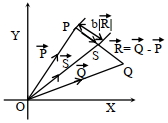
આકૃતિમાં ત્રણ સદિશો $\vec{P}, \vec{Q}$ અને $\vec{R}$ દર્શાવેલ છે. ધારો કે $S$ એ સદિશ $\vec{R}$ પરનું કોઈ બિંદુ છે. બિંદુ $P$ અને $S$ વચ્ચેનું અંતર $b|\vec{R}|$ છે. સદિશો $\vec{P}, \vec{Q}$ અને $\vec{S}$ વચ્ચેનો સામાન્ય સંબંધ શું છે?
A
$\vec{S}=(1-b) \vec{P}+b \vec{Q}$
B
$\vec{S}=(b-1) \vec{P}+b \vec{Q}$
C
$\vec{S}=(1-b^2) \vec{P}+b \vec{Q}$
D
$\vec{S}=(1-b) \vec{P}+b^2 \vec{Q}$
Solution
(A) આકૃતિ પરથી,સદિશ $\vec{R}$ એ $\vec{R} = \vec{Q} - \vec{P}$ દ્વારા આપવામાં આવે છે.
બિંદુ $S$ એ રેખાખંડ $PQ$ પર આવેલું છે જેથી અંતર $PS = b|\vec{R}|$ થાય.
આનો અર્થ એ છે કે સદિશ $\vec{PS} = b\vec{R} = b(\vec{Q} - \vec{P})$.
$\triangle OPS$ માં સદિશ સરવાળાના ત્રિકોણના નિયમનો ઉપયોગ કરતા,આપણને $\vec{S} = \vec{P} + \vec{PS}$ મળે છે.
$\vec{PS}$ માટેનું પદ મૂકતા,આપણને $\vec{S} = \vec{P} + b(\vec{Q} - \vec{P})$ મળે છે.
આનું સાદું રૂપ આપતા,આપણને $\vec{S} = \vec{P} + b\vec{Q} - b\vec{P} = (1-b)\vec{P} + b\vec{Q}$ મળે છે.
બિંદુ $S$ એ રેખાખંડ $PQ$ પર આવેલું છે જેથી અંતર $PS = b|\vec{R}|$ થાય.
આનો અર્થ એ છે કે સદિશ $\vec{PS} = b\vec{R} = b(\vec{Q} - \vec{P})$.
$\triangle OPS$ માં સદિશ સરવાળાના ત્રિકોણના નિયમનો ઉપયોગ કરતા,આપણને $\vec{S} = \vec{P} + \vec{PS}$ મળે છે.
$\vec{PS}$ માટેનું પદ મૂકતા,આપણને $\vec{S} = \vec{P} + b(\vec{Q} - \vec{P})$ મળે છે.
આનું સાદું રૂપ આપતા,આપણને $\vec{S} = \vec{P} + b\vec{Q} - b\vec{P} = (1-b)\vec{P} + b\vec{Q}$ મળે છે.
0 likesView Solution
19
MathematicsMediumMCQIIT JEE · 2017
ધારો કે $O$ એ ઉગમબિંદુ છે અને $PQR$ એ એક સ્વૈચ્છિક ત્રિકોણ છે. બિંદુ $S$ એવું છે કે $\overline{OP} \cdot \overline{OQ} + \overline{OR} \cdot \overline{OS} = \overline{OR} \cdot \overline{OP} + \overline{OQ} \cdot \overline{OS} = \overline{OQ} \cdot \overline{OR} + \overline{OP} \cdot \overline{OS}$. તો ત્રિકોણ $PQR$ માટે $S$ એ તેનું શું છે?
A
મધ્યકેન્દ્ર
B
પરિકેન્દ્ર
C
અંતઃકેન્દ્ર
D
લંબકેન્દ્ર
Solution
(D) આપેલ સમીકરણ: $\overline{OP} \cdot \overline{OQ} + \overline{OR} \cdot \overline{OS} = \overline{OR} \cdot \overline{OP} + \overline{OQ} \cdot \overline{OS}$.
પદોને ગોઠવતા: $\overline{OP} \cdot \overline{OQ} - \overline{OR} \cdot \overline{OP} = \overline{OQ} \cdot \overline{OS} - \overline{OR} \cdot \overline{OS}$.
$\overline{OP} \cdot (\overline{OQ} - \overline{OR}) = \overline{OS} \cdot (\overline{OQ} - \overline{OR})$.
$(\overline{OP} - \overline{OS}) \cdot (\overline{OQ} - \overline{OR}) = 0$.
$\overline{SP} \cdot \overline{RQ} = 0$.
આનો અર્થ એ છે કે $\overline{SP} \perp \overline{RQ}$,એટલે કે $S$ એ $P$ માંથી $QR$ પરના વેધ પર આવેલું છે.
તે જ રીતે,$\overline{OR} \cdot \overline{OP} + \overline{OQ} \cdot \overline{OS} = \overline{OQ} \cdot \overline{OR} + \overline{OP} \cdot \overline{OS}$ પરથી,આપણને $\overline{SQ} \perp \overline{PR}$ મળે છે.
જેથી $S$ એ વેધનું છેદબિંદુ હોવાથી,$S$ એ $\triangle PQR$ નું લંબકેન્દ્ર છે.
પદોને ગોઠવતા: $\overline{OP} \cdot \overline{OQ} - \overline{OR} \cdot \overline{OP} = \overline{OQ} \cdot \overline{OS} - \overline{OR} \cdot \overline{OS}$.
$\overline{OP} \cdot (\overline{OQ} - \overline{OR}) = \overline{OS} \cdot (\overline{OQ} - \overline{OR})$.
$(\overline{OP} - \overline{OS}) \cdot (\overline{OQ} - \overline{OR}) = 0$.
$\overline{SP} \cdot \overline{RQ} = 0$.
આનો અર્થ એ છે કે $\overline{SP} \perp \overline{RQ}$,એટલે કે $S$ એ $P$ માંથી $QR$ પરના વેધ પર આવેલું છે.
તે જ રીતે,$\overline{OR} \cdot \overline{OP} + \overline{OQ} \cdot \overline{OS} = \overline{OQ} \cdot \overline{OR} + \overline{OP} \cdot \overline{OS}$ પરથી,આપણને $\overline{SQ} \perp \overline{PR}$ મળે છે.
જેથી $S$ એ વેધનું છેદબિંદુ હોવાથી,$S$ એ $\triangle PQR$ નું લંબકેન્દ્ર છે.
0 likesView Solution
20
MathematicsMediumMCQIIT JEE · 2017
જો $y=y(x)$ એ વિકલ સમીકરણ $8 \sqrt{x}(\sqrt{9+\sqrt{x}}) dy = (\sqrt{4+\sqrt{9+\sqrt{x}}})^{-1} dx$ ને $x>0$ માટે સંતોષતું હોય અને $y(0)=\sqrt{7}$ હોય,તો $y(256)$ શોધો.
A
$3$
B
$9$
C
$16$
D
$80$
Solution
(A) આપેલ વિકલ સમીકરણ: $8 \sqrt{x}(\sqrt{9+\sqrt{x}}) dy = \frac{1}{\sqrt{4+\sqrt{9+\sqrt{x}}}} dx$.
પદોને ગોઠવતા: $dy = \frac{dx}{8 \sqrt{x} \sqrt{9+\sqrt{x}} \sqrt{4+\sqrt{9+\sqrt{x}}}}$.
ધારો કે $u = 4+\sqrt{9+\sqrt{x}}$.
તો $du = \frac{1}{2\sqrt{9+\sqrt{x}}} \cdot \frac{1}{2\sqrt{x}} dx = \frac{dx}{4\sqrt{x}\sqrt{9+\sqrt{x}}}$.
આ કિંમત વિકલ સમીકરણમાં મૂકતા: $dy = \frac{1}{2} \cdot \frac{du}{\sqrt{u}}$.
બંને બાજુ સંકલન કરતા: $y = \int \frac{1}{2\sqrt{u}} du = \sqrt{u} + C$.
$u$ ની કિંમત પાછી મૂકતા: $y = \sqrt{4+\sqrt{9+\sqrt{x}}} + C$.
$y(0) = \sqrt{7}$ આપેલ હોવાથી,$\sqrt{4+\sqrt{9+0}} + C = \sqrt{7} \Rightarrow \sqrt{4+3} + C = \sqrt{7} \Rightarrow \sqrt{7} + C = \sqrt{7} \Rightarrow C = 0$.
આમ,$y = \sqrt{4+\sqrt{9+\sqrt{x}}}$.
$x=256$ માટે,$y(256) = \sqrt{4+\sqrt{9+\sqrt{256}}} = \sqrt{4+\sqrt{9+16}} = \sqrt{4+\sqrt{25}} = \sqrt{4+5} = \sqrt{9} = 3$.
પદોને ગોઠવતા: $dy = \frac{dx}{8 \sqrt{x} \sqrt{9+\sqrt{x}} \sqrt{4+\sqrt{9+\sqrt{x}}}}$.
ધારો કે $u = 4+\sqrt{9+\sqrt{x}}$.
તો $du = \frac{1}{2\sqrt{9+\sqrt{x}}} \cdot \frac{1}{2\sqrt{x}} dx = \frac{dx}{4\sqrt{x}\sqrt{9+\sqrt{x}}}$.
આ કિંમત વિકલ સમીકરણમાં મૂકતા: $dy = \frac{1}{2} \cdot \frac{du}{\sqrt{u}}$.
બંને બાજુ સંકલન કરતા: $y = \int \frac{1}{2\sqrt{u}} du = \sqrt{u} + C$.
$u$ ની કિંમત પાછી મૂકતા: $y = \sqrt{4+\sqrt{9+\sqrt{x}}} + C$.
$y(0) = \sqrt{7}$ આપેલ હોવાથી,$\sqrt{4+\sqrt{9+0}} + C = \sqrt{7} \Rightarrow \sqrt{4+3} + C = \sqrt{7} \Rightarrow \sqrt{7} + C = \sqrt{7} \Rightarrow C = 0$.
આમ,$y = \sqrt{4+\sqrt{9+\sqrt{x}}}$.
$x=256$ માટે,$y(256) = \sqrt{4+\sqrt{9+\sqrt{256}}} = \sqrt{4+\sqrt{9+16}} = \sqrt{4+\sqrt{25}} = \sqrt{4+5} = \sqrt{9} = 3$.
0 likesView Solution
21
MathematicsAdvancedMCQIIT JEE · 2017
જો $f: R \rightarrow R$ એ બે વાર વિકલનીય વિધેય છે કે જેથી તમામ $x \in R$ માટે $f^{\prime \prime}(x) > 0$ હોય,અને $f(\frac{1}{2}) = \frac{1}{2}$,$f(1) = 1$ હોય,તો
A
$f^{\prime}(1) \leq 0$
B
$0 < f^{\prime}(1) \leq \frac{1}{2}$
C
$\frac{1}{2} < f^{\prime}(1) \leq 1$
D
$f^{\prime}(1) > 1$
Solution
(D) વિધેય $h(x) = f(x) - x$ વ્યાખ્યાયિત કરો.
આપેલ છે કે $f(\frac{1}{2}) = \frac{1}{2}$ અને $f(1) = 1$,તેથી $h(\frac{1}{2}) = f(\frac{1}{2}) - \frac{1}{2} = 0$ અને $h(1) = f(1) - 1 = 0$.
$f(x)$ એ બે વાર વિકલનીય હોવાથી,$h(x)$ પણ $[\frac{1}{2}, 1]$ પર વિકલનીય છે.
રોલના પ્રમેય મુજબ,કોઈક $\alpha \in (\frac{1}{2}, 1)$ અસ્તિત્વ ધરાવે છે કે જેથી $h^{\prime}(\alpha) = 0$ થાય.
$h^{\prime}(x) = f^{\prime}(x) - 1$ હોવાથી,આનો અર્થ એ થાય કે $f^{\prime}(\alpha) = 1$.
આપણને આપેલ છે કે તમામ $x \in R$ માટે $f^{\prime \prime}(x) > 0$,જેનો અર્થ છે કે $f^{\prime}(x)$ એ ચુસ્ત વધતું વિધેય છે.
$\alpha < 1$ અને $f^{\prime}(x)$ ચુસ્ત વધતું હોવાથી,આપણને $f^{\prime}(\alpha) < f^{\prime}(1)$ મળે છે.
$f^{\prime}(\alpha) = 1$ મૂકતા,આપણને $1 < f^{\prime}(1)$ મળે છે.
આપેલ છે કે $f(\frac{1}{2}) = \frac{1}{2}$ અને $f(1) = 1$,તેથી $h(\frac{1}{2}) = f(\frac{1}{2}) - \frac{1}{2} = 0$ અને $h(1) = f(1) - 1 = 0$.
$f(x)$ એ બે વાર વિકલનીય હોવાથી,$h(x)$ પણ $[\frac{1}{2}, 1]$ પર વિકલનીય છે.
રોલના પ્રમેય મુજબ,કોઈક $\alpha \in (\frac{1}{2}, 1)$ અસ્તિત્વ ધરાવે છે કે જેથી $h^{\prime}(\alpha) = 0$ થાય.
$h^{\prime}(x) = f^{\prime}(x) - 1$ હોવાથી,આનો અર્થ એ થાય કે $f^{\prime}(\alpha) = 1$.
આપણને આપેલ છે કે તમામ $x \in R$ માટે $f^{\prime \prime}(x) > 0$,જેનો અર્થ છે કે $f^{\prime}(x)$ એ ચુસ્ત વધતું વિધેય છે.
$\alpha < 1$ અને $f^{\prime}(x)$ ચુસ્ત વધતું હોવાથી,આપણને $f^{\prime}(\alpha) < f^{\prime}(1)$ મળે છે.
$f^{\prime}(\alpha) = 1$ મૂકતા,આપણને $1 < f^{\prime}(1)$ મળે છે.
0 likesView Solution
22
MathematicsAdvancedMCQIIT JEE · 2017
$\left\{0, 1, 2\right\}$ માંથી ઘટકો ધરાવતા કેટલા $3 \times 3$ શ્રેણિકો $M$ છે,જેના માટે $M^T M$ ના વિકર્ણ ઘટકોનો સરવાળો $5$ થાય?
A
$126$
B
$198$
C
$162$
D
$135$
Solution
(B) ધારો કે $M = [m_{ij}]$ એ $3 \times 3$ શ્રેણિક છે જ્યાં $m_{ij} \in \{0, 1, 2\}$ છે.
$M^T M$ ના વિકર્ણ ઘટકોનો સરવાળો એ $M^T M$ નો નિશ્ચાયક (trace) છે,જે $M$ ના તમામ ઘટકોના વર્ગોના સરવાળા બરાબર થાય છે,એટલે કે $\sum_{i=1}^3 \sum_{j=1}^3 m_{ij}^2 = 5$.
કારણ કે $m_{ij} \in \{0, 1, 2\}$,તેથી ઘટકોના વર્ગો $m_{ij}^2 \in \{0, 1, 4\}$ છે.
આપણે $9$ ઘટકો એવી રીતે પસંદ કરવાના છે કે જેથી તેમના વર્ગોનો સરવાળો $5$ થાય. વર્ગોના શક્ય સંયોજનો નીચે મુજબ છે:
કિસ્સો $1$: પાંચ ઘટકો $1$ હોય અને ચાર ઘટકો $0$ હોય. આ રીતે પસંદગી કરવાની રીતો $\binom{9}{5} = 126$ છે.
કિસ્સો $2$: એક ઘટક $2$ હોય (જેનો વર્ગ $4$ થાય),એક ઘટક $1$ હોય (જેનો વર્ગ $1$ થાય),અને સાત ઘટકો $0$ હોય. $2$ ના સ્થાનને પસંદ કરવાની રીતો $\binom{9}{1} = 9$ છે,અને બાકીના $8$ સ્થાનોમાંથી $1$ ના સ્થાનને પસંદ કરવાની રીતો $\binom{8}{1} = 8$ છે. આમ,$9 \times 8 = 72$ રીતો મળે.
શ્રેણિકોની કુલ સંખ્યા $= 126 + 72 = 198$ થાય.
$M^T M$ ના વિકર્ણ ઘટકોનો સરવાળો એ $M^T M$ નો નિશ્ચાયક (trace) છે,જે $M$ ના તમામ ઘટકોના વર્ગોના સરવાળા બરાબર થાય છે,એટલે કે $\sum_{i=1}^3 \sum_{j=1}^3 m_{ij}^2 = 5$.
કારણ કે $m_{ij} \in \{0, 1, 2\}$,તેથી ઘટકોના વર્ગો $m_{ij}^2 \in \{0, 1, 4\}$ છે.
આપણે $9$ ઘટકો એવી રીતે પસંદ કરવાના છે કે જેથી તેમના વર્ગોનો સરવાળો $5$ થાય. વર્ગોના શક્ય સંયોજનો નીચે મુજબ છે:
કિસ્સો $1$: પાંચ ઘટકો $1$ હોય અને ચાર ઘટકો $0$ હોય. આ રીતે પસંદગી કરવાની રીતો $\binom{9}{5} = 126$ છે.
કિસ્સો $2$: એક ઘટક $2$ હોય (જેનો વર્ગ $4$ થાય),એક ઘટક $1$ હોય (જેનો વર્ગ $1$ થાય),અને સાત ઘટકો $0$ હોય. $2$ ના સ્થાનને પસંદ કરવાની રીતો $\binom{9}{1} = 9$ છે,અને બાકીના $8$ સ્થાનોમાંથી $1$ ના સ્થાનને પસંદ કરવાની રીતો $\binom{8}{1} = 8$ છે. આમ,$9 \times 8 = 72$ રીતો મળે.
શ્રેણિકોની કુલ સંખ્યા $= 126 + 72 = 198$ થાય.
0 likesView Solution
23
MathematicsEasyMCQIIT JEE · 2017
જો $g(x) = \int_{\sin x}^{\sin(2x)} \sin^{-1}(t) \, dt$ હોય,તો
A
$g^{\prime}\left(\frac{\pi}{2}\right) = -2\pi$
B
$g^{\prime}\left(-\frac{\pi}{2}\right) = 2\pi$
C
$g^{\prime}\left(\frac{\pi}{2}\right) = 0$
D
$g^{\prime}\left(-\frac{\pi}{2}\right) = -2\pi$
Solution
(C) આપેલ છે $g(x) = \int_{\sin x}^{\sin(2x)} \sin^{-1}(t) \, dt$.
લેબનીઝના નિયમનો ઉપયોગ કરતા:
$g^{\prime}(x) = \sin^{-1}(\sin(2x)) \cdot \frac{d}{dx}(\sin(2x)) - \sin^{-1}(\sin x) \cdot \frac{d}{dx}(\sin x)$.
$g^{\prime}(x) = \sin^{-1}(\sin(2x)) \cdot (2\cos(2x)) - \sin^{-1}(\sin x) \cdot (\cos x)$.
$x = \frac{\pi}{2}$ માટે:
$g^{\prime}\left(\frac{\pi}{2}\right) = \sin^{-1}(\sin(\pi)) \cdot (2\cos(\pi)) - \sin^{-1}(\sin(\frac{\pi}{2})) \cdot (\cos(\frac{\pi}{2}))$.
$\sin(\pi) = 0$ હોવાથી,$\sin^{-1}(0) = 0$.
$\cos(\frac{\pi}{2}) = 0$ હોવાથી,બીજું પદ પણ $0$ થશે.
આમ,$g^{\prime}\left(\frac{\pi}{2}\right) = 0 \cdot (-2) - (\frac{\pi}{2}) \cdot 0 = 0$.
તેથી,વિકલ્પ $C$ સાચો છે.
લેબનીઝના નિયમનો ઉપયોગ કરતા:
$g^{\prime}(x) = \sin^{-1}(\sin(2x)) \cdot \frac{d}{dx}(\sin(2x)) - \sin^{-1}(\sin x) \cdot \frac{d}{dx}(\sin x)$.
$g^{\prime}(x) = \sin^{-1}(\sin(2x)) \cdot (2\cos(2x)) - \sin^{-1}(\sin x) \cdot (\cos x)$.
$x = \frac{\pi}{2}$ માટે:
$g^{\prime}\left(\frac{\pi}{2}\right) = \sin^{-1}(\sin(\pi)) \cdot (2\cos(\pi)) - \sin^{-1}(\sin(\frac{\pi}{2})) \cdot (\cos(\frac{\pi}{2}))$.
$\sin(\pi) = 0$ હોવાથી,$\sin^{-1}(0) = 0$.
$\cos(\frac{\pi}{2}) = 0$ હોવાથી,બીજું પદ પણ $0$ થશે.
આમ,$g^{\prime}\left(\frac{\pi}{2}\right) = 0 \cdot (-2) - (\frac{\pi}{2}) \cdot 0 = 0$.
તેથી,વિકલ્પ $C$ સાચો છે.
0 likesView Solution
24
MathematicsAdvancedMCQIIT JEE · 2017
જો $f: R \rightarrow R$ એક વિકલનીય વિધેય છે કે જેથી તમામ $x \in R$ માટે $f^{\prime}(x) > 2f(x)$ અને $f(0) = 1$ હોય,તો:
A
$B, D$
B
$B, C$
C
$A, C$
D
$A, D$
Solution
(C) આપેલ છે કે $f^{\prime}(x) - 2f(x) > 0$.
સંકલ્યકારક અવયવ $e^{-2x}$ વડે ગુણતા:
$e^{-2x} f^{\prime}(x) - 2e^{-2x} f(x) > 0$.
આ $\frac{d}{dx}(f(x) e^{-2x}) > 0$ ને સમાન છે.
ધારો કે $g(x) = f(x) e^{-2x}$. કારણ કે $g^{\prime}(x) > 0$,તેથી $g(x)$ એ ચુસ્ત વધતું વિધેય છે.
$x > 0$ માટે,$g(x) > g(0)$.
કારણ કે $g(0) = f(0) e^0 = 1 \cdot 1 = 1$,તેથી આપણને $f(x) e^{-2x} > 1$ મળે છે,જેનો અર્થ છે કે તમામ $x > 0$ માટે $f(x) > e^{2x}$.
કારણ કે $x > 0$ માટે $f(x) > e^{2x} > 0$ અને $f^{\prime}(x) > 2f(x)$,તેથી $f^{\prime}(x) > 2e^{2x} > 0$.
કારણ કે $f^{\prime}(x) > 0$,તેથી $f(x)$ એ $(0, \infty)$ માં વધતું વિધેય છે.
આમ,$A$ અને $C$ સાચા છે.
સંકલ્યકારક અવયવ $e^{-2x}$ વડે ગુણતા:
$e^{-2x} f^{\prime}(x) - 2e^{-2x} f(x) > 0$.
આ $\frac{d}{dx}(f(x) e^{-2x}) > 0$ ને સમાન છે.
ધારો કે $g(x) = f(x) e^{-2x}$. કારણ કે $g^{\prime}(x) > 0$,તેથી $g(x)$ એ ચુસ્ત વધતું વિધેય છે.
$x > 0$ માટે,$g(x) > g(0)$.
કારણ કે $g(0) = f(0) e^0 = 1 \cdot 1 = 1$,તેથી આપણને $f(x) e^{-2x} > 1$ મળે છે,જેનો અર્થ છે કે તમામ $x > 0$ માટે $f(x) > e^{2x}$.
કારણ કે $x > 0$ માટે $f(x) > e^{2x} > 0$ અને $f^{\prime}(x) > 2f(x)$,તેથી $f^{\prime}(x) > 2e^{2x} > 0$.
કારણ કે $f^{\prime}(x) > 0$,તેથી $f(x)$ એ $(0, \infty)$ માં વધતું વિધેય છે.
આમ,$A$ અને $C$ સાચા છે.
0 likesView Solution
25
MathematicsDifficultMCQIIT JEE · 2017
ધારો કે $x \neq 1$ માટે $f(x) = \frac{1 - x(1 + |1 - x|)}{|1 - x|} \cos \left(\frac{1}{1 - x}\right)$ છે. તો
A
$A, C$
B
$A, D$
C
$B, C$
D
$B, D$
Solution
(B) $x \to 1^{-}$ માટે,ધારો કે $x = 1 - h$ જ્યાં $h > 0$. તો $|1 - x| = h$.
$f(1 - h) = \frac{1 - (1 - h)(1 + h)}{h} \cos \left(\frac{1}{h}\right) = \frac{1 - (1 - h^2)}{h} \cos \left(\frac{1}{h}\right) = h \cos \left(\frac{1}{h}\right)$.
$\lim_{h \to 0} h \cos \left(\frac{1}{h}\right) = 0$ હોવાથી,$\lim_{x \to 1^{-}} f(x) = 0$.
$x \to 1^{+}$ માટે,ધારો કે $x = 1 + h$ જ્યાં $h > 0$. તો $|1 - x| = h$.
$f(1 + h) = \frac{1 - (1 + h)(1 + h)}{h} \cos \left(\frac{-1}{h}\right) = -(2 + h) \cos \left(\frac{1}{h}\right)$.
જેમ $h \to 0$,તેમ $-(2 + h) \to -2$ અને $\cos \left(\frac{1}{h}\right)$ એ $-1$ અને $1$ ની વચ્ચે દોલન કરે છે.
તેથી,$\lim_{x \to 1^{+}} f(x)$ નું અસ્તિત્વ નથી.
આમ,વિકલ્પો $A$ અને $D$ સાચા છે.
$f(1 - h) = \frac{1 - (1 - h)(1 + h)}{h} \cos \left(\frac{1}{h}\right) = \frac{1 - (1 - h^2)}{h} \cos \left(\frac{1}{h}\right) = h \cos \left(\frac{1}{h}\right)$.
$\lim_{h \to 0} h \cos \left(\frac{1}{h}\right) = 0$ હોવાથી,$\lim_{x \to 1^{-}} f(x) = 0$.
$x \to 1^{+}$ માટે,ધારો કે $x = 1 + h$ જ્યાં $h > 0$. તો $|1 - x| = h$.
$f(1 + h) = \frac{1 - (1 + h)(1 + h)}{h} \cos \left(\frac{-1}{h}\right) = -(2 + h) \cos \left(\frac{1}{h}\right)$.
જેમ $h \to 0$,તેમ $-(2 + h) \to -2$ અને $\cos \left(\frac{1}{h}\right)$ એ $-1$ અને $1$ ની વચ્ચે દોલન કરે છે.
તેથી,$\lim_{x \to 1^{+}} f(x)$ નું અસ્તિત્વ નથી.
આમ,વિકલ્પો $A$ અને $D$ સાચા છે.
0 likesView Solution
26
MathematicsAdvancedMCQIIT JEE · 2017
જો $f(x) = \left| \begin{array}{ccc} \cos(2x) & \cos(2x) & \sin(2x) \\ -\cos x & \cos x & -\sin x \\ \sin x & \sin x & \cos x \end{array} \right|$,તો:
$A$. $(-\pi, \pi)$ માં બરાબર ત્રણ બિંદુઓ પર $f'(x) = 0$ થાય છે
$B$. $(-\pi, \pi)$ માં ત્રણથી વધુ બિંદુઓ પર $f'(x) = 0$ થાય છે
$C$. $f(x)$ તેની મહત્તમ કિંમત $x = 0$ પર પ્રાપ્ત કરે છે
$D$. $f(x)$ તેની ન્યૂનતમ કિંમત $x = 0$ પર પ્રાપ્ત કરે છે
$A$. $(-\pi, \pi)$ માં બરાબર ત્રણ બિંદુઓ પર $f'(x) = 0$ થાય છે
$B$. $(-\pi, \pi)$ માં ત્રણથી વધુ બિંદુઓ પર $f'(x) = 0$ થાય છે
$C$. $f(x)$ તેની મહત્તમ કિંમત $x = 0$ પર પ્રાપ્ત કરે છે
$D$. $f(x)$ તેની ન્યૂનતમ કિંમત $x = 0$ પર પ્રાપ્ત કરે છે
A
$A, C$
B
$A, B$
C
$A, D$
D
$B, C$
Solution
(D) નિશ્ચાયક $f(x)$ નું વિસ્તરણ કરતા:
$f(x) = \cos(2x)(\cos^2 x + \sin^2 x) - \cos(2x)(-\cos^2 x + \sin^2 x) + \sin(2x)(-2 \sin x \cos x)$
$f(x) = \cos 2x + \cos^2 2x - \sin^2 2x = \cos 2x + \cos 4x$.
હવે,$f'(x) = -2 \sin 2x - 4 \sin 4x = -2 \sin 2x (1 + 4 \cos 2x)$.
$f'(x) = 0$ લેતા,$\sin 2x = 0$ અથવા $\cos 2x = -1/4$ મળે.
$(-\pi, \pi)$ અંતરાલમાં,$\sin 2x = 0$ એ $x = 0, \pm \pi/2$ પર થાય છે. ($3$ બિંદુઓ)
$\cos 2x = -1/4$ ના $(-\pi, \pi)$ માં $4$ ઉકેલો છે.
આમ,$f'(x) = 0$ એ $3 + 4 = 7$ બિંદુઓ પર થાય છે,જે ત્રણથી વધુ છે. તેથી $B$ સાચું છે.
$f(x) = \cos 2x + \cos 4x$ માટે,$x = 0$ પર,$f(0) = \cos 0 + \cos 0 = 2$.
$\cos \theta \le 1$ હોવાથી,$f(x)$ ની મહત્તમ કિંમત $2$ છે,જે $x = 0$ પર મળે છે. તેથી $C$ સાચું છે.
તેથી,સાચા વિકલ્પો $B$ અને $C$ છે.
$f(x) = \cos(2x)(\cos^2 x + \sin^2 x) - \cos(2x)(-\cos^2 x + \sin^2 x) + \sin(2x)(-2 \sin x \cos x)$
$f(x) = \cos 2x + \cos^2 2x - \sin^2 2x = \cos 2x + \cos 4x$.
હવે,$f'(x) = -2 \sin 2x - 4 \sin 4x = -2 \sin 2x (1 + 4 \cos 2x)$.
$f'(x) = 0$ લેતા,$\sin 2x = 0$ અથવા $\cos 2x = -1/4$ મળે.
$(-\pi, \pi)$ અંતરાલમાં,$\sin 2x = 0$ એ $x = 0, \pm \pi/2$ પર થાય છે. ($3$ બિંદુઓ)
$\cos 2x = -1/4$ ના $(-\pi, \pi)$ માં $4$ ઉકેલો છે.
આમ,$f'(x) = 0$ એ $3 + 4 = 7$ બિંદુઓ પર થાય છે,જે ત્રણથી વધુ છે. તેથી $B$ સાચું છે.
$f(x) = \cos 2x + \cos 4x$ માટે,$x = 0$ પર,$f(0) = \cos 0 + \cos 0 = 2$.
$\cos \theta \le 1$ હોવાથી,$f(x)$ ની મહત્તમ કિંમત $2$ છે,જે $x = 0$ પર મળે છે. તેથી $C$ સાચું છે.
તેથી,સાચા વિકલ્પો $B$ અને $C$ છે.
0 likesView Solution
27
MathematicsAdvancedMCQIIT JEE · 2017
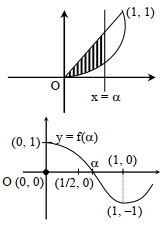
જો રેખા $x=\alpha$ એ પ્રદેશ $R=\{(x, y) \in \mathbb{R}^2: x^3 \leq y \leq x, 0 \leq x \leq 1\}$ ના ક્ષેત્રફળને બે સમાન ભાગોમાં વિભાજિત કરે,તો નીચેનામાંથી કયું સાચું છે?
$[A] \ 0 < \alpha \leq \frac{1}{2}$
$[B] \ \frac{1}{2} < \alpha < 1$
$[C] \ 2 \alpha^4 - 4 \alpha^2 + 1 = 0$
$[D] \ \alpha^4 + 4 \alpha^2 - 1 = 0$
$[A] \ 0 < \alpha \leq \frac{1}{2}$
$[B] \ \frac{1}{2} < \alpha < 1$
$[C] \ 2 \alpha^4 - 4 \alpha^2 + 1 = 0$
$[D] \ \alpha^4 + 4 \alpha^2 - 1 = 0$
A
$B, C$
B
$B, D$
C
$B, A$
D
$B, C, D$
Solution
(A) પ્રદેશ $R$ નું કુલ ક્ષેત્રફળ નીચે મુજબ છે:
$A = \int_0^1 (x - x^3) dx = \left[ \frac{x^2}{2} - \frac{x^4}{4} \right]_0^1 = \frac{1}{2} - \frac{1}{4} = \frac{1}{4}$.
રેખા $x = \alpha$ ક્ષેત્રફળને બે સમાન ભાગોમાં વહેંચતી હોવાથી,$0$ થી $\alpha$ સુધીનું ક્ષેત્રફળ કુલ ક્ષેત્રફળના અડધા જેટલું હોવું જોઈએ:
$\int_0^{\alpha} (x - x^3) dx = \frac{1}{2} \times \frac{1}{4} = \frac{1}{8}$.
સંકલનનું મૂલ્ય શોધતા:
$\left[ \frac{x^2}{2} - \frac{x^4}{4} \right]_0^{\alpha} = \frac{1}{8}$
$\frac{\alpha^2}{2} - \frac{\alpha^4}{4} = \frac{1}{8}$
$4$ વડે ગુણતા:
$2 \alpha^2 - \alpha^4 = \frac{1}{2}$
$4 \alpha^2 - 2 \alpha^4 = 1$
$2 \alpha^4 - 4 \alpha^2 + 1 = 0$. આ વિકલ્પ $[C]$ સાબિત કરે છે.
ધારો કે $f(\alpha) = 2 \alpha^4 - 4 \alpha^2 + 1$. આપણી પાસે $f(0) = 1$ અને $f(1) = 2 - 4 + 1 = -1$ છે.
$f(\alpha)$ સતત હોવાથી અને $0$ થી $1$ ની વચ્ચે ચિહ્ન બદલાતું હોવાથી,એક બીજ $\alpha \in (0, 1)$ અસ્તિત્વ ધરાવે છે.
વળી,$f(1/\sqrt{2}) = 2(1/4) - 4(1/2) + 1 = 0.5 - 2 + 1 = -0.5 < 0$.
$f(0) = 1 > 0$ અને $f(1/\sqrt{2}) < 0$ હોવાથી,બીજ $\alpha$ એ $(0, 1/\sqrt{2})$ માં હોવું જોઈએ.
$1/\sqrt{2} \approx 0.707$ અને $1/2 = 0.5$ હોવાથી,આપણે $f(1/2) = 2(1/16) - 4(1/4) + 1 = 1/8 - 1 + 1 = 1/8 > 0$ ચકાસીએ છીએ.
$f(1/2) > 0$ અને $f(1/\sqrt{2}) < 0$ હોવાથી,બીજ $\alpha$ એ $(1/2, 1/\sqrt{2})$ માં છે,જે $(1/2, 1)$ નો ઉપગણ છે. તેથી,વિકલ્પ $[B]$ પણ સાચો છે.
$A = \int_0^1 (x - x^3) dx = \left[ \frac{x^2}{2} - \frac{x^4}{4} \right]_0^1 = \frac{1}{2} - \frac{1}{4} = \frac{1}{4}$.
રેખા $x = \alpha$ ક્ષેત્રફળને બે સમાન ભાગોમાં વહેંચતી હોવાથી,$0$ થી $\alpha$ સુધીનું ક્ષેત્રફળ કુલ ક્ષેત્રફળના અડધા જેટલું હોવું જોઈએ:
$\int_0^{\alpha} (x - x^3) dx = \frac{1}{2} \times \frac{1}{4} = \frac{1}{8}$.
સંકલનનું મૂલ્ય શોધતા:
$\left[ \frac{x^2}{2} - \frac{x^4}{4} \right]_0^{\alpha} = \frac{1}{8}$
$\frac{\alpha^2}{2} - \frac{\alpha^4}{4} = \frac{1}{8}$
$4$ વડે ગુણતા:
$2 \alpha^2 - \alpha^4 = \frac{1}{2}$
$4 \alpha^2 - 2 \alpha^4 = 1$
$2 \alpha^4 - 4 \alpha^2 + 1 = 0$. આ વિકલ્પ $[C]$ સાબિત કરે છે.
ધારો કે $f(\alpha) = 2 \alpha^4 - 4 \alpha^2 + 1$. આપણી પાસે $f(0) = 1$ અને $f(1) = 2 - 4 + 1 = -1$ છે.
$f(\alpha)$ સતત હોવાથી અને $0$ થી $1$ ની વચ્ચે ચિહ્ન બદલાતું હોવાથી,એક બીજ $\alpha \in (0, 1)$ અસ્તિત્વ ધરાવે છે.
વળી,$f(1/\sqrt{2}) = 2(1/4) - 4(1/2) + 1 = 0.5 - 2 + 1 = -0.5 < 0$.
$f(0) = 1 > 0$ અને $f(1/\sqrt{2}) < 0$ હોવાથી,બીજ $\alpha$ એ $(0, 1/\sqrt{2})$ માં હોવું જોઈએ.
$1/\sqrt{2} \approx 0.707$ અને $1/2 = 0.5$ હોવાથી,આપણે $f(1/2) = 2(1/16) - 4(1/4) + 1 = 1/8 - 1 + 1 = 1/8 > 0$ ચકાસીએ છીએ.
$f(1/2) > 0$ અને $f(1/\sqrt{2}) < 0$ હોવાથી,બીજ $\alpha$ એ $(1/2, 1/\sqrt{2})$ માં છે,જે $(1/2, 1)$ નો ઉપગણ છે. તેથી,વિકલ્પ $[B]$ પણ સાચો છે.
0 likesView Solution
28
MathematicsAdvancedMCQIIT JEE · 2017
જો $I = \sum_{k=1}^{98} \int_k^{k+1} \frac{k+1}{x(x+1)} dx$ હોય,તો નીચેનામાંથી કયું સાચું છે?
A
$B, A$
B
$B, C$
C
$B, D$
D
$A, B, C$
Solution
(C) આપણને $I = \sum_{k=1}^{98} \int_{k}^{k+1} \frac{k+1}{x(x+1)} dx$ આપેલ છે.
$x \in [k, k+1]$ માટે,આપણી પાસે $k \le x \le k+1$ છે.
આનો અર્થ એ થાય કે $\frac{1}{k+1} \le \frac{1}{x} \le \frac{1}{k}$.
$(k+1)$ વડે ગુણતા,આપણને $\frac{k+1}{k+1} \le \frac{k+1}{x} \le \frac{k+1}{k}$ મળે છે.
$(x+1)$ વડે ભાગતા,આપણને $\frac{1}{x+1} \le \frac{k+1}{x(x+1)} \le \frac{k+1}{k(x+1)}$ મળે છે.
$k$ થી $k+1$ સુધી સંકલન કરતા:
$\int_{k}^{k+1} \frac{1}{x+1} dx < \int_{k}^{k+1} \frac{k+1}{x(x+1)} dx < \int_{k}^{k+1} \frac{k+1}{k(x+1)} dx$.
$k=1$ થી $98$ સુધી સરવાળો કરતા:
$\sum_{k=1}^{98} (\ln(k+2) - \ln(k+1)) < I < \sum_{k=1}^{98} \frac{k+1}{k} (\ln(k+2) - \ln(k+1))$.
ડાબી બાજુ $\ln(100) - \ln(2) = \ln(50)$ છે.
$\frac{k+1}{k} = 1 + \frac{1}{k}$ હોવાથી,જમણી બાજુ $\sum_{k=1}^{98} (1 + \frac{1}{k}) \ln(\frac{k+2}{k+1})$ છે.
$\ln(1+x) < x$ ગુણધર્મનો ઉપયોગ કરીને,આપણે સાબિત કરી શકીએ કે $I < \ln(99)$.
વધુમાં,$\frac{49}{50}$ સાથે સરખામણી કરતા,આપણને $I > \frac{49}{50}$ મળે છે.
આમ,$I < \ln(99)$ અને $I > \frac{49}{50}$ બંને સાચા છે.
$x \in [k, k+1]$ માટે,આપણી પાસે $k \le x \le k+1$ છે.
આનો અર્થ એ થાય કે $\frac{1}{k+1} \le \frac{1}{x} \le \frac{1}{k}$.
$(k+1)$ વડે ગુણતા,આપણને $\frac{k+1}{k+1} \le \frac{k+1}{x} \le \frac{k+1}{k}$ મળે છે.
$(x+1)$ વડે ભાગતા,આપણને $\frac{1}{x+1} \le \frac{k+1}{x(x+1)} \le \frac{k+1}{k(x+1)}$ મળે છે.
$k$ થી $k+1$ સુધી સંકલન કરતા:
$\int_{k}^{k+1} \frac{1}{x+1} dx < \int_{k}^{k+1} \frac{k+1}{x(x+1)} dx < \int_{k}^{k+1} \frac{k+1}{k(x+1)} dx$.
$k=1$ થી $98$ સુધી સરવાળો કરતા:
$\sum_{k=1}^{98} (\ln(k+2) - \ln(k+1)) < I < \sum_{k=1}^{98} \frac{k+1}{k} (\ln(k+2) - \ln(k+1))$.
ડાબી બાજુ $\ln(100) - \ln(2) = \ln(50)$ છે.
$\frac{k+1}{k} = 1 + \frac{1}{k}$ હોવાથી,જમણી બાજુ $\sum_{k=1}^{98} (1 + \frac{1}{k}) \ln(\frac{k+2}{k+1})$ છે.
$\ln(1+x) < x$ ગુણધર્મનો ઉપયોગ કરીને,આપણે સાબિત કરી શકીએ કે $I < \ln(99)$.
વધુમાં,$\frac{49}{50}$ સાથે સરખામણી કરતા,આપણને $I > \frac{49}{50}$ મળે છે.
આમ,$I < \ln(99)$ અને $I > \frac{49}{50}$ બંને સાચા છે.
0 likesView Solution
29
MathematicsMediumMCQIIT JEE · 2017
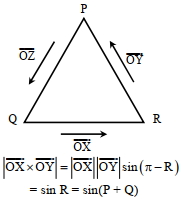
ધારો કે $O$ ઉગમબિંદુ છે,અને $\overline{OX}, \overline{OY}, \overline{OZ}$ એ ત્રિકોણ $PQR$ ની બાજુઓ $QR, RP, PQ$ ની દિશામાં ત્રણ એકમ સદિશો છે.
$(1)$ $|\overline{OX} \times \overline{OY}|$ શોધો.
$[A] \sin(P+Q)$
$[B] \sin 2R$
$[C] \sin(P+R)$
$[D] \sin(Q+R)$
$(2)$ જો ત્રિકોણ $PQR$ બદલાતો હોય,તો $\cos(P+Q) + \cos(Q+R) + \cos(R+P)$ ની ન્યૂનતમ કિંમત શોધો.
$[A] -\frac{5}{3}$
$[B] -\frac{3}{2}$
$[C] \frac{3}{2}$
$[D] \frac{5}{3}$
$(1)$ અને $(2)$ માટે સાચા વિકલ્પો પસંદ કરો.
$(1)$ $|\overline{OX} \times \overline{OY}|$ શોધો.
$[A] \sin(P+Q)$
$[B] \sin 2R$
$[C] \sin(P+R)$
$[D] \sin(Q+R)$
$(2)$ જો ત્રિકોણ $PQR$ બદલાતો હોય,તો $\cos(P+Q) + \cos(Q+R) + \cos(R+P)$ ની ન્યૂનતમ કિંમત શોધો.
$[A] -\frac{5}{3}$
$[B] -\frac{3}{2}$
$[C] \frac{3}{2}$
$[D] \frac{5}{3}$
$(1)$ અને $(2)$ માટે સાચા વિકલ્પો પસંદ કરો.
A
$B, C$
B
$B, D$
C
$B, C, D$
D
$A, B$
Solution
(D) $(1)$ $\overline{OX}$ અને $\overline{OY}$ એ $QR$ અને $RP$ ની દિશામાં એકમ સદિશો હોવાથી,તેમની વચ્ચેનો ખૂણો $\pi - R$ છે.
તેથી,$|\overline{OX} \times \overline{OY}| = |\overline{OX}| |\overline{OY}| \sin(\pi - R) = 1 \cdot 1 \cdot \sin R = \sin R$.
$P+Q+R = \pi$ હોવાથી,$\sin R = \sin(\pi - (P+Q)) = \sin(P+Q)$.
આમ,વિકલ્પ $A$ સાચો છે.
$(2)$ આપણે $\cos(P+Q) + \cos(Q+R) + \cos(R+P)$ ની ન્યૂનતમ કિંમત શોધવાની છે.
$P+Q+R = \pi$ હોવાથી,આ $\cos(\pi-R) + \cos(\pi-P) + \cos(\pi-Q) = -(\cos P + \cos Q + \cos R)$ ને સમાન છે.
કોઈપણ ત્રિકોણ માટે,$\cos P + \cos Q + \cos R \leq \frac{3}{2}$.
તેથી,$-(\cos P + \cos Q + \cos R) \geq -\frac{3}{2}$.
ન્યૂનતમ કિંમત $-\frac{3}{2}$ છે,જે સમબાજુ ત્રિકોણ માટે મળે છે.
આમ,વિકલ્પ $B$ સાચો છે.
બંનેને જોડતા,સાચો વિકલ્પ $A, B$ છે.
તેથી,$|\overline{OX} \times \overline{OY}| = |\overline{OX}| |\overline{OY}| \sin(\pi - R) = 1 \cdot 1 \cdot \sin R = \sin R$.
$P+Q+R = \pi$ હોવાથી,$\sin R = \sin(\pi - (P+Q)) = \sin(P+Q)$.
આમ,વિકલ્પ $A$ સાચો છે.
$(2)$ આપણે $\cos(P+Q) + \cos(Q+R) + \cos(R+P)$ ની ન્યૂનતમ કિંમત શોધવાની છે.
$P+Q+R = \pi$ હોવાથી,આ $\cos(\pi-R) + \cos(\pi-P) + \cos(\pi-Q) = -(\cos P + \cos Q + \cos R)$ ને સમાન છે.
કોઈપણ ત્રિકોણ માટે,$\cos P + \cos Q + \cos R \leq \frac{3}{2}$.
તેથી,$-(\cos P + \cos Q + \cos R) \geq -\frac{3}{2}$.
ન્યૂનતમ કિંમત $-\frac{3}{2}$ છે,જે સમબાજુ ત્રિકોણ માટે મળે છે.
આમ,વિકલ્પ $B$ સાચો છે.
બંનેને જોડતા,સાચો વિકલ્પ $A, B$ છે.
0 likesView Solution
30
MathematicsMediumMCQIIT JEE · 2017
બિંદુ $(1, 1, 1)$ માંથી પસાર થતા અને સમતલો $2x + y - 2z = 5$ અને $3x - 6y - 2z = 7$ ને લંબ હોય તેવા સમતલનું સમીકરણ શોધો.
A
$14x + 2y - 15z = 1$
B
$14x - 2y + 15z = 27$
C
$14x + 2y + 15z = 31$
D
$-14x + 2y + 15z = 3$
Solution
(C) બિંદુ $(1, 1, 1)$ માંથી પસાર થતા સમતલનું સમીકરણ $a(x - 1) + b(y - 1) + c(z - 1) = 0$ છે.
આ સમતલ $2x + y - 2z = 5$ અને $3x - 6y - 2z = 7$ ને લંબ હોવાથી,તેનો અભિલંબ સદિશ $\vec{n} = (a, b, c)$ એ આપેલા સમતલોના અભિલંબ સદિશો $\vec{n_1} = (2, 1, -2)$ અને $\vec{n_2} = (3, -6, -2)$ ને લંબ હશે.
તેથી,અભિલંબ સદિશ $\vec{n}$ એ $\vec{n_1} \times \vec{n_2}$ દ્વારા મળે છે:
$\vec{n} = \begin{vmatrix} \hat{i} & \hat{j} & \hat{k} \\ 2 & 1 & -2 \\ 3 & -6 & -2 \end{vmatrix} = \hat{i}(-2 - 12) - \hat{j}(-4 + 6) + \hat{k}(-12 - 3) = -14\hat{i} - 2\hat{j} - 15\hat{k}$.
અભિલંબ સદિશ $(14, 2, 15)$ લેતા,સમતલનું સમીકરણ $14(x - 1) + 2(y - 1) + 15(z - 1) = 0$ થાય.
આનું સાદુરૂપ આપતા,$14x - 14 + 2y - 2 + 15z - 15 = 0$,એટલે કે $14x + 2y + 15z = 31$ મળે છે.
આ સમતલ $2x + y - 2z = 5$ અને $3x - 6y - 2z = 7$ ને લંબ હોવાથી,તેનો અભિલંબ સદિશ $\vec{n} = (a, b, c)$ એ આપેલા સમતલોના અભિલંબ સદિશો $\vec{n_1} = (2, 1, -2)$ અને $\vec{n_2} = (3, -6, -2)$ ને લંબ હશે.
તેથી,અભિલંબ સદિશ $\vec{n}$ એ $\vec{n_1} \times \vec{n_2}$ દ્વારા મળે છે:
$\vec{n} = \begin{vmatrix} \hat{i} & \hat{j} & \hat{k} \\ 2 & 1 & -2 \\ 3 & -6 & -2 \end{vmatrix} = \hat{i}(-2 - 12) - \hat{j}(-4 + 6) + \hat{k}(-12 - 3) = -14\hat{i} - 2\hat{j} - 15\hat{k}$.
અભિલંબ સદિશ $(14, 2, 15)$ લેતા,સમતલનું સમીકરણ $14(x - 1) + 2(y - 1) + 15(z - 1) = 0$ થાય.
આનું સાદુરૂપ આપતા,$14x - 14 + 2y - 2 + 15z - 15 = 0$,એટલે કે $14x + 2y + 15z = 31$ મળે છે.
0 likesView Solution
Vedclass Products
For Students
Vedclass Test Series
Mock tests in real IIT JEE style covering Mathematics with performance analysis. 5-day free trial.
Start Free TrialFor Teachers
Exam Paper Generator
Generate Set A/B/C/D Mathematics papers from 7.5L+ questions in 2 minutes. 3 chapters free.
Try FreeFor Institutes
Online Exam Module
Run live IIT JEE mock exams with unlimited students, 360° analytics & white-label branding.
See DemoFrequently Asked Questions
How many Mathematics questions are in IIT JEE 2017?
There are 30 Mathematics questions from the IIT JEE 2017 paper on Vedclass, each with a detailed step-by-step solution in Gujarati.
Are IIT JEE 2017 Mathematics solutions available in Gujarati?
Yes. All solutions on this page are in Gujarati. You can also switch to English or Hindi using the language buttons above the questions.
Can I practice IIT JEE 2017 Mathematics as a timed test?
Yes. Use the Vedclass Test Series to attempt a full IIT JEE mock test covering Mathematics with time limits and instant score analysis.
Can teachers create Mathematics papers from IIT JEE previous year questions?
Yes. The Vedclass Exam Paper Generator lets teachers mix IIT JEE Mathematics questions and generate Set A/B/C/D papers in minutes.
For Teachers & Institutes
Build a Custom Mathematics Paper
Pick IIT JEE 2017 Mathematics questions, set difficulty, and generate Set A/B/C/D in 2 minutes.