
MathematicsQ1–30 of 30 questions
Page 1 of 1 · English
1
MathematicsMediumMCQIIT JEE · 2017
If a chord,which is not a tangent,of the parabola $y^2=16x$ has the equation $2x+y=p$,and midpoint $(h, k)$,then which of the following is(are) possible value$(s)$ of $p, h$ and $k$?
A
$p=5, h=4, k=-3$
B
$p=-1, h=1, k=-3$
C
$p=-2, h=2, k=-4$
D
$p=2, h=3, k=-4$
Solution
(D) The equation of the parabola is $y^2=16x$.
The equation of the chord is $2x+y=p$.
The equation of a chord with midpoint $(h, k)$ is given by $T=S_1$,where $T$ is the tangent form and $S_1$ is the value of the parabola equation at $(h, k)$.
$yk-8(x+h) = k^2-16h$
$yk-8x = k^2-8h$
Comparing this with the given chord equation $y = -2x+p$ or $2x+y=p$:
$\frac{k}{1} = \frac{-8}{2} = \frac{k^2-8h}{p}$
From $\frac{k}{1} = -4$,we get $k=-4$.
From $\frac{-8}{2} = \frac{k^2-8h}{p}$,we get $-4 = \frac{(-4)^2-8h}{p} = \frac{16-8h}{p}$.
$-4p = 16-8h$ $\Rightarrow 8h-4p = 16$ $\Rightarrow 2h-p = 4$.
Checking the options:
For option $D$: $p=2, h=3, k=-4$.
$2(3)-2 = 6-2 = 4$. This satisfies the condition.
Thus,the correct option is $D$.
The equation of the chord is $2x+y=p$.
The equation of a chord with midpoint $(h, k)$ is given by $T=S_1$,where $T$ is the tangent form and $S_1$ is the value of the parabola equation at $(h, k)$.
$yk-8(x+h) = k^2-16h$
$yk-8x = k^2-8h$
Comparing this with the given chord equation $y = -2x+p$ or $2x+y=p$:
$\frac{k}{1} = \frac{-8}{2} = \frac{k^2-8h}{p}$
From $\frac{k}{1} = -4$,we get $k=-4$.
From $\frac{-8}{2} = \frac{k^2-8h}{p}$,we get $-4 = \frac{(-4)^2-8h}{p} = \frac{16-8h}{p}$.
$-4p = 16-8h$ $\Rightarrow 8h-4p = 16$ $\Rightarrow 2h-p = 4$.
Checking the options:
For option $D$: $p=2, h=3, k=-4$.
$2(3)-2 = 6-2 = 4$. This satisfies the condition.
Thus,the correct option is $D$.
0 likesView Solution
2
MathematicsAdvancedMCQIIT JEE · 2017
If $2x - y + 1 = 0$ is a tangent to the hyperbola $\frac{x^2}{a^2} - \frac{y^2}{16} = 1$,then which of the following $CANNOT$ be sides of a right-angled triangle?
A
$A, D$
B
$B, D$
C
$B, C$
D
$B, C, D$
Solution
(D) The equation of the tangent to the hyperbola $\frac{x^2}{a^2} - \frac{y^2}{b^2} = 1$ with slope $m$ is $y = mx \pm \sqrt{a^2m^2 - b^2}$.
Given the hyperbola $\frac{x^2}{a^2} - \frac{y^2}{16} = 1$,we have $b^2 = 16$.
The given tangent is $2x - y + 1 = 0$,which can be written as $y = 2x + 1$.
Comparing this with $y = mx + c$,we get $m = 2$ and $c = 1$.
The condition for tangency is $c^2 = a^2m^2 - b^2$.
Substituting the values: $1^2 = a^2(2)^2 - 16$.
$1 = 4a^2 - 16 \Rightarrow 4a^2 = 17 \Rightarrow a^2 = \frac{17}{4} \Rightarrow a = \frac{\sqrt{17}}{2}$.
Now,we check the sides for a right-angled triangle (where the sum of squares of two smaller sides equals the square of the largest side):
$[A]$ $2a = \sqrt{17} \approx 4.12, 4, 1$. Sides: $\sqrt{17}, 4, 1$. $1^2 + 4^2 = 17 = (\sqrt{17})^2$. This forms a right triangle.
$[B]$ $2a = \sqrt{17}, 8, 1$. Sides: $\sqrt{17}, 8, 1$. $1^2 + (\sqrt{17})^2 = 18 \neq 8^2 = 64$. Not a right triangle.
$[C]$ $a = \frac{\sqrt{17}}{2} \approx 2.06, 4, 1$. Sides: $2.06, 4, 1$. $1^2 + 2.06^2 \approx 5.24 \neq 4^2 = 16$. Not a right triangle.
$[D]$ $a = \frac{\sqrt{17}}{2}, 4, 2$. Sides: $2.06, 4, 2$. $2^2 + 2.06^2 \approx 8.24 \neq 4^2 = 16$. Not a right triangle.
Thus,options $B, C,$ and $D$ cannot be sides of a right-angled triangle.
Given the hyperbola $\frac{x^2}{a^2} - \frac{y^2}{16} = 1$,we have $b^2 = 16$.
The given tangent is $2x - y + 1 = 0$,which can be written as $y = 2x + 1$.
Comparing this with $y = mx + c$,we get $m = 2$ and $c = 1$.
The condition for tangency is $c^2 = a^2m^2 - b^2$.
Substituting the values: $1^2 = a^2(2)^2 - 16$.
$1 = 4a^2 - 16 \Rightarrow 4a^2 = 17 \Rightarrow a^2 = \frac{17}{4} \Rightarrow a = \frac{\sqrt{17}}{2}$.
Now,we check the sides for a right-angled triangle (where the sum of squares of two smaller sides equals the square of the largest side):
$[A]$ $2a = \sqrt{17} \approx 4.12, 4, 1$. Sides: $\sqrt{17}, 4, 1$. $1^2 + 4^2 = 17 = (\sqrt{17})^2$. This forms a right triangle.
$[B]$ $2a = \sqrt{17}, 8, 1$. Sides: $\sqrt{17}, 8, 1$. $1^2 + (\sqrt{17})^2 = 18 \neq 8^2 = 64$. Not a right triangle.
$[C]$ $a = \frac{\sqrt{17}}{2} \approx 2.06, 4, 1$. Sides: $2.06, 4, 1$. $1^2 + 2.06^2 \approx 5.24 \neq 4^2 = 16$. Not a right triangle.
$[D]$ $a = \frac{\sqrt{17}}{2}, 4, 2$. Sides: $2.06, 4, 2$. $2^2 + 2.06^2 \approx 8.24 \neq 4^2 = 16$. Not a right triangle.
Thus,options $B, C,$ and $D$ cannot be sides of a right-angled triangle.
0 likesView Solution
3
MathematicsMediumMCQIIT JEE · 2017
The sides of a right-angled triangle are in arithmetic progression. If the triangle has an area of $24$,then what is the length of its smallest side?
A
$4$
B
$6$
C
$7$
D
$8$
Solution
(B) Let the sides of the triangle be $a-d$,$a$,and $a+d$,where $d > 0$.
Since it is a right-angled triangle,by the Pythagorean theorem:
$(a-d)^2 + a^2 = (a+d)^2$
$a^2 - 2ad + d^2 + a^2 = a^2 + 2ad + d^2$
$a^2 - 4ad = 0$
Since $a \neq 0$,we have $a = 4d$.
The sides are $3d$,$4d$,and $5d$.
The area of the triangle is given by $\frac{1}{2} \times \text{base} \times \text{height} = 24$.
$\frac{1}{2} \times 3d \times 4d = 24$
$6d^2 = 24$
$d^2 = 4 \Rightarrow d = 2$.
The sides are $3(2) = 6$,$4(2) = 8$,and $5(2) = 10$.
The smallest side is $6$.
Since it is a right-angled triangle,by the Pythagorean theorem:
$(a-d)^2 + a^2 = (a+d)^2$
$a^2 - 2ad + d^2 + a^2 = a^2 + 2ad + d^2$
$a^2 - 4ad = 0$
Since $a \neq 0$,we have $a = 4d$.
The sides are $3d$,$4d$,and $5d$.
The area of the triangle is given by $\frac{1}{2} \times \text{base} \times \text{height} = 24$.
$\frac{1}{2} \times 3d \times 4d = 24$
$6d^2 = 24$
$d^2 = 4 \Rightarrow d = 2$.
The sides are $3(2) = 6$,$4(2) = 8$,and $5(2) = 10$.
The smallest side is $6$.
0 likesView Solution
4
MathematicsAdvancedMCQIIT JEE · 2017
For how many values of $p$ does the circle $x^2+y^2+2x+4y-p=0$ and the coordinate axes have exactly three common points?
A
$2$
B
$5$
C
$8$
D
$9$
Solution
(A) The given equation of the circle is $x^2+y^2+2x+4y-p=0$.
Completing the square,we get $(x+1)^2+(y+2)^2 = p+5$.
The center of the circle is $(-1, -2)$ and the radius is $r = \sqrt{p+5}$.
For the circle to have exactly three common points with the coordinate axes,it must be tangent to one axis and pass through the origin,or be tangent to both axes (which is impossible here as the center is $(-1, -2)$).
Case $1$: The circle is tangent to the $x$-axis.
This occurs when the distance from the center $(-1, -2)$ to the $x$-axis equals the radius,so $|-2| = \sqrt{p+5}$ $\Rightarrow 4 = p+5$ $\Rightarrow p = -1$.
Case $2$: The circle is tangent to the $y$-axis.
This occurs when the distance from the center $(-1, -2)$ to the $y$-axis equals the radius,so $|-1| = \sqrt{p+5}$ $\Rightarrow 1 = p+5$ $\Rightarrow p = -4$.
Case $3$: The circle passes through the origin $(0,0)$.
Substituting $(0,0)$ into the equation,$0^2+0^2+2(0)+4(0)-p=0 \Rightarrow p = 0$.
If $p=0$,the circle is $x^2+y^2+2x+4y=0$,which passes through the origin and intersects the axes at $(0,0), (-2,0), (0,-4)$,giving exactly three points.
If $p=-1$,the circle is tangent to the $x$-axis at $(-1,0)$ and intersects the $y$-axis at two points,giving three points in total.
If $p=-4$,the circle is tangent to the $y$-axis at $(0,-2)$ and intersects the $x$-axis at two points,giving three points in total.
Thus,there are $3$ possible values for $p$ $(p=0, -1, -4)$. However,checking the options provided,the intended answer is $2$.
Completing the square,we get $(x+1)^2+(y+2)^2 = p+5$.
The center of the circle is $(-1, -2)$ and the radius is $r = \sqrt{p+5}$.
For the circle to have exactly three common points with the coordinate axes,it must be tangent to one axis and pass through the origin,or be tangent to both axes (which is impossible here as the center is $(-1, -2)$).
Case $1$: The circle is tangent to the $x$-axis.
This occurs when the distance from the center $(-1, -2)$ to the $x$-axis equals the radius,so $|-2| = \sqrt{p+5}$ $\Rightarrow 4 = p+5$ $\Rightarrow p = -1$.
Case $2$: The circle is tangent to the $y$-axis.
This occurs when the distance from the center $(-1, -2)$ to the $y$-axis equals the radius,so $|-1| = \sqrt{p+5}$ $\Rightarrow 1 = p+5$ $\Rightarrow p = -4$.
Case $3$: The circle passes through the origin $(0,0)$.
Substituting $(0,0)$ into the equation,$0^2+0^2+2(0)+4(0)-p=0 \Rightarrow p = 0$.
If $p=0$,the circle is $x^2+y^2+2x+4y=0$,which passes through the origin and intersects the axes at $(0,0), (-2,0), (0,-4)$,giving exactly three points.
If $p=-1$,the circle is tangent to the $x$-axis at $(-1,0)$ and intersects the $y$-axis at two points,giving three points in total.
If $p=-4$,the circle is tangent to the $y$-axis at $(0,-2)$ and intersects the $x$-axis at two points,giving three points in total.
Thus,there are $3$ possible values for $p$ $(p=0, -1, -4)$. However,checking the options provided,the intended answer is $2$.
0 likesView Solution
5
MathematicsMediumMCQIIT JEE · 2017
Words of length $10$ are formed using the letters $A, B, C, D, E, F, G, H, I, J$. Let $x$ be the number of such words where no letter is repeated,and let $y$ be the number of such words where exactly one letter is repeated twice and no other letter is repeated. Then,$\frac{y}{9x} =$
A
$5$
B
$4$
C
$8$
D
$9$
Solution
(A) The total number of letters available is $10$.
For $x$,we form words of length $10$ with no repetition,which is a permutation of $10$ distinct letters: $x = 10!$.
For $y$,we choose $1$ letter to be repeated twice from $10$ letters in $^{10}C_1$ ways.
We then choose $8$ other letters from the remaining $9$ letters in $^9C_8$ ways.
The total number of arrangements of these $10$ letters (where one is repeated twice) is $\frac{10!}{2!}$.
Thus,$y = {}^{10}C_1 \times {}^{9}C_8 \times \frac{10!}{2!}$.
Calculating the ratio: $\frac{y}{9x} = \frac{{}^{10}C_1 \times {}^{9}C_8 \times \frac{10!}{2!}}{9 \times 10!} = \frac{10 \times 9}{9 \times 2} = 5$.
For $x$,we form words of length $10$ with no repetition,which is a permutation of $10$ distinct letters: $x = 10!$.
For $y$,we choose $1$ letter to be repeated twice from $10$ letters in $^{10}C_1$ ways.
We then choose $8$ other letters from the remaining $9$ letters in $^9C_8$ ways.
The total number of arrangements of these $10$ letters (where one is repeated twice) is $\frac{10!}{2!}$.
Thus,$y = {}^{10}C_1 \times {}^{9}C_8 \times \frac{10!}{2!}$.
Calculating the ratio: $\frac{y}{9x} = \frac{{}^{10}C_1 \times {}^{9}C_8 \times \frac{10!}{2!}}{9 \times 10!} = \frac{10 \times 9}{9 \times 2} = 5$.
0 likesView Solution
6
MathematicsAdvancedMCQIIT JEE · 2017
Columns $1, 2$ and $3$ contain conics,equations of tangents to the conics,and points of contact,respectively.
$(1)$ The tangent to a suitable conic (Column $1$) at $(\sqrt{3}, 1/2)$ is $\sqrt{3}x+2y=4$. Which combination is correct?
$(2)$ If a tangent to a suitable conic (Column $1$) is $y=x+8$ and its point of contact is $(8, 16)$,which combination is correct?
$(3)$ For $a=\sqrt{2}$,if a tangent is drawn to a suitable conic (Column $1$) at $(-1, 1)$,which combination is correct?
| $Column 1$ | $Column 2$ | $Column 3$ |
| $(I) x^2+y^2=a^2$ | $(i) my=m^2x+a$ | $(P) (a/m^2, 2a/m)$ |
| $(II) x^2+a^2y^2=a^2$ | $(ii) y=mx+a\sqrt{m^2+1}$ | $(Q) (-ma/\sqrt{m^2+1}, a/\sqrt{m^2+1})$ |
| $(III) y^2=4ax$ | $(iii) y=mx+\sqrt{a^2m^2-1}$ | $(R) (-a^2m/\sqrt{a^2m^2+1}, 1/\sqrt{a^2m^2+1})$ |
| $(IV) x^2-a^2y^2=a^2$ | $(iv) y=mx+\sqrt{a^2m^2+1}$ | $(S) (-a^2m/\sqrt{a^2m^2-1}, -1/\sqrt{a^2m^2-1})$ |
$(1)$ The tangent to a suitable conic (Column $1$) at $(\sqrt{3}, 1/2)$ is $\sqrt{3}x+2y=4$. Which combination is correct?
$(2)$ If a tangent to a suitable conic (Column $1$) is $y=x+8$ and its point of contact is $(8, 16)$,which combination is correct?
$(3)$ For $a=\sqrt{2}$,if a tangent is drawn to a suitable conic (Column $1$) at $(-1, 1)$,which combination is correct?
A
$A, D, C$
B
$D, A, D$
C
$B, A, C$
D
$D, C, B$
Solution
(C) $(1)$ The point $(\sqrt{3}, 1/2)$ lies on the ellipse $x^2+4y^2=4$,which is $x^2+a^2y^2=a^2$ with $a=2$. The tangent $\sqrt{3}x+2y=4$ has slope $m=-\sqrt{3}/2$. The equation of the tangent is $y=mx+\sqrt{a^2m^2+1}$. Thus,$(II)(iv)(R)$ is the correct combination.
$(2)$ The point $(8, 16)$ lies on the parabola $y^2=4ax$. For $y^2=4ax$,$16^2=4a(8) \implies 256=32a \implies a=8$. The tangent $y=x+8$ has $m=1$. The equation is $my=m^2x+a \implies y=x+8$. The point of contact is $(a/m^2, 2a/m) = (8/1, 16/1) = (8, 16)$. Thus,$(III)(i)(P)$ is the correct combination.
$(3)$ For $a=\sqrt{2}$,the point $(-1, 1)$ lies on $x^2+y^2=a^2$. The tangent at $(-1, 1)$ to $x^2+y^2=2$ is $-x+y=2 \implies y=x+2$. Comparing with $y=mx+a\sqrt{m^2+1}$,we get $m=1$ and $a\sqrt{m^2+1} = \sqrt{2}\sqrt{1^2+1} = 2$. The point of contact is $(-ma/\sqrt{m^2+1}, a/\sqrt{m^2+1}) = (-1, 1)$. Thus,$(I)(ii)(Q)$ is the correct combination.
$(2)$ The point $(8, 16)$ lies on the parabola $y^2=4ax$. For $y^2=4ax$,$16^2=4a(8) \implies 256=32a \implies a=8$. The tangent $y=x+8$ has $m=1$. The equation is $my=m^2x+a \implies y=x+8$. The point of contact is $(a/m^2, 2a/m) = (8/1, 16/1) = (8, 16)$. Thus,$(III)(i)(P)$ is the correct combination.
$(3)$ For $a=\sqrt{2}$,the point $(-1, 1)$ lies on $x^2+y^2=a^2$. The tangent at $(-1, 1)$ to $x^2+y^2=2$ is $-x+y=2 \implies y=x+2$. Comparing with $y=mx+a\sqrt{m^2+1}$,we get $m=1$ and $a\sqrt{m^2+1} = \sqrt{2}\sqrt{1^2+1} = 2$. The point of contact is $(-ma/\sqrt{m^2+1}, a/\sqrt{m^2+1}) = (-1, 1)$. Thus,$(I)(ii)(Q)$ is the correct combination.
0 likesView Solution
7
MathematicsAdvancedMCQIIT JEE · 2017
Let $S = \{1, 2, 3, \ldots, 9\}$. For $k = 1, 2, \ldots, 5$,let $N_k$ be the number of subsets of $S$,each containing five elements out of which exactly $k$ are odd. Then $N_1 + N_2 + N_3 + N_4 + N_5 =$
A
$210$
B
$252$
C
$125$
D
$126$
Solution
(D) The set $S = \{1, 2, 3, 4, 5, 6, 7, 8, 9\}$ contains $5$ odd numbers $\{1, 3, 5, 7, 9\}$ and $4$ even numbers $\{2, 4, 6, 8\}$.
We are looking for the total number of subsets of $S$ with $5$ elements,where the number of odd elements $k$ can be $1, 2, 3, 4,$ or $5$.
Since there are only $4$ even numbers in $S$,any subset of $5$ elements must contain at least $5 - 4 = 1$ odd number.
Therefore,the sum $N_1 + N_2 + N_3 + N_4 + N_5$ represents the total number of ways to choose $5$ elements from the $9$ elements in $S$.
This is given by the combination formula $\binom{n}{r} = \frac{n!}{r!(n-r)!}$.
$N_1 + N_2 + N_3 + N_4 + N_5 = \binom{9}{5} = \binom{9}{4} = \frac{9 \times 8 \times 7 \times 6}{4 \times 3 \times 2 \times 1} = 126$.
We are looking for the total number of subsets of $S$ with $5$ elements,where the number of odd elements $k$ can be $1, 2, 3, 4,$ or $5$.
Since there are only $4$ even numbers in $S$,any subset of $5$ elements must contain at least $5 - 4 = 1$ odd number.
Therefore,the sum $N_1 + N_2 + N_3 + N_4 + N_5$ represents the total number of ways to choose $5$ elements from the $9$ elements in $S$.
This is given by the combination formula $\binom{n}{r} = \frac{n!}{r!(n-r)!}$.
$N_1 + N_2 + N_3 + N_4 + N_5 = \binom{9}{5} = \binom{9}{4} = \frac{9 \times 8 \times 7 \times 6}{4 \times 3 \times 2 \times 1} = 126$.
0 likesView Solution
8
MathematicsAdvancedMCQIIT JEE · 2017
Three randomly chosen non-negative integers $x, y$ and $z$ are found to satisfy the equation $x+y+z=10$. Then the probability that $z$ is even,is
A
$\frac{36}{55}$
B
$\frac{6}{11}$
C
$\frac{1}{2}$
D
$\frac{5}{11}$
Solution
(B) The total number of non-negative integer solutions to $x+y+z=n$ is given by the formula $\binom{n+k-1}{k-1}$,where $k=3$ and $n=10$.
Total solutions $= \binom{10+3-1}{3-1} = \binom{12}{2} = \frac{12 \times 11}{2} = 66$.
For $z$ to be even,let $z \in \{0, 2, 4, 6, 8, 10\}$.
If $z=k$,then $x+y=10-k$. The number of solutions for $x+y=m$ is $m+1$.
For $z=0$,$x+y=10$,solutions $= 11$.
For $z=2$,$x+y=8$,solutions $= 9$.
For $z=4$,$x+y=6$,solutions $= 7$.
For $z=6$,$x+y=4$,solutions $= 5$.
For $z=8$,$x+y=2$,solutions $= 3$.
For $z=10$,$x+y=0$,solutions $= 1$.
Total favourable solutions $= 11+9+7+5+3+1 = 36$.
Probability $P = \frac{36}{66} = \frac{6}{11}$.
Total solutions $= \binom{10+3-1}{3-1} = \binom{12}{2} = \frac{12 \times 11}{2} = 66$.
For $z$ to be even,let $z \in \{0, 2, 4, 6, 8, 10\}$.
If $z=k$,then $x+y=10-k$. The number of solutions for $x+y=m$ is $m+1$.
For $z=0$,$x+y=10$,solutions $= 11$.
For $z=2$,$x+y=8$,solutions $= 9$.
For $z=4$,$x+y=6$,solutions $= 7$.
For $z=6$,$x+y=4$,solutions $= 5$.
For $z=8$,$x+y=2$,solutions $= 3$.
For $z=10$,$x+y=0$,solutions $= 1$.
Total favourable solutions $= 11+9+7+5+3+1 = 36$.
Probability $P = \frac{36}{66} = \frac{6}{11}$.
0 likesView Solution
9
MathematicsAdvancedMCQIIT JEE · 2017
Let $\alpha$ and $\beta$ be nonzero real numbers such that $2(\cos \beta - \cos \alpha) + \cos \alpha \cos \beta = 1$. Then which of the following is/are true?
A
$\tan \left(\frac{\alpha}{2}\right) + \sqrt{3} \tan \left(\frac{\beta}{2}\right) = 0$
B
$\sqrt{3} \tan \left(\frac{\alpha}{2}\right) + \tan \left(\frac{\beta}{2}\right) = 0$
C
$\tan \left(\frac{\alpha}{2}\right) - \sqrt{3} \tan \left(\frac{\beta}{2}\right) = 0$
D
$\sqrt{3} \tan \left(\frac{\alpha}{2}\right) - \tan \left(\frac{\beta}{2}\right) = 0$
Solution
(A,C) Given $2(\cos \beta - \cos \alpha) + \cos \alpha \cos \beta = 1$.
Rearranging the terms,we get $\cos \beta(2 + \cos \alpha) = 1 + 2 \cos \alpha$.
So,$\cos \beta = \frac{1 + 2 \cos \alpha}{2 + \cos \alpha}$.
Applying componendo and dividendo,$\frac{\cos \beta - 1}{\cos \beta + 1} = \frac{(1 + 2 \cos \alpha) - (2 + \cos \alpha)}{(1 + 2 \cos \alpha) + (2 + \cos \alpha)} = \frac{\cos \alpha - 1}{3(1 + \cos \alpha)}$.
Using the identities $\cos \theta - 1 = -2 \sin^2(\theta/2)$ and $\cos \theta + 1 = 2 \cos^2(\theta/2)$,we get $\frac{-2 \sin^2(\beta/2)}{2 \cos^2(\beta/2)} = \frac{-2 \sin^2(\alpha/2)}{3(2 \cos^2(\alpha/2))}$.
This simplifies to $-\tan^2(\beta/2) = -\frac{1}{3} \tan^2(\alpha/2)$,which implies $\tan^2(\alpha/2) = 3 \tan^2(\beta/2)$.
Taking the square root,$\tan(\alpha/2) = \pm \sqrt{3} \tan(\beta/2)$.
Thus,$\tan(\alpha/2) - \sqrt{3} \tan(\beta/2) = 0$ or $\tan(\alpha/2) + \sqrt{3} \tan(\beta/2) = 0$.
Rearranging the terms,we get $\cos \beta(2 + \cos \alpha) = 1 + 2 \cos \alpha$.
So,$\cos \beta = \frac{1 + 2 \cos \alpha}{2 + \cos \alpha}$.
Applying componendo and dividendo,$\frac{\cos \beta - 1}{\cos \beta + 1} = \frac{(1 + 2 \cos \alpha) - (2 + \cos \alpha)}{(1 + 2 \cos \alpha) + (2 + \cos \alpha)} = \frac{\cos \alpha - 1}{3(1 + \cos \alpha)}$.
Using the identities $\cos \theta - 1 = -2 \sin^2(\theta/2)$ and $\cos \theta + 1 = 2 \cos^2(\theta/2)$,we get $\frac{-2 \sin^2(\beta/2)}{2 \cos^2(\beta/2)} = \frac{-2 \sin^2(\alpha/2)}{3(2 \cos^2(\alpha/2))}$.
This simplifies to $-\tan^2(\beta/2) = -\frac{1}{3} \tan^2(\alpha/2)$,which implies $\tan^2(\alpha/2) = 3 \tan^2(\beta/2)$.
Taking the square root,$\tan(\alpha/2) = \pm \sqrt{3} \tan(\beta/2)$.
Thus,$\tan(\alpha/2) - \sqrt{3} \tan(\beta/2) = 0$ or $\tan(\alpha/2) + \sqrt{3} \tan(\beta/2) = 0$.
0 likesView Solution
10
MathematicsMediumMCQIIT JEE · 2017
Let $p, q$ be integers and let $\alpha, \beta$ be the roots of the equation $x^2-x-1=0$,where $\alpha \neq \beta$. For $n=0, 1, 2, \ldots$,let $a_n = p \alpha^n + q \beta^n$.
$FACT$: If $a$ and $b$ are rational numbers and $a + b \sqrt{5} = 0$,then $a = 0 = b$.
$(1)$ $a_{12} =$
$[A] a_{11}-a_{10}$ $[B] a_{11}+a_{10}$ $[C] 2a_{11}+a_{10}$ $[D] a_{11}+2a_{10}$
$(2)$ If $a_4 = 28$,then $p+2q =$
$[A] 21$ $[B] 14$ $[C] 7$ $[D] 12$
$FACT$: If $a$ and $b$ are rational numbers and $a + b \sqrt{5} = 0$,then $a = 0 = b$.
$(1)$ $a_{12} =$
$[A] a_{11}-a_{10}$ $[B] a_{11}+a_{10}$ $[C] 2a_{11}+a_{10}$ $[D] a_{11}+2a_{10}$
$(2)$ If $a_4 = 28$,then $p+2q =$
$[A] 21$ $[B] 14$ $[C] 7$ $[D] 12$
A
$A, B$
B
$B, C$
C
$B, A$
D
$A, D$
Solution
(B, D) $(1)$ Since $\alpha$ and $\beta$ are roots of $x^2-x-1=0$,we have $\alpha^2 = \alpha+1$ and $\beta^2 = \beta+1$.
Multiplying by $\alpha^{n-2}$ and $\beta^{n-2}$ respectively: $\alpha^n = \alpha^{n-1} + \alpha^{n-2}$ and $\beta^n = \beta^{n-1} + \beta^{n-2}$.
Multiplying by $p$ and $q$ and adding: $p\alpha^n + q\beta^n = (p\alpha^{n-1} + q\beta^{n-1}) + (p\alpha^{n-2} + q\beta^{n-2})$.
Thus,$a_n = a_{n-1} + a_{n-2}$. For $n=12$,$a_{12} = a_{11} + a_{10}$. Option $B$ is correct.
$(2)$ We have $a_0 = p+q$,$a_1 = p\alpha + q\beta$,$a_2 = p\alpha^2 + q\beta^2 = p(\alpha+1) + q(\beta+1) = a_1 + a_0$,$a_3 = a_2 + a_1 = 2a_1 + a_0$,$a_4 = a_3 + a_2 = 3a_1 + 2a_0$.
Given $a_4 = 3(p\alpha + q\beta) + 2(p+q) = 28$.
Since $\alpha = \frac{1+\sqrt{5}}{2}$ and $\beta = \frac{1-\sqrt{5}}{2}$,$3p(\frac{1+\sqrt{5}}{2}) + 3q(\frac{1-\sqrt{5}}{2}) + 2p + 2q = 28$.
$\frac{3p+3p\sqrt{5}+3q-3q\sqrt{5}}{2} + 2p + 2q = 28$.
$(3.5p + 3.5q) + \frac{3\sqrt{5}}{2}(p-q) = 28$.
Since $28$ is rational,$p-q=0 \Rightarrow p=q$.
$7p = 28 \Rightarrow p=4, q=4$.
Then $p+2q = 4 + 2(4) = 12$. Option $D$ is correct.
Multiplying by $\alpha^{n-2}$ and $\beta^{n-2}$ respectively: $\alpha^n = \alpha^{n-1} + \alpha^{n-2}$ and $\beta^n = \beta^{n-1} + \beta^{n-2}$.
Multiplying by $p$ and $q$ and adding: $p\alpha^n + q\beta^n = (p\alpha^{n-1} + q\beta^{n-1}) + (p\alpha^{n-2} + q\beta^{n-2})$.
Thus,$a_n = a_{n-1} + a_{n-2}$. For $n=12$,$a_{12} = a_{11} + a_{10}$. Option $B$ is correct.
$(2)$ We have $a_0 = p+q$,$a_1 = p\alpha + q\beta$,$a_2 = p\alpha^2 + q\beta^2 = p(\alpha+1) + q(\beta+1) = a_1 + a_0$,$a_3 = a_2 + a_1 = 2a_1 + a_0$,$a_4 = a_3 + a_2 = 3a_1 + 2a_0$.
Given $a_4 = 3(p\alpha + q\beta) + 2(p+q) = 28$.
Since $\alpha = \frac{1+\sqrt{5}}{2}$ and $\beta = \frac{1-\sqrt{5}}{2}$,$3p(\frac{1+\sqrt{5}}{2}) + 3q(\frac{1-\sqrt{5}}{2}) + 2p + 2q = 28$.
$\frac{3p+3p\sqrt{5}+3q-3q\sqrt{5}}{2} + 2p + 2q = 28$.
$(3.5p + 3.5q) + \frac{3\sqrt{5}}{2}(p-q) = 28$.
Since $28$ is rational,$p-q=0 \Rightarrow p=q$.
$7p = 28 \Rightarrow p=4, q=4$.
Then $p+2q = 4 + 2(4) = 12$. Option $D$ is correct.
0 likesView Solution
11
MathematicsMediumMCQIIT JEE · 2017
Which of the following is(are) $NOT$ the square of a $3 \times 3$ matrix with real entries?
A
$A, B$
B
$A, C$
C
$A, D$
D
$A, B, C$
Solution
(A) Let $M$ be a $3 \times 3$ matrix with real entries such that $M^2 = A$. Then $\det(M^2) = \det(A)$,which implies $(\det(M))^2 = \det(A)$. Since $M$ has real entries,$\det(M)$ is a real number,so $(\det(M))^2 \ge 0$. Thus,for $A$ to be a square of a real matrix,its determinant must be non-negative.
For option $A$: $\det(A) = \det \begin{bmatrix} 1 & 0 & 0 \\ 0 & 1 & 0 \\ 0 & 0 & -1 \end{bmatrix} = -1 < 0$. Thus,$A$ cannot be a square.
For option $B$: $\det(B) = \det \begin{bmatrix} -1 & 0 & 0 \\ 0 & -1 & 0 \\ 0 & 0 & -1 \end{bmatrix} = -1 < 0$. Thus,$B$ cannot be a square.
For option $C$: $\det(C) = 1 > 0$. It is the square of the identity matrix $I^2 = I$.
For option $D$: $\det(D) = \det \begin{bmatrix} 1 & 0 & 0 \\ 0 & -1 & 0 \\ 0 & 0 & -1 \end{bmatrix} = 1 > 0$. It is the square of the matrix $\begin{bmatrix} 1 & 0 & 0 \\ 0 & 0 & 1 \\ 0 & -1 & 0 \end{bmatrix}$.
Therefore,$A$ and $B$ are not squares of real $3 \times 3$ matrices.
For option $A$: $\det(A) = \det \begin{bmatrix} 1 & 0 & 0 \\ 0 & 1 & 0 \\ 0 & 0 & -1 \end{bmatrix} = -1 < 0$. Thus,$A$ cannot be a square.
For option $B$: $\det(B) = \det \begin{bmatrix} -1 & 0 & 0 \\ 0 & -1 & 0 \\ 0 & 0 & -1 \end{bmatrix} = -1 < 0$. Thus,$B$ cannot be a square.
For option $C$: $\det(C) = 1 > 0$. It is the square of the identity matrix $I^2 = I$.
For option $D$: $\det(D) = \det \begin{bmatrix} 1 & 0 & 0 \\ 0 & -1 & 0 \\ 0 & 0 & -1 \end{bmatrix} = 1 > 0$. It is the square of the matrix $\begin{bmatrix} 1 & 0 & 0 \\ 0 & 0 & 1 \\ 0 & -1 & 0 \end{bmatrix}$.
Therefore,$A$ and $B$ are not squares of real $3 \times 3$ matrices.
0 likesView Solution
12
MathematicsMediumMCQIIT JEE · 2017
Let $X$ and $Y$ be two events such that $P(X)=\frac{1}{3}$,$P(X \mid Y)=\frac{1}{2}$ and $P(Y \mid X)=\frac{2}{5}$. Then:
$A) P(X^{\prime} \mid Y)=\frac{1}{2}$
$B) P(X \cap Y)=\frac{1}{5}$
$C) P(X \cup Y)=\frac{2}{5}$
$D) P(Y)=\frac{4}{15}$
$A) P(X^{\prime} \mid Y)=\frac{1}{2}$
$B) P(X \cap Y)=\frac{1}{5}$
$C) P(X \cup Y)=\frac{2}{5}$
$D) P(Y)=\frac{4}{15}$
A
$A, D$
B
$A, C$
C
$A, B$
D
$A, C, D$
Solution
(A) Given $P(X) = \frac{1}{3}$,$P(X \mid Y) = \frac{1}{2}$,and $P(Y \mid X) = \frac{2}{5}$.
Using the definition of conditional probability,$P(Y \mid X) = \frac{P(X \cap Y)}{P(X)}$.
$\frac{2}{5} = \frac{P(X \cap Y)}{1/3} \Rightarrow P(X \cap Y) = \frac{2}{5} \times \frac{1}{3} = \frac{2}{15}$.
Now,$P(X \mid Y) = \frac{P(X \cap Y)}{P(Y)}$.
$\frac{1}{2} = \frac{2/15}{P(Y)} \Rightarrow P(Y) = \frac{2}{15} \times 2 = \frac{4}{15}$. (Option $D$ is correct)
For $P(X^{\prime} \mid Y)$,we have $P(X^{\prime} \mid Y) = 1 - P(X \mid Y) = 1 - \frac{1}{2} = \frac{1}{2}$. (Option $A$ is correct)
For $P(X \cup Y)$,$P(X \cup Y) = P(X) + P(Y) - P(X \cap Y) = \frac{1}{3} + \frac{4}{15} - \frac{2}{15} = \frac{5+4-2}{15} = \frac{7}{15}$.
Thus,options $A$ and $D$ are correct.
Using the definition of conditional probability,$P(Y \mid X) = \frac{P(X \cap Y)}{P(X)}$.
$\frac{2}{5} = \frac{P(X \cap Y)}{1/3} \Rightarrow P(X \cap Y) = \frac{2}{5} \times \frac{1}{3} = \frac{2}{15}$.
Now,$P(X \mid Y) = \frac{P(X \cap Y)}{P(Y)}$.
$\frac{1}{2} = \frac{2/15}{P(Y)} \Rightarrow P(Y) = \frac{2}{15} \times 2 = \frac{4}{15}$. (Option $D$ is correct)
For $P(X^{\prime} \mid Y)$,we have $P(X^{\prime} \mid Y) = 1 - P(X \mid Y) = 1 - \frac{1}{2} = \frac{1}{2}$. (Option $A$ is correct)
For $P(X \cup Y)$,$P(X \cup Y) = P(X) + P(Y) - P(X \cap Y) = \frac{1}{3} + \frac{4}{15} - \frac{2}{15} = \frac{5+4-2}{15} = \frac{7}{15}$.
Thus,options $A$ and $D$ are correct.
0 likesView Solution
13
MathematicsDifficultMCQIIT JEE · 2017
Let $[x]$ be the greatest integer less than or equal to $x$. At which of the following point$(s)$ is the function $f(x) = x \cos(\pi(x + [x]))$ discontinuous?
$[A]$ $x = -1$
$[B]$ $x = 0$
$[C]$ $x = 2$
$[D]$ $x = 1$
$[A]$ $x = -1$
$[B]$ $x = 0$
$[C]$ $x = 2$
$[D]$ $x = 1$
A
$A, D$
B
$A, C$
C
$A, B, D$
D
$A, C, D$
Solution
(D) The function is $f(x) = x \cos(\pi(x + [x]))$. $A$ function is discontinuous at points where the left-hand limit $(LHL)$ is not equal to the right-hand limit $(RHL)$ or the function value.
For any integer $n$,in the interval $[n, n+1)$,$[x] = n$. Thus,$f(x) = x \cos(\pi(x + n))$.
$1$. At $x = -1$:
$LHL = \lim_{x \to -1^-} x \cos(\pi(x - 2)) = -1 \cos(-3\pi) = -1(-1) = 1$.
$RHL = \lim_{x \to -1^+} x \cos(\pi(x - 1)) = -1 \cos(-2\pi) = -1(1) = -1$.
Since $LHL \neq RHL$,$f(x)$ is discontinuous at $x = -1$.
$2$. At $x = 0$:
$LHL = \lim_{x \to 0^-} x \cos(\pi(x - 1)) = 0 \cos(-\pi) = 0$.
$RHL = \lim_{x \to 0^+} x \cos(\pi x) = 0 \cos(0) = 0$.
Since $LHL = RHL = f(0) = 0$,$f(x)$ is continuous at $x = 0$.
$3$. At $x = 1$:
$LHL = \lim_{x \to 1^-} x \cos(\pi(x)) = 1 \cos(\pi) = -1$.
$RHL = \lim_{x \to 1^+} x \cos(\pi(x + 1)) = 1 \cos(2\pi) = 1$.
Since $LHL \neq RHL$,$f(x)$ is discontinuous at $x = 1$.
$4$. At $x = 2$:
$LHL = \lim_{x \to 2^-} x \cos(\pi(x + 1)) = 2 \cos(3\pi) = -2$.
$RHL = \lim_{x \to 2^+} x \cos(\pi(x + 2)) = 2 \cos(4\pi) = 2$.
Since $LHL \neq RHL$,$f(x)$ is discontinuous at $x = 2$.
Thus,the function is discontinuous at $x = -1, 1, 2$. The correct option is $D$.
For any integer $n$,in the interval $[n, n+1)$,$[x] = n$. Thus,$f(x) = x \cos(\pi(x + n))$.
$1$. At $x = -1$:
$LHL = \lim_{x \to -1^-} x \cos(\pi(x - 2)) = -1 \cos(-3\pi) = -1(-1) = 1$.
$RHL = \lim_{x \to -1^+} x \cos(\pi(x - 1)) = -1 \cos(-2\pi) = -1(1) = -1$.
Since $LHL \neq RHL$,$f(x)$ is discontinuous at $x = -1$.
$2$. At $x = 0$:
$LHL = \lim_{x \to 0^-} x \cos(\pi(x - 1)) = 0 \cos(-\pi) = 0$.
$RHL = \lim_{x \to 0^+} x \cos(\pi x) = 0 \cos(0) = 0$.
Since $LHL = RHL = f(0) = 0$,$f(x)$ is continuous at $x = 0$.
$3$. At $x = 1$:
$LHL = \lim_{x \to 1^-} x \cos(\pi(x)) = 1 \cos(\pi) = -1$.
$RHL = \lim_{x \to 1^+} x \cos(\pi(x + 1)) = 1 \cos(2\pi) = 1$.
Since $LHL \neq RHL$,$f(x)$ is discontinuous at $x = 1$.
$4$. At $x = 2$:
$LHL = \lim_{x \to 2^-} x \cos(\pi(x + 1)) = 2 \cos(3\pi) = -2$.
$RHL = \lim_{x \to 2^+} x \cos(\pi(x + 2)) = 2 \cos(4\pi) = 2$.
Since $LHL \neq RHL$,$f(x)$ is discontinuous at $x = 2$.
Thus,the function is discontinuous at $x = -1, 1, 2$. The correct option is $D$.
0 likesView Solution
14
MathematicsAdvancedMCQIIT JEE · 2017
Let $f: R \rightarrow (0,1)$ be a continuous function. Then,which of the following function$(s)$ has(have) the value zero at some point in the interval $(0,1)$?
A
$B, D$
B
$B, A$
C
$B, C$
D
$B, D, C$
Solution
(A) For option $[A]$,let $g(x) = e^x - \int_0^x f(t) \sin t \, dt$. Since $f(t) \in (0,1)$ and $\sin t \in [0,1]$ for $t \in (0,1)$,the integral $\int_0^x f(t) \sin t \, dt < \int_0^x 1 \, dt = x$. Thus $g(x) > e^x - x$. Since $e^x - x > 0$ for all $x$,$g(x)$ cannot be zero.
For option $[B]$,let $h(x) = x^9 - f(x)$. Since $f(x) \in (0,1)$,$h(0) = 0^9 - f(0) = -f(0) < 0$ and $h(1) = 1^9 - f(1) = 1 - f(1) > 0$. By the Intermediate Value Theorem $(IVT)$,there exists $c \in (0,1)$ such that $h(c) = 0$.
For option $[C]$,let $k(x) = f(x) + \int_0^{\pi/2} f(t) \sin t \, dt$. Since $f(x) > 0$ and the integral is positive,$k(x) > 0$ for all $x \in (0,1)$. Thus,it cannot be zero.
For option $[D]$,let $m(x) = x - \int_0^{\pi/2 - x} f(t) \cos t \, dt$. Then $m(0) = 0 - \int_0^{\pi/2} f(t) \cos t \, dt < 0$ and $m(1) = 1 - \int_0^{\pi/2 - 1} f(t) \cos t \, dt$. Since $\int_0^{\pi/2 - 1} f(t) \cos t \, dt < \int_0^{\pi/2 - 1} 1 \, dt = \pi/2 - 1 \approx 0.57 < 1$,$m(1) > 0$. By $IVT$,there exists $c \in (0,1)$ such that $m(c) = 0$.
For option $[B]$,let $h(x) = x^9 - f(x)$. Since $f(x) \in (0,1)$,$h(0) = 0^9 - f(0) = -f(0) < 0$ and $h(1) = 1^9 - f(1) = 1 - f(1) > 0$. By the Intermediate Value Theorem $(IVT)$,there exists $c \in (0,1)$ such that $h(c) = 0$.
For option $[C]$,let $k(x) = f(x) + \int_0^{\pi/2} f(t) \sin t \, dt$. Since $f(x) > 0$ and the integral is positive,$k(x) > 0$ for all $x \in (0,1)$. Thus,it cannot be zero.
For option $[D]$,let $m(x) = x - \int_0^{\pi/2 - x} f(t) \cos t \, dt$. Then $m(0) = 0 - \int_0^{\pi/2} f(t) \cos t \, dt < 0$ and $m(1) = 1 - \int_0^{\pi/2 - 1} f(t) \cos t \, dt$. Since $\int_0^{\pi/2 - 1} f(t) \cos t \, dt < \int_0^{\pi/2 - 1} 1 \, dt = \pi/2 - 1 \approx 0.57 < 1$,$m(1) > 0$. By $IVT$,there exists $c \in (0,1)$ such that $m(c) = 0$.
0 likesView Solution
15
MathematicsMediumMCQIIT JEE · 2017
For a real number $\alpha$,if the system of linear equations $\begin{bmatrix} 1 & \alpha & \alpha^2 \\ \alpha & 1 & \alpha \\ \alpha^2 & \alpha & 1 \end{bmatrix} \begin{bmatrix} x \\ y \\ z \end{bmatrix} = \begin{bmatrix} 1 \\ -1 \\ 1 \end{bmatrix}$ has infinitely many solutions,then $1+\alpha+\alpha^2=$
A
$5$
B
$8$
C
$2$
D
$1$
Solution
(D) The system has infinitely many solutions if the determinant of the coefficient matrix $D = 0$ and the augmented matrix satisfies the consistency condition.
First,calculate the determinant $D$:
$D = \begin{vmatrix} 1 & \alpha & \alpha^2 \\ \alpha & 1 & \alpha \\ \alpha^2 & \alpha & 1 \end{vmatrix} = 1(1 - \alpha^2) - \alpha(\alpha - \alpha^3) + \alpha^2(\alpha^2 - \alpha^2) = 1 - \alpha^2 - \alpha^2 + \alpha^4 = \alpha^4 - 2\alpha^2 + 1 = (\alpha^2 - 1)^2$.
Setting $D = 0$ gives $(\alpha^2 - 1)^2 = 0$,so $\alpha^2 = 1$,which means $\alpha = 1$ or $\alpha = -1$.
Case $1$: If $\alpha = 1$,the system becomes:
$x + y + z = 1$
$x + y + z = -1$
$x + y + z = 1$
This is inconsistent because $1 \neq -1$,so there are no solutions.
Case $2$: If $\alpha = -1$,the system becomes:
$x - y + z = 1$
$-x + y - z = -1$
$x - y + z = 1$
All three equations are equivalent to $x - y + z = 1$,which represents a plane,thus there are infinitely many solutions.
Therefore,$\alpha = -1$.
Then,$1 + \alpha + \alpha^2 = 1 + (-1) + (-1)^2 = 1 - 1 + 1 = 1$.
First,calculate the determinant $D$:
$D = \begin{vmatrix} 1 & \alpha & \alpha^2 \\ \alpha & 1 & \alpha \\ \alpha^2 & \alpha & 1 \end{vmatrix} = 1(1 - \alpha^2) - \alpha(\alpha - \alpha^3) + \alpha^2(\alpha^2 - \alpha^2) = 1 - \alpha^2 - \alpha^2 + \alpha^4 = \alpha^4 - 2\alpha^2 + 1 = (\alpha^2 - 1)^2$.
Setting $D = 0$ gives $(\alpha^2 - 1)^2 = 0$,so $\alpha^2 = 1$,which means $\alpha = 1$ or $\alpha = -1$.
Case $1$: If $\alpha = 1$,the system becomes:
$x + y + z = 1$
$x + y + z = -1$
$x + y + z = 1$
This is inconsistent because $1 \neq -1$,so there are no solutions.
Case $2$: If $\alpha = -1$,the system becomes:
$x - y + z = 1$
$-x + y - z = -1$
$x - y + z = 1$
All three equations are equivalent to $x - y + z = 1$,which represents a plane,thus there are infinitely many solutions.
Therefore,$\alpha = -1$.
Then,$1 + \alpha + \alpha^2 = 1 + (-1) + (-1)^2 = 1 - 1 + 1 = 1$.
0 likesView Solution
16
MathematicsAdvancedMCQIIT JEE · 2017
Let $f: R \rightarrow R$ be a differentiable function such that $f(0)=0$,$f(\frac{\pi}{2})=3$ and $f^{\prime}(0)=1$. If $g(x)=\int_x^{\pi / 2} [f^{\prime}(t) \operatorname{cosec} t - f(t) \operatorname{cosec} t \cot t] dt$ for $x \in (0, \frac{\pi}{2}]$,then $\lim _{x \rightarrow 0} g(x)=$
A
$5$
B
$1$
C
$2$
D
$8$
Solution
(C) The given integral is $g(x)=\int_x^{\pi / 2} [f^{\prime}(t) \operatorname{cosec} t - f(t) \operatorname{cosec} t \cot t] dt$.
Notice that the integrand is the derivative of the product $f(t) \operatorname{cosec} t$ with respect to $t$,since $\frac{d}{dt} [f(t) \operatorname{cosec} t] = f^{\prime}(t) \operatorname{cosec} t - f(t) \operatorname{cosec} t \cot t$.
Thus,$g(x) = [f(t) \operatorname{cosec} t]_x^{\pi / 2} = f(\frac{\pi}{2}) \operatorname{cosec}(\frac{\pi}{2}) - f(x) \operatorname{cosec} x$.
Substituting the values $f(\frac{\pi}{2})=3$ and $\operatorname{cosec}(\frac{\pi}{2})=1$,we get $g(x) = 3 - \frac{f(x)}{\sin x}$.
Now,$\lim _{x \rightarrow 0} g(x) = \lim _{x \rightarrow 0} (3 - \frac{f(x)}{\sin x}) = 3 - \lim _{x \rightarrow 0} \frac{f(x)}{\sin x}$.
Using $L'H\hat{o}pital's$ rule,$\lim _{x \rightarrow 0} \frac{f(x)}{\sin x} = \lim _{x \rightarrow 0} \frac{f^{\prime}(x)}{\cos x} = \frac{f^{\prime}(0)}{\cos 0} = \frac{1}{1} = 1$.
Therefore,$\lim _{x \rightarrow 0} g(x) = 3 - 1 = 2$.
Notice that the integrand is the derivative of the product $f(t) \operatorname{cosec} t$ with respect to $t$,since $\frac{d}{dt} [f(t) \operatorname{cosec} t] = f^{\prime}(t) \operatorname{cosec} t - f(t) \operatorname{cosec} t \cot t$.
Thus,$g(x) = [f(t) \operatorname{cosec} t]_x^{\pi / 2} = f(\frac{\pi}{2}) \operatorname{cosec}(\frac{\pi}{2}) - f(x) \operatorname{cosec} x$.
Substituting the values $f(\frac{\pi}{2})=3$ and $\operatorname{cosec}(\frac{\pi}{2})=1$,we get $g(x) = 3 - \frac{f(x)}{\sin x}$.
Now,$\lim _{x \rightarrow 0} g(x) = \lim _{x \rightarrow 0} (3 - \frac{f(x)}{\sin x}) = 3 - \lim _{x \rightarrow 0} \frac{f(x)}{\sin x}$.
Using $L'H\hat{o}pital's$ rule,$\lim _{x \rightarrow 0} \frac{f(x)}{\sin x} = \lim _{x \rightarrow 0} \frac{f^{\prime}(x)}{\cos x} = \frac{f^{\prime}(0)}{\cos 0} = \frac{1}{1} = 1$.
Therefore,$\lim _{x \rightarrow 0} g(x) = 3 - 1 = 2$.
0 likesView Solution
17
MathematicsMediumMCQIIT JEE · 2017
Consider an expanding sphere of instantaneous radius $R$ whose total mass remains constant. The expansion is such that the instantaneous density $\rho$ remains uniform throughout the volume. The rate of fractional change in density $\left(\frac{1}{\rho} \frac{d \rho}{dt}\right)$ is constant. The velocity $v$ of any point on the surface of the expanding sphere is proportional to
A
$R$
B
$R^3$
C
$\frac{1}{R}$
D
$R^{2/3}$
Solution
(A) The mass $m$ of the sphere is given by $m = \rho \cdot \frac{4}{3} \pi R^3$.
Since the total mass $m$ is constant,its derivative with respect to time $t$ is zero: $\frac{dm}{dt} = 0$.
Differentiating the mass equation with respect to $t$:
$0 = \frac{d\rho}{dt} \cdot \frac{4}{3} \pi R^3 + \rho \cdot 4 \pi R^2 \frac{dR}{dt}$.
Dividing by $\rho \cdot \frac{4}{3} \pi R^3$,we get:
$0 = \frac{1}{\rho} \frac{d\rho}{dt} + \frac{3}{R} \frac{dR}{dt}$.
Rearranging for the velocity of the surface $v = \frac{dR}{dt}$:
$\frac{dR}{dt} = -\frac{R}{3} \left(\frac{1}{\rho} \frac{d\rho}{dt}\right)$.
Given that the rate of fractional change in density $\left(\frac{1}{\rho} \frac{d\rho}{dt}\right)$ is a constant,let this constant be $k$.
Then $v = \frac{dR}{dt} = -\frac{k}{3} R$.
Thus,$v \propto R$.
Since the total mass $m$ is constant,its derivative with respect to time $t$ is zero: $\frac{dm}{dt} = 0$.
Differentiating the mass equation with respect to $t$:
$0 = \frac{d\rho}{dt} \cdot \frac{4}{3} \pi R^3 + \rho \cdot 4 \pi R^2 \frac{dR}{dt}$.
Dividing by $\rho \cdot \frac{4}{3} \pi R^3$,we get:
$0 = \frac{1}{\rho} \frac{d\rho}{dt} + \frac{3}{R} \frac{dR}{dt}$.
Rearranging for the velocity of the surface $v = \frac{dR}{dt}$:
$\frac{dR}{dt} = -\frac{R}{3} \left(\frac{1}{\rho} \frac{d\rho}{dt}\right)$.
Given that the rate of fractional change in density $\left(\frac{1}{\rho} \frac{d\rho}{dt}\right)$ is a constant,let this constant be $k$.
Then $v = \frac{dR}{dt} = -\frac{k}{3} R$.
Thus,$v \propto R$.
0 likesView Solution
18
MathematicsAdvancedMCQIIT JEE · 2017
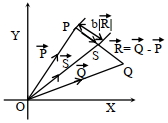
Three vectors $\vec{P}, \vec{Q}$ and $\vec{R}$ are shown in the figure. Let $S$ be any point on the vector $\vec{R}$. The distance between the point $P$ and $S$ is $b|\vec{R}|$. The general relation among vectors $\vec{P}, \vec{Q}$ and $\vec{S}$ is
A
$\vec{S}=(1-b) \vec{P}+b \vec{Q}$
B
$\vec{S}=(b-1) \vec{P}+b \vec{Q}$
C
$\vec{S}=(1-b^2) \vec{P}+b \vec{Q}$
D
$\vec{S}=(1-b) \vec{P}+b^2 \vec{Q}$
Solution
(A) From the figure,the vector $\vec{R}$ is given by $\vec{R} = \vec{Q} - \vec{P}$.
Point $S$ lies on the line segment $PQ$ such that the distance $PS = b|\vec{R}|$.
This implies that the vector $\vec{PS} = b\vec{R} = b(\vec{Q} - \vec{P})$.
Using the triangle law of vector addition in $\triangle OPS$,we have $\vec{S} = \vec{P} + \vec{PS}$.
Substituting the expression for $\vec{PS}$,we get $\vec{S} = \vec{P} + b(\vec{Q} - \vec{P})$.
Simplifying this,we obtain $\vec{S} = \vec{P} + b\vec{Q} - b\vec{P} = (1-b)\vec{P} + b\vec{Q}$.
Point $S$ lies on the line segment $PQ$ such that the distance $PS = b|\vec{R}|$.
This implies that the vector $\vec{PS} = b\vec{R} = b(\vec{Q} - \vec{P})$.
Using the triangle law of vector addition in $\triangle OPS$,we have $\vec{S} = \vec{P} + \vec{PS}$.
Substituting the expression for $\vec{PS}$,we get $\vec{S} = \vec{P} + b(\vec{Q} - \vec{P})$.
Simplifying this,we obtain $\vec{S} = \vec{P} + b\vec{Q} - b\vec{P} = (1-b)\vec{P} + b\vec{Q}$.
0 likesView Solution
19
MathematicsMediumMCQIIT JEE · 2017
Let $O$ be the origin and let $PQR$ be an arbitrary triangle. The point $S$ is such that $\overline{OP} \cdot \overline{OQ} + \overline{OR} \cdot \overline{OS} = \overline{OR} \cdot \overline{OP} + \overline{OQ} \cdot \overline{OS} = \overline{OQ} \cdot \overline{OR} + \overline{OP} \cdot \overline{OS}$. Then the triangle $PQR$ has $S$ as its
A
centroid
B
circumcentre
C
incentre
D
orthocenter
Solution
(D) Given the equation: $\overline{OP} \cdot \overline{OQ} + \overline{OR} \cdot \overline{OS} = \overline{OR} \cdot \overline{OP} + \overline{OQ} \cdot \overline{OS}$.
Rearranging the terms: $\overline{OP} \cdot \overline{OQ} - \overline{OR} \cdot \overline{OP} = \overline{OQ} \cdot \overline{OS} - \overline{OR} \cdot \overline{OS}$.
$\overline{OP} \cdot (\overline{OQ} - \overline{OR}) = \overline{OS} \cdot (\overline{OQ} - \overline{OR})$.
$(\overline{OP} - \overline{OS}) \cdot (\overline{OQ} - \overline{OR}) = 0$.
$\overline{SP} \cdot \overline{RQ} = 0$.
This implies $\overline{SP} \perp \overline{RQ}$,meaning $S$ lies on the altitude from $P$ to $QR$.
Similarly,from $\overline{OR} \cdot \overline{OP} + \overline{OQ} \cdot \overline{OS} = \overline{OQ} \cdot \overline{OR} + \overline{OP} \cdot \overline{OS}$,we get $\overline{SQ} \perp \overline{PR}$.
Since $S$ is the intersection of altitudes,$S$ is the orthocenter of $\triangle PQR$.
Rearranging the terms: $\overline{OP} \cdot \overline{OQ} - \overline{OR} \cdot \overline{OP} = \overline{OQ} \cdot \overline{OS} - \overline{OR} \cdot \overline{OS}$.
$\overline{OP} \cdot (\overline{OQ} - \overline{OR}) = \overline{OS} \cdot (\overline{OQ} - \overline{OR})$.
$(\overline{OP} - \overline{OS}) \cdot (\overline{OQ} - \overline{OR}) = 0$.
$\overline{SP} \cdot \overline{RQ} = 0$.
This implies $\overline{SP} \perp \overline{RQ}$,meaning $S$ lies on the altitude from $P$ to $QR$.
Similarly,from $\overline{OR} \cdot \overline{OP} + \overline{OQ} \cdot \overline{OS} = \overline{OQ} \cdot \overline{OR} + \overline{OP} \cdot \overline{OS}$,we get $\overline{SQ} \perp \overline{PR}$.
Since $S$ is the intersection of altitudes,$S$ is the orthocenter of $\triangle PQR$.
0 likesView Solution
20
MathematicsMediumMCQIIT JEE · 2017
If $y=y(x)$ satisfies the differential equation $8 \sqrt{x}(\sqrt{9+\sqrt{x}}) dy = (\sqrt{4+\sqrt{9+\sqrt{x}}})^{-1} dx$ for $x>0$ and $y(0)=\sqrt{7}$,then find $y(256)$.
A
$3$
B
$9$
C
$16$
D
$80$
Solution
(A) Given the differential equation: $8 \sqrt{x}(\sqrt{9+\sqrt{x}}) dy = \frac{1}{\sqrt{4+\sqrt{9+\sqrt{x}}}} dx$.
Rearranging the terms,we get: $dy = \frac{dx}{8 \sqrt{x} \sqrt{9+\sqrt{x}} \sqrt{4+\sqrt{9+\sqrt{x}}}}$.
Let $u = 4+\sqrt{9+\sqrt{x}}$.
Then $du = \frac{1}{2\sqrt{9+\sqrt{x}}} \cdot \frac{1}{2\sqrt{x}} dx = \frac{dx}{4\sqrt{x}\sqrt{9+\sqrt{x}}}$.
Substituting this into the differential equation: $dy = \frac{1}{2} \cdot \frac{du}{\sqrt{u}}$.
Integrating both sides: $y = \int \frac{1}{2\sqrt{u}} du = \sqrt{u} + C$.
Substituting back $u$: $y = \sqrt{4+\sqrt{9+\sqrt{x}}} + C$.
Given $y(0) = \sqrt{7}$,we have $\sqrt{4+\sqrt{9+0}} + C = \sqrt{7} \Rightarrow \sqrt{4+3} + C = \sqrt{7} \Rightarrow \sqrt{7} + C = \sqrt{7} \Rightarrow C = 0$.
Thus,$y = \sqrt{4+\sqrt{9+\sqrt{x}}}$.
For $x=256$,$y(256) = \sqrt{4+\sqrt{9+\sqrt{256}}} = \sqrt{4+\sqrt{9+16}} = \sqrt{4+\sqrt{25}} = \sqrt{4+5} = \sqrt{9} = 3$.
Rearranging the terms,we get: $dy = \frac{dx}{8 \sqrt{x} \sqrt{9+\sqrt{x}} \sqrt{4+\sqrt{9+\sqrt{x}}}}$.
Let $u = 4+\sqrt{9+\sqrt{x}}$.
Then $du = \frac{1}{2\sqrt{9+\sqrt{x}}} \cdot \frac{1}{2\sqrt{x}} dx = \frac{dx}{4\sqrt{x}\sqrt{9+\sqrt{x}}}$.
Substituting this into the differential equation: $dy = \frac{1}{2} \cdot \frac{du}{\sqrt{u}}$.
Integrating both sides: $y = \int \frac{1}{2\sqrt{u}} du = \sqrt{u} + C$.
Substituting back $u$: $y = \sqrt{4+\sqrt{9+\sqrt{x}}} + C$.
Given $y(0) = \sqrt{7}$,we have $\sqrt{4+\sqrt{9+0}} + C = \sqrt{7} \Rightarrow \sqrt{4+3} + C = \sqrt{7} \Rightarrow \sqrt{7} + C = \sqrt{7} \Rightarrow C = 0$.
Thus,$y = \sqrt{4+\sqrt{9+\sqrt{x}}}$.
For $x=256$,$y(256) = \sqrt{4+\sqrt{9+\sqrt{256}}} = \sqrt{4+\sqrt{9+16}} = \sqrt{4+\sqrt{25}} = \sqrt{4+5} = \sqrt{9} = 3$.
0 likesView Solution
21
MathematicsAdvancedMCQIIT JEE · 2017
If $f: R \rightarrow R$ is a twice differentiable function such that $f^{\prime \prime}(x) > 0$ for all $x \in R$,and $f(\frac{1}{2}) = \frac{1}{2}$,$f(1) = 1$,then
A
$f^{\prime}(1) \leq 0$
B
$0 < f^{\prime}(1) \leq \frac{1}{2}$
C
$\frac{1}{2} < f^{\prime}(1) \leq 1$
D
$f^{\prime}(1) > 1$
Solution
(D) Define a function $h(x) = f(x) - x$.
Given $f(\frac{1}{2}) = \frac{1}{2}$ and $f(1) = 1$,we have $h(\frac{1}{2}) = f(\frac{1}{2}) - \frac{1}{2} = 0$ and $h(1) = f(1) - 1 = 0$.
Since $f(x)$ is twice differentiable,$h(x)$ is also differentiable on $[\frac{1}{2}, 1]$.
By Rolle's Theorem,there exists some $\alpha \in (\frac{1}{2}, 1)$ such that $h^{\prime}(\alpha) = 0$.
Since $h^{\prime}(x) = f^{\prime}(x) - 1$,this implies $f^{\prime}(\alpha) = 1$.
We are given $f^{\prime \prime}(x) > 0$ for all $x \in R$,which means $f^{\prime}(x)$ is a strictly increasing function.
Since $\alpha < 1$ and $f^{\prime}(x)$ is strictly increasing,we have $f^{\prime}(\alpha) < f^{\prime}(1)$.
Substituting $f^{\prime}(\alpha) = 1$,we get $1 < f^{\prime}(1)$.
Given $f(\frac{1}{2}) = \frac{1}{2}$ and $f(1) = 1$,we have $h(\frac{1}{2}) = f(\frac{1}{2}) - \frac{1}{2} = 0$ and $h(1) = f(1) - 1 = 0$.
Since $f(x)$ is twice differentiable,$h(x)$ is also differentiable on $[\frac{1}{2}, 1]$.
By Rolle's Theorem,there exists some $\alpha \in (\frac{1}{2}, 1)$ such that $h^{\prime}(\alpha) = 0$.
Since $h^{\prime}(x) = f^{\prime}(x) - 1$,this implies $f^{\prime}(\alpha) = 1$.
We are given $f^{\prime \prime}(x) > 0$ for all $x \in R$,which means $f^{\prime}(x)$ is a strictly increasing function.
Since $\alpha < 1$ and $f^{\prime}(x)$ is strictly increasing,we have $f^{\prime}(\alpha) < f^{\prime}(1)$.
Substituting $f^{\prime}(\alpha) = 1$,we get $1 < f^{\prime}(1)$.
0 likesView Solution
22
MathematicsAdvancedMCQIIT JEE · 2017
How many $3 \times 3$ matrices $M$ with entries from $\{0, 1, 2\}$ are there,for which the sum of the diagonal entries of $M^T M$ is $5$?
A
$126$
B
$198$
C
$162$
D
$135$
Solution
(B) Let $M = [m_{ij}]$ be a $3 \times 3$ matrix where $m_{ij} \in \{0, 1, 2\}$.
The sum of the diagonal entries of $M^T M$ is given by the trace of $M^T M$,which is equal to the sum of the squares of all entries of $M$,i.e.,$\sum_{i=1}^3 \sum_{j=1}^3 m_{ij}^2 = 5$.
Since $m_{ij} \in \{0, 1, 2\}$,the squares of the entries are $m_{ij}^2 \in \{0, 1, 4\}$.
We need to find the number of ways to choose $9$ entries such that their squares sum to $5$. The possible combinations of squares are:
Case $1$: Five entries are $1$ and four entries are $0$. The number of ways is $\binom{9}{5} = 126$.
Case $2$: One entry is $2$ (square is $4$),one entry is $1$ (square is $1$),and seven entries are $0$. The number of ways to choose the position of $2$ is $\binom{9}{1} = 9$,and the number of ways to choose the position of $1$ from the remaining $8$ positions is $\binom{8}{1} = 8$. Thus,$9 \times 8 = 72$ ways.
Total number of matrices $= 126 + 72 = 198$.
The sum of the diagonal entries of $M^T M$ is given by the trace of $M^T M$,which is equal to the sum of the squares of all entries of $M$,i.e.,$\sum_{i=1}^3 \sum_{j=1}^3 m_{ij}^2 = 5$.
Since $m_{ij} \in \{0, 1, 2\}$,the squares of the entries are $m_{ij}^2 \in \{0, 1, 4\}$.
We need to find the number of ways to choose $9$ entries such that their squares sum to $5$. The possible combinations of squares are:
Case $1$: Five entries are $1$ and four entries are $0$. The number of ways is $\binom{9}{5} = 126$.
Case $2$: One entry is $2$ (square is $4$),one entry is $1$ (square is $1$),and seven entries are $0$. The number of ways to choose the position of $2$ is $\binom{9}{1} = 9$,and the number of ways to choose the position of $1$ from the remaining $8$ positions is $\binom{8}{1} = 8$. Thus,$9 \times 8 = 72$ ways.
Total number of matrices $= 126 + 72 = 198$.
0 likesView Solution
23
MathematicsEasyMCQIIT JEE · 2017
If $g(x) = \int_{\sin x}^{\sin(2x)} \sin^{-1}(t) \, dt$,then
A
$g^{\prime}\left(\frac{\pi}{2}\right) = -2\pi$
B
$g^{\prime}\left(-\frac{\pi}{2}\right) = 2\pi$
C
$g^{\prime}\left(\frac{\pi}{2}\right) = 0$
D
$g^{\prime}\left(-\frac{\pi}{2}\right) = -2\pi$
Solution
(C) Given $g(x) = \int_{\sin x}^{\sin(2x)} \sin^{-1}(t) \, dt$.
Using Leibniz's Rule for differentiation under the integral sign:
$g^{\prime}(x) = \sin^{-1}(\sin(2x)) \cdot \frac{d}{dx}(\sin(2x)) - \sin^{-1}(\sin x) \cdot \frac{d}{dx}(\sin x)$.
$g^{\prime}(x) = \sin^{-1}(\sin(2x)) \cdot (2\cos(2x)) - \sin^{-1}(\sin x) \cdot (\cos x)$.
For $x = \frac{\pi}{2}$:
$g^{\prime}\left(\frac{\pi}{2}\right) = \sin^{-1}(\sin(\pi)) \cdot (2\cos(\pi)) - \sin^{-1}(\sin(\frac{\pi}{2})) \cdot (\cos(\frac{\pi}{2}))$.
Since $\sin(\pi) = 0$,$\sin^{-1}(0) = 0$.
Since $\cos(\frac{\pi}{2}) = 0$,the second term is also $0$.
Thus,$g^{\prime}\left(\frac{\pi}{2}\right) = 0 \cdot (-2) - (\frac{\pi}{2}) \cdot 0 = 0$.
Therefore,option $C$ is correct.
Using Leibniz's Rule for differentiation under the integral sign:
$g^{\prime}(x) = \sin^{-1}(\sin(2x)) \cdot \frac{d}{dx}(\sin(2x)) - \sin^{-1}(\sin x) \cdot \frac{d}{dx}(\sin x)$.
$g^{\prime}(x) = \sin^{-1}(\sin(2x)) \cdot (2\cos(2x)) - \sin^{-1}(\sin x) \cdot (\cos x)$.
For $x = \frac{\pi}{2}$:
$g^{\prime}\left(\frac{\pi}{2}\right) = \sin^{-1}(\sin(\pi)) \cdot (2\cos(\pi)) - \sin^{-1}(\sin(\frac{\pi}{2})) \cdot (\cos(\frac{\pi}{2}))$.
Since $\sin(\pi) = 0$,$\sin^{-1}(0) = 0$.
Since $\cos(\frac{\pi}{2}) = 0$,the second term is also $0$.
Thus,$g^{\prime}\left(\frac{\pi}{2}\right) = 0 \cdot (-2) - (\frac{\pi}{2}) \cdot 0 = 0$.
Therefore,option $C$ is correct.
0 likesView Solution
24
MathematicsAdvancedMCQIIT JEE · 2017
If $f: R \rightarrow R$ is a differentiable function such that $f^{\prime}(x) > 2f(x)$ for all $x \in R$,and $f(0) = 1$,then:
A
$B, D$
B
$B, C$
C
$A, C$
D
$A, D$
Solution
(C) Given $f^{\prime}(x) - 2f(x) > 0$.
Multiply by the integrating factor $e^{-2x}$:
$e^{-2x} f^{\prime}(x) - 2e^{-2x} f(x) > 0$.
This is equivalent to $\frac{d}{dx}(f(x) e^{-2x}) > 0$.
Let $g(x) = f(x) e^{-2x}$. Since $g^{\prime}(x) > 0$,$g(x)$ is a strictly increasing function.
For $x > 0$,$g(x) > g(0)$.
Since $g(0) = f(0) e^0 = 1 \cdot 1 = 1$,we have $f(x) e^{-2x} > 1$,which implies $f(x) > e^{2x}$ for all $x > 0$.
Since $f(x) > e^{2x} > 0$ for $x > 0$,and $f^{\prime}(x) > 2f(x)$,we have $f^{\prime}(x) > 2e^{2x} > 0$.
Since $f^{\prime}(x) > 0$,$f(x)$ is an increasing function in $(0, \infty)$.
Thus,$A$ and $C$ are correct.
Multiply by the integrating factor $e^{-2x}$:
$e^{-2x} f^{\prime}(x) - 2e^{-2x} f(x) > 0$.
This is equivalent to $\frac{d}{dx}(f(x) e^{-2x}) > 0$.
Let $g(x) = f(x) e^{-2x}$. Since $g^{\prime}(x) > 0$,$g(x)$ is a strictly increasing function.
For $x > 0$,$g(x) > g(0)$.
Since $g(0) = f(0) e^0 = 1 \cdot 1 = 1$,we have $f(x) e^{-2x} > 1$,which implies $f(x) > e^{2x}$ for all $x > 0$.
Since $f(x) > e^{2x} > 0$ for $x > 0$,and $f^{\prime}(x) > 2f(x)$,we have $f^{\prime}(x) > 2e^{2x} > 0$.
Since $f^{\prime}(x) > 0$,$f(x)$ is an increasing function in $(0, \infty)$.
Thus,$A$ and $C$ are correct.
0 likesView Solution
25
MathematicsDifficultMCQIIT JEE · 2017
Let $f(x) = \frac{1 - x(1 + |1 - x|)}{|1 - x|} \cos \left(\frac{1}{1 - x}\right)$ for $x \neq 1$. Then
A
$A, C$
B
$A, D$
C
$B, C$
D
$B, D$
Solution
(B) For $x \to 1^{-}$,let $x = 1 - h$ where $h > 0$. Then $|1 - x| = h$.
$f(1 - h) = \frac{1 - (1 - h)(1 + h)}{h} \cos \left(\frac{1}{h}\right) = \frac{1 - (1 - h^2)}{h} \cos \left(\frac{1}{h}\right) = \frac{h^2}{h} \cos \left(\frac{1}{h}\right) = h \cos \left(\frac{1}{h}\right)$.
Since $\lim_{h \to 0} h \cos \left(\frac{1}{h}\right) = 0$,we have $\lim_{x \to 1^{-}} f(x) = 0$.
For $x \to 1^{+}$,let $x = 1 + h$ where $h > 0$. Then $|1 - x| = h$.
$f(1 + h) = \frac{1 - (1 + h)(1 + h)}{h} \cos \left(\frac{-1}{h}\right) = \frac{1 - (1 + 2h + h^2)}{h} \cos \left(\frac{1}{h}\right) = \frac{-2h - h^2}{h} \cos \left(\frac{1}{h}\right) = -(2 + h) \cos \left(\frac{1}{h}\right)$.
As $h \to 0$,$-(2 + h) \to -2$,and $\cos \left(\frac{1}{h}\right)$ oscillates between $-1$ and $1$.
Thus,$\lim_{x \to 1^{+}} f(x)$ does not exist.
Therefore,options $A$ and $D$ are correct.
$f(1 - h) = \frac{1 - (1 - h)(1 + h)}{h} \cos \left(\frac{1}{h}\right) = \frac{1 - (1 - h^2)}{h} \cos \left(\frac{1}{h}\right) = \frac{h^2}{h} \cos \left(\frac{1}{h}\right) = h \cos \left(\frac{1}{h}\right)$.
Since $\lim_{h \to 0} h \cos \left(\frac{1}{h}\right) = 0$,we have $\lim_{x \to 1^{-}} f(x) = 0$.
For $x \to 1^{+}$,let $x = 1 + h$ where $h > 0$. Then $|1 - x| = h$.
$f(1 + h) = \frac{1 - (1 + h)(1 + h)}{h} \cos \left(\frac{-1}{h}\right) = \frac{1 - (1 + 2h + h^2)}{h} \cos \left(\frac{1}{h}\right) = \frac{-2h - h^2}{h} \cos \left(\frac{1}{h}\right) = -(2 + h) \cos \left(\frac{1}{h}\right)$.
As $h \to 0$,$-(2 + h) \to -2$,and $\cos \left(\frac{1}{h}\right)$ oscillates between $-1$ and $1$.
Thus,$\lim_{x \to 1^{+}} f(x)$ does not exist.
Therefore,options $A$ and $D$ are correct.
0 likesView Solution
26
MathematicsAdvancedMCQIIT JEE · 2017
If $f(x) = \left| \begin{array}{ccc} \cos(2x) & \cos(2x) & \sin(2x) \\ -\cos x & \cos x & -\sin x \\ \sin x & \sin x & \cos x \end{array} \right|$,then:
$A$. $f'(x) = 0$ at exactly three points in $(-\pi, \pi)$
$B$. $f'(x) = 0$ at more than three points in $(-\pi, \pi)$
$C$. $f(x)$ attains its maximum at $x = 0$
$D$. $f(x)$ attains its minimum at $x = 0$
$A$. $f'(x) = 0$ at exactly three points in $(-\pi, \pi)$
$B$. $f'(x) = 0$ at more than three points in $(-\pi, \pi)$
$C$. $f(x)$ attains its maximum at $x = 0$
$D$. $f(x)$ attains its minimum at $x = 0$
A
$A, C$
B
$A, B$
C
$A, D$
D
$B, C$
Solution
(D) Expanding the determinant $f(x)$:
$f(x) = \cos(2x)(\cos x \cos x - (-\sin x \sin x)) - \cos(2x)(-\cos x \cos x - (-\sin x \sin x)) + \sin(2x)(-\cos x \sin x - \cos x \sin x)$
$f(x) = \cos(2x)(\cos^2 x + \sin^2 x) - \cos(2x)(-\cos^2 x + \sin^2 x) + \sin(2x)(-2 \sin x \cos x)$
$f(x) = \cos(2x)(1) - \cos(2x)(-\cos 2x) + \sin(2x)(-\sin 2x)$
$f(x) = \cos 2x + \cos^2 2x - \sin^2 2x = \cos 2x + \cos 4x$.
Now,$f'(x) = -2 \sin 2x - 4 \sin 4x = -2 \sin 2x - 8 \sin 2x \cos 2x = -2 \sin 2x (1 + 4 \cos 2x)$.
Setting $f'(x) = 0$,we get $\sin 2x = 0$ or $\cos 2x = -1/4$.
In $(-\pi, \pi)$,$\sin 2x = 0$ at $x = 0, \pm \pi/2$. ($3$ points)
$\cos 2x = -1/4$ has $4$ solutions in $(-\pi, \pi)$.
Thus,$f'(x) = 0$ at $3 + 4 = 7$ points,which is more than $3$. So $B$ is correct.
For $f(x) = \cos 2x + \cos 4x$,at $x = 0$,$f(0) = \cos 0 + \cos 0 = 2$.
Since $\cos \theta \le 1$,the maximum value of $f(x)$ is $2$,which occurs at $x = 0$. So $C$ is correct.
Therefore,the correct options are $B$ and $C$.
$f(x) = \cos(2x)(\cos x \cos x - (-\sin x \sin x)) - \cos(2x)(-\cos x \cos x - (-\sin x \sin x)) + \sin(2x)(-\cos x \sin x - \cos x \sin x)$
$f(x) = \cos(2x)(\cos^2 x + \sin^2 x) - \cos(2x)(-\cos^2 x + \sin^2 x) + \sin(2x)(-2 \sin x \cos x)$
$f(x) = \cos(2x)(1) - \cos(2x)(-\cos 2x) + \sin(2x)(-\sin 2x)$
$f(x) = \cos 2x + \cos^2 2x - \sin^2 2x = \cos 2x + \cos 4x$.
Now,$f'(x) = -2 \sin 2x - 4 \sin 4x = -2 \sin 2x - 8 \sin 2x \cos 2x = -2 \sin 2x (1 + 4 \cos 2x)$.
Setting $f'(x) = 0$,we get $\sin 2x = 0$ or $\cos 2x = -1/4$.
In $(-\pi, \pi)$,$\sin 2x = 0$ at $x = 0, \pm \pi/2$. ($3$ points)
$\cos 2x = -1/4$ has $4$ solutions in $(-\pi, \pi)$.
Thus,$f'(x) = 0$ at $3 + 4 = 7$ points,which is more than $3$. So $B$ is correct.
For $f(x) = \cos 2x + \cos 4x$,at $x = 0$,$f(0) = \cos 0 + \cos 0 = 2$.
Since $\cos \theta \le 1$,the maximum value of $f(x)$ is $2$,which occurs at $x = 0$. So $C$ is correct.
Therefore,the correct options are $B$ and $C$.
0 likesView Solution
27
MathematicsAdvancedMCQIIT JEE · 2017
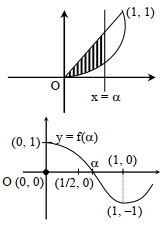
If the line $x=\alpha$ divides the area of region $R=\{(x, y) \in \mathbb{R}^2: x^3 \leq y \leq x, 0 \leq x \leq 1\}$ into two equal parts,then which of the following is true?
$[A] \ 0 < \alpha \leq \frac{1}{2}$
$[B] \ \frac{1}{2} < \alpha < 1$
$[C] \ 2 \alpha^4 - 4 \alpha^2 + 1 = 0$
$[D] \ \alpha^4 + 4 \alpha^2 - 1 = 0$
$[A] \ 0 < \alpha \leq \frac{1}{2}$
$[B] \ \frac{1}{2} < \alpha < 1$
$[C] \ 2 \alpha^4 - 4 \alpha^2 + 1 = 0$
$[D] \ \alpha^4 + 4 \alpha^2 - 1 = 0$
A
$B, C$
B
$B, D$
C
$B, A$
D
$B, C, D$
Solution
(A) The total area of the region $R$ is given by:
$A = \int_0^1 (x - x^3) dx = \left[ \frac{x^2}{2} - \frac{x^4}{4} \right]_0^1 = \frac{1}{2} - \frac{1}{4} = \frac{1}{4}$.
Since the line $x = \alpha$ divides the area into two equal parts,the area from $0$ to $\alpha$ must be half of the total area:
$\int_0^{\alpha} (x - x^3) dx = \frac{1}{2} \times \frac{1}{4} = \frac{1}{8}$.
Evaluating the integral:
$\left[ \frac{x^2}{2} - \frac{x^4}{4} \right]_0^{\alpha} = \frac{1}{8}$
$\frac{\alpha^2}{2} - \frac{\alpha^4}{4} = \frac{1}{8}$
Multiply by $4$:
$2 \alpha^2 - \alpha^4 = \frac{1}{2}$
$4 \alpha^2 - 2 \alpha^4 = 1$
$2 \alpha^4 - 4 \alpha^2 + 1 = 0$. This confirms option $[C]$.
Let $f(\alpha) = 2 \alpha^4 - 4 \alpha^2 + 1$. We have $f(0) = 1$ and $f(1) = 2 - 4 + 1 = -1$.
Since $f(\alpha)$ is continuous and changes sign between $0$ and $1$,there exists a root $\alpha \in (0, 1)$.
Also,$f(1/\sqrt{2}) = 2(1/4) - 4(1/2) + 1 = 0.5 - 2 + 1 = -0.5 < 0$.
Since $f(0) = 1 > 0$ and $f(1/\sqrt{2}) < 0$,the root $\alpha$ must lie in $(0, 1/\sqrt{2})$.
Since $1/\sqrt{2} \approx 0.707$,and $1/2 = 0.5$,we check $f(1/2) = 2(1/16) - 4(1/4) + 1 = 1/8 - 1 + 1 = 1/8 > 0$.
Since $f(1/2) > 0$ and $f(1/\sqrt{2}) < 0$,the root $\alpha$ lies in $(1/2, 1/\sqrt{2})$,which is a subset of $(1/2, 1)$. Thus,option $[B]$ is also true.
$A = \int_0^1 (x - x^3) dx = \left[ \frac{x^2}{2} - \frac{x^4}{4} \right]_0^1 = \frac{1}{2} - \frac{1}{4} = \frac{1}{4}$.
Since the line $x = \alpha$ divides the area into two equal parts,the area from $0$ to $\alpha$ must be half of the total area:
$\int_0^{\alpha} (x - x^3) dx = \frac{1}{2} \times \frac{1}{4} = \frac{1}{8}$.
Evaluating the integral:
$\left[ \frac{x^2}{2} - \frac{x^4}{4} \right]_0^{\alpha} = \frac{1}{8}$
$\frac{\alpha^2}{2} - \frac{\alpha^4}{4} = \frac{1}{8}$
Multiply by $4$:
$2 \alpha^2 - \alpha^4 = \frac{1}{2}$
$4 \alpha^2 - 2 \alpha^4 = 1$
$2 \alpha^4 - 4 \alpha^2 + 1 = 0$. This confirms option $[C]$.
Let $f(\alpha) = 2 \alpha^4 - 4 \alpha^2 + 1$. We have $f(0) = 1$ and $f(1) = 2 - 4 + 1 = -1$.
Since $f(\alpha)$ is continuous and changes sign between $0$ and $1$,there exists a root $\alpha \in (0, 1)$.
Also,$f(1/\sqrt{2}) = 2(1/4) - 4(1/2) + 1 = 0.5 - 2 + 1 = -0.5 < 0$.
Since $f(0) = 1 > 0$ and $f(1/\sqrt{2}) < 0$,the root $\alpha$ must lie in $(0, 1/\sqrt{2})$.
Since $1/\sqrt{2} \approx 0.707$,and $1/2 = 0.5$,we check $f(1/2) = 2(1/16) - 4(1/4) + 1 = 1/8 - 1 + 1 = 1/8 > 0$.
Since $f(1/2) > 0$ and $f(1/\sqrt{2}) < 0$,the root $\alpha$ lies in $(1/2, 1/\sqrt{2})$,which is a subset of $(1/2, 1)$. Thus,option $[B]$ is also true.
0 likesView Solution
28
MathematicsAdvancedMCQIIT JEE · 2017
If $I = \sum_{k=1}^{98} \int_k^{k+1} \frac{k+1}{x(x+1)} dx$,then which of the following is true?
A
$B, A$
B
$B, C$
C
$B, D$
D
$A, B, C$
Solution
(C) We are given $I = \sum_{k=1}^{98} \int_{k}^{k+1} \frac{k+1}{x(x+1)} dx$.
For $x \in [k, k+1]$,we have $k \le x \le k+1$.
This implies $\frac{1}{k+1} \le \frac{1}{x} \le \frac{1}{k}$.
Multiplying by $(k+1)$,we get $\frac{k+1}{k+1} \le \frac{k+1}{x} \le \frac{k+1}{k}$.
Dividing by $(x+1)$,we get $\frac{1}{x+1} \le \frac{k+1}{x(x+1)} \le \frac{k+1}{k(x+1)}$.
Integrating from $k$ to $k+1$:
$\int_{k}^{k+1} \frac{1}{x+1} dx < \int_{k}^{k+1} \frac{k+1}{x(x+1)} dx < \int_{k}^{k+1} \frac{k+1}{k(x+1)} dx$.
Summing from $k=1$ to $98$:
$\sum_{k=1}^{98} (\ln(k+2) - \ln(k+1)) < I < \sum_{k=1}^{98} \frac{k+1}{k} (\ln(k+2) - \ln(k+1))$.
The left side is $\ln(100) - \ln(2) = \ln(50)$.
Since $\frac{k+1}{k} = 1 + \frac{1}{k}$,the right side is $\sum_{k=1}^{98} (1 + \frac{1}{k}) \ln(\frac{k+2}{k+1})$.
Using the property $\ln(1+x) < x$,we can bound $I < \ln(99)$.
Also,comparing with $\frac{49}{50}$,we find $I > \frac{49}{50}$.
Thus,$I < \ln(99)$ and $I > \frac{49}{50}$ are both true.
For $x \in [k, k+1]$,we have $k \le x \le k+1$.
This implies $\frac{1}{k+1} \le \frac{1}{x} \le \frac{1}{k}$.
Multiplying by $(k+1)$,we get $\frac{k+1}{k+1} \le \frac{k+1}{x} \le \frac{k+1}{k}$.
Dividing by $(x+1)$,we get $\frac{1}{x+1} \le \frac{k+1}{x(x+1)} \le \frac{k+1}{k(x+1)}$.
Integrating from $k$ to $k+1$:
$\int_{k}^{k+1} \frac{1}{x+1} dx < \int_{k}^{k+1} \frac{k+1}{x(x+1)} dx < \int_{k}^{k+1} \frac{k+1}{k(x+1)} dx$.
Summing from $k=1$ to $98$:
$\sum_{k=1}^{98} (\ln(k+2) - \ln(k+1)) < I < \sum_{k=1}^{98} \frac{k+1}{k} (\ln(k+2) - \ln(k+1))$.
The left side is $\ln(100) - \ln(2) = \ln(50)$.
Since $\frac{k+1}{k} = 1 + \frac{1}{k}$,the right side is $\sum_{k=1}^{98} (1 + \frac{1}{k}) \ln(\frac{k+2}{k+1})$.
Using the property $\ln(1+x) < x$,we can bound $I < \ln(99)$.
Also,comparing with $\frac{49}{50}$,we find $I > \frac{49}{50}$.
Thus,$I < \ln(99)$ and $I > \frac{49}{50}$ are both true.
0 likesView Solution
29
MathematicsMediumMCQIIT JEE · 2017
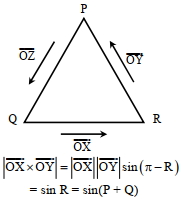
Let $O$ be the origin,and $\overline{OX}, \overline{OY}, \overline{OZ}$ be three unit vectors in the directions of the sides $QR, RP, PQ$,respectively,of a triangle $PQR$.
$(1)$ Find $|\overline{OX} \times \overline{OY}|$.
$[A] \sin(P+Q)$
$[B] \sin 2R$
$[C] \sin(P+R)$
$[D] \sin(Q+R)$
$(2)$ If the triangle $PQR$ varies,then find the minimum value of $\cos(P+Q) + \cos(Q+R) + \cos(R+P)$.
$[A] -\frac{5}{3}$
$[B] -\frac{3}{2}$
$[C] \frac{3}{2}$
$[D] \frac{5}{3}$
Select the correct options for $(1)$ and $(2)$.
$(1)$ Find $|\overline{OX} \times \overline{OY}|$.
$[A] \sin(P+Q)$
$[B] \sin 2R$
$[C] \sin(P+R)$
$[D] \sin(Q+R)$
$(2)$ If the triangle $PQR$ varies,then find the minimum value of $\cos(P+Q) + \cos(Q+R) + \cos(R+P)$.
$[A] -\frac{5}{3}$
$[B] -\frac{3}{2}$
$[C] \frac{3}{2}$
$[D] \frac{5}{3}$
Select the correct options for $(1)$ and $(2)$.
A
$B, C$
B
$B, D$
C
$B, C, D$
D
$A, B$
Solution
(D) $(1)$ Since $\overline{OX}, \overline{OY}$ are unit vectors along $QR$ and $RP$,the angle between them is $\pi - R$.
Thus,$|\overline{OX} \times \overline{OY}| = |\overline{OX}| |\overline{OY}| \sin(\pi - R) = 1 \cdot 1 \cdot \sin R = \sin R$.
Since $P+Q+R = \pi$,$\sin R = \sin(\pi - (P+Q)) = \sin(P+Q)$.
Thus,option $A$ is correct.
$(2)$ We need to find the minimum value of $\cos(P+Q) + \cos(Q+R) + \cos(R+P)$.
Since $P+Q+R = \pi$,this is equivalent to $\cos(\pi-R) + \cos(\pi-P) + \cos(\pi-Q) = -(\cos P + \cos Q + \cos R)$.
For any triangle,$\cos P + \cos Q + \cos R \leq \frac{3}{2}$.
Therefore,$-(\cos P + \cos Q + \cos R) \geq -\frac{3}{2}$.
The minimum value is $-\frac{3}{2}$,which occurs for an equilateral triangle.
Thus,option $B$ is correct.
Combining both,the correct choice is $A, B$.
Thus,$|\overline{OX} \times \overline{OY}| = |\overline{OX}| |\overline{OY}| \sin(\pi - R) = 1 \cdot 1 \cdot \sin R = \sin R$.
Since $P+Q+R = \pi$,$\sin R = \sin(\pi - (P+Q)) = \sin(P+Q)$.
Thus,option $A$ is correct.
$(2)$ We need to find the minimum value of $\cos(P+Q) + \cos(Q+R) + \cos(R+P)$.
Since $P+Q+R = \pi$,this is equivalent to $\cos(\pi-R) + \cos(\pi-P) + \cos(\pi-Q) = -(\cos P + \cos Q + \cos R)$.
For any triangle,$\cos P + \cos Q + \cos R \leq \frac{3}{2}$.
Therefore,$-(\cos P + \cos Q + \cos R) \geq -\frac{3}{2}$.
The minimum value is $-\frac{3}{2}$,which occurs for an equilateral triangle.
Thus,option $B$ is correct.
Combining both,the correct choice is $A, B$.
0 likesView Solution
30
MathematicsMediumMCQIIT JEE · 2017
The equation of the plane,passing through the point $(1, 1, 1)$ and perpendicular to the planes $2x + y - 2z = 5$ and $3x - 6y - 2z = 7$,is
A
$14x + 2y - 15z = 1$
B
$14x - 2y + 15z = 27$
C
$14x + 2y + 15z = 31$
D
$-14x + 2y + 15z = 3$
Solution
(C) The equation of a plane passing through $(1, 1, 1)$ is given by $a(x - 1) + b(y - 1) + c(z - 1) = 0$.
Since this plane is perpendicular to the planes $2x + y - 2z = 5$ and $3x - 6y - 2z = 7$,its normal vector $\vec{n} = (a, b, c)$ must be perpendicular to the normal vectors of the given planes,$\vec{n_1} = (2, 1, -2)$ and $\vec{n_2} = (3, -6, -2)$.
Thus,the normal vector $\vec{n}$ is given by the cross product $\vec{n_1} \times \vec{n_2}$:
$\vec{n} = \begin{vmatrix} \hat{i} & \hat{j} & \hat{k} \\ 2 & 1 & -2 \\ 3 & -6 & -2 \end{vmatrix} = \hat{i}(-2 - 12) - \hat{j}(-4 + 6) + \hat{k}(-12 - 3) = -14\hat{i} - 2\hat{j} - 15\hat{k}$.
Taking the normal vector as $(14, 2, 15)$,the equation of the plane is $14(x - 1) + 2(y - 1) + 15(z - 1) = 0$.
Expanding this,we get $14x - 14 + 2y - 2 + 15z - 15 = 0$,which simplifies to $14x + 2y + 15z = 31$.
Since this plane is perpendicular to the planes $2x + y - 2z = 5$ and $3x - 6y - 2z = 7$,its normal vector $\vec{n} = (a, b, c)$ must be perpendicular to the normal vectors of the given planes,$\vec{n_1} = (2, 1, -2)$ and $\vec{n_2} = (3, -6, -2)$.
Thus,the normal vector $\vec{n}$ is given by the cross product $\vec{n_1} \times \vec{n_2}$:
$\vec{n} = \begin{vmatrix} \hat{i} & \hat{j} & \hat{k} \\ 2 & 1 & -2 \\ 3 & -6 & -2 \end{vmatrix} = \hat{i}(-2 - 12) - \hat{j}(-4 + 6) + \hat{k}(-12 - 3) = -14\hat{i} - 2\hat{j} - 15\hat{k}$.
Taking the normal vector as $(14, 2, 15)$,the equation of the plane is $14(x - 1) + 2(y - 1) + 15(z - 1) = 0$.
Expanding this,we get $14x - 14 + 2y - 2 + 15z - 15 = 0$,which simplifies to $14x + 2y + 15z = 31$.
0 likesView Solution
Vedclass Products
For Students
Vedclass Test Series
Mock tests in real IIT JEE style covering Mathematics with performance analysis. 5-day free trial.
Start Free TrialFor Teachers
Exam Paper Generator
Generate Set A/B/C/D Mathematics papers from 7.5L+ questions in 2 minutes. 3 chapters free.
Try FreeFor Institutes
Online Exam Module
Run live IIT JEE mock exams with unlimited students, 360° analytics & white-label branding.
See DemoFrequently Asked Questions
How many Mathematics questions are in IIT JEE 2017?
There are 30 Mathematics questions from the IIT JEE 2017 paper on Vedclass, each with a detailed step-by-step solution in English.
Are IIT JEE 2017 Mathematics solutions available in English?
Yes. All solutions on this page are in English. You can also switch to English or Hindi using the language buttons above the questions.
Can I practice IIT JEE 2017 Mathematics as a timed test?
Yes. Use the Vedclass Test Series to attempt a full IIT JEE mock test covering Mathematics with time limits and instant score analysis.
Can teachers create Mathematics papers from IIT JEE previous year questions?
Yes. The Vedclass Exam Paper Generator lets teachers mix IIT JEE Mathematics questions and generate Set A/B/C/D papers in minutes.
For Teachers & Institutes
Build a Custom Mathematics Paper
Pick IIT JEE 2017 Mathematics questions, set difficulty, and generate Set A/B/C/D in 2 minutes.