
ChemistryQ151–250 of 452 questions
Page 4 of 5 · English
151
ChemistryMCQAP EAMCET · 2025
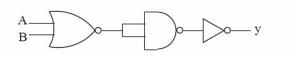
The logic gate equivalent to the circuit shown in the figure is
A
$AND$
B
$NAND$
C
$NOR$
D
$OR$
Solution
(C) The given circuit consists of a $NOR$ gate, a $NAND$ gate with its inputs tied together (acting as a $NOT$ gate), and a $NOT$ gate.
Let the inputs be $A$ and $B$.
The output of the $NOR$ gate is $Y_1 = \overline{A+B}$.
The $NAND$ gate with tied inputs acts as a $NOT$ gate, so its output is $Y_2 = \overline{Y_1 \cdot Y_1} = \overline{Y_1}$.
Substituting $Y_1$, we get $Y_2 = \overline{\overline{A+B}} = A+B$.
The final output $y$ passes through a $NOT$ gate, so $y = \overline{Y_2} = \overline{A+B}$.
This is the Boolean expression for a $NOR$ gate.
Therefore, the circuit is equivalent to a $NOR$ gate.
Let the inputs be $A$ and $B$.
The output of the $NOR$ gate is $Y_1 = \overline{A+B}$.
The $NAND$ gate with tied inputs acts as a $NOT$ gate, so its output is $Y_2 = \overline{Y_1 \cdot Y_1} = \overline{Y_1}$.
Substituting $Y_1$, we get $Y_2 = \overline{\overline{A+B}} = A+B$.
The final output $y$ passes through a $NOT$ gate, so $y = \overline{Y_2} = \overline{A+B}$.
This is the Boolean expression for a $NOR$ gate.
Therefore, the circuit is equivalent to a $NOR$ gate.
0 likesView Solution
152
ChemistryMCQAP EAMCET · 2025
If the position vectors of $A, B, C, D$ are $\hat{i}+2\hat{j}+2\hat{k}, 2\hat{i}-\hat{j}, \hat{i}+\hat{j}+3\hat{k}$ and $4\hat{j}+5\hat{k}$ respectively,then the quadrilateral $ABCD$ is a
A
square
B
rectangle
C
rhombus
D
parallelogram
Solution
(C) Let the position vectors be $\vec{a} = \hat{i}+2\hat{j}+2\hat{k}$,$\vec{b} = 2\hat{i}-\hat{j}$,$\vec{c} = \hat{i}+\hat{j}+3\hat{k}$,and $\vec{d} = 4\hat{j}+5\hat{k}$.
First,find the vectors representing the sides:
$\vec{AB} = \vec{b} - \vec{a} = (2-1)\hat{i} + (-1-2)\hat{j} + (0-2)\hat{k} = \hat{i} - 3\hat{j} - 2\hat{k}$.
$\vec{BC} = \vec{c} - \vec{b} = (1-2)\hat{i} + (1-(-1))\hat{j} + (3-0)\hat{k} = -\hat{i} + 2\hat{j} + 3\hat{k}$.
$\vec{CD} = \vec{d} - \vec{c} = (0-1)\hat{i} + (4-1)\hat{j} + (5-3)\hat{k} = -\hat{i} + 3\hat{j} + 2\hat{k}$.
$\vec{DA} = \vec{a} - \vec{d} = (1-0)\hat{i} + (2-4)\hat{j} + (2-5)\hat{k} = \hat{i} - 2\hat{j} - 3\hat{k}$.
Note that $\vec{AB} = -\vec{CD}$ and $\vec{BC} = -\vec{DA}$,which confirms $ABCD$ is a parallelogram.
Now check the lengths of the sides:
$|\vec{AB}| = \sqrt{1^2 + (-3)^2 + (-2)^2} = \sqrt{1+9+4} = \sqrt{14}$.
$|\vec{BC}| = \sqrt{(-1)^2 + 2^2 + 3^2} = \sqrt{1+4+9} = \sqrt{14}$.
Since adjacent sides are equal $(|\vec{AB}| = |\vec{BC}| = \sqrt{14})$,the parallelogram is a rhombus.
First,find the vectors representing the sides:
$\vec{AB} = \vec{b} - \vec{a} = (2-1)\hat{i} + (-1-2)\hat{j} + (0-2)\hat{k} = \hat{i} - 3\hat{j} - 2\hat{k}$.
$\vec{BC} = \vec{c} - \vec{b} = (1-2)\hat{i} + (1-(-1))\hat{j} + (3-0)\hat{k} = -\hat{i} + 2\hat{j} + 3\hat{k}$.
$\vec{CD} = \vec{d} - \vec{c} = (0-1)\hat{i} + (4-1)\hat{j} + (5-3)\hat{k} = -\hat{i} + 3\hat{j} + 2\hat{k}$.
$\vec{DA} = \vec{a} - \vec{d} = (1-0)\hat{i} + (2-4)\hat{j} + (2-5)\hat{k} = \hat{i} - 2\hat{j} - 3\hat{k}$.
Note that $\vec{AB} = -\vec{CD}$ and $\vec{BC} = -\vec{DA}$,which confirms $ABCD$ is a parallelogram.
Now check the lengths of the sides:
$|\vec{AB}| = \sqrt{1^2 + (-3)^2 + (-2)^2} = \sqrt{1+9+4} = \sqrt{14}$.
$|\vec{BC}| = \sqrt{(-1)^2 + 2^2 + 3^2} = \sqrt{1+4+9} = \sqrt{14}$.
Since adjacent sides are equal $(|\vec{AB}| = |\vec{BC}| = \sqrt{14})$,the parallelogram is a rhombus.
0 likesView Solution
153
ChemistryMCQAP EAMCET · 2025
If $(2,-1,3)$ is the foot of the perpendicular drawn from the origin to the plane,then the equation of the plane is
A
$2x-y+3z-14=0$
B
$2x+y-3z+6=0$
C
$2x-y+3z-13=0$
D
$2x+y+3z-10=0$
Solution
(A) Let the origin be $O(0,0,0)$ and the foot of the perpendicular be $P(2,-1,3)$.
Since $OP$ is the normal to the plane,the direction ratios of the normal are the same as the direction ratios of the line $OP$.
The direction ratios of $OP$ are $(2-0, -1-0, 3-0) = (2, -1, 3)$.
Thus,the normal vector to the plane is $\vec{n} = 2\hat{i} - \hat{j} + 3\hat{k}$.
The equation of a plane passing through a point $(x_1, y_1, z_1)$ with normal vector $(a, b, c)$ is given by $a(x-x_1) + b(y-y_1) + c(z-z_1) = 0$.
Substituting the point $P(2, -1, 3)$ and the normal vector $(2, -1, 3)$ into the equation:
$2(x-2) - 1(y-(-1)) + 3(z-3) = 0$
$2(x-2) - 1(y+1) + 3(z-3) = 0$
$2x - 4 - y - 1 + 3z - 9 = 0$
$2x - y + 3z - 14 = 0$
Therefore,the equation of the plane is $2x - y + 3z - 14 = 0$.
Since $OP$ is the normal to the plane,the direction ratios of the normal are the same as the direction ratios of the line $OP$.
The direction ratios of $OP$ are $(2-0, -1-0, 3-0) = (2, -1, 3)$.
Thus,the normal vector to the plane is $\vec{n} = 2\hat{i} - \hat{j} + 3\hat{k}$.
The equation of a plane passing through a point $(x_1, y_1, z_1)$ with normal vector $(a, b, c)$ is given by $a(x-x_1) + b(y-y_1) + c(z-z_1) = 0$.
Substituting the point $P(2, -1, 3)$ and the normal vector $(2, -1, 3)$ into the equation:
$2(x-2) - 1(y-(-1)) + 3(z-3) = 0$
$2(x-2) - 1(y+1) + 3(z-3) = 0$
$2x - 4 - y - 1 + 3z - 9 = 0$
$2x - y + 3z - 14 = 0$
Therefore,the equation of the plane is $2x - y + 3z - 14 = 0$.
0 likesView Solution
154
ChemistryMediumMCQAP EAMCET · 2025
$1.84 \ g$ of a mixture of $CaCO_3$ and $MgCO_3$ is strongly heated to get a residue of $0.96 \ g$. The percentage of $CaCO_3$ in the mixture is
A
$50.34$
B
$49.66$
C
$54.34$
D
$45.66$
Solution
(C) Let the mass of $CaCO_3$ be $x \ g$ and the mass of $MgCO_3$ be $(1.84 - x) \ g$.
Heating the carbonates results in the following reactions:
$CaCO_3(s) \rightarrow CaO(s) + CO_2(g)$
$MgCO_3(s) \rightarrow MgO(s) + CO_2(g)$
The molar mass of $CaCO_3 = 100 \ g/mol$,$CaO = 56 \ g/mol$,$MgCO_3 = 84 \ g/mol$,and $MgO = 40 \ g/mol$.
The mass of the residue $(CaO + MgO)$ is $0.96 \ g$.
Mass of $CaO = (x / 100) \times 56 = 0.56x$.
Mass of $MgO = ((1.84 - x) / 84) \times 40 = 0.476(1.84 - x)$.
$0.56x + 0.476(1.84 - x) = 0.96$.
$0.56x + 0.876 - 0.476x = 0.96$.
$0.084x = 0.084$.
$x = 1 \ g$.
Percentage of $CaCO_3 = (1 / 1.84) \times 100 \approx 54.34\%$.
Heating the carbonates results in the following reactions:
$CaCO_3(s) \rightarrow CaO(s) + CO_2(g)$
$MgCO_3(s) \rightarrow MgO(s) + CO_2(g)$
The molar mass of $CaCO_3 = 100 \ g/mol$,$CaO = 56 \ g/mol$,$MgCO_3 = 84 \ g/mol$,and $MgO = 40 \ g/mol$.
The mass of the residue $(CaO + MgO)$ is $0.96 \ g$.
Mass of $CaO = (x / 100) \times 56 = 0.56x$.
Mass of $MgO = ((1.84 - x) / 84) \times 40 = 0.476(1.84 - x)$.
$0.56x + 0.476(1.84 - x) = 0.96$.
$0.56x + 0.876 - 0.476x = 0.96$.
$0.084x = 0.084$.
$x = 1 \ g$.
Percentage of $CaCO_3 = (1 / 1.84) \times 100 \approx 54.34\%$.
0 likesView Solution
155
ChemistryMediumMCQAP EAMCET · 2025
$209 \ g$ of an element reacts with chlorine to form $315.5 \ g$ of its chloride. What is the weight (in $g$) of oxygen that reacts with $418 \ g$ of same element?
$(Cl = 35.5 \ u; O = 16 \ u)$
$(Cl = 35.5 \ u; O = 16 \ u)$
A
$24$
B
$48$
C
$96$
D
$36$
Solution
(B) Let the element be $M$ and its valency be $n$. The chloride formed is $MCl_n$.
Mass of $Cl$ in $315.5 \ g$ of $MCl_n = 315.5 \ g - 209 \ g = 106.5 \ g$.
Equivalent mass of $Cl = \frac{35.5}{1} = 35.5 \ g$.
Number of equivalents of $Cl = \frac{106.5}{35.5} = 3$.
Since equivalents of $M$ = equivalents of $Cl$,equivalents of $M = 3$.
Equivalent mass of $M = \frac{\text{Mass of } M}{\text{Equivalents}} = \frac{209}{3} \ g$.
Now,for the oxide $M_xO_y$,equivalents of $M$ = equivalents of $O$.
For $418 \ g$ of $M$,equivalents of $M = \frac{418}{209/3} = 418 \times \frac{3}{209} = 2 \times 3 = 6$.
Equivalent mass of $O = \frac{16}{2} = 8 \ g$.
Mass of $O = \text{Equivalents} \times \text{Equivalent mass} = 6 \times 8 = 48 \ g$.
Mass of $Cl$ in $315.5 \ g$ of $MCl_n = 315.5 \ g - 209 \ g = 106.5 \ g$.
Equivalent mass of $Cl = \frac{35.5}{1} = 35.5 \ g$.
Number of equivalents of $Cl = \frac{106.5}{35.5} = 3$.
Since equivalents of $M$ = equivalents of $Cl$,equivalents of $M = 3$.
Equivalent mass of $M = \frac{\text{Mass of } M}{\text{Equivalents}} = \frac{209}{3} \ g$.
Now,for the oxide $M_xO_y$,equivalents of $M$ = equivalents of $O$.
For $418 \ g$ of $M$,equivalents of $M = \frac{418}{209/3} = 418 \times \frac{3}{209} = 2 \times 3 = 6$.
Equivalent mass of $O = \frac{16}{2} = 8 \ g$.
Mass of $O = \text{Equivalents} \times \text{Equivalent mass} = 6 \times 8 = 48 \ g$.
0 likesView Solution
156
ChemistryMediumMCQAP EAMCET · 2025
An ideal gas mixture of $C_2H_6$ and $C_2H_4$ occupies a volume of $28 \ L$ at $1 \ atm$ and $273 \ K$. This mixture reacts completely with $128 \ g$ of $O_2$ to produce $CO_2$ and $H_2O_{(l)}$. What is the mole fraction of $C_2H_4$ in the mixture?
A
$0.4$
B
$0.8$
C
$0.5$
D
$0.6$
Solution
(D) $1$. Calculate total moles of the mixture $(n_{total})$ using the ideal gas law: $PV = nRT$. Given $P = 1 \ atm$,$V = 28 \ L$,$R = 0.0821 \ L \ atm \ K^{-1} \ mol^{-1}$,and $T = 273 \ K$. $n_{total} = \frac{1 \times 28}{0.0821 \times 273} \approx 1.25 \ mol$.
$2$. Let $x$ be the moles of $C_2H_6$ and $y$ be the moles of $C_2H_4$. So,$x + y = 1.25$.
$3$. Combustion reactions:
$C_2H_6 + 3.5O_2 \rightarrow 2CO_2 + 3H_2O$
$C_2H_4 + 3O_2 \rightarrow 2CO_2 + 2H_2O$
$4$. Moles of $O_2$ required: $3.5x + 3y = \frac{128}{32} = 4$.
$5$. Solve the system of equations: $x + y = 1.25 \Rightarrow x = 1.25 - y$.
$6$. Substitute into the second equation: $3.5(1.25 - y) + 3y = 4$ $\Rightarrow 4.375 - 3.5y + 3y = 4$ $\Rightarrow 0.5y = 0.375$ $\Rightarrow y = 0.75$.
$7$. Mole fraction of $C_2H_4 = \frac{y}{x+y} = \frac{0.75}{1.25} = 0.6$.
$2$. Let $x$ be the moles of $C_2H_6$ and $y$ be the moles of $C_2H_4$. So,$x + y = 1.25$.
$3$. Combustion reactions:
$C_2H_6 + 3.5O_2 \rightarrow 2CO_2 + 3H_2O$
$C_2H_4 + 3O_2 \rightarrow 2CO_2 + 2H_2O$
$4$. Moles of $O_2$ required: $3.5x + 3y = \frac{128}{32} = 4$.
$5$. Solve the system of equations: $x + y = 1.25 \Rightarrow x = 1.25 - y$.
$6$. Substitute into the second equation: $3.5(1.25 - y) + 3y = 4$ $\Rightarrow 4.375 - 3.5y + 3y = 4$ $\Rightarrow 0.5y = 0.375$ $\Rightarrow y = 0.75$.
$7$. Mole fraction of $C_2H_4 = \frac{y}{x+y} = \frac{0.75}{1.25} = 0.6$.
0 likesView Solution
157
ChemistryMediumMCQAP EAMCET · 2025
Complete combustion of ethane gives only gaseous products. In a closed vessel,$15 \ g$ of ethane and $112 \ g$ of $O_2$ were allowed to completely react. What is the total number of moles of gaseous substances present in the vessel at the end of the reaction?
A
$4.25$
B
$2.5$
C
$1.75$
D
$8.50$
Solution
(A) The balanced chemical equation for the combustion of ethane $(C_2H_6)$ is:
$2C_2H_6(g) + 7O_2(g) \rightarrow 4CO_2(g) + 6H_2O(g)$
Calculate the moles of reactants:
Molar mass of $C_2H_6 = 30 \ g/mol$. Moles of $C_2H_6 = 15 \ g / 30 \ g/mol = 0.5 \ mol$.
Molar mass of $O_2 = 32 \ g/mol$. Moles of $O_2 = 112 \ g / 32 \ g/mol = 3.5 \ mol$.
Determine the limiting reagent:
For $0.5 \ mol$ of $C_2H_6$,required $O_2 = (7/2) \times 0.5 = 1.75 \ mol$.
Since we have $3.5 \ mol$ of $O_2$,$C_2H_6$ is the limiting reagent.
Calculate moles of products and remaining reactants:
$C_2H_6$ consumed = $0.5 \ mol$ (Remaining = $0 \ mol$).
$O_2$ consumed = $1.75 \ mol$ (Remaining = $3.5 - 1.75 = 1.75 \ mol$).
$CO_2$ produced = $(4/2) \times 0.5 = 1.0 \ mol$.
$H_2O$ produced = $(6/2) \times 0.5 = 1.5 \ mol$.
Total moles of gaseous substances = $n(O_2) + n(CO_2) + n(H_2O) = 1.75 + 1.0 + 1.5 = 4.25 \ mol$.
$2C_2H_6(g) + 7O_2(g) \rightarrow 4CO_2(g) + 6H_2O(g)$
Calculate the moles of reactants:
Molar mass of $C_2H_6 = 30 \ g/mol$. Moles of $C_2H_6 = 15 \ g / 30 \ g/mol = 0.5 \ mol$.
Molar mass of $O_2 = 32 \ g/mol$. Moles of $O_2 = 112 \ g / 32 \ g/mol = 3.5 \ mol$.
Determine the limiting reagent:
For $0.5 \ mol$ of $C_2H_6$,required $O_2 = (7/2) \times 0.5 = 1.75 \ mol$.
Since we have $3.5 \ mol$ of $O_2$,$C_2H_6$ is the limiting reagent.
Calculate moles of products and remaining reactants:
$C_2H_6$ consumed = $0.5 \ mol$ (Remaining = $0 \ mol$).
$O_2$ consumed = $1.75 \ mol$ (Remaining = $3.5 - 1.75 = 1.75 \ mol$).
$CO_2$ produced = $(4/2) \times 0.5 = 1.0 \ mol$.
$H_2O$ produced = $(6/2) \times 0.5 = 1.5 \ mol$.
Total moles of gaseous substances = $n(O_2) + n(CO_2) + n(H_2O) = 1.75 + 1.0 + 1.5 = 4.25 \ mol$.
0 likesView Solution
158
ChemistryMediumMCQAP EAMCET · 2025
The mass of a mixture containing $NaCl$ and $NaBr$ is $4.0 \ g$. If $Na$ is $30 \%$ of the total mixture,the composition of $NaCl$ in the mixture is (in $\%$)
A
$48$
B
$55$
C
$45$
D
$52$
Solution
(C) Let the mass of $NaCl$ be $x \ g$ and the mass of $NaBr$ be $(4.0 - x) \ g$.
The molar mass of $NaCl = 23 + 35.5 = 58.5 \ g/mol$.
The molar mass of $NaBr = 23 + 80 = 103 \ g/mol$.
The mass of $Na$ in $NaCl = x \times (23 / 58.5) \ g$.
The mass of $Na$ in $NaBr = (4.0 - x) \times (23 / 103) \ g$.
Total mass of $Na = 30 \% \text{ of } 4.0 \ g = 1.2 \ g$.
So,$x(23 / 58.5) + (4.0 - x)(23 / 103) = 1.2$.
Dividing by $23$: $x / 58.5 + (4.0 - x) / 103 = 1.2 / 23 \approx 0.05217$.
$0.01709x + 0.03883 - 0.00971x = 0.05217$.
$0.00738x = 0.01334$.
$x \approx 1.807 \ g$.
Percentage of $NaCl = (1.807 / 4.0) \times 100 \approx 45.17 \%$.
The closest option is $45 \%$.
The molar mass of $NaCl = 23 + 35.5 = 58.5 \ g/mol$.
The molar mass of $NaBr = 23 + 80 = 103 \ g/mol$.
The mass of $Na$ in $NaCl = x \times (23 / 58.5) \ g$.
The mass of $Na$ in $NaBr = (4.0 - x) \times (23 / 103) \ g$.
Total mass of $Na = 30 \% \text{ of } 4.0 \ g = 1.2 \ g$.
So,$x(23 / 58.5) + (4.0 - x)(23 / 103) = 1.2$.
Dividing by $23$: $x / 58.5 + (4.0 - x) / 103 = 1.2 / 23 \approx 0.05217$.
$0.01709x + 0.03883 - 0.00971x = 0.05217$.
$0.00738x = 0.01334$.
$x \approx 1.807 \ g$.
Percentage of $NaCl = (1.807 / 4.0) \times 100 \approx 45.17 \%$.
The closest option is $45 \%$.
0 likesView Solution
159
ChemistryEasyMCQAP EAMCET · 2025
Observe the following:
$I) 0.0063$
$II) 132.00$
$III) 1004$
The number of significant figures in $I, II$ and $III$ is respectively:
$I) 0.0063$
$II) 132.00$
$III) 1004$
The number of significant figures in $I, II$ and $III$ is respectively:
A
$4, 3, 5$
B
$4, 5, 4$
C
$4, 3, 4$
D
$2, 5, 4$
Solution
(D) For $I) 0.0063$: Leading zeros are not significant. The significant figures are $6$ and $3$. Total = $2$.
For $II) 132.00$: Trailing zeros in a number with a decimal point are significant. Total = $5$.
For $III) 1004$: Zeros between non-zero digits are significant. Total = $4$.
Therefore,the number of significant figures is $2, 5, 4$.
For $II) 132.00$: Trailing zeros in a number with a decimal point are significant. Total = $5$.
For $III) 1004$: Zeros between non-zero digits are significant. Total = $4$.
Therefore,the number of significant figures is $2, 5, 4$.
0 likesView Solution
160
ChemistryEasyMCQAP EAMCET · 2025
Consider the following:
$A) 0.0025$
$B) 500.0$
$C) 2.0034$
Number of significant figures in $A, B$ and $C$ respectively,are
$A) 0.0025$
$B) 500.0$
$C) 2.0034$
Number of significant figures in $A, B$ and $C$ respectively,are
A
$2, 4, 4$
B
$2, 4, 2$
C
$4, 3, 2$
D
$2, 4, 5$
Solution
(D) For $A = 0.0025$: Leading zeros are not significant. The significant figures are $2$ and $5$. Total = $2$.
For $B = 500.0$: Trailing zeros in a number with a decimal point are significant. The significant figures are $5, 0, 0, 0$. Total = $4$.
For $C = 2.0034$: Zeros between non-zero digits are significant. The significant figures are $2, 0, 0, 3, 4$. Total = $5$.
Therefore,the number of significant figures are $2, 4, 5$.
For $B = 500.0$: Trailing zeros in a number with a decimal point are significant. The significant figures are $5, 0, 0, 0$. Total = $4$.
For $C = 2.0034$: Zeros between non-zero digits are significant. The significant figures are $2, 0, 0, 3, 4$. Total = $5$.
Therefore,the number of significant figures are $2, 4, 5$.
0 likesView Solution
161
ChemistryMediumMCQAP EAMCET · 2025
Which of the following graphs is correct for an ideal gas?
A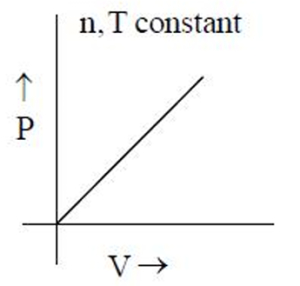
B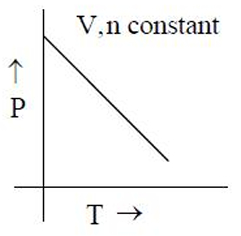
C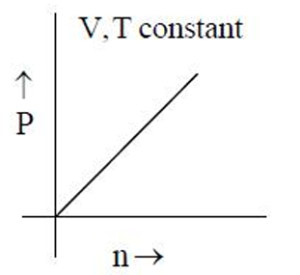
D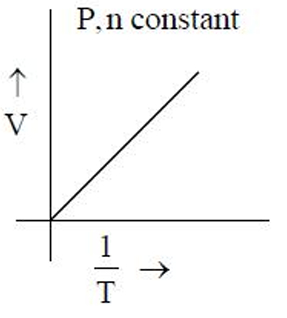
Solution
(C) The ideal gas equation is given by $PV = nRT$.
For option $A$: If $n$ and $T$ are constant, then $PV = \text{constant}$, which means $P \propto 1/V$. The graph of $P$ versus $V$ should be a rectangular hyperbola, not a straight line.
For option $B$: If $V$ and $n$ are constant, then $P = (nR/V) \times T$. Since $nR/V$ is constant, $P \propto T$. The graph of $P$ versus $T$ should be a straight line passing through the origin, not a line with a negative slope.
For option $C$: If $V$ and $T$ are constant, then $P = (RT/V) \times n$. Since $RT/V$ is constant, $P \propto n$. The graph of $P$ versus $n$ is a straight line passing through the origin. This is correct.
For option $D$: If $P$ and $n$ are constant, then $V = (nR/P) \times T$. Thus $V \propto T$. The graph of $V$ versus $1/T$ would not be a straight line passing through the origin; rather, $V$ versus $T$ would be.
Therefore, the correct graph is $C$.
For option $A$: If $n$ and $T$ are constant, then $PV = \text{constant}$, which means $P \propto 1/V$. The graph of $P$ versus $V$ should be a rectangular hyperbola, not a straight line.
For option $B$: If $V$ and $n$ are constant, then $P = (nR/V) \times T$. Since $nR/V$ is constant, $P \propto T$. The graph of $P$ versus $T$ should be a straight line passing through the origin, not a line with a negative slope.
For option $C$: If $V$ and $T$ are constant, then $P = (RT/V) \times n$. Since $RT/V$ is constant, $P \propto n$. The graph of $P$ versus $n$ is a straight line passing through the origin. This is correct.
For option $D$: If $P$ and $n$ are constant, then $V = (nR/P) \times T$. Thus $V \propto T$. The graph of $V$ versus $1/T$ would not be a straight line passing through the origin; rather, $V$ versus $T$ would be.
Therefore, the correct graph is $C$.
0 likesView Solution
162
ChemistryMediumMCQAP EAMCET · 2025
For $1 \ mol$ of an ideal gas,an isochore is obtained. The slope of the isochore is $0.082 \ atm \ K^{-1}$. What will be its pressure (in $atm$) when the temperature is $12.2 \ K$? $(R = 0.082 \ L \ atm \ mol^{-1} \ K^{-1})$.
A
$10.0$
B
$0.1$
C
$1.0$
D
$0.5$
Solution
(C) For an ideal gas,the equation is $PV = nRT$.
For an isochore (constant volume process),the equation can be written as $P = (\frac{nR}{V})T$.
The slope of the $P$ vs $T$ graph is given by $m = \frac{nR}{V}$.
Given $n = 1 \ mol$ and slope $m = 0.082 \ atm \ K^{-1}$.
So,$\frac{1 \times 0.082}{V} = 0.082$,which implies $V = 1 \ L$.
Now,at $T = 12.2 \ K$,the pressure $P$ is calculated as $P = \frac{nRT}{V} = \frac{1 \times 0.082 \times 12.2}{1} = 1.0004 \ atm \approx 1.0 \ atm$.
For an isochore (constant volume process),the equation can be written as $P = (\frac{nR}{V})T$.
The slope of the $P$ vs $T$ graph is given by $m = \frac{nR}{V}$.
Given $n = 1 \ mol$ and slope $m = 0.082 \ atm \ K^{-1}$.
So,$\frac{1 \times 0.082}{V} = 0.082$,which implies $V = 1 \ L$.
Now,at $T = 12.2 \ K$,the pressure $P$ is calculated as $P = \frac{nRT}{V} = \frac{1 \times 0.082 \times 12.2}{1} = 1.0004 \ atm \approx 1.0 \ atm$.
0 likesView Solution
163
ChemistryMediumMCQAP EAMCET · 2025
Consider the following statements:
Statement-$I$: If thermal energy is stronger than intermolecular forces,the substance prefers to be in a gaseous state.
Statement-$II$: At constant temperature,the density of an ideal gas is proportional to its pressure.
The correct answer is:
Statement-$I$: If thermal energy is stronger than intermolecular forces,the substance prefers to be in a gaseous state.
Statement-$II$: At constant temperature,the density of an ideal gas is proportional to its pressure.
The correct answer is:
A
Statement-$I$ is correct,but Statement-$II$ is not correct
B
Statement-$I$ is not correct,but Statement-$II$ is correct
C
Both Statement-$I$ and Statement-$II$ are correct
D
Both Statement-$I$ and Statement-$II$ are not correct
Solution
(C) Statement-$I$ is correct: Thermal energy promotes random motion of particles,while intermolecular forces hold them together. If thermal energy dominates,the particles move apart,leading to a gaseous state.
Statement-$II$ is correct: From the ideal gas equation,$PV = nRT$. Since $n = \frac{m}{M}$,we have $PV = \frac{m}{M}RT$. Rearranging gives $P = \frac{m}{V} \times \frac{RT}{M}$,where $\frac{m}{V} = d$ (density). Thus,$P = d \times \frac{RT}{M}$. At constant temperature $(T)$ and molar mass $(M)$,$P \propto d$ or $d \propto P$.
Statement-$II$ is correct: From the ideal gas equation,$PV = nRT$. Since $n = \frac{m}{M}$,we have $PV = \frac{m}{M}RT$. Rearranging gives $P = \frac{m}{V} \times \frac{RT}{M}$,where $\frac{m}{V} = d$ (density). Thus,$P = d \times \frac{RT}{M}$. At constant temperature $(T)$ and molar mass $(M)$,$P \propto d$ or $d \propto P$.
0 likesView Solution
164
ChemistryMediumMCQAP EAMCET · 2025
At $T(K)$,a gaseous mixture contains $H_2$ and $O_2$. The total pressure of the mixture is $2 \ bar$. The partial pressure of $H_2$ is $1.778 \ bar$. What is the weight $(w/w)$ percentage of $H_2$ in the mixture?
A
$66.67$
B
$33.33$
C
$80$
D
$20$
Solution
(B) Given: Total pressure $P_{total} = 2 \ bar$,Partial pressure of $H_2$ $(P_{H_2})$ = $1.778 \ bar$.
Partial pressure of $O_2$ $(P_{O_2})$ = $P_{total} - P_{H_2} = 2 - 1.778 = 0.222 \ bar$.
According to Dalton's Law,the mole fraction $(x)$ is proportional to the partial pressure: $x_{H_2} = \frac{P_{H_2}}{P_{total}} = \frac{1.778}{2} = 0.889$ and $x_{O_2} = \frac{P_{O_2}}{P_{total}} = \frac{0.222}{2} = 0.111$.
Assuming $1 \ mole$ of the mixture,moles of $H_2$ $(n_{H_2})$ = $0.889 \ mol$ and moles of $O_2$ $(n_{O_2})$ = $0.111 \ mol$.
Mass of $H_2$ = $n_{H_2} \times M_{H_2} = 0.889 \times 2 = 1.778 \ g$.
Mass of $O_2$ = $n_{O_2} \times M_{O_2} = 0.111 \times 32 = 3.552 \ g$.
Total mass = $1.778 + 3.552 = 5.33 \ g$.
Weight percentage of $H_2$ = $(\frac{1.778}{5.33}) \times 100 \approx 33.33 \%$.
Partial pressure of $O_2$ $(P_{O_2})$ = $P_{total} - P_{H_2} = 2 - 1.778 = 0.222 \ bar$.
According to Dalton's Law,the mole fraction $(x)$ is proportional to the partial pressure: $x_{H_2} = \frac{P_{H_2}}{P_{total}} = \frac{1.778}{2} = 0.889$ and $x_{O_2} = \frac{P_{O_2}}{P_{total}} = \frac{0.222}{2} = 0.111$.
Assuming $1 \ mole$ of the mixture,moles of $H_2$ $(n_{H_2})$ = $0.889 \ mol$ and moles of $O_2$ $(n_{O_2})$ = $0.111 \ mol$.
Mass of $H_2$ = $n_{H_2} \times M_{H_2} = 0.889 \times 2 = 1.778 \ g$.
Mass of $O_2$ = $n_{O_2} \times M_{O_2} = 0.111 \times 32 = 3.552 \ g$.
Total mass = $1.778 + 3.552 = 5.33 \ g$.
Weight percentage of $H_2$ = $(\frac{1.778}{5.33}) \times 100 \approx 33.33 \%$.
0 likesView Solution
165
ChemistryMediumMCQAP EAMCET · 2025
At $T \ K$,hydrogen and oxygen gases are mixed in the ratio of $1:2$ by mass in a closed vessel of volume '$V$' litres. If the total pressure of the gaseous mixture is '$p$' atm,the partial pressure of oxygen (in atm) is
A
$\frac{p}{9}$
B
$9 p$
C
$\frac{8 p}{9}$
D
$\frac{p}{6}$
Solution
(A) Let the mass of $H_2$ be $w \ g$ and the mass of $O_2$ be $2w \ g$.
Number of moles of $H_2$ $(n_{H_2})$ = $\frac{w}{2}$.
Number of moles of $O_2$ $(n_{O_2})$ = $\frac{2w}{32} = \frac{w}{16}$.
Total moles $(n_{total})$ = $\frac{w}{2} + \frac{w}{16} = \frac{8w + w}{16} = \frac{9w}{16}$.
Mole fraction of $O_2$ $(x_{O_2})$ = $\frac{n_{O_2}}{n_{total}} = \frac{w/16}{9w/16} = \frac{1}{9}$.
Partial pressure of $O_2$ = $x_{O_2} \times P_{total} = \frac{1}{9} \times p = \frac{p}{9}$ atm.
Number of moles of $H_2$ $(n_{H_2})$ = $\frac{w}{2}$.
Number of moles of $O_2$ $(n_{O_2})$ = $\frac{2w}{32} = \frac{w}{16}$.
Total moles $(n_{total})$ = $\frac{w}{2} + \frac{w}{16} = \frac{8w + w}{16} = \frac{9w}{16}$.
Mole fraction of $O_2$ $(x_{O_2})$ = $\frac{n_{O_2}}{n_{total}} = \frac{w/16}{9w/16} = \frac{1}{9}$.
Partial pressure of $O_2$ = $x_{O_2} \times P_{total} = \frac{1}{9} \times p = \frac{p}{9}$ atm.
0 likesView Solution
166
ChemistryMediumMCQAP EAMCET · 2025
At $27^{\circ} C$,$1 \ L$ of $H_2$ with a pressure of $1 \ bar$ is mixed with $2 \ L$ of $O_2$ with a pressure of $2 \ bar$ in a $10 \ L$ flask. What is the pressure exerted by the gaseous mixture in $bar$? (Assume $H_2$ and $O_2$ as ideal gases)
A
$0.5$
B
$0.4$
C
$1.0$
D
$0.1$
Solution
(A) Using the ideal gas law $PV = nRT$,we find the moles of each gas at constant temperature $T = 300 \ K$.
For $H_2$: $n_1 = \frac{P_1 V_1}{RT} = \frac{1 \ bar \times 1 \ L}{RT} = \frac{1}{RT}$.
For $O_2$: $n_2 = \frac{P_2 V_2}{RT} = \frac{2 \ bar \times 2 \ L}{RT} = \frac{4}{RT}$.
Total moles $n_{total} = n_1 + n_2 = \frac{1+4}{RT} = \frac{5}{RT}$.
In the $10 \ L$ flask,the total pressure $P_{total}$ is given by $P_{total} = \frac{n_{total} RT}{V_{final}}$.
$P_{total} = \frac{(5/RT) \times RT}{10 \ L} = \frac{5}{10} \ bar = 0.5 \ bar$.
For $H_2$: $n_1 = \frac{P_1 V_1}{RT} = \frac{1 \ bar \times 1 \ L}{RT} = \frac{1}{RT}$.
For $O_2$: $n_2 = \frac{P_2 V_2}{RT} = \frac{2 \ bar \times 2 \ L}{RT} = \frac{4}{RT}$.
Total moles $n_{total} = n_1 + n_2 = \frac{1+4}{RT} = \frac{5}{RT}$.
In the $10 \ L$ flask,the total pressure $P_{total}$ is given by $P_{total} = \frac{n_{total} RT}{V_{final}}$.
$P_{total} = \frac{(5/RT) \times RT}{10 \ L} = \frac{5}{10} \ bar = 0.5 \ bar$.
0 likesView Solution
167
ChemistryMediumMCQAP EAMCET · 2025
$2.0 \ g$ of $H_2$ diffuses through a porous container in $10 \ minutes$. How many grams of $O_2$ would diffuse from the same container in the same time under similar conditions (in $.0$)?
A
$2$
B
$4$
C
$16$
D
$8$
Solution
(D) According to Graham's Law of Diffusion,the rate of diffusion $r$ is inversely proportional to the square root of the molar mass $M$ of the gas: $r \propto \frac{1}{\sqrt{M}}$.
Since the time $t$ is the same,the rate of diffusion is directly proportional to the mass $w$ diffused: $r = \frac{w}{t}$.
Therefore,$\frac{w_1}{w_2} = \sqrt{\frac{M_2}{M_1}}$.
Given: $w_{H_2} = 2.0 \ g$,$M_{H_2} = 2 \ g/mol$,$M_{O_2} = 32 \ g/mol$.
Substituting the values: $\frac{2.0}{w_{O_2}} = \sqrt{\frac{2}{32}} = \sqrt{\frac{1}{16}} = \frac{1}{4}$.
$w_{O_2} = 2.0 \times 4 = 8.0 \ g$.
Since the time $t$ is the same,the rate of diffusion is directly proportional to the mass $w$ diffused: $r = \frac{w}{t}$.
Therefore,$\frac{w_1}{w_2} = \sqrt{\frac{M_2}{M_1}}$.
Given: $w_{H_2} = 2.0 \ g$,$M_{H_2} = 2 \ g/mol$,$M_{O_2} = 32 \ g/mol$.
Substituting the values: $\frac{2.0}{w_{O_2}} = \sqrt{\frac{2}{32}} = \sqrt{\frac{1}{16}} = \frac{1}{4}$.
$w_{O_2} = 2.0 \times 4 = 8.0 \ g$.
0 likesView Solution
168
ChemistryMediumMCQAP EAMCET · 2025
$A$ and $B$ are ideal gases. At $T(K)$,$2 \ L$ of $A$ with a pressure of $1 \ bar$ is mixed with $4 \ L$ of $B$ with a pressure $p_B \ bar$ in a $100 \ L$ flask. The pressure exerted by the gaseous mixture is $0.1 \ bar$. What is the value of $p_B$ in $bar$?
A
$2$
B
$0.04$
C
$0.02$
D
$1$
Solution
(A) For an ideal gas,the product of pressure and volume $(PV)$ is proportional to the number of moles $(n)$ at a constant temperature $(T)$.
Using the principle of conservation of moles,the total pressure of the mixture $(P_{mix})$ in the final volume $(V_{final} = 100 \ L)$ is given by the sum of the partial pressures of $A$ and $B$.
Initial state of $A$: $P_1 = 1 \ bar$,$V_1 = 2 \ L$.
Initial state of $B$: $P_2 = p_B \ bar$,$V_2 = 4 \ L$.
Final state of mixture: $P_{mix} = 0.1 \ bar$,$V_{final} = 100 \ L$.
According to Boyle's Law $(P_1V_1 + P_2V_2 = P_{mix}V_{final})$:
$(1 \ bar \times 2 \ L) + (p_B \ bar \times 4 \ L) = 0.1 \ bar \times 100 \ L$
$2 + 4p_B = 10$
$4p_B = 10 - 2$
$4p_B = 8$
$p_B = 2 \ bar$.
Therefore,the value of $p_B$ is $2$.
Using the principle of conservation of moles,the total pressure of the mixture $(P_{mix})$ in the final volume $(V_{final} = 100 \ L)$ is given by the sum of the partial pressures of $A$ and $B$.
Initial state of $A$: $P_1 = 1 \ bar$,$V_1 = 2 \ L$.
Initial state of $B$: $P_2 = p_B \ bar$,$V_2 = 4 \ L$.
Final state of mixture: $P_{mix} = 0.1 \ bar$,$V_{final} = 100 \ L$.
According to Boyle's Law $(P_1V_1 + P_2V_2 = P_{mix}V_{final})$:
$(1 \ bar \times 2 \ L) + (p_B \ bar \times 4 \ L) = 0.1 \ bar \times 100 \ L$
$2 + 4p_B = 10$
$4p_B = 10 - 2$
$4p_B = 8$
$p_B = 2 \ bar$.
Therefore,the value of $p_B$ is $2$.
0 likesView Solution
169
ChemistryMediumMCQAP EAMCET · 2025
At $256 \ K$,the $rms$ speed of $SO_2$ gas molecules is $3.16 \times 10^2 \ ms^{-1}$. What is the most probable velocity (in $ms^{-1}$) of the same gas at the same temperature?
A
$2.911 \times 10^2$
B
$2.58 \times 10^2$
C
$5.16 \times 10^2$
D
$1.29 \times 10^2$
Solution
(B) The relationship between $rms$ speed $(v_{rms})$ and most probable velocity $(v_{mp})$ is given by the formula: $v_{rms} = \sqrt{\frac{3RT}{M}}$ and $v_{mp} = \sqrt{\frac{2RT}{M}}$.
Dividing the two expressions,we get: $\frac{v_{mp}}{v_{rms}} = \sqrt{\frac{2}{3}}$.
Given $v_{rms} = 3.16 \times 10^2 \ ms^{-1}$,we calculate $v_{mp} = v_{rms} \times \sqrt{\frac{2}{3}}$.
$v_{mp} = 3.16 \times 10^2 \times \sqrt{0.6667} \approx 3.16 \times 10^2 \times 0.8165$.
$v_{mp} \approx 2.58 \times 10^2 \ ms^{-1}$.
Dividing the two expressions,we get: $\frac{v_{mp}}{v_{rms}} = \sqrt{\frac{2}{3}}$.
Given $v_{rms} = 3.16 \times 10^2 \ ms^{-1}$,we calculate $v_{mp} = v_{rms} \times \sqrt{\frac{2}{3}}$.
$v_{mp} = 3.16 \times 10^2 \times \sqrt{0.6667} \approx 3.16 \times 10^2 \times 0.8165$.
$v_{mp} \approx 2.58 \times 10^2 \ ms^{-1}$.
0 likesView Solution
170
ChemistryMediumMCQAP EAMCET · 2025
The most probable speed $(u_{mp})$ of $8 \ g$ of $H_2$ is $2 \times 10^2 \ ms^{-1}$. The kinetic energy (in $J$) of the same amount of $H_2$ gas is:
A
$480$
B
$240$
C
$720$
D
$120$
Solution
(B) The most probable speed is given by the formula $u_{mp} = \sqrt{\frac{2RT}{M}}$.
Given $u_{mp} = 200 \ ms^{-1}$ and molar mass $M = 2 \times 10^{-3} \ kg \ mol^{-1}$.
$200 = \sqrt{\frac{2RT}{2 \times 10^{-3}}} \implies 40000 = \frac{2RT}{2 \times 10^{-3}} \implies RT = 40 \ J \ mol^{-1}$.
The kinetic energy of an ideal gas is given by $KE = \frac{3}{2} nRT$.
Number of moles $n = \frac{\text{mass}}{\text{molar mass}} = \frac{8 \ g}{2 \ g \ mol^{-1}} = 4 \ mol$.
$KE = \frac{3}{2} \times 4 \times 40 = 6 \times 40 = 240 \ J$.
Given $u_{mp} = 200 \ ms^{-1}$ and molar mass $M = 2 \times 10^{-3} \ kg \ mol^{-1}$.
$200 = \sqrt{\frac{2RT}{2 \times 10^{-3}}} \implies 40000 = \frac{2RT}{2 \times 10^{-3}} \implies RT = 40 \ J \ mol^{-1}$.
The kinetic energy of an ideal gas is given by $KE = \frac{3}{2} nRT$.
Number of moles $n = \frac{\text{mass}}{\text{molar mass}} = \frac{8 \ g}{2 \ g \ mol^{-1}} = 4 \ mol$.
$KE = \frac{3}{2} \times 4 \times 40 = 6 \times 40 = 240 \ J$.
0 likesView Solution
171
ChemistryMediumMCQAP EAMCET · 2025
At what temperature (in $K$) is the $rms$ velocity of $SO_2$ molecules equal to the $rms$ velocity of $O_2$ molecules at $27^{\circ} C$?
A
$300$
B
$1200$
C
$600$
D
$900$
Solution
(C) The formula for $rms$ velocity is $v_{rms} = \sqrt{\frac{3RT}{M}}$.
For $v_{rms}$ of $SO_2$ to be equal to $v_{rms}$ of $O_2$,we have $\sqrt{\frac{3RT_{SO_2}}{M_{SO_2}}} = \sqrt{\frac{3RT_{O_2}}{M_{O_2}}}$.
Squaring both sides and canceling common terms,we get $\frac{T_{SO_2}}{M_{SO_2}} = \frac{T_{O_2}}{M_{O_2}}$.
Given $T_{O_2} = 27 + 273 = 300 \ K$,$M_{O_2} = 32 \ g/mol$,and $M_{SO_2} = 64 \ g/mol$.
Substituting the values: $\frac{T_{SO_2}}{64} = \frac{300}{32}$.
$T_{SO_2} = \frac{300 \times 64}{32} = 300 \times 2 = 600 \ K$.
For $v_{rms}$ of $SO_2$ to be equal to $v_{rms}$ of $O_2$,we have $\sqrt{\frac{3RT_{SO_2}}{M_{SO_2}}} = \sqrt{\frac{3RT_{O_2}}{M_{O_2}}}$.
Squaring both sides and canceling common terms,we get $\frac{T_{SO_2}}{M_{SO_2}} = \frac{T_{O_2}}{M_{O_2}}$.
Given $T_{O_2} = 27 + 273 = 300 \ K$,$M_{O_2} = 32 \ g/mol$,and $M_{SO_2} = 64 \ g/mol$.
Substituting the values: $\frac{T_{SO_2}}{64} = \frac{300}{32}$.
$T_{SO_2} = \frac{300 \times 64}{32} = 300 \times 2 = 600 \ K$.
0 likesView Solution
172
ChemistryMediumMCQAP EAMCET · 2025
At $27^{\circ} C$ kinetic energy of $4 \ g$ of $H_2$ is $x \ J$. What is the kinetic energy (in $J$) of $6.4 \ g$ of oxygen at $127^{\circ} C$?
A
$\frac{x}{15}$
B
$\frac{4 x}{15}$
C
$\frac{8 x}{15}$
D
$\frac{2 x}{15}$
Solution
(D) The kinetic energy $(KE)$ of an ideal gas is given by the formula $KE = \frac{3}{2} nRT$.
For $H_2$:
Molar mass $M(H_2) = 2 \ g/mol$.
Number of moles $n_1 = \frac{4 \ g}{2 \ g/mol} = 2 \ mol$.
Temperature $T_1 = 27 + 273 = 300 \ K$.
$x = \frac{3}{2} \times 2 \times R \times 300 = 900R$.
For $O_2$:
Molar mass $M(O_2) = 32 \ g/mol$.
Number of moles $n_2 = \frac{6.4 \ g}{32 \ g/mol} = 0.2 \ mol$.
Temperature $T_2 = 127 + 273 = 400 \ K$.
$KE_2 = \frac{3}{2} \times 0.2 \times R \times 400 = 120R$.
Now,find the ratio: $\frac{KE_2}{x} = \frac{120R}{900R} = \frac{12}{90} = \frac{2}{15}$.
Therefore,$KE_2 = \frac{2x}{15} \ J$.
For $H_2$:
Molar mass $M(H_2) = 2 \ g/mol$.
Number of moles $n_1 = \frac{4 \ g}{2 \ g/mol} = 2 \ mol$.
Temperature $T_1 = 27 + 273 = 300 \ K$.
$x = \frac{3}{2} \times 2 \times R \times 300 = 900R$.
For $O_2$:
Molar mass $M(O_2) = 32 \ g/mol$.
Number of moles $n_2 = \frac{6.4 \ g}{32 \ g/mol} = 0.2 \ mol$.
Temperature $T_2 = 127 + 273 = 400 \ K$.
$KE_2 = \frac{3}{2} \times 0.2 \times R \times 400 = 120R$.
Now,find the ratio: $\frac{KE_2}{x} = \frac{120R}{900R} = \frac{12}{90} = \frac{2}{15}$.
Therefore,$KE_2 = \frac{2x}{15} \ J$.
0 likesView Solution
173
ChemistryMediumMCQAP EAMCET · 2025
At $T(K)$,the $u_{rms}$ of $CO_2$ is $412 \ ms^{-1}$. What is its kinetic energy (in $kJ \ mol^{-1}$) at the same temperature? $(CO_2 = 44 \ u)$.
A
$3.7343$
B
$7.4687$
C
$14.9374$
D
$3734.3$
Solution
(A) The root mean square velocity $(u_{rms})$ is given by the formula $u_{rms} = \sqrt{\frac{3RT}{M}}$.
Given $u_{rms} = 412 \ ms^{-1}$ and molar mass $M = 44 \times 10^{-3} \ kg \ mol^{-1}$.
Squaring both sides: $u_{rms}^2 = \frac{3RT}{M} \implies \frac{3}{2}RT = \frac{1}{2} M u_{rms}^2$.
The kinetic energy $(KE)$ of $1 \ mol$ of an ideal gas is given by $KE = \frac{3}{2}RT = \frac{1}{2} M u_{rms}^2$.
Substituting the values: $KE = \frac{1}{2} \times (44 \times 10^{-3} \ kg \ mol^{-1}) \times (412 \ ms^{-1})^2$.
$KE = 0.5 \times 0.044 \times 169744 \ J \ mol^{-1} = 3734.368 \ J \ mol^{-1}$.
Converting to $kJ \ mol^{-1}$: $KE = \frac{3734.368}{1000} \approx 3.7344 \ kJ \ mol^{-1}$.
Thus,the correct option is $A$.
Given $u_{rms} = 412 \ ms^{-1}$ and molar mass $M = 44 \times 10^{-3} \ kg \ mol^{-1}$.
Squaring both sides: $u_{rms}^2 = \frac{3RT}{M} \implies \frac{3}{2}RT = \frac{1}{2} M u_{rms}^2$.
The kinetic energy $(KE)$ of $1 \ mol$ of an ideal gas is given by $KE = \frac{3}{2}RT = \frac{1}{2} M u_{rms}^2$.
Substituting the values: $KE = \frac{1}{2} \times (44 \times 10^{-3} \ kg \ mol^{-1}) \times (412 \ ms^{-1})^2$.
$KE = 0.5 \times 0.044 \times 169744 \ J \ mol^{-1} = 3734.368 \ J \ mol^{-1}$.
Converting to $kJ \ mol^{-1}$: $KE = \frac{3734.368}{1000} \approx 3.7344 \ kJ \ mol^{-1}$.
Thus,the correct option is $A$.
0 likesView Solution
174
ChemistryEasyMCQAP EAMCET · 2025
Consider the following statements:
$Statement-I$ : If the intermolecular forces are stronger than thermal energy,the substance prefers to be in a gaseous state.
$Statement-II$ : Among all elements,the total number of elements available as gases at room temperature is $10$.
$Statement-I$ : If the intermolecular forces are stronger than thermal energy,the substance prefers to be in a gaseous state.
$Statement-II$ : Among all elements,the total number of elements available as gases at room temperature is $10$.
A
Both $Statement-I$ and $Statement-II$ are correct
B
Both $Statement-I$ and $Statement-II$ are not correct
C
$Statement-I$ is correct,but $Statement-II$ is not correct
D
$Statement-I$ is not correct,but $Statement-II$ is correct
Solution
(B) $Statement-I$ is incorrect. If intermolecular forces are stronger than thermal energy,the substance prefers to be in a solid or liquid state,not a gaseous state. Thermal energy promotes random motion,which leads to the gaseous state.
$Statement-II$ is correct. There are $11$ elements that are gases at room temperature $(H_2, He, N_2, O_2, F_2, Ne, Cl_2, Ar, Kr, Xe, Rn)$. Wait,checking the count: $H, He, N, O, F, Ne, Cl, Ar, Kr, Xe, Rn$ equals $11$ elements. Therefore,the statement claiming $10$ is incorrect.
Both statements are incorrect.
$Statement-II$ is correct. There are $11$ elements that are gases at room temperature $(H_2, He, N_2, O_2, F_2, Ne, Cl_2, Ar, Kr, Xe, Rn)$. Wait,checking the count: $H, He, N, O, F, Ne, Cl, Ar, Kr, Xe, Rn$ equals $11$ elements. Therefore,the statement claiming $10$ is incorrect.
Both statements are incorrect.
0 likesView Solution
175
ChemistryEasyMCQAP EAMCET · 2025
Identify the conditions at which the van der Waals equation of state changes to the ideal gas equation.
A
High temperature and high pressure
B
Low temperature and high pressure
C
High temperature and low pressure
D
Low temperature and low pressure
Solution
(C) The van der Waals equation is given by $(P + \frac{an^2}{V^2})(V - nb) = nRT$.
For $1 \ mol$ of gas,this becomes $(P + \frac{a}{V^2})(V - b) = RT$.
At high temperature,the kinetic energy of gas molecules is very high,making the intermolecular forces of attraction (represented by the constant $a$) negligible.
At low pressure,the volume $V$ is very large,making the volume occupied by gas molecules (represented by the constant $b$) negligible compared to the total volume.
Under these conditions,$(P + 0)(V - 0) = RT$,which simplifies to $PV = RT$,the ideal gas equation.
For $1 \ mol$ of gas,this becomes $(P + \frac{a}{V^2})(V - b) = RT$.
At high temperature,the kinetic energy of gas molecules is very high,making the intermolecular forces of attraction (represented by the constant $a$) negligible.
At low pressure,the volume $V$ is very large,making the volume occupied by gas molecules (represented by the constant $b$) negligible compared to the total volume.
Under these conditions,$(P + 0)(V - 0) = RT$,which simplifies to $PV = RT$,the ideal gas equation.
0 likesView Solution
176
ChemistryMediumMCQAP EAMCET · 2025
Choose the incorrect statement from the following:
A
At Boyle temperature,a real gas obeys the ideal gas law over an appreciable range of pressure.
B
Critical temperature of $CO_2$ is $27.5^{\circ} C$.
C
Above critical temperature,a real gas behaves like an ideal gas.
D
At room temperature and $1 \ atm$ pressure,the compressibility factor $(Z)$ for $H_2$ gas is greater than $1$.
Solution
(B) The critical temperature of $CO_2$ is $31.1^{\circ} C$ $(304.1 \ K)$,not $27.5^{\circ} C$. Therefore,statement $B$ is incorrect.
At Boyle temperature,the effects of attractive and repulsive forces balance out,making the gas behave ideally over a range of pressure.
Above the critical temperature,gases cannot be liquefied by pressure alone,and they exhibit behavior closer to ideal gases as temperature increases.
For $H_2$ and $He$,the compressibility factor $Z$ is always greater than $1$ at room temperature because the repulsive forces dominate due to their small molecular size.
At Boyle temperature,the effects of attractive and repulsive forces balance out,making the gas behave ideally over a range of pressure.
Above the critical temperature,gases cannot be liquefied by pressure alone,and they exhibit behavior closer to ideal gases as temperature increases.
For $H_2$ and $He$,the compressibility factor $Z$ is always greater than $1$ at room temperature because the repulsive forces dominate due to their small molecular size.
0 likesView Solution
177
ChemistryEasyMCQAP EAMCET · 2025
The correct equation for one mole of a real gas is ($a, b$ are constants)
A
$(p + \frac{a}{V^2})(V - b) = RT$
B
$(p - \frac{a}{V^2})(V - b) = RT$
C
$(p + \frac{a}{V^2})(V + b) = RT$
D
$(p + \frac{a}{V})(V - b) = RT$
Solution
(A) The van der Waals equation for $n$ moles of a real gas is given by $(p + \frac{an^2}{V^2})(V - nb) = nRT$.
For $1 \text{ mole}$ of a real gas,we substitute $n = 1$ into the equation.
This results in $(p + \frac{a}{V^2})(V - b) = RT$.
For $1 \text{ mole}$ of a real gas,we substitute $n = 1$ into the equation.
This results in $(p + \frac{a}{V^2})(V - b) = RT$.
0 likesView Solution
178
ChemistryEasyMCQAP EAMCET · 2025
Identify the correct graph for an ideal gas ($y$-axis $= Z$; $x$-axis $= p$).
A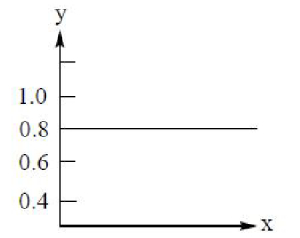
B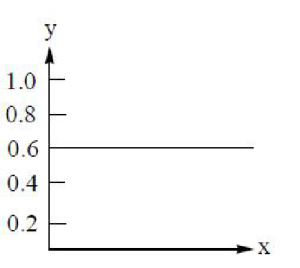
C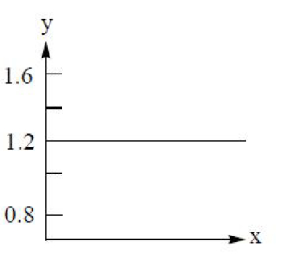
D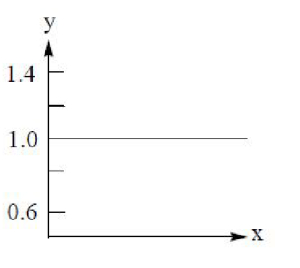
Solution
(D) For an ideal gas,the compressibility factor $Z$ is defined as $Z = \frac{pV}{nRT}$.
For an ideal gas,$pV = nRT$,therefore $Z = 1$ for all values of pressure $p$.
Thus,the graph of $Z$ versus $p$ for an ideal gas is a horizontal straight line at $Z = 1.0$.
For an ideal gas,$pV = nRT$,therefore $Z = 1$ for all values of pressure $p$.
Thus,the graph of $Z$ versus $p$ for an ideal gas is a horizontal straight line at $Z = 1.0$.
0 likesView Solution
179
ChemistryMediumMCQAP EAMCET · 2025
Identify the correct statements from the following.
$I$. Glass is an extremely viscous liquid.
$II$. Increase in temperature decreases the surface tension of liquids.
$III$. Compressibility factor for an ideal gas is zero.
$I$. Glass is an extremely viscous liquid.
$II$. Increase in temperature decreases the surface tension of liquids.
$III$. Compressibility factor for an ideal gas is zero.
A
$I, II, III$
B
$I, II$ only
C
$I, III$ only
D
$II, III$ only
Solution
(B) $I$. Glass is considered a supercooled liquid or an extremely viscous liquid,which is a correct statement.
$II$. Surface tension of liquids decreases with an increase in temperature because the kinetic energy of molecules increases,which weakens the intermolecular forces of attraction. This is a correct statement.
$III$. The compressibility factor $(Z)$ for an ideal gas is defined as $Z = \frac{PV}{nRT} = 1$. Therefore,the statement that it is zero is incorrect.
$II$. Surface tension of liquids decreases with an increase in temperature because the kinetic energy of molecules increases,which weakens the intermolecular forces of attraction. This is a correct statement.
$III$. The compressibility factor $(Z)$ for an ideal gas is defined as $Z = \frac{PV}{nRT} = 1$. Therefore,the statement that it is zero is incorrect.
0 likesView Solution
180
ChemistryMediumMCQAP EAMCET · 2025
Which of the following statements are correct?
$I$) The energy of hydrogen atom in its ground state is $-13.6 \ eV$
$II$) On the basis of Bohr's model,the radius of the $3^{rd}$ orbit of hydrogen atom is $158.7 \ pm$
$III$) The order of radius of the first orbit of $H, He^{+}, Li^{2+}$ and $Be^{3+}$ is $H > He^{+} > Li^{2+} > Be^{3+}$
$I$) The energy of hydrogen atom in its ground state is $-13.6 \ eV$
$II$) On the basis of Bohr's model,the radius of the $3^{rd}$ orbit of hydrogen atom is $158.7 \ pm$
$III$) The order of radius of the first orbit of $H, He^{+}, Li^{2+}$ and $Be^{3+}$ is $H > He^{+} > Li^{2+} > Be^{3+}$
A
$II$ & $III$ only
B
$I$ & $III$ only
C
$I$ & $II$ only
D
$I, II, III$
Solution
(B) $I$) The energy of the hydrogen atom in its ground state $(n=1)$ is given by $E_n = -13.6 \ eV / n^2$. For $n=1$,$E_1 = -13.6 \ eV$. Thus,statement $I$ is correct.
$II$) The radius of the $n^{th}$ orbit of a hydrogen-like species is given by $r_n = 52.9 \times n^2 / Z \ pm$. For $H$ $(Z=1)$ and $n=3$,$r_3 = 52.9 \times 3^2 / 1 = 476.1 \ pm$. Thus,statement $II$ is incorrect.
$III$) The radius of the first orbit $(n=1)$ is $r_1 = 52.9 \times (1^2 / Z) \ pm$. As $Z$ increases,$r_1$ decreases. The atomic numbers are $H(1), He^{+}(2), Li^{2+}(3), Be^{3+}(4)$. Therefore,the order of radii is $H > He^{+} > Li^{2+} > Be^{3+}$. Thus,statement $III$ is correct.
Conclusion: $I$ and $III$ are correct.
$II$) The radius of the $n^{th}$ orbit of a hydrogen-like species is given by $r_n = 52.9 \times n^2 / Z \ pm$. For $H$ $(Z=1)$ and $n=3$,$r_3 = 52.9 \times 3^2 / 1 = 476.1 \ pm$. Thus,statement $II$ is incorrect.
$III$) The radius of the first orbit $(n=1)$ is $r_1 = 52.9 \times (1^2 / Z) \ pm$. As $Z$ increases,$r_1$ decreases. The atomic numbers are $H(1), He^{+}(2), Li^{2+}(3), Be^{3+}(4)$. Therefore,the order of radii is $H > He^{+} > Li^{2+} > Be^{3+}$. Thus,statement $III$ is correct.
Conclusion: $I$ and $III$ are correct.
0 likesView Solution
181
ChemistryMediumMCQAP EAMCET · 2025
The difference between the radii of $3^{rd}$ and $2^{nd}$ orbit of $H$ atom is $x \text{ pm}$. The difference between the radii of $4^{th}$ and $3^{rd}$ orbit of $Li^{2+}$ ion is $y \text{ pm}$. The ratio $y:x$ is equal to:
A
$15:7$
B
$7:15$
C
$3:1$
D
$1:3$
Solution
(B) The radius of the $n^{th}$ orbit of a hydrogen-like species is given by $r_n = a_0 \times \frac{n^2}{Z}$, where $a_0$ is the Bohr radius $(52.9 \text{ pm})$.
For $H$ atom $(Z=1)$: $x = r_3 - r_2 = a_0 \times (3^2 - 2^2) / 1 = a_0 \times (9 - 4) = 5a_0$.
For $Li^{2+}$ ion $(Z=3)$: $y = r_4 - r_3 = a_0 \times (4^2 - 3^2) / 3 = a_0 \times (16 - 9) / 3 = \frac{7}{3}a_0$.
The ratio $y:x = (\frac{7}{3}a_0) : (5a_0) = \frac{7}{3} : 5 = 7 : 15$.
For $H$ atom $(Z=1)$: $x = r_3 - r_2 = a_0 \times (3^2 - 2^2) / 1 = a_0 \times (9 - 4) = 5a_0$.
For $Li^{2+}$ ion $(Z=3)$: $y = r_4 - r_3 = a_0 \times (4^2 - 3^2) / 3 = a_0 \times (16 - 9) / 3 = \frac{7}{3}a_0$.
The ratio $y:x = (\frac{7}{3}a_0) : (5a_0) = \frac{7}{3} : 5 = 7 : 15$.
0 likesView Solution
182
ChemistryMediumMCQAP EAMCET · 2025
The radius of the fourth orbit in $He^{+}$ ion is '$R_1$' $pm$ and the radius of the third orbit in $Li^{2+}$ ion is '$R_2$' $pm$. The value of $(R_1 - R_2)$ in $pm$ is:
A
$132.25$
B
$529.00$
C
$264.50$
D
$793.50$
Solution
(C) The radius of an orbit in a hydrogen-like species is given by the formula: $r_n = 0.529 \times \frac{n^2}{Z} \mathring{A}$.
Since $1 \mathring{A} = 100 \ pm$, the formula in $pm$ is $r_n = 52.9 \times \frac{n^2}{Z} \ pm$.
For $He^{+}$ ion $(Z = 2)$, the radius of the fourth orbit $(n = 4)$ is:
$R_1 = 52.9 \times \frac{4^2}{2} = 52.9 \times \frac{16}{2} = 52.9 \times 8 = 423.2 \ pm$.
For $Li^{2+}$ ion $(Z = 3)$, the radius of the third orbit $(n = 3)$ is:
$R_2 = 52.9 \times \frac{3^2}{3} = 52.9 \times 3 = 158.7 \ pm$.
Therefore, $(R_1 - R_2) = 423.2 - 158.7 = 264.5 \ pm$.
Since $1 \mathring{A} = 100 \ pm$, the formula in $pm$ is $r_n = 52.9 \times \frac{n^2}{Z} \ pm$.
For $He^{+}$ ion $(Z = 2)$, the radius of the fourth orbit $(n = 4)$ is:
$R_1 = 52.9 \times \frac{4^2}{2} = 52.9 \times \frac{16}{2} = 52.9 \times 8 = 423.2 \ pm$.
For $Li^{2+}$ ion $(Z = 3)$, the radius of the third orbit $(n = 3)$ is:
$R_2 = 52.9 \times \frac{3^2}{3} = 52.9 \times 3 = 158.7 \ pm$.
Therefore, $(R_1 - R_2) = 423.2 - 158.7 = 264.5 \ pm$.
0 likesView Solution
183
ChemistryMediumMCQAP EAMCET · 2025
The energy of the second Bohr orbit of the hydrogen atom is $-3.4 \ eV$. The energy of the fourth Bohr orbit of the $He^{+}$ ion will be: (in $eV$)
A
$-3.4$
B
$-13.6$
C
$-6.8$
D
$-0.85$
Solution
(A) The energy of an electron in the $n^{th}$ orbit of a hydrogen-like species is given by the formula: $E_n = -13.6 \times \frac{Z^2}{n^2} \ eV$.
For the hydrogen atom $(Z=1)$,the energy of the second orbit $(n=2)$ is $E_2 = -13.6 \times \frac{1^2}{2^2} = -3.4 \ eV$.
For the $He^{+}$ ion,the atomic number $Z=2$.
We need to find the energy of the fourth orbit $(n=4)$.
Substituting these values into the formula: $E_4 = -13.6 \times \frac{2^2}{4^2} \ eV$.
$E_4 = -13.6 \times \frac{4}{16} \ eV$.
$E_4 = -13.6 \times \frac{1}{4} \ eV$.
$E_4 = -3.4 \ eV$.
For the hydrogen atom $(Z=1)$,the energy of the second orbit $(n=2)$ is $E_2 = -13.6 \times \frac{1^2}{2^2} = -3.4 \ eV$.
For the $He^{+}$ ion,the atomic number $Z=2$.
We need to find the energy of the fourth orbit $(n=4)$.
Substituting these values into the formula: $E_4 = -13.6 \times \frac{2^2}{4^2} \ eV$.
$E_4 = -13.6 \times \frac{4}{16} \ eV$.
$E_4 = -13.6 \times \frac{1}{4} \ eV$.
$E_4 = -3.4 \ eV$.
0 likesView Solution
184
ChemistryEasyMCQAP EAMCET · 2025
Identify the correct statements from the following:
$I$) Isotopes of an element show different chemical behaviour
$II$) Lyman series of lines of hydrogen spectrum appear in $UV$ region
$III$) The oscillating electric and magnetic field components of electromagnetic radiation are perpendicular to each other and both are perpendicular to the direction of propagation of radiation
$I$) Isotopes of an element show different chemical behaviour
$II$) Lyman series of lines of hydrogen spectrum appear in $UV$ region
$III$) The oscillating electric and magnetic field components of electromagnetic radiation are perpendicular to each other and both are perpendicular to the direction of propagation of radiation
A
$II$ & $III$ only
B
$I$ & $II$ only
C
$I$ & $III$ only
D
$I$,$II$,$III$
Solution
(A) Statement $I$ is incorrect because isotopes of an element have the same electronic configuration and therefore exhibit similar chemical properties.
Statement $II$ is correct because the Lyman series corresponds to electronic transitions to the $n=1$ energy level,which releases energy in the ultraviolet $(UV)$ region.
Statement $III$ is correct because,according to Maxwell's wave theory,electromagnetic radiation consists of oscillating electric and magnetic fields that are mutually perpendicular to each other and to the direction of wave propagation.
Therefore,statements $II$ and $III$ are correct.
Statement $II$ is correct because the Lyman series corresponds to electronic transitions to the $n=1$ energy level,which releases energy in the ultraviolet $(UV)$ region.
Statement $III$ is correct because,according to Maxwell's wave theory,electromagnetic radiation consists of oscillating electric and magnetic fields that are mutually perpendicular to each other and to the direction of wave propagation.
Therefore,statements $II$ and $III$ are correct.
0 likesView Solution
185
ChemistryMediumMCQAP EAMCET · 2025
The wavenumber of the first line $(n_2=3)$ in the Balmer series of hydrogen is $\bar{\nu}_1 \ cm^{-1}$. What is the wavenumber (in $cm^{-1}$) of the second line $(n_2=4)$ in the Balmer series of $He^{+}$?
A
$\frac{5 \bar{\nu}_1}{27}$
B
$\frac{27 \bar{\nu}_1}{5}$
C
$\frac{27 \bar{\nu}_1}{20}$
D
$\frac{20 \bar{\nu}_1}{27}$
Solution
(B) The Rydberg formula for wavenumber is $\bar{\nu} = R_H Z^2 (\frac{1}{n_1^2} - \frac{1}{n_2^2})$.
For the first line of the Balmer series of $H$ $(Z=1, n_1=2, n_2=3)$: $\bar{\nu}_1 = R_H (1)^2 (\frac{1}{2^2} - \frac{1}{3^2}) = R_H (\frac{1}{4} - \frac{1}{9}) = R_H (\frac{5}{36})$.
So,$R_H = \frac{36 \bar{\nu}_1}{5}$.
For the second line of the Balmer series of $He^{+}$ $(Z=2, n_1=2, n_2=4)$: $\bar{\nu}_2 = R_H (2)^2 (\frac{1}{2^2} - \frac{1}{4^2}) = R_H (4) (\frac{1}{4} - \frac{1}{16}) = R_H (4) (\frac{3}{16}) = R_H (\frac{3}{4})$.
Substituting $R_H = \frac{36 \bar{\nu}_1}{5}$ into the expression for $\bar{\nu}_2$: $\bar{\nu}_2 = (\frac{36 \bar{\nu}_1}{5}) \times (\frac{3}{4}) = \frac{9 \times 3 \bar{\nu}_1}{5} = \frac{27 \bar{\nu}_1}{5}$.
For the first line of the Balmer series of $H$ $(Z=1, n_1=2, n_2=3)$: $\bar{\nu}_1 = R_H (1)^2 (\frac{1}{2^2} - \frac{1}{3^2}) = R_H (\frac{1}{4} - \frac{1}{9}) = R_H (\frac{5}{36})$.
So,$R_H = \frac{36 \bar{\nu}_1}{5}$.
For the second line of the Balmer series of $He^{+}$ $(Z=2, n_1=2, n_2=4)$: $\bar{\nu}_2 = R_H (2)^2 (\frac{1}{2^2} - \frac{1}{4^2}) = R_H (4) (\frac{1}{4} - \frac{1}{16}) = R_H (4) (\frac{3}{16}) = R_H (\frac{3}{4})$.
Substituting $R_H = \frac{36 \bar{\nu}_1}{5}$ into the expression for $\bar{\nu}_2$: $\bar{\nu}_2 = (\frac{36 \bar{\nu}_1}{5}) \times (\frac{3}{4}) = \frac{9 \times 3 \bar{\nu}_1}{5} = \frac{27 \bar{\nu}_1}{5}$.
0 likesView Solution
186
ChemistryMediumMCQAP EAMCET · 2025
Which of the following represents the wavelength of a spectral line of the Balmer series of the $He^{+}$ ion? ($R=$ Rydberg constant,$n > 2$)
A
$\frac{n^2}{R(n^2-4)}$
B
$\frac{R(n^2-4)}{n^2}$
C
$\frac{n^2}{4R(n^2-4)}$
D
$\frac{4R(n^2-4)}{n^2}$
Solution
(A) The Rydberg formula for hydrogen-like species is given by: $\frac{1}{\lambda} = R Z^2 \left( \frac{1}{n_1^2} - \frac{1}{n_2^2} \right)$.
For the $He^{+}$ ion,the atomic number $Z = 2$.
For the Balmer series,the transition ends at $n_1 = 2$,and $n_2 = n$ (where $n > 2$).
Substituting these values into the formula:
$\frac{1}{\lambda} = R (2)^2 \left( \frac{1}{2^2} - \frac{1}{n^2} \right)$
$\frac{1}{\lambda} = 4R \left( \frac{1}{4} - \frac{1}{n^2} \right)$
$\frac{1}{\lambda} = 4R \left( \frac{n^2 - 4}{4n^2} \right)$
$\frac{1}{\lambda} = \frac{R(n^2 - 4)}{n^2}$
Therefore,the wavelength $\lambda$ is given by: $\lambda = \frac{n^2}{R(n^2 - 4)}$ or $\lambda = \frac{n^2}{R(n-2)(n+2)}$.
For the $He^{+}$ ion,the atomic number $Z = 2$.
For the Balmer series,the transition ends at $n_1 = 2$,and $n_2 = n$ (where $n > 2$).
Substituting these values into the formula:
$\frac{1}{\lambda} = R (2)^2 \left( \frac{1}{2^2} - \frac{1}{n^2} \right)$
$\frac{1}{\lambda} = 4R \left( \frac{1}{4} - \frac{1}{n^2} \right)$
$\frac{1}{\lambda} = 4R \left( \frac{n^2 - 4}{4n^2} \right)$
$\frac{1}{\lambda} = \frac{R(n^2 - 4)}{n^2}$
Therefore,the wavelength $\lambda$ is given by: $\lambda = \frac{n^2}{R(n^2 - 4)}$ or $\lambda = \frac{n^2}{R(n-2)(n+2)}$.
0 likesView Solution
187
ChemistryMediumMCQAP EAMCET · 2025
$a$,$b$,$c$,$d$ are electromagnetic radiations. Frequencies of $a$,$b$ are $3 \times 10^{15} \ Hz$,$2 \times 10^{14} \ Hz$,respectively,whereas wavelengths of $c$,$d$ are $400 \ nm$,$750 \ nm$,respectively. The increasing order of their energies is
A
$b < d < c < a$
B
$a < d < c < b$
C
$a < b < c < d$
D
$b < c < d < a$
Solution
(A) The energy of electromagnetic radiation is given by $E = h\nu = \frac{hc}{\lambda}$.
For $a$: $\nu_a = 3 \times 10^{15} \ Hz$.
For $b$: $\nu_b = 2 \times 10^{14} \ Hz$.
For $c$: $\lambda_c = 400 \ nm = 400 \times 10^{-9} \ m$. Frequency $\nu_c = \frac{c}{\lambda_c} = \frac{3 \times 10^8}{400 \times 10^{-9}} = 7.5 \times 10^{14} \ Hz$.
For $d$: $\lambda_d = 750 \ nm = 750 \times 10^{-9} \ m$. Frequency $\nu_d = \frac{c}{\lambda_d} = \frac{3 \times 10^8}{750 \times 10^{-9}} = 4 \times 10^{14} \ Hz$.
Comparing frequencies: $\nu_b (2 \times 10^{14}) < \nu_d (4 \times 10^{14}) < \nu_c (7.5 \times 10^{14}) < \nu_a (30 \times 10^{14})$.
Since $E \propto \nu$,the increasing order of energies is $b < d < c < a$.
For $a$: $\nu_a = 3 \times 10^{15} \ Hz$.
For $b$: $\nu_b = 2 \times 10^{14} \ Hz$.
For $c$: $\lambda_c = 400 \ nm = 400 \times 10^{-9} \ m$. Frequency $\nu_c = \frac{c}{\lambda_c} = \frac{3 \times 10^8}{400 \times 10^{-9}} = 7.5 \times 10^{14} \ Hz$.
For $d$: $\lambda_d = 750 \ nm = 750 \times 10^{-9} \ m$. Frequency $\nu_d = \frac{c}{\lambda_d} = \frac{3 \times 10^8}{750 \times 10^{-9}} = 4 \times 10^{14} \ Hz$.
Comparing frequencies: $\nu_b (2 \times 10^{14}) < \nu_d (4 \times 10^{14}) < \nu_c (7.5 \times 10^{14}) < \nu_a (30 \times 10^{14})$.
Since $E \propto \nu$,the increasing order of energies is $b < d < c < a$.
0 likesView Solution
188
ChemistryMediumMCQAP EAMCET · 2025
The wavelength of a particular electron transition for $He^{+}$ is $100 \ nm$. The wavelength (in $\mathring{A}$) of $H$ atom for the same transition is
A
$1000$
B
$100$
C
$4000$
D
$2000$
Solution
(C) The Rydberg formula for the wavelength of a transition is given by $\frac{1}{\lambda} = R Z^2 (\frac{1}{n_1^2} - \frac{1}{n_2^2})$.
For the same transition,the term $(\frac{1}{n_1^2} - \frac{1}{n_2^2})$ is constant.
Therefore,$\lambda \propto \frac{1}{Z^2}$.
For $He^{+}$,$Z = 2$,so $\lambda_{He^+} \propto \frac{1}{2^2} = \frac{1}{4}$.
For $H$,$Z = 1$,so $\lambda_{H} \propto \frac{1}{1^2} = 1$.
Thus,$\frac{\lambda_{H}}{\lambda_{He^+}} = \frac{Z_{He^+}^2}{Z_{H}^2} = \frac{2^2}{1^2} = 4$.
Given $\lambda_{He^+} = 100 \ nm = 1000 \ \mathring{A}$.
Therefore,$\lambda_{H} = 4 \times 1000 \ \mathring{A} = 4000 \ \mathring{A}$.
For the same transition,the term $(\frac{1}{n_1^2} - \frac{1}{n_2^2})$ is constant.
Therefore,$\lambda \propto \frac{1}{Z^2}$.
For $He^{+}$,$Z = 2$,so $\lambda_{He^+} \propto \frac{1}{2^2} = \frac{1}{4}$.
For $H$,$Z = 1$,so $\lambda_{H} \propto \frac{1}{1^2} = 1$.
Thus,$\frac{\lambda_{H}}{\lambda_{He^+}} = \frac{Z_{He^+}^2}{Z_{H}^2} = \frac{2^2}{1^2} = 4$.
Given $\lambda_{He^+} = 100 \ nm = 1000 \ \mathring{A}$.
Therefore,$\lambda_{H} = 4 \times 1000 \ \mathring{A} = 4000 \ \mathring{A}$.
0 likesView Solution
189
ChemistryMediumMCQAP EAMCET · 2025
When a metal surface is irradiated with light of frequency $x \ Hz$,the kinetic energy of emitted photoelectrons is $z \ J$. When the same metal is irradiated with light of frequency $y \ Hz$,the kinetic energy of emitted electrons is $\frac{z}{3} \ J$. What is the threshold frequency (in $Hz$) of the metal?
A
$\frac{3x-y}{2}$
B
$\frac{3y-x}{2}$
C
$\frac{2y-x}{3}$
D
$\frac{2}{3}(y-x)$
Solution
(B) According to Einstein's photoelectric equation: $K.E. = h\nu - h\nu_0$,where $\nu_0$ is the threshold frequency.
For the first case: $z = hx - h\nu_0$ --- $(1)$
For the second case: $\frac{z}{3} = hy - h\nu_0$ --- $(2)$
Multiply equation $(2)$ by $3$: $z = 3hy - 3h\nu_0$ --- $(3)$
Equating $(1)$ and $(3)$: $hx - h\nu_0 = 3hy - 3h\nu_0$
$2h\nu_0 = 3hy - hx$
$2\nu_0 = 3y - x$
$\nu_0 = \frac{3y-x}{2}$
For the first case: $z = hx - h\nu_0$ --- $(1)$
For the second case: $\frac{z}{3} = hy - h\nu_0$ --- $(2)$
Multiply equation $(2)$ by $3$: $z = 3hy - 3h\nu_0$ --- $(3)$
Equating $(1)$ and $(3)$: $hx - h\nu_0 = 3hy - 3h\nu_0$
$2h\nu_0 = 3hy - hx$
$2\nu_0 = 3y - x$
$\nu_0 = \frac{3y-x}{2}$
0 likesView Solution
190
ChemistryMediumMCQAP EAMCET · 2025
The uncertainty in the position of an electron $(\Delta x)$ is approximately $100 \ pm$. Calculate the uncertainty in momentum $(\Delta p)$ of the electron in $kg \ m \ s^{-1}$. $[h = 6.626 \times 10^{-34} \ J \ s]$
A
$1.104 \times 10^{-22}$
B
$0.527 \times 10^{-27}$
C
$0.527 \times 10^{-24}$
D
$1.055 \times 10^{-24}$
Solution
(C) According to Heisenberg's uncertainty principle, $\Delta x \times \Delta p \geq \frac{h}{4\pi}$.
Given, $\Delta x = 100 \ pm = 100 \times 10^{-12} \ m = 10^{-10} \ m$.
$h = 6.626 \times 10^{-34} \ J \ s$.
Substituting the values, $\Delta p \geq \frac{h}{4\pi \Delta x}$.
$\Delta p \geq \frac{6.626 \times 10^{-34}}{4 \times 3.14159 \times 10^{-10}}$.
$\Delta p \geq \frac{6.626 \times 10^{-34}}{12.566 \times 10^{-10}}$.
$\Delta p \geq 0.527 \times 10^{-24} \ kg \ m \ s^{-1}$.
Thus, the correct option is $C$.
Given, $\Delta x = 100 \ pm = 100 \times 10^{-12} \ m = 10^{-10} \ m$.
$h = 6.626 \times 10^{-34} \ J \ s$.
Substituting the values, $\Delta p \geq \frac{h}{4\pi \Delta x}$.
$\Delta p \geq \frac{6.626 \times 10^{-34}}{4 \times 3.14159 \times 10^{-10}}$.
$\Delta p \geq \frac{6.626 \times 10^{-34}}{12.566 \times 10^{-10}}$.
$\Delta p \geq 0.527 \times 10^{-24} \ kg \ m \ s^{-1}$.
Thus, the correct option is $C$.
0 likesView Solution
191
ChemistryMediumMCQAP EAMCET · 2025
The de Broglie wavelength of an electron in the third Bohr orbit of $H$-atom is
A
$3 \pi \times 5.29 \ pm$
B
$4 \pi \times 52.9 \ pm$
C
$6 \pi \times 52.9 \ pm$
D
$2 \pi \times 5.29 \ pm$
Solution
(C) According to the Bohr's quantization condition, the angular momentum of an electron in the $n^{th}$ orbit is given by $mvr = \frac{nh}{2\pi}$.
Rearranging this, we get $2\pi r = \frac{nh}{mv}$.
Since the de Broglie wavelength is $\lambda = \frac{h}{mv}$, we can substitute this into the equation to get $2\pi r = n\lambda$, or $\lambda = \frac{2\pi r}{n}$.
For the $H$-atom, the radius of the $n^{th}$ orbit is $r_n = n^2 \times a_0$, where $a_0 = 52.9 \ pm$.
For the third orbit $(n = 3)$, $r_3 = 3^2 \times 52.9 \ pm = 9 \times 52.9 \ pm$.
Substituting $n = 3$ and $r_3$ into the wavelength formula: $\lambda = \frac{2\pi \times (9 \times 52.9 \ pm)}{3} = 6\pi \times 52.9 \ pm$.
Rearranging this, we get $2\pi r = \frac{nh}{mv}$.
Since the de Broglie wavelength is $\lambda = \frac{h}{mv}$, we can substitute this into the equation to get $2\pi r = n\lambda$, or $\lambda = \frac{2\pi r}{n}$.
For the $H$-atom, the radius of the $n^{th}$ orbit is $r_n = n^2 \times a_0$, where $a_0 = 52.9 \ pm$.
For the third orbit $(n = 3)$, $r_3 = 3^2 \times 52.9 \ pm = 9 \times 52.9 \ pm$.
Substituting $n = 3$ and $r_3$ into the wavelength formula: $\lambda = \frac{2\pi \times (9 \times 52.9 \ pm)}{3} = 6\pi \times 52.9 \ pm$.
0 likesView Solution
192
ChemistryMediumMCQAP EAMCET · 2025
The de Broglie wavelengths of two fast moving particles $X$ and $Y$ are $1 \ nm$ and $3 \ nm$ respectively. The mass of $X$ is nine times the mass of $Y$. The ratio of kinetic energies of $X$ and $Y$ is:
A
$1: 3$
B
$1: 1$
C
$9: 1$
D
$1: 9$
Solution
(B) The de Broglie wavelength $\lambda$ is given by the formula $\lambda = \frac{h}{p} = \frac{h}{\sqrt{2mK}}$,where $h$ is Planck's constant,$m$ is mass,and $K$ is kinetic energy.
Squaring both sides,we get $\lambda^2 = \frac{h^2}{2mK}$,which implies $K = \frac{h^2}{2m\lambda^2}$.
Given $\lambda_X = 1 \ nm$,$\lambda_Y = 3 \ nm$,and $m_X = 9m_Y$.
The ratio of kinetic energies is $\frac{K_X}{K_Y} = \frac{h^2}{2m_X\lambda_X^2} \times \frac{2m_Y\lambda_Y^2}{h^2} = \frac{m_Y}{m_X} \times \left(\frac{\lambda_Y}{\lambda_X}\right)^2$.
Substituting the values: $\frac{K_X}{K_Y} = \frac{m_Y}{9m_Y} \times \left(\frac{3}{1}\right)^2 = \frac{1}{9} \times 9 = 1$.
Thus,the ratio is $1: 1$.
Squaring both sides,we get $\lambda^2 = \frac{h^2}{2mK}$,which implies $K = \frac{h^2}{2m\lambda^2}$.
Given $\lambda_X = 1 \ nm$,$\lambda_Y = 3 \ nm$,and $m_X = 9m_Y$.
The ratio of kinetic energies is $\frac{K_X}{K_Y} = \frac{h^2}{2m_X\lambda_X^2} \times \frac{2m_Y\lambda_Y^2}{h^2} = \frac{m_Y}{m_X} \times \left(\frac{\lambda_Y}{\lambda_X}\right)^2$.
Substituting the values: $\frac{K_X}{K_Y} = \frac{m_Y}{9m_Y} \times \left(\frac{3}{1}\right)^2 = \frac{1}{9} \times 9 = 1$.
Thus,the ratio is $1: 1$.
0 likesView Solution
193
ChemistryMediumMCQAP EAMCET · 2025
The uncertainty in the velocities of two particles $A$ and $B$ are $0.03 \ m \ s^{-1}$ and $0.01 \ m \ s^{-1}$ respectively. The mass of $B$ is four times the mass of $A$. The ratio of uncertainties in their positions is
A
$4/3$
B
$3/4$
C
$16/9$
D
$9/16$
Solution
(A) According to Heisenberg's uncertainty principle,$\Delta x \cdot \Delta p \ge \frac{h}{4\pi}$.
Since $\Delta p = m \cdot \Delta v$,we have $\Delta x \cdot m \cdot \Delta v = \text{constant}$.
Therefore,$\Delta x \propto \frac{1}{m \cdot \Delta v}$.
Given $m_B = 4m_A$,$\Delta v_A = 0.03 \ m \ s^{-1}$,and $\Delta v_B = 0.01 \ m \ s^{-1}$.
The ratio of uncertainties in positions is $\frac{\Delta x_A}{\Delta x_B} = \frac{m_B \cdot \Delta v_B}{m_A \cdot \Delta v_A}$.
Substituting the values: $\frac{\Delta x_A}{\Delta x_B} = \frac{4m_A \cdot 0.01}{m_A \cdot 0.03} = \frac{4 \cdot 0.01}{0.03} = \frac{4}{3}$.
Since $\Delta p = m \cdot \Delta v$,we have $\Delta x \cdot m \cdot \Delta v = \text{constant}$.
Therefore,$\Delta x \propto \frac{1}{m \cdot \Delta v}$.
Given $m_B = 4m_A$,$\Delta v_A = 0.03 \ m \ s^{-1}$,and $\Delta v_B = 0.01 \ m \ s^{-1}$.
The ratio of uncertainties in positions is $\frac{\Delta x_A}{\Delta x_B} = \frac{m_B \cdot \Delta v_B}{m_A \cdot \Delta v_A}$.
Substituting the values: $\frac{\Delta x_A}{\Delta x_B} = \frac{4m_A \cdot 0.01}{m_A \cdot 0.03} = \frac{4 \cdot 0.01}{0.03} = \frac{4}{3}$.
0 likesView Solution
194
ChemistryMediumMCQAP EAMCET · 2025
The work functions (in $eV$) of $Mg, Cu, Ag, Na$ respectively are $3.7, 4.8, 4.3, 2.3$. From how many metals,the electrons will be ejected if their surfaces are irradiated with an electromagnetic radiation of wavelength $300 \ nm$ ?
$(h=6.6 \times 10^{-34} \ Js, 1 \ eV=1.6 \times 10^{-19} \ J)$
$(h=6.6 \times 10^{-34} \ Js, 1 \ eV=1.6 \times 10^{-19} \ J)$
A
$1$
B
$4$
C
$2$
D
$3$
Solution
(C) The energy of the incident photon is given by $E = \frac{hc}{\lambda}$.
Substituting the values: $E = \frac{6.6 \times 10^{-34} \ J \cdot s \times 3 \times 10^8 \ m/s}{300 \times 10^{-9} \ m} = 6.6 \times 10^{-19} \ J$.
Converting this energy into $eV$: $E = \frac{6.6 \times 10^{-19} \ J}{1.6 \times 10^{-19} \ J/eV} = 4.125 \ eV$.
Electrons are ejected if the energy of the incident photon is greater than or equal to the work function $(\Phi)$ of the metal.
Comparing $4.125 \ eV$ with the given work functions:
$Mg (3.7 \ eV) < 4.125 \ eV$ (Ejected)
$Cu (4.8 \ eV) > 4.125 \ eV$ (Not ejected)
$Ag (4.3 \ eV) > 4.125 \ eV$ (Not ejected)
$Na (2.3 \ eV) < 4.125 \ eV$ (Ejected)
Thus,electrons will be ejected from $2$ metals ($Mg$ and $Na$).
Substituting the values: $E = \frac{6.6 \times 10^{-34} \ J \cdot s \times 3 \times 10^8 \ m/s}{300 \times 10^{-9} \ m} = 6.6 \times 10^{-19} \ J$.
Converting this energy into $eV$: $E = \frac{6.6 \times 10^{-19} \ J}{1.6 \times 10^{-19} \ J/eV} = 4.125 \ eV$.
Electrons are ejected if the energy of the incident photon is greater than or equal to the work function $(\Phi)$ of the metal.
Comparing $4.125 \ eV$ with the given work functions:
$Mg (3.7 \ eV) < 4.125 \ eV$ (Ejected)
$Cu (4.8 \ eV) > 4.125 \ eV$ (Not ejected)
$Ag (4.3 \ eV) > 4.125 \ eV$ (Not ejected)
$Na (2.3 \ eV) < 4.125 \ eV$ (Ejected)
Thus,electrons will be ejected from $2$ metals ($Mg$ and $Na$).
0 likesView Solution
195
ChemistryMediumMCQAP EAMCET · 2025
The work function of $Cu$ is $7.68 \times 10^{-19} \ J$. If photons of wavelength $221 \ nm$ are made to strike the surface of the metal,the kinetic energy (in $J$) of the ejected electrons will be $\left(h=6.63 \times 10^{-34} \ Js, c=3 \times 10^8 \ ms^{-1}\right)$.
A
$2.64 \times 10^{-18}$
B
$1.32 \times 10^{-19}$
C
$2.64 \times 10^{-19}$
D
$6.60 \times 10^{-19}$
Solution
(B) The energy of the incident photon is given by $E = \frac{hc}{\lambda}$.
Substituting the values: $E = \frac{6.63 \times 10^{-34} \ J s \times 3 \times 10^8 \ m s^{-1}}{221 \times 10^{-9} \ m} = 9.00 \times 10^{-19} \ J$.
The kinetic energy $(KE)$ of the ejected electron is given by $KE = E - \Phi$,where $\Phi$ is the work function.
$KE = 9.00 \times 10^{-19} \ J - 7.68 \times 10^{-19} \ J = 1.32 \times 10^{-19} \ J$.
Substituting the values: $E = \frac{6.63 \times 10^{-34} \ J s \times 3 \times 10^8 \ m s^{-1}}{221 \times 10^{-9} \ m} = 9.00 \times 10^{-19} \ J$.
The kinetic energy $(KE)$ of the ejected electron is given by $KE = E - \Phi$,where $\Phi$ is the work function.
$KE = 9.00 \times 10^{-19} \ J - 7.68 \times 10^{-19} \ J = 1.32 \times 10^{-19} \ J$.
0 likesView Solution
196
ChemistryEasyMCQAP EAMCET · 2025
Which of the following sets of quantum numbers is not possible for an electron?
A
$n=3, l=1, m=0, s=+\frac{1}{2}$
B
$n=4, l=0, m=0, s=-\frac{1}{2}$
C
$n=3, l=3, m=-3, s=+\frac{1}{2}$
D
$n=1, l=0, m=0, s=-\frac{1}{2}$
Solution
(C) For any electron,the value of the azimuthal quantum number $l$ must range from $0$ to $n-1$.
In option $C$,$n=3$,which implies that $l$ can only take values $0, 1, \text{or } 2$.
Since $l=3$ is given,this set of quantum numbers is impossible because $l$ cannot be equal to or greater than $n$.
Therefore,the correct option is $C$.
In option $C$,$n=3$,which implies that $l$ can only take values $0, 1, \text{or } 2$.
Since $l=3$ is given,this set of quantum numbers is impossible because $l$ cannot be equal to or greater than $n$.
Therefore,the correct option is $C$.
0 likesView Solution
197
ChemistryMediumMCQAP EAMCET · 2025
The total maximum number of electrons possible in $3d$,$6d$,$5s$,and $4f$ orbitals with $m_l$ (magnetic quantum number) value $-2$ is
A
$6$
B
$8$
C
$10$
D
$12$
Solution
(A) The magnetic quantum number $m_l$ ranges from $-l$ to $+l$. An orbital can contain a maximum of $2$ electrons (with opposite spins).
$1$. For $3d$ orbital $(l=2)$: $m_l$ values are $-2, -1, 0, +1, +2$. The value $m_l = -2$ is possible. Max electrons = $2$.
$2$. For $6d$ orbital $(l=2)$: $m_l$ values are $-2, -1, 0, +1, +2$. The value $m_l = -2$ is possible. Max electrons = $2$.
$3$. For $5s$ orbital $(l=0)$: $m_l$ value is $0$. The value $m_l = -2$ is not possible. Max electrons = $0$.
$4$. For $4f$ orbital $(l=3)$: $m_l$ values are $-3, -2, -1, 0, +1, +2, +3$. The value $m_l = -2$ is possible. Max electrons = $2$.
Total electrons = $2 + 2 + 0 + 2 = 6$.
$1$. For $3d$ orbital $(l=2)$: $m_l$ values are $-2, -1, 0, +1, +2$. The value $m_l = -2$ is possible. Max electrons = $2$.
$2$. For $6d$ orbital $(l=2)$: $m_l$ values are $-2, -1, 0, +1, +2$. The value $m_l = -2$ is possible. Max electrons = $2$.
$3$. For $5s$ orbital $(l=0)$: $m_l$ value is $0$. The value $m_l = -2$ is not possible. Max electrons = $0$.
$4$. For $4f$ orbital $(l=3)$: $m_l$ values are $-3, -2, -1, 0, +1, +2, +3$. The value $m_l = -2$ is possible. Max electrons = $2$.
Total electrons = $2 + 2 + 0 + 2 = 6$.
0 likesView Solution
198
ChemistryMediumMCQAP EAMCET · 2025
The number of electrons with magnetic quantum number,$m_l=0$ in the elements with atomic numbers $Z=24$ and $Z=29$ are respectively
A
$12, 13$
B
$12, 12$
C
$13, 12$
D
$14, 15$
Solution
(A) For $Z=24$ (Chromium): The electronic configuration is $[Ar] 3d^5 4s^1$.
Electrons with $m_l=0$:
$1s^2$ ($2$ electrons),$2s^2$ ($2$ electrons),$2p^6$ ($2$ electrons in $2p_z$),$3s^2$ ($2$ electrons),$3p^6$ ($2$ electrons in $3p_z$),$3d^5$ ($1$ electron in $3d_{z^2}$),$4s^1$ ($1$ electron).
Total = $2+2+2+2+2+1+1 = 12$.
For $Z=29$ (Copper): The electronic configuration is $[Ar] 3d^{10} 4s^1$.
Electrons with $m_l=0$:
$1s^2$ $(2)$,$2s^2$ $(2)$,$2p^6$ $(2)$,$3s^2$ $(2)$,$3p^6$ $(2)$,$3d^{10}$ ($2$ electrons in $3d_{z^2}$),$4s^1$ $(1)$.
Total = $2+2+2+2+2+2+1 = 13$.
Thus,the values are $12$ and $13$.
Electrons with $m_l=0$:
$1s^2$ ($2$ electrons),$2s^2$ ($2$ electrons),$2p^6$ ($2$ electrons in $2p_z$),$3s^2$ ($2$ electrons),$3p^6$ ($2$ electrons in $3p_z$),$3d^5$ ($1$ electron in $3d_{z^2}$),$4s^1$ ($1$ electron).
Total = $2+2+2+2+2+1+1 = 12$.
For $Z=29$ (Copper): The electronic configuration is $[Ar] 3d^{10} 4s^1$.
Electrons with $m_l=0$:
$1s^2$ $(2)$,$2s^2$ $(2)$,$2p^6$ $(2)$,$3s^2$ $(2)$,$3p^6$ $(2)$,$3d^{10}$ ($2$ electrons in $3d_{z^2}$),$4s^1$ $(1)$.
Total = $2+2+2+2+2+2+1 = 13$.
Thus,the values are $12$ and $13$.
0 likesView Solution
199
ChemistryMediumMCQAP EAMCET · 2025
In an element with atomic number $(Z) = 25$,the number of electrons with $(n+l)$ value equal to $3$ and $4$ are $x$ and $y$ respectively. The value of $(x+y)$ is
A
$21$
B
$12$
C
$14$
D
$16$
Solution
(D) The electronic configuration of an element with atomic number $(Z) = 25$ is $1s^2, 2s^2, 2p^6, 3s^2, 3p^6, 4s^2, 3d^5$.
For $(n+l) = 3$:
- $2p$ orbital $(n=2, l=1)$: $(n+l) = 2+1 = 3$. Number of electrons = $6$.
- $3s$ orbital $(n=3, l=0)$: $(n+l) = 3+0 = 3$. Number of electrons = $2$.
So,$x = 6 + 2 = 8$.
For $(n+l) = 4$:
- $3p$ orbital $(n=3, l=1)$: $(n+l) = 3+1 = 4$. Number of electrons = $6$.
- $4s$ orbital $(n=4, l=0)$: $(n+l) = 4+0 = 4$. Number of electrons = $2$.
So,$y = 6 + 2 = 8$.
The value of $(x+y) = 8 + 8 = 16$.
For $(n+l) = 3$:
- $2p$ orbital $(n=2, l=1)$: $(n+l) = 2+1 = 3$. Number of electrons = $6$.
- $3s$ orbital $(n=3, l=0)$: $(n+l) = 3+0 = 3$. Number of electrons = $2$.
So,$x = 6 + 2 = 8$.
For $(n+l) = 4$:
- $3p$ orbital $(n=3, l=1)$: $(n+l) = 3+1 = 4$. Number of electrons = $6$.
- $4s$ orbital $(n=4, l=0)$: $(n+l) = 4+0 = 4$. Number of electrons = $2$.
So,$y = 6 + 2 = 8$.
The value of $(x+y) = 8 + 8 = 16$.
0 likesView Solution
200
ChemistryMediumMCQAP EAMCET · 2025
Identify the correct statements from the following:
$I$) Work is a path function.
$II$) Enthalpy is an extensive property.
$III$) Lattice enthalpy of ionic compounds can be obtained from Born-Haber cycle.
$I$) Work is a path function.
$II$) Enthalpy is an extensive property.
$III$) Lattice enthalpy of ionic compounds can be obtained from Born-Haber cycle.
A
$I, II$ only
B
$I, III$ only
C
$II, III$ only
D
$I, II, III$
Solution
(D) $I$) Work is a path function because it depends on the path taken to reach the final state from the initial state. This is a correct statement.
$II$) Enthalpy $(H)$ is an extensive property because it depends on the amount of matter present in the system. This is a correct statement.
$III$) Lattice enthalpy of ionic compounds can be calculated using the Born-Haber cycle,which relates lattice enthalpy to other thermodynamic data like ionization energy,electron gain enthalpy,and sublimation energy. This is a correct statement.
Therefore,all statements $I, II,$ and $III$ are correct.
$II$) Enthalpy $(H)$ is an extensive property because it depends on the amount of matter present in the system. This is a correct statement.
$III$) Lattice enthalpy of ionic compounds can be calculated using the Born-Haber cycle,which relates lattice enthalpy to other thermodynamic data like ionization energy,electron gain enthalpy,and sublimation energy. This is a correct statement.
Therefore,all statements $I, II,$ and $III$ are correct.
0 likesView Solution
201
ChemistryMediumMCQAP EAMCET · 2025
Which of the following will undergo Friedel-Crafts alkylation with $CH_3Cl$ / anhy. $AlCl_3$?
A
$a, d$
B
$b, c$
C
$b, d$
D
$a, c$
Solution
(C) Friedel-Crafts alkylation is an electrophilic aromatic substitution reaction.
It does not occur with strongly deactivated rings (like benzoic acid,which has a $-COOH$ group) or with compounds that form a complex with the Lewis acid catalyst (like aniline,which has a $-NH_2$ group that coordinates with $AlCl_3$).
Chlorobenzene is deactivated due to the $-I$ effect of the chlorine atom,making it very slow to react,but it is generally considered to undergo the reaction under specific conditions.
Anisole (methoxybenzene) is an activated ring due to the $+M$ effect of the $-OCH_3$ group and readily undergoes Friedel-Crafts alkylation.
Therefore,$b$ (Chlorobenzene) and $d$ (Anisole) are the compounds that can undergo this reaction.
It does not occur with strongly deactivated rings (like benzoic acid,which has a $-COOH$ group) or with compounds that form a complex with the Lewis acid catalyst (like aniline,which has a $-NH_2$ group that coordinates with $AlCl_3$).
Chlorobenzene is deactivated due to the $-I$ effect of the chlorine atom,making it very slow to react,but it is generally considered to undergo the reaction under specific conditions.
Anisole (methoxybenzene) is an activated ring due to the $+M$ effect of the $-OCH_3$ group and readily undergoes Friedel-Crafts alkylation.
Therefore,$b$ (Chlorobenzene) and $d$ (Anisole) are the compounds that can undergo this reaction.
0 likesView Solution
202
ChemistryMediumMCQAP EAMCET · 2025
Identify $X$ and $Y$ in the following reactions:
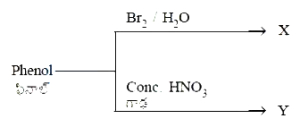
A
$X$ = $2-$bromophenol,$Y$ = $2-$nitrophenol
B
$X$ = $2,4-$dibromophenol,$Y$ = $2,6-$dinitrophenol
C
$X$ = $2,6-$dibromophenol,$Y$ = $2,6-$dinitrophenol
D
$X$ = $2,4,6-$tribromophenol,$Y$ = $2,4,6-$trinitrophenol
Solution
(D) When phenol reacts with bromine water $(Br_2/H_2O)$,it undergoes electrophilic substitution at all ortho and para positions due to the strong activating effect of the $-OH$ group,resulting in the formation of $2,4,6$-tribromophenol $(X)$.
When phenol reacts with concentrated nitric acid $(Conc. HNO_3)$,it undergoes nitration to form $2,4,6$-trinitrophenol,commonly known as picric acid $(Y)$.
When phenol reacts with concentrated nitric acid $(Conc. HNO_3)$,it undergoes nitration to form $2,4,6$-trinitrophenol,commonly known as picric acid $(Y)$.
0 likesView Solution
203
ChemistryMediumMCQAP EAMCET · 2025
Consider the following:
Statement-$I$ : $Al_2O_3$ is amphoteric in nature.
Statement-$II$ : $Tl_2O_3$ is more basic than $Ga_2O_3$.
The correct answer is
Statement-$I$ : $Al_2O_3$ is amphoteric in nature.
Statement-$II$ : $Tl_2O_3$ is more basic than $Ga_2O_3$.
The correct answer is
A
Both statement-$I$ and statement-$II$ are correct
B
Both statement-$I$ and statement-$II$ are not correct
C
Statement-$I$ is correct,but statement-$II$ is not correct
D
Statement-$I$ is not correct,but statement-$II$ is correct
Solution
(A) Statement-$I$: $Al_2O_3$ is a well-known amphoteric oxide,meaning it reacts with both acids and bases. This statement is correct.
Statement-$II$: As we move down the group $13$ (Boron family),the metallic character increases,and the basic character of oxides increases. Therefore,$Tl_2O_3$ (thallium oxide) is more basic than $Ga_2O_3$ (gallium oxide). This statement is also correct.
Thus,both statements are correct.
Statement-$II$: As we move down the group $13$ (Boron family),the metallic character increases,and the basic character of oxides increases. Therefore,$Tl_2O_3$ (thallium oxide) is more basic than $Ga_2O_3$ (gallium oxide). This statement is also correct.
Thus,both statements are correct.
0 likesView Solution
204
ChemistryMediumMCQAP EAMCET · 2025
The oxides of nitrogen obtained by the reaction of nitric acid with $(i)$ $P_4O_{10}$ and $(ii)$ $P_4$ respectively are:
A
$N_2O_5, NO_2$
B
$N_2O_3, NO$
C
$N_2O_5, NO$
D
$NO_2, N_2O$
Solution
(A) The reaction of concentrated nitric acid $(HNO_3)$ with $P_4O_{10}$ leads to the dehydration of the acid to form dinitrogen pentoxide $(N_2O_5)$:
$4HNO_3 + P_4O_{10} \rightarrow 2N_2O_5 + 4HPO_3$.
The reaction of concentrated nitric acid with phosphorus $(P_4)$ leads to the oxidation of phosphorus to phosphoric acid $(H_3PO_4)$ and the reduction of nitric acid to nitrogen dioxide $(NO_2)$:
$P_4 + 20HNO_3 \rightarrow 4H_3PO_4 + 20NO_2 + 4H_2O$.
Thus,the oxides obtained are $N_2O_5$ and $NO_2$ respectively.
$4HNO_3 + P_4O_{10} \rightarrow 2N_2O_5 + 4HPO_3$.
The reaction of concentrated nitric acid with phosphorus $(P_4)$ leads to the oxidation of phosphorus to phosphoric acid $(H_3PO_4)$ and the reduction of nitric acid to nitrogen dioxide $(NO_2)$:
$P_4 + 20HNO_3 \rightarrow 4H_3PO_4 + 20NO_2 + 4H_2O$.
Thus,the oxides obtained are $N_2O_5$ and $NO_2$ respectively.
0 likesView Solution
205
ChemistryMediumMCQAP EAMCET · 2025
The nature of the two oxides of nitrogen,$X$ and $Y$,formed in the reaction of sodium nitrite $(NaNO_2)$ with hydrochloric acid $(HCl)$ is:
A
Both $X$ and $Y$ are acidic in nature
B
$X$ is acidic and $Y$ is neutral in nature
C
Both $X$ and $Y$ are neutral in nature
D
$X$ is amphoteric and $Y$ is neutral in nature
Solution
(B) The reaction of sodium nitrite $(NaNO_2)$ with hydrochloric acid $(HCl)$ is as follows:
$NaNO_2 + HCl \rightarrow NaCl + HNO_2$
$3HNO_2 \rightarrow HNO_3 + H_2O + 2NO$
In this reaction,the oxides of nitrogen formed are nitrogen dioxide $(NO_2)$ and nitric oxide $(NO)$.
However,in the context of this specific reaction pathway,the primary products are $NO$ and $NO_2$ (which exists in equilibrium with $N_2O_4$).
$NO$ is a neutral oxide.
$NO_2$ is an acidic oxide.
Therefore,one oxide is acidic and the other is neutral.
$NaNO_2 + HCl \rightarrow NaCl + HNO_2$
$3HNO_2 \rightarrow HNO_3 + H_2O + 2NO$
In this reaction,the oxides of nitrogen formed are nitrogen dioxide $(NO_2)$ and nitric oxide $(NO)$.
However,in the context of this specific reaction pathway,the primary products are $NO$ and $NO_2$ (which exists in equilibrium with $N_2O_4$).
$NO$ is a neutral oxide.
$NO_2$ is an acidic oxide.
Therefore,one oxide is acidic and the other is neutral.
0 likesView Solution
206
ChemistryMediumMCQAP EAMCET · 2025
White phosphorus on heating with concentrated $NaOH$ solution in an inert atmosphere of $CO_2$ gives a salt '$X$' and gas '$Y$'. The oxidation state of central atom in $X$ and $Y$ is respectively
A
$-3, +1$
B
$+1, -3$
C
$0, -3$
D
$+1, +2$
Solution
(B) The reaction of white phosphorus $(P_4)$ with concentrated $NaOH$ solution is a disproportionation reaction:
$P_4 + 3NaOH + 3H_2O \rightarrow 3NaH_2PO_2 + PH_3$
Here,the salt '$X$' is sodium hypophosphite $(NaH_2PO_2)$ and the gas '$Y$' is phosphine $(PH_3)$.
In $NaH_2PO_2$,the oxidation state of $P$ is calculated as: $1 + 2 + x + 2(-2) = 0 \Rightarrow x = +1$.
In $PH_3$,the oxidation state of $P$ is calculated as: $x + 3(1) = 0 \Rightarrow x = -3$.
Thus,the oxidation states are $+1$ and $-3$ respectively.
$P_4 + 3NaOH + 3H_2O \rightarrow 3NaH_2PO_2 + PH_3$
Here,the salt '$X$' is sodium hypophosphite $(NaH_2PO_2)$ and the gas '$Y$' is phosphine $(PH_3)$.
In $NaH_2PO_2$,the oxidation state of $P$ is calculated as: $1 + 2 + x + 2(-2) = 0 \Rightarrow x = +1$.
In $PH_3$,the oxidation state of $P$ is calculated as: $x + 3(1) = 0 \Rightarrow x = -3$.
Thus,the oxidation states are $+1$ and $-3$ respectively.
0 likesView Solution
207
ChemistryMediumMCQAP EAMCET · 2025
The number of $P=O$ and $P-P$ bonds present in the oxoacid of phosphorus,prepared by treating red $P_4$ with alkali,are respectively:
A
$2, 1$
B
$1, 1$
C
$1, 2$
D
$2, 2$
Solution
(A) The reaction of red $P_4$ with alkali (like $NaOH$) produces hypophosphite $(H_2PO_2^-)$ and phosphine $(PH_3)$. The oxoacid formed upon acidification is hypophosphorous acid $(H_3PO_2)$.
In the structure of $H_3PO_2$,there is one $P=O$ bond,two $P-H$ bonds,and one $P-OH$ bond.
However,the question refers to the oxoacid prepared by treating $P_4$ with alkali,which is hypophosphorous acid $(H_3PO_2)$.
Wait,let us re-evaluate: The reaction of $P_4$ with $NaOH$ gives $PH_3$ and $NaH_2PO_2$. The acid is $H_3PO_2$. Its structure is $P(=O)(H)_2(OH)$. It has one $P=O$ bond and zero $P-P$ bonds.
If the question refers to hypophosphoric acid $(H_4P_2O_6)$,it has one $P-P$ bond and two $P=O$ bonds. But $H_4P_2O_6$ is not prepared by treating $P_4$ with alkali.
Given the options,the question likely refers to hypophosphoric acid $(H_4P_2O_6)$,which contains $2$ $P=O$ bonds and $1$ $P-P$ bond. Thus,the correct option is $A$.
In the structure of $H_3PO_2$,there is one $P=O$ bond,two $P-H$ bonds,and one $P-OH$ bond.
However,the question refers to the oxoacid prepared by treating $P_4$ with alkali,which is hypophosphorous acid $(H_3PO_2)$.
Wait,let us re-evaluate: The reaction of $P_4$ with $NaOH$ gives $PH_3$ and $NaH_2PO_2$. The acid is $H_3PO_2$. Its structure is $P(=O)(H)_2(OH)$. It has one $P=O$ bond and zero $P-P$ bonds.
If the question refers to hypophosphoric acid $(H_4P_2O_6)$,it has one $P-P$ bond and two $P=O$ bonds. But $H_4P_2O_6$ is not prepared by treating $P_4$ with alkali.
Given the options,the question likely refers to hypophosphoric acid $(H_4P_2O_6)$,which contains $2$ $P=O$ bonds and $1$ $P-P$ bond. Thus,the correct option is $A$.
0 likesView Solution
208
ChemistryMediumMCQAP EAMCET · 2025
Orthophosphorus acid on disproportionation gives $PH_3$ and another oxoacid of phosphorus '$X$'. The basicity of $X$ is
A
$2$
B
$1$
C
$3$
D
$4$
Solution
(C) The disproportionation reaction of orthophosphorus acid $(H_3PO_3)$ is given by:
$4H_3PO_3 \rightarrow PH_3 + 3H_3PO_4$
Here,the oxoacid '$X$' formed is orthophosphoric acid $(H_3PO_4)$.
The structure of $H_3PO_4$ contains three $P-OH$ groups,which are ionizable.
Therefore,the basicity of $H_3PO_4$ is $3$.
$4H_3PO_3 \rightarrow PH_3 + 3H_3PO_4$
Here,the oxoacid '$X$' formed is orthophosphoric acid $(H_3PO_4)$.
The structure of $H_3PO_4$ contains three $P-OH$ groups,which are ionizable.
Therefore,the basicity of $H_3PO_4$ is $3$.
0 likesView Solution
209
ChemistryMediumMCQAP EAMCET · 2025
Observe the following reactions:
$P_4 + 8SOCl_2 \longrightarrow 4PCl_3 + 4SO_2 + 2S_2Cl_2$
$P_4 + 10SO_2Cl_2 \longrightarrow 4PCl_5 + 10SO_2$
In both the reactions,a common product '$x$' is obtained. The number of lone pair of electrons on the central atom of '$x$' is:
$P_4 + 8SOCl_2 \longrightarrow 4PCl_3 + 4SO_2 + 2S_2Cl_2$
$P_4 + 10SO_2Cl_2 \longrightarrow 4PCl_5 + 10SO_2$
In both the reactions,a common product '$x$' is obtained. The number of lone pair of electrons on the central atom of '$x$' is:
A
$1$
B
$2$
C
$3$
D
$0$
Solution
(A) The reactions are:
$1) P_4 + 8SOCl_2 \longrightarrow 4PCl_3 + 4SO_2 + 2S_2Cl_2$
$2) P_4 + 10SO_2Cl_2 \longrightarrow 4PCl_5 + 10SO_2$
In both reactions,the common product '$x$' is sulfur dioxide $(SO_2)$.
In $SO_2$,the central atom is sulfur $(S)$.
The electronic configuration of sulfur is $[Ne] 3s^2 3p^4$.
In $SO_2$,sulfur forms two double bonds with two oxygen atoms.
Sulfur has $6$ valence electrons. It uses $4$ electrons for bonding with oxygen atoms (two double bonds).
Therefore,$6 - 4 = 2$ electrons remain,which form $1$ lone pair on the sulfur atom.
Thus,the number of lone pair of electrons on the central atom of $SO_2$ is $1$.
$1) P_4 + 8SOCl_2 \longrightarrow 4PCl_3 + 4SO_2 + 2S_2Cl_2$
$2) P_4 + 10SO_2Cl_2 \longrightarrow 4PCl_5 + 10SO_2$
In both reactions,the common product '$x$' is sulfur dioxide $(SO_2)$.
In $SO_2$,the central atom is sulfur $(S)$.
The electronic configuration of sulfur is $[Ne] 3s^2 3p^4$.
In $SO_2$,sulfur forms two double bonds with two oxygen atoms.
Sulfur has $6$ valence electrons. It uses $4$ electrons for bonding with oxygen atoms (two double bonds).
Therefore,$6 - 4 = 2$ electrons remain,which form $1$ lone pair on the sulfur atom.
Thus,the number of lone pair of electrons on the central atom of $SO_2$ is $1$.
0 likesView Solution
210
ChemistryMediumMCQAP EAMCET · 2025
Gas $X$ is obtained in Deacon's process. $X$ on reacting with iodine and water gives:
A
$HIO_4$
B
$HIO_2$
C
$HIO$
D
$HIO_3$
Solution
(D) Deacon's process is used for the industrial preparation of chlorine gas $(Cl_2)$.
Thus,gas $X$ is $Cl_2$.
When chlorine reacts with iodine and water,it acts as an oxidizing agent and oxidizes iodine to iodic acid $(HIO_3)$.
The chemical reaction is:
$I_2 + 5Cl_2 + 6H_2O \rightarrow 2HIO_3 + 10HCl$
Thus,gas $X$ is $Cl_2$.
When chlorine reacts with iodine and water,it acts as an oxidizing agent and oxidizes iodine to iodic acid $(HIO_3)$.
The chemical reaction is:
$I_2 + 5Cl_2 + 6H_2O \rightarrow 2HIO_3 + 10HCl$
0 likesView Solution
211
ChemistryMediumMCQAP EAMCET · 2025
Which of the following statements is not correct?
A
Potassium permanganate on heating gives potassium manganate and manganese dioxide only.
B
Phosphine is used in smoke screens.
C
Bleaching action of chlorine is due to oxidation.
D
Noble gases have very low boiling points.
Solution
(A) The correct answer is $A$.
Heating potassium permanganate $(KMnO_4)$ results in the formation of potassium manganate $(K_2MnO_4)$,manganese dioxide $(MnO_2)$,and oxygen gas $(O_2)$.
The reaction is: $2KMnO_4 \xrightarrow{\Delta} K_2MnO_4 + MnO_2 + O_2$.
Since the statement in option $A$ claims it gives only potassium manganate and manganese dioxide,it is incorrect because oxygen is also produced.
Phosphine $(PH_3)$ is indeed used in smoke screens (Holme's signals).
Chlorine's bleaching action is due to oxidation in the presence of moisture.
Noble gases have weak van der Waals forces,leading to very low boiling points.
Heating potassium permanganate $(KMnO_4)$ results in the formation of potassium manganate $(K_2MnO_4)$,manganese dioxide $(MnO_2)$,and oxygen gas $(O_2)$.
The reaction is: $2KMnO_4 \xrightarrow{\Delta} K_2MnO_4 + MnO_2 + O_2$.
Since the statement in option $A$ claims it gives only potassium manganate and manganese dioxide,it is incorrect because oxygen is also produced.
Phosphine $(PH_3)$ is indeed used in smoke screens (Holme's signals).
Chlorine's bleaching action is due to oxidation in the presence of moisture.
Noble gases have weak van der Waals forces,leading to very low boiling points.
0 likesView Solution
212
ChemistryMediumMCQAP EAMCET · 2025
Which of the following is not correct?
A
Thermal stability : $H_2O > H_2S > H_2Se > H_2Te > H_2Po$
B
Reducing property : $H_2S < H_2Se < H_2Te < H_2Po$
C
Boiling point : $H_2S < H_2Se < H_2Te < H_2O$
D
Melting point : $H_2S < H_2Se < H_2Te < H_2O$
Solution
(D) $1$. Thermal stability decreases down the group as the bond dissociation energy decreases: $H_2O > H_2S > H_2Se > H_2Te > H_2Po$. This is correct.
$2$. Reducing property increases down the group as the bond dissociation energy decreases: $H_2S < H_2Se < H_2Te < H_2Po$. This is correct.
$3$. Boiling point: $H_2O$ has the highest boiling point due to hydrogen bonding. For the rest,boiling point increases with increasing molecular mass: $H_2S < H_2Se < H_2Te < H_2O$. This is correct.
$4$. Melting point: The trend for melting point is $H_2S < H_2Se < H_2O < H_2Te$. $H_2O$ does not have the highest melting point compared to $H_2Te$ because of the crystal structure differences. Thus,the statement in option $D$ is incorrect.
$2$. Reducing property increases down the group as the bond dissociation energy decreases: $H_2S < H_2Se < H_2Te < H_2Po$. This is correct.
$3$. Boiling point: $H_2O$ has the highest boiling point due to hydrogen bonding. For the rest,boiling point increases with increasing molecular mass: $H_2S < H_2Se < H_2Te < H_2O$. This is correct.
$4$. Melting point: The trend for melting point is $H_2S < H_2Se < H_2O < H_2Te$. $H_2O$ does not have the highest melting point compared to $H_2Te$ because of the crystal structure differences. Thus,the statement in option $D$ is incorrect.
0 likesView Solution
213
ChemistryMediumMCQAP EAMCET · 2025
Complete hydrolysis of $XeF_6$ gives $HF$ along with compound $X$. The hybridisation in $X$ is
A
$sp^3$
B
$sp$
C
$sp^2$
D
$sp^3d$
Solution
(A) The complete hydrolysis of $XeF_6$ is represented by the following chemical equation:
$XeF_6 + 3H_2O \rightarrow XeO_3 + 6HF$
Here,the compound $X$ is $XeO_3$.
In $XeO_3$,the central atom $Xe$ has $8$ valence electrons.
It forms $3$ double bonds with $3$ oxygen atoms,utilizing $6$ electrons,and has $1$ lone pair of electrons.
Total electron pairs = $3$ (bond pairs) + $1$ (lone pair) = $4$.
Therefore,the hybridisation of $Xe$ in $XeO_3$ is $sp^3$.
$XeF_6 + 3H_2O \rightarrow XeO_3 + 6HF$
Here,the compound $X$ is $XeO_3$.
In $XeO_3$,the central atom $Xe$ has $8$ valence electrons.
It forms $3$ double bonds with $3$ oxygen atoms,utilizing $6$ electrons,and has $1$ lone pair of electrons.
Total electron pairs = $3$ (bond pairs) + $1$ (lone pair) = $4$.
Therefore,the hybridisation of $Xe$ in $XeO_3$ is $sp^3$.
0 likesView Solution
214
ChemistryEasyMCQAP EAMCET · 2025
In which polymer preparation,Ziegler-Natta catalyst is used?
A
Low density polythene
B
Teflon
C
Polyacrylonitrile
D
High density polythene
Solution
(D) The Ziegler-Natta catalyst,which is a mixture of $TiCl_4$ and $(C_2H_5)_3Al$,is specifically used in the production of $High \ density \ polythene$ $(HDPE)$.
This catalyst allows for the polymerization of ethene at low pressure and temperature,resulting in a linear polymer chain with high density and strength.
This catalyst allows for the polymerization of ethene at low pressure and temperature,resulting in a linear polymer chain with high density and strength.
0 likesView Solution
215
ChemistryMediumMCQAP EAMCET · 2025
What are $X$ and $Y$ in the following reaction?
$nClCH=CH_2 \xrightarrow{X} Y$
$nClCH=CH_2 \xrightarrow{X} Y$
A
$Na / NH_{3(l)} \quad - \quad$ thermosetting polymer
B
$(C_6H_5COO)_2 \quad - \quad$ thermoplastic polymer
C
$Na / NH_{3(l)} \quad - \quad$ condensation polymer
D
$(C_6H_5COO)_2 \quad - \quad$ network polymer
Solution
(B) The reaction $nClCH=CH_2 \xrightarrow{X} Y$ represents the polymerization of vinyl chloride to form polyvinyl chloride $(PVC)$.
$X$ is the initiator,which is benzoyl peroxide,represented as $(C_6H_5COO)_2$.
$Y$ is the polymer formed,which is polyvinyl chloride $(PVC)$.
Polyvinyl chloride is a thermoplastic polymer because it softens on heating and hardens on cooling.
Therefore,the correct pair is $X = (C_6H_5COO)_2$ and $Y = \text{thermoplastic polymer}$.
$X$ is the initiator,which is benzoyl peroxide,represented as $(C_6H_5COO)_2$.
$Y$ is the polymer formed,which is polyvinyl chloride $(PVC)$.
Polyvinyl chloride is a thermoplastic polymer because it softens on heating and hardens on cooling.
Therefore,the correct pair is $X = (C_6H_5COO)_2$ and $Y = \text{thermoplastic polymer}$.
0 likesView Solution
216
ChemistryMediumMCQAP EAMCET · 2025
Consider the following statements:
Statement-$I$: Nylon $6$ is a condensation copolymer.
Statement-$II$: Nylon $6, 6$ is a condensation polymer of adipic acid and hexamethylenediamine.
The correct answer is:
Statement-$I$: Nylon $6$ is a condensation copolymer.
Statement-$II$: Nylon $6, 6$ is a condensation polymer of adipic acid and hexamethylenediamine.
The correct answer is:
A
Both statement-$I$ and statement-$II$ are correct
B
Statement-$I$ is correct,but statement-$II$ is not correct
C
Statement-$I$ is not correct,but statement-$II$ is correct
D
Both statement-$I$ and statement-$II$ are not correct
Solution
(D) Statement-$I$ is incorrect because Nylon $6$ is a condensation homopolymer formed from the monomer caprolactam,not a copolymer.
Statement-$II$ is incorrect because Nylon $6, 6$ is formed from adipic acid and hexamethylenediamine,not tetramethylenediamine.
Therefore,both statements are incorrect.
Statement-$II$ is incorrect because Nylon $6, 6$ is formed from adipic acid and hexamethylenediamine,not tetramethylenediamine.
Therefore,both statements are incorrect.
0 likesView Solution
217
ChemistryMediumMCQAP EAMCET · 2025
$A$ polymer sample contains $10$ molecules each with molecular mass $5,000$ and $5$ molecules each with molecular mass $50,000$. The number average molecular mass of the polymer sample is
A
$2 \times 10^4$
B
$3 \times 10^4$
C
$2 \times 10^5$
D
$3 \times 10^5$
Solution
(A) The number average molecular mass $(\overline{M}_n)$ is calculated using the formula: $\overline{M}_n = \frac{\sum N_i M_i}{\sum N_i}$
Here,$N_1 = 10$,$M_1 = 5,000$ and $N_2 = 5$,$M_2 = 50,000$.
$\sum N_i M_i = (10 \times 5,000) + (5 \times 50,000) = 50,000 + 250,000 = 300,000$.
$\sum N_i = 10 + 5 = 15$.
$\overline{M}_n = \frac{300,000}{15} = 20,000 = 2 \times 10^4$.
Here,$N_1 = 10$,$M_1 = 5,000$ and $N_2 = 5$,$M_2 = 50,000$.
$\sum N_i M_i = (10 \times 5,000) + (5 \times 50,000) = 50,000 + 250,000 = 300,000$.
$\sum N_i = 10 + 5 = 15$.
$\overline{M}_n = \frac{300,000}{15} = 20,000 = 2 \times 10^4$.
0 likesView Solution
218
ChemistryMediumMCQAP EAMCET · 2025
The number of linear and crosslinked polymers in the following respectively are: Novolac,Nylon $6,6$,Bakelite,$PVC$,melamine.
A
$1, 4$
B
$4, 1$
C
$2, 3$
D
$3, 2$
Solution
(D) $1$. Linear polymers: These are long chain polymers. Examples from the list are: Nylon $6,6$,$PVC$,and Novolac (which is a linear polymer). So,there are $3$ linear polymers.
$2$. Crosslinked polymers: These are polymers with crosslinks between chains. Examples from the list are: Bakelite and melamine-formaldehyde resin. So,there are $2$ crosslinked polymers.
$3$. Therefore,the number of linear and crosslinked polymers are $3$ and $2$ respectively.
The correct option is $D$.
$2$. Crosslinked polymers: These are polymers with crosslinks between chains. Examples from the list are: Bakelite and melamine-formaldehyde resin. So,there are $2$ crosslinked polymers.
$3$. Therefore,the number of linear and crosslinked polymers are $3$ and $2$ respectively.
The correct option is $D$.
0 likesView Solution
219
ChemistryEasyMCQAP EAMCET · 2025
Which of the following is the common monomer for the polymers Bakelite and Melamine?
A
Phenol
B
Formaldehyde $(HCHO)$
C
Ethylene glycol
D
Methanol
Solution
(B) Bakelite is a condensation polymer formed by the reaction of phenol and formaldehyde $(HCHO)$.
Melamine-formaldehyde polymer is formed by the condensation polymerization of melamine and formaldehyde $(HCHO)$.
Therefore,formaldehyde $(HCHO)$ is the common monomer for both Bakelite and Melamine-formaldehyde polymers.
Melamine-formaldehyde polymer is formed by the condensation polymerization of melamine and formaldehyde $(HCHO)$.
Therefore,formaldehyde $(HCHO)$ is the common monomer for both Bakelite and Melamine-formaldehyde polymers.
0 likesView Solution
220
ChemistryEasyMCQAP EAMCET · 2025
Novolac is formed by the polymerization of monomer '$x$' in the presence of $OH^{-}$ ions. What is '$x$'?
A
o-Hydroxybenzyl alcohol
B
p-Hydroxybenzyl alcohol
C
$2,4,6-$Trihydroxymethylphenol
D
$2,6-$Dihydroxymethylphenol
Solution
(A) Novolac is a linear polymer of phenol and formaldehyde.
It is prepared by the condensation polymerization of phenol and formaldehyde in the presence of an acid or base catalyst.
The initial step involves the formation of ortho- or para-hydroxybenzyl alcohol as the monomer '$x$'.
Specifically,$o$-hydroxybenzyl alcohol is the primary monomer that undergoes linear polymerization to form Novolac.
It is prepared by the condensation polymerization of phenol and formaldehyde in the presence of an acid or base catalyst.
The initial step involves the formation of ortho- or para-hydroxybenzyl alcohol as the monomer '$x$'.
Specifically,$o$-hydroxybenzyl alcohol is the primary monomer that undergoes linear polymerization to form Novolac.
0 likesView Solution
221
ChemistryMediumMCQAP EAMCET · 2025
The correct statement regarding $X$ and $Y$ in the following set of reactions is:
$nCH_2=CH_2 \xrightarrow[(C_2H_5)_3Al, TiCl_4]{333-343 \ K, 6-7 \ atm} Y$
$nCH_2=CH_2 \xrightarrow[(C_6H_5COO)_2]{350-570 \ K, 1000-2000 \ atm} X$
$nCH_2=CH_2 \xrightarrow[(C_2H_5)_3Al, TiCl_4]{333-343 \ K, 6-7 \ atm} Y$
$nCH_2=CH_2 \xrightarrow[(C_6H_5COO)_2]{350-570 \ K, 1000-2000 \ atm} X$
A
$X$ is $HDP$ and $Y$ is $LDP$
B
$X$ is $LDP$ and $Y$ is $HDP$
C
$X$ is used in the preparation of flexible pipes and $Y$ is used in manufacturing squeeze bottles
D
$X$ is used in insulation of electricity carrying wires,$Y$ is used in manufacturing of bottles
Solution
(B) In the reaction forming $Y$,the catalyst used is Ziegler-Natta catalyst ($(C_2H_5)_3Al$ and $TiCl_4$) at low pressure and temperature,which produces High Density Polyethylene $(HDP)$.
In the reaction forming $X$,the initiator used is a peroxide $((C_6H_5COO)_2)$ at high pressure and temperature,which produces Low Density Polyethylene $(LDP)$.
Therefore,$X$ is $LDP$ and $Y$ is $HDP$.
$LDP$ is used in the insulation of electricity-carrying wires and in the manufacture of squeeze bottles.
$HDP$ is used in the manufacture of containers like buckets,dustbins,bottles,and pipes.
Thus,option $B$ is correct.
In the reaction forming $X$,the initiator used is a peroxide $((C_6H_5COO)_2)$ at high pressure and temperature,which produces Low Density Polyethylene $(LDP)$.
Therefore,$X$ is $LDP$ and $Y$ is $HDP$.
$LDP$ is used in the insulation of electricity-carrying wires and in the manufacture of squeeze bottles.
$HDP$ is used in the manufacture of containers like buckets,dustbins,bottles,and pipes.
Thus,option $B$ is correct.
0 likesView Solution
222
ChemistryMediumMCQAP EAMCET · 2025
Match the following:
Correct answer is:
| List-$I$ (Polymer) | List-$II$ (Used in Making) |
|---|---|
| $A$. Urea-formaldehyde resin | $I$. Safety Helmets |
| $B$. Glyptal | $II$. Gaskets |
| $C$. Bakelite | $III$. Laminated sheets |
| $D$. Nylon-$6,6$ | $IV$. Commercial fibres |
| $E$. Phenol-formaldehyde | $V$. Paints |
Correct answer is:
A
$A-III, B-V, C-I, D-IV$
B
$A-III, B-V, C-I, D-IV$
C
$A-III, B-V, C-I, D-IV$
D
$A-III, B-V, C-I, D-IV$
Solution
(A) The correct matches are as follows:
$A$. Urea-formaldehyde resin is used in making Laminated sheets $(III)$.
$B$. Glyptal is used in making Paints $(V)$.
$C$. Bakelite is used in making Safety Helmets $(I)$.
$D$. Nylon-$6,6$ is used in making Commercial fibres $(IV)$.
$E$. Phenol-formaldehyde is used in making Gaskets $(II)$.
Thus,the correct sequence is $A-III, B-V, C-I, D-IV$.
$A$. Urea-formaldehyde resin is used in making Laminated sheets $(III)$.
$B$. Glyptal is used in making Paints $(V)$.
$C$. Bakelite is used in making Safety Helmets $(I)$.
$D$. Nylon-$6,6$ is used in making Commercial fibres $(IV)$.
$E$. Phenol-formaldehyde is used in making Gaskets $(II)$.
Thus,the correct sequence is $A-III, B-V, C-I, D-IV$.
0 likesView Solution
223
ChemistryMediumMCQAP EAMCET · 2025
Which one of the statements regarding $X$ is not correct?
$3$-Hydroxybutanoic acid + $3$-Hydroxypentanoic acid $\longrightarrow X$
$3$-Hydroxybutanoic acid + $3$-Hydroxypentanoic acid $\longrightarrow X$
A
It is a condensation polymer
B
It is non-biodegradable
C
It is used in orthopaedic devices
D
It is known as $PHBV$
Solution
(B) The reaction between $3$-hydroxybutanoic acid and $3$-hydroxypentanoic acid leads to the formation of the copolymer $PHBV$ (poly-$\beta$-hydroxybutyrate-co-$\beta$-hydroxyvalerate).
$PHBV$ is a well-known biodegradable polymer.
Therefore,the statement that it is non-biodegradable is incorrect.
$PHBV$ is a condensation polymer and is used in orthopaedic devices and controlled drug release.
$PHBV$ is a well-known biodegradable polymer.
Therefore,the statement that it is non-biodegradable is incorrect.
$PHBV$ is a condensation polymer and is used in orthopaedic devices and controlled drug release.
0 likesView Solution
224
ChemistryMediumMCQAP EAMCET · 2025
Which one of the following acts as an autocatalyst during the titration of $KMnO_4$ and oxalic acid in the presence of dilute $H_2SO_4$?
A
$H_2SO_4$
B
$KMnO_4$
C
$H_2C_2O_4$
D
$MnSO_4$
Solution
(D) The reaction between $KMnO_4$ and oxalic acid $(H_2C_2O_4)$ in the presence of dilute $H_2SO_4$ is given by the equation:
$2KMnO_4 + 3H_2SO_4 + 5H_2C_2O_4 \rightarrow K_2SO_4 + 2MnSO_4 + 8H_2O + 10CO_2$.
In this reaction,$Mn^{2+}$ ions are produced as a product.
These $Mn^{2+}$ ions act as an autocatalyst,meaning they increase the rate of the reaction as the reaction proceeds.
Therefore,$MnSO_4$ (which provides $Mn^{2+}$ ions) acts as the autocatalyst.
$2KMnO_4 + 3H_2SO_4 + 5H_2C_2O_4 \rightarrow K_2SO_4 + 2MnSO_4 + 8H_2O + 10CO_2$.
In this reaction,$Mn^{2+}$ ions are produced as a product.
These $Mn^{2+}$ ions act as an autocatalyst,meaning they increase the rate of the reaction as the reaction proceeds.
Therefore,$MnSO_4$ (which provides $Mn^{2+}$ ions) acts as the autocatalyst.
0 likesView Solution
225
ChemistryEasyMCQAP EAMCET · 2025
What is the indicator used in Argentometric titrations?
A
Starch solution
B
Eosin dye
C
$KMnO_4$ solution
D
Phenolphthalein
Solution
(B) Argentometric titrations are precipitation titrations involving silver ions $(Ag^+)$.
In the Fajans method,which is a type of Argentometric titration,adsorption indicators like Eosin or Fluorescein are used to detect the endpoint.
Therefore,Eosin dye is the correct indicator used in this context.
In the Fajans method,which is a type of Argentometric titration,adsorption indicators like Eosin or Fluorescein are used to detect the endpoint.
Therefore,Eosin dye is the correct indicator used in this context.
0 likesView Solution
226
ChemistryMediumMCQAP EAMCET · 2025
$100 \ mL$ of aqueous solution of $0.05 \ M$ $Cu^{2+}$ is added to $1 \ L$ of $0.1 \ M$ $KI$ solution. The resultant solution was titrated with $0.01 \ M$ $Na_2S_2O_3$ solution using starch indicator till blue color disappeared. What is the volume (in $mL$) of $Na_2S_2O_3$ used?
A
$2000$
B
$1000$
C
$500$
D
$250$
Solution
(C) The reaction between $Cu^{2+}$ and $I^-$ is: $2Cu^{2+} + 4I^- \rightarrow 2CuI(s) + I_2$.
Moles of $Cu^{2+} = 0.1 \ L \times 0.05 \ M = 0.005 \ mol$.
Moles of $I_2$ produced = $\frac{1}{2} \times \text{moles of } Cu^{2+} = 0.0025 \ mol$.
The titration reaction is: $I_2 + 2Na_2S_2O_3 \rightarrow 2NaI + Na_2S_4O_6$.
Moles of $Na_2S_2O_3$ required = $2 \times \text{moles of } I_2 = 2 \times 0.0025 = 0.005 \ mol$.
Volume of $Na_2S_2O_3 = \frac{\text{moles}}{\text{molarity}} = \frac{0.005 \ mol}{0.01 \ M} = 0.5 \ L = 500 \ mL$.
Moles of $Cu^{2+} = 0.1 \ L \times 0.05 \ M = 0.005 \ mol$.
Moles of $I_2$ produced = $\frac{1}{2} \times \text{moles of } Cu^{2+} = 0.0025 \ mol$.
The titration reaction is: $I_2 + 2Na_2S_2O_3 \rightarrow 2NaI + Na_2S_4O_6$.
Moles of $Na_2S_2O_3$ required = $2 \times \text{moles of } I_2 = 2 \times 0.0025 = 0.005 \ mol$.
Volume of $Na_2S_2O_3 = \frac{\text{moles}}{\text{molarity}} = \frac{0.005 \ mol}{0.01 \ M} = 0.5 \ L = 500 \ mL$.
0 likesView Solution
227
ChemistryMediumMCQAP EAMCET · 2025
An element crystallizes in a $bcc$ lattice. The atomic radius of the element is $2.598 \ \mathring{A}$. What is the volume (in $cm^3$) of one unit cell?
A
$6.4 \times 10^{-22}$
B
$2.16 \times 10^{22}$
C
$2.16 \times 10^{-22}$
D
$2.16 \times 10^{-24}$
Solution
(C) For a $bcc$ lattice,the relationship between the edge length $(a)$ and the atomic radius $(r)$ is given by: $4r = \sqrt{3}a$,which implies $a = \frac{4r}{\sqrt{3}}$.
Given $r = 2.598 \ \mathring{A} = 2.598 \times 10^{-8} \ cm$.
Substituting the value of $r$: $a = \frac{4 \times 2.598 \times 10^{-8}}{\sqrt{3}} = \frac{4 \times 2.598 \times 10^{-8}}{1.732} = 4 \times 1.5 \times 10^{-8} = 6 \times 10^{-8} \ cm$.
The volume of the unit cell is $V = a^3 = (6 \times 10^{-8} \ cm)^3 = 216 \times 10^{-24} \ cm^3 = 2.16 \times 10^{-22} \ cm^3$.
Given $r = 2.598 \ \mathring{A} = 2.598 \times 10^{-8} \ cm$.
Substituting the value of $r$: $a = \frac{4 \times 2.598 \times 10^{-8}}{\sqrt{3}} = \frac{4 \times 2.598 \times 10^{-8}}{1.732} = 4 \times 1.5 \times 10^{-8} = 6 \times 10^{-8} \ cm$.
The volume of the unit cell is $V = a^3 = (6 \times 10^{-8} \ cm)^3 = 216 \times 10^{-24} \ cm^3 = 2.16 \times 10^{-22} \ cm^3$.
0 likesView Solution
228
ChemistryMediumMCQAP EAMCET · 2025
$A$ metal crystallizes in a simple cubic lattice. The radius of the metal atom is $x \ pm$. What is the volume of the unit cell in $pm^3$?
A
$x^3$
B
$4 \ x^3$
C
$8 \ x^3$
D
$16 \ x^3$
Solution
(C) In a simple cubic lattice, the atoms are present at the corners of the cube.
For a simple cubic unit cell, the edge length $a$ is related to the radius of the atom $r$ by the formula $a = 2r$.
Given that the radius of the metal atom is $r = x \ pm$.
Therefore, the edge length $a = 2 \times x = 2x \ pm$.
The volume of the unit cell is given by $V = a^3$.
Substituting the value of $a$, we get $V = (2x)^3 = 8x^3 \ pm^3$.
For a simple cubic unit cell, the edge length $a$ is related to the radius of the atom $r$ by the formula $a = 2r$.
Given that the radius of the metal atom is $r = x \ pm$.
Therefore, the edge length $a = 2 \times x = 2x \ pm$.
The volume of the unit cell is given by $V = a^3$.
Substituting the value of $a$, we get $V = (2x)^3 = 8x^3 \ pm^3$.
0 likesView Solution
229
ChemistryEasyMCQAP EAMCET · 2025
The crystal system with edge lengths $a \neq b \neq c$ and axial angles $\alpha = \beta = \gamma = 90^{\circ}$ is '$x$' and the number of Bravais lattices for it is '$y$'. $x$ and $y$ are:
A
Cubic; $3$
B
Monoclinic; $2$
C
Orthorhombic; $4$
D
Trigonal; $2$
Solution
(C) The crystal system defined by the parameters $a \neq b \neq c$ and $\alpha = \beta = \gamma = 90^{\circ}$ is the Orthorhombic system.
The Orthorhombic crystal system has $4$ types of Bravais lattices: Primitive,Body-centered,Face-centered,and End-centered.
Therefore,$x = \text{Orthorhombic}$ and $y = 4$.
The Orthorhombic crystal system has $4$ types of Bravais lattices: Primitive,Body-centered,Face-centered,and End-centered.
Therefore,$x = \text{Orthorhombic}$ and $y = 4$.
0 likesView Solution
230
ChemistryMediumMCQAP EAMCET · 2025
Gold crystallises in $fcc$ lattice. The edge length of the unit cell is $4 \ \mathring{A}$. The closest distance between gold atoms is '$x$' $\mathring{A}$ and density of gold is '$y$' $g \ cm^{-3}$. What are $x$ and $y$ respectively?
$($ Molar mass of gold $= 197 \ g \ mol^{-1} ; N_A = 6 \times 10^{23} \ mol^{-1} )$
$($ Molar mass of gold $= 197 \ g \ mol^{-1} ; N_A = 6 \times 10^{23} \ mol^{-1} )$
A
$2\sqrt{2}, 41.04$
B
$2\sqrt{2}, 20.52$
C
$2\sqrt{3}, 10.25$
D
$\sqrt{3}, 5.15$
Solution
(B) For an $fcc$ lattice,the edge length $a = 4 \ \mathring{A} = 4 \times 10^{-8} \ cm$.
$1$. The closest distance between atoms $(x)$ in an $fcc$ lattice is given by $x = \frac{a}{\sqrt{2}}$.
$x = \frac{4}{\sqrt{2}} = 2\sqrt{2} \ \mathring{A} \approx 2.828 \ \mathring{A}$.
$2$. The density $(y)$ is given by the formula $d = \frac{Z \times M}{N_A \times a^3}$.
For $fcc$,$Z = 4$. Given $M = 197 \ g \ mol^{-1}$,$N_A = 6 \times 10^{23} \ mol^{-1}$,and $a = 4 \times 10^{-8} \ cm$.
$y = \frac{4 \times 197}{6 \times 10^{23} \times (4 \times 10^{-8})^3} = \frac{788}{6 \times 10^{23} \times 64 \times 10^{-24}} = \frac{788}{38.4} \approx 20.52 \ g \ cm^{-3}$.
Thus,$x = 2\sqrt{2}$ and $y = 20.52$.
$1$. The closest distance between atoms $(x)$ in an $fcc$ lattice is given by $x = \frac{a}{\sqrt{2}}$.
$x = \frac{4}{\sqrt{2}} = 2\sqrt{2} \ \mathring{A} \approx 2.828 \ \mathring{A}$.
$2$. The density $(y)$ is given by the formula $d = \frac{Z \times M}{N_A \times a^3}$.
For $fcc$,$Z = 4$. Given $M = 197 \ g \ mol^{-1}$,$N_A = 6 \times 10^{23} \ mol^{-1}$,and $a = 4 \times 10^{-8} \ cm$.
$y = \frac{4 \times 197}{6 \times 10^{23} \times (4 \times 10^{-8})^3} = \frac{788}{6 \times 10^{23} \times 64 \times 10^{-24}} = \frac{788}{38.4} \approx 20.52 \ g \ cm^{-3}$.
Thus,$x = 2\sqrt{2}$ and $y = 20.52$.
0 likesView Solution
231
ChemistryMediumMCQAP EAMCET · 2025
$A$ compound is formed by two elements $A$ and $B$. Atoms of the element $B$ (as anion) make $ccp$ lattice and those of element $A$ (as cation) occupy all tetrahedral voids. The formula of the compound is
A
$A_4 B_3$
B
$AB$
C
$AB_2$
D
$A_2 B$
Solution
(D) In a $ccp$ (cubic close packing) lattice,the number of atoms of element $B$ is $n$.
The number of tetrahedral voids is equal to $2n$.
Since element $A$ occupies all tetrahedral voids,the number of atoms of $A$ is $2n$.
The ratio of atoms $A:B$ is $2n:n = 2:1$.
Therefore,the formula of the compound is $A_2 B$.
The number of tetrahedral voids is equal to $2n$.
Since element $A$ occupies all tetrahedral voids,the number of atoms of $A$ is $2n$.
The ratio of atoms $A:B$ is $2n:n = 2:1$.
Therefore,the formula of the compound is $A_2 B$.
0 likesView Solution
232
ChemistryMediumMCQAP EAMCET · 2025
An element (atomic weight $= 250 \ u$) crystallises in a simple cubic lattice. If the density of the unit cell is $7.2 \ g \ cm^{-3}$,what is the radius (in $\mathring{A}$) of the atom of the element? $(N_A = 6.02 \times 10^{23} \ mol^{-1})$
A
$4.04$
B
$2.93$
C
$1.93$
D
$3.04$
Solution
(C) For a simple cubic lattice,the number of atoms per unit cell $(Z)$ is $1$.
The formula for density $(d)$ is $d = \frac{Z \times M}{N_A \times a^3}$,where $M$ is the atomic weight,$N_A$ is Avogadro's number,and $a$ is the edge length.
Substituting the values: $7.2 = \frac{1 \times 250}{6.02 \times 10^{23} \times a^3}$.
$a^3 = \frac{250}{7.2 \times 6.02 \times 10^{23}} \approx 5.767 \times 10^{-23} \ cm^3$.
$a = (57.67 \times 10^{-24})^{1/3} \approx 3.86 \times 10^{-8} \ cm = 3.86 \ \mathring{A}$.
For a simple cubic lattice,the radius $(r)$ is related to the edge length $(a)$ by $r = \frac{a}{2}$.
$r = \frac{3.86}{2} = 1.93 \ \mathring{A}$.
The formula for density $(d)$ is $d = \frac{Z \times M}{N_A \times a^3}$,where $M$ is the atomic weight,$N_A$ is Avogadro's number,and $a$ is the edge length.
Substituting the values: $7.2 = \frac{1 \times 250}{6.02 \times 10^{23} \times a^3}$.
$a^3 = \frac{250}{7.2 \times 6.02 \times 10^{23}} \approx 5.767 \times 10^{-23} \ cm^3$.
$a = (57.67 \times 10^{-24})^{1/3} \approx 3.86 \times 10^{-8} \ cm = 3.86 \ \mathring{A}$.
For a simple cubic lattice,the radius $(r)$ is related to the edge length $(a)$ by $r = \frac{a}{2}$.
$r = \frac{3.86}{2} = 1.93 \ \mathring{A}$.
0 likesView Solution
233
ChemistryMediumMCQAP EAMCET · 2025
An element occurs in the body-centred cubic $(BCC)$ structure with an edge length of $288 \ pm$. The density of the element is $7.2 \ g \ cm^{-3}$. The number of atoms present in $208 \ g$ of the element is nearly:
A
$24.2 \times 10^{23}$
B
$12.1 \times 10^{23}$
C
$24.2 \times 10^{24}$
D
$36.3 \times 10^{23}$
Solution
(A) $1$. For a $BCC$ unit cell, the number of atoms per unit cell $(Z)$ is $2$.
$2$. The edge length $(a)$ is $288 \ pm = 288 \times 10^{-10} \ cm$.
$3$. The volume of the unit cell $(V)$ is $a^3 = (288 \times 10^{-10} \ cm)^3 \approx 2.39 \times 10^{-23} \ cm^3$.
$4$. The density $(\rho)$ is given by $\rho = \frac{Z \times M}{N_A \times a^3}$.
$5$. Rearranging to find the molar mass $(M)$: $M = \frac{\rho \times N_A \times a^3}{Z} = \frac{7.2 \times 6.022 \times 10^{23} \times 2.39 \times 10^{-23}}{2} \approx 51.8 \ g \ mol^{-1}$.
$6$. The number of moles in $208 \ g$ is $n = \frac{\text{mass}}{M} = \frac{208}{51.8} \approx 4.015 \ mol$.
$7$. The number of atoms is $n \times N_A = 4.015 \times 6.022 \times 10^{23} \approx 24.18 \times 10^{23} \approx 24.2 \times 10^{23}$.
$2$. The edge length $(a)$ is $288 \ pm = 288 \times 10^{-10} \ cm$.
$3$. The volume of the unit cell $(V)$ is $a^3 = (288 \times 10^{-10} \ cm)^3 \approx 2.39 \times 10^{-23} \ cm^3$.
$4$. The density $(\rho)$ is given by $\rho = \frac{Z \times M}{N_A \times a^3}$.
$5$. Rearranging to find the molar mass $(M)$: $M = \frac{\rho \times N_A \times a^3}{Z} = \frac{7.2 \times 6.022 \times 10^{23} \times 2.39 \times 10^{-23}}{2} \approx 51.8 \ g \ mol^{-1}$.
$6$. The number of moles in $208 \ g$ is $n = \frac{\text{mass}}{M} = \frac{208}{51.8} \approx 4.015 \ mol$.
$7$. The number of atoms is $n \times N_A = 4.015 \times 6.022 \times 10^{23} \approx 24.18 \times 10^{23} \approx 24.2 \times 10^{23}$.
0 likesView Solution
234
ChemistryMediumMCQAP EAMCET · 2025
$A$ metal crystallizes in a simple cubic lattice. The volume of one unit cell is $6.4 \times 10^7 \ pm^3$. What is the radius of the metal atom in $pm$?
A
$100$
B
$200$
C
$300$
D
$400$
Solution
(B) For a simple cubic lattice, the relationship between the edge length $(a)$ and the radius of the atom $(r)$ is given by $a = 2r$.
The volume of the unit cell $(V)$ is given by $V = a^3$.
Given $V = 6.4 \times 10^7 \ pm^3$.
Therefore, $a^3 = 6.4 \times 10^7 \ pm^3$.
Taking the cube root of both sides, $a = (64 \times 10^6)^{1/3} \ pm = 400 \ pm$.
Since $a = 2r$, we have $r = a / 2 = 400 / 2 = 200 \ pm$.
The volume of the unit cell $(V)$ is given by $V = a^3$.
Given $V = 6.4 \times 10^7 \ pm^3$.
Therefore, $a^3 = 6.4 \times 10^7 \ pm^3$.
Taking the cube root of both sides, $a = (64 \times 10^6)^{1/3} \ pm = 400 \ pm$.
Since $a = 2r$, we have $r = a / 2 = 400 / 2 = 200 \ pm$.
0 likesView Solution
235
ChemistryMediumMCQAP EAMCET · 2025
If $AgCl$ is doped with $1 \times 10^{-4}$ mole percent of $CdCl_2$,the number of cation vacancies (in $mol^{-1}$) is
A
$6.023 \times 10^{19}$
B
$6.023 \times 10^{21}$
C
$6.023 \times 10^{17}$
D
$6.023 \times 10^{23}$
Solution
(C) When $CdCl_2$ is added to $AgCl$,each $Cd^{2+}$ ion replaces two $Ag^+$ ions to maintain electrical neutrality.
One $Cd^{2+}$ ion occupies the site of one $Ag^+$ ion,while the other $Ag^+$ site remains vacant.
Thus,the number of cation vacancies created is equal to the number of $Cd^{2+}$ ions added.
Given that $1 \times 10^{-4}$ mole percent of $CdCl_2$ is added,this means $1 \times 10^{-4} \text{ moles of } CdCl_2$ are present in $100 \text{ moles of } AgCl$.
Therefore,the number of moles of $Cd^{2+}$ ions per mole of $AgCl$ is $\frac{1 \times 10^{-4}}{100} = 1 \times 10^{-6} \text{ mol}$.
The number of cation vacancies per mole is $1 \times 10^{-6} \times N_A$,where $N_A = 6.023 \times 10^{23} \text{ mol}^{-1}$.
Number of vacancies $= 1 \times 10^{-6} \times 6.023 \times 10^{23} = 6.023 \times 10^{17} \text{ mol}^{-1}$.
One $Cd^{2+}$ ion occupies the site of one $Ag^+$ ion,while the other $Ag^+$ site remains vacant.
Thus,the number of cation vacancies created is equal to the number of $Cd^{2+}$ ions added.
Given that $1 \times 10^{-4}$ mole percent of $CdCl_2$ is added,this means $1 \times 10^{-4} \text{ moles of } CdCl_2$ are present in $100 \text{ moles of } AgCl$.
Therefore,the number of moles of $Cd^{2+}$ ions per mole of $AgCl$ is $\frac{1 \times 10^{-4}}{100} = 1 \times 10^{-6} \text{ mol}$.
The number of cation vacancies per mole is $1 \times 10^{-6} \times N_A$,where $N_A = 6.023 \times 10^{23} \text{ mol}^{-1}$.
Number of vacancies $= 1 \times 10^{-6} \times 6.023 \times 10^{23} = 6.023 \times 10^{17} \text{ mol}^{-1}$.
0 likesView Solution
236
ChemistryEasyMCQAP EAMCET · 2025
$248 \ g$ of ethylene glycol $(C_2H_6O_2)$ is added to $200 \ g$ of water to prepare antifreeze. What is the molality of the resultant solution (in $m$)? $(C=12 \ u, H=1 \ u, O=16 \ u)$
A
$5$
B
$10$
C
$20$
D
$40$
Solution
(C) Step $1$: Calculate the molar mass of ethylene glycol $(C_2H_6O_2)$.
$M = (2 \times 12) + (6 \times 1) + (2 \times 16) = 24 + 6 + 32 = 62 \ g \ mol^{-1}$.
Step $2$: Calculate the number of moles of ethylene glycol.
$n = \frac{\text{mass}}{\text{molar mass}} = \frac{248 \ g}{62 \ g \ mol^{-1}} = 4 \ mol$.
Step $3$: Calculate the molality $(m)$ of the solution.
$m = \frac{\text{moles of solute}}{\text{mass of solvent in kg}} = \frac{4 \ mol}{0.2 \ kg} = 20 \ m$.
$M = (2 \times 12) + (6 \times 1) + (2 \times 16) = 24 + 6 + 32 = 62 \ g \ mol^{-1}$.
Step $2$: Calculate the number of moles of ethylene glycol.
$n = \frac{\text{mass}}{\text{molar mass}} = \frac{248 \ g}{62 \ g \ mol^{-1}} = 4 \ mol$.
Step $3$: Calculate the molality $(m)$ of the solution.
$m = \frac{\text{moles of solute}}{\text{mass of solvent in kg}} = \frac{4 \ mol}{0.2 \ kg} = 20 \ m$.
0 likesView Solution
237
ChemistryMediumMCQAP EAMCET · 2025
The mole fractions of glucose $(C_6H_{12}O_6)$ and water $(H_2O)$ in an aqueous glucose solution are $0.0244$ and $0.9756$ respectively. What is the weight percentage $(w/w)$ of glucose in this solution?
A
$40$
B
$25$
C
$20$
D
$10$
Solution
(C) The mole fraction of a component is given by $x_i = \frac{n_i}{n_{total}}$.
Let the total number of moles be $n_{total} = 1 \ mol$.
Then,the moles of glucose $(n_{glucose})$ = $0.0244 \ mol$ and the moles of water $(n_{water})$ = $0.9756 \ mol$.
The molar mass of glucose $(C_6H_{12}O_6)$ is $180 \ g/mol$ and the molar mass of water $(H_2O)$ is $18 \ g/mol$.
Mass of glucose = $0.0244 \ mol \times 180 \ g/mol = 4.392 \ g$.
Mass of water = $0.9756 \ mol \times 18 \ g/mol = 17.5608 \ g$.
Total mass of the solution = $4.392 \ g + 17.5608 \ g = 21.9528 \ g$.
Weight percentage $(w/w)$ of glucose = $\frac{\text{mass of glucose}}{\text{total mass of solution}} \times 100 = \frac{4.392}{21.9528} \times 100 \approx 20\%$.
Let the total number of moles be $n_{total} = 1 \ mol$.
Then,the moles of glucose $(n_{glucose})$ = $0.0244 \ mol$ and the moles of water $(n_{water})$ = $0.9756 \ mol$.
The molar mass of glucose $(C_6H_{12}O_6)$ is $180 \ g/mol$ and the molar mass of water $(H_2O)$ is $18 \ g/mol$.
Mass of glucose = $0.0244 \ mol \times 180 \ g/mol = 4.392 \ g$.
Mass of water = $0.9756 \ mol \times 18 \ g/mol = 17.5608 \ g$.
Total mass of the solution = $4.392 \ g + 17.5608 \ g = 21.9528 \ g$.
Weight percentage $(w/w)$ of glucose = $\frac{\text{mass of glucose}}{\text{total mass of solution}} \times 100 = \frac{4.392}{21.9528} \times 100 \approx 20\%$.
0 likesView Solution
238
ChemistryMediumMCQAP EAMCET · 2025
In an aqueous glucose solution,the mole fraction of water is $40$ times the mole fraction of glucose. What is the weight percentage $(w/w)$ of glucose in the solution?
A
$40$
B
$30$
C
$20$
D
$10$
Solution
(C) Let $n_g$ be the moles of glucose and $n_w$ be the moles of water. Given that the mole fraction of water $(x_w)$ is $40$ times the mole fraction of glucose $(x_g)$,we have $x_w = 40 x_g$. Since $x_w + x_g = 1$,we get $40 x_g + x_g = 1$,which implies $41 x_g = 1$,so $x_g = 1/41$ and $x_w = 40/41$. The ratio of moles is $n_w / n_g = x_w / x_g = 40/1$. Thus,$n_w = 40 n_g$. The mass of glucose $(m_g)$ is $n_g \times 180 \ g/mol$ and the mass of water $(m_w)$ is $n_w \times 18 \ g/mol = 40 n_g \times 18 \ g/mol = 720 n_g \ g$. The weight percentage of glucose is $(m_g / (m_g + m_w)) \times 100 = (180 n_g / (180 n_g + 720 n_g)) \times 100 = (180 / 900) \times 100 = (1/5) \times 100 = 20\%$. Therefore,the correct option is $C$.
0 likesView Solution
239
ChemistryMediumMCQAP EAMCET · 2025
What is the approximate molality of $10 \% (w/w)$ aqueous glucose solution (in $m$)? (Molar mass of glucose $= 180 \ g \ mol^{-1}$)
A
$0.31$
B
$0.62$
C
$0.93$
D
$1.24$
Solution
(B) Given,$10 \% (w/w)$ aqueous glucose solution means $10 \ g$ of glucose is present in $100 \ g$ of the solution.
Mass of solute (glucose) $= 10 \ g$.
Mass of solvent (water) $= 100 \ g - 10 \ g = 90 \ g = 0.09 \ kg$.
Molar mass of glucose $= 180 \ g \ mol^{-1}$.
Number of moles of glucose $= \frac{10 \ g}{180 \ g \ mol^{-1}} = 0.0556 \ mol$.
Molality $(m) = \frac{\text{moles of solute}}{\text{mass of solvent in kg}} = \frac{0.0556 \ mol}{0.09 \ kg} \approx 0.617 \ m$.
Rounding to the nearest option,the value is $0.62 \ m$.
Mass of solute (glucose) $= 10 \ g$.
Mass of solvent (water) $= 100 \ g - 10 \ g = 90 \ g = 0.09 \ kg$.
Molar mass of glucose $= 180 \ g \ mol^{-1}$.
Number of moles of glucose $= \frac{10 \ g}{180 \ g \ mol^{-1}} = 0.0556 \ mol$.
Molality $(m) = \frac{\text{moles of solute}}{\text{mass of solvent in kg}} = \frac{0.0556 \ mol}{0.09 \ kg} \approx 0.617 \ m$.
Rounding to the nearest option,the value is $0.62 \ m$.
0 likesView Solution
240
ChemistryMediumMCQAP EAMCET · 2025
$A$ solution is prepared by adding $124 \ g$ of ethylene glycol (molar mass $= 62 \ g \ mol^{-1}$) to $x \ g$ of water to get a $10 \ m$ solution. What is the value of $x$ (in $g$)?
A
$100$
B
$400$
C
$800$
D
$200$
Solution
(D) The molality $(m)$ of a solution is defined as the number of moles of solute per kilogram of solvent.
Given:
Mass of ethylene glycol $= 124 \ g$.
Molar mass of ethylene glycol $= 62 \ g \ mol^{-1}$.
Moles of ethylene glycol $(n)$ $= \frac{124 \ g}{62 \ g \ mol^{-1}} = 2 \ mol$.
Molality $(m)$ $= 10 \ mol \ kg^{-1}$.
Formula: $m = \frac{n_{\text{solute}}}{W_{\text{solvent (in kg)}}}$.
Substituting the values: $10 = \frac{2}{W_{\text{solvent (in kg)}}}$.
$W_{\text{solvent (in kg)}} = \frac{2}{10} = 0.2 \ kg$.
Since $1 \ kg = 1000 \ g$,$W_{\text{solvent}} = 0.2 \times 1000 = 200 \ g$.
Therefore,$x = 200$.
Given:
Mass of ethylene glycol $= 124 \ g$.
Molar mass of ethylene glycol $= 62 \ g \ mol^{-1}$.
Moles of ethylene glycol $(n)$ $= \frac{124 \ g}{62 \ g \ mol^{-1}} = 2 \ mol$.
Molality $(m)$ $= 10 \ mol \ kg^{-1}$.
Formula: $m = \frac{n_{\text{solute}}}{W_{\text{solvent (in kg)}}}$.
Substituting the values: $10 = \frac{2}{W_{\text{solvent (in kg)}}}$.
$W_{\text{solvent (in kg)}} = \frac{2}{10} = 0.2 \ kg$.
Since $1 \ kg = 1000 \ g$,$W_{\text{solvent}} = 0.2 \times 1000 = 200 \ g$.
Therefore,$x = 200$.
0 likesView Solution
241
ChemistryMediumMCQAP EAMCET · 2025
At $300 \ K$,the vapour pressure of a pure liquid $A$ is $70 \ mm \ Hg$. It forms an ideal solution with another liquid $B$. The mole fraction of $B$ in the solution is $0.2$ and the total vapour pressure of the solution is $84 \ mm \ Hg$ at the same temperature. What is the vapour pressure (in $mm \ Hg$) of pure liquid $B$ at $300 \ K$?
A
$140$
B
$70$
C
$280$
D
$560$
Solution
(A) According to Raoult's Law for an ideal solution,the total vapour pressure $P_{total}$ is given by:
$P_{total} = P_A^0 \cdot x_A + P_B^0 \cdot x_B$
Given:
$P_A^0 = 70 \ mm \ Hg$
$x_B = 0.2$
$x_A = 1 - x_B = 1 - 0.2 = 0.8$
$P_{total} = 84 \ mm \ Hg$
Substituting the values:
$84 = (70 \times 0.8) + (P_B^0 \times 0.2)$
$84 = 56 + 0.2 \cdot P_B^0$
$84 - 56 = 0.2 \cdot P_B^0$
$28 = 0.2 \cdot P_B^0$
$P_B^0 = \frac{28}{0.2} = 140 \ mm \ Hg$
Thus,the vapour pressure of pure liquid $B$ is $140 \ mm \ Hg$.
$P_{total} = P_A^0 \cdot x_A + P_B^0 \cdot x_B$
Given:
$P_A^0 = 70 \ mm \ Hg$
$x_B = 0.2$
$x_A = 1 - x_B = 1 - 0.2 = 0.8$
$P_{total} = 84 \ mm \ Hg$
Substituting the values:
$84 = (70 \times 0.8) + (P_B^0 \times 0.2)$
$84 = 56 + 0.2 \cdot P_B^0$
$84 - 56 = 0.2 \cdot P_B^0$
$28 = 0.2 \cdot P_B^0$
$P_B^0 = \frac{28}{0.2} = 140 \ mm \ Hg$
Thus,the vapour pressure of pure liquid $B$ is $140 \ mm \ Hg$.
0 likesView Solution
242
ChemistryMediumMCQAP EAMCET · 2025
At $T \ K$,the vapour pressure of an aqueous solution of a non-volatile solute,whose mole fraction is $0.02$,is found to be $34.65 \ mm \ Hg$. What is the vapour pressure (in $mm \ Hg$) of pure water at the same temperature?
A
$35.7$
B
$35.36$
C
$35.0$
D
$34.3$
Solution
(B) According to Raoult's law for a solution containing a non-volatile solute,the relative lowering of vapour pressure is equal to the mole fraction of the solute:
$\frac{P^o - P_s}{P^o} = x_{solute}$
Where:
$P^o$ = Vapour pressure of pure water
$P_s$ = Vapour pressure of the solution = $34.65 \ mm \ Hg$
$x_{solute}$ = Mole fraction of the solute = $0.02$
Substituting the values:
$\frac{P^o - 34.65}{P^o} = 0.02$
$1 - \frac{34.65}{P^o} = 0.02$
$1 - 0.02 = \frac{34.65}{P^o}$
$0.98 = \frac{34.65}{P^o}$
$P^o = \frac{34.65}{0.98} = 35.357 \ mm \ Hg \approx 35.36 \ mm \ Hg$
Thus,the vapour pressure of pure water is $35.36 \ mm \ Hg$.
$\frac{P^o - P_s}{P^o} = x_{solute}$
Where:
$P^o$ = Vapour pressure of pure water
$P_s$ = Vapour pressure of the solution = $34.65 \ mm \ Hg$
$x_{solute}$ = Mole fraction of the solute = $0.02$
Substituting the values:
$\frac{P^o - 34.65}{P^o} = 0.02$
$1 - \frac{34.65}{P^o} = 0.02$
$1 - 0.02 = \frac{34.65}{P^o}$
$0.98 = \frac{34.65}{P^o}$
$P^o = \frac{34.65}{0.98} = 35.357 \ mm \ Hg \approx 35.36 \ mm \ Hg$
Thus,the vapour pressure of pure water is $35.36 \ mm \ Hg$.
0 likesView Solution
243
ChemistryMediumMCQAP EAMCET · 2025
At $298 \ K$,$0.714$ moles of liquid $A$ is dissolved in $5.555$ moles of liquid $B$. The vapour pressure of the resultant solution is $475 \ torr$. The vapour pressure of pure liquid $A$ at the same temperature is $280.7 \ torr$. What is the vapour pressure of pure liquid $B$ in $torr$?
A
$486$
B
$550$
C
$514$
D
$500$
Solution
(D) According to Raoult's law for a solution of two volatile liquids,the total vapour pressure $P_{total}$ is given by: $P_{total} = P_A^0 \chi_A + P_B^0 \chi_B$.
Given: $n_A = 0.714 \ mol$,$n_B = 5.555 \ mol$.
Total moles $n_{total} = 0.714 + 5.555 = 6.269 \ mol$.
Mole fractions are: $\chi_A = \frac{0.714}{6.269} \approx 0.1139$ and $\chi_B = \frac{5.555}{6.269} \approx 0.8861$.
Given $P_{total} = 475 \ torr$ and $P_A^0 = 280.7 \ torr$.
Substituting values: $475 = (280.7 \times 0.1139) + (P_B^0 \times 0.8861)$.
$475 = 31.97 + (P_B^0 \times 0.8861)$.
$443.03 = P_B^0 \times 0.8861$.
$P_B^0 = \frac{443.03}{0.8861} \approx 499.98 \ torr \approx 500 \ torr$.
Given: $n_A = 0.714 \ mol$,$n_B = 5.555 \ mol$.
Total moles $n_{total} = 0.714 + 5.555 = 6.269 \ mol$.
Mole fractions are: $\chi_A = \frac{0.714}{6.269} \approx 0.1139$ and $\chi_B = \frac{5.555}{6.269} \approx 0.8861$.
Given $P_{total} = 475 \ torr$ and $P_A^0 = 280.7 \ torr$.
Substituting values: $475 = (280.7 \times 0.1139) + (P_B^0 \times 0.8861)$.
$475 = 31.97 + (P_B^0 \times 0.8861)$.
$443.03 = P_B^0 \times 0.8861$.
$P_B^0 = \frac{443.03}{0.8861} \approx 499.98 \ torr \approx 500 \ torr$.
0 likesView Solution
244
ChemistryMediumMCQAP EAMCET · 2025
At $T \ K$,the vapour pressure of pure benzene $(C_6H_6)$ and toluene $(C_7H_8)$ are $75 \ mm \ Hg$ and $22 \ mm \ Hg$ respectively. $23.4 \ g$ of benzene and $64.4 \ g$ of toluene are mixed to form an ideal solution. If the vapours are in equilibrium with the liquid mixture,the mole fraction of toluene in the vapour phase is (Atomic weight: $C=12, H=1$).
A
$0.406$
B
$0.594$
C
$0.539$
D
$0.461$
Solution
(A) $1$. Calculate moles of components:
$n_{\text{benzene}} = \frac{23.4 \ g}{78 \ g/mol} = 0.3 \ mol$
$n_{\text{toluene}} = \frac{64.4 \ g}{92 \ g/mol} = 0.7 \ mol$
$2$. Calculate mole fractions in liquid phase $(x)$:
$x_{\text{benzene}} = \frac{0.3}{0.3 + 0.7} = 0.3$
$x_{\text{toluene}} = \frac{0.7}{0.3 + 0.7} = 0.7$
$3$. Calculate partial pressures using Raoult's Law:
$P_{\text{benzene}} = x_{\text{benzene}} \times P^0_{\text{benzene}} = 0.3 \times 75 = 22.5 \ mm \ Hg$
$P_{\text{toluene}} = x_{\text{toluene}} \times P^0_{\text{toluene}} = 0.7 \times 22 = 15.4 \ mm \ Hg$
$4$. Calculate total pressure $(P_{\text{total}})$:
$P_{\text{total}} = 22.5 + 15.4 = 37.9 \ mm \ Hg$
$5$. Calculate mole fraction of toluene in vapour phase $(y_{\text{toluene}})$:
$y_{\text{toluene}} = \frac{P_{\text{toluene}}}{P_{\text{total}}} = \frac{15.4}{37.9} \approx 0.406$
$n_{\text{benzene}} = \frac{23.4 \ g}{78 \ g/mol} = 0.3 \ mol$
$n_{\text{toluene}} = \frac{64.4 \ g}{92 \ g/mol} = 0.7 \ mol$
$2$. Calculate mole fractions in liquid phase $(x)$:
$x_{\text{benzene}} = \frac{0.3}{0.3 + 0.7} = 0.3$
$x_{\text{toluene}} = \frac{0.7}{0.3 + 0.7} = 0.7$
$3$. Calculate partial pressures using Raoult's Law:
$P_{\text{benzene}} = x_{\text{benzene}} \times P^0_{\text{benzene}} = 0.3 \times 75 = 22.5 \ mm \ Hg$
$P_{\text{toluene}} = x_{\text{toluene}} \times P^0_{\text{toluene}} = 0.7 \times 22 = 15.4 \ mm \ Hg$
$4$. Calculate total pressure $(P_{\text{total}})$:
$P_{\text{total}} = 22.5 + 15.4 = 37.9 \ mm \ Hg$
$5$. Calculate mole fraction of toluene in vapour phase $(y_{\text{toluene}})$:
$y_{\text{toluene}} = \frac{P_{\text{toluene}}}{P_{\text{total}}} = \frac{15.4}{37.9} \approx 0.406$
0 likesView Solution
245
ChemistryMediumMCQAP EAMCET · 2025
At $T \ K$,the vapour pressure of an $x$ molal aqueous solution containing a non-volatile solute is $12.078 \ kPa$. The vapour pressure of pure water at $T \ K$ is $12.3 \ kPa$. What is the value of $x$?
A
$10$
B
$1.018$
C
$0.1018$
D
$0.018$
Solution
(B) According to Raoult's law for a solution containing a non-volatile solute,the relative lowering of vapour pressure is given by: $\frac{P^o - P_s}{P^o} = \frac{n_2}{n_1 + n_2} \approx \frac{n_2}{n_1}$ (for dilute solutions).
Here,$P^o = 12.3 \ kPa$,$P_s = 12.078 \ kPa$.
The lowering of vapour pressure is $\Delta P = P^o - P_s = 12.3 - 12.078 = 0.222 \ kPa$.
Relative lowering of vapour pressure = $\frac{0.222}{12.3} = 0.018048$.
For an aqueous solution,molality $x = \frac{n_2 \times 1000}{W_1 \ (g)}$,where $W_1$ is the mass of water in grams.
We know $\frac{n_2}{n_1} = \frac{n_2 \times M_1}{W_1} = \frac{x \times M_1}{1000}$,where $M_1 = 18 \ g/mol$ (molar mass of water).
So,$0.018048 = \frac{x \times 18}{1000}$.
$x = \frac{0.018048 \times 1000}{18} = \frac{18.048}{18} \approx 1.0026 \approx 1.018$ (considering standard approximations).
Thus,the correct option is $B$.
Here,$P^o = 12.3 \ kPa$,$P_s = 12.078 \ kPa$.
The lowering of vapour pressure is $\Delta P = P^o - P_s = 12.3 - 12.078 = 0.222 \ kPa$.
Relative lowering of vapour pressure = $\frac{0.222}{12.3} = 0.018048$.
For an aqueous solution,molality $x = \frac{n_2 \times 1000}{W_1 \ (g)}$,where $W_1$ is the mass of water in grams.
We know $\frac{n_2}{n_1} = \frac{n_2 \times M_1}{W_1} = \frac{x \times M_1}{1000}$,where $M_1 = 18 \ g/mol$ (molar mass of water).
So,$0.018048 = \frac{x \times 18}{1000}$.
$x = \frac{0.018048 \times 1000}{18} = \frac{18.048}{18} \approx 1.0026 \approx 1.018$ (considering standard approximations).
Thus,the correct option is $B$.
0 likesView Solution
246
ChemistryMediumMCQAP EAMCET · 2025
At $T \ K$,the vapour pressure of water is $x \ kPa$. What is the vapour pressure (in $kPa$) of a $1 \ m$ (molal) aqueous solution containing a non-volatile solute (in $x$)?
A
$1.018$
B
$0.8$
C
$0.972$
D
$0.982$
Solution
(D) The relative lowering of vapour pressure is given by Raoult's Law: $\frac{P^o - P_s}{P^o} = \frac{n_2}{n_1 + n_2}$.
Here,$P^o = x \ kPa$ and $P_s$ is the vapour pressure of the solution.
For a $1 \ m$ solution,there is $1 \ mol$ of solute in $1000 \ g$ of water.
Moles of water $(n_1)$ = $\frac{1000 \ g}{18 \ g/mol} = 55.55 \ mol$.
Moles of solute $(n_2)$ = $1 \ mol$.
Substituting these values: $\frac{x - P_s}{x} = \frac{1}{55.55 + 1} = \frac{1}{56.55} \approx 0.01768$.
$1 - \frac{P_s}{x} = 0.01768$.
$\frac{P_s}{x} = 1 - 0.01768 = 0.98232$.
$P_s \approx 0.982 x \ kPa$.
Here,$P^o = x \ kPa$ and $P_s$ is the vapour pressure of the solution.
For a $1 \ m$ solution,there is $1 \ mol$ of solute in $1000 \ g$ of water.
Moles of water $(n_1)$ = $\frac{1000 \ g}{18 \ g/mol} = 55.55 \ mol$.
Moles of solute $(n_2)$ = $1 \ mol$.
Substituting these values: $\frac{x - P_s}{x} = \frac{1}{55.55 + 1} = \frac{1}{56.55} \approx 0.01768$.
$1 - \frac{P_s}{x} = 0.01768$.
$\frac{P_s}{x} = 1 - 0.01768 = 0.98232$.
$P_s \approx 0.982 x \ kPa$.
0 likesView Solution
247
ChemistryMediumMCQAP EAMCET · 2025
The following graph is obtained for an ideal solution containing a non-volatile solute. The $x$- and $y$-axes represent,respectively:
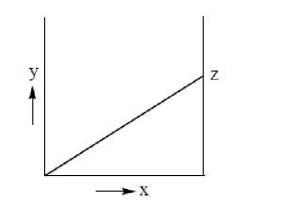
A
mole fraction of solute,vapour pressure of solution.
B
mole fraction of solvent,vapour pressure of solution.
C
mole fraction of solute,vapour pressure of solvent.
D
concentration of solution,vapour pressure of solution.
Solution
(B) According to Raoult's Law for a solution containing a non-volatile solute,the vapour pressure of the solution $(P_{sol})$ is directly proportional to the mole fraction of the solvent $(x_{solvent})$:
$P_{sol} = P^0_{solvent} \times x_{solvent}$
Since $x_{solvent} + x_{solute} = 1$,we can write:
$P_{sol} = P^0_{solvent} \times (1 - x_{solute}) = P^0_{solvent} - P^0_{solvent} \times x_{solute}$
This represents a linear equation $y = mx + c$ where the slope is negative.
However,if the graph shows a direct linear increase starting from the origin,it represents the relationship between the vapour pressure of the solution and the mole fraction of the solvent $(P_{sol} \propto x_{solvent})$.
Thus,the $x$-axis represents the mole fraction of the solvent and the $y$-axis represents the vapour pressure of the solution.
$P_{sol} = P^0_{solvent} \times x_{solvent}$
Since $x_{solvent} + x_{solute} = 1$,we can write:
$P_{sol} = P^0_{solvent} \times (1 - x_{solute}) = P^0_{solvent} - P^0_{solvent} \times x_{solute}$
This represents a linear equation $y = mx + c$ where the slope is negative.
However,if the graph shows a direct linear increase starting from the origin,it represents the relationship between the vapour pressure of the solution and the mole fraction of the solvent $(P_{sol} \propto x_{solvent})$.
Thus,the $x$-axis represents the mole fraction of the solvent and the $y$-axis represents the vapour pressure of the solution.
0 likesView Solution
248
ChemistryMediumMCQAP EAMCET · 2025
$A$ solution containing $7.5 \ g$ of urea (molar mass $= 60 \ g \ mol^{-1}$) in $1 \ kg$ of water freezes at the same temperature as another solution containing $15 \ g$ of solute $X$,in the same amount of water. The molar mass of $X \ (g \ mol^{-1})$ is
A
$60$
B
$180$
C
$120$
D
$240$
Solution
(C) The depression in freezing point is given by $\Delta T_f = K_f \times m$,where $m$ is the molality of the solution.
Since both solutions have the same freezing point and the same amount of solvent ($1 \ kg$ of water),their molalities must be equal.
Molality $m = \frac{\text{moles of solute}}{\text{mass of solvent in kg}}$.
For urea: $\text{moles} = \frac{7.5 \ g}{60 \ g \ mol^{-1}} = 0.125 \ mol$.
For solute $X$: $\text{moles} = \frac{15 \ g}{M_X}$,where $M_X$ is the molar mass of $X$.
Equating the moles (since solvent mass is the same): $0.125 = \frac{15}{M_X}$.
$M_X = \frac{15}{0.125} = 120 \ g \ mol^{-1}$.
Since both solutions have the same freezing point and the same amount of solvent ($1 \ kg$ of water),their molalities must be equal.
Molality $m = \frac{\text{moles of solute}}{\text{mass of solvent in kg}}$.
For urea: $\text{moles} = \frac{7.5 \ g}{60 \ g \ mol^{-1}} = 0.125 \ mol$.
For solute $X$: $\text{moles} = \frac{15 \ g}{M_X}$,where $M_X$ is the molar mass of $X$.
Equating the moles (since solvent mass is the same): $0.125 = \frac{15}{M_X}$.
$M_X = \frac{15}{0.125} = 120 \ g \ mol^{-1}$.
0 likesView Solution
249
ChemistryMediumMCQAP EAMCET · 2025
$A$ centimolar solution of acetic acid is $50 \%$ dissociated at $27^{\circ} C$. The osmotic pressure of the solution (in $atm$) is $\left(R=0.083 \ L \ atm \ K^{-1} \ mol^{-1}\right)$
A
$0.37$
B
$3.7$
C
$0.037$
D
$0.73$
Solution
(A) For a centimolar solution,the concentration $C = 0.01 \ M = 10^{-2} \ mol \ L^{-1}$.
Acetic acid $(CH_3COOH)$ dissociates as: $CH_3COOH \rightleftharpoons CH_3COO^- + H^+$.
The degree of dissociation $\alpha = 0.5$.
The van't Hoff factor $i = 1 + \alpha(n-1)$,where $n=2$.
$i = 1 + 0.5(2-1) = 1.5$.
The osmotic pressure $\pi = iCRT$.
Given $T = 27 + 273 = 300 \ K$ and $R = 0.083 \ L \ atm \ K^{-1} \ mol^{-1}$.
$\pi = 1.5 \times 0.01 \times 0.083 \times 300$.
$\pi = 1.5 \times 0.01 \times 24.9 = 1.5 \times 0.249 = 0.3735 \ atm$.
Rounding to the nearest option,the value is $0.37 \ atm$.
Acetic acid $(CH_3COOH)$ dissociates as: $CH_3COOH \rightleftharpoons CH_3COO^- + H^+$.
The degree of dissociation $\alpha = 0.5$.
The van't Hoff factor $i = 1 + \alpha(n-1)$,where $n=2$.
$i = 1 + 0.5(2-1) = 1.5$.
The osmotic pressure $\pi = iCRT$.
Given $T = 27 + 273 = 300 \ K$ and $R = 0.083 \ L \ atm \ K^{-1} \ mol^{-1}$.
$\pi = 1.5 \times 0.01 \times 0.083 \times 300$.
$\pi = 1.5 \times 0.01 \times 24.9 = 1.5 \times 0.249 = 0.3735 \ atm$.
Rounding to the nearest option,the value is $0.37 \ atm$.
0 likesView Solution
250
ChemistryMediumMCQAP EAMCET · 2025
$1.95 \ g$ of non-volatile and non-electrolyte solute dissolved in $100 \ g$ of benzene lowered the freezing point of it by $0.64 \ K$. The molar mass of the solute (in $g \ mol^{-1}$) is: $(K_{f}(C_6H_6) = 5.12 \ K \ kg \ mol^{-1})$
A
$240$
B
$156$
C
$165$
D
$265$
Solution
(B) The formula for freezing point depression is $\Delta T_{f} = K_{f} \times m$,where $m$ is the molality of the solution.
Molality $m = \frac{w_{solute} \times 1000}{M_{solute} \times w_{solvent(g)}}$.
Given: $\Delta T_{f} = 0.64 \ K$,$w_{solute} = 1.95 \ g$,$w_{solvent} = 100 \ g$,$K_{f} = 5.12 \ K \ kg \ mol^{-1}$.
Substituting the values: $0.64 = 5.12 \times \frac{1.95 \times 1000}{M_{solute} \times 100}$.
$0.64 = 5.12 \times \frac{19.5}{M_{solute}}$.
$M_{solute} = \frac{5.12 \times 19.5}{0.64}$.
$M_{solute} = 8 \times 19.5 = 156 \ g \ mol^{-1}$.
Molality $m = \frac{w_{solute} \times 1000}{M_{solute} \times w_{solvent(g)}}$.
Given: $\Delta T_{f} = 0.64 \ K$,$w_{solute} = 1.95 \ g$,$w_{solvent} = 100 \ g$,$K_{f} = 5.12 \ K \ kg \ mol^{-1}$.
Substituting the values: $0.64 = 5.12 \times \frac{1.95 \times 1000}{M_{solute} \times 100}$.
$0.64 = 5.12 \times \frac{19.5}{M_{solute}}$.
$M_{solute} = \frac{5.12 \times 19.5}{0.64}$.
$M_{solute} = 8 \times 19.5 = 156 \ g \ mol^{-1}$.
0 likesView Solution
Vedclass Products
For Students
Vedclass Test Series
Mock tests in real AP EAMCET style covering Chemistry with performance analysis. 5-day free trial.
Start Free TrialFor Teachers
Exam Paper Generator
Generate Set A/B/C/D Chemistry papers from 7.5L+ questions in 2 minutes. 3 chapters free.
Try FreeFor Institutes
Online Exam Module
Run live AP EAMCET mock exams with unlimited students, 360° analytics & white-label branding.
See DemoFrequently Asked Questions
How many Chemistry questions are in AP EAMCET 2025?
There are 452 Chemistry questions from the AP EAMCET 2025 paper on Vedclass, each with a detailed step-by-step solution in English.
Are AP EAMCET 2025 Chemistry solutions available in English?
Yes. All solutions on this page are in English. You can also switch to English or Hindi using the language buttons above the questions.
Can I practice AP EAMCET 2025 Chemistry as a timed test?
Yes. Use the Vedclass Test Series to attempt a full AP EAMCET mock test covering Chemistry with time limits and instant score analysis.
Can teachers create Chemistry papers from AP EAMCET previous year questions?
Yes. The Vedclass Exam Paper Generator lets teachers mix AP EAMCET Chemistry questions and generate Set A/B/C/D papers in minutes.
For Teachers & Institutes
Build a Custom Chemistry Paper
Pick AP EAMCET 2025 Chemistry questions, set difficulty, and generate Set A/B/C/D in 2 minutes.