
ChemistryQ51–150 of 452 questions
Page 2 of 5 · English
51
ChemistryEasyMCQAP EAMCET · 2025
Which one of the following gases is the major contributor to global warming?
A
$CO$
B
$CO_2$
C
$CH_4$
D
$N_2O$
Solution
(B) Global warming is primarily caused by the greenhouse effect,where certain gases trap heat in the Earth's atmosphere.
Among the given options,carbon dioxide $(CO_2)$ is the most significant contributor to global warming due to its high concentration and long atmospheric lifetime resulting from human activities like the burning of fossil fuels and deforestation.
Therefore,the correct option is $B$.
Among the given options,carbon dioxide $(CO_2)$ is the most significant contributor to global warming due to its high concentration and long atmospheric lifetime resulting from human activities like the burning of fossil fuels and deforestation.
Therefore,the correct option is $B$.
0 likesView Solution
52
ChemistryMediumMCQAP EAMCET · 2025
The incorrect statement from the following is:
A
Classical smog is also called reducing smog.
B
Common components of classical smog are $O_3, NO, HCHO$.
C
Photochemical smog leads to cracking of rubber and corrosion of metals.
D
Photochemical smog occurs in warm,dry and sunny climate.
Solution
(B) Classical smog is a mixture of smoke,fog,and sulfur dioxide $(SO_2)$,which acts as a reducing agent. Hence,it is called reducing smog.
Photochemical smog is formed by the action of sunlight on nitrogen oxides $(NO_x)$ and hydrocarbons. Its common components include ozone $(O_3)$,nitric oxide $(NO)$,acrolein,formaldehyde $(HCHO)$,and peroxyacetyl nitrate $(PAN)$.
Classical smog components are primarily $SO_2$ and particulate matter,not $O_3, NO, HCHO$. Therefore,the statement in option $B$ is incorrect.
Photochemical smog is formed by the action of sunlight on nitrogen oxides $(NO_x)$ and hydrocarbons. Its common components include ozone $(O_3)$,nitric oxide $(NO)$,acrolein,formaldehyde $(HCHO)$,and peroxyacetyl nitrate $(PAN)$.
Classical smog components are primarily $SO_2$ and particulate matter,not $O_3, NO, HCHO$. Therefore,the statement in option $B$ is incorrect.
0 likesView Solution
53
ChemistryEasyMCQAP EAMCET · 2025
Which of the following statements is not correct?
A
Catalytic converters present in automobiles prevent the release of nitrogen oxide to the atmosphere.
B
Photochemical smog is a mixture of smoke,fog and $SO_2$.
C
Chlorofluorocarbons damage ozone layer.
D
Acid rain corrodes water pipes resulting in the leaching of heavy metals into the drinking water.
Solution
(B) The correct answer is $B$.
Photochemical smog is primarily composed of nitrogen oxides $(NO_x)$,volatile organic compounds $(VOCs)$,and ozone $(O_3)$,which are formed by the action of sunlight on these precursors.
It does not contain $SO_2$ as a primary component; $SO_2$ is associated with classical smog (sulfurous smog).
Option $A$ is correct as catalytic converters reduce $NO_x$ emissions.
Option $C$ is correct as $CFCs$ are responsible for ozone depletion.
Option $D$ is correct as acid rain increases the solubility of heavy metals in water pipes.
Photochemical smog is primarily composed of nitrogen oxides $(NO_x)$,volatile organic compounds $(VOCs)$,and ozone $(O_3)$,which are formed by the action of sunlight on these precursors.
It does not contain $SO_2$ as a primary component; $SO_2$ is associated with classical smog (sulfurous smog).
Option $A$ is correct as catalytic converters reduce $NO_x$ emissions.
Option $C$ is correct as $CFCs$ are responsible for ozone depletion.
Option $D$ is correct as acid rain increases the solubility of heavy metals in water pipes.
0 likesView Solution
54
ChemistryEasyMCQAP EAMCET · 2025
Match the following metals in drinking water with their maximum prescribed concentration in $ppm$:
| List-$I$ (Metal) | List-$II$ (Concentration in $ppm$) |
|---|---|
| $A$. $Mn$ | $I$. $0.05$ |
| $B$. $Zn$ | $II$. $5.0$ |
| $C$. $Cd$ | $III$. $0.005$ |
| $D$. $Cu$ | $IV$. $3.0$ |
A
$A-I, B-II, C-III, D-IV$
B
$A-I, B-IV, C-III, D-II$
C
$A-III, B-II, C-IV, D-I$
D
$A-I, B-III, C-IV, D-II$
Solution
(A) According to the standards for drinking water quality:
$1$. The maximum prescribed concentration of $Mn$ is $0.05 \ ppm$.
$2$. The maximum prescribed concentration of $Zn$ is $5.0 \ ppm$.
$3$. The maximum prescribed concentration of $Cd$ is $0.005 \ ppm$.
$4$. The maximum prescribed concentration of $Cu$ is $3.0 \ ppm$.
Therefore,the correct matching is $A-I, B-II, C-III, D-IV$.
$1$. The maximum prescribed concentration of $Mn$ is $0.05 \ ppm$.
$2$. The maximum prescribed concentration of $Zn$ is $5.0 \ ppm$.
$3$. The maximum prescribed concentration of $Cd$ is $0.005 \ ppm$.
$4$. The maximum prescribed concentration of $Cu$ is $3.0 \ ppm$.
Therefore,the correct matching is $A-I, B-II, C-III, D-IV$.
0 likesView Solution
55
ChemistryEasyMCQAP EAMCET · 2025
Match the following:
The correct answer is
| List-$I$ (Pollutant concentration limit in water) | List-$II$ (Effect) |
|---|---|
| $A. Pb > 50 \ ppb$ | $I. \text{Liver damage}$ |
| $B. SO_4^{2-} > 500 \ ppm$ | $II. \text{Laxative effect}$ |
| $C. NO_3^{-} > 50 \ ppm$ | $III. \text{Blue baby syndrome}$ |
| $D. F^{-} > 2 \ ppm$ | $IV. \text{Brown mottling of teeth}$ |
A
$A-I, B-II, C-III, D-IV$
B
$A-I, B-II, C-IV, D-III$
C
$A-II, B-I, C-III, D-IV$
D
$A-III, B-II, C-I, D-IV$
Solution
(A) The correct matches are as follows:
$A. Pb > 50 \ ppb$ leads to $I. \text{Liver damage}$.
$B. SO_4^{2-} > 500 \ ppm$ leads to $II. \text{Laxative effect}$.
$C. NO_3^{-} > 50 \ ppm$ leads to $III. \text{Blue baby syndrome}$.
$D. F^{-} > 2 \ ppm$ leads to $IV. \text{Brown mottling of teeth}$.
Therefore,the correct sequence is $A-I, B-II, C-III, D-IV$.
$A. Pb > 50 \ ppb$ leads to $I. \text{Liver damage}$.
$B. SO_4^{2-} > 500 \ ppm$ leads to $II. \text{Laxative effect}$.
$C. NO_3^{-} > 50 \ ppm$ leads to $III. \text{Blue baby syndrome}$.
$D. F^{-} > 2 \ ppm$ leads to $IV. \text{Brown mottling of teeth}$.
Therefore,the correct sequence is $A-I, B-II, C-III, D-IV$.
0 likesView Solution
56
ChemistryEasyMCQAP EAMCET · 2025
Which of the following,when present in excess in drinking water,causes the disease methemoglobinemia?
A
$SO_4^{2-}$
B
$NO_3^{-}$
C
$F^{-}$
D
$Pb$
Solution
(B) The disease methemoglobinemia,also known as 'blue baby syndrome',is caused by the presence of excess nitrates $(NO_3^{-})$ in drinking water.
When ingested,nitrates are reduced to nitrites $(NO_2^{-})$ in the body,which then react with hemoglobin to form methemoglobin.
Methemoglobin is unable to transport oxygen effectively,leading to oxygen deficiency in the blood.
When ingested,nitrates are reduced to nitrites $(NO_2^{-})$ in the body,which then react with hemoglobin to form methemoglobin.
Methemoglobin is unable to transport oxygen effectively,leading to oxygen deficiency in the blood.
0 likesView Solution
57
ChemistryMediumMCQAP EAMCET · 2025
The $IUPAC$ name of the following compound is
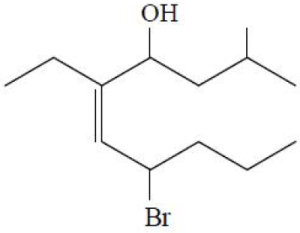
A
$6-$Ethyl$-9-$methyl$-4-$bromodec$-5-$en$-7-$ol
B
$7-$Bromo$-2-$methyl$-5-$ethyldec$-5-$en$-4-$ol
C
$7-$Bromo$-5-$ethyl$-2-$methyldec$-5-$en$-4-$ol
D
$4-$Bromo$-6-$ethyl$-9-$methyldec$-5-$en$-7-$ol
Solution
(C) $1$. Identify the longest carbon chain containing the principal functional group $(-OH)$ and the double bond. The chain has $10$ carbons,so the parent alkane is decane.
$2$. Number the chain starting from the end that gives the $-OH$ group the lowest possible locant. Numbering from right to left gives the $-OH$ group at position $4$.
$3$. The substituents are: bromo at $7$,ethyl at $5$,and methyl at $2$.
$4$. Alphabetical order of substituents: bromo,ethyl,methyl.
$5$. Combining these,the $IUPAC$ name is $7-$bromo$-5-$ethyl$-2-$methyldec$-5-$en$-4-$ol.
$2$. Number the chain starting from the end that gives the $-OH$ group the lowest possible locant. Numbering from right to left gives the $-OH$ group at position $4$.
$3$. The substituents are: bromo at $7$,ethyl at $5$,and methyl at $2$.
$4$. Alphabetical order of substituents: bromo,ethyl,methyl.
$5$. Combining these,the $IUPAC$ name is $7-$bromo$-5-$ethyl$-2-$methyldec$-5-$en$-4-$ol.
0 likesView Solution
58
ChemistryEasyMCQAP EAMCET · 2025
The correct decreasing order of priority for the functional groups of organic compounds in the $IUPAC$ system of nomenclature is:
A
$-COCl > -CONH_2 > -CHO > -OH$
B
$-CONH_2 > -CHO > -COCl > -OH$
C
$-COCl > -CHO > -CONH_2 > -OH$
D
$-CHO > -CONH_2 > -COCl > -OH$
Solution
(A) According to the $IUPAC$ priority rules for functional groups,the order of priority is:
$1$. Acid halides $(-COCl)$
$2$. Amides $(-CONH_2)$
$3$. Aldehydes $(-CHO)$
$4$. Alcohols $(-OH)$
Therefore,the correct decreasing order is $-COCl > -CONH_2 > -CHO > -OH$.
$1$. Acid halides $(-COCl)$
$2$. Amides $(-CONH_2)$
$3$. Aldehydes $(-CHO)$
$4$. Alcohols $(-OH)$
Therefore,the correct decreasing order is $-COCl > -CONH_2 > -CHO > -OH$.
0 likesView Solution
59
ChemistryEasyMCQAP EAMCET · 2025
$IUPAC$ names of mesityl oxide and oxalic acid are respectively
A
$4-$Methylpent$-3-$en$-2-$one; Ethanedioic acid
B
$4-$Methylpent$-3-$en$-2-$one; Propanedioic acid
C
$3-$Methylpent$-3-$en$-2-$one; Propanedioic acid
D
$3-$Methylpent$-3-$en$-2-$one; Ethanedioic acid
Solution
(A) Mesityl oxide is an $\alpha,\beta-$unsaturated ketone with the structure $(CH_3)_2C=CHCOCH_3$. The longest carbon chain containing the ketone group has $5$ carbons. Numbering from the end closer to the ketone group gives the name $4-$Methylpent$-3-$en$-2-$one.
Oxalic acid is the simplest dicarboxylic acid with the formula $(COOH)_2$. Its $IUPAC$ name is Ethanedioic acid.
Therefore,the correct $IUPAC$ names are $4-$Methylpent$-3-$en$-2-$one and Ethanedioic acid.
Oxalic acid is the simplest dicarboxylic acid with the formula $(COOH)_2$. Its $IUPAC$ name is Ethanedioic acid.
Therefore,the correct $IUPAC$ names are $4-$Methylpent$-3-$en$-2-$one and Ethanedioic acid.
0 likesView Solution
60
ChemistryMediumMCQAP EAMCET · 2025
The $IUPAC$ name of the following compound is:
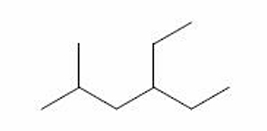
A
$3-$Ethyl$-5-$methylhexane
B
$4-$Ethyl$-2-$methylhexane
C
$2-$Methyl$-4-$ethylhexane
D
$5-$Methyl$-3-$ethylhexane
Solution
(B) $1$. Identify the longest carbon chain. The longest chain contains $6$ carbon atoms,so the parent alkane is hexane.
$2$. Number the chain from the end that gives the substituents the lowest possible locants. Numbering from left to right gives substituents at positions $2$ and $4$. Numbering from right to left gives substituents at positions $3$ and $5$. Thus,the correct numbering is from left to right.
$3$. The substituents are a methyl group at position $2$ and an ethyl group at position $4$.
$4$. According to $IUPAC$ rules,substituents are listed in alphabetical order. Therefore,ethyl comes before methyl.
$5$. Combining these,the $IUPAC$ name is $4-$Ethyl$-2-$methylhexane.
$2$. Number the chain from the end that gives the substituents the lowest possible locants. Numbering from left to right gives substituents at positions $2$ and $4$. Numbering from right to left gives substituents at positions $3$ and $5$. Thus,the correct numbering is from left to right.
$3$. The substituents are a methyl group at position $2$ and an ethyl group at position $4$.
$4$. According to $IUPAC$ rules,substituents are listed in alphabetical order. Therefore,ethyl comes before methyl.
$5$. Combining these,the $IUPAC$ name is $4-$Ethyl$-2-$methylhexane.
0 likesView Solution
61
ChemistryMediumMCQAP EAMCET · 2025
$IUPAC$ names of the given compounds $(I)$ and $(II)$ are respectively
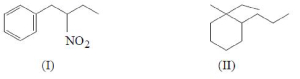
A
$5-$Phenyl$-3-$nitrobutane; $2-$ethyl$-2-$methyl$-1-$propylcyclohexane
B
$2-$Nitro$-1-$phenylbutane; $2-$ethyl$-2-$methyl$-1-$propylcyclohexane
C
$2-$Nitro$-1-$phenylbutane; $1-$ethyl$-1-$methyl$-2-$propylcyclohexane
D
$3-$Nitro$-5-$phenylbutane; $1-$ethyl$-1-$methyl$-2-$propylcyclohexane
Solution
(C) For compound $(I)$: The longest carbon chain containing the nitro group has $4$ carbons. Numbering starts from the end closer to the nitro group. The phenyl group is at position $1$. Thus,the name is $2-$nitro$-1-$phenylbutane.
For compound $(II)$: The ring is cyclohexane. Substituents are at positions $1$ and $2$. According to alphabetical order,ethyl comes before methyl and propyl. Numbering is done to give the lowest locants to substituents. The correct numbering gives $1-$ethyl$-1-$methyl$-2-$propylcyclohexane.
For compound $(II)$: The ring is cyclohexane. Substituents are at positions $1$ and $2$. According to alphabetical order,ethyl comes before methyl and propyl. Numbering is done to give the lowest locants to substituents. The correct numbering gives $1-$ethyl$-1-$methyl$-2-$propylcyclohexane.
0 likesView Solution
62
ChemistryMediumMCQAP EAMCET · 2025
In compound $(X)$,hyperconjugation is present and in $(Y)$,resonance effect is present. What are $X$ and $Y$,respectively?
A
Toluene,prop$-2-$en$-1-$ol
B
Aniline,$2-$propenal
C
Toluene,nitrobenzene
D
$1-$Bromopropane,phenol
Solution
(C) Hyperconjugation requires an $\alpha-$hydrogen atom attached to an $sp^2$ hybridized carbon atom. In Toluene $(C_6H_5CH_3)$,the methyl group has three $\alpha-$hydrogens attached to the benzene ring,exhibiting hyperconjugation.
Resonance effect involves the delocalization of $\pi-$electrons or lone pairs. In nitrobenzene $(C_6H_5NO_2)$,the nitro group is in conjugation with the benzene ring,exhibiting a strong resonance effect ($-M$ effect).
Therefore,$X$ is Toluene and $Y$ is nitrobenzene.
Resonance effect involves the delocalization of $\pi-$electrons or lone pairs. In nitrobenzene $(C_6H_5NO_2)$,the nitro group is in conjugation with the benzene ring,exhibiting a strong resonance effect ($-M$ effect).
Therefore,$X$ is Toluene and $Y$ is nitrobenzene.
0 likesView Solution
63
ChemistryMediumMCQAP EAMCET · 2025
Identify the most stable carbocation from the following:
A
Cyclohexyl cation
B
Cyclohex$-2-$en$-1-$yl cation
C
$1-$methyl$-2-$phenylcyclohex$-2-$en$-1-$yl cation
D
($3$-phenylcyclohexyl)methyl cation
Solution
(C) The stability of a carbocation is determined by factors such as resonance,hyperconjugation,and inductive effects.
$A$: Cyclohexyl cation is a secondary carbocation with no resonance stabilization.
$B$: Cyclohex$-2-$en$-1-$yl cation is an allylic carbocation,which is stabilized by resonance with the adjacent double bond.
$C$: $1-$methyl$-2-$phenylcyclohex$-2-$en$-1-$yl cation is a tertiary allylic carbocation. It is stabilized by resonance with the adjacent double bond and the phenyl group,as well as by the inductive effect of the methyl group. This extensive delocalization of the positive charge makes it the most stable among the given options.
$D$: ($3$-phenylcyclohexyl)methyl cation is a primary carbocation,which is generally the least stable.
Therefore,the most stable carbocation is the one in option $C$.
$A$: Cyclohexyl cation is a secondary carbocation with no resonance stabilization.
$B$: Cyclohex$-2-$en$-1-$yl cation is an allylic carbocation,which is stabilized by resonance with the adjacent double bond.
$C$: $1-$methyl$-2-$phenylcyclohex$-2-$en$-1-$yl cation is a tertiary allylic carbocation. It is stabilized by resonance with the adjacent double bond and the phenyl group,as well as by the inductive effect of the methyl group. This extensive delocalization of the positive charge makes it the most stable among the given options.
$D$: ($3$-phenylcyclohexyl)methyl cation is a primary carbocation,which is generally the least stable.
Therefore,the most stable carbocation is the one in option $C$.
0 likesView Solution
64
ChemistryMediumMCQAP EAMCET · 2025
Consider the sets $I$,$II$,and $III$. Identify the set$(s)$ which is (are) correctly matched.
$I$. $\text{Staggered ethane} > \text{eclipsed ethane} \dots \dots \dots \text{torsional strain}$.
$II$. $2, 2-\text{Dimethylbutane} > 2-\text{methylpentane} \dots \dots \dots \text{boiling point}$.
$III$. $cis-\text{but}-2-\text{ene} > trans-\text{but}-2-\text{ene} \dots \dots \dots \text{dipole moment}$.
$I$. $\text{Staggered ethane} > \text{eclipsed ethane} \dots \dots \dots \text{torsional strain}$.
$II$. $2, 2-\text{Dimethylbutane} > 2-\text{methylpentane} \dots \dots \dots \text{boiling point}$.
$III$. $cis-\text{but}-2-\text{ene} > trans-\text{but}-2-\text{ene} \dots \dots \dots \text{dipole moment}$.
A
$I, II$ only
B
$II, III$ only
C
$III$ only
D
$I, II, III$
Solution
(C) $I$. Torsional strain is higher in eclipsed ethane due to repulsion between hydrogen atoms on adjacent carbons. Thus,$\text{staggered ethane} < \text{eclipsed ethane}$. This statement is incorrect.
$II$. $2, 2-\text{Dimethylbutane}$ is more branched than $2-\text{methylpentane}$. Increased branching decreases the surface area,leading to weaker van der Waals forces and a lower boiling point. Thus,$2, 2-\text{Dimethylbutane} < 2-\text{methylpentane}$. This statement is incorrect.
$III$. $cis-\text{but}-2-\text{ene}$ has a net dipole moment due to the same side orientation of methyl groups,whereas $trans-\text{but}-2-\text{ene}$ has a zero net dipole moment due to symmetry. Thus,$cis-\text{but}-2-\text{ene} > trans-\text{but}-2-\text{ene}$. This statement is correct.
$II$. $2, 2-\text{Dimethylbutane}$ is more branched than $2-\text{methylpentane}$. Increased branching decreases the surface area,leading to weaker van der Waals forces and a lower boiling point. Thus,$2, 2-\text{Dimethylbutane} < 2-\text{methylpentane}$. This statement is incorrect.
$III$. $cis-\text{but}-2-\text{ene}$ has a net dipole moment due to the same side orientation of methyl groups,whereas $trans-\text{but}-2-\text{ene}$ has a zero net dipole moment due to symmetry. Thus,$cis-\text{but}-2-\text{ene} > trans-\text{but}-2-\text{ene}$. This statement is correct.
0 likesView Solution
65
ChemistryEasyMCQAP EAMCET · 2025
Which method is used to purify liquids having very high boiling points and liquids which decompose at or below their boiling point?
A
Distillation
B
Fractional distillation
C
Distillation under reduced pressure
D
Steam distillation
Solution
(C) Liquids that have very high boiling points or decompose at or below their boiling point cannot be purified by simple distillation because they would degrade before vaporizing.
Distillation under reduced pressure (also known as vacuum distillation) is used in these cases.
By reducing the pressure above the liquid,the boiling point of the liquid is lowered,allowing it to boil and vaporize at a temperature below its decomposition point.
Distillation under reduced pressure (also known as vacuum distillation) is used in these cases.
By reducing the pressure above the liquid,the boiling point of the liquid is lowered,allowing it to boil and vaporize at a temperature below its decomposition point.
0 likesView Solution
66
ChemistryEasyMCQAP EAMCET · 2025
The element whose percentage composition in an organic compound can be determined by the Carius method is
A
Nitrogen
B
Sulphur
C
Carbon
D
Oxygen
Solution
(B) The Carius method is a standard analytical technique used for the quantitative estimation of halogens,sulphur,and phosphorus in organic compounds.
In this method,a known mass of the organic compound is heated with fuming nitric acid in a hard glass tube known as a Carius tube.
Sulphur is oxidized to sulphuric acid,which is then precipitated as barium sulphate $(BaSO_4)$ by adding barium chloride $(BaCl_2)$.
Therefore,among the given options,sulphur is the element determined by this method.
In this method,a known mass of the organic compound is heated with fuming nitric acid in a hard glass tube known as a Carius tube.
Sulphur is oxidized to sulphuric acid,which is then precipitated as barium sulphate $(BaSO_4)$ by adding barium chloride $(BaCl_2)$.
Therefore,among the given options,sulphur is the element determined by this method.
0 likesView Solution
67
ChemistryMediumMCQAP EAMCET · 2025
When ethyl bromide and $n$-propyl bromide are allowed to react with $Na$ metal in dry ether,the number of different alkanes formed is
A
$1$
B
$2$
C
$3$
D
$4$
Solution
(C) The reaction of a mixture of two different alkyl halides with $Na$ metal in dry ether is known as the Wurtz reaction.
When a mixture of ethyl bromide $(C_2H_5Br)$ and $n$-propyl bromide $(C_3H_7Br)$ reacts with $Na$ in dry ether,three different alkanes are formed due to the coupling of alkyl radicals:
$1$. Coupling of two ethyl radicals: $C_2H_5-C_2H_5$ ($n$-butane)
$2$. Coupling of two $n$-propyl radicals: $C_3H_7-C_3H_7$ ($n$-hexane)
$3$. Cross-coupling of one ethyl and one $n$-propyl radical: $C_2H_5-C_3H_7$ ($n$-pentane)
Thus,a total of $3$ different alkanes are formed.
When a mixture of ethyl bromide $(C_2H_5Br)$ and $n$-propyl bromide $(C_3H_7Br)$ reacts with $Na$ in dry ether,three different alkanes are formed due to the coupling of alkyl radicals:
$1$. Coupling of two ethyl radicals: $C_2H_5-C_2H_5$ ($n$-butane)
$2$. Coupling of two $n$-propyl radicals: $C_3H_7-C_3H_7$ ($n$-hexane)
$3$. Cross-coupling of one ethyl and one $n$-propyl radical: $C_2H_5-C_3H_7$ ($n$-pentane)
Thus,a total of $3$ different alkanes are formed.
0 likesView Solution
68
ChemistryMediumMCQAP EAMCET · 2025
What are $X$ and $Y$ respectively in the following sets of reactions?
$I. \ CH_3CH_2CH_2OH \xrightarrow{PBr_3} X$
$II. \ CH_3CH=CH_2 \xrightarrow{HBr, (C_6H_5COO)_2} Y \text{ (major)}$
$I. \ CH_3CH_2CH_2OH \xrightarrow{PBr_3} X$
$II. \ CH_3CH=CH_2 \xrightarrow{HBr, (C_6H_5COO)_2} Y \text{ (major)}$
A
$CH_3CH(Br)CH_3, \ CH_3CH_2CH_2Br$
B
$CH_3CH_2CH_2Br, \ CH_3CH_2CH_2Br$
C
$CH_3CH_2CH_2Br, \ CH_3CH(Br)CH_3$
D
$CH_3CH(Br)CH_3, \ CH_3CH(Br)CH_3$
Solution
(B) In reaction $I$,the reaction of $n$-propanol with $PBr_3$ is a nucleophilic substitution reaction ($S_N2$ mechanism) which converts the alcohol group into a bromide,yielding $n$-propyl bromide $(CH_3CH_2CH_2Br)$.
In reaction $II$,the reaction of propene with $HBr$ in the presence of benzoyl peroxide $((C_6H_5COO)_2)$ proceeds via the anti-Markovnikov addition mechanism (peroxide effect or Kharasch effect). This results in the formation of $n$-propyl bromide $(CH_3CH_2CH_2Br)$ as the major product.
Therefore,$X = CH_3CH_2CH_2Br$ and $Y = CH_3CH_2CH_2Br$.
In reaction $II$,the reaction of propene with $HBr$ in the presence of benzoyl peroxide $((C_6H_5COO)_2)$ proceeds via the anti-Markovnikov addition mechanism (peroxide effect or Kharasch effect). This results in the formation of $n$-propyl bromide $(CH_3CH_2CH_2Br)$ as the major product.
Therefore,$X = CH_3CH_2CH_2Br$ and $Y = CH_3CH_2CH_2Br$.
0 likesView Solution
69
ChemistryMediumMCQAP EAMCET · 2025
Consider the following:
Statement-$I$ : Kolbe's electrolysis of sodium propionate gives $n$-hexane as product.
Statement-$II$ : In Kolbe's process,$CO_2$ is liberated at the anode and $H_2$ is liberated at the cathode.
The correct answer is:
Statement-$I$ : Kolbe's electrolysis of sodium propionate gives $n$-hexane as product.
Statement-$II$ : In Kolbe's process,$CO_2$ is liberated at the anode and $H_2$ is liberated at the cathode.
The correct answer is:
A
Both statement-$I$ and statement-$II$ are correct.
B
Both statement-$I$ and statement-$II$ are not correct.
C
Statement-$I$ is correct,but statement-$II$ is not correct.
D
Statement-$I$ is not correct,but statement-$II$ is correct.
Solution
(D) In Kolbe's electrolysis,the reaction is $2CH_3CH_2COONa + 2H_2O \xrightarrow{\text{electrolysis}} CH_3CH_2CH_2CH_2CH_3 + 2CO_2 + H_2 + 2NaOH$.
Statement-$I$: Sodium propionate $(CH_3CH_2COONa)$ undergoes electrolysis to form $n$-butane $(CH_3CH_2CH_2CH_3)$,not $n$-hexane. Thus,statement-$I$ is incorrect.
Statement-$II$: During the electrolysis of sodium salts of carboxylic acids,$CO_2$ is evolved at the anode and $H_2$ is evolved at the cathode. Thus,statement-$II$ is correct.
Statement-$I$: Sodium propionate $(CH_3CH_2COONa)$ undergoes electrolysis to form $n$-butane $(CH_3CH_2CH_2CH_3)$,not $n$-hexane. Thus,statement-$I$ is incorrect.
Statement-$II$: During the electrolysis of sodium salts of carboxylic acids,$CO_2$ is evolved at the anode and $H_2$ is evolved at the cathode. Thus,statement-$II$ is correct.
0 likesView Solution
70
ChemistryMediumMCQAP EAMCET · 2025
The empirical formula weight of '$Z$' in the given reaction sequence is
$n$-propyl bromide $\xrightarrow[\text{Dry ether}]{Na} X$ $\xrightarrow[\substack{773 \ K \\ 20 \ atm}]{V_2O_5} Y$ $\xrightarrow[\substack{UV \\ 500 \ K}]{Cl_2} Z$ (in $.5$)
$n$-propyl bromide $\xrightarrow[\text{Dry ether}]{Na} X$ $\xrightarrow[\substack{773 \ K \\ 20 \ atm}]{V_2O_5} Y$ $\xrightarrow[\substack{UV \\ 500 \ K}]{Cl_2} Z$ (in $.5$)
A
$47$
B
$54$
C
$84$
D
$48$
Solution
(D) $1$. $n$-propyl bromide $(CH_3CH_2CH_2Br)$ reacts with $Na$ in dry ether (Wurtz reaction) to form $n$-hexane $(X)$: $2CH_3CH_2CH_2Br + 2Na \rightarrow CH_3(CH_2)_4CH_3 + 2NaBr$.
$2$. $n$-hexane $(X)$ undergoes catalytic aromatization with $V_2O_5$ at $773 \ K$ and $20 \ atm$ to form benzene $(Y)$: $C_6H_{14} \rightarrow C_6H_6 + 4H_2$.
$3$. Benzene $(Y)$ reacts with $Cl_2$ under $UV$ light at $500 \ K$ (free radical substitution/addition conditions). Given the context of industrial synthesis,this typically leads to chlorobenzene or hexachlorocyclohexane. However,standard textbook sequences for this path lead to chlorobenzene $(C_6H_5Cl)$ $(Z)$.
$4$. The molecular formula of chlorobenzene is $C_6H_5Cl$. The empirical formula is also $C_6H_5Cl$.
$5$. Empirical formula weight = $(6 \times 12) + (5 \times 1) + 35.5 = 72 + 5 + 35.5 = 112.5$.
$6$. Re-evaluating the sequence: If $Z$ is $C_6H_6Cl_6$ $(BHC)$,empirical formula is $CHCl$. Weight = $12 + 1 + 35.5 = 48.5$. This matches option $D$.
$2$. $n$-hexane $(X)$ undergoes catalytic aromatization with $V_2O_5$ at $773 \ K$ and $20 \ atm$ to form benzene $(Y)$: $C_6H_{14} \rightarrow C_6H_6 + 4H_2$.
$3$. Benzene $(Y)$ reacts with $Cl_2$ under $UV$ light at $500 \ K$ (free radical substitution/addition conditions). Given the context of industrial synthesis,this typically leads to chlorobenzene or hexachlorocyclohexane. However,standard textbook sequences for this path lead to chlorobenzene $(C_6H_5Cl)$ $(Z)$.
$4$. The molecular formula of chlorobenzene is $C_6H_5Cl$. The empirical formula is also $C_6H_5Cl$.
$5$. Empirical formula weight = $(6 \times 12) + (5 \times 1) + 35.5 = 72 + 5 + 35.5 = 112.5$.
$6$. Re-evaluating the sequence: If $Z$ is $C_6H_6Cl_6$ $(BHC)$,empirical formula is $CHCl$. Weight = $12 + 1 + 35.5 = 48.5$. This matches option $D$.
0 likesView Solution
71
ChemistryEasyMCQAP EAMCET · 2025
The catalyst used for the isomerisation of $n$-alkanes to branched chain alkanes is
A
Anhy. $AlCl_3 / HCl$
B
$Mo_2O_3$
C
$FeCl_3$
D
$TiCl_4 + R_3Al$
Solution
(A) The isomerisation of $n$-alkanes to branched chain alkanes is a process used to improve the octane rating of fuel.
This reaction is typically carried out in the presence of a Lewis acid catalyst,such as anhydrous $AlCl_3$ combined with $HCl$ gas.
Therefore,the correct catalyst is anhydrous $AlCl_3 / HCl$.
This reaction is typically carried out in the presence of a Lewis acid catalyst,such as anhydrous $AlCl_3$ combined with $HCl$ gas.
Therefore,the correct catalyst is anhydrous $AlCl_3 / HCl$.
0 likesView Solution
72
ChemistryMediumMCQAP EAMCET · 2025
What is $Z$ in the following reaction sequence ?
$C_3H_6$ $\xrightarrow[CCl_4]{Br_2} \underset{\text{(colourless)}}{X}$ $\xrightarrow[\text{(ii) } NaNH_2, \Delta]{\text{(i) } KOH / \text{alcohol}} Y$ $\xrightarrow[\substack{Hg^{2+}, H^{+} \\ 333 \ K}]{H_2O} Z$
$C_3H_6$ $\xrightarrow[CCl_4]{Br_2} \underset{\text{(colourless)}}{X}$ $\xrightarrow[\text{(ii) } NaNH_2, \Delta]{\text{(i) } KOH / \text{alcohol}} Y$ $\xrightarrow[\substack{Hg^{2+}, H^{+} \\ 333 \ K}]{H_2O} Z$
A
Acetone
B
Propanal
C
Propanol-$2$
D
Methoxy ethane
Solution
(A) Step $1$: $C_3H_6$ (Propene) reacts with $Br_2$ in $CCl_4$ to form $X$,which is $1,2$-dibromopropane $(CH_3-CHBr-CH_2Br)$.
Step $2$: $1,2$-dibromopropane reacts with alcoholic $KOH$ followed by $NaNH_2$ and heat (dehydrohalogenation) to form $Y$,which is $CH_3-C \equiv CH$ (Propyne).
Step $3$: Propyne undergoes hydration in the presence of $Hg^{2+}$ and $H^+$ at $333 \ K$ (Kucherov reaction) to form an enol intermediate,which tautomerizes to form $Z$,which is $CH_3-CO-CH_3$ (Acetone).
Step $2$: $1,2$-dibromopropane reacts with alcoholic $KOH$ followed by $NaNH_2$ and heat (dehydrohalogenation) to form $Y$,which is $CH_3-C \equiv CH$ (Propyne).
Step $3$: Propyne undergoes hydration in the presence of $Hg^{2+}$ and $H^+$ at $333 \ K$ (Kucherov reaction) to form an enol intermediate,which tautomerizes to form $Z$,which is $CH_3-CO-CH_3$ (Acetone).
0 likesView Solution
73
ChemistryMediumMCQAP EAMCET · 2025
What are $B$ and $C$ respectively in the following set of reactions?
$C \xleftarrow[\Delta]{Zn} 1,2-\text{dibromopropane}$ $\xrightarrow[\text {(ii) } NaNH_2]{\text {(i) alc. } KOH} A$ $\xrightarrow[\text { Catalyst }]{\text { Lindlar }} B$
$C \xleftarrow[\Delta]{Zn} 1,2-\text{dibromopropane}$ $\xrightarrow[\text {(ii) } NaNH_2]{\text {(i) alc. } KOH} A$ $\xrightarrow[\text { Catalyst }]{\text { Lindlar }} B$
A
Propene,Propene
B
Propane,Propane
C
Propene,Propane
D
Propane,Propene
Solution
(A) $1$. Reaction of $1,2-\text{dibromopropane}$ with $Zn$ and $\Delta$ (dehalogenation) yields $C = \text{propene}$ $(CH_3-CH=CH_2)$.
$2$. Reaction of $1,2-\text{dibromopropane}$ with $(i)$ $\text{alc. } KOH$ and (ii) $NaNH_2$ (dehydrohalogenation) yields $A = \text{propyne}$ $(CH_3-C \equiv CH)$.
$3$. Hydrogenation of $A$ $(\text{propyne})$ using $\text{Lindlar catalyst}$ yields $B = \text{propene}$ $(CH_3-CH=CH_2)$.
$4$. Thus,$B$ is $\text{propene}$ and $C$ is $\text{propene}$.
$2$. Reaction of $1,2-\text{dibromopropane}$ with $(i)$ $\text{alc. } KOH$ and (ii) $NaNH_2$ (dehydrohalogenation) yields $A = \text{propyne}$ $(CH_3-C \equiv CH)$.
$3$. Hydrogenation of $A$ $(\text{propyne})$ using $\text{Lindlar catalyst}$ yields $B = \text{propene}$ $(CH_3-CH=CH_2)$.
$4$. Thus,$B$ is $\text{propene}$ and $C$ is $\text{propene}$.
0 likesView Solution
74
ChemistryEasyMCQAP EAMCET · 2025
In Buckminsterfullerene,the number of six-membered carbon rings is '$x$' and five-membered carbon rings is '$y$'. The $(x+y)$ value is
A
$30$
B
$31$
C
$32$
D
$33$
Solution
(C) Buckminsterfullerene $(C_{60})$ is an allotrope of carbon consisting of $60$ carbon atoms arranged in a soccer ball-like structure.
It contains $20$ six-membered rings $(x = 20)$ and $12$ five-membered rings $(y = 12)$.
Therefore,the value of $(x+y) = 20 + 12 = 32$.
It contains $20$ six-membered rings $(x = 20)$ and $12$ five-membered rings $(y = 12)$.
Therefore,the value of $(x+y) = 20 + 12 = 32$.
0 likesView Solution
75
ChemistryMediumMCQAP EAMCET · 2025
Consider the following reaction sequence:
Vinylbenzene $\xrightarrow[\Delta]{KMnO_4+KOH} X$ $\xrightarrow[\Delta]{NaOH+CaO} Y$
'$Y$' can also be formed from:
Vinylbenzene $\xrightarrow[\Delta]{KMnO_4+KOH} X$ $\xrightarrow[\Delta]{NaOH+CaO} Y$
'$Y$' can also be formed from:
A
Polymerisation of ethylene
B
Polymerisation of propyne
C
Aromatisation of $n-$hexane
D
Aromatisation of $n-$heptane
Solution
(C) $1$. Vinylbenzene $(C_6H_5-CH=CH_2)$ on oxidation with alkaline $KMnO_4$ followed by heating undergoes oxidative cleavage of the side chain to form Potassium benzoate $(C_6H_5COOK)$,which on acidification gives Benzoic acid $(C_6H_5COOH)$. Thus,$X$ is Benzoic acid.
$2$. Benzoic acid $(C_6H_5COOH)$ reacts with Sodalime $(NaOH+CaO)$ upon heating (decarboxylation) to form Benzene $(C_6H_6)$. Thus,$Y$ is Benzene.
$3$. Benzene can be prepared by the aromatisation (dehydrocyclisation) of $n-$hexane $(C_6H_{14})$ in the presence of catalysts like $Cr_2O_3/Al_2O_3$ at high temperature and pressure.
$2$. Benzoic acid $(C_6H_5COOH)$ reacts with Sodalime $(NaOH+CaO)$ upon heating (decarboxylation) to form Benzene $(C_6H_6)$. Thus,$Y$ is Benzene.
$3$. Benzene can be prepared by the aromatisation (dehydrocyclisation) of $n-$hexane $(C_6H_{14})$ in the presence of catalysts like $Cr_2O_3/Al_2O_3$ at high temperature and pressure.
0 likesView Solution
76
ChemistryMediumMCQAP EAMCET · 2025
What are the major products $X$ and $Y$ respectively in the following set of reactions?
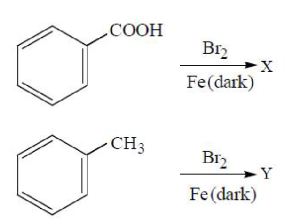
A
m-bromobenzoic acid,p-bromotoluene
B
p-bromobenzoic acid,p-bromotoluene
C
p-bromobenzoic acid,m-bromotoluene
D
m-bromobenzoic acid,p-bromotoluene
Solution
(D) The reaction of benzoic acid $(C_6H_5COOH)$ with $Br_2$ in the presence of $Fe$ (dark) is an electrophilic aromatic substitution. The $-COOH$ group is a deactivating and meta-directing group,so the major product $X$ is $m$-bromobenzoic acid.
The reaction of toluene $(C_6H_5CH_3)$ with $Br_2$ in the presence of $Fe$ (dark) is also an electrophilic aromatic substitution. The $-CH_3$ group is an activating and ortho/para-directing group. Due to steric hindrance at the ortho position,the major product $Y$ is $p$-bromotoluene.
Therefore,the major products are $m$-bromobenzoic acid and $p$-bromotoluene.
The reaction of toluene $(C_6H_5CH_3)$ with $Br_2$ in the presence of $Fe$ (dark) is also an electrophilic aromatic substitution. The $-CH_3$ group is an activating and ortho/para-directing group. Due to steric hindrance at the ortho position,the major product $Y$ is $p$-bromotoluene.
Therefore,the major products are $m$-bromobenzoic acid and $p$-bromotoluene.
0 likesView Solution
77
ChemistryMediumMCQAP EAMCET · 2025
Observe the following reactions:
$I$. $N_{2(g)} + 3H_{2(g)} \xrightarrow[773 \ K, \ 200 \ atm]{X} 2NH_{3(g)}$
$II$. $CO_{(g)} + H_{2}O_{(g)} \xrightarrow[673 \ K]{Y} CO_{2(g)} + H_{2(g)}$
$III$. $CH_{4(g)} + H_{2}O_{(g)} \xrightarrow[1270 \ K]{Z} CO_{(g)} + 3H_{2(g)}$
Catalysts $X$,$Y$,and $Z$ respectively are:
$I$. $N_{2(g)} + 3H_{2(g)} \xrightarrow[773 \ K, \ 200 \ atm]{X} 2NH_{3(g)}$
$II$. $CO_{(g)} + H_{2}O_{(g)} \xrightarrow[673 \ K]{Y} CO_{2(g)} + H_{2(g)}$
$III$. $CH_{4(g)} + H_{2}O_{(g)} \xrightarrow[1270 \ K]{Z} CO_{(g)} + 3H_{2(g)}$
Catalysts $X$,$Y$,and $Z$ respectively are:
A
Iron,sodium arsenite,cobalt
B
Iron,zinc,cobalt
C
Cobalt,zinc,nickel
D
Iron,iron chromate,nickel
Solution
(D) The reactions provided are industrial processes for the production of hydrogen and ammonia:
$I$. This is the Haber process for the synthesis of ammonia,where $X$ is $Fe$ (Iron) with $Mo$ as a promoter.
$II$. This is the water-gas shift reaction,where $Y$ is $FeCrO_4$ (Iron chromate).
$III$. This is the steam reforming of methane,where $Z$ is $Ni$ (Nickel).
Therefore,the catalysts $X$,$Y$,and $Z$ are Iron,iron chromate,and nickel respectively.
$I$. This is the Haber process for the synthesis of ammonia,where $X$ is $Fe$ (Iron) with $Mo$ as a promoter.
$II$. This is the water-gas shift reaction,where $Y$ is $FeCrO_4$ (Iron chromate).
$III$. This is the steam reforming of methane,where $Z$ is $Ni$ (Nickel).
Therefore,the catalysts $X$,$Y$,and $Z$ are Iron,iron chromate,and nickel respectively.
0 likesView Solution
78
ChemistryMediumMCQAP EAMCET · 2025
The incorrect statement among the following is:
A
Ionic hydrides are crystalline in nature.
B
Group $14$ elements form electron-precise hydrides.
C
Covalent hydrides are non-volatile compounds.
D
Generally,saline hydrides react violently with water.
Solution
(C) $1$. Ionic (or saline) hydrides are stoichiometric compounds formed by $s$-block elements. They are crystalline,non-volatile,and non-conducting solids in their solid state. They react violently with water to produce $H_2$ gas.
$2$. Group $14$ elements (like $CH_4$,$SiH_4$) have the required number of electrons to form normal covalent bonds,hence they are called electron-precise hydrides.
$3$. Covalent (or molecular) hydrides are generally volatile compounds with low boiling points and melting points,as they are held together by weak van der Waals forces. Therefore,the statement that covalent hydrides are non-volatile is incorrect.
$2$. Group $14$ elements (like $CH_4$,$SiH_4$) have the required number of electrons to form normal covalent bonds,hence they are called electron-precise hydrides.
$3$. Covalent (or molecular) hydrides are generally volatile compounds with low boiling points and melting points,as they are held together by weak van der Waals forces. Therefore,the statement that covalent hydrides are non-volatile is incorrect.
0 likesView Solution
79
ChemistryMediumMCQAP EAMCET · 2025
Which set of elements form electron precise hydrides?
A
$B, Al, Ga$
B
$C, Si, Ge$
C
$N, P, As$
D
$B, C, N$
Solution
(B) Electron precise hydrides are formed by elements of group $14$ of the periodic table.
These elements have exactly the number of electrons required to form the necessary covalent bonds (e.g.,$CH_4$,$SiH_4$,$GeH_4$).
Among the given options,$C, Si, Ge$ belong to group $14$ and thus form electron precise hydrides.
These elements have exactly the number of electrons required to form the necessary covalent bonds (e.g.,$CH_4$,$SiH_4$,$GeH_4$).
Among the given options,$C, Si, Ge$ belong to group $14$ and thus form electron precise hydrides.
0 likesView Solution
80
ChemistryMediumMCQAP EAMCET · 2025
Identify the hydride which is not correctly matched with the example given in brackets?
A
Saline hydride - $(NaH)$
B
Electron rich hydride - $(H_2O)$
C
Electron deficient hydride - $(B_2H_6)$
D
Electron precise hydride - $(HF)$
Solution
(D) Hydrides are classified based on their electronic structure:
$1$. Saline (ionic) hydrides: Formed by $s$-block elements,e.g.,$(NaH)$.
$2$. Electron-deficient hydrides: Have fewer electrons than required for bonding,e.g.,$(B_2H_6)$.
$3$. Electron-precise hydrides: Have the exact number of electrons for bonding,e.g.,$(CH_4)$.
$4$. Electron-rich hydrides: Have lone pairs of electrons,e.g.,$(H_2O, NH_3, HF)$.
In option $(D)$,$(HF)$ is an electron-rich hydride because it has lone pairs on the fluorine atom,not an electron-precise hydride. Therefore,$(D)$ is incorrectly matched.
$1$. Saline (ionic) hydrides: Formed by $s$-block elements,e.g.,$(NaH)$.
$2$. Electron-deficient hydrides: Have fewer electrons than required for bonding,e.g.,$(B_2H_6)$.
$3$. Electron-precise hydrides: Have the exact number of electrons for bonding,e.g.,$(CH_4)$.
$4$. Electron-rich hydrides: Have lone pairs of electrons,e.g.,$(H_2O, NH_3, HF)$.
In option $(D)$,$(HF)$ is an electron-rich hydride because it has lone pairs on the fluorine atom,not an electron-precise hydride. Therefore,$(D)$ is incorrectly matched.
0 likesView Solution
81
ChemistryMediumMCQAP EAMCET · 2025
Consider the following statements:
Statement-$I$: $H_2O_2$ acts as an oxidising as well as a reducing agent in both acidic and basic media.
Statement-$II$: $10 \ V \ H_2O_2$ sample means it contains $3.03\% \ (w/v) \ H_2O_2$.
Statement-$I$: $H_2O_2$ acts as an oxidising as well as a reducing agent in both acidic and basic media.
Statement-$II$: $10 \ V \ H_2O_2$ sample means it contains $3.03\% \ (w/v) \ H_2O_2$.
A
Both statement-$I$ and statement-$II$ are correct
B
Statement-$I$ is correct,but statement-$II$ is not correct
C
Statement-$I$ is not correct,but statement-$II$ is correct
D
Both statement-$I$ and statement-$II$ are not correct.
Solution
(B) Statement-$I$ is correct: $H_2O_2$ has an oxidation state of $-1$ for oxygen. It can be reduced to $H_2O$ (oxidation state $-2$) or oxidized to $O_2$ (oxidation state $0$),allowing it to act as both an oxidizing and a reducing agent in acidic and basic media.
Statement-$II$ is incorrect: $10 \ V \ H_2O_2$ means $1 \ mL$ of $H_2O_2$ solution gives $10 \ mL$ of $O_2$ at $STP$.
The decomposition reaction is: $2H_2O_2 \rightarrow 2H_2O + O_2$.
$2 \times 34 \ g$ of $H_2O_2$ produces $22400 \ mL$ of $O_2$ at $STP$.
So,$22400 \ mL \ O_2$ is produced by $68 \ g \ H_2O_2$.
$10 \ mL \ O_2$ is produced by $(68 \times 10) / 22400 \approx 0.03036 \ g \ H_2O_2$.
Since this is in $1 \ mL$ of solution,the concentration is $0.03036 \ g/mL$,which is $3.03\% \ (w/v)$. The statement claims $6\%$,which is incorrect.
Statement-$II$ is incorrect: $10 \ V \ H_2O_2$ means $1 \ mL$ of $H_2O_2$ solution gives $10 \ mL$ of $O_2$ at $STP$.
The decomposition reaction is: $2H_2O_2 \rightarrow 2H_2O + O_2$.
$2 \times 34 \ g$ of $H_2O_2$ produces $22400 \ mL$ of $O_2$ at $STP$.
So,$22400 \ mL \ O_2$ is produced by $68 \ g \ H_2O_2$.
$10 \ mL \ O_2$ is produced by $(68 \times 10) / 22400 \approx 0.03036 \ g \ H_2O_2$.
Since this is in $1 \ mL$ of solution,the concentration is $0.03036 \ g/mL$,which is $3.03\% \ (w/v)$. The statement claims $6\%$,which is incorrect.
0 likesView Solution
82
ChemistryEasyMCQAP EAMCET · 2025
Which of the following properties is less for $D_2O$ than $H_2O$?
A
Dielectric constant
B
Viscosity
C
Density
D
Melting point
Solution
(A) The physical properties of $D_2O$ (heavy water) are generally higher than those of $H_2O$ due to stronger hydrogen bonding and higher molecular mass.
Specifically,the dielectric constant of $D_2O$ is $78.06$ at $298 \ K$,whereas for $H_2O$ it is $78.39$ at $298 \ K$.
Thus,the dielectric constant of $D_2O$ is less than that of $H_2O$.
Specifically,the dielectric constant of $D_2O$ is $78.06$ at $298 \ K$,whereas for $H_2O$ it is $78.39$ at $298 \ K$.
Thus,the dielectric constant of $D_2O$ is less than that of $H_2O$.
0 likesView Solution
83
ChemistryMediumMCQAP EAMCET · 2025
At $25^{\circ} C$,$K_{a}$ of formic acid is $1.8 \times 10^{-4}$. What is the $K_{b}$ of $HCOO^{-}$?
A
$1.8 \times 10^{-10}$
B
$5.55 \times 10^{-4}$
C
$5.55 \times 10^{-11}$
D
$5.55 \times 10^{-12}$
Solution
(C) The relationship between the dissociation constant of a weak acid $(K_{a})$ and the dissociation constant of its conjugate base $(K_{b})$ is given by the equation: $K_{a} \times K_{b} = K_{w}$.
At $25^{\circ} C$,the ionic product of water is $K_{w} = 1.0 \times 10^{-14}$.
Given $K_{a} = 1.8 \times 10^{-4}$ for formic acid $(HCOOH)$.
Therefore,$K_{b} = \frac{K_{w}}{K_{a}} = \frac{1.0 \times 10^{-14}}{1.8 \times 10^{-4}}$.
$K_{b} = 0.555 \times 10^{-10} = 5.55 \times 10^{-11}$.
At $25^{\circ} C$,the ionic product of water is $K_{w} = 1.0 \times 10^{-14}$.
Given $K_{a} = 1.8 \times 10^{-4}$ for formic acid $(HCOOH)$.
Therefore,$K_{b} = \frac{K_{w}}{K_{a}} = \frac{1.0 \times 10^{-14}}{1.8 \times 10^{-4}}$.
$K_{b} = 0.555 \times 10^{-10} = 5.55 \times 10^{-11}$.
0 likesView Solution
84
ChemistryMediumMCQAP EAMCET · 2025
The conjugate base of phosphorus acid is $x$. The conjugate base of oleum is $y$. What are $x$ and $y$,respectively?
A
$H_2PO_4^{-}, H_2S_2O_7^{-}$
B
$H_2PO_4^{-}, HSO_5^{-}$
C
$H_2PO_3^{-}, HS_2O_7^{-}$
D
$H_2PO_3^{-}, HSO_4^{-}$
Solution
(C) The conjugate base is formed by removing one proton $(H^+)$ from the acid.
Phosphorous acid is $H_3PO_3$. Removing one $H^+$ gives $H_2PO_3^-$. Thus,$x = H_2PO_3^-$.
Oleum is $H_2S_2O_7$. Removing one $H^+$ gives $HS_2O_7^-$. Thus,$y = HS_2O_7^-$.
Therefore,the correct pair is $(x, y) = (H_2PO_3^-, HS_2O_7^-)$.
Phosphorous acid is $H_3PO_3$. Removing one $H^+$ gives $H_2PO_3^-$. Thus,$x = H_2PO_3^-$.
Oleum is $H_2S_2O_7$. Removing one $H^+$ gives $HS_2O_7^-$. Thus,$y = HS_2O_7^-$.
Therefore,the correct pair is $(x, y) = (H_2PO_3^-, HS_2O_7^-)$.
0 likesView Solution
85
ChemistryMediumMCQAP EAMCET · 2025
At $25^{\circ} C$,the percentage of ionization of $x \ M$ acetic acid is $4.242$. What is the pH of the acetic acid solution?
$(\log 4.242=0.6275) ;(\log 0.04242=-1.372) \quad (K_a=1.8 \times 10^{-5})$
$(\log 4.242=0.6275) ;(\log 0.04242=-1.372) \quad (K_a=1.8 \times 10^{-5})$
A
$3.37$
B
$1.7$
C
$1.37$
D
$2.37$
Solution
(A) For a weak acid,the dissociation constant $K_a$ is given by $K_a = C \alpha^2$,where $C$ is the concentration and $\alpha$ is the degree of ionization.
Given $\alpha = 4.242 \% = 0.04242$ and $K_a = 1.8 \times 10^{-5}$.
$1.8 \times 10^{-5} = C \times (0.04242)^2$.
$C = \frac{1.8 \times 10^{-5}}{0.001799} \approx 0.01 \ M$.
The concentration of $H^+$ ions is $[H^+] = C \alpha = 0.01 \times 0.04242 = 4.242 \times 10^{-4} \ M$.
The pH is calculated as $pH = -\log[H^+] = -\log(4.242 \times 10^{-4})$.
$pH = -(\log 4.242 + \log 10^{-4}) = -(0.6275 - 4) = 3.3725 \approx 3.37$.
Given $\alpha = 4.242 \% = 0.04242$ and $K_a = 1.8 \times 10^{-5}$.
$1.8 \times 10^{-5} = C \times (0.04242)^2$.
$C = \frac{1.8 \times 10^{-5}}{0.001799} \approx 0.01 \ M$.
The concentration of $H^+$ ions is $[H^+] = C \alpha = 0.01 \times 0.04242 = 4.242 \times 10^{-4} \ M$.
The pH is calculated as $pH = -\log[H^+] = -\log(4.242 \times 10^{-4})$.
$pH = -(\log 4.242 + \log 10^{-4}) = -(0.6275 - 4) = 3.3725 \approx 3.37$.
0 likesView Solution
86
ChemistryMediumMCQAP EAMCET · 2025
The percentage of ionization of $1 \ L$ of $x \ M$ acetic acid is $4.242$ and is called solution "$A$". The percentage of ionization of $1 \ L$ of $y \ M$ acetic acid is $3$ and is called solution "$B$". Solution "$A$" is mixed with solution "$B$". What is the concentration of acetic acid in the resultant solution (in $M$)? $\left(K_{a} \text{ of acetic acid } = 1.8 \times 10^{-5}\right)$
A
$0.05$
B
$0.015$
C
$0.02$
D
$0.15$
Solution
(B) For a weak acid,the degree of ionization $\alpha$ is given by $\alpha = \sqrt{\frac{K_a}{C}}$,where $C$ is the molar concentration.
Given $K_a = 1.8 \times 10^{-5}$.
For solution "$A$": $\alpha_A = \frac{4.242}{100} = 0.04242$. Thus,$0.04242 = \sqrt{\frac{1.8 \times 10^{-5}}{x}}$. Squaring both sides: $0.0018 = \frac{1.8 \times 10^{-5}}{x}$,which gives $x = \frac{1.8 \times 10^{-5}}{1.8 \times 10^{-3}} = 0.01 \ M$.
For solution "$B$": $\alpha_B = \frac{3}{100} = 0.03$. Thus,$0.03 = \sqrt{\frac{1.8 \times 10^{-5}}{y}}$. Squaring both sides: $0.0009 = \frac{1.8 \times 10^{-5}}{y}$,which gives $y = \frac{1.8 \times 10^{-5}}{9 \times 10^{-4}} = 0.02 \ M$.
When $1 \ L$ of solution "$A$" $(0.01 \ M)$ is mixed with $1 \ L$ of solution "$B$" $(0.02 \ M)$,the total volume becomes $2 \ L$.
The total moles of acetic acid = $(1 \ L \times 0.01 \ M) + (1 \ L \times 0.02 \ M) = 0.03 \ \text{moles}$.
The resultant concentration = $\frac{0.03 \ \text{moles}}{2 \ L} = 0.015 \ M$.
Given $K_a = 1.8 \times 10^{-5}$.
For solution "$A$": $\alpha_A = \frac{4.242}{100} = 0.04242$. Thus,$0.04242 = \sqrt{\frac{1.8 \times 10^{-5}}{x}}$. Squaring both sides: $0.0018 = \frac{1.8 \times 10^{-5}}{x}$,which gives $x = \frac{1.8 \times 10^{-5}}{1.8 \times 10^{-3}} = 0.01 \ M$.
For solution "$B$": $\alpha_B = \frac{3}{100} = 0.03$. Thus,$0.03 = \sqrt{\frac{1.8 \times 10^{-5}}{y}}$. Squaring both sides: $0.0009 = \frac{1.8 \times 10^{-5}}{y}$,which gives $y = \frac{1.8 \times 10^{-5}}{9 \times 10^{-4}} = 0.02 \ M$.
When $1 \ L$ of solution "$A$" $(0.01 \ M)$ is mixed with $1 \ L$ of solution "$B$" $(0.02 \ M)$,the total volume becomes $2 \ L$.
The total moles of acetic acid = $(1 \ L \times 0.01 \ M) + (1 \ L \times 0.02 \ M) = 0.03 \ \text{moles}$.
The resultant concentration = $\frac{0.03 \ \text{moles}}{2 \ L} = 0.015 \ M$.
0 likesView Solution
87
ChemistryMediumMCQAP EAMCET · 2025
At $25^{\circ} C$,the percentage of ionization of '$x$' $M$ acetic acid is $4.242$. What is the value of $x$? $(K_a = 1.8 \times 10^{-5})$
A
$0.05$
B
$0.04$
C
$0.02$
D
$0.01$
Solution
(D) For a weak acid,the degree of ionization $\alpha$ is given by the formula $\alpha = \sqrt{\frac{K_a}{C}}$,where $C$ is the molar concentration '$x$'.
Given,percentage of ionization $= 4.242\%$,so $\alpha = \frac{4.242}{100} = 0.04242$.
Given $K_a = 1.8 \times 10^{-5}$.
Using the formula $\alpha^2 = \frac{K_a}{C}$,we get $C = \frac{K_a}{\alpha^2}$.
$C = \frac{1.8 \times 10^{-5}}{(0.04242)^2}$.
$(0.04242)^2 \approx 0.0018$.
$C = \frac{1.8 \times 10^{-5}}{1.8 \times 10^{-3}} = 10^{-2} = 0.01 \ M$.
Therefore,the value of $x$ is $0.01$.
Given,percentage of ionization $= 4.242\%$,so $\alpha = \frac{4.242}{100} = 0.04242$.
Given $K_a = 1.8 \times 10^{-5}$.
Using the formula $\alpha^2 = \frac{K_a}{C}$,we get $C = \frac{K_a}{\alpha^2}$.
$C = \frac{1.8 \times 10^{-5}}{(0.04242)^2}$.
$(0.04242)^2 \approx 0.0018$.
$C = \frac{1.8 \times 10^{-5}}{1.8 \times 10^{-3}} = 10^{-2} = 0.01 \ M$.
Therefore,the value of $x$ is $0.01$.
0 likesView Solution
88
ChemistryMediumMCQAP EAMCET · 2025
When $30 \ mL$ of $0.2 \ M \ NH_4OH$ is added to $30 \ mL$ of $2 \ M \ NH_4Cl$ solution. If the $pH$ of the buffer formed is $8.2$,what is the $pK_b$ of $NH_4OH$?
A
$7.2$
B
$5.8$
C
$6.8$
D
$4.8$
Solution
(D) The given solution is a basic buffer consisting of a weak base $(NH_4OH)$ and its salt with a strong acid $(NH_4Cl)$.
For a basic buffer,the $pOH$ is calculated using the Henderson-Hasselbalch equation: $pOH = pK_b + \log \frac{[Salt]}{[Base]}$.
First,calculate the $pOH$ from the given $pH$: $pOH = 14 - pH = 14 - 8.2 = 5.8$.
Since the volumes of both solutions are equal $(30 \ mL)$,the ratio of concentrations $\frac{[Salt]}{[Base]}$ is equal to the ratio of their molarities: $\frac{[NH_4Cl]}{[NH_4OH]} = \frac{2 \ M}{0.2 \ M} = 10$.
Substitute these values into the Henderson-Hasselbalch equation: $5.8 = pK_b + \log(10)$.
Since $\log(10) = 1$,we have $5.8 = pK_b + 1$.
Therefore,$pK_b = 5.8 - 1 = 4.8$.
For a basic buffer,the $pOH$ is calculated using the Henderson-Hasselbalch equation: $pOH = pK_b + \log \frac{[Salt]}{[Base]}$.
First,calculate the $pOH$ from the given $pH$: $pOH = 14 - pH = 14 - 8.2 = 5.8$.
Since the volumes of both solutions are equal $(30 \ mL)$,the ratio of concentrations $\frac{[Salt]}{[Base]}$ is equal to the ratio of their molarities: $\frac{[NH_4Cl]}{[NH_4OH]} = \frac{2 \ M}{0.2 \ M} = 10$.
Substitute these values into the Henderson-Hasselbalch equation: $5.8 = pK_b + \log(10)$.
Since $\log(10) = 1$,we have $5.8 = pK_b + 1$.
Therefore,$pK_b = 5.8 - 1 = 4.8$.
0 likesView Solution
89
ChemistryMediumMCQAP EAMCET · 2025
At $T(K)$,the solubility product of $AgBr$ is $4 \times 10^{-13}$. What is its solubility in $0.1 \ M$ $KBr$ solution?
A
$2 \times 10^{-6} \ M$
B
$4 \times 10^{-10} \ M$
C
$4 \times 10^{-12} \ M$
D
$4 \times 10^{-14} \ M$
Solution
(C) The dissociation of $AgBr$ is given by: $AgBr(s) \rightleftharpoons Ag^+(aq) + Br^-(aq)$.
Let the solubility of $AgBr$ in $0.1 \ M$ $KBr$ be $s$.
In the presence of $0.1 \ M$ $KBr$,the concentration of $Br^-$ ions is $[Br^-] = (s + 0.1) \approx 0.1 \ M$ (since $s$ is very small).
The concentration of $Ag^+$ ions is $[Ag^+] = s$.
The solubility product expression is $K_{sp} = [Ag^+][Br^-]$.
Substituting the values: $4 \times 10^{-13} = s \times 0.1$.
Solving for $s$: $s = \frac{4 \times 10^{-13}}{0.1} = 4 \times 10^{-12} \ M$.
Let the solubility of $AgBr$ in $0.1 \ M$ $KBr$ be $s$.
In the presence of $0.1 \ M$ $KBr$,the concentration of $Br^-$ ions is $[Br^-] = (s + 0.1) \approx 0.1 \ M$ (since $s$ is very small).
The concentration of $Ag^+$ ions is $[Ag^+] = s$.
The solubility product expression is $K_{sp} = [Ag^+][Br^-]$.
Substituting the values: $4 \times 10^{-13} = s \times 0.1$.
Solving for $s$: $s = \frac{4 \times 10^{-13}}{0.1} = 4 \times 10^{-12} \ M$.
0 likesView Solution
90
ChemistryMediumMCQAP EAMCET · 2025
The molar solubility of $PbI_2$ in $0.2 \ M \ Pb(NO_3)_2$ solution in terms of $K_{sp}$ (solubility product) is
A
$(\frac{K_{sp}}{0.2})^{1/2}$
B
$(\frac{K_{sp}}{0.4})^{1/4}$
C
$(\frac{K_{sp}}{0.8})^{1/2}$
D
$(\frac{K_{sp}}{0.8})^{1/3}$
Solution
(C) The dissociation of $PbI_2$ is given by: $PbI_2(s) \rightleftharpoons Pb^{2+}(aq) + 2I^-(aq)$.
Let the molar solubility of $PbI_2$ be $S \ mol/L$.
The concentration of $Pb^{2+}$ ions from $Pb(NO_3)_2$ is $0.2 \ M$.
Total concentration of $[Pb^{2+}] = (0.2 + S) \approx 0.2 \ M$ (since $S$ is very small).
Total concentration of $[I^-] = 2S$.
The solubility product expression is $K_{sp} = [Pb^{2+}][I^-]^2$.
Substituting the values: $K_{sp} = (0.2)(2S)^2$.
$K_{sp} = 0.2 \times 4S^2 = 0.8S^2$.
Solving for $S$: $S^2 = \frac{K_{sp}}{0.8}$,therefore $S = (\frac{K_{sp}}{0.8})^{1/2}$.
Let the molar solubility of $PbI_2$ be $S \ mol/L$.
The concentration of $Pb^{2+}$ ions from $Pb(NO_3)_2$ is $0.2 \ M$.
Total concentration of $[Pb^{2+}] = (0.2 + S) \approx 0.2 \ M$ (since $S$ is very small).
Total concentration of $[I^-] = 2S$.
The solubility product expression is $K_{sp} = [Pb^{2+}][I^-]^2$.
Substituting the values: $K_{sp} = (0.2)(2S)^2$.
$K_{sp} = 0.2 \times 4S^2 = 0.8S^2$.
Solving for $S$: $S^2 = \frac{K_{sp}}{0.8}$,therefore $S = (\frac{K_{sp}}{0.8})^{1/2}$.
0 likesView Solution
91
ChemistryMediumMCQAP EAMCET · 2025
At $T(K)$,$K_{sp}$ of two ionic salts $MX_2$ and $MX$ is $5 \times 10^{-13}$ and $1.6 \times 10^{-11}$ respectively. The ratio of molar solubility of $MX_2$ and $MX$ is
A
$12.5$
B
$1.25$
C
$6.25$
D
$7.50$
Solution
(A) For salt $MX_2$: $MX_2 \rightleftharpoons M^{2+} + 2X^-$. Let solubility be $S_1$. Then $K_{sp} = (S_1)(2S_1)^2 = 4S_1^3$. Given $4S_1^3 = 5 \times 10^{-13}$,so $S_1^3 = 1.25 \times 10^{-13} = 125 \times 10^{-15}$. Thus,$S_1 = 5 \times 10^{-5} \ M$.
For salt $MX$: $MX \rightleftharpoons M^+ + X^-$. Let solubility be $S_2$. Then $K_{sp} = S_2^2$. Given $S_2^2 = 1.6 \times 10^{-11} = 16 \times 10^{-12}$. Thus,$S_2 = 4 \times 10^{-6} \ M$.
The ratio of molar solubility is $\frac{S_1}{S_2} = \frac{5 \times 10^{-5}}{4 \times 10^{-6}} = \frac{50}{4} = 12.5$.
For salt $MX$: $MX \rightleftharpoons M^+ + X^-$. Let solubility be $S_2$. Then $K_{sp} = S_2^2$. Given $S_2^2 = 1.6 \times 10^{-11} = 16 \times 10^{-12}$. Thus,$S_2 = 4 \times 10^{-6} \ M$.
The ratio of molar solubility is $\frac{S_1}{S_2} = \frac{5 \times 10^{-5}}{4 \times 10^{-6}} = \frac{50}{4} = 12.5$.
0 likesView Solution
92
ChemistryMCQAP EAMCET · 2025
If the harmonic mean of the roots of the equation $\sqrt{2}x^2 - bx + (8 - 2\sqrt{5}) = 0$ is $4$,then the value of $b$ is:
A
$2$
B
$3$
C
$4 - \sqrt{5}$
D
$4 + \sqrt{5}$
Solution
(C) Given the quadratic equation: $\sqrt{2}x^2 - bx + (8 - 2\sqrt{5}) = 0$.
Let the roots of the equation be $\alpha$ and $\beta$.
From the properties of quadratic equations,the sum of the roots is $\alpha + \beta = \frac{-(-b)}{\sqrt{2}} = \frac{b}{\sqrt{2}}$.
The product of the roots is $\alpha\beta = \frac{8 - 2\sqrt{5}}{\sqrt{2}}$.
The harmonic mean $(HM)$ of two roots is given by $HM = \frac{2\alpha\beta}{\alpha + \beta}$.
Given $HM = 4$,we have:
$\frac{2\alpha\beta}{\alpha + \beta} = 4$
Substituting the values of $\alpha + \beta$ and $\alpha\beta$:
$\frac{2 \left( \frac{8 - 2\sqrt{5}}{\sqrt{2}} \right)}{\frac{b}{\sqrt{2}}} = 4$
$\frac{2(8 - 2\sqrt{5})}{b} = 4$
$2(8 - 2\sqrt{5}) = 4b$
$8 - 2\sqrt{5} = 2b$
$b = 4 - \sqrt{5}$.
Let the roots of the equation be $\alpha$ and $\beta$.
From the properties of quadratic equations,the sum of the roots is $\alpha + \beta = \frac{-(-b)}{\sqrt{2}} = \frac{b}{\sqrt{2}}$.
The product of the roots is $\alpha\beta = \frac{8 - 2\sqrt{5}}{\sqrt{2}}$.
The harmonic mean $(HM)$ of two roots is given by $HM = \frac{2\alpha\beta}{\alpha + \beta}$.
Given $HM = 4$,we have:
$\frac{2\alpha\beta}{\alpha + \beta} = 4$
Substituting the values of $\alpha + \beta$ and $\alpha\beta$:
$\frac{2 \left( \frac{8 - 2\sqrt{5}}{\sqrt{2}} \right)}{\frac{b}{\sqrt{2}}} = 4$
$\frac{2(8 - 2\sqrt{5})}{b} = 4$
$2(8 - 2\sqrt{5}) = 4b$
$8 - 2\sqrt{5} = 2b$
$b = 4 - \sqrt{5}$.
0 likesView Solution
93
ChemistryMCQAP EAMCET · 2025
If the number of diagonals of a regular polygon is $35$,then the number of sides of the polygon is
A
$12$
B
$9$
C
$10$
D
$11$
Solution
(C) The number of diagonals in a polygon with $n$ sides is given by the formula $\frac{n(n-3)}{2}$.
Given that the number of diagonals is $35$,we have:
$\frac{n(n-3)}{2} = 35$
$n(n-3) = 70$
$n^2 - 3n - 70 = 0$
$(n-10)(n+7) = 0$
Since $n$ must be a positive integer,we take $n = 10$.
Thus,the number of sides of the polygon is $10$.
Given that the number of diagonals is $35$,we have:
$\frac{n(n-3)}{2} = 35$
$n(n-3) = 70$
$n^2 - 3n - 70 = 0$
$(n-10)(n+7) = 0$
Since $n$ must be a positive integer,we take $n = 10$.
Thus,the number of sides of the polygon is $10$.
0 likesView Solution
94
ChemistryMediumMCQAP EAMCET · 2025
Consider the following.
Statement-$I$ : The order of electronegativity of $B, Al, In, Tl$ is $B > Tl > Al > In$.
Statement-$II$ : Boric acid is a weak protonic acid.
The correct answer is
Statement-$I$ : The order of electronegativity of $B, Al, In, Tl$ is $B > Tl > Al > In$.
Statement-$II$ : Boric acid is a weak protonic acid.
The correct answer is
A
Both statement-$I$ and statement-$II$ are correct
B
Both statement-$I$ and statement-$II$ are not correct
C
Statement-$I$ is correct,but statement-$II$ is not correct
D
Statement-$I$ is not correct,but statement-$II$ is correct
Solution
(C) Statement-$I$ is correct. Due to the poor shielding effect of $d$ and $f$ electrons in $Tl$,the effective nuclear charge increases,resulting in a higher electronegativity for $Tl$ compared to $Al$ and $In$. The order is $B (2.04) > Tl (1.8) > Al (1.61) > In (1.5)$.
Statement-$II$ is incorrect. Boric acid ($H_3BO_3$ or $B(OH)_3$) is not a protonic acid (it does not release $H^+$ ions). Instead,it acts as a Lewis acid by accepting an $OH^-$ ion from water to form $[B(OH)_4]^-$,releasing $H^+$ ions from the water molecule.
Statement-$II$ is incorrect. Boric acid ($H_3BO_3$ or $B(OH)_3$) is not a protonic acid (it does not release $H^+$ ions). Instead,it acts as a Lewis acid by accepting an $OH^-$ ion from water to form $[B(OH)_4]^-$,releasing $H^+$ ions from the water molecule.
0 likesView Solution
95
ChemistryMediumMCQAP EAMCET · 2025
In the structure of diborane $(B_2H_6)$,the number of $2$-centre-$2$-electron $(2c-2e)$ bonds is $X$ and the number of $3$-centre-$2$-electron $(3c-2e)$ bonds is $Y$. The value of $(X+Y)$ is:
A
$5$
B
$6$
C
$4$
D
$8$
Solution
(B) The structure of diborane $(B_2H_6)$ consists of two boron atoms and six hydrogen atoms.
There are $4$ terminal hydrogen atoms,each bonded to a boron atom by a $2$-centre-$2$-electron $(2c-2e)$ bond. Thus,$X = 4$.
There are $2$ bridging hydrogen atoms,each involved in a $3$-centre-$2$-electron $(3c-2e)$ bond with the two boron atoms. Thus,$Y = 2$.
The value of $(X+Y) = 4 + 2 = 6$.
There are $4$ terminal hydrogen atoms,each bonded to a boron atom by a $2$-centre-$2$-electron $(2c-2e)$ bond. Thus,$X = 4$.
There are $2$ bridging hydrogen atoms,each involved in a $3$-centre-$2$-electron $(3c-2e)$ bond with the two boron atoms. Thus,$Y = 2$.
The value of $(X+Y) = 4 + 2 = 6$.
0 likesView Solution
96
ChemistryMediumMCQAP EAMCET · 2025
The incorrect statement from the following is:
A
Aluminium dissolves in conc. $HNO_3$ and liberates $H_2$ gas
B
Borazole contains $12$ $\sigma$ and $3$ $\pi$ bonds
C
Gallium oxide is amphoteric in nature
D
$BF_3$ is a Lewis acid
Solution
(A) . Aluminium becomes passive in concentrated $HNO_3$ due to the formation of a protective oxide layer on its surface,so it does not liberate $H_2$ gas. This statement is incorrect.
$B$. Borazole $(B_3N_3H_6)$ has a structure similar to benzene. It contains $12$ $\sigma$ bonds ($6$ $B-H$ and $N-H$ bonds,and $6$ $B-N$ bonds) and $3$ $\pi$ bonds. This statement is correct.
$C$. Gallium oxide $(Ga_2O_3)$ is amphoteric in nature as it reacts with both acids and bases. This statement is correct.
$D$. $BF_3$ has an incomplete octet on the Boron atom,making it an electron-deficient species and thus a Lewis acid. This statement is correct.
$B$. Borazole $(B_3N_3H_6)$ has a structure similar to benzene. It contains $12$ $\sigma$ bonds ($6$ $B-H$ and $N-H$ bonds,and $6$ $B-N$ bonds) and $3$ $\pi$ bonds. This statement is correct.
$C$. Gallium oxide $(Ga_2O_3)$ is amphoteric in nature as it reacts with both acids and bases. This statement is correct.
$D$. $BF_3$ has an incomplete octet on the Boron atom,making it an electron-deficient species and thus a Lewis acid. This statement is correct.
0 likesView Solution
97
ChemistryEasyMCQAP EAMCET · 2025
Identify the reaction in which diborane is produced on an industrial scale.
A
Reaction of $BF_3$ with $LiAlH_4$ in diethyl ether
B
Oxidation of $NaBH_4$ with $I_2$
C
Reaction of $BF_3$ with $NaH$ at $450 \ K$
D
By heating $H_3BO_3$ to above $370 \ K$ temperature
Solution
(C) On an industrial scale,diborane $(B_2H_6)$ is prepared by the reaction of boron trifluoride $(BF_3)$ with sodium hydride $(NaH)$ at $450 \ K$.
The chemical equation for this reaction is:
$2BF_3 + 6NaH \xrightarrow{450 \ K} B_2H_6 + 6NaF$
Therefore,the correct option is $C$.
The chemical equation for this reaction is:
$2BF_3 + 6NaH \xrightarrow{450 \ K} B_2H_6 + 6NaF$
Therefore,the correct option is $C$.
0 likesView Solution
98
ChemistryMediumMCQAP EAMCET · 2025
Identify the incorrect statement about the group $13$ elements.
A
Nature of aqueous solution of borax is alkaline.
B
Orthoboric acid is a weak tribasic acid.
C
Metaboric acid on heating gives an acidic oxide.
D
$LiBH_4$ acts as a reducing agent.
Solution
(B) $1$. Borax $(Na_2B_4O_7 \cdot 10H_2O)$ in water hydrolyzes to give $NaOH$ and $H_3BO_3$. Since $NaOH$ is a strong base and $H_3BO_3$ is a weak acid,the solution is alkaline. This statement is correct.
$2$. Orthoboric acid $(H_3BO_3)$ is a weak monobasic Lewis acid. It acts as an acid by accepting a hydroxyl ion $(OH^-)$ from water,not by donating protons. Therefore,calling it a tribasic acid is incorrect.
$3$. Metaboric acid $(HBO_2)$ on heating gives boron trioxide $(B_2O_3)$,which is an acidic oxide. This statement is correct.
$4$. $LiBH_4$ is a well-known reducing agent used in organic synthesis. This statement is correct.
Thus,the incorrect statement is $B$.
$2$. Orthoboric acid $(H_3BO_3)$ is a weak monobasic Lewis acid. It acts as an acid by accepting a hydroxyl ion $(OH^-)$ from water,not by donating protons. Therefore,calling it a tribasic acid is incorrect.
$3$. Metaboric acid $(HBO_2)$ on heating gives boron trioxide $(B_2O_3)$,which is an acidic oxide. This statement is correct.
$4$. $LiBH_4$ is a well-known reducing agent used in organic synthesis. This statement is correct.
Thus,the incorrect statement is $B$.
0 likesView Solution
99
ChemistryMediumMCQAP EAMCET · 2025
Which of the following reactions give $H_2$ as one of the products? (Reactions are not balanced)
$I) NaBH_4 + I_2 \longrightarrow$
$II) B_2H_6 + N(CH_3)_3 \longrightarrow$
$III) Al + NaOH + H_2O \longrightarrow$
$IV) BF_3 + NaH \longrightarrow$
$I) NaBH_4 + I_2 \longrightarrow$
$II) B_2H_6 + N(CH_3)_3 \longrightarrow$
$III) Al + NaOH + H_2O \longrightarrow$
$IV) BF_3 + NaH \longrightarrow$
A
$I, II$ & $III$ only
B
$II$ & $IV$ only
C
$I$ & $III$ only
D
$II, III$ & $IV$ only
Solution
(C) Let us analyze each reaction:
$I) 2NaBH_4 + I_2 \longrightarrow 2NaI + B_2H_6 + H_2$. This reaction produces $H_2$.
$II) B_2H_6 + 2N(CH_3)_3 \longrightarrow 2BH_3 \cdot N(CH_3)_3$. This is an adduct formation reaction and does not produce $H_2$.
$III) 2Al + 2NaOH + 6H_2O \longrightarrow 2Na[Al(OH)_4] + 3H_2$. This reaction produces $H_2$.
$IV) 2BF_3 + 6NaH \longrightarrow B_2H_6 + 6NaF$. This reaction does not produce $H_2$.
Therefore,only reactions $I$ and $III$ produce $H_2$ as a product.
$I) 2NaBH_4 + I_2 \longrightarrow 2NaI + B_2H_6 + H_2$. This reaction produces $H_2$.
$II) B_2H_6 + 2N(CH_3)_3 \longrightarrow 2BH_3 \cdot N(CH_3)_3$. This is an adduct formation reaction and does not produce $H_2$.
$III) 2Al + 2NaOH + 6H_2O \longrightarrow 2Na[Al(OH)_4] + 3H_2$. This reaction produces $H_2$.
$IV) 2BF_3 + 6NaH \longrightarrow B_2H_6 + 6NaF$. This reaction does not produce $H_2$.
Therefore,only reactions $I$ and $III$ produce $H_2$ as a product.
0 likesView Solution
100
ChemistryMediumMCQAP EAMCET · 2025
Select the correct statements from the following:
$A$) Aluminium liberates $H_2$ gas with dil. $HCl$ but not with aqueous $NaOH$.
$B$) Formula of sodium metaborate is $Na_3BO_3$.
$C$) Boric acid is a weak monobasic acid.
$D$) For thallium,$+1$ state is more stable than $+3$ state.
$A$) Aluminium liberates $H_2$ gas with dil. $HCl$ but not with aqueous $NaOH$.
$B$) Formula of sodium metaborate is $Na_3BO_3$.
$C$) Boric acid is a weak monobasic acid.
$D$) For thallium,$+1$ state is more stable than $+3$ state.
A
$A$ & $B$
B
$B$ & $C$
C
$C$ & $D$
D
$A$ & $D$
Solution
(C) ) Incorrect: Aluminium is amphoteric and reacts with both $HCl$ and $NaOH$ to liberate $H_2$ gas.
$B$) Incorrect: The formula of sodium metaborate is $NaBO_2$. $Na_3BO_3$ is sodium orthoborate.
$C$) Correct: Boric acid $(H_3BO_3)$ acts as a weak monobasic Lewis acid by accepting $OH^-$ from water: $B(OH)_3 + 2H_2O \rightarrow [B(OH)_4]^- + H_3O^+$.
$D$) Correct: Due to the inert pair effect,the stability of the $+1$ oxidation state increases down the group $13$ $(Al < Ga < In < Tl)$,making $Tl^+$ more stable than $Tl^{3+}$.
$B$) Incorrect: The formula of sodium metaborate is $NaBO_2$. $Na_3BO_3$ is sodium orthoborate.
$C$) Correct: Boric acid $(H_3BO_3)$ acts as a weak monobasic Lewis acid by accepting $OH^-$ from water: $B(OH)_3 + 2H_2O \rightarrow [B(OH)_4]^- + H_3O^+$.
$D$) Correct: Due to the inert pair effect,the stability of the $+1$ oxidation state increases down the group $13$ $(Al < Ga < In < Tl)$,making $Tl^+$ more stable than $Tl^{3+}$.
0 likesView Solution
101
ChemistryMediumMCQAP EAMCET · 2025
Match the following:
| List-$I$ (Glycosidic linkage) | List-$II$ (Polysaccharide) |
|---|---|
| $A$. $\alpha-1,4$ | $I$. Amylose |
| $B$. $\beta-1,4$ | $II$. Cellulose |
| $C$. $\alpha-1,4, \alpha-1,6$ | $III$. Amylopectin |
A
$A-II, B-I, C-III$
B
$A-III, B-I, C-II$
C
$A-I, B-II, C-III$
D
$A-I, B-III, C-II$
Solution
(D) . Amylose is a linear polymer of $\alpha-D-glucose$ units linked by $\alpha-1,4$-glycosidic bonds. Thus,$A-I$.
$B$. Cellulose is a linear polymer of $\beta-D-glucose$ units linked by $\beta-1,4$-glycosidic bonds. Thus,$B-III$.
$C$. Amylopectin is a branched polymer of $\alpha-D-glucose$ units with $\alpha-1,4$-glycosidic bonds in the chain and $\alpha-1,6$-glycosidic bonds at the branching points. Thus,$C-II$.
Therefore,the correct matching is $A-I, B-III, C-II$.
$B$. Cellulose is a linear polymer of $\beta-D-glucose$ units linked by $\beta-1,4$-glycosidic bonds. Thus,$B-III$.
$C$. Amylopectin is a branched polymer of $\alpha-D-glucose$ units with $\alpha-1,4$-glycosidic bonds in the chain and $\alpha-1,6$-glycosidic bonds at the branching points. Thus,$C-II$.
Therefore,the correct matching is $A-I, B-III, C-II$.
0 likesView Solution
102
ChemistryMediumMCQAP EAMCET · 2025
Which of the following do not reduce Tollens' reagent?
$a$) Fructose
$b$) Sucrose
$c$) Lactose
$d$) Cellulose
$a$) Fructose
$b$) Sucrose
$c$) Lactose
$d$) Cellulose
A
$a, b$
B
$b, d$
C
$a, c$
D
$c, d$
Solution
(B) Tollens' reagent is reduced by sugars that contain a free hemiacetal or hemiketal group,known as reducing sugars.
$a$) Fructose is a ketohexose that isomerizes to glucose and mannose in the presence of base,thus it acts as a reducing sugar.
$b$) Sucrose is a non-reducing sugar because the glycosidic linkage is between the anomeric carbons of glucose and fructose,leaving no free hemiacetal or hemiketal group.
$c$) Lactose is a reducing sugar as it contains a free hemiacetal group.
$d$) Cellulose is a polysaccharide consisting of $D$-glucose units linked by $\beta(1 \to 4)$ glycosidic bonds; it is a non-reducing sugar.
Therefore,sucrose and cellulose do not reduce Tollens' reagent.
$a$) Fructose is a ketohexose that isomerizes to glucose and mannose in the presence of base,thus it acts as a reducing sugar.
$b$) Sucrose is a non-reducing sugar because the glycosidic linkage is between the anomeric carbons of glucose and fructose,leaving no free hemiacetal or hemiketal group.
$c$) Lactose is a reducing sugar as it contains a free hemiacetal group.
$d$) Cellulose is a polysaccharide consisting of $D$-glucose units linked by $\beta(1 \to 4)$ glycosidic bonds; it is a non-reducing sugar.
Therefore,sucrose and cellulose do not reduce Tollens' reagent.
0 likesView Solution
103
ChemistryMediumMCQAP EAMCET · 2025
The list given below contains essential amino acids that are basic $(X)$ and also non-essential amino acids that are neutral $(Y)$. Identify $X$ and $Y$ from the following list:
$a)$ Lysine
$b)$ Alanine
$c)$ Serine
$d)$ Arginine
$e)$ Tyrosine
$a)$ Lysine
$b)$ Alanine
$c)$ Serine
$d)$ Arginine
$e)$ Tyrosine
A
$X = b, c, e; \quad Y = a, d$
B
$X = a, d; \quad Y = b, c, e$
C
$X = a, c; \quad Y = b, d, e$
D
$X = a, b, c; \quad Y = d, e$
Solution
(B) $1$. Analyze the amino acids provided:
$a)$ Lysine: Essential,Basic
$b)$ Alanine: Non-essential,Neutral
$c)$ Serine: Non-essential,Neutral
$d)$ Arginine: Essential,Basic
$e)$ Tyrosine: Non-essential,Neutral
$2$. $X$ represents essential and basic amino acids: Lysine $(a)$ and Arginine $(d)$.
$3$. $Y$ represents non-essential and neutral amino acids: Alanine $(b)$,Serine $(c)$,and Tyrosine $(e)$.
$4$. Therefore,$X = a, d$ and $Y = b, c, e$.
$a)$ Lysine: Essential,Basic
$b)$ Alanine: Non-essential,Neutral
$c)$ Serine: Non-essential,Neutral
$d)$ Arginine: Essential,Basic
$e)$ Tyrosine: Non-essential,Neutral
$2$. $X$ represents essential and basic amino acids: Lysine $(a)$ and Arginine $(d)$.
$3$. $Y$ represents non-essential and neutral amino acids: Alanine $(b)$,Serine $(c)$,and Tyrosine $(e)$.
$4$. Therefore,$X = a, d$ and $Y = b, c, e$.
0 likesView Solution
104
ChemistryEasyMCQAP EAMCET · 2025
Consider the following statements:
Statement-$I$: Lysine and arginine are essential and basic amino acids.
Statement-$II$: Leucine and phenylalanine are non-essential and neutral amino acids.
Statement-$I$: Lysine and arginine are essential and basic amino acids.
Statement-$II$: Leucine and phenylalanine are non-essential and neutral amino acids.
A
Both statement-$I$ and statement-$II$ are correct
B
Both statement-$I$ and statement-$II$ are not correct
C
Statement-$I$ is correct,but statement-$II$ is not correct
D
Statement-$I$ is not correct,but statement-$II$ is correct
Solution
(C) Statement-$I$ is correct: Lysine and arginine are indeed basic amino acids (due to the presence of extra amino groups) and they are essential amino acids (cannot be synthesized by the human body).
Statement-$II$ is incorrect: While leucine and phenylalanine are neutral amino acids,they are both essential amino acids,not non-essential.
Therefore,statement-$I$ is correct,but statement-$II$ is not correct.
Statement-$II$ is incorrect: While leucine and phenylalanine are neutral amino acids,they are both essential amino acids,not non-essential.
Therefore,statement-$I$ is correct,but statement-$II$ is not correct.
0 likesView Solution
105
ChemistryEasyMCQAP EAMCET · 2025
Identify the essential amino acids from the following:
$A$) Leucine
$B$) Tyrosine
$C$) Cysteine
$D$) Histidine
$A$) Leucine
$B$) Tyrosine
$C$) Cysteine
$D$) Histidine
A
$A$ & $B$ only
B
$B$ & $C$ only
C
$B$ & $D$ only
D
$A$ & $D$ only
Solution
(D) Essential amino acids are those that cannot be synthesized by the human body and must be obtained through the diet.
Among the given options:
$1$) Leucine is an essential amino acid.
$2$) Histidine is an essential amino acid (often classified as semi-essential in adults but essential in infants).
$3$) Tyrosine and Cysteine are non-essential amino acids as they can be synthesized by the body.
Therefore,$A$ (Leucine) and $D$ (Histidine) are the essential amino acids.
The correct option is $D$.
Among the given options:
$1$) Leucine is an essential amino acid.
$2$) Histidine is an essential amino acid (often classified as semi-essential in adults but essential in infants).
$3$) Tyrosine and Cysteine are non-essential amino acids as they can be synthesized by the body.
Therefore,$A$ (Leucine) and $D$ (Histidine) are the essential amino acids.
The correct option is $D$.
0 likesView Solution
106
ChemistryMediumMCQAP EAMCET · 2025
Consider the following statements:
Statement-$I$: The primary structure of a protein represents its amino acid sequence.
Statement-$II$: The $\alpha$-helix and $\beta$-pleated sheet structures of a protein represent its tertiary structure.
Statement-$I$: The primary structure of a protein represents its amino acid sequence.
Statement-$II$: The $\alpha$-helix and $\beta$-pleated sheet structures of a protein represent its tertiary structure.
A
Both statement-$I$ and statement-$II$ are correct
B
Both statement-$I$ and statement-$II$ are not correct
C
Statement-$I$ is correct,but statement-$II$ is not correct
D
Statement-$I$ is not correct,but statement-$II$ is correct
Solution
(C) Statement-$I$ is correct because the primary structure of a protein refers to the specific sequence of amino acids linked by peptide bonds.
Statement-$II$ is incorrect because $\alpha$-helix and $\beta$-pleated sheet structures are examples of the secondary structure of proteins,not the tertiary structure. The tertiary structure refers to the overall three-dimensional folding of the polypeptide chain.
Statement-$II$ is incorrect because $\alpha$-helix and $\beta$-pleated sheet structures are examples of the secondary structure of proteins,not the tertiary structure. The tertiary structure refers to the overall three-dimensional folding of the polypeptide chain.
0 likesView Solution
107
ChemistryEasyMCQAP EAMCET · 2025
The structure of the nitrogen-containing heterocyclic base given below represents:
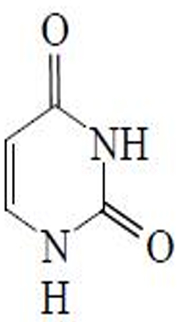
A
Adenine
B
Thymine
C
Uracil
D
Cytosine
Solution
(C) The given structure is a six-membered heterocyclic ring containing two nitrogen atoms at positions $1$ and $3$,and two carbonyl groups at positions $2$ and $4$. This structure is characteristic of $Uracil$.
$Adenine$ is a purine base.
$Thymine$ is $5-methyluracil$.
$Cytosine$ contains an amino group at position $4$ and a carbonyl group at position $2$.
$Adenine$ is a purine base.
$Thymine$ is $5-methyluracil$.
$Cytosine$ contains an amino group at position $4$ and a carbonyl group at position $2$.
0 likesView Solution
108
ChemistryEasyMCQAP EAMCET · 2025
Identify the set containing purine and pyrimidine base of $DNA$ respectively.
A
Adenine,Uracil
B
Cytosine,Guanine
C
Thymine,Uracil
D
Adenine,Cytosine
Solution
(D) The nitrogenous bases in $DNA$ are classified into two categories: purines and pyrimidines.
Purines are double-ring structures,which include $Adenine$ $(A)$ and $Guanine$ $(G)$.
Pyrimidines are single-ring structures,which include $Cytosine$ $(C)$ and $Thymine$ $(T)$ in $DNA$.
Therefore,the set containing a purine followed by a pyrimidine base of $DNA$ is $Adenine$ and $Cytosine$.
Purines are double-ring structures,which include $Adenine$ $(A)$ and $Guanine$ $(G)$.
Pyrimidines are single-ring structures,which include $Cytosine$ $(C)$ and $Thymine$ $(T)$ in $DNA$.
Therefore,the set containing a purine followed by a pyrimidine base of $DNA$ is $Adenine$ and $Cytosine$.
0 likesView Solution
109
ChemistryMediumMCQAP EAMCET · 2025
Which of the following represents a nucleoside of $RNA$?
A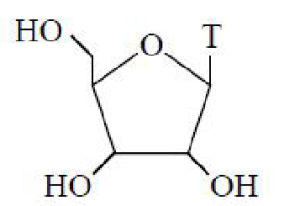
B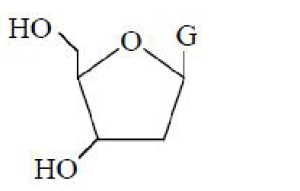
C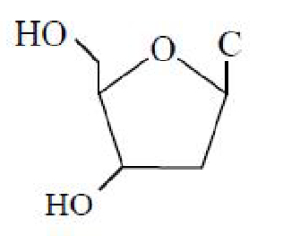
D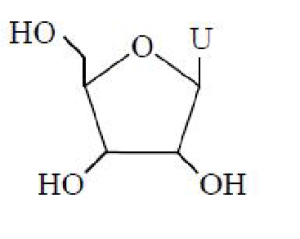
Solution
(D) nucleoside consists of a nitrogenous base attached to a pentose sugar.
In $RNA$,the pentose sugar is ribose,which has a hydroxyl $(-OH)$ group at both the $2'$ and $3'$ positions.
$RNA$ contains the nitrogenous bases Adenine $(A)$,Guanine $(G)$,Cytosine $(C)$,and Uracil $(U)$.
Thymine $(T)$ is found in $DNA$,not $RNA$.
Looking at the options:
Option $A$ has $T$ (Thymine),which is characteristic of $DNA$.
Option $B$ and $C$ show a deoxyribose sugar (missing the $-OH$ group at the $2'$ position),which is characteristic of $DNA$.
Option $D$ shows a ribose sugar (with $-OH$ groups at both $2'$ and $3'$ positions) attached to Uracil $(U)$,which is a characteristic nucleoside of $RNA$ (Uridine).
In $RNA$,the pentose sugar is ribose,which has a hydroxyl $(-OH)$ group at both the $2'$ and $3'$ positions.
$RNA$ contains the nitrogenous bases Adenine $(A)$,Guanine $(G)$,Cytosine $(C)$,and Uracil $(U)$.
Thymine $(T)$ is found in $DNA$,not $RNA$.
Looking at the options:
Option $A$ has $T$ (Thymine),which is characteristic of $DNA$.
Option $B$ and $C$ show a deoxyribose sugar (missing the $-OH$ group at the $2'$ position),which is characteristic of $DNA$.
Option $D$ shows a ribose sugar (with $-OH$ groups at both $2'$ and $3'$ positions) attached to Uracil $(U)$,which is a characteristic nucleoside of $RNA$ (Uridine).
0 likesView Solution
110
ChemistryMediumMCQAP EAMCET · 2025
Which of the following represents a nucleoside?
A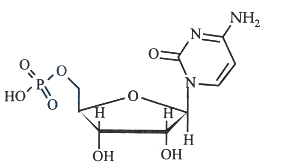
B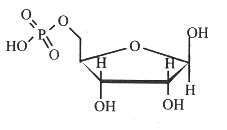
C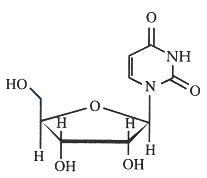
D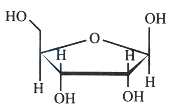
Solution
(C) nucleoside is composed of a pentose sugar and a nitrogenous base.
$A$ nucleotide is composed of a nucleoside and a phosphate group.
Option $A$ shows a nucleotide (cytidine monophosphate).
Option $B$ shows a sugar phosphate.
Option $C$ shows a nucleoside (uridine),which consists of a nitrogenous base (uracil) attached to a pentose sugar (ribose).
Option $D$ shows a pentose sugar (ribose).
$A$ nucleotide is composed of a nucleoside and a phosphate group.
Option $A$ shows a nucleotide (cytidine monophosphate).
Option $B$ shows a sugar phosphate.
Option $C$ shows a nucleoside (uridine),which consists of a nitrogenous base (uracil) attached to a pentose sugar (ribose).
Option $D$ shows a pentose sugar (ribose).
0 likesView Solution
111
ChemistryEasyMCQAP EAMCET · 2025
The improper functioning of '$X$' results in $Addison's$ disease. Hormone '$Y$' is responsible for the development of secondary female characteristics. '$X$' and '$Y$' are respectively
A
$Adrenal \text{ } Cortex$,estradiol
B
$Adrenal \text{ } Cortex$,progesterone
C
Thyroid,progesterone
D
Thyroid,estradiol
Solution
(A) $1$. $Addison's$ disease is caused by the hyposecretion of hormones from the $Adrenal \text{ } Cortex$ (specifically glucocorticoids and mineralocorticoids).
$2$. Estradiol is the primary estrogen hormone responsible for the development and maintenance of secondary female sexual characteristics.
$3$. Therefore,'$X$' is the $Adrenal \text{ } Cortex$ and '$Y$' is estradiol.
$4$. The correct option is $A$.
$2$. Estradiol is the primary estrogen hormone responsible for the development and maintenance of secondary female sexual characteristics.
$3$. Therefore,'$X$' is the $Adrenal \text{ } Cortex$ and '$Y$' is estradiol.
$4$. The correct option is $A$.
0 likesView Solution
112
ChemistryEasyMCQAP EAMCET · 2025
Match the hormones in List-$I$ with their functions in List-$II$:
| $A$. Glucocorticoids | $I$. Control the carbohydrate metabolism |
| $B$. Mineralocorticoids | $II$. Control the level of excretion of water and salt by the kidneys |
| $C$. Progesterone | $III$. Prepares the uterus for implantation of fertilised egg |
| $D$. Estradiol | $IV$. In the control of menstrual cycle |
A
$A-I, B-II, C-III, D-IV$
B
$A-IV, B-I, C-II, D-III$
C
$A-IV, B-III, C-II, D-I$
D
$A-I, B-II, C-IV, D-III$
Solution
(A) The correct matching is as follows:
$A$. Glucocorticoids: $I$. Control the carbohydrate metabolism.
$B$. Mineralocorticoids: $II$. Control the level of excretion of water and salt by the kidneys.
$C$. Progesterone: $III$. Prepares the uterus for implantation of fertilised egg.
$D$. Estradiol: $IV$. In the control of menstrual cycle.
Therefore,the correct sequence is $A-I, B-II, C-III, D-IV$.
$A$. Glucocorticoids: $I$. Control the carbohydrate metabolism.
$B$. Mineralocorticoids: $II$. Control the level of excretion of water and salt by the kidneys.
$C$. Progesterone: $III$. Prepares the uterus for implantation of fertilised egg.
$D$. Estradiol: $IV$. In the control of menstrual cycle.
Therefore,the correct sequence is $A-I, B-II, C-III, D-IV$.
0 likesView Solution
113
ChemistryEasyMCQAP EAMCET · 2025
The deficiency of vitamin $(X)$ causes convulsions. Source of $X$ is $Y$. What are $X$ and $Y$?
A
Riboflavin,milk
B
Riboflavin,fish
C
Pyridoxine,curd
D
Pyridoxine,cereals
Solution
(D) The deficiency of Vitamin $B_6$ (Pyridoxine) is known to cause convulsions in humans.
Common dietary sources of Pyridoxine $(X)$ include yeast,milk,egg yolk,cereals,and gram.
Among the given options,Pyridoxine and cereals represent a correct pairing for $X$ and $Y$ respectively.
Therefore,the correct option is $D$.
Common dietary sources of Pyridoxine $(X)$ include yeast,milk,egg yolk,cereals,and gram.
Among the given options,Pyridoxine and cereals represent a correct pairing for $X$ and $Y$ respectively.
Therefore,the correct option is $D$.
0 likesView Solution
114
ChemistryEasyMCQAP EAMCET · 2025
Which of the following enzymatic reactions is not correctly matched with the enzyme shown against it in brackets?
A
Proteins $\longrightarrow$ Peptides (Pepsin)
B
Starch $\longrightarrow$ Maltose (Zymase)
C
Sucrose $\longrightarrow$ Glucose and fructose (Invertase)
D
Maltose $\longrightarrow$ Glucose (Maltase)
Solution
(B) The reaction $Starch \longrightarrow Maltose$ is catalyzed by the enzyme $Diastase$,not $Zymase$.
$Zymase$ is an enzyme complex that catalyzes the fermentation of sugar into ethanol and carbon dioxide.
Therefore,the match in option $B$ is incorrect.
$Zymase$ is an enzyme complex that catalyzes the fermentation of sugar into ethanol and carbon dioxide.
Therefore,the match in option $B$ is incorrect.
0 likesView Solution
115
ChemistryMediumMCQAP EAMCET · 2025
Arrange the products $I$,$II$,$III$ from the following reactions in decreasing order of their acid strength.
$A) \text{Propylbenzene} \xrightarrow[\text{ (ii) } H_3O^{+}]{\text{ (i) } KMnO_4 / OH^{-}} I$
$B) CH_3COOH \xrightarrow[\text{ (ii) } H_2O]{\text{ (i) } Br_2 / \text{red } P} II$
$C) \text{Bromobenzene}$ $\xrightarrow[\substack{\text{ (ii) } CO_2 / \text{dry ether} \\ \text{ (iii) } H_3O^{+}}]{\text{ (i) } Mg / \text{dry ether}} III$
$A) \text{Propylbenzene} \xrightarrow[\text{ (ii) } H_3O^{+}]{\text{ (i) } KMnO_4 / OH^{-}} I$
$B) CH_3COOH \xrightarrow[\text{ (ii) } H_2O]{\text{ (i) } Br_2 / \text{red } P} II$
$C) \text{Bromobenzene}$ $\xrightarrow[\substack{\text{ (ii) } CO_2 / \text{dry ether} \\ \text{ (iii) } H_3O^{+}}]{\text{ (i) } Mg / \text{dry ether}} III$
A
$III > II > I$
B
$III > I > II$
C
$II > I > III$
D
$I > II > III$
Solution
(C) Step $1$: Identify the products.
Reaction $A$: Oxidation of propylbenzene with $KMnO_4/OH^-$ followed by acid workup gives benzoic acid $(I = C_6H_5COOH)$.
Reaction $B$: Hell-Volhard-Zelinsky reaction of acetic acid gives bromoacetic acid $(II = BrCH_2COOH)$.
Reaction $C$: Grignard reagent formation from bromobenzene followed by reaction with $CO_2$ and acid workup gives benzoic acid $(III = C_6H_5COOH)$.
Note: $I$ and $III$ are both benzoic acid.
Step $2$: Compare acid strength.
$II$ is $BrCH_2COOH$. The electron-withdrawing $-Br$ group increases the acidity of the carboxylic acid compared to benzoic acid.
$I$ and $III$ are both benzoic acid $(C_6H_5COOH)$.
Therefore,the order of acid strength is $II > I = III$.
Given the options,the most appropriate order is $II > I \approx III$.
Reaction $A$: Oxidation of propylbenzene with $KMnO_4/OH^-$ followed by acid workup gives benzoic acid $(I = C_6H_5COOH)$.
Reaction $B$: Hell-Volhard-Zelinsky reaction of acetic acid gives bromoacetic acid $(II = BrCH_2COOH)$.
Reaction $C$: Grignard reagent formation from bromobenzene followed by reaction with $CO_2$ and acid workup gives benzoic acid $(III = C_6H_5COOH)$.
Note: $I$ and $III$ are both benzoic acid.
Step $2$: Compare acid strength.
$II$ is $BrCH_2COOH$. The electron-withdrawing $-Br$ group increases the acidity of the carboxylic acid compared to benzoic acid.
$I$ and $III$ are both benzoic acid $(C_6H_5COOH)$.
Therefore,the order of acid strength is $II > I = III$.
Given the options,the most appropriate order is $II > I \approx III$.
0 likesView Solution
116
ChemistryMediumMCQAP EAMCET · 2025
The most acidic carboxylic acid is
A
$C_6H_5COOH$
B
$C_6H_5CH_2COOH$
C
$HCOOH$
D
$CH_3COOH$
Solution
(C) The acidity of carboxylic acids depends on the stability of the carboxylate anion formed after the loss of a proton. Electron-withdrawing groups increase acidity by stabilizing the negative charge,while electron-donating groups decrease acidity.
$1$. $HCOOH$ (Formic acid): The $H$ atom has no inductive effect.
$2$. $CH_3COOH$ (Acetic acid): The $CH_3$ group is electron-donating ($+I$ effect),which destabilizes the carboxylate anion,making it less acidic than formic acid.
$3$. $C_6H_5COOH$ (Benzoic acid): The phenyl group is electron-withdrawing due to its $sp^2$ hybridized carbon atom ($-I$ effect),making it more acidic than acetic acid.
$4$. $C_6H_5CH_2COOH$ (Phenylacetic acid): The $CH_2$ group separates the phenyl ring from the carboxyl group,reducing the electron-withdrawing effect of the phenyl ring compared to benzoic acid.
Comparing the $pK_a$ values: $HCOOH$ $(pK_a \approx 3.75)$ > $C_6H_5COOH$ $(pK_a \approx 4.20)$ > $C_6H_5CH_2COOH$ $(pK_a \approx 4.31)$ > $CH_3COOH$ $(pK_a \approx 4.76)$.
Therefore,$HCOOH$ is the most acidic among the given options.
$1$. $HCOOH$ (Formic acid): The $H$ atom has no inductive effect.
$2$. $CH_3COOH$ (Acetic acid): The $CH_3$ group is electron-donating ($+I$ effect),which destabilizes the carboxylate anion,making it less acidic than formic acid.
$3$. $C_6H_5COOH$ (Benzoic acid): The phenyl group is electron-withdrawing due to its $sp^2$ hybridized carbon atom ($-I$ effect),making it more acidic than acetic acid.
$4$. $C_6H_5CH_2COOH$ (Phenylacetic acid): The $CH_2$ group separates the phenyl ring from the carboxyl group,reducing the electron-withdrawing effect of the phenyl ring compared to benzoic acid.
Comparing the $pK_a$ values: $HCOOH$ $(pK_a \approx 3.75)$ > $C_6H_5COOH$ $(pK_a \approx 4.20)$ > $C_6H_5CH_2COOH$ $(pK_a \approx 4.31)$ > $CH_3COOH$ $(pK_a \approx 4.76)$.
Therefore,$HCOOH$ is the most acidic among the given options.
0 likesView Solution
117
ChemistryMediumMCQAP EAMCET · 2025
The carboxylic acid with the highest $pK_{a}$ and lowest $pK_{a}$ values among the following are respectively:
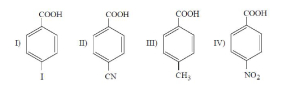
A
$I, II$
B
$I, IV$
C
$III, II$
D
$III, IV$
Solution
(D) The acidity of substituted benzoic acids depends on the electronic effects of the substituents. Electron-withdrawing groups $(EWG)$ increase acidity (lower $pK_{a}$),while electron-donating groups $(EDG)$ decrease acidity (higher $pK_{a}$).
$1$. $III$ ($p$-methylbenzoic acid): $-CH_3$ is an $EDG$ ($+I$ and hyperconjugation effect),which decreases acidity. Thus,it has the highest $pK_{a}$.
$2$. $I$ ($p$-iodobenzoic acid): $-I$ is a weak $EWG$ ($-I$ effect),which slightly increases acidity.
$3$. $II$ ($p$-cyanobenzoic acid): $-CN$ is a strong $EWG$ ($-I$ and $-M$ effects),which significantly increases acidity.
$4$. $IV$ ($p$-nitrobenzoic acid): $-NO_2$ is a very strong $EWG$ ($-I$ and $-M$ effects),which increases acidity the most. Thus,it has the lowest $pK_{a}$.
Therefore,the highest $pK_{a}$ is for $III$ and the lowest $pK_{a}$ is for $IV$. The correct option is $D$.
$1$. $III$ ($p$-methylbenzoic acid): $-CH_3$ is an $EDG$ ($+I$ and hyperconjugation effect),which decreases acidity. Thus,it has the highest $pK_{a}$.
$2$. $I$ ($p$-iodobenzoic acid): $-I$ is a weak $EWG$ ($-I$ effect),which slightly increases acidity.
$3$. $II$ ($p$-cyanobenzoic acid): $-CN$ is a strong $EWG$ ($-I$ and $-M$ effects),which significantly increases acidity.
$4$. $IV$ ($p$-nitrobenzoic acid): $-NO_2$ is a very strong $EWG$ ($-I$ and $-M$ effects),which increases acidity the most. Thus,it has the lowest $pK_{a}$.
Therefore,the highest $pK_{a}$ is for $III$ and the lowest $pK_{a}$ is for $IV$. The correct option is $D$.
0 likesView Solution
118
ChemistryMediumMCQAP EAMCET · 2025
What are $X$ and $Y$ respectively in the following reaction sequence?
Styrene $\xrightarrow[(ii) H_3O^+]{(i) KMnO_4 / KOH} X$ $\xrightarrow{Br_2 / FeBr_3} Y$
Styrene $\xrightarrow[(ii) H_3O^+]{(i) KMnO_4 / KOH} X$ $\xrightarrow{Br_2 / FeBr_3} Y$
A
$X$ = Phenylacetic acid,$Y$ = Phenylacetyl bromide
B
$X$ = Phenylacetic acid,$Y$ = $p$-Bromophenylacetic acid
C
$X$ = Benzoic acid,$Y$ = $m$-Bromobenzoic acid
D
$X$ = Benzoic acid,$Y$ = $o$-Bromobenzoyl bromide
Solution
(C) $1$. The reaction of styrene $(C_6H_5-CH=CH_2)$ with alkaline $KMnO_4$ followed by acidic workup $(H_3O^+)$ is an oxidative cleavage reaction that converts the vinyl group into a carboxylic acid group,yielding benzoic acid $(C_6H_5COOH)$ as product $X$.
$2$. Benzoic acid contains a $-COOH$ group attached to the benzene ring. The $-COOH$ group is a strongly deactivating group and is meta-directing for electrophilic aromatic substitution reactions.
$3$. Therefore,the bromination of benzoic acid $(X)$ using $Br_2 / FeBr_3$ will result in the electrophilic substitution of the bromine atom at the meta-position,yielding $m$-bromobenzoic acid as product $Y$.
$2$. Benzoic acid contains a $-COOH$ group attached to the benzene ring. The $-COOH$ group is a strongly deactivating group and is meta-directing for electrophilic aromatic substitution reactions.
$3$. Therefore,the bromination of benzoic acid $(X)$ using $Br_2 / FeBr_3$ will result in the electrophilic substitution of the bromine atom at the meta-position,yielding $m$-bromobenzoic acid as product $Y$.
0 likesView Solution
119
ChemistryMediumMCQAP EAMCET · 2025
What are $X$ and $Y$ respectively in the following set of reactions?
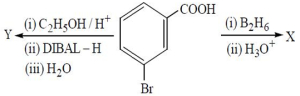
A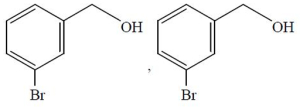
B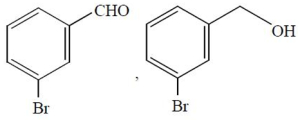
C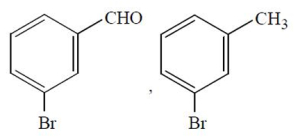
D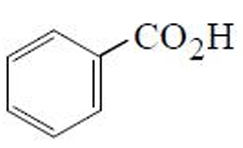
Solution
(C) The starting material is $3$-bromobenzoic acid.
$1$. Formation of $X$:
Reaction with $B_2H_6$ followed by $H_3O^+$ is a selective reduction of the carboxylic acid group $(-COOH)$ to a primary alcohol $(-CH_2OH)$ without affecting the bromine $(-Br)$ substituent on the benzene ring. Thus,$X$ is $3$-bromobenzyl alcohol.
$2$. Formation of $Y$:
$(i)$ Esterification: $3$-bromobenzoic acid reacts with $C_2H_5OH/H^+$ to form ethyl $3$-bromobenzoate.
(ii) Reduction: $DIBAL-H$ is a selective reducing agent that reduces esters $(-COOC_2H_5)$ to aldehydes $(-CHO)$.
(iii) Hydrolysis: The final step yields $3$-bromobenzaldehyde as $Y$.
Therefore,$X$ is $3$-bromobenzyl alcohol and $Y$ is $3$-bromobenzaldehyde. The correct option is $C$.
$1$. Formation of $X$:
Reaction with $B_2H_6$ followed by $H_3O^+$ is a selective reduction of the carboxylic acid group $(-COOH)$ to a primary alcohol $(-CH_2OH)$ without affecting the bromine $(-Br)$ substituent on the benzene ring. Thus,$X$ is $3$-bromobenzyl alcohol.
$2$. Formation of $Y$:
$(i)$ Esterification: $3$-bromobenzoic acid reacts with $C_2H_5OH/H^+$ to form ethyl $3$-bromobenzoate.
(ii) Reduction: $DIBAL-H$ is a selective reducing agent that reduces esters $(-COOC_2H_5)$ to aldehydes $(-CHO)$.
(iii) Hydrolysis: The final step yields $3$-bromobenzaldehyde as $Y$.
Therefore,$X$ is $3$-bromobenzyl alcohol and $Y$ is $3$-bromobenzaldehyde. The correct option is $C$.
0 likesView Solution
120
ChemistryMediumMCQAP EAMCET · 2025
The final product $(C)$ in the given reaction sequence is
$C_6H_5COOH$ $\xrightarrow{SOCl_2} (A)$ $\xrightarrow[\text{anhy. } AlCl_3]{C_6H_6} (B)$ $\xrightarrow[\text{(ii) } KOH / (CH_2OH)_2]{\text{(i) } NH_2-NH_2} (C)$
$C_6H_5COOH$ $\xrightarrow{SOCl_2} (A)$ $\xrightarrow[\text{anhy. } AlCl_3]{C_6H_6} (B)$ $\xrightarrow[\text{(ii) } KOH / (CH_2OH)_2]{\text{(i) } NH_2-NH_2} (C)$
A
Benzophenone
B
Diphenyl methane
C
Diphenylmethanol
D
Benzoic acid
Solution
(B) Step $1$: $C_6H_5COOH + SOCl_2 \rightarrow C_6H_5COCl (A) + SO_2 + HCl$. This is the conversion of benzoic acid to benzoyl chloride.
Step $2$: $C_6H_5COCl + C_6H_6 \xrightarrow{\text{anhy. } AlCl_3} C_6H_5COC_6H_5 (B) + HCl$. This is a Friedel-Crafts acylation reaction producing benzophenone.
Step $3$: $C_6H_5COC_6H_5 \xrightarrow[\text{(ii) } KOH / (CH_2OH)_2]{\text{(i) } NH_2-NH_2} C_6H_5CH_2C_6H_5 (C)$. This is the Wolff-Kishner reduction of benzophenone to diphenylmethane.
Step $2$: $C_6H_5COCl + C_6H_6 \xrightarrow{\text{anhy. } AlCl_3} C_6H_5COC_6H_5 (B) + HCl$. This is a Friedel-Crafts acylation reaction producing benzophenone.
Step $3$: $C_6H_5COC_6H_5 \xrightarrow[\text{(ii) } KOH / (CH_2OH)_2]{\text{(i) } NH_2-NH_2} C_6H_5CH_2C_6H_5 (C)$. This is the Wolff-Kishner reduction of benzophenone to diphenylmethane.
0 likesView Solution
121
ChemistryMediumMCQAP EAMCET · 2025
Consider the reaction given below:
$A + 2 B \longrightarrow 3 C + 2 D$.
If the rate of disappearance of $B$ is $x \times 10^{-2} \ mol \ L^{-1} \ s^{-1}$,the ratio of the rate of reaction and the rate of appearance of $C$ is:
$A + 2 B \longrightarrow 3 C + 2 D$.
If the rate of disappearance of $B$ is $x \times 10^{-2} \ mol \ L^{-1} \ s^{-1}$,the ratio of the rate of reaction and the rate of appearance of $C$ is:
A
$1:3$
B
$3:1$
C
$1:2$
D
$2:1$
Solution
(A) For the reaction $A + 2 B \longrightarrow 3 C + 2 D$,the rate of reaction $(r)$ is given by:
$r = -\frac{d[A]}{dt} = -\frac{1}{2} \frac{d[B]}{dt} = \frac{1}{3} \frac{d[C]}{dt} = \frac{1}{2} \frac{d[D]}{dt}$
Given that the rate of disappearance of $B$ is $-\frac{d[B]}{dt} = x \times 10^{-2} \ mol \ L^{-1} \ s^{-1}$.
Substituting this into the rate expression:
$r = -\frac{1}{2} \frac{d[B]}{dt} = \frac{1}{2} (x \times 10^{-2}) = 0.5x \times 10^{-2} \ mol \ L^{-1} \ s^{-1}$.
The rate of appearance of $C$ is $\frac{d[C]}{dt}$.
From the rate expression,$r = \frac{1}{3} \frac{d[C]}{dt}$,so $\frac{d[C]}{dt} = 3r$.
The ratio of the rate of reaction $(r)$ to the rate of appearance of $C$ $(\frac{d[C]}{dt})$ is:
$\frac{r}{\frac{d[C]}{dt}} = \frac{r}{3r} = \frac{1}{3}$.
$r = -\frac{d[A]}{dt} = -\frac{1}{2} \frac{d[B]}{dt} = \frac{1}{3} \frac{d[C]}{dt} = \frac{1}{2} \frac{d[D]}{dt}$
Given that the rate of disappearance of $B$ is $-\frac{d[B]}{dt} = x \times 10^{-2} \ mol \ L^{-1} \ s^{-1}$.
Substituting this into the rate expression:
$r = -\frac{1}{2} \frac{d[B]}{dt} = \frac{1}{2} (x \times 10^{-2}) = 0.5x \times 10^{-2} \ mol \ L^{-1} \ s^{-1}$.
The rate of appearance of $C$ is $\frac{d[C]}{dt}$.
From the rate expression,$r = \frac{1}{3} \frac{d[C]}{dt}$,so $\frac{d[C]}{dt} = 3r$.
The ratio of the rate of reaction $(r)$ to the rate of appearance of $C$ $(\frac{d[C]}{dt})$ is:
$\frac{r}{\frac{d[C]}{dt}} = \frac{r}{3r} = \frac{1}{3}$.
0 likesView Solution
122
ChemistryEasyMCQAP EAMCET · 2025
$A \rightarrow B$ is a first order reaction. The concentration of $A$ is decreased from $x \ mol \ L^{-1}$ to $y \ mol \ L^{-1}$ in $100 \ \min$. What is the average velocity of the reaction in $mol \ L^{-1} \ \min^{-1}$?
A
$\frac{|x-y|}{100}$
B
$\frac{|y-x|^2}{100}$
C
$\frac{100}{|x-y|}$
D
$\frac{100}{|x+y|}$
Solution
(A) The average rate of a reaction is defined as the change in concentration of a reactant or product divided by the time interval taken for the change.
For the reaction $A \rightarrow B$,the average rate is given by:
$\text{Average Rate} = -\frac{\Delta[A]}{\Delta t}$
Here,the change in concentration of $A$ is $\Delta[A] = [A]_{final} - [A]_{initial} = y - x$.
The time interval is $\Delta t = 100 \ \min$.
Therefore,the average rate is $-\frac{y - x}{100} = \frac{x - y}{100}$.
Since rate is always positive,we take the magnitude: $\frac{|x - y|}{100} \ mol \ L^{-1} \ \min^{-1}$.
For the reaction $A \rightarrow B$,the average rate is given by:
$\text{Average Rate} = -\frac{\Delta[A]}{\Delta t}$
Here,the change in concentration of $A$ is $\Delta[A] = [A]_{final} - [A]_{initial} = y - x$.
The time interval is $\Delta t = 100 \ \min$.
Therefore,the average rate is $-\frac{y - x}{100} = \frac{x - y}{100}$.
Since rate is always positive,we take the magnitude: $\frac{|x - y|}{100} \ mol \ L^{-1} \ \min^{-1}$.
0 likesView Solution
123
ChemistryMediumMCQAP EAMCET · 2025
$R \longrightarrow P$ is a first order reaction. The concentration of $R$ changed from $0.04$ to $0.03 \ mol \ L^{-1}$ in $40 \ min$. What is the average velocity of the reaction in $mol \ L^{-1} \ s^{-1}$?
A
$2.5 \times 10^{-4}$
B
$4.167 \times 10^{-6}$
C
$4.167 \times 10^{6}$
D
$2.5 \times 10^{-5}$
Solution
(B) The average rate of reaction is given by the formula: $\text{Average Rate} = -\frac{\Delta[R]}{\Delta t}$.
Given,$\Delta[R] = [R]_2 - [R]_1 = 0.03 - 0.04 = -0.01 \ mol \ L^{-1}$.
Given,$\Delta t = 40 \ min = 40 \times 60 \ s = 2400 \ s$.
Substituting the values: $\text{Average Rate} = -\frac{-0.01}{2400} = \frac{0.01}{2400} \ mol \ L^{-1} \ s^{-1}$.
$\text{Average Rate} = \frac{1 \times 10^{-2}}{24 \times 10^2} = \frac{1}{24} \times 10^{-4} \approx 0.04167 \times 10^{-4} = 4.167 \times 10^{-6} \ mol \ L^{-1} \ s^{-1}$.
Given,$\Delta[R] = [R]_2 - [R]_1 = 0.03 - 0.04 = -0.01 \ mol \ L^{-1}$.
Given,$\Delta t = 40 \ min = 40 \times 60 \ s = 2400 \ s$.
Substituting the values: $\text{Average Rate} = -\frac{-0.01}{2400} = \frac{0.01}{2400} \ mol \ L^{-1} \ s^{-1}$.
$\text{Average Rate} = \frac{1 \times 10^{-2}}{24 \times 10^2} = \frac{1}{24} \times 10^{-4} \approx 0.04167 \times 10^{-4} = 4.167 \times 10^{-6} \ mol \ L^{-1} \ s^{-1}$.
0 likesView Solution
124
ChemistryMediumMCQAP EAMCET · 2025
$A \rightarrow$ products is a first-order reaction. The following data is obtained for this reaction at $T \ K$. The value of $x : y$ is:
| Rate $(\text{mol } L^{-1} \ \text{min}^{-1})$ | $[A]$ |
|---|---|
| $0.2$ | $0.02 \ M$ |
| $0.4$ | $x \ M$ |
| $1.0$ | $y \ M$ |
A
$1 : 5$
B
$2 : 3$
C
$5 : 2$
D
$2 : 5$
Solution
(D) For a first-order reaction,the rate law is given by: $\text{Rate} = k[A]$.
From the given data,we can find the rate constant $k$:
$0.2 = k \times 0.02 \implies k = \frac{0.2}{0.02} = 10 \ \text{min}^{-1}$.
Now,we find $x$ using the rate $0.4$:
$0.4 = 10 \times x \implies x = 0.04 \ M$.
Next,we find $y$ using the rate $1.0$:
$1.0 = 10 \times y \implies y = 0.10 \ M$.
The ratio $x : y$ is $0.04 : 0.10 = 4 : 10 = 2 : 5$.
From the given data,we can find the rate constant $k$:
$0.2 = k \times 0.02 \implies k = \frac{0.2}{0.02} = 10 \ \text{min}^{-1}$.
Now,we find $x$ using the rate $0.4$:
$0.4 = 10 \times x \implies x = 0.04 \ M$.
Next,we find $y$ using the rate $1.0$:
$1.0 = 10 \times y \implies y = 0.10 \ M$.
The ratio $x : y$ is $0.04 : 0.10 = 4 : 10 = 2 : 5$.
0 likesView Solution
125
ChemistryMediumMCQAP EAMCET · 2025
In a first order reaction,the concentration of the reactant is reduced to $1/8$ of the initial concentration in $75 \ minutes$. The $t_{1/2}$ of the reaction (in minutes) is $(\log 2 = 0.30, \log 3 = 0.47, \log 4 = 0.60)$.
A
$60.2$
B
$50.2$
C
$25.1$
D
$75.1$
Solution
(C) For a first order reaction,the concentration after time $t$ is given by $[A]_t = [A]_0 \times (1/2)^n$,where $n$ is the number of half-lives.
Given that the concentration is reduced to $1/8$ of the initial concentration,we have $(1/2)^n = 1/8$.
Since $1/8 = (1/2)^3$,we find that $n = 3$.
This means $3$ half-lives have passed in $75 \ minutes$.
Therefore,$3 \times t_{1/2} = 75 \ minutes$.
$t_{1/2} = 75 / 3 = 25 \ minutes$.
The closest option is $25.1 \ minutes$.
Given that the concentration is reduced to $1/8$ of the initial concentration,we have $(1/2)^n = 1/8$.
Since $1/8 = (1/2)^3$,we find that $n = 3$.
This means $3$ half-lives have passed in $75 \ minutes$.
Therefore,$3 \times t_{1/2} = 75 \ minutes$.
$t_{1/2} = 75 / 3 = 25 \ minutes$.
The closest option is $25.1 \ minutes$.
0 likesView Solution
126
ChemistryMediumMCQAP EAMCET · 2025
For a first order reaction,the ratio between the time taken to complete $\frac{3}{4}$ th of the reaction and time taken to complete half of the reaction is
A
$2$
B
$3$
C
$1.5$
D
$2.5$
Solution
(A) For a first order reaction,the time taken to complete a fraction $f$ is given by $t = \frac{2.303}{k} \log(\frac{1}{1-f})$.
For half-life $(t_{1/2})$,$f = 0.5$,so $t_{1/2} = \frac{2.303}{k} \log(2)$.
For $\frac{3}{4}$ th completion,$f = 0.75$,so $t_{3/4} = \frac{2.303}{k} \log(\frac{1}{1-0.75}) = \frac{2.303}{k} \log(4) = \frac{2.303}{k} \log(2^2) = 2 \times \frac{2.303}{k} \log(2)$.
Therefore,the ratio $\frac{t_{3/4}}{t_{1/2}} = \frac{2 \times \frac{2.303}{k} \log(2)}{\frac{2.303}{k} \log(2)} = 2$.
For half-life $(t_{1/2})$,$f = 0.5$,so $t_{1/2} = \frac{2.303}{k} \log(2)$.
For $\frac{3}{4}$ th completion,$f = 0.75$,so $t_{3/4} = \frac{2.303}{k} \log(\frac{1}{1-0.75}) = \frac{2.303}{k} \log(4) = \frac{2.303}{k} \log(2^2) = 2 \times \frac{2.303}{k} \log(2)$.
Therefore,the ratio $\frac{t_{3/4}}{t_{1/2}} = \frac{2 \times \frac{2.303}{k} \log(2)}{\frac{2.303}{k} \log(2)} = 2$.
0 likesView Solution
127
ChemistryEasyMCQAP EAMCET · 2025
Activation energy for the hydrolysis of sucrose by acid is $X \ kJ \ mol^{-1}$ whereas activation energy for the hydrolysis of sucrose by sucrase is $Y \ kJ \ mol^{-1}$. $X$ and $Y$ respectively are
A
$6.22, 2.15$
B
$2.15, 6.22$
C
$6.22, 6.22$
D
$2.15, 2.15$
Solution
(A) The hydrolysis of sucrose is a reaction that can be catalyzed by either an acid or an enzyme (sucrase).
Enzymes are biological catalysts that lower the activation energy of a reaction significantly compared to inorganic catalysts or acid-catalyzed reactions.
For the hydrolysis of sucrose,the activation energy with acid catalysis is approximately $6.22 \ kJ \ mol^{-1}$,while the activation energy with the enzyme sucrase is significantly lower,approximately $2.15 \ kJ \ mol^{-1}$.
Therefore,$X = 6.22$ and $Y = 2.15$.
Enzymes are biological catalysts that lower the activation energy of a reaction significantly compared to inorganic catalysts or acid-catalyzed reactions.
For the hydrolysis of sucrose,the activation energy with acid catalysis is approximately $6.22 \ kJ \ mol^{-1}$,while the activation energy with the enzyme sucrase is significantly lower,approximately $2.15 \ kJ \ mol^{-1}$.
Therefore,$X = 6.22$ and $Y = 2.15$.
0 likesView Solution
128
ChemistryMediumMCQAP EAMCET · 2025
At $T \ K$,the following equation is obtained for a first order reaction: $\log \frac{k}{A} = -\frac{x}{T}$. The activation energy for this reaction is equal to $(R = \text{gas constant})$
A
$2.303 x R$
B
$\frac{2.303 R}{x}$
C
$\frac{x}{2.303 R}$
D
$\frac{1}{2.303 x R}$
Solution
(A) According to the Arrhenius equation: $k = A e^{-E_a / RT}$.
Taking natural logarithm on both sides: $\ln k = \ln A - \frac{E_a}{RT}$.
Rearranging the terms: $\ln \left(\frac{k}{A}\right) = -\frac{E_a}{RT}$.
Converting natural logarithm to base $10$: $2.303 \log \left(\frac{k}{A}\right) = -\frac{E_a}{RT}$.
Dividing by $2.303$: $\log \left(\frac{k}{A}\right) = -\frac{E_a}{2.303 RT}$.
Given equation: $\log \left(\frac{k}{A}\right) = -\frac{x}{T}$.
Comparing the two equations,we get: $\frac{E_a}{2.303 R} = x$.
Therefore,the activation energy is: $E_a = 2.303 x R$.
Taking natural logarithm on both sides: $\ln k = \ln A - \frac{E_a}{RT}$.
Rearranging the terms: $\ln \left(\frac{k}{A}\right) = -\frac{E_a}{RT}$.
Converting natural logarithm to base $10$: $2.303 \log \left(\frac{k}{A}\right) = -\frac{E_a}{RT}$.
Dividing by $2.303$: $\log \left(\frac{k}{A}\right) = -\frac{E_a}{2.303 RT}$.
Given equation: $\log \left(\frac{k}{A}\right) = -\frac{x}{T}$.
Comparing the two equations,we get: $\frac{E_a}{2.303 R} = x$.
Therefore,the activation energy is: $E_a = 2.303 x R$.
0 likesView Solution
129
ChemistryMediumMCQAP EAMCET · 2025
The following equation is obtained for a first order reaction at $300 \ K$.
$\log_{10} \frac{k}{A} = 0.00174$
What is the activation energy (in $J \ mol^{-1}$) of the reaction?
$(R = 8.314 \ J \ mol^{-1} \ K^{-1})$
$\log_{10} \frac{k}{A} = 0.00174$
What is the activation energy (in $J \ mol^{-1}$) of the reaction?
$(R = 8.314 \ J \ mol^{-1} \ K^{-1})$
A
$10.0$
B
$100.0$
C
$0.1$
D
$1.0$
Solution
(A) The Arrhenius equation is given by $k = A e^{-E_a / RT}$.
Taking the logarithm on both sides: $\ln k = \ln A - \frac{E_a}{RT}$.
Rearranging gives $\ln \frac{k}{A} = -\frac{E_a}{RT}$.
Converting to base $10$: $\log_{10} \frac{k}{A} = -\frac{E_a}{2.303 RT}$.
Given $\log_{10} \frac{k}{A} = 0.00174$,$T = 300 \ K$,and $R = 8.314 \ J \ mol^{-1} \ K^{-1}$.
Substituting the values: $0.00174 = -\frac{E_a}{2.303 \times 8.314 \times 300}$.
Note: The provided equation $\log_{10} \frac{k}{A} = 0.00174$ implies a positive value,which is physically inconsistent with the Arrhenius equation for activation energy $E_a > 0$. Assuming the magnitude is intended: $E_a = |0.00174 \times 2.303 \times 8.314 \times 300| \approx 10 \ J \ mol^{-1}$.
Taking the logarithm on both sides: $\ln k = \ln A - \frac{E_a}{RT}$.
Rearranging gives $\ln \frac{k}{A} = -\frac{E_a}{RT}$.
Converting to base $10$: $\log_{10} \frac{k}{A} = -\frac{E_a}{2.303 RT}$.
Given $\log_{10} \frac{k}{A} = 0.00174$,$T = 300 \ K$,and $R = 8.314 \ J \ mol^{-1} \ K^{-1}$.
Substituting the values: $0.00174 = -\frac{E_a}{2.303 \times 8.314 \times 300}$.
Note: The provided equation $\log_{10} \frac{k}{A} = 0.00174$ implies a positive value,which is physically inconsistent with the Arrhenius equation for activation energy $E_a > 0$. Assuming the magnitude is intended: $E_a = |0.00174 \times 2.303 \times 8.314 \times 300| \approx 10 \ J \ mol^{-1}$.
0 likesView Solution
130
ChemistryMediumMCQAP EAMCET · 2025
The following graph is obtained for a reaction $(A \rightarrow P)$. The activation energy ($E_{a}$ in $kJ \ mol^{-1}$) and heat of reaction ($|\Delta H|$ in $kJ \ mol^{-1}$) for this reaction are respectively ($x=$ reaction coordinate; $y=E$ in $kJ \ mol^{-1}$)
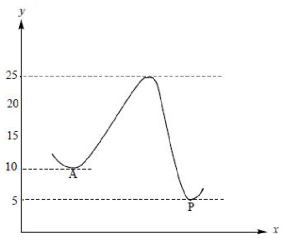
A
$5, 15$
B
$15, 5$
C
$25, 5$
D
$10, 25$
Solution
(B) From the given potential energy diagram:
$1$. The energy of the reactant $(A)$ is $E_{A} = 10 \ kJ \ mol^{-1}$.
$2$. The energy of the product $(P)$ is $E_{P} = 5 \ kJ \ mol^{-1}$.
$3$. The threshold energy (peak of the curve) is $E_{threshold} = 25 \ kJ \ mol^{-1}$.
$4$. The activation energy $(E_{a})$ is calculated as $E_{threshold} - E_{A} = 25 - 10 = 15 \ kJ \ mol^{-1}$.
$5$. The heat of reaction $(\Delta H)$ is calculated as $E_{P} - E_{A} = 5 - 10 = -5 \ kJ \ mol^{-1}$.
$6$. The magnitude of the heat of reaction is $|\Delta H| = |-5| = 5 \ kJ \ mol^{-1}$.
Therefore,the activation energy is $15 \ kJ \ mol^{-1}$ and the heat of reaction is $5 \ kJ \ mol^{-1}$.
$1$. The energy of the reactant $(A)$ is $E_{A} = 10 \ kJ \ mol^{-1}$.
$2$. The energy of the product $(P)$ is $E_{P} = 5 \ kJ \ mol^{-1}$.
$3$. The threshold energy (peak of the curve) is $E_{threshold} = 25 \ kJ \ mol^{-1}$.
$4$. The activation energy $(E_{a})$ is calculated as $E_{threshold} - E_{A} = 25 - 10 = 15 \ kJ \ mol^{-1}$.
$5$. The heat of reaction $(\Delta H)$ is calculated as $E_{P} - E_{A} = 5 - 10 = -5 \ kJ \ mol^{-1}$.
$6$. The magnitude of the heat of reaction is $|\Delta H| = |-5| = 5 \ kJ \ mol^{-1}$.
Therefore,the activation energy is $15 \ kJ \ mol^{-1}$ and the heat of reaction is $5 \ kJ \ mol^{-1}$.
0 likesView Solution
131
ChemistryMediumMCQAP EAMCET · 2025
For a reaction,the graph of $\ln k$ (on y-axis) and $1 / T$ (on x-axis) is a straight line with a slope $-2 \times 10^4 \ K$. The activation energy of the reaction (in $kJ \ mol^{-1}$) is $(R = 8.3 \ J \ K^{-1} \ mol^{-1})$
A
$332$
B
$432$
C
$166$
D
$216$
Solution
(C) According to the Arrhenius equation,$\ln k = \ln A - \frac{E_a}{RT}$.
Comparing this with the equation of a straight line $y = mx + c$,where $y = \ln k$ and $x = 1 / T$,the slope $m = -\frac{E_a}{R}$.
Given,slope $= -2 \times 10^4 \ K$ and $R = 8.3 \ J \ K^{-1} \ mol^{-1}$.
So,$-\frac{E_a}{R} = -2 \times 10^4 \ K$.
$E_a = 2 \times 10^4 \ K \times 8.3 \ J \ K^{-1} \ mol^{-1} = 166000 \ J \ mol^{-1}$.
Converting to $kJ \ mol^{-1}$,$E_a = \frac{166000}{1000} = 166 \ kJ \ mol^{-1}$.
Comparing this with the equation of a straight line $y = mx + c$,where $y = \ln k$ and $x = 1 / T$,the slope $m = -\frac{E_a}{R}$.
Given,slope $= -2 \times 10^4 \ K$ and $R = 8.3 \ J \ K^{-1} \ mol^{-1}$.
So,$-\frac{E_a}{R} = -2 \times 10^4 \ K$.
$E_a = 2 \times 10^4 \ K \times 8.3 \ J \ K^{-1} \ mol^{-1} = 166000 \ J \ mol^{-1}$.
Converting to $kJ \ mol^{-1}$,$E_a = \frac{166000}{1000} = 166 \ kJ \ mol^{-1}$.
0 likesView Solution
132
ChemistryEasyMCQAP EAMCET · 2025
Which of the following is not an example of an antacid?
A
Cimetidine
B
Ranitidine
C
Sodium hydrogen carbonate
D
Phenelzine
Solution
(D) Antacids are substances that neutralize excess stomach acid. $Cimetidine$ and $Ranitidine$ are histamine receptor blockers used as antacids. $Sodium \text{ } hydrogen \text{ } carbonate$ $(NaHCO_3)$ is a common mild antacid. $Phenelzine$ is an antidepressant,not an antacid. Therefore,the correct answer is $D$.
0 likesView Solution
133
ChemistryEasyMCQAP EAMCET · 2025
What is the drug used to control depression and hypertension?
A
Bithionol
B
Equanil
C
Dimetapp
D
Prontosil
Solution
(B) Equanil is a tranquilizer used to control depression and hypertension.
It is a mild tranquilizer that helps in relieving stress and anxiety.
It is a mild tranquilizer that helps in relieving stress and anxiety.
0 likesView Solution
134
ChemistryEasyMCQAP EAMCET · 2025
Bithionol is added to soaps to impart antiseptic properties. The number of $-OH$ and $-Cl$ groups in its structure are respectively
A
$2, 3$
B
$3, 2$
C
$4, 2$
D
$2, 4$
Solution
(D) The chemical structure of Bithionol is $2,2'$-thiobis($4,6$-dichlorophenol).
It consists of two phenol rings linked by a sulfur atom at the $2,2'$ positions.
Each phenol ring contains one $-OH$ group and two $-Cl$ groups.
Therefore,the total number of $-OH$ groups is $2$ and the total number of $-Cl$ groups is $4$.
The correct option is $D$.
It consists of two phenol rings linked by a sulfur atom at the $2,2'$ positions.
Each phenol ring contains one $-OH$ group and two $-Cl$ groups.
Therefore,the total number of $-OH$ groups is $2$ and the total number of $-Cl$ groups is $4$.
The correct option is $D$.
0 likesView Solution
135
ChemistryEasyMCQAP EAMCET · 2025
Match the following.
Correct answer is
| List-$I$ (Drugs) | List-$II$ (Effect) |
|---|---|
| $A$. Equanil | $I$. Hypnotic |
| $B$. Furacine | $C$. Antiseptic |
| $C$. Tegamet | $II$. Antacid |
| $D$. Veronal | $IV$. To control hypertension |
A
$A-III, B-I, C-II, D-IV$
B
$A-II, B-IV, C-III, D-I$
C
$A-IV, B-III, C-II, D-I$
D
$A-IV, B-III, C-I, D-II$
Solution
(D) . Equanil is used to control hypertension (tranquilizer). So,$A-IV$.
$B$. Furacine is an antiseptic. So,$B-III$.
$C$. Tegamet is an antacid. So,$C-II$.
$D$. Veronal is a hypnotic (sleep-inducing drug). So,$D-I$.
Therefore,the correct matching is $A-IV, B-III, C-II, D-I$.
$B$. Furacine is an antiseptic. So,$B-III$.
$C$. Tegamet is an antacid. So,$C-II$.
$D$. Veronal is a hypnotic (sleep-inducing drug). So,$D-I$.
Therefore,the correct matching is $A-IV, B-III, C-II, D-I$.
0 likesView Solution
136
ChemistryEasyMCQAP EAMCET · 2025
Which of the following is not an antibiotic?
A
Chloramphenicol
B
Ofloxacin
C
Penicillin
D
Novestrol
Solution
(D) $Chloramphenicol$,$Ofloxacin$,and $Penicillin$ are well-known antibiotics used to treat bacterial infections.
$Novestrol$ (or $Novestrol$ derivative) is a synthetic estrogen,which is a type of hormone used in oral contraceptives,not an antibiotic.
$Novestrol$ (or $Novestrol$ derivative) is a synthetic estrogen,which is a type of hormone used in oral contraceptives,not an antibiotic.
0 likesView Solution
137
ChemistryMediumMCQAP EAMCET · 2025
Which of the following are synthetic detergents?
$A$) $CH_3(CH_2)_{10}CH_2OH$
$B$) $CH_3(CH_2)_{10}CH_2OSO_3Na$
$C$) $CH_3(CH_2)_{15}N(CH_3)_3Br$
$D$) $(C_{15}H_{31}COO)_3C_3H_5$
$A$) $CH_3(CH_2)_{10}CH_2OH$
$B$) $CH_3(CH_2)_{10}CH_2OSO_3Na$
$C$) $CH_3(CH_2)_{15}N(CH_3)_3Br$
$D$) $(C_{15}H_{31}COO)_3C_3H_5$
A
$A, B, C$ only
B
$B, C, D$ only
C
$A, D$ only
D
$B, C$ only
Solution
(D) Synthetic detergents are cleansing agents that have all the properties of soaps but do not contain any actual soap. They are classified into three categories: anionic,cationic,and non-ionic detergents.
$1$. $CH_3(CH_2)_{10}CH_2OH$ is a long-chain alcohol,not a detergent.
$2$. $CH_3(CH_2)_{10}CH_2OSO_3Na$ is Sodium lauryl sulfate,which is an anionic synthetic detergent.
$3$. $CH_3(CH_2)_{15}N(CH_3)_3Br$ is Cetyltrimethylammonium bromide,which is a cationic synthetic detergent.
$4$. $(C_{15}H_{31}COO)_3C_3H_5$ is Glyceryl tripalmitate,which is a natural fat (triglyceride),not a synthetic detergent.
Therefore,$B$ and $C$ are synthetic detergents.
$1$. $CH_3(CH_2)_{10}CH_2OH$ is a long-chain alcohol,not a detergent.
$2$. $CH_3(CH_2)_{10}CH_2OSO_3Na$ is Sodium lauryl sulfate,which is an anionic synthetic detergent.
$3$. $CH_3(CH_2)_{15}N(CH_3)_3Br$ is Cetyltrimethylammonium bromide,which is a cationic synthetic detergent.
$4$. $(C_{15}H_{31}COO)_3C_3H_5$ is Glyceryl tripalmitate,which is a natural fat (triglyceride),not a synthetic detergent.
Therefore,$B$ and $C$ are synthetic detergents.
0 likesView Solution
138
ChemistryEasyMCQAP EAMCET · 2025
Which of the following is not an example of a synthetic detergent?
A
Cetyltrimethylammonium bromide
B
Sodium stearate
C
Sodium laurylsulphate
D
Sodium dodecylbenzenesulfonate
Solution
(B) Synthetic detergents are cleansing agents that do not contain any soap. They are typically salts of long-chain alkyl hydrogen sulfates or long-chain alkyl benzene sulfonic acids.
$A$. $Cetyltrimethylammonium bromide$ is a cationic detergent.
$B$. $Sodium \text{ } stearate$ $(C_{17}H_{35}COONa)$ is a soap,not a synthetic detergent.
$C$. $Sodium \text{ } laurylsulphate$ is an anionic detergent.
$D$. $Sodium \text{ } dodecylbenzenesulfonate$ is an anionic detergent.
Therefore,$Sodium \text{ } stearate$ is the correct answer.
$A$. $Cetyltrimethylammonium bromide$ is a cationic detergent.
$B$. $Sodium \text{ } stearate$ $(C_{17}H_{35}COONa)$ is a soap,not a synthetic detergent.
$C$. $Sodium \text{ } laurylsulphate$ is an anionic detergent.
$D$. $Sodium \text{ } dodecylbenzenesulfonate$ is an anionic detergent.
Therefore,$Sodium \text{ } stearate$ is the correct answer.
0 likesView Solution
139
ChemistryEasyMCQAP EAMCET · 2025
Consider the following statements:
Statement-$I$: Shaving soaps contain glycerol to prevent rapid drying.
Statement-$II$: Laundry soaps contain sodium rosinate or sodium silicate as fillers,not sodium carbonate.
Correct answer is:
Statement-$I$: Shaving soaps contain glycerol to prevent rapid drying.
Statement-$II$: Laundry soaps contain sodium rosinate or sodium silicate as fillers,not sodium carbonate.
Correct answer is:
A
Both statement-$I$ and statement-$II$ are correct
B
Both statement-$I$ and statement-$II$ are not correct
C
Statement-$I$ is correct,but statement-$II$ is not correct
D
Statement-$I$ is not correct,but statement-$II$ is correct
Solution
(C) Statement-$I$ is correct. Shaving soaps contain glycerol to prevent rapid drying by forming a film that retains moisture.
Statement-$II$ is incorrect. Laundry soaps often contain fillers like sodium rosinate or sodium silicate to increase their lathering and cleaning efficiency,whereas sodium carbonate is typically used in washing powders,not as a filler in laundry soaps.
Therefore,statement-$I$ is correct,but statement-$II$ is not correct.
Statement-$II$ is incorrect. Laundry soaps often contain fillers like sodium rosinate or sodium silicate to increase their lathering and cleaning efficiency,whereas sodium carbonate is typically used in washing powders,not as a filler in laundry soaps.
Therefore,statement-$I$ is correct,but statement-$II$ is not correct.
0 likesView Solution
140
ChemistryEasyMCQAP EAMCET · 2025
The synthetic detergent used in toothpaste is of type $X$. Animal starch is $Y$. $X$ and $Y$ respectively are:
A
Anionic,amylose
B
Non-ionic,cellulose
C
Anionic,glycogen
D
Cationic,amylopectin
Solution
(C) The synthetic detergent used in toothpaste is typically an anionic detergent,such as sodium lauryl sulfate.
Animal starch is known as glycogen,which is a polysaccharide that serves as the form of energy storage in animals.
Therefore,$X$ is anionic and $Y$ is glycogen.
Animal starch is known as glycogen,which is a polysaccharide that serves as the form of energy storage in animals.
Therefore,$X$ is anionic and $Y$ is glycogen.
0 likesView Solution
141
ChemistryMediumMCQAP EAMCET · 2025
The artificial sweetener $X$ contains a glycosidic linkage and $Y$ contains amide and ester linkages. $X$ and $Y$ respectively are:
A
Sucralose,Alitame
B
Sucralose,Aspartame
C
Saccharin,Alitame
D
Saccharin,Aspartame
Solution
(B) $X$ is Sucralose,which is a trichloro derivative of sucrose. It contains a glycosidic linkage between the glucose and fructose units.
$Y$ is Aspartame,which is a dipeptide methyl ester of aspartic acid and phenylalanine. It contains both amide (peptide) and ester linkages.
Therefore,the correct pair is Sucralose and Aspartame.
$Y$ is Aspartame,which is a dipeptide methyl ester of aspartic acid and phenylalanine. It contains both amide (peptide) and ester linkages.
Therefore,the correct pair is Sucralose and Aspartame.
0 likesView Solution
142
ChemistryMediumMCQAP EAMCET · 2025
In $Fe_{x}[Fe_{y}(CN)_6]_3$,$x$ and $y$ respectively are:
A
$3, 2$
B
$4, 1$
C
$2, 3$
D
$1, 4$
Solution
(B) The given compound is Prussian blue,which is $Fe_4[Fe(CN)_6]_3$.
Comparing this with the general formula $Fe_x[Fe_y(CN)_6]_3$,we can identify the values of $x$ and $y$.
Here,$x = 4$ and $y = 1$.
Thus,the values of $x$ and $y$ are $4$ and $1$ respectively.
Comparing this with the general formula $Fe_x[Fe_y(CN)_6]_3$,we can identify the values of $x$ and $y$.
Here,$x = 4$ and $y = 1$.
Thus,the values of $x$ and $y$ are $4$ and $1$ respectively.
0 likesView Solution
143
ChemistryEasyMCQAP EAMCET · 2025
The coordination number of chromium in $K[Cr(H_2O)_2(C_2O_4)_2]$ is
A
$5$
B
$4$
C
$6$
D
$3$
Solution
(C) The coordination number is defined as the number of ligand donor atoms to which the metal is directly bonded.
In the complex $[Cr(H_2O)_2(C_2O_4)_2]^-$,the ligands are:
$1$. Two $H_2O$ molecules,which are monodentate ligands (each donates $1$ pair of electrons).
$2$. Two $C_2O_4^{2-}$ (oxalate) ions,which are bidentate ligands (each donates $2$ pairs of electrons).
Calculation: $(2 \times 1) + (2 \times 2) = 2 + 4 = 6$.
Therefore,the coordination number of $Cr$ is $6$.
In the complex $[Cr(H_2O)_2(C_2O_4)_2]^-$,the ligands are:
$1$. Two $H_2O$ molecules,which are monodentate ligands (each donates $1$ pair of electrons).
$2$. Two $C_2O_4^{2-}$ (oxalate) ions,which are bidentate ligands (each donates $2$ pairs of electrons).
Calculation: $(2 \times 1) + (2 \times 2) = 2 + 4 = 6$.
Therefore,the coordination number of $Cr$ is $6$.
0 likesView Solution
144
ChemistryMediumMCQAP EAMCET · 2025
Identify the set which does not have ambidentate ligand$(s)$.
A
$NO_2^{-}, CN^{-}, C_2O_4^{2-}$
B
$C_2O_4^{2-}, H_2O, SO_4^{2-}$
C
$SCN^{-}, NH_3, CH_3COO^{-}$
D
$CN^{-}, SCN^{-}, CH_3NH_2$
Solution
(B) An ambidentate ligand is a ligand that can coordinate to the central metal atom through two different donor atoms. Examples include $NO_2^{-}$,$CN^{-}$,and $SCN^{-}$.
In option $A$,$NO_2^{-}$ and $CN^{-}$ are ambidentate.
In option $B$,$C_2O_4^{2-}$ (oxalate) is a bidentate ligand,$H_2O$ is a monodentate ligand,and $SO_4^{2-}$ is a bidentate ligand. None of these are ambidentate.
In option $C$,$SCN^{-}$ is ambidentate.
In option $D$,$CN^{-}$ and $SCN^{-}$ are ambidentate.
Therefore,the set containing no ambidentate ligands is $C_2O_4^{2-}, H_2O, SO_4^{2-}$.
In option $A$,$NO_2^{-}$ and $CN^{-}$ are ambidentate.
In option $B$,$C_2O_4^{2-}$ (oxalate) is a bidentate ligand,$H_2O$ is a monodentate ligand,and $SO_4^{2-}$ is a bidentate ligand. None of these are ambidentate.
In option $C$,$SCN^{-}$ is ambidentate.
In option $D$,$CN^{-}$ and $SCN^{-}$ are ambidentate.
Therefore,the set containing no ambidentate ligands is $C_2O_4^{2-}, H_2O, SO_4^{2-}$.
0 likesView Solution
145
ChemistryEasyMCQAP EAMCET · 2025
The $IUPAC$ name of the complex shown below is $K_3[Co(ox)_3]$
A
Tripotassium trioxalatocobaltate $(III)$
B
Potassium trioxalatecobaltate $(III)$
C
Potassium trioxalatecobalt $(III)$
D
Potassium trioxalatocobaltate $(III)$
Solution
(D) $1$. Identify the cation: The cation is $K^+$,which is named as Potassium. The number of potassium ions is not mentioned in the $IUPAC$ name.
$2$. Identify the ligand: The ligand is $ox^{2-}$ (oxalate ion). Since there are $3$ oxalate ligands,the prefix is 'tri'. The ligand name becomes 'trioxalato'.
$3$. Identify the central metal atom: The complex ion is $[Co(ox)_3]^{3-}$. Since the complex ion is anionic,the metal $Co$ is named as 'cobaltate'.
$4$. Determine the oxidation state: Let the oxidation state of $Co$ be $x$. The charge on oxalate is $-2$. So,$x + 3(-2) = -3$,which gives $x - 6 = -3$,so $x = +3$. The oxidation state is written in Roman numerals in parentheses: $(III)$.
$5$. Combine the parts: The name is Potassium trioxalatocobaltate $(III)$.
$2$. Identify the ligand: The ligand is $ox^{2-}$ (oxalate ion). Since there are $3$ oxalate ligands,the prefix is 'tri'. The ligand name becomes 'trioxalato'.
$3$. Identify the central metal atom: The complex ion is $[Co(ox)_3]^{3-}$. Since the complex ion is anionic,the metal $Co$ is named as 'cobaltate'.
$4$. Determine the oxidation state: Let the oxidation state of $Co$ be $x$. The charge on oxalate is $-2$. So,$x + 3(-2) = -3$,which gives $x - 6 = -3$,so $x = +3$. The oxidation state is written in Roman numerals in parentheses: $(III)$.
$5$. Combine the parts: The name is Potassium trioxalatocobaltate $(III)$.
0 likesView Solution
146
ChemistryMediumMCQAP EAMCET · 2025
Which of the following complexes exhibit geometrical isomerism?
$I$) $[Co(en)(NH_3)_2 Cl_2] Cl$
$II$) $[Co(NH_3)_4 Cl_2] Cl$
$III$) $[Co(en)_3] Cl_3$
$IV$) $[Co(en)_2 Cl_2] Br$
$I$) $[Co(en)(NH_3)_2 Cl_2] Cl$
$II$) $[Co(NH_3)_4 Cl_2] Cl$
$III$) $[Co(en)_3] Cl_3$
$IV$) $[Co(en)_2 Cl_2] Br$
A
$I, II \& III$ only
B
$II, III \& IV$ only
C
$I, II \& IV$ only
D
$II \& III$ only
Solution
(C) Geometrical isomerism in octahedral complexes occurs when ligands are arranged in different spatial orientations (cis and trans forms).
$I$) $[Co(en)(NH_3)_2 Cl_2] Cl$: This complex has the form $[M(AA)(a)_2(b)_2]$,which exhibits geometrical isomerism.
$II$) $[Co(NH_3)_4 Cl_2] Cl$: This complex has the form $[M(a)_4(b)_2]$,which exhibits cis and trans geometrical isomers.
$III$) $[Co(en)_3] Cl_3$: This complex has the form $[M(AA)_3]$. It does not show geometrical isomerism because all positions are equivalent due to the symmetry of the bidentate ligands.
$IV$) $[Co(en)_2 Cl_2] Br$: This complex has the form $[M(AA)_2(b)_2]$,which exhibits cis and trans geometrical isomers.
Therefore,complexes $I, II,$ and $IV$ exhibit geometrical isomerism.
$I$) $[Co(en)(NH_3)_2 Cl_2] Cl$: This complex has the form $[M(AA)(a)_2(b)_2]$,which exhibits geometrical isomerism.
$II$) $[Co(NH_3)_4 Cl_2] Cl$: This complex has the form $[M(a)_4(b)_2]$,which exhibits cis and trans geometrical isomers.
$III$) $[Co(en)_3] Cl_3$: This complex has the form $[M(AA)_3]$. It does not show geometrical isomerism because all positions are equivalent due to the symmetry of the bidentate ligands.
$IV$) $[Co(en)_2 Cl_2] Br$: This complex has the form $[M(AA)_2(b)_2]$,which exhibits cis and trans geometrical isomers.
Therefore,complexes $I, II,$ and $IV$ exhibit geometrical isomerism.
0 likesView Solution
147
ChemistryMediumMCQAP EAMCET · 2025
Which of the following exhibit ionization isomerism?
$I) [Cr(NH_3)_4Cl_2]Cl$
$II) [Ti(H_2O)_5Cl](NO_3)_2$
$III) [Pt(en)(NH_3)Cl]NO_3$
$IV) [Co(NH_3)_4(NO_3)_2]NO_3$
$I) [Cr(NH_3)_4Cl_2]Cl$
$II) [Ti(H_2O)_5Cl](NO_3)_2$
$III) [Pt(en)(NH_3)Cl]NO_3$
$IV) [Co(NH_3)_4(NO_3)_2]NO_3$
A
$II$ & $III$ only
B
$I$ & $II$ only
C
$II$ & $IV$ only
D
$III$ & $IV$ only
Solution
(A) Ionization isomerism occurs when the counter ion in a coordination complex is a potential ligand and can displace a ligand from the coordination sphere.
$I) [Cr(NH_3)_4Cl_2]Cl$ can form $[Cr(NH_3)_4Cl_3]$ (No,$Cl$ is already inside).
$II) [Ti(H_2O)_5Cl](NO_3)_2$ can form $[Ti(H_2O)_5(NO_3)]Cl(NO_3)$ or $[Ti(H_2O)_5(NO_3)_2]Cl$. This exhibits ionization isomerism.
$III) [Pt(en)(NH_3)Cl]NO_3$ can form $[Pt(en)(NH_3)(NO_3)]Cl$. This exhibits ionization isomerism.
$IV) [Co(NH_3)_4(NO_3)_2]NO_3$ can form $[Co(NH_3)_4(NO_3)_3]$. This exhibits ionization isomerism.
However,looking at the options provided,the most appropriate pair exhibiting this behavior clearly is $II$ and $III$.
$I) [Cr(NH_3)_4Cl_2]Cl$ can form $[Cr(NH_3)_4Cl_3]$ (No,$Cl$ is already inside).
$II) [Ti(H_2O)_5Cl](NO_3)_2$ can form $[Ti(H_2O)_5(NO_3)]Cl(NO_3)$ or $[Ti(H_2O)_5(NO_3)_2]Cl$. This exhibits ionization isomerism.
$III) [Pt(en)(NH_3)Cl]NO_3$ can form $[Pt(en)(NH_3)(NO_3)]Cl$. This exhibits ionization isomerism.
$IV) [Co(NH_3)_4(NO_3)_2]NO_3$ can form $[Co(NH_3)_4(NO_3)_3]$. This exhibits ionization isomerism.
However,looking at the options provided,the most appropriate pair exhibiting this behavior clearly is $II$ and $III$.
0 likesView Solution
148
ChemistryMediumMCQAP EAMCET · 2025
Identify the complex ion with spin only magnetic moment of $4.90 \ BM$.
A
$[Co(NH_3)_6]^{3+}$
B
$[Cr(NH_3)_6]^{3+}$
C
$[Mn(CN)_6]^{3-}$
D
$[MnCl_6]^{3-}$
Solution
(D) The spin-only magnetic moment $(\mu_{eff})$ is given by the formula $\mu = \sqrt{n(n+2)} \ BM$,where $n$ is the number of unpaired electrons.
For $\mu = 4.90 \ BM$,$n$ must be $4$ (since $\sqrt{4(4+2)} = \sqrt{24} \approx 4.90$).
$A$: $[Co(NH_3)_6]^{3+}$: $Co^{3+}$ is $d^6$. $NH_3$ is a strong field ligand,causing pairing. $n = 0$.
$B$: $[Cr(NH_3)_6]^{3+}$: $Cr^{3+}$ is $d^3$. $n = 3$.
$C$: $[Mn(CN)_6]^{3-}$: $Mn^{3+}$ is $d^4$. $CN^{-}$ is a strong field ligand,causing pairing. $n = 2$.
$D$: $[MnCl_6]^{3-}$: $Mn^{3+}$ is $d^4$. $Cl^{-}$ is a weak field ligand,no pairing occurs. The configuration is $t_{2g}^3 e_g^1$,resulting in $n = 4$ unpaired electrons.
Therefore,$[MnCl_6]^{3-}$ has a magnetic moment of $4.90 \ BM$.
For $\mu = 4.90 \ BM$,$n$ must be $4$ (since $\sqrt{4(4+2)} = \sqrt{24} \approx 4.90$).
$A$: $[Co(NH_3)_6]^{3+}$: $Co^{3+}$ is $d^6$. $NH_3$ is a strong field ligand,causing pairing. $n = 0$.
$B$: $[Cr(NH_3)_6]^{3+}$: $Cr^{3+}$ is $d^3$. $n = 3$.
$C$: $[Mn(CN)_6]^{3-}$: $Mn^{3+}$ is $d^4$. $CN^{-}$ is a strong field ligand,causing pairing. $n = 2$.
$D$: $[MnCl_6]^{3-}$: $Mn^{3+}$ is $d^4$. $Cl^{-}$ is a weak field ligand,no pairing occurs. The configuration is $t_{2g}^3 e_g^1$,resulting in $n = 4$ unpaired electrons.
Therefore,$[MnCl_6]^{3-}$ has a magnetic moment of $4.90 \ BM$.
0 likesView Solution
149
ChemistryMediumMCQAP EAMCET · 2025
Match the following:
| List-$I$ (Aquated Ion) | List-$II$ (Colour) |
|---|---|
| $A. Ni^{2+}$ | $I. \text{Violet}$ |
| $B. Fe^{3+}$ | $II. \text{Blue}$ |
| $C. Mn^{3+}$ | $III. \text{Yellow}$ |
| $D. V^{4+}$ | $IV. \text{Red}$ |
| $V. \text{Green}$ |
A
$A-V, B-III, C-IV, D-II$
B
$A-IV, B-V, C-I, D-III$
C
$A-I, B-III, C-IV, D-V$
D
$A-V, B-III, C-I, D-II$
Solution
(D) The colors of the aquated ions are as follows:
$1$. $[Ni(H_2O)_6]^{2+}$ is green.
$2$. $[Fe(H_2O)_6]^{3+}$ is yellow.
$3$. $[Mn(H_2O)_6]^{3+}$ is violet.
$4$. $[V(H_2O)_6]^{4+}$ is blue.
Thus,the correct matching is $A-V, B-III, C-I, D-II$.
$1$. $[Ni(H_2O)_6]^{2+}$ is green.
$2$. $[Fe(H_2O)_6]^{3+}$ is yellow.
$3$. $[Mn(H_2O)_6]^{3+}$ is violet.
$4$. $[V(H_2O)_6]^{4+}$ is blue.
Thus,the correct matching is $A-V, B-III, C-I, D-II$.
0 likesView Solution
150
ChemistryMediumMCQAP EAMCET · 2025
In which of the following,complex ions are not in correct order with respect to their magnitude of crystal field splitting?
A
$[Fe(H_2O)_6]^{3+} > [FeF_6]^{3-}$
B
$[Fe(en)_3]^{3+} > [Fe(NCS)_6]^{3-}$
C
$[Fe(CN)_6]^{4-} > [Fe(H_2O)_6]^{2+}$
D
$[Fe(H_2O)_6]^{2+} > [Fe(NH_3)_6]^{2+}$
Solution
(D) The magnitude of crystal field splitting $(\Delta_o)$ depends on the nature of the ligand (spectrochemical series) and the oxidation state of the metal ion.
$1$. In option $A$,$H_2O$ is a stronger field ligand than $F^-$,so $[Fe(H_2O)_6]^{3+} > [FeF_6]^{3-}$ is correct.
$2$. In option $B$,$en$ (ethylenediamine) is a stronger field ligand than $NCS^-$,so $[Fe(en)_3]^{3+} > [Fe(NCS)_6]^{3-}$ is correct.
$3$. In option $C$,$CN^-$ is a strong field ligand compared to $H_2O$,so $[Fe(CN)_6]^{4-} > [Fe(H_2O)_6]^{2+}$ is correct.
$4$. In option $D$,$NH_3$ is a stronger field ligand than $H_2O$. Therefore,the order should be $[Fe(NH_3)_6]^{2+} > [Fe(H_2O)_6]^{2+}$. The given order $[Fe(H_2O)_6]^{2+} > [Fe(NH_3)_6]^{2+}$ is incorrect.
$1$. In option $A$,$H_2O$ is a stronger field ligand than $F^-$,so $[Fe(H_2O)_6]^{3+} > [FeF_6]^{3-}$ is correct.
$2$. In option $B$,$en$ (ethylenediamine) is a stronger field ligand than $NCS^-$,so $[Fe(en)_3]^{3+} > [Fe(NCS)_6]^{3-}$ is correct.
$3$. In option $C$,$CN^-$ is a strong field ligand compared to $H_2O$,so $[Fe(CN)_6]^{4-} > [Fe(H_2O)_6]^{2+}$ is correct.
$4$. In option $D$,$NH_3$ is a stronger field ligand than $H_2O$. Therefore,the order should be $[Fe(NH_3)_6]^{2+} > [Fe(H_2O)_6]^{2+}$. The given order $[Fe(H_2O)_6]^{2+} > [Fe(NH_3)_6]^{2+}$ is incorrect.
0 likesView Solution
Vedclass Products
For Students
Vedclass Test Series
Mock tests in real AP EAMCET style covering Chemistry with performance analysis. 5-day free trial.
Start Free TrialFor Teachers
Exam Paper Generator
Generate Set A/B/C/D Chemistry papers from 7.5L+ questions in 2 minutes. 3 chapters free.
Try FreeFor Institutes
Online Exam Module
Run live AP EAMCET mock exams with unlimited students, 360° analytics & white-label branding.
See DemoFrequently Asked Questions
How many Chemistry questions are in AP EAMCET 2025?
There are 452 Chemistry questions from the AP EAMCET 2025 paper on Vedclass, each with a detailed step-by-step solution in English.
Are AP EAMCET 2025 Chemistry solutions available in English?
Yes. All solutions on this page are in English. You can also switch to English or Hindi using the language buttons above the questions.
Can I practice AP EAMCET 2025 Chemistry as a timed test?
Yes. Use the Vedclass Test Series to attempt a full AP EAMCET mock test covering Chemistry with time limits and instant score analysis.
Can teachers create Chemistry papers from AP EAMCET previous year questions?
Yes. The Vedclass Exam Paper Generator lets teachers mix AP EAMCET Chemistry questions and generate Set A/B/C/D papers in minutes.
For Teachers & Institutes
Build a Custom Chemistry Paper
Pick AP EAMCET 2025 Chemistry questions, set difficulty, and generate Set A/B/C/D in 2 minutes.