
ChemistryQ251–263 of 412 questions
Page 6 of 6 · English
251
ChemistryMediumMCQAP EAMCET · 2018
If $1.5 \ L$ of an ideal gas at a pressure of $20 \ atm$ expands isothermally and reversibly to a final volume of $15 \ L$,the work done by the gas in $L \ atm$ is
A
$69.09$
B
$34.55$
C
$-34.55$
D
$-69.09$
Solution
(D) For an isothermal reversible expansion,the work done by the gas is given by the formula: $W = -nRT \ln(\frac{V_2}{V_1})$.
Since the process is isothermal,$p_1 V_1 = nRT$.
Given $p_1 = 20 \ atm$ and $V_1 = 1.5 \ L$,we have $nRT = 20 \ atm \times 1.5 \ L = 30 \ L \ atm$.
Substituting the values into the work formula:
$W = -30 \times \ln(\frac{15}{1.5})$
$W = -30 \times \ln(10)$
$W = -30 \times 2.303 \times \log_{10}(10)$
$W = -30 \times 2.303 \times 1 = -69.09 \ L \ atm$.
The negative sign indicates that work is done by the system on the surroundings.
Since the process is isothermal,$p_1 V_1 = nRT$.
Given $p_1 = 20 \ atm$ and $V_1 = 1.5 \ L$,we have $nRT = 20 \ atm \times 1.5 \ L = 30 \ L \ atm$.
Substituting the values into the work formula:
$W = -30 \times \ln(\frac{15}{1.5})$
$W = -30 \times \ln(10)$
$W = -30 \times 2.303 \times \log_{10}(10)$
$W = -30 \times 2.303 \times 1 = -69.09 \ L \ atm$.
The negative sign indicates that work is done by the system on the surroundings.
0 likesView Solution
252
ChemistryMediumMCQAP EAMCET · 2018
If the work done during the isothermal reversible expansion of an ideal gas at a pressure of $10 \ atm$ from $4 \ L$ to a final volume is $-184.24 \ L \ atm$,the final volume of the gas in $L$ is
A
$40$
B
$400$
C
$8$
D
$80$
Solution
(B) For an isothermal reversible expansion of an ideal gas,the work done $(w)$ is given by the formula: $w = -2.303 \ nRT \ \log(\frac{V_f}{V_i})$.
Since $PV = nRT$,we can substitute $nRT$ with $P_i V_i$ (initial state):
$w = -2.303 \ P_i V_i \ \log(\frac{V_f}{V_i})$.
Given: $w = -184.24 \ L \ atm$,$P_i = 10 \ atm$,$V_i = 4 \ L$.
Substituting the values:
$-184.24 = -2.303 \times (10 \times 4) \times \log(\frac{V_f}{4})$.
$-184.24 = -2.303 \times 40 \times \log(\frac{V_f}{4})$.
$-184.24 = -92.12 \times \log(\frac{V_f}{4})$.
$\log(\frac{V_f}{4}) = \frac{-184.24}{-92.12} = 2$.
$\frac{V_f}{4} = 10^2 = 100$.
$V_f = 100 \times 4 = 400 \ L$.
Since $PV = nRT$,we can substitute $nRT$ with $P_i V_i$ (initial state):
$w = -2.303 \ P_i V_i \ \log(\frac{V_f}{V_i})$.
Given: $w = -184.24 \ L \ atm$,$P_i = 10 \ atm$,$V_i = 4 \ L$.
Substituting the values:
$-184.24 = -2.303 \times (10 \times 4) \times \log(\frac{V_f}{4})$.
$-184.24 = -2.303 \times 40 \times \log(\frac{V_f}{4})$.
$-184.24 = -92.12 \times \log(\frac{V_f}{4})$.
$\log(\frac{V_f}{4}) = \frac{-184.24}{-92.12} = 2$.
$\frac{V_f}{4} = 10^2 = 100$.
$V_f = 100 \times 4 = 400 \ L$.
0 likesView Solution
253
ChemistryMediumMCQAP EAMCET · 2018
From the following data:
$CH_3OH_{(l)} + \frac{3}{2}O_{2(g)} \longrightarrow CO_{2(g)} + 2H_2O_{(l)}$; $\Delta_rH^{\circ} = -726 \ kJ \ mol^{-1}$
$H_{2(g)} + \frac{1}{2}O_{2(g)} \longrightarrow H_2O_{(l)}$; $\Delta_rH^{\circ} = -286 \ kJ \ mol^{-1}$
$C_{(graphite)} + O_{2(g)} \longrightarrow CO_{2(g)}$; $\Delta_rH^{\circ} = -393 \ kJ \ mol^{-1}$
The standard enthalpy of formation of $CH_3OH_{(l)}$ in $kJ \ mol^{-1}$ is:
$CH_3OH_{(l)} + \frac{3}{2}O_{2(g)} \longrightarrow CO_{2(g)} + 2H_2O_{(l)}$; $\Delta_rH^{\circ} = -726 \ kJ \ mol^{-1}$
$H_{2(g)} + \frac{1}{2}O_{2(g)} \longrightarrow H_2O_{(l)}$; $\Delta_rH^{\circ} = -286 \ kJ \ mol^{-1}$
$C_{(graphite)} + O_{2(g)} \longrightarrow CO_{2(g)}$; $\Delta_rH^{\circ} = -393 \ kJ \ mol^{-1}$
The standard enthalpy of formation of $CH_3OH_{(l)}$ in $kJ \ mol^{-1}$ is:
A
$-239$
B
$239$
C
$547$
D
$-905$
Solution
(A) The formation reaction for $CH_3OH_{(l)}$ is:
$C_{(graphite)} + 2H_{2(g)} + \frac{1}{2}O_{2(g)} \longrightarrow CH_3OH_{(l)}$
We can obtain this by combining the given equations:
$(iii) + 2 \times (ii) - (i)$
Substituting the values:
$\Delta_fH^{\circ} = (-393) + 2 \times (-286) - (-726)$
$\Delta_fH^{\circ} = -393 - 572 + 726$
$\Delta_fH^{\circ} = -965 + 726 = -239 \ kJ \ mol^{-1}$
$C_{(graphite)} + 2H_{2(g)} + \frac{1}{2}O_{2(g)} \longrightarrow CH_3OH_{(l)}$
We can obtain this by combining the given equations:
$(iii) + 2 \times (ii) - (i)$
Substituting the values:
$\Delta_fH^{\circ} = (-393) + 2 \times (-286) - (-726)$
$\Delta_fH^{\circ} = -393 - 572 + 726$
$\Delta_fH^{\circ} = -965 + 726 = -239 \ kJ \ mol^{-1}$
0 likesView Solution
254
ChemistryMediumMCQAP EAMCET · 2018
If the enthalpy of combustion of carbon to $CO_{2(g)}$ is $-394.0 \ kJ \ mol^{-1}$,the enthalpy change for the formation of $17.6 \ g$ of $CO_2$ from carbon and dioxygen at the same temperature in $kJ$ is:
A
$-157.6$
B
$315.2$
C
$157.6$
D
$-315.2$
Solution
(A) The combustion reaction is: $C_{(s)} + O_{2(g)} \longrightarrow CO_{2(g)}$,$\Delta H = -394.0 \ kJ \ mol^{-1}$.
The molar mass of $CO_2$ is $12 + (2 \times 16) = 44 \ g \ mol^{-1}$.
Since the formation of $44 \ g$ of $CO_2$ releases $394.0 \ kJ$ of heat,the enthalpy change for the formation of $17.6 \ g$ of $CO_2$ is calculated as:
$\Delta H = \frac{-394.0 \ kJ \ mol^{-1} \times 17.6 \ g}{44 \ g \ mol^{-1}} = -157.6 \ kJ$.
The molar mass of $CO_2$ is $12 + (2 \times 16) = 44 \ g \ mol^{-1}$.
Since the formation of $44 \ g$ of $CO_2$ releases $394.0 \ kJ$ of heat,the enthalpy change for the formation of $17.6 \ g$ of $CO_2$ is calculated as:
$\Delta H = \frac{-394.0 \ kJ \ mol^{-1} \times 17.6 \ g}{44 \ g \ mol^{-1}} = -157.6 \ kJ$.
0 likesView Solution
255
ChemistryMCQAP EAMCET · 2018
At the temperature $T$ $(K)$ for the reaction $X_2O_{4(l)} \rightarrow 2XO_{2(g)}$,$\Delta U = x \ kJ \ mol^{-1}$ and $\Delta S = y \ J \ K^{-1} \ mol^{-1}$. The Gibbs energy change for the reaction is (Assume $XO_2$ is an ideal gas):
A
$1000x + 2R(T - y) \ J \ mol^{-1}$
B
$1000x + T(2R - y) \ J \ mol^{-1}$
C
$x + T(2R - y) \ J \ mol^{-1}$
D
$x + 2R(T - y) \ J \ mol^{-1}$
Solution
(B) The relationship between Gibbs energy change,enthalpy change,and entropy change is given by: $\Delta G = \Delta H - T\Delta S$.
We know that $\Delta H = \Delta U + \Delta n_g RT$.
For the reaction $X_2O_{4(l)} \rightarrow 2XO_{2(g)}$,the change in the number of moles of gas is $\Delta n_g = 2 - 0 = 2$.
Given $\Delta U = x \ kJ \ mol^{-1} = 1000x \ J \ mol^{-1}$ and $\Delta S = y \ J \ K^{-1} \ mol^{-1}$.
Substituting these values into the enthalpy equation: $\Delta H = 1000x + 2RT$.
Now,substituting $\Delta H$ into the Gibbs energy equation: $\Delta G = (1000x + 2RT) - T(y)$.
Rearranging the terms,we get: $\Delta G = 1000x + T(2R - y) \ J \ mol^{-1}$.
We know that $\Delta H = \Delta U + \Delta n_g RT$.
For the reaction $X_2O_{4(l)} \rightarrow 2XO_{2(g)}$,the change in the number of moles of gas is $\Delta n_g = 2 - 0 = 2$.
Given $\Delta U = x \ kJ \ mol^{-1} = 1000x \ J \ mol^{-1}$ and $\Delta S = y \ J \ K^{-1} \ mol^{-1}$.
Substituting these values into the enthalpy equation: $\Delta H = 1000x + 2RT$.
Now,substituting $\Delta H$ into the Gibbs energy equation: $\Delta G = (1000x + 2RT) - T(y)$.
Rearranging the terms,we get: $\Delta G = 1000x + T(2R - y) \ J \ mol^{-1}$.
0 likesView Solution
256
ChemistryEasyMCQAP EAMCET · 2018
At the temperature $T$ $(K)$ for the reaction: $X_2O_{4(l)} \rightarrow 2XO_{2(g)}$,given $\Delta U = x \ kJ \ mol^{-1}$ and $\Delta S = y \ J \ K^{-1} \ mol^{-1}$. The Gibbs energy change for the reaction is: (Assume $X_2O_4$ and $XO_2$ are ideal gases)
A
$1000x + 2R(T - y) \ J \ mol^{-1}$
B
$1000x + T(2R - y) \ J \ mol^{-1}$
C
$x + T(2R - y) \ J \ mol^{-1}$
D
$x + 2R(T - y) \ J \ mol^{-1}$
Solution
(B) The relationship between Gibbs energy change,enthalpy change,and entropy change is given by $\Delta G = \Delta H - T\Delta S$.
Enthalpy change is related to internal energy change by $\Delta H = \Delta U + \Delta n_gRT$.
For the reaction $X_2O_{4(l)} \rightarrow 2XO_{2(g)}$,the change in the number of moles of gaseous species is $\Delta n_g = 2 - 0 = 2$.
Substituting $\Delta H$ into the Gibbs equation: $\Delta G = \Delta U + \Delta n_gRT - T\Delta S$.
Given $\Delta U = x \ kJ \ mol^{-1} = 1000x \ J \ mol^{-1}$ and $\Delta S = y \ J \ K^{-1} \ mol^{-1}$,we get:
$\Delta G = 1000x + 2RT - Ty$.
Factoring out $T$,we obtain: $\Delta G = 1000x + T(2R - y) \ J \ mol^{-1}$.
Enthalpy change is related to internal energy change by $\Delta H = \Delta U + \Delta n_gRT$.
For the reaction $X_2O_{4(l)} \rightarrow 2XO_{2(g)}$,the change in the number of moles of gaseous species is $\Delta n_g = 2 - 0 = 2$.
Substituting $\Delta H$ into the Gibbs equation: $\Delta G = \Delta U + \Delta n_gRT - T\Delta S$.
Given $\Delta U = x \ kJ \ mol^{-1} = 1000x \ J \ mol^{-1}$ and $\Delta S = y \ J \ K^{-1} \ mol^{-1}$,we get:
$\Delta G = 1000x + 2RT - Ty$.
Factoring out $T$,we obtain: $\Delta G = 1000x + T(2R - y) \ J \ mol^{-1}$.
0 likesView Solution
257
ChemistryMCQAP EAMCET · 2018
Assertion $(A)$: Energy per unit volume and angular momentum can be added dimensionally.
Reason $(R)$: Physical quantities having same dimensions can be added or subtracted.
Reason $(R)$: Physical quantities having same dimensions can be added or subtracted.
A
Both $(A)$ and $(R)$ are true and $(R)$ is the correct explanation of $(A)$
B
Both $(A)$ and $(R)$ are true but $(R)$ is not the correct explanation of $(A)$
C
$(A)$ is true but $(R)$ is false
D
$(A)$ is false but $(R)$ is true
Solution
(D) The dimensional formula for energy per unit volume is $[M L^{-1} T^{-2}]$.
The dimensional formula for angular momentum is $[M L^2 T^{-1}]$.
Since these two quantities have different dimensions,they cannot be added or subtracted. Thus,Assertion $(A)$ is false.
According to the principle of homogeneity of dimensions,only physical quantities having the same dimensions can be added or subtracted. Thus,Reason $(R)$ is true.
Therefore,the correct option is $(d)$.
The dimensional formula for angular momentum is $[M L^2 T^{-1}]$.
Since these two quantities have different dimensions,they cannot be added or subtracted. Thus,Assertion $(A)$ is false.
According to the principle of homogeneity of dimensions,only physical quantities having the same dimensions can be added or subtracted. Thus,Reason $(R)$ is true.
Therefore,the correct option is $(d)$.
0 likesView Solution
258
ChemistryMCQAP EAMCET · 2018
$A$ small source of sound vibrating at a frequency $500 ~Hz$ is rotated along a circle of radius $\frac{100}{\pi} ~cm$ at a constant angular speed of $5 ~revolutions ~per ~second$. The minimum and maximum frequency of the sound observed by a listener situated in the plane of the circle is (speed of sound is $332 ~ms^{-1}$).
A
$338.5 ~Hz, 612.5 ~Hz$
B
$485.4 ~Hz, 535.6 ~Hz$
C
$435.3 ~Hz, 565.6 ~Hz$
D
$485.4 ~Hz, 515.5 ~Hz$
Solution
(D) The linear velocity of the source,$v_s = r \omega$.
Given $r = \frac{100}{\pi} ~cm = \frac{1}{\pi} ~m$ and angular frequency $\omega = 2 \pi f_{rot} = 2 \pi \times 5 = 10 \pi ~rad/s$.
Thus,$v_s = \frac{1}{\pi} ~m \times 10 \pi ~rad/s = 10 ~m/s$.
Using the Doppler effect formula for a moving source and stationary observer:
$f' = f \left( \frac{v}{v \mp v_s} \right)$.
The maximum frequency occurs when the source moves towards the listener:
$f_{max} = 500 \times \left( \frac{332}{332 - 10} \right) = 500 \times \frac{332}{322} \approx 515.5 ~Hz$.
The minimum frequency occurs when the source moves away from the listener:
$f_{min} = 500 \times \left( \frac{332}{332 + 10} \right) = 500 \times \frac{332}{342} \approx 485.4 ~Hz$.
Given $r = \frac{100}{\pi} ~cm = \frac{1}{\pi} ~m$ and angular frequency $\omega = 2 \pi f_{rot} = 2 \pi \times 5 = 10 \pi ~rad/s$.
Thus,$v_s = \frac{1}{\pi} ~m \times 10 \pi ~rad/s = 10 ~m/s$.
Using the Doppler effect formula for a moving source and stationary observer:
$f' = f \left( \frac{v}{v \mp v_s} \right)$.
The maximum frequency occurs when the source moves towards the listener:
$f_{max} = 500 \times \left( \frac{332}{332 - 10} \right) = 500 \times \frac{332}{322} \approx 515.5 ~Hz$.
The minimum frequency occurs when the source moves away from the listener:
$f_{min} = 500 \times \left( \frac{332}{332 + 10} \right) = 500 \times \frac{332}{342} \approx 485.4 ~Hz$.
0 likesView Solution
259
ChemistryMCQAP EAMCET · 2018
If the length of a stretched string is shortened by $x \%$ and the tension is increased by $44 \%$,then the ratio of the final and initial fundamental frequencies is $2:1$. The value of $x$ is:
A
$20$
B
$30$
C
$40$
D
$60$
Solution
(C) The fundamental frequency of a stretched string is given by $n = \frac{1}{2l} \sqrt{\frac{T}{m}}$.
From this,we can see that $n \propto \frac{\sqrt{T}}{l}$.
Let the initial length be $l$ and initial tension be $T$. The final length is $l' = l - \frac{x}{100}l = l(1 - \frac{x}{100})$ and the final tension is $T' = T + 0.44T = 1.44T$.
The ratio of the final frequency $n'$ to the initial frequency $n$ is given as $\frac{n'}{n} = \frac{2}{1}$.
Using the proportionality relation: $\frac{n'}{n} = \sqrt{\frac{T'}{T}} \times \frac{l}{l'}$.
Substituting the values: $\frac{2}{1} = \sqrt{\frac{1.44T}{T}} \times \frac{l}{l(1 - \frac{x}{100})}$.
$2 = \sqrt{1.44} \times \frac{1}{1 - \frac{x}{100}}$.
$2 = 1.2 \times \frac{100}{100 - x}$.
$2(100 - x) = 120$.
$200 - 2x = 120$.
$2x = 80$.
$x = 40$.
From this,we can see that $n \propto \frac{\sqrt{T}}{l}$.
Let the initial length be $l$ and initial tension be $T$. The final length is $l' = l - \frac{x}{100}l = l(1 - \frac{x}{100})$ and the final tension is $T' = T + 0.44T = 1.44T$.
The ratio of the final frequency $n'$ to the initial frequency $n$ is given as $\frac{n'}{n} = \frac{2}{1}$.
Using the proportionality relation: $\frac{n'}{n} = \sqrt{\frac{T'}{T}} \times \frac{l}{l'}$.
Substituting the values: $\frac{2}{1} = \sqrt{\frac{1.44T}{T}} \times \frac{l}{l(1 - \frac{x}{100})}$.
$2 = \sqrt{1.44} \times \frac{1}{1 - \frac{x}{100}}$.
$2 = 1.2 \times \frac{100}{100 - x}$.
$2(100 - x) = 120$.
$200 - 2x = 120$.
$2x = 80$.
$x = 40$.
0 likesView Solution
260
ChemistryMCQAP EAMCET · 2018
$A$ cannon shell fired breaks into two equal parts at its highest point. One part retraces its path to the cannon with kinetic energy $E_1$,and the kinetic energy of the second part is $E_2$. The relation between $E_1$ and $E_2$ is:
A
$E_2 = 15 E_1$
B
$E_2 = E_1$
C
$E_2 = 4 E_1$
D
$E_2 = 9 E_1$
Solution
(D) Let the mass of the shell be $M$. At the highest point,the velocity of the shell is $v_x = u \cos \theta$. The shell breaks into two equal parts of mass $m = M/2$.
Let the velocity of the first part (which retraces its path) be $v_1 = -u \cos \theta$. By the law of conservation of linear momentum:
$M(u \cos \theta) = m v_1 + m v_2$
$M(u \cos \theta) = (M/2)(-u \cos \theta) + (M/2)v_2$
$u \cos \theta = -0.5 u \cos \theta + 0.5 v_2$
$1.5 u \cos \theta = 0.5 v_2$
$v_2 = 3 u \cos \theta$
The kinetic energy of the first part is $E_1 = \frac{1}{2} (M/2) (u \cos \theta)^2 = \frac{1}{4} M u^2 \cos^2 \theta$.
The kinetic energy of the second part is $E_2 = \frac{1}{2} (M/2) (3 u \cos \theta)^2 = \frac{1}{2} (M/2) (9 u^2 \cos^2 \theta) = \frac{9}{4} M u^2 \cos^2 \theta$.
Comparing $E_1$ and $E_2$:
$E_2 = 9 \times (\frac{1}{4} M u^2 \cos^2 \theta) = 9 E_1$.
Let the velocity of the first part (which retraces its path) be $v_1 = -u \cos \theta$. By the law of conservation of linear momentum:
$M(u \cos \theta) = m v_1 + m v_2$
$M(u \cos \theta) = (M/2)(-u \cos \theta) + (M/2)v_2$
$u \cos \theta = -0.5 u \cos \theta + 0.5 v_2$
$1.5 u \cos \theta = 0.5 v_2$
$v_2 = 3 u \cos \theta$
The kinetic energy of the first part is $E_1 = \frac{1}{2} (M/2) (u \cos \theta)^2 = \frac{1}{4} M u^2 \cos^2 \theta$.
The kinetic energy of the second part is $E_2 = \frac{1}{2} (M/2) (3 u \cos \theta)^2 = \frac{1}{2} (M/2) (9 u^2 \cos^2 \theta) = \frac{9}{4} M u^2 \cos^2 \theta$.
Comparing $E_1$ and $E_2$:
$E_2 = 9 \times (\frac{1}{4} M u^2 \cos^2 \theta) = 9 E_1$.
0 likesView Solution
261
ChemistryMCQAP EAMCET · 2018
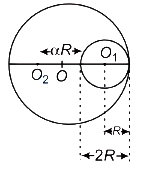
$A$ circular disc of radius $R$ is removed from a bigger circular disc of radius $2R$ such that the circumferences of the discs touch. The centre of mass of the new disc is at a distance $\alpha R$ from the centre of the bigger disc. The value of $\alpha$ is
A
$\frac{1}{2}$
B
$\frac{1}{3}$
C
$\frac{1}{4}$
D
$\frac{1}{6}$
Solution
(B) Let the centre of the bigger disc of radius $2R$ be at the origin $(0,0)$.
Let $M$ be the mass of the bigger disc. The mass per unit area is $\sigma = \frac{M}{\pi(2R)^2} = \frac{M}{4\pi R^2}$.
The mass of the removed smaller disc of radius $R$ is $m = \sigma \cdot \pi R^2 = \frac{M}{4\pi R^2} \cdot \pi R^2 = \frac{M}{4}$.
The centre of mass of the bigger disc is at $x_1 = 0$. The centre of mass of the removed smaller disc is at $x_2 = R$ (since the circumferences touch).
The centre of mass of the remaining part is given by:
$x_{CM} = \frac{M x_1 - m x_2}{M - m}$
$x_{CM} = \frac{M(0) - (M/4)(R)}{M - M/4} = \frac{-MR/4}{3M/4} = -\frac{R}{3}$.
The distance from the centre of the bigger disc is $|x_{CM}| = \frac{R}{3}$.
Comparing this with $\alpha R$,we get $\alpha = \frac{1}{3}$.
Let $M$ be the mass of the bigger disc. The mass per unit area is $\sigma = \frac{M}{\pi(2R)^2} = \frac{M}{4\pi R^2}$.
The mass of the removed smaller disc of radius $R$ is $m = \sigma \cdot \pi R^2 = \frac{M}{4\pi R^2} \cdot \pi R^2 = \frac{M}{4}$.
The centre of mass of the bigger disc is at $x_1 = 0$. The centre of mass of the removed smaller disc is at $x_2 = R$ (since the circumferences touch).
The centre of mass of the remaining part is given by:
$x_{CM} = \frac{M x_1 - m x_2}{M - m}$
$x_{CM} = \frac{M(0) - (M/4)(R)}{M - M/4} = \frac{-MR/4}{3M/4} = -\frac{R}{3}$.
The distance from the centre of the bigger disc is $|x_{CM}| = \frac{R}{3}$.
Comparing this with $\alpha R$,we get $\alpha = \frac{1}{3}$.
0 likesView Solution
262
ChemistryMediumMCQAP EAMCET · 2018
Which one of the following equations represents the variation of viscosity coefficient $(\eta)$ with temperature $(T)$?
A
$\eta = A e^{-E / R T}$
B
$\eta = A e^{E / R T}$
C
$\eta = A e^{-E / k T}$
D
$\eta = A e^{-E / T}$
Solution
(B) The variation of the viscosity coefficient $(\eta)$ of liquids with temperature $(T)$ is described by the Andrade equation,which is given by the expression: $\eta = A e^{E / R T}$.
Here,$A$ is a constant,$E$ is the activation energy for viscous flow,$R$ is the universal gas constant,and $T$ is the absolute temperature.
As temperature increases,the viscosity of liquids decreases,which is consistent with the exponential form $\eta = A e^{E / R T}$.
Here,$A$ is a constant,$E$ is the activation energy for viscous flow,$R$ is the universal gas constant,and $T$ is the absolute temperature.
As temperature increases,the viscosity of liquids decreases,which is consistent with the exponential form $\eta = A e^{E / R T}$.
0 likesView Solution
263
ChemistryMCQAP EAMCET · 2018
If the direction cosines of two lines satisfy the equations $l+m+n=0$ and $2lm+2ln-mn=0$,then the acute angle between those two lines is
A
$\frac{\pi}{4}$
B
$\frac{\pi}{3}$
C
$\frac{\pi}{6}$
D
$\frac{2\pi}{5}$
Solution
(B) Given equations are $l+m+n=0$ and $2lm+2ln-mn=0$.
From the first equation,$l = -(m+n)$.
Substituting this into the second equation:
$2(-m-n)m + 2(-m-n)n - mn = 0$
$-2m^2 - 2mn - 2mn - 2n^2 - mn = 0$
$-2m^2 - 5mn - 2n^2 = 0$
$2m^2 + 5mn + 2n^2 = 0$
$(2m+n)(m+2n) = 0$
Case $1$: $2m+n=0 \Rightarrow m = -n/2$. Then $l = -(-n/2 + n) = -n/2$. The direction ratios are $\langle -n/2, -n/2, n \rangle$,which is proportional to $\langle -1, -1, 2 \rangle$.
Case $2$: $m+2n=0 \Rightarrow m = -2n$. Then $l = -(-2n + n) = n$. The direction ratios are $\langle n, -2n, n \rangle$,which is proportional to $\langle 1, -2, 1 \rangle$.
Let the direction ratios be $\vec{a} = \langle -1, -1, 2 \rangle$ and $\vec{b} = \langle 1, -2, 1 \rangle$.
The angle $\theta$ between the lines is given by $\cos \theta = \frac{|\vec{a} \cdot \vec{b}|}{|\vec{a}| |\vec{b}|}$.
$\vec{a} \cdot \vec{b} = (-1)(1) + (-1)(-2) + (2)(1) = -1 + 2 + 2 = 3$.
$|\vec{a}| = \sqrt{(-1)^2 + (-1)^2 + 2^2} = \sqrt{6}$.
$|\vec{b}| = \sqrt{1^2 + (-2)^2 + 1^2} = \sqrt{6}$.
$\cos \theta = \frac{3}{\sqrt{6} \cdot \sqrt{6}} = \frac{3}{6} = \frac{1}{2}$.
Therefore,$\theta = \cos^{-1}(1/2) = \frac{\pi}{3}$.
From the first equation,$l = -(m+n)$.
Substituting this into the second equation:
$2(-m-n)m + 2(-m-n)n - mn = 0$
$-2m^2 - 2mn - 2mn - 2n^2 - mn = 0$
$-2m^2 - 5mn - 2n^2 = 0$
$2m^2 + 5mn + 2n^2 = 0$
$(2m+n)(m+2n) = 0$
Case $1$: $2m+n=0 \Rightarrow m = -n/2$. Then $l = -(-n/2 + n) = -n/2$. The direction ratios are $\langle -n/2, -n/2, n \rangle$,which is proportional to $\langle -1, -1, 2 \rangle$.
Case $2$: $m+2n=0 \Rightarrow m = -2n$. Then $l = -(-2n + n) = n$. The direction ratios are $\langle n, -2n, n \rangle$,which is proportional to $\langle 1, -2, 1 \rangle$.
Let the direction ratios be $\vec{a} = \langle -1, -1, 2 \rangle$ and $\vec{b} = \langle 1, -2, 1 \rangle$.
The angle $\theta$ between the lines is given by $\cos \theta = \frac{|\vec{a} \cdot \vec{b}|}{|\vec{a}| |\vec{b}|}$.
$\vec{a} \cdot \vec{b} = (-1)(1) + (-1)(-2) + (2)(1) = -1 + 2 + 2 = 3$.
$|\vec{a}| = \sqrt{(-1)^2 + (-1)^2 + 2^2} = \sqrt{6}$.
$|\vec{b}| = \sqrt{1^2 + (-2)^2 + 1^2} = \sqrt{6}$.
$\cos \theta = \frac{3}{\sqrt{6} \cdot \sqrt{6}} = \frac{3}{6} = \frac{1}{2}$.
Therefore,$\theta = \cos^{-1}(1/2) = \frac{\pi}{3}$.
0 likesView Solution
Vedclass Products
For Students
Vedclass Test Series
Mock tests in real AP EAMCET style covering Chemistry with performance analysis. 5-day free trial.
Start Free TrialFor Teachers
Exam Paper Generator
Generate Set A/B/C/D Chemistry papers from 7.5L+ questions in 2 minutes. 3 chapters free.
Try FreeFor Institutes
Online Exam Module
Run live AP EAMCET mock exams with unlimited students, 360° analytics & white-label branding.
See DemoFrequently Asked Questions
How many Chemistry questions are in AP EAMCET 2018?
There are 412 Chemistry questions from the AP EAMCET 2018 paper on Vedclass, each with a detailed step-by-step solution in English.
Are AP EAMCET 2018 Chemistry solutions available in English?
Yes. All solutions on this page are in English. You can also switch to English or Hindi using the language buttons above the questions.
Can I practice AP EAMCET 2018 Chemistry as a timed test?
Yes. Use the Vedclass Test Series to attempt a full AP EAMCET mock test covering Chemistry with time limits and instant score analysis.
Can teachers create Chemistry papers from AP EAMCET previous year questions?
Yes. The Vedclass Exam Paper Generator lets teachers mix AP EAMCET Chemistry questions and generate Set A/B/C/D papers in minutes.
For Teachers & Institutes
Build a Custom Chemistry Paper
Pick AP EAMCET 2018 Chemistry questions, set difficulty, and generate Set A/B/C/D in 2 minutes.