
ChemistryQ201–250 of 412 questions
Page 5 of 6 · English
201
ChemistryMediumMCQAP EAMCET · 2018
$2KMnO_4 + 3H_2SO_4 + 5H_2O_2 \rightarrow K_2SO_4 + 2MnSO_4 + 8H_2O + 5O_2$. Find the normality of $H_2O_2$ solution,if $20 \ mL$ of it is required to react completely with $16 \ mL$ of $0.02 \ M \ KMnO_4$ solution. (Molar mass of $KMnO_4 = 158 \ g \ mol^{-1}$)
A
$4 \times 10^{-2} \ N$
B
$2 \times 10^{-2} \ N$
C
$6 \times 10^{-2} \ N$
D
$8 \times 10^{-2} \ N$
Solution
(D) The reaction is a redox titration between $KMnO_4$ and $H_2O_2$ in acidic medium.
For $KMnO_4$,the change in oxidation state of $Mn$ is from $+7$ to $+2$,so the n-factor is $5$.
For $H_2O_2$,the change in oxidation state of $O$ is from $-1$ to $0$,so the n-factor is $2$.
At the equivalence point,the number of milliequivalents of $H_2O_2$ equals the number of milliequivalents of $KMnO_4$.
$N_1 V_1 = N_2 V_2$
Here,$N_2 = M_2 \times \text{n-factor} = 0.02 \times 5 = 0.1 \ N$.
$V_2 = 16 \ mL$,$V_1 = 20 \ mL$.
$N_1 = \frac{N_2 V_2}{V_1} = \frac{0.1 \times 16}{20} = \frac{1.6}{20} = 0.08 \ N = 8 \times 10^{-2} \ N$.
For $KMnO_4$,the change in oxidation state of $Mn$ is from $+7$ to $+2$,so the n-factor is $5$.
For $H_2O_2$,the change in oxidation state of $O$ is from $-1$ to $0$,so the n-factor is $2$.
At the equivalence point,the number of milliequivalents of $H_2O_2$ equals the number of milliequivalents of $KMnO_4$.
$N_1 V_1 = N_2 V_2$
Here,$N_2 = M_2 \times \text{n-factor} = 0.02 \times 5 = 0.1 \ N$.
$V_2 = 16 \ mL$,$V_1 = 20 \ mL$.
$N_1 = \frac{N_2 V_2}{V_1} = \frac{0.1 \times 16}{20} = \frac{1.6}{20} = 0.08 \ N = 8 \times 10^{-2} \ N$.
0 likesView Solution
202
ChemistryMediumMCQAP EAMCET · 2018
One litre of $0.15 \ M$ $Na_2SO_3$ aqueous solution is mixed with $500 \ mL$ of $0.2 \ M$ $K_2Cr_2O_7$ aqueous solution in acid medium. What is the number of moles of $K_2Cr_2O_7$ remaining in the solution after the reaction?
A
$0.1$
B
$0.0125$
C
$0.025$
D
$0.05$
Solution
(D) The balanced chemical equation is:
$3Na_2SO_3 + K_2Cr_2O_7 + 4H_2SO_4 \rightarrow 3Na_2SO_4 + K_2SO_4 + Cr_2(SO_4)_3 + 4H_2O$
Moles of $Na_2SO_3 = 0.15 \ M \times 1 \ L = 0.15 \ mol$
Moles of $K_2Cr_2O_7 = 0.2 \ M \times 0.5 \ L = 0.1 \ mol$
From the stoichiometry,$3 \ mol$ of $Na_2SO_3$ react with $1 \ mol$ of $K_2Cr_2O_7$.
Moles of $K_2Cr_2O_7$ required for $0.15 \ mol$ of $Na_2SO_3 = \frac{0.15}{3} = 0.05 \ mol$.
Moles of $K_2Cr_2O_7$ remaining $= 0.1 \ mol - 0.05 \ mol = 0.05 \ mol$.
$3Na_2SO_3 + K_2Cr_2O_7 + 4H_2SO_4 \rightarrow 3Na_2SO_4 + K_2SO_4 + Cr_2(SO_4)_3 + 4H_2O$
Moles of $Na_2SO_3 = 0.15 \ M \times 1 \ L = 0.15 \ mol$
Moles of $K_2Cr_2O_7 = 0.2 \ M \times 0.5 \ L = 0.1 \ mol$
From the stoichiometry,$3 \ mol$ of $Na_2SO_3$ react with $1 \ mol$ of $K_2Cr_2O_7$.
Moles of $K_2Cr_2O_7$ required for $0.15 \ mol$ of $Na_2SO_3 = \frac{0.15}{3} = 0.05 \ mol$.
Moles of $K_2Cr_2O_7$ remaining $= 0.1 \ mol - 0.05 \ mol = 0.05 \ mol$.
0 likesView Solution
203
ChemistryEasyMCQAP EAMCET · 2018
Which of the following nitrates on heating does not give its oxide?
A
$LiNO_3$
B
$NaNO_3$
C
$Ba(NO_3)_2$
D
$Be(NO_3)_2$
Solution
(B) $LiNO_3$ decomposes as: $2 LiNO_3 \xrightarrow{\Delta} Li_2O + 2 NO_2 + \frac{1}{2} O_2$
$NaNO_3$ decomposes as: $2 NaNO_3 \xrightarrow{\Delta} 2 NaNO_2 + O_2$
$Ba(NO_3)_2$ decomposes as: $2 Ba(NO_3)_2 \xrightarrow{\Delta} 2 BaO + 4 NO_2 + O_2$
$Be(NO_3)_2$ decomposes as: $2 Be(NO_3)_2 \xrightarrow{\Delta} 2 BeO + 4 NO_2 + O_2$
Thus,$NaNO_3$ forms its nitrite $(NaNO_2)$ and $O_2$ upon heating,not its oxide.
$NaNO_3$ decomposes as: $2 NaNO_3 \xrightarrow{\Delta} 2 NaNO_2 + O_2$
$Ba(NO_3)_2$ decomposes as: $2 Ba(NO_3)_2 \xrightarrow{\Delta} 2 BaO + 4 NO_2 + O_2$
$Be(NO_3)_2$ decomposes as: $2 Be(NO_3)_2 \xrightarrow{\Delta} 2 BeO + 4 NO_2 + O_2$
Thus,$NaNO_3$ forms its nitrite $(NaNO_2)$ and $O_2$ upon heating,not its oxide.
0 likesView Solution
204
ChemistryEasyMCQAP EAMCET · 2018
Identify the option in which the trends corresponding to hydroxides of group $2$ elements (from $Mg(OH)_2$ to $Ba(OH)_2$) are correctly shown:
| Basic character | Chemical stability | Solubility |
A
| Increases | Increases | Decreases |
B
| Decreases | Decreases | Decreases |
C
| Decreases | Increases | Increases |
D
| Increases | Increases | Increases |
Solution
(D) As we move down group $2$ from $Mg(OH)_2$ to $Ba(OH)_2$:
$1$. The basic character increases because the metallic character and the ease of releasing $OH^-$ ions increase due to the increase in atomic size.
$2$. The chemical stability (thermal stability) increases as the electropositive character of the metal increases,making the $M-O$ bond stronger relative to the $O-H$ bond.
$3$. The solubility in water increases because the lattice energy decreases more rapidly than the hydration energy as the size of the cation increases.
Therefore,all three properties increase down the group.
$1$. The basic character increases because the metallic character and the ease of releasing $OH^-$ ions increase due to the increase in atomic size.
$2$. The chemical stability (thermal stability) increases as the electropositive character of the metal increases,making the $M-O$ bond stronger relative to the $O-H$ bond.
$3$. The solubility in water increases because the lattice energy decreases more rapidly than the hydration energy as the size of the cation increases.
Therefore,all three properties increase down the group.
0 likesView Solution
205
ChemistryEasyMCQAP EAMCET · 2018
What are $X$,$Y$ and $Z$ in the following reactions?
$CaCO_3 \stackrel{\Delta}{\rightleftharpoons} CO_2 + X$
$X + H_2O \longrightarrow Y$
$Y + Cl_2 \longrightarrow Z$
$CaCO_3 \stackrel{\Delta}{\rightleftharpoons} CO_2 + X$
$X + H_2O \longrightarrow Y$
$Y + Cl_2 \longrightarrow Z$
A
$CaO, Ca(OH)_2, CaOCl_2$
B
$CaO, Ca(OCl)_2, Ca(OH)_2$
C
$Ca(OCl)_2, Ca(OH)_2, CaO$
D
$Ca(OH)_2, CaO, Ca(OCl)_2$
Solution
(A) $1$. Thermal decomposition of calcium carbonate: $CaCO_3 \stackrel{\Delta}{\rightleftharpoons} CO_2 + CaO (X)$.
$2$. Slaking of lime: $CaO (X) + H_2O \longrightarrow Ca(OH)_2 (Y)$.
$3$. Reaction with chlorine to form bleaching powder: $Ca(OH)_2 (Y) + Cl_2 \longrightarrow CaOCl_2 (Z) + H_2O$.
Thus,$X = CaO$,$Y = Ca(OH)_2$,and $Z = CaOCl_2$.
$2$. Slaking of lime: $CaO (X) + H_2O \longrightarrow Ca(OH)_2 (Y)$.
$3$. Reaction with chlorine to form bleaching powder: $Ca(OH)_2 (Y) + Cl_2 \longrightarrow CaOCl_2 (Z) + H_2O$.
Thus,$X = CaO$,$Y = Ca(OH)_2$,and $Z = CaOCl_2$.
0 likesView Solution
206
ChemistryEasyMCQAP EAMCET · 2018
Observe the following compounds.
$(i)$ $CaCO_3$
$(ii)$ $MgSO_4$
$(iii)$ $BaCl_2$
$(iv)$ $Sr(NO_3)_2$
$(v)$ $MgBr_2$
$(vi)$ $MgCl_2$
The oxoacid salts of group $II$ elements from the above list are
$(i)$ $CaCO_3$
$(ii)$ $MgSO_4$
$(iii)$ $BaCl_2$
$(iv)$ $Sr(NO_3)_2$
$(v)$ $MgBr_2$
$(vi)$ $MgCl_2$
The oxoacid salts of group $II$ elements from the above list are
A
$i, ii, iii, iv, v, vi$
B
$i, ii, iv$
C
$iii, v, vi$
D
$ii, v, vi$
Solution
(B) Oxoacid salts are salts derived from oxoacids (acids containing oxygen).
From the given list:
$(i)$ $CaCO_3$ is a salt of carbonic acid $(H_2CO_3)$.
$(ii)$ $MgSO_4$ is a salt of sulfuric acid $(H_2SO_4)$.
$(iv)$ $Sr(NO_3)_2$ is a salt of nitric acid $(HNO_3)$.
Compounds $(iii)$ $BaCl_2$,$(v)$ $MgBr_2$,and $(vi)$ $MgCl_2$ are halides,which are not oxoacid salts.
Therefore,the oxoacid salts are $(i)$,$(ii)$,and $(iv)$.
From the given list:
$(i)$ $CaCO_3$ is a salt of carbonic acid $(H_2CO_3)$.
$(ii)$ $MgSO_4$ is a salt of sulfuric acid $(H_2SO_4)$.
$(iv)$ $Sr(NO_3)_2$ is a salt of nitric acid $(HNO_3)$.
Compounds $(iii)$ $BaCl_2$,$(v)$ $MgBr_2$,and $(vi)$ $MgCl_2$ are halides,which are not oxoacid salts.
Therefore,the oxoacid salts are $(i)$,$(ii)$,and $(iv)$.
0 likesView Solution
207
ChemistryEasyMCQAP EAMCET · 2018
$Be$ and $Al$ show similarities in properties due to diagonal relationship except in the property $X$ given below. What is $X$?
A
Both form basic oxides and hydroxides
B
Ions of both have strong tendency to form complexes
C
In vapour phase chlorides of both have $Cl^-$ bridged chloride structure
D
Chlorides of both are soluble in organic solvents
Solution
(A) The oxides and hydroxides of both $Be$ and $Al$ are amphoteric in nature,not basic.
Both $Be$ and $Al$ exhibit diagonal relationship due to similar ionic potential ($charge/size$ ratio).
$Be$ and $Al$ both form complexes (e.g.,$[BeF_4]^{2-}$ and $[AlF_6]^{3-}$).
Their chlorides ($BeCl_2$ and $Al_2Cl_6$) exist as bridged structures in the vapour phase and are covalent,making them soluble in organic solvents.
Therefore,the statement that they form basic oxides and hydroxides is incorrect as they are amphoteric.
Both $Be$ and $Al$ exhibit diagonal relationship due to similar ionic potential ($charge/size$ ratio).
$Be$ and $Al$ both form complexes (e.g.,$[BeF_4]^{2-}$ and $[AlF_6]^{3-}$).
Their chlorides ($BeCl_2$ and $Al_2Cl_6$) exist as bridged structures in the vapour phase and are covalent,making them soluble in organic solvents.
Therefore,the statement that they form basic oxides and hydroxides is incorrect as they are amphoteric.
0 likesView Solution
208
ChemistryEasyMCQAP EAMCET · 2018
$Be$ and $Al$ show similarities in properties due to the diagonal relationship except in the property $X$ given below. What is $X?$
A
Both form basic oxides and hydroxides.
B
Ions of both have a strong tendency to form complexes.
C
In the vapour phase,chlorides of both have $Cl^{-}$ bridged chloride structure.
D
Chlorides of both are soluble in organic solvents.
Solution
(A) $Be$ and $Al$ exhibit a diagonal relationship,leading to many similar properties.
Both metals form covalent compounds and their chlorides act as Lewis acids.
Both metals dissolve in alkalies to form soluble complexes (beryllates and aluminates).
The oxides and hydroxides of both $Be$ and $Al$ are amphoteric in nature,not basic.
Therefore,the statement that both form basic oxides and hydroxides is incorrect.
Both metals form covalent compounds and their chlorides act as Lewis acids.
Both metals dissolve in alkalies to form soluble complexes (beryllates and aluminates).
The oxides and hydroxides of both $Be$ and $Al$ are amphoteric in nature,not basic.
Therefore,the statement that both form basic oxides and hydroxides is incorrect.
0 likesView Solution
209
ChemistryMCQAP EAMCET · 2018
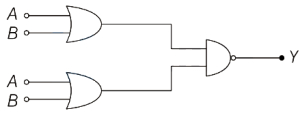
For the combination of logic gates shown in the figure,the equivalent logic gate is
A
$AND$
B
$NOT$
C
$NAND$
D
$NOR$
Solution
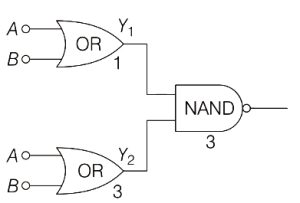
(D) The inputs to the two $OR$ gates are $A$ and $B$. Therefore,the outputs of the two $OR$ gates are $Y_1 = A + B$ and $Y_2 = A + B$.
These outputs $Y_1$ and $Y_2$ are fed into a $NAND$ gate. The output $Y$ of the $NAND$ gate is given by:
$Y = \overline{Y_1 \cdot Y_2}$
Substituting the values of $Y_1$ and $Y_2$:
$Y = \overline{(A + B) \cdot (A + B)}$
Using the Boolean identity $X \cdot X = X$,we have $(A + B) \cdot (A + B) = A + B$.
Therefore,$Y = \overline{A + B}$.
The expression $\overline{A + B}$ represents the output of a $NOR$ gate.
Thus,the equivalent logic gate is a $NOR$ gate.
These outputs $Y_1$ and $Y_2$ are fed into a $NAND$ gate. The output $Y$ of the $NAND$ gate is given by:
$Y = \overline{Y_1 \cdot Y_2}$
Substituting the values of $Y_1$ and $Y_2$:
$Y = \overline{(A + B) \cdot (A + B)}$
Using the Boolean identity $X \cdot X = X$,we have $(A + B) \cdot (A + B) = A + B$.
Therefore,$Y = \overline{A + B}$.
The expression $\overline{A + B}$ represents the output of a $NOR$ gate.
Thus,the equivalent logic gate is a $NOR$ gate.
0 likesView Solution
210
ChemistryMCQAP EAMCET · 2018
If $l$ and $m$ are the degree and the order respectively of the differential equation of the family of all circles in the $XY$ plane with radius $5$ units,then $2l + 3m =$
A
$5$
B
$10$
C
$15$
D
$7$
Solution
(B) The family of all circles in the $XY$ plane with radius $5$ units and center $(x_1, y_1)$ is given by:
$(x - x_1)^2 + (y - y_1)^2 = 25$ ... $(i)$
Differentiating with respect to $x$:
$2(x - x_1) + 2(y - y_1)y' = 0$
$(x - x_1) = -(y - y_1)y'$ ... (ii)
Differentiating again with respect to $x$:
$1 - [(y')^2 + (y - y_1)y''] = 0$
$(y - y_1) = \frac{1 - (y')^2}{y''}$ ... (iii)
Substituting $(y - y_1)$ from (iii) into (ii):
$(x - x_1) = -\left(\frac{1 - (y')^2}{y''}\right)y' = \frac{(y')^3 - y'}{y''}$
Substituting $(x - x_1)$ and $(y - y_1)$ into $(i)$:
$\left(\frac{(y')^3 - y'}{y''}\right)^2 + \left(\frac{1 - (y')^2}{y''}\right)^2 = 25$
$\frac{(y')^2((y')^2 - 1)^2 + (1 - (y')^2)^2}{(y'')^2} = 25$
$\frac{(1 - (y')^2)^2 [ (y')^2 + 1 ]}{(y'')^2} = 25$
$(1 - (y')^2)^2 (1 + (y')^2) = 25(y'')^2$
Here,the highest order derivative is $y''$,so the order $m = 2$.
The power of the highest order derivative is $2$,so the degree $l = 2$.
Given $l = 2$ and $m = 2$,we have:
$2l + 3m = 2(2) + 3(2) = 4 + 6 = 10$.
$(x - x_1)^2 + (y - y_1)^2 = 25$ ... $(i)$
Differentiating with respect to $x$:
$2(x - x_1) + 2(y - y_1)y' = 0$
$(x - x_1) = -(y - y_1)y'$ ... (ii)
Differentiating again with respect to $x$:
$1 - [(y')^2 + (y - y_1)y''] = 0$
$(y - y_1) = \frac{1 - (y')^2}{y''}$ ... (iii)
Substituting $(y - y_1)$ from (iii) into (ii):
$(x - x_1) = -\left(\frac{1 - (y')^2}{y''}\right)y' = \frac{(y')^3 - y'}{y''}$
Substituting $(x - x_1)$ and $(y - y_1)$ into $(i)$:
$\left(\frac{(y')^3 - y'}{y''}\right)^2 + \left(\frac{1 - (y')^2}{y''}\right)^2 = 25$
$\frac{(y')^2((y')^2 - 1)^2 + (1 - (y')^2)^2}{(y'')^2} = 25$
$\frac{(1 - (y')^2)^2 [ (y')^2 + 1 ]}{(y'')^2} = 25$
$(1 - (y')^2)^2 (1 + (y')^2) = 25(y'')^2$
Here,the highest order derivative is $y''$,so the order $m = 2$.
The power of the highest order derivative is $2$,so the degree $l = 2$.
Given $l = 2$ and $m = 2$,we have:
$2l + 3m = 2(2) + 3(2) = 4 + 6 = 10$.
0 likesView Solution
211
ChemistryMCQAP EAMCET · 2018
If $-\frac{\pi}{4} < x < \frac{\pi}{4}$,then the general solution of the differential equation $\cos ^2 x \cdot \frac{d y}{d x}-(\tan 2 x) y=\cos ^4 x$ is
A
$y=\frac{1}{2}\left[\frac{\tan 2 x+c}{1-\tan ^2 x}\right]$
B
$y=\frac{1}{2}\left[\frac{\cos 2 x+c}{1-\tan ^2 x}\right]$
C
$y=\frac{1}{2}\left[\frac{\sin 2 x+c}{1-\tan ^2 x}\right]$
D
$y=\frac{1}{2}\left[\frac{\sin x+c}{1-\tan ^2 x}\right]$
Solution
(C) Given differential equation: $\cos ^2 x \frac{d y}{d x}-(\tan 2 x) y=\cos ^4 x$.
Dividing by $\cos ^2 x$,we get: $\frac{d y}{d x} - \frac{\tan 2 x}{\cos ^2 x} y = \cos ^2 x$.
This is a linear differential equation of the form $\frac{d y}{d x} + P y = Q$,where $P = -\frac{\tan 2 x}{\cos ^2 x}$ and $Q = \cos ^2 x$.
Integrating factor $IF = e^{\int P dx} = e^{\int -\frac{\tan 2 x}{\cos ^2 x} dx}$.
Let $I = \int -\frac{\tan 2 x}{\cos ^2 x} dx = \int -\frac{\sin 2 x}{\cos 2 x \cdot \cos ^2 x} dx$.
Using $\cos^2 x = \frac{1+\cos 2 x}{2}$,we get $I = \int -\frac{2 \sin 2 x}{\cos 2 x (1+\cos 2 x)} dx$.
Let $\cos 2 x = t$,then $-2 \sin 2 x dx = dt$.
$I = \int \frac{dt}{t(t+1)} = \int (\frac{1}{t} - \frac{1}{t+1}) dt = \ln|t| - \ln|t+1| = \ln|\frac{t}{t+1}|$.
Thus,$IF = \frac{\cos 2 x}{\cos 2 x + 1} = \frac{\cos 2 x}{2 \cos^2 x}$.
The solution is $y \cdot IF = \int Q \cdot IF dx + c$.
$y \cdot \frac{\cos 2 x}{2 \cos^2 x} = \int \cos^2 x \cdot \frac{\cos 2 x}{2 \cos^2 x} dx + c = \frac{1}{2} \int \cos 2 x dx + c = \frac{1}{4} \sin 2 x + c$.
$y = \frac{2 \cos^2 x}{\cos 2 x} (\frac{\sin 2 x + 4c}{4}) = \frac{1}{2} \frac{\cos^2 x}{\cos 2 x} (\sin 2 x + C)$.
Using $\cos 2 x = \cos^2 x - \sin^2 x = \cos^2 x (1 - \tan^2 x)$,we get $y = \frac{1}{2} \frac{\sin 2 x + C}{1 - \tan^2 x}$.
Dividing by $\cos ^2 x$,we get: $\frac{d y}{d x} - \frac{\tan 2 x}{\cos ^2 x} y = \cos ^2 x$.
This is a linear differential equation of the form $\frac{d y}{d x} + P y = Q$,where $P = -\frac{\tan 2 x}{\cos ^2 x}$ and $Q = \cos ^2 x$.
Integrating factor $IF = e^{\int P dx} = e^{\int -\frac{\tan 2 x}{\cos ^2 x} dx}$.
Let $I = \int -\frac{\tan 2 x}{\cos ^2 x} dx = \int -\frac{\sin 2 x}{\cos 2 x \cdot \cos ^2 x} dx$.
Using $\cos^2 x = \frac{1+\cos 2 x}{2}$,we get $I = \int -\frac{2 \sin 2 x}{\cos 2 x (1+\cos 2 x)} dx$.
Let $\cos 2 x = t$,then $-2 \sin 2 x dx = dt$.
$I = \int \frac{dt}{t(t+1)} = \int (\frac{1}{t} - \frac{1}{t+1}) dt = \ln|t| - \ln|t+1| = \ln|\frac{t}{t+1}|$.
Thus,$IF = \frac{\cos 2 x}{\cos 2 x + 1} = \frac{\cos 2 x}{2 \cos^2 x}$.
The solution is $y \cdot IF = \int Q \cdot IF dx + c$.
$y \cdot \frac{\cos 2 x}{2 \cos^2 x} = \int \cos^2 x \cdot \frac{\cos 2 x}{2 \cos^2 x} dx + c = \frac{1}{2} \int \cos 2 x dx + c = \frac{1}{4} \sin 2 x + c$.
$y = \frac{2 \cos^2 x}{\cos 2 x} (\frac{\sin 2 x + 4c}{4}) = \frac{1}{2} \frac{\cos^2 x}{\cos 2 x} (\sin 2 x + C)$.
Using $\cos 2 x = \cos^2 x - \sin^2 x = \cos^2 x (1 - \tan^2 x)$,we get $y = \frac{1}{2} \frac{\sin 2 x + C}{1 - \tan^2 x}$.
0 likesView Solution
212
ChemistryMCQAP EAMCET · 2018
If the position vectors of $A, B, C, D$ are $\hat{i}+2\hat{j}+2\hat{k}, 2\hat{i}-\hat{j}, \hat{i}+\hat{j}+3\hat{k}$ and $4\hat{j}+5\hat{k}$ respectively,then the quadrilateral $ABCD$ is a
A
square
B
rectangle
C
rhombus
D
parallelogram
Solution
(C) Let the position vectors be $\vec{a} = \hat{i}+2\hat{j}+2\hat{k}$,$\vec{b} = 2\hat{i}-\hat{j}$,$\vec{c} = \hat{i}+\hat{j}+3\hat{k}$,and $\vec{d} = 4\hat{j}+5\hat{k}$.
First,find the vectors representing the sides:
$\vec{AB} = \vec{b} - \vec{a} = (2-1)\hat{i} + (-1-2)\hat{j} + (0-2)\hat{k} = \hat{i} - 3\hat{j} - 2\hat{k}$.
$\vec{BC} = \vec{c} - \vec{b} = (1-2)\hat{i} + (1-(-1))\hat{j} + (3-0)\hat{k} = -\hat{i} + 2\hat{j} + 3\hat{k}$.
$\vec{CD} = \vec{d} - \vec{c} = (0-1)\hat{i} + (4-1)\hat{j} + (5-3)\hat{k} = -\hat{i} + 3\hat{j} + 2\hat{k}$.
$\vec{DA} = \vec{a} - \vec{d} = (1-0)\hat{i} + (2-4)\hat{j} + (2-5)\hat{k} = \hat{i} - 2\hat{j} - 3\hat{k}$.
Note that $\vec{AB} = -\vec{CD}$ and $\vec{BC} = -\vec{DA}$,which confirms $ABCD$ is a parallelogram.
Now check the lengths of the sides:
$|\vec{AB}| = \sqrt{1^2 + (-3)^2 + (-2)^2} = \sqrt{1+9+4} = \sqrt{14}$.
$|\vec{BC}| = \sqrt{(-1)^2 + 2^2 + 3^2} = \sqrt{1+4+9} = \sqrt{14}$.
Since adjacent sides are equal $(|\vec{AB}| = |\vec{BC}| = \sqrt{14})$,the parallelogram is a rhombus.
First,find the vectors representing the sides:
$\vec{AB} = \vec{b} - \vec{a} = (2-1)\hat{i} + (-1-2)\hat{j} + (0-2)\hat{k} = \hat{i} - 3\hat{j} - 2\hat{k}$.
$\vec{BC} = \vec{c} - \vec{b} = (1-2)\hat{i} + (1-(-1))\hat{j} + (3-0)\hat{k} = -\hat{i} + 2\hat{j} + 3\hat{k}$.
$\vec{CD} = \vec{d} - \vec{c} = (0-1)\hat{i} + (4-1)\hat{j} + (5-3)\hat{k} = -\hat{i} + 3\hat{j} + 2\hat{k}$.
$\vec{DA} = \vec{a} - \vec{d} = (1-0)\hat{i} + (2-4)\hat{j} + (2-5)\hat{k} = \hat{i} - 2\hat{j} - 3\hat{k}$.
Note that $\vec{AB} = -\vec{CD}$ and $\vec{BC} = -\vec{DA}$,which confirms $ABCD$ is a parallelogram.
Now check the lengths of the sides:
$|\vec{AB}| = \sqrt{1^2 + (-3)^2 + (-2)^2} = \sqrt{1+9+4} = \sqrt{14}$.
$|\vec{BC}| = \sqrt{(-1)^2 + 2^2 + 3^2} = \sqrt{1+4+9} = \sqrt{14}$.
Since adjacent sides are equal $(|\vec{AB}| = |\vec{BC}| = \sqrt{14})$,the parallelogram is a rhombus.
0 likesView Solution
213
ChemistryMCQAP EAMCET · 2018
If $a, b, c$ are unit vectors and the maximum value of $|a-b|^2+|b-c|^2+|c-a|^2$ is $k$,then $k(2|a|^2+3|b|^2-4|c|^2)=$
A
$6$
B
$8$
C
$9$
D
$12$
Solution
(C) Given that $a, b, c$ are unit vectors,so $|a|=|b|=|c|=1$.
We know that $|a-b|^2 = |a|^2 + |b|^2 - 2(a \cdot b) = 1 + 1 - 2(a \cdot b) = 2 - 2(a \cdot b)$.
Similarly,$|b-c|^2 = 2 - 2(b \cdot c)$ and $|c-a|^2 = 2 - 2(c \cdot a)$.
Adding these,we get:
$|a-b|^2+|b-c|^2+|c-a|^2 = 6 - 2(a \cdot b + b \cdot c + c \cdot a) \quad \dots (i)$
To maximize this expression,we need to minimize $(a \cdot b + b \cdot c + c \cdot a)$.
We know that $|a+b+c|^2 = |a|^2 + |b|^2 + |c|^2 + 2(a \cdot b + b \cdot c + c \cdot a) \ge 0$.
Since $|a|=|b|=|c|=1$,we have $1 + 1 + 1 + 2(a \cdot b + b \cdot c + c \cdot a) \ge 0$,which implies $2(a \cdot b + b \cdot c + c \cdot a) \ge -3$.
The minimum value of $2(a \cdot b + b \cdot c + c \cdot a)$ is $-3$.
Substituting this into equation $(i)$:
$k = 6 - (-3) = 9$.
Now,we need to calculate $k(2|a|^2+3|b|^2-4|c|^2)$.
Since $|a|=|b|=|c|=1$,we have $|a|^2=|b|^2=|c|^2=1$.
Thus,$k(2(1)+3(1)-4(1)) = 9(2+3-4) = 9(1) = 9$.
We know that $|a-b|^2 = |a|^2 + |b|^2 - 2(a \cdot b) = 1 + 1 - 2(a \cdot b) = 2 - 2(a \cdot b)$.
Similarly,$|b-c|^2 = 2 - 2(b \cdot c)$ and $|c-a|^2 = 2 - 2(c \cdot a)$.
Adding these,we get:
$|a-b|^2+|b-c|^2+|c-a|^2 = 6 - 2(a \cdot b + b \cdot c + c \cdot a) \quad \dots (i)$
To maximize this expression,we need to minimize $(a \cdot b + b \cdot c + c \cdot a)$.
We know that $|a+b+c|^2 = |a|^2 + |b|^2 + |c|^2 + 2(a \cdot b + b \cdot c + c \cdot a) \ge 0$.
Since $|a|=|b|=|c|=1$,we have $1 + 1 + 1 + 2(a \cdot b + b \cdot c + c \cdot a) \ge 0$,which implies $2(a \cdot b + b \cdot c + c \cdot a) \ge -3$.
The minimum value of $2(a \cdot b + b \cdot c + c \cdot a)$ is $-3$.
Substituting this into equation $(i)$:
$k = 6 - (-3) = 9$.
Now,we need to calculate $k(2|a|^2+3|b|^2-4|c|^2)$.
Since $|a|=|b|=|c|=1$,we have $|a|^2=|b|^2=|c|^2=1$.
Thus,$k(2(1)+3(1)-4(1)) = 9(2+3-4) = 9(1) = 9$.
0 likesView Solution
214
ChemistryMCQAP EAMCET · 2018
If a line makes angles $\tan ^{-1} \sqrt{7}$ and $\tan ^{-1} \frac{\sqrt{5}}{\sqrt{3}}$ with the $X$-axis and $Y$-axis respectively,then the angle made by it with the $Z$-axis is
A
$\frac{\pi}{2}$
B
$\frac{\pi}{6}$ or $\frac{5 \pi}{6}$
C
$\frac{\pi}{3}$ or $\frac{2 \pi}{3}$
D
$\frac{\pi}{4}$ or $\frac{3 \pi}{4}$
Solution
(D) Let the angles made by the line with the $X$,$Y$,and $Z$-axes be $\alpha$,$\beta$,and $\gamma$ respectively.
Given:
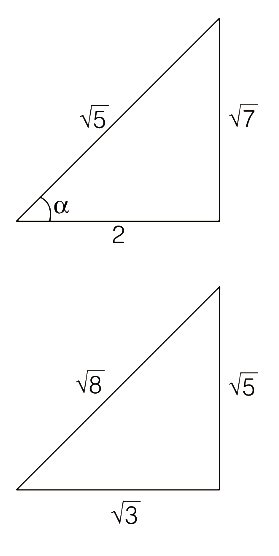
$\alpha = \tan ^{-1} \sqrt{7} \implies \tan \alpha = \sqrt{7}$.
Since $\sec^2 \alpha = 1 + \tan^2 \alpha = 1 + 7 = 8$,we have $\cos^2 \alpha = \frac{1}{8}$.
$\beta = \tan ^{-1} \frac{\sqrt{5}}{\sqrt{3}} \implies \tan \beta = \frac{\sqrt{5}}{\sqrt{3}}$.
Since $\sec^2 \beta = 1 + \tan^2 \beta = 1 + \frac{5}{3} = \frac{8}{3}$,we have $\cos^2 \beta = \frac{3}{8}$.
We know that $\cos^2 \alpha + \cos^2 \beta + \cos^2 \gamma = 1$.
Substituting the values:
$\frac{1}{8} + \frac{3}{8} + \cos^2 \gamma = 1$
$\frac{4}{8} + \cos^2 \gamma = 1$
$\frac{1}{2} + \cos^2 \gamma = 1$
$\cos^2 \gamma = \frac{1}{2}$
$\cos \gamma = \pm \frac{1}{\sqrt{2}}$
Thus,$\gamma = \frac{\pi}{4}$ or $\gamma = \pi - \frac{\pi}{4} = \frac{3\pi}{4}$.
Given:
$\alpha = \tan ^{-1} \sqrt{7} \implies \tan \alpha = \sqrt{7}$.
Since $\sec^2 \alpha = 1 + \tan^2 \alpha = 1 + 7 = 8$,we have $\cos^2 \alpha = \frac{1}{8}$.
$\beta = \tan ^{-1} \frac{\sqrt{5}}{\sqrt{3}} \implies \tan \beta = \frac{\sqrt{5}}{\sqrt{3}}$.
Since $\sec^2 \beta = 1 + \tan^2 \beta = 1 + \frac{5}{3} = \frac{8}{3}$,we have $\cos^2 \beta = \frac{3}{8}$.
We know that $\cos^2 \alpha + \cos^2 \beta + \cos^2 \gamma = 1$.
Substituting the values:
$\frac{1}{8} + \frac{3}{8} + \cos^2 \gamma = 1$
$\frac{4}{8} + \cos^2 \gamma = 1$
$\frac{1}{2} + \cos^2 \gamma = 1$
$\cos^2 \gamma = \frac{1}{2}$
$\cos \gamma = \pm \frac{1}{\sqrt{2}}$
Thus,$\gamma = \frac{\pi}{4}$ or $\gamma = \pi - \frac{\pi}{4} = \frac{3\pi}{4}$.
0 likesView Solution
215
ChemistryMCQAP EAMCET · 2018
$A$ plane passes through the point $(3, 5, 7)$. If the direction ratios of its normal are equal to the intercepts made by the plane $x + 3y + 2z = 9$ with the coordinate axes,then the equation of that plane is
A
$x + y + z = 5$
B
$6x + 2y + 3z = 105$
C
$12x + 4y + 6z = 49$
D
$6x + 2y + 3z = 49$
Solution
(D) The given equation of the plane is $x + 3y + 2z = 9$.
Dividing by $9$,we get $\frac{x}{9} + \frac{y}{3} + \frac{z}{9/2} = 1$.
Thus,the intercepts made by the plane with the coordinate axes are $a = 9$,$b = 3$,and $c = 9/2$.
The direction ratios of the normal to the required plane are $(9, 3, 9/2)$.
Multiplying by $2$,we can take the direction ratios as $(18, 6, 9)$,or simply $(6, 2, 3)$.
The plane passes through the point $(3, 5, 7)$.
The equation of the plane is $a(x - x_1) + b(y - y_1) + c(z - z_1) = 0$.
Substituting the values: $6(x - 3) + 2(y - 5) + 3(z - 7) = 0$.
$6x - 18 + 2y - 10 + 3z - 21 = 0$.
$6x + 2y + 3z - 49 = 0$.
Therefore,the equation of the plane is $6x + 2y + 3z = 49$.
Dividing by $9$,we get $\frac{x}{9} + \frac{y}{3} + \frac{z}{9/2} = 1$.
Thus,the intercepts made by the plane with the coordinate axes are $a = 9$,$b = 3$,and $c = 9/2$.
The direction ratios of the normal to the required plane are $(9, 3, 9/2)$.
Multiplying by $2$,we can take the direction ratios as $(18, 6, 9)$,or simply $(6, 2, 3)$.
The plane passes through the point $(3, 5, 7)$.
The equation of the plane is $a(x - x_1) + b(y - y_1) + c(z - z_1) = 0$.
Substituting the values: $6(x - 3) + 2(y - 5) + 3(z - 7) = 0$.
$6x - 18 + 2y - 10 + 3z - 21 = 0$.
$6x + 2y + 3z - 49 = 0$.
Therefore,the equation of the plane is $6x + 2y + 3z = 49$.
0 likesView Solution
216
ChemistryMCQAP EAMCET · 2018
If a number is chosen at random from the four-digit numbers formed by using the digits $0, 1, 2, 3, 4, 6$ without repetition,then the probability that it is divisible by $4$ is:
A
$\frac{17}{100}$
B
$\frac{17}{50}$
C
$\frac{13}{50}$
D
$\frac{13}{25}$
Solution
(B) Total number of $4$-digit numbers formed using digits ${0, 1, 2, 3, 4, 6}$ without repetition:
Thousands place can be filled in $5$ ways (excluding $0$).
Hundreds place can be filled in $5$ ways.
Tens place can be filled in $4$ ways.
Units place can be filled in $3$ ways.
Total $= 5 \times 5 \times 4 \times 3 = 300$.
$A$ number is divisible by $4$ if the number formed by its last two digits is divisible by $4$. The possible last two-digit combinations from ${0, 1, 2, 3, 4, 6}$ are:
$04, 12, 16, 20, 24, 32, 36, 40, 60, 64$.
Case $1$: Last two digits are $04, 20, 24, 40, 60, 64$ (contain $0$ or $4$).
- If the last two digits are $04, 20, 40, 60$:
Remaining $2$ places can be filled in $4 \times 3 = 12$ ways each.
Total $= 4 \times 12 = 48$ ways.
- If the last two digits are $24, 64$:
Thousands place cannot be $0$ or the digits used.
Thousands place has $3$ choices,Hundreds place has $3$ choices.
Total $= 2 \times (3 \times 3) = 18$ ways.
Case $2$: Last two digits are $12, 16, 32, 36$:
Thousands place cannot be $0$ or the digits used.
Thousands place has $3$ choices,Hundreds place has $3$ choices.
Total $= 4 \times (3 \times 3) = 36$ ways.
Total favorable outcomes $= 48 + 18 + 36 = 102$.
Probability $= \frac{102}{300} = \frac{17}{50}$.
Thousands place can be filled in $5$ ways (excluding $0$).
Hundreds place can be filled in $5$ ways.
Tens place can be filled in $4$ ways.
Units place can be filled in $3$ ways.
Total $= 5 \times 5 \times 4 \times 3 = 300$.
$A$ number is divisible by $4$ if the number formed by its last two digits is divisible by $4$. The possible last two-digit combinations from ${0, 1, 2, 3, 4, 6}$ are:
$04, 12, 16, 20, 24, 32, 36, 40, 60, 64$.
Case $1$: Last two digits are $04, 20, 24, 40, 60, 64$ (contain $0$ or $4$).
- If the last two digits are $04, 20, 40, 60$:
Remaining $2$ places can be filled in $4 \times 3 = 12$ ways each.
Total $= 4 \times 12 = 48$ ways.
- If the last two digits are $24, 64$:
Thousands place cannot be $0$ or the digits used.
Thousands place has $3$ choices,Hundreds place has $3$ choices.
Total $= 2 \times (3 \times 3) = 18$ ways.
Case $2$: Last two digits are $12, 16, 32, 36$:
Thousands place cannot be $0$ or the digits used.
Thousands place has $3$ choices,Hundreds place has $3$ choices.
Total $= 4 \times (3 \times 3) = 36$ ways.
Total favorable outcomes $= 48 + 18 + 36 = 102$.
Probability $= \frac{102}{300} = \frac{17}{50}$.
0 likesView Solution
217
ChemistryMCQAP EAMCET · 2018
Four cards are drawn at random from a pack of playing cards. The probability of getting exactly two cards from the same suit and the remaining two cards from two different suits is
A
$\frac{72 \times 169}{425 \times 49}$
B
$\frac{24 \times 169}{425 \times 49}$
C
$\frac{18 \times 169}{425 \times 49}$
D
$\frac{6 \times 169}{425 \times 49}$
Solution
(A) Total number of cards = $52$.
The total number of ways to draw $4$ cards from $52$ is $^{52}C_4 = \frac{52 \times 51 \times 50 \times 49}{4 \times 3 \times 2 \times 1} = 270725$.
For the favourable case,we need exactly two cards from one suit and one card each from two other different suits.
Step $1$: Select $1$ suit out of $4$ to get $2$ cards: $^4C_1 = 4$ ways.
Step $2$: Select $2$ cards from the $13$ cards of that suit: $^{13}C_2 = \frac{13 \times 12}{2} = 78$ ways.
Step $3$: Select $2$ other suits out of the remaining $3$ suits: $^3C_2 = 3$ ways.
Step $4$: Select $1$ card each from these $2$ selected suits: $^{13}C_1 \times ^{13}C_1 = 13 \times 13 = 169$ ways.
Total favourable ways = $4 \times 78 \times 3 \times 169 = 157872$.
Probability = $\frac{157872}{270725} = \frac{72 \times 169}{425 \times 49}$.
The total number of ways to draw $4$ cards from $52$ is $^{52}C_4 = \frac{52 \times 51 \times 50 \times 49}{4 \times 3 \times 2 \times 1} = 270725$.
For the favourable case,we need exactly two cards from one suit and one card each from two other different suits.
Step $1$: Select $1$ suit out of $4$ to get $2$ cards: $^4C_1 = 4$ ways.
Step $2$: Select $2$ cards from the $13$ cards of that suit: $^{13}C_2 = \frac{13 \times 12}{2} = 78$ ways.
Step $3$: Select $2$ other suits out of the remaining $3$ suits: $^3C_2 = 3$ ways.
Step $4$: Select $1$ card each from these $2$ selected suits: $^{13}C_1 \times ^{13}C_1 = 13 \times 13 = 169$ ways.
Total favourable ways = $4 \times 78 \times 3 \times 169 = 157872$.
Probability = $\frac{157872}{270725} = \frac{72 \times 169}{425 \times 49}$.
0 likesView Solution
218
ChemistryMCQAP EAMCET · 2018
For a binomial variate $X$ with parameters $n=5$ and $p=\frac{3}{4}$,if $\alpha=\frac{1}{9} P(X \geq 3)$ and $\beta=P(X \leq 2)$,then $256(\beta-\alpha)=$
A
-$1$
B
$0$
C
$1$
D
$2$
Solution
(C) Given $n=5$ and $p=\frac{3}{4}$,so $q=1-p=\frac{1}{4}$.
$\alpha = \frac{1}{9} P(X \geq 3) = \frac{1}{9} [P(X=3) + P(X=4) + P(X=5)]$
$= \frac{1}{9} [^5C_3(\frac{3}{4})^3(\frac{1}{4})^2 + ^5C_4(\frac{3}{4})^4(\frac{1}{4})^1 + ^5C_5(\frac{3}{4})^5]$
$= \frac{1}{9} [10 \cdot \frac{27}{1024} + 5 \cdot \frac{81}{1024} + 1 \cdot \frac{243}{1024}] = \frac{1}{9} [\frac{270+405+243}{1024}] = \frac{1}{9} [\frac{918}{1024}] = \frac{102}{1024}$.
$\beta = P(X \leq 2) = P(X=0) + P(X=1) + P(X=2)$
$= ^5C_0(\frac{3}{4})^0(\frac{1}{4})^5 + ^5C_1(\frac{3}{4})^1(\frac{1}{4})^4 + ^5C_2(\frac{3}{4})^2(\frac{1}{4})^3$
$= 1 \cdot \frac{1}{1024} + 5 \cdot \frac{3}{1024} + 10 \cdot \frac{9}{1024} = \frac{1+15+90}{1024} = \frac{106}{1024}$.
Now,$256(\beta-\alpha) = 256(\frac{106}{1024} - \frac{102}{1024}) = 256(\frac{4}{1024}) = 256(\frac{1}{256}) = 1$.
$\alpha = \frac{1}{9} P(X \geq 3) = \frac{1}{9} [P(X=3) + P(X=4) + P(X=5)]$
$= \frac{1}{9} [^5C_3(\frac{3}{4})^3(\frac{1}{4})^2 + ^5C_4(\frac{3}{4})^4(\frac{1}{4})^1 + ^5C_5(\frac{3}{4})^5]$
$= \frac{1}{9} [10 \cdot \frac{27}{1024} + 5 \cdot \frac{81}{1024} + 1 \cdot \frac{243}{1024}] = \frac{1}{9} [\frac{270+405+243}{1024}] = \frac{1}{9} [\frac{918}{1024}] = \frac{102}{1024}$.
$\beta = P(X \leq 2) = P(X=0) + P(X=1) + P(X=2)$
$= ^5C_0(\frac{3}{4})^0(\frac{1}{4})^5 + ^5C_1(\frac{3}{4})^1(\frac{1}{4})^4 + ^5C_2(\frac{3}{4})^2(\frac{1}{4})^3$
$= 1 \cdot \frac{1}{1024} + 5 \cdot \frac{3}{1024} + 10 \cdot \frac{9}{1024} = \frac{1+15+90}{1024} = \frac{106}{1024}$.
Now,$256(\beta-\alpha) = 256(\frac{106}{1024} - \frac{102}{1024}) = 256(\frac{4}{1024}) = 256(\frac{1}{256}) = 1$.
0 likesView Solution
219
ChemistryMCQAP EAMCET · 2018
$A$ random variable $X$ has the following probability distribution:
The variance of this random variable is:
| $X = x_i$ | $-2$ | $-1$ | $0$ | $1$ | $2$ |
| $P(X = x_i)$ | $\frac{1}{6}$ | $k$ | $\frac{1}{4}$ | $k$ | $\frac{1}{6}$ |
The variance of this random variable is:
A
$0$
B
$\frac{5}{24}$
C
$\frac{3}{24}$
D
$\frac{7}{4}$
Solution
(D) We know that the sum of probabilities in a probability distribution is $1$.
$\Sigma P(X = x_i) = 1$
$\Rightarrow \frac{1}{6} + k + \frac{1}{4} + k + \frac{1}{6} = 1$
$\Rightarrow 2k + \frac{2}{6} + \frac{1}{4} = 1$
$\Rightarrow 2k + \frac{1}{3} + \frac{1}{4} = 1$
$\Rightarrow 2k + \frac{7}{12} = 1$
$\Rightarrow 2k = 1 - \frac{7}{12} = \frac{5}{12}$
$\Rightarrow k = \frac{5}{24}$
Now,the mean $E(X) = \Sigma x_i P(x_i)$:
$E(X) = (-2)(\frac{1}{6}) + (-1)(\frac{5}{24}) + (0)(\frac{1}{4}) + (1)(\frac{5}{24}) + (2)(\frac{1}{6})$
$E(X) = -\frac{2}{6} - \frac{5}{24} + 0 + \frac{5}{24} + \frac{2}{6} = 0$
Now,$E(X^2) = \Sigma x_i^2 P(x_i)$:
$E(X^2) = (-2)^2(\frac{1}{6}) + (-1)^2(\frac{5}{24}) + (0)^2(\frac{1}{4}) + (1)^2(\frac{5}{24}) + (2)^2(\frac{1}{6})$
$E(X^2) = 4(\frac{1}{6}) + 1(\frac{5}{24}) + 0 + 1(\frac{5}{24}) + 4(\frac{1}{6})$
$E(X^2) = \frac{4}{6} + \frac{5}{24} + \frac{5}{24} + \frac{4}{6} = \frac{8}{6} + \frac{10}{24} = \frac{4}{3} + \frac{5}{12} = \frac{16+5}{12} = \frac{21}{12} = \frac{7}{4}$
Variance $\text{Var}(X) = E(X^2) - [E(X)]^2$
$\text{Var}(X) = \frac{7}{4} - (0)^2 = \frac{7}{4}$
$\Sigma P(X = x_i) = 1$
$\Rightarrow \frac{1}{6} + k + \frac{1}{4} + k + \frac{1}{6} = 1$
$\Rightarrow 2k + \frac{2}{6} + \frac{1}{4} = 1$
$\Rightarrow 2k + \frac{1}{3} + \frac{1}{4} = 1$
$\Rightarrow 2k + \frac{7}{12} = 1$
$\Rightarrow 2k = 1 - \frac{7}{12} = \frac{5}{12}$
$\Rightarrow k = \frac{5}{24}$
Now,the mean $E(X) = \Sigma x_i P(x_i)$:
$E(X) = (-2)(\frac{1}{6}) + (-1)(\frac{5}{24}) + (0)(\frac{1}{4}) + (1)(\frac{5}{24}) + (2)(\frac{1}{6})$
$E(X) = -\frac{2}{6} - \frac{5}{24} + 0 + \frac{5}{24} + \frac{2}{6} = 0$
Now,$E(X^2) = \Sigma x_i^2 P(x_i)$:
$E(X^2) = (-2)^2(\frac{1}{6}) + (-1)^2(\frac{5}{24}) + (0)^2(\frac{1}{4}) + (1)^2(\frac{5}{24}) + (2)^2(\frac{1}{6})$
$E(X^2) = 4(\frac{1}{6}) + 1(\frac{5}{24}) + 0 + 1(\frac{5}{24}) + 4(\frac{1}{6})$
$E(X^2) = \frac{4}{6} + \frac{5}{24} + \frac{5}{24} + \frac{4}{6} = \frac{8}{6} + \frac{10}{24} = \frac{4}{3} + \frac{5}{12} = \frac{16+5}{12} = \frac{21}{12} = \frac{7}{4}$
Variance $\text{Var}(X) = E(X^2) - [E(X)]^2$
$\text{Var}(X) = \frac{7}{4} - (0)^2 = \frac{7}{4}$
0 likesView Solution
220
ChemistryMCQAP EAMCET · 2018
Benzene and toluene form an ideal solution over the entire range of composition. The vapour pressure of pure benzene and toluene at $T \ K$ are $50 \ mm \ Hg$ and $40 \ mm \ Hg$ respectively. What is the mole fraction of toluene in vapour phase when $117 \ g$ of benzene is mixed with $46 \ g$ of toluene? (molar mass of benzene and toluene are $78 \ g \ mol^{-1}$ and $92 \ g \ mol^{-1}$ respectively)
A
$0.78$
B
$0.21$
C
$0.64$
D
$0.35$
Solution
(B) Given: $p^{\circ}_{benzene} = 50 \ mm \ Hg$,$p^{\circ}_{toluene} = 40 \ mm \ Hg$.
Number of moles of benzene $(n_b) = \frac{117 \ g}{78 \ g \ mol^{-1}} = 1.5 \ mol$.
Number of moles of toluene $(n_t) = \frac{46 \ g}{92 \ g \ mol^{-1}} = 0.5 \ mol$.
Total moles $= 1.5 + 0.5 = 2.0 \ mol$.
Mole fraction of benzene $(\chi_b) = \frac{1.5}{2.0} = 0.75$.
Mole fraction of toluene $(\chi_t) = \frac{0.5}{2.0} = 0.25$.
Partial pressure of benzene $(p_b) = p^{\circ}_b \times \chi_b = 50 \times 0.75 = 37.5 \ mm \ Hg$.
Partial pressure of toluene $(p_t) = p^{\circ}_t \times \chi_t = 40 \times 0.25 = 10 \ mm \ Hg$.
Total vapour pressure $(p_T) = p_b + p_t = 37.5 + 10 = 47.5 \ mm \ Hg$.
Mole fraction of toluene in vapour phase $(y_t) = \frac{p_t}{p_T} = \frac{10}{47.5} \approx 0.21$.
Number of moles of benzene $(n_b) = \frac{117 \ g}{78 \ g \ mol^{-1}} = 1.5 \ mol$.
Number of moles of toluene $(n_t) = \frac{46 \ g}{92 \ g \ mol^{-1}} = 0.5 \ mol$.
Total moles $= 1.5 + 0.5 = 2.0 \ mol$.
Mole fraction of benzene $(\chi_b) = \frac{1.5}{2.0} = 0.75$.
Mole fraction of toluene $(\chi_t) = \frac{0.5}{2.0} = 0.25$.
Partial pressure of benzene $(p_b) = p^{\circ}_b \times \chi_b = 50 \times 0.75 = 37.5 \ mm \ Hg$.
Partial pressure of toluene $(p_t) = p^{\circ}_t \times \chi_t = 40 \times 0.25 = 10 \ mm \ Hg$.
Total vapour pressure $(p_T) = p_b + p_t = 37.5 + 10 = 47.5 \ mm \ Hg$.
Mole fraction of toluene in vapour phase $(y_t) = \frac{p_t}{p_T} = \frac{10}{47.5} \approx 0.21$.
0 likesView Solution
221
ChemistryMCQAP EAMCET · 2018
When $36 \ g$ of a non-volatile,non-electrolytic solute having the empirical formula $CH_2O$ is dissolved in $1.2 \ kg$ of water,the solution freezes at $-0.93 \ ^{\circ}C$. The molecular formula of the solute is ($K_f$ of water $= 1.86 \ K \ kg \ mol^{-1}$)
A
$CH_2O$
B
$C_2H_4O_2$
C
$C_3H_6O_3$
D
$C_4H_8O_4$
Solution
(B) $\Delta T_f = K_f \times m$
$\Delta T_f = 0 - (-0.93) = 0.93 \ K$
$m = \frac{\text{moles of solute}}{\text{mass of solvent in kg}} = \frac{36 / M}{1.2} = \frac{30}{M}$
$0.93 = 1.86 \times \frac{30}{M}$
$M = \frac{1.86 \times 30}{0.93} = 2 \times 30 = 60 \ g \ mol^{-1}$
Empirical formula mass of $CH_2O = 12 + 2(1) + 16 = 30 \ g \ mol^{-1}$
$n = \frac{\text{Molecular mass}}{\text{Empirical formula mass}} = \frac{60}{30} = 2$
Molecular formula $= (CH_2O)_2 = C_2H_4O_2$
$\Delta T_f = 0 - (-0.93) = 0.93 \ K$
$m = \frac{\text{moles of solute}}{\text{mass of solvent in kg}} = \frac{36 / M}{1.2} = \frac{30}{M}$
$0.93 = 1.86 \times \frac{30}{M}$
$M = \frac{1.86 \times 30}{0.93} = 2 \times 30 = 60 \ g \ mol^{-1}$
Empirical formula mass of $CH_2O = 12 + 2(1) + 16 = 30 \ g \ mol^{-1}$
$n = \frac{\text{Molecular mass}}{\text{Empirical formula mass}} = \frac{60}{30} = 2$
Molecular formula $= (CH_2O)_2 = C_2H_4O_2$
0 likesView Solution
222
ChemistryMediumMCQAP EAMCET · 2018
To $50 \ mL$ of $0.1 \ N \ Na_2CO_3$ solution,$150 \ mL$ of water is added. What is the molarity of the resultant solution?
A
$M/40$
B
$M/20$
C
$M/80$
D
$M/30$
Solution
(C) Initial volume $(V_1) = 50 \ mL$
Initial normality $(N_1) = 0.1 \ N$
Final volume $(V_2) = 50 \ mL + 150 \ mL = 200 \ mL$
Using the dilution formula: $N_1 \times V_1 = N_2 \times V_2$
$0.1 \times 50 = N_2 \times 200$
$N_2 = \frac{0.1 \times 50}{200} = 0.025 \ N = \frac{1}{40} \ N$
For $Na_2CO_3$,the valence factor $(Z)$ is $2$ (total positive charge of $Na^+$ ions).
Relation between Normality and Molarity: $N = M \times Z$
$M = \frac{N}{Z} = \frac{1/40}{2} = \frac{1}{80} \ M$
Therefore,the molarity of the resultant solution is $M/80$.
Initial normality $(N_1) = 0.1 \ N$
Final volume $(V_2) = 50 \ mL + 150 \ mL = 200 \ mL$
Using the dilution formula: $N_1 \times V_1 = N_2 \times V_2$
$0.1 \times 50 = N_2 \times 200$
$N_2 = \frac{0.1 \times 50}{200} = 0.025 \ N = \frac{1}{40} \ N$
For $Na_2CO_3$,the valence factor $(Z)$ is $2$ (total positive charge of $Na^+$ ions).
Relation between Normality and Molarity: $N = M \times Z$
$M = \frac{N}{Z} = \frac{1/40}{2} = \frac{1}{80} \ M$
Therefore,the molarity of the resultant solution is $M/80$.
0 likesView Solution
223
ChemistryMediumMCQAP EAMCET · 2018
The volume of $0.1 \ M \ HCl$ required in $mL$ to neutralise $20 \ mL$ of a solution containing $0.106 \ g$ of $Na_2CO_3$ is
A
$10$
B
$5$
C
$20$
D
$40$
Solution
(C) Given,
Molarity of $HCl$ $(M_1) = 0.1 \ M$
Volume of $Na_2CO_3$ solution $(V_2) = 20 \ mL$
Mass of $Na_2CO_3 = 0.106 \ g$
Molar mass of $Na_2CO_3 = (2 \times 23) + 12 + (3 \times 16) = 106 \ g/mol$
Moles of $Na_2CO_3 = \frac{0.106 \ g}{106 \ g/mol} = 0.001 \ mol$
Molarity of $Na_2CO_3$ $(M_2) = \frac{0.001 \ mol}{0.020 \ L} = 0.05 \ M$
The neutralization reaction is: $Na_2CO_3 + 2HCl \rightarrow 2NaCl + H_2O + CO_2$
Using the equivalence relation: $n_{HCl} = 2 \times n_{Na_2CO_3}$
$M_1 \times V_1 = 2 \times (M_2 \times V_2)$
$0.1 \times V_1 = 2 \times (0.05 \times 20)$
$0.1 \times V_1 = 2 \times 1 = 2$
$V_1 = \frac{2}{0.1} = 20 \ mL$
Molarity of $HCl$ $(M_1) = 0.1 \ M$
Volume of $Na_2CO_3$ solution $(V_2) = 20 \ mL$
Mass of $Na_2CO_3 = 0.106 \ g$
Molar mass of $Na_2CO_3 = (2 \times 23) + 12 + (3 \times 16) = 106 \ g/mol$
Moles of $Na_2CO_3 = \frac{0.106 \ g}{106 \ g/mol} = 0.001 \ mol$
Molarity of $Na_2CO_3$ $(M_2) = \frac{0.001 \ mol}{0.020 \ L} = 0.05 \ M$
The neutralization reaction is: $Na_2CO_3 + 2HCl \rightarrow 2NaCl + H_2O + CO_2$
Using the equivalence relation: $n_{HCl} = 2 \times n_{Na_2CO_3}$
$M_1 \times V_1 = 2 \times (M_2 \times V_2)$
$0.1 \times V_1 = 2 \times (0.05 \times 20)$
$0.1 \times V_1 = 2 \times 1 = 2$
$V_1 = \frac{2}{0.1} = 20 \ mL$
0 likesView Solution
224
ChemistryMediumMCQAP EAMCET · 2018
$16 \ g$ each of $H_2$,$He$,and $O_2$ are present in a container exerting $10 \ atm$ pressure at $T \ (K)$. The pressure in $atm$ exerted by $16 \ g$ each of $He$ and $O_2$ in the second container of same volume and temperature is
A
$1.8$
B
$6.4$
C
$3.6$
D
$5.4$
Solution
(C) The pressure $P$ of a gas mixture is given by $P = \frac{nRT}{V}$. Since $R, T,$ and $V$ are constant,$P \propto n_{total}$.
In the first container,the total moles $n_1 = n_{H_2} + n_{He} + n_{O_2} = \frac{16}{2} + \frac{16}{4} + \frac{16}{32} = 8 + 4 + 0.5 = 12.5 \ mol$.
Given $P_1 = 10 \ atm$,so $10 \propto 12.5$.
In the second container,the total moles $n_2 = n_{He} + n_{O_2} = \frac{16}{4} + \frac{16}{32} = 4 + 0.5 = 4.5 \ mol$.
Therefore,the new pressure $P_2 = \frac{n_2}{n_1} \times P_1 = \frac{4.5}{12.5} \times 10 = 0.36 \times 10 = 3.6 \ atm$.
In the first container,the total moles $n_1 = n_{H_2} + n_{He} + n_{O_2} = \frac{16}{2} + \frac{16}{4} + \frac{16}{32} = 8 + 4 + 0.5 = 12.5 \ mol$.
Given $P_1 = 10 \ atm$,so $10 \propto 12.5$.
In the second container,the total moles $n_2 = n_{He} + n_{O_2} = \frac{16}{4} + \frac{16}{32} = 4 + 0.5 = 4.5 \ mol$.
Therefore,the new pressure $P_2 = \frac{n_2}{n_1} \times P_1 = \frac{4.5}{12.5} \times 10 = 0.36 \times 10 = 3.6 \ atm$.
0 likesView Solution
225
ChemistryEasyMCQAP EAMCET · 2018
The temperature of $4.0 \ mol$ of a gas occupying $5 \ dm^3$ at $3.32 \ bar$ is $(R = 0.083 \ bar \ dm^3 \ K^{-1} \ mol^{-1})$. (in $K$)
A
$25$
B
$50$
C
$75$
D
$100$
Solution
(B) Given: Amount of gas $n = 4.0 \ mol$,Volume $V = 5 \ dm^3$,Pressure $p = 3.32 \ bar$,and Gas constant $R = 0.083 \ bar \ dm^3 \ K^{-1} \ mol^{-1}$.
Using the ideal gas equation $p \ V = n \ R \ T$,we can solve for temperature $T$:
$T = \frac{p \ V}{n \ R}$
Substituting the values:
$T = \frac{3.32 \times 5}{4.0 \times 0.083}$
$T = \frac{16.6}{0.332} = 50 \ K$.
Therefore,the temperature of the gas is $50 \ K$.
Using the ideal gas equation $p \ V = n \ R \ T$,we can solve for temperature $T$:
$T = \frac{p \ V}{n \ R}$
Substituting the values:
$T = \frac{3.32 \times 5}{4.0 \times 0.083}$
$T = \frac{16.6}{0.332} = 50 \ K$.
Therefore,the temperature of the gas is $50 \ K$.
0 likesView Solution
226
ChemistryMCQAP EAMCET · 2018
At the same temperature and pressure,the rate of diffusion of gas '$X$' is $3\sqrt{3}$ times that of a gaseous hydrocarbon of molar mass $54 \ g \ mol^{-1}$. The molar mass of $X$ in $g \ mol^{-1}$ is
A
$16$
B
$2$
C
$32$
D
$28$
Solution
(B) According to Graham's law of diffusion,the rate of diffusion of a gas is inversely proportional to the square root of its molar mass $(M_m)$.
$\frac{r_X}{r_{hydrocarbon}} = \sqrt{\frac{M_{hydrocarbon}}{M_X}}$
Given that $r_X = 3\sqrt{3} \times r_{hydrocarbon}$ and $M_{hydrocarbon} = 54 \ g \ mol^{-1}$.
Substituting the values:
$3\sqrt{3} = \sqrt{\frac{54}{M_X}}$
Squaring both sides:
$(3\sqrt{3})^2 = \frac{54}{M_X}$
$9 \times 3 = \frac{54}{M_X}$
$27 = \frac{54}{M_X}$
$M_X = \frac{54}{27} = 2 \ g \ mol^{-1}$
$\frac{r_X}{r_{hydrocarbon}} = \sqrt{\frac{M_{hydrocarbon}}{M_X}}$
Given that $r_X = 3\sqrt{3} \times r_{hydrocarbon}$ and $M_{hydrocarbon} = 54 \ g \ mol^{-1}$.
Substituting the values:
$3\sqrt{3} = \sqrt{\frac{54}{M_X}}$
Squaring both sides:
$(3\sqrt{3})^2 = \frac{54}{M_X}$
$9 \times 3 = \frac{54}{M_X}$
$27 = \frac{54}{M_X}$
$M_X = \frac{54}{27} = 2 \ g \ mol^{-1}$
0 likesView Solution
227
ChemistryMediumMCQAP EAMCET · 2018
At the same temperature and pressure,the rate of diffusion of gas $X$ is $3 \sqrt{3}$ times that of a gaseous hydrocarbon of molar mass $54 \ g \ mol^{-1}$. The molar mass of $X$ in $g \ mol^{-1}$ is
A
$16$
B
$2$
C
$32$
D
$28$
Solution
(B) According to Graham's Law of diffusion,the rate of diffusion $r$ is inversely proportional to the square root of the molar mass $M$: $r \propto \frac{1}{\sqrt{M}}$.
Therefore,$\frac{r_X}{r_{\text{gas}}} = \sqrt{\frac{M_{\text{gas}}}{M_X}}$.
Given that $r_X = 3 \sqrt{3} \times r_{\text{gas}}$,we have $\frac{r_X}{r_{\text{gas}}} = 3 \sqrt{3}$.
Substituting the values: $3 \sqrt{3} = \sqrt{\frac{54}{M_X}}$.
Squaring both sides: $(3 \sqrt{3})^2 = \frac{54}{M_X}$.
$27 = \frac{54}{M_X}$.
$M_X = \frac{54}{27} = 2 \ g \ mol^{-1}$.
Therefore,$\frac{r_X}{r_{\text{gas}}} = \sqrt{\frac{M_{\text{gas}}}{M_X}}$.
Given that $r_X = 3 \sqrt{3} \times r_{\text{gas}}$,we have $\frac{r_X}{r_{\text{gas}}} = 3 \sqrt{3}$.
Substituting the values: $3 \sqrt{3} = \sqrt{\frac{54}{M_X}}$.
Squaring both sides: $(3 \sqrt{3})^2 = \frac{54}{M_X}$.
$27 = \frac{54}{M_X}$.
$M_X = \frac{54}{27} = 2 \ g \ mol^{-1}$.
0 likesView Solution
228
ChemistryEasyMCQAP EAMCET · 2018
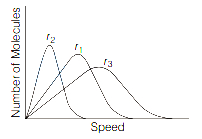
If $r_1, r_2$ and $r_3$ represent the most probable speeds of three different gases at the same temperature as shown in the figure,with molar masses $M_1, M_2$ and $M_3$ respectively,what is the correct order of the molar masses of these gases?
A
$M_1 > M_3 > M_2$
B
$M_3 > M_2 > M_1$
C
$M_2 > M_1 > M_3$
D
$M_2 > M_3 > M_1$
Solution
(C) The most probable speed $(v_{mp})$ is given by the formula $v_{mp} = \sqrt{\frac{2RT}{M}}$.
At a constant temperature,$v_{mp} \propto \frac{1}{\sqrt{M}}$.
From the given graph,the order of most probable speeds is $r_2 < r_1 < r_3$.
Since $v_{mp}$ is inversely proportional to the square root of the molar mass,a lower speed corresponds to a higher molar mass.
Therefore,the order of molar masses is $M_2 > M_1 > M_3$.
At a constant temperature,$v_{mp} \propto \frac{1}{\sqrt{M}}$.
From the given graph,the order of most probable speeds is $r_2 < r_1 < r_3$.
Since $v_{mp}$ is inversely proportional to the square root of the molar mass,a lower speed corresponds to a higher molar mass.
Therefore,the order of molar masses is $M_2 > M_1 > M_3$.
0 likesView Solution
229
ChemistryMediumMCQAP EAMCET · 2018
If the $RMS$ speed of nitrogen at a certain temperature is $3000 \ ms^{-1}$,the approximate kinetic energy of one mole of nitrogen at that temperature in $kJ$ is (assume nitrogen as ideal gas)
A
$9$
B
$126$
C
$90$
D
$12.6$
Solution
(B) Given,$U_{rms} = 3000 \ ms^{-1}$.
The formula for $RMS$ speed is $U_{rms} = \sqrt{\frac{3RT}{M}}$.
Squaring both sides,we get $U_{rms}^2 = \frac{3RT}{M}$.
For nitrogen $(N_2)$,the molar mass $M = 28 \ g/mol = 28 \times 10^{-3} \ kg/mol$.
Substituting the values: $(3000)^2 = \frac{3RT}{28 \times 10^{-3}}$.
$9 \times 10^6 = \frac{3RT}{28 \times 10^{-3}}$.
$3RT = 9 \times 10^6 \times 28 \times 10^{-3} = 252 \times 10^3 \ J/mol$.
The kinetic energy $(K.E.)$ for $1$ mole of an ideal gas is given by $K.E. = \frac{3}{2} RT$.
$K.E. = \frac{1}{2} \times (3RT) = \frac{1}{2} \times 252 \times 10^3 \ J/mol = 126 \times 10^3 \ J/mol = 126 \ kJ$.
The formula for $RMS$ speed is $U_{rms} = \sqrt{\frac{3RT}{M}}$.
Squaring both sides,we get $U_{rms}^2 = \frac{3RT}{M}$.
For nitrogen $(N_2)$,the molar mass $M = 28 \ g/mol = 28 \times 10^{-3} \ kg/mol$.
Substituting the values: $(3000)^2 = \frac{3RT}{28 \times 10^{-3}}$.
$9 \times 10^6 = \frac{3RT}{28 \times 10^{-3}}$.
$3RT = 9 \times 10^6 \times 28 \times 10^{-3} = 252 \times 10^3 \ J/mol$.
The kinetic energy $(K.E.)$ for $1$ mole of an ideal gas is given by $K.E. = \frac{3}{2} RT$.
$K.E. = \frac{1}{2} \times (3RT) = \frac{1}{2} \times 252 \times 10^3 \ J/mol = 126 \times 10^3 \ J/mol = 126 \ kJ$.
0 likesView Solution
230
ChemistryMediumMCQAP EAMCET · 2018
If the most probable speed of methane $(CH_4)$ at a certain temperature is $400 \ ms^{-1}$,what is the kinetic energy of one mole of methane at the same temperature in $J$?
A
$1024$
B
$2048$
C
$3072$
D
$1920$
Solution
(D) The most probable speed $(u_{mp})$ is given by the formula: $u_{mp} = \sqrt{\frac{2RT}{M}}$.
Given $u_{mp} = 400 \ ms^{-1}$ and molar mass of methane $(M)$ = $16 \ g \ mol^{-1} = 0.016 \ kg \ mol^{-1}$.
Squaring both sides: $u_{mp}^2 = \frac{2RT}{M} \Rightarrow \frac{RT}{M} = \frac{u_{mp}^2}{2}$.
Substituting the values: $\frac{RT}{0.016} = \frac{400^2}{2} = \frac{160000}{2} = 80000$.
Thus,$RT = 80000 \times 0.016 = 1280 \ J \ mol^{-1}$.
The kinetic energy $(KE)$ of one mole of an ideal gas is given by: $KE = \frac{3}{2} RT$.
$KE = \frac{3}{2} \times 1280 = 3 \times 640 = 1920 \ J$.
Given $u_{mp} = 400 \ ms^{-1}$ and molar mass of methane $(M)$ = $16 \ g \ mol^{-1} = 0.016 \ kg \ mol^{-1}$.
Squaring both sides: $u_{mp}^2 = \frac{2RT}{M} \Rightarrow \frac{RT}{M} = \frac{u_{mp}^2}{2}$.
Substituting the values: $\frac{RT}{0.016} = \frac{400^2}{2} = \frac{160000}{2} = 80000$.
Thus,$RT = 80000 \times 0.016 = 1280 \ J \ mol^{-1}$.
The kinetic energy $(KE)$ of one mole of an ideal gas is given by: $KE = \frac{3}{2} RT$.
$KE = \frac{3}{2} \times 1280 = 3 \times 640 = 1920 \ J$.
0 likesView Solution
231
ChemistryMediumMCQAP EAMCET · 2018
The mass numbers of two elements $X$ and $Z$ are $52$ and $75$ respectively. $X$ contains $16.6 \%$ more neutrons compared to protons. $Z$ contains $27.3 \%$ more neutrons compared to protons. $X$ and $Z$ are respectively
A
${ }_{24} Cr, { }_{33} As$
B
${ }_{24} Cr, { }_{30} Zn$
C
${ }_{19} K, { }_{33} As$
D
${ }_{29} Cu, { }_{30} Zn$
Solution
(A) For element $X$: Mass number $A = 52$. Let the number of protons be $p$. Number of neutrons $n = p + 0.166p = 1.166p$. Since $A = p + n$,we have $52 = p + 1.166p = 2.166p$. Thus,$p = 52 / 2.166 \approx 24$. The element with atomic number $24$ is $Cr$.
For element $Z$: Mass number $A = 75$. Let the number of protons be $p'$. Number of neutrons $n' = p' + 0.273p' = 1.273p'$. Since $A = p' + n'$,we have $75 = p' + 1.273p' = 2.273p'$. Thus,$p' = 75 / 2.273 \approx 33$. The element with atomic number $33$ is $As$.
For element $Z$: Mass number $A = 75$. Let the number of protons be $p'$. Number of neutrons $n' = p' + 0.273p' = 1.273p'$. Since $A = p' + n'$,we have $75 = p' + 1.273p' = 2.273p'$. Thus,$p' = 75 / 2.273 \approx 33$. The element with atomic number $33$ is $As$.
0 likesView Solution
232
ChemistryEasyMCQAP EAMCET · 2018
The element $Uuq$ (Ununquadium,atomic number $Z = 114$) contains $12.8 \%$ more neutrons compared to protons. What is the approximate mass number of it?
A
$263$
B
$253$
C
$233$
D
$243$
Solution
(D) The atomic number $(Z)$ of $Uuq$ is $114$,so the number of protons $(p)$ is $114$.
Let the number of neutrons be $n$.
According to the problem,the number of neutrons is $12.8 \%$ more than the number of protons:
$n = p + 0.128 \times p = 1.128 \times p$
$n = 1.128 \times 114 = 128.592 \approx 129$.
The mass number $(A)$ is the sum of protons and neutrons:
$A = p + n = 114 + 129 = 243$.
Therefore,the approximate mass number is $243$.
Let the number of neutrons be $n$.
According to the problem,the number of neutrons is $12.8 \%$ more than the number of protons:
$n = p + 0.128 \times p = 1.128 \times p$
$n = 1.128 \times 114 = 128.592 \approx 129$.
The mass number $(A)$ is the sum of protons and neutrons:
$A = p + n = 114 + 129 = 243$.
Therefore,the approximate mass number is $243$.
0 likesView Solution
233
ChemistryMediumMCQAP EAMCET · 2018
If the radius of the electron orbit in the excited state of a hydrogen atom is $476.1 \ pm$, the energy of the electron in that excited state in $J$ is (Radius and energy of the electron in the first orbit of a hydrogen atom are $52.9 \ pm$ and $-2.18 \times 10^{-18} \ J$ respectively).
A
$-2.42 \times 10^{-18}$
B
$-19.62 \times 10^{-18}$
C
$-2.42 \times 10^{-19}$
D
$-6.05 \times 10^{-19}$
Solution
(C) For a hydrogen atom, the radius of the $n^{th}$ orbit is given by $r_n = n^2 \times a_0$, where $a_0 = 52.9 \ pm$.
Given $r_n = 476.1 \ pm$, we have $n^2 = 476.1 / 52.9 = 9$, so $n = 3$.
The energy of an electron in the $n^{th}$ orbit is given by $E_n = E_1 / n^2$.
Substituting the values, $E_3 = -2.18 \times 10^{-18} \ J / 3^2 = -2.18 \times 10^{-18} / 9 \ J$.
$E_3 = -0.2422 \times 10^{-18} \ J = -2.422 \times 10^{-19} \ J$.
Given $r_n = 476.1 \ pm$, we have $n^2 = 476.1 / 52.9 = 9$, so $n = 3$.
The energy of an electron in the $n^{th}$ orbit is given by $E_n = E_1 / n^2$.
Substituting the values, $E_3 = -2.18 \times 10^{-18} \ J / 3^2 = -2.18 \times 10^{-18} / 9 \ J$.
$E_3 = -0.2422 \times 10^{-18} \ J = -2.422 \times 10^{-19} \ J$.
0 likesView Solution
234
ChemistryMediumMCQAP EAMCET · 2018
The wavelength corresponding to an electronic transition between two orbits of a hydrogen atom is $912 \mathring{A}$. The wavelength (in $\mathring{A}$) for the same electronic transition in $Li^{2+}$ is
A
$101.3$
B
$202.6$
C
$303.9$
D
$50.65$
Solution
(A) The energy of an electronic transition is given by $E = \frac{hc}{\lambda}$,which implies $E \propto \frac{1}{\lambda}$.
According to the Bohr model,the energy of an orbit is $E_n \propto Z^2$. For the same transition (same $n_1$ and $n_2$),the energy difference $\Delta E \propto Z^2$.
Therefore,$\frac{1}{\lambda} \propto Z^2$,or $\lambda \propto \frac{1}{Z^2}$.
For hydrogen $(H)$,$Z = 1$ and $\lambda_H = 912 \mathring{A}$.
For lithium ion $(Li^{2+})$,$Z = 3$.
Using the relation $\frac{\lambda_{Li}}{\lambda_H} = \frac{Z_H^2}{Z_{Li}^2}$,we get:
$\lambda_{Li} = \lambda_H \times \frac{1^2}{3^2} = \frac{912}{9} \mathring{A} = 101.3 \mathring{A}$.
According to the Bohr model,the energy of an orbit is $E_n \propto Z^2$. For the same transition (same $n_1$ and $n_2$),the energy difference $\Delta E \propto Z^2$.
Therefore,$\frac{1}{\lambda} \propto Z^2$,or $\lambda \propto \frac{1}{Z^2}$.
For hydrogen $(H)$,$Z = 1$ and $\lambda_H = 912 \mathring{A}$.
For lithium ion $(Li^{2+})$,$Z = 3$.
Using the relation $\frac{\lambda_{Li}}{\lambda_H} = \frac{Z_H^2}{Z_{Li}^2}$,we get:
$\lambda_{Li} = \lambda_H \times \frac{1^2}{3^2} = \frac{912}{9} \mathring{A} = 101.3 \mathring{A}$.
0 likesView Solution
235
ChemistryMediumMCQAP EAMCET · 2018
If the ratio of energies of an electron in the excited states of $H$ and $Li^{2+}$ is $1: 9$,the radius ratio of the electron in the same excited states of $H$ and $Li^{2+}$ is
A
$9: 1$
B
$3: 1$
C
$1: 9$
D
$1: 3$
Solution
(B) The energy of an electron in a hydrogen-like species is given by $E_n = -13.6 \times \frac{Z^2}{n^2} \text{ eV}$.
For the same excited state,$n$ is constant,so $E \propto Z^2$.
Given the ratio of energies $\frac{E_H}{E_{Li^{2+}}} = \frac{1}{9}$,we have $\frac{Z_H^2}{Z_{Li^{2+}}^2} = \frac{1^2}{3^2} = \frac{1}{9}$,which is consistent with the given data.
The radius of an electron in a hydrogen-like species is given by $r_n = 0.529 \times \frac{n^2}{Z} \mathring{A} $.
For the same excited state,$n$ is constant,so $r \propto \frac{1}{Z}$.
Therefore,the ratio of radii is $\frac{r_H}{r_{Li^{2+}}} = \frac{Z_{Li^{2+}}}{Z_H} = \frac{3}{1} = 3: 1$.
For the same excited state,$n$ is constant,so $E \propto Z^2$.
Given the ratio of energies $\frac{E_H}{E_{Li^{2+}}} = \frac{1}{9}$,we have $\frac{Z_H^2}{Z_{Li^{2+}}^2} = \frac{1^2}{3^2} = \frac{1}{9}$,which is consistent with the given data.
The radius of an electron in a hydrogen-like species is given by $r_n = 0.529 \times \frac{n^2}{Z} \mathring{A} $.
For the same excited state,$n$ is constant,so $r \propto \frac{1}{Z}$.
Therefore,the ratio of radii is $\frac{r_H}{r_{Li^{2+}}} = \frac{Z_{Li^{2+}}}{Z_H} = \frac{3}{1} = 3: 1$.
0 likesView Solution
236
ChemistryMediumMCQAP EAMCET · 2018
The radius ratio of Bohr's first orbit of hydrogen-like species $He^{+}$,$Li^{2+}$,and $Be^{3+}$ is:
A
$3: 4: 6$
B
$2: 3: 4$
C
$6: 4: 3$
D
$4: 3: 2$
Solution
(C) The radius of the $n^{th}$ orbit of a hydrogen-like species is given by the formula: $r_n = 0.529 \times \frac{n^2}{Z} \ \mathring{A}$.
For the first orbit,$n = 1$,so $r_1 \propto \frac{1}{Z}$.
For $He^{+}$ $(Z = 2)$,$r_{He^+} \propto \frac{1}{2}$.
For $Li^{2+}$ $(Z = 3)$,$r_{Li^{2+}} \propto \frac{1}{3}$.
For $Be^{3+}$ $(Z = 4)$,$r_{Be^{3+}} \propto \frac{1}{4}$.
The ratio is $\frac{1}{2} : \frac{1}{3} : \frac{1}{4}$.
To simplify,multiply by the least common multiple of $2, 3, 4$,which is $12$.
Ratio $= (\frac{1}{2} \times 12) : (\frac{1}{3} \times 12) : (\frac{1}{4} \times 12) = 6 : 4 : 3$.
For the first orbit,$n = 1$,so $r_1 \propto \frac{1}{Z}$.
For $He^{+}$ $(Z = 2)$,$r_{He^+} \propto \frac{1}{2}$.
For $Li^{2+}$ $(Z = 3)$,$r_{Li^{2+}} \propto \frac{1}{3}$.
For $Be^{3+}$ $(Z = 4)$,$r_{Be^{3+}} \propto \frac{1}{4}$.
The ratio is $\frac{1}{2} : \frac{1}{3} : \frac{1}{4}$.
To simplify,multiply by the least common multiple of $2, 3, 4$,which is $12$.
Ratio $= (\frac{1}{2} \times 12) : (\frac{1}{3} \times 12) : (\frac{1}{4} \times 12) = 6 : 4 : 3$.
0 likesView Solution
237
ChemistryMediumMCQAP EAMCET · 2018
The ratio of the lowest energy in terms of wave numbers of the Balmer and Lyman series of lines of the atomic spectrum of hydrogen is
A
$5 : 27$
B
$27 : 5$
C
$20 : 27$
D
$27 : 2$
Solution
(A) The wave number $(\bar{\nu})$ is given by the Rydberg formula: $\bar{\nu} = R \cdot Z^2 \left( \frac{1}{n_{L}^2} - \frac{1}{n_{H}^2} \right)$.
For hydrogen,$Z = 1$.
For the lowest energy transition in the Balmer series,$n_{L} = 2$ and $n_{H} = 3$:
$\bar{\nu}_{Balmer} = R \left( \frac{1}{2^2} - \frac{1}{3^2} \right) = R \left( \frac{1}{4} - \frac{1}{9} \right) = R \left( \frac{9-4}{36} \right) = \frac{5}{36} R$.
For the lowest energy transition in the Lyman series,$n_{L} = 1$ and $n_{H} = 2$:
$\bar{\nu}_{Lyman} = R \left( \frac{1}{1^2} - \frac{1}{2^2} \right) = R \left( 1 - \frac{1}{4} \right) = \frac{3}{4} R$.
The ratio of the wave number of the Balmer series to the Lyman series is:
$\frac{\bar{\nu}_{Balmer}}{\bar{\nu}_{Lyman}} = \frac{\frac{5}{36} R}{\frac{3}{4} R} = \frac{5}{36} \times \frac{4}{3} = \frac{5}{9 \times 3} = \frac{5}{27}$.
Thus,the ratio is $5 : 27$.
For hydrogen,$Z = 1$.
For the lowest energy transition in the Balmer series,$n_{L} = 2$ and $n_{H} = 3$:
$\bar{\nu}_{Balmer} = R \left( \frac{1}{2^2} - \frac{1}{3^2} \right) = R \left( \frac{1}{4} - \frac{1}{9} \right) = R \left( \frac{9-4}{36} \right) = \frac{5}{36} R$.
For the lowest energy transition in the Lyman series,$n_{L} = 1$ and $n_{H} = 2$:
$\bar{\nu}_{Lyman} = R \left( \frac{1}{1^2} - \frac{1}{2^2} \right) = R \left( 1 - \frac{1}{4} \right) = \frac{3}{4} R$.
The ratio of the wave number of the Balmer series to the Lyman series is:
$\frac{\bar{\nu}_{Balmer}}{\bar{\nu}_{Lyman}} = \frac{\frac{5}{36} R}{\frac{3}{4} R} = \frac{5}{36} \times \frac{4}{3} = \frac{5}{9 \times 3} = \frac{5}{27}$.
Thus,the ratio is $5 : 27$.
0 likesView Solution
238
ChemistryDifficultMCQAP EAMCET · 2018
Light of frequency $1.6 \times 10^{16} \ Hz$ falling on a metal plate emits electrons that have double the kinetic energy compared to the kinetic energy of electrons emitted when light of frequency $1.0 \times 10^{16} \ Hz$ falls on the same plate. The threshold frequency $(v_0)$ of the metal in $Hz$ is:
A
$1 \times 10^{15}$
B
$4 \times 10^{15}$
C
$3 \times 10^{15}$
D
$4 \times 10^{13}$
Solution
(B) According to Einstein's photoelectric equation,$K.E. = h(v - v_0)$.
For frequency $v_1 = 1.6 \times 10^{16} \ Hz$,$K.E._1 = h(1.6 \times 10^{16} - v_0) \longrightarrow \text{Eq. } (i)$.
For frequency $v_2 = 1.0 \times 10^{16} \ Hz$,$K.E._2 = h(1.0 \times 10^{16} - v_0) \longrightarrow \text{Eq. } (ii)$.
Given that $K.E._1 = 2 \times K.E._2$,we have:
$h(1.6 \times 10^{16} - v_0) = 2 \times h(1.0 \times 10^{16} - v_0)$.
$1.6 \times 10^{16} - v_0 = 2.0 \times 10^{16} - 2v_0$.
$2v_0 - v_0 = 2.0 \times 10^{16} - 1.6 \times 10^{16}$.
$v_0 = 0.4 \times 10^{16} \ Hz = 4 \times 10^{15} \ Hz$.
For frequency $v_1 = 1.6 \times 10^{16} \ Hz$,$K.E._1 = h(1.6 \times 10^{16} - v_0) \longrightarrow \text{Eq. } (i)$.
For frequency $v_2 = 1.0 \times 10^{16} \ Hz$,$K.E._2 = h(1.0 \times 10^{16} - v_0) \longrightarrow \text{Eq. } (ii)$.
Given that $K.E._1 = 2 \times K.E._2$,we have:
$h(1.6 \times 10^{16} - v_0) = 2 \times h(1.0 \times 10^{16} - v_0)$.
$1.6 \times 10^{16} - v_0 = 2.0 \times 10^{16} - 2v_0$.
$2v_0 - v_0 = 2.0 \times 10^{16} - 1.6 \times 10^{16}$.
$v_0 = 0.4 \times 10^{16} \ Hz = 4 \times 10^{15} \ Hz$.
0 likesView Solution
239
ChemistryEasyMCQAP EAMCET · 2018
If uncertainties in the measurement of position and momentum of a microscopic object of mass $m$ are equal,then the uncertainty in the measurement of velocity is given by the expression:
A
$\sqrt{\frac{h}{4 \pi m}}$
B
$\sqrt{\frac{h}{4 \pi}} \times \frac{1}{m}$
C
$\frac{h}{4 \pi} \times \sqrt{\frac{1}{m}}$
D
$\sqrt{\frac{h}{2 \pi m}}$
Solution
(B) According to Heisenberg's uncertainty principle: $\Delta x \cdot \Delta p \geq \frac{h}{4\pi}$.
Given that $\Delta x = \Delta p$,we substitute this into the equation: $(\Delta p)^2 = \frac{h}{4\pi}$.
Since $\Delta p = m \Delta v$,we have $(m \Delta v)^2 = \frac{h}{4\pi}$.
Expanding this gives $m^2 \Delta v^2 = \frac{h}{4\pi}$.
Solving for $\Delta v^2$,we get $\Delta v^2 = \frac{h}{4\pi m^2}$.
Taking the square root of both sides,we obtain $\Delta v = \frac{1}{m} \sqrt{\frac{h}{4\pi}}$.
Given that $\Delta x = \Delta p$,we substitute this into the equation: $(\Delta p)^2 = \frac{h}{4\pi}$.
Since $\Delta p = m \Delta v$,we have $(m \Delta v)^2 = \frac{h}{4\pi}$.
Expanding this gives $m^2 \Delta v^2 = \frac{h}{4\pi}$.
Solving for $\Delta v^2$,we get $\Delta v^2 = \frac{h}{4\pi m^2}$.
Taking the square root of both sides,we obtain $\Delta v = \frac{1}{m} \sqrt{\frac{h}{4\pi}}$.
0 likesView Solution
240
ChemistryMediumMCQAP EAMCET · 2018
The ratio of de-Broglie wavelengths of two particles having mass ratio $1:3$ and kinetic energy ratio $2:1$ is
A
$3:2$
B
$\sqrt{3}:\sqrt{2}$
C
$\sqrt{2}:\sqrt{3}$
D
$2:3$
Solution
(B) The de-Broglie wavelength is given by $\lambda = \frac{h}{p}$.
Since $p = \sqrt{2mK}$,where $m$ is mass and $K$ is kinetic energy,the ratio of wavelengths is $\frac{\lambda_1}{\lambda_2} = \frac{p_2}{p_1} = \sqrt{\frac{2m_2 K_2}{2m_1 K_1}}$.
Given $\frac{m_1}{m_2} = \frac{1}{3}$ and $\frac{K_1}{K_2} = \frac{2}{1}$,we have $\frac{m_2}{m_1} = 3$ and $\frac{K_2}{K_1} = \frac{1}{2}$.
Substituting these values: $\frac{\lambda_1}{\lambda_2} = \sqrt{3 \times \frac{1}{2}} = \sqrt{\frac{3}{2}} = \sqrt{3}:\sqrt{2}$.
Since $p = \sqrt{2mK}$,where $m$ is mass and $K$ is kinetic energy,the ratio of wavelengths is $\frac{\lambda_1}{\lambda_2} = \frac{p_2}{p_1} = \sqrt{\frac{2m_2 K_2}{2m_1 K_1}}$.
Given $\frac{m_1}{m_2} = \frac{1}{3}$ and $\frac{K_1}{K_2} = \frac{2}{1}$,we have $\frac{m_2}{m_1} = 3$ and $\frac{K_2}{K_1} = \frac{1}{2}$.
Substituting these values: $\frac{\lambda_1}{\lambda_2} = \sqrt{3 \times \frac{1}{2}} = \sqrt{\frac{3}{2}} = \sqrt{3}:\sqrt{2}$.
0 likesView Solution
241
ChemistryDifficultMCQAP EAMCET · 2018
When a metal surface is exposed to a certain frequency of electromagnetic radiation,the kinetic energy of the electron ejected from the metal surface is $0.20 \ eV$. If its work function $(W_0)$ is $4.80 \ eV$,the approximate frequency of the radiation falling on the metal surface in $Hz$ is:
A
$1.98 \times 10^{15}$
B
$1.21 \times 10^{16}$
C
$1.21 \times 10^{15}$
D
$1.98 \times 10^{16}$
Solution
(C) Given: Work function $(W_0) = 4.80 \ eV$ and Kinetic energy $(KE) = 0.20 \ eV$.
According to the photoelectric effect equation:
Total energy $(E_T) = W_0 + KE = 4.80 \ eV + 0.20 \ eV = 5.0 \ eV$.
Convert energy to Joules: $E_T = 5.0 \times 1.602 \times 10^{-19} \ J = 8.01 \times 10^{-19} \ J$.
Using the relation $E_T = h\nu$,where $h = 6.626 \times 10^{-34} \ J \cdot s$:
$\nu = \frac{E_T}{h} = \frac{8.01 \times 10^{-19} \ J}{6.626 \times 10^{-34} \ J \cdot s} \approx 1.21 \times 10^{15} \ Hz$.
According to the photoelectric effect equation:
Total energy $(E_T) = W_0 + KE = 4.80 \ eV + 0.20 \ eV = 5.0 \ eV$.
Convert energy to Joules: $E_T = 5.0 \times 1.602 \times 10^{-19} \ J = 8.01 \times 10^{-19} \ J$.
Using the relation $E_T = h\nu$,where $h = 6.626 \times 10^{-34} \ J \cdot s$:
$\nu = \frac{E_T}{h} = \frac{8.01 \times 10^{-19} \ J}{6.626 \times 10^{-34} \ J \cdot s} \approx 1.21 \times 10^{15} \ Hz$.
0 likesView Solution
242
ChemistryMediumMCQAP EAMCET · 2018
The work functions $(W_0)$ of $K, Na, Li, Mg$ and $Cu$ are $2.25, 2.30, 2.42, 3.70$ and $4.80 \ eV$ respectively. How many of these metals do not undergo photoelectric effect when a radiation of wavelength $450 \ nm$ is allowed to fall on them? $(1 \ eV = 1.602 \times 10^{-19} \ J)$
A
$2$
B
$1$
C
$3$
D
$5$
Solution
(A) The energy of the incident photon is given by $E = \frac{hc}{\lambda}$.
Given $\lambda = 450 \ nm = 450 \times 10^{-9} \ m$.
$E = \frac{6.626 \times 10^{-34} \ J \cdot s \times 3 \times 10^8 \ m/s}{450 \times 10^{-9} \ m} \approx 4.417 \times 10^{-19} \ J$.
Converting to $eV$: $E = \frac{4.417 \times 10^{-19} \ J}{1.602 \times 10^{-19} \ J/eV} \approx 2.76 \ eV$.
Photoelectric effect occurs if the energy of the incident photon is greater than or equal to the work function $(E \ge W_0)$.
Metals with $W_0 < 2.76 \ eV$ are $K (2.25 \ eV), Na (2.30 \ eV)$,and $Li (2.42 \ eV)$. These will undergo the photoelectric effect.
Metals with $W_0 > 2.76 \ eV$ are $Mg (3.70 \ eV)$ and $Cu (4.80 \ eV)$. These will not undergo the photoelectric effect.
The number of such metals is $2$.
Given $\lambda = 450 \ nm = 450 \times 10^{-9} \ m$.
$E = \frac{6.626 \times 10^{-34} \ J \cdot s \times 3 \times 10^8 \ m/s}{450 \times 10^{-9} \ m} \approx 4.417 \times 10^{-19} \ J$.
Converting to $eV$: $E = \frac{4.417 \times 10^{-19} \ J}{1.602 \times 10^{-19} \ J/eV} \approx 2.76 \ eV$.
Photoelectric effect occurs if the energy of the incident photon is greater than or equal to the work function $(E \ge W_0)$.
Metals with $W_0 < 2.76 \ eV$ are $K (2.25 \ eV), Na (2.30 \ eV)$,and $Li (2.42 \ eV)$. These will undergo the photoelectric effect.
Metals with $W_0 > 2.76 \ eV$ are $Mg (3.70 \ eV)$ and $Cu (4.80 \ eV)$. These will not undergo the photoelectric effect.
The number of such metals is $2$.
0 likesView Solution
243
ChemistryMediumMCQAP EAMCET · 2018
If the kinetic energy of an electron of mass $9.0 \times 10^{-31} \ kg$ is $8.0 \times 10^{-25} \ J$,the wavelength of this electron in $nm$ is
A
$1104.1$
B
$276.2$
C
$552.2$
D
$828.4$
Solution
(C) The kinetic energy $(K.E.)$ is given by $K.E. = \frac{1}{2}mv^2$,so $v = \sqrt{\frac{2 \times K.E.}{m}}$.
Substituting the values: $v = \sqrt{\frac{2 \times 8.0 \times 10^{-25}}{9.0 \times 10^{-31}}} = \sqrt{\frac{16}{9} \times 10^6} = \frac{4}{3} \times 10^3 \ m/s$.
The de Broglie wavelength is given by $\lambda = \frac{h}{mv}$.
Substituting $h = 6.626 \times 10^{-34} \ J \cdot s$,$m = 9.0 \times 10^{-31} \ kg$,and $v = \frac{4}{3} \times 10^3 \ m/s$:
$\lambda = \frac{6.626 \times 10^{-34}}{9.0 \times 10^{-31} \times (4/3) \times 10^3} = \frac{6.626 \times 10^{-34}}{12 \times 10^{-28}} = 0.55216 \times 10^{-6} \ m$.
Converting to $nm$: $\lambda = 0.55216 \times 10^{-6} \times 10^9 \ nm = 552.16 \ nm \approx 552.2 \ nm$.
Substituting the values: $v = \sqrt{\frac{2 \times 8.0 \times 10^{-25}}{9.0 \times 10^{-31}}} = \sqrt{\frac{16}{9} \times 10^6} = \frac{4}{3} \times 10^3 \ m/s$.
The de Broglie wavelength is given by $\lambda = \frac{h}{mv}$.
Substituting $h = 6.626 \times 10^{-34} \ J \cdot s$,$m = 9.0 \times 10^{-31} \ kg$,and $v = \frac{4}{3} \times 10^3 \ m/s$:
$\lambda = \frac{6.626 \times 10^{-34}}{9.0 \times 10^{-31} \times (4/3) \times 10^3} = \frac{6.626 \times 10^{-34}}{12 \times 10^{-28}} = 0.55216 \times 10^{-6} \ m$.
Converting to $nm$: $\lambda = 0.55216 \times 10^{-6} \times 10^9 \ nm = 552.16 \ nm \approx 552.2 \ nm$.
0 likesView Solution
244
ChemistryEasyMCQAP EAMCET · 2018
If uncertainty in the measurement of position and momentum of a microscopic object of mass $m$ are equal,then the uncertainty in the measurement of velocity is given by the expression:
A
$\sqrt{\frac{h}{4 \pi m}}$
B
$\frac{1}{2m} \sqrt{\frac{h}{\pi}}$
C
$\frac{h}{4 \pi} \sqrt{\frac{1}{m}}$
D
$\sqrt{\frac{h}{2 \pi m}}$
Solution
(B) According to Heisenberg's uncertainty principle: $\Delta x \cdot \Delta p \ge \frac{h}{4 \pi}$.
Given that the uncertainty in position $(\Delta x)$ is equal to the uncertainty in momentum $(\Delta p)$: $\Delta x = \Delta p$.
Substituting this into the equation: $(\Delta p)^2 = \frac{h}{4 \pi}$.
Therefore,$\Delta p = \sqrt{\frac{h}{4 \pi}}$.
Since momentum uncertainty is related to velocity uncertainty by $\Delta p = m \Delta v$,we have $m \Delta v = \sqrt{\frac{h}{4 \pi}}$.
Solving for $\Delta v$: $\Delta v = \frac{1}{m} \sqrt{\frac{h}{4 \pi}} = \frac{1}{m} \cdot \frac{1}{2} \sqrt{\frac{h}{\pi}} = \frac{1}{2m} \sqrt{\frac{h}{\pi}}$.
Given that the uncertainty in position $(\Delta x)$ is equal to the uncertainty in momentum $(\Delta p)$: $\Delta x = \Delta p$.
Substituting this into the equation: $(\Delta p)^2 = \frac{h}{4 \pi}$.
Therefore,$\Delta p = \sqrt{\frac{h}{4 \pi}}$.
Since momentum uncertainty is related to velocity uncertainty by $\Delta p = m \Delta v$,we have $m \Delta v = \sqrt{\frac{h}{4 \pi}}$.
Solving for $\Delta v$: $\Delta v = \frac{1}{m} \sqrt{\frac{h}{4 \pi}} = \frac{1}{m} \cdot \frac{1}{2} \sqrt{\frac{h}{\pi}} = \frac{1}{2m} \sqrt{\frac{h}{\pi}}$.
0 likesView Solution
245
ChemistryMediumMCQAP EAMCET · 2018
The ratio of de Broglie wavelengths of two particles,having mass ratio $1 : 3$ and kinetic energy ratio $2 : 1$ is
A
$3 : 2$
B
$\sqrt{3} : \sqrt{2}$
C
$\sqrt{2} : \sqrt{3}$
D
$2 : 3$
Solution
(B) The de Broglie wavelength is given by $\lambda = \frac{h}{\sqrt{2 m K E}}$.
Given the mass ratio $\frac{m_1}{m_2} = \frac{1}{3}$ and kinetic energy ratio $\frac{K E_1}{K E_2} = \frac{2}{1}$.
The ratio of wavelengths is $\frac{\lambda_1}{\lambda_2} = \sqrt{\frac{m_2 \times K E_2}{m_1 \times K E_1}}$.
Substituting the values: $\frac{\lambda_1}{\lambda_2} = \sqrt{\frac{3 \times 1}{1 \times 2}} = \sqrt{\frac{3}{2}} = \frac{\sqrt{3}}{\sqrt{2}}$.
Thus,the ratio is $\sqrt{3} : \sqrt{2}$.
Given the mass ratio $\frac{m_1}{m_2} = \frac{1}{3}$ and kinetic energy ratio $\frac{K E_1}{K E_2} = \frac{2}{1}$.
The ratio of wavelengths is $\frac{\lambda_1}{\lambda_2} = \sqrt{\frac{m_2 \times K E_2}{m_1 \times K E_1}}$.
Substituting the values: $\frac{\lambda_1}{\lambda_2} = \sqrt{\frac{3 \times 1}{1 \times 2}} = \sqrt{\frac{3}{2}} = \frac{\sqrt{3}}{\sqrt{2}}$.
Thus,the ratio is $\sqrt{3} : \sqrt{2}$.
0 likesView Solution
246
ChemistryEasyMCQAP EAMCET · 2018
Number of completely filled orbitals in xenon atom $(Xe)$ is
A
$17$
B
$18$
C
$27$
D
$28$
Solution
(C) The electronic configuration of xenon $(Xe)$ with atomic number $54$ is: $1s^2, 2s^2, 2p^6, 3s^2, 3p^6, 3d^{10}, 4s^2, 4p^6, 4d^{10}, 5s^2, 5p^6$.
Counting the orbitals:
$1s$ ($1$ orbital),$2s$ ($1$ orbital),$2p$ ($3$ orbitals),$3s$ ($1$ orbital),$3p$ ($3$ orbitals),$3d$ ($5$ orbitals),$4s$ ($1$ orbital),$4p$ ($3$ orbitals),$4d$ ($5$ orbitals),$5s$ ($1$ orbital),$5p$ ($3$ orbitals).
Total number of orbitals = $1 + 1 + 3 + 1 + 3 + 5 + 1 + 3 + 5 + 1 + 3 = 27$.
Counting the orbitals:
$1s$ ($1$ orbital),$2s$ ($1$ orbital),$2p$ ($3$ orbitals),$3s$ ($1$ orbital),$3p$ ($3$ orbitals),$3d$ ($5$ orbitals),$4s$ ($1$ orbital),$4p$ ($3$ orbitals),$4d$ ($5$ orbitals),$5s$ ($1$ orbital),$5p$ ($3$ orbitals).
Total number of orbitals = $1 + 1 + 3 + 1 + 3 + 5 + 1 + 3 + 5 + 1 + 3 = 27$.
0 likesView Solution
247
ChemistryMCQAP EAMCET · 2018
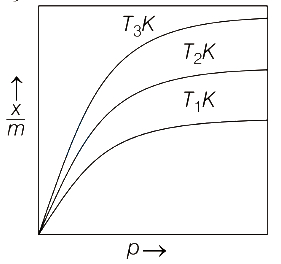
Freundlich adsorption isotherms for the physical adsorption of a gas at temperatures $T_1$,$T_2$,and $T_3$ are shown in the graph given below. The correct relationship between $T_1$,$T_2$,and $T_3$ is:
A
$T_1 < T_2 < T_3$
B
$T_3 < T_1 < T_2$
C
$T_3 < T_2 < T_1$
D
$T_2 < T_1 < T_3$
Solution
(C) Physical adsorption is an exothermic process. According to Le Chatelier's principle,for an exothermic process,the extent of adsorption decreases with an increase in temperature.
From the given graph,at a constant pressure $p$,the extent of adsorption $\frac{x}{m}$ follows the order: $T_3 > T_2 > T_1$.
Since adsorption is inversely proportional to temperature for physical adsorption,the relationship between the temperatures must be $T_1 > T_2 > T_3$,which is equivalent to $T_3 < T_2 < T_1$.
From the given graph,at a constant pressure $p$,the extent of adsorption $\frac{x}{m}$ follows the order: $T_3 > T_2 > T_1$.
Since adsorption is inversely proportional to temperature for physical adsorption,the relationship between the temperatures must be $T_1 > T_2 > T_3$,which is equivalent to $T_3 < T_2 < T_1$.
0 likesView Solution
248
ChemistryMCQAP EAMCET · 2018
The time taken for a calorimeter containing $75 \ g$ of water at $62^{\circ} C$ to cool to $58^{\circ} C$ is $9 \ \text{minutes}$. When the calorimeter contains $105 \ g$ of water, it takes $12 \ \text{minutes}$ to cool from $62^{\circ} C$ to $58^{\circ} C$. The water equivalent of the calorimeter is: (in $g$)
A
$10$
B
$15$
C
$20$
D
$30$
Solution
(B) According to Newton's law of cooling, the rate of cooling is proportional to the heat lost per unit time. Assuming the rate of heat loss $(dQ/dt)$ is constant for the same temperature range:
Heat lost $Q = (w + m) C_V \Delta T$
where $w$ is the water equivalent of the calorimeter, $m$ is the mass of water, $C_V$ is the specific heat of water, and $\Delta T = 62^{\circ} C - 58^{\circ} C = 4^{\circ} C$.
Since the rate of cooling is constant, the time taken $t \propto Q$.
Case $I$: $t_1 = 9 \ \text{minutes}$, $m_1 = 75 \ g$
$9 \propto (w + 75) C_V \times 4^{\circ} \quad \dots (i)$
Case $II$: $t_2 = 12 \ \text{minutes}$, $m_2 = 105 \ g$
$12 \propto (w + 105) C_V \times 4^{\circ} \quad \dots (ii)$
Dividing equation $(i)$ by equation $(ii)$:
$\frac{9}{12} = \frac{(w + 75) C_V \times 4^{\circ}}{(w + 105) C_V \times 4^{\circ}}$
$\frac{3}{4} = \frac{w + 75}{w + 105}$
$3(w + 105) = 4(w + 75)$
$3w + 315 = 4w + 300$
$w = 315 - 300 = 15 \ g$
Thus, the water equivalent of the calorimeter is $15 \ g$.
Heat lost $Q = (w + m) C_V \Delta T$
where $w$ is the water equivalent of the calorimeter, $m$ is the mass of water, $C_V$ is the specific heat of water, and $\Delta T = 62^{\circ} C - 58^{\circ} C = 4^{\circ} C$.
Since the rate of cooling is constant, the time taken $t \propto Q$.
Case $I$: $t_1 = 9 \ \text{minutes}$, $m_1 = 75 \ g$
$9 \propto (w + 75) C_V \times 4^{\circ} \quad \dots (i)$
Case $II$: $t_2 = 12 \ \text{minutes}$, $m_2 = 105 \ g$
$12 \propto (w + 105) C_V \times 4^{\circ} \quad \dots (ii)$
Dividing equation $(i)$ by equation $(ii)$:
$\frac{9}{12} = \frac{(w + 75) C_V \times 4^{\circ}}{(w + 105) C_V \times 4^{\circ}}$
$\frac{3}{4} = \frac{w + 75}{w + 105}$
$3(w + 105) = 4(w + 75)$
$3w + 315 = 4w + 300$
$w = 315 - 300 = 15 \ g$
Thus, the water equivalent of the calorimeter is $15 \ g$.
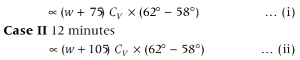
0 likesView Solution
249
ChemistryMCQAP EAMCET · 2018
Three rods of same dimensions have thermal conductivities $3K$,$2K$,and $K$. They are arranged as shown in the figure. In the steady state,the temperature of the junction $P$ is
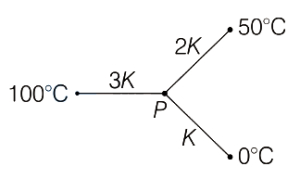
A
$\frac{200}{3}{ }^{\circ} C$
B
$\frac{100}{3}{ }^{\circ} C$
C
$75^{\circ} C$
D
$\frac{50}{3}{ }^{\circ} C$
Solution
(A) The amount of heat $Q$ transmitted through a rod in time $t$ is given by the formula:
$Q = \frac{k A t (T_1 - T_2)}{d}$
where $k$ is the thermal conductivity,$A$ is the cross-sectional area,$d$ is the length of the rod,and $(T_1 - T_2)$ is the temperature difference.
Since the rods have the same dimensions,$A$ and $d$ are constant for all rods.
At the junction $P$,let the temperature be $T$. According to the principle of conservation of energy in the steady state,the heat flowing into the junction must equal the heat flowing out of the junction.
Heat flowing from the $100^{\circ} C$ end to $P$ equals the sum of heat flowing from $P$ to the $50^{\circ} C$ end and from $P$ to the $0^{\circ} C$ end:
$\frac{3K A (100 - T) t}{d} = \frac{2K A (T - 50) t}{d} + \frac{K A (T - 0) t}{d}$
Canceling the common terms $\frac{K A t}{d}$ from both sides:
$3(100 - T) = 2(T - 50) + (T - 0)$
$300 - 3T = 2T - 100 + T$
$300 - 3T = 3T - 100$
$400 = 6T$
$T = \frac{400}{6} = \frac{200}{3}{ }^{\circ} C$
$Q = \frac{k A t (T_1 - T_2)}{d}$
where $k$ is the thermal conductivity,$A$ is the cross-sectional area,$d$ is the length of the rod,and $(T_1 - T_2)$ is the temperature difference.
Since the rods have the same dimensions,$A$ and $d$ are constant for all rods.
At the junction $P$,let the temperature be $T$. According to the principle of conservation of energy in the steady state,the heat flowing into the junction must equal the heat flowing out of the junction.
Heat flowing from the $100^{\circ} C$ end to $P$ equals the sum of heat flowing from $P$ to the $50^{\circ} C$ end and from $P$ to the $0^{\circ} C$ end:
$\frac{3K A (100 - T) t}{d} = \frac{2K A (T - 50) t}{d} + \frac{K A (T - 0) t}{d}$
Canceling the common terms $\frac{K A t}{d}$ from both sides:
$3(100 - T) = 2(T - 50) + (T - 0)$
$300 - 3T = 2T - 100 + T$
$300 - 3T = 3T - 100$
$400 = 6T$
$T = \frac{400}{6} = \frac{200}{3}{ }^{\circ} C$
0 likesView Solution
250
ChemistryMediumMCQAP EAMCET · 2018
Match the following items in List-$I$ with their corresponding expressions in List-$II$.
| List-$I$ | List-$II$ |
| $A$. At constant volume the change in internal energy of a system | $I$. $W = -2.303 nRT \log \frac{V_f}{V_i}$ |
| $B$. Isothermal irreversible change | $II$. $W_{adiabatic} = \Delta U$ |
| $C$. Isothermal reversible change | $III$. $q_V = \Delta U$ |
| $D$. Adiabatic change | $IV$. $W = -p_{ex} (V_f - V_i)$ |
| $V$. $\Delta U = \Delta H - \Delta nRT$ |
A
$A-III, B-IV, C-I, D-II$
B
$A-IV, B-I, C-III, D-V$
C
$A-III, B-IV, C-I, D-V$
D
$A-III, B-V, C-I, D-II$
Solution
(A) The correct matches are as follows:
$(A)$ At constant volume,the heat exchanged is equal to the change in internal energy: $q_V = \Delta U$ $(III)$.
$(B)$ For an isothermal irreversible process,the work done is given by: $W = -p_{ex} (V_f - V_i)$ $(IV)$.
$(C)$ For an isothermal reversible process,the work done is given by: $W = -2.303 nRT \log \frac{V_f}{V_i}$ $(I)$.
$(D)$ For an adiabatic process,$q = 0$,so according to the first law of thermodynamics $(\Delta U = q + W)$,we have $W_{adiabatic} = \Delta U$ $(II)$.
Therefore,the correct sequence is $A-III, B-IV, C-I, D-II$.
$(A)$ At constant volume,the heat exchanged is equal to the change in internal energy: $q_V = \Delta U$ $(III)$.
$(B)$ For an isothermal irreversible process,the work done is given by: $W = -p_{ex} (V_f - V_i)$ $(IV)$.
$(C)$ For an isothermal reversible process,the work done is given by: $W = -2.303 nRT \log \frac{V_f}{V_i}$ $(I)$.
$(D)$ For an adiabatic process,$q = 0$,so according to the first law of thermodynamics $(\Delta U = q + W)$,we have $W_{adiabatic} = \Delta U$ $(II)$.
Therefore,the correct sequence is $A-III, B-IV, C-I, D-II$.
0 likesView Solution
Vedclass Products
For Students
Vedclass Test Series
Mock tests in real AP EAMCET style covering Chemistry with performance analysis. 5-day free trial.
Start Free TrialFor Teachers
Exam Paper Generator
Generate Set A/B/C/D Chemistry papers from 7.5L+ questions in 2 minutes. 3 chapters free.
Try FreeFor Institutes
Online Exam Module
Run live AP EAMCET mock exams with unlimited students, 360° analytics & white-label branding.
See DemoFrequently Asked Questions
How many Chemistry questions are in AP EAMCET 2018?
There are 412 Chemistry questions from the AP EAMCET 2018 paper on Vedclass, each with a detailed step-by-step solution in English.
Are AP EAMCET 2018 Chemistry solutions available in English?
Yes. All solutions on this page are in English. You can also switch to English or Hindi using the language buttons above the questions.
Can I practice AP EAMCET 2018 Chemistry as a timed test?
Yes. Use the Vedclass Test Series to attempt a full AP EAMCET mock test covering Chemistry with time limits and instant score analysis.
Can teachers create Chemistry papers from AP EAMCET previous year questions?
Yes. The Vedclass Exam Paper Generator lets teachers mix AP EAMCET Chemistry questions and generate Set A/B/C/D papers in minutes.
For Teachers & Institutes
Build a Custom Chemistry Paper
Pick AP EAMCET 2018 Chemistry questions, set difficulty, and generate Set A/B/C/D in 2 minutes.