
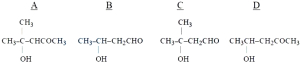
What are $A, B, C$ and $D$ in the following cross-aldol condensation reaction?
$\text{Propanal} + \text{Ethanal} \xrightarrow[ii) \ \Delta]{i) \ NaOH} A + B + C + D$
(The products are the four possible $\alpha,\beta$-unsaturated aldehydes formed by self and cross-aldol condensation followed by dehydration.)
$\text{Propanal} + \text{Ethanal} \xrightarrow[ii) \ \Delta]{i) \ NaOH} A + B + C + D$
(The products are the four possible $\alpha,\beta$-unsaturated aldehydes formed by self and cross-aldol condensation followed by dehydration.)
- A

- B

- C

- D
Explore More
Similar Questions
The synthesis of crotonaldehyde from acetaldehyde is an example of ....... reaction.
The reagent that can distinguish benzaldehyde from propionaldehyde is
Medium
View SolutionWhich one of the following compounds will give an orange precipitate when treated with $2,4-$dinitrophenylhydrazine?
DifficultJEE MAIN 2021
View SolutionWhich of the following compounds will react with ethanolic $KCN$?
MediumIIT 1984
View SolutionMatch the compounds in Column-$I$ with their respective intermolecular attraction forces in Column-$II$.
Column-$I$ (Compound) Column-$II$ (Attraction Forces) $A$. Aldehyde $i$. Intermolecular hydrogen bond formed in $ROH$ between $O^{\delta -}$ of one molecule and $H^{\delta +}$ of another molecule. $B$. Ketone $ii$. Dipole-dipole forces between $C^{\delta +}$ of one molecule and $O^{\delta -}$ of another molecule. $C$. Alcohol $iii$. van der Waals forces $D$. Alkane $iv$. Ionic forces
| Column-$I$ (Compound) | Column-$II$ (Attraction Forces) |
|---|---|
| $A$. Aldehyde | $i$. Intermolecular hydrogen bond formed in $ROH$ between $O^{\delta -}$ of one molecule and $H^{\delta +}$ of another molecule. |
| $B$. Ketone | $ii$. Dipole-dipole forces between $C^{\delta +}$ of one molecule and $O^{\delta -}$ of another molecule. |
| $C$. Alcohol | $iii$. van der Waals forces |
| $D$. Alkane | $iv$. Ionic forces |
Medium
View SolutionVedclass Products
For Students
Vedclass Test Series
Mock tests in real JEE/NEET style with performance analysis. 5-day free trial.
Start Free TrialFor Teachers
Exam Paper Generator
Generate Set A/B/C/D exam papers from 7.5L+ questions in 2 minutes. 3 chapters free.
Try FreeFor Institutes
Online Exam Module
Live online exams with unlimited students, 360° analytics & white-label branding.
See Demo