
PhysicsQ1–80 of 80 questions
Page 1 of 1 · English
1
PhysicsMediumMCQAIPMT · 2012
$A$ slab of stone of area $0.36\, m^2$ and thickness $0.1\, m$ is exposed on the lower surface to steam at $100^{\circ} C$. $A$ block of ice at $0^{\circ} C$ rests on the upper surface of the slab. In one hour $4.8\, kg$ of ice is melted. The thermal conductivity of the slab is .......... $J/m/s/^{\circ} C$ (Given latent heat of fusion of ice $= 3.36 \times 10^5\, J/kg$)
A
$1.02$
B
$1.29$
C
$1.24$
D
$2.05$
Solution
(C) The heat required to melt the ice is given by $Q = m L_f$.
The heat conducted through the slab is given by $Q = \frac{K A (T_1 - T_2) t}{L}$.
Equating the two, we get $\frac{K A (T_1 - T_2) t}{L} = m L_f$.
Rearranging for thermal conductivity $K$, we have $K = \frac{m L_f L}{A (T_1 - T_2) t}$.
Given values: $m = 4.8\, kg$, $L_f = 3.36 \times 10^5\, J/kg$, $L = 0.1\, m$, $A = 0.36\, m^2$, $(T_1 - T_2) = 100^{\circ} C$, and $t = 1\, hour = 3600\, s$.
Substituting the values: $K = \frac{4.8 \times 3.36 \times 10^5 \times 0.1}{0.36 \times 100 \times 3600}$.
$K = \frac{4.8 \times 3.36 \times 10^4}{0.36 \times 3.6 \times 10^5} = \frac{16.128}{129.6} \times 10 = 1.24\, J/m/s/^{\circ} C$.
The heat conducted through the slab is given by $Q = \frac{K A (T_1 - T_2) t}{L}$.
Equating the two, we get $\frac{K A (T_1 - T_2) t}{L} = m L_f$.
Rearranging for thermal conductivity $K$, we have $K = \frac{m L_f L}{A (T_1 - T_2) t}$.
Given values: $m = 4.8\, kg$, $L_f = 3.36 \times 10^5\, J/kg$, $L = 0.1\, m$, $A = 0.36\, m^2$, $(T_1 - T_2) = 100^{\circ} C$, and $t = 1\, hour = 3600\, s$.
Substituting the values: $K = \frac{4.8 \times 3.36 \times 10^5 \times 0.1}{0.36 \times 100 \times 3600}$.
$K = \frac{4.8 \times 3.36 \times 10^4}{0.36 \times 3.6 \times 10^5} = \frac{16.128}{129.6} \times 10 = 1.24\, J/m/s/^{\circ} C$.
0 likesView Solution
2
PhysicsEasyMCQAIPMT · 2012
The damping force on an oscillator is directly proportional to the velocity. The units of the constant of proportionality are:
A
$Kg\ m\ s^{-1}$
B
$Kg\ m\ s^{-2}$
C
$Kg\ s^{-1}$
D
$Kg\ s$
Solution
(C) The damping force $F$ is directly proportional to the velocity $v$,which can be written as $F = kv$,where $k$ is the constant of proportionality.
From this equation,we can express $k$ as $k = \frac{F}{v}$.
The $SI$ unit of force $F$ is Newton $(N)$,which is equivalent to $kg\ m\ s^{-2}$.
The $SI$ unit of velocity $v$ is $m\ s^{-1}$.
Substituting these units into the expression for $k$:
$k = \frac{kg\ m\ s^{-2}}{m\ s^{-1}} = kg\ s^{-1}$.
Therefore,the unit of the constant of proportionality is $kg\ s^{-1}$.
From this equation,we can express $k$ as $k = \frac{F}{v}$.
The $SI$ unit of force $F$ is Newton $(N)$,which is equivalent to $kg\ m\ s^{-2}$.
The $SI$ unit of velocity $v$ is $m\ s^{-1}$.
Substituting these units into the expression for $k$:
$k = \frac{kg\ m\ s^{-2}}{m\ s^{-1}} = kg\ s^{-1}$.
Therefore,the unit of the constant of proportionality is $kg\ s^{-1}$.
0 likesView Solution
3
PhysicsMediumMCQAIPMT · 2012
The dimensions of $(\mu_0 \varepsilon_0)^{-1/2}$ are
A
$L^{1/2}T^{-1/2}$
B
$L^{-1}T$
C
$LT^{-1}$
D
$L^{1/2}T^{1/2}$
Solution
(C) The speed of light in vacuum is given by the relation:
$c = \frac{1}{\sqrt{\mu_0 \varepsilon_0}} = (\mu_0 \varepsilon_0)^{-1/2}$
Since $c$ represents the speed of light,its dimensions are the same as velocity.
The dimensional formula for velocity is $[LT^{-1}]$.
Therefore,the dimensions of $(\mu_0 \varepsilon_0)^{-1/2}$ are $[LT^{-1}]$.
$c = \frac{1}{\sqrt{\mu_0 \varepsilon_0}} = (\mu_0 \varepsilon_0)^{-1/2}$
Since $c$ represents the speed of light,its dimensions are the same as velocity.
The dimensional formula for velocity is $[LT^{-1}]$.
Therefore,the dimensions of $(\mu_0 \varepsilon_0)^{-1/2}$ are $[LT^{-1}]$.
0 likesView Solution
4
PhysicsMediumMCQAIPMT · 2012
The motion of a particle along a straight line is described by the equation $x = 8 + 12t - t^3$,where $x$ is in meters and $t$ is in seconds. The retardation of the particle when its velocity becomes zero is .......... $m/s^2$.
A
$24$
B
$0$
C
$6$
D
$12$
Solution
(D) Given the position equation: $x = 8 + 12t - t^3$.
Velocity $v$ is the derivative of position with respect to time: $v = \frac{dx}{dt} = \frac{d}{dt}(8 + 12t - t^3) = 12 - 3t^2$.
When the velocity becomes zero: $12 - 3t^2 = 0 \implies 3t^2 = 12 \implies t^2 = 4 \implies t = 2 \, s$.
Acceleration $a$ is the derivative of velocity with respect to time: $a = \frac{dv}{dt} = \frac{d}{dt}(12 - 3t^2) = -6t$.
At $t = 2 \, s$,the acceleration is $a = -6(2) = -12 \, m/s^2$.
Retardation is the magnitude of negative acceleration,so retardation = $12 \, m/s^2$.
Velocity $v$ is the derivative of position with respect to time: $v = \frac{dx}{dt} = \frac{d}{dt}(8 + 12t - t^3) = 12 - 3t^2$.
When the velocity becomes zero: $12 - 3t^2 = 0 \implies 3t^2 = 12 \implies t^2 = 4 \implies t = 2 \, s$.
Acceleration $a$ is the derivative of velocity with respect to time: $a = \frac{dv}{dt} = \frac{d}{dt}(12 - 3t^2) = -6t$.
At $t = 2 \, s$,the acceleration is $a = -6(2) = -12 \, m/s^2$.
Retardation is the magnitude of negative acceleration,so retardation = $12 \, m/s^2$.
0 likesView Solution
5
PhysicsMediumMCQAIPMT · 2012
$A$ particle has an initial velocity $(2\hat i + 3\hat j)$ and an acceleration $(0.3\hat i + 0.2\hat j)$. Its speed after $10\,s$ is:
A
$9\sqrt{2}$ Units
B
$5\sqrt{2}$ Units
C
$5$ Units
D
$9$ Units
Solution
(B) Given:
Initial velocity,$\vec{u} = 2\hat{i} + 3\hat{j}$
Acceleration,$\vec{a} = 0.3\hat{i} + 0.2\hat{j}$
Time,$t = 10\,s$
Using the first equation of motion for vectors:
$\vec{v} = \vec{u} + \vec{a}t$
$\vec{v} = (2\hat{i} + 3\hat{j}) + (0.3\hat{i} + 0.2\hat{j})(10)$
$\vec{v} = 2\hat{i} + 3\hat{j} + 3\hat{i} + 2\hat{j}$
$\vec{v} = 5\hat{i} + 5\hat{j}$
Speed is the magnitude of the velocity vector:
$|\vec{v}| = \sqrt{(5)^2 + (5)^2}$
$|\vec{v}| = \sqrt{25 + 25} = \sqrt{50} = 5\sqrt{2}\,\text{units}$
Initial velocity,$\vec{u} = 2\hat{i} + 3\hat{j}$
Acceleration,$\vec{a} = 0.3\hat{i} + 0.2\hat{j}$
Time,$t = 10\,s$
Using the first equation of motion for vectors:
$\vec{v} = \vec{u} + \vec{a}t$
$\vec{v} = (2\hat{i} + 3\hat{j}) + (0.3\hat{i} + 0.2\hat{j})(10)$
$\vec{v} = 2\hat{i} + 3\hat{j} + 3\hat{i} + 2\hat{j}$
$\vec{v} = 5\hat{i} + 5\hat{j}$
Speed is the magnitude of the velocity vector:
$|\vec{v}| = \sqrt{(5)^2 + (5)^2}$
$|\vec{v}| = \sqrt{25 + 25} = \sqrt{50} = 5\sqrt{2}\,\text{units}$
0 likesView Solution
6
PhysicsMediumMCQAIPMT · 2012
$A$ stone is dropped from a height $h$. It hits the ground with a certain momentum $P$. If the same stone is dropped from a height $100\%$ more than the previous height,the momentum when it hits the ground will change by ........... $\%$.
A
$68$
B
$41$
C
$200$
D
$100$
Solution
(B) When a stone is dropped from a height $h$,its velocity $v$ upon hitting the ground is given by $v = \sqrt{2gh}$.
Thus,the initial momentum is $P = m\sqrt{2gh} \dots (i)$.
If the height is increased by $100\%$,the new height $h' = h + 100\% \text{ of } h = h + h = 2h$.
The new momentum $P'$ is $P' = m\sqrt{2g(2h)} = m\sqrt{2gh} \times \sqrt{2} = P\sqrt{2}$.
Given $\sqrt{2} \approx 1.414$.
The percentage change in momentum is $\frac{P' - P}{P} \times 100\% = \frac{P\sqrt{2} - P}{P} \times 100\% = (\sqrt{2} - 1) \times 100\%$.
$= (1.414 - 1) \times 100\% = 0.414 \times 100\% = 41.4\% \approx 41\%$.
Thus,the initial momentum is $P = m\sqrt{2gh} \dots (i)$.
If the height is increased by $100\%$,the new height $h' = h + 100\% \text{ of } h = h + h = 2h$.
The new momentum $P'$ is $P' = m\sqrt{2g(2h)} = m\sqrt{2gh} \times \sqrt{2} = P\sqrt{2}$.
Given $\sqrt{2} \approx 1.414$.
The percentage change in momentum is $\frac{P' - P}{P} \times 100\% = \frac{P\sqrt{2} - P}{P} \times 100\% = (\sqrt{2} - 1) \times 100\%$.
$= (1.414 - 1) \times 100\% = 0.414 \times 100\% = 41.4\% \approx 41\%$.
0 likesView Solution
7
PhysicsDifficultMCQAIPMT · 2012
$A$ solid cylinder of mass $3 \, kg$ is rolling on a horizontal surface with velocity $4 \, m s^{-1}$. It collides with a horizontal spring of force constant $200 \, N m^{-1}$. The maximum compression produced in the spring will be ............... $m$.
A
$0.5$
B
$0.6$
C
$0.2$
D
$0.7$
Solution
(B) At maximum compression,the solid cylinder will stop momentarily.
According to the law of conservation of mechanical energy:
Loss in kinetic energy of the cylinder = Gain in potential energy of the spring.
The total kinetic energy of a rolling cylinder is $K = \frac{1}{2}mv^2 + \frac{1}{2}I\omega^2$.
For a solid cylinder,$I = \frac{1}{2}mR^2$ and for pure rolling,$\omega = \frac{v}{R}$.
Substituting these,$K = \frac{1}{2}mv^2 + \frac{1}{2}(\frac{1}{2}mR^2)(\frac{v}{R})^2 = \frac{1}{2}mv^2 + \frac{1}{4}mv^2 = \frac{3}{4}mv^2$.
Equating this to the potential energy stored in the spring,$\frac{1}{2}kx^2 = \frac{3}{4}mv^2$.
Solving for $x$: $x^2 = \frac{3mv^2}{2k}$.
Given $m = 3 \, kg$,$v = 4 \, m s^{-1}$,and $k = 200 \, N m^{-1}$.
$x^2 = \frac{3 \times 3 \times (4)^2}{2 \times 200} = \frac{9 \times 16}{400} = \frac{144}{400} = 0.36$.
Therefore,$x = \sqrt{0.36} = 0.6 \, m$.
According to the law of conservation of mechanical energy:
Loss in kinetic energy of the cylinder = Gain in potential energy of the spring.
The total kinetic energy of a rolling cylinder is $K = \frac{1}{2}mv^2 + \frac{1}{2}I\omega^2$.
For a solid cylinder,$I = \frac{1}{2}mR^2$ and for pure rolling,$\omega = \frac{v}{R}$.
Substituting these,$K = \frac{1}{2}mv^2 + \frac{1}{2}(\frac{1}{2}mR^2)(\frac{v}{R})^2 = \frac{1}{2}mv^2 + \frac{1}{4}mv^2 = \frac{3}{4}mv^2$.
Equating this to the potential energy stored in the spring,$\frac{1}{2}kx^2 = \frac{3}{4}mv^2$.
Solving for $x$: $x^2 = \frac{3mv^2}{2k}$.
Given $m = 3 \, kg$,$v = 4 \, m s^{-1}$,and $k = 200 \, N m^{-1}$.
$x^2 = \frac{3 \times 3 \times (4)^2}{2 \times 200} = \frac{9 \times 16}{400} = \frac{144}{400} = 0.36$.
Therefore,$x = \sqrt{0.36} = 0.6 \, m$.
0 likesView Solution
8
PhysicsMediumMCQAIPMT · 2012
The potential energy of a particle in a force field is $U(r) = \frac{A}{r^2} - \frac{B}{r}$,where $A$ and $B$ are positive constants and $r$ is the distance of the particle from the centre of the field. For stable equilibrium,the distance of the particle is:
A
$\frac{B}{2A}$
B
$\frac{2A}{B}$
C
$\frac{A}{B}$
D
$\frac{B}{A}$
Solution
(B) Given potential energy: $U(r) = \frac{A}{r^2} - \frac{B}{r}$.
For equilibrium,the force $F = -\frac{dU}{dr} = 0$,which implies $\frac{dU}{dr} = 0$.
$\frac{dU}{dr} = \frac{d}{dr}(Ar^{-2} - Br^{-1}) = -2Ar^{-3} + Br^{-2} = 0$.
$\frac{B}{r^2} = \frac{2A}{r^3} \implies r = \frac{2A}{B}$.
For stable equilibrium,the second derivative must be positive: $\frac{d^2U}{dr^2} > 0$.
$\frac{d^2U}{dr^2} = \frac{d}{dr}(-2Ar^{-3} + Br^{-2}) = 6Ar^{-4} - 2Br^{-3}$.
Substituting $r = \frac{2A}{B}$:
$\frac{d^2U}{dr^2} = 6A(\frac{B}{2A})^4 - 2B(\frac{B}{2A})^3 = 6A(\frac{B^4}{16A^4}) - 2B(\frac{B^3}{8A^3}) = \frac{3B^4}{8A^3} - \frac{B^4}{4A^3} = \frac{3B^4 - 2B^4}{8A^3} = \frac{B^4}{8A^3}$.
Since $A, B > 0$,$\frac{B^4}{8A^3} > 0$. Thus,the condition for stable equilibrium is satisfied at $r = \frac{2A}{B}$.
For equilibrium,the force $F = -\frac{dU}{dr} = 0$,which implies $\frac{dU}{dr} = 0$.
$\frac{dU}{dr} = \frac{d}{dr}(Ar^{-2} - Br^{-1}) = -2Ar^{-3} + Br^{-2} = 0$.
$\frac{B}{r^2} = \frac{2A}{r^3} \implies r = \frac{2A}{B}$.
For stable equilibrium,the second derivative must be positive: $\frac{d^2U}{dr^2} > 0$.
$\frac{d^2U}{dr^2} = \frac{d}{dr}(-2Ar^{-3} + Br^{-2}) = 6Ar^{-4} - 2Br^{-3}$.
Substituting $r = \frac{2A}{B}$:
$\frac{d^2U}{dr^2} = 6A(\frac{B}{2A})^4 - 2B(\frac{B}{2A})^3 = 6A(\frac{B^4}{16A^4}) - 2B(\frac{B^3}{8A^3}) = \frac{3B^4}{8A^3} - \frac{B^4}{4A^3} = \frac{3B^4 - 2B^4}{8A^3} = \frac{B^4}{8A^3}$.
Since $A, B > 0$,$\frac{B^4}{8A^3} > 0$. Thus,the condition for stable equilibrium is satisfied at $r = \frac{2A}{B}$.
0 likesView Solution
9
PhysicsDifficultMCQAIPMT · 2012
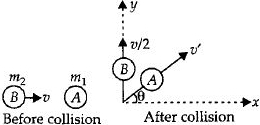
Two spheres $A$ and $B$ of masses $m_1$ and $m_2$ respectively collide. Sphere $A$ is at rest initially and sphere $B$ is moving with velocity $v$ along the $x$-axis. After the collision,sphere $B$ has a velocity of $\frac{v}{2}$ in a direction perpendicular to the original direction. The mass $A$ moves after the collision in the direction:
A
Same as that of $B$
B
Opposite to that of $B$
C
$\theta = \tan^{-1}\left(\frac{1}{2}\right)$ to the $x$-axis
D
$\theta = \tan^{-1}\left(-\frac{1}{2}\right)$ to the $x$-axis
Solution
(D) Let the velocity of sphere $A$ after collision be $v'$ at an angle $\theta$ with the $x$-axis.
According to the law of conservation of linear momentum along the $x$-axis:
$m_2 v = m_1 v' \cos \theta + m_2(0)$
$m_1 v' \cos \theta = m_2 v \quad ... (i)$
According to the law of conservation of linear momentum along the $y$-axis:
$0 = m_1 v' \sin \theta + m_2 \left(\frac{v}{2}\right)$
$m_1 v' \sin \theta = -\frac{m_2 v}{2} \quad ... (ii)$
Dividing equation $(ii)$ by equation $(i)$:
$\frac{m_1 v' \sin \theta}{m_1 v' \cos \theta} = \frac{-m_2 v / 2}{m_2 v}$
$\tan \theta = -\frac{1}{2}$
$\theta = \tan^{-1}\left(-\frac{1}{2}\right)$ to the $x$-axis.
According to the law of conservation of linear momentum along the $x$-axis:
$m_2 v = m_1 v' \cos \theta + m_2(0)$
$m_1 v' \cos \theta = m_2 v \quad ... (i)$
According to the law of conservation of linear momentum along the $y$-axis:
$0 = m_1 v' \sin \theta + m_2 \left(\frac{v}{2}\right)$
$m_1 v' \sin \theta = -\frac{m_2 v}{2} \quad ... (ii)$
Dividing equation $(ii)$ by equation $(i)$:
$\frac{m_1 v' \sin \theta}{m_1 v' \cos \theta} = \frac{-m_2 v / 2}{m_2 v}$
$\tan \theta = -\frac{1}{2}$
$\theta = \tan^{-1}\left(-\frac{1}{2}\right)$ to the $x$-axis.
0 likesView Solution
10
PhysicsMediumMCQAIPMT · 2012
$A$ car of mass $m$ starts from rest and accelerates so that the instantaneous power delivered to the car has a constant magnitude $P_0$. The instantaneous velocity of this car is proportional to
A
$t^2P_0$
B
$t^{1/2}$
C
$t^{3/2}$
D
$t/\sqrt{m}$
Solution
(B) The instantaneous power $P_0$ is given by $P_0 = Fv$.
Since $F = ma = m(dv/dt)$,we can write $P_0 = mv(dv/dt)$.
Rearranging the terms,we get $P_0 dt = mv dv$.
Integrating both sides from $t=0$ to $t$ and $v=0$ to $v$:
$\int_0^t P_0 dt = \int_0^v mv dv$
$P_0 t = \frac{1}{2}mv^2$.
Solving for $v$,we get $v = \sqrt{\frac{2P_0 t}{m}}$.
Therefore,$v \propto \sqrt{t}$ or $v \propto t^{1/2}$.
Since $F = ma = m(dv/dt)$,we can write $P_0 = mv(dv/dt)$.
Rearranging the terms,we get $P_0 dt = mv dv$.
Integrating both sides from $t=0$ to $t$ and $v=0$ to $v$:
$\int_0^t P_0 dt = \int_0^v mv dv$
$P_0 t = \frac{1}{2}mv^2$.
Solving for $v$,we get $v = \sqrt{\frac{2P_0 t}{m}}$.
Therefore,$v \propto \sqrt{t}$ or $v \propto t^{1/2}$.
0 likesView Solution
11
PhysicsMediumMCQAIPMT · 2012
If the radius of a star is $R$ and it acts as a black body,what would be the temperature of the star,in which the rate of energy production is $Q$? ($\sigma$ stands for Stefan's constant)
A
$\frac{Q}{4\pi \sigma R^2}$
B
$\left( \frac{Q}{4\pi \sigma R^2} \right)^{1/2}$
C
$\left( \frac{Q}{4\pi \sigma R^2} \right)^{1/4}$
D
$\left( \frac{4\pi \sigma R^2}{Q} \right)^{1/4}$
Solution
(C) According to Stefan's law,the rate of energy emission (power) $Q$ from a black body is given by $Q = \sigma A T^4$.
Here,$A$ is the surface area of the star,which is $4\pi R^2$.
Substituting the value of $A$ into the equation,we get $Q = \sigma (4\pi R^2) T^4$.
Rearranging the formula to solve for temperature $T$,we have $T^4 = \frac{Q}{4\pi \sigma R^2}$.
Taking the fourth root on both sides,we get $T = \left( \frac{Q}{4\pi \sigma R^2} \right)^{1/4}$.
Here,$A$ is the surface area of the star,which is $4\pi R^2$.
Substituting the value of $A$ into the equation,we get $Q = \sigma (4\pi R^2) T^4$.
Rearranging the formula to solve for temperature $T$,we have $T^4 = \frac{Q}{4\pi \sigma R^2}$.
Taking the fourth root on both sides,we get $T = \left( \frac{Q}{4\pi \sigma R^2} \right)^{1/4}$.
0 likesView Solution
12
PhysicsMediumMCQAIPMT · 2012
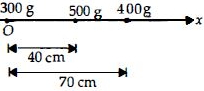
Three masses are placed on the $x-$axis: $300 \, g$ at the origin,$500 \, g$ at $x = 40 \, cm$ and $400 \, g$ at $x = 70 \, cm$. The distance of the centre of mass from the origin is ....... $cm$.
A
$40$
B
$50$
C
$30$
D
$45$
Solution
(A) The distance of the center of mass $(X_{CM})$ of a system of particles from the origin is given by the formula:
$X_{CM} = \frac{m_1x_1 + m_2x_2 + m_3x_3}{m_1 + m_2 + m_3}$
Given:
$m_1 = 300 \, g, x_1 = 0 \, cm$
$m_2 = 500 \, g, x_2 = 40 \, cm$
$m_3 = 400 \, g, x_3 = 70 \, cm$
Substituting the values:
$X_{CM} = \frac{300 \times 0 + 500 \times 40 + 400 \times 70}{300 + 500 + 400}$
$X_{CM} = \frac{0 + 20000 + 28000}{1200}$
$X_{CM} = \frac{48000}{1200}$
$X_{CM} = 40 \, cm$
$X_{CM} = \frac{m_1x_1 + m_2x_2 + m_3x_3}{m_1 + m_2 + m_3}$
Given:
$m_1 = 300 \, g, x_1 = 0 \, cm$
$m_2 = 500 \, g, x_2 = 40 \, cm$
$m_3 = 400 \, g, x_3 = 70 \, cm$
Substituting the values:
$X_{CM} = \frac{300 \times 0 + 500 \times 40 + 400 \times 70}{300 + 500 + 400}$
$X_{CM} = \frac{0 + 20000 + 28000}{1200}$
$X_{CM} = \frac{48000}{1200}$
$X_{CM} = 40 \, cm$
0 likesView Solution
13
PhysicsEasyMCQAIPMT · 2012
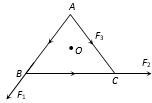
$ABC$ is an equilateral triangle with $O$ as its centre. $\vec F_1, \vec F_2$ and $\vec F_3$ represent three forces acting along the sides $AB, BC$ and $AC$ respectively. If the total torque about $O$ is zero,then the magnitude of $\vec F_3$ is
A
$({F_1} + {F_2})/2$
B
$2({F_1} + {F_2})$
C
$({F_1} + {F_2})$
D
$({F_1} - {F_2})$
Solution
(C) Let $x$ be the perpendicular distance from the center $O$ of the equilateral triangle to each of its sides.
Since the triangle is equilateral,the distance from the center to each side is the same.
The torque $\tau$ produced by a force $F$ about point $O$ is given by $\tau = F \times x$.
Looking at the directions of the forces $\vec F_1, \vec F_2$,and $\vec F_3$ along the sides of the triangle,we can see that $\vec F_1$ and $\vec F_2$ produce torques in the same rotational sense (e.g.,clockwise) about $O$,while $\vec F_3$ produces a torque in the opposite sense (e.g.,counter-clockwise).
For the total torque about $O$ to be zero,the sum of the torques must be zero:
$\tau_1 + \tau_2 - \tau_3 = 0$
$F_1 x + F_2 x - F_3 x = 0$
Dividing by $x$ (since $x \neq 0$):
$F_1 + F_2 - F_3 = 0$
Therefore,$F_3 = F_1 + F_2$.
Since the triangle is equilateral,the distance from the center to each side is the same.
The torque $\tau$ produced by a force $F$ about point $O$ is given by $\tau = F \times x$.
Looking at the directions of the forces $\vec F_1, \vec F_2$,and $\vec F_3$ along the sides of the triangle,we can see that $\vec F_1$ and $\vec F_2$ produce torques in the same rotational sense (e.g.,clockwise) about $O$,while $\vec F_3$ produces a torque in the opposite sense (e.g.,counter-clockwise).
For the total torque about $O$ to be zero,the sum of the torques must be zero:
$\tau_1 + \tau_2 - \tau_3 = 0$
$F_1 x + F_2 x - F_3 x = 0$
Dividing by $x$ (since $x \neq 0$):
$F_1 + F_2 - F_3 = 0$
Therefore,$F_3 = F_1 + F_2$.
0 likesView Solution
14
PhysicsMediumMCQAIPMT · 2012
$A$ car of mass $m$ is moving on a level circular track of radius $R.$ If $\mu_s$ represents the static friction between the road and tyres of the car,the maximum speed of the car in circular motion is given by
A
$\mu_s Rg$
B
$Rg\sqrt{\mu_s}$
C
$\mu_s\sqrt{Rg}$
D
$\sqrt{\mu_s Rg}$
Solution
(D) The necessary centripetal force for circular motion is provided by the static friction between the road and the tyres.
The condition for the car not to skid is $f \leq \mu_s N$.
Since the track is level,the normal force $N = mg$.
The centripetal force required is $F_c = \frac{mv^2}{R}$.
Equating the maximum friction to the centripetal force: $\mu_s mg = \frac{mv_{max}^2}{R}$.
Solving for $v_{max}$:
$v_{max}^2 = \mu_s Rg$
$v_{max} = \sqrt{\mu_s Rg}$.
The condition for the car not to skid is $f \leq \mu_s N$.
Since the track is level,the normal force $N = mg$.
The centripetal force required is $F_c = \frac{mv^2}{R}$.
Equating the maximum friction to the centripetal force: $\mu_s mg = \frac{mv_{max}^2}{R}$.
Solving for $v_{max}$:
$v_{max}^2 = \mu_s Rg$
$v_{max} = \sqrt{\mu_s Rg}$.
0 likesView Solution
15
PhysicsMediumMCQAIPMT · 2012
$A$ circular platform is mounted on a frictionless vertical axle. Its radius $R = 2\, m$ and its moment of inertia about the axle is $200\, kg\, m^2$. It is initially at rest. $A$ $50\, kg$ man stands on the edge of the platform and begins to walk along the edge at the speed of $1\, m/s$ relative to the ground. Time taken by the man to complete one revolution is
A
$\pi \, s$
B
$\frac{3\pi}{2} \, s$
C
$2\pi \, s$
D
$\frac{\pi}{2} \, s$
Solution
(C) Since the system is initially at rest,the initial angular momentum $L_i = 0$.
According to the principle of conservation of angular momentum,the final angular momentum $L_f$ must also be $0$.
Let $\omega$ be the angular velocity of the platform. The angular momentum of the man is $L_m = m v R$ and the angular momentum of the platform is $L_p = I \omega$.
Since the total angular momentum is zero,the man and the platform move in opposite directions: $m v R - I \omega = 0$.
$\omega = \frac{m v R}{I} = \frac{50 \times 1 \times 2}{200} = 0.5 \, rad/s$.
The angular velocity of the man relative to the ground is $\omega_m = \frac{v}{R} = \frac{1}{2} = 0.5 \, rad/s$.
The angular velocity of the man relative to the platform is $\omega_r = \omega_m + \omega = 0.5 + 0.5 = 1 \, rad/s$.
The time taken to complete one revolution is $T = \frac{2\pi}{\omega_r} = \frac{2\pi}{1} = 2\pi \, s$.
According to the principle of conservation of angular momentum,the final angular momentum $L_f$ must also be $0$.
Let $\omega$ be the angular velocity of the platform. The angular momentum of the man is $L_m = m v R$ and the angular momentum of the platform is $L_p = I \omega$.
Since the total angular momentum is zero,the man and the platform move in opposite directions: $m v R - I \omega = 0$.
$\omega = \frac{m v R}{I} = \frac{50 \times 1 \times 2}{200} = 0.5 \, rad/s$.
The angular velocity of the man relative to the ground is $\omega_m = \frac{v}{R} = \frac{1}{2} = 0.5 \, rad/s$.
The angular velocity of the man relative to the platform is $\omega_r = \omega_m + \omega = 0.5 + 0.5 = 1 \, rad/s$.
The time taken to complete one revolution is $T = \frac{2\pi}{\omega_r} = \frac{2\pi}{1} = 2\pi \, s$.
0 likesView Solution
16
PhysicsEasyMCQAIPMT · 2012
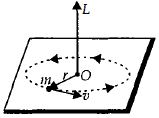
When a mass is rotating in a plane about a fixed point,its angular momentum is directed along
A
a line perpendicular to the plane of rotation
B
the radius
C
the tangent to the orbit
D
the line making an angle of $45^{\circ}$ to the plane of rotation
Solution
(A) The angular momentum $\vec{L}$ of a particle is defined by the cross product of its position vector $\vec{r}$ and its linear momentum $\vec{p} = m\vec{v}$,given by $\vec{L} = \vec{r} \times \vec{p}$.
Since $\vec{r}$ and $\vec{v}$ both lie in the plane of rotation,their cross product $\vec{L}$ must be perpendicular to both $\vec{r}$ and $\vec{v}$ according to the right-hand rule.
Therefore,the angular momentum vector is directed along a line perpendicular to the plane of rotation.
Since $\vec{r}$ and $\vec{v}$ both lie in the plane of rotation,their cross product $\vec{L}$ must be perpendicular to both $\vec{r}$ and $\vec{v}$ according to the right-hand rule.
Therefore,the angular momentum vector is directed along a line perpendicular to the plane of rotation.
0 likesView Solution
17
PhysicsEasyMCQAIPMT · 2012
Two persons of masses $55\, kg$ and $65\, kg$ respectively,are at the opposite ends of a boat. The length of the boat is $3.0\, m$ and it weighs $100\, kg$. The $55\, kg$ man walks up to the $65\, kg$ man and sits with him. If the boat is in still water,the center of mass of the system shifts by ....... $m$.
A
$3$
B
$2.3$
C
$0$
D
$0.75$
Solution
(C) The system consists of the boat and the two persons.
Since the boat is in still water and there are no external horizontal forces acting on the system (the forces involved in the movement of the person are internal to the system),the net external force on the system is zero.
According to the property of the center of mass,if the net external force acting on a system is zero,the position of the center of mass of the system remains unchanged.
Therefore,the center of mass of the system does not shift.
Thus,the shift is $0\, m$.
Since the boat is in still water and there are no external horizontal forces acting on the system (the forces involved in the movement of the person are internal to the system),the net external force on the system is zero.
According to the property of the center of mass,if the net external force acting on a system is zero,the position of the center of mass of the system remains unchanged.
Therefore,the center of mass of the system does not shift.
Thus,the shift is $0\, m$.
0 likesView Solution
18
PhysicsMediumMCQAIPMT · 2012
$A$ car of mass $1000\, kg$ negotiates a banked curve of radius $90\, m$ on a frictionless road. If the banking angle is $45^\circ$,the speed of the car is ....... $m\,s^{-1}$.
A
$20$
B
$10$
C
$30$
D
$5$
Solution
(C) Given: Mass $m = 1000\, kg$,Radius $R = 90\, m$,Banking angle $\theta = 45^\circ$,Acceleration due to gravity $g = 10\, m\,s^{-2}$.
For a car on a frictionless banked road,the condition for safe turning is given by the formula: $\tan \theta = \frac{v^2}{Rg}$.
Rearranging for velocity $v$: $v = \sqrt{Rg \tan \theta}$.
Substituting the values: $v = \sqrt{90 \times 10 \times \tan 45^\circ}$.
Since $\tan 45^\circ = 1$,we get: $v = \sqrt{900 \times 1} = 30\, m\,s^{-1}$.
For a car on a frictionless banked road,the condition for safe turning is given by the formula: $\tan \theta = \frac{v^2}{Rg}$.
Rearranging for velocity $v$: $v = \sqrt{Rg \tan \theta}$.
Substituting the values: $v = \sqrt{90 \times 10 \times \tan 45^\circ}$.
Since $\tan 45^\circ = 1$,we get: $v = \sqrt{900 \times 1} = 30\, m\,s^{-1}$.
0 likesView Solution
19
PhysicsMediumMCQAIPMT · 2012
The height at which the weight of a body becomes $\frac{1}{16}^{th}$ of its weight on the surface of the Earth (radius $R$) is: (in $R$)
A
$5$
B
$15$
C
$3$
D
$4$
Solution
(C) The acceleration due to gravity at a height $h$ from the surface of the Earth is given by:
$g' = \frac{g}{(1 + \frac{h}{R})^2} \quad ... (i)$
Where $g$ is the acceleration due to gravity at the surface of the Earth and $R$ is the radius of the Earth.
Multiplying both sides by the mass of the body $m$,we get the weight $W'$ at height $h$:
$W' = mg' = \frac{mg}{(1 + \frac{h}{R})^2} = \frac{W}{(1 + \frac{h}{R})^2}$
According to the question,$W' = \frac{1}{16}W$.
Substituting this into the equation:
$\frac{1}{16} = \frac{1}{(1 + \frac{h}{R})^2}$
Taking the square root on both sides:
$1 + \frac{h}{R} = 4$
$\frac{h}{R} = 3$
$h = 3R$
$g' = \frac{g}{(1 + \frac{h}{R})^2} \quad ... (i)$
Where $g$ is the acceleration due to gravity at the surface of the Earth and $R$ is the radius of the Earth.
Multiplying both sides by the mass of the body $m$,we get the weight $W'$ at height $h$:
$W' = mg' = \frac{mg}{(1 + \frac{h}{R})^2} = \frac{W}{(1 + \frac{h}{R})^2}$
According to the question,$W' = \frac{1}{16}W$.
Substituting this into the equation:
$\frac{1}{16} = \frac{1}{(1 + \frac{h}{R})^2}$
Taking the square root on both sides:
$1 + \frac{h}{R} = 4$
$\frac{h}{R} = 3$
$h = 3R$
0 likesView Solution
20
PhysicsMediumMCQAIPMT · 2012
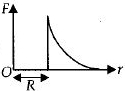
Which one of the following plots represents the variation of gravitational field on a particle with distance $r$ due to a thin spherical shell of radius $R$? ($r$ is measured from the centre of the spherical shell)
A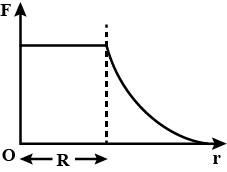
B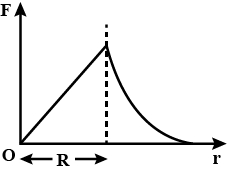
C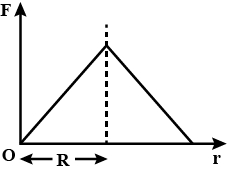
D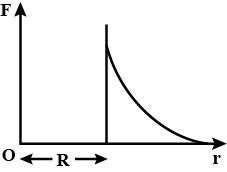
Solution
(D) The gravitational field $F$ due to a thin spherical shell of mass $M$ and radius $R$ is given by:
$1$. Inside the shell,i.e.,for $r < R$:
The gravitational field $F = 0$.
$2$. On the surface of the shell,i.e.,for $r = R$:
The gravitational field $F = \frac{GM}{R^2}$.
$3$. Outside the shell,i.e.,for $r > R$:
The gravitational field $F = \frac{GM}{r^2}$.
Thus,for $r < R$,the field is zero,and for $r > R$,it follows an inverse-square law. The correct plot is the one that shows $F = 0$ for $r < R$ and a curve representing $F \propto 1/r^2$ for $r > R$.
$1$. Inside the shell,i.e.,for $r < R$:
The gravitational field $F = 0$.
$2$. On the surface of the shell,i.e.,for $r = R$:
The gravitational field $F = \frac{GM}{R^2}$.
$3$. Outside the shell,i.e.,for $r > R$:
The gravitational field $F = \frac{GM}{r^2}$.
Thus,for $r < R$,the field is zero,and for $r > R$,it follows an inverse-square law. The correct plot is the one that shows $F = 0$ for $r < R$ and a curve representing $F \propto 1/r^2$ for $r > R$.
0 likesView Solution
21
PhysicsMediumMCQAIPMT · 2012
If $v_e$ is escape velocity and $v_0$ is orbital velocity of a satellite for an orbit close to the earth's surface,then these are related by:
A
$v_0 = \sqrt{2} v_e$
B
$v_e = v_0$
C
$v_e = \sqrt{2v_0}$
D
$v_e = \sqrt{2} v_0$
Solution
(D) The escape velocity of an object from the earth's surface is given by the formula:
$v_e = \sqrt{\frac{2GM}{R}} \quad ...(i)$
Where $M$ is the mass of the earth and $R$ is the radius of the earth.
The orbital velocity of a satellite orbiting close to the earth's surface is given by:
$v_0 = \sqrt{\frac{GM}{R}} \quad ...(ii)$
Comparing equation $(i)$ and equation $(ii)$,we can substitute $\sqrt{\frac{GM}{R}}$ with $v_0$ in the expression for $v_e$:
$v_e = \sqrt{2} \times \sqrt{\frac{GM}{R}}$
$v_e = \sqrt{2} v_0$
$v_e = \sqrt{\frac{2GM}{R}} \quad ...(i)$
Where $M$ is the mass of the earth and $R$ is the radius of the earth.
The orbital velocity of a satellite orbiting close to the earth's surface is given by:
$v_0 = \sqrt{\frac{GM}{R}} \quad ...(ii)$
Comparing equation $(i)$ and equation $(ii)$,we can substitute $\sqrt{\frac{GM}{R}}$ with $v_0$ in the expression for $v_e$:
$v_e = \sqrt{2} \times \sqrt{\frac{GM}{R}}$
$v_e = \sqrt{2} v_0$
0 likesView Solution
22
PhysicsMediumMCQAIPMT · 2012
$A$ geostationary satellite is orbiting the earth at a height $5R$ above the surface of the earth,where $R$ is the radius of the earth. What is the time period (in hours) of another satellite orbiting at a height of $2R$ from the surface of the earth?
A
$5 \, hr$
B
$10 \, hr$
C
$6\sqrt{2} \, hr$
D
$10\sqrt{2} \, hr$
Solution
(C) According to Kepler's third law of planetary motion,the square of the time period $T$ is proportional to the cube of the orbital radius $r$,i.e.,$T^2 \propto r^3$ or $T \propto r^{3/2}$.
The orbital radius $r$ is the distance from the center of the Earth,given by $r = R + h$,where $h$ is the height above the surface.
For the geostationary satellite,$h_1 = 5R$,so $r_1 = R + 5R = 6R$. The time period $T_1 = 24 \, hr$.
For the second satellite,$h_2 = 2R$,so $r_2 = R + 2R = 3R$.
Using the ratio formula: $\frac{T_2}{T_1} = \left( \frac{r_2}{r_1} \right)^{3/2}$.
Substituting the values: $\frac{T_2}{24} = \left( \frac{3R}{6R} \right)^{3/2} = \left( \frac{1}{2} \right)^{3/2} = \frac{1}{2\sqrt{2}}$.
Therefore,$T_2 = \frac{24}{2\sqrt{2}} = \frac{12}{\sqrt{2}} = 6\sqrt{2} \, hr$.
The orbital radius $r$ is the distance from the center of the Earth,given by $r = R + h$,where $h$ is the height above the surface.
For the geostationary satellite,$h_1 = 5R$,so $r_1 = R + 5R = 6R$. The time period $T_1 = 24 \, hr$.
For the second satellite,$h_2 = 2R$,so $r_2 = R + 2R = 3R$.
Using the ratio formula: $\frac{T_2}{T_1} = \left( \frac{r_2}{r_1} \right)^{3/2}$.
Substituting the values: $\frac{T_2}{24} = \left( \frac{3R}{6R} \right)^{3/2} = \left( \frac{1}{2} \right)^{3/2} = \frac{1}{2\sqrt{2}}$.
Therefore,$T_2 = \frac{24}{2\sqrt{2}} = \frac{12}{\sqrt{2}} = 6\sqrt{2} \, hr$.
0 likesView Solution
23
PhysicsMediumMCQAIPMT · 2012
$A$ spherical planet has a mass $M$ and diameter $D$. $A$ particle of mass $m$ falling freely near the surface of this planet will experience an acceleration due to gravity equal to:
A
$\frac{4GM}{D^2}$
B
$\frac{GM}{D^2}$
C
$\frac{GMm}{D^2}$
D
$\frac{4GMm}{D^2}$
Solution
(A) The gravitational force $F$ acting on a particle of mass $m$ near the surface of a planet of mass $M$ and radius $R = D/2$ is given by Newton's law of gravitation:
$F = \frac{GMm}{R^2} = \frac{GMm}{(D/2)^2}$
The acceleration due to gravity $g$ experienced by the particle is defined as the force per unit mass:
$g = \frac{F}{m} = \frac{GM}{(D/2)^2}$
Simplifying the expression:
$g = \frac{GM}{D^2/4} = \frac{4GM}{D^2}$
Thus,the acceleration due to gravity is $\frac{4GM}{D^2}$.
$F = \frac{GMm}{R^2} = \frac{GMm}{(D/2)^2}$
The acceleration due to gravity $g$ experienced by the particle is defined as the force per unit mass:
$g = \frac{F}{m} = \frac{GM}{(D/2)^2}$
Simplifying the expression:
$g = \frac{GM}{D^2/4} = \frac{4GM}{D^2}$
Thus,the acceleration due to gravity is $\frac{4GM}{D^2}$.
0 likesView Solution
24
PhysicsMediumMCQAIPMT · 2012
One mole of an ideal gas goes from an initial state $A$ to a final state $B$ via two processes: It first undergoes isothermal expansion from volume $V$ to $3V$ and then its volume is reduced from $3V$ to $V$ at constant pressure. The correct $P-V$ diagram representing the two processes is:
A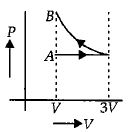
B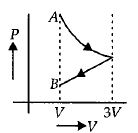
C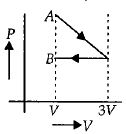
D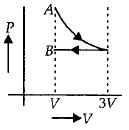
Solution
(D) $1$. In the first process, the gas undergoes isothermal expansion from volume $V$ to $3V$. For an ideal gas, the isothermal process follows the equation $PV = \text{constant}$, which represents a rectangular hyperbola on a $P-V$ diagram. Since it is an expansion, the pressure decreases as volume increases.
$2$. In the second process, the volume is reduced from $3V$ to $V$ at constant pressure. On a $P-V$ diagram, a constant pressure process is represented by a horizontal line.
$3$. Combining these, the path starts at $A$ (at volume $V$), follows a hyperbolic curve to $3V$, and then follows a horizontal line back to volume $V$ at point $B$.
$4$. Comparing this with the given options, the diagram in option $D$ correctly represents an isothermal expansion followed by a constant pressure compression.
$2$. In the second process, the volume is reduced from $3V$ to $V$ at constant pressure. On a $P-V$ diagram, a constant pressure process is represented by a horizontal line.
$3$. Combining these, the path starts at $A$ (at volume $V$), follows a hyperbolic curve to $3V$, and then follows a horizontal line back to volume $V$ at point $B$.
$4$. Comparing this with the given options, the diagram in option $D$ correctly represents an isothermal expansion followed by a constant pressure compression.
0 likesView Solution
25
PhysicsMediumMCQAIPMT · 2012
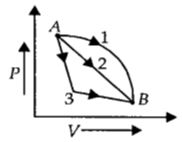
An ideal gas goes from state $A$ to state $B$ via three different processes as indicated in the $P-V$ diagram. If $Q_1, Q_2, Q_3$ indicate the heat absorbed by the gas along the three processes and $\Delta U_1, \Delta U_2, \Delta U_3$ indicate the change in internal energy along the three processes respectively,then
A
$Q_1 < Q_2 < Q_3$ and $\Delta U_1 = \Delta U_2 = \Delta U_3$
B
$Q_1 < Q_2 = Q_3$ and $\Delta U_1 > \Delta U_2 > \Delta U_3$
C
$Q_1 = Q_2 > Q_3$ and $\Delta U_1 > \Delta U_2 > \Delta U_3$
D
$Q_1 > Q_2 > Q_3$ and $\Delta U_1 = \Delta U_2 = \Delta U_3$
Solution
(D) The change in internal energy $(\Delta U)$ is a state function,meaning it is path-independent and depends only on the initial and final states.
Since the initial state $A$ and final state $B$ are the same for all three processes,the change in internal energy is identical for all:
$\Delta U_1 = \Delta U_2 = \Delta U_3$
The work done $(W)$ by the gas in a $P-V$ diagram is equal to the area under the curve.
From the given diagram,the area under curve $1$ is the largest,followed by curve $2$,and then curve $3$ is the smallest.
Therefore,$W_1 > W_2 > W_3$.
According to the first law of thermodynamics,$Q = \Delta U + W$.
Since $\Delta U$ is constant for all processes and $W_1 > W_2 > W_3$,it follows that the heat absorbed must satisfy:
$Q_1 > Q_2 > Q_3$
Since the initial state $A$ and final state $B$ are the same for all three processes,the change in internal energy is identical for all:
$\Delta U_1 = \Delta U_2 = \Delta U_3$
The work done $(W)$ by the gas in a $P-V$ diagram is equal to the area under the curve.
From the given diagram,the area under curve $1$ is the largest,followed by curve $2$,and then curve $3$ is the smallest.
Therefore,$W_1 > W_2 > W_3$.
According to the first law of thermodynamics,$Q = \Delta U + W$.
Since $\Delta U$ is constant for all processes and $W_1 > W_2 > W_3$,it follows that the heat absorbed must satisfy:
$Q_1 > Q_2 > Q_3$
0 likesView Solution
26
PhysicsEasyMCQAIPMT · 2012
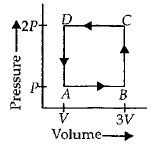
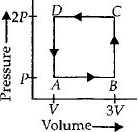
$A$ thermodynamic system is taken through the cycle $ABCD$ as shown in the figure. Heat rejected by the gas during the cycle is:
A
$2PV$
B
$4PV$
C
$PV$
D
$\frac{PV}{2}$
Solution
(A) In a cyclic process,the change in internal energy is zero,i.e.,$\Delta U = 0$.
According to the first law of thermodynamics,$\Delta Q = \Delta U + \Delta W$. Since $\Delta U = 0$,we have $\Delta Q = \Delta W$.
The work done in a cyclic process is equal to the area enclosed by the cycle on the $P-V$ diagram.
The cycle $ABCD$ is traversed in an anticlockwise direction,so the work done by the gas is negative.
Area of the rectangle $ABCD = (\text{change in volume}) \times (\text{change in pressure}) = (3V - V) \times (2P - P) = (2V) \times (P) = 2PV$.
Since the cycle is anticlockwise,$\Delta W = -2PV$.
Thus,$\Delta Q = -2PV$.
The negative sign indicates that heat is rejected by the system.
Therefore,the heat rejected by the gas is $2PV$.
According to the first law of thermodynamics,$\Delta Q = \Delta U + \Delta W$. Since $\Delta U = 0$,we have $\Delta Q = \Delta W$.
The work done in a cyclic process is equal to the area enclosed by the cycle on the $P-V$ diagram.
The cycle $ABCD$ is traversed in an anticlockwise direction,so the work done by the gas is negative.
Area of the rectangle $ABCD = (\text{change in volume}) \times (\text{change in pressure}) = (3V - V) \times (2P - P) = (2V) \times (P) = 2PV$.
Since the cycle is anticlockwise,$\Delta W = -2PV$.
Thus,$\Delta Q = -2PV$.
The negative sign indicates that heat is rejected by the system.
Therefore,the heat rejected by the gas is $2PV$.
0 likesView Solution
27
PhysicsMediumMCQAIPMT · 2012
$A$ train moving at a speed of $220\, m s^{-1}$ towards a stationary object,emits a sound of frequency $1000\, Hz$. Some of the sound reaching the object gets reflected back to the train as an echo. The frequency of the echo as detected by the driver of the train is ...... $Hz$. (Speed of sound in air is $330\, m s^{-1}$)
A
$3500$
B
$4000$
C
$5000$
D
$3000$
Solution
(C) The speed of the train (source and observer) is $v_T = 220\, m s^{-1}$.
The speed of sound in air is $v = 330\, m s^{-1}$.
The source (train) emits a frequency $f_0 = 1000\, Hz$.
First,the sound reaches the stationary object. The frequency received by the object is $f_1 = f_0 \left( \frac{v}{v - v_T} \right)$.
Then,the object reflects this sound back to the moving train. The train acts as an observer moving towards the reflected sound source. The frequency detected by the driver is $f' = f_1 \left( \frac{v + v_T}{v} \right)$.
Substituting $f_1$ into the equation for $f'$,we get $f' = f_0 \left( \frac{v}{v - v_T} \right) \left( \frac{v + v_T}{v} \right) = f_0 \left( \frac{v + v_T}{v - v_T} \right)$.
Calculating the value: $f' = 1000 \left( \frac{330 + 220}{330 - 220} \right) = 1000 \left( \frac{550}{110} \right) = 1000 \times 5 = 5000\, Hz$.
The speed of sound in air is $v = 330\, m s^{-1}$.
The source (train) emits a frequency $f_0 = 1000\, Hz$.
First,the sound reaches the stationary object. The frequency received by the object is $f_1 = f_0 \left( \frac{v}{v - v_T} \right)$.
Then,the object reflects this sound back to the moving train. The train acts as an observer moving towards the reflected sound source. The frequency detected by the driver is $f' = f_1 \left( \frac{v + v_T}{v} \right)$.
Substituting $f_1$ into the equation for $f'$,we get $f' = f_0 \left( \frac{v}{v - v_T} \right) \left( \frac{v + v_T}{v} \right) = f_0 \left( \frac{v + v_T}{v - v_T} \right)$.
Calculating the value: $f' = 1000 \left( \frac{330 + 220}{330 - 220} \right) = 1000 \left( \frac{550}{110} \right) = 1000 \times 5 = 5000\, Hz$.
0 likesView Solution
28
PhysicsMediumMCQAIPMT · 2012
If $n_{1}, n_{2}$ and $n_{3}$ are the fundamental frequencies of three segments into which a string is divided,then the original fundamental frequency $n$ of the string is given by
A
$n = n_{1} + n_{2} + n_{3}$
B
$\sqrt{n} = \sqrt{n_{1}} + \sqrt{n_{2}} + \sqrt{n_{3}}$
C
$\frac{1}{n} = \frac{1}{n_{1}} + \frac{1}{n_{2}} + \frac{1}{n_{3}}$
D
$\frac{1}{n^{2}} = \frac{1}{n_{1}^{2}} + \frac{1}{n_{2}^{2}} + \frac{1}{n_{3}^{2}}$
Solution
(C) The fundamental frequency of a stretched string is given by $n = \frac{1}{2l} \sqrt{\frac{T}{\mu}}$.
Since the tension $T$ and mass per unit length $\mu$ are constant for the string,we have $n \propto \frac{1}{l}$,which implies $l = \frac{k}{n}$,where $k$ is a constant.
When the string is divided into three segments of lengths $l_{1}, l_{2}, l_{3}$ with fundamental frequencies $n_{1}, n_{2}, n_{3}$ respectively,we have $l_{1} = \frac{k}{n_{1}}$,$l_{2} = \frac{k}{n_{2}}$,and $l_{3} = \frac{k}{n_{3}}$.
The total length of the string is $l = l_{1} + l_{2} + l_{3}$.
Substituting the expressions for length in terms of frequency,we get $\frac{k}{n} = \frac{k}{n_{1}} + \frac{k}{n_{2}} + \frac{k}{n_{3}}$.
Dividing by $k$,we obtain the relation $\frac{1}{n} = \frac{1}{n_{1}} + \frac{1}{n_{2}} + \frac{1}{n_{3}}$.
Since the tension $T$ and mass per unit length $\mu$ are constant for the string,we have $n \propto \frac{1}{l}$,which implies $l = \frac{k}{n}$,where $k$ is a constant.
When the string is divided into three segments of lengths $l_{1}, l_{2}, l_{3}$ with fundamental frequencies $n_{1}, n_{2}, n_{3}$ respectively,we have $l_{1} = \frac{k}{n_{1}}$,$l_{2} = \frac{k}{n_{2}}$,and $l_{3} = \frac{k}{n_{3}}$.
The total length of the string is $l = l_{1} + l_{2} + l_{3}$.
Substituting the expressions for length in terms of frequency,we get $\frac{k}{n} = \frac{k}{n_{1}} + \frac{k}{n_{2}} + \frac{k}{n_{3}}$.
Dividing by $k$,we obtain the relation $\frac{1}{n} = \frac{1}{n_{1}} + \frac{1}{n_{2}} + \frac{1}{n_{3}}$.
0 likesView Solution
29
PhysicsMediumMCQAIPMT · 2012
The equation of a simple harmonic wave is given by $y = 3 \sin \frac{\pi}{2}(50t - x)$,where $x$ and $y$ are in metres and $t$ is in seconds. The ratio of maximum particle velocity to the wave velocity is
A
$2\pi$
B
$\frac{3\pi}{2}$
C
$3\pi$
D
$\frac{2\pi}{3}$
Solution
(B) The given wave equation is $y = 3 \sin \frac{\pi}{2}(50t - x)$.
Expanding this,we get $y = 3 \sin (25\pi t - \frac{\pi}{2}x)$ $...(i)$.
The standard wave equation is $y = A \sin (\omega t - kx)$ $...(ii)$.
Comparing $(i)$ and $(ii)$,we get angular frequency $\omega = 25\pi \text{ rad/s}$ and wave number $k = \frac{\pi}{2} \text{ m}^{-1}$.
Wave velocity $v = \frac{\omega}{k} = \frac{25\pi}{\pi/2} = 50 \text{ m/s}$.
Particle velocity $v_p = \frac{dy}{dt} = \frac{d}{dt} [3 \sin (25\pi t - \frac{\pi}{2}x)] = 3 \times 25\pi \cos (25\pi t - \frac{\pi}{2}x) = 75\pi \cos (25\pi t - \frac{\pi}{2}x)$.
Maximum particle velocity $(v_p)_{\max} = 75\pi \text{ m/s}$.
The ratio of maximum particle velocity to wave velocity is $\frac{(v_p)_{\max}}{v} = \frac{75\pi}{50} = \frac{3\pi}{2}$.
Expanding this,we get $y = 3 \sin (25\pi t - \frac{\pi}{2}x)$ $...(i)$.
The standard wave equation is $y = A \sin (\omega t - kx)$ $...(ii)$.
Comparing $(i)$ and $(ii)$,we get angular frequency $\omega = 25\pi \text{ rad/s}$ and wave number $k = \frac{\pi}{2} \text{ m}^{-1}$.
Wave velocity $v = \frac{\omega}{k} = \frac{25\pi}{\pi/2} = 50 \text{ m/s}$.
Particle velocity $v_p = \frac{dy}{dt} = \frac{d}{dt} [3 \sin (25\pi t - \frac{\pi}{2}x)] = 3 \times 25\pi \cos (25\pi t - \frac{\pi}{2}x) = 75\pi \cos (25\pi t - \frac{\pi}{2}x)$.
Maximum particle velocity $(v_p)_{\max} = 75\pi \text{ m/s}$.
The ratio of maximum particle velocity to wave velocity is $\frac{(v_p)_{\max}}{v} = \frac{75\pi}{50} = \frac{3\pi}{2}$.
0 likesView Solution
30
PhysicsMediumMCQAIPMT · 2012
Two sources of sound placed close to each other are emitting progressive waves given by $y_1 = 4 \sin(600\pi t)$ and $y_2 = 5 \sin(608\pi t)$. An observer located near these two sources of sound will hear:
A
$4$ beats per second with intensity ratio $25 : 16$ between waxing and waning.
B
$8$ beats per second with intensity ratio $25 : 16$ between waxing and waning.
C
$8$ beats per second with intensity ratio $81 : 1$ between waxing and waning.
D
$4$ beats per second with intensity ratio $81 : 1$ between waxing and waning.
Solution
(D) Given equations are $y_1 = 4 \sin(600\pi t)$ and $y_2 = 5 \sin(608\pi t)$.
Comparing with $y = A \sin(2\pi \nu t)$,we get:
For the first source: $A_1 = 4$ and $2\pi \nu_1 = 600\pi \implies \nu_1 = 300 \text{ Hz}$.
For the second source: $A_2 = 5$ and $2\pi \nu_2 = 608\pi \implies \nu_2 = 304 \text{ Hz}$.
The number of beats heard per second is the difference in frequencies: $\text{Beat frequency} = \nu_2 - \nu_1 = 304 - 300 = 4 \text{ beats/sec}$.
The ratio of maximum intensity to minimum intensity is given by $\frac{I_{\max}}{I_{\min}} = \frac{(A_1 + A_2)^2}{(A_1 - A_2)^2}$.
Substituting the values: $\frac{I_{\max}}{I_{\min}} = \frac{(4 + 5)^2}{(4 - 5)^2} = \frac{9^2}{(-1)^2} = \frac{81}{1}$.
Thus,the observer hears $4$ beats per second with an intensity ratio of $81 : 1$.
Comparing with $y = A \sin(2\pi \nu t)$,we get:
For the first source: $A_1 = 4$ and $2\pi \nu_1 = 600\pi \implies \nu_1 = 300 \text{ Hz}$.
For the second source: $A_2 = 5$ and $2\pi \nu_2 = 608\pi \implies \nu_2 = 304 \text{ Hz}$.
The number of beats heard per second is the difference in frequencies: $\text{Beat frequency} = \nu_2 - \nu_1 = 304 - 300 = 4 \text{ beats/sec}$.
The ratio of maximum intensity to minimum intensity is given by $\frac{I_{\max}}{I_{\min}} = \frac{(A_1 + A_2)^2}{(A_1 - A_2)^2}$.
Substituting the values: $\frac{I_{\max}}{I_{\min}} = \frac{(4 + 5)^2}{(4 - 5)^2} = \frac{9^2}{(-1)^2} = \frac{81}{1}$.
Thus,the observer hears $4$ beats per second with an intensity ratio of $81 : 1$.
0 likesView Solution
31
PhysicsMediumMCQAIPMT · 2012
Liquid oxygen at $50\ K$ is heated to $300\ K$ at a constant pressure of $1\ atm$. The rate of heating is constant. Which of the following graphs represents the variation of temperature with time?
A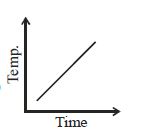
B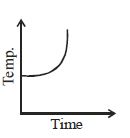
C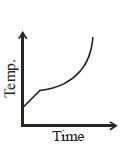
D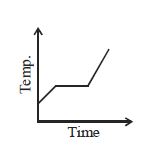
Solution
(D) When a substance is heated at a constant rate,its temperature increases until it reaches its boiling point. During the phase change (boiling),the temperature remains constant as the heat supplied is used to overcome the intermolecular forces (latent heat of vaporization). After the substance has completely turned into gas,the temperature increases again. Therefore,the temperature-time graph shows a linear increase,followed by a horizontal plateau during the phase change,and then another linear increase. This behavior is correctly represented by graph $D$.
0 likesView Solution
32
PhysicsDifficultMCQAIPMT · 2012
The angle of projection for a projectile to have the same horizontal range and maximum height is
A
$\tan ^{-1}(2)$
B
$\tan ^{-1}(4)$
C
$\tan ^{-1}\left(\frac{1}{4}\right)$
D
$\tan ^{-1}\left(\frac{1}{2}\right)$
Solution
(B) The formula for horizontal range $R$ is $R = \frac{u^2 \sin 2\theta}{g} = \frac{2u^2 \sin \theta \cos \theta}{g}$.
The formula for maximum height $H$ is $H = \frac{u^2 \sin^2 \theta}{2g}$.
Given that the range is equal to the maximum height,we set $R = H$:
$\frac{2u^2 \sin \theta \cos \theta}{g} = \frac{u^2 \sin^2 \theta}{2g}$.
Canceling common terms $u^2/g$ from both sides:
$2 \sin \theta \cos \theta = \frac{\sin^2 \theta}{2}$.
Dividing both sides by $\sin \theta$ (assuming $\sin \theta \neq 0$):
$2 \cos \theta = \frac{\sin \theta}{2}$.
Rearranging to solve for $\tan \theta = \frac{\sin \theta}{\cos \theta}$:
$4 = \frac{\sin \theta}{\cos \theta} = \tan \theta$.
Therefore,$\theta = \tan^{-1}(4)$.
The formula for maximum height $H$ is $H = \frac{u^2 \sin^2 \theta}{2g}$.
Given that the range is equal to the maximum height,we set $R = H$:
$\frac{2u^2 \sin \theta \cos \theta}{g} = \frac{u^2 \sin^2 \theta}{2g}$.
Canceling common terms $u^2/g$ from both sides:
$2 \sin \theta \cos \theta = \frac{\sin^2 \theta}{2}$.
Dividing both sides by $\sin \theta$ (assuming $\sin \theta \neq 0$):
$2 \cos \theta = \frac{\sin \theta}{2}$.
Rearranging to solve for $\tan \theta = \frac{\sin \theta}{\cos \theta}$:
$4 = \frac{\sin \theta}{\cos \theta} = \tan \theta$.
Therefore,$\theta = \tan^{-1}(4)$.
0 likesView Solution
33
PhysicsEasyMCQAIPMT · 2012
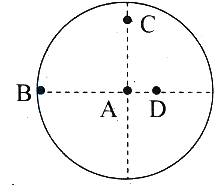
The moment of inertia of a uniform circular disc is maximum about an axis perpendicular to the disc and passing through which of the following points?
A
$A$
B
$B$
C
$C$
D
$D$
Solution
(B) According to the parallel axis theorem,the moment of inertia $I$ about any axis is given by $I = I_{CM} + Md^2$,where $I_{CM}$ is the moment of inertia about the center of mass,$M$ is the mass of the disc,and $d$ is the perpendicular distance of the axis from the center of mass.
Since $I_{CM}$ and $M$ are constant for the disc,the moment of inertia $I$ is directly proportional to the square of the distance $d$ from the center of mass $(A)$.
Comparing the distances of points $A, B, C,$ and $D$ from the center of mass $A$:
- For point $A$,$d = 0$.
- For point $B$,$d = R$ (radius of the disc).
- For point $C$,$d < R$.
- For point $D$,$d < R$.
Since point $B$ is at the maximum distance $(d = R)$ from the center of mass,the moment of inertia is maximum about the axis passing through point $B$.
Since $I_{CM}$ and $M$ are constant for the disc,the moment of inertia $I$ is directly proportional to the square of the distance $d$ from the center of mass $(A)$.
Comparing the distances of points $A, B, C,$ and $D$ from the center of mass $A$:
- For point $A$,$d = 0$.
- For point $B$,$d = R$ (radius of the disc).
- For point $C$,$d < R$.
- For point $D$,$d < R$.
Since point $B$ is at the maximum distance $(d = R)$ from the center of mass,the moment of inertia is maximum about the axis passing through point $B$.
0 likesView Solution
34
PhysicsMediumMCQAIPMT · 2012
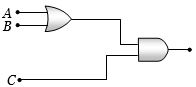
To get an output $Y = 1$ in the given circuit,which of the following inputs will be correct?
A
$A = 0, B = 1, C = 0$
B
$A = 1, B = 0, C = 0$
C
$A = 1, B = 0, C = 1$
D
$A = 1, B = 1, C = 0$
Solution
(C) The given circuit consists of an $OR$ gate followed by an $AND$ gate. The output of the $OR$ gate is $(A + B)$. This output is then fed into an $AND$ gate along with input $C$. Thus,the final Boolean expression for the output $Y$ is $Y = (A + B) \cdot C$.
To get an output $Y = 1$,both inputs to the $AND$ gate must be $1$. This means $(A + B) = 1$ and $C = 1$.
For $(A + B) = 1$,at least one of $A$ or $B$ must be $1$.
Checking the options:
- For option $A$: $A=0, B=1, C=0 \implies Y = (0+1) \cdot 0 = 0$.
- For option $B$: $A=1, B=0, C=0 \implies Y = (1+0) \cdot 0 = 0$.
- For option $C$: $A=1, B=0, C=1 \implies Y = (1+0) \cdot 1 = 1$.
- For option $D$: $A=1, B=1, C=0 \implies Y = (1+1) \cdot 0 = 0$.
Thus,the correct input is $A = 1, B = 0, C = 1$.
To get an output $Y = 1$,both inputs to the $AND$ gate must be $1$. This means $(A + B) = 1$ and $C = 1$.
For $(A + B) = 1$,at least one of $A$ or $B$ must be $1$.
Checking the options:
- For option $A$: $A=0, B=1, C=0 \implies Y = (0+1) \cdot 0 = 0$.
- For option $B$: $A=1, B=0, C=0 \implies Y = (1+0) \cdot 0 = 0$.
- For option $C$: $A=1, B=0, C=1 \implies Y = (1+0) \cdot 1 = 1$.
- For option $D$: $A=1, B=1, C=0 \implies Y = (1+1) \cdot 0 = 0$.
Thus,the correct input is $A = 1, B = 0, C = 1$.
0 likesView Solution
35
PhysicsMediumMCQAIPMT · 2012
Monochromatic radiation emitted when an electron in a hydrogen atom jumps from the first excited state to the ground state irradiates a photosensitive material. The stopping potential is measured to be $3.57 \; V$. The threshold frequency of the material is ......... $\times 10^{15} \; Hz$.
A
$2.5$
B
$1.6$
C
$4$
D
$5$
Solution
(B) The energy of the photon emitted when an electron jumps from the first excited state $(n=2)$ to the ground state $(n=1)$ in a hydrogen atom is given by:
$E = E_2 - E_1 = -3.4 \; eV - (-13.6 \; eV) = 10.2 \; eV$.
According to Einstein's photoelectric equation:
$E = \phi + K_{max}$
where $\phi$ is the work function and $K_{max} = eV_s$ is the maximum kinetic energy.
Given $V_s = 3.57 \; V$,so $K_{max} = 3.57 \; eV$.
Substituting the values:
$10.2 \; eV = \phi + 3.57 \; eV$
$\phi = 10.2 - 3.57 = 6.63 \; eV$.
The work function is also given by $\phi = h \nu_0$,where $h \approx 4.136 \times 10^{-15} \; eV \cdot s$.
$\nu_0 = \frac{\phi}{h} = \frac{6.63 \; eV}{4.136 \times 10^{-15} \; eV \cdot s} \approx 1.6 \times 10^{15} \; Hz$.
$E = E_2 - E_1 = -3.4 \; eV - (-13.6 \; eV) = 10.2 \; eV$.
According to Einstein's photoelectric equation:
$E = \phi + K_{max}$
where $\phi$ is the work function and $K_{max} = eV_s$ is the maximum kinetic energy.
Given $V_s = 3.57 \; V$,so $K_{max} = 3.57 \; eV$.
Substituting the values:
$10.2 \; eV = \phi + 3.57 \; eV$
$\phi = 10.2 - 3.57 = 6.63 \; eV$.
The work function is also given by $\phi = h \nu_0$,where $h \approx 4.136 \times 10^{-15} \; eV \cdot s$.
$\nu_0 = \frac{\phi}{h} = \frac{6.63 \; eV}{4.136 \times 10^{-15} \; eV \cdot s} \approx 1.6 \times 10^{15} \; Hz$.
0 likesView Solution
36
PhysicsMediumMCQAIPMT · 2012
$A$ parallel plate capacitor has a uniform electric field $E$ in the space between the plates. If the distance between the plates is $d$ and the area of each plate is $A,$ the energy stored in the capacitor is
A
$\varepsilon_0 EAd$
B
$\frac{1}{2} \varepsilon_0 \frac{E^2}{Ad}$
C
$\frac{1}{2} \varepsilon_0 E^2 Ad$
D
$\varepsilon_0 \frac{E^2}{Ad}$
Solution
(C) The potential difference $V$ between the plates of a parallel plate capacitor in a uniform electric field $E$ is given by $V = Ed$.
The capacitance $C$ of a parallel plate capacitor is given by $C = \frac{\varepsilon_0 A}{d}$.
The energy $U$ stored in a capacitor is given by the formula $U = \frac{1}{2} CV^2$.
Substituting the expressions for $C$ and $V$ into the energy formula:
$U = \frac{1}{2} \left( \frac{\varepsilon_0 A}{d} \right) (Ed)^2$
$U = \frac{1}{2} \left( \frac{\varepsilon_0 A}{d} \right) E^2 d^2$
$U = \frac{1}{2} \varepsilon_0 E^2 Ad$.
The capacitance $C$ of a parallel plate capacitor is given by $C = \frac{\varepsilon_0 A}{d}$.
The energy $U$ stored in a capacitor is given by the formula $U = \frac{1}{2} CV^2$.
Substituting the expressions for $C$ and $V$ into the energy formula:
$U = \frac{1}{2} \left( \frac{\varepsilon_0 A}{d} \right) (Ed)^2$
$U = \frac{1}{2} \left( \frac{\varepsilon_0 A}{d} \right) E^2 d^2$
$U = \frac{1}{2} \varepsilon_0 E^2 Ad$.
0 likesView Solution
37
PhysicsMediumMCQAIPMT · 2012
Four point charges $-Q, -q, 2q$ and $2Q$ are placed,one at each corner of a square. The relation between $Q$ and $q$ for which the potential at the center of the square is zero is:
A
$Q = -q$
B
$Q = -1/q$
C
$Q = q$
D
$Q = 1/q$
Solution
(A) Let the distance from the center of the square to each corner be $r$. The electric potential $V$ at the center due to a point charge $q_i$ at distance $r$ is given by $V = \frac{1}{4\pi\epsilon_0} \frac{q_i}{r}$.
Since the distance $r$ is the same for all four corners,the total potential at the center is the algebraic sum of the potentials due to each charge:
$V_{total} = \frac{1}{4\pi\epsilon_0} \left( \frac{-Q}{r} + \frac{-q}{r} + \frac{2q}{r} + \frac{2Q}{r} \right)$
$V_{total} = \frac{1}{4\pi\epsilon_0 r} (-Q - q + 2q + 2Q)$
$V_{total} = \frac{1}{4\pi\epsilon_0 r} (Q + q)$
For the potential at the center to be zero,we must have $V_{total} = 0$,which implies:
$Q + q = 0$
$Q = -q$
Since the distance $r$ is the same for all four corners,the total potential at the center is the algebraic sum of the potentials due to each charge:
$V_{total} = \frac{1}{4\pi\epsilon_0} \left( \frac{-Q}{r} + \frac{-q}{r} + \frac{2q}{r} + \frac{2Q}{r} \right)$
$V_{total} = \frac{1}{4\pi\epsilon_0 r} (-Q - q + 2q + 2Q)$
$V_{total} = \frac{1}{4\pi\epsilon_0 r} (Q + q)$
For the potential at the center to be zero,we must have $V_{total} = 0$,which implies:
$Q + q = 0$
$Q = -q$
0 likesView Solution
38
PhysicsMediumMCQAIPMT · 2012
Two metallic spheres of radii $1 \, cm$ and $3 \, cm$ are given,with charges of $-1 \times 10^{-2} \, C$ and $5 \times 10^{-2} \, C$ respectively. If these are connected by a conducting wire,the final charge on the bigger sphere is
A
$1 \times 10^{-2} \, C$
B
$2 \times 10^{-2} \, C$
C
$3 \times 10^{-2} \, C$
D
$4 \times 10^{-2} \, C$
Solution
(C) When two metallic spheres are connected by a conducting wire,charge flows until both spheres reach a common potential $V$.
The total charge $Q_{total} = q_1 + q_2 = -1 \times 10^{-2} + 5 \times 10^{-2} = 4 \times 10^{-2} \, C$.
The total capacitance $C_{total} = C_1 + C_2 = 4 \pi \varepsilon_0 R_1 + 4 \pi \varepsilon_0 R_2 = 4 \pi \varepsilon_0 (R_1 + R_2)$.
The common potential $V = \frac{Q_{total}}{C_{total}} = \frac{4 \times 10^{-2}}{4 \pi \varepsilon_0 (1 \times 10^{-2} + 3 \times 10^{-2})} = \frac{4 \times 10^{-2}}{4 \pi \varepsilon_0 (4 \times 10^{-2})} = \frac{1}{4 \pi \varepsilon_0}$.
The final charge on the bigger sphere $(R_2 = 3 \, cm)$ is $q_2' = C_2 V = (4 \pi \varepsilon_0 R_2) \times V$.
$q_2' = (4 \pi \varepsilon_0 \times 3 \times 10^{-2}) \times \frac{1}{4 \pi \varepsilon_0} = 3 \times 10^{-2} \, C$.
The total charge $Q_{total} = q_1 + q_2 = -1 \times 10^{-2} + 5 \times 10^{-2} = 4 \times 10^{-2} \, C$.
The total capacitance $C_{total} = C_1 + C_2 = 4 \pi \varepsilon_0 R_1 + 4 \pi \varepsilon_0 R_2 = 4 \pi \varepsilon_0 (R_1 + R_2)$.
The common potential $V = \frac{Q_{total}}{C_{total}} = \frac{4 \times 10^{-2}}{4 \pi \varepsilon_0 (1 \times 10^{-2} + 3 \times 10^{-2})} = \frac{4 \times 10^{-2}}{4 \pi \varepsilon_0 (4 \times 10^{-2})} = \frac{1}{4 \pi \varepsilon_0}$.
The final charge on the bigger sphere $(R_2 = 3 \, cm)$ is $q_2' = C_2 V = (4 \pi \varepsilon_0 R_2) \times V$.
$q_2' = (4 \pi \varepsilon_0 \times 3 \times 10^{-2}) \times \frac{1}{4 \pi \varepsilon_0} = 3 \times 10^{-2} \, C$.
0 likesView Solution
39
PhysicsEasyMCQAIPMT · 2012
An electric dipole of moment $p$ is placed in an electric field of intensity $E$. The dipole acquires a position such that the axis of the dipole makes an angle $\theta$ with the direction of the field. Assuming that the potential energy of the dipole is zero when $\theta = 90^o$,the torque and the potential energy of the dipole will respectively be
A
$pE \sin \theta, -pE \cos \theta$
B
$pE \sin \theta, -2pE \cos \theta$
C
$pE \sin \theta, 2pE \cos \theta$
D
$pE \cos \theta, -pE \sin \theta$
Solution
(A) The torque $\tau$ acting on an electric dipole in an external electric field is given by $\tau = pE \sin \theta$,where $\theta$ is the angle between the dipole moment vector and the electric field vector.
The potential energy $U$ of the dipole is defined as the work done by an external agent to rotate the dipole from a reference position (where $U = 0$) to the current position $\theta$. Given $U = 0$ at $\theta = 90^o$,the potential energy is:
$U = -\int_{90^o}^{\theta} \tau \, d\theta = -\int_{\pi/2}^{\theta} pE \sin \theta \, d\theta$
$U = -pE [-\cos \theta]_{\pi/2}^{\theta} = pE (\cos \theta - \cos 90^o)$
Since $\cos 90^o = 0$,we get $U = -pE \cos \theta$.
Thus,the torque is $pE \sin \theta$ and the potential energy is $-pE \cos \theta$.
The potential energy $U$ of the dipole is defined as the work done by an external agent to rotate the dipole from a reference position (where $U = 0$) to the current position $\theta$. Given $U = 0$ at $\theta = 90^o$,the potential energy is:
$U = -\int_{90^o}^{\theta} \tau \, d\theta = -\int_{\pi/2}^{\theta} pE \sin \theta \, d\theta$
$U = -pE [-\cos \theta]_{\pi/2}^{\theta} = pE (\cos \theta - \cos 90^o)$
Since $\cos 90^o = 0$,we get $U = -pE \cos \theta$.
Thus,the torque is $pE \sin \theta$ and the potential energy is $-pE \cos \theta$.
0 likesView Solution
40
PhysicsEasyMCQAIPMT · 2012
What is the flux through a cube of side $a$ if a point charge of $q$ is at one of its corners?
A
$\frac{q}{6\varepsilon_0}$
B
$\frac{q}{8\varepsilon_0}$
C
$\frac{q}{3\varepsilon_0}$
D
$\frac{q}{2\varepsilon_0}$
Solution
(B) According to Gauss's Law,the total electric flux through a closed surface is $\phi_{total} = \frac{q_{enclosed}}{\varepsilon_0}$.
When a point charge $q$ is placed at one corner of a cube,it is shared by $8$ identical cubes to enclose the charge completely in a symmetric manner.
Therefore,the flux through one cube is $\frac{1}{8}$ of the total flux through the larger symmetric enclosure.
Thus,the electric flux passing through the given cube is $\phi = \frac{1}{8} \left( \frac{q}{\varepsilon_0} \right) = \frac{q}{8\varepsilon_0}$.
When a point charge $q$ is placed at one corner of a cube,it is shared by $8$ identical cubes to enclose the charge completely in a symmetric manner.
Therefore,the flux through one cube is $\frac{1}{8}$ of the total flux through the larger symmetric enclosure.
Thus,the electric flux passing through the given cube is $\phi = \frac{1}{8} \left( \frac{q}{\varepsilon_0} \right) = \frac{q}{8\varepsilon_0}$.
0 likesView Solution
41
PhysicsMediumMCQAIPMT · 2012
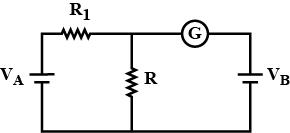
In the circuit shown,the cells $A$ and $B$ have negligible resistance. For $V_{A} = 12 \; V$,$R_{1} = 500 \; \Omega$ and $R = 100 \; \Omega$,the galvanometer $(G)$ shows no deflection. The value of $V_{B}$ is .... $V$.
A
$12$
B
$6$
C
$2$
D
$4$
Solution
(C) In the circuit,the left loop consists of the battery $V_{A}$,resistor $R_{1}$,and resistor $R$ in series.
Since the galvanometer $(G)$ shows no deflection,no current flows through the branch containing the galvanometer and battery $V_{B}$.
Therefore,the current $I$ flowing through the left loop is determined by the series combination of $R_{1}$ and $R$:
$I = \frac{V_{A}}{R_{1} + R}$
Substituting the given values:
$I = \frac{12}{500 + 100} = \frac{12}{600} = 0.02 \; A$
Now,the potential difference across the resistor $R$ is the voltage at the junction point relative to the common negative terminal:
$V = I \times R$
$V = 0.02 \times 100 = 2 \; V$
Since there is no current through the galvanometer,the potential difference across it must be zero. Thus,the potential of battery $V_{B}$ must be equal to the potential across resistor $R$.
$V_{B} = V = 2 \; V$.
Since the galvanometer $(G)$ shows no deflection,no current flows through the branch containing the galvanometer and battery $V_{B}$.
Therefore,the current $I$ flowing through the left loop is determined by the series combination of $R_{1}$ and $R$:
$I = \frac{V_{A}}{R_{1} + R}$
Substituting the given values:
$I = \frac{12}{500 + 100} = \frac{12}{600} = 0.02 \; A$
Now,the potential difference across the resistor $R$ is the voltage at the junction point relative to the common negative terminal:
$V = I \times R$
$V = 0.02 \times 100 = 2 \; V$
Since there is no current through the galvanometer,the potential difference across it must be zero. Thus,the potential of battery $V_{B}$ must be equal to the potential across resistor $R$.
$V_{B} = V = 2 \; V$.
0 likesView Solution
42
PhysicsMediumMCQAIPMT · 2012
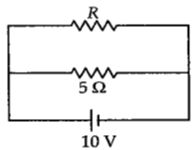
The power dissipated in the circuit shown in the figure is $30 \, W$. The value of $R$ is ............. $\Omega$.
A
$10$
B
$15$
C
$20$
D
$25$
Solution
(A) The equivalent resistance $R_{eq}$ of the two resistors $R$ and $5 \, \Omega$ connected in parallel is given by:
$R_{eq} = \frac{R \times 5}{R + 5}$
The power dissipated in the circuit is given by the formula:
$P = \frac{V^2}{R_{eq}}$
Given $P = 30 \, W$ and $V = 10 \, V$,we substitute these values into the formula:
$30 = \frac{10^2}{\left(\frac{5R}{R + 5}\right)}$
$30 = \frac{100(R + 5)}{5R}$
$30 = \frac{20(R + 5)}{R}$
$30R = 20R + 100$
$10R = 100$
$R = 10 \, \Omega$
$R_{eq} = \frac{R \times 5}{R + 5}$
The power dissipated in the circuit is given by the formula:
$P = \frac{V^2}{R_{eq}}$
Given $P = 30 \, W$ and $V = 10 \, V$,we substitute these values into the formula:
$30 = \frac{10^2}{\left(\frac{5R}{R + 5}\right)}$
$30 = \frac{100(R + 5)}{5R}$
$30 = \frac{20(R + 5)}{R}$
$30R = 20R + 100$
$10R = 100$
$R = 10 \, \Omega$
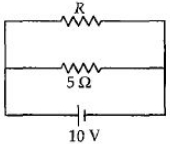
0 likesView Solution
43
PhysicsMediumMCQAIPMT · 2012
If voltage across a bulb rated $220 \text{ V} - 100 \text{ W}$ drops by $2.5\%$ of its rated value,the percentage of the rated value by which the power would decrease is ............... $\%$
A
$20$
B
$2.5$
C
$5$
D
$10$
Solution
(C) The power consumed by a bulb is given by the formula $P = \frac{V^2}{R}$,where $V$ is the voltage and $R$ is the resistance of the bulb.
Since the resistance $R$ of the bulb remains constant,we can use the relative error formula: $\frac{\Delta P}{P} = 2 \frac{\Delta V}{V}$.
Given that the voltage drops by $2.5\%$,we have $\frac{\Delta V}{V} = 2.5\% = 0.025$.
Substituting this into the error formula:
$\frac{\Delta P}{P} = 2 \times 2.5\% = 5\%$.
Therefore,the power decreases by $5\%$ of its rated value.
Since the resistance $R$ of the bulb remains constant,we can use the relative error formula: $\frac{\Delta P}{P} = 2 \frac{\Delta V}{V}$.
Given that the voltage drops by $2.5\%$,we have $\frac{\Delta V}{V} = 2.5\% = 0.025$.
Substituting this into the error formula:
$\frac{\Delta P}{P} = 2 \times 2.5\% = 5\%$.
Therefore,the power decreases by $5\%$ of its rated value.
0 likesView Solution
44
PhysicsDifficultMCQAIPMT · 2012
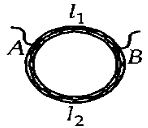
$A$ ring is made of a wire having a resistance $R_0 = 12 \,\Omega$. Find the points $A$ and $B$,as shown in the figure,at which a current-carrying conductor should be connected so that the resistance $R$ of the sub-circuit between these points is equal to $\frac{8}{3} \,\Omega$.
A
$\frac{l_1}{l_2} = \frac{5}{8}$
B
$\frac{l_1}{l_2} = \frac{1}{3}$
C
$\frac{l_1}{l_2} = \frac{3}{8}$
D
$\frac{l_1}{l_2} = \frac{1}{2}$
Solution
(D) Let $r$ be the resistance per unit length of the wire. The total resistance is $R_0 = r(l_1 + l_2) = 12 \,\Omega$.
The resistances of the two arcs are $R_1 = r l_1$ and $R_2 = r l_2$.
Since these two arcs are in parallel,the equivalent resistance $R$ is given by:
$R = \frac{R_1 R_2}{R_1 + R_2} = \frac{(r l_1)(r l_2)}{r(l_1 + l_2)} = \frac{r l_1 l_2}{l_1 + l_2} = \frac{8}{3} \,\Omega$.
We know $r(l_1 + l_2) = 12$,so $r = \frac{12}{l_1 + l_2}$.
Substituting $r$ into the equation for $R$:
$\frac{(\frac{12}{l_1 + l_2}) l_1 l_2}{l_1 + l_2} = \frac{8}{3} \implies \frac{12 l_1 l_2}{(l_1 + l_2)^2} = \frac{8}{3}$.
Let $y = \frac{l_1}{l_2}$. Then $l_1 = y l_2$. Substituting this:
$\frac{12 (y l_2) l_2}{(y l_2 + l_2)^2} = \frac{8}{3} \implies \frac{12 y l_2^2}{l_2^2 (y + 1)^2} = \frac{8}{3} \implies \frac{12 y}{(y + 1)^2} = \frac{8}{3}$.
Cross-multiplying:
$36 y = 8(y^2 + 2y + 1) \implies 36 y = 8y^2 + 16y + 8$.
$8y^2 - 20y + 8 = 0 \implies 2y^2 - 5y + 2 = 0$.
Factoring the quadratic equation:
$2y^2 - 4y - y + 2 = 0 \implies 2y(y - 2) - 1(y - 2) = 0$.
$(2y - 1)(y - 2) = 0$.
Thus,$y = \frac{1}{2}$ or $y = 2$. Therefore,$\frac{l_1}{l_2} = \frac{1}{2}$ or $2$.
The resistances of the two arcs are $R_1 = r l_1$ and $R_2 = r l_2$.
Since these two arcs are in parallel,the equivalent resistance $R$ is given by:
$R = \frac{R_1 R_2}{R_1 + R_2} = \frac{(r l_1)(r l_2)}{r(l_1 + l_2)} = \frac{r l_1 l_2}{l_1 + l_2} = \frac{8}{3} \,\Omega$.
We know $r(l_1 + l_2) = 12$,so $r = \frac{12}{l_1 + l_2}$.
Substituting $r$ into the equation for $R$:
$\frac{(\frac{12}{l_1 + l_2}) l_1 l_2}{l_1 + l_2} = \frac{8}{3} \implies \frac{12 l_1 l_2}{(l_1 + l_2)^2} = \frac{8}{3}$.
Let $y = \frac{l_1}{l_2}$. Then $l_1 = y l_2$. Substituting this:
$\frac{12 (y l_2) l_2}{(y l_2 + l_2)^2} = \frac{8}{3} \implies \frac{12 y l_2^2}{l_2^2 (y + 1)^2} = \frac{8}{3} \implies \frac{12 y}{(y + 1)^2} = \frac{8}{3}$.
Cross-multiplying:
$36 y = 8(y^2 + 2y + 1) \implies 36 y = 8y^2 + 16y + 8$.
$8y^2 - 20y + 8 = 0 \implies 2y^2 - 5y + 2 = 0$.
Factoring the quadratic equation:
$2y^2 - 4y - y + 2 = 0 \implies 2y(y - 2) - 1(y - 2) = 0$.
$(2y - 1)(y - 2) = 0$.
Thus,$y = \frac{1}{2}$ or $y = 2$. Therefore,$\frac{l_1}{l_2} = \frac{1}{2}$ or $2$.
0 likesView Solution
45
PhysicsMediumMCQAIPMT · 2012
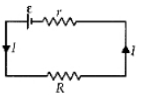
$A$ cell having an emf $\varepsilon$ and internal resistance $r$ is connected across a variable external resistance $R$. As the resistance $R$ is increased,the plot of potential difference $V$ across $R$ is given by:
A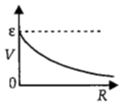
B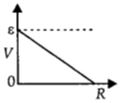
C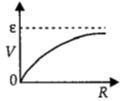
D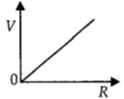
Solution
(C) The current in the circuit is given by $I = \frac{\varepsilon}{R+r}$.
The potential difference $V$ across the external resistance $R$ is $V = IR = \left( \frac{\varepsilon}{R+r} \right) R$.
This can be rewritten as $V = \frac{\varepsilon}{1 + \frac{r}{R}}$.
Analyzing the limits:
$1$. When $R = 0$,$V = 0$.
$2$. As $R \to \infty$,the term $\frac{r}{R} \to 0$,so $V \to \varepsilon$.
As $R$ increases,$V$ increases from $0$ and approaches the value $\varepsilon$ asymptotically. This corresponds to the graph where the curve starts at the origin and levels off at $V = \varepsilon$.
The potential difference $V$ across the external resistance $R$ is $V = IR = \left( \frac{\varepsilon}{R+r} \right) R$.
This can be rewritten as $V = \frac{\varepsilon}{1 + \frac{r}{R}}$.
Analyzing the limits:
$1$. When $R = 0$,$V = 0$.
$2$. As $R \to \infty$,the term $\frac{r}{R} \to 0$,so $V \to \varepsilon$.
As $R$ increases,$V$ increases from $0$ and approaches the value $\varepsilon$ asymptotically. This corresponds to the graph where the curve starts at the origin and levels off at $V = \varepsilon$.
0 likesView Solution
46
PhysicsDifficultMCQAIPMT · 2012
$A$ proton carrying $1\, MeV$ kinetic energy is moving in a circular path of radius $R$ in a uniform magnetic field. What should be the energy of an $\alpha$-particle to describe a circle of the same radius in the same field? ........$MeV$
A
$1$
B
$4$
C
$2$
D
$0.5$
Solution
(A) The radius $R$ of a circular path of a charged particle with mass $m$,charge $q$,and kinetic energy $K$ in a uniform magnetic field $B$ is given by:
$R = \frac{\sqrt{2mK}}{Bq}$
For a proton: $m_p = m$,$q_p = e$,$K_p = 1\, MeV$.
$R_p = \frac{\sqrt{2m(1)}}{Be}$
For an $\alpha$-particle: $m_{\alpha} = 4m$,$q_{\alpha} = 2e$.
$R_{\alpha} = \frac{\sqrt{2(4m)K_{\alpha}}}{B(2e)} = \frac{\sqrt{8mK_{\alpha}}}{2Be} = \frac{\sqrt{2mK_{\alpha}}}{Be}$
Since the radii are equal $(R_p = R_{\alpha})$:
$\frac{\sqrt{2m(1)}}{Be} = \frac{\sqrt{2mK_{\alpha}}}{Be}$
$1 = K_{\alpha}$
Therefore,the kinetic energy of the $\alpha$-particle is $1\, MeV$.
$R = \frac{\sqrt{2mK}}{Bq}$
For a proton: $m_p = m$,$q_p = e$,$K_p = 1\, MeV$.
$R_p = \frac{\sqrt{2m(1)}}{Be}$
For an $\alpha$-particle: $m_{\alpha} = 4m$,$q_{\alpha} = 2e$.
$R_{\alpha} = \frac{\sqrt{2(4m)K_{\alpha}}}{B(2e)} = \frac{\sqrt{8mK_{\alpha}}}{2Be} = \frac{\sqrt{2mK_{\alpha}}}{Be}$
Since the radii are equal $(R_p = R_{\alpha})$:
$\frac{\sqrt{2m(1)}}{Be} = \frac{\sqrt{2mK_{\alpha}}}{Be}$
$1 = K_{\alpha}$
Therefore,the kinetic energy of the $\alpha$-particle is $1\, MeV$.
0 likesView Solution
47
PhysicsMediumMCQAIPMT · 2012
Two similar coils of radius $R$ are lying concentrically with their planes at right angles to each other. The currents flowing in them are $I$ and $2I$,respectively. The resultant magnetic field induction at the centre will be
A
$\frac{\sqrt{5} \mu_{0} I}{2 R}$
B
$\frac{\sqrt{5} \mu_{0} I}{R}$
C
$\frac{\mu_{0} I}{2 R}$
D
$\frac{\mu_{0} I}{R}$
Solution
(A) The magnetic field induction at the centre of a circular coil of radius $R$ carrying current $I$ is given by $B = \frac{\mu_{0} I}{2 R}$.
For the first coil with current $I$,the magnetic field is $B_{1} = \frac{\mu_{0} I}{2 R}$.
For the second coil with current $2I$,the magnetic field is $B_{2} = \frac{\mu_{0} (2I)}{2 R} = \frac{\mu_{0} I}{R}$.
Since the planes of the coils are at right angles to each other,the magnetic fields $B_{1}$ and $B_{2}$ are mutually perpendicular.
The resultant magnetic field induction $B_{\text{net}}$ at the centre is given by:
$B_{\text{net}} = \sqrt{B_{1}^{2} + B_{2}^{2}}$
$B_{\text{net}} = \sqrt{\left(\frac{\mu_{0} I}{2 R}\right)^{2} + \left(\frac{\mu_{0} I}{R}\right)^{2}}$
$B_{\text{net}} = \frac{\mu_{0} I}{2 R} \sqrt{1^{2} + 2^{2}}$
$B_{\text{net}} = \frac{\sqrt{5} \mu_{0} I}{2 R}$
For the first coil with current $I$,the magnetic field is $B_{1} = \frac{\mu_{0} I}{2 R}$.
For the second coil with current $2I$,the magnetic field is $B_{2} = \frac{\mu_{0} (2I)}{2 R} = \frac{\mu_{0} I}{R}$.
Since the planes of the coils are at right angles to each other,the magnetic fields $B_{1}$ and $B_{2}$ are mutually perpendicular.
The resultant magnetic field induction $B_{\text{net}}$ at the centre is given by:
$B_{\text{net}} = \sqrt{B_{1}^{2} + B_{2}^{2}}$
$B_{\text{net}} = \sqrt{\left(\frac{\mu_{0} I}{2 R}\right)^{2} + \left(\frac{\mu_{0} I}{R}\right)^{2}}$
$B_{\text{net}} = \frac{\mu_{0} I}{2 R} \sqrt{1^{2} + 2^{2}}$
$B_{\text{net}} = \frac{\sqrt{5} \mu_{0} I}{2 R}$
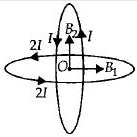
0 likesView Solution
48
PhysicsMediumMCQAIPMT · 2012
An alternating electric field,of frequency $f$,is applied across the dees (radius $\approx R$) of a cyclotron that is being used to accelerate protons (mass $\approx m$). The operating magnetic field $(B)$ used in the cyclotron and the kinetic energy $(K)$ of the proton beam,produced by it,are given by:
A
$B = \frac{mf}{e}$,$K = 2m\pi^2f^2R^2$
B
$B = \frac{2\pi mf}{e}$,$K = \pi m^2f^2R^2$
C
$B = \frac{2\pi mf}{e}$,$K = 2m\pi^2f^2R^2$
D
$B = \frac{mf}{e}$,$K = \pi m^2f^2R^2$
Solution
(C) The cyclotron frequency $f$ is given by $f = \frac{eB}{2\pi m}$.
Rearranging for the magnetic field $B$,we get $B = \frac{2\pi mf}{e}$.
The maximum velocity $v$ of the proton at the exit of the dee (radius $R$) is given by $v = \omega R = (2\pi f)R$.
The kinetic energy $K$ is given by $K = \frac{1}{2}mv^2$.
Substituting $v = 2\pi fR$ into the kinetic energy formula:
$K = \frac{1}{2}m(2\pi fR)^2 = \frac{1}{2}m(4\pi^2f^2R^2) = 2m\pi^2f^2R^2$.
Thus,$B = \frac{2\pi mf}{e}$ and $K = 2m\pi^2f^2R^2$.
Rearranging for the magnetic field $B$,we get $B = \frac{2\pi mf}{e}$.
The maximum velocity $v$ of the proton at the exit of the dee (radius $R$) is given by $v = \omega R = (2\pi f)R$.
The kinetic energy $K$ is given by $K = \frac{1}{2}mv^2$.
Substituting $v = 2\pi fR$ into the kinetic energy formula:
$K = \frac{1}{2}m(2\pi fR)^2 = \frac{1}{2}m(4\pi^2f^2R^2) = 2m\pi^2f^2R^2$.
Thus,$B = \frac{2\pi mf}{e}$ and $K = 2m\pi^2f^2R^2$.
0 likesView Solution
49
PhysicsMediumMCQAIPMT · 2012
$A$ millivoltmeter of $25 \, mV$ range is to be converted into an ammeter of $25 \, A$ range. The value (in $\Omega$) of the necessary shunt will be:
A
$0.001 \, \Omega$
B
$0.01 \, \Omega$
C
$1 \, \Omega$
D
$0.05 \, \Omega$
Solution
(A) The shunt resistance $S$ required to convert a galvanometer (or millivoltmeter) into an ammeter is given by the formula: $S = \frac{V_g}{I - I_g}$.
Here,$V_g$ is the full-scale voltage of the millivoltmeter,$I$ is the desired range of the ammeter,and $I_g$ is the full-scale current of the millivoltmeter.
Given $V_g = 25 \, mV = 25 \times 10^{-3} \, V$ and $I = 25 \, A$.
Since $I \gg I_g$,we can approximate $I - I_g \approx I$.
Therefore,$S = \frac{V_g}{I} = \frac{25 \times 10^{-3} \, V}{25 \, A} = 10^{-3} \, \Omega = 0.001 \, \Omega$.
Here,$V_g$ is the full-scale voltage of the millivoltmeter,$I$ is the desired range of the ammeter,and $I_g$ is the full-scale current of the millivoltmeter.
Given $V_g = 25 \, mV = 25 \times 10^{-3} \, V$ and $I = 25 \, A$.
Since $I \gg I_g$,we can approximate $I - I_g \approx I$.
Therefore,$S = \frac{V_g}{I} = \frac{25 \times 10^{-3} \, V}{25 \, A} = 10^{-3} \, \Omega = 0.001 \, \Omega$.
0 likesView Solution
50
PhysicsEasyMCQAIPMT · 2012
$A$ compass needle which is allowed to move in a horizontal plane is taken to a geomagnetic pole. It
A
Will stay in north-south direction only
B
Will stay in east-west direction only
C
Will stay in any position
D
Will become rigid showing no movement
Solution
(C) At the geomagnetic poles,the horizontal component of the Earth's magnetic field $(B_H)$ is zero. Since the compass needle is constrained to move only in a horizontal plane,it experiences no horizontal torque to align it in any specific direction. Therefore,the needle will stay in any position in which it is placed.
0 likesView Solution
51
PhysicsMediumMCQAIPMT · 2012
$A$ magnetic needle suspended parallel to a magnetic field requires $\sqrt{3} \, J$ of work to turn it through $60^{\circ}$. The torque needed to maintain the needle in this position will be.....$J$
A
$2\sqrt{3}$
B
$3$
C
$\sqrt{3}$
D
$1.5$
Solution
(B) Work done in changing the orientation of a magnetic needle of magnetic moment $M$ in a magnetic field $B$ from position $\theta_{1}$ to $\theta_{2}$ is given by:
$W = MB(\cos \theta_{1} - \cos \theta_{2})$
Given $\theta_{1} = 0^{\circ}$ and $\theta_{2} = 60^{\circ}$,the work done is:
$W = MB(\cos 0^{\circ} - \cos 60^{\circ}) = MB(1 - 0.5) = 0.5 MB$
Given $W = \sqrt{3} \, J$,we have $0.5 MB = \sqrt{3} \implies MB = 2\sqrt{3} \, J$.
The torque $\tau$ required to maintain the needle at an angle $\theta = 60^{\circ}$ is given by:
$\tau = MB \sin \theta$
$\tau = MB \sin 60^{\circ} = (2\sqrt{3}) \times \frac{\sqrt{3}}{2} = 3 \, J$.
$W = MB(\cos \theta_{1} - \cos \theta_{2})$
Given $\theta_{1} = 0^{\circ}$ and $\theta_{2} = 60^{\circ}$,the work done is:
$W = MB(\cos 0^{\circ} - \cos 60^{\circ}) = MB(1 - 0.5) = 0.5 MB$
Given $W = \sqrt{3} \, J$,we have $0.5 MB = \sqrt{3} \implies MB = 2\sqrt{3} \, J$.
The torque $\tau$ required to maintain the needle at an angle $\theta = 60^{\circ}$ is given by:
$\tau = MB \sin \theta$
$\tau = MB \sin 60^{\circ} = (2\sqrt{3}) \times \frac{\sqrt{3}}{2} = 3 \, J$.
0 likesView Solution
52
PhysicsDifficultMCQAIPMT · 2012
For the angle of minimum deviation of a prism to be equal to its refracting angle,the prism must be made of a material whose refractive index
A
lies between $\sqrt{2}$ and $1$
B
lies between $2$ and $\sqrt{2}$
C
$> 1$
D
$< 1$
Solution
(B) The refractive index of a prism is given by $\mu = \frac{\sin((A+\delta_m)/2)}{\sin(A/2)}$.
Given that the angle of minimum deviation $\delta_m = A$,we substitute this into the formula:
$\mu = \frac{\sin((A+A)/2)}{\sin(A/2)} = \frac{\sin A}{\sin(A/2)}$.
Using the identity $\sin A = 2\sin(A/2)\cos(A/2)$,we get:
$\mu = \frac{2\sin(A/2)\cos(A/2)}{\sin(A/2)} = 2\cos(A/2)$.
For a physical prism,the angle of incidence $i$ must satisfy $0 < i < 90^o$. Since $\delta_m = 2i - A$,we have $A = 2i - A$,so $i = A$. Thus,$0 < A < 90^o$.
If $A \to 0^o$,then $\mu \to 2\cos(0^o) = 2$.
If $A \to 90^o$,then $\mu \to 2\cos(45^o) = 2 \times (1/\sqrt{2}) = \sqrt{2}$.
Therefore,the refractive index $\mu$ must lie between $\sqrt{2}$ and $2$.
Given that the angle of minimum deviation $\delta_m = A$,we substitute this into the formula:
$\mu = \frac{\sin((A+A)/2)}{\sin(A/2)} = \frac{\sin A}{\sin(A/2)}$.
Using the identity $\sin A = 2\sin(A/2)\cos(A/2)$,we get:
$\mu = \frac{2\sin(A/2)\cos(A/2)}{\sin(A/2)} = 2\cos(A/2)$.
For a physical prism,the angle of incidence $i$ must satisfy $0 < i < 90^o$. Since $\delta_m = 2i - A$,we have $A = 2i - A$,so $i = A$. Thus,$0 < A < 90^o$.
If $A \to 0^o$,then $\mu \to 2\cos(0^o) = 2$.
If $A \to 90^o$,then $\mu \to 2\cos(45^o) = 2 \times (1/\sqrt{2}) = \sqrt{2}$.
Therefore,the refractive index $\mu$ must lie between $\sqrt{2}$ and $2$.
0 likesView Solution
53
PhysicsMediumMCQAIPMT · 2012
The magnifying power of a telescope is $9.$ When it is adjusted for parallel rays,the distance between the objective and eyepiece is $20\; cm.$ The focal lengths of the lenses are:
A
$10\; cm$ and $10\; cm$
B
$15\; cm$ and $5\; cm$
C
$18\; cm$ and $2\; cm$
D
$11\; cm$ and $9\; cm$
Solution
(C) The magnifying power of a telescope adjusted for parallel rays (normal adjustment) is given by $m = \frac{f_o}{f_e} = 9$,where $f_o$ is the focal length of the objective and $f_e$ is the focal length of the eyepiece.
From this,we get $f_o = 9f_e$ ..... $(i)$
The length of the telescope tube in normal adjustment is the sum of the focal lengths of the objective and eyepiece: $L = f_o + f_e = 20\; cm$ ..... $(ii)$
Substituting equation $(i)$ into equation $(ii)$:
$9f_e + f_e = 20\; cm$
$10f_e = 20\; cm$
$f_e = 2\; cm$
Now,substituting $f_e = 2\; cm$ back into equation $(i)$:
$f_o = 9 \times 2\; cm = 18\; cm$
Thus,the focal lengths are $18\; cm$ and $2\; cm$.
From this,we get $f_o = 9f_e$ ..... $(i)$
The length of the telescope tube in normal adjustment is the sum of the focal lengths of the objective and eyepiece: $L = f_o + f_e = 20\; cm$ ..... $(ii)$
Substituting equation $(i)$ into equation $(ii)$:
$9f_e + f_e = 20\; cm$
$10f_e = 20\; cm$
$f_e = 2\; cm$
Now,substituting $f_e = 2\; cm$ back into equation $(i)$:
$f_o = 9 \times 2\; cm = 18\; cm$
Thus,the focal lengths are $18\; cm$ and $2\; cm$.
0 likesView Solution
54
PhysicsEasyMCQAIPMT · 2012
When a biconvex lens of glass having refractive index $1.47$ is dipped in a liquid,it acts as a plane sheet of glass. This implies that the liquid must have a refractive index:
A
greater than that of glass
B
less than that of glass
C
less than one
D
equal to that of glass
Solution
(D) The focal length of a lens in a medium is given by the Lens Maker's Formula:
$\frac{1}{f} = (\frac{\mu_l}{\mu_m} - 1) (\frac{1}{R_1} - \frac{1}{R_2})$
where $\mu_l$ is the refractive index of the lens,$\mu_m$ is the refractive index of the surrounding medium,and $R_1, R_2$ are the radii of curvature.
If the lens acts as a plane sheet of glass,its focal length $f$ becomes infinite $(f \to \infty)$,which implies $\frac{1}{f} = 0$.
Substituting this into the formula: $0 = (\frac{\mu_l}{\mu_m} - 1) (\frac{1}{R_1} - \frac{1}{R_2})$.
Since the lens is biconvex,$(\frac{1}{R_1} - \frac{1}{R_2}) \neq 0$.
Therefore,$(\frac{\mu_l}{\mu_m} - 1) = 0$,which means $\frac{\mu_l}{\mu_m} = 1$,or $\mu_l = \mu_m$.
Thus,the refractive index of the liquid must be equal to the refractive index of the glass $(1.47)$.
$\frac{1}{f} = (\frac{\mu_l}{\mu_m} - 1) (\frac{1}{R_1} - \frac{1}{R_2})$
where $\mu_l$ is the refractive index of the lens,$\mu_m$ is the refractive index of the surrounding medium,and $R_1, R_2$ are the radii of curvature.
If the lens acts as a plane sheet of glass,its focal length $f$ becomes infinite $(f \to \infty)$,which implies $\frac{1}{f} = 0$.
Substituting this into the formula: $0 = (\frac{\mu_l}{\mu_m} - 1) (\frac{1}{R_1} - \frac{1}{R_2})$.
Since the lens is biconvex,$(\frac{1}{R_1} - \frac{1}{R_2}) \neq 0$.
Therefore,$(\frac{\mu_l}{\mu_m} - 1) = 0$,which means $\frac{\mu_l}{\mu_m} = 1$,or $\mu_l = \mu_m$.
Thus,the refractive index of the liquid must be equal to the refractive index of the glass $(1.47)$.
0 likesView Solution
55
PhysicsDifficultMCQAIPMT · 2012
$A$ rod of length $10\, cm$ lies along the principal axis of a concave mirror of focal length $10\, cm$ in such a way that its end closer to the pole is $20\, cm$ away from the mirror. The length of the image is ......$cm$.
A
$10$
B
$15$
C
$2.5$
D
$5$
Solution
(D) Given,focal length of the concave mirror $f = -10\, cm$.
For end $A$ of the rod,the object distance is $u_A = -20\, cm$.
Using the mirror formula $\frac{1}{v} + \frac{1}{u} = \frac{1}{f}$:
$\frac{1}{v_A} + \frac{1}{-20} = \frac{1}{-10}$
$\frac{1}{v_A} = -\frac{1}{10} + \frac{1}{20} = -\frac{1}{20}$
$v_A = -20\, cm$.
For end $B$ of the rod,the object distance is $u_B = -(20 + 10) = -30\, cm$.
Using the mirror formula:
$\frac{1}{v_B} + \frac{1}{-30} = \frac{1}{-10}$
$\frac{1}{v_B} = -\frac{1}{10} + \frac{1}{30} = -\frac{2}{30} = -\frac{1}{15}$
$v_B = -15\, cm$.
The length of the image is the distance between the image positions of the two ends:
$L = |v_A - v_B| = |-20 - (-15)| = |-5| = 5\, cm$.
For end $A$ of the rod,the object distance is $u_A = -20\, cm$.
Using the mirror formula $\frac{1}{v} + \frac{1}{u} = \frac{1}{f}$:
$\frac{1}{v_A} + \frac{1}{-20} = \frac{1}{-10}$
$\frac{1}{v_A} = -\frac{1}{10} + \frac{1}{20} = -\frac{1}{20}$
$v_A = -20\, cm$.
For end $B$ of the rod,the object distance is $u_B = -(20 + 10) = -30\, cm$.
Using the mirror formula:
$\frac{1}{v_B} + \frac{1}{-30} = \frac{1}{-10}$
$\frac{1}{v_B} = -\frac{1}{10} + \frac{1}{30} = -\frac{2}{30} = -\frac{1}{15}$
$v_B = -15\, cm$.
The length of the image is the distance between the image positions of the two ends:
$L = |v_A - v_B| = |-20 - (-15)| = |-5| = 5\, cm$.
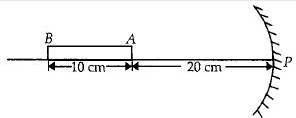
0 likesView Solution
56
PhysicsMediumMCQAIPMT · 2012
$A$ concave mirror of focal length $f_1$ is placed at a distance of $d$ from a convex lens of focal length $f_2$. $A$ beam of light coming from infinity and falling on this convex lens-concave mirror combination returns to infinity. The distance $d$ must equal:
A
$f_1 + f_2$
B
$2f_1 + f_2$
C
$f_1 + 2f_2$
D
$2f_1 - f_2$
Solution
(B) For a beam of light coming from infinity to return to infinity after passing through the lens and reflecting from the mirror,the rays must strike the concave mirror normally.
This happens if the rays incident on the mirror appear to be coming from its center of curvature.
The convex lens focuses the parallel beam of light at its focal point,which is at a distance $f_2$ from the lens.
For the rays to strike the concave mirror normally,this focal point must coincide with the center of curvature of the concave mirror.
The distance of the center of curvature from the concave mirror is $2f_1$.
Therefore,the total distance $d$ between the lens and the mirror is the sum of the focal length of the lens and the radius of curvature of the mirror:
$d = f_2 + 2f_1$.
This happens if the rays incident on the mirror appear to be coming from its center of curvature.
The convex lens focuses the parallel beam of light at its focal point,which is at a distance $f_2$ from the lens.
For the rays to strike the concave mirror normally,this focal point must coincide with the center of curvature of the concave mirror.
The distance of the center of curvature from the concave mirror is $2f_1$.
Therefore,the total distance $d$ between the lens and the mirror is the sum of the focal length of the lens and the radius of curvature of the mirror:
$d = f_2 + 2f_1$.
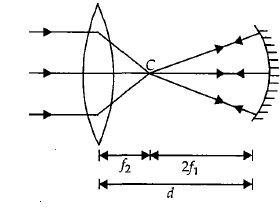
0 likesView Solution
57
PhysicsMediumMCQAIPMT · 2012
Two radiations of photon energies $1 \; eV$ and $2.5 \; eV$ successively illuminate a photosensitive metallic surface of work function $0.5 \; eV$. The ratio of the maximum speeds of the emitted electrons is
A
$1:5$
B
$1:4$
C
$1:2$
D
$1:1$
Solution
(C) Given,work function $\phi_{0} = 0.5 \; eV$.
According to Einstein's photoelectric equation,the maximum kinetic energy $K_{\max}$ of the emitted electrons is given by $K_{\max} = E - \phi_{0}$,where $E$ is the incident photon energy.
For the first radiation,$E_{1} = 1 \; eV$:
$K_{\max 1} = 1 \; eV - 0.5 \; eV = 0.5 \; eV$.
For the second radiation,$E_{2} = 2.5 \; eV$:
$K_{\max 2} = 2.5 \; eV - 0.5 \; eV = 2 \; eV$.
The kinetic energy is related to the maximum speed $v_{\max}$ by $K_{\max} = \frac{1}{2} m v_{\max}^2$.
Therefore,the ratio of the maximum speeds is:
$\frac{v_{\max 1}}{v_{\max 2}} = \sqrt{\frac{K_{\max 1}}{K_{\max 2}}} = \sqrt{\frac{0.5}{2}} = \sqrt{\frac{1}{4}} = \frac{1}{2}$.
Thus,the ratio is $1:2$.
According to Einstein's photoelectric equation,the maximum kinetic energy $K_{\max}$ of the emitted electrons is given by $K_{\max} = E - \phi_{0}$,where $E$ is the incident photon energy.
For the first radiation,$E_{1} = 1 \; eV$:
$K_{\max 1} = 1 \; eV - 0.5 \; eV = 0.5 \; eV$.
For the second radiation,$E_{2} = 2.5 \; eV$:
$K_{\max 2} = 2.5 \; eV - 0.5 \; eV = 2 \; eV$.
The kinetic energy is related to the maximum speed $v_{\max}$ by $K_{\max} = \frac{1}{2} m v_{\max}^2$.
Therefore,the ratio of the maximum speeds is:
$\frac{v_{\max 1}}{v_{\max 2}} = \sqrt{\frac{K_{\max 1}}{K_{\max 2}}} = \sqrt{\frac{0.5}{2}} = \sqrt{\frac{1}{4}} = \frac{1}{2}$.
Thus,the ratio is $1:2$.
0 likesView Solution
58
PhysicsDifficultMCQAIPMT · 2012
An $\alpha$-particle moves in a circular path of radius $0.83\, cm$ in the presence of a magnetic field of $0.25\, Wb/m^2$. The de Broglie wavelength associated with the particle will be .............. $\mathring{A}$.
A
$1$
B
$0.1$
C
$10$
D
$0.01$
Solution
(D) The radius $R$ of the circular path of a charged particle in a magnetic field is given by $R = \frac{mv}{Bq}$,which implies $mv = RBq$.
Given values:
$R = 0.83\, cm = 0.83 \times 10^{-2}\, m$
$B = 0.25\, Wb/m^2$
$q = 2e = 2 \times 1.6 \times 10^{-19}\, C$
Calculating the momentum $p = mv$:
$mv = (0.83 \times 10^{-2}) \times (0.25) \times (2 \times 1.6 \times 10^{-19})$
$mv = 0.83 \times 10^{-2} \times 0.25 \times 3.2 \times 10^{-19}$
$mv = 0.664 \times 10^{-21}\, kg\cdot m/s$
The de Broglie wavelength $\lambda$ is given by $\lambda = \frac{h}{mv}$,where $h = 6.63 \times 10^{-34}\, J\cdot s$ (using $6.6$ for approximation as per the provided solution context):
$\lambda = \frac{6.6 \times 10^{-34}}{0.664 \times 10^{-21}} \approx 9.94 \times 10^{-13}\, m \approx 10^{-12}\, m$.
Converting to $\mathring{A}$ $(1\, \mathring{A} = 10^{-10}\, m)$:
$\lambda = 0.01 \times 10^{-10}\, m = 0.01\, \mathring{A}$.
Given values:
$R = 0.83\, cm = 0.83 \times 10^{-2}\, m$
$B = 0.25\, Wb/m^2$
$q = 2e = 2 \times 1.6 \times 10^{-19}\, C$
Calculating the momentum $p = mv$:
$mv = (0.83 \times 10^{-2}) \times (0.25) \times (2 \times 1.6 \times 10^{-19})$
$mv = 0.83 \times 10^{-2} \times 0.25 \times 3.2 \times 10^{-19}$
$mv = 0.664 \times 10^{-21}\, kg\cdot m/s$
The de Broglie wavelength $\lambda$ is given by $\lambda = \frac{h}{mv}$,where $h = 6.63 \times 10^{-34}\, J\cdot s$ (using $6.6$ for approximation as per the provided solution context):
$\lambda = \frac{6.6 \times 10^{-34}}{0.664 \times 10^{-21}} \approx 9.94 \times 10^{-13}\, m \approx 10^{-12}\, m$.
Converting to $\mathring{A}$ $(1\, \mathring{A} = 10^{-10}\, m)$:
$\lambda = 0.01 \times 10^{-10}\, m = 0.01\, \mathring{A}$.
0 likesView Solution
59
PhysicsMediumMCQAIPMT · 2012
If the momentum of an electron is changed by $\Delta P,$ then the de Broglie wavelength associated with it changes by $0.5\%.$ The initial momentum of the electron will be
A
$\frac{\Delta P}{200}$
B
$400\,\Delta P$
C
$100\,\Delta P$
D
$200\,\Delta P$
Solution
(D) The de Broglie wavelength $\lambda$ is related to momentum $P$ by the equation $\lambda = \frac{h}{P}$.
Taking the logarithmic derivative,we get $\frac{d\lambda}{\lambda} = -\frac{dP}{P}$.
For small changes,we can write $\frac{|\Delta \lambda|}{\lambda} = \frac{\Delta P}{P}$.
Given that the wavelength changes by $0.5\%$,we have $\frac{\Delta \lambda}{\lambda} = 0.5\% = \frac{0.5}{100} = \frac{1}{200}$.
Substituting this into the relation,we get $\frac{\Delta P}{P} = \frac{1}{200}$.
Therefore,the initial momentum $P = 200\,\Delta P$.
Taking the logarithmic derivative,we get $\frac{d\lambda}{\lambda} = -\frac{dP}{P}$.
For small changes,we can write $\frac{|\Delta \lambda|}{\lambda} = \frac{\Delta P}{P}$.
Given that the wavelength changes by $0.5\%$,we have $\frac{\Delta \lambda}{\lambda} = 0.5\% = \frac{0.5}{100} = \frac{1}{200}$.
Substituting this into the relation,we get $\frac{\Delta P}{P} = \frac{1}{200}$.
Therefore,the initial momentum $P = 200\,\Delta P$.
0 likesView Solution
60
PhysicsMediumMCQAIPMT · 2012
In a coil of resistance $10\,\Omega$,the induced current developed by changing magnetic flux through it is shown in the figure as a function of time. The magnitude of change in flux through the coil in weber is:
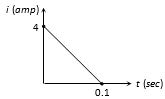
A
$2$
B
$4$
C
$6$
D
$8$
Solution
(A) The total charge $q$ flowing through the coil is equal to the area under the $i-t$ graph.
$q = \text{Area} = \frac{1}{2} \times \text{base} \times \text{height}$
$q = \frac{1}{2} \times 0.1 \, s \times 4 \, A = 0.2 \, C$
From Faraday's law,the charge $q$ is related to the change in magnetic flux $\Delta \phi$ and resistance $R$ by the formula:
$q = \frac{\Delta \phi}{R}$
Therefore,the magnitude of change in flux is:
$\Delta \phi = q \times R$
$\Delta \phi = 0.2 \, C \times 10 \, \Omega = 2 \, Wb$
$q = \text{Area} = \frac{1}{2} \times \text{base} \times \text{height}$
$q = \frac{1}{2} \times 0.1 \, s \times 4 \, A = 0.2 \, C$
From Faraday's law,the charge $q$ is related to the change in magnetic flux $\Delta \phi$ and resistance $R$ by the formula:
$q = \frac{\Delta \phi}{R}$
Therefore,the magnitude of change in flux is:
$\Delta \phi = q \times R$
$\Delta \phi = 0.2 \, C \times 10 \, \Omega = 2 \, Wb$
0 likesView Solution
61
PhysicsMediumMCQAIPMT · 2012
The current $(I)$ in the inductance is varying with time according to the plot shown in the figure. Which one of the following is the correct variation of voltage $(V)$ with time in the coil?
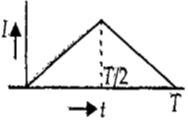
A
B
C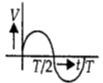
D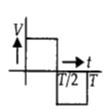
Solution
(D) The induced voltage $(V)$ across an inductor is given by the formula $V = -L \frac{dI}{dt}$.
From the given $I-t$ graph, the current increases linearly from $t = 0$ to $t = T/2$. During this interval, the slope $\frac{dI}{dt}$ is positive and constant. Therefore, $V = -L \times (\text{positive constant}) = \text{negative constant}$.
From $t = T/2$ to $t = T$, the current decreases linearly. During this interval, the slope $\frac{dI}{dt}$ is negative and constant. Therefore, $V = -L \times (\text{negative constant}) = \text{positive constant}$.
Thus, the voltage $V$ is a negative constant for the first half and a positive constant for the second half. Comparing this with the given options, the correct representation is a square wave where the voltage is negative for $0 < t < T/2$ and positive for $T/2 < t < T$, which corresponds to the shape shown in option $D$.
From the given $I-t$ graph, the current increases linearly from $t = 0$ to $t = T/2$. During this interval, the slope $\frac{dI}{dt}$ is positive and constant. Therefore, $V = -L \times (\text{positive constant}) = \text{negative constant}$.
From $t = T/2$ to $t = T$, the current decreases linearly. During this interval, the slope $\frac{dI}{dt}$ is negative and constant. Therefore, $V = -L \times (\text{negative constant}) = \text{positive constant}$.
Thus, the voltage $V$ is a negative constant for the first half and a positive constant for the second half. Comparing this with the given options, the correct representation is a square wave where the voltage is negative for $0 < t < T/2$ and positive for $T/2 < t < T$, which corresponds to the shape shown in option $D$.
0 likesView Solution
62
PhysicsMediumMCQAIPMT · 2012
$A$ coil of resistance $400 \,\Omega$ is placed in a magnetic field. If the magnetic flux $\phi \,(Wb)$ linked with the coil varies with time $t \,(s)$ as $\phi = 50t^2 + 4$,the current in the coil at $t = 2 \,s$ is.....$A$.
A
$0.5$
B
$0.1$
C
$2$
D
$1$
Solution
(A) Given: Resistance $R = 400 \,\Omega$,Magnetic flux $\phi = 50t^2 + 4 \,Wb$.
According to Faraday's law of electromagnetic induction,the induced electromotive force $(emf)$ is given by $\varepsilon = -\frac{d\phi}{dt}$.
$\varepsilon = -\frac{d}{dt}(50t^2 + 4) = -100t \,V$.
At time $t = 2 \,s$,the magnitude of the induced $emf$ is $|\varepsilon| = |-100(2)| = 200 \,V$.
The induced current $I$ in the coil is given by Ohm's law: $I = \frac{|\varepsilon|}{R}$.
$I = \frac{200 \,V}{400 \,\Omega} = 0.5 \,A$.
According to Faraday's law of electromagnetic induction,the induced electromotive force $(emf)$ is given by $\varepsilon = -\frac{d\phi}{dt}$.
$\varepsilon = -\frac{d}{dt}(50t^2 + 4) = -100t \,V$.
At time $t = 2 \,s$,the magnitude of the induced $emf$ is $|\varepsilon| = |-100(2)| = 200 \,V$.
The induced current $I$ in the coil is given by Ohm's law: $I = \frac{|\varepsilon|}{R}$.
$I = \frac{200 \,V}{400 \,\Omega} = 0.5 \,A$.
0 likesView Solution
63
PhysicsMediumMCQAIPMT · 2012
The instantaneous values of alternating current and voltage in a circuit are given as $I = \frac{1}{\sqrt{2}} \sin(100\pi t)$ and $E = \frac{1}{\sqrt{2}} \sin(100\pi t + \frac{\pi}{3})$. The average power in watts consumed in the circuit is:
A
$\frac{1}{4}$
B
$\frac{\sqrt{3}}{4}$
C
$\frac{1}{2}$
D
$\frac{1}{8}$
Solution
(D) Given: $i = \frac{1}{\sqrt{2}} \sin(100\pi t) \text{ A}$.
Comparing with $i = i_0 \sin(\omega t)$,we get peak current $i_0 = \frac{1}{\sqrt{2}} \text{ A}$.
Given: $e = \frac{1}{\sqrt{2}} \sin(100\pi t + \frac{\pi}{3}) \text{ V}$.
Comparing with $e = e_0 \sin(\omega t + \phi)$,we get peak voltage $e_0 = \frac{1}{\sqrt{2}} \text{ V}$ and phase difference $\phi = \frac{\pi}{3}$.
Calculate $RMS$ values:
$i_{rms} = \frac{i_0}{\sqrt{2}} = \frac{1/\sqrt{2}}{\sqrt{2}} = \frac{1}{2} \text{ A}$.
$e_{rms} = \frac{e_0}{\sqrt{2}} = \frac{1/\sqrt{2}}{\sqrt{2}} = \frac{1}{2} \text{ V}$.
Average power consumed in the circuit is given by $P = i_{rms} e_{rms} \cos \phi$.
$P = (\frac{1}{2}) (\frac{1}{2}) \cos(\frac{\pi}{3}) = (\frac{1}{4}) (\frac{1}{2}) = \frac{1}{8} \text{ W}$.
Comparing with $i = i_0 \sin(\omega t)$,we get peak current $i_0 = \frac{1}{\sqrt{2}} \text{ A}$.
Given: $e = \frac{1}{\sqrt{2}} \sin(100\pi t + \frac{\pi}{3}) \text{ V}$.
Comparing with $e = e_0 \sin(\omega t + \phi)$,we get peak voltage $e_0 = \frac{1}{\sqrt{2}} \text{ V}$ and phase difference $\phi = \frac{\pi}{3}$.
Calculate $RMS$ values:
$i_{rms} = \frac{i_0}{\sqrt{2}} = \frac{1/\sqrt{2}}{\sqrt{2}} = \frac{1}{2} \text{ A}$.
$e_{rms} = \frac{e_0}{\sqrt{2}} = \frac{1/\sqrt{2}}{\sqrt{2}} = \frac{1}{2} \text{ V}$.
Average power consumed in the circuit is given by $P = i_{rms} e_{rms} \cos \phi$.
$P = (\frac{1}{2}) (\frac{1}{2}) \cos(\frac{\pi}{3}) = (\frac{1}{4}) (\frac{1}{2}) = \frac{1}{8} \text{ W}$.
0 likesView Solution
64
PhysicsEasyMCQAIPMT · 2012
The ratio of the amplitude of the magnetic field to the amplitude of the electric field for an electromagnetic wave propagating in vacuum is equal to:
A
$c$
B
$\frac{1}{c}$
C
$1$
D
None of these
Solution
(B) For an electromagnetic wave propagating in a vacuum,the relationship between the amplitude of the electric field $(E_{0})$ and the amplitude of the magnetic field $(B_{0})$ is given by the equation:
$E_{0} = B_{0} c$
where $c$ represents the speed of light in a vacuum.
To find the ratio of the amplitude of the magnetic field to the amplitude of the electric field,we rearrange the equation:
$\frac{B_{0}}{E_{0}} = \frac{1}{c}$
Thus,the ratio is equal to $\frac{1}{c}$.
$E_{0} = B_{0} c$
where $c$ represents the speed of light in a vacuum.
To find the ratio of the amplitude of the magnetic field to the amplitude of the electric field,we rearrange the equation:
$\frac{B_{0}}{E_{0}} = \frac{1}{c}$
Thus,the ratio is equal to $\frac{1}{c}$.
0 likesView Solution
65
PhysicsMediumMCQAIPMT · 2012
The electric field associated with an electromagnetic $(EM)$ wave in vacuum is given by $\vec{E} = \hat{i} 40 \cos (kz - 6 \times 10^{8} t)$,where $E$,$z$,and $t$ are in $V/m$,$m$,and $s$ respectively. The value of the wave vector $k$ is .... $m^{-1}$.
A
$2$
B
$0.5$
C
$6$
D
$3$
Solution
(A) The standard equation for an electromagnetic wave traveling in the $z$-direction is given by $\vec{E} = E_{0} \cos (kz - \omega t) \hat{i}$.
Comparing the given equation $\vec{E} = \hat{i} 40 \cos (kz - 6 \times 10^{8} t)$ with the standard form,we identify the angular frequency $\omega = 6 \times 10^{8} \, rad/s$.
In vacuum,the relationship between the wave vector $k$,angular frequency $\omega$,and the speed of light $c$ is given by $k = \frac{\omega}{c}$.
Given $c = 3 \times 10^{8} \, m/s$,we calculate $k = \frac{6 \times 10^{8}}{3 \times 10^{8}} = 2 \, m^{-1}$.
Comparing the given equation $\vec{E} = \hat{i} 40 \cos (kz - 6 \times 10^{8} t)$ with the standard form,we identify the angular frequency $\omega = 6 \times 10^{8} \, rad/s$.
In vacuum,the relationship between the wave vector $k$,angular frequency $\omega$,and the speed of light $c$ is given by $k = \frac{\omega}{c}$.
Given $c = 3 \times 10^{8} \, m/s$,we calculate $k = \frac{6 \times 10^{8}}{3 \times 10^{8}} = 2 \, m^{-1}$.
0 likesView Solution
66
PhysicsDifficultMCQAIPMT · 2012
The transition from the state $n = 3$ to $n = 1$ in a hydrogen-like atom results in ultraviolet radiation. Infrared radiation will be obtained in the transition from
A
$2 \to 1$
B
$3 \to 1$
C
$4 \to 2$
D
$4 \to 3$
Solution
(D) The energy of a photon emitted during a transition is given by $\Delta E = 13.6 Z^2 \left( \frac{1}{n_f^2} - \frac{1}{n_i^2} \right) \text{ eV}$.
Ultraviolet $(UV)$ radiation corresponds to higher energy transitions (Lyman series),while Infrared $(IR)$ radiation corresponds to lower energy transitions (Paschen,Brackett,or Pfund series).
For a transition to result in infrared radiation,the energy difference must be significantly smaller than that of the $n=3 \to n=1$ transition.
Let's evaluate the transitions:
$1. 2 \to 1$: This is part of the Lyman series,which is in the $UV$ region.
$2. 3 \to 1$: This is also part of the Lyman series,which is in the $UV$ region.
$3. 4 \to 2$: This is part of the Balmer series,which is in the visible region.
$4. 4 \to 3$: This is part of the Paschen series,which corresponds to the infrared $(IR)$ region.
Since the energy gap for $4 \to 3$ is the smallest among the given options,it corresponds to the longest wavelength,which falls in the infrared region.
Ultraviolet $(UV)$ radiation corresponds to higher energy transitions (Lyman series),while Infrared $(IR)$ radiation corresponds to lower energy transitions (Paschen,Brackett,or Pfund series).
For a transition to result in infrared radiation,the energy difference must be significantly smaller than that of the $n=3 \to n=1$ transition.
Let's evaluate the transitions:
$1. 2 \to 1$: This is part of the Lyman series,which is in the $UV$ region.
$2. 3 \to 1$: This is also part of the Lyman series,which is in the $UV$ region.
$3. 4 \to 2$: This is part of the Balmer series,which is in the visible region.
$4. 4 \to 3$: This is part of the Paschen series,which corresponds to the infrared $(IR)$ region.
Since the energy gap for $4 \to 3$ is the smallest among the given options,it corresponds to the longest wavelength,which falls in the infrared region.
0 likesView Solution
67
PhysicsDifficultMCQAIPMT · 2012
An electron in a hydrogen atom first jumps from the third excited state to the second excited state and then from the second excited state to the first excited state. The ratio of the wavelengths $\lambda_1 : \lambda_2$ emitted in the two cases is
A
$\frac{7}{5}$
B
$\frac{27}{20}$
C
$\frac{27}{5}$
D
$\frac{20}{7}$
Solution
(D) According to the Rydberg formula:
$\frac{1}{\lambda} = R \left[ \frac{1}{n_f^2} - \frac{1}{n_i^2} \right]$
In the first case,the electron jumps from the third excited state $(n_i = 4)$ to the second excited state $(n_f = 3)$:
$\frac{1}{\lambda_1} = R \left[ \frac{1}{3^2} - \frac{1}{4^2} \right] = R \left[ \frac{1}{9} - \frac{1}{16} \right] = R \left[ \frac{16 - 9}{144} \right] = \frac{7}{144} R$ .... $(i)$
In the second case,the electron jumps from the second excited state $(n_i = 3)$ to the first excited state $(n_f = 2)$:
$\frac{1}{\lambda_2} = R \left[ \frac{1}{2^2} - \frac{1}{3^2} \right] = R \left[ \frac{1}{4} - \frac{1}{9} \right] = R \left[ \frac{9 - 4}{36} \right] = \frac{5}{36} R$ .... $(ii)$
To find the ratio $\frac{\lambda_1}{\lambda_2}$,we divide the expression for $\frac{1}{\lambda_1}$ by $\frac{1}{\lambda_2}$:
$\frac{\lambda_2}{\lambda_1} = \frac{\frac{5}{36} R}{\frac{7}{144} R} = \frac{5}{36} \times \frac{144}{7} = \frac{5 \times 4}{7} = \frac{20}{7}$
Therefore,the ratio $\frac{\lambda_1}{\lambda_2} = \frac{20}{7}$.
$\frac{1}{\lambda} = R \left[ \frac{1}{n_f^2} - \frac{1}{n_i^2} \right]$
In the first case,the electron jumps from the third excited state $(n_i = 4)$ to the second excited state $(n_f = 3)$:
$\frac{1}{\lambda_1} = R \left[ \frac{1}{3^2} - \frac{1}{4^2} \right] = R \left[ \frac{1}{9} - \frac{1}{16} \right] = R \left[ \frac{16 - 9}{144} \right] = \frac{7}{144} R$ .... $(i)$
In the second case,the electron jumps from the second excited state $(n_i = 3)$ to the first excited state $(n_f = 2)$:
$\frac{1}{\lambda_2} = R \left[ \frac{1}{2^2} - \frac{1}{3^2} \right] = R \left[ \frac{1}{4} - \frac{1}{9} \right] = R \left[ \frac{9 - 4}{36} \right] = \frac{5}{36} R$ .... $(ii)$
To find the ratio $\frac{\lambda_1}{\lambda_2}$,we divide the expression for $\frac{1}{\lambda_1}$ by $\frac{1}{\lambda_2}$:
$\frac{\lambda_2}{\lambda_1} = \frac{\frac{5}{36} R}{\frac{7}{144} R} = \frac{5}{36} \times \frac{144}{7} = \frac{5 \times 4}{7} = \frac{20}{7}$
Therefore,the ratio $\frac{\lambda_1}{\lambda_2} = \frac{20}{7}$.
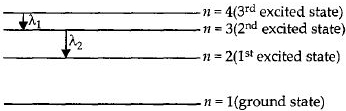
0 likesView Solution
68
PhysicsDifficultMCQAIPMT · 2012
An electron of a stationary hydrogen atom passes from the fifth energy level to the ground level. The velocity that the atom acquired as a result of photon emission will be
A
$\frac{24hR}{25m}$
B
$\frac{25hR}{24m}$
C
$\frac{25m}{24hR}$
D
$\frac{24m}{25hR}$
Solution
(A) According to the Rydberg formula:
$\frac{1}{\lambda} = R \left[ \frac{1}{n_{f}^{2}} - \frac{1}{n_{i}^{2}} \right]$
Here,$n_{f} = 1$ and $n_{i} = 5$.
Substituting the values:
$\frac{1}{\lambda} = R \left[ \frac{1}{1^{2}} - \frac{1}{5^{2}} \right] = R \left[ 1 - \frac{1}{25} \right] = \frac{24}{25} R$
According to the law of conservation of linear momentum,the momentum of the emitted photon must be equal to the momentum acquired by the atom:
$p_{\text{photon}} = p_{\text{atom}}$
$\frac{h}{\lambda} = mv$
Solving for velocity $v$:
$v = \frac{h}{m\lambda} = \frac{h}{m} \left( \frac{24R}{25} \right) = \frac{24hR}{25m}$
$\frac{1}{\lambda} = R \left[ \frac{1}{n_{f}^{2}} - \frac{1}{n_{i}^{2}} \right]$
Here,$n_{f} = 1$ and $n_{i} = 5$.
Substituting the values:
$\frac{1}{\lambda} = R \left[ \frac{1}{1^{2}} - \frac{1}{5^{2}} \right] = R \left[ 1 - \frac{1}{25} \right] = \frac{24}{25} R$
According to the law of conservation of linear momentum,the momentum of the emitted photon must be equal to the momentum acquired by the atom:
$p_{\text{photon}} = p_{\text{atom}}$
$\frac{h}{\lambda} = mv$
Solving for velocity $v$:
$v = \frac{h}{m\lambda} = \frac{h}{m} \left( \frac{24R}{25} \right) = \frac{24hR}{25m}$
0 likesView Solution
69
PhysicsDifficultMCQAIPMT · 2012
$A$ mixture consists of two radioactive materials $A_1$ and $A_2$ with half-lives of $20 \, s$ and $10 \, s$ respectively. Initially,the mixture has $40 \, g$ of $A_1$ and $160 \, g$ of $A_2$. The amount of the two in the mixture will become equal after how many seconds (in $, s$)?
A
$60$
B
$80$
C
$20$
D
$40$
Solution
(D) Let the amount of $A_1$ and $A_2$ become equal after $t \, s$.
The amount of a radioactive substance remaining after time $t$ is given by $N = N_0 \left( \frac{1}{2} \right)^{t/T_{1/2}}$,where $T_{1/2}$ is the half-life.
For $A_1$: $N_1 = 40 \left( \frac{1}{2} \right)^{t/20}$.
For $A_2$: $N_2 = 160 \left( \frac{1}{2} \right)^{t/10}$.
Setting $N_1 = N_2$:
$40 \left( \frac{1}{2} \right)^{t/20} = 160 \left( \frac{1}{2} \right)^{t/10}$.
Dividing both sides by $40$:
$\left( \frac{1}{2} \right)^{t/20} = 4 \left( \frac{1}{2} \right)^{t/10}$.
Using the property $2^{-x} = \frac{1}{2^x}$:
$\frac{1}{2^{t/20}} = 4 \cdot \frac{1}{2^{t/10}}$.
Rearranging the terms:
$\frac{2^{t/10}}{2^{t/20}} = 4$.
$2^{(t/10 - t/20)} = 2^2$.
Equating the exponents:
$\frac{t}{10} - \frac{t}{20} = 2$.
$\frac{2t - t}{20} = 2$.
$\frac{t}{20} = 2 \Rightarrow t = 40 \, s$.
The amount of a radioactive substance remaining after time $t$ is given by $N = N_0 \left( \frac{1}{2} \right)^{t/T_{1/2}}$,where $T_{1/2}$ is the half-life.
For $A_1$: $N_1 = 40 \left( \frac{1}{2} \right)^{t/20}$.
For $A_2$: $N_2 = 160 \left( \frac{1}{2} \right)^{t/10}$.
Setting $N_1 = N_2$:
$40 \left( \frac{1}{2} \right)^{t/20} = 160 \left( \frac{1}{2} \right)^{t/10}$.
Dividing both sides by $40$:
$\left( \frac{1}{2} \right)^{t/20} = 4 \left( \frac{1}{2} \right)^{t/10}$.
Using the property $2^{-x} = \frac{1}{2^x}$:
$\frac{1}{2^{t/20}} = 4 \cdot \frac{1}{2^{t/10}}$.
Rearranging the terms:
$\frac{2^{t/10}}{2^{t/20}} = 4$.
$2^{(t/10 - t/20)} = 2^2$.
Equating the exponents:
$\frac{t}{10} - \frac{t}{20} = 2$.
$\frac{2t - t}{20} = 2$.
$\frac{t}{20} = 2 \Rightarrow t = 40 \, s$.
0 likesView Solution
70
PhysicsMediumMCQAIPMT · 2012
If the nuclear radius of ${}_{13}^{27}Al$ is $3.6 \, fm$,the approximate nuclear radius of ${}_{29}^{64}Cu$ in fermi is .......... $fm$.
A
$2.4$
B
$1.2$
C
$4.8$
D
$3.6$
Solution
(C) The nuclear radius $R$ is given by the formula $R = R_0 A^{1/3}$,where $R_0$ is a constant and $A$ is the mass number.
For ${}_{13}^{27}Al$,$A_1 = 27$ and $R_1 = 3.6 \, fm$.
For ${}_{29}^{64}Cu$,$A_2 = 64$.
Taking the ratio: $\frac{R_2}{R_1} = \left( \frac{A_2}{A_1} \right)^{1/3}$.
Substituting the values: $\frac{R_2}{3.6} = \left( \frac{64}{27} \right)^{1/3}$.
$\frac{R_2}{3.6} = \frac{4}{3}$.
$R_2 = 3.6 \times \frac{4}{3} = 1.2 \times 4 = 4.8 \, fm$.
For ${}_{13}^{27}Al$,$A_1 = 27$ and $R_1 = 3.6 \, fm$.
For ${}_{29}^{64}Cu$,$A_2 = 64$.
Taking the ratio: $\frac{R_2}{R_1} = \left( \frac{A_2}{A_1} \right)^{1/3}$.
Substituting the values: $\frac{R_2}{3.6} = \left( \frac{64}{27} \right)^{1/3}$.
$\frac{R_2}{3.6} = \frac{4}{3}$.
$R_2 = 3.6 \times \frac{4}{3} = 1.2 \times 4 = 4.8 \, fm$.
0 likesView Solution
71
PhysicsMediumMCQAIPMT · 2012
The half-life of a radioactive nucleus is $50$ days. The time interval $(t_2 - t_1)$ between the time $t_2$ when $2/3$ of it has decayed and the time $t_1$ when $1/3$ of it has decayed is ...... days.
A
$30$
B
$50$
C
$15$
D
$60$
Solution
(B) According to the radioactive decay law,$N = N_0 e^{-\lambda t}$,where $N_0$ is the initial number of nuclei and $N$ is the number of undecayed nuclei at time $t$.
At time $t_2$,$2/3$ of the sample has decayed,so the remaining amount is $N = N_0 - (2/3)N_0 = (1/3)N_0$.
Thus,$(1/3)N_0 = N_0 e^{-\lambda t_2} \Rightarrow e^{-\lambda t_2} = 1/3$ ...... $(i)$
At time $t_1$,$1/3$ of the sample has decayed,so the remaining amount is $N = N_0 - (1/3)N_0 = (2/3)N_0$.
Thus,$(2/3)N_0 = N_0 e^{-\lambda t_1} \Rightarrow e^{-\lambda t_1} = 2/3$ ...... $(ii)$
Dividing $(i)$ by $(ii)$,we get: $\frac{e^{-\lambda t_2}}{e^{-\lambda t_1}} = \frac{1/3}{2/3} = 1/2$.
This simplifies to $e^{-\lambda(t_2 - t_1)} = 1/2$,or $e^{\lambda(t_2 - t_1)} = 2$.
Taking the natural logarithm on both sides: $\lambda(t_2 - t_1) = \ln 2$.
Since $\lambda = \frac{\ln 2}{T_{1/2}}$,we have $(t_2 - t_1) = \frac{\ln 2}{\lambda} = T_{1/2}$.
Given $T_{1/2} = 50$ days,the time interval $(t_2 - t_1) = 50$ days.
At time $t_2$,$2/3$ of the sample has decayed,so the remaining amount is $N = N_0 - (2/3)N_0 = (1/3)N_0$.
Thus,$(1/3)N_0 = N_0 e^{-\lambda t_2} \Rightarrow e^{-\lambda t_2} = 1/3$ ...... $(i)$
At time $t_1$,$1/3$ of the sample has decayed,so the remaining amount is $N = N_0 - (1/3)N_0 = (2/3)N_0$.
Thus,$(2/3)N_0 = N_0 e^{-\lambda t_1} \Rightarrow e^{-\lambda t_1} = 2/3$ ...... $(ii)$
Dividing $(i)$ by $(ii)$,we get: $\frac{e^{-\lambda t_2}}{e^{-\lambda t_1}} = \frac{1/3}{2/3} = 1/2$.
This simplifies to $e^{-\lambda(t_2 - t_1)} = 1/2$,or $e^{\lambda(t_2 - t_1)} = 2$.
Taking the natural logarithm on both sides: $\lambda(t_2 - t_1) = \ln 2$.
Since $\lambda = \frac{\ln 2}{T_{1/2}}$,we have $(t_2 - t_1) = \frac{\ln 2}{\lambda} = T_{1/2}$.
Given $T_{1/2} = 50$ days,the time interval $(t_2 - t_1) = 50$ days.
0 likesView Solution
72
PhysicsMediumMCQAIPMT · 2012
In a $CE$ transistor amplifier,the audio signal voltage across the collector resistance of $2 \, k\Omega$ is $2 \, V$. If the base resistance is $1 \, k\Omega$ and the current amplification of the transistor is $100$,the input signal voltage is
A
$0.1 \, V$
B
$1 \, V$
C
$1 \, mV$
D
$10 \, mV$
Solution
(D) Given: Collector resistance $R_{C} = 2 \, k\Omega = 2 \times 10^{3} \, \Omega$.
Output voltage $V_{o} = 2 \, V$.
Base resistance $R_{B} = 1 \, k\Omega = 1 \times 10^{3} \, \Omega$.
Current amplification factor $\beta = 100$.
The output voltage is given by $V_{o} = I_{C} R_{C}$.
Therefore,the collector current is $I_{C} = \frac{V_{o}}{R_{C}} = \frac{2 \, V}{2 \times 10^{3} \, \Omega} = 10^{-3} \, A = 1 \, mA$.
Since $\beta = \frac{I_{C}}{I_{B}}$,the base current is $I_{B} = \frac{I_{C}}{\beta} = \frac{10^{-3} \, A}{100} = 10^{-5} \, A$.
The input signal voltage $V_{i}$ is given by $V_{i} = I_{B} R_{B}$.
Substituting the values: $V_{i} = (10^{-5} \, A) \times (1 \times 10^{3} \, \Omega) = 10^{-2} \, V = 10 \, mV$.
Output voltage $V_{o} = 2 \, V$.
Base resistance $R_{B} = 1 \, k\Omega = 1 \times 10^{3} \, \Omega$.
Current amplification factor $\beta = 100$.
The output voltage is given by $V_{o} = I_{C} R_{C}$.
Therefore,the collector current is $I_{C} = \frac{V_{o}}{R_{C}} = \frac{2 \, V}{2 \times 10^{3} \, \Omega} = 10^{-3} \, A = 1 \, mA$.
Since $\beta = \frac{I_{C}}{I_{B}}$,the base current is $I_{B} = \frac{I_{C}}{\beta} = \frac{10^{-3} \, A}{100} = 10^{-5} \, A$.
The input signal voltage $V_{i}$ is given by $V_{i} = I_{B} R_{B}$.
Substituting the values: $V_{i} = (10^{-5} \, A) \times (1 \times 10^{3} \, \Omega) = 10^{-2} \, V = 10 \, mV$.
0 likesView Solution
73
PhysicsMediumMCQAIPMT · 2012
The input resistance of a silicon transistor is $100\,\Omega$. Base current is changed by $40\,\mu A$,which results in a change in collector current by $2\,mA$. This transistor is used as a common emitter amplifier with a load resistance of $4\,k\Omega$. The voltage gain of the amplifier is:
A
$2000$
B
$3000$
C
$4000$
D
$1000$
Solution
(A) Given:
Input resistance,$R_{i} = 100\,\Omega$
Change in base current,$\Delta I_{B} = 40\,\mu A = 40 \times 10^{-6}\,A$
Change in collector current,$\Delta I_{C} = 2\,mA = 2 \times 10^{-3}\,A$
Load resistance,$R_{L} = 4\,k\Omega = 4000\,\Omega$
First,calculate the current gain $(\beta)$:
$\beta = \frac{\Delta I_{C}}{\Delta I_{B}} = \frac{2 \times 10^{-3}}{40 \times 10^{-6}} = \frac{2000}{40} = 50$
The voltage gain $(A_{V})$ of a common emitter amplifier is given by the formula:
$A_{V} = \beta \times \frac{R_{L}}{R_{i}}$
Substituting the values:
$A_{V} = 50 \times \frac{4000}{100}$
$A_{V} = 50 \times 40 = 2000$
Thus,the voltage gain of the amplifier is $2000$.
Input resistance,$R_{i} = 100\,\Omega$
Change in base current,$\Delta I_{B} = 40\,\mu A = 40 \times 10^{-6}\,A$
Change in collector current,$\Delta I_{C} = 2\,mA = 2 \times 10^{-3}\,A$
Load resistance,$R_{L} = 4\,k\Omega = 4000\,\Omega$
First,calculate the current gain $(\beta)$:
$\beta = \frac{\Delta I_{C}}{\Delta I_{B}} = \frac{2 \times 10^{-3}}{40 \times 10^{-6}} = \frac{2000}{40} = 50$
The voltage gain $(A_{V})$ of a common emitter amplifier is given by the formula:
$A_{V} = \beta \times \frac{R_{L}}{R_{i}}$
Substituting the values:
$A_{V} = 50 \times \frac{4000}{100}$
$A_{V} = 50 \times 40 = 2000$
Thus,the voltage gain of the amplifier is $2000$.
0 likesView Solution
74
PhysicsMediumMCQAIPMT · 2012
The figure shows a logic circuit with two inputs $A$ and $B$ and the output $C.$ The voltage waveforms across $A, B$ and $C$ are as given. The logic circuit gate is
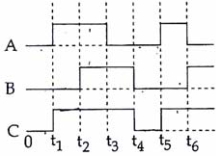
A
$OR$ gate
B
$NAND$ gate
C
$NOR$ gate
D
$AND$ gate
Solution
(A) To identify the logic gate,we analyze the truth table from the given waveforms:
Comparing this with the truth tables of standard gates:
- For an $OR$ gate,the output is $1$ if at least one input is $1$.
- The observed output $C$ follows the condition: $C = 1$ if $A=1$ or $B=1$,and $C = 0$ if $A=0$ and $B=0$.
- This corresponds exactly to the truth table of an $OR$ gate.
| Time Interval | Input $A$ | Input $B$ | Output $C$ |
|---|---|---|---|
| $0$ to $t_1$ | $0$ | $0$ | $0$ |
| $t_1$ to $t_2$ | $1$ | $0$ | $1$ |
| $t_2$ to $t_3$ | $1$ | $1$ | $1$ |
| $t_3$ to $t_4$ | $0$ | $1$ | $1$ |
| $t_4$ to $t_5$ | $0$ | $0$ | $0$ |
| $t_5$ to $t_6$ | $1$ | $0$ | $1$ |
Comparing this with the truth tables of standard gates:
- For an $OR$ gate,the output is $1$ if at least one input is $1$.
- The observed output $C$ follows the condition: $C = 1$ if $A=1$ or $B=1$,and $C = 0$ if $A=0$ and $B=0$.
- This corresponds exactly to the truth table of an $OR$ gate.
0 likesView Solution
75
PhysicsMediumMCQAIPMT · 2012
The transfer characteristics [output voltage $(V_o)$ vs input voltage $(V_i)$] for a base-biased transistor in $CE$ configuration are shown in the figure. For using a transistor as a switch,it is used:
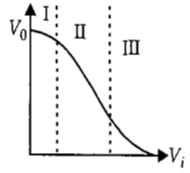
A
in region $III$
B
both in region $I$ and $III$
C
in region $II$
D
in region $I$
Solution
(B) In the given graph:
Region $(I)$ represents the cutoff region,where the transistor is in the $OFF$ state.
Region $(II)$ represents the active region,where the transistor acts as an amplifier.
Region $(III)$ represents the saturation region,where the transistor is in the $ON$ state.
To use a transistor as a switch,it must be operated between the cutoff region ($OFF$ state) and the saturation region ($ON$ state).
Therefore,the transistor is used in both region $(I)$ and region $(III)$ for switching applications.
Region $(I)$ represents the cutoff region,where the transistor is in the $OFF$ state.
Region $(II)$ represents the active region,where the transistor acts as an amplifier.
Region $(III)$ represents the saturation region,where the transistor is in the $ON$ state.
To use a transistor as a switch,it must be operated between the cutoff region ($OFF$ state) and the saturation region ($ON$ state).
Therefore,the transistor is used in both region $(I)$ and region $(III)$ for switching applications.
0 likesView Solution
76
PhysicsEasyMCQAIPMT · 2012
$C$ and $Si$ both have the same lattice structure,having $4$ bonding electrons in each. However,$C$ is an insulator whereas $Si$ is an intrinsic semiconductor. This is because:
A
In the case of $C$,the valence band is not completely filled at absolute zero temperature.
B
In the case of $C$,the conduction band is partly filled even at absolute zero temperature.
C
The four bonding electrons in the case of $C$ lie in the second orbit,whereas in the case of $Si$ they lie in the third.
D
The four bonding electrons in the case of $C$ lie in the third orbit,whereas for $Si$ they lie in the fourth orbit.
Solution
(C) The electronic configuration of carbon $(^{6}C)$ is $1s^{2} 2s^{2} 2p^{2}$.
The electronic configuration of silicon $(_{14}Si)$ is $1s^{2} 2s^{2} 2p^{6} 3s^{2} 3p^{2}$.
In $C$,the valence electrons are in the $n=2$ shell,which is closer to the nucleus,resulting in a large energy band gap $(E_{g} \approx 5.4 \ eV)$,making it an insulator.
In $Si$,the valence electrons are in the $n=3$ shell,which is further from the nucleus,resulting in a smaller energy band gap $(E_{g} \approx 1.1 \ eV)$,allowing it to act as an intrinsic semiconductor.
Therefore,the four bonding electrons of $C$ and $Si$ lie in the second and third orbits,respectively.
The electronic configuration of silicon $(_{14}Si)$ is $1s^{2} 2s^{2} 2p^{6} 3s^{2} 3p^{2}$.
In $C$,the valence electrons are in the $n=2$ shell,which is closer to the nucleus,resulting in a large energy band gap $(E_{g} \approx 5.4 \ eV)$,making it an insulator.
In $Si$,the valence electrons are in the $n=3$ shell,which is further from the nucleus,resulting in a smaller energy band gap $(E_{g} \approx 1.1 \ eV)$,allowing it to act as an intrinsic semiconductor.
Therefore,the four bonding electrons of $C$ and $Si$ lie in the second and third orbits,respectively.
0 likesView Solution
77
PhysicsMediumMCQAIPMT · 2012
Two ideal diodes are connected to a battery as shown in the circuit. The current supplied by the battery is......$A$
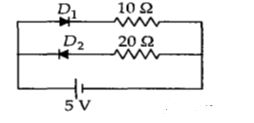
A
$0$
B
$0.75$
C
$0.25$
D
$0.5$
Solution
(D) In the given circuit,the upper diode $D_1$ is forward-biased because its p-side is connected to the positive terminal of the battery.
The lower diode $D_2$ is reverse-biased because its n-side is connected to the positive terminal of the battery.
An ideal diode in forward bias acts as a short circuit (zero resistance),and an ideal diode in reverse bias acts as an open circuit (infinite resistance).
Therefore,no current flows through the branch containing $D_2$.
The total current supplied by the battery flows only through the branch containing $D_1$ and the $10 \ \Omega$ resistor.
Using Ohm's law,$I = \frac{V}{R} = \frac{5 \ V}{10 \ \Omega} = 0.5 \ A$.
The lower diode $D_2$ is reverse-biased because its n-side is connected to the positive terminal of the battery.
An ideal diode in forward bias acts as a short circuit (zero resistance),and an ideal diode in reverse bias acts as an open circuit (infinite resistance).
Therefore,no current flows through the branch containing $D_2$.
The total current supplied by the battery flows only through the branch containing $D_1$ and the $10 \ \Omega$ resistor.
Using Ohm's law,$I = \frac{V}{R} = \frac{5 \ V}{10 \ \Omega} = 0.5 \ A$.
0 likesView Solution
78
PhysicsMediumMCQAIPMT · 2012
$A$ $200\, W$ sodium street lamp emits yellow light of wavelength $0.6\, \mu m$. Assuming it to be $25\%$ efficient in converting electrical energy to light, the number of photons of yellow light it emits per second is:
A
$1.5 \times 10^{20}$
B
$62 \times 10^{20}$
C
$3 \times 10^{19}$
D
$6 \times 10^{18}$
Solution
(A) The total electrical power input is $P_{in} = 200\, W$.
Given the efficiency is $25\%$, the effective power output as light is $P_{out} = 0.25 \times 200\, W = 50\, W$.
The energy of a single photon is given by $E = \frac{hc}{\lambda}$.
If $n$ is the number of photons emitted per second, then the total power is $P_{out} = nE = n \frac{hc}{\lambda}$.
Rearranging for $n$, we get $n = \frac{P_{out} \lambda}{hc}$.
Substituting the values: $n = \frac{50 \times 0.6 \times 10^{-6}}{6.63 \times 10^{-34} \times 3 \times 10^8}$.
$n = \frac{30 \times 10^{-6}}{19.89 \times 10^{-26}} \approx 1.5 \times 10^{20}$ photons per second.
Given the efficiency is $25\%$, the effective power output as light is $P_{out} = 0.25 \times 200\, W = 50\, W$.
The energy of a single photon is given by $E = \frac{hc}{\lambda}$.
If $n$ is the number of photons emitted per second, then the total power is $P_{out} = nE = n \frac{hc}{\lambda}$.
Rearranging for $n$, we get $n = \frac{P_{out} \lambda}{hc}$.
Substituting the values: $n = \frac{50 \times 0.6 \times 10^{-6}}{6.63 \times 10^{-34} \times 3 \times 10^8}$.
$n = \frac{30 \times 10^{-6}}{19.89 \times 10^{-26}} \approx 1.5 \times 10^{20}$ photons per second.
0 likesView Solution
79
PhysicsMediumMCQAIPMT · 2012
$A$ ray is incident at an angle of incidence $i$ on one surface of a small angle prism (with angle of prism $A$) and emerges normally from the opposite surface. If the refractive index of the material of the prism is $\mu$,then the angle of incidence is nearly equal to
A
$\frac{\mu A}{2}$
B
$\frac{A}{2\mu}$
C
$\frac{2A}{\mu}$
D
$\mu A$
Solution
(D) For a prism,the angle of the prism is given by $A = r_1 + r_2$.
Since the ray emerges normally from the opposite surface,the angle of emergence $e = 0$,which implies the angle of refraction at the second surface $r_2 = 0$.
Substituting $r_2 = 0$ into the prism equation,we get $r_1 = A$.
Applying Snell's law at the first surface: $\sin i = \mu \sin r_1$.
For small angles,$\sin i \approx i$ and $\sin r_1 \approx r_1$.
Therefore,$i = \mu r_1$.
Substituting $r_1 = A$,we get $i = \mu A$.
Since the ray emerges normally from the opposite surface,the angle of emergence $e = 0$,which implies the angle of refraction at the second surface $r_2 = 0$.
Substituting $r_2 = 0$ into the prism equation,we get $r_1 = A$.
Applying Snell's law at the first surface: $\sin i = \mu \sin r_1$.
For small angles,$\sin i \approx i$ and $\sin r_1 \approx r_1$.
Therefore,$i = \mu r_1$.
Substituting $r_1 = A$,we get $i = \mu A$.

0 likesView Solution
80
PhysicsMediumMCQAIPMT · 2012
$A$ series $LCR$ circuit is connected to an ac voltage source. When $L$ is removed from the circuit,the phase difference between current and voltage is $\frac{\pi}{3}$. If instead $C$ is removed from the circuit,the phase difference is again $\frac{\pi}{3}$ between current and voltage. The power factor of the circuit is:
A
-$1.0$
B
zero
C
$0.5$
D
$1.0$
Solution
(D) In a series $LCR$ circuit,the phase difference $\phi$ is given by $\tan \phi = \frac{|X_L - X_C|}{R}$.
When $L$ is removed,the circuit becomes an $RC$ circuit. The phase difference is $\tan \phi = \frac{X_C}{R} = \tan(\frac{\pi}{3}) = \sqrt{3}$.
When $C$ is removed,the circuit becomes an $RL$ circuit. The phase difference is $\tan \phi = \frac{X_L}{R} = \tan(\frac{\pi}{3}) = \sqrt{3}$.
Equating the two,we get $\frac{X_C}{R} = \frac{X_L}{R}$,which implies $X_L = X_C$.
Since $X_L = X_C$,the circuit is at resonance.
At resonance,the impedance $Z = R$.
The power factor is $\cos \phi = \frac{R}{Z} = \frac{R}{R} = 1.0$.
When $L$ is removed,the circuit becomes an $RC$ circuit. The phase difference is $\tan \phi = \frac{X_C}{R} = \tan(\frac{\pi}{3}) = \sqrt{3}$.
When $C$ is removed,the circuit becomes an $RL$ circuit. The phase difference is $\tan \phi = \frac{X_L}{R} = \tan(\frac{\pi}{3}) = \sqrt{3}$.
Equating the two,we get $\frac{X_C}{R} = \frac{X_L}{R}$,which implies $X_L = X_C$.
Since $X_L = X_C$,the circuit is at resonance.
At resonance,the impedance $Z = R$.
The power factor is $\cos \phi = \frac{R}{Z} = \frac{R}{R} = 1.0$.
0 likesView Solution
Vedclass Products
For Students
Vedclass Test Series
Mock tests in real AIPMT style covering Physics with performance analysis. 5-day free trial.
Start Free TrialFor Teachers
Exam Paper Generator
Generate Set A/B/C/D Physics papers from 7.5L+ questions in 2 minutes. 3 chapters free.
Try FreeFor Institutes
Online Exam Module
Run live AIPMT mock exams with unlimited students, 360° analytics & white-label branding.
See DemoFrequently Asked Questions
How many Physics questions are in AIPMT 2012?
There are 80 Physics questions from the AIPMT 2012 paper on Vedclass, each with a detailed step-by-step solution in English.
Are AIPMT 2012 Physics solutions available in English?
Yes. All solutions on this page are in English. You can also switch to English or Hindi using the language buttons above the questions.
Can I practice AIPMT 2012 Physics as a timed test?
Yes. Use the Vedclass Test Series to attempt a full AIPMT mock test covering Physics with time limits and instant score analysis.
Can teachers create Physics papers from AIPMT previous year questions?
Yes. The Vedclass Exam Paper Generator lets teachers mix AIPMT Physics questions and generate Set A/B/C/D papers in minutes.
For Teachers & Institutes
Build a Custom Physics Paper
Pick AIPMT 2012 Physics questions, set difficulty, and generate Set A/B/C/D in 2 minutes.