
BiologyQ1–100 of 169 questions
Page 1 of 2 · English
1
BiologyMediumMCQAIPMT · 2012
Which one of the following organisms is scientifically correctly named,correctly printed according to the International Rules of Nomenclature,and correctly described?
A
Musca domestica - the common house lizard,a reptile
B
Plasmodium falciparum - a protozoan pathogen causing the most serious type of malaria.
C
Felis tigris - the Indian tiger,well protected in Gir forests.
D
$E$.coli - full name Entamoeba coli,a commonly occurring bacterium in human intestine.
Solution
(B) is the correct answer. $Plasmodium$ $falciparum$ is a protozoan parasite and is one of the species of $Plasmodium$ that causes malaria in humans.
It is a digenetic parasite,meaning its life cycle is completed in two hosts: humans and the female $Anopheles$ mosquito.
The sexual cycle occurs in the female $Anopheles$ mosquito,where infective stages called sporozoites are formed.
These are transmitted to humans through the bite of an infected female $Anopheles$ mosquito.
The asexual cycle occurs in humans in two phases (liver and blood stages).
Malaria caused by $P. falciparum$ (also known as malignant tertian or pernicious malaria) is the most dangerous form of malaria,with the highest rate of complications and mortality.
Regarding other options: The scientific name of the common house lizard is $Hemidactylus$,while $Musca$ $domestica$ is the scientific name of the common housefly.
The scientific name of the Indian tiger is $Panthera$ $tigris$.
The full name of $E. coli$ is $Escherichia$ $coli$,which is a bacterium,not $Entamoeba$ $coli$ (which is a commensal amoeba).
It is a digenetic parasite,meaning its life cycle is completed in two hosts: humans and the female $Anopheles$ mosquito.
The sexual cycle occurs in the female $Anopheles$ mosquito,where infective stages called sporozoites are formed.
These are transmitted to humans through the bite of an infected female $Anopheles$ mosquito.
The asexual cycle occurs in humans in two phases (liver and blood stages).
Malaria caused by $P. falciparum$ (also known as malignant tertian or pernicious malaria) is the most dangerous form of malaria,with the highest rate of complications and mortality.
Regarding other options: The scientific name of the common house lizard is $Hemidactylus$,while $Musca$ $domestica$ is the scientific name of the common housefly.
The scientific name of the Indian tiger is $Panthera$ $tigris$.
The full name of $E. coli$ is $Escherichia$ $coli$,which is a bacterium,not $Entamoeba$ $coli$ (which is a commensal amoeba).
0 likesView Solution
2
BiologyMediumMCQAIPMT · 2012
Which statement is wrong for viruses?
A
All are parasites.
B
All of them have helical symmetry.
C
They have ability to synthesize nucleic acids and proteins.
D
Antibiotics have no effect on them.
Solution
(B) : In viruses,three architectural forms are found: helical (elongated body,e.g.,$TMV$),cuboidal (short broad body with rhombic,rounded,polyhedral shape,e.g.,poliovirus),and binal (with both cuboidal and helical parts,e.g.,$T_2$ phage). Therefore,the statement that all viruses have helical symmetry is incorrect.
0 likesView Solution
3
BiologyMediumMCQAIPMT · 2012
Maximum nutritional diversity is found in the group
A
fungi
B
animalia
C
monera
D
plantae
Solution
(C) $(C) :$ Although the bacterial structure is very simple,they are very complex in behavior. Compared to many other organisms,bacteria as a group show the most extensive metabolic diversity.
Some bacteria are autotrophic,$i.e.$,they synthesize their own food from inorganic substrates. They may be photosynthetic autotrophic or chemosynthetic autotrophic.
The vast majority of bacteria are heterotrophs,$i.e.$,they do not synthesize their own food but depend on other organisms or on dead organic matter for food.
Some bacteria are autotrophic,$i.e.$,they synthesize their own food from inorganic substrates. They may be photosynthetic autotrophic or chemosynthetic autotrophic.
The vast majority of bacteria are heterotrophs,$i.e.$,they do not synthesize their own food but depend on other organisms or on dead organic matter for food.
0 likesView Solution
4
BiologyEasyMCQAIPMT · 2012
Nuclear membrane is absent in
A
Penicillium
B
Agaricus
C
Volvox
D
Nostoc
Solution
(D) $Penicillium$ and $Agaricus$ are fungi,while $Volvox$ is an alga. All three are eukaryotes and thus possess a membrane-bound nucleus.
$Nostoc$ is a cyanobacterium,i.e.,a prokaryote. Prokaryotes lack a true nucleus,and therefore,the nuclear membrane is absent in $Nostoc$.
$Nostoc$ is a cyanobacterium,i.e.,a prokaryote. Prokaryotes lack a true nucleus,and therefore,the nuclear membrane is absent in $Nostoc$.
0 likesView Solution
5
BiologyEasyMCQAIPMT · 2012
The cyanobacteria are also referred to as
A
protists
B
golden algae
C
slime moulds
D
blue-green algae
Solution
(D) Cyanobacteria are a phylum of bacteria that obtain their energy through photosynthesis.
They are commonly referred to as blue-green algae because of their characteristic blue-green pigmentation.
Although they were historically classified as algae due to their photosynthetic nature,they are prokaryotic organisms and are now classified under the kingdom $Monera$.
They are commonly referred to as blue-green algae because of their characteristic blue-green pigmentation.
Although they were historically classified as algae due to their photosynthetic nature,they are prokaryotic organisms and are now classified under the kingdom $Monera$.
0 likesView Solution
6
BiologyMediumMCQAIPMT · 2012
The most abundant prokaryotes helpful to humans in making curd from milk and in production of antibiotics are the ones categorized as
A
cyanobacteria
B
archaebacteria
C
chemosynthetic autotrophs
D
heterotrophic bacteria
Solution
(D) The correct answer is $D$.
$1$. Heterotrophic bacteria are the most abundant prokaryotes in nature.
$2$. Many heterotrophic bacteria are significantly helpful to humans,such as $Lactobacillus$ (Lactic Acid Bacteria),which is used in the conversion of milk into curd.
$3$. Additionally,many antibiotics are derived from soil-dwelling heterotrophic bacteria,specifically actinomycetes (e.g.,$Streptomyces$),which are saprotrophic in nature.
$1$. Heterotrophic bacteria are the most abundant prokaryotes in nature.
$2$. Many heterotrophic bacteria are significantly helpful to humans,such as $Lactobacillus$ (Lactic Acid Bacteria),which is used in the conversion of milk into curd.
$3$. Additionally,many antibiotics are derived from soil-dwelling heterotrophic bacteria,specifically actinomycetes (e.g.,$Streptomyces$),which are saprotrophic in nature.
0 likesView Solution
7
BiologyMediumMCQAIPMT · 2012
Which one single organism or the pair of organisms is correctly assigned to its or their named taxonomic group?
A
$Paramecium$ and $Plasmodium$ belong to the same kingdom as that of $Penicillium$.
B
Lichen is a composite organism formed from the symbiotic association of an algae and a protozoan.
C
Yeast used in making bread and beer is a fungus.
D
$Nostoc$ and $Anabaena$ are examples of protista.
Solution
(C) : Yeast is a group of unicellular fungi belonging to the class Ascomycetes.
They occur as single cells,groups,or chains of cells.
Yeast of the genus $Saccharomyces$ ferments sugar and is widely used in the production of bread and beer.
$Paramecium$ and $Plasmodium$ are Protists,while $Penicillium$ is a Fungus.
Lichen is a symbiotic association between algae and fungi,not protozoans.
$Nostoc$ and $Anabaena$ are Cyanobacteria (Monera),not Protista.
They occur as single cells,groups,or chains of cells.
Yeast of the genus $Saccharomyces$ ferments sugar and is widely used in the production of bread and beer.
$Paramecium$ and $Plasmodium$ are Protists,while $Penicillium$ is a Fungus.
Lichen is a symbiotic association between algae and fungi,not protozoans.
$Nostoc$ and $Anabaena$ are Cyanobacteria (Monera),not Protista.
0 likesView Solution
8
BiologyMediumMCQAIPMT · 2012
In the five kingdom classification,Chlamydomonas and Chlorella have been included in
A
Protista
B
Algae
C
Plantae
D
Monera
Solution
(A) $(A) :$ In order to develop phylogenetic classification,$R.H. Whittaker$ $(1969)$,an American taxonomist,divided all organisms into five kingdoms based on five criteria:
$(i)$ Complexity of cell structure (prokaryotic and eukaryotic).
$(ii)$ Complexity of body structure (unicellular and multicellular).
$(iii)$ Mode of nutrition.
$(iv)$ Ecological lifestyle (producers,decomposers,and consumers).
$(v)$ Phylogenetic relationship.
All prokaryotic organisms were grouped under Kingdom $Monera$,and all unicellular eukaryotic organisms were placed in Kingdom $Protista$. Kingdom $Protista$ brought together $Chlamydomonas$ and $Chlorella$ (which were earlier placed in $Algae$ within $Plantae$ due to the presence of cell walls) along with $Paramecium$ and $Amoeba$ (which were earlier placed in $Animalia$ due to the absence of cell walls). This reclassification occurred because the criteria for classification changed.
$(i)$ Complexity of cell structure (prokaryotic and eukaryotic).
$(ii)$ Complexity of body structure (unicellular and multicellular).
$(iii)$ Mode of nutrition.
$(iv)$ Ecological lifestyle (producers,decomposers,and consumers).
$(v)$ Phylogenetic relationship.
All prokaryotic organisms were grouped under Kingdom $Monera$,and all unicellular eukaryotic organisms were placed in Kingdom $Protista$. Kingdom $Protista$ brought together $Chlamydomonas$ and $Chlorella$ (which were earlier placed in $Algae$ within $Plantae$ due to the presence of cell walls) along with $Paramecium$ and $Amoeba$ (which were earlier placed in $Animalia$ due to the absence of cell walls). This reclassification occurred because the criteria for classification changed.
0 likesView Solution
9
BiologyMediumMCQAIPMT · 2012
Which one of the following is common to multicellular fungi,filamentous algae and protonema of mosses?
A
Diplontic life cycle
B
Members of Kingdom Plantae
C
Mode of nutrition
D
Multiplication by fragmentation
Solution
(D) : Multicellular fungi,filamentous algae,and the protonema of mosses all share the ability to reproduce vegetatively through fragmentation.
$1$. Fungi belong to Kingdom Fungi,while algae and mosses belong to Kingdom Plantae.
$2$. Mosses exhibit a haplodiplontic life cycle,whereas fungi and algae show diverse life cycles.
$3$. Algae and mosses are autotrophic,whereas fungi are heterotrophic.
$4$. Fragmentation is a common method of asexual reproduction in these organisms,allowing them to spread and colonize new areas.
$1$. Fungi belong to Kingdom Fungi,while algae and mosses belong to Kingdom Plantae.
$2$. Mosses exhibit a haplodiplontic life cycle,whereas fungi and algae show diverse life cycles.
$3$. Algae and mosses are autotrophic,whereas fungi are heterotrophic.
$4$. Fragmentation is a common method of asexual reproduction in these organisms,allowing them to spread and colonize new areas.
0 likesView Solution
10
BiologyMediumMCQAIPMT · 2012
Which one of the following is a correct statement?
A
Pteridophyte gametophyte has a protonemal and leafy stage.
B
In gymnosperms,female gametophyte is free-living.
C
Antheridiophores and archegoniophores are present in pteridophytes.
D
Origin of seed habit can be traced in pteridophytes.
Solution
(D) : In the majority of pteridophytes,all spores are of similar kinds; such plants are called homosporous. Genera like $Selaginella$ and $Salvinia$,which produce two kinds of spores,macro (large) and micro (small) spores,are known as heterosporous. The megaspores and microspores germinate and give rise to female and male gametophytes,respectively. The female gametophytes in these plants are retained on the parent sporophytes for variable periods. The development of the zygotes into young embryos takes place within the female gametophytes. This event is a precursor to the seed habit,which is considered an important step in evolution.
0 likesView Solution
11
BiologyMediumMCQAIPMT · 2012
Cycas and Adiantum resemble each other in having
A
seeds
B
motile sperms
C
cambium
D
vessels
Solution
(B) $Cycas$ is a gymnosperm and $Adiantum$ is a pteridophyte.
$Cambium$ and seeds are absent in pteridophytes,while vessels are absent in both of these two groups.
Both $Cycas$ and $Adiantum$ resemble each other in having multi-ciliated motile sperms.
$Cambium$ and seeds are absent in pteridophytes,while vessels are absent in both of these two groups.
Both $Cycas$ and $Adiantum$ resemble each other in having multi-ciliated motile sperms.
0 likesView Solution
12
BiologyMediumMCQAIPMT · 2012
Which one of the following pairs is wrongly matched?
A
Ginkgo - Archegonia
B
Salvinia - Prothallus
C
Viroids - $RNA$
D
Mustard - Synergids
Solution
(B) The correct answer is $B$.
$1$. $Ginkgo$ is a gymnosperm,and gymnosperms produce archegonia in their female gametophyte. This is correctly matched.
$2$. $Salvinia$ is a heterosporous pteridophyte. Pteridophytes produce a prothallus,but heterosporous pteridophytes like $Salvinia$ produce reduced gametophytes that do not form a typical independent prothallus structure. Thus,this is wrongly matched.
$3$. $Viroids$ are infectious agents consisting only of a short strand of circular single-stranded $RNA$. This is correctly matched.
$4$. $Mustard$ is an angiosperm. In angiosperms,the embryo sac contains synergids. This is correctly matched.
$1$. $Ginkgo$ is a gymnosperm,and gymnosperms produce archegonia in their female gametophyte. This is correctly matched.
$2$. $Salvinia$ is a heterosporous pteridophyte. Pteridophytes produce a prothallus,but heterosporous pteridophytes like $Salvinia$ produce reduced gametophytes that do not form a typical independent prothallus structure. Thus,this is wrongly matched.
$3$. $Viroids$ are infectious agents consisting only of a short strand of circular single-stranded $RNA$. This is correctly matched.
$4$. $Mustard$ is an angiosperm. In angiosperms,the embryo sac contains synergids. This is correctly matched.
0 likesView Solution
13
BiologyMediumMCQAIPMT · 2012
Read the following five statements $(A-E)$ and answer as asked next to them.
$(A)$ In $Equisetum$, the female gametophyte is retained on the parent sporophyte.
$(B)$ In $Ginkgo$, male gametophyte is not independent.
$(C)$ The sporophyte in $Riccia$ is more developed than that in $Polytrichum$.
$(D)$ Sexual reproduction in $Volvox$ is isogamous.
$(E)$ The spores of slime moulds lack cell walls.
How many of the above statements are correct?
$(A)$ In $Equisetum$, the female gametophyte is retained on the parent sporophyte.
$(B)$ In $Ginkgo$, male gametophyte is not independent.
$(C)$ The sporophyte in $Riccia$ is more developed than that in $Polytrichum$.
$(D)$ Sexual reproduction in $Volvox$ is isogamous.
$(E)$ The spores of slime moulds lack cell walls.
How many of the above statements are correct?
A
Two
B
Three
C
Four
D
One
Solution
$(A)$ Incorrect: In $Equisetum$, the gametophyte is free-living and photosynthetic.
$(B)$ Correct: In $Ginkgo$ (a gymnosperm), the male gametophyte is highly reduced and not independent.
$(C)$ Incorrect: $Riccia$ is a liverwort with a simple sporophyte, while $Polytrichum$ is a moss with a more complex and differentiated sporophyte.
$(D)$ Incorrect: $Volvox$ exhibits oogamous sexual reproduction.
$(E)$ Incorrect: The spores of slime moulds possess true cell walls made of cellulose, which makes them highly resistant to adverse conditions.
Therefore, only statement $(B)$ is correct. Hence, the correct answer is $One$.
$(B)$ Correct: In $Ginkgo$ (a gymnosperm), the male gametophyte is highly reduced and not independent.
$(C)$ Incorrect: $Riccia$ is a liverwort with a simple sporophyte, while $Polytrichum$ is a moss with a more complex and differentiated sporophyte.
$(D)$ Incorrect: $Volvox$ exhibits oogamous sexual reproduction.
$(E)$ Incorrect: The spores of slime moulds possess true cell walls made of cellulose, which makes them highly resistant to adverse conditions.
Therefore, only statement $(B)$ is correct. Hence, the correct answer is $One$.
0 likesView Solution
14
BiologyMediumMCQAIPMT · 2012
How many organisms in the list given below are autotrophs?
Lactobacillus,Nostoc,Chara,Nitrosomonas,Nitrobacter,Streptomyces,Saccharomyces,Trypanosoma,Porphyra,Wolffia
Lactobacillus,Nostoc,Chara,Nitrosomonas,Nitrobacter,Streptomyces,Saccharomyces,Trypanosoma,Porphyra,Wolffia
A
Four
B
Five
C
Six
D
Three
Solution
(C) Autotrophic nutrition involves the manufacture of organic materials from inorganic raw materials using energy obtained from external sources. It is of two types: chemosynthesis and photosynthesis.
$1$. Chemoautotrophs: Organisms that manufacture organic food from inorganic raw materials using energy derived from exergonic chemical reactions. In the given list,$Nitrosomonas$ and $Nitrobacter$ are chemoautotrophic nitrifying bacteria.
$2$. Photoautotrophs: Organisms that manufacture organic compounds from inorganic raw materials using solar energy in the presence of photosynthetic pigments. In the given list,$Nostoc$ (cyanobacteria),$Chara$ (algae),$Porphyra$ (algae),and $Wolffia$ (angiosperm) are photoautotrophs.
Total autotrophs = $2$ (chemoautotrophs) + $4$ (photoautotrophs) = $6$.
Therefore,the correct option is $C$.
$1$. Chemoautotrophs: Organisms that manufacture organic food from inorganic raw materials using energy derived from exergonic chemical reactions. In the given list,$Nitrosomonas$ and $Nitrobacter$ are chemoautotrophic nitrifying bacteria.
$2$. Photoautotrophs: Organisms that manufacture organic compounds from inorganic raw materials using solar energy in the presence of photosynthetic pigments. In the given list,$Nostoc$ (cyanobacteria),$Chara$ (algae),$Porphyra$ (algae),and $Wolffia$ (angiosperm) are photoautotrophs.
Total autotrophs = $2$ (chemoautotrophs) + $4$ (photoautotrophs) = $6$.
Therefore,the correct option is $C$.
0 likesView Solution
15
BiologyEasyMCQAIPMT · 2012
$Pheretima$ and its close relatives derive nourishment from
A
sugarcane roots
B
decaying fallen leaves and soil organic matter
C
soil insects
D
small pieces of fresh fallen leaves of maize,etc.
Solution
(B) $Pheretima$ (earthworm) and its related organisms are detritivores.
They feed upon decaying organic matter,such as fallen leaves and other decomposing plant or animal materials present in the soil.
By consuming this organic matter,they play a crucial role in soil fertility and nutrient cycling.
They feed upon decaying organic matter,such as fallen leaves and other decomposing plant or animal materials present in the soil.
By consuming this organic matter,they play a crucial role in soil fertility and nutrient cycling.
0 likesView Solution
16
BiologyMediumMCQAIPMT · 2012
In which one of the following, the genus name, its two characters and its phylum are not correctly matched, whereas the remaining three are correct?
A
$Pila \implies (i)$ Body unsegmented, $(ii)$ Mouth with radula, Phylum: Mollusca
B
$Asterias \implies (i)$ Spiny skinned, $(ii)$ Water vascular system, Phylum: Echinodermata
C
$Sycon \implies (i)$ Pore bearing, $(ii)$ Canal system, Phylum: Porifera
D
$Periplaneta \implies (i)$ Jointed appendages, $(ii)$ Chitinous exoskeleton, Phylum: Arthropoda
Solution
(A) $Pila$ belongs to the phylum $Mollusca$. The body of molluscs (soft-bodied animals) is unsegmented, typically consisting of a distinct head, a muscular foot, and a visceral hump. Therefore, the character "Body segmented" is incorrect for $Pila$. The presence of a radula in the mouth is a correct characteristic of $Pila$. Since the question asks for the option that is not correctly matched, option $A$ is the correct answer.
0 likesView Solution
17
BiologyMediumMCQAIPMT · 2012
Which one of the following pairs of animals are similar to each other pertaining to the feature stated against them?
A
$Pteropus$ and $Ornithorhynchus \implies$ Viviparity
B
Garden lizard and crocodile $\implies$ Three chambered heart
C
$Ascaris$ and $Ancylostoma \implies$ Metameric segmentation
D
Sea horse and flying fish $\implies$ Cold blooded (poikilothermal)
Solution
(D) : Sea horse $(Hippocampus)$ and flying fish $(Exocoetus)$ both belong to the class $Osteichthyes$ (bony fishes) of the superclass $Pisces$.
Both organisms are cold-blooded (poikilothermal), meaning their body temperature fluctuates with the environment.
$Pteropus$ (flying fox) is a mammal (viviparous), while $Ornithorhynchus$ (platypus) is an egg-laying mammal (oviparous).
Garden lizard is a reptile with a three-chambered heart, but the crocodile is a reptile with a four-chambered heart.
$Ascaris$ and $Ancylostoma$ are roundworms (phylum $Aschelminthes$), which are pseudocoelomates and do not exhibit metameric segmentation.
Both organisms are cold-blooded (poikilothermal), meaning their body temperature fluctuates with the environment.
$Pteropus$ (flying fox) is a mammal (viviparous), while $Ornithorhynchus$ (platypus) is an egg-laying mammal (oviparous).
Garden lizard is a reptile with a three-chambered heart, but the crocodile is a reptile with a four-chambered heart.
$Ascaris$ and $Ancylostoma$ are roundworms (phylum $Aschelminthes$), which are pseudocoelomates and do not exhibit metameric segmentation.
0 likesView Solution
18
BiologyMediumMCQAIPMT · 2012
Which one of the following categories of animals is correctly described with no single exception?
A
All reptiles possess scales,have a three-chambered heart,and are cold-blooded (poikilothermal).
B
All bony fishes have four pairs of gills and an operculum on each side.
C
All sponges are marine and have collared cells.
D
All mammals are viviparous and possess a diaphragm for breathing.
Solution
(B) The correct answer is $B$.
$A$: Incorrect. Reptiles like crocodiles have a $4$-chambered heart.
$B$: Correct. All bony fishes (Osteichthyes) possess $4$ pairs of gills covered by an operculum on each side.
$C$: Incorrect. While most sponges are marine,some like $Spongilla$ are freshwater.
$D$: Incorrect. Most mammals are viviparous,but monotremes like $Ornithorhynchus$ (platypus) are oviparous (egg-laying).
$A$: Incorrect. Reptiles like crocodiles have a $4$-chambered heart.
$B$: Correct. All bony fishes (Osteichthyes) possess $4$ pairs of gills covered by an operculum on each side.
$C$: Incorrect. While most sponges are marine,some like $Spongilla$ are freshwater.
$D$: Incorrect. Most mammals are viviparous,but monotremes like $Ornithorhynchus$ (platypus) are oviparous (egg-laying).
0 likesView Solution
19
BiologyMediumMCQAIPMT · 2012
Placentation in tomato and lemon is
A
parietal
B
free central
C
marginal
D
axile
Solution
(D) The correct answer is $D$.
Placentation refers to the arrangement of ovules within the ovary.
It is classified into several types:
$1$. Marginal: Found in pea.
$2$. Parietal: Found in mustard and Argemone.
$3$. Axile: Found in China rose,tomato,and lemon.
$4$. Free central: Found in Dianthus and Primrose.
Therefore,tomato and lemon exhibit axile placentation.
Placentation refers to the arrangement of ovules within the ovary.
It is classified into several types:
$1$. Marginal: Found in pea.
$2$. Parietal: Found in mustard and Argemone.
$3$. Axile: Found in China rose,tomato,and lemon.
$4$. Free central: Found in Dianthus and Primrose.
Therefore,tomato and lemon exhibit axile placentation.
0 likesView Solution
20
BiologyMediumMCQAIPMT · 2012
Cymose inflorescence is present in
A
Solanum
B
Sesbania
C
Trifolium
D
Brassica
Solution
(A) : In cymose inflorescence,the main axis terminates in a flower,hence it is limited in growth.
Flowers are borne in a basipetal order,where the older flowers are at the apex and younger buds are towards the base.
The flowers open in a centrifugal manner,meaning they open from the center towards the periphery.
Examples of plants with cymose inflorescence include $Solanum$,$Ranunculus$,$Datura$,and $Gossypium$.
Flowers are borne in a basipetal order,where the older flowers are at the apex and younger buds are towards the base.
The flowers open in a centrifugal manner,meaning they open from the center towards the periphery.
Examples of plants with cymose inflorescence include $Solanum$,$Ranunculus$,$Datura$,and $Gossypium$.
0 likesView Solution
21
BiologyMediumMCQAIPMT · 2012
Phyllode is present in
A
Asparagus
B
Euphorbia
C
Australian Acacia
D
Opuntia
Solution
(C) The correct answer is $(C)$.
In several species of $Acacia$ found in the deserts of Australia,the bipinnate lamina is absent.
Instead,the petiole and part of the rachis become flattened into a sickle-shaped structure to perform the function of photosynthesis.
Such a flattened petiole that carries out the functions of the leaf blade (lamina) is called a phyllode.
The formation of a phyllode is an adaptive mechanism to reduce transpiration because $(i)$ it is vertically placed and $(ii)$ it has fewer stomata.
In several species of $Acacia$ found in the deserts of Australia,the bipinnate lamina is absent.
Instead,the petiole and part of the rachis become flattened into a sickle-shaped structure to perform the function of photosynthesis.
Such a flattened petiole that carries out the functions of the leaf blade (lamina) is called a phyllode.
The formation of a phyllode is an adaptive mechanism to reduce transpiration because $(i)$ it is vertically placed and $(ii)$ it has fewer stomata.
0 likesView Solution
22
BiologyEasyMCQAIPMT · 2012
The gynoecium consists of many free pistils in flowers of
A
Aloe
B
tomato
C
Papaver
D
Michelia
Solution
(D) The gynoecium is the female reproductive part of a flower.
When the pistils are free,the condition is called apocarpous,as seen in $Michelia$.
When the pistils are fused together,the condition is called syncarpous,as seen in $tomato$ and $Papaver$.
When the pistils are free,the condition is called apocarpous,as seen in $Michelia$.
When the pistils are fused together,the condition is called syncarpous,as seen in $tomato$ and $Papaver$.
0 likesView Solution
23
BiologyMediumMCQAIPMT · 2012
How many plants in the list given below have composite fruits that develop from an inflorescence? Walnut,poppy,radish,fig,pineapple,apple,tomato,mulberry.
A
Four
B
Five
C
Two
D
Three
Solution
(D) composite or multiple fruit is a group of fruitlets that develop from the entire inflorescence rather than a single flower.
Based on the list provided:
$1$. Fig ($Syconus$ type)
$2$. Pineapple ($Sorosis$ type)
$3$. Mulberry ($Sorosis$ type)
Walnut,poppy,radish,apple,and tomato are not composite fruits.
Therefore,there are $3$ plants in the list that have composite fruits.
Based on the list provided:
$1$. Fig ($Syconus$ type)
$2$. Pineapple ($Sorosis$ type)
$3$. Mulberry ($Sorosis$ type)
Walnut,poppy,radish,apple,and tomato are not composite fruits.
Therefore,there are $3$ plants in the list that have composite fruits.
0 likesView Solution
24
BiologyMediumMCQAIPMT · 2012
Vexillary aestivation is characteristic of the family
A
Fabaceae
B
Asteraceae
C
Solanaceae
D
Brassicaceae
Solution
(A) The correct answer is $A$.
$Vexillary$ or descending imbricate aestivation is a characteristic feature of the family $Fabaceae$.
In this type of aestivation,the posterior largest petal,known as the standard or vexillum,overlaps two lateral petals called wings.
These wings,in turn,overlap two anterior petals known as the keel.
This arrangement is also referred to as $papilionaceous$ corolla.
$Vexillary$ or descending imbricate aestivation is a characteristic feature of the family $Fabaceae$.
In this type of aestivation,the posterior largest petal,known as the standard or vexillum,overlaps two lateral petals called wings.
These wings,in turn,overlap two anterior petals known as the keel.
This arrangement is also referred to as $papilionaceous$ corolla.
0 likesView Solution
25
BiologyMediumMCQAIPMT · 2012
Which one of the following organisms is correctly matched with its three characteristics?
A
Pea: $C_3$ pathway,endospermic seed,vexillary aestivation
B
Tomato: twisted aestivation,axile placentation,berry
C
Onion: bulb,imbricate aestivation,axile placentation
D
Maize: $C_3$ pathway,closed vascular bundles,scutellum
Solution
(C) The correct answer is $C$.
$1$. Onion ($Allium$ $cepa$) is a monocot belonging to the family $Liliaceae$. It stores food in fleshy leaves forming a bulb.
$2$. The aestivation in $Liliaceae$ (like Onion) is imbricate,where the margins of the sepals or petals overlap one another but not in any particular direction.
$3$. It exhibits axile placentation,where the placenta is axial and the ovules are attached to it in a multilocular ovary.
Analysis of other options:
- Pea: It has non-endospermic (exalbuminous) seeds,not endospermic.
- Tomato: It shows valvate aestivation,not twisted.
- Maize: It is a $C_4$ plant,not a $C_3$ plant.
$1$. Onion ($Allium$ $cepa$) is a monocot belonging to the family $Liliaceae$. It stores food in fleshy leaves forming a bulb.
$2$. The aestivation in $Liliaceae$ (like Onion) is imbricate,where the margins of the sepals or petals overlap one another but not in any particular direction.
$3$. It exhibits axile placentation,where the placenta is axial and the ovules are attached to it in a multilocular ovary.
Analysis of other options:
- Pea: It has non-endospermic (exalbuminous) seeds,not endospermic.
- Tomato: It shows valvate aestivation,not twisted.
- Maize: It is a $C_4$ plant,not a $C_3$ plant.
0 likesView Solution
26
BiologyMediumMCQAIPMT · 2012
How many plants in the list given below have marginal placentation: Mustard,Gram,Tulip,Asparagus,Arhar,Sun hemp,Chilli,Colchicum,Onion,Moong,Pea,Tobacco,Lupin?
A
Four
B
Five
C
Six
D
Three
Solution
(C) Marginal placentation is a characteristic feature of the family $Fabaceae$.
In the given list,the plants belonging to the family $Fabaceae$ are: Gram,Arhar,Sun hemp,Moong,Pea,and Lupin.
$1$. Gram ($Cicer$ $arietinum$)
$2$. Arhar ($Cajanus$ $cajan$)
$3$. Sun hemp ($Crotalaria$ $juncea$)
$4$. Moong ($Vigna$ $radiata$)
$5$. Pea ($Pisum$ $sativum$)
$6$. Lupin $(Lupinus)$
Therefore,there are $6$ plants that exhibit marginal placentation.
The correct option is $C$.
In the given list,the plants belonging to the family $Fabaceae$ are: Gram,Arhar,Sun hemp,Moong,Pea,and Lupin.
$1$. Gram ($Cicer$ $arietinum$)
$2$. Arhar ($Cajanus$ $cajan$)
$3$. Sun hemp ($Crotalaria$ $juncea$)
$4$. Moong ($Vigna$ $radiata$)
$5$. Pea ($Pisum$ $sativum$)
$6$. Lupin $(Lupinus)$
Therefore,there are $6$ plants that exhibit marginal placentation.
The correct option is $C$.
0 likesView Solution
27
BiologyMediumMCQAIPMT · 2012
Gymnosperms are also called soft wood spermatophytes because they lack
A
cambium
B
phloem fibres
C
thick-walled tracheids
D
xylem fibres
Solution
(D) Gymnosperms are referred to as soft wood spermatophytes because their xylem lacks $xylem$ $fibres$ (also known as wood fibres). In angiosperms,the presence of these fibres provides mechanical strength and hardness to the wood,which is why they are called hard wood. Since gymnosperms lack these fibres,their wood is relatively soft.
0 likesView Solution
28
BiologyMediumMCQAIPMT · 2012
Water-containing cavities in vascular bundles are found in
A
sunflower
B
maize
C
Cycas
D
Pinus
Solution
(B) In monocot stems like $maize$ ($Zea$ $mays$),the vascular bundles are conjoint,collateral,and closed. $A$ characteristic feature of these vascular bundles is the presence of a lysigenous water-containing cavity (also known as a protoxylem lacuna or lysigenous cavity) formed by the disintegration of the protoxylem elements and the surrounding parenchyma cells during the growth of the stem.
0 likesView Solution
29
BiologyEasyMCQAIPMT · 2012
Closed vascular bundles lack
A
ground tissue
B
conjunctive tissue
C
cambium
D
pith
Solution
(C) : Vascular bundles consist of complex tissues,the phloem and xylem. In dicots,cambium is present between the xylem and phloem,which helps in secondary growth; this type of vascular bundle is called open. In monocots,cambium is absent,so these are called closed vascular bundles.
0 likesView Solution
30
BiologyEasyMCQAIPMT · 2012
Companion cells are closely associated with
A
sieve elements
B
vessel elements
C
trichomes
D
guard cells
Solution
(A) $(A) :$ Companion cells are specialized parenchyma cells found in the phloem of angiosperms.
Each companion cell is closely associated with a sieve tube element.
They are connected to the sieve tube elements through numerous plasmodesmata.
Companion cells play a crucial role in the loading of sugars into the sieve tube elements via active transport,which is essential for the translocation of food.
Each companion cell is closely associated with a sieve tube element.
They are connected to the sieve tube elements through numerous plasmodesmata.
Companion cells play a crucial role in the loading of sugars into the sieve tube elements via active transport,which is essential for the translocation of food.
0 likesView Solution
31
BiologyEasyMCQAIPMT · 2012
The common bottle cork is a product of
A
dermatogen
B
phellogen
C
xylem
D
vascular cambium
Solution
(B) : Cork cambium or phellogen is a type of cambium arising within the outer layer of the stems of woody plants,usually as a complete ring surrounding the inner tissues.
The cells of the cork cambium divide to produce an outer corky tissue ($cork$ or $phellem$) and an inner secondary cortex $(phelloderm)$.
The common bottle cork produced from $Quercus$ $suber$ is a product of phellogen.
The cells of the cork cambium divide to produce an outer corky tissue ($cork$ or $phellem$) and an inner secondary cortex $(phelloderm)$.
The common bottle cork produced from $Quercus$ $suber$ is a product of phellogen.
0 likesView Solution
32
BiologyMediumMCQAIPMT · 2012
As compared to a dicot root,a monocot root has
A
more abundant secondary xylem
B
many xylem bundles
C
inconspicuous annual rings
D
relatively thicker periderm
Solution
(B) : In monocot roots,secondary growth is absent,and the vascular cylinder consists of several alternate and radial xylem and phloem bundles. The vascular bundles are arranged in a ring around the central pith. Their number in maize ranges between $20-30$,whereas in Pandanus and palms,they may be up to $100$. Because of the presence of numerous xylem bundles and the exarch condition,the xylem of a monocot root is polyarch. On the other hand,in dicot roots,xylem and phloem are equal in number $(2-6)$ and are alternately arranged,i.e.,they lie on different radii,hence called radial bundles. Depending on the number of rays (equivalent to the number of xylem or phloem bundles),the roots may be diarch,triarch,tetrarch,pentarch,or hexarch.
0 likesView Solution
33
BiologyEasyMCQAIPMT · 2012
Compared to those of humans,the erythrocytes in frogs are
A
without nucleus but with haemoglobin
B
nucleated and with haemoglobin
C
very much smaller and fewer
D
nucleated and without haemoglobin
Solution
(B) : Human erythrocytes are enucleated (lack a nucleus) and discoidal in shape. In contrast,frog erythrocytes are large,oval,biconvex,and nucleated cells. Both human and frog erythrocytes contain the respiratory pigment haemoglobin,which is responsible for oxygen transport.
0 likesView Solution
34
BiologyMediumMCQAIPMT · 2012
Select the correct statement from the ones given below with respect to $Periplaneta$ $americana$.
A
Nervous system is located dorsally and consists of segmentally arranged ganglia joined by a pair of longitudinal connectives.
B
Males bear a pair of short,thread-like anal styles.
C
There are $16$ very long Malpighian tubules present at the junctions of midgut and hindgut.
D
Grinding of food is carried out only by the mouth parts.
Solution
(B) is the correct statement.
In $Periplaneta$ $americana$ (cockroach),the posterior segment of the abdomen bears a pair of jointed filamentous structures called anal cerci,which are present in both sexes.
However,males can be distinguished from females by the presence of an additional pair of short,thread-like structures called anal styles.
These anal styles assist in the process of copulation.
In $Periplaneta$ $americana$ (cockroach),the posterior segment of the abdomen bears a pair of jointed filamentous structures called anal cerci,which are present in both sexes.
However,males can be distinguished from females by the presence of an additional pair of short,thread-like structures called anal styles.
These anal styles assist in the process of copulation.
0 likesView Solution
35
BiologyMediumMCQAIPMT · 2012
Given below is the diagrammatic sketch of a certain type of connective tissue. Identify the parts labelled $A, B, C$ and $D$ and select the right option about them.
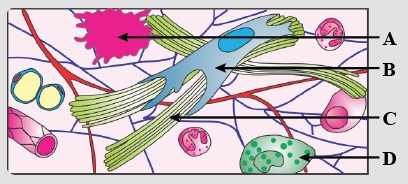
A
$A$-Macrophage,$B$-Fibroblast,$C$-Collagen fibres,$D$-Mast cell
B
$A$-Mast cell,$B$-Macrophage,$C$-Fibroblast,$D$-Collagen fibres
C
$A$-Macrophage,$B$-Collagen fibres,$C$-Fibroblast,$D$-Mast cell
D
$A$-Mast cell,$B$-Collagen fibres,$C$-Fibroblast,$D$-Macrophage
Solution
(A) Based on the standard diagram of areolar connective tissue provided in the $NCERT$ textbook:
$A$ represents a Macrophage,which is a large phagocytic cell.
$B$ represents a Fibroblast,which is responsible for producing and secreting fibres.
$C$ represents Collagen fibres,which provide structural strength.
$D$ represents a Mast cell,which contains granules and is involved in inflammatory responses.
Therefore,the correct sequence is $A$-Macrophage,$B$-Fibroblast,$C$-Collagen fibres,$D$-Mast cell.
$A$ represents a Macrophage,which is a large phagocytic cell.
$B$ represents a Fibroblast,which is responsible for producing and secreting fibres.
$C$ represents Collagen fibres,which provide structural strength.
$D$ represents a Mast cell,which contains granules and is involved in inflammatory responses.
Therefore,the correct sequence is $A$-Macrophage,$B$-Fibroblast,$C$-Collagen fibres,$D$-Mast cell.
0 likesView Solution
36
BiologyMediumMCQAIPMT · 2012
The supportive skeletal structures in the human external ears and in the nose tip are examples of
A
ligament
B
areolar tissue
C
bone
D
cartilage
Solution
(D) : Cartilage is a semi-rigid supportive or skeletal connective tissue in which the matrix is solid and made of mucoprotein or proteoglycan called chondrin.
It is of four types: hyaline,fibrous,calcified,and elastic.
Yellow elastic fibrocartilage is found in the pinna and external auditory canal of the ear,Eustachian tubes,epiglottis,and the tip of the nose.
Its matrix contains numerous yellow fibers which form a network by uniting with one another.
Due to the presence of yellow fibers,the cartilage becomes more flexible.
Hence,it provides flexibility to these organs.
It is of four types: hyaline,fibrous,calcified,and elastic.
Yellow elastic fibrocartilage is found in the pinna and external auditory canal of the ear,Eustachian tubes,epiglottis,and the tip of the nose.
Its matrix contains numerous yellow fibers which form a network by uniting with one another.
Due to the presence of yellow fibers,the cartilage becomes more flexible.
Hence,it provides flexibility to these organs.
0 likesView Solution
37
BiologyMediumMCQAIPMT · 2012
The four sketches $(A, B, C$ and $D)$ given below represent four different types of animal tissues. Which one of these is correctly identified in the options given,along with its correct location and function?
A
$(B)$ Glandular epithelium $\Rightarrow$ Intestine $\Rightarrow$ Secretion
B
$(C)$ Collagen $\Rightarrow$ Cartilage $\Rightarrow$ Attach skeletal muscles fibres to bones
C
$(D)$ Smooth muscle tissue $\Rightarrow$ Heart $\Rightarrow$ Heart contraction
D
$(A)$ Columnar epithelium $\Rightarrow$ Nephron $\Rightarrow$ Secretion and absorption
Solution
(A) The correct option is $(A)$.
Intestine is lined by glandular epithelium,which is secretory in function.
The glands found in the intestine are exocrine and may be unicellular or multicellular.
When unicellular glands secrete mucus,they are called goblet cells,which are common in the columnar epithelium of the intestine.
Multicellular glands consist of a duct and a secretory portion,both formed of epithelial cells,such as the Crypts of Lieberkuhn and Brunner's glands found in the intestine.
Intestine is lined by glandular epithelium,which is secretory in function.
The glands found in the intestine are exocrine and may be unicellular or multicellular.
When unicellular glands secrete mucus,they are called goblet cells,which are common in the columnar epithelium of the intestine.
Multicellular glands consist of a duct and a secretory portion,both formed of epithelial cells,such as the Crypts of Lieberkuhn and Brunner's glands found in the intestine.
0 likesView Solution
38
BiologyMediumMCQAIPMT · 2012
Select the correct statement from the following regarding the cell membrane.
A
$Na^+$ and $K^+$ ions move across the cell membrane by passive transport.
B
Proteins make up $60$ to $70\%$ of the cell membrane.
C
Lipids are arranged in a bilayer with polar heads towards the inner part.
D
The fluid mosaic model of the cell membrane was proposed by Singer and Nicolson.
Solution
(D) The correct statement is $(D)$.
According to the fluid mosaic model of cell membrane structure proposed by $Singer$ and $Nicolson$ $(1972)$,the plasma membrane consists of approximately $50-60\%$ proteins and $40-50\%$ lipids.
Lipids are arranged in a bilayer with the hydrophilic (polar) heads pointing outwards and the hydrophobic (non-polar) tails pointing inwards.
$Na^+$ and $K^+$ ions are transported across the cell membrane primarily via active transport (e.g.,$Na^+/K^+$ pump),not passive transport.
Therefore,the statement that the fluid mosaic model was proposed by $Singer$ and $Nicolson$ is the only correct statement.
According to the fluid mosaic model of cell membrane structure proposed by $Singer$ and $Nicolson$ $(1972)$,the plasma membrane consists of approximately $50-60\%$ proteins and $40-50\%$ lipids.
Lipids are arranged in a bilayer with the hydrophilic (polar) heads pointing outwards and the hydrophobic (non-polar) tails pointing inwards.
$Na^+$ and $K^+$ ions are transported across the cell membrane primarily via active transport (e.g.,$Na^+/K^+$ pump),not passive transport.
Therefore,the statement that the fluid mosaic model was proposed by $Singer$ and $Nicolson$ is the only correct statement.
0 likesView Solution
39
BiologyEasyMCQAIPMT · 2012
What is true about ribosomes?
A
The prokaryotic ribosomes are $80S$,where $S$ stands for sedimentation coefficient.
B
These are composed of ribonucleic acid and proteins.
C
These are found only in eukaryotic cells.
D
These are self-splicing introns of some $RNAs$.
Solution
(B) : Ribosomes are small,spherical,non-membrane-bound organelles found in both prokaryotic and eukaryotic cells. They are the sites of protein synthesis. Ribosomes consist of two subunits,one large and one small,each of which is composed of ribosomal $RNA$ $(rRNA)$ and proteins. They do not contain any $DNA$.
0 likesView Solution
40
BiologyMediumMCQAIPMT · 2012
Which one of the following does not differ in $E. coli$ and $Chlamydomonas$?
A
Ribosomes
B
Chromosomal organization
C
Cell wall
D
Cell membrane
Solution
(D) $E. coli$ (bacteria) is a prokaryote,while $Chlamydomonas$ (algae) is a eukaryote.
Ribosomes of both groups differ,being $70S$ in prokaryotes and $80S$ in eukaryotes.
Prokaryotic chromosomes lack histone proteins,unlike eukaryotic chromosomes.
Cell wall organization also differs; the bacterial cell wall is rich in peptidoglycan (muramic acid),while the algal cell wall is primarily cellulosic.
It is the cell membrane that has a similar fluid mosaic organization in both groups.
Ribosomes of both groups differ,being $70S$ in prokaryotes and $80S$ in eukaryotes.
Prokaryotic chromosomes lack histone proteins,unlike eukaryotic chromosomes.
Cell wall organization also differs; the bacterial cell wall is rich in peptidoglycan (muramic acid),while the algal cell wall is primarily cellulosic.
It is the cell membrane that has a similar fluid mosaic organization in both groups.
0 likesView Solution
41
BiologyMediumMCQAIPMT · 2012
Which one of the following cellular parts is correctly described?
A
Thylakoids - flattened membranous sacs forming the grana of chloroplasts
B
Centrioles - sites for active $RNA$ synthesis
C
Ribosomes - those on chloroplasts are larger $(80S)$ while those in the cytoplasm are smaller $(70S)$
D
Lysosomes - optimally active at a $pH$ of about $8.5$
Solution
(A) : Thylakoids are the flattened sac-like membranous structures that are stacked on top of one another to form the grana of plant chloroplasts.
Chlorophyll and other photosynthetic pigments are situated in the thylakoid membranes,which are the site for the light-dependent reactions of photosynthesis.
$B$ is incorrect because centrioles are involved in spindle formation during cell division,not $RNA$ synthesis.
$C$ is incorrect because chloroplast ribosomes are $70S$ and cytoplasmic ribosomes are $80S$.
$D$ is incorrect because lysosomes contain hydrolytic enzymes that are optimally active at an acidic $pH$ (about $5.0$).
Chlorophyll and other photosynthetic pigments are situated in the thylakoid membranes,which are the site for the light-dependent reactions of photosynthesis.
$B$ is incorrect because centrioles are involved in spindle formation during cell division,not $RNA$ synthesis.
$C$ is incorrect because chloroplast ribosomes are $70S$ and cytoplasmic ribosomes are $80S$.
$D$ is incorrect because lysosomes contain hydrolytic enzymes that are optimally active at an acidic $pH$ (about $5.0$).
0 likesView Solution
42
BiologyMediumMCQAIPMT · 2012
Which one of the following structures is an organelle within an organelle?
A
Ribosome
B
Peroxisome
C
$ER$
D
Mesosome
Solution
(A) : Ribosomes are found in all living cells except mammalian erythrocytes or red blood corpuscles.
Depending upon their location,ribosomes are of two types: cytoplasmic ribosomes and organelle ribosomes.
Cytoplasmic ribosomes (cytoribosomes) may remain free in the cytoplasmic matrix or attached to the cytosolic surface of the endoplasmic reticulum with the help of special ribophorin or $SRP$ proteins.
Organelle ribosomes are found within other organelles,specifically in plastids (plastiribosomes) and mitochondria (mitoribosomes).
Cytoplasmic ribosomes are of the $80S$ type in eukaryotic cells,whereas organelle ribosomes are of the $70S$ type.
Depending upon their location,ribosomes are of two types: cytoplasmic ribosomes and organelle ribosomes.
Cytoplasmic ribosomes (cytoribosomes) may remain free in the cytoplasmic matrix or attached to the cytosolic surface of the endoplasmic reticulum with the help of special ribophorin or $SRP$ proteins.
Organelle ribosomes are found within other organelles,specifically in plastids (plastiribosomes) and mitochondria (mitoribosomes).
Cytoplasmic ribosomes are of the $80S$ type in eukaryotic cells,whereas organelle ribosomes are of the $70S$ type.
0 likesView Solution
43
BiologyMediumMCQAIPMT · 2012
Which one out of $A-D$ given below correctly represents the structural formula of a basic amino acid?
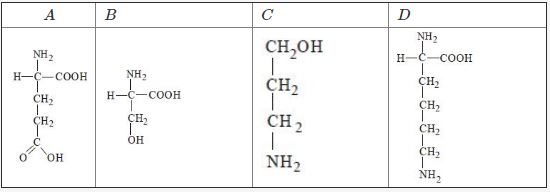
A
$C$
B
$D$
C
$A$
D
$B$
Solution
(B) Basic amino acids are characterized by the presence of an additional amino group $(-NH_2)$ in their side chain ($R$-group),which makes them basic in nature.
In the given structures:
$A$ represents Glutamic acid (an acidic amino acid).
$B$ represents Serine (a polar,uncharged amino acid).
$C$ is not an amino acid structure.
$D$ represents Lysine,which contains an additional amino group in its side chain,making it a basic amino acid.
Therefore,the correct representation of a basic amino acid is $D$.
In the given structures:
$A$ represents Glutamic acid (an acidic amino acid).
$B$ represents Serine (a polar,uncharged amino acid).
$C$ is not an amino acid structure.
$D$ represents Lysine,which contains an additional amino group in its side chain,making it a basic amino acid.
Therefore,the correct representation of a basic amino acid is $D$.
0 likesView Solution
44
BiologyMediumMCQAIPMT · 2012
Which one is the most abundant protein in the animal world?
A
Trypsin
B
Haemoglobin
C
Collagen
D
Insulin
Solution
(C) : Collagen is an insoluble fibrous protein found extensively in the connective tissue of skin,tendons,and bone.
Collagen accounts for over $30\%$ of the total body proteins of mammals and it is the most abundant animal protein.
Collagen accounts for over $30\%$ of the total body proteins of mammals and it is the most abundant animal protein.
0 likesView Solution
45
BiologyMediumMCQAIPMT · 2012
The given diagrammatic representation shows one of the categories of small molecular weight organic compounds in living tissues. Identify the category shown and the one blank component "$X$" in it.
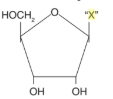
A
Cholesterol $\Rightarrow$ Guanine
B
Amino acid $\Rightarrow$ $NH_2$
C
Nucleotide $\Rightarrow$ Adenine
D
Nucleoside $\Rightarrow$ Uracil
Solution
(D) The given structure represents a ribose sugar molecule attached to a nitrogenous base at position "$X$".
Since the structure consists of a pentose sugar and a nitrogenous base, but lacks a phosphate group, it represents a nucleoside.
In the context of the options provided, the structure is a nucleoside, and "$X$" represents a nitrogenous base such as Uracil.
Since the structure consists of a pentose sugar and a nitrogenous base, but lacks a phosphate group, it represents a nucleoside.
In the context of the options provided, the structure is a nucleoside, and "$X$" represents a nitrogenous base such as Uracil.
0 likesView Solution
46
BiologyMediumMCQAIPMT · 2012
During gamete formation,the enzyme recombinase participates during
A
metaphase $I$
B
anaphase $II$
C
prophase $I$
D
prophase $II$
Solution
(C) The correct answer is $C$.
During gamete formation,the enzyme recombinase participates during the pachytene stage of prophase $I$.
This stage is characterized by the appearance of recombination nodules,which are the sites where crossing over occurs between non-sister chromatids of homologous chromosomes.
Crossing over is the exchange of genetic material between two homologous chromosomes.
Crossing over is an enzyme-mediated process,and the enzyme involved in this process is called recombinase.
During gamete formation,the enzyme recombinase participates during the pachytene stage of prophase $I$.
This stage is characterized by the appearance of recombination nodules,which are the sites where crossing over occurs between non-sister chromatids of homologous chromosomes.
Crossing over is the exchange of genetic material between two homologous chromosomes.
Crossing over is an enzyme-mediated process,and the enzyme involved in this process is called recombinase.
0 likesView Solution
47
BiologyMediumMCQAIPMT · 2012
The given figure is the representation of a certain event at a particular stage of a type of cell division. Which is this stage?
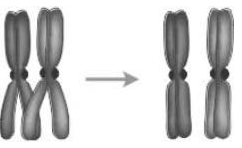
A
Prophase $I$ during meiosis
B
Prophase $II$ during meiosis
C
Prophase of mitosis
D
Both prophase and metaphase of mitosis
Solution
(A) The given figure shows crossing over,$i.e.$,the exchange of genetic segments between two non-sister chromatids of homologous chromosomes.
Crossing over is a characteristic feature of meiosis and occurs specifically during the pachytene stage of prophase $I$.
Crossing over is a characteristic feature of meiosis and occurs specifically during the pachytene stage of prophase $I$.
0 likesView Solution
48
BiologyMediumMCQAIPMT · 2012
Identify the meiotic stage in which the homologous chromosomes separate while the sister chromatids remain associated at their centromeres.
A
Metaphase $I$
B
Metaphase $II$
C
Anaphase $I$
D
Anaphase $II$
Solution
(C) During $Anaphase I$,the homologous chromosomes of each bivalent (tetrad) separate and move toward opposite poles of the cell.
In this stage,the sister chromatids remain associated at their centromeres,meaning the centromeres do not split.
This process ensures that each pole receives only one chromosome from each homologous pair,effectively reducing the chromosome number by half.
In contrast,during $Anaphase II$,the centromeres split and sister chromatids separate.
In this stage,the sister chromatids remain associated at their centromeres,meaning the centromeres do not split.
This process ensures that each pole receives only one chromosome from each homologous pair,effectively reducing the chromosome number by half.
In contrast,during $Anaphase II$,the centromeres split and sister chromatids separate.
0 likesView Solution
49
BiologyEasyMCQAIPMT · 2012
The best-defined function of manganese in green plants is:
A
photolysis of water
B
Calvin cycle
C
nitrogen fixation
D
water absorption
Solution
(A) The correct option is $A$. Manganese $(Mn^{2+})$ plays a critical role in the photolysis of water during the light-dependent reactions of photosynthesis.
Photolysis is the process of splitting water molecules into hydrogen ions,electrons,and oxygen in the presence of light within the chloroplast.
$Mn^{2+}$ acts as an essential cofactor for the oxygen-evolving complex,which is necessary for this reaction to occur.
Photolysis is the process of splitting water molecules into hydrogen ions,electrons,and oxygen in the presence of light within the chloroplast.
$Mn^{2+}$ acts as an essential cofactor for the oxygen-evolving complex,which is necessary for this reaction to occur.
0 likesView Solution
50
BiologyMediumMCQAIPMT · 2012
Which one of the following is correctly matched?
A
Passive transport of nutrients - $ATP$
B
Apoplast - Plasmodesmata
C
Potassium - Readily immobilisation
D
Bakane of rice seedlings - $F. Skoog$
Solution
(C) : Immobilization or fixation of a nutrient means that the nutrient becomes unavailable for the plant.
The process of converting exchangeable or water-soluble potassium to its non-exchangeable or water-insoluble form is known as potassium immobilization.
Potassium is present in relatively large quantities in the soil (averaging about $1.9\%$).
Depending on the circumstances,soil potassium may be not easily available,slowly available,or readily available.
The first category accounts for $90\%$ to $98\%$ of the total soil potassium,which is only slightly soluble.
The second category constitutes $2-10\%$ of total mineral soil.
The third category makes up for about $1\%$.
The process of converting exchangeable or water-soluble potassium to its non-exchangeable or water-insoluble form is known as potassium immobilization.
Potassium is present in relatively large quantities in the soil (averaging about $1.9\%$).
Depending on the circumstances,soil potassium may be not easily available,slowly available,or readily available.
The first category accounts for $90\%$ to $98\%$ of the total soil potassium,which is only slightly soluble.
The second category constitutes $2-10\%$ of total mineral soil.
The third category makes up for about $1\%$.
0 likesView Solution
51
BiologyMediumMCQAIPMT · 2012
Which one of the following microbes forms symbiotic association with plants and helps them in their nutrition?
A
Azotobacter
B
Aspergillus
C
Glomus
D
Trichoderma
Solution
(C) : $Azotobacter$,$Aspergillus$,and $Trichoderma$ are all free-living microbes that contribute to plant nutrition. $Glomus$ is a genus of arbuscular mycorrhizal fungi that forms a symbiotic association with plant roots,known as endomycorrhiza. This association significantly enhances the plant's ability to absorb nutrients,particularly phosphorus,from the soil.
0 likesView Solution
52
BiologyMediumMCQAIPMT · 2012
The coconut water and the edible part of coconut are equivalent to
A
endosperm
B
endocarp
C
mesocarp
D
embryo
Solution
(A) : Coconut fruit is a drupe. It has a membranous epicarp,fibrous mesocarp,and stony endocarp. The endocarp encloses a single seed with a brown testa that contains a small embryo and a white oily endosperm (edible part) with a watery fluid called coconut water.
0 likesView Solution
53
BiologyMediumMCQAIPMT · 2012
Both,autogamy and geitonogamy are prevented in
A
papaya
B
cucumber
C
castor
D
maize
Solution
(A) : Autogamy and geitonogamy are two forms of self-pollination.
In autogamy,pollen grains are transferred from the anther to the stigma of the same flower.
In geitonogamy,pollen grains are transferred from the anther of one flower to the stigma of another flower on the same plant.
Papaya is a dioecious plant,meaning male and female flowers are borne on separate plants.
Because the male and female reproductive structures are on different individuals,both autogamy and geitonogamy are prevented.
In autogamy,pollen grains are transferred from the anther to the stigma of the same flower.
In geitonogamy,pollen grains are transferred from the anther of one flower to the stigma of another flower on the same plant.
Papaya is a dioecious plant,meaning male and female flowers are borne on separate plants.
Because the male and female reproductive structures are on different individuals,both autogamy and geitonogamy are prevented.
0 likesView Solution
54
BiologyMediumMCQAIPMT · 2012
An organic substance that can withstand environmental extremes and cannot be degraded by any enzyme is
A
cuticle
B
sporopollenin
C
lignin
D
cellulose
Solution
(B) : $Sporopollenin$ is a major component of the tough outer $(exine)$ walls of spores and pollen grains.
It is chemically very stable and is usually well preserved in soils and sediments.
It can withstand environmental extremes and cannot be degraded by any known enzymes or strong chemical reagents.
It is chemically very stable and is usually well preserved in soils and sediments.
It can withstand environmental extremes and cannot be degraded by any known enzymes or strong chemical reagents.
0 likesView Solution
55
BiologyMediumMCQAIPMT · 2012
Which one of the following is correctly matched?
A
Onion-$Bulb$
B
Ginger-$Sucker$
C
Chlamydomonas-$Conidia$
D
Yeast-$Zoospores$
Solution
(A) The correct answer is $A$.
$1$. Onion propagates vegetatively through a $Bulb$,which is an underground modified stem.
$2$. Ginger propagates through a $Rhizome$,not a $Sucker$.
$3$. $Chlamydomonas$ reproduces through $Zoospores$,not $Conidia$.
$4$. $Yeast$ reproduces through budding,and it does not produce $Zoospores$.
$1$. Onion propagates vegetatively through a $Bulb$,which is an underground modified stem.
$2$. Ginger propagates through a $Rhizome$,not a $Sucker$.
$3$. $Chlamydomonas$ reproduces through $Zoospores$,not $Conidia$.
$4$. $Yeast$ reproduces through budding,and it does not produce $Zoospores$.
0 likesView Solution
56
BiologyMediumMCQAIPMT · 2012
Even in the absence of pollinating agents,seed setting is assured in
A
Commelina
B
Zostera
C
Salvia
D
fig
Solution
(A) : Some plants such as $Viola$ (common pansy),$Oxalis$,and $Commelina$ produce two types of flowers: chasmogamous flowers,which are similar to flowers of other species with exposed anthers and stigma,and cleistogamous flowers,which do not open at all.
In such cleistogamous flowers,the anthers and stigma lie very close to each other.
When anthers dehisce in the flower buds,pollen grains come in contact with the stigma to effect pollination.
Thus,cleistogamous flowers are invariably autogamous as there is no chance of cross-pollen landing on the stigma.
Therefore,cleistogamous flowers produce assured seed-set even in the absence of pollinators.
In such cleistogamous flowers,the anthers and stigma lie very close to each other.
When anthers dehisce in the flower buds,pollen grains come in contact with the stigma to effect pollination.
Thus,cleistogamous flowers are invariably autogamous as there is no chance of cross-pollen landing on the stigma.
Therefore,cleistogamous flowers produce assured seed-set even in the absence of pollinators.
1 likesView Solution
57
BiologyMediumMCQAIPMT · 2012
What is the function of the germ pore?
A
Emergence of radicle
B
Absorption of water for seed germination
C
Initiation of pollen tube
D
Release of male gametes
Solution
(C) The correct answer is $C$.
In a pollen grain,the exine is thin or absent at certain places.
These areas may have thickened intine or deposition of callose.
They are called germ pores (if rounded) or germinal furrows (if elongated).
After pollination,the pollen grain on the stigma absorbs water and nutrients from the stigmatic secretion through its germ pores.
The vegetative cell enlarges and emerges from the pollen grain through the germ pore to form a pollen tube.
In a pollen grain,the exine is thin or absent at certain places.
These areas may have thickened intine or deposition of callose.
They are called germ pores (if rounded) or germinal furrows (if elongated).
After pollination,the pollen grain on the stigma absorbs water and nutrients from the stigmatic secretion through its germ pores.
The vegetative cell enlarges and emerges from the pollen grain through the germ pore to form a pollen tube.
0 likesView Solution
58
BiologyMediumMCQAIPMT · 2012
Which one of the following statements is wrong?
A
When pollen is shed at two-celled stage,double fertilization does not take place.
B
Vegetative cell is larger than generative cell.
C
Pollen grains in some plants remain viable for months.
D
Intine is made up of cellulose and pectin.
Solution
(A) : In $60\%$ of flowering plants,the pollen grains are shed at the two-celled stage (tube cell + generative cell).
Further development of the male gametophyte (pollen grain) occurs on the stigma.
The pollen grain gives rise to a pollen tube,which absorbs nourishment from the cells of the style for its growth.
The generative cell divides to give rise to two male gametes.
Out of these,one fuses with the egg to form a diploid zygote (syngamy),whereas the second male gamete fuses with the two polar nuclei or the diploid secondary nucleus of the central cell to form the primary endosperm nucleus (triple fusion).
These two acts of fertilization occur in the same embryo sac and are collectively referred to as double fertilization.
Therefore,the statement that double fertilization does not take place when pollen is shed at the two-celled stage is incorrect.
Further development of the male gametophyte (pollen grain) occurs on the stigma.
The pollen grain gives rise to a pollen tube,which absorbs nourishment from the cells of the style for its growth.
The generative cell divides to give rise to two male gametes.
Out of these,one fuses with the egg to form a diploid zygote (syngamy),whereas the second male gamete fuses with the two polar nuclei or the diploid secondary nucleus of the central cell to form the primary endosperm nucleus (triple fusion).
These two acts of fertilization occur in the same embryo sac and are collectively referred to as double fertilization.
Therefore,the statement that double fertilization does not take place when pollen is shed at the two-celled stage is incorrect.
0 likesView Solution
59
BiologyMediumMCQAIPMT · 2012
Plants with ovaries having only one or a few ovules are generally pollinated by
A
bees
B
butterflies
C
birds
D
wind
Solution
(D) : Anemophily is an abiotic means of pollination by wind. Since it is non-directional,it is a wasteful process because the pollen reaching the stigma via wind is a hit-or-miss affair.
During the transit of pollen through wind,a considerable amount of pollen is lost because it never reaches a proper stigma.
To compensate for this loss,anemophilous plants produce enormous quantities of pollen.
Anemophily is also associated with a reduction in the number of ovules per ovary.
Some models predict that plants benefit from numerous inexpensive flowers distributed throughout the inflorescence,each with a single ovule or a few ovules.
In grasses,there is just one ovule per ovary to increase the probability of successful pollination of each ovule.
During the transit of pollen through wind,a considerable amount of pollen is lost because it never reaches a proper stigma.
To compensate for this loss,anemophilous plants produce enormous quantities of pollen.
Anemophily is also associated with a reduction in the number of ovules per ovary.
Some models predict that plants benefit from numerous inexpensive flowers distributed throughout the inflorescence,each with a single ovule or a few ovules.
In grasses,there is just one ovule per ovary to increase the probability of successful pollination of each ovule.
0 likesView Solution
60
BiologyMediumMCQAIPMT · 2012
Which one of the following statements is false in respect of the viability of mammalian sperm?
A
Sperm is viable for only up to $24$ hours.
B
Survival of sperm depends on the pH of the medium and is more active in alkaline medium.
C
Viability of sperm is determined by its motility.
D
Sperms must be concentrated in a thick suspension.
Solution
(A) The correct answer is $A$.
Statement $A$ is false because mammalian sperm typically remain viable in the female reproductive tract for $48$ to $72$ hours,not just $24$ hours.
Statement $B$ is true as sperm motility and survival are enhanced in an alkaline environment,which helps them navigate the acidic environment of the vagina.
Statement $C$ is true because motility is a primary indicator of sperm health and viability.
Statement $D$ is true as a high concentration of sperm is necessary to ensure successful fertilization.
Statement $A$ is false because mammalian sperm typically remain viable in the female reproductive tract for $48$ to $72$ hours,not just $24$ hours.
Statement $B$ is true as sperm motility and survival are enhanced in an alkaline environment,which helps them navigate the acidic environment of the vagina.
Statement $C$ is true because motility is a primary indicator of sperm health and viability.
Statement $D$ is true as a high concentration of sperm is necessary to ensure successful fertilization.
0 likesView Solution
61
BiologyMediumMCQAIPMT · 2012
Signals for parturition originate from
A
both placenta as well as fully developed foetus
B
oxytocin released from maternal pituitary
C
placenta only
D
fully developed foetus only.
Solution
(A) Parturition is induced by a complex neuroendocrine mechanism.
Signals for parturition originate from the fully developed foetus and the placenta,which induce mild uterine contractions known as the foetal ejection reflex.
This reflex triggers the release of oxytocin from the maternal pituitary gland.
Oxytocin acts on the uterine muscles and causes stronger uterine contractions,which in turn stimulates further secretion of oxytocin.
The stimulatory reflex between the uterine contraction and oxytocin secretion continues,resulting in progressively stronger contractions.
This leads to the expulsion of the baby out of the uterus through the birth canal.
Signals for parturition originate from the fully developed foetus and the placenta,which induce mild uterine contractions known as the foetal ejection reflex.
This reflex triggers the release of oxytocin from the maternal pituitary gland.
Oxytocin acts on the uterine muscles and causes stronger uterine contractions,which in turn stimulates further secretion of oxytocin.
The stimulatory reflex between the uterine contraction and oxytocin secretion continues,resulting in progressively stronger contractions.
This leads to the expulsion of the baby out of the uterus through the birth canal.
0 likesView Solution
62
BiologyMediumMCQAIPMT · 2012
In a normal pregnant woman,the amount of total gonadotropin activity was assessed. The result expected was
A
high level of circulating $FSH$ and $LH$ in the uterus to stimulate implantation of the embryo
B
high level of circulating $hCG$ to stimulate endometrial thickening
C
high levels of $FSH$ and $LH$ in uterus to stimulate endometrial thickening
D
high level of circulating $hCG$ to stimulate estrogen and progesterone synthesis.
Solution
(D) : During pregnancy,the placenta acts as an endocrine tissue and produces several hormones like human chorionic gonadotropin $(hCG)$,human placental lactogen $(hPL)$,estrogens,and progestogens. The $hCG$ is secreted by the placenta to stimulate and maintain the corpus luteum in the ovary,which in turn secretes progesterone,essential for the maintenance of pregnancy.
0 likesView Solution
63
BiologyMediumMCQAIPMT · 2012
The Leydig cells as found in the human body are the secretory source of
A
progesterone
B
intestinal mucus
C
glucagon
D
androgens
Solution
(D) : Interstitial cells or Leydig cells are the cells located in the interstitial spaces between the seminiferous tubules of the testis. They synthesize and secrete testicular hormones called androgens,primarily testosterone,in response to stimulation by the luteinizing hormone $(LH)$ released from the anterior pituitary gland.
0 likesView Solution
64
BiologyMediumMCQAIPMT · 2012
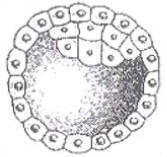
Identify the human developmental stage shown below as well as the related right place of its occurrence in a normal pregnant woman,and select the right option for the two,together.
A
Late morula $\to$ Middle part of Fallopian tube
B
Blastula $\to$ End part of Fallopian tube
C
Blastocyst $\to$ Uterine wall
D
$8$-celled morula $\to$ Starting point of Fallopian tube
Solution
(C) : After fertilization,the zygote undergoes rapid mitotic divisions,called cleavage,which is characterized by the absence of growth of daughter cells. This leads to the conversion of a single-celled zygote into a multicellular structure called a blastocyst. Implantation or embedding of the zygote into the endometrium of the uterus occurs in the blastocyst stage. The blastocyst comes in contact with the endometrium in the region of the embryonal knob or embryonic disc and adheres to it. The surface cells of the trophoblast secrete lytic enzymes which cause corrosion of the endometrial lining. They also give rise to finger-like outgrowths called chorionic villi. Chorionic villi and uterine tissue become interdigitated. Villi not only help in fixation but also in the absorption of nourishment.
0 likesView Solution
65
BiologyMediumMCQAIPMT · 2012
The secretory phase in the human menstrual cycle is also called
A
luteal phase and lasts for about $6$ days
B
follicular phase and lasts for about $6$ days
C
luteal phase and lasts for about $13$ days
D
follicular phase and lasts for about $13$ days.
Solution
(C) The secretory phase is also known as the luteal phase.
After ovulation,which occurs in the middle of the menstrual cycle,the empty Graafian follicle transforms into the corpus luteum under the influence of $LH$.
The corpus luteum secretes large amounts of progesterone,which is essential for the maintenance of the endometrium.
During this phase,the endometrial glands become secretory,preparing the uterine wall for the implantation of a blastocyst.
This phase typically lasts for about $13$ days,covering the period from day $16$ to day $28$ in a standard $28$-day menstrual cycle.
After ovulation,which occurs in the middle of the menstrual cycle,the empty Graafian follicle transforms into the corpus luteum under the influence of $LH$.
The corpus luteum secretes large amounts of progesterone,which is essential for the maintenance of the endometrium.
During this phase,the endometrial glands become secretory,preparing the uterine wall for the implantation of a blastocyst.
This phase typically lasts for about $13$ days,covering the period from day $16$ to day $28$ in a standard $28$-day menstrual cycle.
0 likesView Solution
66
BiologyMediumMCQAIPMT · 2012
The test-tube baby programme employs which one of the following techniques?
A
Intra cytoplasmic sperm injection $(ICSI)$
B
Intra uterine insemination $(IUI)$
C
Gamete intra Fallopian transfer $(GIFT)$
D
Zygote intra Fallopian transfer $(ZIFT)$
Solution
(D) : In the in vitro fertilization method,popularly known as the test-tube baby programme,ova from the wife/donor (female) and sperms from the husband/donor (male) are collected and induced to form a zygote under simulated conditions in the laboratory.
The zygote or early embryos (with up to $8$ blastomeres) can then be transferred into the Fallopian tube,which is known as Zygote Intra Fallopian Transfer $(ZIFT)$.
Embryos with more than $8$ blastomeres are transferred into the uterus,known as Intra Uterine Transfer $(IUT)$,to complete their further development.
The zygote or early embryos (with up to $8$ blastomeres) can then be transferred into the Fallopian tube,which is known as Zygote Intra Fallopian Transfer $(ZIFT)$.
Embryos with more than $8$ blastomeres are transferred into the uterus,known as Intra Uterine Transfer $(IUT)$,to complete their further development.
0 likesView Solution
67
BiologyMediumMCQAIPMT · 2012
$A$ normal-visioned man whose father was colour-blind,marries a woman whose father was also colour-blind. They have their first child as a daughter. What are the chances that this child would be colour-blind?
A
$1$
B
Zero percent
C
$0.25$
D
$0.5$
Solution
(B) Colour blindness is an $X$-linked recessive trait. Let $X^C$ be the allele for colour blindness and $X$ be the normal allele.
$1$. The man is normal-visioned,so his genotype is $XY$. His father was colour-blind,but this does not affect the man's genotype as he inherits his $Y$ chromosome from his father.
$2$. The woman's father was colour-blind,meaning she must be a carrier of the trait. Her genotype is $XX^C$.
$3$. The cross between the man $(XY)$ and the carrier woman $(XX^C)$ is: $XY \times XX^C$.
$4$. The possible genotypes of the offspring are: $XX$ (normal daughter),$XX^C$ (carrier daughter),$XY$ (normal son),and $X^CY$ (colour-blind son).
$5$. The probability of having a colour-blind daughter is $0$ because a daughter needs to inherit the $X^C$ allele from both parents to be colour-blind,but the father is normal $(XY)$.
$1$. The man is normal-visioned,so his genotype is $XY$. His father was colour-blind,but this does not affect the man's genotype as he inherits his $Y$ chromosome from his father.
$2$. The woman's father was colour-blind,meaning she must be a carrier of the trait. Her genotype is $XX^C$.
$3$. The cross between the man $(XY)$ and the carrier woman $(XX^C)$ is: $XY \times XX^C$.
$4$. The possible genotypes of the offspring are: $XX$ (normal daughter),$XX^C$ (carrier daughter),$XY$ (normal son),and $X^CY$ (colour-blind son).
$5$. The probability of having a colour-blind daughter is $0$ because a daughter needs to inherit the $X^C$ allele from both parents to be colour-blind,but the father is normal $(XY)$.
0 likesView Solution
68
BiologyMediumMCQAIPMT · 2012
$F_2$ generation in a Mendelian cross showed that both genotypic and phenotypic ratios are same as $1 : 2 : 1$. It represents a case of
A
co-dominance
B
dihybrid cross
C
monohybrid cross with complete dominance
D
monohybrid cross with incomplete dominance
Solution
(D) : The inheritance of flower colour in the dog flower (snapdragon or Antirrhinum $sp.$) is a good example which shows incomplete dominance.
In a cross between true-breeding red-flowered $(RR)$ and true-breeding white-flowered plants $(rr)$,the $F_1$ $(Rr)$ was pink.
When the $F_1$ was self-pollinated,the $F_2$ resulted in the following ratio: $1$ $(RR)$ Red : $2$ $(Rr)$ Pink : $1$ $(rr)$ White.
Here,the genotype ratios were $1 : 2 : 1$,as in any Mendelian monohybrid cross,but the phenotype ratios had changed from the $3 : 1$ dominant:recessive ratio to $1 : 2 : 1$.
In a cross between true-breeding red-flowered $(RR)$ and true-breeding white-flowered plants $(rr)$,the $F_1$ $(Rr)$ was pink.
When the $F_1$ was self-pollinated,the $F_2$ resulted in the following ratio: $1$ $(RR)$ Red : $2$ $(Rr)$ Pink : $1$ $(rr)$ White.
Here,the genotype ratios were $1 : 2 : 1$,as in any Mendelian monohybrid cross,but the phenotype ratios had changed from the $3 : 1$ dominant:recessive ratio to $1 : 2 : 1$.
0 likesView Solution
69
BiologyMediumMCQAIPMT · 2012
Represented below is the inheritance pattern of a certain type of trait in humans. Which one of the following conditions could be an example of this pattern?
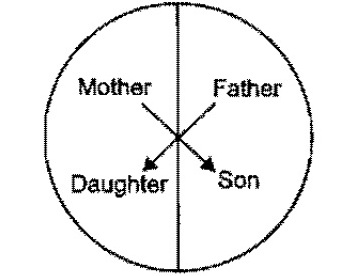
A
Phenylketonuria
B
Sickle cell anaemia
C
Haemophilia
D
Thalassemia
Solution
(C) The diagram shows a criss-cross inheritance pattern,where a trait is passed from the mother to her son and from the father to his daughter. This is characteristic of $X$-linked recessive inheritance.
$1$. Phenylketonuria,Sickle cell anaemia,and Thalassemia are autosomal recessive disorders.
$2$. Haemophilia is an $X$-linked recessive disorder that follows a criss-cross pattern of inheritance.
Therefore,the correct option is $C$.
$1$. Phenylketonuria,Sickle cell anaemia,and Thalassemia are autosomal recessive disorders.
$2$. Haemophilia is an $X$-linked recessive disorder that follows a criss-cross pattern of inheritance.
Therefore,the correct option is $C$.
0 likesView Solution
70
BiologyMediumMCQAIPMT · 2012
$A$ test cross is carried out to
A
determine the genotype of a plant at $F_2$
B
predict whether two traits are linked
C
assess the number of alleles of a gene
D
determine whether two species or varieties will breed successfully.
Solution
(A) test cross is performed to determine the genotype of an $F_2$ plant showing a dominant phenotype.
In a typical test cross,an organism with a dominant phenotype whose genotype is unknown is crossed with an individual that is homozygous recessive for the trait being investigated.
The resulting progeny can be analyzed to determine the genotype of the parent organism.
If the progeny shows a $1:1$ ratio of dominant to recessive phenotypes,the parent was heterozygous $(Aa)$.
If all progeny show the dominant phenotype,the parent was homozygous dominant $(AA)$.
In a typical test cross,an organism with a dominant phenotype whose genotype is unknown is crossed with an individual that is homozygous recessive for the trait being investigated.
The resulting progeny can be analyzed to determine the genotype of the parent organism.
If the progeny shows a $1:1$ ratio of dominant to recessive phenotypes,the parent was heterozygous $(Aa)$.
If all progeny show the dominant phenotype,the parent was homozygous dominant $(AA)$.
0 likesView Solution
71
BiologyEasyMCQAIPMT · 2012
Removal of introns and joining of exons in a defined order during transcription is called
A
looping
B
inducing
C
slicing
D
splicing
Solution
(D) The correct answer is $D$.
In eukaryotic cells,the primary transcript (pre-$mRNA$) contains both coding sequences called exons and non-coding sequences called introns.
The process of removing these non-coding introns and joining the coding exons together in a specific order to form a mature $mRNA$ molecule is known as splicing.
This process is essential for the production of functional proteins,as introns do not code for amino acids.
In eukaryotic cells,the primary transcript (pre-$mRNA$) contains both coding sequences called exons and non-coding sequences called introns.
The process of removing these non-coding introns and joining the coding exons together in a specific order to form a mature $mRNA$ molecule is known as splicing.
This process is essential for the production of functional proteins,as introns do not code for amino acids.
0 likesView Solution
72
BiologyMediumMCQAIPMT · 2012
If one strand of $DNA$ has the nitrogenous base sequence as $ATCTG$,what would be the complementary $RNA$ strand sequence?
A
$TTAGU$
B
$UAGAC$
C
$AACTG$
D
$ATCGU$
Solution
(B) In $DNA$,the base pairing rules are $A$ pairs with $T$,and $C$ pairs with $G$.
During the process of transcription,$DNA$ is transcribed into $RNA$.
In $RNA$,the base uracil $(U)$ replaces thymine $(T)$.
Therefore,the complementary $RNA$ sequence for the $DNA$ template strand $ATCTG$ is determined as follows:
$A$ pairs with $U$
$T$ pairs with $A$
$C$ pairs with $G$
$T$ pairs with $A$
$G$ pairs with $C$
Thus,the resulting $RNA$ sequence is $UAGAC$.
During the process of transcription,$DNA$ is transcribed into $RNA$.
In $RNA$,the base uracil $(U)$ replaces thymine $(T)$.
Therefore,the complementary $RNA$ sequence for the $DNA$ template strand $ATCTG$ is determined as follows:
$A$ pairs with $U$
$T$ pairs with $A$
$C$ pairs with $G$
$T$ pairs with $A$
$G$ pairs with $C$
Thus,the resulting $RNA$ sequence is $UAGAC$.
0 likesView Solution
73
BiologyMediumMCQAIPMT · 2012
Which one of the following is not a part of a transcription unit in $DNA$?
A
The inducer
B
$A$ terminator
C
$A$ promoter
D
The structural gene
Solution
(A) The correct answer is $A$.
$A$ transcription unit in $DNA$ is defined primarily by three regions:
$1$. $A$ promoter: The site where $RNA$ polymerase binds to initiate the process of transcription.
$2$. The structural gene: The segment of $DNA$ that codes for an $RNA$ molecule.
$3$. $A$ terminator: The region that signals the termination of the transcription process and the release of the newly synthesized $RNA$ strand.
The inducer is a regulatory molecule (often a small metabolite) that interacts with a repressor protein to regulate gene expression,but it is not a structural component of the transcription unit itself.
$A$ transcription unit in $DNA$ is defined primarily by three regions:
$1$. $A$ promoter: The site where $RNA$ polymerase binds to initiate the process of transcription.
$2$. The structural gene: The segment of $DNA$ that codes for an $RNA$ molecule.
$3$. $A$ terminator: The region that signals the termination of the transcription process and the release of the newly synthesized $RNA$ strand.
The inducer is a regulatory molecule (often a small metabolite) that interacts with a repressor protein to regulate gene expression,but it is not a structural component of the transcription unit itself.
0 likesView Solution
74
BiologyMediumMCQAIPMT · 2012
Removal of $RNA$ polymerase $III$ from nucleoplasm will affect the synthesis of
A
$tRNA$
B
$hnRNA$
C
$mRNA$
D
$rRNA$
Solution
(A) In eukaryotes,there are three main types of $RNA$ polymerases involved in transcription:
$1$. $RNA$ polymerase $I$ is responsible for the synthesis of $rRNA$ ($28S, 18S,$ and $5.8S$).
$2$. $RNA$ polymerase $II$ is responsible for the synthesis of $hnRNA$ (precursor of $mRNA$).
$3$. $RNA$ polymerase $III$ is responsible for the synthesis of $tRNA$,$5S$ $rRNA$,and $snRNA$.
Therefore,the removal of $RNA$ polymerase $III$ will specifically affect the synthesis of $tRNA$.
$1$. $RNA$ polymerase $I$ is responsible for the synthesis of $rRNA$ ($28S, 18S,$ and $5.8S$).
$2$. $RNA$ polymerase $II$ is responsible for the synthesis of $hnRNA$ (precursor of $mRNA$).
$3$. $RNA$ polymerase $III$ is responsible for the synthesis of $tRNA$,$5S$ $rRNA$,and $snRNA$.
Therefore,the removal of $RNA$ polymerase $III$ will specifically affect the synthesis of $tRNA$.
0 likesView Solution
75
BiologyMediumMCQAIPMT · 2012
Removal of introns and joining the exons in a defined order in a transcription unit is called
A
tailing
B
transformation
C
capping
D
splicing
Solution
(D) : $mRNA$ is not made directly in a eukaryotic cell. It is transcribed as heterogeneous nuclear $RNA$ $(hnRNA)$ in the nucleus. $hnRNA$ contains introns and exons. The introns are removed by $RNA$ splicing,leaving behind the exons,which contain the coding information. The exonic regions of $RNA$ are joined together to produce a single chain $RNA$ required for functioning as a translational template.
0 likesView Solution
76
BiologyEasyMCQAIPMT · 2012
Evolution of different species in a given area starting from a point and spreading to other geographical areas is known as
A
adaptive radiation
B
natural selection
C
migration
D
divergent evolution
Solution
(A) Adaptive radiation is the process of evolution of different species in a given geographical area starting from a single point and radiating to other areas of geography.
This phenomenon is a type of divergent evolution where organisms diversify rapidly from an ancestral species into a multitude of new forms,particularly when a change in the environment makes new resources available or creates new challenges.
As the original population increases,it spreads from its center of origin to exploit new habitats and food sources.
Over time,these populations adapt to their specific habitats and eventually become distinct enough to be classified as new species.
This phenomenon is a type of divergent evolution where organisms diversify rapidly from an ancestral species into a multitude of new forms,particularly when a change in the environment makes new resources available or creates new challenges.
As the original population increases,it spreads from its center of origin to exploit new habitats and food sources.
Over time,these populations adapt to their specific habitats and eventually become distinct enough to be classified as new species.
0 likesView Solution
77
BiologyMediumMCQAIPMT · 2012
Which one of the following options gives one correct example each of convergent evolution and divergent evolution?
A
Eyes of octopus $\rightarrow$ Bones of forelimbs of mammals and vertebrates
B
Thorns of Bougainvillea and tendrils of Cucurbita $\rightarrow$ Wings of butterflies and birds
C
Bones of forelimbs of vertebrates $\rightarrow$ Wings of butterfly and birds
D
Thorns of Bougainvillea and tendrils of Cucurbita $\rightarrow$ Eyes of octopus and mammals
Solution
(D) Convergent evolution refers to the development of similar adaptive functional structures in unrelated groups of organisms,which is known as analogy. Examples include the wings of butterflies and birds,the eyes of octopuses and mammals,and the flippers of penguins and dolphins.
Divergent evolution involves the development of different functional structures along different directions due to adaptations to different needs from a common ancestral form. $A$ classic example is the forelimbs of vertebrates (e.g.,whales,bats,cheetahs,and humans). Although these limbs perform different functions,they share a similar anatomical structure (homology). Therefore,the correct pair is: Thorns of Bougainvillea and tendrils of Cucurbita (divergent) $\rightarrow$ Eyes of octopus and mammals (convergent).
Divergent evolution involves the development of different functional structures along different directions due to adaptations to different needs from a common ancestral form. $A$ classic example is the forelimbs of vertebrates (e.g.,whales,bats,cheetahs,and humans). Although these limbs perform different functions,they share a similar anatomical structure (homology). Therefore,the correct pair is: Thorns of Bougainvillea and tendrils of Cucurbita (divergent) $\rightarrow$ Eyes of octopus and mammals (convergent).
0 likesView Solution
78
BiologyMediumMCQAIPMT · 2012
What was the most significant trend in the evolution of modern man ($Homo$ $sapiens$) from his ancestors?
A
Shortening of jaws
B
Binocular vision
C
Increasing cranial capacity
D
Upright posture
Solution
(C) The correct answer is $(C)$.
Binocular vision,smaller jaws,and upright posture are important adaptations that occurred during human evolution.
However,the most significant trend in the evolution of modern man from his ancestors is the increase in cranial capacity.
In modern humans ($Homo$ $sapiens$),the cranial capacity is approximately $1450$ $cc$,whereas it was only about $500$ $cc$ in $Australopithecus$.
This increased cranial capacity allowed for a larger brain,which serves as the foundation for the social,cultural,and intellectual development of modern man.
Binocular vision,smaller jaws,and upright posture are important adaptations that occurred during human evolution.
However,the most significant trend in the evolution of modern man from his ancestors is the increase in cranial capacity.
In modern humans ($Homo$ $sapiens$),the cranial capacity is approximately $1450$ $cc$,whereas it was only about $500$ $cc$ in $Australopithecus$.
This increased cranial capacity allowed for a larger brain,which serves as the foundation for the social,cultural,and intellectual development of modern man.
0 likesView Solution
79
BiologyMediumMCQAIPMT · 2012
The extinct human who lived $1,00,000$ to $40,000$ years ago,in Europe,Asia and parts of Africa,with short stature,heavy eye brows,retreating foreheads,large jaws with heavy teeth,stocky bodies,a lumbering gait and stooped posture was
A
Homo habilis
B
Neanderthal human
C
Cro-magnon human
D
Ramapithecus
Solution
(B) The correct answer is $B$. The $Neanderthal$ human ($Homo$ $neanderthalensis$) lived in near-eastern and central Asia and Europe between $1,00,000$ and $40,000$ years ago. They were characterized by a short stature,heavy eyebrows,retreating foreheads,large jaws with heavy teeth,stocky bodies,a lumbering gait,and a stooped posture. They used hides to protect their bodies and buried their dead.
0 likesView Solution
80
BiologyMediumMCQAIPMT · 2012
The idea of mutations was brought forth by
A
Hugo de Vries who worked on evening primrose
B
Gregor Mendel who worked on Pisum sativum
C
Hardy Weinberg who worked on allele frequencies in a population
D
Charles Darwin who observed a wide variety of organisms during sea voyage.
Solution
(A) : The term mutation was coined by Hugo de Vries $(1901)$ for large spontaneous inheritable changes which occur suddenly in naturally reproducing populations.
He also proposed the mutation theory of evolution in his book "The Mutation Theory" published in $1903$, in which he stated that evolution occurred due to large, discontinuous variations.
He worked on $Oenothera$ $lamarckiana$, commonly known as the evening primrose.
During his experiments, he observed $834$ mutations in a population of $54343$ plants.
It was later discovered that the mutations observed by Hugo de Vries were actually chromosomal aberrations.
He also proposed the mutation theory of evolution in his book "The Mutation Theory" published in $1903$, in which he stated that evolution occurred due to large, discontinuous variations.
He worked on $Oenothera$ $lamarckiana$, commonly known as the evening primrose.
During his experiments, he observed $834$ mutations in a population of $54343$ plants.
It was later discovered that the mutations observed by Hugo de Vries were actually chromosomal aberrations.
0 likesView Solution
81
BiologyMediumMCQAIPMT · 2012
Motile zygote of $Plasmodium$ occurs in
A
gut of female $Anopheles$
B
salivary glands of $Anopheles$
C
human $RBCs$
D
human liver
Solution
(A) $Plasmodium$,a tiny protozoan parasite,causes malaria in humans and is transmitted through the bite of an infected female $Anopheles$ mosquito.
When a female $Anopheles$ mosquito sucks the blood of an infected human,it ingests gametocytes (sexual stages of the parasite) with the blood meal.
The gametocytes are released from the $RBCs$ into the lumen (cavity) of the mosquito's stomach.
In the stomach,the male gametocyte divides to form $6$ to $8$ long,motile,whip-like microgametes (male gametes).
The female gametocyte matures into a macrogamete (female gamete).
Fertilization (syngamy) occurs when a microgamete penetrates a macrogamete,resulting in the formation of a zygote.
The zygote elongates and transforms into a worm-like,motile organism called an ookinete.
Therefore,the motile zygote (ookinete) of $Plasmodium$ is found in the gut of the female $Anopheles$ mosquito.
When a female $Anopheles$ mosquito sucks the blood of an infected human,it ingests gametocytes (sexual stages of the parasite) with the blood meal.
The gametocytes are released from the $RBCs$ into the lumen (cavity) of the mosquito's stomach.
In the stomach,the male gametocyte divides to form $6$ to $8$ long,motile,whip-like microgametes (male gametes).
The female gametocyte matures into a macrogamete (female gamete).
Fertilization (syngamy) occurs when a microgamete penetrates a macrogamete,resulting in the formation of a zygote.
The zygote elongates and transforms into a worm-like,motile organism called an ookinete.
Therefore,the motile zygote (ookinete) of $Plasmodium$ is found in the gut of the female $Anopheles$ mosquito.
0 likesView Solution
82
BiologyEasyMCQAIPMT · 2012
Widal test is carried out to test
A
malaria
B
diabetes mellitus
C
$HIV/AIDS$
D
typhoid fever
Solution
(D) The $Widal$ test (developed by $G.F.I. Widal$) is a serological agglutination test used to detect the presence of antibodies against the $Salmonella$ $typhi$ bacterium,which causes typhoid fever.
It is a diagnostic tool used to confirm the presence of typhoid infection in a patient by identifying specific antigens or antibodies in the blood serum.
It is a diagnostic tool used to confirm the presence of typhoid infection in a patient by identifying specific antigens or antibodies in the blood serum.
0 likesView Solution
83
BiologyMediumMCQAIPMT · 2012
Common cold differs from pneumonia in that
A
pneumonia is a communicable disease whereas the common cold is a nutritional deficiency disease
B
pneumonia can be prevented by a live attenuated bacterial vaccine whereas the common cold has no effective vaccine
C
pneumonia is caused by a virus while the common cold is caused by the bacterium Haemophilus influenzae
D
pneumonia pathogen infects alveoli whereas the common cold affects nose and respiratory passage but not the lungs.
Solution
(D) : Common cold or rhinitis is one of the most infectious diseases caused by Rhino viruses.
It affects the nose and respiratory passage but not the lungs.
It spreads by droplet infection or contaminated objects.
Pneumonia, caused by bacteria $Streptococcus$ $pneumoniae$ and $Haemophilus$ $influenzae$, is a serious disease of the lungs, in which fluid collects in the alveoli and bronchioles.
The disease spreads by the sputum of the patient.
It affects the nose and respiratory passage but not the lungs.
It spreads by droplet infection or contaminated objects.
Pneumonia, caused by bacteria $Streptococcus$ $pneumoniae$ and $Haemophilus$ $influenzae$, is a serious disease of the lungs, in which fluid collects in the alveoli and bronchioles.
The disease spreads by the sputum of the patient.
0 likesView Solution
84
BiologyMediumMCQAIPMT · 2012
Which one of the following is not a property of cancerous cells,whereas the remaining three are?
A
They compete with normal cells for vital nutrients.
B
They do not remain confined in the area of formation.
C
They divide in an uncontrolled manner.
D
They show contact inhibition.
Solution
(D) : Contact inhibition is a property of normal cells by virtue of which contact with other cells inhibits their uncontrolled growth. Cancerous cells lack this property,which allows them to continue dividing and form tumors.
0 likesView Solution
85
BiologyMediumMCQAIPMT · 2012
Cirrhosis of the liver is caused by the chronic intake of
A
opium
B
alcohol
C
tobacco (chewing)
D
cocaine
Solution
(B) : Cirrhosis is a condition in which the liver responds to injury or death of some of its cells by producing interlacing strands of fibrous tissue,between which are nodules of regenerating cells. The liver becomes tawny and characteristically knobbly due to the presence of these nodules. Chronic alcohol consumption is a primary cause of this condition,known as alcoholic cirrhosis.
0 likesView Solution
86
BiologyMediumMCQAIPMT · 2012
Identify the molecules $(A)$ and $(B)$ shown below and select the right option giving their source and use.
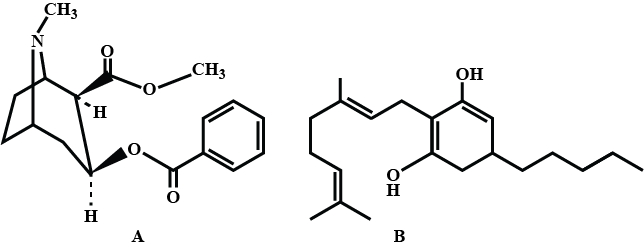
A
$(A)$ Cocaine $\rightarrow$ Erythroxylum coca $\rightarrow$ Accelerates the transport of dopamine
B
$(B)$ Heroin $\rightarrow$ Cannabis sativa $\rightarrow$ Depressant and slows down body functions
C
$(B)$ Cannabinoid $\rightarrow$ Atropa belladonna $\rightarrow$ Produces hallucinations
D
$(A)$ Morphine $\rightarrow$ Papaver somniferum $\rightarrow$ Sedative and pain killer
Solution
(A) The chemical structure $(A)$ represents Cocaine,which is obtained from the plant Erythroxylum coca. It interferes with the transport of the neurotransmitter dopamine,causing euphoria and increased energy.
The chemical structure $(B)$ represents a Cannabinoid,which is obtained from the inflorescence of the plant Cannabis sativa. Cannabinoids are known for their effects on the cardiovascular system and can produce hallucinogenic effects.
Option $(A)$ correctly identifies molecule $(A)$ as Cocaine,its source as Erythroxylum coca,and its effect on dopamine transport.
Therefore,the correct option is $(A)$.
The chemical structure $(B)$ represents a Cannabinoid,which is obtained from the inflorescence of the plant Cannabis sativa. Cannabinoids are known for their effects on the cardiovascular system and can produce hallucinogenic effects.
Option $(A)$ correctly identifies molecule $(A)$ as Cocaine,its source as Erythroxylum coca,and its effect on dopamine transport.
Therefore,the correct option is $(A)$.
0 likesView Solution
87
BiologyEasyMCQAIPMT · 2012
Widal test is used for the diagnosis of
A
malaria
B
pneumonia
C
tuberculosis
D
typhoid
Solution
(D) The correct answer is $D$.
Widal test (developed by $G.F.I$ Widal) is a serological agglutination test used for the diagnosis of typhoid fever.
It detects the presence of antibodies against the $Salmonella$ $typhi$ bacterium in the patient's serum.
This test helps in confirming the infection caused by $Salmonella$ $typhi$.
Widal test (developed by $G.F.I$ Widal) is a serological agglutination test used for the diagnosis of typhoid fever.
It detects the presence of antibodies against the $Salmonella$ $typhi$ bacterium in the patient's serum.
This test helps in confirming the infection caused by $Salmonella$ $typhi$.
0 likesView Solution
88
BiologyMediumMCQAIPMT · 2012
Which one of the following is a case of wrong matching?
A
Somatic hybridization $\rightarrow$ Fusion of two diverse cells
B
Vector $DNA$ $\rightarrow$ Site for tRNA synthesis
C
Micropropagation $\rightarrow$ In vitro production of plants in large numbers
D
Callus $\rightarrow$ Unorganised mass of cells produced in tissue culture
Solution
(B) is the correct answer because it is a wrong match. Vectors are $DNA$ molecules used as vehicles to carry a foreign $DNA$ segment into a host cell,where they replicate. They are not sites for $tRNA$ synthesis.
$A$ is correct: Somatic hybridization involves the fusion of protoplasts from two different plant species.
$C$ is correct: Micropropagation is the production of genetically identical plants in large numbers using tissue culture methods.
$D$ is correct: Callus is an unorganized,undifferentiated mass of cells that develops from an explant during tissue culture.
$A$ is correct: Somatic hybridization involves the fusion of protoplasts from two different plant species.
$C$ is correct: Micropropagation is the production of genetically identical plants in large numbers using tissue culture methods.
$D$ is correct: Callus is an unorganized,undifferentiated mass of cells that develops from an explant during tissue culture.
0 likesView Solution
89
BiologyMediumMCQAIPMT · 2012
Which part would be most suitable for raising virus-free plants for micropropagation?
A
Bark
B
Vascular tissue
C
Meristem
D
Node
Solution
(C) : Meristem is a localized group of cells that are actively dividing and undifferentiated, ultimately giving rise to permanent tissue.
Even if a plant is infected with a virus, the meristem remains free of the virus.
Therefore, the meristem can be removed and grown $in vitro$ to obtain virus-free plants.
The cultivation of axillary or apical shoot meristems is known as meristem culture.
The apical or axillary meristems are generally free from viruses.
Even if a plant is infected with a virus, the meristem remains free of the virus.
Therefore, the meristem can be removed and grown $in vitro$ to obtain virus-free plants.
The cultivation of axillary or apical shoot meristems is known as meristem culture.
The apical or axillary meristems are generally free from viruses.
0 likesView Solution
90
BiologyEasyMCQAIPMT · 2012
Green revolution in India occurred during (in $s$)
A
$1960$
B
$1970$
C
$1980$
D
$1950$
Solution
(A) The Green Revolution refers to the period of significant increase in agricultural production in India,which occurred during the mid-$1960s$.
This phase involved the development and use of high-yielding varieties $(HYVs)$ of wheat and rice,improved irrigation facilities,increased use of fertilizers,and better pest and disease control.
$Norman E. Borlaug$ is known as the Father of the Green Revolution globally for developing semi-dwarf wheat varieties.
In India,$Dr. M.S. Swaminathan$ is recognized as the Father of the Green Revolution.
In $1963$,wheat varieties like $Sonalika$ and $Kalyan Sona$ were introduced,and in $1966$,semi-dwarf rice varieties like $IR-8$ and $Taichung Native-1$ were introduced,marking the onset of this revolution.
This phase involved the development and use of high-yielding varieties $(HYVs)$ of wheat and rice,improved irrigation facilities,increased use of fertilizers,and better pest and disease control.
$Norman E. Borlaug$ is known as the Father of the Green Revolution globally for developing semi-dwarf wheat varieties.
In India,$Dr. M.S. Swaminathan$ is recognized as the Father of the Green Revolution.
In $1963$,wheat varieties like $Sonalika$ and $Kalyan Sona$ were introduced,and in $1966$,semi-dwarf rice varieties like $IR-8$ and $Taichung Native-1$ were introduced,marking the onset of this revolution.
0 likesView Solution
91
BiologyEasyMCQAIPMT · 2012
Monascus purpureus is a yeast used commercially in the production of
A
ethanol
B
streptokinase for removing clots from the blood vessels
C
citric acid
D
blood cholesterol lowering statins
Solution
(D) $Monascus$ $purpureus$ is a yeast used commercially in the production of blood cholesterol-lowering statins.
Statins act by competitively inhibiting the enzyme responsible for the synthesis of cholesterol in the body.
Statins act by competitively inhibiting the enzyme responsible for the synthesis of cholesterol in the body.
0 likesView Solution
92
BiologyMediumMCQAIPMT · 2012
$A$ nitrogen-fixing microbe associated with $Azolla$ in rice fields is
A
Spirulina
B
Anabaena
C
Frankia
D
Tolypothrix
Solution
(B) : $Azolla$ plays a very important role in rice production.
$Azolla$ and its nitrogen-fixing partner,$Anabaena$,have been used as green manure to fertilise rice paddies and increase production.
With the help of $Azolla$,rice can be grown year after year,several crops a year,with little or no decline in productivity; hence no rotation of crops is necessary.
$Azolla$ and its nitrogen-fixing partner,$Anabaena$,have been used as green manure to fertilise rice paddies and increase production.
With the help of $Azolla$,rice can be grown year after year,several crops a year,with little or no decline in productivity; hence no rotation of crops is necessary.
0 likesView Solution
93
BiologyMediumMCQAIPMT · 2012
Which one of the following is an example of carrying out biological control of pests or diseases using microbes?
A
$Trichoderma$ $sp.$ against certain plant pathogens.
B
$Nucleopolyhedrovirus$ against white rust in $Brassica$.
C
$Bt$-cotton to increase cotton yield.
D
Ladybird beetle against aphids in mustard.
Solution
(A) : $Trichoderma$ species are free-living fungi that are very common in root ecosystems.
They act as effective biological control agents against several plant pathogens.
$Nucleopolyhedrovirus$ (Baculoviruses) are used for insects and arthropods,not for white rust.
$Bt$-cotton is a genetically modified crop,not a direct microbial biocontrol application.
Ladybird beetle is a predator,not a microbe.
They act as effective biological control agents against several plant pathogens.
$Nucleopolyhedrovirus$ (Baculoviruses) are used for insects and arthropods,not for white rust.
$Bt$-cotton is a genetically modified crop,not a direct microbial biocontrol application.
Ladybird beetle is a predator,not a microbe.
0 likesView Solution
94
BiologyMediumMCQAIPMT · 2012
In gobar gas,the maximum amount is that of
A
butane
B
methane
C
propane
D
carbon dioxide
Solution
(B) Biogas or gobar gas is a methane-rich fuel gas produced by the anaerobic breakdown or digestion of biomass with the help of methanogenic bacteria.
It is primarily composed of methane $(50-70\%)$,carbon dioxide $(30-40\%)$,and traces of nitrogen,hydrogen sulphide,and hydrogen.
Therefore,methane is present in the maximum amount in gobar gas.
It is primarily composed of methane $(50-70\%)$,carbon dioxide $(30-40\%)$,and traces of nitrogen,hydrogen sulphide,and hydrogen.
Therefore,methane is present in the maximum amount in gobar gas.
0 likesView Solution
95
BiologyMediumMCQAIPMT · 2012
Read the following four statements $(A-D)$.
$(A)$ Colostrum is recommended for the new born because it is rich in antibodies.
$(B)$ Chikungunya is caused by a Gram-negative bacterium.
$(C)$ Tissue culture has proved useful in obtaining virus-free plants.
$(D)$ Beer is manufactured by distillation of fermented grape juice.
How many of the above statements are wrong?
$(A)$ Colostrum is recommended for the new born because it is rich in antibodies.
$(B)$ Chikungunya is caused by a Gram-negative bacterium.
$(C)$ Tissue culture has proved useful in obtaining virus-free plants.
$(D)$ Beer is manufactured by distillation of fermented grape juice.
How many of the above statements are wrong?
A
Two
B
Three
C
Four
D
One
Solution
$(A)$ Correct: Colostrum is the initial milk produced by the mother during the first few days of lactation, which is rich in antibodies, especially $IgA$, providing passive immunity to the newborn.
$(B)$ Incorrect: Chikungunya is a viral disease caused by the Chikungunya virus, which is transmitted to humans by infected mosquitoes, not by a bacterium.
$(C)$ Correct: Tissue culture, specifically meristem culture, is a widely used technique to produce virus-free plants because the meristematic tissue is typically free from viral infection.
$(D)$ Incorrect: Beer is produced by the fermentation of cereal grains like barley malt using yeast $(Saccharomyces \text{ } cerevisiae)$, not by the distillation of grape juice (which is used for wine/brandy).
Therefore, statements $(B)$ and $(D)$ are wrong. Thus, there are $2$ wrong statements.
$(B)$ Incorrect: Chikungunya is a viral disease caused by the Chikungunya virus, which is transmitted to humans by infected mosquitoes, not by a bacterium.
$(C)$ Correct: Tissue culture, specifically meristem culture, is a widely used technique to produce virus-free plants because the meristematic tissue is typically free from viral infection.
$(D)$ Incorrect: Beer is produced by the fermentation of cereal grains like barley malt using yeast $(Saccharomyces \text{ } cerevisiae)$, not by the distillation of grape juice (which is used for wine/brandy).
Therefore, statements $(B)$ and $(D)$ are wrong. Thus, there are $2$ wrong statements.
0 likesView Solution
96
BiologyMediumMCQAIPMT · 2012
The domestic sewage in large cities
A
has a high $BOD$ as it contains both aerobic and anaerobic bacteria
B
is processed by aerobic and then anaerobic bacteria in the secondary treatment in Sewage Treatment Plants $(STPs)$
C
when treated in $STPs$ does not really require the aeration step as the sewage contains adequate oxygen
D
has very high amount of suspended solids and dissolved salts.
Solution
(B) : Sewage water can be purified by passing it through sewage treatment plants with the action of heterotrophic microorganisms. There are three stages of this treatment - primary,secondary,and tertiary. Primary treatment removes floating and suspended solids from sewage through two processes of filtration and sedimentation. First,floating matter is removed through sequential filtration. The filtrate is kept in large open settling tanks where grit settles down. The sediment is called primary sludge,while the supernatant is called effluent. In secondary treatment,the primary effluent is taken to aeration tanks. $A$ large number of aerobic heterotrophic microbes grow in the aeration tank and form flocs. The microbes digest a lot of organic matter,reducing the $BOD$ of the waste. The sediment of the settling tank is called activated sludge. The remaining is passed into a large tank called an anaerobic sludge digester,where anaerobic microbes digest the organic mass and produce gases like methane,$H_2S$,and $CO_2$.
0 likesView Solution
97
BiologyMediumMCQAIPMT · 2012
Consider the following four statements $(A-D)$ and select the option which includes all the correct ones only.
$(A)$ Single cell $Spirulina$ can produce large quantities of food rich in protein,minerals,vitamins,etc.
$(B)$ Body weight-wise,the microorganism $Methylophilus$ $methylotrophus$ may be able to produce several times more proteins than the cows per day.
$(C)$ Common button mushrooms are a very rich source of vitamin $C$.
$(D)$ $A$ rice variety has been developed which is very rich in calcium.
$(A)$ Single cell $Spirulina$ can produce large quantities of food rich in protein,minerals,vitamins,etc.
$(B)$ Body weight-wise,the microorganism $Methylophilus$ $methylotrophus$ may be able to produce several times more proteins than the cows per day.
$(C)$ Common button mushrooms are a very rich source of vitamin $C$.
$(D)$ $A$ rice variety has been developed which is very rich in calcium.
A
Statements $(C)$ and $(D)$
B
Statements $(A), (C)$ and $(D)$
C
Statements $(B), (C)$ and $(D)$
D
Statements $(A)$ and $(B)$
Solution
(D) Statement $(A)$ is correct because $Spirulina$ is a single-cell protein $(SCP)$ source that is highly nutritious.
Statement $(B)$ is correct because $Methylophilus$ $methylotrophus$ has a high rate of biomass production due to its high rate of biomass doubling,allowing it to produce more protein per unit of body weight compared to cows.
Statement $(C)$ is incorrect because mushrooms are generally rich in proteins and fiber,but not a significant source of vitamin $C$.
Statement $(D)$ is incorrect because,while biofortified rice varieties exist (like Golden Rice for vitamin $A$),there is no widely recognized rice variety developed specifically for being rich in calcium.
Therefore,only statements $(A)$ and $(B)$ are correct.
Statement $(B)$ is correct because $Methylophilus$ $methylotrophus$ has a high rate of biomass production due to its high rate of biomass doubling,allowing it to produce more protein per unit of body weight compared to cows.
Statement $(C)$ is incorrect because mushrooms are generally rich in proteins and fiber,but not a significant source of vitamin $C$.
Statement $(D)$ is incorrect because,while biofortified rice varieties exist (like Golden Rice for vitamin $A$),there is no widely recognized rice variety developed specifically for being rich in calcium.
Therefore,only statements $(A)$ and $(B)$ are correct.
0 likesView Solution
98
BiologyMediumMCQAIPMT · 2012
Consumption of which one of the following foods can prevent the kind of blindness associated with vitamin $A$ deficiency?
A
'Flavr Savr' tomato
B
Canola
C
Golden rice
D
$Bt$-Brinjal
Solution
(C) The correct answer is $C$.
Golden rice is a genetically modified (transgenic) variety of rice $(Oryza sativa)$ engineered to produce $\beta$-carotene, which is a precursor (provitamin $A$) of vitamin $A$.
When consumed, the human body converts $\beta$-carotene into vitamin $A$.
Regular consumption of golden rice helps in preventing vitamin $A$ deficiency, which is a leading cause of childhood blindness in many developing countries.
The grains of this rice appear yellow due to the presence of $\beta$-carotene, hence the name 'Golden rice'.
Golden rice is a genetically modified (transgenic) variety of rice $(Oryza sativa)$ engineered to produce $\beta$-carotene, which is a precursor (provitamin $A$) of vitamin $A$.
When consumed, the human body converts $\beta$-carotene into vitamin $A$.
Regular consumption of golden rice helps in preventing vitamin $A$ deficiency, which is a leading cause of childhood blindness in many developing countries.
The grains of this rice appear yellow due to the presence of $\beta$-carotene, hence the name 'Golden rice'.
0 likesView Solution
99
BiologyMediumMCQAIPMT · 2012
Tobacco plants resistant to a nematode have been developed by the introduction of $DNA$ that produces (in the host cells)
A
both sense and anti-sense $RNA$
B
a particular hormone
C
an antifeedant
D
a toxic protein.
Solution
(A) : Many nematodes live in plants and animals including human beings. $A$ nematode $Meloidogyne \ incognita$ infests the roots of tobacco plants and causes a great reduction in yield. $A$ novel strategy was adopted to prevent this infection that was based on the process of $RNA$ interference $(RNAi)$.
$RNA$ interference $(RNAi)$ is the phenomenon of inhibiting the activity of a gene by the synthesis of $RNA$ molecules complementary to the $mRNA$. The normal (in vivo synthesized) $mRNA$ of a gene is said to be "sense" because it carries the codons that are "read" during translation.
Normally, the complement to the $mRNA$ "sense" strand will not contain a sequence of codons that can be translated to produce a functional protein; thus, this complementary strand is called "anti-sense $RNA$".
The anti-sense $RNA$ and $mRNA$ molecules will anneal to form duplex $RNA$ molecules (or double-stranded $RNA$), and the duplex $RNA$ molecules cannot be translated. Thus, the presence of anti-sense $RNA$ will block the translation of the $mRNA$ of the affected gene. In fact, recent evidence indicates that these $RNA$ duplexes are often rapidly degraded in vivo.
$RNA$ interference $(RNAi)$ is the phenomenon of inhibiting the activity of a gene by the synthesis of $RNA$ molecules complementary to the $mRNA$. The normal (in vivo synthesized) $mRNA$ of a gene is said to be "sense" because it carries the codons that are "read" during translation.
Normally, the complement to the $mRNA$ "sense" strand will not contain a sequence of codons that can be translated to produce a functional protein; thus, this complementary strand is called "anti-sense $RNA$".
The anti-sense $RNA$ and $mRNA$ molecules will anneal to form duplex $RNA$ molecules (or double-stranded $RNA$), and the duplex $RNA$ molecules cannot be translated. Thus, the presence of anti-sense $RNA$ will block the translation of the $mRNA$ of the affected gene. In fact, recent evidence indicates that these $RNA$ duplexes are often rapidly degraded in vivo.
0 likesView Solution
100
BiologyMediumMCQAIPMT · 2012
What is it that forms the basis of $DNA$ fingerprinting?
A
The relative proportions of purines and pyrimidines in $DNA$
B
The relative difference in the $DNA$ occurrence in blood,skin and saliva.
C
The relative amount of $DNA$ in the ridges and grooves of the fingerprints.
D
Satellite $DNA$ occurring as highly repeated short $DNA$ segments.
Solution
(D) $DNA$ fingerprinting is a technique used to identify nucleotide sequences in specific regions of $DNA$ that are unique to each individual.
The difference of approximately $0.1\%$ or $3 \times 10^6$ base pairs (out of $3 \times 10^9 \ bp$) provides individuality to each human being.
The human genome contains numerous small,non-coding,but inheritable base sequences that are repeated multiple times. These sequences are found near telomeres,centromeres,the $Y$ chromosome,and heterochromatic regions.
Regions containing the same sequence of bases repeated several times are known as repetitive $DNA$. During density gradient centrifugation,this $DNA$ separates as a satellite from the bulk $DNA$,hence it is called satellite $DNA$,where the repetition of bases occurs in tandem.
Satellite $DNAs$ exhibit polymorphism (the occurrence of mutations in a population at high frequency),which serves as the basis for both genetic mapping of the human genome and $DNA$ fingerprinting.
While mutations in genes produce alleles with different expressions,mutations in non-coding repetitive $DNA$ have no immediate impact. These accumulated mutations form the basis of polymorphism.
The difference of approximately $0.1\%$ or $3 \times 10^6$ base pairs (out of $3 \times 10^9 \ bp$) provides individuality to each human being.
The human genome contains numerous small,non-coding,but inheritable base sequences that are repeated multiple times. These sequences are found near telomeres,centromeres,the $Y$ chromosome,and heterochromatic regions.
Regions containing the same sequence of bases repeated several times are known as repetitive $DNA$. During density gradient centrifugation,this $DNA$ separates as a satellite from the bulk $DNA$,hence it is called satellite $DNA$,where the repetition of bases occurs in tandem.
Satellite $DNAs$ exhibit polymorphism (the occurrence of mutations in a population at high frequency),which serves as the basis for both genetic mapping of the human genome and $DNA$ fingerprinting.
While mutations in genes produce alleles with different expressions,mutations in non-coding repetitive $DNA$ have no immediate impact. These accumulated mutations form the basis of polymorphism.
0 likesView Solution
Vedclass Products
For Students
Vedclass Test Series
Mock tests in real AIPMT style covering Biology with performance analysis. 5-day free trial.
Start Free TrialFor Teachers
Exam Paper Generator
Generate Set A/B/C/D Biology papers from 7.5L+ questions in 2 minutes. 3 chapters free.
Try FreeFor Institutes
Online Exam Module
Run live AIPMT mock exams with unlimited students, 360° analytics & white-label branding.
See DemoFrequently Asked Questions
How many Biology questions are in AIPMT 2012?
There are 169 Biology questions from the AIPMT 2012 paper on Vedclass, each with a detailed step-by-step solution in English.
Are AIPMT 2012 Biology solutions available in English?
Yes. All solutions on this page are in English. You can also switch to English or Hindi using the language buttons above the questions.
Can I practice AIPMT 2012 Biology as a timed test?
Yes. Use the Vedclass Test Series to attempt a full AIPMT mock test covering Biology with time limits and instant score analysis.
Can teachers create Biology papers from AIPMT previous year questions?
Yes. The Vedclass Exam Paper Generator lets teachers mix AIPMT Biology questions and generate Set A/B/C/D papers in minutes.
For Teachers & Institutes
Build a Custom Biology Paper
Pick AIPMT 2012 Biology questions, set difficulty, and generate Set A/B/C/D in 2 minutes.