
PhysicsQ1–48 of 48 questions
Page 1 of 1 · English
1
PhysicsMediumMCQAIPMT · 2009
The internal energy change in a system that has absorbed $2 \; kcal$ of heat and done $500 \; J$ of work is ...... $J$.
A
$7900$
B
$8200$
C
$5600$
D
$6400$
Solution
(A) According to the first law of thermodynamics,$\Delta Q = \Delta U + \Delta W$,where $\Delta Q$ is the heat absorbed,$\Delta U$ is the change in internal energy,and $\Delta W$ is the work done by the system.
Given:
Heat absorbed,$\Delta Q = 2 \; kcal = 2 \times 10^3 \times 4.2 \; J = 8400 \; J$.
Work done,$\Delta W = 500 \; J$.
Substituting these values into the equation:
$\Delta U = \Delta Q - \Delta W$
$\Delta U = 8400 \; J - 500 \; J = 7900 \; J$.
Therefore,the internal energy change is $7900 \; J$.
Given:
Heat absorbed,$\Delta Q = 2 \; kcal = 2 \times 10^3 \times 4.2 \; J = 8400 \; J$.
Work done,$\Delta W = 500 \; J$.
Substituting these values into the equation:
$\Delta U = \Delta Q - \Delta W$
$\Delta U = 8400 \; J - 500 \; J = 7900 \; J$.
Therefore,the internal energy change is $7900 \; J$.
0 likesView Solution
2
PhysicsMediumMCQAIPMT · 2009
$A$ thin circular ring of mass $M$ and radius $r$ is rotating about its axis with a constant angular velocity $\omega$. Two objects,each of mass $m$,are attached gently to the opposite ends of a diameter of the ring. The ring will now rotate with an angular velocity:
A
$\frac{\omega (M - 2m)}{M + 2m}$
B
$\frac{\omega M}{M + 2m}$
C
$\frac{\omega M}{M + m}$
D
$\frac{\omega (M + 2m)}{M}$
Solution
(B) The initial moment of inertia of the ring about its axis is $I = Mr^2$.
The initial angular momentum is $L = I\omega = Mr^2\omega$.
When two objects of mass $m$ are attached to the opposite ends of a diameter,the new moment of inertia $I'$ becomes the sum of the ring's moment of inertia and the moment of inertia of the two point masses: $I' = Mr^2 + m(r)^2 + m(r)^2 = (M + 2m)r^2$.
According to the principle of conservation of angular momentum,the external torque is zero,so $L_{initial} = L_{final}$.
$Mr^2\omega = (M + 2m)r^2\omega'$
Solving for the new angular velocity $\omega'$:
$\omega' = \frac{Mr^2\omega}{(M + 2m)r^2} = \frac{M\omega}{M + 2m}$.
The initial angular momentum is $L = I\omega = Mr^2\omega$.
When two objects of mass $m$ are attached to the opposite ends of a diameter,the new moment of inertia $I'$ becomes the sum of the ring's moment of inertia and the moment of inertia of the two point masses: $I' = Mr^2 + m(r)^2 + m(r)^2 = (M + 2m)r^2$.
According to the principle of conservation of angular momentum,the external torque is zero,so $L_{initial} = L_{final}$.
$Mr^2\omega = (M + 2m)r^2\omega'$
Solving for the new angular velocity $\omega'$:
$\omega' = \frac{Mr^2\omega}{(M + 2m)r^2} = \frac{M\omega}{M + 2m}$.
1 likesView Solution
3
PhysicsMediumMCQAIPMT · 2009
The mean free path of electrons in a metal is $4 \times 10^{-8} \;m$. The electric field which can give on an average $2 \;eV$ energy to an electron in the metal will be in units of $V/m$.
A
$8 \times 10^7$
B
$5 \times 10^7$
C
$5 \times 10^{-11}$
D
$8 \times 10^{-11}$
Solution
(B) The energy gained by an electron in an electric field $E$ over a mean free path $\lambda$ is given by the work done: $W = qE\lambda$.
Given the energy $W = 2 \;eV$,the charge $q = e$,and the mean free path $\lambda = 4 \times 10^{-8} \;m$.
Substituting these values into the equation: $2 \;eV = e \times E \times (4 \times 10^{-8} \;m)$.
Since $1 \;eV$ is the energy gained by an electron moving through a potential difference of $1 \;V$,we have $2 \;e \;V = e \times E \times 4 \times 10^{-8} \;m$.
Dividing both sides by $e$ and $4 \times 10^{-8} \;m$,we get: $E = \frac{2}{4 \times 10^{-8}} \;V/m$.
$E = 0.5 \times 10^8 \;V/m = 5 \times 10^7 \;V/m$.
Given the energy $W = 2 \;eV$,the charge $q = e$,and the mean free path $\lambda = 4 \times 10^{-8} \;m$.
Substituting these values into the equation: $2 \;eV = e \times E \times (4 \times 10^{-8} \;m)$.
Since $1 \;eV$ is the energy gained by an electron moving through a potential difference of $1 \;V$,we have $2 \;e \;V = e \times E \times 4 \times 10^{-8} \;m$.
Dividing both sides by $e$ and $4 \times 10^{-8} \;m$,we get: $E = \frac{2}{4 \times 10^{-8}} \;V/m$.
$E = 0.5 \times 10^8 \;V/m = 5 \times 10^7 \;V/m$.
0 likesView Solution
4
PhysicsDifficultMCQAIPMT · 2009
If the dimensions of a physical quantity are given by $M^aL^bT^c$,then the physical quantity will be:
A
velocity if $a=1, b=0, c=-1$
B
acceleration if $a=1, b=1, c=-2$
C
force if $a=0, b=-1, c=-2$
D
pressure if $a=1, b=-1, c=-2$
Solution
(D) The dimensional formula for pressure is given by $P = \frac{\text{Force}}{\text{Area}} = \frac{[M^1 L^1 T^{-2}]}{[L^2]}$.
Simplifying this,we get $[P] = [M^1 L^{-1} T^{-2}]$.
Comparing this with the given form $M^a L^b T^c$,we find $a=1, b=-1, c=-2$.
Thus,the physical quantity is pressure when $a=1, b=-1, c=-2$.
Simplifying this,we get $[P] = [M^1 L^{-1} T^{-2}]$.
Comparing this with the given form $M^a L^b T^c$,we find $a=1, b=-1, c=-2$.
Thus,the physical quantity is pressure when $a=1, b=-1, c=-2$.
0 likesView Solution
5
PhysicsMediumMCQAIPMT · 2009
$A$ particle starts its motion from rest under the action of a constant force. If the distance covered in the first $10 \ s$ is $S_1$ and that covered in the first $20 \ s$ is $S_2$,then:
A
$S_2 = 2S_1$
B
$S_2 = 3S_1$
C
$S_2 = 4S_1$
D
$S_2 = S_1$
Solution
(C) Given that the particle starts from rest,the initial velocity $u = 0$.
Since the force is constant,the acceleration $a$ is also constant.
The distance $S$ covered in time $t$ is given by the equation of motion: $S = ut + \frac{1}{2}at^2$.
For $t = 10 \ s$,the distance $S_1 = 0(10) + \frac{1}{2}a(10)^2 = 50a$.
For $t = 20 \ s$,the distance $S_2 = 0(20) + \frac{1}{2}a(20)^2 = 200a$.
Comparing the two,$S_2 = 200a = 4(50a) = 4S_1$.
Therefore,$S_2 = 4S_1$.
Since the force is constant,the acceleration $a$ is also constant.
The distance $S$ covered in time $t$ is given by the equation of motion: $S = ut + \frac{1}{2}at^2$.
For $t = 10 \ s$,the distance $S_1 = 0(10) + \frac{1}{2}a(10)^2 = 50a$.
For $t = 20 \ s$,the distance $S_2 = 0(20) + \frac{1}{2}a(20)^2 = 200a$.
Comparing the two,$S_2 = 200a = 4(50a) = 4S_1$.
Therefore,$S_2 = 4S_1$.
0 likesView Solution
6
PhysicsEasyMCQAIPMT · 2009
$A$ bus is moving with a speed of $10\; m/s$ on a straight road. $A$ scooterist wishes to overtake the bus in $100\; s$. If the bus is at a distance of $1\; km$ from the scooterist,with what speed should the scooterist chase the bus? (in $m/s$)
A
$40$
B
$25$
C
$10$
D
$20$
Solution
(D) Let $v_s$ be the velocity of the scooter.
The initial distance between the scooter and the bus is $d = 1\; km = 1000\; m$.
The velocity of the bus is $v_b = 10\; m/s$.
The time taken to overtake is $t = 100\; s$.
The relative velocity of the scooter with respect to the bus is $v_{rel} = v_s - v_b = v_s - 10$.
Using the formula for relative motion,$d = v_{rel} \times t$:
$1000 = (v_s - 10) \times 100$
$10 = v_s - 10$
$v_s = 20\; m/s$.
Thus,the scooterist should chase the bus at a speed of $20\; m/s$.
The initial distance between the scooter and the bus is $d = 1\; km = 1000\; m$.
The velocity of the bus is $v_b = 10\; m/s$.
The time taken to overtake is $t = 100\; s$.
The relative velocity of the scooter with respect to the bus is $v_{rel} = v_s - v_b = v_s - 10$.
Using the formula for relative motion,$d = v_{rel} \times t$:
$1000 = (v_s - 10) \times 100$
$10 = v_s - 10$
$v_s = 20\; m/s$.
Thus,the scooterist should chase the bus at a speed of $20\; m/s$.
0 likesView Solution
7
PhysicsEasyMCQAIPMT · 2009
$A$ body,under the action of a force $\vec F = 6\hat i - 8\hat j + 10\hat k$,acquires an acceleration of $1\, m/s^2$. The mass of this body must be
A
$15\,kg$
B
$20\,kg$
C
$10\sqrt 2 \,kg$
D
$2\sqrt {10} \,kg$
Solution
(C) Given force vector $\vec F = 6\hat i - 8\hat j + 10\hat k$.
The magnitude of the force is given by $|\vec F| = \sqrt{6^2 + (-8)^2 + 10^2} = \sqrt{36 + 64 + 100} = \sqrt{200} = 10\sqrt 2 \,N$.
According to Newton's second law of motion,$F = ma$,where $m$ is the mass and $a$ is the acceleration.
Given acceleration $a = 1\, m/s^2$.
Therefore,$m = \frac{F}{a} = \frac{10\sqrt 2}{1} = 10\sqrt 2 \,kg$.
The magnitude of the force is given by $|\vec F| = \sqrt{6^2 + (-8)^2 + 10^2} = \sqrt{36 + 64 + 100} = \sqrt{200} = 10\sqrt 2 \,N$.
According to Newton's second law of motion,$F = ma$,where $m$ is the mass and $a$ is the acceleration.
Given acceleration $a = 1\, m/s^2$.
Therefore,$m = \frac{F}{a} = \frac{10\sqrt 2}{1} = 10\sqrt 2 \,kg$.
0 likesView Solution
8
PhysicsEasyMCQAIPMT · 2009
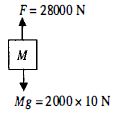
The mass of a lift is $2000 \, kg$. When the tension in the supporting cable is $28000 \, N$,then its acceleration is:
A
$30 \, m/s^2$ downwards
B
$4 \, m/s^2$ upwards
C
$4 \, m/s^2$ downwards
D
$14 \, m/s^2$ upwards
Solution
(B) Given:
Mass of the lift,$M = 2000 \, kg$
Tension in the cable,$T = 28000 \, N$
Acceleration due to gravity,$g = 10 \, m/s^2$
According to Newton's second law,the net force acting on the lift is $T - Mg = Ma$.
Substituting the values:
$28000 - (2000 \times 10) = 2000 \times a$
$28000 - 20000 = 2000 \times a$
$8000 = 2000 \times a$
$a = \frac{8000}{2000} = 4 \, m/s^2$
Since the tension is greater than the weight,the acceleration is directed upwards.
Mass of the lift,$M = 2000 \, kg$
Tension in the cable,$T = 28000 \, N$
Acceleration due to gravity,$g = 10 \, m/s^2$
According to Newton's second law,the net force acting on the lift is $T - Mg = Ma$.
Substituting the values:
$28000 - (2000 \times 10) = 2000 \times a$
$28000 - 20000 = 2000 \times a$
$8000 = 2000 \times a$
$a = \frac{8000}{2000} = 4 \, m/s^2$
Since the tension is greater than the weight,the acceleration is directed upwards.
0 likesView Solution
9
PhysicsMediumMCQAIPMT · 2009
An engine pumps water continuously through a hose. Water leaves the hose with a velocity $v$ and $m$ is the mass per unit length of the water jet. What is the rate at which kinetic energy is imparted to water?
A
$mv^2$
B
$\frac{1}{2} mv^2$
C
$\frac{1}{2} m^2v^2$
D
$\frac{1}{2} mv^3$
Solution
(D) Let the velocity of water be $v$ and the mass per unit length be $m$.
The mass of water flowing per unit time (mass flow rate) is given by the product of mass per unit length and velocity:
$\text{Mass flow rate} = m \times v$
The kinetic energy $K$ of a mass $M$ moving with velocity $v$ is $K = \frac{1}{2} Mv^2$.
The rate at which kinetic energy is imparted is the power $P$,which is the kinetic energy per unit time:
$P = \frac{1}{2} (\text{mass flow rate}) v^2$
$P = \frac{1}{2} (mv) v^2 = \frac{1}{2} mv^3$.
The mass of water flowing per unit time (mass flow rate) is given by the product of mass per unit length and velocity:
$\text{Mass flow rate} = m \times v$
The kinetic energy $K$ of a mass $M$ moving with velocity $v$ is $K = \frac{1}{2} Mv^2$.
The rate at which kinetic energy is imparted is the power $P$,which is the kinetic energy per unit time:
$P = \frac{1}{2} (\text{mass flow rate}) v^2$
$P = \frac{1}{2} (mv) v^2 = \frac{1}{2} mv^3$.
0 likesView Solution
10
PhysicsMediumMCQAIPMT · 2009
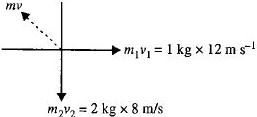
An explosion breaks a rock into three parts in a horizontal plane. Two of them go off at right angles to each other. The first part of mass $1 \, kg$ moves with a speed of $12 \, m s^{-1}$ and the second part of mass $2 \, kg$ moves with $8 \, m s^{-1}$ speed. If the third part flies off with $4 \, m s^{-1}$ speed,then its mass is ......... $kg$.
A
$7$
B
$17$
C
$3$
D
$5$
Solution
(D) According to the law of conservation of linear momentum,the initial momentum of the rock is zero. Therefore,the vector sum of the momenta of the three parts must be zero.
Let the momenta of the three parts be $\vec{p}_1$,$\vec{p}_2$,and $\vec{p}_3$.
$\vec{p}_1 + \vec{p}_2 + \vec{p}_3 = 0 \implies \vec{p}_3 = -(\vec{p}_1 + \vec{p}_2)$.
The magnitude of the momentum of the first part is $p_1 = m_1 v_1 = 1 \, kg \times 12 \, m s^{-1} = 12 \, kg \, m s^{-1}$.
The magnitude of the momentum of the second part is $p_2 = m_2 v_2 = 2 \, kg \times 8 \, m s^{-1} = 16 \, kg \, m s^{-1}$.
Since the two parts move at right angles to each other,the magnitude of the resultant momentum of these two parts is $p_{12} = \sqrt{p_1^2 + p_2^2} = \sqrt{12^2 + 16^2} = \sqrt{144 + 256} = \sqrt{400} = 20 \, kg \, m s^{-1}$.
The third part must have a momentum equal in magnitude and opposite in direction to this resultant momentum to satisfy the conservation law.
Thus,$p_3 = p_{12} = 20 \, kg \, m s^{-1}$.
Given the speed of the third part $v_3 = 4 \, m s^{-1}$,its mass $m_3$ is:
$m_3 = \frac{p_3}{v_3} = \frac{20 \, kg \, m s^{-1}}{4 \, m s^{-1}} = 5 \, kg$.
Let the momenta of the three parts be $\vec{p}_1$,$\vec{p}_2$,and $\vec{p}_3$.
$\vec{p}_1 + \vec{p}_2 + \vec{p}_3 = 0 \implies \vec{p}_3 = -(\vec{p}_1 + \vec{p}_2)$.
The magnitude of the momentum of the first part is $p_1 = m_1 v_1 = 1 \, kg \times 12 \, m s^{-1} = 12 \, kg \, m s^{-1}$.
The magnitude of the momentum of the second part is $p_2 = m_2 v_2 = 2 \, kg \times 8 \, m s^{-1} = 16 \, kg \, m s^{-1}$.
Since the two parts move at right angles to each other,the magnitude of the resultant momentum of these two parts is $p_{12} = \sqrt{p_1^2 + p_2^2} = \sqrt{12^2 + 16^2} = \sqrt{144 + 256} = \sqrt{400} = 20 \, kg \, m s^{-1}$.
The third part must have a momentum equal in magnitude and opposite in direction to this resultant momentum to satisfy the conservation law.
Thus,$p_3 = p_{12} = 20 \, kg \, m s^{-1}$.
Given the speed of the third part $v_3 = 4 \, m s^{-1}$,its mass $m_3$ is:
$m_3 = \frac{p_3}{v_3} = \frac{20 \, kg \, m s^{-1}}{4 \, m s^{-1}} = 5 \, kg$.
0 likesView Solution
11
PhysicsMediumMCQAIPMT · 2009
$A$ body of mass $1\,kg$ is thrown upwards with a velocity $20\,m/s$. It momentarily comes to rest after attaining a height of $18\,m$. How much energy is lost due to air friction? (Given $g = 10\,m/s^2$)
A
$30$
B
$40$
C
$10$
D
$20$
Solution
(D) Initial kinetic energy $(K_i)$ of the body is given by: $K_i = \frac{1}{2}mv^2 = \frac{1}{2} \times 1 \times (20)^2 = 200\,J$.
At the maximum height $h$ reached in the absence of air friction,the kinetic energy would be completely converted into potential energy: $mgh = 200\,J$.
Using $m = 1\,kg$ and $g = 10\,m/s^2$,the theoretical maximum height is $h = \frac{200}{1 \times 10} = 20\,m$.
However,the body only reaches a height of $h' = 18\,m$ due to air friction.
The potential energy at this height is $U_f = mgh' = 1 \times 10 \times 18 = 180\,J$.
The energy lost due to air friction is the difference between the initial kinetic energy and the final potential energy: $\Delta E = K_i - U_f = 200\,J - 180\,J = 20\,J$.
At the maximum height $h$ reached in the absence of air friction,the kinetic energy would be completely converted into potential energy: $mgh = 200\,J$.
Using $m = 1\,kg$ and $g = 10\,m/s^2$,the theoretical maximum height is $h = \frac{200}{1 \times 10} = 20\,m$.
However,the body only reaches a height of $h' = 18\,m$ due to air friction.
The potential energy at this height is $U_f = mgh' = 1 \times 10 \times 18 = 180\,J$.
The energy lost due to air friction is the difference between the initial kinetic energy and the final potential energy: $\Delta E = K_i - U_f = 200\,J - 180\,J = 20\,J$.
0 likesView Solution
12
PhysicsEasyMCQAIPMT · 2009
$A$ block of mass $M$ is attached to the lower end of a vertical spring. The spring is hung from a ceiling and has a force constant $k$. The mass is released from rest with the spring initially unstretched. The maximum extension produced in the length of the spring will be
A
$2 Mg/k$
B
$4 Mg/k$
C
$Mg/2k$
D
$Mg/k$
Solution
(A) Let the maximum extension in the spring be $x$.
According to the law of conservation of energy,the loss in gravitational potential energy of the block is equal to the gain in elastic potential energy of the spring.
Loss in gravitational potential energy = $Mgx$.
Gain in elastic potential energy = $\frac{1}{2} k x^2$.
Equating the two: $Mgx = \frac{1}{2} k x^2$.
Solving for $x$ (where $x \neq 0$): $x = \frac{2Mg}{k}$.
According to the law of conservation of energy,the loss in gravitational potential energy of the block is equal to the gain in elastic potential energy of the spring.
Loss in gravitational potential energy = $Mgx$.
Gain in elastic potential energy = $\frac{1}{2} k x^2$.
Equating the two: $Mgx = \frac{1}{2} k x^2$.
Solving for $x$ (where $x \neq 0$): $x = \frac{2Mg}{k}$.
0 likesView Solution
13
PhysicsEasyMCQAIPMT · 2009
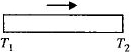
The two ends of a rod of length $L$ and a uniform cross-sectional area $A$ are kept at two temperatures $T_1$ and $T_2$ $(T_1 > T_2)$. The rate of heat transfer,$\frac{dQ}{dt}$,through the rod in a steady state is given by:
A
$\frac{k(T_1 - T_2)}{LA}$
B
$kLA(T_1 - T_2)$
C
$\frac{kA(T_1 - T_2)}{L}$
D
$\frac{kL(T_1 - T_2)}{A}$
Solution
(C) In a steady state,the rate of heat flow through a rod is analogous to the flow of electric current in a conductor,where the temperature difference corresponds to potential difference and thermal resistance corresponds to electrical resistance.
The formula for the rate of heat transfer $\frac{dQ}{dt}$ is given by Fourier's law of heat conduction:
$\frac{dQ}{dt} = \frac{kA(T_1 - T_2)}{L}$
Here,$k$ is the thermal conductivity of the material of the rod,$A$ is the cross-sectional area,$L$ is the length of the rod,and $(T_1 - T_2)$ is the temperature difference between the two ends.
The formula for the rate of heat transfer $\frac{dQ}{dt}$ is given by Fourier's law of heat conduction:
$\frac{dQ}{dt} = \frac{kA(T_1 - T_2)}{L}$
Here,$k$ is the thermal conductivity of the material of the rod,$A$ is the cross-sectional area,$L$ is the length of the rod,and $(T_1 - T_2)$ is the temperature difference between the two ends.
0 likesView Solution
14
PhysicsMediumMCQAIPMT · 2009
$A$ black body at $227^o C$ radiates heat at the rate of $7 \; cal/cm^2 s$. At a temperature of $727^o C$,the rate of heat radiated in the same units will be:
A
$50$
B
$112$
C
$80$
D
$60$
Solution
(B) According to Stefan-Boltzmann law,the rate of heat radiation $E$ is proportional to the fourth power of the absolute temperature $T$,i.e.,$E \propto T^4$.
Given:
Initial temperature $T_1 = 227^o C = (227 + 273) K = 500 K$.
Initial rate of radiation $E_1 = 7 \; cal/cm^2 s$.
Final temperature $T_2 = 727^o C = (727 + 273) K = 1000 K$.
Using the ratio formula:
$\frac{E_2}{E_1} = \left( \frac{T_2}{T_1} \right)^4$
Substituting the values:
$\frac{E_2}{7} = \left( \frac{1000}{500} \right)^4$
$\frac{E_2}{7} = (2)^4$
$\frac{E_2}{7} = 16$
$E_2 = 7 \times 16 = 112 \; cal/cm^2 s$.
Therefore,the rate of heat radiated at $727^o C$ is $112 \; cal/cm^2 s$.
Given:
Initial temperature $T_1 = 227^o C = (227 + 273) K = 500 K$.
Initial rate of radiation $E_1 = 7 \; cal/cm^2 s$.
Final temperature $T_2 = 727^o C = (727 + 273) K = 1000 K$.
Using the ratio formula:
$\frac{E_2}{E_1} = \left( \frac{T_2}{T_1} \right)^4$
Substituting the values:
$\frac{E_2}{7} = \left( \frac{1000}{500} \right)^4$
$\frac{E_2}{7} = (2)^4$
$\frac{E_2}{7} = 16$
$E_2 = 7 \times 16 = 112 \; cal/cm^2 s$.
Therefore,the rate of heat radiated at $727^o C$ is $112 \; cal/cm^2 s$.
0 likesView Solution
15
PhysicsMediumMCQAIPMT · 2009
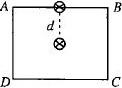
Four identical thin rods,each of mass $M$ and length $l$,form a square frame. The moment of inertia of this frame about an axis passing through the centre of the square and perpendicular to its plane is
A
$\frac{2}{3}Ml^2$
B
$\frac{13}{3}Ml^2$
C
$\frac{1}{3}Ml^2$
D
$\frac{4}{3}Ml^2$
Solution
(D) Consider one rod of the square frame,say rod $AB$. The moment of inertia of a rod of mass $M$ and length $l$ about an axis passing through its center and perpendicular to its length is $I_{cm} = \frac{Ml^2}{12}$.
The distance $d$ from the center of the rod $AB$ to the center of the square frame is $d = \frac{l}{2}$.
Using the parallel axis theorem,the moment of inertia of one rod about the axis passing through the center of the square and perpendicular to its plane is:
$I_{rod} = I_{cm} + Md^2 = \frac{Ml^2}{12} + M\left(\frac{l}{2}\right)^2 = \frac{Ml^2}{12} + \frac{Ml^2}{4} = \frac{Ml^2 + 3Ml^2}{12} = \frac{4Ml^2}{12} = \frac{Ml^2}{3}$.
Since there are four identical rods forming the square frame,the total moment of inertia $I$ is:
$I = 4 \times I_{rod} = 4 \times \frac{Ml^2}{3} = \frac{4}{3}Ml^2$.
The distance $d$ from the center of the rod $AB$ to the center of the square frame is $d = \frac{l}{2}$.
Using the parallel axis theorem,the moment of inertia of one rod about the axis passing through the center of the square and perpendicular to its plane is:
$I_{rod} = I_{cm} + Md^2 = \frac{Ml^2}{12} + M\left(\frac{l}{2}\right)^2 = \frac{Ml^2}{12} + \frac{Ml^2}{4} = \frac{Ml^2 + 3Ml^2}{12} = \frac{4Ml^2}{12} = \frac{Ml^2}{3}$.
Since there are four identical rods forming the square frame,the total moment of inertia $I$ is:
$I = 4 \times I_{rod} = 4 \times \frac{Ml^2}{3} = \frac{4}{3}Ml^2$.
0 likesView Solution
16
PhysicsMediumMCQAIPMT · 2009
If $\vec{F}$ is the force acting on a particle having position vector $\vec{r}$ and $\vec{\tau}$ is the torque of this force about the origin,then
A
$\vec{r} \cdot \vec{\tau} = 0$ and $\vec{F} \cdot \vec{\tau} \neq 0$
B
$\vec{r} \cdot \vec{\tau} \neq 0$ and $\vec{F} \cdot \vec{\tau} = 0$
C
$\vec{r} \cdot \vec{\tau} \neq 0$ and $\vec{F} \cdot \vec{\tau} \neq 0$
D
$\vec{r} \cdot \vec{\tau} = 0$ and $\vec{F} \cdot \vec{\tau} = 0$
Solution
(D) The torque $\vec{\tau}$ is defined as the cross product of the position vector $\vec{r}$ and the force vector $\vec{F}$,given by $\vec{\tau} = \vec{r} \times \vec{F}$.
By the definition of the cross product,the resulting vector $\vec{\tau}$ is always perpendicular to both the vectors $\vec{r}$ and $\vec{F}$ that form it.
Since the dot product of two perpendicular vectors is always zero,we have $\vec{r} \cdot \vec{\tau} = 0$ and $\vec{F} \cdot \vec{\tau} = 0$.
By the definition of the cross product,the resulting vector $\vec{\tau}$ is always perpendicular to both the vectors $\vec{r}$ and $\vec{F}$ that form it.
Since the dot product of two perpendicular vectors is always zero,we have $\vec{r} \cdot \vec{\tau} = 0$ and $\vec{F} \cdot \vec{\tau} = 0$.
0 likesView Solution
17
PhysicsEasyMCQAIPMT · 2009
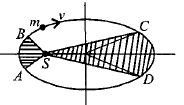
The figure shows an elliptical orbit of a planet of mass $m$ about the sun $S.$ The shaded area $SCD$ is twice the shaded area $SAB.$ If $t_1$ is the time taken for the planet to move from $C$ to $D$ and $t_2$ is the time taken to move from $A$ to $B,$ then:
A
$t_1 = 4t_2$
B
$t_1 = 2t_2$
C
$t_1 = t_2$
D
$t_1 > t_2$
Solution
(B) According to Kepler's Second Law of Planetary Motion,a line segment joining a planet and the Sun sweeps out equal areas during equal intervals of time.
This means the areal velocity $\frac{dA}{dt}$ is constant.
Therefore,the time taken to sweep an area is directly proportional to the area swept.
Given that the area $SCD = 2 \times \text{Area } SAB$.
Since $t_1$ is the time taken to sweep area $SCD$ and $t_2$ is the time taken to sweep area $SAB$,we have:
$\frac{t_1}{t_2} = \frac{\text{Area } SCD}{\text{Area } SAB} = \frac{2 \times \text{Area } SAB}{\text{Area } SAB} = 2$.
Thus,$t_1 = 2t_2$.
This means the areal velocity $\frac{dA}{dt}$ is constant.
Therefore,the time taken to sweep an area is directly proportional to the area swept.
Given that the area $SCD = 2 \times \text{Area } SAB$.
Since $t_1$ is the time taken to sweep area $SCD$ and $t_2$ is the time taken to sweep area $SAB$,we have:
$\frac{t_1}{t_2} = \frac{\text{Area } SCD}{\text{Area } SAB} = \frac{2 \times \text{Area } SAB}{\text{Area } SAB} = 2$.
Thus,$t_1 = 2t_2$.
0 likesView Solution
18
PhysicsEasyMCQAIPMT · 2009
In thermodynamic processes,which of the following statements is not true?
A
In an isochoric process,pressure remains constant.
B
In an isothermal process,the temperature remains constant.
C
In an adiabatic process,$PV^{\gamma} = \text{constant}$.
D
In an adiabatic process,the system is insulated from the surroundings.
Solution
(A) In an isochoric process,the volume of the system is kept constant.
If the pressure is kept constant,the process is known as an isobaric process.
Therefore,the statement that pressure remains constant in an isochoric process is incorrect.
If the pressure is kept constant,the process is known as an isobaric process.
Therefore,the statement that pressure remains constant in an isochoric process is incorrect.
0 likesView Solution
19
PhysicsMediumMCQAIPMT · 2009
$A$ simple pendulum performs simple harmonic motion about $x=0$ with an amplitude $a$ and time period $T$. The speed of the pendulum at $x=a/2$ will be
A
$\frac{\pi a}{T}$
B
$\frac{3\pi^2 a}{T}$
C
$\frac{\pi a\sqrt{3}}{T}$
D
$\frac{\pi a\sqrt{3}}{2T}$
Solution
(C) For simple harmonic motion,the velocity $v$ at position $x$ is given by $v = \omega \sqrt{a^2 - x^2}$.
Given the amplitude is $a$ and the time period is $T$,the angular frequency is $\omega = \frac{2\pi}{T}$.
At position $x = \frac{a}{2}$,the speed is:
$v = \omega \sqrt{a^2 - (\frac{a}{2})^2}$
$v = \omega \sqrt{a^2 - \frac{a^2}{4}}$
$v = \omega \sqrt{\frac{3a^2}{4}}$
$v = \omega \cdot \frac{a\sqrt{3}}{2}$
Substituting $\omega = \frac{2\pi}{T}$:
$v = \frac{2\pi}{T} \cdot \frac{a\sqrt{3}}{2}$
$v = \frac{\pi a\sqrt{3}}{T}$
Given the amplitude is $a$ and the time period is $T$,the angular frequency is $\omega = \frac{2\pi}{T}$.
At position $x = \frac{a}{2}$,the speed is:
$v = \omega \sqrt{a^2 - (\frac{a}{2})^2}$
$v = \omega \sqrt{a^2 - \frac{a^2}{4}}$
$v = \omega \sqrt{\frac{3a^2}{4}}$
$v = \omega \cdot \frac{a\sqrt{3}}{2}$
Substituting $\omega = \frac{2\pi}{T}$:
$v = \frac{2\pi}{T} \cdot \frac{a\sqrt{3}}{2}$
$v = \frac{\pi a\sqrt{3}}{T}$
0 likesView Solution
20
PhysicsEasyMCQAIPMT · 2009
Which one of the following equations of motion represents simple harmonic motion? (Where $k, k_0, k_1$ and $a$ are all positive constants)
A
$Acceleration = k(x)$
B
$Acceleration = k(x+a)$
C
$Acceleration = -k(x+a)$
D
$Acceleration = -k(x^2)$
Solution
(C) The defining condition for Simple Harmonic Motion $(S.H.M.)$ is that the acceleration $(a)$ is directly proportional to the negative of the displacement $(x)$ from the mean position.
Mathematically,this is expressed as $a = -\omega^2 x$,where $\omega$ is the angular frequency.
In option $(C)$,the equation is $a = -k(x+a)$. If we define a new coordinate $x' = x+a$,then the equation becomes $a = -k x'$.
This represents an $S.H.M.$ about the equilibrium position $x = -a$.
Since the acceleration is proportional to the displacement from the mean position and directed towards it,option $(C)$ correctly represents $S.H.M.$
Mathematically,this is expressed as $a = -\omega^2 x$,where $\omega$ is the angular frequency.
In option $(C)$,the equation is $a = -k(x+a)$. If we define a new coordinate $x' = x+a$,then the equation becomes $a = -k x'$.
This represents an $S.H.M.$ about the equilibrium position $x = -a$.
Since the acceleration is proportional to the displacement from the mean position and directed towards it,option $(C)$ correctly represents $S.H.M.$
0 likesView Solution
21
PhysicsMediumMCQAIPMT · 2009
$A$ wave in a string has an amplitude of $2\, cm$. The wave travels in the $+ve$ direction of $x-$axis with a speed of $128\, m/s$ and it is noted that $5$ complete waves fit in $4\, m$ length of the string. The equation describing the wave is
A
$y = 0.02\, m\, \sin(7.85x - 1005t)$
B
$y = 0.02\, m\, \sin(7.85x + 1005t)$
C
$y = 0.02\, m\, \sin(15.7x - 2010t)$
D
$y = 0.02\, m\, \sin(15.7x + 2010t)$
Solution
(A) Given: Amplitude $A = 2\, cm = 0.02\, m$,speed $v = 128\, m/s$.
Since $5$ complete waves fit in $4\, m$,the wavelength $\lambda = \frac{4\, m}{5} = 0.8\, m$.
The frequency $f = \frac{v}{\lambda} = \frac{128}{0.8} = 160\, Hz$.
The angular frequency $\omega = 2\pi f = 2 \times 3.14159 \times 160 \approx 1005\, rad/s$.
The wave number $k = \frac{2\pi}{\lambda} = \frac{2 \times 3.14159}{0.8} \approx 7.85\, rad/m$.
Since the wave travels in the $+ve$ $x$-direction,the equation is $y = A \sin(kx - \omega t)$.
Substituting the values: $y = 0.02 \sin(7.85x - 1005t)$.
Since $5$ complete waves fit in $4\, m$,the wavelength $\lambda = \frac{4\, m}{5} = 0.8\, m$.
The frequency $f = \frac{v}{\lambda} = \frac{128}{0.8} = 160\, Hz$.
The angular frequency $\omega = 2\pi f = 2 \times 3.14159 \times 160 \approx 1005\, rad/s$.
The wave number $k = \frac{2\pi}{\lambda} = \frac{2 \times 3.14159}{0.8} \approx 7.85\, rad/m$.
Since the wave travels in the $+ve$ $x$-direction,the equation is $y = A \sin(kx - \omega t)$.
Substituting the values: $y = 0.02 \sin(7.85x - 1005t)$.
0 likesView Solution
22
PhysicsMediumMCQAIPMT · 2009
The driver of a car travelling with speed $30 \, m/s$ towards a hill sounds a horn of frequency $600 \, Hz$. If the velocity of sound in air is $330 \, m/s$,the frequency of reflected sound as heard by the driver is .... $Hz$.
A
$480$
B
$720$
C
$510$
D
$570$
Solution
(B) The car acts as the source and the hill acts as the observer.
First,we calculate the frequency $f_1$ heard by the hill:
$f_1 = f_0 \times \frac{v}{v - v_s} = 600 \times \frac{330}{330 - 30} = 600 \times \frac{330}{300} = 660 \, Hz$.
Now,the hill reflects this sound,acting as the source,and the driver acts as the observer moving towards the source.
The frequency $f_2$ heard by the driver is:
$f_2 = f_1 \times \frac{v + v_o}{v} = 660 \times \frac{330 + 30}{330} = 660 \times \frac{360}{330} = 2 \times 360 = 720 \, Hz$.
First,we calculate the frequency $f_1$ heard by the hill:
$f_1 = f_0 \times \frac{v}{v - v_s} = 600 \times \frac{330}{330 - 30} = 600 \times \frac{330}{300} = 660 \, Hz$.
Now,the hill reflects this sound,acting as the source,and the driver acts as the observer moving towards the source.
The frequency $f_2$ heard by the driver is:
$f_2 = f_1 \times \frac{v + v_o}{v} = 660 \times \frac{330 + 30}{330} = 660 \times \frac{360}{330} = 2 \times 360 = 720 \, Hz$.
0 likesView Solution
23
PhysicsMediumMCQAIPMT · 2009
Each of the two strings of length $51.6 \, cm$ and $49.1 \, cm$ are tensioned separately by $20 \, N$ force. The mass per unit length of both strings is the same and equal to $1 \, g/m$. When both strings vibrate simultaneously,the number of beats is:
A
$7$
B
$8$
C
$3$
D
$5$
Solution
(A) Given: Lengths $l_1 = 0.516 \, m$ and $l_2 = 0.491 \, m$. Tension $T = 20 \, N$. Mass per unit length $\mu = 1 \, g/m = 0.001 \, kg/m$.
The fundamental frequency of a vibrating string is given by $v = \frac{1}{2l} \sqrt{\frac{T}{\mu}}$.
Calculate the wave speed $v_w = \sqrt{\frac{T}{\mu}} = \sqrt{\frac{20}{0.001}} = \sqrt{20000} = 100\sqrt{2} \approx 141.42 \, m/s$.
Frequency $v_1 = \frac{141.42}{2 \times 0.516} \approx 137.04 \, Hz$.
Frequency $v_2 = \frac{141.42}{2 \times 0.491} \approx 144.02 \, Hz$.
The number of beats is the difference in frequencies: $|v_2 - v_1| = 144.02 - 137.04 = 6.98 \approx 7 \, Hz$.
The fundamental frequency of a vibrating string is given by $v = \frac{1}{2l} \sqrt{\frac{T}{\mu}}$.
Calculate the wave speed $v_w = \sqrt{\frac{T}{\mu}} = \sqrt{\frac{20}{0.001}} = \sqrt{20000} = 100\sqrt{2} \approx 141.42 \, m/s$.
Frequency $v_1 = \frac{141.42}{2 \times 0.516} \approx 137.04 \, Hz$.
Frequency $v_2 = \frac{141.42}{2 \times 0.491} \approx 144.02 \, Hz$.
The number of beats is the difference in frequencies: $|v_2 - v_1| = 144.02 - 137.04 = 6.98 \approx 7 \, Hz$.
0 likesView Solution
24
PhysicsMediumMCQAIPMT · 2009
Two bodies of mass $1\,kg$ and $3\,kg$ have position vectors $\hat{i}+2\hat{j}+\hat{k}$ and $-3\hat{i}-2\hat{j}+\hat{k}$ respectively. The magnitude of the position vector of the centre of mass of this system will be equal to the magnitude of which of the following vectors?
A
$\hat{i}-2\hat{j}+\hat{k}$
B
$-3\hat{i}-2\hat{j}+\hat{k}$
C
$-2\hat{i}+2\hat{k}$
D
$-2\hat{i}-\hat{j}+\hat{k}$
Solution
(D) The position vector of the centre of mass is given by $\vec{r}_{com} = \frac{m_1\vec{r}_1 + m_2\vec{r}_2}{m_1 + m_2}$.
Substituting the given values: $\vec{r}_{com} = \frac{1(\hat{i} + 2\hat{j} + \hat{k}) + 3(-3\hat{i} - 2\hat{j} + \hat{k})}{1 + 3}$.
$\vec{r}_{com} = \frac{\hat{i} + 2\hat{j} + \hat{k} - 9\hat{i} - 6\hat{j} + 3\hat{k}}{4} = \frac{-8\hat{i} - 4\hat{j} + 4\hat{k}}{4} = -2\hat{i} - \hat{j} + \hat{k}$.
The magnitude of the centre of mass position vector is $|\vec{r}_{com}| = \sqrt{(-2)^2 + (-1)^2 + (1)^2} = \sqrt{4 + 1 + 1} = \sqrt{6}$.
Now,check the magnitude of the vector in option $D$: $|-2\hat{i} - \hat{j} + \hat{k}| = \sqrt{(-2)^2 + (-1)^2 + (1)^2} = \sqrt{6}$.
Thus,the magnitudes are equal.
Substituting the given values: $\vec{r}_{com} = \frac{1(\hat{i} + 2\hat{j} + \hat{k}) + 3(-3\hat{i} - 2\hat{j} + \hat{k})}{1 + 3}$.
$\vec{r}_{com} = \frac{\hat{i} + 2\hat{j} + \hat{k} - 9\hat{i} - 6\hat{j} + 3\hat{k}}{4} = \frac{-8\hat{i} - 4\hat{j} + 4\hat{k}}{4} = -2\hat{i} - \hat{j} + \hat{k}$.
The magnitude of the centre of mass position vector is $|\vec{r}_{com}| = \sqrt{(-2)^2 + (-1)^2 + (1)^2} = \sqrt{4 + 1 + 1} = \sqrt{6}$.
Now,check the magnitude of the vector in option $D$: $|-2\hat{i} - \hat{j} + \hat{k}| = \sqrt{(-2)^2 + (-1)^2 + (1)^2} = \sqrt{6}$.
Thus,the magnitudes are equal.
0 likesView Solution
25
PhysicsEasyMCQAIPMT · 2009
If a diamagnetic substance is brought near the north or south pole of a bar magnet,it is:
A
Attracted by the poles
B
Repelled by the poles
C
Repelled by the north pole and attracted by the south pole
D
Attracted by the north pole and repelled by the south pole
Solution
(B) Diamagnetic substances are materials that develop a weak magnetization in the direction opposite to the applied magnetic field. When a diamagnetic substance is placed in a non-uniform magnetic field (such as near the poles of a bar magnet),it experiences a force that pushes it from the stronger part of the field to the weaker part. Since the magnetic field is strongest at the poles of a bar magnet,the diamagnetic substance is repelled by both the north and south poles.
0 likesView Solution
26
PhysicsEasyMCQAIPMT · 2009
Three capacitors each of capacitance $C$ and of breakdown voltage $V$ are joined in series. The capacitance and breakdown voltage of the combination will be
A
$3C, V/3$
B
$C/3, 3V$
C
$3C, 3V$
D
$C/3, V/3$
Solution
(B) When $n$ capacitors of capacitance $C$ are connected in series,the equivalent capacitance $C_{\text{eq}}$ is given by $\frac{1}{C_{\text{eq}}} = \frac{1}{C} + \frac{1}{C} + \frac{1}{C} = \frac{3}{C}$.
Thus,$C_{\text{eq}} = \frac{C}{3}$.
In a series combination,the potential difference across each capacitor is $V$. Since the capacitors are identical,the total breakdown voltage $V_{\text{total}}$ of the combination is the sum of the individual breakdown voltages.
$V_{\text{total}} = V + V + V = 3V$.
Therefore,the combination has a capacitance of $C/3$ and a breakdown voltage of $3V$.
Thus,$C_{\text{eq}} = \frac{C}{3}$.
In a series combination,the potential difference across each capacitor is $V$. Since the capacitors are identical,the total breakdown voltage $V_{\text{total}}$ of the combination is the sum of the individual breakdown voltages.
$V_{\text{total}} = V + V + V = 3V$.
Therefore,the combination has a capacitance of $C/3$ and a breakdown voltage of $3V$.
0 likesView Solution
27
PhysicsMediumMCQAIPMT · 2009
Three concentric spherical shells have radii $a, b$ and $c$ $(a < b < c)$ and have surface charge densities $\sigma, -\sigma$ and $\sigma$ respectively. If $V_A, V_B$ and $V_C$ denote the potentials of the three shells,then,for $c = a + b$,we have
A
$V_C = V_B \neq V_A$
B
$V_C \neq V_B \neq V_A$
C
$V_C = V_B = V_A$
D
$V_C = V_A \neq V_B$
Solution
(D) The potential at any point on a shell is the sum of potentials due to all shells. The charge on a shell of radius $r$ and surface charge density $\sigma$ is $q = 4\pi r^2 \sigma$.
Thus,$q_A = 4\pi a^2 \sigma$,$q_B = -4\pi b^2 \sigma$,and $q_C = 4\pi c^2 \sigma$.
The potentials are:
$V_A = \frac{1}{4\pi\epsilon_0} [\frac{q_A}{a} + \frac{q_B}{b} + \frac{q_C}{c}] = \frac{1}{\epsilon_0} [a\sigma - b\sigma + \frac{c^2\sigma}{c}] = \frac{\sigma}{\epsilon_0} [a - b + c]$
$V_B = \frac{1}{4\pi\epsilon_0} [\frac{q_A}{b} + \frac{q_B}{b} + \frac{q_C}{c}] = \frac{1}{\epsilon_0} [\frac{a^2\sigma}{b} - b\sigma + \frac{c^2\sigma}{c}] = \frac{\sigma}{\epsilon_0} [\frac{a^2}{b} - b + c]$
$V_C = \frac{1}{4\pi\epsilon_0} [\frac{q_A}{c} + \frac{q_B}{c} + \frac{q_C}{c}] = \frac{1}{\epsilon_0} [\frac{a^2\sigma}{c} - \frac{b^2\sigma}{c} + c\sigma] = \frac{\sigma}{\epsilon_0} [\frac{a^2 - b^2}{c} + c]$
Given $c = a + b$,then $c - b = a$ and $c - a = b$. Also $a^2 - b^2 = (a - b)(a + b) = (a - b)c$.
Substituting $c = a + b$ into $V_A$: $V_A = \frac{\sigma}{\epsilon_0} [a - b + (a + b)] = \frac{2a\sigma}{\epsilon_0}$.
Substituting $c = a + b$ into $V_C$: $V_C = \frac{\sigma}{\epsilon_0} [\frac{(a - b)(a + b)}{c} + c] = \frac{\sigma}{\epsilon_0} [\frac{(a - b)c}{c} + c] = \frac{\sigma}{\epsilon_0} [a - b + a + b] = \frac{2a\sigma}{\epsilon_0}$.
Since $V_A = V_C = \frac{2a\sigma}{\epsilon_0}$ and $V_B = \frac{\sigma}{\epsilon_0} [\frac{a^2}{b} - b + a + b] = \frac{\sigma}{\epsilon_0} [\frac{a^2}{b} + a]$,clearly $V_A = V_C \neq V_B$.
Thus,$q_A = 4\pi a^2 \sigma$,$q_B = -4\pi b^2 \sigma$,and $q_C = 4\pi c^2 \sigma$.
The potentials are:
$V_A = \frac{1}{4\pi\epsilon_0} [\frac{q_A}{a} + \frac{q_B}{b} + \frac{q_C}{c}] = \frac{1}{\epsilon_0} [a\sigma - b\sigma + \frac{c^2\sigma}{c}] = \frac{\sigma}{\epsilon_0} [a - b + c]$
$V_B = \frac{1}{4\pi\epsilon_0} [\frac{q_A}{b} + \frac{q_B}{b} + \frac{q_C}{c}] = \frac{1}{\epsilon_0} [\frac{a^2\sigma}{b} - b\sigma + \frac{c^2\sigma}{c}] = \frac{\sigma}{\epsilon_0} [\frac{a^2}{b} - b + c]$
$V_C = \frac{1}{4\pi\epsilon_0} [\frac{q_A}{c} + \frac{q_B}{c} + \frac{q_C}{c}] = \frac{1}{\epsilon_0} [\frac{a^2\sigma}{c} - \frac{b^2\sigma}{c} + c\sigma] = \frac{\sigma}{\epsilon_0} [\frac{a^2 - b^2}{c} + c]$
Given $c = a + b$,then $c - b = a$ and $c - a = b$. Also $a^2 - b^2 = (a - b)(a + b) = (a - b)c$.
Substituting $c = a + b$ into $V_A$: $V_A = \frac{\sigma}{\epsilon_0} [a - b + (a + b)] = \frac{2a\sigma}{\epsilon_0}$.
Substituting $c = a + b$ into $V_C$: $V_C = \frac{\sigma}{\epsilon_0} [\frac{(a - b)(a + b)}{c} + c] = \frac{\sigma}{\epsilon_0} [\frac{(a - b)c}{c} + c] = \frac{\sigma}{\epsilon_0} [a - b + a + b] = \frac{2a\sigma}{\epsilon_0}$.
Since $V_A = V_C = \frac{2a\sigma}{\epsilon_0}$ and $V_B = \frac{\sigma}{\epsilon_0} [\frac{a^2}{b} - b + a + b] = \frac{\sigma}{\epsilon_0} [\frac{a^2}{b} + a]$,clearly $V_A = V_C \neq V_B$.
0 likesView Solution
28
PhysicsEasyMCQAIPMT · 2009
The electric potential at a point $(x, y, z)$ is given by $V = -x^2y - xz^3 + 4$. The electric field at that point is:
A
$\vec{E} = 2xy\hat{i} + (x^2 + y^2)\hat{j} + (3xz - y^2)\hat{k}$
B
$\vec{E} = z^3\hat{i} + xyz\hat{j} + z^2\hat{k}$
C
$\vec{E} = (2xy - z^3)\hat{i} + xy^2\hat{j} + 3z^2x\hat{k}$
D
$\vec{E} = (2xy + z^3)\hat{i} + x^2\hat{j} + 3xz^2\hat{k}$
Solution
(D) The electric potential is given by $V = -x^2y - xz^3 + 4$.
The electric field $\vec{E}$ is related to the potential $V$ by the relation $\vec{E} = -\vec{\nabla} V = -\left( \frac{\partial V}{\partial x}\hat{i} + \frac{\partial V}{\partial y}\hat{j} + \frac{\partial V}{\partial z}\hat{k} \right)$.
Calculating the partial derivatives:
$\frac{\partial V}{\partial x} = \frac{\partial}{\partial x}(-x^2y - xz^3 + 4) = -2xy - z^3$
$\frac{\partial V}{\partial y} = \frac{\partial}{\partial y}(-x^2y - xz^3 + 4) = -x^2$
$\frac{\partial V}{\partial z} = \frac{\partial}{\partial z}(-x^2y - xz^3 + 4) = -3xz^2$
Substituting these into the expression for $\vec{E}$:
$\vec{E} = -[(-2xy - z^3)\hat{i} + (-x^2)\hat{j} + (-3xz^2)\hat{k}]$
$\vec{E} = (2xy + z^3)\hat{i} + x^2\hat{j} + 3xz^2\hat{k}$.
The electric field $\vec{E}$ is related to the potential $V$ by the relation $\vec{E} = -\vec{\nabla} V = -\left( \frac{\partial V}{\partial x}\hat{i} + \frac{\partial V}{\partial y}\hat{j} + \frac{\partial V}{\partial z}\hat{k} \right)$.
Calculating the partial derivatives:
$\frac{\partial V}{\partial x} = \frac{\partial}{\partial x}(-x^2y - xz^3 + 4) = -2xy - z^3$
$\frac{\partial V}{\partial y} = \frac{\partial}{\partial y}(-x^2y - xz^3 + 4) = -x^2$
$\frac{\partial V}{\partial z} = \frac{\partial}{\partial z}(-x^2y - xz^3 + 4) = -3xz^2$
Substituting these into the expression for $\vec{E}$:
$\vec{E} = -[(-2xy - z^3)\hat{i} + (-x^2)\hat{j} + (-3xz^2)\hat{k}]$
$\vec{E} = (2xy + z^3)\hat{i} + x^2\hat{j} + 3xz^2\hat{k}$.
0 likesView Solution
29
PhysicsMediumMCQAIPMT · 2009
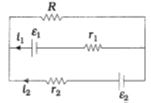
See the electrical circuit shown in this figure. Which of the following equations is a correct equation for it?
A
$\varepsilon _2 - i_2 r_2 - \varepsilon _1 - i_1 r_1 = 0$
B
$-\varepsilon _2 - (i_1 + i_2)R + i_2 r_2 = 0$
C
$\varepsilon _1 - (i_1 + i_2)R + i_1 r_1 = 0$
D
$\varepsilon _1 - (i_1 + i_2)R - i_1 r_1 = 0$
Solution
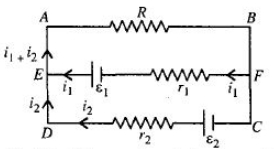
(D) Applying Kirchhoff's voltage law to the loop $ABFE$ in the clockwise direction:
Starting from point $A$ and moving towards $B$,the potential drop across resistor $R$ is $-(i_1 + i_2)R$.
Moving from $F$ to $E$ through the branch containing $\varepsilon_1$ and $r_1$,we encounter the negative terminal of the battery first,so we add $\varepsilon_1$,and then we pass through the resistor $r_1$ in the direction of current $i_1$,resulting in a potential drop of $-i_1 r_1$.
Equating the sum of potential changes to zero,we get:
$-(i_1 + i_2)R + \varepsilon_1 - i_1 r_1 = 0$
Rearranging the terms,we obtain:
$\varepsilon_1 - (i_1 + i_2)R - i_1 r_1 = 0$
Starting from point $A$ and moving towards $B$,the potential drop across resistor $R$ is $-(i_1 + i_2)R$.
Moving from $F$ to $E$ through the branch containing $\varepsilon_1$ and $r_1$,we encounter the negative terminal of the battery first,so we add $\varepsilon_1$,and then we pass through the resistor $r_1$ in the direction of current $i_1$,resulting in a potential drop of $-i_1 r_1$.
Equating the sum of potential changes to zero,we get:
$-(i_1 + i_2)R + \varepsilon_1 - i_1 r_1 = 0$
Rearranging the terms,we obtain:
$\varepsilon_1 - (i_1 + i_2)R - i_1 r_1 = 0$
0 likesView Solution
30
PhysicsMediumMCQAIPMT · 2009
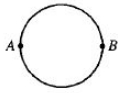
$A$ wire of resistance $12 \, \Omega/m$ is bent to form a complete circle of radius $10 \, cm$. The resistance between its two diametrically opposite points, $A$ and $B$, as shown in the figure, is:
A
$3 \, \Omega$
B
$6 \, \Omega$
C
$6 \pi \, \Omega$
D
$0.6 \pi \, \Omega$
Solution
(D) The circumference of the circle is $L = 2 \pi r = 2 \pi \times 0.1 \, m = 0.2 \pi \, m$.
The total resistance of the wire is $R_{total} = (12 \, \Omega/m) \times (0.2 \pi \, m) = 2.4 \pi \, \Omega$.
When the wire is bent into a circle and points $A$ and $B$ are diametrically opposite, the wire is divided into two equal semicircular parts, each with resistance $R' = R_{total} / 2 = 1.2 \pi \, \Omega$.
These two parts are connected in parallel between points $A$ and $B$.
The equivalent resistance $R_{eq}$ is given by $\frac{1}{R_{eq}} = \frac{1}{R'} + \frac{1}{R'} = \frac{2}{R'}$.
Therefore, $R_{eq} = \frac{R'}{2} = \frac{1.2 \pi \, \Omega}{2} = 0.6 \pi \, \Omega$.
The total resistance of the wire is $R_{total} = (12 \, \Omega/m) \times (0.2 \pi \, m) = 2.4 \pi \, \Omega$.
When the wire is bent into a circle and points $A$ and $B$ are diametrically opposite, the wire is divided into two equal semicircular parts, each with resistance $R' = R_{total} / 2 = 1.2 \pi \, \Omega$.
These two parts are connected in parallel between points $A$ and $B$.
The equivalent resistance $R_{eq}$ is given by $\frac{1}{R_{eq}} = \frac{1}{R'} + \frac{1}{R'} = \frac{2}{R'}$.
Therefore, $R_{eq} = \frac{R'}{2} = \frac{1.2 \pi \, \Omega}{2} = 0.6 \pi \, \Omega$.
0 likesView Solution
31
PhysicsEasyMCQAIPMT · 2009
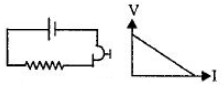
$A$ student measures the terminal potential difference $(V)$ of a cell (of $emf \; \varepsilon$ and internal resistance $r$) as a function of the current $(I)$ flowing through it. The slope and intercept of the graph between $V$ and $I$,respectively,are equal to:
A
$-r$ and $\varepsilon$
B
$r$ and $-\varepsilon$
C
$-\varepsilon$ and $r$
D
$\varepsilon$ and $-r$
Solution
(A) The terminal potential difference $(V)$ of a cell is given by the equation: $V = \varepsilon - Ir$.
Comparing this with the equation of a straight line $y = mx + c$,where $y = V$ and $x = I$:
$V = (-r)I + \varepsilon$.
Here,the slope $(m)$ is equal to $-r$ and the $y$-intercept $(c)$ is equal to $\varepsilon$.
Therefore,the slope is $-r$ and the intercept is $\varepsilon$.
Comparing this with the equation of a straight line $y = mx + c$,where $y = V$ and $x = I$:
$V = (-r)I + \varepsilon$.
Here,the slope $(m)$ is equal to $-r$ and the $y$-intercept $(c)$ is equal to $\varepsilon$.
Therefore,the slope is $-r$ and the intercept is $\varepsilon$.
0 likesView Solution
32
PhysicsMediumMCQAIPMT · 2009
$A$ galvanometer having a coil resistance of $60\,\Omega$ shows full-scale deflection when a current of $1.0\,A$ passes through it. It can be converted into an ammeter to read currents up to $5.0\,A$ by:
A
putting in series a resistance of $15\,\Omega$
B
putting in series a resistance of $240\,\Omega$
C
putting in parallel a resistance of $15\,\Omega$
D
putting in parallel a resistance of $240\,\Omega$
Solution
(C) To convert a galvanometer into an ammeter,a shunt resistance $S$ must be connected in parallel with the galvanometer.
The formula for the shunt resistance is $i_g G = (I - i_g) S$,where $i_g$ is the full-scale deflection current,$G$ is the galvanometer resistance,and $I$ is the maximum current to be measured.
Given: $G = 60\,\Omega$,$i_g = 1.0\,A$,and $I = 5.0\,A$.
Substituting the values: $1.0 \times 60 = (5.0 - 1.0) \times S$.
$60 = 4 \times S$.
$S = \frac{60}{4} = 15\,\Omega$.
Therefore,a resistance of $15\,\Omega$ must be connected in parallel.
The formula for the shunt resistance is $i_g G = (I - i_g) S$,where $i_g$ is the full-scale deflection current,$G$ is the galvanometer resistance,and $I$ is the maximum current to be measured.
Given: $G = 60\,\Omega$,$i_g = 1.0\,A$,and $I = 5.0\,A$.
Substituting the values: $1.0 \times 60 = (5.0 - 1.0) \times S$.
$60 = 4 \times S$.
$S = \frac{60}{4} = 15\,\Omega$.
Therefore,a resistance of $15\,\Omega$ must be connected in parallel.
0 likesView Solution
33
PhysicsMediumMCQAIPMT · 2009
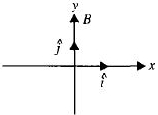
The magnetic force acting on a charged particle of charge $-2\, \mu C$ in a magnetic field of $2\, T$ acting in the $y$-direction,when the particle velocity is $(2\hat{i} + 3\hat{j}) \times 10^6\, m/s$,is:
A
$4\, N$ in $+z$ direction
B
$8\, N$ in $+y$ direction
C
$8\, N$ in $+z$ direction
D
$8\, N$ in $-z$ direction
Solution
(D) The magnetic force $\vec{F}$ on a charged particle is given by the Lorentz force formula: $\vec{F} = q(\vec{v} \times \vec{B})$.
Given:
Charge $q = -2 \times 10^{-6}\, C$
Velocity $\vec{v} = (2\hat{i} + 3\hat{j}) \times 10^6\, m/s$
Magnetic field $\vec{B} = 2\hat{j}\, T$
Substituting these values into the formula:
$\vec{F} = (-2 \times 10^{-6}) \times [(2\hat{i} + 3\hat{j}) \times 10^6] \times (2\hat{j})$
$\vec{F} = -2 \times 2 \times [ (2\hat{i} \times \hat{j}) + (3\hat{j} \times \hat{j}) ]$
Since $\hat{i} \times \hat{j} = \hat{k}$ and $\hat{j} \times \hat{j} = 0$:
$\vec{F} = -4 \times (2\hat{k} + 0)$
$\vec{F} = -8\hat{k}\, N$
The negative sign indicates the force is in the $-z$ direction.
Thus,the force is $8\, N$ in the $-z$ direction.
Given:
Charge $q = -2 \times 10^{-6}\, C$
Velocity $\vec{v} = (2\hat{i} + 3\hat{j}) \times 10^6\, m/s$
Magnetic field $\vec{B} = 2\hat{j}\, T$
Substituting these values into the formula:
$\vec{F} = (-2 \times 10^{-6}) \times [(2\hat{i} + 3\hat{j}) \times 10^6] \times (2\hat{j})$
$\vec{F} = -2 \times 2 \times [ (2\hat{i} \times \hat{j}) + (3\hat{j} \times \hat{j}) ]$
Since $\hat{i} \times \hat{j} = \hat{k}$ and $\hat{j} \times \hat{j} = 0$:
$\vec{F} = -4 \times (2\hat{k} + 0)$
$\vec{F} = -8\hat{k}\, N$
The negative sign indicates the force is in the $-z$ direction.
Thus,the force is $8\, N$ in the $-z$ direction.
0 likesView Solution
34
PhysicsMediumMCQAIPMT · 2009
$A$ bar magnet having a magnetic moment of $2 \times 10^4 \, JT^{-1}$ is free to rotate in a horizontal plane. $A$ horizontal magnetic field $B = 6 \times 10^{-4} \, T$ exists in the space. The work done in taking the magnet slowly from a direction parallel to the field to a direction $60^{\circ}$ from the field is.....$J$
A
$2$
B
$4$
C
$6$
D
$8$
Solution
(C) The work done $W$ in rotating a magnetic dipole in a magnetic field is given by the formula:
$W = MB(\cos \theta_1 - \cos \theta_2)$
Given:
Magnetic moment $M = 2 \times 10^4 \, JT^{-1}$
Magnetic field $B = 6 \times 10^{-4} \, T$
Initial angle $\theta_1 = 0^{\circ}$ (parallel to the field)
Final angle $\theta_2 = 60^{\circ}$
Substituting the values:
$W = (2 \times 10^4) \times (6 \times 10^{-4}) \times (\cos 0^{\circ} - \cos 60^{\circ})$
$W = 12 \times (1 - 0.5)$
$W = 12 \times 0.5 = 6 \, J$
Thus,the work done is $6 \, J$.
$W = MB(\cos \theta_1 - \cos \theta_2)$
Given:
Magnetic moment $M = 2 \times 10^4 \, JT^{-1}$
Magnetic field $B = 6 \times 10^{-4} \, T$
Initial angle $\theta_1 = 0^{\circ}$ (parallel to the field)
Final angle $\theta_2 = 60^{\circ}$
Substituting the values:
$W = (2 \times 10^4) \times (6 \times 10^{-4}) \times (\cos 0^{\circ} - \cos 60^{\circ})$
$W = 12 \times (1 - 0.5)$
$W = 12 \times 0.5 = 6 \, J$
Thus,the work done is $6 \, J$.
0 likesView Solution
35
PhysicsMediumMCQAIPMT · 2009
Monochromatic light of wavelength $667 \, nm$ is produced by a helium-neon laser. The power emitted is $9 \, mW$. The number of photons arriving per second on average at a target irradiated by this beam is:
A
$3 \times 10^{16}$
B
$9 \times 10^{15}$
C
$3 \times 10^{19}$
D
$9 \times 10^{17}$
Solution
(A) Given: Wavelength $\lambda = 667 \, nm = 667 \times 10^{-9} \, m$. Power $P = 9 \, mW = 9 \times 10^{-3} \, W$.
Energy of a single photon $E = \frac{hc}{\lambda}$.
Using $h = 6.63 \times 10^{-34} \, J \cdot s$ and $c = 3 \times 10^8 \, m/s$:
$E = \frac{6.63 \times 10^{-34} \times 3 \times 10^8}{667 \times 10^{-9}} \approx 2.98 \times 10^{-19} \, J$.
The number of photons per second $n = \frac{P}{E}$.
$n = \frac{9 \times 10^{-3}}{2.98 \times 10^{-19}} \approx 3.02 \times 10^{16} \approx 3 \times 10^{16}$ photons/sec.
Energy of a single photon $E = \frac{hc}{\lambda}$.
Using $h = 6.63 \times 10^{-34} \, J \cdot s$ and $c = 3 \times 10^8 \, m/s$:
$E = \frac{6.63 \times 10^{-34} \times 3 \times 10^8}{667 \times 10^{-9}} \approx 2.98 \times 10^{-19} \, J$.
The number of photons per second $n = \frac{P}{E}$.
$n = \frac{9 \times 10^{-3}}{2.98 \times 10^{-19}} \approx 3.02 \times 10^{16} \approx 3 \times 10^{16}$ photons/sec.
0 likesView Solution
36
PhysicsEasyMCQAIPMT · 2009
The number of photoelectrons emitted for light of a frequency $\nu$ (higher than the threshold frequency $\nu_0$) is proportional to
A
threshold frequency $\nu_0$
B
intensity of light
C
frequency of light $\nu$
D
$\nu - \nu_0$
Solution
(B) According to the photoelectric effect,the number of photoelectrons emitted per unit time is directly proportional to the number of incident photons per unit time.
Since the intensity of light is defined as the energy incident per unit area per unit time,and for a given frequency $\nu$,the energy of each photon is $E = h\nu$ (a constant),the intensity is directly proportional to the number of incident photons.
Therefore,the number of photoelectrons emitted is directly proportional to the intensity of the incident light,provided the frequency $\nu$ is greater than the threshold frequency $\nu_0$.
Since the intensity of light is defined as the energy incident per unit area per unit time,and for a given frequency $\nu$,the energy of each photon is $E = h\nu$ (a constant),the intensity is directly proportional to the number of incident photons.
Therefore,the number of photoelectrons emitted is directly proportional to the intensity of the incident light,provided the frequency $\nu$ is greater than the threshold frequency $\nu_0$.
0 likesView Solution
37
PhysicsMediumMCQAIPMT · 2009
$A$ conducting circular loop is placed in a uniform magnetic field of $0.04\, T$ with its plane perpendicular to the magnetic field. The radius of the loop starts shrinking at a rate of $2\, mm/s$. The induced $emf$ in the loop when the radius is $2\, cm$ is:
A
$4.8\pi\, \mu V$
B
$0.8\pi\, \mu V$
C
$1.6\pi\, \mu V$
D
$3.2\pi\, \mu V$
Solution
(D) The magnetic flux $\phi$ through the loop is given by $\phi = B \cdot A = B \cdot \pi r^2$,where $B$ is the magnetic field and $r$ is the radius of the loop.
According to Faraday's law,the induced $emf$ is $\varepsilon = -\frac{d\phi}{dt}$.
Since $B$ is constant,$\varepsilon = -\frac{d}{dt}(B \pi r^2) = -B \pi (2r) \frac{dr}{dt}$.
Given: $B = 0.04\, T$,$r = 2\, cm = 0.02\, m$,and $\frac{dr}{dt} = -2\, mm/s = -2 \times 10^{-3}\, m/s$ (negative because the radius is shrinking).
Substituting the values:
$\varepsilon = -(0.04) \cdot \pi \cdot 2 \cdot (0.02) \cdot (-2 \times 10^{-3})$
$\varepsilon = 0.04 \cdot \pi \cdot 0.04 \cdot 2 \times 10^{-3}$
$\varepsilon = 0.0032 \times 10^{-3} \cdot \pi\, V$
$\varepsilon = 3.2 \times 10^{-6} \cdot \pi\, V = 3.2\pi\, \mu V$.
According to Faraday's law,the induced $emf$ is $\varepsilon = -\frac{d\phi}{dt}$.
Since $B$ is constant,$\varepsilon = -\frac{d}{dt}(B \pi r^2) = -B \pi (2r) \frac{dr}{dt}$.
Given: $B = 0.04\, T$,$r = 2\, cm = 0.02\, m$,and $\frac{dr}{dt} = -2\, mm/s = -2 \times 10^{-3}\, m/s$ (negative because the radius is shrinking).
Substituting the values:
$\varepsilon = -(0.04) \cdot \pi \cdot 2 \cdot (0.02) \cdot (-2 \times 10^{-3})$
$\varepsilon = 0.04 \cdot \pi \cdot 0.04 \cdot 2 \times 10^{-3}$
$\varepsilon = 0.0032 \times 10^{-3} \cdot \pi\, V$
$\varepsilon = 3.2 \times 10^{-6} \cdot \pi\, V = 3.2\pi\, \mu V$.
0 likesView Solution
38
PhysicsEasyMCQAIPMT · 2009
$A$ rectangular,a square,a circular,and an elliptical loop,all in the $(x-y)$ plane,are moving out of a uniform magnetic field with a constant velocity,$\vec{V} = v\hat{i}$. The magnetic field is directed along the negative $z$-axis direction. The induced emf,during the passage of these loops out of the field region,will not remain constant for:
A
the circular and the elliptical loops
B
only the elliptical loop
C
any of the four loops
D
the rectangular,circular and elliptical loops
Solution
(A) The induced electromotive force (emf) is given by $\varepsilon = B l v$,where $l$ is the length of the conductor cutting the magnetic field lines perpendicular to the velocity vector.
For a rectangular or square loop,as it moves out of the magnetic field,the length $l$ of the side cutting the magnetic field lines remains constant until the entire loop exits the field. Thus,the induced emf remains constant.
For a circular or elliptical loop,the width of the loop perpendicular to the velocity vector changes continuously as the loop moves out of the magnetic field. Since the length $l$ is not constant,the induced emf $\varepsilon = B l v$ will not remain constant.
Therefore,the induced emf will not remain constant for the circular and elliptical loops.
For a rectangular or square loop,as it moves out of the magnetic field,the length $l$ of the side cutting the magnetic field lines remains constant until the entire loop exits the field. Thus,the induced emf remains constant.
For a circular or elliptical loop,the width of the loop perpendicular to the velocity vector changes continuously as the loop moves out of the magnetic field. Since the length $l$ is not constant,the induced emf $\varepsilon = B l v$ will not remain constant.
Therefore,the induced emf will not remain constant for the circular and elliptical loops.
0 likesView Solution
39
PhysicsMediumMCQAIPMT · 2009
Power dissipated in an $LCR$ series circuit connected to an $A.C.$ source of $e.m.f.$ $\varepsilon$ is
A
$\frac{\varepsilon^2 \sqrt{R^2 + (\omega L - \frac{1}{\omega C})^2}}{R}$
B
$\frac{\varepsilon^2 R^2 + (\omega L - \frac{1}{\omega C})^2}{R}$
C
$\frac{\varepsilon^2 R}{\sqrt{R^2 + (\omega L - \frac{1}{\omega C})^2}}$
D
$\frac{\varepsilon^2 R}{R^2 + (\omega L - \frac{1}{\omega C})^2}$
Solution
(D) The average power dissipated in an $LCR$ series circuit is given by $P = E_{rms} I_{rms} \cos \phi$.
The impedance of the circuit is $Z = \sqrt{R^2 + (X_L - X_C)^2}$,where $X_L = \omega L$ and $X_C = \frac{1}{\omega C}$.
The power factor is $\cos \phi = \frac{R}{Z}$.
The root-mean-square current is $I_{rms} = \frac{E_{rms}}{Z}$.
Substituting these into the power formula: $P = E_{rms} \cdot \frac{E_{rms}}{Z} \cdot \frac{R}{Z} = \frac{E_{rms}^2 R}{Z^2}$.
Substituting $Z^2 = R^2 + (\omega L - \frac{1}{\omega C})^2$ and $E_{rms} = \varepsilon$,we get $P = \frac{\varepsilon^2 R}{R^2 + (\omega L - \frac{1}{\omega C})^2}$.
The impedance of the circuit is $Z = \sqrt{R^2 + (X_L - X_C)^2}$,where $X_L = \omega L$ and $X_C = \frac{1}{\omega C}$.
The power factor is $\cos \phi = \frac{R}{Z}$.
The root-mean-square current is $I_{rms} = \frac{E_{rms}}{Z}$.
Substituting these into the power formula: $P = E_{rms} \cdot \frac{E_{rms}}{Z} \cdot \frac{R}{Z} = \frac{E_{rms}^2 R}{Z^2}$.
Substituting $Z^2 = R^2 + (\omega L - \frac{1}{\omega C})^2$ and $E_{rms} = \varepsilon$,we get $P = \frac{\varepsilon^2 R}{R^2 + (\omega L - \frac{1}{\omega C})^2}$.
0 likesView Solution
40
PhysicsMediumMCQAIPMT · 2009
The electric field part of an electromagnetic wave in a medium is represented by $E_x=0, E_y=2.5 \frac{N}{C} \cos \left[ (2\pi \times 10^6 \frac{rad}{s})t - (\pi \times 10^{-2} \frac{rad}{m})x \right]$,and $E_z=0$. The wave is
A
moving along $x$ direction with frequency $10^6 \text{ Hz}$ and wavelength $100 \text{ m}$
B
moving along $x$ direction with frequency $10^6 \text{ Hz}$ and wavelength $200 \text{ m}$
C
moving along $-x$ direction with frequency $10^6 \text{ Hz}$ and wavelength $200 \text{ m}$
D
moving along $y$ direction with frequency $2\pi \times 10^6 \text{ Hz}$ and wavelength $200 \text{ m}$
Solution
(B) The given electric field is $E_y = E_0 \cos(\omega t - kx)$.
Comparing this with the given equation $E_y = 2.5 \cos[(2\pi \times 10^6)t - (\pi \times 10^{-2})x]$,we identify the angular frequency $\omega = 2\pi \times 10^6 \text{ rad/s}$ and the wave number $k = \pi \times 10^{-2} \text{ rad/m}$.
Since the term inside the cosine is $(\omega t - kx)$,the wave is propagating in the positive $x$-direction.
The frequency $f$ is given by $\omega = 2\pi f$,so $f = \frac{2\pi \times 10^6}{2\pi} = 10^6 \text{ Hz}$.
The wavelength $\lambda$ is given by $k = \frac{2\pi}{\lambda}$,so $\lambda = \frac{2\pi}{k} = \frac{2\pi}{\pi \times 10^{-2}} = 2 \times 10^2 = 200 \text{ m}$.
Thus,the wave is moving along the $x$-direction with a frequency of $10^6 \text{ Hz}$ and a wavelength of $200 \text{ m}$.
Comparing this with the given equation $E_y = 2.5 \cos[(2\pi \times 10^6)t - (\pi \times 10^{-2})x]$,we identify the angular frequency $\omega = 2\pi \times 10^6 \text{ rad/s}$ and the wave number $k = \pi \times 10^{-2} \text{ rad/m}$.
Since the term inside the cosine is $(\omega t - kx)$,the wave is propagating in the positive $x$-direction.
The frequency $f$ is given by $\omega = 2\pi f$,so $f = \frac{2\pi \times 10^6}{2\pi} = 10^6 \text{ Hz}$.
The wavelength $\lambda$ is given by $k = \frac{2\pi}{\lambda}$,so $\lambda = \frac{2\pi}{k} = \frac{2\pi}{\pi \times 10^{-2}} = 2 \times 10^2 = 200 \text{ m}$.
Thus,the wave is moving along the $x$-direction with a frequency of $10^6 \text{ Hz}$ and a wavelength of $200 \text{ m}$.
0 likesView Solution
41
PhysicsMediumMCQAIPMT · 2009
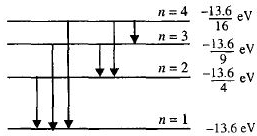
The ionization energy of the electron in the hydrogen atom in its ground state is $13.6 \text{ eV}$. The atoms are excited to higher energy levels to emit radiations of $6$ wavelengths. The maximum wavelength of the emitted radiation corresponds to the transition between:
A
$n=3 \to n=1$
B
$n=2 \to n=1$
C
$n=4 \to n=3$
D
$n=3 \to n=2$
Solution
(C) The number of spectral lines emitted when an electron transitions from an excited state $n$ to the ground state is given by the formula $N = \frac{n(n-1)}{2}$.
Given $N = 6$,we have $\frac{n(n-1)}{2} = 6$,which implies $n^2 - n - 12 = 0$. Solving this quadratic equation,we get $(n-4)(n+3) = 0$,so $n = 4$.
The energy of the emitted photon is given by $\Delta E = E_i - E_f = \frac{hc}{\lambda}$.
Since $\lambda = \frac{hc}{\Delta E}$,the wavelength $\lambda$ is maximum when the energy difference $\Delta E$ is minimum.
The possible transitions from $n=4$ are: $(4 \to 3), (4 \to 2), (4 \to 1), (3 \to 2), (3 \to 1), (2 \to 1)$.
Comparing the energy gaps,the transition $n=4 \to n=3$ has the smallest energy difference,and therefore corresponds to the maximum wavelength of the emitted radiation.
Given $N = 6$,we have $\frac{n(n-1)}{2} = 6$,which implies $n^2 - n - 12 = 0$. Solving this quadratic equation,we get $(n-4)(n+3) = 0$,so $n = 4$.
The energy of the emitted photon is given by $\Delta E = E_i - E_f = \frac{hc}{\lambda}$.
Since $\lambda = \frac{hc}{\Delta E}$,the wavelength $\lambda$ is maximum when the energy difference $\Delta E$ is minimum.
The possible transitions from $n=4$ are: $(4 \to 3), (4 \to 2), (4 \to 1), (3 \to 2), (3 \to 1), (2 \to 1)$.
Comparing the energy gaps,the transition $n=4 \to n=3$ has the smallest energy difference,and therefore corresponds to the maximum wavelength of the emitted radiation.
0 likesView Solution
42
PhysicsMediumMCQAIPMT · 2009
In a Rutherford scattering experiment,when a projectile of charge $Z_1$ and mass $M_1$ approaches a target nucleus of charge $Z_2$ and mass $M_2$,the distance of closest approach is $r_0$. The energy of the projectile is:
A
directly proportional to $Z_1 Z_2$
B
inversely proportional to $Z_1$
C
directly proportional to $M_1 \times M_2$
D
directly proportional to mass $M_1$
Solution
(A) In a Rutherford scattering experiment,at the distance of closest approach $(r_0)$,the entire initial kinetic energy $(K)$ of the projectile is converted into electrostatic potential energy $(U)$.
The electrostatic potential energy is given by the formula:
$U = \frac{1}{4 \pi \varepsilon_0} \frac{(Z_1 e)(Z_2 e)}{r_0}$
Since the kinetic energy $K$ is equal to the potential energy $U$ at the point of closest approach:
$K = \frac{1}{4 \pi \varepsilon_0} \frac{Z_1 Z_2 e^2}{r_0}$
From this expression,it is clear that the energy of the projectile is directly proportional to the product of the charges of the projectile and the target nucleus,i.e.,$K \propto Z_1 Z_2$.
The electrostatic potential energy is given by the formula:
$U = \frac{1}{4 \pi \varepsilon_0} \frac{(Z_1 e)(Z_2 e)}{r_0}$
Since the kinetic energy $K$ is equal to the potential energy $U$ at the point of closest approach:
$K = \frac{1}{4 \pi \varepsilon_0} \frac{Z_1 Z_2 e^2}{r_0}$
From this expression,it is clear that the energy of the projectile is directly proportional to the product of the charges of the projectile and the target nucleus,i.e.,$K \propto Z_1 Z_2$.
0 likesView Solution
43
PhysicsMediumMCQAIPMT · 2009
In the nuclear decay sequence given below:
$_Z{X^A} \to {}_{Z + 1}{Y^A} \to {}_{Z - 1}{K^{A - 4}} \to {}_{Z - 1}{K^{A - 4}}$
the particles emitted in the sequence are:
$_Z{X^A} \to {}_{Z + 1}{Y^A} \to {}_{Z - 1}{K^{A - 4}} \to {}_{Z - 1}{K^{A - 4}}$
the particles emitted in the sequence are:
A
$\alpha, \beta, \gamma$
B
$\beta, \alpha, \gamma$
C
$\gamma, \alpha, \beta$
D
$\beta, \gamma, \alpha$
Solution
(B) The given decay sequence is: ${}_Z^AX \to {}_{Z + 1}^AY \to {}_{Z - 1}^{A - 4}K \to {}_{Z - 1}^{A - 4}K$.
$1$. In the first step,${}_Z^AX \to {}_{Z + 1}^AY$: The atomic number increases by $1$ while the mass number remains the same. This corresponds to the emission of a $\beta^-$ particle.
$2$. In the second step,${}_{Z + 1}^AY \to {}_{Z - 1}^{A - 4}K$: The atomic number decreases by $2$ and the mass number decreases by $4$. This corresponds to the emission of an $\alpha$ particle.
$3$. In the third step,${}_{Z - 1}^{A - 4}K \to {}_{Z - 1}^{A - 4}K$: There is no change in the atomic number or mass number,which indicates the emission of a $\gamma$ ray (de-excitation of the nucleus).
Therefore,the sequence of particles emitted is $\beta, \alpha, \gamma$.
$1$. In the first step,${}_Z^AX \to {}_{Z + 1}^AY$: The atomic number increases by $1$ while the mass number remains the same. This corresponds to the emission of a $\beta^-$ particle.
$2$. In the second step,${}_{Z + 1}^AY \to {}_{Z - 1}^{A - 4}K$: The atomic number decreases by $2$ and the mass number decreases by $4$. This corresponds to the emission of an $\alpha$ particle.
$3$. In the third step,${}_{Z - 1}^{A - 4}K \to {}_{Z - 1}^{A - 4}K$: There is no change in the atomic number or mass number,which indicates the emission of a $\gamma$ ray (de-excitation of the nucleus).
Therefore,the sequence of particles emitted is $\beta, \alpha, \gamma$.
0 likesView Solution
44
PhysicsMediumMCQAIPMT · 2009
The number of beta particles emitted by a radioactive substance is twice the number of alpha particles emitted by it. The resulting daughter nucleus is an
A
isomer of parent
B
isotone of parent
C
isotope of parent
D
isobar of parent
Solution
(C) Let the parent nucleus be represented as ${}_Z^AX$.
When one $\alpha$ particle $({}_2^4He)$ is emitted,the atomic number $Z$ decreases by $2$ and the mass number $A$ decreases by $4$.
When one $\beta^-$ particle $({}_{-1}^0e)$ is emitted,the atomic number $Z$ increases by $1$ and the mass number $A$ remains unchanged.
Given that the number of $\beta$ particles emitted is twice the number of $\alpha$ particles,let the number of $\alpha$ particles be $n$. Then the number of $\beta$ particles is $2n$.
The change in atomic number $Z'$ of the daughter nucleus is given by: $Z' = Z - 2(n) + 1(2n) = Z - 2n + 2n = Z$.
The change in mass number $A'$ of the daughter nucleus is given by: $A' = A - 4(n) + 0(2n) = A - 4n$.
Since the atomic number $Z$ remains the same,the resulting daughter nucleus is an isotope of the parent nucleus.
When one $\alpha$ particle $({}_2^4He)$ is emitted,the atomic number $Z$ decreases by $2$ and the mass number $A$ decreases by $4$.
When one $\beta^-$ particle $({}_{-1}^0e)$ is emitted,the atomic number $Z$ increases by $1$ and the mass number $A$ remains unchanged.
Given that the number of $\beta$ particles emitted is twice the number of $\alpha$ particles,let the number of $\alpha$ particles be $n$. Then the number of $\beta$ particles is $2n$.
The change in atomic number $Z'$ of the daughter nucleus is given by: $Z' = Z - 2(n) + 1(2n) = Z - 2n + 2n = Z$.
The change in mass number $A'$ of the daughter nucleus is given by: $A' = A - 4(n) + 0(2n) = A - 4n$.
Since the atomic number $Z$ remains the same,the resulting daughter nucleus is an isotope of the parent nucleus.
0 likesView Solution
45
PhysicsMediumMCQAIPMT · 2009
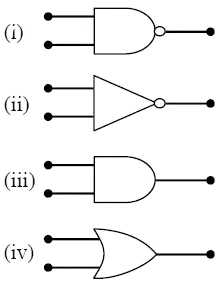
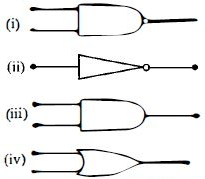
The symbolic representations of four logic gates are given below. The logic symbols for $OR$,$NOT$,and $NAND$ gates are respectively:
A
$iv, ii$ and $i$
B
$iv, i$ and $iii$
C
$i, iii$ and $iv$
D
$iii, iv$ and $ii$
Solution
(A) By observing the given logic gate symbols:
$(i)$ represents a $NAND$ gate.
(ii) represents a $NOT$ gate.
(iii) represents an $AND$ gate.
(iv) represents an $OR$ gate.
Therefore,the symbols for $OR$,$NOT$,and $NAND$ gates are $(iv)$,$(ii)$,and $(i)$ respectively.
$(i)$ represents a $NAND$ gate.
(ii) represents a $NOT$ gate.
(iii) represents an $AND$ gate.
(iv) represents an $OR$ gate.
Therefore,the symbols for $OR$,$NOT$,and $NAND$ gates are $(iv)$,$(ii)$,and $(i)$ respectively.
0 likesView Solution
46
PhysicsMediumMCQAIPMT · 2009
$A$ $p-n$ photodiode is fabricated from a semiconductor with a band gap of $2.5 \, eV$. It can detect a signal of wavelength:
A
$4000 \, nm$
B
$6000 \, nm$
C
$4000 \, \mathring{A}$
D
$6000 \, \mathring{A}$
Solution
(C) The energy of a photon required to excite an electron across the band gap is given by $E_g = 2.5 \, eV$.
For a photodiode to detect a signal,the energy of the incident photon $(E = \frac{hc}{\lambda})$ must be greater than or equal to the band gap energy $(E_g)$.
Thus,$\frac{12400 \, eV \cdot \mathring{A}}{\lambda} \geq 2.5 \, eV$.
Calculating the threshold wavelength $\lambda_{max} = \frac{12400}{2.5} \, \mathring{A} = 4960 \, \mathring{A}$.
Any signal with a wavelength less than or equal to $4960 \, \mathring{A}$ can be detected.
Among the given options,$4000 \, \mathring{A}$ is the only wavelength smaller than $4960 \, \mathring{A}$.
For a photodiode to detect a signal,the energy of the incident photon $(E = \frac{hc}{\lambda})$ must be greater than or equal to the band gap energy $(E_g)$.
Thus,$\frac{12400 \, eV \cdot \mathring{A}}{\lambda} \geq 2.5 \, eV$.
Calculating the threshold wavelength $\lambda_{max} = \frac{12400}{2.5} \, \mathring{A} = 4960 \, \mathring{A}$.
Any signal with a wavelength less than or equal to $4960 \, \mathring{A}$ can be detected.
Among the given options,$4000 \, \mathring{A}$ is the only wavelength smaller than $4960 \, \mathring{A}$.
0 likesView Solution
47
PhysicsMediumMCQAIPMT · 2009
$A$ transistor is operated in common-emitter configuration at $V_{CE} = 2\, V$ such that a change in the base current from $100\,\mu A$ to $200\,\mu A$ produces a change in the collector current from $5\, mA$ to $10\, mA$. The current gain is
A
$100$
B
$150$
C
$50$
D
$75$
Solution
(C) In a common-emitter configuration,the current gain $\beta$ is defined as the ratio of the change in collector current to the change in base current at a constant collector-emitter voltage $V_{CE}$.
$\beta = \left( \frac{\Delta I_C}{\Delta I_B} \right)_{V_{CE}}$
Given:
$\Delta I_C = 10\, mA - 5\, mA = 5\, mA = 5 \times 10^{-3}\, A$
$\Delta I_B = 200\,\mu A - 100\,\mu A = 100\,\mu A = 100 \times 10^{-6}\, A$
Substituting these values into the formula:
$\beta = \frac{5 \times 10^{-3}}{100 \times 10^{-6}}$
$\beta = \frac{5 \times 10^{-3}}{10^{-4}}$
$\beta = 5 \times 10^1 = 50$
Thus,the current gain is $50$.
$\beta = \left( \frac{\Delta I_C}{\Delta I_B} \right)_{V_{CE}}$
Given:
$\Delta I_C = 10\, mA - 5\, mA = 5\, mA = 5 \times 10^{-3}\, A$
$\Delta I_B = 200\,\mu A - 100\,\mu A = 100\,\mu A = 100 \times 10^{-6}\, A$
Substituting these values into the formula:
$\beta = \frac{5 \times 10^{-3}}{100 \times 10^{-6}}$
$\beta = \frac{5 \times 10^{-3}}{10^{-4}}$
$\beta = 5 \times 10^1 = 50$
Thus,the current gain is $50$.
0 likesView Solution
48
PhysicsMediumMCQAIPMT · 2009
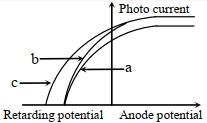
The figure shows a plot of photo current versus anode potential for a photo sensitive surface for three different radiations. Which one of the following is a correct statement?
A
Curves $(b)$ and $(c)$ represent incident radiations of same frequencies having same intensity.
B
Curves $(a)$ and $(b)$ represent incident radiations of same frequencies but of different intensities.
C
Curves $(a)$ and $(b)$ represent incident radiations of different frequencies and different intensities.
D
Curves $(b)$ and $(c)$ represent incident radiations of different frequencies and different intensities.
Solution
(B) In the photoelectric effect,the stopping potential depends on the frequency of the incident radiation,while the saturation current depends on the intensity of the incident radiation.
From the graph,curves $(a)$ and $(b)$ have the same stopping potential (the point where the curve intersects the negative x-axis),which implies they have the same frequency.
However,they have different saturation currents (the plateau value of the photo current),which implies they have different intensities.
Therefore,curves $(a)$ and $(b)$ represent incident radiations of the same frequency but different intensities.
From the graph,curves $(a)$ and $(b)$ have the same stopping potential (the point where the curve intersects the negative x-axis),which implies they have the same frequency.
However,they have different saturation currents (the plateau value of the photo current),which implies they have different intensities.
Therefore,curves $(a)$ and $(b)$ represent incident radiations of the same frequency but different intensities.
0 likesView Solution
Vedclass Products
For Students
Vedclass Test Series
Mock tests in real AIPMT style covering Physics with performance analysis. 5-day free trial.
Start Free TrialFor Teachers
Exam Paper Generator
Generate Set A/B/C/D Physics papers from 7.5L+ questions in 2 minutes. 3 chapters free.
Try FreeFor Institutes
Online Exam Module
Run live AIPMT mock exams with unlimited students, 360° analytics & white-label branding.
See DemoFrequently Asked Questions
How many Physics questions are in AIPMT 2009?
There are 48 Physics questions from the AIPMT 2009 paper on Vedclass, each with a detailed step-by-step solution in English.
Are AIPMT 2009 Physics solutions available in English?
Yes. All solutions on this page are in English. You can also switch to English or Hindi using the language buttons above the questions.
Can I practice AIPMT 2009 Physics as a timed test?
Yes. Use the Vedclass Test Series to attempt a full AIPMT mock test covering Physics with time limits and instant score analysis.
Can teachers create Physics papers from AIPMT previous year questions?
Yes. The Vedclass Exam Paper Generator lets teachers mix AIPMT Physics questions and generate Set A/B/C/D papers in minutes.
For Teachers & Institutes
Build a Custom Physics Paper
Pick AIPMT 2009 Physics questions, set difficulty, and generate Set A/B/C/D in 2 minutes.