
PhysicsQ1–46 of 46 questions
Page 1 of 1 · English
1
PhysicsMediumMCQAIPMT · 2007
Dimensions of resistance in an electrical circuit in terms of dimension of mass $M$,of length $L$,of time $T$,and of current $I$ would be:
A
$M^1L^2T^{-2}I^{-2}$
B
$M^1L^2T^{-1}I^{-1}$
C
$M^1L^2T^{-3}I^{-2}$
D
$M^1L^2T^{-3}I^{-1}$
Solution
(C) According to Ohm's law,$V = RI$,which implies $R = \frac{V}{I}$.
Dimensions of potential difference $V$ are given by $V = \frac{W}{q}$,where $W$ is work and $q$ is charge.
Dimensions of work $W = [ML^2T^{-2}]$ and charge $q = [IT]$.
Therefore,dimensions of $V = \frac{[ML^2T^{-2}]}{[IT]} = [ML^2T^{-3}I^{-1}]$.
Now,substituting this into the expression for resistance: $R = \frac{[ML^2T^{-3}I^{-1}]}{[I]} = [ML^2T^{-3}I^{-2}]$.
Dimensions of potential difference $V$ are given by $V = \frac{W}{q}$,where $W$ is work and $q$ is charge.
Dimensions of work $W = [ML^2T^{-2}]$ and charge $q = [IT]$.
Therefore,dimensions of $V = \frac{[ML^2T^{-2}]}{[IT]} = [ML^2T^{-3}I^{-1}]$.
Now,substituting this into the expression for resistance: $R = \frac{[ML^2T^{-3}I^{-1}]}{[I]} = [ML^2T^{-3}I^{-2}]$.
0 likesView Solution
2
PhysicsMediumMCQAIPMT · 2007
The position $x$ of a particle with respect to time $t$ along the $x$-axis is given by $x = 9t^2 - t^3$,where $x$ is in metres and $t$ is in seconds. What will be the position of this particle when it achieves maximum speed along the $x$-direction?
A
$54$
B
$81$
C
$24$
D
$32$
Solution
(A) Given the position equation: $x = 9t^2 - t^3$.
Velocity $v$ is the derivative of position with respect to time: $v = \frac{dx}{dt} = \frac{d}{dt}(9t^2 - t^3) = 18t - 3t^2$.
To find the time at which speed is maximum,we differentiate velocity with respect to time and set it to zero: $\frac{dv}{dt} = 18 - 6t = 0$.
Solving for $t$,we get $t = 3 \ s$.
Now,substitute $t = 3 \ s$ into the position equation to find the position at that instant: $x = 9(3)^2 - (3)^3 = 9(9) - 27 = 81 - 27 = 54 \ m$.
Velocity $v$ is the derivative of position with respect to time: $v = \frac{dx}{dt} = \frac{d}{dt}(9t^2 - t^3) = 18t - 3t^2$.
To find the time at which speed is maximum,we differentiate velocity with respect to time and set it to zero: $\frac{dv}{dt} = 18 - 6t = 0$.
Solving for $t$,we get $t = 3 \ s$.
Now,substitute $t = 3 \ s$ into the position equation to find the position at that instant: $x = 9(3)^2 - (3)^3 = 9(9) - 27 = 81 - 27 = 54 \ m$.
1 likesView Solution
3
PhysicsMediumMCQAIPMT · 2007
$A$ car moves from $X$ to $Y$ with a uniform speed $v_1$ and returns from $Y$ to $X$ with a uniform speed $v_2$. The average speed for this round trip is
A
$\bar v = \frac{v_1 + v_2}{2}$
B
$\bar v = \sqrt{v_1 v_2}$
C
$\frac{2}{\bar v} = \frac{1}{v_1} + \frac{1}{v_2}$
D
$\frac{1}{\bar v} = \frac{1}{v_1} + \frac{1}{v_2}$
Solution
(C) Average speed is defined as the ratio of total distance traveled to the total time taken.
Let the distance between $X$ and $Y$ be $d$.
Time taken to travel from $X$ to $Y$ is $t_1 = \frac{d}{v_1}$.
Time taken to travel from $Y$ to $X$ is $t_2 = \frac{d}{v_2}$.
Total distance $= d + d = 2d$.
Total time $= t_1 + t_2 = \frac{d}{v_1} + \frac{d}{v_2}$.
Average speed $\bar v = \frac{\text{Total distance}}{\text{Total time}} = \frac{2d}{\frac{d}{v_1} + \frac{d}{v_2}}$.
Canceling $d$ from the numerator and denominator,we get $\bar v = \frac{2}{\frac{1}{v_1} + \frac{1}{v_2}}$.
Rearranging this gives $\frac{2}{\bar v} = \frac{1}{v_1} + \frac{1}{v_2}$.
Let the distance between $X$ and $Y$ be $d$.
Time taken to travel from $X$ to $Y$ is $t_1 = \frac{d}{v_1}$.
Time taken to travel from $Y$ to $X$ is $t_2 = \frac{d}{v_2}$.
Total distance $= d + d = 2d$.
Total time $= t_1 + t_2 = \frac{d}{v_1} + \frac{d}{v_2}$.
Average speed $\bar v = \frac{\text{Total distance}}{\text{Total time}} = \frac{2d}{\frac{d}{v_1} + \frac{d}{v_2}}$.
Canceling $d$ from the numerator and denominator,we get $\bar v = \frac{2}{\frac{1}{v_1} + \frac{1}{v_2}}$.
Rearranging this gives $\frac{2}{\bar v} = \frac{1}{v_1} + \frac{1}{v_2}$.
1 likesView Solution
4
PhysicsDifficultMCQAIPMT · 2007
$A$ particle moving along the $x-$axis has acceleration $f$ at time $t$,given by $f = f_0(1 - t/T)$,where $f_0$ and $T$ are constants. The particle at $t = 0$ has zero velocity. In the time interval between $t = 0$ and the instant when $f = 0$,the particle's velocity $(v_x)$ is:
A
$\frac{1}{2}f_0 t^2$
B
$f_0 T^2$
C
$\frac{1}{2}f_0 T$
D
$f_0 T$
Solution
(C) Given: At time $t = 0$,velocity $v = 0$.
Acceleration $f = f_0(1 - t/T)$.
At the instant when $f = 0$,we have $0 = f_0(1 - t/T)$. Since $f_0$ is a constant,$1 - t/T = 0$,which implies $t = T$.
We know that acceleration $f = \frac{dv}{dt}$,so $dv = f dt$.
Integrating both sides from $t = 0$ to $t = T$:
$\int_{0}^{v_x} dv = \int_{0}^{T} f_0(1 - t/T) dt$
$v_x = f_0 \left[ t - \frac{t^2}{2T} \right]_{0}^{T}$
$v_x = f_0 \left( T - \frac{T^2}{2T} \right) = f_0 \left( T - \frac{T}{2} \right) = \frac{1}{2} f_0 T$.
Acceleration $f = f_0(1 - t/T)$.
At the instant when $f = 0$,we have $0 = f_0(1 - t/T)$. Since $f_0$ is a constant,$1 - t/T = 0$,which implies $t = T$.
We know that acceleration $f = \frac{dv}{dt}$,so $dv = f dt$.
Integrating both sides from $t = 0$ to $t = T$:
$\int_{0}^{v_x} dv = \int_{0}^{T} f_0(1 - t/T) dt$
$v_x = f_0 \left[ t - \frac{t^2}{2T} \right]_{0}^{T}$
$v_x = f_0 \left( T - \frac{T^2}{2T} \right) = f_0 \left( T - \frac{T}{2} \right) = \frac{1}{2} f_0 T$.
0 likesView Solution
5
PhysicsMediumMCQAIPMT · 2007
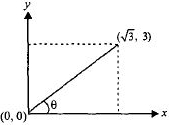
$A$ particle starting from the origin $(0, 0)$ moves in a straight line in the $(x, y)$ plane. Its coordinates at a later time are $(\sqrt{3}, 3)$. The path of the particle makes an angle of ......... $^o$ with the $x$-axis.
A
$45$
B
$60$
C
$0$
D
$30$
Solution
(B) Let $\theta$ be the angle that the particle's path makes with the $x$-axis.
From the given coordinates $(x, y) = (\sqrt{3}, 3)$,the slope of the line is given by $\tan \theta = \frac{y}{x}$.
Substituting the values,we get $\tan \theta = \frac{3}{\sqrt{3}}$.
Simplifying this,$\tan \theta = \sqrt{3}$.
Therefore,$\theta = \tan^{-1}(\sqrt{3}) = 60^o$.
From the given coordinates $(x, y) = (\sqrt{3}, 3)$,the slope of the line is given by $\tan \theta = \frac{y}{x}$.
Substituting the values,we get $\tan \theta = \frac{3}{\sqrt{3}}$.
Simplifying this,$\tan \theta = \sqrt{3}$.
Therefore,$\theta = \tan^{-1}(\sqrt{3}) = 60^o$.
0 likesView Solution
6
PhysicsMediumMCQAIPMT · 2007
$\vec A$ and $\vec B$ are two vectors and $\theta$ is the angle between them. If $|\vec A \times \vec B| = \sqrt{3}(\vec A \cdot \vec B)$,the value of $\theta$ is ......... $^\circ$.
A
$60$
B
$45$
C
$180$
D
$0$
Solution
(A) Given the equation: $|\vec A \times \vec B| = \sqrt{3}(\vec A \cdot \vec B)$.
We know that the magnitude of the cross product is $|\vec A \times \vec B| = AB \sin \theta$ and the dot product is $\vec A \cdot \vec B = AB \cos \theta$.
Substituting these into the given equation:
$AB \sin \theta = \sqrt{3} AB \cos \theta$.
Dividing both sides by $AB \cos \theta$ (assuming $A, B \neq 0$ and $\cos \theta \neq 0$):
$\frac{\sin \theta}{\cos \theta} = \sqrt{3}$.
$\tan \theta = \sqrt{3}$.
Therefore,$\theta = \tan^{-1}(\sqrt{3}) = 60^\circ$.
We know that the magnitude of the cross product is $|\vec A \times \vec B| = AB \sin \theta$ and the dot product is $\vec A \cdot \vec B = AB \cos \theta$.
Substituting these into the given equation:
$AB \sin \theta = \sqrt{3} AB \cos \theta$.
Dividing both sides by $AB \cos \theta$ (assuming $A, B \neq 0$ and $\cos \theta \neq 0$):
$\frac{\sin \theta}{\cos \theta} = \sqrt{3}$.
$\tan \theta = \sqrt{3}$.
Therefore,$\theta = \tan^{-1}(\sqrt{3}) = 60^\circ$.
0 likesView Solution
7
PhysicsMediumMCQAIPMT · 2007
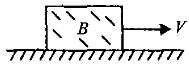
$A$ block $B$ is pushed momentarily along a horizontal surface with an initial velocity $V$. If $\mu$ is the coefficient of sliding friction between $B$ and the surface,the block $B$ will come to rest after a time:
A
$\frac{g\mu}{V}$
B
$\frac{g}{V}$
C
$\frac{V}{g}$
D
$\frac{V}{\mu g}$
Solution
(D) Given: Initial velocity $u = V$,final velocity $v = 0$.
The force of kinetic friction acting on the block is $f = \mu R = \mu mg$,where $m$ is the mass of the block and $g$ is the acceleration due to gravity.
According to Newton's second law,the retardation $a$ produced by this friction is:
$a = \frac{f}{m} = \frac{\mu mg}{m} = \mu g$.
Using the first equation of motion,$v = u - at$ (where $a$ is retardation):
$0 = V - (\mu g)t$
$V = \mu gt$
$t = \frac{V}{\mu g}$.
The force of kinetic friction acting on the block is $f = \mu R = \mu mg$,where $m$ is the mass of the block and $g$ is the acceleration due to gravity.
According to Newton's second law,the retardation $a$ produced by this friction is:
$a = \frac{f}{m} = \frac{\mu mg}{m} = \mu g$.
Using the first equation of motion,$v = u - at$ (where $a$ is retardation):
$0 = V - (\mu g)t$
$V = \mu gt$
$t = \frac{V}{\mu g}$.
0 likesView Solution
8
PhysicsMediumMCQAIPMT · 2007
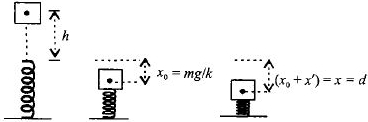
$A$ vertical spring with force constant $k$ is fixed on a table. $A$ ball of mass $m$ at a height $h$ above the free upper end of the spring falls vertically on the spring so that the spring is compressed by a distance $d$. The net work done in the process is
A
$mg(h + d) - \frac{1}{2}kd^2$
B
$mg(h - d) - \frac{1}{2}kd^2$
C
$mg(h - d) + \frac{1}{2}kd^2$
D
$mg(h + d) + \frac{1}{2}kd^2$
Solution
(A) According to the work-energy theorem,the net work done on the system is equal to the change in kinetic energy of the ball.
Let the initial position of the ball be at height $h$ above the spring. The final position is when the spring is compressed by distance $d$.
The total vertical displacement of the ball is $(h + d)$.
The forces acting on the ball are gravity (downward) and the spring force (upward).
The work done by gravity is $W_g = mg(h + d)$.
The work done by the spring force is $W_s = -\int_0^d kx \, dx = -\frac{1}{2}kd^2$.
The net work done on the ball is $W_{net} = W_g + W_s = mg(h + d) - \frac{1}{2}kd^2$.
Since the ball starts from rest and comes to rest momentarily at the maximum compression $d$,the change in kinetic energy is zero,which implies $W_{net} = 0$ for the entire process. However,the question asks for the net work done by the external forces (gravity and spring) during the displacement $d$,which is $mg(h + d) - \frac{1}{2}kd^2$.
Let the initial position of the ball be at height $h$ above the spring. The final position is when the spring is compressed by distance $d$.
The total vertical displacement of the ball is $(h + d)$.
The forces acting on the ball are gravity (downward) and the spring force (upward).
The work done by gravity is $W_g = mg(h + d)$.
The work done by the spring force is $W_s = -\int_0^d kx \, dx = -\frac{1}{2}kd^2$.
The net work done on the ball is $W_{net} = W_g + W_s = mg(h + d) - \frac{1}{2}kd^2$.
Since the ball starts from rest and comes to rest momentarily at the maximum compression $d$,the change in kinetic energy is zero,which implies $W_{net} = 0$ for the entire process. However,the question asks for the net work done by the external forces (gravity and spring) during the displacement $d$,which is $mg(h + d) - \frac{1}{2}kd^2$.
0 likesView Solution
9
PhysicsEasyMCQAIPMT · 2007
$A$ black body is at $727^\circ C$. It emits energy at a rate which is proportional to
A
$(1000)^4$
B
$(1000)^2$
C
$(727)^4$
D
$(727)^2$
Solution
(A) According to Stefan-Boltzmann law,the rate of energy radiated $(E)$ by a black body is directly proportional to the fourth power of its absolute temperature ($T$ in Kelvin).
The formula is given by $E \propto T^4$.
Given the temperature in Celsius is $727^\circ C$,we must convert it to Kelvin:
$T = 727 + 273 = 1000 \ K$.
Substituting this value into the proportionality relation:
$E \propto (1000)^4$.
Therefore,the rate of energy emission is proportional to $(1000)^4$.
The formula is given by $E \propto T^4$.
Given the temperature in Celsius is $727^\circ C$,we must convert it to Kelvin:
$T = 727 + 273 = 1000 \ K$.
Substituting this value into the proportionality relation:
$E \propto (1000)^4$.
Therefore,the rate of energy emission is proportional to $(1000)^4$.
0 likesView Solution
10
PhysicsMediumMCQAIPMT · 2007
Assuming the sun to have a spherical outer surface of radius $r$,radiating like a black body at temperature $t^{\circ} C$,the power received by a unit surface (normal to the incident rays) at a distance $R$ from the centre of the sun is,where $\sigma$ is the Stefan's constant.
A
$\frac{r^2 \sigma (t + 273)^4}{4\pi R^2}$
B
$\frac{16\pi^2 r^2 \sigma t^4}{R^2}$
C
$\frac{r^2 \sigma (t + 273)^4}{R^2}$
D
$\frac{4\pi r^2 \sigma t^4}{R^2}$
Solution
(C) The total power $P$ radiated by the sun,acting as a black body with radius $r$ and absolute temperature $T = (t + 273) \ K$,is given by the Stefan-Boltzmann law: $P = \sigma A T^4 = \sigma (4\pi r^2) (t + 273)^4$.
At a distance $R$ from the center of the sun,this power is distributed over a spherical surface area of $4\pi R^2$.
The power received per unit area (intensity $S$) by a surface normal to the incident rays is given by: $S = \frac{P}{4\pi R^2}$.
Substituting the value of $P$: $S = \frac{\sigma (4\pi r^2) (t + 273)^4}{4\pi R^2} = \frac{r^2 \sigma (t + 273)^4}{R^2}$.
At a distance $R$ from the center of the sun,this power is distributed over a spherical surface area of $4\pi R^2$.
The power received per unit area (intensity $S$) by a surface normal to the incident rays is given by: $S = \frac{P}{4\pi R^2}$.
Substituting the value of $P$: $S = \frac{\sigma (4\pi r^2) (t + 273)^4}{4\pi R^2} = \frac{r^2 \sigma (t + 273)^4}{R^2}$.
0 likesView Solution
11
PhysicsMediumMCQAIPMT · 2007
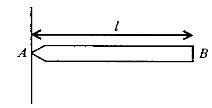
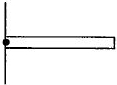
$A$ uniform rod $AB$ of length $l$ and mass $m$ is free to rotate about point $A.$ The rod is released from rest in the horizontal position. Given that the moment of inertia of the rod about $A$ is $ml^2/3$,the initial angular acceleration of the rod will be:
A
$\frac{mgl}{2}$
B
$\frac{3}{2}gl$
C
$\frac{3g}{2l}$
D
$\frac{2g}{3l}$
Solution
(C) The torque $\tau$ about point $A$ is due to the gravitational force acting at the center of mass of the rod,which is at a distance $l/2$ from $A.$
$\tau = mg \times \frac{l}{2} = \frac{mgl}{2}$
Using the relation between torque and angular acceleration,$\tau = I\alpha$,where $I$ is the moment of inertia about $A$ and $\alpha$ is the angular acceleration.
Given $I = \frac{ml^2}{3}$,we have:
$\alpha = \frac{\tau}{I} = \frac{mgl/2}{ml^2/3} = \frac{mgl}{2} \times \frac{3}{ml^2} = \frac{3g}{2l}$
$\tau = mg \times \frac{l}{2} = \frac{mgl}{2}$
Using the relation between torque and angular acceleration,$\tau = I\alpha$,where $I$ is the moment of inertia about $A$ and $\alpha$ is the angular acceleration.
Given $I = \frac{ml^2}{3}$,we have:
$\alpha = \frac{\tau}{I} = \frac{mgl/2}{ml^2/3} = \frac{mgl}{2} \times \frac{3}{ml^2} = \frac{3g}{2l}$
0 likesView Solution
12
PhysicsMediumMCQAIPMT · 2007
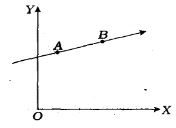
$A$ particle of mass $m$ moves in the $XY$ plane with a velocity $v$ along the straight line $AB.$ If the angular momentum of the particle with respect to origin $O$ is $L_A$ when it is at $A$ and $L_B$ when it is at $B,$ then
A
$L_A = L_B$
B
the relationship between $L_A$ and $L_B$ depends upon the slope of the line $AB$
C
$L_A < L_B$
D
$L_A > L_B$
Solution
(A) The angular momentum $L$ of a particle with respect to an origin $O$ is given by the formula $L = r \times p = r \times (mv),$ where $r$ is the position vector of the particle and $p$ is its linear momentum.
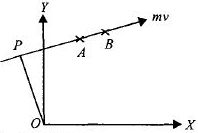
This can also be expressed as $L = m v d,$ where $d$ is the perpendicular distance from the origin $O$ to the line of motion of the particle.
Since the particle is moving along a straight line $AB,$ the perpendicular distance $d$ from the origin $O$ to this line remains constant at all points on the line.
Therefore,the angular momentum $L$ is constant for all points on the line $AB.$
Thus,$L_A = L_B.$
This can also be expressed as $L = m v d,$ where $d$ is the perpendicular distance from the origin $O$ to the line of motion of the particle.
Since the particle is moving along a straight line $AB,$ the perpendicular distance $d$ from the origin $O$ to this line remains constant at all points on the line.
Therefore,the angular momentum $L$ is constant for all points on the line $AB.$
Thus,$L_A = L_B.$
0 likesView Solution
13
PhysicsDifficultMCQAIPMT · 2007
An engine has an efficiency of $1/6$. When the temperature of the sink is reduced by $62^{\circ}C$,its efficiency is doubled. The temperature of the source is ....... $^{\circ}C$.
A
$80$
B
$95$
C
$90$
D
$99$
Solution
(D) The efficiency of a Carnot engine is given by $\eta = 1 - \frac{T_2}{T_1}$,where $T_1$ is the source temperature and $T_2$ is the sink temperature in Kelvin.
Given $\eta_1 = 1/6$,so $1/6 = 1 - \frac{T_2}{T_1}$,which implies $\frac{T_2}{T_1} = 5/6$ or $T_2 = \frac{5}{6}T_1$ $...(i)$.
When the sink temperature is reduced by $62^{\circ}C$ (which is equivalent to a change of $62 \ K$),the new efficiency $\eta_2 = 2 \times \eta_1 = 2 \times (1/6) = 1/3$.
The new sink temperature is $T_2' = T_2 - 62$.
Using the efficiency formula: $1/3 = 1 - \frac{T_2 - 62}{T_1}$.
Rearranging gives $\frac{T_2 - 62}{T_1} = 1 - 1/3 = 2/3$.
Substituting $T_2 = \frac{5}{6}T_1$ from equation $(i)$:
$\frac{\frac{5}{6}T_1 - 62}{T_1} = 2/3$.
$\frac{5}{6} - \frac{62}{T_1} = 2/3$.
$\frac{62}{T_1} = \frac{5}{6} - \frac{4}{6} = 1/6$.
$T_1 = 62 \times 6 = 372 \ K$.
To convert to Celsius: $T(^{\circ}C) = 372 - 273 = 99^{\circ}C$.
Given $\eta_1 = 1/6$,so $1/6 = 1 - \frac{T_2}{T_1}$,which implies $\frac{T_2}{T_1} = 5/6$ or $T_2 = \frac{5}{6}T_1$ $...(i)$.
When the sink temperature is reduced by $62^{\circ}C$ (which is equivalent to a change of $62 \ K$),the new efficiency $\eta_2 = 2 \times \eta_1 = 2 \times (1/6) = 1/3$.
The new sink temperature is $T_2' = T_2 - 62$.
Using the efficiency formula: $1/3 = 1 - \frac{T_2 - 62}{T_1}$.
Rearranging gives $\frac{T_2 - 62}{T_1} = 1 - 1/3 = 2/3$.
Substituting $T_2 = \frac{5}{6}T_1$ from equation $(i)$:
$\frac{\frac{5}{6}T_1 - 62}{T_1} = 2/3$.
$\frac{5}{6} - \frac{62}{T_1} = 2/3$.
$\frac{62}{T_1} = \frac{5}{6} - \frac{4}{6} = 1/6$.
$T_1 = 62 \times 6 = 372 \ K$.
To convert to Celsius: $T(^{\circ}C) = 372 - 273 = 99^{\circ}C$.
0 likesView Solution
14
PhysicsMediumMCQAIPMT · 2007
$A$ particle executing simple harmonic motion has a kinetic energy $K = K_0 \cos^2(\omega t)$. The maximum values of the potential energy and the total energy are respectively:
A
$K_0, K_0$
B
$K_0, 2K_0$
C
$K_0/2, K_0$
D
$0, 2K_0$
Solution
(A) The kinetic energy of a particle in simple harmonic motion is given by $K = K_0 \cos^2(\omega t)$.
Since the maximum value of $\cos^2(\omega t)$ is $1$,the maximum kinetic energy is $K_{max} = K_0$.
In simple harmonic motion,the total energy $E$ remains constant and is equal to the maximum kinetic energy or the maximum potential energy.
Thus,$E = K_{max} = K_0$.
Since the total energy $E = K + U$,where $U$ is the potential energy,we have $U = E - K = K_0 - K_0 \cos^2(\omega t) = K_0 \sin^2(\omega t)$.
The maximum value of potential energy is $U_{max} = K_0$.
Therefore,the maximum potential energy is $K_0$ and the total energy is $K_0$.
Since the maximum value of $\cos^2(\omega t)$ is $1$,the maximum kinetic energy is $K_{max} = K_0$.
In simple harmonic motion,the total energy $E$ remains constant and is equal to the maximum kinetic energy or the maximum potential energy.
Thus,$E = K_{max} = K_0$.
Since the total energy $E = K + U$,where $U$ is the potential energy,we have $U = E - K = K_0 - K_0 \cos^2(\omega t) = K_0 \sin^2(\omega t)$.
The maximum value of potential energy is $U_{max} = K_0$.
Therefore,the maximum potential energy is $K_0$ and the total energy is $K_0$.
0 likesView Solution
15
PhysicsEasyMCQAIPMT · 2007
The phase difference between the instantaneous velocity and acceleration of a particle executing simple harmonic motion is
A
$\pi$
B
$2\pi$
C
$0.5\pi$
D
$0$
Solution
(C) Let the displacement of a particle executing simple harmonic motion be $y = A \sin(\omega t)$.
The instantaneous velocity $v$ is given by the derivative of displacement with respect to time:
$v = \frac{dy}{dt} = A\omega \cos(\omega t) = A\omega \sin(\omega t + \frac{\pi}{2})$.
The instantaneous acceleration $a$ is given by the derivative of velocity with respect to time:
$a = \frac{dv}{dt} = -A\omega^2 \sin(\omega t) = A\omega^2 \sin(\omega t + \pi)$.
The phase of velocity is $(\omega t + \frac{\pi}{2})$ and the phase of acceleration is $(\omega t + \pi)$.
The phase difference between acceleration and velocity is $(\omega t + \pi) - (\omega t + \frac{\pi}{2}) = \frac{\pi}{2}$ or $0.5\pi$.
The instantaneous velocity $v$ is given by the derivative of displacement with respect to time:
$v = \frac{dy}{dt} = A\omega \cos(\omega t) = A\omega \sin(\omega t + \frac{\pi}{2})$.
The instantaneous acceleration $a$ is given by the derivative of velocity with respect to time:
$a = \frac{dv}{dt} = -A\omega^2 \sin(\omega t) = A\omega^2 \sin(\omega t + \pi)$.
The phase of velocity is $(\omega t + \frac{\pi}{2})$ and the phase of acceleration is $(\omega t + \pi)$.
The phase difference between acceleration and velocity is $(\omega t + \pi) - (\omega t + \frac{\pi}{2}) = \frac{\pi}{2}$ or $0.5\pi$.
0 likesView Solution
16
PhysicsMediumMCQAIPMT · 2007
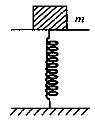
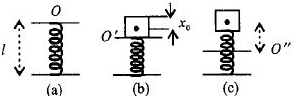
$A$ mass of $2.0\, kg$ is placed on a flat pan attached to a vertical spring fixed on the ground as shown in the figure. The mass of the spring and the pan is negligible. When pressed slightly and released,the mass executes simple harmonic motion. The spring constant is $200\, N/m$. What should be the minimum amplitude of the motion so that the mass gets detached from the pan? (Take $g = 10\, m/s^2$)
A
$10\, cm$
B
Any value less than $12\, cm$
C
$4\, cm$
D
$8\, cm$
Solution
(A) The spring has a natural length $l$. When mass $m$ is placed on it,the spring compresses by $x_0$ to reach the equilibrium position $O'$.
At equilibrium,the spring force balances the weight of the mass: $k x_0 = m g$.
$x_0 = \frac{m g}{k} = \frac{2.0 \times 10}{200} = 0.10\, m = 10\, cm$.
When the mass oscillates with amplitude $A$,the maximum upward acceleration of the mass is $a_{max} = A \omega^2$,where $\omega^2 = \frac{k}{m}$.
The mass will detach from the pan when the downward acceleration of the mass exceeds the acceleration due to gravity $g$ at the highest point of its motion,or equivalently,when the normal force becomes zero.
The condition for the mass to lose contact with the pan is $A \omega^2 \ge g$.
Substituting $\omega^2 = \frac{k}{m}$,we get $A (\frac{k}{m}) \ge g$.
$A \ge \frac{m g}{k} = x_0$.
Therefore,the minimum amplitude required for the mass to detach is $A = 10\, cm$.
At equilibrium,the spring force balances the weight of the mass: $k x_0 = m g$.
$x_0 = \frac{m g}{k} = \frac{2.0 \times 10}{200} = 0.10\, m = 10\, cm$.
When the mass oscillates with amplitude $A$,the maximum upward acceleration of the mass is $a_{max} = A \omega^2$,where $\omega^2 = \frac{k}{m}$.
The mass will detach from the pan when the downward acceleration of the mass exceeds the acceleration due to gravity $g$ at the highest point of its motion,or equivalently,when the normal force becomes zero.
The condition for the mass to lose contact with the pan is $A \omega^2 \ge g$.
Substituting $\omega^2 = \frac{k}{m}$,we get $A (\frac{k}{m}) \ge g$.
$A \ge \frac{m g}{k} = x_0$.
Therefore,the minimum amplitude required for the mass to detach is $A = 10\, cm$.
0 likesView Solution
17
PhysicsMediumMCQAIPMT · 2007
$A$ particle executes simple harmonic oscillation with an amplitude $a$. The period of oscillation is $T$. The minimum time taken by the particle to travel half of the amplitude from the equilibrium position is:
A
$T/8$
B
$T/12$
C
$T/2$
D
$T/4$
Solution
(B) The displacement of a particle in simple harmonic motion starting from the equilibrium position is given by $x(t) = a \sin(\omega t)$.
We need to find the time $t$ when the displacement $x(t) = a/2$.
Substituting the values,we get: $a/2 = a \sin(\omega t)$.
This simplifies to $\sin(\omega t) = 1/2$.
Since $\sin(\pi/6) = 1/2$,we have $\omega t = \pi/6$.
Substituting $\omega = 2\pi/T$,we get $(2\pi/T) \cdot t = \pi/6$.
Solving for $t$,we find $t = T/12$.
We need to find the time $t$ when the displacement $x(t) = a/2$.
Substituting the values,we get: $a/2 = a \sin(\omega t)$.
This simplifies to $\sin(\omega t) = 1/2$.
Since $\sin(\pi/6) = 1/2$,we have $\omega t = \pi/6$.
Substituting $\omega = 2\pi/T$,we get $(2\pi/T) \cdot t = \pi/6$.
Solving for $t$,we find $t = T/12$.
0 likesView Solution
18
PhysicsEasyMCQAIPMT · 2007
$A$ wheel has an angular acceleration of $3.0\, rad/s^2$ and an initial angular speed of $2.00\, rad/s$. In a time of $2\, s$,it has rotated through an angle (in radians) of:
A
$6$
B
$10$
C
$12$
D
$4$
Solution
(B) Given:
Initial angular speed,$\omega_0 = 2.00\, rad/s$
Angular acceleration,$\alpha = 3.0\, rad/s^2$
Time,$t = 2\, s$
Using the kinematic equation for angular displacement:
$\theta = \omega_0 t + \frac{1}{2} \alpha t^2$
Substituting the given values:
$\theta = (2.00)(2) + \frac{1}{2}(3.0)(2)^2$
$\theta = 4 + \frac{1}{2}(3.0)(4)$
$\theta = 4 + 6 = 10\, radians$
Thus,the wheel has rotated through an angle of $10\, radians$.
Initial angular speed,$\omega_0 = 2.00\, rad/s$
Angular acceleration,$\alpha = 3.0\, rad/s^2$
Time,$t = 2\, s$
Using the kinematic equation for angular displacement:
$\theta = \omega_0 t + \frac{1}{2} \alpha t^2$
Substituting the given values:
$\theta = (2.00)(2) + \frac{1}{2}(3.0)(2)^2$
$\theta = 4 + \frac{1}{2}(3.0)(4)$
$\theta = 4 + 6 = 10\, radians$
Thus,the wheel has rotated through an angle of $10\, radians$.
0 likesView Solution
19
PhysicsEasyMCQAIPMT · 2007
Two satellites of earth,$S_{1}$ and $S_{2}$,are moving in the same orbit. The mass of $S_{1}$ is four times the mass of $S_{2}$. Which one of the following statements is true?
A
The time period of $S_{1}$ is four times that of $S_{2}$
B
The potential energies of earth and satellite in the two cases are equal
C
$S_{1}$ and $S_{2}$ are moving with the same speed
D
The kinetic energies of the two satellites are equal
Solution
(C) The orbital speed of a satellite is given by $v = \sqrt{\frac{GM}{r}}$,where $G$ is the gravitational constant,$M$ is the mass of the earth,and $r$ is the radius of the orbit.
Since both satellites are in the same orbit,$r$ is the same for both.
Therefore,the orbital speed $v$ is independent of the mass of the satellite.
Thus,$S_{1}$ and $S_{2}$ move with the same speed.
The time period is given by $T = \frac{2\pi r}{v}$,which is also independent of the mass of the satellite.
Potential energy $U = -\frac{GMm}{r}$ and kinetic energy $K = \frac{GMm}{2r}$ both depend on the mass $m$ of the satellite,so they are not equal for $S_{1}$ and $S_{2}$.
Since both satellites are in the same orbit,$r$ is the same for both.
Therefore,the orbital speed $v$ is independent of the mass of the satellite.
Thus,$S_{1}$ and $S_{2}$ move with the same speed.
The time period is given by $T = \frac{2\pi r}{v}$,which is also independent of the mass of the satellite.
Potential energy $U = -\frac{GMm}{r}$ and kinetic energy $K = \frac{GMm}{2r}$ both depend on the mass $m$ of the satellite,so they are not equal for $S_{1}$ and $S_{2}$.
0 likesView Solution
20
PhysicsEasyMCQAIPMT · 2007
The oscillating electric and magnetic vectors of an electromagnetic wave are oriented along
A
The same direction but differ in phase by $90^{\circ}$
B
The same direction and are in phase
C
Mutually perpendicular directions and are in phase
D
Mutually perpendicular directions and differ in phase by $90^{\circ}$
Solution
(C) In an electromagnetic wave,the oscillating electric field vector $\vec{E}$ and the magnetic field vector $\vec{B}$ are always mutually perpendicular to each other and also perpendicular to the direction of wave propagation.
Furthermore,these fields are in phase,which means they reach their maximum and minimum values at the same time and at the same spatial location.
Therefore,the correct option is $C$.
Furthermore,these fields are in phase,which means they reach their maximum and minimum values at the same time and at the same spatial location.
Therefore,the correct option is $C$.
0 likesView Solution
21
PhysicsDifficultMCQAIPMT · 2007
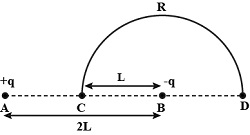
Charges $+q$ and $-q$ are placed at points $A$ and $B$ respectively,which are a distance $2L$ apart. $C$ is the midpoint between $A$ and $B$. The work done in moving a charge $+Q$ along the semicircle $CRD$ is
A
$\frac{qQ}{2\pi\varepsilon_0 L}$
B
$\frac{qQ}{6\pi\varepsilon_0 L}$
C
$-\frac{qQ}{6\pi\varepsilon_0 L}$
D
$\frac{qQ}{4\pi\varepsilon_0 L}$
Solution
(C) From the figure,$AC = L$,$BC = L$. Since $C$ is the midpoint of $AB$ and $CD$ is a semicircle with diameter $CD$,the distance $BD = L$ (as $C, B, D$ are collinear and $CD$ is the diameter of the semicircle,$CB = BD = L$).
Potential at $C$ is given by:
$V_C = \frac{1}{4\pi\varepsilon_0} \left[ \frac{q}{AC} + \frac{-q}{BC} \right] = \frac{1}{4\pi\varepsilon_0} \left[ \frac{q}{L} - \frac{q}{L} \right] = 0$
Potential at $D$ is given by:
$AD = AB + BD = 2L + L = 3L$
$V_D = \frac{1}{4\pi\varepsilon_0} \left[ \frac{q}{AD} + \frac{-q}{BD} \right] = \frac{1}{4\pi\varepsilon_0} \left[ \frac{q}{3L} - \frac{q}{L} \right]$
$V_D = \frac{q}{4\pi\varepsilon_0 L} \left[ \frac{1}{3} - 1 \right] = \frac{q}{4\pi\varepsilon_0 L} \left( -\frac{2}{3} \right) = -\frac{q}{6\pi\varepsilon_0 L}$
Work done in moving charge $+Q$ from $C$ to $D$ is:
$W = Q(V_D - V_C) = Q \left( -\frac{q}{6\pi\varepsilon_0 L} - 0 \right) = -\frac{qQ}{6\pi\varepsilon_0 L}$
Potential at $C$ is given by:
$V_C = \frac{1}{4\pi\varepsilon_0} \left[ \frac{q}{AC} + \frac{-q}{BC} \right] = \frac{1}{4\pi\varepsilon_0} \left[ \frac{q}{L} - \frac{q}{L} \right] = 0$
Potential at $D$ is given by:
$AD = AB + BD = 2L + L = 3L$
$V_D = \frac{1}{4\pi\varepsilon_0} \left[ \frac{q}{AD} + \frac{-q}{BD} \right] = \frac{1}{4\pi\varepsilon_0} \left[ \frac{q}{3L} - \frac{q}{L} \right]$
$V_D = \frac{q}{4\pi\varepsilon_0 L} \left[ \frac{1}{3} - 1 \right] = \frac{q}{4\pi\varepsilon_0 L} \left( -\frac{2}{3} \right) = -\frac{q}{6\pi\varepsilon_0 L}$
Work done in moving charge $+Q$ from $C$ to $D$ is:
$W = Q(V_D - V_C) = Q \left( -\frac{q}{6\pi\varepsilon_0 L} - 0 \right) = -\frac{qQ}{6\pi\varepsilon_0 L}$
0 likesView Solution
22
PhysicsMediumMCQAIPMT · 2007
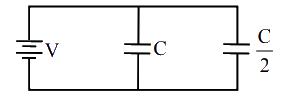
Two capacitors,one of capacity $C$ and other of capacity $C/2$ are connected to a $V$ volt battery,as shown in the figure. The work done in charging fully both the capacitors is
A
$\frac{1}{4} C V^2$
B
$\frac{3}{4} C V^2$
C
$\frac{1}{2} C V^2$
D
$3 C V^2$
Solution
(B) The capacitors are connected in parallel to the battery of potential $V$.
The equivalent capacitance of the parallel combination is $C_{eq} = C + \frac{C}{2} = \frac{3}{2} C$.
The work done $W$ in charging a capacitor is equal to the energy stored in the capacitor,which is given by $W = \frac{1}{2} C_{eq} V^2$.
Substituting the value of $C_{eq}$:
$W = \frac{1}{2} \times \left( \frac{3}{2} C \right) V^2 = \frac{3}{4} C V^2$.
The equivalent capacitance of the parallel combination is $C_{eq} = C + \frac{C}{2} = \frac{3}{2} C$.
The work done $W$ in charging a capacitor is equal to the energy stored in the capacitor,which is given by $W = \frac{1}{2} C_{eq} V^2$.
Substituting the value of $C_{eq}$:
$W = \frac{1}{2} \times \left( \frac{3}{2} C \right) V^2 = \frac{3}{4} C V^2$.
0 likesView Solution
23
PhysicsMediumMCQAIPMT · 2007
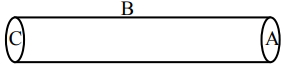
$A$ hollow cylinder has a charge $q$ within it. If $\phi$ is the electric flux in units of $V-m$ associated with the curved surface $B,$ the flux linked with the plane surface $A$ in units of $V-m$ will be
A
$\frac{q}{2\varepsilon_0}$
B
$\frac{\phi}{3}$
C
$\frac{q}{\varepsilon_0} - \phi$
D
$\frac{1}{2}\left(\frac{q}{\varepsilon_0} - \phi\right)$
Solution
(D) Let $\phi_A, \phi_B,$ and $\phi_C$ be the electric flux linked with the surfaces $A, B,$ and $C$ respectively.
According to Gauss's Law,the total electric flux through the closed surface is $\phi_{total} = \phi_A + \phi_B + \phi_C = \frac{q}{\varepsilon_0}$.
Due to the symmetry of the cylinder,the flux linked with the two plane surfaces $A$ and $C$ is equal,so $\phi_A = \phi_C$.
Substituting this into the Gauss's Law equation,we get $2\phi_A + \phi_B = \frac{q}{\varepsilon_0}$.
Given that the flux through the curved surface $B$ is $\phi_B = \phi$,we have $2\phi_A + \phi = \frac{q}{\varepsilon_0}$.
Rearranging for $\phi_A$,we get $2\phi_A = \frac{q}{\varepsilon_0} - \phi$.
Therefore,$\phi_A = \frac{1}{2}\left(\frac{q}{\varepsilon_0} - \phi\right)$.
According to Gauss's Law,the total electric flux through the closed surface is $\phi_{total} = \phi_A + \phi_B + \phi_C = \frac{q}{\varepsilon_0}$.
Due to the symmetry of the cylinder,the flux linked with the two plane surfaces $A$ and $C$ is equal,so $\phi_A = \phi_C$.
Substituting this into the Gauss's Law equation,we get $2\phi_A + \phi_B = \frac{q}{\varepsilon_0}$.
Given that the flux through the curved surface $B$ is $\phi_B = \phi$,we have $2\phi_A + \phi = \frac{q}{\varepsilon_0}$.
Rearranging for $\phi_A$,we get $2\phi_A = \frac{q}{\varepsilon_0} - \phi$.
Therefore,$\phi_A = \frac{1}{2}\left(\frac{q}{\varepsilon_0} - \phi\right)$.
0 likesView Solution
24
PhysicsMediumMCQAIPMT · 2007
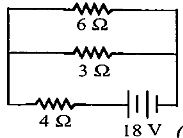
The total power dissipated in the circuit shown here is ............. $W$.
A
$40$
B
$54$
C
$4$
D
$16$
Solution
(B) In the given circuit,the resistors $6 \,\Omega$ and $3 \,\Omega$ are connected in parallel. Their equivalent resistance $R_p$ is given by:
$\frac{1}{R_p} = \frac{1}{6} + \frac{1}{3} = \frac{1+2}{6} = \frac{3}{6} = \frac{1}{2} \implies R_p = 2 \,\Omega$.
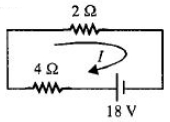
The equivalent circuit consists of this $R_p = 2 \,\Omega$ resistor in series with the $4 \,\Omega$ resistor and the $18 \,V$ battery.
The total resistance of the circuit is $R_{eq} = R_p + 4 \,\Omega = 2 \,\Omega + 4 \,\Omega = 6 \,\Omega$.
The total current $I$ flowing through the circuit is given by Ohm's law:
$I = \frac{V}{R_{eq}} = \frac{18 \,V}{6 \,\Omega} = 3 \,A$.
The total power dissipated in the circuit is given by $P = I^2 R_{eq}$ or $P = VI_{total}$.
Using $P = VI_{total} = 18 \,V \times 3 \,A = 54 \,W$.
$\frac{1}{R_p} = \frac{1}{6} + \frac{1}{3} = \frac{1+2}{6} = \frac{3}{6} = \frac{1}{2} \implies R_p = 2 \,\Omega$.
The equivalent circuit consists of this $R_p = 2 \,\Omega$ resistor in series with the $4 \,\Omega$ resistor and the $18 \,V$ battery.
The total resistance of the circuit is $R_{eq} = R_p + 4 \,\Omega = 2 \,\Omega + 4 \,\Omega = 6 \,\Omega$.
The total current $I$ flowing through the circuit is given by Ohm's law:
$I = \frac{V}{R_{eq}} = \frac{18 \,V}{6 \,\Omega} = 3 \,A$.
The total power dissipated in the circuit is given by $P = I^2 R_{eq}$ or $P = VI_{total}$.
Using $P = VI_{total} = 18 \,V \times 3 \,A = 54 \,W$.
0 likesView Solution
25
PhysicsMediumMCQAIPMT · 2007
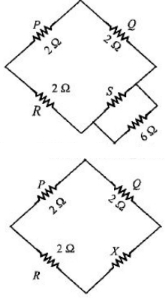
Three resistances $P, Q, R$ each of $2 \,\Omega$ and an unknown resistance $S$ form the four arms of a Wheatstone bridge circuit. When a resistance of $6 \,\Omega$ is connected in parallel to $S$,the bridge gets balanced. What is the value of $S$ in $\Omega$?
A
$3$
B
$6$
C
$1$
D
$2$
Solution
(A) Let $X$ be the equivalent resistance of $S$ and $6 \,\Omega$ connected in parallel.
For a parallel combination,the equivalent resistance $X$ is given by:
$\frac{1}{X} = \frac{1}{S} + \frac{1}{6} \quad \dots(i)$
For a balanced Wheatstone bridge,the condition is $\frac{P}{Q} = \frac{R}{X}$.
Given $P = Q = R = 2 \,\Omega$,we substitute these values:
$\frac{2}{2} = \frac{2}{X} \implies 1 = \frac{2}{X} \implies X = 2 \,\Omega$.
Now,substitute $X = 2 \,\Omega$ into equation $(i)$:
$\frac{1}{2} = \frac{1}{S} + \frac{1}{6}$
$\frac{1}{S} = \frac{1}{2} - \frac{1}{6}$
$\frac{1}{S} = \frac{3 - 1}{6} = \frac{2}{6} = \frac{1}{3}$
Therefore,$S = 3 \,\Omega$.
For a parallel combination,the equivalent resistance $X$ is given by:
$\frac{1}{X} = \frac{1}{S} + \frac{1}{6} \quad \dots(i)$
For a balanced Wheatstone bridge,the condition is $\frac{P}{Q} = \frac{R}{X}$.
Given $P = Q = R = 2 \,\Omega$,we substitute these values:
$\frac{2}{2} = \frac{2}{X} \implies 1 = \frac{2}{X} \implies X = 2 \,\Omega$.
Now,substitute $X = 2 \,\Omega$ into equation $(i)$:
$\frac{1}{2} = \frac{1}{S} + \frac{1}{6}$
$\frac{1}{S} = \frac{1}{2} - \frac{1}{6}$
$\frac{1}{S} = \frac{3 - 1}{6} = \frac{2}{6} = \frac{1}{3}$
Therefore,$S = 3 \,\Omega$.
0 likesView Solution
26
PhysicsMediumMCQAIPMT · 2007
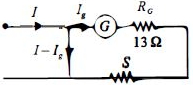
The resistance of an ammeter is $13\, \Omega$ and its scale is graduated for a current up to $100\, A$. After an additional shunt has been connected to this ammeter,it becomes possible to measure currents up to $750\, A$ by this meter. The value of the shunt resistance is:
A
$2\, \Omega$
B
$0.2\, \Omega$
C
$2\, k\Omega$
D
$20\, \Omega$
Solution
(A) Let the shunt resistance be $S$.
Given:
Total current to be measured,$I = 750\, A$
Full-scale deflection current of the ammeter,$I_g = 100\, A$
Resistance of the ammeter,$R_G = 13\, \Omega$
When a shunt $S$ is connected in parallel with the ammeter,the potential difference across the ammeter and the shunt must be equal:
$I_g R_G = (I - I_g) S$
Substituting the given values:
$100 \times 13 = (750 - 100) \times S$
$1300 = 650 \times S$
Solving for $S$:
$S = \frac{1300}{650} = 2\, \Omega$
Thus,the value of the shunt resistance is $2\, \Omega$.
Given:
Total current to be measured,$I = 750\, A$
Full-scale deflection current of the ammeter,$I_g = 100\, A$
Resistance of the ammeter,$R_G = 13\, \Omega$
When a shunt $S$ is connected in parallel with the ammeter,the potential difference across the ammeter and the shunt must be equal:
$I_g R_G = (I - I_g) S$
Substituting the given values:
$100 \times 13 = (750 - 100) \times S$
$1300 = 650 \times S$
Solving for $S$:
$S = \frac{1300}{650} = 2\, \Omega$
Thus,the value of the shunt resistance is $2\, \Omega$.
0 likesView Solution
27
PhysicsMediumMCQAIPMT · 2007
$A$ charged particle (charge $q$) is moving in a circle of radius $R$ with uniform speed $v.$ The associated magnetic moment $\mu$ is given by
A
$qvR^2$
B
$\frac{qvR^2}{2}$
C
$qvR$
D
$\frac{qvR}{2}$
Solution
(D) The magnetic moment $\mu$ of a current loop is given by $\mu = I A$.
Here,the current $I$ produced by the revolving charge $q$ is $I = \frac{q}{T}$,where $T$ is the time period of revolution.
The time period $T$ for a particle moving in a circle of radius $R$ with speed $v$ is $T = \frac{2 \pi R}{v}$.
Substituting $T$ into the expression for $I$,we get $I = \frac{q}{2 \pi R / v} = \frac{qv}{2 \pi R}$.
The area $A$ of the circular path is $A = \pi R^2$.
Therefore,the magnetic moment is $\mu = I A = \left( \frac{qv}{2 \pi R} \right) (\pi R^2) = \frac{qvR}{2}$.
Here,the current $I$ produced by the revolving charge $q$ is $I = \frac{q}{T}$,where $T$ is the time period of revolution.
The time period $T$ for a particle moving in a circle of radius $R$ with speed $v$ is $T = \frac{2 \pi R}{v}$.
Substituting $T$ into the expression for $I$,we get $I = \frac{q}{2 \pi R / v} = \frac{qv}{2 \pi R}$.
The area $A$ of the circular path is $A = \pi R^2$.
Therefore,the magnetic moment is $\mu = I A = \left( \frac{qv}{2 \pi R} \right) (\pi R^2) = \frac{qvR}{2}$.
0 likesView Solution
28
PhysicsMediumMCQAIPMT · 2007
The frequency of a light wave in a material is $2 \times 10^{14} \ Hz$ and its wavelength is $5000 \ \mathring{A}$. The refractive index of the material will be:
A
$1.5$
B
$3$
C
$1.33$
D
$1.4$
Solution
(B) The refractive index $\mu$ is defined as the ratio of the speed of light in a vacuum $(c)$ to the speed of light in the medium $(v)$: $\mu = \frac{c}{v}$.
The speed of light in the medium is given by $v = f \lambda$,where $f$ is the frequency and $\lambda$ is the wavelength.
Given: $f = 2 \times 10^{14} \ Hz$ and $\lambda = 5000 \ \mathring{A} = 5000 \times 10^{-10} \ m = 5 \times 10^{-7} \ m$.
Calculating the velocity in the medium: $v = (2 \times 10^{14}) \times (5 \times 10^{-7}) = 10 \times 10^{7} = 10^{8} \ m/s$.
Using $c = 3 \times 10^{8} \ m/s$,the refractive index is: $\mu = \frac{3 \times 10^{8}}{10^{8}} = 3$.
The speed of light in the medium is given by $v = f \lambda$,where $f$ is the frequency and $\lambda$ is the wavelength.
Given: $f = 2 \times 10^{14} \ Hz$ and $\lambda = 5000 \ \mathring{A} = 5000 \times 10^{-10} \ m = 5 \times 10^{-7} \ m$.
Calculating the velocity in the medium: $v = (2 \times 10^{14}) \times (5 \times 10^{-7}) = 10 \times 10^{7} = 10^{8} \ m/s$.
Using $c = 3 \times 10^{8} \ m/s$,the refractive index is: $\mu = \frac{3 \times 10^{8}}{10^{8}} = 3$.
0 likesView Solution
29
PhysicsMediumMCQAIPMT · 2007
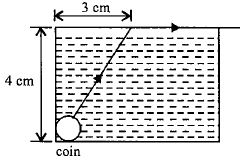
$A$ small coin is resting on the bottom of a beaker filled with liquid. $A$ ray of light from the coin travels up to the surface of the liquid and moves along its surface. How fast is the light travelling in the liquid?
A
$2.4 \times 10^8 \, m/s$
B
$3.0 \times 10^8 \, m/s$
C
$1.2 \times 10^8 \, m/s$
D
$1.8 \times 10^8 \, m/s$
Solution
(D) From the figure,the light ray travels from the coin to the surface at the critical angle $C$. The base of the triangle formed is $3 \, cm$ and the height is $4 \, cm$. The hypotenuse is $\sqrt{3^2 + 4^2} = 5 \, cm$.
By definition of the critical angle,$\sin C = \frac{\text{opposite}}{\text{hypotenuse}} = \frac{3}{5}$.
Also,the refractive index of the liquid with respect to air is $\mu = \frac{1}{\sin C} = \frac{1}{3/5} = \frac{5}{3}$.
We know that $\mu = \frac{c}{v}$,where $c = 3 \times 10^8 \, m/s$ is the speed of light in air and $v$ is the speed of light in the liquid.
Therefore,$v = \frac{c}{\mu} = \frac{3 \times 10^8}{5/3} = \frac{9 \times 10^8}{5} = 1.8 \times 10^8 \, m/s$.
By definition of the critical angle,$\sin C = \frac{\text{opposite}}{\text{hypotenuse}} = \frac{3}{5}$.
Also,the refractive index of the liquid with respect to air is $\mu = \frac{1}{\sin C} = \frac{1}{3/5} = \frac{5}{3}$.
We know that $\mu = \frac{c}{v}$,where $c = 3 \times 10^8 \, m/s$ is the speed of light in air and $v$ is the speed of light in the liquid.
Therefore,$v = \frac{c}{\mu} = \frac{3 \times 10^8}{5/3} = \frac{9 \times 10^8}{5} = 1.8 \times 10^8 \, m/s$.
0 likesView Solution
30
PhysicsMediumMCQAIPMT · 2007
Monochromatic light of frequency $6.0 \times 10^{14} \text{ Hz}$ is produced by a laser. The power emitted is $2 \times 10^{-3} \text{ W}$. The number of photons emitted,on the average,by the source per second is
A
$5 \times 10^{16}$
B
$5 \times 10^{17}$
C
$5 \times 10^{14}$
D
$5 \times 10^{15}$
Solution
(D) The power $P$ of a monochromatic light beam is given by $P = N h \nu$,where $N$ is the number of photons emitted per second,$h$ is Planck's constant,and $\nu$ is the frequency.
Given:
Power $P = 2 \times 10^{-3} \text{ W}$
Frequency $\nu = 6.0 \times 10^{14} \text{ Hz}$
Planck's constant $h \approx 6.63 \times 10^{-34} \text{ J s}$
Energy of one photon $E = h \nu = (6.63 \times 10^{-34}) \times (6.0 \times 10^{14}) \text{ J} \approx 3.978 \times 10^{-19} \text{ J}$.
Number of photons emitted per second $N = P / E$:
$N = \frac{2 \times 10^{-3}}{3.978 \times 10^{-19}} \approx 0.5027 \times 10^{16} \approx 5 \times 10^{15}$ photons per second.
Thus,the correct option is $D$.
Given:
Power $P = 2 \times 10^{-3} \text{ W}$
Frequency $\nu = 6.0 \times 10^{14} \text{ Hz}$
Planck's constant $h \approx 6.63 \times 10^{-34} \text{ J s}$
Energy of one photon $E = h \nu = (6.63 \times 10^{-34}) \times (6.0 \times 10^{14}) \text{ J} \approx 3.978 \times 10^{-19} \text{ J}$.
Number of photons emitted per second $N = P / E$:
$N = \frac{2 \times 10^{-3}}{3.978 \times 10^{-19}} \approx 0.5027 \times 10^{16} \approx 5 \times 10^{15}$ photons per second.
Thus,the correct option is $D$.
0 likesView Solution
31
PhysicsMediumMCQAIPMT · 2007
$A$ transformer is used to light a $100\,W$ and $110\,V$ lamp from a $220\,V$ main. If the main current is $0.5\,A$, the efficiency of the transformer is approximately .....$\%$
A
$50$
B
$90$
C
$10$
D
$30$
Solution
(B) Given: Output power $P_{out} = 100\,W$.
Primary voltage $V_{p} = 220\,V$.
Primary current $I_{p} = 0.5\,A$.
The input power is calculated as $P_{in} = V_{p} \times I_{p} = 220\,V \times 0.5\,A = 110\,W$.
The efficiency $\eta$ is defined as the ratio of output power to input power: $\eta = (P_{out} / P_{in}) \times 100$.
Substituting the values: $\eta = (100 / 110) \times 100 \approx 90.9\%$.
Rounding to the nearest given option, the efficiency is approximately $90\%$.
Primary voltage $V_{p} = 220\,V$.
Primary current $I_{p} = 0.5\,A$.
The input power is calculated as $P_{in} = V_{p} \times I_{p} = 220\,V \times 0.5\,A = 110\,W$.
The efficiency $\eta$ is defined as the ratio of output power to input power: $\eta = (P_{out} / P_{in}) \times 100$.
Substituting the values: $\eta = (100 / 110) \times 100 \approx 90.9\%$.
Rounding to the nearest given option, the efficiency is approximately $90\%$.
0 likesView Solution
32
PhysicsDifficultMCQAIPMT · 2007
The primary and secondary coils of a transformer have $50$ and $1500$ turns respectively. If the magnetic flux $\phi = \phi_0 + 4t$,where $\phi$ is in webers,$t$ is time in seconds and $\phi_0$ is a constant,the output voltage across the secondary coil is......$V$
A
$120$
B
$220$
C
$30$
D
$90$
Solution
(A) Given: Number of turns in the primary coil $N_p = 50$. Number of turns in the secondary coil $N_s = 1500$. The magnetic flux linked with the primary coil is $\phi = \phi_0 + 4t$.
According to Faraday's law of electromagnetic induction,the induced voltage $(EMF)$ is given by $V = \frac{d\phi}{dt}$.
Therefore,the voltage across the primary coil is $V_p = \frac{d}{dt}(\phi_0 + 4t) = 4\, V$.
Using the transformer ratio formula,$\frac{V_s}{V_p} = \frac{N_s}{N_p}$.
Substituting the values,$V_s = V_p \times \frac{N_s}{N_p} = 4 \times \frac{1500}{50} = 4 \times 30 = 120\, V$.
According to Faraday's law of electromagnetic induction,the induced voltage $(EMF)$ is given by $V = \frac{d\phi}{dt}$.
Therefore,the voltage across the primary coil is $V_p = \frac{d}{dt}(\phi_0 + 4t) = 4\, V$.
Using the transformer ratio formula,$\frac{V_s}{V_p} = \frac{N_s}{N_p}$.
Substituting the values,$V_s = V_p \times \frac{N_s}{N_p} = 4 \times \frac{1500}{50} = 4 \times 30 = 120\, V$.
0 likesView Solution
33
PhysicsMediumMCQAIPMT · 2007
What is the value of inductance $L$ in $mH$ for which the current is maximum in a series $LCR$ circuit with $C = 10 \, \mu F$ and $\omega = 1000 \, rad/sec$?
A
$1$
B
$10$
C
$100$
D
cannot be calculated unless $R$ is known
Solution
(C) In a series $LCR$ circuit,the current is maximum at resonance.
At resonance,the inductive reactance equals the capacitive reactance,i.e.,$\omega L = \frac{1}{\omega C}$.
Therefore,the resonant frequency is given by $\omega = \frac{1}{\sqrt{LC}}$.
Squaring both sides,we get $\omega^2 = \frac{1}{LC}$,which implies $L = \frac{1}{\omega^2 C}$.
Given values: $\omega = 1000 \, rad/sec$ and $C = 10 \, \mu F = 10 \times 10^{-6} \, F = 10^{-5} \, F$.
Substituting these values into the formula:
$L = \frac{1}{(1000)^2 \times 10^{-5}} = \frac{1}{10^6 \times 10^{-5}} = \frac{1}{10^1} = 0.1 \, H$.
Converting to $mH$:
$0.1 \, H = 0.1 \times 1000 \, mH = 100 \, mH$.
At resonance,the inductive reactance equals the capacitive reactance,i.e.,$\omega L = \frac{1}{\omega C}$.
Therefore,the resonant frequency is given by $\omega = \frac{1}{\sqrt{LC}}$.
Squaring both sides,we get $\omega^2 = \frac{1}{LC}$,which implies $L = \frac{1}{\omega^2 C}$.
Given values: $\omega = 1000 \, rad/sec$ and $C = 10 \, \mu F = 10 \times 10^{-6} \, F = 10^{-5} \, F$.
Substituting these values into the formula:
$L = \frac{1}{(1000)^2 \times 10^{-5}} = \frac{1}{10^6 \times 10^{-5}} = \frac{1}{10^1} = 0.1 \, H$.
Converting to $mH$:
$0.1 \, H = 0.1 \times 1000 \, mH = 100 \, mH$.
0 likesView Solution
34
PhysicsMediumMCQAIPMT · 2007
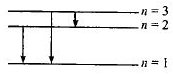
The total energy of an electron in the ground state of a hydrogen atom is $-13.6 \text{ eV}$. The kinetic energy of an electron in the first excited state is.....$\text{ eV}$
A
$6.8$
B
$13.6$
C
$1.7$
D
$3.4$
Solution
(D) The total energy of an electron in the $n^{\text{th}}$ orbit of a hydrogen atom is given by $E_n = \frac{-13.6}{n^2} \text{ eV}$.
For the ground state,$n = 1$,so $E_1 = -13.6 \text{ eV}$.
For the first excited state,$n = 2$.
Therefore,the total energy in the first excited state is $E_2 = \frac{-13.6}{2^2} = \frac{-13.6}{4} = -3.4 \text{ eV}$.
In any orbit,the kinetic energy $K$ is equal to the negative of the total energy $E$,i.e.,$K = -E$.
Thus,the kinetic energy of the electron in the first excited state is $K = -(-3.4 \text{ eV}) = 3.4 \text{ eV}$.
For the ground state,$n = 1$,so $E_1 = -13.6 \text{ eV}$.
For the first excited state,$n = 2$.
Therefore,the total energy in the first excited state is $E_2 = \frac{-13.6}{2^2} = \frac{-13.6}{4} = -3.4 \text{ eV}$.
In any orbit,the kinetic energy $K$ is equal to the negative of the total energy $E$,i.e.,$K = -E$.
Thus,the kinetic energy of the electron in the first excited state is $K = -(-3.4 \text{ eV}) = 3.4 \text{ eV}$.
0 likesView Solution
35
PhysicsEasyMCQAIPMT · 2007
In a radioactive decay process, the negatively charged emitted $\beta -$ particles are
A
the electrons orbiting around the nucleus
B
the electrons produced as a result of collisions between atoms
C
the electrons produced as a result of the decay of neutrons inside the nucleus
D
the electrons present inside the nucleus
Solution
(C) In beta minus decay $(\beta^{-})$, a neutron is transformed into a proton, and an electron is emitted from the nucleus along with an antineutrino.
The process is represented by the equation: $n \rightarrow p + e^{-} + \bar{\nu}$
where $n$ is the neutron, $p$ is the proton, $e^{-}$ is the emitted electron ($\beta$-particle), and $\bar{\nu}$ is the antineutrino.
The process is represented by the equation: $n \rightarrow p + e^{-} + \bar{\nu}$
where $n$ is the neutron, $p$ is the proton, $e^{-}$ is the emitted electron ($\beta$-particle), and $\bar{\nu}$ is the antineutrino.
0 likesView Solution
36
PhysicsMediumMCQAIPMT · 2007
If the nucleus ${}_{13}^{27}Al$ has a nuclear radius of about $3.6 \, fm$,then ${}_{52}^{125}Te$ would have its radius approximately as .......$fm$.
A
$9.6$
B
$12$
C
$4.8$
D
$6$
Solution
(D) The nuclear radius $R$ is given by the formula $R = R_0 A^{1/3}$,where $A$ is the mass number and $R_0$ is a constant.
For the given nuclei:
For ${}_{13}^{27}Al$,$A_1 = 27$ and $R_1 = 3.6 \, fm$.
For ${}_{52}^{125}Te$,$A_2 = 125$ and we need to find $R_2$.
Taking the ratio:
$\frac{R_2}{R_1} = \left( \frac{A_2}{A_1} \right)^{1/3}$
Substituting the values:
$\frac{R_2}{3.6} = \left( \frac{125}{27} \right)^{1/3}$
$\frac{R_2}{3.6} = \frac{5}{3}$
$R_2 = \frac{5}{3} \times 3.6 = 5 \times 1.2 = 6 \, fm$.
Thus,the radius of ${}_{52}^{125}Te$ is $6 \, fm$.
For the given nuclei:
For ${}_{13}^{27}Al$,$A_1 = 27$ and $R_1 = 3.6 \, fm$.
For ${}_{52}^{125}Te$,$A_2 = 125$ and we need to find $R_2$.
Taking the ratio:
$\frac{R_2}{R_1} = \left( \frac{A_2}{A_1} \right)^{1/3}$
Substituting the values:
$\frac{R_2}{3.6} = \left( \frac{125}{27} \right)^{1/3}$
$\frac{R_2}{3.6} = \frac{5}{3}$
$R_2 = \frac{5}{3} \times 3.6 = 5 \times 1.2 = 6 \, fm$.
Thus,the radius of ${}_{52}^{125}Te$ is $6 \, fm$.
0 likesView Solution
37
PhysicsMediumMCQAIPMT · 2007
$A$ nucleus $^{A}_{Z} X$ has mass represented by $M(A, Z)$. If $M_p$ and $M_n$ denote the mass of a proton and a neutron respectively, and $B.E.$ is the binding energy in $MeV$, then:
A
$B.E. = [Z M_p + (A - Z) M_n - M(A, Z)] c^2$
B
$B.E. = [Z M_p + A M_n - M(A, Z)] c^2$
C
$B.E. = M(A, Z) - Z M_p - (A - Z) M_n$
D
$B.E. = [M(A, Z) - Z M_p - (A - Z) M_n] c^2$
Solution
(A) The binding energy $(B.E.)$ of a nucleus is the energy equivalent of the mass defect $(\Delta m)$.
The mass defect is defined as the difference between the sum of the masses of individual nucleons (protons and neutrons) and the actual mass of the nucleus.
Number of protons = $Z$
Number of neutrons = $A - Z$
Mass defect $\Delta m = [Z M_p + (A - Z) M_n - M(A, Z)]$
According to Einstein's mass-energy equivalence principle, $B.E. = \Delta m c^2$.
Therefore, $B.E. = [Z M_p + (A - Z) M_n - M(A, Z)] c^2$.
The mass defect is defined as the difference between the sum of the masses of individual nucleons (protons and neutrons) and the actual mass of the nucleus.
Number of protons = $Z$
Number of neutrons = $A - Z$
Mass defect $\Delta m = [Z M_p + (A - Z) M_n - M(A, Z)]$
According to Einstein's mass-energy equivalence principle, $B.E. = \Delta m c^2$.
Therefore, $B.E. = [Z M_p + (A - Z) M_n - M(A, Z)] c^2$.
0 likesView Solution
38
PhysicsDifficultMCQAIPMT · 2007
Two radioactive materials $A$ and $B$ have decay constants $5\lambda$ and $\lambda$ respectively. At $t=0$,they have the same number of nuclei. The ratio of the number of nuclei of $A$ to that of $B$ will be $(1/e)^2$ after a time interval of:
A
$4\lambda$
B
$2\lambda$
C
$\frac{1}{2\lambda}$
D
$\frac{1}{4\lambda}$
Solution
(C) Given: Decay constants $\lambda_{A} = 5\lambda$ and $\lambda_{B} = \lambda$.
At $t=0$,the initial number of nuclei are equal,i.e.,$(N_{0})_{A} = (N_{0})_{B}$.
We are given the ratio $\frac{N_{A}}{N_{B}} = (\frac{1}{e})^{2} = e^{-2}$.
According to the law of radioactive decay,$N = N_{0}e^{-\lambda t}$.
For material $A$,$N_{A} = (N_{0})_{A} e^{-5\lambda t}$.
For material $B$,$N_{B} = (N_{0})_{B} e^{-\lambda t}$.
Dividing the two equations:
$\frac{N_{A}}{N_{B}} = \frac{(N_{0})_{A} e^{-5\lambda t}}{(N_{0})_{B} e^{-\lambda t}} = e^{-(5\lambda - \lambda)t} = e^{-4\lambda t}$.
Equating the ratios:
$e^{-4\lambda t} = e^{-2}$.
Comparing the exponents:
$4\lambda t = 2$.
Solving for $t$:
$t = \frac{2}{4\lambda} = \frac{1}{2\lambda}$.
At $t=0$,the initial number of nuclei are equal,i.e.,$(N_{0})_{A} = (N_{0})_{B}$.
We are given the ratio $\frac{N_{A}}{N_{B}} = (\frac{1}{e})^{2} = e^{-2}$.
According to the law of radioactive decay,$N = N_{0}e^{-\lambda t}$.
For material $A$,$N_{A} = (N_{0})_{A} e^{-5\lambda t}$.
For material $B$,$N_{B} = (N_{0})_{B} e^{-\lambda t}$.
Dividing the two equations:
$\frac{N_{A}}{N_{B}} = \frac{(N_{0})_{A} e^{-5\lambda t}}{(N_{0})_{B} e^{-\lambda t}} = e^{-(5\lambda - \lambda)t} = e^{-4\lambda t}$.
Equating the ratios:
$e^{-4\lambda t} = e^{-2}$.
Comparing the exponents:
$4\lambda t = 2$.
Solving for $t$:
$t = \frac{2}{4\lambda} = \frac{1}{2\lambda}$.
0 likesView Solution
39
PhysicsMediumMCQAIPMT · 2007
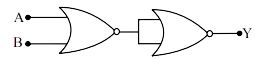
In the following circuit,the output $Y$ for all possible inputs $A$ and $B$ is expressed by the truth table.
A
| $A, B, Y$ |
| $0, 0, 1$ |
| $0, 1, 1$ |
| $1, 0, 1$ |
| $1, 1, 0$ |
B
| $A, B, Y$ |
| $0, 0, 1$ |
| $0, 1, 0$ |
| $1, 0, 0$ |
| $1, 1, 0$ |
C
| $A, B, Y$ |
| $0, 0, 0$ |
| $0, 1, 1$ |
| $1, 0, 1$ |
| $1, 1, 1$ |
D
| $A, B, Y$ |
| $0, 0, 0$ |
| $0, 1, 0$ |
| $1, 0, 0$ |
| $1, 1, 1$ |
Solution
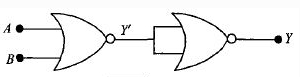
(C) The circuit consists of a $NOR$ gate followed by a $NOR$ gate acting as a $NOT$ gate (since both inputs are tied together).
Let the output of the first $NOR$ gate be $Y^{\prime} = \overline{A + B}$.
The second gate is a $NOR$ gate with both inputs as $Y^{\prime}$,so its output is $Y = \overline{Y^{\prime} + Y^{\prime}} = \overline{Y^{\prime}} = \overline{\overline{A + B}} = A + B$.
This is the Boolean expression for an $OR$ gate.
The truth table for $Y = A + B$ is:
Comparing this with the given options,option $C$ is correct.
Let the output of the first $NOR$ gate be $Y^{\prime} = \overline{A + B}$.
The second gate is a $NOR$ gate with both inputs as $Y^{\prime}$,so its output is $Y = \overline{Y^{\prime} + Y^{\prime}} = \overline{Y^{\prime}} = \overline{\overline{A + B}} = A + B$.
This is the Boolean expression for an $OR$ gate.
The truth table for $Y = A + B$ is:
| $A$ | $B$ | $Y$ |
| $0$ | $0$ | $0$ |
| $0$ | $1$ | $1$ |
| $1$ | $0$ | $1$ |
| $1$ | $1$ | $1$ |
Comparing this with the given options,option $C$ is correct.
0 likesView Solution
40
PhysicsMediumMCQAIPMT · 2007
$A$ common emitter amplifier has a voltage gain of $50$,an input impedance of $100\; \Omega$,and an output impedance of $200\; \Omega$. The power gain of the amplifier is:
A
$1000$
B
$1250$
C
$100$
D
$5000$
Solution
(B) The voltage gain $(A_v)$ of an amplifier is given by the product of the current gain $(\beta)$ and the ratio of output impedance $(R_{\text{out}})$ to input impedance $(R_{\text{in}})$:
$A_v = \beta \times \frac{R_{\text{out}}}{R_{\text{in}}}$
Given $A_v = 50$,$R_{\text{in}} = 100\; \Omega$,and $R_{\text{out}} = 200\; \Omega$,we can find the current gain $(\beta)$:
$50 = \beta \times \frac{200}{100}$
$50 = \beta \times 2$
$\beta = 25$
The power gain $(A_p)$ is defined as the product of the current gain $(\beta)$ and the voltage gain $(A_v)$:
$A_p = \beta \times A_v$
$A_p = 25 \times 50 = 1250$
$A_v = \beta \times \frac{R_{\text{out}}}{R_{\text{in}}}$
Given $A_v = 50$,$R_{\text{in}} = 100\; \Omega$,and $R_{\text{out}} = 200\; \Omega$,we can find the current gain $(\beta)$:
$50 = \beta \times \frac{200}{100}$
$50 = \beta \times 2$
$\beta = 25$
The power gain $(A_p)$ is defined as the product of the current gain $(\beta)$ and the voltage gain $(A_v)$:
$A_p = \beta \times A_v$
$A_p = 25 \times 50 = 1250$
0 likesView Solution
41
PhysicsEasyMCQAIPMT · 2007
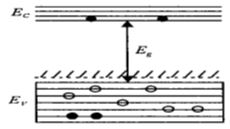
In the energy band diagram of a material shown below,the open circles and filled circles denote holes and electrons respectively. The material is
A
an insulator
B
a metal
C
an $n-$ type semiconductor
D
an $p-$ type semiconductor
Solution
(D) In the provided energy band diagram,the open circles represent holes in the valence band $(E_v)$,and the filled circles represent electrons in the conduction band $(E_c)$.
By observing the diagram,we can see that the number of holes in the valence band is significantly greater than the number of electrons in the conduction band.
In a semiconductor,if the majority charge carriers are holes,it is classified as a $p-$ type semiconductor.
Therefore,the material is a $p-$ type semiconductor.
By observing the diagram,we can see that the number of holes in the valence band is significantly greater than the number of electrons in the conduction band.
In a semiconductor,if the majority charge carriers are holes,it is classified as a $p-$ type semiconductor.
Therefore,the material is a $p-$ type semiconductor.
0 likesView Solution
42
PhysicsEasyMCQAIPMT · 2007
$A$ beam of electrons passes undeflected through mutually perpendicular electric and magnetic fields. If the electric field is switched off,and the same magnetic field is maintained,the electrons move
A
in an elliptical orbit
B
in a circular orbit
C
along a parabolic path
D
along a straight line
Solution
(B) When a charged particle enters a magnetic field with a velocity perpendicular to the magnetic field,it experiences a magnetic Lorentz force $F = q(v \times B)$.
Since the force is always perpendicular to the velocity,it acts as a centripetal force.
This centripetal force causes the particle to move in a circular path with a constant speed.
Therefore,when the electric field is switched off,the electrons will move in a circular orbit.
Since the force is always perpendicular to the velocity,it acts as a centripetal force.
This centripetal force causes the particle to move in a circular path with a constant speed.
Therefore,when the electric field is switched off,the electrons will move in a circular orbit.
0 likesView Solution
43
PhysicsMediumMCQAIPMT · 2007
$A$ $5\; W$ source emits monochromatic light of wavelength $5000\; Å$. When placed $0.5\; m$ away, it liberates photoelectrons from a photosensitive metallic surface. When the source is moved to a distance of $1.0\; m$, the number of photoelectrons liberated will
A
be reduced by a factor of $4$
B
be reduced by a factor of $2$
C
be reduced by a factor of $8$
D
be reduced by a factor of $16$
Solution
(A) The intensity of light $I$ at a distance $r$ from a point source is given by $I = \frac{P_0}{4 \pi r^2}$, where $P_0$ is the power of the source.
Since the number of photoelectrons liberated per second is directly proportional to the number of photons incident on the surface, and the number of photons is proportional to the intensity of light, we have $N \propto I$.
Therefore, $N \propto \frac{1}{r^2}$.
Given $r_1 = 0.5\; m$ and $r_2 = 1.0\; m$, the ratio of the number of photoelectrons is:
$\frac{N_2}{N_1} = \frac{r_1^2}{r_2^2} = \left( \frac{0.5}{1.0} \right)^2 = \left( \frac{1}{2} \right)^2 = \frac{1}{4}$.
Thus, the number of photoelectrons liberated is reduced by a factor of $4$.
Since the number of photoelectrons liberated per second is directly proportional to the number of photons incident on the surface, and the number of photons is proportional to the intensity of light, we have $N \propto I$.
Therefore, $N \propto \frac{1}{r^2}$.
Given $r_1 = 0.5\; m$ and $r_2 = 1.0\; m$, the ratio of the number of photoelectrons is:
$\frac{N_2}{N_1} = \frac{r_1^2}{r_2^2} = \left( \frac{0.5}{1.0} \right)^2 = \left( \frac{1}{2} \right)^2 = \frac{1}{4}$.
Thus, the number of photoelectrons liberated is reduced by a factor of $4$.
0 likesView Solution
44
PhysicsMediumMCQAIPMT · 2007
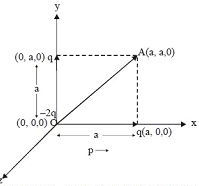
Three point charges $+q$,$-2q$ and $+q$ are placed at points $(x = 0, y = a, z = 0)$,$(x = 0, y = 0, z = 0)$ and $(x = a, y = 0, z = 0)$ respectively. The magnitude and direction of the electric dipole moment vector of this charge assembly are
A
$\sqrt{2}qa$ along $+y$ direction
B
$\sqrt{2}qa$ along the line joining points $(x = 0, y = 0, z = 0)$ and $(x = a, y = a, z = 0)$
C
$qa$ along the line joining points $(x = 0, y = 0, z = 0)$ and $(x = a, y = a, z = 0)$
D
$\sqrt{2}qa$ along $+x$ direction
Solution
(B) The given charge assembly can be represented using the coordinate axes $x$ and $y$ as shown in the figure.
The charge $-2q$ is placed at the origin $O(0, 0, 0)$. One $+q$ charge is placed at $(a, 0, 0)$ and the other $+q$ charge is placed at $(0, a, 0)$.
This system can be viewed as two electric dipoles: one along the $x$-axis with dipole moment $\vec{p}_1 = q a \hat{i}$ and another along the $y$-axis with dipole moment $\vec{p}_2 = q a \hat{j}$.
The resultant dipole moment $\vec{P}_R$ is the vector sum of these two dipoles:
$\vec{P}_R = \vec{p}_1 + \vec{p}_2 = qa \hat{i} + qa \hat{j}$.
The magnitude of the resultant dipole moment is:
$P_R = \sqrt{(qa)^2 + (qa)^2} = \sqrt{2} qa$.
The direction of the resultant dipole moment is along the vector $\hat{i} + \hat{j}$,which is the line joining the origin $(0, 0, 0)$ and the point $(a, a, 0)$.
The charge $-2q$ is placed at the origin $O(0, 0, 0)$. One $+q$ charge is placed at $(a, 0, 0)$ and the other $+q$ charge is placed at $(0, a, 0)$.
This system can be viewed as two electric dipoles: one along the $x$-axis with dipole moment $\vec{p}_1 = q a \hat{i}$ and another along the $y$-axis with dipole moment $\vec{p}_2 = q a \hat{j}$.
The resultant dipole moment $\vec{P}_R$ is the vector sum of these two dipoles:
$\vec{P}_R = \vec{p}_1 + \vec{p}_2 = qa \hat{i} + qa \hat{j}$.
The magnitude of the resultant dipole moment is:
$P_R = \sqrt{(qa)^2 + (qa)^2} = \sqrt{2} qa$.
The direction of the resultant dipole moment is along the vector $\hat{i} + \hat{j}$,which is the line joining the origin $(0, 0, 0)$ and the point $(a, a, 0)$.
0 likesView Solution
45
PhysicsMediumMCQAIPMT · 2007
Under the influence of a uniform magnetic field,a charged particle is moving in a circle of radius $R$ with constant speed $v$. The time period of the motion
A
depends on $v$ and not on $R$
B
depends on both $R$ and $v$
C
is independent of both $R$ and $v$
D
depends on $R$ and not on $v$
Solution
(C) When a magnetic field is perpendicular to the motion of a charged particle,the magnetic force provides the necessary centripetal force.
$F_{c} = F_{m}$
$\frac{m v^{2}}{R} = B q v$
From this,the radius of the circular path is given by:
$R = \frac{m v}{B q}$
The time period $T$ of the circular motion is the time taken to complete one full circumference:
$T = \frac{2 \pi R}{v}$
Substituting the expression for $R$:
$T = \frac{2 \pi}{v} \left( \frac{m v}{B q} \right)$
$T = \frac{2 \pi m}{B q}$
Since $T$ depends only on the mass $m$,charge $q$,and magnetic field $B$,it is independent of both the radius $R$ and the speed $v$.
$F_{c} = F_{m}$
$\frac{m v^{2}}{R} = B q v$
From this,the radius of the circular path is given by:
$R = \frac{m v}{B q}$
The time period $T$ of the circular motion is the time taken to complete one full circumference:
$T = \frac{2 \pi R}{v}$
Substituting the expression for $R$:
$T = \frac{2 \pi}{v} \left( \frac{m v}{B q} \right)$
$T = \frac{2 \pi m}{B q}$
Since $T$ depends only on the mass $m$,charge $q$,and magnetic field $B$,it is independent of both the radius $R$ and the speed $v$.
0 likesView Solution
46
PhysicsEasyMCQAIPMT · 2007
Nickel shows ferromagnetic property at room temperature. If the temperature is increased beyond Curie temperature,then it will show
A
paramagnetism
B
anti-ferromagnetism
C
no magnetic property
D
diamagnetism
Solution
(A) Nickel exhibits ferromagnetism due to a quantum physical effect known as exchange coupling,where the electron spins of one atom interact with those of neighboring atoms.
This interaction results in the alignment of the magnetic dipole moments of the atoms,overcoming the randomizing tendency of thermal collisions.
This persistent alignment is responsible for the permanent magnetism in ferromagnetic materials.
When the temperature of a ferromagnetic material is raised above a specific critical value,known as the Curie temperature $(T_C)$,the exchange coupling is no longer effective.
Consequently,the material transitions from being ferromagnetic to paramagnetic.
In the paramagnetic state,the dipoles still tend to align with an external magnetic field,but this alignment is much weaker,and thermal agitation can easily disrupt it.
This interaction results in the alignment of the magnetic dipole moments of the atoms,overcoming the randomizing tendency of thermal collisions.
This persistent alignment is responsible for the permanent magnetism in ferromagnetic materials.
When the temperature of a ferromagnetic material is raised above a specific critical value,known as the Curie temperature $(T_C)$,the exchange coupling is no longer effective.
Consequently,the material transitions from being ferromagnetic to paramagnetic.
In the paramagnetic state,the dipoles still tend to align with an external magnetic field,but this alignment is much weaker,and thermal agitation can easily disrupt it.
0 likesView Solution
Vedclass Products
For Students
Vedclass Test Series
Mock tests in real AIPMT style covering Physics with performance analysis. 5-day free trial.
Start Free TrialFor Teachers
Exam Paper Generator
Generate Set A/B/C/D Physics papers from 7.5L+ questions in 2 minutes. 3 chapters free.
Try FreeFor Institutes
Online Exam Module
Run live AIPMT mock exams with unlimited students, 360° analytics & white-label branding.
See DemoFrequently Asked Questions
How many Physics questions are in AIPMT 2007?
There are 46 Physics questions from the AIPMT 2007 paper on Vedclass, each with a detailed step-by-step solution in English.
Are AIPMT 2007 Physics solutions available in English?
Yes. All solutions on this page are in English. You can also switch to English or Hindi using the language buttons above the questions.
Can I practice AIPMT 2007 Physics as a timed test?
Yes. Use the Vedclass Test Series to attempt a full AIPMT mock test covering Physics with time limits and instant score analysis.
Can teachers create Physics papers from AIPMT previous year questions?
Yes. The Vedclass Exam Paper Generator lets teachers mix AIPMT Physics questions and generate Set A/B/C/D papers in minutes.
For Teachers & Institutes
Build a Custom Physics Paper
Pick AIPMT 2007 Physics questions, set difficulty, and generate Set A/B/C/D in 2 minutes.