
PhysicsQ1–46 of 46 questions
Page 1 of 1 · English
1
PhysicsEasyMCQAIPMT · 2013
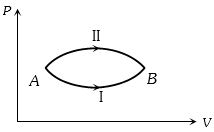
$A$ system goes from $A$ to $B$ via two processes $I$ and $II$ as shown in the figure. If $\Delta U_I$ and $\Delta U_{II}$ are the changes in internal energies in the processes $I$ and $II$ respectively,then:
A
$\Delta U_{II} > \Delta U_I$
B
$\Delta U_{II} < \Delta U_I$
C
$\Delta U_I = \Delta U_{II}$
D
The relation between $\Delta U_I$ and $\Delta U_{II}$ cannot be determined.
Solution
(C) Internal energy $(U)$ is a state function,which means its value depends only on the state of the system (defined by variables like pressure,volume,and temperature) and not on the path taken to reach that state.
Since both processes $I$ and $II$ start at the same initial state $A$ and end at the same final state $B$,the change in internal energy for both processes must be identical.
Therefore,$\Delta U_I = \Delta U_{II}$.
Since both processes $I$ and $II$ start at the same initial state $A$ and end at the same final state $B$,the change in internal energy for both processes must be identical.
Therefore,$\Delta U_I = \Delta U_{II}$.
0 likesView Solution
2
PhysicsDifficultMCQAIPMT · 2013
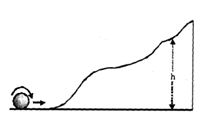
$A$ small object of uniform density rolls up a curved surface with an initial velocity $v$. It reaches up to a maximum height of $3v^2/4g$ with respect to the initial position. The object is
A
Ring
B
Solid sphere
C
Hollow sphere
D
Disc
Solution
(D) By the principle of conservation of energy,the total initial kinetic energy (translational + rotational) is equal to the final potential energy at the maximum height $h$.
Initial kinetic energy $K_i = \frac{1}{2} M v^2 + \frac{1}{2} I \omega^2$
Since the object is rolling without slipping,$\omega = v/R$,so $K_i = \frac{1}{2} M v^2 + \frac{1}{2} I (v/R)^2 = \frac{1}{2} M v^2 + \frac{1}{2} I \frac{v^2}{R^2}$
Final potential energy $U_f = M g h = M g \left( \frac{3 v^2}{4 g} \right) = \frac{3}{4} M v^2$
Equating $K_i = U_f$:
$\frac{1}{2} M v^2 + \frac{1}{2} I \frac{v^2}{R^2} = \frac{3}{4} M v^2$
$\frac{1}{2} I \frac{v^2}{R^2} = \frac{3}{4} M v^2 - \frac{1}{2} M v^2 = \frac{1}{4} M v^2$
$I \frac{1}{R^2} = \frac{1}{2} M \implies I = \frac{1}{2} M R^2$
The moment of inertia $I = \frac{1}{2} M R^2$ corresponds to a disc.
Initial kinetic energy $K_i = \frac{1}{2} M v^2 + \frac{1}{2} I \omega^2$
Since the object is rolling without slipping,$\omega = v/R$,so $K_i = \frac{1}{2} M v^2 + \frac{1}{2} I (v/R)^2 = \frac{1}{2} M v^2 + \frac{1}{2} I \frac{v^2}{R^2}$
Final potential energy $U_f = M g h = M g \left( \frac{3 v^2}{4 g} \right) = \frac{3}{4} M v^2$
Equating $K_i = U_f$:
$\frac{1}{2} M v^2 + \frac{1}{2} I \frac{v^2}{R^2} = \frac{3}{4} M v^2$
$\frac{1}{2} I \frac{v^2}{R^2} = \frac{3}{4} M v^2 - \frac{1}{2} M v^2 = \frac{1}{4} M v^2$
$I \frac{1}{R^2} = \frac{1}{2} M \implies I = \frac{1}{2} M R^2$
The moment of inertia $I = \frac{1}{2} M R^2$ corresponds to a disc.
0 likesView Solution
3
PhysicsEasyMCQAIPMT · 2013
In an experiment,four quantities $a, b, c,$ and $d$ are measured with percentage errors of $1\%, 2\%, 3\%,$ and $4\%$ respectively. The quantity $P$ is calculated as $P = \frac{a^3 b^2}{cd}$. The percentage error in $P$ is ........ $\%$
A
$14$
B
$10$
C
$7$
D
$4$
Solution
(A) Given the formula $P = \frac{a^3 b^2}{cd}$.
To find the percentage error in $P$,we use the formula for propagation of errors:
$\frac{\Delta P}{P} \times 100 = \left( 3 \frac{\Delta a}{a} + 2 \frac{\Delta b}{b} + \frac{\Delta c}{c} + \frac{\Delta d}{d} \right) \times 100$
Substituting the given percentage errors:
$\frac{\Delta P}{P} \times 100 = [3(1\%) + 2(2\%) + 3\% + 4\%]$
$= [3\% + 4\% + 3\% + 4\%]$
$= 14\%$
Thus,the percentage error in $P$ is $14\%$.
To find the percentage error in $P$,we use the formula for propagation of errors:
$\frac{\Delta P}{P} \times 100 = \left( 3 \frac{\Delta a}{a} + 2 \frac{\Delta b}{b} + \frac{\Delta c}{c} + \frac{\Delta d}{d} \right) \times 100$
Substituting the given percentage errors:
$\frac{\Delta P}{P} \times 100 = [3(1\%) + 2(2\%) + 3\% + 4\%]$
$= [3\% + 4\% + 3\% + 4\%]$
$= 14\%$
Thus,the percentage error in $P$ is $14\%$.
0 likesView Solution
4
PhysicsMediumMCQAIPMT · 2013
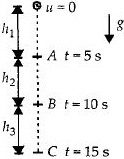
$A$ stone falls freely under gravity. It covers distances $h_1, h_2$ and $h_3$ in the first $5 \ s$,the next $5 \ s$ and the next $5 \ s$ respectively. The relation between $h_1, h_2$ and $h_3$ is:
A
$h_1 = 2h_2 = 3h_3$
B
$h_1 = \frac{h_2}{3} = \frac{h_3}{5}$
C
$h_2 = 3h_1$ and $h_3 = 3h_2$
D
$h_1 = h_2 = h_3$
Solution
(B) For a body falling freely from rest $(u = 0)$,the distance covered in time $t$ is given by $h = \frac{1}{2}gt^2$.
$1$. Distance covered in the first $5 \ s$ $(t = 5 \ s)$:
$h_1 = \frac{1}{2}g(5)^2 = \frac{25}{2}g$ ... $(i)$
$2$. Distance covered in the first $10 \ s$ $(t = 10 \ s)$:
$h_1 + h_2 = \frac{1}{2}g(10)^2 = \frac{100}{2}g$ ... (ii)
$3$. Distance covered in the first $15 \ s$ $(t = 15 \ s)$:
$h_1 + h_2 + h_3 = \frac{1}{2}g(15)^2 = \frac{225}{2}g$ ... (iii)
Subtracting $(i)$ from (ii):
$h_2 = (h_1 + h_2) - h_1 = \frac{100}{2}g - \frac{25}{2}g = \frac{75}{2}g = 3 \left( \frac{25}{2}g \right) = 3h_1$
Subtracting (ii) from (iii):
$h_3 = (h_1 + h_2 + h_3) - (h_1 + h_2) = \frac{225}{2}g - \frac{100}{2}g = \frac{125}{2}g = 5 \left( \frac{25}{2}g \right) = 5h_1$
Thus,$h_1 = \frac{h_2}{3} = \frac{h_3}{5}$.
$1$. Distance covered in the first $5 \ s$ $(t = 5 \ s)$:
$h_1 = \frac{1}{2}g(5)^2 = \frac{25}{2}g$ ... $(i)$
$2$. Distance covered in the first $10 \ s$ $(t = 10 \ s)$:
$h_1 + h_2 = \frac{1}{2}g(10)^2 = \frac{100}{2}g$ ... (ii)
$3$. Distance covered in the first $15 \ s$ $(t = 15 \ s)$:
$h_1 + h_2 + h_3 = \frac{1}{2}g(15)^2 = \frac{225}{2}g$ ... (iii)
Subtracting $(i)$ from (ii):
$h_2 = (h_1 + h_2) - h_1 = \frac{100}{2}g - \frac{25}{2}g = \frac{75}{2}g = 3 \left( \frac{25}{2}g \right) = 3h_1$
Subtracting (ii) from (iii):
$h_3 = (h_1 + h_2 + h_3) - (h_1 + h_2) = \frac{225}{2}g - \frac{100}{2}g = \frac{125}{2}g = 5 \left( \frac{25}{2}g \right) = 5h_1$
Thus,$h_1 = \frac{h_2}{3} = \frac{h_3}{5}$.
0 likesView Solution
5
PhysicsEasyMCQAIPMT · 2013
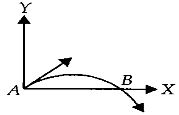
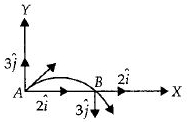
The velocity of a projectile at the initial point $A$ is $(2\hat i + 3\hat j) \text{ m/s}$. Its velocity (in $\text{m/s}$) at point $B$ is
A
$( - 2\hat i - 3\hat j)$
B
$( - 2\hat i + 3\hat j)$
C
$(2\hat i - 3\hat j)$
D
$(2\hat i + 3\hat j)$
Solution
(C) In projectile motion,the horizontal component of velocity $(v_x)$ remains constant throughout the motion because there is no acceleration in the horizontal direction.
At point $A$,the velocity is $\vec{v}_A = 2\hat i + 3\hat j \text{ m/s}$.
At point $B$,which is at the same horizontal level as point $A$,the horizontal component remains $2\hat i \text{ m/s}$.
The vertical component of velocity $(v_y)$ changes due to gravity. At the same horizontal level,the magnitude of the vertical component remains the same,but its direction is reversed.
Therefore,the vertical component at point $B$ becomes $-3\hat j \text{ m/s}$.
Thus,the velocity at point $B$ is $\vec{v}_B = 2\hat i - 3\hat j \text{ m/s}$.
At point $A$,the velocity is $\vec{v}_A = 2\hat i + 3\hat j \text{ m/s}$.
At point $B$,which is at the same horizontal level as point $A$,the horizontal component remains $2\hat i \text{ m/s}$.
The vertical component of velocity $(v_y)$ changes due to gravity. At the same horizontal level,the magnitude of the vertical component remains the same,but its direction is reversed.
Therefore,the vertical component at point $B$ becomes $-3\hat j \text{ m/s}$.
Thus,the velocity at point $B$ is $\vec{v}_B = 2\hat i - 3\hat j \text{ m/s}$.
0 likesView Solution
6
PhysicsMediumMCQAIPMT · 2013
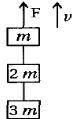
Three blocks with masses $m$,$2m$,and $3m$ are connected by strings,as shown in the figure. After an upward force $F$ is applied on block $m$,the masses move upward at a constant speed $v$. What is the net force on the block of mass $2m$? ($g$ is the acceleration due to gravity)
A
$0$
B
$2mg$
C
$3mg$
D
$6mg$
Solution
(A) According to Newton's second law of motion,the net force $F_{\text{net}}$ acting on an object is given by $F_{\text{net}} = ma$,where $m$ is the mass and $a$ is the acceleration of the object.
In this problem,the blocks are moving upward at a constant speed $v$.
Since the speed is constant,the acceleration $a$ of the blocks is zero $(a = 0)$.
Therefore,the net force on any of the blocks,including the block of mass $2m$,is $F_{\text{net}} = (2m) \times 0 = 0$.
In this problem,the blocks are moving upward at a constant speed $v$.
Since the speed is constant,the acceleration $a$ of the blocks is zero $(a = 0)$.
Therefore,the net force on any of the blocks,including the block of mass $2m$,is $F_{\text{net}} = (2m) \times 0 = 0$.
1 likesView Solution
7
PhysicsMediumMCQAIPMT · 2013
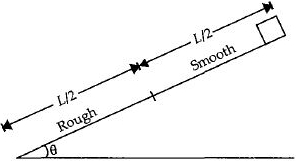
The upper half of an inclined plane of inclination $\theta$ is perfectly smooth,while the lower half is rough. $A$ block starting from rest at the top of the plane will again come to rest at the bottom if the coefficient of friction between the block and the lower half of the plane is given by:
A
$\mu = \frac{1}{\tan\theta}$
B
$\mu = \frac{2}{\tan\theta}$
C
$\mu = 2\tan\theta$
D
$\mu = \tan\theta$
Solution
(C) Let $m$ be the mass of the block and $L$ be the total length of the inclined plane.
According to the work-energy theorem,the total work done on the block is equal to the change in its kinetic energy.
Since the block starts from rest and comes to rest at the bottom,the change in kinetic energy is $\Delta K = 0$.
Therefore,the total work done by all forces (gravity and friction) must be zero:
$W_{\text{gravity}} + W_{\text{friction}} = 0$
Work done by gravity over the entire length $L$ is $W_{\text{gravity}} = mg \sin\theta \cdot L$.
Work done by friction over the lower half length $L/2$ is $W_{\text{friction}} = -f_k \cdot (L/2) = -(\mu mg \cos\theta) \cdot (L/2)$.
Equating the sum to zero:
$mg \sin\theta \cdot L - \mu mg \cos\theta \cdot \frac{L}{2} = 0$
Dividing both sides by $mgL$:
$\sin\theta - \frac{\mu}{2} \cos\theta = 0$
$\sin\theta = \frac{\mu}{2} \cos\theta$
$\mu = 2 \frac{\sin\theta}{\cos\theta} = 2\tan\theta$.
According to the work-energy theorem,the total work done on the block is equal to the change in its kinetic energy.
Since the block starts from rest and comes to rest at the bottom,the change in kinetic energy is $\Delta K = 0$.
Therefore,the total work done by all forces (gravity and friction) must be zero:
$W_{\text{gravity}} + W_{\text{friction}} = 0$
Work done by gravity over the entire length $L$ is $W_{\text{gravity}} = mg \sin\theta \cdot L$.
Work done by friction over the lower half length $L/2$ is $W_{\text{friction}} = -f_k \cdot (L/2) = -(\mu mg \cos\theta) \cdot (L/2)$.
Equating the sum to zero:
$mg \sin\theta \cdot L - \mu mg \cos\theta \cdot \frac{L}{2} = 0$
Dividing both sides by $mgL$:
$\sin\theta - \frac{\mu}{2} \cos\theta = 0$
$\sin\theta = \frac{\mu}{2} \cos\theta$
$\mu = 2 \frac{\sin\theta}{\cos\theta} = 2\tan\theta$.
0 likesView Solution
8
PhysicsMediumMCQAIPMT · 2013
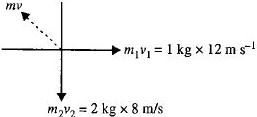
An explosion breaks a rock into three parts in a horizontal plane. Two of them go off at right angles to each other. The first part of mass $1 \, kg$ moves with a speed of $12 \, m s^{-1}$ and the second part of mass $2 \, kg$ moves with $8 \, m s^{-1}$ speed. If the third part flies off with $4 \, m s^{-1}$ speed,then its mass is ......... $kg$.
A
$7$
B
$17$
C
$3$
D
$5$
Solution
(D) According to the law of conservation of linear momentum,the initial momentum of the rock is zero. Therefore,the vector sum of the momenta of the three parts must be zero.
Let the momenta of the three parts be $\vec{p}_1$,$\vec{p}_2$,and $\vec{p}_3$.
$\vec{p}_1 + \vec{p}_2 + \vec{p}_3 = 0 \implies \vec{p}_3 = -(\vec{p}_1 + \vec{p}_2)$.
The magnitude of the momentum of the first part is $p_1 = m_1 v_1 = 1 \, kg \times 12 \, m s^{-1} = 12 \, kg \, m s^{-1}$.
The magnitude of the momentum of the second part is $p_2 = m_2 v_2 = 2 \, kg \times 8 \, m s^{-1} = 16 \, kg \, m s^{-1}$.
Since the two parts move at right angles to each other,the magnitude of the resultant momentum of these two parts is $p_{12} = \sqrt{p_1^2 + p_2^2} = \sqrt{12^2 + 16^2} = \sqrt{144 + 256} = \sqrt{400} = 20 \, kg \, m s^{-1}$.
The third part must have a momentum equal in magnitude and opposite in direction to this resultant momentum to satisfy the conservation law.
Thus,$p_3 = p_{12} = 20 \, kg \, m s^{-1}$.
Given the speed of the third part $v_3 = 4 \, m s^{-1}$,its mass $m_3$ is:
$m_3 = \frac{p_3}{v_3} = \frac{20 \, kg \, m s^{-1}}{4 \, m s^{-1}} = 5 \, kg$.
Let the momenta of the three parts be $\vec{p}_1$,$\vec{p}_2$,and $\vec{p}_3$.
$\vec{p}_1 + \vec{p}_2 + \vec{p}_3 = 0 \implies \vec{p}_3 = -(\vec{p}_1 + \vec{p}_2)$.
The magnitude of the momentum of the first part is $p_1 = m_1 v_1 = 1 \, kg \times 12 \, m s^{-1} = 12 \, kg \, m s^{-1}$.
The magnitude of the momentum of the second part is $p_2 = m_2 v_2 = 2 \, kg \times 8 \, m s^{-1} = 16 \, kg \, m s^{-1}$.
Since the two parts move at right angles to each other,the magnitude of the resultant momentum of these two parts is $p_{12} = \sqrt{p_1^2 + p_2^2} = \sqrt{12^2 + 16^2} = \sqrt{144 + 256} = \sqrt{400} = 20 \, kg \, m s^{-1}$.
The third part must have a momentum equal in magnitude and opposite in direction to this resultant momentum to satisfy the conservation law.
Thus,$p_3 = p_{12} = 20 \, kg \, m s^{-1}$.
Given the speed of the third part $v_3 = 4 \, m s^{-1}$,its mass $m_3$ is:
$m_3 = \frac{p_3}{v_3} = \frac{20 \, kg \, m s^{-1}}{4 \, m s^{-1}} = 5 \, kg$.
0 likesView Solution
9
PhysicsMediumMCQAIPMT · 2013
$A$ uniform force of $(3\hat i + \hat j) \text{ N}$ acts on a particle of mass $2 \text{ kg}$. The particle is displaced from position $(2\hat i + \hat k) \text{ m}$ to position $(4\hat i + 3\hat j - \hat k) \text{ m}$. The work done by the force on the particle is ............. $J$.
A
$9$
B
$6$
C
$13$
D
$15$
Solution
(A) Given force $\vec{F} = (3\hat{i} + \hat{j}) \text{ N}$.
Initial position $\vec{r}_1 = (2\hat{i} + \hat{k}) \text{ m}$.
Final position $\vec{r}_2 = (4\hat{i} + 3\hat{j} - \hat{k}) \text{ m}$.
Displacement $\vec{d} = \vec{r}_2 - \vec{r}_1 = (4\hat{i} + 3\hat{j} - \hat{k}) - (2\hat{i} + \hat{k}) = (2\hat{i} + 3\hat{j} - 2\hat{k}) \text{ m}$.
Work done $W = \vec{F} \cdot \vec{d} = (3\hat{i} + \hat{j}) \cdot (2\hat{i} + 3\hat{j} - 2\hat{k})$.
$W = (3 \times 2) + (1 \times 3) + (0 \times -2) = 6 + 3 = 9 \text{ J}$.
Initial position $\vec{r}_1 = (2\hat{i} + \hat{k}) \text{ m}$.
Final position $\vec{r}_2 = (4\hat{i} + 3\hat{j} - \hat{k}) \text{ m}$.
Displacement $\vec{d} = \vec{r}_2 - \vec{r}_1 = (4\hat{i} + 3\hat{j} - \hat{k}) - (2\hat{i} + \hat{k}) = (2\hat{i} + 3\hat{j} - 2\hat{k}) \text{ m}$.
Work done $W = \vec{F} \cdot \vec{d} = (3\hat{i} + \hat{j}) \cdot (2\hat{i} + 3\hat{j} - 2\hat{k})$.
$W = (3 \times 2) + (1 \times 3) + (0 \times -2) = 6 + 3 = 9 \text{ J}$.
0 likesView Solution
10
PhysicsEasyMCQAIPMT · 2013
$A$ piece of iron is heated in a flame. It first becomes dull red, then becomes reddish yellow, and finally turns to white hot. The correct explanation for the above observation is possible by using
A
Stefan's Law
B
Wien's displacement Law
C
Kirchhoff's Law
D
Newton's Law of cooling
Solution
(B) According to $Wien's$ displacement law, the product of the wavelength corresponding to maximum intensity $(\lambda_m)$ and the absolute temperature $(T)$ is constant:
$\lambda_m T = \text{constant}$
$\lambda_m = \frac{\text{constant}}{T}$
As the temperature $(T)$ of the iron piece increases, the wavelength $(\lambda_m)$ corresponding to the maximum intensity of emitted radiation decreases.
Initially, at lower temperatures, the radiation emitted is in the longer wavelength region (red). As the temperature rises, the peak of the emission spectrum shifts towards shorter wavelengths (reddish-yellow). When the temperature becomes sufficiently high, the object emits radiation across the entire visible spectrum, causing it to appear white-hot.
$\lambda_m T = \text{constant}$
$\lambda_m = \frac{\text{constant}}{T}$
As the temperature $(T)$ of the iron piece increases, the wavelength $(\lambda_m)$ corresponding to the maximum intensity of emitted radiation decreases.
Initially, at lower temperatures, the radiation emitted is in the longer wavelength region (red). As the temperature rises, the peak of the emission spectrum shifts towards shorter wavelengths (reddish-yellow). When the temperature becomes sufficiently high, the object emits radiation across the entire visible spectrum, causing it to appear white-hot.
0 likesView Solution
11
PhysicsMediumMCQAIPMT · 2013
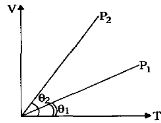
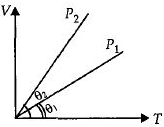
In the given $(V - T)$ diagram,what is the relation between pressures $P_1$ and $P_2 \,?$
A
$P_2 = P_1$
B
$P_2 > P_1$
C
$P_2 < P_1$
D
Cannot be predicted
Solution
(C) According to the ideal gas equation,
$PV = nRT$
Rearranging for $V$ in terms of $T$:
$V = \left( \frac{nR}{P} \right) T$
This represents a straight line passing through the origin,where the slope $m$ is given by:
$m = \frac{V}{T} = \frac{nR}{P}$
Since $n$ and $R$ are constants,the slope is inversely proportional to the pressure $P$ $(m \propto \frac{1}{P})$.
From the given figure,the angle $\theta_2 > \theta_1$,which implies that the slope of the line for $P_2$ is greater than the slope of the line for $P_1$:
$(\text{Slope})_2 > (\text{Slope})_1$
Since slope is inversely proportional to pressure,a higher slope corresponds to a lower pressure:
$P_2 < P_1$
$PV = nRT$
Rearranging for $V$ in terms of $T$:
$V = \left( \frac{nR}{P} \right) T$
This represents a straight line passing through the origin,where the slope $m$ is given by:
$m = \frac{V}{T} = \frac{nR}{P}$
Since $n$ and $R$ are constants,the slope is inversely proportional to the pressure $P$ $(m \propto \frac{1}{P})$.
From the given figure,the angle $\theta_2 > \theta_1$,which implies that the slope of the line for $P_2$ is greater than the slope of the line for $P_1$:
$(\text{Slope})_2 > (\text{Slope})_1$
Since slope is inversely proportional to pressure,a higher slope corresponds to a lower pressure:
$P_2 < P_1$
0 likesView Solution
12
PhysicsMediumMCQAIPMT · 2013
The amount of heat energy required to raise the temperature of $1\, g$ of Helium at $NTP$ from $T_1\, K$ to $T_2\, K$ is:
A
$\frac{3}{8}{N_a}{k_B}\left( {{T_2} - {T_1}} \right)$
B
$\frac{3}{2}{N_a}{k_B}\left( {{T_2} - {T_1}} \right)$
C
$\frac{3}{4}{N_a}{k_B}\left( {{T_2} - {T_1}} \right)$
D
$\frac{3}{4}{N_a}{k_B}\left( {\frac{{{T_2}}}{{{T_1}}}} \right)$
Solution
(A) Since the volume of the gas remains constant,the heat energy required is given by $\Delta Q = n C_V \Delta T$.
For Helium $(He)$,the molar mass is $4\, g/mol$. Therefore,the number of moles $n$ in $1\, g$ of Helium is $n = \frac{1}{4}$.
Helium is a monatomic gas,so its molar heat capacity at constant volume is $C_V = \frac{3}{2} R$.
Given the temperature change $\Delta T = T_2 - T_1$,we substitute these values into the formula:
$\Delta Q = n C_V \Delta T = \left( \frac{1}{4} \right) \left( \frac{3}{2} R \right) (T_2 - T_1) = \frac{3}{8} R (T_2 - T_1)$.
Using the relation $R = N_a k_B$,where $N_a$ is Avogadro's number and $k_B$ is the Boltzmann constant,we get:
$\Delta Q = \frac{3}{8} N_a k_B (T_2 - T_1)$.
For Helium $(He)$,the molar mass is $4\, g/mol$. Therefore,the number of moles $n$ in $1\, g$ of Helium is $n = \frac{1}{4}$.
Helium is a monatomic gas,so its molar heat capacity at constant volume is $C_V = \frac{3}{2} R$.
Given the temperature change $\Delta T = T_2 - T_1$,we substitute these values into the formula:
$\Delta Q = n C_V \Delta T = \left( \frac{1}{4} \right) \left( \frac{3}{2} R \right) (T_2 - T_1) = \frac{3}{8} R (T_2 - T_1)$.
Using the relation $R = N_a k_B$,where $N_a$ is Avogadro's number and $k_B$ is the Boltzmann constant,we get:
$\Delta Q = \frac{3}{8} N_a k_B (T_2 - T_1)$.
0 likesView Solution
13
PhysicsDifficultMCQAIPMT · 2013
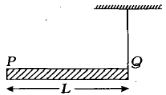
$A$ rod $PQ$ of mass $M$ and length $L$ is hinged at end $P$. The rod is kept horizontal by a massless string tied to point $Q$ as shown in the figure. When the string is cut,the initial angular acceleration of the rod is
A
$\frac{g}{L}$
B
$\frac{2g}{L}$
C
$\frac{2g}{3L}$
D
$\frac{3g}{2L}$
Solution
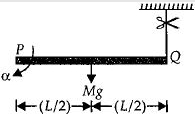
(D) When the string is cut,the rod will rotate about the hinge point $P$ due to the torque produced by its weight.
Let $\alpha$ be the initial angular acceleration of the rod.
The torque $\tau$ about point $P$ is given by $\tau = I\alpha$,where $I$ is the moment of inertia of the rod about one end.
$I = \frac{ML^2}{3} \quad ...(i)$
Also,the torque due to gravity acting at the center of mass (at distance $L/2$ from $P$) is:
$\tau = Mg \times \frac{L}{2} \quad ...(ii)$
Equating $(i)$ and $(ii)$:
$\frac{ML^2}{3} \alpha = Mg \frac{L}{2}$
$\alpha = \frac{MgL}{2} \times \frac{3}{ML^2}$
$\alpha = \frac{3g}{2L}$
Let $\alpha$ be the initial angular acceleration of the rod.
The torque $\tau$ about point $P$ is given by $\tau = I\alpha$,where $I$ is the moment of inertia of the rod about one end.
$I = \frac{ML^2}{3} \quad ...(i)$
Also,the torque due to gravity acting at the center of mass (at distance $L/2$ from $P$) is:
$\tau = Mg \times \frac{L}{2} \quad ...(ii)$
Equating $(i)$ and $(ii)$:
$\frac{ML^2}{3} \alpha = Mg \frac{L}{2}$
$\alpha = \frac{MgL}{2} \times \frac{3}{ML^2}$
$\alpha = \frac{3g}{2L}$
0 likesView Solution
14
PhysicsDifficultMCQAIPMT · 2013
An infinite number of bodies,each of mass $2 \, kg$,are situated on the $x-$axis at distances $1 \, m, 2 \, m, 4 \, m, 8 \, m, \dots$ respectively,from the origin. The resulting gravitational potential due to this system at the origin will be:
A
$-\frac{8}{3}G$
B
$-\frac{4}{3}G$
C
$-4G$
D
$-G$
Solution
(C) The gravitational potential $V$ at a point due to a point mass $m$ at a distance $r$ is given by $V = -\frac{Gm}{r}$.
For a system of multiple masses,the total potential is the algebraic sum of the potentials due to each mass.
Here,each body has a mass $m = 2 \, kg$ and they are located at distances $r_1 = 1 \, m, r_2 = 2 \, m, r_3 = 4 \, m, r_4 = 8 \, m, \dots$ from the origin.
The total gravitational potential $V$ at the origin is:
$V = -\frac{G(2)}{1} - \frac{G(2)}{2} - \frac{G(2)}{4} - \frac{G(2)}{8} - \dots$
$V = -2G \left( 1 + \frac{1}{2} + \frac{1}{4} + \frac{1}{8} + \dots \right)$
The term in the bracket is an infinite geometric series with the first term $a = 1$ and common ratio $r = \frac{1}{2}$.
The sum of an infinite geometric series is $S = \frac{a}{1 - r}$.
$S = \frac{1}{1 - 1/2} = \frac{1}{1/2} = 2$.
Therefore,$V = -2G(2) = -4G$.
For a system of multiple masses,the total potential is the algebraic sum of the potentials due to each mass.
Here,each body has a mass $m = 2 \, kg$ and they are located at distances $r_1 = 1 \, m, r_2 = 2 \, m, r_3 = 4 \, m, r_4 = 8 \, m, \dots$ from the origin.
The total gravitational potential $V$ at the origin is:
$V = -\frac{G(2)}{1} - \frac{G(2)}{2} - \frac{G(2)}{4} - \frac{G(2)}{8} - \dots$
$V = -2G \left( 1 + \frac{1}{2} + \frac{1}{4} + \frac{1}{8} + \dots \right)$
The term in the bracket is an infinite geometric series with the first term $a = 1$ and common ratio $r = \frac{1}{2}$.
The sum of an infinite geometric series is $S = \frac{a}{1 - r}$.
$S = \frac{1}{1 - 1/2} = \frac{1}{1/2} = 2$.
Therefore,$V = -2G(2) = -4G$.

0 likesView Solution
15
PhysicsMediumMCQAIPMT · 2013
The following four wires are made of the same material. Which of these will have the largest extension when the same tension is applied?
A
length $= 50 \; cm$,diameter $= 0.5 \; mm$
B
length $= 100 \; cm$,diameter $= 1 \; mm$
C
length $= 200 \; cm$,diameter $= 2 \; mm$
D
length $= 300 \; cm$,diameter $= 3 \; mm$
Solution
(A) Young's modulus is given by $Y = \frac{FL}{A \Delta L} = \frac{4FL}{\pi D^2 \Delta L}$.
Rearranging for extension,we get $\Delta L = \frac{4FL}{\pi D^2 Y}$.
Since all wires are made of the same material and subjected to the same tension $F$,$Y$ and $F$ are constant.
Therefore,$\Delta L \propto \frac{L}{D^2}$.
Calculating the ratio $\frac{L}{D^2}$ for each case:
$(a)$ $\frac{50}{(0.5)^2} = \frac{50}{0.25} = 200 \; cm^{-1}$
$(b)$ $\frac{100}{(1)^2} = 100 \; cm^{-1}$
$(c)$ $\frac{200}{(2)^2} = \frac{200}{4} = 50 \; cm^{-1}$
$(d)$ $\frac{300}{(3)^2} = \frac{300}{9} \approx 33.3 \; cm^{-1}$
Comparing the values,the ratio is largest for option $(a)$.
Rearranging for extension,we get $\Delta L = \frac{4FL}{\pi D^2 Y}$.
Since all wires are made of the same material and subjected to the same tension $F$,$Y$ and $F$ are constant.
Therefore,$\Delta L \propto \frac{L}{D^2}$.
Calculating the ratio $\frac{L}{D^2}$ for each case:
$(a)$ $\frac{50}{(0.5)^2} = \frac{50}{0.25} = 200 \; cm^{-1}$
$(b)$ $\frac{100}{(1)^2} = 100 \; cm^{-1}$
$(c)$ $\frac{200}{(2)^2} = \frac{200}{4} = 50 \; cm^{-1}$
$(d)$ $\frac{300}{(3)^2} = \frac{300}{9} \approx 33.3 \; cm^{-1}$
Comparing the values,the ratio is largest for option $(a)$.
0 likesView Solution
16
PhysicsEasyMCQAIPMT · 2013
The wettability of a surface by a liquid depends primarily on
A
surface tension
B
density
C
angle of contact between the surface and the liquid
D
viscosity
Solution
(C) The wettability of a surface by a liquid is determined by the angle of contact $\theta$ between the liquid and the solid surface.
If the angle of contact $\theta$ is acute $(\theta < 90^{\circ})$,the liquid wets the surface.
If the angle of contact $\theta$ is obtuse $(\theta > 90^{\circ})$,the liquid does not wet the surface.
Therefore,the primary factor determining wettability is the angle of contact.
If the angle of contact $\theta$ is acute $(\theta < 90^{\circ})$,the liquid wets the surface.
If the angle of contact $\theta$ is obtuse $(\theta > 90^{\circ})$,the liquid does not wet the surface.
Therefore,the primary factor determining wettability is the angle of contact.
0 likesView Solution
17
PhysicsEasyMCQAIPMT · 2013
The molar specific heats of an ideal gas at constant pressure and volume are denoted by $C_{P}$ and $C_{V}$ respectively. If $\gamma = \frac{C_{P}}{C_{V}}$ and $R$ is the universal gas constant,then $C_{V}$ is equal to
A
$\frac{R}{\gamma - 1}$
B
$\frac{\gamma - 1}{R}$
C
$\gamma R$
D
$\frac{\gamma + 1}{\gamma - 1}$
Solution
(A) According to Mayer's relation for an ideal gas,the difference between molar specific heat at constant pressure $(C_{P})$ and molar specific heat at constant volume $(C_{V})$ is equal to the universal gas constant $(R)$:
$C_{P} - C_{V} = R$
Given the adiabatic index $\gamma$ is defined as the ratio of molar specific heats:
$\gamma = \frac{C_{P}}{C_{V}}$
From this,we can express $C_{P}$ as:
$C_{P} = \gamma C_{V}$
Substitute this expression for $C_{P}$ into Mayer's relation:
$\gamma C_{V} - C_{V} = R$
Factor out $C_{V}$:
$C_{V}(\gamma - 1) = R$
Solving for $C_{V}$:
$C_{V} = \frac{R}{\gamma - 1}$
$C_{P} - C_{V} = R$
Given the adiabatic index $\gamma$ is defined as the ratio of molar specific heats:
$\gamma = \frac{C_{P}}{C_{V}}$
From this,we can express $C_{P}$ as:
$C_{P} = \gamma C_{V}$
Substitute this expression for $C_{P}$ into Mayer's relation:
$\gamma C_{V} - C_{V} = R$
Factor out $C_{V}$:
$C_{V}(\gamma - 1) = R$
Solving for $C_{V}$:
$C_{V} = \frac{R}{\gamma - 1}$
0 likesView Solution
18
PhysicsMediumMCQAIPMT · 2013
During an adiabatic process,the pressure of a gas is found to be proportional to the cube of its temperature. The ratio of $\frac{C_P}{C_V}$ for the gas is
A
$2$
B
$1.67$
C
$1.5$
D
$1.33$
Solution
(C) For an adiabatic process,the relationship between pressure $P$ and temperature $T$ is given by $P^{1-\gamma} T^{\gamma} = \text{constant}$,which can be rewritten as $P T^{\frac{\gamma}{1-\gamma}} = \text{constant}$.
Given that $P \propto T^3$,we have $P T^{-3} = \text{constant}$.
Comparing the exponents of $T$,we get $\frac{\gamma}{1-\gamma} = -3$.
Solving for $\gamma$:
$\gamma = -3(1-\gamma)$
$\gamma = -3 + 3\gamma$
$2\gamma = 3$
$\gamma = \frac{3}{2} = 1.5$.
Since $\gamma = \frac{C_P}{C_V}$,the ratio is $1.5$.
Given that $P \propto T^3$,we have $P T^{-3} = \text{constant}$.
Comparing the exponents of $T$,we get $\frac{\gamma}{1-\gamma} = -3$.
Solving for $\gamma$:
$\gamma = -3(1-\gamma)$
$\gamma = -3 + 3\gamma$
$2\gamma = 3$
$\gamma = \frac{3}{2} = 1.5$.
Since $\gamma = \frac{C_P}{C_V}$,the ratio is $1.5$.
0 likesView Solution
19
PhysicsEasyMCQAIPMT · 2013
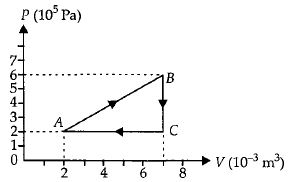
$A$ gas is taken through the cycle $A \to B \to C \to A$ as shown in the figure. What is the net work done by the gas in $J$?
A
$1000$
B
$0$
C
$-2000$
D
$2000$
Solution
(A) In a $P-V$ diagram,the net work done during a cyclic process is equal to the area enclosed by the cycle.
Since the cycle $A \to B \to C \to A$ is clockwise,the work done is positive.
The area of the triangle $ABC$ is given by:
$\text{Area} = \frac{1}{2} \times \text{base} \times \text{height}$
Base $= V_C - V_A = (7 - 2) \times 10^{-3} \ m^3 = 5 \times 10^{-3} \ m^3$
Height $= P_B - P_C = (6 - 2) \times 10^5 \ Pa = 4 \times 10^5 \ Pa$
$\text{Work Done} = \frac{1}{2} \times (5 \times 10^{-3}) \times (4 \times 10^5) = \frac{1}{2} \times 20 \times 10^2 = 1000 \ J$.
Since the cycle $A \to B \to C \to A$ is clockwise,the work done is positive.
The area of the triangle $ABC$ is given by:
$\text{Area} = \frac{1}{2} \times \text{base} \times \text{height}$
Base $= V_C - V_A = (7 - 2) \times 10^{-3} \ m^3 = 5 \times 10^{-3} \ m^3$
Height $= P_B - P_C = (6 - 2) \times 10^5 \ Pa = 4 \times 10^5 \ Pa$
$\text{Work Done} = \frac{1}{2} \times (5 \times 10^{-3}) \times (4 \times 10^5) = \frac{1}{2} \times 20 \times 10^2 = 1000 \ J$.
0 likesView Solution
20
PhysicsEasyMCQAIPMT · 2013
If we study the vibration of a pipe open at both ends,then the following statement is not true.
A
Odd harmonics of the fundamental frequency will be generated.
B
All harmonics of the fundamental frequency will be generated.
C
Pressure change will be maximum at both ends.
D
Open end will be antinode.
Solution
(C) In a pipe open at both ends,the open ends are always displacement antinodes. Since pressure variation is inversely related to displacement,the pressure variation is minimum (zero) at the open ends. Therefore,the statement that 'Pressure change will be maximum at both ends' is false.
0 likesView Solution
21
PhysicsMediumMCQAIPMT · 2013
$A$ source of unknown frequency gives $4\, \text{beats/s}$ when sounded with a source of known frequency $250\, \text{Hz}.$ The second harmonic of the source of unknown frequency gives $5\, \text{beats/s}$ when sounded with a source of frequency $513\, \text{Hz}.$ The unknown frequency is .... $\text{Hz}$
A
$246$
B
$240$
C
$260$
D
$254$
Solution
(D) Let $v$ be the frequency of the unknown source.
Since it produces $4\, \text{beats/s}$ with a source of $250\, \text{Hz}$, the possible frequencies are $v = 250 \pm 4$, which gives $v = 246\, \text{Hz}$ or $v = 254\, \text{Hz}$.
The second harmonic of the unknown source is $2v$. If $v = 246\, \text{Hz}$, then $2v = 492\, \text{Hz}$. The beat frequency with $513\, \text{Hz}$ is $|513 - 492| = 21\, \text{beats/s}$, which does not match the given $5\, \text{beats/s}$.
If $v = 254\, \text{Hz}$, then $2v = 508\, \text{Hz}$. The beat frequency with $513\, \text{Hz}$ is $|513 - 508| = 5\, \text{beats/s}$, which matches the given condition.
Therefore, the unknown frequency is $254\, \text{Hz}$.
Since it produces $4\, \text{beats/s}$ with a source of $250\, \text{Hz}$, the possible frequencies are $v = 250 \pm 4$, which gives $v = 246\, \text{Hz}$ or $v = 254\, \text{Hz}$.
The second harmonic of the unknown source is $2v$. If $v = 246\, \text{Hz}$, then $2v = 492\, \text{Hz}$. The beat frequency with $513\, \text{Hz}$ is $|513 - 492| = 21\, \text{beats/s}$, which does not match the given $5\, \text{beats/s}$.
If $v = 254\, \text{Hz}$, then $2v = 508\, \text{Hz}$. The beat frequency with $513\, \text{Hz}$ is $|513 - 508| = 5\, \text{beats/s}$, which matches the given condition.
Therefore, the unknown frequency is $254\, \text{Hz}$.
0 likesView Solution
22
PhysicsMediumMCQAIPMT · 2013
$A$ wave travelling in the $+ve$ $x$-direction having displacement along $y$-direction as $1\, m$,wavelength $2\pi\, m$,and frequency of $\frac{1}{\pi}\ Hz$ is represented by
A
$y = \sin(x - 2t)$
B
$y = \sin(2\pi x - 2\pi t)$
C
$y = \sin(10\pi x - 20\pi t)$
D
$y = \sin(2\pi x + 2\pi t)$
Solution
(A) The standard equation of a wave travelling along the $+ve$ $x$-direction is given by:
$y = A \sin(kx - \omega t)$
where:
$A$ is the amplitude of the wave.
$k$ is the angular wave number.
$\omega$ is the angular frequency of the wave.
Given: $A = 1\, m$,$\lambda = 2\pi\, m$,and $f = \frac{1}{\pi}\ Hz$.
Calculating the wave number $k$:
$k = \frac{2\pi}{\lambda} = \frac{2\pi}{2\pi} = 1\, m^{-1}$.
Calculating the angular frequency $\omega$:
$\omega = 2\pi f = 2\pi \times \frac{1}{\pi} = 2\, rad/s$.
Substituting these values into the standard equation:
$y = 1 \sin(1x - 2t) = \sin(x - 2t)$.
$y = A \sin(kx - \omega t)$
where:
$A$ is the amplitude of the wave.
$k$ is the angular wave number.
$\omega$ is the angular frequency of the wave.
Given: $A = 1\, m$,$\lambda = 2\pi\, m$,and $f = \frac{1}{\pi}\ Hz$.
Calculating the wave number $k$:
$k = \frac{2\pi}{\lambda} = \frac{2\pi}{2\pi} = 1\, m^{-1}$.
Calculating the angular frequency $\omega$:
$\omega = 2\pi f = 2\pi \times \frac{1}{\pi} = 2\, rad/s$.
Substituting these values into the standard equation:
$y = 1 \sin(1x - 2t) = \sin(x - 2t)$.
0 likesView Solution
23
PhysicsMediumMCQAIPMT · 2013
$A$ body of mass $m$ is taken from the Earth's surface to a height $h$ equal to twice the radius of the Earth $(R_e)$. The increase in potential energy will be: (where $g$ is the acceleration due to gravity on the surface of the Earth)
A
$3 mgR_e$
B
$\frac{1}{3} mgR_e$
C
$\frac{2}{3} mgR_e$
D
$\frac{1}{2} mgR_e$
Solution
(C) The gravitational potential energy of a body of mass $m$ at a distance $r$ from the center of the Earth is given by $U = -\frac{GM_e m}{r}$.
Initial potential energy at the surface $(r = R_e)$ is $U_i = -\frac{GM_e m}{R_e}$.
Final potential energy at height $h = 2R_e$ $(r = R_e + h = 3R_e)$ is $U_f = -\frac{GM_e m}{3R_e}$.
The increase in potential energy is $\Delta U = U_f - U_i$.
$\Delta U = -\frac{GM_e m}{3R_e} - (-\frac{GM_e m}{R_e}) = \frac{GM_e m}{R_e} (1 - \frac{1}{3}) = \frac{2}{3} \frac{GM_e m}{R_e}$.
Since $g = \frac{GM_e}{R_e^2}$,we have $GM_e = gR_e^2$.
Substituting this into the expression: $\Delta U = \frac{2}{3} \frac{(gR_e^2)m}{R_e} = \frac{2}{3} mgR_e$.
Initial potential energy at the surface $(r = R_e)$ is $U_i = -\frac{GM_e m}{R_e}$.
Final potential energy at height $h = 2R_e$ $(r = R_e + h = 3R_e)$ is $U_f = -\frac{GM_e m}{3R_e}$.
The increase in potential energy is $\Delta U = U_f - U_i$.
$\Delta U = -\frac{GM_e m}{3R_e} - (-\frac{GM_e m}{R_e}) = \frac{GM_e m}{R_e} (1 - \frac{1}{3}) = \frac{2}{3} \frac{GM_e m}{R_e}$.
Since $g = \frac{GM_e}{R_e^2}$,we have $GM_e = gR_e^2$.
Substituting this into the expression: $\Delta U = \frac{2}{3} \frac{(gR_e^2)m}{R_e} = \frac{2}{3} mgR_e$.
0 likesView Solution
24
PhysicsDifficultMCQAIPMT · 2013
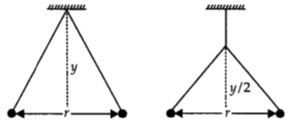
Two pith balls carrying equal charges are suspended from a common point by strings of equal length. The equilibrium separation between them is $r$. Now,the strings are rigidly clamped at half the height. The equilibrium separation between the balls now becomes:
A
$\left( \frac{r}{\sqrt[3]{2}} \right)$
B
$\left( \frac{2r}{\sqrt{3}} \right)$
C
$\left( \frac{2r}{3} \right)$
D
$\left( \frac{r}{2} \right)$
Solution
(A) Let $m$ be the mass of each ball and $q$ be the charge on each ball. The force of electrostatic repulsion is $F = \frac{1}{4 \pi \varepsilon_{0}} \frac{q^{2}}{r^{2}}$.
In equilibrium,the forces acting on each ball are tension $T$,weight $mg$,and electrostatic force $F$.
$T \cos \theta = mg$ $(i)$
$T \sin \theta = F$ $(ii)$
Dividing $(ii)$ by $(i)$,we get $\tan \theta = \frac{F}{mg} = \frac{q^{2}}{4 \pi \varepsilon_{0} r^{2} mg}$.
From the geometry of the first case,$\tan \theta = \frac{r/2}{y} = \frac{r}{2y}$.
Thus,$\frac{r}{2y} = \frac{q^{2}}{4 \pi \varepsilon_{0} r^{2} mg} \Rightarrow y \propto r^{3}$.
In the second case,the strings are clamped at half the height,so the new vertical height is $y' = y/2$. Let the new separation be $r'$.
Since the charge $q$ and mass $m$ remain the same,the relationship $y \propto r^{3}$ still holds.
Therefore,$\frac{y'}{y} = \left( \frac{r'}{r} \right)^{3}$.
Substituting $y' = y/2$,we get $\frac{1}{2} = \left( \frac{r'}{r} \right)^{3}$.
$r'^{3} = \frac{r^{3}}{2} \Rightarrow r' = \frac{r}{\sqrt[3]{2}}$.
In equilibrium,the forces acting on each ball are tension $T$,weight $mg$,and electrostatic force $F$.
$T \cos \theta = mg$ $(i)$
$T \sin \theta = F$ $(ii)$
Dividing $(ii)$ by $(i)$,we get $\tan \theta = \frac{F}{mg} = \frac{q^{2}}{4 \pi \varepsilon_{0} r^{2} mg}$.
From the geometry of the first case,$\tan \theta = \frac{r/2}{y} = \frac{r}{2y}$.
Thus,$\frac{r}{2y} = \frac{q^{2}}{4 \pi \varepsilon_{0} r^{2} mg} \Rightarrow y \propto r^{3}$.
In the second case,the strings are clamped at half the height,so the new vertical height is $y' = y/2$. Let the new separation be $r'$.
Since the charge $q$ and mass $m$ remain the same,the relationship $y \propto r^{3}$ still holds.
Therefore,$\frac{y'}{y} = \left( \frac{r'}{r} \right)^{3}$.
Substituting $y' = y/2$,we get $\frac{1}{2} = \left( \frac{r'}{r} \right)^{3}$.
$r'^{3} = \frac{r^{3}}{2} \Rightarrow r' = \frac{r}{\sqrt[3]{2}}$.
0 likesView Solution
25
PhysicsEasyMCQAIPMT · 2013
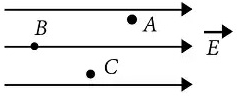
$A, B$ and $C$ are three points in a uniform electric field as shown in the figure. The electric potential is
A
maximum at $A$
B
maximum at $B$
C
maximum at $C$
D
the same at all three points $A, B$ and $C$
Solution
(B) The electric potential decreases in the direction of the electric field.
From the given figure,point $B$ is at the leftmost position,followed by point $C$,and then point $A$ in the direction of the electric field $\vec{E}$.
Therefore,the potential at these points follows the relation $V_B > V_C > V_A$.
Thus,the electric potential is maximum at point $B$.
From the given figure,point $B$ is at the leftmost position,followed by point $C$,and then point $A$ in the direction of the electric field $\vec{E}$.
Therefore,the potential at these points follows the relation $V_B > V_C > V_A$.
Thus,the electric potential is maximum at point $B$.
0 likesView Solution
26
PhysicsMediumMCQAIPMT · 2013
$A$ wire of resistance $4 \,\Omega$ is stretched to twice its original length. The resistance of the stretched wire would be ........... $\Omega$.
A
$4$
B
$8$
C
$16$
D
$2$
Solution
(C) The resistance of a wire is given by $R = \rho \frac{l}{A} = 4 \,\Omega$ .... $(i)$
When the wire is stretched to twice its original length,the new length $l^{\prime} = 2l$.
Since the volume of the wire remains constant during stretching,$V = lA = l^{\prime}A^{\prime}$.
Substituting $l^{\prime} = 2l$,we get $lA = (2l)A^{\prime}$,which implies $A^{\prime} = \frac{A}{2}$.
The new resistance $R^{\prime}$ is given by $R^{\prime} = \rho \frac{l^{\prime}}{A^{\prime}}$.
Substituting the values,$R^{\prime} = \rho \frac{2l}{A/2} = 4 \left( \rho \frac{l}{A} \right)$.
Using equation $(i)$,$R^{\prime} = 4 \times 4 \,\Omega = 16 \,\Omega$.
When the wire is stretched to twice its original length,the new length $l^{\prime} = 2l$.
Since the volume of the wire remains constant during stretching,$V = lA = l^{\prime}A^{\prime}$.
Substituting $l^{\prime} = 2l$,we get $lA = (2l)A^{\prime}$,which implies $A^{\prime} = \frac{A}{2}$.
The new resistance $R^{\prime}$ is given by $R^{\prime} = \rho \frac{l^{\prime}}{A^{\prime}}$.
Substituting the values,$R^{\prime} = \rho \frac{2l}{A/2} = 4 \left( \rho \frac{l}{A} \right)$.
Using equation $(i)$,$R^{\prime} = 4 \times 4 \,\Omega = 16 \,\Omega$.
0 likesView Solution
27
PhysicsMediumMCQAIPMT · 2013
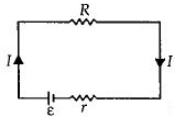
The internal resistance of a $2.1\, V$ cell which gives a current of $0.2\, A$ through a resistance of $10\,\Omega$ is ............. $\Omega$.
A
$0.5$
B
$0.8$
C
$1.0$
D
$0.2$
Solution
(A) The formula for current $I$ in a circuit with a cell of $EMF$ $\varepsilon$ and internal resistance $r$ connected to an external resistance $R$ is given by:
$I = \frac{\varepsilon}{R + r}$
Rearranging the formula to solve for internal resistance $r$:
$I(R + r) = \varepsilon$
$IR + Ir = \varepsilon$
$Ir = \varepsilon - IR$
$r = \frac{\varepsilon - IR}{I}$
Given values:
$EMF$ $\varepsilon = 2.1\, V$
External resistance $R = 10\,\Omega$
Current $I = 0.2\, A$
Substituting the values:
$r = \frac{2.1 - (0.2 \times 10)}{0.2}$
$r = \frac{2.1 - 2}{0.2}$
$r = \frac{0.1}{0.2}$
$r = 0.5\,\Omega$
$I = \frac{\varepsilon}{R + r}$
Rearranging the formula to solve for internal resistance $r$:
$I(R + r) = \varepsilon$
$IR + Ir = \varepsilon$
$Ir = \varepsilon - IR$
$r = \frac{\varepsilon - IR}{I}$
Given values:
$EMF$ $\varepsilon = 2.1\, V$
External resistance $R = 10\,\Omega$
Current $I = 0.2\, A$
Substituting the values:
$r = \frac{2.1 - (0.2 \times 10)}{0.2}$
$r = \frac{2.1 - 2}{0.2}$
$r = \frac{0.1}{0.2}$
$r = 0.5\,\Omega$
0 likesView Solution
28
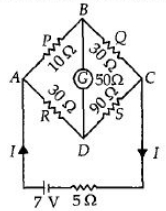
PhysicsMediumMCQAIPMT · 2013
The resistances of the four arms $P, Q, R$ and $S$ in a Wheatstone's bridge are $10 \, \Omega$, $30 \, \Omega$, $30 \, \Omega$ and $90 \, \Omega$, respectively. The e.m.f. and internal resistance of the cell are $7 \, V$ and $5 \, \Omega$ respectively. If the galvanometer resistance is $50 \, \Omega$, the current drawn from the cell will be ............... $A$.
A
$0.2$
B
$0.1$
C
$2$
D
$1$
Solution
(A) For a balanced Wheatstone's bridge, the condition is $\frac{P}{Q} = \frac{R}{S}$.
Substituting the given values: $\frac{10 \, \Omega}{30 \, \Omega} = \frac{30 \, \Omega}{90 \, \Omega}$, which simplifies to $\frac{1}{3} = \frac{1}{3}$.
Since the bridge is balanced, no current flows through the galvanometer arm. Therefore, the $50 \, \Omega$ galvanometer resistance is ineffective.
The circuit simplifies to two parallel branches: $(P+Q)$ and $(R+S)$ in parallel, connected in series with the internal resistance $r = 5 \, \Omega$.
The equivalent resistance of the parallel part is $R_p = \frac{(P+Q)(R+S)}{(P+Q)+(R+S)} = \frac{(10+30)(30+90)}{(10+30)+(30+90)} = \frac{40 \times 120}{40+120} = \frac{4800}{160} = 30 \, \Omega$.
The total equivalent resistance of the circuit is $R_{eq} = r + R_p = 5 \, \Omega + 30 \, \Omega = 35 \, \Omega$.
The current drawn from the cell is $I = \frac{E}{R_{eq}} = \frac{7 \, V}{35 \, \Omega} = 0.2 \, A$.
Substituting the given values: $\frac{10 \, \Omega}{30 \, \Omega} = \frac{30 \, \Omega}{90 \, \Omega}$, which simplifies to $\frac{1}{3} = \frac{1}{3}$.
Since the bridge is balanced, no current flows through the galvanometer arm. Therefore, the $50 \, \Omega$ galvanometer resistance is ineffective.
The circuit simplifies to two parallel branches: $(P+Q)$ and $(R+S)$ in parallel, connected in series with the internal resistance $r = 5 \, \Omega$.
The equivalent resistance of the parallel part is $R_p = \frac{(P+Q)(R+S)}{(P+Q)+(R+S)} = \frac{(10+30)(30+90)}{(10+30)+(30+90)} = \frac{40 \times 120}{40+120} = \frac{4800}{160} = 30 \, \Omega$.
The total equivalent resistance of the circuit is $R_{eq} = r + R_p = 5 \, \Omega + 30 \, \Omega = 35 \, \Omega$.
The current drawn from the cell is $I = \frac{E}{R_{eq}} = \frac{7 \, V}{35 \, \Omega} = 0.2 \, A$.
0 likesView Solution
29
PhysicsMediumMCQAIPMT · 2013
When a proton is released from rest in a room,it starts with an initial acceleration $a_0$ towards west. When it is projected towards north with a speed $v_0$,it moves with an initial acceleration $3a_0$ towards west. The electric and magnetic fields in the room are
A
$\frac{ma_0}{e}$ west,$\frac{ma_0}{ev_0}$ up
B
$\frac{ma_0}{e}$ west,$\frac{2ma_0}{ev_0}$ down
C
$\frac{ma_0}{e}$ east,$\frac{3ma_0}{ev_0}$ up
D
$\frac{ma_0}{e}$ east,$\frac{3ma_0}{ev_0}$ down
Solution
(B) $1$. When the proton is at rest,the only force acting on it is the electric force $F_E = qE = eE$. Given the acceleration is $a_0$ towards west,we have $ma_0 = eE$,which implies $E = \frac{ma_0}{e}$ towards west.
$2$. When the proton is projected towards north with speed $v_0$,the total force is the vector sum of the electric force and the magnetic force: $F_{net} = F_E + F_B = ma_{net}$.
$3$. The net acceleration is $3a_0$ towards west. Since $F_E$ is $ma_0$ towards west,the magnetic force $F_B$ must be $2ma_0$ towards west to result in a total force of $3ma_0$ towards west $(F_B = F_{net} - F_E = 3ma_0 - ma_0 = 2ma_0)$.
$4$. The magnetic force is given by $F_B = q(v \times B) = ev_0B \sin(\theta)$. For the force to be towards west,with velocity towards north,the magnetic field $B$ must be directed downwards (using Fleming's Left-Hand Rule or the cross product $v \times B$).
$5$. Setting the magnitudes equal: $ev_0B = 2ma_0$,which gives $B = \frac{2ma_0}{ev_0}$ downwards.
$2$. When the proton is projected towards north with speed $v_0$,the total force is the vector sum of the electric force and the magnetic force: $F_{net} = F_E + F_B = ma_{net}$.
$3$. The net acceleration is $3a_0$ towards west. Since $F_E$ is $ma_0$ towards west,the magnetic force $F_B$ must be $2ma_0$ towards west to result in a total force of $3ma_0$ towards west $(F_B = F_{net} - F_E = 3ma_0 - ma_0 = 2ma_0)$.
$4$. The magnetic force is given by $F_B = q(v \times B) = ev_0B \sin(\theta)$. For the force to be towards west,with velocity towards north,the magnetic field $B$ must be directed downwards (using Fleming's Left-Hand Rule or the cross product $v \times B$).
$5$. Setting the magnitudes equal: $ev_0B = 2ma_0$,which gives $B = \frac{2ma_0}{ev_0}$ downwards.

0 likesView Solution
30
PhysicsEasyMCQAIPMT · 2013
$A$ current loop in a magnetic field:
A
experiences a torque whether the field is uniform or non-uniform in all orientations.
B
can be in equilibrium in one orientation.
C
can be in equilibrium in two orientations,both the equilibrium states are unstable.
D
can be in equilibrium in two orientations,one stable while the other is unstable.
Solution
(D) When a current loop is placed in a magnetic field,it experiences a torque given by $\vec{\tau} = \vec{M} \times \vec{B}$,where $\vec{M}$ is the magnetic moment and $\vec{B}$ is the magnetic field.
The magnitude of the torque is $\tau = MB \sin \theta$,where $\theta$ is the angle between $\vec{M}$ and $\vec{B}$.
Equilibrium occurs when the torque is zero,which happens when $\sin \theta = 0$,i.e.,$\theta = 0^{\circ}$ or $\theta = 180^{\circ}$.
$1$. When $\theta = 0^{\circ}$,$\vec{M}$ and $\vec{B}$ are parallel. This is a state of minimum potential energy $(U = -\vec{M} \cdot \vec{B} = -MB)$,which corresponds to stable equilibrium.
$2$. When $\theta = 180^{\circ}$,$\vec{M}$ and $\vec{B}$ are antiparallel. This is a state of maximum potential energy $(U = +MB)$,which corresponds to unstable equilibrium.
Thus,the loop can be in equilibrium in two orientations,one stable and one unstable.
The magnitude of the torque is $\tau = MB \sin \theta$,where $\theta$ is the angle between $\vec{M}$ and $\vec{B}$.
Equilibrium occurs when the torque is zero,which happens when $\sin \theta = 0$,i.e.,$\theta = 0^{\circ}$ or $\theta = 180^{\circ}$.
$1$. When $\theta = 0^{\circ}$,$\vec{M}$ and $\vec{B}$ are parallel. This is a state of minimum potential energy $(U = -\vec{M} \cdot \vec{B} = -MB)$,which corresponds to stable equilibrium.
$2$. When $\theta = 180^{\circ}$,$\vec{M}$ and $\vec{B}$ are antiparallel. This is a state of maximum potential energy $(U = +MB)$,which corresponds to unstable equilibrium.
Thus,the loop can be in equilibrium in two orientations,one stable and one unstable.
0 likesView Solution
31
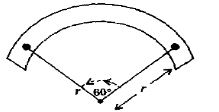
PhysicsMediumMCQAIPMT · 2013
$A$ bar magnet of length $l$ and magnetic dipole moment $M$ is bent in the form of an arc as shown in the figure. The new magnetic dipole moment will be
A
$M$
B
$\frac{3}{\pi} M$
C
$\frac{2}{\pi} M$
D
$\frac{M}{2}$
Solution
(B) Let $m$ be the pole strength of each pole of the bar magnet of length $l$. Then,the initial magnetic dipole moment is given by:
$M = m \times l$ ......... $(i)$
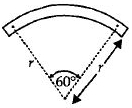
When the bar magnet is bent into an arc of radius $r$ subtending an angle $\theta = 60^{\circ} = \frac{\pi}{3} \text{ radians}$ at the center,the arc length $l$ is:
$l = r \theta = r \times \frac{\pi}{3}$
$r = \frac{3l}{\pi}$
The new magnetic dipole moment $M^{\prime}$ is the product of pole strength $m$ and the straight-line distance (chord length) between the two poles.
The chord length $d$ is given by $2r \sin(\frac{\theta}{2}) = 2r \sin(30^{\circ}) = 2r \times \frac{1}{2} = r$.
Thus,$M^{\prime} = m \times d = m \times r$.
Substituting $r = \frac{3l}{\pi}$:
$M^{\prime} = m \times \frac{3l}{\pi} = \frac{3}{\pi} (m \times l) = \frac{3}{\pi} M$ (using equation $(i)$).
$M = m \times l$ ......... $(i)$
When the bar magnet is bent into an arc of radius $r$ subtending an angle $\theta = 60^{\circ} = \frac{\pi}{3} \text{ radians}$ at the center,the arc length $l$ is:
$l = r \theta = r \times \frac{\pi}{3}$
$r = \frac{3l}{\pi}$
The new magnetic dipole moment $M^{\prime}$ is the product of pole strength $m$ and the straight-line distance (chord length) between the two poles.
The chord length $d$ is given by $2r \sin(\frac{\theta}{2}) = 2r \sin(30^{\circ}) = 2r \times \frac{1}{2} = r$.
Thus,$M^{\prime} = m \times d = m \times r$.
Substituting $r = \frac{3l}{\pi}$:
$M^{\prime} = m \times \frac{3l}{\pi} = \frac{3}{\pi} (m \times l) = \frac{3}{\pi} M$ (using equation $(i)$).
0 likesView Solution
32
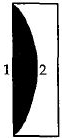
PhysicsMediumMCQAIPMT · 2013
$A$ plano-convex lens fits exactly into a plano-concave lens. Their plane surfaces are parallel to each other. If the lenses are made of different materials with refractive indices $\mu_1$ and $\mu_2$ and $R$ is the radius of curvature of the curved surface of the lenses,then the focal length of the combination is:
A
$\frac{R}{2(\mu_1 + \mu_2)}$
B
$\frac{R}{2(\mu_1 - \mu_2)}$
C
$\frac{R}{(\mu_1 - \mu_2)}$
D
$\frac{2R}{(\mu_2 - \mu_1)}$
Solution
(C) The combination of two lenses $1$ and $2$ is as shown in the figure.
For a combination of thin lenses in contact,the equivalent focal length $f$ is given by $\frac{1}{f} = \frac{1}{f_1} + \frac{1}{f_2}$.
According to the lens maker's formula,$\frac{1}{f} = (\mu - 1) \left( \frac{1}{R_1} - \frac{1}{R_2} \right)$.
For the plano-convex lens (lens $1$): $R_1 = \infty$,$R_2 = -R$. Thus,$\frac{1}{f_1} = (\mu_1 - 1) \left( \frac{1}{\infty} - \frac{1}{-R} \right) = \frac{\mu_1 - 1}{R}$.
For the plano-concave lens (lens $2$): $R_1 = -R$,$R_2 = \infty$. Thus,$\frac{1}{f_2} = (\mu_2 - 1) \left( \frac{1}{-R} - \frac{1}{\infty} \right) = -\frac{\mu_2 - 1}{R}$.
Substituting these into the combination formula:
$\frac{1}{f} = \frac{\mu_1 - 1}{R} - \frac{\mu_2 - 1}{R} = \frac{\mu_1 - 1 - \mu_2 + 1}{R} = \frac{\mu_1 - \mu_2}{R}$.
Therefore,$f = \frac{R}{\mu_1 - \mu_2}$.
For a combination of thin lenses in contact,the equivalent focal length $f$ is given by $\frac{1}{f} = \frac{1}{f_1} + \frac{1}{f_2}$.
According to the lens maker's formula,$\frac{1}{f} = (\mu - 1) \left( \frac{1}{R_1} - \frac{1}{R_2} \right)$.
For the plano-convex lens (lens $1$): $R_1 = \infty$,$R_2 = -R$. Thus,$\frac{1}{f_1} = (\mu_1 - 1) \left( \frac{1}{\infty} - \frac{1}{-R} \right) = \frac{\mu_1 - 1}{R}$.
For the plano-concave lens (lens $2$): $R_1 = -R$,$R_2 = \infty$. Thus,$\frac{1}{f_2} = (\mu_2 - 1) \left( \frac{1}{-R} - \frac{1}{\infty} \right) = -\frac{\mu_2 - 1}{R}$.
Substituting these into the combination formula:
$\frac{1}{f} = \frac{\mu_1 - 1}{R} - \frac{\mu_2 - 1}{R} = \frac{\mu_1 - 1 - \mu_2 + 1}{R} = \frac{\mu_1 - \mu_2}{R}$.
Therefore,$f = \frac{R}{\mu_1 - \mu_2}$.
0 likesView Solution
33
PhysicsMediumMCQAIPMT · 2013
For a normal eye,the cornea of the eye provides a converging power of $40\, D$ and the least converging power of the eye lens behind the cornea is $20\, D$. Using this information,the distance between the retina and the cornea-eye lens can be estimated to be ......... $cm$.
A
$5$
B
$2.5$
C
$1.67$
D
$1.5$
Solution
(C) The total converging power of the eye is the sum of the power of the cornea and the eye lens.
Total power $P = P_{c} + P_{e} = 40\, D + 20\, D = 60\, D$.
For a normal eye,the image of an object at infinity is formed on the retina.
The focal length $f$ of the eye system is given by $f = \frac{1}{P}$.
$f = \frac{1}{60}\, m = \frac{100}{60}\, cm = \frac{5}{3}\, cm$.
$f \approx 1.67\, cm$.
Since the image is formed on the retina,the distance between the retina and the cornea-eye lens is equal to the focal length of the eye system,which is $1.67\, cm$.
Total power $P = P_{c} + P_{e} = 40\, D + 20\, D = 60\, D$.
For a normal eye,the image of an object at infinity is formed on the retina.
The focal length $f$ of the eye system is given by $f = \frac{1}{P}$.
$f = \frac{1}{60}\, m = \frac{100}{60}\, cm = \frac{5}{3}\, cm$.
$f \approx 1.67\, cm$.
Since the image is formed on the retina,the distance between the retina and the cornea-eye lens is equal to the focal length of the eye system,which is $1.67\, cm$.
0 likesView Solution
34
PhysicsMediumMCQAIPMT · 2013
For photoelectric emission from a certain metal,the cutoff frequency is $\nu$. If radiation of frequency $2\nu$ impinges on the metal plate,the maximum possible velocity of the emitted electron will be ($m$ is the electron mass).
A
$\sqrt{\frac{h\nu}{2m}}$
B
$\sqrt{\frac{h\nu}{m}}$
C
$\sqrt{\frac{2h\nu}{m}}$
D
$2\sqrt{\frac{h\nu}{m}}$
Solution
(C) The work function $\phi$ of the metal is given by $\phi = h\nu$,where $\nu$ is the cutoff (threshold) frequency.
According to Einstein's photoelectric equation,the maximum kinetic energy $K_{\max}$ of the emitted electron is given by $K_{\max} = E - \phi$.
Here,the incident frequency is $2\nu$,so the incident energy $E = h(2\nu) = 2h\nu$.
Substituting the values,we get $K_{\max} = 2h\nu - h\nu = h\nu$.
Since $K_{\max} = \frac{1}{2}mv_{\max}^2$,we have $\frac{1}{2}mv_{\max}^2 = h\nu$.
Solving for $v_{\max}$,we get $v_{\max}^2 = \frac{2h\nu}{m}$,which implies $v_{\max} = \sqrt{\frac{2h\nu}{m}}$.
According to Einstein's photoelectric equation,the maximum kinetic energy $K_{\max}$ of the emitted electron is given by $K_{\max} = E - \phi$.
Here,the incident frequency is $2\nu$,so the incident energy $E = h(2\nu) = 2h\nu$.
Substituting the values,we get $K_{\max} = 2h\nu - h\nu = h\nu$.
Since $K_{\max} = \frac{1}{2}mv_{\max}^2$,we have $\frac{1}{2}mv_{\max}^2 = h\nu$.
Solving for $v_{\max}$,we get $v_{\max}^2 = \frac{2h\nu}{m}$,which implies $v_{\max} = \sqrt{\frac{2h\nu}{m}}$.
0 likesView Solution
35
PhysicsDifficultMCQAIPMT · 2013
The wavelength $\lambda_e$ of an electron and $\lambda_p$ of a photon of same energy $E$ are related by
A
$\lambda_p \propto \lambda_e^2$
B
$\lambda_p \propto \lambda_e$
C
$\lambda_p \propto \sqrt{\lambda_e}$
D
$\lambda_p \propto \frac{1}{\sqrt{\lambda_e}}$
Solution
(A) The de Broglie wavelength of an electron with kinetic energy $E$ is given by:
$\lambda_e = \frac{h}{\sqrt{2 m_e E}}$ .... $(i)$
The wavelength of a photon with energy $E$ is given by:
$\lambda_p = \frac{hc}{E}$ or $E = \frac{hc}{\lambda_p}$ .... $(ii)$
From equation $(i)$,squaring both sides:
$\lambda_e^2 = \frac{h^2}{2 m_e E}$ or $E = \frac{h^2}{2 m_e \lambda_e^2}$ .... $(iii)$
Equating the expressions for $E$ from $(ii)$ and $(iii)$:
$\frac{hc}{\lambda_p} = \frac{h^2}{2 m_e \lambda_e^2}$
Rearranging for $\lambda_p$:
$\lambda_p = \left( \frac{2 m_e c}{h} \right) \lambda_e^2$
Since $\frac{2 m_e c}{h}$ is a constant,we have:
$\lambda_p \propto \lambda_e^2$
$\lambda_e = \frac{h}{\sqrt{2 m_e E}}$ .... $(i)$
The wavelength of a photon with energy $E$ is given by:
$\lambda_p = \frac{hc}{E}$ or $E = \frac{hc}{\lambda_p}$ .... $(ii)$
From equation $(i)$,squaring both sides:
$\lambda_e^2 = \frac{h^2}{2 m_e E}$ or $E = \frac{h^2}{2 m_e \lambda_e^2}$ .... $(iii)$
Equating the expressions for $E$ from $(ii)$ and $(iii)$:
$\frac{hc}{\lambda_p} = \frac{h^2}{2 m_e \lambda_e^2}$
Rearranging for $\lambda_p$:
$\lambda_p = \left( \frac{2 m_e c}{h} \right) \lambda_e^2$
Since $\frac{2 m_e c}{h}$ is a constant,we have:
$\lambda_p \propto \lambda_e^2$
0 likesView Solution
36
PhysicsEasyMCQAIPMT · 2013
$A$ wire loop is rotated in a magnetic field. The frequency of change of direction of the induced $e.m.f.$ is
A
twice per revolution
B
four times per revolution
C
six times per revolution
D
once per revolution
Solution
(A) The induced $e.m.f.$ in a rotating loop is given by $\varepsilon = N B A \omega \sin(\omega t)$.
As the loop completes one full revolution $(360^{\circ})$,the value of $\sin(\omega t)$ changes from positive to negative at $180^{\circ}$ and from negative to positive at $360^{\circ}$.
Therefore,the direction of the induced $e.m.f.$ changes twice per revolution.
As the loop completes one full revolution $(360^{\circ})$,the value of $\sin(\omega t)$ changes from positive to negative at $180^{\circ}$ and from negative to positive at $360^{\circ}$.
Therefore,the direction of the induced $e.m.f.$ changes twice per revolution.
0 likesView Solution
37
PhysicsMediumMCQAIPMT · 2013
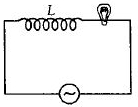
$A$ coil of self-inductance $L$ is connected in series with a bulb $B$ and an $AC$ source. The brightness of the bulb decreases when:
A
the number of turns in the coil is reduced.
B
a capacitance of reactance $X_C = X_L$ is included in the same circuit.
C
an iron rod is inserted into the coil.
D
the frequency of the $AC$ source is decreased.
Solution
(C) The circuit consists of an inductor $L$ and a bulb $B$ in series with an $AC$ source. The impedance of the circuit is $Z = \sqrt{R^2 + X_L^2}$,where $R$ is the resistance of the bulb and $X_L = \omega L$ is the inductive reactance.
When an iron rod is inserted into the coil,the permeability of the core increases,which significantly increases the self-inductance $L$ of the coil.
Since $X_L = \omega L$,an increase in $L$ leads to an increase in the inductive reactance $X_L$.
As the total impedance $Z = \sqrt{R^2 + X_L^2}$ increases,the total current in the circuit $I = \frac{V}{Z}$ decreases.
The brightness of the bulb depends on the power dissipated,$P = I^2 R$. Since the current $I$ decreases,the power dissipated by the bulb decreases,and thus the brightness of the bulb decreases.
When an iron rod is inserted into the coil,the permeability of the core increases,which significantly increases the self-inductance $L$ of the coil.
Since $X_L = \omega L$,an increase in $L$ leads to an increase in the inductive reactance $X_L$.
As the total impedance $Z = \sqrt{R^2 + X_L^2}$ increases,the total current in the circuit $I = \frac{V}{Z}$ decreases.
The brightness of the bulb depends on the power dissipated,$P = I^2 R$. Since the current $I$ decreases,the power dissipated by the bulb decreases,and thus the brightness of the bulb decreases.
0 likesView Solution
38
PhysicsEasyMCQAIPMT · 2013
The condition under which a microwave oven heats up a food item containing water molecules most efficiently is
A
The frequency of the microwaves has no relation with the natural frequency of water molecules.
B
Microwaves are heat waves,so they always produce heating.
C
Infra-red waves produce heating in a microwave oven.
D
The frequency of the microwaves must match the resonant frequency of the water molecules.
Solution
(D) In a microwave oven,the frequency of the microwaves is tuned to match the resonant frequency of water molecules.
When these frequencies match,the water molecules absorb the energy from the electromagnetic waves through the process of resonance.
This energy absorption increases the rotational kinetic energy of the water molecules,which manifests as an increase in temperature,thereby heating the food efficiently.
When these frequencies match,the water molecules absorb the energy from the electromagnetic waves through the process of resonance.
This energy absorption increases the rotational kinetic energy of the water molecules,which manifests as an increase in temperature,thereby heating the food efficiently.
0 likesView Solution
39
PhysicsDifficultMCQAIPMT · 2013
In Young's double slit experiment,the slits are $2\, mm$ apart and are illuminated by light of two wavelengths $\lambda_1 = 12000\, \mathring{A}$ and $\lambda_2 = 10000\, \mathring{A}$. At what minimum distance from the common central bright fringe on the screen $2\, m$ from the slits will a bright fringe from one interference pattern coincide with a bright fringe from the other? (in $mm$)
A
$6$
B
$4$
C
$3$
D
$8$
Solution
(A) Let the $n_1$-th bright fringe of $\lambda_1$ coincide with the $n_2$-th bright fringe of $\lambda_2$.
For bright fringes,the position $x$ is given by $x = \frac{n\lambda D}{d}$.
Since the positions coincide,we have $\frac{n_1 \lambda_1 D}{d} = \frac{n_2 \lambda_2 D}{d}$,which implies $n_1 \lambda_1 = n_2 \lambda_2$.
Rearranging gives $\frac{n_1}{n_2} = \frac{\lambda_2}{\lambda_1} = \frac{10000}{12000} = \frac{5}{6}$.
Thus,the minimum integer values are $n_1 = 5$ and $n_2 = 6$.
Now,calculate the distance $x$ using $n_1 = 5$:
$x = \frac{n_1 \lambda_1 D}{d} = \frac{5 \times 12000 \times 10^{-10} \times 2}{2 \times 10^{-3}}$.
$x = \frac{5 \times 12 \times 10^{-7} \times 2}{2 \times 10^{-3}} = 60 \times 10^{-4} = 6 \times 10^{-3}\, m$.
$x = 6\, mm$.
For bright fringes,the position $x$ is given by $x = \frac{n\lambda D}{d}$.
Since the positions coincide,we have $\frac{n_1 \lambda_1 D}{d} = \frac{n_2 \lambda_2 D}{d}$,which implies $n_1 \lambda_1 = n_2 \lambda_2$.
Rearranging gives $\frac{n_1}{n_2} = \frac{\lambda_2}{\lambda_1} = \frac{10000}{12000} = \frac{5}{6}$.
Thus,the minimum integer values are $n_1 = 5$ and $n_2 = 6$.
Now,calculate the distance $x$ using $n_1 = 5$:
$x = \frac{n_1 \lambda_1 D}{d} = \frac{5 \times 12000 \times 10^{-10} \times 2}{2 \times 10^{-3}}$.
$x = \frac{5 \times 12 \times 10^{-7} \times 2}{2 \times 10^{-3}} = 60 \times 10^{-4} = 6 \times 10^{-3}\, m$.
$x = 6\, mm$.
0 likesView Solution
40
PhysicsMediumMCQAIPMT · 2013
$A$ parallel beam of fast-moving electrons is incident normally on a narrow slit. $A$ fluorescent screen is placed at a large distance from the slit. If the speed of the electrons is increased,which of the following statements is correct?
A
The angular width of the central maximum of the diffraction pattern will increase.
B
The angular width of the central maximum will decrease.
C
The angular width of the central maximum will be unaffected.
D
Diffraction pattern is not observed on the screen in the case of electrons.
Solution
(B) According to the de Broglie hypothesis,the wavelength $\lambda$ of an electron moving with velocity $v$ is given by $\lambda = \frac{h}{mv}$,where $h$ is Planck's constant and $m$ is the mass of the electron.
The angular width $\omega$ of the central maximum in a single-slit diffraction pattern is given by $\omega = \frac{2\lambda}{d}$,where $d$ is the width of the slit.
Substituting the expression for $\lambda$,we get $\omega = \frac{2h}{mdv}$.
From this relation,it is clear that $\omega \propto \frac{1}{v}$.
Therefore,if the speed $v$ of the electrons is increased,the angular width $\omega$ of the central maximum will decrease.
The angular width $\omega$ of the central maximum in a single-slit diffraction pattern is given by $\omega = \frac{2\lambda}{d}$,where $d$ is the width of the slit.
Substituting the expression for $\lambda$,we get $\omega = \frac{2h}{mdv}$.
From this relation,it is clear that $\omega \propto \frac{1}{v}$.
Therefore,if the speed $v$ of the electrons is increased,the angular width $\omega$ of the central maximum will decrease.
0 likesView Solution
41
PhysicsDifficultMCQAIPMT · 2013
In the spectrum of hydrogen,the ratio of the longest wavelength in the Lyman series to the longest wavelength in the Balmer series is
A
$5/27$
B
$4/9$
C
$9/4$
D
$27/5$
Solution
(A) The wavelength of a spectral line in the Lyman series is given by $\frac{1}{\lambda_{L}} = R\left(\frac{1}{1^{2}} - \frac{1}{n^{2}}\right)$,where $n = 2, 3, 4, \dots$.
For the longest wavelength in the Lyman series,we take $n = 2$:
$\frac{1}{\lambda_{L}} = R\left(1 - \frac{1}{4}\right) = \frac{3R}{4} \implies \lambda_{L} = \frac{4}{3R}$.
The wavelength of a spectral line in the Balmer series is given by $\frac{1}{\lambda_{B}} = R\left(\frac{1}{2^{2}} - \frac{1}{n^{2}}\right)$,where $n = 3, 4, 5, \dots$.
For the longest wavelength in the Balmer series,we take $n = 3$:
$\frac{1}{\lambda_{B}} = R\left(\frac{1}{4} - \frac{1}{9}\right) = R\left(\frac{9-4}{36}\right) = \frac{5R}{36} \implies \lambda_{B} = \frac{36}{5R}$.
The ratio of the longest wavelength in the Lyman series to the longest wavelength in the Balmer series is:
$\frac{\lambda_{L}}{\lambda_{B}} = \frac{4/3R}{36/5R} = \frac{4}{3R} \times \frac{5R}{36} = \frac{5}{27}$.
For the longest wavelength in the Lyman series,we take $n = 2$:
$\frac{1}{\lambda_{L}} = R\left(1 - \frac{1}{4}\right) = \frac{3R}{4} \implies \lambda_{L} = \frac{4}{3R}$.
The wavelength of a spectral line in the Balmer series is given by $\frac{1}{\lambda_{B}} = R\left(\frac{1}{2^{2}} - \frac{1}{n^{2}}\right)$,where $n = 3, 4, 5, \dots$.
For the longest wavelength in the Balmer series,we take $n = 3$:
$\frac{1}{\lambda_{B}} = R\left(\frac{1}{4} - \frac{1}{9}\right) = R\left(\frac{9-4}{36}\right) = \frac{5R}{36} \implies \lambda_{B} = \frac{36}{5R}$.
The ratio of the longest wavelength in the Lyman series to the longest wavelength in the Balmer series is:
$\frac{\lambda_{L}}{\lambda_{B}} = \frac{4/3R}{36/5R} = \frac{4}{3R} \times \frac{5R}{36} = \frac{5}{27}$.
0 likesView Solution
42
PhysicsMediumMCQAIPMT · 2013
$A$ certain mass of Hydrogen is changed to Helium by the process of fusion. The mass defect in the fusion reaction is $0.02866 \, u$. The energy liberated per $u$ is ........... $MeV$. (Given $1 \, u = 931 \, MeV$)
A
$26.7$
B
$6.675$
C
$13.35$
D
$2.67$
Solution
(B) The fusion reaction is $4_{1}^{1} H \rightarrow _{2}^{4} He + 2e^{+} + 2\nu + Q$.
The total mass defect for the formation of one Helium nucleus $(_{2}^{4} He)$ from four Hydrogen nuclei is $\Delta M = 0.02866 \, u$.
The total energy released in this fusion process is $E = \Delta M \times 931 \, MeV$.
$E = 0.02866 \times 931 \approx 26.7 \, MeV$.
Since the Helium nucleus has a mass number of $4$,the energy liberated per nucleon (or per $u$ of the mass involved in the product) is calculated by dividing the total energy by the mass number of the Helium nucleus.
Energy per $u = \frac{26.7 \, MeV}{4} = 6.675 \, MeV$.
The total mass defect for the formation of one Helium nucleus $(_{2}^{4} He)$ from four Hydrogen nuclei is $\Delta M = 0.02866 \, u$.
The total energy released in this fusion process is $E = \Delta M \times 931 \, MeV$.
$E = 0.02866 \times 931 \approx 26.7 \, MeV$.
Since the Helium nucleus has a mass number of $4$,the energy liberated per nucleon (or per $u$ of the mass involved in the product) is calculated by dividing the total energy by the mass number of the Helium nucleus.
Energy per $u = \frac{26.7 \, MeV}{4} = 6.675 \, MeV$.
0 likesView Solution
43
PhysicsDifficultMCQAIPMT · 2013
The half-life of a radioactive isotope $X$ is $20$ years. It decays to another element $Y$,which is stable. The two elements $X$ and $Y$ were found to be in the ratio $1:7$ in a sample of a given rock. The age of the rock is estimated to be:
A
$60$
B
$80$
C
$100$
D
$40$
Solution
(A) Let the initial number of atoms of $X$ be $N_0$.
After time $t$,the number of atoms of $X$ remaining is $N$,and the number of atoms of $Y$ formed is $N_0 - N$.
According to the problem,the ratio of $X$ to $Y$ is $\frac{N}{N_0 - N} = \frac{1}{7}$.
This implies $7N = N_0 - N$,which simplifies to $8N = N_0$,or $\frac{N}{N_0} = \frac{1}{8}$.
We know that $\frac{N}{N_0} = (\frac{1}{2})^n$,where $n$ is the number of half-lives.
Thus,$(\frac{1}{2})^3 = (\frac{1}{2})^n$,which gives $n = 3$.
The age of the rock $t$ is given by $t = n \times T_{1/2}$.
Given $T_{1/2} = 20$ years,$t = 3 \times 20 = 60$ years.
Therefore,the age of the rock is $60$ years.
After time $t$,the number of atoms of $X$ remaining is $N$,and the number of atoms of $Y$ formed is $N_0 - N$.
According to the problem,the ratio of $X$ to $Y$ is $\frac{N}{N_0 - N} = \frac{1}{7}$.
This implies $7N = N_0 - N$,which simplifies to $8N = N_0$,or $\frac{N}{N_0} = \frac{1}{8}$.
We know that $\frac{N}{N_0} = (\frac{1}{2})^n$,where $n$ is the number of half-lives.
Thus,$(\frac{1}{2})^3 = (\frac{1}{2})^n$,which gives $n = 3$.
The age of the rock $t$ is given by $t = n \times T_{1/2}$.
Given $T_{1/2} = 20$ years,$t = 3 \times 20 = 60$ years.
Therefore,the age of the rock is $60$ years.
0 likesView Solution
44
PhysicsEasyMCQAIPMT · 2013
In an $n-$type semiconductor,which of the following statements is true?
A
Holes are majority carriers and pentavalent atoms are dopants.
B
Electrons are majority carriers and pentavalent atoms are dopants.
C
Holes are majority carriers and trivalent atoms are dopants.
D
Electrons are majority carriers and trivalent atoms are dopants.
Solution
(B) In an $n-$type semiconductor,the intrinsic semiconductor (like $Si$ or $Ge$) is doped with pentavalent impurity atoms (like $P, As, Sb$).
These pentavalent atoms provide extra electrons to the conduction band.
Therefore,electrons become the majority charge carriers,while holes are the minority charge carriers.
Thus,the correct statement is that electrons are majority carriers and pentavalent atoms are dopants.
These pentavalent atoms provide extra electrons to the conduction band.
Therefore,electrons become the majority charge carriers,while holes are the minority charge carriers.
Thus,the correct statement is that electrons are majority carriers and pentavalent atoms are dopants.
0 likesView Solution
45
PhysicsDifficultMCQAIPMT · 2013
In a common emitter $(CE)$ amplifier having a voltage gain $G,$ the transistor used has transconductance $0.03\, mho$ and current gain $25.$ If the above transistor is replaced with another one with transconductance $0.02\, mho$ and current gain $20,$ the voltage gain will be
A
$1.5 G$
B
$\frac{1}{3} G$
C
$\frac{5}{4} G$
D
$\frac{2}{3} G$
Solution
(D) Voltage gain is given by the product of current gain and resistance gain.
$A_{v} = \beta \times \frac{R_{\text{out}}}{R_{\text{in}}}$
Since transconductance $g_{m} = \frac{\beta}{R_{\text{in}}}$,we can write $R_{\text{in}} = \frac{\beta}{g_{m}}$.
Substituting this into the voltage gain formula: $A_{v} = \beta \times \frac{R_{\text{out}}}{\beta / g_{m}} = g_{m} R_{\text{out}}$.
For the first transistor: $G = 0.03 \times R_{\text{out}}$ (Equation $i$).
For the second transistor: $G' = 0.02 \times R_{\text{out}}$ (Equation $ii$).
Dividing Equation $ii$ by Equation $i$: $\frac{G'}{G} = \frac{0.02}{0.03} = \frac{2}{3}$.
Therefore,the new voltage gain is $G' = \frac{2}{3} G$.
$A_{v} = \beta \times \frac{R_{\text{out}}}{R_{\text{in}}}$
Since transconductance $g_{m} = \frac{\beta}{R_{\text{in}}}$,we can write $R_{\text{in}} = \frac{\beta}{g_{m}}$.
Substituting this into the voltage gain formula: $A_{v} = \beta \times \frac{R_{\text{out}}}{\beta / g_{m}} = g_{m} R_{\text{out}}$.
For the first transistor: $G = 0.03 \times R_{\text{out}}$ (Equation $i$).
For the second transistor: $G' = 0.02 \times R_{\text{out}}$ (Equation $ii$).
Dividing Equation $ii$ by Equation $i$: $\frac{G'}{G} = \frac{0.02}{0.03} = \frac{2}{3}$.
Therefore,the new voltage gain is $G' = \frac{2}{3} G$.
0 likesView Solution
46
PhysicsEasyMCQAIPMT · 2013
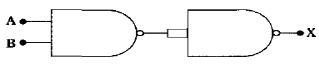
The output $(X)$ of the logic circuit shown in the figure will be:
A
$X = A + B$
B
$X = \overline{A.B}$
C
$X = A.B$
D
$X = \overline{A+B}$
Solution
(C) The first gate is a $NAND$ gate with inputs $A$ and $B$. Its output is $\overline{A.B}$.
This output is fed into a $NOT$ gate (a $NAND$ gate with both inputs connected together acts as a $NOT$ gate).
If the input to a $NOT$ gate is $Y$,the output is $\overline{Y}$.
Here,$Y = \overline{A.B}$,so the final output $X = \overline{\overline{A.B}}$.
Using the Boolean algebra property $\overline{\overline{Z}} = Z$,we get $X = A.B$.
This output is fed into a $NOT$ gate (a $NAND$ gate with both inputs connected together acts as a $NOT$ gate).
If the input to a $NOT$ gate is $Y$,the output is $\overline{Y}$.
Here,$Y = \overline{A.B}$,so the final output $X = \overline{\overline{A.B}}$.
Using the Boolean algebra property $\overline{\overline{Z}} = Z$,we get $X = A.B$.

0 likesView Solution
Vedclass Products
For Students
Vedclass Test Series
Mock tests in real AIPMT style covering Physics with performance analysis. 5-day free trial.
Start Free TrialFor Teachers
Exam Paper Generator
Generate Set A/B/C/D Physics papers from 7.5L+ questions in 2 minutes. 3 chapters free.
Try FreeFor Institutes
Online Exam Module
Run live AIPMT mock exams with unlimited students, 360° analytics & white-label branding.
See DemoFrequently Asked Questions
How many Physics questions are in AIPMT 2013?
There are 46 Physics questions from the AIPMT 2013 paper on Vedclass, each with a detailed step-by-step solution in English.
Are AIPMT 2013 Physics solutions available in English?
Yes. All solutions on this page are in English. You can also switch to English or Hindi using the language buttons above the questions.
Can I practice AIPMT 2013 Physics as a timed test?
Yes. Use the Vedclass Test Series to attempt a full AIPMT mock test covering Physics with time limits and instant score analysis.
Can teachers create Physics papers from AIPMT previous year questions?
Yes. The Vedclass Exam Paper Generator lets teachers mix AIPMT Physics questions and generate Set A/B/C/D papers in minutes.
For Teachers & Institutes
Build a Custom Physics Paper
Pick AIPMT 2013 Physics questions, set difficulty, and generate Set A/B/C/D in 2 minutes.