
PhysicsQ1–90 of 90 questions
Page 1 of 1 · English
1
PhysicsMediumMCQAIPMT · 2015
$A$ satellite $S$ is moving in an elliptical orbit around the Earth. The mass of the satellite is very small compared to the mass of the Earth.
A
The acceleration of $S$ is always directed towards the centre of the Earth.
B
The angular momentum of $S$ about the centre of the Earth changes in direction but its magnitude remains constant.
C
The total mechanical energy of $S$ varies periodically with time.
D
The linear momentum of $S$ remains constant in magnitude.
Solution
(A) The gravitational force exerted by the Earth on the satellite always acts towards the centre of the Earth. According to Newton's second law,$F = ma$,the acceleration of the satellite is always directed towards the centre of the Earth.
Since the gravitational force is a central force,the torque acting on the satellite about the centre of the Earth is zero. Therefore,the angular momentum $L$ of the satellite remains constant in both magnitude and direction.
According to the law of conservation of energy,in the absence of non-conservative forces,the total mechanical energy of the satellite remains constant throughout its orbit.
Since the distance $r$ of the satellite from the Earth varies in an elliptical orbit,the orbital velocity $v$ must change to conserve angular momentum $(L = mvr \sin \theta)$. Consequently,the linear momentum $p = mv$ is not constant.
Since the gravitational force is a central force,the torque acting on the satellite about the centre of the Earth is zero. Therefore,the angular momentum $L$ of the satellite remains constant in both magnitude and direction.
According to the law of conservation of energy,in the absence of non-conservative forces,the total mechanical energy of the satellite remains constant throughout its orbit.
Since the distance $r$ of the satellite from the Earth varies in an elliptical orbit,the orbital velocity $v$ must change to conserve angular momentum $(L = mvr \sin \theta)$. Consequently,the linear momentum $p = mv$ is not constant.
0 likesView Solution
2
PhysicsEasyMCQAIPMT · 2015
If the degree of freedom of a gas is $f,$ then the ratio of two specific heats ${C_P}/{C_V}$ is given by
A
$1 + \frac{2}{f}$
B
$1 - \frac{2}{f}$
C
$1 + \frac{1}{f}$
D
$1 - \frac{1}{f}$
Solution
(A) The ratio of specific heats is defined as $\gamma = \frac{C_P}{C_V}$.
According to the kinetic theory of gases,the molar specific heat at constant volume is $C_V = \frac{f}{2}R$.
The molar specific heat at constant pressure is $C_P = C_V + R = \frac{f}{2}R + R = R(1 + \frac{f}{2})$.
Therefore,the ratio $\gamma = \frac{C_P}{C_V} = \frac{R(1 + f/2)}{(f/2)R} = \frac{1 + f/2}{f/2} = \frac{2}{f} + 1 = 1 + \frac{2}{f}$.
According to the kinetic theory of gases,the molar specific heat at constant volume is $C_V = \frac{f}{2}R$.
The molar specific heat at constant pressure is $C_P = C_V + R = \frac{f}{2}R + R = R(1 + \frac{f}{2})$.
Therefore,the ratio $\gamma = \frac{C_P}{C_V} = \frac{R(1 + f/2)}{(f/2)R} = \frac{1 + f/2}{f/2} = \frac{2}{f} + 1 = 1 + \frac{2}{f}$.
0 likesView Solution
3
PhysicsDifficultMCQAIPMT · 2015
If energy $(E)$,velocity $(V)$,and time $(T)$ are chosen as the fundamental quantities,the dimensional formula of surface tension will be
A
$[EV^{-2}T^{-1}]$
B
$[EV^{-1}T^{-2}]$
C
$[EV^{-2}T^{-2}]$
D
$[E^{-2}V^{-1}T^{-3}]$
Solution
(C) Let the dimensional formula of surface tension $(S)$ be $S = E^x V^y T^z$.
The dimensions of surface tension are $[S] = [MT^{-2}]$.
The dimensions of the fundamental quantities are:
$[E] = [ML^2T^{-2}]$
$[V] = [LT^{-1}]$
$[T] = [T]$
Substituting these into the equation:
$[MT^{-2}] = [ML^2T^{-2}]^x [LT^{-1}]^y [T]^z$
$[MT^{-2}] = [M^x L^{2x+y} T^{-2x-y+z}]$
Comparing the powers of $M, L,$ and $T$ on both sides:
For $M$: $x = 1$
For $L$: $2x + y = 0 \Rightarrow 2(1) + y = 0 \Rightarrow y = -2$
For $T$: $-2x - y + z = -2 \Rightarrow -2(1) - (-2) + z = -2 \Rightarrow -2 + 2 + z = -2 \Rightarrow z = -2$
Thus,the dimensional formula is $[EV^{-2}T^{-2}]$.
The dimensions of surface tension are $[S] = [MT^{-2}]$.
The dimensions of the fundamental quantities are:
$[E] = [ML^2T^{-2}]$
$[V] = [LT^{-1}]$
$[T] = [T]$
Substituting these into the equation:
$[MT^{-2}] = [ML^2T^{-2}]^x [LT^{-1}]^y [T]^z$
$[MT^{-2}] = [M^x L^{2x+y} T^{-2x-y+z}]$
Comparing the powers of $M, L,$ and $T$ on both sides:
For $M$: $x = 1$
For $L$: $2x + y = 0 \Rightarrow 2(1) + y = 0 \Rightarrow y = -2$
For $T$: $-2x - y + z = -2 \Rightarrow -2(1) - (-2) + z = -2 \Rightarrow -2 + 2 + z = -2 \Rightarrow z = -2$
Thus,the dimensional formula is $[EV^{-2}T^{-2}]$.
0 likesView Solution
4
PhysicsDifficultMCQAIPMT · 2015
If dimensions of critical velocity $v_c$ of a liquid flowing through a tube are expressed as $[\eta^x \rho^y r^z]$,where $\eta, \rho,$ and $r$ are the coefficient of viscosity of the liquid,density of the liquid,and radius of the tube respectively,then the values of $x, y,$ and $z$ are given by:
A
$1, 1, 1$
B
$1, -1, -1$
C
$-1, -1, 1$
D
$-1, -1, -1$
Solution
(B) Given the dimensional relation: $[v_c] = [\eta^x \rho^y r^z]$ $(i)$
Writing the dimensions of the physical quantities:
$[v_c] = [M^0 L T^{-1}]$
$[\eta] = [M L^{-1} T^{-1}]$
$[\rho] = [M L^{-3} T^0]$
$[r] = [M^0 L T^0]$
Substituting these into equation $(i)$:
$[M^0 L T^{-1}] = [M L^{-1} T^{-1}]^x [M L^{-3} T^0]^y [M^0 L T^0]^z$
$[M^0 L T^{-1}] = [M^{x+y} L^{-x-3y+z} T^{-x}]$
Applying the principle of homogeneity of dimensions,we equate the powers of $M, L,$ and $T$ on both sides:
$x + y = 0$ $(ii)$
$-x - 3y + z = 1$ $(iii)$
$-x = -1$ $(iv)$
From $(iv)$,we get $x = 1$.
Substituting $x = 1$ into $(ii)$,we get $1 + y = 0$,so $y = -1$.
Substituting $x = 1$ and $y = -1$ into $(iii)$,we get $-1 - 3(-1) + z = 1 \implies -1 + 3 + z = 1 \implies 2 + z = 1 \implies z = -1$.
Thus,the values are $x = 1, y = -1, z = -1$.
Writing the dimensions of the physical quantities:
$[v_c] = [M^0 L T^{-1}]$
$[\eta] = [M L^{-1} T^{-1}]$
$[\rho] = [M L^{-3} T^0]$
$[r] = [M^0 L T^0]$
Substituting these into equation $(i)$:
$[M^0 L T^{-1}] = [M L^{-1} T^{-1}]^x [M L^{-3} T^0]^y [M^0 L T^0]^z$
$[M^0 L T^{-1}] = [M^{x+y} L^{-x-3y+z} T^{-x}]$
Applying the principle of homogeneity of dimensions,we equate the powers of $M, L,$ and $T$ on both sides:
$x + y = 0$ $(ii)$
$-x - 3y + z = 1$ $(iii)$
$-x = -1$ $(iv)$
From $(iv)$,we get $x = 1$.
Substituting $x = 1$ into $(ii)$,we get $1 + y = 0$,so $y = -1$.
Substituting $x = 1$ and $y = -1$ into $(iii)$,we get $-1 - 3(-1) + z = 1 \implies -1 + 3 + z = 1 \implies 2 + z = 1 \implies z = -1$.
Thus,the values are $x = 1, y = -1, z = -1$.
0 likesView Solution
5
PhysicsDifficultMCQAIPMT · 2015
$A$ particle of unit mass undergoes one-dimensional motion such that its velocity varies according to $v(x) = \beta x^{-2n}$,where $\beta$ and $n$ are constants and $x$ is the position of the particle. The acceleration of the particle as a function of $x$ is given by:
A
$-2n \beta^2 x^{-2n-1}$
B
$-2n \beta^2 x^{-4n-1}$
C
$-2n \beta^2 x^{-2n+1}$
D
$-2n \beta^2 x^{-4n+1}$
Solution
(B) The velocity of the particle is given as $v(x) = \beta x^{-2n}$.
To find the acceleration $a$,we use the relation $a = v \frac{dv}{dx}$.
First,differentiate $v$ with respect to $x$:
$\frac{dv}{dx} = \frac{d}{dx} (\beta x^{-2n}) = \beta (-2n) x^{-2n-1} = -2n \beta x^{-2n-1}$.
Now,substitute $v$ and $\frac{dv}{dx}$ into the acceleration formula:
$a = (\beta x^{-2n}) \times (-2n \beta x^{-2n-1})$.
$a = -2n \beta^2 x^{-2n + (-2n) - 1}$.
$a = -2n \beta^2 x^{-4n-1}$.
To find the acceleration $a$,we use the relation $a = v \frac{dv}{dx}$.
First,differentiate $v$ with respect to $x$:
$\frac{dv}{dx} = \frac{d}{dx} (\beta x^{-2n}) = \beta (-2n) x^{-2n-1} = -2n \beta x^{-2n-1}$.
Now,substitute $v$ and $\frac{dv}{dx}$ into the acceleration formula:
$a = (\beta x^{-2n}) \times (-2n \beta x^{-2n-1})$.
$a = -2n \beta^2 x^{-2n + (-2n) - 1}$.
$a = -2n \beta^2 x^{-4n-1}$.
0 likesView Solution
6
PhysicsDifficultMCQAIPMT · 2015
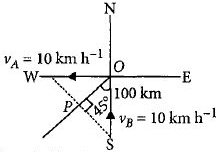
$A$ ship $A$ is moving Westwards with a speed of $10 \, km \, h^{-1}$ and a ship $B$,$100 \, km$ South of $A$,is moving Northwards with a speed of $10 \, km \, h^{-1}$. The time after which the distance between them becomes shortest is ........ $hr$.
A
$0$
B
$5$
C
$5\sqrt{2}$
D
$10\sqrt{2}$
Solution
(B) Let the initial position of ship $A$ be at the origin $(0, 0)$ moving along the negative $x$-axis. Its position at time $t$ is $\vec{r}_A = (-10t, 0)$.
Ship $B$ is initially at $(0, -100)$ moving along the positive $y$-axis. Its position at time $t$ is $\vec{r}_B = (0, -100 + 10t)$.
The relative position vector is $\vec{r}_{BA} = \vec{r}_B - \vec{r}_A = (10t, -100 + 10t)$.
The square of the distance $D^2 = (10t)^2 + (-100 + 10t)^2 = 100t^2 + 10000 - 2000t + 100t^2 = 200t^2 - 2000t + 10000$.
To find the shortest distance,differentiate $D^2$ with respect to $t$ and set it to zero:
$\frac{d(D^2)}{dt} = 400t - 2000 = 0$.
$400t = 2000 \Rightarrow t = 5 \, hr$.
Alternatively,using relative velocity: $\vec{v}_{BA} = \vec{v}_B - \vec{v}_A = (0, 10) - (-10, 0) = (10, 10) \, km \, h^{-1}$.
The magnitude of relative velocity is $|\vec{v}_{BA}| = \sqrt{10^2 + 10^2} = 10\sqrt{2} \, km \, h^{-1}$.
The shortest distance occurs when the relative position vector is perpendicular to the relative velocity vector. From the geometry,the time taken is $t = 5 \, hr$.
Ship $B$ is initially at $(0, -100)$ moving along the positive $y$-axis. Its position at time $t$ is $\vec{r}_B = (0, -100 + 10t)$.
The relative position vector is $\vec{r}_{BA} = \vec{r}_B - \vec{r}_A = (10t, -100 + 10t)$.
The square of the distance $D^2 = (10t)^2 + (-100 + 10t)^2 = 100t^2 + 10000 - 2000t + 100t^2 = 200t^2 - 2000t + 10000$.
To find the shortest distance,differentiate $D^2$ with respect to $t$ and set it to zero:
$\frac{d(D^2)}{dt} = 400t - 2000 = 0$.
$400t = 2000 \Rightarrow t = 5 \, hr$.
Alternatively,using relative velocity: $\vec{v}_{BA} = \vec{v}_B - \vec{v}_A = (0, 10) - (-10, 0) = (10, 10) \, km \, h^{-1}$.
The magnitude of relative velocity is $|\vec{v}_{BA}| = \sqrt{10^2 + 10^2} = 10\sqrt{2} \, km \, h^{-1}$.
The shortest distance occurs when the relative position vector is perpendicular to the relative velocity vector. From the geometry,the time taken is $t = 5 \, hr$.
0 likesView Solution
7
PhysicsDifficultMCQAIPMT · 2015
The position vector of a particle $\vec{R}$ as a function of time is given by $\vec{R} = 4\sin(2\pi t)\hat{i} + 4\cos(2\pi t)\hat{j}$,where $R$ is in meters,$t$ is in seconds,and $\hat{i}$ and $\hat{j}$ denote unit vectors along $x$- and $y$-directions,respectively. Which one of the following statements is wrong for the motion of the particle?
A
Path of the particle is a circle of radius $4 \ m$.
B
Acceleration vector is along $-\vec{R}$.
C
Magnitude of acceleration vector is $\frac{V^2}{R}$,where $V$ is the velocity of the particle.
D
Magnitude of the velocity of the particle is $8 \ m/s$.
Solution
(D) Given position vector: $\vec{R} = 4\sin(2\pi t)\hat{i} + 4\cos(2\pi t)\hat{j}$.
Since $x = 4\sin(2\pi t)$ and $y = 4\cos(2\pi t)$,then $x^2 + y^2 = 16(\sin^2(2\pi t) + \cos^2(2\pi t)) = 16$. This represents a circle of radius $4 \ m$.
Velocity $\vec{v} = \frac{d\vec{R}}{dt} = 8\pi\cos(2\pi t)\hat{i} - 8\pi\sin(2\pi t)\hat{j}$.
Magnitude of velocity $|\vec{v}| = \sqrt{(8\pi\cos(2\pi t))^2 + (-8\pi\sin(2\pi t))^2} = 8\pi \ m/s$.
Acceleration $\vec{a} = \frac{d\vec{v}}{dt} = -16\pi^2\sin(2\pi t)\hat{i} - 16\pi^2\cos(2\pi t)\hat{j} = -4\pi^2\vec{R}$.
Since $\vec{a} = -4\pi^2\vec{R}$,the acceleration is directed towards the origin (along $-\vec{R}$).
For uniform circular motion,$a = \frac{V^2}{R}$. Here $V = 8\pi$ and $R = 4$,so $a = \frac{(8\pi)^2}{4} = 16\pi^2$. This matches the magnitude of $\vec{a}$.
Statement $(D)$ claims the magnitude of velocity is $8 \ m/s$,but it is $8\pi \ m/s$. Thus,$(D)$ is the wrong statement.
Since $x = 4\sin(2\pi t)$ and $y = 4\cos(2\pi t)$,then $x^2 + y^2 = 16(\sin^2(2\pi t) + \cos^2(2\pi t)) = 16$. This represents a circle of radius $4 \ m$.
Velocity $\vec{v} = \frac{d\vec{R}}{dt} = 8\pi\cos(2\pi t)\hat{i} - 8\pi\sin(2\pi t)\hat{j}$.
Magnitude of velocity $|\vec{v}| = \sqrt{(8\pi\cos(2\pi t))^2 + (-8\pi\sin(2\pi t))^2} = 8\pi \ m/s$.
Acceleration $\vec{a} = \frac{d\vec{v}}{dt} = -16\pi^2\sin(2\pi t)\hat{i} - 16\pi^2\cos(2\pi t)\hat{j} = -4\pi^2\vec{R}$.
Since $\vec{a} = -4\pi^2\vec{R}$,the acceleration is directed towards the origin (along $-\vec{R}$).
For uniform circular motion,$a = \frac{V^2}{R}$. Here $V = 8\pi$ and $R = 4$,so $a = \frac{(8\pi)^2}{4} = 16\pi^2$. This matches the magnitude of $\vec{a}$.
Statement $(D)$ claims the magnitude of velocity is $8 \ m/s$,but it is $8\pi \ m/s$. Thus,$(D)$ is the wrong statement.
0 likesView Solution
8
PhysicsDifficultMCQAIPMT · 2015
If vectors $\overrightarrow {A} = \cos\omega t\hat i + \sin\omega t\hat j$ and $\overrightarrow {B} = \cos\frac{\omega t}{2}\hat i + \sin\frac{\omega t}{2}\hat j$ are functions of time,then the value of $t$ at which they are orthogonal to each other is:
A
$t=0$
B
$t=\frac{\pi}{4\omega}$
C
$t=\frac{\pi}{2\omega}$
D
$t=\frac{\pi}{\omega}$
Solution
(D) Two vectors $\overrightarrow {A}$ and $\overrightarrow {B}$ are orthogonal to each other if their scalar product is zero,i.e.,$\overrightarrow {A} \cdot \overrightarrow {B} = 0$.
Given $\overrightarrow {A} = \cos \omega t \hat i + \sin \omega t \hat j$ and $\overrightarrow {B} = \cos \frac{\omega t}{2} \hat i + \sin \frac{\omega t}{2} \hat j$.
Calculating the dot product:
$\overrightarrow {A} \cdot \overrightarrow {B} = (\cos \omega t \hat i + \sin \omega t \hat j) \cdot (\cos \frac{\omega t}{2} \hat i + \sin \frac{\omega t}{2} \hat j)$
$= \cos \omega t \cos \frac{\omega t}{2} + \sin \omega t \sin \frac{\omega t}{2}$
Using the trigonometric identity $\cos(A - B) = \cos A \cos B + \sin A \sin B$:
$\overrightarrow {A} \cdot \overrightarrow {B} = \cos(\omega t - \frac{\omega t}{2}) = \cos(\frac{\omega t}{2})$
Since the vectors are orthogonal,$\overrightarrow {A} \cdot \overrightarrow {B} = 0$,so:
$\cos(\frac{\omega t}{2}) = 0$
We know $\cos(\frac{\pi}{2}) = 0$,therefore:
$\frac{\omega t}{2} = \frac{\pi}{2}$
$t = \frac{\pi}{\omega}$.
Given $\overrightarrow {A} = \cos \omega t \hat i + \sin \omega t \hat j$ and $\overrightarrow {B} = \cos \frac{\omega t}{2} \hat i + \sin \frac{\omega t}{2} \hat j$.
Calculating the dot product:
$\overrightarrow {A} \cdot \overrightarrow {B} = (\cos \omega t \hat i + \sin \omega t \hat j) \cdot (\cos \frac{\omega t}{2} \hat i + \sin \frac{\omega t}{2} \hat j)$
$= \cos \omega t \cos \frac{\omega t}{2} + \sin \omega t \sin \frac{\omega t}{2}$
Using the trigonometric identity $\cos(A - B) = \cos A \cos B + \sin A \sin B$:
$\overrightarrow {A} \cdot \overrightarrow {B} = \cos(\omega t - \frac{\omega t}{2}) = \cos(\frac{\omega t}{2})$
Since the vectors are orthogonal,$\overrightarrow {A} \cdot \overrightarrow {B} = 0$,so:
$\cos(\frac{\omega t}{2}) = 0$
We know $\cos(\frac{\pi}{2}) = 0$,therefore:
$\frac{\omega t}{2} = \frac{\pi}{2}$
$t = \frac{\pi}{\omega}$.
0 likesView Solution
9
PhysicsMediumMCQAIPMT · 2015
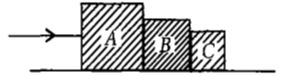
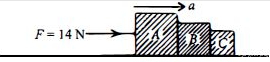
Three blocks $A, B$ and $C,$ of masses $4 \, kg, 2 \, kg$ and $1 \, kg$ respectively,are in contact on a frictionless surface,as shown. If a force of $14 \, N$ is applied on the $4 \, kg$ block,then the contact force between $A$ and $B$ is .......... $N$.
A
$2$
B
$6$
C
$8$
D
$18$
Solution
(B) Given: Masses $M_A = 4 \, kg, M_B = 2 \, kg, M_C = 1 \, kg$ and applied force $F = 14 \, N$.
First,calculate the acceleration $(a)$ of the entire system:
$a = \frac{F}{M_A + M_B + M_C} = \frac{14}{4 + 2 + 1} = \frac{14}{7} = 2 \, m/s^2$.
The contact force between $A$ and $B$ (let it be $F_{AB}$) is the force required to accelerate blocks $B$ and $C$ together.
$F_{AB} = (M_B + M_C) \times a$
$F_{AB} = (2 + 1) \times 2 = 3 \times 2 = 6 \, N$.
Alternatively,considering the free body diagram of block $A$:
$F - F_{AB} = M_A \times a$
$14 - F_{AB} = 4 \times 2$
$14 - F_{AB} = 8$
$F_{AB} = 14 - 8 = 6 \, N$.
First,calculate the acceleration $(a)$ of the entire system:
$a = \frac{F}{M_A + M_B + M_C} = \frac{14}{4 + 2 + 1} = \frac{14}{7} = 2 \, m/s^2$.
The contact force between $A$ and $B$ (let it be $F_{AB}$) is the force required to accelerate blocks $B$ and $C$ together.
$F_{AB} = (M_B + M_C) \times a$
$F_{AB} = (2 + 1) \times 2 = 3 \times 2 = 6 \, N$.
Alternatively,considering the free body diagram of block $A$:
$F - F_{AB} = M_A \times a$
$14 - F_{AB} = 4 \times 2$
$14 - F_{AB} = 8$
$F_{AB} = 14 - 8 = 6 \, N$.
0 likesView Solution
10
PhysicsDifficultMCQAIPMT · 2015
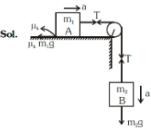
$A$ block $A$ of mass $m_1$ rests on a horizontal table. $A$ light string connected to it passes over a frictionless pulley at the edge of the table,and from its other end,another block $B$ of mass $m_2$ is suspended. The coefficient of kinetic friction between the block $A$ and the table is $\mu_k$. When the block $A$ is sliding on the table,the tension in the string is:
A
$\frac{m_1 m_2 (1 + \mu_k) g}{m_1 + m_2}$
B
$\frac{m_1 m_2 (1 - \mu_k) g}{m_1 + m_2}$
C
$\frac{(m_2 + \mu_k m_1) g}{m_1 + m_2}$
D
$\frac{(m_2 - \mu_k m_1) g}{m_1 + m_2}$
Solution
(A) For block $B$ (mass $m_2$) moving downwards with acceleration $a$: $m_2 g - T = m_2 a$ (Equation $1$)
For block $A$ (mass $m_1$) moving horizontally with acceleration $a$: $T - \mu_k m_1 g = m_1 a$ (Equation $2$)
Adding Equation $1$ and Equation $2$:
$(m_2 g - T) + (T - \mu_k m_1 g) = m_2 a + m_1 a$
$m_2 g - \mu_k m_1 g = (m_1 + m_2) a$
$a = \frac{(m_2 - \mu_k m_1) g}{m_1 + m_2}$
Now,substitute the value of $a$ into Equation $1$:
$T = m_2 g - m_2 a = m_2 (g - a)$
$T = m_2 \left( g - \frac{(m_2 - \mu_k m_1) g}{m_1 + m_2} \right)$
$T = m_2 g \left( \frac{m_1 + m_2 - m_2 + \mu_k m_1}{m_1 + m_2} \right)$
$T = \frac{m_1 m_2 (1 + \mu_k) g}{m_1 + m_2}$
For block $A$ (mass $m_1$) moving horizontally with acceleration $a$: $T - \mu_k m_1 g = m_1 a$ (Equation $2$)
Adding Equation $1$ and Equation $2$:
$(m_2 g - T) + (T - \mu_k m_1 g) = m_2 a + m_1 a$
$m_2 g - \mu_k m_1 g = (m_1 + m_2) a$
$a = \frac{(m_2 - \mu_k m_1) g}{m_1 + m_2}$
Now,substitute the value of $a$ into Equation $1$:
$T = m_2 g - m_2 a = m_2 (g - a)$
$T = m_2 \left( g - \frac{(m_2 - \mu_k m_1) g}{m_1 + m_2} \right)$
$T = m_2 g \left( \frac{m_1 + m_2 - m_2 + \mu_k m_1}{m_1 + m_2} \right)$
$T = \frac{m_1 m_2 (1 + \mu_k) g}{m_1 + m_2}$
0 likesView Solution
11
PhysicsDifficultMCQAIPMT · 2015
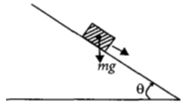
$A$ plank with a box on it at one end is gradually raised about the other end. As the angle of inclination with the horizontal reaches $30^o$,the box starts to slip and slides $4.0\, m$ down the plank in $4.0\, s$. The coefficients of static and kinetic friction between the box and the plank will be,respectively:
A
$0.4$ and $0.3$
B
$0.6$ and $0.6$
C
$0.6$ and $0.5$
D
$0.5$ and $0.6$
Solution
(C) Let $\mu_s$ and $\mu_k$ be the coefficients of static and kinetic friction between the box and the plank,respectively.
When the angle of inclination $\theta$ reaches $30^o$,the block just starts to slide. Therefore,$\mu_s = \tan\theta = \tan 30^o = \frac{1}{\sqrt{3}} \approx 0.577 \approx 0.6$.
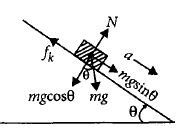
If $a$ is the acceleration produced in the block,then the equation of motion is:
$ma = mg\sin\theta - f_k$
$ma = mg\sin\theta - \mu_k N$
Since $N = mg\cos\theta$,we have:
$a = g(\sin\theta - \mu_k\cos\theta)$
Given $g = 10\, m/s^2$,$\theta = 30^o$,$s = 4.0\, m$,and $t = 4.0\, s$,we use the kinematic equation $s = ut + \frac{1}{2}at^2$ (with $u = 0$):
$4.0 = 0 + \frac{1}{2} a (4.0)^2$
$4.0 = 8a \implies a = 0.5\, m/s^2$.
Substituting $a$ into the acceleration equation:
$0.5 = 10(\sin 30^o - \mu_k \cos 30^o)$
$0.5 = 10(0.5 - \mu_k \frac{\sqrt{3}}{2})$
$0.05 = 0.5 - \mu_k \frac{\sqrt{3}}{2}$
$\mu_k \frac{\sqrt{3}}{2} = 0.45$
$\mu_k = \frac{0.9}{\sqrt{3}} = \frac{0.9}{1.732} \approx 0.519 \approx 0.5$.
Thus,$\mu_s \approx 0.6$ and $\mu_k \approx 0.5$.
When the angle of inclination $\theta$ reaches $30^o$,the block just starts to slide. Therefore,$\mu_s = \tan\theta = \tan 30^o = \frac{1}{\sqrt{3}} \approx 0.577 \approx 0.6$.
If $a$ is the acceleration produced in the block,then the equation of motion is:
$ma = mg\sin\theta - f_k$
$ma = mg\sin\theta - \mu_k N$
Since $N = mg\cos\theta$,we have:
$a = g(\sin\theta - \mu_k\cos\theta)$
Given $g = 10\, m/s^2$,$\theta = 30^o$,$s = 4.0\, m$,and $t = 4.0\, s$,we use the kinematic equation $s = ut + \frac{1}{2}at^2$ (with $u = 0$):
$4.0 = 0 + \frac{1}{2} a (4.0)^2$
$4.0 = 8a \implies a = 0.5\, m/s^2$.
Substituting $a$ into the acceleration equation:
$0.5 = 10(\sin 30^o - \mu_k \cos 30^o)$
$0.5 = 10(0.5 - \mu_k \frac{\sqrt{3}}{2})$
$0.05 = 0.5 - \mu_k \frac{\sqrt{3}}{2}$
$\mu_k \frac{\sqrt{3}}{2} = 0.45$
$\mu_k = \frac{0.9}{\sqrt{3}} = \frac{0.9}{1.732} \approx 0.519 \approx 0.5$.
Thus,$\mu_s \approx 0.6$ and $\mu_k \approx 0.5$.
0 likesView Solution
12
PhysicsMediumMCQAIPMT · 2015
Two stones of masses $m$ and $2\,m$ are whirled in horizontal circles,the heavier one in a radius $\frac{r}{2}$ and the lighter one in radius $r$. The tangential speed of the lighter stone is $n$ times that of the heavier stone when they experience the same centripetal force. The value of $n$ is
A
$1$
B
$2$
C
$3$
D
$4$
Solution
(B) Let $v$ be the tangential speed of the heavier stone.
Given that the centripetal force experienced by both stones is the same.
The centripetal force for the lighter stone (mass $m$,radius $r$,speed $nv$) is given by:
$F_{lighter} = \frac{m(nv)^2}{r} = \frac{mn^2v^2}{r}$
The centripetal force for the heavier stone (mass $2m$,radius $r/2$,speed $v$) is given by:
$F_{heavier} = \frac{(2m)v^2}{r/2} = \frac{4mv^2}{r}$
Equating the two forces:
$\frac{mn^2v^2}{r} = \frac{4mv^2}{r}$
$n^2 = 4$
$n = 2$
Given that the centripetal force experienced by both stones is the same.
The centripetal force for the lighter stone (mass $m$,radius $r$,speed $nv$) is given by:
$F_{lighter} = \frac{m(nv)^2}{r} = \frac{mn^2v^2}{r}$
The centripetal force for the heavier stone (mass $2m$,radius $r/2$,speed $v$) is given by:
$F_{heavier} = \frac{(2m)v^2}{r/2} = \frac{4mv^2}{r}$
Equating the two forces:
$\frac{mn^2v^2}{r} = \frac{4mv^2}{r}$
$n^2 = 4$
$n = 2$
0 likesView Solution
13
PhysicsMediumMCQAIPMT · 2015
Two similar springs $P$ and $Q$ have spring constants $K_P$ and $K_Q$,such that $K_P > K_Q$. They are stretched first by the same amount (case $a$),then by the same force (case $b$). The work done by the springs $W_P$ and $W_Q$ are related as,in case $(a)$ and case $(b)$ respectively:
A
$W_P > W_Q, W_P < W_Q$
B
$W_P = W_Q, W_P = W_Q$
C
$W_P > W_Q, W_Q > W_P$
D
$W_P < W_Q, W_Q < W_P$
Solution
(C) Case $(a)$: When stretched by the same amount $x$,the work done is $W = \frac{1}{2} K x^2$. Since $K_P > K_Q$ and $x$ is the same,$W_P = \frac{1}{2} K_P x^2$ and $W_Q = \frac{1}{2} K_Q x^2$. Therefore,$W_P > W_Q$.
Case $(b)$: When stretched by the same force $F$,the work done is $W = \frac{F^2}{2K}$. Since $K_P > K_Q$ and $F$ is the same,$W_P = \frac{F^2}{2K_P}$ and $W_Q = \frac{F^2}{2K_Q}$. Since $K_P > K_Q$,it follows that $\frac{1}{K_P} < \frac{1}{K_Q}$,therefore $W_P < W_Q$ or $W_Q > W_P$.
Case $(b)$: When stretched by the same force $F$,the work done is $W = \frac{F^2}{2K}$. Since $K_P > K_Q$ and $F$ is the same,$W_P = \frac{F^2}{2K_P}$ and $W_Q = \frac{F^2}{2K_Q}$. Since $K_P > K_Q$,it follows that $\frac{1}{K_P} < \frac{1}{K_Q}$,therefore $W_P < W_Q$ or $W_Q > W_P$.
0 likesView Solution
14
PhysicsMediumMCQAIPMT · 2015
$A$ block of mass $10 \, kg$,moving in $x$ direction with a constant speed of $10 \, m/s$,is subjected to a retarding force $F = 0.1 \, x \, N$ during its travel from $x = 20 \, m$ to $30 \, m$. Its final $KE$ will be ............... $J$.
A
$475$
B
$450$
C
$275$
D
$250$
Solution
(A) Given: Mass $m = 10 \, kg$,initial velocity $v_i = 10 \, m/s$.
Initial kinetic energy $K_i = \frac{1}{2} m v_i^2 = \frac{1}{2} \times 10 \times (10)^2 = 500 \, J$.
The retarding force is $F = -0.1 \, x \, N$.
Work done by the retarding force $W = \int_{20}^{30} (-0.1 \, x) \, dx$.
$W = -0.1 \left[ \frac{x^2}{2} \right]_{20}^{30} = -0.1 \times \frac{1}{2} (30^2 - 20^2) = -0.05 \times (900 - 400) = -0.05 \times 500 = -25 \, J$.
According to the work-energy theorem,$W = K_f - K_i$.
$K_f = W + K_i = -25 \, J + 500 \, J = 475 \, J$.
Initial kinetic energy $K_i = \frac{1}{2} m v_i^2 = \frac{1}{2} \times 10 \times (10)^2 = 500 \, J$.
The retarding force is $F = -0.1 \, x \, N$.
Work done by the retarding force $W = \int_{20}^{30} (-0.1 \, x) \, dx$.
$W = -0.1 \left[ \frac{x^2}{2} \right]_{20}^{30} = -0.1 \times \frac{1}{2} (30^2 - 20^2) = -0.05 \times (900 - 400) = -0.05 \times 500 = -25 \, J$.
According to the work-energy theorem,$W = K_f - K_i$.
$K_f = W + K_i = -25 \, J + 500 \, J = 475 \, J$.
0 likesView Solution
15
PhysicsDifficultMCQAIPMT · 2015
$A$ particle of mass $m$ is driven by a machine that delivers a constant power $k$ watts. If the particle starts from rest,the force on the particle at time $t$ is:
A
$\sqrt {\frac{{mk}}{2}} \;{t^{ - \frac{1}{2}}}$
B
$\sqrt {mk} \;{t^{ - \frac{1}{2}}}$
C
$\sqrt {2mk} \;{t^{ - \frac{1}{2}}}$
D
$\frac{1}{2}\sqrt {mk} \;{t^{ - \frac{1}{2}}}$
Solution
(A) The power $P$ delivered to the particle is constant,so $P = k$.
Since $P = \frac{dW}{dt}$,we have $dW = k dt$.
Integrating both sides from $0$ to $t$,we get $W = kt$.
According to the work-energy theorem,the work done is equal to the change in kinetic energy:
$W = \Delta K = \frac{1}{2}mv^2 - 0$.
Equating the two expressions for $W$: $kt = \frac{1}{2}mv^2$,which gives $v = \sqrt{\frac{2kt}{m}}$.
The acceleration $a$ is the derivative of velocity with respect to time:
$a = \frac{dv}{dt} = \frac{d}{dt} \left( \sqrt{\frac{2k}{m}} t^{1/2} \right) = \sqrt{\frac{2k}{m}} \cdot \frac{1}{2} t^{-1/2} = \sqrt{\frac{k}{2mt}}$.
The force $F$ acting on the particle is $F = ma$:
$F = m \cdot \sqrt{\frac{k}{2mt}} = \sqrt{\frac{m^2 k}{2mt}} = \sqrt{\frac{mk}{2t}} = \sqrt{\frac{mk}{2}} t^{-1/2}$.
Since $P = \frac{dW}{dt}$,we have $dW = k dt$.
Integrating both sides from $0$ to $t$,we get $W = kt$.
According to the work-energy theorem,the work done is equal to the change in kinetic energy:
$W = \Delta K = \frac{1}{2}mv^2 - 0$.
Equating the two expressions for $W$: $kt = \frac{1}{2}mv^2$,which gives $v = \sqrt{\frac{2kt}{m}}$.
The acceleration $a$ is the derivative of velocity with respect to time:
$a = \frac{dv}{dt} = \frac{d}{dt} \left( \sqrt{\frac{2k}{m}} t^{1/2} \right) = \sqrt{\frac{2k}{m}} \cdot \frac{1}{2} t^{-1/2} = \sqrt{\frac{k}{2mt}}$.
The force $F$ acting on the particle is $F = ma$:
$F = m \cdot \sqrt{\frac{k}{2mt}} = \sqrt{\frac{m^2 k}{2mt}} = \sqrt{\frac{mk}{2t}} = \sqrt{\frac{mk}{2}} t^{-1/2}$.
0 likesView Solution
16
PhysicsMediumMCQAIPMT · 2015
Two particles of masses $m_1$ and $m_2$ move with initial velocities $u_1$ and $u_2$. On collision,one of the particles gets excited to a higher level after absorbing energy $\varepsilon$. If the final velocities of the particles are $v_1$ and $v_2$,then we must have:
A
$\frac{1}{2}m_1u_1^2 + \frac{1}{2}m_2u_2^2 = \frac{1}{2}m_1v_1^2 + \frac{1}{2}m_2v_2^2 - \varepsilon$
B
$\frac{1}{2}m_1u_1^2 + \frac{1}{2}m_2u_2^2 - \varepsilon = \frac{1}{2}m_1v_1^2 + \frac{1}{2}m_2v_2^2$
C
$\frac{1}{2}m_1u_1^2 + \frac{1}{2}m_2u_2^2 + \varepsilon = \frac{1}{2}m_1v_1^2 + \frac{1}{2}m_2v_2^2$
D
$m_1^2u_1 + m_2^2u_2 - \varepsilon = m_1^2v_1 + m_2^2v_2$
Solution
(B) The total initial kinetic energy of the two particles is given by $K_i = \frac{1}{2}m_1u_1^2 + \frac{1}{2}m_2u_2^2$.
During the collision,an amount of energy $\varepsilon$ is absorbed by one of the particles to reach an excited state.
Therefore,the total final kinetic energy of the particles $K_f = \frac{1}{2}m_1v_1^2 + \frac{1}{2}m_2v_2^2$ must be less than the initial kinetic energy by the amount $\varepsilon$.
According to the law of conservation of energy: $K_i = K_f + \varepsilon$.
Substituting the expressions: $\frac{1}{2}m_1u_1^2 + \frac{1}{2}m_2u_2^2 = \frac{1}{2}m_1v_1^2 + \frac{1}{2}m_2v_2^2 + \varepsilon$.
Rearranging the terms,we get: $\frac{1}{2}m_1u_1^2 + \frac{1}{2}m_2u_2^2 - \varepsilon = \frac{1}{2}m_1v_1^2 + \frac{1}{2}m_2v_2^2$.
During the collision,an amount of energy $\varepsilon$ is absorbed by one of the particles to reach an excited state.
Therefore,the total final kinetic energy of the particles $K_f = \frac{1}{2}m_1v_1^2 + \frac{1}{2}m_2v_2^2$ must be less than the initial kinetic energy by the amount $\varepsilon$.
According to the law of conservation of energy: $K_i = K_f + \varepsilon$.
Substituting the expressions: $\frac{1}{2}m_1u_1^2 + \frac{1}{2}m_2u_2^2 = \frac{1}{2}m_1v_1^2 + \frac{1}{2}m_2v_2^2 + \varepsilon$.
Rearranging the terms,we get: $\frac{1}{2}m_1u_1^2 + \frac{1}{2}m_2u_2^2 - \varepsilon = \frac{1}{2}m_1v_1^2 + \frac{1}{2}m_2v_2^2$.
0 likesView Solution
17
PhysicsMediumMCQAIPMT · 2015
Two particles $A$ and $B$ move with constant velocities $\vec{v}_1$ and $\vec{v}_2$. At the initial moment,their position vectors are $\vec{r}_1$ and $\vec{r}_2$ respectively. The condition for particles $A$ and $B$ to collide is:
A
$\frac{\vec{r}_1 - \vec{r}_2}{|\vec{r}_1 - \vec{r}_2|} = \frac{\vec{v}_2 - \vec{v}_1}{|\vec{v}_2 - \vec{v}_1|}$
B
$\vec{r}_1 - \vec{r}_2 = \vec{v}_1 - \vec{v}_2$
C
$\vec{r}_1 \cdot \vec{v}_1 = \vec{r}_2 \cdot \vec{v}_2$
D
$\vec{r}_1 \times \vec{v}_1 = \vec{r}_2 \times \vec{v}_2$
Solution
(A) Let the particles $A$ and $B$ collide at time $t$. For their collision,the position vectors of both particles must be the same at time $t$,i.e.,
$\vec{r}_1 + \vec{v}_1 t = \vec{r}_2 + \vec{v}_2 t$
$\vec{r}_1 - \vec{r}_2 = (\vec{v}_2 - \vec{v}_1) t$ ... $(i)$
Taking the magnitude of both sides:
$|\vec{r}_1 - \vec{r}_2| = |\vec{v}_2 - \vec{v}_1| t$
$t = \frac{|\vec{r}_1 - \vec{r}_2|}{|\vec{v}_2 - \vec{v}_1|}$
Substituting this value of $t$ into equation $(i)$:
$\vec{r}_1 - \vec{r}_2 = (\vec{v}_2 - \vec{v}_1) \frac{|\vec{r}_1 - \vec{r}_2|}{|\vec{v}_2 - \vec{v}_1|}$
Rearranging the terms,we get:
$\frac{\vec{r}_1 - \vec{r}_2}{|\vec{r}_1 - \vec{r}_2|} = \frac{\vec{v}_2 - \vec{v}_1}{|\vec{v}_2 - \vec{v}_1|}$
$\vec{r}_1 + \vec{v}_1 t = \vec{r}_2 + \vec{v}_2 t$
$\vec{r}_1 - \vec{r}_2 = (\vec{v}_2 - \vec{v}_1) t$ ... $(i)$
Taking the magnitude of both sides:
$|\vec{r}_1 - \vec{r}_2| = |\vec{v}_2 - \vec{v}_1| t$
$t = \frac{|\vec{r}_1 - \vec{r}_2|}{|\vec{v}_2 - \vec{v}_1|}$
Substituting this value of $t$ into equation $(i)$:
$\vec{r}_1 - \vec{r}_2 = (\vec{v}_2 - \vec{v}_1) \frac{|\vec{r}_1 - \vec{r}_2|}{|\vec{v}_2 - \vec{v}_1|}$
Rearranging the terms,we get:
$\frac{\vec{r}_1 - \vec{r}_2}{|\vec{r}_1 - \vec{r}_2|} = \frac{\vec{v}_2 - \vec{v}_1}{|\vec{v}_2 - \vec{v}_1|}$
0 likesView Solution
18
PhysicsDifficultMCQAIPMT · 2015
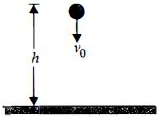
$A$ ball is thrown vertically downwards from a height of $20 \, m$ with an initial velocity $v_0$. It collides with the ground,loses $50\%$ of its energy in the collision,and rebounds to the same height. The initial velocity $v_0$ is .................... $m/s$ (Take $g = 10 \, m/s^2$)
A
$10$
B
$14$
C
$28$
D
$20$
Solution
(D) Let $m$ be the mass of the ball,$h = 20 \, m$ be the height,and $v$ be the velocity just before hitting the ground.
Using the law of conservation of energy for the downward motion:
$\frac{1}{2}mv^2 = \frac{1}{2}mv_0^2 + mgh$
$v^2 = v_0^2 + 2gh \quad ... (i)$
When the ball hits the ground,it loses $50\%$ of its kinetic energy. The remaining kinetic energy is $\frac{1}{2} \times (\frac{1}{2}mv^2) = \frac{1}{4}mv^2$.
This remaining energy allows the ball to rebound to the same height $h$:
$\frac{1}{4}mv^2 = mgh$
$v^2 = 4gh$
Substitute $v^2 = 4gh$ into equation $(i)$:
$4gh = v_0^2 + 2gh$
$v_0^2 = 2gh$
$v_0 = \sqrt{2gh}$
Given $g = 10 \, m/s^2$ and $h = 20 \, m$:
$v_0 = \sqrt{2 \times 10 \times 20} = \sqrt{400} = 20 \, m/s$.
Using the law of conservation of energy for the downward motion:
$\frac{1}{2}mv^2 = \frac{1}{2}mv_0^2 + mgh$
$v^2 = v_0^2 + 2gh \quad ... (i)$
When the ball hits the ground,it loses $50\%$ of its kinetic energy. The remaining kinetic energy is $\frac{1}{2} \times (\frac{1}{2}mv^2) = \frac{1}{4}mv^2$.
This remaining energy allows the ball to rebound to the same height $h$:
$\frac{1}{4}mv^2 = mgh$
$v^2 = 4gh$
Substitute $v^2 = 4gh$ into equation $(i)$:
$4gh = v_0^2 + 2gh$
$v_0^2 = 2gh$
$v_0 = \sqrt{2gh}$
Given $g = 10 \, m/s^2$ and $h = 20 \, m$:
$v_0 = \sqrt{2 \times 10 \times 20} = \sqrt{400} = 20 \, m/s$.
0 likesView Solution
19
PhysicsDifficultMCQAIPMT · 2015
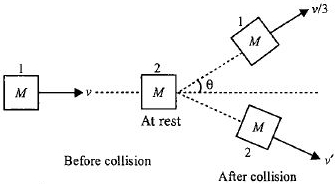
On a frictionless surface,a block of mass $M$ moving at speed $V$ collides elastically with another block of same mass $M$ which is initially at rest. After collision,the first block moves at an angle $\theta$ to its initial direction and has a speed $\frac{V}{3}$. The second block's speed after the collision is:
A
$\frac{2\sqrt{2}}{3}V$
B
$\frac{\sqrt{3}}{2}V$
C
$\frac{3}{4}V$
D
$\frac{3}{\sqrt{2}}V$
Solution
(A) The collision is elastic,which means that both linear momentum and kinetic energy are conserved.
Let $v'$ be the speed of the second block after the collision.
According to the law of conservation of kinetic energy:
$\frac{1}{2}M V^2 + 0 = \frac{1}{2}M \left( \frac{V}{3} \right)^2 + \frac{1}{2}M (v')^2$
Dividing both sides by $\frac{1}{2}M$:
$V^2 = \frac{V^2}{9} + (v')^2$
$(v')^2 = V^2 - \frac{V^2}{9}$
$(v')^2 = \frac{8V^2}{9}$
$v' = \sqrt{\frac{8V^2}{9}} = \frac{2\sqrt{2}}{3}V$
Let $v'$ be the speed of the second block after the collision.
According to the law of conservation of kinetic energy:
$\frac{1}{2}M V^2 + 0 = \frac{1}{2}M \left( \frac{V}{3} \right)^2 + \frac{1}{2}M (v')^2$
Dividing both sides by $\frac{1}{2}M$:
$V^2 = \frac{V^2}{9} + (v')^2$
$(v')^2 = V^2 - \frac{V^2}{9}$
$(v')^2 = \frac{8V^2}{9}$
$v' = \sqrt{\frac{8V^2}{9}} = \frac{2\sqrt{2}}{3}V$
0 likesView Solution
20
PhysicsMediumMCQAIPMT · 2015
The heart of a man pumps $5 \, \text{litres}$ of blood through the arteries per minute at a pressure of $150 \, \text{mm}$ of mercury. If the density of mercury is $13.6 \times 10^3 \, \text{kg/m}^3$ and $g = 10 \, \text{m/s}^2$, then the power (in $\text{watt}$) is:
A
$1.5$
B
$3$
C
$2.35$
D
$1.7$
Solution
(D) Given:
Volume of blood pumped, $V = 5 \, \text{litres} = 5 \times 10^{-3} \, \text{m}^3$.
Time, $t = 1 \, \text{min} = 60 \, \text{s}$.
Pressure, $P = 150 \, \text{mm of Hg} = 0.15 \, \text{m of Hg}$.
Density of mercury, $\rho = 13.6 \times 10^3 \, \text{kg/m}^3$.
Acceleration due to gravity, $g = 10 \, \text{m/s}^2$.
First, calculate the pressure in $\text{N/m}^2$ using $P = h \rho g$:
$P = (0.15 \, \text{m}) \times (13.6 \times 10^3 \, \text{kg/m}^3) \times (10 \, \text{m/s}^2)$
$P = 20.4 \times 10^3 \, \text{N/m}^2$.
Now, calculate the power using $Power = \frac{P \times V}{t}$:
$Power = \frac{(20.4 \times 10^3 \, \text{N/m}^2) \times (5 \times 10^{-3} \, \text{m}^3)}{60 \, \text{s}}$
$Power = \frac{20.4 \times 5}{60} \, \text{W}$
$Power = \frac{102}{60} \, \text{W} = 1.7 \, \text{W}$.
Volume of blood pumped, $V = 5 \, \text{litres} = 5 \times 10^{-3} \, \text{m}^3$.
Time, $t = 1 \, \text{min} = 60 \, \text{s}$.
Pressure, $P = 150 \, \text{mm of Hg} = 0.15 \, \text{m of Hg}$.
Density of mercury, $\rho = 13.6 \times 10^3 \, \text{kg/m}^3$.
Acceleration due to gravity, $g = 10 \, \text{m/s}^2$.
First, calculate the pressure in $\text{N/m}^2$ using $P = h \rho g$:
$P = (0.15 \, \text{m}) \times (13.6 \times 10^3 \, \text{kg/m}^3) \times (10 \, \text{m/s}^2)$
$P = 20.4 \times 10^3 \, \text{N/m}^2$.
Now, calculate the power using $Power = \frac{P \times V}{t}$:
$Power = \frac{(20.4 \times 10^3 \, \text{N/m}^2) \times (5 \times 10^{-3} \, \text{m}^3)}{60 \, \text{s}}$
$Power = \frac{20.4 \times 5}{60} \, \text{W}$
$Power = \frac{102}{60} \, \text{W} = 1.7 \, \text{W}$.
0 likesView Solution
21
PhysicsMediumMCQAIPMT · 2015
On observing light from three different stars $P, Q$ and $R$, it was found that the intensity of violet colour is maximum in the spectrum of $P$, the intensity of green colour is maximum in the spectrum of $R$, and the intensity of red colour is maximum in the spectrum of $Q$. If $T_P, T_Q$ and $T_R$ are the respective absolute temperatures of $P, Q$ and $R$, then it can be concluded from the above observations that:
A
$T_P > T_R > T_Q$
B
$T_P > T_Q > T_R$
C
$T_P < T_R < T_Q$
D
$T_P < T_Q < T_R$
Solution
(A) According to $Wien's$ displacement law, the product of the wavelength corresponding to maximum intensity $(\lambda_m)$ and the absolute temperature $(T)$ is constant:
$\lambda_m T = \text{constant} \implies T \propto \frac{1}{\lambda_m}$
For star $P$, the intensity of violet colour is maximum. Since violet has the shortest wavelength among the three $(\lambda_V < \lambda_G < \lambda_R)$, star $P$ must have the highest temperature.
For star $R$, the intensity of green colour is maximum. Green light has a wavelength between violet and red $(\lambda_V < \lambda_G < \lambda_R)$.
For star $Q$, the intensity of red colour is maximum. Since red has the longest wavelength among the three, star $Q$ must have the lowest temperature.
Comparing the wavelengths: $\lambda_V < \lambda_G < \lambda_R$.
Therefore, the temperatures follow the inverse order: $T_P > T_R > T_Q$.
$\lambda_m T = \text{constant} \implies T \propto \frac{1}{\lambda_m}$
For star $P$, the intensity of violet colour is maximum. Since violet has the shortest wavelength among the three $(\lambda_V < \lambda_G < \lambda_R)$, star $P$ must have the highest temperature.
For star $R$, the intensity of green colour is maximum. Green light has a wavelength between violet and red $(\lambda_V < \lambda_G < \lambda_R)$.
For star $Q$, the intensity of red colour is maximum. Since red has the longest wavelength among the three, star $Q$ must have the lowest temperature.
Comparing the wavelengths: $\lambda_V < \lambda_G < \lambda_R$.
Therefore, the temperatures follow the inverse order: $T_P > T_R > T_Q$.
0 likesView Solution
22
PhysicsMediumMCQAIPMT · 2015
The two ends of a metal rod are maintained at temperatures $100 ^\circ C$ and $110 ^\circ C$. The rate of heat flow in the rod is found to be $4.0 \ J/s$. If the ends are maintained at temperatures $200 ^\circ C$ and $210 ^\circ C$,the rate of heat flow will be.... $J/s$
A
$44$
B
$16.8$
C
$8$
D
$4$
Solution
(D) The rate of heat flow $(H)$ through a metal rod is given by the formula $H = \frac{dQ}{dt} = \frac{kA(T_2 - T_1)}{L}$,where $k$ is the thermal conductivity,$A$ is the cross-sectional area,$L$ is the length,and $(T_2 - T_1)$ is the temperature difference.
In the first case,the temperature difference is $\Delta T_1 = 110 ^\circ C - 100 ^\circ C = 10 ^\circ C$.
The rate of heat flow is $H_1 = 4.0 \ J/s$.
In the second case,the temperature difference is $\Delta T_2 = 210 ^\circ C - 200 ^\circ C = 10 ^\circ C$.
Since the rate of heat flow is directly proportional to the temperature difference $(H \propto \Delta T)$,and the temperature difference remains the same ($10 ^\circ C$ in both cases),the rate of heat flow will remain unchanged.
Therefore,$H_2 = H_1 = 4.0 \ J/s$.
In the first case,the temperature difference is $\Delta T_1 = 110 ^\circ C - 100 ^\circ C = 10 ^\circ C$.
The rate of heat flow is $H_1 = 4.0 \ J/s$.
In the second case,the temperature difference is $\Delta T_2 = 210 ^\circ C - 200 ^\circ C = 10 ^\circ C$.
Since the rate of heat flow is directly proportional to the temperature difference $(H \propto \Delta T)$,and the temperature difference remains the same ($10 ^\circ C$ in both cases),the rate of heat flow will remain unchanged.
Therefore,$H_2 = H_1 = 4.0 \ J/s$.
0 likesView Solution
23
PhysicsMediumMCQAIPMT · 2015
Two vessels separately contain two ideal gases $A$ and $B$ at the same temperature. The pressure of $A$ is twice that of $B.$ Under such conditions,the density of $A$ is found to be $1.5$ times the density of $B.$ The ratio of the molecular weight of $A$ to that of $B$ is
A
$0.5$
B
$0.67$
C
$0.75$
D
$2$
Solution
(C) According to the ideal gas equation,the molecular weight $M$ of an ideal gas is given by:
$M = \frac{\rho R T}{P}$
where $P$ is the pressure,$T$ is the temperature,$\rho$ is the density,and $R$ is the universal gas constant.
For gases $A$ and $B$:
$M_A = \frac{\rho_A R T_A}{P_A}$ and $M_B = \frac{\rho_B R T_B}{P_B}$
The ratio of their molecular weights is:
$\frac{M_A}{M_B} = \left( \frac{\rho_A}{\rho_B} \right) \left( \frac{T_A}{T_B} \right) \left( \frac{P_B}{P_A} \right)$
Given:
$\frac{\rho_A}{\rho_B} = 1.5 = \frac{3}{2}$
$T_A = T_B \implies \frac{T_A}{T_B} = 1$
$P_A = 2 P_B \implies \frac{P_B}{P_A} = \frac{1}{2}$
Substituting these values:
$\frac{M_A}{M_B} = \left( \frac{3}{2} \right) \times (1) \times \left( \frac{1}{2} \right) = \frac{3}{4} = 0.75$
$M = \frac{\rho R T}{P}$
where $P$ is the pressure,$T$ is the temperature,$\rho$ is the density,and $R$ is the universal gas constant.
For gases $A$ and $B$:
$M_A = \frac{\rho_A R T_A}{P_A}$ and $M_B = \frac{\rho_B R T_B}{P_B}$
The ratio of their molecular weights is:
$\frac{M_A}{M_B} = \left( \frac{\rho_A}{\rho_B} \right) \left( \frac{T_A}{T_B} \right) \left( \frac{P_B}{P_A} \right)$
Given:
$\frac{\rho_A}{\rho_B} = 1.5 = \frac{3}{2}$
$T_A = T_B \implies \frac{T_A}{T_B} = 1$
$P_A = 2 P_B \implies \frac{P_B}{P_A} = \frac{1}{2}$
Substituting these values:
$\frac{M_A}{M_B} = \left( \frac{3}{2} \right) \times (1) \times \left( \frac{1}{2} \right) = \frac{3}{4} = 0.75$
0 likesView Solution
24
PhysicsMediumMCQAIPMT · 2015
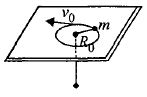
$A$ mass $m$ moves in a circle on a smooth horizontal plane with velocity $v_0$ at a radius $R_0$. The mass is attached to a string which passes through a smooth hole in the plane as shown. The tension in the string is increased gradually and finally $m$ moves in a circle of radius $\frac{R_0}{2}$. The final value of the kinetic energy is
A
$mv_0^2$
B
$\frac{1}{4}mv_0^2$
C
$2mv_0^2$
D
$\frac{1}{2}mv_0^2$
Solution
(C) Since the tension force acts towards the center of the circle,the torque about the center is zero. Therefore,the angular momentum of the mass $m$ is conserved.
Initial angular momentum $L_i = m v_0 R_0$.
Final angular momentum $L_f = m v R$,where $R = \frac{R_0}{2}$.
By conservation of angular momentum,$L_i = L_f$:
$m v_0 R_0 = m v \left( \frac{R_0}{2} \right)$
$v = 2 v_0$.
The initial kinetic energy is $K_i = \frac{1}{2} m v_0^2$.
The final kinetic energy is $K_f = \frac{1}{2} m v^2 = \frac{1}{2} m (2 v_0)^2 = \frac{1}{2} m (4 v_0^2) = 2 m v_0^2$.
Initial angular momentum $L_i = m v_0 R_0$.
Final angular momentum $L_f = m v R$,where $R = \frac{R_0}{2}$.
By conservation of angular momentum,$L_i = L_f$:
$m v_0 R_0 = m v \left( \frac{R_0}{2} \right)$
$v = 2 v_0$.
The initial kinetic energy is $K_i = \frac{1}{2} m v_0^2$.
The final kinetic energy is $K_f = \frac{1}{2} m v^2 = \frac{1}{2} m (2 v_0)^2 = \frac{1}{2} m (4 v_0^2) = 2 m v_0^2$.
0 likesView Solution
25
PhysicsMediumMCQAIPMT · 2015
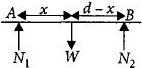
$A$ rod of weight $W$ is supported by two parallel knife edges $A$ and $B$ and is in equilibrium in a horizontal position. The knives are at a distance $d$ from each other. The centre of mass of the rod is at distance $x$ from $A.$ The normal reaction on $A$ is
A
$\frac{W(d - x)}{d}$
B
$\frac{Wd}{x}$
C
$\frac{Wx}{d}$
D
$\frac{W(d - x)}{x}$
Solution
(A) Let $N_1$ be the normal reaction on $A$ and $N_2$ be the normal reaction on $B$.
For vertical equilibrium,the sum of upward forces must equal the downward force:
$N_1 + N_2 = W$ --- $(i)$
For rotational equilibrium,we take the torque about the centre of mass of the rod (where the weight $W$ acts). The torque due to $W$ is zero.
Sum of torques about the centre of mass = $0$
$N_1 \cdot x = N_2 \cdot (d - x)$ --- $(ii)$
From equation $(i)$,$N_2 = W - N_1$.
Substitute this into equation $(ii)$:
$N_1 x = (W - N_1)(d - x)$
$N_1 x = W(d - x) - N_1(d - x)$
$N_1 x = W(d - x) - N_1 d + N_1 x$
$N_1 d = W(d - x)$
$N_1 = \frac{W(d - x)}{d}$
For vertical equilibrium,the sum of upward forces must equal the downward force:
$N_1 + N_2 = W$ --- $(i)$
For rotational equilibrium,we take the torque about the centre of mass of the rod (where the weight $W$ acts). The torque due to $W$ is zero.
Sum of torques about the centre of mass = $0$
$N_1 \cdot x = N_2 \cdot (d - x)$ --- $(ii)$
From equation $(i)$,$N_2 = W - N_1$.
Substitute this into equation $(ii)$:
$N_1 x = (W - N_1)(d - x)$
$N_1 x = W(d - x) - N_1(d - x)$
$N_1 x = W(d - x) - N_1 d + N_1 x$
$N_1 d = W(d - x)$
$N_1 = \frac{W(d - x)}{d}$
0 likesView Solution
26
PhysicsDifficultMCQAIPMT · 2015
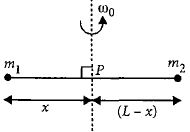
Point masses $m_1$ and $m_2$ are placed at the opposite ends of a rigid rod of length $L$ and negligible mass. The rod is to be set rotating about an axis perpendicular to it. The position of point $P$ on this rod through which the axis should pass so that the work required to set the rod rotating with angular velocity $\omega_0$ is minimum,is given by
A
$x = \frac{m_2 L}{m_1 + m_2}$
B
$x = \frac{m_1 L}{m_1 + m_2}$
C
$x = \frac{m_1 L}{m_2}$
D
$x = \frac{m_2 L}{m_1}$
Solution
(A) The moment of inertia $I$ of the system about an axis passing through point $P$ at a distance $x$ from $m_1$ is given by:
$I = m_1 x^2 + m_2 (L - x)^2$
According to the work-energy theorem,the work done $W$ to set the rod rotating with angular velocity $\omega_0$ is equal to the rotational kinetic energy:
$W = \frac{1}{2} I \omega_0^2 = \frac{1}{2} [m_1 x^2 + m_2 (L - x)^2] \omega_0^2$
For the work $W$ to be minimum,we set the derivative with respect to $x$ to zero:
$\frac{dW}{dx} = \frac{1}{2} \omega_0^2 [2 m_1 x + 2 m_2 (L - x)(-1)] = 0$
$m_1 x - m_2 (L - x) = 0$
$m_1 x - m_2 L + m_2 x = 0$
$(m_1 + m_2) x = m_2 L$
$x = \frac{m_2 L}{m_1 + m_2}$
$I = m_1 x^2 + m_2 (L - x)^2$
According to the work-energy theorem,the work done $W$ to set the rod rotating with angular velocity $\omega_0$ is equal to the rotational kinetic energy:
$W = \frac{1}{2} I \omega_0^2 = \frac{1}{2} [m_1 x^2 + m_2 (L - x)^2] \omega_0^2$
For the work $W$ to be minimum,we set the derivative with respect to $x$ to zero:
$\frac{dW}{dx} = \frac{1}{2} \omega_0^2 [2 m_1 x + 2 m_2 (L - x)(-1)] = 0$
$m_1 x - m_2 (L - x) = 0$
$m_1 x - m_2 L + m_2 x = 0$
$(m_1 + m_2) x = m_2 L$
$x = \frac{m_2 L}{m_1 + m_2}$
0 likesView Solution
27
PhysicsMediumMCQAIPMT · 2015
$A$ force $\overrightarrow{F} = \alpha \hat{i} + 3\hat{j} + 6\hat{k}$ is acting at a point $\overrightarrow{R} = 2\hat{i} - 6\hat{j} - 12\hat{k}$. The value of $\alpha$ for which angular momentum about the origin is conserved is
A
$1$
B
$-1$
C
$2$
D
$0$
Solution
(B) For the conservation of angular momentum about the origin,the net torque $\overrightarrow{\tau}$ acting on the particle must be zero.
By definition,$\overrightarrow{\tau} = \overrightarrow{R} \times \overrightarrow{F}$.
Given $\overrightarrow{R} = 2\hat{i} - 6\hat{j} - 12\hat{k}$ and $\overrightarrow{F} = \alpha \hat{i} + 3\hat{j} + 6\hat{k}$.
Calculating the cross product:
$\overrightarrow{\tau} = \begin{vmatrix} \hat{i} & \hat{j} & \hat{k} \\ 2 & -6 & -12 \\ \alpha & 3 & 6 \end{vmatrix}$
$\overrightarrow{\tau} = \hat{i}(-36 - (-36)) - \hat{j}(12 - (-12\alpha)) + \hat{k}(6 - (-6\alpha))$
$\overrightarrow{\tau} = \hat{i}(0) - \hat{j}(12 + 12\alpha) + \hat{k}(6 + 6\alpha)$
For $\overrightarrow{\tau} = 0$,both the $\hat{j}$ and $\hat{k}$ components must be zero:
$12 + 12\alpha = 0 \implies \alpha = -1$
$6 + 6\alpha = 0 \implies \alpha = -1$
Thus,the value of $\alpha$ is $-1$.
By definition,$\overrightarrow{\tau} = \overrightarrow{R} \times \overrightarrow{F}$.
Given $\overrightarrow{R} = 2\hat{i} - 6\hat{j} - 12\hat{k}$ and $\overrightarrow{F} = \alpha \hat{i} + 3\hat{j} + 6\hat{k}$.
Calculating the cross product:
$\overrightarrow{\tau} = \begin{vmatrix} \hat{i} & \hat{j} & \hat{k} \\ 2 & -6 & -12 \\ \alpha & 3 & 6 \end{vmatrix}$
$\overrightarrow{\tau} = \hat{i}(-36 - (-36)) - \hat{j}(12 - (-12\alpha)) + \hat{k}(6 - (-6\alpha))$
$\overrightarrow{\tau} = \hat{i}(0) - \hat{j}(12 + 12\alpha) + \hat{k}(6 + 6\alpha)$
For $\overrightarrow{\tau} = 0$,both the $\hat{j}$ and $\hat{k}$ components must be zero:
$12 + 12\alpha = 0 \implies \alpha = -1$
$6 + 6\alpha = 0 \implies \alpha = -1$
Thus,the value of $\alpha$ is $-1$.
0 likesView Solution
28
PhysicsMediumMCQAIPMT · 2015
An automobile moves on a road with a speed of $54 \,km h^{-1}.$ The radius of its wheels is $0.45\, m$ and the moment of inertia of the wheel about its axis of rotation is $3\, kg m^2$. If the vehicle is brought to rest in $15\, s,$ the magnitude of average torque transmitted by its brakes to the wheel is .......... $kg \,m^2\, s^{-2}$.
A
$2.86$
B
$6.66$
C
$8.58$
D
$10.86$
Solution
(B) Given:
Speed of the automobile,$v = 54 \,km h^{-1} = 54 \times \frac{5}{18} \,m s^{-1} = 15 \,m s^{-1}$.
Radius of the wheel,$R = 0.45 \,m$.
Moment of inertia of the wheel,$I = 3 \,kg m^2$.
Time taken to stop,$t = 15 \,s$.
The initial angular speed of the wheel is $\omega_i = \frac{v}{R} = \frac{15 \,m s^{-1}}{0.45 \,m} = \frac{1500}{45} \,rad s^{-1} = \frac{100}{3} \,rad s^{-1}$.
The final angular speed is $\omega_f = 0$ (as the vehicle comes to rest).
The angular retardation of the wheel is $\alpha = \frac{\omega_f - \omega_i}{t} = \frac{0 - \frac{100}{3}}{15} = -\frac{100}{45} \,rad s^{-2}$.
The magnitude of the average torque is $\tau = I |\alpha| = 3 \,kg m^2 \times \frac{100}{45} \,rad s^{-2} = \frac{300}{45} \,N m = \frac{20}{3} \,N m \approx 6.66 \,kg m^2 s^{-2}$.
Speed of the automobile,$v = 54 \,km h^{-1} = 54 \times \frac{5}{18} \,m s^{-1} = 15 \,m s^{-1}$.
Radius of the wheel,$R = 0.45 \,m$.
Moment of inertia of the wheel,$I = 3 \,kg m^2$.
Time taken to stop,$t = 15 \,s$.
The initial angular speed of the wheel is $\omega_i = \frac{v}{R} = \frac{15 \,m s^{-1}}{0.45 \,m} = \frac{1500}{45} \,rad s^{-1} = \frac{100}{3} \,rad s^{-1}$.
The final angular speed is $\omega_f = 0$ (as the vehicle comes to rest).
The angular retardation of the wheel is $\alpha = \frac{\omega_f - \omega_i}{t} = \frac{0 - \frac{100}{3}}{15} = -\frac{100}{45} \,rad s^{-2}$.
The magnitude of the average torque is $\tau = I |\alpha| = 3 \,kg m^2 \times \frac{100}{45} \,rad s^{-2} = \frac{300}{45} \,N m = \frac{20}{3} \,N m \approx 6.66 \,kg m^2 s^{-2}$.
0 likesView Solution
29
PhysicsMediumMCQAIPMT · 2015
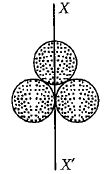
Three identical spherical shells,each of mass $m$ and radius $r$,are placed as shown in the figure. Consider an axis $XX'$ which touches two shells and passes through the diameter of the third shell. The moment of inertia of the system consisting of these three spherical shells about the $XX'$ axis is:
A
$\frac{11}{5} mr^2$
B
$3 mr^2$
C
$\frac{16}{5} mr^2$
D
$4 mr^2$
Solution
(D) The moment of inertia of a thin spherical shell of mass $m$ and radius $r$ about its diameter is $I_{diam} = \frac{2}{3} mr^2$.
For the third shell,the axis $XX'$ passes through its diameter. Therefore,its moment of inertia is $I_3 = \frac{2}{3} mr^2$.
For the other two shells,the axis $XX'$ is tangent to them. According to the parallel axis theorem,the moment of inertia about a tangent is $I_{tangent} = I_{cm} + md^2$,where $d = r$. Thus,$I_1 = I_2 = \frac{2}{3} mr^2 + mr^2 = \frac{5}{3} mr^2$.
The total moment of inertia of the system about the $XX'$ axis is $I = I_1 + I_2 + I_3 = \frac{5}{3} mr^2 + \frac{5}{3} mr^2 + \frac{2}{3} mr^2 = \frac{12}{3} mr^2 = 4 mr^2$.
For the third shell,the axis $XX'$ passes through its diameter. Therefore,its moment of inertia is $I_3 = \frac{2}{3} mr^2$.
For the other two shells,the axis $XX'$ is tangent to them. According to the parallel axis theorem,the moment of inertia about a tangent is $I_{tangent} = I_{cm} + md^2$,where $d = r$. Thus,$I_1 = I_2 = \frac{2}{3} mr^2 + mr^2 = \frac{5}{3} mr^2$.
The total moment of inertia of the system about the $XX'$ axis is $I = I_1 + I_2 + I_3 = \frac{5}{3} mr^2 + \frac{5}{3} mr^2 + \frac{2}{3} mr^2 = \frac{12}{3} mr^2 = 4 mr^2$.
1 likesView Solution
30
PhysicsMediumMCQAIPMT · 2015
$A$ remote-sensing satellite of Earth revolves in a circular orbit at a height of $0.25 \times 10^6 \, m$ above the surface of Earth. If Earth's radius is $6.38 \times 10^6 \, m$ and $g = 9.8 \, m s^{-2}$,then the orbital speed of the satellite is ...... $km s^{-1}$.
A
$6.67$
B
$7.76$
C
$8.56$
D
$9.13$
Solution
(B) The orbital speed of a satellite is given by the formula $v_0 = \sqrt{\frac{GM}{R+h}}$.
Since $g = \frac{GM}{R^2}$,we have $GM = gR^2$.
Substituting this into the orbital speed formula,we get $v_0 = \sqrt{\frac{gR^2}{R+h}} = R \sqrt{\frac{g}{R+h}}$.
Given values: $R = 6.38 \times 10^6 \, m$,$h = 0.25 \times 10^6 \, m$,and $g = 9.8 \, m s^{-2}$.
Total orbital radius $r = R + h = (6.38 + 0.25) \times 10^6 \, m = 6.63 \times 10^6 \, m$.
Now,$v_0 = \sqrt{\frac{9.8 \times (6.38 \times 10^6)^2}{6.63 \times 10^6}} = \sqrt{\frac{9.8 \times 40.7044 \times 10^{12}}{6.63 \times 10^6}} = \sqrt{60.16 \times 10^6} \approx 7.756 \times 10^3 \, m s^{-1}$.
Thus,$v_0 \approx 7.76 \, km s^{-1}$.
Since $g = \frac{GM}{R^2}$,we have $GM = gR^2$.
Substituting this into the orbital speed formula,we get $v_0 = \sqrt{\frac{gR^2}{R+h}} = R \sqrt{\frac{g}{R+h}}$.
Given values: $R = 6.38 \times 10^6 \, m$,$h = 0.25 \times 10^6 \, m$,and $g = 9.8 \, m s^{-2}$.
Total orbital radius $r = R + h = (6.38 + 0.25) \times 10^6 \, m = 6.63 \times 10^6 \, m$.
Now,$v_0 = \sqrt{\frac{9.8 \times (6.38 \times 10^6)^2}{6.63 \times 10^6}} = \sqrt{\frac{9.8 \times 40.7044 \times 10^{12}}{6.63 \times 10^6}} = \sqrt{60.16 \times 10^6} \approx 7.756 \times 10^3 \, m s^{-1}$.
Thus,$v_0 \approx 7.76 \, km s^{-1}$.
0 likesView Solution
31
PhysicsDifficultMCQAIPMT · 2015
Kepler's third law states that the square of the period of revolution $(T)$ of a planet around the sun is proportional to the cube of the average distance $(r)$ between the sun and the planet,i.e.,$T^2 = Kr^3$,where $K$ is a constant. If the masses of the sun and the planet are $M$ and $m$ respectively,then according to Newton's law of gravitation,the force of attraction between them is $F = \frac{GMm}{r^2}$,where $G$ is the gravitational constant. The relation between $G$ and $K$ is:
A
$GK = 4\pi^2$
B
$GMK = 4\pi^2$
C
$K = G$
D
$K = \frac{1}{G}$
Solution
(B) The gravitational force of attraction between the sun and the planet provides the necessary centripetal force for the planet's orbit.
$\therefore \frac{GMm}{r^2} = \frac{mv^2}{r} \implies v^2 = \frac{GM}{r} \quad \dots(i)$
The time period $(T)$ of the planet is given by $T = \frac{2\pi r}{v}$.
Squaring both sides,we get $T^2 = \frac{4\pi^2 r^2}{v^2}$.
Substituting the value of $v^2$ from equation $(i)$:
$T^2 = \frac{4\pi^2 r^2}{(\frac{GM}{r})} = \frac{4\pi^2 r^3}{GM} \quad \dots(ii)$
According to the problem,Kepler's third law is given as:
$T^2 = Kr^3 \quad \dots(iii)$
Comparing equations $(ii)$ and $(iii)$,we get:
$K = \frac{4\pi^2}{GM} \implies GMK = 4\pi^2$.
$\therefore \frac{GMm}{r^2} = \frac{mv^2}{r} \implies v^2 = \frac{GM}{r} \quad \dots(i)$
The time period $(T)$ of the planet is given by $T = \frac{2\pi r}{v}$.
Squaring both sides,we get $T^2 = \frac{4\pi^2 r^2}{v^2}$.
Substituting the value of $v^2$ from equation $(i)$:
$T^2 = \frac{4\pi^2 r^2}{(\frac{GM}{r})} = \frac{4\pi^2 r^3}{GM} \quad \dots(ii)$
According to the problem,Kepler's third law is given as:
$T^2 = Kr^3 \quad \dots(iii)$
Comparing equations $(ii)$ and $(iii)$,we get:
$K = \frac{4\pi^2}{GM} \implies GMK = 4\pi^2$.
0 likesView Solution
32
PhysicsMediumMCQAIPMT · 2015
Two spherical bodies of mass $M$ and $5M$ and radii $R$ and $2R$ are released in free space with initial separation between their centres equal to $12R.$ If they attract each other due to gravitational force only,then the distance covered by the smaller body before collision is (in $R$)
A
$2.5$
B
$4.5$
C
$7.5$
D
$1.5$
Solution
(C) The initial distance between the centres is $12R.$ Collision occurs when the distance between the centres is equal to the sum of their radii,which is $R + 2R = 3R.$
Therefore,the total distance covered by both bodies before collision is $12R - 3R = 9R.$
Let $x_1$ and $x_2$ be the distances covered by the bodies of mass $M$ and $5M$ respectively. Since there is no external force,the centre of mass of the system remains stationary. Thus,$M x_1 = 5M x_2$,which gives $x_1 = 5x_2$.
Given $x_1 + x_2 = 9R$,we substitute $x_1 = 5x_2$ to get $5x_2 + x_2 = 9R$,so $6x_2 = 9R$,which means $x_2 = 1.5R$.
Then,$x_1 = 5(1.5R) = 7.5R$.
The distance covered by the smaller body (mass $M$) is $7.5R$.
Therefore,the total distance covered by both bodies before collision is $12R - 3R = 9R.$
Let $x_1$ and $x_2$ be the distances covered by the bodies of mass $M$ and $5M$ respectively. Since there is no external force,the centre of mass of the system remains stationary. Thus,$M x_1 = 5M x_2$,which gives $x_1 = 5x_2$.
Given $x_1 + x_2 = 9R$,we substitute $x_1 = 5x_2$ to get $5x_2 + x_2 = 9R$,so $6x_2 = 9R$,which means $x_2 = 1.5R$.
Then,$x_1 = 5(1.5R) = 7.5R$.
The distance covered by the smaller body (mass $M$) is $7.5R$.
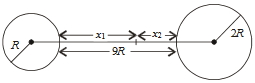
0 likesView Solution
33
PhysicsMediumMCQAIPMT · 2015
The Young's modulus of steel is twice that of brass. Two wires of the same length and of the same area of cross-section,one of steel and another of brass,are suspended from the same roof. If we want the lower ends of the wires to be at the same level,then the weights added to the steel and brass wires must be in the ratio of
A
$2:1$
B
$1:2$
C
$1:1$
D
$4:1$
Solution
(A) Let $L$ and $A$ be the length and area of cross-section of each wire respectively.
In order to have the lower ends of the wires at the same level,the elongation produced in both wires must be equal.
Let $W_s$ and $W_b$ be the weights added to the steel and brass wires respectively.
By the definition of Young's modulus $Y = \frac{W/A}{\Delta L/L}$,the elongation produced in the steel wire is $\Delta L_s = \frac{W_s L}{Y_s A}$.
The elongation produced in the brass wire is $\Delta L_b = \frac{W_b L}{Y_b A}$.
Since $\Delta L_s = \Delta L_b$,we have $\frac{W_s L}{Y_s A} = \frac{W_b L}{Y_b A}$.
This simplifies to $\frac{W_s}{W_b} = \frac{Y_s}{Y_b}$.
Given that the Young's modulus of steel is twice that of brass,$Y_s = 2 Y_b$,so $\frac{Y_s}{Y_b} = 2$.
Therefore,$\frac{W_s}{W_b} = 2$,which means the ratio is $2:1$.
In order to have the lower ends of the wires at the same level,the elongation produced in both wires must be equal.
Let $W_s$ and $W_b$ be the weights added to the steel and brass wires respectively.
By the definition of Young's modulus $Y = \frac{W/A}{\Delta L/L}$,the elongation produced in the steel wire is $\Delta L_s = \frac{W_s L}{Y_s A}$.
The elongation produced in the brass wire is $\Delta L_b = \frac{W_b L}{Y_b A}$.
Since $\Delta L_s = \Delta L_b$,we have $\frac{W_s L}{Y_s A} = \frac{W_b L}{Y_b A}$.
This simplifies to $\frac{W_s}{W_b} = \frac{Y_s}{Y_b}$.
Given that the Young's modulus of steel is twice that of brass,$Y_s = 2 Y_b$,so $\frac{Y_s}{Y_b} = 2$.
Therefore,$\frac{W_s}{W_b} = 2$,which means the ratio is $2:1$.
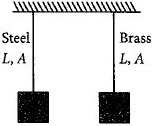
0 likesView Solution
34
PhysicsMediumMCQAIPMT · 2015
The value of the coefficient of volume expansion of glycerin is $5 \times 10^{-4} \ K^{-1}$. The fractional change in the density of glycerin for a rise of $40^{\circ}C$ in its temperature is:
A
$0.01$
B
$0.015$
C
$0.02$
D
$0.025$
Solution
(C) Let $\rho_0$ and $\rho_T$ be the densities of glycerin at initial temperature and final temperature respectively.
The relationship between density and temperature is given by $\rho_T = \rho_0(1 - \gamma \Delta T)$,where $\gamma$ is the coefficient of volume expansion and $\Delta T$ is the change in temperature.
Rearranging the equation,we get $\frac{\rho_T}{\rho_0} = 1 - \gamma \Delta T$.
The fractional change in density is defined as $\frac{\rho_0 - \rho_T}{\rho_0}$.
From the equation,$\frac{\rho_0 - \rho_T}{\rho_0} = \gamma \Delta T$.
Given $\gamma = 5 \times 10^{-4} \ K^{-1}$ and $\Delta T = 40 \ K$.
Substituting the values,the fractional change in density = $(5 \times 10^{-4} \ K^{-1}) \times (40 \ K) = 200 \times 10^{-4} = 0.02$.
The relationship between density and temperature is given by $\rho_T = \rho_0(1 - \gamma \Delta T)$,where $\gamma$ is the coefficient of volume expansion and $\Delta T$ is the change in temperature.
Rearranging the equation,we get $\frac{\rho_T}{\rho_0} = 1 - \gamma \Delta T$.
The fractional change in density is defined as $\frac{\rho_0 - \rho_T}{\rho_0}$.
From the equation,$\frac{\rho_0 - \rho_T}{\rho_0} = \gamma \Delta T$.
Given $\gamma = 5 \times 10^{-4} \ K^{-1}$ and $\Delta T = 40 \ K$.
Substituting the values,the fractional change in density = $(5 \times 10^{-4} \ K^{-1}) \times (40 \ K) = 200 \times 10^{-4} = 0.02$.
0 likesView Solution
35
PhysicsMediumMCQAIPMT · 2015
The cylindrical tube of a spray pump has radius $R,$ one end of which has $n$ fine holes,each of radius $r.$ If the speed of the liquid in the tube is $v,$ the speed of the ejection of the liquid through the holes is
A
$\frac{v^2 R}{n r}$
B
$\frac{v R^2}{n^2 r^2}$
C
$\frac{v R^2}{n r^2}$
D
$\frac{v R^2}{n^3 r^2}$
Solution
(C) According to the equation of continuity,the volume flow rate of the liquid remains constant throughout the tube.
The volume flow rate inside the cylindrical tube is given by $A_1 v_1 = \pi R^2 v$.
The total volume flow rate through the $n$ fine holes is given by $A_2 v_2 = n (\pi r^2) v_{ejection}$.
Equating the two flow rates:
$\pi R^2 v = n \pi r^2 v_{ejection}$.
Solving for the speed of ejection $(v_{ejection})$:
$v_{ejection} = \frac{\pi R^2 v}{n \pi r^2} = \frac{v R^2}{n r^2}$.
The volume flow rate inside the cylindrical tube is given by $A_1 v_1 = \pi R^2 v$.
The total volume flow rate through the $n$ fine holes is given by $A_2 v_2 = n (\pi r^2) v_{ejection}$.
Equating the two flow rates:
$\pi R^2 v = n \pi r^2 v_{ejection}$.
Solving for the speed of ejection $(v_{ejection})$:
$v_{ejection} = \frac{\pi R^2 v}{n \pi r^2} = \frac{v R^2}{n r^2}$.
0 likesView Solution
36
PhysicsEasyMCQAIPMT · 2015
Water rises to a height $h$ in a capillary tube. If the length of the capillary tube above the surface of water is made less than $h,$ then
A
water does not rise at all.
B
water rises up to the tip of the capillary tube and then starts overflowing like a fountain.
C
water rises up to the top of the capillary tube and stays there without overflowing.
D
water rises up to a point a little below the top and stays there.
Solution
(C) The height to which water rises in a capillary tube is given by $h = \frac{2T \cos \theta}{r \rho g}$.
If the actual length of the tube $L$ is less than the equilibrium height $h$,the water will rise to the top of the tube.
At the top,the radius of curvature $R$ of the meniscus will adjust such that $h' = \frac{2T \cos \theta'}{R \rho g} = L$,where $h' < h$.
Since the pressure at the top remains balanced by the surface tension,the water will not overflow but will stay at the top of the tube with a modified radius of curvature.
If the actual length of the tube $L$ is less than the equilibrium height $h$,the water will rise to the top of the tube.
At the top,the radius of curvature $R$ of the meniscus will adjust such that $h' = \frac{2T \cos \theta'}{R \rho g} = L$,where $h' < h$.
Since the pressure at the top remains balanced by the surface tension,the water will not overflow but will stay at the top of the tube with a modified radius of curvature.
0 likesView Solution
37
PhysicsMediumMCQAIPMT · 2015
The approximate depth of an ocean is $2700 \, m$. The compressibility of water is $45.4 \times 10^{-11} \, Pa^{-1}$ and the density of water is $10^3 \, kg/m^3$. What fractional compression of water will be obtained at the bottom of the ocean?
A
$0.8 \times 10^{-2}$
B
$1.0 \times 10^{-2}$
C
$1.2 \times 10^{-2}$
D
$1.4 \times 10^{-2}$
Solution
(C) Given:
Depth of ocean,$d = 2700 \, m$
Density of water,$\rho = 10^3 \, kg/m^3$
Compressibility of water,$K = 45.4 \times 10^{-11} \, Pa^{-1}$
Acceleration due to gravity,$g = 10 \, m/s^2$
The excess pressure at the bottom of the ocean is given by $\Delta P = \rho gd$.
$\Delta P = 10^3 \times 10 \times 2700 = 27 \times 10^6 \, Pa$.
Compressibility $K$ is defined as the reciprocal of the Bulk Modulus $B$,i.e.,$K = \frac{1}{B}$.
Since $B = \frac{\Delta P}{(\Delta V/V)}$,we have $\frac{\Delta V}{V} = K \times \Delta P$.
Substituting the values:
$\frac{\Delta V}{V} = (45.4 \times 10^{-11} \, Pa^{-1}) \times (27 \times 10^6 \, Pa)$
$\frac{\Delta V}{V} = 1225.8 \times 10^{-5} = 1.2258 \times 10^{-2} \approx 1.2 \times 10^{-2}$.
Depth of ocean,$d = 2700 \, m$
Density of water,$\rho = 10^3 \, kg/m^3$
Compressibility of water,$K = 45.4 \times 10^{-11} \, Pa^{-1}$
Acceleration due to gravity,$g = 10 \, m/s^2$
The excess pressure at the bottom of the ocean is given by $\Delta P = \rho gd$.
$\Delta P = 10^3 \times 10 \times 2700 = 27 \times 10^6 \, Pa$.
Compressibility $K$ is defined as the reciprocal of the Bulk Modulus $B$,i.e.,$K = \frac{1}{B}$.
Since $B = \frac{\Delta P}{(\Delta V/V)}$,we have $\frac{\Delta V}{V} = K \times \Delta P$.
Substituting the values:
$\frac{\Delta V}{V} = (45.4 \times 10^{-11} \, Pa^{-1}) \times (27 \times 10^6 \, Pa)$
$\frac{\Delta V}{V} = 1225.8 \times 10^{-5} = 1.2258 \times 10^{-2} \approx 1.2 \times 10^{-2}$.
0 likesView Solution
38
PhysicsMediumMCQAIPMT · 2015
$A$ wind with speed $40 \ m/s$ blows parallel to the roof of a house. The area of the roof is $250 \ m^2$. Assuming that the pressure inside the house is atmospheric pressure,the force exerted by the wind on the roof and the direction of the force will be $(\rho_{air} = 1.2 \ kg/m^3)$.
A
$4.8 \times 10^5 \ N$,downwards
B
$4.8 \times 10^5 \ N$,upwards
C
$2.4 \times 10^5 \ N$,upwards
D
$2.4 \times 10^5 \ N$,downwards
Solution
(C) Applying Bernoulli's theorem just above and just below the roof:
$P + \frac{1}{2}\rho v^2 = P_0 + 0$
Here,$P$ is the pressure just above the roof,$P_0$ is the atmospheric pressure inside the house,and $v = 40 \ m/s$ is the wind speed.
The pressure difference is $\Delta P = P_0 - P = \frac{1}{2}\rho v^2$.
The force exerted on the roof is $F = \Delta P \cdot A = \frac{1}{2}\rho A v^2$.
Substituting the given values:
$F = \frac{1}{2} \times 1.2 \ kg/m^3 \times 250 \ m^2 \times (40 \ m/s)^2$
$F = 0.6 \times 250 \times 1600 = 2.4 \times 10^5 \ N$.
Since the pressure inside the house $(P_0)$ is greater than the pressure just above the roof $(P)$,the net force acts in the upward direction.
$P + \frac{1}{2}\rho v^2 = P_0 + 0$
Here,$P$ is the pressure just above the roof,$P_0$ is the atmospheric pressure inside the house,and $v = 40 \ m/s$ is the wind speed.
The pressure difference is $\Delta P = P_0 - P = \frac{1}{2}\rho v^2$.
The force exerted on the roof is $F = \Delta P \cdot A = \frac{1}{2}\rho A v^2$.
Substituting the given values:
$F = \frac{1}{2} \times 1.2 \ kg/m^3 \times 250 \ m^2 \times (40 \ m/s)^2$
$F = 0.6 \times 250 \times 1600 = 2.4 \times 10^5 \ N$.
Since the pressure inside the house $(P_0)$ is greater than the pressure just above the roof $(P)$,the net force acts in the upward direction.
0 likesView Solution
39
PhysicsDifficultMCQAIPMT · 2015
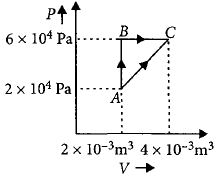
The figure below shows two paths that may be taken by a gas to go from a state $A$ to a state $C.$ In process $AB,$ $400 \, J$ of heat is added to the system and in process $BC,$ $100 \, J$ of heat is added to the system. The heat absorbed by the system in the process $AC$ will be ...... $J$
A
$380$
B
$500$
C
$460$
D
$300$
Solution
(C) Since internal energy is a state function,the change in internal energy depends only on the initial and final states. Therefore,$\Delta U_{ABC} = \Delta U_{AC}$.
For process $AB$ (isochoric,$\Delta V = 0$):
$\Delta W_{AB} = 0$
$\Delta Q_{AB} = \Delta U_{AB} = 400 \, J$.
For process $BC$ (isobaric,$P = 6 \times 10^4 \, Pa$):
$\Delta W_{BC} = P \Delta V = 6 \times 10^4 \times (4 \times 10^{-3} - 2 \times 10^{-3}) = 6 \times 10^4 \times 2 \times 10^{-3} = 120 \, J$.
$\Delta Q_{BC} = \Delta U_{BC} + \Delta W_{BC} \implies 100 = \Delta U_{BC} + 120 \implies \Delta U_{BC} = -20 \, J$.
Total change in internal energy for path $ABC$ is:
$\Delta U_{AC} = \Delta U_{AB} + \Delta U_{BC} = 400 - 20 = 380 \, J$.
For process $AC$,the work done $\Delta W_{AC}$ is the area under the line $AC$ in the $PV$ diagram,which is a trapezoid:
$\Delta W_{AC} = \text{Area} = \frac{1}{2} \times (P_A + P_C) \times (V_C - V_A) = \frac{1}{2} \times (2 \times 10^4 + 6 \times 10^4) \times (4 \times 10^{-3} - 2 \times 10^{-3}) = \frac{1}{2} \times 8 \times 10^4 \times 2 \times 10^{-3} = 80 \, J$.
Using the first law of thermodynamics for process $AC$:
$\Delta Q_{AC} = \Delta U_{AC} + \Delta W_{AC} = 380 + 80 = 460 \, J$.
For process $AB$ (isochoric,$\Delta V = 0$):
$\Delta W_{AB} = 0$
$\Delta Q_{AB} = \Delta U_{AB} = 400 \, J$.
For process $BC$ (isobaric,$P = 6 \times 10^4 \, Pa$):
$\Delta W_{BC} = P \Delta V = 6 \times 10^4 \times (4 \times 10^{-3} - 2 \times 10^{-3}) = 6 \times 10^4 \times 2 \times 10^{-3} = 120 \, J$.
$\Delta Q_{BC} = \Delta U_{BC} + \Delta W_{BC} \implies 100 = \Delta U_{BC} + 120 \implies \Delta U_{BC} = -20 \, J$.
Total change in internal energy for path $ABC$ is:
$\Delta U_{AC} = \Delta U_{AB} + \Delta U_{BC} = 400 - 20 = 380 \, J$.
For process $AC$,the work done $\Delta W_{AC}$ is the area under the line $AC$ in the $PV$ diagram,which is a trapezoid:
$\Delta W_{AC} = \text{Area} = \frac{1}{2} \times (P_A + P_C) \times (V_C - V_A) = \frac{1}{2} \times (2 \times 10^4 + 6 \times 10^4) \times (4 \times 10^{-3} - 2 \times 10^{-3}) = \frac{1}{2} \times 8 \times 10^4 \times 2 \times 10^{-3} = 80 \, J$.
Using the first law of thermodynamics for process $AC$:
$\Delta Q_{AC} = \Delta U_{AC} + \Delta W_{AC} = 380 + 80 = 460 \, J$.
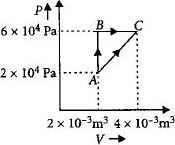
0 likesView Solution
40
PhysicsDifficultMCQAIPMT · 2015
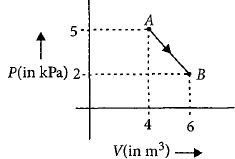
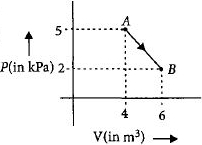
One mole of an ideal diatomic gas undergoes a transition from $A$ to $B$ along a path $AB$ as shown in the figure. The change in internal energy of the gas during the transition is ............ $kJ$.
A
$20$
B
$-20$
C
$0.02$
D
$-12$
Solution
(B) We know that the change in internal energy for an ideal gas is given by $\Delta U = n C_v \Delta T$.
For a diatomic gas,the molar heat capacity at constant volume is $C_v = \frac{5R}{2}$.
Substituting this into the equation,we get $\Delta U = n \left( \frac{5R}{2} \right) (T_B - T_A)$.
Using the ideal gas law $PV = nRT$,we can write $T = \frac{PV}{nR}$,so $\Delta U = \frac{5}{2} (P_B V_B - P_A V_A)$.
From the given graph,at point $A$: $P_A = 5 \times 10^3 \, Pa$ and $V_A = 4 \, m^3$.
At point $B$: $P_B = 2 \times 10^3 \, Pa$ and $V_B = 6 \, m^3$.
Substituting these values:
$\Delta U = \frac{5}{2} [(2 \times 10^3 \times 6) - (5 \times 10^3 \times 4)]$
$\Delta U = \frac{5}{2} [12 \times 10^3 - 20 \times 10^3]$
$\Delta U = \frac{5}{2} [-8 \times 10^3]$
$\Delta U = -20 \times 10^3 \, J = -20 \, kJ$.
For a diatomic gas,the molar heat capacity at constant volume is $C_v = \frac{5R}{2}$.
Substituting this into the equation,we get $\Delta U = n \left( \frac{5R}{2} \right) (T_B - T_A)$.
Using the ideal gas law $PV = nRT$,we can write $T = \frac{PV}{nR}$,so $\Delta U = \frac{5}{2} (P_B V_B - P_A V_A)$.
From the given graph,at point $A$: $P_A = 5 \times 10^3 \, Pa$ and $V_A = 4 \, m^3$.
At point $B$: $P_B = 2 \times 10^3 \, Pa$ and $V_B = 6 \, m^3$.
Substituting these values:
$\Delta U = \frac{5}{2} [(2 \times 10^3 \times 6) - (5 \times 10^3 \times 4)]$
$\Delta U = \frac{5}{2} [12 \times 10^3 - 20 \times 10^3]$
$\Delta U = \frac{5}{2} [-8 \times 10^3]$
$\Delta U = -20 \times 10^3 \, J = -20 \, kJ$.
0 likesView Solution
41
PhysicsEasyMCQAIPMT · 2015
An ideal gas is compressed to half its initial volume by means of several processes. Which of the processes results in the maximum work done on the gas?
A
Isochoric
B
Isothermal
C
Adiabatic
D
Isobaric
Solution
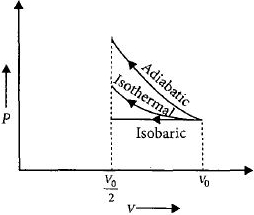
(C) The $P-V$ diagram of an ideal gas compressed from its initial volume $V_0$ to $\frac{V_0}{2}$ by several processes is shown in the figure.
Work done on the gas is equal to the area under the $P-V$ curve.
As the area under the $P-V$ curve is maximum for the adiabatic process,the work done on the gas is maximum for the adiabatic process.
Work done on the gas is equal to the area under the $P-V$ curve.
As the area under the $P-V$ curve is maximum for the adiabatic process,the work done on the gas is maximum for the adiabatic process.
0 likesView Solution
42
PhysicsMediumMCQAIPMT · 2015
The coefficient of performance of a refrigerator is $5$. If the temperature inside the freezer is $-20^{\circ}C$,the temperature of the surroundings to which it rejects heat is ........ $^{\circ}C$.
A
$21$
B
$31$
C
$41$
D
$11$
Solution
(B) The coefficient of performance $(COP)$ of a refrigerator is given by the formula:
$\alpha = \frac{T_2}{T_1 - T_2}$
where $T_1$ is the temperature of the hot reservoir (surroundings) and $T_2$ is the temperature of the cold reservoir (freezer) in Kelvin.
Given: $\alpha = 5$,$T_2 = -20^{\circ}C = (-20 + 273) K = 253 K$.
Substituting the values into the formula:
$5 = \frac{253}{T_1 - 253}$
$5(T_1 - 253) = 253$
$5T_1 - 1265 = 253$
$5T_1 = 1518$
$T_1 = \frac{1518}{5} = 303.6 K$
Converting back to Celsius:
$T_1 = 303.6 - 273 = 30.6^{\circ}C \approx 31^{\circ}C$.
$\alpha = \frac{T_2}{T_1 - T_2}$
where $T_1$ is the temperature of the hot reservoir (surroundings) and $T_2$ is the temperature of the cold reservoir (freezer) in Kelvin.
Given: $\alpha = 5$,$T_2 = -20^{\circ}C = (-20 + 273) K = 253 K$.
Substituting the values into the formula:
$5 = \frac{253}{T_1 - 253}$
$5(T_1 - 253) = 253$
$5T_1 - 1265 = 253$
$5T_1 = 1518$
$T_1 = \frac{1518}{5} = 303.6 K$
Converting back to Celsius:
$T_1 = 303.6 - 273 = 30.6^{\circ}C \approx 31^{\circ}C$.
0 likesView Solution
43
PhysicsMediumMCQAIPMT · 2015
$A$ particle is executing a simple harmonic motion. Its maximum acceleration is $\alpha$ and maximum velocity is $\beta$. Then,its time period of vibration will be
A
$\frac{2\pi \beta}{\alpha}$
B
$\frac{\beta^2}{\alpha^2}$
C
$\frac{\alpha}{\beta}$
D
$\frac{\beta^2}{\alpha}$
Solution
(A) Let $A$ be the amplitude and $\omega$ be the angular frequency of the simple harmonic motion.
The maximum acceleration is given by $\alpha = \omega^2 A$ $(i)$.
The maximum velocity is given by $\beta = \omega A$ $(ii)$.
Dividing equation $(i)$ by equation $(ii)$,we get:
$\frac{\alpha}{\beta} = \frac{\omega^2 A}{\omega A} = \omega$.
Therefore,the time period of vibration $T$ is given by:
$T = \frac{2\pi}{\omega} = \frac{2\pi}{(\alpha / \beta)} = \frac{2\pi \beta}{\alpha}$.
The maximum acceleration is given by $\alpha = \omega^2 A$ $(i)$.
The maximum velocity is given by $\beta = \omega A$ $(ii)$.
Dividing equation $(i)$ by equation $(ii)$,we get:
$\frac{\alpha}{\beta} = \frac{\omega^2 A}{\omega A} = \omega$.
Therefore,the time period of vibration $T$ is given by:
$T = \frac{2\pi}{\omega} = \frac{2\pi}{(\alpha / \beta)} = \frac{2\pi \beta}{\alpha}$.
0 likesView Solution
44
PhysicsMediumMCQAIPMT · 2015
When two displacements represented by $y_1 = a \sin(\omega t)$ and $y_2 = b \cos(\omega t)$ are superimposed,the motion is
A
not a simple harmonic
B
simple harmonic with amplitude $\frac{a}{b}$
C
simple harmonic with amplitude $\sqrt{a^2 + b^2}$
D
simple harmonic with amplitude $\frac{a + b}{2}$
Solution
(C) Given the two displacements:
$y_1 = a \sin(\omega t)$
$y_2 = b \cos(\omega t) = b \sin(\omega t + \frac{\pi}{2})$
The resultant displacement $y = y_1 + y_2$ is given by:
$y = a \sin(\omega t) + b \cos(\omega t)$
To find the amplitude,we can write this in the form $y = A \sin(\omega t + \phi)$,where the resultant amplitude $A$ is:
$A = \sqrt{a^2 + b^2 + 2ab \cos(\frac{\pi}{2})}$
Since $\cos(\frac{\pi}{2}) = 0$,the amplitude is:
$A = \sqrt{a^2 + b^2}$
Thus,the resultant motion is simple harmonic with an amplitude of $\sqrt{a^2 + b^2}$.
$y_1 = a \sin(\omega t)$
$y_2 = b \cos(\omega t) = b \sin(\omega t + \frac{\pi}{2})$
The resultant displacement $y = y_1 + y_2$ is given by:
$y = a \sin(\omega t) + b \cos(\omega t)$
To find the amplitude,we can write this in the form $y = A \sin(\omega t + \phi)$,where the resultant amplitude $A$ is:
$A = \sqrt{a^2 + b^2 + 2ab \cos(\frac{\pi}{2})}$
Since $\cos(\frac{\pi}{2}) = 0$,the amplitude is:
$A = \sqrt{a^2 + b^2}$
Thus,the resultant motion is simple harmonic with an amplitude of $\sqrt{a^2 + b^2}$.
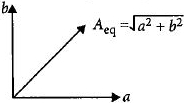
0 likesView Solution
45
PhysicsDifficultMCQAIPMT · 2015
$A$ particle is executing $SHM$ along a straight line. Its velocities at distances $x_1$ and $x_2$ from the mean position are $V_1$ and $V_2$ respectively. Its time period is
A
$2\pi \sqrt {\frac{{{x_1}^2 + {x_2}^2}}{{{V_1}^2 + {V_2}^2}}}$
B
$2\pi \sqrt {\frac{{{x_2}^2 - {x_1}^2}}{{{V_1}^2 - {V_2}^2}}}$
C
$2\pi \sqrt {\frac{{{V_1}^2 + {V_2}^2}}{{{x_1}^2 + {x_2}^2}}}$
D
$2\pi \sqrt {\frac{{{V_1}^2 - {V_2}^2}}{{{x_1}^2 - {x_2}^2}}}$
Solution
(B) In $SHM$,the velocity $V$ of a particle at a distance $x$ from the mean position is given by $V = \omega \sqrt{a^2 - x^2}$,where $a$ is the amplitude and $\omega$ is the angular frequency.
Squaring both sides,we get $V^2 = \omega^2(a^2 - x^2)$.
For distances $x_1$ and $x_2$,we have:
$V_1^2 = \omega^2(a^2 - x_1^2) \dots (i)$
$V_2^2 = \omega^2(a^2 - x_2^2) \dots (ii)$
Subtracting equation $(ii)$ from $(i)$:
$V_1^2 - V_2^2 = \omega^2(a^2 - x_1^2 - a^2 + x_2^2)$
$V_1^2 - V_2^2 = \omega^2(x_2^2 - x_1^2)$
$\omega^2 = \frac{V_1^2 - V_2^2}{x_2^2 - x_1^2}$
Since the time period $T = \frac{2\pi}{\omega}$,we have $\omega = \frac{2\pi}{T}$.
Substituting this into the equation for $\omega^2$:
$\left(\frac{2\pi}{T}\right)^2 = \frac{V_1^2 - V_2^2}{x_2^2 - x_1^2}$
$T^2 = 4\pi^2 \left(\frac{x_2^2 - x_1^2}{V_1^2 - V_2^2}\right)$
$T = 2\pi \sqrt{\frac{x_2^2 - x_1^2}{V_1^2 - V_2^2}}$
Squaring both sides,we get $V^2 = \omega^2(a^2 - x^2)$.
For distances $x_1$ and $x_2$,we have:
$V_1^2 = \omega^2(a^2 - x_1^2) \dots (i)$
$V_2^2 = \omega^2(a^2 - x_2^2) \dots (ii)$
Subtracting equation $(ii)$ from $(i)$:
$V_1^2 - V_2^2 = \omega^2(a^2 - x_1^2 - a^2 + x_2^2)$
$V_1^2 - V_2^2 = \omega^2(x_2^2 - x_1^2)$
$\omega^2 = \frac{V_1^2 - V_2^2}{x_2^2 - x_1^2}$
Since the time period $T = \frac{2\pi}{\omega}$,we have $\omega = \frac{2\pi}{T}$.
Substituting this into the equation for $\omega^2$:
$\left(\frac{2\pi}{T}\right)^2 = \frac{V_1^2 - V_2^2}{x_2^2 - x_1^2}$
$T^2 = 4\pi^2 \left(\frac{x_2^2 - x_1^2}{V_1^2 - V_2^2}\right)$
$T = 2\pi \sqrt{\frac{x_2^2 - x_1^2}{V_1^2 - V_2^2}}$
0 likesView Solution
46
PhysicsDifficultMCQAIPMT · 2015
$A$ source of sound $S$ emitting waves of frequency $100 \, Hz$ and an observer $O$ are located at some distance from each other. The source is moving with a speed of $19.4 \, m s^{-1}$ at an angle of $60^{\circ}$ with the source-observer line as shown in the figure. The observer is at rest. The apparent frequency observed by the observer is .... $Hz$ (velocity of sound in air $330 \, m s^{-1}$).
A
$97$
B
$100$
C
$103$
D
$106$
Solution
(A) Given:
Frequency of source,$f_{0} = 100 \, Hz$
Velocity of source,$v_{s} = 19.4 \, m s^{-1}$
Velocity of sound in air,$v = 330 \, m s^{-1}$
The component of the source velocity along the line joining the source and the observer is $v_{s} \cos 60^{\circ}$. Since the source is moving away from the observer,the apparent frequency $f'$ is given by the Doppler effect formula:
$f' = f_{0} \left( \frac{v}{v + v_{s} \cos 60^{\circ}} \right)$
Substituting the values:
$f' = 100 \left( \frac{330}{330 + 19.4 \times \cos 60^{\circ}} \right)$
$f' = 100 \left( \frac{330}{330 + 19.4 \times 0.5} \right)$
$f' = 100 \left( \frac{330}{330 + 9.7} \right)$
$f' = 100 \left( \frac{330}{339.7} \right) \approx 97.14 \, Hz$
Rounding to the nearest integer,the apparent frequency is $97 \, Hz$.
Frequency of source,$f_{0} = 100 \, Hz$
Velocity of source,$v_{s} = 19.4 \, m s^{-1}$
Velocity of sound in air,$v = 330 \, m s^{-1}$
The component of the source velocity along the line joining the source and the observer is $v_{s} \cos 60^{\circ}$. Since the source is moving away from the observer,the apparent frequency $f'$ is given by the Doppler effect formula:
$f' = f_{0} \left( \frac{v}{v + v_{s} \cos 60^{\circ}} \right)$
Substituting the values:
$f' = 100 \left( \frac{330}{330 + 19.4 \times \cos 60^{\circ}} \right)$
$f' = 100 \left( \frac{330}{330 + 19.4 \times 0.5} \right)$
$f' = 100 \left( \frac{330}{330 + 9.7} \right)$
$f' = 100 \left( \frac{330}{339.7} \right) \approx 97.14 \, Hz$
Rounding to the nearest integer,the apparent frequency is $97 \, Hz$.
0 likesView Solution
47
PhysicsMediumMCQAIPMT · 2015
$A$ string is stretched between fixed points separated by $75.0\, cm$. It is observed to have resonant frequencies of $420\, Hz$ and $315\, Hz$. There are no other resonant frequencies between these two. The lowest resonant frequency for this string is .... $Hz$.
A
$105$
B
$155$
C
$205$
D
$10.5$
Solution
(A) For a string fixed at both ends,the resonant frequencies are given by $v_n = n \cdot v_0$,where $v_0$ is the fundamental frequency (lowest resonant frequency) and $n = 1, 2, 3, \dots$.
The difference between any two consecutive resonant frequencies is $\Delta v = v_{n+1} - v_n = (n+1)v_0 - nv_0 = v_0$.
Given that $420\, Hz$ and $315\, Hz$ are resonant frequencies with no other resonant frequencies between them,they must be consecutive harmonics.
Therefore,the fundamental frequency $v_0$ is the difference between these two frequencies:
$v_0 = 420\, Hz - 315\, Hz = 105\, Hz$.
The difference between any two consecutive resonant frequencies is $\Delta v = v_{n+1} - v_n = (n+1)v_0 - nv_0 = v_0$.
Given that $420\, Hz$ and $315\, Hz$ are resonant frequencies with no other resonant frequencies between them,they must be consecutive harmonics.
Therefore,the fundamental frequency $v_0$ is the difference between these two frequencies:
$v_0 = 420\, Hz - 315\, Hz = 105\, Hz$.
0 likesView Solution
48
PhysicsDifficultMCQAIPMT · 2015
$4.0 \, g$ of a gas occupies $22.4 \, L$ at $NTP$. The specific heat capacity of the gas at constant volume is $5.0 \, J K^{-1} mol^{-1}$. If the speed of sound in this gas at $NTP$ is $952 \, m s^{-1}$,then the heat capacity at constant pressure is .... $J K^{-1} mol^{-1}$ (Take gas constant $R = 8.3 \, J K^{-1} mol^{-1}$)
A
$8.5$
B
$8.0$
C
$7.5$
D
$7.0$
Solution
(B) Since $4.0 \, g$ of a gas occupies $22.4 \, L$ at $NTP$,the molar mass of the gas is $M = 4.0 \, g \, mol^{-1} = 4.0 \times 10^{-3} \, kg \, mol^{-1}$.
The speed of sound in an ideal gas is given by $v = \sqrt{\frac{\gamma R T}{M}}$.
Rearranging for $\gamma$,we get $\gamma = \frac{M v^2}{R T}$.
Given $v = 952 \, m s^{-1}$,$R = 8.3 \, J K^{-1} mol^{-1}$,and $T = 273 \, K$ at $NTP$:
$\gamma = \frac{(4.0 \times 10^{-3} \, kg \, mol^{-1}) \times (952 \, m s^{-1})^2}{(8.3 \, J K^{-1} mol^{-1}) \times (273 \, K)} \approx \frac{3625.216}{2265.9} \approx 1.6$.
We know that $\gamma = \frac{C_p}{C_v}$,so $C_p = \gamma C_v$.
Given $C_v = 5.0 \, J K^{-1} mol^{-1}$,we have $C_p = 1.6 \times 5.0 \, J K^{-1} mol^{-1} = 8.0 \, J K^{-1} mol^{-1}$.
The speed of sound in an ideal gas is given by $v = \sqrt{\frac{\gamma R T}{M}}$.
Rearranging for $\gamma$,we get $\gamma = \frac{M v^2}{R T}$.
Given $v = 952 \, m s^{-1}$,$R = 8.3 \, J K^{-1} mol^{-1}$,and $T = 273 \, K$ at $NTP$:
$\gamma = \frac{(4.0 \times 10^{-3} \, kg \, mol^{-1}) \times (952 \, m s^{-1})^2}{(8.3 \, J K^{-1} mol^{-1}) \times (273 \, K)} \approx \frac{3625.216}{2265.9} \approx 1.6$.
We know that $\gamma = \frac{C_p}{C_v}$,so $C_p = \gamma C_v$.
Given $C_v = 5.0 \, J K^{-1} mol^{-1}$,we have $C_p = 1.6 \times 5.0 \, J K^{-1} mol^{-1} = 8.0 \, J K^{-1} mol^{-1}$.
0 likesView Solution
49
PhysicsDifficultMCQAIPMT · 2015
$A$ Carnot engine,having an efficiency of $\eta = 1/10$ as a heat engine,is used as a refrigerator. If the work done on the system is $10 \ J$,the amount of energy absorbed from the reservoir at a lower temperature is ....... $J$.
A
$100$
B
$99$
C
$90$
D
$1$
Solution
(C) The efficiency $(\eta)$ of a Carnot engine and the coefficient of performance $(\beta)$ of a refrigerator are related as:
$\beta = \frac{1 - \eta}{\eta}$
Given $\eta = 1/10$,we calculate the coefficient of performance:
$\beta = \frac{1 - 1/10}{1/10} = \frac{9/10}{1/10} = 9$
The coefficient of performance $(\beta)$ is also defined as the ratio of heat absorbed from the cold reservoir $(Q_2)$ to the work done $(W)$ on the system:
$\beta = \frac{Q_2}{W}$
Given $W = 10 \ J$ and $\beta = 9$,we have:
$9 = \frac{Q_2}{10 \ J}$
$Q_2 = 9 \times 10 \ J = 90 \ J$
Therefore,the energy absorbed from the reservoir at a lower temperature is $90 \ J$.
$\beta = \frac{1 - \eta}{\eta}$
Given $\eta = 1/10$,we calculate the coefficient of performance:
$\beta = \frac{1 - 1/10}{1/10} = \frac{9/10}{1/10} = 9$
The coefficient of performance $(\beta)$ is also defined as the ratio of heat absorbed from the cold reservoir $(Q_2)$ to the work done $(W)$ on the system:
$\beta = \frac{Q_2}{W}$
Given $W = 10 \ J$ and $\beta = 9$,we have:
$9 = \frac{Q_2}{10 \ J}$
$Q_2 = 9 \times 10 \ J = 90 \ J$
Therefore,the energy absorbed from the reservoir at a lower temperature is $90 \ J$.
0 likesView Solution
50
PhysicsMediumMCQAIPMT · 2015
The fundamental frequency of a closed organ pipe of length $20\; cm$ is equal to the second overtone of an organ pipe open at both the ends. The length of the organ pipe open at both the ends is ...... $cm$.
A
$100$
B
$120$
C
$140$
D
$80$
Solution
(B) The fundamental frequency of a closed organ pipe is given by $f_c = \frac{v}{4\ell_c}$,where $\ell_c = 20\; cm$.
The frequencies of an open organ pipe are given by $f_n = \frac{nv}{2\ell_o}$,where $n = 1, 2, 3, \dots$.
The first overtone is $n=2$,and the second overtone is $n=3$.
Thus,the second overtone frequency of an open organ pipe is $f_{o,2} = \frac{3v}{2\ell_o}$.
According to the problem,the fundamental frequency of the closed pipe equals the second overtone of the open pipe:
$\frac{v}{4\ell_c} = \frac{3v}{2\ell_o}$
Canceling $v$ from both sides:
$\frac{1}{4\ell_c} = \frac{3}{2\ell_o}$
Rearranging to solve for $\ell_o$:
$\ell_o = \frac{3 \times 4\ell_c}{2} = 6\ell_c$
Substituting $\ell_c = 20\; cm$:
$\ell_o = 6 \times 20\; cm = 120\; cm$.
The frequencies of an open organ pipe are given by $f_n = \frac{nv}{2\ell_o}$,where $n = 1, 2, 3, \dots$.
The first overtone is $n=2$,and the second overtone is $n=3$.
Thus,the second overtone frequency of an open organ pipe is $f_{o,2} = \frac{3v}{2\ell_o}$.
According to the problem,the fundamental frequency of the closed pipe equals the second overtone of the open pipe:
$\frac{v}{4\ell_c} = \frac{3v}{2\ell_o}$
Canceling $v$ from both sides:
$\frac{1}{4\ell_c} = \frac{3}{2\ell_o}$
Rearranging to solve for $\ell_o$:
$\ell_o = \frac{3 \times 4\ell_c}{2} = 6\ell_c$
Substituting $\ell_c = 20\; cm$:
$\ell_o = 6 \times 20\; cm = 120\; cm$.
0 likesView Solution
51
PhysicsEasyMCQAIPMT · 2015
If potential (in volts) in a region is expressed as $V(x, y, z) = 6xy - y + 2yz$,the electric field (in $N/C$) at point $(1, 1, 0)$ is:
A
$-(6\hat{i} + 9\hat{j} + \hat{k})$
B
$-(3\hat{i} + 5\hat{j} + 3\hat{k})$
C
$-(6\hat{i} + 5\hat{j} + 2\hat{k})$
D
$-(2\hat{i} + 3\hat{j} + \hat{k})$
Solution
(C) Given the potential function: $V = 6xy - y + 2yz$.
The electric field $\vec{E}$ is related to the potential $V$ by the relation: $\vec{E} = -\nabla V = -\left( \frac{\partial V}{\partial x} \hat{i} + \frac{\partial V}{\partial y} \hat{j} + \frac{\partial V}{\partial z} \hat{k} \right)$.
Calculating the partial derivatives:
$\frac{\partial V}{\partial x} = \frac{\partial}{\partial x}(6xy - y + 2yz) = 6y$
$\frac{\partial V}{\partial y} = \frac{\partial}{\partial y}(6xy - y + 2yz) = 6x - 1 + 2z$
$\frac{\partial V}{\partial z} = \frac{\partial}{\partial z}(6xy - y + 2yz) = 2y$
Substituting these into the expression for $\vec{E}$:
$\vec{E} = -[ (6y)\hat{i} + (6x - 1 + 2z)\hat{j} + (2y)\hat{k} ]$.
Now,evaluating at the point $(1, 1, 0)$:
$\vec{E}_{(1, 1, 0)} = -[ (6 \times 1)\hat{i} + (6 \times 1 - 1 + 2 \times 0)\hat{j} + (2 \times 1)\hat{k} ]$
$\vec{E}_{(1, 1, 0)} = -(6\hat{i} + 5\hat{j} + 2\hat{k}) \ N/C$.
The electric field $\vec{E}$ is related to the potential $V$ by the relation: $\vec{E} = -\nabla V = -\left( \frac{\partial V}{\partial x} \hat{i} + \frac{\partial V}{\partial y} \hat{j} + \frac{\partial V}{\partial z} \hat{k} \right)$.
Calculating the partial derivatives:
$\frac{\partial V}{\partial x} = \frac{\partial}{\partial x}(6xy - y + 2yz) = 6y$
$\frac{\partial V}{\partial y} = \frac{\partial}{\partial y}(6xy - y + 2yz) = 6x - 1 + 2z$
$\frac{\partial V}{\partial z} = \frac{\partial}{\partial z}(6xy - y + 2yz) = 2y$
Substituting these into the expression for $\vec{E}$:
$\vec{E} = -[ (6y)\hat{i} + (6x - 1 + 2z)\hat{j} + (2y)\hat{k} ]$.
Now,evaluating at the point $(1, 1, 0)$:
$\vec{E}_{(1, 1, 0)} = -[ (6 \times 1)\hat{i} + (6 \times 1 - 1 + 2 \times 0)\hat{j} + (2 \times 1)\hat{k} ]$
$\vec{E}_{(1, 1, 0)} = -(6\hat{i} + 5\hat{j} + 2\hat{k}) \ N/C$.
0 likesView Solution
52
PhysicsEasyMCQAIPMT · 2015
$A$ parallel plate air capacitor of capacitance $C$ is connected to a cell of emf $V$ and then disconnected from it. $A$ dielectric slab of dielectric constant $K,$ which can just fill the air gap of the capacitor,is now inserted in it. Which of the following is incorrect $?$
A
The energy stored in the capacitor decreases $K$ times.
B
The potential difference between the plates decreases $K$ times.
C
The change in energy stored is $\frac{1}{2}CV^2\left(\frac{1}{K} - 1\right)$.
D
The charge on the capacitor is not conserved.
Solution
(D) Initially,the capacitor is charged to $q = CV$. When the cell is disconnected,the charge $q$ remains constant on the plates.
After inserting the dielectric slab,the new capacitance becomes $C' = KC$.
The potential difference between the plates becomes $V' = \frac{q}{C'} = \frac{CV}{KC} = \frac{V}{K}$. Thus,the potential difference decreases $K$ times.
The initial energy stored is $U_1 = \frac{q^2}{2C} = \frac{1}{2}CV^2$.
The final energy stored is $U_2 = \frac{q^2}{2C'} = \frac{q^2}{2KC} = \frac{U_1}{K}$. Thus,the energy decreases $K$ times.
The change in energy is $\Delta U = U_2 - U_1 = \frac{q^2}{2KC} - \frac{q^2}{2C} = \frac{1}{2}CV^2\left(\frac{1}{K} - 1\right)$.
Since the capacitor is disconnected from the cell,the charge $q$ on the plates remains constant (conserved). Therefore,the statement that the charge is not conserved is incorrect.
After inserting the dielectric slab,the new capacitance becomes $C' = KC$.
The potential difference between the plates becomes $V' = \frac{q}{C'} = \frac{CV}{KC} = \frac{V}{K}$. Thus,the potential difference decreases $K$ times.
The initial energy stored is $U_1 = \frac{q^2}{2C} = \frac{1}{2}CV^2$.
The final energy stored is $U_2 = \frac{q^2}{2C'} = \frac{q^2}{2KC} = \frac{U_1}{K}$. Thus,the energy decreases $K$ times.
The change in energy is $\Delta U = U_2 - U_1 = \frac{q^2}{2KC} - \frac{q^2}{2C} = \frac{1}{2}CV^2\left(\frac{1}{K} - 1\right)$.
Since the capacitor is disconnected from the cell,the charge $q$ on the plates remains constant (conserved). Therefore,the statement that the charge is not conserved is incorrect.
0 likesView Solution
53
PhysicsMediumMCQAIPMT · 2015
$A$ parallel plate air capacitor has capacity $C$,distance of separation between plates is $d$,and potential difference $V$ is applied between the plates. The force of attraction between the plates of the parallel plate air capacitor is
A
$\frac{C^2 V^2}{2d^2}$
B
$\frac{C^2 V^2}{2d}$
C
$\frac{C V^2}{2d}$
D
$\frac{C V^2}{d}$
Solution
(C) The force of attraction $F$ between the plates of a parallel plate capacitor is given by the formula:
$F = \frac{Q^2}{2 \varepsilon_0 A}$
where $Q$ is the charge on the capacitor,$\varepsilon_0$ is the permittivity of free space,and $A$ is the area of each plate.
We know that the charge $Q$ is related to capacitance $C$ and potential difference $V$ by:
$Q = CV$
Also,the capacitance of a parallel plate capacitor is given by:
$C = \frac{\varepsilon_0 A}{d} \implies \varepsilon_0 A = Cd$
Substituting these expressions into the force formula:
$F = \frac{(CV)^2}{2(Cd)}$
$F = \frac{C^2 V^2}{2Cd}$
$F = \frac{CV^2}{2d}$
$F = \frac{Q^2}{2 \varepsilon_0 A}$
where $Q$ is the charge on the capacitor,$\varepsilon_0$ is the permittivity of free space,and $A$ is the area of each plate.
We know that the charge $Q$ is related to capacitance $C$ and potential difference $V$ by:
$Q = CV$
Also,the capacitance of a parallel plate capacitor is given by:
$C = \frac{\varepsilon_0 A}{d} \implies \varepsilon_0 A = Cd$
Substituting these expressions into the force formula:
$F = \frac{(CV)^2}{2(Cd)}$
$F = \frac{C^2 V^2}{2Cd}$
$F = \frac{CV^2}{2d}$
0 likesView Solution
54
PhysicsDifficultMCQAIPMT · 2015
The electric field in a certain region is acting radially outward and is given by $E = Ar$. $A$ charge contained in a sphere of radius $a$ centered at the origin of the field will be given by:
A
$4\pi \varepsilon_0 A a^2$
B
$A \varepsilon_0 a^2$
C
$4\pi \varepsilon_0 A a^3$
D
$\varepsilon_0 A a^2$
Solution
(C) According to Gauss's Law,the net electric flux $\phi$ through a closed surface is given by $\phi = \oint E \cdot dA = \frac{q_{en}}{\varepsilon_0}$.
Given the electric field $E = Ar$ is acting radially outward,for a spherical surface of radius $a$,the electric field at the surface is $E = Aa$.
The surface area of the sphere is $S = 4\pi a^2$.
Since the field is uniform over the surface of the sphere and directed radially outward,the flux is $\phi = E \times S = (Aa) \times (4\pi a^2) = 4\pi A a^3$.
Equating this to Gauss's Law: $4\pi A a^3 = \frac{q}{\varepsilon_0}$.
Therefore,the charge contained is $q = 4\pi \varepsilon_0 A a^3$.
Given the electric field $E = Ar$ is acting radially outward,for a spherical surface of radius $a$,the electric field at the surface is $E = Aa$.
The surface area of the sphere is $S = 4\pi a^2$.
Since the field is uniform over the surface of the sphere and directed radially outward,the flux is $\phi = E \times S = (Aa) \times (4\pi a^2) = 4\pi A a^3$.
Equating this to Gauss's Law: $4\pi A a^3 = \frac{q}{\varepsilon_0}$.
Therefore,the charge contained is $q = 4\pi \varepsilon_0 A a^3$.
0 likesView Solution
55
PhysicsMediumMCQAIPMT · 2015
Two metal wires of identical dimensions are connected in series. If $\sigma_1$ and $\sigma_2$ are the conductivities of the metal wires respectively,the effective conductivity of the combination is
A
$\frac{{\sigma_1}{\sigma_2}}{{\sigma_1} + {\sigma_2}}$
B
$\frac{2{\sigma_1}{\sigma_2}}{{\sigma_1} + {\sigma_2}}$
C
$\frac{{\sigma_1} + {\sigma_2}}{2{\sigma_1}{\sigma_2}}$
D
$\frac{{\sigma_1} + {\sigma_2}}{{\sigma_1}{\sigma_2}}$
Solution
(B) Since both metal wires are of identical dimensions,their length and area of cross-section are the same. Let them be $l$ and $A$ respectively.
The resistance of the first wire is $R_1 = \frac{l}{\sigma_1 A}$ ...$(i)$
The resistance of the second wire is $R_2 = \frac{l}{\sigma_2 A}$ ...$(ii)$
Since they are connected in series,their effective resistance is $R_s = R_1 + R_2$.
$R_s = \frac{l}{\sigma_1 A} + \frac{l}{\sigma_2 A} = \frac{l}{A} \left( \frac{1}{\sigma_1} + \frac{1}{\sigma_2} \right)$ ...$(iii)$
If $\sigma_{eff}$ is the effective conductivity of the combination,then the total length is $2l$ and the total resistance is $R_s = \frac{2l}{\sigma_{eff} A}$ ...$(iv)$
Equating equations $(iii)$ and $(iv)$,we get:
$\frac{2l}{\sigma_{eff} A} = \frac{l}{A} \left( \frac{\sigma_1 + \sigma_2}{\sigma_1 \sigma_2} \right)$
$\frac{2}{\sigma_{eff}} = \frac{\sigma_1 + \sigma_2}{\sigma_1 \sigma_2}$
$\sigma_{eff} = \frac{2 \sigma_1 \sigma_2}{\sigma_1 + \sigma_2}$
The resistance of the first wire is $R_1 = \frac{l}{\sigma_1 A}$ ...$(i)$
The resistance of the second wire is $R_2 = \frac{l}{\sigma_2 A}$ ...$(ii)$
Since they are connected in series,their effective resistance is $R_s = R_1 + R_2$.
$R_s = \frac{l}{\sigma_1 A} + \frac{l}{\sigma_2 A} = \frac{l}{A} \left( \frac{1}{\sigma_1} + \frac{1}{\sigma_2} \right)$ ...$(iii)$
If $\sigma_{eff}$ is the effective conductivity of the combination,then the total length is $2l$ and the total resistance is $R_s = \frac{2l}{\sigma_{eff} A}$ ...$(iv)$
Equating equations $(iii)$ and $(iv)$,we get:
$\frac{2l}{\sigma_{eff} A} = \frac{l}{A} \left( \frac{\sigma_1 + \sigma_2}{\sigma_1 \sigma_2} \right)$
$\frac{2}{\sigma_{eff}} = \frac{\sigma_1 + \sigma_2}{\sigma_1 \sigma_2}$
$\sigma_{eff} = \frac{2 \sigma_1 \sigma_2}{\sigma_1 + \sigma_2}$

0 likesView Solution
56
PhysicsMediumMCQAIPMT · 2015
$A$ potentiometer wire of length $L$ and a resistance $r$ are connected in series with a battery of e.m.f. $E_0$ and a resistance $r_1$. An unknown e.m.f. $E$ is balanced at a length $l$ of the potentiometer wire. The e.m.f. $E$ will be given by
A
$\frac{L E_0 r}{(r + r_1) l}$
B
$\frac{L E_0 r}{l r_1}$
C
$\frac{E_0 r l}{(r + r_1) L}$
D
$\frac{E_0 l}{L}$
Solution
(C) The current $I$ flowing through the potentiometer wire is given by the total e.m.f. divided by the total resistance of the primary circuit:
$I = \frac{E_0}{r + r_1}$
The potential difference $V$ across the entire length $L$ of the potentiometer wire is:
$V = I r = \frac{E_0 r}{r + r_1}$
The potential gradient $k$ along the wire is the potential difference per unit length:
$k = \frac{V}{L} = \frac{E_0 r}{(r + r_1) L}$
Since the unknown e.m.f. $E$ is balanced at a length $l$,the potential drop across length $l$ must equal $E$:
$E = k l = \left( \frac{E_0 r}{(r + r_1) L} \right) l = \frac{E_0 r l}{(r + r_1) L}$
$I = \frac{E_0}{r + r_1}$
The potential difference $V$ across the entire length $L$ of the potentiometer wire is:
$V = I r = \frac{E_0 r}{r + r_1}$
The potential gradient $k$ along the wire is the potential difference per unit length:
$k = \frac{V}{L} = \frac{E_0 r}{(r + r_1) L}$
Since the unknown e.m.f. $E$ is balanced at a length $l$,the potential drop across length $l$ must equal $E$:
$E = k l = \left( \frac{E_0 r}{(r + r_1) L} \right) l = \frac{E_0 r l}{(r + r_1) L}$
0 likesView Solution
57
PhysicsDifficultMCQAIPMT · 2015
$A$ circuit contains an ammeter,a battery of $30\,V$ and a resistance of $40.8\,\Omega$ all connected in series. If the ammeter has a coil of resistance $480\,\Omega$ and a shunt of $20\,\Omega$,the reading in the ammeter will be .................. $A$.
A
$1$
B
$0.25$
C
$0.5$
D
$2$
Solution
(C) The circuit is shown in the figure.
First,calculate the effective resistance of the ammeter $(R_A)$. Since the coil resistance $(480\,\Omega)$ and the shunt resistance $(20\,\Omega)$ are in parallel,the equivalent resistance is:
$R_A = \frac{480 \times 20}{480 + 20} = \frac{9600}{500} = 19.2\,\Omega$
Since the ammeter is connected in series with the $40.8\,\Omega$ resistor,the total resistance $(R_{total})$ of the circuit is:
$R_{total} = 40.8\,\Omega + 19.2\,\Omega = 60\,\Omega$
Using Ohm's law $(I = V/R)$,the total current flowing through the circuit is:
$I = \frac{30\,V}{60\,\Omega} = 0.5\,A$
Thus,the reading in the ammeter will be $0.5\,A$.
First,calculate the effective resistance of the ammeter $(R_A)$. Since the coil resistance $(480\,\Omega)$ and the shunt resistance $(20\,\Omega)$ are in parallel,the equivalent resistance is:
$R_A = \frac{480 \times 20}{480 + 20} = \frac{9600}{500} = 19.2\,\Omega$
Since the ammeter is connected in series with the $40.8\,\Omega$ resistor,the total resistance $(R_{total})$ of the circuit is:
$R_{total} = 40.8\,\Omega + 19.2\,\Omega = 60\,\Omega$
Using Ohm's law $(I = V/R)$,the total current flowing through the circuit is:
$I = \frac{30\,V}{60\,\Omega} = 0.5\,A$
Thus,the reading in the ammeter will be $0.5\,A$.
0 likesView Solution
58
PhysicsMediumMCQAIPMT · 2015
$A$ potentiometer wire has length $4\, m$ and resistance $8\, \Omega$. The resistance that must be connected in series with the wire and an accumulator of e.m.f. $2\, V$,so as to get a potential gradient of $1\, mV$ per $cm$ on the wire is ............. $\Omega$.
A
$32$
B
$40$
C
$44$
D
$48$
Solution
(A) Required potential gradient $k = 1\, mV/cm = 10^{-3}\, V / 10^{-2}\, m = 0.1\, V/m$.
Length of the potentiometer wire $L = 4\, m$.
Potential difference across the wire $V_w = k \times L = 0.1 \times 4 = 0.4\, V$.
The circuit consists of an accumulator of $E = 2\, V$ in series with a resistor $R$ and the potentiometer wire of resistance $R_w = 8\, \Omega$.
The current in the circuit is $I = \frac{E}{R + R_w} = \frac{2}{R + 8}$.
The potential difference across the wire is $V_w = I \times R_w$.
Substituting the values: $0.4 = \left( \frac{2}{R + 8} \right) \times 8$.
$0.4 = \frac{16}{R + 8}$.
$R + 8 = \frac{16}{0.4} = 40$.
$R = 40 - 8 = 32\, \Omega$.
Length of the potentiometer wire $L = 4\, m$.
Potential difference across the wire $V_w = k \times L = 0.1 \times 4 = 0.4\, V$.
The circuit consists of an accumulator of $E = 2\, V$ in series with a resistor $R$ and the potentiometer wire of resistance $R_w = 8\, \Omega$.
The current in the circuit is $I = \frac{E}{R + R_w} = \frac{2}{R + 8}$.
The potential difference across the wire is $V_w = I \times R_w$.
Substituting the values: $0.4 = \left( \frac{2}{R + 8} \right) \times 8$.
$0.4 = \frac{16}{R + 8}$.
$R + 8 = \frac{16}{0.4} = 40$.
$R = 40 - 8 = 32\, \Omega$.
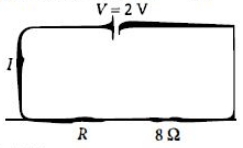
0 likesView Solution
59
PhysicsMediumMCQAIPMT · 2015
$A, B$ and $C$ are voltmeters of resistance $R, 1.5R$ and $3R$ respectively as shown in the figure. When some potential difference is applied between $X$ and $Y$,the voltmeter readings are $V_A, V_B$ and $V_C$ respectively. Then
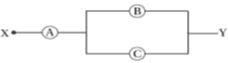
A
$V_A = V_B = V_C$
B
$V_A \neq V_B = V_C$
C
$V_A = V_B \neq V_C$
D
$V_A \neq V_B \neq V_C$
Solution
(A) Let the total current flowing through the circuit be $I$. This current $I$ passes through voltmeter $A$.
At the junction,the current $I$ splits into two parallel branches containing voltmeters $B$ and $C$. Let $I_B$ and $I_C$ be the currents through $B$ and $C$ respectively.
Since $B$ and $C$ are in parallel,the potential difference across them is the same:
$V_B = V_C \implies I_B \times (1.5R) = I_C \times (3R) \implies I_B = 2I_C$.
Also,$I_B + I_C = I$. Substituting $I_B = 2I_C$,we get $3I_C = I$,so $I_C = I/3$ and $I_B = 2I/3$.
The readings are:
$V_A = I \times R = IR$
$V_B = I_B \times 1.5R = (2I/3) \times (3R/2) = IR$
$V_C = I_C \times 3R = (I/3) \times 3R = IR$
Thus,$V_A = V_B = V_C$.
At the junction,the current $I$ splits into two parallel branches containing voltmeters $B$ and $C$. Let $I_B$ and $I_C$ be the currents through $B$ and $C$ respectively.
Since $B$ and $C$ are in parallel,the potential difference across them is the same:
$V_B = V_C \implies I_B \times (1.5R) = I_C \times (3R) \implies I_B = 2I_C$.
Also,$I_B + I_C = I$. Substituting $I_B = 2I_C$,we get $3I_C = I$,so $I_C = I/3$ and $I_B = 2I/3$.
The readings are:
$V_A = I \times R = IR$
$V_B = I_B \times 1.5R = (2I/3) \times (3R/2) = IR$
$V_C = I_C \times 3R = (I/3) \times 3R = IR$
Thus,$V_A = V_B = V_C$.
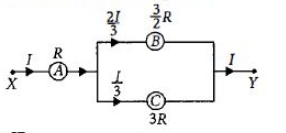
0 likesView Solution
60
PhysicsEasyMCQAIPMT · 2015
Across a metallic conductor of non-uniform cross-section, a constant potential difference is applied. The quantity which remains constant along the conductor is
A
current density
B
current
C
drift velocity
D
electric field
Solution
(B) For a metallic conductor, the total current $I$ flowing through any cross-section must be the same due to the principle of conservation of charge (steady state flow).
Since $I = nAev_d$ and $J = I/A = nev_d$, if the cross-sectional area $A$ varies, the current density $J$ and drift velocity $v_d$ must also vary to keep $I$ constant.
The electric field $E = J/\sigma$ also varies with the cross-sectional area.
Therefore, the current $I$ is the only quantity that remains constant along the conductor.
Since $I = nAev_d$ and $J = I/A = nev_d$, if the cross-sectional area $A$ varies, the current density $J$ and drift velocity $v_d$ must also vary to keep $I$ constant.
The electric field $E = J/\sigma$ also varies with the cross-sectional area.
Therefore, the current $I$ is the only quantity that remains constant along the conductor.
0 likesView Solution
61
PhysicsDifficultMCQAIPMT · 2015
$A$ wire carrying current $I$ has the shape as shown in the adjoining figure. The linear parts of the wire are very long and parallel to the $X$-axis,while the semicircular portion of radius $R$ lies in the $Y-Z$ plane. The magnetic field at point $O$ is:
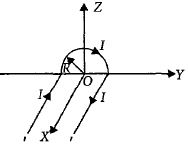
A
$\overrightarrow {B} = \frac{{\mu _0}I}{{4\pi R}}\left( {\pi \hat i + 2\hat k} \right)$
B
$\overrightarrow {B} = - \frac{{\mu _0}I}{{4\pi R}}\left( {\pi \hat i - 2\hat k} \right)$
C
$\overrightarrow {B} = - \frac{{\mu _0}I}{{4\pi R}}\left( {\pi \hat i + 2\hat k} \right)$
D
$\overrightarrow {B} = \frac{{\mu _0}I}{{4\pi R}}\left( {\pi \hat i - 2\hat k} \right)$
Solution
(C) The given situation is shown in the figure. The wire consists of three parts: two semi-infinite straight wires parallel to the $X$-axis and a semicircular arc in the $Y-Z$ plane.
$1$. For the two semi-infinite straight wires (labeled $1$ and $3$): The magnetic field at $O$ due to a semi-infinite wire is $B = \frac{\mu_0 I}{4 \pi R}$. Using the right-hand rule,both wires produce a magnetic field in the $-\hat{k}$ direction at point $O$. Thus,$\vec{B}_{1} = \vec{B}_{3} = -\frac{\mu_{0} I}{4 \pi R} \hat{k}$.
$2$. For the semicircular arc (labeled $2$): The magnetic field at the center of a semicircular arc of radius $R$ is $B = \frac{\mu_0 I}{4 R}$. Using the right-hand rule,the field is directed in the $-\hat{i}$ direction. Thus,$\vec{B}_{2} = -\frac{\mu_{0} I}{4 R} \hat{i}$.
$3$. The net magnetic field at point $O$ is the vector sum: $\vec{B} = \vec{B}_{1} + \vec{B}_{2} + \vec{B}_{3}$.
Substituting the values: $\vec{B} = -\frac{\mu_{0} I}{4 \pi R} \hat{k} - \frac{\mu_{0} I}{4 R} \hat{i} - \frac{\mu_{0} I}{4 \pi R} \hat{k}$.
Factoring out $-\frac{\mu_{0} I}{4 \pi R}$: $\vec{B} = -\frac{\mu_{0} I}{4 \pi R} (\pi \hat{i} + 2 \hat{k})$.
$1$. For the two semi-infinite straight wires (labeled $1$ and $3$): The magnetic field at $O$ due to a semi-infinite wire is $B = \frac{\mu_0 I}{4 \pi R}$. Using the right-hand rule,both wires produce a magnetic field in the $-\hat{k}$ direction at point $O$. Thus,$\vec{B}_{1} = \vec{B}_{3} = -\frac{\mu_{0} I}{4 \pi R} \hat{k}$.
$2$. For the semicircular arc (labeled $2$): The magnetic field at the center of a semicircular arc of radius $R$ is $B = \frac{\mu_0 I}{4 R}$. Using the right-hand rule,the field is directed in the $-\hat{i}$ direction. Thus,$\vec{B}_{2} = -\frac{\mu_{0} I}{4 R} \hat{i}$.
$3$. The net magnetic field at point $O$ is the vector sum: $\vec{B} = \vec{B}_{1} + \vec{B}_{2} + \vec{B}_{3}$.
Substituting the values: $\vec{B} = -\frac{\mu_{0} I}{4 \pi R} \hat{k} - \frac{\mu_{0} I}{4 R} \hat{i} - \frac{\mu_{0} I}{4 \pi R} \hat{k}$.
Factoring out $-\frac{\mu_{0} I}{4 \pi R}$: $\vec{B} = -\frac{\mu_{0} I}{4 \pi R} (\pi \hat{i} + 2 \hat{k})$.
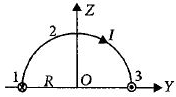
0 likesView Solution
62
PhysicsDifficultMCQAIPMT · 2015
$A$ conducting square frame of side $a$ and a long straight wire carrying current $I$ are located in the same plane as shown in the figure. The frame moves to the right with a constant velocity $V$. The $emf$ induced in the frame will be proportional to
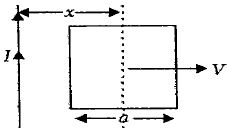
A
$\frac{1}{x^2}$
B
$\frac{1}{(2x - a)^2}$
C
$\frac{1}{(2x + a)}$
D
$\frac{1}{(2x - a)(2x + a)}$
Solution
(D) Let the distance of the center of the square frame from the wire be $x$. The left side of the frame is at a distance $(x - a/2)$ from the wire,and the right side is at a distance $(x + a/2)$ from the wire.
The magnetic field due to the long wire at distance $r$ is $B = \frac{\mu_0 I}{2\pi r}$.
The motional $emf$ induced in the left side (length $a$) is $\varepsilon_1 = B_1 a V = \frac{\mu_0 I}{2\pi (x - a/2)} a V$.
The motional $emf$ induced in the right side (length $a$) is $\varepsilon_2 = B_2 a V = \frac{\mu_0 I}{2\pi (x + a/2)} a V$.
The net $emf$ induced in the frame is $\varepsilon = \varepsilon_1 - \varepsilon_2$.
$\varepsilon = \frac{\mu_0 I a V}{2\pi} \left[ \frac{1}{x - a/2} - \frac{1}{x + a/2} \right]$
$\varepsilon = \frac{\mu_0 I a V}{2\pi} \left[ \frac{2}{2x - a} - \frac{2}{2x + a} \right]$
$\varepsilon = \frac{\mu_0 I a V}{\pi} \left[ \frac{(2x + a) - (2x - a)}{(2x - a)(2x + a)} \right]$
$\varepsilon = \frac{\mu_0 I a V}{\pi} \left[ \frac{2a}{(2x - a)(2x + a)} \right]$
Thus,$\varepsilon \propto \frac{1}{(2x - a)(2x + a)}$.
The magnetic field due to the long wire at distance $r$ is $B = \frac{\mu_0 I}{2\pi r}$.
The motional $emf$ induced in the left side (length $a$) is $\varepsilon_1 = B_1 a V = \frac{\mu_0 I}{2\pi (x - a/2)} a V$.
The motional $emf$ induced in the right side (length $a$) is $\varepsilon_2 = B_2 a V = \frac{\mu_0 I}{2\pi (x + a/2)} a V$.
The net $emf$ induced in the frame is $\varepsilon = \varepsilon_1 - \varepsilon_2$.
$\varepsilon = \frac{\mu_0 I a V}{2\pi} \left[ \frac{1}{x - a/2} - \frac{1}{x + a/2} \right]$
$\varepsilon = \frac{\mu_0 I a V}{2\pi} \left[ \frac{2}{2x - a} - \frac{2}{2x + a} \right]$
$\varepsilon = \frac{\mu_0 I a V}{\pi} \left[ \frac{(2x + a) - (2x - a)}{(2x - a)(2x + a)} \right]$
$\varepsilon = \frac{\mu_0 I a V}{\pi} \left[ \frac{2a}{(2x - a)(2x + a)} \right]$
Thus,$\varepsilon \propto \frac{1}{(2x - a)(2x + a)}$.
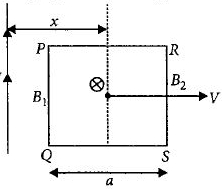
0 likesView Solution
63
PhysicsDifficultMCQAIPMT · 2015
$A$ proton and an alpha particle both enter a region of uniform magnetic field $B,$ moving at right angles to the field $B.$ If the radius of circular orbits for both the particles is equal and the kinetic energy acquired by proton is $1 \, MeV,$ the energy acquired by the alpha particle will be......$MeV$
A
$1$
B
$4$
C
$0.5$
D
$1.5$
Solution
(A) The radius of a circular orbit for a charged particle in a uniform magnetic field $B$ is given by $R = \frac{mv}{qB} = \frac{\sqrt{2mK}}{qB}$, where $K$ is the kinetic energy.
Rearranging for kinetic energy $K$, we get $K = \frac{q^2 B^2 R^2}{2m}$.
For the proton $(p)$ and alpha particle $(\alpha)$, since $B$ and $R$ are equal, the ratio of their kinetic energies is:
$\frac{K_{\alpha}}{K_{p}} = \left(\frac{q_{\alpha}}{q_{p}}\right)^2 \left(\frac{m_{p}}{m_{\alpha}}\right)$.
Given $q_{\alpha} = 2q_{p}$ and $m_{\alpha} = 4m_{p}$, we have:
$\frac{K_{\alpha}}{K_{p}} = (2)^2 \times \left(\frac{1}{4}\right) = 4 \times \frac{1}{4} = 1$.
Therefore, $K_{\alpha} = K_{p} = 1 \, MeV$.
Rearranging for kinetic energy $K$, we get $K = \frac{q^2 B^2 R^2}{2m}$.
For the proton $(p)$ and alpha particle $(\alpha)$, since $B$ and $R$ are equal, the ratio of their kinetic energies is:
$\frac{K_{\alpha}}{K_{p}} = \left(\frac{q_{\alpha}}{q_{p}}\right)^2 \left(\frac{m_{p}}{m_{\alpha}}\right)$.
Given $q_{\alpha} = 2q_{p}$ and $m_{\alpha} = 4m_{p}$, we have:
$\frac{K_{\alpha}}{K_{p}} = (2)^2 \times \left(\frac{1}{4}\right) = 4 \times \frac{1}{4} = 1$.
Therefore, $K_{\alpha} = K_{p} = 1 \, MeV$.
0 likesView Solution
64
PhysicsMediumMCQAIPMT · 2015
An electron moving in a circular orbit of radius $r$ makes $n$ rotations per second. The magnetic field produced at the centre has magnitude
A
$\frac{\mu_0 ne}{2\pi r}$
B
zero
C
$\frac{\mu_0 n^2 e}{r}$
D
$\frac{\mu_0 ne}{2r}$
Solution
(D) The current $I$ produced by an electron of charge $e$ moving in a circular orbit with frequency $n$ (rotations per second) is given by $I = q \times f = e \times n$.
The magnetic field $B$ at the center of a circular current-carrying loop of radius $r$ is given by the formula $B = \frac{\mu_0 I}{2r}$.
Substituting the value of $I = ne$ into the magnetic field formula,we get:
$B = \frac{\mu_0 (ne)}{2r} = \frac{\mu_0 ne}{2r}$.
The magnetic field $B$ at the center of a circular current-carrying loop of radius $r$ is given by the formula $B = \frac{\mu_0 I}{2r}$.
Substituting the value of $I = ne$ into the magnetic field formula,we get:
$B = \frac{\mu_0 (ne)}{2r} = \frac{\mu_0 ne}{2r}$.
0 likesView Solution
65
PhysicsMediumMCQAIPMT · 2015
$A$ rectangular coil of length $0.12\, m$ and width $0.1\, m$ having $50$ turns of wire is suspended vertically in a uniform magnetic field of strength $0.2\, Wb/m^2$. The coil carries a current of $2\, A$. If the plane of the coil is inclined at an angle of $30^{\circ}$ with the direction of the field,the torque required to keep the coil in this position will be .......$Nm$.
A
$0.12$
B
$0.15$
C
$0.20$
D
$0.24$
Solution
(C) The torque acting on a current-carrying coil in a magnetic field is given by $\tau = N I A B \sin \theta$,where $\theta$ is the angle between the normal to the plane of the coil and the magnetic field direction.
Given: $N = 50$,$I = 2\, A$,$B = 0.2\, Wb/m^2$,and area $A = 0.12\, m \times 0.1\, m = 0.012\, m^2$.
The plane of the coil is inclined at $30^{\circ}$ to the magnetic field,so the angle between the normal to the coil and the magnetic field is $\theta = 90^{\circ} - 30^{\circ} = 60^{\circ}$.
Substituting the values: $\tau = 50 \times 2 \times 0.012 \times 0.2 \times \sin 60^{\circ}$.
$\tau = 100 \times 0.0024 \times \frac{\sqrt{3}}{2} = 0.24 \times 0.866 = 0.2078\, Nm \approx 0.20\, Nm$.
Given: $N = 50$,$I = 2\, A$,$B = 0.2\, Wb/m^2$,and area $A = 0.12\, m \times 0.1\, m = 0.012\, m^2$.
The plane of the coil is inclined at $30^{\circ}$ to the magnetic field,so the angle between the normal to the coil and the magnetic field is $\theta = 90^{\circ} - 30^{\circ} = 60^{\circ}$.
Substituting the values: $\tau = 50 \times 2 \times 0.012 \times 0.2 \times \sin 60^{\circ}$.
$\tau = 100 \times 0.0024 \times \frac{\sqrt{3}}{2} = 0.24 \times 0.866 = 0.2078\, Nm \approx 0.20\, Nm$.
0 likesView Solution
66
PhysicsMediumMCQAIPMT · 2015
$A$ beam of light consisting of red,green and blue colours is incident on a right-angled prism. The refractive index of the material of the prism for the above red,green and blue wavelengths are $1.39, 1.44$ and $1.47$ respectively.
The prism will
The prism will
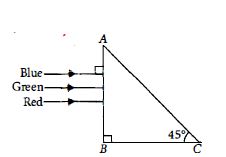
A
separate the red colour part from the green and blue colours
B
separate the blue colour part from the red and green colours
C
separate all the three colours from one another
D
not separate the three colours at all
Solution
(A) As the beam of light is incident normally on the face $AB$ of the right-angled prism $ABC$,no refraction occurs at face $AB$. The light passes straight and strikes the face $AC$ at an angle of incidence $i = 45^{\circ}$.
For total internal reflection to take place at face $AC$,the condition is $i > i_c$,where $i_c$ is the critical angle.
We know that $\sin i_c = \frac{1}{\mu}$. Therefore,the condition for total internal reflection is $\sin i > \frac{1}{\mu}$,or $\mu > \frac{1}{\sin i}$.
Given $i = 45^{\circ}$,we have $\sin 45^{\circ} = \frac{1}{\sqrt{2}} \approx 0.707$. Thus,the condition becomes $\mu > \sqrt{2} \approx 1.414$.
Comparing the refractive indices:
For red: $\mu_{\text{red}} = 1.39 < 1.414$.
For green: $\mu_{\text{green}} = 1.44 > 1.414$.
For blue: $\mu_{\text{blue}} = 1.47 > 1.414$.
Since $\mu_{\text{red}} < 1.414$,the red light will be refracted out of the prism through face $AC$. Since $\mu_{\text{green}}$ and $\mu_{\text{blue}}$ are both greater than $1.414$,both green and blue light will undergo total internal reflection at face $AC$.
Therefore,the prism will separate the red colour from the green and blue colours.
For total internal reflection to take place at face $AC$,the condition is $i > i_c$,where $i_c$ is the critical angle.
We know that $\sin i_c = \frac{1}{\mu}$. Therefore,the condition for total internal reflection is $\sin i > \frac{1}{\mu}$,or $\mu > \frac{1}{\sin i}$.
Given $i = 45^{\circ}$,we have $\sin 45^{\circ} = \frac{1}{\sqrt{2}} \approx 0.707$. Thus,the condition becomes $\mu > \sqrt{2} \approx 1.414$.
Comparing the refractive indices:
For red: $\mu_{\text{red}} = 1.39 < 1.414$.
For green: $\mu_{\text{green}} = 1.44 > 1.414$.
For blue: $\mu_{\text{blue}} = 1.47 > 1.414$.
Since $\mu_{\text{red}} < 1.414$,the red light will be refracted out of the prism through face $AC$. Since $\mu_{\text{green}}$ and $\mu_{\text{blue}}$ are both greater than $1.414$,both green and blue light will undergo total internal reflection at face $AC$.
Therefore,the prism will separate the red colour from the green and blue colours.
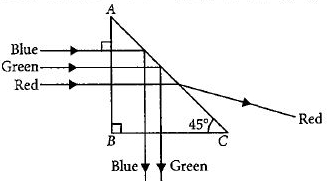
0 likesView Solution
67
PhysicsDifficultMCQAIPMT · 2015
Two identical thin plano-convex glass lenses (refractive index $1.5$) each having a radius of curvature of $20\, cm$ are placed with their convex surfaces in contact at the centre. The intervening space is filled with oil of refractive index $1.7$. The focal length of the combination is.......$cm$.
A
$-20$
B
$-25$
C
$-50$
D
$50$
Solution
(C) Using the lens maker's formula: $\frac{1}{f} = (\mu - 1) \left( \frac{1}{R_1} - \frac{1}{R_2} \right)$.
For the two identical plano-convex lenses ($f_1$ and $f_2$):
$\frac{1}{f_1} = (1.5 - 1) \left( \frac{1}{20} - \frac{1}{\infty} \right) = 0.5 \times \frac{1}{20} = \frac{1}{40} \, cm^{-1}$.
Similarly,$\frac{1}{f_2} = \frac{1}{40} \, cm^{-1}$.
The oil lens formed in the middle is a biconcave lens with radii of curvature $R_1 = -20 \, cm$ and $R_2 = 20 \, cm$ (or vice versa,resulting in the same focal length).
For the oil lens $(f_3)$:
$\frac{1}{f_3} = (1.7 - 1) \left( \frac{1}{-20} - \frac{1}{20} \right) = 0.7 \times \left( -\frac{2}{20} \right) = 0.7 \times \left( -\frac{1}{10} \right) = -\frac{0.7}{10} = -\frac{7}{100} \, cm^{-1}$.
The focal length of the combination is given by $\frac{1}{f} = \frac{1}{f_1} + \frac{1}{f_2} + \frac{1}{f_3}$.
$\frac{1}{f} = \frac{1}{40} + \frac{1}{40} - \frac{7}{100} = \frac{2}{40} - \frac{7}{100} = \frac{1}{20} - \frac{7}{100}$.
$\frac{1}{f} = \frac{5 - 7}{100} = -\frac{2}{100} = -\frac{1}{50}$.
Therefore,$f = -50 \, cm$.
For the two identical plano-convex lenses ($f_1$ and $f_2$):
$\frac{1}{f_1} = (1.5 - 1) \left( \frac{1}{20} - \frac{1}{\infty} \right) = 0.5 \times \frac{1}{20} = \frac{1}{40} \, cm^{-1}$.
Similarly,$\frac{1}{f_2} = \frac{1}{40} \, cm^{-1}$.
The oil lens formed in the middle is a biconcave lens with radii of curvature $R_1 = -20 \, cm$ and $R_2 = 20 \, cm$ (or vice versa,resulting in the same focal length).
For the oil lens $(f_3)$:
$\frac{1}{f_3} = (1.7 - 1) \left( \frac{1}{-20} - \frac{1}{20} \right) = 0.7 \times \left( -\frac{2}{20} \right) = 0.7 \times \left( -\frac{1}{10} \right) = -\frac{0.7}{10} = -\frac{7}{100} \, cm^{-1}$.
The focal length of the combination is given by $\frac{1}{f} = \frac{1}{f_1} + \frac{1}{f_2} + \frac{1}{f_3}$.
$\frac{1}{f} = \frac{1}{40} + \frac{1}{40} - \frac{7}{100} = \frac{2}{40} - \frac{7}{100} = \frac{1}{20} - \frac{7}{100}$.
$\frac{1}{f} = \frac{5 - 7}{100} = -\frac{2}{100} = -\frac{1}{50}$.
Therefore,$f = -50 \, cm$.
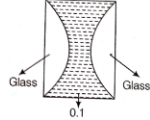
0 likesView Solution
68
PhysicsMediumMCQAIPMT · 2015
The refracting angle of a prism is $A,$ and the refractive index of the material of the prism is $\cot(A/2).$ The angle of minimum deviation is:
A
$180^o-3A$
B
$180^o-2A$
C
$90^o-A$
D
$180^o+2A$
Solution
(B) The formula for the refractive index $\mu$ of a prism in terms of the refracting angle $A$ and the angle of minimum deviation $\delta$ is given by:
$\mu = \frac{\sin((A+\delta)/2)}{\sin(A/2)}$
Given $\mu = \cot(A/2) = \frac{\cos(A/2)}{\sin(A/2)},$ we substitute this into the formula:
$\frac{\cos(A/2)}{\sin(A/2)} = \frac{\sin((A+\delta)/2)}{\sin(A/2)}$
Canceling $\sin(A/2)$ from both sides,we get:
$\cos(A/2) = \sin((A+\delta)/2)$
Using the trigonometric identity $\cos(\theta) = \sin(90^o - \theta)$:
$\sin(90^o - A/2) = \sin((A+\delta)/2)$
Equating the angles:
$90^o - A/2 = (A+\delta)/2$
$180^o - A = A + \delta$
$\delta = 180^o - 2A$
$\mu = \frac{\sin((A+\delta)/2)}{\sin(A/2)}$
Given $\mu = \cot(A/2) = \frac{\cos(A/2)}{\sin(A/2)},$ we substitute this into the formula:
$\frac{\cos(A/2)}{\sin(A/2)} = \frac{\sin((A+\delta)/2)}{\sin(A/2)}$
Canceling $\sin(A/2)$ from both sides,we get:
$\cos(A/2) = \sin((A+\delta)/2)$
Using the trigonometric identity $\cos(\theta) = \sin(90^o - \theta)$:
$\sin(90^o - A/2) = \sin((A+\delta)/2)$
Equating the angles:
$90^o - A/2 = (A+\delta)/2$
$180^o - A = A + \delta$
$\delta = 180^o - 2A$
1 likesView Solution
69
PhysicsMediumMCQAIPMT · 2015
Light of wavelength $500\, nm$ is incident on a metal with work function $2.28\, eV$. The de Broglie wavelength of the emitted electron is:
A
$\le 2.8 \times 10^{-12}\, m$
B
$< 2.8 \times 10^{-10}\, m$
C
$< 2.8 \times 10^{-9}\, m$
D
$\ge 2.8 \times 10^{-9}\, m$
Solution
(D) According to Einstein's photoelectric equation,the maximum kinetic energy of the emitted electron is $K_{\max} = \frac{hc}{\lambda} - \phi_0$,where $\lambda$ is the wavelength of incident light and $\phi_0$ is the work function.
Given: $\lambda = 500\, nm$,$hc = 1240\, eV\, nm$,and $\phi_0 = 2.28\, eV$.
$K_{\max} = \frac{1240\, eV\, nm}{500\, nm} - 2.28\, eV = 2.48\, eV - 2.28\, eV = 0.2\, eV$.
The de Broglie wavelength $\lambda_e$ is related to kinetic energy $K$ by $\lambda_e = \frac{h}{\sqrt{2mK}}$. Since $K \le K_{\max}$,the minimum wavelength corresponds to the maximum kinetic energy: $\lambda_{\min} = \frac{h}{\sqrt{2mK_{\max}}}$.
Using $h = 6.6 \times 10^{-34}\, J\, s$,$m = 9.1 \times 10^{-31}\, kg$,and $K_{\max} = 0.2 \times 1.6 \times 10^{-19}\, J$:
$\lambda_{\min} = \frac{6.6 \times 10^{-34}}{\sqrt{2 \times 9.1 \times 10^{-31} \times 0.32 \times 10^{-19}}} \approx 2.8 \times 10^{-9}\, m$.
Since $K \le K_{\max}$,it follows that $\lambda_e \ge \lambda_{\min}$. Thus,$\lambda_e \ge 2.8 \times 10^{-9}\, m$.
Given: $\lambda = 500\, nm$,$hc = 1240\, eV\, nm$,and $\phi_0 = 2.28\, eV$.
$K_{\max} = \frac{1240\, eV\, nm}{500\, nm} - 2.28\, eV = 2.48\, eV - 2.28\, eV = 0.2\, eV$.
The de Broglie wavelength $\lambda_e$ is related to kinetic energy $K$ by $\lambda_e = \frac{h}{\sqrt{2mK}}$. Since $K \le K_{\max}$,the minimum wavelength corresponds to the maximum kinetic energy: $\lambda_{\min} = \frac{h}{\sqrt{2mK_{\max}}}$.
Using $h = 6.6 \times 10^{-34}\, J\, s$,$m = 9.1 \times 10^{-31}\, kg$,and $K_{\max} = 0.2 \times 1.6 \times 10^{-19}\, J$:
$\lambda_{\min} = \frac{6.6 \times 10^{-34}}{\sqrt{2 \times 9.1 \times 10^{-31} \times 0.32 \times 10^{-19}}} \approx 2.8 \times 10^{-9}\, m$.
Since $K \le K_{\max}$,it follows that $\lambda_e \ge \lambda_{\min}$. Thus,$\lambda_e \ge 2.8 \times 10^{-9}\, m$.
0 likesView Solution
70
PhysicsDifficultMCQAIPMT · 2015
$A$ photoelectric surface is illuminated successively by monochromatic light of wavelength $\lambda$ and $\lambda /2$. If the maximum kinetic energy of the emitted photoelectrons in the second case is $3$ times that in the first case,the work function of the surface of the material is
$(h =$ Planck's constant,$c =$ speed of light $)$
$(h =$ Planck's constant,$c =$ speed of light $)$
A
$\frac{hc}{3\lambda}$
B
$\frac{hc}{2\lambda}$
C
$\frac{hc}{\lambda}$
D
$\frac{2hc}{\lambda}$
Solution
(B) Let $\phi_{0}$ be the work function of the surface of the material. According to Einstein's photoelectric equation,the maximum kinetic energy of the emitted photoelectrons in the first case is $K_{\max 1} = \frac{hc}{\lambda} - \phi_{0}$.
In the second case,the wavelength is $\lambda/2$,so the maximum kinetic energy is $K_{\max 2} = \frac{hc}{\lambda/2} - \phi_{0} = \frac{2hc}{\lambda} - \phi_{0}$.
Given that $K_{\max 2} = 3 K_{\max 1}$,we substitute the expressions:
$\frac{2hc}{\lambda} - \phi_{0} = 3 \left( \frac{hc}{\lambda} - \phi_{0} \right)$.
Expanding the equation: $\frac{2hc}{\lambda} - \phi_{0} = \frac{3hc}{\lambda} - 3\phi_{0}$.
Rearranging the terms: $3\phi_{0} - \phi_{0} = \frac{3hc}{\lambda} - \frac{2hc}{\lambda}$.
$2\phi_{0} = \frac{hc}{\lambda}$.
Therefore,the work function is $\phi_{0} = \frac{hc}{2\lambda}$.
In the second case,the wavelength is $\lambda/2$,so the maximum kinetic energy is $K_{\max 2} = \frac{hc}{\lambda/2} - \phi_{0} = \frac{2hc}{\lambda} - \phi_{0}$.
Given that $K_{\max 2} = 3 K_{\max 1}$,we substitute the expressions:
$\frac{2hc}{\lambda} - \phi_{0} = 3 \left( \frac{hc}{\lambda} - \phi_{0} \right)$.
Expanding the equation: $\frac{2hc}{\lambda} - \phi_{0} = \frac{3hc}{\lambda} - 3\phi_{0}$.
Rearranging the terms: $3\phi_{0} - \phi_{0} = \frac{3hc}{\lambda} - \frac{2hc}{\lambda}$.
$2\phi_{0} = \frac{hc}{\lambda}$.
Therefore,the work function is $\phi_{0} = \frac{hc}{2\lambda}$.
0 likesView Solution
71
PhysicsMediumMCQAIPMT · 2015
$A$ certain metallic surface is illuminated with monochromatic light of wavelength $\lambda$. The stopping potential for the photoelectric current for this light is $3V_0$. If the same surface is illuminated with light of wavelength $2\lambda$,the stopping potential is $V_0$. The threshold wavelength for this surface for the photoelectric effect is:
A
$6\lambda$
B
$4\lambda$
C
$\frac{\lambda}{4}$
D
$\frac{\lambda}{6}$
Solution
(B) According to Einstein's photoelectric equation,the maximum kinetic energy $K_{max} = eV_s = \frac{hc}{\lambda} - \phi_0$,where $\phi_0$ is the work function.
Case $(i)$: For wavelength $\lambda$,stopping potential is $3V_0$:
$3eV_0 = \frac{hc}{\lambda} - \phi_0$ ......... $(1)$
Case $(ii)$: For wavelength $2\lambda$,stopping potential is $V_0$:
$eV_0 = \frac{hc}{2\lambda} - \phi_0$ ......... $(2)$
Multiply equation $(2)$ by $3$:
$3eV_0 = \frac{3hc}{2\lambda} - 3\phi_0$ ......... $(3)$
Equating $(1)$ and $(3)$:
$\frac{hc}{\lambda} - \phi_0 = \frac{3hc}{2\lambda} - 3\phi_0$
$2\phi_0 = \frac{3hc}{2\lambda} - \frac{hc}{\lambda} = \frac{hc}{2\lambda}$
$\phi_0 = \frac{hc}{4\lambda}$
Since the threshold wavelength $\lambda_0 = \frac{hc}{\phi_0}$,substituting $\phi_0$:
$\lambda_0 = \frac{hc}{hc / 4\lambda} = 4\lambda$.
Case $(i)$: For wavelength $\lambda$,stopping potential is $3V_0$:
$3eV_0 = \frac{hc}{\lambda} - \phi_0$ ......... $(1)$
Case $(ii)$: For wavelength $2\lambda$,stopping potential is $V_0$:
$eV_0 = \frac{hc}{2\lambda} - \phi_0$ ......... $(2)$
Multiply equation $(2)$ by $3$:
$3eV_0 = \frac{3hc}{2\lambda} - 3\phi_0$ ......... $(3)$
Equating $(1)$ and $(3)$:
$\frac{hc}{\lambda} - \phi_0 = \frac{3hc}{2\lambda} - 3\phi_0$
$2\phi_0 = \frac{3hc}{2\lambda} - \frac{hc}{\lambda} = \frac{hc}{2\lambda}$
$\phi_0 = \frac{hc}{4\lambda}$
Since the threshold wavelength $\lambda_0 = \frac{hc}{\phi_0}$,substituting $\phi_0$:
$\lambda_0 = \frac{hc}{hc / 4\lambda} = 4\lambda$.
0 likesView Solution
72
PhysicsEasyMCQAIPMT · 2015
Which of the following figures represents the variation of particle momentum $p$ and the associated de-Broglie wavelength $\lambda$?
A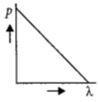
B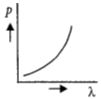
C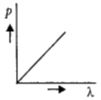
D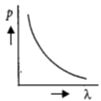
Solution
(D) The de-Broglie wavelength $\lambda$ is related to the momentum $p$ of a particle by the equation $\lambda = \frac{h}{p}$, where $h$ is Planck's constant.
This equation can be rewritten as $p \lambda = h$.
Since $h$ is a constant, the product of $p$ and $\lambda$ is constant $(p \lambda = \text{constant})$.
This relationship represents a rectangular hyperbola in the $p-\lambda$ plane, where $p$ decreases as $\lambda$ increases.
Therefore, the graph shown in Figure $D$ correctly represents this inverse relationship.
This equation can be rewritten as $p \lambda = h$.
Since $h$ is a constant, the product of $p$ and $\lambda$ is constant $(p \lambda = \text{constant})$.
This relationship represents a rectangular hyperbola in the $p-\lambda$ plane, where $p$ decreases as $\lambda$ increases.
Therefore, the graph shown in Figure $D$ correctly represents this inverse relationship.
0 likesView Solution
73
PhysicsMediumMCQAIPMT · 2015
An electron moves on a straight line path $XY$ as shown. The $abcd$ is a coil adjacent to the path of the electron. What will be the direction of current,if any,induced in the coil?
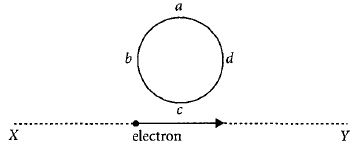
A
No current induced
B
$abcd$
C
$adcb$
D
The current will reverse its direction as the electron goes past the coil.
Solution
(D) As the electron moves from $X$ to $Y$,it creates a magnetic field. According to the right-hand rule,the magnetic field lines pass through the coil $abcd$ in a direction perpendicular to the plane of the coil (into the page).
As the electron approaches the coil,the magnetic flux linked with the coil increases. According to Lenz's Law,the induced current will oppose this increase by creating a magnetic field in the opposite direction (out of the page),which corresponds to an anticlockwise direction $(adcb)$.
As the electron moves away from the coil,the magnetic flux linked with the coil decreases. The induced current will now oppose this decrease by creating a magnetic field in the same direction as the original field (into the page),which corresponds to a clockwise direction $(abcd)$.
Therefore,the current will reverse its direction as the electron goes past the coil.
As the electron approaches the coil,the magnetic flux linked with the coil increases. According to Lenz's Law,the induced current will oppose this increase by creating a magnetic field in the opposite direction (out of the page),which corresponds to an anticlockwise direction $(adcb)$.
As the electron moves away from the coil,the magnetic flux linked with the coil decreases. The induced current will now oppose this decrease by creating a magnetic field in the same direction as the original field (into the page),which corresponds to a clockwise direction $(abcd)$.
Therefore,the current will reverse its direction as the electron goes past the coil.
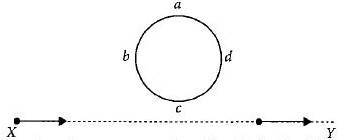
0 likesView Solution
74
PhysicsMediumMCQAIPMT · 2015
$A$ series $R-C$ circuit is connected to an alternating voltage source. Consider two situations:
$(a)$ When the capacitor is air-filled.
$(b)$ When the capacitor is mica-filled.
If the current through the resistor is $i$ and the voltage across the capacitor is $V$,then:
$(a)$ When the capacitor is air-filled.
$(b)$ When the capacitor is mica-filled.
If the current through the resistor is $i$ and the voltage across the capacitor is $V$,then:
A
$V_a = V_b$
B
$V_a < V_b$
C
$V_a > V_b$
D
$i_a > i_b$
Solution
(C) The current $i$ in a series $R-C$ circuit is given by:
$i = \frac{V_0}{Z} = \frac{V_0}{\sqrt{R^2 + X_C^2}} = \frac{V_0}{\sqrt{R^2 + (1/\omega C)^2}}$
The voltage across the capacitor is $V = i X_C = i \cdot \frac{1}{\omega C}$.
Substituting the expression for $i$:
$V = \frac{V_0}{\sqrt{R^2 + (1/\omega C)^2}} \cdot \frac{1}{\omega C} = \frac{V_0}{\sqrt{R^2 \omega^2 C^2 + 1}}$
When the capacitor is filled with mica (dielectric constant $K > 1$),its capacitance increases,so $C_b > C_a$.
$1$. For current: As $C$ increases,$X_C = 1/\omega C$ decreases,so the impedance $Z = \sqrt{R^2 + X_C^2}$ decreases. Thus,$i_b > i_a$.
$2$. For voltage across the capacitor: From $V = \frac{V_0}{\sqrt{R^2 \omega^2 C^2 + 1}}$,as $C$ increases,the denominator increases,which means $V$ decreases. Therefore,$V_b < V_a$,or $V_a > V_b$.
$i = \frac{V_0}{Z} = \frac{V_0}{\sqrt{R^2 + X_C^2}} = \frac{V_0}{\sqrt{R^2 + (1/\omega C)^2}}$
The voltage across the capacitor is $V = i X_C = i \cdot \frac{1}{\omega C}$.
Substituting the expression for $i$:
$V = \frac{V_0}{\sqrt{R^2 + (1/\omega C)^2}} \cdot \frac{1}{\omega C} = \frac{V_0}{\sqrt{R^2 \omega^2 C^2 + 1}}$
When the capacitor is filled with mica (dielectric constant $K > 1$),its capacitance increases,so $C_b > C_a$.
$1$. For current: As $C$ increases,$X_C = 1/\omega C$ decreases,so the impedance $Z = \sqrt{R^2 + X_C^2}$ decreases. Thus,$i_b > i_a$.
$2$. For voltage across the capacitor: From $V = \frac{V_0}{\sqrt{R^2 \omega^2 C^2 + 1}}$,as $C$ increases,the denominator increases,which means $V$ decreases. Therefore,$V_b < V_a$,or $V_a > V_b$.
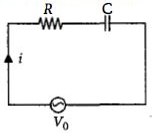
0 likesView Solution
75
PhysicsMediumMCQAIPMT · 2015
$A$ resistance $R$ draws power $P$ when connected to an $AC$ source. If an inductance is now placed in series with the resistance,such that the impedance of the circuit becomes $Z$,the power drawn will be
A
$P \left( \frac{R}{Z} \right)^2$
B
$P \sqrt{\frac{R}{Z}}$
C
$P \left( \frac{R}{Z} \right)$
D
$P$
Solution
(A) Case $I$: The power consumed by a purely resistive circuit is given by $P = V_{\text{rms}} I_{\text{rms}}$.
Since $I_{\text{rms}} = \frac{V_{\text{rms}}}{R}$,we have $P = \frac{V_{\text{rms}}^2}{R}$,which implies $V_{\text{rms}}^2 = P R$ ... $(i)$.
Case $II$: When an inductance $L$ is connected in series with the resistance $R$,the circuit becomes an $LR$ circuit with impedance $Z$.
The power consumed in an $AC$ circuit is given by $P' = V_{\text{rms}} I_{\text{rms}} \cos \phi$,where $\cos \phi = \frac{R}{Z}$ is the power factor.
Here,$I_{\text{rms}} = \frac{V_{\text{rms}}}{Z}$.
Substituting these values,we get $P' = V_{\text{rms}} \times \left( \frac{V_{\text{rms}}}{Z} \right) \times \left( \frac{R}{Z} \right) = V_{\text{rms}}^2 \frac{R}{Z^2}$.
Using equation $(i)$,$V_{\text{rms}}^2 = P R$,so $P' = (P R) \frac{R}{Z^2} = P \left( \frac{R}{Z} \right)^2$.
Since $I_{\text{rms}} = \frac{V_{\text{rms}}}{R}$,we have $P = \frac{V_{\text{rms}}^2}{R}$,which implies $V_{\text{rms}}^2 = P R$ ... $(i)$.
Case $II$: When an inductance $L$ is connected in series with the resistance $R$,the circuit becomes an $LR$ circuit with impedance $Z$.
The power consumed in an $AC$ circuit is given by $P' = V_{\text{rms}} I_{\text{rms}} \cos \phi$,where $\cos \phi = \frac{R}{Z}$ is the power factor.
Here,$I_{\text{rms}} = \frac{V_{\text{rms}}}{Z}$.
Substituting these values,we get $P' = V_{\text{rms}} \times \left( \frac{V_{\text{rms}}}{Z} \right) \times \left( \frac{R}{Z} \right) = V_{\text{rms}}^2 \frac{R}{Z^2}$.
Using equation $(i)$,$V_{\text{rms}}^2 = P R$,so $P' = (P R) \frac{R}{Z^2} = P \left( \frac{R}{Z} \right)^2$.
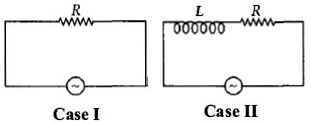
0 likesView Solution
76
PhysicsEasyMCQAIPMT · 2015
$A$ radiation of energy $E$ falls normally on a perfectly reflecting surface. The momentum transferred to the surface is ($C =$ velocity of light).
A
$E/C$
B
$2E/C$
C
$2E/C^2$
D
$E/C^2$
Solution
(B) The energy of a photon is given by $E = pc$,where $p$ is the momentum of the photon and $C$ is the speed of light.
Therefore,the initial momentum of the radiation incident on the surface is $p_i = E/C$.
Since the surface is perfectly reflecting,the radiation reflects back with the same magnitude of momentum but in the opposite direction.
Thus,the final momentum of the radiation is $p_f = -E/C$.
The momentum transferred to the surface is the change in momentum of the radiation,given by $\Delta p = p_i - p_f$.
Substituting the values,we get $\Delta p = E/C - (-E/C) = E/C + E/C = 2E/C$.
Therefore,the initial momentum of the radiation incident on the surface is $p_i = E/C$.
Since the surface is perfectly reflecting,the radiation reflects back with the same magnitude of momentum but in the opposite direction.
Thus,the final momentum of the radiation is $p_f = -E/C$.
The momentum transferred to the surface is the change in momentum of the radiation,given by $\Delta p = p_i - p_f$.
Substituting the values,we get $\Delta p = E/C - (-E/C) = E/C + E/C = 2E/C$.
0 likesView Solution
77
PhysicsMediumMCQAIPMT · 2015
The energy of the electromagnetic waves is of the order of $15\, keV$. To which part of the spectrum does it belong?
A
$\gamma$-rays
B
$X$-rays
C
Infra-red rays
D
Ultraviolet rays
Solution
(B) The energy $E$ of a photon is related to its wavelength $\lambda$ by the formula $\lambda = \frac{hc}{E}$.
Given,$E = 15\, keV = 15 \times 10^3\, eV$.
The value of $hc$ is approximately $1240\, eV\, nm$.
Substituting these values,we get $\lambda = \frac{1240\, eV\, nm}{15 \times 10^3\, eV} \approx 0.083\, nm$.
The wavelength range for $X$-rays typically spans from $1\, nm$ to $10^{-3}\, nm$.
Since $0.083\, nm$ falls within this range,the electromagnetic waves belong to the $X$-ray part of the spectrum.
Given,$E = 15\, keV = 15 \times 10^3\, eV$.
The value of $hc$ is approximately $1240\, eV\, nm$.
Substituting these values,we get $\lambda = \frac{1240\, eV\, nm}{15 \times 10^3\, eV} \approx 0.083\, nm$.
The wavelength range for $X$-rays typically spans from $1\, nm$ to $10^{-3}\, nm$.
Since $0.083\, nm$ falls within this range,the electromagnetic waves belong to the $X$-ray part of the spectrum.
0 likesView Solution
78
PhysicsMediumMCQAIPMT · 2015
In a double slit experiment,the two slits are $1\, mm$ apart and the screen is placed $1\, m$ away. $A$ monochromatic light of wavelength $500\, nm$ is used. What will be the width of each slit for obtaining ten maxima of the double slit pattern within the central maxima of the single slit pattern? .......$mm$
A
$0.2$
B
$0.1$
C
$0.5$
D
$0.02$
Solution
(A) Given:
Distance between slits $d = 1\, mm = 1 \times 10^{-3}\, m$
Distance of screen $D = 1\, m$
Wavelength $\lambda = 500\, nm = 500 \times 10^{-9}\, m$
The width of the central maximum in a single-slit diffraction pattern is given by $w = \frac{2\lambda D}{a}$,where $a$ is the slit width.
The width of one fringe in a double-slit interference pattern is $\beta = \frac{\lambda D}{d}$.
According to the problem,the width of the central maximum of the single-slit pattern contains $10$ maxima of the double-slit pattern.
Therefore,$\frac{2\lambda D}{a} = 10 \times \frac{\lambda D}{d}$.
Simplifying the equation: $\frac{2}{a} = \frac{10}{d}$.
$a = \frac{2d}{10} = \frac{d}{5}$.
Substituting $d = 1\, mm$:
$a = \frac{1\, mm}{5} = 0.2\, mm$.
Distance between slits $d = 1\, mm = 1 \times 10^{-3}\, m$
Distance of screen $D = 1\, m$
Wavelength $\lambda = 500\, nm = 500 \times 10^{-9}\, m$
The width of the central maximum in a single-slit diffraction pattern is given by $w = \frac{2\lambda D}{a}$,where $a$ is the slit width.
The width of one fringe in a double-slit interference pattern is $\beta = \frac{\lambda D}{d}$.
According to the problem,the width of the central maximum of the single-slit pattern contains $10$ maxima of the double-slit pattern.
Therefore,$\frac{2\lambda D}{a} = 10 \times \frac{\lambda D}{d}$.
Simplifying the equation: $\frac{2}{a} = \frac{10}{d}$.
$a = \frac{2d}{10} = \frac{d}{5}$.
Substituting $d = 1\, mm$:
$a = \frac{1\, mm}{5} = 0.2\, mm$.
0 likesView Solution
79
PhysicsMediumMCQAIPMT · 2015
Two slits in Young's experiment have widths in the ratio $1 : 25$. The ratio of intensity at the maxima and minima in the interference pattern,$\frac{I_{max}}{I_{min}}$ is
A
$\frac{4}{9}$
B
$\frac{9}{4}$
C
$\frac{121}{49}$
D
$\frac{49}{121}$
Solution
(B) The intensity $I$ of light is directly proportional to the width $W$ of the slit,and also to the square of the amplitude $A$ of the wave.
$\therefore \frac{I_1}{I_2} = \frac{W_1}{W_2} = \frac{A_1^2}{A_2^2}$
Given the ratio of widths $\frac{W_1}{W_2} = \frac{1}{25}$,we have:
$\frac{A_1^2}{A_2^2} = \frac{1}{25} \implies \frac{A_1}{A_2} = \sqrt{\frac{1}{25}} = \frac{1}{5}$
The ratio of maximum intensity to minimum intensity is given by:
$\frac{I_{max}}{I_{min}} = \frac{(A_1 + A_2)^2}{(A_1 - A_2)^2} = \left( \frac{\frac{A_1}{A_2} + 1}{\frac{A_1}{A_2} - 1} \right)^2$
Substituting $\frac{A_1}{A_2} = \frac{1}{5}$:
$\frac{I_{max}}{I_{min}} = \left( \frac{\frac{1}{5} + 1}{\frac{1}{5} - 1} \right)^2 = \left( \frac{\frac{6}{5}}{-\frac{4}{5}} \right)^2 = \left( -\frac{6}{4} \right)^2 = \left( -\frac{3}{2} \right)^2 = \frac{9}{4}$
$\therefore \frac{I_1}{I_2} = \frac{W_1}{W_2} = \frac{A_1^2}{A_2^2}$
Given the ratio of widths $\frac{W_1}{W_2} = \frac{1}{25}$,we have:
$\frac{A_1^2}{A_2^2} = \frac{1}{25} \implies \frac{A_1}{A_2} = \sqrt{\frac{1}{25}} = \frac{1}{5}$
The ratio of maximum intensity to minimum intensity is given by:
$\frac{I_{max}}{I_{min}} = \frac{(A_1 + A_2)^2}{(A_1 - A_2)^2} = \left( \frac{\frac{A_1}{A_2} + 1}{\frac{A_1}{A_2} - 1} \right)^2$
Substituting $\frac{A_1}{A_2} = \frac{1}{5}$:
$\frac{I_{max}}{I_{min}} = \left( \frac{\frac{1}{5} + 1}{\frac{1}{5} - 1} \right)^2 = \left( \frac{\frac{6}{5}}{-\frac{4}{5}} \right)^2 = \left( -\frac{6}{4} \right)^2 = \left( -\frac{3}{2} \right)^2 = \frac{9}{4}$
0 likesView Solution
80
PhysicsMediumMCQAIPMT · 2015
For a parallel beam of monochromatic light of wavelength $\lambda$,diffraction is produced by a single slit whose width $a$ is of the order of the wavelength of the light. If $D$ is the distance of the screen from the slit,the width of the central maxima will be
A
$\frac{2D\lambda}{a}$
B
$\frac{D\lambda}{a}$
C
$\frac{Da}{\lambda}$
D
$\frac{2Da}{\lambda}$
Solution
(A) In single slit diffraction,the condition for the first minima on either side of the central maxima is given by $a \sin \theta = \pm \lambda$.
For small angles,$\sin \theta \approx \theta = \frac{\lambda}{a}$.
The distance of the first minima from the center of the screen is $y = D \tan \theta \approx D \theta = \frac{D \lambda}{a}$.
The central maxima lies between the first minima on both sides,so its total width is $2y = \frac{2D \lambda}{a}$.
For small angles,$\sin \theta \approx \theta = \frac{\lambda}{a}$.
The distance of the first minima from the center of the screen is $y = D \tan \theta \approx D \theta = \frac{D \lambda}{a}$.
The central maxima lies between the first minima on both sides,so its total width is $2y = \frac{2D \lambda}{a}$.
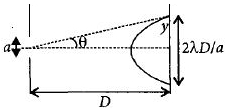
0 likesView Solution
81
PhysicsMediumMCQAIPMT · 2015
At the first minimum adjacent to the central maximum of a single-slit diffraction pattern,the phase difference between the Huygens' wavelet from the edge of the slit and the wavelet from the midpoint of the slit is
A
$\frac{\pi}{8} \text{ rad}$
B
$\frac{\pi}{4} \text{ rad}$
C
$\frac{\pi}{2} \text{ rad}$
D
$\pi \text{ rad}$
Solution
(D) The situation is shown in the figure. In the figure,$A$ and $B$ represent the edges of the slit $AB$ of width $a$,and $C$ represents the midpoint of the slit. For the first minimum at $P$,the condition is given by:
$a \sin \theta = \lambda$ ...... $(i)$
where $\lambda$ is the wavelength of light.
The path difference $\Delta x$ between the wavelets from the edge $A$ and the midpoint $C$ is:
$\Delta x = \frac{a}{2} \sin \theta = \frac{1}{2}(a \sin \theta) = \frac{\lambda}{2}$ (using equation $(i)$).
The corresponding phase difference $\Delta \phi$ is given by the relation:
$\Delta \phi = \frac{2 \pi}{\lambda} \Delta x = \frac{2 \pi}{\lambda} \times \frac{\lambda}{2} = \pi \text{ rad}$.
$a \sin \theta = \lambda$ ...... $(i)$
where $\lambda$ is the wavelength of light.
The path difference $\Delta x$ between the wavelets from the edge $A$ and the midpoint $C$ is:
$\Delta x = \frac{a}{2} \sin \theta = \frac{1}{2}(a \sin \theta) = \frac{\lambda}{2}$ (using equation $(i)$).
The corresponding phase difference $\Delta \phi$ is given by the relation:
$\Delta \phi = \frac{2 \pi}{\lambda} \Delta x = \frac{2 \pi}{\lambda} \times \frac{\lambda}{2} = \pi \text{ rad}$.
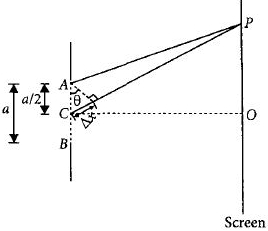
0 likesView Solution
82
PhysicsDifficultMCQAIPMT · 2015
In the spectrum of hydrogen,the ratio of the longest wavelength in the Lyman series to the longest wavelength in the Balmer series is
A
$5/27$
B
$4/9$
C
$9/4$
D
$27/5$
Solution
(A) The wavelength of a spectral line in the Lyman series is given by $\frac{1}{\lambda_{L}} = R\left(\frac{1}{1^{2}} - \frac{1}{n^{2}}\right)$,where $n = 2, 3, 4, \dots$.
For the longest wavelength in the Lyman series,we take $n = 2$:
$\frac{1}{\lambda_{L}} = R\left(1 - \frac{1}{4}\right) = \frac{3R}{4} \implies \lambda_{L} = \frac{4}{3R}$.
The wavelength of a spectral line in the Balmer series is given by $\frac{1}{\lambda_{B}} = R\left(\frac{1}{2^{2}} - \frac{1}{n^{2}}\right)$,where $n = 3, 4, 5, \dots$.
For the longest wavelength in the Balmer series,we take $n = 3$:
$\frac{1}{\lambda_{B}} = R\left(\frac{1}{4} - \frac{1}{9}\right) = R\left(\frac{9-4}{36}\right) = \frac{5R}{36} \implies \lambda_{B} = \frac{36}{5R}$.
The ratio of the longest wavelength in the Lyman series to the longest wavelength in the Balmer series is:
$\frac{\lambda_{L}}{\lambda_{B}} = \frac{4/3R}{36/5R} = \frac{4}{3R} \times \frac{5R}{36} = \frac{5}{27}$.
For the longest wavelength in the Lyman series,we take $n = 2$:
$\frac{1}{\lambda_{L}} = R\left(1 - \frac{1}{4}\right) = \frac{3R}{4} \implies \lambda_{L} = \frac{4}{3R}$.
The wavelength of a spectral line in the Balmer series is given by $\frac{1}{\lambda_{B}} = R\left(\frac{1}{2^{2}} - \frac{1}{n^{2}}\right)$,where $n = 3, 4, 5, \dots$.
For the longest wavelength in the Balmer series,we take $n = 3$:
$\frac{1}{\lambda_{B}} = R\left(\frac{1}{4} - \frac{1}{9}\right) = R\left(\frac{9-4}{36}\right) = \frac{5R}{36} \implies \lambda_{B} = \frac{36}{5R}$.
The ratio of the longest wavelength in the Lyman series to the longest wavelength in the Balmer series is:
$\frac{\lambda_{L}}{\lambda_{B}} = \frac{4/3R}{36/5R} = \frac{4}{3R} \times \frac{5R}{36} = \frac{5}{27}$.
0 likesView Solution
83
PhysicsMediumMCQAIPMT · 2015
Consider the $3^{rd}$ orbit of $He^{+}$ (Helium) using a non-relativistic approach. The speed of the electron in this orbit will be (given $K = 9 \times 10^9 \; N \cdot m^2/C^2$,$Z = 2$,and $h = 6.6 \times 10^{-34} \; J \cdot s$).
A
$2.92 \times 10^6 \; m/s$
B
$1.46 \times 10^6 \; m/s$
C
$0.73 \times 10^6 \; m/s$
D
$3.0 \times 10^8 \; m/s$
Solution
(B) According to Bohr's theory,the velocity of an electron in the $n^{th}$ orbit of a hydrogen-like atom is given by the formula:
$v_n = v_0 \times \frac{Z}{n}$
where $v_0 = 2.18 \times 10^6 \; m/s$ is the velocity of an electron in the first orbit of the hydrogen atom.
For $He^{+}$,$Z = 2$ and for the $3^{rd}$ orbit,$n = 3$.
Substituting these values:
$v_3 = (2.18 \times 10^6) \times \frac{2}{3} \; m/s$
$v_3 = 2.18 \times 10^6 \times 0.666... \; m/s$
$v_3 \approx 1.453 \times 10^6 \; m/s \approx 1.46 \times 10^6 \; m/s$.
$v_n = v_0 \times \frac{Z}{n}$
where $v_0 = 2.18 \times 10^6 \; m/s$ is the velocity of an electron in the first orbit of the hydrogen atom.
For $He^{+}$,$Z = 2$ and for the $3^{rd}$ orbit,$n = 3$.
Substituting these values:
$v_3 = (2.18 \times 10^6) \times \frac{2}{3} \; m/s$
$v_3 = 2.18 \times 10^6 \times 0.666... \; m/s$
$v_3 \approx 1.453 \times 10^6 \; m/s \approx 1.46 \times 10^6 \; m/s$.
0 likesView Solution
84
PhysicsMediumMCQAIPMT · 2015
$A$ nucleus of uranium decays at rest into nuclei of thorium and helium. Then:
A
The helium nucleus has less momentum than the thorium nucleus.
B
The helium nucleus has more momentum than the thorium nucleus.
C
The helium nucleus has less kinetic energy than the thorium nucleus.
D
The helium nucleus has more kinetic energy than the thorium nucleus.
Solution
(D) If $\vec{p}_{Th}$ and $\vec{p}_{He}$ are the momenta of thorium and helium nuclei respectively,then according to the law of conservation of linear momentum:
$0 = \vec{p}_{Th} + \vec{p}_{He}$ or $\vec{p}_{Th} = -\vec{p}_{He}$.
The negative sign shows that both are moving in opposite directions. However,in magnitude,$p_{Th} = p_{He}$.
If $m_{Th}$ and $m_{He}$ are the masses of thorium and helium nuclei respectively,then the kinetic energy of the thorium nucleus is $K_{Th} = \frac{p_{Th}^2}{2m_{Th}}$ and that of the helium nucleus is $K_{He} = \frac{p_{He}^2}{2m_{He}}$.
Therefore,$\frac{K_{Th}}{K_{He}} = \left(\frac{p_{Th}}{p_{He}}\right)^2 \left(\frac{m_{He}}{m_{Th}}\right)$.
Since $p_{Th} = p_{He}$ and $m_{He} < m_{Th}$,it follows that $K_{Th} < K_{He}$ or $K_{He} > K_{Th}$.
Thus,the helium nucleus has more kinetic energy than the thorium nucleus.
$0 = \vec{p}_{Th} + \vec{p}_{He}$ or $\vec{p}_{Th} = -\vec{p}_{He}$.
The negative sign shows that both are moving in opposite directions. However,in magnitude,$p_{Th} = p_{He}$.
If $m_{Th}$ and $m_{He}$ are the masses of thorium and helium nuclei respectively,then the kinetic energy of the thorium nucleus is $K_{Th} = \frac{p_{Th}^2}{2m_{Th}}$ and that of the helium nucleus is $K_{He} = \frac{p_{He}^2}{2m_{He}}$.
Therefore,$\frac{K_{Th}}{K_{He}} = \left(\frac{p_{Th}}{p_{He}}\right)^2 \left(\frac{m_{He}}{m_{Th}}\right)$.
Since $p_{Th} = p_{He}$ and $m_{He} < m_{Th}$,it follows that $K_{Th} < K_{He}$ or $K_{He} > K_{Th}$.
Thus,the helium nucleus has more kinetic energy than the thorium nucleus.
0 likesView Solution
85
PhysicsMediumMCQAIPMT · 2015
If the radius of the $^{27}_{13}Al$ nucleus is taken to be $R_{Al}$,then the radius of the $^{125}_{53}Te$ nucleus is nearly
A
$(\frac{53}{13})^{1/3} R_{Al}$
B
$\frac{5}{3} R_{Al}$
C
$\frac{3}{5} R_{Al}$
D
$(\frac{13}{53})^{1/3} R_{Al}$
Solution
(B) The radius of a nucleus is given by the formula $R = R_0 A^{1/3}$,where $A$ is the mass number and $R_0$ is a constant.
For the $^{27}_{13}Al$ nucleus,the mass number $A_{Al} = 27$. Thus,$R_{Al} = R_0 (27)^{1/3} = 3 R_0$.
For the $^{125}_{53}Te$ nucleus,the mass number $A_{Te} = 125$. Thus,$R_{Te} = R_0 (125)^{1/3} = 5 R_0$.
Taking the ratio of the two radii:
$\frac{R_{Te}}{R_{Al}} = \frac{5 R_0}{3 R_0} = \frac{5}{3}$.
Therefore,$R_{Te} = \frac{5}{3} R_{Al}$.
For the $^{27}_{13}Al$ nucleus,the mass number $A_{Al} = 27$. Thus,$R_{Al} = R_0 (27)^{1/3} = 3 R_0$.
For the $^{125}_{53}Te$ nucleus,the mass number $A_{Te} = 125$. Thus,$R_{Te} = R_0 (125)^{1/3} = 5 R_0$.
Taking the ratio of the two radii:
$\frac{R_{Te}}{R_{Al}} = \frac{5 R_0}{3 R_0} = \frac{5}{3}$.
Therefore,$R_{Te} = \frac{5}{3} R_{Al}$.
0 likesView Solution
86
PhysicsMediumMCQAIPMT · 2015
The input signal given to a $CE$ amplifier having a voltage gain of $150$ is $V_{in} = 2 \cos(15t + \frac{\pi}{3}) \text{ V}$. The corresponding output signal will be:
A
$300 \cos(15t + \frac{4\pi}{3}) \text{ V}$
B
$300 \cos(15t + \frac{\pi}{3}) \text{ V}$
C
$300 \cos(15t + \frac{2\pi}{3}) \text{ V}$
D
$2 \cos(15t + \frac{5\pi}{6}) \text{ V}$
Solution
(A) Given, input signal $V_{i} = 2 \cos(15t + \frac{\pi}{3})$ and voltage gain $A_{v} = 150$.
The voltage gain is defined as $A_{v} = \frac{V_{o}}{V_{i}}$, so the output signal magnitude is $V_{o} = A_{v} \times V_{i}$.
A common emitter $(CE)$ amplifier introduces a phase shift of $\pi$ $(180^{\circ})$ between the input and output signals.
Therefore, the output signal is $V_{o} = 150 \times 2 \cos(15t + \frac{\pi}{3} + \pi)$.
Simplifying the phase, $\frac{\pi}{3} + \pi = \frac{4\pi}{3}$.
Thus, $V_{o} = 300 \cos(15t + \frac{4\pi}{3}) \text{ V}$.
The voltage gain is defined as $A_{v} = \frac{V_{o}}{V_{i}}$, so the output signal magnitude is $V_{o} = A_{v} \times V_{i}$.
A common emitter $(CE)$ amplifier introduces a phase shift of $\pi$ $(180^{\circ})$ between the input and output signals.
Therefore, the output signal is $V_{o} = 150 \times 2 \cos(15t + \frac{\pi}{3} + \pi)$.
Simplifying the phase, $\frac{\pi}{3} + \pi = \frac{4\pi}{3}$.
Thus, $V_{o} = 300 \cos(15t + \frac{4\pi}{3}) \text{ V}$.
0 likesView Solution
87
PhysicsMediumMCQAIPMT · 2015
In the given figure,a diode $D$ is connected to an external resistance $R = 100 \,\Omega$ and an $e.m.f.$ of $3.5 \,V$. If the barrier potential developed across the diode is $0.5 \,V$,the current in the circuit will be ........ $mA$.
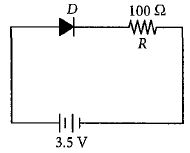
A
$35$
B
$30$
C
$40$
D
$20$
Solution
(B) The potential difference across the resistance $R$ is given by subtracting the barrier potential of the diode from the total $e.m.f.$ of the circuit:
$V_R = E - V_{\text{barrier}} = 3.5 \,V - 0.5 \,V = 3.0 \,V$
According to Ohm's law,the current $I$ in the circuit is:
$I = \frac{V_R}{R} = \frac{3.0 \,V}{100 \,\Omega} = 0.03 \,A$
To convert the current into milliamperes $(mA)$:
$I = 0.03 \,A \times 1000 \,mA/A = 30 \,mA$
Therefore,the current in the circuit is $30 \,mA$.
$V_R = E - V_{\text{barrier}} = 3.5 \,V - 0.5 \,V = 3.0 \,V$
According to Ohm's law,the current $I$ in the circuit is:
$I = \frac{V_R}{R} = \frac{3.0 \,V}{100 \,\Omega} = 0.03 \,A$
To convert the current into milliamperes $(mA)$:
$I = 0.03 \,A \times 1000 \,mA/A = 30 \,mA$
Therefore,the current in the circuit is $30 \,mA$.
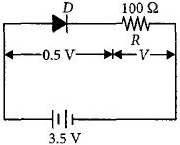
0 likesView Solution
88
PhysicsMediumMCQAIPMT · 2015
In an astronomical telescope in normal adjustment,a straight black line of length $L$ is drawn on the objective lens. The eyepiece forms a real image of this line. The length of this image is $l$. The magnification of the telescope is
A
$L/l$
B
$L/l + 1$
C
$L/l - 1$
D
$(L + l)/(L - l)$
Solution
(A) In normal adjustment,the distance between the objective lens and the eyepiece is $f_0 + f_e$.
Since the line of length $L$ is on the objective lens,it acts as an object for the eyepiece.
The distance of this object from the eyepiece is $u = -(f_0 + f_e)$.
The magnification of the eyepiece is given by $m_e = f_e / (f_e + u)$.
Substituting the value of $u$:
$m_e = f_e / (f_e - (f_0 + f_e)) = f_e / (-f_0) = -f_e / f_0$.
The magnitude of magnification is $|m_e| = l / L = f_e / f_0$.
Since the magnification of the telescope is $M = f_0 / f_e$,we have $M = L / l$.
Since the line of length $L$ is on the objective lens,it acts as an object for the eyepiece.
The distance of this object from the eyepiece is $u = -(f_0 + f_e)$.
The magnification of the eyepiece is given by $m_e = f_e / (f_e + u)$.
Substituting the value of $u$:
$m_e = f_e / (f_e - (f_0 + f_e)) = f_e / (-f_0) = -f_e / f_0$.
The magnitude of magnification is $|m_e| = l / L = f_e / f_0$.
Since the magnification of the telescope is $M = f_0 / f_e$,we have $M = L / l$.
0 likesView Solution
89
PhysicsMediumMCQAIPMT · 2015
The figure shows a combination of two $NOT$ gates and a $NOR$ gate. The combination is equivalent to a
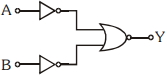
A
$NAND$ gate
B
$NOR$ gate
C
$AND$ gate
D
$OR$ gate
Solution
(C) The inputs to the $NOR$ gate are $\bar{A}$ and $\bar{B}$ because they pass through $NOT$ gates. The output $Y$ of the $NOR$ gate is given by the Boolean expression: $Y = \overline{\bar{A} + \bar{B}}$.
According to De Morgan's theorem,$\overline{\bar{A} + \bar{B}} = \overline{\bar{A}} \cdot \overline{\bar{B}} = A \cdot B$.
This is the Boolean expression for an $AND$ gate.
Truth table:
Thus,the combination is equivalent to an $AND$ gate.
According to De Morgan's theorem,$\overline{\bar{A} + \bar{B}} = \overline{\bar{A}} \cdot \overline{\bar{B}} = A \cdot B$.
This is the Boolean expression for an $AND$ gate.
Truth table:
| $A$ | $B$ | $\bar{A}$ | $\bar{B}$ | $\bar{A} + \bar{B}$ | $Y = \overline{\bar{A} + \bar{B}}$ |
| $0$ | $0$ | $1$ | $1$ | $1$ | $0$ |
| $0$ | $1$ | $1$ | $0$ | $1$ | $0$ |
| $1$ | $0$ | $0$ | $1$ | $1$ | $0$ |
| $1$ | $1$ | $0$ | $0$ | $0$ | $1$ |
Thus,the combination is equivalent to an $AND$ gate.
0 likesView Solution
90
PhysicsMediumMCQAIPMT · 2015
If in a $p-n$ junction diode,a square input signal of $10\, V$ (varying from $+5\, V$ to $-5\, V$) is applied as shown,then the output signal across $R_L$ will be:
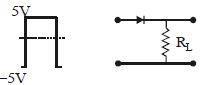
A
B
C
D
Solution
(A) The circuit consists of a $p-n$ junction diode in series with a load resistor $R_L$.
When the input voltage is $+5\, V$,the diode is forward-biased. Assuming an ideal diode,it acts as a short circuit,and the entire input voltage of $+5\, V$ appears across the load resistor $R_L$.
When the input voltage is $-5\, V$,the diode is reverse-biased. It acts as an open circuit,and no current flows through the resistor $R_L$. Therefore,the output voltage across $R_L$ is $0\, V$.
Thus,the output signal is a square wave that varies between $+5\, V$ and $0\, V$.
When the input voltage is $+5\, V$,the diode is forward-biased. Assuming an ideal diode,it acts as a short circuit,and the entire input voltage of $+5\, V$ appears across the load resistor $R_L$.
When the input voltage is $-5\, V$,the diode is reverse-biased. It acts as an open circuit,and no current flows through the resistor $R_L$. Therefore,the output voltage across $R_L$ is $0\, V$.
Thus,the output signal is a square wave that varies between $+5\, V$ and $0\, V$.
0 likesView Solution
Vedclass Products
For Students
Vedclass Test Series
Mock tests in real AIPMT style covering Physics with performance analysis. 5-day free trial.
Start Free TrialFor Teachers
Exam Paper Generator
Generate Set A/B/C/D Physics papers from 7.5L+ questions in 2 minutes. 3 chapters free.
Try FreeFor Institutes
Online Exam Module
Run live AIPMT mock exams with unlimited students, 360° analytics & white-label branding.
See DemoFrequently Asked Questions
How many Physics questions are in AIPMT 2015?
There are 90 Physics questions from the AIPMT 2015 paper on Vedclass, each with a detailed step-by-step solution in English.
Are AIPMT 2015 Physics solutions available in English?
Yes. All solutions on this page are in English. You can also switch to English or Hindi using the language buttons above the questions.
Can I practice AIPMT 2015 Physics as a timed test?
Yes. Use the Vedclass Test Series to attempt a full AIPMT mock test covering Physics with time limits and instant score analysis.
Can teachers create Physics papers from AIPMT previous year questions?
Yes. The Vedclass Exam Paper Generator lets teachers mix AIPMT Physics questions and generate Set A/B/C/D papers in minutes.
For Teachers & Institutes
Build a Custom Physics Paper
Pick AIPMT 2015 Physics questions, set difficulty, and generate Set A/B/C/D in 2 minutes.