
ChemistryQ1–97 of 141 questions
Page 1 of 2 · English
1
ChemistryMCQAIPMT · 2012
Read the following five statements $(1-5)$ carefully and answer the question that follows.
$(1)$ In $Equisetum$,the female gametophyte is retained on the parent sporophyte.
$(2)$ In $Ginkgo$,the male gametophyte is not independent.
$(3)$ The sporophyte of $Polytrichum$ is more developed than that of $Riccia$.
$(4)$ Sexual reproduction in $Volvox$ is isogamous.
$(5)$ Spores of slime molds lack a cell wall.
How many of the above statements are correct?
$(1)$ In $Equisetum$,the female gametophyte is retained on the parent sporophyte.
$(2)$ In $Ginkgo$,the male gametophyte is not independent.
$(3)$ The sporophyte of $Polytrichum$ is more developed than that of $Riccia$.
$(4)$ Sexual reproduction in $Volvox$ is isogamous.
$(5)$ Spores of slime molds lack a cell wall.
How many of the above statements are correct?
A
Four
B
One
C
Two
D
Three
Solution
(D) Let us analyze each statement:
$(1)$ $Equisetum$ is a pteridophyte. In pteridophytes,the female gametophyte is retained on the parent sporophyte for variable periods. This statement is correct.
$(2)$ $Ginkgo$ is a gymnosperm. In gymnosperms,the male gametophyte is highly reduced and is not independent. This statement is correct.
$(3)$ $Polytrichum$ (a moss) has a more complex and differentiated sporophyte (foot,seta,capsule) compared to the simple,undifferentiated sporophyte of $Riccia$ (a liverwort). This statement is correct.
$(4)$ Sexual reproduction in $Volvox$ is oogamous,not isogamous. This statement is incorrect.
$(5)$ Slime mold spores possess true cell walls (made of cellulose). This statement is incorrect.
Therefore,statements $(1), (2),$ and $(3)$ are correct. The total number of correct statements is $3$.
$(1)$ $Equisetum$ is a pteridophyte. In pteridophytes,the female gametophyte is retained on the parent sporophyte for variable periods. This statement is correct.
$(2)$ $Ginkgo$ is a gymnosperm. In gymnosperms,the male gametophyte is highly reduced and is not independent. This statement is correct.
$(3)$ $Polytrichum$ (a moss) has a more complex and differentiated sporophyte (foot,seta,capsule) compared to the simple,undifferentiated sporophyte of $Riccia$ (a liverwort). This statement is correct.
$(4)$ Sexual reproduction in $Volvox$ is oogamous,not isogamous. This statement is incorrect.
$(5)$ Slime mold spores possess true cell walls (made of cellulose). This statement is incorrect.
Therefore,statements $(1), (2),$ and $(3)$ are correct. The total number of correct statements is $3$.
0 likesView Solution
2
ChemistryMCQAIPMT · 2012
The moment of inertia of a uniform circular disc is maximum about an axis perpendicular to the disc and passing through which of the following points?
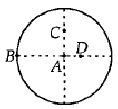
A
$B$
B
$C$
C
$D$
D
$A$
Solution
(A) According to the theorem of parallel axes,the moment of inertia $I$ about an axis parallel to the axis passing through the center of mass is given by $I = I_{CM} + Ma^2$,where $M$ is the mass of the disc,$I_{CM}$ is the moment of inertia about the center of mass,and $a$ is the perpendicular distance between the two axes.
Since the axis is perpendicular to the disc and passes through the given points,the distance $a$ is the distance of the point from the center of the disc $(A)$.
For the moment of inertia $I$ to be maximum,the distance $a$ must be maximum.
Looking at the figure,point $B$ is on the circumference of the disc,making its distance from the center $A$ the radius of the disc,which is the maximum distance among the given points.
Therefore,the moment of inertia is maximum about an axis passing through point $B$.
Since the axis is perpendicular to the disc and passes through the given points,the distance $a$ is the distance of the point from the center of the disc $(A)$.
For the moment of inertia $I$ to be maximum,the distance $a$ must be maximum.
Looking at the figure,point $B$ is on the circumference of the disc,making its distance from the center $A$ the radius of the disc,which is the maximum distance among the given points.
Therefore,the moment of inertia is maximum about an axis passing through point $B$.
0 likesView Solution
3
ChemistryMCQAIPMT · 2012
If $n_1, n_2$,and $n_3$ are the fundamental frequencies of three segments into which a string is divided,then the original fundamental frequency $n$ of the string is given by
A
$n = n_1 + n_2 + n_3$
B
$\frac{1}{n} = \frac{1}{n_1} + \frac{1}{n_2} + \frac{1}{n_3}$
C
$n = \frac{n_1 n_2 n_3}{n_1 n_2 + n_2 n_3 + n_3 n_1}$
D
$\frac{1}{n^2} = \frac{1}{n_1^2} + \frac{1}{n_2^2} + \frac{1}{n_3^2}$
Solution
(B) The fundamental frequency of a string of length $L$ is given by $n = \frac{1}{2L} \sqrt{\frac{T}{\mu}}$,where $T$ is the tension and $\mu$ is the mass per unit length.
Since $T$ and $\mu$ are constant for all segments,we have $L = \frac{1}{2n} \sqrt{\frac{T}{\mu}} = \frac{k}{n}$,where $k = \frac{1}{2} \sqrt{\frac{T}{\mu}}$ is a constant.
The string is divided into three segments of lengths $L_1, L_2$,and $L_3$ such that $L = L_1 + L_2 + L_3$.
Substituting the expression for length in terms of frequency: $\frac{k}{n} = \frac{k}{n_1} + \frac{k}{n_2} + \frac{k}{n_3}$.
Dividing both sides by $k$,we get $\frac{1}{n} = \frac{1}{n_1} + \frac{1}{n_2} + \frac{1}{n_3}$.
Since $T$ and $\mu$ are constant for all segments,we have $L = \frac{1}{2n} \sqrt{\frac{T}{\mu}} = \frac{k}{n}$,where $k = \frac{1}{2} \sqrt{\frac{T}{\mu}}$ is a constant.
The string is divided into three segments of lengths $L_1, L_2$,and $L_3$ such that $L = L_1 + L_2 + L_3$.
Substituting the expression for length in terms of frequency: $\frac{k}{n} = \frac{k}{n_1} + \frac{k}{n_2} + \frac{k}{n_3}$.
Dividing both sides by $k$,we get $\frac{1}{n} = \frac{1}{n_1} + \frac{1}{n_2} + \frac{1}{n_3}$.
0 likesView Solution
4
ChemistryMCQAIPMT · 2012
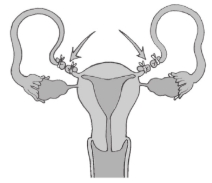
What is the figure given below showing in particular?
A
Ovarian cancer
B
Uterine cancer
C
Tubectomy
D
Vasectomy
Solution
(C) The correct answer is $(C)$.
Tubectomy is a surgical sterilization method for females.
In this procedure,a small part of the Fallopian tubes is removed or tied up through a small incision in the abdomen or through the vagina.
This blocks the passage of the ovum,thereby preventing fertilization by preventing the sperm from reaching the egg.
It is a highly effective and permanent method of contraception.
Tubectomy is a surgical sterilization method for females.
In this procedure,a small part of the Fallopian tubes is removed or tied up through a small incision in the abdomen or through the vagina.
This blocks the passage of the ovum,thereby preventing fertilization by preventing the sperm from reaching the egg.
It is a highly effective and permanent method of contraception.
0 likesView Solution
5
ChemistryMCQAIPMT · 2012
$A$ patient brought to a hospital with myocardial infarction is normally immediately given
A
penicillin
B
streptokinase
C
cyclosporin-$A$
D
statins
Solution
(B) : Streptokinase (Tissue Plasminogen Activator or $TPA$) is an enzyme obtained from the culture of some haemolytic bacterium $Streptococcus$ which is modified genetically to function as a clot buster.
It helps in clearing blood clots inside the blood vessels through the dissolution of intravascular fibrin during myocardial infarction.
It helps in clearing blood clots inside the blood vessels through the dissolution of intravascular fibrin during myocardial infarction.
0 likesView Solution
6
ChemistryMediumMCQAIPMT · 2012
Maximum number of electrons in a subshell with $l = 3$ and $n = 4$ is
A
$14$
B
$16$
C
$10$
D
$12$
Solution
(A) $n$ represents the main energy level and $l$ represents the subshell.
If $n = 4$ and $l = 3,$ the subshell is $4f.$
In an $f$ subshell,there are $2l + 1 = 2(3) + 1 = 7$ orbitals.
Since each orbital can accommodate a maximum of $2$ electrons,the maximum number of electrons in the $4f$ subshell is $7 \times 2 = 14$.
If $n = 4$ and $l = 3,$ the subshell is $4f.$
In an $f$ subshell,there are $2l + 1 = 2(3) + 1 = 7$ orbitals.
Since each orbital can accommodate a maximum of $2$ electrons,the maximum number of electrons in the $4f$ subshell is $7 \times 2 = 14$.
0 likesView Solution
7
ChemistryDifficultMCQAIPMT · 2012
The correct set of four quantum numbers for the valence electron of rubidium atom $(Z = 37)$ is
A
$5, 1, 1, +1/2$
B
$6, 0, 0, +1/2$
C
$5, 0, 0, +1/2$
D
$5, 1, 0, +1/2$
Solution
(C) The electronic configuration of rubidium atom $(Z = 37)$ is $[Kr] 5s^1$.
The valence electron is in the $5s$ orbital.
For the $5s$ orbital,the principal quantum number $(n)$ is $5$.
For an $s$-orbital,the azimuthal quantum number $(l)$ is $0$.
Since $l = 0$,the magnetic quantum number $(m_l)$ is $0$.
The spin quantum number $(m_s)$ can be either $+1/2$ or $-1/2$.
Thus,the set of quantum numbers is $(n = 5, l = 0, m_l = 0, m_s = +1/2)$.
Therefore,the correct option is $C$.
The valence electron is in the $5s$ orbital.
For the $5s$ orbital,the principal quantum number $(n)$ is $5$.
For an $s$-orbital,the azimuthal quantum number $(l)$ is $0$.
Since $l = 0$,the magnetic quantum number $(m_l)$ is $0$.
The spin quantum number $(m_s)$ can be either $+1/2$ or $-1/2$.
Thus,the set of quantum numbers is $(n = 5, l = 0, m_l = 0, m_s = +1/2)$.
Therefore,the correct option is $C$.
0 likesView Solution
8
ChemistryDifficultMCQAIPMT · 2012
The orbital angular momentum of a $p-$ electron is given as
A
$\frac{h}{\sqrt{2} \pi}$
B
$\sqrt{3} \frac{h}{2 \pi}$
C
$\sqrt{\frac{3}{2}} \frac{h}{\pi}$
D
$\sqrt{6} \frac{h}{2 \pi}$
Solution
(A) The formula for orbital angular momentum is given by $\sqrt{l(l+1)} \times \frac{h}{2 \pi}$.
For a $p-$ electron,the azimuthal quantum number $l = 1$.
Substituting the value of $l$ into the formula:
Orbital angular momentum $= \sqrt{1(1+1)} \times \frac{h}{2 \pi}$
$= \sqrt{2} \times \frac{h}{2 \pi}$
$= \frac{\sqrt{2} h}{2 \pi} = \frac{h}{\sqrt{2} \pi}$.
For a $p-$ electron,the azimuthal quantum number $l = 1$.
Substituting the value of $l$ into the formula:
Orbital angular momentum $= \sqrt{1(1+1)} \times \frac{h}{2 \pi}$
$= \sqrt{2} \times \frac{h}{2 \pi}$
$= \frac{\sqrt{2} h}{2 \pi} = \frac{h}{\sqrt{2} \pi}$.
0 likesView Solution
9
ChemistryEasyMCQAIPMT · 2012
Identify the wrong statement in the following.
A
Amongst isoelectronic species,smaller the positive charge on the cation,smaller is the ionic radius.
B
Amongst isoelectronic species,greater the negative charge on the anion,larger is the ionic radius.
C
Atomic radius of the elements increases as one moves down the first group of the periodic table.
D
Atomic radius of the elements decreases as one moves across from left to right in the $2^{nd}$ period of the periodic table.
Solution
(A) Atomic radius of the elements decreases across a period from left to right due to an increase in effective nuclear charge.
On moving down a group,the number of shells increases,so the atomic radius increases.
Amongst isoelectronic species,the ionic radius increases with an increase in negative charge or a decrease in positive charge.
Therefore,the statement that 'smaller the positive charge on the cation,smaller is the ionic radius' is incorrect,because a smaller positive charge means a larger ionic radius.
On moving down a group,the number of shells increases,so the atomic radius increases.
Amongst isoelectronic species,the ionic radius increases with an increase in negative charge or a decrease in positive charge.
Therefore,the statement that 'smaller the positive charge on the cation,smaller is the ionic radius' is incorrect,because a smaller positive charge means a larger ionic radius.
0 likesView Solution
10
ChemistryDifficultMCQAIPMT · 2012
The pair of species that has the same bond order in the following is
A
$CO, NO^{+}$
B
$NO^{-}, CN^{-}$
C
$O_2, N_2$
D
$O_2, B_2$
Solution
(A) The bond order is calculated using the formula: $Bond \ order = \frac{N_b - N_a}{2}$,where $N_b$ is the number of electrons in bonding molecular orbitals and $N_a$ is the number of electrons in antibonding molecular orbitals.
For $CO$ ($6+8=14$ electrons): Bond order $= \frac{10-4}{2} = 3$.
For $NO^{+}$ ($7+8-1=14$ electrons): Bond order $= \frac{10-4}{2} = 3$.
Since both $CO$ and $NO^{+}$ have $14$ electrons,they have the same bond order of $3$.
For other options:
$NO^{-}$ ($16$ electrons,$BO=2$),$CN^{-}$ ($14$ electrons,$BO=3$).
$O_2$ ($16$ electrons,$BO=2$),$N_2$ ($14$ electrons,$BO=3$).
$O_2$ ($16$ electrons,$BO=2$),$B_2$ ($10$ electrons,$BO=1$).
For $CO$ ($6+8=14$ electrons): Bond order $= \frac{10-4}{2} = 3$.
For $NO^{+}$ ($7+8-1=14$ electrons): Bond order $= \frac{10-4}{2} = 3$.
Since both $CO$ and $NO^{+}$ have $14$ electrons,they have the same bond order of $3$.
For other options:
$NO^{-}$ ($16$ electrons,$BO=2$),$CN^{-}$ ($14$ electrons,$BO=3$).
$O_2$ ($16$ electrons,$BO=2$),$N_2$ ($14$ electrons,$BO=3$).
$O_2$ ($16$ electrons,$BO=2$),$B_2$ ($10$ electrons,$BO=1$).
0 likesView Solution
11
ChemistryMediumMCQAIPMT · 2012
Which one of the following pairs is isostructural ($i.e.$,having the same shape and hybridization)?
A
[$BCl_3$ and $BrCl_3$]
B
[$NH_3$ and $NO_3^-$]
C
[$NF_3$ and $BF_3$]
D
[$BF_4^-$ and $NH_4^+$]
Solution
(D) In $BF_4^-$,the central atom $B$ has $4$ bond pairs and $0$ lone pairs,resulting in $sp^3$ hybridization and a tetrahedral shape.
In $NH_4^+$,the central atom $N$ has $4$ bond pairs and $0$ lone pairs,resulting in $sp^3$ hybridization and a tetrahedral shape.
Since both species have the same hybridization and shape,they are isostructural.
In $NH_4^+$,the central atom $N$ has $4$ bond pairs and $0$ lone pairs,resulting in $sp^3$ hybridization and a tetrahedral shape.
Since both species have the same hybridization and shape,they are isostructural.
0 likesView Solution
12
ChemistryMediumMCQAIPMT · 2012
Which of the following species has a bond order of $1.5$?
A
$O_{2}^{+}$
B
$O_{2}^{-}$
C
$O_{2}^{2-}$
D
$O_{2}$
Solution
(B) The bond order is calculated using the formula: $\text{Bond Order} = \frac{N_b - N_a}{2}$,where $N_b$ is the number of bonding electrons and $N_a$ is the number of antibonding electrons.
For $O_{2}^{+}$ (total $15$ electrons): Configuration is $\sigma 1s^2, \sigma^* 1s^2, \sigma 2s^2, \sigma^* 2s^2, \sigma 2p_z^2, \pi 2p_x^2 = \pi 2p_y^2, \pi^* 2p_x^1$. Bond order $= \frac{10 - 5}{2} = 2.5$.
For $O_{2}^{-}$ (total $17$ electrons): Configuration is $\sigma 1s^2, \sigma^* 1s^2, \sigma 2s^2, \sigma^* 2s^2, \sigma 2p_z^2, \pi 2p_x^2 = \pi 2p_y^2, \pi^* 2p_x^2 = \pi^* 2p_y^1$. Bond order $= \frac{10 - 7}{2} = 1.5$.
For $O_{2}^{2-}$ (total $18$ electrons): Bond order $= \frac{10 - 8}{2} = 1.0$.
For $O_{2}$ (total $16$ electrons): Bond order $= \frac{10 - 6}{2} = 2.0$.
Thus,$O_{2}^{-}$ has a bond order of $1.5$.
For $O_{2}^{+}$ (total $15$ electrons): Configuration is $\sigma 1s^2, \sigma^* 1s^2, \sigma 2s^2, \sigma^* 2s^2, \sigma 2p_z^2, \pi 2p_x^2 = \pi 2p_y^2, \pi^* 2p_x^1$. Bond order $= \frac{10 - 5}{2} = 2.5$.
For $O_{2}^{-}$ (total $17$ electrons): Configuration is $\sigma 1s^2, \sigma^* 1s^2, \sigma 2s^2, \sigma^* 2s^2, \sigma 2p_z^2, \pi 2p_x^2 = \pi 2p_y^2, \pi^* 2p_x^2 = \pi^* 2p_y^1$. Bond order $= \frac{10 - 7}{2} = 1.5$.
For $O_{2}^{2-}$ (total $18$ electrons): Bond order $= \frac{10 - 8}{2} = 1.0$.
For $O_{2}$ (total $16$ electrons): Bond order $= \frac{10 - 6}{2} = 2.0$.
Thus,$O_{2}^{-}$ has a bond order of $1.5$.
0 likesView Solution
13
ChemistryMediumMCQAIPMT · 2012
Which of the following species contains three bond pairs and one lone pair around the central atom?
A
$H_2O$
B
$BF_3$
C
$NH_2^-$
D
$PCl_3$
Solution
(D) To determine the number of bond pairs and lone pairs,we analyze the Lewis structure of each species:
$1$. $H_2O$: The central oxygen atom has $2$ bond pairs (with $H$) and $2$ lone pairs.
$2$. $BF_3$: The central boron atom has $3$ bond pairs (with $F$) and $0$ lone pairs.
$3$. $NH_2^-$: The central nitrogen atom has $2$ bond pairs (with $H$) and $2$ lone pairs.
$4$. $PCl_3$: The central phosphorus atom has $3$ bond pairs (with $Cl$) and $1$ lone pair.
Thus,$PCl_3$ is the species that contains three bond pairs and one lone pair around the central atom.
$1$. $H_2O$: The central oxygen atom has $2$ bond pairs (with $H$) and $2$ lone pairs.
$2$. $BF_3$: The central boron atom has $3$ bond pairs (with $F$) and $0$ lone pairs.
$3$. $NH_2^-$: The central nitrogen atom has $2$ bond pairs (with $H$) and $2$ lone pairs.
$4$. $PCl_3$: The central phosphorus atom has $3$ bond pairs (with $Cl$) and $1$ lone pair.
Thus,$PCl_3$ is the species that contains three bond pairs and one lone pair around the central atom.
0 likesView Solution
14
ChemistryMediumMCQAIPMT · 2012
During the change of $O_2$ to $O_2^-$ ion,the electron adds to which one of the following orbitals?
A
$\pi ^*$ orbital
B
$\pi$ orbital
C
$\sigma ^*$ orbital
D
$\sigma$ orbital
Solution
(A) The electronic configuration of $O_2$ is $KK \sigma(2s)^2 \sigma^*(2s)^2 \sigma(2p_z)^2 \pi(2p_x)^2 \pi(2p_y)^2 \pi^*(2p_x)^1 \pi^*(2p_y)^1$.
When $O_2$ gains an electron to form $O_2^-$,the incoming electron enters the next available orbital,which is the antibonding $\pi^*$ orbital.
Thus,the configuration of $O_2^-$ becomes $KK \sigma(2s)^2 \sigma^*(2s)^2 \sigma(2p_z)^2 \pi(2p_x)^2 \pi(2p_y)^2 \pi^*(2p_x)^2 \pi^*(2p_y)^1$.
When $O_2$ gains an electron to form $O_2^-$,the incoming electron enters the next available orbital,which is the antibonding $\pi^*$ orbital.
Thus,the configuration of $O_2^-$ becomes $KK \sigma(2s)^2 \sigma^*(2s)^2 \sigma(2p_z)^2 \pi(2p_x)^2 \pi(2p_y)^2 \pi^*(2p_x)^2 \pi^*(2p_y)^1$.
0 likesView Solution
15
ChemistryMediumMCQAIPMT · 2012
Four diatomic species are listed below. Identify the correct order in which the bond order is increasing in them.
A
$NO < O_2^- < C_2^{2-} < He_2^+$
B
$O_2^- < NO < C_2^{2-} < He_2^+$
C
$C_2^{2-} < He_2^+ < O_2^- < NO$
D
$He_2^+ < O_2^- < NO < C_2^{2-}$
Solution
(D) The bond order is calculated using the formula: $Bond \ Order = \frac{1}{2} (N_b - N_a)$.
For $He_2^+$ ($3$ electrons): $\sigma 1s^2, \sigma^* 1s^1$,$BO = \frac{2-1}{2} = 0.5$.
For $O_2^-$ ($17$ electrons): $BO = \frac{10-7}{2} = 1.5$.
For $NO$ ($15$ electrons): $BO = \frac{10-5}{2} = 2.5$.
For $C_2^{2-}$ ($14$ electrons): $BO = \frac{10-4}{2} = 3.0$.
Thus,the increasing order of bond order is: $He_2^+ < O_2^- < NO < C_2^{2-}$.
For $He_2^+$ ($3$ electrons): $\sigma 1s^2, \sigma^* 1s^1$,$BO = \frac{2-1}{2} = 0.5$.
For $O_2^-$ ($17$ electrons): $BO = \frac{10-7}{2} = 1.5$.
For $NO$ ($15$ electrons): $BO = \frac{10-5}{2} = 2.5$.
For $C_2^{2-}$ ($14$ electrons): $BO = \frac{10-4}{2} = 3.0$.
Thus,the increasing order of bond order is: $He_2^+ < O_2^- < NO < C_2^{2-}$.
0 likesView Solution
16
ChemistryDifficultMCQAIPMT · 2012
$50 \ mL$ of each gas $A$ and gas $B$ takes $150$ and $200$ seconds respectively for effusing through a pinhole under similar conditions. If the molecular mass of gas $B$ is $36$,the molecular mass of gas $A$ will be:
A
$20.25$
B
$128$
C
$32$
D
None of the above
Solution
(A) According to Graham's law of effusion,the rate of effusion $r$ is inversely proportional to the square root of the molecular mass $M$: $\frac{r_A}{r_B} = \sqrt{\frac{M_B}{M_A}}$.
Since $r = \frac{V}{t}$ and the volumes $V$ are equal,$\frac{r_A}{r_B} = \frac{t_B}{t_A}$.
Substituting the given values: $\frac{200}{150} = \sqrt{\frac{36}{M_A}}$.
Simplifying the ratio: $\frac{4}{3} = \sqrt{\frac{36}{M_A}}$.
Squaring both sides: $\frac{16}{9} = \frac{36}{M_A}$.
Solving for $M_A$: $M_A = \frac{36 \times 9}{16} = \frac{324}{16} = 20.25$.
Since $r = \frac{V}{t}$ and the volumes $V$ are equal,$\frac{r_A}{r_B} = \frac{t_B}{t_A}$.
Substituting the given values: $\frac{200}{150} = \sqrt{\frac{36}{M_A}}$.
Simplifying the ratio: $\frac{4}{3} = \sqrt{\frac{36}{M_A}}$.
Squaring both sides: $\frac{16}{9} = \frac{36}{M_A}$.
Solving for $M_A$: $M_A = \frac{36 \times 9}{16} = \frac{324}{16} = 20.25$.
0 likesView Solution
17
ChemistryMediumMCQAIPMT · 2012
$A$ certain gas takes three times as long to effuse out as helium. Its molecular mass will be ........... $u$.
A
$27$
B
$36$
C
$64$
D
$9$
Solution
(B) According to Graham's Law of Effusion,the rate of effusion $r$ is inversely proportional to the square root of the molar mass $M_W$: $\frac{r_1}{r_2} = \sqrt{\frac{M_{W_2}}{M_{W_1}}}$.
Since rate $r = \frac{V}{t}$,for the same volume $V$,the expression becomes $\frac{t_2}{t_1} = \sqrt{\frac{M_{W_1}}{M_{W_2}}}$.
Given that the time taken by the gas $(t_1)$ is $3$ times the time taken by helium $(t_2)$,we have $\frac{t_1}{t_2} = 3$.
Substituting the values: $3 = \sqrt{\frac{M_{W_1}}{4}}$.
Squaring both sides: $9 = \frac{M_{W_1}}{4}$.
Therefore,$M_{W_1} = 9 \times 4 = 36 \ u$.
Since rate $r = \frac{V}{t}$,for the same volume $V$,the expression becomes $\frac{t_2}{t_1} = \sqrt{\frac{M_{W_1}}{M_{W_2}}}$.
Given that the time taken by the gas $(t_1)$ is $3$ times the time taken by helium $(t_2)$,we have $\frac{t_1}{t_2} = 3$.
Substituting the values: $3 = \sqrt{\frac{M_{W_1}}{4}}$.
Squaring both sides: $9 = \frac{M_{W_1}}{4}$.
Therefore,$M_{W_1} = 9 \times 4 = 36 \ u$.
0 likesView Solution
18
ChemistryDifficultMCQAIPMT · 2012
For real gases,the van der Waals equation is written as $\left( p + \frac{a n^2}{V^2} \right) (V - nb) = nRT$,where $a$ and $b$ are van der Waals constants. Two sets of gases are:
$(I)$ $O_2, CO_2, H_2, He$
$(II)$ $CH_4, O_2, H_2$
The gases given in set-$I$ are arranged in increasing order of $b$,and the gases given in set-$II$ are arranged in decreasing order of $a$. Select the correct order from the following:
$(I)$ $O_2, CO_2, H_2, He$
$(II)$ $CH_4, O_2, H_2$
The gases given in set-$I$ are arranged in increasing order of $b$,and the gases given in set-$II$ are arranged in decreasing order of $a$. Select the correct order from the following:
A
$I. He < H_2 < O_2 < CO_2$; $II. CH_4 > O_2 > H_2$
B
$I. O_2 < He < H_2 < CO_2$; $II. H_2 > O_2 > CH_4$
C
$I. H_2 < He < O_2 < CO_2$; $II. CH_4 > O_2 > H_2$
D
$I. H_2 < O_2 < He < CO_2$; $II. O_2 > CH_4 > H_2$
Solution
(A) The constant $b$ represents the excluded volume,which increases with the size of the molecule. The order of $b$ for set-$I$ is: $H_2 (0.0266) < He (0.0237)$ (Note: $He$ is smaller than $H_2$,so $He < H_2$) $< O_2 (0.0318) < CO_2 (0.0427)$. Thus,$I. He < H_2 < O_2 < CO_2$.
The constant $a$ represents the magnitude of intermolecular forces. Larger molecules with more electrons have stronger van der Waals forces. The order of $a$ for set-$II$ is: $CH_4 (2.25) > O_2 (1.36) > H_2 (0.244)$. Thus,$II. CH_4 > O_2 > H_2$.
The constant $a$ represents the magnitude of intermolecular forces. Larger molecules with more electrons have stronger van der Waals forces. The order of $a$ for set-$II$ is: $CH_4 (2.25) > O_2 (1.36) > H_2 (0.244)$. Thus,$II. CH_4 > O_2 > H_2$.
0 likesView Solution
19
ChemistryMediumMCQAIPMT · 2012
Equal volumes of two monoatomic gases,$A$ and $B$ at same temperature and pressure are mixed. The ratio of specific heats $(C_P/C_V)$ of the mixture will be
A
$0.83$
B
$1.5$
C
$3.3$
D
$1.67$
Solution
(D) For a monoatomic gas,the adiabatic index $\gamma = C_P/C_V = 5/3 \approx 1.67$.
Since both gases $A$ and $B$ are monoatomic and are mixed in equal volumes at the same temperature and pressure,the resulting mixture will also behave as a monoatomic gas.
Therefore,the ratio of specific heats $(C_P/C_V)$ for the mixture remains $1.67$.
Since both gases $A$ and $B$ are monoatomic and are mixed in equal volumes at the same temperature and pressure,the resulting mixture will also behave as a monoatomic gas.
Therefore,the ratio of specific heats $(C_P/C_V)$ for the mixture remains $1.67$.
0 likesView Solution
20
ChemistryDifficultMCQAIPMT · 2012
In which of the following reactions,standard reaction entropy change $(\Delta S^o)$ is positive and standard Gibb's energy change $(\Delta G^o)$ decreases sharply with increasing temperature?
A
$C_{(graphite)} + \frac{1}{2} O_{2(g)} \to CO_{(g)}$
B
$CO_{(g)} + \frac{1}{2} O_{2(g)} \to CO_{2(g)}$
C
$Mg_{(s)} + \frac{1}{2} O_{2(g)} \to MgO_{(s)}$
D
$\frac{1}{2} C_{(graphite)} + \frac{1}{2} O_{2(g)} \to \frac{1}{2} CO_{2(g)}$
Solution
(A) For a reaction,$\Delta G^o = \Delta H^o - T \Delta S^o$. If $\Delta S^o > 0$,then as temperature $T$ increases,the term $-T \Delta S^o$ becomes more negative,causing $\Delta G^o$ to decrease sharply.
$\Delta S^o$ is positive when the number of moles of gaseous products is greater than the number of moles of gaseous reactants (i.e.,$\Delta n_g > 0$).
In option $A$: $C_{(graphite)} + \frac{1}{2} O_{2(g)} \to CO_{(g)}$,$\Delta n_g = 1 - 0.5 = 0.5 > 0$.
In option $B$: $CO_{(g)} + \frac{1}{2} O_{2(g)} \to CO_{2(g)}$,$\Delta n_g = 1 - 1.5 = -0.5 < 0$.
In option $C$: $Mg_{(s)} + \frac{1}{2} O_{2(g)} \to MgO_{(s)}$,$\Delta n_g = 0 - 0.5 = -0.5 < 0$.
In option $D$: $\frac{1}{2} C_{(graphite)} + \frac{1}{2} O_{2(g)} \to \frac{1}{2} CO_{2(g)}$,$\Delta n_g = 0.5 - 0.5 = 0$.
Thus,only reaction $A$ has a positive $\Delta S^o$.
$\Delta S^o$ is positive when the number of moles of gaseous products is greater than the number of moles of gaseous reactants (i.e.,$\Delta n_g > 0$).
In option $A$: $C_{(graphite)} + \frac{1}{2} O_{2(g)} \to CO_{(g)}$,$\Delta n_g = 1 - 0.5 = 0.5 > 0$.
In option $B$: $CO_{(g)} + \frac{1}{2} O_{2(g)} \to CO_{2(g)}$,$\Delta n_g = 1 - 1.5 = -0.5 < 0$.
In option $C$: $Mg_{(s)} + \frac{1}{2} O_{2(g)} \to MgO_{(s)}$,$\Delta n_g = 0 - 0.5 = -0.5 < 0$.
In option $D$: $\frac{1}{2} C_{(graphite)} + \frac{1}{2} O_{2(g)} \to \frac{1}{2} CO_{2(g)}$,$\Delta n_g = 0.5 - 0.5 = 0$.
Thus,only reaction $A$ has a positive $\Delta S^o$.
0 likesView Solution
21
ChemistryEasyMCQAIPMT · 2012
The enthalpy of fusion of water is $1.435 \ kcal/mol$. The molar entropy change for the melting of ice at $0 \ ^\circ C$ is
A
$10.52 \ cal/(mol \ K)$
B
$21.04 \ cal/(mol \ K)$
C
$5.260 \ cal/(mol \ K)$
D
$0.526 \ cal/(mol \ K)$
Solution
(C) The process of melting ice at $0 \ ^\circ C$ $(273 \ K)$ is a reversible phase transition.
For a reversible process,the entropy change is given by $\Delta S = \frac{\Delta H_{fus}}{T}$.
Given $\Delta H_{fus} = 1.435 \ kcal/mol = 1435 \ cal/mol$.
Temperature $T = 0 \ ^\circ C = 273 \ K$.
Therefore,$\Delta S = \frac{1435 \ cal/mol}{273 \ K} = 5.256 \ cal/(mol \ K) \approx 5.26 \ cal/(mol \ K)$.
For a reversible process,the entropy change is given by $\Delta S = \frac{\Delta H_{fus}}{T}$.
Given $\Delta H_{fus} = 1.435 \ kcal/mol = 1435 \ cal/mol$.
Temperature $T = 0 \ ^\circ C = 273 \ K$.
Therefore,$\Delta S = \frac{1435 \ cal/mol}{273 \ K} = 5.256 \ cal/(mol \ K) \approx 5.26 \ cal/(mol \ K)$.
0 likesView Solution
22
ChemistryEasyMCQAIPMT · 2012
Standard enthalpy of vaporisation $\Delta_{vap}H^o$ for water at $100\ ^oC$ is $40.66\ kJ\ mol^{-1}.$ The internal energy of vaporisation of water at $100\ ^oC$ (in $kJ\ mol^{-1}$) is ............... $kJ\ mol^{-1}$ (Assume water vapour to behave like an ideal gas)
A
$+ 37.56$
B
$-43.76$
C
$+43.76$
D
$+ 40.66$
Solution
(A) The process is $H_2O_{(l)} \longrightarrow H_2O_{(g)}$.
The relation between enthalpy change and internal energy change is $\Delta H = \Delta U + \Delta n_g RT$.
Here,$\Delta H = 40.66\ kJ\ mol^{-1}$,$T = 100 + 273 = 373\ K$,and $\Delta n_g = 1 - 0 = 1$.
Using $R = 8.314 \times 10^{-3}\ kJ\ K^{-1}\ mol^{-1}$,we have:
$40.66 = \Delta U + (1 \times 8.314 \times 10^{-3} \times 373)$.
$40.66 = \Delta U + 3.101$.
$\Delta U = 40.66 - 3.101 = 37.559\ kJ\ mol^{-1} \approx 37.56\ kJ\ mol^{-1}$.
The relation between enthalpy change and internal energy change is $\Delta H = \Delta U + \Delta n_g RT$.
Here,$\Delta H = 40.66\ kJ\ mol^{-1}$,$T = 100 + 273 = 373\ K$,and $\Delta n_g = 1 - 0 = 1$.
Using $R = 8.314 \times 10^{-3}\ kJ\ K^{-1}\ mol^{-1}$,we have:
$40.66 = \Delta U + (1 \times 8.314 \times 10^{-3} \times 373)$.
$40.66 = \Delta U + 3.101$.
$\Delta U = 40.66 - 3.101 = 37.559\ kJ\ mol^{-1} \approx 37.56\ kJ\ mol^{-1}$.
0 likesView Solution
23
ChemistryMediumMCQAIPMT · 2012
The $pH$ of a saturated solution of $Ba(OH)_2$ is $12$. What is the value of the solubility product $(K_{sp})$ of $Ba(OH)_2$?
A
$3.3 \times 10^{-7}$
B
$5.0 \times 10^{-7}$
C
$4.0 \times 10^{-6}$
D
$5.0 \times 10^{-6}$
Solution
(B) Given,$pH = 12$.
Since $pH + pOH = 14$,we have $pOH = 14 - 12 = 2$.
The concentration of hydroxide ions is $[OH^-] = 10^{-pOH} = 10^{-2} \ M$.
The dissociation of $Ba(OH)_2$ is represented as: $Ba(OH)_2 \rightleftharpoons Ba^{2+} + 2OH^-$.
If the solubility of $Ba(OH)_2$ is $s$,then $[Ba^{2+}] = s$ and $[OH^-] = 2s$.
From the given concentration,$2s = 10^{-2} \ M$,which implies $s = 0.5 \times 10^{-2} = 5 \times 10^{-3} \ M$.
The solubility product expression is $K_{sp} = [Ba^{2+}][OH^-]^2$.
Substituting the values,$K_{sp} = (s)(2s)^2 = 4s^3$.
$K_{sp} = 4 \times (5 \times 10^{-3})^3 = 4 \times 125 \times 10^{-9} = 500 \times 10^{-9} = 5.0 \times 10^{-7}$.
Since $pH + pOH = 14$,we have $pOH = 14 - 12 = 2$.
The concentration of hydroxide ions is $[OH^-] = 10^{-pOH} = 10^{-2} \ M$.
The dissociation of $Ba(OH)_2$ is represented as: $Ba(OH)_2 \rightleftharpoons Ba^{2+} + 2OH^-$.
If the solubility of $Ba(OH)_2$ is $s$,then $[Ba^{2+}] = s$ and $[OH^-] = 2s$.
From the given concentration,$2s = 10^{-2} \ M$,which implies $s = 0.5 \times 10^{-2} = 5 \times 10^{-3} \ M$.
The solubility product expression is $K_{sp} = [Ba^{2+}][OH^-]^2$.
Substituting the values,$K_{sp} = (s)(2s)^2 = 4s^3$.
$K_{sp} = 4 \times (5 \times 10^{-3})^3 = 4 \times 125 \times 10^{-9} = 500 \times 10^{-9} = 5.0 \times 10^{-7}$.
0 likesView Solution
24
ChemistryMediumMCQAIPMT · 2012
Equimolar solutions of the following substances were prepared separately. Which one of these will record the highest $pH$ value?
A
$BaCl_2$
B
$AlCl_3$
C
$LiCl$
D
$BeCl_2$
Solution
(A) $BaCl_2$ is a salt of a strong acid $(HCl)$ and a strong base $(Ba(OH)_2)$. Therefore,its aqueous solution is neutral with a $pH$ of $7$.
$AlCl_3$,$LiCl$,and $BeCl_2$ undergo cationic hydrolysis in water to produce acidic solutions because they involve weak bases or small,highly charged cations.
Consequently,their $pH$ values are less than $7$.
Thus,the $pH$ value is highest for the solution of $BaCl_2$.
$AlCl_3$,$LiCl$,and $BeCl_2$ undergo cationic hydrolysis in water to produce acidic solutions because they involve weak bases or small,highly charged cations.
Consequently,their $pH$ values are less than $7$.
Thus,the $pH$ value is highest for the solution of $BaCl_2$.
0 likesView Solution
25
ChemistryDifficultMCQAIPMT · 2012
Buffer solutions have constant acidity and alkalinity because
A
these give unionised acid or base on reaction with added acid or alkali
B
acids and alkalies in these solutions are shielded from attack by other ions
C
they have large excess of $H^{+}$ or $OH^{-}$ ions
D
they have fixed value of $pH$.
Solution
(A) If a small amount of an acid or alkali is added to a buffer solution,it converts them into unionised acid or base.
Thus,the $pH$ remains unaffected or in other words,its acidity/alkalinity remains constant.
For example:
$H_3O^{+} + A^{-} \rightleftharpoons H_2O + HA$
$OH^{-} + HA \rightarrow H_2O + A^{-}$
If an acid is added,it reacts with the conjugate base $A^{-}$ to form undissociated $HA$.
Similarly,if a base/alkali is added,$OH^{-}$ combines with $HA$ to give $H_2O$ and $A^{-}$,and thus,maintains the acidity/alkalinity of the buffer solution.
Thus,the $pH$ remains unaffected or in other words,its acidity/alkalinity remains constant.
For example:
$H_3O^{+} + A^{-} \rightleftharpoons H_2O + HA$
$OH^{-} + HA \rightarrow H_2O + A^{-}$
If an acid is added,it reacts with the conjugate base $A^{-}$ to form undissociated $HA$.
Similarly,if a base/alkali is added,$OH^{-}$ combines with $HA$ to give $H_2O$ and $A^{-}$,and thus,maintains the acidity/alkalinity of the buffer solution.
0 likesView Solution
26
ChemistryDifficultMCQAIPMT · 2012
Given that the equilibrium constant for the reaction,$2SO_{2(g)} + O_{2(g)} \rightleftharpoons 2SO_{3(g)}$ has a value of $278$ at a particular temperature. What is the value of the equilibrium constant for the following reaction at the same temperature? $SO_{3(g)} \rightleftharpoons SO_{2(g)} + \frac{1}{2} O_{2(g)}$
A
$1.8 \times 10^{-3}$
B
$3.6 \times 10^{-3}$
C
$6.0 \times 10^{-2}$
D
$1.3 \times 10^{-5}$
Solution
(C) For the reaction $2SO_{2(g)} + O_{2(g)} \rightleftharpoons 2SO_{3(g)}$,the equilibrium constant is $K = 278$.
Reversing the reaction gives $2SO_{3(g)} \rightleftharpoons 2SO_{2(g)} + O_{2(g)}$,for which the equilibrium constant is $K' = \frac{1}{K} = \frac{1}{278}$.
Dividing the stoichiometric coefficients of the reversed reaction by $2$ gives the target reaction: $SO_{3(g)} \rightleftharpoons SO_{2(g)} + \frac{1}{2} O_{2(g)}$.
The equilibrium constant for this reaction is $K'' = \sqrt{K'} = \sqrt{\frac{1}{278}} \approx 0.0599 \approx 6.0 \times 10^{-2}$.
Reversing the reaction gives $2SO_{3(g)} \rightleftharpoons 2SO_{2(g)} + O_{2(g)}$,for which the equilibrium constant is $K' = \frac{1}{K} = \frac{1}{278}$.
Dividing the stoichiometric coefficients of the reversed reaction by $2$ gives the target reaction: $SO_{3(g)} \rightleftharpoons SO_{2(g)} + \frac{1}{2} O_{2(g)}$.
The equilibrium constant for this reaction is $K'' = \sqrt{K'} = \sqrt{\frac{1}{278}} \approx 0.0599 \approx 6.0 \times 10^{-2}$.
0 likesView Solution
27
ChemistryMediumMCQAIPMT · 2012
Given the reaction between $2$ gases represented by $A_2$ and $B_2$ to give the compound $AB_{(g)}$:
$A_{2(g)} + B_{2(g)} \rightleftharpoons 2AB_{(g)}$
At equilibrium,the concentrations are $[A_2] = 3.0 \times 10^{-3} \, M$,$[B_2] = 4.2 \times 10^{-3} \, M$,and $[AB] = 2.8 \times 10^{-3} \, M$.
If the reaction takes place in a sealed vessel at $527^{\circ}C$,then the value of $K_c$ will be:
$A_{2(g)} + B_{2(g)} \rightleftharpoons 2AB_{(g)}$
At equilibrium,the concentrations are $[A_2] = 3.0 \times 10^{-3} \, M$,$[B_2] = 4.2 \times 10^{-3} \, M$,and $[AB] = 2.8 \times 10^{-3} \, M$.
If the reaction takes place in a sealed vessel at $527^{\circ}C$,then the value of $K_c$ will be:
A
$2$
B
$1.9$
C
$0.62$
D
$4.5$
Solution
(C) The equilibrium reaction is: $A_{2(g)} + B_{2(g)} \rightleftharpoons 2AB_{(g)}$
The expression for the equilibrium constant $K_c$ is:
$K_c = \frac{[AB]^2}{[A_2][B_2]}$
Substituting the given equilibrium concentrations:
$K_c = \frac{(2.8 \times 10^{-3})^2}{(3.0 \times 10^{-3})(4.2 \times 10^{-3})}$
$K_c = \frac{2.8 \times 2.8}{3.0 \times 4.2} = \frac{7.84}{12.6} \approx 0.622$
Rounding to two decimal places,the value of $K_c$ is $0.62$.
The expression for the equilibrium constant $K_c$ is:
$K_c = \frac{[AB]^2}{[A_2][B_2]}$
Substituting the given equilibrium concentrations:
$K_c = \frac{(2.8 \times 10^{-3})^2}{(3.0 \times 10^{-3})(4.2 \times 10^{-3})}$
$K_c = \frac{2.8 \times 2.8}{3.0 \times 4.2} = \frac{7.84}{12.6} \approx 0.622$
Rounding to two decimal places,the value of $K_c$ is $0.62$.
0 likesView Solution
28
ChemistryMediumMCQAIPMT · 2012
When $Cl_2$ gas reacts with hot and concentrated sodium hydroxide solution,the oxidation number of chlorine changes from
A
$0$ to $+1$ and $0$ to $-5$
B
$0$ to $-1$ and $0$ to $+5$
C
$0$ to $-1$ and $0$ to $+3$
D
$0$ to $+1$ and $0$ to $-3$
Solution
(B) The reaction of chlorine gas with hot and concentrated sodium hydroxide solution is:
$3Cl_2 + 6NaOH \rightarrow NaClO_3 + 5NaCl + 3H_2O$
In $Cl_2$,the oxidation number of $Cl$ is $0$.
In $NaCl$,the oxidation number of $Cl$ is $-1$.
In $NaClO_3$,the oxidation number of $Cl$ is $x + (-2 \times 3) = -1 \Rightarrow x = +5$.
Thus,the oxidation number changes from $0$ to $-1$ and $0$ to $+5$.
$3Cl_2 + 6NaOH \rightarrow NaClO_3 + 5NaCl + 3H_2O$
In $Cl_2$,the oxidation number of $Cl$ is $0$.
In $NaCl$,the oxidation number of $Cl$ is $-1$.
In $NaClO_3$,the oxidation number of $Cl$ is $x + (-2 \times 3) = -1 \Rightarrow x = +5$.
Thus,the oxidation number changes from $0$ to $-1$ and $0$ to $+5$.
0 likesView Solution
29
ChemistryDifficultMCQAIPMT · 2012
$A$ mixture of potassium chlorate,oxalic acid,and sulphuric acid is heated. During the reaction,which element undergoes the maximum change in its oxidation number?
A
$S$
B
$H$
C
$Cl$
D
$C$
Solution
(C) The balanced chemical reaction is:
$2KClO_3 + 3H_2C_2O_4 + H_2SO_4 \rightarrow K_2SO_4 + 2KCl + 6CO_2 + 4H_2O$
Calculation of oxidation states:
$1$. For $Cl$ in $KClO_3$,the oxidation state changes from $+5$ to $-1$ in $KCl$. The change is $|-1 - 5| = 6$.
$2$. For $C$ in $H_2C_2O_4$,the oxidation state changes from $+3$ to $+4$ in $CO_2$. The change is $|4 - 3| = 1$.
$3$. The oxidation states of $S$,$H$,$K$,and $O$ remain unchanged in this reaction.
Thus,$Cl$ undergoes the maximum change in oxidation number.
$2KClO_3 + 3H_2C_2O_4 + H_2SO_4 \rightarrow K_2SO_4 + 2KCl + 6CO_2 + 4H_2O$
Calculation of oxidation states:
$1$. For $Cl$ in $KClO_3$,the oxidation state changes from $+5$ to $-1$ in $KCl$. The change is $|-1 - 5| = 6$.
$2$. For $C$ in $H_2C_2O_4$,the oxidation state changes from $+3$ to $+4$ in $CO_2$. The change is $|4 - 3| = 1$.
$3$. The oxidation states of $S$,$H$,$K$,and $O$ remain unchanged in this reaction.
Thus,$Cl$ undergoes the maximum change in oxidation number.
0 likesView Solution
30
ChemistryMediumMCQAIPMT · 2012
Which one of the alkali metals forms only the normal oxide,$M_2O$,on heating in air?
A
$Rb$
B
$K$
C
$Li$
D
$Na$
Solution
(C) When alkali metals are heated in an atmosphere of oxygen,they ignite and form oxides.
$Li$ reacts with oxygen to form the normal oxide,$Li_2O$.
$Na$ reacts with oxygen to form the peroxide,$Na_2O_2$.
$K$ and $Rb$ react with oxygen to form superoxides,$MO_2$ (where $M = K, Rb$).
$Li$ reacts with oxygen to form the normal oxide,$Li_2O$.
$Na$ reacts with oxygen to form the peroxide,$Na_2O_2$.
$K$ and $Rb$ react with oxygen to form superoxides,$MO_2$ (where $M = K, Rb$).
0 likesView Solution
31
ChemistryMediumMCQAIPMT · 2012
The ease of adsorption of the hydrated alkali metal ions on an ion-exchange resins follows the order:
A
$Li^{+} < K^{+} < Na^{+} < Rb^{+}$
B
$Rb^{+} < K^{+} < Na^{+} < Li^{+}$
C
$K^{+} < Na^{+} < Rb^{+} < Li^{+}$
D
$Na^{+} < Li^{+} < K^{+} < Rb^{+}$
Solution
(B) The ease of adsorption of hydrated alkali metal ions on an ion-exchange resin depends on the size of the hydrated ion.
Smaller alkali metal ions have a higher charge density,leading to greater hydration. Thus,the size of the hydrated ion follows the order: $Li^{+} > Na^{+} > K^{+} > Rb^{+}$.
Since the ease of adsorption is inversely proportional to the size of the hydrated ion,the order of adsorption is: $Rb^{+} < K^{+} < Na^{+} < Li^{+}$.
Smaller alkali metal ions have a higher charge density,leading to greater hydration. Thus,the size of the hydrated ion follows the order: $Li^{+} > Na^{+} > K^{+} > Rb^{+}$.
Since the ease of adsorption is inversely proportional to the size of the hydrated ion,the order of adsorption is: $Rb^{+} < K^{+} < Na^{+} < Li^{+}$.
0 likesView Solution
32
ChemistryMediumMCQAIPMT · 2012
Among the following compounds,the one that is most reactive towards electrophilic nitration is
A
benzoic acid
B
nitrobenzene
C
toluene
D
benzene
Solution
(C) The presence of an electron-releasing group like $-CH_3$,$-OH$,etc.,increases the electron density at the $o/p$ positions and thus makes the benzene ring more reactive towards electrophiles.
On the other hand,electron-withdrawing groups like $-COOH$,$-NO_2$,etc.,reduce the electron density of the benzene ring,thereby decreasing its reactivity towards electrophilic substitution.
Comparing the given compounds:
$1$. $-NO_2$ (in nitrobenzene) is a strong electron-withdrawing group.
$2$. $-COOH$ (in benzoic acid) is an electron-withdrawing group.
$3$. $-H$ (in benzene) is the reference.
$4$. $-CH_3$ (in toluene) is an electron-releasing group due to the $+I$ effect and hyperconjugation.
Therefore,the order of reactivity towards electrophilic nitration is: $\text{nitrobenzene} < \text{benzoic acid} < \text{benzene} < \text{toluene}$.
Thus,toluene is the most reactive.
On the other hand,electron-withdrawing groups like $-COOH$,$-NO_2$,etc.,reduce the electron density of the benzene ring,thereby decreasing its reactivity towards electrophilic substitution.
Comparing the given compounds:
$1$. $-NO_2$ (in nitrobenzene) is a strong electron-withdrawing group.
$2$. $-COOH$ (in benzoic acid) is an electron-withdrawing group.
$3$. $-H$ (in benzene) is the reference.
$4$. $-CH_3$ (in toluene) is an electron-releasing group due to the $+I$ effect and hyperconjugation.
Therefore,the order of reactivity towards electrophilic nitration is: $\text{nitrobenzene} < \text{benzoic acid} < \text{benzene} < \text{toluene}$.
Thus,toluene is the most reactive.
0 likesView Solution
33
ChemistryMediumMCQAIPMT · 2012
Which nomenclature is not according to the $IUPAC$ system?
A
$Br-CH_2-CH=CH_2$ ($1-$Bromoprop$-2-$ene)
B
$CH_3-CH_2-C(Br)(CH_3)-CH_2-CH(CH_3)-CH_3$ ($4-$Bromo$-2,4-$dimethylhexane)
C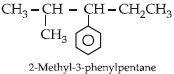
$CH_3-CH(CH_3)-CH(OH)-CH_3$ ($3-$Methylbutan$-2-$ol)
D
$CH_3-CO-CH_2-CH_2-CH_2-COOH$ ($5-$Oxohexanoic acid)
Solution
(A) In $Br-CH_2-CH=CH_2$,the double bond is given priority over the halogen substituent for numbering.
The numbering of the carbon chain should start from the end containing the double bond:
$CH_2(1)=CH(2)-CH_2(3)-Br$
Therefore,the correct $IUPAC$ name is $3-$Bromoprop$-1-$ene.
Thus,option $(A)$ is not according to the $IUPAC$ system.
The numbering of the carbon chain should start from the end containing the double bond:
$CH_2(1)=CH(2)-CH_2(3)-Br$
Therefore,the correct $IUPAC$ name is $3-$Bromoprop$-1-$ene.
Thus,option $(A)$ is not according to the $IUPAC$ system.
0 likesView Solution
34
ChemistryDifficultMCQAIPMT · 2012
In the following reaction: $CH_3-C(CH_3)_2-CH=CH_2 \xrightarrow{H_2O/H^{+}} A (\text{Major product}) + B (\text{Minor product})$,the major product $A$ is:
A
$CH_3-C(OH)(CH_3)-CH(CH_3)-CH_3$
B
$HO-CH_2-C(CH_3)_2-CH_2-CH_3$
C
$CH_3-C(CH_3)_2-CH(OH)-CH_3$
D
$CH_3-C(CH_3)_2-CH_2-CH_2-OH$
Solution
(A) The acid-catalyzed hydration of $3,3-\text{dimethyl}-1-\text{butene}$ proceeds via a carbocation intermediate.
$1$. Protonation of the alkene follows Markovnikov's rule to form a secondary carbocation: $CH_3-C(CH_3)_2-CH^{+}-CH_3$.
$2$. $A$ $1,2-\text{methyl shift}$ occurs to convert the secondary carbocation into a more stable tertiary carbocation: $CH_3-C^{+}(CH_3)-CH(CH_3)-CH_3$.
$3$. Nucleophilic attack by $H_2O$ on the tertiary carbocation followed by deprotonation yields the major product,$2,3-\text{dimethyl}-2-\text{butanol}$: $CH_3-C(OH)(CH_3)-CH(CH_3)-CH_3$.
$1$. Protonation of the alkene follows Markovnikov's rule to form a secondary carbocation: $CH_3-C(CH_3)_2-CH^{+}-CH_3$.
$2$. $A$ $1,2-\text{methyl shift}$ occurs to convert the secondary carbocation into a more stable tertiary carbocation: $CH_3-C^{+}(CH_3)-CH(CH_3)-CH_3$.
$3$. Nucleophilic attack by $H_2O$ on the tertiary carbocation followed by deprotonation yields the major product,$2,3-\text{dimethyl}-2-\text{butanol}$: $CH_3-C(OH)(CH_3)-CH(CH_3)-CH_3$.
0 likesView Solution
35
ChemistryMediumMCQAIPMT · 2012
Which of the following acids does not exhibit optical isomerism?
A
Maleic acid
B
$\alpha$-amino acids
C
Lactic acid
D
Tartaric acid
Solution
(A) Optical isomerism requires the presence of at least one chiral carbon atom (a carbon atom bonded to four different groups).
Maleic acid $(HOOC-CH=CH-COOH)$ contains $sp^2$ hybridized carbons in a double bond and lacks a chiral carbon atom,so it does not exhibit optical isomerism.
Tartaric acid,lactic acid,and $\alpha$-amino acids all contain at least one chiral carbon atom (indicated by $*$ in the structure),allowing them to exhibit optical isomerism.
Maleic acid $(HOOC-CH=CH-COOH)$ contains $sp^2$ hybridized carbons in a double bond and lacks a chiral carbon atom,so it does not exhibit optical isomerism.
Tartaric acid,lactic acid,and $\alpha$-amino acids all contain at least one chiral carbon atom (indicated by $*$ in the structure),allowing them to exhibit optical isomerism.
0 likesView Solution
36
ChemistryMediumMCQAIPMT · 2012
Which of the following reagents will be able to distinguish between $but-1-yne$ and $but-2-yne$?
A
$NaNH_2$
B
$HCl$
C
$O_2$
D
$Br_2$
Solution
(A) $But-1-yne$ $(CH_3CH_2C \equiv CH)$ contains a terminal acidic hydrogen atom attached to an $sp$ hybridized carbon atom.
$But-2-yne$ $(CH_3C \equiv CCH_3)$ does not have any terminal acidic hydrogen atom.
$NaNH_2$ is a strong base that can abstract the acidic proton from $but-1-yne$ to form a sodium acetylide salt,whereas $but-2-yne$ does not react with $NaNH_2$.
Reaction: $CH_3CH_2C \equiv CH + NaNH_2 \rightarrow CH_3CH_2C \equiv C^-Na^+ + NH_3$.
Therefore,$NaNH_2$ is the correct reagent to distinguish between them.
$But-2-yne$ $(CH_3C \equiv CCH_3)$ does not have any terminal acidic hydrogen atom.
$NaNH_2$ is a strong base that can abstract the acidic proton from $but-1-yne$ to form a sodium acetylide salt,whereas $but-2-yne$ does not react with $NaNH_2$.
Reaction: $CH_3CH_2C \equiv CH + NaNH_2 \rightarrow CH_3CH_2C \equiv C^-Na^+ + NH_3$.
Therefore,$NaNH_2$ is the correct reagent to distinguish between them.
0 likesView Solution
37
ChemistryMediumMCQAIPMT · 2012
Which one of the following statements regarding photochemical smog is not correct?
A
Carbon monoxide does not play any role in photochemical smog formation.
B
Photochemical smog is an oxidising agent in character.
C
Photochemical smog is formed through photochemical reaction involving solar energy.
D
Photochemical smog does not cause irritation in eyes and throat.
Solution
(D) Photochemical smog is formed in warm and sunny climates during the daytime by the action of sunlight on primary pollutants like nitrogen oxides and hydrocarbons.
It contains components such as nitrogen oxides,ozone $(O_3)$,and peroxyacetyl nitrate $(PAN)$,which are oxidising in nature.
Therefore,photochemical smog is an oxidising agent in character.
It is well-known to cause irritation in the eyes and throat,making statement $D$ incorrect.
It contains components such as nitrogen oxides,ozone $(O_3)$,and peroxyacetyl nitrate $(PAN)$,which are oxidising in nature.
Therefore,photochemical smog is an oxidising agent in character.
It is well-known to cause irritation in the eyes and throat,making statement $D$ incorrect.
0 likesView Solution
38
ChemistryEasyMCQAIPMT · 2012
In which of the following compounds,does nitrogen exhibit the highest oxidation state?
A
$N_2H_4$
B
$NH_3$
C
$N_3H$
D
$NH_2OH$
Solution
(C) To find the oxidation state of nitrogen $(N)$ in each compound,we assign hydrogen $(H)$ a value of $+1$ and oxygen $(O)$ a value of $-2$:
$1$. In $N_2H_4$: $2x + 4(+1) = 0 \implies 2x = -4 \implies x = -2$.
$2$. In $NH_3$: $x + 3(+1) = 0 \implies x = -3$.
$3$. In $N_3H$: $3x + 1(+1) = 0 \implies 3x = -1 \implies x = -1/3$.
$4$. In $NH_2OH$: $x + 2(+1) + (-2) + 1(+1) = 0 \implies x + 1 = 0 \implies x = -1$.
Comparing the values $-2, -3, -1/3, -1$,the highest value is $-1/3$.
$1$. In $N_2H_4$: $2x + 4(+1) = 0 \implies 2x = -4 \implies x = -2$.
$2$. In $NH_3$: $x + 3(+1) = 0 \implies x = -3$.
$3$. In $N_3H$: $3x + 1(+1) = 0 \implies 3x = -1 \implies x = -1/3$.
$4$. In $NH_2OH$: $x + 2(+1) + (-2) + 1(+1) = 0 \implies x + 1 = 0 \implies x = -1$.
Comparing the values $-2, -3, -1/3, -1$,the highest value is $-1/3$.
0 likesView Solution
39
ChemistryMCQAIPMT · 2012
Which one of the following is not a condensation polymer?
A
Melamine
B
Glyptal
C
Dacron
D
Neoprene
Solution
(D) Condensation polymers are formed by the repeated condensation reaction between bifunctional monomers,often accompanied by the elimination of small molecules like $H_2O$ or $HCl$.
Addition polymers are formed by the polymerization of monomers containing multiple bonds (double or triple bonds) without the loss of any small molecules.
$A$. Melamine is a condensation polymer formed from melamine and formaldehyde.
$B$. Glyptal is a polyester formed by the condensation of ethylene glycol and phthalic acid.
$C$. Dacron (Terylene) is a polyester formed by the condensation of ethylene glycol and terephthalic acid.
$D$. Neoprene is a polymer of chloroprene $(CH_2=C(Cl)-CH=CH_2)$,which is an addition polymer.
Therefore,Neoprene is not a condensation polymer.
Addition polymers are formed by the polymerization of monomers containing multiple bonds (double or triple bonds) without the loss of any small molecules.
$A$. Melamine is a condensation polymer formed from melamine and formaldehyde.
$B$. Glyptal is a polyester formed by the condensation of ethylene glycol and phthalic acid.
$C$. Dacron (Terylene) is a polyester formed by the condensation of ethylene glycol and terephthalic acid.
$D$. Neoprene is a polymer of chloroprene $(CH_2=C(Cl)-CH=CH_2)$,which is an addition polymer.
Therefore,Neoprene is not a condensation polymer.
0 likesView Solution
40
ChemistryMCQAIPMT · 2012
The instantaneous values of alternating current and voltage in a circuit are given as $i = \frac{1}{\sqrt{2}} \sin(100\pi t) \text{ A}$ and $e = \frac{1}{\sqrt{2}} \sin(100\pi t + \frac{\pi}{3}) \text{ V}$. The average power in Watts consumed in the circuit is:
A
$\frac{1}{2}$
B
$\frac{1}{8}$
C
$\frac{1}{4}$
D
$\frac{\sqrt{3}}{4}$
Solution
(B) Comparing the given equations with the standard forms $i = I_0 \sin(\omega t)$ and $e = E_0 \sin(\omega t + \phi)$,we get:
$I_0 = \frac{1}{\sqrt{2}} \text{ A}$
$E_0 = \frac{1}{\sqrt{2}} \text{ V}$
$\phi = \frac{\pi}{3}$
The $RMS$ values are calculated as:
$I_{rms} = \frac{I_0}{\sqrt{2}} = \frac{1/\sqrt{2}}{\sqrt{2}} = \frac{1}{2} \text{ A}$
$E_{rms} = \frac{E_0}{\sqrt{2}} = \frac{1/\sqrt{2}}{\sqrt{2}} = \frac{1}{2} \text{ V}$
The power factor is $\cos \phi = \cos(\frac{\pi}{3}) = \frac{1}{2}$.
The average power consumed is given by $P_{av} = E_{rms} I_{rms} \cos \phi$.
$P_{av} = (\frac{1}{2}) \times (\frac{1}{2}) \times (\frac{1}{2}) = \frac{1}{8} \text{ W}$.
$I_0 = \frac{1}{\sqrt{2}} \text{ A}$
$E_0 = \frac{1}{\sqrt{2}} \text{ V}$
$\phi = \frac{\pi}{3}$
The $RMS$ values are calculated as:
$I_{rms} = \frac{I_0}{\sqrt{2}} = \frac{1/\sqrt{2}}{\sqrt{2}} = \frac{1}{2} \text{ A}$
$E_{rms} = \frac{E_0}{\sqrt{2}} = \frac{1/\sqrt{2}}{\sqrt{2}} = \frac{1}{2} \text{ V}$
The power factor is $\cos \phi = \cos(\frac{\pi}{3}) = \frac{1}{2}$.
The average power consumed is given by $P_{av} = E_{rms} I_{rms} \cos \phi$.
$P_{av} = (\frac{1}{2}) \times (\frac{1}{2}) \times (\frac{1}{2}) = \frac{1}{8} \text{ W}$.
0 likesView Solution
41
ChemistryMCQAIPMT · 2012
Yeast is used in the production of
A
Citric acid and lactic acid
B
Lipase and pectinase
C
Bread and beer
D
Cheese and butter
Solution
(C) Yeast,specifically $Saccharomyces$ $cerevisiae$ (also known as brewer's yeast),is widely used in the food and beverage industry.
It is used in the production of bread,where it acts as a leavening agent by fermenting sugars to produce $CO_2$ and ethanol,causing the dough to rise.
It is also used in the production of beer and other alcoholic beverages through the process of fermentation.
Therefore,the correct answer is bread and beer.
It is used in the production of bread,where it acts as a leavening agent by fermenting sugars to produce $CO_2$ and ethanol,causing the dough to rise.
It is also used in the production of beer and other alcoholic beverages through the process of fermentation.
Therefore,the correct answer is bread and beer.
0 likesView Solution
42
ChemistryMCQAIPMT · 2012
The best-defined function of Manganese in green plants is:
A
Photolysis of water
B
Calvin cycle
C
Nitrogen fixation
D
Water absorption
Solution
(A) Manganese $(Mn^{2+})$ plays a crucial role in the process of photosynthesis.
Its most significant and well-defined function is the photolysis of water (splitting of water molecules) during the light-dependent reactions.
This process releases electrons,protons $(H^+)$,and oxygen $(O_2)$,which are essential for the electron transport chain and the subsequent synthesis of $ATP$ and $NADPH$.
Its most significant and well-defined function is the photolysis of water (splitting of water molecules) during the light-dependent reactions.
This process releases electrons,protons $(H^+)$,and oxygen $(O_2)$,which are essential for the electron transport chain and the subsequent synthesis of $ATP$ and $NADPH$.
0 likesView Solution
43
ChemistryMCQAIPMT · 2012
Which one of the following generally acts as an antagonist to gibberellins?
A
Zeatin
B
Ethylene
C
$ABA$
D
$IAA$
Solution
(C) $ABA$ (Abscisic Acid) acts as a general plant growth inhibitor. It functions as an antagonist to gibberellins in several physiological processes,such as seed germination and bud dormancy. While gibberellins promote seed germination and break dormancy,$ABA$ inhibits germination and induces dormancy.
0 likesView Solution
44
ChemistryMCQAIPMT · 2012
Vernalization stimulates flowering in
A
Zamikand
B
turmeric
C
carrot
D
gingers
Solution
(C) Vernalization is the process of inducing flowering by exposure to prolonged periods of low temperature. It is commonly observed in biennial plants such as $carrot$,$cabbage$,and $sugar$ $beet$. These plants typically have a life cycle that spans two years; in the first year,they undergo vegetative growth,and in the second year,they flower and produce seeds. Exposure to cold temperatures during the winter is essential to trigger the transition from vegetative to reproductive growth in these species.
0 likesView Solution
45
ChemistryMCQAIPMT · 2012
Anxiety and eating spicy food together in an otherwise normal human may lead to:
A
Indigestion
B
Jaundice
C
Diarrhoea
D
Vomiting
Solution
(A) Indigestion is a condition in which the food is not properly digested,leading to a feeling of fullness. The causes of indigestion include inadequate enzyme secretion,anxiety,food poisoning,overeating,and eating spicy food. Therefore,when anxiety and spicy food are combined in an otherwise normal human,it frequently results in indigestion.
0 likesView Solution
46
ChemistryMCQAIPMT · 2012
The maximum amount of electrolytes and water ($70-80$ percent) from the glomerular filtrate is reabsorbed in which part of the nephron?
A
Ascending limb of loop of Henle
B
Distal convoluted tubule
C
Proximal convoluted tubule
D
Descending limb of loop of Henle
Solution
(C) The $Proximal \text{ } Convoluted \text{ } Tubule$ $(PCT)$ is lined by simple cuboidal brush border epithelium which increases the surface area for reabsorption.
Nearly all of the essential nutrients and $70-80$ percent of electrolytes and water are reabsorbed in the $PCT$.
Therefore, the correct answer is $C$.
Nearly all of the essential nutrients and $70-80$ percent of electrolytes and water are reabsorbed in the $PCT$.
Therefore, the correct answer is $C$.
0 likesView Solution
47
ChemistryMCQAIPMT · 2012
$A$ fall in glomerular filtration rate $(GFR)$ activates
A
adrenal cortex to release aldosterone
B
adrenal medulla to release adrenaline
C
juxta-glomerular cells to release renin
D
posterior pituitary to release vasopressin
Solution
(C) The $GFR$ (Glomerular Filtration Rate) is regulated by the $JGA$ (Juxta-Glomerular Apparatus).
When there is a significant fall in $GFR$,the $JG$ cells are activated.
These $JG$ cells release an enzyme called renin into the bloodstream.
Renin converts angiotensinogen in the blood to angiotensin $I$ and further to angiotensin $II$.
Angiotensin $II$ is a powerful vasoconstrictor that increases the glomerular blood pressure and thereby $GFR$ back to normal levels.
When there is a significant fall in $GFR$,the $JG$ cells are activated.
These $JG$ cells release an enzyme called renin into the bloodstream.
Renin converts angiotensinogen in the blood to angiotensin $I$ and further to angiotensin $II$.
Angiotensin $II$ is a powerful vasoconstrictor that increases the glomerular blood pressure and thereby $GFR$ back to normal levels.
0 likesView Solution
48
ChemistryMCQAIPMT · 2012
Select the correct statement regarding the specific disorder of the muscular or skeletal system:
A
Muscular dystrophy - age-related shortening of muscles.
B
Osteoporosis - decrease in bone mass and higher chance of fractures with advancing age.
C
Myasthenia gravis - Autoimmune disorder which inhibits sliding of myosin filaments.
D
Gout - inflammation of joints due to extra deposition of calcium.
Solution
(B) The correct statement is $B$.
$1$. Osteoporosis is an age-related disorder characterized by decreased bone mass and increased chances of fractures. It is often caused by decreased levels of estrogen.
$2$. Muscular dystrophy is a genetic disorder resulting in progressive degeneration of skeletal muscle,not age-related shortening.
$3$. Myasthenia gravis is an autoimmune disorder affecting the neuromuscular junction,leading to fatigue,weakening,and paralysis of skeletal muscle,not specifically the sliding of myosin filaments.
$4$. Gout is the inflammation of joints due to the accumulation of uric acid crystals,not calcium deposition.
$1$. Osteoporosis is an age-related disorder characterized by decreased bone mass and increased chances of fractures. It is often caused by decreased levels of estrogen.
$2$. Muscular dystrophy is a genetic disorder resulting in progressive degeneration of skeletal muscle,not age-related shortening.
$3$. Myasthenia gravis is an autoimmune disorder affecting the neuromuscular junction,leading to fatigue,weakening,and paralysis of skeletal muscle,not specifically the sliding of myosin filaments.
$4$. Gout is the inflammation of joints due to the accumulation of uric acid crystals,not calcium deposition.
0 likesView Solution
49
ChemistryMCQAIPMT · 2012
The human hindbrain comprises three parts,one of which is:
A
Spinal cord
B
Corpus callosum
C
Cerebellum
D
Hypothalamus
Solution
(C) The human brain is divided into three main parts: forebrain,midbrain,and hindbrain.
The hindbrain consists of three specific structures: $Pons$,$Cerebellum$,and $Medulla$ $oblongata$.
$Spinal$ $cord$ is a part of the central nervous system but not the brain.
$Corpus$ $callosum$ is a tract of nerve fibers connecting the two cerebral hemispheres.
$Hypothalamus$ is a part of the forebrain.
Therefore,$Cerebellum$ is the correct part of the hindbrain.
The hindbrain consists of three specific structures: $Pons$,$Cerebellum$,and $Medulla$ $oblongata$.
$Spinal$ $cord$ is a part of the central nervous system but not the brain.
$Corpus$ $callosum$ is a tract of nerve fibers connecting the two cerebral hemispheres.
$Hypothalamus$ is a part of the forebrain.
Therefore,$Cerebellum$ is the correct part of the hindbrain.
0 likesView Solution
50
ChemistryMCQAIPMT · 2012
Which part of the human ear plays no role in hearing as such but is otherwise very much required?
A
Eustachian tube
B
Organ of Corti
C
Vestibular apparatus
D
Cochlear duct
Solution
(C) The human ear consists of three parts: the outer,middle,and inner ear.
$1$. The $Organ$ $of$ $Corti$ and $Cochlear$ $duct$ are essential components of the cochlea,which is responsible for the process of hearing.
$2$. The $Eustachian$ $tube$ connects the middle ear to the pharynx and helps in equalizing the pressure on either side of the eardrum.
$3$. The $Vestibular$ $apparatus$ is located in the inner ear and is composed of the semicircular canals and the otolith organ (saccule and utricle). Its primary function is the maintenance of body balance and posture,not hearing.
Therefore,the $Vestibular$ $apparatus$ is the part that plays no role in hearing but is essential for equilibrium.
$1$. The $Organ$ $of$ $Corti$ and $Cochlear$ $duct$ are essential components of the cochlea,which is responsible for the process of hearing.
$2$. The $Eustachian$ $tube$ connects the middle ear to the pharynx and helps in equalizing the pressure on either side of the eardrum.
$3$. The $Vestibular$ $apparatus$ is located in the inner ear and is composed of the semicircular canals and the otolith organ (saccule and utricle). Its primary function is the maintenance of body balance and posture,not hearing.
Therefore,the $Vestibular$ $apparatus$ is the part that plays no role in hearing but is essential for equilibrium.
0 likesView Solution
51
ChemistryMediumMCQAIPMT · 2012
$A$ metal crystallises with a face-centred cubic $(fcc)$ lattice. The edge length of the unit cell is $408 \, pm$. The diameter of the metal atom is ............. $pm$.
A
$288.5$
B
$204$
C
$144$
D
$408$
Solution
(A) For a face-centred cubic $(fcc)$ lattice, the relationship between the edge length $(a)$ and the atomic radius $(r)$ is given by $4r = \sqrt{2}a$.
The diameter $(d)$ of the atom is $2r$. Therefore, $d = 2r = \frac{\sqrt{2}a}{2} = \frac{a}{\sqrt{2}}$.
Given the edge length $a = 408 \, pm$, we calculate the diameter as:
$d = \frac{408 \, pm}{1.414} \approx 288.5 \, pm$.
Since $288.5 \, pm$ is the correct calculated value, option $A$ is the closest match.
The diameter $(d)$ of the atom is $2r$. Therefore, $d = 2r = \frac{\sqrt{2}a}{2} = \frac{a}{\sqrt{2}}$.
Given the edge length $a = 408 \, pm$, we calculate the diameter as:
$d = \frac{408 \, pm}{1.414} \approx 288.5 \, pm$.
Since $288.5 \, pm$ is the correct calculated value, option $A$ is the closest match.
0 likesView Solution
52
ChemistryEasyMCQAIPMT · 2012
The number of octahedral void$(s)$ per atom present in a cubic close-packed structure is
A
$1$
B
$3$
C
$2$
D
$4$
Solution
(A) In a cubic close-packed $(CCP)$ or face-centered cubic $(FCC)$ structure,the number of octahedral voids is equal to the number of atoms present in the unit cell.
If the number of atoms per unit cell is $N$,then the number of octahedral voids is $N$.
Therefore,the number of octahedral voids per atom is $\frac{N}{N} = 1$.
If the number of atoms per unit cell is $N$,then the number of octahedral voids is $N$.
Therefore,the number of octahedral voids per atom is $\frac{N}{N} = 1$.
0 likesView Solution
53
ChemistryDifficultMCQAIPMT · 2012
The structure of a mixed oxide is cubic close packed $(ccp)$. The cubic unit cell of the mixed oxide is composed of oxide ions. One-fourth of the tetrahedral voids are occupied by divalent metal $A$ and the octahedral voids are occupied by a monovalent metal $B$. The formula of the oxide is:
A
$ABO_2$
B
$A_2BO_2$
C
$A_2B_3O_4$
D
$AB_2O_2$
Solution
(D) In a $ccp$ lattice,the number of oxide ions $(O^{2-})$ per unit cell is $4$.
For a $ccp$ structure,the number of tetrahedral voids is $2 \times 4 = 8$ and the number of octahedral voids is $4$.
Given that $A$ ions occupy $\frac{1}{4}$ of the tetrahedral voids,the number of $A$ ions $= \frac{1}{4} \times 8 = 2$.
Given that $B$ ions occupy all the octahedral voids,the number of $B$ ions $= 4$.
The ratio of $A : B : O$ is $2 : 4 : 4$,which simplifies to $1 : 2 : 2$.
Therefore,the formula of the oxide is $AB_2O_2$.
For a $ccp$ structure,the number of tetrahedral voids is $2 \times 4 = 8$ and the number of octahedral voids is $4$.
Given that $A$ ions occupy $\frac{1}{4}$ of the tetrahedral voids,the number of $A$ ions $= \frac{1}{4} \times 8 = 2$.
Given that $B$ ions occupy all the octahedral voids,the number of $B$ ions $= 4$.
The ratio of $A : B : O$ is $2 : 4 : 4$,which simplifies to $1 : 2 : 2$.
Therefore,the formula of the oxide is $AB_2O_2$.
0 likesView Solution
54
ChemistryDifficultMCQAIPMT · 2012
$p_A$ and $p_B$ are the vapour pressure of pure liquid components,$A$ and $B,$ respectively of an ideal binary solution. If $x_A$ represents the mole fraction of component $A,$ the total pressure of the solution will be
A
$p_A + x_A(p_B - p_A)$
B
$p_A + x_A(p_A - p_B)$
C
$p_B + x_A(p_B - p_A)$
D
$p_B + x_A(p_A - p_B)$
Solution
(D) According to Raoult's Law,the total pressure $P_T$ of an ideal binary solution is given by the sum of the partial pressures of the components:
$P_T = P_A + P_B$
We know that $P_A = p_A x_A$ and $P_B = p_B x_B$,where $p_A$ and $p_B$ are the vapour pressures of pure components.
Substituting these into the equation:
$P_T = p_A x_A + p_B x_B$
Since $x_A + x_B = 1$,we have $x_B = 1 - x_A$.
Substituting $x_B$ in the equation:
$P_T = p_A x_A + p_B(1 - x_A)$
$P_T = p_A x_A + p_B - p_B x_A$
$P_T = p_B + x_A(p_A - p_B)$
$P_T = P_A + P_B$
We know that $P_A = p_A x_A$ and $P_B = p_B x_B$,where $p_A$ and $p_B$ are the vapour pressures of pure components.
Substituting these into the equation:
$P_T = p_A x_A + p_B x_B$
Since $x_A + x_B = 1$,we have $x_B = 1 - x_A$.
Substituting $x_B$ in the equation:
$P_T = p_A x_A + p_B(1 - x_A)$
$P_T = p_A x_A + p_B - p_B x_A$
$P_T = p_B + x_A(p_A - p_B)$
0 likesView Solution
55
ChemistryAdvancedMCQAIPMT · 2012
Vapour pressure of chloroform $(CHCl_3)$ and dichloromethane $(CH_2Cl_2)$ at $25^\circ C$ are $200 \ mm \ Hg$ and $41.5 \ mm \ Hg$ respectively. Vapour pressure of the solution obtained by mixing $25.5 \ g$ of $CHCl_3$ and $40 \ g$ of $CH_2Cl_2$ at the same temperature will be (Molecular mass of $CHCl_3 = 119.5 \ u$ and molecular mass of $CH_2Cl_2 = 85 \ u$)
A
$173.9 \ mm \ Hg$
B
$615.0 \ mm \ Hg$
C
$347.9 \ mm \ Hg$
D
None of the above
Solution
(D) $1$. Calculate the moles of each component:
$n_{CHCl_3} = \frac{25.5 \ g}{119.5 \ g/mol} \approx 0.213 \ mol$
$n_{CH_2Cl_2} = \frac{40 \ g}{85 \ g/mol} \approx 0.471 \ mol$
$2$. Calculate the mole fractions:
$n_{total} = 0.213 + 0.471 = 0.684 \ mol$
$x_{CHCl_3} = \frac{0.213}{0.684} \approx 0.311$
$x_{CH_2Cl_2} = \frac{0.471}{0.684} \approx 0.689$
$3$. Calculate the total vapour pressure using Raoult's Law:
$P_{total} = P^0_{CHCl_3} \cdot x_{CHCl_3} + P^0_{CH_2Cl_2} \cdot x_{CH_2Cl_2}$
$P_{total} = (200 \ mm \ Hg \times 0.311) + (41.5 \ mm \ Hg \times 0.689)$
$P_{total} = 62.2 + 28.5935 = 90.7935 \ mm \ Hg$
Since $90.7935 \ mm \ Hg$ is not among the options,the correct choice is $D$.
$n_{CHCl_3} = \frac{25.5 \ g}{119.5 \ g/mol} \approx 0.213 \ mol$
$n_{CH_2Cl_2} = \frac{40 \ g}{85 \ g/mol} \approx 0.471 \ mol$
$2$. Calculate the mole fractions:
$n_{total} = 0.213 + 0.471 = 0.684 \ mol$
$x_{CHCl_3} = \frac{0.213}{0.684} \approx 0.311$
$x_{CH_2Cl_2} = \frac{0.471}{0.684} \approx 0.689$
$3$. Calculate the total vapour pressure using Raoult's Law:
$P_{total} = P^0_{CHCl_3} \cdot x_{CHCl_3} + P^0_{CH_2Cl_2} \cdot x_{CH_2Cl_2}$
$P_{total} = (200 \ mm \ Hg \times 0.311) + (41.5 \ mm \ Hg \times 0.689)$
$P_{total} = 62.2 + 28.5935 = 90.7935 \ mm \ Hg$
Since $90.7935 \ mm \ Hg$ is not among the options,the correct choice is $D$.
0 likesView Solution
56
ChemistryDifficultMCQAIPMT · 2012
Limiting molar conductivity of $NH_4OH$ [i.e.,$\Lambda ^o_{m(NH_4OH)}$] is equal to:
A
$\Lambda ^o_{m(NH_4Cl)} + \Lambda ^o_{m(NaCl)} - \Lambda ^o_{m(NaOH)}$
B
$\Lambda ^o_{m(NaOH)} + \Lambda ^o_{m(NaCl)} - \Lambda ^o_{m(NH_4Cl)}$
C
$\Lambda ^o_{m(NH_4OH)} + \Lambda ^o_{m(NH_4Cl)} - \Lambda ^o_{m(HCl)}$
D
$\Lambda ^o_{m(NH_4Cl)} + \Lambda ^o_{m(NaOH)} - \Lambda ^o_{m(NaCl)}$
Solution
(D) According to Kohlrausch's law of independent migration of ions,the limiting molar conductivity of a weak electrolyte can be calculated using the limiting molar conductivities of strong electrolytes.
For $NH_4OH$,we can express it as:
$\Lambda ^o_{m(NH_4OH)} = \lambda ^o_{NH_4^+} + \lambda ^o_{OH^-}$
Using strong electrolytes $NH_4Cl$,$NaOH$,and $NaCl$:
$\Lambda ^o_{m(NH_4Cl)} = \lambda ^o_{NH_4^+} + \lambda ^o_{Cl^-}$
$\Lambda ^o_{m(NaOH)} = \lambda ^o_{Na^+} + \lambda ^o_{OH^-}$
$\Lambda ^o_{m(NaCl)} = \lambda ^o_{Na^+} + \lambda ^o_{Cl^-}$
By performing the operation $\Lambda ^o_{m(NH_4Cl)} + \Lambda ^o_{m(NaOH)} - \Lambda ^o_{m(NaCl)}$,we get:
$(\lambda ^o_{NH_4^+} + \lambda ^o_{Cl^-}) + (\lambda ^o_{Na^+} + \lambda ^o_{OH^-}) - (\lambda ^o_{Na^+} + \lambda ^o_{Cl^-}) = \lambda ^o_{NH_4^+} + \lambda ^o_{OH^-} = \Lambda ^o_{m(NH_4OH)}$
Therefore,the correct expression is $\Lambda ^o_{m(NH_4Cl)} + \Lambda ^o_{m(NaOH)} - \Lambda ^o_{m(NaCl)}$.
For $NH_4OH$,we can express it as:
$\Lambda ^o_{m(NH_4OH)} = \lambda ^o_{NH_4^+} + \lambda ^o_{OH^-}$
Using strong electrolytes $NH_4Cl$,$NaOH$,and $NaCl$:
$\Lambda ^o_{m(NH_4Cl)} = \lambda ^o_{NH_4^+} + \lambda ^o_{Cl^-}$
$\Lambda ^o_{m(NaOH)} = \lambda ^o_{Na^+} + \lambda ^o_{OH^-}$
$\Lambda ^o_{m(NaCl)} = \lambda ^o_{Na^+} + \lambda ^o_{Cl^-}$
By performing the operation $\Lambda ^o_{m(NH_4Cl)} + \Lambda ^o_{m(NaOH)} - \Lambda ^o_{m(NaCl)}$,we get:
$(\lambda ^o_{NH_4^+} + \lambda ^o_{Cl^-}) + (\lambda ^o_{Na^+} + \lambda ^o_{OH^-}) - (\lambda ^o_{Na^+} + \lambda ^o_{Cl^-}) = \lambda ^o_{NH_4^+} + \lambda ^o_{OH^-} = \Lambda ^o_{m(NH_4OH)}$
Therefore,the correct expression is $\Lambda ^o_{m(NH_4Cl)} + \Lambda ^o_{m(NaOH)} - \Lambda ^o_{m(NaCl)}$.
0 likesView Solution
57
ChemistryMediumMCQAIPMT · 2012
Standard reduction potentials of the half-reactions are given below:
$F_{2(g)} + 2e^- \rightarrow 2F^-_{(aq)}$; $E^o = +2.85 \ V$
$Cl_{2(g)} + 2e^- \rightarrow 2Cl^-_{(aq)}$; $E^o = +1.36 \ V$
$Br_{2(l)} + 2e^- \rightarrow 2Br^-_{(aq)}$; $E^o = +1.06 \ V$
$I_{2(s)} + 2e^- \rightarrow 2I^-_{(aq)}$; $E^o = +0.53 \ V$
The strongest oxidising and reducing agents respectively are:
$F_{2(g)} + 2e^- \rightarrow 2F^-_{(aq)}$; $E^o = +2.85 \ V$
$Cl_{2(g)} + 2e^- \rightarrow 2Cl^-_{(aq)}$; $E^o = +1.36 \ V$
$Br_{2(l)} + 2e^- \rightarrow 2Br^-_{(aq)}$; $E^o = +1.06 \ V$
$I_{2(s)} + 2e^- \rightarrow 2I^-_{(aq)}$; $E^o = +0.53 \ V$
The strongest oxidising and reducing agents respectively are:
A
$F_2$ and $I^-$
B
$Br_2$ and $Cl^-$
C
$Cl_2$ and $Br^-$
D
$Cl_2$ and $I_2$
Solution
(A) The strength of an oxidising agent is directly proportional to the standard reduction potential $(E^o)$. $A$ higher positive $E^o$ value indicates a stronger oxidising agent.
The strength of a reducing agent is inversely proportional to the standard reduction potential $(E^o)$. $A$ lower (or more negative) $E^o$ value indicates a stronger reducing agent.
Comparing the given values:
$F_2$ has the highest $E^o$ $(+2.85 \ V)$,so it is the strongest oxidising agent.
$I^-$ has the lowest $E^o$ ($+0.53 \ V$ for the corresponding $I_2/I^-$ couple),making it the strongest reducing agent among the species listed.
Therefore,the strongest oxidising and reducing agents are $F_2$ and $I^-$ respectively.
The strength of a reducing agent is inversely proportional to the standard reduction potential $(E^o)$. $A$ lower (or more negative) $E^o$ value indicates a stronger reducing agent.
Comparing the given values:
$F_2$ has the highest $E^o$ $(+2.85 \ V)$,so it is the strongest oxidising agent.
$I^-$ has the lowest $E^o$ ($+0.53 \ V$ for the corresponding $I_2/I^-$ couple),making it the strongest reducing agent among the species listed.
Therefore,the strongest oxidising and reducing agents are $F_2$ and $I^-$ respectively.
0 likesView Solution
58
ChemistryDifficultMCQAIPMT · 2012
Molar conductivities $(\Lambda ^o_m)$ at infinite dilution of $NaCl$,$HCl$ and $CH_3COONa$ are $126.4$,$425.9$ and $91.0 \ S \ cm^2 \ mol^{-1}$ respectively. $(\Lambda ^o_m)$ for $CH_3COOH$ will be .......... $S \ cm^2 \ mol^{-1}$.
A
$425.5$
B
$180.5$
C
$290.8$
D
$390.5$
Solution
(D) According to Kohlrausch's Law of independent migration of ions,the molar conductivity of a weak electrolyte can be calculated using the molar conductivities of strong electrolytes.
$\Lambda ^o_m(CH_3COOH) = \Lambda ^o_m(CH_3COONa) + \Lambda ^o_m(HCl) - \Lambda ^o_m(NaCl)$
Substituting the given values:
$\Lambda ^o_m(CH_3COOH) = 91.0 + 425.9 - 126.4$
$\Lambda ^o_m(CH_3COOH) = 516.9 - 126.4 = 390.5 \ S \ cm^2 \ mol^{-1}$
$\Lambda ^o_m(CH_3COOH) = \Lambda ^o_m(CH_3COONa) + \Lambda ^o_m(HCl) - \Lambda ^o_m(NaCl)$
Substituting the given values:
$\Lambda ^o_m(CH_3COOH) = 91.0 + 425.9 - 126.4$
$\Lambda ^o_m(CH_3COOH) = 516.9 - 126.4 = 390.5 \ S \ cm^2 \ mol^{-1}$
0 likesView Solution
59
ChemistryAdvancedMCQAIPMT · 2012
The Gibbs energy for the decomposition of $Al_2O_3$ at $500^oC$ is as follows:
$\frac{2}{3} Al_2O_3 \rightarrow \frac{4}{3} Al + O_2$
$\Delta_rG = +960 \ kJ \ mol^{-1}$
The potential difference needed for the electrolytic reduction of aluminium oxide $(Al_2O_3)$ at $500^oC$ is at least ........ $V$.
$\frac{2}{3} Al_2O_3 \rightarrow \frac{4}{3} Al + O_2$
$\Delta_rG = +960 \ kJ \ mol^{-1}$
The potential difference needed for the electrolytic reduction of aluminium oxide $(Al_2O_3)$ at $500^oC$ is at least ........ $V$.
A
$4.5$
B
$3.0$
C
$2.5$
D
$5.0$
Solution
(C) The relationship between Gibbs energy and cell potential is given by $\Delta G = -nFE_{cell}$.
For the reaction $\frac{2}{3} Al_2O_3 \rightarrow \frac{4}{3} Al + O_2$,the number of electrons transferred $(n)$ is calculated as follows:
$Al$ goes from $+3$ to $0$ (change of $3$ per $Al$ atom).
For $\frac{4}{3}$ moles of $Al$,$n = \frac{4}{3} \times 3 = 4$.
Given $\Delta G = +960 \ kJ \ mol^{-1} = 960000 \ J \ mol^{-1}$.
Using $\Delta G = -nFE_{cell}$:
$960000 = -4 \times 96500 \times E_{cell}$.
$E_{cell} = -\frac{960000}{386000} \approx -2.487 \ V$.
The magnitude of the potential difference required for the electrolytic reduction is approximately $2.5 \ V$.
For the reaction $\frac{2}{3} Al_2O_3 \rightarrow \frac{4}{3} Al + O_2$,the number of electrons transferred $(n)$ is calculated as follows:
$Al$ goes from $+3$ to $0$ (change of $3$ per $Al$ atom).
For $\frac{4}{3}$ moles of $Al$,$n = \frac{4}{3} \times 3 = 4$.
Given $\Delta G = +960 \ kJ \ mol^{-1} = 960000 \ J \ mol^{-1}$.
Using $\Delta G = -nFE_{cell}$:
$960000 = -4 \times 96500 \times E_{cell}$.
$E_{cell} = -\frac{960000}{386000} \approx -2.487 \ V$.
The magnitude of the potential difference required for the electrolytic reduction is approximately $2.5 \ V$.
0 likesView Solution
60
ChemistryAdvancedMCQAIPMT · 2012
In a reaction,$A + B \rightarrow$ product,the rate is doubled when the concentration of $B$ is doubled,and the rate increases by a factor of $8$ when the concentrations of both the reactants $(A$ and $B)$ are doubled. The rate law for the reaction can be written as:
A
rate $= k[A][B]^2$
B
rate $= k[A]^2[B]^2$
C
rate $= k[A][B]$
D
rate $= k[A]^2[B]$
Solution
(D) Let the order of reaction with respect to $A$ and $B$ be $x$ and $y$ respectively.
So,the rate law can be given as:
$R = k[A]^{x}[B]^{y} \dots (i)$
When the concentration of only $B$ is doubled,the rate is doubled:
$2R = k[A]^{x}[2B]^{y} \dots (ii)$
Dividing $(ii)$ by $(i)$:
$2 = 2^{y} \Rightarrow y = 1$
When concentrations of both $A$ and $B$ are doubled,the rate increases by a factor of $8$:
$8R = k[2A]^{x}[2B]^{y} \dots (iii)$
Dividing $(iii)$ by $(i)$:
$8 = 2^{x} \times 2^{y}$
Substituting $y = 1$:
$8 = 2^{x} \times 2^{1}$ $\Rightarrow 4 = 2^{x}$ $\Rightarrow x = 2$
Thus,the rate law is $R = k[A]^{2}[B]$.
So,the rate law can be given as:
$R = k[A]^{x}[B]^{y} \dots (i)$
When the concentration of only $B$ is doubled,the rate is doubled:
$2R = k[A]^{x}[2B]^{y} \dots (ii)$
Dividing $(ii)$ by $(i)$:
$2 = 2^{y} \Rightarrow y = 1$
When concentrations of both $A$ and $B$ are doubled,the rate increases by a factor of $8$:
$8R = k[2A]^{x}[2B]^{y} \dots (iii)$
Dividing $(iii)$ by $(i)$:
$8 = 2^{x} \times 2^{y}$
Substituting $y = 1$:
$8 = 2^{x} \times 2^{1}$ $\Rightarrow 4 = 2^{x}$ $\Rightarrow x = 2$
Thus,the rate law is $R = k[A]^{2}[B]$.
0 likesView Solution
61
ChemistryDifficultMCQAIPMT · 2012
In a reaction,for every $10\,^{\circ}C$ rise of temperature,the rate is doubled. If the temperature is increased from $10\,^{\circ}C$ to $100\,^{\circ}C,$ the rate of the reaction will become $.......$ times.
A
$256$
B
$512$
C
$64$
D
$128$
Solution
(B) The number of $10\,^{\circ}C$ intervals $(n)$ is calculated as:
$n = \frac{T_2 - T_1}{10} = \frac{100 - 10}{10} = \frac{90}{10} = 9$
Since the rate doubles for every $10\,^{\circ}C$ rise,the rate increases by a factor of $2^n$.
Rate factor $= 2^9 = 512$
Therefore,the rate of the reaction will become $512$ times.
$n = \frac{T_2 - T_1}{10} = \frac{100 - 10}{10} = \frac{90}{10} = 9$
Since the rate doubles for every $10\,^{\circ}C$ rise,the rate increases by a factor of $2^n$.
Rate factor $= 2^9 = 512$
Therefore,the rate of the reaction will become $512$ times.
0 likesView Solution
62
ChemistryMediumMCQAIPMT · 2012
Activation energy $(E_a)$ and rate constants $(k_1)$ and $(k_2)$ of a chemical reaction at two different temperatures $(T_1)$ and $(T_2)$ are related by
A
$\ln \frac{k_2}{k_1} = \frac{-E_a}{R} \left( \frac{1}{T_1} - \frac{1}{T_2} \right)$
B
$\ln \frac{k_2}{k_1} = \frac{-E_a}{R} \left( \frac{1}{T_2} - \frac{1}{T_1} \right)$
C
$\ln \frac{k_2}{k_1} = \frac{E_a}{R} \left( \frac{1}{T_1} - \frac{1}{T_2} \right)$
D
Both $(b)$ and $(c)$
Solution
(D) The Arrhenius equation is given by: $k = A e^{-E_a / RT}$.
For two different temperatures $T_1$ and $T_2$ with corresponding rate constants $k_1$ and $k_2$:
$\ln k_1 = \ln A - \frac{E_a}{RT_1}$
$\ln k_2 = \ln A - \frac{E_a}{RT_2}$
Subtracting the first equation from the second:
$\ln k_2 - \ln k_1 = \left( \ln A - \frac{E_a}{RT_2} \right) - \left( \ln A - \frac{E_a}{RT_1} \right)$
$\ln \frac{k_2}{k_1} = \frac{E_a}{R} \left( \frac{1}{T_1} - \frac{1}{T_2} \right)$
Alternatively,this can be written as:
$\ln \frac{k_2}{k_1} = \frac{-E_a}{R} \left( \frac{1}{T_2} - \frac{1}{T_1} \right)$
Thus,both expressions $(b)$ and $(c)$ are correct.
For two different temperatures $T_1$ and $T_2$ with corresponding rate constants $k_1$ and $k_2$:
$\ln k_1 = \ln A - \frac{E_a}{RT_1}$
$\ln k_2 = \ln A - \frac{E_a}{RT_2}$
Subtracting the first equation from the second:
$\ln k_2 - \ln k_1 = \left( \ln A - \frac{E_a}{RT_2} \right) - \left( \ln A - \frac{E_a}{RT_1} \right)$
$\ln \frac{k_2}{k_1} = \frac{E_a}{R} \left( \frac{1}{T_1} - \frac{1}{T_2} \right)$
Alternatively,this can be written as:
$\ln \frac{k_2}{k_1} = \frac{-E_a}{R} \left( \frac{1}{T_2} - \frac{1}{T_1} \right)$
Thus,both expressions $(b)$ and $(c)$ are correct.
0 likesView Solution
63
ChemistryEasyMCQAIPMT · 2012
In Freundlich adsorption isotherm,the value of $1/n$ is
A
between $0$ and $1$ in all cases
B
between $2$ and $4$ in all cases
C
$1$ in case of physical adsorption
D
$1$ in case of chemisorption
Solution
(A) In Freundlich adsorption isotherm,the equation is given by $\frac{x}{m} = k p^{1/n}$.
Here,$x$ is the mass of the adsorbate,$m$ is the mass of the adsorbent,$p$ is the pressure,and $k$ and $n$ are constants that depend on the nature of the adsorbent and adsorbate at a particular temperature.
The value of $n$ is always greater than $1$,which implies that $n > 1$.
Therefore,the value of the exponent $1/n$ must lie between $0$ and $1$ in all cases.
Here,$x$ is the mass of the adsorbate,$m$ is the mass of the adsorbent,$p$ is the pressure,and $k$ and $n$ are constants that depend on the nature of the adsorbent and adsorbate at a particular temperature.
The value of $n$ is always greater than $1$,which implies that $n > 1$.
Therefore,the value of the exponent $1/n$ must lie between $0$ and $1$ in all cases.
0 likesView Solution
64
ChemistryMediumMCQAIPMT · 2012
Which one of the following statements is incorrect about enzyme catalysis?
A
Enzymes are mostly proteinous in nature.
B
Enzyme action is specific.
C
Enzymes are denatured by ultraviolet rays and at high temperature.
D
Enzymes are least reactive at optimum temperature.
Solution
(D) Most enzymes are proteinous in nature.
They are highly specific in their action.
They get denatured by high temperatures or $UV$ rays.
At the optimum temperature,enzyme activity is at its maximum,not minimum.
They are highly specific in their action.
They get denatured by high temperatures or $UV$ rays.
At the optimum temperature,enzyme activity is at its maximum,not minimum.
0 likesView Solution
65
ChemistryMediumMCQAIPMT · 2012
The protecting power of lyophilic colloidal sol is expressed in terms of
A
coagulation value
B
gold number
C
critical micelle concentration
D
oxidation number
Solution
(B) Lyophilic sols are stabilized by adding lyophilic colloids,which protect them from precipitation. These are called protecting colloids.
Their protecting power is expressed in terms of $gold \ number$.
$Gold \ number$ is defined as the minimum amount of lyophilic colloid in milligrams that prevents the flocculation of $10 \ mL$ of gold sol by the addition of $1 \ mL$ of $10 \ \% \ NaCl$ solution.
Lesser the $gold \ number$,higher is the protecting power.
Their protecting power is expressed in terms of $gold \ number$.
$Gold \ number$ is defined as the minimum amount of lyophilic colloid in milligrams that prevents the flocculation of $10 \ mL$ of gold sol by the addition of $1 \ mL$ of $10 \ \% \ NaCl$ solution.
Lesser the $gold \ number$,higher is the protecting power.
0 likesView Solution
66
ChemistryMediumMCQAIPMT · 2012
In the extraction of copper from its sulphide ore,the metal is finally obtained by the reduction of cuprous oxide with
A
carbon monoxide
B
copper $(I)$ sulphide
C
sulphur dioxide
D
iron $(II)$ sulphide
Solution
(B) In the extraction of copper from its sulphide ore,the ore is subjected to roasting,where some of it is oxidized to $Cu_{2}O$.
This $Cu_{2}O$ then reacts with the remaining $Cu_{2}S$ (cuprous sulphide) to produce copper metal.
The chemical equation for this self-reduction process is:
$2Cu_{2}O + Cu_{2}S \longrightarrow 6Cu + SO_{2} \uparrow$
In this reaction,$Cu_{2}S$ acts as the reducing agent for $Cu_{2}O$.
This $Cu_{2}O$ then reacts with the remaining $Cu_{2}S$ (cuprous sulphide) to produce copper metal.
The chemical equation for this self-reduction process is:
$2Cu_{2}O + Cu_{2}S \longrightarrow 6Cu + SO_{2} \uparrow$
In this reaction,$Cu_{2}S$ acts as the reducing agent for $Cu_{2}O$.
0 likesView Solution
67
ChemistryMediumMCQAIPMT · 2012
Aluminium is extracted from alumina $(Al_2O_3)$ by electrolysis of a molten mixture of
A
$Al_2O_3 + HF + NaAlF_4$
B
$Al_2O_3 + CaF_2 + NaAlF_4$
C
$Al_2O_3 + Na_3AlF_6 + CaF_2$
D
$Al_2O_3 + KF + Na_3AlF_6$
Solution
(C) Alumina,$Al_2O_3$,is a poor conductor of electricity and has a very high melting point.
To facilitate electrolysis,it is mixed with cryolite $(Na_3AlF_6)$ and fluorspar $(CaF_2)$.
These substances lower the melting point of the mixture and increase its electrical conductivity,allowing the electrolysis to occur at a lower temperature.
To facilitate electrolysis,it is mixed with cryolite $(Na_3AlF_6)$ and fluorspar $(CaF_2)$.
These substances lower the melting point of the mixture and increase its electrical conductivity,allowing the electrolysis to occur at a lower temperature.
0 likesView Solution
68
ChemistryEasyMCQAIPMT · 2012
Which one of the following is a mineral of iron?
A
Malachite
B
Cassiterite
C
Pyrolusite
D
Magnetite
Solution
(D) The chemical compositions of the given minerals are as follows:
$1$. Malachite: $CuCO_{3} \cdot Cu(OH)_{2}$ (Copper ore)
$2$. Cassiterite: $SnO_{2}$ (Tin ore)
$3$. Pyrolusite: $MnO_{2}$ (Manganese ore)
$4$. Magnetite: $Fe_{3}O_{4}$ (Iron ore)
Therefore,$Magnetite$ is a mineral of iron.
$1$. Malachite: $CuCO_{3} \cdot Cu(OH)_{2}$ (Copper ore)
$2$. Cassiterite: $SnO_{2}$ (Tin ore)
$3$. Pyrolusite: $MnO_{2}$ (Manganese ore)
$4$. Magnetite: $Fe_{3}O_{4}$ (Iron ore)
Therefore,$Magnetite$ is a mineral of iron.
0 likesView Solution
69
ChemistryDifficultMCQAIPMT · 2012
Which of the following statements is not valid for oxoacids of phosphorus?
A
Orthophosphoric acid is used in the manufacture of triple superphosphate.
B
Hypophosphorous acid is a diprotic acid.
C
All oxoacids contain tetrahedral four coordinated phosphorus.
D
All oxoacids contain at least one $P=O$ unit and one $P-OH$ group.
Solution
(B) Hypophosphorous acid,$H_{3}PO_{2}$,contains only one replaceable $H$-atom (that is attached to $O$,not with $P$ directly),so it is a monoprotic acid. Therefore,the statement that it is a diprotic acid is incorrect.
0 likesView Solution
70
ChemistryMediumMCQAIPMT · 2012
Sulphur trioxide can be obtained by which of the following reactions?
A
$CaSO_4 + C \xrightarrow{\Delta} CaO + SO_2 + CO$
B
$Fe_2(SO_4)_3 \xrightarrow{\Delta} Fe_2O_3 + 3SO_3$
C
$S + 2H_2SO_4 \xrightarrow{\Delta} 3SO_2 + 2H_2O$
D
$H_2SO_4 + PCl_5 \xrightarrow{\Delta} SO_3HCl + POCl_3 + HCl$
Solution
(B) The thermal decomposition of ferric sulphate is a standard laboratory method for the preparation of sulphur trioxide:
$Fe_2(SO_4)_3 \xrightarrow{\Delta} Fe_2O_3 + 3SO_3$
Analysis of other options:
$(A)$ $CaSO_4 + C \xrightarrow{\Delta} CaO + SO_2 + CO$ (Produces $SO_2$)
$(B)$ $Fe_2(SO_4)_3 \xrightarrow{\Delta} Fe_2O_3 + 3SO_3$ (Produces $SO_3$)
$(C)$ $S + 2H_2SO_4 \xrightarrow{\Delta} 3SO_2 + 2H_2O$ (Produces $SO_2$)
$(D)$ $H_2SO_4 + PCl_5 \xrightarrow{\Delta} SO_3HCl + POCl_3 + HCl$ (Produces chlorosulphonic acid)
Thus,$SO_3$ is obtained by heating $Fe_2(SO_4)_3$.
$Fe_2(SO_4)_3 \xrightarrow{\Delta} Fe_2O_3 + 3SO_3$
Analysis of other options:
$(A)$ $CaSO_4 + C \xrightarrow{\Delta} CaO + SO_2 + CO$ (Produces $SO_2$)
$(B)$ $Fe_2(SO_4)_3 \xrightarrow{\Delta} Fe_2O_3 + 3SO_3$ (Produces $SO_3$)
$(C)$ $S + 2H_2SO_4 \xrightarrow{\Delta} 3SO_2 + 2H_2O$ (Produces $SO_2$)
$(D)$ $H_2SO_4 + PCl_5 \xrightarrow{\Delta} SO_3HCl + POCl_3 + HCl$ (Produces chlorosulphonic acid)
Thus,$SO_3$ is obtained by heating $Fe_2(SO_4)_3$.
0 likesView Solution
71
ChemistryDifficultMCQAIPMT · 2012
In which of the following arrangements is the given sequence not strictly according to the property indicated against it?
A
$HF < HCl < HBr < HI$ : increasing acidic strength
B
$H_2O < H_2S < H_2Se < H_2Te$ : increasing $pK_a$ values
C
$NH_3 < PH_3 < AsH_3 < SbH_3$ : increasing acidic character
D
$CO_2 < SiO_2 < SnO_2 < PbO_2$ : increasing oxidising power
Solution
(B) The acidic strength of hydrides of group $16$ elements increases down the group as the bond dissociation energy decreases: $H_2O < H_2S < H_2Se < H_2Te$.
Since $pK_a = -\log(K_a)$,a higher acidic strength corresponds to a lower $pK_a$ value.
Therefore,the correct order for $pK_a$ values should be $H_2O > H_2S > H_2Se > H_2Te$.
Option $B$ shows an increasing order of $pK_a$ values,which is incorrect.
Since $pK_a = -\log(K_a)$,a higher acidic strength corresponds to a lower $pK_a$ value.
Therefore,the correct order for $pK_a$ values should be $H_2O > H_2S > H_2Se > H_2Te$.
Option $B$ shows an increasing order of $pK_a$ values,which is incorrect.
0 likesView Solution
72
ChemistryMediumMCQAIPMT · 2012
Identify the alloy containing a non-metal as a constituent in it.
A
Invar
B
Steel
C
Bell metal
D
Bronze
Solution
(B) Steel is an alloy of iron $(Fe)$ and carbon $(C)$.
Carbon is a non-metal.
Invar $(Fe-Ni)$,Bell metal $(Cu-Sn)$,and Bronze $(Cu-Sn)$ consist only of metals.
Carbon is a non-metal.
Invar $(Fe-Ni)$,Bell metal $(Cu-Sn)$,and Bronze $(Cu-Sn)$ consist only of metals.
0 likesView Solution
73
ChemistryDifficultMCQAIPMT · 2012
Which of the following statements is not true?
A
On passing $H_2S$ through acidified $K_2Cr_2O_7$ solution,a milky colour is observed.
B
$Na_2Cr_2O_7$ is preferred over $K_2Cr_2O_7$ in volumetric analysis.
C
$K_2Cr_2O_7$ solution in acidic medium is orange.
D
$K_2Cr_2O_7$ solution becomes yellow on increasing the $pH$ beyond $7$.
Solution
(B) . Passing $H_2S$ through acidified $K_2Cr_2O_7$ produces $S$ (sulfur) which causes a milky appearance. This is true.
$B$. $Na_2Cr_2O_7$ is more soluble than $K_2Cr_2O_7$,but it is hygroscopic,making it unsuitable for primary standards in volumetric analysis. Thus,$K_2Cr_2O_7$ is preferred. This statement is false.
$C$. $K_2Cr_2O_7$ exists as dichromate ions in acidic medium,which are orange. This is true.
$D$. In basic medium $(pH > 7)$,dichromate ions $(Cr_2O_7^{2-})$ convert to chromate ions $(CrO_4^{2-})$,which are yellow. This is true.
$B$. $Na_2Cr_2O_7$ is more soluble than $K_2Cr_2O_7$,but it is hygroscopic,making it unsuitable for primary standards in volumetric analysis. Thus,$K_2Cr_2O_7$ is preferred. This statement is false.
$C$. $K_2Cr_2O_7$ exists as dichromate ions in acidic medium,which are orange. This is true.
$D$. In basic medium $(pH > 7)$,dichromate ions $(Cr_2O_7^{2-})$ convert to chromate ions $(CrO_4^{2-})$,which are yellow. This is true.
0 likesView Solution
74
ChemistryMediumMCQAIPMT · 2012
The catalytic activity of transition metals and their compounds is ascribed mainly to
A
their magnetic behaviour
B
their unfilled $d-$orbitals
C
their ability to adopt variable oxidation states
D
their chemical reactivity
Solution
(C) The catalytic activity of transition metals and their compounds is primarily attributed to their ability to adopt variable oxidation states and form complexes.
For example,in the contact process,$V_{2}O_{5}$ acts as a catalyst:
$2SO_{2} + O_{2} \xrightarrow{V_{2}O_{5}} 2SO_{3}$
This occurs because vanadium can easily switch between oxidation states:
$SO_{2} + V_{2}O_{5} \longrightarrow SO_{3} + 2VO_{2}$
$2VO_{2} + \frac{1}{2}O_{2} \longrightarrow V_{2}O_{5}$
For example,in the contact process,$V_{2}O_{5}$ acts as a catalyst:
$2SO_{2} + O_{2} \xrightarrow{V_{2}O_{5}} 2SO_{3}$
This occurs because vanadium can easily switch between oxidation states:
$SO_{2} + V_{2}O_{5} \longrightarrow SO_{3} + 2VO_{2}$
$2VO_{2} + \frac{1}{2}O_{2} \longrightarrow V_{2}O_{5}$
0 likesView Solution
75
ChemistryMediumMCQAIPMT · 2012
Which of the following exhibits only $+3$ oxidation state?
A
$U$
B
$Th$
C
$Ac$
D
$Pa$
Solution
(C) Actinium $(Ac)$ has the atomic number $89$.
The electronic configuration of $Ac$ is $[Rn] \ 6d^1 \ 7s^2$.
Due to the stability of its electronic configuration,it exhibits only a $+3$ oxidation state.
In contrast,$Th$ $(Z=90)$ exhibits $+3$ and $+4$,$Pa$ $(Z=91)$ exhibits $+3, +4, +5$,and $U$ $(Z=92)$ exhibits $+3, +4, +5, +6$ oxidation states.
The electronic configuration of $Ac$ is $[Rn] \ 6d^1 \ 7s^2$.
Due to the stability of its electronic configuration,it exhibits only a $+3$ oxidation state.
In contrast,$Th$ $(Z=90)$ exhibits $+3$ and $+4$,$Pa$ $(Z=91)$ exhibits $+3, +4, +5$,and $U$ $(Z=92)$ exhibits $+3, +4, +5, +6$ oxidation states.
1 likesView Solution
76
ChemistryDifficultMCQAIPMT · 2012
Which one of the following does not correctly represent the correct order of the property indicated against it?
A
$Ti < V < Cr < Mn$; increasing number of oxidation states
B
$Ti^{3+} < V^{3+} < Cr^{3+} < Mn^{3+}$; increasing magnetic moment
C
$Ti < V < Cr < Mn$; increasing melting points
D
$Ti < V < Mn < Cr$; increasing $2^{nd}$ ionization enthalpy
Solution
(C) For $Ti, V, Cr, Mn$,the number of oxidation states are $3, 4, 5, 6$ respectively. Thus,$Ti < V < Cr < Mn$ is correct.
For magnetic moment $(\mu) = \sqrt{n(n+2)} \ B.M$:
$Ti^{3+} (3d^1): n=1, \mu = \sqrt{3} \ B.M$
$V^{3+} (3d^2): n=2, \mu = \sqrt{8} \ B.M$
$Cr^{3+} (3d^3): n=3, \mu = \sqrt{15} \ B.M$
$Mn^{3+} (3d^4): n=4, \mu = \sqrt{24} \ B.M$
Thus,$Ti^{3+} < V^{3+} < Cr^{3+} < Mn^{3+}$ is correct.
The actual order of melting points is $Mn < Ti < Cr < V$. Therefore,$Ti < V < Cr < Mn$ is incorrect.
The $2^{nd}$ ionization enthalpy order is $Ti < V < Mn < Cr$,which is correct.
For magnetic moment $(\mu) = \sqrt{n(n+2)} \ B.M$:
$Ti^{3+} (3d^1): n=1, \mu = \sqrt{3} \ B.M$
$V^{3+} (3d^2): n=2, \mu = \sqrt{8} \ B.M$
$Cr^{3+} (3d^3): n=3, \mu = \sqrt{15} \ B.M$
$Mn^{3+} (3d^4): n=4, \mu = \sqrt{24} \ B.M$
Thus,$Ti^{3+} < V^{3+} < Cr^{3+} < Mn^{3+}$ is correct.
The actual order of melting points is $Mn < Ti < Cr < V$. Therefore,$Ti < V < Cr < Mn$ is incorrect.
The $2^{nd}$ ionization enthalpy order is $Ti < V < Mn < Cr$,which is correct.
0 likesView Solution
77
ChemistryMediumMCQAIPMT · 2012
Four successive members of the first series of the transition metals are listed below. For which one of them is the standard electrode potential $(E^o_{M^{2+}/M})$ value positive?
A
$Co (Z = 27)$
B
$Ni (Z = 28)$
C
$Cu (Z = 29)$
D
$Fe (Z = 26)$
Solution
(C) The standard electrode potential $(E^o_{M^{2+}/M})$ depends on the sum of the enthalpy of atomization,ionization enthalpy,and hydration enthalpy.
For most transition metals,the value of $(E^o_{M^{2+}/M})$ is negative.
However,for $Cu$,the high energy to transform $Cu(s)$ to $Cu^{2+}(aq)$ is not compensated by its hydration enthalpy,resulting in a positive $(E^o_{M^{2+}/M})$ value of $+0.34 \ V$.
Therefore,$Cu$ is the correct answer.
For most transition metals,the value of $(E^o_{M^{2+}/M})$ is negative.
However,for $Cu$,the high energy to transform $Cu(s)$ to $Cu^{2+}(aq)$ is not compensated by its hydration enthalpy,resulting in a positive $(E^o_{M^{2+}/M})$ value of $+0.34 \ V$.
Therefore,$Cu$ is the correct answer.
0 likesView Solution
78
ChemistryDifficultMCQAIPMT · 2012
Which one of the following is an outer orbital complex and exhibits paramagnetic behaviour?
A
$[Ni(NH_3)_6]^{2+}$
B
$[Zn(NH_3)_6]^{2+}$
C
$[Cr(NH_3)_6]^{3+}$
D
$[Co(NH_3)_6]^{3+}$
Solution
(A) For $[Ni(NH_3)_6]^{2+}$,the oxidation state of $Ni$ is $+2$ ($3d^8$ configuration). It uses $4s, 4p,$ and $4d$ orbitals to form $sp^3d^2$ hybrid orbitals,making it an outer orbital complex. It has two unpaired electrons in the $3d$ orbitals,so it is paramagnetic.
For $[Zn(NH_3)_6]^{2+}$,the oxidation state of $Zn$ is $+2$ ($3d^{10}$ configuration). It is an outer orbital complex $(sp^3d^2)$,but it is diamagnetic due to no unpaired electrons.
For $[Cr(NH_3)_6]^{3+}$,the oxidation state of $Cr$ is $+3$ ($3d^3$ configuration). It uses $3d, 4s,$ and $4p$ orbitals to form $d^2sp^3$ hybrid orbitals,making it an inner orbital complex. It is paramagnetic.
For $[Co(NH_3)_6]^{3+}$,the oxidation state of $Co$ is $+3$ ($3d^6$ configuration). It forms $d^2sp^3$ hybrid orbitals,making it an inner orbital complex. It is diamagnetic.
For $[Zn(NH_3)_6]^{2+}$,the oxidation state of $Zn$ is $+2$ ($3d^{10}$ configuration). It is an outer orbital complex $(sp^3d^2)$,but it is diamagnetic due to no unpaired electrons.
For $[Cr(NH_3)_6]^{3+}$,the oxidation state of $Cr$ is $+3$ ($3d^3$ configuration). It uses $3d, 4s,$ and $4p$ orbitals to form $d^2sp^3$ hybrid orbitals,making it an inner orbital complex. It is paramagnetic.
For $[Co(NH_3)_6]^{3+}$,the oxidation state of $Co$ is $+3$ ($3d^6$ configuration). It forms $d^2sp^3$ hybrid orbitals,making it an inner orbital complex. It is diamagnetic.
0 likesView Solution
79
ChemistryDifficultMCQAIPMT · 2012
Red precipitate is obtained when an ethanol solution of dimethylglyoxime is added to ammoniacal $Ni(II)$. Which of the following statements is not true?
A
Red complex has a square planar geometry.
B
Complex has symmetrical $H$-bonding.
C
Red complex has a tetrahedral geometry.
D
Dimethylglyoxime functions as a bidentate ligand.
Solution
(C) The reaction of $Ni^{2+}$ with dimethylglyoxime $(DMG)$ in an ammoniacal medium produces a red-coloured complex,$[Ni(DMG)_2]$.
This complex has a square planar geometry,not a tetrahedral one.
Dimethylglyoxime acts as a bidentate ligand,coordinating through the nitrogen atoms.
The complex is highly stable due to the presence of strong intramolecular symmetrical hydrogen bonding between the oxime groups of the two ligands.
This complex has a square planar geometry,not a tetrahedral one.
Dimethylglyoxime acts as a bidentate ligand,coordinating through the nitrogen atoms.
The complex is highly stable due to the presence of strong intramolecular symmetrical hydrogen bonding between the oxime groups of the two ligands.
0 likesView Solution
80
ChemistryMediumMCQAIPMT · 2012
Low spin complex of $d^6$ cation in an octahedral field will have the following energy:
($\Delta_o =$ crystal field splitting energy in an octahedral field,$P =$ Electron pairing energy)
($\Delta_o =$ crystal field splitting energy in an octahedral field,$P =$ Electron pairing energy)
A
$\frac{-12}{5} \Delta_o + P$
B
$\frac{-12}{5} \Delta_o + 3P$
C
$\frac{-2}{5} \Delta_o + 2P$
D
$\frac{-2}{5} \Delta_o + P$
Solution
(B) For a low spin complex of a $d^6$ cation in an octahedral field,the condition is $\Delta_o > P$.
The electronic configuration is $t_{2g}^6 e_g^0$.
In this configuration,all $6$ electrons occupy the $t_{2g}$ orbitals,resulting in $3$ pairs of electrons.
The Crystal Field Stabilization Energy $(CFSE)$ is calculated as:
$CFSE = (6 \times -0.4 \Delta_o) + 3P$
$CFSE = (6 \times -\frac{2}{5} \Delta_o) + 3P$
$CFSE = -\frac{12}{5} \Delta_o + 3P$
The electronic configuration is $t_{2g}^6 e_g^0$.
In this configuration,all $6$ electrons occupy the $t_{2g}$ orbitals,resulting in $3$ pairs of electrons.
The Crystal Field Stabilization Energy $(CFSE)$ is calculated as:
$CFSE = (6 \times -0.4 \Delta_o) + 3P$
$CFSE = (6 \times -\frac{2}{5} \Delta_o) + 3P$
$CFSE = -\frac{12}{5} \Delta_o + 3P$
0 likesView Solution
81
ChemistryMediumMCQAIPMT · 2012
In the replacement reaction:
$R-Cl + MF \rightarrow R-F + MCl$
The reaction will be most favourable if $M$ happens to be:
$R-Cl + MF \rightarrow R-F + MCl$
The reaction will be most favourable if $M$ happens to be:
A
$Na$
B
$K$
C
$Rb$
D
$Li$
Solution
(C) The given reaction is a Swarts reaction,which is used to prepare alkyl fluorides from alkyl chlorides or bromides.
The reaction is driven by the precipitation of the metal halide $(MCl)$ formed as a byproduct.
For the reaction to be most favourable,the metal fluoride $(MF)$ should be soluble in the reaction medium,and the metal chloride $(MCl)$ should be insoluble (precipitate out).
Among the given options,$RbF$ is the most soluble in organic solvents due to its lower lattice energy compared to $LiF$,$NaF$,and $KF$. Consequently,$RbCl$ is more likely to precipitate,driving the reaction forward.
The reaction is driven by the precipitation of the metal halide $(MCl)$ formed as a byproduct.
For the reaction to be most favourable,the metal fluoride $(MF)$ should be soluble in the reaction medium,and the metal chloride $(MCl)$ should be insoluble (precipitate out).
Among the given options,$RbF$ is the most soluble in organic solvents due to its lower lattice energy compared to $LiF$,$NaF$,and $KF$. Consequently,$RbCl$ is more likely to precipitate,driving the reaction forward.
0 likesView Solution
82
ChemistryMediumMCQAIPMT · 2012
In the following sequence of reactions,$CH_3-Br$ $\xrightarrow{KCN} A$ $\xrightarrow{H_3O^{+}} B$ $\xrightarrow[ether]{LiAlH_4} C$,the end product $(C)$ is:
A
acetone
B
methane
C
acetaldehyde
D
ethyl alcohol
Solution
(D) The reaction sequence is as follows:
$1$. $CH_3Br + KCN \rightarrow CH_3CN (A) + KBr$
$2$. $CH_3CN + 2H_2O + H^{+} \rightarrow CH_3COOH (B) + NH_4^{+}$
$3$. $CH_3COOH + LiAlH_4 \xrightarrow{ether} CH_3CH_2OH (C)$
$LiAlH_4$ is a strong reducing agent that reduces carboxylic acids to primary alcohols. Therefore,the final product $(C)$ is $CH_3CH_2OH$,which is ethyl alcohol.
$1$. $CH_3Br + KCN \rightarrow CH_3CN (A) + KBr$
$2$. $CH_3CN + 2H_2O + H^{+} \rightarrow CH_3COOH (B) + NH_4^{+}$
$3$. $CH_3COOH + LiAlH_4 \xrightarrow{ether} CH_3CH_2OH (C)$
$LiAlH_4$ is a strong reducing agent that reduces carboxylic acids to primary alcohols. Therefore,the final product $(C)$ is $CH_3CH_2OH$,which is ethyl alcohol.
0 likesView Solution
83
ChemistryEasyMCQAIPMT · 2012
Which of the following compounds can be used as antifreeze in automobile radiators?
A
Methyl alcohol
B
Glycol
C
Nitrophenol
D
Ethyl alcohol
Solution
(B) Ethylene glycol (commonly known as $Glycol$) is widely used as an antifreeze in automobile radiators because it lowers the freezing point of water and raises its boiling point.
0 likesView Solution
84
ChemistryMediumMCQAIPMT · 2012
Predict the products in the given reaction.
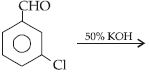
A
$3-$chlorobenzyl alcohol + potassium $3-$chlorobenzoate
B
$3-$hydroxybenzyl alcohol + potassium $3-$hydroxybenzoate
C
$3-$chlorobenzyl alcohol + potassium $3-$chlorobenzoate (with different structure)
D
$3-$hydroxybenzyl alcohol + $3-$hydroxybenzoic acid
Solution
(A) The given reaction is a Cannizzaro reaction because the reactant,$3$-chlorobenzaldehyde,does not have any $\alpha$-hydrogen atoms. When treated with $50 \% \ KOH$,it undergoes disproportionation (self-oxidation and reduction). The aldehyde group is oxidized to a carboxylate salt $(COOK)$ and reduced to an alcohol group $(-CH_2OH)$. The products are $3$-chlorobenzyl alcohol and potassium $3$-chlorobenzoate.
0 likesView Solution
85
ChemistryMediumMCQAIPMT · 2012
Acetone is treated with excess of ethanol in the presence of hydrochloric acid. The product obtained is
A
$CH_3-C(OC_2H_5)_2-CH_3$
B
$CH_3-C(OH)(OC_2H_5)-CH_3$
C
$(CH_3)_2C(OH)(OC_2H_5)$
D
$(CH_3)_2C(OC_2H_5)_2$
Solution
(A) Acetone reacts with excess ethanol in the presence of dry $HCl$ gas to form a ketal (a type of acetal). The reaction is as follows:
$CH_3COCH_3 + 2C_2H_5OH \xrightarrow{dry \ HCl} CH_3C(OC_2H_5)_2CH_3 + H_2O$
Thus,the product obtained is $CH_3C(OC_2H_5)_2CH_3$.
$CH_3COCH_3 + 2C_2H_5OH \xrightarrow{dry \ HCl} CH_3C(OC_2H_5)_2CH_3 + H_2O$
Thus,the product obtained is $CH_3C(OC_2H_5)_2CH_3$.
0 likesView Solution
86
ChemistryMediumMCQAIPMT · 2012
$CH_3CHO$ and $C_6H_5CH_2CHO$ can be distinguished chemically by
A
Benedict's test
B
Iodoform test
C
Tollen's reagent test
D
Fehling's solution test
Solution
(B) $CH_3CHO$ and $C_6H_5CH_2CHO$ are both aldehydes and react with Tollen's reagent,Fehling's solution,and Benedict's solution,so these cannot distinguish them.
$CH_3CHO$ contains a $CH_3CO-$ group,which gives a positive Iodoform test with $I_2$ and $NaOH$,forming a yellow precipitate of $CHI_3$.
$CH_3CHO + 3 I_2 + 4 NaOH \longrightarrow CHI_3 (\text{yellow ppt}) + HCOONa + 3 NaI + 3 H_2O$
$C_6H_5CH_2CHO$ does not contain the $CH_3CO-$ group and does not give the Iodoform test.
$\therefore$ The Iodoform test is the correct method to distinguish between them.
$CH_3CHO$ contains a $CH_3CO-$ group,which gives a positive Iodoform test with $I_2$ and $NaOH$,forming a yellow precipitate of $CHI_3$.
$CH_3CHO + 3 I_2 + 4 NaOH \longrightarrow CHI_3 (\text{yellow ppt}) + HCOONa + 3 NaI + 3 H_2O$
$C_6H_5CH_2CHO$ does not contain the $CH_3CO-$ group and does not give the Iodoform test.
$\therefore$ The Iodoform test is the correct method to distinguish between them.
0 likesView Solution
87
ChemistryMediumMCQAIPMT · 2012
The correct order of decreasing acid strength of trichloroacetic acid $(A)$,trifluoroacetic acid $(B)$,acetic acid $(C)$,and formic acid $(D)$ is
A
$B > A > D > C$
B
$B > D > C > A$
C
$A > B > C > D$
D
$A > C > B > D$
Solution
(A) The acid strength of carboxylic acids is determined by the stability of the carboxylate anion formed after the loss of a $H^+$ ion.
Electron-withdrawing groups ($-I$ effect) stabilize the carboxylate anion,thereby increasing the acidity.
Electron-donating groups ($+I$ effect) destabilize the carboxylate anion,thereby decreasing the acidity.
Comparing the substituents:
$CF_3-$ (trifluoroacetic acid,$B$) has a stronger $-I$ effect than $CCl_3-$ (trichloroacetic acid,$A$) due to the higher electronegativity of fluorine.
Formic acid ($D$,$HCOOH$) has no alkyl group,while acetic acid ($C$,$CH_3COOH$) has a methyl group which exerts a $+I$ effect.
Therefore,the order of decreasing acid strength is $CF_3COOH (B) > CCl_3COOH (A) > HCOOH (D) > CH_3COOH (C)$.
Electron-withdrawing groups ($-I$ effect) stabilize the carboxylate anion,thereby increasing the acidity.
Electron-donating groups ($+I$ effect) destabilize the carboxylate anion,thereby decreasing the acidity.
Comparing the substituents:
$CF_3-$ (trifluoroacetic acid,$B$) has a stronger $-I$ effect than $CCl_3-$ (trichloroacetic acid,$A$) due to the higher electronegativity of fluorine.
Formic acid ($D$,$HCOOH$) has no alkyl group,while acetic acid ($C$,$CH_3COOH$) has a methyl group which exerts a $+I$ effect.
Therefore,the order of decreasing acid strength is $CF_3COOH (B) > CCl_3COOH (A) > HCOOH (D) > CH_3COOH (C)$.
0 likesView Solution
88
ChemistryMediumMCQAIPMT · 2012
Consider the following reaction:
$C_6H_5COCl \xrightarrow{H_2, Pd/BaSO_4} A$
The product $A$ is:
$C_6H_5COCl \xrightarrow{H_2, Pd/BaSO_4} A$
The product $A$ is:
A
$C_6H_5CHO$
B
$C_6H_5OH$
C
$C_6H_5COCH_3$
D
$C_6H_5Cl$
Solution
(A) The given reaction is the Rosenmund reduction.
In this reaction,an acid chloride $(RCOCl)$ is hydrogenated to an aldehyde $(RCHO)$ using hydrogen gas in the presence of a palladium catalyst supported on barium sulfate $(Pd/BaSO_4)$.
The $BaSO_4$ acts as a poison to prevent the further reduction of the aldehyde to an alcohol.
Therefore,the reaction of benzoyl chloride $(C_6H_5COCl)$ with $H_2$ in the presence of $Pd/BaSO_4$ yields benzaldehyde $(C_6H_5CHO)$.
In this reaction,an acid chloride $(RCOCl)$ is hydrogenated to an aldehyde $(RCHO)$ using hydrogen gas in the presence of a palladium catalyst supported on barium sulfate $(Pd/BaSO_4)$.
The $BaSO_4$ acts as a poison to prevent the further reduction of the aldehyde to an alcohol.
Therefore,the reaction of benzoyl chloride $(C_6H_5COCl)$ with $H_2$ in the presence of $Pd/BaSO_4$ yields benzaldehyde $(C_6H_5CHO)$.
0 likesView Solution
89
ChemistryMediumMCQAIPMT · 2012
Consider the reaction:
$RCHO + NH_2NH_2 \rightarrow RCH=NNH_2 + H_2O$
What sort of reaction is it?
$RCHO + NH_2NH_2 \rightarrow RCH=NNH_2 + H_2O$
What sort of reaction is it?
A
Electrophilic addition-elimination reaction
B
Free radical addition-elimination reaction
C
Electrophilic substitution-elimination reaction
D
Nucleophilic addition-elimination reaction
Solution
(D) The reaction $RCHO + NH_2NH_2 \rightarrow RCH=NNH_2 + H_2O$ involves the attack of the nucleophilic nitrogen atom of hydrazine $(NH_2NH_2)$ on the electrophilic carbonyl carbon of the aldehyde $(RCHO)$.
This step is a nucleophilic addition to the carbonyl group.
Subsequently,the elimination of a water molecule $(H_2O)$ occurs to form the final product,which is a hydrazone.
Therefore,the overall mechanism is classified as a nucleophilic addition-elimination reaction.
This step is a nucleophilic addition to the carbonyl group.
Subsequently,the elimination of a water molecule $(H_2O)$ occurs to form the final product,which is a hydrazone.
Therefore,the overall mechanism is classified as a nucleophilic addition-elimination reaction.
0 likesView Solution
90
ChemistryMediumMCQAIPMT · 2012
Which of the following compounds will give a yellow precipitate with iodine and alkali?
A
Acetophenone
B
Methyl acetate
C
$2-$Hydroxypropane
D
Both $(a)$ and $(c)$
Solution
(D) The iodoform test is given by compounds containing the $CH_3CO-$ group or the $CH_3CH(OH)-$ group.
Acetophenone $(C_6H_5COCH_3)$ contains the $CH_3CO-$ group and gives a yellow precipitate of iodoform $(CHI_3)$.
$2-$Hydroxypropane $(CH_3CH(OH)CH_3)$ contains the $CH_3CH(OH)-$ group and also gives a yellow precipitate of iodoform $(CHI_3)$.
Methyl acetate $(CH_3COOCH_3)$ does not give this test.
Therefore,both $(a)$ and $(c)$ give the yellow precipitate.
Acetophenone $(C_6H_5COCH_3)$ contains the $CH_3CO-$ group and gives a yellow precipitate of iodoform $(CHI_3)$.
$2-$Hydroxypropane $(CH_3CH(OH)CH_3)$ contains the $CH_3CH(OH)-$ group and also gives a yellow precipitate of iodoform $(CHI_3)$.
Methyl acetate $(CH_3COOCH_3)$ does not give this test.
Therefore,both $(a)$ and $(c)$ give the yellow precipitate.
0 likesView Solution
91
ChemistryMediumMCQAIPMT · 2012
An organic compound $(C_3H_9N)$ $(A)$,when treated with nitrous acid,gave an alcohol and $N_2$ gas was evolved. $(A)$ on warming with $CHCl_3$ and caustic potash gave $(C)$ which on reduction gave isopropylmethylamine. Predict the structure of $(A)$.
A
$(CH_3)_2CH-NH_2$
B
$CH_3CH_2-NH-CH_3$
C
$N(CH_3)_3$
D
$CH_3CH_2CH_2-NH_2$
Solution
(A) The molecular formula $(C_3H_9N)$ corresponds to a primary amine.
When treated with nitrous acid $(HNO_2)$,primary aliphatic amines evolve $N_2$ gas and form an alcohol.
The carbylamine reaction (warming with $CHCl_3$ and $KOH$) is a characteristic test for primary amines,forming an isocyanide $(C)$.
Reduction of the isocyanide $(CH_3)_2CH-NC$ gives isopropylmethylamine $(CH_3)_2CH-NH-CH_3$.
Therefore,$(A)$ is isopropylamine,$(CH_3)_2CH-NH_2$.
When treated with nitrous acid $(HNO_2)$,primary aliphatic amines evolve $N_2$ gas and form an alcohol.
The carbylamine reaction (warming with $CHCl_3$ and $KOH$) is a characteristic test for primary amines,forming an isocyanide $(C)$.
Reduction of the isocyanide $(CH_3)_2CH-NC$ gives isopropylmethylamine $(CH_3)_2CH-NH-CH_3$.
Therefore,$(A)$ is isopropylamine,$(CH_3)_2CH-NH_2$.
0 likesView Solution
92
ChemistryEasyMCQAIPMT · 2012
Deficiency of vitamin $B_1$ causes the disease
A
convulsions
B
beri-beri
C
cheilosis
D
sterility
Solution
(B) deficiency of vitamin $B_1$ (thiamine) leads to the disease known as beri-beri.
This condition is characterized by damage to the peripheral nerves and muscle wasting.
Symptoms may include weight loss,anorexia,confusion,and short-term memory loss.
This condition is characterized by damage to the peripheral nerves and muscle wasting.
Symptoms may include weight loss,anorexia,confusion,and short-term memory loss.
0 likesView Solution
93
ChemistryMediumMCQAIPMT · 2012
Which one of the following sets of monosaccharides forms sucrose?
A
$\alpha-D$-glucopyranose and $\beta-D$-fructofuranose
B
$\alpha-D$-glucopyranose and $\alpha-D$-fructofuranose
C
$\beta-D$-glucopyranose and $\alpha-D$-fructofuranose
D
$\alpha-D$-glucopyranose and $\beta-D$-fructopyranose
Solution
(A) Sucrose is a disaccharide composed of $\alpha-D$-glucopyranose and $\beta-D$-fructofuranose units.
These units are linked by an $\alpha, \beta-1,2$-glycosidic linkage between the $C-1$ of the glucose unit and the $C-2$ of the fructose unit.
These units are linked by an $\alpha, \beta-1,2$-glycosidic linkage between the $C-1$ of the glucose unit and the $C-2$ of the fructose unit.
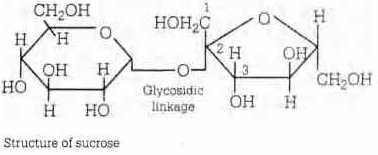
0 likesView Solution
94
ChemistryMediumMCQAIPMT · 2012
Which of the following statements is false?
A
Artificial silk is derived from cellulose.
B
Nylon-$6,6$ is an example of elastomer.
C
The repeat unit in natural rubber is isoprene.
D
Both starch and cellulose are polymers of glucose.
Solution
(B) Elastomers are polymers that possess weak intermolecular forces of attraction,allowing them to be stretched.
Nylon-$6,6$ is a fibre,not an elastomer,because it has strong intermolecular forces like hydrogen bonding.
Artificial silk (rayon) is indeed derived from cellulose.
Natural rubber is a polymer of isoprene ($2$-methyl-$1,3$-butadiene).
Both starch and cellulose are natural polymers of glucose.
Therefore,the statement that Nylon-$6,6$ is an elastomer is false.
Nylon-$6,6$ is a fibre,not an elastomer,because it has strong intermolecular forces like hydrogen bonding.
Artificial silk (rayon) is indeed derived from cellulose.
Natural rubber is a polymer of isoprene ($2$-methyl-$1,3$-butadiene).
Both starch and cellulose are natural polymers of glucose.
Therefore,the statement that Nylon-$6,6$ is an elastomer is false.
0 likesView Solution
95
ChemistryMediumMCQAIPMT · 2012
Which one of the following sets forms a biodegradable polymer?
A
$CH_2=CH-CN$ and $CH_2=CH-CH=CH_2$
B
$H_2N-CH_2-COOH$ and $H_2N-(CH_2)_5-COOH$
C
$HO-CH_2-CH_2-OH$ and $HOOC-C_6H_4-COOH$
D
$CH_2=CH-CH=CH_2$ and $C_6H_5-CH=CH_2$
Solution
(B) Biodegradable polymers are polymers that can be decomposed by microorganisms.
Option $B$ involves $H_2N-CH_2-COOH$ (Glycine) and $H_2N-(CH_2)_5-COOH$ (Aminocaproic acid). These monomers undergo condensation polymerization to form Nylon-$2$-Nylon-$6$,which is a well-known biodegradable polyamide polymer.
Therefore,the correct set is $B$.
Option $B$ involves $H_2N-CH_2-COOH$ (Glycine) and $H_2N-(CH_2)_5-COOH$ (Aminocaproic acid). These monomers undergo condensation polymerization to form Nylon-$2$-Nylon-$6$,which is a well-known biodegradable polyamide polymer.
Therefore,the correct set is $B$.
0 likesView Solution
96
ChemistryMediumMCQAIPMT · 2012
Chloramphenicol is an
A
antifertility drug
B
antihistaminic
C
antiseptic and disinfectant
D
antibiotic-broad spectrum
Solution
(D) . Antifertility drugs are used to control pregnancy. These drugs prevent conception or fertilization,e.g.,$Mifepristone$,$norethindrone$,$mestranol$ etc.
$B$. Antihistamines are used for the relief of allergies,e.g.,$diphenhydramine$,$chlorpheniramine$,$promethazine$ etc.
$C$. Antiseptics are used to reduce the number and growth of microorganisms,e.g.,$Dettol$ soap,whereas disinfectants kill bacteria and are used for sterilization of inanimate objects like instruments,utensils,clothes,floors,etc.,e.g.,$phenol$,$dettol$,$iodoform$ etc.
$D$. Broad spectrum antibiotics are such antibiotics that act against a wide range of disease-causing bacteria. They act against both $Gram$-positive and $Gram$-negative bacteria,e.g.,$ampicillin$,$chloramphenicol$ etc.
Therefore,$Chloramphenicol$ is a broad spectrum antibiotic.
$B$. Antihistamines are used for the relief of allergies,e.g.,$diphenhydramine$,$chlorpheniramine$,$promethazine$ etc.
$C$. Antiseptics are used to reduce the number and growth of microorganisms,e.g.,$Dettol$ soap,whereas disinfectants kill bacteria and are used for sterilization of inanimate objects like instruments,utensils,clothes,floors,etc.,e.g.,$phenol$,$dettol$,$iodoform$ etc.
$D$. Broad spectrum antibiotics are such antibiotics that act against a wide range of disease-causing bacteria. They act against both $Gram$-positive and $Gram$-negative bacteria,e.g.,$ampicillin$,$chloramphenicol$ etc.
Therefore,$Chloramphenicol$ is a broad spectrum antibiotic.
0 likesView Solution
97
ChemistryMediumMCQAIPMT · 2012
Which one of the following is not a condensation polymer?
A
Melamine
B
Glyptal
C
Dacron
D
Neoprene
Solution
(D) Neoprene is an addition polymer formed by the polymerization of chloroprene $(CH_2=C(Cl)-CH=CH_2)$.
Melamine,Glyptal,and Dacron are condensation polymers.
Melamine,Glyptal,and Dacron are condensation polymers.
0 likesView Solution
Vedclass Products
For Students
Vedclass Test Series
Mock tests in real AIPMT style covering Chemistry with performance analysis. 5-day free trial.
Start Free TrialFor Teachers
Exam Paper Generator
Generate Set A/B/C/D Chemistry papers from 7.5L+ questions in 2 minutes. 3 chapters free.
Try FreeFor Institutes
Online Exam Module
Run live AIPMT mock exams with unlimited students, 360° analytics & white-label branding.
See DemoFrequently Asked Questions
How many Chemistry questions are in AIPMT 2012?
There are 141 Chemistry questions from the AIPMT 2012 paper on Vedclass, each with a detailed step-by-step solution in English.
Are AIPMT 2012 Chemistry solutions available in English?
Yes. All solutions on this page are in English. You can also switch to English or Hindi using the language buttons above the questions.
Can I practice AIPMT 2012 Chemistry as a timed test?
Yes. Use the Vedclass Test Series to attempt a full AIPMT mock test covering Chemistry with time limits and instant score analysis.
Can teachers create Chemistry papers from AIPMT previous year questions?
Yes. The Vedclass Exam Paper Generator lets teachers mix AIPMT Chemistry questions and generate Set A/B/C/D papers in minutes.
For Teachers & Institutes
Build a Custom Chemistry Paper
Pick AIPMT 2012 Chemistry questions, set difficulty, and generate Set A/B/C/D in 2 minutes.