
PhysicsQ1–47 of 47 questions
Page 1 of 1 · English
1
PhysicsMediumMCQAIPMT · 2008
Which two of the following five physical parameters have the same dimensions $?$
$(1)$ energy density
$(2)$ refractive index
$(3)$ dielectric constant
$(4)$ Young's modulus
$(5)$ magnetic field
$(1)$ energy density
$(2)$ refractive index
$(3)$ dielectric constant
$(4)$ Young's modulus
$(5)$ magnetic field
A
$1$ and $4$
B
$1$ and $5$
C
$2$ and $4$
D
$3$ and $5$
Solution
(A) The dimension of energy density is given by: $\text{Energy density} = \frac{\text{Energy}}{\text{Volume}} = \frac{[ML^2T^{-2}]}{[L^3]} = [ML^{-1}T^{-2}]$.
Young's modulus $(Y)$ is defined as: $Y = \frac{\text{Stress}}{\text{Strain}} = \frac{\text{Force/Area}}{\text{Change in length/Original length}}$.
Since strain is dimensionless,the dimensions of Young's modulus are the same as stress: $[Y] = \frac{[MLT^{-2}]}{[L^2]} = [ML^{-1}T^{-2}]$.
Refractive index and dielectric constant are dimensionless quantities.
Magnetic field has dimensions $[MT^{-2}A^{-1}]$.
Thus,energy density and Young's modulus have the same dimensions.
Young's modulus $(Y)$ is defined as: $Y = \frac{\text{Stress}}{\text{Strain}} = \frac{\text{Force/Area}}{\text{Change in length/Original length}}$.
Since strain is dimensionless,the dimensions of Young's modulus are the same as stress: $[Y] = \frac{[MLT^{-2}]}{[L^2]} = [ML^{-1}T^{-2}]$.
Refractive index and dielectric constant are dimensionless quantities.
Magnetic field has dimensions $[MT^{-2}A^{-1}]$.
Thus,energy density and Young's modulus have the same dimensions.
0 likesView Solution
2
PhysicsEasyMCQAIPMT · 2008
If the error in the measurement of the radius of a sphere is $2\%$,then the error in the determination of the volume of the sphere will be ........ $\%$
A
$2$
B
$4$
C
$6$
D
$8$
Solution
(C) The percentage error in the radius is given as $\frac{\Delta r}{r} \times 100 = 2\%$.
The volume of a sphere is given by the formula $V = \frac{4}{3} \pi r^3$.
Using the rules of propagation of errors for powers,the relative error in volume is $\frac{\Delta V}{V} = 3 \times \frac{\Delta r}{r}$.
To find the percentage error,multiply both sides by $100$:
$\frac{\Delta V}{V} \times 100 = 3 \times (\frac{\Delta r}{r} \times 100)$.
Substituting the given value:
$\frac{\Delta V}{V} \times 100 = 3 \times 2\% = 6\%$.
The volume of a sphere is given by the formula $V = \frac{4}{3} \pi r^3$.
Using the rules of propagation of errors for powers,the relative error in volume is $\frac{\Delta V}{V} = 3 \times \frac{\Delta r}{r}$.
To find the percentage error,multiply both sides by $100$:
$\frac{\Delta V}{V} \times 100 = 3 \times (\frac{\Delta r}{r} \times 100)$.
Substituting the given value:
$\frac{\Delta V}{V} \times 100 = 3 \times 2\% = 6\%$.
0 likesView Solution
3
PhysicsMediumMCQAIPMT · 2008
$A$ particle moves in a straight line with a constant acceleration. It changes its velocity from $10 \, m/s$ to $20 \, m/s$ while passing through a distance of $135 \, m$ in $t$ seconds. The value of $t$ is..........$s$.
A
$12$
B
$9$
C
$10$
D
$1.8$
Solution
(B) Given: Initial velocity $u = 10 \, m/s$,final velocity $v = 20 \, m/s$,and distance $s = 135 \, m$.
Using the equation of motion $v^2 - u^2 = 2as$:
$(20)^2 - (10)^2 = 2 \times a \times 135$
$400 - 100 = 270a$
$300 = 270a$
$a = \frac{300}{270} = \frac{10}{9} \, m/s^2$.
Now,using the equation $v = u + at$ to find $t$:
$20 = 10 + (\frac{10}{9})t$
$10 = (\frac{10}{9})t$
$t = 9 \, s$.
Using the equation of motion $v^2 - u^2 = 2as$:
$(20)^2 - (10)^2 = 2 \times a \times 135$
$400 - 100 = 270a$
$300 = 270a$
$a = \frac{300}{270} = \frac{10}{9} \, m/s^2$.
Now,using the equation $v = u + at$ to find $t$:
$20 = 10 + (\frac{10}{9})t$
$10 = (\frac{10}{9})t$
$t = 9 \, s$.
1 likesView Solution
4
PhysicsEasyMCQAIPMT · 2008
The distance travelled by a particle starting from rest and moving with an acceleration $\frac{4}{3} \ m/s^2$ in the third second is:
A
$\frac{10}{3} \ m$
B
$\frac{19}{3} \ m$
C
$6 \ m$
D
$4 \ m$
Solution
(A) The distance travelled by a particle in the $n^{th}$ second is given by the formula: $S_n = u + \frac{a}{2}(2n - 1)$.
Given,initial velocity $u = 0 \ m/s$,acceleration $a = \frac{4}{3} \ m/s^2$,and time $n = 3 \ s$.
Substituting these values into the formula:
$S_3 = 0 + \frac{4/3}{2}(2(3) - 1)$
$S_3 = \frac{4}{6}(6 - 1)$
$S_3 = \frac{2}{3}(5)$
$S_3 = \frac{10}{3} \ m$.
Therefore,the distance travelled in the third second is $\frac{10}{3} \ m$.
Given,initial velocity $u = 0 \ m/s$,acceleration $a = \frac{4}{3} \ m/s^2$,and time $n = 3 \ s$.
Substituting these values into the formula:
$S_3 = 0 + \frac{4/3}{2}(2(3) - 1)$
$S_3 = \frac{4}{6}(6 - 1)$
$S_3 = \frac{2}{3}(5)$
$S_3 = \frac{10}{3} \ m$.
Therefore,the distance travelled in the third second is $\frac{10}{3} \ m$.
0 likesView Solution
5
PhysicsMediumMCQAIPMT · 2008
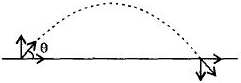
$A$ particle of mass $m$ is projected with velocity $v$ making an angle of $45^\circ$ with the horizontal. When the particle lands on the level ground,the magnitude of the change in its momentum will be
A
$\sqrt{2}mv$
B
$0$
C
$2mv$
D
$\frac{mv}{\sqrt{2}}$
Solution
(A) The initial velocity of the particle is $\vec{u} = v \cos \theta \hat{i} + v \sin \theta \hat{j}$.
The final velocity of the particle when it lands on the ground is $\vec{v}_f = v \cos \theta \hat{i} - v \sin \theta \hat{j}$.
The initial momentum is $\vec{p}_i = m(v \cos \theta \hat{i} + v \sin \theta \hat{j})$.
The final momentum is $\vec{p}_f = m(v \cos \theta \hat{i} - v \sin \theta \hat{j})$.
The change in momentum is $\Delta \vec{p} = \vec{p}_f - \vec{p}_i = -2mv \sin \theta \hat{j}$.
The magnitude of the change in momentum is $|\Delta \vec{p}| = 2mv \sin \theta$.
Given $\theta = 45^\circ$,we have $\sin 45^\circ = \frac{1}{\sqrt{2}}$.
Therefore,$|\Delta \vec{p}| = 2mv \times \frac{1}{\sqrt{2}} = \sqrt{2}mv$.
The final velocity of the particle when it lands on the ground is $\vec{v}_f = v \cos \theta \hat{i} - v \sin \theta \hat{j}$.
The initial momentum is $\vec{p}_i = m(v \cos \theta \hat{i} + v \sin \theta \hat{j})$.
The final momentum is $\vec{p}_f = m(v \cos \theta \hat{i} - v \sin \theta \hat{j})$.
The change in momentum is $\Delta \vec{p} = \vec{p}_f - \vec{p}_i = -2mv \sin \theta \hat{j}$.
The magnitude of the change in momentum is $|\Delta \vec{p}| = 2mv \sin \theta$.
Given $\theta = 45^\circ$,we have $\sin 45^\circ = \frac{1}{\sqrt{2}}$.
Therefore,$|\Delta \vec{p}| = 2mv \times \frac{1}{\sqrt{2}} = \sqrt{2}mv$.
0 likesView Solution
6
PhysicsEasyMCQAIPMT · 2008
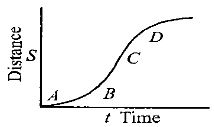
$A$ particle shows a distance-time curve as given in the figure. The maximum instantaneous velocity of the particle is around the point:
A
$D$
B
$A$
C
$B$
D
$C$
Solution
(D) The instantaneous velocity of a particle is given by the slope of the distance-time graph,which is $v = \frac{ds}{dt}$.
In a distance-time graph,the slope is represented by the steepness of the curve at any given point.
By observing the figure,the curve is steepest at point $C$,meaning the slope is maximum at this point.
Therefore,the instantaneous velocity is maximum around point $C$.
In a distance-time graph,the slope is represented by the steepness of the curve at any given point.
By observing the figure,the curve is steepest at point $C$,meaning the slope is maximum at this point.
Therefore,the instantaneous velocity is maximum around point $C$.
0 likesView Solution
7
PhysicsEasyMCQAIPMT · 2008
Sand is being dropped on a conveyor belt at the rate of $M \ kg/s$. The force necessary to keep the belt moving with a constant velocity of $v \ m/s$ will be
A
$Mv/2 \ N$
B
zero
C
$Mv \ N$
D
$2Mv \ N$
Solution
(C) The force $F$ required to maintain the motion of the conveyor belt is given by the rate of change of momentum.
Since the velocity $v$ is constant,the force is given by $F = \frac{dp}{dt} = \frac{d}{dt}(mv)$.
Using the product rule,$F = v \frac{dm}{dt} + m \frac{dv}{dt}$.
Since the velocity $v$ is constant,$\frac{dv}{dt} = 0$.
Given that the rate of mass deposition is $\frac{dm}{dt} = M \ kg/s$,we substitute these values into the equation:
$F = v \cdot M + m \cdot 0 = Mv$.
Therefore,the force required to keep the conveyor belt moving at a constant velocity $v$ is $Mv \ N$.
Since the velocity $v$ is constant,the force is given by $F = \frac{dp}{dt} = \frac{d}{dt}(mv)$.
Using the product rule,$F = v \frac{dm}{dt} + m \frac{dv}{dt}$.
Since the velocity $v$ is constant,$\frac{dv}{dt} = 0$.
Given that the rate of mass deposition is $\frac{dm}{dt} = M \ kg/s$,we substitute these values into the equation:
$F = v \cdot M + m \cdot 0 = Mv$.
Therefore,the force required to keep the conveyor belt moving at a constant velocity $v$ is $Mv \ N$.
0 likesView Solution
8
PhysicsMediumMCQAIPMT · 2008
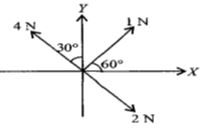
Three forces acting on a body are shown in the figure. To have the resultant force only along the $y-$ direction,the magnitude of the minimum additional force needed is ........... $N$.
A
$\frac{\sqrt{3}}{4}$
B
$\sqrt{3}$
C
$0.5$
D
$1.5$
Solution
(C) To have the resultant force only along the $y-$ direction,the net force along the $x-$ direction must be zero.
Let the additional force be $\vec{F}_{add} = F_x \hat{i} + F_y \hat{j}$.
The $x-$ components of the given forces are:
$F_{1x} = 1 \cos(60^{\circ}) = 1 \times 0.5 = 0.5 \ N$
$F_{2x} = 2 \cos(60^{\circ}) = 2 \times 0.5 = 1.0 \ N$
$F_{4x} = -4 \sin(30^{\circ}) = -4 \times 0.5 = -2.0 \ N$
Sum of $x-$ components = $0.5 + 1.0 - 2.0 = -0.5 \ N$.
To make the net $x-$ component zero,we need an additional force $F_x$ such that $-0.5 + F_x = 0$,which gives $F_x = 0.5 \ N$.
The magnitude of the minimum additional force is $0.5 \ N$.
Let the additional force be $\vec{F}_{add} = F_x \hat{i} + F_y \hat{j}$.
The $x-$ components of the given forces are:
$F_{1x} = 1 \cos(60^{\circ}) = 1 \times 0.5 = 0.5 \ N$
$F_{2x} = 2 \cos(60^{\circ}) = 2 \times 0.5 = 1.0 \ N$
$F_{4x} = -4 \sin(30^{\circ}) = -4 \times 0.5 = -2.0 \ N$
Sum of $x-$ components = $0.5 + 1.0 - 2.0 = -0.5 \ N$.
To make the net $x-$ component zero,we need an additional force $F_x$ such that $-0.5 + F_x = 0$,which gives $F_x = 0.5 \ N$.
The magnitude of the minimum additional force is $0.5 \ N$.
0 likesView Solution
9
PhysicsMediumMCQAIPMT · 2008
$A$ roller coaster is designed such that riders experience "weightlessness" as they go round the top of a hill whose radius of curvature is $20\, m$. The speed of the car at the top of the hill is between
A
$16\, m/s$ and $17\, m/s$
B
$13\, m/s$ and $14\, m/s$
C
$14\, m/s$ and $15\, m/s$
D
$15\, m/s$ and $16\, m/s$
Solution
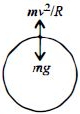
(C) At the top of the hill, the forces acting on the rider are the gravitational force $(mg)$ acting downwards and the normal reaction $(N)$ acting upwards.
The centripetal force required for circular motion is provided by the net force towards the center: $mg - N = \frac{mv^2}{R}$.
For the condition of "weightlessness", the normal reaction $N$ must be zero.
Therefore, $mg = \frac{mv^2}{R}$.
Solving for velocity $v$: $v = \sqrt{Rg}$.
Given $R = 20\, m$ and taking $g = 10\, m/s^2$, we have:
$v = \sqrt{20 \times 10} = \sqrt{200} \approx 14.14\, m/s$.
Thus, the speed is between $14\, m/s$ and $15\, m/s$.
The centripetal force required for circular motion is provided by the net force towards the center: $mg - N = \frac{mv^2}{R}$.
For the condition of "weightlessness", the normal reaction $N$ must be zero.
Therefore, $mg = \frac{mv^2}{R}$.
Solving for velocity $v$: $v = \sqrt{Rg}$.
Given $R = 20\, m$ and taking $g = 10\, m/s^2$, we have:
$v = \sqrt{20 \times 10} = \sqrt{200} \approx 14.14\, m/s$.
Thus, the speed is between $14\, m/s$ and $15\, m/s$.
0 likesView Solution
10
PhysicsMediumMCQAIPMT · 2008
Water falls from a height of $60\, m$ at the rate of $15\, kg/s$ to operate a turbine. The losses due to frictional forces are $10\%$ of energy. How much power is generated by the turbine ............. $kW$ ? $(g = 10\, m/s^2)$
A
$12.3$
B
$7$
C
$8.1$
D
$10.2$
Solution
(C) The rate of mass flow of water is $\frac{dm}{dt} = 15\, kg/s$.
The height is $h = 60\, m$ and acceleration due to gravity is $g = 10\, m/s^2$.
The total potential energy available per second (input power) is $P_{in} = \frac{dm}{dt} \cdot g \cdot h = 15 \times 10 \times 60 = 9000\, W$.
The losses due to friction are $10\%$,so the efficiency of the turbine is $90\%$.
The power generated by the turbine is $P_{out} = P_{in} \times 0.90 = 9000 \times 0.90 = 8100\, W$.
Converting to kilowatts,$P_{out} = 8.1\, kW$.
The height is $h = 60\, m$ and acceleration due to gravity is $g = 10\, m/s^2$.
The total potential energy available per second (input power) is $P_{in} = \frac{dm}{dt} \cdot g \cdot h = 15 \times 10 \times 60 = 9000\, W$.
The losses due to friction are $10\%$,so the efficiency of the turbine is $90\%$.
The power generated by the turbine is $P_{out} = P_{in} \times 0.90 = 9000 \times 0.90 = 8100\, W$.
Converting to kilowatts,$P_{out} = 8.1\, kW$.
0 likesView Solution
11
PhysicsMediumMCQAIPMT · 2008
$A$ shell of mass $200\, g$ is ejected from a gun of mass $4\, kg$ by an explosion that generates $1.05\, kJ$ of energy. The initial velocity of the shell is .............. $m/s$.
A
$40$
B
$120$
C
$100$
D
$80$
Solution
(C) Let $m = 0.2\, kg$ be the mass of the shell and $M = 4\, kg$ be the mass of the gun. Let $v$ be the velocity of the shell and $V$ be the recoil velocity of the gun.
By the law of conservation of momentum,$mv = MV$,so $V = (m/M)v$.
The total energy generated by the explosion is equal to the sum of the kinetic energies of the shell and the gun:
$E = \frac{1}{2}mv^2 + \frac{1}{2}MV^2$
Substituting $V = (m/M)v$:
$E = \frac{1}{2}mv^2 + \frac{1}{2}M(\frac{m}{M}v)^2 = \frac{1}{2}mv^2 (1 + \frac{m}{M})$
Given $E = 1.05\, kJ = 1050\, J$,$m = 0.2\, kg$,and $M = 4\, kg$:
$1050 = \frac{1}{2} \times 0.2 \times v^2 \times (1 + \frac{0.2}{4})$
$1050 = 0.1 \times v^2 \times (1 + 0.05)$
$1050 = 0.1 \times 1.05 \times v^2$
$1050 = 0.105 \times v^2$
$v^2 = \frac{1050}{0.105} = 10000$
$v = 100\, m/s$.
By the law of conservation of momentum,$mv = MV$,so $V = (m/M)v$.
The total energy generated by the explosion is equal to the sum of the kinetic energies of the shell and the gun:
$E = \frac{1}{2}mv^2 + \frac{1}{2}MV^2$
Substituting $V = (m/M)v$:
$E = \frac{1}{2}mv^2 + \frac{1}{2}M(\frac{m}{M}v)^2 = \frac{1}{2}mv^2 (1 + \frac{m}{M})$
Given $E = 1.05\, kJ = 1050\, J$,$m = 0.2\, kg$,and $M = 4\, kg$:
$1050 = \frac{1}{2} \times 0.2 \times v^2 \times (1 + \frac{0.2}{4})$
$1050 = 0.1 \times v^2 \times (1 + 0.05)$
$1050 = 0.1 \times 1.05 \times v^2$
$1050 = 0.105 \times v^2$
$v^2 = \frac{1050}{0.105} = 10000$
$v = 100\, m/s$.
1 likesView Solution
12
PhysicsMediumMCQAIPMT · 2008
At $10^{\circ} C$,the value of the density of a fixed mass of an ideal gas divided by its pressure is $x$. At $110^{\circ} C$,this ratio is:
A
$\left( \frac{10}{110} \right)x$
B
$\left( \frac{283}{383} \right)x$
C
$x$
D
$\left( \frac{383}{283} \right)x$
Solution
(B) From the ideal gas equation,$PV = nRT = \frac{m}{M}RT$,where $m$ is the mass and $M$ is the molar mass.
Density $\rho = \frac{m}{V} = \frac{PM}{RT}$.
The ratio of density to pressure is $\frac{\rho}{P} = \frac{M}{RT}$.
Since $M$ and $R$ are constants,$\frac{\rho}{P} \propto \frac{1}{T}$.
Let the ratio at $T_1 = 10^{\circ} C = 283 \ K$ be $x_1 = x$.
Let the ratio at $T_2 = 110^{\circ} C = 383 \ K$ be $x_2$.
Since $x \cdot T = \text{constant}$,we have $x_1 T_1 = x_2 T_2$.
$x \cdot 283 = x_2 \cdot 383$.
Therefore,$x_2 = \left( \frac{283}{383} \right)x$.
Density $\rho = \frac{m}{V} = \frac{PM}{RT}$.
The ratio of density to pressure is $\frac{\rho}{P} = \frac{M}{RT}$.
Since $M$ and $R$ are constants,$\frac{\rho}{P} \propto \frac{1}{T}$.
Let the ratio at $T_1 = 10^{\circ} C = 283 \ K$ be $x_1 = x$.
Let the ratio at $T_2 = 110^{\circ} C = 383 \ K$ be $x_2$.
Since $x \cdot T = \text{constant}$,we have $x_1 T_1 = x_2 T_2$.
$x \cdot 283 = x_2 \cdot 383$.
Therefore,$x_2 = \left( \frac{283}{383} \right)x$.
0 likesView Solution
13
PhysicsEasyMCQAIPMT · 2008
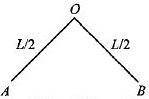
$A$ thin rod of length $L$ and mass $M$ is bent at its midpoint into two halves so that the angle between them is $90^o$. The moment of inertia of the bent rod about an axis passing through the bending point and perpendicular to the plane defined by the two halves of the rod is
A
$\frac{ML^2}{6}$
B
$\frac{\sqrt{2}ML^2}{24}$
C
$\frac{ML^2}{24}$
D
$\frac{ML^2}{12}$
Solution
(D) The rod is bent at its midpoint into two halves,each of length $l = L/2$ and mass $m = M/2$.
Each half acts as a thin rod of length $L/2$ and mass $M/2$ rotating about an axis passing through one of its ends.
The moment of inertia of a thin rod of mass $m$ and length $l$ about an axis passing through one end and perpendicular to its length is given by $I = \frac{1}{3}ml^2$.
Here,$m = M/2$ and $l = L/2$.
So,the moment of inertia of one half about the bending point $O$ is $I_{half} = \frac{1}{3} \times (M/2) \times (L/2)^2 = \frac{1}{3} \times \frac{M}{2} \times \frac{L^2}{4} = \frac{ML^2}{24}$.
Since the two halves are identical and rotate about the same axis passing through $O$,the total moment of inertia is $I_{total} = I_{half} + I_{half} = 2 \times \frac{ML^2}{24} = \frac{ML^2}{12}$.
Each half acts as a thin rod of length $L/2$ and mass $M/2$ rotating about an axis passing through one of its ends.
The moment of inertia of a thin rod of mass $m$ and length $l$ about an axis passing through one end and perpendicular to its length is given by $I = \frac{1}{3}ml^2$.
Here,$m = M/2$ and $l = L/2$.
So,the moment of inertia of one half about the bending point $O$ is $I_{half} = \frac{1}{3} \times (M/2) \times (L/2)^2 = \frac{1}{3} \times \frac{M}{2} \times \frac{L^2}{4} = \frac{ML^2}{24}$.
Since the two halves are identical and rotate about the same axis passing through $O$,the total moment of inertia is $I_{total} = I_{half} + I_{half} = 2 \times \frac{ML^2}{24} = \frac{ML^2}{12}$.
0 likesView Solution
14
PhysicsMediumMCQAIPMT · 2008
The ratio of the radii of gyration of a circular disc to that of a circular ring,each of same mass and radius,around their respective axes is
A
$1 : \sqrt{2}$
B
$\sqrt{2} : 1$
C
$\sqrt{2} : \sqrt{3}$
D
$\sqrt{3} : \sqrt{2}$
Solution
(A) The moment of inertia $(I)$ of a circular disc about its central axis is $I_{disc} = \frac{1}{2}MR^2$. The radius of gyration $(k)$ is defined by $I = Mk^2$. Thus,$k_{disc} = \sqrt{\frac{I}{M}} = \sqrt{\frac{R^2}{2}} = \frac{R}{\sqrt{2}}$.
The moment of inertia $(I)$ of a circular ring about its central axis is $I_{ring} = MR^2$. Thus,$k_{ring} = \sqrt{\frac{I}{M}} = \sqrt{R^2} = R$.
The ratio of the radius of gyration of the disc to that of the ring is $\frac{k_{disc}}{k_{ring}} = \frac{R/\sqrt{2}}{R} = \frac{1}{\sqrt{2}}$.
Therefore,the ratio is $1 : \sqrt{2}$.
The moment of inertia $(I)$ of a circular ring about its central axis is $I_{ring} = MR^2$. Thus,$k_{ring} = \sqrt{\frac{I}{M}} = \sqrt{R^2} = R$.
The ratio of the radius of gyration of the disc to that of the ring is $\frac{k_{disc}}{k_{ring}} = \frac{R/\sqrt{2}}{R} = \frac{1}{\sqrt{2}}$.
Therefore,the ratio is $1 : \sqrt{2}$.
0 likesView Solution
15
PhysicsMediumMCQAIPMT · 2008
On a new scale of temperature (which is linear) called the $W$ scale,the freezing and boiling points of water are $39\,^{\circ}W$ and $239\,^{\circ}W$ respectively. What will be the temperature on the new scale,corresponding to a temperature of $39\,^{\circ}C$ on the Celsius scale?
A
$200$
B
$139$
C
$78$
D
$117$
Solution
(D) The relationship between two linear temperature scales is given by the formula: $\frac{T_W - \text{Freezing point}_W}{\text{Boiling point}_W - \text{Freezing point}_W} = \frac{T_C - \text{Freezing point}_C}{\text{Boiling point}_C - \text{Freezing point}_C}$.
Given for the $W$ scale: Freezing point = $39\,^{\circ}W$,Boiling point = $239\,^{\circ}W$.
Given for the Celsius scale: Freezing point = $0\,^{\circ}C$,Boiling point = $100\,^{\circ}C$.
Substituting the values:
$\frac{T_W - 39}{239 - 39} = \frac{39 - 0}{100 - 0}$
$\frac{T_W - 39}{200} = \frac{39}{100}$
$T_W - 39 = \frac{39}{100} \times 200$
$T_W - 39 = 39 \times 2 = 78$
$T_W = 78 + 39 = 117\,^{\circ}W$.
Given for the $W$ scale: Freezing point = $39\,^{\circ}W$,Boiling point = $239\,^{\circ}W$.
Given for the Celsius scale: Freezing point = $0\,^{\circ}C$,Boiling point = $100\,^{\circ}C$.
Substituting the values:
$\frac{T_W - 39}{239 - 39} = \frac{39 - 0}{100 - 0}$
$\frac{T_W - 39}{200} = \frac{39}{100}$
$T_W - 39 = \frac{39}{100} \times 200$
$T_W - 39 = 39 \times 2 = 78$
$T_W = 78 + 39 = 117\,^{\circ}W$.
0 likesView Solution
16
PhysicsEasyMCQAIPMT · 2008
If $Q$,$E$,and $W$ denote respectively the heat added,change in internal energy,and the work done by a closed cycle process,then
A
$W = 0$
B
$Q = 0$
C
$E = 0$
D
$Q = W = 0$
Solution
(C) According to the first law of thermodynamics,$Q = \Delta U + W$,where $Q$ is the heat added,$\Delta U$ is the change in internal energy,and $W$ is the work done.
Internal energy is a state function,meaning it depends only on the initial and final states of the system.
In a closed cyclic process,the system returns to its initial state after completing the cycle.
Since the initial and final states are identical,the change in internal energy $\Delta U$ (denoted here as $E$) must be zero.
Therefore,$E = 0$.
Internal energy is a state function,meaning it depends only on the initial and final states of the system.
In a closed cyclic process,the system returns to its initial state after completing the cycle.
Since the initial and final states are identical,the change in internal energy $\Delta U$ (denoted here as $E$) must be zero.
Therefore,$E = 0$.
0 likesView Solution
17
PhysicsEasyMCQAIPMT · 2008
Two simple harmonic motions of angular frequency $100 \, rad \, s^{-1}$ and $1000 \, rad \, s^{-1}$ have the same displacement amplitude. The ratio of their maximum acceleration is
A
$1:10^3$
B
$1:10^4$
C
$1:10$
D
$1:10^2$
Solution
(D) The angular frequencies are given as $\omega_{1} = 100 \, rad \, s^{-1}$ and $\omega_{2} = 1000 \, rad \, s^{-1}$.
Let the common displacement amplitude be $A$.
The maximum acceleration $a_{max}$ for a simple harmonic motion is given by the formula $a_{max} = \omega^2 A$.
For the first motion,$a_{max1} = \omega_{1}^2 A = (100)^2 A$.
For the second motion,$a_{max2} = \omega_{2}^2 A = (1000)^2 A$.
The ratio of their maximum accelerations is $\frac{a_{max1}}{a_{max2}} = \frac{\omega_{1}^2 A}{\omega_{2}^2 A} = \frac{\omega_{1}^2}{\omega_{2}^2}$.
Substituting the values,we get $\frac{a_{max1}}{a_{max2}} = \frac{(100)^2}{(1000)^2} = \frac{10000}{1000000} = \frac{1}{100}$.
Thus,the ratio is $1:10^2$.
Let the common displacement amplitude be $A$.
The maximum acceleration $a_{max}$ for a simple harmonic motion is given by the formula $a_{max} = \omega^2 A$.
For the first motion,$a_{max1} = \omega_{1}^2 A = (100)^2 A$.
For the second motion,$a_{max2} = \omega_{2}^2 A = (1000)^2 A$.
The ratio of their maximum accelerations is $\frac{a_{max1}}{a_{max2}} = \frac{\omega_{1}^2 A}{\omega_{2}^2 A} = \frac{\omega_{1}^2}{\omega_{2}^2}$.
Substituting the values,we get $\frac{a_{max1}}{a_{max2}} = \frac{(100)^2}{(1000)^2} = \frac{10000}{1000000} = \frac{1}{100}$.
Thus,the ratio is $1:10^2$.
0 likesView Solution
18
PhysicsMediumMCQAIPMT · 2008
The wave described by $y = 0.25 \sin(10\pi x - 2\pi t)$,where $x$ and $y$ are in meters and $t$ is in seconds,is a wave travelling along the
A
$+ve$ $x$ direction with frequency $1 \text{ Hz}$ and wavelength $\lambda = 0.2 \text{ m}$.
B
$-ve$ $x$ direction with amplitude $0.25 \text{ m}$ and wavelength $\lambda = 0.2 \text{ m}$.
C
$-ve$ $x$ direction with frequency $1 \text{ Hz}$.
D
$+ve$ $x$ direction with frequency $\pi \text{ Hz}$ and wavelength $\lambda = 0.2 \text{ m}$.
Solution
(A) The given wave equation is $y = 0.25 \sin(10\pi x - 2\pi t)$.
Comparing this with the standard wave equation $y = A \sin(kx - \omega t)$:
$1$. The amplitude $A = 0.25 \text{ m}$.
$2$. The wave number $k = 10\pi$. Since $k = \frac{2\pi}{\lambda}$,we have $\frac{2\pi}{\lambda} = 10\pi$,which gives $\lambda = 0.2 \text{ m}$.
$3$. The angular frequency $\omega = 2\pi$. Since $\omega = 2\pi f$,we have $2\pi f = 2\pi$,which gives $f = 1 \text{ Hz}$.
$4$. Since the sign between the $kx$ and $\omega t$ terms is negative,the wave is travelling in the positive $x$-direction.
Therefore,the wave travels in the $+ve$ $x$-direction with frequency $1 \text{ Hz}$ and wavelength $\lambda = 0.2 \text{ m}$.
Comparing this with the standard wave equation $y = A \sin(kx - \omega t)$:
$1$. The amplitude $A = 0.25 \text{ m}$.
$2$. The wave number $k = 10\pi$. Since $k = \frac{2\pi}{\lambda}$,we have $\frac{2\pi}{\lambda} = 10\pi$,which gives $\lambda = 0.2 \text{ m}$.
$3$. The angular frequency $\omega = 2\pi$. Since $\omega = 2\pi f$,we have $2\pi f = 2\pi$,which gives $f = 1 \text{ Hz}$.
$4$. Since the sign between the $kx$ and $\omega t$ terms is negative,the wave is travelling in the positive $x$-direction.
Therefore,the wave travels in the $+ve$ $x$-direction with frequency $1 \text{ Hz}$ and wavelength $\lambda = 0.2 \text{ m}$.
0 likesView Solution
19
PhysicsMediumMCQAIPMT · 2008
Two periodic waves of intensities $I_1$ and $I_2$ pass through a region at the same time in the same direction. The sum of the maximum and minimum intensities is
A
$(\sqrt{I_1} - \sqrt{I_2})^2$
B
$2(I_1 + I_2)$
C
$I_1 + I_2$
D
$(\sqrt{I_1} + \sqrt{I_2})^2$
Solution
(B) The intensity $I$ of a wave is proportional to the square of its amplitude $A$,i.e.,$I = kA^2$,where $k$ is a constant. Thus,$A = \sqrt{I/k}$.
When two waves superpose,the maximum and minimum amplitudes are given by $A_{\max} = A_1 + A_2$ and $A_{\min} = |A_1 - A_2|$.
The maximum intensity is $I_{\max} = k(A_1 + A_2)^2 = k(A_1^2 + A_2^2 + 2A_1A_2) = I_1 + I_2 + 2\sqrt{I_1I_2}$.
The minimum intensity is $I_{\min} = k(A_1 - A_2)^2 = k(A_1^2 + A_2^2 - 2A_1A_2) = I_1 + I_2 - 2\sqrt{I_1I_2}$.
Adding the maximum and minimum intensities:
$I_{\max} + I_{\min} = (I_1 + I_2 + 2\sqrt{I_1I_2}) + (I_1 + I_2 - 2\sqrt{I_1I_2}) = 2(I_1 + I_2)$.
When two waves superpose,the maximum and minimum amplitudes are given by $A_{\max} = A_1 + A_2$ and $A_{\min} = |A_1 - A_2|$.
The maximum intensity is $I_{\max} = k(A_1 + A_2)^2 = k(A_1^2 + A_2^2 + 2A_1A_2) = I_1 + I_2 + 2\sqrt{I_1I_2}$.
The minimum intensity is $I_{\min} = k(A_1 - A_2)^2 = k(A_1^2 + A_2^2 - 2A_1A_2) = I_1 + I_2 - 2\sqrt{I_1I_2}$.
Adding the maximum and minimum intensities:
$I_{\max} + I_{\min} = (I_1 + I_2 + 2\sqrt{I_1I_2}) + (I_1 + I_2 - 2\sqrt{I_1I_2}) = 2(I_1 + I_2)$.
0 likesView Solution
20
PhysicsMediumMCQAIPMT · 2008
$A$ point performs simple harmonic oscillation of period $T$ and the equation of motion is given by $x = A \sin(\omega t + \frac{\pi}{6})$. After the elapse of what fraction of the time period will the velocity of the point be equal to half of its maximum velocity?
A
$\frac{T}{3}$
B
$\frac{T}{12}$
C
$\frac{T}{8}$
D
$\frac{T}{6}$
Solution
(B) The equation of motion is $x = A \sin(\omega t + \frac{\pi}{6})$.
The velocity $v$ is the derivative of displacement with respect to time: $v = \frac{dx}{dt} = A\omega \cos(\omega t + \frac{\pi}{6})$.
The maximum velocity $v_{max}$ is $A\omega$.
We are given that the velocity is half of its maximum velocity: $v = \frac{v_{max}}{2}$.
Substituting the expressions: $A\omega \cos(\omega t + \frac{\pi}{6}) = \frac{A\omega}{2}$.
This simplifies to $\cos(\omega t + \frac{\pi}{6}) = \frac{1}{2}$.
Since $\cos(60^{\circ}) = \frac{1}{2}$,we have $\omega t + \frac{\pi}{6} = \frac{\pi}{3}$.
Using $\omega = \frac{2\pi}{T}$,we get $\frac{2\pi}{T} t + \frac{\pi}{6} = \frac{\pi}{3}$.
Solving for $t$: $\frac{2\pi}{T} t = \frac{\pi}{3} - \frac{\pi}{6} = \frac{\pi}{6}$.
Therefore,$t = \frac{\pi}{6} \times \frac{T}{2\pi} = \frac{T}{12}$.
The velocity $v$ is the derivative of displacement with respect to time: $v = \frac{dx}{dt} = A\omega \cos(\omega t + \frac{\pi}{6})$.
The maximum velocity $v_{max}$ is $A\omega$.
We are given that the velocity is half of its maximum velocity: $v = \frac{v_{max}}{2}$.
Substituting the expressions: $A\omega \cos(\omega t + \frac{\pi}{6}) = \frac{A\omega}{2}$.
This simplifies to $\cos(\omega t + \frac{\pi}{6}) = \frac{1}{2}$.
Since $\cos(60^{\circ}) = \frac{1}{2}$,we have $\omega t + \frac{\pi}{6} = \frac{\pi}{3}$.
Using $\omega = \frac{2\pi}{T}$,we get $\frac{2\pi}{T} t + \frac{\pi}{6} = \frac{\pi}{3}$.
Solving for $t$: $\frac{2\pi}{T} t = \frac{\pi}{3} - \frac{\pi}{6} = \frac{\pi}{6}$.
Therefore,$t = \frac{\pi}{6} \times \frac{T}{2\pi} = \frac{T}{12}$.
0 likesView Solution
21
PhysicsMediumMCQAIPMT · 2008
Two points are located at a distance of $10\; m$ and $15 \;m$ from the source of oscillation. The period of oscillation is $0.05 \;s$ and the velocity of the wave is $300 \;m/s$. What is the phase difference between the oscillations of the two points?
A
$\pi$
B
$\frac{\pi}{6}$
C
$\frac{\pi}{3}$
D
$\frac{2\pi}{3}$
Solution
(D) Given:
Distance of first point,$x_1 = 10\;m$
Distance of second point,$x_2 = 15\;m$
Period of oscillation,$T = 0.05\;s$
Velocity of wave,$v = 300\;m/s$
Path difference between the two points is:
$\Delta x = x_2 - x_1 = 15 - 10 = 5\;m$
First,calculate the wavelength $\lambda$ using the formula $v = f \lambda$,where $f = \frac{1}{T}$:
$f = \frac{1}{0.05} = 20\;Hz$
$\lambda = \frac{v}{f} = \frac{300}{20} = 15\;m$
The phase difference $\Delta \phi$ is related to the path difference $\Delta x$ by the formula:
$\Delta \phi = \frac{2\pi}{\lambda} \times \Delta x$
Substituting the values:
$\Delta \phi = \frac{2\pi}{15} \times 5 = \frac{2\pi}{3}$
Distance of first point,$x_1 = 10\;m$
Distance of second point,$x_2 = 15\;m$
Period of oscillation,$T = 0.05\;s$
Velocity of wave,$v = 300\;m/s$
Path difference between the two points is:
$\Delta x = x_2 - x_1 = 15 - 10 = 5\;m$
First,calculate the wavelength $\lambda$ using the formula $v = f \lambda$,where $f = \frac{1}{T}$:
$f = \frac{1}{0.05} = 20\;Hz$
$\lambda = \frac{v}{f} = \frac{300}{20} = 15\;m$
The phase difference $\Delta \phi$ is related to the path difference $\Delta x$ by the formula:
$\Delta \phi = \frac{2\pi}{\lambda} \times \Delta x$
Substituting the values:
$\Delta \phi = \frac{2\pi}{15} \times 5 = \frac{2\pi}{3}$
0 likesView Solution
22
PhysicsEasyMCQAIPMT · 2008
Curie temperature is the temperature above which
A
$A$ paramagnetic material becomes ferromagnetic
B
$A$ ferromagnetic material becomes paramagnetic
C
$A$ paramagnetic material becomes diamagnetic
D
$A$ ferromagnetic material becomes diamagnetic
Solution
(B) The Curie temperature $(T_C)$ is a characteristic property of ferromagnetic materials.
At temperatures below $T_C$,the material exhibits ferromagnetic properties due to the alignment of magnetic domains.
As the temperature increases and reaches $T_C$,the thermal agitation becomes strong enough to overcome the exchange coupling that maintains the alignment of these domains.
Consequently,above the Curie temperature,the material loses its spontaneous magnetization and transitions into a paramagnetic state.
Therefore,the correct option is $(B)$.
At temperatures below $T_C$,the material exhibits ferromagnetic properties due to the alignment of magnetic domains.
As the temperature increases and reaches $T_C$,the thermal agitation becomes strong enough to overcome the exchange coupling that maintains the alignment of these domains.
Consequently,above the Curie temperature,the material loses its spontaneous magnetization and transitions into a paramagnetic state.
Therefore,the correct option is $(B)$.
0 likesView Solution
23
PhysicsMediumMCQAIPMT · 2008
$M_p$ denotes the mass of a proton and $M_n$ that of a neutron. $A$ given nucleus,of binding energy $B$,contains $Z$ protons and $N$ neutrons. The mass $M(N, Z)$ of the nucleus is given by ($c$ is the velocity of light):
A
$M(N, Z) = N M_n + Z M_p - B c^2$
B
$M(N, Z) = N M_n + Z M_p + B c^2$
C
$M(N, Z) = N M_n + Z M_p - B / c^2$
D
$M(N, Z) = N M_n + Z M_p + B / c^2$
Solution
(C) The binding energy $B$ of a nucleus is defined as the energy equivalent of the mass defect $\Delta m$.
The mass defect is given by $\Delta m = (Z M_p + N M_n) - M(N, Z)$.
According to Einstein's mass-energy equivalence relation,$B = \Delta m c^2$.
Substituting the expression for $\Delta m$,we get $B = [Z M_p + N M_n - M(N, Z)] c^2$.
Rearranging the terms to solve for $M(N, Z)$:
$B / c^2 = Z M_p + N M_n - M(N, Z)$
$M(N, Z) = Z M_p + N M_n - B / c^2$.
The mass defect is given by $\Delta m = (Z M_p + N M_n) - M(N, Z)$.
According to Einstein's mass-energy equivalence relation,$B = \Delta m c^2$.
Substituting the expression for $\Delta m$,we get $B = [Z M_p + N M_n - M(N, Z)] c^2$.
Rearranging the terms to solve for $M(N, Z)$:
$B / c^2 = Z M_p + N M_n - M(N, Z)$
$M(N, Z) = Z M_p + N M_n - B / c^2$.
0 likesView Solution
24
PhysicsEasyMCQAIPMT · 2008
Two thin lenses of focal lengths $f_1$ and $f_2$ are in contact and coaxial. The combination is equivalent to a single lens of power:
A
$f_1 + f_2$
B
$\frac{f_1 f_2}{f_1 + f_2}$
C
$\frac{1}{2}(f_1 + f_2)$
D
$\frac{f_1 + f_2}{f_1 f_2}$
Solution
(D) When two thin lenses of focal lengths $f_1$ and $f_2$ are placed in contact,the equivalent focal length $F$ of the combination is given by the formula:
$\frac{1}{F} = \frac{1}{f_1} + \frac{1}{f_2}$
Taking the common denominator,we get:
$\frac{1}{F} = \frac{f_2 + f_1}{f_1 f_2}$
The power $P$ of a lens is defined as the reciprocal of its focal length in meters,i.e.,$P = \frac{1}{F}$.
Therefore,the power of the combination is $P = \frac{f_1 + f_2}{f_1 f_2}$.
$\frac{1}{F} = \frac{1}{f_1} + \frac{1}{f_2}$
Taking the common denominator,we get:
$\frac{1}{F} = \frac{f_2 + f_1}{f_1 f_2}$
The power $P$ of a lens is defined as the reciprocal of its focal length in meters,i.e.,$P = \frac{1}{F}$.
Therefore,the power of the combination is $P = \frac{f_1 + f_2}{f_1 f_2}$.
0 likesView Solution
25
PhysicsMediumMCQAIPMT · 2008
$A$ parallel plate capacitor has a uniform electric field $E$ in the space between the plates. If the distance between the plates is $d$ and the area of each plate is $A,$ the energy stored in the capacitor is
A
$\varepsilon_0 EAd$
B
$\frac{1}{2} \varepsilon_0 \frac{E^2}{Ad}$
C
$\frac{1}{2} \varepsilon_0 E^2 Ad$
D
$\varepsilon_0 \frac{E^2}{Ad}$
Solution
(C) The potential difference $V$ between the plates of a parallel plate capacitor in a uniform electric field $E$ is given by $V = Ed$.
The capacitance $C$ of a parallel plate capacitor is given by $C = \frac{\varepsilon_0 A}{d}$.
The energy $U$ stored in a capacitor is given by the formula $U = \frac{1}{2} CV^2$.
Substituting the expressions for $C$ and $V$ into the energy formula:
$U = \frac{1}{2} \left( \frac{\varepsilon_0 A}{d} \right) (Ed)^2$
$U = \frac{1}{2} \left( \frac{\varepsilon_0 A}{d} \right) E^2 d^2$
$U = \frac{1}{2} \varepsilon_0 E^2 Ad$.
The capacitance $C$ of a parallel plate capacitor is given by $C = \frac{\varepsilon_0 A}{d}$.
The energy $U$ stored in a capacitor is given by the formula $U = \frac{1}{2} CV^2$.
Substituting the expressions for $C$ and $V$ into the energy formula:
$U = \frac{1}{2} \left( \frac{\varepsilon_0 A}{d} \right) (Ed)^2$
$U = \frac{1}{2} \left( \frac{\varepsilon_0 A}{d} \right) E^2 d^2$
$U = \frac{1}{2} \varepsilon_0 E^2 Ad$.
0 likesView Solution
26
PhysicsMediumMCQAIPMT · 2008
The electric potential at a point in free space due to charge $Q$ coulomb is $V = Q \times 10^{11} \, V$. The electric field at that point is:
A
$4\pi \varepsilon_0 Q \times 10^{20} \, V/m$
B
$12\pi \varepsilon_0 Q \times 10^{22} \, V/m$
C
$4\pi \varepsilon_0 Q \times 10^{22} \, V/m$
D
$12\pi \varepsilon_0 Q \times 10^{20} \, V/m$
Solution
(C) The electric potential $V$ due to a point charge $Q$ at a distance $r$ is given by $V = \frac{1}{4 \pi \varepsilon_0} \cdot \frac{Q}{r}$.
Given $V = Q \times 10^{11} \, V$,we have $\frac{1}{4 \pi \varepsilon_0} \cdot \frac{Q}{r} = Q \times 10^{11}$.
This simplifies to $\frac{1}{r} = 4 \pi \varepsilon_0 \times 10^{11}$.
The electric field $E$ at that point is given by $E = \frac{1}{4 \pi \varepsilon_0} \cdot \frac{Q}{r^2} = \left( \frac{1}{4 \pi \varepsilon_0} \cdot \frac{Q}{r} \right) \cdot \frac{1}{r}$.
Substituting the values,$E = (Q \times 10^{11}) \times (4 \pi \varepsilon_0 \times 10^{11})$.
Therefore,$E = 4 \pi \varepsilon_0 Q \times 10^{22} \, V/m$.
Given $V = Q \times 10^{11} \, V$,we have $\frac{1}{4 \pi \varepsilon_0} \cdot \frac{Q}{r} = Q \times 10^{11}$.
This simplifies to $\frac{1}{r} = 4 \pi \varepsilon_0 \times 10^{11}$.
The electric field $E$ at that point is given by $E = \frac{1}{4 \pi \varepsilon_0} \cdot \frac{Q}{r^2} = \left( \frac{1}{4 \pi \varepsilon_0} \cdot \frac{Q}{r} \right) \cdot \frac{1}{r}$.
Substituting the values,$E = (Q \times 10^{11}) \times (4 \pi \varepsilon_0 \times 10^{11})$.
Therefore,$E = 4 \pi \varepsilon_0 Q \times 10^{22} \, V/m$.
0 likesView Solution
27
PhysicsEasyMCQAIPMT · 2008
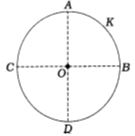
$A$ thin conducting ring of radius $R$ is given a charge $+Q.$ The electric field at the centre $O$ of the ring due to the charge on the part $AKB$ of the ring is $E.$ The electric field at the centre due to the charge on the part $ACDB$ of the ring is
A
$E$ along $KO$
B
$3E$ along $OK$
C
$3E$ along $KO$
D
$E$ along $OK$
Solution
(D) The total electric field at the centre $O$ of a uniformly charged ring is zero.
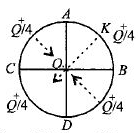
Let the ring be divided into four equal parts: $AK$,$KB$,$BD$,and $DC$. Each part carries a charge of $+Q/4$.
The electric field at the centre $O$ due to the part $AKB$ is the vector sum of the fields due to $AK$ and $KB$. Let this resultant be $E$ directed along $KO$.
The part $ACDB$ consists of the segments $AC$,$CD$,and $DB$.
Due to symmetry,the electric field at $O$ due to the charge on part $AC$ is equal and opposite to the field due to the charge on part $BD$. Thus,they cancel each other out.
Therefore,the net electric field at $O$ due to the part $ACDB$ is equal to the electric field due to the part $CD$ alone.
Since the total field of the entire ring is zero,the field due to $AKB$ must be equal and opposite to the field due to $ACDB$.
If the field due to $AKB$ is $E$ directed along $KO$,then the field due to $ACDB$ must be $E$ directed along $OK$ to ensure the vector sum is zero.
Let the ring be divided into four equal parts: $AK$,$KB$,$BD$,and $DC$. Each part carries a charge of $+Q/4$.
The electric field at the centre $O$ due to the part $AKB$ is the vector sum of the fields due to $AK$ and $KB$. Let this resultant be $E$ directed along $KO$.
The part $ACDB$ consists of the segments $AC$,$CD$,and $DB$.
Due to symmetry,the electric field at $O$ due to the charge on part $AC$ is equal and opposite to the field due to the charge on part $BD$. Thus,they cancel each other out.
Therefore,the net electric field at $O$ due to the part $ACDB$ is equal to the electric field due to the part $CD$ alone.
Since the total field of the entire ring is zero,the field due to $AKB$ must be equal and opposite to the field due to $ACDB$.
If the field due to $AKB$ is $E$ directed along $KO$,then the field due to $ACDB$ must be $E$ directed along $OK$ to ensure the vector sum is zero.
0 likesView Solution
28
PhysicsMediumMCQAIPMT · 2008
$A$ wire of a certain material is stretched slowly by $10\%$. Its new resistance and specific resistance become respectively:
A
both remain the same
B
$1.1$ times,$1.1$ times
C
$1.21$ times,same
D
$1.21$ times,$1.21$ times
Solution
(C) Let the initial length be $l$ and area be $A$. The initial resistance is $R = \rho \frac{l}{A}$.
When the wire is stretched by $10\%$,the new length $l' = l + 0.1l = 1.1l$.
Since the volume $V = Al$ remains constant,$A'l' = Al \Rightarrow A' = \frac{Al}{1.1l} = \frac{A}{1.1}$.
The new resistance $R' = \rho \frac{l'}{A'} = \rho \frac{1.1l}{A/1.1} = (1.1)^2 \rho \frac{l}{A} = 1.21 R$.
Specific resistance (resistivity) $\rho$ is a property of the material and depends only on the temperature,not on the dimensions of the wire.
Therefore,the new resistance becomes $1.21$ times the original,and the specific resistance remains the same.
When the wire is stretched by $10\%$,the new length $l' = l + 0.1l = 1.1l$.
Since the volume $V = Al$ remains constant,$A'l' = Al \Rightarrow A' = \frac{Al}{1.1l} = \frac{A}{1.1}$.
The new resistance $R' = \rho \frac{l'}{A'} = \rho \frac{1.1l}{A/1.1} = (1.1)^2 \rho \frac{l}{A} = 1.21 R$.
Specific resistance (resistivity) $\rho$ is a property of the material and depends only on the temperature,not on the dimensions of the wire.
Therefore,the new resistance becomes $1.21$ times the original,and the specific resistance remains the same.
0 likesView Solution
29
PhysicsMediumMCQAIPMT · 2008
An electric kettle draws $4\, A$ current at $220\, V.$ How much time (in minutes) will it take to boil $1\, kg$ of water starting from a temperature of $20\, ^oC$? (Assume the boiling point of water is $100\, ^oC$ and specific heat capacity of water is $4.2\, J/g\, ^oC$)
A
$12.6$
B
$4.2$
C
$6.3$
D
$8.4$
Solution
(C) Power $P = V \times I = 220\, V \times 4\, A = 880\, W = 880\, J/s$.
Heat required to raise the temperature of $1\, kg$ $(1000\, g)$ of water from $20\, ^oC$ to $100\, ^oC$:
$Q = mc\Delta T$
$Q = 1000\, g \times 4.2\, J/g\, ^oC \times (100\, ^oC - 20\, ^oC)$
$Q = 1000 \times 4.2 \times 80 = 336,000\, J$.
Time taken $t = \frac{Q}{P} = \frac{336,000\, J}{880\, J/s} \approx 381.8\, s$.
Converting to minutes: $t = \frac{381.8}{60} \approx 6.36\, min \approx 6.3\, min$.
Heat required to raise the temperature of $1\, kg$ $(1000\, g)$ of water from $20\, ^oC$ to $100\, ^oC$:
$Q = mc\Delta T$
$Q = 1000\, g \times 4.2\, J/g\, ^oC \times (100\, ^oC - 20\, ^oC)$
$Q = 1000 \times 4.2 \times 80 = 336,000\, J$.
Time taken $t = \frac{Q}{P} = \frac{336,000\, J}{880\, J/s} \approx 381.8\, s$.
Converting to minutes: $t = \frac{381.8}{60} \approx 6.36\, min \approx 6.3\, min$.
0 likesView Solution
30
PhysicsMediumMCQAIPMT · 2008
$A$ cell can be balanced against $110 \, cm$ and $100 \, cm$ of potentiometer wire,respectively with and without being short-circuited through a resistance of $10 \, \Omega$. Its internal resistance is ............... $\Omega$.
A
$2$
B
$0$
C
$1$
D
$0.5$
Solution
(C) Let $\varepsilon$ be the $EMF$ of the cell and $r$ be its internal resistance. Let $V/L$ be the potential gradient of the potentiometer wire.
When the cell is not short-circuited,the balancing length is $l_1 = 110 \, cm$. The $EMF$ is balanced as:
$\varepsilon = (V/L) \times 110$ ....$(i)$
When the cell is short-circuited through an external resistance $R = 10 \, \Omega$,the terminal voltage $V_t$ is balanced at $l_2 = 100 \, cm$. The terminal voltage is given by $V_t = \frac{\varepsilon R}{R + r}$.
$V_t = (V/L) \times 100$ ....$(ii)$
Dividing equation $(i)$ by equation $(ii)$:
$\frac{\varepsilon}{V_t} = \frac{110}{100}$
$\frac{\varepsilon}{\varepsilon R / (R + r)} = \frac{11}{10}$
$\frac{R + r}{R} = 1.1$
$1 + \frac{r}{R} = 1.1$
$\frac{r}{R} = 0.1$
$r = 0.1 \times R = 0.1 \times 10 \, \Omega = 1 \, \Omega$.
When the cell is not short-circuited,the balancing length is $l_1 = 110 \, cm$. The $EMF$ is balanced as:
$\varepsilon = (V/L) \times 110$ ....$(i)$
When the cell is short-circuited through an external resistance $R = 10 \, \Omega$,the terminal voltage $V_t$ is balanced at $l_2 = 100 \, cm$. The terminal voltage is given by $V_t = \frac{\varepsilon R}{R + r}$.
$V_t = (V/L) \times 100$ ....$(ii)$
Dividing equation $(i)$ by equation $(ii)$:
$\frac{\varepsilon}{V_t} = \frac{110}{100}$
$\frac{\varepsilon}{\varepsilon R / (R + r)} = \frac{11}{10}$
$\frac{R + r}{R} = 1.1$
$1 + \frac{r}{R} = 1.1$
$\frac{r}{R} = 0.1$
$r = 0.1 \times R = 0.1 \times 10 \, \Omega = 1 \, \Omega$.
0 likesView Solution
31
PhysicsDifficultMCQAIPMT · 2008
$A$ galvanometer of resistance $50\, \Omega$ is connected to a battery of $3\, V$ along with a resistance of $2950\, \Omega$ in series. $A$ full-scale deflection of $30$ divisions is obtained in the galvanometer. In order to reduce this deflection to $20$ divisions,the resistance in series should be.......$\Omega$
A
$6050$
B
$4450$
C
$5050$
D
$5550$
Solution
(B) The initial total resistance is $R_{total,1} = R_G + R_1 = 50\, \Omega + 2950\, \Omega = 3000\, \Omega$.
The current for full-scale deflection ($30$ divisions) is $I_1 = \frac{V}{R_{total,1}} = \frac{3\, V}{3000\, \Omega} = 1 \times 10^{-3}\, A = 1\, mA$.
To reduce the deflection to $20$ divisions,the new current $I_2$ must be proportional to the divisions: $I_2 = I_1 \times \frac{20}{30} = 1\, mA \times \frac{2}{3} = \frac{2}{3}\, mA$.
Using Ohm's law for the new circuit,$V = I_2 \times R_{total,2}$,where $R_{total,2} = R_G + R_2$.
$3\, V = (\frac{2}{3} \times 10^{-3}\, A) \times R_{total,2}$.
$R_{total,2} = \frac{3 \times 3}{2} \times 10^3\, \Omega = 4500\, \Omega$.
Since $R_{total,2} = R_G + R_2$,the required series resistance is $R_2 = 4500\, \Omega - 50\, \Omega = 4450\, \Omega$.
The current for full-scale deflection ($30$ divisions) is $I_1 = \frac{V}{R_{total,1}} = \frac{3\, V}{3000\, \Omega} = 1 \times 10^{-3}\, A = 1\, mA$.
To reduce the deflection to $20$ divisions,the new current $I_2$ must be proportional to the divisions: $I_2 = I_1 \times \frac{20}{30} = 1\, mA \times \frac{2}{3} = \frac{2}{3}\, mA$.
Using Ohm's law for the new circuit,$V = I_2 \times R_{total,2}$,where $R_{total,2} = R_G + R_2$.
$3\, V = (\frac{2}{3} \times 10^{-3}\, A) \times R_{total,2}$.
$R_{total,2} = \frac{3 \times 3}{2} \times 10^3\, \Omega = 4500\, \Omega$.
Since $R_{total,2} = R_G + R_2$,the required series resistance is $R_2 = 4500\, \Omega - 50\, \Omega = 4450\, \Omega$.
0 likesView Solution
32
PhysicsEasyMCQAIPMT · 2008
$A$ particle of mass $m$,charge $Q$,and kinetic energy $K$ enters a transverse uniform magnetic field of induction $B$. After $3$ $seconds$,the kinetic energy of the particle will be .......$K$.
A
$1$
B
$2$
C
$3$
D
$4$
Solution
(A) When a charged particle enters a uniform magnetic field perpendicular to its velocity,it experiences a magnetic Lorentz force given by $\vec{F} = Q(\vec{v} \times \vec{B})$.
Since the force is always perpendicular to the velocity of the particle,the magnetic field does no work on the particle $(W = \int \vec{F} \cdot d\vec{r} = 0)$.
According to the work-energy theorem,the change in kinetic energy is equal to the work done by the net force.
Since the work done is zero,the kinetic energy of the particle remains constant throughout its motion.
Therefore,after $3$ $seconds$,the kinetic energy remains $K$.
Since the force is always perpendicular to the velocity of the particle,the magnetic field does no work on the particle $(W = \int \vec{F} \cdot d\vec{r} = 0)$.
According to the work-energy theorem,the change in kinetic energy is equal to the work done by the net force.
Since the work done is zero,the kinetic energy of the particle remains constant throughout its motion.
Therefore,after $3$ $seconds$,the kinetic energy remains $K$.
0 likesView Solution
33
PhysicsMediumMCQAIPMT · 2008
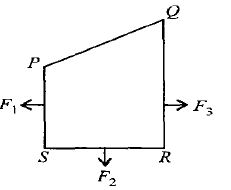
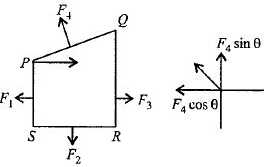
$A$ closed loop $PQRS$ carrying a current is placed in a uniform magnetic field. If the magnetic forces on segments $PS, SR$ and $RQ$ are $F_1, F_2$ and $F_3$ respectively and are in the plane of the paper and along the directions shown,the force on the segment $QP$ is
A
$\sqrt {{{\left( {F_3 - F_1} \right)}^2} + F_2^2} $
B
$F_1+F_2+F_3$
C
$-F_1+F_2+F_3$
D
$\sqrt {{{\left( {F_3 - F_1} \right)}^2} - F_2^2} $
Solution
(A) For a closed loop carrying a current in a uniform magnetic field,the net magnetic force on the loop is zero.
Let the force on segment $QP$ be $F_4$.
Since the loop is in equilibrium under the influence of these forces,the vector sum of all forces must be zero:
$\vec{F_1} + \vec{F_2} + \vec{F_3} + \vec{F_4} = 0$
$\vec{F_4} = -(\vec{F_1} + \vec{F_2} + \vec{F_3})$
Resolving the forces into horizontal and vertical components:
Let the horizontal direction be along the $x$-axis (positive towards the right) and the vertical direction be along the $y$-axis (positive upwards).
$F_{4x} = -(F_{3x} + F_{2x} + F_{1x}) = -(F_3 + 0 - F_1) = F_1 - F_3$
$F_{4y} = -(F_{3y} + F_{2y} + F_{1y}) = -(0 - F_2 + 0) = F_2$
The magnitude of the force $F_4$ is given by:
$F_4 = \sqrt{F_{4x}^2 + F_{4y}^2} = \sqrt{(F_1 - F_3)^2 + F_2^2} = \sqrt{(F_3 - F_1)^2 + F_2^2}$
Let the force on segment $QP$ be $F_4$.
Since the loop is in equilibrium under the influence of these forces,the vector sum of all forces must be zero:
$\vec{F_1} + \vec{F_2} + \vec{F_3} + \vec{F_4} = 0$
$\vec{F_4} = -(\vec{F_1} + \vec{F_2} + \vec{F_3})$
Resolving the forces into horizontal and vertical components:
Let the horizontal direction be along the $x$-axis (positive towards the right) and the vertical direction be along the $y$-axis (positive upwards).
$F_{4x} = -(F_{3x} + F_{2x} + F_{1x}) = -(F_3 + 0 - F_1) = F_1 - F_3$
$F_{4y} = -(F_{3y} + F_{2y} + F_{1y}) = -(0 - F_2 + 0) = F_2$
The magnitude of the force $F_4$ is given by:
$F_4 = \sqrt{F_{4x}^2 + F_{4y}^2} = \sqrt{(F_1 - F_3)^2 + F_2^2} = \sqrt{(F_3 - F_1)^2 + F_2^2}$
0 likesView Solution
34
PhysicsMediumMCQAIPMT · 2008
$A$ boy is trying to start a fire by focusing sunlight on a piece of paper using an equiconvex lens of focal length $10\, cm$. The diameter of the sun is $1.39 \times 10^9\, m$ and its mean distance from the earth is $1.5 \times 10^{11}\, m$. What is the diameter of the sun's image on the paper?
A
$6.5 \times 10^{-5}\, m$
B
$12.4 \times 10^{-4}\, m$
C
$9.2 \times 10^{-4}\, m$
D
$6.5 \times 10^{-4}\, m$
Solution
(C) The angular diameter of the sun as seen from the earth is $\alpha = \frac{\text{Diameter of Sun}}{\text{Distance of Sun}} = \frac{1.39 \times 10^9}{1.5 \times 10^{11}} \approx 9.26 \times 10^{-3}\, \text{radians}$.
When the sunlight is focused by a lens of focal length $f = 10\, cm = 0.1\, m$,the image of the sun is formed at the focus.
The diameter of the image $d$ is given by $d = f \times \alpha$.
Substituting the values: $d = 0.1\, m \times (\frac{1.39 \times 10^9}{1.5 \times 10^{11}})$.
$d = 0.1 \times 0.926 \times 10^{-2} = 0.0926 \times 10^{-2} = 9.26 \times 10^{-4}\, m$.
Rounding to the nearest provided option,the diameter is $9.2 \times 10^{-4}\, m$.
When the sunlight is focused by a lens of focal length $f = 10\, cm = 0.1\, m$,the image of the sun is formed at the focus.
The diameter of the image $d$ is given by $d = f \times \alpha$.
Substituting the values: $d = 0.1\, m \times (\frac{1.39 \times 10^9}{1.5 \times 10^{11}})$.
$d = 0.1 \times 0.926 \times 10^{-2} = 0.0926 \times 10^{-2} = 9.26 \times 10^{-4}\, m$.
Rounding to the nearest provided option,the diameter is $9.2 \times 10^{-4}\, m$.
0 likesView Solution
35
PhysicsMediumMCQAIPMT · 2008
The work function of a surface of a photosensitive material is $6.2\, eV$. The wavelength of the incident radiation for which the stopping potential is $5\, V$ lies in the
A
Infrared region
B
$X-ray$ region
C
Ultraviolet region
D
Visible region
Solution
(C) The work function is given by $\Phi = 6.2\, eV$.
The stopping potential is $V_s = 5\, V$,so the maximum kinetic energy is $K_{\max} = e V_s = 5\, eV$.
According to Einstein's photoelectric equation,the energy of the incident photon is $E = \Phi + K_{\max} = 6.2\, eV + 5\, eV = 11.2\, eV$.
The wavelength $\lambda$ is given by $\lambda = \frac{hc}{E}$. Using $hc \approx 12400\, eV\cdot\mathring{A}$,we get $\lambda = \frac{12400}{11.2} \approx 1107\, \mathring{A}$.
Since the wavelength $1107\, \mathring{A}$ falls in the range of $100\, \mathring{A}$ to $4000\, \mathring{A}$,it lies in the ultraviolet region.
The stopping potential is $V_s = 5\, V$,so the maximum kinetic energy is $K_{\max} = e V_s = 5\, eV$.
According to Einstein's photoelectric equation,the energy of the incident photon is $E = \Phi + K_{\max} = 6.2\, eV + 5\, eV = 11.2\, eV$.
The wavelength $\lambda$ is given by $\lambda = \frac{hc}{E}$. Using $hc \approx 12400\, eV\cdot\mathring{A}$,we get $\lambda = \frac{12400}{11.2} \approx 1107\, \mathring{A}$.
Since the wavelength $1107\, \mathring{A}$ falls in the range of $100\, \mathring{A}$ to $4000\, \mathring{A}$,it lies in the ultraviolet region.
0 likesView Solution
36
PhysicsMediumMCQAIPMT · 2008
$A$ particle of mass $1 \, mg$ has the same wavelength as an electron moving with a velocity of $3 \times 10^6 \, m/s$. The velocity of the particle is (mass of electron $= 9.1 \times 10^{-31} \, kg$).
A
$3 \times 10^{-31} \, m/s$
B
$2.7 \times 10^{-21} \, m/s$
C
$2.7 \times 10^{-18} \, m/s$
D
$9 \times 10^{-2} \, m/s$
Solution
(C) The de Broglie wavelength is given by $\lambda = \frac{h}{mv}$.
Since the wavelengths are equal,we have $\frac{h}{m_p v_p} = \frac{h}{m_e v_e}$.
This simplifies to $m_p v_p = m_e v_e$.
Given: mass of particle $m_p = 1 \, mg = 10^{-6} \, kg$,mass of electron $m_e = 9.1 \times 10^{-31} \, kg$,and velocity of electron $v_e = 3 \times 10^6 \, m/s$.
Substituting the values: $10^{-6} \, kg \times v_p = 9.1 \times 10^{-31} \, kg \times 3 \times 10^6 \, m/s$.
$v_p = \frac{27.3 \times 10^{-25}}{10^{-6}} \, m/s = 27.3 \times 10^{-19} \, m/s = 2.73 \times 10^{-18} \, m/s$.
Rounding to the nearest option,the velocity of the particle is $2.7 \times 10^{-18} \, m/s$.
Since the wavelengths are equal,we have $\frac{h}{m_p v_p} = \frac{h}{m_e v_e}$.
This simplifies to $m_p v_p = m_e v_e$.
Given: mass of particle $m_p = 1 \, mg = 10^{-6} \, kg$,mass of electron $m_e = 9.1 \times 10^{-31} \, kg$,and velocity of electron $v_e = 3 \times 10^6 \, m/s$.
Substituting the values: $10^{-6} \, kg \times v_p = 9.1 \times 10^{-31} \, kg \times 3 \times 10^6 \, m/s$.
$v_p = \frac{27.3 \times 10^{-25}}{10^{-6}} \, m/s = 27.3 \times 10^{-19} \, m/s = 2.73 \times 10^{-18} \, m/s$.
Rounding to the nearest option,the velocity of the particle is $2.7 \times 10^{-18} \, m/s$.
0 likesView Solution
37
PhysicsMediumMCQAIPMT · 2008
$A$ long solenoid has $500$ turns. When a current of $2 \, A$ is passed through it,the resulting magnetic flux linked with each turn of the solenoid is $4 \times 10^{-3} \, Wb$. The self-inductance of the solenoid is ....... $H$.
A
$1$
B
$4$
C
$2.5$
D
$2$
Solution
(A) The self-inductance $L$ of a solenoid is defined by the relation $\Phi_{total} = L \cdot I$,where $\Phi_{total}$ is the total magnetic flux linked with the solenoid.
The total magnetic flux linked with the solenoid is given by $\Phi_{total} = N \cdot \phi$,where $N$ is the number of turns and $\phi$ is the magnetic flux linked with each turn.
Given:
Number of turns $N = 500$
Current $I = 2 \, A$
Flux per turn $\phi = 4 \times 10^{-3} \, Wb$
Total flux $\Phi_{total} = 500 \times 4 \times 10^{-3} \, Wb = 2 \, Wb$.
Using the formula $L = \frac{\Phi_{total}}{I}$:
$L = \frac{2 \, Wb}{2 \, A} = 1 \, H$.
Therefore,the self-inductance of the solenoid is $1 \, H$.
The total magnetic flux linked with the solenoid is given by $\Phi_{total} = N \cdot \phi$,where $N$ is the number of turns and $\phi$ is the magnetic flux linked with each turn.
Given:
Number of turns $N = 500$
Current $I = 2 \, A$
Flux per turn $\phi = 4 \times 10^{-3} \, Wb$
Total flux $\Phi_{total} = 500 \times 4 \times 10^{-3} \, Wb = 2 \, Wb$.
Using the formula $L = \frac{\Phi_{total}}{I}$:
$L = \frac{2 \, Wb}{2 \, A} = 1 \, H$.
Therefore,the self-inductance of the solenoid is $1 \, H$.
0 likesView Solution
38
PhysicsMediumMCQAIPMT · 2008
$A$ circular disc of radius $0.2 \; m$ is placed in a uniform magnetic field of induction $\frac{1}{\pi} \; Wb/m^2$ in such a way that its axis makes an angle of $60^{\circ}$ with $\vec{B}$. The magnetic flux linked with the disc is..... $Wb$.
A
$0.08$
B
$0.01$
C
$0.02$
D
$0.06$
Solution
(C) The magnetic flux $\phi$ is given by the formula $\phi = \vec{B} \cdot \vec{A} = BA \cos \theta$,where $\theta$ is the angle between the magnetic field vector $\vec{B}$ and the area vector $\vec{A}$ (which is normal to the surface).
Given,radius $R = 0.2 \; m$,so the area $A = \pi R^2 = \pi (0.2)^2 = 0.04\pi \; m^2$.
The magnetic field $B = \frac{1}{\pi} \; Wb/m^2$.
The axis of the disc makes an angle of $60^{\circ}$ with $\vec{B}$. Since the area vector $\vec{A}$ is along the axis of the disc,the angle $\theta$ between $\vec{B}$ and $\vec{A}$ is $60^{\circ}$.
Therefore,$\phi = B A \cos 60^{\circ} = \left(\frac{1}{\pi}\right) \times (0.04\pi) \times \cos 60^{\circ}$.
$\phi = 0.04 \times \frac{1}{2} = 0.02 \; Wb$.
Given,radius $R = 0.2 \; m$,so the area $A = \pi R^2 = \pi (0.2)^2 = 0.04\pi \; m^2$.
The magnetic field $B = \frac{1}{\pi} \; Wb/m^2$.
The axis of the disc makes an angle of $60^{\circ}$ with $\vec{B}$. Since the area vector $\vec{A}$ is along the axis of the disc,the angle $\theta$ between $\vec{B}$ and $\vec{A}$ is $60^{\circ}$.
Therefore,$\phi = B A \cos 60^{\circ} = \left(\frac{1}{\pi}\right) \times (0.04\pi) \times \cos 60^{\circ}$.
$\phi = 0.04 \times \frac{1}{2} = 0.02 \; Wb$.
0 likesView Solution
39
PhysicsMediumMCQAIPMT · 2008
In an $A.C.$ circuit,the $e.m.f.$ $(\varepsilon)$ and the current $(i)$ at any instant are given respectively by $E = E_o \sin \omega t$ and $i = I_o \sin(\omega t - \phi)$. The average power in the circuit over one cycle of $A.C.$ is:
A
$P = E_o I_o \cos \phi$
B
$P = \frac{E_o I_o}{2} \cos \phi$
C
$P = E_o I_o$
D
$P = \frac{E_o I_o}{2} \sin \phi$
Solution
(B) The instantaneous power $p$ in an $A.C.$ circuit is given by the product of instantaneous $e.m.f.$ and instantaneous current:
$p = E \cdot i = (E_o \sin \omega t) \cdot (I_o \sin(\omega t - \phi))$
Using the trigonometric identity $\sin A \sin B = \frac{1}{2} [\cos(A-B) - \cos(A+B)]$,we get:
$p = \frac{E_o I_o}{2} [\cos \phi - \cos(2\omega t - \phi)]$
The average power $P_{av}$ over one complete cycle $T$ is the average of the instantaneous power:
$P_{av} = \frac{1}{T} \int_0^T p \, dt = \frac{1}{T} \int_0^T \frac{E_o I_o}{2} [\cos \phi - \cos(2\omega t - \phi)] \, dt$
Since the average of $\cos(2\omega t - \phi)$ over a complete cycle is $0$,we have:
$P_{av} = \frac{E_o I_o}{2} \cos \phi$
Thus,the average power is $\frac{E_o I_o}{2} \cos \phi$.
$p = E \cdot i = (E_o \sin \omega t) \cdot (I_o \sin(\omega t - \phi))$
Using the trigonometric identity $\sin A \sin B = \frac{1}{2} [\cos(A-B) - \cos(A+B)]$,we get:
$p = \frac{E_o I_o}{2} [\cos \phi - \cos(2\omega t - \phi)]$
The average power $P_{av}$ over one complete cycle $T$ is the average of the instantaneous power:
$P_{av} = \frac{1}{T} \int_0^T p \, dt = \frac{1}{T} \int_0^T \frac{E_o I_o}{2} [\cos \phi - \cos(2\omega t - \phi)] \, dt$
Since the average of $\cos(2\omega t - \phi)$ over a complete cycle is $0$,we have:
$P_{av} = \frac{E_o I_o}{2} \cos \phi$
Thus,the average power is $\frac{E_o I_o}{2} \cos \phi$.
0 likesView Solution
40
PhysicsEasyMCQAIPMT · 2008
The velocity of electromagnetic radiation in a medium of permittivity $\varepsilon_0$ and permeability $\mu_0$ is given by:
A
$\sqrt{\frac{1}{\mu_0 \varepsilon_0}}$
B
$\sqrt{\frac{\mu_0}{\varepsilon_0}}$
C
$\sqrt{\frac{\varepsilon_0}{\mu_0}}$
D
$\sqrt{\mu_0 \varepsilon_0}$
Solution
(A) The velocity $v$ of electromagnetic radiation in a medium is given by the relation $v = \frac{1}{\sqrt{\mu \varepsilon}}$,where $\mu$ is the permeability and $\varepsilon$ is the permittivity of the medium.
For vacuum (or free space),the permeability is $\mu_0$ and the permittivity is $\varepsilon_0$.
Therefore,the velocity of electromagnetic radiation in vacuum is $c = \frac{1}{\sqrt{\mu_0 \varepsilon_0}}$.
For vacuum (or free space),the permeability is $\mu_0$ and the permittivity is $\varepsilon_0$.
Therefore,the velocity of electromagnetic radiation in vacuum is $c = \frac{1}{\sqrt{\mu_0 \varepsilon_0}}$.
0 likesView Solution
41
PhysicsMediumMCQAIPMT · 2008
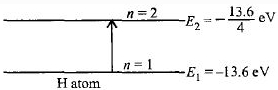
The ground state energy of a hydrogen atom is $-13.6 \, eV$. When its electron is in the first excited state,its excitation energy is ...... $eV$.
A
$10.2$
B
$0$
C
$6.8$
D
$3.4$
Solution
(A) The energy of an electron in the $n$-th orbit of a hydrogen atom is given by $E_n = -\frac{13.6}{n^2} \, eV$.
For the ground state $(n=1)$,$E_1 = -13.6 \, eV$.
For the first excited state $(n=2)$,$E_2 = -\frac{13.6}{2^2} = -\frac{13.6}{4} = -3.4 \, eV$.
The excitation energy required to move the electron from the ground state to the first excited state is $\Delta E = E_2 - E_1$.
$\Delta E = -3.4 \, eV - (-13.6 \, eV) = 10.2 \, eV$.
For the ground state $(n=1)$,$E_1 = -13.6 \, eV$.
For the first excited state $(n=2)$,$E_2 = -\frac{13.6}{2^2} = -\frac{13.6}{4} = -3.4 \, eV$.
The excitation energy required to move the electron from the ground state to the first excited state is $\Delta E = E_2 - E_1$.
$\Delta E = -3.4 \, eV - (-13.6 \, eV) = 10.2 \, eV$.
0 likesView Solution
42
PhysicsMediumMCQAIPMT · 2008
Two radioactive materials $X_1$ and $X_2$ have decay constants $5\lambda$ and $\lambda$ respectively. Initially,they have the same number of nuclei. The ratio of the number of nuclei of $X_1$ to that of $X_2$ will be $\frac{1}{e}$ after a time:
A
$\frac{1}{4\lambda}$
B
$\frac{1}{2\lambda}$
C
$\frac{1}{\lambda}$
D
$\frac{4}{\lambda}$
Solution
(A) Let the initial number of nuclei for both materials be $N_0$.
The number of nuclei remaining at time $t$ is given by $N(t) = N_0 e^{-\lambda t}$.
For material $X_1$: $N_1(t) = N_0 e^{-(5\lambda)t}$.
For material $X_2$: $N_2(t) = N_0 e^{-\lambda t}$.
The ratio is given as $\frac{N_1(t)}{N_2(t)} = \frac{1}{e} = e^{-1}$.
Substituting the expressions: $\frac{N_0 e^{-5\lambda t}}{N_0 e^{-\lambda t}} = e^{-1}$.
$e^{-5\lambda t + \lambda t} = e^{-1}$.
$e^{-4\lambda t} = e^{-1}$.
Equating the exponents: $-4\lambda t = -1$.
Therefore,$t = \frac{1}{4\lambda}$.
The number of nuclei remaining at time $t$ is given by $N(t) = N_0 e^{-\lambda t}$.
For material $X_1$: $N_1(t) = N_0 e^{-(5\lambda)t}$.
For material $X_2$: $N_2(t) = N_0 e^{-\lambda t}$.
The ratio is given as $\frac{N_1(t)}{N_2(t)} = \frac{1}{e} = e^{-1}$.
Substituting the expressions: $\frac{N_0 e^{-5\lambda t}}{N_0 e^{-\lambda t}} = e^{-1}$.
$e^{-5\lambda t + \lambda t} = e^{-1}$.
$e^{-4\lambda t} = e^{-1}$.
Equating the exponents: $-4\lambda t = -1$.
Therefore,$t = \frac{1}{4\lambda}$.
0 likesView Solution
43
PhysicsMediumMCQAIPMT · 2008
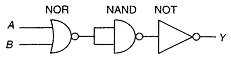
The given logic circuit is equivalent to which of the following gates?
A
$NOR$ gate
B
$OR$ gate
C
$AND$ gate
D
$NAND$ gate
Solution
(A) Let the inputs be $A$ and $B$.
$1$. The first gate is a $NOR$ gate,so its output is $X = \overline{A+B}$.
$2$. The second gate is a $NAND$ gate with both inputs tied together. $A$ $NAND$ gate with tied inputs acts as a $NOT$ gate. Thus,the output of the $NAND$ gate is $Z = \overline{X \cdot X} = \overline{X}$.
$3$. Substituting $X = \overline{A+B}$ into $Z$,we get $Z = \overline{\overline{A+B}} = A+B$.
$4$. The third gate is a $NOT$ gate,so its final output is $Y = \overline{Z} = \overline{A+B}$.
$5$. The expression $\overline{A+B}$ represents a $NOR$ gate.
Therefore,the circuit is equivalent to a $NOR$ gate.
$1$. The first gate is a $NOR$ gate,so its output is $X = \overline{A+B}$.
$2$. The second gate is a $NAND$ gate with both inputs tied together. $A$ $NAND$ gate with tied inputs acts as a $NOT$ gate. Thus,the output of the $NAND$ gate is $Z = \overline{X \cdot X} = \overline{X}$.
$3$. Substituting $X = \overline{A+B}$ into $Z$,we get $Z = \overline{\overline{A+B}} = A+B$.
$4$. The third gate is a $NOT$ gate,so its final output is $Y = \overline{Z} = \overline{A+B}$.
$5$. The expression $\overline{A+B}$ represents a $NOR$ gate.
Therefore,the circuit is equivalent to a $NOR$ gate.
0 likesView Solution
44
PhysicsMediumMCQAIPMT · 2008
$A$ $p-n$ photodiode is made of a material with a band gap of $2.0\, eV$. The minimum frequency of the radiation that can be absorbed by the material is nearly:
A
$1 \times 10^{14}\, Hz$
B
$20 \times 10^{14}\, Hz$
C
$10 \times 10^{14}\, Hz$
D
$5 \times 10^{14}\, Hz$
Solution
(D) The energy of the photon required to excite an electron across the band gap is given by $E = h\nu$.
For the minimum frequency $\nu$,the energy of the photon must be equal to the band gap energy $E_g$.
Given $E_g = 2.0\, eV$.
We know that $1\, eV = 1.6 \times 10^{-19}\, J$,so $E_g = 2.0 \times 1.6 \times 10^{-19} = 3.2 \times 10^{-19}\, J$.
Using the relation $E = h\nu$,we have $\nu = \frac{E_g}{h}$.
Substituting the values $h = 6.63 \times 10^{-34}\, J\cdot s$:
$\nu = \frac{3.2 \times 10^{-19}}{6.63 \times 10^{-34}} \approx 0.482 \times 10^{15}\, Hz$.
$\nu \approx 4.82 \times 10^{14}\, Hz$.
Rounding this value,we get $\nu \approx 5 \times 10^{14}\, Hz$.
For the minimum frequency $\nu$,the energy of the photon must be equal to the band gap energy $E_g$.
Given $E_g = 2.0\, eV$.
We know that $1\, eV = 1.6 \times 10^{-19}\, J$,so $E_g = 2.0 \times 1.6 \times 10^{-19} = 3.2 \times 10^{-19}\, J$.
Using the relation $E = h\nu$,we have $\nu = \frac{E_g}{h}$.
Substituting the values $h = 6.63 \times 10^{-34}\, J\cdot s$:
$\nu = \frac{3.2 \times 10^{-19}}{6.63 \times 10^{-34}} \approx 0.482 \times 10^{15}\, Hz$.
$\nu \approx 4.82 \times 10^{14}\, Hz$.
Rounding this value,we get $\nu \approx 5 \times 10^{14}\, Hz$.
0 likesView Solution
45
PhysicsMediumMCQAIPMT · 2008
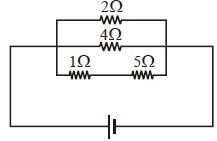
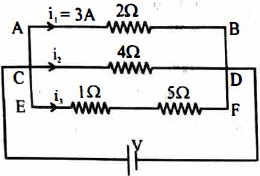
$A$ current of $3 \, A$ flows through the $2 \, \Omega$ resistor shown in the circuit. The power dissipated in the $5 \, \Omega$ resistor is ................. $W$.
A
$1$
B
$5$
C
$4$
D
$2$
Solution
(B) The resistors $2 \, \Omega$,$4 \, \Omega$,and the series combination of $(1 \, \Omega + 5 \, \Omega)$ are connected in parallel. Therefore,the potential difference across each branch is the same.
The potential difference $V$ across the $2 \, \Omega$ resistor is given by $V = I \times R = 3 \, A \times 2 \, \Omega = 6 \, V$.
Since the branches are in parallel,the same potential difference $V = 6 \, V$ is applied across the branch containing the $1 \, \Omega$ and $5 \, \Omega$ resistors in series.
The total resistance of this branch is $R_{branch} = 1 \, \Omega + 5 \, \Omega = 6 \, \Omega$.
The current $i_3$ flowing through this branch is $i_3 = \frac{V}{R_{branch}} = \frac{6 \, V}{6 \, \Omega} = 1 \, A$.
The power dissipated in the $5 \, \Omega$ resistor is $P = i_3^2 \times R = (1 \, A)^2 \times 5 \, \Omega = 5 \, W$.
The potential difference $V$ across the $2 \, \Omega$ resistor is given by $V = I \times R = 3 \, A \times 2 \, \Omega = 6 \, V$.
Since the branches are in parallel,the same potential difference $V = 6 \, V$ is applied across the branch containing the $1 \, \Omega$ and $5 \, \Omega$ resistors in series.
The total resistance of this branch is $R_{branch} = 1 \, \Omega + 5 \, \Omega = 6 \, \Omega$.
The current $i_3$ flowing through this branch is $i_3 = \frac{V}{R_{branch}} = \frac{6 \, V}{6 \, \Omega} = 1 \, A$.
The power dissipated in the $5 \, \Omega$ resistor is $P = i_3^2 \times R = (1 \, A)^2 \times 5 \, \Omega = 5 \, W$.
0 likesView Solution
46
PhysicsMediumMCQAIPMT · 2008
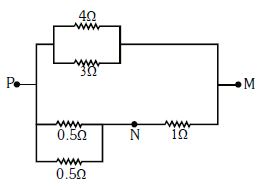
In the circuit shown,the current through the $4\,\Omega$ resistor is $1\,A$ when the points $P$ and $M$ are connected to a d.c. voltage source. The potential difference between the points $M$ and $N$ is ............... $V$.
A
$0.5$
B
$3.2$
C
$1.5$
D
$1$
Solution
(B) The resistors $4\,\Omega$ and $3\,\Omega$ are in parallel. Since the potential difference across parallel branches is the same,the current $i_1$ through the $3\,\Omega$ resistor is given by $4\,\Omega \times 1\,A = 3\,\Omega \times i_1$,which gives $i_1 = \frac{4}{3}\,A$.
The total current flowing through the upper branch is $I_{upper} = 1\,A + \frac{4}{3}\,A = \frac{7}{3}\,A$.
The equivalent resistance of the $4\,\Omega$ and $3\,\Omega$ parallel combination is $R_{eq} = \frac{4 \times 3}{4 + 3} = \frac{12}{7}\,\Omega$.
The potential difference between points $P$ and $M$ is $V_{PM} = I_{upper} \times R_{eq} = \frac{7}{3}\,A \times \frac{12}{7}\,\Omega = 4\,V$.
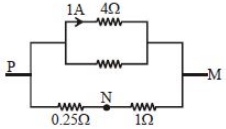
The lower branch consists of two $0.5\,\Omega$ resistors in parallel,which is equivalent to $R_{lower1} = \frac{0.5 \times 0.5}{0.5 + 0.5} = 0.25\,\Omega$. This is in series with a $1\,\Omega$ resistor. The total resistance of the lower branch is $R_{lower} = 0.25\,\Omega + 1\,\Omega = 1.25\,\Omega$.
The current in the lower branch is $I_{lower} = \frac{V_{PM}}{R_{lower}} = \frac{4\,V}{1.25\,\Omega} = 3.2\,A$.
The potential difference between points $M$ and $N$ is the voltage drop across the $1\,\Omega$ resistor: $V_{MN} = I_{lower} \times 1\,\Omega = 3.2\,A \times 1\,\Omega = 3.2\,V$.
The total current flowing through the upper branch is $I_{upper} = 1\,A + \frac{4}{3}\,A = \frac{7}{3}\,A$.
The equivalent resistance of the $4\,\Omega$ and $3\,\Omega$ parallel combination is $R_{eq} = \frac{4 \times 3}{4 + 3} = \frac{12}{7}\,\Omega$.
The potential difference between points $P$ and $M$ is $V_{PM} = I_{upper} \times R_{eq} = \frac{7}{3}\,A \times \frac{12}{7}\,\Omega = 4\,V$.
The lower branch consists of two $0.5\,\Omega$ resistors in parallel,which is equivalent to $R_{lower1} = \frac{0.5 \times 0.5}{0.5 + 0.5} = 0.25\,\Omega$. This is in series with a $1\,\Omega$ resistor. The total resistance of the lower branch is $R_{lower} = 0.25\,\Omega + 1\,\Omega = 1.25\,\Omega$.
The current in the lower branch is $I_{lower} = \frac{V_{PM}}{R_{lower}} = \frac{4\,V}{1.25\,\Omega} = 3.2\,A$.
The potential difference between points $M$ and $N$ is the voltage drop across the $1\,\Omega$ resistor: $V_{MN} = I_{lower} \times 1\,\Omega = 3.2\,A \times 1\,\Omega = 3.2\,V$.
0 likesView Solution
47
PhysicsDifficultMCQAIPMT · 2008
Two nuclei have their mass numbers in the ratio of $1: 3$. The ratio of their nuclear densities would be
A
$1: 3$
B
$3: 1$
C
$(3)^{1 / 3}: 1$
D
$1: 1$
Solution
(D) The nuclear density $\rho$ is defined as the ratio of the mass of the nucleus to its volume.
Since the mass of a nucleus is approximately $M = A \cdot m_p$ (where $A$ is the mass number and $m_p$ is the mass of a nucleon) and the volume is $V = \frac{4}{3} \pi R^3$,where $R = R_0 A^{1/3}$.
Substituting the expression for $R$,we get $V = \frac{4}{3} \pi (R_0 A^{1/3})^3 = \frac{4}{3} \pi R_0^3 A$.
Thus,$\rho = \frac{A \cdot m_p}{\frac{4}{3} \pi R_0^3 A} = \frac{m_p}{\frac{4}{3} \pi R_0^3}$.
This expression shows that the nuclear density is independent of the mass number $A$.
Therefore,the ratio of the nuclear densities of any two nuclei is always $1: 1$.
Since the mass of a nucleus is approximately $M = A \cdot m_p$ (where $A$ is the mass number and $m_p$ is the mass of a nucleon) and the volume is $V = \frac{4}{3} \pi R^3$,where $R = R_0 A^{1/3}$.
Substituting the expression for $R$,we get $V = \frac{4}{3} \pi (R_0 A^{1/3})^3 = \frac{4}{3} \pi R_0^3 A$.
Thus,$\rho = \frac{A \cdot m_p}{\frac{4}{3} \pi R_0^3 A} = \frac{m_p}{\frac{4}{3} \pi R_0^3}$.
This expression shows that the nuclear density is independent of the mass number $A$.
Therefore,the ratio of the nuclear densities of any two nuclei is always $1: 1$.
0 likesView Solution
Vedclass Products
For Students
Vedclass Test Series
Mock tests in real AIPMT style covering Physics with performance analysis. 5-day free trial.
Start Free TrialFor Teachers
Exam Paper Generator
Generate Set A/B/C/D Physics papers from 7.5L+ questions in 2 minutes. 3 chapters free.
Try FreeFor Institutes
Online Exam Module
Run live AIPMT mock exams with unlimited students, 360° analytics & white-label branding.
See DemoFrequently Asked Questions
How many Physics questions are in AIPMT 2008?
There are 47 Physics questions from the AIPMT 2008 paper on Vedclass, each with a detailed step-by-step solution in English.
Are AIPMT 2008 Physics solutions available in English?
Yes. All solutions on this page are in English. You can also switch to English or Hindi using the language buttons above the questions.
Can I practice AIPMT 2008 Physics as a timed test?
Yes. Use the Vedclass Test Series to attempt a full AIPMT mock test covering Physics with time limits and instant score analysis.
Can teachers create Physics papers from AIPMT previous year questions?
Yes. The Vedclass Exam Paper Generator lets teachers mix AIPMT Physics questions and generate Set A/B/C/D papers in minutes.
For Teachers & Institutes
Build a Custom Physics Paper
Pick AIPMT 2008 Physics questions, set difficulty, and generate Set A/B/C/D in 2 minutes.