
One mole of an ideal gas goes from an initial state $A$ to a final state $B$ via two processes: It first undergoes isothermal expansion from volume $V$ to $3V$ and then its volume is reduced from $3V$ to $V$ at constant pressure. The correct $P-V$ diagram representing the two processes is:
- A
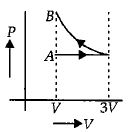
- B
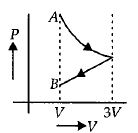
- C
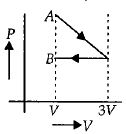
- D
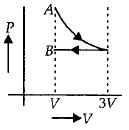
Explore More
Similar Questions
There are two samples $A$ and $B$ of a certain gas,which are initially at the same temperature and pressure. Both are compressed from volume $V$ to $\frac{V}{2}$. Sample $A$ is compressed isothermally while sample $B$ is compressed adiabatically. The final pressure of $A$ is
One mole of a gas expands such that its volume $V$ changes with absolute temperature $T$ in accordance with the relation $V = K T^2$,where $K$ is a constant. If the temperature of the gas changes by $60 \text{ K}$,then the work done by the gas is ($R$ is the universal gas constant).
What is an isochoric process and a cyclic process? Write the first law of thermodynamics for an ideal gas.
Medium
View Solution$A$ thermally insulated vessel contains an ideal gas of molecular mass $M$ and ratio of specific heats $1.4$. The vessel is moving with speed $v$ and is suddenly brought to rest. Assuming no heat is lost to the surroundings,the temperature of the gas increases by ... ($R =$ universal gas constant)
$A$ polyatomic gas at pressure $P$,having volume $V$ expands isothermally to a volume $3V$ and then adiabatically to a volume $24V$. The final pressure of the gas is (for a polyatomic gas,assume degrees of freedom $f = 6$,so $\gamma = 4/3$):
Vedclass Products
For Students
Vedclass Test Series
Mock tests in real JEE/NEET style with performance analysis. 5-day free trial.
Start Free TrialFor Teachers
Exam Paper Generator
Generate Set A/B/C/D exam papers from 7.5L+ questions in 2 minutes. 3 chapters free.
Try FreeFor Institutes
Online Exam Module
Live online exams with unlimited students, 360° analytics & white-label branding.
See Demo