
PhysicsQ1–45 of 45 questions
Page 1 of 1 · English
1
PhysicsMediumMCQAIPMT · 2014
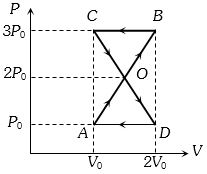
$A$ thermodynamic system undergoes a cyclic process $ABCDA$ as shown in the figure. The work done by the system in the cycle is
A
$P_0V_0$
B
$2P_0V_0$
C
$\frac{P_0V_0}{2}$
D
Zero
Solution
(D) The work done in a cyclic process on a $P-V$ diagram is equal to the net area enclosed by the cycle.
In the given figure,the cycle consists of two triangles: $\triangle AOD$ and $\triangle BOC$.
For the process $A \rightarrow O \rightarrow D$,the volume increases,so the work done is positive. The area of $\triangle AOD = \frac{1}{2} \times \text{base} \times \text{height} = \frac{1}{2} \times (2V_0 - V_0) \times (2P_0 - P_0) = \frac{1}{2} \times V_0 \times P_0 = \frac{P_0V_0}{2}$.
For the process $B \rightarrow O \rightarrow C$,the volume decreases,so the work done is negative. The area of $\triangle BOC = \frac{1}{2} \times \text{base} \times \text{height} = \frac{1}{2} \times (2V_0 - V_0) \times (3P_0 - 2P_0) = \frac{1}{2} \times V_0 \times P_0 = \frac{P_0V_0}{2}$.
The total work done $W = W_{AOD} + W_{BOC} = \frac{P_0V_0}{2} + (-\frac{P_0V_0}{2}) = 0$.
In the given figure,the cycle consists of two triangles: $\triangle AOD$ and $\triangle BOC$.
For the process $A \rightarrow O \rightarrow D$,the volume increases,so the work done is positive. The area of $\triangle AOD = \frac{1}{2} \times \text{base} \times \text{height} = \frac{1}{2} \times (2V_0 - V_0) \times (2P_0 - P_0) = \frac{1}{2} \times V_0 \times P_0 = \frac{P_0V_0}{2}$.
For the process $B \rightarrow O \rightarrow C$,the volume decreases,so the work done is negative. The area of $\triangle BOC = \frac{1}{2} \times \text{base} \times \text{height} = \frac{1}{2} \times (2V_0 - V_0) \times (3P_0 - 2P_0) = \frac{1}{2} \times V_0 \times P_0 = \frac{P_0V_0}{2}$.
The total work done $W = W_{AOD} + W_{BOC} = \frac{P_0V_0}{2} + (-\frac{P_0V_0}{2}) = 0$.
0 likesView Solution
2
PhysicsDifficultMCQAIPMT · 2014
If force $(F)$,velocity $(V)$,and time $(T)$ are taken as fundamental units,then the dimensions of mass are:
A
$[FV T^{-1}]$
B
$[FV T^{-2}]$
C
$[F V^{-1} T^{-1}]$
D
$[F V^{-1} T]$
Solution
(D) Let mass $m \propto F^a V^b T^c$.
Then $m = k F^a V^b T^c$,where $k$ is a dimensionless constant.
Writing dimensions on both sides:
$[M L^0 T^0] = [M L T^{-2}]^a [L T^{-1}]^b [T]^c$
$[M L^0 T^0] = [M^a L^{a+b} T^{-2a-b+c}]$
Comparing the powers of $M, L,$ and $T$ on both sides:
For $M$: $a = 1$
For $L$: $a + b = 0 \implies 1 + b = 0 \implies b = -1$
For $T$: $-2a - b + c = 0 \implies -2(1) - (-1) + c = 0 \implies -2 + 1 + c = 0 \implies c = 1$
Substituting the values of $a, b,$ and $c$ in the equation,we get:
$[m] = [F^1 V^{-1} T^1] = [F V^{-1} T]$.
Then $m = k F^a V^b T^c$,where $k$ is a dimensionless constant.
Writing dimensions on both sides:
$[M L^0 T^0] = [M L T^{-2}]^a [L T^{-1}]^b [T]^c$
$[M L^0 T^0] = [M^a L^{a+b} T^{-2a-b+c}]$
Comparing the powers of $M, L,$ and $T$ on both sides:
For $M$: $a = 1$
For $L$: $a + b = 0 \implies 1 + b = 0 \implies b = -1$
For $T$: $-2a - b + c = 0 \implies -2(1) - (-1) + c = 0 \implies -2 + 1 + c = 0 \implies c = 1$
Substituting the values of $a, b,$ and $c$ in the equation,we get:
$[m] = [F^1 V^{-1} T^1] = [F V^{-1} T]$.
0 likesView Solution
3
PhysicsMediumMCQAIPMT · 2014
$A$ projectile is fired from the surface of the earth with a velocity of $5 \, m s^{-1}$ and angle $\theta$ with the horizontal. Another projectile is fired from another planet with a velocity of $3 \, m s^{-1}$ at the same angle and follows a trajectory which is identical to the trajectory of the projectile fired from the earth. The value of the acceleration due to gravity on the planet is (in $m s^{-2}$) (Given $g = 9.8 \, m s^{-2}$):
A
$3.5$
B
$5.9$
C
$16.3$
D
$110.8$
Solution
(A) The equation of the trajectory of a projectile is given by: $y = x \tan \theta - \frac{g x^2}{2 u^2 \cos^2 \theta}$.
For two trajectories to be identical with the same angle of projection $\theta$,the term $\frac{g}{u^2}$ must be constant.
Therefore,$\frac{g_{earth}}{u_{earth}^2} = \frac{g_{planet}}{u_{planet}^2}$.
Given $g_{earth} = 9.8 \, m s^{-2}$,$u_{earth} = 5 \, m s^{-1}$,and $u_{planet} = 3 \, m s^{-1}$.
Substituting the values: $\frac{9.8}{5^2} = \frac{g_{planet}}{3^2}$.
$\frac{9.8}{25} = \frac{g_{planet}}{9}$.
$g_{planet} = \frac{9.8 \times 9}{25} = \frac{88.2}{25} = 3.528 \, m s^{-2}$.
Rounding to the nearest provided option,the value is $3.5 \, m s^{-2}$.
For two trajectories to be identical with the same angle of projection $\theta$,the term $\frac{g}{u^2}$ must be constant.
Therefore,$\frac{g_{earth}}{u_{earth}^2} = \frac{g_{planet}}{u_{planet}^2}$.
Given $g_{earth} = 9.8 \, m s^{-2}$,$u_{earth} = 5 \, m s^{-1}$,and $u_{planet} = 3 \, m s^{-1}$.
Substituting the values: $\frac{9.8}{5^2} = \frac{g_{planet}}{3^2}$.
$\frac{9.8}{25} = \frac{g_{planet}}{9}$.
$g_{planet} = \frac{9.8 \times 9}{25} = \frac{88.2}{25} = 3.528 \, m s^{-2}$.
Rounding to the nearest provided option,the value is $3.5 \, m s^{-2}$.
0 likesView Solution
4
PhysicsMediumMCQAIPMT · 2014
$A$ particle is moving such that its position coordinates $(x, y)$ are $(2 \, m, 3 \, m)$ at time $t = 0$,$(6 \, m, 7 \, m)$ at time $t = 2 \, s$,and $(13 \, m, 14 \, m)$ at $t = 5 \, s$. The average velocity vector $\vec{v}_{av}$ from $t = 0$ to $t = 5 \, s$ is:
A
$\frac{1}{5}(13\hat{i} + 14\hat{j})$
B
$\frac{7}{3}(\hat{i} + \hat{j})$
C
$2(\hat{i} + \hat{j})$
D
$\frac{11}{5}(\hat{i} + \hat{j})$
Solution
(D) At time $t_1 = 0 \, s$,the position vector of the particle is $\vec{r}_1 = 2\hat{i} + 3\hat{j}$.
At time $t_2 = 5 \, s$,the position vector of the particle is $\vec{r}_2 = 13\hat{i} + 14\hat{j}$.
The displacement $\Delta \vec{r}$ from $t = 0$ to $t = 5 \, s$ is given by $\Delta \vec{r} = \vec{r}_2 - \vec{r}_1$.
$\Delta \vec{r} = (13\hat{i} + 14\hat{j}) - (2\hat{i} + 3\hat{j}) = 11\hat{i} + 11\hat{j}$.
The average velocity $\vec{v}_{av}$ is defined as the total displacement divided by the total time interval $\Delta t = t_2 - t_1 = 5 - 0 = 5 \, s$.
$\vec{v}_{av} = \frac{\Delta \vec{r}}{\Delta t} = \frac{11\hat{i} + 11\hat{j}}{5} = \frac{11}{5}(\hat{i} + \hat{j}) \, m/s$.
At time $t_2 = 5 \, s$,the position vector of the particle is $\vec{r}_2 = 13\hat{i} + 14\hat{j}$.
The displacement $\Delta \vec{r}$ from $t = 0$ to $t = 5 \, s$ is given by $\Delta \vec{r} = \vec{r}_2 - \vec{r}_1$.
$\Delta \vec{r} = (13\hat{i} + 14\hat{j}) - (2\hat{i} + 3\hat{j}) = 11\hat{i} + 11\hat{j}$.
The average velocity $\vec{v}_{av}$ is defined as the total displacement divided by the total time interval $\Delta t = t_2 - t_1 = 5 - 0 = 5 \, s$.
$\vec{v}_{av} = \frac{\Delta \vec{r}}{\Delta t} = \frac{11\hat{i} + 11\hat{j}}{5} = \frac{11}{5}(\hat{i} + \hat{j}) \, m/s$.
0 likesView Solution
5
PhysicsDifficultMCQAIPMT · 2014
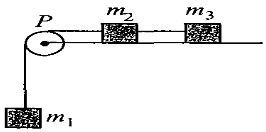
$A$ system consists of three masses $m_1$,$m_2$,and $m_3$ connected by a string passing over a pulley $P$. The mass $m_1$ hangs freely,and $m_2$ and $m_3$ are on a rough horizontal table (the coefficient of friction $= \mu$). The pulley is frictionless and of negligible mass. Find the downward acceleration of mass $m_1$. (Assume $m_1 = m_2 = m_3 = m$)
A
$\frac{g(1 - g\mu)}{9}$
B
$\frac{2g\mu}{3}$
C
$\frac{g(1 - 2\mu)}{3}$
D
$\frac{g(1 - 2\mu)}{2}$
Solution
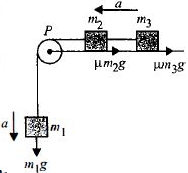
(C) The driving force for the system is the weight of mass $m_1$,which is $m_1g$.
The opposing forces are the frictional forces acting on masses $m_2$ and $m_3$.
The frictional force on $m_2$ is $f_2 = \mu m_2g$.
The frictional force on $m_3$ is $f_3 = \mu m_3g$.
Using Newton's second law for the system,the net force is $F_{net} = m_1g - \mu m_2g - \mu m_3g$.
The total mass of the system is $M = m_1 + m_2 + m_3$.
The acceleration $a$ is given by $a = \frac{F_{net}}{M} = \frac{m_1g - \mu m_2g - \mu m_3g}{m_1 + m_2 + m_3}$.
Given $m_1 = m_2 = m_3 = m$,we substitute these values:
$a = \frac{mg - \mu mg - \mu mg}{m + m + m} = \frac{mg - 2\mu mg}{3m} = \frac{g(1 - 2\mu)}{3}$.
The opposing forces are the frictional forces acting on masses $m_2$ and $m_3$.
The frictional force on $m_2$ is $f_2 = \mu m_2g$.
The frictional force on $m_3$ is $f_3 = \mu m_3g$.
Using Newton's second law for the system,the net force is $F_{net} = m_1g - \mu m_2g - \mu m_3g$.
The total mass of the system is $M = m_1 + m_2 + m_3$.
The acceleration $a$ is given by $a = \frac{F_{net}}{M} = \frac{m_1g - \mu m_2g - \mu m_3g}{m_1 + m_2 + m_3}$.
Given $m_1 = m_2 = m_3 = m$,we substitute these values:
$a = \frac{mg - \mu mg - \mu mg}{m + m + m} = \frac{mg - 2\mu mg}{3m} = \frac{g(1 - 2\mu)}{3}$.
0 likesView Solution
6
PhysicsEasyMCQAIPMT · 2014
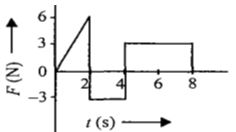
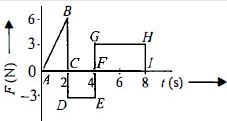
The force $F$ acting on a particle of mass $m$ is indicated by the force-time graph shown below. The change in momentum of the particle over the time interval from $0 \, s$ to $8 \, s$ is .......... $N-s$.
A
$24$
B
$20$
C
$12$
D
$6$
Solution
(C) The change in momentum of a particle is equal to the impulse,which is the area under the force-time $(F-t)$ graph.
Change in momentum = Area under $F-t$ graph
$= \text{Area of triangle } ABC + \text{Area of rectangle } CDEF + \text{Area of rectangle } FGHI$
$= (\frac{1}{2} \times \text{base} \times \text{height}) + (\text{width} \times \text{height}) + (\text{width} \times \text{height})$
$= (\frac{1}{2} \times 2 \times 6) + (2 \times -3) + (4 \times 3)$
$= 6 - 6 + 12$
$= 12 \, N-s$.
Change in momentum = Area under $F-t$ graph
$= \text{Area of triangle } ABC + \text{Area of rectangle } CDEF + \text{Area of rectangle } FGHI$
$= (\frac{1}{2} \times \text{base} \times \text{height}) + (\text{width} \times \text{height}) + (\text{width} \times \text{height})$
$= (\frac{1}{2} \times 2 \times 6) + (2 \times -3) + (4 \times 3)$
$= 6 - 6 + 12$
$= 12 \, N-s$.
0 likesView Solution
7
PhysicsDifficultMCQAIPMT · 2014
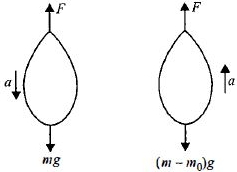
$A$ balloon with mass $m$ is descending down with an acceleration $a$ (where $a < g$). How much mass should be removed from it so that it starts moving up with an acceleration $a$?
A
$\frac{2ma}{g + a}$
B
$\frac{2ma}{g - a}$
C
$\frac{ma}{g + a}$
D
$\frac{ma}{g - a}$
Solution
(A) Let $F$ be the upthrust of the air. As the balloon is descending down with an acceleration $a$:
$mg - F = ma$ ... $(i)$
Let mass $m_0$ be removed from the balloon so that it starts moving up with an acceleration $a$. Then:
$F - (m - m_0)g = (m - m_0)a$
$F - mg + m_0g = ma - m_0a$ ... $(ii)$
Adding equation $(i)$ and equation $(ii)$,we get:
$m_0g = 2ma - m_0a$
$m_0(g + a) = 2ma$
$m_0 = \frac{2ma}{g + a}$
$mg - F = ma$ ... $(i)$
Let mass $m_0$ be removed from the balloon so that it starts moving up with an acceleration $a$. Then:
$F - (m - m_0)g = (m - m_0)a$
$F - mg + m_0g = ma - m_0a$ ... $(ii)$
Adding equation $(i)$ and equation $(ii)$,we get:
$m_0g = 2ma - m_0a$
$m_0(g + a) = 2ma$
$m_0 = \frac{2ma}{g + a}$
0 likesView Solution
8
PhysicsDifficultMCQAIPMT · 2014
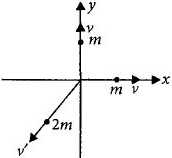
$A$ body of mass $(4m)$ is lying in the $x-y$ plane at rest. It suddenly explodes into three pieces. Two pieces,each of mass $(m)$,move perpendicular to each other with equal speeds $(v)$. The total kinetic energy generated due to the explosion is ................. $mv^2$.
A
$0$
B
$1.5$
C
$2$
D
$4$
Solution
(B) Let $\vec{v}'$ be the velocity of the third piece of mass $2m$.
Initial momentum,$\vec{P}_i = 0$ (as the body is at rest).
Final momentum,$\vec{P}_f = m v \hat{i} + m v \hat{j} + 2m \vec{v}'$.
According to the law of conservation of momentum,$\vec{P}_i = \vec{P}_f$.
$0 = m v \hat{i} + m v \hat{j} + 2m \vec{v}'$.
$\vec{v}' = -\frac{v}{2} \hat{i} - \frac{v}{2} \hat{j}$.
The magnitude of $v'$ is $v' = \sqrt{(-\frac{v}{2})^2 + (-\frac{v}{2})^2} = \frac{v}{\sqrt{2}}$.
Total kinetic energy generated due to the explosion is the sum of the kinetic energies of the three pieces:
$K.E. = \frac{1}{2} m v^2 + \frac{1}{2} m v^2 + \frac{1}{2} (2m) (v')^2$.
$K.E. = m v^2 + m (\frac{v}{\sqrt{2}})^2$.
$K.E. = m v^2 + m (\frac{v^2}{2}) = \frac{3}{2} m v^2 = 1.5 m v^2$.
Initial momentum,$\vec{P}_i = 0$ (as the body is at rest).
Final momentum,$\vec{P}_f = m v \hat{i} + m v \hat{j} + 2m \vec{v}'$.
According to the law of conservation of momentum,$\vec{P}_i = \vec{P}_f$.
$0 = m v \hat{i} + m v \hat{j} + 2m \vec{v}'$.
$\vec{v}' = -\frac{v}{2} \hat{i} - \frac{v}{2} \hat{j}$.
The magnitude of $v'$ is $v' = \sqrt{(-\frac{v}{2})^2 + (-\frac{v}{2})^2} = \frac{v}{\sqrt{2}}$.
Total kinetic energy generated due to the explosion is the sum of the kinetic energies of the three pieces:
$K.E. = \frac{1}{2} m v^2 + \frac{1}{2} m v^2 + \frac{1}{2} (2m) (v')^2$.
$K.E. = m v^2 + m (\frac{v}{\sqrt{2}})^2$.
$K.E. = m v^2 + m (\frac{v^2}{2}) = \frac{3}{2} m v^2 = 1.5 m v^2$.
0 likesView Solution
9
PhysicsDifficultMCQAIPMT · 2014
$A$ certain quantity of water cools from $70^\circ C$ to $60^\circ C$ in the first $5$ minutes and to $54^\circ C$ in the next $5$ minutes. The temperature of the surroundings is ..... $^\circ C$
A
$45$
B
$20$
C
$42$
D
$10$
Solution
(A) Let $T_s$ be the temperature of the surroundings.
According to $Newton's$ law of cooling,the rate of cooling is given by:
$\frac{T_1 - T_2}{t} = K \left( \frac{T_1 + T_2}{2} - T_s \right)$
For the first $5$ minutes:
$T_1 = 70^\circ C, T_2 = 60^\circ C, t = 5$ minutes.
$\frac{70 - 60}{5} = K \left( \frac{70 + 60}{2} - T_s \right)$
$2 = K(65 - T_s)$ --- $(i)$
For the next $5$ minutes:
$T_1 = 60^\circ C, T_2 = 54^\circ C, t = 5$ minutes.
$\frac{60 - 54}{5} = K \left( \frac{60 + 54}{2} - T_s \right)$
$1.2 = K(57 - T_s)$ --- $(ii)$
Dividing equation $(i)$ by equation $(ii)$:
$\frac{2}{1.2} = \frac{65 - T_s}{57 - T_s}$
$\frac{5}{3} = \frac{65 - T_s}{57 - T_s}$
$5(57 - T_s) = 3(65 - T_s)$
$285 - 5T_s = 195 - 3T_s$
$2T_s = 90$
$T_s = 45^\circ C$
According to $Newton's$ law of cooling,the rate of cooling is given by:
$\frac{T_1 - T_2}{t} = K \left( \frac{T_1 + T_2}{2} - T_s \right)$
For the first $5$ minutes:
$T_1 = 70^\circ C, T_2 = 60^\circ C, t = 5$ minutes.
$\frac{70 - 60}{5} = K \left( \frac{70 + 60}{2} - T_s \right)$
$2 = K(65 - T_s)$ --- $(i)$
For the next $5$ minutes:
$T_1 = 60^\circ C, T_2 = 54^\circ C, t = 5$ minutes.
$\frac{60 - 54}{5} = K \left( \frac{60 + 54}{2} - T_s \right)$
$1.2 = K(57 - T_s)$ --- $(ii)$
Dividing equation $(i)$ by equation $(ii)$:
$\frac{2}{1.2} = \frac{65 - T_s}{57 - T_s}$
$\frac{5}{3} = \frac{65 - T_s}{57 - T_s}$
$5(57 - T_s) = 3(65 - T_s)$
$285 - 5T_s = 195 - 3T_s$
$2T_s = 90$
$T_s = 45^\circ C$
0 likesView Solution
10
PhysicsEasyMCQAIPMT · 2014
The mean free path of molecules of a gas (radius $r$) is inversely proportional to
A
$r^3$
B
$r^2$
C
$r$
D
$\sqrt{r}$
Solution
(B) The mean free path $\lambda$ of a gas molecule is given by the formula:
$\lambda = \frac{1}{\sqrt{2} n \pi d^2}$
where $n$ is the number density of molecules and $d$ is the diameter of the molecule.
Since the radius of the molecule is $r$,the diameter is $d = 2r$.
Substituting this into the formula:
$\lambda = \frac{1}{\sqrt{2} n \pi (2r)^2} = \frac{1}{4\sqrt{2} n \pi r^2}$
From this expression,it is clear that $\lambda \propto \frac{1}{r^2}$.
Therefore,the mean free path is inversely proportional to $r^2$.
$\lambda = \frac{1}{\sqrt{2} n \pi d^2}$
where $n$ is the number density of molecules and $d$ is the diameter of the molecule.
Since the radius of the molecule is $r$,the diameter is $d = 2r$.
Substituting this into the formula:
$\lambda = \frac{1}{\sqrt{2} n \pi (2r)^2} = \frac{1}{4\sqrt{2} n \pi r^2}$
From this expression,it is clear that $\lambda \propto \frac{1}{r^2}$.
Therefore,the mean free path is inversely proportional to $r^2$.
0 likesView Solution
11
PhysicsMediumMCQAIPMT · 2014
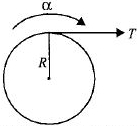
$A$ solid cylinder of mass $50\, kg$ and radius $0.5\, m$ is free to rotate about a horizontal axis. $A$ massless string is wound around the cylinder with one end attached to it and the other hanging freely. The tension in the string required to produce an angular acceleration of $2\, \text{revolutions } s^{-2}$ is ...... $N$.
A
$25$
B
$50$
C
$78.5$
D
$157$
Solution
(D) Given: Mass of the cylinder, $M = 50\, kg$. Radius of the cylinder, $R = 0.5\, m$. Angular acceleration, $\alpha = 2\, \text{rev } s^{-2}$.
Converting angular acceleration to $SI$ units: $\alpha = 2 \times 2\pi\, \text{rad } s^{-2} = 4\pi\, \text{rad } s^{-2}$.
The torque $\tau$ produced by the tension $T$ in the string is $\tau = T \times R$.
The moment of inertia $I$ of a solid cylinder about its central axis is $I = \frac{1}{2}MR^2$.
Using the relation $\tau = I\alpha$, we have $TR = (\frac{1}{2}MR^2)\alpha$.
Solving for tension $T$: $T = \frac{1}{2}MR\alpha$.
Substituting the values: $T = \frac{1}{2} \times 50 \times 0.5 \times 4\pi = 50\pi$.
Using $\pi \approx 3.14$, $T = 50 \times 3.14 = 157\, N$.
Converting angular acceleration to $SI$ units: $\alpha = 2 \times 2\pi\, \text{rad } s^{-2} = 4\pi\, \text{rad } s^{-2}$.
The torque $\tau$ produced by the tension $T$ in the string is $\tau = T \times R$.
The moment of inertia $I$ of a solid cylinder about its central axis is $I = \frac{1}{2}MR^2$.
Using the relation $\tau = I\alpha$, we have $TR = (\frac{1}{2}MR^2)\alpha$.
Solving for tension $T$: $T = \frac{1}{2}MR\alpha$.
Substituting the values: $T = \frac{1}{2} \times 50 \times 0.5 \times 4\pi = 50\pi$.
Using $\pi \approx 3.14$, $T = 50 \times 3.14 = 157\, N$.
0 likesView Solution
12
PhysicsMediumMCQAIPMT · 2014
The ratio of the accelerations for a solid sphere (mass $m$ and radius $R$) rolling down an incline of angle $\theta$ without slipping and slipping down the incline without rolling is
A
$5:7$
B
$2:3$
C
$2:5$
D
$7:5$
Solution
(A) Acceleration of the solid sphere slipping down the incline without rolling is
${a_{slipping}} = g \sin \theta \,\,\,\,\,\,\,(i)$
Acceleration of the solid sphere rolling down the incline without slipping is
${a_{rolling}} = \frac{g \sin \theta}{1 + \frac{k^2}{R^2}} = \frac{g \sin \theta}{1 + \frac{2}{5}}$
(For a solid sphere,$\frac{k^2}{R^2} = \frac{2}{5}$)
$= \frac{5}{7} g \sin \theta \,\,\,\,\,(ii)$
Dividing equation $(ii)$ by equation $(i)$,we get
$\frac{a_{rolling}}{a_{slipping}} = \frac{5}{7}$
${a_{slipping}} = g \sin \theta \,\,\,\,\,\,\,(i)$
Acceleration of the solid sphere rolling down the incline without slipping is
${a_{rolling}} = \frac{g \sin \theta}{1 + \frac{k^2}{R^2}} = \frac{g \sin \theta}{1 + \frac{2}{5}}$
(For a solid sphere,$\frac{k^2}{R^2} = \frac{2}{5}$)
$= \frac{5}{7} g \sin \theta \,\,\,\,\,(ii)$
Dividing equation $(ii)$ by equation $(i)$,we get
$\frac{a_{rolling}}{a_{slipping}} = \frac{5}{7}$
1 likesView Solution
13
PhysicsMediumMCQAIPMT · 2014
$A$ black hole is an object whose gravitational field is so strong that even light cannot escape from it. To what approximate radius would Earth (mass $= 5.98 \times 10^{24} \, kg$) have to be compressed to be a black hole?
A
$10^{-9} \, m$
B
$10^{-6} \, m$
C
$10^{-2} \, m$
D
$100 \, m$
Solution
(C) For an object to become a black hole,its escape velocity must be equal to the speed of light $(c)$.
The formula for escape velocity is $v_{esc} = \sqrt{\frac{2GM}{R}}$.
Setting $v_{esc} = c$,we get $c = \sqrt{\frac{2GM}{R}}$,which implies $R = \frac{2GM}{c^2}$.
Given $G = 6.67 \times 10^{-11} \, N \cdot m^2/kg^2$,$M = 5.98 \times 10^{24} \, kg$,and $c = 3 \times 10^8 \, m/s$:
$R = \frac{2 \times 6.67 \times 10^{-11} \times 5.98 \times 10^{24}}{(3 \times 10^8)^2}$
$R = \frac{79.77 \times 10^{13}}{9 \times 10^{16}}$
$R \approx 8.86 \times 10^{-3} \, m \approx 10^{-2} \, m$.
The formula for escape velocity is $v_{esc} = \sqrt{\frac{2GM}{R}}$.
Setting $v_{esc} = c$,we get $c = \sqrt{\frac{2GM}{R}}$,which implies $R = \frac{2GM}{c^2}$.
Given $G = 6.67 \times 10^{-11} \, N \cdot m^2/kg^2$,$M = 5.98 \times 10^{24} \, kg$,and $c = 3 \times 10^8 \, m/s$:
$R = \frac{2 \times 6.67 \times 10^{-11} \times 5.98 \times 10^{24}}{(3 \times 10^8)^2}$
$R = \frac{79.77 \times 10^{13}}{9 \times 10^{16}}$
$R \approx 8.86 \times 10^{-3} \, m \approx 10^{-2} \, m$.
0 likesView Solution
14
PhysicsMediumMCQAIPMT · 2014
The dependence of the intensity of the gravitational field $(E)$ of the Earth on the distance $(r)$ from the center of the Earth is correctly represented by:
A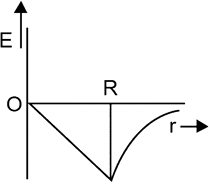
B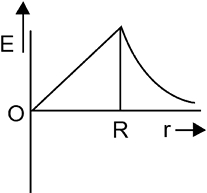
C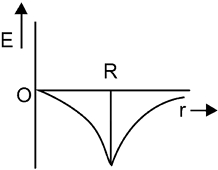
D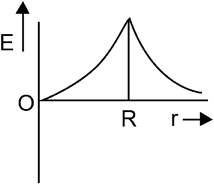
Solution
(A) For a point inside the Earth,i.e.,$r < R$:
$E = -\frac{GM}{R^3}r$
Where $M$ and $R$ are the mass and radius of the Earth,respectively. The negative sign indicates that the field is directed towards the center.
At the center,$r = 0$,therefore $E = 0$.
For a point outside the Earth,i.e.,$r > R$:
$E = -\frac{GM}{r^2}$
On the surface of the Earth,i.e.,$r = R$:
$E = -\frac{GM}{R^2}$
The magnitude of the gravitational field increases linearly with distance $r$ inside the Earth and decreases inversely with the square of the distance $r$ outside the Earth. The graph representing this variation is shown in the provided solution image.
$E = -\frac{GM}{R^3}r$
Where $M$ and $R$ are the mass and radius of the Earth,respectively. The negative sign indicates that the field is directed towards the center.
At the center,$r = 0$,therefore $E = 0$.
For a point outside the Earth,i.e.,$r > R$:
$E = -\frac{GM}{r^2}$
On the surface of the Earth,i.e.,$r = R$:
$E = -\frac{GM}{R^2}$
The magnitude of the gravitational field increases linearly with distance $r$ inside the Earth and decreases inversely with the square of the distance $r$ outside the Earth. The graph representing this variation is shown in the provided solution image.
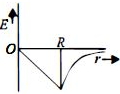
0 likesView Solution
15
PhysicsEasyMCQAIPMT · 2014
Copper of fixed volume $V$ is drawn into a wire of length $l$. When this wire is subjected to a constant force $F$,the extension produced in the wire is $\Delta l$. Which of the following graphs is a straight line?
A
$\Delta l \rightarrow \frac{1}{l}$
B
$\Delta l \rightarrow l^2$
C
$\Delta l \rightarrow \frac{1}{l^2}$
D
$\Delta l \rightarrow l$
Solution
(B) Given that the volume $V$ of the copper wire is constant,we have $V = A \cdot l$,where $A$ is the cross-sectional area and $l$ is the length of the wire.
From this,we can express the area as $A = \frac{V}{l}$.
According to Hooke's Law,Young's modulus $Y$ is defined as $Y = \frac{\text{Stress}}{\text{Strain}} = \frac{F/A}{\Delta l/l} = \frac{F \cdot l}{A \cdot \Delta l}$.
Rearranging this formula to solve for the extension $\Delta l$,we get $\Delta l = \frac{F \cdot l}{Y \cdot A}$.
Substituting $A = \frac{V}{l}$ into the equation,we get $\Delta l = \frac{F \cdot l}{Y \cdot (V/l)} = \frac{F \cdot l^2}{Y \cdot V}$.
Since $F$,$Y$,and $V$ are constants,we have $\Delta l \propto l^2$.
Therefore,the graph of $\Delta l$ versus $l^2$ will be a straight line passing through the origin.
From this,we can express the area as $A = \frac{V}{l}$.
According to Hooke's Law,Young's modulus $Y$ is defined as $Y = \frac{\text{Stress}}{\text{Strain}} = \frac{F/A}{\Delta l/l} = \frac{F \cdot l}{A \cdot \Delta l}$.
Rearranging this formula to solve for the extension $\Delta l$,we get $\Delta l = \frac{F \cdot l}{Y \cdot A}$.
Substituting $A = \frac{V}{l}$ into the equation,we get $\Delta l = \frac{F \cdot l}{Y \cdot (V/l)} = \frac{F \cdot l^2}{Y \cdot V}$.
Since $F$,$Y$,and $V$ are constants,we have $\Delta l \propto l^2$.
Therefore,the graph of $\Delta l$ versus $l^2$ will be a straight line passing through the origin.
0 likesView Solution
16
PhysicsDifficultMCQAIPMT · 2014
$A$ certain number of spherical drops of a liquid of radius $r$ coalesce to form a single drop of radius $R$ and volume $V.$ If $T$ is the surface tension of the liquid,then
A
energy $= 4VT \left( \frac{1}{r} - \frac{1}{R} \right)$ is released.
B
energy $= 3VT \left( \frac{1}{r} + \frac{1}{R} \right)$ is absorbed.
C
energy $= 3VT \left( \frac{1}{r} - \frac{1}{R} \right)$ is released.
D
energy is neither released nor absorbed.
Solution
(C) Let $n$ droplets each of radius $r$ coalesce to form a big drop of radius $R$.
Volume of $n$ droplets = Volume of big drop
$n \times \frac{4}{3}\pi r^3 = \frac{4}{3}\pi R^3 \Rightarrow n = \frac{R^3}{r^3}$ $(i)$
Volume of big drop,$V = \frac{4}{3}\pi R^3$ $(ii)$
Initial surface area of $n$ droplets,$A_i = n \times 4\pi r^2 = \frac{R^3}{r^3} \times 4\pi r^2 = \frac{4\pi R^3}{r} = \left( \frac{4}{3}\pi R^3 \right) \frac{3}{r} = \frac{3V}{r}$ $(Using (i) \text{ and } (ii))$
Final surface area of big drop,$A_f = 4\pi R^2 = \left( \frac{4}{3}\pi R^3 \right) \frac{3}{R} = \frac{3V}{R}$ $(Using (ii))$
Decrease in surface area,$\Delta A = A_i - A_f = \frac{3V}{r} - \frac{3V}{R} = 3V \left( \frac{1}{r} - \frac{1}{R} \right)$
Energy released = Surface tension $\times$ Decrease in surface area
Energy released $= T \times \Delta A = 3VT \left( \frac{1}{r} - \frac{1}{R} \right)$.
Volume of $n$ droplets = Volume of big drop
$n \times \frac{4}{3}\pi r^3 = \frac{4}{3}\pi R^3 \Rightarrow n = \frac{R^3}{r^3}$ $(i)$
Volume of big drop,$V = \frac{4}{3}\pi R^3$ $(ii)$
Initial surface area of $n$ droplets,$A_i = n \times 4\pi r^2 = \frac{R^3}{r^3} \times 4\pi r^2 = \frac{4\pi R^3}{r} = \left( \frac{4}{3}\pi R^3 \right) \frac{3}{r} = \frac{3V}{r}$ $(Using (i) \text{ and } (ii))$
Final surface area of big drop,$A_f = 4\pi R^2 = \left( \frac{4}{3}\pi R^3 \right) \frac{3}{R} = \frac{3V}{R}$ $(Using (ii))$
Decrease in surface area,$\Delta A = A_i - A_f = \frac{3V}{r} - \frac{3V}{R} = 3V \left( \frac{1}{r} - \frac{1}{R} \right)$
Energy released = Surface tension $\times$ Decrease in surface area
Energy released $= T \times \Delta A = 3VT \left( \frac{1}{r} - \frac{1}{R} \right)$.
0 likesView Solution
17
PhysicsMediumMCQAIPMT · 2014
$A$ monatomic gas at a pressure $P$, having a volume $V$, expands isothermally to a volume $2V$ and then adiabatically to a volume $16V$. The final pressure of the gas is (Take $\gamma = 5/3$)
A
$64P$
B
$32P$
C
$\frac{P}{64}$
D
$16P$
Solution
(C) Step $1$: Isothermal expansion.
For an isothermal process, $PV = \text{constant}$.
Initial state: $(P, V)$.
Final state after isothermal expansion: $(P', 2V)$.
$PV = P'(2V) \implies P' = \frac{P}{2}$.
Step $2$: Adiabatic expansion.
For an adiabatic process, $PV^\gamma = \text{constant}$.
Initial state for this process: $(P', 2V) = (P/2, 2V)$.
Final state: $(P_f, 16V)$.
$P'(2V)^\gamma = P_f(16V)^\gamma$.
Substituting $P' = P/2$ and $\gamma = 5/3$:
$\frac{P}{2} (2V)^{5/3} = P_f (16V)^{5/3}$.
$P_f = \frac{P}{2} \left( \frac{2V}{16V} \right)^{5/3} = \frac{P}{2} \left( \frac{1}{8} \right)^{5/3}$.
Since $8 = 2^3$, we have $\left( \frac{1}{2^3} \right)^{5/3} = \frac{1}{2^5} = \frac{1}{32}$.
$P_f = \frac{P}{2} \times \frac{1}{32} = \frac{P}{64}$.
For an isothermal process, $PV = \text{constant}$.
Initial state: $(P, V)$.
Final state after isothermal expansion: $(P', 2V)$.
$PV = P'(2V) \implies P' = \frac{P}{2}$.
Step $2$: Adiabatic expansion.
For an adiabatic process, $PV^\gamma = \text{constant}$.
Initial state for this process: $(P', 2V) = (P/2, 2V)$.
Final state: $(P_f, 16V)$.
$P'(2V)^\gamma = P_f(16V)^\gamma$.
Substituting $P' = P/2$ and $\gamma = 5/3$:
$\frac{P}{2} (2V)^{5/3} = P_f (16V)^{5/3}$.
$P_f = \frac{P}{2} \left( \frac{2V}{16V} \right)^{5/3} = \frac{P}{2} \left( \frac{1}{8} \right)^{5/3}$.
Since $8 = 2^3$, we have $\left( \frac{1}{2^3} \right)^{5/3} = \frac{1}{2^5} = \frac{1}{32}$.
$P_f = \frac{P}{2} \times \frac{1}{32} = \frac{P}{64}$.
0 likesView Solution
18
PhysicsMediumMCQAIPMT · 2014
The oscillation of a body on a smooth horizontal surface is represented by the equation $x = A \cos \omega t$,where $x$ is the displacement at time $t$ and $\omega$ is the angular frequency of oscillation. Which one of the following graphs correctly shows the variation of acceleration $a$ with time $t$?
A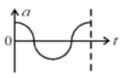
B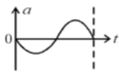
C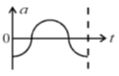
D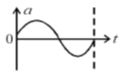
Solution
(C) Given the displacement equation: $x = A \cos \omega t$.
The velocity $v$ is the first derivative of displacement with respect to time:
$v = \frac{dx}{dt} = \frac{d}{dt}(A \cos \omega t) = -A \omega \sin \omega t$.
The acceleration $a$ is the derivative of velocity with respect to time:
$a = \frac{dv}{dt} = \frac{d}{dt}(-A \omega \sin \omega t) = -A \omega^2 \cos \omega t$.
Comparing this with the original displacement equation $x = A \cos \omega t$,we see that $a = -\omega^2 x$. At $t = 0$,$x = A$,so $a = -A \omega^2$. This means the acceleration starts at a negative maximum value and follows a negative cosine curve. Graph $C$ represents this variation correctly.
The velocity $v$ is the first derivative of displacement with respect to time:
$v = \frac{dx}{dt} = \frac{d}{dt}(A \cos \omega t) = -A \omega \sin \omega t$.
The acceleration $a$ is the derivative of velocity with respect to time:
$a = \frac{dv}{dt} = \frac{d}{dt}(-A \omega \sin \omega t) = -A \omega^2 \cos \omega t$.
Comparing this with the original displacement equation $x = A \cos \omega t$,we see that $a = -\omega^2 x$. At $t = 0$,$x = A$,so $a = -A \omega^2$. This means the acceleration starts at a negative maximum value and follows a negative cosine curve. Graph $C$ represents this variation correctly.
0 likesView Solution
19
PhysicsMediumMCQAIPMT · 2014
If $n_{1}, n_{2}$ and $n_{3}$ are the fundamental frequencies of three segments into which a string is divided,then the original fundamental frequency $n$ of the string is given by
A
$n = n_{1} + n_{2} + n_{3}$
B
$\sqrt{n} = \sqrt{n_{1}} + \sqrt{n_{2}} + \sqrt{n_{3}}$
C
$\frac{1}{n} = \frac{1}{n_{1}} + \frac{1}{n_{2}} + \frac{1}{n_{3}}$
D
$\frac{1}{n^{2}} = \frac{1}{n_{1}^{2}} + \frac{1}{n_{2}^{2}} + \frac{1}{n_{3}^{2}}$
Solution
(C) The fundamental frequency of a stretched string is given by $n = \frac{1}{2l} \sqrt{\frac{T}{\mu}}$.
Since the tension $T$ and mass per unit length $\mu$ are constant for the string,we have $n \propto \frac{1}{l}$,which implies $l = \frac{k}{n}$,where $k$ is a constant.
When the string is divided into three segments of lengths $l_{1}, l_{2}, l_{3}$ with fundamental frequencies $n_{1}, n_{2}, n_{3}$ respectively,we have $l_{1} = \frac{k}{n_{1}}$,$l_{2} = \frac{k}{n_{2}}$,and $l_{3} = \frac{k}{n_{3}}$.
The total length of the string is $l = l_{1} + l_{2} + l_{3}$.
Substituting the expressions for length in terms of frequency,we get $\frac{k}{n} = \frac{k}{n_{1}} + \frac{k}{n_{2}} + \frac{k}{n_{3}}$.
Dividing by $k$,we obtain the relation $\frac{1}{n} = \frac{1}{n_{1}} + \frac{1}{n_{2}} + \frac{1}{n_{3}}$.
Since the tension $T$ and mass per unit length $\mu$ are constant for the string,we have $n \propto \frac{1}{l}$,which implies $l = \frac{k}{n}$,where $k$ is a constant.
When the string is divided into three segments of lengths $l_{1}, l_{2}, l_{3}$ with fundamental frequencies $n_{1}, n_{2}, n_{3}$ respectively,we have $l_{1} = \frac{k}{n_{1}}$,$l_{2} = \frac{k}{n_{2}}$,and $l_{3} = \frac{k}{n_{3}}$.
The total length of the string is $l = l_{1} + l_{2} + l_{3}$.
Substituting the expressions for length in terms of frequency,we get $\frac{k}{n} = \frac{k}{n_{1}} + \frac{k}{n_{2}} + \frac{k}{n_{3}}$.
Dividing by $k$,we obtain the relation $\frac{1}{n} = \frac{1}{n_{1}} + \frac{1}{n_{2}} + \frac{1}{n_{3}}$.
0 likesView Solution
20
PhysicsMediumMCQAIPMT · 2014
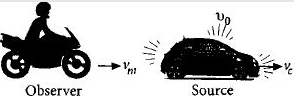
$A$ speeding motorcyclist sees a traffic jam ahead. He slows down to $36\, km\, h^{-1}$. He finds that the traffic has eased and a car moving ahead of him at $18\, km\, h^{-1}$ is honking at a frequency of $1392\, Hz$. If the speed of sound is $343\, m s^{-1}$,the frequency of the honk as heard by him will be .... $Hz$.
A
$1332$
B
$1372$
C
$1412$
D
$1454$
Solution
(C) The speed of the motorcyclist (observer) is $v_o = 36\, km\, h^{-1} = 36 \times \frac{5}{18} = 10\, m s^{-1}$.
Since the motorcyclist is moving towards the source (car),the observer's velocity is taken as positive.
The speed of the car (source) is $v_s = 18\, km\, h^{-1} = 18 \times \frac{5}{18} = 5\, m s^{-1}$.
Since the source is moving away from the observer,the source's velocity is taken as positive.
The speed of sound is $v = 343\, m s^{-1}$.
The frequency of the source is $f_0 = 1392\, Hz$.
Using the Doppler effect formula for frequency heard by the observer,$f' = f_0 \left( \frac{v + v_o}{v + v_s} \right)$,
$f' = 1392 \left( \frac{343 + 10}{343 + 5} \right)$,
$f' = 1392 \left( \frac{353}{348} \right)$,
$f' = 4 \times 353 = 1412\, Hz$.
Since the motorcyclist is moving towards the source (car),the observer's velocity is taken as positive.
The speed of the car (source) is $v_s = 18\, km\, h^{-1} = 18 \times \frac{5}{18} = 5\, m s^{-1}$.
Since the source is moving away from the observer,the source's velocity is taken as positive.
The speed of sound is $v = 343\, m s^{-1}$.
The frequency of the source is $f_0 = 1392\, Hz$.
Using the Doppler effect formula for frequency heard by the observer,$f' = f_0 \left( \frac{v + v_o}{v + v_s} \right)$,
$f' = 1392 \left( \frac{343 + 10}{343 + 5} \right)$,
$f' = 1392 \left( \frac{353}{348} \right)$,
$f' = 4 \times 353 = 1412\, Hz$.
0 likesView Solution
21
PhysicsMediumMCQAIPMT · 2014
The number of possible natural oscillations of an air column in a pipe closed at one end of length $85 \, cm$ whose frequencies lie below $1250 \, Hz$ are (Velocity of sound $= 340 \, m s^{-1}$)
A
$4$
B
$5$
C
$6$
D
$7$
Solution
(C) The fundamental frequency $(f_1)$ of a pipe closed at one end is given by $f_1 = \frac{v}{4L}$.
Given: $v = 340 \, m s^{-1}$ and $L = 85 \, cm = 0.85 \, m$.
Substituting the values: $f_1 = \frac{340}{4 \times 0.85} = \frac{340}{3.4} = 100 \, Hz$.
The natural frequencies of a closed pipe are odd harmonics of the fundamental frequency: $f_n = (2n - 1)f_1$,where $n = 1, 2, 3, \dots$.
The frequencies are: $100 \, Hz, 300 \, Hz, 500 \, Hz, 700 \, Hz, 900 \, Hz, 1100 \, Hz, 1300 \, Hz, \dots$.
We need to find the number of frequencies below $1250 \, Hz$.
The frequencies are $100, 300, 500, 700, 900, 1100$.
Counting these,we get $6$ possible natural oscillations.
Given: $v = 340 \, m s^{-1}$ and $L = 85 \, cm = 0.85 \, m$.
Substituting the values: $f_1 = \frac{340}{4 \times 0.85} = \frac{340}{3.4} = 100 \, Hz$.
The natural frequencies of a closed pipe are odd harmonics of the fundamental frequency: $f_n = (2n - 1)f_1$,where $n = 1, 2, 3, \dots$.
The frequencies are: $100 \, Hz, 300 \, Hz, 500 \, Hz, 700 \, Hz, 900 \, Hz, 1100 \, Hz, 1300 \, Hz, \dots$.
We need to find the number of frequencies below $1250 \, Hz$.
The frequencies are $100, 300, 500, 700, 900, 1100$.
Counting these,we get $6$ possible natural oscillations.
0 likesView Solution
22
PhysicsMediumMCQAIPMT · 2014
Steam at $100\,^{\circ}C$ is passed into $20\,g$ of water at $10\,^{\circ}C$. When water acquires a temperature of $80\,^{\circ}C$,the mass of water present will be ........ $g$. [Take specific heat of water $= 1\,cal\,g^{-1}\,^{\circ}C^{-1}$ and latent heat of steam $= 540\,cal\,g^{-1}$]
A
$24$
B
$31.5$
C
$42.5$
D
$22.5$
Solution
(D) Let $m$ be the mass of steam condensed into water.
Heat lost by steam $=$ Heat gained by water.
Heat lost by steam consists of two parts: latent heat of condensation and cooling of condensed water from $100\,^{\circ}C$ to $80\,^{\circ}C$.
Heat lost $= m \times L_v + m \times s_w \times \Delta T_1 = m \times 540 + m \times 1 \times (100 - 80) = 540m + 20m = 560m$.
Heat gained by $20\,g$ of water to reach $80\,^{\circ}C$ from $10\,^{\circ}C$ is:
Heat gained $= m_w \times s_w \times \Delta T_2 = 20 \times 1 \times (80 - 10) = 20 \times 70 = 1400\,cal$.
Equating heat lost and gained: $560m = 1400$.
$m = \frac{1400}{560} = 2.5\,g$.
The total mass of water present is the initial mass plus the condensed steam mass:
Total mass $= 20\,g + 2.5\,g = 22.5\,g$.
Heat lost by steam $=$ Heat gained by water.
Heat lost by steam consists of two parts: latent heat of condensation and cooling of condensed water from $100\,^{\circ}C$ to $80\,^{\circ}C$.
Heat lost $= m \times L_v + m \times s_w \times \Delta T_1 = m \times 540 + m \times 1 \times (100 - 80) = 540m + 20m = 560m$.
Heat gained by $20\,g$ of water to reach $80\,^{\circ}C$ from $10\,^{\circ}C$ is:
Heat gained $= m_w \times s_w \times \Delta T_2 = 20 \times 1 \times (80 - 10) = 20 \times 70 = 1400\,cal$.
Equating heat lost and gained: $560m = 1400$.
$m = \frac{1400}{560} = 2.5\,g$.
The total mass of water present is the initial mass plus the condensed steam mass:
Total mass $= 20\,g + 2.5\,g = 22.5\,g$.
0 likesView Solution
23
PhysicsDifficultMCQAIPMT · 2014
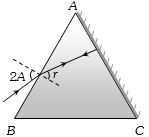
The angle of a prism is $A$. One of its refracting surfaces is silvered. Light rays falling at an angle of incidence $2A$ on the first surface return back through the same path after suffering reflection at the silvered surface. The refractive index $\mu$ of the prism is:
A
$2 \sin A$
B
$2 \cos A$
C
$\frac{1}{2} \cos A$
D
$\tan A$
Solution
(A) For the light ray to retrace its path,it must strike the silvered surface normally (at an angle of $90^{\circ}$).
In the triangle formed inside the prism,the angle at the silvered surface is $90^{\circ}$,and the angle at the apex is $A$. Thus,the angle of refraction $r$ at the first surface must be $r = 90^{\circ} - A$.
According to Snell's Law at the first surface: $\mu = \frac{\sin i}{\sin r}$.
Given $i = 2A$ and $r = 90^{\circ} - A$,we have:
$\mu = \frac{\sin(2A)}{\sin(90^{\circ} - A)}$
$\mu = \frac{2 \sin A \cos A}{\cos A}$
$\mu = 2 \sin A$.
In the triangle formed inside the prism,the angle at the silvered surface is $90^{\circ}$,and the angle at the apex is $A$. Thus,the angle of refraction $r$ at the first surface must be $r = 90^{\circ} - A$.
According to Snell's Law at the first surface: $\mu = \frac{\sin i}{\sin r}$.
Given $i = 2A$ and $r = 90^{\circ} - A$,we have:
$\mu = \frac{\sin(2A)}{\sin(90^{\circ} - A)}$
$\mu = \frac{2 \sin A \cos A}{\cos A}$
$\mu = 2 \sin A$.
0 likesView Solution
24
PhysicsMediumMCQAIPMT · 2014
In a region,the potential is represented by $V(x, y, z) = 6x - 8xy - 8y + 6yz$,where $V$ is in volts and $x, y, z$ are in metres. The electric force experienced by a charge of $2 \ C$ situated at point $(1, 1, 1)$ is
A
$6\sqrt{5} \ N$
B
$30 \ N$
C
$24 \ N$
D
$4\sqrt{35} \ N$
Solution
(D) The electric field $\vec{E}$ is given by the negative gradient of the potential $V$: $\vec{E} = -\nabla V = -\left( \frac{\partial V}{\partial x} \hat{i} + \frac{\partial V}{\partial y} \hat{j} + \frac{\partial V}{\partial z} \hat{k} \right)$.
Given $V(x, y, z) = 6x - 8xy - 8y + 6yz$.
Calculating partial derivatives:
$E_x = -\frac{\partial V}{\partial x} = -(6 - 8y) = -6 + 8y$.
$E_y = -\frac{\partial V}{\partial y} = -(-8x - 8 + 6z) = 8x + 8 - 6z$.
$E_z = -\frac{\partial V}{\partial z} = -(6y) = -6y$.
At point $(1, 1, 1)$:
$E_x = -6 + 8(1) = 2 \ V/m$.
$E_y = 8(1) + 8 - 6(1) = 10 \ V/m$.
$E_z = -6(1) = -6 \ V/m$.
Thus,$\vec{E} = 2\hat{i} + 10\hat{j} - 6\hat{k} \ V/m$.
The magnitude of the electric field is $|\vec{E}| = \sqrt{2^2 + 10^2 + (-6)^2} = \sqrt{4 + 100 + 36} = \sqrt{140} = 2\sqrt{35} \ V/m$.
The electric force $\vec{F} = q\vec{E}$. Given $q = 2 \ C$,the magnitude of the force is $F = q|\vec{E}| = 2 \times 2\sqrt{35} = 4\sqrt{35} \ N$.
Given $V(x, y, z) = 6x - 8xy - 8y + 6yz$.
Calculating partial derivatives:
$E_x = -\frac{\partial V}{\partial x} = -(6 - 8y) = -6 + 8y$.
$E_y = -\frac{\partial V}{\partial y} = -(-8x - 8 + 6z) = 8x + 8 - 6z$.
$E_z = -\frac{\partial V}{\partial z} = -(6y) = -6y$.
At point $(1, 1, 1)$:
$E_x = -6 + 8(1) = 2 \ V/m$.
$E_y = 8(1) + 8 - 6(1) = 10 \ V/m$.
$E_z = -6(1) = -6 \ V/m$.
Thus,$\vec{E} = 2\hat{i} + 10\hat{j} - 6\hat{k} \ V/m$.
The magnitude of the electric field is $|\vec{E}| = \sqrt{2^2 + 10^2 + (-6)^2} = \sqrt{4 + 100 + 36} = \sqrt{140} = 2\sqrt{35} \ V/m$.
The electric force $\vec{F} = q\vec{E}$. Given $q = 2 \ C$,the magnitude of the force is $F = q|\vec{E}| = 2 \times 2\sqrt{35} = 4\sqrt{35} \ N$.
0 likesView Solution
25
PhysicsEasyMCQAIPMT · 2014
$A$ conducting sphere of radius $R$ is given a charge $Q$. The electric potential and the electric field at the centre of the sphere respectively are
A
$0, \frac{Q}{4\pi \varepsilon_0 R^2}$
B
$\frac{Q}{4\pi \varepsilon_0 R}, 0$
C
$\frac{Q}{4\pi \varepsilon_0 R}, \frac{Q}{4\pi \varepsilon_0 R^2}$
D
$0, 0$
Solution
(B) For a conducting sphere,the charge $Q$ resides entirely on its outer surface.
The electric field $E$ inside a conducting sphere is zero because the charges are distributed on the surface such that they cancel each other's field at every point inside.
The electric potential $V$ inside a conducting sphere is constant and equal to the potential at its surface.
Therefore,the potential at the centre is $V = \frac{1}{4\pi \varepsilon_0} \frac{Q}{R}$.
The electric field at the centre is $E = 0$.
The electric field $E$ inside a conducting sphere is zero because the charges are distributed on the surface such that they cancel each other's field at every point inside.
The electric potential $V$ inside a conducting sphere is constant and equal to the potential at its surface.
Therefore,the potential at the centre is $V = \frac{1}{4\pi \varepsilon_0} \frac{Q}{R}$.
The electric field at the centre is $E = 0$.
0 likesView Solution
26
PhysicsMediumMCQAIPMT · 2014
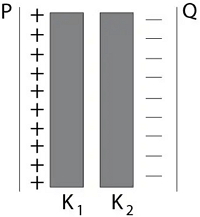
Two thin dielectric slabs of dielectric constants $K_1$ and $K_2$ $(K_1 < K_2)$ are inserted between the plates of a parallel plate capacitor,as shown in the figure. The variation of the electric field $E$ between the plates with distance $d$ as measured from plate $P$ is correctly shown by:
A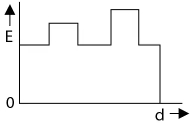
B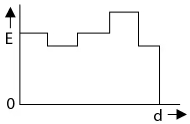
C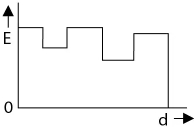
D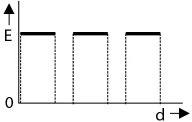
Solution
(D) The electric field $E$ between the plates of a parallel plate capacitor is given by $E = \frac{\sigma}{\varepsilon_0 K}$,where $\sigma$ is the surface charge density and $K$ is the dielectric constant of the medium.
In the regions where the dielectric is absent (air/vacuum),$K = 1$,so the electric field is $E_0 = \frac{\sigma}{\varepsilon_0}$.
In the regions where the dielectric slabs are present,the electric field is $E_1 = \frac{\sigma}{\varepsilon_0 K_1}$ and $E_2 = \frac{\sigma}{\varepsilon_0 K_2}$.
Since $K_1 < K_2$,it follows that $\frac{1}{K_1} > \frac{1}{K_2}$,which implies $E_1 > E_2$.
Also,both $E_1$ and $E_2$ are less than the electric field $E_0$ in the air gap ($E_1 < E_0$ and $E_2 < E_0$).
Therefore,the electric field is highest in the air gaps,and among the dielectric regions,the field is higher in the slab with the smaller dielectric constant $(K_1)$.
Comparing this with the given options,the graph that shows the highest field in the air gaps and a higher field in the $K_1$ region compared to the $K_2$ region is represented by option $(D)$.
In the regions where the dielectric is absent (air/vacuum),$K = 1$,so the electric field is $E_0 = \frac{\sigma}{\varepsilon_0}$.
In the regions where the dielectric slabs are present,the electric field is $E_1 = \frac{\sigma}{\varepsilon_0 K_1}$ and $E_2 = \frac{\sigma}{\varepsilon_0 K_2}$.
Since $K_1 < K_2$,it follows that $\frac{1}{K_1} > \frac{1}{K_2}$,which implies $E_1 > E_2$.
Also,both $E_1$ and $E_2$ are less than the electric field $E_0$ in the air gap ($E_1 < E_0$ and $E_2 < E_0$).
Therefore,the electric field is highest in the air gaps,and among the dielectric regions,the field is higher in the slab with the smaller dielectric constant $(K_1)$.
Comparing this with the given options,the graph that shows the highest field in the air gaps and a higher field in the $K_1$ region compared to the $K_2$ region is represented by option $(D)$.
0 likesView Solution
27
PhysicsMediumMCQAIPMT · 2014
Two cities are $150\, km$ apart. Electric power is sent from one city to another city through copper wires. The fall of potential per $km$ is $8\, V$ and the average resistance per $km$ is $0.5\, \Omega$. The power loss in the wire is
A
$19.2\, W$
B
$19.2\, kW$
C
$12.2\, kW$
D
$12.2\, W$
Solution
(B) The distance between the two cities is $d = 150\, km$.
The total resistance of the copper wire is $R = (0.5\, \Omega/km) \times (150\, km) = 75\, \Omega$.
The total voltage drop across the wire is $V = (8\, V/km) \times (150\, km) = 1200\, V$.
The power loss in the wire is given by the formula $P = \frac{V^2}{R}$.
Substituting the values,$P = \frac{(1200\, V)^2}{75\, \Omega} = \frac{1440000}{75}\, W = 19200\, W$.
Converting to kilowatts,$P = 19.2\, kW$.
The total resistance of the copper wire is $R = (0.5\, \Omega/km) \times (150\, km) = 75\, \Omega$.
The total voltage drop across the wire is $V = (8\, V/km) \times (150\, km) = 1200\, V$.
The power loss in the wire is given by the formula $P = \frac{V^2}{R}$.
Substituting the values,$P = \frac{(1200\, V)^2}{75\, \Omega} = \frac{1440000}{75}\, W = 19200\, W$.
Converting to kilowatts,$P = 19.2\, kW$.
0 likesView Solution
28
PhysicsMediumMCQAIPMT · 2014
$A$ potentiometer circuit has been set up for finding the internal resistance of a given cell. The main battery,used across the potentiometer wire,has an $EMF$ of $2.0\,V$ and a negligible internal resistance. The potentiometer wire itself is $4\,m$ long. When the resistance $R$,connected across the given cell,has values of $(i)$ infinity and $(ii)$ $9.5\,\Omega$,the balancing lengths on the potentiometer wire are found to be $3\,m$ and $2.85\,m$,respectively. The value of internal resistance of the cell is ............... $\Omega$.
A
$0.5$
B
$0.25$
C
$0.75$
D
$0.95$
Solution
(A) The internal resistance $r$ of a cell using a potentiometer is given by the formula:
$r = \left( \frac{l_1}{l_2} - 1 \right) R$
where $l_1$ is the balancing length when the cell is in an open circuit (i.e.,$R = \infty$) and $l_2$ is the balancing length when an external resistance $R$ is connected across the cell.
Given:
$l_1 = 3\,m$
$l_2 = 2.85\,m$
$R = 9.5\,\Omega$
Substituting the values into the formula:
$r = \left( \frac{3}{2.85} - 1 \right) \times 9.5\,\Omega$
$r = \left( \frac{3 - 2.85}{2.85} \right) \times 9.5\,\Omega$
$r = \left( \frac{0.15}{2.85} \right) \times 9.5\,\Omega$
$r = \frac{15}{285} \times 9.5\,\Omega$
$r = \frac{1}{19} \times 9.5\,\Omega = 0.5\,\Omega$
Thus,the internal resistance of the cell is $0.5\,\Omega$.
$r = \left( \frac{l_1}{l_2} - 1 \right) R$
where $l_1$ is the balancing length when the cell is in an open circuit (i.e.,$R = \infty$) and $l_2$ is the balancing length when an external resistance $R$ is connected across the cell.
Given:
$l_1 = 3\,m$
$l_2 = 2.85\,m$
$R = 9.5\,\Omega$
Substituting the values into the formula:
$r = \left( \frac{3}{2.85} - 1 \right) \times 9.5\,\Omega$
$r = \left( \frac{3 - 2.85}{2.85} \right) \times 9.5\,\Omega$
$r = \left( \frac{0.15}{2.85} \right) \times 9.5\,\Omega$
$r = \frac{15}{285} \times 9.5\,\Omega$
$r = \frac{1}{19} \times 9.5\,\Omega = 0.5\,\Omega$
Thus,the internal resistance of the cell is $0.5\,\Omega$.
0 likesView Solution
29
PhysicsDifficultMCQAIPMT · 2014
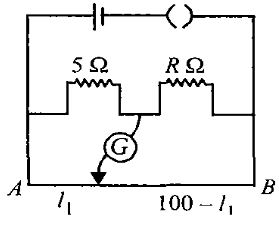
The resistances in the two arms of the meter bridge are $5 \,\Omega$ and $R \,\Omega$ respectively. When the resistance $R$ is shunted with an equal resistance,the new balance point is at $1.6\,l_1$. The resistance $R$ is .................. $\Omega$.
A
$10$
B
$15$
C
$20$
D
$25$
Solution
(B) In the first case,at the balance point:
$\frac{5}{R} = \frac{l_1}{100 - l_1}$ $....(i)$
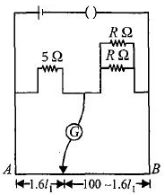
In the second case,the resistance $R$ is shunted with an equal resistance $R$,so the equivalent resistance becomes $R' = \frac{R \times R}{R + R} = \frac{R}{2}$.
The new balance point is at $1.6\,l_1$. Thus,at the balance point:
$\frac{5}{R/2} = \frac{1.6\,l_1}{100 - 1.6\,l_1}$ $....(ii)$
Dividing equation $(i)$ by equation $(ii)$:
$\frac{5/R}{5/(R/2)} = \frac{l_1 / (100 - l_1)}{1.6\,l_1 / (100 - 1.6\,l_1)}$
$\frac{1}{2} = \frac{l_1}{100 - l_1} \times \frac{100 - 1.6\,l_1}{1.6\,l_1}$
$\frac{1}{2} = \frac{100 - 1.6\,l_1}{1.6(100 - l_1)}$
$0.8(100 - l_1) = 100 - 1.6\,l_1$
$80 - 0.8\,l_1 = 100 - 1.6\,l_1$
$0.8\,l_1 = 20$
$l_1 = 25\,cm$
Substituting $l_1 = 25\,cm$ into equation $(i)$:
$\frac{5}{R} = \frac{25}{100 - 25} = \frac{25}{75} = \frac{1}{3}$
$R = 15\,\Omega$.
$\frac{5}{R} = \frac{l_1}{100 - l_1}$ $....(i)$
In the second case,the resistance $R$ is shunted with an equal resistance $R$,so the equivalent resistance becomes $R' = \frac{R \times R}{R + R} = \frac{R}{2}$.
The new balance point is at $1.6\,l_1$. Thus,at the balance point:
$\frac{5}{R/2} = \frac{1.6\,l_1}{100 - 1.6\,l_1}$ $....(ii)$
Dividing equation $(i)$ by equation $(ii)$:
$\frac{5/R}{5/(R/2)} = \frac{l_1 / (100 - l_1)}{1.6\,l_1 / (100 - 1.6\,l_1)}$
$\frac{1}{2} = \frac{l_1}{100 - l_1} \times \frac{100 - 1.6\,l_1}{1.6\,l_1}$
$\frac{1}{2} = \frac{100 - 1.6\,l_1}{1.6(100 - l_1)}$
$0.8(100 - l_1) = 100 - 1.6\,l_1$
$80 - 0.8\,l_1 = 100 - 1.6\,l_1$
$0.8\,l_1 = 20$
$l_1 = 25\,cm$
Substituting $l_1 = 25\,cm$ into equation $(i)$:
$\frac{5}{R} = \frac{25}{100 - 25} = \frac{25}{75} = \frac{1}{3}$
$R = 15\,\Omega$.
0 likesView Solution
30
PhysicsMediumMCQAIPMT · 2014
In an ammeter, $0.2\%$ of the main current passes through the galvanometer. If the resistance of the galvanometer is $G$, the resistance of the ammeter will be
A
$\frac{1}{499} G \, \Omega$
B
$\frac{499}{500} G \, \Omega$
C
$\frac{1}{500} G \, \Omega$
D
$\frac{500}{499} G \, \Omega$
Solution
(C) Let the total current be $I$ and the resistance of the galvanometer be $G$.
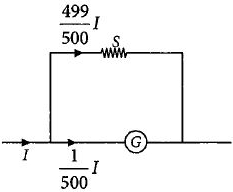
The current through the galvanometer is $I_G = 0.2\% \text{ of } I = \frac{0.2}{100} I = \frac{1}{500} I$.
The current through the shunt resistance $S$ is $I_S = I - I_G = I - \frac{1}{500} I = \frac{499}{500} I$.
Since the galvanometer and shunt are in parallel, the potential difference across them is the same:
$I_G G = I_S S$
$\left( \frac{1}{500} I \right) G = \left( \frac{499}{500} I \right) S$
$S = \frac{G}{499}$.
The resistance of the ammeter $R_A$ is the equivalent resistance of the parallel combination of $G$ and $S$:
$\frac{1}{R_A} = \frac{1}{G} + \frac{1}{S} = \frac{1}{G} + \frac{499}{G} = \frac{500}{G}$.
Therefore, $R_A = \frac{G}{500}$.
The current through the galvanometer is $I_G = 0.2\% \text{ of } I = \frac{0.2}{100} I = \frac{1}{500} I$.
The current through the shunt resistance $S$ is $I_S = I - I_G = I - \frac{1}{500} I = \frac{499}{500} I$.
Since the galvanometer and shunt are in parallel, the potential difference across them is the same:
$I_G G = I_S S$
$\left( \frac{1}{500} I \right) G = \left( \frac{499}{500} I \right) S$
$S = \frac{G}{499}$.
The resistance of the ammeter $R_A$ is the equivalent resistance of the parallel combination of $G$ and $S$:
$\frac{1}{R_A} = \frac{1}{G} + \frac{1}{S} = \frac{1}{G} + \frac{499}{G} = \frac{500}{G}$.
Therefore, $R_A = \frac{G}{500}$.
0 likesView Solution
31
PhysicsMediumMCQAIPMT · 2014
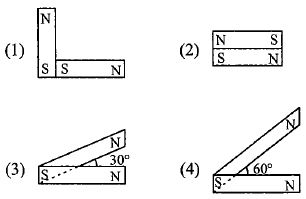
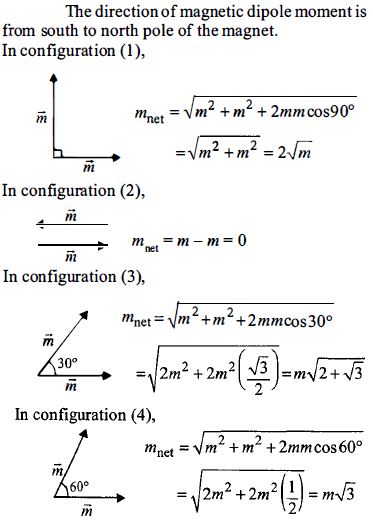
The following figures show the arrangement of bar magnets in different configurations. Each magnet has a magnetic dipole moment $\vec{m}$. Which configuration has the highest net magnetic dipole moment?
A
$1$
B
$2$
C
$3$
D
$4$
Solution
(C) The direction of the magnetic dipole moment is from the south pole to the north pole of the magnet.
In configuration $(1)$,the angle between the two magnetic moments is $90^{\circ}$. The net magnetic dipole moment is $m_{\text{net}} = \sqrt{m^2 + m^2 + 2m^2 \cos 90^{\circ}} = \sqrt{2m^2} = m\sqrt{2} \approx 1.414m$.
In configuration $(2)$,the magnetic moments are in opposite directions,so the angle is $180^{\circ}$. The net magnetic dipole moment is $m_{\text{net}} = m - m = 0$.
In configuration $(3)$,the angle between the two magnetic moments is $30^{\circ}$. The net magnetic dipole moment is $m_{\text{net}} = \sqrt{m^2 + m^2 + 2m^2 \cos 30^{\circ}} = \sqrt{2m^2 + 2m^2(\frac{\sqrt{3}}{2})} = m\sqrt{2 + \sqrt{3}} \approx m\sqrt{3.732} \approx 1.932m$.
In configuration $(4)$,the angle between the two magnetic moments is $60^{\circ}$. The net magnetic dipole moment is $m_{\text{net}} = \sqrt{m^2 + m^2 + 2m^2 \cos 60^{\circ}} = \sqrt{2m^2 + 2m^2(\frac{1}{2})} = m\sqrt{3} \approx 1.732m$.
Comparing the values,configuration $(3)$ has the highest net magnetic dipole moment.
In configuration $(1)$,the angle between the two magnetic moments is $90^{\circ}$. The net magnetic dipole moment is $m_{\text{net}} = \sqrt{m^2 + m^2 + 2m^2 \cos 90^{\circ}} = \sqrt{2m^2} = m\sqrt{2} \approx 1.414m$.
In configuration $(2)$,the magnetic moments are in opposite directions,so the angle is $180^{\circ}$. The net magnetic dipole moment is $m_{\text{net}} = m - m = 0$.
In configuration $(3)$,the angle between the two magnetic moments is $30^{\circ}$. The net magnetic dipole moment is $m_{\text{net}} = \sqrt{m^2 + m^2 + 2m^2 \cos 30^{\circ}} = \sqrt{2m^2 + 2m^2(\frac{\sqrt{3}}{2})} = m\sqrt{2 + \sqrt{3}} \approx m\sqrt{3.732} \approx 1.932m$.
In configuration $(4)$,the angle between the two magnetic moments is $60^{\circ}$. The net magnetic dipole moment is $m_{\text{net}} = \sqrt{m^2 + m^2 + 2m^2 \cos 60^{\circ}} = \sqrt{2m^2 + 2m^2(\frac{1}{2})} = m\sqrt{3} \approx 1.732m$.
Comparing the values,configuration $(3)$ has the highest net magnetic dipole moment.
0 likesView Solution
32
PhysicsEasyMCQAIPMT · 2014
If the focal length of the objective lens is increased,then the magnifying power of:
A
microscope will increase but that of telescope will decrease.
B
microscope and telescope both will increase.
C
microscope and telescope both will decrease.
D
microscope will decrease but that of telescope will increase.
Solution
(D) The magnifying power of a compound microscope is given by $m = \left(\frac{L}{f_o}\right) \left(\frac{D}{f_e}\right)$,where $f_o$ is the focal length of the objective lens,$f_e$ is the focal length of the eyepiece,$L$ is the tube length,and $D$ is the least distance of distinct vision.
From this formula,it is clear that $m \propto \frac{1}{f_o}$. Therefore,if $f_o$ increases,the magnifying power of the microscope will decrease.
The magnifying power of an astronomical telescope is given by $m = \frac{f_o}{f_e}$,where $f_o$ is the focal length of the objective lens and $f_e$ is the focal length of the eyepiece.
From this formula,it is clear that $m \propto f_o$. Therefore,if $f_o$ increases,the magnifying power of the telescope will increase.
From this formula,it is clear that $m \propto \frac{1}{f_o}$. Therefore,if $f_o$ increases,the magnifying power of the microscope will decrease.
The magnifying power of an astronomical telescope is given by $m = \frac{f_o}{f_e}$,where $f_o$ is the focal length of the objective lens and $f_e$ is the focal length of the eyepiece.
From this formula,it is clear that $m \propto f_o$. Therefore,if $f_o$ increases,the magnifying power of the telescope will increase.
0 likesView Solution
33
PhysicsMediumMCQAIPMT · 2014
When the energy of the incident radiation is increased by $20\%$,the kinetic energy of the photoelectrons emitted from a metal surface increases from $0.5\, eV$ to $0.8\, eV$. The work function of the metal is ............. $eV$.
A
$0.65$
B
$1$
C
$1.3$
D
$1.5$
Solution
(B) According to Einstein's photoelectric equation,the kinetic energy $K$ of emitted photoelectrons is given by $K = E - \phi_0$,where $E$ is the energy of incident radiation and $\phi_0$ is the work function of the metal.
Initially,the energy of incident radiation is $E$. Given $K_1 = 0.5\, eV$,we have:
$0.5 = E - \phi_0$ ..... $(i)$
When the energy of incident radiation is increased by $20\%$,the new energy becomes $E' = E + 0.2E = 1.2E$. The new kinetic energy is $K_2 = 0.8\, eV$. Thus:
$0.8 = 1.2E - \phi_0$ ..... $(ii)$
From equation $(i)$,we get $E = 0.5 + \phi_0$. Substituting this into equation $(ii)$:
$0.8 = 1.2(0.5 + \phi_0) - \phi_0$
$0.8 = 0.6 + 1.2\phi_0 - \phi_0$
$0.8 - 0.6 = 0.2\phi_0$
$0.2 = 0.2\phi_0$
$\phi_0 = 1.0\, eV$.
Initially,the energy of incident radiation is $E$. Given $K_1 = 0.5\, eV$,we have:
$0.5 = E - \phi_0$ ..... $(i)$
When the energy of incident radiation is increased by $20\%$,the new energy becomes $E' = E + 0.2E = 1.2E$. The new kinetic energy is $K_2 = 0.8\, eV$. Thus:
$0.8 = 1.2E - \phi_0$ ..... $(ii)$
From equation $(i)$,we get $E = 0.5 + \phi_0$. Substituting this into equation $(ii)$:
$0.8 = 1.2(0.5 + \phi_0) - \phi_0$
$0.8 = 0.6 + 1.2\phi_0 - \phi_0$
$0.8 - 0.6 = 0.2\phi_0$
$0.2 = 0.2\phi_0$
$\phi_0 = 1.0\, eV$.
0 likesView Solution
34
PhysicsDifficultMCQAIPMT · 2014
If the kinetic energy of the particle is increased to $16$ times its previous value,the percentage change in the de Broglie wavelength of the particle is
A
$25$
B
$50$
C
$60$
D
$75$
Solution
(D) The de Broglie wavelength is given by the formula:
$\lambda = \frac{h}{\sqrt{2mK}}$ ...... $(i)$
where $m$ is the mass and $K$ is the kinetic energy of the particle.
When the kinetic energy of the particle is increased to $16$ times its initial value,the new kinetic energy $K' = 16K$.
The new de Broglie wavelength $\lambda'$ becomes:
$\lambda' = \frac{h}{\sqrt{2m(16K)}} = \frac{h}{4\sqrt{2mK}} = \frac{\lambda}{4}$ (Using equation $(i)$).
The percentage change in the de Broglie wavelength is calculated as:
$\text{Percentage change} = \frac{\lambda - \lambda'}{\lambda} \times 100$
$= \left(1 - \frac{\lambda'}{\lambda}\right) \times 100$
$= \left(1 - \frac{1}{4}\right) \times 100 = \frac{3}{4} \times 100 = 75\%$.
$\lambda = \frac{h}{\sqrt{2mK}}$ ...... $(i)$
where $m$ is the mass and $K$ is the kinetic energy of the particle.
When the kinetic energy of the particle is increased to $16$ times its initial value,the new kinetic energy $K' = 16K$.
The new de Broglie wavelength $\lambda'$ becomes:
$\lambda' = \frac{h}{\sqrt{2m(16K)}} = \frac{h}{4\sqrt{2mK}} = \frac{\lambda}{4}$ (Using equation $(i)$).
The percentage change in the de Broglie wavelength is calculated as:
$\text{Percentage change} = \frac{\lambda - \lambda'}{\lambda} \times 100$
$= \left(1 - \frac{\lambda'}{\lambda}\right) \times 100$
$= \left(1 - \frac{1}{4}\right) \times 100 = \frac{3}{4} \times 100 = 75\%$.
0 likesView Solution
35
PhysicsEasyMCQAIPMT · 2014
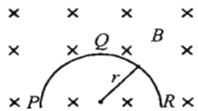
$A$ thin semicircular conducting ring $(PQR)$ of radius $r$ is falling with its plane vertical in a horizontal magnetic field $B,$ as shown in the figure. The potential difference developed across the ring when its speed is $v,$ is
A
$0$
B
$2rBv$ and $R$ is at higher potential
C
$\pi rBv$ and $R$ is at higher potential
D
$\frac{Bv\pi r^2}{2}$ and $P$ is at higher potential
Solution
(B) The motional $emf$ induced in a curved conductor moving in a magnetic field is equal to the $emf$ induced in a straight conductor connecting the two ends of the curve.
The effective length of the semicircular ring $PQR$ is the straight distance between its ends $P$ and $R,$ which is the diameter $l = 2r.$
The induced $emf$ is given by $\varepsilon = Bvl = Bv(2r) = 2rBv.$
According to Fleming's Right-Hand Rule,for a downward velocity $v$ and a magnetic field $B$ directed into the plane,the force on positive charges is directed towards $R.$ Thus,$R$ is at a higher potential than $P.$
The effective length of the semicircular ring $PQR$ is the straight distance between its ends $P$ and $R,$ which is the diameter $l = 2r.$
The induced $emf$ is given by $\varepsilon = Bvl = Bv(2r) = 2rBv.$
According to Fleming's Right-Hand Rule,for a downward velocity $v$ and a magnetic field $B$ directed into the plane,the force on positive charges is directed towards $R.$ Thus,$R$ is at a higher potential than $P.$
0 likesView Solution
36
PhysicsMediumMCQAIPMT · 2014
Light with an energy flux of $25 \times 10^4 \, W/m^2$ falls on a perfectly reflecting surface at normal incidence. If the surface area is $15 \, cm^2$,the average force exerted on the surface is:
A
$1.25 \times 10^{-6} \, N$
B
$2.50 \times 10^{-6} \, N$
C
$1.2 \times 10^{-6} \, N$
D
$3 \times 10^{-6} \, N$
Solution
(B) The energy flux (intensity) is given by $I = 25 \times 10^4 \, W/m^2$.
The surface area is $A = 15 \, cm^2 = 15 \times 10^{-4} \, m^2$.
The speed of light is $c = 3 \times 10^8 \, m/s$.
For a perfectly reflecting surface,the momentum transferred per unit time (force) is given by the formula $F = \frac{2IA}{c}$.
Substituting the values:
$F = \frac{2 \times (25 \times 10^4) \times (15 \times 10^{-4})}{3 \times 10^8}$
$F = \frac{2 \times 25 \times 15 \times 10^0}{3 \times 10^8}$
$F = \frac{750}{3} \times 10^{-8} \, N$
$F = 250 \times 10^{-8} \, N = 2.50 \times 10^{-6} \, N$.
The surface area is $A = 15 \, cm^2 = 15 \times 10^{-4} \, m^2$.
The speed of light is $c = 3 \times 10^8 \, m/s$.
For a perfectly reflecting surface,the momentum transferred per unit time (force) is given by the formula $F = \frac{2IA}{c}$.
Substituting the values:
$F = \frac{2 \times (25 \times 10^4) \times (15 \times 10^{-4})}{3 \times 10^8}$
$F = \frac{2 \times 25 \times 15 \times 10^0}{3 \times 10^8}$
$F = \frac{750}{3} \times 10^{-8} \, N$
$F = 250 \times 10^{-8} \, N = 2.50 \times 10^{-6} \, N$.
0 likesView Solution
37
PhysicsMediumMCQAIPMT · 2014
In the Young's double slit experiment,the intensity of light at a point on the screen where the path difference is $\lambda$ is $K$ ($\lambda$ being the wavelength of light used). The intensity at a point where the path difference is $\lambda / 4$ will be:
A
$K/4$
B
$K/2$
C
$K$
D
$Zero$
Solution
(B) The intensity at any point on the screen is given by $I = 4I_0 \cos^2(\phi/2)$,where $I_0$ is the intensity of each individual wave and $\phi$ is the phase difference.
The phase difference $\phi$ is related to the path difference $\Delta x$ by the formula $\phi = (2\pi / \lambda) \times \Delta x$.
Case $1$: When path difference $\Delta x = \lambda$,the phase difference is $\phi = (2\pi / \lambda) \times \lambda = 2\pi$.
Substituting this into the intensity formula: $I = 4I_0 \cos^2(2\pi / 2) = 4I_0 \cos^2(\pi) = 4I_0(1)^2 = 4I_0$. Given this intensity is $K$,we have $K = 4I_0$.
Case $2$: When path difference $\Delta x = \lambda / 4$,the phase difference is $\phi = (2\pi / \lambda) \times (\lambda / 4) = \pi / 2$.
Substituting this into the intensity formula: $I' = 4I_0 \cos^2((\pi / 2) / 2) = 4I_0 \cos^2(\pi / 4) = 4I_0 (1 / \sqrt{2})^2 = 4I_0 (1 / 2) = 2I_0$.
Since $K = 4I_0$,then $2I_0 = K / 2$. Therefore,the intensity is $K / 2$.
The phase difference $\phi$ is related to the path difference $\Delta x$ by the formula $\phi = (2\pi / \lambda) \times \Delta x$.
Case $1$: When path difference $\Delta x = \lambda$,the phase difference is $\phi = (2\pi / \lambda) \times \lambda = 2\pi$.
Substituting this into the intensity formula: $I = 4I_0 \cos^2(2\pi / 2) = 4I_0 \cos^2(\pi) = 4I_0(1)^2 = 4I_0$. Given this intensity is $K$,we have $K = 4I_0$.
Case $2$: When path difference $\Delta x = \lambda / 4$,the phase difference is $\phi = (2\pi / \lambda) \times (\lambda / 4) = \pi / 2$.
Substituting this into the intensity formula: $I' = 4I_0 \cos^2((\pi / 2) / 2) = 4I_0 \cos^2(\pi / 4) = 4I_0 (1 / \sqrt{2})^2 = 4I_0 (1 / 2) = 2I_0$.
Since $K = 4I_0$,then $2I_0 = K / 2$. Therefore,the intensity is $K / 2$.
0 likesView Solution
38
PhysicsMediumMCQAIPMT · 2014
$A$ beam of light of $\lambda = 600 \, nm$ from a distant source falls on a single slit $1 \, mm$ wide and the resulting diffraction pattern is observed on a screen $2 \, m$ away. The distance between the first dark fringes on either side of the central bright fringe is:
A
$1.2 \, cm$
B
$1.2 \, mm$
C
$2.4 \, cm$
D
$2.4 \, mm$
Solution
(D) Given: $\lambda = 600 \, nm = 600 \times 10^{-9} \, m$,slit width $a = 1 \, mm = 10^{-3} \, m$,and distance $D = 2 \, m$.
The distance between the first dark fringes on either side of the central bright fringe is equal to the width of the central maximum.
The formula for the width of the central maximum is given by $w = \frac{2 \lambda D}{a}$.
Substituting the values:
$w = \frac{2 \times (600 \times 10^{-9} \, m) \times 2 \, m}{10^{-3} \, m}$
$w = \frac{2400 \times 10^{-9}}{10^{-3}} \, m$
$w = 2400 \times 10^{-6} \, m = 2.4 \times 10^{-3} \, m = 2.4 \, mm$.
The distance between the first dark fringes on either side of the central bright fringe is equal to the width of the central maximum.
The formula for the width of the central maximum is given by $w = \frac{2 \lambda D}{a}$.
Substituting the values:
$w = \frac{2 \times (600 \times 10^{-9} \, m) \times 2 \, m}{10^{-3} \, m}$
$w = \frac{2400 \times 10^{-9}}{10^{-3}} \, m$
$w = 2400 \times 10^{-6} \, m = 2.4 \times 10^{-3} \, m = 2.4 \, mm$.
0 likesView Solution
39
PhysicsMediumMCQAIPMT · 2014
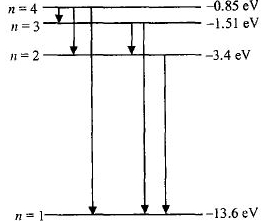
$A$ hydrogen atom in the ground state is excited by monochromatic radiation of $\lambda = 975 \; \mathring{A}$. The number of spectral lines in the resulting emission spectrum will be:
A
$2$
B
$3$
C
$6$
D
$10$
Solution
(C) The energy of the incident photon is given by $E = \frac{hc}{\lambda}$.
Using $hc \approx 12400 \; \text{eV} \cdot \mathring{A}$,we get $E = \frac{12400}{975} \approx 12.75 \; \text{eV}$.
The energy levels of a hydrogen atom are given by $E_n = -\frac{13.6}{n^2} \; \text{eV}$.
For the ground state $(n=1)$,$E_1 = -13.6 \; \text{eV}$.
After absorbing the photon,the new energy level is $E_n = E_1 + E = -13.6 + 12.75 = -0.85 \; \text{eV}$.
Since $E_n = -\frac{13.6}{n^2} = -0.85 \; \text{eV}$,we have $n^2 = \frac{13.6}{0.85} = 16$,so $n = 4$.
The electron is excited to the $n = 4$ state.
The number of spectral lines emitted when the electron transitions from $n$ to the ground state is given by $\frac{n(n-1)}{2}$.
For $n = 4$,the number of spectral lines is $\frac{4(4-1)}{2} = \frac{4 \times 3}{2} = 6$.
Using $hc \approx 12400 \; \text{eV} \cdot \mathring{A}$,we get $E = \frac{12400}{975} \approx 12.75 \; \text{eV}$.
The energy levels of a hydrogen atom are given by $E_n = -\frac{13.6}{n^2} \; \text{eV}$.
For the ground state $(n=1)$,$E_1 = -13.6 \; \text{eV}$.
After absorbing the photon,the new energy level is $E_n = E_1 + E = -13.6 + 12.75 = -0.85 \; \text{eV}$.
Since $E_n = -\frac{13.6}{n^2} = -0.85 \; \text{eV}$,we have $n^2 = \frac{13.6}{0.85} = 16$,so $n = 4$.
The electron is excited to the $n = 4$ state.
The number of spectral lines emitted when the electron transitions from $n$ to the ground state is given by $\frac{n(n-1)}{2}$.
For $n = 4$,the number of spectral lines is $\frac{4(4-1)}{2} = \frac{4 \times 3}{2} = 6$.
0 likesView Solution
40
PhysicsMediumMCQAIPMT · 2014
$A$ radioisotope $X$ with a half-life of $1.4 \times 10^{9} \text{ years}$ decays into $Y$,which is stable. $A$ sample of rock from a cave was found to contain $X$ and $Y$ in the ratio $1:7$. The age of the rock is ........ $\times 10^{9} \text{ years}$.
A
$2.4$
B
$1.4$
C
$4.2$
D
$5.2$
Solution
(C) Given the ratio of the amount of radioisotope $X$ to stable isotope $Y$ is $\frac{X}{Y} = \frac{1}{7}$.
The total amount of the initial sample is $X + Y$. The fraction of the remaining radioisotope $X$ is given by $\frac{X}{X+Y} = \frac{1}{1+7} = \frac{1}{8}$.
We know that the remaining fraction after $n$ half-lives is $\left(\frac{1}{2}\right)^{n}$.
Equating the two,$\left(\frac{1}{2}\right)^{n} = \frac{1}{8} = \left(\frac{1}{2}\right)^{3}$.
Thus,the number of half-lives elapsed is $n = 3$.
The age of the rock $t$ is given by $t = n \times T$,where $T$ is the half-life.
$t = 3 \times 1.4 \times 10^{9} \text{ years} = 4.2 \times 10^{9} \text{ years}$.
The total amount of the initial sample is $X + Y$. The fraction of the remaining radioisotope $X$ is given by $\frac{X}{X+Y} = \frac{1}{1+7} = \frac{1}{8}$.
We know that the remaining fraction after $n$ half-lives is $\left(\frac{1}{2}\right)^{n}$.
Equating the two,$\left(\frac{1}{2}\right)^{n} = \frac{1}{8} = \left(\frac{1}{2}\right)^{3}$.
Thus,the number of half-lives elapsed is $n = 3$.
The age of the rock $t$ is given by $t = n \times T$,where $T$ is the half-life.
$t = 3 \times 1.4 \times 10^{9} \text{ years} = 4.2 \times 10^{9} \text{ years}$.
0 likesView Solution
41
PhysicsMediumMCQAIPMT · 2014
The binding energy per nucleon of ${}_3^7Li$ and ${}_2^4He$ nuclei are $5.60\,MeV$ and $7.06\,MeV$ respectively. In the nuclear reaction ${}_3^7Li + {}_1^1H \to 2{}_2^4He + Q$, the value of energy $Q$ released is.........$MeV$.
A
$19.6$
B
$2.4$
C
$8.4$
D
$17.3$
Solution
(D) The binding energy of a nucleus is given by $BE = (\text{number of nucleons}) \times (\text{binding energy per nucleon})$.
For ${}_3^7Li$: $BE_1 = 7 \times 5.60\,MeV = 39.2\,MeV$.
For ${}_1^1H$: The binding energy is $0\,MeV$ as it is a single proton.
For $2{}_2^4He$: $BE_2 = 2 \times (4 \times 7.06\,MeV) = 2 \times 28.24\,MeV = 56.48\,MeV$.
The energy released $Q$ is the difference between the total binding energy of the products and the reactants:
$Q = BE_{\text{products}} - BE_{\text{reactants}}$
$Q = 56.48\,MeV - (39.2\,MeV + 0\,MeV)$
$Q = 17.28\,MeV \approx 17.3\,MeV$.
For ${}_3^7Li$: $BE_1 = 7 \times 5.60\,MeV = 39.2\,MeV$.
For ${}_1^1H$: The binding energy is $0\,MeV$ as it is a single proton.
For $2{}_2^4He$: $BE_2 = 2 \times (4 \times 7.06\,MeV) = 2 \times 28.24\,MeV = 56.48\,MeV$.
The energy released $Q$ is the difference between the total binding energy of the products and the reactants:
$Q = BE_{\text{products}} - BE_{\text{reactants}}$
$Q = 56.48\,MeV - (39.2\,MeV + 0\,MeV)$
$Q = 17.28\,MeV \approx 17.3\,MeV$.
0 likesView Solution
42
PhysicsEasyMCQAIPMT · 2014
The barrier potential of a $p-n$ junction depends on:
$(1)$ Type of semiconductor material
$(2)$ Amount of doping
$(3)$ Temperature
Which one of the following is correct?
$(1)$ Type of semiconductor material
$(2)$ Amount of doping
$(3)$ Temperature
Which one of the following is correct?
A
$1$ and $2$ only
B
$2$ only
C
$2$ and $3$ only
D
$1, 2$ and $3$
Solution
(D) The barrier potential $(V_b)$ of a $p-n$ junction is determined by the following factors:
$1$. Type of semiconductor material: The band gap energy differs for different materials. For $Si$,$V_b \approx 0.7 \ V$,and for $Ge$,$V_b \approx 0.3 \ V$.
$2$. Amount of doping: The concentration of impurity atoms affects the width of the depletion region and the potential difference across it.
$3$. Temperature: The barrier potential decreases with an increase in temperature because the intrinsic carrier concentration increases,which affects the Fermi level and the built-in potential.
Therefore,all three factors $(1, 2, 3)$ influence the barrier potential.
$1$. Type of semiconductor material: The band gap energy differs for different materials. For $Si$,$V_b \approx 0.7 \ V$,and for $Ge$,$V_b \approx 0.3 \ V$.
$2$. Amount of doping: The concentration of impurity atoms affects the width of the depletion region and the potential difference across it.
$3$. Temperature: The barrier potential decreases with an increase in temperature because the intrinsic carrier concentration increases,which affects the Fermi level and the built-in potential.
Therefore,all three factors $(1, 2, 3)$ influence the barrier potential.
0 likesView Solution
43
PhysicsEasyMCQAIPMT · 2014
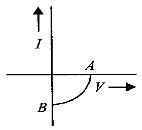
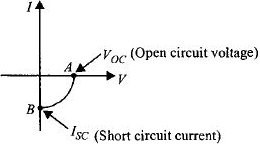
The given graph represents $V-I$ characteristic for a semiconductor device. Which of the following statements is correct?
A
It is the $V-I$ characteristic for a solar cell where point $A$ represents open circuit voltage and point $B$ represents short circuit current.
B
It is for a solar cell and points $A$ and $B$ represent open circuit voltage and current,respectively.
C
It is for a photodiode and points $A$ and $B$ represent open circuit voltage and current,respectively.
D
It is for an $LED$ and points $A$ and $B$ represent open circuit voltage and short circuit current,respectively.
Solution
(A) The $V-I$ characteristic curve shown in the graph is characteristic of a solar cell.
In this graph,the $V$-axis represents the voltage and the $I$-axis represents the current.
Point $A$ lies on the $V$-axis where the current $I = 0$,which corresponds to the open circuit voltage $(V_{OC})$.
Point $B$ lies on the $I$-axis where the voltage $V = 0$,which corresponds to the short circuit current $(I_{SC})$.
Therefore,the graph represents the $V-I$ characteristic of a solar cell where $A$ is the open circuit voltage and $B$ is the short circuit current.
In this graph,the $V$-axis represents the voltage and the $I$-axis represents the current.
Point $A$ lies on the $V$-axis where the current $I = 0$,which corresponds to the open circuit voltage $(V_{OC})$.
Point $B$ lies on the $I$-axis where the voltage $V = 0$,which corresponds to the short circuit current $(I_{SC})$.
Therefore,the graph represents the $V-I$ characteristic of a solar cell where $A$ is the open circuit voltage and $B$ is the short circuit current.
0 likesView Solution
44
PhysicsDifficultMCQAIPMT · 2014
Two identical conducting wires $AOB$ and $COD$ are placed at right angles to each other. The wire $AOB$ carries an electric current $I_1$ and $COD$ carries a current $I_2$. The magnetic field at a point lying at a distance $d$ from $O$,in a direction perpendicular to the plane of the wires $AOB$ and $COD$,will be given by
A
$\frac{\mu_0}{2\pi d} (I_1^2 + I_2^2)$
B
$\frac{\mu_0}{2\pi} \left( \frac{I_1 + I_2}{d} \right)^{\frac{1}{2}}$
C
$\frac{\mu_0}{2\pi d} (I_1^2 + I_2^2)^{\frac{1}{2}}$
D
$\frac{\mu_0}{2\pi d} (I_1 + I_2)$
Solution
(C) The magnetic field produced by a long straight current-carrying wire at a distance $d$ is given by $B = \frac{\mu_0 I}{2 \pi d}$.
Since the wires $AOB$ and $COD$ are placed at right angles to each other,the magnetic fields $B_1$ and $B_2$ produced by them at a point $P$ (at distance $d$ from $O$ along the normal to the plane) will also be perpendicular to each other.
Thus,the magnitude of the resultant magnetic field $B$ is given by $B = \sqrt{B_1^2 + B_2^2}$.
Substituting the values,$B_1 = \frac{\mu_0 I_1}{2 \pi d}$ and $B_2 = \frac{\mu_0 I_2}{2 \pi d}$.
Therefore,$B = \sqrt{\left( \frac{\mu_0 I_1}{2 \pi d} \right)^2 + \left( \frac{\mu_0 I_2}{2 \pi d} \right)^2}$.
$B = \frac{\mu_0}{2 \pi d} \sqrt{I_1^2 + I_2^2} = \frac{\mu_0}{2 \pi d} (I_1^2 + I_2^2)^{1/2}$.
Since the wires $AOB$ and $COD$ are placed at right angles to each other,the magnetic fields $B_1$ and $B_2$ produced by them at a point $P$ (at distance $d$ from $O$ along the normal to the plane) will also be perpendicular to each other.
Thus,the magnitude of the resultant magnetic field $B$ is given by $B = \sqrt{B_1^2 + B_2^2}$.
Substituting the values,$B_1 = \frac{\mu_0 I_1}{2 \pi d}$ and $B_2 = \frac{\mu_0 I_2}{2 \pi d}$.
Therefore,$B = \sqrt{\left( \frac{\mu_0 I_1}{2 \pi d} \right)^2 + \left( \frac{\mu_0 I_2}{2 \pi d} \right)^2}$.
$B = \frac{\mu_0}{2 \pi d} \sqrt{I_1^2 + I_2^2} = \frac{\mu_0}{2 \pi d} (I_1^2 + I_2^2)^{1/2}$.
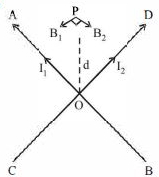
0 likesView Solution
45
PhysicsMediumMCQAIPMT · 2014
$A$ transformer having an efficiency of $90 \%$ is working on a $200 \ V$ and $3 \ kW$ power supply. If the current in the secondary coil is $6 \ A$,the voltage across the secondary coil and the current in the primary coil respectively are:
A
$450 \ V, 12 \ A$
B
$600 \ V, 15 \ A$
C
$300 \ V, 15 \ A$
D
$450 \ V, 15 \ A$
Solution
(D) Given: Efficiency $\eta = 90 \% = 0.9$,Primary voltage $V_P = 200 \ V$,Primary power $P_P = 3 \ kW = 3000 \ W$,Secondary current $I_S = 6 \ A$.
First,calculate the primary current $I_P$ using $P_P = V_P \times I_P$:
$I_P = \frac{P_P}{V_P} = \frac{3000 \ W}{200 \ V} = 15 \ A$.
Next,calculate the output power (secondary power) $P_S$ using efficiency: $P_S = \eta \times P_P = 0.9 \times 3000 \ W = 2700 \ W$.
Finally,calculate the secondary voltage $V_S$ using $P_S = V_S \times I_S$:
$V_S = \frac{P_S}{I_S} = \frac{2700 \ W}{6 \ A} = 450 \ V$.
Thus,the secondary voltage is $450 \ V$ and the primary current is $15 \ A$.
First,calculate the primary current $I_P$ using $P_P = V_P \times I_P$:
$I_P = \frac{P_P}{V_P} = \frac{3000 \ W}{200 \ V} = 15 \ A$.
Next,calculate the output power (secondary power) $P_S$ using efficiency: $P_S = \eta \times P_P = 0.9 \times 3000 \ W = 2700 \ W$.
Finally,calculate the secondary voltage $V_S$ using $P_S = V_S \times I_S$:
$V_S = \frac{P_S}{I_S} = \frac{2700 \ W}{6 \ A} = 450 \ V$.
Thus,the secondary voltage is $450 \ V$ and the primary current is $15 \ A$.
0 likesView Solution
Vedclass Products
For Students
Vedclass Test Series
Mock tests in real AIPMT style covering Physics with performance analysis. 5-day free trial.
Start Free TrialFor Teachers
Exam Paper Generator
Generate Set A/B/C/D Physics papers from 7.5L+ questions in 2 minutes. 3 chapters free.
Try FreeFor Institutes
Online Exam Module
Run live AIPMT mock exams with unlimited students, 360° analytics & white-label branding.
See DemoFrequently Asked Questions
How many Physics questions are in AIPMT 2014?
There are 45 Physics questions from the AIPMT 2014 paper on Vedclass, each with a detailed step-by-step solution in English.
Are AIPMT 2014 Physics solutions available in English?
Yes. All solutions on this page are in English. You can also switch to English or Hindi using the language buttons above the questions.
Can I practice AIPMT 2014 Physics as a timed test?
Yes. Use the Vedclass Test Series to attempt a full AIPMT mock test covering Physics with time limits and instant score analysis.
Can teachers create Physics papers from AIPMT previous year questions?
Yes. The Vedclass Exam Paper Generator lets teachers mix AIPMT Physics questions and generate Set A/B/C/D papers in minutes.
For Teachers & Institutes
Build a Custom Physics Paper
Pick AIPMT 2014 Physics questions, set difficulty, and generate Set A/B/C/D in 2 minutes.