
ChemistryQ1–93 of 149 questions
Page 1 of 3 · English
1
ChemistryMCQAIPMT · 2010
Breeding crops with higher levels of vitamins,minerals,and proteins is known as ..........
A
Somatic hybridization
B
Biofortification
C
Biomagnification
D
Micropropagation
Solution
(B) Biofortification is the process of breeding crops to increase their nutritional value. This includes increasing the levels of vitamins,minerals,proteins,and healthier fats to improve public health and combat malnutrition.
0 likesView Solution
2
ChemistryMCQAIPMT · 2010
If for some reason the parietal cells of the gut epithelium become partially non-functional,what is likely to happen?
A
The pancreatic enzymes and specially the trypsin and lipase will not work efficiently.
B
The $pH$ of stomach will fall abruptly.
C
Steapsin will be more effective.
D
Proteins will not be adequately hydrolysed by pepsin into proteoses and peptones.
Solution
(D) The correct answer is $D$.
$1$. Parietal cells (also known as oxyntic cells) are responsible for the secretion of hydrochloric acid $(HCl)$ and the intrinsic factor.
$2$. The $HCl$ secreted by these cells lowers the $pH$ of the stomach to an acidic range $(1.8 - 3.5)$,which is essential for the activation of the proenzyme pepsinogen into its active form,pepsin.
$3$. Pepsin is a proteolytic enzyme that hydrolyzes proteins into smaller peptides like proteoses and peptones.
$4$. If the parietal cells become non-functional,the secretion of $HCl$ will decrease or stop,leading to a failure in the conversion of pepsinogen to pepsin.
$5$. Consequently,the digestion of proteins in the stomach will be severely impaired.
$1$. Parietal cells (also known as oxyntic cells) are responsible for the secretion of hydrochloric acid $(HCl)$ and the intrinsic factor.
$2$. The $HCl$ secreted by these cells lowers the $pH$ of the stomach to an acidic range $(1.8 - 3.5)$,which is essential for the activation of the proenzyme pepsinogen into its active form,pepsin.
$3$. Pepsin is a proteolytic enzyme that hydrolyzes proteins into smaller peptides like proteoses and peptones.
$4$. If the parietal cells become non-functional,the secretion of $HCl$ will decrease or stop,leading to a failure in the conversion of pepsinogen to pepsin.
$5$. Consequently,the digestion of proteins in the stomach will be severely impaired.
0 likesView Solution
3
ChemistryMCQAIPMT · 2010
The number of atoms in $0.1 \ mol$ of a triatomic gas is $(N_A = 6.02 \times 10^{23} \ mol^{-1})$
A
$6.026 \times 10^{22}$
B
$1.806 \times 10^{23}$
C
$3.600 \times 10^{23}$
D
$1.800 \times 10^{22}$
Solution
(B) The number of molecules in $0.1 \ mol$ of gas is $0.1 \times N_A = 0.1 \times 6.02 \times 10^{23} = 6.02 \times 10^{22}$ molecules.
Since the gas is triatomic,each molecule contains $3$ atoms.
Therefore,the total number of atoms $= 3 \times 6.02 \times 10^{22} = 1.806 \times 10^{23}$ atoms.
Since the gas is triatomic,each molecule contains $3$ atoms.
Therefore,the total number of atoms $= 3 \times 6.02 \times 10^{22} = 1.806 \times 10^{23}$ atoms.
0 likesView Solution
4
ChemistryMediumMCQAIPMT · 2010
$A$ $0.66 \ kg$ ball is moving with a speed of $100 \ m/s$. The associated wavelength will be $(h = 6.6 \times 10^{-34} \ J \ s)$.
A
$6.6 \times 10^{-32} \ m$
B
$6.6 \times 10^{-34} \ m$
C
$1.0 \times 10^{-35} \ m$
D
$1.0 \times 10^{-32} \ m$
Solution
(C) According to the de-Broglie equation,the wavelength $\lambda$ is given by:
$\lambda = \frac{h}{mv}$
Given:
$h = 6.6 \times 10^{-34} \ J \ s$
$m = 0.66 \ kg$
$v = 100 \ m/s$
Substituting the values:
$\lambda = \frac{6.6 \times 10^{-34}}{0.66 \times 100} = \frac{6.6 \times 10^{-34}}{66} = 0.1 \times 10^{-34} = 1.0 \times 10^{-35} \ m$
$\lambda = \frac{h}{mv}$
Given:
$h = 6.6 \times 10^{-34} \ J \ s$
$m = 0.66 \ kg$
$v = 100 \ m/s$
Substituting the values:
$\lambda = \frac{6.6 \times 10^{-34}}{0.66 \times 100} = \frac{6.6 \times 10^{-34}}{66} = 0.1 \times 10^{-34} = 1.0 \times 10^{-35} \ m$
0 likesView Solution
5
ChemistryMediumMCQAIPMT · 2010
The correct order of the decreasing ionic radii among the following isoelectronic species is
A
$Ca^{2+} > K^{+} > S^{2-} > Cl^{-}$
B
$Cl^{-} > S^{2-} > Ca^{2+} > K^{+}$
C
$S^{2-} > Cl^{-} > K^{+} > Ca^{2+}$
D
$K^{+} > Ca^{2+} > Cl^{-} > S^{2-}$
Solution
(C) For isoelectronic species,the ionic radius decreases as the nuclear charge (atomic number) increases.
All the given species $(S^{2-}, Cl^{-}, K^{+}, Ca^{2+})$ have $18$ electrons.
The atomic numbers are: $S (16), Cl (17), K (19), Ca (20)$.
As the nuclear charge increases,the force of attraction between the nucleus and the electrons increases,which pulls the electron cloud closer to the nucleus,resulting in a smaller ionic radius.
Therefore,the order of decreasing ionic radii is $S^{2-} > Cl^{-} > K^{+} > Ca^{2+}$.
All the given species $(S^{2-}, Cl^{-}, K^{+}, Ca^{2+})$ have $18$ electrons.
The atomic numbers are: $S (16), Cl (17), K (19), Ca (20)$.
As the nuclear charge increases,the force of attraction between the nucleus and the electrons increases,which pulls the electron cloud closer to the nucleus,resulting in a smaller ionic radius.
Therefore,the order of decreasing ionic radii is $S^{2-} > Cl^{-} > K^{+} > Ca^{2+}$.
0 likesView Solution
6
ChemistryMediumMCQAIPMT · 2010
Which of the following represents the correct order of increasing electron gain enthalpy with negative sign for the elements $O$,$S$,$F$ and $Cl$?
A
$Cl < F < O < S$
B
$O < S < F < Cl$
C
$F < S < O < Cl$
D
$S < O < Cl < F$
Solution
(B) Electron gain enthalpy generally increases in a period from left to right and decreases in a group on moving downwards.
However,members of the $3^{rd}$ period have higher electron gain enthalpy compared to the corresponding members of the $2^{nd}$ period due to their larger size,which reduces inter-electronic repulsion.
$O$ and $S$ belong to group $16$,while $F$ and $Cl$ belong to group $17$.
Thus,the electron gain enthalpy of $F$ and $Cl$ is higher than that of $O$ and $S$.
Comparing within groups,$Cl > F$ and $S > O$ because the smaller size of $F$ and $O$ atoms leads to greater inter-electronic repulsion for the incoming electron.
Therefore,the correct order of increasing electron gain enthalpy is $O < S < F < Cl$.
However,members of the $3^{rd}$ period have higher electron gain enthalpy compared to the corresponding members of the $2^{nd}$ period due to their larger size,which reduces inter-electronic repulsion.
$O$ and $S$ belong to group $16$,while $F$ and $Cl$ belong to group $17$.
Thus,the electron gain enthalpy of $F$ and $Cl$ is higher than that of $O$ and $S$.
Comparing within groups,$Cl > F$ and $S > O$ because the smaller size of $F$ and $O$ atoms leads to greater inter-electronic repulsion for the incoming electron.
Therefore,the correct order of increasing electron gain enthalpy is $O < S < F < Cl$.
0 likesView Solution
7
ChemistryDifficultMCQAIPMT · 2010
Among the elements $Ca, Mg, P$ and $Cl,$ the order of increasing atomic radii is
A
$Mg < Ca < Cl < P$
B
$Cl < P < Mg < Ca$
C
$P < Cl < Ca < Mg$
D
$Ca < Mg < P < Cl$
Solution
(B) Atomic radius decreases across a period from left to right due to an increase in effective nuclear charge,while it increases down a group due to the addition of new shells.
The electronic configurations are:
$Mg (Z=12): [Ne] 3s^2$
$P (Z=15): [Ne] 3s^2 3p^3$
$Cl (Z=17): [Ne] 3s^2 3p^5$
$Ca (Z=20): [Ar] 4s^2$
$Mg, P,$ and $Cl$ belong to the $3^{rd}$ period. Within the same period,the atomic radius decreases as $Z$ increases: $Mg > P > Cl$.
$Ca$ belongs to the $4^{th}$ period,so it has a larger atomic radius than the $3^{rd}$ period elements.
Therefore,the increasing order of atomic radii is $Cl < P < Mg < Ca$.
The electronic configurations are:
$Mg (Z=12): [Ne] 3s^2$
$P (Z=15): [Ne] 3s^2 3p^3$
$Cl (Z=17): [Ne] 3s^2 3p^5$
$Ca (Z=20): [Ar] 4s^2$
$Mg, P,$ and $Cl$ belong to the $3^{rd}$ period. Within the same period,the atomic radius decreases as $Z$ increases: $Mg > P > Cl$.
$Ca$ belongs to the $4^{th}$ period,so it has a larger atomic radius than the $3^{rd}$ period elements.
Therefore,the increasing order of atomic radii is $Cl < P < Mg < Ca$.
0 likesView Solution
8
ChemistryDifficultMCQAIPMT · 2010
Among the following,which one has the highest cation to anion size ratio?
A
$CsI$
B
$CsF$
C
$LiF$
D
$NaF$
Solution
(B) The ratio of cation to anion size is given by $\frac{r_{+}}{r_{-}}$.
To maximize this ratio,we need the largest cation $(r_{+})$ and the smallest anion $(r_{-})$.
Comparing the cations: $Li^{+} < Na^{+} < Cs^{+}$. Thus,$Cs^{+}$ is the largest cation.
Comparing the anions: $F^{-} < I^{-}$. Thus,$F^{-}$ is the smallest anion.
Therefore,the ratio is highest for $CsF$.
To maximize this ratio,we need the largest cation $(r_{+})$ and the smallest anion $(r_{-})$.
Comparing the cations: $Li^{+} < Na^{+} < Cs^{+}$. Thus,$Cs^{+}$ is the largest cation.
Comparing the anions: $F^{-} < I^{-}$. Thus,$F^{-}$ is the smallest anion.
Therefore,the ratio is highest for $CsF$.
0 likesView Solution
9
ChemistryDifficultMCQAIPMT · 2010
In which of the following pairs of molecules/ions,the central atoms have $sp^{2}$ hybridisation?
A
$NO_{2}^{-}$ and $NH_{3}$
B
$BF_{3}$ and $NO_{2}^{-}$
C
$NH_{2}^{-}$ and $H_{2}O$
D
$BF_{3}$ and $NH_{2}^{-}$
Solution
(B) For $sp^{2}$ hybridisation,the steric number (sum of $\sigma$-bonds and lone pairs) must be $3$.
$(I)$ $NO_{2}^{-}$: Central $N$ atom has $2$ $\sigma$-bonds and $1$ lone pair,so steric number $= 3$,which corresponds to $sp^{2}$ hybridisation.
$(II)$ $NH_{3}$: Central $N$ atom has $3$ $\sigma$-bonds and $1$ lone pair,so steric number $= 4$,which corresponds to $sp^{3}$ hybridisation.
$(III)$ $BF_{3}$: Central $B$ atom has $3$ $\sigma$-bonds and $0$ lone pairs,so steric number $= 3$,which corresponds to $sp^{2}$ hybridisation.
$(IV)$ $NH_{2}^{-}$: Central $N$ atom has $2$ $\sigma$-bonds and $2$ lone pairs,so steric number $= 4$,which corresponds to $sp^{3}$ hybridisation.
$(V)$ $H_{2}O$: Central $O$ atom has $2$ $\sigma$-bonds and $2$ lone pairs,so steric number $= 4$,which corresponds to $sp^{3}$ hybridisation.
Thus,the pair $BF_{3}$ and $NO_{2}^{-}$ both exhibit $sp^{2}$ hybridisation.
$(I)$ $NO_{2}^{-}$: Central $N$ atom has $2$ $\sigma$-bonds and $1$ lone pair,so steric number $= 3$,which corresponds to $sp^{2}$ hybridisation.
$(II)$ $NH_{3}$: Central $N$ atom has $3$ $\sigma$-bonds and $1$ lone pair,so steric number $= 4$,which corresponds to $sp^{3}$ hybridisation.
$(III)$ $BF_{3}$: Central $B$ atom has $3$ $\sigma$-bonds and $0$ lone pairs,so steric number $= 3$,which corresponds to $sp^{2}$ hybridisation.
$(IV)$ $NH_{2}^{-}$: Central $N$ atom has $2$ $\sigma$-bonds and $2$ lone pairs,so steric number $= 4$,which corresponds to $sp^{3}$ hybridisation.
$(V)$ $H_{2}O$: Central $O$ atom has $2$ $\sigma$-bonds and $2$ lone pairs,so steric number $= 4$,which corresponds to $sp^{3}$ hybridisation.
Thus,the pair $BF_{3}$ and $NO_{2}^{-}$ both exhibit $sp^{2}$ hybridisation.
0 likesView Solution
10
ChemistryMediumMCQAIPMT · 2010
Which one of the following species does not exist under normal conditions?
A
$Be_2^+$
B
$Be_2$
C
$B_2$
D
$Li_2$
Solution
(B) The species $Be_2$ does not exist under normal conditions.
The electronic configuration of $Be_2$ ($Z=4$,total $8$ electrons) is: $\sigma 1s^2 \sigma^* 1s^2 \sigma 2s^2 \sigma^* 2s^2$.
The bond order is calculated as: $\text{Bond order} = \frac{N_b - N_a}{2} = \frac{4 - 4}{2} = 0$.
Since the bond order is $0$,the molecule is unstable and does not exist.
The electronic configuration of $Be_2$ ($Z=4$,total $8$ electrons) is: $\sigma 1s^2 \sigma^* 1s^2 \sigma 2s^2 \sigma^* 2s^2$.
The bond order is calculated as: $\text{Bond order} = \frac{N_b - N_a}{2} = \frac{4 - 4}{2} = 0$.
Since the bond order is $0$,the molecule is unstable and does not exist.
0 likesView Solution
11
ChemistryDifficultMCQAIPMT · 2010
In which one of the following species does the central atom have a type of hybridization that is not the same as that present in the other three?
A
$SF_4$
B
$I_3^-$
C
$SbCl_5^{2-}$
D
$PCl_5$
Solution
(C) The hybridization of the central atom can be determined using the formula $H = \frac{1}{2} [V + X - C + A]$,where $V$ is the number of valence electrons,$X$ is the number of monovalent atoms,$C$ is the cationic charge,and $A$ is the anionic charge.
$1. SF_4: H = \frac{1}{2} [6 + 4] = 5 \rightarrow sp^3d$
$2. I_3^-: H = \frac{1}{2} [7 + 2 + 1] = 5 \rightarrow sp^3d$
$3. PCl_5: H = \frac{1}{2} [5 + 5] = 5 \rightarrow sp^3d$
$4. SbCl_5^{2-}: H = \frac{1}{2} [5 + 5 + 2] = 6 \rightarrow sp^3d^2$
Thus,$SbCl_5^{2-}$ has a different hybridization $(sp^3d^2)$ compared to the others $(sp^3d)$.
$1. SF_4: H = \frac{1}{2} [6 + 4] = 5 \rightarrow sp^3d$
$2. I_3^-: H = \frac{1}{2} [7 + 2 + 1] = 5 \rightarrow sp^3d$
$3. PCl_5: H = \frac{1}{2} [5 + 5] = 5 \rightarrow sp^3d$
$4. SbCl_5^{2-}: H = \frac{1}{2} [5 + 5 + 2] = 6 \rightarrow sp^3d^2$
Thus,$SbCl_5^{2-}$ has a different hybridization $(sp^3d^2)$ compared to the others $(sp^3d)$.
0 likesView Solution
12
ChemistryDifficultMCQAIPMT · 2010
In which of the following molecules the central atom does not have $sp^3$ hybridization?
A
$CH_4$
B
$SF_4$
C
$BF_4^-$
D
$NH_4^+$
Solution
(B) The number of hybrid orbitals $(H)$ is calculated using the formula: $H = \frac{1}{2} [V + M - C + A]$,where $V$ is the number of valence electrons of the central atom,$M$ is the number of monovalent atoms,$C$ is the total positive charge,and $A$ is the negative charge.
For $CH_4$: $H = \frac{1}{2} [4 + 4 - 0 + 0] = 4$,which corresponds to $sp^3$ hybridization.
For $SF_4$: $H = \frac{1}{2} [6 + 4 - 0 + 0] = 5$,which corresponds to $sp^3d$ hybridization.
For $BF_4^-$: $H = \frac{1}{2} [3 + 4 - 0 + 1] = 4$,which corresponds to $sp^3$ hybridization.
For $NH_4^+$: $H = \frac{1}{2} [5 + 4 - 1 + 0] = 4$,which corresponds to $sp^3$ hybridization.
Thus,the central atom in $SF_4$ does not have $sp^3$ hybridization.
For $CH_4$: $H = \frac{1}{2} [4 + 4 - 0 + 0] = 4$,which corresponds to $sp^3$ hybridization.
For $SF_4$: $H = \frac{1}{2} [6 + 4 - 0 + 0] = 5$,which corresponds to $sp^3d$ hybridization.
For $BF_4^-$: $H = \frac{1}{2} [3 + 4 - 0 + 1] = 4$,which corresponds to $sp^3$ hybridization.
For $NH_4^+$: $H = \frac{1}{2} [5 + 4 - 1 + 0] = 4$,which corresponds to $sp^3$ hybridization.
Thus,the central atom in $SF_4$ does not have $sp^3$ hybridization.
0 likesView Solution
13
ChemistryMediumMCQAIPMT · 2010
Some of the properties of the two species,$NO_{3}^{-}$ and $H_{3}O^{+}$ are described below. Which one of them is correct?
A
Dissimilar in hybridization for the central atom with different structures.
B
Isostructural with same hybridization for the central atom.
C
Isostructural with different hybridization for the central atom.
D
Similar in hybridization for the central atom with different structures.
Solution
(A) For $NO_{3}^{-}$,the number of hybrid orbitals $H = \frac{1}{2} [5 + 0 - 0 + 1] = 3$. Thus,the central atom $N$ is $sp^{2}$ hybridized and the species has a trigonal planar geometry.
For $H_{3}O^{+}$,the number of hybrid orbitals $H = \frac{1}{2} [6 + 3 - 1 + 0] = 4$. Thus,the central atom $O$ is $sp^{3}$ hybridized and the species has a pyramidal geometry due to the presence of one lone pair.
Since they have different hybridization states ($sp^{2}$ vs $sp^{3}$) and different geometries (trigonal planar vs pyramidal),they are dissimilar in both hybridization and structure.
For $H_{3}O^{+}$,the number of hybrid orbitals $H = \frac{1}{2} [6 + 3 - 1 + 0] = 4$. Thus,the central atom $O$ is $sp^{3}$ hybridized and the species has a pyramidal geometry due to the presence of one lone pair.
Since they have different hybridization states ($sp^{2}$ vs $sp^{3}$) and different geometries (trigonal planar vs pyramidal),they are dissimilar in both hybridization and structure.
1 likesView Solution
14
ChemistryDifficultMCQAIPMT · 2010
The pressure exerted by $6.0 \ g$ of methane gas in a $0.03 \ m^3$ vessel at $129^{\circ} C$ is $........ \ Pa$ (Atomic masses : $C = 12.01, H = 1.01$ and $R = 8.314 \ J K^{-1} mol^{-1}$)
A
$215216$
B
$13409$
C
$41648$
D
$31684$
Solution
(C) Volume,$V = 0.03 \ m^3$
Temperature,$T = 129 + 273 = 402 \ K$
Mass of methane,$w = 6.0 \ g$
Molar mass of methane,$M = 12.01 + 4 \times 1.01 = 16.05 \ g \ mol^{-1}$
Using the ideal gas equation,$pV = nRT$,where $n = \frac{w}{M}$
$p = \frac{wRT}{MV} = \frac{6.0 \times 8.314 \times 402}{16.05 \times 0.03}$
$p = \frac{20065.392}{0.4815} \approx 41672.67 \ Pa$
Rounding to the nearest provided option,the value is $41648 \ Pa$.
Temperature,$T = 129 + 273 = 402 \ K$
Mass of methane,$w = 6.0 \ g$
Molar mass of methane,$M = 12.01 + 4 \times 1.01 = 16.05 \ g \ mol^{-1}$
Using the ideal gas equation,$pV = nRT$,where $n = \frac{w}{M}$
$p = \frac{wRT}{MV} = \frac{6.0 \times 8.314 \times 402}{16.05 \times 0.03}$
$p = \frac{20065.392}{0.4815} \approx 41672.67 \ Pa$
Rounding to the nearest provided option,the value is $41648 \ Pa$.
0 likesView Solution
15
ChemistryMediumMCQAIPMT · 2010
Standard entropies of $X_2, Y_2$ and $XY_3$ are $60, 40$ and $50 \ J \ K^{-1} \ mol^{-1}$ respectively. For the reaction $\frac{1}{2} X_2 + \frac{3}{2} Y_2 \rightleftharpoons XY_3, \Delta H = -30 \ kJ$,to be at equilibrium,the temperature should be ............. $K$.
A
$750$
B
$1000$
C
$1250$
D
$500$
Solution
(A) The reaction is $\frac{1}{2} X_2 + \frac{3}{2} Y_2 \rightleftharpoons XY_3$.
First,calculate the entropy change of the reaction $\Delta S^{\circ}_{rxn}$:
$\Delta S^{\circ}_{rxn} = S^{\circ}(XY_3) - [\frac{1}{2} S^{\circ}(X_2) + \frac{3}{2} S^{\circ}(Y_2)]$
$\Delta S^{\circ}_{rxn} = 50 - [(\frac{1}{2} \times 60) + (\frac{3}{2} \times 40)] \ J \ K^{-1} \ mol^{-1}$
$\Delta S^{\circ}_{rxn} = 50 - [30 + 60] = 50 - 90 = -40 \ J \ K^{-1} \ mol^{-1}$.
At equilibrium,$\Delta G = 0$,which implies $\Delta H = T \Delta S$.
Given $\Delta H = -30 \ kJ = -30000 \ J$.
$-30000 = T \times (-40)$.
$T = \frac{-30000}{-40} = 750 \ K$.
First,calculate the entropy change of the reaction $\Delta S^{\circ}_{rxn}$:
$\Delta S^{\circ}_{rxn} = S^{\circ}(XY_3) - [\frac{1}{2} S^{\circ}(X_2) + \frac{3}{2} S^{\circ}(Y_2)]$
$\Delta S^{\circ}_{rxn} = 50 - [(\frac{1}{2} \times 60) + (\frac{3}{2} \times 40)] \ J \ K^{-1} \ mol^{-1}$
$\Delta S^{\circ}_{rxn} = 50 - [30 + 60] = 50 - 90 = -40 \ J \ K^{-1} \ mol^{-1}$.
At equilibrium,$\Delta G = 0$,which implies $\Delta H = T \Delta S$.
Given $\Delta H = -30 \ kJ = -30000 \ J$.
$-30000 = T \times (-40)$.
$T = \frac{-30000}{-40} = 750 \ K$.
0 likesView Solution
16
ChemistryMediumMCQAIPMT · 2010
Match List-$I$ (Equations) with List-$II$ (Type of processes) and select the correct option.
| List-$I$ (Equations) | List-$II$ (Type of processes) |
| $A. K_p > Q$ | $(i)$ Non-spontaneous |
| $B. \Delta G^\circ < RT \ln Q$ | $(ii)$ Equilibrium |
| $C. K_p = Q$ | $(iii)$ Spontaneous and endothermic |
| $D. T > \frac{\Delta H}{\Delta S}$ | $(iv)$ Spontaneous |
A
$A-(i), B-(ii), C-(iii), D-(iv)$
B
$A-(iii), B-(iv), C-(ii), D-(i)$
C
$A-(iv), B-(i), C-(ii), D-(iii)$
D
$A-(ii), B-(i), C-(iv), D-(iii)$
Solution
(C) $A. K_p > Q$: Since the reaction quotient $Q$ is less than the equilibrium constant $K_p$,the reaction proceeds in the forward direction,making it spontaneous. $(A-(iv))$
$B. \Delta G^\circ < RT \ln Q$: Using the relation $\Delta G = \Delta G^\circ + RT \ln Q$,if $\Delta G^\circ < -RT \ln Q$ (or $\Delta G^\circ < RT \ln Q$ in specific contexts),it implies $\Delta G > 0$,indicating a non-spontaneous process. $(B-(i))$
$C. K_p = Q$: The system is at equilibrium. $(C-(ii))$
$D. T > \frac{\Delta H}{\Delta S}$: For an endothermic process $(\Delta H > 0)$,if $T > \frac{\Delta H}{\Delta S}$,then $T \Delta S > \Delta H$,resulting in $\Delta G = \Delta H - T \Delta S < 0$,which means the process is spontaneous and endothermic. $(D-(iii))$
$B. \Delta G^\circ < RT \ln Q$: Using the relation $\Delta G = \Delta G^\circ + RT \ln Q$,if $\Delta G^\circ < -RT \ln Q$ (or $\Delta G^\circ < RT \ln Q$ in specific contexts),it implies $\Delta G > 0$,indicating a non-spontaneous process. $(B-(i))$
$C. K_p = Q$: The system is at equilibrium. $(C-(ii))$
$D. T > \frac{\Delta H}{\Delta S}$: For an endothermic process $(\Delta H > 0)$,if $T > \frac{\Delta H}{\Delta S}$,then $T \Delta S > \Delta H$,resulting in $\Delta G = \Delta H - T \Delta S < 0$,which means the process is spontaneous and endothermic. $(D-(iii))$
0 likesView Solution
17
ChemistryEasyMCQAIPMT · 2010
Three moles of an ideal gas expanded spontaneously into vacuum. The work done will be .............. $Joules$.
A
infinite
B
$3$
C
$9$
D
$0$
Solution
(D) The work done during the expansion of a gas is given by the formula $W = -P_{ext} \Delta V$.
Since the gas expands into a vacuum,the external pressure $P_{ext}$ is $0$.
Therefore,the work done $W = -0 \times \Delta V = 0 \ J$.
Since the gas expands into a vacuum,the external pressure $P_{ext}$ is $0$.
Therefore,the work done $W = -0 \times \Delta V = 0 \ J$.
0 likesView Solution
18
ChemistryMediumMCQAIPMT · 2010
For vaporization of water at $1$ atmospheric pressure,the values of $\Delta H$ and $\Delta S$ are $40.63 \ kJ \ mol^{-1}$ and $108.8 \ J \ K^{-1} \ mol^{-1},$ respectively. The temperature when Gibb's energy change $(\Delta G)$ for this transformation will be zero,is ............ $K$. (in $.4$)
A
$273$
B
$393$
C
$373$
D
$293$
Solution
(C) According to the Gibbs equation:
$\Delta G = \Delta H - T \Delta S$
When $\Delta G = 0$,the system is at equilibrium,so:
$\Delta H = T \Delta S$
Given:
$\Delta H = 40.63 \ kJ \ mol^{-1} = 40.63 \times 10^{3} \ J \ mol^{-1}$
$\Delta S = 108.8 \ J \ K^{-1} \ mol^{-1}$
Substituting the values:
$T = \frac{\Delta H}{\Delta S}$
$T = \frac{40.63 \times 10^{3} \ J \ mol^{-1}}{108.8 \ J \ K^{-1} \ mol^{-1}}$
$T \approx 373.43 \ K$
Thus,the temperature is approximately $373.4 \ K$.
$\Delta G = \Delta H - T \Delta S$
When $\Delta G = 0$,the system is at equilibrium,so:
$\Delta H = T \Delta S$
Given:
$\Delta H = 40.63 \ kJ \ mol^{-1} = 40.63 \times 10^{3} \ J \ mol^{-1}$
$\Delta S = 108.8 \ J \ K^{-1} \ mol^{-1}$
Substituting the values:
$T = \frac{\Delta H}{\Delta S}$
$T = \frac{40.63 \times 10^{3} \ J \ mol^{-1}}{108.8 \ J \ K^{-1} \ mol^{-1}}$
$T \approx 373.43 \ K$
Thus,the temperature is approximately $373.4 \ K$.
0 likesView Solution
19
ChemistryMediumMCQAIPMT · 2010
The following two reactions are known:
$Fe_2O_{3(s)} + 3CO_{(g)} \rightarrow 2Fe_{(s)} + 3CO_{2(g)}; \Delta H = -26.8 \ kJ$
$FeO_{(s)} + CO_{(g)} \rightarrow Fe_{(s)} + CO_{2(g)}; \Delta H = -16.5 \ kJ$
The value of $\Delta H$ for the following reaction:
$Fe_2O_{3(s)} + CO_{(g)} \rightarrow 2FeO_{(s)} + CO_{2(g)}$ is ............. $kJ$.
$Fe_2O_{3(s)} + 3CO_{(g)} \rightarrow 2Fe_{(s)} + 3CO_{2(g)}; \Delta H = -26.8 \ kJ$
$FeO_{(s)} + CO_{(g)} \rightarrow Fe_{(s)} + CO_{2(g)}; \Delta H = -16.5 \ kJ$
The value of $\Delta H$ for the following reaction:
$Fe_2O_{3(s)} + CO_{(g)} \rightarrow 2FeO_{(s)} + CO_{2(g)}$ is ............. $kJ$.
A
$+10.3$
B
$-43.3$
C
$-10.3$
D
$+6.2$
Solution
(D) Given reactions:
$(I) \ Fe_2O_{3(s)} + 3CO_{(g)} \rightarrow 2Fe_{(s)} + 3CO_{2(g)}; \Delta H_1 = -26.8 \ kJ$
$(II) \ FeO_{(s)} + CO_{(g)} \rightarrow Fe_{(s)} + CO_{2(g)}; \Delta H_2 = -16.5 \ kJ$
We need to find $\Delta H$ for:
$(III) \ Fe_2O_{3(s)} + CO_{(g)} \rightarrow 2FeO_{(s)} + CO_{2(g)}$
To obtain reaction $(III)$,we perform the operation: $(I) - 2 \times (II)$
$\Delta H = \Delta H_1 - 2(\Delta H_2)$
$\Delta H = -26.8 - 2(-16.5)$
$\Delta H = -26.8 + 33.0 = +6.2 \ kJ$
$(I) \ Fe_2O_{3(s)} + 3CO_{(g)} \rightarrow 2Fe_{(s)} + 3CO_{2(g)}; \Delta H_1 = -26.8 \ kJ$
$(II) \ FeO_{(s)} + CO_{(g)} \rightarrow Fe_{(s)} + CO_{2(g)}; \Delta H_2 = -16.5 \ kJ$
We need to find $\Delta H$ for:
$(III) \ Fe_2O_{3(s)} + CO_{(g)} \rightarrow 2FeO_{(s)} + CO_{2(g)}$
To obtain reaction $(III)$,we perform the operation: $(I) - 2 \times (II)$
$\Delta H = \Delta H_1 - 2(\Delta H_2)$
$\Delta H = -26.8 - 2(-16.5)$
$\Delta H = -26.8 + 33.0 = +6.2 \ kJ$
0 likesView Solution
20
ChemistryDifficultMCQAIPMT · 2010
If $pH$ of a saturated solution of $Ba(OH)_2$ is $12$,the value of its $K_{sp}$ is
A
$4.00 \times 10^{-6} \, M^3$
B
$4.00 \times 10^{-7} \, M^3$
C
$5.00 \times 10^{-7} \, M^3$
D
$5.00 \times 10^{-6} \, M^3$
Solution
(C) Given,$pH$ of $Ba(OH)_2 = 12$.
Since $pH + pOH = 14$,we have $pOH = 14 - 12 = 2$.
Therefore,$[OH^-] = 10^{-pOH} = 10^{-2} \, M$.
The dissociation of $Ba(OH)_2$ is: $Ba(OH)_2 \rightleftharpoons Ba^{2+} + 2OH^-$.
From the stoichiometry,$[OH^-] = 2S$,where $S$ is the solubility of $Ba(OH)_2$.
So,$S = \frac{[OH^-]}{2} = \frac{10^{-2}}{2} = 0.5 \times 10^{-2} \, M$.
The solubility product constant $K_{sp}$ is given by: $K_{sp} = [Ba^{2+}][OH^-]^2 = (S)(2S)^2 = 4S^3$.
Substituting the value of $S$: $K_{sp} = 4 \times (0.5 \times 10^{-2})^3 = 4 \times (0.125 \times 10^{-6}) = 0.5 \times 10^{-6} = 5.0 \times 10^{-7} \, M^3$.
Since $pH + pOH = 14$,we have $pOH = 14 - 12 = 2$.
Therefore,$[OH^-] = 10^{-pOH} = 10^{-2} \, M$.
The dissociation of $Ba(OH)_2$ is: $Ba(OH)_2 \rightleftharpoons Ba^{2+} + 2OH^-$.
From the stoichiometry,$[OH^-] = 2S$,where $S$ is the solubility of $Ba(OH)_2$.
So,$S = \frac{[OH^-]}{2} = \frac{10^{-2}}{2} = 0.5 \times 10^{-2} \, M$.
The solubility product constant $K_{sp}$ is given by: $K_{sp} = [Ba^{2+}][OH^-]^2 = (S)(2S)^2 = 4S^3$.
Substituting the value of $S$: $K_{sp} = 4 \times (0.5 \times 10^{-2})^3 = 4 \times (0.125 \times 10^{-6}) = 0.5 \times 10^{-6} = 5.0 \times 10^{-7} \, M^3$.
0 likesView Solution
21
ChemistryDifficultMCQAIPMT · 2010
What is $[H^{+}]$ in $mol/L$ of a solution that is $0.20\, M$ in $CH_3COONa$ and $0.10\, M$ in $CH_3COOH$? $K_a$ for $CH_3COOH = 1.8 \times 10^{-5}$.
A
$3.5 \times 10^{-4}$
B
$1.1 \times 10^{-5}$
C
$1.8 \times 10^{-5}$
D
$9.0 \times 10^{-6}$
Solution
(D) The solution contains a weak acid $(CH_3COOH)$ and its conjugate salt $(CH_3COONa)$,which forms an acidic buffer.
For an acidic buffer,the concentration of $[H^{+}]$ is given by the Henderson-Hasselbalch equation:
$[H^{+}] = K_a \times \frac{[acid]}{[salt]}$
Given:
$K_a = 1.8 \times 10^{-5}$
$[acid] = [CH_3COOH] = 0.10\, M$
$[salt] = [CH_3COONa] = 0.20\, M$
Substituting the values:
$[H^{+}] = 1.8 \times 10^{-5} \times \frac{0.10}{0.20}$
$[H^{+}] = 1.8 \times 10^{-5} \times 0.5$
$[H^{+}] = 0.9 \times 10^{-5} = 9.0 \times 10^{-6}\, mol/L$
For an acidic buffer,the concentration of $[H^{+}]$ is given by the Henderson-Hasselbalch equation:
$[H^{+}] = K_a \times \frac{[acid]}{[salt]}$
Given:
$K_a = 1.8 \times 10^{-5}$
$[acid] = [CH_3COOH] = 0.10\, M$
$[salt] = [CH_3COONa] = 0.20\, M$
Substituting the values:
$[H^{+}] = 1.8 \times 10^{-5} \times \frac{0.10}{0.20}$
$[H^{+}] = 1.8 \times 10^{-5} \times 0.5$
$[H^{+}] = 0.9 \times 10^{-5} = 9.0 \times 10^{-6}\, mol/L$
0 likesView Solution
22
ChemistryMediumMCQAIPMT · 2010
In which of the following equilibrium $K_c$ and $K_p$ are not equal?
A
$2NO_{(g)} \rightleftharpoons N_{2(g)} + O_{2(g)}$
B
$SO_{2(g)} + NO_{2(g)} \rightleftharpoons SO_{3(g)} + NO_{(g)}$
C
$H_{2(g)} + I_{2(g)} \rightleftharpoons 2HI_{(g)}$
D
$2C_{(s)} + O_{2(g)} \rightleftharpoons 2CO_{2(g)}$
Solution
(D) Key Idea: The relationship between $K_p$ and $K_c$ is given by $K_p = K_c(RT)^{\Delta n_g}$,where $\Delta n_g$ is the change in the number of moles of gaseous species.
$K_p$ and $K_c$ are not equal when $\Delta n_g \neq 0$.
$(a)$ $\Delta n_g = (1+1) - 2 = 0$,so $K_p = K_c$.
$(b)$ $\Delta n_g = (1+1) - (1+1) = 0$,so $K_p = K_c$.
$(c)$ $\Delta n_g = 2 - (1+1) = 0$,so $K_p = K_c$.
$(d)$ $\Delta n_g = 2 - 1 = 1$,so $K_p = K_c(RT)^1$,which means $K_p \neq K_c$.
$K_p$ and $K_c$ are not equal when $\Delta n_g \neq 0$.
$(a)$ $\Delta n_g = (1+1) - 2 = 0$,so $K_p = K_c$.
$(b)$ $\Delta n_g = (1+1) - (1+1) = 0$,so $K_p = K_c$.
$(c)$ $\Delta n_g = 2 - (1+1) = 0$,so $K_p = K_c$.
$(d)$ $\Delta n_g = 2 - 1 = 1$,so $K_p = K_c(RT)^1$,which means $K_p \neq K_c$.
0 likesView Solution
23
ChemistryMediumMCQAIPMT · 2010
In a buffer solution containing equal concentration of $B^{-}$ and $HB,$ the $K_b$ for $B^{-}$ is $10^{-10}.$ The $pH$ of the buffer solution is:
A
$10$
B
$7$
C
$6$
D
$4$
Solution
(D) For a basic buffer solution,the $pOH$ is given by the Henderson-Hasselbalch equation:
$pOH = pK_b + \log \frac{[salt]}{[base]}$
Given that $[salt] = [B^{-}]$ and $[base] = [HB]$,and their concentrations are equal,we have $\frac{[B^{-}]}{[HB]} = 1$.
$pK_b = -\log(K_b) = -\log(10^{-10}) = 10$.
Substituting these values into the equation:
$pOH = 10 + \log(1) = 10 + 0 = 10$.
Since $pH + pOH = 14$ at $25^{\circ}C$:
$pH = 14 - pOH = 14 - 10 = 4$.
$pOH = pK_b + \log \frac{[salt]}{[base]}$
Given that $[salt] = [B^{-}]$ and $[base] = [HB]$,and their concentrations are equal,we have $\frac{[B^{-}]}{[HB]} = 1$.
$pK_b = -\log(K_b) = -\log(10^{-10}) = 10$.
Substituting these values into the equation:
$pOH = 10 + \log(1) = 10 + 0 = 10$.
Since $pH + pOH = 14$ at $25^{\circ}C$:
$pH = 14 - pOH = 14 - 10 = 4$.
0 likesView Solution
24
ChemistryDifficultMCQAIPMT · 2010
The reaction,$2A_{(g)} + B_{(g)} \rightleftharpoons 3C_{(g)} + D_{(g)}$ is begun with the concentrations of $A$ and $B$ both at an initial value of $1.00 \ M$. When equilibrium is reached,the concentration of $D$ is measured and found to be $0.25 \ M$. The value for the equilibrium constant for this reaction is given by the expression:
A
$[(0.75)^3(0.25)] \div [(1.00)^2(1.00)]$
B
$[(0.75)^3(0.25)] \div [(0.50)^2(0.75)]$
C
$[(0.75)^3(0.25)] \div [(0.50)^2(0.25)]$
D
$[(0.75)^3(0.25)] \div [(0.75)^2(0.25)]$
Solution
(B) The reaction is $2A_{(g)} + B_{(g)} \rightleftharpoons 3C_{(g)} + D_{(g)}$.
Initial concentrations: $[A] = 1.00 \ M$,$[B] = 1.00 \ M$,$[C] = 0 \ M$,$[D] = 0 \ M$.
At equilibrium,$[D] = 0.25 \ M$. Since the stoichiometry of $D$ is $1$,the change in concentration for $D$ is $+0.25 \ M$.
Using stoichiometry:
$[A]_{eq} = 1.00 - 2(0.25) = 0.50 \ M$
$[B]_{eq} = 1.00 - 0.25 = 0.75 \ M$
$[C]_{eq} = 3(0.25) = 0.75 \ M$
$[D]_{eq} = 0.25 \ M$
The equilibrium constant expression is $K_c = \frac{[C]^3[D]}{[A]^2[B]}$.
Substituting the values: $K_c = \frac{(0.75)^3(0.25)}{(0.50)^2(0.75)}$.
Initial concentrations: $[A] = 1.00 \ M$,$[B] = 1.00 \ M$,$[C] = 0 \ M$,$[D] = 0 \ M$.
At equilibrium,$[D] = 0.25 \ M$. Since the stoichiometry of $D$ is $1$,the change in concentration for $D$ is $+0.25 \ M$.
Using stoichiometry:
$[A]_{eq} = 1.00 - 2(0.25) = 0.50 \ M$
$[B]_{eq} = 1.00 - 0.25 = 0.75 \ M$
$[C]_{eq} = 3(0.25) = 0.75 \ M$
$[D]_{eq} = 0.25 \ M$
The equilibrium constant expression is $K_c = \frac{[C]^3[D]}{[A]^2[B]}$.
Substituting the values: $K_c = \frac{(0.75)^3(0.25)}{(0.50)^2(0.75)}$.
0 likesView Solution
25
ChemistryMediumMCQAIPMT · 2010
Some statements about heavy water are given below:
$(i)$ Heavy water is used as a moderator in nuclear reactors.
$(ii)$ Heavy water is more associated than ordinary water.
$(iii)$ Heavy water is more effective solvent than ordinary water.
Which of the above statements are correct?
$(i)$ Heavy water is used as a moderator in nuclear reactors.
$(ii)$ Heavy water is more associated than ordinary water.
$(iii)$ Heavy water is more effective solvent than ordinary water.
Which of the above statements are correct?
A
$(i)$ and $(ii)$
B
$(i), (ii)$ and $(iii)$
C
$(ii)$ and $(iii)$
D
$(i)$ and $(iii)$
Solution
(A) Heavy water $(D_2O)$ is used as a moderator in nuclear reactors to slow down fast-moving neutrons.
Heavy water has a higher boiling point $(374.42 \ K)$ compared to ordinary water $(373 \ K)$,which indicates that it is more associated due to stronger intermolecular forces.
The dielectric constant of ordinary water is higher than that of heavy water,making ordinary water a better solvent than heavy water.
Therefore,statements $(i)$ and $(ii)$ are correct.
Heavy water has a higher boiling point $(374.42 \ K)$ compared to ordinary water $(373 \ K)$,which indicates that it is more associated due to stronger intermolecular forces.
The dielectric constant of ordinary water is higher than that of heavy water,making ordinary water a better solvent than heavy water.
Therefore,statements $(i)$ and $(ii)$ are correct.
0 likesView Solution
26
ChemistryMediumMCQAIPMT · 2010
Which of the following alkaline earth metal sulphates has hydration enthalpy higher than the lattice enthalpy?
A
$CaSO_4$
B
$BeSO_4$
C
$BaSO_4$
D
$SrSO_4$
Solution
(B) The solubility of alkaline earth metal sulphates depends on the balance between hydration enthalpy and lattice enthalpy.
Hydration enthalpy decreases as the size of the cation increases,while lattice enthalpy remains relatively constant for these sulphates due to the large size of the sulphate anion.
The ionic size order is $Be^{2+} < Mg^{2+} < Ca^{2+} < Sr^{2+} < Ba^{2+}$.
Since $Be^{2+}$ is the smallest ion,it has the highest hydration enthalpy.
$BeSO_4$ is the only sulphate among the options where the hydration enthalpy is sufficiently high to overcome the lattice enthalpy,making it highly soluble in water.
Hydration enthalpy decreases as the size of the cation increases,while lattice enthalpy remains relatively constant for these sulphates due to the large size of the sulphate anion.
The ionic size order is $Be^{2+} < Mg^{2+} < Ca^{2+} < Sr^{2+} < Ba^{2+}$.
Since $Be^{2+}$ is the smallest ion,it has the highest hydration enthalpy.
$BeSO_4$ is the only sulphate among the options where the hydration enthalpy is sufficiently high to overcome the lattice enthalpy,making it highly soluble in water.
0 likesView Solution
27
ChemistryMediumMCQAIPMT · 2010
Which property of the alkaline earth metals increases with their atomic number?
A
Solubility of their hydroxides in water
B
Solubility of their sulphates in water
C
Ionization energy
D
Electronegativity
Solution
(A) As we move down the group in alkaline earth metals,the lattice energy decreases more rapidly than the hydration energy for hydroxides,leading to an increase in the solubility of their hydroxides in water.
Conversely,the solubility of sulphates decreases down the group.
Ionization energy and electronegativity also decrease down the group due to the increase in atomic size.
Conversely,the solubility of sulphates decreases down the group.
Ionization energy and electronegativity also decrease down the group due to the increase in atomic size.
0 likesView Solution
28
ChemistryDifficultMCQAIPMT · 2010
Which one of the following compounds is a peroxide?
A
$KO_2$
B
$BaO_2$
C
$MnO_2$
D
$NO_2$
Solution
(B) In a peroxide,the oxidation number of $O$ is $-1$,and they contain a peroxide linkage $(-O-O-)$. They react with dilute acids to produce $H_2O_2$.
For $KO_2$: Let the oxidation state of $O$ be $x$. Then $1 + 2x = 0$,so $x = -\frac{1}{2}$. This is a superoxide.
For $BaO_2$: Let the oxidation state of $O$ be $x$. Then $2 + 2x = 0$,so $x = -1$. This is a peroxide.
For $MnO_2$ and $NO_2$: These are dioxides where the oxidation state of $O$ is $-2$. Therefore,they are not peroxides.
Thus,$BaO_2$ is the correct answer.
For $KO_2$: Let the oxidation state of $O$ be $x$. Then $1 + 2x = 0$,so $x = -\frac{1}{2}$. This is a superoxide.
For $BaO_2$: Let the oxidation state of $O$ be $x$. Then $2 + 2x = 0$,so $x = -1$. This is a peroxide.
For $MnO_2$ and $NO_2$: These are dioxides where the oxidation state of $O$ is $-2$. Therefore,they are not peroxides.
Thus,$BaO_2$ is the correct answer.
0 likesView Solution
29
ChemistryDifficultMCQAIPMT · 2010
The compound $A$ on heating gives a colourless gas and a residue that is dissolved in water to obtain $B$. Excess of $CO_2$ is bubbled through aqueous solution of $B$,$C$ is formed which is recovered in the solid form. Solid $C$ on gentle heating gives back $A$. The compound $A$ is:
A
$CaCO_3$
B
$Na_2CO_3$
C
$K_2CO_3$
D
$CaSO_4 \cdot 2H_2O$
Solution
(A) The reactions are as follows:
$A \xrightarrow{\Delta} \text{colourless gas} (CO_2) + \text{residue} (CaO)$
$\text{Residue} (CaO) + H_2O \rightarrow Ca(OH)_2 (B)$
$Ca(OH)_2 + \text{excess } CO_2 \rightarrow Ca(HCO_3)_2 (C)$
$Ca(HCO_3)_2 \xrightarrow{\Delta} CaCO_3 (A) + H_2O + CO_2$
Thus,the compound $A$ is $CaCO_3$.
$A \xrightarrow{\Delta} \text{colourless gas} (CO_2) + \text{residue} (CaO)$
$\text{Residue} (CaO) + H_2O \rightarrow Ca(OH)_2 (B)$
$Ca(OH)_2 + \text{excess } CO_2 \rightarrow Ca(HCO_3)_2 (C)$
$Ca(HCO_3)_2 \xrightarrow{\Delta} CaCO_3 (A) + H_2O + CO_2$
Thus,the compound $A$ is $CaCO_3$.
0 likesView Solution
30
ChemistryMediumMCQAIPMT · 2010
Which one of the following molecular hydrides acts as a Lewis acid?
A
$NH_3$
B
$H_2O$
C
$B_2H_6$
D
$CH_4$
Solution
(C) Electron-deficient molecules act as Lewis acids.
Among the given molecules,only diborane $(B_2H_6)$ is electron-deficient,meaning it does not have a complete octet.
Thus,it acts as a Lewis acid.
$NH_3$ and $H_2O$ are electron-rich molecules and behave as Lewis bases.
Among the given molecules,only diborane $(B_2H_6)$ is electron-deficient,meaning it does not have a complete octet.
Thus,it acts as a Lewis acid.
$NH_3$ and $H_2O$ are electron-rich molecules and behave as Lewis bases.
0 likesView Solution
31
ChemistryMediumMCQAIPMT · 2010
The tendency of $BF_3$,$BCl_3$ and $BBr_3$ to behave as Lewis acid decreases in the sequence
A
$BCl_3 > BF_3 > BBr_3$
B
$BBr_3 > BCl_3 > BF_3$
C
$BBr_3 > BF_3 > BCl_3$
D
$BF_3 > BCl_3 > BBr_3$
Solution
(B) The Lewis acid strength of boron trihalides depends on the extent of $p\pi - p\pi$ back bonding from the halogen atom to the boron atom.
In $BF_3$,the $2p - 2p$ back bonding is most effective due to the small size of the $F$ atom,which significantly reduces the electron deficiency of boron.
As the size of the halogen increases from $F$ to $Cl$ to $Br$,the effectiveness of $p\pi - p\pi$ back bonding decreases $(F > Cl > Br)$.
Consequently,the electron deficiency on the boron atom increases in the order $BF_3 < BCl_3 < BBr_3$.
Therefore,the Lewis acid strength follows the sequence $BBr_3 > BCl_3 > BF_3$.
In $BF_3$,the $2p - 2p$ back bonding is most effective due to the small size of the $F$ atom,which significantly reduces the electron deficiency of boron.
As the size of the halogen increases from $F$ to $Cl$ to $Br$,the effectiveness of $p\pi - p\pi$ back bonding decreases $(F > Cl > Br)$.
Consequently,the electron deficiency on the boron atom increases in the order $BF_3 < BCl_3 < BBr_3$.
Therefore,the Lewis acid strength follows the sequence $BBr_3 > BCl_3 > BF_3$.
0 likesView Solution
32
ChemistryDifficultMCQAIPMT · 2010
Which one of the following is most reactive towards electrophilic reagent?
A
$1-$methoxy$-2-$methylbenzene
B
$2-$methylphenol
C
$N$-($2$-methylphenyl)acetamide
D
$2-$methylphenylmethanol
Solution

0 likesView Solution
33
ChemistryDifficultMCQAIPMT · 2010
Which of the following species is not electrophilic in nature?
A
$Cl^{\oplus}$
B
$BH_3$
C
$H_3O^{\oplus}$
D
$NO_2^{\oplus}$
Solution
(C) Electrophiles are electron-deficient species that act as Lewis acids by accepting an electron pair.
$Cl^{\oplus}$,$BH_3$,and $NO_2^{\oplus}$ are electron-deficient and act as electrophiles.
In $H_3O^{\oplus}$,the oxygen atom has a complete octet and a lone pair of electrons,which it can donate.
Therefore,$H_3O^{\oplus}$ is not electron-deficient and does not behave as an electrophile.
$Cl^{\oplus}$,$BH_3$,and $NO_2^{\oplus}$ are electron-deficient and act as electrophiles.
In $H_3O^{\oplus}$,the oxygen atom has a complete octet and a lone pair of electrons,which it can donate.
Therefore,$H_3O^{\oplus}$ is not electron-deficient and does not behave as an electrophile.
0 likesView Solution
34
ChemistryEasyMCQAIPMT · 2010
The $IUPAC$ name of the compound $CH_3CH=CHC\equiv CH$ is
A
pent$-4-$yn$-2-$ene
B
pent$-3-$en$-1-$yne
C
pent$-2-$en$-4-$yne
D
pent$-1-$yn$-3-$ene
Solution
(B) The given compound is $CH_3-CH=CH-C\equiv CH$.
According to $IUPAC$ rules,the numbering of the carbon chain starts from the end that gives the lowest possible locants to the multiple bonds.
If there is a choice between a double bond and a triple bond,the double bond is given priority for the lower number.
Here,the double bond starts at $C-3$ and the triple bond starts at $C-1$.
Thus,the correct name is pent$-3-$en$-1-$yne.
According to $IUPAC$ rules,the numbering of the carbon chain starts from the end that gives the lowest possible locants to the multiple bonds.
If there is a choice between a double bond and a triple bond,the double bond is given priority for the lower number.
Here,the double bond starts at $C-3$ and the triple bond starts at $C-1$.
Thus,the correct name is pent$-3-$en$-1-$yne.
0 likesView Solution
35
ChemistryEasyMCQAIPMT · 2010
The $IUPAC$ name of the compound having the formula $CH \equiv C-CH=CH_2$ is
A
$1-$butyne$-3-$ene
B
but$-1-$yne$-3-$ene
C
but$-1-$ene$-3-$yne
D
$3-$butene$-1-$yne
Solution
(C) The structure is $CH \equiv C-CH=CH_2$.
According to $IUPAC$ rules for naming hydrocarbons containing both double and triple bonds,if both are at the same position from either end,the double bond is given priority in numbering.
Numbering from right to left: $CH_2(1)=CH(2)-C(3) \equiv CH(4)$.
The double bond is at position $1$ and the triple bond is at position $3$.
Therefore,the name is but$-1-$ene$-3-$yne.
According to $IUPAC$ rules for naming hydrocarbons containing both double and triple bonds,if both are at the same position from either end,the double bond is given priority in numbering.
Numbering from right to left: $CH_2(1)=CH(2)-C(3) \equiv CH(4)$.
The double bond is at position $1$ and the triple bond is at position $3$.
Therefore,the name is but$-1-$ene$-3-$yne.
0 likesView Solution
36
ChemistryMediumMCQAIPMT · 2010
In the following,the most stable conformation of $n-$butane is:
A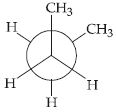
B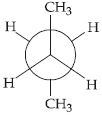
C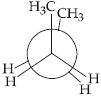
D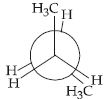
Solution
(B) The stability of a conformation depends on the minimization of steric repulsion between the groups attached to adjacent carbon atoms.
In the $anti$ conformation of $n-$butane,the two bulky $-CH_{3}$ groups are at a dihedral angle of $180^{\circ}$,which is the maximum possible distance between them. This minimizes the steric repulsion and torsional strain,making it the most stable conformation.
Therefore,the $anti$ conformation is the most stable.
In the $anti$ conformation of $n-$butane,the two bulky $-CH_{3}$ groups are at a dihedral angle of $180^{\circ}$,which is the maximum possible distance between them. This minimizes the steric repulsion and torsional strain,making it the most stable conformation.
Therefore,the $anti$ conformation is the most stable.
0 likesView Solution
37
ChemistryMediumMCQAIPMT · 2010
Liquid hydrocarbons can be converted to a mixture of gaseous hydrocarbons by
A
oxidation
B
cracking
C
distillation under reduced pressure
D
hydrolysis
Solution
(B) Lower hydrocarbons exist in the gaseous state,while higher ones exist in the liquid or solid state.
On cracking or pyrolysis,a hydrocarbon with a higher molecular mass breaks down into a mixture of hydrocarbons having lower molecular masses.
Therefore,by the process of cracking,a liquid hydrocarbon can be converted into a mixture of gaseous hydrocarbons.
On cracking or pyrolysis,a hydrocarbon with a higher molecular mass breaks down into a mixture of hydrocarbons having lower molecular masses.
Therefore,by the process of cracking,a liquid hydrocarbon can be converted into a mixture of gaseous hydrocarbons.
0 likesView Solution
38
ChemistryMediumMCQAIPMT · 2010
Which of the following conformers for ethylene glycol is most stable?
A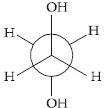
B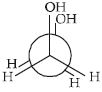
C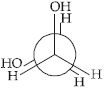
D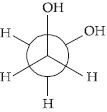
Solution
(C) The gauche conformer of ethylene glycol is the most stable conformer. This is due to the formation of intramolecular hydrogen bonding between the two hydroxyl $(-OH)$ groups,which stabilizes this specific conformation despite the steric repulsion between the groups.
0 likesView Solution
39
ChemistryEasyMCQAIPMT · 2010
Oxidation states of $P$ in $H_{4}P_{2}O_{5}, H_{4}P_{2}O_{6}, H_{4}P_{2}O_{7}$ are respectively:
A
$+3, +5, +4$
B
$+5, +3, +4$
C
$+5, +4, +3$
D
$+3, +4, +5$
Solution
(D) The oxidation state of $P$ $(x)$ is calculated as follows:
For $H_{4}P_{2}O_{5}: 4(+1) + 2x + 5(-2) = 0$ $\Rightarrow 2x - 6 = 0$ $\Rightarrow x = +3$
For $H_{4}P_{2}O_{6}: 4(+1) + 2x + 6(-2) = 0$ $\Rightarrow 2x - 8 = 0$ $\Rightarrow x = +4$
For $H_{4}P_{2}O_{7}: 4(+1) + 2x + 7(-2) = 0$ $\Rightarrow 2x - 10 = 0$ $\Rightarrow x = +5$
Thus,the oxidation states are $+3, +4, +5$.
For $H_{4}P_{2}O_{5}: 4(+1) + 2x + 5(-2) = 0$ $\Rightarrow 2x - 6 = 0$ $\Rightarrow x = +3$
For $H_{4}P_{2}O_{6}: 4(+1) + 2x + 6(-2) = 0$ $\Rightarrow 2x - 8 = 0$ $\Rightarrow x = +4$
For $H_{4}P_{2}O_{7}: 4(+1) + 2x + 7(-2) = 0$ $\Rightarrow 2x - 10 = 0$ $\Rightarrow x = +5$
Thus,the oxidation states are $+3, +4, +5$.
0 likesView Solution
40
ChemistryDifficultMCQAIPMT · 2010
The correct order of increasing bond angles in the following species is:
A
$Cl_2O < ClO_2 < ClO_2^-$
B
$ClO_2 < Cl_2O < ClO_2^-$
C
$Cl_2O < ClO_2^- < ClO_2$
D
$ClO_2^- < Cl_2O < ClO_2$
Solution
(D) To determine the bond angle,we analyze the hybridization and the number of lone pairs on the central atom:
$1$. $ClO_2^-$: The central $Cl$ atom has $2$ lone pairs and $2$ bond pairs. The bond angle is approximately $111^\circ$.
$2$. $Cl_2O$: The central $O$ atom has $2$ lone pairs and $2$ bond pairs. Due to the lower electronegativity of $Cl$ compared to $O$,the bond pairs are further from the central atom,resulting in a smaller bond angle of approximately $110.9^\circ$.
$3$. $ClO_2$: The central $Cl$ atom has $1$ lone pair and $2$ bond pairs. With fewer lone pairs,there is less repulsion,leading to a larger bond angle of approximately $117.5^\circ$.
Thus,the correct order of increasing bond angles is $ClO_2^- < Cl_2O < ClO_2$.
$1$. $ClO_2^-$: The central $Cl$ atom has $2$ lone pairs and $2$ bond pairs. The bond angle is approximately $111^\circ$.
$2$. $Cl_2O$: The central $O$ atom has $2$ lone pairs and $2$ bond pairs. Due to the lower electronegativity of $Cl$ compared to $O$,the bond pairs are further from the central atom,resulting in a smaller bond angle of approximately $110.9^\circ$.
$3$. $ClO_2$: The central $Cl$ atom has $1$ lone pair and $2$ bond pairs. With fewer lone pairs,there is less repulsion,leading to a larger bond angle of approximately $117.5^\circ$.
Thus,the correct order of increasing bond angles is $ClO_2^- < Cl_2O < ClO_2$.
0 likesView Solution
41
ChemistryMCQAIPMT · 2010
How many bridging oxygen atoms are present in $P_4O_{10}$?
A
$6$
B
$4$
C
$2$
D
$5$
Solution
(A) In the structure of $P_4O_{10}$,there are four phosphorus atoms at the corners of a tetrahedron. Each phosphorus atom is bonded to one terminal oxygen atom via a double bond $(P=O)$.
Additionally,there are six oxygen atoms that act as bridges between the phosphorus atoms,forming $P-O-P$ linkages.
Therefore,the total number of bridging oxygen atoms in $P_4O_{10}$ is $6$.
Additionally,there are six oxygen atoms that act as bridges between the phosphorus atoms,forming $P-O-P$ linkages.
Therefore,the total number of bridging oxygen atoms in $P_4O_{10}$ is $6$.
0 likesView Solution
42
ChemistryMCQAIPMT · 2010
Which of the following ions will exhibit colour in aqueous solutions?
A
$La^{3+} \, (Z = 57)$
B
$Ti^{3+} \, (Z = 22)$
C
$Lu^{3+} \, (Z = 71)$
D
$Sc^{3+} \, (Z = 21)$
Solution
(B) Ions that possess unpaired electrons exhibit colour in aqueous solutions due to $d-d$ or $f-f$ transitions.
$Ti^{3+} (Z = 22)$ has an electronic configuration of $[Ar] 3d^{1}$,which contains $1$ unpaired electron. Therefore,it exhibits colour.
$Sc^{3+} (Z = 21)$ has a configuration of $[Ar] 3d^{0}$,meaning it has no unpaired electrons.
$La^{3+} (Z = 57)$ has a configuration of $[Xe] 4f^{0}$,and $Lu^{3+} (Z = 71)$ has a configuration of $[Xe] 4f^{14}$. Both lack unpaired electrons in the $f$-subshell,so no $f-f$ transitions are possible.
Thus,only $Ti^{3+}$ is coloured.
$Ti^{3+} (Z = 22)$ has an electronic configuration of $[Ar] 3d^{1}$,which contains $1$ unpaired electron. Therefore,it exhibits colour.
$Sc^{3+} (Z = 21)$ has a configuration of $[Ar] 3d^{0}$,meaning it has no unpaired electrons.
$La^{3+} (Z = 57)$ has a configuration of $[Xe] 4f^{0}$,and $Lu^{3+} (Z = 71)$ has a configuration of $[Xe] 4f^{14}$. Both lack unpaired electrons in the $f$-subshell,so no $f-f$ transitions are possible.
Thus,only $Ti^{3+}$ is coloured.
0 likesView Solution
43
ChemistryMCQAIPMT · 2010
Fructose reduces Tollen's reagent due to
A
asymmetric carbons
B
primary alcoholic group
C
secondary alcoholic group
D
enolisation of fructose followed by conversion to aldehyde by base
Solution
(D) Fructose is a ketose. In the presence of a base,it undergoes enolisation to form an enediol intermediate,which is then converted into an aldose (glucose and mannose) via tautomerization. These aldoses contain the $-CHO$ group,which is responsible for reducing Tollen's reagent to give a silver mirror test.
0 likesView Solution
44
ChemistryMCQAIPMT · 2010
Which one of the following symbols and its representation,used in human pedigree analysis is correct?
A
B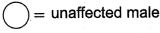
C
D
Solution
(A) In human pedigree analysis,standard symbols are used to represent different individuals and their relationships:
$1$. $A$ square represents a male.
$2$. $A$ circle represents a female.
$3$. $A$ horizontal line connecting a square and a circle represents mating.
$4$. $A$ double horizontal line connecting a square and a circle represents mating between relatives (consanguineous mating).
$5$. Shading or filling a symbol indicates that the individual is affected by the trait or disease being studied.
$6$. Therefore,the symbol showing a square and a circle connected by a double horizontal line correctly represents 'mating between relatives'.
$1$. $A$ square represents a male.
$2$. $A$ circle represents a female.
$3$. $A$ horizontal line connecting a square and a circle represents mating.
$4$. $A$ double horizontal line connecting a square and a circle represents mating between relatives (consanguineous mating).
$5$. Shading or filling a symbol indicates that the individual is affected by the trait or disease being studied.
$6$. Therefore,the symbol showing a square and a circle connected by a double horizontal line correctly represents 'mating between relatives'.
0 likesView Solution
45
ChemistryMCQAIPMT · 2010
Which one of the following cannot be explained on the basis of $Mendel's$ law of Dominance?
A
The discrete unit controlling a particular character is called a factor.
B
Out of one pair of factors one is dominant,and the other recessive.
C
Alleles do not show any blending and both the characters recover as such in $F_2$ generation.
D
Factors occur in pairs.
Solution
(C) The law of dominance states that in a heterozygous organism,only one allele (the dominant one) expresses its phenotype,while the other (the recessive one) remains masked.
Option $A$ describes the concept of factors (genes).
Option $B$ describes the core principle of dominance.
Option $D$ describes the pairing of factors.
Option $C$ describes the law of segregation (or purity of gametes),which states that alleles do not blend and separate during gamete formation,allowing both traits to reappear in the $F_2$ generation. This phenomenon is explained by the law of segregation,not the law of dominance.
Option $A$ describes the concept of factors (genes).
Option $B$ describes the core principle of dominance.
Option $D$ describes the pairing of factors.
Option $C$ describes the law of segregation (or purity of gametes),which states that alleles do not blend and separate during gamete formation,allowing both traits to reappear in the $F_2$ generation. This phenomenon is explained by the law of segregation,not the law of dominance.
0 likesView Solution
46
ChemistryMCQAIPMT · 2010
An element playing an important role in nitrogen fixation is
A
Molybdenum
B
Copper
C
Manganese
D
Zinc
Solution
(A) Nitrogen fixation is the process of converting atmospheric nitrogen $(N_2)$ into ammonia $(NH_3)$.
This process is catalyzed by the enzyme nitrogenase.
Nitrogenase is a complex metalloprotein that requires both $Mo$ (Molybdenum) and $Fe$ (Iron) as essential cofactors for its catalytic activity.
Therefore,Molybdenum is an essential element for nitrogen fixation in plants,particularly in legumes.
This process is catalyzed by the enzyme nitrogenase.
Nitrogenase is a complex metalloprotein that requires both $Mo$ (Molybdenum) and $Fe$ (Iron) as essential cofactors for its catalytic activity.
Therefore,Molybdenum is an essential element for nitrogen fixation in plants,particularly in legumes.
0 likesView Solution
47
ChemistryMCQAIPMT · 2010
If for some reason our goblet cells are non-functional,this will adversely affect:
A
Production of somatostatin
B
Secretion of sebum from the sebaceous glands
C
Maturation of sperms
D
Smooth movement of food down the intestine
Solution
(D) Goblet cells are specialized epithelial cells found in the mucosal lining of the digestive and respiratory tracts.
Their primary function is to secrete mucus,which is a glycoprotein-rich substance.
In the digestive tract,this mucus acts as a lubricant,protecting the intestinal wall from mechanical abrasion and facilitating the smooth movement of food (chyme) through the intestine.
If goblet cells become non-functional,the lack of mucus will lead to increased friction,causing difficulty in the passage of food and potentially damaging the intestinal lining.
Their primary function is to secrete mucus,which is a glycoprotein-rich substance.
In the digestive tract,this mucus acts as a lubricant,protecting the intestinal wall from mechanical abrasion and facilitating the smooth movement of food (chyme) through the intestine.
If goblet cells become non-functional,the lack of mucus will lead to increased friction,causing difficulty in the passage of food and potentially damaging the intestinal lining.
0 likesView Solution
48
ChemistryMCQAIPMT · 2010
If due to some injury the chordae tendineae of the tricuspid valve of the human heart are partially non-functional,what will be the immediate effect?
A
The flow of blood into the aorta will be slowed down
B
The 'pacemaker' will stop working
C
The blood will tend to flow back into the left atrium
D
The flow of blood into the pulmonary artery will be reduced
Solution
(D) The tricuspid valve is located between the right atrium and the right ventricle of the human heart.
Chordae tendineae are fibrous cords that attach the valve leaflets to the papillary muscles,preventing the valves from prolapsing into the atria during ventricular systole.
If the chordae tendineae of the tricuspid valve are damaged or non-functional,the valve will not close properly during ventricular contraction.
This leads to the regurgitation of blood from the right ventricle back into the right atrium.
Since the right ventricle pumps blood into the pulmonary artery,a failure of the tricuspid valve results in a reduced volume of blood being pumped into the pulmonary artery.
Therefore,the correct answer is $D$.
Chordae tendineae are fibrous cords that attach the valve leaflets to the papillary muscles,preventing the valves from prolapsing into the atria during ventricular systole.
If the chordae tendineae of the tricuspid valve are damaged or non-functional,the valve will not close properly during ventricular contraction.
This leads to the regurgitation of blood from the right ventricle back into the right atrium.
Since the right ventricle pumps blood into the pulmonary artery,a failure of the tricuspid valve results in a reduced volume of blood being pumped into the pulmonary artery.
Therefore,the correct answer is $D$.
0 likesView Solution
49
ChemistryMCQAIPMT · 2010
Which one of the following pairs is incorrectly matched?
A
Glucagon - Beta cells (source)
B
Somatostatin - Delta cells (source)
C
Corpus luteum - Progesterone (secretion)
D
Insulin - Diabetes mellitus (disease)
Solution
(A) The pancreas contains the Islets of Langerhans, which consist of different types of cells:
$1$. Alpha ($\alpha$) cells secrete Glucagon.
$2$. Beta ($\beta$) cells secrete Insulin.
$3$. Delta ($\delta$) cells secrete Somatostatin.
In option $A$, Glucagon is stated to be secreted by Beta cells, which is incorrect as Beta cells secrete Insulin. Therefore, the pair $A$ is incorrectly matched.
$1$. Alpha ($\alpha$) cells secrete Glucagon.
$2$. Beta ($\beta$) cells secrete Insulin.
$3$. Delta ($\delta$) cells secrete Somatostatin.
In option $A$, Glucagon is stated to be secreted by Beta cells, which is incorrect as Beta cells secrete Insulin. Therefore, the pair $A$ is incorrectly matched.
0 likesView Solution
50
ChemistryMCQAIPMT · 2010
Membrane-bound organelles are absent in
A
Saccharomyces
B
Streptococcus
C
Chlamydomonas
D
Plasmodium
Solution
(B) Membrane-bound organelles (such as mitochondria,chloroplasts,endoplasmic reticulum,and nucleus) are characteristic features of eukaryotic cells.
$Saccharomyces$ (yeast) is a fungus,$Chlamydomonas$ is an alga,and $Plasmodium$ is a protozoan; all of these are eukaryotes.
$Streptococcus$ is a bacterium,which belongs to the kingdom $Monera$.
Bacteria are prokaryotic organisms that lack a well-defined nucleus and membrane-bound organelles.
Therefore,the correct answer is $Streptococcus$.
$Saccharomyces$ (yeast) is a fungus,$Chlamydomonas$ is an alga,and $Plasmodium$ is a protozoan; all of these are eukaryotes.
$Streptococcus$ is a bacterium,which belongs to the kingdom $Monera$.
Bacteria are prokaryotic organisms that lack a well-defined nucleus and membrane-bound organelles.
Therefore,the correct answer is $Streptococcus$.
0 likesView Solution
51
ChemistryDifficultMCQAIPMT · 2010
$25.3 \ g$ of sodium carbonate,$Na_2CO_3$ is dissolved in enough water to make $250 \ mL$ of solution. If sodium carbonate dissociates completely,the molar concentration of sodium ions,$Na^{+}$,and carbonate ions,$CO_3^{2-}$,are respectively:
(Molar mass of $Na_2CO_3 = 106 \ g \ mol^{-1}$)
(Molar mass of $Na_2CO_3 = 106 \ g \ mol^{-1}$)
A
$0.955 \ M$ and $1.910 \ M$
B
$1.910 \ M$ and $0.955 \ M$
C
$1.90 \ M$ and $1.910 \ M$
D
$0.477 \ M$ and $0.477 \ M$
Solution
(B) Step $1$: Calculate the molarity of $Na_2CO_3$ solution.
Molarity $(M) = \frac{\text{mass of solute}}{\text{molar mass} \times \text{volume of solution in } L}$
$M = \frac{25.3 \ g}{106 \ g \ mol^{-1} \times 0.250 \ L} = 0.955 \ M$
Step $2$: Write the dissociation equation.
$Na_2CO_3(aq) \rightarrow 2Na^{+}(aq) + CO_3^{2-}(aq)$
Step $3$: Determine the concentration of ions.
Since $1 \ mol$ of $Na_2CO_3$ produces $2 \ mol$ of $Na^{+}$ and $1 \ mol$ of $CO_3^{2-}$,
$[Na^{+}] = 2 \times 0.955 \ M = 1.910 \ M$
$[CO_3^{2-}] = 1 \times 0.955 \ M = 0.955 \ M$
Thus,the concentrations are $1.910 \ M$ and $0.955 \ M$ respectively.
Molarity $(M) = \frac{\text{mass of solute}}{\text{molar mass} \times \text{volume of solution in } L}$
$M = \frac{25.3 \ g}{106 \ g \ mol^{-1} \times 0.250 \ L} = 0.955 \ M$
Step $2$: Write the dissociation equation.
$Na_2CO_3(aq) \rightarrow 2Na^{+}(aq) + CO_3^{2-}(aq)$
Step $3$: Determine the concentration of ions.
Since $1 \ mol$ of $Na_2CO_3$ produces $2 \ mol$ of $Na^{+}$ and $1 \ mol$ of $CO_3^{2-}$,
$[Na^{+}] = 2 \times 0.955 \ M = 1.910 \ M$
$[CO_3^{2-}] = 1 \times 0.955 \ M = 0.955 \ M$
Thus,the concentrations are $1.910 \ M$ and $0.955 \ M$ respectively.
0 likesView Solution
52
ChemistryMediumMCQAIPMT · 2010
For an endothermic reaction,the energy of activation is $E_a$ and the enthalpy of reaction is $\Delta H$ (both in $kJ/mol$). The minimum value of $E_a$ will be:
A
less than $\Delta H$
B
equal to $\Delta H$
C
more than $\Delta H$
D
equal to zero
Solution
(C) In an endothermic reaction,the energy of the reactants is less than that of the products.
From the potential energy diagram for an endothermic reaction,the relationship between the activation energy of the forward reaction $(E_a)$,the activation energy of the backward reaction $(E_a')$,and the enthalpy of reaction $(\Delta H)$ is given by:
$E_a = E_a' + \Delta H$
Since the activation energy of the backward reaction $(E_a')$ must always be a positive value $(E_a' > 0)$,it follows that:
$E_a > \Delta H$
Therefore,the minimum value of $E_a$ is greater than $\Delta H$.
From the potential energy diagram for an endothermic reaction,the relationship between the activation energy of the forward reaction $(E_a)$,the activation energy of the backward reaction $(E_a')$,and the enthalpy of reaction $(\Delta H)$ is given by:
$E_a = E_a' + \Delta H$
Since the activation energy of the backward reaction $(E_a')$ must always be a positive value $(E_a' > 0)$,it follows that:
$E_a > \Delta H$
Therefore,the minimum value of $E_a$ is greater than $\Delta H$.
0 likesView Solution
53
ChemistryMediumMCQAIPMT · 2010
The reaction of toluene with $Cl_2$ in the presence of $FeCl_3$ gives $X$ and the reaction in the presence of light gives $Y.$ Thus,$X$ and $Y$ are
A
$X =$ Benzal chloride,$Y = o-$chlorotoluene
B
$X = m-$chlorotoluene,$Y = p-$chlorotoluene
C
$X = o-$ and $p-$chlorotoluene,$Y =$ Trichloromethyl benzene
D
$X =$ Benzyl chloride,$Y = m-$chlorotoluene
Solution
(C) $1$. When toluene reacts with $Cl_2$ in the presence of a Lewis acid catalyst like $FeCl_3$,electrophilic aromatic substitution occurs at the ring (nuclear halogenation),resulting in $o-$ and $p-$chlorotoluene as $X$.
$2$. When toluene reacts with $Cl_2$ in the presence of light $(hv)$,free radical substitution occurs at the side chain (side chain halogenation),resulting in benzyl chloride,benzal chloride,and finally trichloromethyl benzene (benzotrichloride) as $Y$.
$2$. When toluene reacts with $Cl_2$ in the presence of light $(hv)$,free radical substitution occurs at the side chain (side chain halogenation),resulting in benzyl chloride,benzal chloride,and finally trichloromethyl benzene (benzotrichloride) as $Y$.
0 likesView Solution
54
ChemistryMediumMCQAIPMT · 2010
In a set of reactions,ethylbenzene yielded a product $D$.
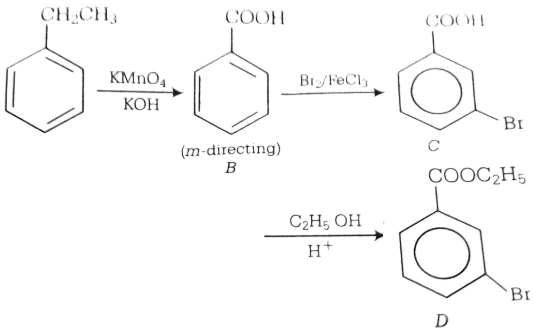
Ethylbenzene $\xrightarrow[KOH]{KMnO_4} B$ $\xrightarrow[FeCl_3]{Br_2} C$ $\xrightarrow[H^{+}]{C_2H_5OH} D$
$D$ would be
Ethylbenzene $\xrightarrow[KOH]{KMnO_4} B$ $\xrightarrow[FeCl_3]{Br_2} C$ $\xrightarrow[H^{+}]{C_2H_5OH} D$
$D$ would be
A
Ethyl $3-$bromo$-2-$phenylpropanoate
B
Ethyl $2,4-$dibromobenzoate
C
Ethyl $3-$bromobenzoate
D
Ethyl $3-$bromophenyl ether
Solution
(C) $1$. Oxidation: Ethylbenzene reacts with alkaline $KMnO_4$ to form benzoic acid $(B)$. The alkyl group is oxidized to a $-COOH$ group.
$2$. Bromination: Benzoic acid is a meta-directing group. Reaction with $Br_2/FeCl_3$ yields $3-$bromobenzoic acid $(C)$.
$3$. Esterification: $3-$bromobenzoic acid reacts with ethanol $(C_2H_5OH)$ in the presence of an acid catalyst $(H^+)$ to form ethyl $3-$bromobenzoate $(D)$.
$2$. Bromination: Benzoic acid is a meta-directing group. Reaction with $Br_2/FeCl_3$ yields $3-$bromobenzoic acid $(C)$.
$3$. Esterification: $3-$bromobenzoic acid reacts with ethanol $(C_2H_5OH)$ in the presence of an acid catalyst $(H^+)$ to form ethyl $3-$bromobenzoate $(D)$.
0 likesView Solution
55
ChemistryMediumMCQAIPMT · 2010
$AB$ crystallizes in a body-centred cubic $(bcc)$ lattice with edge length $a$ equal to $387 \ pm$. The distance between two oppositely charged ions in the lattice is ............... $pm$.
A
$335$
B
$250$
C
$200$
D
$300$
Solution
(A) For a body-centred cubic $(bcc)$ lattice, the distance $(d)$ between two oppositely charged ions (located at the corner and the body center) is given by the formula:
$d = \frac{\sqrt{3}}{2} a$
Given $a = 387 \ pm$,
$d = \frac{1.732 \times 387}{2} \ pm$
$d = 0.866 \times 387 \ pm$
$d \approx 335.14 \ pm$
Therefore, the closest value is $335 \ pm$.
$d = \frac{\sqrt{3}}{2} a$
Given $a = 387 \ pm$,
$d = \frac{1.732 \times 387}{2} \ pm$
$d = 0.866 \times 387 \ pm$
$d \approx 335.14 \ pm$
Therefore, the closest value is $335 \ pm$.
0 likesView Solution
56
ChemistryMediumMCQAIPMT · 2010
An aqueous solution is $1.00 \ molal$ in $KI$. Which change will cause the vapour pressure of the solution to increase?
A
Addition of $NaCl$
B
Addition of $Na_2SO_4$
C
Addition of $1.00 \ molal \ KI$
D
Addition of water
Solution
(D) The vapour pressure of a solution is inversely proportional to the concentration of the solute particles.
Adding water to an aqueous solution of $KI$ dilutes the solution,which decreases the concentration of solute particles.
According to Raoult's law,a decrease in solute concentration leads to an increase in the vapour pressure of the solvent.
In contrast,adding $NaCl$,$Na_2SO_4$,or more $KI$ increases the total number of solute particles,which further lowers the vapour pressure due to the colligative property of vapour pressure lowering.
Adding water to an aqueous solution of $KI$ dilutes the solution,which decreases the concentration of solute particles.
According to Raoult's law,a decrease in solute concentration leads to an increase in the vapour pressure of the solvent.
In contrast,adding $NaCl$,$Na_2SO_4$,or more $KI$ increases the total number of solute particles,which further lowers the vapour pressure due to the colligative property of vapour pressure lowering.
0 likesView Solution
57
ChemistryMediumMCQAIPMT · 2010
$A$ solution of sucrose (molar mass $= 342 \, g \, mol^{-1}$) has been prepared by dissolving $68.5 \, g$ of sucrose in $1000 \, g$ of water. The freezing point of the solution obtained will be ......... $^oC$. ($K_f$ for water $= 1.86 \, K \, kg \, mol^{-1}$)
A
$-0.37$
B
$-0.52$
C
$+0.37$
D
$-0.57$
Solution
(A) Given: $w_2 = 68.5 \, g$,$M_2 = 342 \, g \, mol^{-1}$,$w_1 = 1000 \, g = 1 \, kg$,$K_f = 1.86 \, K \, kg \, mol^{-1}$.
$\Delta T_f = K_f \times m = K_f \times \frac{w_2}{M_2 \times w_1(kg)}$
$\Delta T_f = 1.86 \times \frac{68.5}{342 \times 1} = 0.3725 \, K$ or $^oC$.
Freezing point of solution $T_f = T_f^o - \Delta T_f = 0 \, ^oC - 0.3725 \, ^oC = -0.3725 \, ^oC \approx -0.37 \, ^oC$.
$\Delta T_f = K_f \times m = K_f \times \frac{w_2}{M_2 \times w_1(kg)}$
$\Delta T_f = 1.86 \times \frac{68.5}{342 \times 1} = 0.3725 \, K$ or $^oC$.
Freezing point of solution $T_f = T_f^o - \Delta T_f = 0 \, ^oC - 0.3725 \, ^oC = -0.3725 \, ^oC \approx -0.37 \, ^oC$.
0 likesView Solution
58
ChemistryDifficultMCQAIPMT · 2010
For the reduction of silver ions with copper metal,the standard cell potential was found to be $+ 0.46 \ V$ at $25^oC.$ The value of standard Gibb's energy,$\Delta G^o$ will be .......... $kJ.$
$(F = 96500 \ C \ mol^{-1})$
$(F = 96500 \ C \ mol^{-1})$
A
$- 89.0$
B
$- 90$
C
$- 44.5$
D
$- 98.0$
Solution
(A) The standard Gibbs energy change is given by the formula: $\Delta G^{\circ} = -nFE^{\circ}_{cell}$
The cell reaction is: $2 Ag^{+} + Cu \rightarrow Cu^{2+} + 2 Ag$
Here,the number of electrons transferred,$n = 2$.
Given,$E^{\circ}_{cell} = + 0.46 \ V$ and $F = 96500 \ C \ mol^{-1}$.
Substituting the values: $\Delta G^{\circ} = -2 \times 96500 \times 0.46 \ J \ mol^{-1}$
$\Delta G^{\circ} = -88780 \ J \ mol^{-1}$
Converting to $kJ \ mol^{-1}$: $\Delta G^{\circ} = -88.78 \ kJ \ mol^{-1}$
Rounding to the nearest value,we get $\Delta G^{\circ} \approx -89.0 \ kJ \ mol^{-1}$.
The cell reaction is: $2 Ag^{+} + Cu \rightarrow Cu^{2+} + 2 Ag$
Here,the number of electrons transferred,$n = 2$.
Given,$E^{\circ}_{cell} = + 0.46 \ V$ and $F = 96500 \ C \ mol^{-1}$.
Substituting the values: $\Delta G^{\circ} = -2 \times 96500 \times 0.46 \ J \ mol^{-1}$
$\Delta G^{\circ} = -88780 \ J \ mol^{-1}$
Converting to $kJ \ mol^{-1}$: $\Delta G^{\circ} = -88.78 \ kJ \ mol^{-1}$
Rounding to the nearest value,we get $\Delta G^{\circ} \approx -89.0 \ kJ \ mol^{-1}$.
0 likesView Solution
59
ChemistryMediumMCQAIPMT · 2010
An increase in equivalent conductance of a strong electrolyte with dilution is mainly due to
A
increase in ionic mobility of ions
B
$100\%$ ionisation of electrolyte at normal dilution
C
increase in both $i.e.$,number of ions and ionic mobility of ions
D
increase in number of ions.
Solution
(A) For a strong electrolyte,the number of ions is already fixed because it is completely dissociated at all concentrations.
Equivalent conductance $(\lambda_{eq})$ is defined as $\lambda_{eq} = \kappa \times V$,where $\kappa$ is the specific conductance and $V$ is the volume containing $1 \ g$-equivalent of the electrolyte.
Upon dilution,the inter-ionic attractions decrease,which leads to an increase in the ionic mobility of the ions.
Since the number of ions remains constant for a strong electrolyte,the increase in equivalent conductance is primarily due to the increase in ionic mobility.
Equivalent conductance $(\lambda_{eq})$ is defined as $\lambda_{eq} = \kappa \times V$,where $\kappa$ is the specific conductance and $V$ is the volume containing $1 \ g$-equivalent of the electrolyte.
Upon dilution,the inter-ionic attractions decrease,which leads to an increase in the ionic mobility of the ions.
Since the number of ions remains constant for a strong electrolyte,the increase in equivalent conductance is primarily due to the increase in ionic mobility.
0 likesView Solution
60
ChemistryAdvancedMCQAIPMT · 2010
Which of the following expressions correctly represents the equivalent conductance at infinite dilution of $Al_2(SO_4)_3$? Given that $\Lambda_{Al^{3+}}^o$ and $\Lambda_{SO_4^{2-}}^o$ are the equivalent conductances at infinite dilution of the respective ions.
A
$\Lambda_{Al^{3+}}^o + \Lambda_{SO_4^{2-}}^o$
B
$2\Lambda_{Al^{3+}}^o + 3\Lambda_{SO_4^{2-}}^o$
C
$\frac{1}{3}\Lambda_{Al^{3+}}^o + \frac{1}{2}\Lambda_{SO_4^{2-}}^o$
D
$\frac{1}{6}\Lambda_{Al^{3+}}^o + \frac{1}{6}\Lambda_{SO_4^{2-}}^o$
Solution
(A) The equivalent conductance at infinite dilution $(\Lambda_{eq}^{\infty})$ of an electrolyte is the sum of the equivalent conductances of its constituent ions.
By definition,the equivalent conductance of any electrolyte at infinite dilution is the sum of the equivalent conductances of its cation and anion.
For $Al_2(SO_4)_3$,the equivalent conductance at infinite dilution is given by:
$\Lambda_{eq}^{\infty} = \Lambda_{Al^{3+}}^o + \Lambda_{SO_4^{2-}}^o$
This is because the equivalent conductance of an ion is defined as the molar conductance divided by its charge (valence factor),which inherently accounts for the stoichiometry of the salt.
By definition,the equivalent conductance of any electrolyte at infinite dilution is the sum of the equivalent conductances of its cation and anion.
For $Al_2(SO_4)_3$,the equivalent conductance at infinite dilution is given by:
$\Lambda_{eq}^{\infty} = \Lambda_{Al^{3+}}^o + \Lambda_{SO_4^{2-}}^o$
This is because the equivalent conductance of an ion is defined as the molar conductance divided by its charge (valence factor),which inherently accounts for the stoichiometry of the salt.
0 likesView Solution
61
ChemistryDifficultMCQAIPMT · 2010
Consider the following relations for $EMF$ of an electrochemical cell:
$(i)$ $EMF$ of cell = (Oxidation potential of anode) $-$ (Reduction potential of cathode)
$(ii)$ $EMF$ of cell = (Oxidation potential of anode) $+$ (Reduction potential of cathode)
$(iii)$ $EMF$ of cell = (Reduction potential of anode) $+$ (Reduction potential of cathode)
$(iv)$ $EMF$ of cell = (Oxidation potential of anode) $-$ (Oxidation potential of cathode)
Which of the above relations are correct?
$(i)$ $EMF$ of cell = (Oxidation potential of anode) $-$ (Reduction potential of cathode)
$(ii)$ $EMF$ of cell = (Oxidation potential of anode) $+$ (Reduction potential of cathode)
$(iii)$ $EMF$ of cell = (Reduction potential of anode) $+$ (Reduction potential of cathode)
$(iv)$ $EMF$ of cell = (Oxidation potential of anode) $-$ (Oxidation potential of cathode)
Which of the above relations are correct?
A
$(iii)$ and $(i)$
B
$(i)$ and $(ii)$
C
$(iii)$ and $(iv)$
D
$(ii)$ and $(iv)$
Solution
(D) The $EMF$ of a cell is defined as:
$EMF_{cell} = E_{cathode} (reduction) - E_{anode} (reduction)$
Since $E_{anode} (reduction) = -E_{anode} (oxidation)$,we can write:
$EMF_{cell} = E_{cathode} (reduction) + E_{anode} (oxidation)$
Also,since $E_{cathode} (reduction) = -E_{cathode} (oxidation)$,we can write:
$EMF_{cell} = E_{anode} (oxidation) - E_{cathode} (oxidation)$
Comparing these with the given relations:
$(ii)$ $EMF$ of cell = (Oxidation potential of anode) $+$ (Reduction potential of cathode) is correct.
$(iv)$ $EMF$ of cell = (Oxidation potential of anode) $-$ (Oxidation potential of cathode) is correct.
Therefore,the correct option is $D$.
$EMF_{cell} = E_{cathode} (reduction) - E_{anode} (reduction)$
Since $E_{anode} (reduction) = -E_{anode} (oxidation)$,we can write:
$EMF_{cell} = E_{cathode} (reduction) + E_{anode} (oxidation)$
Also,since $E_{cathode} (reduction) = -E_{cathode} (oxidation)$,we can write:
$EMF_{cell} = E_{anode} (oxidation) - E_{cathode} (oxidation)$
Comparing these with the given relations:
$(ii)$ $EMF$ of cell = (Oxidation potential of anode) $+$ (Reduction potential of cathode) is correct.
$(iv)$ $EMF$ of cell = (Oxidation potential of anode) $-$ (Oxidation potential of cathode) is correct.
Therefore,the correct option is $D$.
0 likesView Solution
62
ChemistryAdvancedMCQAIPMT · 2010
For the reaction $N_{2}O_{5(g)} \rightarrow 2NO_{2(g)} + \frac{1}{2} O_{2(g)}$,the rate of disappearance of $N_{2}O_{5}$ is given as $6.25 \times 10^{-3} \ mol \ L^{-1} \ s^{-1}$. The rate of formation of $NO_{2}$ and $O_{2}$ is given respectively as:
A
$6.25 \times 10^{-3} \ mol \ L^{-1} \ s^{-1}$ and $6.25 \times 10^{-3} \ mol \ L^{-1} \ s^{-1}$
B
$1.25 \times 10^{-2} \ mol \ L^{-1} \ s^{-1}$ and $3.125 \times 10^{-3} \ mol \ L^{-1} \ s^{-1}$
C
$6.25 \times 10^{-3} \ mol \ L^{-1} \ s^{-1}$ and $3.125 \times 10^{-3} \ mol \ L^{-1} \ s^{-1}$
D
$1.25 \times 10^{-3} \ mol \ L^{-1} \ s^{-1}$ and $6.25 \times 10^{-3} \ mol \ L^{-1} \ s^{-1}$
Solution
(B) The rate of reaction is given by the expression: $-\frac{d[N_{2}O_{5}]}{dt} = \frac{1}{2} \frac{d[NO_{2}]}{dt} = 2 \frac{d[O_{2}]}{dt}$.
Given,$-\frac{d[N_{2}O_{5}]}{dt} = 6.25 \times 10^{-3} \ mol \ L^{-1} \ s^{-1}$.
For $NO_{2}$ formation: $\frac{d[NO_{2}]}{dt} = 2 \times (-\frac{d[N_{2}O_{5}]}{dt}) = 2 \times 6.25 \times 10^{-3} = 1.25 \times 10^{-2} \ mol \ L^{-1} \ s^{-1}$.
For $O_{2}$ formation: $\frac{d[O_{2}]}{dt} = \frac{1}{2} \times (-\frac{d[N_{2}O_{5}]}{dt}) = \frac{6.25 \times 10^{-3}}{2} = 3.125 \times 10^{-3} \ mol \ L^{-1} \ s^{-1}$.
Given,$-\frac{d[N_{2}O_{5}]}{dt} = 6.25 \times 10^{-3} \ mol \ L^{-1} \ s^{-1}$.
For $NO_{2}$ formation: $\frac{d[NO_{2}]}{dt} = 2 \times (-\frac{d[N_{2}O_{5}]}{dt}) = 2 \times 6.25 \times 10^{-3} = 1.25 \times 10^{-2} \ mol \ L^{-1} \ s^{-1}$.
For $O_{2}$ formation: $\frac{d[O_{2}]}{dt} = \frac{1}{2} \times (-\frac{d[N_{2}O_{5}]}{dt}) = \frac{6.25 \times 10^{-3}}{2} = 3.125 \times 10^{-3} \ mol \ L^{-1} \ s^{-1}$.
0 likesView Solution
63
ChemistryAdvancedMCQAIPMT · 2010
During the kinetic study of the reaction,$2A + B \rightarrow C + D,$ the following results were obtained:
Based on the above data,which one of the following is correct?
| $Run$ | $[A] / mol \ L^{-1}$ | $[B] / mol \ L^{-1}$ | Initial rate of formation of $D / mol \ L^{-1} \ min^{-1}$ |
| $I.$ | $0.1$ | $0.1$ | $6.0 \times 10^{-3}$ |
| $II.$ | $0.3$ | $0.2$ | $7.2 \times 10^{-2}$ |
| $III.$ | $0.3$ | $0.4$ | $2.88 \times 10^{-1}$ |
| $IV.$ | $0.4$ | $0.1$ | $2.40 \times 10^{-2}$ |
Based on the above data,which one of the following is correct?
A
Rate $= k[A]^2[B]$
B
Rate $= k[A][B]$
C
Rate $= k[A]^2[B]^2$
D
Rate $= k[A][B]^2$
Solution
(D) Let the order of reaction with respect to $A$ be $x$ and with respect to $B$ be $y$.
The rate law is given by: $\text{Rate} = k[A]^x[B]^y$
Using the data from the table:
$I. \ 6.0 \times 10^{-3} = k(0.1)^x(0.1)^y$
$II. \ 7.2 \times 10^{-2} = k(0.3)^x(0.2)^y$
$III. \ 2.88 \times 10^{-1} = k(0.3)^x(0.4)^y$
$IV. \ 2.40 \times 10^{-2} = k(0.4)^x(0.1)^y$
Dividing Eq. $(I)$ by Eq. $(IV)$:
$\frac{6.0 \times 10^{-3}}{2.40 \times 10^{-2}} = \left(\frac{0.1}{0.4}\right)^x \left(\frac{0.1}{0.1}\right)^y$
$0.25 = (0.25)^x \implies x = 1$
Dividing Eq. $(II)$ by Eq. $(III)$:
$\frac{7.2 \times 10^{-2}}{2.88 \times 10^{-1}} = \left(\frac{0.3}{0.3}\right)^x \left(\frac{0.2}{0.4}\right)^y$
$0.25 = (0.5)^y \implies (0.5)^2 = (0.5)^y \implies y = 2$
Therefore,the rate law is: $\text{Rate} = k[A]^1[B]^2 = k[A][B]^2$.
The rate law is given by: $\text{Rate} = k[A]^x[B]^y$
Using the data from the table:
$I. \ 6.0 \times 10^{-3} = k(0.1)^x(0.1)^y$
$II. \ 7.2 \times 10^{-2} = k(0.3)^x(0.2)^y$
$III. \ 2.88 \times 10^{-1} = k(0.3)^x(0.4)^y$
$IV. \ 2.40 \times 10^{-2} = k(0.4)^x(0.1)^y$
Dividing Eq. $(I)$ by Eq. $(IV)$:
$\frac{6.0 \times 10^{-3}}{2.40 \times 10^{-2}} = \left(\frac{0.1}{0.4}\right)^x \left(\frac{0.1}{0.1}\right)^y$
$0.25 = (0.25)^x \implies x = 1$
Dividing Eq. $(II)$ by Eq. $(III)$:
$\frac{7.2 \times 10^{-2}}{2.88 \times 10^{-1}} = \left(\frac{0.3}{0.3}\right)^x \left(\frac{0.2}{0.4}\right)^y$
$0.25 = (0.5)^y \implies (0.5)^2 = (0.5)^y \implies y = 2$
Therefore,the rate law is: $\text{Rate} = k[A]^1[B]^2 = k[A][B]^2$.
0 likesView Solution
64
ChemistryEasyMCQAIPMT · 2010
The rate of the reaction,$2NO + Cl_2 \rightarrow 2NOCl$ is given by the rate equation $\text{rate} = k[NO]^2[Cl_2]$. The value of the rate constant can be increased by
A
increasing the temperature
B
increasing the concentration of $NO$
C
increasing the concentration of $Cl_2$
D
doing all of these.
Solution
(A) The rate constant $k$ is a characteristic property of a reaction at a given temperature.
It is independent of the concentrations of the reactants.
According to the Arrhenius equation,$k = Ae^{-E_a/RT}$,the rate constant $k$ increases with an increase in temperature.
It is independent of the concentrations of the reactants.
According to the Arrhenius equation,$k = Ae^{-E_a/RT}$,the rate constant $k$ increases with an increase in temperature.
0 likesView Solution
65
ChemistryEasyMCQAIPMT · 2010
Which of the following ions has electronic configuration $[Ar]3d^6$ ?
(At. nos. $Mn = 25, Fe = 26, Co = 27, Ni = 28$)
(At. nos. $Mn = 25, Fe = 26, Co = 27, Ni = 28$)
A
$Ni^{3+}$
B
$Mn^{3+}$
C
$Fe^{3+}$
D
$Co^{3+}$
Solution
(D) The electronic configuration of neutral atoms is:
$Mn (25) = [Ar] 3d^5 4s^2$
$Fe (26) = [Ar] 3d^6 4s^2$
$Co (27) = [Ar] 3d^7 4s^2$
$Ni (28) = [Ar] 3d^8 4s^2$
For the ions:
$Ni^{3+} = [Ar] 3d^7$
$Mn^{3+} = [Ar] 3d^4$
$Fe^{3+} = [Ar] 3d^5$
$Co^{3+} = [Ar] 3d^6$
Thus,$Co^{3+}$ has the $[Ar] 3d^6$ configuration.
$Mn (25) = [Ar] 3d^5 4s^2$
$Fe (26) = [Ar] 3d^6 4s^2$
$Co (27) = [Ar] 3d^7 4s^2$
$Ni (28) = [Ar] 3d^8 4s^2$
For the ions:
$Ni^{3+} = [Ar] 3d^7$
$Mn^{3+} = [Ar] 3d^4$
$Fe^{3+} = [Ar] 3d^5$
$Co^{3+} = [Ar] 3d^6$
Thus,$Co^{3+}$ has the $[Ar] 3d^6$ configuration.
0 likesView Solution
66
ChemistryEasyMCQAIPMT · 2010
Which of the following pairs has the same size?
A
$Fe^{2+}, Ni^{2+}$
B
$Zr^{4+}, Ti^{4+}$
C
$Zr^{4+}, Hf^{4+}$
D
$Zn^{2+}, Hf^{4+}$
Solution
(C) In general,the atomic and ionic radii increase on moving down a group.
However,the elements of the second transition series $(Zr, Nb, Mo, \dots)$ have almost the same radii as the elements of the third transition series $(Hf, Ta, W, \dots)$.
This phenomenon is due to lanthanoid contraction,which arises from the imperfect shielding of one $4f$ electron by another,leading to a smaller increase in size than expected when moving from the $4d$ to the $5d$ series.
Therefore,$Zr^{4+}$ and $Hf^{4+}$ have nearly identical ionic radii.
However,the elements of the second transition series $(Zr, Nb, Mo, \dots)$ have almost the same radii as the elements of the third transition series $(Hf, Ta, W, \dots)$.
This phenomenon is due to lanthanoid contraction,which arises from the imperfect shielding of one $4f$ electron by another,leading to a smaller increase in size than expected when moving from the $4d$ to the $5d$ series.
Therefore,$Zr^{4+}$ and $Hf^{4+}$ have nearly identical ionic radii.
0 likesView Solution
67
ChemistryDifficultMCQAIPMT · 2010
Match List-$I$ (substances) with List-$II$ (processes) employed in the manufacture of the substances and select the correct option.
| List-$I$ (Substances) | List-$II$ (Processes) |
| $A$. Sulphuric acid | $i$. Haber's process |
| $B$. Steel | $ii$. Bessemer's process |
| $C$. Sodium hydroxide | $iii$. Leblanc process |
| $D$. Ammonia | $iv$. Contact process |
A
$A-i, B-iv, C-ii, D-iii$
B
$A-i, B-ii, C-iii, D-iv$
C
$A-iv, B-iii, C-ii, D-i$
D
$A-iv, B-ii, C-iii, D-i$
Solution
(D) The correct matches are as follows:
$A$. Sulphuric acid is manufactured by the $iv$. Contact process.
$B$. Steel is manufactured by the $ii$. Bessemer's process.
$C$. Sodium hydroxide was historically manufactured by the $iii$. Leblanc process.
$D$. Ammonia is manufactured by the $i$. Haber's process.
Therefore,the correct matching is $A-iv, B-ii, C-iii, D-i$.
$A$. Sulphuric acid is manufactured by the $iv$. Contact process.
$B$. Steel is manufactured by the $ii$. Bessemer's process.
$C$. Sodium hydroxide was historically manufactured by the $iii$. Leblanc process.
$D$. Ammonia is manufactured by the $i$. Haber's process.
Therefore,the correct matching is $A-iv, B-ii, C-iii, D-i$.
0 likesView Solution
68
ChemistryEasyMCQAIPMT · 2010
Which of the following oxidation states is the most common among the lanthanoids?
A
$4$
B
$2$
C
$5$
D
$3$
Solution
(D) The most common oxidation state exhibited by lanthanoids is $+3$.
0 likesView Solution
69
ChemistryDifficultMCQAIPMT · 2010
Which of the following complex ions is not expected to absorb visible light?
A
$[Ni(CN)_4]^{2-}$
B
$[Cr(NH_3)_6]^{3+}$
C
$[Fe(H_2O)_6]^{2+}$
D
$[Ni(H_2O)_6]^{2+}$
Solution
(A) transition metal complex absorbs visible light only if it has unpaired electrons,which allows for $d-d$ transitions.
$1$. In $[Ni(CN)_4]^{2-}$,$Ni$ is in the $+2$ oxidation state $(3d^8)$. Since $CN^-$ is a strong field ligand,it causes pairing of electrons in the $3d$ orbitals,resulting in no unpaired electrons ($d^8$ configuration: $t_{2g}^6 e_g^2$ is not applicable here as it is square planar,but all electrons are paired).
$2$. $[Cr(NH_3)_6]^{3+}$ has $Cr^{3+}$ $(3d^3)$,which has $3$ unpaired electrons.
$3$. $[Fe(H_2O)_6]^{2+}$ has $Fe^{2+}$ $(3d^6)$,which has $4$ unpaired electrons.
$4$. $[Ni(H_2O)_6]^{2+}$ has $Ni^{2+}$ $(3d^8)$,which has $2$ unpaired electrons.
Since $[Ni(CN)_4]^{2-}$ has no unpaired electrons,it is not expected to absorb visible light.
$1$. In $[Ni(CN)_4]^{2-}$,$Ni$ is in the $+2$ oxidation state $(3d^8)$. Since $CN^-$ is a strong field ligand,it causes pairing of electrons in the $3d$ orbitals,resulting in no unpaired electrons ($d^8$ configuration: $t_{2g}^6 e_g^2$ is not applicable here as it is square planar,but all electrons are paired).
$2$. $[Cr(NH_3)_6]^{3+}$ has $Cr^{3+}$ $(3d^3)$,which has $3$ unpaired electrons.
$3$. $[Fe(H_2O)_6]^{2+}$ has $Fe^{2+}$ $(3d^6)$,which has $4$ unpaired electrons.
$4$. $[Ni(H_2O)_6]^{2+}$ has $Ni^{2+}$ $(3d^8)$,which has $2$ unpaired electrons.
Since $[Ni(CN)_4]^{2-}$ has no unpaired electrons,it is not expected to absorb visible light.
0 likesView Solution
70
ChemistryDifficultMCQAIPMT · 2010
Crystal field stabilization energy for high spin $d^4$ octahedral complex is
A
$- 1.8 \Delta_o$
B
$- 1.6 \Delta_o + P$
C
$- 1.2 \Delta_o$
D
$- 0.6 \Delta_o$
Solution
(D) In an octahedral complex,the $d$-orbitals split into $t_{2g}$ (lower energy) and $e_g$ (higher energy) sets.
For a high spin $d^4$ configuration,the electrons occupy the orbitals according to Hund's rule because the crystal field splitting energy $\Delta_o$ is less than the pairing energy $P$.
The electronic configuration is $t_{2g}^3 e_g^1$.
The Crystal Field Stabilization Energy $(CFSE)$ is calculated as:
$CFSE = (n_{t_{2g}} \times -0.4 \Delta_o) + (n_{e_g} \times 0.6 \Delta_o)$
$CFSE = (3 \times -0.4 \Delta_o) + (1 \times 0.6 \Delta_o)$
$CFSE = -1.2 \Delta_o + 0.6 \Delta_o = -0.6 \Delta_o$.
For a high spin $d^4$ configuration,the electrons occupy the orbitals according to Hund's rule because the crystal field splitting energy $\Delta_o$ is less than the pairing energy $P$.
The electronic configuration is $t_{2g}^3 e_g^1$.
The Crystal Field Stabilization Energy $(CFSE)$ is calculated as:
$CFSE = (n_{t_{2g}} \times -0.4 \Delta_o) + (n_{e_g} \times 0.6 \Delta_o)$
$CFSE = (3 \times -0.4 \Delta_o) + (1 \times 0.6 \Delta_o)$
$CFSE = -1.2 \Delta_o + 0.6 \Delta_o = -0.6 \Delta_o$.
0 likesView Solution
71
ChemistryMediumMCQAIPMT · 2010
The existence of two different coloured complexes with the composition of $[Co(NH_3)_4Cl_2]^+$ is due to
A
linkage isomerism
B
ionization isomerism
C
coordination isomerism
D
geometrical isomerism
Solution
(D) Complexes of $[MA_4B_2]$ type exhibit geometrical isomerism.
The complex $[Co(NH_3)_4Cl_2]^+$ is a $[MA_4B_2]$ type complex and thus,fulfills the conditions that are necessary to exhibit geometrical isomerism.
Hence,it has two geometrical isomers (cis and trans) of different colours.
For linkage isomerism,the presence of an ambidentate ligand is necessary.
For coordination isomerism,both the cation and anion of the complex must be complex ions.
For ionisation isomerism,an anion different from the ligands must be present outside the coordination sphere.
All these conditions are not satisfied by this complex. Hence,it does not exhibit other given isomerisms.
The complex $[Co(NH_3)_4Cl_2]^+$ is a $[MA_4B_2]$ type complex and thus,fulfills the conditions that are necessary to exhibit geometrical isomerism.
Hence,it has two geometrical isomers (cis and trans) of different colours.
For linkage isomerism,the presence of an ambidentate ligand is necessary.
For coordination isomerism,both the cation and anion of the complex must be complex ions.
For ionisation isomerism,an anion different from the ligands must be present outside the coordination sphere.
All these conditions are not satisfied by this complex. Hence,it does not exhibit other given isomerisms.
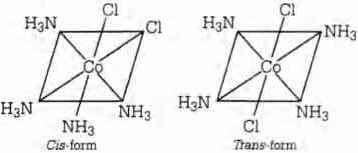
0 likesView Solution
72
ChemistryMediumMCQAIPMT · 2010
Which one of the following complexes is not expected to exhibit isomerism?
A
$[Ni(NH_3)_4(H_2O)_2]^{2+}$
B
$[Pt(NH_3)_2Cl_2]$
C
$[Ni(NH_3)_2Cl_2]$
D
$[Ni(en)_3]^{2+}$
Solution
(C) The complex $[Ni(NH_3)_2Cl_2]$ adopts a tetrahedral geometry because $Ni^{2+}$ is a $d^8$ ion and $NH_3$ and $Cl^-$ are weak field ligands in this context,leading to $sp^3$ hybridization.
Tetrahedral complexes of the type $[M(A)_2(B)_2]$ do not exhibit geometric isomerism because all positions in a tetrahedron are equivalent relative to each other.
In contrast,$[Pt(NH_3)_2Cl_2]$ is a square planar complex which exhibits cis-trans isomerism.
$[Ni(NH_3)_4(H_2O)_2]^{2+}$ is an octahedral complex which exhibits geometric isomerism.
$[Ni(en)_3]^{2+}$ is an octahedral complex which exhibits optical isomerism.
Tetrahedral complexes of the type $[M(A)_2(B)_2]$ do not exhibit geometric isomerism because all positions in a tetrahedron are equivalent relative to each other.
In contrast,$[Pt(NH_3)_2Cl_2]$ is a square planar complex which exhibits cis-trans isomerism.
$[Ni(NH_3)_4(H_2O)_2]^{2+}$ is an octahedral complex which exhibits geometric isomerism.
$[Ni(en)_3]^{2+}$ is an octahedral complex which exhibits optical isomerism.
0 likesView Solution
73
ChemistryAdvancedMCQAIPMT · 2010
Which one is most reactive towards $S_{N}1$ reaction?
A
$C_6H_5CH(C_6H_5)Br$
B
$C_6H_5CH(CH_3)Br$
C
$C_6H_5C(CH_3)(C_6H_5)Br$
D
$C_6H_5CH_2Br$
Solution
(C) Key Idea: The $S_{N}1$ reaction proceeds via the formation of a carbocation intermediate. The stability of the carbocation determines the reactivity of the alkyl/aryl halide; higher stability leads to higher reactivity.
The carbocations formed from the given halides are:
$1$. $C_6H_5CH(C_6H_5)Br \rightarrow (C_6H_5)_2CH^+ + Br^-$
$2$. $C_6H_5CH(CH_3)Br \rightarrow C_6H_5CH^+(CH_3) + Br^-$
$3$. $C_6H_5C(CH_3)(C_6H_5)Br \rightarrow (C_6H_5)_2C^+(CH_3) + Br^-$
$4$. $C_6H_5CH_2Br \rightarrow C_6H_5CH_2^+ + Br^-$
The stability order of these carbocations is: $(C_6H_5)_2C^+(CH_3) > (C_6H_5)_2CH^+ > C_6H_5CH^+(CH_3) > C_6H_5CH_2^+$.
The carbocation $(C_6H_5)_2C^+(CH_3)$ is the most stable due to the presence of two phenyl groups and one methyl group providing resonance and inductive stabilization. Thus,$C_6H_5C(CH_3)(C_6H_5)Br$ is the most reactive towards $S_{N}1$ reaction.
The carbocations formed from the given halides are:
$1$. $C_6H_5CH(C_6H_5)Br \rightarrow (C_6H_5)_2CH^+ + Br^-$
$2$. $C_6H_5CH(CH_3)Br \rightarrow C_6H_5CH^+(CH_3) + Br^-$
$3$. $C_6H_5C(CH_3)(C_6H_5)Br \rightarrow (C_6H_5)_2C^+(CH_3) + Br^-$
$4$. $C_6H_5CH_2Br \rightarrow C_6H_5CH_2^+ + Br^-$
The stability order of these carbocations is: $(C_6H_5)_2C^+(CH_3) > (C_6H_5)_2CH^+ > C_6H_5CH^+(CH_3) > C_6H_5CH_2^+$.
The carbocation $(C_6H_5)_2C^+(CH_3)$ is the most stable due to the presence of two phenyl groups and one methyl group providing resonance and inductive stabilization. Thus,$C_6H_5C(CH_3)(C_6H_5)Br$ is the most reactive towards $S_{N}1$ reaction.
0 likesView Solution
74
ChemistryMediumMCQAIPMT · 2010
The correct order of increasing reactivity of $C-X$ bond towards nucleophile in the following compounds is:
$I$: Chlorobenzene (or aryl halide)
$II$: $2,4$-Dinitrochlorobenzene
$III$: $(CH_3)_3C-X$ ($3^o$ alkyl halide)
$IV$: $(CH_3)_2CH-X$ ($2^o$ alkyl halide)
$I$: Chlorobenzene (or aryl halide)
$II$: $2,4$-Dinitrochlorobenzene
$III$: $(CH_3)_3C-X$ ($3^o$ alkyl halide)
$IV$: $(CH_3)_2CH-X$ ($2^o$ alkyl halide)
A
$I < II < IV < III$
B
$II < III < I < IV$
C
$IV < III < I < II$
D
$III < II < I < IV$
Solution
(A) The reactivity of $C-X$ bond towards nucleophilic substitution depends on the mechanism ($S_N1$ or $S_N2$).
$1$. Alkyl halides ($III$ and $IV$) are generally more reactive than aryl halides ($I$ and $II$) towards nucleophilic substitution because the $C-X$ bond in aryl halides has partial double bond character due to resonance.
$2$. Among alkyl halides,the $3^o$ halide $(III)$ is more reactive than the $2^o$ halide $(IV)$ in $S_N1$ reactions due to the formation of a more stable carbocation.
$3$. Among aryl halides,the presence of electron-withdrawing groups $(-NO_2)$ increases the reactivity towards nucleophilic aromatic substitution. Thus,$II$ is significantly more reactive than $I$.
$4$. Comparing all,the order of reactivity is $I < II < IV < III$.
$1$. Alkyl halides ($III$ and $IV$) are generally more reactive than aryl halides ($I$ and $II$) towards nucleophilic substitution because the $C-X$ bond in aryl halides has partial double bond character due to resonance.
$2$. Among alkyl halides,the $3^o$ halide $(III)$ is more reactive than the $2^o$ halide $(IV)$ in $S_N1$ reactions due to the formation of a more stable carbocation.
$3$. Among aryl halides,the presence of electron-withdrawing groups $(-NO_2)$ increases the reactivity towards nucleophilic aromatic substitution. Thus,$II$ is significantly more reactive than $I$.
$4$. Comparing all,the order of reactivity is $I < II < IV < III$.
0 likesView Solution
75
ChemistryDifficultMCQAIPMT · 2010
In the following reaction $C_6H_5CH_2Br \xrightarrow{1. Mg, \text{ ether } \atop 2. H_3O^{+}} X$,the product $X$ is
A
$C_6H_5CH_2OCH_2C_6H_5$
B
$C_6H_5CH_2OH$
C
$C_6H_5CH_3$
D
$C_6H_5CH_2CH_2C_6H_5$
Solution
(C) The reaction proceeds as follows:
$1$. $C_6H_5CH_2Br$ reacts with $Mg$ in the presence of dry ether to form the Grignard reagent,$C_6H_5CH_2MgBr$.
$2$. The Grignard reagent $C_6H_5CH_2MgBr$ undergoes hydrolysis with $H_3O^{+}$ to form $C_6H_5CH_3$ (Toluene).
Therefore,the product $X$ is $C_6H_5CH_3$.
$1$. $C_6H_5CH_2Br$ reacts with $Mg$ in the presence of dry ether to form the Grignard reagent,$C_6H_5CH_2MgBr$.
$2$. The Grignard reagent $C_6H_5CH_2MgBr$ undergoes hydrolysis with $H_3O^{+}$ to form $C_6H_5CH_3$ (Toluene).
Therefore,the product $X$ is $C_6H_5CH_3$.
0 likesView Solution
76
ChemistryDifficultMCQAIPMT · 2010
Given are cyclohexanol $(I)$,acetic acid $(II)$,$2,4,6-$trinitrophenol $(III)$ and phenol $(IV)$. The order of decreasing acidic character is:
A
$III > II > IV > I$
B
$II > III > I > IV$
C
$II > III > IV > I$
D
$III > IV > II > I$
Solution
(A) The acidic strength depends on the stability of the conjugate base formed after the loss of a proton $(H^+)$.
$2,4,6-$trinitrophenol $(III)$ is the most acidic because the phenoxide ion is highly stabilized by the strong $-I$ and $-M$ effects of three $-NO_2$ groups.
Acetic acid $(II)$ is more acidic than phenol $(IV)$ because the carboxylate ion is stabilized by resonance between two electronegative oxygen atoms,whereas the phenoxide ion is stabilized by resonance within the aromatic ring.
Phenol $(IV)$ is more acidic than cyclohexanol $(I)$ because the phenoxide ion is resonance-stabilized,while the cyclohexoxide ion has no such stabilization.
Cyclohexanol $(I)$ is the least acidic as the alkyl group is electron-donating ($+I$ effect),which destabilizes the alkoxide ion.
Therefore,the order of decreasing acidic strength is $III > II > IV > I$.
$2,4,6-$trinitrophenol $(III)$ is the most acidic because the phenoxide ion is highly stabilized by the strong $-I$ and $-M$ effects of three $-NO_2$ groups.
Acetic acid $(II)$ is more acidic than phenol $(IV)$ because the carboxylate ion is stabilized by resonance between two electronegative oxygen atoms,whereas the phenoxide ion is stabilized by resonance within the aromatic ring.
Phenol $(IV)$ is more acidic than cyclohexanol $(I)$ because the phenoxide ion is resonance-stabilized,while the cyclohexoxide ion has no such stabilization.
Cyclohexanol $(I)$ is the least acidic as the alkyl group is electron-donating ($+I$ effect),which destabilizes the alkoxide ion.
Therefore,the order of decreasing acidic strength is $III > II > IV > I$.
0 likesView Solution
77
ChemistryDifficultMCQAIPMT · 2010
Which of the following compounds has the most acidic nature?
A
Benzyl alcohol $(C_6H_5CH_2OH)$
B
Phenol
C
Cyclohexanol $(C_6H_{11}OH)$
D
Dicyclohexylmethanol $((C_6H_{11})_2CHOH)$
Solution
(B) The acidity of a compound depends on the stability of its conjugate base.
$1$. Phenol $(C_6H_5OH)$ forms a phenoxide ion $(C_6H_5O^-)$ upon losing a proton. This phenoxide ion is highly resonance-stabilized by the benzene ring,making phenol the most acidic among the given options.
$2$. Benzyl alcohol $(C_6H_5CH_2OH)$ forms a benzyloxide ion $(C_6H_5CH_2O^-)$,where the negative charge is localized on the oxygen atom and is not resonance-stabilized by the benzene ring.
$3$. Cyclohexanol and dicyclohexylmethanol are aliphatic alcohols. The alkyl groups attached to the carbon bearing the $-OH$ group are electron-releasing ($+I$ effect),which destabilizes the alkoxide ion and decreases acidity.
Therefore,phenol is the most acidic compound.
$1$. Phenol $(C_6H_5OH)$ forms a phenoxide ion $(C_6H_5O^-)$ upon losing a proton. This phenoxide ion is highly resonance-stabilized by the benzene ring,making phenol the most acidic among the given options.
$2$. Benzyl alcohol $(C_6H_5CH_2OH)$ forms a benzyloxide ion $(C_6H_5CH_2O^-)$,where the negative charge is localized on the oxygen atom and is not resonance-stabilized by the benzene ring.
$3$. Cyclohexanol and dicyclohexylmethanol are aliphatic alcohols. The alkyl groups attached to the carbon bearing the $-OH$ group are electron-releasing ($+I$ effect),which destabilizes the alkoxide ion and decreases acidity.
Therefore,phenol is the most acidic compound.
0 likesView Solution
78
ChemistryMediumMCQAIPMT · 2010
Among the following four compounds:
$(i)$ Phenol
$(ii)$ Methyl phenol
$(iii)$ Meta-nitrophenol
$(iv)$ Para-nitrophenol
The acidity order is:
$(i)$ Phenol
$(ii)$ Methyl phenol
$(iii)$ Meta-nitrophenol
$(iv)$ Para-nitrophenol
The acidity order is:
A
$(iv) > (iii) > (i) > (ii)$
B
$(iii) > (iv) > (i) > (ii)$
C
$(i) > (iv) > (iii) > (ii)$
D
$(ii) > (i) > (iii) > (iv)$
Solution
(A) The acidity of phenols is determined by the stability of the phenoxide ion formed after the loss of a proton.
Electron-withdrawing groups $(EWG)$,such as $-NO_2$,stabilize the phenoxide ion through $-I$ and $-M$ effects,thereby increasing the acidity.
Electron-releasing groups $(ERG)$,such as $-CH_3$,destabilize the phenoxide ion through $+I$ and $+H$ effects,thereby decreasing the acidity.
Comparing the compounds:
$1$. $(iv)$ Para-nitrophenol: $-NO_2$ at para position exerts both $-I$ and $-M$ effects,providing maximum stabilization.
$2$. $(iii)$ Meta-nitrophenol: $-NO_2$ at meta position exerts only $-I$ effect,providing less stabilization than para.
$3$. $(i)$ Phenol: Reference compound.
$4$. $(ii)$ Methyl phenol: $-CH_3$ group exerts $+I$ and $+H$ effects,destabilizing the phenoxide ion.
Thus,the correct order of acidity is $(iv) > (iii) > (i) > (ii)$.
Electron-withdrawing groups $(EWG)$,such as $-NO_2$,stabilize the phenoxide ion through $-I$ and $-M$ effects,thereby increasing the acidity.
Electron-releasing groups $(ERG)$,such as $-CH_3$,destabilize the phenoxide ion through $+I$ and $+H$ effects,thereby decreasing the acidity.
Comparing the compounds:
$1$. $(iv)$ Para-nitrophenol: $-NO_2$ at para position exerts both $-I$ and $-M$ effects,providing maximum stabilization.
$2$. $(iii)$ Meta-nitrophenol: $-NO_2$ at meta position exerts only $-I$ effect,providing less stabilization than para.
$3$. $(i)$ Phenol: Reference compound.
$4$. $(ii)$ Methyl phenol: $-CH_3$ group exerts $+I$ and $+H$ effects,destabilizing the phenoxide ion.
Thus,the correct order of acidity is $(iv) > (iii) > (i) > (ii)$.
0 likesView Solution
79
ChemistryMediumMCQAIPMT · 2010
When glycerol is treated with excess of $HI$,it produces:
A
allyl iodide
B
$2$-iodopropane
C
propene
D
glycerol triiodide
Solution
(B) When glycerol is treated with excess $HI$,it produces $2$-iodopropane. The reaction proceeds through several steps:
$1.$ Glycerol reacts with $3$ moles of $HI$ to form an unstable triiodide: $CH_2(OH)CH(OH)CH_2(OH) + 3HI \rightarrow [CH_2I-CHI-CH_2I] + 3H_2O$.
$2.$ The unstable triiodide loses $I_2$ to form allyl iodide: $[CH_2I-CHI-CH_2I] \rightarrow CH_2=CH-CH_2I + I_2$.
$3.$ Since $HI$ is in excess,allyl iodide reacts further to form $1,2$-diiodopropane,which loses $I_2$ to form propene: $CH_2=CH-CH_2I + HI$ $\rightarrow [CH_3-CHI-CH_2I]$ $\rightarrow CH_3-CH=CH_2 + I_2$.
$4.$ Finally,propene reacts with $HI$ (Markovnikov addition) to give $2$-iodopropane: $CH_3-CH=CH_2 + HI \rightarrow CH_3-CHI-CH_3$.
$1.$ Glycerol reacts with $3$ moles of $HI$ to form an unstable triiodide: $CH_2(OH)CH(OH)CH_2(OH) + 3HI \rightarrow [CH_2I-CHI-CH_2I] + 3H_2O$.
$2.$ The unstable triiodide loses $I_2$ to form allyl iodide: $[CH_2I-CHI-CH_2I] \rightarrow CH_2=CH-CH_2I + I_2$.
$3.$ Since $HI$ is in excess,allyl iodide reacts further to form $1,2$-diiodopropane,which loses $I_2$ to form propene: $CH_2=CH-CH_2I + HI$ $\rightarrow [CH_3-CHI-CH_2I]$ $\rightarrow CH_3-CH=CH_2 + I_2$.
$4.$ Finally,propene reacts with $HI$ (Markovnikov addition) to give $2$-iodopropane: $CH_3-CH=CH_2 + HI \rightarrow CH_3-CHI-CH_3$.
0 likesView Solution
80
ChemistryMediumMCQAIPMT · 2010
Following compounds are given:
$(i) CH_3-CH_2-OH$
$(ii) CH_3-CO-CH_3$
$(iii) CH_3-CH(OH)-CH_3$
$(iv) CH_3-OH$
Which of the above compound$(s)$,on being warmed with iodine solution and $NaOH$,will give iodoform?
$(i) CH_3-CH_2-OH$
$(ii) CH_3-CO-CH_3$
$(iii) CH_3-CH(OH)-CH_3$
$(iv) CH_3-OH$
Which of the above compound$(s)$,on being warmed with iodine solution and $NaOH$,will give iodoform?
A
$(i), (iii)$ and $(iv)$
B
Only $(ii)$
C
$(i), (ii)$ and $(iii)$
D
$(i)$ and $(ii)$
Solution
(C) The iodoform test is given by compounds containing either a methyl keto group $(CH_3-CO-)$ or a methyl hydroxy group $(CH_3-CH(OH)-)$ which can be oxidized to a methyl keto group.
$(i) CH_3-CH_2-OH$ (Ethanol) oxidizes to $CH_3-CHO$,which gives the iodoform test.
$(ii) CH_3-CO-CH_3$ (Acetone) contains the $CH_3-CO-$ group.
$(iii) CH_3-CH(OH)-CH_3$ (Propan$-2-$ol) oxidizes to $CH_3-CO-CH_3$.
$(iv) CH_3-OH$ (Methanol) does not contain the required group.
Therefore,$(i), (ii),$ and $(iii)$ will give a positive iodoform test.
$(i) CH_3-CH_2-OH$ (Ethanol) oxidizes to $CH_3-CHO$,which gives the iodoform test.
$(ii) CH_3-CO-CH_3$ (Acetone) contains the $CH_3-CO-$ group.
$(iii) CH_3-CH(OH)-CH_3$ (Propan$-2-$ol) oxidizes to $CH_3-CO-CH_3$.
$(iv) CH_3-OH$ (Methanol) does not contain the required group.
Therefore,$(i), (ii),$ and $(iii)$ will give a positive iodoform test.
0 likesView Solution
81
ChemistryDifficultMCQAIPMT · 2010
Match the compounds given in List-$I$ with their characteristic reactions given in List-$II$. Select the correct option.
| List-$I$ (Compounds) | List-$II$ (Reactions) |
| $A. \ CH_3(CH_2)_3NH_2$ | $(i)$ Alkaline hydrolysis |
| $B. \ CH_3C\equiv CH$ | $(ii)$ With $KOH$ (alc.) and $CHCl_3$ produces bad smell |
| $C. \ CH_3CH_2COOCH_3$ | $(iii)$ Gives white ppt. with ammoniacal $AgNO_3$ |
| $D. \ CH_3CH(OH)CH_3$ | $(iv)$ With Lucas reagent cloudiness appears after $5 \ minutes$ |
A
$A-(ii), B-(i), C-(iv), D-(iii)$
B
$A-(iii), B-(ii), C-(i), D-(iv)$
C
$A-(ii), B-(iii), C-(i), D-(iv)$
D
$A-(iv), B-(ii), C-(iii), D-(i)$
Solution
(C) $A. \ CH_3(CH_2)_3NH_2$ is a primary amine,which gives the carbylamine test with $KOH$ (alc.) and $CHCl_3$ to produce a foul-smelling isocyanide $(ii)$.
$B. \ CH_3C\equiv CH$ is a terminal alkyne,which reacts with ammoniacal $AgNO_3$ to form a white precipitate of silver acetylide $(iii)$.
$C. \ CH_3CH_2COOCH_3$ is an ester,which undergoes alkaline hydrolysis to form an alcohol and a carboxylate salt $(i)$.
$D. \ CH_3CH(OH)CH_3$ is a secondary alcohol,which reacts with Lucas reagent $(ZnCl_2 + conc. HCl)$ to produce cloudiness within $5-10 \ minutes$ $(iv)$.
Thus,the correct matching is $A-(ii), B-(iii), C-(i), D-(iv)$.
$B. \ CH_3C\equiv CH$ is a terminal alkyne,which reacts with ammoniacal $AgNO_3$ to form a white precipitate of silver acetylide $(iii)$.
$C. \ CH_3CH_2COOCH_3$ is an ester,which undergoes alkaline hydrolysis to form an alcohol and a carboxylate salt $(i)$.
$D. \ CH_3CH(OH)CH_3$ is a secondary alcohol,which reacts with Lucas reagent $(ZnCl_2 + conc. HCl)$ to produce cloudiness within $5-10 \ minutes$ $(iv)$.
Thus,the correct matching is $A-(ii), B-(iii), C-(i), D-(iv)$.
0 likesView Solution
82
ChemistryMediumMCQAIPMT · 2010
Which of the following reactions will not result in the formation of carbon-carbon bonds?
A
Reimer-Tiemann reaction
B
Cannizzaro reaction
C
Wurtz reaction
D
Friedel-Crafts acylation
Solution
(B) In the $Reimer-Tiemann$ reaction,a new $C-C$ bond is formed between the aromatic ring and the formyl group.
In the $Cannizzaro$ reaction,an aldehyde without an $\alpha$-hydrogen undergoes disproportionation to form an alcohol and a carboxylic acid salt. No new $C-C$ bond is formed in this reaction.
$2HCHO \xrightarrow{\text{Conc. } NaOH} CH_3OH + HCOONa$
In the $Wurtz$ reaction,two alkyl halides react in the presence of sodium to form a higher alkane,creating a new $C-C$ bond.
In $Friedel-Crafts$ acylation,an acyl group is introduced into an aromatic ring,forming a new $C-C$ bond between the ring and the acyl group.
Therefore,the $Cannizzaro$ reaction is the correct answer.
In the $Cannizzaro$ reaction,an aldehyde without an $\alpha$-hydrogen undergoes disproportionation to form an alcohol and a carboxylic acid salt. No new $C-C$ bond is formed in this reaction.
$2HCHO \xrightarrow{\text{Conc. } NaOH} CH_3OH + HCOONa$
In the $Wurtz$ reaction,two alkyl halides react in the presence of sodium to form a higher alkane,creating a new $C-C$ bond.
In $Friedel-Crafts$ acylation,an acyl group is introduced into an aromatic ring,forming a new $C-C$ bond between the ring and the acyl group.
Therefore,the $Cannizzaro$ reaction is the correct answer.
0 likesView Solution
83
ChemistryMediumMCQAIPMT · 2010
Acetamide is treated with the following reagents separately. Which one of these would yield methylamine?
A
$NaOH + Br_2$
B
Sodalime
C
Hot conc. $H_2SO_4$
D
$PCl_5$
Solution
(A) The reaction that converts an amide $(-CONH_2)$ into a primary amine $(-NH_2)$ with one carbon atom less is known as the $Hofmann$ bromamide degradation reaction.
Among the given reagents,$NaOH + Br_2$ (alkaline solution of bromine) is the specific reagent used for this transformation.
Acetamide $(CH_3CONH_2)$ reacts with $NaOH$ and $Br_2$ to yield methylamine $(CH_3NH_2)$.
The chemical equation is: $CH_3CONH_2 + 4NaOH + Br_2 \rightarrow CH_3NH_2 + Na_2CO_3 + 2NaBr + 2H_2O$.
Among the given reagents,$NaOH + Br_2$ (alkaline solution of bromine) is the specific reagent used for this transformation.
Acetamide $(CH_3CONH_2)$ reacts with $NaOH$ and $Br_2$ to yield methylamine $(CH_3NH_2)$.
The chemical equation is: $CH_3CONH_2 + 4NaOH + Br_2 \rightarrow CH_3NH_2 + Na_2CO_3 + 2NaBr + 2H_2O$.
0 likesView Solution
84
ChemistryMediumMCQAIPMT · 2010
Among the given compounds,the most susceptible to nucleophilic attack at the carbonyl group is
A
$CH_3COOCH_3$
B
$CH_3CONH_2$
C
$CH_3COOCOCH_3$
D
$CH_3COCl$
Solution
(D) The susceptibility of a carbonyl group to nucleophilic attack depends on the electrophilicity of the carbonyl carbon.
This electrophilicity is increased by the presence of an electron-withdrawing group attached to the carbonyl carbon.
Among the given derivatives,the chloride ion $(Cl^-)$ is the weakest base and therefore the best leaving group.
Since $Cl$ is highly electronegative and a good leaving group,it exerts a strong inductive effect,making the carbonyl carbon in $CH_3COCl$ the most electron-deficient and thus the most susceptible to nucleophilic attack.
This electrophilicity is increased by the presence of an electron-withdrawing group attached to the carbonyl carbon.
Among the given derivatives,the chloride ion $(Cl^-)$ is the weakest base and therefore the best leaving group.
Since $Cl$ is highly electronegative and a good leaving group,it exerts a strong inductive effect,making the carbonyl carbon in $CH_3COCl$ the most electron-deficient and thus the most susceptible to nucleophilic attack.
0 likesView Solution
85
ChemistryMediumMCQAIPMT · 2010
Which one of the following compounds will be most readily dehydrated?
A
$3-$hydroxyhexan$-2-$one
B
$3-$hydroxypentan$-2-$one
C
$4-$hydroxypentan$-2-$one
D
$3-$hydroxyheptan$-2-$one
Solution
(C) The dehydration of alcohols involves the formation of a carbocation intermediate. The stability of the carbocation determines the ease of dehydration. The more stable the carbocation,the easier the dehydration.
In the given compounds,the hydroxyl group is located at different positions relative to the carbonyl group.
For option $C$ ($4$-hydroxypentan-$2$-one),the carbocation formed after the loss of the $-OH$ group is a secondary carbocation that is relatively more stable due to its position,allowing for easier formation of the conjugated enone system.
Comparing the stability of the intermediate carbocations:
$(b)$ and $(d)$ form secondary carbocations adjacent to the carbonyl group (destabilized by the electron-withdrawing effect of the carbonyl group).
$(a)$ forms a secondary carbocation adjacent to the carbonyl group.
$(c)$ forms a secondary carbocation at the $4$-position,which is further from the electron-withdrawing carbonyl group,making it more stable than the others.
Therefore,the compound in option $C$ undergoes dehydration most readily.
In the given compounds,the hydroxyl group is located at different positions relative to the carbonyl group.
For option $C$ ($4$-hydroxypentan-$2$-one),the carbocation formed after the loss of the $-OH$ group is a secondary carbocation that is relatively more stable due to its position,allowing for easier formation of the conjugated enone system.
Comparing the stability of the intermediate carbocations:
$(b)$ and $(d)$ form secondary carbocations adjacent to the carbonyl group (destabilized by the electron-withdrawing effect of the carbonyl group).
$(a)$ forms a secondary carbocation adjacent to the carbonyl group.
$(c)$ forms a secondary carbocation at the $4$-position,which is further from the electron-withdrawing carbonyl group,making it more stable than the others.
Therefore,the compound in option $C$ undergoes dehydration most readily.
0 likesView Solution
86
ChemistryMediumMCQAIPMT · 2010
Aniline in a set of the following reactions yielded a coloured product $Y$.
Aniline $\xrightarrow[(273-278 \ K)]{NaNO_{2}/HCl} X$ $\xrightarrow{N,N-dimethylaniline} Y$
The structure of $Y$ would be
Aniline $\xrightarrow[(273-278 \ K)]{NaNO_{2}/HCl} X$ $\xrightarrow{N,N-dimethylaniline} Y$
The structure of $Y$ would be
A
Aniline
B
p-(Dimethylamino)azobenzene
C
$N$,$N$-Dimethyl-p-phenylenediamine
D
p-Aminoazobenzene
Solution
(B) $1$. The reaction of aniline with $NaNO_{2}/HCl$ at $273-278 \ K$ results in the formation of benzenediazonium chloride $(X)$.
$2$. Benzenediazonium chloride $(X)$ then undergoes an electrophilic aromatic substitution reaction (coupling reaction) with $N,N-dimethylaniline$ in a weakly acidic medium.
$3$. The coupling occurs at the para-position of $N,N-dimethylaniline$ to form $p-(dimethylamino)azobenzene$ $(Y)$,which is a yellow-orange coloured dye.
$4$. The structure of $Y$ is $C_6H_5-N=N-C_6H_4-N(CH_3)_2$.
$2$. Benzenediazonium chloride $(X)$ then undergoes an electrophilic aromatic substitution reaction (coupling reaction) with $N,N-dimethylaniline$ in a weakly acidic medium.
$3$. The coupling occurs at the para-position of $N,N-dimethylaniline$ to form $p-(dimethylamino)azobenzene$ $(Y)$,which is a yellow-orange coloured dye.
$4$. The structure of $Y$ is $C_6H_5-N=N-C_6H_4-N(CH_3)_2$.
0 likesView Solution
87
ChemistryMediumMCQAIPMT · 2010
Which of the following statements about primary amines is false?
A
Alkyl amines are stronger bases than aryl amines.
B
Alkyl amines react with nitrous acid to produce alcohols.
C
Aryl amines react with nitrous acid to produce phenols.
D
Alkyl amines are stronger bases than ammonia.
Solution
(C) $(i)$ The presence of an electron-withdrawing substituent decreases basicity,while the presence of an electron-releasing substituent like $-CH_{3}, -C_{2}H_{5},$ etc.,increases basicity.
$(ii)$ $HNO_{2}$ converts the $-NH_{2}$ group of aliphatic amines into $-OH$ (alcohols),whereas it converts aromatic amines into diazonium salts at low temperatures $(0-5\,^{\circ}C)$.
$(iii)$ Alkyl amines are more basic than ammonia due to the electron-releasing effect of the alkyl group,while aryl amines are less basic than ammonia due to the electron-withdrawing nature of the phenyl ring.
$(iv)$ The reaction for alkyl amines: $R-NH_{2} \xrightarrow{HNO_{2}} R-OH + N_{2} + H_{2}O$.
$(v)$ The reaction for aryl amines: $C_{6}H_{5}NH_{2} \xrightarrow{NaNO_{2} + HCl, 273-278\,K} C_{6}H_{5}N_{2}^{+}Cl^{-}$.
Therefore,the statement that aryl amines react with nitrous acid to produce phenols is false,as they form diazonium salts under these conditions.
$(ii)$ $HNO_{2}$ converts the $-NH_{2}$ group of aliphatic amines into $-OH$ (alcohols),whereas it converts aromatic amines into diazonium salts at low temperatures $(0-5\,^{\circ}C)$.
$(iii)$ Alkyl amines are more basic than ammonia due to the electron-releasing effect of the alkyl group,while aryl amines are less basic than ammonia due to the electron-withdrawing nature of the phenyl ring.
$(iv)$ The reaction for alkyl amines: $R-NH_{2} \xrightarrow{HNO_{2}} R-OH + N_{2} + H_{2}O$.
$(v)$ The reaction for aryl amines: $C_{6}H_{5}NH_{2} \xrightarrow{NaNO_{2} + HCl, 273-278\,K} C_{6}H_{5}N_{2}^{+}Cl^{-}$.
Therefore,the statement that aryl amines react with nitrous acid to produce phenols is false,as they form diazonium salts under these conditions.
0 likesView Solution
88
ChemistryMediumMCQAIPMT · 2010
Which one of the following does not exhibit the phenomenon of mutarotation?
A
$(+)$ Sucrose
B
$(+)$ Lactose
C
$(+)$ Maltose
D
$(-)$ Fructose
Solution
(A) Mutarotation is the phenomenon of change in optical rotation observed in freshly prepared solutions of reducing sugars.
This property is exhibited by sugars that possess a free hemiacetal or hemiketal group,which allows them to exist in equilibrium with their open-chain aldehyde $(-CHO)$ or ketone $(>C=O)$ forms.
$(+)$ Sucrose is a non-reducing sugar because its glycosidic linkage is formed between the anomeric carbons of glucose and fructose,leaving no free aldehyde or ketone group.
Therefore,$(+)$ Sucrose does not exhibit mutarotation.
This property is exhibited by sugars that possess a free hemiacetal or hemiketal group,which allows them to exist in equilibrium with their open-chain aldehyde $(-CHO)$ or ketone $(>C=O)$ forms.
$(+)$ Sucrose is a non-reducing sugar because its glycosidic linkage is formed between the anomeric carbons of glucose and fructose,leaving no free aldehyde or ketone group.
Therefore,$(+)$ Sucrose does not exhibit mutarotation.
0 likesView Solution
89
ChemistryMediumMCQAIPMT · 2010
Which of the following structures represents the neoprene polymer?
A
$[-CH_2-C(Cl)=CH-CH_2-]_n$
B
$[-CH_2-CH(Cl)-]_n$
C
$[-CH_2-CH(CN)-]_n$
D
$[-CH_2-CH(C_6H_5)-]_n$
Solution
(A) Neoprene is a synthetic rubber produced by the free radical polymerization of chloroprene ($2$-chloro-$1,3$-butadiene).
The repeating unit of neoprene is formed by the polymerization of $CH_2=C(Cl)-CH=CH_2$.
The resulting structure is $[-CH_2-C(Cl)=CH-CH_2-]_n$.
The repeating unit of neoprene is formed by the polymerization of $CH_2=C(Cl)-CH=CH_2$.
The resulting structure is $[-CH_2-C(Cl)=CH-CH_2-]_n$.
0 likesView Solution
90
ChemistryMediumMCQAIPMT · 2010
Which one of the following is employed as a tranquilizer drug?
A
Promethazine
B
Valium
C
Naproxen
D
Mifepristone
Solution
(B) Tranquilizers are chemical substances that reduce anxiety and mental tension.
They are often referred to as psychotherapeutic drugs.
Examples of commonly used tranquilizers include $Equanil$,$Valium$,and $Serotonin$.
They are often referred to as psychotherapeutic drugs.
Examples of commonly used tranquilizers include $Equanil$,$Valium$,and $Serotonin$.
0 likesView Solution
91
ChemistryMediumMCQAIPMT · 2010
Fructose reduces Tollen's reagent due to
A
primary alcoholic group
B
secondary alcoholic group
C
enolisation of fructose followed by conversion to aldehyde by base
D
asymmetric carbon atoms
Solution
(C) Tollen's reagent is $(AgNO_3 + NH_4OH)$ and it provides a basic medium. Fructose is a keto-hexose,yet it can reduce Tollen's reagent. This is because,in a basic medium,it undergoes enolisation and rearrangement (Lobry de-Bruyn-van Ekenstein transformation) to form an aldose (like $D$-glucose or $D$-mannose) which contains an aldehyde group. The equilibrium involves the formation of an enediol intermediate.
0 likesView Solution
92
ChemistryMediumMCQAIPMT · 2010
Which of the following ions will exhibit colour in aqueous solution?
A
$La^{3+} (Z=57)$
B
$Ti^{3+} (Z=22)$
C
$Lu^{3+} (Z=71)$
D
$Sc^{3+} (Z=21)$
Solution
(B) Ions exhibit colour in aqueous solution due to the presence of unpaired electrons in their $d$-orbitals,which allow for $d-d$ transitions.
Electronic configurations:
$La^{3+} (Z=57): [Xe] 4f^0 5d^0$ (No unpaired electrons).
$Ti^{3+} (Z=22): [Ar] 3d^1$ (One unpaired electron).
$Lu^{3+} (Z=71): [Xe] 4f^{14}$ (No unpaired electrons).
$Sc^{3+} (Z=21): [Ar] 3d^0$ (No unpaired electrons).
Since $Ti^{3+}$ has one unpaired electron,it will exhibit colour in aqueous solution.
Electronic configurations:
$La^{3+} (Z=57): [Xe] 4f^0 5d^0$ (No unpaired electrons).
$Ti^{3+} (Z=22): [Ar] 3d^1$ (One unpaired electron).
$Lu^{3+} (Z=71): [Xe] 4f^{14}$ (No unpaired electrons).
$Sc^{3+} (Z=21): [Ar] 3d^0$ (No unpaired electrons).
Since $Ti^{3+}$ has one unpaired electron,it will exhibit colour in aqueous solution.
0 likesView Solution
93
ChemistryMediumMCQAIPMT · 2010
How many bridging oxygen atoms are present in $P_4O_{10}$?
A
$4$
B
$5$
C
$6$
D
$2$
Solution
(C) The structure of $P_4O_{10}$ consists of a tetrahedral arrangement of four phosphorus atoms.
Each phosphorus atom is bonded to one terminal oxygen atom via a double bond $(P=O)$.
There are six oxygen atoms that act as bridges between the phosphorus atoms,forming $P-O-P$ linkages.
Therefore,the total number of bridging oxygen atoms is $6$.
Each phosphorus atom is bonded to one terminal oxygen atom via a double bond $(P=O)$.
There are six oxygen atoms that act as bridges between the phosphorus atoms,forming $P-O-P$ linkages.
Therefore,the total number of bridging oxygen atoms is $6$.
0 likesView Solution
Vedclass Products
For Students
Vedclass Test Series
Mock tests in real AIPMT style covering Chemistry with performance analysis. 5-day free trial.
Start Free TrialFor Teachers
Exam Paper Generator
Generate Set A/B/C/D Chemistry papers from 7.5L+ questions in 2 minutes. 3 chapters free.
Try FreeFor Institutes
Online Exam Module
Run live AIPMT mock exams with unlimited students, 360° analytics & white-label branding.
See DemoFrequently Asked Questions
How many Chemistry questions are in AIPMT 2010?
There are 149 Chemistry questions from the AIPMT 2010 paper on Vedclass, each with a detailed step-by-step solution in English.
Are AIPMT 2010 Chemistry solutions available in English?
Yes. All solutions on this page are in English. You can also switch to English or Hindi using the language buttons above the questions.
Can I practice AIPMT 2010 Chemistry as a timed test?
Yes. Use the Vedclass Test Series to attempt a full AIPMT mock test covering Chemistry with time limits and instant score analysis.
Can teachers create Chemistry papers from AIPMT previous year questions?
Yes. The Vedclass Exam Paper Generator lets teachers mix AIPMT Chemistry questions and generate Set A/B/C/D papers in minutes.
For Teachers & Institutes
Build a Custom Chemistry Paper
Pick AIPMT 2010 Chemistry questions, set difficulty, and generate Set A/B/C/D in 2 minutes.