
ChemistryQ51–100 of 149 questions
Page 2 of 3 · English
51
ChemistryMCQAIPMT · 2010
The protein coat of a virus is known as:
A
Capsid
B
Virion
C
Nucleoprotein
D
Core
Solution
(A) The protein coat that surrounds the genetic material ($DNA$ or $RNA$) of a virus is called the $Capsid$.
This coat is composed of smaller protein subunits known as $capsomeres$.
$Virion$ refers to the complete,infectious virus particle.
$Nucleoprotein$ refers to the complex of nucleic acid and protein.
$Core$ refers to the central part of the virus containing the genome.
This coat is composed of smaller protein subunits known as $capsomeres$.
$Virion$ refers to the complete,infectious virus particle.
$Nucleoprotein$ refers to the complex of nucleic acid and protein.
$Core$ refers to the central part of the virus containing the genome.
0 likesView Solution
52
ChemistryMCQAIPMT · 2010
Which one of the following kinds of animals are triploblastic?
A
Flatworms
B
Sponges
C
Ctenophores
D
Corals
Solution
(A) Triploblastic animals are those that possess three germ layers: ectoderm,mesoderm,and endoderm during embryonic development.
$1$. Flatworms (Phylum $Platyhelminthes$) are the first group of animals to exhibit a triploblastic body organization.
$2$. Sponges (Phylum $Porifera$) are diploblastic or lack true tissue organization.
$3$. Ctenophores (Phylum $Ctenophora$) are diploblastic.
$4$. Corals (Phylum $Cnidaria$) are diploblastic.
Therefore,the correct answer is Flatworms.
$1$. Flatworms (Phylum $Platyhelminthes$) are the first group of animals to exhibit a triploblastic body organization.
$2$. Sponges (Phylum $Porifera$) are diploblastic or lack true tissue organization.
$3$. Ctenophores (Phylum $Ctenophora$) are diploblastic.
$4$. Corals (Phylum $Cnidaria$) are diploblastic.
Therefore,the correct answer is Flatworms.
0 likesView Solution
53
ChemistryMCQAIPMT · 2010
Heartwood differs from sapwood in
A
presence of rays and fibers
B
absence of vessels and parenchyma
C
having dead and non-conducting elements
D
being susceptible to pests and pathogens
Solution
(C) Heartwood,also known as $duramen$,is the central,darker,and harder part of the secondary xylem.
It consists of dead elements with highly lignified walls,which makes it non-conducting.
In contrast,sapwood,or $alburnum$,is the peripheral,lighter-colored part of the secondary xylem that is involved in the conduction of water and minerals.
Heartwood is resistant to microbial and insect attacks due to the deposition of organic compounds like tannins,resins,oils,gums,and aromatic substances in the vessels,which block them (tyloses).
Therefore,the primary difference is that heartwood consists of dead and non-conducting elements.
It consists of dead elements with highly lignified walls,which makes it non-conducting.
In contrast,sapwood,or $alburnum$,is the peripheral,lighter-colored part of the secondary xylem that is involved in the conduction of water and minerals.
Heartwood is resistant to microbial and insect attacks due to the deposition of organic compounds like tannins,resins,oils,gums,and aromatic substances in the vessels,which block them (tyloses).
Therefore,the primary difference is that heartwood consists of dead and non-conducting elements.
0 likesView Solution
54
ChemistryMCQAIPMT · 2010
The part of the fallopian tube closest to the ovary is -
A
Isthmus
B
Infundibulum
C
Cervix
D
Ampulla
Solution
(B) The fallopian tube (oviduct) consists of three main parts: Infundibulum,Ampulla,and Isthmus.
$1$. The $Infundibulum$ is the funnel-shaped part closest to the ovary,which possesses finger-like projections called fimbriae that help in the collection of the ovum after ovulation.
$2$. The $Ampulla$ is the wider part of the oviduct where fertilization usually takes place.
$3$. The $Isthmus$ is the last and narrow part of the oviduct that joins the uterus.
Therefore,the part closest to the ovary is the $Infundibulum$.
$1$. The $Infundibulum$ is the funnel-shaped part closest to the ovary,which possesses finger-like projections called fimbriae that help in the collection of the ovum after ovulation.
$2$. The $Ampulla$ is the wider part of the oviduct where fertilization usually takes place.
$3$. The $Isthmus$ is the last and narrow part of the oviduct that joins the uterus.
Therefore,the part closest to the ovary is the $Infundibulum$.
0 likesView Solution
55
ChemistryMCQAIPMT · 2010
If for some reason our goblet cells are non-functional,this will adversely affect:
A
Production of somatostatin
B
Secretion of sebum from the sebaceous glands
C
Maturation of sperms
D
Smooth movement of food down the intestine
Solution
(D) Goblet cells are specialized epithelial cells found in the mucosal lining of the digestive tract.
They are responsible for the secretion of mucus.
Mucus acts as a lubricant,which protects the intestinal wall from mechanical injury and chemical damage (like acid).
It also facilitates the smooth movement of food (chyme) through the intestinal lumen.
Therefore,if goblet cells are non-functional,the lubrication of the intestinal tract is lost,leading to difficulty in the movement of food.
They are responsible for the secretion of mucus.
Mucus acts as a lubricant,which protects the intestinal wall from mechanical injury and chemical damage (like acid).
It also facilitates the smooth movement of food (chyme) through the intestinal lumen.
Therefore,if goblet cells are non-functional,the lubrication of the intestinal tract is lost,leading to difficulty in the movement of food.
0 likesView Solution
56
ChemistryMCQAIPMT · 2010
Which of the following species is not electrophilic in nature?
A
$Cl^{\oplus}$
B
$BH_3$
C
$H_3O^{\oplus}$
D
$NO_2^{\oplus}$
Solution
(C) An electrophile is an electron-deficient species that can accept an electron pair.
$Cl^{\oplus}$,$BH_3$,and $NO_2^{\oplus}$ are electron-deficient and act as electrophiles.
In $H_3O^{\oplus}$,the oxygen atom has a complete octet (eight electrons in its valence shell) and a positive charge,but it cannot accept further electrons. Therefore,it is not electrophilic in nature.
$Cl^{\oplus}$,$BH_3$,and $NO_2^{\oplus}$ are electron-deficient and act as electrophiles.
In $H_3O^{\oplus}$,the oxygen atom has a complete octet (eight electrons in its valence shell) and a positive charge,but it cannot accept further electrons. Therefore,it is not electrophilic in nature.
0 likesView Solution
57
ChemistryMCQAIPMT · 2010
An increase in equivalent conductance of a strong electrolyte with dilution is mainly due to
A
Increase in number of ions
B
Increase in ionic mobility of ions
C
$100 \%$ ionisation of electrolyte at normal dilution
D
Increase in both i.e. number of ions and ionic mobility of ions
Solution
(B) Strong electrolytes are completely ionised at all concentrations.
On increasing dilution,the number of ions remains the same because they are already fully dissociated.
However,the inter-ionic attractions decrease,which leads to an increase in the ionic mobility of the ions.
Therefore,the equivalent conductance increases primarily due to the increase in ionic mobility.
On increasing dilution,the number of ions remains the same because they are already fully dissociated.
However,the inter-ionic attractions decrease,which leads to an increase in the ionic mobility of the ions.
Therefore,the equivalent conductance increases primarily due to the increase in ionic mobility.
0 likesView Solution
58
ChemistryMCQAIPMT · 2010
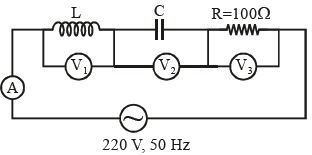
In the given circuit,the readings of voltmeters $V_1$ and $V_2$ are $300 \, V$ each. The readings of voltmeter $V_3$ and ammeter $A$ are respectively:
A
$100 \, V, 2.0 \, A$
B
$220 \, V, 2.2 \, A$
C
$150 \, V, 2.2 \, A$
D
$220 \, V, 2.0 \, A$
Solution
(B) In an $LCR$ series circuit,the voltage across the inductor is $V_L$ (reading of $V_1$) and across the capacitor is $V_C$ (reading of $V_2$).
Given $V_1 = V_L = 300 \, V$ and $V_2 = V_C = 300 \, V$.
Since $V_L = V_C$,the circuit is in a state of electrical resonance.
At resonance,the net impedance $Z$ of the circuit is equal to the resistance $R$,so $Z = R = 100 \, \Omega$.
The total voltage applied is $V = 220 \, V$.
The current $I$ in the circuit is given by $I = \frac{V}{Z} = \frac{220 \, V}{100 \, \Omega} = 2.2 \, A$.
This is the reading of the ammeter $A$.
At resonance,the total voltage $V$ is equal to the voltage across the resistor $V_R$ (reading of $V_3$).
Therefore,$V_3 = V_R = V = 220 \, V$.
Thus,the reading of $V_3$ is $220 \, V$ and the reading of $A$ is $2.2 \, A$.
Given $V_1 = V_L = 300 \, V$ and $V_2 = V_C = 300 \, V$.
Since $V_L = V_C$,the circuit is in a state of electrical resonance.
At resonance,the net impedance $Z$ of the circuit is equal to the resistance $R$,so $Z = R = 100 \, \Omega$.
The total voltage applied is $V = 220 \, V$.
The current $I$ in the circuit is given by $I = \frac{V}{Z} = \frac{220 \, V}{100 \, \Omega} = 2.2 \, A$.
This is the reading of the ammeter $A$.
At resonance,the total voltage $V$ is equal to the voltage across the resistor $V_R$ (reading of $V_3$).
Therefore,$V_3 = V_R = V = 220 \, V$.
Thus,the reading of $V_3$ is $220 \, V$ and the reading of $A$ is $2.2 \, A$.
0 likesView Solution
59
ChemistryMCQAIPMT · 2010
Oxidation states of $P$ in $H_4P_2O_5, H_4P_2O_6, H_4P_2O_7$ are respectively:
A
$+3, +4, +5$
B
$+3, +5, +4$
C
$+5, +3, +4$
D
$+5, +4, +3$
Solution
(A) For $H_4P_2O_5$: $4(+1) + 2x + 5(-2) = 0$ $\Rightarrow 2x = +6$ $\Rightarrow x = +3$.
For $H_4P_2O_6$: $4(+1) + 2x + 6(-2) = 0$ $\Rightarrow 2x = +8$ $\Rightarrow x = +4$.
For $H_4P_2O_7$: $4(+1) + 2x + 7(-2) = 0$ $\Rightarrow 2x = +10$ $\Rightarrow x = +5$.
Thus,the oxidation states are $+3, +4, +5$.
For $H_4P_2O_6$: $4(+1) + 2x + 6(-2) = 0$ $\Rightarrow 2x = +8$ $\Rightarrow x = +4$.
For $H_4P_2O_7$: $4(+1) + 2x + 7(-2) = 0$ $\Rightarrow 2x = +10$ $\Rightarrow x = +5$.
Thus,the oxidation states are $+3, +4, +5$.
0 likesView Solution
60
ChemistryMCQAIPMT · 2010
Which of the following complex ions is not expected to absorb visible light?
A
$[Ni(H_2O)_6]^{2+}$
B
$[Ni(CN)_4]^{2-}$
C
$[Cr(NH_3)_6]^{3+}$
D
$[Fe(H_2O)_6]^{2+}$
Solution
(B) complex ion absorbs visible light if it has unpaired electrons,which allows for $d-d$ transitions.
In $[Ni(CN)_4]^{2-}$,$Ni$ is in the $+2$ oxidation state ($3d^8$ configuration).
Since $CN^-$ is a strong field ligand,it causes pairing of electrons,resulting in a square planar geometry with zero unpaired electrons.
Therefore,it does not undergo $d-d$ transitions and is not expected to absorb visible light.
In $[Ni(CN)_4]^{2-}$,$Ni$ is in the $+2$ oxidation state ($3d^8$ configuration).
Since $CN^-$ is a strong field ligand,it causes pairing of electrons,resulting in a square planar geometry with zero unpaired electrons.
Therefore,it does not undergo $d-d$ transitions and is not expected to absorb visible light.
0 likesView Solution
61
ChemistryMCQAIPMT · 2010
Which one of the following is employed as a tranquilizer drug?
A
Mifepristone
B
Promethazine
C
Valium
D
Naproxen
Solution
(C) Valium is a tranquilizer drug.
It is mainly used to treat anxiety,insomnia,and symptoms of acute alcohol withdrawal.
It acts by enhancing the effects of gamma-aminobutyric acid $(GABA)$ in the brain.
It is mainly used to treat anxiety,insomnia,and symptoms of acute alcohol withdrawal.
It acts by enhancing the effects of gamma-aminobutyric acid $(GABA)$ in the brain.
0 likesView Solution
62
ChemistryMCQAIPMT · 2010
How many bridging oxygen atoms are present in $P_4O_{10}$?
A
$4$
B
$2$
C
$5$
D
$6$
Solution
(D) The structure of $P_4O_{10}$ consists of a tetrahedral arrangement of four phosphorus atoms.
Each phosphorus atom is bonded to three other phosphorus atoms through oxygen bridges ($P-O-P$ bonds).
There are $6$ such bridging oxygen atoms in the structure.
Additionally,each phosphorus atom is bonded to one terminal oxygen atom via a double bond $(P=O)$,totaling $4$ terminal oxygen atoms.
Thus,the total number of bridging oxygen atoms is $6$.
Each phosphorus atom is bonded to three other phosphorus atoms through oxygen bridges ($P-O-P$ bonds).
There are $6$ such bridging oxygen atoms in the structure.
Additionally,each phosphorus atom is bonded to one terminal oxygen atom via a double bond $(P=O)$,totaling $4$ terminal oxygen atoms.
Thus,the total number of bridging oxygen atoms is $6$.
0 likesView Solution
63
ChemistryMCQAIPMT · 2010
Which of the following complex ions is not expected to absorb visible light?
A
$[Ni(H_2O)_6]^{2+}$
B
$[Ni(CN)_4]^{2-}$
C
$[Cr(NH_3)_6]^{3+}$
D
$[Fe(H_2O)_6]^{2+}$
Solution
(B) complex ion absorbs visible light if it contains unpaired electrons,which allow for $d-d$ transitions.
$1$. $[Ni(H_2O)_6]^{2+}$: $Ni^{2+}$ is $3d^8$,which has $2$ unpaired electrons.
$2$. $[Ni(CN)_4]^{2-}$: $Ni^{2+}$ is $3d^8$. $CN^-$ is a strong field ligand,causing pairing of electrons to form a $dsp^2$ square planar complex with $0$ unpaired electrons.
$3$. $[Cr(NH_3)_6]^{3+}$: $Cr^{3+}$ is $3d^3$,which has $3$ unpaired electrons.
$4$. $[Fe(H_2O)_6]^{2+}$: $Fe^{2+}$ is $3d^6$,which has $4$ unpaired electrons.
Since $[Ni(CN)_4]^{2-}$ has no unpaired electrons,it does not undergo $d-d$ transitions and is not expected to absorb visible light.
$1$. $[Ni(H_2O)_6]^{2+}$: $Ni^{2+}$ is $3d^8$,which has $2$ unpaired electrons.
$2$. $[Ni(CN)_4]^{2-}$: $Ni^{2+}$ is $3d^8$. $CN^-$ is a strong field ligand,causing pairing of electrons to form a $dsp^2$ square planar complex with $0$ unpaired electrons.
$3$. $[Cr(NH_3)_6]^{3+}$: $Cr^{3+}$ is $3d^3$,which has $3$ unpaired electrons.
$4$. $[Fe(H_2O)_6]^{2+}$: $Fe^{2+}$ is $3d^6$,which has $4$ unpaired electrons.
Since $[Ni(CN)_4]^{2-}$ has no unpaired electrons,it does not undergo $d-d$ transitions and is not expected to absorb visible light.
0 likesView Solution
64
ChemistryMCQAIPMT · 2010
$A$ lens having focal length $f$ and aperture of diameter $d$ forms an image of intensity $I$. If the central region of the lens with diameter $\frac{d}{2}$ is covered by black paper,what will be the new focal length and intensity of the image?
A
$f/2$ and $I/2$
B
$f$ and $I/4$
C
$3f/4$ and $I/2$
D
$f$ and $3I/4$
Solution
(D) The focal length $f$ of a lens depends on the refractive index of the material and the radii of curvature of its surfaces. Covering a part of the lens does not change these parameters,so the focal length remains $f$.
Intensity $I$ is proportional to the area of the aperture $A = \pi (d/2)^2 = \pi d^2/4$.
When the central part with diameter $d/2$ is covered,the radius of the covered part is $d/4$. The area of the covered part is $A_{covered} = \pi (d/4)^2 = \pi d^2/16 = A/4$.
The remaining area of the lens is $A' = A - A/4 = 3A/4$.
Since intensity $I$ is proportional to the area,the new intensity $I'$ is $I' = I \times (A'/A) = I \times (3/4) = 3I/4$.
Intensity $I$ is proportional to the area of the aperture $A = \pi (d/2)^2 = \pi d^2/4$.
When the central part with diameter $d/2$ is covered,the radius of the covered part is $d/4$. The area of the covered part is $A_{covered} = \pi (d/4)^2 = \pi d^2/16 = A/4$.
The remaining area of the lens is $A' = A - A/4 = 3A/4$.
Since intensity $I$ is proportional to the area,the new intensity $I'$ is $I' = I \times (A'/A) = I \times (3/4) = 3I/4$.
0 likesView Solution
65
ChemistryMCQAIPMT · 2010
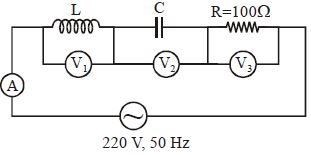
In the given circuit,the readings of voltmeters $V_1$ and $V_2$ are $300 \, V$ each. The readings of voltmeter $V_3$ and ammeter $A$ are respectively:
A
$100 \, V, 2.0 \, A$
B
$220 \, V, 2.2 \, A$
C
$150 \, V, 2.2 \, A$
D
$220 \, V, 2.0 \, A$
Solution
(B) In an $LCR$ series circuit,the voltage across the inductor $V_L$ and the capacitor $V_C$ are in opposite phases.
Given $V_1 = V_L = 300 \, V$ and $V_2 = V_C = 300 \, V$.
Since $V_L = V_C$,the circuit is in a state of resonance.
In resonance,the net voltage across the $LC$ combination is $V_{LC} = V_L - V_C = 300 - 300 = 0 \, V$.
The total applied voltage $V$ is equal to the voltage across the resistor $V_R$.
Therefore,$V_3 = V_R = V = 220 \, V$.
The current in the circuit is given by $I = \frac{V_R}{R} = \frac{220 \, V}{100 \, \Omega} = 2.2 \, A$.
Thus,the reading of voltmeter $V_3$ is $220 \, V$ and the reading of ammeter $A$ is $2.2 \, A$.
Given $V_1 = V_L = 300 \, V$ and $V_2 = V_C = 300 \, V$.
Since $V_L = V_C$,the circuit is in a state of resonance.
In resonance,the net voltage across the $LC$ combination is $V_{LC} = V_L - V_C = 300 - 300 = 0 \, V$.
The total applied voltage $V$ is equal to the voltage across the resistor $V_R$.
Therefore,$V_3 = V_R = V = 220 \, V$.
The current in the circuit is given by $I = \frac{V_R}{R} = \frac{220 \, V}{100 \, \Omega} = 2.2 \, A$.
Thus,the reading of voltmeter $V_3$ is $220 \, V$ and the reading of ammeter $A$ is $2.2 \, A$.
0 likesView Solution
66
ChemistryMCQAIPMT · 2010
$A$ man of $50\, kg$ mass is standing in a gravity-free space at a height of $10\, m$ above the floor. He throws a stone of $0.5\, kg$ mass downwards with a speed of $2\, m/s$. When the stone reaches the floor,the distance of the man above the floor will be ........ $m.$
A
$20$
B
$9.9$
C
$10.1$
D
$10$
Solution
(C) In a gravity-free space,there is no external force acting on the system (man + stone). Therefore,the center of mass of the system remains at rest.
Let the initial position of the center of mass be $Y_{cm} = 10\, m$ from the floor.
Let the man move upwards by a distance $x$ and the stone move downwards by a distance $y$ when the stone hits the floor.
The stone travels $10\, m$ downwards,so $y = 10\, m$.
Since the center of mass remains stationary,the displacement of the center of mass is zero: $m_1 \Delta y_1 + m_2 \Delta y_2 = 0$.
Here,$m_1 = 50\, kg$,$\Delta y_1 = x$ (upwards),$m_2 = 0.5\, kg$,$\Delta y_2 = -10\, m$ (downwards).
$50(x) + 0.5(-10) = 0$.
$50x = 5$.
$x = 0.1\, m$.
The new height of the man above the floor is $10 + x = 10 + 0.1 = 10.1\, m$.
Let the initial position of the center of mass be $Y_{cm} = 10\, m$ from the floor.
Let the man move upwards by a distance $x$ and the stone move downwards by a distance $y$ when the stone hits the floor.
The stone travels $10\, m$ downwards,so $y = 10\, m$.
Since the center of mass remains stationary,the displacement of the center of mass is zero: $m_1 \Delta y_1 + m_2 \Delta y_2 = 0$.
Here,$m_1 = 50\, kg$,$\Delta y_1 = x$ (upwards),$m_2 = 0.5\, kg$,$\Delta y_2 = -10\, m$ (downwards).
$50(x) + 0.5(-10) = 0$.
$50x = 5$.
$x = 0.1\, m$.
The new height of the man above the floor is $10 + x = 10 + 0.1 = 10.1\, m$.
0 likesView Solution
67
ChemistryMCQAIPMT · 2010
$A$ conducting circular loop is placed in a uniform magnetic field,$B = 0.025 \, T$,with its plane perpendicular to the magnetic field. The radius of the loop is made to shrink at a constant rate of $1 \, mm/s$. The induced $e.m.f.$ when the radius is $2 \, cm$ is
A
$2 \, \mu V$
B
$2 \pi \, \mu V$
C
$\pi \, \mu V$
D
$\frac{\pi}{2} \, \mu V$
Solution
(C) Magnetic field,$B = 0.025 \, T$.
Radius of the loop,$r = 2 \, cm = 2 \times 10^{-2} \, m$.
Constant rate at which the radius of the loop shrinks,$\frac{dr}{dt} = 1 \times 10^{-3} \, m/s$.
Magnetic flux linked with the loop is $\phi = B A \cos \theta = B(\pi r^2) \cos 0^{\circ} = B \pi r^2$.
The magnitude of the induced $e.m.f.$ is $|\varepsilon| = \frac{d\phi}{dt} = \frac{d}{dt}(B \pi r^2) = B \pi (2r) \frac{dr}{dt}$.
Substituting the values:
$|\varepsilon| = 0.025 \times \pi \times 2 \times (2 \times 10^{-2}) \times (1 \times 10^{-3})$.
$|\varepsilon| = 0.025 \times \pi \times 4 \times 10^{-5} = 0.1 \times 10^{-5} \times \pi = 1 \times 10^{-6} \pi \, V$.
$|\varepsilon| = \pi \, \mu V$.
Radius of the loop,$r = 2 \, cm = 2 \times 10^{-2} \, m$.
Constant rate at which the radius of the loop shrinks,$\frac{dr}{dt} = 1 \times 10^{-3} \, m/s$.
Magnetic flux linked with the loop is $\phi = B A \cos \theta = B(\pi r^2) \cos 0^{\circ} = B \pi r^2$.
The magnitude of the induced $e.m.f.$ is $|\varepsilon| = \frac{d\phi}{dt} = \frac{d}{dt}(B \pi r^2) = B \pi (2r) \frac{dr}{dt}$.
Substituting the values:
$|\varepsilon| = 0.025 \times \pi \times 2 \times (2 \times 10^{-2}) \times (1 \times 10^{-3})$.
$|\varepsilon| = 0.025 \times \pi \times 4 \times 10^{-5} = 0.1 \times 10^{-5} \times \pi = 1 \times 10^{-6} \pi \, V$.
$|\varepsilon| = \pi \, \mu V$.
0 likesView Solution
68
ChemistryMCQAIPMT · 2010
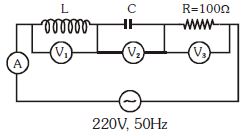
In the given circuit,the readings of voltmeters $V_1$ and $V_2$ are $300 \, V$ each. The readings of the voltmeter $V_3$ and ammeter $A$ are respectively:
A
$100 \, V, 2.0 \, A$
B
$150 \, V, 2.2 \, A$
C
$220 \, V, 2.2 \, A$
D
$220 \, V, 2.0 \, A$
Solution
(C) In an $LCR$ series circuit,the voltage across the inductor $V_L$ and the capacitor $V_C$ are $180^{\circ}$ out of phase.
Given $V_1 = V_L = 300 \, V$ and $V_2 = V_C = 300 \, V$.
The net voltage across the $LC$ combination is $V_{LC} = |V_L - V_C| = |300 - 300| = 0 \, V$.
The total supply voltage $V$ is given by $V = \sqrt{V_R^2 + (V_L - V_C)^2}$.
Since $V = 220 \, V$ and $(V_L - V_C) = 0$,we have $V = V_R = 220 \, V$.
Thus,the reading of voltmeter $V_3$ (which measures voltage across resistor $R$) is $V_3 = 220 \, V$.
The current $I$ in the circuit is given by $I = \frac{V_R}{R} = \frac{220 \, V}{100 \, \Omega} = 2.2 \, A$.
Therefore,the reading of ammeter $A$ is $2.2 \, A$.
Given $V_1 = V_L = 300 \, V$ and $V_2 = V_C = 300 \, V$.
The net voltage across the $LC$ combination is $V_{LC} = |V_L - V_C| = |300 - 300| = 0 \, V$.
The total supply voltage $V$ is given by $V = \sqrt{V_R^2 + (V_L - V_C)^2}$.
Since $V = 220 \, V$ and $(V_L - V_C) = 0$,we have $V = V_R = 220 \, V$.
Thus,the reading of voltmeter $V_3$ (which measures voltage across resistor $R$) is $V_3 = 220 \, V$.
The current $I$ in the circuit is given by $I = \frac{V_R}{R} = \frac{220 \, V}{100 \, \Omega} = 2.2 \, A$.
Therefore,the reading of ammeter $A$ is $2.2 \, A$.
0 likesView Solution
69
ChemistryMediumMCQAIPMT · 2010
The number of atoms in $0.1 \ mol$ of a triatomic gas is $(N_A = 6.02 \times 10^{23} \ mol^{-1})$
A
$1.800 \times 10^{22}$
B
$6.026 \times 10^{22}$
C
$1.806 \times 10^{23}$
D
$3.600 \times 10^{23}$
Solution
(C) The number of moles of the gas is $0.1 \ mol$.
Since the gas is triatomic,each molecule contains $3$ atoms.
The number of molecules $= \text{moles} \times N_A = 0.1 \times 6.02 \times 10^{23} = 6.02 \times 10^{22} \ \text{molecules}$.
The number of atoms $= \text{number of molecules} \times 3 = 6.02 \times 10^{22} \times 3 = 1.806 \times 10^{23} \ \text{atoms}$.
Since the gas is triatomic,each molecule contains $3$ atoms.
The number of molecules $= \text{moles} \times N_A = 0.1 \times 6.02 \times 10^{23} = 6.02 \times 10^{22} \ \text{molecules}$.
The number of atoms $= \text{number of molecules} \times 3 = 6.02 \times 10^{22} \times 3 = 1.806 \times 10^{23} \ \text{atoms}$.
0 likesView Solution
70
ChemistryMCQAIPMT · 2010
$A$ square current-carrying loop is suspended in a uniform magnetic field acting in the plane of the loop. If the force on one arm of the loop is $\vec{F}$,what is the net force on the remaining three arms of the loop?
A
$\vec{F}$
B
$3\vec{F}$
C
$-\vec{F}$
D
$-3\vec{F}$
Solution
(C) When a current-carrying loop is placed in a uniform magnetic field,the net magnetic force acting on the entire closed loop is zero.
Let $\vec{F}_{net}$ be the total force on the loop,which is given by $\vec{F}_{net} = \vec{F}_{arm1} + \vec{F}_{remaining} = 0$.
Given that the force on one arm is $\vec{F}$,we have $\vec{F} + \vec{F}_{remaining} = 0$.
Therefore,the net force on the remaining three arms is $\vec{F}_{remaining} = -\vec{F}$.
Let $\vec{F}_{net}$ be the total force on the loop,which is given by $\vec{F}_{net} = \vec{F}_{arm1} + \vec{F}_{remaining} = 0$.
Given that the force on one arm is $\vec{F}$,we have $\vec{F} + \vec{F}_{remaining} = 0$.
Therefore,the net force on the remaining three arms is $\vec{F}_{remaining} = -\vec{F}$.
0 likesView Solution
71
ChemistryMCQAIPMT · 2010
$AB$ crystallizes in a body-centred cubic lattice with edge length '$a$' equal to $387 \ pm$. The distance between two oppositely charged ions in the lattice is ............. $pm$.
A
$335$
B
$250$
C
$200$
D
$300$
Solution
(A) In a body-centred cubic $(BCC)$ lattice,the atoms touch along the body diagonal.
The body diagonal length is given by $a \sqrt{3}$.
The distance between two oppositely charged ions (nearest neighbour distance) is half of the body diagonal.
Distance $= \frac{a \sqrt{3}}{2}$.
Given $a = 387 \ pm$.
Distance $= \frac{387 \times 1.732}{2} \approx 335 \ pm$.
The body diagonal length is given by $a \sqrt{3}$.
The distance between two oppositely charged ions (nearest neighbour distance) is half of the body diagonal.
Distance $= \frac{a \sqrt{3}}{2}$.
Given $a = 387 \ pm$.
Distance $= \frac{387 \times 1.732}{2} \approx 335 \ pm$.
0 likesView Solution
72
ChemistryMCQAIPMT · 2010
How many bridging oxygen atoms are present in $P_4O_{10}$?
A
$5$
B
$6$
C
$4$
D
$2$
Solution
(B) The structure of $P_4O_{10}$ consists of four phosphorus atoms at the corners of a tetrahedron. Each phosphorus atom is bonded to one terminal oxygen atom via a double bond $(P=O)$. The remaining six oxygen atoms act as bridging atoms,each connecting two phosphorus atoms ($P-O-P$ linkages). Therefore,there are $6$ bridging oxygen atoms in the $P_4O_{10}$ molecule.
0 likesView Solution
73
ChemistryMCQAIPMT · 2010
$A$ series combination of $n_1$ capacitors,each of value $C_1$,is charged by a source of potential difference $4V$. When another parallel combination of $n_2$ capacitors,each of value $C_2$,is charged by a source of potential difference $V$,it has the same total energy stored in it as the first combination. The value of $C_2$,in terms of $C_1$,is:
A
$\frac{2C_1}{n_1n_2}$
B
$16\frac{n_2}{n_1}C_1$
C
$2\frac{n_2}{n_1}C_1$
D
$\frac{16C_1}{n_1n_2}$
Solution
(D) In series,the equivalent capacitance is $C_S = \frac{C_1}{n_1}$.
Energy stored,$E_S = \frac{1}{2} C_S V_S^2 = \frac{1}{2} \left(\frac{C_1}{n_1}\right) (4V)^2 = \frac{8 C_1 V^2}{n_1}$.
In parallel,the equivalent capacitance is $C_P = n_2 C_2$.
Energy stored,$E_P = \frac{1}{2} C_P V_P^2 = \frac{1}{2} (n_2 C_2) (V)^2 = \frac{n_2 C_2 V^2}{2}$.
Given that $E_S = E_P$,we have:
$\frac{8 C_1 V^2}{n_1} = \frac{n_2 C_2 V^2}{2}$.
Solving for $C_2$:
$C_2 = \frac{16 C_1}{n_1 n_2}$.
Energy stored,$E_S = \frac{1}{2} C_S V_S^2 = \frac{1}{2} \left(\frac{C_1}{n_1}\right) (4V)^2 = \frac{8 C_1 V^2}{n_1}$.
In parallel,the equivalent capacitance is $C_P = n_2 C_2$.
Energy stored,$E_P = \frac{1}{2} C_P V_P^2 = \frac{1}{2} (n_2 C_2) (V)^2 = \frac{n_2 C_2 V^2}{2}$.
Given that $E_S = E_P$,we have:
$\frac{8 C_1 V^2}{n_1} = \frac{n_2 C_2 V^2}{2}$.
Solving for $C_2$:
$C_2 = \frac{16 C_1}{n_1 n_2}$.
0 likesView Solution
74
ChemistryMCQAIPMT · 2010
$A$ gramophone record is revolving with an angular velocity $\omega$. $A$ coin is placed at a distance $R$ from the centre of the record. The static coefficient of friction is $\mu$. The coin will revolve with the record if
A
$R > \frac{\mu g}{\omega^2}$
B
$R = \frac{\mu g}{\omega^2}$ only
C
$R < \frac{\mu g}{\omega^2}$
D
$R \leq \frac{\mu g}{\omega^2}$
Solution
(D) For the coin to revolve with the record without slipping,the required centripetal force must be provided by the static frictional force.
The centripetal force required is $F_c = mR\omega^2$.
The maximum static frictional force available is $f_{s,max} = \mu N = \mu mg$.
For the coin to remain stationary relative to the record,the centripetal force must be less than or equal to the maximum static friction:
$mR\omega^2 \leq \mu mg$
Dividing both sides by $m\omega^2$,we get:
$R \leq \frac{\mu g}{\omega^2}$
The centripetal force required is $F_c = mR\omega^2$.
The maximum static frictional force available is $f_{s,max} = \mu N = \mu mg$.
For the coin to remain stationary relative to the record,the centripetal force must be less than or equal to the maximum static friction:
$mR\omega^2 \leq \mu mg$
Dividing both sides by $m\omega^2$,we get:
$R \leq \frac{\mu g}{\omega^2}$
0 likesView Solution
75
ChemistryMCQAIPMT · 2010
An increase in equivalent conductance of a strong electrolyte with dilution is mainly due to
A
Increase in number of ions
B
Increase in ionic mobility of ions
C
$100\%$ ionisation of electrolyte at normal dilution
D
Increase in both i.e. number of ions and ionic mobility of ions
Solution
(B) Strong electrolytes are completely ionised at all concentrations.
On increasing dilution,the number of ions remains the same,but the inter-ionic attractions decrease,which leads to an increase in the ionic mobility of the ions.
Therefore,the equivalent conductance increases.
On increasing dilution,the number of ions remains the same,but the inter-ionic attractions decrease,which leads to an increase in the ionic mobility of the ions.
Therefore,the equivalent conductance increases.
0 likesView Solution
76
ChemistryMCQAIPMT · 2010
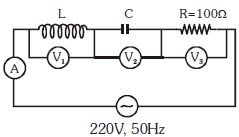
In the given circuit,the readings of voltmeters $V_1$ and $V_2$ are $300 \, V$ each. The readings of the voltmeter $V_3$ and ammeter $A$ are respectively:
A
$100 \, V, \, 2.0 \, A$
B
$150 \, V, \, 2.2 \, A$
C
$220 \, V, \, 2.2 \, A$
D
$220 \, V, \, 2.0 \, A$
Solution
(C) The circuit is an $LCR$ series circuit connected to an $AC$ source of $220 \, V$.
Given: $V_L = V_1 = 300 \, V$ and $V_C = V_2 = 300 \, V$.
Since $V_L = V_C$,the circuit is in resonance.
In a series $LCR$ circuit at resonance,the net voltage across the $LC$ combination is zero $(V_{LC} = V_L - V_C = 300 - 300 = 0 \, V)$.
Therefore,the entire source voltage appears across the resistor $R$.
Thus,the reading of voltmeter $V_3$ is $V_R = 220 \, V$.
The current $I$ in the circuit is given by $I = \frac{V_R}{R} = \frac{220 \, V}{100 \, \Omega} = 2.2 \, A$.
So,the reading of voltmeter $V_3$ is $220 \, V$ and the reading of ammeter $A$ is $2.2 \, A$.
Given: $V_L = V_1 = 300 \, V$ and $V_C = V_2 = 300 \, V$.
Since $V_L = V_C$,the circuit is in resonance.
In a series $LCR$ circuit at resonance,the net voltage across the $LC$ combination is zero $(V_{LC} = V_L - V_C = 300 - 300 = 0 \, V)$.
Therefore,the entire source voltage appears across the resistor $R$.
Thus,the reading of voltmeter $V_3$ is $V_R = 220 \, V$.
The current $I$ in the circuit is given by $I = \frac{V_R}{R} = \frac{220 \, V}{100 \, \Omega} = 2.2 \, A$.
So,the reading of voltmeter $V_3$ is $220 \, V$ and the reading of ammeter $A$ is $2.2 \, A$.
0 likesView Solution
77
ChemistryMCQAIPMT · 2010
$A$ gramophone record is revolving with an angular velocity $\omega$. $A$ coin is placed at a distance $r$ from the centre of the record. The static coefficient of friction is $\mu$. The coin will revolve with the record if
A
$r \ge \frac{\mu g}{\omega^2}$
B
$r = \mu g \omega^2$
C
$r < \frac{\omega^2}{\mu g}$
D
$r \le \frac{\mu g}{\omega^2}$
Solution
(D) For the coin to revolve with the record without slipping,the required centripetal force must be provided by the static frictional force.
The centripetal force required for circular motion is $F_c = m \omega^2 r$.
The maximum static frictional force available is $f_{s, \text{max}} = \mu N = \mu m g$.
For the coin to stay in place,the static friction must be greater than or equal to the required centripetal force:
$f_{s, \text{max}} \ge F_c$
Substituting the expressions:
$\mu m g \ge m \omega^2 r$
Dividing both sides by $m \omega^2$ (assuming $m$ and $\omega$ are non-zero):
$r \le \frac{\mu g}{\omega^2}$
The centripetal force required for circular motion is $F_c = m \omega^2 r$.
The maximum static frictional force available is $f_{s, \text{max}} = \mu N = \mu m g$.
For the coin to stay in place,the static friction must be greater than or equal to the required centripetal force:
$f_{s, \text{max}} \ge F_c$
Substituting the expressions:
$\mu m g \ge m \omega^2 r$
Dividing both sides by $m \omega^2$ (assuming $m$ and $\omega$ are non-zero):
$r \le \frac{\mu g}{\omega^2}$
0 likesView Solution
78
ChemistryMCQAIPMT · 2010
$A$ particle of mass $M$ starting from rest undergoes uniform acceleration. If the speed acquired in time $T$ is $V$,then the power delivered to the particle in time $T$ is:
A
$\frac{1}{2} \frac{M V^{2}}{T^{2}}$
B
$\frac{M V^{2}}{T^{2}}$
C
$\frac{1}{2} \frac{M V^{2}}{T}$
D
$\frac{M V^{2}}{T}$
Solution
(C) The particle starts from rest,so its initial velocity $u = 0$.
After time $T$,the final velocity is $V$.
The work done on the particle is equal to the change in its kinetic energy,according to the work-energy theorem.
$W = \Delta K = \frac{1}{2} M V^{2} - \frac{1}{2} M u^{2} = \frac{1}{2} M V^{2} - 0 = \frac{1}{2} M V^{2}$.
The average power delivered to the particle in time $T$ is defined as the work done divided by the time taken.
$P_{\text{avg}} = \frac{W}{T} = \frac{\frac{1}{2} M V^{2}}{T} = \frac{1}{2} \frac{M V^{2}}{T}$.
After time $T$,the final velocity is $V$.
The work done on the particle is equal to the change in its kinetic energy,according to the work-energy theorem.
$W = \Delta K = \frac{1}{2} M V^{2} - \frac{1}{2} M u^{2} = \frac{1}{2} M V^{2} - 0 = \frac{1}{2} M V^{2}$.
The average power delivered to the particle in time $T$ is defined as the work done divided by the time taken.
$P_{\text{avg}} = \frac{W}{T} = \frac{\frac{1}{2} M V^{2}}{T} = \frac{1}{2} \frac{M V^{2}}{T}$.
0 likesView Solution
79
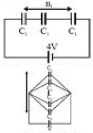
ChemistryMCQAIPMT · 2010
$A$ series combination of $n_1$ capacitors,each of value $C_1$,is charged by a source of potential difference $4V$. When another parallel combination of $n_2$ capacitors,each of value $C_2$,is charged by a source of potential difference $V$,it has the same (total) energy stored in it as the first combination has. The value of $C_2$,in terms of $C_1$,is then
A
$\frac {2C_1}{n_1n_2}$
B
$16\frac{n_2}{n_1}C_1$
C
$2\frac{n_2}{n_1}C_1$
D
$\frac {16C_1}{n_1n_2}$
Solution
(D) For the series combination of $n_1$ capacitors of capacitance $C_1$ connected to a $4V$ source:
The equivalent capacitance is $C_s = \frac{C_1}{n_1}$.
The energy stored is $U_s = \frac{1}{2} C_s (4V)^2 = \frac{1}{2} \left( \frac{C_1}{n_1} \right) (16V^2) = \frac{8 C_1 V^2}{n_1}$.
For the parallel combination of $n_2$ capacitors of capacitance $C_2$ connected to a $V$ source:
The equivalent capacitance is $C_p = n_2 C_2$.
The energy stored is $U_p = \frac{1}{2} C_p V^2 = \frac{1}{2} (n_2 C_2) V^2$.
Given that $U_s = U_p$:
$\frac{8 C_1 V^2}{n_1} = \frac{1}{2} n_2 C_2 V^2$.
Solving for $C_2$:
$C_2 = \frac{16 C_1}{n_1 n_2}$.
The equivalent capacitance is $C_s = \frac{C_1}{n_1}$.
The energy stored is $U_s = \frac{1}{2} C_s (4V)^2 = \frac{1}{2} \left( \frac{C_1}{n_1} \right) (16V^2) = \frac{8 C_1 V^2}{n_1}$.
For the parallel combination of $n_2$ capacitors of capacitance $C_2$ connected to a $V$ source:
The equivalent capacitance is $C_p = n_2 C_2$.
The energy stored is $U_p = \frac{1}{2} C_p V^2 = \frac{1}{2} (n_2 C_2) V^2$.
Given that $U_s = U_p$:
$\frac{8 C_1 V^2}{n_1} = \frac{1}{2} n_2 C_2 V^2$.
Solving for $C_2$:
$C_2 = \frac{16 C_1}{n_1 n_2}$.
0 likesView Solution
80
ChemistryMCQAIPMT · 2010
Two parallel metal plates having charges $+Q$ and $-Q$ face each other at a certain distance between them. If the plates are now dipped in a kerosene oil tank,the electric field between the plates will
A
Increase
B
Decrease
C
Remain same
D
Become zero
Solution
(B) The electric field between two parallel plates is given by $E = \frac{\sigma}{\epsilon_0 K}$,where $\sigma$ is the surface charge density,$\epsilon_0$ is the permittivity of free space,and $K$ is the dielectric constant of the medium.
When the plates are dipped in kerosene oil,the medium between the plates changes from air (or vacuum) to kerosene oil.
The dielectric constant $K$ of kerosene oil is greater than $1$ $(K > 1)$.
Since the charge $Q$ on the plates remains constant,the surface charge density $\sigma = \frac{Q}{A}$ also remains constant.
Therefore,the new electric field $E'$ becomes $E' = \frac{E}{K}$.
Since $K > 1$,the electric field $E'$ will be less than the original electric field $E$. Thus,the electric field decreases.
When the plates are dipped in kerosene oil,the medium between the plates changes from air (or vacuum) to kerosene oil.
The dielectric constant $K$ of kerosene oil is greater than $1$ $(K > 1)$.
Since the charge $Q$ on the plates remains constant,the surface charge density $\sigma = \frac{Q}{A}$ also remains constant.
Therefore,the new electric field $E'$ becomes $E' = \frac{E}{K}$.
Since $K > 1$,the electric field $E'$ will be less than the original electric field $E$. Thus,the electric field decreases.
0 likesView Solution
81
ChemistryMCQAIPMT · 2010
$A$ lens having focal length $f$ and aperture of diameter $d$ forms an image of intensity $I$. If the central region of the lens with diameter $\frac{d}{2}$ is covered by black paper,what will be the new focal length and intensity of the image,respectively?
A
$f/2$ and $I/2$
B
$f$ and $I/4$
C
$3f/4$ and $I/2$
D
$f$ and $3I/4$
Solution
(D) The focal length $f$ of a lens depends on the refractive index of the material and the radii of curvature of its surfaces. Covering the central part of the lens does not change these parameters,so the focal length remains $f' = f$.
Intensity $I$ is proportional to the area of the aperture $A$. The initial area is $A = \pi (d/2)^2 = \pi d^2 / 4$.
The area of the covered central part is $A_{covered} = \pi (d/4)^2 = \pi d^2 / 16$.
The remaining area is $A' = A - A_{covered} = \frac{\pi d^2}{4} - \frac{\pi d^2}{16} = \frac{3\pi d^2}{16}$.
Since $I \propto A$,the new intensity $I'$ is given by $I' = I \times (A'/A) = I \times (3/4) = 3I/4$.
Intensity $I$ is proportional to the area of the aperture $A$. The initial area is $A = \pi (d/2)^2 = \pi d^2 / 4$.
The area of the covered central part is $A_{covered} = \pi (d/4)^2 = \pi d^2 / 16$.
The remaining area is $A' = A - A_{covered} = \frac{\pi d^2}{4} - \frac{\pi d^2}{16} = \frac{3\pi d^2}{16}$.
Since $I \propto A$,the new intensity $I'$ is given by $I' = I \times (A'/A) = I \times (3/4) = 3I/4$.
0 likesView Solution
82
ChemistryMCQAIPMT · 2010
$A$ student measures the distance traversed in free fall of a body,initially at rest in a given time. He uses this data to estimate $g$,the acceleration due to gravity. If the maximum percentage errors in measurement of the distance and the time are $e_1$ and $e_2$ respectively,the percentage error in the estimation of $g$ is
A
$e_1 + 2e_2$
B
$e_1 + e_2$
C
$e_1 - 2e_2$
D
$e_2 - e_1$
Solution
(A) The distance $h$ covered by a body in free fall starting from rest in time $t$ is given by the equation $h = \frac{1}{2} gt^2$.
Rearranging this formula to solve for $g$,we get $g = \frac{2h}{t^2}$.
According to the rules of error propagation,for a quantity $g = k \cdot h^a \cdot t^b$,the relative error is given by $\frac{\Delta g}{g} = a \frac{\Delta h}{h} + |b| \frac{\Delta t}{t}$.
Here,$a = 1$ and $b = -2$. Therefore,the maximum relative error is $\frac{\Delta g}{g} = \frac{\Delta h}{h} + 2 \frac{\Delta t}{t}$.
Multiplying by $100$ to express this as a percentage error,we get $\frac{\Delta g}{g} \times 100 = \left( \frac{\Delta h}{h} \times 100 \right) + 2 \left( \frac{\Delta t}{t} \times 100 \right)$.
Given that the percentage error in distance is $e_1$ and in time is $e_2$,the percentage error in $g$ is $e_1 + 2e_2$.
Rearranging this formula to solve for $g$,we get $g = \frac{2h}{t^2}$.
According to the rules of error propagation,for a quantity $g = k \cdot h^a \cdot t^b$,the relative error is given by $\frac{\Delta g}{g} = a \frac{\Delta h}{h} + |b| \frac{\Delta t}{t}$.
Here,$a = 1$ and $b = -2$. Therefore,the maximum relative error is $\frac{\Delta g}{g} = \frac{\Delta h}{h} + 2 \frac{\Delta t}{t}$.
Multiplying by $100$ to express this as a percentage error,we get $\frac{\Delta g}{g} \times 100 = \left( \frac{\Delta h}{h} \times 100 \right) + 2 \left( \frac{\Delta t}{t} \times 100 \right)$.
Given that the percentage error in distance is $e_1$ and in time is $e_2$,the percentage error in $g$ is $e_1 + 2e_2$.
0 likesView Solution
83
ChemistryMCQAIPMT · 2010
The period of oscillation of a mass $M$ suspended from a spring of negligible mass is $T$. If along with it another mass $M$ is also suspended,the period of oscillation will now be
A
$T$
B
$T/\sqrt{2}$
C
$2T$
D
$\sqrt{2}T$
Solution
(D) The period of oscillation for a mass-spring system is given by the formula $T = 2\pi \sqrt{\frac{m}{k}}$,where $m$ is the mass and $k$ is the spring constant.
Initially,the mass is $M$,so $T = 2\pi \sqrt{\frac{M}{k}}$.
When another mass $M$ is added,the total mass becomes $M' = M + M = 2M$.
The new period of oscillation $T'$ will be $T' = 2\pi \sqrt{\frac{2M}{k}}$.
Dividing the new period by the initial period: $\frac{T'}{T} = \frac{2\pi \sqrt{\frac{2M}{k}}}{2\pi \sqrt{\frac{M}{k}}} = \sqrt{\frac{2M}{M}} = \sqrt{2}$.
Therefore,the new period is $T' = \sqrt{2}T$.
Initially,the mass is $M$,so $T = 2\pi \sqrt{\frac{M}{k}}$.
When another mass $M$ is added,the total mass becomes $M' = M + M = 2M$.
The new period of oscillation $T'$ will be $T' = 2\pi \sqrt{\frac{2M}{k}}$.
Dividing the new period by the initial period: $\frac{T'}{T} = \frac{2\pi \sqrt{\frac{2M}{k}}}{2\pi \sqrt{\frac{M}{k}}} = \sqrt{\frac{2M}{M}} = \sqrt{2}$.
Therefore,the new period is $T' = \sqrt{2}T$.
0 likesView Solution
84
ChemistryMCQAIPMT · 2010
In a unilocular ovary with a single ovule,the placentation is
A
Marginal
B
Basal
C
Free central
D
Axile
Solution
(B) In basal placentation,the placenta develops at the base of the ovary and a single ovule is attached to it. The ovary is typically unilocular. Examples include sunflower and marigold.
0 likesView Solution
85
ChemistryMCQAIPMT · 2010
The chief water conducting elements of xylem in gymnosperms are
A
Vessels
B
Fibres
C
Transfusion tissue
D
Tracheids
Solution
(D) Tracheids are elongated,angular,dead cells with hard,lignified,wide lumens and narrow end walls.
The walls of tracheids possess different types of thickenings,and the unthickened areas (pits) of their walls allow the rapid movement of water from one tracheid to another.
Tracheids are the characteristic cell types of xylem tissues in gymnosperms and pteridophytes,where they serve as the chief elements for water conduction.
The walls of tracheids possess different types of thickenings,and the unthickened areas (pits) of their walls allow the rapid movement of water from one tracheid to another.
Tracheids are the characteristic cell types of xylem tissues in gymnosperms and pteridophytes,where they serve as the chief elements for water conduction.
0 likesView Solution
86
ChemistryMCQAIPMT · 2010
Which one of the following structures between two adjacent cells is an effective transport pathway?
A
Plasmodesmata
B
Plastoquinones
C
Endoplasmic reticulum
D
Plasmalemma
Solution
(A) Plasmodesmata are microscopic channels that traverse the cell walls of plant cells and some algal cells.
They act as an effective transport pathway between two adjacent cells.
These structures facilitate the transport of molecules and communication between the cytoplasm of neighboring cells.
They act as an effective transport pathway between two adjacent cells.
These structures facilitate the transport of molecules and communication between the cytoplasm of neighboring cells.
0 likesView Solution
87
ChemistryMCQAIPMT · 2010
An elaborate network of filamentous proteinaceous structures present in the cytoplasm which helps in the maintenance of cell shape is called
A
Thylakoid
B
Endoplasmic reticulum
C
Plasmalemma
D
Cytoskeleton
Solution
(D) Thylakoid: These are flattened sac-like structures present inside the chloroplast,involved in light-dependent reactions of photosynthesis.
Endoplasmic reticulum $(ER)$: This is a network of membranes involved in protein and lipid synthesis.
Plasmalemma: This is another term for the plasma membrane,which acts as the outer boundary of the cell.
Cytoskeleton: This is an elaborate network of filamentous proteinaceous structures (such as microtubules,microfilaments,and intermediate filaments) present in the cytoplasm that provides structural support,maintains cell shape,and facilitates cell motility.
Endoplasmic reticulum $(ER)$: This is a network of membranes involved in protein and lipid synthesis.
Plasmalemma: This is another term for the plasma membrane,which acts as the outer boundary of the cell.
Cytoskeleton: This is an elaborate network of filamentous proteinaceous structures (such as microtubules,microfilaments,and intermediate filaments) present in the cytoplasm that provides structural support,maintains cell shape,and facilitates cell motility.
0 likesView Solution
88
ChemistryMCQAIPMT · 2010
Which one of the following is not a micronutrient?
A
Molybdenum
B
Magnesium
C
Zinc
D
Boron
Solution
(B) Essential elements required by plants in relatively large amounts are called macronutrients,such as $C, H, O, N, P, K, Ca, S, Mg.$
Essential elements required by plants in very small amounts are called micronutrients or trace elements,such as $Fe, Mn, Zn, Cu, B, Mo, Cl$ and $Ni.$
Magnesium $(Mg)$ is a macronutrient because it is a constituent of the chlorophyll molecule and is required in significant quantities for plant growth and development.
Therefore,$Mg$ is not a micronutrient.
Essential elements required by plants in very small amounts are called micronutrients or trace elements,such as $Fe, Mn, Zn, Cu, B, Mo, Cl$ and $Ni.$
Magnesium $(Mg)$ is a macronutrient because it is a constituent of the chlorophyll molecule and is required in significant quantities for plant growth and development.
Therefore,$Mg$ is not a micronutrient.
0 likesView Solution
89
ChemistryMCQAIPMT · 2010
Phototropic curvature is the result of uneven distribution of
A
Gibberellin
B
Phytochrome
C
Cytokinins
D
Auxin
Solution
(D) Phototropic movement is the result of the uneven distribution of $Auxin$.
When a plant is exposed to light from one side,$Auxin$ migrates to the shaded side of the stem.
This higher concentration of $Auxin$ on the shaded side causes cells to elongate more rapidly than those on the illuminated side,leading to the bending or curvature of the plant towards the light source.
When a plant is exposed to light from one side,$Auxin$ migrates to the shaded side of the stem.
This higher concentration of $Auxin$ on the shaded side causes cells to elongate more rapidly than those on the illuminated side,leading to the bending or curvature of the plant towards the light source.
0 likesView Solution
90
ChemistryMCQAIPMT · 2010
If for some reason our goblet cells are non-functional,this will adversely affect:
A
Production of somatostatin
B
Secretion of sebum from the sebaceous glands
C
Maturation of sperms
D
Smooth movement of food downwards the intestine
Solution
(D) Goblet cells are specialized cells found in the columnar epithelium of the intestinal mucosa. They are responsible for the secretion of mucin,a glycoprotein that forms mucus when hydrated. Mucus acts as a lubricant,protecting the intestinal lining and facilitating the smooth movement of food (chyme) through the digestive tract. If goblet cells become non-functional,the lack of mucus will lead to friction and difficulty in the passage of food,thereby adversely affecting the smooth movement of food downwards the intestine.
0 likesView Solution
91
ChemistryMCQAIPMT · 2010
The principal nitrogenous excretory compound in humans is synthesized:
A
In kidneys,but eliminated mostly through liver
B
In kidneys as well as eliminated by kidneys
C
In liver and also eliminated by the same through bile
D
In the liver,but eliminated mostly through kidneys
Solution
(D) In humans,the principal nitrogenous excretory compound (i.e.,urea) is synthesized in the liver via the ornithine cycle. Urea is then transported through the blood and eliminated mostly through the kidneys as an excretory product.
0 likesView Solution
92
ChemistryMCQAIPMT · 2010
Injury to the adrenal cortex is not likely to affect the secretion of which one of the following?
A
Aldosterone
B
Both androstenedione and dehydroepiandrosterone
C
Adrenaline
D
Cortisol
Solution
(C) The adrenal gland is composed of two distinct parts: the adrenal cortex and the adrenal medulla.
Adrenaline (epinephrine) and noradrenaline (norepinephrine) are catecholamine hormones secreted by the adrenal medulla.
In contrast,the adrenal cortex secretes steroid hormones such as aldosterone (a mineralocorticoid),cortisol (a glucocorticoid),and sex steroids like androstenedione and dehydroepiandrosterone.
Since adrenaline is produced in the adrenal medulla,an injury to the adrenal cortex will not affect its secretion.
Adrenaline (epinephrine) and noradrenaline (norepinephrine) are catecholamine hormones secreted by the adrenal medulla.
In contrast,the adrenal cortex secretes steroid hormones such as aldosterone (a mineralocorticoid),cortisol (a glucocorticoid),and sex steroids like androstenedione and dehydroepiandrosterone.
Since adrenaline is produced in the adrenal medulla,an injury to the adrenal cortex will not affect its secretion.
0 likesView Solution
93
ChemistryMCQAIPMT · 2010
Which one of the following pairs is incorrectly matched?
A
Glucagon - Beta cells (source)
B
Somatostatin - Delta cells (source)
C
Corpus luteum - Relaxin (secretion)
D
Insulin - Diabetes mellitus (disease)
Solution
(A) In the pancreatic islets (Islets of Langerhans),$\alpha$-cells secrete glucagon,whereas $\beta$-cells secrete insulin.
Therefore,the pair 'Glucagon - Beta cells' is incorrectly matched because glucagon is secreted by $\alpha$-cells,not $\beta$-cells.
Somatostatin is correctly secreted by $\delta$-cells.
Corpus luteum secretes relaxin during the later stages of pregnancy.
Deficiency or dysfunction of insulin leads to diabetes mellitus.
Therefore,the pair 'Glucagon - Beta cells' is incorrectly matched because glucagon is secreted by $\alpha$-cells,not $\beta$-cells.
Somatostatin is correctly secreted by $\delta$-cells.
Corpus luteum secretes relaxin during the later stages of pregnancy.
Deficiency or dysfunction of insulin leads to diabetes mellitus.
0 likesView Solution
94
ChemistryMCQAIPMT · 2010
Vegetative propagation in Pistia occurs by:
A
Stolon
B
Offset
C
Runner
D
Sucker
Solution
(B) Vegetative propagation is a form of asexual reproduction in plants.
In aquatic plants like $Pistia$ and $Eichhornia$,vegetative propagation occurs through a specialized structure known as an $Offset$.
An $Offset$ is a lateral branch with short internodes and each node bears a rosette of leaves and a tuft of roots.
Therefore,the correct option is $B$.
In aquatic plants like $Pistia$ and $Eichhornia$,vegetative propagation occurs through a specialized structure known as an $Offset$.
An $Offset$ is a lateral branch with short internodes and each node bears a rosette of leaves and a tuft of roots.
Therefore,the correct option is $B$.
0 likesView Solution
95
ChemistryMCQAIPMT · 2010
Breeding of crops with high levels of minerals,vitamins,and proteins is called:
A
Somatic hybridization
B
Biofortification
C
Micropropagation
D
Biomagnification
Solution
(B) Biofortification is the process of breeding crops to increase their nutritional value. This includes increasing the levels of vitamins,minerals,proteins,and healthy fats. It is a practical and cost-effective method to improve public health by addressing hidden hunger or micronutrient deficiencies.
0 likesView Solution
96
ChemistryMCQAIPMT · 2010
Breeding of crops with high levels of minerals,vitamins,and proteins is called:
A
Somatic hybridization
B
Biofortification
C
Micropropagation
D
Biomagnification
Solution
(B) Biofortification is the process of breeding crops to increase their nutritional value. This includes increasing the levels of vitamins,minerals,and proteins to improve public health and combat malnutrition. Somatic hybridization involves the fusion of protoplasts from two different plant species. Micropropagation is a technique for rapid vegetative multiplication of plants using tissue culture. Biomagnification refers to the increasing concentration of toxic substances in the tissues of organisms at successively higher levels in a food chain.
0 likesView Solution
97
ChemistryMCQAIPMT · 2010
Vegetative propagation in $Pistia$ occurs by:
A
Stolon
B
Offset
C
Runner
D
Sucker
Solution
(B) Vegetative propagation in aquatic plants like $Pistia$ and $Eichhornia$ (water hyacinth) occurs through a specialized structure called an $Offset$.
An $Offset$ is a short,thick,horizontal branch that produces a rosette of leaves above and a tuft of roots below at the node.
Therefore,the correct option is $B$.
An $Offset$ is a short,thick,horizontal branch that produces a rosette of leaves above and a tuft of roots below at the node.
Therefore,the correct option is $B$.
0 likesView Solution
98
ChemistryMCQAIPMT · 2010
The part of the fallopian tube closest to the ovary is:
A
Isthmus
B
Infundibulum
C
Cervix
D
Ampulla
Solution
(B) The part of the fallopian tube closer to the ovary is the funnel-shaped $Infundibulum$.
It possesses finger-like projections called $fimbriae$,which help in the collection of the ovum after ovulation.
It possesses finger-like projections called $fimbriae$,which help in the collection of the ovum after ovulation.
0 likesView Solution
99
ChemistryMCQAIPMT · 2010
Seminal plasma in human males is rich in
A
Fructose and calcium
B
Glucose and calcium
C
$DNA$ and testosterone
D
Ribose and potassium
Solution
(A) Seminal plasma is composed of the fluid and sperms from the vas deferens (about $10 \%$ of the total),fluid from the seminal vesicles (almost $60 \%$ ),fluid from the prostate gland (about $30 \%$ ),and a small amount of secretions from the bulbourethral glands.
It is rich in fructose,calcium,citrate ions,phosphate ions,a clotting enzyme,profibrinolysin,inositol,prostaglandins,and several proteins.
Fructose serves as the primary energy source for the sperm,while calcium and other ions help in maintaining the motility and viability of the sperm.
It is rich in fructose,calcium,citrate ions,phosphate ions,a clotting enzyme,profibrinolysin,inositol,prostaglandins,and several proteins.
Fructose serves as the primary energy source for the sperm,while calcium and other ions help in maintaining the motility and viability of the sperm.
0 likesView Solution
100
ChemistryMCQAIPMT · 2010
The second maturation division of the mammalian ovum occurs:
A
Shortly after ovulation before the ovum makes entry into the fallopian tube
B
Until after the ovum has been penetrated by a sperm
C
Until the nucleus of the sperm has fused with that of the ovum
D
In the Graafian follicle following the first maturation division
Solution
(B) In the mammalian ovum,the process of meiosis occurs during the maturation phase.
Initially,the nucleus shifts towards the animal pole and undergoes meiosis-$I$.
The second meiotic division remains arrested at the metaphase-$II$ stage.
It is only completed after the penetration of the ovum by a sperm during the process of fertilization.
This division results in an unequal cytoplasmic cleavage,forming a large cell called the ootid (which contains almost all the cytoplasm) and a very small cell called the second polar body.
Initially,the nucleus shifts towards the animal pole and undergoes meiosis-$I$.
The second meiotic division remains arrested at the metaphase-$II$ stage.
It is only completed after the penetration of the ovum by a sperm during the process of fertilization.
This division results in an unequal cytoplasmic cleavage,forming a large cell called the ootid (which contains almost all the cytoplasm) and a very small cell called the second polar body.
0 likesView Solution
Vedclass Products
For Students
Vedclass Test Series
Mock tests in real AIPMT style covering Chemistry with performance analysis. 5-day free trial.
Start Free TrialFor Teachers
Exam Paper Generator
Generate Set A/B/C/D Chemistry papers from 7.5L+ questions in 2 minutes. 3 chapters free.
Try FreeFor Institutes
Online Exam Module
Run live AIPMT mock exams with unlimited students, 360° analytics & white-label branding.
See DemoFrequently Asked Questions
How many Chemistry questions are in AIPMT 2010?
There are 149 Chemistry questions from the AIPMT 2010 paper on Vedclass, each with a detailed step-by-step solution in English.
Are AIPMT 2010 Chemistry solutions available in English?
Yes. All solutions on this page are in English. You can also switch to English or Hindi using the language buttons above the questions.
Can I practice AIPMT 2010 Chemistry as a timed test?
Yes. Use the Vedclass Test Series to attempt a full AIPMT mock test covering Chemistry with time limits and instant score analysis.
Can teachers create Chemistry papers from AIPMT previous year questions?
Yes. The Vedclass Exam Paper Generator lets teachers mix AIPMT Chemistry questions and generate Set A/B/C/D papers in minutes.
For Teachers & Institutes
Build a Custom Chemistry Paper
Pick AIPMT 2010 Chemistry questions, set difficulty, and generate Set A/B/C/D in 2 minutes.