
ChemistryQ1–76 of 91 questions
Page 1 of 2 · English
1
ChemistryMCQAIPMT · 2009
Cyclic photophosphorylation results in the formation of:
A
$ATP$ and $NADPH$
B
$ATP, NADPH$ and $O_2$
C
$ATP$
D
$NADPH$
Solution
(C) Cyclic photophosphorylation involves only Photosystem $I$ $(PSI)$.
In this process,the excited electrons are cycled back to the reaction center $(P700)$ through an electron transport chain.
As the electrons move through the electron transport system,energy is released which is used to pump protons across the membrane,creating a proton gradient.
This gradient drives the synthesis of $ATP$ from $ADP$ and inorganic phosphate $(Pi)$ via $ATP$ synthase.
Unlike non-cyclic photophosphorylation,cyclic photophosphorylation does not involve the photolysis of water (so no $O_2$ is released) and does not reduce $NADP^+$ to $NADPH$.
In this process,the excited electrons are cycled back to the reaction center $(P700)$ through an electron transport chain.
As the electrons move through the electron transport system,energy is released which is used to pump protons across the membrane,creating a proton gradient.
This gradient drives the synthesis of $ATP$ from $ADP$ and inorganic phosphate $(Pi)$ via $ATP$ synthase.
Unlike non-cyclic photophosphorylation,cyclic photophosphorylation does not involve the photolysis of water (so no $O_2$ is released) and does not reduce $NADP^+$ to $NADPH$.
0 likesView Solution
2
ChemistryMCQAIPMT · 2009
The tissue that forms the supporting structure in our pinna (external ear) is also found in:
A
Tip of the nose
B
Vertebrae
C
Nails
D
Ear ossicles
Solution
(A) The pinna (external ear) is supported by cartilage,specifically elastic cartilage.
Elastic cartilage provides both strength and flexibility to the structure.
This type of cartilage is also found in the tip of the nose,the epiglottis,and the Eustachian tubes.
Therefore,the correct option is $A$.
Elastic cartilage provides both strength and flexibility to the structure.
This type of cartilage is also found in the tip of the nose,the epiglottis,and the Eustachian tubes.
Therefore,the correct option is $A$.
0 likesView Solution
3
ChemistryMCQAIPMT · 2009
Which of the following is a symbiotic nitrogen fixer?
A
Azolla
B
Glomus
C
Azotobacter
D
Frankia
Solution
(D) The correct answer is $D$.
$Frankia$ is a symbiotic nitrogen-fixing bacterium that forms root nodules in non-leguminous plants like $Alnus$.
$Azolla$ is a water fern that has a symbiotic relationship with the cyanobacterium $Anabaena$ $azollae$,but $Frankia$ is a classic example of a symbiotic nitrogen-fixing actinomycete.
$Glomus$ is a genus of fungi that forms mycorrhizal associations (not nitrogen fixation).
$Azotobacter$ is a free-living nitrogen-fixing bacterium.
$Frankia$ is a symbiotic nitrogen-fixing bacterium that forms root nodules in non-leguminous plants like $Alnus$.
$Azolla$ is a water fern that has a symbiotic relationship with the cyanobacterium $Anabaena$ $azollae$,but $Frankia$ is a classic example of a symbiotic nitrogen-fixing actinomycete.
$Glomus$ is a genus of fungi that forms mycorrhizal associations (not nitrogen fixation).
$Azotobacter$ is a free-living nitrogen-fixing bacterium.
0 likesView Solution
4
ChemistryMCQAIPMT · 2009
Antihistamines and steroids are administered for which of the following?
A
Anxiety
B
Cough
C
Headache
D
Allergy
Solution
(D) Allergies are the exaggerated response of the immune system to certain antigens present in the environment.
Common symptoms of allergies include sneezing,watery eyes,running nose,and difficulty in breathing.
These symptoms are caused by the release of chemicals like histamine and serotonin from the mast cells.
To quickly reduce the symptoms of allergy,drugs like antihistamines,adrenaline,and steroids are used.
Therefore,these medications are specifically administered to treat allergic reactions.
Common symptoms of allergies include sneezing,watery eyes,running nose,and difficulty in breathing.
These symptoms are caused by the release of chemicals like histamine and serotonin from the mast cells.
To quickly reduce the symptoms of allergy,drugs like antihistamines,adrenaline,and steroids are used.
Therefore,these medications are specifically administered to treat allergic reactions.
0 likesView Solution
5
ChemistryMCQAIPMT · 2009
Three concentric spherical shells have radii $a, b,$ and $c$ $(a < b < c)$ and have surface charge densities $\sigma, -\sigma,$ and $\sigma$ respectively. If the potentials on the surfaces of these shells are $V_A, V_B,$ and $V_C$ respectively,then for $c = a + b$,which of the following is true?
A
$V_C = V_B = V_A$
B
$V_C \neq V_B \neq V_A$
C
$V_C = V_B \neq V_A$
D
$V_C = V_A \neq V_B$
Solution
(D) Let the charges on the shells be $q_1, q_2,$ and $q_3$ respectively.
$q_1 = 4\pi a^2\sigma, q_2 = -4\pi b^2\sigma, q_3 = 4\pi c^2\sigma$.
The potential at the surface of shell $a$ is $V_A = \frac{kq_1}{a} + \frac{kq_2}{b} + \frac{kq_3}{c} = k4\pi\sigma(a - b + c)$.
The potential at the surface of shell $b$ is $V_B = \frac{kq_1}{b} + \frac{kq_2}{b} + \frac{kq_3}{c} = k4\pi\sigma(\frac{a^2}{b} - b + c)$.
The potential at the surface of shell $c$ is $V_C = \frac{kq_1}{c} + \frac{kq_2}{c} + \frac{kq_3}{c} = \frac{k4\pi\sigma}{c}(a^2 - b^2 + c^2)$.
Given $c = a + b$,then $c^2 = (a + b)^2 = a^2 + b^2 + 2ab$,so $a^2 - b^2 + c^2 = a^2 - b^2 + a^2 + b^2 + 2ab = 2a^2 + 2ab = 2a(a + b) = 2ac$.
Substituting this into $V_C$: $V_C = \frac{k4\pi\sigma}{c}(2ac) = k8\pi\sigma a$.
Also,$V_A = k4\pi\sigma(a - b + a + b) = k4\pi\sigma(2a) = k8\pi\sigma a$.
Thus,$V_A = V_C \neq V_B$.
$q_1 = 4\pi a^2\sigma, q_2 = -4\pi b^2\sigma, q_3 = 4\pi c^2\sigma$.
The potential at the surface of shell $a$ is $V_A = \frac{kq_1}{a} + \frac{kq_2}{b} + \frac{kq_3}{c} = k4\pi\sigma(a - b + c)$.
The potential at the surface of shell $b$ is $V_B = \frac{kq_1}{b} + \frac{kq_2}{b} + \frac{kq_3}{c} = k4\pi\sigma(\frac{a^2}{b} - b + c)$.
The potential at the surface of shell $c$ is $V_C = \frac{kq_1}{c} + \frac{kq_2}{c} + \frac{kq_3}{c} = \frac{k4\pi\sigma}{c}(a^2 - b^2 + c^2)$.
Given $c = a + b$,then $c^2 = (a + b)^2 = a^2 + b^2 + 2ab$,so $a^2 - b^2 + c^2 = a^2 - b^2 + a^2 + b^2 + 2ab = 2a^2 + 2ab = 2a(a + b) = 2ac$.
Substituting this into $V_C$: $V_C = \frac{k4\pi\sigma}{c}(2ac) = k8\pi\sigma a$.
Also,$V_A = k4\pi\sigma(a - b + a + b) = k4\pi\sigma(2a) = k8\pi\sigma a$.
Thus,$V_A = V_C \neq V_B$.
0 likesView Solution
6
ChemistryMCQAIPMT · 2009
The internal energy change in a system that has absorbed $2 \, kcal$ of heat and done $500 \, J$ of work is ........... $J$.
A
$7900$
B
$8200$
C
$5600$
D
$6400$
Solution
(A) According to the first law of thermodynamics,the heat energy supplied to a system is given by $dQ = dU + dW$,where $dU$ is the change in internal energy and $dW$ is the work done by the system.
Given:
Heat absorbed $dQ = 2 \, kcal = 2000 \, cal$.
Since $1 \, cal = 4.2 \, J$,we have $dQ = 2000 \times 4.2 \, J = 8400 \, J$.
Work done $dW = 500 \, J$.
Substituting these values into the equation:
$8400 \, J = dU + 500 \, J$
$dU = 8400 \, J - 500 \, J$
$dU = 7900 \, J$.
Therefore,the change in internal energy is $7900 \, J$.
Given:
Heat absorbed $dQ = 2 \, kcal = 2000 \, cal$.
Since $1 \, cal = 4.2 \, J$,we have $dQ = 2000 \times 4.2 \, J = 8400 \, J$.
Work done $dW = 500 \, J$.
Substituting these values into the equation:
$8400 \, J = dU + 500 \, J$
$dU = 8400 \, J - 500 \, J$
$dU = 7900 \, J$.
Therefore,the change in internal energy is $7900 \, J$.
1 likesView Solution
7
ChemistryMCQAIPMT · 2009
Under the influence of a uniform magnetic field,a charged particle is moving in a circle of radius $R$ with constant speed $v$. The time period of the motion
A
depends on both $R$ and $v$
B
is independent of both $R$ and $v$
C
depends on $R$ and not on $v$
D
depends on $v$ and not on $R$
Solution
(B) When a charged particle of mass $m$ and charge $q$ moves in a uniform magnetic field $B$ with speed $v$ perpendicular to the field,it experiences a magnetic Lorentz force that acts as a centripetal force.
The magnetic force is given by $F = qvB$.
The centripetal force required for circular motion is $F = \frac{mv^2}{R}$.
Equating the two forces: $qvB = \frac{mv^2}{R}$.
Solving for the radius $R$: $R = \frac{mv}{qB}$.
The angular velocity $\omega$ is given by $\omega = \frac{v}{R}$.
Substituting $R$: $\omega = \frac{v}{(mv/qB)} = \frac{qB}{m}$.
The time period $T$ is given by $T = \frac{2\pi}{\omega}$.
Substituting $\omega$: $T = \frac{2\pi m}{qB}$.
Since $T$ depends only on the mass $m$,charge $q$,and magnetic field $B$,it is independent of both the radius $R$ and the speed $v$.
The magnetic force is given by $F = qvB$.
The centripetal force required for circular motion is $F = \frac{mv^2}{R}$.
Equating the two forces: $qvB = \frac{mv^2}{R}$.
Solving for the radius $R$: $R = \frac{mv}{qB}$.
The angular velocity $\omega$ is given by $\omega = \frac{v}{R}$.
Substituting $R$: $\omega = \frac{v}{(mv/qB)} = \frac{qB}{m}$.
The time period $T$ is given by $T = \frac{2\pi}{\omega}$.
Substituting $\omega$: $T = \frac{2\pi m}{qB}$.
Since $T$ depends only on the mass $m$,charge $q$,and magnetic field $B$,it is independent of both the radius $R$ and the speed $v$.
0 likesView Solution
8
ChemistryMCQAIPMT · 2009
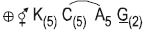
The floral formula (image) is that of
A
soybean
B
sunhemp
C
tobacco
D
tulip.
Solution
(c) : The floral formula of tobacco is (image). It belongs to the family Solanaceae. The flower is actinomorphic, bisexual, 5 sepals gamosepalous, $5$ gamopetalous corolla, $5$ epipetalous stamens and $2$ carpels syncarpous havingsuperior ovary.
0 likesView Solution
9
ChemistryMCQAIPMT · 2009
$DDT$ residues are rapidly passed through the food chain causing biomagnification because $DDT$ is:
A
moderately toxic
B
non-toxic to aquatic animals
C
water soluble
D
lipo soluble
Solution
(D) $DDT$ causes biomagnification because it is a non-biodegradable pollutant.
These substances are lipo-soluble (fat-soluble),which allows them to accumulate in the fatty tissues of organisms.
As they are not metabolized or excreted easily,their concentration increases at each successive trophic level in the food chain,a phenomenon known as biomagnification.
These substances are lipo-soluble (fat-soluble),which allows them to accumulate in the fatty tissues of organisms.
As they are not metabolized or excreted easily,their concentration increases at each successive trophic level in the food chain,a phenomenon known as biomagnification.
0 likesView Solution
10
ChemistryMCQAIPMT · 2009
$10 \ g$ of hydrogen and $64 \ g$ of oxygen were filled in a steel vessel and exploded. The amount of water produced in this reaction will be ........... $mol$.
A
$3$
B
$4$
C
$1$
D
$2$
Solution
(B) The balanced chemical equation for the reaction is: $2 H_2(g) + O_2(g) \rightarrow 2 H_2 O(l)$.
Calculate the number of moles for the reactants:
$n(H_2) = \frac{10 \ g}{2 \ g/mol} = 5 \ mol$.
$n(O_2) = \frac{64 \ g}{32 \ g/mol} = 2 \ mol$.
According to the stoichiometry,$1 \ mol$ of $O_2$ reacts with $2 \ mol$ of $H_2$ to produce $2 \ mol$ of $H_2 O$.
Here,$O_2$ is the limiting reagent because it will be consumed completely first ($2 \ mol$ of $O_2$ requires $4 \ mol$ of $H_2$,and we have $5 \ mol$ of $H_2$).
Since $1 \ mol$ of $O_2$ produces $2 \ mol$ of $H_2 O$,then $2 \ mol$ of $O_2$ will produce $2 \times 2 = 4 \ mol$ of $H_2 O$.
Calculate the number of moles for the reactants:
$n(H_2) = \frac{10 \ g}{2 \ g/mol} = 5 \ mol$.
$n(O_2) = \frac{64 \ g}{32 \ g/mol} = 2 \ mol$.
According to the stoichiometry,$1 \ mol$ of $O_2$ reacts with $2 \ mol$ of $H_2$ to produce $2 \ mol$ of $H_2 O$.
Here,$O_2$ is the limiting reagent because it will be consumed completely first ($2 \ mol$ of $O_2$ requires $4 \ mol$ of $H_2$,and we have $5 \ mol$ of $H_2$).
Since $1 \ mol$ of $O_2$ produces $2 \ mol$ of $H_2 O$,then $2 \ mol$ of $O_2$ will produce $2 \times 2 = 4 \ mol$ of $H_2 O$.
0 likesView Solution
11
ChemistryMediumMCQAIPMT · 2009
The maximum number of electrons in a subshell of an atom is determined by which of the following expressions?
A
$2l + 1$
B
$4l - 2$
C
$2n^2$
D
$4l + 2$
Solution
(D) For a given azimuthal quantum number $l$,the number of orbitals in a subshell is given by $(2l + 1)$.
Since each orbital can accommodate a maximum of $2$ electrons,the total number of electrons in a subshell is $2 \times (2l + 1) = 4l + 2$.
Since each orbital can accommodate a maximum of $2$ electrons,the total number of electrons in a subshell is $2 \times (2l + 1) = 4l + 2$.
0 likesView Solution
12
ChemistryMediumMCQAIPMT · 2009
Which of the following is not a permissible arrangement of electrons in an atom?
A
$n = 5, l = 3, m = 0, s = +1/2$
B
$n = 3, l = 2, m = -3, s = -1/2$
C
$n = 3, l = 2, m = -2, s = -1/2$
D
$n = 4, l = 0, m = 0, s = -1/2$
Solution
(B) For an electron in an atom,the quantum numbers must satisfy the following rules:
$1$. $n$ is a positive integer $(1, 2, 3, \dots)$.
$2$. $l$ can have values from $0$ to $(n - 1)$.
$3$. $m$ can have values from $-l$ to $+l$ (including $0$).
$4$. $s$ can be $+1/2$ or $-1/2$.
In option $B$,$n = 3$ and $l = 2$. The allowed values for $m$ are $-2, -1, 0, +1, +2$. Since $m = -3$ is outside this range,this arrangement is not permissible.
$1$. $n$ is a positive integer $(1, 2, 3, \dots)$.
$2$. $l$ can have values from $0$ to $(n - 1)$.
$3$. $m$ can have values from $-l$ to $+l$ (including $0$).
$4$. $s$ can be $+1/2$ or $-1/2$.
In option $B$,$n = 3$ and $l = 2$. The allowed values for $m$ are $-2, -1, 0, +1, +2$. Since $m = -3$ is outside this range,this arrangement is not permissible.
0 likesView Solution
13
ChemistryDifficultMCQAIPMT · 2009
Amongst the elements with the following electronic configurations,which one of them may have the highest ionisation energy?
A
$Ne [3s^2 3p^2]$
B
$Ar [3d^{10} 4s^2 4p^3]$
C
$Ne [3s^2 3p^1]$
D
$Ne [3s^2 3p^3]$
Solution
(D) Ionisation energy generally increases across a period due to a decrease in atomic size and effective nuclear charge.
Comparing the configurations:
$A: [Ne] 3s^2 3p^2$ (Period $3$,Group $14$)
$B: [Ar] 3d^{10} 4s^2 4p^3$ (Period $4$,Group $15$)
$C: [Ne] 3s^2 3p^1$ (Period $3$,Group $13$)
$D: [Ne] 3s^2 3p^3$ (Period $3$,Group $15$)
Elements in Period $3$ have smaller atomic radii than those in Period $4$,so elements in Period $3$ generally have higher ionisation energies than those in Period $4$.
Among the Period $3$ elements $(A, C, D)$,the configuration $[Ne] 3s^2 3p^3$ corresponds to a half-filled $p$-orbital,which is exceptionally stable.
Therefore,$[Ne] 3s^2 3p^3$ has the highest ionisation energy.
Comparing the configurations:
$A: [Ne] 3s^2 3p^2$ (Period $3$,Group $14$)
$B: [Ar] 3d^{10} 4s^2 4p^3$ (Period $4$,Group $15$)
$C: [Ne] 3s^2 3p^1$ (Period $3$,Group $13$)
$D: [Ne] 3s^2 3p^3$ (Period $3$,Group $15$)
Elements in Period $3$ have smaller atomic radii than those in Period $4$,so elements in Period $3$ generally have higher ionisation energies than those in Period $4$.
Among the Period $3$ elements $(A, C, D)$,the configuration $[Ne] 3s^2 3p^3$ corresponds to a half-filled $p$-orbital,which is exceptionally stable.
Therefore,$[Ne] 3s^2 3p^3$ has the highest ionisation energy.
0 likesView Solution
14
ChemistryMediumMCQAIPMT · 2009
What is the dominant intermolecular force or bond that must be overcome in converting liquid $CH_3OH$ to a gas?
A
Dipole-dipole interaction
B
Covalent bonds
C
London dispersion force
D
Hydrogen bonding
Solution
(D) When an $H$ atom is directly bonded to a highly electronegative atom like $N$,$O$,or $F$,a strong dipole is created,leading to the formation of intermolecular hydrogen bonding.
In liquid $CH_3OH$ (methanol),the $H$ atom is bonded to an $O$ atom,which allows for the formation of intermolecular hydrogen bonds between adjacent molecules.
To convert liquid $CH_3OH$ to a gas,these intermolecular hydrogen bonds must be overcome,as they are the dominant attractive forces holding the liquid molecules together.
In liquid $CH_3OH$ (methanol),the $H$ atom is bonded to an $O$ atom,which allows for the formation of intermolecular hydrogen bonds between adjacent molecules.
To convert liquid $CH_3OH$ to a gas,these intermolecular hydrogen bonds must be overcome,as they are the dominant attractive forces holding the liquid molecules together.
0 likesView Solution
15
ChemistryMediumMCQAIPMT · 2009
According to $MO$ theory,which of the following lists ranks the nitrogen species in terms of increasing bond order?
A
$N_2^{2-} < N_2^- < N_2$
B
$N_2 < N_2^{2-} < N_2^-$
C
$N_2^- < N_2^{2-} < N_2$
D
$N_2^- < N_2 < N_2^{2-}$
Solution
(A) The molecular orbital configuration for $N_2$ ($14$ electrons) is: $(\sigma 1s)^2(\sigma^* 1s)^2(\sigma 2s)^2(\sigma^* 2s)^2(\pi 2p_x)^2(\pi 2p_y)^2(\sigma 2p_z)^2$.
Bond order $(B.O.)$ $= \frac{10-4}{2} = 3$.
For $N_2^-$ ($15$ electrons): $(\sigma 1s)^2(\sigma^* 1s)^2(\sigma 2s)^2(\sigma^* 2s)^2(\pi 2p_x)^2(\pi 2p_y)^2(\sigma 2p_z)^2(\pi^* 2p_x)^1$.
$B.O. = \frac{10-5}{2} = 2.5$.
For $N_2^{2-}$ ($16$ electrons): $(\sigma 1s)^2(\sigma^* 1s)^2(\sigma 2s)^2(\sigma^* 2s)^2(\pi 2p_x)^2(\pi 2p_y)^2(\sigma 2p_z)^2(\pi^* 2p_x)^1(\pi^* 2p_y)^1$.
$B.O. = \frac{10-6}{2} = 2$.
Comparing the bond orders: $2 < 2.5 < 3$.
Therefore,the increasing order is $N_2^{2-} < N_2^- < N_2$.
Bond order $(B.O.)$ $= \frac{10-4}{2} = 3$.
For $N_2^-$ ($15$ electrons): $(\sigma 1s)^2(\sigma^* 1s)^2(\sigma 2s)^2(\sigma^* 2s)^2(\pi 2p_x)^2(\pi 2p_y)^2(\sigma 2p_z)^2(\pi^* 2p_x)^1$.
$B.O. = \frac{10-5}{2} = 2.5$.
For $N_2^{2-}$ ($16$ electrons): $(\sigma 1s)^2(\sigma^* 1s)^2(\sigma 2s)^2(\sigma^* 2s)^2(\pi 2p_x)^2(\pi 2p_y)^2(\sigma 2p_z)^2(\pi^* 2p_x)^1(\pi^* 2p_y)^1$.
$B.O. = \frac{10-6}{2} = 2$.
Comparing the bond orders: $2 < 2.5 < 3$.
Therefore,the increasing order is $N_2^{2-} < N_2^- < N_2$.
0 likesView Solution
16
ChemistryDifficultMCQAIPMT · 2009
In which of the following molecules/ions $BF_3$,$NO_2^-$,$NH_2^-$ and $H_2O$,the central atom is $sp^2$ hybridised?
A
$NH_2^-$ and $H_2O$
B
$NO_2^-$ and $H_2O$
C
$BF_3$ and $NO_2^-$
D
$NO_2^-$ and $NH_2^-$
Solution
(C) For $sp^2$ hybridization,the steric number should be $3$.
In $BF_3$ molecule,the central atom $B$ is bonded to $3$ atoms and has $0$ lone pairs,so steric number $= 3 + 0 = 3$. Hence,it is $sp^2$ hybridized.
In $NO_2^-$ ion,the central atom $N$ is bonded to $2$ oxygen atoms and has $1$ lone pair,so steric number $= 2 + 1 = 3$. Hence,it is $sp^2$ hybridized.
In $NH_2^-$ ion,the central atom $N$ is bonded to $2$ hydrogen atoms and has $2$ lone pairs,so steric number $= 2 + 2 = 4$. Hence,it is $sp^3$ hybridized.
In $H_2O$ molecule,the central atom $O$ is bonded to $2$ hydrogen atoms and has $2$ lone pairs,so steric number $= 2 + 2 = 4$. Hence,it is $sp^3$ hybridized.
Thus,in $BF_3$ and $NO_2^-$,the central atom is $sp^2$ hybridised.
In $BF_3$ molecule,the central atom $B$ is bonded to $3$ atoms and has $0$ lone pairs,so steric number $= 3 + 0 = 3$. Hence,it is $sp^2$ hybridized.
In $NO_2^-$ ion,the central atom $N$ is bonded to $2$ oxygen atoms and has $1$ lone pair,so steric number $= 2 + 1 = 3$. Hence,it is $sp^2$ hybridized.
In $NH_2^-$ ion,the central atom $N$ is bonded to $2$ hydrogen atoms and has $2$ lone pairs,so steric number $= 2 + 2 = 4$. Hence,it is $sp^3$ hybridized.
In $H_2O$ molecule,the central atom $O$ is bonded to $2$ hydrogen atoms and has $2$ lone pairs,so steric number $= 2 + 2 = 4$. Hence,it is $sp^3$ hybridized.
Thus,in $BF_3$ and $NO_2^-$,the central atom is $sp^2$ hybridised.
0 likesView Solution
17
ChemistryDifficultMCQAIPMT · 2009
The energy absorbed by each molecule $(A_2)$ of a substance is $4.4 \times 10^{-19} \ J$ and bond energy per molecule is $4.0 \times 10^{-19} \ J.$ The kinetic energy of the molecule per atom will be $...... \times 10^{-20} \ J$
A
$0.22$
B
$0.2$
C
$4.0$
D
$2.0$
Solution
(D) Energy absorbed by molecule $(A_2) = 4.4 \times 10^{-19} \ J$
Bond energy per molecule $(A_2) = 4.0 \times 10^{-19} \ J$
Excess energy available as kinetic energy $(K.E.) = \text{Energy absorbed} - \text{Bond energy}$
$K.E. = 4.4 \times 10^{-19} - 4.0 \times 10^{-19} = 0.4 \times 10^{-19} \ J$
Since the molecule is $(A_2)$,it contains $2$ atoms.
$K.E.$ per atom $= \frac{0.4 \times 10^{-19} \ J}{2} = 0.2 \times 10^{-19} \ J = 2 \times 10^{-20} \ J$
Thus,the kinetic energy per atom is $2 \times 10^{-20} \ J$.
Bond energy per molecule $(A_2) = 4.0 \times 10^{-19} \ J$
Excess energy available as kinetic energy $(K.E.) = \text{Energy absorbed} - \text{Bond energy}$
$K.E. = 4.4 \times 10^{-19} - 4.0 \times 10^{-19} = 0.4 \times 10^{-19} \ J$
Since the molecule is $(A_2)$,it contains $2$ atoms.
$K.E.$ per atom $= \frac{0.4 \times 10^{-19} \ J}{2} = 0.2 \times 10^{-19} \ J = 2 \times 10^{-20} \ J$
Thus,the kinetic energy per atom is $2 \times 10^{-20} \ J$.
0 likesView Solution
18
ChemistryMediumMCQAIPMT · 2009
The values of $\Delta H$ and $\Delta S$ for the reaction,$C_{(graphite)} + CO_{2(g)} \rightarrow 2CO_{(g)}$ are $170 \ kJ$ and $170 \ J \ K^{-1}$ respectively. This reaction will be spontaneous at temperatures greater than ............ $K$.
A
$910$
B
$1110$
C
$510$
D
$710$
Solution
(B) For a reaction to be spontaneous,the Gibbs free energy change $\Delta G$ must be negative $(\Delta G < 0)$.
Given: $\Delta H = 170 \ kJ = 170000 \ J$ and $\Delta S = 170 \ J \ K^{-1}$.
Using the relation $\Delta G = \Delta H - T \Delta S$,for spontaneity:
$\Delta H - T \Delta S < 0$
$\Delta H < T \Delta S$
$T > \frac{\Delta H}{\Delta S}$
$T > \frac{170000 \ J}{170 \ J \ K^{-1}}$
$T > 1000 \ K$.
Among the given options,the reaction becomes spontaneous at temperatures above $1000 \ K$,and $1110 \ K$ is the only value satisfying this condition.
Given: $\Delta H = 170 \ kJ = 170000 \ J$ and $\Delta S = 170 \ J \ K^{-1}$.
Using the relation $\Delta G = \Delta H - T \Delta S$,for spontaneity:
$\Delta H - T \Delta S < 0$
$\Delta H < T \Delta S$
$T > \frac{\Delta H}{\Delta S}$
$T > \frac{170000 \ J}{170 \ J \ K^{-1}}$
$T > 1000 \ K$.
Among the given options,the reaction becomes spontaneous at temperatures above $1000 \ K$,and $1110 \ K$ is the only value satisfying this condition.
0 likesView Solution
19
ChemistryMediumMCQAIPMT · 2009
From the following bond energies:
Enthalpy for the reaction $CH_2=CH_2 + H-H \to CH_3-CH_3$ will be .............. $\text{kJ mol}^{-1}$
| $H-H$ bond energy | $431.37 \text{ kJ mol}^{-1}$ |
| $C=C$ bond energy | $606.10 \text{ kJ mol}^{-1}$ |
| $C-C$ bond energy | $336.49 \text{ kJ mol}^{-1}$ |
| $C-H$ bond energy | $410.50 \text{ kJ mol}^{-1}$ |
Enthalpy for the reaction $CH_2=CH_2 + H-H \to CH_3-CH_3$ will be .............. $\text{kJ mol}^{-1}$
A
$-243.6$
B
$-120$
C
$553$
D
$1523.6$
Solution
(B) The enthalpy of reaction $(\Delta H)$ is calculated using the formula:
$\Delta H = \sum \text{Bond Energy (Reactants)} - \sum \text{Bond Energy (Products)}$
For the reaction: $CH_2=CH_2 + H-H \to CH_3-CH_3$
Reactants have: $1 \times (C=C)$,$4 \times (C-H)$,and $1 \times (H-H)$ bonds.
Products have: $1 \times (C-C)$ and $6 \times (C-H)$ bonds.
$\Delta H = [BE(C=C) + 4 \times BE(C-H) + BE(H-H)] - [BE(C-C) + 6 \times BE(C-H)]$
$\Delta H = BE(C=C) + BE(H-H) - BE(C-C) - 2 \times BE(C-H)$
$\Delta H = 606.10 + 431.37 - 336.49 - 2(410.50)$
$\Delta H = 1037.47 - 336.49 - 821.00$
$\Delta H = -120.02 \approx -120 \text{ kJ mol}^{-1}$.
$\Delta H = \sum \text{Bond Energy (Reactants)} - \sum \text{Bond Energy (Products)}$
For the reaction: $CH_2=CH_2 + H-H \to CH_3-CH_3$
Reactants have: $1 \times (C=C)$,$4 \times (C-H)$,and $1 \times (H-H)$ bonds.
Products have: $1 \times (C-C)$ and $6 \times (C-H)$ bonds.
$\Delta H = [BE(C=C) + 4 \times BE(C-H) + BE(H-H)] - [BE(C-C) + 6 \times BE(C-H)]$
$\Delta H = BE(C=C) + BE(H-H) - BE(C-C) - 2 \times BE(C-H)$
$\Delta H = 606.10 + 431.37 - 336.49 - 2(410.50)$
$\Delta H = 1037.47 - 336.49 - 821.00$
$\Delta H = -120.02 \approx -120 \text{ kJ mol}^{-1}$.
0 likesView Solution
20
ChemistryDifficultMCQAIPMT · 2009
The dissociation constants for acetic acid and $HCN$ at $25\,^{\circ}C$ are $1.5 \times 10^{-5}$ and $4.5 \times 10^{-10}$ respectively. The equilibrium constant for the equilibrium $CN^{-} + CH_3COOH \rightleftharpoons HCN + CH_3COO^{-}$ would be
A
$3.0 \times 10^{-5}$
B
$3.0 \times 10^{-4}$
C
$3.0 \times 10^4$
D
$3.0 \times 10^5$
Solution
(C) The dissociation of acetic acid is given by:
$CH_3COOH \rightleftharpoons CH_3COO^{-} + H^{+}$,$K_{a1} = 1.5 \times 10^{-5}$
The dissociation of $HCN$ is given by:
$HCN \rightleftharpoons H^{+} + CN^{-}$,$K_{a2} = 4.5 \times 10^{-10}$
For the reaction $CN^{-} + CH_3COOH \rightleftharpoons HCN + CH_3COO^{-}$,the equilibrium constant $K$ is calculated as:
$K = \frac{K_{a1}}{K_{a2}}$
Substituting the values:
$K = \frac{1.5 \times 10^{-5}}{4.5 \times 10^{-10}} = \frac{1.5}{4.5} \times 10^{5} = \frac{1}{3} \times 10^{5} = 0.333 \times 10^{5} = 3.33 \times 10^{4}$
Rounding to the nearest provided option,$K \approx 3.0 \times 10^{4}$.
$CH_3COOH \rightleftharpoons CH_3COO^{-} + H^{+}$,$K_{a1} = 1.5 \times 10^{-5}$
The dissociation of $HCN$ is given by:
$HCN \rightleftharpoons H^{+} + CN^{-}$,$K_{a2} = 4.5 \times 10^{-10}$
For the reaction $CN^{-} + CH_3COOH \rightleftharpoons HCN + CH_3COO^{-}$,the equilibrium constant $K$ is calculated as:
$K = \frac{K_{a1}}{K_{a2}}$
Substituting the values:
$K = \frac{1.5 \times 10^{-5}}{4.5 \times 10^{-10}} = \frac{1.5}{4.5} \times 10^{5} = \frac{1}{3} \times 10^{5} = 0.333 \times 10^{5} = 3.33 \times 10^{4}$
Rounding to the nearest provided option,$K \approx 3.0 \times 10^{4}$.
0 likesView Solution
21
ChemistryMediumMCQAIPMT · 2009
Which of the following molecules acts as a Lewis acid?
A
$(CH_3)_2O$
B
$(CH_3)_3P$
C
$(CH_3)_3N$
D
$(CH_3)_3B$
Solution
(D) Lewis acid is defined as an electron-pair acceptor.
In $(CH_3)_3B$,the central boron atom has only $6$ electrons in its valence shell,meaning it has an incomplete octet.
Therefore,it can accept a lone pair of electrons to complete its octet,acting as a Lewis acid.
In contrast,$(CH_3)_2O$,$(CH_3)_3P$,and $(CH_3)_3N$ all have central atoms with complete octets and at least one lone pair of electrons,which allows them to act as Lewis bases (electron-pair donors).
In $(CH_3)_3B$,the central boron atom has only $6$ electrons in its valence shell,meaning it has an incomplete octet.
Therefore,it can accept a lone pair of electrons to complete its octet,acting as a Lewis acid.
In contrast,$(CH_3)_2O$,$(CH_3)_3P$,and $(CH_3)_3N$ all have central atoms with complete octets and at least one lone pair of electrons,which allows them to act as Lewis bases (electron-pair donors).
0 likesView Solution
22
ChemistryDifficultMCQAIPMT · 2009
The ionization constant of ammonium hydroxide is $1.77 \times 10^{-5}$ at $298 \ K$. The hydrolysis constant of ammonium chloride is:
A
$6.50 \times 10^{-12}$
B
$5.65 \times 10^{-13}$
C
$5.65 \times 10^{-12}$
D
$5.65 \times 10^{-10}$
Solution
(D) The ionization constant of the weak base $NH_{4}OH$ is given as $K_{b} = 1.77 \times 10^{-5}$.
Ammonium chloride $(NH_{4}Cl)$ is a salt of a weak base $(NH_{4}OH)$ and a strong acid $(HCl)$.
The hydrolysis constant $(K_{h})$ for such a salt is given by the formula:
$K_{h} = \frac{K_{w}}{K_{b}}$
Where $K_{w}$ is the ionic product of water,which is $1.0 \times 10^{-14}$ at $298 \ K$.
Substituting the values:
$K_{h} = \frac{1.0 \times 10^{-14}}{1.77 \times 10^{-5}}$
$K_{h} \approx 0.56497 \times 10^{-9} = 5.65 \times 10^{-10}$.
Ammonium chloride $(NH_{4}Cl)$ is a salt of a weak base $(NH_{4}OH)$ and a strong acid $(HCl)$.
The hydrolysis constant $(K_{h})$ for such a salt is given by the formula:
$K_{h} = \frac{K_{w}}{K_{b}}$
Where $K_{w}$ is the ionic product of water,which is $1.0 \times 10^{-14}$ at $298 \ K$.
Substituting the values:
$K_{h} = \frac{1.0 \times 10^{-14}}{1.77 \times 10^{-5}}$
$K_{h} \approx 0.56497 \times 10^{-9} = 5.65 \times 10^{-10}$.
0 likesView Solution
23
ChemistryMediumMCQAIPMT · 2009
What is the $[OH^{-}]$ in the final solution prepared by mixing $20.0 \ mL$ of $0.050 \ M \ HCl$ with $30.0 \ mL$ of $0.10 \ M \ Ba(OH)_2$? $...... \ M$
A
$0.40$
B
$0.0050$
C
$0.12$
D
$0.10$
Solution
(D) Number of millimoles of $HCl = 20.0 \times 0.050 = 1.0 \ mmol$.
Number of millimoles of $Ba(OH)_2 = 30.0 \times 0.10 = 3.0 \ mmol$.
Since $Ba(OH)_2 \rightarrow Ba^{2+} + 2OH^{-}$,$3.0 \ mmol$ of $Ba(OH)_2$ provides $6.0 \ mmol$ of $OH^{-}$ ions.
Number of $H^{+}$ ions from $HCl = 1.0 \ mmol$.
Remaining $OH^{-}$ moles after neutralization $= 6.0 - 1.0 = 5.0 \ mmol$.
Total volume $= 20.0 + 30.0 = 50.0 \ mL$.
$[OH^{-}] = \frac{5.0 \ mmol}{50.0 \ mL} = 0.10 \ M$.
Number of millimoles of $Ba(OH)_2 = 30.0 \times 0.10 = 3.0 \ mmol$.
Since $Ba(OH)_2 \rightarrow Ba^{2+} + 2OH^{-}$,$3.0 \ mmol$ of $Ba(OH)_2$ provides $6.0 \ mmol$ of $OH^{-}$ ions.
Number of $H^{+}$ ions from $HCl = 1.0 \ mmol$.
Remaining $OH^{-}$ moles after neutralization $= 6.0 - 1.0 = 5.0 \ mmol$.
Total volume $= 20.0 + 30.0 = 50.0 \ mL$.
$[OH^{-}] = \frac{5.0 \ mmol}{50.0 \ mL} = 0.10 \ M$.
0 likesView Solution
24
ChemistryMCQAIPMT · 2009
Oxidation numbers of $P$ in $PO_{4}^{3-}$,of $S$ in $SO_{4}^{2-}$ and that of $Cr$ in $Cr_{2}O_{7}^{2-}$ are respectively
A
$+3, +6$ and $+5$
B
$+5, +3$ and $+6$
C
$-3, +6$ and $+6$
D
$+5, +6$ and $+6$
Solution
(D) $(i)$ Sum of oxidation states of all atoms $=$ charge of ion.
$(ii)$ Oxidation number of oxygen $= -2$.
Let the oxidation state of $P$ in $PO_{4}^{3-}$ be $x$:
$x + 4(-2) = -3 \implies x - 8 = -3 \implies x = +5$.
Let the oxidation state of $S$ in $SO_{4}^{2-}$ be $y$:
$y + 4(-2) = -2 \implies y - 8 = -2 \implies y = +6$.
Let the oxidation state of $Cr$ in $Cr_{2}O_{7}^{2-}$ be $z$:
$2z + 7(-2) = -2 \implies 2z - 14 = -2 \implies 2z = 12 \implies z = +6$.
Thus,the oxidation states of $P, S$ and $Cr$ are $+5, +6$ and $+6$ respectively.
$(ii)$ Oxidation number of oxygen $= -2$.
Let the oxidation state of $P$ in $PO_{4}^{3-}$ be $x$:
$x + 4(-2) = -3 \implies x - 8 = -3 \implies x = +5$.
Let the oxidation state of $S$ in $SO_{4}^{2-}$ be $y$:
$y + 4(-2) = -2 \implies y - 8 = -2 \implies y = +6$.
Let the oxidation state of $Cr$ in $Cr_{2}O_{7}^{2-}$ be $z$:
$2z + 7(-2) = -2 \implies 2z - 14 = -2 \implies 2z = 12 \implies z = +6$.
Thus,the oxidation states of $P, S$ and $Cr$ are $+5, +6$ and $+6$ respectively.
0 likesView Solution
25
ChemistryDifficultMCQAIPMT · 2009
In the case of alkali metals,the covalent character decreases in the order
A
$MF > MCl > MBr > MI$
B
$MF > MCl > MI > MBr$
C
$MI > MBr > MCl > MF$
D
$MCl > MI > MBr > MF$
Solution
(C) According to Fajans' rule,the covalent character is directly proportional to the polarizability of the anion.
As the size of the anion increases,its polarizability increases,which leads to an increase in the covalent character of the bond.
The order of the size of halide ions is $F^- < Cl^- < Br^- < I^-$.
Therefore,the order of covalent character in alkali metal halides is $MI > MBr > MCl > MF$.
As the size of the anion increases,its polarizability increases,which leads to an increase in the covalent character of the bond.
The order of the size of halide ions is $F^- < Cl^- < Br^- < I^-$.
Therefore,the order of covalent character in alkali metal halides is $MI > MBr > MCl > MF$.
0 likesView Solution
26
ChemistryMediumMCQAIPMT · 2009
Which of the following oxides is not expected to react with sodium hydroxide?
A
$CaO$
B
$SiO_2$
C
$BeO$
D
$B_2O_3$
Solution
(A) Sodium hydroxide,$NaOH$,is a strong base. It reacts with acidic and amphoteric oxides but does not react with basic oxides.
$CaO$ is a basic oxide (alkaline earth metal oxide).
$SiO_2$ is an acidic oxide.
$BeO$ and $B_2O_3$ are amphoteric oxides.
Since $CaO$ is a basic oxide,it will not react with the base $NaOH$.
$CaO$ is a basic oxide (alkaline earth metal oxide).
$SiO_2$ is an acidic oxide.
$BeO$ and $B_2O_3$ are amphoteric oxides.
Since $CaO$ is a basic oxide,it will not react with the base $NaOH$.
0 likesView Solution
27
ChemistryMediumMCQAIPMT · 2009
The stability of $+1$ oxidation state among $Al$,$Ga$,$In$ and $Tl$ increases in the sequence:
A
$Al < Ga < In < Tl$
B
$Tl < In < Ga < Al$
C
$In < Tl < Ga < Al$
D
$Ga < In < Al < Tl$
Solution
(A) The stability of the $+1$ oxidation state increases down the group $13$ elements as $Al < Ga < In < Tl$.
This is due to the inert pair effect,where the $ns^2$ electrons become increasingly reluctant to participate in bond formation due to poor shielding by $d$ and $f$ orbitals.
As we move down the group,the stability of the $+1$ oxidation state increases,making $Tl^+$ the most stable among the given ions.
This is due to the inert pair effect,where the $ns^2$ electrons become increasingly reluctant to participate in bond formation due to poor shielding by $d$ and $f$ orbitals.
As we move down the group,the stability of the $+1$ oxidation state increases,making $Tl^+$ the most stable among the given ions.
0 likesView Solution
28
ChemistryMediumMCQAIPMT · 2009
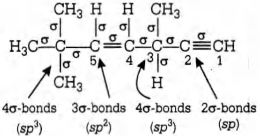
The state of hybridisation of $C_2, C_3, C_5$ and $C_6$ of the hydrocarbon $CH_3-C_6(CH_3)_2-C_5H=C_4H-C_3H(CH_3)-C_2 \equiv C_1H$ is in the following sequence:
A
$sp^3, sp^2, sp^2$ and $sp$
B
$sp, sp^2, sp^2$ and $sp^3$
C
$sp, sp^2, sp^3$ and $sp^2$
D
$sp, sp^3, sp^2$ and $sp^3$
Solution
(D) The correct option is $(d)$.
In the given hydrocarbon structure:
$1.$ $C_2$ is involved in a triple bond $(C \equiv C)$,so it is $sp$ hybridized.
$2.$ $C_3$ is bonded to four other atoms ($C_2, C_4, H$,and the $C$ of the $CH_3$ group) via single bonds,so it is $sp^3$ hybridized.
$3.$ $C_5$ is involved in a double bond $(C=C)$,so it is $sp^2$ hybridized.
$4.$ $C_6$ is bonded to four other atoms ($C_5, C_7$,and the $C$ atoms of two $CH_3$ groups) via single bonds,so it is $sp^3$ hybridized.
Thus,the sequence for $C_2, C_3, C_5$ and $C_6$ is $sp, sp^3, sp^2, sp^3$.
In the given hydrocarbon structure:
$1.$ $C_2$ is involved in a triple bond $(C \equiv C)$,so it is $sp$ hybridized.
$2.$ $C_3$ is bonded to four other atoms ($C_2, C_4, H$,and the $C$ of the $CH_3$ group) via single bonds,so it is $sp^3$ hybridized.
$3.$ $C_5$ is involved in a double bond $(C=C)$,so it is $sp^2$ hybridized.
$4.$ $C_6$ is bonded to four other atoms ($C_5, C_7$,and the $C$ atoms of two $CH_3$ groups) via single bonds,so it is $sp^3$ hybridized.
Thus,the sequence for $C_2, C_3, C_5$ and $C_6$ is $sp, sp^3, sp^2, sp^3$.
0 likesView Solution
29
ChemistryMediumMCQAIPMT · 2009
Which of the following compounds will exhibit $cis-trans$ (geometrical) isomerism?
A
Butanol
B
$2-$Butyne
C
$2-$Butenol
D
$2-$Butene
Solution
(D) Compounds that exhibit geometrical isomerism must have a restricted rotation,such as a double bond $(C=C)$,where each carbon atom of the double bond is attached to two different groups.
For $2-$Butene $(CH_3-CH=CH-CH_3)$,each double-bonded carbon is attached to a hydrogen atom and a methyl group. Since these groups are different,it exhibits $cis-trans$ isomerism.
$1.$ $cis-2-$Butene: Both methyl groups are on the same side of the double bond.
$2.$ $trans-2-$Butene: Both methyl groups are on opposite sides of the double bond.
For $2-$Butene $(CH_3-CH=CH-CH_3)$,each double-bonded carbon is attached to a hydrogen atom and a methyl group. Since these groups are different,it exhibits $cis-trans$ isomerism.
$1.$ $cis-2-$Butene: Both methyl groups are on the same side of the double bond.
$2.$ $trans-2-$Butene: Both methyl groups are on opposite sides of the double bond.
0 likesView Solution
30
ChemistryMediumMCQAIPMT · 2009
Benzene reacts with $CH_3Cl$ in the presence of anhydrous $AlCl_3$ to form
A
chlorobenzene
B
benzyl chloride
C
xylene
D
toluene
Solution
(D) The reaction of benzene with $CH_3Cl$ in the presence of anhydrous $AlCl_3$ is known as Friedel-Crafts alkylation.
In this reaction,the methyl group $(-CH_3)$ replaces a hydrogen atom on the benzene ring to form toluene $(C_6H_5CH_3)$.
The chemical equation is: $C_6H_6 + CH_3Cl \xrightarrow{Anhy. AlCl_3} C_6H_5CH_3 + HCl$.
In this reaction,the methyl group $(-CH_3)$ replaces a hydrogen atom on the benzene ring to form toluene $(C_6H_5CH_3)$.
The chemical equation is: $C_6H_6 + CH_3Cl \xrightarrow{Anhy. AlCl_3} C_6H_5CH_3 + HCl$.
0 likesView Solution
31
ChemistryMediumMCQAIPMT · 2009
The equivalent conductance of $M/32$ solution of a weak monobasic acid is $8.0 \, \text{mho} \, \text{cm}^2$ and at infinite dilution is $400 \, \text{mho} \, \text{cm}^2.$ The dissociation constant of this acid is
A
$1.25 \times 10^{-6}$
B
$6.25 \times 10^{-4}$
C
$1.25 \times 10^{-4}$
D
$1.25 \times 10^{-5}$
Solution
(D) Degree of dissociation,$\alpha = \frac{\Lambda^{c}}{\Lambda^{\infty}}$
Given,$\Lambda^{c} = 8.0 \, \text{mho} \, \text{cm}^2$ and $\Lambda^{\infty} = 400 \, \text{mho} \, \text{cm}^2$.
$\alpha = \frac{8.0}{400} = 0.02 = 2 \times 10^{-2}$.
For a weak monobasic acid,the dissociation constant $K_{a}$ is given by Ostwald's dilution law:
$K_{a} = \frac{C \alpha^{2}}{1 - \alpha}$.
Since $\alpha$ is very small $(1 - \alpha \approx 1)$,the formula simplifies to $K_{a} \approx C \alpha^{2}$.
Given concentration $C = \frac{1}{32} \, M$.
$K_{a} = \frac{1}{32} \times (2 \times 10^{-2})^{2} = \frac{1}{32} \times 4 \times 10^{-4} = \frac{1}{8} \times 10^{-4} = 0.125 \times 10^{-4} = 1.25 \times 10^{-5}$.
Given,$\Lambda^{c} = 8.0 \, \text{mho} \, \text{cm}^2$ and $\Lambda^{\infty} = 400 \, \text{mho} \, \text{cm}^2$.
$\alpha = \frac{8.0}{400} = 0.02 = 2 \times 10^{-2}$.
For a weak monobasic acid,the dissociation constant $K_{a}$ is given by Ostwald's dilution law:
$K_{a} = \frac{C \alpha^{2}}{1 - \alpha}$.
Since $\alpha$ is very small $(1 - \alpha \approx 1)$,the formula simplifies to $K_{a} \approx C \alpha^{2}$.
Given concentration $C = \frac{1}{32} \, M$.
$K_{a} = \frac{1}{32} \times (2 \times 10^{-2})^{2} = \frac{1}{32} \times 4 \times 10^{-4} = \frac{1}{8} \times 10^{-4} = 0.125 \times 10^{-4} = 1.25 \times 10^{-5}$.
0 likesView Solution
32
ChemistryMediumMCQAIPMT · 2009
Nitrobenzene can be prepared from benzene by using a mixture of conc. $HNO_3$ and conc. $H_2SO_4$. In the mixture,nitric acid acts as a/an
A
acid
B
base
C
catalyst
D
reducing agent
Solution
(B) According to the Bronsted-Lowry theory,an acid is a proton donor and a base is a proton acceptor.
In the nitrating mixture,conc. $H_2SO_4$ acts as a strong acid and donates a proton to conc. $HNO_3$.
The reaction is: $HNO_3 + H_2SO_4 \rightarrow H_2NO_3^+ + HSO_4^-$.
Here,$HNO_3$ accepts a proton from $H_2SO_4$,therefore $HNO_3$ acts as a base.
Subsequently,$H_2NO_3^+$ decomposes to form the electrophile $NO_2^+$: $H_2NO_3^+ \rightarrow NO_2^+ + H_2O$.
In the nitrating mixture,conc. $H_2SO_4$ acts as a strong acid and donates a proton to conc. $HNO_3$.
The reaction is: $HNO_3 + H_2SO_4 \rightarrow H_2NO_3^+ + HSO_4^-$.
Here,$HNO_3$ accepts a proton from $H_2SO_4$,therefore $HNO_3$ acts as a base.
Subsequently,$H_2NO_3^+$ decomposes to form the electrophile $NO_2^+$: $H_2NO_3^+ \rightarrow NO_2^+ + H_2O$.
0 likesView Solution
33
ChemistryMCQAIPMT · 2009
In the case of alkali metals,the covalent character decreases in the order
A
$MI > MBr > MCl > MF$
B
$MCl > MI > MBr > MF$
C
$MF > MCl > MBr > MI$
D
$MF > MCl > MI > MBr$
Solution
(A) Fajan's rule states that the covalent character increases with the decrease in the size of the cation and increases with the increase in the size of the anion.
Since the size of the anion increases down the group,the order of ionic size is $I^{-} > Br^{-} > Cl^{-} > F^{-}$.
According to Fajan's rule,the covalent character increases as the size of the anion increases.
Therefore,the order of covalent character is $MI > MBr > MCl > MF$.
Since the size of the anion increases down the group,the order of ionic size is $I^{-} > Br^{-} > Cl^{-} > F^{-}$.
According to Fajan's rule,the covalent character increases as the size of the anion increases.
Therefore,the order of covalent character is $MI > MBr > MCl > MF$.
0 likesView Solution
34
ChemistryMCQAIPMT · 2009
$A$ young infant may be feeding entirely on mother's milk,which is white in color,but the stools which the infant passes out are quite yellowish. What is this yellow color due to?
A
Bile pigments passed through bile juice
B
Undigested milk protein casein
C
Pancreatic juice poured into duodenum
D
Intestinal juice
Solution
(A) The yellow color of the stool in infants is primarily due to the presence of bile pigments,specifically bilirubin and biliverdin.
Even though the infant's diet consists solely of white mother's milk,the liver secretes bile juice into the digestive tract.
Bile pigments are metabolic waste products resulting from the breakdown of old red blood cells.
These pigments are excreted into the intestine along with bile juice and are modified by intestinal bacteria,giving the stool its characteristic yellow color.
Even though the infant's diet consists solely of white mother's milk,the liver secretes bile juice into the digestive tract.
Bile pigments are metabolic waste products resulting from the breakdown of old red blood cells.
These pigments are excreted into the intestine along with bile juice and are modified by intestinal bacteria,giving the stool its characteristic yellow color.
0 likesView Solution
35
ChemistryMCQAIPMT · 2009
Which one of the following pairs of food components in humans reaches the stomach totally undigested?
A
Starch and fat
B
Fat and cellulose
C
Starch and cellulose
D
Protein and starch
Solution
(B) In humans,the process of digestion begins in the mouth.
Salivary amylase (ptyalin) acts on starch in the mouth,breaking it down into maltose.
Therefore,starch is partially digested before reaching the stomach.
Fats are not digested in the mouth; they undergo emulsification and digestion primarily in the small intestine.
Cellulose is a complex carbohydrate (polysaccharide) that humans lack the enzymes to digest.
Thus,both fat and cellulose reach the stomach in a completely undigested state.
Salivary amylase (ptyalin) acts on starch in the mouth,breaking it down into maltose.
Therefore,starch is partially digested before reaching the stomach.
Fats are not digested in the mouth; they undergo emulsification and digestion primarily in the small intestine.
Cellulose is a complex carbohydrate (polysaccharide) that humans lack the enzymes to digest.
Thus,both fat and cellulose reach the stomach in a completely undigested state.
0 likesView Solution
36
ChemistryMCQAIPMT · 2009
Which part of the human brain is concerned with the regulation of body temperature?
A
Cerebellum
B
Cerebrum
C
Hypothalamus
D
Medulla Oblongata
Solution
(C) The $Hypothalamus$ is a vital part of the diencephalon in the human brain.
It contains a number of centers which control body temperature,urge for eating and drinking.
It also contains several groups of neurosecretory cells,which secrete hormones called hypothalamic hormones.
Therefore,the correct option is $C$.
It contains a number of centers which control body temperature,urge for eating and drinking.
It also contains several groups of neurosecretory cells,which secrete hormones called hypothalamic hormones.
Therefore,the correct option is $C$.
0 likesView Solution
37
ChemistryMCQAIPMT · 2009
Which one of the following plants is monoecious?
A
Pinus
B
Cycas
C
Papaya
D
Marchantia
Solution
(A) plant is called monoecious when both male and female reproductive structures (cones or flowers) are present on the same individual plant.
In the given options,$Pinus$ is a monoecious plant because it bears both male and female cones on the same tree.
$Cycas$ is dioecious (male and female plants are separate).
$Papaya$ is dioecious.
$Marchantia$ is a liverwort where male and female sex organs are produced on separate thalli (dioecious).
In the given options,$Pinus$ is a monoecious plant because it bears both male and female cones on the same tree.
$Cycas$ is dioecious (male and female plants are separate).
$Papaya$ is dioecious.
$Marchantia$ is a liverwort where male and female sex organs are produced on separate thalli (dioecious).
0 likesView Solution
38
ChemistryMCQAIPMT · 2009
What will happen if the stretch receptors of the urinary bladder wall are completely removed?
A
Micturition will continue.
B
Urine will continue to collect normally in the bladder.
C
Micturition will not occur.
D
Urine will not collect in the bladder.
Solution
(C) The process of micturition (urination) is initiated by the stretching of the urinary bladder wall as it fills with urine.
Stretch receptors present in the wall of the bladder send signals to the Central Nervous System $(CNS)$ when the bladder is stretched.
In response,the $CNS$ sends motor messages to initiate the contraction of smooth muscles of the bladder and the simultaneous relaxation of the urethral sphincter,causing the release of urine.
If the stretch receptors are removed,the brain will not receive the signal that the bladder is full.
Consequently,the reflex arc required for micturition will not be triggered,and micturition will not occur,leading to the bladder becoming over-distended.
Stretch receptors present in the wall of the bladder send signals to the Central Nervous System $(CNS)$ when the bladder is stretched.
In response,the $CNS$ sends motor messages to initiate the contraction of smooth muscles of the bladder and the simultaneous relaxation of the urethral sphincter,causing the release of urine.
If the stretch receptors are removed,the brain will not receive the signal that the bladder is full.
Consequently,the reflex arc required for micturition will not be triggered,and micturition will not occur,leading to the bladder becoming over-distended.
0 likesView Solution
39
ChemistryMCQAIPMT · 2009
Which of the following is not used as a biopesticide?
A
Bacillus thuringiensis
B
Trichoderma harzianum
C
Nuclear Polyhedrosis Virus $(NPV)$
D
Xanthomonas campestris
Solution
(D) Biopesticides are biological agents used to control pests.
$1$. $Bacillus$ $thuringiensis$ $(Bt)$ is a well-known bacterium used as a biopesticide to control insect larvae.
$2$. $Trichoderma$ $harzianum$ is a free-living fungus used as a biocontrol agent against several plant pathogens.
$3$. $Nuclear$ $Polyhedrosis$ $Virus$ $(NPV)$ belongs to the genus $Baculovirus$ and is used as a narrow-spectrum insecticidal agent.
$4$. $Xanthomonas$ $campestris$ is a bacterium that causes black rot disease in cruciferous plants,making it a plant pathogen rather than a biopesticide.
Therefore,the correct option is $D$.
$1$. $Bacillus$ $thuringiensis$ $(Bt)$ is a well-known bacterium used as a biopesticide to control insect larvae.
$2$. $Trichoderma$ $harzianum$ is a free-living fungus used as a biocontrol agent against several plant pathogens.
$3$. $Nuclear$ $Polyhedrosis$ $Virus$ $(NPV)$ belongs to the genus $Baculovirus$ and is used as a narrow-spectrum insecticidal agent.
$4$. $Xanthomonas$ $campestris$ is a bacterium that causes black rot disease in cruciferous plants,making it a plant pathogen rather than a biopesticide.
Therefore,the correct option is $D$.
0 likesView Solution
40
ChemistryMCQAIPMT · 2009
$DDT$ residues are rapidly passed through food chain causing biomagnification because $DDT$ is:
A
Moderately toxic.
B
Non-toxic to aquatic animals.
C
Water soluble.
D
Lipid soluble.
Solution
(D) Biomagnification refers to the increase in concentration of a toxic substance at successive trophic levels.
$DDT$ (Dichlorodiphenyltrichloroethane) is a persistent organic pollutant.
It is highly lipid-soluble (fat-soluble),which means it is not easily excreted by the body.
Instead,it gets stored in the adipose (fat) tissues of organisms.
As it moves up the food chain,the concentration of $DDT$ increases significantly in the tissues of higher trophic level organisms,leading to biomagnification.
$DDT$ (Dichlorodiphenyltrichloroethane) is a persistent organic pollutant.
It is highly lipid-soluble (fat-soluble),which means it is not easily excreted by the body.
Instead,it gets stored in the adipose (fat) tissues of organisms.
As it moves up the food chain,the concentration of $DDT$ increases significantly in the tissues of higher trophic level organisms,leading to biomagnification.
0 likesView Solution
41
ChemistryMCQAIPMT · 2009
If $\vec F$ is the force acting on a particle having position vector $\vec r$ and $\vec \tau$ is the torque of this force about the origin,then:
A
$\vec r \cdot \vec \tau = 0$ and $\vec F \cdot \vec \tau \neq 0$
B
$\vec r \cdot \vec \tau \neq 0$ and $\vec F \cdot \vec \tau = 0$
C
$\vec r \cdot \vec \tau > 0$ and $\vec F \cdot \vec \tau < 0$
D
$\vec r \cdot \vec \tau = 0$ and $\vec F \cdot \vec \tau = 0$
Solution
(D) The torque $\vec \tau$ is defined as the cross product of the position vector $\vec r$ and the force vector $\vec F$,given by $\vec \tau = \vec r \times \vec F$.
By the definition of the cross product,the resulting vector $\vec \tau$ is perpendicular to both $\vec r$ and $\vec F$.
Since the dot product of two perpendicular vectors is zero,we have $\vec r \cdot \vec \tau = 0$ and $\vec F \cdot \vec \tau = 0$.
By the definition of the cross product,the resulting vector $\vec \tau$ is perpendicular to both $\vec r$ and $\vec F$.
Since the dot product of two perpendicular vectors is zero,we have $\vec r \cdot \vec \tau = 0$ and $\vec F \cdot \vec \tau = 0$.
0 likesView Solution
42
ChemistryDifficultMCQAIPMT · 2009
$10 \ g$ of hydrogen and $64 \ g$ of oxygen were filled in a steel vessel and exploded. The amount of water produced in this reaction will be ............... $mol$.
A
$1$
B
$2$
C
$3$
D
$4$
Solution
(D) The balanced chemical equation is: $2H_2(g) + O_2(g) \to 2H_2O(l)$.
Calculate the moles of reactants:
$n(H_2) = \frac{10 \ g}{2 \ g/mol} = 5 \ mol$.
$n(O_2) = \frac{64 \ g}{32 \ g/mol} = 2 \ mol$.
Identify the Limiting Reagent $(L.R.)$:
According to the stoichiometry,$2 \ mol$ of $H_2$ requires $1 \ mol$ of $O_2$.
So,$5 \ mol$ of $H_2$ would require $2.5 \ mol$ of $O_2$.
Since we only have $2 \ mol$ of $O_2$,$O_2$ is the $L.R.$
Calculate the product:
Since $1 \ mol$ of $O_2$ produces $2 \ mol$ of $H_2O$,$2 \ mol$ of $O_2$ will produce $2 \times 2 = 4 \ mol$ of $H_2O$.
Calculate the moles of reactants:
$n(H_2) = \frac{10 \ g}{2 \ g/mol} = 5 \ mol$.
$n(O_2) = \frac{64 \ g}{32 \ g/mol} = 2 \ mol$.
Identify the Limiting Reagent $(L.R.)$:
According to the stoichiometry,$2 \ mol$ of $H_2$ requires $1 \ mol$ of $O_2$.
So,$5 \ mol$ of $H_2$ would require $2.5 \ mol$ of $O_2$.
Since we only have $2 \ mol$ of $O_2$,$O_2$ is the $L.R.$
Calculate the product:
Since $1 \ mol$ of $O_2$ produces $2 \ mol$ of $H_2O$,$2 \ mol$ of $O_2$ will produce $2 \times 2 = 4 \ mol$ of $H_2O$.
0 likesView Solution
43
ChemistryMCQAIPMT · 2009
Lithium metal crystallises in a body-centred cubic $(BCC)$ crystal. If the length of the side of the unit cell of lithium is $351 \ pm$,the atomic radius of the lithium will be ............. $pm$.
A
$300.5$
B
$240.8$
C
$151.8$
D
$75.5$
Solution
(C) For a body-centred cubic $(BCC)$ crystal,the relationship between the edge length $(a)$ and the atomic radius $(r)$ is given by the formula: $\sqrt{3}a = 4r$.
Given that the edge length $a = 351 \ pm$.
Substituting the values: $r = \frac{\sqrt{3} \times a}{4} = \frac{1.732 \times 351}{4}$.
$r = \frac{607.932}{4} = 151.98 \ pm \approx 151.8 \ pm$.
Given that the edge length $a = 351 \ pm$.
Substituting the values: $r = \frac{\sqrt{3} \times a}{4} = \frac{1.732 \times 351}{4}$.
$r = \frac{607.932}{4} = 151.98 \ pm \approx 151.8 \ pm$.
0 likesView Solution
44
ChemistryMCQAIPMT · 2009
$A$ body of mass $1\, kg$ is thrown upwards with a velocity $20\, m/s$. It momentarily comes to rest after attaining a height of $18\, m$. How much energy is lost due to air friction? $(g = 10\, m/s^2)$
A
$30$
B
$40$
C
$10$
D
$20$
Solution
(D) The initial kinetic energy of the body is given by $K_i = \frac{1}{2} m u^2 = \frac{1}{2} \times 1 \times (20)^2 = 200\, J$.
If there were no air friction,the maximum height $H$ reached by the body would be determined by the conservation of energy: $m g H = K_i$.
$1 \times 10 \times H = 200 \implies H = 20\, m$.
However,the body only reaches a height of $h' = 18\, m$ due to energy loss from air friction.
The potential energy at this height is $U_f = m g h' = 1 \times 10 \times 18 = 180\, J$.
The energy lost due to air friction is the difference between the initial kinetic energy and the final potential energy: $\Delta E = K_i - U_f = 200\, J - 180\, J = 20\, J$.
If there were no air friction,the maximum height $H$ reached by the body would be determined by the conservation of energy: $m g H = K_i$.
$1 \times 10 \times H = 200 \implies H = 20\, m$.
However,the body only reaches a height of $h' = 18\, m$ due to energy loss from air friction.
The potential energy at this height is $U_f = m g h' = 1 \times 10 \times 18 = 180\, J$.
The energy lost due to air friction is the difference between the initial kinetic energy and the final potential energy: $\Delta E = K_i - U_f = 200\, J - 180\, J = 20\, J$.
0 likesView Solution
45
ChemistryMCQAIPMT · 2009
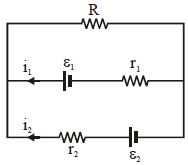
See the electrical circuit shown in the figure. Which of the following equations is a correct equation for it?
A
${\varepsilon _1} - ({i_1} + {i_2})R + {i_1}{r_1} = 0$
B
${\varepsilon _1} - ({i_1} + {i_2})R - {i_1}{r_1} = 0$
C
${\varepsilon _1} - {i_2}{r_2} - {\varepsilon _1} - {i_1}{r_1} = 0$
D
$ - {\varepsilon _2} - ({i_1} + {i_2})R + {i_2}{r_2} = 0$
Solution
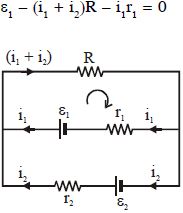
(B) Applying Kirchhoff's Voltage Law $(KVL)$ to the upper loop containing the resistor $R$ and the cell with emf ${\varepsilon _1}$ and internal resistance ${r_1}$:
Starting from the positive terminal of the cell ${\varepsilon _1}$ and moving in the direction of the current:
$1$. The potential drop across the cell is ${\varepsilon _1}$.
$2$. The current flowing through the resistor $R$ is $(i_1 + i_2)$,so the potential drop is $-(i_1 + i_2)R$.
$3$. The current flowing through the internal resistance $r_1$ is $i_1$,so the potential drop is $-i_1r_1$.
Summing these potential changes to zero gives: ${\varepsilon _1} - (i_1 + i_2)R - i_1r_1 = 0$.
Starting from the positive terminal of the cell ${\varepsilon _1}$ and moving in the direction of the current:
$1$. The potential drop across the cell is ${\varepsilon _1}$.
$2$. The current flowing through the resistor $R$ is $(i_1 + i_2)$,so the potential drop is $-(i_1 + i_2)R$.
$3$. The current flowing through the internal resistance $r_1$ is $i_1$,so the potential drop is $-i_1r_1$.
Summing these potential changes to zero gives: ${\varepsilon _1} - (i_1 + i_2)R - i_1r_1 = 0$.
0 likesView Solution
46
ChemistryMCQAIPMT · 2009
Which of the following hormones contains iodine?
A
Thyroxine
B
Insulin
C
Testosterone
D
Adrenaline
Solution
(A) Thyroxine hormone contains iodine. The thyroid gland produces two primary hormones - thyroxine (also referred to as $T4$) and tri-iodothyronine (also referred to as $T3$). The numbers $3$ and $4$ refer to the number of atoms of iodine in the hormones. Iodine is essential for the production of thyroid hormones. Iodine is found in most foods,especially seafood.
0 likesView Solution
47
ChemistryMCQAIPMT · 2009
$A$ galvanometer having a coil resistance of $60\,\Omega$ shows full-scale deflection when a current of $1.0\,A$ passes through it. It can be converted into an ammeter to read currents up to $5.0\,A$ by:
A
putting in parallel a resistance of $15\,\Omega$
B
putting in parallel a resistance of $240\,\Omega$
C
putting in series a resistance of $15\,\Omega$
D
putting in series a resistance of $240\,\Omega$
Solution
(A) To convert a galvanometer into an ammeter,a shunt resistance $S$ must be connected in parallel with the galvanometer.
The formula for the shunt resistance is given by $I_{g} \cdot G = (I - I_{g}) \cdot S$,where $I_{g}$ is the full-scale deflection current,$G$ is the galvanometer resistance,$I$ is the maximum current to be measured,and $S$ is the shunt resistance.
Rearranging for $S$,we get $S = \frac{I_{g} \cdot G}{I - I_{g}}$.
Given values are $I_{g} = 1.0\,A$,$G = 60\,\Omega$,and $I = 5.0\,A$.
Substituting these values: $S = \frac{1.0 \times 60}{5.0 - 1.0} = \frac{60}{4} = 15\,\Omega$.
Thus,a resistance of $15\,\Omega$ must be connected in parallel.
The formula for the shunt resistance is given by $I_{g} \cdot G = (I - I_{g}) \cdot S$,where $I_{g}$ is the full-scale deflection current,$G$ is the galvanometer resistance,$I$ is the maximum current to be measured,and $S$ is the shunt resistance.
Rearranging for $S$,we get $S = \frac{I_{g} \cdot G}{I - I_{g}}$.
Given values are $I_{g} = 1.0\,A$,$G = 60\,\Omega$,and $I = 5.0\,A$.
Substituting these values: $S = \frac{1.0 \times 60}{5.0 - 1.0} = \frac{60}{4} = 15\,\Omega$.
Thus,a resistance of $15\,\Omega$ must be connected in parallel.
0 likesView Solution
48
ChemistryMCQAIPMT · 2009
In thermodynamic processes,which of the following statements is not true?
A
In an adiabatic process,$PV^{\gamma} = \text{constant}$.
B
In an adiabatic process,the system is insulated from the surroundings.
C
In an isochoric process,pressure remains constant.
D
In an isothermal process,the temperature remains constant.
Solution
(C) An isochoric process is defined as a process in which the volume of the system remains constant. In such a process,the pressure and temperature may change,but the volume does not. Therefore,the statement that pressure remains constant in an isochoric process is incorrect.
0 likesView Solution
49
ChemistryMediumMCQAIPMT · 2009
Oxidation numbers of $P$ in $PO_4^{3-}$,of $S$ in $SO_4^{2-}$ and that of $Cr$ in $Cr_2O_7^{2-}$ are respectively
A
$+3, +6$ and $+5$
B
$+5, +3$ and $+6$
C
$-3, +6$ and $+6$
D
$+5, +6$ and $+6$
Solution
(D) For $PO_4^{3-}$: Let the oxidation number of $P$ be $x$. Then $x + 4(-2) = -3$,which gives $x - 8 = -3$,so $x = +5$.
For $SO_4^{2-}$: Let the oxidation number of $S$ be $x$. Then $x + 4(-2) = -2$,which gives $x - 8 = -2$,so $x = +6$.
For $Cr_2O_7^{2-}$: Let the oxidation number of $Cr$ be $x$. Then $2x + 7(-2) = -2$,which gives $2x - 14 = -2$,so $2x = 12$,and $x = +6$.
Thus,the oxidation numbers are $+5, +6, +6$.
For $SO_4^{2-}$: Let the oxidation number of $S$ be $x$. Then $x + 4(-2) = -2$,which gives $x - 8 = -2$,so $x = +6$.
For $Cr_2O_7^{2-}$: Let the oxidation number of $Cr$ be $x$. Then $2x + 7(-2) = -2$,which gives $2x - 14 = -2$,so $2x = 12$,and $x = +6$.
Thus,the oxidation numbers are $+5, +6, +6$.
0 likesView Solution
50
ChemistryMCQAIPMT · 2009
The epithelial tissue present on the inner surface of bronchioles and fallopian tubes is
A
Squamous
B
Cuboidal
C
Glandular
D
Ciliated
Solution
(D) Ciliated epithelium is characterized by the presence of cilia on the free surface of the cells.
These cilia help in moving particles or mucus in a specific direction over the epithelial surface.
This tissue is specifically found on the inner surface of hollow organs such as the bronchioles (part of the respiratory tract) and the fallopian tubes (oviducts) to facilitate the movement of mucus and ova,respectively.
These cilia help in moving particles or mucus in a specific direction over the epithelial surface.
This tissue is specifically found on the inner surface of hollow organs such as the bronchioles (part of the respiratory tract) and the fallopian tubes (oviducts) to facilitate the movement of mucus and ova,respectively.
0 likesView Solution
51
ChemistryMediumMCQAIPMT · 2009
The straight chain polymer is formed by
A
hydrolysis of $CH_3SiCl_3$ followed by condensation polymerisation
B
hydrolysis of $(CH_3)_4Si$ by addition polymerisation
C
hydrolysis of $(CH_3)_2SiCl_2$ followed by condensation polymerisation
D
hydrolysis of $(CH_3)_3SiCl$ followed by condensation polymerisation.
Solution
(C) The hydrolysis of dimethyl dichlorosilane,$(CH_3)_2SiCl_2$,produces a dihydroxy derivative,$(CH_3)_2Si(OH)_2$.
This dihydroxy derivative undergoes condensation polymerisation to form a straight chain silicone polymer,as shown in the reaction:
$n(CH_3)_2SiCl_2 + 2nH_2O \rightarrow n(CH_3)_2Si(OH)_2 + 2nHCl$
$n(CH_3)_2Si(OH)_2 \rightarrow -[O-Si(CH_3)_2-O]_n- + nH_2O$
This dihydroxy derivative undergoes condensation polymerisation to form a straight chain silicone polymer,as shown in the reaction:
$n(CH_3)_2SiCl_2 + 2nH_2O \rightarrow n(CH_3)_2Si(OH)_2 + 2nHCl$
$n(CH_3)_2Si(OH)_2 \rightarrow -[O-Si(CH_3)_2-O]_n- + nH_2O$
0 likesView Solution
52
ChemistryDifficultMCQAIPMT · 2009
Lithium metal crystallises in a body-centred cubic crystal. If the length of the side of the unit cell of lithium is $351 \ pm,$ the atomic radius of lithium will be $............$ $pm$.
A
$151.8$
B
$75.5$
C
$300.5$
D
$240.8$
Solution
(A) For a body-centred cubic $(bcc)$ crystal, the relationship between the edge length $a$ and the atomic radius $r$ is given by $a \sqrt{3} = 4r$.
Given, edge length $a = 351 \ pm$.
Thus, the atomic radius $r = \frac{a \sqrt{3}}{4}$.
Substituting the values, $r = \frac{351 \times 1.732}{4} = 151.98 \ pm$.
Rounding to the nearest option, the value is approximately $151.8 \ pm$.
Given, edge length $a = 351 \ pm$.
Thus, the atomic radius $r = \frac{a \sqrt{3}}{4}$.
Substituting the values, $r = \frac{351 \times 1.732}{4} = 151.98 \ pm$.
Rounding to the nearest option, the value is approximately $151.8 \ pm$.
0 likesView Solution
53
ChemistryDifficultMCQAIPMT · 2009
Copper crystallises in a face-centred cubic lattice with a unit cell length of $361 \text{ pm}$. What is the radius of copper atom in $\text{pm}$?
A
$157$
B
$181$
C
$108$
D
$128$
Solution
(D) In a face-centred cubic $(fcc)$ lattice, the relationship between the edge length $(a)$ and the atomic radius $(r)$ is given by $r = \frac{\sqrt{2}a}{4}$.
Given, $a = 361 \text{ pm}$.
Substituting the value of $a$ in the formula:
$r = \frac{\sqrt{2} \times 361}{4} \approx \frac{1.414 \times 361}{4} \approx 127.6 \text{ pm}$.
Rounding to the nearest integer, the radius is $128 \text{ pm}$.
Given, $a = 361 \text{ pm}$.
Substituting the value of $a$ in the formula:
$r = \frac{\sqrt{2} \times 361}{4} \approx \frac{1.414 \times 361}{4} \approx 127.6 \text{ pm}$.
Rounding to the nearest integer, the radius is $128 \text{ pm}$.
0 likesView Solution
54
ChemistryMediumMCQAIPMT · 2009
$A$ $0.0020 \ m$ aqueous solution of an ionic compound $[Co(NH_3)_5(NO_2)]Cl$ freezes at $-0.00732 \ ^oC.$ Number of moles of ions which $1 \ mol$ of ionic compound produces on being dissolved in water will be
$(K_f = 1.86 \ ^oC/m)$
$(K_f = 1.86 \ ^oC/m)$
A
$3$
B
$4$
C
$1$
D
$2$
Solution
(D) The depression in freezing point is given by the formula: $\Delta T_f = i \cdot K_f \cdot m$
Here,$\Delta T_f = 0 - (-0.00732) = 0.00732 \ ^oC$,$K_f = 1.86 \ ^oC/m$,and $m = 0.0020 \ m$.
Calculating the van't Hoff factor $(i)$:
$i = \frac{\Delta T_f}{K_f \cdot m} = \frac{0.00732}{1.86 \times 0.0020} = \frac{0.00732}{0.00372} \approx 1.968 \approx 2$.
The ionic compound $[Co(NH_3)_5(NO_2)]Cl$ dissociates in water as: $[Co(NH_3)_5(NO_2)]Cl \rightarrow [Co(NH_3)_5(NO_2)]^+ + Cl^-$.
Thus,$1 \ mol$ of the compound produces $2 \ mol$ of ions.
Here,$\Delta T_f = 0 - (-0.00732) = 0.00732 \ ^oC$,$K_f = 1.86 \ ^oC/m$,and $m = 0.0020 \ m$.
Calculating the van't Hoff factor $(i)$:
$i = \frac{\Delta T_f}{K_f \cdot m} = \frac{0.00732}{1.86 \times 0.0020} = \frac{0.00732}{0.00372} \approx 1.968 \approx 2$.
The ionic compound $[Co(NH_3)_5(NO_2)]Cl$ dissociates in water as: $[Co(NH_3)_5(NO_2)]Cl \rightarrow [Co(NH_3)_5(NO_2)]^+ + Cl^-$.
Thus,$1 \ mol$ of the compound produces $2 \ mol$ of ions.
0 likesView Solution
55
ChemistryAdvancedMCQAIPMT · 2009
Given $:$
$(i) \, Cu^{2+} + 2e^- \rightarrow Cu \,, \, E^o = 0.337 \, V$
$(ii) \, Cu^{2+} + e^- \rightarrow Cu^{+} \,, \, E^o = 0.153 \, V$
Electrode potential,$E^o$ for the reaction,
$Cu^{+} + e^- \rightarrow Cu \,,$ will be $............$ $V$.
$(i) \, Cu^{2+} + 2e^- \rightarrow Cu \,, \, E^o = 0.337 \, V$
$(ii) \, Cu^{2+} + e^- \rightarrow Cu^{+} \,, \, E^o = 0.153 \, V$
Electrode potential,$E^o$ for the reaction,
$Cu^{+} + e^- \rightarrow Cu \,,$ will be $............$ $V$.
A
$0.90$
B
$0.30$
C
$0.38$
D
$0.52$
Solution
(D) The standard Gibbs free energy change is given by $\Delta G^{o} = -nFE^{o}$.
For reaction $(i): Cu^{2+} + 2e^{-} \rightarrow Cu$,$\Delta G_{1}^{o} = -2 \times F \times 0.337 = -0.674F$.
For reaction $(ii): Cu^{2+} + e^{-} \rightarrow Cu^{+}$,$E^{o} = 0.153 \, V$. We need the reverse reaction: $Cu^{+} \rightarrow Cu^{2+} + e^{-}$,where $E^{o} = -0.153 \, V$.
Thus,for $Cu^{+} \rightarrow Cu^{2+} + e^{-}$,$\Delta G_{2}^{o} = -1 \times F \times (-0.153) = 0.153F$.
Adding the two reactions:
$(Cu^{2+} + 2e^{-}$ $\rightarrow Cu) + (Cu^{+}$ $\rightarrow Cu^{2+} + e^{-})$ $\rightarrow (Cu^{+} + e^{-}$ $\rightarrow Cu)$.
$\Delta G_{total}^{o} = \Delta G_{1}^{o} + \Delta G_{2}^{o} = -0.674F + 0.153F = -0.521F$.
For the target reaction $Cu^{+} + e^{-} \rightarrow Cu$,$n=1$,so $\Delta G^{o} = -1 \times F \times E^{o}$.
$-0.521F = -1 \times F \times E^{o} \implies E^{o} = 0.52 \, V$.
For reaction $(i): Cu^{2+} + 2e^{-} \rightarrow Cu$,$\Delta G_{1}^{o} = -2 \times F \times 0.337 = -0.674F$.
For reaction $(ii): Cu^{2+} + e^{-} \rightarrow Cu^{+}$,$E^{o} = 0.153 \, V$. We need the reverse reaction: $Cu^{+} \rightarrow Cu^{2+} + e^{-}$,where $E^{o} = -0.153 \, V$.
Thus,for $Cu^{+} \rightarrow Cu^{2+} + e^{-}$,$\Delta G_{2}^{o} = -1 \times F \times (-0.153) = 0.153F$.
Adding the two reactions:
$(Cu^{2+} + 2e^{-}$ $\rightarrow Cu) + (Cu^{+}$ $\rightarrow Cu^{2+} + e^{-})$ $\rightarrow (Cu^{+} + e^{-}$ $\rightarrow Cu)$.
$\Delta G_{total}^{o} = \Delta G_{1}^{o} + \Delta G_{2}^{o} = -0.674F + 0.153F = -0.521F$.
For the target reaction $Cu^{+} + e^{-} \rightarrow Cu$,$n=1$,so $\Delta G^{o} = -1 \times F \times E^{o}$.
$-0.521F = -1 \times F \times E^{o} \implies E^{o} = 0.52 \, V$.
0 likesView Solution
56
ChemistryMediumMCQAIPMT · 2009
$Al_2O_3$ is reduced by electrolysis at low potentials and high currents. If $4.0 \times 10^4$ amperes of current is passed through molten $Al_2O_3$ for $6$ hours,what mass of aluminium is produced? (Assume $100\%$ current efficiency,at. mass of $Al = 27 \ g \ mol^{-1}$).
A
$8.1 \times 10^4 \ g$
B
$2.4 \times 10^5 \ g$
C
$1.3 \times 10^4 \ g$
D
$9.0 \times 10^3 \ g$
Solution
(A) The reduction reaction for aluminium is: $Al^{3+} + 3e^- \rightarrow Al(s)$.
The equivalent mass of $Al$ is $E = \frac{\text{Atomic mass}}{\text{Valency factor}} = \frac{27}{3} = 9 \ g \ mol^{-1}$.
Using Faraday's law of electrolysis: $W = \frac{E \times I \times t}{96500}$.
Given: $I = 4.0 \times 10^4 \ A$,$t = 6 \ hours = 6 \times 3600 \ s = 21600 \ s$.
$W = \frac{9 \times 4.0 \times 10^4 \times 21600}{96500} \approx 8.05 \times 10^4 \ g \approx 8.1 \times 10^4 \ g$.
The equivalent mass of $Al$ is $E = \frac{\text{Atomic mass}}{\text{Valency factor}} = \frac{27}{3} = 9 \ g \ mol^{-1}$.
Using Faraday's law of electrolysis: $W = \frac{E \times I \times t}{96500}$.
Given: $I = 4.0 \times 10^4 \ A$,$t = 6 \ hours = 6 \times 3600 \ s = 21600 \ s$.
$W = \frac{9 \times 4.0 \times 10^4 \times 21600}{96500} \approx 8.05 \times 10^4 \ g \approx 8.1 \times 10^4 \ g$.
0 likesView Solution
57
ChemistryMediumMCQAIPMT · 2009
For the reaction,$N_2 + 3H_2 \rightarrow 2NH_3,$ if $\frac{d[NH_3]}{dt} = 2 \times 10^{-4} \ mol \ L^{-1} \ s^{-1},$ the value of $-\frac{d[H_2]}{dt}$ would be .................. $mol \ L^{-1} \ s^{-1}$.
A
$4 \times 10^{-4}$
B
$6 \times 10^{-4}$
C
$1 \times 10^{-4}$
D
$3 \times 10^{-4}$
Solution
(D) For the reaction,$N_2 + 3H_2 \rightarrow 2NH_3,$ the rate of reaction is given by:
Rate $= -\frac{d[N_2]}{dt} = -\frac{1}{3} \frac{d[H_2]}{dt} = \frac{1}{2} \frac{d[NH_3]}{dt}$
Given that $\frac{d[NH_3]}{dt} = 2 \times 10^{-4} \ mol \ L^{-1} \ s^{-1}.$
Equating the terms for $H_2$ and $NH_3$:
$-\frac{1}{3} \frac{d[H_2]}{dt} = \frac{1}{2} \frac{d[NH_3]}{dt}$
$-\frac{d[H_2]}{dt} = \frac{3}{2} \times \frac{d[NH_3]}{dt}$
$-\frac{d[H_2]}{dt} = \frac{3}{2} \times (2 \times 10^{-4}) = 3 \times 10^{-4} \ mol \ L^{-1} \ s^{-1}.$
Rate $= -\frac{d[N_2]}{dt} = -\frac{1}{3} \frac{d[H_2]}{dt} = \frac{1}{2} \frac{d[NH_3]}{dt}$
Given that $\frac{d[NH_3]}{dt} = 2 \times 10^{-4} \ mol \ L^{-1} \ s^{-1}.$
Equating the terms for $H_2$ and $NH_3$:
$-\frac{1}{3} \frac{d[H_2]}{dt} = \frac{1}{2} \frac{d[NH_3]}{dt}$
$-\frac{d[H_2]}{dt} = \frac{3}{2} \times \frac{d[NH_3]}{dt}$
$-\frac{d[H_2]}{dt} = \frac{3}{2} \times (2 \times 10^{-4}) = 3 \times 10^{-4} \ mol \ L^{-1} \ s^{-1}.$
0 likesView Solution
58
ChemistryMediumMCQAIPMT · 2009
In the reaction,$BrO_{3(aq)}^{-} + 5Br_{(aq)}^{-} + 6H^{+} \to 3Br_{2(l)} + 3H_2O_{(l)}$. The rate of appearance of bromine $(Br_2)$ is related to the rate of disappearance of bromide ions as:
A
$\frac{d[Br_2]}{dt} = -\frac{5}{3} \frac{d[Br^{-}]}{dt}$
B
$\frac{d[Br_2]}{dt} = \frac{5}{3} \frac{d[Br^{-}]}{dt}$
C
$\frac{d[Br_2]}{dt} = \frac{3}{5} \frac{d[Br^{-}]}{dt}$
D
$\frac{d[Br_2]}{dt} = -\frac{3}{5} \frac{d[Br^{-}]}{dt}$
Solution
(D) For the reaction $BrO_{3(aq)}^{-} + 5Br_{(aq)}^{-} + 6H^{+} \to 3Br_{2(l)} + 3H_2O_{(l)}$,the rate of reaction is given by:
Rate $= -\frac{d[BrO_3^-]}{dt} = -\frac{1}{5} \frac{d[Br^-]}{dt} = -\frac{1}{6} \frac{d[H^+]}{dt} = \frac{1}{3} \frac{d[Br_2]}{dt} = \frac{1}{3} \frac{d[H_2O]}{dt}$.
We need to relate the rate of appearance of $Br_2$ to the rate of disappearance of $Br^-$.
From the expression: $\frac{1}{3} \frac{d[Br_2]}{dt} = -\frac{1}{5} \frac{d[Br^-]}{dt}$.
Multiplying both sides by $3$,we get:
$\frac{d[Br_2]}{dt} = -\frac{3}{5} \frac{d[Br^-]}{dt}$.
Rate $= -\frac{d[BrO_3^-]}{dt} = -\frac{1}{5} \frac{d[Br^-]}{dt} = -\frac{1}{6} \frac{d[H^+]}{dt} = \frac{1}{3} \frac{d[Br_2]}{dt} = \frac{1}{3} \frac{d[H_2O]}{dt}$.
We need to relate the rate of appearance of $Br_2$ to the rate of disappearance of $Br^-$.
From the expression: $\frac{1}{3} \frac{d[Br_2]}{dt} = -\frac{1}{5} \frac{d[Br^-]}{dt}$.
Multiplying both sides by $3$,we get:
$\frac{d[Br_2]}{dt} = -\frac{3}{5} \frac{d[Br^-]}{dt}$.
0 likesView Solution
59
ChemistryMediumMCQAIPMT · 2009
Half-life period of a first order reaction is $1386 \ s$. The specific rate constant of the reaction is
A
$0.5 \times 10^{-2} \ s^{-1}$
B
$0.5 \times 10^{-3} \ s^{-1}$
C
$5.0 \times 10^{-2} \ s^{-1}$
D
$5.0 \times 10^{-3} \ s^{-1}$
Solution
(B) Given: Half-life period $(t_{1/2})$ = $1386 \ s$.
For a first-order reaction,the relationship between half-life and rate constant $(k)$ is given by:
$t_{1/2} = \frac{0.693}{k}$
Rearranging for $k$:
$k = \frac{0.693}{t_{1/2}}$
Substituting the value:
$k = \frac{0.693}{1386} \ s^{-1}$
$k = 0.0005 \ s^{-1}$
$k = 5.0 \times 10^{-4} \ s^{-1} = 0.5 \times 10^{-3} \ s^{-1}$.
For a first-order reaction,the relationship between half-life and rate constant $(k)$ is given by:
$t_{1/2} = \frac{0.693}{k}$
Rearranging for $k$:
$k = \frac{0.693}{t_{1/2}}$
Substituting the value:
$k = \frac{0.693}{1386} \ s^{-1}$
$k = 0.0005 \ s^{-1}$
$k = 5.0 \times 10^{-4} \ s^{-1} = 0.5 \times 10^{-3} \ s^{-1}$.
0 likesView Solution
60
ChemistryAdvancedMCQAIPMT · 2009
For the reaction $A + B \rightarrow$ products,it is observed that
$(i)$ on doubling the initial concentration of $A$ only,the rate of reaction is also doubled and
$(ii)$ on doubling the initial concentration of both $A$ and $B$,there is a change by a factor of $8$ in the rate of the reaction.
The rate of this reaction is given by
$(i)$ on doubling the initial concentration of $A$ only,the rate of reaction is also doubled and
$(ii)$ on doubling the initial concentration of both $A$ and $B$,there is a change by a factor of $8$ in the rate of the reaction.
The rate of this reaction is given by
A
rate $= k[A][B]^2$
B
rate $= k[A]^2[B]^2$
C
rate $= k[A][B]$
D
rate $= k[A]^2[B]$
Solution
(A) For the reaction,$A + B \longrightarrow$ Products.
Let the rate law be: $\text{Rate} = k[A]^x[B]^y$.
From observation $(i)$,doubling $[A]$ doubles the rate: $2 \times \text{Rate} = k[2A]^x[B]^y \implies 2 = 2^x \implies x = 1$.
From observation $(ii)$,doubling both $[A]$ and $[B]$ increases the rate by a factor of $8$: $8 \times \text{Rate} = k[2A]^1[2B]^y$.
Dividing this by the original rate law: $8 = 2^1 \times 2^y \implies 8 = 2 \times 2^y \implies 4 = 2^y \implies y = 2$.
Thus,the rate law is: $\text{Rate} = k[A][B]^2$.
Let the rate law be: $\text{Rate} = k[A]^x[B]^y$.
From observation $(i)$,doubling $[A]$ doubles the rate: $2 \times \text{Rate} = k[2A]^x[B]^y \implies 2 = 2^x \implies x = 1$.
From observation $(ii)$,doubling both $[A]$ and $[B]$ increases the rate by a factor of $8$: $8 \times \text{Rate} = k[2A]^1[2B]^y$.
Dividing this by the original rate law: $8 = 2^1 \times 2^y \implies 8 = 2 \times 2^y \implies 4 = 2^y \implies y = 2$.
Thus,the rate law is: $\text{Rate} = k[A][B]^2$.
0 likesView Solution
61
ChemistryEasyMCQAIPMT · 2009
Among the following,which is the strongest oxidising agent?
A
$Br_2$
B
$I_2$
C
$Cl_2$
D
$F_2$
Solution
(D) The strength of an oxidising agent is determined by its ability to gain electrons,which is related to its reduction potential.
Fluorine $(F_2)$ has the highest electronegativity and the highest standard reduction potential among the halogens.
As we move down the group,the electronegativity decreases,making it harder to gain electrons.
Therefore,$F_2$ is the strongest oxidising agent as it is reduced most readily to the $F^-$ ion.
Fluorine $(F_2)$ has the highest electronegativity and the highest standard reduction potential among the halogens.
As we move down the group,the electronegativity decreases,making it harder to gain electrons.
Therefore,$F_2$ is the strongest oxidising agent as it is reduced most readily to the $F^-$ ion.
0 likesView Solution
62
ChemistryEasyMCQAIPMT · 2009
Which one of the elements with the following outer orbital configurations may exhibit the largest number of oxidation states?
A
$3d^54s^1$
B
$3d^54s^2$
C
$3d^24s^2$
D
$3d^34s^2$
Solution
(B) The number of oxidation states exhibited by a transition element depends on the number of valence electrons available for bonding.
$1$. For $3d^54s^1$ (Chromium),the total number of valence electrons is $6$,so it can show oxidation states up to $+6$.
$2$. For $3d^54s^2$ (Manganese),the total number of valence electrons is $7$,so it can show oxidation states up to $+7$.
$3$. For $3d^24s^2$ (Titanium),the total number of valence electrons is $4$,so it can show oxidation states up to $+4$.
$4$. For $3d^34s^2$ (Vanadium),the total number of valence electrons is $5$,so it can show oxidation states up to $+5$.
Thus,the element with the configuration $3d^54s^2$ exhibits the largest number of oxidation states.
$1$. For $3d^54s^1$ (Chromium),the total number of valence electrons is $6$,so it can show oxidation states up to $+6$.
$2$. For $3d^54s^2$ (Manganese),the total number of valence electrons is $7$,so it can show oxidation states up to $+7$.
$3$. For $3d^24s^2$ (Titanium),the total number of valence electrons is $4$,so it can show oxidation states up to $+4$.
$4$. For $3d^34s^2$ (Vanadium),the total number of valence electrons is $5$,so it can show oxidation states up to $+5$.
Thus,the element with the configuration $3d^54s^2$ exhibits the largest number of oxidation states.
0 likesView Solution
63
ChemistryAdvancedMCQAIPMT · 2009
Out of $TiF_6^{2-}$,$CoF_6^{3-}$,$Cu_2Cl_2$ and $NiCl_4^{2-}$ ($Z$ of $Ti = 22, Co = 27, Cu = 29, Ni = 28$),the colourless species are:
A
$Cu_2Cl_2$ and $NiCl_4^{2-}$
B
$TiF_6^{2-}$ and $Cu_2Cl_2$
C
$CoF_6^{3-}$ and $NiCl_4^{2-}$
D
$TiF_6^{2-}$ and $CoF_6^{3-}$
Solution
(B) To determine if a species is colourless,we check for the presence of unpaired electrons in the $d$-orbitals. If the $d$-orbital is either completely empty $(d^0)$ or completely filled $(d^{10})$,the species is colourless due to the absence of $d-d$ transitions.
$1$. $TiF_6^{2-}$: $Ti$ is in $+4$ oxidation state. Electronic configuration: $Ti^{4+} = [Ar] 3d^0$. Since it has no $d$-electrons,it is colourless.
$2$. $CoF_6^{3-}$: $Co$ is in $+3$ oxidation state. Electronic configuration: $Co^{3+} = [Ar] 3d^6$. It has unpaired electrons,so it is coloured.
$3$. $Cu_2Cl_2$: $Cu$ is in $+1$ oxidation state. Electronic configuration: $Cu^{+} = [Ar] 3d^{10}$. Since the $d$-orbital is fully filled,it is colourless.
$4$. $NiCl_4^{2-}$: $Ni$ is in $+2$ oxidation state. Electronic configuration: $Ni^{2+} = [Ar] 3d^8$. It has unpaired electrons,so it is coloured.
Therefore,$TiF_6^{2-}$ and $Cu_2Cl_2$ are the colourless species.
$1$. $TiF_6^{2-}$: $Ti$ is in $+4$ oxidation state. Electronic configuration: $Ti^{4+} = [Ar] 3d^0$. Since it has no $d$-electrons,it is colourless.
$2$. $CoF_6^{3-}$: $Co$ is in $+3$ oxidation state. Electronic configuration: $Co^{3+} = [Ar] 3d^6$. It has unpaired electrons,so it is coloured.
$3$. $Cu_2Cl_2$: $Cu$ is in $+1$ oxidation state. Electronic configuration: $Cu^{+} = [Ar] 3d^{10}$. Since the $d$-orbital is fully filled,it is colourless.
$4$. $NiCl_4^{2-}$: $Ni$ is in $+2$ oxidation state. Electronic configuration: $Ni^{2+} = [Ar] 3d^8$. It has unpaired electrons,so it is coloured.
Therefore,$TiF_6^{2-}$ and $Cu_2Cl_2$ are the colourless species.
0 likesView Solution
64
ChemistryMediumMCQAIPMT · 2009
Which of the following does not show optical isomerism?
$(en = \text{ethylenediamine})$
$(en = \text{ethylenediamine})$
A
$[Co(NH_3)_3Cl_3]^0$
B
$[Co(en)Cl_2(NH_3)_2]^+$
C
$[Co(en)_3]^{3+}$
D
$[Co(en)_2Cl_2]^+$
Solution
(A) Optical isomerism is exhibited by only those complexes in which elements of symmetry are absent.
Octahedral complexes of the types $[M(aa)_3]$,$[M(aa)x_2y_2]$,and $[M(aa)_2x_2]$ lack elements of symmetry and thus exhibit optical isomerism,where $aa$ represents a bidentate ligand,$x$ or $y$ represent monodentate ligands,and $M$ represents the central metal ion.
Complexes of the type $[MA_3B_3]$,such as $[Co(NH_3)_3Cl_3]^0$,possess planes of symmetry and therefore do not exhibit optical isomerism.
Conversely,$[Co(en)_3]^{3+}$ (type $[M(aa)_3]$),$[Co(en)_2Cl_2]^+$ (type $[M(aa)_2x_2]$),and $[Co(en)Cl_2(NH_3)_2]^+$ (type $[M(aa)x_2y_2]$) all exhibit optical isomerism.
Octahedral complexes of the types $[M(aa)_3]$,$[M(aa)x_2y_2]$,and $[M(aa)_2x_2]$ lack elements of symmetry and thus exhibit optical isomerism,where $aa$ represents a bidentate ligand,$x$ or $y$ represent monodentate ligands,and $M$ represents the central metal ion.
Complexes of the type $[MA_3B_3]$,such as $[Co(NH_3)_3Cl_3]^0$,possess planes of symmetry and therefore do not exhibit optical isomerism.
Conversely,$[Co(en)_3]^{3+}$ (type $[M(aa)_3]$),$[Co(en)_2Cl_2]^+$ (type $[M(aa)_2x_2]$),and $[Co(en)Cl_2(NH_3)_2]^+$ (type $[M(aa)x_2y_2]$) all exhibit optical isomerism.
0 likesView Solution
65
ChemistryDifficultMCQAIPMT · 2009
Which of the following complex ions is expected to absorb visible light?
[At. nos. $Zn = 30$,$Sc = 21$,$Ti = 22$,$Cr = 24$]
[At. nos. $Zn = 30$,$Sc = 21$,$Ti = 22$,$Cr = 24$]
A
$[Ti(en)_2(NH_3)_2]^{4+}$
B
$[Cr(NH_3)_6]^{3+}$
C
$[Zn(NH_3)_6]^{2+}$
D
$[Sc(H_2O)_3(NH_3)_3]^{3+}$
Solution
(B) complex ion absorbs visible light if it contains unpaired electrons in its $d$-orbitals,allowing for $d-d$ transitions.
$1$. In $[Ti(en)_2(NH_3)_2]^{4+}$,$Ti$ is in the $+4$ oxidation state. $Ti^{4+} = [Ar] 3d^0$. No $d$-electrons,so no $d-d$ transition.
$2$. In $[Cr(NH_3)_6]^{3+}$,$Cr$ is in the $+3$ oxidation state. $Cr^{3+} = [Ar] 3d^3$. It has $3$ unpaired electrons,allowing for $d-d$ transitions.
$3$. In $[Zn(NH_3)_6]^{2+}$,$Zn$ is in the $+2$ oxidation state. $Zn^{2+} = [Ar] 3d^{10}$. Fully filled $d$-orbitals,no $d-d$ transition.
$4$. In $[Sc(H_2O)_3(NH_3)_3]^{3+}$,$Sc$ is in the $+3$ oxidation state. $Sc^{3+} = [Ar] 3d^0$. No $d$-electrons,so no $d-d$ transition.
Therefore,only $[Cr(NH_3)_6]^{3+}$ is expected to absorb visible light.
$1$. In $[Ti(en)_2(NH_3)_2]^{4+}$,$Ti$ is in the $+4$ oxidation state. $Ti^{4+} = [Ar] 3d^0$. No $d$-electrons,so no $d-d$ transition.
$2$. In $[Cr(NH_3)_6]^{3+}$,$Cr$ is in the $+3$ oxidation state. $Cr^{3+} = [Ar] 3d^3$. It has $3$ unpaired electrons,allowing for $d-d$ transitions.
$3$. In $[Zn(NH_3)_6]^{2+}$,$Zn$ is in the $+2$ oxidation state. $Zn^{2+} = [Ar] 3d^{10}$. Fully filled $d$-orbitals,no $d-d$ transition.
$4$. In $[Sc(H_2O)_3(NH_3)_3]^{3+}$,$Sc$ is in the $+3$ oxidation state. $Sc^{3+} = [Ar] 3d^0$. No $d$-electrons,so no $d-d$ transition.
Therefore,only $[Cr(NH_3)_6]^{3+}$ is expected to absorb visible light.
0 likesView Solution
66
ChemistryDifficultMCQAIPMT · 2009
Which of the following reactions is an example of a nucleophilic substitution reaction?
A
$2RX + 2Na \rightarrow R-R + 2NaX$
B
$RX + H_2 \rightarrow RH + HX$
C
$RX + Mg \rightarrow RMgX$
D
$RX + KOH \rightarrow ROH + KX$
Solution
(D) $KOH \rightarrow K^{+} + OH^{-}$
$RX + OH^{-} \rightarrow R-OH + X^{-}$
$OH^{-}$ is a stronger nucleophile than the halide ion $(X^{-})$,so it easily replaces the weaker nucleophile. Nucleophiles are species that are either negatively charged or possess lone pairs of electrons,such as $OH^{-}$,$\ddot{N}H_{3}$,etc.
$RX + OH^{-} \rightarrow R-OH + X^{-}$
$OH^{-}$ is a stronger nucleophile than the halide ion $(X^{-})$,so it easily replaces the weaker nucleophile. Nucleophiles are species that are either negatively charged or possess lone pairs of electrons,such as $OH^{-}$,$\ddot{N}H_{3}$,etc.
0 likesView Solution
67
ChemistryDifficultMCQAIPMT · 2009
Consider the following reaction:
$CH_3CH_2OH$ $\xrightarrow{PBr_3} X$ $\xrightarrow{alc. KOH} Y$ $\xrightarrow[(ii) H_2O, \text{heat}]{(i) H_2SO_4, \text{room temperature}} Z$
The product $Z$ is
$CH_3CH_2OH$ $\xrightarrow{PBr_3} X$ $\xrightarrow{alc. KOH} Y$ $\xrightarrow[(ii) H_2O, \text{heat}]{(i) H_2SO_4, \text{room temperature}} Z$
The product $Z$ is
A
$CH_3CH_2-O-CH_2CH_3$
B
$CH_3-CH_2-OSO_3H$
C
$CH_3CH_2OH$
D
$CH_2=CH_2$
Solution
(C) $1$. $CH_3CH_2OH \xrightarrow{PBr_3} CH_3CH_2Br \ (X)$
$2$. $CH_3CH_2Br \xrightarrow{alc. KOH} CH_2=CH_2 \ (Y) \text{ (Dehydrohalogenation)}$
$3$. $CH_2=CH_2$ $\xrightarrow{H_2SO_4} CH_3CH_2OSO_3H$ $\xrightarrow{H_2O, \text{heat}} CH_3CH_2OH \ (Z) \text{ (Hydration of ethene)}$
Thus,the product $Z$ is ethanol.
$2$. $CH_3CH_2Br \xrightarrow{alc. KOH} CH_2=CH_2 \ (Y) \text{ (Dehydrohalogenation)}$
$3$. $CH_2=CH_2$ $\xrightarrow{H_2SO_4} CH_3CH_2OSO_3H$ $\xrightarrow{H_2O, \text{heat}} CH_3CH_2OH \ (Z) \text{ (Hydration of ethene)}$
Thus,the product $Z$ is ethanol.
0 likesView Solution
68
ChemistryDifficultMCQAIPMT · 2009
$HO-CH_2-CH_2-OH$ on heating with periodic acid gives:
A
$2HCOOH$
B
$CHO-CHO$
C
$2HCHO$
D
$2CO_2$
Solution
(C) Periodic acid $(HIO_4)$ is a selective oxidizing agent used for the oxidative cleavage of vicinal diols ($1,2$-diols).
Ethylene glycol $(HO-CH_2-CH_2-OH)$ is a vicinal diol that reacts with $HIO_4$ to produce two molecules of formaldehyde $(HCHO)$.
$HO-CH_2-CH_2-OH + HIO_4 \rightarrow 2HCHO + HIO_3 + H_2O$.
Ethylene glycol $(HO-CH_2-CH_2-OH)$ is a vicinal diol that reacts with $HIO_4$ to produce two molecules of formaldehyde $(HCHO)$.
$HO-CH_2-CH_2-OH + HIO_4 \rightarrow 2HCHO + HIO_3 + H_2O$.
0 likesView Solution
69
ChemistryDifficultMCQAIPMT · 2009
Consider the following reaction:
$Phenol$ $\xrightarrow{Zn\,dust} X$ $\xrightarrow[{Anhyd.\,AlCl_3}]{CH_3Cl} Y$ $\xrightarrow{Alkaline\,KMnO_4} Z$
The product $Z$ is:
$Phenol$ $\xrightarrow{Zn\,dust} X$ $\xrightarrow[{Anhyd.\,AlCl_3}]{CH_3Cl} Y$ $\xrightarrow{Alkaline\,KMnO_4} Z$
The product $Z$ is:
A
benzaldehyde
B
benzoic acid
C
benzene
D
toluene
Solution
(B) Step $1$: Phenol reacts with $Zn$ dust to form benzene $(X)$.
$C_6H_5OH + Zn \rightarrow C_6H_6 + ZnO$
Step $2$: Benzene undergoes Friedel-Crafts alkylation with $CH_3Cl$ in the presence of anhydrous $AlCl_3$ to form toluene $(Y)$.
$C_6H_6 + CH_3Cl \xrightarrow{Anhyd.\,AlCl_3} C_6H_5CH_3 + HCl$
Step $3$: Toluene $(Y)$ is oxidized by alkaline $KMnO_4$ to form benzoic acid $(Z)$.
$C_6H_5CH_3 \xrightarrow{Alkaline\,KMnO_4} C_6H_5COOH$
Therefore,the product $Z$ is benzoic acid.
$C_6H_5OH + Zn \rightarrow C_6H_6 + ZnO$
Step $2$: Benzene undergoes Friedel-Crafts alkylation with $CH_3Cl$ in the presence of anhydrous $AlCl_3$ to form toluene $(Y)$.
$C_6H_6 + CH_3Cl \xrightarrow{Anhyd.\,AlCl_3} C_6H_5CH_3 + HCl$
Step $3$: Toluene $(Y)$ is oxidized by alkaline $KMnO_4$ to form benzoic acid $(Z)$.
$C_6H_5CH_3 \xrightarrow{Alkaline\,KMnO_4} C_6H_5COOH$
Therefore,the product $Z$ is benzoic acid.
0 likesView Solution
70
ChemistryMediumMCQAIPMT · 2009
Trichloroacetaldehyde,$CCl_3CHO$,reacts with chlorobenzene in the presence of sulphuric acid and produces:
A
$DDT$
B
Benzene hexachloride
C
Chloral hydrate
D
$1,1-$dichloro$-2,2-$bis($p-$chlorophenyl)ethane
Solution
(A) The reaction of trichloroacetaldehyde (chloral) with chlorobenzene in the presence of concentrated sulphuric acid $(H_2SO_4)$ is a condensation reaction.
In this reaction,one molecule of chloral reacts with two molecules of chlorobenzene to form $1,1,1-$trichloro$-2,2-$bis($p-$chlorophenyl)ethane,which is commonly known as $DDT$.
The chemical equation is:
$CCl_3CHO + 2C_6H_5Cl \xrightarrow{Conc. H_2SO_4} (ClC_6H_4)_2CHCCl_3 + H_2O$
Thus,the product formed is $DDT$.
In this reaction,one molecule of chloral reacts with two molecules of chlorobenzene to form $1,1,1-$trichloro$-2,2-$bis($p-$chlorophenyl)ethane,which is commonly known as $DDT$.
The chemical equation is:
$CCl_3CHO + 2C_6H_5Cl \xrightarrow{Conc. H_2SO_4} (ClC_6H_4)_2CHCCl_3 + H_2O$
Thus,the product formed is $DDT$.
0 likesView Solution
71
ChemistryMediumMCQAIPMT · 2009
Propionic acid with $Br_2/P$ yields a dibromo product. Its structure would be:
A
$CH(Br)_2-CH_2-COOH$
B
$CH_2(Br)-CH_2-COBr$
C
$CH_3-C(Br)_2-COOH$
D
$CH_2(Br)-CH(Br)-COOH$
Solution
(C) The reaction of propionic acid $(CH_3-CH_2-COOH)$ with $Br_2$ in the presence of red phosphorus is known as the $Hell-Volhard-Zelinsky$ $(HVZ)$ reaction.
This reaction specifically substitutes the $\alpha$-hydrogen atoms with bromine atoms.
Propionic acid has two $\alpha$-hydrogens on the carbon atom adjacent to the $-COOH$ group.
Since a dibromo product is formed,both $\alpha$-hydrogens are replaced by bromine,resulting in the structure $CH_3-C(Br)_2-COOH$.
This reaction specifically substitutes the $\alpha$-hydrogen atoms with bromine atoms.
Propionic acid has two $\alpha$-hydrogens on the carbon atom adjacent to the $-COOH$ group.
Since a dibromo product is formed,both $\alpha$-hydrogens are replaced by bromine,resulting in the structure $CH_3-C(Br)_2-COOH$.
0 likesView Solution
72
ChemistryMediumMCQAIPMT · 2009
Predict the product of the following reaction:
$C_6H_5NHCH_3 + NaNO_2 + HCl \rightarrow \text{Product}$
$C_6H_5NHCH_3 + NaNO_2 + HCl \rightarrow \text{Product}$
A
$N$-nitroso-$N$-methylaniline
B
$o$-nitroso-$N$-methylaniline + $p$-nitroso-$N$-methylaniline
C
$N$-hydroxy-$N$-methylaniline
D
$N$-methyl-$N$-nitrosoaniline
Solution
(A) $N$-methylaniline is a secondary amine. When it reacts with nitrous acid $(HNO_2)$,generated in situ by the reaction of $NaNO_2$ and $HCl$,it undergoes $N$-nitrosation to form $N$-nitroso-$N$-methylaniline. The reaction is as follows:
$C_6H_5NHCH_3 + NaNO_2 + HCl \rightarrow C_6H_5N(NO)CH_3 + NaCl + H_2O$
This product is a yellow oily liquid.
$C_6H_5NHCH_3 + NaNO_2 + HCl \rightarrow C_6H_5N(NO)CH_3 + NaCl + H_2O$
This product is a yellow oily liquid.
0 likesView Solution
73
ChemistryMediumMCQAIPMT · 2009
The segment of $DNA$ which acts as the instrumental manual for the synthesis of the protein is
A
ribose
B
gene
C
nucleoside
D
nucleotide
Solution
(B) The segment of $DNA$ which acts as the instrumental manual for the synthesis of the protein is a $gene$.
Every protein in a cell has a corresponding $gene$ that contains the information required for its synthesis.
Every protein in a cell has a corresponding $gene$ that contains the information required for its synthesis.
0 likesView Solution
74
ChemistryMediumMCQAIPMT · 2009
Which of the following hormones contains iodine?
A
Testosterone
B
Adrenaline
C
Thyroxine
D
Insulin
Solution
(C) Thyroxine is $3, 5, 3', 5'$-tetraiodothyronine. It is secreted by the follicular cells of the thyroid gland. The structure is shown below:
$HO-C_6H_2I_2-O-C_6H_2I_2-CH(NH_2)COOH$
Thyroxine stimulates the consumption of oxygen and thus,the metabolism of all cells or tissues in the body.
$HO-C_6H_2I_2-O-C_6H_2I_2-CH(NH_2)COOH$
Thyroxine stimulates the consumption of oxygen and thus,the metabolism of all cells or tissues in the body.
0 likesView Solution
75
ChemistryDifficultMCQAIPMT · 2009
Structures of some common polymers are given. Which one is not correctly presented?
A
Neoprene - $[ - CH_2 - C(Cl) = CH - CH_2 - CH_2 - ]_n$
B
Terylene - $[ - OC - C_6H_4 - COOCH_2 - CH_2 - O - ]_n$
C
Nylon $6,6$ - $[ - NH(CH_2)_6NHCO(CH_2)_4CO - ]_n$
D
Teflon - $[ - CF_2 - CF_2 - ]_n$
Solution
(A) Neoprene is a polymer of chloroprene ($2$-chloro-$1,3$-butadiene). Its correct repeating unit is $[ - CH_2 - C(Cl) = CH - CH_2 - ]_n$. The structure provided in option $(A)$ is incorrect because it contains an extra $-CH_2-$ group in the main chain.
0 likesView Solution
76
ChemistryMediumMCQAIPMT · 2009
Which one of the following is employed as a tranquilizer?
A
Naproxen
B
Tetracycline
C
Chlorpheniramine
D
Equanil
Solution
(D) Tranquilizers are chemical substances that reduce mental tension and anxiety.
They are often referred to as psychotherapeutic drugs.
$Equanil$,$Valium$,and $Serotonin$ are common examples of tranquilizers.
Therefore,$Equanil$ is the correct answer.
They are often referred to as psychotherapeutic drugs.
$Equanil$,$Valium$,and $Serotonin$ are common examples of tranquilizers.
Therefore,$Equanil$ is the correct answer.
0 likesView Solution
Vedclass Products
For Students
Vedclass Test Series
Mock tests in real AIPMT style covering Chemistry with performance analysis. 5-day free trial.
Start Free TrialFor Teachers
Exam Paper Generator
Generate Set A/B/C/D Chemistry papers from 7.5L+ questions in 2 minutes. 3 chapters free.
Try FreeFor Institutes
Online Exam Module
Run live AIPMT mock exams with unlimited students, 360° analytics & white-label branding.
See DemoFrequently Asked Questions
How many Chemistry questions are in AIPMT 2009?
There are 91 Chemistry questions from the AIPMT 2009 paper on Vedclass, each with a detailed step-by-step solution in English.
Are AIPMT 2009 Chemistry solutions available in English?
Yes. All solutions on this page are in English. You can also switch to English or Hindi using the language buttons above the questions.
Can I practice AIPMT 2009 Chemistry as a timed test?
Yes. Use the Vedclass Test Series to attempt a full AIPMT mock test covering Chemistry with time limits and instant score analysis.
Can teachers create Chemistry papers from AIPMT previous year questions?
Yes. The Vedclass Exam Paper Generator lets teachers mix AIPMT Chemistry questions and generate Set A/B/C/D papers in minutes.
For Teachers & Institutes
Build a Custom Chemistry Paper
Pick AIPMT 2009 Chemistry questions, set difficulty, and generate Set A/B/C/D in 2 minutes.