
ChemistryQ1–12 of 12 questions
Page 1 of 1 · English
1
ChemistryMCQAIPMT · 2013
During an adiabatic process, the pressure of a gas is found to be proportional to the cube of its absolute temperature. The ratio ${C_p}/{C_v}$ for the gas is
A
$1.5$
B
$1.33$
C
$2$
D
$1.67$
Solution
(A) For an adiabatic process, the relationship between pressure $P$ and absolute temperature $T$ is given by $P^{1-\gamma} T^{\gamma} = \text{constant}$, which can be rewritten as $P \propto T^{\frac{\gamma}{\gamma-1}}$.
Given that $P \propto T^3$, we compare the exponents:
$\frac{\gamma}{\gamma-1} = 3$
$\gamma = 3(\gamma - 1)$
$\gamma = 3\gamma - 3$
$2\gamma = 3$
$\gamma = \frac{3}{2} = 1.5$.
Since the ratio ${C_p}/{C_v}$ is equal to the adiabatic index $\gamma$, the value is $1.5$.
Given that $P \propto T^3$, we compare the exponents:
$\frac{\gamma}{\gamma-1} = 3$
$\gamma = 3(\gamma - 1)$
$\gamma = 3\gamma - 3$
$2\gamma = 3$
$\gamma = \frac{3}{2} = 1.5$.
Since the ratio ${C_p}/{C_v}$ is equal to the adiabatic index $\gamma$, the value is $1.5$.
0 likesView Solution
2
ChemistryMCQAIPMT · 2013
The amount of heat energy required to raise the temperature of $1\, g$ of Helium at $NTP$ from $T_1\, K$ to $T_2\, K$ is
A
$\frac{3}{2} N_Ak_B(T_2-T_1)$
B
$\frac{3}{4}N_Ak_B(T_2-T_1)$
C
$\frac{3}{4}N_Ak_B(\frac{T_2}{T_1})$
D
$\frac{3}{8}N_Ak_B(T_2-T_1)$
Solution
(D) Helium is a monoatomic gas,so its degree of freedom $f = 3$.
For a gas at constant volume,the heat energy required is given by $\Delta Q = \mu C_V \Delta T$.
The number of moles $\mu = \frac{\text{mass}}{\text{molar mass}} = \frac{1\, g}{4\, g/mol} = \frac{1}{4}\, mol$.
The molar heat capacity at constant volume is $C_V = \frac{fR}{2} = \frac{3R}{2}$.
Substituting these values,we get $\Delta Q = \frac{1}{4} \times \frac{3R}{2} \times (T_2 - T_1) = \frac{3R}{8}(T_2 - T_1)$.
Since the universal gas constant $R = N_A k_B$,the heat energy is $\Delta Q = \frac{3}{8} N_A k_B (T_2 - T_1)$.
For a gas at constant volume,the heat energy required is given by $\Delta Q = \mu C_V \Delta T$.
The number of moles $\mu = \frac{\text{mass}}{\text{molar mass}} = \frac{1\, g}{4\, g/mol} = \frac{1}{4}\, mol$.
The molar heat capacity at constant volume is $C_V = \frac{fR}{2} = \frac{3R}{2}$.
Substituting these values,we get $\Delta Q = \frac{1}{4} \times \frac{3R}{2} \times (T_2 - T_1) = \frac{3R}{8}(T_2 - T_1)$.
Since the universal gas constant $R = N_A k_B$,the heat energy is $\Delta Q = \frac{3}{8} N_A k_B (T_2 - T_1)$.
0 likesView Solution
3
ChemistryMCQAIPMT · 2013
In the given $(V-T)$ diagram,what is the relation between pressure $P_1$ and $P_2$?
A
Cannot be predicted
B
$P_2 = P_1$
C
$P_2 > P_1$
D
$P_2 < P_1$
Solution
(D) From the ideal gas equation,$PV = nRT$,we can write $V = (\frac{nR}{P})T$.
Comparing this with the equation of a straight line $y = mx$,where $y = V$ and $x = T$,the slope $m$ is given by $m = \frac{nR}{P}$.
Since the slope is inversely proportional to pressure $(m \propto \frac{1}{P})$,a smaller slope corresponds to a higher pressure.
In the $(V-T)$ diagram,the line for $P_1$ makes a smaller angle $\theta_1$ with the $T$-axis compared to the line for $P_2$ (where $\theta_2 > \theta_1$).
Therefore,the slope of the line for $P_1$ is less than the slope of the line for $P_2$.
Since $\text{slope}_1 < \text{slope}_2$,it follows that $\frac{nR}{P_1} < \frac{nR}{P_2}$,which implies $P_1 > P_2$ or $P_2 < P_1$.
Comparing this with the equation of a straight line $y = mx$,where $y = V$ and $x = T$,the slope $m$ is given by $m = \frac{nR}{P}$.
Since the slope is inversely proportional to pressure $(m \propto \frac{1}{P})$,a smaller slope corresponds to a higher pressure.
In the $(V-T)$ diagram,the line for $P_1$ makes a smaller angle $\theta_1$ with the $T$-axis compared to the line for $P_2$ (where $\theta_2 > \theta_1$).
Therefore,the slope of the line for $P_1$ is less than the slope of the line for $P_2$.
Since $\text{slope}_1 < \text{slope}_2$,it follows that $\frac{nR}{P_1} < \frac{nR}{P_2}$,which implies $P_1 > P_2$ or $P_2 < P_1$.
0 likesView Solution
4
ChemistryMCQAIPMT · 2013
The output $(X)$ of the logic circuit shown in the figure will be:

A
$X = \overline{A.B}$
B
$X = A.B$
C
$X = \overline{A+B}$
D
$X = \overline{\bar{A}.\bar{B}}$
Solution
(B) The given circuit consists of two $NAND$ gates. The first $NAND$ gate takes inputs $A$ and $B$,producing an output of $\overline{A.B}$.
This output is then fed into the second $NAND$ gate,which has its two input terminals connected together,effectively acting as a $NOT$ gate.
Therefore,the final output $X$ is the inversion of the input to the second gate:
$X = \overline{(\overline{A.B})}$
Using the Boolean algebra property $\overline{\bar{Y}} = Y$,we get:
$X = A.B$
Thus,the correct option is $(b)$.
This output is then fed into the second $NAND$ gate,which has its two input terminals connected together,effectively acting as a $NOT$ gate.
Therefore,the final output $X$ is the inversion of the input to the second gate:
$X = \overline{(\overline{A.B})}$
Using the Boolean algebra property $\overline{\bar{Y}} = Y$,we get:
$X = A.B$
Thus,the correct option is $(b)$.

0 likesView Solution
5
ChemistryMCQAIPMT · 2013
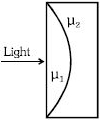
$A$ plano-convex lens fits exactly into a plano-concave lens. Their plane surfaces are parallel to each other. If the lenses are made of different materials with refractive indices $\mu_1$ and $\mu_2$ and $R$ is the radius of curvature of the curved surface of the lenses,then the focal length of the combination is:
A
$\frac{2R}{(\mu_2 - \mu_1)}$
B
$\frac{R}{2(\mu_1 + \mu_2)}$
C
$\frac{R}{2(\mu_1 - \mu_2)}$
D
$\frac{R}{(\mu_1 - \mu_2)}$
Solution
(D) The equivalent focal length $f_{eq}$ of two thin lenses in contact is given by $\frac{1}{f_{eq}} = \frac{1}{f_1} + \frac{1}{f_2}$.
For the plano-convex lens (refractive index $\mu_1$): The first surface is plane $(R_1 = \infty)$ and the second surface is convex $(R_2 = -R)$. Using the lens maker's formula: $\frac{1}{f_1} = (\mu_1 - 1) \left( \frac{1}{\infty} - \frac{1}{-R} \right) = \frac{\mu_1 - 1}{R}$.
For the plano-concave lens (refractive index $\mu_2$): The first surface is concave $(R_1 = -R)$ and the second surface is plane $(R_2 = \infty)$. Using the lens maker's formula: $\frac{1}{f_2} = (\mu_2 - 1) \left( \frac{1}{-R} - \frac{1}{\infty} \right) = -\frac{\mu_2 - 1}{R}$.
Adding the two focal powers:
$\frac{1}{f_{eq}} = \frac{\mu_1 - 1}{R} - \frac{\mu_2 - 1}{R} = \frac{\mu_1 - 1 - \mu_2 + 1}{R} = \frac{\mu_1 - \mu_2}{R}$.
Therefore,$f_{eq} = \frac{R}{\mu_1 - \mu_2}$.
For the plano-convex lens (refractive index $\mu_1$): The first surface is plane $(R_1 = \infty)$ and the second surface is convex $(R_2 = -R)$. Using the lens maker's formula: $\frac{1}{f_1} = (\mu_1 - 1) \left( \frac{1}{\infty} - \frac{1}{-R} \right) = \frac{\mu_1 - 1}{R}$.
For the plano-concave lens (refractive index $\mu_2$): The first surface is concave $(R_1 = -R)$ and the second surface is plane $(R_2 = \infty)$. Using the lens maker's formula: $\frac{1}{f_2} = (\mu_2 - 1) \left( \frac{1}{-R} - \frac{1}{\infty} \right) = -\frac{\mu_2 - 1}{R}$.
Adding the two focal powers:
$\frac{1}{f_{eq}} = \frac{\mu_1 - 1}{R} - \frac{\mu_2 - 1}{R} = \frac{\mu_1 - 1 - \mu_2 + 1}{R} = \frac{\mu_1 - \mu_2}{R}$.
Therefore,$f_{eq} = \frac{R}{\mu_1 - \mu_2}$.
0 likesView Solution
6
ChemistryMCQAIPMT · 2013
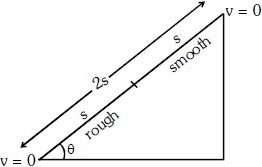
The upper half of an inclined plane of inclination $\theta$ is perfectly smooth while the lower half is rough. $A$ block starting from rest at the top of the plane will again come to rest at the bottom,if the coefficient of friction between the block and the lower half of the plane is given by:
A
$\mu = \tan \theta$
B
$\mu = \frac{1}{\tan \theta}$
C
$\mu = \frac{2}{\tan \theta}$
D
$\mu = 2 \tan \theta$
Solution
(D) Let the total length of the inclined plane be $2s$. The upper half has length $s$ and is smooth,while the lower half has length $s$ and is rough.
According to the work-energy theorem,the total work done by all forces on the block is equal to the change in its kinetic energy.
Since the block starts from rest at the top and comes to rest at the bottom,the change in kinetic energy is $\Delta KE = 0 - 0 = 0$.
The forces doing work are gravity and friction.
Work done by gravity over the total distance $2s$ is $W_g = (mg \sin \theta)(2s)$.
Work done by friction over the lower half of length $s$ is $W_f = -(\mu mg \cos \theta)(s)$.
Setting the total work to zero: $W_g + W_f = 0$.
$(mg \sin \theta)(2s) - (\mu mg \cos \theta)(s) = 0$.
$2mg \sin \theta = \mu mg \cos \theta$.
Dividing both sides by $mg \cos \theta$,we get $\mu = 2 \frac{\sin \theta}{\cos \theta} = 2 \tan \theta$.
According to the work-energy theorem,the total work done by all forces on the block is equal to the change in its kinetic energy.
Since the block starts from rest at the top and comes to rest at the bottom,the change in kinetic energy is $\Delta KE = 0 - 0 = 0$.
The forces doing work are gravity and friction.
Work done by gravity over the total distance $2s$ is $W_g = (mg \sin \theta)(2s)$.
Work done by friction over the lower half of length $s$ is $W_f = -(\mu mg \cos \theta)(s)$.
Setting the total work to zero: $W_g + W_f = 0$.
$(mg \sin \theta)(2s) - (\mu mg \cos \theta)(s) = 0$.
$2mg \sin \theta = \mu mg \cos \theta$.
Dividing both sides by $mg \cos \theta$,we get $\mu = 2 \frac{\sin \theta}{\cos \theta} = 2 \tan \theta$.
0 likesView Solution
7
ChemistryMCQAIPMT · 2013
In an experiment,four quantities $a, b, c$ and $d$ are measured with percentage errors of $1\%, 2\%, 3\%$ and $4\%$ respectively. Quantity $P$ is calculated as $P = \frac{a^3 b^2}{cd}$. The percentage error in the measurement of $P$ is .......... $\%$
A
$4$
B
$14$
C
$10$
D
$7$
Solution
(B) Given the formula $P = \frac{a^3 b^2}{cd}$.
To find the relative error in $P$,we use the formula for propagation of errors:
$\frac{\Delta P}{P} = 3 \frac{\Delta a}{a} + 2 \frac{\Delta b}{b} + \frac{\Delta c}{c} + \frac{\Delta d}{d}$.
Given percentage errors are $\frac{\Delta a}{a} \times 100 = 1\%$,$\frac{\Delta b}{b} \times 100 = 2\%$,$\frac{\Delta c}{c} \times 100 = 3\%$,and $\frac{\Delta d}{d} \times 100 = 4\%$.
Substituting these values:
$\frac{\Delta P}{P} \times 100 = 3(1\%) + 2(2\%) + 3\% + 4\%$.
$\frac{\Delta P}{P} \times 100 = 3\% + 4\% + 3\% + 4\% = 14\%$.
Thus,the percentage error in $P$ is $14\%$.
To find the relative error in $P$,we use the formula for propagation of errors:
$\frac{\Delta P}{P} = 3 \frac{\Delta a}{a} + 2 \frac{\Delta b}{b} + \frac{\Delta c}{c} + \frac{\Delta d}{d}$.
Given percentage errors are $\frac{\Delta a}{a} \times 100 = 1\%$,$\frac{\Delta b}{b} \times 100 = 2\%$,$\frac{\Delta c}{c} \times 100 = 3\%$,and $\frac{\Delta d}{d} \times 100 = 4\%$.
Substituting these values:
$\frac{\Delta P}{P} \times 100 = 3(1\%) + 2(2\%) + 3\% + 4\%$.
$\frac{\Delta P}{P} \times 100 = 3\% + 4\% + 3\% + 4\% = 14\%$.
Thus,the percentage error in $P$ is $14\%$.
0 likesView Solution
8
ChemistryMCQAIPMT · 2013
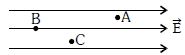
$A, B$ and $C$ are three points in a uniform electric field as shown in the figure. The electric potential is
A
Same at all the three points $A, B$ and $C$
B
Maximum at $A$
C
Maximum at $B$
D
Maximum at $C$
Solution
(C) The electric potential $V$ in an electric field $\vec{E}$ is related by the relation $dV = -\vec{E} \cdot d\vec{r}$.
This implies that the electric potential decreases as we move in the direction of the electric field.
In the given figure,the electric field $\vec{E}$ is directed towards the right.
Point $B$ is the furthest to the left,followed by point $C$ (which is at the same vertical level as $B$ but slightly to the right),and point $A$ is the furthest to the right.
Since the potential decreases in the direction of the electric field,the point furthest to the left will have the highest potential.
Therefore,the electric potential is maximum at point $B$.
This implies that the electric potential decreases as we move in the direction of the electric field.
In the given figure,the electric field $\vec{E}$ is directed towards the right.
Point $B$ is the furthest to the left,followed by point $C$ (which is at the same vertical level as $B$ but slightly to the right),and point $A$ is the furthest to the right.
Since the potential decreases in the direction of the electric field,the point furthest to the left will have the highest potential.
Therefore,the electric potential is maximum at point $B$.
0 likesView Solution
9
ChemistryMCQAIPMT · 2013
$A$ wire of resistance $4\,\Omega$ is stretched to twice its original length. The resistance of the stretched wire would be ................ $\Omega$.
A
$16$
B
$2$
C
$4$
D
$8$
Solution
(A) The resistance of a wire is given by $R = \rho \frac{l}{A}$.
Since the volume $V = A \times l$ remains constant when the wire is stretched,we can write $A = \frac{V}{l}$.
Substituting this into the resistance formula,we get $R = \rho \frac{l}{V/l} = \rho \frac{l^2}{V}$.
Since $\rho$ and $V$ are constant,$R \propto l^2$.
If the length is doubled $(l' = 2l)$,the new resistance $R'$ becomes $R' = R \times (2)^2 = 4R$.
Given the initial resistance $R = 4\,\Omega$,the new resistance is $R' = 4 \times 4\,\Omega = 16\,\Omega$.
Since the volume $V = A \times l$ remains constant when the wire is stretched,we can write $A = \frac{V}{l}$.
Substituting this into the resistance formula,we get $R = \rho \frac{l}{V/l} = \rho \frac{l^2}{V}$.
Since $\rho$ and $V$ are constant,$R \propto l^2$.
If the length is doubled $(l' = 2l)$,the new resistance $R'$ becomes $R' = R \times (2)^2 = 4R$.
Given the initial resistance $R = 4\,\Omega$,the new resistance is $R' = 4 \times 4\,\Omega = 16\,\Omega$.
0 likesView Solution
10
ChemistryMCQAIPMT · 2013
During an adiabatic process,the pressure of a gas is found to be proportional to the cube of its absolute temperature. The ratio $C_P / C_V$ for the gas is
A
$1.5$
B
$1.33$
C
$2$
D
$1.67$
Solution
(A) For an adiabatic process,the relationship between pressure $P$ and temperature $T$ is given by $P^{1-\gamma} T^{\gamma} = \text{constant}$.
Given that $P \propto T^{3}$,we can write this as $P T^{-3} = \text{constant}$.
Comparing the exponents of $P$ and $T$ in the two equations,we have the ratio $\frac{\gamma}{1-\gamma} = -3$.
Solving for $\gamma$: $\gamma = -3(1-\gamma) \Rightarrow \gamma = -3 + 3\gamma \Rightarrow 2\gamma = 3 \Rightarrow \gamma = 1.5$.
Since the ratio $C_P / C_V$ is defined as $\gamma$,the value is $1.5$.
Given that $P \propto T^{3}$,we can write this as $P T^{-3} = \text{constant}$.
Comparing the exponents of $P$ and $T$ in the two equations,we have the ratio $\frac{\gamma}{1-\gamma} = -3$.
Solving for $\gamma$: $\gamma = -3(1-\gamma) \Rightarrow \gamma = -3 + 3\gamma \Rightarrow 2\gamma = 3 \Rightarrow \gamma = 1.5$.
Since the ratio $C_P / C_V$ is defined as $\gamma$,the value is $1.5$.
0 likesView Solution
11
ChemistryMCQAIPMT · 2013
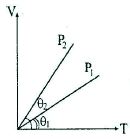
In the given $(V-T)$ diagram,what is the relation between pressure $P_1$ and $P_2$?
A
$P_2 > P_1$
B
$P_2 < P_1$
C
$P_2 = P_1$
D
None of these
Solution
(B) According to the ideal gas equation,$PV = nRT$,which can be rewritten as $V = (nR/P)T$.
For an isobaric process,the pressure $P$ is constant,and $V \propto T$.
Therefore,the $(V-T)$ graph is a straight line passing through the origin,where the slope of the line is given by $m = nR/P$.
Since the slope $m$ is inversely proportional to the pressure $P$ $(m \propto 1/P)$,a larger slope corresponds to a smaller pressure.
From the given diagram,the angle $\theta_2 > \theta_1$,which implies that the slope of the line for $P_2$ is greater than the slope of the line for $P_1$ (i.e.,$\text{slope}_2 > \text{slope}_1$).
Since the slope is inversely proportional to pressure,we conclude that $P_2 < P_1$.
For an isobaric process,the pressure $P$ is constant,and $V \propto T$.
Therefore,the $(V-T)$ graph is a straight line passing through the origin,where the slope of the line is given by $m = nR/P$.
Since the slope $m$ is inversely proportional to the pressure $P$ $(m \propto 1/P)$,a larger slope corresponds to a smaller pressure.
From the given diagram,the angle $\theta_2 > \theta_1$,which implies that the slope of the line for $P_2$ is greater than the slope of the line for $P_1$ (i.e.,$\text{slope}_2 > \text{slope}_1$).
Since the slope is inversely proportional to pressure,we conclude that $P_2 < P_1$.
0 likesView Solution
12
ChemistryMCQAIPMT · 2013
$A$ piece of iron is heated in a flame. It first becomes dull red, then becomes reddish yellow, and finally turns to white hot. The correct explanation for the above observation is possible by using:
A
Wien's displacement Law
B
Kirchhoff's Law
C
Newton's Law of cooling
D
Stefan's Law
Solution
(A) According to Wien's displacement law, the product of the wavelength corresponding to maximum intensity $(\lambda_{m})$ and the absolute temperature $(T)$ of the black body is a constant.
$\lambda_{m} T = b$ (constant)
This implies $\lambda_{m} \propto \frac{1}{T}$.
As the temperature $(T)$ of the iron piece increases, the wavelength $(\lambda_{m})$ of the emitted radiation decreases. Initially, the iron emits longer wavelengths (dull red), and as it gets hotter, it shifts toward shorter wavelengths (yellow and eventually white, which contains all visible colors), confirming the observation.
$\lambda_{m} T = b$ (constant)
This implies $\lambda_{m} \propto \frac{1}{T}$.
As the temperature $(T)$ of the iron piece increases, the wavelength $(\lambda_{m})$ of the emitted radiation decreases. Initially, the iron emits longer wavelengths (dull red), and as it gets hotter, it shifts toward shorter wavelengths (yellow and eventually white, which contains all visible colors), confirming the observation.
0 likesView Solution
Vedclass Products
For Students
Vedclass Test Series
Mock tests in real AIPMT style covering Chemistry with performance analysis. 5-day free trial.
Start Free TrialFor Teachers
Exam Paper Generator
Generate Set A/B/C/D Chemistry papers from 7.5L+ questions in 2 minutes. 3 chapters free.
Try FreeFor Institutes
Online Exam Module
Run live AIPMT mock exams with unlimited students, 360° analytics & white-label branding.
See DemoFrequently Asked Questions
How many Chemistry questions are in AIPMT 2013?
There are 12 Chemistry questions from the AIPMT 2013 paper on Vedclass, each with a detailed step-by-step solution in English.
Are AIPMT 2013 Chemistry solutions available in English?
Yes. All solutions on this page are in English. You can also switch to English or Hindi using the language buttons above the questions.
Can I practice AIPMT 2013 Chemistry as a timed test?
Yes. Use the Vedclass Test Series to attempt a full AIPMT mock test covering Chemistry with time limits and instant score analysis.
Can teachers create Chemistry papers from AIPMT previous year questions?
Yes. The Vedclass Exam Paper Generator lets teachers mix AIPMT Chemistry questions and generate Set A/B/C/D papers in minutes.
For Teachers & Institutes
Build a Custom Chemistry Paper
Pick AIPMT 2013 Chemistry questions, set difficulty, and generate Set A/B/C/D in 2 minutes.