
ChemistryQ1–18 of 18 questions
Page 1 of 1 · English
1
ChemistryMCQAIPMT · 2015
Which of the following figures represents the variation of particle momentum $p$ and the associated de-Broglie wavelength $\lambda$?
A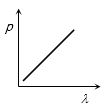
B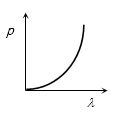
C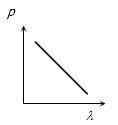
D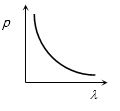
Solution
(D) According to the de-Broglie hypothesis,the wavelength $\lambda$ associated with a particle of momentum $p$ is given by the relation:
$\lambda = \frac{h}{p}$
where $h$ is Planck's constant.
Rearranging this equation,we get:
$p = \frac{h}{\lambda}$
This implies that the momentum $p$ is inversely proportional to the wavelength $\lambda$ $(p \propto \frac{1}{\lambda})$.
The graph of $p$ versus $\lambda$ for an inverse relationship is a rectangular hyperbola.
Therefore,the correct figure is the one representing a rectangular hyperbola,which corresponds to option $(D)$.
$\lambda = \frac{h}{p}$
where $h$ is Planck's constant.
Rearranging this equation,we get:
$p = \frac{h}{\lambda}$
This implies that the momentum $p$ is inversely proportional to the wavelength $\lambda$ $(p \propto \frac{1}{\lambda})$.
The graph of $p$ versus $\lambda$ for an inverse relationship is a rectangular hyperbola.
Therefore,the correct figure is the one representing a rectangular hyperbola,which corresponds to option $(D)$.
0 likesView Solution
2
ChemistryMediumMCQAIPMT · 2015
Which of the following species contains an equal number of $\sigma -$ and $\pi -$ bonds?
A
$(CN)_2$
B
$CH_2(CN)_2$
C
$HCO_3^-$
D
$XeO_4$
Solution
(D) Let us analyze the number of $\sigma$ and $\pi$ bonds in each species:
$A$. $(CN)_2$ (or $N \equiv C-C \equiv N$): It has $3$ $\sigma$ bonds and $4$ $\pi$ bonds.
$B$. $CH_2(CN)_2$ (or $NC-CH_2-CN$): It has $9$ $\sigma$ bonds and $4$ $\pi$ bonds.
$C$. $HCO_3^-$: It has $5$ $\sigma$ bonds and $1$ $\pi$ bond.
$D$. $XeO_4$: The structure consists of a central $Xe$ atom bonded to $4$ oxygen atoms via double bonds. Each double bond consists of $1$ $\sigma$ bond and $1$ $\pi$ bond. Thus,there are $4$ $\sigma$ bonds and $4$ $\pi$ bonds.
Therefore,$XeO_4$ contains an equal number of $\sigma$ and $\pi$ bonds.
$A$. $(CN)_2$ (or $N \equiv C-C \equiv N$): It has $3$ $\sigma$ bonds and $4$ $\pi$ bonds.
$B$. $CH_2(CN)_2$ (or $NC-CH_2-CN$): It has $9$ $\sigma$ bonds and $4$ $\pi$ bonds.
$C$. $HCO_3^-$: It has $5$ $\sigma$ bonds and $1$ $\pi$ bond.
$D$. $XeO_4$: The structure consists of a central $Xe$ atom bonded to $4$ oxygen atoms via double bonds. Each double bond consists of $1$ $\sigma$ bond and $1$ $\pi$ bond. Thus,there are $4$ $\sigma$ bonds and $4$ $\pi$ bonds.
Therefore,$XeO_4$ contains an equal number of $\sigma$ and $\pi$ bonds.
0 likesView Solution
3
ChemistryMediumMCQAIPMT · 2015
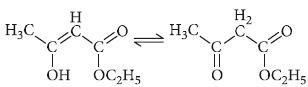
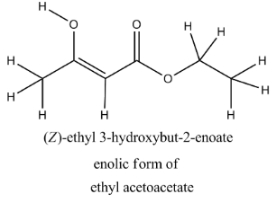
The enolic form of ethyl acetoacetate,as shown below,has:
A
$9$ sigma bonds and $2$ pi-bonds
B
$9$ sigma bonds and $1$ pi-bond
C
$18$ sigma bonds and $2$ pi-bonds
D
$16$ sigma bonds and $1$ pi-bond
Solution
(C) The chemical formula of the enolic form of ethyl acetoacetate is $CH_3-C(OH)=CH-COOCH_2CH_3$.
Counting the bonds:
$1$. Sigma $(\sigma)$ bonds: There are $18$ sigma bonds in the molecule.
$2$. Pi $(\pi)$ bonds: There are $2$ pi bonds (one in the $C=C$ double bond and one in the $C=O$ double bond).
Therefore,the correct answer is $18$ sigma bonds and $2$ pi-bonds.
Counting the bonds:
$1$. Sigma $(\sigma)$ bonds: There are $18$ sigma bonds in the molecule.
$2$. Pi $(\pi)$ bonds: There are $2$ pi bonds (one in the $C=C$ double bond and one in the $C=O$ double bond).
Therefore,the correct answer is $18$ sigma bonds and $2$ pi-bonds.
0 likesView Solution
4
ChemistryMediumMCQAIPMT · 2015
$2,3-$Dimethyl$-2-$butene can be prepared by heating which of the following compounds with a strong acid?
A
$CH_3-C(CH_3)_2-CH=CH_2$
B
$CH_3-C(CH_3)=CH-CH_2-CH_3$
C
$(CH_3)_2CH-CH_2-CH=CH_2$
D
$(CH_3)_2CH-CH(CH_3)-CH=CH_2$
Solution
(A) $3,3-$Dimethyl$-1-$butene $(CH_3-C(CH_3)_2-CH=CH_2)$ on treatment with a strong acid undergoes protonation to form a secondary carbocation: $CH_3-C(CH_3)_2-C^+H-CH_3$.
This carbocation undergoes a $1,2-$methyl shift to form a more stable tertiary carbocation: $CH_3-C^+(CH_3)-CH(CH_3)-CH_3$.
Finally,it loses a proton (deprotonation) to form the more substituted alkene,$2,3-$dimethyl$-2-$butene $(CH_3-C(CH_3)=C(CH_3)-CH_3)$,as the major product.
This carbocation undergoes a $1,2-$methyl shift to form a more stable tertiary carbocation: $CH_3-C^+(CH_3)-CH(CH_3)-CH_3$.
Finally,it loses a proton (deprotonation) to form the more substituted alkene,$2,3-$dimethyl$-2-$butene $(CH_3-C(CH_3)=C(CH_3)-CH_3)$,as the major product.
0 likesView Solution
5
ChemistryMCQAIPMT · 2015
The coefficient of performance of a refrigerator is $5$. If the temperature inside the freezer is $-20\,^{\circ}C$,the temperature of the surroundings to which it rejects heat is ....... $^{\circ}C$.
A
$21$
B
$31$
C
$41$
D
$11$
Solution
(B) The coefficient of performance $(COP)$ of a refrigerator is given by the formula:
$COP = \frac{T_L}{T_H - T_L}$
where $T_L$ is the temperature inside the freezer and $T_H$ is the temperature of the surroundings.
First,convert the temperature from Celsius to Kelvin:
$T_L = -20 + 273 = 253 \, K$.
Given $COP = 5$,substitute the values into the formula:
$5 = \frac{253}{T_H - 253}$
$5(T_H - 253) = 253$
$5T_H - 1265 = 253$
$5T_H = 1518$
$T_H = 303.6 \, K$.
Now,convert the temperature back to Celsius:
$T_H (^{\circ}C) = 303.6 - 273 = 30.6 \, ^{\circ}C \approx 31 \, ^{\circ}C$.
$COP = \frac{T_L}{T_H - T_L}$
where $T_L$ is the temperature inside the freezer and $T_H$ is the temperature of the surroundings.
First,convert the temperature from Celsius to Kelvin:
$T_L = -20 + 273 = 253 \, K$.
Given $COP = 5$,substitute the values into the formula:
$5 = \frac{253}{T_H - 253}$
$5(T_H - 253) = 253$
$5T_H - 1265 = 253$
$5T_H = 1518$
$T_H = 303.6 \, K$.
Now,convert the temperature back to Celsius:
$T_H (^{\circ}C) = 303.6 - 273 = 30.6 \, ^{\circ}C \approx 31 \, ^{\circ}C$.
0 likesView Solution
6
ChemistryMCQAIPMT · 2015
$A$ certain metallic surface is illuminated with monochromatic light of wavelength $\lambda$. The stopping potential for the photoelectric current for this light is $3V_0$. If the same surface is illuminated with light of wavelength $2\lambda$,the stopping potential is $V_0$. The threshold wavelength for this surface for the photoelectric effect is:
A
$4\lambda$
B
$\frac{\lambda}{4}$
C
$\frac{\lambda}{6}$
D
$6\lambda$
Solution
(A) According to Einstein's photoelectric equation,the stopping potential $V_s$ is given by $eV_s = \frac{hc}{\lambda} - \phi$,where $\phi = \frac{hc}{\lambda_0}$ is the work function and $\lambda_0$ is the threshold wavelength.
For the first case: $3eV_0 = \frac{hc}{\lambda} - \frac{hc}{\lambda_0}$ --- $(1)$
For the second case: $eV_0 = \frac{hc}{2\lambda} - \frac{hc}{\lambda_0}$ --- $(2)$
Dividing equation $(1)$ by equation $(2)$:
$3 = \frac{\frac{hc}{\lambda} - \frac{hc}{\lambda_0}}{\frac{hc}{2\lambda} - \frac{hc}{\lambda_0}}$
$3 \left( \frac{1}{2\lambda} - \frac{1}{\lambda_0} \right) = \frac{1}{\lambda} - \frac{1}{\lambda_0}$
$\frac{3}{2\lambda} - \frac{3}{\lambda_0} = \frac{1}{\lambda} - \frac{1}{\lambda_0}$
$\frac{3}{2\lambda} - \frac{1}{\lambda} = \frac{3}{\lambda_0} - \frac{1}{\lambda_0}$
$\frac{1}{2\lambda} = \frac{2}{\lambda_0}$
$\lambda_0 = 4\lambda$.
For the first case: $3eV_0 = \frac{hc}{\lambda} - \frac{hc}{\lambda_0}$ --- $(1)$
For the second case: $eV_0 = \frac{hc}{2\lambda} - \frac{hc}{\lambda_0}$ --- $(2)$
Dividing equation $(1)$ by equation $(2)$:
$3 = \frac{\frac{hc}{\lambda} - \frac{hc}{\lambda_0}}{\frac{hc}{2\lambda} - \frac{hc}{\lambda_0}}$
$3 \left( \frac{1}{2\lambda} - \frac{1}{\lambda_0} \right) = \frac{1}{\lambda} - \frac{1}{\lambda_0}$
$\frac{3}{2\lambda} - \frac{3}{\lambda_0} = \frac{1}{\lambda} - \frac{1}{\lambda_0}$
$\frac{3}{2\lambda} - \frac{1}{\lambda} = \frac{3}{\lambda_0} - \frac{1}{\lambda_0}$
$\frac{1}{2\lambda} = \frac{2}{\lambda_0}$
$\lambda_0 = 4\lambda$.
0 likesView Solution
7
ChemistryMCQAIPMT · 2015
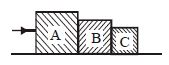
Three blocks,$A, B$ and $C,$ of masses $4\,kg, 2\,kg$ and $1\,kg$ respectively,are in contact on a frictionless surface,as shown. If a force of $14\,N$ is applied on the $4\,kg$ block,then the contact force between $A$ and $B$ is ....... $N$.
A
$6$
B
$8$
C
$18$
D
$2$
Solution
(A) Given: Force $F = 14\,N$,masses $m_A = 4\,kg, m_B = 2\,kg, m_C = 1\,kg$.
Total mass of the system $m = m_A + m_B + m_C = 4 + 2 + 1 = 7\,kg$.
Acceleration of the system $a = \frac{F}{m} = \frac{14}{7} = 2\,m/s^2$.
The contact force between block $A$ and block $B$ is the force required to accelerate blocks $B$ and $C$ together.
Let $F_{AB}$ be the contact force between $A$ and $B$.
$F_{AB} = (m_B + m_C) \times a = (2 + 1) \times 2 = 3 \times 2 = 6\,N$.
Total mass of the system $m = m_A + m_B + m_C = 4 + 2 + 1 = 7\,kg$.
Acceleration of the system $a = \frac{F}{m} = \frac{14}{7} = 2\,m/s^2$.
The contact force between block $A$ and block $B$ is the force required to accelerate blocks $B$ and $C$ together.
Let $F_{AB}$ be the contact force between $A$ and $B$.
$F_{AB} = (m_B + m_C) \times a = (2 + 1) \times 2 = 3 \times 2 = 6\,N$.
0 likesView Solution
8
ChemistryMCQAIPMT · 2015
Water rises to a height $h$ in a capillary tube. If the length of the capillary tube above the surface of water is made less than $h$,then
A
water does not rise at all.
B
water rises up to the tip of the capillary tube and then starts overflowing like a fountain.
C
water rises up to the top of the capillary tube and stays there without overflowing.
D
water rises up to a point a little below the top and stays there.
Solution
(C) When the length of the capillary tube is less than the height $h$ to which water would normally rise,the water will rise to the top of the tube.
At the top,the radius of curvature of the meniscus increases such that the pressure balance is maintained.
The water does not overflow because the pressure at the top surface remains equal to the atmospheric pressure,and the surface tension force adjusts to keep the water in equilibrium.
Therefore,the water rises up to the top of the capillary tube and stays there without overflowing.
At the top,the radius of curvature of the meniscus increases such that the pressure balance is maintained.
The water does not overflow because the pressure at the top surface remains equal to the atmospheric pressure,and the surface tension force adjusts to keep the water in equilibrium.
Therefore,the water rises up to the top of the capillary tube and stays there without overflowing.
0 likesView Solution
9
ChemistryMCQAIPMT · 2015
In an astronomical telescope in normal adjustment,a straight black line of length $L$ is drawn on the objective lens. The eyepiece forms a real image of this line. The length of this image is $l$. The magnification of the telescope is
A
$L/l$
B
$L/l + 1$
C
$L/l - 1$
D
$(L + l)/(L - l)$
Solution
(A) Let $f_{o}$ and $f_{e}$ be the focal lengths of the objective and eyepiece respectively.
In normal adjustment,the distance between the objective and the eyepiece is $f_{o} + f_{e}$.
The line of length $L$ on the objective lens acts as an object for the eyepiece.
The distance of this object from the eyepiece is $u = -(f_{o} + f_{e})$.
Using the lens formula for the eyepiece: $1/v - 1/u = 1/f_{e}$.
$1/v = 1/f_{e} + 1/u = 1/f_{e} - 1/(f_{o} + f_{e}) = f_{o} / [f_{e}(f_{o} + f_{e})]$.
So,$v = [f_{e}(f_{o} + f_{e})] / f_{o}$.
The magnification $m$ produced by the eyepiece for this object is $m = v/u = [f_{e}(f_{o} + f_{e}) / f_{o}] / [-(f_{o} + f_{e})] = -f_{e}/f_{o}$.
The ratio of the image length $l$ to the object length $L$ is $|m| = l/L = f_{e}/f_{o}$.
The magnification of the astronomical telescope in normal adjustment is $M = f_{o}/f_{e}$.
Therefore,$M = L/l$.
In normal adjustment,the distance between the objective and the eyepiece is $f_{o} + f_{e}$.
The line of length $L$ on the objective lens acts as an object for the eyepiece.
The distance of this object from the eyepiece is $u = -(f_{o} + f_{e})$.
Using the lens formula for the eyepiece: $1/v - 1/u = 1/f_{e}$.
$1/v = 1/f_{e} + 1/u = 1/f_{e} - 1/(f_{o} + f_{e}) = f_{o} / [f_{e}(f_{o} + f_{e})]$.
So,$v = [f_{e}(f_{o} + f_{e})] / f_{o}$.
The magnification $m$ produced by the eyepiece for this object is $m = v/u = [f_{e}(f_{o} + f_{e}) / f_{o}] / [-(f_{o} + f_{e})] = -f_{e}/f_{o}$.
The ratio of the image length $l$ to the object length $L$ is $|m| = l/L = f_{e}/f_{o}$.
The magnification of the astronomical telescope in normal adjustment is $M = f_{o}/f_{e}$.
Therefore,$M = L/l$.
0 likesView Solution
10
ChemistryMCQAIPMT · 2015
$A$ particle is executing a simple harmonic motion. Its maximum acceleration is $\alpha$ and maximum velocity is $\beta$. Then,its time period of vibration will be
A
$\frac{2\pi \beta}{\alpha}$
B
$\frac{\beta^2}{\alpha^2}$
C
$\frac{\alpha}{\beta}$
D
$\frac{\beta^2}{\alpha}$
Solution
(A) For a particle in simple harmonic motion with amplitude $A$ and angular frequency $\omega$:
Maximum acceleration is given by $\alpha = A\omega^2$.
Maximum velocity is given by $\beta = A\omega$.
Dividing the two equations: $\frac{\alpha}{\beta} = \frac{A\omega^2}{A\omega} = \omega$.
Therefore,$\omega = \frac{\alpha}{\beta}$.
The time period $T$ is given by $T = \frac{2\pi}{\omega}$.
Substituting the value of $\omega$: $T = \frac{2\pi}{(\alpha / \beta)} = \frac{2\pi \beta}{\alpha}$.
Maximum acceleration is given by $\alpha = A\omega^2$.
Maximum velocity is given by $\beta = A\omega$.
Dividing the two equations: $\frac{\alpha}{\beta} = \frac{A\omega^2}{A\omega} = \omega$.
Therefore,$\omega = \frac{\alpha}{\beta}$.
The time period $T$ is given by $T = \frac{2\pi}{\omega}$.
Substituting the value of $\omega$: $T = \frac{2\pi}{(\alpha / \beta)} = \frac{2\pi \beta}{\alpha}$.
0 likesView Solution
11
ChemistryMCQAIPMT · 2015
$A$ wind with speed $40\,m/s$ blows parallel to the roof of a house. The area of the roof is $250\,m^2.$ Assuming that the pressure inside the house is atmospheric pressure,the force exerted by the wind on the roof and the direction of the force will be $(\rho_{air} = 1.2\,kg/m^3)$
A
$4.8 \times 10^5\,N,$ upwards
B
$2.4 \times 10^5\,N,$ upwards
C
$2.4 \times 10^5\,N,$ downwards
D
$4.8 \times 10^5\,N,$ downwards
Solution
(B) According to Bernoulli's principle,the pressure above the roof decreases as the wind speed increases.
The pressure difference $\Delta P$ between the inside and outside of the roof is given by $\Delta P = \frac{1}{2} \rho V^2$.
Given: $\rho = 1.2\,kg/m^3$,$V = 40\,m/s$,and $A = 250\,m^2$.
$\Delta P = \frac{1}{2} \times 1.2 \times (40)^2 = 0.6 \times 1600 = 960\,Pa$.
The force exerted on the roof is $F = \Delta P \times A$.
$F = 960 \times 250 = 240,000\,N = 2.4 \times 10^5\,N$.
Since the pressure outside is lower than the pressure inside,the net force acts in the upward direction.
The pressure difference $\Delta P$ between the inside and outside of the roof is given by $\Delta P = \frac{1}{2} \rho V^2$.
Given: $\rho = 1.2\,kg/m^3$,$V = 40\,m/s$,and $A = 250\,m^2$.
$\Delta P = \frac{1}{2} \times 1.2 \times (40)^2 = 0.6 \times 1600 = 960\,Pa$.
The force exerted on the roof is $F = \Delta P \times A$.
$F = 960 \times 250 = 240,000\,N = 2.4 \times 10^5\,N$.
Since the pressure outside is lower than the pressure inside,the net force acts in the upward direction.
0 likesView Solution
12
ChemistryMCQAIPMT · 2015
Which of the following species contains an equal number of $\sigma$ and $\pi$ bonds?
A
$XeO_4$
B
$(CN)_2$
C
$CH_2(CN)_2$
D
$H_2CO_3$
Solution
(A) The number of $\sigma$ and $\pi$ bonds in the given species is calculated as follows:
In $XeO_4$,there are $4$ $\sigma$ bonds (Xe-$O$ single bonds) and $4$ $\pi$ bonds (Xe=$O$ double bonds). Thus,it contains an equal number of $\sigma$ and $\pi$ bonds.
| Molecule | Number of $\sigma$ and $\pi$ bonds |
| $(CN)_2$ $(N \equiv C-C \equiv N)$ | $3 \sigma, 4 \pi$ |
| $CH_2(CN)_2$ | $8 \sigma, 4 \pi$ |
| $H_2CO_3$ | $6 \sigma, 1 \pi$ |
| $XeO_4$ | $4 \sigma, 4 \pi$ |
In $XeO_4$,there are $4$ $\sigma$ bonds (Xe-$O$ single bonds) and $4$ $\pi$ bonds (Xe=$O$ double bonds). Thus,it contains an equal number of $\sigma$ and $\pi$ bonds.
0 likesView Solution
13
ChemistryMCQAIPMT · 2015
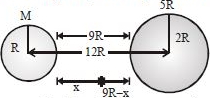
Two spherical bodies of mass $M$ and $5M$ and radii $R$ and $2R$ respectively are released in free space with an initial separation between their centres equal to $12\,R$. If they attract each other due to gravitational force only,then the distance covered by the smaller body just before collision is (in $, R$)
A
$1.5$
B
$2.5$
C
$4.5$
D
$7.5$
Solution
(D) The initial distance between the centres of the two bodies is $12\,R$. Collision occurs when the distance between their centres is equal to the sum of their radii,which is $R + 2R = 3\,R$.
The total distance covered by both bodies relative to each other until collision is $12\,R - 3\,R = 9\,R$.
Since the bodies move under mutual gravitational attraction only,the position of their centre of mass remains stationary. Let $x$ be the distance covered by the smaller body (mass $M$) and $y$ be the distance covered by the larger body (mass $5M$).
From the property of the centre of mass,$M x = (5M) y$.
We also know that $x + y = 9\,R$,which implies $y = 9\,R - x$.
Substituting $y$ into the first equation: $M x = 5M(9\,R - x)$.
Dividing by $M$: $x = 5(9\,R - x) = 45\,R - 5x$.
$6x = 45\,R$,which gives $x = \frac{45\,R}{6} = 7.5\,R$.
The total distance covered by both bodies relative to each other until collision is $12\,R - 3\,R = 9\,R$.
Since the bodies move under mutual gravitational attraction only,the position of their centre of mass remains stationary. Let $x$ be the distance covered by the smaller body (mass $M$) and $y$ be the distance covered by the larger body (mass $5M$).
From the property of the centre of mass,$M x = (5M) y$.
We also know that $x + y = 9\,R$,which implies $y = 9\,R - x$.
Substituting $y$ into the first equation: $M x = 5M(9\,R - x)$.
Dividing by $M$: $x = 5(9\,R - x) = 45\,R - 5x$.
$6x = 45\,R$,which gives $x = \frac{45\,R}{6} = 7.5\,R$.
0 likesView Solution
14
ChemistryMCQAIPMT · 2015
Three blocks $A, B$ and $C$ of masses $4\, kg$,$2\, kg$ and $1\, kg$ respectively,are in contact on a frictionless surface,as shown. If a force of $14\, N$ is applied on the $4\, kg$ block,then the contact force between $A$ and $B$ is .......... $N$.
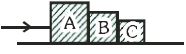
A
$6$
B
$8$
C
$18$
D
$2$
Solution
(A) The total mass of the system is $M = m_A + m_B + m_C = 4\, kg + 2\, kg + 1\, kg = 7\, kg$.
The external force applied is $F = 14\, N$.
The acceleration of the system is $a = \frac{F}{M} = \frac{14\, N}{7\, kg} = 2\, m/s^2$.
The contact force between block $A$ and block $B$ is the force required to accelerate blocks $B$ and $C$ together.
Therefore,the contact force $F_{AB} = (m_B + m_C) \times a$.
$F_{AB} = (2\, kg + 1\, kg) \times 2\, m/s^2 = 3\, kg \times 2\, m/s^2 = 6\, N$.
The external force applied is $F = 14\, N$.
The acceleration of the system is $a = \frac{F}{M} = \frac{14\, N}{7\, kg} = 2\, m/s^2$.
The contact force between block $A$ and block $B$ is the force required to accelerate blocks $B$ and $C$ together.
Therefore,the contact force $F_{AB} = (m_B + m_C) \times a$.
$F_{AB} = (2\, kg + 1\, kg) \times 2\, m/s^2 = 3\, kg \times 2\, m/s^2 = 6\, N$.
0 likesView Solution
15
ChemistryMCQAIPMT · 2015
Two particles $A$ and $B$ move with constant velocities $\vec{v}_1$ and $\vec{v}_2$. At the initial moment,their position vectors are $\vec{r}_1$ and $\vec{r}_2$ respectively. The condition for their collision is
A
$\vec{r}_1 - \vec{r}_2 = \vec{v}_1 - \vec{v}_2$
B
$\frac{\vec{r}_1 - \vec{r}_2}{|\vec{r}_1 - \vec{r}_2|} = \frac{\vec{v}_2 - \vec{v}_1}{|\vec{v}_2 - \vec{v}_1|}$
C
$\vec{r}_1 \cdot \vec{v}_1 = \vec{r}_2 \cdot \vec{v}_2$
D
$\vec{r}_1 \times \vec{v}_1 = \vec{r}_2 \times \vec{v}_2$
Solution
(B) For two particles to collide,the relative velocity vector of one particle with respect to the other must be directed along the line joining their initial positions.
Let the relative position vector be $\vec{r}_{rel} = \vec{r}_1 - \vec{r}_2$.
The relative velocity vector is $\vec{v}_{rel} = \vec{v}_2 - \vec{v}_1$.
For collision,the direction of the relative velocity must be the same as the direction of the relative position vector.
Thus,the unit vectors must be equal:
$\frac{\vec{r}_1 - \vec{r}_2}{|\vec{r}_1 - \vec{r}_2|} = \frac{\vec{v}_2 - \vec{v}_1}{|\vec{v}_2 - \vec{v}_1|}$.
Let the relative position vector be $\vec{r}_{rel} = \vec{r}_1 - \vec{r}_2$.
The relative velocity vector is $\vec{v}_{rel} = \vec{v}_2 - \vec{v}_1$.
For collision,the direction of the relative velocity must be the same as the direction of the relative position vector.
Thus,the unit vectors must be equal:
$\frac{\vec{r}_1 - \vec{r}_2}{|\vec{r}_1 - \vec{r}_2|} = \frac{\vec{v}_2 - \vec{v}_1}{|\vec{v}_2 - \vec{v}_1|}$.
0 likesView Solution
16
ChemistryMCQAIPMT · 2015
$A$ plank with a box on it at one end is gradually raised about the other end. As the angle of inclination with the horizontal reaches $30^o$,the box starts to slip and slides $4.0\, m$ down the plank in $4.0\, s$. The coefficients of static and kinetic friction between the box and the plank will be,respectively:
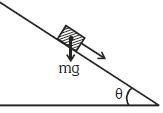
A
$0.4$ and $0.3$
B
$0.6$ and $0.6$
C
$0.6$ and $0.5$
D
$0.5$ and $0.6$
Solution
(C) $1$. Coefficient of static friction $(\mu_s)$: When the box just starts to slip,the angle of inclination is the angle of repose. Thus,$\mu_s = \tan \theta = \tan 30^o = \frac{1}{\sqrt{3}} \approx 0.577 \approx 0.6$.
$2$. Coefficient of kinetic friction $(\mu_k)$: The acceleration $a$ of the box sliding down the plank is given by $a = g \sin \theta - \mu_k g \cos \theta$.
$3$. Using the equation of motion $S = ut + \frac{1}{2}at^2$,where $S = 4.0\, m$,$u = 0$,and $t = 4.0\, s$:
$4.0 = 0 + \frac{1}{2} a (4.0)^2 \Rightarrow 4.0 = 8a \Rightarrow a = 0.5\, m/s^2$.
$4$. Substituting $a$ into the force equation (taking $g = 10\, m/s^2$):
$0.5 = 10 \sin 30^o - \mu_k (10) \cos 30^o$
$0.5 = 10(0.5) - \mu_k (10)(\frac{\sqrt{3}}{2})$
$0.5 = 5 - 5\sqrt{3} \mu_k$
$5\sqrt{3} \mu_k = 4.5$
$\mu_k = \frac{4.5}{5 \times 1.732} = \frac{0.9}{1.732} \approx 0.519 \approx 0.5$.
Thus,$\mu_s \approx 0.6$ and $\mu_k \approx 0.5$.
$2$. Coefficient of kinetic friction $(\mu_k)$: The acceleration $a$ of the box sliding down the plank is given by $a = g \sin \theta - \mu_k g \cos \theta$.
$3$. Using the equation of motion $S = ut + \frac{1}{2}at^2$,where $S = 4.0\, m$,$u = 0$,and $t = 4.0\, s$:
$4.0 = 0 + \frac{1}{2} a (4.0)^2 \Rightarrow 4.0 = 8a \Rightarrow a = 0.5\, m/s^2$.
$4$. Substituting $a$ into the force equation (taking $g = 10\, m/s^2$):
$0.5 = 10 \sin 30^o - \mu_k (10) \cos 30^o$
$0.5 = 10(0.5) - \mu_k (10)(\frac{\sqrt{3}}{2})$
$0.5 = 5 - 5\sqrt{3} \mu_k$
$5\sqrt{3} \mu_k = 4.5$
$\mu_k = \frac{4.5}{5 \times 1.732} = \frac{0.9}{1.732} \approx 0.519 \approx 0.5$.
Thus,$\mu_s \approx 0.6$ and $\mu_k \approx 0.5$.
0 likesView Solution
17
ChemistryMCQAIPMT · 2015
The figure below shows two paths that may be taken by a gas to go from a state $A$ to a state $C$. In process $AB$,$400 \, J$ of heat is added to the system and in process $BC$,$100 \, J$ of heat is added to the system. The heat absorbed by the system in the process $AC$ will be ............. $J$.
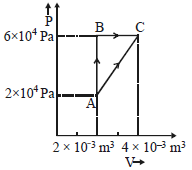
A
$500$
B
$460$
C
$300$
D
$380$
Solution
(B) From the first law of thermodynamics,$\Delta U = Q - W$. Since the change in internal energy $\Delta U$ is a state function,it is the same for any path between two states.
For path $ABC$: $\Delta U_{ABC} = \Delta U_{AC} = Q_{ABC} - W_{ABC}$.
Total heat absorbed $Q_{ABC} = Q_{AB} + Q_{BC} = 400 \, J + 100 \, J = 500 \, J$.
The work done $W_{ABC}$ is the area under the path $ABC$ on the $PV$ diagram. Since $AB$ is an isochoric process,$W_{AB} = 0$. For process $BC$,$W_{BC} = P \Delta V = (6 \times 10^4 \, Pa) \times (4 \times 10^{-3} \, m^3 - 2 \times 10^{-3} \, m^3) = 6 \times 10^4 \times 2 \times 10^{-3} = 120 \, J$.
So,$W_{ABC} = 0 + 120 \, J = 120 \, J$.
Thus,$\Delta U_{AC} = 500 \, J - 120 \, J = 380 \, J$.
For the process $AC$,$\Delta U_{AC} = Q_{AC} - W_{AC}$.
The work done $W_{AC}$ is the area under the line $AC$,which is a trapezoid: $W_{AC} = \frac{1}{2} \times (P_A + P_C) \times (V_C - V_A) = \frac{1}{2} \times (2 \times 10^4 + 6 \times 10^4) \times (4 \times 10^{-3} - 2 \times 10^{-3}) = \frac{1}{2} \times 8 \times 10^4 \times 2 \times 10^{-3} = 80 \, J$.
Therefore,$Q_{AC} = \Delta U_{AC} + W_{AC} = 380 \, J + 80 \, J = 460 \, J$.
For path $ABC$: $\Delta U_{ABC} = \Delta U_{AC} = Q_{ABC} - W_{ABC}$.
Total heat absorbed $Q_{ABC} = Q_{AB} + Q_{BC} = 400 \, J + 100 \, J = 500 \, J$.
The work done $W_{ABC}$ is the area under the path $ABC$ on the $PV$ diagram. Since $AB$ is an isochoric process,$W_{AB} = 0$. For process $BC$,$W_{BC} = P \Delta V = (6 \times 10^4 \, Pa) \times (4 \times 10^{-3} \, m^3 - 2 \times 10^{-3} \, m^3) = 6 \times 10^4 \times 2 \times 10^{-3} = 120 \, J$.
So,$W_{ABC} = 0 + 120 \, J = 120 \, J$.
Thus,$\Delta U_{AC} = 500 \, J - 120 \, J = 380 \, J$.
For the process $AC$,$\Delta U_{AC} = Q_{AC} - W_{AC}$.
The work done $W_{AC}$ is the area under the line $AC$,which is a trapezoid: $W_{AC} = \frac{1}{2} \times (P_A + P_C) \times (V_C - V_A) = \frac{1}{2} \times (2 \times 10^4 + 6 \times 10^4) \times (4 \times 10^{-3} - 2 \times 10^{-3}) = \frac{1}{2} \times 8 \times 10^4 \times 2 \times 10^{-3} = 80 \, J$.
Therefore,$Q_{AC} = \Delta U_{AC} + W_{AC} = 380 \, J + 80 \, J = 460 \, J$.
0 likesView Solution
18
ChemistryMCQAIPMT · 2015
$A$ nucleus of uranium decays at rest into nuclei of thorium and helium. Then:
A
the helium nucleus has less momentum than the thorium nucleus
B
the helium nucleus has more momentum than the thorium nucleus
C
the helium nucleus has less kinetic energy than the thorium nucleus
D
the helium nucleus has more kinetic energy than the thorium nucleus
Solution
(D) Since the uranium nucleus is at rest,the initial momentum is $0$. By the law of conservation of linear momentum,the total final momentum must also be $0$.
Therefore,the magnitude of the momentum of the thorium nucleus $(P_{Th})$ must be equal to the magnitude of the momentum of the helium nucleus $(P_{He})$,i.e.,$P_{Th} = P_{He} = P$.
The kinetic energy $(KE)$ of a particle is given by the formula $KE = \frac{P^2}{2m}$,where $m$ is the mass.
Thus,$KE_{Th} = \frac{P^2}{2m_{Th}}$ and $KE_{He} = \frac{P^2}{2m_{He}}$.
Since the mass of the helium nucleus $(m_{He})$ is significantly smaller than the mass of the thorium nucleus $(m_{Th})$,the kinetic energy of the helium nucleus $(KE_{He})$ will be greater than the kinetic energy of the thorium nucleus $(KE_{Th})$.
Hence,option $(D)$ is correct.
Therefore,the magnitude of the momentum of the thorium nucleus $(P_{Th})$ must be equal to the magnitude of the momentum of the helium nucleus $(P_{He})$,i.e.,$P_{Th} = P_{He} = P$.
The kinetic energy $(KE)$ of a particle is given by the formula $KE = \frac{P^2}{2m}$,where $m$ is the mass.
Thus,$KE_{Th} = \frac{P^2}{2m_{Th}}$ and $KE_{He} = \frac{P^2}{2m_{He}}$.
Since the mass of the helium nucleus $(m_{He})$ is significantly smaller than the mass of the thorium nucleus $(m_{Th})$,the kinetic energy of the helium nucleus $(KE_{He})$ will be greater than the kinetic energy of the thorium nucleus $(KE_{Th})$.
Hence,option $(D)$ is correct.
0 likesView Solution
Vedclass Products
For Students
Vedclass Test Series
Mock tests in real AIPMT style covering Chemistry with performance analysis. 5-day free trial.
Start Free TrialFor Teachers
Exam Paper Generator
Generate Set A/B/C/D Chemistry papers from 7.5L+ questions in 2 minutes. 3 chapters free.
Try FreeFor Institutes
Online Exam Module
Run live AIPMT mock exams with unlimited students, 360° analytics & white-label branding.
See DemoFrequently Asked Questions
How many Chemistry questions are in AIPMT 2015?
There are 18 Chemistry questions from the AIPMT 2015 paper on Vedclass, each with a detailed step-by-step solution in English.
Are AIPMT 2015 Chemistry solutions available in English?
Yes. All solutions on this page are in English. You can also switch to English or Hindi using the language buttons above the questions.
Can I practice AIPMT 2015 Chemistry as a timed test?
Yes. Use the Vedclass Test Series to attempt a full AIPMT mock test covering Chemistry with time limits and instant score analysis.
Can teachers create Chemistry papers from AIPMT previous year questions?
Yes. The Vedclass Exam Paper Generator lets teachers mix AIPMT Chemistry questions and generate Set A/B/C/D papers in minutes.
For Teachers & Institutes
Build a Custom Chemistry Paper
Pick AIPMT 2015 Chemistry questions, set difficulty, and generate Set A/B/C/D in 2 minutes.