
ChemistryQ1–93 of 156 questions
Page 1 of 3 · English
1
ChemistryMCQAIPMT · 2011
What is the function of nitrifying bacteria?
A
Oxidize ammonia to form nitrates
B
Convert free nitrogen into nitrogenous compounds
C
Convert proteins into ammonia
D
Decompose nitrates to release free nitrogen
Solution
(A) Nitrifying bacteria,such as $Nitrosomonas$ and $Nitrobacter$,play a crucial role in the nitrogen cycle.
They oxidize ammonia $(NH_3)$ into nitrites $(NO_2^-)$ and subsequently into nitrates $(NO_3^-)$.
This process is known as nitrification,which makes nitrogen available in a form that plants can readily absorb from the soil.
They oxidize ammonia $(NH_3)$ into nitrites $(NO_2^-)$ and subsequently into nitrates $(NO_3^-)$.
This process is known as nitrification,which makes nitrogen available in a form that plants can readily absorb from the soil.
0 likesView Solution
2
ChemistryMCQAIPMT · 2011
Filiform apparatus is a characteristic feature of .......
A
Suspensor
B
Egg
C
Synergid
D
Zygote
Solution
(C) The filiform apparatus is a specialized cellular thickening of the plasma membrane in the synergid cells of the embryo sac.
It consists of finger-like projections that extend into the cytoplasm of the synergids.
Its primary function is to guide the entry of the pollen tube into the synergid during the process of fertilization.
Therefore,the filiform apparatus is a characteristic feature of the synergids.
It consists of finger-like projections that extend into the cytoplasm of the synergids.
Its primary function is to guide the entry of the pollen tube into the synergid during the process of fertilization.
Therefore,the filiform apparatus is a characteristic feature of the synergids.
0 likesView Solution
3
ChemistryMCQAIPMT · 2011
Wind pollination is common in . . . . . . .
A
Legumes
B
Lilies
C
Grasses
D
Orchids
Solution
(C) Wind pollination,also known as anemophily,is a common mode of pollination in grasses.
Grasses possess lightweight,non-sticky pollen grains that can be easily transported by wind currents.
Additionally,their flowers are often small,inconspicuous,and lack nectar or scent,which are adaptations to attract insects.
In contrast,legumes,lilies,and orchids typically rely on biotic agents like insects for pollination.
Grasses possess lightweight,non-sticky pollen grains that can be easily transported by wind currents.
Additionally,their flowers are often small,inconspicuous,and lack nectar or scent,which are adaptations to attract insects.
In contrast,legumes,lilies,and orchids typically rely on biotic agents like insects for pollination.
0 likesView Solution
4
ChemistryMCQAIPMT · 2011
Which of the following oxides is amphoteric in nature?
A
$CaO$
B
$CO_2$
C
$SiO_2$
D
$SnO_2$
Solution
(D) An amphoteric oxide is one that can react with both acids and bases.
Among the given options,$CaO$ is basic,$CO_2$ is acidic,and $SiO_2$ is acidic.
$SnO_2$ is amphoteric in nature as it reacts with both strong acids and strong bases.
Among the given options,$CaO$ is basic,$CO_2$ is acidic,and $SiO_2$ is acidic.
$SnO_2$ is amphoteric in nature as it reacts with both strong acids and strong bases.
0 likesView Solution
5
ChemistryMCQAIPMT · 2011
Which of the following compounds has the lowest melting point?
A
$CaCl_2$
B
$CaBr_2$
C
$CaI_2$
D
$CaF_2$
Solution
(C) As the size of the halogen atom increases,the ionic character decreases and the covalent character increases due to polarization (Fajans' rule),which leads to a decrease in the melting point.
The correct order of melting points is:
$CaF_2 > CaCl_2 > CaBr_2 > CaI_2$.
Therefore,$CaI_2$ has the lowest melting point.
The correct order of melting points is:
$CaF_2 > CaCl_2 > CaBr_2 > CaI_2$.
Therefore,$CaI_2$ has the lowest melting point.
0 likesView Solution
6
ChemistryMCQAIPMT · 2011
$A$ projectile is fired at an angle of $45^\circ$ with the horizontal. The elevation angle of the projectile at its highest point as seen from the point of projection is:
A
$45^\circ$
B
$60^\circ$
C
$\tan^{-1}\left(\frac{1}{2}\right)$
D
$\tan^{-1}\left(\frac{\sqrt{3}}{2}\right)$
Solution
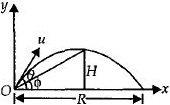
(C) Let $\phi$ be the elevation angle of the projectile at its highest point as seen from the point of projection $O$,and $\theta$ be the angle of projection with the horizontal.
From the figure,$\tan \phi = \frac{H}{R/2} = \frac{2H}{R}$.
In projectile motion,the maximum height $H$ is given by $H = \frac{u^2 \sin^2 \theta}{2g}$ and the horizontal range $R$ is given by $R = \frac{u^2 \sin 2\theta}{g}$.
Substituting these values into the expression for $\tan \phi$:
$\tan \phi = \frac{2 \left( \frac{u^2 \sin^2 \theta}{2g} \right)}{\left( \frac{u^2 \sin 2\theta}{g} \right)} = \frac{\sin^2 \theta}{\sin 2\theta} = \frac{\sin^2 \theta}{2 \sin \theta \cos \theta} = \frac{1}{2} \tan \theta$.
Given $\theta = 45^\circ$,we have $\tan \phi = \frac{1}{2} \tan 45^\circ = \frac{1}{2} \times 1 = \frac{1}{2}$.
Therefore,$\phi = \tan^{-1}\left(\frac{1}{2}\right)$.
From the figure,$\tan \phi = \frac{H}{R/2} = \frac{2H}{R}$.
In projectile motion,the maximum height $H$ is given by $H = \frac{u^2 \sin^2 \theta}{2g}$ and the horizontal range $R$ is given by $R = \frac{u^2 \sin 2\theta}{g}$.
Substituting these values into the expression for $\tan \phi$:
$\tan \phi = \frac{2 \left( \frac{u^2 \sin^2 \theta}{2g} \right)}{\left( \frac{u^2 \sin 2\theta}{g} \right)} = \frac{\sin^2 \theta}{\sin 2\theta} = \frac{\sin^2 \theta}{2 \sin \theta \cos \theta} = \frac{1}{2} \tan \theta$.
Given $\theta = 45^\circ$,we have $\tan \phi = \frac{1}{2} \tan 45^\circ = \frac{1}{2} \times 1 = \frac{1}{2}$.
Therefore,$\phi = \tan^{-1}\left(\frac{1}{2}\right)$.
0 likesView Solution
7
ChemistryMCQAIPMT · 2011
$A$ charge $Q$ is enclosed by a Gaussian spherical surface of radius $R$. If the radius is doubled,then the outward electric flux will
A
remain the same
B
be doubled
C
be reduced to half
D
increase four times
Solution
(A) According to Gauss's Law,the net electric flux $\phi$ through any closed surface is given by $\phi = \frac{Q_{\text{enclosed}}}{\varepsilon_0}$.
Here,$Q_{\text{enclosed}} = Q$. Therefore,$\phi = \frac{Q}{\varepsilon_0}$.
Since the electric flux depends only on the charge enclosed by the surface and not on the shape or size of the Gaussian surface,changing the radius from $R$ to $2R$ does not affect the net electric flux.
Thus,the outward electric flux will remain the same.
Here,$Q_{\text{enclosed}} = Q$. Therefore,$\phi = \frac{Q}{\varepsilon_0}$.
Since the electric flux depends only on the charge enclosed by the surface and not on the shape or size of the Gaussian surface,changing the radius from $R$ to $2R$ does not affect the net electric flux.
Thus,the outward electric flux will remain the same.
0 likesView Solution
8
ChemistryMCQAIPMT · 2011
The correct floral formula of chilli is
A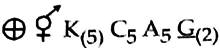
B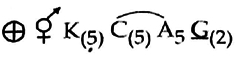
C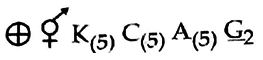
D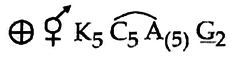
Solution
(b) : Chilli is the member of Solanaceae, in which flowers are bisexual , actinomorphic $(\bigoplus )$ calyx -$5$ and gamosepalous, corolla -$5$ and gamopetalous ; androecium -$5$, free, epipetalous basifixed, inferior; gynoecium -bicarpellary, syncarpous and ovary superior.
So, floral formula of chilli is :
So, floral formula of chilli is :
0 likesView Solution
9
ChemistryMCQAIPMT · 2011
Bulk of carbon dioxide $(CO_2)$ released from body tissues into the blood is present as
A
bicarbonate in blood plasma and RBCs
B
free $CO_2$ in blood plasma
C
$70\%$ carbamino-haemoglobin and $30\%$ as bicarbonate
D
carbamino-haemoglobin in $RBCs$
Solution
(A) The correct answer is $A$.
At the tissue site,the partial pressure of $CO_2$ is high due to catabolic processes.
$CO_2$ diffuses into the blood ($RBCs$ and plasma) and reacts with water to form carbonic acid $(H_2CO_3)$,which then dissociates into bicarbonate ions $(HCO_3^-)$ and hydrogen ions $(H^+)$.
Approximately $70\%$ of $CO_2$ is transported in the form of bicarbonates.
At the alveolar site,where the partial pressure of $CO_2$ is low,the reaction proceeds in the opposite direction,leading to the formation of $CO_2$ and $H_2O$,which is then exhaled.
At the tissue site,the partial pressure of $CO_2$ is high due to catabolic processes.
$CO_2$ diffuses into the blood ($RBCs$ and plasma) and reacts with water to form carbonic acid $(H_2CO_3)$,which then dissociates into bicarbonate ions $(HCO_3^-)$ and hydrogen ions $(H^+)$.
Approximately $70\%$ of $CO_2$ is transported in the form of bicarbonates.
At the alveolar site,where the partial pressure of $CO_2$ is low,the reaction proceeds in the opposite direction,leading to the formation of $CO_2$ and $H_2O$,which is then exhaled.
0 likesView Solution
10
ChemistryMCQAIPMT · 2011
What is common between vegetative reproduction and apomixis?
A
Both are applicable to only dicot plants
B
Both bypass the flowering phase
C
Both occur round the year
D
Both produce progeny identical to the parent
Solution
(D) : Apomixis is a form of asexual reproduction that mimics sexual reproduction in plants,but it does not involve the fusion of gametes (fertilization).
In apomixis,the embryo develops directly from a diploid cell within the ovule without meiosis or syngamy.
Consequently,the offspring produced are genetically identical to the parent plant.
Similarly,vegetative reproduction is a type of asexual reproduction where new plants arise from vegetative parts of the parent plant,resulting in clones that are genetically identical to the parent.
In apomixis,the embryo develops directly from a diploid cell within the ovule without meiosis or syngamy.
Consequently,the offspring produced are genetically identical to the parent plant.
Similarly,vegetative reproduction is a type of asexual reproduction where new plants arise from vegetative parts of the parent plant,resulting in clones that are genetically identical to the parent.
0 likesView Solution
11
ChemistryMCQAIPMT · 2011
Which has the maximum number of molecules among the following?
A
$44 \ g \ CO_2$
B
$48 \ g \ O_3$
C
$8 \ g \ H_2$
D
$64 \ g \ SO_2$
Solution
(C) The number of molecules is directly proportional to the number of moles $(n = \text{mass} / \text{molar mass})$.
$A) \ 44 \ g \ CO_2 = 44 / 44 = 1 \ \text{mole}$
$B) \ 48 \ g \ O_3 = 48 / 48 = 1 \ \text{mole}$
$C) \ 8 \ g \ H_2 = 8 / 2 = 4 \ \text{moles}$
$D) \ 64 \ g \ SO_2 = 64 / 64 = 1 \ \text{mole}$
Since $8 \ g \ H_2$ has the highest number of moles $(4 \ \text{moles})$,it contains the maximum number of molecules.
$A) \ 44 \ g \ CO_2 = 44 / 44 = 1 \ \text{mole}$
$B) \ 48 \ g \ O_3 = 48 / 48 = 1 \ \text{mole}$
$C) \ 8 \ g \ H_2 = 8 / 2 = 4 \ \text{moles}$
$D) \ 64 \ g \ SO_2 = 64 / 64 = 1 \ \text{mole}$
Since $8 \ g \ H_2$ has the highest number of moles $(4 \ \text{moles})$,it contains the maximum number of molecules.
0 likesView Solution
12
ChemistryEasyMCQAIPMT · 2011
The total number of atomic orbitals in the fourth energy level of an atom is
A
$8$
B
$16$
C
$32$
D
$4$
Solution
(B) The total number of atomic orbitals in a given energy level (shell) with principal quantum number $n$ is given by the formula $n^{2}$.
For the fourth energy level,$n = 4$.
Therefore,the number of atomic orbitals $= 4^{2} = 16$.
For the fourth energy level,$n = 4$.
Therefore,the number of atomic orbitals $= 4^{2} = 16$.
0 likesView Solution
13
ChemistryMediumMCQAIPMT · 2011
The energies $E_1$ and $E_2$ of two radiations are $25 \ eV$ and $50 \ eV$ respectively. The relation between their wavelengths,i.e.,$\lambda_1$ and $\lambda_2$,will be:
A
$\lambda_1 = \lambda_2$
B
$\lambda_1 = 2 \lambda_2$
C
$\lambda_1 = 4 \lambda_2$
D
$\lambda_1 = \frac{1}{2} \lambda_2$
Solution
(B) The energy of a radiation is given by the formula $E = \frac{hc}{\lambda}$,which implies $E \propto \frac{1}{\lambda}$.
Given $E_1 = 25 \ eV$ and $E_2 = 50 \ eV$.
Therefore,$\frac{E_1}{E_2} = \frac{\lambda_2}{\lambda_1}$.
Substituting the values: $\frac{25}{50} = \frac{\lambda_2}{\lambda_1}$.
$\frac{1}{2} = \frac{\lambda_2}{\lambda_1}$,which simplifies to $\lambda_1 = 2 \lambda_2$.
Given $E_1 = 25 \ eV$ and $E_2 = 50 \ eV$.
Therefore,$\frac{E_1}{E_2} = \frac{\lambda_2}{\lambda_1}$.
Substituting the values: $\frac{25}{50} = \frac{\lambda_2}{\lambda_1}$.
$\frac{1}{2} = \frac{\lambda_2}{\lambda_1}$,which simplifies to $\lambda_1 = 2 \lambda_2$.
0 likesView Solution
14
ChemistryEasyMCQAIPMT · 2011
If $n = 6,$ the correct sequence for filling of electrons will be
A
$ns$ $\rightarrow (n - 2)f$ $\rightarrow (n - 1)d$ $\rightarrow np$
B
$ns$ $\rightarrow (n - 1)d$ $\rightarrow (n - 2)f$ $\rightarrow np$
C
$ns$ $\rightarrow (n - 2)f$ $\rightarrow np$ $\rightarrow (n - 1)d$
D
$ns$ $\rightarrow np$ $\rightarrow (n - 1)d$ $\rightarrow (n - 2)f$
Solution
(A) According to the $(n + l)$ rule,electrons fill orbitals in order of increasing $(n + l)$ values.
For $n = 6$:
$ns$ corresponds to $6s$ $(n+l = 6+0 = 6)$
$(n-2)f$ corresponds to $4f$ $(n+l = 4+3 = 7)$
$(n-1)d$ corresponds to $5d$ $(n+l = 5+2 = 7)$
$np$ corresponds to $6p$ $(n+l = 6+1 = 7)$
Comparing the $(n+l)$ values and the $n$ values for orbitals with the same $(n+l)$,the filling order is $6s$ $\rightarrow 4f$ $\rightarrow 5d$ $\rightarrow 6p$.
For $n = 6$:
$ns$ corresponds to $6s$ $(n+l = 6+0 = 6)$
$(n-2)f$ corresponds to $4f$ $(n+l = 4+3 = 7)$
$(n-1)d$ corresponds to $5d$ $(n+l = 5+2 = 7)$
$np$ corresponds to $6p$ $(n+l = 6+1 = 7)$
Comparing the $(n+l)$ values and the $n$ values for orbitals with the same $(n+l)$,the filling order is $6s$ $\rightarrow 4f$ $\rightarrow 5d$ $\rightarrow 6p$.
0 likesView Solution
15
ChemistryMediumMCQAIPMT · 2011
According to the Bohr theory,which of the following transitions in the hydrogen atom will give rise to the least energetic photon?
A
$n = 6$ to $n = 1$
B
$n = 5$ to $n = 4$
C
$n = 6$ to $n = 5$
D
$n = 5$ to $n = 3$
Solution
(C) The energy of a photon emitted during an electronic transition is given by the formula: $E = \Delta E = 13.6 \ eV \left[ \frac{1}{n_1^2} - \frac{1}{n_2^2} \right]$.
As the principal quantum number $n$ increases,the energy gap between consecutive shells decreases.
The energy difference between shells $n$ and $n+1$ is given by $\Delta E = 13.6 \left[ \frac{1}{n^2} - \frac{1}{(n+1)^2} \right]$.
Comparing the transitions:
$(A)$ $n=6 \to n=1$: Large energy gap.
$(B)$ $n=5 \to n=4$: $\Delta E \propto (1/16 - 1/25) = 0.0225$.
$(C)$ $n=6 \to n=5$: $\Delta E \propto (1/25 - 1/36) = 0.0122$.
$(D)$ $n=5 \to n=3$: $\Delta E \propto (1/9 - 1/25) = 0.0711$.
The transition $n=6 \to n=5$ involves the shells with the highest principal quantum numbers,resulting in the smallest energy difference and thus the least energetic photon.
As the principal quantum number $n$ increases,the energy gap between consecutive shells decreases.
The energy difference between shells $n$ and $n+1$ is given by $\Delta E = 13.6 \left[ \frac{1}{n^2} - \frac{1}{(n+1)^2} \right]$.
Comparing the transitions:
$(A)$ $n=6 \to n=1$: Large energy gap.
$(B)$ $n=5 \to n=4$: $\Delta E \propto (1/16 - 1/25) = 0.0225$.
$(C)$ $n=6 \to n=5$: $\Delta E \propto (1/25 - 1/36) = 0.0122$.
$(D)$ $n=5 \to n=3$: $\Delta E \propto (1/9 - 1/25) = 0.0711$.
The transition $n=6 \to n=5$ involves the shells with the highest principal quantum numbers,resulting in the smallest energy difference and thus the least energetic photon.
0 likesView Solution
16
ChemistryEasyMCQAIPMT · 2011
What is the value of electron gain enthalpy of $Na^{+}$ if $IE_{1}$ of $Na$ is $5.1 \ eV$? .......... $eV$
A
$-5.1$
B
$-10.2$
C
$+2.55$
D
$+10.2$
Solution
(A) The ionization energy $(IE_{1})$ is the energy required to remove an electron from a neutral atom: $Na(g) \longrightarrow Na^{ }(g) e^{-}(g) ; IE_{1} = 5.1 \ eV$.
The electron gain enthalpy $(\Delta H_{eg})$ is the energy change when an electron is added to a gaseous ion to form a neutral atom,which is the reverse process of ionization: $Na^{ }(g) e^{-}(g) \longrightarrow Na(g)$.
According to the law of conservation of energy,the enthalpy change for the reverse process is the negative of the ionization energy: $\Delta H_{eg} = -IE_{1} = -5.1 \ eV$.
The electron gain enthalpy $(\Delta H_{eg})$ is the energy change when an electron is added to a gaseous ion to form a neutral atom,which is the reverse process of ionization: $Na^{ }(g) e^{-}(g) \longrightarrow Na(g)$.
According to the law of conservation of energy,the enthalpy change for the reverse process is the negative of the ionization energy: $\Delta H_{eg} = -IE_{1} = -5.1 \ eV$.
0 likesView Solution
17
ChemistryMediumMCQAIPMT · 2011
Which of the following has the minimum bond length?
A
$O_2^+$
B
$O_2^-$
C
$O_2^{2-}$
D
$O_2$
Solution
(A) The bond order is inversely proportional to the bond length.
Bond order of $O_2^+ = \frac{10-5}{2} = 2.5$
Bond order of $O_2 = \frac{10-6}{2} = 2.0$
Bond order of $O_2^- = \frac{10-7}{2} = 1.5$
Bond order of $O_2^{2-} = \frac{10-8}{2} = 1.0$
Since $O_2^+$ has the highest bond order $(2.5)$,it has the minimum bond length.
Bond order of $O_2^+ = \frac{10-5}{2} = 2.5$
Bond order of $O_2 = \frac{10-6}{2} = 2.0$
Bond order of $O_2^- = \frac{10-7}{2} = 1.5$
Bond order of $O_2^{2-} = \frac{10-8}{2} = 1.0$
Since $O_2^+$ has the highest bond order $(2.5)$,it has the minimum bond length.
0 likesView Solution
18
ChemistryDifficultMCQAIPMT · 2011
Which of the two ions from the list given below have the geometry that is explained by the same hybridization of orbitals: $NO_2^-$,$NO_3^-$,$NH_2^-$,$NH_4^+$,$SCN^-$?
A
$NO_2^-$ and $NO_3^-$
B
$NH_4^+$ and $NO_3^-$
C
$SCN^-$ and $NH_2^-$
D
$NO_2^-$ and $NH_2^-$
Solution
(A) To determine the hybridization,we calculate the steric number $(SN)$ using the formula: $SN = \frac{1}{2} (V + M - C + A)$,where $V$ is the number of valence electrons of the central atom,$M$ is the number of monovalent atoms,$C$ is the cationic charge,and $A$ is the anionic charge.
$1. NO_2^-: SN = \frac{1}{2} (5 + 0 - 0 + 1) = 3 \rightarrow sp^2$ hybridization.
$2. NO_3^-: SN = \frac{1}{2} (5 + 0 - 0 + 1) = 3 \rightarrow sp^2$ hybridization.
$3. NH_2^-: SN = \frac{1}{2} (5 + 2 - 0 + 1) = 4 \rightarrow sp^3$ hybridization.
$4. NH_4^+: SN = \frac{1}{2} (5 + 4 - 1 + 0) = 4 \rightarrow sp^3$ hybridization.
$5. SCN^-: SN = \frac{1}{2} (4 + 0 - 0 + 1) = 2 \rightarrow sp$ hybridization.
Comparing the results,$NO_2^-$ and $NO_3^-$ both exhibit $sp^2$ hybridization.
$1. NO_2^-: SN = \frac{1}{2} (5 + 0 - 0 + 1) = 3 \rightarrow sp^2$ hybridization.
$2. NO_3^-: SN = \frac{1}{2} (5 + 0 - 0 + 1) = 3 \rightarrow sp^2$ hybridization.
$3. NH_2^-: SN = \frac{1}{2} (5 + 2 - 0 + 1) = 4 \rightarrow sp^3$ hybridization.
$4. NH_4^+: SN = \frac{1}{2} (5 + 4 - 1 + 0) = 4 \rightarrow sp^3$ hybridization.
$5. SCN^-: SN = \frac{1}{2} (4 + 0 - 0 + 1) = 2 \rightarrow sp$ hybridization.
Comparing the results,$NO_2^-$ and $NO_3^-$ both exhibit $sp^2$ hybridization.
0 likesView Solution
19
ChemistryDifficultMCQAIPMT · 2011
The correct order of increasing bond length of $C - H, C - O, C - C$ and $C=C$ is
A
$C - H < C=C < C - O < C - C$
B
$C - C < C=C < C - O < C - H$
C
$C - O < C - H < C - C < C = C$
D
$C - H < C - O < C - C < C=C$
Solution
(A) The bond lengths for the given bonds are as follows:
$C - H \approx 0.109 \ nm$
$C=C \approx 0.134 \ nm$
$C - O \approx 0.143 \ nm$
$C - C \approx 0.154 \ nm$
Comparing these values,the order of increasing bond length is $C - H < C=C < C - O < C - C$.
$C - H \approx 0.109 \ nm$
$C=C \approx 0.134 \ nm$
$C - O \approx 0.143 \ nm$
$C - C \approx 0.154 \ nm$
Comparing these values,the order of increasing bond length is $C - H < C=C < C - O < C - C$.
0 likesView Solution
20
ChemistryAdvancedMCQAIPMT · 2011
Which of the following structures is the most preferred and hence of lowest energy for $SO_3$?
A
B
C
D
Solution
(D) Formal charges help in the selection of the lowest energy structure from a number of possible Lewis structures for a given species.
Generally,the lowest energy structure is the one with the smallest formal charges on the atoms.
Formal charge on an atom $=$ (total number of valence electrons) $-$ (non-bonding electrons) $-$ $\frac{1}{2} \times$ (bonding electrons).
For the Lewis structure of $SO_3$ with three double bonds:
Formal charge on $S$ atom $= 6 - 0 - \frac{1}{2} \times 12 = 0$.
Formal charge on each of the three $O$ atoms $= 6 - 4 - \frac{1}{2} \times 4 = 0$.
Since all atoms have a formal charge of $0$,this structure is the most preferred and has the lowest energy.
Generally,the lowest energy structure is the one with the smallest formal charges on the atoms.
Formal charge on an atom $=$ (total number of valence electrons) $-$ (non-bonding electrons) $-$ $\frac{1}{2} \times$ (bonding electrons).
For the Lewis structure of $SO_3$ with three double bonds:
Formal charge on $S$ atom $= 6 - 0 - \frac{1}{2} \times 12 = 0$.
Formal charge on each of the three $O$ atoms $= 6 - 4 - \frac{1}{2} \times 4 = 0$.
Since all atoms have a formal charge of $0$,this structure is the most preferred and has the lowest energy.
0 likesView Solution
21
ChemistryMediumMCQAIPMT · 2011
The pairs of species of oxygen and their magnetic behaviour are noted below. Which of the following presents the correct description?
A
$O_2^-, O_2^{2-}$ - Both diamagnetic
B
$O^{+}, O_2^{2-}$ - Both paramagnetic
C
$O_2^+, O_2$ - Both paramagnetic
D
$O, O_2^{2-}$ - Both paramagnetic
Solution
(C) The electronic configuration of $O_2^+$ ($13$ electrons) is: $KK \sigma 2s^2 \sigma^* 2s^2 \sigma 2pz^2 (\pi 2px^2 = \pi 2py^2) (\pi^* 2px^1)$. It has one unpaired electron,so it is paramagnetic.
The electronic configuration of $O_2$ ($16$ electrons) is: $KK \sigma 2s^2 \sigma^* 2s^2 \sigma 2pz^2 (\pi 2px^2 = \pi 2py^2) (\pi^* 2px^1 = \pi^* 2py^1)$. It has two unpaired electrons,so it is paramagnetic.
Since both $O_2^+$ and $O_2$ contain unpaired electrons in their $\pi^*$ antibonding molecular orbitals,both are paramagnetic.
The electronic configuration of $O_2$ ($16$ electrons) is: $KK \sigma 2s^2 \sigma^* 2s^2 \sigma 2pz^2 (\pi 2px^2 = \pi 2py^2) (\pi^* 2px^1 = \pi^* 2py^1)$. It has two unpaired electrons,so it is paramagnetic.
Since both $O_2^+$ and $O_2$ contain unpaired electrons in their $\pi^*$ antibonding molecular orbitals,both are paramagnetic.
1 likesView Solution
22
ChemistryMediumMCQAIPMT · 2011
By what factor does the average velocity of a gaseous molecule increase when the temperature (in Kelvin) is doubled?
A
$2$
B
$2.8$
C
$4$
D
$1.4$
Solution
(D) The formula for the average velocity $(V_{av})$ of a gaseous molecule is given by $V_{av} = \sqrt{\frac{8RT}{\pi M}}$.
From this expression,it is clear that $V_{av} \propto \sqrt{T}$.
When the temperature is doubled,the new temperature $T' = 2T$.
Therefore,the ratio of the new average velocity to the initial average velocity is $\frac{V_{av}'}{V_{av}} = \sqrt{\frac{T'}{T}} = \sqrt{\frac{2T}{T}} = \sqrt{2} \approx 1.414$.
Thus,the average velocity increases by a factor of approximately $1.4$.
From this expression,it is clear that $V_{av} \propto \sqrt{T}$.
When the temperature is doubled,the new temperature $T' = 2T$.
Therefore,the ratio of the new average velocity to the initial average velocity is $\frac{V_{av}'}{V_{av}} = \sqrt{\frac{T'}{T}} = \sqrt{\frac{2T}{T}} = \sqrt{2} \approx 1.414$.
Thus,the average velocity increases by a factor of approximately $1.4$.
0 likesView Solution
23
ChemistryAdvancedMCQAIPMT · 2011
Two gases $A$ and $B$ having the same volume diffuse through a porous partition in $20$ and $10$ seconds respectively. The molecular mass of $A$ is $49 \ u$. The molecular mass of $B$ will be .............. $u$.
A
$50$
B
$12.25$
C
$6.50$
D
$25$
Solution
(B) According to Graham's Law of diffusion,the rate of diffusion $r$ is inversely proportional to the square root of the molar mass $M$ for gases at the same volume and pressure: $\frac{r_A}{r_B} = \sqrt{\frac{M_B}{M_A}}$.
Since $r = \frac{V}{t}$ and $V_A = V_B$,the equation becomes $\frac{t_B}{t_A} = \sqrt{\frac{M_B}{M_A}}$.
Given $t_A = 20 \ s$,$t_B = 10 \ s$,and $M_A = 49 \ u$,we substitute these values:
$\frac{10}{20} = \sqrt{\frac{M_B}{49}}$.
$\frac{1}{2} = \frac{\sqrt{M_B}}{7}$.
$\sqrt{M_B} = \frac{7}{2} = 3.5$.
$M_B = (3.5)^2 = 12.25 \ u$.
Since $r = \frac{V}{t}$ and $V_A = V_B$,the equation becomes $\frac{t_B}{t_A} = \sqrt{\frac{M_B}{M_A}}$.
Given $t_A = 20 \ s$,$t_B = 10 \ s$,and $M_A = 49 \ u$,we substitute these values:
$\frac{10}{20} = \sqrt{\frac{M_B}{49}}$.
$\frac{1}{2} = \frac{\sqrt{M_B}}{7}$.
$\sqrt{M_B} = \frac{7}{2} = 3.5$.
$M_B = (3.5)^2 = 12.25 \ u$.
0 likesView Solution
24
ChemistryDifficultMCQAIPMT · 2011
$A$ gaseous mixture was prepared by taking equal moles of $CO$ and $N_2$. If the total pressure of the mixture was found to be $1 \ atm$,the partial pressure of the nitrogen $(N_2)$ in the mixture is ............ $atm$.
A
$0.5$
B
$0.8$
C
$0.9$
D
$1$
Solution
(A) According to Dalton's Law of Partial Pressures,the partial pressure of a gas is proportional to its mole fraction in the mixture.
Given that the moles of $CO$ and $N_2$ are equal,let $n_{CO} = n_{N_2} = n$.
The mole fraction of $N_2$ is given by $x_{N_2} = \frac{n_{N_2}}{n_{CO} + n_{N_2}} = \frac{n}{n + n} = \frac{n}{2n} = 0.5$.
The partial pressure of $N_2$ is calculated as $p_{N_2} = x_{N_2} \times P_{total}$.
Given $P_{total} = 1 \ atm$,we have $p_{N_2} = 0.5 \times 1 \ atm = 0.5 \ atm$.
Given that the moles of $CO$ and $N_2$ are equal,let $n_{CO} = n_{N_2} = n$.
The mole fraction of $N_2$ is given by $x_{N_2} = \frac{n_{N_2}}{n_{CO} + n_{N_2}} = \frac{n}{n + n} = \frac{n}{2n} = 0.5$.
The partial pressure of $N_2$ is calculated as $p_{N_2} = x_{N_2} \times P_{total}$.
Given $P_{total} = 1 \ atm$,we have $p_{N_2} = 0.5 \times 1 \ atm = 0.5 \ atm$.
0 likesView Solution
25
ChemistryDifficultMCQAIPMT · 2011
$A$ bubble of air is underwater at temperature $15^\circ C$ and the pressure $1.5 \ bar$. If the bubble rises to the surface where the temperature is $25^\circ C$ and the pressure is $1.0 \ bar$,what will happen to the volume of the bubble?
A
Volume will become greater by a factor of $1.6$.
B
Volume will become greater by a factor of $1.1$.
C
Volume will become smaller by a factor of $0.70$.
D
Volume will become greater by a factor of $2.5$.
Solution
(A) Using the combined gas law,$\frac{P_1 V_1}{T_1} = \frac{P_2 V_2}{T_2}$,we can express the ratio of volumes as $\frac{V_2}{V_1} = \frac{P_1 T_2}{P_2 T_1}$.
Given initial conditions: $T_1 = 15 + 273 = 288 \ K$ and $P_1 = 1.5 \ bar$.
Given final conditions: $T_2 = 25 + 273 = 298 \ K$ and $P_2 = 1.0 \ bar$.
Substituting the values: $\frac{V_2}{V_1} = \frac{1.5 \times 298}{1.0 \times 288} = \frac{447}{288} \approx 1.552$.
Rounding to one decimal place,the volume increases by a factor of $1.6$.
Given initial conditions: $T_1 = 15 + 273 = 288 \ K$ and $P_1 = 1.5 \ bar$.
Given final conditions: $T_2 = 25 + 273 = 298 \ K$ and $P_2 = 1.0 \ bar$.
Substituting the values: $\frac{V_2}{V_1} = \frac{1.5 \times 298}{1.0 \times 288} = \frac{447}{288} \approx 1.552$.
Rounding to one decimal place,the volume increases by a factor of $1.6$.
0 likesView Solution
26
ChemistryMediumMCQAIPMT · 2011
If the enthalpy change for the transition of liquid water to steam is $30 \ kJ \ mol^{-1}$ at $27 \ ^oC,$ the entropy change for the process would be ............. $J \ mol^{-1} \ K^{-1}$
A
$10$
B
$1$
C
$0.1$
D
$100$
Solution
(D) The process is the phase transition of liquid water to steam at a constant temperature.
Given: $\Delta H_{vap} = 30 \ kJ \ mol^{-1} = 30000 \ J \ mol^{-1}$.
Temperature $T = 27 \ ^oC = 27 + 273 = 300 \ K$.
The entropy change is given by the formula: $\Delta S_{vap} = \frac{\Delta H_{vap}}{T}$.
Substituting the values: $\Delta S_{vap} = \frac{30000 \ J \ mol^{-1}}{300 \ K} = 100 \ J \ mol^{-1} \ K^{-1}$.
Given: $\Delta H_{vap} = 30 \ kJ \ mol^{-1} = 30000 \ J \ mol^{-1}$.
Temperature $T = 27 \ ^oC = 27 + 273 = 300 \ K$.
The entropy change is given by the formula: $\Delta S_{vap} = \frac{\Delta H_{vap}}{T}$.
Substituting the values: $\Delta S_{vap} = \frac{30000 \ J \ mol^{-1}}{300 \ K} = 100 \ J \ mol^{-1} \ K^{-1}$.
0 likesView Solution
27
ChemistryMediumMCQAIPMT · 2011
Enthalpy change for the reaction,$4H_{(g)} \rightarrow 2H_{2_{(g)}}$ is $-869.6 \ kJ$. The dissociation energy of $H-H$ bond is $............ \ kJ$.
A
$434.8$
B
$869.6$
C
$217.4$
D
$1739.2$
Solution
(A) The given reaction is $4H_{(g)} \rightarrow 2H_{2_{(g)}}$ with $\Delta H = -869.6 \ kJ$.
This reaction represents the formation of $2$ moles of $H_2$ molecules from $4$ moles of $H$ atoms.
The dissociation energy of a bond is defined as the energy required to break $1$ mole of bonds in the gaseous state.
First,reverse the reaction to represent the dissociation of $2$ moles of $H_2$ molecules:
$2H_{2_{(g)}} \rightarrow 4H_{(g)}$; $\Delta H = +869.6 \ kJ$.
Now,for $1$ mole of $H_2$ dissociation:
$H_{2_{(g)}} \rightarrow 2H_{(g)}$; $\Delta H = \frac{869.6}{2} = 434.8 \ kJ$.
Thus,the dissociation energy of the $H-H$ bond is $434.8 \ kJ$.
This reaction represents the formation of $2$ moles of $H_2$ molecules from $4$ moles of $H$ atoms.
The dissociation energy of a bond is defined as the energy required to break $1$ mole of bonds in the gaseous state.
First,reverse the reaction to represent the dissociation of $2$ moles of $H_2$ molecules:
$2H_{2_{(g)}} \rightarrow 4H_{(g)}$; $\Delta H = +869.6 \ kJ$.
Now,for $1$ mole of $H_2$ dissociation:
$H_{2_{(g)}} \rightarrow 2H_{(g)}$; $\Delta H = \frac{869.6}{2} = 434.8 \ kJ$.
Thus,the dissociation energy of the $H-H$ bond is $434.8 \ kJ$.
0 likesView Solution
28
ChemistryMediumMCQAIPMT · 2011
Which of the following is the correct option for the free expansion of an ideal gas under adiabatic conditions?
A
$q = 0, \Delta T \neq 0, W = 0$
B
$q \neq 0, \Delta T = 0, W = 0$
C
$q = 0, \Delta T = 0, W = 0$
D
$q = 0, \Delta T < 0, W \neq 0$
Solution
(C) For the free expansion of an ideal gas,the process is adiabatic,so $q = 0$.
Since the expansion occurs against zero external pressure $(P_{ext} = 0)$,the work done is $W = -P_{ext} \Delta V = 0$.
According to the first law of thermodynamics,$\Delta U = q + W$. Since $q = 0$ and $W = 0$,$\Delta U = 0$.
For an ideal gas,internal energy $U$ is a function of temperature only,so $\Delta U = 0$ implies $\Delta T = 0$.
Since the expansion occurs against zero external pressure $(P_{ext} = 0)$,the work done is $W = -P_{ext} \Delta V = 0$.
According to the first law of thermodynamics,$\Delta U = q + W$. Since $q = 0$ and $W = 0$,$\Delta U = 0$.
For an ideal gas,internal energy $U$ is a function of temperature only,so $\Delta U = 0$ implies $\Delta T = 0$.
0 likesView Solution
29
ChemistryMediumMCQAIPMT · 2011
Consider the following processes:
For $B + D \rightarrow E + 2C, \Delta H$ will be ............. $kJ/mol$
| Process | $\Delta H \ (kJ/mol)$ |
|---|---|
| $I. \ \frac{1}{2} A \rightarrow B$ | $+150$ |
| $II. \ 3B \rightarrow 2C + D$ | $-125$ |
| $III. \ E + A \rightarrow 2D$ | $+350$ |
For $B + D \rightarrow E + 2C, \Delta H$ will be ............. $kJ/mol$
A
$525$
B
$-175$
C
$-325$
D
$325$
Solution
(B) To obtain the target reaction $B + D \rightarrow E + 2C$,we manipulate the given equations:
$1. \ 2 \times (I): A \rightarrow 2B, \Delta H = 2 \times 150 = 300 \ kJ/mol$
$2. \ (II): 3B \rightarrow 2C + D, \Delta H = -125 \ kJ/mol$
$3. \ -(III): 2D \rightarrow E + A, \Delta H = -350 \ kJ/mol$
Adding these equations:
$(A + 3B + 2D) \rightarrow (2B + 2C + D + E + A)$
Simplifying by canceling common terms ($A$ and $2B$ and $D$ from both sides):
$B + D \rightarrow E + 2C$
$\Delta H = 300 - 125 - 350 = -175 \ kJ/mol$
$1. \ 2 \times (I): A \rightarrow 2B, \Delta H = 2 \times 150 = 300 \ kJ/mol$
$2. \ (II): 3B \rightarrow 2C + D, \Delta H = -125 \ kJ/mol$
$3. \ -(III): 2D \rightarrow E + A, \Delta H = -350 \ kJ/mol$
Adding these equations:
$(A + 3B + 2D) \rightarrow (2B + 2C + D + E + A)$
Simplifying by canceling common terms ($A$ and $2B$ and $D$ from both sides):
$B + D \rightarrow E + 2C$
$\Delta H = 300 - 125 - 350 = -175 \ kJ/mol$
0 likesView Solution
30
ChemistryEasyMCQAIPMT · 2011
The value of $\Delta H$ for the reaction $X_{2(g)} + 4Y_{2(g)} \rightleftharpoons 2XY_{4(g)}$ is less than zero. Formation of $XY_{4(g)}$ will be favoured at
A
high temperature and high pressure
B
low pressure and low temperature
C
high temperature and low pressure
D
high pressure and low temperature
Solution
(D) The given reaction is $X_{2(g)} + 4Y_{2(g)} \rightleftharpoons 2XY_{4(g)}$.
Given that $\Delta H < 0$,the reaction is exothermic.
Calculate the change in the number of moles of gaseous species: $\Delta n_g = n_{products} - n_{reactants} = 2 - (1 + 4) = 2 - 5 = -3$.
Since $\Delta n_g < 0$,the forward reaction is favoured at high pressure according to Le Chatelier's principle.
Since the reaction is exothermic $(\Delta H < 0)$,the forward reaction is favoured at low temperature.
Therefore,the formation of $XY_{4(g)}$ is favoured at high pressure and low temperature.
Given that $\Delta H < 0$,the reaction is exothermic.
Calculate the change in the number of moles of gaseous species: $\Delta n_g = n_{products} - n_{reactants} = 2 - (1 + 4) = 2 - 5 = -3$.
Since $\Delta n_g < 0$,the forward reaction is favoured at high pressure according to Le Chatelier's principle.
Since the reaction is exothermic $(\Delta H < 0)$,the forward reaction is favoured at low temperature.
Therefore,the formation of $XY_{4(g)}$ is favoured at high pressure and low temperature.
0 likesView Solution
31
ChemistryDifficultMCQAIPMT · 2011
$A$ buffer solution is prepared in which the concentration of $NH_3$ is $0.30 \ M$ and the concentration of $NH_4^+$ is $0.20 \ M.$ If the equilibrium constant,$K_b$ for $NH_3$ equals $1.8 \times 10^{-5},$ what is the $pH$ of this solution? $(log \ 2.7 = 0.43)$
A
$9.08$
B
$9.43$
C
$11.72$
D
$8.73$
Solution
(B) For a basic buffer,the $pOH$ is calculated using the Henderson-Hasselbalch equation:
$pOH = pK_b + \log \frac{[Salt]}{[Base]}$
Given: $[Base] = [NH_3] = 0.30 \ M$,$[Salt] = [NH_4^+] = 0.20 \ M$,and $K_b = 1.8 \times 10^{-5}$.
$pK_b = -\log(1.8 \times 10^{-5}) = 5 - \log(1.8) = 5 - 0.255 = 4.745$.
$pOH = 4.745 + \log \frac{0.20}{0.30} = 4.745 + \log(0.667) = 4.745 - 0.176 = 4.569$.
Since $pH + pOH = 14$,
$pH = 14 - 4.569 = 9.431 \approx 9.43$.
$pOH = pK_b + \log \frac{[Salt]}{[Base]}$
Given: $[Base] = [NH_3] = 0.30 \ M$,$[Salt] = [NH_4^+] = 0.20 \ M$,and $K_b = 1.8 \times 10^{-5}$.
$pK_b = -\log(1.8 \times 10^{-5}) = 5 - \log(1.8) = 5 - 0.255 = 4.745$.
$pOH = 4.745 + \log \frac{0.20}{0.30} = 4.745 + \log(0.667) = 4.745 - 0.176 = 4.569$.
Since $pH + pOH = 14$,
$pH = 14 - 4.569 = 9.431 \approx 9.43$.
0 likesView Solution
32
ChemistryEasyMCQAIPMT · 2011
Which of the following is least likely to behave as a Lewis base?
A
$H_2O$
B
$NH_3$
C
$BF_3$
D
$OH^{-}$
Solution
(C) Lewis base is a substance that can donate a lone pair of electrons.
$H_2O$,$NH_3$,and $OH^{-}$ all possess lone pairs of electrons that can be donated.
$BF_3$ has an incomplete octet around the central Boron atom,making it an electron-deficient species.
Therefore,$BF_3$ acts as a Lewis acid rather than a Lewis base.
$H_2O$,$NH_3$,and $OH^{-}$ all possess lone pairs of electrons that can be donated.
$BF_3$ has an incomplete octet around the central Boron atom,making it an electron-deficient species.
Therefore,$BF_3$ acts as a Lewis acid rather than a Lewis base.
0 likesView Solution
33
ChemistryDifficultMCQAIPMT · 2011
For the reaction,$N_{2(g)} + O_{2(g)} \rightleftharpoons 2NO_{(g)}$,the equilibrium constant is $K_1$. The equilibrium constant is $K_2$ for the reaction,$2NO_{(g)} + O_{2(g)} \rightleftharpoons 2NO_{2(g)}$. What is $K$ for the reaction,$NO_{2(g)} \rightleftharpoons \frac{1}{2} N_{2(g)} + O_{2(g)}$?
A
$\frac{1}{2K_1K_2}$
B
$\frac{1}{4K_1K_2}$
C
$\left[ \frac{1}{K_1K_2} \right]^{1/2}$
D
$\frac{1}{K_1K_2}$
Solution
(C) Given reactions:
$1) N_{2(g)} + O_{2(g)} \rightleftharpoons 2NO_{(g)} ; K_1$
$2) 2NO_{(g)} + O_{2(g)} \rightleftharpoons 2NO_{2(g)} ; K_2$
Adding equations $(1)$ and $(2)$ gives:
$N_{2(g)} + 2O_{2(g)} \rightleftharpoons 2NO_{2(g)}$
The equilibrium constant for this combined reaction is $K_{eq} = K_1 \times K_2$.
Now,to obtain the target reaction $NO_{2(g)} \rightleftharpoons \frac{1}{2} N_{2(g)} + O_{2(g)}$,we reverse the combined reaction and multiply the coefficients by $\frac{1}{2}$.
Reversing the reaction gives $K' = \frac{1}{K_1 K_2}$.
Multiplying coefficients by $\frac{1}{2}$ gives $K = (K')^{1/2} = \left[ \frac{1}{K_1 K_2} \right]^{1/2}$.
$1) N_{2(g)} + O_{2(g)} \rightleftharpoons 2NO_{(g)} ; K_1$
$2) 2NO_{(g)} + O_{2(g)} \rightleftharpoons 2NO_{2(g)} ; K_2$
Adding equations $(1)$ and $(2)$ gives:
$N_{2(g)} + 2O_{2(g)} \rightleftharpoons 2NO_{2(g)}$
The equilibrium constant for this combined reaction is $K_{eq} = K_1 \times K_2$.
Now,to obtain the target reaction $NO_{2(g)} \rightleftharpoons \frac{1}{2} N_{2(g)} + O_{2(g)}$,we reverse the combined reaction and multiply the coefficients by $\frac{1}{2}$.
Reversing the reaction gives $K' = \frac{1}{K_1 K_2}$.
Multiplying coefficients by $\frac{1}{2}$ gives $K = (K')^{1/2} = \left[ \frac{1}{K_1 K_2} \right]^{1/2}$.
0 likesView Solution
34
ChemistryDifficultMCQAIPMT · 2011
In qualitative analysis,the metals of group $I$ can be separated from other ions by precipitating them as chloride salts. $A$ solution initially contains $Ag^{+}$ and $Pb^{2+}$ at a concentration of $0.10 \, M$. Aqueous $HCl$ is added to this solution until the $Cl^{-}$ concentration is $0.10 \, M$. What will the concentrations of $Ag^{+}$ and $Pb^{2+}$ be at equilibrium? ($K_{sp}$ for $AgCl = 1.8 \times 10^{-10}$,$K_{sp}$ for $PbCl_2 = 1.7 \times 10^{-5}$)
A
$[Ag^{+}] = 1.8 \times 10^{-7} \, M, [Pb^{2+}] = 1.7 \times 10^{-6} \, M$
B
$[Ag^{+}] = 1.8 \times 10^{-11} \, M, [Pb^{2+}] = 8.5 \times 10^{-5} \, M$
C
$[Ag^{+}] = 1.8 \times 10^{-9} \, M, [Pb^{2+}] = 1.7 \times 10^{-3} \, M$
D
$[Ag^{+}] = 1.8 \times 10^{-11} \, M, [Pb^{2+}] = 1.7 \times 10^{-4} \, M$
Solution
(C) For $AgCl$ precipitation: $K_{sp} = [Ag^{+}][Cl^{-}]$.
Given $[Cl^{-}] = 0.10 \, M = 10^{-1} \, M$.
$[Ag^{+}] = \frac{K_{sp}}{[Cl^{-}]} = \frac{1.8 \times 10^{-10}}{0.10} = 1.8 \times 10^{-9} \, M$.
For $PbCl_2$ precipitation: $K_{sp} = [Pb^{2+}][Cl^{-}]^2$.
$[Pb^{2+}] = \frac{K_{sp}}{[Cl^{-}]^2} = \frac{1.7 \times 10^{-5}}{(0.10)^2} = \frac{1.7 \times 10^{-5}}{0.01} = 1.7 \times 10^{-3} \, M$.
Given $[Cl^{-}] = 0.10 \, M = 10^{-1} \, M$.
$[Ag^{+}] = \frac{K_{sp}}{[Cl^{-}]} = \frac{1.8 \times 10^{-10}}{0.10} = 1.8 \times 10^{-9} \, M$.
For $PbCl_2$ precipitation: $K_{sp} = [Pb^{2+}][Cl^{-}]^2$.
$[Pb^{2+}] = \frac{K_{sp}}{[Cl^{-}]^2} = \frac{1.7 \times 10^{-5}}{(0.10)^2} = \frac{1.7 \times 10^{-5}}{0.01} = 1.7 \times 10^{-3} \, M$.
0 likesView Solution
35
ChemistryMediumMCQAIPMT · 2011
Which of the following compounds has the lowest melting point?
A
$CaCl_2$
B
$CaBr_2$
C
$CaI_2$
D
$CaF_2$
Solution
(C) The melting point of ionic compounds is directly related to their lattice energy.
As the size of the anion increases $(F^- < Cl^- < Br^- < I^-)$,the lattice energy decreases due to weaker electrostatic attraction between the cation and the larger,more polarizable anion.
Therefore,the melting point decreases in the order: $CaF_2 > CaCl_2 > CaBr_2 > CaI_2$.
Thus,$CaI_2$ has the lowest melting point.
As the size of the anion increases $(F^- < Cl^- < Br^- < I^-)$,the lattice energy decreases due to weaker electrostatic attraction between the cation and the larger,more polarizable anion.
Therefore,the melting point decreases in the order: $CaF_2 > CaCl_2 > CaBr_2 > CaI_2$.
Thus,$CaI_2$ has the lowest melting point.
0 likesView Solution
36
ChemistryMediumMCQAIPMT · 2011
Match List-$I$ with List-$II$ for the compositions of substances and select the correct answer using the codes given below.
| List-$I$ (Substances) | List-$II$ (Composition) |
| $A$. Plaster of Paris | $i$. $CaSO_4 \cdot \frac{1}{2} H_2O$ |
| $B$. Epsomite | $ii$. $MgSO_4 \cdot 7H_2O$ |
| $C$. Kieserite | $iii$. $MgSO_4 \cdot H_2O$ |
| $D$. Gypsum | $iv$. $CaSO_4 \cdot 2H_2O$ |
| $v$. $CaSO_4$ |
A
$A-i, B-ii, C-iii, D-iv$
B
$A-ii, B-iii, C-iv, D-i$
C
$A-i, B-ii, C-iii, D-v$
D
$A-iv, B-iii, C-ii, D-i$
Solution
(A) . Plaster of Paris is $CaSO_4 \cdot \frac{1}{2} H_2O$ $(i)$.
$B$. Epsomite is $MgSO_4 \cdot 7H_2O$ $(ii)$.
$C$. Kieserite is $MgSO_4 \cdot H_2O$ $(iii)$.
$D$. Gypsum is $CaSO_4 \cdot 2H_2O$ $(iv)$.
Therefore,the correct matching is $A-i, B-ii, C-iii, D-iv$.
$B$. Epsomite is $MgSO_4 \cdot 7H_2O$ $(ii)$.
$C$. Kieserite is $MgSO_4 \cdot H_2O$ $(iii)$.
$D$. Gypsum is $CaSO_4 \cdot 2H_2O$ $(iv)$.
Therefore,the correct matching is $A-i, B-ii, C-iii, D-iv$.
0 likesView Solution
37
ChemistryMediumMCQAIPMT · 2011
Name the type of silicate structure in which one oxygen atom of $[SiO_4]^{4-}$ is shared.
A
Linear chain silicate
B
Sheet silicate
C
Pyrosilicate
D
Three-dimensional silicate
Solution
(C) In a pyrosilicate structure,two $[SiO_4]^{4-}$ tetrahedral units are joined by sharing one oxygen atom at one corner.
This results in the formula $[Si_2O_7]^{6-}$.
Therefore,the correct answer is pyrosilicate.
This results in the formula $[Si_2O_7]^{6-}$.
Therefore,the correct answer is pyrosilicate.
0 likesView Solution
38
ChemistryMediumMCQAIPMT · 2011
Which of the following statements is incorrect?
A
Pure sodium metal dissolves in liquid ammonia to give a blue solution.
B
$NaOH$ reacts with glass to give sodium silicate.
C
Aluminium reacts with excess $NaOH$ to give $Al(OH)_3$.
D
$NaHCO_3$ on heating gives $Na_2CO_3$.
Solution
(C) Aluminium reacts with excess $NaOH$ to form sodium tetrahydroxoaluminate$(III)$,which is a soluble complex,not $Al(OH)_3$.
The reaction is: $2 Al(s) + 2 NaOH(aq) + 6 H_2O(l) \longrightarrow 2 Na[Al(OH)_4](aq) + 3 H_2(g)$.
Therefore,the statement in option $C$ is incorrect.
The reaction is: $2 Al(s) + 2 NaOH(aq) + 6 H_2O(l) \longrightarrow 2 Na[Al(OH)_4](aq) + 3 H_2(g)$.
Therefore,the statement in option $C$ is incorrect.
0 likesView Solution
39
ChemistryEasyMCQAIPMT · 2011
Which of the following oxides is amphoteric?
A
$SnO_2$
B
$CaO$
C
$SiO_2$
D
$CO_2$
Solution
(A) $SnO_2$ is an amphoteric oxide because it reacts with both acids and bases.
Reaction with acid:
$SnO_2 + 4 HCl \longrightarrow SnCl_4 + 2 H_2O$
Reaction with base:
$SnO_2 + 2 NaOH \longrightarrow Na_2SnO_3 + H_2O$
Reaction with acid:
$SnO_2 + 4 HCl \longrightarrow SnCl_4 + 2 H_2O$
Reaction with base:
$SnO_2 + 2 NaOH \longrightarrow Na_2SnO_3 + H_2O$
0 likesView Solution
40
ChemistryMediumMCQAIPMT · 2011
Considering the state of hybridization of carbon atoms,find out the molecule among the following which is linear?
A
$CH_3 - CH = CH - CH_3$
B
$CH_3 - C \equiv C - CH_3$
C
$CH_2 = CH - CH_2 - C \equiv CH$
D
$CH_3 - CH_2 - CH_2 - CH_3$
Solution
(B) The geometry of a molecule depends on the hybridization of its carbon atoms.
$sp^{3}$ hybridized carbon atoms have a tetrahedral geometry with a bond angle of $109^{\circ} 28^{\prime}$.
$sp^{2}$ hybridized carbon atoms have a trigonal planar geometry with a bond angle of $120^{\circ}$.
$sp$ hybridized carbon atoms have a linear geometry with a bond angle of $180^{\circ}$.
In $CH_3 - C \equiv C - CH_3$ (but$-2-$yne),the two central carbon atoms are $sp$ hybridized,making the central part of the molecule linear.
$sp^{3}$ hybridized carbon atoms have a tetrahedral geometry with a bond angle of $109^{\circ} 28^{\prime}$.
$sp^{2}$ hybridized carbon atoms have a trigonal planar geometry with a bond angle of $120^{\circ}$.
$sp$ hybridized carbon atoms have a linear geometry with a bond angle of $180^{\circ}$.
In $CH_3 - C \equiv C - CH_3$ (but$-2-$yne),the two central carbon atoms are $sp$ hybridized,making the central part of the molecule linear.
0 likesView Solution
41
ChemistryDifficultMCQAIPMT · 2011
Which one of the following is most reactive towards electrophilic reagent?
A
$1-$methoxy$-2-$methylbenzene
B
$2-$methylphenol
C
$N$-($2$-methylphenyl)acetamide
D
$2-$methylphenylmethanol
Solution

0 likesView Solution
42
ChemistryMediumMCQAIPMT · 2011
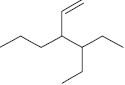
The correct $IUPAC$ name for the compound shown below is:
A
$4-$ethyl$-3-$propylhex$-1-$ene
B
$3-$ethyl$-4-$ethenylheptane
C
$3-$ethyl$-4-$propylhex$-5-$ene
D
$3-(1-$ethylpropyl$)$hex$-1-$ene
Solution
(A) $1$. Identify the longest carbon chain containing the double bond. The longest chain has $6$ carbons,making it a hexene derivative.
$2$. Number the chain starting from the end closest to the double bond. The double bond starts at $C-1$.
$3$. The substituents are an ethyl group at $C-3$ and a propyl group at $C-4$.
$4$. Combining these,the correct $IUPAC$ name is $4-$ethyl$-3-$propylhex$-1-$ene.
$2$. Number the chain starting from the end closest to the double bond. The double bond starts at $C-1$.
$3$. The substituents are an ethyl group at $C-3$ and a propyl group at $C-4$.
$4$. Combining these,the correct $IUPAC$ name is $4-$ethyl$-3-$propylhex$-1-$ene.
0 likesView Solution
43
ChemistryDifficultMCQAIPMT · 2011
In Dumas' method of estimation of nitrogen,$0.35 \ g$ of an organic compound gave $55 \ mL$ of nitrogen collected at $300 \ K$ temperature and $715 \ mm$ pressure. The percentage composition of nitrogen in the compound would be (aqueous tension at $300 \ K = 15 \ mm$). (in $\%$)
A
$15.45$
B
$16.45$
C
$17.45$
D
$14.45$
Solution
(B) The pressure of dry nitrogen gas is $p_1 = p - p_{aq} = 715 \ mm - 15 \ mm = 700 \ mm$.
Using the ideal gas equation $\frac{p_1 V_1}{T_1} = \frac{p_2 V_2}{T_2}$ to find the volume of $N_2$ at $STP$ $(p_2 = 760 \ mm, T_2 = 273 \ K)$:
$V_2 = \frac{p_1 V_1 T_2}{T_1 p_2} = \frac{700 \times 55 \times 273}{300 \times 760} = 48.098 \ mL$.
The percentage of nitrogen is calculated as:
$\% \ N = \frac{28}{22400} \times \frac{V_2 \ (mL)}{W \ (g)} \times 100$
$\% \ N = \frac{28}{22400} \times \frac{48.098}{0.35} \times 100 = 16.45 \ \%$.
Using the ideal gas equation $\frac{p_1 V_1}{T_1} = \frac{p_2 V_2}{T_2}$ to find the volume of $N_2$ at $STP$ $(p_2 = 760 \ mm, T_2 = 273 \ K)$:
$V_2 = \frac{p_1 V_1 T_2}{T_1 p_2} = \frac{700 \times 55 \times 273}{300 \times 760} = 48.098 \ mL$.
The percentage of nitrogen is calculated as:
$\% \ N = \frac{28}{22400} \times \frac{V_2 \ (mL)}{W \ (g)} \times 100$
$\% \ N = \frac{28}{22400} \times \frac{48.098}{0.35} \times 100 = 16.45 \ \%$.
0 likesView Solution
44
ChemistryMediumMCQAIPMT · 2011
The Lassaigne's extract is boiled with conc. $HNO_3$ while testing for halogens. By doing so it
A
decomposes $Na_2S$ and $NaCN$ formed
B
helps in the precipitation of $AgCl$
C
increases the solubility product of $AgCl$
D
increases the concentration of $NO_3^-$ ions
Solution
(A) If $Na_2S$ and $NaCN$ are present in the extract,they will interfere with the test for halogens by forming precipitates with $AgNO_3$.
Boiling the extract with conc. $HNO_3$ decomposes these compounds into volatile $H_2S$ and $HCN$ gases:
$NaCN + HNO_3 \rightarrow NaNO_3 + HCN \uparrow$
$Na_2S + 2HNO_3 \rightarrow 2NaNO_3 + H_2S \uparrow$
These gases escape from the solution,ensuring they do not interfere with the halogen test.
Boiling the extract with conc. $HNO_3$ decomposes these compounds into volatile $H_2S$ and $HCN$ gases:
$NaCN + HNO_3 \rightarrow NaNO_3 + HCN \uparrow$
$Na_2S + 2HNO_3 \rightarrow 2NaNO_3 + H_2S \uparrow$
These gases escape from the solution,ensuring they do not interfere with the halogen test.
0 likesView Solution
45
ChemistryMediumMCQAIPMT · 2011
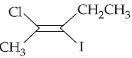
The $IUPAC$ name of the following compound is:
A
$trans-2-chloro-3-iodo-2-pentene$
B
$cis-3-iodo-4-chloro-3-pentene$
C
$trans-3-iodo-4-chloro-3-pentene$
D
$cis-2-chloro-3-iodo-2-pentene$
Solution
$(A)$ The longest carbon chain contains $5$ carbon atoms with a $C=C$ bond starting at the second carbon atom, so it is a $2$-pentene derivative.
The substituents are a chlorine atom $(Cl)$ at position $2$ and an iodine atom $(I)$ at position $3$.
Looking at the geometry across the $C=C$ bond, the higher priority groups (based on atomic number, $Cl$ vs $CH_3$ on one side, and $I$ vs $CH_2CH_3$ on the other) are on opposite sides of the double bond, which corresponds to the $E$ configuration, often referred to as $trans$ in simple cases where similar groups are on opposite sides.
Specifically, the $Cl$ and the $CH_2CH_3$ group are on opposite sides of the double bond, and the $CH_3$ and $I$ are on opposite sides. Thus, the configuration is $trans-2-chloro-3-iodo-2-pentene$.
The substituents are a chlorine atom $(Cl)$ at position $2$ and an iodine atom $(I)$ at position $3$.
Looking at the geometry across the $C=C$ bond, the higher priority groups (based on atomic number, $Cl$ vs $CH_3$ on one side, and $I$ vs $CH_2CH_3$ on the other) are on opposite sides of the double bond, which corresponds to the $E$ configuration, often referred to as $trans$ in simple cases where similar groups are on opposite sides.
Specifically, the $Cl$ and the $CH_2CH_3$ group are on opposite sides of the double bond, and the $CH_3$ and $I$ are on opposite sides. Thus, the configuration is $trans-2-chloro-3-iodo-2-pentene$.
0 likesView Solution
46
ChemistryMediumMCQAIPMT · 2011
Which one of the following statements is not true?
A
$pH$ of drinking water should be between $5.5 - 9.5$.
B
Concentration of $DO$ below $6 \ ppm$ is good for the growth of fish.
C
Clean water would have a $BOD$ value of less than $5 \ ppm$.
D
Oxides of sulphur,nitrogen and carbon are the most widespread air pollutants.
Solution
(B) The concentration of $DO$ (Dissolved Oxygen) in water is crucial for aquatic life. The growth of fish is inhibited if the concentration of $DO$ falls below $6 \ ppm$. Therefore,the statement that a concentration below $6 \ ppm$ is good for the growth of fish is false.
0 likesView Solution
47
ChemistryEasyMCQAIPMT · 2011
Acidified $K_2Cr_2O_7$ solution turns green when $Na_2SO_3$ is added to it. This is due to the formation of
A
$Cr_2(SO_4)_3$
B
$CrO_4^{2-}$
C
$Cr_2(SO_3)_3$
D
$CrSO_4$
Solution
(A) The reaction between acidified $K_2Cr_2O_7$ and $Na_2SO_3$ is a redox reaction where $Cr_2O_7^{2-}$ acts as an oxidizing agent and $SO_3^{2-}$ acts as a reducing agent.
The balanced chemical equation is:
$K_2Cr_2O_7 + 3Na_2SO_3 + 4H_2SO_4 \rightarrow K_2SO_4 + 3Na_2SO_4 + Cr_2(SO_4)_3 + 4H_2O$
In this reaction,the orange-colored dichromate ion $(Cr_2O_7^{2-})$ is reduced to the green-colored chromium$(III)$ sulfate $(Cr_2(SO_4)_3)$,which causes the solution to turn green.
The balanced chemical equation is:
$K_2Cr_2O_7 + 3Na_2SO_3 + 4H_2SO_4 \rightarrow K_2SO_4 + 3Na_2SO_4 + Cr_2(SO_4)_3 + 4H_2O$
In this reaction,the orange-colored dichromate ion $(Cr_2O_7^{2-})$ is reduced to the green-colored chromium$(III)$ sulfate $(Cr_2(SO_4)_3)$,which causes the solution to turn green.
0 likesView Solution
48
ChemistryMCQAIPMT · 2011
In land plants,the guard cells differ from other epidermal cells in having:
A
Cytoskeleton
B
Mitochondria
C
Endoplasmic reticulum
D
Chloroplasts
Solution
(D) Guard cells are specialized epidermal cells that surround the stomatal pore.
Unlike typical epidermal cells,which are generally transparent and lack photosynthetic machinery,guard cells contain chloroplasts.
These chloroplasts are essential for the production of $ATP$ via photosynthesis,which provides the energy required for the active transport of ions (like $K^+$) to regulate stomatal opening and closing.
While both guard cells and other epidermal cells contain mitochondria,endoplasmic reticulum,and a cytoskeleton,the presence of chloroplasts is the distinguishing feature that allows guard cells to perform their unique physiological function.
Unlike typical epidermal cells,which are generally transparent and lack photosynthetic machinery,guard cells contain chloroplasts.
These chloroplasts are essential for the production of $ATP$ via photosynthesis,which provides the energy required for the active transport of ions (like $K^+$) to regulate stomatal opening and closing.
While both guard cells and other epidermal cells contain mitochondria,endoplasmic reticulum,and a cytoskeleton,the presence of chloroplasts is the distinguishing feature that allows guard cells to perform their unique physiological function.
0 likesView Solution
49
ChemistryMCQAIPMT · 2011
The function of companion cells is:
A
Providing energy to sieve elements for active transport.
B
Providing water to phloem.
C
Loading of sucrose into sieve elements by passive transport.
D
Loading of sucrose into sieve elements.
Solution
(D) Companion cells are specialized parenchyma cells associated with sieve tube elements in the phloem.
They maintain a pressure gradient in the sieve tubes by actively loading sucrose into them.
This process is known as phloem loading,which requires energy in the form of $ATP$ because it occurs against the concentration gradient (active transport).
Therefore,the primary function is the active loading of sucrose into sieve elements.
They maintain a pressure gradient in the sieve tubes by actively loading sucrose into them.
This process is known as phloem loading,which requires energy in the form of $ATP$ because it occurs against the concentration gradient (active transport).
Therefore,the primary function is the active loading of sucrose into sieve elements.
0 likesView Solution
50
ChemistryMCQAIPMT · 2011
Guttation is the result of
A
diffusion
B
transpiration
C
osmosis
D
root pressure
Solution
(D) Guttation is the process of exudation of liquid droplets from the margins of leaves through specialized pores called hydathodes.
It occurs due to the development of high positive hydrostatic pressure in the xylem of roots,known as root pressure.
This phenomenon is typically observed during the night or early morning when transpiration is low and soil moisture is high.
It occurs due to the development of high positive hydrostatic pressure in the xylem of roots,known as root pressure.
This phenomenon is typically observed during the night or early morning when transpiration is low and soil moisture is high.
0 likesView Solution
51
ChemistryDifficultMCQAIPMT · 2011
Which one of the following is present as an active ingredient in bleaching powder for bleaching action?
A
$CaOCl_2$
B
$Ca(OCl)_2$
C
$CaO_2Cl$
D
$CaCl_2$
Solution
(B) Calcium hypochlorite,with the formula $Ca(OCl)_2$,is the primary active ingredient in bleaching powder.
It is responsible for the bleaching action and disinfection properties of the compound.
The chemical reaction for the preparation of bleaching powder is:
$3Ca(OH)_2 + 2Cl_2 \xrightarrow{\text{below } 35 \ ^\circ C} Ca(OCl)_2 \cdot CaCl_2 \cdot Ca(OH)_2 \cdot 2H_2O$.
It is responsible for the bleaching action and disinfection properties of the compound.
The chemical reaction for the preparation of bleaching powder is:
$3Ca(OH)_2 + 2Cl_2 \xrightarrow{\text{below } 35 \ ^\circ C} Ca(OCl)_2 \cdot CaCl_2 \cdot Ca(OH)_2 \cdot 2H_2O$.
0 likesView Solution
52
ChemistryMediumMCQAIPMT · 2011
Which one is a nucleophilic substitution reaction among the following?
A
$CH_3-CH=CH_2 + H_2O \xrightarrow{H^{+}} CH_3-CH(OH)-CH_3$
B
$RCHO + R'MgX \to R-CH(OMgX)-R'$
C
$CH_3-CH_2-CH(CH_3)-CH_2Br + NH_3 \to CH_3-CH_2-CH(CH_3)-CH_2NH_2 + HBr$
D
$CH_3CHO + HCN \to CH_3CH(OH)CN$
Solution
(C) In this reaction,the bromine atom $(Br)$ in the alkyl halide is replaced by the amino group $(-NH_2)$ from ammonia $(NH_3)$.
Since a nucleophile $(NH_3)$ replaces a leaving group $(Br^{-})$,it is a nucleophilic substitution reaction.
Option $(a)$ is an electrophilic addition reaction.
Options $(b)$ and $(d)$ are nucleophilic addition reactions.
Since a nucleophile $(NH_3)$ replaces a leaving group $(Br^{-})$,it is a nucleophilic substitution reaction.
Option $(a)$ is an electrophilic addition reaction.
Options $(b)$ and $(d)$ are nucleophilic addition reactions.
0 likesView Solution
53
ChemistryMediumMCQAIPMT · 2011
Which of the following compounds undergoes nucleophilic substitution reaction most easily?
A
p-Nitrochlorobenzene
B
p-Chlorotoluene
C
p-Chloroanisole
D
Chlorobenzene
Solution
(A) Nucleophilic aromatic substitution reactions are facilitated by the presence of electron-withdrawing groups on the benzene ring.
These groups stabilize the intermediate carbanion (Meisenheimer complex) formed during the reaction.
The $-NO_2$ group is a strong electron-withdrawing group due to its $-I$ and $-M$ effects.
In contrast,$-CH_3$ and $-OCH_3$ groups are electron-donating groups,which destabilize the intermediate carbanion and make the reaction more difficult.
Therefore,$p$-nitrochlorobenzene undergoes nucleophilic substitution most easily.
These groups stabilize the intermediate carbanion (Meisenheimer complex) formed during the reaction.
The $-NO_2$ group is a strong electron-withdrawing group due to its $-I$ and $-M$ effects.
In contrast,$-CH_3$ and $-OCH_3$ groups are electron-donating groups,which destabilize the intermediate carbanion and make the reaction more difficult.
Therefore,$p$-nitrochlorobenzene undergoes nucleophilic substitution most easily.
0 likesView Solution
54
ChemistryDifficultMCQAIPMT · 2011
$A$ solid compound $XY$ has $NaCl$ structure. If the radius of the cation is $100 \ pm,$ the radius of the anion $(Y^-)$ will be .............. $pm$.
A
$275.1$
B
$322.5$
C
$241.5$
D
$165.7$
Solution
(C) For a compound with $NaCl$ structure, the limiting radius ratio is $0.414$.
The radius ratio formula is given by $\frac{r^+}{r^-} = 0.414$.
Given that the radius of the cation $r^+ = 100 \ pm$, we substitute this into the equation:
$\frac{100}{r^-} = 0.414$
$r^- = \frac{100}{0.414} \approx 241.54 \ pm$.
Rounding to the nearest option, the radius of the anion is $241.5 \ pm$.
The radius ratio formula is given by $\frac{r^+}{r^-} = 0.414$.
Given that the radius of the cation $r^+ = 100 \ pm$, we substitute this into the equation:
$\frac{100}{r^-} = 0.414$
$r^- = \frac{100}{0.414} \approx 241.54 \ pm$.
Rounding to the nearest option, the radius of the anion is $241.5 \ pm$.
0 likesView Solution
55
ChemistryMediumMCQAIPMT · 2011
What is the mole fraction of the solute in a $1.00 \, m$ aqueous solution?
A
$0.1770$
B
$0.0354$
C
$0.0177$
D
$0.177$
Solution
(C) $1.00 \, m$ solution means $1 \, mol$ of solute is present in $1000 \, g$ of water.
The number of moles of water is $n_{H_{2}O} = \frac{1000 \, g}{18 \, g/mol} = 55.5 \, mol$.
The mole fraction of the solute is given by $X_{\text{solute}} = \frac{n_{\text{solute}}}{n_{\text{solute}} + n_{H_{2}O}}$.
Substituting the values,$X_{\text{solute}} = \frac{1}{1 + 55.5} = \frac{1}{56.5} \approx 0.0177$.
The number of moles of water is $n_{H_{2}O} = \frac{1000 \, g}{18 \, g/mol} = 55.5 \, mol$.
The mole fraction of the solute is given by $X_{\text{solute}} = \frac{n_{\text{solute}}}{n_{\text{solute}} + n_{H_{2}O}}$.
Substituting the values,$X_{\text{solute}} = \frac{1}{1 + 55.5} = \frac{1}{56.5} \approx 0.0177$.
0 likesView Solution
56
ChemistryMediumMCQAIPMT · 2011
The freezing point depression constant for water is $1.86 \, ^oC \, kg \, mol^{-1}.$ If $5.00 \, g$ of $Na_2SO_4$ is dissolved in $45.0 \, g$ of $H_2O,$ the freezing point is lowered by $3.82 \, ^oC.$ Calculate the van't Hoff factor for $Na_2SO_4.$
A
$2.05$
B
$2.63$
C
$3.11$
D
$0.381$
Solution
(B) The formula for freezing point depression is $\Delta T_f = i \times K_f \times m.$
Here,$\Delta T_f = 3.82 \, ^oC,$ $K_f = 1.86 \, ^oC \, kg \, mol^{-1},$ $W_{solute} = 5.00 \, g,$ $W_{solvent} = 45.0 \, g,$ and the molar mass of $Na_2SO_4$ is $M = 142 \, g \, mol^{-1}.$
The molality $m$ is given by $\frac{W_{solute} \times 1000}{M \times W_{solvent}} = \frac{5.00 \times 1000}{142 \times 45.0} \approx 0.782 \, m.$
Substituting these values into the equation: $3.82 = i \times 1.86 \times 0.782.$
Solving for $i$: $i = \frac{3.82}{1.86 \times 0.782} \approx 2.63.$
Here,$\Delta T_f = 3.82 \, ^oC,$ $K_f = 1.86 \, ^oC \, kg \, mol^{-1},$ $W_{solute} = 5.00 \, g,$ $W_{solvent} = 45.0 \, g,$ and the molar mass of $Na_2SO_4$ is $M = 142 \, g \, mol^{-1}.$
The molality $m$ is given by $\frac{W_{solute} \times 1000}{M \times W_{solvent}} = \frac{5.00 \times 1000}{142 \times 45.0} \approx 0.782 \, m.$
Substituting these values into the equation: $3.82 = i \times 1.86 \times 0.782.$
Solving for $i$: $i = \frac{3.82}{1.86 \times 0.782} \approx 2.63.$
0 likesView Solution
57
ChemistryEasyMCQAIPMT · 2011
The van't Hoff factor $i$ for a compound which undergoes dissociation in one solvent and association in another solvent is respectively:
A
less than $1$ and greater than $1$
B
less than $1$ and less than $1$
C
greater than $1$ and less than $1$
D
greater than $1$ and greater than $1$
Solution
(C) The van't Hoff factor $i$ is defined as the ratio of the observed colligative property to the calculated colligative property.
For a compound that undergoes dissociation,the number of particles in the solution increases,so $i > 1$.
For a compound that undergoes association,the number of particles in the solution decreases,so $i < 1$.
Therefore,for dissociation and association respectively,$i$ is greater than $1$ and less than $1$.
For a compound that undergoes dissociation,the number of particles in the solution increases,so $i > 1$.
For a compound that undergoes association,the number of particles in the solution decreases,so $i < 1$.
Therefore,for dissociation and association respectively,$i$ is greater than $1$ and less than $1$.
0 likesView Solution
58
ChemistryEasyMCQAIPMT · 2011
$A$ $0.1 \ m$ aqueous solution of a weak acid $HX$ is $30\%$ ionized. If $K_f$ for water is $1.86 \ ^{\circ}C/m,$ the freezing point of the solution will be ......... $^{\circ}C$.
A
$- 0.18$
B
$- 0.54$
C
$- 0.36$
D
$- 0.24$
Solution
(D) For the dissociation of weak acid $HX$: $HX \rightleftharpoons H^+ + X^-$
Initial moles: $1 \quad 0 \quad 0$
At equilibrium: $(1-\alpha) \quad \alpha \quad \alpha$
Total moles at equilibrium $= 1 - \alpha + \alpha + \alpha = 1 + \alpha$
Van't Hoff factor $i = 1 + \alpha = 1 + 0.3 = 1.3$
Depression in freezing point $\Delta T_f = i \times K_f \times m$
$\Delta T_f = 1.3 \times 1.86 \times 0.1 = 0.2418 \ ^{\circ}C$
Freezing point of solution $T_f = T_f^{\circ} - \Delta T_f = 0 - 0.2418 \ ^{\circ}C = - 0.24 \ ^{\circ}C$
Initial moles: $1 \quad 0 \quad 0$
At equilibrium: $(1-\alpha) \quad \alpha \quad \alpha$
Total moles at equilibrium $= 1 - \alpha + \alpha + \alpha = 1 + \alpha$
Van't Hoff factor $i = 1 + \alpha = 1 + 0.3 = 1.3$
Depression in freezing point $\Delta T_f = i \times K_f \times m$
$\Delta T_f = 1.3 \times 1.86 \times 0.1 = 0.2418 \ ^{\circ}C$
Freezing point of solution $T_f = T_f^{\circ} - \Delta T_f = 0 - 0.2418 \ ^{\circ}C = - 0.24 \ ^{\circ}C$
0 likesView Solution
59
ChemistryMediumMCQAIPMT · 2011
$200 \ mL$ of an aqueous solution of a protein contains its $1.26 \ g$. The osmotic pressure of this solution at $300 \ K$ is found to be $2.57 \times 10^{-3} \ bar$. The molar mass of protein will be ......... $g \ mol^{-1}$.
$(R = 0.083 \ L \ bar \ mol^{-1} \ K^{-1})$
$(R = 0.083 \ L \ bar \ mol^{-1} \ K^{-1})$
A
$51022$
B
$122044$
C
$31011$
D
$61039$
Solution
(D) The formula for osmotic pressure is $\pi V = nRT$,where $n = \frac{w}{M}$.
Given:
$\pi = 2.57 \times 10^{-3} \ bar$
$V = 200 \ mL = 0.2 \ L$
$w = 1.26 \ g$
$T = 300 \ K$
$R = 0.083 \ L \ bar \ mol^{-1} \ K^{-1}$
Substituting the values into the equation $\pi V = \frac{w}{M} RT$:
$2.57 \times 10^{-3} \times 0.2 = \frac{1.26}{M} \times 0.083 \times 300$
$M = \frac{1.26 \times 0.083 \times 300}{2.57 \times 10^{-3} \times 0.2}$
$M = \frac{31.374}{0.000514} \approx 61039 \ g \ mol^{-1}$.
Given:
$\pi = 2.57 \times 10^{-3} \ bar$
$V = 200 \ mL = 0.2 \ L$
$w = 1.26 \ g$
$T = 300 \ K$
$R = 0.083 \ L \ bar \ mol^{-1} \ K^{-1}$
Substituting the values into the equation $\pi V = \frac{w}{M} RT$:
$2.57 \times 10^{-3} \times 0.2 = \frac{1.26}{M} \times 0.083 \times 300$
$M = \frac{1.26 \times 0.083 \times 300}{2.57 \times 10^{-3} \times 0.2}$
$M = \frac{31.374}{0.000514} \approx 61039 \ g \ mol^{-1}$.
0 likesView Solution
60
ChemistryDifficultMCQAIPMT · 2011
If the $E^{\circ}_{cell}$ for a given reaction has a negative value,which of the following gives the correct relationships for the values of $\Delta G^{\circ}$ and $K_{eq}$ ?
A
$\Delta G^{\circ} > 0; K_{eq} < 1$
B
$\Delta G^{\circ} > 0; K_{eq} > 1$
C
$\Delta G^{\circ} < 0; K_{eq} > 1$
D
$\Delta G^{\circ} < 0; K_{eq} < 1$
Solution
(A) The relationship between standard Gibbs free energy change $(\Delta G^{\circ})$ and standard cell potential $(E^{\circ}_{cell})$ is given by $\Delta G^{\circ} = -nFE^{\circ}_{cell}$.
If $E^{\circ}_{cell} < 0$,then $\Delta G^{\circ} > 0$,which indicates that the reaction is non-spontaneous.
Furthermore,the relationship between $E^{\circ}_{cell}$ and the equilibrium constant $(K_{eq})$ is given by $E^{\circ}_{cell} = \frac{RT}{nF} \ln K_{eq}$.
If $E^{\circ}_{cell} < 0$,then $\ln K_{eq} < 0$,which implies $K_{eq} < 1$.
If $E^{\circ}_{cell} < 0$,then $\Delta G^{\circ} > 0$,which indicates that the reaction is non-spontaneous.
Furthermore,the relationship between $E^{\circ}_{cell}$ and the equilibrium constant $(K_{eq})$ is given by $E^{\circ}_{cell} = \frac{RT}{nF} \ln K_{eq}$.
If $E^{\circ}_{cell} < 0$,then $\ln K_{eq} < 0$,which implies $K_{eq} < 1$.
0 likesView Solution
61
ChemistryMediumMCQAIPMT · 2011
Standard electrode potential of three metals $X$,$Y$ and $Z$ are $-1.2 \, V$,$+0.5 \, V$ and $-3.0 \, V$ respectively. The reducing power of these metals will be
A
$Y > Z > X$
B
$Y > X > Z$
C
$Z > X > Y$
D
$X > Y > Z$
Solution
(C) The standard reduction potentials are given as:
$E_{X}^{0} = -1.2 \, V$
$E_{Y}^{0} = +0.5 \, V$
$E_{Z}^{0} = -3.0 \, V$
Reducing power is inversely proportional to the standard reduction potential.
Therefore,the metal with the lowest (most negative) reduction potential has the highest reducing power.
Comparing the values: $-3.0 \, V < -1.2 \, V < +0.5 \, V$.
Thus,the order of reducing power is $Z > X > Y$.
$E_{X}^{0} = -1.2 \, V$
$E_{Y}^{0} = +0.5 \, V$
$E_{Z}^{0} = -3.0 \, V$
Reducing power is inversely proportional to the standard reduction potential.
Therefore,the metal with the lowest (most negative) reduction potential has the highest reducing power.
Comparing the values: $-3.0 \, V < -1.2 \, V < +0.5 \, V$.
Thus,the order of reducing power is $Z > X > Y$.
0 likesView Solution
62
ChemistryAdvancedMCQAIPMT · 2011
The electrode potentials for $Cu^{2+}_{(aq)} + e^- \rightarrow Cu^{+}_{(aq)}$ and $Cu^{+}_{(aq)} + e^- \rightarrow Cu_{(s)}$ are $+0.15 \ V$ and $+0.50 \ V$ respectively. The value of $E^o_{Cu^{2+}/Cu}$ will be $........ \ V$.
A
$0.500$
B
$0.325$
C
$0.650$
D
$0.150$
Solution
(B) For the reaction $Cu^{2+} + e^- \rightarrow Cu^{+}$,$E^0_1 = 0.15 \ V$. The Gibbs free energy change is $\Delta G^0_1 = -n_1 F E^0_1 = -1 \times F \times 0.15 = -0.15 F$.
For the reaction $Cu^{+} + e^- \rightarrow Cu$,$E^0_2 = 0.50 \ V$. The Gibbs free energy change is $\Delta G^0_2 = -n_2 F E^0_2 = -1 \times F \times 0.50 = -0.50 F$.
For the overall reaction $Cu^{2+} + 2e^- \rightarrow Cu$,the total Gibbs free energy change is $\Delta G^0 = \Delta G^0_1 + \Delta G^0_2 = -0.15 F - 0.50 F = -0.65 F$.
Using the relation $\Delta G^0 = -n F E^0_{Cu^{2+}/Cu}$,where $n = 2$:
$-2 F E^0_{Cu^{2+}/Cu} = -0.65 F$.
Therefore,$E^0_{Cu^{2+}/Cu} = \frac{0.65}{2} = 0.325 \ V$.
For the reaction $Cu^{+} + e^- \rightarrow Cu$,$E^0_2 = 0.50 \ V$. The Gibbs free energy change is $\Delta G^0_2 = -n_2 F E^0_2 = -1 \times F \times 0.50 = -0.50 F$.
For the overall reaction $Cu^{2+} + 2e^- \rightarrow Cu$,the total Gibbs free energy change is $\Delta G^0 = \Delta G^0_1 + \Delta G^0_2 = -0.15 F - 0.50 F = -0.65 F$.
Using the relation $\Delta G^0 = -n F E^0_{Cu^{2+}/Cu}$,where $n = 2$:
$-2 F E^0_{Cu^{2+}/Cu} = -0.65 F$.
Therefore,$E^0_{Cu^{2+}/Cu} = \frac{0.65}{2} = 0.325 \ V$.
0 likesView Solution
63
ChemistryDifficultMCQAIPMT · 2011
Standard electrode potential for $Sn^{4+}/Sn^{2+}$ couple is $+0.15 \ V$ and that for the $Cr^{3+}/Cr$ couple is $-0.74 \ V.$ These two couples in their standard state are connected to make a cell. The cell potential will be ........ $V$
A
$+1.19$
B
$+0.89$
C
$+0.18$
D
$+1.83$
Solution
(B) The standard reduction potential for the cathode $(Sn^{4+}/Sn^{2+})$ is $E_{cathode}^{0} = +0.15 \ V$.
The standard reduction potential for the anode $(Cr^{3+}/Cr)$ is $E_{anode}^{0} = -0.74 \ V$.
The standard cell potential is calculated using the formula: $E_{cell}^{0} = E_{cathode}^{0} - E_{anode}^{0}$.
Substituting the values: $E_{cell}^{0} = 0.15 \ V - (-0.74 \ V) = 0.15 + 0.74 = +0.89 \ V$.
The standard reduction potential for the anode $(Cr^{3+}/Cr)$ is $E_{anode}^{0} = -0.74 \ V$.
The standard cell potential is calculated using the formula: $E_{cell}^{0} = E_{cathode}^{0} - E_{anode}^{0}$.
Substituting the values: $E_{cell}^{0} = 0.15 \ V - (-0.74 \ V) = 0.15 + 0.74 = +0.89 \ V$.
0 likesView Solution
64
ChemistryDifficultMCQAIPMT · 2011
$A$ solution contains $Fe^{2+}$,$Fe^{3+}$ and $I^{-}$ ions. This solution was treated with iodine at $35^{\circ}C$. $E^{\circ}$ for $Fe^{3+}/Fe^{2+}$ is $+0.77 \ V$ and $E^{\circ}$ for $I_2/2I^{-}$ is $+0.536 \ V$. The favourable redox reaction is
A
$I_2$ will be reduced to $I^{-}$
B
there will be no redox reaction
C
$I^{-}$ will be oxidised to $I_2$
D
$Fe^{2+}$ will be oxidised to $Fe^{3+}$
Solution
(C) The standard reduction potential $(E^{\circ})$ for $Fe^{3+}/Fe^{2+}$ is $+0.77 \ V$ and for $I_2/2I^{-}$ is $+0.536 \ V$.
Since the reduction potential of $Fe^{3+}/Fe^{2+}$ is higher than that of $I_2/2I^{-}$,$Fe^{3+}$ has a greater tendency to get reduced to $Fe^{2+}$.
Conversely,$I^{-}$ has a greater tendency to get oxidised to $I_2$.
Therefore,the spontaneous reaction is $2Fe^{3+} + 2I^{-} \rightarrow 2Fe^{2+} + I_2$.
Thus,$I^{-}$ will be oxidised to $I_2$.
Since the reduction potential of $Fe^{3+}/Fe^{2+}$ is higher than that of $I_2/2I^{-}$,$Fe^{3+}$ has a greater tendency to get reduced to $Fe^{2+}$.
Conversely,$I^{-}$ has a greater tendency to get oxidised to $I_2$.
Therefore,the spontaneous reaction is $2Fe^{3+} + 2I^{-} \rightarrow 2Fe^{2+} + I_2$.
Thus,$I^{-}$ will be oxidised to $I_2$.
0 likesView Solution
65
ChemistryEasyMCQAIPMT · 2011
Which one of the following statements for the order of a reaction is incorrect?
A
Order can be determined only experimentally.
B
Order is not influenced by stoichiometric coefficient of the reactants.
C
Order of a reaction is the sum of powers to the concentration terms of reactants to express the rate of reaction.
D
Order of reaction is always a whole number.
Solution
(D) The order of a reaction is defined as the sum of the powers of the concentration terms in the rate law expression.
It is an experimental quantity and is not necessarily related to the stoichiometric coefficients of the balanced chemical equation.
The order of a reaction can be zero,a whole number,or even a fraction.
Therefore,the statement that the order of reaction is always a whole number is incorrect.
It is an experimental quantity and is not necessarily related to the stoichiometric coefficients of the balanced chemical equation.
The order of a reaction can be zero,a whole number,or even a fraction.
Therefore,the statement that the order of reaction is always a whole number is incorrect.
0 likesView Solution
66
ChemistryDifficultMCQAIPMT · 2011
The rate of the reaction: $2N_2O_5 \rightarrow 4NO_2 + O_2$ can be written in three ways.
$-\frac{d[N_2O_5]}{dt} = k[N_2O_5]$
$\frac{d[NO_2]}{dt} = k'[N_2O_5]$ ; $\frac{d[O_2]}{dt} = k''[N_2O_5]$
The relationship between $k$ and $k'$ and between $k$ and $k''$ are:
$-\frac{d[N_2O_5]}{dt} = k[N_2O_5]$
$\frac{d[NO_2]}{dt} = k'[N_2O_5]$ ; $\frac{d[O_2]}{dt} = k''[N_2O_5]$
The relationship between $k$ and $k'$ and between $k$ and $k''$ are:
A
$k' = 2k$ ; $k'' = k$
B
$k' = 2k$ ; $k'' = k/2$
C
$k' = 2k$ ; $k'' = 2k$
D
$k' = k$ ; $k'' = k$
Solution
(B) The rate of reaction is defined as:
$-\frac{1}{2} \frac{d[N_2O_5]}{dt} = \frac{1}{4} \frac{d[NO_2]}{dt} = \frac{d[O_2]}{dt}$
Substituting the given rate expressions:
$\frac{1}{2} k[N_2O_5] = \frac{1}{4} k'[N_2O_5] = k''[N_2O_5]$
Dividing by $[N_2O_5]$:
$\frac{k}{2} = \frac{k'}{4} = k''$
From $\frac{k}{2} = \frac{k'}{4}$,we get $k' = 2k$.
From $\frac{k}{2} = k''$,we get $k'' = \frac{k}{2}$.
$-\frac{1}{2} \frac{d[N_2O_5]}{dt} = \frac{1}{4} \frac{d[NO_2]}{dt} = \frac{d[O_2]}{dt}$
Substituting the given rate expressions:
$\frac{1}{2} k[N_2O_5] = \frac{1}{4} k'[N_2O_5] = k''[N_2O_5]$
Dividing by $[N_2O_5]$:
$\frac{k}{2} = \frac{k'}{4} = k''$
From $\frac{k}{2} = \frac{k'}{4}$,we get $k' = 2k$.
From $\frac{k}{2} = k''$,we get $k'' = \frac{k}{2}$.
0 likesView Solution
67
ChemistryEasyMCQAIPMT · 2011
The unit of rate constant for a zero order reaction is
A
$mol\, L^{-1}\, s^{-1}$
B
$L\, mol^{-1}\, s^{-1}$
C
$L^2\, mol^{-2}\, s^{-1}$
D
$s^{-1}$
Solution
(A) The rate law expression for a zero order reaction is given by: $\text{Rate} = k[A]^0$.
Since the rate of reaction is expressed in units of concentration per unit time $(mol\, L^{-1}\, s^{-1})$,we have:
$mol\, L^{-1}\, s^{-1} = k \times (mol\, L^{-1})^0$.
Since any value raised to the power of $0$ is $1$,the unit of $k$ is equal to the unit of the rate of reaction.
Therefore,the unit of the rate constant for a zero order reaction is $mol\, L^{-1}\, s^{-1}$.
Since the rate of reaction is expressed in units of concentration per unit time $(mol\, L^{-1}\, s^{-1})$,we have:
$mol\, L^{-1}\, s^{-1} = k \times (mol\, L^{-1})^0$.
Since any value raised to the power of $0$ is $1$,the unit of $k$ is equal to the unit of the rate of reaction.
Therefore,the unit of the rate constant for a zero order reaction is $mol\, L^{-1}\, s^{-1}$.
0 likesView Solution
68
ChemistryMediumMCQAIPMT · 2011
The half-life of a substance in a certain enzyme-catalysed reaction is $138 \; s$. The time required for the concentration of the substance to fall from $1.28 \; mg \; L^{-1}$ to $0.04 \; mg \; L^{-1}$ is ....... $s$.
A
$414$
B
$552$
C
$690$
D
$276$
Solution
(C) Enzyme-catalysed reactions follow first-order kinetics.
The concentration of the substance decreases from $1.28 \; mg \; L^{-1}$ to $0.04 \; mg \; L^{-1}$.
We can calculate the number of half-lives $(n)$ as follows:
$1.28$ $\xrightarrow{t_{1/2}} 0.64$ $\xrightarrow{t_{1/2}} 0.32$ $\xrightarrow{t_{1/2}} 0.16$ $\xrightarrow{t_{1/2}} 0.08$ $\xrightarrow{t_{1/2}} 0.04$
This sequence shows that the concentration reduces by half $5$ times,so $n = 5$.
The total time required is $t = n \times t_{1/2}$.
$t = 5 \times 138 \; s = 690 \; s$.
The concentration of the substance decreases from $1.28 \; mg \; L^{-1}$ to $0.04 \; mg \; L^{-1}$.
We can calculate the number of half-lives $(n)$ as follows:
$1.28$ $\xrightarrow{t_{1/2}} 0.64$ $\xrightarrow{t_{1/2}} 0.32$ $\xrightarrow{t_{1/2}} 0.16$ $\xrightarrow{t_{1/2}} 0.08$ $\xrightarrow{t_{1/2}} 0.04$
This sequence shows that the concentration reduces by half $5$ times,so $n = 5$.
The total time required is $t = n \times t_{1/2}$.
$t = 5 \times 138 \; s = 690 \; s$.
0 likesView Solution
69
ChemistryEasyMCQAIPMT · 2011
If $x$ is the amount of adsorbate and $m$ is the amount of adsorbent,which of the following relations is not related to the adsorption process?
A
$x/m = f(p)$ at constant $T$
B
$x/m = f(T)$ at constant $p$
C
$p = f(T)$ at constant $(x/m)$
D
$x/m = p \times T$
Solution
(D) The relation $x/m = p \times T$ is incorrect for the adsorption process.
Adsorption is typically described by the Freundlich or Langmuir isotherms,where the extent of adsorption $(x/m)$ is a function of pressure $(p)$ at constant temperature $(T)$,or a function of temperature $(T)$ at constant pressure $(p)$.
The relationship $p = f(T)$ at constant $x/m$ represents isosteres.
The expression $x/m = p \times T$ does not represent any standard adsorption isotherm or thermodynamic relation.
Adsorption is typically described by the Freundlich or Langmuir isotherms,where the extent of adsorption $(x/m)$ is a function of pressure $(p)$ at constant temperature $(T)$,or a function of temperature $(T)$ at constant pressure $(p)$.
The relationship $p = f(T)$ at constant $x/m$ represents isosteres.
The expression $x/m = p \times T$ does not represent any standard adsorption isotherm or thermodynamic relation.
0 likesView Solution
70
ChemistryEasyMCQAIPMT · 2011
Which of the following elements is present as the impurity to the maximum extent in the pig iron?
A
Manganese
B
Carbon
C
Silicon
D
Phosphorus
Solution
(B) Pig iron is the most impure form of iron,obtained directly from the blast furnace.
It contains about $3-4.5 \%$ of carbon as the major impurity.
Other impurities like $S, P, Si,$ and $Mn$ are present in much smaller amounts compared to carbon.
It contains about $3-4.5 \%$ of carbon as the major impurity.
Other impurities like $S, P, Si,$ and $Mn$ are present in much smaller amounts compared to carbon.
0 likesView Solution
71
ChemistryEasyMCQAIPMT · 2011
Which of the following pairs of metals is purified by the van Arkel method?
A
$Ga$ and $In$
B
$Zr$ and $Ti$
C
$Ag$ and $Au$
D
$Ni$ and $Fe$
Solution
(B) $Zr$ and $Ti$ are purified by the van Arkel method.
$\underset{\text{Impure}}{Zr + 2I_2}$ $\xrightarrow{600\,^{\circ}C} ZrI_4$ $\xrightarrow{1800\,^{\circ}C} \underset{\text{Pure}}{Zr + 2I_2}$
This method is useful for removing all the oxygen and nitrogen present as impurities in certain metals like $Zr$ and $Ti$.
$\underset{\text{Impure}}{Zr + 2I_2}$ $\xrightarrow{600\,^{\circ}C} ZrI_4$ $\xrightarrow{1800\,^{\circ}C} \underset{\text{Pure}}{Zr + 2I_2}$
This method is useful for removing all the oxygen and nitrogen present as impurities in certain metals like $Zr$ and $Ti$.
0 likesView Solution
72
ChemistryMediumMCQAIPMT · 2011
The following reactions take place in the blast furnace during the preparation of impure iron. Identify the reaction pertaining to the formation of the slag.
A
$Fe_2O_{3(s)} + 3CO_{(g)} \rightarrow 2Fe_{(l)} + 3CO_{2(g)}$
B
$CaCO_{3(s)} \rightarrow CaO_{(s)} + CO_{2(g)}$
C
$CaO_{(s)} + SiO_{2(s)} \rightarrow CaSiO_{3(l)}$
D
$2C_{(s)} + O_{2(g)} \rightarrow 2CO_{(g)}$
Solution
(C) In the blast furnace,the limestone $(CaCO_3)$ decomposes to form calcium oxide $(CaO)$,which acts as a flux.
This flux reacts with the silica $(SiO_2)$ impurity (gangue) present in the ore to form a fusible slag called calcium silicate $(CaSiO_3)$.
The reaction is: $CaO_{(s)} + SiO_{2(s)} \rightarrow CaSiO_{3(l)}$.
This flux reacts with the silica $(SiO_2)$ impurity (gangue) present in the ore to form a fusible slag called calcium silicate $(CaSiO_3)$.
The reaction is: $CaO_{(s)} + SiO_{2(s)} \rightarrow CaSiO_{3(l)}$.
0 likesView Solution
73
ChemistryDifficultMCQAIPMT · 2011
For the four successive transition elements $(Cr, Mn, Fe, \text{ and } Co)$,the stability of $+2$ oxidation state will be in which of the following order?
(Atomic numbers: $Cr = 24, Mn = 25, Fe = 26, Co = 27$)
(Atomic numbers: $Cr = 24, Mn = 25, Fe = 26, Co = 27$)
A
$Mn > Fe > Cr > Co$
B
$Fe > Mn > Co > Cr$
C
$Co > Mn > Fe > Cr$
D
$Cr > Mn > Co > Fe$
Solution
(A) The stability of the $+2$ oxidation state in transition metals is influenced by the electronic configuration and exchange energy.
$1$. $Mn^{2+}$ has a $d^5$ configuration,which is half-filled and highly stable due to maximum exchange energy.
$2$. $Fe^{2+}$ has a $d^6$ configuration. While it has one electron paired,it still possesses significant exchange energy,making it more stable than $Cr^{2+}$ $(d^4)$.
$3$. $Cr^{2+}$ has a $d^4$ configuration,which is less stable than $d^5$ and $d^6$ due to lower exchange energy.
$4$. $Co^{2+}$ has a $d^7$ configuration,which is the least stable among these due to increased inter-electronic repulsion.
Thus,the order of stability is $Mn^{2+} > Fe^{2+} > Cr^{2+} > Co^{2+}$.
$1$. $Mn^{2+}$ has a $d^5$ configuration,which is half-filled and highly stable due to maximum exchange energy.
$2$. $Fe^{2+}$ has a $d^6$ configuration. While it has one electron paired,it still possesses significant exchange energy,making it more stable than $Cr^{2+}$ $(d^4)$.
$3$. $Cr^{2+}$ has a $d^4$ configuration,which is less stable than $d^5$ and $d^6$ due to lower exchange energy.
$4$. $Co^{2+}$ has a $d^7$ configuration,which is the least stable among these due to increased inter-electronic repulsion.
Thus,the order of stability is $Mn^{2+} > Fe^{2+} > Cr^{2+} > Co^{2+}$.
0 likesView Solution
74
ChemistryMediumMCQAIPMT · 2011
Of the following complex ions,which is diamagnetic in nature?
A
$[NiCl_4]^{2-}$
B
$[Ni(CN)_4]^{2-}$
C
$[CuCl_4]^{2-}$
D
$[CoF_6]^{3-}$
Solution
(B) The electronic configuration of $Ni$ is $[Ar] 3d^8 4s^2$. In $[Ni(CN)_4]^{2-}$,$Ni$ is in the $+2$ oxidation state,so its configuration is $Ni^{2+} = 3d^8$.
Since $CN^-$ is a strong field ligand,it causes pairing of electrons in the $3d$ orbitals.
This results in $d^8$ configuration with all electrons paired,making the complex diamagnetic.
In contrast,$[NiCl_4]^{2-}$,$[CuCl_4]^{2-}$,and $[CoF_6]^{3-}$ contain unpaired electrons and are paramagnetic.
Since $CN^-$ is a strong field ligand,it causes pairing of electrons in the $3d$ orbitals.
This results in $d^8$ configuration with all electrons paired,making the complex diamagnetic.
In contrast,$[NiCl_4]^{2-}$,$[CuCl_4]^{2-}$,and $[CoF_6]^{3-}$ contain unpaired electrons and are paramagnetic.
0 likesView Solution
75
ChemistryMediumMCQAIPMT · 2011
The complexes $[Co(NH_3)_6][Cr(CN)_6]$ and $[Cr(NH_3)_6][Co(CN)_6]$ are the examples of which type of isomerism?
A
Linkage isomerism
B
Ionization isomerism
C
Coordination isomerism
D
Geometrical isomerism
Solution
(C) The complexes $[Co(NH_3)_6][Cr(CN)_6]$ and $[Cr(NH_3)_6][Co(CN)_6]$ are examples of coordination isomerism.
This type of isomerism occurs in complexes where both the cation and the anion are complex ions.
It arises due to the interchange of ligands between the cationic and anionic coordination spheres.
This type of isomerism occurs in complexes where both the cation and the anion are complex ions.
It arises due to the interchange of ligands between the cationic and anionic coordination spheres.
0 likesView Solution
76
ChemistryDifficultMCQAIPMT · 2011
The complex,$[Pt(Py)(NH_3)BrCl]$,will have how many geometrical isomers?
A
$3$
B
$4$
C
$0$
D
$2$
Solution
(A) The complex $[Pt(Py)(NH_3)BrCl]$ is a square planar complex of the type $[M(abcd)]$,where $M = Pt$,$a = Py$,$b = NH_3$,$c = Br$,and $d = Cl$.
For a square planar complex of the type $[M(abcd)]$,there are $3$ possible geometrical isomers.
These isomers are formed by fixing one ligand (e.g.,$Py$) and varying the positions of the other three ligands $(NH_3, Br, Cl)$ relative to it.
Thus,the total number of geometrical isomers is $3$.
For a square planar complex of the type $[M(abcd)]$,there are $3$ possible geometrical isomers.
These isomers are formed by fixing one ligand (e.g.,$Py$) and varying the positions of the other three ligands $(NH_3, Br, Cl)$ relative to it.
Thus,the total number of geometrical isomers is $3$.
0 likesView Solution
77
ChemistryDifficultMCQAIPMT · 2011
The $d-$electron configurations of $Cr^{2+}, Mn^{2+}, Fe^{2+}$ and $Co^{2+}$ are $d^4, d^5, d^6$ and $d^7$ respectively. Which one of the following will exhibit minimum paramagnetic behaviour?
(At. nos. $Cr = 24, Mn = 25, Fe = 26, Co = 27$)
(At. nos. $Cr = 24, Mn = 25, Fe = 26, Co = 27$)
A
$[Mn(H_2O)_6]^{2+}$
B
$[Fe(H_2O)_6]^{2+}$
C
$[Co(H_2O)_6]^{2+}$
D
$[Cr(H_2O)_6]^{2+}$
Solution
(C) The paramagnetic behaviour depends on the number of unpaired electrons $(n)$.
$1$. For $[Cr(H_2O)_6]^{2+}$,$Cr^{2+}$ is $d^4$. In a weak field ligand like $H_2O$,$n = 4$.
$2$. For $[Mn(H_2O)_6]^{2+}$,$Mn^{2+}$ is $d^5$. In a weak field ligand like $H_2O$,$n = 5$.
$3$. For $[Fe(H_2O)_6]^{2+}$,$Fe^{2+}$ is $d^6$. In a weak field ligand like $H_2O$,$n = 4$.
$4$. For $[Co(H_2O)_6]^{2+}$,$Co^{2+}$ is $d^7$. In a weak field ligand like $H_2O$,$n = 3$.
Since $[Co(H_2O)_6]^{2+}$ has the minimum number of unpaired electrons $(n = 3)$,it exhibits the minimum paramagnetic behaviour.
The magnetic moment is given by $\mu = \sqrt{n(n+2)} \text{ BM}$.
$1$. For $[Cr(H_2O)_6]^{2+}$,$Cr^{2+}$ is $d^4$. In a weak field ligand like $H_2O$,$n = 4$.
$2$. For $[Mn(H_2O)_6]^{2+}$,$Mn^{2+}$ is $d^5$. In a weak field ligand like $H_2O$,$n = 5$.
$3$. For $[Fe(H_2O)_6]^{2+}$,$Fe^{2+}$ is $d^6$. In a weak field ligand like $H_2O$,$n = 4$.
$4$. For $[Co(H_2O)_6]^{2+}$,$Co^{2+}$ is $d^7$. In a weak field ligand like $H_2O$,$n = 3$.
Since $[Co(H_2O)_6]^{2+}$ has the minimum number of unpaired electrons $(n = 3)$,it exhibits the minimum paramagnetic behaviour.
The magnetic moment is given by $\mu = \sqrt{n(n+2)} \text{ BM}$.
0 likesView Solution
78
ChemistryMediumMCQAIPMT · 2011
Which of the following carbonyls will have the strongest $C-O$ bond?
A
$Mn(CO)_6^+$
B
$Cr(CO)_6$
C
$V(CO)_6^-$
D
$Fe(CO)_5$
Solution
(A) The strength of the $C-O$ bond in metal carbonyls depends on the extent of back-bonding from the metal $d$-orbitals to the $\pi^*$-antibonding orbitals of the $CO$ ligand.
As the negative charge on the metal complex increases,the metal atom becomes more electron-rich and donates more electron density into the $\pi^*$-orbitals of $CO$,which weakens the $C-O$ bond.
Conversely,as the positive charge on the central metal atom increases,the metal's ability to donate electron density decreases.
Therefore,the $C-O$ bond is strongest in the species with the highest positive charge or lowest negative charge,as there is minimal back-bonding.
Among the given options,$Mn(CO)_6^+$ has the highest positive charge,resulting in the least back-bonding and the strongest $C-O$ bond.
As the negative charge on the metal complex increases,the metal atom becomes more electron-rich and donates more electron density into the $\pi^*$-orbitals of $CO$,which weakens the $C-O$ bond.
Conversely,as the positive charge on the central metal atom increases,the metal's ability to donate electron density decreases.
Therefore,the $C-O$ bond is strongest in the species with the highest positive charge or lowest negative charge,as there is minimal back-bonding.
Among the given options,$Mn(CO)_6^+$ has the highest positive charge,resulting in the least back-bonding and the strongest $C-O$ bond.
0 likesView Solution
79
ChemistryMediumMCQAIPMT · 2011
Which of the following complex compounds will exhibit highest paramagnetic behaviour?
(At. No. $Ti = 22, Cr = 24, Co = 27, Zn = 30$)
(At. No. $Ti = 22, Cr = 24, Co = 27, Zn = 30$)
A
$[Ti(NH_3)_6]^{3+}$
B
$[Cr(NH_3)_6]^{3+}$
C
$[Co(NH_3)_6]^{3+}$
D
$[Zn(NH_3)_6]^{2+}$
Solution
(B) $Ti$ $\rightarrow [Ar] 3d^{2} 4s^{2}, Ti^{3+}$ $\rightarrow [Ar] 3d^{1} 4s^{0}$ ($1$ unpaired electron)
$Cr$ $\rightarrow [Ar] 3d^{5} 4s^{1}, Cr^{3+}$ $\rightarrow [Ar] 3d^{3} 4s^{0}$ ($3$ unpaired electrons)
$Co$ $\rightarrow [Ar] 3d^{7} 4s^{2}, Co^{3+}$ $\rightarrow [Ar] 3d^{6} 4s^{0}$ ($0$ unpaired electrons because $NH_3$ is a strong field ligand causing pairing)
$Zn$ $\rightarrow [Ar] 3d^{10} 4s^{2}, Zn^{2+}$ $\rightarrow [Ar] 3d^{10}$ ($0$ unpaired electrons)
Since $[Cr(NH_3)_6]^{3+}$ has the highest number of unpaired electrons $(3)$,it exhibits the highest paramagnetic behaviour.
$Cr$ $\rightarrow [Ar] 3d^{5} 4s^{1}, Cr^{3+}$ $\rightarrow [Ar] 3d^{3} 4s^{0}$ ($3$ unpaired electrons)
$Co$ $\rightarrow [Ar] 3d^{7} 4s^{2}, Co^{3+}$ $\rightarrow [Ar] 3d^{6} 4s^{0}$ ($0$ unpaired electrons because $NH_3$ is a strong field ligand causing pairing)
$Zn$ $\rightarrow [Ar] 3d^{10} 4s^{2}, Zn^{2+}$ $\rightarrow [Ar] 3d^{10}$ ($0$ unpaired electrons)
Since $[Cr(NH_3)_6]^{3+}$ has the highest number of unpaired electrons $(3)$,it exhibits the highest paramagnetic behaviour.
0 likesView Solution
80
ChemistryAdvancedMCQAIPMT · 2011
Consider the reactions.
$(i) \ (CH_3)_2CH-CH_2Br \xrightarrow{C_2H_5OH} (CH_3)_2CH-CH_2OC_2H_5 + HBr$
$(ii) \ (CH_3)_2CH-CH_2Br \xrightarrow{C_2H_5O^-} (CH_3)_2CH-CH_2OC_2H_5 + Br^-$
The mechanisms of reactions $(i)$ and $(ii)$ are respectively:
$(i) \ (CH_3)_2CH-CH_2Br \xrightarrow{C_2H_5OH} (CH_3)_2CH-CH_2OC_2H_5 + HBr$
$(ii) \ (CH_3)_2CH-CH_2Br \xrightarrow{C_2H_5O^-} (CH_3)_2CH-CH_2OC_2H_5 + Br^-$
The mechanisms of reactions $(i)$ and $(ii)$ are respectively:
A
$S_N2$ and $S_N2$
B
$S_N1$ and $S_N1$
C
$S_N1$ and $S_N2$
D
$S_N2$ and $S_N1$
Solution
(C) Reaction $(i)$ involves a primary alkyl halide reacting with a weak nucleophile $(C_2H_5OH)$,which proceeds via the $S_N1$ mechanism.
Reaction $(ii)$ involves a primary alkyl halide reacting with a strong nucleophile $(C_2H_5O^-)$,which proceeds via the $S_N2$ mechanism.
Therefore,the mechanisms are $S_N1$ and $S_N2$ respectively.
Reaction $(ii)$ involves a primary alkyl halide reacting with a strong nucleophile $(C_2H_5O^-)$,which proceeds via the $S_N2$ mechanism.
Therefore,the mechanisms are $S_N1$ and $S_N2$ respectively.
0 likesView Solution
81
ChemistryDifficultMCQAIPMT · 2011
In the following reactions,
$(i) CH_3-CH(CH_3)-CH(OH)-CH_3 \xrightarrow{H^{+}/\text{heat}} A \text{ [Major product]} + B \text{ [Minor product]}$
$(ii) A$ $\xrightarrow[\text{in absence of peroxide}]{HBr, \text{dark}} C \text{ [Major product]} + D \text{ [Minor product]}$
the major products $(A)$ and $(C)$ are respectively:
$(i) CH_3-CH(CH_3)-CH(OH)-CH_3 \xrightarrow{H^{+}/\text{heat}} A \text{ [Major product]} + B \text{ [Minor product]}$
$(ii) A$ $\xrightarrow[\text{in absence of peroxide}]{HBr, \text{dark}} C \text{ [Major product]} + D \text{ [Minor product]}$
the major products $(A)$ and $(C)$ are respectively:
A
$CH_2=C(CH_3)-CH_2-CH_3$ and $CH_3-C(Br)(CH_3)-CH_2-CH_3$
B
$CH_3-C(CH_3)=CH-CH_3$ and $CH_3-C(Br)(CH_3)-CH_2-CH_3$
C
$CH_2=C(CH_3)-CH_2-CH_3$ and $CH_3-CH(CH_3)-CH(Br)-CH_3$
D
$CH_3-C(CH_3)=CH-CH_3$ and $CH_3-CH(CH_3)-CH(Br)-CH_3$
Solution
(B) In reaction $(i)$,dehydration of $3\text{-methylbutan-}2\text{-ol}$ occurs via a carbocation intermediate.
The initially formed $2^\circ$ carbocation $CH_3-CH(CH_3)-C^+H-CH_3$ undergoes a $1,2\text{-hydride shift}$ to form a more stable $3^\circ$ carbocation $CH_3-C^+(CH_3)-CH_2-CH_3$.
Elimination of a proton from this $3^\circ$ carbocation according to Saytzeff's rule gives the major product $A$,which is $2\text{-methylbut-}2\text{-ene}$ $(CH_3-C(CH_3)=CH-CH_3)$.
In reaction $(ii)$,Markovnikov addition of $HBr$ to $A$ in the absence of peroxide yields the major product $C$,which is $2\text{-bromo-}2\text{-methylbutane}$ $(CH_3-C(Br)(CH_3)-CH_2-CH_3)$.
The initially formed $2^\circ$ carbocation $CH_3-CH(CH_3)-C^+H-CH_3$ undergoes a $1,2\text{-hydride shift}$ to form a more stable $3^\circ$ carbocation $CH_3-C^+(CH_3)-CH_2-CH_3$.
Elimination of a proton from this $3^\circ$ carbocation according to Saytzeff's rule gives the major product $A$,which is $2\text{-methylbut-}2\text{-ene}$ $(CH_3-C(CH_3)=CH-CH_3)$.
In reaction $(ii)$,Markovnikov addition of $HBr$ to $A$ in the absence of peroxide yields the major product $C$,which is $2\text{-bromo-}2\text{-methylbutane}$ $(CH_3-C(Br)(CH_3)-CH_2-CH_3)$.
0 likesView Solution
82
ChemistryMediumMCQAIPMT · 2011
Clemmensen reduction of a ketone is carried out in the presence of which of the following?
A
$Glycol$ with $KOH$
B
$Zn-Hg$ with $HCl$
C
$LiAlH_4$
D
$H_2$ and $Pt$ as catalyst
Solution
(B) The reducing agent used in Clemmensen reduction is $Zn-Hg$ (zinc amalgam) and $HCl$.
In this reaction,the carbonyl group $(>C=O)$ of an aldehyde or ketone is reduced to a methylene group $(>CH_2)$.
The reaction is represented as: $>C=O \xrightarrow{Zn-Hg / HCl} >CH_2$.
In this reaction,the carbonyl group $(>C=O)$ of an aldehyde or ketone is reduced to a methylene group $(>CH_2)$.
The reaction is represented as: $>C=O \xrightarrow{Zn-Hg / HCl} >CH_2$.
0 likesView Solution
83
ChemistryMediumMCQAIPMT · 2011
In a set of reactions,$m$-bromobenzoic acid gave a product $D$. Identify the product $D$.
$m$-bromobenzoic acid $\xrightarrow{SOCl_2} B$ $\xrightarrow{NH_3} C$ $\xrightarrow{Br_2, NaOH} D$
$m$-bromobenzoic acid $\xrightarrow{SOCl_2} B$ $\xrightarrow{NH_3} C$ $\xrightarrow{Br_2, NaOH} D$
A
$m$-bromoaniline
B
$m$-bromobenzamide
C
$m$-bromobenzoic acid
D
$p$-bromoaniline
Solution
(A) The reaction sequence is as follows:
$1$. $m$-bromobenzoic acid reacts with $SOCl_2$ to form $m$-bromobenzoyl chloride $(B)$.
$2$. $m$-bromobenzoyl chloride reacts with $NH_3$ to form $m$-bromobenzamide $(C)$.
$3$. $m$-bromobenzamide undergoes the Hofmann bromamide degradation reaction with $Br_2$ and $NaOH$ to form $m$-bromoaniline $(D)$.
Thus,the product $D$ is $m$-bromoaniline.
$1$. $m$-bromobenzoic acid reacts with $SOCl_2$ to form $m$-bromobenzoyl chloride $(B)$.
$2$. $m$-bromobenzoyl chloride reacts with $NH_3$ to form $m$-bromobenzamide $(C)$.
$3$. $m$-bromobenzamide undergoes the Hofmann bromamide degradation reaction with $Br_2$ and $NaOH$ to form $m$-bromoaniline $(D)$.
Thus,the product $D$ is $m$-bromoaniline.
0 likesView Solution
84
ChemistryMediumMCQAIPMT · 2011
The order of reactivity of phenyl magnesium bromide $(PhMgBr)$ with the following compounds is:

A
$III > II > I$
B
$II > I > III$
C
$I > III > II$
D
$I > II > III$
Solution
(D) The reactivity of carbonyl compounds towards nucleophilic addition reactions depends on two main factors:
$1$. Electronic factors: Alkyl groups exhibit a $+I$-effect,which increases the electron density on the carbonyl carbon,thereby reducing its electrophilicity. Aryl groups exhibit a $+R$-effect,which also decreases the electrophilicity of the carbonyl carbon.
$2$. Steric factors: As the size and number of groups attached to the carbonyl carbon increase,steric hindrance increases,which hinders the approach of the nucleophile.
In the given compounds:
$(I)$ is acetaldehyde $(CH_3CHO)$,which has one alkyl group and one hydrogen atom.
$(II)$ is acetone $(CH_3COCH_3)$,which has two alkyl groups.
$(III)$ is benzophenone $(PhCOPh)$,which has two bulky phenyl groups.
Due to the combined effect of increased electron density and higher steric hindrance,the reactivity decreases in the order: $I > II > III$.
$1$. Electronic factors: Alkyl groups exhibit a $+I$-effect,which increases the electron density on the carbonyl carbon,thereby reducing its electrophilicity. Aryl groups exhibit a $+R$-effect,which also decreases the electrophilicity of the carbonyl carbon.
$2$. Steric factors: As the size and number of groups attached to the carbonyl carbon increase,steric hindrance increases,which hinders the approach of the nucleophile.
In the given compounds:
$(I)$ is acetaldehyde $(CH_3CHO)$,which has one alkyl group and one hydrogen atom.
$(II)$ is acetone $(CH_3COCH_3)$,which has two alkyl groups.
$(III)$ is benzophenone $(PhCOPh)$,which has two bulky phenyl groups.
Due to the combined effect of increased electron density and higher steric hindrance,the reactivity decreases in the order: $I > II > III$.
0 likesView Solution
85
ChemistryMediumMCQAIPMT · 2011
Match the compounds given in List-$I$ with List-$II$ and select the suitable option using the code given below.
| List-$I$ | List-$II$ |
|---|---|
| $A$. Benzaldehyde | $i$. Phenolphthalein |
| $B$. Phthalic anhydride | $ii$. Benzoin condensation |
| $C$. Phenyl benzoate | $iii$. Oil of wintergreen |
| $D$. Methyl salicylate | $iv$. Fries rearrangement |
A
$A-iv, B-i, C-iii, D-ii$
B
$A-iv, B-ii, C-iii, D-i$
C
$A-ii, B-iii, C-iv, D-i$
D
$A-ii, B-i, C-iv, D-iii$
Solution
(D) . Benzaldehyde undergoes $ii$. Benzoin condensation in the presence of cyanide ions.
$B$. Phthalic anhydride reacts with phenol to form $i$. Phenolphthalein.
$C$. Phenyl benzoate undergoes $iv$. Fries rearrangement to form hydroxybenzophenones.
$D$. Methyl salicylate is known as $iii$. Oil of wintergreen.
Therefore,the correct matching is $A-ii, B-i, C-iv, D-iii$.
$B$. Phthalic anhydride reacts with phenol to form $i$. Phenolphthalein.
$C$. Phenyl benzoate undergoes $iv$. Fries rearrangement to form hydroxybenzophenones.
$D$. Methyl salicylate is known as $iii$. Oil of wintergreen.
Therefore,the correct matching is $A-ii, B-i, C-iv, D-iii$.
0 likesView Solution
86
ChemistryDifficultMCQAIPMT · 2011
An organic compound $A$ on treatment with $NH_3$ gives $B$,which on heating gives $C$. $C$ when treated with $Br_2$ in the presence of $KOH$ produces ethyl amine. Compound $A$ is:
A
$CH_3COOH$
B
$CH_3CH_2CH_2COOH$
C
$CH_3-CH(CH_3)-COOH$
D
$CH_3CH_2COOH$
Solution
(D) The reaction sequence is as follows:
$CH_3CH_2COOH (A)$ $\xrightarrow{NH_3} CH_3CH_2COONH_4 (B)$ $\xrightarrow{\Delta} CH_3CH_2CONH_2 (C)$ $\xrightarrow{Br_2/KOH} CH_3CH_2NH_2$ (Ethylamine).
The last step is the Hoffmann Bromamide degradation reaction,where an amide is converted into an amine with one less carbon atom.
Since the product is ethylamine $(CH_3CH_2NH_2)$,which has $2$ carbon atoms,the amide $(C)$ must have $3$ carbon atoms.
Therefore,compound $A$ is propanoic acid $(CH_3CH_2COOH)$.
$CH_3CH_2COOH (A)$ $\xrightarrow{NH_3} CH_3CH_2COONH_4 (B)$ $\xrightarrow{\Delta} CH_3CH_2CONH_2 (C)$ $\xrightarrow{Br_2/KOH} CH_3CH_2NH_2$ (Ethylamine).
The last step is the Hoffmann Bromamide degradation reaction,where an amide is converted into an amine with one less carbon atom.
Since the product is ethylamine $(CH_3CH_2NH_2)$,which has $2$ carbon atoms,the amide $(C)$ must have $3$ carbon atoms.
Therefore,compound $A$ is propanoic acid $(CH_3CH_2COOH)$.
0 likesView Solution
87
ChemistryDifficultMCQAIPMT · 2011
What is the product obtained in the following reaction?
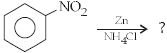
A
Phenylhydroxylamine
B
Azobenzene
C
Azoxybenzene
D
Aniline
Solution
(A) The reduction of nitrobenzene with $Zn$ in the presence of $NH_4Cl$ is a controlled reduction process.
Nitrobenzene $(C_6H_5NO_2)$ reacts with $Zn/NH_4Cl$ to form $N$-phenylhydroxylamine $(C_6H_5NHOH)$.
Therefore,the correct product is phenylhydroxylamine.
Nitrobenzene $(C_6H_5NO_2)$ reacts with $Zn/NH_4Cl$ to form $N$-phenylhydroxylamine $(C_6H_5NHOH)$.
Therefore,the correct product is phenylhydroxylamine.
0 likesView Solution
88
ChemistryMediumMCQAIPMT · 2011
Which of the following compounds is most basic?
A
$O_2N-C_6H_4-NH_2$ (p-nitroaniline)
B
$C_6H_5-CH_2NH_2$ (benzylamine)
C
$C_6H_5-NH-COCH_3$ (acetanilide)
D
$C_6H_5-NH_2$ (aniline)
Solution
(B) The basicity of an amine depends on the availability of the lone pair of electrons on the nitrogen atom for protonation.
In $C_6H_5-CH_2NH_2$ (benzylamine),the lone pair on the nitrogen atom is localised because the $-NH_2$ group is attached to an $sp^3$ hybridized carbon atom,which is not directly attached to the benzene ring.
In the other compounds ($p$-nitroaniline,acetanilide,and aniline),the lone pair on the nitrogen atom is delocalized over the benzene ring due to resonance,making it less available for donation.
Therefore,benzylamine is the most basic compound among the given options.
In $C_6H_5-CH_2NH_2$ (benzylamine),the lone pair on the nitrogen atom is localised because the $-NH_2$ group is attached to an $sp^3$ hybridized carbon atom,which is not directly attached to the benzene ring.
In the other compounds ($p$-nitroaniline,acetanilide,and aniline),the lone pair on the nitrogen atom is delocalized over the benzene ring due to resonance,making it less available for donation.
Therefore,benzylamine is the most basic compound among the given options.
0 likesView Solution
89
ChemistryMediumMCQAIPMT · 2011
Which one of the following statements is not true regarding $(+)$ lactose?
A
On hydrolysis $(+)$ lactose gives equal amount of $D(+)$ glucose and $D(+)$ galactose.
B
$(+)$ Lactose is a $\beta-$ glucoside formed by the union of a molecule of $D(+)$ glucose and a molecule of $D(+)$ galactose.
C
$(+)$ Lactose is a reducing sugar and does not exhibit mutarotation.
D
$(+)$ Lactose,$C_{12}H_{22}O_{11}$ contains $8-OH$ groups.
Solution
(C) $(+)$ Lactose is a reducing sugar because it contains a hemiacetal group,which allows it to exist in equilibrium with its open-chain form.
All reducing sugars exhibit mutarotation in aqueous solution.
Therefore,the statement that $(+)$ lactose does not exhibit mutarotation is false.
All reducing sugars exhibit mutarotation in aqueous solution.
Therefore,the statement that $(+)$ lactose does not exhibit mutarotation is false.
0 likesView Solution
90
ChemistryMediumMCQAIPMT · 2011
Which of the following is not a fat-soluble vitamin?
A
Vitamin $B$ complex
B
Vitamin $D$
C
Vitamin $E$
D
Vitamin $A$
Solution
(A) The correct option is $A$.
$1.$ Vitamins are classified into two categories based on their solubility: water-soluble and fat-soluble vitamins.
$2.$ Fat-soluble vitamins include Vitamin $A$,$D$,$E$,and $K$,which are stored in the liver and fatty tissues.
$3.$ Water-soluble vitamins include Vitamin $B$ complex and Vitamin $C$,which are not stored in the body and must be replenished regularly.
$4.$ Therefore,Vitamin $B$ complex is water-soluble,not fat-soluble.
$1.$ Vitamins are classified into two categories based on their solubility: water-soluble and fat-soluble vitamins.
$2.$ Fat-soluble vitamins include Vitamin $A$,$D$,$E$,and $K$,which are stored in the liver and fatty tissues.
$3.$ Water-soluble vitamins include Vitamin $B$ complex and Vitamin $C$,which are not stored in the body and must be replenished regularly.
$4.$ Therefore,Vitamin $B$ complex is water-soluble,not fat-soluble.
0 likesView Solution
91
ChemistryMediumMCQAIPMT · 2011
Which of the statements about "Denaturation" given below are correct?
$1.$ Denaturation of proteins causes loss of secondary and tertiary structures of the protein.
$2.$ Denaturation leads to the conversion of double strand of $DNA$ into single strand.
$3.$ Denaturation affects primary structure which gets distorted.
$1.$ Denaturation of proteins causes loss of secondary and tertiary structures of the protein.
$2.$ Denaturation leads to the conversion of double strand of $DNA$ into single strand.
$3.$ Denaturation affects primary structure which gets distorted.
A
$2.$ and $3.$
B
$1.$ and $3.$
C
$1.$ and $2.$
D
$1.$,$2.$ and $3.$
Solution
(C) Statement $1$ is correct: Denaturation of proteins involves the unfolding of the polypeptide chain,leading to the loss of secondary and tertiary structures,while the primary structure remains intact.
Statement $2$ is correct: Denaturation of $DNA$ involves the separation of the two strands of the double helix into single strands due to the breaking of hydrogen bonds.
Statement $3$ is incorrect: Denaturation does not affect the primary structure of proteins,as the peptide bonds remain intact.
Therefore,statements $1$ and $2$ are correct.
Statement $2$ is correct: Denaturation of $DNA$ involves the separation of the two strands of the double helix into single strands due to the breaking of hydrogen bonds.
Statement $3$ is incorrect: Denaturation does not affect the primary structure of proteins,as the peptide bonds remain intact.
Therefore,statements $1$ and $2$ are correct.
0 likesView Solution
92
ChemistryDifficultMCQAIPMT · 2011
Of the following,which one is classified as a polyester polymer?
A
Terylene
B
Bakelite
C
Melamine
D
Nylon $6,6$
Solution
(A) $Terylene$ is a polyester because it contains ester linkages $(-COO-)$ in its backbone.
It is formed by the condensation polymerization of monomer units,terephthalic acid $(C_6H_4(COOH)_2)$ and ethylene glycol $(HO-CH_2-CH_2-OH)$.
It is formed by the condensation polymerization of monomer units,terephthalic acid $(C_6H_4(COOH)_2)$ and ethylene glycol $(HO-CH_2-CH_2-OH)$.
0 likesView Solution
93
ChemistryMediumMCQAIPMT · 2011
Which one of the following is employed as an antihistamine?
A
Chloramphenicol
B
Diphenylhydramine
C
Norethindrone
D
Omeprazole
Solution
(B) An antihistamine is a type of pharmaceutical drug that opposes the activity of histamine receptors in the body.
Diphenylhydramine is employed as an antihistamine.
Omeprazole is used in the treatment of peptic ulcer diseases.
Chloramphenicol is an antibiotic.
Norethindrone is an antifertility drug.
Hence,option $B$ is correct.
Diphenylhydramine is employed as an antihistamine.
Omeprazole is used in the treatment of peptic ulcer diseases.
Chloramphenicol is an antibiotic.
Norethindrone is an antifertility drug.
Hence,option $B$ is correct.
0 likesView Solution
Vedclass Products
For Students
Vedclass Test Series
Mock tests in real AIPMT style covering Chemistry with performance analysis. 5-day free trial.
Start Free TrialFor Teachers
Exam Paper Generator
Generate Set A/B/C/D Chemistry papers from 7.5L+ questions in 2 minutes. 3 chapters free.
Try FreeFor Institutes
Online Exam Module
Run live AIPMT mock exams with unlimited students, 360° analytics & white-label branding.
See DemoFrequently Asked Questions
How many Chemistry questions are in AIPMT 2011?
There are 156 Chemistry questions from the AIPMT 2011 paper on Vedclass, each with a detailed step-by-step solution in English.
Are AIPMT 2011 Chemistry solutions available in English?
Yes. All solutions on this page are in English. You can also switch to English or Hindi using the language buttons above the questions.
Can I practice AIPMT 2011 Chemistry as a timed test?
Yes. Use the Vedclass Test Series to attempt a full AIPMT mock test covering Chemistry with time limits and instant score analysis.
Can teachers create Chemistry papers from AIPMT previous year questions?
Yes. The Vedclass Exam Paper Generator lets teachers mix AIPMT Chemistry questions and generate Set A/B/C/D papers in minutes.
For Teachers & Institutes
Build a Custom Chemistry Paper
Pick AIPMT 2011 Chemistry questions, set difficulty, and generate Set A/B/C/D in 2 minutes.