
BiologyQ1–100 of 160 questions
Page 1 of 2 · English
1
BiologyEasyMCQAIPMT · 2010
The protein coat of a virus is known as:
A
capsid
B
virion
C
nucleoprotein
D
core
Solution
(A) The correct answer is $A$. The nucleic acid of a virus is surrounded by a protective protein coat called the capsid. The capsid is composed of small protein subunits known as capsomeres. In some viruses,this capsid is further covered by an outer layer called an envelope,which typically consists of a combination of lipids,proteins,and carbohydrates.
0 likesView Solution
2
BiologyMediumMCQAIPMT · 2010
Single-celled eukaryotes are included in
A
Protista
B
Fungi
C
Archaea
D
Monera
Solution
(A) : Protista includes all unicellular and colonial eukaryotes. The protistan cells are typically eukaryotic,possessing membrane-bound organelles like mitochondria,chloroplasts,Golgi bodies,endoplasmic reticulum,and a nucleus.
Protista is commonly known as the kingdom of unicellular eukaryotes.
Kingdom Fungi contains achlorophyllous,spore-producing,heterotrophic,multicellular,or multinucleate eukaryotic organisms (unicellular yeasts are also included in Fungi because their sexual reproduction is similar to that of some fungi).
Monerans are basically unicellular prokaryotes.
Archaea (ancient bacteria) are also a type of monerans which live in extreme environments like high temperature,high salt content,and acidic $pH$.
Protista is commonly known as the kingdom of unicellular eukaryotes.
Kingdom Fungi contains achlorophyllous,spore-producing,heterotrophic,multicellular,or multinucleate eukaryotic organisms (unicellular yeasts are also included in Fungi because their sexual reproduction is similar to that of some fungi).
Monerans are basically unicellular prokaryotes.
Archaea (ancient bacteria) are also a type of monerans which live in extreme environments like high temperature,high salt content,and acidic $pH$.
0 likesView Solution
3
BiologyMediumMCQAIPMT · 2010
Some hyperthermophilic organisms that grow in highly acidic $(pH \ 2)$ habitats belong to the two groups:
A
eubacteria and archaea
B
cyanobacteria and diatoms
C
protists and mosses
D
liverworts and yeasts
Solution
(A) The correct answer is $A$.
$1$. Hyperthermophilic organisms that thrive in extremely acidic environments (such as $pH \ 2$) and high temperatures are primarily classified under the domain $Archaea$,specifically the group known as thermoacidophiles.
$2$. $Archaebacteria$ are known for their unique cell wall structure that allows them to survive in extreme conditions like hot sulphur springs.
$3$. Certain $Eubacteria$ also exhibit remarkable adaptability and can survive in diverse,hostile environments including hot springs and acidic conditions,although they are distinct from $Archaea$ in their biochemical composition.
$1$. Hyperthermophilic organisms that thrive in extremely acidic environments (such as $pH \ 2$) and high temperatures are primarily classified under the domain $Archaea$,specifically the group known as thermoacidophiles.
$2$. $Archaebacteria$ are known for their unique cell wall structure that allows them to survive in extreme conditions like hot sulphur springs.
$3$. Certain $Eubacteria$ also exhibit remarkable adaptability and can survive in diverse,hostile environments including hot springs and acidic conditions,although they are distinct from $Archaea$ in their biochemical composition.
0 likesView Solution
4
BiologyMediumMCQAIPMT · 2010
One of the free-living,anaerobic nitrogen-fixer is
A
Beijernickia
B
Rhodospirillum
C
Rhizobium
D
Azotobacter
Solution
(B) The correct answer is $B$.
Many free-living bacteria and blue-green algae are capable of fixing atmospheric nitrogen.
$Rhodospirillum$ is a free-living,photosynthetic,anaerobic,nitrogen-fixing,non-sulphur bacterium.
It is capable of synthesizing its organic food in the presence of light and in the absence of $O_2$ through a process known as bacterial photosynthesis.
$Beijernickia$ and $Azotobacter$ are free-living but aerobic nitrogen-fixing bacteria.
$Rhizobium$ is a symbiotic nitrogen-fixing bacterium.
Many free-living bacteria and blue-green algae are capable of fixing atmospheric nitrogen.
$Rhodospirillum$ is a free-living,photosynthetic,anaerobic,nitrogen-fixing,non-sulphur bacterium.
It is capable of synthesizing its organic food in the presence of light and in the absence of $O_2$ through a process known as bacterial photosynthesis.
$Beijernickia$ and $Azotobacter$ are free-living but aerobic nitrogen-fixing bacteria.
$Rhizobium$ is a symbiotic nitrogen-fixing bacterium.
0 likesView Solution
5
BiologyMediumMCQAIPMT · 2010
Membrane-bound organelles are absent in
A
Saccharomyces
B
Streptococcus
C
Chlamydomonas
D
Plasmodium
Solution
(B) $Streptococcus$ is a bacterium included under Kingdom $Monera$.
$Monerans$ possess a prokaryotic cell organization in which membrane-bound organelles like mitochondria,endoplasmic reticulum,Golgi bodies,etc.,are absent.
All the other three,$i.e.$,$Saccharomyces$ (a fungus),$Chlamydomonas$ (an alga),and $Plasmodium$ (a protozoan protist),are eukaryotes containing true membrane-bound organelles.
$Monerans$ possess a prokaryotic cell organization in which membrane-bound organelles like mitochondria,endoplasmic reticulum,Golgi bodies,etc.,are absent.
All the other three,$i.e.$,$Saccharomyces$ (a fungus),$Chlamydomonas$ (an alga),and $Plasmodium$ (a protozoan protist),are eukaryotes containing true membrane-bound organelles.
0 likesView Solution
6
BiologyMediumMCQAIPMT · 2010
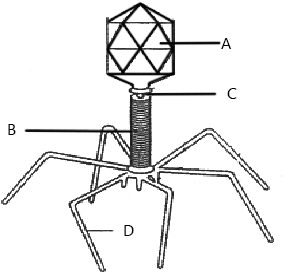
Given below is the diagram of a bacteriophage. In which one of the options are all the four parts $A, B, C$ and $D$ correctly identified?
A
$A$-Tail fibres,$B$-Head,$C$-Sheath,$D$-Collar
B
$A$-Sheath,$B$-Collar,$C$-Head,$D$-Tail fibres
C
$A$-Head,$B$-Sheath,$C$-Collar,$D$-Tail fibres
D
$A$-Collar,$B$-Tail fibres,$C$-Head,$D$-Sheath
Solution
(C) Based on the structure of a bacteriophage:
$A$ represents the Head,which contains the viral genetic material.
$B$ represents the Sheath (or tail tube),which is the contractile part of the tail.
$C$ represents the Collar,which connects the head to the tail.
$D$ represents the Tail fibres,which are used for attachment to the host cell surface.
Therefore,the correct identification is $A$-Head,$B$-Sheath,$C$-Collar,$D$-Tail fibres,which corresponds to option $C$.
$A$ represents the Head,which contains the viral genetic material.
$B$ represents the Sheath (or tail tube),which is the contractile part of the tail.
$C$ represents the Collar,which connects the head to the tail.
$D$ represents the Tail fibres,which are used for attachment to the host cell surface.
Therefore,the correct identification is $A$-Head,$B$-Sheath,$C$-Collar,$D$-Tail fibres,which corresponds to option $C$.
0 likesView Solution
7
BiologyMediumMCQAIPMT · 2010
Select the correct combination of the statements $(i-iv)$ regarding the characteristics of certain organisms.
$(i)$ Methanogens are archaebacteria which produce methane in marshy areas.
$(ii)$ Nostoc is a filamentous blue-green alga which fixes atmospheric nitrogen.
$(iii)$ Chemosynthetic autotrophic bacteria synthesize cellulose from glucose.
$(iv)$ Mycoplasma lack a cell wall and can survive without oxygen.
The correct statements are:
$(i)$ Methanogens are archaebacteria which produce methane in marshy areas.
$(ii)$ Nostoc is a filamentous blue-green alga which fixes atmospheric nitrogen.
$(iii)$ Chemosynthetic autotrophic bacteria synthesize cellulose from glucose.
$(iv)$ Mycoplasma lack a cell wall and can survive without oxygen.
The correct statements are:
A
$(ii)$ and $(iii)$
B
$(i), (ii)$ and $(iii)$
C
$(ii), (iii)$ and $(iv)$
D
$(i), (ii)$ and $(iv)$
Solution
(D) Statement $(i)$ is correct: Methanogens are archaebacteria found in marshy areas that produce methane $(CH_4)$.
Statement $(ii)$ is correct: Nostoc is a filamentous cyanobacterium (blue-green alga) that possesses heterocysts for atmospheric nitrogen fixation.
Statement $(iii)$ is incorrect: Chemosynthetic autotrophic bacteria oxidize inorganic substances (like nitrates,nitrites,or ammonia) to produce $ATP$ for energy,not to synthesize cellulose from glucose.
Statement $(iv)$ is correct: Mycoplasma are the smallest living cells,lack a cell wall,and are facultative anaerobes,meaning they can survive without oxygen.
Therefore,statements $(i), (ii),$ and $(iv)$ are correct.
Statement $(ii)$ is correct: Nostoc is a filamentous cyanobacterium (blue-green alga) that possesses heterocysts for atmospheric nitrogen fixation.
Statement $(iii)$ is incorrect: Chemosynthetic autotrophic bacteria oxidize inorganic substances (like nitrates,nitrites,or ammonia) to produce $ATP$ for energy,not to synthesize cellulose from glucose.
Statement $(iv)$ is correct: Mycoplasma are the smallest living cells,lack a cell wall,and are facultative anaerobes,meaning they can survive without oxygen.
Therefore,statements $(i), (ii),$ and $(iv)$ are correct.
0 likesView Solution
8
BiologyMediumMCQAIPMT · 2010
Black (stem) rust of wheat is caused by
A
Alternaria solani
B
Ustilago nuda
C
Puccinia graminis
D
Xanthomonas oryzae
Solution
(C) : Black stem rust is caused by $Puccinia graminis tritici$. The genus $Puccinia$ includes $700$ species, which cause rust diseases of many economic plants such as wheat, barley, oats, etc.
It is called a rust because of the reddish-brown color of the spores that are found chiefly upon the surface of the host leaves and stems.
$P. graminis$ is heteroecious, $i.e.$, requiring two hosts, wheat and barberry, for the completion of its normal life cycle.
According to the nature of the spores, the life cycle of $P. graminis$ is divided into five stages.
It is during the teleuto stage that the teliospores produce dark brown to black pustules on the surface of stems and leaves of the wheat, which results in 'black stem rust of wheat'.
It is called a rust because of the reddish-brown color of the spores that are found chiefly upon the surface of the host leaves and stems.
$P. graminis$ is heteroecious, $i.e.$, requiring two hosts, wheat and barberry, for the completion of its normal life cycle.
According to the nature of the spores, the life cycle of $P. graminis$ is divided into five stages.
It is during the teleuto stage that the teliospores produce dark brown to black pustules on the surface of stems and leaves of the wheat, which results in 'black stem rust of wheat'.
0 likesView Solution
9
BiologyMediumMCQAIPMT · 2010
The cell wall of algae is composed of:
A
cellulose,galactans and mannans
B
hemicellulose,pectins and proteins
C
pectins,cellulose and proteins
D
cellulose,hemicellulose and pectins
Solution
(A) The correct answer is $A$.
Most eukaryotic algae possess a well-defined cell wall primarily composed of cellulose and other carbohydrates such as galactans and mannans.
These chemical components vary significantly among different algal groups,often including substances like xylan,alginic acid,silica,agar,pectin,and carrageenin.
In contrast,the cell wall of blue-green algae (cyanobacteria,which are prokaryotes) is composed of peptidoglycans (muropeptides),which are distinct from the cellulose-based walls of eukaryotic algae.
Most eukaryotic algae possess a well-defined cell wall primarily composed of cellulose and other carbohydrates such as galactans and mannans.
These chemical components vary significantly among different algal groups,often including substances like xylan,alginic acid,silica,agar,pectin,and carrageenin.
In contrast,the cell wall of blue-green algae (cyanobacteria,which are prokaryotes) is composed of peptidoglycans (muropeptides),which are distinct from the cellulose-based walls of eukaryotic algae.
0 likesView Solution
10
BiologyMediumMCQAIPMT · 2010
Male and female gametophytes are independent and free-living in
A
mustard
B
castor
C
Pinus
D
Sphagnum
Solution
(D) $Sphagnum$ is a bryophyte in which the dominant phase or plant body is an independent and free-living gametophyte.
The sporophyte is parasitic over the gametophyte.
In $Pinus$ (a gymnosperm),mustard,and castor (angiosperms),the main plant body is sporophytic.
The gametophyte is highly reduced and is completely dependent on the sporophyte.
The sporophyte is parasitic over the gametophyte.
In $Pinus$ (a gymnosperm),mustard,and castor (angiosperms),the main plant body is sporophytic.
The gametophyte is highly reduced and is completely dependent on the sporophyte.
0 likesView Solution
11
BiologyEasyMCQAIPMT · 2010
Which one of the following is monoecious?
A
Marchantia
B
Cycas
C
Pinus
D
Date palm
Solution
(C) : Monoecious plants are those that bear both male and female reproductive structures on the same individual plant.
In the case of $Pinus$, both male and female cones (strobili) are produced on the same tree, making it a monoecious plant.
In contrast, $Marchantia$ is dioecious (male and female thalli are separate), and both $Cycas$ and $Date \text{ } palm$ are dioecious, meaning male and female reproductive structures are found on separate plants.
In the case of $Pinus$, both male and female cones (strobili) are produced on the same tree, making it a monoecious plant.
In contrast, $Marchantia$ is dioecious (male and female thalli are separate), and both $Cycas$ and $Date \text{ } palm$ are dioecious, meaning male and female reproductive structures are found on separate plants.
0 likesView Solution
12
BiologyMediumMCQAIPMT · 2010
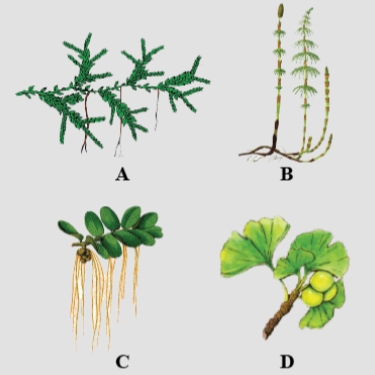
Examine the figures $A, B, C$ and $D$. In which one of the four options are all the items $A, B, C$ and $D$ correctly identified?
A
$A$-Chara,$B$-Marchantia,$C$-Fucus,$D$-Pinus
B
$A$-Equisetum,$B$-Ginkgo,$C$-Selaginella,$D$-Lycopodium
C
$A$-Selaginella,$B$-Equisetum,$C$-Salvinia,$D$-Ginkgo
D
$A$-Funaria,$B$-Adiantum,$C$-Salvinia,$D$-Riccia
Solution
(C) Based on the provided figures:
$A$ represents $Selaginella$,which is a pteridophyte.
$B$ represents $Equisetum$,which is a pteridophyte.
$C$ represents $Salvinia$,which is a heterosporous pteridophyte.
$D$ represents $Ginkgo$,which is a gymnosperm.
Therefore,the correct identification is given in option $C$.
$A$ represents $Selaginella$,which is a pteridophyte.
$B$ represents $Equisetum$,which is a pteridophyte.
$C$ represents $Salvinia$,which is a heterosporous pteridophyte.
$D$ represents $Ginkgo$,which is a gymnosperm.
Therefore,the correct identification is given in option $C$.
0 likesView Solution
13
BiologyMediumMCQAIPMT · 2010
One example of animals having a single opening to the outside that serves both as mouth as well as anus is
A
Octopus
B
Asterias
C
Ascidia
D
Fasciola
Solution
(D) The correct answer is $D$. In $Fasciola$ (a member of Platyhelminthes),the body plan is known as the 'blind sac' body plan.
This means the digestive system has only a single opening that serves both as the mouth for ingestion (intake of food) and as the anus for egestion (removal of undigested waste).
In contrast,organisms like $Octopus$,$Asterias$,and $Ascidia$ possess a complete digestive tract with two separate openings (mouth and anus).
This means the digestive system has only a single opening that serves both as the mouth for ingestion (intake of food) and as the anus for egestion (removal of undigested waste).
In contrast,organisms like $Octopus$,$Asterias$,and $Ascidia$ possess a complete digestive tract with two separate openings (mouth and anus).
0 likesView Solution
14
BiologyMediumMCQAIPMT · 2010
Which one of the following statements about all the four of $Spongilla$,leech,dolphin and penguin is correct?
A
Penguin is homoiothermic while the remaining three are poikilothermic.
B
Leech is a fresh water form while all others are marine.
C
$Spongilla$ has special collared cells called choanocytes,not found in the remaining three.
D
All are bilaterally symmetrical.
Solution
(C) $Spongilla$ is a common,widely distributed fresh water sponge belonging to the phylum $Porifera$.
$Spongilla$ possesses special flagellated cells known as choanocytes (collar cells) which line the spongocoel and the canals.
These cells are characteristic of sponges and are not found in the leech (annelid),dolphin (mammal),or penguin (bird).
$Spongilla$ possesses special flagellated cells known as choanocytes (collar cells) which line the spongocoel and the canals.
These cells are characteristic of sponges and are not found in the leech (annelid),dolphin (mammal),or penguin (bird).
0 likesView Solution
15
BiologyMediumMCQAIPMT · 2010
Which one of the following kinds of animals are triploblastic?
A
Flatworms
B
Sponges
C
Ctenophores
D
Corals
Solution
(A) $Triploblastic$ is a condition describing an animal having a body composed of three embryonic germ layers: the ectoderm,mesoderm,and endoderm.
Most multicellular animals belonging to phylum $Platyhelminthes$ to phylum $Chordata$ are triploblastic.
Flatworms (phylum $Platyhelminthes$) are the first group of animals to exhibit triploblastic organization.
$Ctenophores$,sponges (phylum $Porifera$),and corals (phylum $Cnidaria$) are diploblastic,meaning they possess only two germ layers: the ectoderm and endoderm.
Most multicellular animals belonging to phylum $Platyhelminthes$ to phylum $Chordata$ are triploblastic.
Flatworms (phylum $Platyhelminthes$) are the first group of animals to exhibit triploblastic organization.
$Ctenophores$,sponges (phylum $Porifera$),and corals (phylum $Cnidaria$) are diploblastic,meaning they possess only two germ layers: the ectoderm and endoderm.
0 likesView Solution
16
BiologyMediumMCQAIPMT · 2010
Which one of the following statements about certain given animals is correct?
A
Roundworms (Aschelminthes) are pseudocoelomates.
B
Molluscs are acoelomates.
C
Insects are pseudocoelomates.
D
Flatworms (Platyhelminthes) are coelomates.
Solution
(A) $Acoelomates$ are animals that lack a body cavity or coelom. Examples include $Porifera$,$Cnidaria$,$Ctenophora$,and $Platyhelminthes$.
In $pseudocoelomates$,the body cavity is a $pseudocoelom$ or false coelom,which is not lined by mesoderm. Examples include $Aschelminthes$.
In $coelomates$,the body cavity is a true coelom,which is lined by mesoderm on both sides. Most phyla from $Annelida$ to $Chordata$ are $coelomates$.
$Molluscs$ and $Insects$ (Arthropoda) are $coelomates$,while $Flatworms$ are $acoelomates$.
Therefore,the statement that $Roundworms$ $(Aschelminthes)$ are $pseudocoelomates$ is correct.
In $pseudocoelomates$,the body cavity is a $pseudocoelom$ or false coelom,which is not lined by mesoderm. Examples include $Aschelminthes$.
In $coelomates$,the body cavity is a true coelom,which is lined by mesoderm on both sides. Most phyla from $Annelida$ to $Chordata$ are $coelomates$.
$Molluscs$ and $Insects$ (Arthropoda) are $coelomates$,while $Flatworms$ are $acoelomates$.
Therefore,the statement that $Roundworms$ $(Aschelminthes)$ are $pseudocoelomates$ is correct.
0 likesView Solution
17
BiologyMediumMCQAIPMT · 2010
In which one of the following organisms are its excretory organs correctly stated?
A
Humans - Kidneys,sebaceous glands and tear glands
B
Earthworm - Pharyngeal,integumentary and septal nephridia
C
Cockroach - Malpighian tubules and enteric caeca
D
Frog - Kidneys,skin and buccal epithelium
Solution
(B) The correct option is $B$.
Nephridia are the primary excretory organs of the earthworm $(Pheretima)$.
Earthworms possess three types of nephridial structures based on their location: septal,integumentary,and pharyngeal nephridia.
These structures vary in their position and physiological function.
Septal and pharyngeal nephridia are enteronephric,meaning they discharge nitrogenous wastes into the alimentary canal.
Integumentary nephridia are exonephric,as they discharge nitrogenous wastes directly to the exterior of the body.
Nephridia are the primary excretory organs of the earthworm $(Pheretima)$.
Earthworms possess three types of nephridial structures based on their location: septal,integumentary,and pharyngeal nephridia.
These structures vary in their position and physiological function.
Septal and pharyngeal nephridia are enteronephric,meaning they discharge nitrogenous wastes into the alimentary canal.
Integumentary nephridia are exonephric,as they discharge nitrogenous wastes directly to the exterior of the body.
0 likesView Solution
18
BiologyMediumMCQAIPMT · 2010
Crocodile and penguin are similar to whale and dogfish in which one of the following features?
A
Possess a solid single-stranded central nervous system
B
Lay eggs and guard them till they hatch
C
Possess bony skeleton
D
Have gill slits at some stage
Solution
(D) : Animals belonging to Phylum $Chordata$ are fundamentally characterized by the presence of a notochord,a dorsal hollow nerve cord,and paired pharyngeal gill slits. Crocodile,penguin,whale,and dogfish are all chordates. All of them possess gill slits or have had them during embryonic development. Thus,paired gill slits are present in these animals at some stage of their life cycle.
0 likesView Solution
19
BiologyMediumMCQAIPMT · 2010
In a unilocular ovary with a single ovule,the placentation is
A
marginal
B
basal
C
free central
D
axile
Solution
(B) The correct answer is $B$. In basal placentation,the placenta develops at the base of the ovary,and a single ovule is attached to it. This type of placentation is commonly observed in families like $Asteraceae$ (formerly $Compositae$) and $Poaceae$.
0 likesView Solution
20
BiologyMediumMCQAIPMT · 2010
Keel is a characteristic feature of the flowers of
A
Gulmohur
B
Cassia
C
Calotropis
D
Bean
Solution
(D) The flowers of the family $Fabaceae$ (subfamily $Papilionoideae$) exhibit a butterfly-shaped corolla,known as $papilionaceous$ corolla.
This arrangement consists of five petals: one large posterior petal called the $standard$ or $vexillum$,two lateral petals called $wings$ or $alae$,and two anterior petals that are fused to form the $keel$ or $carina$.
The $keel$ encloses the stamens and the carpel.
This specific type of aestivation is characteristic of plants like $bean$,$gram$,$pea$,and $Indigofera$.
This arrangement consists of five petals: one large posterior petal called the $standard$ or $vexillum$,two lateral petals called $wings$ or $alae$,and two anterior petals that are fused to form the $keel$ or $carina$.
The $keel$ encloses the stamens and the carpel.
This specific type of aestivation is characteristic of plants like $bean$,$gram$,$pea$,and $Indigofera$.
0 likesView Solution
21
BiologyMediumMCQAIPMT · 2010
Ovary is half-inferior in the flowers of
A
guava
B
plum
C
brinjal
D
cucumber
Solution
(B) : If the gynoecium is situated in the centre and other parts of the flower are located on the rim of the thalamus almost at the same level,it is called perigynous. The ovary here is said to be half-inferior,e.g.,plum,rose,and peach.
0 likesView Solution
22
BiologyEasyMCQAIPMT · 2010
The technical term used for the androecium in a flower of China rose $(Hibiscus \text{ } rosa \text{ } sinensis)$ is
A
monadelphous
B
diadelphous
C
polyandrous
D
polyadelphous
Solution
(A) : China rose of Family $Malvaceae$ possesses numerous stamens.
The filaments of the stamens are united into a single bundle or group, forming a staminal tube around the style.
Such a condition of stamens is technically termed as monadelphous.
The filaments of the stamens are united into a single bundle or group, forming a staminal tube around the style.
Such a condition of stamens is technically termed as monadelphous.
0 likesView Solution
23
BiologyMediumMCQAIPMT · 2010
Which one of the following is a xerophytic plant in which the stem is modified into the flat,green,and succulent structure?
A
Opuntia
B
Casuarina
C
Hydrilla
D
Acacia
Solution
(A) : $Opuntia$ is a xerophytic plant that lives in dry habitats.
It possesses fleshy organs where water and mucilage are stored.
The stem is modified into a flat,green,photosynthetic structure known as a phylloclade,which helps in reducing water loss and performing photosynthesis.
It possesses fleshy organs where water and mucilage are stored.
The stem is modified into a flat,green,photosynthetic structure known as a phylloclade,which helps in reducing water loss and performing photosynthesis.
0 likesView Solution
24
BiologyMediumMCQAIPMT · 2010
Aestivation of petals in the flower of cotton is correctly shown in
A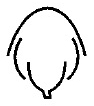
B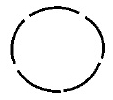
C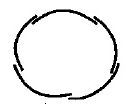
D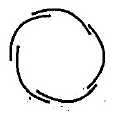
Solution
(D) The correct answer is $D$.
In plants like cotton,China rose,and lady's finger,the margins of sepals or petals overlap with the margin of the next one in a regular pattern.
This specific mode of arrangement of sepals or petals in a floral bud with respect to the other members of the same whorl is known as aestivation.
In the twisted type of aestivation,one margin of each petal overlaps the next one,creating a spiral or twisted appearance.
Image $D$ correctly represents this twisted aestivation.
In plants like cotton,China rose,and lady's finger,the margins of sepals or petals overlap with the margin of the next one in a regular pattern.
This specific mode of arrangement of sepals or petals in a floral bud with respect to the other members of the same whorl is known as aestivation.
In the twisted type of aestivation,one margin of each petal overlaps the next one,creating a spiral or twisted appearance.
Image $D$ correctly represents this twisted aestivation.
0 likesView Solution
25
BiologyMediumMCQAIPMT · 2010
The correct floral formula of soybean is
A
B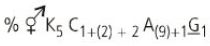
C
D
Solution
(C) The correct floral formula for soybean (a member of the family Fabaceae) is: % ♀ K_{$(5)$} C_{$1$+$2$+$(2)$} A_{$(9)$+$1$} G_{$1$}.
Explanation:
$1$. %: Zygomorphic flower.
$2$. ♀: Bisexual flower.
$3$. K_{$(5)$}: Calyx with $5$ sepals,gamosepalous (fused).
$4$. C_{$1$+$2$+$(2)$}: Corolla with $5$ petals,polypetalous,showing vexillary aestivation ($1$ standard,$2$ wings,$2$ fused keels).
$5$. A_{$(9)$+$1$}: Androecium with $10$ stamens,diadelphous ($9$ fused,$1$ free).
$6$. G_{$1$}: Gynoecium with a single monocarpellary ovary,superior (indicated by the underline).
Explanation:
$1$. %: Zygomorphic flower.
$2$. ♀: Bisexual flower.
$3$. K_{$(5)$}: Calyx with $5$ sepals,gamosepalous (fused).
$4$. C_{$1$+$2$+$(2)$}: Corolla with $5$ petals,polypetalous,showing vexillary aestivation ($1$ standard,$2$ wings,$2$ fused keels).
$5$. A_{$(9)$+$1$}: Androecium with $10$ stamens,diadelphous ($9$ fused,$1$ free).
$6$. G_{$1$}: Gynoecium with a single monocarpellary ovary,superior (indicated by the underline).
0 likesView Solution
26
BiologyMediumMCQAIPMT · 2010
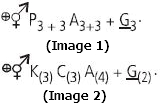
Consider the following four statements $(i), (ii), (iii)$ and $(iv)$ and select the right option for two correct statements.
Statements:
$(i)$ In vexillary aestivation,the large posterior petal is called standard,two lateral ones are wings and two small anterior petals are termed keel.
$(ii)$ The floral formula for Liliaceae is $\oplus \text{ } \text{O}\mkern-11mu{^\nearrow} \text{ } P_{(3+3)} A_{3+3} \underline{G}_{(3)}$.
$(iii)$ In pea flower,the stamens are monadelphous.
$(iv)$ The floral formula for Solanaceae is $\oplus \text{ } \text{O}\mkern-11mu{^\nearrow} \text{ } K_{(5)} C_{(5)} A_{5} \underline{G}_{(2)}$.
The correct statements are:
Statements:
$(i)$ In vexillary aestivation,the large posterior petal is called standard,two lateral ones are wings and two small anterior petals are termed keel.
$(ii)$ The floral formula for Liliaceae is $\oplus \text{ } \text{O}\mkern-11mu{^\nearrow} \text{ } P_{(3+3)} A_{3+3} \underline{G}_{(3)}$.
$(iii)$ In pea flower,the stamens are monadelphous.
$(iv)$ The floral formula for Solanaceae is $\oplus \text{ } \text{O}\mkern-11mu{^\nearrow} \text{ } K_{(5)} C_{(5)} A_{5} \underline{G}_{(2)}$.
The correct statements are:
A
$(i)$ and $(iii)$
B
$(i)$ and $(ii)$
C
$(ii)$ and $(iii)$
D
$(iii)$ and $(iv)$
Solution
(B) Statement $(i)$ is correct: In vexillary aestivation (found in Fabaceae),the largest posterior petal is the standard (vexillum),two lateral petals are wings (alae),and two anterior petals form the keel (carina).
Statement $(ii)$ is correct: The floral formula for Liliaceae is $\oplus \text{ } \text{O}\mkern-11mu{^\nearrow} \text{ } P_{(3+3)} A_{3+3} \underline{G}_{(3)}$.
Statement $(iii)$ is incorrect: In pea flowers (Fabaceae),the stamens are diadelphous ($9+1$ arrangement),not monadelphous.
Statement $(iv)$ is incorrect: The floral formula for Solanaceae is $\oplus \text{ } \text{O}\mkern-11mu{^\nearrow} \text{ } K_{(5)} C_{(5)} A_{5} \underline{G}_{(2)}$. The formula provided in the image is incorrect.
Therefore,statements $(i)$ and $(ii)$ are correct. The correct option is $(b)$.
Statement $(ii)$ is correct: The floral formula for Liliaceae is $\oplus \text{ } \text{O}\mkern-11mu{^\nearrow} \text{ } P_{(3+3)} A_{3+3} \underline{G}_{(3)}$.
Statement $(iii)$ is incorrect: In pea flowers (Fabaceae),the stamens are diadelphous ($9+1$ arrangement),not monadelphous.
Statement $(iv)$ is incorrect: The floral formula for Solanaceae is $\oplus \text{ } \text{O}\mkern-11mu{^\nearrow} \text{ } K_{(5)} C_{(5)} A_{5} \underline{G}_{(2)}$. The formula provided in the image is incorrect.
Therefore,statements $(i)$ and $(ii)$ are correct. The correct option is $(b)$.
0 likesView Solution
27
BiologyMediumMCQAIPMT · 2010
Heartwood differs from sapwood in
A
presence of rays and fibres
B
absence of vessels and parenchyma
C
having dead and non-conducting elements
D
being susceptible to pests and pathogens
Solution
(C) : In old trees,the greater part of secondary xylem is dark brown due to the deposition of organic compounds like tannins,resins,oils,gums,aromatic substances,and essential oils in the central or innermost layers of the stem.
These substances make it hard,durable,and resistant to the attacks of microorganisms and insects.
This region comprises dead elements with highly lignified walls and is called heartwood.
The heartwood does not conduct water,but it gives mechanical support to the stem.
The peripheral region of the secondary xylem is lighter in color and is known as the sapwood.
It is involved in the conduction of water and minerals from root to leaf.
These substances make it hard,durable,and resistant to the attacks of microorganisms and insects.
This region comprises dead elements with highly lignified walls and is called heartwood.
The heartwood does not conduct water,but it gives mechanical support to the stem.
The peripheral region of the secondary xylem is lighter in color and is known as the sapwood.
It is involved in the conduction of water and minerals from root to leaf.
0 likesView Solution
28
BiologyMediumMCQAIPMT · 2010
Which one of the following is not a lateral meristem?
A
Intrafascicular cambium
B
Interfascicular cambium
C
Phellogen
D
Intercalary meristem
Solution
(D) The correct answer is $(d)$.
Meristems are classified based on their position in the plant body into apical,intercalary,and lateral meristems.
Lateral meristems are responsible for secondary growth and are located on the lateral sides of the stem and root. Examples include vascular cambium (which consists of intrafascicular and interfascicular cambium) and cork cambium (phellogen).
Intercalary meristems are located between permanent tissues and are responsible for the elongation of internodes in grasses and other monocots. Therefore,intercalary meristem is not a lateral meristem.
Meristems are classified based on their position in the plant body into apical,intercalary,and lateral meristems.
Lateral meristems are responsible for secondary growth and are located on the lateral sides of the stem and root. Examples include vascular cambium (which consists of intrafascicular and interfascicular cambium) and cork cambium (phellogen).
Intercalary meristems are located between permanent tissues and are responsible for the elongation of internodes in grasses and other monocots. Therefore,intercalary meristem is not a lateral meristem.
0 likesView Solution
29
BiologyMediumMCQAIPMT · 2010
The chief water conducting elements of xylem in gymnosperms are
A
vessels
B
fibres
C
transfusion tissue
D
tracheids
Solution
(D) : The chief water conducting elements of xylem in gymnosperms are tracheids. These are elongated cells with tapering ends and are dead at maturity due to the deposition of lignin. These cells exhibit scalariform,annular,reticulate,or bordered pitted thickenings. Tracheids are the primary water-conducting xylem elements in both gymnosperms and pteridophytes. Generally,vessels are absent in gymnosperms,with rare exceptions such as $Gnetum$,$Welwitschia$,and $Ephedra$.
0 likesView Solution
30
BiologyMediumMCQAIPMT · 2010
Transport of food material in higher plants takes place through
A
companion cells
B
transfusion tissue
C
tracheids
D
sieve elements
Solution
(D) In higher plants,the transport of food material (photosynthates) occurs through the phloem tissue. The primary conducting cells of the phloem are the sieve elements (sieve tube elements in angiosperms and sieve cells in gymnosperms). These cells are specialized for the translocation of organic nutrients from source to sink. Therefore,the correct option is $D$.
0 likesView Solution
31
BiologyMediumMCQAIPMT · 2010
The cells lining the blood vessels belong to the category of
A
smooth muscle tissue
B
squamous epithelium
C
columnar epithelium
D
connective tissue
Solution
(B) : Simple squamous epithelium is composed of large flat cells whose edges fit closely together like the tiles in a floor,hence it is also called pavement epithelium.
The nuclei of the cells are flattened and often lie at the centre of the cells and cause bulgings of the cell surface.
The epithelium lines the blood vessels,lymph vessels,heart,terminal bronchioles,alveoli of the lungs,walls of the Bowman's capsules,and descending limbs of the loop of Henle.
In the blood vessels and heart,it is specifically called endothelium.
The nuclei of the cells are flattened and often lie at the centre of the cells and cause bulgings of the cell surface.
The epithelium lines the blood vessels,lymph vessels,heart,terminal bronchioles,alveoli of the lungs,walls of the Bowman's capsules,and descending limbs of the loop of Henle.
In the blood vessels and heart,it is specifically called endothelium.
0 likesView Solution
32
BiologyEasyMCQAIPMT · 2010
The plasma membrane consists mainly of
A
phospholipids embedded in a protein bilayer
B
proteins embedded in a phospholipid bilayer
C
proteins embedded in a polymer of glucose molecules
D
proteins embedded in a carbohydrate bilayer.
Solution
(B) The correct answer is $(B)$.
According to the fluid mosaic model,the plasma membrane is composed of a phospholipid bilayer in which protein molecules are embedded.
Lipids $(20-79\%)$,proteins $(20-70\%)$,carbohydrates $(1-5\%)$,and water $(20\%)$ are the main components of the plasma membrane.
Lipid molecules,primarily phospholipids,are amphipathic (having both hydrophobic and hydrophilic ends) and form a bilayer structure.
Protein molecules are distributed throughout this bilayer,either partially or totally embedded (intrinsic/integral proteins) or attached to the surface (extrinsic/peripheral proteins).
According to the fluid mosaic model,the plasma membrane is composed of a phospholipid bilayer in which protein molecules are embedded.
Lipids $(20-79\%)$,proteins $(20-70\%)$,carbohydrates $(1-5\%)$,and water $(20\%)$ are the main components of the plasma membrane.
Lipid molecules,primarily phospholipids,are amphipathic (having both hydrophobic and hydrophilic ends) and form a bilayer structure.
Protein molecules are distributed throughout this bilayer,either partially or totally embedded (intrinsic/integral proteins) or attached to the surface (extrinsic/peripheral proteins).
0 likesView Solution
33
BiologyMediumMCQAIPMT · 2010
The main area of various types of activities of a cell is
A
plasma membrane
B
mitochondrion
C
cytoplasm
D
nucleus
Solution
(C) : Cytoplasm is a granular,crystallo-colloidal complex that forms the living protoplasm of a cell,excluding its nucleus. It consists of proteins,nucleic acids,fats,carbohydrates,vitamins,minerals,waste metabolites,and all the cell organelles. It serves as the main site for various cellular activities such as respiration,nutrition,and storage.
0 likesView Solution
34
BiologyEasyMCQAIPMT · 2010
Which one of the following has its own $DNA$?
A
Mitochondria
B
Dictyosome
C
Lysosome
D
Peroxisome
Solution
(A) The correct answer is $A$.
Both mitochondria and chloroplasts are semi-autonomous organelles.
They contain their own circular $DNA$,which is responsible for producing their own $mRNA$,$tRNA$,and $rRNA$.
These organelles also possess their own $70S$ ribosomes,which allow them to synthesize some of their own proteins independently of the nucleus.
Both mitochondria and chloroplasts are semi-autonomous organelles.
They contain their own circular $DNA$,which is responsible for producing their own $mRNA$,$tRNA$,and $rRNA$.
These organelles also possess their own $70S$ ribosomes,which allow them to synthesize some of their own proteins independently of the nucleus.
0 likesView Solution
35
BiologyEasyMCQAIPMT · 2010
Which one of the following structures between two adjacent cells is an effective transport pathway?
A
Plasmodesmata
B
Plastoquinones
C
Endoplasmic reticulum
D
Plasmalemma
Solution
(A) : Plasmodesmata are fine cytoplasmic strands that connect the protoplasts of adjacent plant cells by passing through their cell walls.
Plasmodesmata are cylindrical in shape (about $20-40 \ nm$ in diameter) and are lined by the plasma membrane of the two adjacent cells.
They permit the passage between cells of substances including ions,sugars,amino acids,and macromolecules.
Plasmodesmata are cylindrical in shape (about $20-40 \ nm$ in diameter) and are lined by the plasma membrane of the two adjacent cells.
They permit the passage between cells of substances including ions,sugars,amino acids,and macromolecules.
0 likesView Solution
36
BiologyMediumMCQAIPMT · 2010
An elaborate network of filamentous proteinaceous structures present in the cytoplasm which helps in the maintenance of cell shape is called
A
thylakoid
B
endoplasmic reticulum
C
plasmalemma
D
cytoskeleton
Solution
(D) The cytoskeleton is an elaborate network of filamentous proteinaceous structures consisting of microtubules,microfilaments,and intermediate filaments present in the cytoplasm. It plays a crucial role in various functions such as mechanical support,motility,and the maintenance of the shape of the cell. Therefore,the correct option is $(d)$.
0 likesView Solution
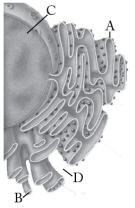
37
BiologyEasyMCQAIPMT · 2010
Identify the components labelled $A, B, C$ and $D$ in the diagram below from the list $(i)$ to $(viii)$ given along with:
Components:
$(i)$ Cristae of mitochondria
$(ii)$ Inner membrane of mitochondria
$(iii)$ Cytoplasm
$(iv)$ Smooth endoplasmic reticulum
$(v)$ Rough endoplasmic reticulum
$(vi)$ Mitochondrial matrix
$(vii)$ Cell vacuole
$(viii)$ Nucleus
The correct components are:
Components:
$(i)$ Cristae of mitochondria
$(ii)$ Inner membrane of mitochondria
$(iii)$ Cytoplasm
$(iv)$ Smooth endoplasmic reticulum
$(v)$ Rough endoplasmic reticulum
$(vi)$ Mitochondrial matrix
$(vii)$ Cell vacuole
$(viii)$ Nucleus
The correct components are:
A
$(A)-(v), (B)-(iv), (C)-(viii), (D)-(iii)$
B
$(A)-(i), (B)-(iv), (C)-(viii), (D)-(vi)$
C
$(A)-(vi), (B)-(v), (C)-(iv), (D)-(vii)$
D
$(A)-(v), (B)-(i), (C)-(iii), (D)-(ii)$
Solution
(A) Based on the provided diagram:
$A$ points to the Rough Endoplasmic Reticulum $(RER)$,which is studded with ribosomes.
$B$ points to the Smooth Endoplasmic Reticulum $(SER)$,which lacks ribosomes.
$C$ points to the Nucleus,which is the large central organelle.
$D$ points to the Cytoplasm,the fluid surrounding the organelles.
Therefore,the correct matching is:
$A - (v)$ (Rough endoplasmic reticulum)
$B - (iv)$ (Smooth endoplasmic reticulum)
$C - (viii)$ (Nucleus)
$D - (iii)$ (Cytoplasm)
Thus,the correct option is $(A)$.
$A$ points to the Rough Endoplasmic Reticulum $(RER)$,which is studded with ribosomes.
$B$ points to the Smooth Endoplasmic Reticulum $(SER)$,which lacks ribosomes.
$C$ points to the Nucleus,which is the large central organelle.
$D$ points to the Cytoplasm,the fluid surrounding the organelles.
Therefore,the correct matching is:
$A - (v)$ (Rough endoplasmic reticulum)
$B - (iv)$ (Smooth endoplasmic reticulum)
$C - (viii)$ (Nucleus)
$D - (iii)$ (Cytoplasm)
Thus,the correct option is $(A)$.
0 likesView Solution
38
BiologyMediumMCQAIPMT · 2010
During mitosis,$ER$ and nucleolus begin to disappear at
A
late prophase
B
early metaphase
C
late metaphase
D
early prophase
Solution
(D) During the early prophase of mitosis,the nucleus and the cell become spherical. The viscosity and refractivity of the cytoplasm increase. $DNA$ molecules condense to form shortened chromosomes. The endoplasmic reticulum $(ER)$ and the nucleolus begin to disappear.
0 likesView Solution
39
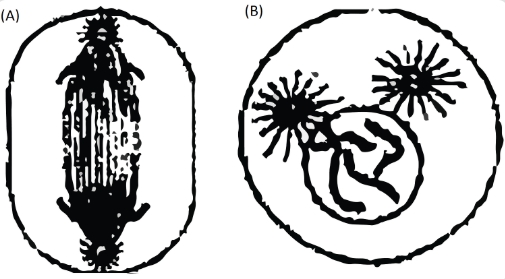
BiologyMediumMCQAIPMT · 2010
Which stages of cell division do the following figures $A$ and $B$ represent respectively?
| Option | Figure $A$ | Figure $B$ |
|---|---|---|
| $(a)$ | Metaphase | Telophase |
| $(b)$ | Telophase | Metaphase |
| $(c)$ | Late anaphase | Prophase |
| $(d)$ | Prophase | Anaphase |
A
$(a)$
B
$(b)$
C
$(c)$
D
$(d)$
Solution
(C) In figure $A$,the chromosomes have separated and are moving towards opposite poles,which is characteristic of the late anaphase stage of mitosis.
In figure $B$,the chromosomes are condensing and the nuclear envelope is beginning to disappear,which is characteristic of the prophase stage of mitosis.
Therefore,figure $A$ represents late anaphase and figure $B$ represents prophase. The correct option is $(c)$.
In figure $B$,the chromosomes are condensing and the nuclear envelope is beginning to disappear,which is characteristic of the prophase stage of mitosis.
Therefore,figure $A$ represents late anaphase and figure $B$ represents prophase. The correct option is $(c)$.
0 likesView Solution
40
BiologyEasyMCQAIPMT · 2010
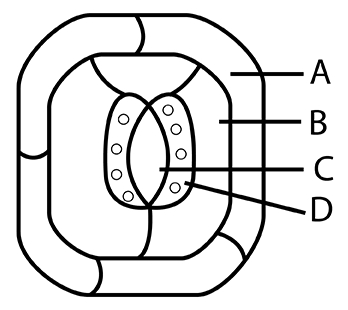
Given below is the diagram of a stomatal apparatus. In which of the following are all the four parts labelled as $A, B, C$ and $D$ correctly identified?
A
$A$-Subsidiary cell,$B$-Epidermal cell,$C$-Guard cell,$D$-Stomatal aperture
B
$A$-Guard cell,$B$-Stomatal aperture,$C$-Subsidiary cell,$D$-Epidermal cell
C
$A$-Epidermal cell,$B$-Guard cell,$C$-Stomatal aperture,$D$-Subsidiary cell
D
$A$-Epidermal cell,$B$-Subsidiary cell,$C$-Stomatal aperture,$D$-Guard cell
Solution
(D) The correct identification of the parts in the stomatal apparatus diagram is as follows:
$A$ - Epidermal cell: The outer cells surrounding the stomatal complex.
$B$ - Subsidiary cell: Specialized cells that surround the guard cells.
$C$ - Stomatal aperture: The central pore through which gas exchange occurs.
$D$ - Guard cell: The specialized kidney-shaped cells that regulate the opening and closing of the stomatal aperture.
Therefore,option $D$ is the correct answer.
$A$ - Epidermal cell: The outer cells surrounding the stomatal complex.
$B$ - Subsidiary cell: Specialized cells that surround the guard cells.
$C$ - Stomatal aperture: The central pore through which gas exchange occurs.
$D$ - Guard cell: The specialized kidney-shaped cells that regulate the opening and closing of the stomatal aperture.
Therefore,option $D$ is the correct answer.
0 likesView Solution
41
BiologyEasyMCQAIPMT · 2010
An element playing an important role in nitrogen fixation is:
A
Molybdenum
B
Copper
C
Manganese
D
Zinc
Solution
(A) $Molybdenum$ is a micronutrient required in very small amounts by plants. It is essential for nodulation in legumes. It is a key component of the $Nitrate$ $reductase$ enzyme, which plays a crucial role in nitrogen fixation.
0 likesView Solution
42
BiologyEasyMCQAIPMT · 2010
Which one of the following is not a micronutrient?
A
Molybdenum
B
Magnesium
C
Zinc
D
Boron
Solution
(B) The correct answer is $B$.
Macronutrients are essential elements present in plant tissues in large amounts,typically $1-10 \ mg$ per gram of dry weight.
These include carbon,hydrogen,oxygen,nitrogen,phosphorus,sulfur,potassium,calcium,and magnesium.
Micronutrients,or trace elements,are required in very small amounts,typically equal to or less than $0.1 \ mg$ per gram of dry matter.
These include iron,manganese,copper,molybdenum,zinc,boron,chlorine,and nickel.
Since magnesium is a macronutrient,it is not a micronutrient.
Macronutrients are essential elements present in plant tissues in large amounts,typically $1-10 \ mg$ per gram of dry weight.
These include carbon,hydrogen,oxygen,nitrogen,phosphorus,sulfur,potassium,calcium,and magnesium.
Micronutrients,or trace elements,are required in very small amounts,typically equal to or less than $0.1 \ mg$ per gram of dry matter.
These include iron,manganese,copper,molybdenum,zinc,boron,chlorine,and nickel.
Since magnesium is a macronutrient,it is not a micronutrient.
0 likesView Solution
43
BiologyMediumMCQAIPMT · 2010
Leguminous plants are able to fix atmospheric nitrogen through the process of symbiotic nitrogen fixation. Which one of the following statements is not correct during this process of nitrogen fixation?
A
Leghaemoglobin scavenges oxygen and is pinkish in colour.
B
Nodules act as sites for nitrogen fixation.
C
The enzyme nitrogenase catalyses the conversion of atmospheric $N_2$ to $NH_3$.
D
Nitrogenase is insensitive to oxygen.
Solution
(D) The enzyme nitrogenase is highly sensitive to molecular oxygen and requires anaerobic conditions to function effectively. Leghaemoglobin acts as an oxygen scavenger to protect the nitrogenase enzyme from oxygen damage,creating an anaerobic environment within the root nodules. Therefore,the statement that nitrogenase is insensitive to oxygen is incorrect.
0 likesView Solution
44
BiologyMediumMCQAIPMT · 2010
Study the nitrogen cycle process shown below and select the option that correctly identifies the four blanks $A, B, C,$ and $D$ in the context of nitrogen transformation.
A
$A$-Nitrification,$B$-Ammonification,$C$-Animals,$D$-Plants
B
$A$-Denitrification,$B$-Ammonification,$C$-Animals,$D$-Plants
C
$A$-Nitrification,$B$-Denitrification,$C$-Animals,$D$-Plants
D
$A$-Denitrification,$B$-Nitrification,$C$-Plants,$D$-Animals
Solution
(B) The nitrogen cycle involves several key processes:
$1$. $A$ represents Denitrification,where nitrates in the soil are converted back into atmospheric nitrogen $(N_2)$ by bacteria like $Pseudomonas$.
$2$. $B$ represents Ammonification,where organic nitrogen from dead plants and animals is converted into ammonia $(NH_3)$ by decomposers.
$3$. $C$ represents Animals,which consume organic nitrogen from plants.
$4$. $D$ represents Plants,which absorb nitrogenous compounds from the soil.
Therefore,option $B$ is the correct sequence.
$1$. $A$ represents Denitrification,where nitrates in the soil are converted back into atmospheric nitrogen $(N_2)$ by bacteria like $Pseudomonas$.
$2$. $B$ represents Ammonification,where organic nitrogen from dead plants and animals is converted into ammonia $(NH_3)$ by decomposers.
$3$. $C$ represents Animals,which consume organic nitrogen from plants.
$4$. $D$ represents Plants,which absorb nitrogenous compounds from the soil.
Therefore,option $B$ is the correct sequence.
0 likesView Solution
45
BiologyMediumMCQAIPMT · 2010
$PGA$ as the first $CO_2$ fixation product was discovered in photosynthesis of
A
bryophyte
B
gymnosperm
C
angiosperm
D
alga
Solution
(D) The correct answer is $D$. Calvin,Benson,and their colleagues in California,$U.S.A.$,conducted experiments using radioactive $^{14}C$ in carbon dioxide to feed $Chlorella$ and $Scenedesmus$ (which are algae).
Radioactive carbon,$^{14}C$,has a half-life of $5568$ years,allowing the path of $CO_2$ fixation to be traced.
Algal suspension,while performing photosynthesis,was supplied with $^{14}CO_2$.
The algae were killed at specific intervals in near-boiling methanol,which immediately stopped photosynthetic activity due to the denaturation of enzymes.
After evaporating the alcohol and crushing the algae,the resulting paste was analyzed using two-dimensional paper chromatography.
Calvin and his co-workers discovered that after three seconds,radioactivity appeared in phosphoglyceric acid $(PGA)$.
Thus,$PGA$ was identified as the first stable product of photosynthesis in algae.
Radioactive carbon,$^{14}C$,has a half-life of $5568$ years,allowing the path of $CO_2$ fixation to be traced.
Algal suspension,while performing photosynthesis,was supplied with $^{14}CO_2$.
The algae were killed at specific intervals in near-boiling methanol,which immediately stopped photosynthetic activity due to the denaturation of enzymes.
After evaporating the alcohol and crushing the algae,the resulting paste was analyzed using two-dimensional paper chromatography.
Calvin and his co-workers discovered that after three seconds,radioactivity appeared in phosphoglyceric acid $(PGA)$.
Thus,$PGA$ was identified as the first stable product of photosynthesis in algae.
0 likesView Solution
46
BiologyMediumMCQAIPMT · 2010
$C_4$ plants are more efficient in photosynthesis than $C_3$ plants due to
A
higher leaf area
B
presence of larger number of chloroplasts in the leaf cells
C
presence of thin cuticle
D
lower rate of photorespiration.
Solution
(D) $C_4$ plants are more efficient in photosynthesis because they have a mechanism to minimize photorespiration.
In $C_3$ plants,the enzyme $RuBisCO$ acts as an oxygenase in the presence of high $O_2$ concentrations,leading to photorespiration,which is a wasteful process that consumes energy and releases $CO_2$.
$C_4$ plants possess a specialized anatomy called $Kranz$ anatomy,which separates the initial $CO_2$ fixation from the Calvin cycle.
This spatial separation ensures that $RuBisCO$ always operates in a high $CO_2$ environment,effectively suppressing photorespiration.
Therefore,the lower rate of photorespiration in $C_4$ plants makes them more photosynthetically efficient compared to $C_3$ plants.
In $C_3$ plants,the enzyme $RuBisCO$ acts as an oxygenase in the presence of high $O_2$ concentrations,leading to photorespiration,which is a wasteful process that consumes energy and releases $CO_2$.
$C_4$ plants possess a specialized anatomy called $Kranz$ anatomy,which separates the initial $CO_2$ fixation from the Calvin cycle.
This spatial separation ensures that $RuBisCO$ always operates in a high $CO_2$ environment,effectively suppressing photorespiration.
Therefore,the lower rate of photorespiration in $C_4$ plants makes them more photosynthetically efficient compared to $C_3$ plants.
0 likesView Solution
47
BiologyMediumMCQAIPMT · 2010
Read the following four statements,$(i), (ii), (iii)$ and $(iv)$ and select the right option having both correct statements.
Statements:
$(i)$ $Z$ scheme of light reaction takes place in the presence of $PSI$ only.
$(ii)$ Only $PSI$ is functional in cyclic photophosphorylation.
$(iii)$ Cyclic photophosphorylation results in the synthesis of $ATP$ and $NADPH_2$.
$(iv)$ Stroma lamellae lack $PSII$ as well as $NADP$ reductase.
Statements:
$(i)$ $Z$ scheme of light reaction takes place in the presence of $PSI$ only.
$(ii)$ Only $PSI$ is functional in cyclic photophosphorylation.
$(iii)$ Cyclic photophosphorylation results in the synthesis of $ATP$ and $NADPH_2$.
$(iv)$ Stroma lamellae lack $PSII$ as well as $NADP$ reductase.
A
$(ii)$ and $(iv)$
B
$(i)$ and $(ii)$
C
$(ii)$ and $(iii)$
D
$(iii)$ and $(iv)$
Solution
(A) Statement $(i)$ is incorrect because the $Z$ scheme involves both $PSII$ and $PSI$ working in series.
Statement $(ii)$ is correct because cyclic photophosphorylation involves only $PSI$ where electrons circulate within the photosystem.
Statement $(iii)$ is incorrect because cyclic photophosphorylation produces only $ATP$,not $NADPH_2$.
Statement $(iv)$ is correct because the stroma lamellae lack both $PSII$ and the enzyme $NADP$ reductase,which is why they only perform cyclic photophosphorylation.
Therefore,statements $(ii)$ and $(iv)$ are correct.
Statement $(ii)$ is correct because cyclic photophosphorylation involves only $PSI$ where electrons circulate within the photosystem.
Statement $(iii)$ is incorrect because cyclic photophosphorylation produces only $ATP$,not $NADPH_2$.
Statement $(iv)$ is correct because the stroma lamellae lack both $PSII$ and the enzyme $NADP$ reductase,which is why they only perform cyclic photophosphorylation.
Therefore,statements $(ii)$ and $(iv)$ are correct.
0 likesView Solution
48
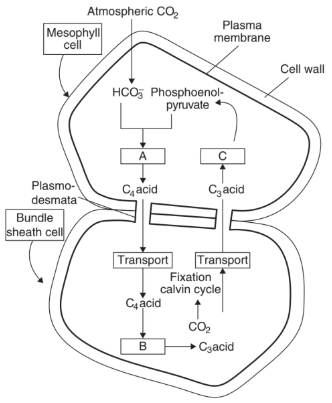
BiologyMediumMCQAIPMT · 2010
Study the pathway given below. In which of the following options are the correct words for all the three blanks $A$,$B$,and $C$ indicated?
A
Decarboxylation $\rightarrow$ Reduction $\rightarrow$ Regeneration
B
Fixation $\rightarrow$ Transamination $\rightarrow$ Regeneration
C
Fixation $\rightarrow$ Decarboxylation $\rightarrow$ Regeneration
D
Carboxylation $\rightarrow$ Decarboxylation $\rightarrow$ Reduction
Solution
(C) The given pathway represents the $C_4$ cycle (Hatch-Slack pathway).
$A$ represents the primary fixation of $CO_2$ in the mesophyll cells,where $PEP$ (Phosphoenolpyruvate) combines with $CO_2$ to form a $C_4$ acid (Oxaloacetate).
$B$ represents the decarboxylation step in the bundle sheath cells,where the $C_4$ acid releases $CO_2$ to enter the Calvin cycle and converts into a $C_3$ acid.
$C$ represents the regeneration of $PEP$ from the $C_3$ acid in the mesophyll cells to continue the cycle.
Therefore,the correct sequence is Fixation $\rightarrow$ Decarboxylation $\rightarrow$ Regeneration.
$A$ represents the primary fixation of $CO_2$ in the mesophyll cells,where $PEP$ (Phosphoenolpyruvate) combines with $CO_2$ to form a $C_4$ acid (Oxaloacetate).
$B$ represents the decarboxylation step in the bundle sheath cells,where the $C_4$ acid releases $CO_2$ to enter the Calvin cycle and converts into a $C_3$ acid.
$C$ represents the regeneration of $PEP$ from the $C_3$ acid in the mesophyll cells to continue the cycle.
Therefore,the correct sequence is Fixation $\rightarrow$ Decarboxylation $\rightarrow$ Regeneration.
0 likesView Solution
49
BiologyMediumMCQAIPMT · 2010
Kranz anatomy is one of the characteristics of the leaves of
A
potato
B
wheat
C
sugarcane
D
mustard
Solution
(C) The correct answer is $C$.
Kranz anatomy is a specialized leaf structure found in $C_4$ plants.
In this anatomy,the mesophyll cells are undifferentiated and arranged in concentric layers around the vascular bundles.
The vascular bundles are surrounded by large bundle sheath cells,which are arranged in a wreath-like manner (the word 'Kranz' means wreath in German).
Examples of $C_4$ plants that exhibit Kranz anatomy include sugarcane,maize,and sorghum.
Kranz anatomy is a specialized leaf structure found in $C_4$ plants.
In this anatomy,the mesophyll cells are undifferentiated and arranged in concentric layers around the vascular bundles.
The vascular bundles are surrounded by large bundle sheath cells,which are arranged in a wreath-like manner (the word 'Kranz' means wreath in German).
Examples of $C_4$ plants that exhibit Kranz anatomy include sugarcane,maize,and sorghum.
0 likesView Solution
50
BiologyMediumMCQAIPMT · 2010
The energy-releasing metabolic process in which substrate is oxidized without an external electron acceptor is called:
A
glycolysis
B
fermentation
C
aerobic respiration
D
photorespiration
Solution
(B) : Fermentation is an energy-releasing metabolic process in which organic substrates,such as carbohydrates,are oxidized without the involvement of an external electron acceptor.
In this process,an endogenous electron acceptor (usually an organic compound) is used.
This is in contrast to aerobic respiration,where electrons are transferred to an exogenous electron acceptor,such as oxygen,via an electron transport chain.
In this process,an endogenous electron acceptor (usually an organic compound) is used.
This is in contrast to aerobic respiration,where electrons are transferred to an exogenous electron acceptor,such as oxygen,via an electron transport chain.
0 likesView Solution
51
BiologyMediumMCQAIPMT · 2010
The scutellum observed in a grain of wheat or maize is comparable to which part of the seed in other monocotyledons?
A
Cotyledon
B
Endosperm
C
Aleurone layer
D
Plumule
Solution
(A) The scutellum is the tissue in a grass,wheat,or maize seed that lies between the embryo and the endosperm. It is a modified cotyledon,specialized for the digestion and absorption of the endosperm nutrients for the developing embryo.
0 likesView Solution
52
BiologyMediumMCQAIPMT · 2010
Apomictic embryos in $Citrus$ arise from
A
synergids
B
maternal sporophytic tissue in ovule
C
antipodal cells
D
diploid egg
Solution
(B) : Apomixis is a form of asexual reproduction that mimics sexual reproduction. In $Citrus$,apomictic embryos are formed through adventive embryony.
Adventive embryony is a type of apomixis where embryos develop directly from the diploid maternal sporophytic tissues of the ovule,such as the nucellus or integuments,without fertilization.
Since these cells are diploid and part of the parent plant,the resulting embryos are genetically identical to the parent plant.
Adventive embryony is a type of apomixis where embryos develop directly from the diploid maternal sporophytic tissues of the ovule,such as the nucellus or integuments,without fertilization.
Since these cells are diploid and part of the parent plant,the resulting embryos are genetically identical to the parent plant.
0 likesView Solution
53
BiologyEasyMCQAIPMT · 2010
Transfer of pollen grains from the anther to the stigma of another flower of the same plant is called
A
xenogamy
B
geitonogamy
C
karyogamy
D
autogamy
Solution
(B) The correct answer is $B$.
Geitonogamy is the transfer of pollen grains from the anther to the stigma of another flower on the same plant.
Although geitonogamy is functionally cross-pollination involving a pollinating agent,genetically it is similar to autogamy since the pollen grains come from the same plant.
$A$: Xenogamy is the transfer of pollen grains from the anther to the stigma of a different plant.
$C$: Karyogamy is the fusion of two nuclei.
$D$: Autogamy is the transfer of pollen grains from the anther to the stigma of the same flower.
Geitonogamy is the transfer of pollen grains from the anther to the stigma of another flower on the same plant.
Although geitonogamy is functionally cross-pollination involving a pollinating agent,genetically it is similar to autogamy since the pollen grains come from the same plant.
$A$: Xenogamy is the transfer of pollen grains from the anther to the stigma of a different plant.
$C$: Karyogamy is the fusion of two nuclei.
$D$: Autogamy is the transfer of pollen grains from the anther to the stigma of the same flower.
0 likesView Solution
54
BiologyMediumMCQAIPMT · 2010
Wind pollinated flowers are
A
small,brightly coloured,producing large number of pollen grains
B
small,producing large number of dry pollen grains
C
large producing abundant nectar and pollen
D
small,producing nectar and dry pollen.
Solution
(B) : Pollination by wind is called anemophily,and plants that utilize this method are called anemophilous plants.
Anemophilous flowers are typically small and inconspicuous.
They produce a large number of pollen grains that are small,dry,and lightweight,allowing them to be carried over long distances (up to $1300 \ km$) by the wind.
The stigma is often feathery or brush-like to effectively trap airborne pollen.
These flowers do not produce nectar or scent,as they do not need to attract biotic pollinators.
Grasses are common examples of anemophilous plants.
Anemophilous flowers are typically small and inconspicuous.
They produce a large number of pollen grains that are small,dry,and lightweight,allowing them to be carried over long distances (up to $1300 \ km$) by the wind.
The stigma is often feathery or brush-like to effectively trap airborne pollen.
These flowers do not produce nectar or scent,as they do not need to attract biotic pollinators.
Grasses are common examples of anemophilous plants.
0 likesView Solution
55
BiologyMediumMCQAIPMT · 2010
Examine the figures $(A-D)$ given below and select the right option out of $(A-D)$,in which all the four structures $A, B, C$ and $D$ are identified correctly.
A
$A$: Rhizome,$B$: Sporangiophore,$C$: Polar cell,$D$: Globule
B
$A$: Runner,$B$: Archegoniophore,$C$: Synergid,$D$: Antheridium
C
$A$: Offset,$B$: Antheridiophore,$C$: Antipodals,$D$: Oogonium
D
$A$: Sucker,$B$: Seta,$C$: Megaspore mother cell,$D$: Gemma cup
Solution
(C) The correct identification of the structures is as follows:
$A$ represents the offset of water hyacinth $(Eichhornia)$,which is a vegetative propagule.
$B$ represents the antheridiophore of $Marchantia$,a male reproductive structure in liverworts.
$C$ represents the antipodal cells found at the chalazal end of the mature embryo sac in angiosperms.
$D$ represents the oogonium,which is the female sex organ in the green alga $Chara$.
Therefore,option $C$ is the correct choice.
$A$ represents the offset of water hyacinth $(Eichhornia)$,which is a vegetative propagule.
$B$ represents the antheridiophore of $Marchantia$,a male reproductive structure in liverworts.
$C$ represents the antipodal cells found at the chalazal end of the mature embryo sac in angiosperms.
$D$ represents the oogonium,which is the female sex organ in the green alga $Chara$.
Therefore,option $C$ is the correct choice.
0 likesView Solution
56
BiologyEasyMCQAIPMT · 2010
Vegetative propagation in $Pistia$ occurs by
A
stolon
B
offset
C
runner
D
sucker
Solution
(B) $Pistia$ (water lettuce) is an aquatic plant that reproduces vegetatively through structures known as offsets.
An offset is a short,thick runner that grows horizontally at the water surface.
It produces a rosette of leaves at the apex and adventitious roots at the base,eventually developing into a new independent plant.
An offset is a short,thick runner that grows horizontally at the water surface.
It produces a rosette of leaves at the apex and adventitious roots at the base,eventually developing into a new independent plant.
0 likesView Solution
57
BiologyMediumMCQAIPMT · 2010
Sertoli cells are found in which place and what is their function?
A
Ovaries and secrete progesterone
B
Adrenal cortex and secrete adrenaline
C
Seminiferous tubules and provide nutrition to germ cells
D
Pancreas and secrete cholecystokinin
Solution
(C) : Sertoli cells (named after the Italian histologist $Enrico$ $Sertoli$) are located within the walls of the seminiferous tubules of the testes.
They are large,pale cells that provide structural support and nutrition to the developing germ cells.
Specifically,they anchor and nourish the spermatids,which become partially embedded within them during the process of spermiogenesis.
They are large,pale cells that provide structural support and nutrition to the developing germ cells.
Specifically,they anchor and nourish the spermatids,which become partially embedded within them during the process of spermiogenesis.
0 likesView Solution
58
BiologyMediumMCQAIPMT · 2010
Vasa efferentia are the ductules leading from
A
testicular lobules to rete testis
B
rete testis to vas deferens
C
vas deferens to epididymis
D
epididymis to urethra
Solution
(B) The correct answer is $B$.
$Vasa$ $efferentia$ are a series of fine ciliated ductules that arise from the $rete$ $testis$.
These ductules transport spermatozoa from the $rete$ $testis$ to the $epididymis$ (which then leads to the $vas$ $deferens$).
Therefore,they serve as the connecting pathway between the $rete$ $testis$ and the $epididymis$.
Among the given options,$B$ is the most appropriate description of the pathway segment involving the $rete$ $testis$ and the subsequent duct system.
$Vasa$ $efferentia$ are a series of fine ciliated ductules that arise from the $rete$ $testis$.
These ductules transport spermatozoa from the $rete$ $testis$ to the $epididymis$ (which then leads to the $vas$ $deferens$).
Therefore,they serve as the connecting pathway between the $rete$ $testis$ and the $epididymis$.
Among the given options,$B$ is the most appropriate description of the pathway segment involving the $rete$ $testis$ and the subsequent duct system.
0 likesView Solution
59
BiologyMediumMCQAIPMT · 2010
Seminal plasma in human males is rich in
A
fructose and calcium
B
glucose and calcium
C
$DNA$ and testosterone
D
ribose and potassium
Solution
(A) The correct answer is $A$.
Seminal plasma is the fluid component of semen,which is ejaculated from the penis during sexual climax.
It is primarily secreted by the seminal vesicles,prostate gland,and bulbourethral (Cowper's) glands.
Seminal plasma is rich in fructose,calcium,and various enzymes.
Fructose serves as the primary energy source for sperm,while calcium and enzymes help in sperm motility and activation.
Additionally,it provides a medium for sperm transport,lubricates the female reproductive tract,and neutralizes the acidic environment of the vagina to protect the sperm.
Seminal plasma is the fluid component of semen,which is ejaculated from the penis during sexual climax.
It is primarily secreted by the seminal vesicles,prostate gland,and bulbourethral (Cowper's) glands.
Seminal plasma is rich in fructose,calcium,and various enzymes.
Fructose serves as the primary energy source for sperm,while calcium and enzymes help in sperm motility and activation.
Additionally,it provides a medium for sperm transport,lubricates the female reproductive tract,and neutralizes the acidic environment of the vagina to protect the sperm.
0 likesView Solution
60
BiologyEasyMCQAIPMT · 2010
The first movements of the foetus and appearance of hair on its head are usually observed during which month of pregnancy?
A
Fourth month
B
Fifth month
C
Sixth month
D
Third month
Solution
(B) : In human beings,after one month of pregnancy,the embryo's heart is formed.
By the end of the second month of pregnancy,the foetus develops limbs and digits.
By the end of $12$ weeks (first trimester),most of the major organ systems are formed.
The first movements of the foetus and appearance of hair on the head are usually observed during the fifth month.
By the end of $24$ weeks (second trimester),the body is covered with fine hair,eyelids separate,and eyelashes are formed.
By the end of nine months of pregnancy,the foetus is fully developed and is ready for delivery.
By the end of the second month of pregnancy,the foetus develops limbs and digits.
By the end of $12$ weeks (first trimester),most of the major organ systems are formed.
The first movements of the foetus and appearance of hair on the head are usually observed during the fifth month.
By the end of $24$ weeks (second trimester),the body is covered with fine hair,eyelids separate,and eyelashes are formed.
By the end of nine months of pregnancy,the foetus is fully developed and is ready for delivery.
0 likesView Solution
61
BiologyMediumMCQAIPMT · 2010
The second maturation division of the mammalian ovum occurs:
A
shortly after ovulation before the ovum makes entry into the Fallopian tube
B
until after the ovum has been penetrated by a sperm
C
until the nucleus of the sperm has fused with that of the ovum
D
in the Graafian follicle following the first maturation division
Solution
(B) The correct answer is $B$. Oogenesis begins with the division of oogonia (gamete mother cells),which give rise to primary oocytes. These primary oocytes enter prophase $I$ of meiosis and are temporarily arrested at this stage. As the follicle matures,the primary oocyte completes its first meiotic division to form a haploid secondary oocyte and a first polar body. The secondary oocyte then begins the second meiotic division but arrests at metaphase $II$. This second meiotic division is only completed after the sperm penetrates the secondary oocyte during fertilization. This process results in the formation of a second polar body and a mature haploid ovum (ootid).
0 likesView Solution
62
BiologyMediumMCQAIPMT · 2010
Which one of the following statements about human sperm is correct?
A
Acrosome has a conical pointed structure used for piercing and penetrating the egg,resulting in fertilisation.
B
The sperm lysins in the acrosome dissolve the egg envelope facilitating fertilisation.
C
Acrosome serves as a sensory structure leading the sperm towards the ovum.
D
Acrosome serves no particular function.
Solution
(B) The correct answer is $B$.
$Acrosome$ is a cap-like structure located at the anterior end of the sperm head.
It contains various hydrolytic enzymes,collectively known as sperm lysins.
During the process of fertilisation,these enzymes are released to dissolve the protective layers of the ovum (such as the $zona$ $pellucida$),which facilitates the entry of the sperm into the egg.
Failure of the acrosome reaction prevents the sperm from penetrating the egg,which is a common cause of male infertility.
$Acrosome$ is a cap-like structure located at the anterior end of the sperm head.
It contains various hydrolytic enzymes,collectively known as sperm lysins.
During the process of fertilisation,these enzymes are released to dissolve the protective layers of the ovum (such as the $zona$ $pellucida$),which facilitates the entry of the sperm into the egg.
Failure of the acrosome reaction prevents the sperm from penetrating the egg,which is a common cause of male infertility.
0 likesView Solution
63
BiologyMediumMCQAIPMT · 2010
Which one of the following statements about morula in humans is correct?
A
It has almost equal quantity of cytoplasm as an uncleaved zygote but much more $DNA$.
B
It has far less cytoplasm as well as less $DNA$ than in an uncleaved zygote.
C
It has more or less equal quantity of cytoplasm and $DNA$ as in uncleaved zygote.
D
It has more cytoplasm and more $DNA$ than an uncleaved zygote.
Solution
(A) : $A$ morula is an embryo at an early stage of embryonic development,consisting of cells (called blastomeres) in a solid ball contained within the zona pellucida.
During cleavage,the zygote undergoes rapid mitotic divisions without any significant growth in size.
Because there is no net growth,the total volume of cytoplasm remains approximately the same as that of the original zygote,while the number of cells increases.
However,since each cell division involves $DNA$ replication,the total amount of $DNA$ in the morula is significantly higher than in the uncleaved zygote.
Therefore,the morula has almost equal quantity of cytoplasm as an uncleaved zygote but much more $DNA$.
During cleavage,the zygote undergoes rapid mitotic divisions without any significant growth in size.
Because there is no net growth,the total volume of cytoplasm remains approximately the same as that of the original zygote,while the number of cells increases.
However,since each cell division involves $DNA$ replication,the total amount of $DNA$ in the morula is significantly higher than in the uncleaved zygote.
Therefore,the morula has almost equal quantity of cytoplasm as an uncleaved zygote but much more $DNA$.
0 likesView Solution
64
BiologyMediumMCQAIPMT · 2010
The part of the Fallopian tube closest to the ovary is:
A
isthmus
B
infundibulum
C
cervix
D
ampulla
Solution
(B) The correct answer is $(b)$.
Each Fallopian tube is about $10-12 \ cm$ long and extends from the periphery of each ovary to the uterus.
The part closer to the ovary is the funnel-shaped infundibulum.
The edges of the infundibulum possess finger-like projections called fimbriae,which help in the collection of the ovum after ovulation.
The infundibulum leads to a wider part of the oviduct called the ampulla.
The last part of the oviduct,the isthmus,has a narrow lumen and it joins the uterus.
Each Fallopian tube is about $10-12 \ cm$ long and extends from the periphery of each ovary to the uterus.
The part closer to the ovary is the funnel-shaped infundibulum.
The edges of the infundibulum possess finger-like projections called fimbriae,which help in the collection of the ovum after ovulation.
The infundibulum leads to a wider part of the oviduct called the ampulla.
The last part of the oviduct,the isthmus,has a narrow lumen and it joins the uterus.
0 likesView Solution
65
BiologyMediumMCQAIPMT · 2010
Signals from a fully developed foetus and placenta ultimately lead to parturition,which requires the release of:
A
estrogen from placenta
B
oxytocin from maternal pituitary
C
oxytocin from foetal pituitary
D
relaxin from placenta
Solution
(B) The correct answer is $B$.
Parturition is induced by a complex neuroendocrine mechanism.
The signals for parturition originate from the fully developed foetus and the placenta,which induce mild uterine contractions known as the foetal ejection reflex.
This reflex triggers the release of oxytocin from the maternal pituitary gland.
Oxytocin acts on the uterine muscles and causes stronger uterine contractions,which in turn stimulates further secretion of oxytocin.
The stimulatory reflex between the uterine contraction and oxytocin secretion continues,resulting in progressively stronger contractions.
This ultimately leads to the expulsion of the baby out of the uterus through the birth canal.
Parturition is induced by a complex neuroendocrine mechanism.
The signals for parturition originate from the fully developed foetus and the placenta,which induce mild uterine contractions known as the foetal ejection reflex.
This reflex triggers the release of oxytocin from the maternal pituitary gland.
Oxytocin acts on the uterine muscles and causes stronger uterine contractions,which in turn stimulates further secretion of oxytocin.
The stimulatory reflex between the uterine contraction and oxytocin secretion continues,resulting in progressively stronger contractions.
This ultimately leads to the expulsion of the baby out of the uterus through the birth canal.
0 likesView Solution
66
BiologyMediumMCQAIPMT · 2010
In human females,the blastocyst:
A
forms placenta even before implantation.
B
gets implanted into the uterus $3$ days after ovulation.
C
gets nutrition from uterine endometrial secretion only after implantation.
D
gets implanted in the endometrium by the trophoblast cells.
Solution
(D) The correct answer is $(d)$.
Implantation in the endometrial uterine wall takes place at the blastocyst stage of embryonic development.
Before implantation,the blastomeres of the early blastocyst arrange themselves into an outer layer called the trophoblast and an inner group of cells attached to the trophoblast called the inner cell mass.
It is the trophoblast layer through which the blastocyst attaches to the endometrium,and the inner cell mass differentiates into the embryo.
Implantation in the endometrial uterine wall takes place at the blastocyst stage of embryonic development.
Before implantation,the blastomeres of the early blastocyst arrange themselves into an outer layer called the trophoblast and an inner group of cells attached to the trophoblast called the inner cell mass.
It is the trophoblast layer through which the blastocyst attaches to the endometrium,and the inner cell mass differentiates into the embryo.
0 likesView Solution
67
BiologyMediumMCQAIPMT · 2010
Secretions from which one of the following are rich in fructose,calcium and some enzymes?
A
Male accessory glands
B
Liver
C
Pancreas
D
Salivary glands
Solution
(A) The male accessory glands include paired seminal vesicles,a prostate gland,and paired bulbourethral glands.
These glands produce secretions that constitute the seminal plasma.
Seminal plasma is rich in fructose,calcium,and certain enzymes,which provide nutrition and protection to the sperm.
The secretions of the bulbourethral glands also assist in the lubrication of the penis.
These glands produce secretions that constitute the seminal plasma.
Seminal plasma is rich in fructose,calcium,and certain enzymes,which provide nutrition and protection to the sperm.
The secretions of the bulbourethral glands also assist in the lubrication of the penis.
0 likesView Solution
68
BiologyMediumMCQAIPMT · 2010
In vitro fertilisation is a technique that involves the transfer of which one of the following into the Fallopian tube?
A
Embryo only,up to $8$ cell stage
B
Either zygote or early embryo up to $8$ cell stage
C
Embryo of $32$ cell stage
D
Zygote only
Solution
(B) The correct answer is $(b)$. Assisted reproductive technologies $(ART)$ include a number of special techniques that assist infertile couples to have children.
An important technique of $ART$ is the test-tube baby programme.
The baby produced by conceiving in a culture dish and nursing in the uterus is called a test-tube baby.
This method involves in vitro fertilization $(IVF)$,i.e.,fertilization of male and female gametes outside the body in conditions similar to those in the body,followed by embryo transfer $(ET)$.
Zygote or early embryo up to $8$ blastomeres is transferred into the Fallopian tube,a process known as Zygote Intra Fallopian Transfer $(ZIFT)$.
Embryos with more than $8$ blastomeres are transferred to the uterus to complete their further development.
An important technique of $ART$ is the test-tube baby programme.
The baby produced by conceiving in a culture dish and nursing in the uterus is called a test-tube baby.
This method involves in vitro fertilization $(IVF)$,i.e.,fertilization of male and female gametes outside the body in conditions similar to those in the body,followed by embryo transfer $(ET)$.
Zygote or early embryo up to $8$ blastomeres is transferred into the Fallopian tube,a process known as Zygote Intra Fallopian Transfer $(ZIFT)$.
Embryos with more than $8$ blastomeres are transferred to the uterus to complete their further development.
0 likesView Solution
69
BiologyMediumMCQAIPMT · 2010
The permissible use of the technique amniocentesis is for
A
detecting sex of the unborn foetus
B
artificial insemination
C
transfer of embryo into the uterus of a surrogate mother
D
detecting any genetic abnormality
Solution
(D) : Amniocentesis is the withdrawal of a sample of the fluid (amniotic fluid) surrounding a foetus in the uterus by piercing the amniotic sac through the abdominal wall,under direct ultrasound guidance.
As the amniotic fluid contains cells from the foetus,cell cultures enable chromosome patterns to be studied so that prenatal diagnosis of chromosomal abnormalities can be made.
Certain metabolic errors and other abnormalities,such as spina bifida,can also be diagnosed prenatally from analysis of the cells or of the fluid.
As this technique also helps in the detection of the sex of the unborn foetus,it has been legally banned in many regions to prevent female foeticide.
As the amniotic fluid contains cells from the foetus,cell cultures enable chromosome patterns to be studied so that prenatal diagnosis of chromosomal abnormalities can be made.
Certain metabolic errors and other abnormalities,such as spina bifida,can also be diagnosed prenatally from analysis of the cells or of the fluid.
As this technique also helps in the detection of the sex of the unborn foetus,it has been legally banned in many regions to prevent female foeticide.
0 likesView Solution
70
BiologyMediumMCQAIPMT · 2010
$Cu$ ions released from copper-releasing intrauterine devices $(IUDs)$:
A
make uterus unsuitable for implantation
B
increase phagocytosis of sperms
C
suppress sperm motility
D
prevent ovulation
Solution
(C) $Cu$ ions released from copper-releasing $IUDs$ (e.g.,$CuT$,$Cu7$,$Multiload$ $375$) act by suppressing the motility and fertilizing capacity of sperms.
While $IUDs$ also increase the phagocytosis of sperms within the uterus,the primary effect of the copper ions specifically is the inhibition of sperm motility and their ability to fertilize the egg.
While $IUDs$ also increase the phagocytosis of sperms within the uterus,the primary effect of the copper ions specifically is the inhibition of sperm motility and their ability to fertilize the egg.
0 likesView Solution
71
BiologyMediumMCQAIPMT · 2010
Which one of the following symbols and its representation,used in human pedigree analysis,is correct?
A
B
C
D
Solution
(A) The correct answer is $(A)$. In human pedigree analysis,standard symbols are used to represent family relationships and genetic traits:
$1$. $A$ square represents a male,and a circle represents a female.
$2$. $A$ horizontal line connecting a square and a circle represents mating.
$3$. $A$ double horizontal line between a square and a circle represents mating between relatives (consanguineous mating).
$4$. An open (unshaded) symbol represents an unaffected individual.
$5$. $A$ solid (shaded) symbol represents an affected individual.
Based on the provided options:
- Option $(A)$ correctly shows a double horizontal line,which represents mating between relatives.
- Option $(B)$ shows a circle,which represents a female,not a male.
- Option $(C)$ shows a square,which represents a male,not a female.
- Option $(D)$ shows a diamond,which represents an individual of unspecified sex,not an affected male.
$1$. $A$ square represents a male,and a circle represents a female.
$2$. $A$ horizontal line connecting a square and a circle represents mating.
$3$. $A$ double horizontal line between a square and a circle represents mating between relatives (consanguineous mating).
$4$. An open (unshaded) symbol represents an unaffected individual.
$5$. $A$ solid (shaded) symbol represents an affected individual.
Based on the provided options:
- Option $(A)$ correctly shows a double horizontal line,which represents mating between relatives.
- Option $(B)$ shows a circle,which represents a female,not a male.
- Option $(C)$ shows a square,which represents a male,not a female.
- Option $(D)$ shows a diamond,which represents an individual of unspecified sex,not an affected male.
0 likesView Solution
72
BiologyMediumMCQAIPMT · 2010
$ABO$ blood groups in humans are controlled by the gene $I$. It has three alleles: $I^A, I^B$ and $i$. Since there are three different alleles, six different genotypes are possible. How many phenotypes can occur?
A
Three
B
One
C
Four
D
Two
Solution
(C) : The three alleles $I^A, I^B$ and $i$ of gene $I$ in the $ABO$ blood group system can produce six different genotypes and four different phenotypes as shown below:
Thus, there are four distinct phenotypes: $A, B, AB$ and $O$.
| Genotypes | Phenotypes |
| $I^AI^A, I^Ai$ | Blood group $A$ |
| $I^BI^B, I^Bi$ | Blood group $B$ |
| $I^AI^B$ | Blood group $AB$ |
| $ii$ | Blood group $O$ |
Thus, there are four distinct phenotypes: $A, B, AB$ and $O$.
0 likesView Solution
73
BiologyMediumMCQAIPMT · 2010
Select the correct statement from the ones given below with respect to dihybrid cross.
A
Tightly linked genes on the same chromosomes show higher recombinations.
B
Genes far apart on the same chromosome show very few recombinations.
C
Genes loosely linked on the same chromosome show similar recombinations.
D
Tightly linked genes on the same chromosome show very few recombinations.
Solution
(D) : Linkage is the phenomenon of certain genes staying together during inheritance through generations without any change or separation due to their being present on the same chromosome.
Linked genes occur in the same chromosome.
The strength of the linkage between two genes is inversely proportional to the distance between the two.
$i.e.$,two linked genes show a higher frequency of crossing over (recombination) if the distance between them is higher and a lower frequency if the distance is small.
Linked genes occur in the same chromosome.
The strength of the linkage between two genes is inversely proportional to the distance between the two.
$i.e.$,two linked genes show a higher frequency of crossing over (recombination) if the distance between them is higher and a lower frequency if the distance is small.
0 likesView Solution
74
BiologyMediumMCQAIPMT · 2010
The genotype of a plant showing the dominant phenotype can be determined by
A
test cross
B
dihybrid cross
C
pedigree analysis
D
back cross
Solution
(A) : $A$ test cross is performed to determine the genotype of an organism showing the dominant phenotype. In a typical test cross,an organism with a dominant phenotype whose genotype is unknown is crossed with an individual that is homozygous recessive for the trait being investigated. The resulting progeny can be analyzed to determine whether the parent was homozygous dominant or heterozygous. This method is more precise than self-crossing for genotype determination.
0 likesView Solution
75
BiologyMediumMCQAIPMT · 2010
Which one of the following cannot be explained on the basis of Mendel's law of dominance?
A
The discrete unit controlling a particular character is called a factor.
B
Out of one pair of factors one is dominant,and the other recessive.
C
Alleles do not show any blending and both the characters recover as such in $F_2$ generation.
D
Factors occur in pairs.
Solution
(C) The correct answer is $(c)$.
According to Mendel's law of dominance,in heterozygous individuals,a character is represented by two contrasting factors called alleles or allelomorphs which occur in pairs.
Out of the two contrasting alleles,only one is able to express its effect in the individual,which is called the dominant factor or dominant allele.
The other allele,which does not show its effect in the heterozygous individual,is called the recessive factor or recessive allele.
Option $(c)$ cannot be explained by the law of dominance.
It is explained by the law of segregation (or law of purity of gametes),which states that alleles do not show any blending and both characters recover as such in the $F_2$ generation.
According to Mendel's law of dominance,in heterozygous individuals,a character is represented by two contrasting factors called alleles or allelomorphs which occur in pairs.
Out of the two contrasting alleles,only one is able to express its effect in the individual,which is called the dominant factor or dominant allele.
The other allele,which does not show its effect in the heterozygous individual,is called the recessive factor or recessive allele.
Option $(c)$ cannot be explained by the law of dominance.
It is explained by the law of segregation (or law of purity of gametes),which states that alleles do not show any blending and both characters recover as such in the $F_2$ generation.
0 likesView Solution
76
BiologyMediumMCQAIPMT · 2010
$ABO$ blood grouping is controlled by gene $I$,which has three alleles and shows co-dominance. There are six genotypes. How many phenotypes in all are possible?
A
Six
B
Three
C
Four
D
Five
Solution
(C) : The three alleles $I^A$,$I^B$,and $i$ of gene $I$ in the $ABO$ blood group system can produce six different genotypes and four different phenotypes as shown below:
Thus,there are a total of four possible phenotypes: $A, B, AB,$ and $O$.
| Genotypes | Phenotypes |
|---|---|
| $I^AI^A, I^Ai$ | Blood group $A$ |
| $I^BI^B, I^Bi$ | Blood group $B$ |
| $I^AI^B$ | Blood group $AB$ |
| $ii$ | Blood group $O$ |
Thus,there are a total of four possible phenotypes: $A, B, AB,$ and $O$.
0 likesView Solution
77
BiologyMediumMCQAIPMT · 2010
Study the pedigree chart of a certain family given below and select the correct conclusion which can be drawn for the character.
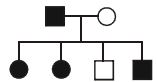
A
The female parent is heterozygous.
B
The parents could not have had a normal daughter for this character.
C
The trait under study could not be colour blindness.
D
The male parent is homozygous dominant.
Solution
(C) The pedigree shows an affected father and an unaffected mother producing both affected and unaffected offspring. This pattern is consistent with an autosomal dominant trait.
Let the dominant allele be $A$ and the recessive allele be $a$.
The affected father must be heterozygous $(Aa)$ because he has an unaffected son $(aa)$.
The unaffected mother must be homozygous recessive $(aa)$.
The cross is $Aa \times aa$.
The offspring genotypes are $Aa$ (affected) and $aa$ (unaffected).
Since the mother is $aa$,she contributes an $a$ allele to all children. The father contributes either $A$ or $a$.
Therefore,the female parent is homozygous recessive $(aa)$,and the male parent is heterozygous $(Aa)$.
Option $(A)$ is incorrect because the female parent is homozygous recessive.
Option $(B)$ is incorrect because they can have a normal daughter $(aa)$.
Option $(C)$ is correct because if the trait were colour blindness ($X$-linked recessive),an affected father would pass the trait to all his daughters,but here he has an unaffected daughter (if we assume the circle represents a daughter,though the pedigree shows two affected daughters and one unaffected son and one affected son). Actually,looking at the pedigree,the father is affected and the mother is unaffected. They have two affected daughters,one unaffected son,and one affected son. This is consistent with an autosomal dominant trait. If it were $X$-linked recessive,an affected father $(X^aY)$ and normal mother $(X^AX^A)$ would produce normal daughters $(X^AX^a)$ and normal sons $(X^AY)$. Thus,it cannot be $X$-linked recessive (colour blindness).
Let the dominant allele be $A$ and the recessive allele be $a$.
The affected father must be heterozygous $(Aa)$ because he has an unaffected son $(aa)$.
The unaffected mother must be homozygous recessive $(aa)$.
The cross is $Aa \times aa$.
The offspring genotypes are $Aa$ (affected) and $aa$ (unaffected).
Since the mother is $aa$,she contributes an $a$ allele to all children. The father contributes either $A$ or $a$.
Therefore,the female parent is homozygous recessive $(aa)$,and the male parent is heterozygous $(Aa)$.
Option $(A)$ is incorrect because the female parent is homozygous recessive.
Option $(B)$ is incorrect because they can have a normal daughter $(aa)$.
Option $(C)$ is correct because if the trait were colour blindness ($X$-linked recessive),an affected father would pass the trait to all his daughters,but here he has an unaffected daughter (if we assume the circle represents a daughter,though the pedigree shows two affected daughters and one unaffected son and one affected son). Actually,looking at the pedigree,the father is affected and the mother is unaffected. They have two affected daughters,one unaffected son,and one affected son. This is consistent with an autosomal dominant trait. If it were $X$-linked recessive,an affected father $(X^aY)$ and normal mother $(X^AX^A)$ would produce normal daughters $(X^AX^a)$ and normal sons $(X^AY)$. Thus,it cannot be $X$-linked recessive (colour blindness).
0 likesView Solution
78
BiologyMediumMCQAIPMT · 2010
$A$ cross in which an organism showing a dominant phenotype is crossed with the recessive parent in order to know its genotype is called
A
monohybrid cross
B
back cross
C
test cross
D
dihybrid cross
Solution
(C) : $A$ test cross is performed to determine the unknown genotype of an organism showing a dominant phenotype.
In a typical test cross, the organism with the dominant phenotype is crossed with a homozygous recessive parent.
This method allows researchers to identify whether the dominant individual is homozygous or heterozygous by analyzing the phenotypic ratio of the offspring.
If the offspring show a $1:1$ ratio of dominant to recessive phenotypes, the parent was heterozygous.
If all offspring show the dominant phenotype, the parent was homozygous dominant.
In a typical test cross, the organism with the dominant phenotype is crossed with a homozygous recessive parent.
This method allows researchers to identify whether the dominant individual is homozygous or heterozygous by analyzing the phenotypic ratio of the offspring.
If the offspring show a $1:1$ ratio of dominant to recessive phenotypes, the parent was heterozygous.
If all offspring show the dominant phenotype, the parent was homozygous dominant.
0 likesView Solution
79
BiologyMediumMCQAIPMT · 2010
In Antirrhinum,two plants with pink flowers were hybridized. The $F_1$ plants produced red,pink,and white flowers in the proportion of $1$ red,$2$ pink,and $1$ white. What could be the genotype of the two plants used for hybridization? Red flower color is determined by $RR$,and white by $rr$ genes.
A
$rrrr$
B
$RR$
C
$Rr$
D
$rr$
Solution
(C) The given situation is an example of incomplete dominance,where the phenotype in the $F_1$ generation does not resemble either of the two parents.
In $Antirrhinum$ (snapdragon),the cross between a red-flowered plant $(RR)$ and a white-flowered plant $(rr)$ results in pink-flowered plants $(Rr)$ in the $F_1$ generation.
When two pink-flowered plants $(Rr)$ are hybridized,the cross is $Rr \times Rr$.
The resulting offspring genotypes are $1 RR$ (red) : $2 Rr$ (pink) : $1 rr$ (white).
Therefore,the genotype of the two plants used for hybridization is $Rr$.
In $Antirrhinum$ (snapdragon),the cross between a red-flowered plant $(RR)$ and a white-flowered plant $(rr)$ results in pink-flowered plants $(Rr)$ in the $F_1$ generation.
When two pink-flowered plants $(Rr)$ are hybridized,the cross is $Rr \times Rr$.
The resulting offspring genotypes are $1 RR$ (red) : $2 Rr$ (pink) : $1 rr$ (white).
Therefore,the genotype of the two plants used for hybridization is $Rr$.
0 likesView Solution
80
BiologyMediumMCQAIPMT · 2010
Which one of the following does not follow the central dogma of molecular biology?
A
Pea
B
Mucor
C
Chlamydomonas
D
$HIV$
Solution
(D) The central dogma of molecular biology,proposed by $F.H.C.$ Crick in $1958$,describes the unidirectional flow of genetic information from $DNA$ to $mRNA$ and then to protein.
However,$H.$ Temin and $D.$ Baltimore discovered that in certain retroviruses,such as $HIV$,genetic information can flow from $RNA$ to $DNA$.
This process is known as reverse transcription or Teminism.
It is catalyzed by the enzyme reverse transcriptase.
Therefore,$HIV$ does not follow the standard central dogma of molecular biology.
However,$H.$ Temin and $D.$ Baltimore discovered that in certain retroviruses,such as $HIV$,genetic information can flow from $RNA$ to $DNA$.
This process is known as reverse transcription or Teminism.
It is catalyzed by the enzyme reverse transcriptase.
Therefore,$HIV$ does not follow the standard central dogma of molecular biology.
0 likesView Solution
81
BiologyMediumMCQAIPMT · 2010
Which one of the following palindromic base sequences in $DNA$ can be easily cut at about the middle by some particular restriction enzyme?
A
$5'-CGTTCG-3'$
$3'-ATGGTA-5'$
$3'-ATGGTA-5'$
B
$5'-GATATG-3'$
$3'-CTACTA-5'$
$3'-CTACTA-5'$
C
$5'-GAATTC-3'$
$3'-CTTAAG-5'$
$3'-CTTAAG-5'$
D
$5'-CACGTA-3'$
$3'-CTCAGT-5'$
$3'-CTCAGT-5'$
Solution
(C) : Palindromic nucleotide sequences in the $DNA$ molecule are groups of bases that form the same sequence when read in both forward and backward direction.
In the given question,only option $(c)$ represents a palindromic sequence,which is the recognition site for the restriction enzyme $EcoRI$.
It reads $GAATTC$ from $5' \rightarrow 3'$ on both strands,allowing it to be cut at the middle by the enzyme.
In the given question,only option $(c)$ represents a palindromic sequence,which is the recognition site for the restriction enzyme $EcoRI$.
It reads $GAATTC$ from $5' \rightarrow 3'$ on both strands,allowing it to be cut at the middle by the enzyme.
0 likesView Solution
82
BiologyMediumMCQAIPMT · 2010
The one aspect which is not a salient feature of the genetic code is its being
A
degenerate
B
ambiguous
C
universal
D
specific
Solution
(B) The genetic code is non-ambiguous. $A$ non-ambiguous code means that there is no ambiguity regarding a particular codon. One codon specifies only one amino acid and not any other. There are $64$ codons in total. Out of these $64$,$3$ are stop codons (nonsense codons),which do not code for any amino acid,while the remaining $61$ code for one of the $20$ amino acids. Each codon is specific to a single amino acid,thus the code is not ambiguous.
0 likesView Solution
83
BiologyMediumMCQAIPMT · 2010
Select the two correct statements out of the four $(i-iv)$ statements given below about the lac operon.
$(i)$ Glucose or galactose may bind with the repressor and inactivate it.
$(ii)$ In the absence of lactose,the repressor binds with the operator region.
$(iii)$ The $z$-gene codes for permease.
$(iv)$ This was elucidated by Francois Jacob and Jacques Monod.
The correct statements are:
$(i)$ Glucose or galactose may bind with the repressor and inactivate it.
$(ii)$ In the absence of lactose,the repressor binds with the operator region.
$(iii)$ The $z$-gene codes for permease.
$(iv)$ This was elucidated by Francois Jacob and Jacques Monod.
The correct statements are:
A
$(ii)$ and $(iii)$
B
$(i)$ and $(iii)$
C
$(ii)$ and $(iv)$
D
$(i)$ and $(ii)$
Solution
(C) The correct statements are $(ii)$ and $(iv)$.
Explanation:
$(i)$ Incorrect: Allolactose (an isomer of lactose) acts as an inducer,not glucose or galactose. It binds to the repressor to inactivate it.
$(ii)$ Correct: In the absence of the inducer (lactose),the repressor protein binds to the operator region,preventing $RNA$ polymerase from transcribing the structural genes.
$(iii)$ Incorrect: The $z$-gene codes for $\beta$-galactosidase,while the $y$-gene codes for permease.
$(iv)$ Correct: The lac operon model was proposed by Francois Jacob and Jacques Monod in $1961$ for which they were awarded the Nobel Prize.
Explanation:
$(i)$ Incorrect: Allolactose (an isomer of lactose) acts as an inducer,not glucose or galactose. It binds to the repressor to inactivate it.
$(ii)$ Correct: In the absence of the inducer (lactose),the repressor protein binds to the operator region,preventing $RNA$ polymerase from transcribing the structural genes.
$(iii)$ Incorrect: The $z$-gene codes for $\beta$-galactosidase,while the $y$-gene codes for permease.
$(iv)$ Correct: The lac operon model was proposed by Francois Jacob and Jacques Monod in $1961$ for which they were awarded the Nobel Prize.
0 likesView Solution
84
BiologyMediumMCQAIPMT · 2010
The $3' \rightarrow 5'$ phosphodiester linkages inside a polynucleotide chain serve to join
A
one $DNA$ strand with the other $DNA$ strand
B
one nucleoside with another nucleoside
C
one nucleotide with another nucleotide
D
one nitrogenous base with pentose sugar
Solution
(C) The $3' \rightarrow 5'$ phosphodiester bond is formed between the phosphate group,which is attached to the $5'$ carbon of the sugar residue of one nucleotide,and the $3'$ hydroxyl group of the sugar residue of the adjacent nucleotide.
This linkage creates the sugar-phosphate backbone of the polynucleotide chain.
Therefore,it serves to join one nucleotide with another nucleotide.
This linkage creates the sugar-phosphate backbone of the polynucleotide chain.
Therefore,it serves to join one nucleotide with another nucleotide.
0 likesView Solution
85
BiologyMediumMCQAIPMT · 2010
The lac operon consists of
A
four regulatory genes only
B
one regulatory gene and three structural genes
C
two regulatory genes and two structural genes
D
three regulatory genes and three structural genes.
Solution
(B) The correct answer is $B$. The $lac$ operon (an inducible operon) in $E. coli$ consists of a promoter,an operator,a regulator gene ($i$ gene),and three structural genes: $z, y,$ and $a$.
These structural genes code for the enzymes $\beta$-galactosidase,$\beta$-galactoside permease,and $\beta$-galactoside transacetylase,respectively.
The $i$ gene codes for a repressor protein that regulates the expression of these structural genes.
In the presence of an inducer (allolactose),the repressor is inactivated,allowing $RNA$ polymerase to transcribe the structural genes.
These structural genes code for the enzymes $\beta$-galactosidase,$\beta$-galactoside permease,and $\beta$-galactoside transacetylase,respectively.
The $i$ gene codes for a repressor protein that regulates the expression of these structural genes.
In the presence of an inducer (allolactose),the repressor is inactivated,allowing $RNA$ polymerase to transcribe the structural genes.
0 likesView Solution
86
BiologyMediumMCQAIPMT · 2010
In eukaryotic cell transcription,$RNA$ splicing and $RNA$ capping take place inside the
A
ribosomes
B
nucleus
C
dictyosomes
D
$ER$
Solution
(B) : Unlike in prokaryotes where transcription and translation take place in the same compartment,in eukaryotes,the primary transcript is first processed in the nucleus and then transported outside of the nucleus.
Since the primary transcripts of eukaryotes contain both expressing genes (exons) and non-expressing genes (introns),they undergo splicing of introns,followed by capping and tailing at the $5'$-end and $3'$-end,respectively.
Since the primary transcripts of eukaryotes contain both expressing genes (exons) and non-expressing genes (introns),they undergo splicing of introns,followed by capping and tailing at the $5'$-end and $3'$-end,respectively.
0 likesView Solution
87
BiologyMediumMCQAIPMT · 2010
Which one of the following statements about the particular entity is true?
A
Centromere is found in animal cells,which produces aster during cell division.
B
The gene for producing insulin is present in every body cell.
C
Nucleosome is formed of nucleotides.
D
$DNA$ consists of core of eight histones.
Solution
(B) is the correct statement.
$1$. The gene for producing insulin is present in every somatic cell of the body because all cells originate from the zygote via mitosis and contain the same genetic information. However,it is only expressed in the beta cells of the pancreas.
$2$. Centrioles (not centromeres) are found in animal cells and produce asters during cell division.
$3$. $A$ nucleosome consists of a core of eight histone proteins wrapped by $DNA$,not nucleotides.
$4$. $DNA$ is a polymer of nucleotides,not a structure consisting of a core of eight histones.
$1$. The gene for producing insulin is present in every somatic cell of the body because all cells originate from the zygote via mitosis and contain the same genetic information. However,it is only expressed in the beta cells of the pancreas.
$2$. Centrioles (not centromeres) are found in animal cells and produce asters during cell division.
$3$. $A$ nucleosome consists of a core of eight histone proteins wrapped by $DNA$,not nucleotides.
$4$. $DNA$ is a polymer of nucleotides,not a structure consisting of a core of eight histones.
0 likesView Solution
88
BiologyMediumMCQAIPMT · 2010
Darwin's finches are a good example of
A
industrial melanism
B
connecting link
C
adaptive radiation
D
convergent evolution
Solution
(C) Darwin's finches are a classic example of adaptive radiation.
Adaptive radiation is the process of evolution of different species in a given geographical area starting from a point and literally radiating to other areas of geography (habitats).
In the Galapagos Islands,Darwin observed that many varieties of finches evolved from a single ancestral species.
These finches adapted to different niches based on the availability of food resources such as insects,seeds,and cactus,leading to the diversification of their beak shapes and sizes.
Adaptive radiation is the process of evolution of different species in a given geographical area starting from a point and literally radiating to other areas of geography (habitats).
In the Galapagos Islands,Darwin observed that many varieties of finches evolved from a single ancestral species.
These finches adapted to different niches based on the availability of food resources such as insects,seeds,and cactus,leading to the diversification of their beak shapes and sizes.
0 likesView Solution
89
BiologyMediumMCQAIPMT · 2010
Given below are four statements $(A-D)$ each with one or two blanks. Select the option which correctly fills up the blanks in two statements.
Statements:
$(A)$ Wings of butterfly and birds look alike and are the results of $ . . . . . . (i) . . . . . . $ evolution.
$(B)$ Miller showed that $CH_4, H_2, NH_3$ and $ . . . . . . (i) . . . . . . $ when exposed to electric discharge in a flask resulted in formation of $ . . . . . . (ii) . . . . . . $.
$(C)$ Vermiform appendix is a $ . . . . . . (i) . . . . . . $ organ and an $ . . . . . . (ii) . . . . . . $ evidence of evolution.
$(D)$ According to Darwin,evolution took place due to $ . . . . . . (i) . . . . . . $ and $ . . . . . . (ii) . . . . . . $ of the fittest.
Statements:
$(A)$ Wings of butterfly and birds look alike and are the results of $ . . . . . . (i) . . . . . . $ evolution.
$(B)$ Miller showed that $CH_4, H_2, NH_3$ and $ . . . . . . (i) . . . . . . $ when exposed to electric discharge in a flask resulted in formation of $ . . . . . . (ii) . . . . . . $.
$(C)$ Vermiform appendix is a $ . . . . . . (i) . . . . . . $ organ and an $ . . . . . . (ii) . . . . . . $ evidence of evolution.
$(D)$ According to Darwin,evolution took place due to $ . . . . . . (i) . . . . . . $ and $ . . . . . . (ii) . . . . . . $ of the fittest.
A
$(D)-(i)$ small variations,$(ii)$ survival,$(A)-(i)$ convergent
B
$(A)-(i)$ convergent,$(B)-(i)$ oxygen,$(ii)$ nucleosides
C
$(B)-(i)$ water vapour,$(ii)$ amino acids,$(C)-(i)$ rudimentary,$(ii)$ anatomical
D
$(C)-(i)$ vestigial,$(ii)$ anatomical,$(D)-(i)$ mutations,$(ii)$ multiplication
Solution
(C) Wings of butterfly and birds are analogous organs,which are the result of convergent evolution.
$(B)$ Miller's experiment used $CH_4, H_2, NH_3$ and water vapour $(H_2O)$ to produce amino acids.
$(C)$ Vermiform appendix is a vestigial organ and serves as an anatomical evidence of evolution.
$(D)$ According to Darwin,evolution occurred due to small variations and survival of the fittest.
Comparing these with the options,option $(C)$ correctly fills the blanks for statements $(B)$ and $(C)$.
$(B)$ Miller's experiment used $CH_4, H_2, NH_3$ and water vapour $(H_2O)$ to produce amino acids.
$(C)$ Vermiform appendix is a vestigial organ and serves as an anatomical evidence of evolution.
$(D)$ According to Darwin,evolution occurred due to small variations and survival of the fittest.
Comparing these with the options,option $(C)$ correctly fills the blanks for statements $(B)$ and $(C)$.
0 likesView Solution
90
BiologyMediumMCQAIPMT · 2010
The most apparent change during the evolutionary history of Homo sapiens is traced in
A
loss of body hair
B
walking upright
C
shortening of the jaws
D
remarkable increase in the brain size
Solution
(D) : The most apparent change during the evolutionary history of modern man $(Homo \ sapiens)$ is the significant increase in brain size.
The brain capacity gradually increased from early human ancestors to modern humans.
$Homo \ habilis$ had a brain capacity of $650-800 \ c.c.$,which increased to $900 \ c.c.$ in $Homo \ erectus$.
True humans,including modern man,displayed a consistent and gradual increase in cranial capacity.
$Neanderthal$ man had a brain capacity of approximately $1400 \ c.c.$,which evolved to an average of $1450 \ c.c.$ $(1300-1600 \ c.c.)$ in the living modern man $(Homo \ sapiens \ sapiens)$.
The brain capacity gradually increased from early human ancestors to modern humans.
$Homo \ habilis$ had a brain capacity of $650-800 \ c.c.$,which increased to $900 \ c.c.$ in $Homo \ erectus$.
True humans,including modern man,displayed a consistent and gradual increase in cranial capacity.
$Neanderthal$ man had a brain capacity of approximately $1400 \ c.c.$,which evolved to an average of $1450 \ c.c.$ $(1300-1600 \ c.c.)$ in the living modern man $(Homo \ sapiens \ sapiens)$.
0 likesView Solution
91
BiologyMediumMCQAIPMT · 2010
Ringworm in humans is caused by
A
bacteria
B
fungi
C
nematodes
D
viruses
Solution
(B) : Ringworm (tinea) is a fungal infection of the skin,scalp,or nails. It is caused by dermatophyte fungi,specifically species of $Microsporum$,$Trichophyton$,and $Epidermophyton$. These fungi can also affect animals,which act as a source of infection for humans. The disease spreads through direct contact or via contaminated materials. Lesions often form partial or complete rings and cause intense itching. The condition is treated using antifungal agents administered orally or applied topically.
0 likesView Solution
92
BiologyEasyMCQAIPMT · 2010
Widal test is used for the diagnosis of
A
malaria
B
pneumonia
C
tuberculosis
D
typhoid
Solution
(D) The correct answer is $D$.
Widal test (developed by $G.F.I$ Widal) is a serological agglutination test used for the diagnosis of typhoid fever.
It detects the presence of antibodies against the $Salmonella$ $typhi$ bacterium in the patient's serum.
This test helps in confirming the infection caused by $Salmonella$ $typhi$.
Widal test (developed by $G.F.I$ Widal) is a serological agglutination test used for the diagnosis of typhoid fever.
It detects the presence of antibodies against the $Salmonella$ $typhi$ bacterium in the patient's serum.
This test helps in confirming the infection caused by $Salmonella$ $typhi$.
0 likesView Solution
93
BiologyMediumMCQAIPMT · 2010
Which one of the following statements is correct with respect to $AIDS$?
A
The $HIV$ can be transmitted through eating food together with an infected person.
B
Drug addicts are least susceptible to $HIV$ infection.
C
$AIDS$ patients are being fully cured cent per cent with proper care and nutrition.
D
The causative $HIV$ retrovirus enters helper $T$-lymphocytes,thus reducing their numbers.
Solution
(D) $AIDS$ (Acquired Immuno Deficiency Syndrome) is a syndrome caused by the retrovirus $HIV$ (Human Immunodeficiency Virus).
The virus specifically targets and destroys a subgroup of lymphocytes known as helper $T$-cells (or $CD4$ lymphocytes).
This destruction leads to a severe suppression of the body's immune response.
$HIV$ is transmitted through infected blood,semen,and vaginal fluids.
The major routes of transmission include unprotected sexual intercourse,sharing of contaminated needles (common in intravenous drug abuse),and the administration of contaminated blood or blood products.
It is important to note that $HIV$ is not transmitted through casual contact like eating together.
While a combination of antiretroviral drugs can delay the progression of the disease for many years,there is currently no cure that can fully eradicate $AIDS$.
The virus specifically targets and destroys a subgroup of lymphocytes known as helper $T$-cells (or $CD4$ lymphocytes).
This destruction leads to a severe suppression of the body's immune response.
$HIV$ is transmitted through infected blood,semen,and vaginal fluids.
The major routes of transmission include unprotected sexual intercourse,sharing of contaminated needles (common in intravenous drug abuse),and the administration of contaminated blood or blood products.
It is important to note that $HIV$ is not transmitted through casual contact like eating together.
While a combination of antiretroviral drugs can delay the progression of the disease for many years,there is currently no cure that can fully eradicate $AIDS$.
0 likesView Solution
94
BiologyMediumMCQAIPMT · 2010
Select the correct statement from the ones given below.
A
Barbiturates,when given to criminals,make them tell the truth.
B
Morphine is often given to persons,who have undergone surgery,as a pain killer.
C
Chewing tobacco lowers blood pressure and heart rate.
D
Cocaine is given to patients after surgery as it stimulates recovery.
Solution
(B) : Morphine is a potent opioid analgesic used mainly to relieve severe and persistent pain,particularly in terminally ill patients or those who have undergone surgery.
It also induces feelings of euphoria.
It is administered by mouth,injection,or in suppositories.
Common side effects are nausea,vomiting,constipation,and drowsiness.
With regular use,tolerance develops and dependence may occur.
It also induces feelings of euphoria.
It is administered by mouth,injection,or in suppositories.
Common side effects are nausea,vomiting,constipation,and drowsiness.
With regular use,tolerance develops and dependence may occur.
0 likesView Solution
95
BiologyMediumMCQAIPMT · 2010
Which one of the following techniques is the safest for the detection of cancers?
A
Magnetic resonance imaging $(MRI)$
B
Radiography $(X-ray)$
C
Computed tomography $(CT)$
D
Histopathological studies
Solution
(A) $MRI$ is the safest technique for the detection of cancers.
$1$. Radiography $(X-ray)$ and $CT$ scans use ionizing radiation, which can be harmful to tissues and potentially increase the risk of cancer.
$2$. Histopathological studies are invasive techniques that require biopsy, which involves surgical removal of tissue.
$3$. $MRI$ uses strong magnetic fields and non-ionizing radio waves to accurately detect pathological and physiological changes in living tissues without exposing the patient to harmful radiation.
$1$. Radiography $(X-ray)$ and $CT$ scans use ionizing radiation, which can be harmful to tissues and potentially increase the risk of cancer.
$2$. Histopathological studies are invasive techniques that require biopsy, which involves surgical removal of tissue.
$3$. $MRI$ uses strong magnetic fields and non-ionizing radio waves to accurately detect pathological and physiological changes in living tissues without exposing the patient to harmful radiation.
0 likesView Solution
96
BiologyMediumMCQAIPMT · 2010
$A$ person suffering from a disease caused by $Plasmodium$ experiences recurring chill and fever at the time when:
A
the sporozoites released from $RBCs$ are being rapidly killed and broken down inside the spleen.
B
the trophozoites reach maximum growth and give out certain toxins.
C
the parasite after its rapid multiplication inside $RBCs$ ruptures them,releasing the stage to enter fresh $RBCs$.
D
the microgametocytes and megagametocytes are being destroyed by the $WBCs$.
Solution
(C) $Plasmodium$ is a protozoan parasite responsible for malaria in humans.
During the life cycle of $Plasmodium$,the parasite multiplies rapidly inside the $RBCs$ (erythrocytes).
When these $RBCs$ rupture,they release the parasite along with a toxic substance called $haemozoin$.
This release of $haemozoin$ into the bloodstream is responsible for the recurring chills and high fever associated with malaria.
During the life cycle of $Plasmodium$,the parasite multiplies rapidly inside the $RBCs$ (erythrocytes).
When these $RBCs$ rupture,they release the parasite along with a toxic substance called $haemozoin$.
This release of $haemozoin$ into the bloodstream is responsible for the recurring chills and high fever associated with malaria.
0 likesView Solution
97
BiologyEasyMCQAIPMT · 2010
Breeding of crops with high levels of minerals,vitamins,and proteins is called:
A
somatic hybridisation
B
biofortification
C
biomagnification
D
micropropagation
Solution
(B) : Breeding of crops with higher levels of vitamins and minerals or higher protein and healthier fats is called biofortification. This is the most practical approach to improve public health.
0 likesView Solution
98
BiologyMediumMCQAIPMT · 2010
Select the correct statement from the following.
A
Biogas is produced by the activity of aerobic bacteria on animal waste.
B
Methanobacterium is an aerobic bacterium found in the rumen of cattle.
C
Biogas,commonly called gobar gas,is pure methane.
D
Activated sludge-sediment in settlement tanks of a sewage treatment plant is a rich source of aerobic bacteria.
Solution
(D) : Sewage water can be purified by passing it through sewage treatment plants with the action of heterotrophic microorganisms. There are three stages of this treatment: primary,secondary,and tertiary. Primary treatment removes floating and suspended solids from sewage through two processes of filtration and sedimentation. First,floating matter is removed through sequential filtration. The filtrate is kept in large open settling tanks where grit settles down. The sediment is called primary sludge,while the supernatant is called effluent. The primary sludge traps a lot of microbes and debris. In secondary treatment,the primary effluent is taken to aeration tanks. $A$ large number of aerobic heterotrophic microbes grow in the aeration tank. They form flocs. Flocs are masses of bacteria held together by slime and fungal filaments to form mesh-like structures. The microbes digest a lot of organic matter,converting it into microbial biomass and releasing a lot of minerals. As the $BOD$ of the waste matter is reduced to $10-15\%$ of raw sewage,it is passed into a settling tank. Thus,secondary treatment is more or less biological. The sediment of the settling tank is called activated sludge. The remaining is passed into a large tank called an anaerobic sludge digester. It is designed for continuous operation. The aerobic microbes present in the sludge get killed. Anaerobic microbes digest the organic mass as well as aerobic microbes of the sludge. They are of two types: non-methanogenic and methanogenic. Methanogenic bacteria produce a mixture of gases containing methane,$H_2S$,and $CO_2$.
0 likesView Solution
99
BiologyEasyMCQAIPMT · 2010
$A$ common biocontrol agent for the control of plant diseases is
A
baculovirus
B
Bacillus thuringiensis
C
Glomus
D
Trichoderma
Solution
(D) : The natural method of pest and pathogen control involving the use of viruses, bacteria, and other organisms (which are their natural predators) is called biocontrol or biological control.
For example, the free-living fungus $Trichoderma$ exerts biocontrol over several plant pathogens to control plant diseases.
$Baculoviruses$ (mostly of the genus $Nucleopolyhedrovirus$) are also used as biocontrol agents, but they are primarily used for the control of insects and arthropods.
$Bacillus \text{ } thuringiensis$ is a soil bacterium used as a biopesticide.
$Glomus$ species are the most common fungal partners of mycorrhiza residing in the roots of higher plants.
For example, the free-living fungus $Trichoderma$ exerts biocontrol over several plant pathogens to control plant diseases.
$Baculoviruses$ (mostly of the genus $Nucleopolyhedrovirus$) are also used as biocontrol agents, but they are primarily used for the control of insects and arthropods.
$Bacillus \text{ } thuringiensis$ is a soil bacterium used as a biopesticide.
$Glomus$ species are the most common fungal partners of mycorrhiza residing in the roots of higher plants.
0 likesView Solution
100
BiologyMediumMCQAIPMT · 2010
The common nitrogen-fixer in paddy fields is
A
Rhizobium
B
Azospirillum
C
Oscillatoria
D
Frankia
Solution
(B) $Azospirillum$ is a nitrogen-fixing bacterium that forms a loose association with the roots of various plants,including paddy ($Oryza$ $sativa$).
It is commonly used as a biofertilizer in paddy fields.
Inoculation of paddy fields with $Azospirillum$ helps in increasing the crop yield and reduces the requirement for chemical nitrogen fertilizers.
It is commonly used as a biofertilizer in paddy fields.
Inoculation of paddy fields with $Azospirillum$ helps in increasing the crop yield and reduces the requirement for chemical nitrogen fertilizers.
0 likesView Solution
Vedclass Products
For Students
Vedclass Test Series
Mock tests in real AIPMT style covering Biology with performance analysis. 5-day free trial.
Start Free TrialFor Teachers
Exam Paper Generator
Generate Set A/B/C/D Biology papers from 7.5L+ questions in 2 minutes. 3 chapters free.
Try FreeFor Institutes
Online Exam Module
Run live AIPMT mock exams with unlimited students, 360° analytics & white-label branding.
See DemoFrequently Asked Questions
How many Biology questions are in AIPMT 2010?
There are 160 Biology questions from the AIPMT 2010 paper on Vedclass, each with a detailed step-by-step solution in English.
Are AIPMT 2010 Biology solutions available in English?
Yes. All solutions on this page are in English. You can also switch to English or Hindi using the language buttons above the questions.
Can I practice AIPMT 2010 Biology as a timed test?
Yes. Use the Vedclass Test Series to attempt a full AIPMT mock test covering Biology with time limits and instant score analysis.
Can teachers create Biology papers from AIPMT previous year questions?
Yes. The Vedclass Exam Paper Generator lets teachers mix AIPMT Biology questions and generate Set A/B/C/D papers in minutes.
For Teachers & Institutes
Build a Custom Biology Paper
Pick AIPMT 2010 Biology questions, set difficulty, and generate Set A/B/C/D in 2 minutes.