
ChemistryQ1–7 of 7 questions
Page 1 of 1 · English
1
ChemistryMCQAIPMT · 2014
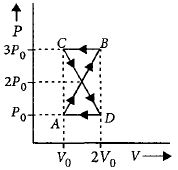
$A$ thermodynamic system undergoes a cyclic process $ABCDA$ as shown in the figure. The work done by the system in the cycle is
A
$P_0 V_0$
B
$2 P_0 V_0$
C
$\frac{P_0 V_0}{2}$
D
zero
Solution
(D) In a $P-V$ diagram,the work done in a cyclic process is equal to the net area enclosed by the cycle. The work is positive if the cycle is clockwise and negative if the cycle is anticlockwise.
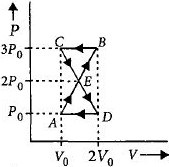
From the figure,the cycle consists of two triangles: $\triangle A E D$ and $\triangle B E C$,where $E$ is the intersection point $(2 P_0, 1.5 V_0)$.
$1$. For the loop $\triangle A E D$ (clockwise):
Work $W_1 = + \text{Area of } \triangle A E D = + \frac{1}{2} \times \text{base} \times \text{height} = + \frac{1}{2} \times (2 V_0 - V_0) \times (2 P_0 - P_0) = + \frac{1}{2} P_0 V_0$.
$2$. For the loop $\triangle B E C$ (anticlockwise):
Work $W_2 = - \text{Area of } \triangle B E C = - \frac{1}{2} \times \text{base} \times \text{height} = - \frac{1}{2} \times (2 V_0 - V_0) \times (3 P_0 - 2 P_0) = - \frac{1}{2} P_0 V_0$.
The net work done by the system is $W_{\text{net}} = W_1 + W_2 = + \frac{1}{2} P_0 V_0 - \frac{1}{2} P_0 V_0 = 0$.
From the figure,the cycle consists of two triangles: $\triangle A E D$ and $\triangle B E C$,where $E$ is the intersection point $(2 P_0, 1.5 V_0)$.
$1$. For the loop $\triangle A E D$ (clockwise):
Work $W_1 = + \text{Area of } \triangle A E D = + \frac{1}{2} \times \text{base} \times \text{height} = + \frac{1}{2} \times (2 V_0 - V_0) \times (2 P_0 - P_0) = + \frac{1}{2} P_0 V_0$.
$2$. For the loop $\triangle B E C$ (anticlockwise):
Work $W_2 = - \text{Area of } \triangle B E C = - \frac{1}{2} \times \text{base} \times \text{height} = - \frac{1}{2} \times (2 V_0 - V_0) \times (3 P_0 - 2 P_0) = - \frac{1}{2} P_0 V_0$.
The net work done by the system is $W_{\text{net}} = W_1 + W_2 = + \frac{1}{2} P_0 V_0 - \frac{1}{2} P_0 V_0 = 0$.
0 likesView Solution
2
ChemistryMCQAIPMT · 2014
$A$ transformer having an efficiency of $90\%$ is working on a $200\, V$ and $3\, kW$ power supply. If the current in the secondary coil is $6\, A$,the voltage across the secondary coil and the current in the primary coil respectively are:
A
$300\, V, 15\, A$
B
$450\, V, 15\, A$
C
$450\, V, 13.5\, A$
D
$600\, V, 15\, A$
Solution
(B) Given:
Efficiency of the transformer,$\eta = 90\% = 0.9$
Input power,$P_{in} = 3\, kW = 3000\, W$
Primary voltage,$V_{p} = 200\, V$
Secondary current,$I_{s} = 6\, A$
$1$. To find the current in the primary coil $(I_{p})$:
Since $P_{in} = V_{p} \times I_{p}$,we have:
$I_{p} = \frac{P_{in}}{V_{p}} = \frac{3000\, W}{200\, V} = 15\, A$
$2$. To find the voltage across the secondary coil $(V_{s})$:
Efficiency $\eta = \frac{P_{out}}{P_{in}} = \frac{V_{s} \times I_{s}}{P_{in}}$
$0.9 = \frac{V_{s} \times 6\, A}{3000\, W}$
$V_{s} = \frac{0.9 \times 3000}{6} = \frac{2700}{6} = 450\, V$
Thus,the secondary voltage is $450\, V$ and the primary current is $15\, A$.
Efficiency of the transformer,$\eta = 90\% = 0.9$
Input power,$P_{in} = 3\, kW = 3000\, W$
Primary voltage,$V_{p} = 200\, V$
Secondary current,$I_{s} = 6\, A$
$1$. To find the current in the primary coil $(I_{p})$:
Since $P_{in} = V_{p} \times I_{p}$,we have:
$I_{p} = \frac{P_{in}}{V_{p}} = \frac{3000\, W}{200\, V} = 15\, A$
$2$. To find the voltage across the secondary coil $(V_{s})$:
Efficiency $\eta = \frac{P_{out}}{P_{in}} = \frac{V_{s} \times I_{s}}{P_{in}}$
$0.9 = \frac{V_{s} \times 6\, A}{3000\, W}$
$V_{s} = \frac{0.9 \times 3000}{6} = \frac{2700}{6} = 450\, V$
Thus,the secondary voltage is $450\, V$ and the primary current is $15\, A$.
0 likesView Solution
3
ChemistryMCQAIPMT · 2014
$A$ balloon with mass $m$ is descending down with an acceleration $a$ (where $a < g$). How much mass should be removed from it so that it starts moving up with an acceleration $a$?
A
$\frac{2ma}{g + a}$
B
$\frac{2ma}{g - a}$
C
$\frac{ma}{g + a}$
D
$\frac{ma}{g - a}$
Solution
(A) Let the upthrust of air be $F_a$.
For the downward motion of the balloon with mass $m$ and acceleration $a$:
$mg - F_a = ma$ --- $(1)$
From this,we get $F_a = m(g - a)$.
Now,let the mass removed be $\Delta m$. The new mass of the balloon is $(m - \Delta m)$.
For the upward motion with acceleration $a$:
$F_a - (m - \Delta m)g = (m - \Delta m)a$
$F_a = (m - \Delta m)(g + a)$ --- $(2)$
Equating the expressions for $F_a$ from $(1)$ and $(2)$:
$m(g - a) = (m - \Delta m)(g + a)$
$mg - ma = mg + ma - \Delta m(g + a)$
$\Delta m(g + a) = 2ma$
$\Delta m = \frac{2ma}{g + a}$
For the downward motion of the balloon with mass $m$ and acceleration $a$:
$mg - F_a = ma$ --- $(1)$
From this,we get $F_a = m(g - a)$.
Now,let the mass removed be $\Delta m$. The new mass of the balloon is $(m - \Delta m)$.
For the upward motion with acceleration $a$:
$F_a - (m - \Delta m)g = (m - \Delta m)a$
$F_a = (m - \Delta m)(g + a)$ --- $(2)$
Equating the expressions for $F_a$ from $(1)$ and $(2)$:
$m(g - a) = (m - \Delta m)(g + a)$
$mg - ma = mg + ma - \Delta m(g + a)$
$\Delta m(g + a) = 2ma$
$\Delta m = \frac{2ma}{g + a}$
0 likesView Solution
4
ChemistryMCQAIPMT · 2014
$A$ certain quantity of water cools from $70\,^{\circ}C$ to $60\,^{\circ}C$ in the first $5\, \text{minutes}$ and to $54\,^{\circ}C$ in the next $5\, \text{minutes}$. The temperature of the surroundings is ......... $^{\circ}C$.
A
$45$
B
$20$
C
$42$
D
$10$
Solution
(A) According to Newton's Law of Cooling,the rate of cooling is given by $\frac{T_1 - T_2}{t} = K \left( \frac{T_1 + T_2}{2} - T_0 \right)$,where $T_0$ is the surrounding temperature.
For the first interval: $\frac{70 - 60}{5} = K \left( \frac{70 + 60}{2} - T_0 \right) \Rightarrow 2 = K(65 - T_0)$ --- $(1)$
For the second interval: $\frac{60 - 54}{5} = K \left( \frac{60 + 54}{2} - T_0 \right) \Rightarrow 1.2 = K(57 - T_0)$ --- $(2)$
Dividing $(1)$ by $(2)$: $\frac{2}{1.2} = \frac{65 - T_0}{57 - T_0} \Rightarrow \frac{5}{3} = \frac{65 - T_0}{57 - T_0}$.
$5(57 - T_0) = 3(65 - T_0) \Rightarrow 285 - 5T_0 = 195 - 3T_0$.
$285 - 195 = 5T_0 - 3T_0 \Rightarrow 90 = 2T_0 \Rightarrow T_0 = 45\,^{\circ}C$.
For the first interval: $\frac{70 - 60}{5} = K \left( \frac{70 + 60}{2} - T_0 \right) \Rightarrow 2 = K(65 - T_0)$ --- $(1)$
For the second interval: $\frac{60 - 54}{5} = K \left( \frac{60 + 54}{2} - T_0 \right) \Rightarrow 1.2 = K(57 - T_0)$ --- $(2)$
Dividing $(1)$ by $(2)$: $\frac{2}{1.2} = \frac{65 - T_0}{57 - T_0} \Rightarrow \frac{5}{3} = \frac{65 - T_0}{57 - T_0}$.
$5(57 - T_0) = 3(65 - T_0) \Rightarrow 285 - 5T_0 = 195 - 3T_0$.
$285 - 195 = 5T_0 - 3T_0 \Rightarrow 90 = 2T_0 \Rightarrow T_0 = 45\,^{\circ}C$.
0 likesView Solution
5
ChemistryMCQAIPMT · 2014
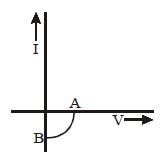
The given graph represents $V-I$ characteristic for a semiconductor device. Which of the following statements is correct?
A
It is $V-I$ characteristic for a solar cell where point $A$ represents open circuit voltage and point $B$ represents short circuit current.
B
It is for a solar cell and points $A$ and $B$ represent open circuit voltage and current,respectively.
C
It is for a photodiode and points $A$ and $B$ represent open circuit voltage and current,respectively.
D
It is for an $LED$ and points $A$ and $B$ represent open circuit voltage and short circuit current,respectively.
Solution
(A) The given graph shows the $V-I$ characteristic curve for a solar cell in the fourth quadrant.
In this quadrant,the device acts as a source of power.
Point $A$ lies on the voltage axis where the current is zero,which corresponds to the open circuit voltage $(V_{oc})$.
Point $B$ lies on the current axis where the voltage is zero,which corresponds to the short circuit current $(I_{sc})$.
Therefore,the correct statement is that it is the $V-I$ characteristic for a solar cell where point $A$ represents open circuit voltage and point $B$ represents short circuit current.
In this quadrant,the device acts as a source of power.
Point $A$ lies on the voltage axis where the current is zero,which corresponds to the open circuit voltage $(V_{oc})$.
Point $B$ lies on the current axis where the voltage is zero,which corresponds to the short circuit current $(I_{sc})$.
Therefore,the correct statement is that it is the $V-I$ characteristic for a solar cell where point $A$ represents open circuit voltage and point $B$ represents short circuit current.
0 likesView Solution
6
ChemistryMCQAIPMT · 2014
$A$ certain number of spherical drops of a liquid of radius $r$ coalesce to form a single drop of radius $R$ and volume $V$. If $T$ is the surface tension of the liquid,then:
A
Energy $= 4VT \left( \frac{1}{r} - \frac{1}{R} \right)$ is released.
B
Energy $= 3VT \left( \frac{1}{r} + \frac{1}{R} \right)$ is absorbed.
C
Energy $= 3VT \left( \frac{1}{r} - \frac{1}{R} \right)$ is released.
D
Energy is neither released nor absorbed.
Solution
(C) When small drops coalesce into a larger drop,the total surface area decreases,which results in the release of energy.
Let $n$ be the number of small drops of radius $r$. The volume is conserved,so $V = n \left( \frac{4}{3} \pi r^3 \right) = \frac{4}{3} \pi R^3$,which implies $n = \frac{R^3}{r^3}$.
The initial surface area $A_i = n (4 \pi r^2) = \left( \frac{R^3}{r^3} \right) (4 \pi r^2) = 4 \pi R^3 / r$.
The final surface area $A_f = 4 \pi R^2$.
The change in surface area $\Delta A = A_i - A_f = 4 \pi R^3 / r - 4 \pi R^2 = 4 \pi R^2 \left( \frac{R}{r} - 1 \right)$.
Energy released $\Delta E = T \Delta A = T (4 \pi R^2) \left( \frac{R}{r} - 1 \right) = T (4 \pi R^3) \left( \frac{1}{r} - \frac{1}{R} \right)$.
Since $V = \frac{4}{3} \pi R^3$,we have $4 \pi R^3 = 3V$.
Substituting this,$\Delta E = 3VT \left( \frac{1}{r} - \frac{1}{R} \right)$.
Let $n$ be the number of small drops of radius $r$. The volume is conserved,so $V = n \left( \frac{4}{3} \pi r^3 \right) = \frac{4}{3} \pi R^3$,which implies $n = \frac{R^3}{r^3}$.
The initial surface area $A_i = n (4 \pi r^2) = \left( \frac{R^3}{r^3} \right) (4 \pi r^2) = 4 \pi R^3 / r$.
The final surface area $A_f = 4 \pi R^2$.
The change in surface area $\Delta A = A_i - A_f = 4 \pi R^3 / r - 4 \pi R^2 = 4 \pi R^2 \left( \frac{R}{r} - 1 \right)$.
Energy released $\Delta E = T \Delta A = T (4 \pi R^2) \left( \frac{R}{r} - 1 \right) = T (4 \pi R^3) \left( \frac{1}{r} - \frac{1}{R} \right)$.
Since $V = \frac{4}{3} \pi R^3$,we have $4 \pi R^3 = 3V$.
Substituting this,$\Delta E = 3VT \left( \frac{1}{r} - \frac{1}{R} \right)$.
0 likesView Solution
7
ChemistryMCQAIPMT · 2014
$A$ projectile is fired from the surface of the earth with a velocity of $5\, ms^{-1}$ at an angle $\theta$ with the horizontal. Another projectile fired from another planet with a velocity of $3\, ms^{-1}$ at the same angle follows a trajectory which is identical to the trajectory of the projectile fired from the earth. The value of the acceleration due to gravity on the planet is (in $ms^{-2}$) (given $g = 9.8\, ms^{-2}$):
A
$3.5$
B
$5.9$
C
$16.3$
D
$110.8$
Solution
(A) The equation of the trajectory of a projectile is given by $y = x \tan \theta - \frac{g x^2}{2 u^2 \cos^2 \theta}$.
For two trajectories to be identical,the coefficients of $x$ and $x^2$ must be the same.
Since the angle $\theta$ is the same,$\tan \theta$ is constant.
For the $x^2$ term to be identical,$\frac{g_e}{u_e^2} = \frac{g_p}{u_p^2}$,where $g_e$ and $u_e$ are gravity and velocity on Earth,and $g_p$ and $u_p$ are gravity and velocity on the planet.
Given $u_e = 5\, ms^{-1}$,$u_p = 3\, ms^{-1}$,and $g_e = 9.8\, ms^{-2}$.
Substituting the values: $\frac{9.8}{5^2} = \frac{g_p}{3^2}$.
$g_p = 9.8 \times \frac{9}{25} = 9.8 \times 0.36 = 3.528\, ms^{-2}$.
Rounding to the nearest provided option,we get $3.5\, ms^{-2}$.
For two trajectories to be identical,the coefficients of $x$ and $x^2$ must be the same.
Since the angle $\theta$ is the same,$\tan \theta$ is constant.
For the $x^2$ term to be identical,$\frac{g_e}{u_e^2} = \frac{g_p}{u_p^2}$,where $g_e$ and $u_e$ are gravity and velocity on Earth,and $g_p$ and $u_p$ are gravity and velocity on the planet.
Given $u_e = 5\, ms^{-1}$,$u_p = 3\, ms^{-1}$,and $g_e = 9.8\, ms^{-2}$.
Substituting the values: $\frac{9.8}{5^2} = \frac{g_p}{3^2}$.
$g_p = 9.8 \times \frac{9}{25} = 9.8 \times 0.36 = 3.528\, ms^{-2}$.
Rounding to the nearest provided option,we get $3.5\, ms^{-2}$.
0 likesView Solution
Vedclass Products
For Students
Vedclass Test Series
Mock tests in real AIPMT style covering Chemistry with performance analysis. 5-day free trial.
Start Free TrialFor Teachers
Exam Paper Generator
Generate Set A/B/C/D Chemistry papers from 7.5L+ questions in 2 minutes. 3 chapters free.
Try FreeFor Institutes
Online Exam Module
Run live AIPMT mock exams with unlimited students, 360° analytics & white-label branding.
See DemoFrequently Asked Questions
How many Chemistry questions are in AIPMT 2014?
There are 7 Chemistry questions from the AIPMT 2014 paper on Vedclass, each with a detailed step-by-step solution in English.
Are AIPMT 2014 Chemistry solutions available in English?
Yes. All solutions on this page are in English. You can also switch to English or Hindi using the language buttons above the questions.
Can I practice AIPMT 2014 Chemistry as a timed test?
Yes. Use the Vedclass Test Series to attempt a full AIPMT mock test covering Chemistry with time limits and instant score analysis.
Can teachers create Chemistry papers from AIPMT previous year questions?
Yes. The Vedclass Exam Paper Generator lets teachers mix AIPMT Chemistry questions and generate Set A/B/C/D papers in minutes.
For Teachers & Institutes
Build a Custom Chemistry Paper
Pick AIPMT 2014 Chemistry questions, set difficulty, and generate Set A/B/C/D in 2 minutes.