
ChemistryQ1–80 of 84 questions
Page 1 of 2 · English
1
ChemistryMCQAIPMT · 2004
The electric resistance of a certain wire of iron is $R$. If its length and radius are both doubled,then
A
The resistance will be doubled and the specific resistance will be halved
B
The resistance will be halved and the specific resistance will remain unchanged
C
The resistance will be halved and the specific resistance will be doubled
D
The resistance and the specific resistance will both remain unchanged
Solution
(B) The resistance $R$ of a wire is given by the formula $R = \rho \frac{l}{A} = \rho \frac{l}{\pi r^2}$,where $\rho$ is the resistivity (specific resistance),$l$ is the length,and $r$ is the radius.
From this,we see that $R \propto \frac{l}{r^2}$.
Let the initial length be $l_1 = l$ and initial radius be $r_1 = r$. The new length is $l_2 = 2l$ and the new radius is $r_2 = 2r$.
The new resistance $R_2$ is given by:
$\frac{R_2}{R_1} = \frac{l_2}{l_1} \times \left( \frac{r_1}{r_2} \right)^2 = \left( \frac{2l}{l} \right) \times \left( \frac{r}{2r} \right)^2 = 2 \times \left( \frac{1}{2} \right)^2 = 2 \times \frac{1}{4} = \frac{1}{2}$.
Therefore,$R_2 = \frac{R}{2}$.
Specific resistance (resistivity) $\rho$ is a material property and does not depend on the dimensions (length or radius) of the wire. Thus,it remains unchanged.
From this,we see that $R \propto \frac{l}{r^2}$.
Let the initial length be $l_1 = l$ and initial radius be $r_1 = r$. The new length is $l_2 = 2l$ and the new radius is $r_2 = 2r$.
The new resistance $R_2$ is given by:
$\frac{R_2}{R_1} = \frac{l_2}{l_1} \times \left( \frac{r_1}{r_2} \right)^2 = \left( \frac{2l}{l} \right) \times \left( \frac{r}{2r} \right)^2 = 2 \times \left( \frac{1}{2} \right)^2 = 2 \times \frac{1}{4} = \frac{1}{2}$.
Therefore,$R_2 = \frac{R}{2}$.
Specific resistance (resistivity) $\rho$ is a material property and does not depend on the dimensions (length or radius) of the wire. Thus,it remains unchanged.
0 likesView Solution
2
ChemistryMCQAIPMT · 2004
The magnetic flux through a circuit of resistance $R$ changes by an amount $\Delta \phi$ in time $\Delta t$. Then the total quantity of electric charge $Q$ passing during this time through any point of the circuit is given by:
A
$Q = \frac{\Delta \phi}{\Delta t}$
B
$Q = \frac{\Delta \phi}{\Delta t} \times R$
C
$Q = - \frac{\Delta \phi}{\Delta t} + R$
D
$Q = \frac{\Delta \phi}{R}$
Solution
(D) According to Faraday's law of electromagnetic induction,the induced electromotive force $(e)$ is given by $e = -\frac{d\phi}{dt}$.
Taking the magnitude,we have $|e| = \frac{d\phi}{dt}$.
Since $e = iR$,where $i$ is the induced current and $R$ is the resistance,we can write $iR = \frac{d\phi}{dt}$.
We know that current $i = \frac{dq}{dt}$,where $dq$ is the small amount of charge passing in time $dt$.
Substituting this into the equation: $\left(\frac{dq}{dt}\right)R = \frac{d\phi}{dt}$.
Canceling $dt$ from both sides,we get $dq \cdot R = d\phi$,which implies $dq = \frac{d\phi}{R}$.
Integrating both sides for the total change,the total charge $Q$ is given by $Q = \frac{\Delta \phi}{R}$.
Taking the magnitude,we have $|e| = \frac{d\phi}{dt}$.
Since $e = iR$,where $i$ is the induced current and $R$ is the resistance,we can write $iR = \frac{d\phi}{dt}$.
We know that current $i = \frac{dq}{dt}$,where $dq$ is the small amount of charge passing in time $dt$.
Substituting this into the equation: $\left(\frac{dq}{dt}\right)R = \frac{d\phi}{dt}$.
Canceling $dt$ from both sides,we get $dq \cdot R = d\phi$,which implies $dq = \frac{d\phi}{R}$.
Integrating both sides for the total change,the total charge $Q$ is given by $Q = \frac{\Delta \phi}{R}$.
0 likesView Solution
3
ChemistryDifficultMCQAIPMT · 2004
The frequency of radiation emitted when the electron falls from $n = 4$ to $n = 1$ in a hydrogen atom will be (Given ionization energy of $H = 2.18 \times 10^{-18} \ J \ atom^{-1}$ and $h = 6.625 \times 10^{-34} \ Js$)
A
$3.08 \times 10^{15} \ s^{-1}$
B
$2.00 \times 10^{15} \ s^{-1}$
C
$1.54 \times 10^{15} \ s^{-1}$
D
$1.03 \times 10^{15} \ s^{-1}$
Solution
(A) The energy of an electron in the $n^{th}$ orbit of a hydrogen atom is given by $E_n = -\frac{R_H}{n^2}$,where $R_H = 2.18 \times 10^{-18} \ J$.
The energy difference for the transition from $n_2 = 4$ to $n_1 = 1$ is $\Delta E = E_4 - E_1 = R_H \left( \frac{1}{n_1^2} - \frac{1}{n_2^2} \right)$.
$\Delta E = 2.18 \times 10^{-18} \left( \frac{1}{1^2} - \frac{1}{4^2} \right) = 2.18 \times 10^{-18} \left( 1 - \frac{1}{16} \right) = 2.18 \times 10^{-18} \times \frac{15}{16} \ J$.
Since $\Delta E = h\nu$,the frequency $\nu = \frac{\Delta E}{h}$.
$\nu = \frac{2.18 \times 10^{-18} \times 15}{16 \times 6.625 \times 10^{-34}} = \frac{32.7 \times 10^{-18}}{106 \times 10^{-34}} \approx 3.08 \times 10^{15} \ s^{-1}$.
The energy difference for the transition from $n_2 = 4$ to $n_1 = 1$ is $\Delta E = E_4 - E_1 = R_H \left( \frac{1}{n_1^2} - \frac{1}{n_2^2} \right)$.
$\Delta E = 2.18 \times 10^{-18} \left( \frac{1}{1^2} - \frac{1}{4^2} \right) = 2.18 \times 10^{-18} \left( 1 - \frac{1}{16} \right) = 2.18 \times 10^{-18} \times \frac{15}{16} \ J$.
Since $\Delta E = h\nu$,the frequency $\nu = \frac{\Delta E}{h}$.
$\nu = \frac{2.18 \times 10^{-18} \times 15}{16 \times 6.625 \times 10^{-34}} = \frac{32.7 \times 10^{-18}}{106 \times 10^{-34}} \approx 3.08 \times 10^{15} \ s^{-1}$.
0 likesView Solution
4
ChemistryMediumMCQAIPMT · 2004
In a regular octahedral molecule,$MX_6$,the number of $X-M-X$ bonds at $180^{\circ}$ is
A
$6$
B
$4$
C
$3$
D
$2$
Solution
(C) In a regular octahedral molecule,the central atom $M$ is surrounded by six $X$ atoms located at the corners of an octahedron.
These six positions consist of three pairs of atoms that are diametrically opposite to each other.
Each such pair forms a linear $X-M-X$ bond with a bond angle of $180^{\circ}$.
Therefore,there are $3$ such $X-M-X$ bonds at $180^{\circ}$.
These six positions consist of three pairs of atoms that are diametrically opposite to each other.
Each such pair forms a linear $X-M-X$ bond with a bond angle of $180^{\circ}$.
Therefore,there are $3$ such $X-M-X$ bonds at $180^{\circ}$.
0 likesView Solution
5
ChemistryMediumMCQAIPMT · 2004
In $BrF_3$ molecule,the lone pairs occupy equatorial positions to minimize
A
Lone pair-lone pair repulsion and lone pair-bond pair repulsion
B
Lone pair-lone pair repulsion only
C
Lone pair-bond pair repulsion only
D
Bond pair-bond pair repulsion only
Solution
(A) In $BrF_3$,the central atom $Br$ has $7$ valence electrons. It forms $3$ $Br-F$ bonds and has $2$ lone pairs,resulting in a total of $5$ electron pairs ($sp^3d$ hybridization).
According to $VSEPR$ theory,lone pairs prefer equatorial positions in a trigonal bipyramidal geometry to minimize lone pair-lone pair repulsion and lone pair-bond pair repulsion.
By placing both lone pairs in equatorial positions,the $90^{\circ}$ lone pair-lone pair interactions are avoided,which significantly reduces the overall repulsion in the molecule.
According to $VSEPR$ theory,lone pairs prefer equatorial positions in a trigonal bipyramidal geometry to minimize lone pair-lone pair repulsion and lone pair-bond pair repulsion.
By placing both lone pairs in equatorial positions,the $90^{\circ}$ lone pair-lone pair interactions are avoided,which significantly reduces the overall repulsion in the molecule.
0 likesView Solution
6
ChemistryMediumMCQAIPMT · 2004
$H_2O$ is dipolar,whereas $BeF_2$ is not. It is because
A
$H_2O$ is linear and $BeF_2$ is angular
B
$H_2O$ is angular and $BeF_2$ is linear
C
The electronegativity of $F$ is greater than that of $O$
D
$H_2O$ involves hydrogen bonding whereas $BeF_2$ is a discrete molecule
Solution
(B) The overall value of the dipole moment of a polar molecule depends on its geometry and shape,i.e.,the vectorial addition of the dipole moments of the constituent bonds.
Water $(H_2O)$ has an angular structure with a bond angle of $105^{\circ}$,which results in a net dipole moment.
However,$BeF_2$ is a linear molecule where the dipole moments of the two $Be-F$ bonds are equal in magnitude and opposite in direction,thus canceling each other out,resulting in a net dipole moment of zero.
Water $(H_2O)$ has an angular structure with a bond angle of $105^{\circ}$,which results in a net dipole moment.
However,$BeF_2$ is a linear molecule where the dipole moments of the two $Be-F$ bonds are equal in magnitude and opposite in direction,thus canceling each other out,resulting in a net dipole moment of zero.
1 likesView Solution
7
ChemistryMediumMCQAIPMT · 2004
Among the following,the pair in which the two species are not isostructural is
A
$BH_4^-$ and $NH_4^+$
B
$PF_6^-$ and $SF_6$
C
$SiF_4$ and $SF_4$
D
$IO_3^-$ and $XeO_3$
Solution
(C) $SiF_4$ has a symmetrical tetrahedral shape due to $sp^3$ hybridization of the central silicon atom.
$SF_4$ has a distorted tetrahedral or see-saw geometry due to $sp^3d$ hybridization of the central sulfur atom and the presence of one lone pair of electrons in an equatorial hybrid orbital.
Since $SiF_4$ is tetrahedral and $SF_4$ is see-saw,they are not isostructural.
$SF_4$ has a distorted tetrahedral or see-saw geometry due to $sp^3d$ hybridization of the central sulfur atom and the presence of one lone pair of electrons in an equatorial hybrid orbital.
Since $SiF_4$ is tetrahedral and $SF_4$ is see-saw,they are not isostructural.
0 likesView Solution
8
ChemistryMediumMCQAIPMT · 2004
The maximum number of molecules is present in
A
$0.5 \ g$ of $H_2$ gas
B
$10 \ g$ of $O_2$ gas
C
$15 \ L$ of $H_2$ gas at $STP$
D
$5 \ L$ of $N_2$ gas at $STP$
Solution
(C) To find the maximum number of molecules,we calculate the number of moles $(n)$ for each option:
$A$: $n = \frac{0.5 \ g}{2 \ g/mol} = 0.25 \ mol$. Molecules $= 0.25 \times N_A = 0.25 N_A$.
$B$: $n = \frac{10 \ g}{32 \ g/mol} = 0.3125 \ mol$. Molecules $= 0.3125 \times N_A = 0.3125 N_A$.
$C$: $n = \frac{15 \ L}{22.4 \ L/mol} \approx 0.67 \ mol$. Molecules $= 0.67 \times N_A = 0.67 N_A$.
$D$: $n = \frac{5 \ L}{22.4 \ L/mol} \approx 0.22 \ mol$. Molecules $= 0.22 \times N_A = 0.22 N_A$.
Comparing the values,$15 \ L$ of $H_2$ gas at $STP$ contains the maximum number of molecules.
$A$: $n = \frac{0.5 \ g}{2 \ g/mol} = 0.25 \ mol$. Molecules $= 0.25 \times N_A = 0.25 N_A$.
$B$: $n = \frac{10 \ g}{32 \ g/mol} = 0.3125 \ mol$. Molecules $= 0.3125 \times N_A = 0.3125 N_A$.
$C$: $n = \frac{15 \ L}{22.4 \ L/mol} \approx 0.67 \ mol$. Molecules $= 0.67 \times N_A = 0.67 N_A$.
$D$: $n = \frac{5 \ L}{22.4 \ L/mol} \approx 0.22 \ mol$. Molecules $= 0.22 \times N_A = 0.22 N_A$.
Comparing the values,$15 \ L$ of $H_2$ gas at $STP$ contains the maximum number of molecules.
0 likesView Solution
9
ChemistryMediumMCQAIPMT · 2004
The solubility product of a sparingly soluble salt $AX_2$ is $3.2 \times 10^{-11}$. Its solubility (in moles/litres) is
A
$2 \times 10^{-4}$
B
$4 \times 10^{-4}$
C
$5.6 \times 10^{-6}$
D
$3.1 \times 10^{-4}$
Solution
(A) For a sparingly soluble salt $AX_2$,the dissociation is: $AX_2(s) \rightleftharpoons A^{2+}(aq) + 2X^{-}(aq)$.
Let the solubility be $s \ mol/L$.
Then,$[A^{2+}] = s$ and $[X^{-}] = 2s$.
The solubility product expression is: $K_{sp} = [A^{2+}][X^{-}]^2 = (s)(2s)^2 = 4s^3$.
Given $K_{sp} = 3.2 \times 10^{-11}$.
$4s^3 = 3.2 \times 10^{-11}$.
$s^3 = \frac{3.2 \times 10^{-11}}{4} = 0.8 \times 10^{-11} = 8 \times 10^{-12}$.
$s = \sqrt[3]{8 \times 10^{-12}} = 2 \times 10^{-4} \ mol/L$.
Let the solubility be $s \ mol/L$.
Then,$[A^{2+}] = s$ and $[X^{-}] = 2s$.
The solubility product expression is: $K_{sp} = [A^{2+}][X^{-}]^2 = (s)(2s)^2 = 4s^3$.
Given $K_{sp} = 3.2 \times 10^{-11}$.
$4s^3 = 3.2 \times 10^{-11}$.
$s^3 = \frac{3.2 \times 10^{-11}}{4} = 0.8 \times 10^{-11} = 8 \times 10^{-12}$.
$s = \sqrt[3]{8 \times 10^{-12}} = 2 \times 10^{-4} \ mol/L$.
0 likesView Solution
10
ChemistryDifficultMCQAIPMT · 2004
The rapid change of $pH$ near the stoichiometric point of an acid-base titration is the basis of indicator detection. The $pH$ of the solution is related to the ratio of the concentrations of the conjugate acid $(HIn)$ and base $(In^{-})$ forms of the indicator by the expression:
A
$\log \frac{[HIn]}{[In^{-}]} = pH - pK_{In}$
B
$\log \frac{[In^{-}]}{[HIn]} = pH - pK_{In}$
C
$\log \frac{[In^{-}]}{[HIn]} = pK_{In} - pH$
D
$\log \frac{[HIn]}{[In^{-}]} = pK_{In} - pH$
Solution
(B) An indicator $(HIn)$ is a weak acid that dissociates in solution as follows:
$HIn \rightleftharpoons H^{+} + In^{-}$
The equilibrium constant expression is:
$K_{In} = \frac{[H^{+}][In^{-}]}{[HIn]}$
Taking the negative logarithm on both sides:
$-\log K_{In} = -\log [H^{+}] - \log \frac{[In^{-}]}{[HIn]}$
$pK_{In} = pH - \log \frac{[In^{-}]}{[HIn]}$
Rearranging the terms,we get:
$\log \frac{[In^{-}]}{[HIn]} = pH - pK_{In}$
$HIn \rightleftharpoons H^{+} + In^{-}$
The equilibrium constant expression is:
$K_{In} = \frac{[H^{+}][In^{-}]}{[HIn]}$
Taking the negative logarithm on both sides:
$-\log K_{In} = -\log [H^{+}] - \log \frac{[In^{-}]}{[HIn]}$
$pK_{In} = pH - \log \frac{[In^{-}]}{[HIn]}$
Rearranging the terms,we get:
$\log \frac{[In^{-}]}{[HIn]} = pH - pK_{In}$
0 likesView Solution
11
ChemistryMediumMCQAIPMT · 2004
The work done during the expansion of a gas from a volume of $4 \ dm^3$ to $6 \ dm^3$ against a constant external pressure of $3 \ atm$ is $(1 \ L \ atm = 101.32 \ J)$ $...... \ J$
A
$+ 304$
B
$-304$
C
$-6$
D
$-608$
Solution
(D) The formula for work done during expansion against a constant external pressure is $W = -P_{ext} \Delta V$.
Given: $P_{ext} = 3 \ atm$,$V_1 = 4 \ dm^3$,$V_2 = 6 \ dm^3$.
Since $1 \ dm^3 = 1 \ L$,$\Delta V = 6 \ L - 4 \ L = 2 \ L$.
$W = -3 \ atm \times 2 \ L = -6 \ L \ atm$.
Given $1 \ L \ atm = 101.32 \ J$,so $W = -6 \times 101.32 \ J = -607.92 \ J \approx -608 \ J$.
Given: $P_{ext} = 3 \ atm$,$V_1 = 4 \ dm^3$,$V_2 = 6 \ dm^3$.
Since $1 \ dm^3 = 1 \ L$,$\Delta V = 6 \ L - 4 \ L = 2 \ L$.
$W = -3 \ atm \times 2 \ L = -6 \ L \ atm$.
Given $1 \ L \ atm = 101.32 \ J$,so $W = -6 \times 101.32 \ J = -607.92 \ J \approx -608 \ J$.
0 likesView Solution
12
ChemistryDifficultMCQAIPMT · 2004
Considering entropy $(S)$ as a thermodynamic parameter,the criterion for the spontaneity of any process is
A
$\Delta S_{system} > 0$ only
B
$\Delta S_{surroundings} > 0$ only
C
$\Delta S_{system} + \Delta S_{surroundings} > 0$
D
$\Delta S_{system} - \Delta S_{surroundings} > 0$
Solution
(C) The criterion for the spontaneity of any process in terms of entropy is based on the Second Law of Thermodynamics.
For a process to be spontaneous,the total entropy change of the universe must be positive.
$\Delta S_{total} = \Delta S_{system} + \Delta S_{surroundings} > 0$.
This indicates that the entropy of the system and its surroundings considered together must increase for an irreversible (spontaneous) process.
For a process to be spontaneous,the total entropy change of the universe must be positive.
$\Delta S_{total} = \Delta S_{system} + \Delta S_{surroundings} > 0$.
This indicates that the entropy of the system and its surroundings considered together must increase for an irreversible (spontaneous) process.
0 likesView Solution
13
ChemistryMediumMCQAIPMT · 2004
If the bond energies of $H-H$,$Br-Br$ and $H-Br$ are $433$,$192$ and $364 \ kJ \ mol^{-1}$ respectively,the $\Delta H^o$ for the reaction,$H_{2(g)} + Br_{2(g)} \to 2HBr_{(g)}$ is.....$kJ$
A
$+ 261$
B
$- 103$
C
$- 261$
D
$+ 103$
Solution
(B) The reaction is: $H_{2(g)} + Br_{2(g)} \to 2HBr_{(g)}$
$\Delta H^o = \sum \text{Bond energies of reactants} - \sum \text{Bond energies of products}$
$\Delta H^o = [BE(H-H) + BE(Br-Br)] - [2 \times BE(H-Br)]$
$\Delta H^o = [433 + 192] - [2 \times 364]$
$\Delta H^o = 625 - 728$
$\Delta H^o = - 103 \ kJ$
$\Delta H^o = \sum \text{Bond energies of reactants} - \sum \text{Bond energies of products}$
$\Delta H^o = [BE(H-H) + BE(Br-Br)] - [2 \times BE(H-Br)]$
$\Delta H^o = [433 + 192] - [2 \times 364]$
$\Delta H^o = 625 - 728$
$\Delta H^o = - 103 \ kJ$
0 likesView Solution
14
ChemistryMediumMCQAIPMT · 2004
For the oxidation of ammonia at $298 \ K$,the standard enthalpy and standard entropy changes are $-382.64 \ kJ \ mol^{-1}$ and $-145.6 \ J \ K^{-1} \ mol^{-1}$ respectively. The standard Gibbs energy change for the same reaction at $298 \ K$ is $..... \ kJ \ mol^{-1}$.
A
$-439.3$
B
$-523.2$
C
$-221.1$
D
$-339.3$
Solution
(D) The standard Gibbs energy change $(\Delta G^{\circ})$ is calculated using the relation: $\Delta G^{\circ} = \Delta H^{\circ} - T\Delta S^{\circ}$.
Given:
$\Delta H^{\circ} = -382.64 \ kJ \ mol^{-1}$
$\Delta S^{\circ} = -145.6 \ J \ K^{-1} \ mol^{-1} = -0.1456 \ kJ \ K^{-1} \ mol^{-1}$
$T = 298 \ K$
Substituting the values:
$\Delta G^{\circ} = -382.64 \ kJ \ mol^{-1} - (298 \ K \times -0.1456 \ kJ \ K^{-1} \ mol^{-1})$
$\Delta G^{\circ} = -382.64 + 43.3888$
$\Delta G^{\circ} = -339.2512 \ kJ \ mol^{-1} \approx -339.3 \ kJ \ mol^{-1}$.
Given:
$\Delta H^{\circ} = -382.64 \ kJ \ mol^{-1}$
$\Delta S^{\circ} = -145.6 \ J \ K^{-1} \ mol^{-1} = -0.1456 \ kJ \ K^{-1} \ mol^{-1}$
$T = 298 \ K$
Substituting the values:
$\Delta G^{\circ} = -382.64 \ kJ \ mol^{-1} - (298 \ K \times -0.1456 \ kJ \ K^{-1} \ mol^{-1})$
$\Delta G^{\circ} = -382.64 + 43.3888$
$\Delta G^{\circ} = -339.2512 \ kJ \ mol^{-1} \approx -339.3 \ kJ \ mol^{-1}$.
0 likesView Solution
15
ChemistryMediumMCQAIPMT · 2004
Which is the best description of the behaviour of bromine in the reaction given below $H_2O + Br_2 \to HOBr + HBr$?
A
Oxidised only
B
Reduced only
C
Proton acceptor only
D
Both oxidised and reduced
Solution
(D) In the reaction $H_2O + Br_2 \to HOBr + HBr$,the oxidation state of bromine changes as follows:
$Br_2$ (elemental state) has an oxidation number of $0$.
In $HOBr$,the oxidation number of $Br$ is $+1$.
In $HBr$,the oxidation number of $Br$ is $-1$.
Since the oxidation number of bromine increases from $0$ to $+1$ (oxidation) and decreases from $0$ to $-1$ (reduction) simultaneously,bromine undergoes both oxidation and reduction.
Therefore,it is a disproportionation reaction,which is a type of redox reaction.
$Br_2$ (elemental state) has an oxidation number of $0$.
In $HOBr$,the oxidation number of $Br$ is $+1$.
In $HBr$,the oxidation number of $Br$ is $-1$.
Since the oxidation number of bromine increases from $0$ to $+1$ (oxidation) and decreases from $0$ to $-1$ (reduction) simultaneously,bromine undergoes both oxidation and reduction.
Therefore,it is a disproportionation reaction,which is a type of redox reaction.
0 likesView Solution
16
ChemistryEasyMCQAIPMT · 2004
Ionic radii are
A
Directly proportional to effective nuclear charge
B
Directly proportional to square of effective nuclear charge
C
Inversely proportional to effective nuclear charge
D
Inversely proportional to square of effective nuclear charge.
Solution
(C) The ionic radius $(r)$ is inversely proportional to the effective nuclear charge $(Z_{eff})$.
According to the relationship $r \propto \frac{1}{Z_{eff}}$,as the effective nuclear charge increases,the electrons are pulled more strongly towards the nucleus,resulting in a decrease in the ionic radius.
Therefore,the correct option is $(C)$.
According to the relationship $r \propto \frac{1}{Z_{eff}}$,as the effective nuclear charge increases,the electrons are pulled more strongly towards the nucleus,resulting in a decrease in the ionic radius.
Therefore,the correct option is $(C)$.
0 likesView Solution
17
ChemistryDifficultMCQAIPMT · 2004
$A$ solid compound $X$ on heating gives $CO_2$ gas and a residue. The residue mixed with water forms $Y$. On passing an excess of $CO_2$ through $Y$ in water,a clear solution $Z$ is obtained. On boiling $Z$,compound $X$ is reformed. The compound $X$ is
A
$Na_2CO_3$
B
$K_2CO_3$
C
$Ca(HCO_3)_2$
D
$CaCO_3$
Solution
(D) The given compound $X$ is $CaCO_3$. The reactions are as follows:
$1. \ CaCO_3 \xrightarrow{\Delta} CaO + CO_2 \uparrow$ ($X$ decomposes to residue $CaO$ and $CO_2$)
$2. \ CaO + H_2O \to Ca(OH)_2$ ($Y$ is calcium hydroxide)
$3. \ Ca(OH)_2 + 2CO_2 \to Ca(HCO_3)_2$ ($Z$ is a clear solution of calcium bicarbonate)
$4. \ Ca(HCO_3)_2 \xrightarrow{\Delta} CaCO_3 \downarrow + CO_2 \uparrow + H_2O$ (Boiling $Z$ reforms $X$)
$1. \ CaCO_3 \xrightarrow{\Delta} CaO + CO_2 \uparrow$ ($X$ decomposes to residue $CaO$ and $CO_2$)
$2. \ CaO + H_2O \to Ca(OH)_2$ ($Y$ is calcium hydroxide)
$3. \ Ca(OH)_2 + 2CO_2 \to Ca(HCO_3)_2$ ($Z$ is a clear solution of calcium bicarbonate)
$4. \ Ca(HCO_3)_2 \xrightarrow{\Delta} CaCO_3 \downarrow + CO_2 \uparrow + H_2O$ (Boiling $Z$ reforms $X$)
0 likesView Solution
18
ChemistryMediumMCQAIPMT · 2004
Which one of the following statements about the zeolites is false?
A
Zeolites are aluminosilicates having three dimensional network
B
Some of the $SiO_4^{4-}$ units are replaced by $AlO_4^{5-}$ and $AlO_6^{9-}$ ions in zeolites
C
They are used as cation exchangers
D
They have open structure which enables them to take up small molecules
Solution
(B) Zeolites are aluminosilicates with a three-dimensional network structure.
In this structure,some $SiO_4$ units are replaced by $AlO_4$ tetrahedra.
They do not contain $AlO_6$ units.
Therefore,the statement that $SiO_4^{4-}$ units are replaced by $AlO_4^{5-}$ and $AlO_6^{9-}$ ions is false.
Zeolites possess an open,cage-like structure that allows them to act as cation exchangers and adsorb small molecules.
In this structure,some $SiO_4$ units are replaced by $AlO_4$ tetrahedra.
They do not contain $AlO_6$ units.
Therefore,the statement that $SiO_4^{4-}$ units are replaced by $AlO_4^{5-}$ and $AlO_6^{9-}$ ions is false.
Zeolites possess an open,cage-like structure that allows them to act as cation exchangers and adsorb small molecules.
0 likesView Solution
19
ChemistryMediumMCQAIPMT · 2004
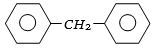
The molecular formula of diphenyl methane,$C_{13}H_{12}$,is given. How many structural isomers are possible when one of the hydrogens is replaced by a chlorine atom?
A
$8$
B
$7$
C
$6$
D
$4$
Solution
(D) Diphenyl methane has two equivalent phenyl rings attached to a central $CH_2$ group.
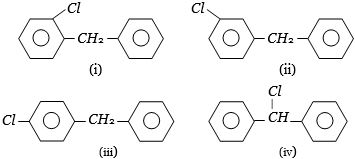
When one hydrogen atom is replaced by a chlorine atom,the possible positions are:
$1$. Ortho-position on the phenyl ring.
$2$. Meta-position on the phenyl ring.
$3$. Para-position on the phenyl ring.
$4$. The central $CH_2$ group (benzylic position).
Thus,there are $4$ distinct structural isomers possible,as shown in the provided image.
When one hydrogen atom is replaced by a chlorine atom,the possible positions are:
$1$. Ortho-position on the phenyl ring.
$2$. Meta-position on the phenyl ring.
$3$. Para-position on the phenyl ring.
$4$. The central $CH_2$ group (benzylic position).
Thus,there are $4$ distinct structural isomers possible,as shown in the provided image.
0 likesView Solution
20
ChemistryMediumMCQAIPMT · 2004
Using anhydrous $AlCl_3$ as a catalyst,which one of the following reactions produces ethylbenzene $(PhEt)$?
A
$H_2C = CH_2 + C_6H_6$
B
$H_3C - CH_3 + C_6H_6$
C
$H_3C - CH_2OH + C_6H_6$
D
$CH_3 - CH = CH_2 + C_6H_6$
Solution
(A) The reaction of benzene $(C_6H_6)$ with ethene $(H_2C = CH_2)$ in the presence of an anhydrous $AlCl_3$ catalyst (often with a trace of $HCl$) is an example of Friedel-Crafts alkylation.
This reaction proceeds via the formation of an ethyl carbocation intermediate,which then attacks the benzene ring to form ethylbenzene $(C_6H_5CH_2CH_3)$.
The reaction is: $C_6H_6 + H_2C = CH_2 \xrightarrow{AlCl_3, HCl} C_6H_5CH_2CH_3$.
This reaction proceeds via the formation of an ethyl carbocation intermediate,which then attacks the benzene ring to form ethylbenzene $(C_6H_5CH_2CH_3)$.
The reaction is: $C_6H_6 + H_2C = CH_2 \xrightarrow{AlCl_3, HCl} C_6H_5CH_2CH_3$.
0 likesView Solution
21
ChemistryMediumMCQAIPMT · 2004
Reaction of $HBr$ with propene in the presence of peroxide gives
A
$Allyl$ bromide
B
$n-propyl$ bromide
C
$Isopropyl$ bromide
D
$3-bromo$ propane
Solution
(B) The reaction of $HBr$ with propene in the presence of peroxide follows the Anti-Markovnikov rule (Kharasch effect).
The bromine atom attaches to the terminal carbon atom.
$CH_3-CH=CH_2 + HBr \xrightarrow{\text{Peroxide}} CH_3-CH_2-CH_2Br$ ($n-propyl$ bromide).
The bromine atom attaches to the terminal carbon atom.
$CH_3-CH=CH_2 + HBr \xrightarrow{\text{Peroxide}} CH_3-CH_2-CH_2Br$ ($n-propyl$ bromide).
0 likesView Solution
22
ChemistryMCQAIPMT · 2004
Which one of the following precedes the re-formation of the nuclear envelope during the $M$ phase of the cell cycle?
A
Formation of the contractile ring,and formation of the phragmoplast
B
Formation of the contractile ring,and transcription from chromosomes
C
Decondensation of chromosomes,and reassembly of the nuclear lamina
D
Transcription from chromosomes,and reassembly of the nuclear lamina
Solution
(C) During the $M$ phase,specifically in telophase,the nuclear envelope begins to re-form around the daughter chromosomes.
Before the nuclear envelope re-assembles,the chromosomes must undergo decondensation (transitioning from a highly coiled state back to chromatin) to allow for gene expression.
Additionally,the nuclear lamina,which is a network of intermediate filaments that provides structural support to the nuclear envelope,must reassemble to provide a scaffold for the new nuclear membrane to attach to.
Therefore,decondensation of chromosomes and reassembly of the nuclear lamina are the essential processes that precede the completion of the nuclear envelope formation.
Before the nuclear envelope re-assembles,the chromosomes must undergo decondensation (transitioning from a highly coiled state back to chromatin) to allow for gene expression.
Additionally,the nuclear lamina,which is a network of intermediate filaments that provides structural support to the nuclear envelope,must reassemble to provide a scaffold for the new nuclear membrane to attach to.
Therefore,decondensation of chromosomes and reassembly of the nuclear lamina are the essential processes that precede the completion of the nuclear envelope formation.
0 likesView Solution
23
ChemistryMCQAIPMT · 2004
In a chloroplast,chlorophyll is found in:
A
Grana
B
Pyrenoid
C
Stroma
D
Both Grana and Stroma
Solution
(A) Chloroplasts contain a fluid-filled matrix called the stroma,which is structurally similar to the cytoplasm. It contains $RNA$,ribosomes,enzymes for $CO_2$ fixation,proteins,starch granules,and lipid droplets (plastoglobuli). Within the stroma,there are flattened membranous sacs called thylakoids. In certain regions,these thylakoids stack together to form structures known as grana. Chlorophyll pigments are embedded within the thylakoid membranes of the grana,where the light-dependent reactions of photosynthesis occur.
0 likesView Solution
24
ChemistryMCQAIPMT · 2004
Which element is present in the highest amount in plants?
A
Carbon
B
Nitrogen
C
Manganese
D
Iron
Solution
(A) According to the elemental analysis of plant tissues,$Carbon$ $(C)$ is the most abundant element found in plants. It constitutes a significant portion of the dry weight of plant biomass,as it is the fundamental building block of all organic molecules like carbohydrates,proteins,lipids,and nucleic acids.
0 likesView Solution
25
ChemistryMCQAIPMT · 2004
An ovule which becomes curved so that the nucellus and embryo sac lie at a right angle to the funicle is called:
A
Campylotropous
B
Anatropous
C
Orthotropous
D
Hemitropous
Solution
(D) In a $Hemitropous$ ovule, the body of the ovule is placed transversely at a right angle to the funicle.
In this type, the micropyle, chalaza, and funicle are arranged such that the nucellus and embryo sac lie at a $90^{\circ}$ angle to the funicle.
Therefore, the correct option is $D$.
In this type, the micropyle, chalaza, and funicle are arranged such that the nucellus and embryo sac lie at a $90^{\circ}$ angle to the funicle.
Therefore, the correct option is $D$.
0 likesView Solution
26
ChemistryMCQAIPMT · 2004
$A$ ball of mass $2\;kg$ and another of mass $4\;kg$ are dropped together from a $60\;ft$ tall building. After a fall of $30\;ft$ each towards the Earth,their respective kinetic energies will be in the ratio of?
A
$\sqrt{2} : 1$
B
$1 : 4$
C
$1 : 2$
D
$1 : \sqrt{2}$
Solution
(C) When objects are dropped from the same height under gravity,their velocity $v$ after falling a distance $h$ is given by the equation of motion $v^2 = u^2 + 2gh$. Since both balls start from rest $(u = 0)$,the velocity after falling $30\;ft$ is $v = \sqrt{2gh}$.
Since $g$ and $h$ are the same for both balls,their velocities are equal $(v_1 = v_2)$.
The kinetic energy $(K.E.)$ is given by $K.E. = \frac{1}{2}mv^2$.
Therefore,the ratio of their kinetic energies is $\frac{K.E._1}{K.E._2} = \frac{\frac{1}{2}m_1v_1^2}{\frac{1}{2}m_2v_2^2} = \frac{m_1}{m_2}$.
Given $m_1 = 2\;kg$ and $m_2 = 4\;kg$,the ratio is $\frac{2}{4} = \frac{1}{2}$.
Since $g$ and $h$ are the same for both balls,their velocities are equal $(v_1 = v_2)$.
The kinetic energy $(K.E.)$ is given by $K.E. = \frac{1}{2}mv^2$.
Therefore,the ratio of their kinetic energies is $\frac{K.E._1}{K.E._2} = \frac{\frac{1}{2}m_1v_1^2}{\frac{1}{2}m_2v_2^2} = \frac{m_1}{m_2}$.
Given $m_1 = 2\;kg$ and $m_2 = 4\;kg$,the ratio is $\frac{2}{4} = \frac{1}{2}$.
0 likesView Solution
27
ChemistryMCQAIPMT · 2004
$A$ bullet of mass $2\, g$ has a charge of $2\, \mu C$. Through what potential difference must it be accelerated,starting from rest,to acquire a speed of $10\, m/s$?
A
$50\, kV$
B
$5\, V$
C
$50\, V$
D
$5\, kV$
Solution
(A) Given:
Mass $m = 2\, g = 2 \times 10^{-3}\, kg$
Charge $q = 2\, \mu C = 2 \times 10^{-6}\, C$
Final velocity $v = 10\, m/s$
Initial velocity $u = 0\, m/s$
According to the work-energy theorem,the work done by the electric field is equal to the change in kinetic energy:
$W = \Delta K$
$qV = \frac{1}{2}mv^2 - \frac{1}{2}mu^2$
Since $u = 0$,the equation becomes:
$qV = \frac{1}{2}mv^2$
$V = \frac{mv^2}{2q}$
Substituting the values:
$V = \frac{(2 \times 10^{-3}\, kg) \times (10\, m/s)^2}{2 \times (2 \times 10^{-6}\, C)}$
$V = \frac{2 \times 10^{-3} \times 100}{4 \times 10^{-6}}$
$V = \frac{0.2}{4 \times 10^{-6}} = 0.05 \times 10^6 = 50,000\, V$
$V = 50\, kV$
Therefore,the correct option is $A$.
Mass $m = 2\, g = 2 \times 10^{-3}\, kg$
Charge $q = 2\, \mu C = 2 \times 10^{-6}\, C$
Final velocity $v = 10\, m/s$
Initial velocity $u = 0\, m/s$
According to the work-energy theorem,the work done by the electric field is equal to the change in kinetic energy:
$W = \Delta K$
$qV = \frac{1}{2}mv^2 - \frac{1}{2}mu^2$
Since $u = 0$,the equation becomes:
$qV = \frac{1}{2}mv^2$
$V = \frac{mv^2}{2q}$
Substituting the values:
$V = \frac{(2 \times 10^{-3}\, kg) \times (10\, m/s)^2}{2 \times (2 \times 10^{-6}\, C)}$
$V = \frac{2 \times 10^{-3} \times 100}{4 \times 10^{-6}}$
$V = \frac{0.2}{4 \times 10^{-6}} = 0.05 \times 10^6 = 50,000\, V$
$V = 50\, kV$
Therefore,the correct option is $A$.
0 likesView Solution
28
ChemistryMCQAIPMT · 2004
$ATP$ase enzyme needed for muscle contraction is located in
A
Actinin
B
Troponin
C
Myosin
D
Actin
Solution
(C) The $ATP$ase enzyme is located in the head of the $Myosin$ filament.
During muscle contraction,the $Myosin$ head acts as an $ATP$ase enzyme,which hydrolyzes $ATP$ into $ADP$ and inorganic phosphate $(Pi)$.
This reaction releases energy that is used for the cross-bridge formation and the power stroke,which pulls the $Actin$ filaments towards the center of the sarcomere.
During muscle contraction,the $Myosin$ head acts as an $ATP$ase enzyme,which hydrolyzes $ATP$ into $ADP$ and inorganic phosphate $(Pi)$.
This reaction releases energy that is used for the cross-bridge formation and the power stroke,which pulls the $Actin$ filaments towards the center of the sarcomere.
0 likesView Solution
29
ChemistryMCQAIPMT · 2004
In transgenics,the expression of a transgene in the target tissue is determined by:
A
Enhancer
B
Transgene
C
Promoter
D
Reporter
Solution
(C) In transgenic organisms,the expression of a transgene is controlled by regulatory sequences known as promoters.
Promoters are specific $DNA$ sequences located upstream of the gene that initiate transcription.
By choosing a tissue-specific promoter,scientists can ensure that the transgene is expressed only in the desired target tissue,rather than throughout the entire organism.
Promoters are specific $DNA$ sequences located upstream of the gene that initiate transcription.
By choosing a tissue-specific promoter,scientists can ensure that the transgene is expressed only in the desired target tissue,rather than throughout the entire organism.
0 likesView Solution
30
ChemistryMCQAIPMT · 2004
The phase difference between two waves,represented by $y_1 = 10^{-6} \sin \{100t + (x/50) + 0.5\} \ m$ and $y_2 = 10^{-6} \cos \{100t + (x/50)\} \ m$,where $x$ is in meters and $t$ is in seconds,is approximately .... $radians$.
A
$2.07$
B
$0.5$
C
$1.5$
D
$1.07$
Solution
(D) The first wave is given by $y_1 = 10^{-6} \sin \{100t + (x/50) + 0.5\}$.
The second wave is given by $y_2 = 10^{-6} \cos \{100t + (x/50)\}$.
We know that $\cos(\theta) = \sin(\theta + \pi/2)$.
Therefore,$y_2 = 10^{-6} \sin \{100t + (x/50) + \pi/2\}$.
The phase of the first wave is $\phi_1 = 100t + (x/50) + 0.5$.
The phase of the second wave is $\phi_2 = 100t + (x/50) + \pi/2$.
The phase difference $\Delta \phi = \phi_2 - \phi_1 = (100t + x/50 + \pi/2) - (100t + x/50 + 0.5)$.
$\Delta \phi = \pi/2 - 0.5$.
Using $\pi \approx 3.14$,$\Delta \phi \approx 1.57 - 0.5 = 1.07 \ radians$.
The second wave is given by $y_2 = 10^{-6} \cos \{100t + (x/50)\}$.
We know that $\cos(\theta) = \sin(\theta + \pi/2)$.
Therefore,$y_2 = 10^{-6} \sin \{100t + (x/50) + \pi/2\}$.
The phase of the first wave is $\phi_1 = 100t + (x/50) + 0.5$.
The phase of the second wave is $\phi_2 = 100t + (x/50) + \pi/2$.
The phase difference $\Delta \phi = \phi_2 - \phi_1 = (100t + x/50 + \pi/2) - (100t + x/50 + 0.5)$.
$\Delta \phi = \pi/2 - 0.5$.
Using $\pi \approx 3.14$,$\Delta \phi \approx 1.57 - 0.5 = 1.07 \ radians$.
0 likesView Solution
31
ChemistryMCQAIPMT · 2004
$A$ particle of mass $m_1$ is moving with a velocity $v_1$ and another particle of mass $m_2$ is moving with a velocity $v_2$. Both of them have the same momentum,but their kinetic energies are $E_1$ and $E_2$ respectively. If $m_1 > m_2$,then:
A
$E_1 < E_2$
B
$\frac{E_1}{E_2} = \frac{m_1}{m_2}$
C
$E_1 > E_2$
D
$E_1 = E_2$
Solution
(A) The kinetic energy $E$ of a particle with momentum $p$ and mass $m$ is given by the relation:
$E = \frac{p^2}{2m}$
Since both particles have the same momentum $(p_1 = p_2 = p)$,we can write the kinetic energies as:
$E_1 = \frac{p^2}{2m_1}$ and $E_2 = \frac{p^2}{2m_2}$
Taking the ratio of the two energies:
$\frac{E_1}{E_2} = \frac{p^2 / 2m_1}{p^2 / 2m_2} = \frac{m_2}{m_1}$
Given that $m_1 > m_2$,it follows that $\frac{m_2}{m_1} < 1$.
Therefore,$\frac{E_1}{E_2} < 1$,which implies $E_1 < E_2$.
$E = \frac{p^2}{2m}$
Since both particles have the same momentum $(p_1 = p_2 = p)$,we can write the kinetic energies as:
$E_1 = \frac{p^2}{2m_1}$ and $E_2 = \frac{p^2}{2m_2}$
Taking the ratio of the two energies:
$\frac{E_1}{E_2} = \frac{p^2 / 2m_1}{p^2 / 2m_2} = \frac{m_2}{m_1}$
Given that $m_1 > m_2$,it follows that $\frac{m_2}{m_1} < 1$.
Therefore,$\frac{E_1}{E_2} < 1$,which implies $E_1 < E_2$.
0 likesView Solution
32
ChemistryMCQAIPMT · 2004
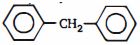
The molecular formula of diphenylmethane is $C_{13}H_{12}$. How many structural isomers are possible when one of the hydrogen atoms is replaced by a chlorine atom?
A
$6$
B
$4$
C
$8$
D
$7$
Solution
(B) Diphenylmethane has the structure $Ph-CH_2-Ph$. The hydrogen atoms can be replaced by a chlorine atom at different positions:
$1$. Replacement of one hydrogen atom from the central $CH_2$ group gives $Ph-CHCl-Ph$ ($1$ isomer).
$2$. Replacement of one hydrogen atom from the benzene rings:
- Due to symmetry,both benzene rings are equivalent.
- In each ring,there are three distinct positions for substitution: ortho $(o)$,meta $(m)$,and para $(p)$.
- This gives $3$ additional isomers: $o$-chlorodiphenylmethane,$m$-chlorodiphenylmethane,and $p$-chlorodiphenylmethane.
Total number of structural isomers = $1 + 3 = 4$.
$1$. Replacement of one hydrogen atom from the central $CH_2$ group gives $Ph-CHCl-Ph$ ($1$ isomer).
$2$. Replacement of one hydrogen atom from the benzene rings:
- Due to symmetry,both benzene rings are equivalent.
- In each ring,there are three distinct positions for substitution: ortho $(o)$,meta $(m)$,and para $(p)$.
- This gives $3$ additional isomers: $o$-chlorodiphenylmethane,$m$-chlorodiphenylmethane,and $p$-chlorodiphenylmethane.
Total number of structural isomers = $1 + 3 = 4$.

0 likesView Solution
33
ChemistryMCQAIPMT · 2004
$M_p$ denotes the mass of a proton and $M_n$ denotes the mass of a neutron. $A$ given nucleus,of binding energy $B$,contains $Z$ protons and $N$ neutrons. The mass $M(N, Z)$ of the nucleus is given by ($c$ is the velocity of light):
A
$M(N, Z) = NM_n + ZM_p - Bc^2$
B
$M(N, Z) = NM_n + ZM_p + Bc^2$
C
$M(N, Z) = NM_n + ZM_p - B/c^2$
D
$M(N, Z) = NM_n + ZM_p + B/c^2$
Solution
(C) The binding energy $B$ of a nucleus is defined as the energy equivalent of the mass defect $\Delta m$.
The mass defect is given by the difference between the sum of the masses of individual nucleons and the actual mass of the nucleus:
$\Delta m = [ZM_p + NM_n - M(N, Z)]$.
According to Einstein's mass-energy equivalence relation,$B = \Delta m c^2$.
Substituting the expression for $\Delta m$:
$B = [ZM_p + NM_n - M(N, Z)] c^2$.
Rearranging the equation to solve for $M(N, Z)$:
$B/c^2 = ZM_p + NM_n - M(N, Z)$.
Therefore,$M(N, Z) = ZM_p + NM_n - B/c^2$.
The mass defect is given by the difference between the sum of the masses of individual nucleons and the actual mass of the nucleus:
$\Delta m = [ZM_p + NM_n - M(N, Z)]$.
According to Einstein's mass-energy equivalence relation,$B = \Delta m c^2$.
Substituting the expression for $\Delta m$:
$B = [ZM_p + NM_n - M(N, Z)] c^2$.
Rearranging the equation to solve for $M(N, Z)$:
$B/c^2 = ZM_p + NM_n - M(N, Z)$.
Therefore,$M(N, Z) = ZM_p + NM_n - B/c^2$.
0 likesView Solution
34
ChemistryMCQAIPMT · 2004
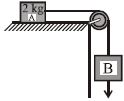
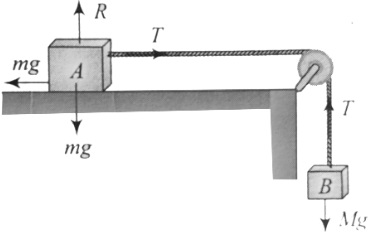
The coefficient of static friction,$\mu_s$ between block $A$ of mass $2\,kg$ and the table as shown in the figure is $0.2$. What would be the maximum mass value of block $B$ so that the two blocks do not move (in $,kg$)? The string and the pulley are assumed to be smooth and massless. $(g = 10\,m/s^2)$
A
$2.0$
B
$4.0$
C
$0.2$
D
$0.4$
Solution
(D) Let the mass of block $B$ be $M$ and the mass of block $A$ be $m = 2\,kg$.
For block $B$ to be in equilibrium,the tension $T$ in the string must balance its weight:
$T = M g \ldots(i)$
For block $A$ to remain stationary,the tension $T$ must be balanced by the limiting static frictional force $f_s$:
$T = f_s$
Since $f_s = \mu_s N$ and the normal force $N = m g$ (as the table is horizontal),we have:
$T = \mu_s m g \ldots(ii)$
Equating $(i)$ and $(ii)$:
$M g = \mu_s m g$
$M = \mu_s m$
Given $\mu_s = 0.2$ and $m = 2\,kg$:
$M = 0.2 \times 2 = 0.4\,kg$
Thus,the maximum mass of block $B$ is $0.4\,kg$.
For block $B$ to be in equilibrium,the tension $T$ in the string must balance its weight:
$T = M g \ldots(i)$
For block $A$ to remain stationary,the tension $T$ must be balanced by the limiting static frictional force $f_s$:
$T = f_s$
Since $f_s = \mu_s N$ and the normal force $N = m g$ (as the table is horizontal),we have:
$T = \mu_s m g \ldots(ii)$
Equating $(i)$ and $(ii)$:
$M g = \mu_s m g$
$M = \mu_s m$
Given $\mu_s = 0.2$ and $m = 2\,kg$:
$M = 0.2 \times 2 = 0.4\,kg$
Thus,the maximum mass of block $B$ is $0.4\,kg$.
0 likesView Solution
35
ChemistryMCQAIPMT · 2004
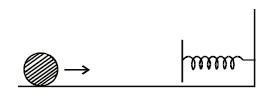
$A$ mass of $0.5\, kg$ moving with a speed of $1.5\, m/s$ on a horizontal smooth surface,collides with a nearly weightless spring of force constant $k=50\, N/m$. The maximum compression of the spring would be ................. $m$.
A
$0.12$
B
$1.5$
C
$0.5$
D
$0.15$
Solution
(D) According to the law of conservation of energy,the initial kinetic energy of the mass is completely converted into the elastic potential energy of the spring at the point of maximum compression.
The kinetic energy of the mass is $K = \frac{1}{2} m v^2$.
The elastic potential energy stored in the spring is $U = \frac{1}{2} k x^2$,where $x$ is the maximum compression.
Equating the two energies:
$\frac{1}{2} m v^2 = \frac{1}{2} k x^2$
Solving for $x$:
$x = \sqrt{\frac{m v^2}{k}}$
Substituting the given values ($m = 0.5\, kg$,$v = 1.5\, m/s$,$k = 50\, N/m$):
$x = \sqrt{\frac{0.5 \times (1.5)^2}{50}}$
$x = \sqrt{\frac{0.5 \times 2.25}{50}}$
$x = \sqrt{\frac{1.125}{50}}$
$x = \sqrt{0.0225}$
$x = 0.15\, m$
The kinetic energy of the mass is $K = \frac{1}{2} m v^2$.
The elastic potential energy stored in the spring is $U = \frac{1}{2} k x^2$,where $x$ is the maximum compression.
Equating the two energies:
$\frac{1}{2} m v^2 = \frac{1}{2} k x^2$
Solving for $x$:
$x = \sqrt{\frac{m v^2}{k}}$
Substituting the given values ($m = 0.5\, kg$,$v = 1.5\, m/s$,$k = 50\, N/m$):
$x = \sqrt{\frac{0.5 \times (1.5)^2}{50}}$
$x = \sqrt{\frac{0.5 \times 2.25}{50}}$
$x = \sqrt{\frac{1.125}{50}}$
$x = \sqrt{0.0225}$
$x = 0.15\, m$
0 likesView Solution
36
ChemistryMCQAIPMT · 2004
The molecular formula of diphenylmethane is $C_{13}H_{12}$. How many structural isomers are possible when one hydrogen atom is replaced by a chlorine atom?
A
$4$
B
$6$
C
$7$
D
$8$
Solution
(A) Diphenylmethane has the structure $(C_6H_5)-CH_2-(C_6H_5)$.
There are three distinct types of hydrogen atoms available for substitution:
$1$. The two hydrogen atoms on the central $CH_2$ group (equivalent).
$2$. The ortho,meta,and para positions on the two benzene rings.
Due to the symmetry of the molecule,the substitution positions are:
- Substitution at the central $CH_2$ carbon: $1$ isomer.
- Substitution at the ortho position of either ring: $1$ isomer.
- Substitution at the meta position of either ring: $1$ isomer.
- Substitution at the para position of either ring: $1$ isomer.
Wait,let us re-evaluate: The two rings are equivalent. The positions are: $CH_2$ $(1)$,ortho $(2)$,meta $(3)$,para $(4)$. Total structural isomers = $4$.
There are three distinct types of hydrogen atoms available for substitution:
$1$. The two hydrogen atoms on the central $CH_2$ group (equivalent).
$2$. The ortho,meta,and para positions on the two benzene rings.
Due to the symmetry of the molecule,the substitution positions are:
- Substitution at the central $CH_2$ carbon: $1$ isomer.
- Substitution at the ortho position of either ring: $1$ isomer.
- Substitution at the meta position of either ring: $1$ isomer.
- Substitution at the para position of either ring: $1$ isomer.
Wait,let us re-evaluate: The two rings are equivalent. The positions are: $CH_2$ $(1)$,ortho $(2)$,meta $(3)$,para $(4)$. Total structural isomers = $4$.
0 likesView Solution
37
ChemistryMCQAIPMT · 2004
If the bond energies of $H-H$,$Br-Br$ and $H-Br$ are $433$,$192$ and $364 \ kJ \ mol^{-1}$ respectively,$\Delta H^o$ for the reaction $H_{2(g)} + Br_{2(g)} \to 2HBr_{(g)}$ is.....$kJ$
A
$-261$
B
$+103$
C
$+261$
D
$-103$
Solution
(D) The enthalpy change for the reaction is calculated using the formula: $\Delta H^o = \sum (\text{Bond Energy})_{Reactants} - \sum (\text{Bond Energy})_{Products}$.
For the reaction $H_{2(g)} + Br_{2(g)} \to 2HBr_{(g)}$,the reactants are $1$ mole of $H-H$ and $1$ mole of $Br-Br$,and the products are $2$ moles of $H-Br$.
$\Delta H^o = [BE(H-H) + BE(Br-Br)] - [2 \times BE(H-Br)]$.
Substituting the given values: $\Delta H^o = [433 + 192] - [2 \times 364]$.
$\Delta H^o = 625 - 728$.
$\Delta H^o = -103 \ kJ$.
For the reaction $H_{2(g)} + Br_{2(g)} \to 2HBr_{(g)}$,the reactants are $1$ mole of $H-H$ and $1$ mole of $Br-Br$,and the products are $2$ moles of $H-Br$.
$\Delta H^o = [BE(H-H) + BE(Br-Br)] - [2 \times BE(H-Br)]$.
Substituting the given values: $\Delta H^o = [433 + 192] - [2 \times 364]$.
$\Delta H^o = 625 - 728$.
$\Delta H^o = -103 \ kJ$.
0 likesView Solution
38
ChemistryMCQAIPMT · 2004
The molecular formula of diphenylmethane is $C_{13}H_{12}$. How many structural isomers are possible when one of the hydrogen atoms is replaced by a chlorine atom?

A
$6$
B
$4$
C
$8$
D
$7$
Solution
(B) Diphenylmethane consists of two phenyl rings attached to a central methylene group $(-CH_2-)$.
Due to the symmetry of the molecule,the two phenyl rings are equivalent.
Within each phenyl ring,there are three distinct types of hydrogen atoms: ortho,meta,and para positions relative to the $-CH_2-$ group.
Additionally,there are the hydrogen atoms on the central methylene group.
Thus,there are $4$ distinct positions for substitution:
$1$. Ortho position on the ring.
$2$. Meta position on the ring.
$3$. Para position on the ring.
$4$. The central methylene carbon.
Therefore,there are $4$ possible structural isomers.
Due to the symmetry of the molecule,the two phenyl rings are equivalent.
Within each phenyl ring,there are three distinct types of hydrogen atoms: ortho,meta,and para positions relative to the $-CH_2-$ group.
Additionally,there are the hydrogen atoms on the central methylene group.
Thus,there are $4$ distinct positions for substitution:
$1$. Ortho position on the ring.
$2$. Meta position on the ring.
$3$. Para position on the ring.
$4$. The central methylene carbon.
Therefore,there are $4$ possible structural isomers.
0 likesView Solution
39
ChemistryMCQAIPMT · 2004
$A$ wheel having a moment of inertia $2 \, kg \cdot m^{2}$ about its vertical axis rotates at the rate of $60 \, rpm$ about this axis. The torque which can stop the wheel's rotation in one minute would be:
A
$\frac{\pi}{18} \, Nm$
B
$\frac{2 \pi}{15} \, Nm$
C
$\frac{\pi}{12} \, Nm$
D
$\frac{\pi}{15} \, Nm$
Solution
(D) Given: Moment of inertia $I = 2 \, kg \cdot m^{2}$,initial angular velocity $\omega_{i} = 60 \, rpm = 60 \times \frac{2\pi}{60} \, rad/s = 2\pi \, rad/s$,final angular velocity $\omega_{f} = 0$,and time $\Delta t = 1 \, minute = 60 \, s$.
Using the impulse-momentum theorem for rotation,the torque $\tau$ required is given by $\tau \Delta t = \Delta L = I(\omega_{f} - \omega_{i})$.
Taking the magnitude,$\tau \times 60 = I \times \omega_{i}$.
Substituting the values: $\tau \times 60 = 2 \times 2\pi$.
$\tau = \frac{4\pi}{60} = \frac{\pi}{15} \, Nm$.
Using the impulse-momentum theorem for rotation,the torque $\tau$ required is given by $\tau \Delta t = \Delta L = I(\omega_{f} - \omega_{i})$.
Taking the magnitude,$\tau \times 60 = I \times \omega_{i}$.
Substituting the values: $\tau \times 60 = 2 \times 2\pi$.
$\tau = \frac{4\pi}{60} = \frac{\pi}{15} \, Nm$.
0 likesView Solution
40
ChemistryMCQAIPMT · 2004
In a longitudinal section of a root,starting from the tip upward,the four zones occur in the following order:
A
Root cap,cell division,cell enlargement,cell maturation
B
Root cap,cell division,cell maturation,cell enlargement
C
Cell division,cell enlargement,cell maturation,root cap
D
Cell division,cell maturation,cell enlargement,root cap
Solution
(A) In a longitudinal section of a root,starting from the tip (apex) and moving upward,the zones are arranged as follows:
$1$. Root cap: Protects the delicate root apex.
$2$. Zone of cell division: Located just above the root cap,where cells divide rapidly.
$3$. Zone of cell enlargement: Located above the zone of division,where cells elongate to increase root length.
$4$. Zone of cell maturation: Located above the zone of enlargement,where cells differentiate into specific tissues.
Therefore,the correct order is: Root cap $\rightarrow$ Zone of cell division $\rightarrow$ Zone of cell enlargement $\rightarrow$ Zone of cell maturation.
$1$. Root cap: Protects the delicate root apex.
$2$. Zone of cell division: Located just above the root cap,where cells divide rapidly.
$3$. Zone of cell enlargement: Located above the zone of division,where cells elongate to increase root length.
$4$. Zone of cell maturation: Located above the zone of enlargement,where cells differentiate into specific tissues.
Therefore,the correct order is: Root cap $\rightarrow$ Zone of cell division $\rightarrow$ Zone of cell enlargement $\rightarrow$ Zone of cell maturation.
0 likesView Solution
41
ChemistryMCQAIPMT · 2004
$A$ sequence of how many nucleotides in messenger $RNA$ makes a codon for an amino acid?
A
Three
B
Four
C
One
D
Two
Solution
(A) sequence of three nucleotides in messenger $RNA$ makes a codon for an amino acid.
This is because there are four nitrogenous bases in $RNA$ (adenine,cytosine,guanine,and uracil).
To code for $20$ amino acids,a triplet code is required,as $4^3 = 64$ combinations,which is sufficient to encode all amino acids.
This is because there are four nitrogenous bases in $RNA$ (adenine,cytosine,guanine,and uracil).
To code for $20$ amino acids,a triplet code is required,as $4^3 = 64$ combinations,which is sufficient to encode all amino acids.
0 likesView Solution
42
ChemistryMCQAIPMT · 2004
Plants adapted to low light intensity have
A
Larger photosynthetic unit size than the sun plants
B
Higher rate of carbon dioxide fixation than the sun plants
C
More extended root system
D
Leaves modified to spines
Solution
(A) Plants adapted to low light intensity (shade plants) are physiologically and morphologically adapted to capture light efficiently in dim conditions. They possess a larger photosynthetic unit size (quantasomes) compared to sun plants,which allows them to harvest light more effectively even when light intensity is low.
0 likesView Solution
43
ChemistryMCQAIPMT · 2004
The richest sources of vitamin $B_{12}$ are
A
Goat's liver and spirulina
B
Chocolate and green gram
C
Rice and hen's egg
D
Carrot and chicken's breast
Solution
(A) Vitamin $B_{12}$ (cyanocobalamin) is a unique vitamin that is generally not found in plant-based food sources.
It is primarily present in animal-derived proteins such as meat,liver,and fish.
Additionally,the blue-green alga $Spirulina$,which is a well-known source of Single Cell Protein $(SCP)$,is also recognized as a significant source of vitamin $B_{12}$.
It is primarily present in animal-derived proteins such as meat,liver,and fish.
Additionally,the blue-green alga $Spirulina$,which is a well-known source of Single Cell Protein $(SCP)$,is also recognized as a significant source of vitamin $B_{12}$.
0 likesView Solution
44
ChemistryMCQAIPMT · 2004
The technique of obtaining a large number of plantlets by tissue culture method is called:
A
Plantlet culture
B
Organ culture
C
Micropropagation
D
Macropropagation
Solution
(C) Micropropagation is a tissue culture technique used to produce a large number of genetically identical plantlets from a small amount of plant tissue in a short period of time.
This method is highly effective for the rapid multiplication of plants,especially those that are endangered or have low natural reproductive rates.
This method is highly effective for the rapid multiplication of plants,especially those that are endangered or have low natural reproductive rates.
0 likesView Solution
45
ChemistryMCQAIPMT · 2004
An ovule which becomes curved so that the nucellus and embryo sac lie at right angles to the funicle is:
A
Hemitropous
B
Campylotropous
C
Anatropous
D
Orthotropous
Solution
(A) In a $Hemitropous$ (or $Hemianatropous$) ovule,the body of the ovule becomes curved such that the $nucellus$ and $embryo$ $sac$ lie at a right angle $(90^{\circ})$ to the $funicle$.
Examples include members of the family $Ranunculaceae$.
In $Campylotropous$ ovules,the body is curved,but the $micropyle$ is directed towards the $chalaza$,and the $nucellus$ is bent.
In $Anatropous$ ovules,the body is inverted $180^{\circ}$,bringing the $micropyle$ close to the $hilum$.
In $Orthotropous$ ovules,the $micropyle$,$chalaza$,and $funicle$ lie in a straight line.
Examples include members of the family $Ranunculaceae$.
In $Campylotropous$ ovules,the body is curved,but the $micropyle$ is directed towards the $chalaza$,and the $nucellus$ is bent.
In $Anatropous$ ovules,the body is inverted $180^{\circ}$,bringing the $micropyle$ close to the $hilum$.
In $Orthotropous$ ovules,the $micropyle$,$chalaza$,and $funicle$ lie in a straight line.
0 likesView Solution
46
ChemistryMCQAIPMT · 2004
Extranuclear inheritance is a consequence of the presence of genes in
A
Mitochondria and chloroplasts
B
Endoplasmic reticulum and mitochondria
C
Ribosomes and chloroplast
D
Lysosomes and ribosomes
Solution
(A) Extranuclear,extra-chromosomal,cytoplasmic,or organellar inheritance occurs due to the presence of genes in mitochondrial and chloroplast $DNA$.
These extra-chromosomal genetic units function either independently or in collaboration with the nuclear genetic system to influence the phenotype of the organism.
These extra-chromosomal genetic units function either independently or in collaboration with the nuclear genetic system to influence the phenotype of the organism.
0 likesView Solution
47
ChemistryMCQAIPMT · 2004
In a mutational event,when adenine is replaced by guanine,it is the case of
A
Frameshift mutation
B
Transcription
C
transition
D
transversion
Solution
(C) In case of transition,a purine base is replaced by another purine (e.g.,$A$ by $G$) or a pyrimidine is replaced by another pyrimidine (e.g.,$C$ by $T$).
Since both adenine $(A)$ and guanine $(G)$ are purines,the replacement of adenine by guanine is a transition mutation.
In case of transversion,a purine is replaced by a pyrimidine or vice versa.
Since both adenine $(A)$ and guanine $(G)$ are purines,the replacement of adenine by guanine is a transition mutation.
In case of transversion,a purine is replaced by a pyrimidine or vice versa.
0 likesView Solution
48
ChemistryMCQAIPMT · 2004
One of the parents of a cross has a mutation in its mitochondria. In that cross,that parent is taken as a male. During segregation of $F_{2}$-progenies,that mutation is found in:
A
One-third of the progenies
B
None of the progenies
C
All of the progenies
D
Fifty per cent of the progenies
Solution
(B) Mitochondrial inheritance is a form of cytoplasmic inheritance,which follows a maternal pattern because the egg cell contributes the vast majority of the cytoplasm and organelles to the zygote.
During fertilization,the sperm cell typically contributes only its nucleus,while the mitochondria present in the sperm are usually degraded or excluded from the developing embryo.
Since the parent with the mitochondrial mutation is used as the male parent,the mutation is not transmitted to the offspring.
Therefore,the mutation will not be found in any of the $F_{2}$-progenies.
During fertilization,the sperm cell typically contributes only its nucleus,while the mitochondria present in the sperm are usually degraded or excluded from the developing embryo.
Since the parent with the mitochondrial mutation is used as the male parent,the mutation is not transmitted to the offspring.
Therefore,the mutation will not be found in any of the $F_{2}$-progenies.
0 likesView Solution
49
ChemistryMCQAIPMT · 2004
The recessive genes located on the $X$-chromosome in humans are always:
A
Lethal
B
Sub-lethal
C
Expressed in males
D
Expressed in females
Solution
(C) In humans,males have one $X$-chromosome and one $Y$-chromosome $(XY)$,while females have two $X$-chromosomes $(XX)$.
Because males have only one $X$-chromosome,they are hemizygous for any gene located on it.
Therefore,any recessive gene present on the $X$-chromosome in males will be expressed because there is no corresponding allele on the $Y$-chromosome to mask its effect.
In contrast,females can be heterozygous,where the dominant allele on one $X$-chromosome masks the recessive allele on the other.
Because males have only one $X$-chromosome,they are hemizygous for any gene located on it.
Therefore,any recessive gene present on the $X$-chromosome in males will be expressed because there is no corresponding allele on the $Y$-chromosome to mask its effect.
In contrast,females can be heterozygous,where the dominant allele on one $X$-chromosome masks the recessive allele on the other.
0 likesView Solution
50
ChemistryMCQAIPMT · 2004
The most likely reason for the development of resistance against pesticides in insects damaging a crop is
A
Random mutations
B
Genetic recombination
C
Directed mutations
D
Acquired heritable changes
Solution
(A) The environmental stress (such as pesticides) does not cause direct changes in the genome. Instead,it acts as a selective pressure that favors the survival of individuals possessing pre-existing random mutations that confer resistance. These resistant individuals then reproduce and pass the beneficial traits to their offspring,leading to the development of a resistant population over generations.
0 likesView Solution
51
ChemistryMediumMCQAIPMT · 2004
In an octahedral structure,the pair of $d$ orbitals involved in ${d^2}sp^3$ hybridization is
A
${d_{x^2}}, {d_{xz}}$
B
${d_{xy}}, {d_{yz}}$
C
${d_{x^2-y^2}}, {d_{z^2}}$
D
${d_{xz}}, {d_{x^2-y^2}}$
Solution
(C) The correct answer is $C$.
In the formation of ${d^2}sp^3$ hybrid orbitals,two $(n-1)d$ orbitals belonging to the $e_g$ set,specifically the $(n-1)d_{z^2}$ and $(n-1)d_{x^2-y^2}$ orbitals,combine with one $ns$ orbital and three $np$ orbitals $(np_x, np_y, np_z)$ to form six equivalent ${d^2}sp^3$ hybrid orbitals.
In the formation of ${d^2}sp^3$ hybrid orbitals,two $(n-1)d$ orbitals belonging to the $e_g$ set,specifically the $(n-1)d_{z^2}$ and $(n-1)d_{x^2-y^2}$ orbitals,combine with one $ns$ orbital and three $np$ orbitals $(np_x, np_y, np_z)$ to form six equivalent ${d^2}sp^3$ hybrid orbitals.
0 likesView Solution
52
ChemistryMediumMCQAIPMT · 2004
Among $K, Ca, Fe,$ and $Zn$,the element which can form more than one binary compound with chlorine is
A
$K$
B
$Ca$
C
$Fe$
D
$Zn$
Solution
(C) binary compound is a chemical compound composed of two different elements.
Elements that exhibit variable oxidation states can form more than one type of binary compound with a given non-metal.
$K$ (potassium) is an alkali metal with a fixed oxidation state of $+1$,forming only $KCl$.
$Ca$ (calcium) is an alkaline earth metal with a fixed oxidation state of $+2$,forming only $CaCl_2$.
$Zn$ (zinc) is a transition metal but exhibits a fixed oxidation state of $+2$ in its compounds,forming only $ZnCl_2$.
$Fe$ (iron) is a transition metal that exhibits variable oxidation states of $+2$ and $+3$.
Therefore,$Fe$ can form two types of binary compounds with chlorine: $FeCl_2$ (iron$(II)$ chloride) and $FeCl_3$ (iron$(III)$ chloride).
Thus,the correct option is $C$.
Elements that exhibit variable oxidation states can form more than one type of binary compound with a given non-metal.
$K$ (potassium) is an alkali metal with a fixed oxidation state of $+1$,forming only $KCl$.
$Ca$ (calcium) is an alkaline earth metal with a fixed oxidation state of $+2$,forming only $CaCl_2$.
$Zn$ (zinc) is a transition metal but exhibits a fixed oxidation state of $+2$ in its compounds,forming only $ZnCl_2$.
$Fe$ (iron) is a transition metal that exhibits variable oxidation states of $+2$ and $+3$.
Therefore,$Fe$ can form two types of binary compounds with chlorine: $FeCl_2$ (iron$(II)$ chloride) and $FeCl_3$ (iron$(III)$ chloride).
Thus,the correct option is $C$.
0 likesView Solution
53
ChemistryMediumMCQAIPMT · 2004
Camphor is often used in molecular mass determination because
A
It is volatile
B
It is a solvent for organic substances
C
It is readily available
D
It has a very high cryoscopic constant
Solution
(D) Camphor is used in the Rast method for the determination of molecular mass of organic compounds.
This is because camphor has a very high cryoscopic constant $(K_f = 37.7 \ K \ kg \ mol^{-1})$,which results in a large depression in freezing point even for small amounts of solute,making the measurement accurate.
This is because camphor has a very high cryoscopic constant $(K_f = 37.7 \ K \ kg \ mol^{-1})$,which results in a large depression in freezing point even for small amounts of solute,making the measurement accurate.
0 likesView Solution
54
ChemistryDifficultMCQAIPMT · 2004
Which one of the following is least reactive in a nucleophilic substitution reaction?
A
$CH_3CH_2Cl$
B
$CH_2 = CHCH_2Cl$
C
$(CH_3)_3C - Cl$
D
$CH_2 = CHCl$
Solution
(D) The correct answer is $D$ $(CH_2 = CHCl)$.
In vinyl chloride $(CH_2 = CHCl)$,the lone pair of electrons on the chlorine atom is in conjugation with the $\pi$-bond of the double bond.
This leads to partial double bond character in the $C-Cl$ bond due to resonance.
As a result,the $C-Cl$ bond is stronger and shorter than in alkyl halides,making it very difficult to break in a nucleophilic substitution reaction.
Therefore,it is the least reactive among the given options.
In vinyl chloride $(CH_2 = CHCl)$,the lone pair of electrons on the chlorine atom is in conjugation with the $\pi$-bond of the double bond.
This leads to partial double bond character in the $C-Cl$ bond due to resonance.
As a result,the $C-Cl$ bond is stronger and shorter than in alkyl halides,making it very difficult to break in a nucleophilic substitution reaction.
Therefore,it is the least reactive among the given options.
0 likesView Solution
55
ChemistryMediumMCQAIPMT · 2004
An ionic compound has a unit cell consisting of $A$ ions at the corners of a cube and $B$ ions on the centres of the faces of the cube. The empirical formula for this compound would be
A
$AB$
B
$A_2B$
C
$AB_3$
D
$A_3B$
Solution
(C) The number of $A$ ions at the eight corners of the cube is $8 \times \frac{1}{8} = 1$.
The number of $B$ ions at the six face centres of the cube is $6 \times \frac{1}{2} = 3$.
Thus,the ratio of $A$ to $B$ is $1:3$.
Therefore,the empirical formula of the compound is $AB_3$.
The number of $B$ ions at the six face centres of the cube is $6 \times \frac{1}{2} = 3$.
Thus,the ratio of $A$ to $B$ is $1:3$.
Therefore,the empirical formula of the compound is $AB_3$.
0 likesView Solution
56
ChemistryMediumMCQAIPMT · 2004
The radioactive isotope $_{27}^{60}Co$,which is used in the treatment of cancer,can be produced by an $(n, p)$ reaction. For this reaction,the target nucleus is:
A
$_{28}^{60}Ni$
B
$_{27}^{60}Co$
C
$_{28}^{59}Ni$
D
$_{27}^{59}Co$
Solution
(A) An $(n, p)$ reaction involves the capture of a neutron and the emission of a proton.
For the production of $_{27}^{60}Co$ from a target nucleus $X$ via $(n, p)$ reaction,the equation is: $_{Z}^{A}X + _{0}^{1}n \rightarrow _{27}^{60}Co + _{1}^{1}p$.
By balancing the mass number: $A + 1 = 60 + 1$,so $A = 60$.
By balancing the atomic number: $Z + 0 = 27 + 1$,so $Z = 28$.
The target nucleus is $_{28}^{60}Ni$.
For the production of $_{27}^{60}Co$ from a target nucleus $X$ via $(n, p)$ reaction,the equation is: $_{Z}^{A}X + _{0}^{1}n \rightarrow _{27}^{60}Co + _{1}^{1}p$.
By balancing the mass number: $A + 1 = 60 + 1$,so $A = 60$.
By balancing the atomic number: $Z + 0 = 27 + 1$,so $Z = 28$.
The target nucleus is $_{28}^{60}Ni$.
0 likesView Solution
57
ChemistryMediumMCQAIPMT · 2004
The rate of a first order reaction is $1.5 \times 10^{-2} \ mol \ L^{-1} \ \min^{-1}$ at $0.5 \ M$ concentration of the reactant. The half life of the reaction is ....... $\min$
A
$8.73$
B
$7.53$
C
$0.383$
D
$23.1$
Solution
(D) For a first order reaction,the rate is given by the expression: $\text{Rate} = k[A]$.
Given: $\text{Rate} = 1.5 \times 10^{-2} \ mol \ L^{-1} \ \min^{-1}$ and $[A] = 0.5 \ M$.
Substituting these values to find the rate constant $k$:
$1.5 \times 10^{-2} = k \times 0.5$
$k = \frac{1.5 \times 10^{-2}}{0.5} = 3 \times 10^{-2} \ \min^{-1}$.
The half-life $(t_{1/2})$ for a first order reaction is calculated as:
$t_{1/2} = \frac{0.693}{k} = \frac{0.693}{3 \times 10^{-2}} = 23.1 \ \min$.
Given: $\text{Rate} = 1.5 \times 10^{-2} \ mol \ L^{-1} \ \min^{-1}$ and $[A] = 0.5 \ M$.
Substituting these values to find the rate constant $k$:
$1.5 \times 10^{-2} = k \times 0.5$
$k = \frac{1.5 \times 10^{-2}}{0.5} = 3 \times 10^{-2} \ \min^{-1}$.
The half-life $(t_{1/2})$ for a first order reaction is calculated as:
$t_{1/2} = \frac{0.693}{k} = \frac{0.693}{3 \times 10^{-2}} = 23.1 \ \min$.
0 likesView Solution
58
ChemistryDifficultMCQAIPMT · 2004
For a cell reaction involving a two-electron change,the standard emf of the cell is found to be $0.295 \ V$ at $25 \ ^oC$. The equilibrium constant of the reaction at $25 \ ^oC$ will be
A
$1 \times 10^{-10}$
B
$29.5 \times 10^{-2}$
C
$10$
D
$1 \times 10^{10}$
Solution
(D) The relationship between standard emf $(E^o)$ and equilibrium constant $(K)$ is given by the equation: $\log \ K = \frac{nFE^o}{2.303 \ RT}$.
Given: $n = 2$,$E^o = 0.295 \ V$,$T = 298 \ K$,$F = 96500 \ C \ mol^{-1}$,$R = 8.314 \ J \ K^{-1} \ mol^{-1}$.
Substituting the values: $\log \ K = \frac{2 \times 96500 \times 0.295}{2.303 \times 8.314 \times 298}$.
$\log \ K = \frac{56935}{5705.8} \approx 9.978$.
Since $\log \ K \approx 10$,we get $K = 10^{10}$.
Given: $n = 2$,$E^o = 0.295 \ V$,$T = 298 \ K$,$F = 96500 \ C \ mol^{-1}$,$R = 8.314 \ J \ K^{-1} \ mol^{-1}$.
Substituting the values: $\log \ K = \frac{2 \times 96500 \times 0.295}{2.303 \times 8.314 \times 298}$.
$\log \ K = \frac{56935}{5705.8} \approx 9.978$.
Since $\log \ K \approx 10$,we get $K = 10^{10}$.
0 likesView Solution
59
ChemistryMediumMCQAIPMT · 2004
Which of the following forms cationic micelles above a certain concentration?
A
Urea
B
Cetyltrimethylammonium bromide
C
Sodium dodecyl sulphate
D
Sodium acetate
Solution
(B) Cationic micelles are formed by surfactants where the long-chain cation is the active part.
$Cetyltrimethylammonium \ bromide$ $(CH_3(CH_2)_{15}N(CH_3)_3^+Br^-)$ dissociates in water to give a long-chain cation,which aggregates to form cationic micelles.
$Sodium \ dodecyl \ sulphate$ and $Sodium \ acetate$ form anionic micelles because the long-chain part is an anion.
$Urea$ does not form micelles.
$Cetyltrimethylammonium \ bromide$ $(CH_3(CH_2)_{15}N(CH_3)_3^+Br^-)$ dissociates in water to give a long-chain cation,which aggregates to form cationic micelles.
$Sodium \ dodecyl \ sulphate$ and $Sodium \ acetate$ form anionic micelles because the long-chain part is an anion.
$Urea$ does not form micelles.
0 likesView Solution
60
ChemistryMediumMCQAIPMT · 2004
Among the following series of transition metal ions,the one where all metal ions have $3d^2$ electronic configuration is
A
$Ti^{4+}, V^{3+}, Cr^{2+}, Mn^{3+}$
B
$Ti^{2+}, V^{3+}, Cr^{4+}, Mn^{5+}$
C
$Ti^{3+}, V^{2+}, Cr^{3+}, Mn^{4+}$
D
$Ti^{+}, V^{4+}, Cr^{6+}, Mn^{7+}$
Solution
(B) The correct option is $(B)$.
To determine the electronic configuration,we look at the atomic numbers of the elements:
$Ti (Z=22): [Ar] 3d^2 4s^2 \implies Ti^{2+} = [Ar] 3d^2$
$V (Z=23): [Ar] 3d^3 4s^2 \implies V^{3+} = [Ar] 3d^2$
$Cr (Z=24): [Ar] 3d^5 4s^1 \implies Cr^{4+} = [Ar] 3d^2$
$Mn (Z=25): [Ar] 3d^5 4s^2 \implies Mn^{5+} = [Ar] 3d^2$
Thus,all ions in option $(B)$ have a $3d^2$ configuration.
To determine the electronic configuration,we look at the atomic numbers of the elements:
$Ti (Z=22): [Ar] 3d^2 4s^2 \implies Ti^{2+} = [Ar] 3d^2$
$V (Z=23): [Ar] 3d^3 4s^2 \implies V^{3+} = [Ar] 3d^2$
$Cr (Z=24): [Ar] 3d^5 4s^1 \implies Cr^{4+} = [Ar] 3d^2$
$Mn (Z=25): [Ar] 3d^5 4s^2 \implies Mn^{5+} = [Ar] 3d^2$
Thus,all ions in option $(B)$ have a $3d^2$ configuration.
0 likesView Solution
61
ChemistryEasyMCQAIPMT · 2004
Lanthanoids are
A
$14$ elements in the sixth period (atomic no. $= 58$ to $71$) that are filling $4f$ sublevel
B
$14$ elements in the seventh period (atomic no. $= 58$ to $71$) that are filling $4f$ sublevel
C
$14$ elements in the sixth period (atomic no. $= 90$ to $103$) that are filling $4f$ sublevel
D
$14$ elements in the seventh period (atomic no. $= 90$ to $103$) that are filling $4f$ sublevel
Solution
(A) is the correct option.
Lanthanoids consist of $14$ elements starting from Cerium $(Z = 58)$ to Lutetium $(Z = 71)$.
These elements are characterized by the progressive filling of the $4f$ orbitals.
They are placed in the sixth period of the periodic table and are shown in a separate row at the bottom of the table.
Lanthanoids consist of $14$ elements starting from Cerium $(Z = 58)$ to Lutetium $(Z = 71)$.
These elements are characterized by the progressive filling of the $4f$ orbitals.
They are placed in the sixth period of the periodic table and are shown in a separate row at the bottom of the table.
0 likesView Solution
62
ChemistryDifficultMCQAIPMT · 2004
Which of the following coordination compounds would exhibit optical isomerism?
A
$trans-dicyanobis(ethylenediamine)chromium(III)$ chloride
B
$tris(ethylenediamine)cobalt(III)$ bromide
C
$pentaamminenitrocobalt(III)$ iodide
D
$diamminedichloroplatinum(II)$
Solution
(B) Optical isomerism is exhibited by coordination compounds that lack a plane of symmetry and a center of symmetry (i.e.,they are chiral).
$A$. $trans-[Cr(en)_2(CN)_2]Cl$ has a plane of symmetry,so it is optically inactive.
$B$. $[Co(en)_3]Br_3$ (tris(ethylenediamine)cobalt$(III)$ bromide) contains three bidentate ligands $(en)$. It does not possess a plane of symmetry or a center of symmetry,making it chiral and optically active. It exists as $d$ and $l$ enantiomers.
$C$. $[Co(NH_3)_5(NO_2)]I_2$ is a simple octahedral complex with high symmetry,making it optically inactive.
$D$. $[Pt(NH_3)_2Cl_2]$ is a square planar complex,which is inherently achiral and optically inactive.
Therefore,the correct option is $B$.
$A$. $trans-[Cr(en)_2(CN)_2]Cl$ has a plane of symmetry,so it is optically inactive.
$B$. $[Co(en)_3]Br_3$ (tris(ethylenediamine)cobalt$(III)$ bromide) contains three bidentate ligands $(en)$. It does not possess a plane of symmetry or a center of symmetry,making it chiral and optically active. It exists as $d$ and $l$ enantiomers.
$C$. $[Co(NH_3)_5(NO_2)]I_2$ is a simple octahedral complex with high symmetry,making it optically inactive.
$D$. $[Pt(NH_3)_2Cl_2]$ is a square planar complex,which is inherently achiral and optically inactive.
Therefore,the correct option is $B$.
0 likesView Solution
63
ChemistryAdvancedMCQAIPMT · 2004
Among $[Ni(CO)_4]$,$[Ni(CN)_4]^{2-}$,and $[NiCl_4]^{2-}$ species,the hybridization states at the $Ni$ atom are,respectively:
A
$sp^3, sp^3, dsp^2$
B
$dsp^2, sp^3, sp^3$
C
$sp^3, dsp^2, dsp^2$
D
$sp^3, dsp^2, sp^3$ (Atomic number of $Ni = 28$)
Solution
(D) $1$. For $[Ni(CO)_4]$: $Ni$ is in $0$ oxidation state $(3d^8 4s^2)$. $CO$ is a strong field ligand,causing pairing of $4s$ electrons into $3d$,resulting in $sp^3$ hybridization.
$2$. For $[Ni(CN)_4]^{2-}$: $Ni$ is in $+2$ oxidation state $(3d^8)$. $CN^-$ is a strong field ligand,causing pairing of $3d$ electrons,resulting in $dsp^2$ hybridization.
$3$. For $[NiCl_4]^{2-}$: $Ni$ is in $+2$ oxidation state $(3d^8)$. $Cl^-$ is a weak field ligand,no pairing occurs,resulting in $sp^3$ hybridization.
Therefore,the hybridization states are $sp^3, dsp^2, sp^3$ respectively. The correct option is $D$.
$2$. For $[Ni(CN)_4]^{2-}$: $Ni$ is in $+2$ oxidation state $(3d^8)$. $CN^-$ is a strong field ligand,causing pairing of $3d$ electrons,resulting in $dsp^2$ hybridization.
$3$. For $[NiCl_4]^{2-}$: $Ni$ is in $+2$ oxidation state $(3d^8)$. $Cl^-$ is a weak field ligand,no pairing occurs,resulting in $sp^3$ hybridization.
Therefore,the hybridization states are $sp^3, dsp^2, sp^3$ respectively. The correct option is $D$.
0 likesView Solution
64
ChemistryMediumMCQAIPMT · 2004
$CN^{-}$ is a strong field ligand. This is due to the fact that
A
It can accept electrons from metal species
B
It forms high spin complexes with metal species
C
It carries a negative charge
D
It is a pseudohalide
Solution
(D) $CN^{-}$ is a strong field ligand because it is a pseudohalide ion.
Pseudohalide ions are strong coordinating ligands because they have the ability to form a $\sigma$-bond (from the ligand to the metal) and a $\pi$-bond (back-bonding from the metal to the ligand),which stabilizes the metal-ligand complex.
Pseudohalide ions are strong coordinating ligands because they have the ability to form a $\sigma$-bond (from the ligand to the metal) and a $\pi$-bond (back-bonding from the metal to the ligand),which stabilizes the metal-ligand complex.
0 likesView Solution
65
ChemistryMediumMCQAIPMT · 2004
Considering $H_2O$ as a weak field ligand,the number of unpaired electrons in $[Mn(H_2O)_6]^{2+}$ will be (Atomic number of $Mn = 25$).
A
$2$
B
$4$
C
$3$
D
$5$
Solution
(D) The atomic number of $Mn$ is $25$. The electronic configuration of $Mn$ is $[Ar] 3d^5 4s^2$.
In the complex $[Mn(H_2O)_6]^{2+}$,the oxidation state of $Mn$ is $+2$. Thus,the configuration of $Mn^{2+}$ is $[Ar] 3d^5$.
Since $H_2O$ is a weak field ligand,it does not cause pairing of electrons in the $d$-orbitals.
Therefore,the $5$ electrons in the $3d$ subshell remain unpaired.
Hence,the number of unpaired electrons is $5$.
In the complex $[Mn(H_2O)_6]^{2+}$,the oxidation state of $Mn$ is $+2$. Thus,the configuration of $Mn^{2+}$ is $[Ar] 3d^5$.
Since $H_2O$ is a weak field ligand,it does not cause pairing of electrons in the $d$-orbitals.
Therefore,the $5$ electrons in the $3d$ subshell remain unpaired.
Hence,the number of unpaired electrons is $5$.
0 likesView Solution
66
ChemistryDifficultMCQAIPMT · 2004
Which of the following does not have a metal-carbon bond?
A
$K[Pt(C_2H_4)Cl_3]$
B
$Ni(CO)_4$
C
$Al(OC_2H_5)_3$
D
$C_2H_5MgBr$
Solution
(C) Organometallic compounds are defined as compounds containing at least one metal-carbon bond.
$K[Pt(C_2H_4)Cl_3]$ is Zeise's salt,which contains a $Pt-C$ bond.
$Ni(CO)_4$ is a metal carbonyl,which contains a $Ni-C$ bond.
$C_2H_5MgBr$ is a Grignard reagent,which contains a $Mg-C$ bond.
$Al(OC_2H_5)_3$ is aluminum ethoxide,where the aluminum atom is bonded to oxygen atoms $(Al-O-C)$,not directly to carbon.
Therefore,it does not contain a metal-carbon bond.
$K[Pt(C_2H_4)Cl_3]$ is Zeise's salt,which contains a $Pt-C$ bond.
$Ni(CO)_4$ is a metal carbonyl,which contains a $Ni-C$ bond.
$C_2H_5MgBr$ is a Grignard reagent,which contains a $Mg-C$ bond.
$Al(OC_2H_5)_3$ is aluminum ethoxide,where the aluminum atom is bonded to oxygen atoms $(Al-O-C)$,not directly to carbon.
Therefore,it does not contain a metal-carbon bond.
0 likesView Solution
67
ChemistryMediumMCQAIPMT · 2004
Which of the following is considered as an anticancer species?
A
Cis-isomer of $[Pt(NH_3)_2Cl_2]$
B
Trans-isomer of $[Pt(NH_3)_2Cl_2]$
C
Zeise's salt $[PtCl_3(C_2H_4)]^-$
D
$[PtCl_4]^{2-}$
Solution
(A) The $cis$-isomer of $[Pt(NH_3)_2Cl_2]$,commonly known as cisplatin,is used as an anticancer drug for treating several types of malignant tumours.
When it is injected into the blood stream,the more reactive $Cl$ groups are replaced,allowing the $Pt$ atom to bond to a $N$ atom in guanosine (a part of $DNA$).
This molecule can bond to two different guanosine units,and by bridging between them,it disrupts the normal replication of $DNA$.
When it is injected into the blood stream,the more reactive $Cl$ groups are replaced,allowing the $Pt$ atom to bond to a $N$ atom in guanosine (a part of $DNA$).
This molecule can bond to two different guanosine units,and by bridging between them,it disrupts the normal replication of $DNA$.
0 likesView Solution
68
ChemistryDifficultMCQAIPMT · 2004
Chloropicrin is obtained by the reaction of
A
Chlorine on picric acid
B
Nitric acid on chloroform
C
Steam on carbon tetrachloride
D
Nitric acid on chlorobenzene
Solution
(B) When chloroform is treated with concentrated nitric acid,its hydrogen is replaced by a nitro group.
$CHCl_{3} + HNO_{3} \to CCl_{3}NO_{2} + H_{2}O$
(Chloropicrin)
$CHCl_{3} + HNO_{3} \to CCl_{3}NO_{2} + H_{2}O$
(Chloropicrin)
0 likesView Solution
69
ChemistryMediumMCQAIPMT · 2004
Which of the following will not form a yellow precipitate on heating with an alkaline solution of iodine?
A
$CH_3OH$
B
$CH_3CH_2OH$
C
$CH_3CH(OH)CH_3$
D
$CH_3CH_2CH(OH)CH_3$
Solution
(A) The formation of a yellow precipitate on heating a compound with an alkaline solution of iodine is known as the iodoform reaction.
This test is positive for compounds containing the $CH_3CO-$ group or the $CH_3CH(OH)-$ group.
$CH_3OH$ (methanol) does not contain these groups and therefore does not respond to the iodoform test.
$CH_3CH_2OH$ (ethanol),$CH_3CH(OH)CH_3$ (propan$-2-$ol),and $CH_3CH_2CH(OH)CH_3$ (butan$-2-$ol) all contain the $CH_3CH(OH)-$ group and will form a yellow precipitate of iodoform $(CHI_3)$.
This test is positive for compounds containing the $CH_3CO-$ group or the $CH_3CH(OH)-$ group.
$CH_3OH$ (methanol) does not contain these groups and therefore does not respond to the iodoform test.
$CH_3CH_2OH$ (ethanol),$CH_3CH(OH)CH_3$ (propan$-2-$ol),and $CH_3CH_2CH(OH)CH_3$ (butan$-2-$ol) all contain the $CH_3CH(OH)-$ group and will form a yellow precipitate of iodoform $(CHI_3)$.
0 likesView Solution
70
ChemistryMediumMCQAIPMT · 2004
The $OH$ group of an alcohol or the $-COOH$ group of a carboxylic acid can be replaced by $-Cl$ using:
A
Chlorine
B
Hydrochloric acid
C
Phosphorus pentachloride
D
Hypochlorous acid
Solution
(C) The reaction of alcohols and carboxylic acids with $PCl_5$ (phosphorus pentachloride) results in the substitution of the hydroxyl group $(-OH)$ or the carboxyl group $(-COOH)$ with a chlorine atom $(-Cl)$.
For alcohols: $R-OH + PCl_5 \to R-Cl + POCl_3 + HCl$
For carboxylic acids: $R-COOH + PCl_5 \to R-COCl + POCl_3 + HCl$
Therefore,the correct reagent is phosphorus pentachloride.
For alcohols: $R-OH + PCl_5 \to R-Cl + POCl_3 + HCl$
For carboxylic acids: $R-COOH + PCl_5 \to R-COCl + POCl_3 + HCl$
Therefore,the correct reagent is phosphorus pentachloride.
0 likesView Solution
71
ChemistryMediumMCQAIPMT · 2004
Aniline,when diazotized in cold and then treated with $N,N$-dimethylaniline,gives a coloured product. Its structure would be:
A
$(CH_3)_2N-C_6H_4-N=N-C_6H_5$
B
$(CH_3)_2N-C_6H_4-NH-C_6H_5$
C
$CH_3NH-C_6H_4-N=N-C_6H_4-NHCH_3$
D
$CH_3-C_6H_4-N=N-C_6H_4-NH_2$
Solution
(A) Aniline $(C_6H_5NH_2)$ reacts with $NaNO_2$ and $HCl$ at $0-5 \ ^{\circ}C$ to form benzenediazonium chloride $(C_6H_5N_2^+Cl^-)$.
This diazonium salt then undergoes an electrophilic substitution (coupling reaction) with $N,N$-dimethylaniline at the para-position to form $p$-(dimethylamino)azobenzene,which is a coloured azo dye.
The reaction is:
$C_6H_5N_2^+Cl^- + C_6H_5N(CH_3)_2 \rightarrow (CH_3)_2N-C_6H_4-N=N-C_6H_5 + HCl$
Thus,the correct structure is $(CH_3)_2N-C_6H_4-N=N-C_6H_5$.
This diazonium salt then undergoes an electrophilic substitution (coupling reaction) with $N,N$-dimethylaniline at the para-position to form $p$-(dimethylamino)azobenzene,which is a coloured azo dye.
The reaction is:
$C_6H_5N_2^+Cl^- + C_6H_5N(CH_3)_2 \rightarrow (CH_3)_2N-C_6H_4-N=N-C_6H_5 + HCl$
Thus,the correct structure is $(CH_3)_2N-C_6H_4-N=N-C_6H_5$.
0 likesView Solution
72
ChemistryMediumMCQAIPMT · 2004
Which of the following is a chain growth polymer?
A
Polystyrene
B
Protein
C
Starch
D
Nucleic acid
Solution
(A) . Polystyrene is a chain growth polymer. Chain growth polymers involve a series of reactions,each of which consumes a reactive particle and produces another similar one. The reactive particles may be free radicals or ions (cation or anion) to which monomers are added by a chain reaction. This is a characteristic reaction of alkenes and conjugated dienes,or indeed of all kinds of compounds that contain a $C=C$ double bond. The provided image illustrates the synthesis of polystyrene from benzene via ethylbenzene and styrene.
0 likesView Solution
73
ChemistryMediumMCQAIPMT · 2004
Which one of the following structures represents the peptide chain?
A
$-NH-CH(R)-CO-NH-CH(R)-CO-NH-CH(R)-CO-$
B
$-NH-CH(R)-CH_2-CO-NH-CH(R)-CH_2-NH-CO-CH(R)-CH_2-$
C
$-NH-CO-NH-CH(R)-NH-CO-NH-$
D
$-NH-CO-CH_2-CH_2-CH_2-NH-CH_2-CH_2-CH_2-$
Solution
(A) The peptide chain is formed by the condensation of amino acids through peptide bonds ($-CONH-$ linkage).
In this process,the carboxyl group $(-COOH)$ of one amino acid reacts with the amino group $(-NH_2)$ of another amino acid with the elimination of a water molecule $(H_2O)$.
The repeating unit in a polypeptide chain is represented as $-NH-CH(R)-CO-NH-CH(R)-CO-$.
Thus,option $A$ correctly represents the structure of a peptide chain.
In this process,the carboxyl group $(-COOH)$ of one amino acid reacts with the amino group $(-NH_2)$ of another amino acid with the elimination of a water molecule $(H_2O)$.
The repeating unit in a polypeptide chain is represented as $-NH-CH(R)-CO-NH-CH(R)-CO-$.
Thus,option $A$ correctly represents the structure of a peptide chain.
0 likesView Solution
74
ChemistryEasyMCQAIPMT · 2004
The correct statement in respect of the protein haemoglobin is that it
A
Acts as an oxygen carrier in the blood
B
Forms antibodies and offers resistance to diseases
C
Functions as a catalyst for biological reactions
D
Maintains blood sugar level
Solution
(A) . Haemoglobin is a conjugated protein that acts as an oxygen carrier in the blood. Each haemoglobin molecule contains four $Fe^{2+}$ ions,which can bind with $4$ molecules of $O_2$ to form oxyhaemoglobin. The reaction is represented as: $Hb_4 + 4O_2 \to Hb_4O_8$.
0 likesView Solution
75
ChemistryMediumMCQAIPMT · 2004
The hormone that helps in the conversion of glucose to glycogen is
A
Adrenaline
B
Insulin
C
Cortisone
D
Bile acids
Solution
(B) Insulin is a hormone secreted by the pancreas that lowers blood glucose level by promoting the uptake of glucose by cells and the conversion of glucose to glycogen by the liver and skeletal muscle.
0 likesView Solution
76
ChemistryMediumMCQAIPMT · 2004
The number of chiral carbons in $\beta-D-(+)$-glucose is
A
$3$
B
$5$
C
$4$
D
$6$
Solution
(B) chiral carbon is a carbon atom that is bonded to four different groups.
In the cyclic structure of $\beta-D-(+)$-glucose,there are five carbon atoms that are bonded to four different groups (marked with dots in the structure).
These are the carbons at positions $C1, C2, C3, C4,$ and $C5$.
Therefore,the total number of chiral carbons in $\beta-D-(+)$-glucose is $5$.
In the cyclic structure of $\beta-D-(+)$-glucose,there are five carbon atoms that are bonded to four different groups (marked with dots in the structure).
These are the carbons at positions $C1, C2, C3, C4,$ and $C5$.
Therefore,the total number of chiral carbons in $\beta-D-(+)$-glucose is $5$.
0 likesView Solution
77
ChemistryMediumMCQAIPMT · 2004
$A$ sequence of how many nucleotides in messenger $RNA$ makes a codon for an amino acid?
A
$1$
B
$2$
C
$3$
D
$4$
Solution
(C) The genetic code is a triplet code.
Each codon consists of a sequence of $3$ nucleotides in messenger $RNA$ $(m-RNA)$.
These $3$ nucleotides specify a particular amino acid during the process of protein synthesis.
Each codon consists of a sequence of $3$ nucleotides in messenger $RNA$ $(m-RNA)$.
These $3$ nucleotides specify a particular amino acid during the process of protein synthesis.
0 likesView Solution
78
ChemistryEasyMCQAIPMT · 2004
The enzyme which hydrolyses triglycerides to fatty acids and glycerol is called
A
Zymase
B
Pepsin
C
Maltase
D
Lipase
Solution
(D) Lipase is the enzyme responsible for the hydrolysis of triglycerides (fats) into fatty acids and glycerol.
The reaction is represented as:
$Triglyceride + 3H_2O \xrightarrow{\text{Lipase}} \text{Glycerol} + 3 \text{Fatty acids}$
Therefore,the correct option is $D$.
The reaction is represented as:
$Triglyceride + 3H_2O \xrightarrow{\text{Lipase}} \text{Glycerol} + 3 \text{Fatty acids}$
Therefore,the correct option is $D$.
0 likesView Solution
79
ChemistryEasyMCQAIPMT · 2004
The helical structure of protein is stabilized by
A
Ether bonds
B
Peptide bonds
C
Dipeptide bonds
D
Hydrogen bonds
Solution
(D) . The $\alpha-$helix structure is formed when the chain of $\alpha-$amino acids coils as a right-handed screw due to the formation of hydrogen bonds between amide groups of the same peptide chain.
Specifically,the $NH$ group in one unit is linked to the carbonyl oxygen of the fourth unit by hydrogen bonding.
This hydrogen bonding is responsible for holding the helix in a stable position.
Specifically,the $NH$ group in one unit is linked to the carbonyl oxygen of the fourth unit by hydrogen bonding.
This hydrogen bonding is responsible for holding the helix in a stable position.
0 likesView Solution
80
ChemistryDifficultMCQAIPMT · 2004
In a reaction of aniline,a coloured product $C$ was obtained as shown below:
$A$ $\xrightarrow{NaNO_2/HCl} B$ $\xrightarrow{N,N-dimethylaniline, \text{cold}} C$
The structure of $C$ would be:
$A$ $\xrightarrow{NaNO_2/HCl} B$ $\xrightarrow{N,N-dimethylaniline, \text{cold}} C$
The structure of $C$ would be:
A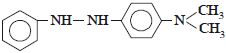
B
C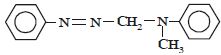
D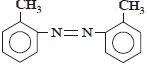
Solution
(B) $1$. The reaction of aniline $(A)$ with $NaNO_2$ and $HCl$ at $0-5^{\circ}C$ (cold conditions) produces benzene diazonium chloride $(B)$.
$2$. Benzene diazonium chloride $(B)$ undergoes an electrophilic aromatic substitution (coupling reaction) with $N,N$-dimethylaniline.
$3$. The coupling occurs at the para-position of the $N,N$-dimethylaniline ring to form $p$-dimethylaminoazobenzene,which is a yellow-coloured dye known as 'Butter yellow' $(C)$.
$4$. The structure of $C$ is $Ph-N=N-C_6H_4-N(CH_3)_2$.
$2$. Benzene diazonium chloride $(B)$ undergoes an electrophilic aromatic substitution (coupling reaction) with $N,N$-dimethylaniline.
$3$. The coupling occurs at the para-position of the $N,N$-dimethylaniline ring to form $p$-dimethylaminoazobenzene,which is a yellow-coloured dye known as 'Butter yellow' $(C)$.
$4$. The structure of $C$ is $Ph-N=N-C_6H_4-N(CH_3)_2$.
0 likesView Solution
Vedclass Products
For Students
Vedclass Test Series
Mock tests in real AIPMT style covering Chemistry with performance analysis. 5-day free trial.
Start Free TrialFor Teachers
Exam Paper Generator
Generate Set A/B/C/D Chemistry papers from 7.5L+ questions in 2 minutes. 3 chapters free.
Try FreeFor Institutes
Online Exam Module
Run live AIPMT mock exams with unlimited students, 360° analytics & white-label branding.
See DemoFrequently Asked Questions
How many Chemistry questions are in AIPMT 2004?
There are 84 Chemistry questions from the AIPMT 2004 paper on Vedclass, each with a detailed step-by-step solution in English.
Are AIPMT 2004 Chemistry solutions available in English?
Yes. All solutions on this page are in English. You can also switch to English or Hindi using the language buttons above the questions.
Can I practice AIPMT 2004 Chemistry as a timed test?
Yes. Use the Vedclass Test Series to attempt a full AIPMT mock test covering Chemistry with time limits and instant score analysis.
Can teachers create Chemistry papers from AIPMT previous year questions?
Yes. The Vedclass Exam Paper Generator lets teachers mix AIPMT Chemistry questions and generate Set A/B/C/D papers in minutes.
For Teachers & Institutes
Build a Custom Chemistry Paper
Pick AIPMT 2004 Chemistry questions, set difficulty, and generate Set A/B/C/D in 2 minutes.