
BiologyQ1–100 of 166 questions
Page 1 of 2 · English
1
BiologyMediumMCQAIPMT · 2004
Phenetic classification of organisms is based on
A
Dendrogram based on $DNA$ characteristics
B
Sexual characteristics
C
Observable characteristics of existing organisms
D
The ancestral lineage of existing organisms
Solution
(C) Phenetic classification,also known as numerical taxonomy,is based on the observable characteristics of existing organisms.
It involves the grouping of organisms based on the number of shared characteristics without considering their evolutionary history or ancestral lineage.
This method uses mathematical and statistical techniques to analyze the similarities and differences in morphological,physiological,and other observable traits.
It involves the grouping of organisms based on the number of shared characteristics without considering their evolutionary history or ancestral lineage.
This method uses mathematical and statistical techniques to analyze the similarities and differences in morphological,physiological,and other observable traits.
0 likesView Solution
2
BiologyEasyMCQAIPMT · 2004
Viruses that infect bacteria,multiply and cause their lysis,are called
A
Lytic
B
Lysogenic
C
Lysozymes
D
Lipolytic
Solution
(A) Viruses that infect bacteria are known as bacteriophages.
When these viruses enter the bacterial cell,they take over the host's machinery to replicate their own genetic material and synthesize viral proteins.
This process leads to the assembly of new viral particles.
Finally,the virus causes the rupture or lysis of the bacterial cell wall to release the progeny viruses.
Such viruses are referred to as $Lytic$ viruses because they complete the lytic cycle.
When these viruses enter the bacterial cell,they take over the host's machinery to replicate their own genetic material and synthesize viral proteins.
This process leads to the assembly of new viral particles.
Finally,the virus causes the rupture or lysis of the bacterial cell wall to release the progeny viruses.
Such viruses are referred to as $Lytic$ viruses because they complete the lytic cycle.
0 likesView Solution
3
BiologyMediumMCQAIPMT · 2004
When a fresh-water protozoan possessing a contractile vacuole is placed in a glass containing marine water,the vacuole will
A
Increase in size
B
Decrease in size
C
Increase in number
D
Disappear
Solution
(D) Fresh-water protozoans (like $Amoeba$) live in a hypotonic environment,where water constantly enters their body via osmosis. The contractile vacuole functions to expel this excess water to maintain osmotic balance.
When placed in marine water (a hypertonic environment),the external medium has a higher solute concentration than the cytoplasm of the protozoan.
Consequently,water moves out of the protozoan's body into the surrounding medium due to exosmosis.
Since there is no excess water entering the cell,the contractile vacuole is no longer required to function and eventually disappears.
When placed in marine water (a hypertonic environment),the external medium has a higher solute concentration than the cytoplasm of the protozoan.
Consequently,water moves out of the protozoan's body into the surrounding medium due to exosmosis.
Since there is no excess water entering the cell,the contractile vacuole is no longer required to function and eventually disappears.
0 likesView Solution
4
BiologyMediumMCQAIPMT · 2004
Lichens are a well-known combination of an alga and a fungus,where the fungus has:
A
$A$ parasitic relationship with the alga
B
$A$ symbiotic relationship with the alga
C
$A$ saprophytic relationship with the alga
D
An epiphytic relationship with the alga
Solution
(B) Lichens represent a symbiotic association,which is a mutually beneficial relationship between algae (phycobiont) and fungi (mycobiont).
In this association,the alga prepares food through photosynthesis,while the fungus provides protection,anchorage,and absorbs water and minerals for the alga.
Therefore,the fungus has a symbiotic relationship with the alga.
In this association,the alga prepares food through photosynthesis,while the fungus provides protection,anchorage,and absorbs water and minerals for the alga.
Therefore,the fungus has a symbiotic relationship with the alga.
0 likesView Solution
5
BiologyMediumMCQAIPMT · 2004
In oogamy,fertilization involves
A
$A$ large non-motile female gamete and a small non-motile male gamete
B
$A$ large motile female gamete and a small non-motile male gamete
C
$A$ small non-motile female gamete and a large motile male gamete
D
$A$ large non-motile female gamete and a small motile male gamete
Solution
(D) Oogamy is the most advanced type of sexual reproduction in algae.
In this process,the female gamete is large,non-motile,and stores food,which is referred to as the egg or oogonium.
The male gamete is small,motile,and does not store food,which is referred to as the antherozoid or sperm.
Therefore,fertilization involves the fusion of a large non-motile female gamete and a small motile male gamete.
In this process,the female gamete is large,non-motile,and stores food,which is referred to as the egg or oogonium.
The male gamete is small,motile,and does not store food,which is referred to as the antherozoid or sperm.
Therefore,fertilization involves the fusion of a large non-motile female gamete and a small motile male gamete.
0 likesView Solution
6
BiologyEasyMCQAIPMT · 2004
Which one of the following is a living fossil?
A
Saccharomyces
B
Spirogyra
C
Cycas
D
Moss
Solution
(C) living fossil is an organism that has remained unchanged over a long period of geological time and whose close relatives have become extinct.
$Cycas$ is considered a living fossil because it exhibits primitive characteristics and has a very restricted geographical distribution,making it a relic of the past.
$Cycas$ is considered a living fossil because it exhibits primitive characteristics and has a very restricted geographical distribution,making it a relic of the past.
0 likesView Solution
7
BiologyMediumMCQAIPMT · 2004
In $Arthropoda$,the head and thorax are often fused to form a $cephalothorax$. However,in which of the following classes is the body divided into head,thorax,and abdomen?
A
Crustacea
B
Arachnida and Crustacea
C
Myriapoda
D
Insecta
Solution
(D) The correct option is $D$.
In the phylum $Arthropoda$,the class $Insecta$ (or $Insecta$) is characterized by a body distinctly divided into three regions: head,thorax,and abdomen.
In contrast,many other arthropods,such as those in the class $Crustacea$ and $Arachnida$,exhibit fusion of the head and thorax to form a $cephalothorax$.
Therefore,$Insecta$ is the class where the body is clearly divided into these three distinct parts.
In the phylum $Arthropoda$,the class $Insecta$ (or $Insecta$) is characterized by a body distinctly divided into three regions: head,thorax,and abdomen.
In contrast,many other arthropods,such as those in the class $Crustacea$ and $Arachnida$,exhibit fusion of the head and thorax to form a $cephalothorax$.
Therefore,$Insecta$ is the class where the body is clearly divided into these three distinct parts.
0 likesView Solution
8
BiologyEasyMCQAIPMT · 2004
An animal phylum having radially symmetrical adults but bilateral symmetrical larvae is
A
Porifera
B
Coelenterata
C
Echinodermata
D
Annelida
Solution
(C) In the phylum $Echinodermata$,the adult organisms exhibit radial symmetry (specifically pentamerous radial symmetry).
However,the larval stages of these animals are bilaterally symmetrical.
This unique feature is a characteristic trait of the phylum $Echinodermata$.
However,the larval stages of these animals are bilaterally symmetrical.
This unique feature is a characteristic trait of the phylum $Echinodermata$.
0 likesView Solution
9
BiologyMediumMCQAIPMT · 2004
Which of the following is a very unique feature of the mammalian body?
A
Four-chambered heart
B
Rib cage
C
Homeothermy
D
Presence of diaphragm
Solution
(D) The presence of a $diaphragm$ is a unique characteristic of mammals. It is a muscular partition that separates the thoracic cavity from the abdominal cavity and plays a crucial role in the mechanism of breathing. While other vertebrates may have a four-chambered heart (like birds) or exhibit homeothermy (like birds), the $diaphragm$ is exclusively found in mammals.
0 likesView Solution
10
BiologyMediumMCQAIPMT · 2004
The edible part of a mango is:
A
Epicarp
B
Mesocarp
C
Endocarp
D
Receptacle
Solution
(B) The fruit of $Mangifera$ $indica$ (mango) is a drupe. In a drupe,the pericarp is well-differentiated into an outer thin epicarp,a middle fleshy edible mesocarp,and an inner stony hard endocarp. Therefore,the edible part of a mango is the mesocarp.
0 likesView Solution
11
BiologyMediumMCQAIPMT · 2004
Which of the following is a dry indehiscent fruit?
A
Caryopsis
B
Pod
C
Follicle
D
Lomentum
Solution
(A) dry indehiscent fruit is a fruit that does not split open at maturity to release its seeds.
$A$. $Caryopsis$ is a type of dry indehiscent fruit where the pericarp is fused with the seed coat (e.g.,wheat,maize).
$B$. $Pod$ (legume) is a dry dehiscent fruit that splits along two sutures.
$C$. $Follicle$ is a dry dehiscent fruit that splits along one suture.
$D$. $Lomentum$ is a type of dry dehiscent fruit that breaks into one-seeded segments.
Therefore,the correct answer is $Caryopsis$.
$A$. $Caryopsis$ is a type of dry indehiscent fruit where the pericarp is fused with the seed coat (e.g.,wheat,maize).
$B$. $Pod$ (legume) is a dry dehiscent fruit that splits along two sutures.
$C$. $Follicle$ is a dry dehiscent fruit that splits along one suture.
$D$. $Lomentum$ is a type of dry dehiscent fruit that breaks into one-seeded segments.
Therefore,the correct answer is $Caryopsis$.
0 likesView Solution
12
BiologyMediumMCQAIPMT · 2004
In a longitudinal section of a root, starting from the tip upward, the four zones occur in the following order:
A
Cell division, cell enlargement, cell maturation, root cap
B
Cell division, cell maturation, cell enlargement, root cap
C
Root cap, cell division, cell enlargement, cell maturation
D
Root cap, cell division, cell maturation, cell enlargement
Solution
(C) The root tip is covered by a protective structure called the $Root \ cap$.
Just behind the root cap is the $Region \ of \ meristematic \ activity$ (or $Zone \ of \ cell \ division$), where cells divide rapidly.
Following this is the $Region \ of \ elongation$ (or $Zone \ of \ cell \ enlargement$), where cells increase in size.
Finally, the $Region \ of \ maturation$ (or $Zone \ of \ cell \ differentiation$) is located furthest from the tip, where cells differentiate and mature into specialized tissues.
Therefore, the correct order from the tip upward is: $Root \ cap \rightarrow Cell \ division \rightarrow Cell \ enlargement \rightarrow Cell \ maturation$.
Just behind the root cap is the $Region \ of \ meristematic \ activity$ (or $Zone \ of \ cell \ division$), where cells divide rapidly.
Following this is the $Region \ of \ elongation$ (or $Zone \ of \ cell \ enlargement$), where cells increase in size.
Finally, the $Region \ of \ maturation$ (or $Zone \ of \ cell \ differentiation$) is located furthest from the tip, where cells differentiate and mature into specialized tissues.
Therefore, the correct order from the tip upward is: $Root \ cap \rightarrow Cell \ division \rightarrow Cell \ enlargement \rightarrow Cell \ maturation$.
0 likesView Solution
13
BiologyMediumMCQAIPMT · 2004
In chloroplasts,chlorophyll is present in the
A
Thylakoids
B
Stroma
C
Outer membrane
D
Inner membrane
Solution
(A) Chloroplasts are double-membrane organelles found in plant cells.
Inside the chloroplast,there is a system of flattened,sac-like structures called thylakoids.
These thylakoids are arranged in stacks known as grana.
The membranes of the thylakoids contain chlorophyll pigments,which are essential for capturing light energy during the process of photosynthesis.
Therefore,chlorophyll is located in the thylakoids.
Inside the chloroplast,there is a system of flattened,sac-like structures called thylakoids.
These thylakoids are arranged in stacks known as grana.
The membranes of the thylakoids contain chlorophyll pigments,which are essential for capturing light energy during the process of photosynthesis.
Therefore,chlorophyll is located in the thylakoids.
0 likesView Solution
14
BiologyMediumMCQAIPMT · 2004
In which one of the following enzymes is copper necessarily associated as an activator?
A
Lactic dehydrogenase
B
Tyrosinase
C
Carbonic anhydrase
D
Tryptophanase
Solution
(B) Enzymes often require metal ions as cofactors to function efficiently.
Copper $(Cu^{2+})$ acts as a prosthetic group or activator for several enzymes, including $Tyrosinase$ (also known as polyphenol oxidase), which is involved in the synthesis of melanin.
$Lactic dehydrogenase$ typically requires $Zn^{2+}$ or $NAD^+$.
$Carbonic anhydrase$ requires $Zn^{2+}$.
$Tryptophanase$ requires $Pyridoxal phosphate$ $(PLP)$ as a coenzyme.
Therefore, the correct option is $B$.
Copper $(Cu^{2+})$ acts as a prosthetic group or activator for several enzymes, including $Tyrosinase$ (also known as polyphenol oxidase), which is involved in the synthesis of melanin.
$Lactic dehydrogenase$ typically requires $Zn^{2+}$ or $NAD^+$.
$Carbonic anhydrase$ requires $Zn^{2+}$.
$Tryptophanase$ requires $Pyridoxal phosphate$ $(PLP)$ as a coenzyme.
Therefore, the correct option is $B$.
0 likesView Solution
15
BiologyMediumMCQAIPMT · 2004
Fat is hydrolysed by enzyme lipase to yield
A
Fatty acid and amino acids
B
Glycerol and fatty acids
C
Glycerine and water
D
Glycerol and amino acids
Solution
(B) Lipase is an enzyme that catalyzes the hydrolysis of fats (triglycerides) into their constituent components.
During the process of digestion,lipase breaks down a triglyceride molecule into one molecule of glycerol and three molecules of fatty acids.
Therefore,the correct products of fat hydrolysis by lipase are glycerol and fatty acids.
During the process of digestion,lipase breaks down a triglyceride molecule into one molecule of glycerol and three molecules of fatty acids.
Therefore,the correct products of fat hydrolysis by lipase are glycerol and fatty acids.
0 likesView Solution
16
BiologyMediumMCQAIPMT · 2004
The best stage to count the number of chromosomes during mitosis is or the structure of chromosomes can be best seen at:
A
Prophase
B
Metaphase
C
Anaphase
D
Telophase
Solution
(B) The correct answer is $B$ (Metaphase).
During the $Metaphase$ stage of mitosis,the chromosomes are highly condensed and aligned at the equatorial plate (metaphase plate).
This maximum condensation makes them clearly visible under a microscope,allowing for the accurate counting and study of their morphology,such as the position of the centromere.
During the $Metaphase$ stage of mitosis,the chromosomes are highly condensed and aligned at the equatorial plate (metaphase plate).
This maximum condensation makes them clearly visible under a microscope,allowing for the accurate counting and study of their morphology,such as the position of the centromere.
0 likesView Solution
17
BiologyMediumMCQAIPMT · 2004
In the somatic cell cycle:
A
$A$ short interphase is followed by a long mitotic phase
B
$G_2$ phase follows mitotic phase
C
In $G_1$ phase $DNA$ content is double the amount of $DNA$ present in the original cell
D
$DNA$ replication takes place in $S$-phase
Solution
(D) The correct answer is $D$. In the somatic cell cycle,the interphase is divided into $G_1$,$S$,and $G_2$ phases. The $S$-phase (Synthesis phase) is the stage where $DNA$ replication occurs,resulting in the duplication of the $DNA$ content of the cell. $G_1$ phase precedes $S$-phase,and $G_2$ phase follows $S$-phase but precedes the mitotic phase ($M$-phase).
0 likesView Solution
18
BiologyEasyMCQAIPMT · 2004
The most abundant element present in plants is
A
Manganese
B
Iron
C
Carbon
D
Nitrogen
Solution
(C) The dry weight of plants is primarily composed of organic compounds. Carbon,Hydrogen,and Oxygen are the most abundant elements in plants,as they form the structural framework of all biological molecules like carbohydrates,proteins,lipids,and nucleic acids. Among the options provided,Carbon is the most abundant element.
0 likesView Solution
19
BiologyMediumMCQAIPMT · 2004
Plants adapted to low light intensity have
A
More extended root system
B
Leaves modified to spines
C
Higher rate of $CO_2$ fixation than the sun plants
D
Larger photosynthetic unit size than the sun plants
Solution
(D) The correct option is $D$.
The proteinaceous photosynthetic unit $(PSU)$ size increases as light levels decline.
At lower light levels,chloroplasts have a larger $PSU$ to increase the probability that a photon will strike the chlorophyll antenna.
Therefore,plants adapted to low light intensity have a larger photosynthetic unit size compared to sun plants.
Plants adapted to low light intensity do not have a higher rate of $CO_2$ fixation,nor do they typically have more extended root systems or leaves modified into spines (which are adaptations for arid environments).
Thus,the correct answer is option $D$.
The proteinaceous photosynthetic unit $(PSU)$ size increases as light levels decline.
At lower light levels,chloroplasts have a larger $PSU$ to increase the probability that a photon will strike the chlorophyll antenna.
Therefore,plants adapted to low light intensity have a larger photosynthetic unit size compared to sun plants.
Plants adapted to low light intensity do not have a higher rate of $CO_2$ fixation,nor do they typically have more extended root systems or leaves modified into spines (which are adaptations for arid environments).
Thus,the correct answer is option $D$.
0 likesView Solution
20
BiologyEasyMCQAIPMT · 2004
Photosynthetically active radiation $(PAR)$ represents the following range of wavelength:
A
$340-450 \,nm$
B
$400-700 \,nm$
C
$500-600 \,nm$
D
$450-950 \,nm$
Solution
(B) Photosynthetically active radiation $(PAR)$ is the spectral range of solar radiation from $400$ to $700 \,nm$ that photosynthetic organisms are able to use in the process of photosynthesis.
This range corresponds to the visible light spectrum,which is essential for the excitation of chlorophyll molecules to initiate the light-dependent reactions.
This range corresponds to the visible light spectrum,which is essential for the excitation of chlorophyll molecules to initiate the light-dependent reactions.
0 likesView Solution
21
BiologyMediumMCQAIPMT · 2004
In glycolysis,during oxidation,electrons are removed by:
A
$NAD^+$
B
Molecular oxygen
C
$ATP$
D
Glyceraldehyde$-3-$phosphate
Solution
(A) During the process of glycolysis,specifically in the step where glyceraldehyde$-3-$phosphate is converted to $1,3$-bisphosphoglycerate,the enzyme glyceraldehyde$-3-$phosphate dehydrogenase catalyzes the oxidation of the substrate.
In this reaction,electrons and protons are removed from glyceraldehyde$-3-$phosphate and are accepted by the coenzyme $NAD^+$,which gets reduced to $NADH + H^+$.
Therefore,$NAD^+$ acts as the electron acceptor during this oxidation step.
In this reaction,electrons and protons are removed from glyceraldehyde$-3-$phosphate and are accepted by the coenzyme $NAD^+$,which gets reduced to $NADH + H^+$.
Therefore,$NAD^+$ acts as the electron acceptor during this oxidation step.
0 likesView Solution
22
BiologyMediumMCQAIPMT · 2004
Cell elongation in the internodal region takes place due to
A
Gibberellins
B
Ethylene
C
Cytokinins
D
Indole acetic acid
Solution
(A) The $Gibberellins$ are plant growth regulators that primarily induce the elongation of internodes.
This process occurs because $Gibberellins$ stimulate both rapid cell division and cell elongation in the stem tissues.
Therefore,they are responsible for the increase in stem length,particularly in plants that exhibit rosette growth habits.
This process occurs because $Gibberellins$ stimulate both rapid cell division and cell elongation in the stem tissues.
Therefore,they are responsible for the increase in stem length,particularly in plants that exhibit rosette growth habits.
0 likesView Solution
23
BiologyMediumMCQAIPMT · 2004
The maximum growth rate occurs in
A
Lag phase
B
Exponential phase
C
Stationary phase
D
Senescent phase
Solution
(B) The growth curve of a plant or population typically follows a sigmoid pattern.
$1$. The $Lag$ phase is the initial period where growth is slow as the organism adapts to the environment.
$2$. The $Exponential$ phase (or $Log$ phase) is characterized by rapid cell division and expansion,leading to the maximum growth rate.
$3$. The $Stationary$ phase occurs when growth slows down due to limited resources.
$4$. The $Senescent$ phase is the final stage where growth declines and the organism ages.
Therefore,the maximum growth rate is observed during the $Exponential$ phase.
$1$. The $Lag$ phase is the initial period where growth is slow as the organism adapts to the environment.
$2$. The $Exponential$ phase (or $Log$ phase) is characterized by rapid cell division and expansion,leading to the maximum growth rate.
$3$. The $Stationary$ phase occurs when growth slows down due to limited resources.
$4$. The $Senescent$ phase is the final stage where growth declines and the organism ages.
Therefore,the maximum growth rate is observed during the $Exponential$ phase.
0 likesView Solution
24
BiologyMediumMCQAIPMT · 2004
One set of a plant was grown at $12$ hours day and $12$ hours night period cycles and it flowered,while in the other set,the night phase was interrupted by a flash of light and it did not produce flowers. Under which one of the following categories will you place this plant?
A
Day neutral
B
Short day
C
Long day
D
Darkness neutral
Solution
(B) The plant flowered under a $12$ hour day and $12$ hour night cycle.
When the night period was interrupted by a flash of light,the plant failed to flower.
This indicates that the plant requires a long,uninterrupted dark period for flowering.
Plants that require a critical dark period to flower and are inhibited by light interruption during the night are classified as Short Day Plants $(SDP)$.
When the night period was interrupted by a flash of light,the plant failed to flower.
This indicates that the plant requires a long,uninterrupted dark period for flowering.
Plants that require a critical dark period to flower and are inhibited by light interruption during the night are classified as Short Day Plants $(SDP)$.
0 likesView Solution
25
BiologyEasyMCQAIPMT · 2004
The duodenum has characteristic Brunner's glands which secrete two hormones called:
A
Prolactin,parathormone
B
Estradiol,progesterone
C
Kinase,estrogen
D
Secretin,cholecystokinin
Solution
(D) Brunner's glands are located in the submucosa of the duodenum.
These glands secrete an alkaline mucus that helps protect the duodenal wall from acidic chyme.
Additionally,the cells of the duodenal mucosa secrete hormones such as $Secretin$ and $Cholecystokinin$ $(CCK)$ in response to the presence of chyme.
Therefore,the correct option is $D$.
These glands secrete an alkaline mucus that helps protect the duodenal wall from acidic chyme.
Additionally,the cells of the duodenal mucosa secrete hormones such as $Secretin$ and $Cholecystokinin$ $(CCK)$ in response to the presence of chyme.
Therefore,the correct option is $D$.
0 likesView Solution
26
BiologyEasyMCQAIPMT · 2004
Which one of the following is the correct matching of a vitamin,its nature,and its deficiency disease?
A
Vitamin $A$ - Fat-soluble - Beri-beri
B
Vitamin $K$ - Water-soluble - Pellagra
C
Vitamin $A$ - Fat-soluble - Night blindness
D
Vitamin $K$ - Fat-soluble - Beri-beri
Solution
(C) The correct matching is Vitamin $A$ - Fat-soluble - Night blindness.
Vitamin $A$ (Retinol) is a fat-soluble vitamin.
Deficiency of Vitamin $A$ leads to night blindness (nyctalopia).
Vitamin $B_1$ (Thiamine) deficiency causes Beri-beri.
Vitamin $B_3$ (Niacin) deficiency causes Pellagra.
Vitamin $K$ is fat-soluble but its deficiency primarily affects blood clotting,not Beri-beri.
Vitamin $A$ (Retinol) is a fat-soluble vitamin.
Deficiency of Vitamin $A$ leads to night blindness (nyctalopia).
Vitamin $B_1$ (Thiamine) deficiency causes Beri-beri.
Vitamin $B_3$ (Niacin) deficiency causes Pellagra.
Vitamin $K$ is fat-soluble but its deficiency primarily affects blood clotting,not Beri-beri.
0 likesView Solution
27
BiologyMediumMCQAIPMT · 2004
Which one of the following pairs is not correctly matched?
A
Vitamin $B_1$ - Beri-beri
B
Vitamin $B_5$ - Pellagra
C
Vitamin $B_{12}$ - Pernicious anaemia
D
Vitamin $B_6$ - Loss of appetite
Solution
(B) The correct matching is as follows:
$1$. Vitamin $B_1$ (Thiamine) deficiency causes Beri-beri.
$2$. Vitamin $B_5$ (Pantothenic acid) deficiency causes burning feet syndrome,not Pellagra. Pellagra is caused by the deficiency of Vitamin $B_3$ (Niacin).
$3$. Vitamin $B_{12}$ (Cyanocobalamin) deficiency causes Pernicious anaemia.
$4$. Vitamin $B_6$ (Pyridoxine) deficiency can lead to dermatitis,convulsions,and loss of appetite.
Therefore,the pair Vitamin $B_5$ - Pellagra is incorrectly matched.
$1$. Vitamin $B_1$ (Thiamine) deficiency causes Beri-beri.
$2$. Vitamin $B_5$ (Pantothenic acid) deficiency causes burning feet syndrome,not Pellagra. Pellagra is caused by the deficiency of Vitamin $B_3$ (Niacin).
$3$. Vitamin $B_{12}$ (Cyanocobalamin) deficiency causes Pernicious anaemia.
$4$. Vitamin $B_6$ (Pyridoxine) deficiency can lead to dermatitis,convulsions,and loss of appetite.
Therefore,the pair Vitamin $B_5$ - Pellagra is incorrectly matched.
0 likesView Solution
28
BiologyMediumMCQAIPMT · 2004
The cardiac pacemaker in a patient fails to function normally. The doctors find that an artificial pacemaker is to be grafted in him. It is likely that it will be grafted at the site of
A
Sinuatrial node
B
Atrioventricular node
C
Atrioventricular bundle
D
Purkinje system
Solution
(A) The $Sinuatrial$ $node$ $(SAN)$ is known as the natural pacemaker of the heart because it generates the rhythmic contractile impulses that initiate the heartbeat. When the natural pacemaker fails to function normally,an artificial pacemaker is implanted to maintain the heart's rhythm. This device is typically grafted at the site of the $Sinuatrial$ $node$ to effectively stimulate the heart muscle and restore normal cardiac function.
0 likesView Solution
29
BiologyEasyMCQAIPMT · 2004
Uricotelism is found in
A
Birds,reptiles and insects
B
Frogs and toads
C
Mammals and birds
D
Fishes and fresh water protozoans
Solution
(A) Uricotelism is the process of excreting nitrogenous waste in the form of uric acid.
This method is primarily an adaptation to conserve water,as uric acid is the least toxic and requires very little water for its elimination.
Organisms that exhibit uricotelism include birds,land reptiles,and insects.
Therefore,the correct option is $A$.
This method is primarily an adaptation to conserve water,as uric acid is the least toxic and requires very little water for its elimination.
Organisms that exhibit uricotelism include birds,land reptiles,and insects.
Therefore,the correct option is $A$.
0 likesView Solution
30
BiologyMediumMCQAIPMT · 2004
Terrestrial animals must be able to:
A
Actively pump salts out through the skin
B
Excrete large amounts of salts in urine
C
Excrete large amounts of water in urine
D
Conserve water
Solution
(D) Terrestrial animals face the constant challenge of water loss due to evaporation and metabolic processes.
To survive in environments with limited water access,these animals have evolved mechanisms to conserve water.
Uric acid is the least soluble nitrogenous waste,and $1 \,g$ of uric acid requires only $10 \,ml$ of water for excretion.
Therefore,uricotelism is a significant evolutionary adaptation for terrestrial life,allowing animals to minimize water loss during the excretion of nitrogenous waste.
To survive in environments with limited water access,these animals have evolved mechanisms to conserve water.
Uric acid is the least soluble nitrogenous waste,and $1 \,g$ of uric acid requires only $10 \,ml$ of water for excretion.
Therefore,uricotelism is a significant evolutionary adaptation for terrestrial life,allowing animals to minimize water loss during the excretion of nitrogenous waste.
0 likesView Solution
31
BiologyMediumMCQAIPMT · 2004
$ATPase$ enzyme needed for muscle contraction is located in
A
Myosin
B
Actin
C
Actinin
D
Troponin
Solution
(A) The $ATPase$ enzyme is located in the head of the $Myosin$ filament.
During muscle contraction,the $Myosin$ head binds to the active sites on the $Actin$ filament to form a cross-bridge.
The $Myosin$ head contains an $ATPase$ enzyme that hydrolyzes $ATP$ into $ADP$ and inorganic phosphate $(Pi)$,releasing the energy required for the power stroke,which causes the sliding of $Actin$ filaments over $Myosin$ filaments.
During muscle contraction,the $Myosin$ head binds to the active sites on the $Actin$ filament to form a cross-bridge.
The $Myosin$ head contains an $ATPase$ enzyme that hydrolyzes $ATP$ into $ADP$ and inorganic phosphate $(Pi)$,releasing the energy required for the power stroke,which causes the sliding of $Actin$ filaments over $Myosin$ filaments.
0 likesView Solution
32
BiologyMediumMCQAIPMT · 2004
Injury to the $Vagus$ nerve ($CN$ $X$) in humans is not likely to affect which of the following?
A
Pancreatic secretion
B
Cardiac movements
C
Tongue movements
D
Gastrointestinal movements
Solution
(C) The $Vagus$ nerve ($CN$ $X$) is a major component of the parasympathetic nervous system and regulates visceral functions,including heart rate ($Cardiac$ $movements$),gastrointestinal motility ($Gastrointestinal$ $movements$),and glandular secretions such as $Pancreatic$ $secretion$.
The $Tongue$ $movements$ are primarily controlled by the $Hypoglossal$ nerve ($CN$ $XII$).
Therefore,injury to the $Vagus$ nerve would not affect the movements of the tongue.
The $Tongue$ $movements$ are primarily controlled by the $Hypoglossal$ nerve ($CN$ $XII$).
Therefore,injury to the $Vagus$ nerve would not affect the movements of the tongue.
0 likesView Solution
33
BiologyMediumMCQAIPMT · 2004
Hormones may be:
A
Amino acid derivatives
B
Peptides
C
Steroids
D
All the above
Solution
(D) Hormones are chemically diverse molecules. Based on their chemical nature,they can be classified as:
$1$. Peptide,polypeptide,or protein hormones (e.g.,insulin,glucagon,pituitary hormones).
$2$. Steroids (e.g.,cortisol,testosterone,estradiol,progesterone).
$3$. Iodothyronines (thyroid hormones).
$4$. Amino acid derivatives (e.g.,epinephrine).
Therefore,all the given options are correct.
$1$. Peptide,polypeptide,or protein hormones (e.g.,insulin,glucagon,pituitary hormones).
$2$. Steroids (e.g.,cortisol,testosterone,estradiol,progesterone).
$3$. Iodothyronines (thyroid hormones).
$4$. Amino acid derivatives (e.g.,epinephrine).
Therefore,all the given options are correct.
0 likesView Solution
34
BiologyMediumMCQAIPMT · 2004
Crossing over that results in genetic recombination in higher organisms occurs between
A
Two daughter nuclei
B
Two different bivalents
C
Sister chromatids of a bivalent
D
Non-sister chromatids of a bivalent
Solution
(D) Crossing over is a biological process that occurs during the pachytene stage of prophase-$I$ of meiosis.
It involves the exchange of genetic material between non-sister chromatids of homologous chromosomes.
This process leads to genetic recombination,which increases genetic diversity in offspring.
Therefore,the correct answer is non-sister chromatids of a bivalent.
It involves the exchange of genetic material between non-sister chromatids of homologous chromosomes.
This process leads to genetic recombination,which increases genetic diversity in offspring.
Therefore,the correct answer is non-sister chromatids of a bivalent.
0 likesView Solution
35
BiologyMediumMCQAIPMT · 2004
You are required to draw blood from a patient and to keep it in a test tube for the analysis of blood corpuscles and plasma. You are provided with the following four types of test tubes. Which of them will you $NOT$ use for this purpose?
A
Test tube containing heparin
B
Test tube containing sodium oxalate
C
Test tube containing calcium bicarbonate
D
Chilled test tube
Solution
(C) To analyze blood corpuscles and plasma,the blood must remain in a liquid state (prevented from clotting).
$1$. Heparin is a natural anticoagulant that prevents blood clotting by inhibiting thrombin.
$2$. Sodium oxalate acts as an anticoagulant by chelating calcium ions,which are essential for the coagulation cascade.
$3$. Calcium bicarbonate is a source of calcium ions. Calcium ions $(Ca^{2+})$ are critical factors in the blood clotting process. Adding calcium to a blood sample will promote or accelerate clotting,making it impossible to separate and analyze the plasma and corpuscles effectively.
$4$. Chilled test tubes are often used to slow down metabolic processes and enzymatic reactions,including the clotting cascade,and are acceptable for short-term storage.
Therefore,the test tube containing calcium bicarbonate should not be used.
$1$. Heparin is a natural anticoagulant that prevents blood clotting by inhibiting thrombin.
$2$. Sodium oxalate acts as an anticoagulant by chelating calcium ions,which are essential for the coagulation cascade.
$3$. Calcium bicarbonate is a source of calcium ions. Calcium ions $(Ca^{2+})$ are critical factors in the blood clotting process. Adding calcium to a blood sample will promote or accelerate clotting,making it impossible to separate and analyze the plasma and corpuscles effectively.
$4$. Chilled test tubes are often used to slow down metabolic processes and enzymatic reactions,including the clotting cascade,and are acceptable for short-term storage.
Therefore,the test tube containing calcium bicarbonate should not be used.
0 likesView Solution
36
BiologyMediumMCQAIPMT · 2004
Flagella of prokaryotic and eukaryotic cells differ in
A
Microtubular organization and type of movement
B
Microtubular organization and function
C
Type of movement and placement in cell
D
Location in cell and mode of functioning
Solution
(A) Prokaryotic flagella are composed of the protein $flagellin$ and lack a $9+2$ microtubular arrangement. They move in a rotary motion.
Eukaryotic flagella are composed of the protein $tubulin$ and possess a characteristic $9+2$ microtubular organization. They exhibit a whip-like or bending motion.
Therefore,they differ primarily in their microtubular organization and their type of movement.
Eukaryotic flagella are composed of the protein $tubulin$ and possess a characteristic $9+2$ microtubular organization. They exhibit a whip-like or bending motion.
Therefore,they differ primarily in their microtubular organization and their type of movement.
0 likesView Solution
37
BiologyMediumMCQAIPMT · 2004
In which one of the following pairs is the specific characteristic of a soil not correctly matched?
A
Chernozems - Richest soil in the world
B
Black soil - Rich in calcium carbonate
C
Laterite - Contains aluminium compound
D
Terra rossa - Most suitable for roses
Solution
(D) The correct answer is $D$.
$A$. Chernozems are known as the richest soils in the world due to their high humus content.
$B$. Black soil (Regur) is typically rich in calcium carbonate,magnesium,potash,and lime.
$C$. Laterite soils are formed under high temperature and heavy rainfall conditions and are rich in iron and aluminium compounds.
$D$. Terra rossa is a reddish clay soil produced by the weathering of limestone; it is not specifically known for being the most suitable for roses. Therefore,this pair is incorrectly matched.
$A$. Chernozems are known as the richest soils in the world due to their high humus content.
$B$. Black soil (Regur) is typically rich in calcium carbonate,magnesium,potash,and lime.
$C$. Laterite soils are formed under high temperature and heavy rainfall conditions and are rich in iron and aluminium compounds.
$D$. Terra rossa is a reddish clay soil produced by the weathering of limestone; it is not specifically known for being the most suitable for roses. Therefore,this pair is incorrectly matched.
0 likesView Solution
38
BiologyEasyMCQAIPMT · 2004
The viruses that infect bacteria,multiply within them,and cause their lysis are called .........
A
Lysozyme
B
Lytic
C
Lipolytic
D
Lysogenic
Solution
(B) Viruses that infect bacteria are known as bacteriophages. When these viruses enter a bacterial cell,they take over the host's machinery to replicate. In the lytic cycle,the virus multiplies rapidly and eventually causes the host cell to burst or undergo lysis,releasing the new viral particles. Therefore,these are referred to as lytic viruses.
0 likesView Solution
39
BiologyMediumMCQAIPMT · 2004
When a freshwater protozoan possessing a contractile vacuole is placed in a glass containing seawater,the vacuole will:
A
Increase in number
B
Disappear
C
Increase in size
D
Decrease in size
Solution
(B) Freshwater protozoans like $Amoeba$ possess a contractile vacuole to perform osmoregulation,which involves expelling excess water that enters the cell due to the hypotonic environment.
When placed in seawater,which is a hypertonic solution,the external environment has a higher solute concentration than the cytoplasm of the protozoan.
Due to exosmosis,water moves out of the cell into the surrounding seawater.
As a result,there is no excess water to be expelled,and the contractile vacuole,which functions to remove water,becomes inactive and eventually disappears.
When placed in seawater,which is a hypertonic solution,the external environment has a higher solute concentration than the cytoplasm of the protozoan.
Due to exosmosis,water moves out of the cell into the surrounding seawater.
As a result,there is no excess water to be expelled,and the contractile vacuole,which functions to remove water,becomes inactive and eventually disappears.
0 likesView Solution
40
BiologyEasyMCQAIPMT · 2004
Lichens are a well-known association between algae and fungi. In this association,the fungus has a/an ..... relationship with the algae.
A
Saprophytic relationship with algae
B
Epiphytic relationship with algae
C
Parasitic relationship with algae
D
Symbiotic relationship with algae
Solution
(D) Lichens represent a symbiotic association between algae (phycobiont) and fungi (mycobiont).
In this relationship,the fungus provides protection,anchorage,and absorption of minerals and water for the algae.
In return,the algae provide food (carbohydrates) produced through photosynthesis to the fungus.
Since both organisms benefit from this association,it is classified as a symbiotic relationship.
In this relationship,the fungus provides protection,anchorage,and absorption of minerals and water for the algae.
In return,the algae provide food (carbohydrates) produced through photosynthesis to the fungus.
Since both organisms benefit from this association,it is classified as a symbiotic relationship.
0 likesView Solution
41
BiologyMediumMCQAIPMT · 2004
In lichens,a symbiotic association is found between algae and fungi. The fungus . . . . . . .
A
provides support,protection,and absorption for the algae.
B
provides food for the algae.
C
fixes atmospheric nitrogen for the algae.
D
releases oxygen for the algae.
Solution
(A) Lichens represent a symbiotic relationship between algae $(phycobiont)$ and fungi $(mycobiont)$.
In this association,the algal component is responsible for photosynthesis,providing food for the fungus.
Conversely,the fungal component provides protection,anchorage (support),and absorbs water and mineral nutrients from the environment for the algae.
Therefore,the fungus provides support,protection,and absorption for the algae.
In this association,the algal component is responsible for photosynthesis,providing food for the fungus.
Conversely,the fungal component provides protection,anchorage (support),and absorbs water and mineral nutrients from the environment for the algae.
Therefore,the fungus provides support,protection,and absorption for the algae.
0 likesView Solution
42
BiologyMediumMCQAIPMT · 2004
Angiosperms are dominant on the land surface due to their $........$.
A
Adaptability in diverse habitats
B
Property of producing a very large number of seeds
C
Nature of some pollination
D
Domination by humans
Solution
(A) Angiosperms (flowering plants) are the most successful and dominant group of plants on Earth. Their dominance is primarily attributed to their remarkable $Adaptability$ in diverse habitats,ranging from polar regions to tropical rainforests and deserts. While they also produce many seeds and have efficient pollination mechanisms,their ability to survive and thrive in varied environmental conditions is the fundamental reason for their widespread distribution and dominance.
0 likesView Solution
43
BiologyEasyMCQAIPMT · 2004
The free-living,nitrogen-fixing cyanobacterium which also forms a symbiotic association with the water fern $Azolla$ is.......
A
Tolypothrix
B
Chlorella
C
Nostoc
D
Anabaena
Solution
(D) The cyanobacterium $Anabaena$ $azollae$ is a free-living nitrogen-fixing organism.
It also forms a symbiotic relationship with the water fern $Azolla$ by residing in the leaf cavities of the fern.
In this association,$Anabaena$ provides fixed nitrogen to the fern,while the fern provides shelter and nutrients to the cyanobacterium.
It also forms a symbiotic relationship with the water fern $Azolla$ by residing in the leaf cavities of the fern.
In this association,$Anabaena$ provides fixed nitrogen to the fern,while the fern provides shelter and nutrients to the cyanobacterium.
0 likesView Solution
44
BiologyEasyMCQAIPMT · 2004
Which of the following is a living fossil?
A
Cycas
B
Algae
C
Saccharomyces
D
Spirogyra
Solution
(A) living fossil is an extant taxon that closely resembles related species known only from the fossil record.
Among the given options,$Cycas$ is considered a living fossil because it has remained morphologically unchanged over millions of years and represents an ancient group of gymnosperms.
$Algae$ is a broad group of photosynthetic organisms,$Saccharomyces$ is a yeast (fungus),and $Spirogyra$ is a green alga; none of these are classified as living fossils.
Among the given options,$Cycas$ is considered a living fossil because it has remained morphologically unchanged over millions of years and represents an ancient group of gymnosperms.
$Algae$ is a broad group of photosynthetic organisms,$Saccharomyces$ is a yeast (fungus),and $Spirogyra$ is a green alga; none of these are classified as living fossils.
0 likesView Solution
45
BiologyMediumMCQAIPMT · 2004
What is common among whales,bats,and rats?
A
Absence of neck
B
Muscular diaphragm between thorax and abdomen
C
Extra-abdominal testes to protect from high body temperature
D
Presence of external ears
Solution
(B) Whales,bats,and rats are all members of the class $Mammalia$.
One of the defining characteristics of mammals is the presence of a muscular diaphragm that separates the thoracic cavity from the abdominal cavity.
This structure plays a crucial role in respiration.
While some mammals have external ears (pinnae),not all do (e.g.,whales have internal ear openings).
Extra-abdominal testes are not a universal feature of all mammals (e.g.,in whales,testes are abdominal).
Therefore,the presence of a muscular diaphragm is the most accurate common feature among these organisms.
One of the defining characteristics of mammals is the presence of a muscular diaphragm that separates the thoracic cavity from the abdominal cavity.
This structure plays a crucial role in respiration.
While some mammals have external ears (pinnae),not all do (e.g.,whales have internal ear openings).
Extra-abdominal testes are not a universal feature of all mammals (e.g.,in whales,testes are abdominal).
Therefore,the presence of a muscular diaphragm is the most accurate common feature among these organisms.
0 likesView Solution
46
BiologyMediumMCQAIPMT · 2004
Terrestrial animals are efficient in:
A
Excreting large amounts of water in urine
B
Conserving water
C
Actively excreting salts through the skin
D
Excreting large amounts of salts in urine
Solution
(B) Terrestrial animals face the constant challenge of water loss due to evaporation and metabolic processes. To survive in dry environments,they have evolved physiological adaptations to conserve water. The primary mechanism for this is the production of concentrated urine by the kidneys,which minimizes water loss while excreting nitrogenous wastes. Therefore,terrestrial animals are highly efficient in conserving water.
0 likesView Solution
47
BiologyMediumMCQAIPMT · 2004
The edible part of the mango is . . . . . . .
A
Mesocarp
B
Epicarp
C
Endocarp
D
Epidermis
Solution
(A) In mango $(Mangifera \text{ } indica)$, the fruit is a drupe.
It develops from a monocarpellary superior ovary and is one-seeded.
The fruit wall is differentiated into three layers:
$1$. The outer thin epicarp (skin).
$2$. The middle fleshy, edible mesocarp.
$3$. The inner stony hard endocarp.
Therefore, the edible part of the mango is the mesocarp.
It develops from a monocarpellary superior ovary and is one-seeded.
The fruit wall is differentiated into three layers:
$1$. The outer thin epicarp (skin).
$2$. The middle fleshy, edible mesocarp.
$3$. The inner stony hard endocarp.
Therefore, the edible part of the mango is the mesocarp.
0 likesView Solution
48
BiologyMediumMCQAIPMT · 2004
In a longitudinal section of a root, starting from the tip and moving upwards, the four regions are arranged in which order?
A
Root cap, Region of meristematic activity, Region of elongation, Region of maturation
B
Root cap, Region of meristematic activity, Region of maturation, Region of elongation
C
Region of meristematic activity, Region of elongation, Region of maturation, Root cap
D
Region of meristematic activity, Region of maturation, Region of elongation, Root cap
Solution
(A) The root is covered at the apex by a thimble-like structure called the $Root cap$.
Just above the $Root cap$ is the $Region of meristematic activity$, where cells divide repeatedly.
The cells proximal to this region undergo rapid elongation and enlargement and are referred to as the $Region of elongation$.
The cells of the elongation zone gradually differentiate and mature, forming the $Region of maturation$.
Therefore, the correct sequence from the tip upwards is: $Root cap \rightarrow \text{Region of meristematic activity} \rightarrow \text{Region of elongation} \rightarrow \text{Region of maturation}$.
Just above the $Root cap$ is the $Region of meristematic activity$, where cells divide repeatedly.
The cells proximal to this region undergo rapid elongation and enlargement and are referred to as the $Region of elongation$.
The cells of the elongation zone gradually differentiate and mature, forming the $Region of maturation$.
Therefore, the correct sequence from the tip upwards is: $Root cap \rightarrow \text{Region of meristematic activity} \rightarrow \text{Region of elongation} \rightarrow \text{Region of maturation}$.
0 likesView Solution
49
BiologyEasyMCQAIPMT · 2004
Mast cells of connective tissue contain ...........
A
Vasopressin and relaxin
B
Heparin and histamine
C
Heparin and calcitonin
D
Serotonin and melanin
Solution
(B) Mast cells are specialized cells found in the connective tissue that play a crucial role in the immune response.
They contain secretory granules filled with chemical mediators.
The primary substances released by mast cells include heparin (an anticoagulant),histamine (a vasodilator involved in inflammatory responses),and serotonin.
Therefore,the correct combination is heparin and histamine.
They contain secretory granules filled with chemical mediators.
The primary substances released by mast cells include heparin (an anticoagulant),histamine (a vasodilator involved in inflammatory responses),and serotonin.
Therefore,the correct combination is heparin and histamine.
0 likesView Solution
50
BiologyMediumMCQAIPMT · 2004
How do the flagella of prokaryotic and eukaryotic cells differ?
A
In their role for cell movement and locomotion
B
In their location within the cell and their mechanism of action
C
In the arrangement of microtubules and the type of movement
D
Based on the organization of microtubules and their function
Solution
(C) Prokaryotic flagella are structurally different from eukaryotic flagella.
$1$. Prokaryotic flagella are composed of the protein $flagellin$ and do not contain microtubules. They move in a rotary motion.
$2$. Eukaryotic flagella are composed of the protein $tubulin$ and exhibit a characteristic $9+2$ arrangement of microtubules. They move in a whip-like or bending motion.
$3$. Therefore,the primary difference lies in the arrangement of microtubules and the type of movement they exhibit.
$1$. Prokaryotic flagella are composed of the protein $flagellin$ and do not contain microtubules. They move in a rotary motion.
$2$. Eukaryotic flagella are composed of the protein $tubulin$ and exhibit a characteristic $9+2$ arrangement of microtubules. They move in a whip-like or bending motion.
$3$. Therefore,the primary difference lies in the arrangement of microtubules and the type of movement they exhibit.
0 likesView Solution
51
BiologyMediumMCQAIPMT · 2004
The most thoroughly studied of the known bacteria-plant interactions is the
A
Nodulation of $Sesbania$ stems by nitrogen-fixing bacteria
B
Plant growth stimulation by phosphate-solubilising bacteria
C
Cyanobacterial symbiosis with some aquatic ferns
D
Gall formation on certain angiosperms by $Agrobacterium$
Solution
(D) The interaction between $Agrobacterium$ $tumefaciens$ and plants is the most thoroughly studied bacteria-plant interaction.
$Agrobacterium$ $tumefaciens$ is a soil bacterium that causes crown gall disease in many dicotyledonous plants.
It is widely used in genetic engineering as a natural vector for gene transfer because it can transfer a segment of its $DNA$,known as $T$-$DNA$,into the host plant genome,causing the formation of galls (tumors).
$Agrobacterium$ $tumefaciens$ is a soil bacterium that causes crown gall disease in many dicotyledonous plants.
It is widely used in genetic engineering as a natural vector for gene transfer because it can transfer a segment of its $DNA$,known as $T$-$DNA$,into the host plant genome,causing the formation of galls (tumors).
0 likesView Solution
52
BiologyMediumMCQAIPMT · 2004
Flowers in which only one set of essential organs is present are said to be:
A
Unisexual
B
Monoecious
C
Dioecious
D
Both $(A)$ and $(C)$
Solution
(A) Flowers that contain only one set of essential reproductive organs (either stamens or pistils) are called unisexual or imperfect flowers.
Unisexual flowers are also referred to as diclinous.
If a plant species produces only unisexual flowers,the plant itself is often described as dioecious (if staminate and pistillate flowers are on different plants) or monoecious (if both types are on the same plant).
However,the term 'unisexual' specifically describes the flower itself,and the condition of having only one set of essential organs is characteristic of unisexual flowers,which are found in both monoecious and dioecious plants.
Therefore,the most appropriate classification for such flowers is unisexual.
Unisexual flowers are also referred to as diclinous.
If a plant species produces only unisexual flowers,the plant itself is often described as dioecious (if staminate and pistillate flowers are on different plants) or monoecious (if both types are on the same plant).
However,the term 'unisexual' specifically describes the flower itself,and the condition of having only one set of essential organs is characteristic of unisexual flowers,which are found in both monoecious and dioecious plants.
Therefore,the most appropriate classification for such flowers is unisexual.
0 likesView Solution
53
BiologyMediumMCQAIPMT · 2004
The telomeres of eukaryotic chromosomes consist of short sequences of
A
Adenine rich repeats
B
Guanine rich repeats
C
Thymine rich repeats
D
Cytosine rich repeats
Solution
(B) Eukaryotic telomeric $DNA$ consists of short,tandemly repeated sequences.
These sequences are characterized by clusters of $G$-residues (Guanine) in one strand and $C$-residues (Cytosine) in the complementary strand.
Specifically,the $3'$ end of the $G$-rich strand forms a single-stranded overhang,which is essential for telomere stability and protection.
Therefore,telomeres are primarily known for being Guanine-rich repeats.
These sequences are characterized by clusters of $G$-residues (Guanine) in one strand and $C$-residues (Cytosine) in the complementary strand.
Specifically,the $3'$ end of the $G$-rich strand forms a single-stranded overhang,which is essential for telomere stability and protection.
Therefore,telomeres are primarily known for being Guanine-rich repeats.
0 likesView Solution
54
BiologyEasyMCQAIPMT · 2004
The richest sources of vitamin $B_{12}$ are
A
Rice and hen's egg
B
Carrot and chicken's breast
C
Goat's liver and Spirulina
D
Chocolate and green gram
Solution
(C) Vitamin $B_{12}$ (cobalamin) is primarily found in animal-derived foods and certain microorganisms.
Liver is known to be one of the most concentrated sources of vitamin $B_{12}$ because it is the storage organ for this vitamin in animals.
Spirulina,a cyanobacterium,is also a significant source of vitamin $B_{12}$,making it a popular supplement for vegetarians and vegans.
Therefore,goat's liver and Spirulina are considered the richest sources among the given options.
Liver is known to be one of the most concentrated sources of vitamin $B_{12}$ because it is the storage organ for this vitamin in animals.
Spirulina,a cyanobacterium,is also a significant source of vitamin $B_{12}$,making it a popular supplement for vegetarians and vegans.
Therefore,goat's liver and Spirulina are considered the richest sources among the given options.
0 likesView Solution
55
BiologyEasyMCQAIPMT · 2004
Lead concentration in blood is considered alarming if it is
A
$20 \, \mu g/100 \, ml$
B
$30 \, \mu g/100 \, ml$
C
$10 \, \mu g/100 \, ml$
D
$4-6 \, \mu g/100 \, ml$
Solution
(B) Lead is a toxic heavy metal that accumulates in the body.
According to medical standards,a blood lead level of $30 \, \mu g/100 \, ml$ or higher is considered alarming and indicates potential lead poisoning,which can cause neurological and physiological damage.
According to medical standards,a blood lead level of $30 \, \mu g/100 \, ml$ or higher is considered alarming and indicates potential lead poisoning,which can cause neurological and physiological damage.
0 likesView Solution
56
BiologyEasyMCQAIPMT · 2004
Which of the following propagates through leaf-tip?
A
Marchantia
B
Moss
C
Walking fern
D
Sprout-leaf plant
Solution
(C) The correct answer is $(C)$ Walking fern $(Adiantum \, caudatum)$.
In $Adiantum \, caudatum$,the leaf tips develop adventitious buds when they come in contact with the soil.
These buds grow into new plantlets,allowing the plant to propagate vegetatively through its leaf tips.
In $Adiantum \, caudatum$,the leaf tips develop adventitious buds when they come in contact with the soil.
These buds grow into new plantlets,allowing the plant to propagate vegetatively through its leaf tips.
0 likesView Solution
57
BiologyMediumMCQAIPMT · 2004
An ovule which becomes curved so that the nucellus and embryo sac lie at right angles to the funicle is called:
A
Anatropous
B
Orthotropous
C
Hemitropous
D
Campylotropous
Solution
(C) In a $Hemitropous$ ovule,the body of the ovule is placed transversely at a right angle $(90^{\circ})$ to the funicle.
In $Anatropous$ ovules,the body is inverted.
In $Orthotropous$ ovules,the micropyle,chalaza,and funicle lie in a straight line.
In $Campylotropous$ ovules,the body of the ovule is curved,but the embryo sac is not straight.
In $Anatropous$ ovules,the body is inverted.
In $Orthotropous$ ovules,the micropyle,chalaza,and funicle lie in a straight line.
In $Campylotropous$ ovules,the body of the ovule is curved,but the embryo sac is not straight.
0 likesView Solution
58
BiologyMediumMCQAIPMT · 2004
Ovulation in the human female normally takes place during the menstrual cycle
A
At the beginning of the proliferative phase
B
At the end of the proliferative phase
C
At the mid secretory phase
D
Just before the end of the secretory phase
Solution
(B) The menstrual cycle in human females typically lasts for $28$ days.
Ovulation,the process of releasing an ovum from the Graafian follicle,occurs due to the $LH$ surge.
This event typically happens on the $14^{th}$ day of the cycle.
The proliferative phase (follicular phase) lasts from the $5^{th}$ to the $14^{th}$ day.
Therefore,ovulation takes place at the end of the proliferative phase.
Ovulation,the process of releasing an ovum from the Graafian follicle,occurs due to the $LH$ surge.
This event typically happens on the $14^{th}$ day of the cycle.
The proliferative phase (follicular phase) lasts from the $5^{th}$ to the $14^{th}$ day.
Therefore,ovulation takes place at the end of the proliferative phase.
0 likesView Solution
59
BiologyMediumMCQAIPMT · 2004
$A$ self-fertilizing trihybrid plant forms:
A
$8$ different gametes and $16$ different zygotes
B
$8$ different gametes and $32$ different zygotes
C
$8$ different gametes and $64$ different zygotes
D
$4$ different gametes and $16$ different zygotes
Solution
(C) For a plant with $n$ heterozygous gene pairs (trihybrid means $n = 3$):
$1$. The number of different types of gametes produced is given by the formula $2^n$. For a trihybrid,this is $2^3 = 8$ different gametes.
$2$. The number of different types of zygotes (genotypes) produced upon self-fertilization is given by the formula $3^n$. For a trihybrid,this is $3^3 = 27$ genotypes. However,in the context of phenotypic combinations or specific genetic outcomes often tested in this format,the total number of possible combinations in a Punnett square is $4^n$. For a trihybrid,this is $4^3 = 64$ different zygotic combinations.
$3$. Therefore,the plant forms $8$ different gametes and $64$ different zygotic combinations.
$1$. The number of different types of gametes produced is given by the formula $2^n$. For a trihybrid,this is $2^3 = 8$ different gametes.
$2$. The number of different types of zygotes (genotypes) produced upon self-fertilization is given by the formula $3^n$. For a trihybrid,this is $3^3 = 27$ genotypes. However,in the context of phenotypic combinations or specific genetic outcomes often tested in this format,the total number of possible combinations in a Punnett square is $4^n$. For a trihybrid,this is $4^3 = 64$ different zygotic combinations.
$3$. Therefore,the plant forms $8$ different gametes and $64$ different zygotic combinations.
0 likesView Solution
60
BiologyMediumMCQAIPMT · 2004
In a plant,red fruit $(R)$ is dominant over yellow fruit $(r)$ and tallness $(T)$ is dominant over shortness $(t)$. If a plant with $RRTt$ genotype is crossed with a plant that is $rrtt$,what will be the phenotypic ratio of the offspring?
A
$75\%$ will be tall with red fruit
B
All the offspring will be tall with red fruit
C
$25\%$ will be tall with red fruit
D
$50\%$ will be tall with red fruit
Solution
(D) The cross is between $RRTt$ and $rrtt$.
$1$. Gametes from $RRTt$ are $RT$ and $Rt$.
$2$. Gametes from $rrtt$ are $rt$.
$3$. The resulting genotypes are $RrTt$ (Red fruit,Tall) and $Rrtt$ (Red fruit,Short).
$4$. Both genotypes are produced in a $1:1$ ratio.
$5$. Therefore,$50\%$ of the offspring will be tall with red fruit and $50\%$ will be short with red fruit.
$1$. Gametes from $RRTt$ are $RT$ and $Rt$.
$2$. Gametes from $rrtt$ are $rt$.
$3$. The resulting genotypes are $RrTt$ (Red fruit,Tall) and $Rrtt$ (Red fruit,Short).
$4$. Both genotypes are produced in a $1:1$ ratio.
$5$. Therefore,$50\%$ of the offspring will be tall with red fruit and $50\%$ will be short with red fruit.
0 likesView Solution
61
BiologyMediumMCQAIPMT · 2004
Extranuclear inheritance is a consequence of the presence of genes in
A
Ribosomes and chloroplasts
B
Lysosomes and ribosomes
C
Mitochondria and chloroplasts
D
Endoplasmic reticulum and mitochondria
Solution
(C) Extranuclear inheritance,also known as cytoplasmic inheritance,refers to the transmission of genes that are located outside the nucleus. In eukaryotic cells,the organelles that contain their own $DNA$ (extranuclear $DNA$) are the mitochondria and chloroplasts. These organelles possess their own genomes,which are inherited independently of the nuclear chromosomes,typically through the cytoplasm of the egg cell.
0 likesView Solution
62
BiologyMediumMCQAIPMT · 2004
The most likely reason for the development of resistance against pesticides in insects damaging a crop is
A
Directed mutation
B
Acquired heritable changes
C
Random mutations
D
Genetic recombination
Solution
(C) The development of pesticide resistance in insects is primarily due to the presence of pre-existing random mutations in the population.
When a pesticide is applied,most susceptible insects die,but those few individuals that possess a random mutation conferring resistance survive.
These resistant survivors reproduce and pass the resistance-conferring genes to their offspring.
Over successive generations,the frequency of these resistant alleles increases in the population,leading to the evolution of a pesticide-resistant population.
When a pesticide is applied,most susceptible insects die,but those few individuals that possess a random mutation conferring resistance survive.
These resistant survivors reproduce and pass the resistance-conferring genes to their offspring.
Over successive generations,the frequency of these resistant alleles increases in the population,leading to the evolution of a pesticide-resistant population.
0 likesView Solution
63
BiologyMediumMCQAIPMT · 2004
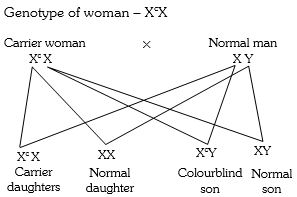
$A$ normal woman,whose father was colour-blind,is married to a normal man. The sons would be
A
All normal
B
All colour-blind
C
$75\%$ colour-blind
D
$50\%$ colour-blind
Solution
(D) Colour blindness is an $X$-linked recessive trait.
Since the woman's father was colour-blind,she must have inherited the recessive allele for colour blindness from him. Thus,the woman is a carrier with the genotype $X^cX$.
The normal man has the genotype $XY$.
When they cross $(X^cX \times XY)$,the possible genotypes for their offspring are:
$X^cX$ (Carrier daughter)
$XX$ (Normal daughter)
$X^cY$ (Colour-blind son)
$XY$ (Normal son)
Out of the two possible genotypes for sons ($X^cY$ and $XY$),one is colour-blind and one is normal.
Therefore,$50\%$ of the sons would be colour-blind.
Since the woman's father was colour-blind,she must have inherited the recessive allele for colour blindness from him. Thus,the woman is a carrier with the genotype $X^cX$.
The normal man has the genotype $XY$.
When they cross $(X^cX \times XY)$,the possible genotypes for their offspring are:
$X^cX$ (Carrier daughter)
$XX$ (Normal daughter)
$X^cY$ (Colour-blind son)
$XY$ (Normal son)
Out of the two possible genotypes for sons ($X^cY$ and $XY$),one is colour-blind and one is normal.
Therefore,$50\%$ of the sons would be colour-blind.
0 likesView Solution
64
BiologyMediumMCQAIPMT · 2004
One of the parents of a cross has a mutation in its mitochondria. In that cross,that parent is taken as a male. During segregation of $F_2$ progenies,that mutation is found in
A
All the progenies
B
Fifty percent of the progenies
C
One-third of the progenies
D
None of the progenies
Solution
(D) The correct answer is $D$.
In eukaryotes,mitochondrial inheritance is strictly maternal.
During fertilization,the sperm contributes its nucleus to the egg,but the cytoplasm (containing mitochondria) is almost exclusively derived from the ovum.
Since the parent with the mitochondrial mutation is used as the male,the mutation will not be passed on to the offspring.
Therefore,none of the $F_1$ or $F_2$ progenies will inherit the mutation.
In eukaryotes,mitochondrial inheritance is strictly maternal.
During fertilization,the sperm contributes its nucleus to the egg,but the cytoplasm (containing mitochondria) is almost exclusively derived from the ovum.
Since the parent with the mitochondrial mutation is used as the male,the mutation will not be passed on to the offspring.
Therefore,none of the $F_1$ or $F_2$ progenies will inherit the mutation.
0 likesView Solution
65
BiologyEasyMCQAIPMT · 2004
In a mutational event,when adenine is replaced by guanine,it is a case of
A
Transition
B
Transversion
C
Frameshift mutation
D
Transcription
Solution
(A) In a transition mutation,a purine ($A$ or $G$) is replaced by another purine,or a pyrimidine ($C, T$ or $U$) is replaced by another pyrimidine.
Since adenine $(A)$ and guanine $(G)$ are both purines,the replacement of adenine by guanine is classified as a transition mutation.
Since adenine $(A)$ and guanine $(G)$ are both purines,the replacement of adenine by guanine is classified as a transition mutation.
0 likesView Solution
66
BiologyMediumMCQAIPMT · 2004
During transcription,if the nucleotide sequence of the $DNA$ strand that is being coded is $ATACG$,then the nucleotide sequence in the $mRNA$ would be:
A
$UAUGC$
B
$UATGC$
C
$TATGC$
D
$TCTGG$
Solution
(A) During transcription,the $DNA$ template strand is used to synthesize $mRNA$ through complementary base pairing.
In $DNA$,the base Adenine $(A)$ pairs with Thymine $(T)$,and Cytosine $(C)$ pairs with Guanine $(G)$.
However,in $mRNA$,Uracil $(U)$ replaces Thymine $(T)$.
Therefore,the base pairing rules for $mRNA$ synthesis are: $A$ pairs with $U$,$T$ pairs with $A$,$C$ pairs with $G$,and $G$ pairs with $C$.
Given the $DNA$ sequence $ATACG$:
- $A$ pairs with $U$
- $T$ pairs with $A$
- $A$ pairs with $U$
- $C$ pairs with $G$
- $G$ pairs with $C$
Thus,the resulting $mRNA$ sequence is $UAUGC$.
In $DNA$,the base Adenine $(A)$ pairs with Thymine $(T)$,and Cytosine $(C)$ pairs with Guanine $(G)$.
However,in $mRNA$,Uracil $(U)$ replaces Thymine $(T)$.
Therefore,the base pairing rules for $mRNA$ synthesis are: $A$ pairs with $U$,$T$ pairs with $A$,$C$ pairs with $G$,and $G$ pairs with $C$.
Given the $DNA$ sequence $ATACG$:
- $A$ pairs with $U$
- $T$ pairs with $A$
- $A$ pairs with $U$
- $C$ pairs with $G$
- $G$ pairs with $C$
Thus,the resulting $mRNA$ sequence is $UAUGC$.
0 likesView Solution
67
BiologyMediumMCQAIPMT · 2004
During replication of a bacterial chromosome,$DNA$ synthesis starts from a replication origin site and:
A
Moves in one direction of the site
B
Moves in a bi-directional way
C
$RNA$ primers are involved
D
Is facilitated by telomerase
Solution
(B) The correct answer is $B$. In bacteria,the replication of the circular chromosome begins at a specific site known as the origin of replication $(oriC)$. From this point,the replication forks move in both directions around the circular chromosome,a process known as bi-directional replication. This allows for the rapid duplication of the entire genome.
0 likesView Solution
68
BiologyMediumMCQAIPMT · 2004
Which form of $RNA$ has a structure resembling a clover leaf?
A
$mRNA$
B
$tRNA$
C
$rRNA$
D
$hnRNA$
Solution
(B) $tRNA$ (transfer $RNA$) has a secondary structure that resembles a clover leaf. This model was proposed by $R.W. Holley$ in $1965$. The structure is formed due to extensive intramolecular base pairing,which results in the formation of double-stranded stems and single-stranded loops.
0 likesView Solution
69
BiologyMediumMCQAIPMT · 2004
$A$ sequence of how many nucleotides in messenger $RNA$ makes a codon for an amino acid?
A
One
B
Two
C
Three
D
Four
Solution
(C) The genetic code is a triplet code. Three adjacent nitrogenous bases on the messenger $RNA$ $(mRNA)$,termed a codon,specify one amino acid. The sequence of these bases is read in the $5'$ to $3'$ direction.
0 likesView Solution
70
BiologyMediumMCQAIPMT · 2004
After a mutation at a genetic locus,the character of an organism changes due to the change in:
A
Protein synthesis pattern
B
$RNA$ transcription pattern
C
Protein structure
D
$DNA$ replication
Solution
(C) mutation at a genetic locus alters the nucleotide sequence of the $DNA$.
This change is transcribed into an altered $mRNA$ sequence.
The abnormal $mRNA$ sequence leads to the incorporation of different amino acids during translation,resulting in a change in the primary structure of the protein.
Since proteins (enzymes/structural proteins) determine the phenotype of an organism,a change in protein structure leads to a change in the organism's character.
This change is transcribed into an altered $mRNA$ sequence.
The abnormal $mRNA$ sequence leads to the incorporation of different amino acids during translation,resulting in a change in the primary structure of the protein.
Since proteins (enzymes/structural proteins) determine the phenotype of an organism,a change in protein structure leads to a change in the organism's character.
0 likesView Solution
71
BiologyMediumMCQAIPMT · 2004
$A$ male human is heterozygous for autosomal genes $A$ and $B$ and is also hemizygous for the hemophilic gene $h$. What proportion of his sperms will be $abh$?
A
$\frac{1}{16}$
B
$\frac{1}{4}$
C
$\frac{1}{8}$
D
$\frac{1}{32}$
Solution
(C) The genotype of the male is $AaBbX^hY$.
Since genes $A$ and $B$ are autosomal and heterozygous,they will segregate independently during meiosis.
The gene $h$ is $X$-linked.
The possible gametes formed by this male are determined by the combination of alleles:
$1$. Autosomal alleles: $A, a, B, b$ can form four combinations: $AB, Ab, aB, ab$ (each with a probability of $\frac{1}{4}$).
$2$. Sex chromosomes: $X^h$ and $Y$ (each with a probability of $\frac{1}{2}$).
To obtain a sperm with the genotype $abh$,the combination must be $ab$ from the autosomes and $h$ from the sex chromosome (specifically $X^h$).
Probability of $ab = \frac{1}{2} \times \frac{1}{2} = \frac{1}{4}$.
Probability of $X^h = \frac{1}{2}$.
Therefore,the total probability of producing an $abh$ sperm is $\frac{1}{4} \times \frac{1}{2} = \frac{1}{8}$.
Since genes $A$ and $B$ are autosomal and heterozygous,they will segregate independently during meiosis.
The gene $h$ is $X$-linked.
The possible gametes formed by this male are determined by the combination of alleles:
$1$. Autosomal alleles: $A, a, B, b$ can form four combinations: $AB, Ab, aB, ab$ (each with a probability of $\frac{1}{4}$).
$2$. Sex chromosomes: $X^h$ and $Y$ (each with a probability of $\frac{1}{2}$).
To obtain a sperm with the genotype $abh$,the combination must be $ab$ from the autosomes and $h$ from the sex chromosome (specifically $X^h$).
Probability of $ab = \frac{1}{2} \times \frac{1}{2} = \frac{1}{4}$.
Probability of $X^h = \frac{1}{2}$.
Therefore,the total probability of producing an $abh$ sperm is $\frac{1}{4} \times \frac{1}{2} = \frac{1}{8}$.
0 likesView Solution
72
BiologyMediumMCQAIPMT · 2004
The recessive genes located on the $X$-chromosome in humans are always:
A
Expressed in males
B
Expressed in females
C
Lethal
D
Sub-lethal
Solution
(A) In humans,males are hemizygous for the $X$-chromosome because they possess only one $X$-chromosome $(XY)$.
If a recessive gene is present on the $X$-chromosome of a male,there is no corresponding allele on the $Y$-chromosome to mask its effect.
Therefore,the recessive trait will always be expressed in males.
In contrast,females have two $X$-chromosomes $(XX)$,so a recessive gene on one $X$-chromosome is usually masked by the dominant allele on the other $X$-chromosome,unless the female is homozygous recessive.
If a recessive gene is present on the $X$-chromosome of a male,there is no corresponding allele on the $Y$-chromosome to mask its effect.
Therefore,the recessive trait will always be expressed in males.
In contrast,females have two $X$-chromosomes $(XX)$,so a recessive gene on one $X$-chromosome is usually masked by the dominant allele on the other $X$-chromosome,unless the female is homozygous recessive.
0 likesView Solution
73
BiologyMediumMCQAIPMT · 2004
What kind of evidence suggests that humans are more closely related to chimpanzees than to other hominoid apes?
A
Evidence from fossil remains and fossil $DNA$ alone.
B
Evidence from $DNA$ extracted from sex chromosomes,autosomes,and mitochondria.
C
Evidence from $DNA$ from sex chromosomes only.
D
Comparison of chromosome morphology only.
Solution
(B) Molecular evidence,particularly the comparison of $DNA$ sequences,provides the most robust proof of evolutionary relationships. Studies involving $DNA$ extracted from sex chromosomes,autosomes,and mitochondria have shown that the genetic similarity between humans and chimpanzees is approximately $98-99\%$. This high degree of genomic homology indicates a more recent common ancestor between humans and chimpanzees compared to other hominoid apes like gorillas or orangutans.
0 likesView Solution
74
BiologyMediumMCQAIPMT · 2004
The most thoroughly studied of the known bacteria-plant interactions is the
A
Nodulation of $Sesbania$ stems by nitrogen-fixing bacteria
B
Plant growth stimulation by phosphate-solubilising bacteria
C
Cyanobacterial symbiosis with some aquatic ferns
D
Gall formation on certain angiosperms by $Agrobacterium$
Solution
(D) The interaction between $Agrobacterium$ $tumefaciens$ and plants is the most thoroughly studied bacteria-plant interaction. $Agrobacterium$ $tumefaciens$ is a soil pathogen that causes crown gall disease in many dicotyledonous plants. It is widely used in genetic engineering as a natural vector for gene transfer because it can transfer a specific segment of $DNA$, known as $T-DNA$, from its Ti plasmid into the host plant genome.
0 likesView Solution
75
BiologyMediumMCQAIPMT · 2004
Which of the following statements is not true for retroviruses?
A
The genetic material in mature retroviruses is $RNA$.
B
Retroviruses are causative agents of certain kinds of cancer in man.
C
$DNA$ is not present at any stage in the life cycle of retroviruses.
D
Retroviruses carry the gene for $RNA$-dependent $DNA$ polymerase.
Solution
(C) Retroviruses are a group of viruses that contain $RNA$ as their genetic material.
Upon infecting a host cell,they use the enzyme $RNA$-dependent $DNA$ polymerase (also known as reverse transcriptase) to synthesize $DNA$ from their $RNA$ template.
This newly synthesized $DNA$ is then integrated into the host cell's genome.
Therefore,statement $C$ is incorrect because $DNA$ is indeed produced and present during the life cycle of retroviruses.
Upon infecting a host cell,they use the enzyme $RNA$-dependent $DNA$ polymerase (also known as reverse transcriptase) to synthesize $DNA$ from their $RNA$ template.
This newly synthesized $DNA$ is then integrated into the host cell's genome.
Therefore,statement $C$ is incorrect because $DNA$ is indeed produced and present during the life cycle of retroviruses.
0 likesView Solution
76
BiologyEasyMCQAIPMT · 2004
Severe Acute Respiratory Syndrome $(SARS)$:
A
Is caused by a variant of Pneumococcus
B
Is caused by a variant of the common cold virus (coronavirus)
C
Is an acute form of asthma
D
Affects non-vegetarians much faster than the vegetarians
Solution
(B) $SARS$ stands for Severe Acute Respiratory Syndrome.
It is a viral respiratory disease caused by the $SARS-associated$ coronavirus $(SARS-CoV)$,which is a member of the coronavirus family,the same family that includes viruses responsible for the common cold.
It is characterized by high fever,headache,and respiratory symptoms like cough and shortness of breath.
It is a viral respiratory disease caused by the $SARS-associated$ coronavirus $(SARS-CoV)$,which is a member of the coronavirus family,the same family that includes viruses responsible for the common cold.
It is characterized by high fever,headache,and respiratory symptoms like cough and shortness of breath.
0 likesView Solution
77
BiologyMediumMCQAIPMT · 2004
Which of the following is not correctly matched?
A
$Aedes aegypti$ - Yellow fever
B
$Anopheles culicifacies$ - Leishmaniasis
C
$Glossina palpalis$ - Sleeping sickness
D
$Culex pipiens$ - Filariasis
Solution
(B) The correct answer is $B$.
$Anopheles culicifacies$ is a vector for Malaria, not Leishmaniasis.
Leishmaniasis (Kala-azar) is transmitted by the sandfly, $Phlebotomus$ species.
$Aedes aegypti$ is the vector for Yellow fever and Dengue.
$Glossina palpalis$ (Tsetse fly) is the vector for African Sleeping sickness caused by $Trypanosoma brucei$.
$Culex pipiens$ is a common vector for Filariasis (Wuchereria bancrofti).
$Anopheles culicifacies$ is a vector for Malaria, not Leishmaniasis.
Leishmaniasis (Kala-azar) is transmitted by the sandfly, $Phlebotomus$ species.
$Aedes aegypti$ is the vector for Yellow fever and Dengue.
$Glossina palpalis$ (Tsetse fly) is the vector for African Sleeping sickness caused by $Trypanosoma brucei$.
$Culex pipiens$ is a common vector for Filariasis (Wuchereria bancrofti).
0 likesView Solution
78
BiologyEasyMCQAIPMT · 2004
$Ti-$ plasmids are present in:
A
Agrobacterium
B
Cymbidium
C
Dendrobium
D
Syzygium
Solution
(A) $Ti-$ plasmid (Tumor-inducing plasmid) is naturally found in the soil bacterium $Agrobacterium \text{ } tumefaciens$.
This bacterium is widely used in genetic engineering as a vector to transfer foreign genes into host plants because it can naturally infect plant cells and integrate its $T-DNA$ into the plant genome.
This bacterium is widely used in genetic engineering as a vector to transfer foreign genes into host plants because it can naturally infect plant cells and integrate its $T-DNA$ into the plant genome.
0 likesView Solution
79
BiologyEasyMCQAIPMT · 2004
The technique of obtaining a large number of plantlets by tissue culture method is called:
A
Micropropagation
B
Macropropagation
C
Plantlet culture
D
Organ culture
Solution
(A) The technique of producing thousands of plants through tissue culture is called $Micropropagation$.
Each of these plants will be genetically identical to the original plant from which they were grown,i.e.,they are $somaclones$.
Many important food plants like tomato,banana,apple,etc.,have been produced on a commercial scale using this method.
Each of these plants will be genetically identical to the original plant from which they were grown,i.e.,they are $somaclones$.
Many important food plants like tomato,banana,apple,etc.,have been produced on a commercial scale using this method.
0 likesView Solution
80
BiologyMediumMCQAIPMT · 2004
In transgenics,the expression of a transgene in the target tissue is determined by:
A
Promoter
B
Reporter
C
Enhancer
D
Transgene
Solution
(A) In genetic engineering,the $Promoter$ is a $DNA$ sequence that initiates the transcription of a particular gene.
It acts as a regulatory switch that determines when,where (in which tissue),and at what level a transgene will be expressed.
While enhancers can increase the rate of transcription,the $Promoter$ is the fundamental element required to direct the tissue-specific expression of the transgene.
It acts as a regulatory switch that determines when,where (in which tissue),and at what level a transgene will be expressed.
While enhancers can increase the rate of transcription,the $Promoter$ is the fundamental element required to direct the tissue-specific expression of the transgene.
0 likesView Solution
81
BiologyMediumMCQAIPMT · 2004
The most likely reason for the development of resistance against pesticides in insects damaging a crop is
A
Direct mutation
B
Acquired heritable changes
C
Random mutation
D
Genetic recombination
Solution
(C) The development of pesticide resistance in insects is primarily driven by the process of natural selection acting on pre-existing genetic variation within the population.
Random mutations occur spontaneously in the insect population.
When a pesticide is applied,most insects are killed,but those few individuals that happen to possess a random mutation conferring resistance survive.
These survivors reproduce and pass the resistance-conferring genes to their offspring.
Over successive generations,the frequency of these resistance genes increases in the population,leading to the development of a resistant strain.
Random mutations occur spontaneously in the insect population.
When a pesticide is applied,most insects are killed,but those few individuals that happen to possess a random mutation conferring resistance survive.
These survivors reproduce and pass the resistance-conferring genes to their offspring.
Over successive generations,the frequency of these resistance genes increases in the population,leading to the development of a resistant strain.
0 likesView Solution
82
BiologyMediumMCQAIPMT · 2004
Dough kept overnight in warm weather becomes soft and spongy because of
A
Cohesion
B
Osmosis
C
Absorption of carbon dioxide from atmosphere
D
Fermentation
Solution
(D) The dough becomes soft and spongy due to the process of $Fermentation$ carried out by microbes like yeast ($Saccharomyces$ $cerevisiae$).
During $Fermentation$,these microbes break down sugars present in the dough and release $CO_2$ gas as a byproduct.
The trapped $CO_2$ gas bubbles within the dough cause it to rise,making it soft and spongy.
During $Fermentation$,these microbes break down sugars present in the dough and release $CO_2$ gas as a byproduct.
The trapped $CO_2$ gas bubbles within the dough cause it to rise,making it soft and spongy.
0 likesView Solution
83
BiologyMediumMCQAIPMT · 2004
Which one of the following pairs is not correctly matched?
A
Spirulina - Single cell protein
B
Rhizobium - Biofertilizer
C
Streptomyces - Antibiotic
D
Serratia - Drug addiction
Solution
(D) . $Spirulina$ is a well-known source of single-cell protein $(SCP)$.
$B$. $Rhizobium$ is a symbiotic bacterium that fixes atmospheric nitrogen and acts as a biofertilizer.
$C$. $Streptomyces$ is a genus of bacteria known for producing various antibiotics.
$D$. $Serratia$ is a genus of Gram-negative bacteria; it is not associated with drug addiction. Therefore,this pair is incorrectly matched.
$B$. $Rhizobium$ is a symbiotic bacterium that fixes atmospheric nitrogen and acts as a biofertilizer.
$C$. $Streptomyces$ is a genus of bacteria known for producing various antibiotics.
$D$. $Serratia$ is a genus of Gram-negative bacteria; it is not associated with drug addiction. Therefore,this pair is incorrectly matched.
0 likesView Solution
84
BiologyMediumMCQAIPMT · 2004
What is a keystone species?
A
$A$ rare species that has minimal impact on the biomass and on other species in the community.
B
$A$ dominant species that constitutes a large proportion of the biomass and which affects many other species.
C
$A$ species which makes up only a small proportion of the total biomass of a community,yet has a huge impact on the community's organization and survival.
D
$A$ common species that has plenty of biomass,yet has a fairly low impact on the community's organization.
Solution
(C) keystone species is defined as a species that has a disproportionately large effect on its environment relative to its abundance or biomass.
Even though these species make up a small proportion of the total biomass in a community,their presence is critical for maintaining the structure,diversity,and survival of the entire ecosystem.
If a keystone species is removed,the ecosystem may undergo drastic changes or even collapse.
Therefore,option $C$ is the correct definition.
Even though these species make up a small proportion of the total biomass in a community,their presence is critical for maintaining the structure,diversity,and survival of the entire ecosystem.
If a keystone species is removed,the ecosystem may undergo drastic changes or even collapse.
Therefore,option $C$ is the correct definition.
0 likesView Solution
85
BiologyMediumMCQAIPMT · 2004
Which of the following ecosystems has the highest gross primary productivity?
A
Grassland
B
Coral reef
C
Mangroves
D
Rain forest
Solution
(B) The correct answer is $B$. Coral reefs are among the most productive ecosystems on Earth. They are coastal regions characterized by maximum primary productivity and high biodiversity,where almost every group of marine algae and every animal phylum is represented. While tropical rain forests are highly productive on land,coral reefs exhibit higher gross primary productivity per unit area due to efficient nutrient cycling and high solar energy utilization.
0 likesView Solution
86
BiologyMediumMCQAIPMT · 2004
An ecosystem which can be easily damaged but can recover after some time if the damaging effect stops will have:
A
Low stability and low resilience
B
High stability and high resilience
C
Low stability and high resilience
D
High stability and low resilience
Solution
(C) Stability refers to the ability of an ecosystem to resist change or disturbance. If an ecosystem is easily damaged,it has low stability.
Resilience refers to the ability of an ecosystem to recover after a disturbance. If an ecosystem can recover after the damaging effect stops,it has high resilience.
Therefore,an ecosystem that is easily damaged but recovers over time possesses low stability and high resilience.
Resilience refers to the ability of an ecosystem to recover after a disturbance. If an ecosystem can recover after the damaging effect stops,it has high resilience.
Therefore,an ecosystem that is easily damaged but recovers over time possesses low stability and high resilience.
0 likesView Solution
87
BiologyMediumMCQAIPMT · 2004
In which of the following habitats does the diurnal temperature of the soil surface vary the most?
A
Desert
B
Grassland
C
Shrub land
D
Forest
Solution
(A) The diurnal temperature of the soil surface varies most in a $Desert$ habitat.
This is because deserts have very low humidity and sparse vegetation,which leads to high solar radiation absorption during the day and rapid heat loss through radiation at night.
In contrast,forests,grasslands,and shrublands have more vegetation cover and higher humidity,which act as buffers to stabilize soil temperature fluctuations.
This is because deserts have very low humidity and sparse vegetation,which leads to high solar radiation absorption during the day and rapid heat loss through radiation at night.
In contrast,forests,grasslands,and shrublands have more vegetation cover and higher humidity,which act as buffers to stabilize soil temperature fluctuations.
0 likesView Solution
88
BiologyMediumMCQAIPMT · 2004
What is the most effective way to conserve the plant diversity of an area?
A
Tissue culture
B
Botanical garden
C
Biosphere reserves
D
Seed banks
Solution
(C) The most effective way to conserve plant diversity is through $In-situ$ conservation,where species are protected in their natural habitats.
Biosphere reserves are large,multipurpose protected areas designed to conserve the genetic diversity of representative ecosystems,natural biomes,and unique biological communities.
Unlike $Ex-situ$ methods like tissue culture,botanical gardens,or seed banks,biosphere reserves allow for the natural evolution and ecological processes of the species to continue undisturbed.
Biosphere reserves are large,multipurpose protected areas designed to conserve the genetic diversity of representative ecosystems,natural biomes,and unique biological communities.
Unlike $Ex-situ$ methods like tissue culture,botanical gardens,or seed banks,biosphere reserves allow for the natural evolution and ecological processes of the species to continue undisturbed.
0 likesView Solution
89
BiologyEasyMCQAIPMT · 2004
Which one of the following organisms is used as an indicator of water quality?
A
Beggiatoa
B
Chlorella
C
Azospirillum
D
Escherichia
Solution
(D) $Escherichia$ $coli$ $(E. coli)$ is a bacterium commonly found in the lower intestine of warm-blooded organisms.
Its presence in water samples is used as a standard indicator of faecal contamination,which suggests that the water may contain other harmful pathogens.
Its presence in water samples is used as a standard indicator of faecal contamination,which suggests that the water may contain other harmful pathogens.
0 likesView Solution
90
BiologyEasyMCQAIPMT · 2004
In $1984$,the Bhopal gas tragedy took place because methyl isocyanate:
A
Reacted with $CO_2$
B
Reacted with water
C
Reacted with $DDT$
D
Reacted with ammonia
Solution
(B) The Bhopal gas tragedy occurred on the night of $2-3$ December $1984$ at the Union Carbide India Limited $(UCIL)$ pesticide plant in Bhopal.
Methyl isocyanate $(MIC)$ gas leaked from the storage tank due to the ingress of water into the tank.
This reaction between methyl isocyanate and water is highly exothermic,which led to a rapid increase in pressure and temperature,causing the tank to rupture and release the toxic gas into the atmosphere.
Methyl isocyanate $(MIC)$ gas leaked from the storage tank due to the ingress of water into the tank.
This reaction between methyl isocyanate and water is highly exothermic,which led to a rapid increase in pressure and temperature,causing the tank to rupture and release the toxic gas into the atmosphere.
0 likesView Solution
91
BiologyEasyMCQAIPMT · 2004
The most abundant element present in the plants is
A
Iron
B
Carbon
C
Nitrogen
D
Manganese
Solution
(B) Plants are primarily composed of organic compounds such as carbohydrates, proteins, lipids, and nucleic acids.
Carbon $(C)$ forms the structural backbone of all these organic molecules.
By dry weight, carbon constitutes approximately $45\%$ of the plant's total biomass, making it the most abundant element in plants.
Carbon $(C)$ forms the structural backbone of all these organic molecules.
By dry weight, carbon constitutes approximately $45\%$ of the plant's total biomass, making it the most abundant element in plants.
0 likesView Solution
92
BiologyEasyMCQAIPMT · 2004
The richest sources of vitamin $B_{12}$ are
A
Rice and hen's egg
B
Carrot and chicken's breast
C
Goat's liver and spirulina
D
Chocolate and green gram
Solution
(C) Vitamin $B_{12}$ (cobalamin) is primarily found in animal-derived foods and certain microorganisms.
Goat's liver is an extremely rich source of vitamin $B_{12}$ due to the liver's role in storing vitamins.
Spirulina is a blue-green alga that is often cited as a plant-based source of $B_{12}$,although it contains pseudo-vitamin $B_{12}$ which is not biologically active in humans; however,in the context of biological sources,it is frequently grouped with high-density nutrient foods.
Therefore,goat's liver and spirulina are considered the richest sources among the given options.
Goat's liver is an extremely rich source of vitamin $B_{12}$ due to the liver's role in storing vitamins.
Spirulina is a blue-green alga that is often cited as a plant-based source of $B_{12}$,although it contains pseudo-vitamin $B_{12}$ which is not biologically active in humans; however,in the context of biological sources,it is frequently grouped with high-density nutrient foods.
Therefore,goat's liver and spirulina are considered the richest sources among the given options.
0 likesView Solution
93
BiologyMediumMCQAIPMT · 2004
The cardiac pacemaker in a patient fails to function normally. The doctors find that an artificial pacemaker is to be grafted in him. It is likely that it will be grafted at the site of
A
Purkinje system
B
Sinuatrial node
C
Atrioventricular node
D
Atrioventricular bundle
Solution
(B) The $Sinuatrial$ $node$ $(SAN)$ is the natural pacemaker of the heart,located in the wall of the right atrium. It generates the electrical impulses that initiate the heartbeat. When the $SAN$ fails to function normally,an artificial pacemaker is implanted to replace its function. Therefore,the artificial pacemaker is grafted at the site of the $Sinuatrial$ $node$ to restore the normal rhythm of the heart.
0 likesView Solution
94
BiologyEasyMCQAIPMT · 2004
$A$ major component of gobar gas is
A
Ethane
B
Butane
C
Ammonia
D
Methane
Solution
(D) Gobar gas,also known as biogas,is produced by the anaerobic decomposition of organic matter such as animal dung and agricultural waste.
Its primary component is $CH_4$ (Methane),which typically constitutes $50-75\%$ of the total gas volume.
Other components include $CO_2$,$H_2$,and traces of other gases.
Therefore,the correct option is $D$.
Its primary component is $CH_4$ (Methane),which typically constitutes $50-75\%$ of the total gas volume.
Other components include $CO_2$,$H_2$,and traces of other gases.
Therefore,the correct option is $D$.
0 likesView Solution
95
BiologyMediumMCQAIPMT · 2004
Certain characteristic demographic features of developing countries are:
A
High infant mortality,low fertility,uneven population growth,and a very young age distribution.
B
High mortality,high density,uneven population growth,and a very old age distribution.
C
High fertility,low or rapidly falling mortality rate,rapid population growth,and a very young age distribution.
D
High fertility,high density,rapidly rising mortality rate,and a very young age distribution.
Solution
(C) Developing countries typically exhibit a demographic profile characterized by high fertility rates,which contribute to rapid population growth. Due to improvements in healthcare and sanitation,mortality rates are either low or rapidly falling. This combination of high birth rates and declining death rates results in a population pyramid with a very young age distribution,meaning a large proportion of the population is in the younger age groups.
0 likesView Solution
96
BiologyMediumMCQAIPMT · 2004
Which of the following statements is $NOT$ true for retroviruses?
A
$DNA$ is not present at any stage of the retrovirus life cycle.
B
Retroviruses carry genes for $RNA$-dependent $DNA$ polymerase.
C
The genetic material in mature retroviruses is $RNA$.
D
Retroviruses are one of the cancer-causing agents in humans.
Solution
(A) Retroviruses are a group of viruses that contain $RNA$ as their genetic material.
During their life cycle,they use an enzyme called reverse transcriptase ($RNA$-dependent $DNA$ polymerase) to convert their $RNA$ genome into $DNA$ inside the host cell.
This newly synthesized $DNA$ is then integrated into the host genome.
Therefore,the statement that '$DNA$ is not present at any stage of the retrovirus life cycle' is false,as $DNA$ is a crucial intermediate in their replication process.
During their life cycle,they use an enzyme called reverse transcriptase ($RNA$-dependent $DNA$ polymerase) to convert their $RNA$ genome into $DNA$ inside the host cell.
This newly synthesized $DNA$ is then integrated into the host genome.
Therefore,the statement that '$DNA$ is not present at any stage of the retrovirus life cycle' is false,as $DNA$ is a crucial intermediate in their replication process.
0 likesView Solution
97
BiologyEasyMCQAIPMT · 2004
Which of the following propagates through the leaf tip?
A
Walking fern
B
Bryophyllum
C
Marchantia
D
Moss
Solution
(A) The walking fern,scientifically known as $Adiantum \ caudatum$,is a type of fern that propagates vegetatively through its leaf tips. When the tip of the leaf touches the soil,it develops adventitious roots and a new plantlet,allowing the plant to 'walk' or spread across the ground.
0 likesView Solution
98
BiologyMediumMCQAIPMT · 2004
The presence of gills in the tadpole of a frog indicates that . . . . . . .
A
Fishes were amphibians in the past.
B
Fishes evolved from amphibian-like ancestors.
C
Frogs will have gills in the future.
D
Frogs evolved from gill-bearing ancestors.
Solution
(D) The presence of gills in the tadpole stage of a frog is an example of recapitulation or evidence of evolutionary history. It indicates that frogs have evolved from aquatic,gill-bearing ancestors. This reflects the principle that ontogeny (development of an individual) often recapitulates phylogeny (evolutionary history of the species). Therefore,the tadpole stage serves as a link to the ancestral aquatic form.
0 likesView Solution
99
BiologyMediumMCQAIPMT · 2004
Extranuclear inheritance is the result of the presence of genes in ........
A
Mitochondria and chloroplasts
B
Endoplasmic reticulum and mitochondria
C
Ribosomes and chloroplasts
D
Lysosomes and ribosomes
Solution
(A) Extranuclear inheritance,also known as cytoplasmic inheritance,refers to the transmission of genes that are located outside the nucleus.
In eukaryotic cells,the organelles that contain their own $DNA$ (extranuclear $DNA$) are the mitochondria and the chloroplasts.
These organelles possess their own genome,which is inherited independently of the nuclear chromosomes,typically through the cytoplasm of the egg cell.
Therefore,the presence of genes in mitochondria and chloroplasts is responsible for extranuclear inheritance.
In eukaryotic cells,the organelles that contain their own $DNA$ (extranuclear $DNA$) are the mitochondria and the chloroplasts.
These organelles possess their own genome,which is inherited independently of the nuclear chromosomes,typically through the cytoplasm of the egg cell.
Therefore,the presence of genes in mitochondria and chloroplasts is responsible for extranuclear inheritance.
0 likesView Solution
100
BiologyMediumMCQAIPMT · 2004
Which of the following hormones is secreted by the human placenta?
A
Human Chorionic Gonadotropin $(hCG)$
B
Prolactin
C
Estrogen
D
Progesterone
Solution
(A) The human placenta acts as an endocrine tissue and produces several hormones essential for pregnancy.
These hormones include Human Chorionic Gonadotropin $(hCG)$,Human Placental Lactogen $(hPL)$,estrogens,and progestogens.
$hCG$ is specifically secreted by the placenta to maintain the corpus luteum during early pregnancy.
While estrogens and progesterone are also produced by the placenta,$hCG$ is a hallmark hormone exclusively associated with placental secretion in this context.
Therefore,the correct option is $A$.
These hormones include Human Chorionic Gonadotropin $(hCG)$,Human Placental Lactogen $(hPL)$,estrogens,and progestogens.
$hCG$ is specifically secreted by the placenta to maintain the corpus luteum during early pregnancy.
While estrogens and progesterone are also produced by the placenta,$hCG$ is a hallmark hormone exclusively associated with placental secretion in this context.
Therefore,the correct option is $A$.
0 likesView Solution
Vedclass Products
For Students
Vedclass Test Series
Mock tests in real AIPMT style covering Biology with performance analysis. 5-day free trial.
Start Free TrialFor Teachers
Exam Paper Generator
Generate Set A/B/C/D Biology papers from 7.5L+ questions in 2 minutes. 3 chapters free.
Try FreeFor Institutes
Online Exam Module
Run live AIPMT mock exams with unlimited students, 360° analytics & white-label branding.
See DemoFrequently Asked Questions
How many Biology questions are in AIPMT 2004?
There are 166 Biology questions from the AIPMT 2004 paper on Vedclass, each with a detailed step-by-step solution in English.
Are AIPMT 2004 Biology solutions available in English?
Yes. All solutions on this page are in English. You can also switch to English or Hindi using the language buttons above the questions.
Can I practice AIPMT 2004 Biology as a timed test?
Yes. Use the Vedclass Test Series to attempt a full AIPMT mock test covering Biology with time limits and instant score analysis.
Can teachers create Biology papers from AIPMT previous year questions?
Yes. The Vedclass Exam Paper Generator lets teachers mix AIPMT Biology questions and generate Set A/B/C/D papers in minutes.
For Teachers & Institutes
Build a Custom Biology Paper
Pick AIPMT 2004 Biology questions, set difficulty, and generate Set A/B/C/D in 2 minutes.