
BiologyQ1–61 of 61 questions
Page 1 of 1 · English
1
BiologyMediumMCQAIIMS · 2014
During meiosis $I$,the chromosomes start pairing at
A
zygotene
B
pachytene
C
diplotene
D
leptotene
Solution
(A) The correct answer is $A$.
During the $zygotene$ stage of prophase $I$ of meiosis,the chromosomes begin to pair up.
This process of pairing of homologous chromosomes is known as $synapsis$.
Each pair of homologous chromosomes is referred to as a $bivalent$ or a $tetrad$.
During the $zygotene$ stage of prophase $I$ of meiosis,the chromosomes begin to pair up.
This process of pairing of homologous chromosomes is known as $synapsis$.
Each pair of homologous chromosomes is referred to as a $bivalent$ or a $tetrad$.
0 likesView Solution
2
BiologyMediumMCQAIIMS · 2014
Approximately $70\%$ of carbon dioxide absorbed by the blood is transported to the lungs:
A
as bicarbonate ions
B
in the form of dissolved gas molecules
C
by binding to $RBCs$
D
as carbamino-haemoglobin
Solution
(A) Approximately $70\%$ of $CO_2$ (about $2.5 \ ml$ per $100 \ ml$ of blood) received by the blood from the tissues enters the $RBCs$,where it reacts with water to form carbonic acid $(H_2CO_3)$.
Carbonic anhydrase,an enzyme found exclusively in $RBCs$,speeds up the formation of $H_2CO_3$ and rapidly converts it back to carbon dioxide and water when the blood reaches the lungs.
Almost as rapidly as it is formed,the carbonic acid in $RBCs$ dissociates into hydrogen ions $(H^+)$ and bicarbonate ions $(HCO_3^-)$.
These bicarbonate ions are then transported in the plasma to the lungs.
Carbonic anhydrase,an enzyme found exclusively in $RBCs$,speeds up the formation of $H_2CO_3$ and rapidly converts it back to carbon dioxide and water when the blood reaches the lungs.
Almost as rapidly as it is formed,the carbonic acid in $RBCs$ dissociates into hydrogen ions $(H^+)$ and bicarbonate ions $(HCO_3^-)$.
These bicarbonate ions are then transported in the plasma to the lungs.
0 likesView Solution
3
BiologyMediumMCQAIIMS · 2014
Read the following statements:
$(i)$ Lower the taxon, more are the characteristics that the members within the taxon share.
$(ii)$ Order is the assemblage of genera which exhibit a few similar characters.
$(iii)$ Cat and dog are included in the same family Felidae.
$(iv)$ Binomial Nomenclature was introduced by Carolus Linnaeus.
Which of the following statements are $NOT$ correct?
$(i)$ Lower the taxon, more are the characteristics that the members within the taxon share.
$(ii)$ Order is the assemblage of genera which exhibit a few similar characters.
$(iii)$ Cat and dog are included in the same family Felidae.
$(iv)$ Binomial Nomenclature was introduced by Carolus Linnaeus.
Which of the following statements are $NOT$ correct?
A
$(i), (ii)$ and $(iii)$
B
$(ii), (iii)$ and $(iv)$
C
$(i)$ and $(iv)$
D
$(ii)$ and $(iii)$
Solution
(D) Statement $(i)$ is correct: As we go lower in the taxonomic hierarchy, the number of shared characteristics increases.
Statement $(ii)$ is incorrect: Order is the assemblage of families, not genera, which exhibit a few similar characters.
Statement $(iii)$ is incorrect: Cat belongs to the family $Felidae$, while dog belongs to the family $Canidae$.
Statement $(iv)$ is correct: Binomial Nomenclature was indeed introduced by Carolus Linnaeus.
Therefore, statements $(ii)$ and $(iii)$ are not correct.
Statement $(ii)$ is incorrect: Order is the assemblage of families, not genera, which exhibit a few similar characters.
Statement $(iii)$ is incorrect: Cat belongs to the family $Felidae$, while dog belongs to the family $Canidae$.
Statement $(iv)$ is correct: Binomial Nomenclature was indeed introduced by Carolus Linnaeus.
Therefore, statements $(ii)$ and $(iii)$ are not correct.
0 likesView Solution
4
BiologyMediumMCQAIIMS · 2014
Assertion : Taxon and category are different things.
Reason : Category shows hierarchical classification.
Reason : Category shows hierarchical classification.
A
If both Assertion and Reason are correct and the Reason is a correct explanation of the Assertion.
B
If both Assertion and Reason are correct but Reason is not a correct explanation of the Assertion.
C
If the Assertion is correct but Reason is incorrect.
D
If both the Assertion and Reason are incorrect.
Solution
(A) category is a rank or level in the hierarchical classification of organisms.
Taxon is a unit in classification which represents a group of organisms based on certain common characteristics.
While a category represents a specific rank (e.g.,Kingdom,Phylum,Class),a taxon represents the actual biological group assigned to that rank (e.g.,$Angiospermae$ is a taxon,while Class is a category).
Therefore,taxon and category are distinct concepts,and the reason correctly describes the nature of a category.
Taxon is a unit in classification which represents a group of organisms based on certain common characteristics.
While a category represents a specific rank (e.g.,Kingdom,Phylum,Class),a taxon represents the actual biological group assigned to that rank (e.g.,$Angiospermae$ is a taxon,while Class is a category).
Therefore,taxon and category are distinct concepts,and the reason correctly describes the nature of a category.
0 likesView Solution
5
BiologyMediumMCQAIIMS · 2014
Match Column-$I$ with Column-$II$ and select the correct option:
| Column-$I$ (Classes of fungi) | Column-$II$ (Common name) |
| $A$. Phycomycetes | $I$. Sac fungi |
| $B$. Ascomycetes | $II$. Algal fungi |
| $C$. Basidiomycetes | $III$. Fungi imperfecti |
| $D$. Deuteromycetes | $IV$. Club fungi |
A
$A-II, B-I, C-IV, D-III$
B
$A-II, B-IV, C-I, D-III$
C
$A-IV, B-I, C-II, D-III$
D
$A-IV, B-III, C-II, D-I$
Solution
(A) The correct matches are as follows:
$1$. Phycomycetes are commonly known as Algal fungi $(A-II)$.
$2$. Ascomycetes are commonly known as Sac fungi $(B-I)$.
$3$. Basidiomycetes are commonly known as Club fungi $(C-IV)$.
$4$. Deuteromycetes are commonly known as Fungi imperfecti $(D-III)$.
Therefore, the correct combination is $A-II, B-I, C-IV, D-III$.
$1$. Phycomycetes are commonly known as Algal fungi $(A-II)$.
$2$. Ascomycetes are commonly known as Sac fungi $(B-I)$.
$3$. Basidiomycetes are commonly known as Club fungi $(C-IV)$.
$4$. Deuteromycetes are commonly known as Fungi imperfecti $(D-III)$.
Therefore, the correct combination is $A-II, B-I, C-IV, D-III$.
0 likesView Solution
6
BiologyMediumMCQAIIMS · 2014
Cockroaches are brown or black bodied animals that are included in class . . . . . . of phylum . . . . . . .
A
Reptilia; Annelida
B
Insecta; Arthropoda
C
Insecta; Annelida
D
Reptilia; Arthropoda
Solution
(B) Cockroaches belong to the class $Insecta$ and the phylum $Arthropoda$.
$Arthropoda$ is the largest phylum of $Animalia$ which includes insects.
Cockroaches are characterized by a chitinous exoskeleton,jointed appendages,and a segmented body,which are key features of the phylum $Arthropoda$.
$Arthropoda$ is the largest phylum of $Animalia$ which includes insects.
Cockroaches are characterized by a chitinous exoskeleton,jointed appendages,and a segmented body,which are key features of the phylum $Arthropoda$.
0 likesView Solution
7
BiologyEasyMCQAIIMS · 2014
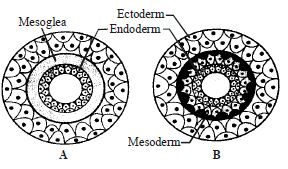
The above diagram shows the germ layers. The animals having structures shown in the figures $A$ and $B$ are respectively called:
A
Diploblastic,Triploblastic
B
Triploblastic,Diploblastic
C
Diploblastic,Diploblastic
D
Triploblastic,Triploblastic
Solution
(A) Figure $A$ shows two germinal layers: an outer ectoderm and an inner endoderm,with an undifferentiated layer called mesoglea in between. Animals with this organization are called Diploblastic (e.g.,Coelenterata).
Figure $B$ shows three germinal layers: an outer ectoderm,a middle mesoderm,and an inner endoderm. Animals with this organization are called Triploblastic (e.g.,Platyhelminthes to Chordata).
Figure $B$ shows three germinal layers: an outer ectoderm,a middle mesoderm,and an inner endoderm. Animals with this organization are called Triploblastic (e.g.,Platyhelminthes to Chordata).
0 likesView Solution
8
BiologyMediumMCQAIIMS · 2014
Assertion : Sponges belong to Porifera.
Reason : Sponges have a canal system.
Reason : Sponges have a canal system.
A
If both Assertion and Reason are correct and the Reason is a correct explanation of the Assertion.
B
If both Assertion and Reason are correct but Reason is not a correct explanation of the Assertion.
C
If the Assertion is correct but Reason is incorrect.
D
If both the Assertion and Reason are incorrect.
Solution
(A) Sponges are multicellular organisms that belong to the phylum $Porifera$.
They possess a unique water transport or canal system,which is a defining characteristic of this phylum.
Water enters through minute pores called $ostia$ in the body wall into a central cavity,the $spongocoel$,and goes out through the $osculum$.
This pathway of water transport is helpful in food gathering,respiratory exchange,and removal of waste.
Since the canal system is a diagnostic feature that defines the phylum $Porifera$,the Reason correctly explains the Assertion.
They possess a unique water transport or canal system,which is a defining characteristic of this phylum.
Water enters through minute pores called $ostia$ in the body wall into a central cavity,the $spongocoel$,and goes out through the $osculum$.
This pathway of water transport is helpful in food gathering,respiratory exchange,and removal of waste.
Since the canal system is a diagnostic feature that defines the phylum $Porifera$,the Reason correctly explains the Assertion.
0 likesView Solution
9
BiologyDifficultMCQAIIMS · 2014
Read the following statements.
$(i)$ Gynoecium is situated in the centre and other parts of the flower are located on the rim of the thalamus almost at the same level.
$(ii)$ Ovary is half-inferior.
$(iii)$ Examples are plum,rose and peach.
Which condition of flowers is being described by the above statements?
$(i)$ Gynoecium is situated in the centre and other parts of the flower are located on the rim of the thalamus almost at the same level.
$(ii)$ Ovary is half-inferior.
$(iii)$ Examples are plum,rose and peach.
Which condition of flowers is being described by the above statements?
A
Hypogyny
B
Perigyny
C
Epigyny
D
None of these
Solution
(B) In perigyny,the gynoecium is situated in the centre and other parts of the flower are located on the rim of the thalamus almost at the same level.
In this condition,the ovary is said to be half-inferior.
Examples of perigynous flowers include plum,rose,and peach.
Therefore,the statements describe the condition of perigyny.
In this condition,the ovary is said to be half-inferior.
Examples of perigynous flowers include plum,rose,and peach.
Therefore,the statements describe the condition of perigyny.
0 likesView Solution
10
BiologyDifficultMCQAIIMS · 2014
Assertion : Apical meristem of root is subterminal.
Reason : At the terminal end of root, root cap is present.
Reason : At the terminal end of root, root cap is present.
A
If both Assertion and Reason are correct and the Reason is a correct explanation of the Assertion.
B
If both Assertion and Reason are correct but Reason is not a correct explanation of the Assertion.
C
If the Assertion is correct but Reason is incorrect.
D
If both the Assertion and Reason are incorrect.
Solution
(A) The root apical meristem is responsible for the growth of the root.
It is located slightly behind the tip of the root, making it subterminal.
This is because the terminal end of the root is covered by a protective structure called the root cap $(root\,cap)$.
The root cap protects the delicate meristematic tissue as the root pushes through the soil.
Therefore, the presence of the root cap at the terminal end is the reason why the apical meristem is subterminal.
Both the Assertion and the Reason are correct, and the Reason is the correct explanation of the Assertion.
It is located slightly behind the tip of the root, making it subterminal.
This is because the terminal end of the root is covered by a protective structure called the root cap $(root\,cap)$.
The root cap protects the delicate meristematic tissue as the root pushes through the soil.
Therefore, the presence of the root cap at the terminal end is the reason why the apical meristem is subterminal.
Both the Assertion and the Reason are correct, and the Reason is the correct explanation of the Assertion.
0 likesView Solution
11
BiologyEasyMCQAIIMS · 2014
Sclerenchyma usually . . . . . . and . . . . . . protoplasts.
A
live,without
B
dead,with
C
live,with
D
dead,without
Solution
(D) Sclerenchyma consists of long,narrow cells with thick and lignified cell walls having a few or numerous pits.
They are usually dead and without protoplasts.
They are usually dead and without protoplasts.
0 likesView Solution
12
BiologyEasyMCQAIIMS · 2014
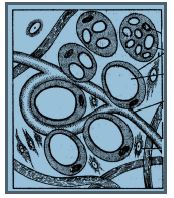
Identify the figure with its correct function.
A
Areolar connective tissue - Serves as a support framework for epithelium.
B
Adipose tissue - Store fats and act as heat insulators.
C
Dense regular tissue - Provide flexibility.
D
Dense irregular tissue - Provide strength and elasticity.
Solution
(B) The provided figure shows Adipose tissue,which is a type of loose connective tissue located mainly beneath the skin.
The cells of this tissue,called adipocytes,are specialised to store fats.
Excess nutrients that are not used immediately are converted into fats and stored in this tissue.
Additionally,it acts as a heat insulator for the body.
The cells of this tissue,called adipocytes,are specialised to store fats.
Excess nutrients that are not used immediately are converted into fats and stored in this tissue.
Additionally,it acts as a heat insulator for the body.
0 likesView Solution
13
BiologyMediumMCQAIIMS · 2014
Assertion : Mitochondria and chloroplasts are semi-autonomous organelles.
Reason : They are formed by division of preexisting organelles as well as contain $DNA$ but lack protein-synthesizing machinery.
Reason : They are formed by division of preexisting organelles as well as contain $DNA$ but lack protein-synthesizing machinery.
A
If both Assertion and Reason are correct and the Reason is a correct explanation of the Assertion.
B
If both Assertion and Reason are correct but Reason is not a correct explanation of the Assertion.
C
If the Assertion is correct but Reason is incorrect.
D
If both the Assertion and Reason are incorrect.
Solution
(C) Mitochondria and chloroplasts are considered semi-autonomous organelles because they contain their own $DNA$ and ribosomes,which allow them to synthesize some of their own proteins.
They are formed by the division of preexisting organelles.
However,the statement that they 'lack protein-synthesizing machinery' is incorrect because they possess $70S$ ribosomes,which are essential for protein synthesis.
Therefore,the Assertion is correct,but the Reason is incorrect.
They are formed by the division of preexisting organelles.
However,the statement that they 'lack protein-synthesizing machinery' is incorrect because they possess $70S$ ribosomes,which are essential for protein synthesis.
Therefore,the Assertion is correct,but the Reason is incorrect.
0 likesView Solution
14
BiologyMediumMCQAIIMS · 2014
Which one of the following is a non-reducing carbohydrate?
A
Maltose
B
Sucrose
C
Lactose
D
Ribose $5$-phosphate
Solution
(B) carbohydrate is considered non-reducing if it lacks a free aldehyde or ketone group capable of acting as a reducing agent.
In $Sucrose$,the glycosidic linkage is formed between the $C1$ of glucose and the $C2$ of fructose.
Since both the anomeric carbons are involved in the glycosidic bond,there is no free aldehyde or keto group available.
Therefore,$Sucrose$ is a non-reducing sugar,whereas $Maltose$,$Lactose$,and $Ribose$ $5$-phosphate contain free anomeric carbons and are reducing sugars.
In $Sucrose$,the glycosidic linkage is formed between the $C1$ of glucose and the $C2$ of fructose.
Since both the anomeric carbons are involved in the glycosidic bond,there is no free aldehyde or keto group available.
Therefore,$Sucrose$ is a non-reducing sugar,whereas $Maltose$,$Lactose$,and $Ribose$ $5$-phosphate contain free anomeric carbons and are reducing sugars.
0 likesView Solution
15
BiologyDifficultMCQAIIMS · 2014
The $Km$ value of the enzyme is the value of the substrate concentration at which the reaction reaches to
A
Zero
B
$2\,V_{max}$
C
$1/2\,V_{max}$
D
$1/4\,V_{max}$
Solution
(C) The $Km$ value,also known as the Michaelis constant,is defined as the substrate concentration at which the reaction velocity is exactly half of the maximum velocity $(V_{max})$.
This constant is a measure of the affinity of an enzyme for its substrate.
This constant is a measure of the affinity of an enzyme for its substrate.
0 likesView Solution
16
BiologyMediumMCQAIIMS · 2014
Assertion : Enzymes lower the activation energy.
Reason : $A$ substrate molecule can be acted upon by a particular enzyme.
Reason : $A$ substrate molecule can be acted upon by a particular enzyme.
A
If both Assertion and Reason are correct and the Reason is a correct explanation of the Assertion.
B
If both Assertion and Reason are correct but Reason is not a correct explanation of the Assertion.
C
If the Assertion is correct but Reason is incorrect.
D
If both the Assertion and Reason are incorrect.
Solution
(B) Activation energy is the minimum amount of energy required for a chemical reaction to proceed. Living systems cannot provide high levels of activation energy for most biochemical reactions.
Enzymes function as biological catalysts that lower the activation energy barrier,allowing reactions to occur at physiological temperatures.
Substrate specificity is a fundamental property of enzymes,meaning a particular enzyme acts only on a specific substrate.
While both statements are scientifically correct,the fact that an enzyme is specific to a substrate does not explain *how* or *why* it lowers the activation energy. Therefore,the Reason is not the correct explanation for the Assertion.
Enzymes function as biological catalysts that lower the activation energy barrier,allowing reactions to occur at physiological temperatures.
Substrate specificity is a fundamental property of enzymes,meaning a particular enzyme acts only on a specific substrate.
While both statements are scientifically correct,the fact that an enzyme is specific to a substrate does not explain *how* or *why* it lowers the activation energy. Therefore,the Reason is not the correct explanation for the Assertion.
0 likesView Solution
17
BiologyEasyMCQAIIMS · 2014
In which method of transport in the plasma membrane is a carrier molecule not required?
A
Active transport
B
Facilitated diffusion
C
Simple diffusion
D
$Na^+ -K^+$ pump
Solution
(C) Simple diffusion is the movement of molecules from a region of higher concentration to a region of lower concentration without the expenditure of energy.
This process does not require any membrane proteins or carrier molecules to facilitate the movement of substances across the plasma membrane.
In contrast,active transport,facilitated diffusion,and the $Na^+ -K^+$ pump all require specific membrane proteins or carrier molecules to transport substances across the membrane.
This process does not require any membrane proteins or carrier molecules to facilitate the movement of substances across the plasma membrane.
In contrast,active transport,facilitated diffusion,and the $Na^+ -K^+$ pump all require specific membrane proteins or carrier molecules to transport substances across the membrane.
0 likesView Solution
18
BiologyEasyMCQAIIMS · 2014
Seed increase in its volume by the adsorption of water through
A
Osmosis
B
Plasmolysis
C
Imbibition
D
Diffusion
Solution
(C) Imbibition is a special type of diffusion where water is absorbed by solids—colloids—causing them to enormously increase in volume.
This process involves the adsorption of water by hydrophilic surfaces of a substance without forming a solution.
The solid particles that adsorb water are called Imbibants,and the liquid absorbed is called the Imbibate.
Common examples include the swelling of seeds and dry wood when placed in water.
This process involves the adsorption of water by hydrophilic surfaces of a substance without forming a solution.
The solid particles that adsorb water are called Imbibants,and the liquid absorbed is called the Imbibate.
Common examples include the swelling of seeds and dry wood when placed in water.
0 likesView Solution
19
BiologyMediumMCQAIIMS · 2014
Which of the following is an $INCORRECT$ match of essential element and function?
A
Manganese - structural component of chlorophyll.
B
Calcium - component of the middle lamella.
C
Zinc - enzyme activator.
D
Iron - component of ferredoxin.
Solution
(A) Magnesium $(Mg^{2+})$ is the central structural component of the chlorophyll molecule's porphyrin ring.
Manganese $(Mn^{2+})$ is involved in the photolysis of water during photosynthesis and acts as an enzyme activator,but it is not a structural component of chlorophyll.
Calcium $(Ca^{2+})$ is required for the formation of calcium pectate in the middle lamella of cell walls.
Zinc $(Zn^{2+})$ acts as an activator for various enzymes,such as alcohol dehydrogenase and carbonic anhydrase.
Iron $(Fe)$ is a vital component of ferredoxin and cytochromes,which are involved in electron transport.
Therefore,the match in option $A$ is incorrect.
Manganese $(Mn^{2+})$ is involved in the photolysis of water during photosynthesis and acts as an enzyme activator,but it is not a structural component of chlorophyll.
Calcium $(Ca^{2+})$ is required for the formation of calcium pectate in the middle lamella of cell walls.
Zinc $(Zn^{2+})$ acts as an activator for various enzymes,such as alcohol dehydrogenase and carbonic anhydrase.
Iron $(Fe)$ is a vital component of ferredoxin and cytochromes,which are involved in electron transport.
Therefore,the match in option $A$ is incorrect.
0 likesView Solution
20
BiologyMediumMCQAIIMS · 2014
Assertion : Deficiency of sulphur causes chlorosis in plants.
Reason : Sulphur is a constituent of chlorophyll,protein and nucleic acids.
Reason : Sulphur is a constituent of chlorophyll,protein and nucleic acids.
A
If both Assertion and Reason are correct and the Reason is a correct explanation of the Assertion.
B
If both Assertion and Reason are correct but Reason is not a correct explanation of the Assertion.
C
If the Assertion is correct but Reason is incorrect.
D
If both the Assertion and Reason are incorrect.
Solution
(C) The Assertion is correct because sulphur deficiency leads to chlorosis (yellowing of leaves) in plants,particularly in younger leaves.
However,the Reason is incorrect because sulphur is not a constituent of chlorophyll. The central atom of the chlorophyll molecule is magnesium $(Mg^{2+})$.
Sulphur is a component of certain amino acids (like cysteine and methionine),vitamins (like biotin and thiamine),and coenzymes,but it is not part of the chlorophyll structure.
However,the Reason is incorrect because sulphur is not a constituent of chlorophyll. The central atom of the chlorophyll molecule is magnesium $(Mg^{2+})$.
Sulphur is a component of certain amino acids (like cysteine and methionine),vitamins (like biotin and thiamine),and coenzymes,but it is not part of the chlorophyll structure.
0 likesView Solution
21
BiologyDifficultMCQAIIMS · 2014
The total requirement of $ATP$ and $NADPH$ for each molecule of $CO_2$ fixed and reduced in photosynthesis in the Calvin cycle is
A
$2\, ATP$ and $2\, NADPH$
B
$2\, ATP$ and $3\, NADPH$
C
$3\, ATP$ and $2\, NADPH$
D
$4\, ATP$ and $3\, NADPH$
Solution
(C) In the Calvin cycle,the fixation and reduction of one molecule of $CO_2$ involves three distinct phases: carboxylation,reduction,and regeneration.
During the reduction phase,$2$ molecules of $ATP$ and $2$ molecules of $NADPH$ are used for the reduction of $1,3$-bisphosphoglycerate to glyceraldehyde-$3$-phosphate.
Additionally,$1$ molecule of $ATP$ is required during the regeneration phase to convert ribulose-$5$-phosphate back into ribulose-$1,5$-bisphosphate.
Therefore,the total requirement for fixing one molecule of $CO_2$ is $3$ molecules of $ATP$ and $2$ molecules of $NADPH$.
During the reduction phase,$2$ molecules of $ATP$ and $2$ molecules of $NADPH$ are used for the reduction of $1,3$-bisphosphoglycerate to glyceraldehyde-$3$-phosphate.
Additionally,$1$ molecule of $ATP$ is required during the regeneration phase to convert ribulose-$5$-phosphate back into ribulose-$1,5$-bisphosphate.
Therefore,the total requirement for fixing one molecule of $CO_2$ is $3$ molecules of $ATP$ and $2$ molecules of $NADPH$.
0 likesView Solution
22
BiologyMediumMCQAIIMS · 2014
Which of the metabolites is common to respiration mediated breakdown of fats,carbohydrates and proteins?
A
Fructose $1, 6$-bisphosphate
B
Pyruvic acid
C
Acetyl $CoA$
D
Glucose-$6$-phosphate
Solution
(C) Acetyl $CoA$ is the common metabolite in the respiratory breakdown of fats,carbohydrates,and proteins.
Fats are broken down into fatty acids and glycerol; fatty acids are then degraded into Acetyl $CoA$.
Proteins are first degraded by proteases into individual amino acids,which are deaminated to form pyruvic acid or other intermediates,and eventually converted into Acetyl $CoA$ to enter the Krebs cycle.
Fats are broken down into fatty acids and glycerol; fatty acids are then degraded into Acetyl $CoA$.
Proteins are first degraded by proteases into individual amino acids,which are deaminated to form pyruvic acid or other intermediates,and eventually converted into Acetyl $CoA$ to enter the Krebs cycle.
0 likesView Solution
23
BiologyMediumMCQAIIMS · 2014
Assertion : Glycolysis occurs in the cytoplasm.
Reason : Enzymes for glycolysis are found in the cytoplasm. It is common in aerobic and anaerobic respiration.
Reason : Enzymes for glycolysis are found in the cytoplasm. It is common in aerobic and anaerobic respiration.
A
If both Assertion and Reason are correct and the Reason is a correct explanation of the Assertion.
B
If both Assertion and Reason are correct but Reason is not a correct explanation of the Assertion.
C
If the Assertion is correct but Reason is incorrect.
D
If both the Assertion and Reason are incorrect.
Solution
(A) Glycolysis occurs in the cytoplasm because all the necessary enzymes for this metabolic pathway are present there.
This process is common to both aerobic and anaerobic respiration.
In this process,one molecule of glucose is partially oxidized to form $2$ molecules of pyruvic acid.
This process is common to both aerobic and anaerobic respiration.
In this process,one molecule of glucose is partially oxidized to form $2$ molecules of pyruvic acid.
0 likesView Solution
24
BiologyMediumMCQAIIMS · 2014
$A$ healthy person eats the following diet: $5 \, gm$ raw sugar,$4 \, gm$ albumin,$10 \, gm$ pure buffalo ghee adulterated with $2 \, gm$ vegetable ghee (hydrogenated vegetable oil),and $5 \, gm$ lignin. How many calories is he likely to get?
A
$144$
B
$126$
C
$164$
D
$112$
Solution
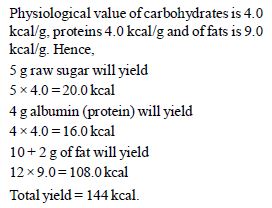
(A) The physiological calorific value of carbohydrates is $4.0 \, kcal/g$,proteins is $4.0 \, kcal/g$,and fats is $9.0 \, kcal/g$. Lignin is a dietary fiber that cannot be digested by humans,so it provides $0 \, kcal$.
$1$. Raw sugar (carbohydrate): $5 \, g \times 4.0 \, kcal/g = 20.0 \, kcal$.
$2$. Albumin (protein): $4 \, g \times 4.0 \, kcal/g = 16.0 \, kcal$.
$3$. Total fat (pure ghee + vegetable ghee): $10 \, g + 2 \, g = 12 \, g$. Energy from fat: $12 \, g \times 9.0 \, kcal/g = 108.0 \, kcal$.
$4$. Lignin: $5 \, g \times 0 \, kcal/g = 0 \, kcal$.
Total energy = $20.0 + 16.0 + 108.0 + 0 = 144 \, kcal$.
$1$. Raw sugar (carbohydrate): $5 \, g \times 4.0 \, kcal/g = 20.0 \, kcal$.
$2$. Albumin (protein): $4 \, g \times 4.0 \, kcal/g = 16.0 \, kcal$.
$3$. Total fat (pure ghee + vegetable ghee): $10 \, g + 2 \, g = 12 \, g$. Energy from fat: $12 \, g \times 9.0 \, kcal/g = 108.0 \, kcal$.
$4$. Lignin: $5 \, g \times 0 \, kcal/g = 0 \, kcal$.
Total energy = $20.0 + 16.0 + 108.0 + 0 = 144 \, kcal$.
0 likesView Solution
25
BiologyEasyMCQAIIMS · 2014
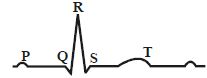
The diagram given here is the standard $ECG$ of a normal person. The $P-$ wave represents the:
A
Initiation of the ventricular contraction
B
Beginning of the systole
C
End of systole
D
Contraction of both the atria
Solution
(D) The $P-$ wave represents the electrical excitation (or depolarisation) of the atria,which leads to the contraction of both the atria.
The $QRS$ complex represents the depolarisation of the ventricles,which initiates the ventricular contraction.
The contraction of the ventricles starts shortly after $Q$ and marks the beginning of the ventricular systole.
The $QRS$ complex represents the depolarisation of the ventricles,which initiates the ventricular contraction.
The contraction of the ventricles starts shortly after $Q$ and marks the beginning of the ventricular systole.
0 likesView Solution
26
BiologyMediumMCQAIIMS · 2014
Assertion : Hemodialysis can save and prolong the life of uremic patients.
Reason : Waste products like urea can be removed from the blood by the process of hemodialysis.
Reason : Waste products like urea can be removed from the blood by the process of hemodialysis.
A
If both Assertion and Reason are correct and the Reason is a correct explanation of the Assertion.
B
If both Assertion and Reason are correct but Reason is not a correct explanation of the Assertion.
C
If the Assertion is correct but Reason is incorrect.
D
If both the Assertion and Reason are incorrect.
Solution
(A) In patients suffering from renal failure,the blood urea level rises abnormally,a condition known as uremia.
In uremic patients,an artificial kidney (hemodialyzer) is used to remove accumulated nitrogenous waste products like urea from the blood through the process of hemodialysis.
Since hemodialysis effectively clears the toxic urea that the damaged kidneys cannot filter,it serves as a life-saving procedure that prolongs the life of these patients.
Therefore,the Reason correctly explains why hemodialysis is beneficial for uremic patients.
In uremic patients,an artificial kidney (hemodialyzer) is used to remove accumulated nitrogenous waste products like urea from the blood through the process of hemodialysis.
Since hemodialysis effectively clears the toxic urea that the damaged kidneys cannot filter,it serves as a life-saving procedure that prolongs the life of these patients.
Therefore,the Reason correctly explains why hemodialysis is beneficial for uremic patients.
0 likesView Solution
27
BiologyMediumMCQAIIMS · 2014
Select the correct matching of the type of the joint with the example in the human skeletal system:
A
Type of joint $-$ Cartilaginous joint,Example $-$ between frontal and parietal
B
Type of joint $-$ Pivot joint,Example $-$ between third and fourth cervical vertebrae
C
Type of joint $-$ Hinge joint,Example $-$ between humerus and pectoral girdle
D
Type of joint $-$ Gliding joint,Example $-$ between carpals
Solution
(D) gliding joint is a type of synovial joint formed between bones that have flat or nearly flat articular surfaces.
These joints allow bones to glide past one another in any direction along the plane of the joint.
In the human body,gliding joints are found between the carpal bones of the wrist,between the tarsal bones of the ankle,and between the zygapophyses of the adjacent vertebrae.
Therefore,the matching of a gliding joint with the carpals is correct.
Cartilaginous joints are found between adjacent vertebrae,not between frontal and parietal bones (which are fibrous joints).
Pivot joints allow rotational movement (e.g.,between atlas and axis),not between the third and fourth cervical vertebrae.
Hinge joints allow movement in one plane (e.g.,elbow joint),whereas the joint between the humerus and pectoral girdle is a ball and socket joint.
These joints allow bones to glide past one another in any direction along the plane of the joint.
In the human body,gliding joints are found between the carpal bones of the wrist,between the tarsal bones of the ankle,and between the zygapophyses of the adjacent vertebrae.
Therefore,the matching of a gliding joint with the carpals is correct.
Cartilaginous joints are found between adjacent vertebrae,not between frontal and parietal bones (which are fibrous joints).
Pivot joints allow rotational movement (e.g.,between atlas and axis),not between the third and fourth cervical vertebrae.
Hinge joints allow movement in one plane (e.g.,elbow joint),whereas the joint between the humerus and pectoral girdle is a ball and socket joint.
0 likesView Solution
28
BiologyMediumMCQAIIMS · 2014
The rate of formation of new organic matter by a rabbit in a grassland is called:
A
net productivity
B
secondary productivity
C
net primary productivity
D
gross primary productivity
Solution
(B) : The rate of resynthesis of organic matter by consumers or the rate at which food energy is assimilated at the trophic level of consumers is called secondary productivity.
In a grassland ecosystem,the rabbit acts as a primary consumer (herbivore).
Therefore,the rate of formation of new organic matter by the rabbit is referred to as secondary productivity.
In a grassland ecosystem,the rabbit acts as a primary consumer (herbivore).
Therefore,the rate of formation of new organic matter by the rabbit is referred to as secondary productivity.
0 likesView Solution
29
BiologyMediumMCQAIIMS · 2014
If the cells of the root in a wheat plant have $42$ chromosomes,then the number of chromosomes in the cell of a pollen grain is:
A
$14$
B
$21$
C
$28$
D
$42$
Solution
(B) The root cells of a wheat plant are diploid $(2n)$ in nature.
Given that the number of chromosomes in root cells is $2n = 42$.
Therefore,the haploid number $(n)$ is calculated as $n = \frac{42}{2} = 21$.
Pollen grains are male gametophytes and are haploid $(n)$ in nature.
Thus,the number of chromosomes in a pollen grain cell is $21$.
Given that the number of chromosomes in root cells is $2n = 42$.
Therefore,the haploid number $(n)$ is calculated as $n = \frac{42}{2} = 21$.
Pollen grains are male gametophytes and are haploid $(n)$ in nature.
Thus,the number of chromosomes in a pollen grain cell is $21$.
0 likesView Solution
30
BiologyEasyMCQAIIMS · 2014
Which one of the following is correctly matched?
A
Onion - Bulb
B
Ginger - Sucker
C
Chlamydomonas - Conidia
D
Yeast - Zoospores
Solution
(A) The correct match is $A$ (Onion - Bulb).
$B$ (Ginger) reproduces via Rhizome,not Sucker.
$C$ (Chlamydomonas) reproduces via Zoospores,not Conidia.
$D$ (Yeast) reproduces via Budding,not Zoospores.
$B$ (Ginger) reproduces via Rhizome,not Sucker.
$C$ (Chlamydomonas) reproduces via Zoospores,not Conidia.
$D$ (Yeast) reproduces via Budding,not Zoospores.
0 likesView Solution
31
BiologyMediumMCQAIIMS · 2014
Select the correct option describing gonadotropin activity in a normal pregnant female:
A
High level of $FSH$ and $LH$ stimulate the thickening of endometrium
B
High level of $FSH$ and $LH$ facilitate implantation of the embryo
C
High level of $hCG$ stimulates the synthesis of estrogen and progesterone
D
High level of $hCG$ stimulates the thickening of endometrium
Solution
(C) During pregnancy,the placenta produces human chorionic gonadotropin $(hCG)$.
This hormone acts similarly to $LH$ and maintains the corpus luteum in the ovary.
The corpus luteum then continues to secrete estrogen and progesterone,which are essential for maintaining the pregnancy.
Therefore,a high level of $hCG$ stimulates the synthesis of estrogen and progesterone.
This hormone acts similarly to $LH$ and maintains the corpus luteum in the ovary.
The corpus luteum then continues to secrete estrogen and progesterone,which are essential for maintaining the pregnancy.
Therefore,a high level of $hCG$ stimulates the synthesis of estrogen and progesterone.
0 likesView Solution
32
BiologyMediumMCQAIIMS · 2014
Assertion: Leaves of $Bryophyllum$ and $Begonia$ help in vegetative multiplication.
Reason: Leaves of these plants possess adventitious buds.
Reason: Leaves of these plants possess adventitious buds.
A
If both Assertion and Reason are correct and the Reason is a correct explanation of the Assertion.
B
If both Assertion and Reason are correct but Reason is not a correct explanation of the Assertion.
C
If the Assertion is correct but Reason is incorrect.
D
If both the Assertion and Reason are incorrect.
Solution
(A) Vegetative propagation is a type of asexual reproduction where new plants are formed from vegetative parts of the parent plant.
In plants like $Bryophyllum$ and $Begonia$,the leaves are specialized to perform vegetative propagation.
These leaves possess adventitious buds (also known as foliar buds) in the notches of their margins.
When these leaves fall on moist soil,the adventitious buds develop into new plantlets.
Therefore,both the Assertion and the Reason are correct,and the Reason is the correct explanation of the Assertion.
In plants like $Bryophyllum$ and $Begonia$,the leaves are specialized to perform vegetative propagation.
These leaves possess adventitious buds (also known as foliar buds) in the notches of their margins.
When these leaves fall on moist soil,the adventitious buds develop into new plantlets.
Therefore,both the Assertion and the Reason are correct,and the Reason is the correct explanation of the Assertion.
0 likesView Solution
33
BiologyMediumMCQAIIMS · 2014
Geitonogamy involves
A
fertilization of a flower by the pollen from another flower of the same plant
B
fertilization of a flower by the pollen from the same flower
C
fertilization of a flower by the pollen from a flower of another plant in the same population
D
fertilization of a flower by the pollen from a flower of another plant belonging to a distant population
Solution
(A) Geitonogamy is a type of pollination where pollen grains are transferred from the anther of one flower to the stigma of another flower on the same plant. Although it is functionally cross-pollination involving a pollinating agent,genetically it is similar to self-pollination because the pollen grains come from the same plant.
0 likesView Solution
34
BiologyMediumMCQAIIMS · 2014
Assertion: Head of sperm consists of acrosome and mitochondria.
Reason: Acrosome contains spiral row of mitochondria.
Reason: Acrosome contains spiral row of mitochondria.
A
If both Assertion and Reason are correct and the Reason is a correct explanation of the Assertion.
B
If both Assertion and Reason are correct but Reason is not a correct explanation of the Assertion.
C
If both the Assertion and Reason are incorrect.
D
If the Assertion is correct but Reason is incorrect.
Solution
(C) The head of a sperm consists of an acrosome and a nucleus,not mitochondria.
The spiral row of mitochondria is present in the middle piece of the sperm,which provides energy for motility.
Therefore,both the Assertion and the Reason are incorrect.
The spiral row of mitochondria is present in the middle piece of the sperm,which provides energy for motility.
Therefore,both the Assertion and the Reason are incorrect.
0 likesView Solution
35
BiologyMediumMCQAIIMS · 2014
Assertion: Females have less stature than males after puberty.
Reason: This happens because of the presence of $hCG$ in the blood of females.
Reason: This happens because of the presence of $hCG$ in the blood of females.
A
If both Assertion and Reason are correct and the Reason is a correct explanation of the Assertion.
B
If both Assertion and Reason are correct but Reason is not a correct explanation of the Assertion.
C
If the Assertion is correct but Reason is incorrect.
D
If both the Assertion and Reason are incorrect.
Solution
(C) Males generally have a greater stature than females after puberty due to the action of the male sex hormone,testosterone,which is secreted by the testes.
Testosterone secretion begins at puberty under the influence of Luteinizing Hormone $(LH)$ from the anterior pituitary gland.
Testosterone promotes secondary sexual characteristics in males,including bone growth,calcium retention,and the closure of epiphyseal cartilage,which contributes to increased height and bone density.
$hCG$ (Human Chorionic Gonadotropin) is a hormone secreted by the placenta during pregnancy,not a hormone responsible for stature.
Therefore,the Assertion is correct,but the Reason is incorrect.
Testosterone secretion begins at puberty under the influence of Luteinizing Hormone $(LH)$ from the anterior pituitary gland.
Testosterone promotes secondary sexual characteristics in males,including bone growth,calcium retention,and the closure of epiphyseal cartilage,which contributes to increased height and bone density.
$hCG$ (Human Chorionic Gonadotropin) is a hormone secreted by the placenta during pregnancy,not a hormone responsible for stature.
Therefore,the Assertion is correct,but the Reason is incorrect.
0 likesView Solution
36
BiologyEasyMCQAIIMS · 2014
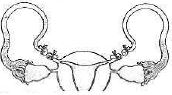
What is the figure given below showing in particular?
A
Ovarian cancer
B
Uterine cancer
C
Tubectomy
D
Vasectomy
Solution
(C) The figure shows a tubectomy. This is a surgical method of contraception used in females. In this procedure,a small part of the fallopian tube is removed or tied through a small incision in the abdomen or through the vagina. It is a highly effective method of birth control,but its reversibility is very poor.
0 likesView Solution
37
BiologyMediumMCQAIIMS · 2014
Assertion: $HIV$ infection can be avoided by the use of condoms.
Reason: Condoms secrete anti-viral interferons.
Reason: Condoms secrete anti-viral interferons.
A
If both Assertion and Reason are correct and the Reason is a correct explanation of the Assertion.
B
If both Assertion and Reason are correct but Reason is not a correct explanation of the Assertion.
C
If the Assertion is correct but Reason is incorrect.
D
If both the Assertion and Reason are incorrect.
Solution
(C) The Assertion is correct because condoms act as a physical barrier that prevents the exchange of body fluids,thereby reducing the risk of $HIV$ transmission.
The Reason is incorrect because condoms are made of latex or polyurethane and do not secrete any biological substances like anti-viral interferons. They function solely as a mechanical barrier.
The Reason is incorrect because condoms are made of latex or polyurethane and do not secrete any biological substances like anti-viral interferons. They function solely as a mechanical barrier.
0 likesView Solution
38
BiologyEasyMCQAIIMS · 2014
Assertion : Copper $-T$ is an effective contraceptive device in human females.
Reason : Copper $-T$ prevents passage of sperms from vagina upwards into fallopian tubes.
Reason : Copper $-T$ prevents passage of sperms from vagina upwards into fallopian tubes.
A
If both Assertion and Reason are correct and the Reason is a correct explanation of the Assertion.
B
If both Assertion and Reason are correct but Reason is not a correct explanation of the Assertion.
C
If the Assertion is correct but Reason is incorrect.
D
If both the Assertion and Reason are incorrect.
Solution
(C) Copper $-T$ is an Intra-Uterine Device $(IUD)$ that is highly effective in preventing pregnancy.
It works by releasing copper ions $(Cu^{2+})$ which suppress sperm motility and the fertilizing capacity of sperms.
It does not prevent the passage of sperms from the vagina to the fallopian tubes; rather,it acts within the uterus to prevent fertilization and implantation.
Therefore,the Assertion is correct,but the Reason is incorrect.
It works by releasing copper ions $(Cu^{2+})$ which suppress sperm motility and the fertilizing capacity of sperms.
It does not prevent the passage of sperms from the vagina to the fallopian tubes; rather,it acts within the uterus to prevent fertilization and implantation.
Therefore,the Assertion is correct,but the Reason is incorrect.
0 likesView Solution
39
BiologyMediumMCQAIIMS · 2014
If both parents are carriers for thalassemia,which is an autosomal recessive disorder,what are the chances of pregnancy resulting in an affected child?
A
$50\%$
B
$25\%$
C
$100\%$
D
no chance
Solution
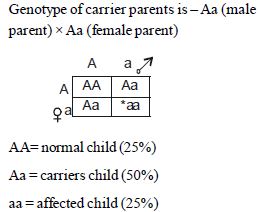
(B) Thalassemia is an autosomal recessive disorder. Let '$A$' represent the dominant normal allele and '$a$' represent the recessive mutant allele.
Carrier parents have the genotype '$Aa$'.
When two carrier parents $(Aa \times Aa)$ reproduce,the possible genotypes of the offspring are determined by a Punnett square:
- $AA$ (Normal child): $25\%$
- $Aa$ (Carrier child): $50\%$
- $aa$ (Affected child): $25\%$
Therefore,the probability of having an affected child $(aa)$ is $25\%$.
Carrier parents have the genotype '$Aa$'.
When two carrier parents $(Aa \times Aa)$ reproduce,the possible genotypes of the offspring are determined by a Punnett square:
- $AA$ (Normal child): $25\%$
- $Aa$ (Carrier child): $50\%$
- $aa$ (Affected child): $25\%$
Therefore,the probability of having an affected child $(aa)$ is $25\%$.
0 likesView Solution
40
BiologyDifficultMCQAIIMS · 2014
Assertion : In $Mirabilis$,selfing of $F_1$ pink flower plants produces same phenotypic & genotypic ratio.
Reason : Flower colour gene shows incomplete dominance.
Reason : Flower colour gene shows incomplete dominance.
A
If both Assertion and Reason are correct and the Reason is a correct explanation of the Assertion.
B
If both Assertion and Reason are correct but Reason is not a correct explanation of the Assertion.
C
If the Assertion is correct but Reason is incorrect.
D
If both the Assertion and Reason are incorrect.
Solution
(A) In $Mirabilis$ $jalapa$ (four o'clock plant),flower colour exhibits incomplete dominance.
When $F_1$ pink flowered plants $(Rr)$ are selfed,the $F_2$ generation results in a phenotypic and genotypic ratio of $1:2:1$.
The ratio is as follows:
$1$ $RR$ (Red) : $2$ $Rr$ (Pink) : $1$ $rr$ (White).
Since both the phenotypic ratio ($1$ Red : $2$ Pink : $1$ White) and the genotypic ratio ($1$ $RR$ : $2$ $Rr$ : $1$ $rr$) are identical $(1:2:1)$,the Assertion is correct.
This occurs specifically because the gene for flower colour shows incomplete dominance,making the Reason the correct explanation for the Assertion.
When $F_1$ pink flowered plants $(Rr)$ are selfed,the $F_2$ generation results in a phenotypic and genotypic ratio of $1:2:1$.
The ratio is as follows:
$1$ $RR$ (Red) : $2$ $Rr$ (Pink) : $1$ $rr$ (White).
Since both the phenotypic ratio ($1$ Red : $2$ Pink : $1$ White) and the genotypic ratio ($1$ $RR$ : $2$ $Rr$ : $1$ $rr$) are identical $(1:2:1)$,the Assertion is correct.
This occurs specifically because the gene for flower colour shows incomplete dominance,making the Reason the correct explanation for the Assertion.
0 likesView Solution
41
BiologyMediumMCQAIIMS · 2014
Select the correct option regarding the direction of $RNA$ synthesis and the direction of reading of the template $DNA$ strand:
A
$5'-3'$ and $3'-5'$
B
$3'-5'$ and $5'-3'$
C
$5'-3'$ and $5'-3'$
D
$3'-5'$ and $3'-5'$
Solution
(A) During the process of transcription,$RNA$ polymerase catalyzes the synthesis of $RNA$ in the $5'-3'$ direction.
This means that the new $RNA$ strand is synthesized by adding nucleotides to the $3'$ end.
To achieve this,the $RNA$ polymerase enzyme moves along the template $DNA$ strand in the $3'-5'$ direction.
Therefore,the direction of $RNA$ synthesis is $5'-3'$ and the direction of reading the template $DNA$ strand is $3'-5'$.
This means that the new $RNA$ strand is synthesized by adding nucleotides to the $3'$ end.
To achieve this,the $RNA$ polymerase enzyme moves along the template $DNA$ strand in the $3'-5'$ direction.
Therefore,the direction of $RNA$ synthesis is $5'-3'$ and the direction of reading the template $DNA$ strand is $3'-5'$.
0 likesView Solution
42
BiologyMediumMCQAIIMS · 2014
Which one of the following represents a palindromic sequence in $DNA$?
A
$5' - GAATTC - 3'$
$3' - CTTAAG - 5'$
$3' - CTTAAG - 5'$
B
$5' - CCAATG - 3'$
$3' - GAATCC - 5'$
$3' - GAATCC - 5'$
C
$5' - CATTAG - 3'$
$3' - GATAAC - 5'$
$3' - GATAAC - 5'$
D
$5' - GATACC - 3'$
$3' - CCTAAG - 5'$
$3' - CCTAAG - 5'$
Solution
(A) palindromic sequence is a nucleic acid sequence ($DNA$ or $RNA$) that is the same when read $5'$ to $3'$ on one strand and $5'$ to $3'$ on the complementary strand.
In the option $A$:
$5' - GAATTC - 3'$
$3' - CTTAAG - 5'$
Reading the top strand from $5'$ to $3'$ gives $GAATTC$. Reading the bottom strand from $5'$ to $3'$ (which is right to left in the representation) also gives $GAATTC$.
This is a classic palindromic sequence recognized by the restriction enzyme $EcoRI$.
In the option $A$:
$5' - GAATTC - 3'$
$3' - CTTAAG - 5'$
Reading the top strand from $5'$ to $3'$ gives $GAATTC$. Reading the bottom strand from $5'$ to $3'$ (which is right to left in the representation) also gives $GAATTC$.
This is a classic palindromic sequence recognized by the restriction enzyme $EcoRI$.
0 likesView Solution
43
BiologyMediumMCQAIIMS · 2014
Assertion : The uptake of $DNA$ during transformation is an active,energy-requiring process.
Reason : Transformation occurs in only those bacteria,which possess the enzymatic machinery involved in the active uptake and recombination.
Reason : Transformation occurs in only those bacteria,which possess the enzymatic machinery involved in the active uptake and recombination.
A
If both Assertion and Reason are correct and the Reason is a correct explanation of the Assertion.
B
If both Assertion and Reason are correct but Reason is not a correct explanation of the Assertion.
C
If the Assertion is correct but Reason is incorrect.
D
If both the Assertion and Reason are incorrect.
Solution
(A) Transformation is a process where a bacterium takes up naked $DNA$ from its environment. This process is not a passive diffusion of $DNA$ molecules through the cell wall and membrane.
It is an active,energy-requiring process that occurs only in specific bacteria that possess the necessary enzymatic machinery for active uptake and subsequent recombination of the $DNA$ into the host genome.
Even within a population of such bacteria,only 'competent' cells,which express specific competence factors,are capable of performing this uptake.
Therefore,both the Assertion and the Reason are correct,and the Reason provides the correct explanation for why the process is active.
It is an active,energy-requiring process that occurs only in specific bacteria that possess the necessary enzymatic machinery for active uptake and subsequent recombination of the $DNA$ into the host genome.
Even within a population of such bacteria,only 'competent' cells,which express specific competence factors,are capable of performing this uptake.
Therefore,both the Assertion and the Reason are correct,and the Reason provides the correct explanation for why the process is active.
0 likesView Solution
44
BiologyMediumMCQAIIMS · 2014
Assertion : $UAA, UAG$ and $UGA$ terminate protein synthesis.
Reason : They are not recognised by $tRNA$.
Reason : They are not recognised by $tRNA$.
A
If both Assertion and Reason are correct and the Reason is a correct explanation of the Assertion.
B
If both Assertion and Reason are correct but Reason is not a correct explanation of the Assertion.
C
If the Assertion is correct but Reason is incorrect.
D
If both the Assertion and Reason are incorrect.
Solution
(A) The synthesis of a polypeptide chain terminates when a stop codon (nonsense codon) of $mRNA$ reaches the $A-$site of the ribosome.
There are three stop codons: $UAA, UAG$,and $UGA$.
These codons do not code for any amino acid and are not recognized by any $tRNA$ molecule.
Because no $tRNA$ can bind to these codons,no further aminoacyl-$tRNA$ reaches the $A-$site.
Consequently,the polypeptide chain is released from the $P-$site $tRNA$ in the presence of release factors,terminating the translation process.
There are three stop codons: $UAA, UAG$,and $UGA$.
These codons do not code for any amino acid and are not recognized by any $tRNA$ molecule.
Because no $tRNA$ can bind to these codons,no further aminoacyl-$tRNA$ reaches the $A-$site.
Consequently,the polypeptide chain is released from the $P-$site $tRNA$ in the presence of release factors,terminating the translation process.
0 likesView Solution
45
BiologyMediumMCQAIIMS · 2014
Forelimbs of cat,lizard used in walking; forelimbs of whale used in swimming and forelimbs of bats used in flying are an example of
A
Analogous organs
B
Adaptive radiation
C
Homologous organs
D
Convergent evolution
Solution
(C) Organs that share a common fundamental anatomical structure and similar embryonic origin,despite performing different functions,are known as homologous organs.
In the case of the forelimbs of a cat,lizard,whale,and bat,they all possess the same basic skeletal arrangement (humerus,radius,ulna,carpals,metacarpals,and phalanges).
Although these limbs are adapted for different functions like walking,swimming,or flying,their underlying structural similarity indicates a common evolutionary ancestry.
Therefore,they are classic examples of homologous organs.
In the case of the forelimbs of a cat,lizard,whale,and bat,they all possess the same basic skeletal arrangement (humerus,radius,ulna,carpals,metacarpals,and phalanges).
Although these limbs are adapted for different functions like walking,swimming,or flying,their underlying structural similarity indicates a common evolutionary ancestry.
Therefore,they are classic examples of homologous organs.
0 likesView Solution
46
BiologyMediumMCQAIIMS · 2014
$A$ population is in Hardy-Weinberg equilibrium for a gene with only two alleles. If the gene frequency of an allele $A$ is $0.7$,the genotype frequency of $Aa$ is
A
$0.21$
B
$0.42$
C
$0.36$
D
$0.7$
Solution
(B) For a gene with two alleles,$A$ and $a$,if the frequency of $A$ is $p$ and the frequency of $a$ is $q$,then the frequencies of the three possible genotypes ($AA, Aa,$ and $aa$) are expressed by the Hardy-Weinberg equation: $p^2 + 2pq + q^2 = 1$.
Here,$p$ is the frequency of allele $A$ and $q$ is the frequency of allele $a$.
Given that $p = 0.7$,we know that $p + q = 1$,so $q = 1 - 0.7 = 0.3$.
The frequency of the heterozygous genotype $Aa$ is represented by $2pq$.
Substituting the values: $2pq = 2 \times 0.7 \times 0.3 = 0.42$.
Here,$p$ is the frequency of allele $A$ and $q$ is the frequency of allele $a$.
Given that $p = 0.7$,we know that $p + q = 1$,so $q = 1 - 0.7 = 0.3$.
The frequency of the heterozygous genotype $Aa$ is represented by $2pq$.
Substituting the values: $2pq = 2 \times 0.7 \times 0.3 = 0.42$.
0 likesView Solution
47
BiologyEasyMCQAIIMS · 2014
Which of the following is based upon the principle of antigen-antibody interaction?
A
$PCR$
B
$ELISA$
C
$r-DNA$ technology
D
$RNA$
Solution
(B) $ELISA$ (Enzyme-Linked Immunosorbent Assay) is a fundamental tool of clinical immunology.
It is based on the principle of antigen-antibody interaction,where specific antibodies or antigens are used to detect the presence of the target molecule.
This test is widely used as an initial screen for $HIV$ detection and allows for easy visualization of results through enzymatic color changes.
It is based on the principle of antigen-antibody interaction,where specific antibodies or antigens are used to detect the presence of the target molecule.
This test is widely used as an initial screen for $HIV$ detection and allows for easy visualization of results through enzymatic color changes.
0 likesView Solution
48
BiologyMediumMCQAIIMS · 2014
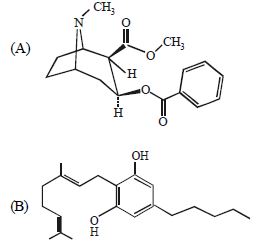
Identify the molecules $(A)$ and $(B)$ shown below and select the right option giving their source and use.
| Molecule | Source | Uses |
| :--- | :--- | :--- |
| Molecule | Source | Uses |
| :--- | :--- | :--- |
A
$(A)$ Cocaine $\to$ Erythroxylum coca $\to$ Accelerates the transport of dopamine
B
$(B)$ Heroin $\to$ Cannabis sativa $\to$ Depressant and slows down body functions
C
$(B)$ Cannabinoid $\to$ Atropa belladona $\to$ Produces hallucinations
D
$(A)$ Morphine $\to$ Papaver somniferum $\to$ Sedative and pain killer
Solution
(A) Molecule $(A)$ is the chemical structure of Cocaine,which is obtained from the plant Erythroxylum coca. It interferes with the transport of the neurotransmitter dopamine.
Molecule $(B)$ is the chemical structure of a Cannabinoid,which is obtained from the inflorescences of the plant Cannabis sativa. Cannabinoids are known for their effects on the cardiovascular system and can produce hallucinations.
Option $(A)$ is incorrect because while the source is correct,the structure shown is Cocaine,not Morphine.
Option $(D)$ is incorrect because the structure shown in $(A)$ is Cocaine,not Morphine.
Therefore,the correct identification and association based on the provided structures is that $(A)$ is Cocaine and $(B)$ is a Cannabinoid. However,looking at the options provided,option $(A)$ correctly identifies the source and action of Cocaine,which matches the structure $(A)$.
Molecule $(B)$ is the chemical structure of a Cannabinoid,which is obtained from the inflorescences of the plant Cannabis sativa. Cannabinoids are known for their effects on the cardiovascular system and can produce hallucinations.
Option $(A)$ is incorrect because while the source is correct,the structure shown is Cocaine,not Morphine.
Option $(D)$ is incorrect because the structure shown in $(A)$ is Cocaine,not Morphine.
Therefore,the correct identification and association based on the provided structures is that $(A)$ is Cocaine and $(B)$ is a Cannabinoid. However,looking at the options provided,option $(A)$ correctly identifies the source and action of Cocaine,which matches the structure $(A)$.
0 likesView Solution
49
BiologyMediumMCQAIIMS · 2014
Assertion: Interferons are effective against viruses.
Reason: Proteins which can be synthesized only by genetic engineering are effective against viruses.
Reason: Proteins which can be synthesized only by genetic engineering are effective against viruses.
A
If both Assertion and Reason are correct and the Reason is a correct explanation of the Assertion.
B
If both Assertion and Reason are correct but Reason is not a correct explanation of the Assertion.
C
If the Assertion is correct but Reason is incorrect.
D
If both the Assertion and Reason are incorrect.
Solution
(C) Interferons are antiviral proteins produced by virus-infected cells. They protect non-infected cells from further viral infection by inhibiting viral protein synthesis.
While interferons can now be produced using genetic engineering,they are naturally synthesized by the body's cells in response to viral infections. Therefore,the claim that they can be synthesized 'only' by genetic engineering is false.
Thus,the Assertion is correct,but the Reason is incorrect.
While interferons can now be produced using genetic engineering,they are naturally synthesized by the body's cells in response to viral infections. Therefore,the claim that they can be synthesized 'only' by genetic engineering is false.
Thus,the Assertion is correct,but the Reason is incorrect.
0 likesView Solution
50
BiologyEasyMCQAIIMS · 2014
Which of the following is the pair of biofertilizers?
A
Azolla and $BGA$
B
Nostoc and legume
C
Rhizobium and grasses
D
Salmonella and $E. coli$
Solution
(A) Biofertilizers are organisms that enrich the nutrient quality of the soil.
$Azolla$ is a water fern that has a symbiotic relationship with the cyanobacterium $Anabaena azollae$,which fixes atmospheric nitrogen.
$BGA$ (Blue-Green Algae),such as $Nostoc$ and $Anabaena$,are also well-known biofertilizers that fix nitrogen and increase soil fertility.
Therefore,$Azolla$ and $BGA$ represent a correct pair of biofertilizers.
$Azolla$ is a water fern that has a symbiotic relationship with the cyanobacterium $Anabaena azollae$,which fixes atmospheric nitrogen.
$BGA$ (Blue-Green Algae),such as $Nostoc$ and $Anabaena$,are also well-known biofertilizers that fix nitrogen and increase soil fertility.
Therefore,$Azolla$ and $BGA$ represent a correct pair of biofertilizers.
0 likesView Solution
51
BiologyMediumMCQAIIMS · 2014
Chloramphenicol and erythromycin (broad-spectrum antibiotics) are produced by
A
Streptomyces
B
Nitrobacter
C
Rhizobium
D
Penicillium
Solution
(A) Antibiotics are chemical substances produced by some microbes and can kill or retard the growth of other disease-causing microbes.
Chloramphenicol and erythromycin are well-known broad-spectrum antibiotics.
These antibiotics are primarily produced by bacteria belonging to the genus $Streptomyces$.
$Streptomyces$ species are filamentous bacteria known for their ability to produce a wide variety of secondary metabolites,including many clinically important antibiotics.
Chloramphenicol and erythromycin are well-known broad-spectrum antibiotics.
These antibiotics are primarily produced by bacteria belonging to the genus $Streptomyces$.
$Streptomyces$ species are filamentous bacteria known for their ability to produce a wide variety of secondary metabolites,including many clinically important antibiotics.
0 likesView Solution
52
BiologyMediumMCQAIIMS · 2014
$A$ patient brought to a hospital with myocardial infarction is normally immediately given
A
Penicillin
B
Streptokinase
C
Cyclosporin-$A$
D
Statins
Solution
(B) Streptokinase is a clot-buster enzyme produced by the bacterium Streptococcus and modified by genetic engineering. It is administered to patients who have suffered from myocardial infarction (heart attack) to dissolve blood clots (thrombi) in the blood vessels,thereby restoring blood flow to the heart muscle.
0 likesView Solution
53
BiologyMediumMCQAIIMS · 2014
Assertion: Vitamin $B_2$ is found in cereals,green vegetables,brewer's yeast,egg white,milk,and liver.
Reason: It can be commercially produced by some yeasts.
Reason: It can be commercially produced by some yeasts.
A
If both Assertion and Reason are correct and the Reason is a correct explanation of the Assertion.
B
If both Assertion and Reason are correct but Reason is not a correct explanation of the Assertion.
C
If the Assertion is correct but Reason is incorrect.
D
If both the Assertion and Reason are incorrect.
Solution
(B) Vitamin $B_2$ (Riboflavin) is naturally found in cereals,green vegetables,brewer's yeast,egg white,milk,and liver. This makes the Assertion correct.
Vitamin $B_2$ is also produced commercially using microorganisms,specifically certain yeasts and fungi like $Ashbya$ $gossypii$. This makes the Reason correct.
However,the commercial production of vitamin $B_2$ by yeasts is a separate industrial fact and does not explain why it is found in the specific food sources mentioned in the Assertion. Therefore,the Reason is not the correct explanation for the Assertion.
Vitamin $B_2$ is also produced commercially using microorganisms,specifically certain yeasts and fungi like $Ashbya$ $gossypii$. This makes the Reason correct.
However,the commercial production of vitamin $B_2$ by yeasts is a separate industrial fact and does not explain why it is found in the specific food sources mentioned in the Assertion. Therefore,the Reason is not the correct explanation for the Assertion.
0 likesView Solution
54
BiologyMediumMCQAIIMS · 2014
Genes of interest can be selected from a genomic library by using
A
Restriction enzymes
B
Cloning vectors
C
$DNA$ probes
D
Gene targets
Solution
(C) hybridization probe is a fragment of $DNA$ of variable length which is used in $DNA$ samples to detect the presence of nucleotide sequences (the $DNA$ target) that are complementary to the sequence in the probe.
The probe hybridizes to single-stranded $DNA$ whose base sequence allows probe-target base-pairing due to complementarity between the probe and the target.
Therefore,$DNA$ probes are specifically used to identify and select genes of interest from a genomic library.
The probe hybridizes to single-stranded $DNA$ whose base sequence allows probe-target base-pairing due to complementarity between the probe and the target.
Therefore,$DNA$ probes are specifically used to identify and select genes of interest from a genomic library.
0 likesView Solution
55
BiologyEasyMCQAIIMS · 2014
Which of the following is a variety of $Brassica$ resistant to white rust disease?
A
Himgiri
B
Pusa Kamal
C
Pusa Swarnim (Karan rai)
D
Pusa Sadabahar
Solution
(C) The variety $Pusa$ $Swarnim$ (also known as $Karan$ $rai$) is a disease-resistant variety of $Brassica$ (mustard).
It was developed through conventional plant breeding techniques to provide resistance against the white rust disease caused by the fungus $Albugo$ $candida$.
$Himgiri$ is a variety of wheat resistant to leaf and stripe rust.
$Pusa$ $Kamal$ is a variety of wheat.
$Pusa$ $Sadabahar$ is a variety of chilli resistant to chilli mosaic virus and leaf curl.
It was developed through conventional plant breeding techniques to provide resistance against the white rust disease caused by the fungus $Albugo$ $candida$.
$Himgiri$ is a variety of wheat resistant to leaf and stripe rust.
$Pusa$ $Kamal$ is a variety of wheat.
$Pusa$ $Sadabahar$ is a variety of chilli resistant to chilli mosaic virus and leaf curl.
0 likesView Solution
56
BiologyMediumMCQAIIMS · 2014
The first clinical gene therapy was given in $1990$ to a $4$-year-old girl with an enzyme deficiency of:
A
Adenosine deaminase $(ADA)$
B
Tyrosine oxidase
C
Monoamine oxidase
D
Glutamate dehydrogenase
Solution
(A) Gene therapy is an experimental technique that uses genes to treat or prevent disease.
The first clinical gene therapy was performed in $1990$ to treat adenosine deaminase deficiency.
$A$ four-year-old girl became the first patient to receive gene therapy on September $14, 1990$,at the $NIH$ Clinical Center.
Adenosine deaminase deficiency,also known as $ADA$ deficiency or $ADA-SCID$,is an autosomal recessive metabolic disorder that leads to severe combined immunodeficiency.
This condition is caused by the lack of the enzyme adenosine deaminase,which is essential for the proper functioning of the immune system.
The first clinical gene therapy was performed in $1990$ to treat adenosine deaminase deficiency.
$A$ four-year-old girl became the first patient to receive gene therapy on September $14, 1990$,at the $NIH$ Clinical Center.
Adenosine deaminase deficiency,also known as $ADA$ deficiency or $ADA-SCID$,is an autosomal recessive metabolic disorder that leads to severe combined immunodeficiency.
This condition is caused by the lack of the enzyme adenosine deaminase,which is essential for the proper functioning of the immune system.
0 likesView Solution
57
BiologyMediumMCQAIIMS · 2014
If $4$ individuals in a laboratory population of $40$ fruitflies died during a specified time interval (i.e.,a week),the death rate in the population during that period is
A
$1$
B
$0.1$
C
$0.01$
D
$0.4$
Solution
(B) Mortality or death rate refers to the number of deaths in a population per unit time.
The formula for calculating the death rate is:
$\text{Death rate} = \frac{\text{Number of deaths}}{\text{Total population}}$
Given:
Number of deaths = $4$
Total population = $40$
$\text{Death rate} = \frac{4}{40} = 0.1$ individuals per fruitfly per week.
The formula for calculating the death rate is:
$\text{Death rate} = \frac{\text{Number of deaths}}{\text{Total population}}$
Given:
Number of deaths = $4$
Total population = $40$
$\text{Death rate} = \frac{4}{40} = 0.1$ individuals per fruitfly per week.
0 likesView Solution
58
BiologyEasyMCQAIIMS · 2014
The largest Tiger reserve in India is
A
Nagarhole
B
Valmiki
C
Nagarjunsagar-Srisailam
D
Periyar
Solution
(C) Nagarjunsagar-Srisailam Tiger Reserve is the largest Tiger reserve in India.
It is located in the state of Andhra Pradesh and Telangana.
It covers a vast area,making it the largest protected area for tigers in the country.
It is located in the state of Andhra Pradesh and Telangana.
It covers a vast area,making it the largest protected area for tigers in the country.
0 likesView Solution
59
BiologyMediumMCQAIIMS · 2014
Assertion : Diversity observed in the entire geographical area is called gamma diversity.
Reason : Biodiversity decreases from high altitude to low altitude.
Reason : Biodiversity decreases from high altitude to low altitude.
A
If both Assertion and Reason are correct and the Reason is a correct explanation of the Assertion.
B
If both Assertion and Reason are correct but Reason is not a correct explanation of the Assertion.
C
If the Assertion is correct but Reason is incorrect.
D
If both the Assertion and Reason are incorrect.
Solution
(C) The Assertion is correct. Gamma diversity refers to the total species diversity in a landscape or a large geographical area,which includes the diversity of different habitats within that region.
The Reason is incorrect. Biodiversity generally increases from high altitude to low altitude (or from poles to the equator) because lower altitudes (or tropical regions) provide more stable,favorable,and resource-rich environments for a wider variety of species.
Therefore,the Assertion is correct but the Reason is incorrect.
The Reason is incorrect. Biodiversity generally increases from high altitude to low altitude (or from poles to the equator) because lower altitudes (or tropical regions) provide more stable,favorable,and resource-rich environments for a wider variety of species.
Therefore,the Assertion is correct but the Reason is incorrect.
0 likesView Solution
60
BiologyMediumMCQAIIMS · 2014
Assertion : $A$ sanctuary is formed for the conservation of animals only.
Reason : Restricted human activities are allowed in sanctuaries.
Reason : Restricted human activities are allowed in sanctuaries.
A
If both Assertion and Reason are correct and the Reason is a correct explanation of the Assertion.
B
If both Assertion and Reason are correct but Reason is not a correct explanation of the Assertion.
C
If the Assertion is correct but Reason is incorrect.
D
If both the Assertion and Reason are incorrect.
Solution
(B) The Assertion is correct because a wildlife sanctuary is a protected area specifically designated for the conservation of wild animals.
The Reason is also correct because,unlike national parks,sanctuaries allow certain human activities such as the harvesting of timber,collection of minor forest products,and private ownership rights,provided these activities do not adversely affect the wildlife.
However,the Reason does not explain why a sanctuary is formed for animals only; it merely describes the management policy of the sanctuary. Therefore,the Reason is not the correct explanation of the Assertion.
The Reason is also correct because,unlike national parks,sanctuaries allow certain human activities such as the harvesting of timber,collection of minor forest products,and private ownership rights,provided these activities do not adversely affect the wildlife.
However,the Reason does not explain why a sanctuary is formed for animals only; it merely describes the management policy of the sanctuary. Therefore,the Reason is not the correct explanation of the Assertion.
0 likesView Solution
61
BiologyEasyMCQAIIMS · 2014
The two gases making the highest relative contribution to the greenhouse gases are
A
$CO_2$ and $CH_4$
B
$CH_4$ and $N_2O$
C
$CFC$ and $N_2O$
D
$CO_2$ and $N_2O$
Solution
(A) Greenhouse gases contribute to global warming by trapping heat in the atmosphere.
According to the relative contribution to the greenhouse effect,carbon dioxide $(CO_2)$ accounts for approximately $60\%$ of the total greenhouse effect,while methane $(CH_4)$ accounts for approximately $20\%$.
Therefore,these two gases are the primary contributors to the greenhouse effect.
According to the relative contribution to the greenhouse effect,carbon dioxide $(CO_2)$ accounts for approximately $60\%$ of the total greenhouse effect,while methane $(CH_4)$ accounts for approximately $20\%$.
Therefore,these two gases are the primary contributors to the greenhouse effect.
0 likesView Solution
Vedclass Products
For Students
Vedclass Test Series
Mock tests in real AIIMS style covering Biology with performance analysis. 5-day free trial.
Start Free TrialFor Teachers
Exam Paper Generator
Generate Set A/B/C/D Biology papers from 7.5L+ questions in 2 minutes. 3 chapters free.
Try FreeFor Institutes
Online Exam Module
Run live AIIMS mock exams with unlimited students, 360° analytics & white-label branding.
See DemoFrequently Asked Questions
How many Biology questions are in AIIMS 2014?
There are 61 Biology questions from the AIIMS 2014 paper on Vedclass, each with a detailed step-by-step solution in English.
Are AIIMS 2014 Biology solutions available in English?
Yes. All solutions on this page are in English. You can also switch to English or Hindi using the language buttons above the questions.
Can I practice AIIMS 2014 Biology as a timed test?
Yes. Use the Vedclass Test Series to attempt a full AIIMS mock test covering Biology with time limits and instant score analysis.
Can teachers create Biology papers from AIIMS previous year questions?
Yes. The Vedclass Exam Paper Generator lets teachers mix AIIMS Biology questions and generate Set A/B/C/D papers in minutes.
For Teachers & Institutes
Build a Custom Biology Paper
Pick AIIMS 2014 Biology questions, set difficulty, and generate Set A/B/C/D in 2 minutes.