
PhysicsQ1–51 of 51 questions
Page 1 of 1 · English
1
PhysicsMediumMCQAIIMS · 2014
$A$ stone tied to the end of a string $1\,m$ long is whirled in a horizontal circle with a constant speed. If the stone makes $22$ revolutions in $44$ seconds,what is the magnitude and direction of the acceleration of the stone?
A
$\frac{\pi^2}{4}\,m/s^2$ and direction along the radius towards the centre
B
$\pi^2\,m/s^2$ and direction along the radius away from the centre
C
$\pi^2\,m/s^2$ and direction along the radius towards the centre
D
$\pi^2\,m/s^2$ and direction along the tangent to the circle
Solution
(C) The length of the string is the radius of the circular path,$r = 1\,m$.
The frequency of revolution $n$ is given by $n = \frac{\text{number of revolutions}}{\text{time}} = \frac{22}{44} = 0.5\,Hz$.
The angular velocity $\omega$ is given by $\omega = 2\pi n = 2\pi(0.5) = \pi\,rad/s$.
The centripetal acceleration $a$ is given by $a = \omega^2 r$.
Substituting the values,$a = (\pi)^2 \times 1 = \pi^2\,m/s^2$.
In uniform circular motion,the acceleration is centripetal,meaning its direction is always along the radius and towards the centre.
The frequency of revolution $n$ is given by $n = \frac{\text{number of revolutions}}{\text{time}} = \frac{22}{44} = 0.5\,Hz$.
The angular velocity $\omega$ is given by $\omega = 2\pi n = 2\pi(0.5) = \pi\,rad/s$.
The centripetal acceleration $a$ is given by $a = \omega^2 r$.
Substituting the values,$a = (\pi)^2 \times 1 = \pi^2\,m/s^2$.
In uniform circular motion,the acceleration is centripetal,meaning its direction is always along the radius and towards the centre.
0 likesView Solution
2
PhysicsMediumMCQAIIMS · 2014
Potential energy of a satellite having mass $m$ and rotating at a height of $6.4 \times 10^6 \ m$ from the Earth's surface is
A
$ - 0.5 \, mgR_e $
B
$ - mgR_e $
C
$ - 2 \, mgR_e $
D
$ 4 \, mgR_e $
Solution
(A) The potential energy $U$ of a satellite of mass $m$ at a distance $r$ from the center of the Earth is given by $U = -\frac{GMm}{r}$.
Here,$r = R_e + h$,where $R_e$ is the radius of the Earth and $h$ is the height of the satellite.
Given $h = 6.4 \times 10^6 \ m$ and $R_e \approx 6.4 \times 10^6 \ m$,we have $r = R_e + R_e = 2R_e$.
Using the relation $g = \frac{GM}{R_e^2}$,we can write $GM = gR_e^2$.
Substituting these into the potential energy formula:
$U = -\frac{(gR_e^2)m}{2R_e} = -\frac{1}{2}mgR_e = -0.5 \, mgR_e$.
Here,$r = R_e + h$,where $R_e$ is the radius of the Earth and $h$ is the height of the satellite.
Given $h = 6.4 \times 10^6 \ m$ and $R_e \approx 6.4 \times 10^6 \ m$,we have $r = R_e + R_e = 2R_e$.
Using the relation $g = \frac{GM}{R_e^2}$,we can write $GM = gR_e^2$.
Substituting these into the potential energy formula:
$U = -\frac{(gR_e^2)m}{2R_e} = -\frac{1}{2}mgR_e = -0.5 \, mgR_e$.
0 likesView Solution
3
PhysicsMediumMCQAIIMS · 2014
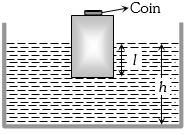
$A$ wooden block,with a coin placed on its top,floats in water as shown in the figure. The distances $l$ and $h$ are shown. After some time,the coin falls into the water. Then:
A
$l$ decreases and $h$ increases
B
$l$ increases and $h$ decreases
C
Both $l$ and $h$ increase
D
Both $l$ and $h$ decrease
Solution
(D) Initially,the block floats with the coin. According to the law of floatation,the total weight of the block and the coin is balanced by the buoyant force,which is equal to the weight of the water displaced by the submerged part of the block. Let $M$ be the mass of the block and $m$ be the mass of the coin. The total weight is $(M+m)g$. The volume of water displaced is $V_{disp} = (M+m)/\rho_w$,where $\rho_w$ is the density of water.
When the coin falls into the water,it sinks (assuming its density is greater than water). The block now only needs to support its own weight $Mg$. The new volume of water displaced by the block is $V'_{disp} = M/\rho_w$. Since $V'_{disp} < V_{disp}$,the submerged depth $l$ of the block decreases.
Regarding $h$,the total volume of water displaced initially was $V_{disp} = (M+m)/\rho_w$. After the coin falls,the block displaces $M/\rho_w$ and the coin displaces its own volume $V_c = m/\rho_c$. The new total volume of water displaced is $V'_{total} = M/\rho_w + m/\rho_c$. Since the density of the coin $\rho_c > \rho_w$,it follows that $m/\rho_c < m/\rho_w$. Therefore,$V'_{total} < V_{disp}$. As the total volume of water displaced decreases,the water level $h$ also decreases. Thus,both $l$ and $h$ decrease.
When the coin falls into the water,it sinks (assuming its density is greater than water). The block now only needs to support its own weight $Mg$. The new volume of water displaced by the block is $V'_{disp} = M/\rho_w$. Since $V'_{disp} < V_{disp}$,the submerged depth $l$ of the block decreases.
Regarding $h$,the total volume of water displaced initially was $V_{disp} = (M+m)/\rho_w$. After the coin falls,the block displaces $M/\rho_w$ and the coin displaces its own volume $V_c = m/\rho_c$. The new total volume of water displaced is $V'_{total} = M/\rho_w + m/\rho_c$. Since the density of the coin $\rho_c > \rho_w$,it follows that $m/\rho_c < m/\rho_w$. Therefore,$V'_{total} < V_{disp}$. As the total volume of water displaced decreases,the water level $h$ also decreases. Thus,both $l$ and $h$ decrease.
0 likesView Solution
4
PhysicsMediumMCQAIIMS · 2014
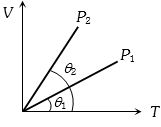
The figure shows the volume $V$ versus temperature $T$ graphs for a certain mass of a perfect gas at two constant pressures of $P_1$ and $P_2$. What inference can you draw from the graphs?
A
$P_1 > P_2$
B
$P_1 < P_2$
C
$P_1 = P_2$
D
No inference can be drawn due to insufficient information
Solution
(A) From the ideal gas equation,$PV = \mu RT$,we have $V = (\frac{\mu R}{P})T$.
The slope of the $V-T$ graph is given by $m = \tan \theta = \frac{V}{T} = \frac{\mu R}{P}$.
Since the slope is inversely proportional to pressure $(m \propto \frac{1}{P})$,a smaller slope corresponds to a higher pressure.
From the graph,it is clear that $\theta_1 < \theta_2$,which implies $\tan \theta_1 < \tan \theta_2$.
Therefore,$(\frac{V}{T})_1 < (\frac{V}{T})_2$.
Since $(\frac{V}{T}) \propto \frac{1}{P}$,we have $(\frac{1}{P})_1 < (\frac{1}{P})_2$,which leads to $P_1 > P_2$.
The slope of the $V-T$ graph is given by $m = \tan \theta = \frac{V}{T} = \frac{\mu R}{P}$.
Since the slope is inversely proportional to pressure $(m \propto \frac{1}{P})$,a smaller slope corresponds to a higher pressure.
From the graph,it is clear that $\theta_1 < \theta_2$,which implies $\tan \theta_1 < \tan \theta_2$.
Therefore,$(\frac{V}{T})_1 < (\frac{V}{T})_2$.
Since $(\frac{V}{T}) \propto \frac{1}{P}$,we have $(\frac{1}{P})_1 < (\frac{1}{P})_2$,which leads to $P_1 > P_2$.
0 likesView Solution
5
PhysicsEasyMCQAIIMS · 2014
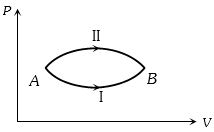
$A$ system goes from $A$ to $B$ via two processes $I$ and $II$ as shown in the figure. If $\Delta U_I$ and $\Delta U_{II}$ are the changes in internal energies in the processes $I$ and $II$ respectively,then:
A
$\Delta U_{II} > \Delta U_I$
B
$\Delta U_{II} < \Delta U_I$
C
$\Delta U_I = \Delta U_{II}$
D
The relation between $\Delta U_I$ and $\Delta U_{II}$ cannot be determined.
Solution
(C) Internal energy $(U)$ is a state function,which means its value depends only on the state of the system (defined by variables like pressure,volume,and temperature) and not on the path taken to reach that state.
Since both processes $I$ and $II$ start at the same initial state $A$ and end at the same final state $B$,the change in internal energy for both processes must be identical.
Therefore,$\Delta U_I = \Delta U_{II}$.
Since both processes $I$ and $II$ start at the same initial state $A$ and end at the same final state $B$,the change in internal energy for both processes must be identical.
Therefore,$\Delta U_I = \Delta U_{II}$.
0 likesView Solution
6
PhysicsMediumMCQAIIMS · 2014
If the temperature of the sun were to be increased from $T$ to $2T$ and its radius from $R$ to $2R$,then the ratio of the radiant energy received on the earth to what it was previously will be
A
$4$
B
$16$
C
$32$
D
$64$
Solution
(D) According to the Stefan-Boltzmann law,the total power radiated by a spherical body of radius $R$ and temperature $T$ is given by $P = \sigma (4\pi R^2) T^4$.
Since the radiant energy $Q$ received on Earth is proportional to the power radiated by the sun,we have $Q \propto R^2 T^4$.
Let the initial energy be $Q_1 = k R^2 T^4$ and the final energy be $Q_2 = k (2R)^2 (2T)^4$.
Taking the ratio,we get $\frac{Q_2}{Q_1} = \left( \frac{2R}{R} \right)^2 \times \left( \frac{2T}{T} \right)^4$.
$\frac{Q_2}{Q_1} = (2)^2 \times (2)^4 = 4 \times 16 = 64$.
Therefore,the ratio of the radiant energy received on the earth is $64$.
Since the radiant energy $Q$ received on Earth is proportional to the power radiated by the sun,we have $Q \propto R^2 T^4$.
Let the initial energy be $Q_1 = k R^2 T^4$ and the final energy be $Q_2 = k (2R)^2 (2T)^4$.
Taking the ratio,we get $\frac{Q_2}{Q_1} = \left( \frac{2R}{R} \right)^2 \times \left( \frac{2T}{T} \right)^4$.
$\frac{Q_2}{Q_1} = (2)^2 \times (2)^4 = 4 \times 16 = 64$.
Therefore,the ratio of the radiant energy received on the earth is $64$.
0 likesView Solution
7
PhysicsEasyMCQAIIMS · 2014
$Assertion$: Two bodies of masses $M$ and $m$ $(M > m)$ are allowed to fall from the same height. If the air resistance for each is the same,then both bodies will reach the Earth simultaneously.
$Reason$: For the same air resistance,the acceleration of both bodies will be the same.
$Reason$: For the same air resistance,the acceleration of both bodies will be the same.
A
If both $Assertion$ and $Reason$ are correct and the $Reason$ is a correct explanation of the $Assertion$.
B
If both $Assertion$ and $Reason$ are correct but $Reason$ is not a correct explanation of the $Assertion$.
C
If the $Assertion$ is correct but $Reason$ is incorrect.
D
If both the $Assertion$ and $Reason$ are incorrect.
Solution
(D) The forces acting on a body of mass $m$ are its weight $mg$ acting vertically downward and air resistance $F$ acting vertically upward.
The net force is $F_{net} = mg - F$.
The acceleration of the body is $a = \frac{F_{net}}{m} = g - \frac{F}{m}$.
For the body of mass $M$,the acceleration is $a_M = g - \frac{F}{M}$.
For the body of mass $m$,the acceleration is $a_m = g - \frac{F}{m}$.
Since $M > m$,it follows that $\frac{F}{M} < \frac{F}{m}$,which implies $a_M > a_m$.
The body with the larger mass $M$ will have a greater acceleration and will reach the ground first.
Therefore,the $Assertion$ is incorrect because they do not reach simultaneously,and the $Reason$ is also incorrect because the accelerations are not the same.
The net force is $F_{net} = mg - F$.
The acceleration of the body is $a = \frac{F_{net}}{m} = g - \frac{F}{m}$.
For the body of mass $M$,the acceleration is $a_M = g - \frac{F}{M}$.
For the body of mass $m$,the acceleration is $a_m = g - \frac{F}{m}$.
Since $M > m$,it follows that $\frac{F}{M} < \frac{F}{m}$,which implies $a_M > a_m$.
The body with the larger mass $M$ will have a greater acceleration and will reach the ground first.
Therefore,the $Assertion$ is incorrect because they do not reach simultaneously,and the $Reason$ is also incorrect because the accelerations are not the same.
0 likesView Solution
8
PhysicsEasyMCQAIIMS · 2014
$Assertion$ : In a free fall,the weight of a body becomes effectively zero.
$Reason$ : The acceleration due to gravity acting on a body in free fall is zero.
$Reason$ : The acceleration due to gravity acting on a body in free fall is zero.
A
If both $Assertion$ and $Reason$ are correct and the $Reason$ is a correct explanation of the $Assertion$.
B
If both $Assertion$ and $Reason$ are correct but $Reason$ is not a correct explanation of the $Assertion$.
C
If both the $Assertion$ and $Reason$ are incorrect.
D
If the $Assertion$ is correct but $Reason$ is incorrect.
Solution
(D) In a free fall,the apparent weight of a body becomes zero. This is because the body and the surface it is on (or the frame of reference) are both accelerating downwards at $g$. The normal force $N$ acting on the body is given by $N = m(g - a)$. Since $a = g$ in free fall,$N = m(g - g) = 0$. Thus,the body experiences weightlessness.
However,the acceleration due to gravity acting on a body in free fall is $g = 9.8 \; m/s^2$,which is definitely not zero. Therefore,the $Assertion$ is correct,but the $Reason$ is incorrect.
However,the acceleration due to gravity acting on a body in free fall is $g = 9.8 \; m/s^2$,which is definitely not zero. Therefore,the $Assertion$ is correct,but the $Reason$ is incorrect.
0 likesView Solution
9
PhysicsMediumMCQAIIMS · 2014
Two projectiles are fired from the same point with the same speed at angles of projection $60^\circ$ and $30^\circ$ respectively. Which one of the following is true?
A
Their maximum height will be same
B
Their range will be same
C
Their landing velocity will be same
D
Their time of flight will be same
Solution
(B) The horizontal range $R$ of a projectile is given by the formula $R = \frac{u^2 \sin(2\theta)}{g}$,where $u$ is the initial speed and $\theta$ is the angle of projection.
For the first projectile: $\theta_1 = 60^\circ$. Thus,$R_1 = \frac{u^2 \sin(2 \times 60^\circ)}{g} = \frac{u^2 \sin(120^\circ)}{g} = \frac{u^2 \sin(60^\circ)}{g} = \frac{u^2 \sqrt{3}}{2g}$.
For the second projectile: $\theta_2 = 30^\circ$. Thus,$R_2 = \frac{u^2 \sin(2 \times 30^\circ)}{g} = \frac{u^2 \sin(60^\circ)}{g} = \frac{u^2 \sqrt{3}}{2g}$.
Since $\sin(2 \times 60^\circ) = \sin(120^\circ) = \sin(60^\circ) = \sin(2 \times 30^\circ)$,the ranges are equal when the sum of the angles is $90^\circ$ (complementary angles). Therefore,their range will be same.
For the first projectile: $\theta_1 = 60^\circ$. Thus,$R_1 = \frac{u^2 \sin(2 \times 60^\circ)}{g} = \frac{u^2 \sin(120^\circ)}{g} = \frac{u^2 \sin(60^\circ)}{g} = \frac{u^2 \sqrt{3}}{2g}$.
For the second projectile: $\theta_2 = 30^\circ$. Thus,$R_2 = \frac{u^2 \sin(2 \times 30^\circ)}{g} = \frac{u^2 \sin(60^\circ)}{g} = \frac{u^2 \sqrt{3}}{2g}$.
Since $\sin(2 \times 60^\circ) = \sin(120^\circ) = \sin(60^\circ) = \sin(2 \times 30^\circ)$,the ranges are equal when the sum of the angles is $90^\circ$ (complementary angles). Therefore,their range will be same.
0 likesView Solution
10
PhysicsEasyMCQAIIMS · 2014
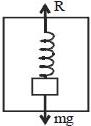
$A$ mass is hanging on a spring balance which is kept in a lift. The lift ascends with an acceleration. The spring balance will show in its readings:
A
an increase
B
a decrease
C
no change
D
a change depending on its velocity
Solution
(A) Let the mass be $m$ and the acceleration of the lift be $a$ in the upward direction.
The forces acting on the mass are the tension $R$ in the spring (which is the reading of the spring balance) acting upwards and the gravitational force $mg$ acting downwards.
According to Newton's second law of motion,the net force is equal to the product of mass and acceleration:
$R - mg = ma$
Rearranging the equation,we get:
$R = m(g + a)$
Since $a > 0$,the reading $R$ is greater than the actual weight $mg$.
Therefore,the spring balance will show an increase in its reading.
The forces acting on the mass are the tension $R$ in the spring (which is the reading of the spring balance) acting upwards and the gravitational force $mg$ acting downwards.
According to Newton's second law of motion,the net force is equal to the product of mass and acceleration:
$R - mg = ma$
Rearranging the equation,we get:
$R = m(g + a)$
Since $a > 0$,the reading $R$ is greater than the actual weight $mg$.
Therefore,the spring balance will show an increase in its reading.
0 likesView Solution
11
PhysicsEasyMCQAIIMS · 2014
If the linear momentum is increased by $5\%$,the kinetic energy will increase by.......$\%$
A
$5$
B
$10$
C
$10.25$
D
$25$
Solution
(C) The relationship between kinetic energy $E$ and linear momentum $p$ is given by $E = \frac{p^2}{2m}$.
For small percentage changes,we can use the differential method: $\frac{\Delta E}{E} = 2 \left( \frac{\Delta p}{p} \right)$.
Given $\frac{\Delta p}{p} = 5\% = 0.05$,the change in kinetic energy is $\frac{\Delta E}{E} = 2 \times 5\% = 10\%$.
Alternatively,using the exact formula: $E' = \frac{(1.05p)^2}{2m} = 1.1025 E$.
The percentage increase is $(1.1025 - 1) \times 100 = 10.25\%$. Since $10.25\%$ is the precise value,we select the closest standard approximation or the exact value if provided.
For small percentage changes,we can use the differential method: $\frac{\Delta E}{E} = 2 \left( \frac{\Delta p}{p} \right)$.
Given $\frac{\Delta p}{p} = 5\% = 0.05$,the change in kinetic energy is $\frac{\Delta E}{E} = 2 \times 5\% = 10\%$.
Alternatively,using the exact formula: $E' = \frac{(1.05p)^2}{2m} = 1.1025 E$.
The percentage increase is $(1.1025 - 1) \times 100 = 10.25\%$. Since $10.25\%$ is the precise value,we select the closest standard approximation or the exact value if provided.
0 likesView Solution
12
PhysicsMediumMCQAIIMS · 2014
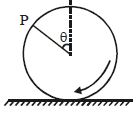
$A$ wheel is rolling straight on ground without slipping. If the axis of the wheel has speed $v$,the instantaneous velocity of a point $P$ on the rim,defined by angle $\theta$ relative to the vertical,relative to the ground will be:
A
$v\,\cos \left( {\frac{\theta}{2} } \right)$
B
$2v\,\cos \left( {\frac{\theta}{2} } \right)$
C
$v\left( {1 + \sin \theta } \right)$
D
$v\left( {1 + \cos \theta } \right)$
Solution
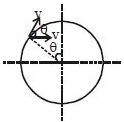
(B) For a wheel rolling without slipping,the velocity of any point $P$ on the rim is the vector sum of the translational velocity of the center of mass $(v)$ and the tangential velocity due to rotation ($v$ relative to the center).
The translational velocity vector is $\vec{v}_{cm} = v\hat{i}$.
The rotational velocity vector at point $P$ is $\vec{v}_{rot} = v\sin\theta\hat{i} + v\cos\theta\hat{j}$ (based on the geometry of the angle $\theta$ with the vertical).
The resultant velocity $\vec{v}_P = \vec{v}_{cm} + \vec{v}_{rot} = (v + v\sin\theta)\hat{i} + v\cos\theta\hat{j}$.
The magnitude is $V_P = \sqrt{(v + v\sin\theta)^2 + (v\cos\theta)^2} = \sqrt{v^2(1 + \sin^2\theta + 2\sin\theta + \cos^2\theta)} = \sqrt{v^2(2 + 2\sin\theta)} = v\sqrt{2(1 + \sin\theta)}$.
However,if $\theta$ is defined such that the velocity components result in the standard form $2v\cos(\theta/2)$,we use the vector addition of two velocities of magnitude $v$ with an angle $\theta$ between them: $V_P = \sqrt{v^2 + v^2 + 2v^2\cos\theta} = \sqrt{2v^2(1 + \cos\theta)} = \sqrt{2v^2(2\cos^2(\theta/2))} = 2v\cos(\theta/2)$.
The translational velocity vector is $\vec{v}_{cm} = v\hat{i}$.
The rotational velocity vector at point $P$ is $\vec{v}_{rot} = v\sin\theta\hat{i} + v\cos\theta\hat{j}$ (based on the geometry of the angle $\theta$ with the vertical).
The resultant velocity $\vec{v}_P = \vec{v}_{cm} + \vec{v}_{rot} = (v + v\sin\theta)\hat{i} + v\cos\theta\hat{j}$.
The magnitude is $V_P = \sqrt{(v + v\sin\theta)^2 + (v\cos\theta)^2} = \sqrt{v^2(1 + \sin^2\theta + 2\sin\theta + \cos^2\theta)} = \sqrt{v^2(2 + 2\sin\theta)} = v\sqrt{2(1 + \sin\theta)}$.
However,if $\theta$ is defined such that the velocity components result in the standard form $2v\cos(\theta/2)$,we use the vector addition of two velocities of magnitude $v$ with an angle $\theta$ between them: $V_P = \sqrt{v^2 + v^2 + 2v^2\cos\theta} = \sqrt{2v^2(1 + \cos\theta)} = \sqrt{2v^2(2\cos^2(\theta/2))} = 2v\cos(\theta/2)$.
1 likesView Solution
13
PhysicsMediumMCQAIIMS · 2014
$A$ body starts from rest from a point at a distance $R_0$ from the centre of the Earth. The velocity acquired by the body when it reaches the surface of the Earth will be ($R$ represents the radius of the Earth).
A
$2GM\left( \frac{1}{R} - \frac{1}{R_0} \right)$
B
$\sqrt{2GM\left( \frac{1}{R} - \frac{1}{R_0} \right)}$
C
$GM\left( \frac{1}{R} - \frac{1}{R_0} \right)$
D
$2GM\sqrt{\left( \frac{1}{R} - \frac{1}{R_0} \right)}$
Solution
(B) According to the law of conservation of energy,the total mechanical energy at the initial point $(r = R_0)$ is equal to the total mechanical energy at the surface of the Earth $(r = R)$.
Initial Energy $(E_i)$ = Initial Kinetic Energy + Initial Potential Energy = $0 + \left( -\frac{GMm}{R_0} \right) = -\frac{GMm}{R_0}$.
Final Energy $(E_f)$ = Final Kinetic Energy + Final Potential Energy = $\frac{1}{2}mv^2 + \left( -\frac{GMm}{R} \right)$.
Equating $E_i = E_f$:
$-\frac{GMm}{R_0} = \frac{1}{2}mv^2 - \frac{GMm}{R}$.
Rearranging for $v^2$:
$\frac{1}{2}mv^2 = GMm\left( \frac{1}{R} - \frac{1}{R_0} \right)$.
$v^2 = 2GM\left( \frac{1}{R} - \frac{1}{R_0} \right)$.
$v = \sqrt{2GM\left( \frac{1}{R} - \frac{1}{R_0} \right)}$.
Initial Energy $(E_i)$ = Initial Kinetic Energy + Initial Potential Energy = $0 + \left( -\frac{GMm}{R_0} \right) = -\frac{GMm}{R_0}$.
Final Energy $(E_f)$ = Final Kinetic Energy + Final Potential Energy = $\frac{1}{2}mv^2 + \left( -\frac{GMm}{R} \right)$.
Equating $E_i = E_f$:
$-\frac{GMm}{R_0} = \frac{1}{2}mv^2 - \frac{GMm}{R}$.
Rearranging for $v^2$:
$\frac{1}{2}mv^2 = GMm\left( \frac{1}{R} - \frac{1}{R_0} \right)$.
$v^2 = 2GM\left( \frac{1}{R} - \frac{1}{R_0} \right)$.
$v = \sqrt{2GM\left( \frac{1}{R} - \frac{1}{R_0} \right)}$.
0 likesView Solution
14
PhysicsMediumMCQAIIMS · 2014
$Assertion :$ Strain causes the stress in an elastic body.
$Reason :$ An elastic rubber is more plastic in nature.
$Reason :$ An elastic rubber is more plastic in nature.
A
If both Assertion and Reason are correct but Reason is not a correct explanation of the Assertion.
B
If both Assertion and Reason are correct and the Reason is a correct explanation of the Assertion.
C
If the Assertion is correct but Reason is incorrect.
D
If both the Assertion and Reason are incorrect.
Solution
(C) The $Assertion$ is correct. According to Hooke's Law,within the elastic limit,stress is directly proportional to strain $(Stress \propto Strain)$. When an external force is applied to an elastic body,it undergoes deformation (strain),which in turn develops an internal restoring force per unit area (stress).
The $Reason$ is incorrect. Rubber is considered one of the most elastic materials because it can return to its original shape after the removal of a deforming force. $A$ material is considered 'plastic' if it undergoes permanent deformation and does not return to its original shape,which is the opposite of the behavior of rubber.
Therefore,the $Assertion$ is correct,but the $Reason$ is incorrect.
The $Reason$ is incorrect. Rubber is considered one of the most elastic materials because it can return to its original shape after the removal of a deforming force. $A$ material is considered 'plastic' if it undergoes permanent deformation and does not return to its original shape,which is the opposite of the behavior of rubber.
Therefore,the $Assertion$ is correct,but the $Reason$ is incorrect.
0 likesView Solution
15
PhysicsDifficultMCQAIIMS · 2014
$A$ water tank of height $10\,m$,completely filled with water,is placed on a level ground. It has two holes,one at $3\,m$ and the other at $7\,m$ from its base. The water ejecting from:
A
both the holes will fall at the same spot
B
upper hole will fall farther than that from the lower hole
C
upper hole will fall closer than that from the lower hole
D
more information is required
Solution
(A) Let the total height of the tank be $H = 10\,m$. The holes are at heights $h_1 = 3\,m$ and $h_2 = 7\,m$ from the base.
The depth of the holes from the top surface are $y_1 = H - h_1 = 10 - 3 = 7\,m$ and $y_2 = H - h_2 = 10 - 7 = 3\,m$.
The horizontal range $R$ of water issuing from a hole at depth $y$ is given by $R = 2\sqrt{y(H-y)}$.
For the first hole $(y_1 = 7\,m)$: $R_1 = 2\sqrt{7(10-7)} = 2\sqrt{7 \times 3} = 2\sqrt{21}\,m$.
For the second hole $(y_2 = 3\,m)$: $R_2 = 2\sqrt{3(10-3)} = 2\sqrt{3 \times 7} = 2\sqrt{21}\,m$.
Since $R_1 = R_2$,the water from both holes will fall at the same spot.
The depth of the holes from the top surface are $y_1 = H - h_1 = 10 - 3 = 7\,m$ and $y_2 = H - h_2 = 10 - 7 = 3\,m$.
The horizontal range $R$ of water issuing from a hole at depth $y$ is given by $R = 2\sqrt{y(H-y)}$.
For the first hole $(y_1 = 7\,m)$: $R_1 = 2\sqrt{7(10-7)} = 2\sqrt{7 \times 3} = 2\sqrt{21}\,m$.
For the second hole $(y_2 = 3\,m)$: $R_2 = 2\sqrt{3(10-3)} = 2\sqrt{3 \times 7} = 2\sqrt{21}\,m$.
Since $R_1 = R_2$,the water from both holes will fall at the same spot.
0 likesView Solution
16
PhysicsEasyMCQAIIMS · 2014
Which of the following relations is true?
A
$3Y = K(1 - \sigma)$
B
$K = \frac{9\eta Y}{Y + 3\eta}$
C
$\sigma = (6K + \eta)Y$
D
$\sigma = \frac{0.5Y - \eta}{\eta}$
Solution
(D) The relationship between Young's modulus $(Y)$,Bulk modulus $(K)$,and Modulus of rigidity $(\eta)$ is given by the formula: $Y = 2\eta(1 + \sigma)$.
Rearranging this equation to solve for Poisson's ratio $(\sigma)$:
$Y = 2\eta + 2\eta\sigma$
$Y - 2\eta = 2\eta\sigma$
$\sigma = \frac{Y - 2\eta}{2\eta}$
$\sigma = \frac{Y}{2\eta} - \frac{2\eta}{2\eta}$
$\sigma = \frac{0.5Y}{\eta} - 1$
Alternatively,expressing it as $\sigma = \frac{0.5Y - \eta}{\eta}$ matches option $D$.
Rearranging this equation to solve for Poisson's ratio $(\sigma)$:
$Y = 2\eta + 2\eta\sigma$
$Y - 2\eta = 2\eta\sigma$
$\sigma = \frac{Y - 2\eta}{2\eta}$
$\sigma = \frac{Y}{2\eta} - \frac{2\eta}{2\eta}$
$\sigma = \frac{0.5Y}{\eta} - 1$
Alternatively,expressing it as $\sigma = \frac{0.5Y - \eta}{\eta}$ matches option $D$.
0 likesView Solution
17
PhysicsEasyMCQAIIMS · 2014
$Assertion :$ The velocity of flow of a liquid is smaller when pressure is larger and vice-versa.
$Reason :$ According to Bernoulli's theorem,for the stream line flow of an ideal liquid,the total energy per unit mass remains constant.
$Reason :$ According to Bernoulli's theorem,for the stream line flow of an ideal liquid,the total energy per unit mass remains constant.
A
If both the Assertion and Reason are incorrect.
B
If both Assertion and Reason are correct but Reason is not a correct explanation of the Assertion.
C
If the Assertion is correct but Reason is incorrect.
D
If both Assertion and Reason are correct and the Reason is a correct explanation of the Assertion.
Solution
(D) According to Bernoulli's theorem,for the streamline flow of an ideal liquid,the sum of pressure energy,kinetic energy,and potential energy per unit volume remains constant along a streamline.
The equation is $P + \frac{1}{2}\rho v^2 + \rho gh = \text{constant}$.
If we consider horizontal flow $(h = \text{constant})$,then $P + \frac{1}{2}\rho v^2 = \text{constant}$.
This implies that if the pressure $P$ increases,the velocity $v$ must decrease to keep the sum constant,and vice-versa. Thus,the Assertion is correct.
The Reason states that the total energy per unit mass remains constant. Bernoulli's theorem states that the total energy per unit volume (or mass) is constant for an ideal fluid. Therefore,the Reason is also correct and provides the physical basis for the Assertion.
The equation is $P + \frac{1}{2}\rho v^2 + \rho gh = \text{constant}$.
If we consider horizontal flow $(h = \text{constant})$,then $P + \frac{1}{2}\rho v^2 = \text{constant}$.
This implies that if the pressure $P$ increases,the velocity $v$ must decrease to keep the sum constant,and vice-versa. Thus,the Assertion is correct.
The Reason states that the total energy per unit mass remains constant. Bernoulli's theorem states that the total energy per unit volume (or mass) is constant for an ideal fluid. Therefore,the Reason is also correct and provides the physical basis for the Assertion.
0 likesView Solution
18
PhysicsMediumMCQAIIMS · 2014
$A$ crystal has a coefficient of linear expansion $13 \times 10^{-7} \ K^{-1}$ in one direction and $231 \times 10^{-7} \ K^{-1}$ in every direction at right angles to it. Then the cubical coefficient of expansion is:
A
$475 \times 10^{-7} \ K^{-1}$
B
$244 \times 10^{-7} \ K^{-1}$
C
$462 \times 10^{-7} \ K^{-1}$
D
$257 \times 10^{-7} \ K^{-1}$
Solution
(A) The coefficient of cubical expansion $\gamma$ for an anisotropic solid is given by the sum of the coefficients of linear expansion along three mutually perpendicular axes.
Given:
$\alpha_1 = 13 \times 10^{-7} \ K^{-1}$
$\alpha_2 = 231 \times 10^{-7} \ K^{-1}$
$\alpha_3 = 231 \times 10^{-7} \ K^{-1}$
Formula:
$\gamma = \alpha_1 + \alpha_2 + \alpha_3$
Calculation:
$\gamma = (13 + 231 + 231) \times 10^{-7} \ K^{-1}$
$\gamma = 475 \times 10^{-7} \ K^{-1}$
Given:
$\alpha_1 = 13 \times 10^{-7} \ K^{-1}$
$\alpha_2 = 231 \times 10^{-7} \ K^{-1}$
$\alpha_3 = 231 \times 10^{-7} \ K^{-1}$
Formula:
$\gamma = \alpha_1 + \alpha_2 + \alpha_3$
Calculation:
$\gamma = (13 + 231 + 231) \times 10^{-7} \ K^{-1}$
$\gamma = 475 \times 10^{-7} \ K^{-1}$
0 likesView Solution
19
PhysicsEasyMCQAIIMS · 2014
$Assertion :$ Adiabatic expansion is always accompanied by fall in temperature.
$Reason :$ In adiabatic process, volume is inversely proportional to temperature.
$Reason :$ In adiabatic process, volume is inversely proportional to temperature.
A
If both Assertion and Reason are correct and the Reason is a correct explanation of the Assertion.
B
If both Assertion and Reason are correct but Reason is not a correct explanation of the Assertion.
C
If the Assertion is correct but Reason is incorrect.
D
If both the Assertion and Reason are incorrect.
Solution
(C) For an adiabatic process, the relation between temperature $T$ and volume $V$ is given by $TV^{\gamma-1} = \text{constant}$.
Since $\gamma > 1$ for all gases, $T \propto V^{-(\gamma-1)}$.
In an adiabatic expansion, the volume $V$ increases, which implies that the temperature $T$ must decrease. Thus, the Assertion is correct.
However, the Reason states that volume is inversely proportional to temperature $(V \propto 1/T)$, which is incorrect. The correct relation is $T \propto V^{-(\gamma-1)}$.
Therefore, the Assertion is correct but the Reason is incorrect.
Since $\gamma > 1$ for all gases, $T \propto V^{-(\gamma-1)}$.
In an adiabatic expansion, the volume $V$ increases, which implies that the temperature $T$ must decrease. Thus, the Assertion is correct.
However, the Reason states that volume is inversely proportional to temperature $(V \propto 1/T)$, which is incorrect. The correct relation is $T \propto V^{-(\gamma-1)}$.
Therefore, the Assertion is correct but the Reason is incorrect.
0 likesView Solution
20
PhysicsMediumMCQAIIMS · 2014
$Assertion:$ Mean free path of a gas molecule varies inversely as the density of the gas.
$Reason:$ Mean free path varies inversely as the pressure of the gas.
$Reason:$ Mean free path varies inversely as the pressure of the gas.
A
If both Assertion and Reason are correct and the Reason is a correct explanation of the Assertion.
B
If both Assertion and Reason are correct but Reason is not a correct explanation of the Assertion.
C
If the Assertion is correct but Reason is incorrect.
D
If both the Assertion and Reason are incorrect.
Solution
(A) The mean free path $\lambda$ of a gas molecule is the average distance between two successive collisions.
It is given by the formula $\lambda = \frac{k T}{\sqrt{2} \pi \sigma^2 P}$,where $k$ is the Boltzmann constant,$T$ is the temperature,$\sigma$ is the molecular diameter,and $P$ is the pressure.
Since density $\rho = \frac{m}{V} = \frac{M P}{R T}$,we can express the mean free path in terms of density as $\lambda = \frac{m}{\sqrt{2} \pi \sigma^2 \rho}$,where $\rho$ is the density of the gas.
From these relations,it is clear that $\lambda \propto \frac{1}{P}$ and $\lambda \propto \frac{1}{\rho}$.
Therefore,the mean free path is inversely proportional to both the pressure and the density of the gas.
Since the Assertion states that it varies inversely with density and the Reason states it varies inversely with pressure,both are correct.
Furthermore,the relationship between pressure and density (at constant temperature) explains why the mean free path depends on both in an inverse manner,making the Reason a correct explanation for the Assertion.
It is given by the formula $\lambda = \frac{k T}{\sqrt{2} \pi \sigma^2 P}$,where $k$ is the Boltzmann constant,$T$ is the temperature,$\sigma$ is the molecular diameter,and $P$ is the pressure.
Since density $\rho = \frac{m}{V} = \frac{M P}{R T}$,we can express the mean free path in terms of density as $\lambda = \frac{m}{\sqrt{2} \pi \sigma^2 \rho}$,where $\rho$ is the density of the gas.
From these relations,it is clear that $\lambda \propto \frac{1}{P}$ and $\lambda \propto \frac{1}{\rho}$.
Therefore,the mean free path is inversely proportional to both the pressure and the density of the gas.
Since the Assertion states that it varies inversely with density and the Reason states it varies inversely with pressure,both are correct.
Furthermore,the relationship between pressure and density (at constant temperature) explains why the mean free path depends on both in an inverse manner,making the Reason a correct explanation for the Assertion.
0 likesView Solution
21
PhysicsMediumMCQAIIMS · 2014
For a particle performing $S.H.M.$ given by the equation $y = 2 \sin \left( \frac{\pi t}{2} + \phi \right) \, (cm)$,what is the maximum acceleration of the particle?
A
$\frac{\pi}{2} \, cm/s^2$
B
$\frac{\pi^2}{2} \, cm/s^2$
C
$\frac{\pi^2}{4} \, cm/s^2$
D
$\frac{\pi}{4} \, cm/s^2$
Solution
(B) The given equation for $S.H.M.$ is $y = A \sin(\omega t + \phi)$,where $A = 2 \, cm$ and $\omega = \frac{\pi}{2} \, rad/s$.
The velocity $v$ is given by $\frac{dy}{dt} = A\omega \cos(\omega t + \phi)$.
The acceleration $a$ is given by $\frac{d^2y}{dt^2} = -A\omega^2 \sin(\omega t + \phi)$.
The maximum acceleration $a_{max}$ is given by $|A\omega^2|$.
Substituting the values: $a_{max} = 2 \times \left( \frac{\pi}{2} \right)^2 = 2 \times \frac{\pi^2}{4} = \frac{\pi^2}{2} \, cm/s^2$.
The velocity $v$ is given by $\frac{dy}{dt} = A\omega \cos(\omega t + \phi)$.
The acceleration $a$ is given by $\frac{d^2y}{dt^2} = -A\omega^2 \sin(\omega t + \phi)$.
The maximum acceleration $a_{max}$ is given by $|A\omega^2|$.
Substituting the values: $a_{max} = 2 \times \left( \frac{\pi}{2} \right)^2 = 2 \times \frac{\pi^2}{4} = \frac{\pi^2}{2} \, cm/s^2$.
0 likesView Solution
22
PhysicsEasyMCQAIIMS · 2014
Resonance is an example of
A
tuning fork
B
forced vibration
C
free vibration
D
damped vibration
Solution
(B) Resonance occurs when an external periodic force is applied to a system such that the frequency of the external force matches the natural frequency of the system.
Since resonance involves an external driving force causing the system to vibrate at a specific frequency,it is a special case of forced vibration.
Therefore,resonance is an example of forced vibration.
Since resonance involves an external driving force causing the system to vibrate at a specific frequency,it is a special case of forced vibration.
Therefore,resonance is an example of forced vibration.
0 likesView Solution
23
PhysicsMediumMCQAIIMS · 2014
$Assertion :$ In simple harmonic motion,the velocity is maximum when the acceleration is minimum.
$Reason :$ Displacement and velocity of $S.H.M.$ differ in phase by $\frac{\pi }{2}$.
$Reason :$ Displacement and velocity of $S.H.M.$ differ in phase by $\frac{\pi }{2}$.
A
If both Assertion and Reason are correct and the Reason is a correct explanation of the Assertion.
B
If both Assertion and Reason are correct but Reason is not a correct explanation of the Assertion.
C
If the Assertion is correct but Reason is incorrect.
D
If both the Assertion and Reason are incorrect.
Solution
(A) In $SHM$,the displacement is given by $x = A \sin(\omega t)$. The velocity is $v = \frac{dx}{dt} = A\omega \cos(\omega t)$ and acceleration is $a = \frac{dv}{dt} = -A\omega^2 \sin(\omega t)$.
At the mean position,displacement $x = 0$,which implies acceleration $a = 0$ (minimum magnitude). At this point,velocity $v = A\omega$ (maximum magnitude). Thus,the Assertion is correct.
Comparing $x = A \sin(\omega t)$ and $v = A\omega \sin(\omega t + \frac{\pi}{2})$,it is clear that the velocity leads the displacement by a phase difference of $\frac{\pi}{2}$. Thus,the Reason is also correct and explains why the velocity is maximum when displacement (and hence acceleration) is zero.
At the mean position,displacement $x = 0$,which implies acceleration $a = 0$ (minimum magnitude). At this point,velocity $v = A\omega$ (maximum magnitude). Thus,the Assertion is correct.
Comparing $x = A \sin(\omega t)$ and $v = A\omega \sin(\omega t + \frac{\pi}{2})$,it is clear that the velocity leads the displacement by a phase difference of $\frac{\pi}{2}$. Thus,the Reason is also correct and explains why the velocity is maximum when displacement (and hence acceleration) is zero.
0 likesView Solution
24
PhysicsMediumMCQAIIMS · 2014
$A$ tuning fork of frequency $256\, Hz$ resonates with a closed organ pipe of length $25.4\, cm$. If the length of the pipe is increased by $2\, mm$,the number of beats per second will be:
A
$4$
B
$1$
C
$2$
D
$3$
Solution
(C) The frequency of a closed organ pipe is given by $n = \frac{v}{4L}$.
Given the initial frequency $n_1 = 256\, Hz$ and length $L_1 = 25.4\, cm = 0.254\, m$.
$256 = \frac{v}{4 \times 0.254} \implies v = 256 \times 4 \times 0.254 = 260.096\, m/s$.
When the length is increased by $2\, mm = 0.2\, cm$,the new length $L_2 = 25.4 + 0.2 = 25.6\, cm = 0.256\, m$.
The new frequency $n_2 = \frac{v}{4L_2} = \frac{260.096}{4 \times 0.256} = \frac{260.096}{1.024} = 254\, Hz$.
The number of beats per second is $|n_1 - n_2| = |256 - 254| = 2\, Hz$.
Given the initial frequency $n_1 = 256\, Hz$ and length $L_1 = 25.4\, cm = 0.254\, m$.
$256 = \frac{v}{4 \times 0.254} \implies v = 256 \times 4 \times 0.254 = 260.096\, m/s$.
When the length is increased by $2\, mm = 0.2\, cm$,the new length $L_2 = 25.4 + 0.2 = 25.6\, cm = 0.256\, m$.
The new frequency $n_2 = \frac{v}{4L_2} = \frac{260.096}{4 \times 0.256} = \frac{260.096}{1.024} = 254\, Hz$.
The number of beats per second is $|n_1 - n_2| = |256 - 254| = 2\, Hz$.
0 likesView Solution
25
PhysicsMediumMCQAIIMS · 2014
The equation of a progressive wave is $y = 0.02 \sin 2\pi \left[ \frac{t}{0.01} - \frac{x}{0.30} \right]$. Here $x$ and $y$ are in $m$ and $t$ is in $s$. The velocity of propagation of the wave is .... $ms^{-1}$.
A
$300$
B
$30$
C
$400$
D
$40$
Solution
(B) The standard equation of a progressive wave is $y = A \sin (\omega t - kx)$.
Given equation is $y = 0.02 \sin \left( \frac{2\pi t}{0.01} - \frac{2\pi x}{0.30} \right)$.
Comparing the two,we get angular frequency $\omega = \frac{2\pi}{0.01} \text{ rad/s}$ and wave number $k = \frac{2\pi}{0.30} \text{ rad/m}$.
The velocity of propagation $v$ is given by $v = \frac{\omega}{k}$.
Substituting the values: $v = \frac{2\pi / 0.01}{2\pi / 0.30} = \frac{0.30}{0.01} = 30 \text{ m/s}$.
Given equation is $y = 0.02 \sin \left( \frac{2\pi t}{0.01} - \frac{2\pi x}{0.30} \right)$.
Comparing the two,we get angular frequency $\omega = \frac{2\pi}{0.01} \text{ rad/s}$ and wave number $k = \frac{2\pi}{0.30} \text{ rad/m}$.
The velocity of propagation $v$ is given by $v = \frac{\omega}{k}$.
Substituting the values: $v = \frac{2\pi / 0.01}{2\pi / 0.30} = \frac{0.30}{0.01} = 30 \text{ m/s}$.
0 likesView Solution
26
PhysicsEasyMCQAIIMS · 2014
$Assertion :$ The Doppler formula for sound waves is symmetric with respect to the speed of the source and the speed of the observer.
$Reason :$ The motion of a source with respect to a stationary observer is not equivalent to the motion of an observer with respect to a stationary source.
$Reason :$ The motion of a source with respect to a stationary observer is not equivalent to the motion of an observer with respect to a stationary source.
A
If both Assertion and Reason are correct and the Reason is a correct explanation of the Assertion.
B
If both Assertion and Reason are correct but Reason is not a correct explanation of the Assertion.
C
If the Assertion is correct but Reason is incorrect.
D
If both the Assertion and Reason are incorrect.
Solution
(D) The Doppler effect for sound waves depends on the medium. The formula is given by $f' = f \left( \frac{v \pm v_o}{v \mp v_s} \right)$,where $v$ is the speed of sound in the medium,$v_o$ is the speed of the observer,and $v_s$ is the speed of the source.
Because the medium provides a preferred frame of reference,the effect is not symmetric with respect to the source and the observer. Therefore,the Assertion is incorrect.
The motion of a source relative to a stationary observer is physically different from the motion of an observer relative to a stationary source because the medium is stationary in one case and moving relative to the observer in the other. Thus,the Reason is correct.
Because the medium provides a preferred frame of reference,the effect is not symmetric with respect to the source and the observer. Therefore,the Assertion is incorrect.
The motion of a source relative to a stationary observer is physically different from the motion of an observer relative to a stationary source because the medium is stationary in one case and moving relative to the observer in the other. Thus,the Reason is correct.
0 likesView Solution
27
PhysicsMediumMCQAIIMS · 2014
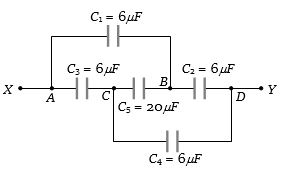
What is the effective capacitance between points $X$ and $Y$ in $\mu F$?
A
$24$
B
$18$
C
$12$
D
$6$
Solution
(D) The given circuit can be analyzed by identifying the nodes. The capacitors $C_1, C_2, C_3, C_4$ are all equal to $6\,\mu F$.
By observing the circuit,we can see that it forms a Wheatstone bridge structure between points $A, B, C,$ and $D$.
Specifically,the ratio of capacitances $\frac{C_1}{C_3} = \frac{6}{6} = 1$ and $\frac{C_2}{C_4} = \frac{6}{6} = 1$.
Since the ratios are equal,the bridge is balanced.
In a balanced Wheatstone bridge,the potential difference across the central capacitor $C_5$ is zero,so no charge flows through it.
Thus,$C_5$ can be removed from the circuit.
Now,the circuit consists of two parallel branches: one with $C_1$ and $C_2$ in series,and the other with $C_3$ and $C_4$ in series.
Equivalent capacitance of the upper branch $(C_{upper})$ = $\frac{C_1 \times C_2}{C_1 + C_2} = \frac{6 \times 6}{6 + 6} = \frac{36}{12} = 3\,\mu F$.
Equivalent capacitance of the lower branch $(C_{lower})$ = $\frac{C_3 \times C_4}{C_3 + C_4} = \frac{6 \times 6}{6 + 6} = \frac{36}{12} = 3\,\mu F$.
Since these two branches are in parallel,the total effective capacitance $C_{eq} = C_{upper} + C_{lower} = 3 + 3 = 6\,\mu F$.
By observing the circuit,we can see that it forms a Wheatstone bridge structure between points $A, B, C,$ and $D$.
Specifically,the ratio of capacitances $\frac{C_1}{C_3} = \frac{6}{6} = 1$ and $\frac{C_2}{C_4} = \frac{6}{6} = 1$.
Since the ratios are equal,the bridge is balanced.
In a balanced Wheatstone bridge,the potential difference across the central capacitor $C_5$ is zero,so no charge flows through it.
Thus,$C_5$ can be removed from the circuit.
Now,the circuit consists of two parallel branches: one with $C_1$ and $C_2$ in series,and the other with $C_3$ and $C_4$ in series.
Equivalent capacitance of the upper branch $(C_{upper})$ = $\frac{C_1 \times C_2}{C_1 + C_2} = \frac{6 \times 6}{6 + 6} = \frac{36}{12} = 3\,\mu F$.
Equivalent capacitance of the lower branch $(C_{lower})$ = $\frac{C_3 \times C_4}{C_3 + C_4} = \frac{6 \times 6}{6 + 6} = \frac{36}{12} = 3\,\mu F$.
Since these two branches are in parallel,the total effective capacitance $C_{eq} = C_{upper} + C_{lower} = 3 + 3 = 6\,\mu F$.
0 likesView Solution
28
PhysicsEasyMCQAIIMS · 2014
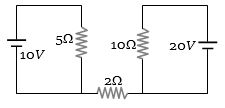
Find the value of the current through the $2\,\Omega$ resistance for the given circuit. (in $,A$)
A
$5$
B
$2$
C
$0$
D
$4$
Solution
(C) The circuit consists of two separate loops connected by a $2\,\Omega$ resistor.
Let the potential at the node to the left of the $2\,\Omega$ resistor be $V_1$ and the potential at the node to the right be $V_2$.
For the left loop,the current flows from the $10\,V$ battery through the $5\,\Omega$ resistor. Since there is no return path for the current to complete the circuit through the $2\,\Omega$ resistor (the circuit is open at the right side of the left loop),no current flows through the $2\,\Omega$ resistor from the left side.
Similarly,for the right loop,the current flows from the $20\,V$ battery through the $10\,\Omega$ resistor. Since the circuit is open at the left side of the right loop,no current flows through the $2\,\Omega$ resistor from the right side.
Therefore,the net current through the $2\,\Omega$ resistor is $0\,A$.
Let the potential at the node to the left of the $2\,\Omega$ resistor be $V_1$ and the potential at the node to the right be $V_2$.
For the left loop,the current flows from the $10\,V$ battery through the $5\,\Omega$ resistor. Since there is no return path for the current to complete the circuit through the $2\,\Omega$ resistor (the circuit is open at the right side of the left loop),no current flows through the $2\,\Omega$ resistor from the left side.
Similarly,for the right loop,the current flows from the $20\,V$ battery through the $10\,\Omega$ resistor. Since the circuit is open at the left side of the right loop,no current flows through the $2\,\Omega$ resistor from the right side.
Therefore,the net current through the $2\,\Omega$ resistor is $0\,A$.
0 likesView Solution
29
PhysicsEasyMCQAIIMS · 2014
Which of the following is most suitable for the core of electromagnets?
A
Soft iron
B
Steel
C
Copper-nickel alloy
D
Air
Solution
(A) Soft iron is highly ferromagnetic and has high magnetic permeability and low retentivity.
This means it can be easily magnetized and demagnetized,which is an essential property for the core of an electromagnet.
Therefore,soft iron is the most suitable material for the core of electromagnets.
This means it can be easily magnetized and demagnetized,which is an essential property for the core of an electromagnet.
Therefore,soft iron is the most suitable material for the core of electromagnets.
0 likesView Solution
30
PhysicsEasyMCQAIIMS · 2014
The quality factor of an $LCR$ circuit having resistance $(R)$ and inductance $(L)$ at resonance frequency $(\omega)$ is given by:
A
$\frac{\omega L}{R}$
B
$\frac{R}{\omega L}$
C
$(\frac{\omega L}{R})^{1/2}$
D
$(\frac{\omega L}{R})^2$
Solution
(A) The quality factor $(Q)$ of an $LCR$ circuit is defined as the ratio of the voltage across the inductor $(V_L)$ or capacitor $(V_C)$ to the voltage across the resistor $(V_R)$ at resonance.
Mathematically,$Q = \frac{V_L}{V_R} = \frac{I \cdot X_L}{I \cdot R} = \frac{X_L}{R}$.
Since the inductive reactance is given by $X_L = \omega L$,we substitute this into the expression.
Therefore,the quality factor is $Q = \frac{\omega L}{R}$.
Mathematically,$Q = \frac{V_L}{V_R} = \frac{I \cdot X_L}{I \cdot R} = \frac{X_L}{R}$.
Since the inductive reactance is given by $X_L = \omega L$,we substitute this into the expression.
Therefore,the quality factor is $Q = \frac{\omega L}{R}$.
0 likesView Solution
31
PhysicsMediumMCQAIIMS · 2014
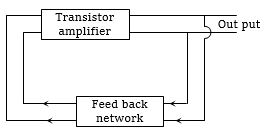
An oscillator is nothing but an amplifier with
A
Positive feedback
B
Large gain
C
No feedback
D
Negative feedback
Solution
(A) An oscillator is a circuit that produces a continuous,repeated,alternating waveform without any input signal.
It functions as an amplifier with positive feedback.
In this configuration,a portion of the output signal is fed back to the input in phase with the original signal.
This positive feedback reinforces the input,allowing the circuit to sustain oscillations indefinitely,provided the Barkhausen criterion (loop gain $A\beta = 1$ and phase shift of $360^{\circ}$ or $0^{\circ}$) is satisfied.
It functions as an amplifier with positive feedback.
In this configuration,a portion of the output signal is fed back to the input in phase with the original signal.
This positive feedback reinforces the input,allowing the circuit to sustain oscillations indefinitely,provided the Barkhausen criterion (loop gain $A\beta = 1$ and phase shift of $360^{\circ}$ or $0^{\circ}$) is satisfied.
0 likesView Solution
32
PhysicsMediumMCQAIIMS · 2014
The dimension of $\frac{1}{2} \varepsilon_0 E^2$,where $\varepsilon_0$ is the permittivity of free space and $E$ is the electric field,is:
A
$M^1L^2T^{-2}$
B
$M^1L^{-1}T^{-2}$
C
$M^1L^2T^{-1}$
D
$MLT^{-1}$
Solution
(B) The expression $\frac{1}{2} \varepsilon_0 E^2$ represents the energy density of an electric field.
Energy density is defined as the energy per unit volume.
Dimensional formula of energy is $[M^1L^2T^{-2}]$.
Dimensional formula of volume is $[L^3]$.
Therefore,the dimensional formula of energy density is $\frac{[M^1L^2T^{-2}]}{[L^3]} = [M^1L^{-1}T^{-2}]$.
Thus,the dimension of $\frac{1}{2} \varepsilon_0 E^2$ is $[M^1L^{-1}T^{-2}]$.
Energy density is defined as the energy per unit volume.
Dimensional formula of energy is $[M^1L^2T^{-2}]$.
Dimensional formula of volume is $[L^3]$.
Therefore,the dimensional formula of energy density is $\frac{[M^1L^2T^{-2}]}{[L^3]} = [M^1L^{-1}T^{-2}]$.
Thus,the dimension of $\frac{1}{2} \varepsilon_0 E^2$ is $[M^1L^{-1}T^{-2}]$.
0 likesView Solution
33
PhysicsMediumMCQAIIMS · 2014
In a medium of dielectric constant $K$,the electric field is $\vec E$. If $\varepsilon_0$ is the permittivity of free space,the electric displacement vector is:
A
$\frac{K\vec E}{\varepsilon_0}$
B
$\frac{\vec E}{K\varepsilon_0}$
C
$\frac{\varepsilon_0\vec E}{K}$
D
$K\varepsilon_0\vec E$
Solution
(D) The electric displacement vector $\vec D$ is defined as the product of the permittivity of the medium $\varepsilon$ and the electric field $\vec E$.
$\vec D = \varepsilon \vec E$
We know that the permittivity of a medium $\varepsilon$ is related to the permittivity of free space $\varepsilon_0$ and the dielectric constant $K$ by the relation:
$\varepsilon = K\varepsilon_0$
Substituting this into the expression for $\vec D$:
$\vec D = (K\varepsilon_0)\vec E$
Therefore,the electric displacement vector is $K\varepsilon_0\vec E$.
$\vec D = \varepsilon \vec E$
We know that the permittivity of a medium $\varepsilon$ is related to the permittivity of free space $\varepsilon_0$ and the dielectric constant $K$ by the relation:
$\varepsilon = K\varepsilon_0$
Substituting this into the expression for $\vec D$:
$\vec D = (K\varepsilon_0)\vec E$
Therefore,the electric displacement vector is $K\varepsilon_0\vec E$.
0 likesView Solution
34
PhysicsEasyMCQAIIMS · 2014
Assertion: Long distance power transmission is done at high voltage.
Reason: At high voltage supply,power losses are less.
Reason: At high voltage supply,power losses are less.
A
If both Assertion and Reason are correct and Reason is the correct explanation of Assertion.
B
If both Assertion and Reason are correct,but Reason is not the correct explanation of Assertion.
C
If Assertion is correct but Reason is incorrect.
D
If both the Assertion and Reason are incorrect.
Solution
(A) The power transmitted is given by $P = VI$,where $V$ is the voltage and $I$ is the current.
Thus,the current $I = P/V$.
The power loss in the transmission lines due to resistance $R$ is given by $P_{loss} = I^2 R$.
Substituting the value of $I$,we get $P_{loss} = (P/V)^2 R = (P^2 / V^2) R$.
From this equation,it is clear that for a constant power $P$ and resistance $R$,the power loss $P_{loss}$ is inversely proportional to the square of the voltage $(P_{loss} \propto 1/V^2)$.
Therefore,by increasing the voltage $V$,the power loss during transmission is significantly reduced.
Hence,both the Assertion and the Reason are correct,and the Reason is the correct explanation of the Assertion.
Thus,the current $I = P/V$.
The power loss in the transmission lines due to resistance $R$ is given by $P_{loss} = I^2 R$.
Substituting the value of $I$,we get $P_{loss} = (P/V)^2 R = (P^2 / V^2) R$.
From this equation,it is clear that for a constant power $P$ and resistance $R$,the power loss $P_{loss}$ is inversely proportional to the square of the voltage $(P_{loss} \propto 1/V^2)$.
Therefore,by increasing the voltage $V$,the power loss during transmission is significantly reduced.
Hence,both the Assertion and the Reason are correct,and the Reason is the correct explanation of the Assertion.
0 likesView Solution
35
PhysicsMediumMCQAIIMS · 2014
If we double the radius of a coil keeping the current through it unchanged,then the magnetic field at any point at a large distance from the centre becomes approximately
A
double
B
three times
C
four times
D
one-fourth
Solution
(C) The magnetic field $B$ on the axis of a circular coil of radius $R$ at a large distance $x$ $(x \gg R)$ from the center is given by the formula:
$B_{\text{axis}} = \frac{\mu_{0} N I R^{2}}{2 x^{3}}$
From this expression,we can see that the magnetic field is directly proportional to the square of the radius of the coil:
$B \propto R^{2}$
If the radius $R$ is doubled $(R' = 2R)$,the new magnetic field $B'$ becomes:
$B' \propto (2R)^{2} = 4R^{2}$
Therefore,$B' = 4B$.
Thus,the magnetic field becomes four times the original value.
$B_{\text{axis}} = \frac{\mu_{0} N I R^{2}}{2 x^{3}}$
From this expression,we can see that the magnetic field is directly proportional to the square of the radius of the coil:
$B \propto R^{2}$
If the radius $R$ is doubled $(R' = 2R)$,the new magnetic field $B'$ becomes:
$B' \propto (2R)^{2} = 4R^{2}$
Therefore,$B' = 4B$.
Thus,the magnetic field becomes four times the original value.
0 likesView Solution
36
PhysicsEasyMCQAIIMS · 2014
Magnetic lines of force due to a bar magnet do not intersect because
A
a point always has a single net magnetic field
B
the lines have similar charges and so repel each other
C
the lines always diverge from a single force
D
the lines need magnetic lenses to be made to intersect
Solution
(A) Magnetic lines of force represent the direction of the magnetic field at any point.
If two magnetic field lines were to intersect at a point,it would imply that there are two distinct directions for the magnetic field at that single point.
Since the magnetic field at any given point in space must have a unique direction,it is physically impossible for magnetic field lines to intersect.
If two magnetic field lines were to intersect at a point,it would imply that there are two distinct directions for the magnetic field at that single point.
Since the magnetic field at any given point in space must have a unique direction,it is physically impossible for magnetic field lines to intersect.
0 likesView Solution
37
PhysicsEasyMCQAIIMS · 2014
Assertion: The ferromagnetic substance does not obey Curie's law.
Reason: At Curie point,a ferromagnetic substance starts behaving as a paramagnetic substance.
Reason: At Curie point,a ferromagnetic substance starts behaving as a paramagnetic substance.
A
If both Assertion and Reason are correct and the Reason is a correct explanation of the Assertion.
B
If both Assertion and Reason are correct but Reason is not a correct explanation of the Assertion.
C
If the Assertion is correct but Reason is incorrect.
D
If both the Assertion and Reason are incorrect.
Solution
(A) The magnetic susceptibility of a ferromagnetic substance does not follow a simple linear relationship with temperature like paramagnetic substances.
Instead,it decreases in a complex manner as temperature increases.
Curie's law states that susceptibility $\chi \propto 1/T$.
Ferromagnetic substances only begin to obey this law after they are heated above their Curie temperature $(T_C)$,where they transition into a paramagnetic state.
Therefore,the assertion that they do not obey Curie's law (in their ferromagnetic state) is correct,and the reason explains the transition at the Curie point.
Instead,it decreases in a complex manner as temperature increases.
Curie's law states that susceptibility $\chi \propto 1/T$.
Ferromagnetic substances only begin to obey this law after they are heated above their Curie temperature $(T_C)$,where they transition into a paramagnetic state.
Therefore,the assertion that they do not obey Curie's law (in their ferromagnetic state) is correct,and the reason explains the transition at the Curie point.
0 likesView Solution
38
PhysicsMediumMCQAIIMS · 2014
The flux linked with a coil at any instant $t$ is given by $\phi = 10t^2 - 50t + 250$. The induced $emf$ at $t = 3 \ s$ is ....... $V$.
A
$-190$
B
$-10$
C
$10$
D
$190$
Solution
(B) The magnetic flux linked with the coil is given by $\phi = 10t^2 - 50t + 250$.
According to Faraday's law of electromagnetic induction,the induced $emf$ $(e)$ is given by $e = -\frac{d\phi}{dt}$.
Differentiating the flux with respect to time $t$:
$\frac{d\phi}{dt} = \frac{d}{dt}(10t^2 - 50t + 250) = 20t - 50$.
Therefore,the induced $emf$ is $e = -(20t - 50) = 50 - 20t$.
At $t = 3 \ s$,the induced $emf$ is:
$e = 50 - 20(3) = 50 - 60 = -10 \ V$.
According to Faraday's law of electromagnetic induction,the induced $emf$ $(e)$ is given by $e = -\frac{d\phi}{dt}$.
Differentiating the flux with respect to time $t$:
$\frac{d\phi}{dt} = \frac{d}{dt}(10t^2 - 50t + 250) = 20t - 50$.
Therefore,the induced $emf$ is $e = -(20t - 50) = 50 - 20t$.
At $t = 3 \ s$,the induced $emf$ is:
$e = 50 - 20(3) = 50 - 60 = -10 \ V$.
0 likesView Solution
39
PhysicsEasyMCQAIIMS · 2014
Assertion : Lenz's law violates the principle of conservation of energy.
Reason : Induced $emf$ always opposes the change in magnetic flux responsible for its production.
Reason : Induced $emf$ always opposes the change in magnetic flux responsible for its production.
A
If both Assertion and Reason are correct and the Reason is a correct explanation of the Assertion.
B
If both Assertion and Reason are correct but Reason is not a correct explanation of the Assertion.
C
If the Assertion is correct but Reason is incorrect.
D
If both the Assertion and Reason are incorrect.
Solution
(D) Lenz's law states that the direction of the induced $emf$ is always such that it opposes the change in magnetic flux that produces it.
This law is a direct consequence of the law of conservation of energy.
If the induced $emf$ were to assist the change in flux,it would lead to an increase in energy without any external work,which is impossible.
Therefore,the Assertion is incorrect,and the Reason is correct.
This law is a direct consequence of the law of conservation of energy.
If the induced $emf$ were to assist the change in flux,it would lead to an increase in energy without any external work,which is impossible.
Therefore,the Assertion is incorrect,and the Reason is correct.
0 likesView Solution
40
PhysicsEasyMCQAIIMS · 2014
Which of the following are not electromagnetic waves?
A
Cosmic rays
B
$\gamma -$ rays
C
$\beta -$ rays
D
$X-$ rays
Solution
(C) Electromagnetic waves are waves that are created as a result of vibrations between an electric field and a magnetic field. $\beta -$ rays consist of a stream of fast-moving electrons (charged particles) emitted during radioactive decay. Since they are composed of matter particles with mass and charge,they are not electromagnetic waves.
0 likesView Solution
41
PhysicsEasyMCQAIIMS · 2014
Assertion : Environmental damage has increased the amount of ozone in the atmosphere.
Reason : Increase of ozone increases the amount of ultraviolet radiation on earth.
Reason : Increase of ozone increases the amount of ultraviolet radiation on earth.
A
If both Assertion and Reason are correct and the Reason is a correct explanation of the Assertion.
B
If both Assertion and Reason are correct but Reason is not a correct explanation of the Assertion.
C
If the Assertion is correct but Reason is incorrect.
D
If both the Assertion and Reason are incorrect.
Solution
(D) The Assertion is incorrect because environmental damage,specifically the release of chlorofluorocarbons $(CFCs)$,leads to the depletion of the ozone layer in the stratosphere,not an increase.
The Reason is also incorrect because the ozone layer acts as a shield that absorbs harmful ultraviolet $(UV)$ radiation. Therefore,a decrease (depletion) of ozone leads to an increase in $UV$ radiation reaching the earth,not the other way around.
Since both the Assertion and the Reason are false,the correct option is $D$.
The Reason is also incorrect because the ozone layer acts as a shield that absorbs harmful ultraviolet $(UV)$ radiation. Therefore,a decrease (depletion) of ozone leads to an increase in $UV$ radiation reaching the earth,not the other way around.
Since both the Assertion and the Reason are false,the correct option is $D$.
0 likesView Solution
42
PhysicsEasyMCQAIIMS · 2014
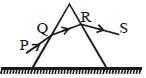
An equilateral prism is placed on a horizontal surface. $A$ ray $PQ$ is incident onto it. For minimum deviation:
A
$PQ$ is horizontal
B
$QR$ is horizontal
C
$RS$ is horizontal
D
Any one will be horizontal
Solution
(B) For a prism,the condition for minimum deviation is that the angle of incidence $(i)$ must be equal to the angle of emergence $(e)$.
In an equilateral prism,this symmetry implies that the refracted ray inside the prism $(QR)$ must be parallel to the base of the prism.
Since the prism is placed on a horizontal surface,the base of the prism is horizontal.
Therefore,for minimum deviation,the ray $QR$ inside the prism must be horizontal.
In an equilateral prism,this symmetry implies that the refracted ray inside the prism $(QR)$ must be parallel to the base of the prism.
Since the prism is placed on a horizontal surface,the base of the prism is horizontal.
Therefore,for minimum deviation,the ray $QR$ inside the prism must be horizontal.
0 likesView Solution
43
PhysicsMediumMCQAIIMS · 2014
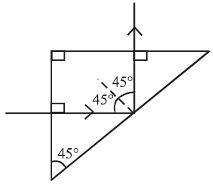
$A$ light ray is incident perpendicularly to one face of a $90^{\circ}$ prism and is totally internally reflected at the glass-air interface. If the angle of incidence at the interface is $45^{\circ}$,we conclude that the refractive index $n$ is:
A
$n > \frac{1}{\sqrt{2}}$
B
$n > \sqrt{2}$
C
$n < \frac{1}{\sqrt{2}}$
D
$n < \sqrt{2}$
Solution
(B) For total internal reflection to occur,the angle of incidence $i$ must be greater than the critical angle $i_{c}$.
Given,$i = 45^{\circ}$.
Therefore,$i > i_{c} \Rightarrow 45^{\circ} > i_{c}$.
Taking the sine on both sides,$\sin 45^{\circ} > \sin i_{c}$.
We know that the critical angle is given by $\sin i_{c} = \frac{1}{n}$,where $n$ is the refractive index of the prism.
Substituting this into the inequality,we get $\sin 45^{\circ} > \frac{1}{n}$.
Since $\sin 45^{\circ} = \frac{1}{\sqrt{2}}$,the inequality becomes $\frac{1}{\sqrt{2}} > \frac{1}{n}$.
Taking the reciprocal on both sides reverses the inequality sign,so $n > \sqrt{2}$.
Given,$i = 45^{\circ}$.
Therefore,$i > i_{c} \Rightarrow 45^{\circ} > i_{c}$.
Taking the sine on both sides,$\sin 45^{\circ} > \sin i_{c}$.
We know that the critical angle is given by $\sin i_{c} = \frac{1}{n}$,where $n$ is the refractive index of the prism.
Substituting this into the inequality,we get $\sin 45^{\circ} > \frac{1}{n}$.
Since $\sin 45^{\circ} = \frac{1}{\sqrt{2}}$,the inequality becomes $\frac{1}{\sqrt{2}} > \frac{1}{n}$.
Taking the reciprocal on both sides reverses the inequality sign,so $n > \sqrt{2}$.
0 likesView Solution
44
PhysicsEasyMCQAIIMS · 2014
Assertion: Critical angle is minimum for violet colour.
Reason: Because critical angle $\theta_c = \sin^{-1} \left( \frac{1}{\mu} \right)$ and $\mu \propto \frac{1}{\lambda}$.
Reason: Because critical angle $\theta_c = \sin^{-1} \left( \frac{1}{\mu} \right)$ and $\mu \propto \frac{1}{\lambda}$.
A
If both Assertion and Reason are correct and the Reason is a correct explanation of the Assertion.
B
If both Assertion and Reason are correct but Reason is not a correct explanation of the Assertion.
C
If the Assertion is correct but Reason is incorrect.
D
If both the Assertion and Reason are incorrect.
Solution
(A) The critical angle $\theta_c$ is given by the formula $\theta_c = \sin^{-1} \left( \frac{1}{\mu} \right)$.
According to Cauchy's dispersion formula,the refractive index $\mu$ of a medium is inversely proportional to the square of the wavelength $\lambda$ (approximately $\mu \propto \frac{1}{\lambda}$ for visible light).
Since the wavelength of violet light is the minimum among visible colors,the refractive index $\mu$ for violet light is the maximum.
As $\theta_c = \sin^{-1} \left( \frac{1}{\mu} \right)$,a higher value of $\mu$ results in a smaller value of $\theta_c$.
Therefore,the critical angle is minimum for violet color. Both the Assertion and the Reason are correct,and the Reason correctly explains the Assertion.
According to Cauchy's dispersion formula,the refractive index $\mu$ of a medium is inversely proportional to the square of the wavelength $\lambda$ (approximately $\mu \propto \frac{1}{\lambda}$ for visible light).
Since the wavelength of violet light is the minimum among visible colors,the refractive index $\mu$ for violet light is the maximum.
As $\theta_c = \sin^{-1} \left( \frac{1}{\mu} \right)$,a higher value of $\mu$ results in a smaller value of $\theta_c$.
Therefore,the critical angle is minimum for violet color. Both the Assertion and the Reason are correct,and the Reason correctly explains the Assertion.
0 likesView Solution
45
PhysicsMediumMCQAIIMS · 2014
In Young's double-slit experiment,we get $10$ fringes in the field of view using monochromatic light of wavelength $4000 \text{ } \mathring{A}$. If we use monochromatic light of wavelength $5000 \text{ } \mathring{A}$,then the number of fringes obtained in the same field of view is
A
$8$
B
$10$
C
$40$
D
$50$
Solution
(A) The fringe width $\beta$ in Young's double-slit experiment is given by $\beta = \frac{\lambda D}{d}$.
Since the field of view $L$ is constant,the total number of fringes $n$ is given by $n = \frac{L}{\beta}$.
Therefore,$n \propto \frac{1}{\beta} \propto \frac{1}{\lambda}$.
Given $n_1 = 10$ for $\lambda_1 = 4000 \text{ } \mathring{A}$ and we need to find $n_2$ for $\lambda_2 = 5000 \text{ } \mathring{A}$.
Using the relation $n_1 \lambda_1 = n_2 \lambda_2$,we get:
$10 \times 4000 = n_2 \times 5000$.
$n_2 = \frac{10 \times 4000}{5000} = 8$.
Thus,the number of fringes obtained is $8$.
Since the field of view $L$ is constant,the total number of fringes $n$ is given by $n = \frac{L}{\beta}$.
Therefore,$n \propto \frac{1}{\beta} \propto \frac{1}{\lambda}$.
Given $n_1 = 10$ for $\lambda_1 = 4000 \text{ } \mathring{A}$ and we need to find $n_2$ for $\lambda_2 = 5000 \text{ } \mathring{A}$.
Using the relation $n_1 \lambda_1 = n_2 \lambda_2$,we get:
$10 \times 4000 = n_2 \times 5000$.
$n_2 = \frac{10 \times 4000}{5000} = 8$.
Thus,the number of fringes obtained is $8$.
0 likesView Solution
46
PhysicsEasyMCQAIIMS · 2014
The condition for obtaining secondary maxima in the diffraction pattern due to a single slit is:
A
$a \sin \theta = n\lambda$
B
$a \sin \theta = (2n + 1)\frac{\lambda}{2}$
C
$a \sin \theta = (2n - 1)\lambda$
D
$a \sin \theta = \frac{n\lambda}{2}$
Solution
(B) In the diffraction pattern produced by a single slit of width $a$,the condition for minima is given by $a \sin \theta = n\lambda$ (where $n = \pm 1, \pm 2, \dots$).
Secondary maxima occur approximately midway between the minima.
The condition for secondary maxima is given by $a \sin \theta = (2n + 1)\frac{\lambda}{2}$,where $n = 1, 2, 3, \dots$ represents the order of the secondary maxima.
Secondary maxima occur approximately midway between the minima.
The condition for secondary maxima is given by $a \sin \theta = (2n + 1)\frac{\lambda}{2}$,where $n = 1, 2, 3, \dots$ represents the order of the secondary maxima.
0 likesView Solution
47
PhysicsEasyMCQAIIMS · 2014
$A$ $15.0\, eV$ photon collides with and ionizes a hydrogen atom. If the atom was originally in the ground state (ionization potential $= 13.6\, eV$),what is the kinetic energy of the ejected electron? .......... $eV$
A
$1.4$
B
$13.6$
C
$15$
D
$28.6$
Solution
(A) The principle of conservation of energy states that the energy of the incident photon is used to ionize the hydrogen atom and the remaining energy is converted into the kinetic energy of the ejected electron.
Energy of incident photon $(E)$ = $15.0\, eV$.
Ionization energy of hydrogen atom in ground state $(E_i)$ = $13.6\, eV$.
Kinetic energy of the ejected electron $(K)$ = $E - E_i$.
$K = 15.0\, eV - 13.6\, eV = 1.4\, eV$.
Energy of incident photon $(E)$ = $15.0\, eV$.
Ionization energy of hydrogen atom in ground state $(E_i)$ = $13.6\, eV$.
Kinetic energy of the ejected electron $(K)$ = $E - E_i$.
$K = 15.0\, eV - 13.6\, eV = 1.4\, eV$.
0 likesView Solution
48
PhysicsDifficultMCQAIIMS · 2014
$A$ radioactive nuclide is produced at a constant rate of $n$ per second (e.g.,by bombarding a target with neutrons). If the number of nuclei at $t = 0$ is $N_0$,the number of nuclei $N$ at time $t$ is given by (where $\lambda$ is the decay constant):
A
$N = N_0 e^{-\lambda t}$
B
$N = \frac{n}{\lambda} + N_0 e^{-\lambda t}$
C
$N = \frac{n}{\lambda} + \left( N_0 - \frac{n}{\lambda} \right) e^{-\lambda t}$
D
$N = \frac{n}{\lambda} + \left( N_0 + \frac{n}{\lambda} \right) e^{-\lambda t}$
Solution
(C) The rate of change of the number of nuclei $N$ is given by the production rate minus the decay rate: $\frac{dN}{dt} = n - \lambda N$.
Rearranging the terms,we get $\frac{dN}{n - \lambda N} = dt$.
Integrating both sides with limits from $t = 0$ $(N = N_0)$ to $t = t$ $(N = N)$:
$\int_{N_0}^{N} \frac{dN}{n - \lambda N} = \int_{0}^{t} dt$.
Using the substitution method,$-\frac{1}{\lambda} [\ln(n - \lambda N)]_{N_0}^{N} = t$.
$-\frac{1}{\lambda} \ln\left( \frac{n - \lambda N}{n - \lambda N_0} \right) = t$.
$\ln\left( \frac{n - \lambda N}{n - \lambda N_0} \right) = -\lambda t$.
$\frac{n - \lambda N}{n - \lambda N_0} = e^{-\lambda t}$.
$n - \lambda N = (n - \lambda N_0) e^{-\lambda t}$.
$\lambda N = n - (n - \lambda N_0) e^{-\lambda t}$.
$N = \frac{n}{\lambda} - \left( \frac{n}{\lambda} - N_0 \right) e^{-\lambda t} = \frac{n}{\lambda} + \left( N_0 - \frac{n}{\lambda} \right) e^{-\lambda t}$.
Rearranging the terms,we get $\frac{dN}{n - \lambda N} = dt$.
Integrating both sides with limits from $t = 0$ $(N = N_0)$ to $t = t$ $(N = N)$:
$\int_{N_0}^{N} \frac{dN}{n - \lambda N} = \int_{0}^{t} dt$.
Using the substitution method,$-\frac{1}{\lambda} [\ln(n - \lambda N)]_{N_0}^{N} = t$.
$-\frac{1}{\lambda} \ln\left( \frac{n - \lambda N}{n - \lambda N_0} \right) = t$.
$\ln\left( \frac{n - \lambda N}{n - \lambda N_0} \right) = -\lambda t$.
$\frac{n - \lambda N}{n - \lambda N_0} = e^{-\lambda t}$.
$n - \lambda N = (n - \lambda N_0) e^{-\lambda t}$.
$\lambda N = n - (n - \lambda N_0) e^{-\lambda t}$.
$N = \frac{n}{\lambda} - \left( \frac{n}{\lambda} - N_0 \right) e^{-\lambda t} = \frac{n}{\lambda} + \left( N_0 - \frac{n}{\lambda} \right) e^{-\lambda t}$.
0 likesView Solution
49
PhysicsEasyMCQAIIMS · 2014
Assertion : The ionising power of $\beta$-particle is less compared to $\alpha$-particles but their penetrating power is more.
Reason : The mass of $\beta$-particle is less than the mass of $\alpha$-particles.
Reason : The mass of $\beta$-particle is less than the mass of $\alpha$-particles.
A
If both Assertion and Reason are correct and the Reason is a correct explanation of the Assertion.
B
If both Assertion and Reason are correct but Reason is not a correct explanation of the Assertion.
C
If the Assertion is correct but Reason is incorrect.
D
If both the Assertion and Reason are incorrect.
Solution
(A) The ionising power of a particle depends on its charge and its velocity. $\alpha$-particles are heavy and move relatively slowly,leading to high interaction with matter and high ionising power.
$\beta$-particles are much lighter (electrons) and travel at much higher speeds,resulting in lower interaction time with atoms and thus lower ionising power.
Because $\beta$-particles interact less frequently with the atoms of the medium,they lose energy more slowly,which gives them a much higher penetrating power compared to $\alpha$-particles.
While the mass difference is a factor,the primary reason for the difference in ionising and penetrating power is the combination of mass,charge,and velocity. Therefore,both statements are correct,and the mass difference is a fundamental reason for the observed physical properties.
$\beta$-particles are much lighter (electrons) and travel at much higher speeds,resulting in lower interaction time with atoms and thus lower ionising power.
Because $\beta$-particles interact less frequently with the atoms of the medium,they lose energy more slowly,which gives them a much higher penetrating power compared to $\alpha$-particles.
While the mass difference is a factor,the primary reason for the difference in ionising and penetrating power is the combination of mass,charge,and velocity. Therefore,both statements are correct,and the mass difference is a fundamental reason for the observed physical properties.
0 likesView Solution
50
PhysicsMediumMCQAIIMS · 2014
The following diagram performs the logic function of:

A
$XOR$ gate
B
$AND$ gate
C
$NAND$ gate
D
$OR$ gate
Solution
(B) The given circuit consists of two $NAND$ gates connected in series.
Let the inputs to the first $NAND$ gate be $A$ and $B$. The output of the first $NAND$ gate is $X = \overline{A \cdot B}$.
This output $X$ acts as the input to the second $NAND$ gate. Since both inputs of the second $NAND$ gate are connected to $X$, its output $Y$ is given by $Y = \overline{X \cdot X} = \overline{X}$.
Substituting the value of $X$, we get $Y = \overline{(\overline{A \cdot B})} = A \cdot B$.
The expression $Y = A \cdot B$ represents the logic function of an $AND$ gate.
Therefore, the given circuit performs the function of an $AND$ gate.
Let the inputs to the first $NAND$ gate be $A$ and $B$. The output of the first $NAND$ gate is $X = \overline{A \cdot B}$.
This output $X$ acts as the input to the second $NAND$ gate. Since both inputs of the second $NAND$ gate are connected to $X$, its output $Y$ is given by $Y = \overline{X \cdot X} = \overline{X}$.
Substituting the value of $X$, we get $Y = \overline{(\overline{A \cdot B})} = A \cdot B$.
The expression $Y = A \cdot B$ represents the logic function of an $AND$ gate.
Therefore, the given circuit performs the function of an $AND$ gate.
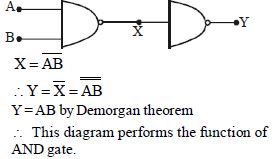
0 likesView Solution
51
PhysicsEasyMCQAIIMS · 2014
Sky wave propagation is not possible for frequencies
A
equal to $30\, MHz$
B
less than $30\, MHz$
C
greater than $30\, MHz$
D
None of these
Solution
(C) Sky wave propagation relies on the reflection of radio waves by the ionosphere. The ionosphere can only reflect electromagnetic waves with frequencies up to approximately $30\, MHz$. For frequencies greater than $30\, MHz$,the waves penetrate the ionosphere and escape into space instead of being reflected back to Earth. Therefore,sky wave propagation is not possible for frequencies greater than $30\, MHz$.
0 likesView Solution
Vedclass Products
For Students
Vedclass Test Series
Mock tests in real AIIMS style covering Physics with performance analysis. 5-day free trial.
Start Free TrialFor Teachers
Exam Paper Generator
Generate Set A/B/C/D Physics papers from 7.5L+ questions in 2 minutes. 3 chapters free.
Try FreeFor Institutes
Online Exam Module
Run live AIIMS mock exams with unlimited students, 360° analytics & white-label branding.
See DemoFrequently Asked Questions
How many Physics questions are in AIIMS 2014?
There are 51 Physics questions from the AIIMS 2014 paper on Vedclass, each with a detailed step-by-step solution in English.
Are AIIMS 2014 Physics solutions available in English?
Yes. All solutions on this page are in English. You can also switch to English or Hindi using the language buttons above the questions.
Can I practice AIIMS 2014 Physics as a timed test?
Yes. Use the Vedclass Test Series to attempt a full AIIMS mock test covering Physics with time limits and instant score analysis.
Can teachers create Physics papers from AIIMS previous year questions?
Yes. The Vedclass Exam Paper Generator lets teachers mix AIIMS Physics questions and generate Set A/B/C/D papers in minutes.
For Teachers & Institutes
Build a Custom Physics Paper
Pick AIIMS 2014 Physics questions, set difficulty, and generate Set A/B/C/D in 2 minutes.