
ChemistryQ1–54 of 54 questions
Page 1 of 1 · English
1
ChemistryMCQAIIMS · 2003
An object is moving with a uniform acceleration which is parallel to its instantaneous direction of motion. The displacement $(s) - $ velocity $(v)$ graph of this object is
A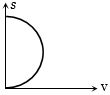
B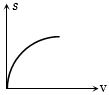
C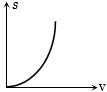
D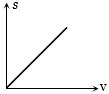
Solution
(C) The equation of motion for an object with uniform acceleration is given by $v^2 = u^2 + 2as$,where $v$ is the final velocity,$u$ is the initial velocity,$a$ is the uniform acceleration,and $s$ is the displacement.
Assuming the object starts from rest,i.e.,$u = 0$,the equation becomes $v^2 = 2as$.
This can be rewritten as $s = \frac{v^2}{2a}$.
Since $a$ is constant,$s \propto v^2$.
This represents a parabola that is symmetric about the displacement axis ($s$-axis),opening towards the positive $v$ direction if $a > 0$.
Comparing this with the given options,the graph in option $C$ represents the relationship $s \propto v^2$.
Assuming the object starts from rest,i.e.,$u = 0$,the equation becomes $v^2 = 2as$.
This can be rewritten as $s = \frac{v^2}{2a}$.
Since $a$ is constant,$s \propto v^2$.
This represents a parabola that is symmetric about the displacement axis ($s$-axis),opening towards the positive $v$ direction if $a > 0$.
Comparing this with the given options,the graph in option $C$ represents the relationship $s \propto v^2$.
0 likesView Solution
2
ChemistryMCQAIIMS · 2003
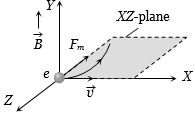
An electron is travelling along the $x$-direction. It encounters a magnetic field in the $y$-direction. Its subsequent motion will be
A
Straight line along the $x$-direction
B
$A$ circle in the $xz$-plane
C
$A$ circle in the $yz$-plane
D
$A$ circle in the $xy$-plane
Solution
(B) The magnetic force on a moving charge is given by $\overrightarrow{F} = q(\overrightarrow{v} \times \overrightarrow{B})$.
For an electron,$q = -e$. The velocity is $\overrightarrow{v} = v\hat{i}$ and the magnetic field is $\overrightarrow{B} = B\hat{j}$.
Substituting these values,we get $\overrightarrow{F} = -e(v\hat{i} \times B\hat{j}) = -evB(\hat{i} \times \hat{j}) = -evB\hat{k}$.
Since the force is always perpendicular to both the velocity and the magnetic field,and the force is directed along the negative $z$-axis,the electron will experience a centripetal force that causes it to move in a circular path in the $xz$-plane.
For an electron,$q = -e$. The velocity is $\overrightarrow{v} = v\hat{i}$ and the magnetic field is $\overrightarrow{B} = B\hat{j}$.
Substituting these values,we get $\overrightarrow{F} = -e(v\hat{i} \times B\hat{j}) = -evB(\hat{i} \times \hat{j}) = -evB\hat{k}$.
Since the force is always perpendicular to both the velocity and the magnetic field,and the force is directed along the negative $z$-axis,the electron will experience a centripetal force that causes it to move in a circular path in the $xz$-plane.
0 likesView Solution
3
ChemistryMCQAIIMS · 2003
For skywave propagation of a $10\, MHz$ signal,what should be the minimum electron density in the ionosphere?
A
$\sim 1.2 \times 10^{12}\, m^{-3}$
B
$\sim 10^6\, m^{-3}$
C
$\sim 10^{14}\, m^{-3}$
D
$\sim 10^{22}\, m^{-3}$
Solution
(A) The critical frequency $f_c$ for skywave propagation is related to the maximum electron density $N_{max}$ in the ionosphere by the formula: $f_c = 9(N_{max})^{1/2}$,where $f_c$ is in $Hz$ and $N_{max}$ is in $m^{-3}$.
Given $f_c = 10\, MHz = 10^7\, Hz$.
Substituting the values: $10^7 = 9 \times (N_{max})^{1/2}$.
$(N_{max})^{1/2} = \frac{10^7}{9} \approx 1.11 \times 10^6$.
Squaring both sides: $N_{max} = (1.11 \times 10^6)^2 \approx 1.23 \times 10^{12}\, m^{-3}$.
Thus,the minimum electron density required is approximately $1.2 \times 10^{12}\, m^{-3}$.
Given $f_c = 10\, MHz = 10^7\, Hz$.
Substituting the values: $10^7 = 9 \times (N_{max})^{1/2}$.
$(N_{max})^{1/2} = \frac{10^7}{9} \approx 1.11 \times 10^6$.
Squaring both sides: $N_{max} = (1.11 \times 10^6)^2 \approx 1.23 \times 10^{12}\, m^{-3}$.
Thus,the minimum electron density required is approximately $1.2 \times 10^{12}\, m^{-3}$.
0 likesView Solution
4
ChemistryMediumMCQAIIMS · 2003
The quantum number $m$ of a free gaseous atom is associated with
A
The effective volume of the orbital
B
The shape of the orbital
C
The spatial orientation of the orbital
D
The energy of the orbital in the absence of a magnetic field
Solution
(C) The magnetic quantum number $(m)$ describes the spatial orientation of a particular orbital.
It is called the magnetic quantum number because the effect of different orientations of orbitals was first observed in the presence of a magnetic field.
The magnetic quantum number $(m)$ determines the number of orbitals and their orientation within a subshell.
Consequently,its value depends on the orbital angular momentum quantum number $l$.
For a given $l$,$m$ ranges from $-l$ to $+l$,including zero.
It is called the magnetic quantum number because the effect of different orientations of orbitals was first observed in the presence of a magnetic field.
The magnetic quantum number $(m)$ determines the number of orbitals and their orientation within a subshell.
Consequently,its value depends on the orbital angular momentum quantum number $l$.
For a given $l$,$m$ ranges from $-l$ to $+l$,including zero.
0 likesView Solution
5
ChemistryMediumMCQAIIMS · 2003
Which one of the following is not a buffer solution?
A
$0.8 \ M \ H_2S + 0.8 \ M \ KHS$
B
$2 \ M \ C_6H_5NH_2 + 2 \ M \ C_6H_5NH_3Br$
C
$3 \ M \ H_2CO_3 + 3 \ M \ KHCO_3$
D
$0.05 \ M \ KClO_4 + 0.05 \ M \ HClO_4$
Solution
(D) buffer solution is typically composed of a weak acid and its conjugate base (salt) or a weak base and its conjugate acid (salt).
$A$. $H_2S$ is a weak acid and $KHS$ is its salt,so it forms a buffer.
$B$. $C_6H_5NH_2$ (aniline) is a weak base and $C_6H_5NH_3Br$ is its salt,so it forms a buffer.
$C$. $H_2CO_3$ is a weak acid and $KHCO_3$ is its salt,so it forms a buffer.
$D$. $HClO_4$ (perchloric acid) is a strong acid. $A$ mixture of a strong acid and its salt does not act as a buffer solution.
Therefore,the correct option is $D$.
$A$. $H_2S$ is a weak acid and $KHS$ is its salt,so it forms a buffer.
$B$. $C_6H_5NH_2$ (aniline) is a weak base and $C_6H_5NH_3Br$ is its salt,so it forms a buffer.
$C$. $H_2CO_3$ is a weak acid and $KHCO_3$ is its salt,so it forms a buffer.
$D$. $HClO_4$ (perchloric acid) is a strong acid. $A$ mixture of a strong acid and its salt does not act as a buffer solution.
Therefore,the correct option is $D$.
0 likesView Solution
6
ChemistryMediumMCQAIIMS · 2003
Which one of the following has $\Delta S^o$ greater than zero?
A
$CaO_{(s)} + CO_{2_{(g)}} \rightleftharpoons CaCO_{3_{(s)}}$
B
$NaCl_{(aq)} \rightleftharpoons NaCl_{(s)}$
C
$NaNO_{3_{(s)}} \rightleftharpoons Na^{+}_{(aq)} + NO_{3(aq)}^{-}$
D
$N_{2(g)} + 3H_{2(g)} \rightleftharpoons 2NH_{3(g)}$
Solution
(C) Entropy $(\Delta S^o)$ is a measure of the disorder or randomness of a system.
For a reaction,$\Delta S^o > 0$ when the disorder increases,which typically occurs when the number of moles of gas increases or when a solid dissolves into aqueous ions.
In option $(C)$,$NaNO_{3(s)}$ (a solid) dissolves to form $Na^{+}_{(aq)}$ and $NO_{3(aq)}^{-}$ (aqueous ions),which increases the disorder of the system.
In options $(A)$,$(B)$,and $(D)$,the number of gas moles decreases or the system moves from a more disordered state to a more ordered state,resulting in $\Delta S^o < 0$.
For a reaction,$\Delta S^o > 0$ when the disorder increases,which typically occurs when the number of moles of gas increases or when a solid dissolves into aqueous ions.
In option $(C)$,$NaNO_{3(s)}$ (a solid) dissolves to form $Na^{+}_{(aq)}$ and $NO_{3(aq)}^{-}$ (aqueous ions),which increases the disorder of the system.
In options $(A)$,$(B)$,and $(D)$,the number of gas moles decreases or the system moves from a more disordered state to a more ordered state,resulting in $\Delta S^o < 0$.
0 likesView Solution
7
ChemistryMediumMCQAIIMS · 2003
One gram sample of $NH_4NO_3$ is decomposed in a bomb calorimeter. The temperature of the calorimeter increases by $6.12 \ K$. The heat capacity of the system is $1.23 \ kJ/K$. What is the molar heat of decomposition for $NH_4NO_3$ in $kJ/mol$?
A
$-7.53$
B
$-398.1$
C
$-16.1$
D
$-602$
Solution
(D) The molar mass of $NH_4NO_3$ is $80 \ g/mol$.
Heat evolved $(q)$ is calculated as $q = C \times \Delta T = 1.23 \ kJ/K \times 6.12 \ K = 7.5276 \ kJ$.
This heat is released by $1 \ g$ of $NH_4NO_3$.
The molar heat of decomposition is calculated as $\Delta H = q \times \text{Molar Mass} = 7.5276 \ kJ/g \times 80 \ g/mol = 602.2 \ kJ/mol$.
Since the decomposition is an exothermic process occurring in a bomb calorimeter,the value is negative: $-602 \ kJ/mol$.
Heat evolved $(q)$ is calculated as $q = C \times \Delta T = 1.23 \ kJ/K \times 6.12 \ K = 7.5276 \ kJ$.
This heat is released by $1 \ g$ of $NH_4NO_3$.
The molar heat of decomposition is calculated as $\Delta H = q \times \text{Molar Mass} = 7.5276 \ kJ/g \times 80 \ g/mol = 602.2 \ kJ/mol$.
Since the decomposition is an exothermic process occurring in a bomb calorimeter,the value is negative: $-602 \ kJ/mol$.
0 likesView Solution
8
ChemistryDifficultMCQAIIMS · 2003
$1 \ mole$ of $MnO_4^{2-}$ in neutral aqueous medium disproportionates to:
A
$2/3 \ mole$ of $MnO_4^-$ and $1/3 \ mole$ of $MnO_2$
B
$1/3 \ mole$ of $MnO_4^-$ and $2/3 \ mole$ of $MnO_2$
C
$1/3 \ mole$ of $Mn_2O_7$ and $1/3 \ mole$ of $MnO_2$
D
$2/3 \ mole$ of $Mn_2O_7$ and $1/3 \ mole$ of $MnO_2$
Solution
(A) The disproportionation reaction of manganate ion $(MnO_4^{2-})$ in a neutral aqueous medium is given by:
$3MnO_4^{2-} + 4H^+ \rightarrow 2MnO_4^- + MnO_2 + 2H_2O$
From the stoichiometry of the balanced equation,$3 \ moles$ of $MnO_4^{2-}$ produce $2 \ moles$ of $MnO_4^-$ and $1 \ mole$ of $MnO_2$.
Therefore,$1 \ mole$ of $MnO_4^{2-}$ will produce $\frac{2}{3} \ mole$ of $MnO_4^-$ and $\frac{1}{3} \ mole$ of $MnO_2$.
$3MnO_4^{2-} + 4H^+ \rightarrow 2MnO_4^- + MnO_2 + 2H_2O$
From the stoichiometry of the balanced equation,$3 \ moles$ of $MnO_4^{2-}$ produce $2 \ moles$ of $MnO_4^-$ and $1 \ mole$ of $MnO_2$.
Therefore,$1 \ mole$ of $MnO_4^{2-}$ will produce $\frac{2}{3} \ mole$ of $MnO_4^-$ and $\frac{1}{3} \ mole$ of $MnO_2$.
0 likesView Solution
9
ChemistryEasyMCQAIIMS · 2003
On dissolving a moderate amount of sodium metal in liquid $NH_3$ at low temperature,which one of the following does not occur?
A
Blue coloured solution is obtained
B
$Na^{+}$ ions are formed in the solution
C
Liquid $NH_3$ becomes a good conductor of electricity
D
Liquid ammonia remains diamagnetic
Solution
(D) When sodium metal dissolves in liquid $NH_3$,it undergoes the following reaction: $Na + (x+y)NH_3 \rightarrow [Na(NH_3)_x]^+ + [e(NH_3)_y]^-$.
The ammoniated electrons $[e(NH_3)_y]^-$ are responsible for the blue color,high electrical conductivity,and paramagnetic nature of the solution.
Therefore,the solution becomes paramagnetic,not diamagnetic.
Thus,option $D$ is the correct answer.
The ammoniated electrons $[e(NH_3)_y]^-$ are responsible for the blue color,high electrical conductivity,and paramagnetic nature of the solution.
Therefore,the solution becomes paramagnetic,not diamagnetic.
Thus,option $D$ is the correct answer.
0 likesView Solution
10
ChemistryMediumMCQAIIMS · 2003
The $IUPAC$ name of the following compound is:

A
$3-$methylcyclohexene
B
$1-$methylcyclohex$-2-$ene
C
$6-$methylcyclohexene
D
$1-$methylcyclohex$-5-$ene
Solution
(A) $1$. In cyclic alkenes,the double bond is assigned the position $1$ and $2$.
$2$. The numbering should be done in such a way that the substituent gets the lowest possible locant.
$3$. Starting from the double bond,if we number the carbon atoms of the double bond as $1$ and $2$,the methyl group attached to the next carbon will be at position $3$.
$4$. Therefore,the correct $IUPAC$ name is $3-$methylcyclohexene.
$2$. The numbering should be done in such a way that the substituent gets the lowest possible locant.
$3$. Starting from the double bond,if we number the carbon atoms of the double bond as $1$ and $2$,the methyl group attached to the next carbon will be at position $3$.
$4$. Therefore,the correct $IUPAC$ name is $3-$methylcyclohexene.
0 likesView Solution
11
ChemistryMediumMCQAIIMS · 2003
Which of the following reagents is used to prepare $Propan-1-ol$ from $propene$?
A
$H_2O/H_2SO_4$
B
$Hg(OAc)_2/H_2O$ followed by $NaBH_4$
C
$B_2H_6$ followed by $H_2O_2/OH^-$
D
$CH_3CO_2H/H_2SO_4$
Solution
(C) The preparation of $Propan-1-ol$ from $propene$ is an example of anti-Markovnikov hydration.
This is achieved via hydroboration-oxidation using $B_2H_6$ followed by $H_2O_2/OH^-$.
The reaction is:
$CH_3-CH=CH_2 + B_2H_6 \xrightarrow{H_2O_2/OH^-} CH_3-CH_2-CH_2OH$.
This is achieved via hydroboration-oxidation using $B_2H_6$ followed by $H_2O_2/OH^-$.
The reaction is:
$CH_3-CH=CH_2 + B_2H_6 \xrightarrow{H_2O_2/OH^-} CH_3-CH_2-CH_2OH$.
0 likesView Solution
12
ChemistryMCQAIIMS · 2003
Both corpus luteum and macula lutea are
A
Found in human ovaries
B
$A$ source of hormones
C
Characterized by a yellow colour
D
Contributory in maintaining pregnancy
Solution
(C) . Corpus luteum is a yellow body formed from the empty Graafian follicle after ovulation.
Macula lutea is a yellow spot on the retina of the eye,located exactly opposite to the center of the cornea.
Both structures are characterized by their distinct yellow color.
Macula lutea is a yellow spot on the retina of the eye,located exactly opposite to the center of the cornea.
Both structures are characterized by their distinct yellow color.
0 likesView Solution
13
ChemistryMCQAIIMS · 2003
The motion of planets in the solar system is an example of the conservation of
A
Mass
B
Linear momentum
C
Angular momentum
D
Energy
Solution
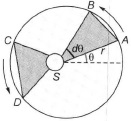
(C) According to Kepler's second law of planetary motion, the line joining any planet to the sun sweeps out equal areas in equal intervals of time.
Let the planet be at position $A$ at any instant $t$. The area $dA$ swept out by the radius vector $r$ in a small time interval $dt$ is given by the area of the triangular sector $SAB$.
$dA = \frac{1}{2} \times \text{base} \times \text{height} = \frac{1}{2} \times (r d\theta) \times r = \frac{1}{2} r^2 d\theta$.
The areal speed is given by $\frac{dA}{dt} = \frac{1}{2} r^2 \frac{d\theta}{dt} = \frac{1}{2} r^2 \omega$.
Since the angular momentum $J$ of the planet is $J = I\omega = mr^2\omega$, we can write $\omega = \frac{J}{mr^2}$.
Substituting this into the areal speed expression: $\frac{dA}{dt} = \frac{1}{2} r^2 \left(\frac{J}{mr^2}\right) = \frac{J}{2m}$.
Since the gravitational force exerted by the sun on the planet is a central force, the torque acting on the planet is zero. Consequently, the angular momentum $J$ remains constant. Thus, the motion of planets is an example of the conservation of angular momentum.
Let the planet be at position $A$ at any instant $t$. The area $dA$ swept out by the radius vector $r$ in a small time interval $dt$ is given by the area of the triangular sector $SAB$.
$dA = \frac{1}{2} \times \text{base} \times \text{height} = \frac{1}{2} \times (r d\theta) \times r = \frac{1}{2} r^2 d\theta$.
The areal speed is given by $\frac{dA}{dt} = \frac{1}{2} r^2 \frac{d\theta}{dt} = \frac{1}{2} r^2 \omega$.
Since the angular momentum $J$ of the planet is $J = I\omega = mr^2\omega$, we can write $\omega = \frac{J}{mr^2}$.
Substituting this into the areal speed expression: $\frac{dA}{dt} = \frac{1}{2} r^2 \left(\frac{J}{mr^2}\right) = \frac{J}{2m}$.
Since the gravitational force exerted by the sun on the planet is a central force, the torque acting on the planet is zero. Consequently, the angular momentum $J$ remains constant. Thus, the motion of planets is an example of the conservation of angular momentum.
0 likesView Solution
14
ChemistryMCQAIIMS · 2003
Which of the following is a $\pi$-acid ligand?
A
$NH_3$
B
$CO$
C
$gly$
D
Ethylenediamine
Solution
(B) $\pi$-acid ligand (also known as a $\pi$-acceptor ligand) is a ligand that can accept electron density from the metal atom into its empty $\pi^*$ antibonding orbitals.
$CO$ (Carbon monoxide) is a classic example of a $\pi$-acid ligand because it possesses empty $\pi^*$ orbitals that can accept electron density from the metal $d$-orbitals,forming a metal-carbon backbond.
$NH_3$,$gly$ (glycinate),and ethylenediamine are $\sigma$-donor ligands.
$CO$ (Carbon monoxide) is a classic example of a $\pi$-acid ligand because it possesses empty $\pi^*$ orbitals that can accept electron density from the metal $d$-orbitals,forming a metal-carbon backbond.
$NH_3$,$gly$ (glycinate),and ethylenediamine are $\sigma$-donor ligands.
0 likesView Solution
15
ChemistryMCQAIIMS · 2003
An earthquake generates both transverse $(S)$ and longitudinal $(P)$ waves in the earth. The speed of $S$ waves is about $4.5 \, km/s$ and that of $P$ waves is about $8.0 \, km/s$. $A$ seismograph records $P$ and $S$ waves from an earthquake. The first $P$ wave arrives $4.0 \, min$ before the first $S$ wave. The epicenter of the earthquake is located at a distance of about ..... $km$.
A
$25$
B
$250$
C
$2500$
D
$5000$
Solution
(C) Let $d$ be the distance of the epicenter from the seismograph.
The time taken by $P$ waves is $t_p = \frac{d}{V_p} = \frac{d}{8.0} \, s$.
The time taken by $S$ waves is $t_s = \frac{d}{V_s} = \frac{d}{4.5} \, s$.
Given that the $P$ wave arrives $4.0 \, min$ before the $S$ wave,we have $t_s - t_p = 4.0 \, min = 240 \, s$.
Substituting the values: $\frac{d}{4.5} - \frac{d}{8.0} = 240$.
Taking $d$ as common: $d \left( \frac{8.0 - 4.5}{4.5 \times 8.0} \right) = 240$.
$d \left( \frac{3.5}{36} \right) = 240$.
$d = \frac{240 \times 36}{3.5} \approx 2468.57 \, km$.
Rounding to the nearest given option,$d \approx 2500 \, km$.
The time taken by $P$ waves is $t_p = \frac{d}{V_p} = \frac{d}{8.0} \, s$.
The time taken by $S$ waves is $t_s = \frac{d}{V_s} = \frac{d}{4.5} \, s$.
Given that the $P$ wave arrives $4.0 \, min$ before the $S$ wave,we have $t_s - t_p = 4.0 \, min = 240 \, s$.
Substituting the values: $\frac{d}{4.5} - \frac{d}{8.0} = 240$.
Taking $d$ as common: $d \left( \frac{8.0 - 4.5}{4.5 \times 8.0} \right) = 240$.
$d \left( \frac{3.5}{36} \right) = 240$.
$d = \frac{240 \times 36}{3.5} \approx 2468.57 \, km$.
Rounding to the nearest given option,$d \approx 2500 \, km$.
0 likesView Solution
16
ChemistryMCQAIIMS · 2003
$A$ neutron makes a head-on elastic collision with a stationary deuteron. The fractional energy loss of the neutron in the collision is
A
$16/81$
B
$8/9$
C
$8/27$
D
$2/3$
Solution
(B) In a head-on elastic collision,the fractional energy loss of the projectile particle (mass $m_1$) colliding with a stationary target particle (mass $m_2$) is given by the formula:
$\frac{\Delta K}{K} = 1 - \left(\frac{m_1 - m_2}{m_1 + m_2}\right)^2$
Here,the mass of the neutron $m_1 = 1 \text{ u}$ and the mass of the deuteron $m_2 = 2 \text{ u}$.
Substituting these values into the formula:
$\frac{\Delta K}{K} = 1 - \left(\frac{1 - 2}{1 + 2}\right)^2$
$\frac{\Delta K}{K} = 1 - \left(\frac{-1}{3}\right)^2$
$\frac{\Delta K}{K} = 1 - \frac{1}{9} = \frac{8}{9}$
Thus,the fractional energy loss of the neutron is $8/9$.
$\frac{\Delta K}{K} = 1 - \left(\frac{m_1 - m_2}{m_1 + m_2}\right)^2$
Here,the mass of the neutron $m_1 = 1 \text{ u}$ and the mass of the deuteron $m_2 = 2 \text{ u}$.
Substituting these values into the formula:
$\frac{\Delta K}{K} = 1 - \left(\frac{1 - 2}{1 + 2}\right)^2$
$\frac{\Delta K}{K} = 1 - \left(\frac{-1}{3}\right)^2$
$\frac{\Delta K}{K} = 1 - \frac{1}{9} = \frac{8}{9}$
Thus,the fractional energy loss of the neutron is $8/9$.
0 likesView Solution
17
ChemistryMCQAIIMS · 2003
Two small drops of mercury,each of radius $R$,coalesce to form a single large drop. The ratio of the total surface energies before and after the change is
A
$1 : 2^{1/3}$
B
$2^{1/3} : 1$
C
$2 : 1$
D
$1 : 2$
Solution
(B) Let $r$ be the radius of the large drop formed after coalescence.
Since the volume remains constant,the volume of the large drop equals the sum of the volumes of the two small drops:
$\frac{4}{3} \pi r^{3} = 2 \times \frac{4}{3} \pi R^{3}$
$r^{3} = 2R^{3} \implies r = 2^{1/3} R$
The surface energy of a drop is given by $E = T \times A$,where $T$ is the surface tension and $A$ is the surface area $(4 \pi R^{2})$.
Surface energy before coalescence $(E_{i})$ = $2 \times (4 \pi R^{2} T) = 8 \pi R^{2} T$.
Surface energy after coalescence $(E_{f})$ = $4 \pi r^{2} T = 4 \pi (2^{1/3} R)^{2} T = 4 \pi 2^{2/3} R^{2} T$.
The ratio of surface energies before and after is:
$\frac{E_{i}}{E_{f}} = \frac{8 \pi R^{2} T}{4 \pi 2^{2/3} R^{2} T} = \frac{2}{2^{2/3}} = 2^{1 - 2/3} = 2^{1/3}$.
Thus,the ratio is $2^{1/3} : 1$.
Since the volume remains constant,the volume of the large drop equals the sum of the volumes of the two small drops:
$\frac{4}{3} \pi r^{3} = 2 \times \frac{4}{3} \pi R^{3}$
$r^{3} = 2R^{3} \implies r = 2^{1/3} R$
The surface energy of a drop is given by $E = T \times A$,where $T$ is the surface tension and $A$ is the surface area $(4 \pi R^{2})$.
Surface energy before coalescence $(E_{i})$ = $2 \times (4 \pi R^{2} T) = 8 \pi R^{2} T$.
Surface energy after coalescence $(E_{f})$ = $4 \pi r^{2} T = 4 \pi (2^{1/3} R)^{2} T = 4 \pi 2^{2/3} R^{2} T$.
The ratio of surface energies before and after is:
$\frac{E_{i}}{E_{f}} = \frac{8 \pi R^{2} T}{4 \pi 2^{2/3} R^{2} T} = \frac{2}{2^{2/3}} = 2^{1 - 2/3} = 2^{1/3}$.
Thus,the ratio is $2^{1/3} : 1$.
0 likesView Solution
18
ChemistryMCQAIIMS · 2003
$A$ lead shot of $1\, mm$ diameter falls through a long column of glycerine. The variation of its velocity $v$ with distance covered is represented by
A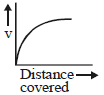
B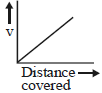
C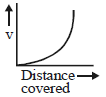
D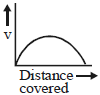
Solution
(A) When a lead shot falls through a viscous liquid like glycerine,it experiences three forces: gravitational force $(mg)$ acting downwards,buoyant force $(F_B)$ acting upwards,and viscous drag force $(F_v)$ acting upwards.
The net force on the lead shot is $F_{net} = mg - F_B - F_v$.
Initially,the velocity $v$ is zero,so the viscous force $F_v = 6\pi\eta rv$ is zero. The net force is maximum,causing the lead shot to accelerate.
As the velocity $v$ increases,the viscous force $F_v$ also increases. Consequently,the net force $F_{net}$ decreases,which means the acceleration decreases.
Eventually,the viscous force becomes large enough such that the net force becomes zero $(mg - F_B - F_v = 0)$. At this point,the lead shot attains a constant terminal velocity $(v_t)$.
Therefore,the velocity increases initially and then levels off to a constant value as the distance covered increases. This behavior is correctly represented by the graph in option $A$.
The net force on the lead shot is $F_{net} = mg - F_B - F_v$.
Initially,the velocity $v$ is zero,so the viscous force $F_v = 6\pi\eta rv$ is zero. The net force is maximum,causing the lead shot to accelerate.
As the velocity $v$ increases,the viscous force $F_v$ also increases. Consequently,the net force $F_{net}$ decreases,which means the acceleration decreases.
Eventually,the viscous force becomes large enough such that the net force becomes zero $(mg - F_B - F_v = 0)$. At this point,the lead shot attains a constant terminal velocity $(v_t)$.
Therefore,the velocity increases initially and then levels off to a constant value as the distance covered increases. This behavior is correctly represented by the graph in option $A$.
0 likesView Solution
19
ChemistryMCQAIIMS · 2003
Assertion : Bohr had to postulate that the electrons in stationary orbits around the nucleus do not radiate.
Reason : According to classical physics,all moving electrons radiate.
Reason : According to classical physics,all moving electrons radiate.
A
If both Assertion and Reason are correct and the Reason is a correct explanation of the Assertion.
B
If both Assertion and Reason are correct but Reason is not a correct explanation of the Assertion.
C
If the Assertion is correct but Reason is incorrect.
D
If both the Assertion and Reason are incorrect.
Solution
(A) According to classical electromagnetic theory,an accelerated charged particle must emit electromagnetic radiation. Since an electron revolving in an orbit is undergoing centripetal acceleration,it should continuously lose energy and spiral into the nucleus,making the atom unstable.
To resolve this,Bohr postulated that electrons revolve in specific 'stationary' orbits where they do not radiate energy.
Thus,the Assertion is correct because Bohr had to make this assumption to explain atomic stability,and the Reason is correct because it describes the classical conflict that necessitated Bohr's postulate. Therefore,the Reason correctly explains the Assertion.
To resolve this,Bohr postulated that electrons revolve in specific 'stationary' orbits where they do not radiate energy.
Thus,the Assertion is correct because Bohr had to make this assumption to explain atomic stability,and the Reason is correct because it describes the classical conflict that necessitated Bohr's postulate. Therefore,the Reason correctly explains the Assertion.
0 likesView Solution
20
ChemistryMediumMCQAIIMS · 2003
Assertion: The $O-O$ bond length in $H_2O_2$ is shorter than that of $O_2F_2$.
Reason: $H_2O_2$ is an ionic compound.
Reason: $H_2O_2$ is an ionic compound.
A
If both Assertion and Reason are correct and the Reason is a correct explanation of the Assertion.
B
If both Assertion and Reason are correct but Reason is not a correct explanation of the Assertion.
C
If the Assertion is correct but Reason is incorrect.
D
If both the Assertion and Reason are incorrect.
Solution
(D) The $O-O$ bond length in $H_2O_2$ is $148 \text{ pm}$, whereas in $O_2F_2$ it is $121.7 \text{ pm}$.
Therefore, the $O-O$ bond length in $H_2O_2$ is actually longer than that of $O_2F_2$.
Additionally, $H_2O_2$ is a covalent compound, not an ionic compound.
Since both the Assertion and the Reason are false, the correct option is $D$.
Therefore, the $O-O$ bond length in $H_2O_2$ is actually longer than that of $O_2F_2$.
Additionally, $H_2O_2$ is a covalent compound, not an ionic compound.
Since both the Assertion and the Reason are false, the correct option is $D$.
0 likesView Solution
21
ChemistryEasyMCQAIIMS · 2003
Assertion : The increase in internal energy $(\Delta E)$ for the vaporization of one mole of water at $1 \ atm$ and $373 \ K$ is zero.
Reason : For all isothermal processes,$\Delta E = 0$.
Reason : For all isothermal processes,$\Delta E = 0$.
A
If both Assertion and Reason are correct and the Reason is a correct explanation of the Assertion.
B
If both Assertion and Reason are correct but Reason is not a correct explanation of the Assertion.
C
If the Assertion is correct but Reason is incorrect.
D
If both the Assertion and Reason are incorrect.
Solution
(D) The vaporization of water is a phase change process occurring at constant temperature $(373 \ K)$.
For an ideal gas,internal energy $(E)$ is a function of temperature only,so $\Delta E = 0$ for isothermal processes.
However,for real substances like water undergoing a phase change,the internal energy changes because the intermolecular forces are overcome during vaporization.
Therefore,the Assertion is incorrect because $\Delta E \neq 0$ for the vaporization of water.
The Reason is also incorrect because $\Delta E = 0$ only strictly applies to ideal gases in isothermal processes,and even then,it does not account for phase changes where potential energy changes.
For an ideal gas,internal energy $(E)$ is a function of temperature only,so $\Delta E = 0$ for isothermal processes.
However,for real substances like water undergoing a phase change,the internal energy changes because the intermolecular forces are overcome during vaporization.
Therefore,the Assertion is incorrect because $\Delta E \neq 0$ for the vaporization of water.
The Reason is also incorrect because $\Delta E = 0$ only strictly applies to ideal gases in isothermal processes,and even then,it does not account for phase changes where potential energy changes.
0 likesView Solution
22
ChemistryEasyMCQAIIMS · 2003
Assertion : $\Delta H$ and $\Delta E$ are almost same for the reaction $N_{2(g)} + O_{2(g)} \rightleftharpoons 2NO_{(g)}$.
Reason : All reactants and products are gases.
Reason : All reactants and products are gases.
A
If both Assertion and Reason are correct and the Reason is a correct explanation of the Assertion.
B
If both Assertion and Reason are correct but Reason is not a correct explanation of the Assertion.
C
If the Assertion is correct but Reason is incorrect.
D
If both the Assertion and Reason are incorrect.
Solution
(B) The relationship between enthalpy change and internal energy change is given by $\Delta H = \Delta E + \Delta n_g RT$.
For the reaction $N_{2(g)} + O_{2(g)} \rightleftharpoons 2NO_{(g)}$,the change in the number of moles of gaseous species is $\Delta n_g = 2 - (1 + 1) = 0$.
Since $\Delta n_g = 0$,we have $\Delta H = \Delta E$.
Thus,the Assertion is correct.
The Reason states that all reactants and products are gases,which is true,but this alone does not guarantee $\Delta H = \Delta E$. The equality holds only because $\Delta n_g = 0$. Therefore,the Reason is not the correct explanation for the Assertion.
For the reaction $N_{2(g)} + O_{2(g)} \rightleftharpoons 2NO_{(g)}$,the change in the number of moles of gaseous species is $\Delta n_g = 2 - (1 + 1) = 0$.
Since $\Delta n_g = 0$,we have $\Delta H = \Delta E$.
Thus,the Assertion is correct.
The Reason states that all reactants and products are gases,which is true,but this alone does not guarantee $\Delta H = \Delta E$. The equality holds only because $\Delta n_g = 0$. Therefore,the Reason is not the correct explanation for the Assertion.
0 likesView Solution
23
ChemistryDifficultMCQAIIMS · 2003
Assertion : Barium is not required for normal biological function in humans.
Reason : Barium does not show variable oxidation states.
Reason : Barium does not show variable oxidation states.
A
If both Assertion and Reason are correct and the Reason is a correct explanation of the Assertion.
B
If both Assertion and Reason are correct but Reason is not a correct explanation of the Assertion.
C
If the Assertion is correct but Reason is incorrect.
D
If both the Assertion and Reason are incorrect.
Solution
(B) The assertion is correct because $Ba^{2+}$ ions are toxic and have no known biological role in humans.
The reason is also correct because $Ba$ is an alkaline earth metal and exhibits a constant oxidation state of $+2$,not variable oxidation states.
However,the reason does not explain why $Ba$ is not required for biological functions.
Therefore,both are correct but the reason is not the correct explanation of the assertion.
The reason is also correct because $Ba$ is an alkaline earth metal and exhibits a constant oxidation state of $+2$,not variable oxidation states.
However,the reason does not explain why $Ba$ is not required for biological functions.
Therefore,both are correct but the reason is not the correct explanation of the assertion.
0 likesView Solution
24
ChemistryDifficultMCQAIIMS · 2003
Assertion : $BaCO_3$ is more soluble in $HNO_3$ than in plain water.
Reason : Carbonate is a weak base and reacts with the $H^+$ from the strong acid,causing the barium salt to dissociate.
Reason : Carbonate is a weak base and reacts with the $H^+$ from the strong acid,causing the barium salt to dissociate.
A
If both Assertion and Reason are correct and the Reason is a correct explanation of the Assertion.
B
If both Assertion and Reason are correct but Reason is not a correct explanation of the Assertion.
C
If the Assertion is correct but Reason is incorrect.
D
If both the Assertion and Reason are incorrect.
Solution
(A) Barium carbonate $(BaCO_3)$ is a salt of a weak acid $(H_2CO_3)$ and a strong base $(Ba(OH)_2)$.
In water,it has very low solubility.
When $HNO_3$ is added,the carbonate ion $(CO_3^{2-})$ acts as a weak base and reacts with $H^+$ ions from the strong acid to form $H_2CO_3$,which further decomposes into $CO_2$ and $H_2O$.
This reaction removes $CO_3^{2-}$ ions from the equilibrium,shifting the dissolution equilibrium of $BaCO_3$ to the right according to Le Chatelier's principle,thereby increasing its solubility.
The reaction is: $BaCO_3(s) + 2H^+(aq) \to Ba^{2+}(aq) + CO_2(g) + H_2O(l)$.
In water,it has very low solubility.
When $HNO_3$ is added,the carbonate ion $(CO_3^{2-})$ acts as a weak base and reacts with $H^+$ ions from the strong acid to form $H_2CO_3$,which further decomposes into $CO_2$ and $H_2O$.
This reaction removes $CO_3^{2-}$ ions from the equilibrium,shifting the dissolution equilibrium of $BaCO_3$ to the right according to Le Chatelier's principle,thereby increasing its solubility.
The reaction is: $BaCO_3(s) + 2H^+(aq) \to Ba^{2+}(aq) + CO_2(g) + H_2O(l)$.
0 likesView Solution
25
ChemistryMediumMCQAIIMS · 2003
Assertion : $PbI_4$ is a stable compound.
Reason : Iodide stabilizes higher oxidation state.
Reason : Iodide stabilizes higher oxidation state.
A
If both Assertion and Reason are correct and the Reason is a correct explanation of the Assertion.
B
If both Assertion and Reason are correct but Reason is not a correct explanation of the Assertion.
C
If the Assertion is correct but Reason is incorrect.
D
If both the Assertion and Reason are incorrect.
Solution
(D) In group $14$ (or $IVA$),the stability of the $+2$ oxidation state increases down the group due to the inert pair effect.
$Pb$ is at the bottom of the group,so $Pb^{2+}$ is much more stable than $Pb^{4+}$.
$I^-$ is a mild reducing agent and cannot oxidize $Pb^{2+}$ to $Pb^{4+}$.
Therefore,$PbI_4$ is not a stable compound.
Both the Assertion and the Reason are incorrect.
$Pb$ is at the bottom of the group,so $Pb^{2+}$ is much more stable than $Pb^{4+}$.
$I^-$ is a mild reducing agent and cannot oxidize $Pb^{2+}$ to $Pb^{4+}$.
Therefore,$PbI_4$ is not a stable compound.
Both the Assertion and the Reason are incorrect.
0 likesView Solution
26
ChemistryDifficultMCQAIIMS · 2003
Assertion : $trans-2-Butene$ on reaction with $Br_2$ gives $meso-2,3-dibromobutane$.
Reason : The reaction involves $syn-addition$ of bromine.
Reason : The reaction involves $syn-addition$ of bromine.
A
If both Assertion and Reason are correct and the Reason is a correct explanation of the Assertion.
B
If both Assertion and Reason are correct but Reason is not a correct explanation of the Assertion.
C
If the Assertion is correct but Reason is incorrect.
D
If both the Assertion and Reason are incorrect.
Solution
(C) The reaction of $trans-2-Butene$ with $Br_2$ proceeds via the formation of a cyclic bromonium ion intermediate.
The bromide ion then attacks the intermediate from the side opposite to the bromonium bridge,resulting in $anti-addition$.
$trans-2-Butene$ undergoes $anti-addition$ of $Br_2$ to yield $meso-2,3-dibromobutane$.
Therefore,the Assertion is correct,but the Reason is incorrect because the reaction involves $anti-addition$,not $syn-addition$.
The bromide ion then attacks the intermediate from the side opposite to the bromonium bridge,resulting in $anti-addition$.
$trans-2-Butene$ undergoes $anti-addition$ of $Br_2$ to yield $meso-2,3-dibromobutane$.
Therefore,the Assertion is correct,but the Reason is incorrect because the reaction involves $anti-addition$,not $syn-addition$.
0 likesView Solution
27
ChemistryMCQAIIMS · 2003
Assertion : $NF_3$ is a weaker ligand than $N(CH_3)_3$.
Reason : $NF_3$ ionizes to give $F^-$ ions in aqueous solution.
Reason : $NF_3$ ionizes to give $F^-$ ions in aqueous solution.
A
If both Assertion and Reason are correct and the Reason is a correct explanation of the Assertion.
B
If both Assertion and Reason are correct but Reason is not a correct explanation of the Assertion.
C
If the Assertion is correct but Reason is incorrect.
D
If both the Assertion and Reason are incorrect.
Solution
(C) $NF_3$ is a weak ligand because the high electronegativity of $F$ atoms withdraws electron density from the $N$ atom,making the lone pair on $N$ less available for donation.
In contrast,$N(CH_3)_3$ is a stronger ligand because the $CH_3$ groups are electron-releasing ($+I$ effect),which increases the electron density on the $N$ atom,making the lone pair more available for donation.
$NF_3$ is a covalent molecule and does not ionize to give $F^-$ ions in aqueous solution.
Therefore,the Assertion is correct,but the Reason is incorrect.
In contrast,$N(CH_3)_3$ is a stronger ligand because the $CH_3$ groups are electron-releasing ($+I$ effect),which increases the electron density on the $N$ atom,making the lone pair more available for donation.
$NF_3$ is a covalent molecule and does not ionize to give $F^-$ ions in aqueous solution.
Therefore,the Assertion is correct,but the Reason is incorrect.
0 likesView Solution
28
ChemistryMCQAIIMS · 2003
Assertion : In plant tissue culture,somatic embryos can be induced from any plant cell.
Reason : Any viable plant cell can differentiate into somatic embryos.
Reason : Any viable plant cell can differentiate into somatic embryos.
A
If both Assertion and Reason are correct and the Reason is a correct explanation of the Assertion.
B
If both Assertion and Reason are correct but Reason is not a correct explanation of the Assertion.
C
If the Assertion is correct but Reason is incorrect.
D
If both the Assertion and Reason are incorrect.
Solution
(A) The ability of a plant cell to regenerate into a whole plant is known as $Totipotency$.
Any living,viable plant cell possesses the potential to differentiate into somatic embryos under appropriate culture conditions.
Since the Assertion states that somatic embryos can be induced from any plant cell and the Reason explains that this is possible because any viable plant cell can differentiate into these embryos,the Reason is the correct explanation for the Assertion.
Therefore,both statements are correct and the Reason correctly explains the Assertion.
Any living,viable plant cell possesses the potential to differentiate into somatic embryos under appropriate culture conditions.
Since the Assertion states that somatic embryos can be induced from any plant cell and the Reason explains that this is possible because any viable plant cell can differentiate into these embryos,the Reason is the correct explanation for the Assertion.
Therefore,both statements are correct and the Reason correctly explains the Assertion.
0 likesView Solution
29
ChemistryMediumMCQAIIMS · 2003
Assertion : Photochemical smog is produced by nitrogen oxides.
Reason : Vehicular pollution is a major source of nitrogen oxides.
Reason : Vehicular pollution is a major source of nitrogen oxides.
A
If both Assertion and Reason are correct and the Reason is a correct explanation of the Assertion.
B
If both Assertion and Reason are correct but Reason is not a correct explanation of the Assertion.
C
If the Assertion is correct but Reason is incorrect.
D
If both the Assertion and Reason are incorrect.
Solution
(B) Photochemical smog is formed by the action of sunlight on nitrogen oxides $(NO_x)$ and hydrocarbons.
Thus,the Assertion is correct.
Vehicular pollution is indeed a major source of nitrogen oxides due to the high-temperature combustion of fuel in engines.
Thus,the Reason is also correct.
However,the Reason does not explain the mechanism of how photochemical smog is produced; it only identifies a source of the pollutant.
Therefore,the Reason is not the correct explanation of the Assertion.
Thus,the Assertion is correct.
Vehicular pollution is indeed a major source of nitrogen oxides due to the high-temperature combustion of fuel in engines.
Thus,the Reason is also correct.
However,the Reason does not explain the mechanism of how photochemical smog is produced; it only identifies a source of the pollutant.
Therefore,the Reason is not the correct explanation of the Assertion.
0 likesView Solution
30
ChemistryMCQAIIMS · 2003
In almost all Indian metropolitan cities like Delhi,the major atmospheric pollutant$(s)$ is/are:
A
Suspended particulate matter $(SPM)$
B
Oxides of sulphur
C
Carbon dioxide and carbon monoxide
D
Oxides of nitrogen
Solution
(C) In almost all Indian metropolitan cities,the major atmospheric pollutants are carbon dioxide and carbon monoxide. These are primarily released due to the incomplete combustion of fossil fuels in vehicles and industrial activities,which significantly contribute to air pollution in densely populated urban areas.
0 likesView Solution
31
ChemistryMCQAIIMS · 2003
Nitrobenzene gives $N$-phenylhydroxylamine by
A
$Sn / HCl$
B
$Zn / NaOH$
C
$H_2 / Pd-C$
D
$Zn / NH_4Cl$
Solution
(D) The reduction of nitrobenzene to $N$-phenylhydroxylamine is a selective reduction process that occurs in a neutral medium.
When nitrobenzene is treated with zinc dust and aqueous ammonium chloride $(Zn / NH_4Cl)$,it undergoes partial reduction to form $N$-phenylhydroxylamine.
The reaction is: $C_6H_5NO_2 + 4[H] \xrightarrow{Zn / NH_4Cl} C_6H_5NHOH + H_2O$.
When nitrobenzene is treated with zinc dust and aqueous ammonium chloride $(Zn / NH_4Cl)$,it undergoes partial reduction to form $N$-phenylhydroxylamine.
The reaction is: $C_6H_5NO_2 + 4[H] \xrightarrow{Zn / NH_4Cl} C_6H_5NHOH + H_2O$.
0 likesView Solution
32
ChemistryMediumMCQAIIMS · 2003
The reagent commonly used to determine the hardness of water titrimetrically is
A
Oxalic acid
B
Disodium salt of $EDTA$
C
Sodium citrate
D
Sodium thiosulphate
Solution
(B) The disodium salt of $EDTA$ (Ethylenediaminetetraacetic acid) is commonly used in complexometric titrations to determine the hardness of water.
It forms stable,water-soluble complexes with $Ca^{2+}$ and $Mg^{2+}$ ions,which are responsible for water hardness.
It forms stable,water-soluble complexes with $Ca^{2+}$ and $Mg^{2+}$ ions,which are responsible for water hardness.
0 likesView Solution
33
ChemistryEasyMCQAIIMS · 2003
The mixture of concentrated $HCl$ and $HNO_3$ made in $3:1$ ratio contains
A
$ClO_2$
B
$NOCl$
C
$NCl_3$
D
$N_2O_4$
Solution
(B) The mixture of concentrated $HCl$ and $HNO_3$ in a $3:1$ ratio is known as aqua regia.
The chemical reaction is: $3HCl + HNO_3 \rightarrow NOCl + 2H_2O + Cl_2$.
Thus,the mixture contains nitrosyl chloride $(NOCl)$.
The chemical reaction is: $3HCl + HNO_3 \rightarrow NOCl + 2H_2O + Cl_2$.
Thus,the mixture contains nitrosyl chloride $(NOCl)$.
0 likesView Solution
34
ChemistryMediumMCQAIIMS · 2003
Which of the following statements concerning the properties of solutions describes a colligative effect?
A
Boiling point of pure water decreases by the addition of ethanol
B
Vapour pressure of pure water decreases by the addition of nitric acid
C
Vapour pressure of pure benzene decreases by the addition of naphthalene; Boiling point of pure benzene increases by the addition of toluene
D
None of these
Solution
(D) Colligative properties depend only on the number of solute particles in a solution,not on their chemical nature.
$1$. Addition of non-volatile solutes to a solvent leads to a decrease in vapour pressure and an increase in boiling point (elevation of boiling point).
$2$. In option $C$,the addition of non-volatile naphthalene to benzene decreases the vapour pressure of benzene,which is a colligative property.
$3$. However,the second part of option $C$ (addition of toluene to benzene) involves two volatile liquids,which does not strictly follow the standard definition of colligative properties as they are typically defined for non-volatile solutes.
$4$. Since options $A$ and $B$ involve volatile solutes (ethanol and nitric acid),they do not represent standard colligative effects.
$5$. Therefore,none of the provided statements correctly describe a pure colligative effect based on standard definitions.
$1$. Addition of non-volatile solutes to a solvent leads to a decrease in vapour pressure and an increase in boiling point (elevation of boiling point).
$2$. In option $C$,the addition of non-volatile naphthalene to benzene decreases the vapour pressure of benzene,which is a colligative property.
$3$. However,the second part of option $C$ (addition of toluene to benzene) involves two volatile liquids,which does not strictly follow the standard definition of colligative properties as they are typically defined for non-volatile solutes.
$4$. Since options $A$ and $B$ involve volatile solutes (ethanol and nitric acid),they do not represent standard colligative effects.
$5$. Therefore,none of the provided statements correctly describe a pure colligative effect based on standard definitions.
0 likesView Solution
35
ChemistryMediumMCQAIIMS · 2003
What is the coordination number of sodium in $Na_2O$?
A
$6$
B
$4$
C
$8$
D
$2$
Solution
(B) In $Na_2O$,the structure is an antifluorite structure.
Each oxide ion $(O^{2-})$ is surrounded by $8$ $Na^{+}$ ions.
Each sodium ion $(Na^{+})$ is surrounded by $4$ oxide ions $(O^{2-})$.
Therefore,the coordination number of sodium is $4$ and the coordination number of oxygen is $8$.
Each oxide ion $(O^{2-})$ is surrounded by $8$ $Na^{+}$ ions.
Each sodium ion $(Na^{+})$ is surrounded by $4$ oxide ions $(O^{2-})$.
Therefore,the coordination number of sodium is $4$ and the coordination number of oxygen is $8$.
0 likesView Solution
36
ChemistryMediumMCQAIIMS · 2003
Which of the following reactions is used to make a fuel cell?
A
$Cd_{(s)} + 2Ni(OH)_{3(s)} \to CdO_{(s)} + 2Ni(OH)_{2(s)} + H_2O_{(l)}$
B
$Pb_{(s)} + PbO_{2(s)} + 2H_2SO_{4(aq)} \to 2PbSO_{4(s)} + 2H_2O_{(l)}$
C
$2H_{2(g)} + O_{2(g)} \to 2H_2O_{(l)}$
D
$2Fe_{(s)} + O_{2(g)} + 4H^{+}_{(aq)} \to 2Fe^{2+}_{(aq)} + 2H_2O_{(l)}$
Solution
(C) The reaction $2H_{2(g)} + O_{2(g)} \to 2H_2O_{(l)}$ represents the overall cell reaction for a hydrogen-oxygen fuel cell.
In this cell,hydrogen and oxygen gases are supplied to produce electricity and water as the only product.
In this cell,hydrogen and oxygen gases are supplied to produce electricity and water as the only product.
0 likesView Solution
37
ChemistryDifficultMCQAIIMS · 2003
Which one of the following is not a surfactant?
A
$CH_3-(CH_2)_{15}-N^{+}(CH_3)_3Br^{-}$
B
$CH_3-(CH_2)_{14}-CH_2-NH_2$
C
$CH_3-(CH_2)_{16}-CH_2OSO_3^{-}Na^{+}$
D
$CH_3-(CH_2)_{14}-CH_2-COO^{-}Na^{+}$
Solution
(B) surfactant (surface active agent) is a molecule that has both a hydrophobic tail and a hydrophilic head,which allows it to reduce surface tension.
$A$ is cetyltrimethylammonium bromide,a cationic surfactant.
$C$ is sodium stearyl sulfate,an anionic surfactant.
$D$ is sodium palmitate,an anionic surfactant.
$B$ is $CH_3-(CH_2)_{14}-CH_2-NH_2$ (hexadecylamine),which is a long-chain primary amine. It does not possess an ionic or highly polar head group capable of forming a stable micelle in water at neutral pH,and thus is not considered a typical surfactant.
$A$ is cetyltrimethylammonium bromide,a cationic surfactant.
$C$ is sodium stearyl sulfate,an anionic surfactant.
$D$ is sodium palmitate,an anionic surfactant.
$B$ is $CH_3-(CH_2)_{14}-CH_2-NH_2$ (hexadecylamine),which is a long-chain primary amine. It does not possess an ionic or highly polar head group capable of forming a stable micelle in water at neutral pH,and thus is not considered a typical surfactant.
0 likesView Solution
38
ChemistryMediumMCQAIIMS · 2003
The lanthanide for which $+II$ and $+III$ oxidation states are common is:
A
$La$
B
$Nd$
C
$Ce$
D
$Eu$
Solution
(D) The general oxidation state of lanthanoids is $+III$. However,some elements exhibit $+II$ or $+IV$ oxidation states due to stable electronic configurations (like half-filled or fully-filled $f$-orbitals).
Europium ($Eu$,atomic number $63$) has the electronic configuration $[Xe] 4f^7 6s^2$.
It easily loses two electrons from the $6s$ orbital to form the $Eu^{2+}$ ion,which has a stable half-filled $4f^7$ configuration.
It also commonly exists in the $+III$ oxidation state $(Eu^{3+})$.
Therefore,$+II$ and $+III$ oxidation states are common for $Eu$.
Europium ($Eu$,atomic number $63$) has the electronic configuration $[Xe] 4f^7 6s^2$.
It easily loses two electrons from the $6s$ orbital to form the $Eu^{2+}$ ion,which has a stable half-filled $4f^7$ configuration.
It also commonly exists in the $+III$ oxidation state $(Eu^{3+})$.
Therefore,$+II$ and $+III$ oxidation states are common for $Eu$.
0 likesView Solution
39
ChemistryMediumMCQAIIMS · 2003
Which of the following is a $\pi$-acid ligand?
A
$NH_3$
B
$CO$
C
$F^{-}$
D
Ethylene diamine
Solution
(B) $CO$ (Carbon monoxide) is a $\pi$-acid ligand because it possesses empty $\pi^*$ antibonding molecular orbitals that can accept electron density from the filled $d$-orbitals of the metal atom,forming a $M \to L$ $\pi$-backbond.
0 likesView Solution
40
ChemistryMediumMCQAIIMS · 2003
The complex used as an anticancer agent is
A
$trans-[Co(NH_3)_3Cl_3]$
B
$cis-[PtCl_2(NH_3)_2]$
C
$cis-K_2[PtCl_2Br_2]$
D
$Na_2CO_3$
Solution
(B) The complex $cis-[PtCl_2(NH_3)_2]$,commonly known as cisplatin,is widely used as an effective anticancer agent in chemotherapy.
It works by binding to the $DNA$ of cancer cells,which inhibits their replication and leads to cell death.
It works by binding to the $DNA$ of cancer cells,which inhibits their replication and leads to cell death.
0 likesView Solution
41
ChemistryMediumMCQAIIMS · 2003
Which of the following compounds gives the iodoform reaction at higher temperatures?
A
$CH_3COCH_3$
B
$CH_3COC_2H_5$
C
$C_6H_5COCH_3$
D
$CH_3COC_6H_5$
Solution
(A) The iodoform reaction is given by compounds containing the $CH_3CO-$ group or the $CH_3CH(OH)-$ group.
All the given options ($CH_3COCH_3$,$CH_3COC_2H_5$,$C_6H_5COCH_3$,and $CH_3COC_6H_5$) contain the $CH_3CO-$ group attached to a carbon or hydrogen atom.
Therefore,all these compounds are capable of undergoing the iodoform reaction.
However,in the context of standard chemistry problems where a single choice is required,it is noted that all these methyl ketones respond positively to the iodoform test.
All the given options ($CH_3COCH_3$,$CH_3COC_2H_5$,$C_6H_5COCH_3$,and $CH_3COC_6H_5$) contain the $CH_3CO-$ group attached to a carbon or hydrogen atom.
Therefore,all these compounds are capable of undergoing the iodoform reaction.
However,in the context of standard chemistry problems where a single choice is required,it is noted that all these methyl ketones respond positively to the iodoform test.
0 likesView Solution
42
ChemistryMediumMCQAIIMS · 2003
The ortho/para directing group among the following is
A
$-COOH$
B
$-CN$
C
$-COCH_3$
D
$-NHCOCH_3$
Solution
(D) The groups $-COOH$,$-CN$,and $-COCH_3$ are electron-withdrawing groups that deactivate the benzene ring and are meta-directing due to the presence of electron-withdrawing atoms or multiple bonds attached directly to the ring.
In contrast,the $-NHCOCH_3$ group is an ortho/para directing group.
This is because the nitrogen atom has a lone pair of electrons that can be delocalized into the benzene ring through resonance,which increases the electron density at the ortho and para positions.
In contrast,the $-NHCOCH_3$ group is an ortho/para directing group.
This is because the nitrogen atom has a lone pair of electrons that can be delocalized into the benzene ring through resonance,which increases the electron density at the ortho and para positions.
0 likesView Solution
43
ChemistryDifficultMCQAIIMS · 2003
Nitrobenzene gives $N$-phenylhydroxylamine by
A
$Sn/HCl$
B
$H_2/Pd-C$
C
$Zn/NaOH$
D
$Zn/NH_4Cl$
Solution
(D) The reduction of nitrobenzene to $N$-phenylhydroxylamine is a selective reduction process.
When nitrobenzene is treated with a neutral reducing agent like $Zn/NH_4Cl$,it undergoes partial reduction to form $N$-phenylhydroxylamine $(C_6H_5NHOH)$.
Other reagents like $Sn/HCl$ or $H_2/Pd-C$ typically reduce nitrobenzene completely to aniline $(C_6H_5NH_2)$,while $Zn/NaOH$ can lead to different products like azoxybenzene,azobenzene,or hydrazobenzene depending on conditions.
Therefore,the correct reagent is $Zn/NH_4Cl$.
When nitrobenzene is treated with a neutral reducing agent like $Zn/NH_4Cl$,it undergoes partial reduction to form $N$-phenylhydroxylamine $(C_6H_5NHOH)$.
Other reagents like $Sn/HCl$ or $H_2/Pd-C$ typically reduce nitrobenzene completely to aniline $(C_6H_5NH_2)$,while $Zn/NaOH$ can lead to different products like azoxybenzene,azobenzene,or hydrazobenzene depending on conditions.
Therefore,the correct reagent is $Zn/NH_4Cl$.
0 likesView Solution
44
ChemistryMediumMCQAIIMS · 2003
Among the following,the weakest base is:
A
$C_6H_5CH_2NH_2$
B
$C_6H_5CH_2NHCH_3$
C
$O_2NCH_2NH_2$
D
$CH_3NHCHO$
Solution
(D) The basic strength of amines depends on the availability of the lone pair of electrons on the nitrogen atom for protonation.
$1$. $C_6H_5CH_2NH_2$ and $C_6H_5CH_2NHCH_3$ are primary and secondary amines where the lone pair is localized on the nitrogen atom,making them relatively strong bases.
$2$. In $O_2NCH_2NH_2$,the $-NO_2$ group is a strong electron-withdrawing group,which decreases the electron density on the nitrogen atom,reducing basicity.
$3$. In $CH_3NHCHO$ ($N$-methylformamide),the lone pair on the nitrogen atom is involved in resonance with the carbonyl group $(C=O)$,significantly reducing its availability for protonation.
$4$. Comparing the two,the resonance effect in the amide $(CH_3NHCHO)$ is much stronger than the inductive effect of the nitro group in $O_2NCH_2NH_2$. Therefore,$CH_3NHCHO$ is the weakest base.
$1$. $C_6H_5CH_2NH_2$ and $C_6H_5CH_2NHCH_3$ are primary and secondary amines where the lone pair is localized on the nitrogen atom,making them relatively strong bases.
$2$. In $O_2NCH_2NH_2$,the $-NO_2$ group is a strong electron-withdrawing group,which decreases the electron density on the nitrogen atom,reducing basicity.
$3$. In $CH_3NHCHO$ ($N$-methylformamide),the lone pair on the nitrogen atom is involved in resonance with the carbonyl group $(C=O)$,significantly reducing its availability for protonation.
$4$. Comparing the two,the resonance effect in the amide $(CH_3NHCHO)$ is much stronger than the inductive effect of the nitro group in $O_2NCH_2NH_2$. Therefore,$CH_3NHCHO$ is the weakest base.
0 likesView Solution
45
ChemistryEasyMCQAIIMS · 2003
Among the following,the achiral amino acid is
A
$2-$Ethylalanine
B
$2-$Methylglycine
C
$2-$Hydroxymethyl serine
D
Tryptophan
Solution
(C) An amino acid is achiral if it does not possess a chiral center (a carbon atom bonded to four different groups).
Glycine is the only naturally occurring achiral amino acid because its side chain is a hydrogen atom,making the $\alpha$-carbon bonded to two identical hydrogen atoms.
Among the given options,$2-$hydroxymethyl serine (also known as isoserine derivative or similar structure) has two identical $-CH_2OH$ groups attached to the $\alpha$-carbon,making it achiral.
Therefore,the correct option is $C$.
Glycine is the only naturally occurring achiral amino acid because its side chain is a hydrogen atom,making the $\alpha$-carbon bonded to two identical hydrogen atoms.
Among the given options,$2-$hydroxymethyl serine (also known as isoserine derivative or similar structure) has two identical $-CH_2OH$ groups attached to the $\alpha$-carbon,making it achiral.
Therefore,the correct option is $C$.
0 likesView Solution
46
ChemistryMediumMCQAIIMS · 2003
Subunits present in haemoglobin are
A
$2$
B
$3$
C
$4$
D
$5$
Solution
(C) Haemoglobin is a globular protein that consists of $4$ polypeptide chains (subunits).
These consist of two $\alpha$-chains and two $\beta$-chains.
These consist of two $\alpha$-chains and two $\beta$-chains.
0 likesView Solution
47
ChemistryMediumMCQAIIMS · 2003
Assertion : $NF_3$ is a weaker ligand than $N(CH_3)_3$.
Reason : $NF_3$ ionizes to give $F^{-}$ ions in aqueous solution.
Reason : $NF_3$ ionizes to give $F^{-}$ ions in aqueous solution.
A
If both Assertion and Reason are correct and the Reason is a correct explanation of the Assertion.
B
If both Assertion and Reason are correct but Reason is not a correct explanation of the Assertion.
C
If the Assertion is correct but Reason is incorrect.
D
If both the Assertion and Reason are incorrect.
Solution
(C) $NF_3$ is a weaker ligand than $N(CH_3)_3$ because fluorine is highly electronegative,which withdraws electron density from the nitrogen atom,making the lone pair less available for donation.
In contrast,$N(CH_3)_3$ is a stronger ligand because the methyl groups are electron-releasing,increasing the electron density on the nitrogen atom.
$NF_3$ does not ionize to give $F^{-}$ ions in aqueous solution; it is a covalent molecule.
Therefore,the Assertion is correct,but the Reason is incorrect.
In contrast,$N(CH_3)_3$ is a stronger ligand because the methyl groups are electron-releasing,increasing the electron density on the nitrogen atom.
$NF_3$ does not ionize to give $F^{-}$ ions in aqueous solution; it is a covalent molecule.
Therefore,the Assertion is correct,but the Reason is incorrect.
0 likesView Solution
48
ChemistryDifficultMCQAIIMS · 2003
Assertion: Alkylbenzene is not prepared by Friedel-Crafts alkylation of benzene.
Reason: Alkyl halides are less reactive than acyl halides.
Reason: Alkyl halides are less reactive than acyl halides.
A
If both Assertion and Reason are correct and the Reason is a correct explanation of the Assertion.
B
If both Assertion and Reason are correct but Reason is not a correct explanation of the Assertion.
C
If the Assertion is correct but Reason is incorrect.
D
If both the Assertion and Reason are incorrect.
Solution
(B) The Assertion is correct because Friedel-Crafts alkylation of benzene leads to polyalkylation due to the activating nature of the alkyl group introduced,making the product more reactive than the starting material.
The Reason is also correct because acyl halides $(RCOX)$ are indeed more reactive than alkyl halides $(RX)$ in terms of electrophilic substitution reactions,as the carbonyl carbon is more electron-deficient than the alkyl carbon.
However,the Reason does not explain why alkylation is not used for preparing alkylbenzene; the limitation of alkylation is polyalkylation,not the reactivity of the halide.
Therefore,both statements are true,but the Reason is not the correct explanation of the Assertion.
The Reason is also correct because acyl halides $(RCOX)$ are indeed more reactive than alkyl halides $(RX)$ in terms of electrophilic substitution reactions,as the carbonyl carbon is more electron-deficient than the alkyl carbon.
However,the Reason does not explain why alkylation is not used for preparing alkylbenzene; the limitation of alkylation is polyalkylation,not the reactivity of the halide.
Therefore,both statements are true,but the Reason is not the correct explanation of the Assertion.
0 likesView Solution
49
ChemistryMediumMCQAIIMS · 2003
Assertion : The micelle formed by sodium stearate in water has $-COO^{-}$ groups at the surface.
Reason : Surface tension of water is reduced by the addition of stearate.
Reason : Surface tension of water is reduced by the addition of stearate.
A
If both Assertion and Reason are correct and the Reason is a correct explanation of the Assertion.
B
If both Assertion and Reason are correct but Reason is not a correct explanation of the Assertion.
C
If the Assertion is correct but Reason is incorrect.
D
If both the Assertion and Reason are incorrect.
Solution
(B) The assertion is correct because in a micelle,the hydrophilic $-COO^{-}$ heads are oriented towards the water at the surface,while the hydrophobic hydrocarbon tails point inward.
The reason is also correct because the addition of soap (sodium stearate) acts as a surfactant,which lowers the surface tension of water.
However,the reduction of surface tension is a property of surfactants,not the direct explanation for why the $-COO^{-}$ groups are at the surface of the micelle. The orientation is due to the amphiphilic nature of the molecules.
The reason is also correct because the addition of soap (sodium stearate) acts as a surfactant,which lowers the surface tension of water.
However,the reduction of surface tension is a property of surfactants,not the direct explanation for why the $-COO^{-}$ groups are at the surface of the micelle. The orientation is due to the amphiphilic nature of the molecules.
0 likesView Solution
50
ChemistryMediumMCQAIIMS · 2003
Assertion : Solution of $Na_2CrO_4$ in water is intensely coloured.
Reason : Oxidation state of $Cr$ in $Na_2CrO_4$ is $+VI$.
Reason : Oxidation state of $Cr$ in $Na_2CrO_4$ is $+VI$.
A
If both Assertion and Reason are correct and the Reason is a correct explanation of the Assertion.
B
If both Assertion and Reason are correct but Reason is not a correct explanation of the Assertion.
C
If the Assertion is correct but Reason is incorrect.
D
If both the Assertion and Reason are incorrect.
Solution
(B) The $Na_2CrO_4$ salt contains the chromate ion,$CrO_4^{2-}$.
In $CrO_4^{2-}$,the oxidation state of $Cr$ is $+VI$,which means its electronic configuration is $[Ar] 3d^0$.
Since there are no $d-$electrons,$d-d$ transitions are not possible.
The intense yellow colour of $Na_2CrO_4$ is due to charge transfer from oxygen to the metal $(Cr)$ atom.
Therefore,both the Assertion and the Reason are correct,but the Reason is not the correct explanation for the colour,as the colour arises from charge transfer,not the oxidation state itself.
In $CrO_4^{2-}$,the oxidation state of $Cr$ is $+VI$,which means its electronic configuration is $[Ar] 3d^0$.
Since there are no $d-$electrons,$d-d$ transitions are not possible.
The intense yellow colour of $Na_2CrO_4$ is due to charge transfer from oxygen to the metal $(Cr)$ atom.
Therefore,both the Assertion and the Reason are correct,but the Reason is not the correct explanation for the colour,as the colour arises from charge transfer,not the oxidation state itself.
0 likesView Solution
51
ChemistryAdvancedMCQAIIMS · 2003
Assertion : Benzyl bromide when kept in acetone water,it produces benzyl alcohol.
Reason : The reaction follows $S_{N}2$ mechanism.
Reason : The reaction follows $S_{N}2$ mechanism.
A
If both Assertion and Reason are correct and the Reason is a correct explanation of the Assertion.
B
If both Assertion and Reason are correct but Reason is not a correct explanation of the Assertion.
C
If the Assertion is correct but Reason is incorrect.
D
If both the Assertion and Reason are incorrect.
Solution
(C) The hydrolysis of benzyl bromide in aqueous acetone follows the $S_{N}1$ mechanism.
$1.$ The formation of the benzyl carbocation $(C_{6}H_{5}CH_{2}^{+})$ is the rate-determining step,which is stabilized by resonance.
$2.$ The reaction proceeds via a carbocation intermediate,which is characteristic of the $S_{N}1$ pathway.
Therefore,the Assertion is correct,but the Reason is incorrect.
$1.$ The formation of the benzyl carbocation $(C_{6}H_{5}CH_{2}^{+})$ is the rate-determining step,which is stabilized by resonance.
$2.$ The reaction proceeds via a carbocation intermediate,which is characteristic of the $S_{N}1$ pathway.
Therefore,the Assertion is correct,but the Reason is incorrect.
0 likesView Solution
52
ChemistryMediumMCQAIIMS · 2003
Assertion : Haemoglobin is an oxygen carrier.
Reason : Oxygen binds as $O_2^-$ to $Fe$ of haemoglobin.
Reason : Oxygen binds as $O_2^-$ to $Fe$ of haemoglobin.
A
If both Assertion and Reason are correct and the Reason is a correct explanation of the Assertion.
B
If both Assertion and Reason are correct but Reason is not a correct explanation of the Assertion.
C
If the Assertion is correct but Reason is incorrect.
D
If both the Assertion and Reason are incorrect.
Solution
(C) The assertion is correct because haemoglobin acts as a respiratory pigment that transports oxygen in the blood.
The reason is incorrect because oxygen binds to the $Fe^{2+}$ ion of the haem group in its molecular form,$O_2$,not as the superoxide ion,$O_2^-$.
The reason is incorrect because oxygen binds to the $Fe^{2+}$ ion of the haem group in its molecular form,$O_2$,not as the superoxide ion,$O_2^-$.
0 likesView Solution
53
ChemistryMediumMCQAIIMS · 2003
Assertion : Glycosides are hydrolyzed in acidic conditions.
Reason : Glycosides are acetals.
Reason : Glycosides are acetals.
A
If both Assertion and Reason are correct and the Reason is a correct explanation of the Assertion.
B
If both Assertion and Reason are correct but Reason is not a correct explanation of the Assertion.
C
If the Assertion is correct but Reason is incorrect.
D
If both the Assertion and Reason are incorrect.
Solution
(A) Glycosides are formed by the reaction of a sugar (like glucose) with an alcohol in the presence of an acid catalyst.
Structurally,glycosides are acetals (specifically,they are cyclic acetals formed from hemiacetals).
Because they are acetals,they are stable in basic conditions but are readily hydrolyzed back to the sugar and alcohol in acidic conditions.
Therefore,the Assertion is correct,and the Reason is correct and provides the correct explanation for the Assertion.
Structurally,glycosides are acetals (specifically,they are cyclic acetals formed from hemiacetals).
Because they are acetals,they are stable in basic conditions but are readily hydrolyzed back to the sugar and alcohol in acidic conditions.
Therefore,the Assertion is correct,and the Reason is correct and provides the correct explanation for the Assertion.
0 likesView Solution
54
ChemistryDifficultMCQAIIMS · 2003
Assertion : Activity of an enzyme is $pH$ dependent.
Reason : Change in $pH$ affects the solubility of enzyme in water.
Reason : Change in $pH$ affects the solubility of enzyme in water.
A
If both Assertion and Reason are correct and the Reason is a correct explanation of the Assertion.
B
If both Assertion and Reason are correct but Reason is not a correct explanation of the Assertion.
C
If the Assertion is correct but Reason is incorrect.
D
If both the Assertion and Reason are incorrect.
Solution
(B) The activity of an enzyme is highly $pH$ dependent because enzymes are proteins,and their tertiary structure (which determines their active site) is maintained by ionic and hydrogen bonds that are sensitive to $pH$ changes.
When the $pH$ changes,these bonds break,leading to denaturation of the enzyme and loss of catalytic activity.
While it is true that $pH$ can affect the solubility of proteins (as they are least soluble at their isoelectric point),this is not the primary reason why enzyme activity is $pH$ dependent.
Therefore,both statements are correct,but the reason does not explain the assertion.
When the $pH$ changes,these bonds break,leading to denaturation of the enzyme and loss of catalytic activity.
While it is true that $pH$ can affect the solubility of proteins (as they are least soluble at their isoelectric point),this is not the primary reason why enzyme activity is $pH$ dependent.
Therefore,both statements are correct,but the reason does not explain the assertion.
0 likesView Solution
Vedclass Products
For Students
Vedclass Test Series
Mock tests in real AIIMS style covering Chemistry with performance analysis. 5-day free trial.
Start Free TrialFor Teachers
Exam Paper Generator
Generate Set A/B/C/D Chemistry papers from 7.5L+ questions in 2 minutes. 3 chapters free.
Try FreeFor Institutes
Online Exam Module
Run live AIIMS mock exams with unlimited students, 360° analytics & white-label branding.
See DemoFrequently Asked Questions
How many Chemistry questions are in AIIMS 2003?
There are 54 Chemistry questions from the AIIMS 2003 paper on Vedclass, each with a detailed step-by-step solution in English.
Are AIIMS 2003 Chemistry solutions available in English?
Yes. All solutions on this page are in English. You can also switch to English or Hindi using the language buttons above the questions.
Can I practice AIIMS 2003 Chemistry as a timed test?
Yes. Use the Vedclass Test Series to attempt a full AIIMS mock test covering Chemistry with time limits and instant score analysis.
Can teachers create Chemistry papers from AIIMS previous year questions?
Yes. The Vedclass Exam Paper Generator lets teachers mix AIIMS Chemistry questions and generate Set A/B/C/D papers in minutes.
For Teachers & Institutes
Build a Custom Chemistry Paper
Pick AIIMS 2003 Chemistry questions, set difficulty, and generate Set A/B/C/D in 2 minutes.