
PhysicsQ1–51 of 51 questions
Page 1 of 1 · English
1
PhysicsMediumMCQAIIMS · 2003
The dimensional formula of permeability of free space $\mu_0$ is
A
$M^1 L^1 T^{-2} A^{-2}$
B
$M^1 L^1 T^{-2}$
C
$M^1 L^0 T^{-1}$
D
$M^1 L^1 T^2 A^{-1}$
Solution
(A) The force per unit length between two parallel current-carrying wires is given by the formula: $F/l = \frac{\mu_0 I_1 I_2}{2\pi r}$.
Rearranging for $\mu_0$,we get: $\mu_0 = \frac{2\pi r F}{l I_1 I_2}$.
The dimensional formula for force $F$ is $[M^1 L^1 T^{-2}]$.
The dimensional formula for length $l$ is $[L^1]$.
The dimensional formula for current $I$ is $[A^1]$.
The dimensional formula for distance $r$ is $[L^1]$.
Substituting these into the formula: $[\mu_0] = \frac{[L^1] [M^1 L^1 T^{-2}]}{[L^1] [A^1] [A^1]}$.
Simplifying the expression: $[\mu_0] = [M^1 L^1 T^{-2} A^{-2}]$.
Rearranging for $\mu_0$,we get: $\mu_0 = \frac{2\pi r F}{l I_1 I_2}$.
The dimensional formula for force $F$ is $[M^1 L^1 T^{-2}]$.
The dimensional formula for length $l$ is $[L^1]$.
The dimensional formula for current $I$ is $[A^1]$.
The dimensional formula for distance $r$ is $[L^1]$.
Substituting these into the formula: $[\mu_0] = \frac{[L^1] [M^1 L^1 T^{-2}]}{[L^1] [A^1] [A^1]}$.
Simplifying the expression: $[\mu_0] = [M^1 L^1 T^{-2} A^{-2}]$.
0 likesView Solution
2
PhysicsDifficultMCQAIIMS · 2003
$A$ ball is thrown vertically upwards. Which of the following plots represents the speed-time graph of the ball during its flight if air resistance is not ignored?
A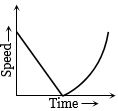
B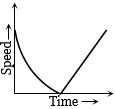
C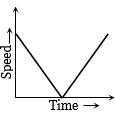
D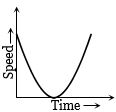
Solution
(B) When a ball is thrown vertically upwards,air resistance acts in the direction opposite to the motion.
During the upward motion,both gravity $(g)$ and air resistance $(a)$ act downwards. Thus,the net acceleration is $a_{up} = -(g + a)$,which is constant and directed downwards. Since acceleration is constant,the speed decreases linearly with time.
During the downward motion,gravity $(g)$ acts downwards and air resistance $(a)$ acts upwards. Thus,the net acceleration is $a_{down} = (g - a)$,which is also constant and directed downwards. Since acceleration is constant,the speed increases linearly with time.
However,because $|a_{up}| > |a_{down}|$,the slope of the speed-time graph (which represents the magnitude of acceleration) will be steeper during the upward motion than during the downward motion. This corresponds to the graph shown in option $B$.
During the upward motion,both gravity $(g)$ and air resistance $(a)$ act downwards. Thus,the net acceleration is $a_{up} = -(g + a)$,which is constant and directed downwards. Since acceleration is constant,the speed decreases linearly with time.
During the downward motion,gravity $(g)$ acts downwards and air resistance $(a)$ acts upwards. Thus,the net acceleration is $a_{down} = (g - a)$,which is also constant and directed downwards. Since acceleration is constant,the speed increases linearly with time.
However,because $|a_{up}| > |a_{down}|$,the slope of the speed-time graph (which represents the magnitude of acceleration) will be steeper during the upward motion than during the downward motion. This corresponds to the graph shown in option $B$.
0 likesView Solution
3
PhysicsMediumMCQAIIMS · 2003
$A$ neutron makes a head-on elastic collision with a stationary deuteron. The fractional energy loss of the neutron in the collision is
A
$16/81$
B
$8/9$
C
$8/27$
D
$2/3$
Solution
(B) For a head-on elastic collision,the fractional energy loss of the projectile (mass $m_1$) colliding with a stationary target (mass $m_2$) is given by the formula:
$\frac{\Delta K}{K} = 1 - \left( \frac{m_1 - m_2}{m_1 + m_2} \right)^2$
Here,the mass of a neutron $m_1 = 1 \text{ u}$ and the mass of a deuteron $m_2 = 2 \text{ u}$.
Substituting these values into the formula:
$\frac{\Delta K}{K} = 1 - \left( \frac{1 - 2}{1 + 2} \right)^2$
$\frac{\Delta K}{K} = 1 - \left( \frac{-1}{3} \right)^2$
$\frac{\Delta K}{K} = 1 - \frac{1}{9}$
$\frac{\Delta K}{K} = \frac{8}{9}$
Thus,the fractional energy loss of the neutron is $8/9$.
$\frac{\Delta K}{K} = 1 - \left( \frac{m_1 - m_2}{m_1 + m_2} \right)^2$
Here,the mass of a neutron $m_1 = 1 \text{ u}$ and the mass of a deuteron $m_2 = 2 \text{ u}$.
Substituting these values into the formula:
$\frac{\Delta K}{K} = 1 - \left( \frac{1 - 2}{1 + 2} \right)^2$
$\frac{\Delta K}{K} = 1 - \left( \frac{-1}{3} \right)^2$
$\frac{\Delta K}{K} = 1 - \frac{1}{9}$
$\frac{\Delta K}{K} = \frac{8}{9}$
Thus,the fractional energy loss of the neutron is $8/9$.
0 likesView Solution
4
PhysicsEasyMCQAIIMS · 2003
The velocity with which a projectile must be fired so that it escapes Earth's gravitation does not depend on
A
Mass of the Earth
B
Mass of the projectile
C
Radius of the Earth
D
Gravitational constant
Solution
(B) The escape velocity is the minimum initial velocity required for an object to escape the gravitational field of a planet and never return.
For an object of mass $m$ to escape from the surface of the Earth (mass $M_e$,radius $R_e$),its initial kinetic energy must be equal to the magnitude of its gravitational potential energy.
$\frac{1}{2} m v_e^2 = \frac{G M_e m}{R_e}$
Solving for $v_e$,we get:
$v_e = \sqrt{\frac{2 G M_e}{R_e}}$
From this formula,it is clear that the escape velocity $v_e$ depends only on the gravitational constant $G$,the mass of the Earth $M_e$,and the radius of the Earth $R_e$.
It is independent of the mass of the projectile $m$. Therefore,the correct option is $B$.
For an object of mass $m$ to escape from the surface of the Earth (mass $M_e$,radius $R_e$),its initial kinetic energy must be equal to the magnitude of its gravitational potential energy.
$\frac{1}{2} m v_e^2 = \frac{G M_e m}{R_e}$
Solving for $v_e$,we get:
$v_e = \sqrt{\frac{2 G M_e}{R_e}}$
From this formula,it is clear that the escape velocity $v_e$ depends only on the gravitational constant $G$,the mass of the Earth $M_e$,and the radius of the Earth $R_e$.
It is independent of the mass of the projectile $m$. Therefore,the correct option is $B$.
0 likesView Solution
5
PhysicsMediumMCQAIIMS · 2003
Two small drops of mercury,each of radius $R$,coalesce to form a single large drop. The ratio of the total surface energies before and after the change is
A
$1:2^{1/3}$
B
$2^{1/3}:1$
C
$2:1$
D
$1:2$
Solution
(B) Let the radius of each small drop be $R$. The volume of two small drops is $V_{initial} = 2 \times (\frac{4}{3}\pi R^3) = \frac{8}{3}\pi R^3$.
Let the radius of the large drop be $R'$. Since the volume remains constant,$\frac{4}{3}\pi (R')^3 = \frac{8}{3}\pi R^3$,which gives $R' = 2^{1/3}R$.
The surface energy of a drop is given by $E = T \times A$,where $T$ is surface tension and $A$ is surface area.
Initial surface energy $E_i = 2 \times (T \times 4\pi R^2) = 8\pi R^2 T$.
Final surface energy $E_f = T \times 4\pi (R')^2 = 4\pi (2^{1/3}R)^2 T = 4\pi 2^{2/3} R^2 T$.
The ratio of initial to final surface energy is $\frac{E_i}{E_f} = \frac{8\pi R^2 T}{4\pi 2^{2/3} R^2 T} = \frac{2}{2^{2/3}} = 2^{1 - 2/3} = 2^{1/3}$.
Thus,the ratio is $2^{1/3}:1$.
Let the radius of the large drop be $R'$. Since the volume remains constant,$\frac{4}{3}\pi (R')^3 = \frac{8}{3}\pi R^3$,which gives $R' = 2^{1/3}R$.
The surface energy of a drop is given by $E = T \times A$,where $T$ is surface tension and $A$ is surface area.
Initial surface energy $E_i = 2 \times (T \times 4\pi R^2) = 8\pi R^2 T$.
Final surface energy $E_f = T \times 4\pi (R')^2 = 4\pi (2^{1/3}R)^2 T = 4\pi 2^{2/3} R^2 T$.
The ratio of initial to final surface energy is $\frac{E_i}{E_f} = \frac{8\pi R^2 T}{4\pi 2^{2/3} R^2 T} = \frac{2}{2^{2/3}} = 2^{1 - 2/3} = 2^{1/3}$.
Thus,the ratio is $2^{1/3}:1$.
0 likesView Solution
6
PhysicsMediumMCQAIIMS · 2003
$A$ lead shot of $1 \, mm$ diameter falls through a long column of glycerine. The variation of its velocity $v$ with distance covered is represented by:
A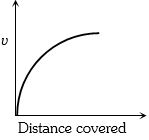
B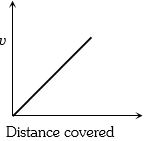
C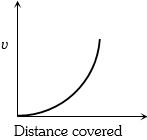
D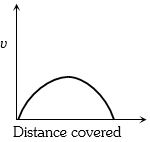
Solution
(A) When a lead shot falls through a viscous liquid like glycerine, it is acted upon by three forces: gravity $(mg)$ acting downwards, and both buoyancy $(F_B)$ and viscous drag $(F_v = 6\pi \eta rv)$ acting upwards. The net force is $F_{net} = mg - F_B - 6\pi \eta rv$. Initially, the velocity $v$ is zero, so the viscous drag is zero, and the acceleration is maximum. As the velocity increases, the viscous drag increases, causing the acceleration to decrease. Eventually, the net force becomes zero when the viscous drag balances the effective weight, and the lead shot attains a constant terminal velocity $(v_t)$. The velocity-distance graph starts from the origin, increases at a decreasing rate, and asymptotically approaches the terminal velocity value. This behavior is correctly represented by plot $(a)$.
0 likesView Solution
7
PhysicsMediumMCQAIIMS · 2003
$A$ black body radiates $20\,W$ at temperature $227^{\circ}C$. If the temperature of the black body is changed to $727^{\circ}C$,then its radiating power will be ..... $W$.
A
$120$
B
$240$
C
$320$
D
$360$
Solution
(C) According to Stefan-Boltzmann Law,the power radiated by a black body is given by $P = A\sigma T^4$,where $A$ is the surface area,$\sigma$ is the Stefan-Boltzmann constant,and $T$ is the absolute temperature in Kelvin.
Given:
$P_1 = 20\,W$
$T_1 = 227^{\circ}C = 227 + 273 = 500\,K$
$T_2 = 727^{\circ}C = 727 + 273 = 1000\,K$
Since $P \propto T^4$,we have:
$\frac{P_2}{P_1} = \left( \frac{T_2}{T_1} \right)^4$
Substituting the values:
$\frac{P_2}{20} = \left( \frac{1000}{500} \right)^4$
$\frac{P_2}{20} = (2)^4$
$\frac{P_2}{20} = 16$
$P_2 = 16 \times 20 = 320\,W$
Therefore,the radiating power will be $320\,W$.
Given:
$P_1 = 20\,W$
$T_1 = 227^{\circ}C = 227 + 273 = 500\,K$
$T_2 = 727^{\circ}C = 727 + 273 = 1000\,K$
Since $P \propto T^4$,we have:
$\frac{P_2}{P_1} = \left( \frac{T_2}{T_1} \right)^4$
Substituting the values:
$\frac{P_2}{20} = \left( \frac{1000}{500} \right)^4$
$\frac{P_2}{20} = (2)^4$
$\frac{P_2}{20} = 16$
$P_2 = 16 \times 20 = 320\,W$
Therefore,the radiating power will be $320\,W$.
0 likesView Solution
8
PhysicsMediumMCQAIIMS · 2003
Shown below are the black body radiation curves at temperatures $T_1$ and $T_2$ $(T_2 > T_1)$. Which of the following plots is correct?
A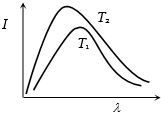
B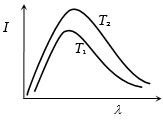
C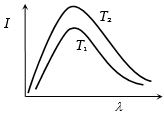
D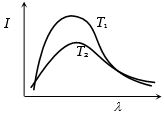
Solution
(A) According to Wien's displacement law,the wavelength corresponding to maximum intensity $\lambda_m$ is inversely proportional to the absolute temperature $T$,i.e.,$\lambda_m \propto \frac{1}{T}$.
Given $T_2 > T_1$,it follows that $\lambda_{m_2} < \lambda_{m_1}$.
This means the peak of the intensity-wavelength curve for the higher temperature $T_2$ shifts towards a shorter wavelength (left side) compared to the curve for $T_1$.
Additionally,according to the Stefan-Boltzmann law,the total energy emitted per unit area per unit time is proportional to $T^4$,so the intensity $I$ for $T_2$ will be higher than for $T_1$ at all wavelengths.
Therefore,the correct plot is the one where the curve for $T_2$ is higher and its peak is shifted to the left relative to the curve for $T_1$.
Given $T_2 > T_1$,it follows that $\lambda_{m_2} < \lambda_{m_1}$.
This means the peak of the intensity-wavelength curve for the higher temperature $T_2$ shifts towards a shorter wavelength (left side) compared to the curve for $T_1$.
Additionally,according to the Stefan-Boltzmann law,the total energy emitted per unit area per unit time is proportional to $T^4$,so the intensity $I$ for $T_2$ will be higher than for $T_1$ at all wavelengths.
Therefore,the correct plot is the one where the curve for $T_2$ is higher and its peak is shifted to the left relative to the curve for $T_1$.
0 likesView Solution
9
PhysicsMediumMCQAIIMS · 2003
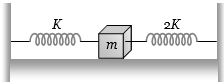
Two springs of force constants $K$ and $2K$ are connected to a mass $m$ as shown in the figure. The frequency of oscillation of the mass is:
A
$(1/2\pi )\sqrt {(K/m)} $
B
$(1/2\pi )\sqrt {(2K/m)} $
C
$(1/2\pi )\sqrt {(3K/m)} $
D
$(1/2\pi )\sqrt {(m/K)} $
Solution
(C) When a mass $m$ is connected between two springs in parallel (as shown in the figure),the effective spring constant $K_{eff}$ is the sum of the individual spring constants.
$K_{eff} = K_1 + K_2 = K + 2K = 3K$
The frequency of oscillation $f$ for a spring-mass system is given by the formula:
$f = \frac{1}{2\pi} \sqrt{\frac{K_{eff}}{m}}$
Substituting the value of $K_{eff}$:
$f = \frac{1}{2\pi} \sqrt{\frac{3K}{m}}$
Thus,the correct option is $C$.
$K_{eff} = K_1 + K_2 = K + 2K = 3K$
The frequency of oscillation $f$ for a spring-mass system is given by the formula:
$f = \frac{1}{2\pi} \sqrt{\frac{K_{eff}}{m}}$
Substituting the value of $K_{eff}$:
$f = \frac{1}{2\pi} \sqrt{\frac{3K}{m}}$
Thus,the correct option is $C$.
0 likesView Solution
10
PhysicsDifficultMCQAIIMS · 2003
An earthquake generates both transverse $(S)$ and longitudinal $(P)$ waves in the Earth. The speed of $S$ waves is about $4.5 \, km/s$ and that of $P$ waves is about $8.0 \, km/s$. $A$ seismograph records $P$ and $S$ waves from an earthquake. The first $P$ wave arrives $4.0 \, min$ before the first $S$ wave. The epicenter of the earthquake is located at a distance of about .... $km$.
A
$25$
B
$250$
C
$2500$
D
$5000$
Solution
(C) Let $d$ be the distance of the epicenter from the seismograph.
Let $v_P = 8.0 \, km/s$ and $v_S = 4.5 \, km/s$ be the speeds of $P$ and $S$ waves respectively.
The time taken by $P$ waves is $t_P = d / v_P$ and by $S$ waves is $t_S = d / v_S$.
Given the time difference $\Delta t = t_S - t_P = 4.0 \, min = 240 \, s$.
Substituting the expressions for time: $d / v_S - d / v_P = 240$.
$d (1 / 4.5 - 1 / 8.0) = 240$.
$d ((8.0 - 4.5) / (4.5 \times 8.0)) = 240$.
$d (3.5 / 36) = 240$.
$d = (240 \times 36) / 3.5 \approx 2468.6 \, km$.
Rounding to the nearest given option,the distance is approximately $2500 \, km$.
Let $v_P = 8.0 \, km/s$ and $v_S = 4.5 \, km/s$ be the speeds of $P$ and $S$ waves respectively.
The time taken by $P$ waves is $t_P = d / v_P$ and by $S$ waves is $t_S = d / v_S$.
Given the time difference $\Delta t = t_S - t_P = 4.0 \, min = 240 \, s$.
Substituting the expressions for time: $d / v_S - d / v_P = 240$.
$d (1 / 4.5 - 1 / 8.0) = 240$.
$d ((8.0 - 4.5) / (4.5 \times 8.0)) = 240$.
$d (3.5 / 36) = 240$.
$d = (240 \times 36) / 3.5 \approx 2468.6 \, km$.
Rounding to the nearest given option,the distance is approximately $2500 \, km$.
0 likesView Solution
11
PhysicsEasyMCQAIIMS · 2003
The difference in the lengths of a mean solar day and a sidereal day is about........$min$.
A
$1$
B
$4$
C
$15$
D
$56$
Solution
(B) mean solar day is the time taken by the Earth to rotate once on its axis relative to the Sun,which is approximately $24$ hours.
$A$ sidereal day is the time taken by the Earth to rotate once on its axis relative to the distant stars,which is approximately $23$ hours and $56$ minutes.
The difference between a mean solar day ($24$ hours) and a sidereal day ($23$ hours $56$ minutes) is $4$ minutes.
Therefore,the correct option is $B$.
$A$ sidereal day is the time taken by the Earth to rotate once on its axis relative to the distant stars,which is approximately $23$ hours and $56$ minutes.
The difference between a mean solar day ($24$ hours) and a sidereal day ($23$ hours $56$ minutes) is $4$ minutes.
Therefore,the correct option is $B$.
0 likesView Solution
12
PhysicsEasyMCQAIIMS · 2003
The motion of planets in the solar system is an example of the conservation of
A
mass
B
linear momentum
C
angular momentum
D
energy
Solution
(C) The gravitational force exerted by the Sun on a planet acts along the line joining the Sun and the planet.
This force is a central force,meaning its torque about the Sun is zero.
According to the principle of conservation of angular momentum,if the net external torque acting on a system is zero,the angular momentum of the system remains constant.
Therefore,the motion of planets in the solar system is an example of the conservation of angular momentum.
This force is a central force,meaning its torque about the Sun is zero.
According to the principle of conservation of angular momentum,if the net external torque acting on a system is zero,the angular momentum of the system remains constant.
Therefore,the motion of planets in the solar system is an example of the conservation of angular momentum.
0 likesView Solution
13
PhysicsMediumMCQAIIMS · 2003
$Assertion$ : The Earth is slowing down and as a result the Moon is coming nearer to it.
$Reason$ : The angular momentum of the Earth-Moon system is not conserved.
$Reason$ : The angular momentum of the Earth-Moon system is not conserved.
A
If both $Assertion$ and $Reason$ are correct and the $Reason$ is a correct explanation of the $Assertion$.
B
If both $Assertion$ and $Reason$ are correct but $Reason$ is not a correct explanation of the $Assertion$.
C
If the $Assertion$ is correct but $Reason$ is incorrect.
D
If both the $Assertion$ and $Reason$ are incorrect.
Solution
(D) The angular momentum of the Earth-Moon system is conserved because no external torque acts on the system.
From the relation $\tau = \frac{dL}{dt}$,if $\tau = 0$,then $\frac{dL}{dt} = 0$,which implies $L$ is constant.
Therefore,the $Reason$ is incorrect.
Due to tidal friction,the Earth's rotation slows down,meaning its angular velocity $\omega_1$ decreases. Since the total angular momentum $L = I_1\omega_1 + I_2\omega_2$ must remain constant,the angular momentum of the Moon's orbit must increase to compensate for the decrease in the Earth's rotational angular momentum.
As the Moon gains angular momentum,its orbital radius $r_2$ increases,causing the Moon to move away from the Earth. Thus,the $Assertion$ is also incorrect.
From the relation $\tau = \frac{dL}{dt}$,if $\tau = 0$,then $\frac{dL}{dt} = 0$,which implies $L$ is constant.
Therefore,the $Reason$ is incorrect.
Due to tidal friction,the Earth's rotation slows down,meaning its angular velocity $\omega_1$ decreases. Since the total angular momentum $L = I_1\omega_1 + I_2\omega_2$ must remain constant,the angular momentum of the Moon's orbit must increase to compensate for the decrease in the Earth's rotational angular momentum.
As the Moon gains angular momentum,its orbital radius $r_2$ increases,causing the Moon to move away from the Earth. Thus,the $Assertion$ is also incorrect.
0 likesView Solution
14
PhysicsEasyMCQAIIMS · 2003
$Assertion$ : The length of the day is slowly increasing.
$Reason$ : The dominant effect causing a slowdown in the rotation of the earth is the gravitational pull of other planets in the solar system.
$Reason$ : The dominant effect causing a slowdown in the rotation of the earth is the gravitational pull of other planets in the solar system.
A
If both $Assertion$ and $Reason$ are correct and the $Reason$ is a correct explanation of the $Assertion$.
B
If both $Assertion$ and $Reason$ are correct but $Reason$ is not a correct explanation of the $Assertion$.
C
If the $Assertion$ is correct but $Reason$ is incorrect.
D
If both the $Assertion$ and $Reason$ are incorrect.
Solution
(C) The length of the day is slowly increasing due to tidal friction caused by the gravitational interaction between the Earth and the Moon,as well as viscous forces between the Earth and its atmosphere.
This process causes a gradual dissipation of the Earth's rotational energy,leading to a slowdown in its rotation.
The gravitational pull of other planets in the solar system is negligible in this context compared to tidal effects.
Therefore,the $Assertion$ is correct,but the $Reason$ is incorrect.
This process causes a gradual dissipation of the Earth's rotational energy,leading to a slowdown in its rotation.
The gravitational pull of other planets in the solar system is negligible in this context compared to tidal effects.
Therefore,the $Assertion$ is correct,but the $Reason$ is incorrect.
0 likesView Solution
15
PhysicsEasyMCQAIIMS · 2003
$Assertion :$ It is hotter over the top of a fire than at the same distance of the sides.
$Reason :$ Air surrounding the fire conducts more heat upwards.
$Reason :$ Air surrounding the fire conducts more heat upwards.
A
If both $Assertion$ and $Reason$ are correct and the $Reason$ is a correct explanation of the $Assertion$.
B
If both $Assertion$ and $Reason$ are correct but $Reason$ is not a correct explanation of the $Assertion$.
C
If the $Assertion$ is correct but $Reason$ is incorrect.
D
If both the $Assertion$ and $Reason$ are incorrect.
Solution
(C) The $Assertion$ is correct because the air directly above the fire becomes heated,expands,and rises due to convection currents.
This process carries heat energy upwards,making the region above the fire significantly hotter than the sides.
The $Reason$ is incorrect because air is a poor conductor of heat. The heat transfer in this scenario is primarily due to convection,not conduction.
This process carries heat energy upwards,making the region above the fire significantly hotter than the sides.
The $Reason$ is incorrect because air is a poor conductor of heat. The heat transfer in this scenario is primarily due to convection,not conduction.
0 likesView Solution
16
PhysicsEasyMCQAIIMS · 2003
$Assertion:$ When a bottle of cold carbonated drink is opened,a slight fog forms around the opening.
$Reason:$ Adiabatic expansion of the gas causes lowering of temperature and condensation of water vapours.
$Reason:$ Adiabatic expansion of the gas causes lowering of temperature and condensation of water vapours.
A
If both Assertion and Reason are correct and the Reason is a correct explanation of the Assertion.
B
If both Assertion and Reason are correct but Reason is not a correct explanation of the Assertion.
C
If the Assertion is correct but Reason is incorrect.
D
If both the Assertion and Reason are incorrect.
Solution
(A) When a bottle of cold carbonated drink is opened,the high-pressure gas inside the bottle expands rapidly into the atmosphere.
This rapid expansion is an adiabatic process because it happens so quickly that there is no time for heat exchange with the surroundings.
According to the first law of thermodynamics,for an adiabatic expansion $(dQ = 0)$,the work done by the gas $(dW > 0)$ results in a decrease in internal energy $(dU < 0)$,which leads to a significant drop in temperature.
Due to this sudden cooling,the water vapour present in the air near the opening condenses into tiny liquid droplets,forming a visible fog.
This rapid expansion is an adiabatic process because it happens so quickly that there is no time for heat exchange with the surroundings.
According to the first law of thermodynamics,for an adiabatic expansion $(dQ = 0)$,the work done by the gas $(dW > 0)$ results in a decrease in internal energy $(dU < 0)$,which leads to a significant drop in temperature.
Due to this sudden cooling,the water vapour present in the air near the opening condenses into tiny liquid droplets,forming a visible fog.
0 likesView Solution
17
PhysicsEasyMCQAIIMS · 2003
$Assertion :$ The amplitude of an oscillating pendulum decreases gradually with time.
$Reason :$ The frequency of the pendulum decreases with time.
$Reason :$ The frequency of the pendulum decreases with time.
A
If both Assertion and Reason are correct and the Reason is a correct explanation of the Assertion.
B
If both Assertion and Reason are correct but Reason is not a correct explanation of the Assertion.
C
If the Assertion is correct but Reason is incorrect.
D
If both the Assertion and Reason are incorrect.
Solution
(C) The amplitude of an oscillating pendulum decreases with time due to air resistance (damping). This is known as damped oscillation.
However,the frequency of an oscillating pendulum depends on its length $L$ and acceleration due to gravity $g$,given by the formula $f = \frac{1}{2\pi} \sqrt{\frac{g}{L}}$.
Since $g$ and $L$ remain constant during the motion,the frequency of the pendulum remains constant over time.
Therefore,the Assertion is correct,but the Reason is incorrect.
However,the frequency of an oscillating pendulum depends on its length $L$ and acceleration due to gravity $g$,given by the formula $f = \frac{1}{2\pi} \sqrt{\frac{g}{L}}$.
Since $g$ and $L$ remain constant during the motion,the frequency of the pendulum remains constant over time.
Therefore,the Assertion is correct,but the Reason is incorrect.
0 likesView Solution
18
PhysicsEasyMCQAIIMS · 2003
$Assertion :$ When a beetle moves along the sand within a few tens of centimeters of a sand scorpion,the scorpion immediately turns towards the beetle and dashes towards it.
$Reason :$ When a beetle disturbs the sand,it sends pulses along the sand's surface. One set of pulses is longitudinal while the other set is transverse.
$Reason :$ When a beetle disturbs the sand,it sends pulses along the sand's surface. One set of pulses is longitudinal while the other set is transverse.
A
If both Assertion and Reason are correct and the Reason is a correct explanation of the Assertion.
B
If both Assertion and Reason are correct but Reason is not a correct explanation of the Assertion.
C
If the Assertion is correct but Reason is incorrect.
D
If both the Assertion and Reason are incorrect.
Solution
(A) When a beetle moves along the sand,it creates disturbances that travel as waves on the sand's surface.
These disturbances consist of two types of pulses: longitudinal waves (which travel faster) and transverse waves (which travel slower).
The sand scorpion is highly sensitive to these vibrations. By sensing the time interval between the arrival of the longitudinal waves and the transverse waves,the scorpion can calculate the distance to the beetle.
Furthermore,by comparing the signals received by its different legs,the scorpion can determine the direction of the beetle.
Thus,the Reason correctly explains how the scorpion detects and locates the beetle.
These disturbances consist of two types of pulses: longitudinal waves (which travel faster) and transverse waves (which travel slower).
The sand scorpion is highly sensitive to these vibrations. By sensing the time interval between the arrival of the longitudinal waves and the transverse waves,the scorpion can calculate the distance to the beetle.
Furthermore,by comparing the signals received by its different legs,the scorpion can determine the direction of the beetle.
Thus,the Reason correctly explains how the scorpion detects and locates the beetle.
0 likesView Solution
19
PhysicsMediumMCQAIIMS · 2003
An object is moving with a uniform acceleration which is parallel to its instantaneous direction of motion. The displacement $(s)-$ velocity $(v)$ graph of this object is
A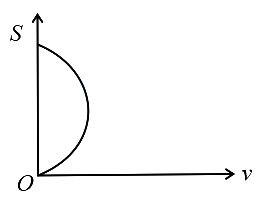
B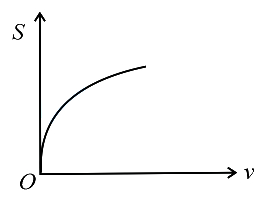
C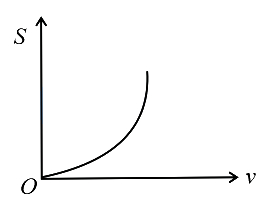
D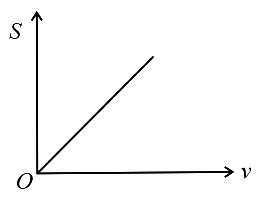
Solution
(C) From the third equation of kinematics,we have $v^2 - u^2 = 2as$.
Assuming the object starts from rest,the initial velocity $u = 0$.
Substituting this into the equation,we get $v^2 = 2as$,which can be rearranged as $s = \frac{v^2}{2a}$.
Since $a$ is a uniform (constant) acceleration,the relationship between displacement $s$ and velocity $v$ is $s \propto v^2$.
This represents a parabola opening along the $s$-axis.
Graph $C$ shows a parabolic curve where $s$ increases with the square of $v$,starting from the origin $(0, 0)$,which matches the derived relationship $s = \frac{1}{2a} v^2$.
Assuming the object starts from rest,the initial velocity $u = 0$.
Substituting this into the equation,we get $v^2 = 2as$,which can be rearranged as $s = \frac{v^2}{2a}$.
Since $a$ is a uniform (constant) acceleration,the relationship between displacement $s$ and velocity $v$ is $s \propto v^2$.
This represents a parabola opening along the $s$-axis.
Graph $C$ shows a parabolic curve where $s$ increases with the square of $v$,starting from the origin $(0, 0)$,which matches the derived relationship $s = \frac{1}{2a} v^2$.
0 likesView Solution
20
PhysicsMediumMCQAIIMS · 2003
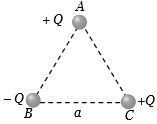
Three charges are placed at the vertices of an equilateral triangle of side '$a$' as shown in the figure. The force experienced by the charge placed at the vertex $A$ in a direction normal to $BC$ is
A
$Q^2 / (4\pi \varepsilon_0 a^2)$
B
$-Q^2 / (4\pi \varepsilon_0 a^2)$
C
Zero
D
$Q^2 / (2\pi \varepsilon_0 a^2)$
Solution
(C) Let the charges at $A, B,$ and $C$ be $+Q, -Q,$ and $+Q$ respectively. The distance between any two vertices is $a$.
The force on charge at $A$ due to charge at $B$ is $F_B = \frac{1}{4\pi \varepsilon_0} \frac{Q^2}{a^2}$ (attractive,directed towards $B$).
The force on charge at $A$ due to charge at $C$ is $F_C = \frac{1}{4\pi \varepsilon_0} \frac{Q^2}{a^2}$ (repulsive,directed away from $C$).
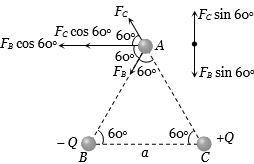
Resolving these forces into components parallel and normal to $BC$:
$1$. The components of $F_B$ and $F_C$ parallel to $BC$ are $F_B \cos 60^\circ$ and $F_C \cos 60^\circ$ respectively,both directed towards the left.
$2$. The components of $F_B$ and $F_C$ normal to $BC$ are $F_B \sin 60^\circ$ (downwards) and $F_C \sin 60^\circ$ (upwards) respectively.
Since $|F_B| = |F_C|$,the net force in the direction normal to $BC$ is $F_C \sin 60^\circ - F_B \sin 60^\circ = 0$.
The force on charge at $A$ due to charge at $B$ is $F_B = \frac{1}{4\pi \varepsilon_0} \frac{Q^2}{a^2}$ (attractive,directed towards $B$).
The force on charge at $A$ due to charge at $C$ is $F_C = \frac{1}{4\pi \varepsilon_0} \frac{Q^2}{a^2}$ (repulsive,directed away from $C$).
Resolving these forces into components parallel and normal to $BC$:
$1$. The components of $F_B$ and $F_C$ parallel to $BC$ are $F_B \cos 60^\circ$ and $F_C \cos 60^\circ$ respectively,both directed towards the left.
$2$. The components of $F_B$ and $F_C$ normal to $BC$ are $F_B \sin 60^\circ$ (downwards) and $F_C \sin 60^\circ$ (upwards) respectively.
Since $|F_B| = |F_C|$,the net force in the direction normal to $BC$ is $F_C \sin 60^\circ - F_B \sin 60^\circ = 0$.
0 likesView Solution
21
PhysicsEasyMCQAIIMS · 2003
$A$ proton is about $1840$ times heavier than an electron. When it is accelerated by a potential difference of $1\, kV$,its kinetic energy will be......$keV$.
A
$1840$
B
$1/1840$
C
$1$
D
$920$
Solution
(C) The kinetic energy $(KE)$ gained by a charged particle when accelerated through a potential difference $(V)$ is given by the formula: $KE = qV$.
Here,the charge of a proton $(q)$ is equal to the elementary charge $(e)$.
The potential difference $(V)$ is given as $1\, kV$.
Substituting these values into the formula:
$KE = e \times 1\, kV = 1\, keV$.
Therefore,the kinetic energy of the proton is $1\, keV$.
Here,the charge of a proton $(q)$ is equal to the elementary charge $(e)$.
The potential difference $(V)$ is given as $1\, kV$.
Substituting these values into the formula:
$KE = e \times 1\, kV = 1\, keV$.
Therefore,the kinetic energy of the proton is $1\, keV$.
0 likesView Solution
22
PhysicsEasyMCQAIIMS · 2003
An electric dipole is kept in a non-uniform electric field. It experiences
A
$A$ force and a torque
B
$A$ force but not a torque
C
$A$ torque but not a force
D
Neither a force nor a torque
Solution
(A) In a non-uniform electric field,the electric field intensity at the position of the two charges of the dipole ($-q$ and $+q$) is different.
Since $F = qE$,the forces acting on the two charges are $F_1 = -qE_1$ and $F_2 = qE_2$.
Because $E_1
eq E_2$,the net force $F_{net} = F_1 + F_2
eq 0$.
Additionally,since these forces act at different points and are not collinear,they exert a net torque on the dipole.
Therefore,the dipole experiences both a net force and a net torque.
Since $F = qE$,the forces acting on the two charges are $F_1 = -qE_1$ and $F_2 = qE_2$.
Because $E_1
eq E_2$,the net force $F_{net} = F_1 + F_2
eq 0$.
Additionally,since these forces act at different points and are not collinear,they exert a net torque on the dipole.
Therefore,the dipole experiences both a net force and a net torque.
0 likesView Solution
23
PhysicsEasyMCQAIIMS · 2003
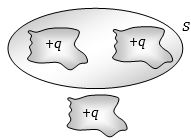
Shown below is a distribution of charges. The flux of electric field due to these charges through the surface $S$ is
A
$3q/{\varepsilon _0}$
B
$2q/{\varepsilon _0}$
C
$q/{\varepsilon _0}$
D
Zero
Solution
(B) According to Gauss's Law,the electric flux $\phi$ through any closed surface is equal to the total charge enclosed by the surface divided by the permittivity of free space $\varepsilon_0$.
Mathematically,$\phi = \frac{Q_{enc}}{\varepsilon_0}$.
In the given figure,the surface $S$ encloses two charges,each of magnitude $+q$.
Therefore,the total enclosed charge $Q_{enc} = +q + q = 2q$.
Substituting this into Gauss's Law,we get $\phi = \frac{2q}{\varepsilon_0}$.
Mathematically,$\phi = \frac{Q_{enc}}{\varepsilon_0}$.
In the given figure,the surface $S$ encloses two charges,each of magnitude $+q$.
Therefore,the total enclosed charge $Q_{enc} = +q + q = 2q$.
Substituting this into Gauss's Law,we get $\phi = \frac{2q}{\varepsilon_0}$.
0 likesView Solution
24
PhysicsMediumMCQAIIMS · 2003
The Earth's magnetic field at a given point is $0.5 \times 10^{-5} \, Wb/m^2$. This field is to be annulled by the magnetic induction at the center of a circular conducting loop of radius $5.0 \, cm$. The current required to be flown in the loop is nearly......$A$
A
$0.2$
B
$0.4$
C
$4$
D
$40$
Solution
(B) The magnetic field $B$ at the center of a circular loop carrying current $i$ is given by the formula: $B = \frac{\mu_0 i}{2r}$.
Given:
$B = 0.5 \times 10^{-5} \, T$ (since $1 \, Wb/m^2 = 1 \, T$)
$r = 5.0 \, cm = 5.0 \times 10^{-2} \, m$
$\mu_0 = 4\pi \times 10^{-7} \, T \cdot m/A$
Substituting the values into the formula:
$0.5 \times 10^{-5} = \frac{4\pi \times 10^{-7} \times i}{2 \times 5.0 \times 10^{-2}}$
$0.5 \times 10^{-5} = \frac{2\pi \times 10^{-7} \times i}{5.0 \times 10^{-2}}$
$i = \frac{0.5 \times 10^{-5} \times 5.0 \times 10^{-2}}{2 \times 3.14 \times 10^{-7}}$
$i = \frac{2.5 \times 10^{-7}}{6.28 \times 10^{-7}}$
$i \approx 0.398 \, A \approx 0.4 \, A$.
Given:
$B = 0.5 \times 10^{-5} \, T$ (since $1 \, Wb/m^2 = 1 \, T$)
$r = 5.0 \, cm = 5.0 \times 10^{-2} \, m$
$\mu_0 = 4\pi \times 10^{-7} \, T \cdot m/A$
Substituting the values into the formula:
$0.5 \times 10^{-5} = \frac{4\pi \times 10^{-7} \times i}{2 \times 5.0 \times 10^{-2}}$
$0.5 \times 10^{-5} = \frac{2\pi \times 10^{-7} \times i}{5.0 \times 10^{-2}}$
$i = \frac{0.5 \times 10^{-5} \times 5.0 \times 10^{-2}}{2 \times 3.14 \times 10^{-7}}$
$i = \frac{2.5 \times 10^{-7}}{6.28 \times 10^{-7}}$
$i \approx 0.398 \, A \approx 0.4 \, A$.
0 likesView Solution
25
PhysicsMediumMCQAIIMS · 2003
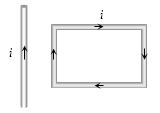
$A$ rectangular loop carrying a current $i$ is situated near a long straight wire such that the wire is parallel to one of the sides of the loop and is in the plane of the loop. If a steady current $i$ is established in the wire as shown in the figure,the loop will
A
Rotate about an axis parallel to the wire
B
Move away from the wire or towards the right
C
Move towards the wire
D
Remain stationary
Solution
(C) The magnetic field produced by the long straight wire at a distance $r$ is given by $B = \frac{\mu_0 i}{2\pi r}$.
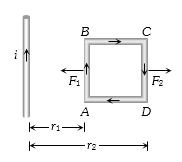
For the side of the loop closer to the wire at distance $r_1$,the current flows in the same direction as the wire. According to Fleming's left-hand rule,the force $F_1$ on this side is attractive (towards the wire).
For the side of the loop farther from the wire at distance $r_2$,the current flows in the opposite direction to the wire. The force $F_2$ on this side is repulsive (away from the wire).
Since $r_1 < r_2$,the magnetic field $B_1$ at the closer side is stronger than the magnetic field $B_2$ at the farther side $(B_1 > B_2)$.
Consequently,the attractive force $F_1$ is greater than the repulsive force $F_2$ $(F_1 > F_2)$.
Therefore,the net force $F_{net} = F_1 - F_2$ acts towards the wire,and the loop will move towards the wire.
For the side of the loop closer to the wire at distance $r_1$,the current flows in the same direction as the wire. According to Fleming's left-hand rule,the force $F_1$ on this side is attractive (towards the wire).
For the side of the loop farther from the wire at distance $r_2$,the current flows in the opposite direction to the wire. The force $F_2$ on this side is repulsive (away from the wire).
Since $r_1 < r_2$,the magnetic field $B_1$ at the closer side is stronger than the magnetic field $B_2$ at the farther side $(B_1 > B_2)$.
Consequently,the attractive force $F_1$ is greater than the repulsive force $F_2$ $(F_1 > F_2)$.
Therefore,the net force $F_{net} = F_1 - F_2$ acts towards the wire,and the loop will move towards the wire.
0 likesView Solution
26
PhysicsEasyMCQAIIMS · 2003
$A$ frog can be levitated in a magnetic field produced by a current in a vertical solenoid placed below the frog. This is possible because the body of the frog behaves as
A
Paramagnetic
B
Diamagnetic
C
Ferromagnetic
D
Antiferromagnetic
Solution
(B) The phenomenon of levitation of a frog in a strong magnetic field is a classic demonstration of diamagnetism.
Biological tissues,including the body of a frog,consist largely of water and organic molecules,which exhibit diamagnetic properties.
Diamagnetic substances are weakly repelled by magnetic fields.
When a strong magnetic field is applied,the diamagnetic repulsion force acting on the frog's body can balance the gravitational force,allowing the frog to levitate.
Therefore,the correct option is $B$.
Biological tissues,including the body of a frog,consist largely of water and organic molecules,which exhibit diamagnetic properties.
Diamagnetic substances are weakly repelled by magnetic fields.
When a strong magnetic field is applied,the diamagnetic repulsion force acting on the frog's body can balance the gravitational force,allowing the frog to levitate.
Therefore,the correct option is $B$.
0 likesView Solution
27
PhysicsEasyMCQAIIMS · 2003
If an electron and a photon propagate in the form of waves having the same wavelength,it implies that they have the same
A
Energy
B
Momentum
C
Velocity
D
Angular momentum
Solution
(B) According to the de-Broglie hypothesis,the momentum $p$ of a particle is related to its wavelength $\lambda$ by the equation $p = \frac{h}{\lambda}$,where $h$ is Planck's constant.
Since both the electron and the photon have the same wavelength $\lambda$,and $h$ is a universal constant,their momenta must be equal.
Therefore,they have the same momentum.
Since both the electron and the photon have the same wavelength $\lambda$,and $h$ is a universal constant,their momenta must be equal.
Therefore,they have the same momentum.
0 likesView Solution
28
PhysicsEasyMCQAIIMS · 2003
Characteristic $X$-rays are produced due to
A
Transfer of momentum in collision of electrons with target atoms
B
Transition of electrons from higher to lower electronic orbits in an atom
C
Heating of the target
D
Transfer of energy in collision of electrons with atoms in the target
Solution
(B) Characteristic $X$-rays are produced when an element is bombarded with high-energy particles such as photons,electrons,or ions.
When an incident particle strikes a bound electron in an atom,the bound electron is ejected from an inner shell of the atom.
After the electron is ejected,the atom is left with a vacant energy level,known as a core hole.
Electrons from outer shells then fall into the inner shell,emitting quantized photons with energy equivalent to the difference between the higher and lower energy states.
Since each element has a unique set of energy levels,the transitions from higher to lower energy levels produce $X$-rays with frequencies that are characteristic to each specific element.
When an incident particle strikes a bound electron in an atom,the bound electron is ejected from an inner shell of the atom.
After the electron is ejected,the atom is left with a vacant energy level,known as a core hole.
Electrons from outer shells then fall into the inner shell,emitting quantized photons with energy equivalent to the difference between the higher and lower energy states.
Since each element has a unique set of energy levels,the transitions from higher to lower energy levels produce $X$-rays with frequencies that are characteristic to each specific element.
0 likesView Solution
29
PhysicsEasyMCQAIIMS · 2003
In a material medium,when a positron meets an electron,both particles annihilate,leading to the emission of two gamma-ray photons. This process forms the basis of an important diagnostic procedure called:
A
$MRI$
B
$PET$
C
$CAT$
D
$SPECT$
Solution
(B) When a positron $(e^+)$ encounters an electron $(e^-)$,they annihilate each other because they are particle-antiparticle pairs.
This annihilation process results in the conversion of their mass-energy into two gamma-ray photons,typically emitted in opposite directions to conserve momentum.
This physical phenomenon is the fundamental principle behind Positron Emission Tomography,commonly abbreviated as $PET$ scan,which is used in medical diagnostics to image metabolic processes in the body.
This annihilation process results in the conversion of their mass-energy into two gamma-ray photons,typically emitted in opposite directions to conserve momentum.
This physical phenomenon is the fundamental principle behind Positron Emission Tomography,commonly abbreviated as $PET$ scan,which is used in medical diagnostics to image metabolic processes in the body.
0 likesView Solution
30
PhysicsMediumMCQAIIMS · 2003
If a radioactive substance reduces to $\frac{1}{16}$ of its original mass in $40$ days,what is its half-life in days?
A
$10$
B
$20$
C
$40$
D
None of these
Solution
(A) The radioactive decay law is given by $\frac{N}{N_0} = \left( \frac{1}{2} \right)^n$,where $n$ is the number of half-lives.
Given $\frac{N}{N_0} = \frac{1}{16}$,we can write $\frac{1}{16} = \left( \frac{1}{2} \right)^4$.
Comparing the two expressions,we get $n = 4$.
The number of half-lives $n$ is related to the total time $t$ and half-life $T_{1/2}$ by $n = \frac{t}{T_{1/2}}$.
Given $t = 40$ days and $n = 4$,we have $4 = \frac{40}{T_{1/2}}$.
Therefore,$T_{1/2} = \frac{40}{4} = 10$ days.
Given $\frac{N}{N_0} = \frac{1}{16}$,we can write $\frac{1}{16} = \left( \frac{1}{2} \right)^4$.
Comparing the two expressions,we get $n = 4$.
The number of half-lives $n$ is related to the total time $t$ and half-life $T_{1/2}$ by $n = \frac{t}{T_{1/2}}$.
Given $t = 40$ days and $n = 4$,we have $4 = \frac{40}{T_{1/2}}$.
Therefore,$T_{1/2} = \frac{40}{4} = 10$ days.
0 likesView Solution
31
PhysicsEasyMCQAIIMS · 2003
Radioactive nuclei that are injected into a patient collect at certain sites within their body,undergoing radioactive decay and emitting electromagnetic radiation. These radiations can then be recorded by a detector. This procedure provides an important diagnostic tool called:
A
Gamma camera
B
$CAT$ scan
C
Radiotracer technique
D
Gamma ray spectroscopy
Solution
(C) Radioactive nuclei injected into a patient accumulate at specific sites within the body.
These nuclei undergo radioactive decay and emit electromagnetic radiation (typically gamma rays).
These radiations are detected by external detectors to map the distribution of the tracer.
This diagnostic procedure is known as the Radiotracer technique.
These nuclei undergo radioactive decay and emit electromagnetic radiation (typically gamma rays).
These radiations are detected by external detectors to map the distribution of the tracer.
This diagnostic procedure is known as the Radiotracer technique.
0 likesView Solution
32
PhysicsEasyMCQAIIMS · 2003
To a germanium sample,traces of gallium are added as an impurity. The resultant sample would behave like
A
$A$ conductor
B
$A$ $P-$ type semiconductor
C
An $N-$ type semiconductor
D
An insulator
Solution
(B) Germanium $(Ge)$ is a group $14$ element with $4$ valence electrons.
Gallium $(Ga)$ is a group $13$ element,which means it has $3$ valence electrons.
When a trivalent impurity like Gallium is added to a tetravalent semiconductor like Germanium,it creates a vacancy or a 'hole' in the crystal lattice.
Since the majority charge carriers in this doped semiconductor are holes (positive charge carriers),the material behaves as a $P-$ type semiconductor.
Gallium $(Ga)$ is a group $13$ element,which means it has $3$ valence electrons.
When a trivalent impurity like Gallium is added to a tetravalent semiconductor like Germanium,it creates a vacancy or a 'hole' in the crystal lattice.
Since the majority charge carriers in this doped semiconductor are holes (positive charge carriers),the material behaves as a $P-$ type semiconductor.
0 likesView Solution
33
PhysicsMediumMCQAIIMS · 2003
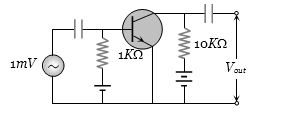
In the following common emitter configuration, an $NPN$ transistor with current gain $\beta = 100$ is used. The output voltage of the amplifier will be
A
$10 \, mV$
B
$0.1 \, V$
C
$1.0 \, V$
D
$10 \, V$
Solution
(C) Given: Input voltage $V_{in} = 1 \, mV = 10^{-3} \, V$, current gain $\beta = 100$, input resistance $R_{in} = 1 \, k\Omega = 10^3 \, \Omega$, and load resistance $R_L = 10 \, k\Omega = 10^4 \, \Omega$.
Voltage gain $A_v = \beta \times \frac{R_L}{R_{in}}$.
$A_v = 100 \times \frac{10 \, k\Omega}{1 \, k\Omega} = 100 \times 10 = 1000$.
Output voltage $V_{out} = A_v \times V_{in}$.
$V_{out} = 1000 \times 10^{-3} \, V = 1 \, V$.
Voltage gain $A_v = \beta \times \frac{R_L}{R_{in}}$.
$A_v = 100 \times \frac{10 \, k\Omega}{1 \, k\Omega} = 100 \times 10 = 1000$.
Output voltage $V_{out} = A_v \times V_{in}$.
$V_{out} = 1000 \times 10^{-3} \, V = 1 \, V$.
0 likesView Solution
34
PhysicsMediumMCQAIIMS · 2003
In short wave communication, waves of which of the following frequencies will be reflected back by the ionospheric layer having an electron density of $10^{11} \text{ per } m^3$ (in $\text{ MHz}$)?
A
$2$
B
$10$
C
$12$
D
$18$
Solution
(A) The critical frequency $(f_c)$ of the ionosphere is given by the formula: $f_c \approx 9 \times (N_{max})^{1/2}$, where $N_{max}$ is the maximum electron density in $\text{electrons/m}^3$.
Given $N_{max} = 10^{11} \text{ m}^{-3}$.
Substituting the value: $f_c \approx 9 \times (10^{11})^{1/2} = 9 \times \sqrt{10} \times 10^5 \approx 9 \times 3.16 \times 10^5 \approx 28.44 \times 10^5 \text{ Hz} \approx 2.84 \text{ MHz}$.
Since the wave is reflected back if its frequency is < or equal to the critical frequency, among the given options, $2 \text{ MHz}$ is the only frequency that will be reflected back by the ionosphere.
Given $N_{max} = 10^{11} \text{ m}^{-3}$.
Substituting the value: $f_c \approx 9 \times (10^{11})^{1/2} = 9 \times \sqrt{10} \times 10^5 \approx 9 \times 3.16 \times 10^5 \approx 28.44 \times 10^5 \text{ Hz} \approx 2.84 \text{ MHz}$.
Since the wave is reflected back if its frequency is < or equal to the critical frequency, among the given options, $2 \text{ MHz}$ is the only frequency that will be reflected back by the ionosphere.
0 likesView Solution
35
PhysicsEasyMCQAIIMS · 2003
The maximum distance up to which $TV$ transmission from a $TV$ tower of height $h$ can be received is proportional to
A
$h^{1/2}$
B
$h$
C
$h^{3/2}$
D
$h^2$
Solution
(A) The maximum line-of-sight distance $d$ for a $TV$ tower of height $h$ is given by the formula $d = \sqrt{2hR}$,where $R$ is the radius of the Earth.
Since $R$ is a constant,the relationship between the distance $d$ and the height $h$ is $d \propto \sqrt{h}$ or $d \propto h^{1/2}$.
Therefore,the maximum distance is proportional to $h^{1/2}$.
Since $R$ is a constant,the relationship between the distance $d$ and the height $h$ is $d \propto \sqrt{h}$ or $d \propto h^{1/2}$.
Therefore,the maximum distance is proportional to $h^{1/2}$.
0 likesView Solution
36
PhysicsEasyMCQAIIMS · 2003
$A$ laser beam is used for carrying out surgery because it
A
Is highly monochromatic
B
Is highly coherent
C
Is highly directional
D
Can be sharply focussed
Solution
(D) The primary reason a laser beam is used in surgery is its ability to be focused into an extremely small,intense spot. This allows for precise cutting or ablation of biological tissue with minimal damage to the surrounding areas. While lasers are also monochromatic,coherent,and directional,these properties are secondary to the ability to be sharply focused for surgical applications.
0 likesView Solution
37
PhysicsMediumMCQAIIMS · 2003
For sky wave propagation of a $10\, MHz$ signal, what should be the minimum electron density in the ionosphere?
A
$\, 1.2 \times 10^{12} \, m^{-3}$
B
$\, 10^{6} \, m^{-3}$
C
$\, 10^{14} \, m^{-3}$
D
$\, 10^{22} \, m^{-3}$
Solution
(A) The critical frequency $(f_c)$ for sky wave propagation is related to the maximum electron density $(N_{\max})$ by the formula: $f_c = 9 \sqrt{N_{\max}}$.
Given $f_c = 10 \, MHz = 10 \times 10^6 \, Hz$.
Substituting the value: $10 \times 10^6 = 9 \sqrt{N_{\max}}$.
Squaring both sides: $(10^7)^2 = 81 \times N_{\max}$.
$N_{\max} = \frac{10^{14}}{81} \approx 1.23 \times 10^{12} \, m^{-3}$.
Thus, the minimum electron density required is approximately $1.2 \times 10^{12} \, m^{-3}$.
Given $f_c = 10 \, MHz = 10 \times 10^6 \, Hz$.
Substituting the value: $10 \times 10^6 = 9 \sqrt{N_{\max}}$.
Squaring both sides: $(10^7)^2 = 81 \times N_{\max}$.
$N_{\max} = \frac{10^{14}}{81} \approx 1.23 \times 10^{12} \, m^{-3}$.
Thus, the minimum electron density required is approximately $1.2 \times 10^{12} \, m^{-3}$.
0 likesView Solution
38
PhysicsMediumMCQAIIMS · 2003
An astronaut is looking down on the Earth's surface from a space shuttle at an altitude of $400 \, km$. Assuming that the astronaut's pupil diameter is $5 \, mm$ and the wavelength of visible light is $500 \, nm$,the astronaut will be able to resolve a linear object of the size of about ........ $m$.
A
$0.5$
B
$5$
C
$50$
D
$500$
Solution
(C) The angular resolution limit of the human eye is given by the Rayleigh criterion: $\theta = \frac{1.22 \lambda}{d}$.
Here,$\lambda = 500 \times 10^{-9} \, m$ is the wavelength of light,$d = 5 \times 10^{-3} \, m$ is the diameter of the pupil,and $r = 400 \times 10^{3} \, m$ is the distance (altitude).
The linear resolution $x$ is given by $x = r \theta = \frac{1.22 \lambda r}{d}$.
Substituting the values:
$x = \frac{1.22 \times (500 \times 10^{-9} \, m) \times (400 \times 10^{3} \, m)}{5 \times 10^{-3} \, m}$.
$x = \frac{1.22 \times 5 \times 10^{-7} \times 4 \times 10^{5}}{5 \times 10^{-3}}$.
$x = \frac{1.22 \times 20 \times 10^{-2}}{5 \times 10^{-3}} = \frac{24.4 \times 10^{-2}}{5 \times 10^{-3}} = 4.88 \times 10^{1} \approx 50 \, m$.
Here,$\lambda = 500 \times 10^{-9} \, m$ is the wavelength of light,$d = 5 \times 10^{-3} \, m$ is the diameter of the pupil,and $r = 400 \times 10^{3} \, m$ is the distance (altitude).
The linear resolution $x$ is given by $x = r \theta = \frac{1.22 \lambda r}{d}$.
Substituting the values:
$x = \frac{1.22 \times (500 \times 10^{-9} \, m) \times (400 \times 10^{3} \, m)}{5 \times 10^{-3} \, m}$.
$x = \frac{1.22 \times 5 \times 10^{-7} \times 4 \times 10^{5}}{5 \times 10^{-3}}$.
$x = \frac{1.22 \times 20 \times 10^{-2}}{5 \times 10^{-3}} = \frac{24.4 \times 10^{-2}}{5 \times 10^{-3}} = 4.88 \times 10^{1} \approx 50 \, m$.
0 likesView Solution
39
PhysicsEasyMCQAIIMS · 2003
In an experiment to find the focal length of a concave mirror,a graph is drawn between the magnitudes of $u$ and $v$. The graph looks like:
A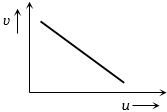
B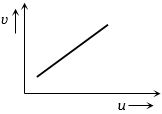
C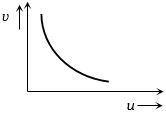
D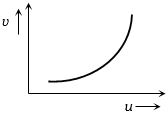
Solution
(C) The mirror formula is given by $\frac{1}{v} + \frac{1}{u} = \frac{1}{f}$.
For a concave mirror,using sign convention,$u$ and $v$ are negative. Let their magnitudes be $u$ and $v$. Then $\frac{1}{v} + \frac{1}{u} = \frac{1}{f}$,which can be written as $v = \frac{uf}{u-f}$.
As $u \to f$,$v \to \infty$.
As $u \to \infty$,$v \to f$.
This represents a rectangular hyperbola where $v$ decreases as $u$ increases,which corresponds to the curve shown in graph $C$.
For a concave mirror,using sign convention,$u$ and $v$ are negative. Let their magnitudes be $u$ and $v$. Then $\frac{1}{v} + \frac{1}{u} = \frac{1}{f}$,which can be written as $v = \frac{uf}{u-f}$.
As $u \to f$,$v \to \infty$.
As $u \to \infty$,$v \to f$.
This represents a rectangular hyperbola where $v$ decreases as $u$ increases,which corresponds to the curve shown in graph $C$.
0 likesView Solution
40
PhysicsEasyMCQAIIMS · 2003
When a beam of light is used to determine the position of an object,the maximum accuracy is achieved if the light is
A
Polarised
B
Of longer wavelength
C
Of shorter wavelength
D
Of high intensity
Solution
(C) The accuracy of determining the position of an object using a beam of light is limited by the phenomenon of diffraction.
According to the Rayleigh criterion,the resolving power of an optical system is inversely proportional to the wavelength of the light used.
Mathematically,the limit of resolution or the minimum resolvable distance $d$ is given by $d \approx \frac{\lambda}{2 \cdot NA}$,where $\lambda$ is the wavelength and $NA$ is the numerical aperture.
To achieve maximum accuracy,the minimum resolvable distance $d$ must be as small as possible.
Since $d \propto \lambda$,a smaller wavelength $\lambda$ results in higher accuracy.
Therefore,the maximum accuracy is achieved if the light is of shorter wavelength.
According to the Rayleigh criterion,the resolving power of an optical system is inversely proportional to the wavelength of the light used.
Mathematically,the limit of resolution or the minimum resolvable distance $d$ is given by $d \approx \frac{\lambda}{2 \cdot NA}$,where $\lambda$ is the wavelength and $NA$ is the numerical aperture.
To achieve maximum accuracy,the minimum resolvable distance $d$ must be as small as possible.
Since $d \propto \lambda$,a smaller wavelength $\lambda$ results in higher accuracy.
Therefore,the maximum accuracy is achieved if the light is of shorter wavelength.
0 likesView Solution
41
PhysicsDifficultMCQAIIMS · 2003
$A$ double slit experiment is performed with light of wavelength $500\, nm$. $A$ thin film of thickness $2\, \mu m$ and refractive index $1.5$ is introduced in the path of the upper beam. The location of the central maximum will
A
Remain unshifted
B
Shift downward by nearly two fringes
C
Shift upward by nearly two fringes
D
Shift downward by $10$ fringes
Solution
(C) The path difference introduced by the thin film is $\Delta x = (\mu - 1)t$.
The shift in the central maximum in terms of fringe width $\beta$ is given by $n = \frac{(\mu - 1)t}{\lambda}$.
Substituting the given values: $n = \frac{(1.5 - 1) \times 2 \times 10^{-6} \, m}{500 \times 10^{-9} \, m} = \frac{0.5 \times 2 \times 10^{-6}}{500 \times 10^{-9}} = \frac{1 \times 10^{-6}}{5 \times 10^{-7}} = 2$.
Since the thin film is introduced in the path of the upper beam,the optical path length of the upper beam increases,causing the central maximum to shift upward towards the upper beam.
The shift in the central maximum in terms of fringe width $\beta$ is given by $n = \frac{(\mu - 1)t}{\lambda}$.
Substituting the given values: $n = \frac{(1.5 - 1) \times 2 \times 10^{-6} \, m}{500 \times 10^{-9} \, m} = \frac{0.5 \times 2 \times 10^{-6}}{500 \times 10^{-9}} = \frac{1 \times 10^{-6}}{5 \times 10^{-7}} = 2$.
Since the thin film is introduced in the path of the upper beam,the optical path length of the upper beam increases,causing the central maximum to shift upward towards the upper beam.
0 likesView Solution
42
PhysicsEasyMCQAIIMS · 2003
The maximum distance up to which $TV$ transmission from a $TV$ tower of height $h$ can be received is proportional to
A
$h^{1/2}$
B
$\frac{1}{2}h$
C
$h$
D
$h^2$
Solution
(A) The maximum line-of-sight distance $d$ for a $TV$ tower of height $h$ is given by the formula $d = \sqrt{2Rh}$,where $R$ is the radius of the Earth.
Since $R$ is a constant,the relationship between the distance $d$ and the height $h$ is $d \propto \sqrt{h}$.
Therefore,the maximum distance is proportional to $h^{1/2}$.
Since $R$ is a constant,the relationship between the distance $d$ and the height $h$ is $d \propto \sqrt{h}$.
Therefore,the maximum distance is proportional to $h^{1/2}$.
0 likesView Solution
43
PhysicsEasyMCQAIIMS · 2003
$Assertion :$ $A$ tube light emits white light.
$Reason :$ Emission of light in a tube takes place at a very high temperature.
$Reason :$ Emission of light in a tube takes place at a very high temperature.
A
If both Assertion and Reason are correct and the Reason is a correct explanation of the Assertion.
B
If both Assertion and Reason are correct but Reason is not a correct explanation of the Assertion.
C
If the Assertion is correct but Reason is incorrect.
D
If both the Assertion and Reason are incorrect.
Solution
(C) In a tube light,the gas contains metal vapors. In metallic atoms,electronic transitions occur,resulting in the emission of light of specific wavelengths.
Emission of white light in a tube light is due to these electronic transitions and not due to thermal radiation (vibration of atoms) as seen in hot,incandescent substances.
Therefore,the Assertion is correct,but the Reason is incorrect.
Emission of white light in a tube light is due to these electronic transitions and not due to thermal radiation (vibration of atoms) as seen in hot,incandescent substances.
Therefore,the Assertion is correct,but the Reason is incorrect.
0 likesView Solution
44
PhysicsEasyMCQAIIMS · 2003
Assertion : The Coulomb force is the dominating force in the universe.
Reason : The Coulomb force is weaker than the gravitational force.
Reason : The Coulomb force is weaker than the gravitational force.
A
If both Assertion and Reason are correct and the Reason is a correct explanation of the Assertion.
B
If both Assertion and Reason are correct but Reason is not a correct explanation of the Assertion.
C
If the Assertion is correct but Reason is incorrect.
D
If both the Assertion and Reason are incorrect.
Solution
(D) The gravitational force is the dominant force on a cosmic scale because it is always attractive and acts over long distances between massive objects,whereas the Coulomb force (electrostatic force) is often neutralized by the presence of both positive and negative charges in matter.
Therefore,the Assertion is incorrect.
Furthermore,the gravitational force is significantly weaker than the Coulomb force at the microscopic level (e.g.,between two electrons),but the Reason states that the Coulomb force is weaker than the gravitational force,which is incorrect.
Thus,both the Assertion and the Reason are incorrect.
Therefore,the Assertion is incorrect.
Furthermore,the gravitational force is significantly weaker than the Coulomb force at the microscopic level (e.g.,between two electrons),but the Reason states that the Coulomb force is weaker than the gravitational force,which is incorrect.
Thus,both the Assertion and the Reason are incorrect.
0 likesView Solution
45
PhysicsEasyMCQAIIMS · 2003
Assertion : In high latitudes,one sees colourful curtains of light hanging down from high altitudes.
Reason : The high-energy charged particles from the sun are deflected to polar regions by the magnetic field of the earth.
Reason : The high-energy charged particles from the sun are deflected to polar regions by the magnetic field of the earth.
A
If both Assertion and Reason are correct and the Reason is a correct explanation of the Assertion.
B
If both Assertion and Reason are correct but Reason is not a correct explanation of the Assertion.
C
If the Assertion is correct but Reason is incorrect.
D
If both the Assertion and Reason are incorrect.
Solution
(A) The phenomenon described is known as the Aurora.
In polar regions (high latitudes),high-energy charged particles (electrons and protons) emitted by the sun (solar wind) are guided by the Earth's magnetic field lines toward the poles.
As these particles enter the upper atmosphere,they collide with gas atoms and molecules,causing them to emit light,which appears as colourful curtains or streamers.
Therefore,the Assertion is correct,and the Reason correctly explains the mechanism behind this phenomenon.
In the northern hemisphere,this is called $Aurora$ $Borealis$,and in the southern hemisphere,it is called $Aurora$ $Australis$.
In polar regions (high latitudes),high-energy charged particles (electrons and protons) emitted by the sun (solar wind) are guided by the Earth's magnetic field lines toward the poles.
As these particles enter the upper atmosphere,they collide with gas atoms and molecules,causing them to emit light,which appears as colourful curtains or streamers.
Therefore,the Assertion is correct,and the Reason correctly explains the mechanism behind this phenomenon.
In the northern hemisphere,this is called $Aurora$ $Borealis$,and in the southern hemisphere,it is called $Aurora$ $Australis$.
0 likesView Solution
46
PhysicsEasyMCQAIIMS · 2003
Assertion: The stars twinkle while the planets do not.
Reason: The stars are much bigger in size than the planets.
Reason: The stars are much bigger in size than the planets.
A
If both Assertion and Reason are correct and the Reason is a correct explanation of the Assertion.
B
If both Assertion and Reason are correct but Reason is not a correct explanation of the Assertion.
C
If the Assertion is correct but Reason is incorrect.
D
If both the Assertion and Reason are incorrect.
Solution
(B) The twinkling of stars is due to the atmospheric refraction caused by the changing refractive index of the atmosphere.
Stars appear as point-sized sources because they are very far away. Due to the small apparent size,the fluctuations in the path of light rays are significant,leading to the twinkling effect.
Planets are much closer to the Earth and appear as extended sources (collection of many point-sized sources). The total variation in the light coming from all these point sources averages out to zero,so they do not twinkle.
The Reason provided states that stars are bigger than planets,which is a fact,but it is not the reason why stars twinkle and planets do not. The actual reason is the difference in their apparent size (point-sized vs. extended source).
Stars appear as point-sized sources because they are very far away. Due to the small apparent size,the fluctuations in the path of light rays are significant,leading to the twinkling effect.
Planets are much closer to the Earth and appear as extended sources (collection of many point-sized sources). The total variation in the light coming from all these point sources averages out to zero,so they do not twinkle.
The Reason provided states that stars are bigger than planets,which is a fact,but it is not the reason why stars twinkle and planets do not. The actual reason is the difference in their apparent size (point-sized vs. extended source).
0 likesView Solution
47
PhysicsEasyMCQAIIMS · 2003
Assertion : Bohr had to postulate that the electrons in stationary orbits around the nucleus do not radiate.
Reason : According to classical physics all moving electrons radiate.
Reason : According to classical physics all moving electrons radiate.
A
If both Assertion and Reason are correct and the Reason is a correct explanation of the Assertion.
B
If both Assertion and Reason are correct but Reason is not a correct explanation of the Assertion.
C
If the Assertion is correct but Reason is incorrect.
D
If both the Assertion and Reason are incorrect.
Solution
(B) According to classical physics,any charged particle undergoing acceleration must radiate electromagnetic energy. Since an electron revolving in an orbit around the nucleus is undergoing centripetal acceleration,classical electrodynamics predicts it should continuously lose energy and spiral into the nucleus.
To resolve this instability,Bohr postulated that electrons in specific 'stationary' orbits do not radiate energy.
Both the Assertion and the Reason are scientifically correct statements. However,the Reason describes the classical conflict,while the Assertion describes Bohr's specific quantum postulate to overcome that conflict. The Reason does not explain *why* Bohr's postulate is true; it only explains why the postulate was *necessary*. Therefore,the Reason is not the correct explanation of the Assertion.
To resolve this instability,Bohr postulated that electrons in specific 'stationary' orbits do not radiate energy.
Both the Assertion and the Reason are scientifically correct statements. However,the Reason describes the classical conflict,while the Assertion describes Bohr's specific quantum postulate to overcome that conflict. The Reason does not explain *why* Bohr's postulate is true; it only explains why the postulate was *necessary*. Therefore,the Reason is not the correct explanation of the Assertion.
0 likesView Solution
48
PhysicsEasyMCQAIIMS · 2003
Assertion: Radioactive nuclei emit $\beta^-$ particles.
Reason: Electrons exist inside the nucleus.
Reason: Electrons exist inside the nucleus.
A
If both Assertion and Reason are correct and the Reason is a correct explanation of the Assertion.
B
If both Assertion and Reason are correct but Reason is not a correct explanation of the Assertion.
C
If the Assertion is correct but Reason is incorrect.
D
If both the Assertion and Reason are incorrect.
Solution
(C) Radioactive nuclei do emit $\beta^-$ particles during the process of $\beta$-decay. Therefore,the Assertion is correct.
However,electrons do not exist inside the nucleus. The $\beta^-$ particle (electron) is created at the moment of decay when a neutron transforms into a proton,an electron,and an antineutrino $(n \rightarrow p + e^- + \bar{\nu}_e)$. Therefore,the Reason is incorrect.
However,electrons do not exist inside the nucleus. The $\beta^-$ particle (electron) is created at the moment of decay when a neutron transforms into a proton,an electron,and an antineutrino $(n \rightarrow p + e^- + \bar{\nu}_e)$. Therefore,the Reason is incorrect.
0 likesView Solution
49
PhysicsEasyMCQAIIMS · 2003
Assertion: Neutrons penetrate matter more readily as compared to protons.
Reason: Neutrons are slightly more massive than protons.
Reason: Neutrons are slightly more massive than protons.
A
If both Assertion and Reason are correct and the Reason is a correct explanation of the Assertion.
B
If both Assertion and Reason are correct but Reason is not a correct explanation of the Assertion.
C
If the Assertion is correct but Reason is incorrect.
D
If both the Assertion and Reason are incorrect.
Solution
(B) Neutrons penetrate matter more readily than protons because neutrons are electrically neutral,meaning they experience no electrostatic repulsion from the positively charged nucleus.
Protons,being positively charged,experience a strong electrostatic repulsive force from the nucleus,which hinders their penetration.
While it is true that the mass of a neutron $(m_n \approx 1.6749 \times 10^{-27} \ kg)$ is slightly greater than the mass of a proton $(m_p \approx 1.6726 \times 10^{-27} \ kg)$,this mass difference is not the reason for their higher penetrating power.
Therefore,both the Assertion and the Reason are correct,but the Reason is not the correct explanation for the Assertion.
Protons,being positively charged,experience a strong electrostatic repulsive force from the nucleus,which hinders their penetration.
While it is true that the mass of a neutron $(m_n \approx 1.6749 \times 10^{-27} \ kg)$ is slightly greater than the mass of a proton $(m_p \approx 1.6726 \times 10^{-27} \ kg)$,this mass difference is not the reason for their higher penetrating power.
Therefore,both the Assertion and the Reason are correct,but the Reason is not the correct explanation for the Assertion.
0 likesView Solution
50
PhysicsMediumMCQAIIMS · 2003
Assertion : The resistivity of a semiconductor increases with temperature.
Reason : The atoms of a semiconductor vibrate with larger amplitude at higher temperatures,thereby increasing its resistivity.
Reason : The atoms of a semiconductor vibrate with larger amplitude at higher temperatures,thereby increasing its resistivity.
A
If both Assertion and Reason are correct and the Reason is a correct explanation of the Assertion.
B
If both Assertion and Reason are correct but Reason is not a correct explanation of the Assertion.
C
If the Assertion is correct but Reason is incorrect.
D
If both the Assertion and Reason are incorrect.
Solution
(D) The Assertion is incorrect because the resistivity of a semiconductor decreases with an increase in temperature.
As temperature increases,more valence electrons gain sufficient thermal energy to jump across the forbidden energy gap into the conduction band.
This increase in the number of charge carriers (electrons and holes) leads to an increase in conductivity,which implies a decrease in resistivity.
The Reason is also incorrect because the mechanism described (vibration of atoms) is the primary cause for the increase in resistivity in metals,not semiconductors.
As temperature increases,more valence electrons gain sufficient thermal energy to jump across the forbidden energy gap into the conduction band.
This increase in the number of charge carriers (electrons and holes) leads to an increase in conductivity,which implies a decrease in resistivity.
The Reason is also incorrect because the mechanism described (vibration of atoms) is the primary cause for the increase in resistivity in metals,not semiconductors.
0 likesView Solution
51
PhysicsDifficultMCQAIIMS · 2003
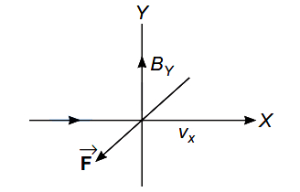
An electron is travelling along the $x$-direction. It encounters a magnetic field in the $y$-direction. Its subsequent motion will be
A
straight line along the $x$-direction
B
a circle in the $xz$-plane
C
a circle in the $yz$-plane
D
a circle in the $xz$-plane
Solution
(B) The magnetic force on a charged particle moving with velocity $\overrightarrow{v}$ in a magnetic field $\overrightarrow{B}$ is given by the Lorentz force formula: $\overrightarrow{F} = q(\overrightarrow{v} \times \overrightarrow{B})$.
For an electron,the charge $q = -e$.
The velocity of the electron is $\overrightarrow{v} = v_x \hat{i}$ and the magnetic field is $\overrightarrow{B} = B_y \hat{j}$.
Substituting these into the force equation:
$\overrightarrow{F} = -e(v_x \hat{i} \times B_y \hat{j})$
$\overrightarrow{F} = -e v_x B_y (\hat{i} \times \hat{j})$
Since $\hat{i} \times \hat{j} = \hat{k}$,we get $\overrightarrow{F} = -e v_x B_y \hat{k}$.
The force is always perpendicular to both the velocity and the magnetic field. Since the velocity is in the $x$-direction and the magnetic field is in the $y$-direction,the force acts in the $z$-direction (specifically $-z$ for an electron). The particle will move in a circle in the plane perpendicular to the magnetic field,which is the $xz$-plane.
For an electron,the charge $q = -e$.
The velocity of the electron is $\overrightarrow{v} = v_x \hat{i}$ and the magnetic field is $\overrightarrow{B} = B_y \hat{j}$.
Substituting these into the force equation:
$\overrightarrow{F} = -e(v_x \hat{i} \times B_y \hat{j})$
$\overrightarrow{F} = -e v_x B_y (\hat{i} \times \hat{j})$
Since $\hat{i} \times \hat{j} = \hat{k}$,we get $\overrightarrow{F} = -e v_x B_y \hat{k}$.
The force is always perpendicular to both the velocity and the magnetic field. Since the velocity is in the $x$-direction and the magnetic field is in the $y$-direction,the force acts in the $z$-direction (specifically $-z$ for an electron). The particle will move in a circle in the plane perpendicular to the magnetic field,which is the $xz$-plane.
0 likesView Solution
Vedclass Products
For Students
Vedclass Test Series
Mock tests in real AIIMS style covering Physics with performance analysis. 5-day free trial.
Start Free TrialFor Teachers
Exam Paper Generator
Generate Set A/B/C/D Physics papers from 7.5L+ questions in 2 minutes. 3 chapters free.
Try FreeFor Institutes
Online Exam Module
Run live AIIMS mock exams with unlimited students, 360° analytics & white-label branding.
See DemoFrequently Asked Questions
How many Physics questions are in AIIMS 2003?
There are 51 Physics questions from the AIIMS 2003 paper on Vedclass, each with a detailed step-by-step solution in English.
Are AIIMS 2003 Physics solutions available in English?
Yes. All solutions on this page are in English. You can also switch to English or Hindi using the language buttons above the questions.
Can I practice AIIMS 2003 Physics as a timed test?
Yes. Use the Vedclass Test Series to attempt a full AIIMS mock test covering Physics with time limits and instant score analysis.
Can teachers create Physics papers from AIIMS previous year questions?
Yes. The Vedclass Exam Paper Generator lets teachers mix AIIMS Physics questions and generate Set A/B/C/D papers in minutes.
For Teachers & Institutes
Build a Custom Physics Paper
Pick AIIMS 2003 Physics questions, set difficulty, and generate Set A/B/C/D in 2 minutes.