
ChemistryQ51–127 of 189 questions
Page 2 of 3 · English
51
ChemistryDifficultMCQAIEEE · 2012
The solubility (in $mol \ L^{-1}$) of $AgCl$ $(K_{sp} = 1.0 \times 10^{-10})$ in a $0.1 \ M \ KCl$ solution will be
A
$1.0 \times 10^{-9}$
B
$1.0 \times 10^{-10}$
C
$1.0 \times 10^{-5}$
D
$1.0 \times 10^{-11}$
Solution
(A) Let the solubility of $AgCl$ be $x \ mol \ L^{-1}$.
The dissociation equilibrium is: $AgCl(s) \rightleftharpoons Ag^{+}(aq) + Cl^{-}(aq)$.
The solubility product expression is: $K_{sp} = [Ag^{+}][Cl^{-}]$.
In a $0.1 \ M \ KCl$ solution,$KCl$ dissociates completely: $KCl(aq) \rightarrow K^{+}(aq) + Cl^{-}(aq)$.
Thus,the concentration of $Cl^{-}$ from $KCl$ is $0.1 \ M$.
The total concentration of $Cl^{-}$ is $[Cl^{-}] = (x + 0.1) \ M \approx 0.1 \ M$ (since $x$ is very small).
Substituting the values into the $K_{sp}$ expression: $1.0 \times 10^{-10} = (x)(0.1)$.
Solving for $x$: $x = \frac{1.0 \times 10^{-10}}{0.1} = 1.0 \times 10^{-9} \ mol \ L^{-1}$.
The dissociation equilibrium is: $AgCl(s) \rightleftharpoons Ag^{+}(aq) + Cl^{-}(aq)$.
The solubility product expression is: $K_{sp} = [Ag^{+}][Cl^{-}]$.
In a $0.1 \ M \ KCl$ solution,$KCl$ dissociates completely: $KCl(aq) \rightarrow K^{+}(aq) + Cl^{-}(aq)$.
Thus,the concentration of $Cl^{-}$ from $KCl$ is $0.1 \ M$.
The total concentration of $Cl^{-}$ is $[Cl^{-}] = (x + 0.1) \ M \approx 0.1 \ M$ (since $x$ is very small).
Substituting the values into the $K_{sp}$ expression: $1.0 \times 10^{-10} = (x)(0.1)$.
Solving for $x$: $x = \frac{1.0 \times 10^{-10}}{0.1} = 1.0 \times 10^{-9} \ mol \ L^{-1}$.
0 likesView Solution
52
ChemistryEasyMCQAIEEE · 2012
Among the following,which is the best description of water in the solid phase?
A
Covalent solid
B
Molecular solid
C
Ionic solid
D
Network solid
Solution
(B) Water in the solid phase (ice) is best described as a molecular solid.
In ice,$H_2O$ molecules are held together by hydrogen bonding,which is a type of intermolecular force characteristic of molecular solids.
In ice,$H_2O$ molecules are held together by hydrogen bonding,which is a type of intermolecular force characteristic of molecular solids.
0 likesView Solution
53
ChemistryDifficultMCQAIEEE · 2012
$K_1, K_2$ and $K_3$ are the equilibrium constants of the following reactions $(I), (II)$ and $(III)$ respectively.
$(I) \, N_2 + 2O_2 \rightleftharpoons 2NO_2$
$(II) \, 2NO_2 \rightleftharpoons N_2 + 2O_2$
$(III) \, NO_2 \rightleftharpoons \frac{1}{2} N_2 + O_2$
The correct relation from the following is
$(I) \, N_2 + 2O_2 \rightleftharpoons 2NO_2$
$(II) \, 2NO_2 \rightleftharpoons N_2 + 2O_2$
$(III) \, NO_2 \rightleftharpoons \frac{1}{2} N_2 + O_2$
The correct relation from the following is
A
$K_1 = \frac{1}{K_2} = \frac{1}{K_3}$
B
$K_1 = \frac{1}{K_2} = \frac{1}{(K_3)^2}$
C
$K_1 = \sqrt{K_2} = K_3$
D
$K_1 = \frac{1}{K_2} = K_3$
Solution
(B) For reaction $(I): N_2 + 2O_2 \rightleftharpoons 2NO_2$,the equilibrium constant is $K_1 = \frac{[NO_2]^2}{[N_2][O_2]^2} \dots (i)$
For reaction $(II): 2NO_2 \rightleftharpoons N_2 + 2O_2$,which is the reverse of $(I)$,the equilibrium constant is $K_2 = \frac{[N_2][O_2]^2}{[NO_2]^2} = \frac{1}{K_1} \dots (ii)$
For reaction $(III): NO_2 \rightleftharpoons \frac{1}{2} N_2 + O_2$,the equilibrium constant is $K_3 = \frac{[N_2]^{1/2}[O_2]}{[NO_2]}$
Squaring $K_3$,we get $(K_3)^2 = \frac{[N_2][O_2]^2}{[NO_2]^2} = K_2 = \frac{1}{K_1} \dots (iii)$
Thus,$K_1 = \frac{1}{K_2} = \frac{1}{(K_3)^2}$.
For reaction $(II): 2NO_2 \rightleftharpoons N_2 + 2O_2$,which is the reverse of $(I)$,the equilibrium constant is $K_2 = \frac{[N_2][O_2]^2}{[NO_2]^2} = \frac{1}{K_1} \dots (ii)$
For reaction $(III): NO_2 \rightleftharpoons \frac{1}{2} N_2 + O_2$,the equilibrium constant is $K_3 = \frac{[N_2]^{1/2}[O_2]}{[NO_2]}$
Squaring $K_3$,we get $(K_3)^2 = \frac{[N_2][O_2]^2}{[NO_2]^2} = K_2 = \frac{1}{K_1} \dots (iii)$
Thus,$K_1 = \frac{1}{K_2} = \frac{1}{(K_3)^2}$.
0 likesView Solution
54
ChemistryDifficultMCQAIEEE · 2012
The concentrated sulphuric acid that is peddled commercially is $95\%\, H_2SO_4$ by weight. If the density of this commercial acid is $1.834\, g\, cm^{-3},$ the molarity of this solution is ........... $M$.
A
$17.8$
B
$12$
C
$10.5$
D
$15.7$
Solution
(A) $95\%\, H_2SO_4$ by weight means $100\, g$ of $H_2SO_4$ solution contains $95\, g$ of $H_2SO_4$ by mass.
Molar mass of $H_2SO_4 = 98\, g\, mol^{-1}$.
Moles of $H_2SO_4 = \frac{95\, g}{98\, g\, mol^{-1}} = 0.969\, mol$.
Volume of $100\, g$ of $H_2SO_4$ solution $= \frac{\text{mass}}{\text{density}} = \frac{100\, g}{1.834\, g\, cm^{-3}} = 54.52\, cm^3 = 0.05452\, L$.
Molarity $(M) = \frac{\text{Moles of solute}}{\text{Volume of solution in } L} = \frac{0.969\, mol}{0.05452\, L} \approx 17.8\, M$.
Molar mass of $H_2SO_4 = 98\, g\, mol^{-1}$.
Moles of $H_2SO_4 = \frac{95\, g}{98\, g\, mol^{-1}} = 0.969\, mol$.
Volume of $100\, g$ of $H_2SO_4$ solution $= \frac{\text{mass}}{\text{density}} = \frac{100\, g}{1.834\, g\, cm^{-3}} = 54.52\, cm^3 = 0.05452\, L$.
Molarity $(M) = \frac{\text{Moles of solute}}{\text{Volume of solution in } L} = \frac{0.969\, mol}{0.05452\, L} \approx 17.8\, M$.
0 likesView Solution
55
ChemistryDifficultMCQAIEEE · 2012
How many cyclic structures are possible for $C_4H_6$?
A
$3$
B
$5$
C
$6$
D
$4$
Solution
(B) The molecular formula $C_4H_6$ corresponds to a degree of unsaturation (double bond equivalent) of $2$.
For cyclic structures,this means the molecule must contain either two double bonds,one triple bond,or two rings,or one ring and one double bond.
The possible cyclic structures for $C_4H_6$ are:
$1$. Cyclobutene
$2$. $1$-methylcyclopropene
$3$. $3$-methylcyclopropene (often referred to as $2$-methylcyclopropene in some contexts)
$4$. Methylenecyclopropane
$5$. Bicyclo$[1.1.0]$butane
Thus,there are $5$ possible cyclic structures.
For cyclic structures,this means the molecule must contain either two double bonds,one triple bond,or two rings,or one ring and one double bond.
The possible cyclic structures for $C_4H_6$ are:
$1$. Cyclobutene
$2$. $1$-methylcyclopropene
$3$. $3$-methylcyclopropene (often referred to as $2$-methylcyclopropene in some contexts)
$4$. Methylenecyclopropane
$5$. Bicyclo$[1.1.0]$butane
Thus,there are $5$ possible cyclic structures.
0 likesView Solution
56
ChemistryDifficultMCQAIEEE · 2012
The $IUPAC$ name of the compound shown below is:
$H_2C-CH-CH_3$ (with an oxygen atom bridging the first two carbons)
$H_2C-CH-CH_3$ (with an oxygen atom bridging the first two carbons)
A
$1, 2-$ Propoxide
B
Propylene oxide
C
$1, 2-$ Oxo propane
D
$1, 2-$ Epoxy propane
Solution
(D) The given compound is a three-membered cyclic ether containing an oxygen atom.
According to $IUPAC$ nomenclature rules for epoxides,the oxygen atom is treated as an epoxy substituent on the alkane chain.
The parent chain is propane ($3$ carbons).
The oxygen atom is bonded to carbon $1$ and carbon $2$.
Therefore,the correct $IUPAC$ name is $1, 2-$ epoxy propane.
According to $IUPAC$ nomenclature rules for epoxides,the oxygen atom is treated as an epoxy substituent on the alkane chain.
The parent chain is propane ($3$ carbons).
The oxygen atom is bonded to carbon $1$ and carbon $2$.
Therefore,the correct $IUPAC$ name is $1, 2-$ epoxy propane.
0 likesView Solution
57
ChemistryMediumMCQAIEEE · 2012
Greenhouse gases can be arranged in the 'Global Warming Potential' $(GWP)$ sequence as:
A
$N_2O > CFC > CH_4 > CO_2$
B
$CFC > N_2O > CH_4 > CO_2$
C
$CFC > CO_2 > N_2O > CH_4$
D
$CO_2 > CFC > N_2O > CH_4$
Solution
(B) The Global Warming Potential $(GWP)$ is a measure of how much heat a greenhouse gas traps in the atmosphere relative to carbon dioxide $(CO_2)$.
Comparing the $GWP$ values (over a $100$-year horizon):
$CFCs$ (Chlorofluorocarbons) have a very high $GWP$ (ranging from thousands to tens of thousands).
$N_2O$ (Nitrous oxide) has a $GWP$ of approximately $273$.
$CH_4$ (Methane) has a $GWP$ of approximately $28$.
$CO_2$ (Carbon dioxide) is the reference gas with a $GWP$ of $1$.
Therefore,the correct sequence is $CFC > N_2O > CH_4 > CO_2$.
Comparing the $GWP$ values (over a $100$-year horizon):
$CFCs$ (Chlorofluorocarbons) have a very high $GWP$ (ranging from thousands to tens of thousands).
$N_2O$ (Nitrous oxide) has a $GWP$ of approximately $273$.
$CH_4$ (Methane) has a $GWP$ of approximately $28$.
$CO_2$ (Carbon dioxide) is the reference gas with a $GWP$ of $1$.
Therefore,the correct sequence is $CFC > N_2O > CH_4 > CO_2$.
0 likesView Solution
58
ChemistryDifficultMCQAIEEE · 2012
The ratio of the number of oxygen atoms $(O)$ in $16.0 \ g$ ozone $(O_3)$,$28.0 \ g$ carbon monoxide $(CO)$,and $16.0 \ g$ oxygen $(O_2)$ is (Atomic mass: $C = 12$,$O = 16$ and Avogadro's constant $N_A = 6.0 \times 10^{23} \ mol^{-1}$)
A
$3 : 1 : 2$
B
$1 : 1 : 2$
C
$3 : 1 : 1$
D
$1 : 1 : 1$
Solution
(D) For $16.0 \ g$ $O_3$: Molar mass $= 48 \ g/mol$. Moles $= 16/48 = 1/3 \ mol$. Number of $O$ atoms $= 3 \times (1/3) \times N_A = N_A$.
For $28.0 \ g$ $CO$: Molar mass $= 28 \ g/mol$. Moles $= 28/28 = 1 \ mol$. Number of $O$ atoms $= 1 \times 1 \times N_A = N_A$.
For $16.0 \ g$ $O_2$: Molar mass $= 32 \ g/mol$. Moles $= 16/32 = 0.5 \ mol$. Number of $O$ atoms $= 2 \times 0.5 \times N_A = N_A$.
Thus,the ratio of oxygen atoms is $N_A : N_A : N_A$,which simplifies to $1 : 1 : 1$.
For $28.0 \ g$ $CO$: Molar mass $= 28 \ g/mol$. Moles $= 28/28 = 1 \ mol$. Number of $O$ atoms $= 1 \times 1 \times N_A = N_A$.
For $16.0 \ g$ $O_2$: Molar mass $= 32 \ g/mol$. Moles $= 16/32 = 0.5 \ mol$. Number of $O$ atoms $= 2 \times 0.5 \times N_A = N_A$.
Thus,the ratio of oxygen atoms is $N_A : N_A : N_A$,which simplifies to $1 : 1 : 1$.
0 likesView Solution
59
ChemistryDifficultMCQAIEEE · 2012
The formation of molecular complex $BF_3-NH_3$ results in a change in hybridization of boron
A
from $sp^2$ to $dsp^2$
B
from $sp^2$ to $sp^3$
C
from $sp^3$ to $sp^2$
D
from $sp^3$ to $sp^3d$
Solution
(B) In $BF_3$,the boron atom is $sp^2$ hybridized and possesses an empty $p_z$ orbital.
When $BF_3$ reacts with $NH_3$,the lone pair of electrons from the nitrogen atom in $NH_3$ is donated into the empty $p_z$ orbital of boron.
This coordinate covalent bond formation changes the geometry of boron from trigonal planar to tetrahedral.
Consequently,the hybridization of boron changes from $sp^2$ to $sp^3$.
When $BF_3$ reacts with $NH_3$,the lone pair of electrons from the nitrogen atom in $NH_3$ is donated into the empty $p_z$ orbital of boron.
This coordinate covalent bond formation changes the geometry of boron from trigonal planar to tetrahedral.
Consequently,the hybridization of boron changes from $sp^2$ to $sp^3$.
0 likesView Solution
60
ChemistryDifficultMCQAIEEE · 2012
$A$ metal $M$ on heating in nitrogen gas gives $Y$. $Y$ on treatment with $H_2O$ gives a colourless gas which when passed through $CuSO_4$ solution gives a blue colour. $Y$ is
A
$NH_3$
B
$Mg(NO_3)_2$
C
$Mg_3N_2$
D
$MgO$
Solution
(C) The reaction of metal $M$ (specifically $Mg$) with nitrogen gas is: $3Mg + N_2 \to Mg_3N_2$ $(Y)$.
$Mg_3N_2$ $(Y)$ reacts with water to produce ammonia gas: $Mg_3N_2 + 6H_2O \to 3Mg(OH)_2 + 2NH_3 \uparrow$ (colourless gas).
When $NH_3$ is passed through $CuSO_4$ solution,it forms a deep blue complex: $CuSO_4 + 4NH_3 \to [Cu(NH_3)_4]SO_4$ (Blue complex).
Therefore,$Y$ is $Mg_3N_2$.
$Mg_3N_2$ $(Y)$ reacts with water to produce ammonia gas: $Mg_3N_2 + 6H_2O \to 3Mg(OH)_2 + 2NH_3 \uparrow$ (colourless gas).
When $NH_3$ is passed through $CuSO_4$ solution,it forms a deep blue complex: $CuSO_4 + 4NH_3 \to [Cu(NH_3)_4]SO_4$ (Blue complex).
Therefore,$Y$ is $Mg_3N_2$.
0 likesView Solution
61
ChemistryDifficultMCQAIEEE · 2012
$A$ water sample is reported to be highly polluted if the $BOD$ (Biological Oxygen Demand) value of the sample becomes:
A
more than $17 \ ppm$
B
equal to $10 \ ppm$
C
equal to $5 \ ppm$
D
less than $5 \ ppm$
Solution
(A) The $BOD$ (Biological Oxygen Demand) value is a measure of the amount of dissolved oxygen required by bacteria to decompose organic matter in a water sample.
Clean water has a $BOD$ value of less than $5 \ ppm$,whereas highly polluted water has a $BOD$ value of more than $17 \ ppm$.
Clean water has a $BOD$ value of less than $5 \ ppm$,whereas highly polluted water has a $BOD$ value of more than $17 \ ppm$.
0 likesView Solution
62
ChemistryEasyMCQAIEEE · 2012
Which among the following elements has the highest first ionization enthalpy?
A
Nitrogen
B
Boron
C
Carbon
D
Oxygen
Solution
(A) The first ionization enthalpy increases across a period from left to right. However,Nitrogen $(N)$ has a stable half-filled $2p^3$ electronic configuration $(1s^2, 2s^2, 2p^3)$.
Due to this extra stability,it requires more energy to remove an electron from Nitrogen compared to its neighbors like Carbon and Oxygen.
Due to this extra stability,it requires more energy to remove an electron from Nitrogen compared to its neighbors like Carbon and Oxygen.
0 likesView Solution
63
ChemistryDifficultMCQAIEEE · 2012
Although $CN^{-}$ ion and $N_2$ molecule are isoelectronic,yet $N_2$ molecule is chemically inert because of
A
presence of more number of electrons in bonding orbitals
B
high bond energy
C
absence of bond polarity
D
uneven electron distribution
Solution
(C) The $N_2$ molecule consists of two nitrogen atoms with identical electronegativity,resulting in a non-polar covalent bond.
Additionally,the $N \equiv N$ triple bond has a very high bond dissociation energy $(941 \ kJ/mol)$,making it chemically inert compared to the $CN^{-}$ ion.
Additionally,the $N \equiv N$ triple bond has a very high bond dissociation energy $(941 \ kJ/mol)$,making it chemically inert compared to the $CN^{-}$ ion.
0 likesView Solution
64
ChemistryDifficultMCQAIEEE · 2012
If the radius of the first orbit of $H$ atom is $a_0$, what is the de-Broglie wavelength of an electron in the third orbit (in $\pi a_0$)?
A
$4$
B
$8$
C
$6$
D
$2$
Solution
(C) The radius of the $n^{th}$ orbit is given by $r_n = a_0 n^2$.
For the third orbit $(n = 3)$, the radius is $r = a_0 \times (3)^2 = 9 a_0$.
According to Bohr's postulate, the angular momentum is $mvr = \frac{nh}{2\pi}$.
Substituting the values, $mv = \frac{nh}{2\pi r} = \frac{3h}{2\pi \times 9 a_0} = \frac{h}{6\pi a_0}$.
The de-Broglie wavelength is given by $\lambda = \frac{h}{mv}$.
Substituting $mv$, we get $\lambda = \frac{h}{h / (6\pi a_0)} = 6\pi a_0$.
For the third orbit $(n = 3)$, the radius is $r = a_0 \times (3)^2 = 9 a_0$.
According to Bohr's postulate, the angular momentum is $mvr = \frac{nh}{2\pi}$.
Substituting the values, $mv = \frac{nh}{2\pi r} = \frac{3h}{2\pi \times 9 a_0} = \frac{h}{6\pi a_0}$.
The de-Broglie wavelength is given by $\lambda = \frac{h}{mv}$.
Substituting $mv$, we get $\lambda = \frac{h}{h / (6\pi a_0)} = 6\pi a_0$.
0 likesView Solution
65
ChemistryDifficultMCQAIEEE · 2012
In the given reaction,
$Ph-C \equiv C-CH_3 \xrightarrow{H^{+}/Hg^{2+}} A$
the product $A$ is
$Ph-C \equiv C-CH_3 \xrightarrow{H^{+}/Hg^{2+}} A$
the product $A$ is
A
$Ph-CH=C(OH)-CH_3$
B
$HO-C(Ph)=CH-CH_3$
C
$Ph-CO-CH_2CH_3$
D
$Ph-CH_2-CO-CH_3$
Solution
(C) The reaction of an alkyne with $H^{+}/Hg^{2+}$ (mercuric sulfate in dilute sulfuric acid) is a hydration reaction that follows Markovnikov's rule.
$Ph-C \equiv C-CH_3 + H_2O \xrightarrow{H^{+}/Hg^{2+}} Ph-C(OH)=CH-CH_3$ (enol intermediate).
The enol intermediate undergoes tautomerization to form the more stable ketone.
$Ph-C(OH)=CH-CH_3 \rightleftharpoons Ph-CO-CH_2CH_3$ (propiophenone).
Thus,the final product $A$ is $Ph-CO-CH_2CH_3$.
$Ph-C \equiv C-CH_3 + H_2O \xrightarrow{H^{+}/Hg^{2+}} Ph-C(OH)=CH-CH_3$ (enol intermediate).
The enol intermediate undergoes tautomerization to form the more stable ketone.
$Ph-C(OH)=CH-CH_3 \rightleftharpoons Ph-CO-CH_2CH_3$ (propiophenone).
Thus,the final product $A$ is $Ph-CO-CH_2CH_3$.
0 likesView Solution
66
ChemistryDifficultMCQAIEEE · 2012
$8 \ mol$ of $AB_{3(g)}$ are introduced into a $1.0 \ dm^3$ vessel. If it dissociates as $2AB_{3(g)} \rightleftharpoons A_{2(g)} + 3B_{2(g)}$. At equilibrium,$2 \ mol$ of $A_2$ are found to be present. The equilibrium constant of this reaction is
A
$2$
B
$3$
C
$27$
D
$36$
Solution
(C) Reaction: $2AB_{3(g)} \rightleftharpoons A_{2(g)} + 3B_{2(g)}$
Initial moles: $8 \ mol$ of $AB_3$,$0 \ mol$ of $A_2$,$0 \ mol$ of $B_2$
At equilibrium,$2 \ mol$ of $A_2$ are formed. According to the stoichiometry,$2 \ mol$ of $A_2$ are produced from $4 \ mol$ of $AB_3$ and produce $6 \ mol$ of $B_2$.
Equilibrium moles: $AB_3 = 8 - 4 = 4 \ mol$,$A_2 = 2 \ mol$,$B_2 = 6 \ mol$
Equilibrium concentrations (in $1 \ dm^3$): $[AB_3] = 4 \ M$,$[A_2] = 2 \ M$,$[B_2] = 6 \ M$
$K_C = \frac{[A_2][B_2]^3}{[AB_3]^2} = \frac{2 \times (6)^3}{(4)^2} = \frac{2 \times 216}{16} = \frac{432}{16} = 27$
Initial moles: $8 \ mol$ of $AB_3$,$0 \ mol$ of $A_2$,$0 \ mol$ of $B_2$
At equilibrium,$2 \ mol$ of $A_2$ are formed. According to the stoichiometry,$2 \ mol$ of $A_2$ are produced from $4 \ mol$ of $AB_3$ and produce $6 \ mol$ of $B_2$.
Equilibrium moles: $AB_3 = 8 - 4 = 4 \ mol$,$A_2 = 2 \ mol$,$B_2 = 6 \ mol$
Equilibrium concentrations (in $1 \ dm^3$): $[AB_3] = 4 \ M$,$[A_2] = 2 \ M$,$[B_2] = 6 \ M$
$K_C = \frac{[A_2][B_2]^3}{[AB_3]^2} = \frac{2 \times (6)^3}{(4)^2} = \frac{2 \times 216}{16} = \frac{432}{16} = 27$
0 likesView Solution
67
ChemistryDifficultMCQAIEEE · 2012
$5\, g$ of benzene on nitration gave $6.6\, g$ of nitrobenzene. The theoretical yield of the nitrobenzene will be $..............$ $g$.
A
$4.5$
B
$5.6$
C
$8.09$
D
$6.6$
Solution
(C) The chemical equation for the nitration of benzene is:
$C_6H_6 + HNO_3 \to C_6H_5NO_2 + H_2O$
Molar mass of benzene $(C_6H_6)$ = $(6 \times 12) + (6 \times 1) = 78\, g/mol$.
Molar mass of nitrobenzene $(C_6H_5NO_2)$ = $(6 \times 12) + (5 \times 1) + 14 + (2 \times 16) = 123\, g/mol$.
According to the stoichiometry,$78\, g$ of benzene produces $123\, g$ of nitrobenzene.
Therefore,$5\, g$ of benzene will produce:
$\text{Theoretical yield} = \frac{123}{78} \times 5 = 7.88\, g$.
Rounding to the nearest provided option,the value is $8.09\, g$ (noting that $7.88$ is closest to $8.09$ among the choices).
$C_6H_6 + HNO_3 \to C_6H_5NO_2 + H_2O$
Molar mass of benzene $(C_6H_6)$ = $(6 \times 12) + (6 \times 1) = 78\, g/mol$.
Molar mass of nitrobenzene $(C_6H_5NO_2)$ = $(6 \times 12) + (5 \times 1) + 14 + (2 \times 16) = 123\, g/mol$.
According to the stoichiometry,$78\, g$ of benzene produces $123\, g$ of nitrobenzene.
Therefore,$5\, g$ of benzene will produce:
$\text{Theoretical yield} = \frac{123}{78} \times 5 = 7.88\, g$.
Rounding to the nearest provided option,the value is $8.09\, g$ (noting that $7.88$ is closest to $8.09$ among the choices).
0 likesView Solution
68
ChemistryDifficultMCQAIEEE · 2012
Given:
$(i) \ HCN_{(aq)} + H_2O_{(l)} \rightleftharpoons H_3O^{+}_{(aq)} + CN^{-}_{(aq)}$
$K_a = 6.2 \times 10^{-10}$
$(ii) \ CN^{-}_{(aq)} + H_2O_{(l)} \rightleftharpoons HCN_{(aq)} + OH^{-}_{(aq)}$
$K_b = 1.6 \times 10^{-5}$
These equilibria show the following order of the relative base strength:
$(i) \ HCN_{(aq)} + H_2O_{(l)} \rightleftharpoons H_3O^{+}_{(aq)} + CN^{-}_{(aq)}$
$K_a = 6.2 \times 10^{-10}$
$(ii) \ CN^{-}_{(aq)} + H_2O_{(l)} \rightleftharpoons HCN_{(aq)} + OH^{-}_{(aq)}$
$K_b = 1.6 \times 10^{-5}$
These equilibria show the following order of the relative base strength:
A
$OH^{-} > H_2O > CN^{-}$
B
$OH^{-} > CN^{-} > H_2O$
C
$H_2O > CN^{-} > OH^{-}$
D
$CN^{-} > H_2O > OH^{-}$
Solution
(B) The strength of a base is determined by its ability to accept a proton $(H^{+})$.
In reaction $(ii)$,$CN^{-}$ reacts with $H_2O$ to form $OH^{-}$. The equilibrium constant $K_b = 1.6 \times 10^{-5}$ indicates the extent of this reaction.
Since $OH^{-}$ is the product of the base dissociation of $CN^{-}$,and $K_b$ is relatively large,$OH^{-}$ is a stronger base than $CN^{-}$.
Comparing the conjugate bases: $OH^{-}$ is the conjugate base of $H_2O$,and $CN^{-}$ is the conjugate base of $HCN$.
Since $HCN$ is a weak acid $(K_a = 6.2 \times 10^{-10})$ and $H_2O$ is an extremely weak acid,the conjugate base of the weaker acid is stronger.
Thus,the order of relative base strength is $OH^{-} > CN^{-} > H_2O$.
In reaction $(ii)$,$CN^{-}$ reacts with $H_2O$ to form $OH^{-}$. The equilibrium constant $K_b = 1.6 \times 10^{-5}$ indicates the extent of this reaction.
Since $OH^{-}$ is the product of the base dissociation of $CN^{-}$,and $K_b$ is relatively large,$OH^{-}$ is a stronger base than $CN^{-}$.
Comparing the conjugate bases: $OH^{-}$ is the conjugate base of $H_2O$,and $CN^{-}$ is the conjugate base of $HCN$.
Since $HCN$ is a weak acid $(K_a = 6.2 \times 10^{-10})$ and $H_2O$ is an extremely weak acid,the conjugate base of the weaker acid is stronger.
Thus,the order of relative base strength is $OH^{-} > CN^{-} > H_2O$.
0 likesView Solution
69
ChemistryDifficultMCQAIEEE · 2012
In the below mentioned compounds,the decreasing order of reactivity towards electrophilic substitution is:
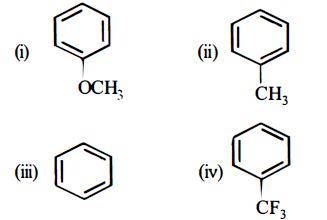
A
$(i) > (ii) > (iii) > (iv)$
B
$(ii) > (iii) > (i) > (iv)$
C
$(iii) > (i) > (iv) > (ii)$
D
$(iv) > (i) > (ii) > (iii)$
Solution
(A) The reactivity of benzene derivatives towards electrophilic substitution depends on the electron density of the benzene ring. Electron-donating groups increase the electron density (activating groups),while electron-withdrawing groups decrease it (deactivating groups).
$(i)$ $-OCH_3$: This group exerts a strong $+M$ (mesomeric) effect,which significantly increases the electron density on the benzene ring,making it highly reactive.
(ii) $-CH_3$: This group exerts a $+I$ (inductive) effect and hyperconjugation,which increases the electron density,but less effectively than the $+M$ effect of $-OCH_3$.
(iii) Benzene: This is the reference compound with no substituents.
(iv) $-CF_3$: This group exerts a strong $-I$ effect,which significantly decreases the electron density on the benzene ring,making it the least reactive.
Therefore,the decreasing order of reactivity is $(i) > (ii) > (iii) > (iv)$.
$(i)$ $-OCH_3$: This group exerts a strong $+M$ (mesomeric) effect,which significantly increases the electron density on the benzene ring,making it highly reactive.
(ii) $-CH_3$: This group exerts a $+I$ (inductive) effect and hyperconjugation,which increases the electron density,but less effectively than the $+M$ effect of $-OCH_3$.
(iii) Benzene: This is the reference compound with no substituents.
(iv) $-CF_3$: This group exerts a strong $-I$ effect,which significantly decreases the electron density on the benzene ring,making it the least reactive.
Therefore,the decreasing order of reactivity is $(i) > (ii) > (iii) > (iv)$.
0 likesView Solution
70
ChemistryDifficultMCQAIEEE · 2012
The difference between the reaction enthalpy change $(\Delta _r H)$ and reaction internal energy change $(\Delta _r U)$ for the reaction $2C_6H_{6(l)} + 15O_{2(g)} \longrightarrow 12CO_{2(g)} + 6H_2O_{(l)}$ at $300 \ K$ is $....$ $J \ mol^{-1}$ $(R = 8.314 \ J \ mol^{-1} \ K^{-1})$
A
$0$
B
$2490$
C
$-2490$
D
$-7482$
Solution
(D) The relationship between enthalpy change and internal energy change is given by $\Delta H = \Delta U + \Delta n_g RT$.
Therefore,the difference is $\Delta H - \Delta U = \Delta n_g RT$.
For the given reaction $2C_6H_{6(l)} + 15O_{2(g)} \longrightarrow 12CO_{2(g)} + 6H_2O_{(l)}$,the change in the number of gaseous moles is $\Delta n_g = (n_{products, g}) - (n_{reactants, g}) = 12 - 15 = -3$.
Substituting the values: $\Delta H - \Delta U = -3 \times 8.314 \times 300 = -7482 \ J \ mol^{-1}$.
Therefore,the difference is $\Delta H - \Delta U = \Delta n_g RT$.
For the given reaction $2C_6H_{6(l)} + 15O_{2(g)} \longrightarrow 12CO_{2(g)} + 6H_2O_{(l)}$,the change in the number of gaseous moles is $\Delta n_g = (n_{products, g}) - (n_{reactants, g}) = 12 - 15 = -3$.
Substituting the values: $\Delta H - \Delta U = -3 \times 8.314 \times 300 = -7482 \ J \ mol^{-1}$.
0 likesView Solution
71
ChemistryDifficultMCQAIEEE · 2012
$\alpha, v$ and $u$ represent the most probable velocity, average velocity, and root mean square velocity, respectively, of a gas at a particular temperature. The correct order among the following is:
A
$u > v > \alpha$
B
$v > u > \alpha$
C
$\alpha > u > v$
D
$u > \alpha > v$
Solution
(A) The expressions for the velocities are:
$u = \sqrt{\frac{3RT}{M}}$ (root mean square velocity)
$v = \sqrt{\frac{8RT}{\pi M}}$ (average velocity)
$\alpha = \sqrt{\frac{2RT}{M}}$ (most probable velocity)
Comparing their ratios:
$u : v : \alpha = \sqrt{3} : \sqrt{\frac{8}{\pi}} : \sqrt{2}$
Using numerical values $(\pi \approx 3.14)$:
$u : v : \alpha = 1.732 : 1.596 : 1.414$
Therefore, the correct order is $u > v > \alpha$.
$u = \sqrt{\frac{3RT}{M}}$ (root mean square velocity)
$v = \sqrt{\frac{8RT}{\pi M}}$ (average velocity)
$\alpha = \sqrt{\frac{2RT}{M}}$ (most probable velocity)
Comparing their ratios:
$u : v : \alpha = \sqrt{3} : \sqrt{\frac{8}{\pi}} : \sqrt{2}$
Using numerical values $(\pi \approx 3.14)$:
$u : v : \alpha = 1.732 : 1.596 : 1.414$
Therefore, the correct order is $u > v > \alpha$.
0 likesView Solution
72
ChemistryDifficultMCQAIEEE · 2012
In the following balanced reaction,
$X\,MnO_4^- + Y\,C_2O_4^{2-} + Z\,H^+ \rightleftharpoons X\,Mn^{2+} + 2Y\,CO_2 + \frac{Z}{2}\,H_2O$
values of $X, Y$ and $Z$ respectively are
$X\,MnO_4^- + Y\,C_2O_4^{2-} + Z\,H^+ \rightleftharpoons X\,Mn^{2+} + 2Y\,CO_2 + \frac{Z}{2}\,H_2O$
values of $X, Y$ and $Z$ respectively are
A
$2, 5, 16$
B
$8, 2, 5$
C
$5, 2, 16$
D
$5, 8, 4$
Solution
(A) The given reaction is a redox reaction involving the reduction of permanganate and oxidation of oxalate.
Reduction half-reaction:
$MnO_4^- + 8H^+ + 5e^- \to Mn^{2+} + 4H_2O$ ... $(i)$
Oxidation half-reaction:
$C_2O_4^{2-} \to 2CO_2 + 2e^-$ ... $(ii)$
To balance the electrons,multiply equation $(i)$ by $2$ and equation $(ii)$ by $5$:
$2MnO_4^- + 16H^+ + 10e^- \to 2Mn^{2+} + 8H_2O$
$5C_2O_4^{2-} \to 10CO_2 + 10e^-$
Adding these two equations gives:
$2MnO_4^- + 5C_2O_4^{2-} + 16H^+ \to 2Mn^{2+} + 10CO_2 + 8H_2O$
Comparing this with the given equation $X\,MnO_4^- + Y\,C_2O_4^{2-} + Z\,H^+ \rightleftharpoons X\,Mn^{2+} + 2Y\,CO_2 + \frac{Z}{2}\,H_2O$,we get:
$X = 2$,$Y = 5$,$Z = 16$.
Reduction half-reaction:
$MnO_4^- + 8H^+ + 5e^- \to Mn^{2+} + 4H_2O$ ... $(i)$
Oxidation half-reaction:
$C_2O_4^{2-} \to 2CO_2 + 2e^-$ ... $(ii)$
To balance the electrons,multiply equation $(i)$ by $2$ and equation $(ii)$ by $5$:
$2MnO_4^- + 16H^+ + 10e^- \to 2Mn^{2+} + 8H_2O$
$5C_2O_4^{2-} \to 10CO_2 + 10e^-$
Adding these two equations gives:
$2MnO_4^- + 5C_2O_4^{2-} + 16H^+ \to 2Mn^{2+} + 10CO_2 + 8H_2O$
Comparing this with the given equation $X\,MnO_4^- + Y\,C_2O_4^{2-} + Z\,H^+ \rightleftharpoons X\,Mn^{2+} + 2Y\,CO_2 + \frac{Z}{2}\,H_2O$,we get:
$X = 2$,$Y = 5$,$Z = 16$.
0 likesView Solution
73
ChemistryMediumMCQAIEEE · 2012
Among the following,the molecule with the lowest dipole moment is
A
$CHCl_3$
B
$CH_3Cl$
C
$CH_2Cl_2$
D
$CCl_4$
Solution
(D) $CCl_4$ has the lowest (zero) dipole moment.
This is due to its symmetrical tetrahedral structure.
In this molecule,the individual bond dipole moments cancel each other out due to the symmetrical arrangement of the four $C-Cl$ bonds.
This is due to its symmetrical tetrahedral structure.
In this molecule,the individual bond dipole moments cancel each other out due to the symmetrical arrangement of the four $C-Cl$ bonds.
0 likesView Solution
74
ChemistryDifficultMCQAIEEE · 2012
If $K_{sp}$ of $CaF_2$ at $25\,^{\circ}C$ is $1.7 \times 10^{-10}$,the combination amongst the following which gives a precipitate of $CaF_2$ is
A
$1 \times 10^{-2}\,M\,Ca^{2+}$ and $1 \times 10^{-3}\,M\,F^{-}$
B
$1 \times 10^{-4}\,M\,Ca^{2+}$ and $1 \times 10^{-4}\,M\,F^{-}$
C
$1 \times 10^{-2}\,M\,Ca^{2+}$ and $1 \times 10^{-5}\,M\,F^{-}$
D
$1 \times 10^{-3}\,M\,Ca^{2+}$ and $1 \times 10^{-5}\,M\,F^{-}$
Solution
(A) precipitate forms when the ionic product of the ions in the solution exceeds the solubility product constant $(K_{sp})$.
For the dissociation of $CaF_2$: $CaF_2 \rightleftharpoons Ca^{2+} + 2F^{-}$.
The ionic product is given by: $Q_{sp} = [Ca^{2+}][F^{-}]^2$.
For option $(A)$: $[Ca^{2+}] = 1 \times 10^{-2}\,M$ and $[F^{-}] = 1 \times 10^{-3}\,M$.
$Q_{sp} = (1 \times 10^{-2}) \times (1 \times 10^{-3})^2 = (1 \times 10^{-2}) \times (1 \times 10^{-6}) = 1 \times 10^{-8}$.
Since $1 \times 10^{-8} > 1.7 \times 10^{-10}$,the ionic product exceeds $K_{sp}$,leading to the formation of a precipitate.
Therefore,option $(A)$ is correct.
For the dissociation of $CaF_2$: $CaF_2 \rightleftharpoons Ca^{2+} + 2F^{-}$.
The ionic product is given by: $Q_{sp} = [Ca^{2+}][F^{-}]^2$.
For option $(A)$: $[Ca^{2+}] = 1 \times 10^{-2}\,M$ and $[F^{-}] = 1 \times 10^{-3}\,M$.
$Q_{sp} = (1 \times 10^{-2}) \times (1 \times 10^{-3})^2 = (1 \times 10^{-2}) \times (1 \times 10^{-6}) = 1 \times 10^{-8}$.
Since $1 \times 10^{-8} > 1.7 \times 10^{-10}$,the ionic product exceeds $K_{sp}$,leading to the formation of a precipitate.
Therefore,option $(A)$ is correct.
0 likesView Solution
75
ChemistryDifficultMCQAIEEE · 2012
The value of $K_P$ for the equilibrium reaction ${N_2}{O_4}_{(g)} \rightleftharpoons 2N{O_2}_{(g)}$ is $2$. The percentage dissociation of ${N_2}{O_4}_{(g)}$ at a pressure of $0.5 \ atm$ is
A
$25$
B
$88$
C
$50$
D
$71$
Solution
(D) For the reaction: ${N_2}{O_4}_{(g)} \rightleftharpoons 2N{O_2}_{(g)}$
Let the initial moles of ${N_2}{O_4}$ be $1$ and degree of dissociation be $\alpha$.
At equilibrium,moles of ${N_2}{O_4} = (1 - \alpha)$ and moles of $N{O_2} = 2\alpha$.
Total moles at equilibrium $= (1 - \alpha) + 2\alpha = (1 + \alpha)$.
Partial pressure of ${N_2}{O_4} = \frac{(1 - \alpha)}{(1 + \alpha)} \times P$.
Partial pressure of $N{O_2} = \frac{2\alpha}{(1 + \alpha)} \times P$.
$K_P = \frac{(P_{N{O_2}})^2}{P_{{N_2}{O_4}}} = \frac{[\frac{2\alpha}{1 + \alpha} \times P]^2}{\frac{1 - \alpha}{1 + \alpha} \times P} = \frac{4\alpha^2 P}{1 - \alpha^2}$.
Given $K_P = 2$ and $P = 0.5 \ atm$:
$2 = \frac{4 \times \alpha^2 \times 0.5}{1 - \alpha^2} = \frac{2\alpha^2}{1 - \alpha^2}$.
$1 - \alpha^2 = \alpha^2 \implies 2\alpha^2 = 1 \implies \alpha^2 = 0.5$.
$\alpha = \sqrt{0.5} \approx 0.707$.
Percentage dissociation $= \alpha \times 100 = 70.7 \% \approx 71 \%$.
Let the initial moles of ${N_2}{O_4}$ be $1$ and degree of dissociation be $\alpha$.
At equilibrium,moles of ${N_2}{O_4} = (1 - \alpha)$ and moles of $N{O_2} = 2\alpha$.
Total moles at equilibrium $= (1 - \alpha) + 2\alpha = (1 + \alpha)$.
Partial pressure of ${N_2}{O_4} = \frac{(1 - \alpha)}{(1 + \alpha)} \times P$.
Partial pressure of $N{O_2} = \frac{2\alpha}{(1 + \alpha)} \times P$.
$K_P = \frac{(P_{N{O_2}})^2}{P_{{N_2}{O_4}}} = \frac{[\frac{2\alpha}{1 + \alpha} \times P]^2}{\frac{1 - \alpha}{1 + \alpha} \times P} = \frac{4\alpha^2 P}{1 - \alpha^2}$.
Given $K_P = 2$ and $P = 0.5 \ atm$:
$2 = \frac{4 \times \alpha^2 \times 0.5}{1 - \alpha^2} = \frac{2\alpha^2}{1 - \alpha^2}$.
$1 - \alpha^2 = \alpha^2 \implies 2\alpha^2 = 1 \implies \alpha^2 = 0.5$.
$\alpha = \sqrt{0.5} \approx 0.707$.
Percentage dissociation $= \alpha \times 100 = 70.7 \% \approx 71 \%$.
0 likesView Solution
76
ChemistryMediumMCQAIEEE · 2012
Which pair of elements with the given atomic numbers is expected to have similar properties?
A
$40, 72$
B
$20, 36$
C
$10, 28$
D
$11, 12$
Solution
(A) Elements with atomic numbers $40$ $(Zr)$ and $72$ $(Hf)$ belong to the same group $(Group \ 4)$ in the periodic table.
Elements in the same group exhibit similar chemical properties due to having the same valence shell electronic configuration.
Therefore,the pair $(40, 72)$ is expected to have similar properties.
Elements in the same group exhibit similar chemical properties due to having the same valence shell electronic configuration.
Therefore,the pair $(40, 72)$ is expected to have similar properties.
0 likesView Solution
77
ChemistryDifficultMCQAIEEE · 2012
The $IUPAC$ name of the following compound $(E)-CH_3-CH=CH-C \equiv C-CH_2-CH_3$ is
A
$(E)-2-\text{hepten}-4-\text{yne}$
B
$(Z)-5-\text{hepten}-3-\text{yne}$
C
$(E)-5-\text{hepten}-3-\text{yne}$
D
$(Z)-2-\text{hepten}-4-\text{yne}$
Solution
(A) $1.$ The longest carbon chain containing both multiple bonds has $7$ carbon atoms,so the parent name is hept.
$2.$ Numbering the chain from left to right gives the multiple bonds the lowest locants ($2$ and $4$). The double bond is at $C2$ and the triple bond is at $C4$.
$3.$ Since the higher priority groups ($CH_3$ and the alkyne group) are on opposite sides of the double bond,the configuration is $(E)$.
$4.$ Therefore,the $IUPAC$ name is $(E)-2-\text{hepten}-4-\text{yne}$.
$2.$ Numbering the chain from left to right gives the multiple bonds the lowest locants ($2$ and $4$). The double bond is at $C2$ and the triple bond is at $C4$.
$3.$ Since the higher priority groups ($CH_3$ and the alkyne group) are on opposite sides of the double bond,the configuration is $(E)$.
$4.$ Therefore,the $IUPAC$ name is $(E)-2-\text{hepten}-4-\text{yne}$.
0 likesView Solution
78
ChemistryDifficultMCQAIEEE · 2012
Which one of the following will react most vigorously with water?
A
$Li$
B
$K$
C
$Rb$
D
$Na$
Solution
(C) The reactivity of alkali metals with water increases as we move down the group from $Li$ to $Cs$.
This trend is due to the increase in the electropositive character and the decrease in ionization enthalpy down the group.
The order of reactivity is $Li < Na < K < Rb < Cs$.
Therefore,$Rb$ (Rubidium) reacts most vigorously with water among the given options.
This trend is due to the increase in the electropositive character and the decrease in ionization enthalpy down the group.
The order of reactivity is $Li < Na < K < Rb < Cs$.
Therefore,$Rb$ (Rubidium) reacts most vigorously with water among the given options.
0 likesView Solution
79
ChemistryDifficultMCQAIEEE · 2012
The major product obtained in the photobromination of $2-$methylbutane is
A
$2-$bromo$-2-$methylbutane
B
$1-$bromo$-2-$methylbutane
C
$1-$bromo$-3-$methylbutane
D
$2-$bromo$-3-$methylbutane
Solution
(A) The photobromination of $2-$methylbutane involves the formation of a free radical intermediate.
$CH_3-CH(CH_3)-CH_2-CH_3 \xrightarrow[Br_2]{hv} CH_3-C(Br)(CH_3)-CH_2-CH_3$ ($2-$bromo$-2-$methylbutane).
The reactivity of hydrogen atoms towards free radical substitution follows the order: $3^{\circ} > 2^{\circ} > 1^{\circ}$.
Since $2-$methylbutane has one tertiary $(3^{\circ})$ hydrogen atom at the $C-2$ position,the abstraction of this hydrogen leads to the most stable tertiary free radical.
Therefore,$2-$bromo$-2-$methylbutane is the major product.
$CH_3-CH(CH_3)-CH_2-CH_3 \xrightarrow[Br_2]{hv} CH_3-C(Br)(CH_3)-CH_2-CH_3$ ($2-$bromo$-2-$methylbutane).
The reactivity of hydrogen atoms towards free radical substitution follows the order: $3^{\circ} > 2^{\circ} > 1^{\circ}$.
Since $2-$methylbutane has one tertiary $(3^{\circ})$ hydrogen atom at the $C-2$ position,the abstraction of this hydrogen leads to the most stable tertiary free radical.
Therefore,$2-$bromo$-2-$methylbutane is the major product.
0 likesView Solution
80
ChemistryAdvancedMCQAIEEE · 2012
If the kinetic energy of an electron is increased four times,the wavelength of the de-Broglie wave associated with it would become
A
one fourth
B
half
C
four times
D
two times
Solution
(B) The de-Broglie wavelength is given by the relation: $\lambda = \frac{h}{p} = \frac{h}{\sqrt{2m(KE)}}$.
From this relation,we can see that $\lambda \propto \frac{1}{\sqrt{KE}}$.
Let the initial kinetic energy be $KE_1$ and the final kinetic energy be $KE_2 = 4 \times KE_1$.
Let the initial wavelength be $\lambda_1$ and the final wavelength be $\lambda_2$.
Then,$\frac{\lambda_2}{\lambda_1} = \sqrt{\frac{KE_1}{KE_2}} = \sqrt{\frac{KE_1}{4 \times KE_1}} = \sqrt{\frac{1}{4}} = \frac{1}{2}$.
Therefore,the new wavelength becomes half of the original wavelength.
From this relation,we can see that $\lambda \propto \frac{1}{\sqrt{KE}}$.
Let the initial kinetic energy be $KE_1$ and the final kinetic energy be $KE_2 = 4 \times KE_1$.
Let the initial wavelength be $\lambda_1$ and the final wavelength be $\lambda_2$.
Then,$\frac{\lambda_2}{\lambda_1} = \sqrt{\frac{KE_1}{KE_2}} = \sqrt{\frac{KE_1}{4 \times KE_1}} = \sqrt{\frac{1}{4}} = \frac{1}{2}$.
Therefore,the new wavelength becomes half of the original wavelength.
0 likesView Solution
81
ChemistryAdvancedMCQAIEEE · 2012
When $CO_2\,(g)$ is passed over red hot coke,it partially gets reduced to $CO\,(g).$ Upon passing $0.5\,L$ of $CO_2\,(g)$ over red hot coke,the total volume of the gases increases to $700\,mL.$ The composition of the gaseous mixture at $STP$ is
A
$CO_2 = 300\,mL;\,CO = 400\,mL$
B
$CO_2 = 0.0\,mL;\,CO = 700\,mL$
C
$CO_2 = 200\,mL;\,CO = 500\,mL$
D
$CO_2 = 350\,mL;\,CO = 350\,mL$
Solution
(A) The chemical reaction is: $CO_2(g) + C(s) \to 2CO(g)$
Let the volume of $CO_2$ reacted be $x\,mL$.
According to the stoichiometry,$x\,mL$ of $CO_2$ produces $2x\,mL$ of $CO$.
Initial volume of $CO_2 = 500\,mL$.
Remaining volume of $CO_2 = (500 - x)\,mL$.
Volume of $CO$ produced = $2x\,mL$.
Total final volume = $(500 - x) + 2x = 500 + x$.
Given that the total final volume is $700\,mL$,so $500 + x = 700$,which gives $x = 200\,mL$.
Volume of $CO_2$ remaining = $500 - 200 = 300\,mL$.
Volume of $CO$ produced = $2 \times 200 = 400\,mL$.
Thus,the composition is $CO_2 = 300\,mL$ and $CO = 400\,mL$.
Let the volume of $CO_2$ reacted be $x\,mL$.
According to the stoichiometry,$x\,mL$ of $CO_2$ produces $2x\,mL$ of $CO$.
Initial volume of $CO_2 = 500\,mL$.
Remaining volume of $CO_2 = (500 - x)\,mL$.
Volume of $CO$ produced = $2x\,mL$.
Total final volume = $(500 - x) + 2x = 500 + x$.
Given that the total final volume is $700\,mL$,so $500 + x = 700$,which gives $x = 200\,mL$.
Volume of $CO_2$ remaining = $500 - 200 = 300\,mL$.
Volume of $CO$ produced = $2 \times 200 = 400\,mL$.
Thus,the composition is $CO_2 = 300\,mL$ and $CO = 400\,mL$.
0 likesView Solution
82
ChemistryDifficultMCQAIEEE · 2012
An open vessel at $300 \ K$ is heated until $2/5$ of the air in it is expelled. Assuming that the volume of the vessel remains constant,the temperature to which the vessel is heated is $..... \ K$.
A
$1500$
B
$400$
C
$500$
D
$750$
Solution
(C) Let the volume of the vessel be $V$. Initially,the volume of air at $T_1 = 300 \ K$ is $V$.
Since $2/5$ of the air is expelled,the remaining volume of air at $300 \ K$ is $V - (2/5)V = (3/5)V$.
When the vessel is heated to a new temperature $T_2$,this remaining air expands to fill the entire volume $V$ of the vessel.
Since the pressure remains constant in an open vessel,we use Charles's Law: $\frac{V_1}{T_1} = \frac{V_2}{T_2}$.
Substituting the values: $\frac{(3/5)V}{300} = \frac{V}{T_2}$.
Solving for $T_2$: $T_2 = 300 \times \frac{5}{3} = 500 \ K$.
Since $2/5$ of the air is expelled,the remaining volume of air at $300 \ K$ is $V - (2/5)V = (3/5)V$.
When the vessel is heated to a new temperature $T_2$,this remaining air expands to fill the entire volume $V$ of the vessel.
Since the pressure remains constant in an open vessel,we use Charles's Law: $\frac{V_1}{T_1} = \frac{V_2}{T_2}$.
Substituting the values: $\frac{(3/5)V}{300} = \frac{V}{T_2}$.
Solving for $T_2$: $T_2 = 300 \times \frac{5}{3} = 500 \ K$.
0 likesView Solution
83
ChemistryMediumMCQAIEEE · 2012
The compound of xenon with zero dipole moment is
A
$XeO_3$
B
$XeF_4$
C
$XeOF_4$
D
$XeO_2$
Solution
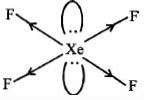
(B) $XeF_4$ has a zero dipole moment.
It has a square planar structure due to which the bond moments of $Xe-F$ bonds cancel each other out.
It has a square planar structure due to which the bond moments of $Xe-F$ bonds cancel each other out.
0 likesView Solution
84
ChemistryDifficultMCQAIEEE · 2012
The enthalpy of neutralisation of $NH_4OH$ with $HCl$ is $-51.46 \ kJ \ mol^{-1}$ and the enthalpy of neutralisation of $NaOH$ with $HCl$ is $-55.90 \ kJ \ mol^{-1}$. The enthalpy of ionisation of $NH_4OH$ is $...... \ kJ \ mol^{-1}$
A
$-107.36$
B
$-4.44$
C
$+107.36$
D
$+4.44$
Solution
(D) The enthalpy of neutralisation of a strong acid with a strong base is the enthalpy of formation of water from $H^+$ and $OH^-$ ions,which is $-55.90 \ kJ \ mol^{-1}$.
$NH_4OH$ is a weak base,so it requires energy for ionisation.
Let the enthalpy of ionisation of $NH_4OH$ be $x \ kJ \ mol^{-1}$.
The total enthalpy of neutralisation is the sum of the enthalpy of ionisation of the weak base and the enthalpy of neutralisation of $H^+$ and $OH^-$.
$\Delta H_{neutralisation} = \Delta H_{ionisation} + \Delta H_{H^+ + OH^- \rightarrow H_2O}$
$-51.46 = x + (-55.90)$
$x = -51.46 + 55.90$
$x = +4.44 \ kJ \ mol^{-1}$
$NH_4OH$ is a weak base,so it requires energy for ionisation.
Let the enthalpy of ionisation of $NH_4OH$ be $x \ kJ \ mol^{-1}$.
The total enthalpy of neutralisation is the sum of the enthalpy of ionisation of the weak base and the enthalpy of neutralisation of $H^+$ and $OH^-$.
$\Delta H_{neutralisation} = \Delta H_{ionisation} + \Delta H_{H^+ + OH^- \rightarrow H_2O}$
$-51.46 = x + (-55.90)$
$x = -51.46 + 55.90$
$x = +4.44 \ kJ \ mol^{-1}$
0 likesView Solution
85
ChemistryEasyMCQAIEEE · 2012
Beilstein test is used for the detection of which one of the following elements?
A
$S$
B
$Cl$
C
$C$ and $H$
D
$N$
Solution
(B) The Beilstein test is a simple chemical test used for the detection of halogens ($Cl$,$Br$,$I$) in organic compounds.
In this test,a copper wire is heated in a flame until it no longer imparts any color to the flame.
The wire is then dipped into the organic compound and heated again in the flame.
$A$ green or blue-green flame indicates the presence of a halogen due to the formation of volatile copper halides.
In this test,a copper wire is heated in a flame until it no longer imparts any color to the flame.
The wire is then dipped into the organic compound and heated again in the flame.
$A$ green or blue-green flame indicates the presence of a halogen due to the formation of volatile copper halides.
0 likesView Solution
86
ChemistryMCQAIEEE · 2012
If $\vec{a} + \vec{b} + \vec{c} = 0$,$|\vec{a}| = 3$,$|\vec{b}| = 5$,and $|\vec{c}| = 7$,then the angle between $\vec{a}$ and $\vec{b}$ is
A
$\frac{\pi}{3}$
B
$\frac{\pi}{4}$
C
$\frac{\pi}{6}$
D
$\frac{\pi}{2}$
Solution
(A) Given $\vec{a} + \vec{b} + \vec{c} = 0$,we can write $\vec{a} + \vec{b} = -\vec{c}$.
Taking the dot product of both sides with themselves:
$(\vec{a} + \vec{b}) \cdot (\vec{a} + \vec{b}) = (-\vec{c}) \cdot (-\vec{c})$
$|\vec{a}|^2 + |\vec{b}|^2 + 2(\vec{a} \cdot \vec{b}) = |\vec{c}|^2$
Since $\vec{a} \cdot \vec{b} = |\vec{a}| |\vec{b}| \cos \theta$,where $\theta$ is the angle between $\vec{a}$ and $\vec{b}$:
$3^2 + 5^2 + 2(3)(5) \cos \theta = 7^2$
$9 + 25 + 30 \cos \theta = 49$
$34 + 30 \cos \theta = 49$
$30 \cos \theta = 15$
$\cos \theta = \frac{15}{30} = \frac{1}{2}$
Therefore,$\theta = \frac{\pi}{3}$.
Taking the dot product of both sides with themselves:
$(\vec{a} + \vec{b}) \cdot (\vec{a} + \vec{b}) = (-\vec{c}) \cdot (-\vec{c})$
$|\vec{a}|^2 + |\vec{b}|^2 + 2(\vec{a} \cdot \vec{b}) = |\vec{c}|^2$
Since $\vec{a} \cdot \vec{b} = |\vec{a}| |\vec{b}| \cos \theta$,where $\theta$ is the angle between $\vec{a}$ and $\vec{b}$:
$3^2 + 5^2 + 2(3)(5) \cos \theta = 7^2$
$9 + 25 + 30 \cos \theta = 49$
$34 + 30 \cos \theta = 49$
$30 \cos \theta = 15$
$\cos \theta = \frac{15}{30} = \frac{1}{2}$
Therefore,$\theta = \frac{\pi}{3}$.
0 likesView Solution
87
ChemistryMediumMCQAIEEE · 2012
The following sets of quantum numbers represent four electrons in an atom:
$(i)$ $n = 4, l = 1$ $(ii)$ $n = 4, l = 0$
$(iii)$ $n = 3, l = 2$ $(iv)$ $n = 3, l = 1$
The sequence representing the increasing order of energy is:
$(i)$ $n = 4, l = 1$ $(ii)$ $n = 4, l = 0$
$(iii)$ $n = 3, l = 2$ $(iv)$ $n = 3, l = 1$
The sequence representing the increasing order of energy is:
A
$(iii) < (i) < (iv) < (ii)$
B
$(iv) < (ii) < (iii) < (i)$
C
$(i) < (iii) < (ii) < (iv)$
D
$(ii) < (iv) < (i) < (iii)$
Solution
(B) First,identify the orbitals based on the given quantum numbers:
$(i)$ $n = 4, l = 1$ corresponds to $4p$ orbital. $(n+l) = 4 + 1 = 5$.
$(ii)$ $n = 4, l = 0$ corresponds to $4s$ orbital. $(n+l) = 4 + 0 = 4$.
$(iii)$ $n = 3, l = 2$ corresponds to $3d$ orbital. $(n+l) = 3 + 2 = 5$.
$(iv)$ $n = 3, l = 1$ corresponds to $3p$ orbital. $(n+l) = 3 + 1 = 4$.
According to the $(n+l)$ rule,energy increases as the $(n+l)$ value increases.
For $(iv)$ and $(ii)$,both have $(n+l) = 4$. Since $(iv)$ has a lower $n$ value $(n=3)$ than $(ii)$ $(n=4)$,$(iv)$ has lower energy.
For $(iii)$ and $(i)$,both have $(n+l) = 5$. Since $(iii)$ has a lower $n$ value $(n=3)$ than $(i)$ $(n=4)$,$(iii)$ has lower energy.
Thus,the increasing order of energy is: $(iv) < (ii) < (iii) < (i)$.
$(i)$ $n = 4, l = 1$ corresponds to $4p$ orbital. $(n+l) = 4 + 1 = 5$.
$(ii)$ $n = 4, l = 0$ corresponds to $4s$ orbital. $(n+l) = 4 + 0 = 4$.
$(iii)$ $n = 3, l = 2$ corresponds to $3d$ orbital. $(n+l) = 3 + 2 = 5$.
$(iv)$ $n = 3, l = 1$ corresponds to $3p$ orbital. $(n+l) = 3 + 1 = 4$.
According to the $(n+l)$ rule,energy increases as the $(n+l)$ value increases.
For $(iv)$ and $(ii)$,both have $(n+l) = 4$. Since $(iv)$ has a lower $n$ value $(n=3)$ than $(ii)$ $(n=4)$,$(iv)$ has lower energy.
For $(iii)$ and $(i)$,both have $(n+l) = 5$. Since $(iii)$ has a lower $n$ value $(n=3)$ than $(i)$ $(n=4)$,$(iii)$ has lower energy.
Thus,the increasing order of energy is: $(iv) < (ii) < (iii) < (i)$.
0 likesView Solution
88
ChemistryMediumMCQAIEEE · 2012
Maleic acid and fumaric acid are:
A
Chain isomers
B
Functional isomers
C
Tautomers
D
Geometrical isomers
Solution
(D) Maleic acid is the $cis$-form and fumaric acid is the $trans$-form of butenedioic acid $(HOOC-CH=CH-COOH)$.
Since they differ in the spatial arrangement of groups around the double bond,they are classified as geometrical isomers.
Since they differ in the spatial arrangement of groups around the double bond,they are classified as geometrical isomers.
0 likesView Solution
89
ChemistryDifficultMCQAIEEE · 2012
Which of the following compounds are antiaromatic?
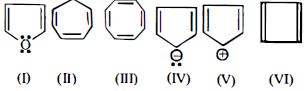
A
$I$ and $V$
B
$II$ and $V$
C
$I$ and $IV$
D
$V$ and $VI$
Solution
(D) compound is antiaromatic if it is cyclic,planar,fully conjugated,and contains $4n \pi$ electrons (where $n = 1, 2, ...$).
$(I)$ Furan: $6 \pi$ electrons (aromatic).
$(II)$ Cycloheptatriene: Not fully conjugated (non-aromatic).
$(III)$ Cyclooctatetraene: Non-planar tub-shaped (non-aromatic).
$(IV)$ Cyclopentadienyl anion: $6 \pi$ electrons (aromatic).
$(V)$ Cyclopentadienyl cation: $4 \pi$ electrons,planar,fully conjugated (antiaromatic).
$(VI)$ Cyclobutadiene: $4 \pi$ electrons,planar,fully conjugated (antiaromatic).
Therefore,compounds $(V)$ and $(VI)$ are antiaromatic.
$(I)$ Furan: $6 \pi$ electrons (aromatic).
$(II)$ Cycloheptatriene: Not fully conjugated (non-aromatic).
$(III)$ Cyclooctatetraene: Non-planar tub-shaped (non-aromatic).
$(IV)$ Cyclopentadienyl anion: $6 \pi$ electrons (aromatic).
$(V)$ Cyclopentadienyl cation: $4 \pi$ electrons,planar,fully conjugated (antiaromatic).
$(VI)$ Cyclobutadiene: $4 \pi$ electrons,planar,fully conjugated (antiaromatic).
Therefore,compounds $(V)$ and $(VI)$ are antiaromatic.
0 likesView Solution
90
ChemistryDifficultMCQAIEEE · 2012
Which of the following presents the correct order of second ionization enthalpies of $C$,$N$,$O$ and $F$?
A
$F > O > N > C$
B
$O > N > F > C$
C
$C > N > O > F$
D
$O > F > N > C$
Solution
(D) The second ionization enthalpy corresponds to the energy required to remove an electron from a unipositive ion $(M^+ \rightarrow M^{2+} + e^-)$.
Electronic configurations of the ions are:
$C^+: 1s^2 2s^2 2p^1$
$N^+: 1s^2 2s^2 2p^2$
$O^+: 1s^2 2s^2 2p^3$
$F^+: 1s^2 2s^2 2p^4$
$O^+$ has a half-filled $2p$ subshell $(2p^3)$,which is exceptionally stable.
Therefore,the energy required to remove an electron from $O^+$ is higher than that for $F^+$.
The general trend of ionization enthalpy increases across a period,but due to the stability of the half-filled $p$-orbital in $O^+$,the order is $O > F > N > C$.
Electronic configurations of the ions are:
$C^+: 1s^2 2s^2 2p^1$
$N^+: 1s^2 2s^2 2p^2$
$O^+: 1s^2 2s^2 2p^3$
$F^+: 1s^2 2s^2 2p^4$
$O^+$ has a half-filled $2p$ subshell $(2p^3)$,which is exceptionally stable.
Therefore,the energy required to remove an electron from $O^+$ is higher than that for $F^+$.
The general trend of ionization enthalpy increases across a period,but due to the stability of the half-filled $p$-orbital in $O^+$,the order is $O > F > N > C$.
0 likesView Solution
91
ChemistryDifficultMCQAIEEE · 2012
$A$ transition metal $M$ forms a volatile chloride which has a vapour density of $94.8$. If it contains $74.75\%$ of chlorine,the formula of the metal chloride will be:
A
$MCl_3$
B
$MCl_2$
C
$MCl_4$
D
$MCl_5$
Solution
(C) Given,vapour density $(V.D.)$ $= 94.8$.
Molecular weight of metal chloride $= 2 \times V.D. = 2 \times 94.8 = 189.6 \ g/mol$.
Mass of chlorine in $189.6 \ g$ of metal chloride $= 74.75\% \text{ of } 189.6 = 0.7475 \times 189.6 \approx 141.7 \ g$.
Number of chlorine atoms $= \frac{141.7}{35.5} \approx 4$.
Mass of metal $= 189.6 - 141.7 = 47.9 \ g$.
Since the metal chloride is $MCl_4$,the valency of the metal $M$ is $4$.
Therefore,the formula of the metal chloride is $MCl_4$.
Molecular weight of metal chloride $= 2 \times V.D. = 2 \times 94.8 = 189.6 \ g/mol$.
Mass of chlorine in $189.6 \ g$ of metal chloride $= 74.75\% \text{ of } 189.6 = 0.7475 \times 189.6 \approx 141.7 \ g$.
Number of chlorine atoms $= \frac{141.7}{35.5} \approx 4$.
Mass of metal $= 189.6 - 141.7 = 47.9 \ g$.
Since the metal chloride is $MCl_4$,the valency of the metal $M$ is $4$.
Therefore,the formula of the metal chloride is $MCl_4$.
0 likesView Solution
92
ChemistryDifficultMCQAIEEE · 2012
Among the following species,which two have a trigonal pyramidal shape?
$I. NI_3$ $II. I_3^-$
$III. SO_3^{2-}$ $IV. NO_3^-$
$I. NI_3$ $II. I_3^-$
$III. SO_3^{2-}$ $IV. NO_3^-$
A
$I$ and $III$
B
$III$ and $IV$
C
$I$ and $IV$
D
$II$ and $III$
Solution
(A) trigonal pyramidal molecular shape occurs when the central atom has three bond pairs and one lone pair of electrons.
$1$. $NI_3$: Nitrogen has $5$ valence electrons. It forms $3$ bonds with $I$ atoms and has $1$ lone pair. Shape: Trigonal pyramidal.
$2$. $I_3^-$: The central $I$ atom has $3$ lone pairs and $2$ bond pairs. Shape: Linear.
$3$. $SO_3^{2-}$: Sulfur has $6$ valence electrons. It forms $3$ bonds with $O$ atoms (one double,two single) and has $1$ lone pair. Shape: Trigonal pyramidal.
$4$. $NO_3^-$: Nitrogen has $5$ valence electrons. It forms $3$ bonds with $O$ atoms and has no lone pairs. Shape: Trigonal planar.
Thus,$NI_3$ $(I)$ and $SO_3^{2-}$ $(III)$ have a trigonal pyramidal shape.
$1$. $NI_3$: Nitrogen has $5$ valence electrons. It forms $3$ bonds with $I$ atoms and has $1$ lone pair. Shape: Trigonal pyramidal.
$2$. $I_3^-$: The central $I$ atom has $3$ lone pairs and $2$ bond pairs. Shape: Linear.
$3$. $SO_3^{2-}$: Sulfur has $6$ valence electrons. It forms $3$ bonds with $O$ atoms (one double,two single) and has $1$ lone pair. Shape: Trigonal pyramidal.
$4$. $NO_3^-$: Nitrogen has $5$ valence electrons. It forms $3$ bonds with $O$ atoms and has no lone pairs. Shape: Trigonal planar.
Thus,$NI_3$ $(I)$ and $SO_3^{2-}$ $(III)$ have a trigonal pyramidal shape.
0 likesView Solution
93
ChemistryDifficultMCQAIEEE · 2012
Consider the following sequence of reactions: $CH_3-CH=CH_2$ $\xrightarrow[700\,K]{Cl_2} A$ $\xrightarrow[420\,K, 12\,atm]{Na_2CO_3} B$ $\xrightarrow[(ii) NaOH]{(i) HOCl} C$. Compound $C$ is:
A
$CH_2(OH)-CH(OH)-CH_2(OH)$
B
$CH_3-CH(OH)-COONa$
C
$HO-CH_2-CH=CH_2$
D
$CH_3-CH(OH)-COCl$
Solution
(A) The reaction sequence is as follows:
$1.$ Allylic chlorination: $CH_3-CH=CH_2 + Cl_2 \xrightarrow{700\,K} Cl-CH_2-CH=CH_2 (A) + HCl$
$2.$ Hydrolysis: $Cl-CH_2-CH=CH_2 \xrightarrow[420\,K, 12\,atm]{Na_2CO_3, H_2O} HO-CH_2-CH=CH_2 (B)$
$3.$ Chlorohydrination and hydrolysis: $HO-CH_2-CH=CH_2$ $\xrightarrow{HOCl} HO-CH_2-CH(OH)-CH_2Cl$ $\xrightarrow{NaOH} HO-CH_2-CH(OH)-CH_2OH (C)$.
Compound $C$ is Glycerol.
$1.$ Allylic chlorination: $CH_3-CH=CH_2 + Cl_2 \xrightarrow{700\,K} Cl-CH_2-CH=CH_2 (A) + HCl$
$2.$ Hydrolysis: $Cl-CH_2-CH=CH_2 \xrightarrow[420\,K, 12\,atm]{Na_2CO_3, H_2O} HO-CH_2-CH=CH_2 (B)$
$3.$ Chlorohydrination and hydrolysis: $HO-CH_2-CH=CH_2$ $\xrightarrow{HOCl} HO-CH_2-CH(OH)-CH_2Cl$ $\xrightarrow{NaOH} HO-CH_2-CH(OH)-CH_2OH (C)$.
Compound $C$ is Glycerol.
0 likesView Solution
94
ChemistryDifficultMCQAIEEE · 2012
Fire extinguishers contain $H_2SO_4$ and which one of the following?
A
$NaHCO_3$ and $Na_2CO_3$
B
$Na_2CO_3$
C
$NaHCO_3$
D
$CaCO_3$
Solution
(C) Soda-acid fire extinguishers work on the principle of the reaction between an acid and a carbonate or bicarbonate salt.
They contain a solution of $NaHCO_3$ (sodium bicarbonate) and a separate bottle of $H_2SO_4$ (sulfuric acid).
When the extinguisher is activated,the acid reacts with the bicarbonate to release $CO_2$ gas,which helps in extinguishing the fire.
Therefore,the correct component is $NaHCO_3$.
They contain a solution of $NaHCO_3$ (sodium bicarbonate) and a separate bottle of $H_2SO_4$ (sulfuric acid).
When the extinguisher is activated,the acid reacts with the bicarbonate to release $CO_2$ gas,which helps in extinguishing the fire.
Therefore,the correct component is $NaHCO_3$.
0 likesView Solution
95
ChemistryDifficultMCQAIEEE · 2012
Which one of the following depletes the ozone layer?
A
$CO$
B
$NO$ and freons
C
$SO_2$
D
$CO_2$
Solution
(B) $NO$ (nitric oxide) and freons (chlorofluorocarbons) are responsible for the depletion of the ozone layer in the stratosphere.
0 likesView Solution
96
ChemistryMediumMCQAIEEE · 2012
Which of the following compounds exhibits a dipole moment?
A
$1, 2-$ dichlorobenzene
B
trans-$2, 3-$ dichloro$-2-$butene
C
$1, 4-$ dichlorobenzene
D
trans$-1, 2-$ dinitroethene
Solution
(A) molecule exhibits a dipole moment if its net dipole moment is non-zero.
In $1, 2-$ dichlorobenzene,the two $C-Cl$ bonds are at an angle of $60^\circ$ to each other,making the molecule unsymmetrical and resulting in a net dipole moment.
In contrast,$1, 4-$ dichlorobenzene,trans-$2, 3-$ dichloro$-2-$butene,and trans$-1, 2-$ dinitroethene are centrosymmetric molecules where the individual bond dipoles cancel each other out,resulting in a net dipole moment of zero.
In $1, 2-$ dichlorobenzene,the two $C-Cl$ bonds are at an angle of $60^\circ$ to each other,making the molecule unsymmetrical and resulting in a net dipole moment.
In contrast,$1, 4-$ dichlorobenzene,trans-$2, 3-$ dichloro$-2-$butene,and trans$-1, 2-$ dinitroethene are centrosymmetric molecules where the individual bond dipoles cancel each other out,resulting in a net dipole moment of zero.
0 likesView Solution
97
ChemistryDifficultMCQAIEEE · 2012
The solubility of $PbI_2$ at $25\,^{\circ}C$ is $0.7\, g\, L^{-1}$. The solubility product of $PbI_2$ at this temperature is (molar mass of $PbI_2 = 461.2\, g\, mol^{-1}$)
A
$1.40 \times 10^{-9}$
B
$0.14 \times 10^{-9}$
C
$140 \times 10^{-9}$
D
$14.0 \times 10^{-9}$
Solution
(D) The dissociation of $PbI_2$ is given by: $PbI_2(s) \rightleftharpoons Pb^{2+}(aq) + 2I^{-}(aq)$.
First,calculate the molar solubility $(s)$ in $mol\, L^{-1}$:
$s = \frac{\text{solubility in } g\, L^{-1}}{\text{molar mass}} = \frac{0.7}{461.2} \approx 1.5178 \times 10^{-3} \, mol\, L^{-1}$.
The solubility product expression is $K_{sp} = [Pb^{2+}][I^{-}]^2 = (s)(2s)^2 = 4s^3$.
Substituting the value of $s$:
$K_{sp} = 4 \times (1.5178 \times 10^{-3})^3 \approx 4 \times 3.5 \times 10^{-9} = 14.0 \times 10^{-9}$.
First,calculate the molar solubility $(s)$ in $mol\, L^{-1}$:
$s = \frac{\text{solubility in } g\, L^{-1}}{\text{molar mass}} = \frac{0.7}{461.2} \approx 1.5178 \times 10^{-3} \, mol\, L^{-1}$.
The solubility product expression is $K_{sp} = [Pb^{2+}][I^{-}]^2 = (s)(2s)^2 = 4s^3$.
Substituting the value of $s$:
$K_{sp} = 4 \times (1.5178 \times 10^{-3})^3 \approx 4 \times 3.5 \times 10^{-9} = 14.0 \times 10^{-9}$.
0 likesView Solution
98
ChemistryDifficultMCQAIEEE · 2012
The hydration of propyne results in the formation of:
A
Acetone
B
Propanol-$1$
C
Propene
D
Propanal
Solution
(A) The hydration of propyne $(CH_3-C\equiv CH)$ in the presence of $H_2SO_4$ and $HgSO_4$ follows Markovnikov's addition.
First,an unstable enol intermediate,$CH_3-C(OH)=CH_2$ (prop-$1$-en-$2$-ol),is formed.
This enol undergoes tautomerization to form the stable ketone,$CH_3-CO-CH_3$ (propan-$2$-one or acetone).
Reaction: $CH_3-C\equiv CH + H_2O$ $\xrightarrow[HgSO_4]{H_2SO_4} [CH_3-C(OH)=CH_2]$ $\rightarrow CH_3-CO-CH_3$.
First,an unstable enol intermediate,$CH_3-C(OH)=CH_2$ (prop-$1$-en-$2$-ol),is formed.
This enol undergoes tautomerization to form the stable ketone,$CH_3-CO-CH_3$ (propan-$2$-one or acetone).
Reaction: $CH_3-C\equiv CH + H_2O$ $\xrightarrow[HgSO_4]{H_2SO_4} [CH_3-C(OH)=CH_2]$ $\rightarrow CH_3-CO-CH_3$.
0 likesView Solution
99
ChemistryDifficultMCQAIEEE · 2012
One mole of an ideal gas is expanded isothermally and reversibly to half of its initial pressure. $\Delta S$ for the process in $J \ K^{-1} \ mol^{-1}$ is $[ln \ 2 = 0.693$ and $R = 8.314 \ J \ mol^{-1} \ K^{-1}]$
A
$6.76$
B
$5.76$
C
$10.76$
D
$8.03$
Solution
(B) For an isothermal process,the change in entropy $\Delta S$ is given by the formula: $\Delta S = nR \ ln \ (P_1 / P_2)$.
Given that the gas is expanded to half of its initial pressure,$P_2 = P_1 / 2$,so $P_1 / P_2 = 2$.
For $n = 1 \ mol$,the expression becomes: $\Delta S = 1 \times R \times ln \ (2)$.
Substituting the values: $\Delta S = 8.314 \times 0.693 = 5.76 \ J \ K^{-1} \ mol^{-1}$.
Given that the gas is expanded to half of its initial pressure,$P_2 = P_1 / 2$,so $P_1 / P_2 = 2$.
For $n = 1 \ mol$,the expression becomes: $\Delta S = 1 \times R \times ln \ (2)$.
Substituting the values: $\Delta S = 8.314 \times 0.693 = 5.76 \ J \ K^{-1} \ mol^{-1}$.
0 likesView Solution
100
ChemistryDifficultMCQAIEEE · 2012
The number of $S-S$ bonds in $SO_3, S_2O_3^{2-}, S_2O_6^{2-}$ and $S_2O_8^{2-}$ respectively are
A
$0, 1, 1, 0$
B
$1, 0, 1, 0$
C
$0, 1, 1, 0$
D
$0, 1, 0, 1$
Solution
(A) $1$. In $SO_3$,there is no $S-S$ bond. Number of $S-S$ bonds = $0$.
$2$. In $S_2O_3^{2-}$ (thiosulfate ion),there is one $S-S$ bond. Number of $S-S$ bonds = $1$.
$3$. In $S_2O_6^{2-}$ (dithionate ion),there is one $S-S$ bond. Number of $S-S$ bonds = $1$.
$4$. In $S_2O_8^{2-}$ (peroxydisulfate ion),there is no $S-S$ bond; it contains an $O-O$ peroxide linkage. Number of $S-S$ bonds = $0$.
Thus,the number of $S-S$ bonds are $0, 1, 1, 0$ respectively.
$2$. In $S_2O_3^{2-}$ (thiosulfate ion),there is one $S-S$ bond. Number of $S-S$ bonds = $1$.
$3$. In $S_2O_6^{2-}$ (dithionate ion),there is one $S-S$ bond. Number of $S-S$ bonds = $1$.
$4$. In $S_2O_8^{2-}$ (peroxydisulfate ion),there is no $S-S$ bond; it contains an $O-O$ peroxide linkage. Number of $S-S$ bonds = $0$.
Thus,the number of $S-S$ bonds are $0, 1, 1, 0$ respectively.
0 likesView Solution
101
ChemistryMediumMCQAIEEE · 2012
Which of the following paramagnetic ions would exhibit a magnetic moment (spin only) of the order of $5 \ BM$?
(At. Nos. $Mn = 25$,$Cr = 24$,$V = 23$,$Ti = 22$)
(At. Nos. $Mn = 25$,$Cr = 24$,$V = 23$,$Ti = 22$)
A
$Mn^{2+}$
B
$Ti^{2+}$
C
$V^{2+}$
D
$Cr^{2+}$
Solution
(D) The magnetic moment (spin only) is calculated using the formula $\mu = \sqrt{n(n+2)} \ BM$,where $n$ is the number of unpaired electrons.
$1$. For $Mn^{2+}$ $(d^5)$: $n = 5$,$\mu = \sqrt{5(5+2)} = \sqrt{35} \approx 5.92 \ BM$.
$2$. For $Ti^{2+}$ $(d^2)$: $n = 2$,$\mu = \sqrt{2(2+2)} = \sqrt{8} \approx 2.83 \ BM$.
$3$. For $V^{2+}$ $(d^3)$: $n = 3$,$\mu = \sqrt{3(3+2)} = \sqrt{15} \approx 3.87 \ BM$.
$4$. For $Cr^{2+}$ $(d^4)$: $n = 4$,$\mu = \sqrt{4(4+2)} = \sqrt{24} \approx 4.90 \ BM$.
The value $4.90 \ BM$ is of the order of $5 \ BM$. Thus,$Cr^{2+}$ is the correct answer.
$1$. For $Mn^{2+}$ $(d^5)$: $n = 5$,$\mu = \sqrt{5(5+2)} = \sqrt{35} \approx 5.92 \ BM$.
$2$. For $Ti^{2+}$ $(d^2)$: $n = 2$,$\mu = \sqrt{2(2+2)} = \sqrt{8} \approx 2.83 \ BM$.
$3$. For $V^{2+}$ $(d^3)$: $n = 3$,$\mu = \sqrt{3(3+2)} = \sqrt{15} \approx 3.87 \ BM$.
$4$. For $Cr^{2+}$ $(d^4)$: $n = 4$,$\mu = \sqrt{4(4+2)} = \sqrt{24} \approx 4.90 \ BM$.
The value $4.90 \ BM$ is of the order of $5 \ BM$. Thus,$Cr^{2+}$ is the correct answer.
0 likesView Solution
102
ChemistryMediumMCQAIEEE · 2012
Which of the following has the square planar structure?
A
$XeF_4$
B
$NH_4^+$
C
$BF_4^-$
D
$CCl_4$
Solution
(A) $XeF_4$ has a square planar structure because it has $4$ bond pairs and $2$ lone pairs on the central $Xe$ atom,resulting in $sp^3d^2$ hybridization.
$NH_4^+$,$BF_4^-$,and $CCl_4$ all have $4$ bond pairs and $0$ lone pairs,resulting in $sp^3$ hybridization and a tetrahedral structure.
$NH_4^+$,$BF_4^-$,and $CCl_4$ all have $4$ bond pairs and $0$ lone pairs,resulting in $sp^3$ hybridization and a tetrahedral structure.
0 likesView Solution
103
ChemistryDifficultMCQAIEEE · 2012
For a reaction $A \to$ Products,a plot of $\log\,t_{1/2}$ versus $\log\,a_0$ is shown in the figure. If the initial concentration of $A$ is represented by $a_0,$ the order of the reaction is
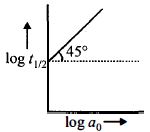
A
$1$
B
$0$
C
$2$
D
$3$
Solution
(B) For a reaction of order $n$,the half-life is given by $t_{1/2} \propto (a_0)^{1-n}$.
Taking logarithm on both sides,we get $\log\,t_{1/2} = (1-n)\log\,a_0 + \text{constant}$.
Comparing this with the equation of a straight line $y = mx + c$,the slope $m = 1-n$.
From the given figure,the slope is $\tan(45^{\circ}) = 1$.
Therefore,$1-n = 1$,which gives $n = 0$.
Taking logarithm on both sides,we get $\log\,t_{1/2} = (1-n)\log\,a_0 + \text{constant}$.
Comparing this with the equation of a straight line $y = mx + c$,the slope $m = 1-n$.
From the given figure,the slope is $\tan(45^{\circ}) = 1$.
Therefore,$1-n = 1$,which gives $n = 0$.
0 likesView Solution
104
ChemistryMediumMCQAIEEE · 2012
Which of the following is a polyamide?
A
Teflon
B
Orlon
C
Nylon
D
Terylene
Solution
(C) Polyamides are polymers containing amide linkages $(-CONH-)$ in their backbone.
$Nylon$ (e.g.,$Nylon-6,6$ or $Nylon-6$) is a well-known example of a synthetic polyamide.
$Teflon$ is a fluoropolymer,$Orlon$ is a polyacrylonitrile,and $Terylene$ is a polyester.
$Nylon$ (e.g.,$Nylon-6,6$ or $Nylon-6$) is a well-known example of a synthetic polyamide.
$Teflon$ is a fluoropolymer,$Orlon$ is a polyacrylonitrile,and $Terylene$ is a polyester.
0 likesView Solution
105
ChemistryDifficultMCQAIEEE · 2012
The standard electrode potentials of $Ag^{+}/Ag$,$Hg_2^{2+}/2Hg$,$Cu^{2+}/Cu$,and $Mg^{2+}/Mg$ are $0.80 \ V$,$0.79 \ V$,$0.34 \ V$,and $-2.37 \ V$,respectively. An aqueous solution containing $1 \ M$ concentration of each of these metal salts is electrolyzed. With increasing voltage,what is the correct sequence of deposition of the metals at the cathode?
A
$Ag, Hg, Cu, Mg$
B
$Cu, Hg, Ag$ only
C
$Ag, Hg, Cu$ only
D
$Mg, Cu, Hg, Ag$
Solution
(C) The deposition of metals at the cathode during electrolysis depends on their standard reduction potentials $(E^o)$.
Metals with higher reduction potentials are deposited more easily at the cathode.
The given standard reduction potentials are: $E^o(Ag^+/Ag) = 0.80 \ V$,$E^o(Hg_2^{2+}/2Hg) = 0.79 \ V$,$E^o(Cu^{2+}/Cu) = 0.34 \ V$,and $E^o(Mg^{2+}/Mg) = -2.37 \ V$.
In an aqueous solution,water can also be reduced at the cathode: $2H_2O + 2e^- \rightarrow H_2 + 2OH^-$,with $E^o = -0.83 \ V$.
Since $Mg^{2+}$ has a reduction potential of $-2.37 \ V$,which is much lower than that of water $(-0.83 \ V)$,$Mg$ will not deposit from an aqueous solution; instead,$H_2$ gas will be evolved.
Therefore,the metals that will deposit in the order of increasing voltage are $Ag$,$Hg$,and $Cu$.
The correct sequence is $Ag > Hg > Cu$.
Metals with higher reduction potentials are deposited more easily at the cathode.
The given standard reduction potentials are: $E^o(Ag^+/Ag) = 0.80 \ V$,$E^o(Hg_2^{2+}/2Hg) = 0.79 \ V$,$E^o(Cu^{2+}/Cu) = 0.34 \ V$,and $E^o(Mg^{2+}/Mg) = -2.37 \ V$.
In an aqueous solution,water can also be reduced at the cathode: $2H_2O + 2e^- \rightarrow H_2 + 2OH^-$,with $E^o = -0.83 \ V$.
Since $Mg^{2+}$ has a reduction potential of $-2.37 \ V$,which is much lower than that of water $(-0.83 \ V)$,$Mg$ will not deposit from an aqueous solution; instead,$H_2$ gas will be evolved.
Therefore,the metals that will deposit in the order of increasing voltage are $Ag$,$Hg$,and $Cu$.
The correct sequence is $Ag > Hg > Cu$.
0 likesView Solution
106
ChemistryDifficultMCQAIEEE · 2012
The product of the reaction between ethylbenzene and $N$-bromosuccinimide $(NBS)$ is:
A
$1-$bromo$-2-$phenylethane
B
$1-$bromo$-1-$phenylethane
C
$p$-bromoethylbenzene
D
$o$-bromoethylbenzene
Solution
(B) $N$-bromosuccinimide $(NBS)$ is a reagent used for allylic or benzylic bromination via a free radical mechanism.
In ethylbenzene $(C_6H_5CH_2CH_3)$,the benzylic position is the carbon atom directly attached to the benzene ring.
The hydrogen atoms at the benzylic position are more reactive due to the stability of the resulting benzylic radical.
Therefore,$NBS$ selectively replaces a hydrogen atom at the benzylic position with a bromine atom,yielding $1$-bromo-$1$-phenylethane $(C_6H_5CH(Br)CH_3)$.
In ethylbenzene $(C_6H_5CH_2CH_3)$,the benzylic position is the carbon atom directly attached to the benzene ring.
The hydrogen atoms at the benzylic position are more reactive due to the stability of the resulting benzylic radical.
Therefore,$NBS$ selectively replaces a hydrogen atom at the benzylic position with a bromine atom,yielding $1$-bromo-$1$-phenylethane $(C_6H_5CH(Br)CH_3)$.
0 likesView Solution
107
ChemistryDifficultMCQAIEEE · 2012
On addition of $1 \, mL$ of $10 \% \, NaCl$ solution to $10 \, mL$ gold sol in the presence of $0.025 \, g$ of starch,the coagulation is just prevented. The gold number of starch is:
A
$2.5$
B
$25$
C
$0.25$
D
$0.025$
Solution
(B) Gold number is defined as the minimum amount of protective colloid in milligrams that prevents the coagulation of $10 \, mL$ of a standard gold sol when $1 \, mL$ of $10 \% \, NaCl$ solution is added to it.
Given mass of starch $= 0.025 \, g$.
Converting mass to milligrams: $0.025 \, g = 0.025 \times 1000 \, mg = 25 \, mg$.
Since this amount of starch just prevents the coagulation of $10 \, mL$ of gold sol,the gold number of starch is $25$.
Given mass of starch $= 0.025 \, g$.
Converting mass to milligrams: $0.025 \, g = 0.025 \times 1000 \, mg = 25 \, mg$.
Since this amount of starch just prevents the coagulation of $10 \, mL$ of gold sol,the gold number of starch is $25$.
0 likesView Solution
108
ChemistryEasyMCQAIEEE · 2012
Which of the following is a non-reducing sugar?
A
Lactose
B
Fructose
C
Sucrose
D
Maltose
Solution
(C) Sucrose is a non-reducing sugar because it does not contain a free hemiacetal or hemiketal group.
It does not reduce Fehling's reagent or Tollen's reagent.
It does not reduce Fehling's reagent or Tollen's reagent.
0 likesView Solution
109
ChemistryDifficultMCQAIEEE · 2012
Fog is a colloidal solution of
A
solid particles dispersed in gas
B
solid particles dispersed in a liquid
C
liquid particles dispersed in gas
D
gaseous particles dispersed in a liquid
Solution
(C) Fog is a type of aerosol where the dispersed phase is a liquid and the dispersion medium is a gas.
0 likesView Solution
110
ChemistryDifficultMCQAIEEE · 2012
Aspirin can be prepared by the reaction of
A
Salicyldehyde with acetic anhydride in presence of $H_2SO_4$
B
Salicylic acid with methanol in presence of $H_2SO_4$
C
Salicylic acid with acetic anhydride in presence of $H_2SO_4$
D
Cinnamic acid with acetic anhydride in presence of $H_2SO_4$
Solution
(C) Aspirin,also known as acetylsalicylic acid,is prepared by the acetylation of the phenolic $-OH$ group of salicylic acid using acetic anhydride in the presence of an acid catalyst like $H_2SO_4$.
The chemical reaction is as follows:
$C_6H_4(OH)COOH + (CH_3CO)_2O \xrightarrow{H_2SO_4} C_6H_4(OCOCH_3)COOH + CH_3COOH$
Thus,the correct option is $C$.
The chemical reaction is as follows:
$C_6H_4(OH)COOH + (CH_3CO)_2O \xrightarrow{H_2SO_4} C_6H_4(OCOCH_3)COOH + CH_3COOH$
Thus,the correct option is $C$.
0 likesView Solution
111
ChemistryDifficultMCQAIEEE · 2012
Square-planar geometry is shown by
A
$[PtCl_2(NH_3)_2]$
B
$[NiCl_4]^{2-}$
C
$MnO_4^-$
D
$CrO_4^{2-}$
Solution
(A) The complex $[PtCl_2(NH_3)_2]$ involves a $Pt^{2+}$ central metal ion with a $d^8$ electronic configuration.
It undergoes $dsp^2$ hybridization,which results in a square-planar geometry.
In contrast,$[NiCl_4]^{2-}$ has a tetrahedral geometry due to $sp^3$ hybridization,while $MnO_4^-$ and $CrO_4^{2-}$ exhibit tetrahedral geometry.
It undergoes $dsp^2$ hybridization,which results in a square-planar geometry.
In contrast,$[NiCl_4]^{2-}$ has a tetrahedral geometry due to $sp^3$ hybridization,while $MnO_4^-$ and $CrO_4^{2-}$ exhibit tetrahedral geometry.
0 likesView Solution
112
ChemistryMediumMCQAIEEE · 2012
The reagent used to convert allyl alcohol to acrolein is:
A
$MnO_2$
B
$H_2O_2$
C
$OsO_4$
D
$KMnO_4$
Solution
(A) $MnO_2$ is a selective oxidizing agent that specifically oxidizes allylic and benzylic alcohols to their corresponding aldehydes or ketones without affecting the double bond.
Allyl alcohol $(CH_2=CH-CH_2OH)$ is oxidized to acrolein $(CH_2=CH-CHO)$ using $MnO_2$.
Allyl alcohol $(CH_2=CH-CH_2OH)$ is oxidized to acrolein $(CH_2=CH-CHO)$ using $MnO_2$.
0 likesView Solution
113
ChemistryDifficultMCQAIEEE · 2012
The substance used as froth stabilisers in the froth-floatation process is
A
Potassium ethyl xanthate
B
Aniline
C
Sodium cyanide
D
Copper sulphate
Solution
(B) In the froth-floatation process,froth stabilizers such as cresols and aniline are added to stabilize the froth and enhance the non-wettability of the mineral particles.
0 likesView Solution
114
ChemistryDifficultMCQAIEEE · 2012
The activation energy for a reaction which doubles the rate when the temperature is raised from $298 \ K$ to $308 \ K$ is ........... $kJ \ mol^{-1}$
A
$52.89$
B
$39.2$
C
$52.9$
D
$29.5$
Solution
(C) The activation energy $(E_a)$ can be calculated using the Arrhenius equation: $\log(\frac{K_2}{K_1}) = \frac{E_a}{2.303 \ R} \times \frac{T_2 - T_1}{T_1 \times T_2}$.
Given: $\frac{K_2}{K_1} = 2$,$T_1 = 298 \ K$,$T_2 = 308 \ K$,and $R = 8.314 \ J \ K^{-1} \ mol^{-1}$.
Substituting the values: $\log(2) = \frac{E_a}{2.303 \times 8.314} \times \frac{308 - 298}{308 \times 298}$.
$0.3010 = \frac{E_a}{19.147} \times \frac{10}{91784}$.
$E_a = \frac{0.3010 \times 19.147 \times 91784}{10} \approx 52897 \ J \ mol^{-1} = 52.9 \ kJ \ mol^{-1}$.
Given: $\frac{K_2}{K_1} = 2$,$T_1 = 298 \ K$,$T_2 = 308 \ K$,and $R = 8.314 \ J \ K^{-1} \ mol^{-1}$.
Substituting the values: $\log(2) = \frac{E_a}{2.303 \times 8.314} \times \frac{308 - 298}{308 \times 298}$.
$0.3010 = \frac{E_a}{19.147} \times \frac{10}{91784}$.
$E_a = \frac{0.3010 \times 19.147 \times 91784}{10} \approx 52897 \ J \ mol^{-1} = 52.9 \ kJ \ mol^{-1}$.
0 likesView Solution
115
ChemistryDifficultMCQAIEEE · 2012
Tollen's reagent and Fehling solutions are used to distinguish between
A
acids and alcohols
B
alkanes and alcohols
C
ketones and aldehydes
D
$n-$alkenes and branched alkanes
Solution
(C) All aldehydes show reaction with Tollen's reagent and Fehling solutions,but ketones do not show this reaction.
$Note$ :- Benzaldehyde does not give reaction with Fehling solution.
$Note$ :- Benzaldehyde does not give reaction with Fehling solution.
0 likesView Solution
116
ChemistryDifficultMCQAIEEE · 2012
In the following compounds,the order of basicity is as follows:
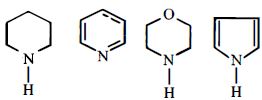
A
$I > III > II > IV$
B
$III > I > II > IV$
C
$II > III > I > IV$
D
$IV > III > II > I$
Solution
(A) The basicity of amines depends on the availability of the lone pair of electrons on the nitrogen atom.
$I$ (Piperidine): The nitrogen atom is $sp^3$ hybridized,and the lone pair is not involved in resonance. It is the most basic.
$II$ (Pyridine): The nitrogen atom is $sp^2$ hybridized. The lone pair is in an $sp^2$ orbital,which is more electronegative than an $sp^3$ orbital,making it less basic than piperidine.
$III$ (Morpholine): Similar to piperidine,the nitrogen is $sp^3$ hybridized,but the presence of an electronegative oxygen atom exerts an inductive effect ($-I$ effect),which reduces the electron density on the nitrogen atom,making it less basic than piperidine but more basic than pyridine.
$IV$ (Pyrrole): The nitrogen atom is $sp^2$ hybridized,and its lone pair is involved in the aromatic sextet (delocalized). Thus,it is the least basic.
Therefore,the order of basicity is $I > III > II > IV$.
$I$ (Piperidine): The nitrogen atom is $sp^3$ hybridized,and the lone pair is not involved in resonance. It is the most basic.
$II$ (Pyridine): The nitrogen atom is $sp^2$ hybridized. The lone pair is in an $sp^2$ orbital,which is more electronegative than an $sp^3$ orbital,making it less basic than piperidine.
$III$ (Morpholine): Similar to piperidine,the nitrogen is $sp^3$ hybridized,but the presence of an electronegative oxygen atom exerts an inductive effect ($-I$ effect),which reduces the electron density on the nitrogen atom,making it less basic than piperidine but more basic than pyridine.
$IV$ (Pyrrole): The nitrogen atom is $sp^2$ hybridized,and its lone pair is involved in the aromatic sextet (delocalized). Thus,it is the least basic.
Therefore,the order of basicity is $I > III > II > IV$.
0 likesView Solution
117
ChemistryDifficultMCQAIEEE · 2012
The freezing point of a $1.00 \ m$ aqueous solution of $HF$ is found to be $-1.91 \ ^oC$. The freezing point constant of water,$K_f$ is $1.86 \ K \ kg \ mol^{-1}$. The percentage dissociation of $HF$ at this concentration is ................ $\%$
A
$30$
B
$10$
C
$5.2$
D
$2.7$
Solution
(D) The depression in freezing point is given by $\Delta T_f = T_f^{\circ} - T_f = 0 - (-1.91) = 1.91 \ K$.
Using the formula $\Delta T_f = i \times K_f \times m$,where $i$ is the van't Hoff factor,$K_f = 1.86 \ K \ kg \ mol^{-1}$,and $m = 1.00 \ m$:
$i = \frac{\Delta T_f}{K_f \times m} = \frac{1.91}{1.86 \times 1.00} \approx 1.027$.
For the dissociation of $HF$: $HF \rightleftharpoons H^+ + F^-$.
If $\alpha$ is the degree of dissociation,then $i = 1 + \alpha$.
$1 + \alpha = 1.027 \implies \alpha = 0.027$.
Therefore,the percentage dissociation is $0.027 \times 100 = 2.7 \%$.
Using the formula $\Delta T_f = i \times K_f \times m$,where $i$ is the van't Hoff factor,$K_f = 1.86 \ K \ kg \ mol^{-1}$,and $m = 1.00 \ m$:
$i = \frac{\Delta T_f}{K_f \times m} = \frac{1.91}{1.86 \times 1.00} \approx 1.027$.
For the dissociation of $HF$: $HF \rightleftharpoons H^+ + F^-$.
If $\alpha$ is the degree of dissociation,then $i = 1 + \alpha$.
$1 + \alpha = 1.027 \implies \alpha = 0.027$.
Therefore,the percentage dissociation is $0.027 \times 100 = 2.7 \%$.
0 likesView Solution
118
ChemistryDifficultMCQAIEEE · 2012
Which of the following statements is correct?
A
$RNA$ controls the synthesis of proteins.
B
The sugar present in $DNA$ is $D-(-)$-ribose.
C
$RNA$ has a double-stranded $\alpha$-helix structure.
D
$DNA$ mainly occurs in the cytoplasm of the cell.
Solution
(A) $1$. $RNA$ (Ribonucleic acid) is primarily responsible for protein synthesis in the cell.
$2$. The sugar present in $DNA$ is $2$-deoxy-$D$-ribose,not $D-(-)$-ribose (which is found in $RNA$).
$3$. $DNA$ typically has a double-stranded helix structure,whereas $RNA$ is usually single-stranded.
$4$. $DNA$ is primarily found in the nucleus of the cell,while $RNA$ is found in the cytoplasm and nucleus.
Therefore,the correct statement is that $RNA$ controls the synthesis of proteins.
$2$. The sugar present in $DNA$ is $2$-deoxy-$D$-ribose,not $D-(-)$-ribose (which is found in $RNA$).
$3$. $DNA$ typically has a double-stranded helix structure,whereas $RNA$ is usually single-stranded.
$4$. $DNA$ is primarily found in the nucleus of the cell,while $RNA$ is found in the cytoplasm and nucleus.
Therefore,the correct statement is that $RNA$ controls the synthesis of proteins.
0 likesView Solution
119
ChemistryEasyMCQAIEEE · 2012
Bakelite is obtained from phenol by reacting it with
A
Acetaldehyde
B
Chlorobenzene
C
Formaldehyde
D
Acetamide
Solution
(C) Bakelite is a thermosetting phenol-formaldehyde resin.
It is obtained by the condensation polymerization of phenol and formaldehyde in the presence of an acid or base catalyst.
It is obtained by the condensation polymerization of phenol and formaldehyde in the presence of an acid or base catalyst.
0 likesView Solution
120
ChemistryMediumMCQAIEEE · 2012
Among the following,the incorrect statement is:
A
Density of crystals remains unaffected due to Frenkel defect.
B
In $BCC$ unit cell,the void space is $32\%$.
C
Density of crystals decreases due to Schottky defect.
D
Electrical conductivity of semiconductors and metals increases with increase in temperature.
Solution
(D) The correct answer is $D$.
In metals,electrical conductivity decreases with an increase in temperature due to the increased vibrations of metal ions,which scatter electrons.
In semiconductors,conductivity increases with temperature due to the excitation of more electrons from the valence band to the conduction band.
Therefore,the statement that conductivity of both metals and semiconductors increases with temperature is incorrect.
In metals,electrical conductivity decreases with an increase in temperature due to the increased vibrations of metal ions,which scatter electrons.
In semiconductors,conductivity increases with temperature due to the excitation of more electrons from the valence band to the conduction band.
Therefore,the statement that conductivity of both metals and semiconductors increases with temperature is incorrect.
0 likesView Solution
121
ChemistryMediumMCQAIEEE · 2012
Which of the following forms a stable $+4$ oxidation state?
A
$La$ $(Z = 57)$
B
$Eu$ $(Z = 63)$
C
$Ce$ $(Z = 58)$
D
$Gd$ $(Z = 64)$
Solution
(C) The electronic configuration of $Ce$ $(Z = 58)$ is $[Xe] 4f^1 5d^1 6s^2$.
By losing four electrons,it attains the stable noble gas configuration of $Xe$ $([Xe])$,making the $+4$ oxidation state stable for $Ce$.
By losing four electrons,it attains the stable noble gas configuration of $Xe$ $([Xe])$,making the $+4$ oxidation state stable for $Ce$.
0 likesView Solution
122
ChemistryDifficultMCQAIEEE · 2012
Colloidal solutions can be purified by
A
emulsification
B
electrodialysis
C
peptization
D
using Tyndall effect
Solution
(B) The process of removing impurities from a colloidal solution is known as purification.
Electrodialysis is a technique used to accelerate the process of dialysis by applying an electric field,which helps in the faster removal of ionic impurities from the colloidal solution.
Therefore,colloidal solutions can be purified by electrodialysis.
Electrodialysis is a technique used to accelerate the process of dialysis by applying an electric field,which helps in the faster removal of ionic impurities from the colloidal solution.
Therefore,colloidal solutions can be purified by electrodialysis.
0 likesView Solution
123
ChemistryDifficultMCQAIEEE · 2012
Given $E_{Cu^{2+}/Cu^{+}}^o = 0.15 \, V$,$E_{Cu^{2+}/Cu}^o = 0.34 \, V$. The standard electrode potential for the half-cell $Cu^{+}/Cu$ is ............. $V$.
A
$0.38$
B
$0.53$
C
$0.19$
D
$0.49$
Solution
(B) For the reaction $Cu^{2+} + e^- \to Cu^{+}$,$\Delta G_1^o = -n_1 E_1^o F = -1 \times 0.15 \times F = -0.15F$.
For the reaction $Cu^{2+} + 2e^- \to Cu$,$\Delta G_2^o = -n_2 E_2^o F = -2 \times 0.34 \times F = -0.68F$.
To find the potential for $Cu^{+} + e^- \to Cu$,we subtract the first reaction from the second:
$(Cu^{2+} + 2e^- \to Cu) - (Cu^{2+} + e^- \to Cu^{+}) \implies Cu^{+} + e^- \to Cu$.
$\Delta G^o = \Delta G_2^o - \Delta G_1^o = -0.68F - (-0.15F) = -0.53F$.
Since $\Delta G^o = -n E^o F$,where $n=1$:
$-0.53F = -1 \times E^o \times F
\implies E^o = 0.53 \, V$.
For the reaction $Cu^{2+} + 2e^- \to Cu$,$\Delta G_2^o = -n_2 E_2^o F = -2 \times 0.34 \times F = -0.68F$.
To find the potential for $Cu^{+} + e^- \to Cu$,we subtract the first reaction from the second:
$(Cu^{2+} + 2e^- \to Cu) - (Cu^{2+} + e^- \to Cu^{+}) \implies Cu^{+} + e^- \to Cu$.
$\Delta G^o = \Delta G_2^o - \Delta G_1^o = -0.68F - (-0.15F) = -0.53F$.
Since $\Delta G^o = -n E^o F$,where $n=1$:
$-0.53F = -1 \times E^o \times F
\implies E^o = 0.53 \, V$.
0 likesView Solution
124
ChemistryDifficultMCQAIEEE · 2012
The complex ion $[Pt(NO_2)(Py)(NH_3)(NH_2OH)]^+$ will give $..........$ geometrical isomers.
A
$2$
B
$3$
C
$6$
D
$4$
Solution
(B) The given complex is of the type $[MABCD]$,where $M = Pt^{2+}$,$A = NO_2^-$,$B = Py$,$C = NH_3$,and $D = NH_2OH$.
Square planar complexes of the type $[MABCD]$ exhibit $3$ geometrical isomers.
These isomers are formed by fixing one ligand and varying the positions of the other three ligands relative to it.
As shown in the structures $(I)$,$(II)$,and $(III)$,there are $3$ possible arrangements for the ligands around the central metal atom.
Square planar complexes of the type $[MABCD]$ exhibit $3$ geometrical isomers.
These isomers are formed by fixing one ligand and varying the positions of the other three ligands relative to it.
As shown in the structures $(I)$,$(II)$,and $(III)$,there are $3$ possible arrangements for the ligands around the central metal atom.
0 likesView Solution
125
ChemistryDifficultMCQAIEEE · 2012
Sulphonamides act as
A
Antiseptic
B
Analgesic
C
Antimicrobials
D
Antipyretic
Solution
(C) Sulphonamides are a group of synthetic drugs that contain the sulphonamide group. They are widely used as antimicrobial agents because they inhibit the growth of bacteria by interfering with the synthesis of folic acid in them.
0 likesView Solution
126
ChemistryEasyMCQAIEEE · 2012
The number of unpaired electrons in Gadolinium $[Z = 64]$ is
A
$3$
B
$8$
C
$6$
D
$2$
Solution
(B) The electronic configuration of Gadolinium $[Z = 64]$ is $[Xe] 4f^7 5d^1 6s^2$.
In the $4f$ subshell,there are $7$ unpaired electrons.
In the $5d$ subshell,there is $1$ unpaired electron.
Therefore,the total number of unpaired electrons is $7 + 1 = 8$.
In the $4f$ subshell,there are $7$ unpaired electrons.
In the $5d$ subshell,there is $1$ unpaired electron.
Therefore,the total number of unpaired electrons is $7 + 1 = 8$.
0 likesView Solution
127
ChemistryMediumMCQAIEEE · 2012
Which one of the following statements is correct?
A
All amino acids except lysine are optically active
B
All amino acids are optically active
C
All amino acids except glycine are optically active
D
All amino acids except glutamic acid are optically active
Solution
(C) Except for glycine,all other naturally occurring amino acids contain a chiral center at the $\alpha$-carbon atom.
Glycine has the structure $H_2N-CH_2-COOH$,where the $\alpha$-carbon is bonded to two identical hydrogen atoms,making it achiral.
Therefore,all amino acids except glycine are optically active.
Glycine has the structure $H_2N-CH_2-COOH$,where the $\alpha$-carbon is bonded to two identical hydrogen atoms,making it achiral.
Therefore,all amino acids except glycine are optically active.
0 likesView Solution
Vedclass Products
For Students
Vedclass Test Series
Mock tests in real AIEEE style covering Chemistry with performance analysis. 5-day free trial.
Start Free TrialFor Teachers
Exam Paper Generator
Generate Set A/B/C/D Chemistry papers from 7.5L+ questions in 2 minutes. 3 chapters free.
Try FreeFor Institutes
Online Exam Module
Run live AIEEE mock exams with unlimited students, 360° analytics & white-label branding.
See DemoFrequently Asked Questions
How many Chemistry questions are in AIEEE 2012?
There are 189 Chemistry questions from the AIEEE 2012 paper on Vedclass, each with a detailed step-by-step solution in English.
Are AIEEE 2012 Chemistry solutions available in English?
Yes. All solutions on this page are in English. You can also switch to English or Hindi using the language buttons above the questions.
Can I practice AIEEE 2012 Chemistry as a timed test?
Yes. Use the Vedclass Test Series to attempt a full AIEEE mock test covering Chemistry with time limits and instant score analysis.
Can teachers create Chemistry papers from AIEEE previous year questions?
Yes. The Vedclass Exam Paper Generator lets teachers mix AIEEE Chemistry questions and generate Set A/B/C/D papers in minutes.
For Teachers & Institutes
Build a Custom Chemistry Paper
Pick AIEEE 2012 Chemistry questions, set difficulty, and generate Set A/B/C/D in 2 minutes.