
MathematicsQ1–100 of 145 questions
Page 1 of 2 · English
1
MathematicsMediumMCQAIEEE · 2012
The number of terms which are free from radical signs in the expansion of $(y^{1/5} + x^{1/10})^{55}$ is
A
$5$
B
$6$
C
$7$
D
None of these
Solution
(B) In the expansion of $(y^{1/5} + x^{1/10})^{55}$,the general term is given by:
$T_{r+1} = {}^{55}C_r (y^{1/5})^{55-r} (x^{1/10})^r = {}^{55}C_r \cdot y^{11 - r/5} \cdot x^{r/10}$.
For the term to be free from radical signs,the exponents of $x$ and $y$ must be integers.
This requires $r/5$ and $r/10$ to be integers.
Since $0 \le r \le 55$,$r$ must be a multiple of $10$ (the least common multiple of $5$ and $10$).
The possible values for $r$ are $0, 10, 20, 30, 40, 50$.
There are $6$ such values,corresponding to the terms $T_1, T_{11}, T_{21}, T_{31}, T_{41}, T_{51}$.
Thus,there are $6$ terms free from radical signs.
$T_{r+1} = {}^{55}C_r (y^{1/5})^{55-r} (x^{1/10})^r = {}^{55}C_r \cdot y^{11 - r/5} \cdot x^{r/10}$.
For the term to be free from radical signs,the exponents of $x$ and $y$ must be integers.
This requires $r/5$ and $r/10$ to be integers.
Since $0 \le r \le 55$,$r$ must be a multiple of $10$ (the least common multiple of $5$ and $10$).
The possible values for $r$ are $0, 10, 20, 30, 40, 50$.
There are $6$ such values,corresponding to the terms $T_1, T_{11}, T_{21}, T_{31}, T_{41}, T_{51}$.
Thus,there are $6$ terms free from radical signs.
0 likesView Solution
2
MathematicsMediumMCQAIEEE · 2012
In a $\Delta PQR$,if $3 \sin P + 4 \cos Q = 6$ and $4 \sin Q + 3 \cos P = 1$,then the angle $R$ is equal to:
A
$\frac{5\pi}{6}$
B
$\frac{\pi}{6}$
C
$\frac{\pi}{4}$
D
$\frac{3\pi}{4}$
Solution
(B) Given equations are:
$3 \sin P + 4 \cos Q = 6$ $(1)$
$4 \sin Q + 3 \cos P = 1$ $(2)$
Squaring and adding $(1)$ and $(2)$:
$(3 \sin P + 4 \cos Q)^2 + (4 \sin Q + 3 \cos P)^2 = 6^2 + 1^2$
$9 \sin^2 P + 16 \cos^2 Q + 24 \sin P \cos Q + 16 \sin^2 Q + 9 \cos^2 P + 24 \sin Q \cos P = 37$
$9(\sin^2 P + \cos^2 P) + 16(\sin^2 Q + \cos^2 Q) + 24(\sin P \cos Q + \cos P \sin Q) = 37$
$9(1) + 16(1) + 24 \sin(P + Q) = 37$
$25 + 24 \sin(P + Q) = 37$
$24 \sin(P + Q) = 12$
$\sin(P + Q) = \frac{1}{2}$
Since $P + Q + R = \pi$,we have $\sin(P + Q) = \sin(\pi - R) = \sin R$.
Thus,$\sin R = \frac{1}{2}$,which implies $R = \frac{\pi}{6}$ or $R = \frac{5\pi}{6}$.
If $R = \frac{5\pi}{6}$,then $P + Q = \frac{\pi}{6}$. Since $P, Q > 0$,$\sin P < \sin(\frac{\pi}{6}) = \frac{1}{2}$ and $\cos Q < 1$. This contradicts $3 \sin P + 4 \cos Q = 6$.
Therefore,$R = \frac{\pi}{6}$.
$3 \sin P + 4 \cos Q = 6$ $(1)$
$4 \sin Q + 3 \cos P = 1$ $(2)$
Squaring and adding $(1)$ and $(2)$:
$(3 \sin P + 4 \cos Q)^2 + (4 \sin Q + 3 \cos P)^2 = 6^2 + 1^2$
$9 \sin^2 P + 16 \cos^2 Q + 24 \sin P \cos Q + 16 \sin^2 Q + 9 \cos^2 P + 24 \sin Q \cos P = 37$
$9(\sin^2 P + \cos^2 P) + 16(\sin^2 Q + \cos^2 Q) + 24(\sin P \cos Q + \cos P \sin Q) = 37$
$9(1) + 16(1) + 24 \sin(P + Q) = 37$
$25 + 24 \sin(P + Q) = 37$
$24 \sin(P + Q) = 12$
$\sin(P + Q) = \frac{1}{2}$
Since $P + Q + R = \pi$,we have $\sin(P + Q) = \sin(\pi - R) = \sin R$.
Thus,$\sin R = \frac{1}{2}$,which implies $R = \frac{\pi}{6}$ or $R = \frac{5\pi}{6}$.
If $R = \frac{5\pi}{6}$,then $P + Q = \frac{\pi}{6}$. Since $P, Q > 0$,$\sin P < \sin(\frac{\pi}{6}) = \frac{1}{2}$ and $\cos Q < 1$. This contradicts $3 \sin P + 4 \cos Q = 6$.
Therefore,$R = \frac{\pi}{6}$.
0 likesView Solution
3
MathematicsDifficultMCQAIEEE · 2012
If $z \neq 1$ and $\frac{z^2}{z-1}$ is real,then the point represented by the complex number $z$ lies:
A
either on the real axis or on a circle passing through the origin
B
on a circle with centre at the origin
C
either on the real axis or on a circle not passing through the origin
D
on the imaginary axis
Solution
(A) Given that $\frac{z^2}{z-1}$ is real,it must be equal to its conjugate: $\frac{z^2}{z-1} = \overline{\left(\frac{z^2}{z-1}\right)} = \frac{\overline{z}^2}{\overline{z}-1}$.
Cross-multiplying,we get: $z^2(\overline{z}-1) = \overline{z}^2(z-1)$.
Expanding the terms: $z^2\overline{z} - z^2 = \overline{z}^2z - \overline{z}^2$.
Rearranging the terms: $z^2\overline{z} - \overline{z}^2z - z^2 + \overline{z}^2 = 0$.
Factoring: $z\overline{z}(z-\overline{z}) - (z^2-\overline{z}^2) = 0$.
$z\overline{z}(z-\overline{z}) - (z-\overline{z})(z+\overline{z}) = 0$.
$(z-\overline{z})(z\overline{z} - (z+\overline{z})) = 0$.
This implies either $z-\overline{z} = 0$ or $z\overline{z} - z - \overline{z} = 0$.
$z-\overline{z} = 0$ implies $z$ is purely real (lies on the real axis).
$z\overline{z} - z - \overline{z} = 0$ can be written as $(z-1)(\overline{z}-1) = 1$,or $|z-1|^2 = 1$,which represents a circle with center $1$ and radius $1$. This circle passes through the origin since $|0-1| = 1$.
Thus,$z$ lies on the real axis or on a circle passing through the origin.
Cross-multiplying,we get: $z^2(\overline{z}-1) = \overline{z}^2(z-1)$.
Expanding the terms: $z^2\overline{z} - z^2 = \overline{z}^2z - \overline{z}^2$.
Rearranging the terms: $z^2\overline{z} - \overline{z}^2z - z^2 + \overline{z}^2 = 0$.
Factoring: $z\overline{z}(z-\overline{z}) - (z^2-\overline{z}^2) = 0$.
$z\overline{z}(z-\overline{z}) - (z-\overline{z})(z+\overline{z}) = 0$.
$(z-\overline{z})(z\overline{z} - (z+\overline{z})) = 0$.
This implies either $z-\overline{z} = 0$ or $z\overline{z} - z - \overline{z} = 0$.
$z-\overline{z} = 0$ implies $z$ is purely real (lies on the real axis).
$z\overline{z} - z - \overline{z} = 0$ can be written as $(z-1)(\overline{z}-1) = 1$,or $|z-1|^2 = 1$,which represents a circle with center $1$ and radius $1$. This circle passes through the origin since $|0-1| = 1$.
Thus,$z$ lies on the real axis or on a circle passing through the origin.
0 likesView Solution
4
MathematicsDifficultMCQAIEEE · 2012
Assuming the balls to be identical except for their color,the number of ways in which one or more balls can be selected from $10$ white,$9$ green,and $7$ black balls is:
A
$880$
B
$629$
C
$630$
D
$879$
Solution
(D) The number of ways to select balls from $n_1$ identical items of type $1$,$n_2$ identical items of type $2$,and $n_3$ identical items of type $3$ is given by $(n_1 + 1)(n_2 + 1)(n_3 + 1)$.
Here,$n_1 = 10$ (white),$n_2 = 9$ (green),and $n_3 = 7$ (black).
Total ways including the case where no ball is selected $= (10 + 1) \times (9 + 1) \times (7 + 1) = 11 \times 10 \times 8 = 880$.
Since we need to select one or more balls,we exclude the case where no ball is selected (i.e.,subtract $1$).
Number of ways $= 880 - 1 = 879$.
Here,$n_1 = 10$ (white),$n_2 = 9$ (green),and $n_3 = 7$ (black).
Total ways including the case where no ball is selected $= (10 + 1) \times (9 + 1) \times (7 + 1) = 11 \times 10 \times 8 = 880$.
Since we need to select one or more balls,we exclude the case where no ball is selected (i.e.,subtract $1$).
Number of ways $= 880 - 1 = 879$.
0 likesView Solution
5
MathematicsMediumMCQAIEEE · 2012
If $n$ is a positive integer,then $(\sqrt{3} + 1)^{2n} - (\sqrt{3} - 1)^{2n}$ is
A
an irrational number
B
an odd positive integer
C
an even positive integer
D
a rational number other than positive integers
Solution
(A) Let $x = (\sqrt{3} + 1)^{2n}$ and $y = (\sqrt{3} - 1)^{2n}$.
Using the binomial expansion,$(\sqrt{3} + 1)^{2n} = \sum_{k=0}^{2n} \binom{2n}{k} (\sqrt{3})^{2n-k} (1)^k$.
Similarly,$(\sqrt{3} - 1)^{2n} = \sum_{k=0}^{2n} \binom{2n}{k} (\sqrt{3})^{2n-k} (-1)^k$.
Subtracting the two expressions:
$(\sqrt{3} + 1)^{2n} - (\sqrt{3} - 1)^{2n} = \sum_{k=0}^{2n} \binom{2n}{k} (\sqrt{3})^{2n-k} [1 - (-1)^k]$.
The term $[1 - (-1)^k]$ is $0$ if $k$ is even and $2$ if $k$ is odd.
Thus,the expression becomes $2 \sum_{k \text{ is odd}} \binom{2n}{k} (\sqrt{3})^{2n-k}$.
Since $k$ is odd,$2n-k$ is odd. Let $2n-k = 2m+1$. Then $(\sqrt{3})^{2n-k} = 3^m \sqrt{3}$.
However,we can simplify this by noting that $(\sqrt{3} + 1)^2 = 3 + 1 + 2\sqrt{3} = 4 + 2\sqrt{3}$ and $(\sqrt{3} - 1)^2 = 3 + 1 - 2\sqrt{3} = 4 - 2\sqrt{3}$.
Let $A = 4 + 2\sqrt{3}$ and $B = 4 - 2\sqrt{3}$. We want $A^n - B^n$.
Since $A$ and $B$ are roots of the quadratic equation $x^2 - 8x + 4 = 0$,the expression $A^n - B^n$ is of the form $k\sqrt{3}$ where $k$ is an integer.
Wait,let's re-evaluate: $(\sqrt{3}+1)^2 = 4+2\sqrt{3}$. So $(\sqrt{3}+1)^{2n} = (4+2\sqrt{3})^n$.
Expanding $(4+2\sqrt{3})^n - (4-2\sqrt{3})^n$ using binomial theorem:
$= \sum \binom{n}{k} 4^{n-k} (2\sqrt{3})^k - \sum \binom{n}{k} 4^{n-k} (-2\sqrt{3})^k$
$= 2 \sum_{k \text{ odd}} \binom{n}{k} 4^{n-k} 2^k (\sqrt{3})^k$.
For $k=1$,term is $2 \cdot n \cdot 4^{n-1} \cdot 2 \cdot \sqrt{3} = n \cdot 4^n \sqrt{3}$.
Actually,the expression is an irrational number because it contains $\sqrt{3}$.
Using the binomial expansion,$(\sqrt{3} + 1)^{2n} = \sum_{k=0}^{2n} \binom{2n}{k} (\sqrt{3})^{2n-k} (1)^k$.
Similarly,$(\sqrt{3} - 1)^{2n} = \sum_{k=0}^{2n} \binom{2n}{k} (\sqrt{3})^{2n-k} (-1)^k$.
Subtracting the two expressions:
$(\sqrt{3} + 1)^{2n} - (\sqrt{3} - 1)^{2n} = \sum_{k=0}^{2n} \binom{2n}{k} (\sqrt{3})^{2n-k} [1 - (-1)^k]$.
The term $[1 - (-1)^k]$ is $0$ if $k$ is even and $2$ if $k$ is odd.
Thus,the expression becomes $2 \sum_{k \text{ is odd}} \binom{2n}{k} (\sqrt{3})^{2n-k}$.
Since $k$ is odd,$2n-k$ is odd. Let $2n-k = 2m+1$. Then $(\sqrt{3})^{2n-k} = 3^m \sqrt{3}$.
However,we can simplify this by noting that $(\sqrt{3} + 1)^2 = 3 + 1 + 2\sqrt{3} = 4 + 2\sqrt{3}$ and $(\sqrt{3} - 1)^2 = 3 + 1 - 2\sqrt{3} = 4 - 2\sqrt{3}$.
Let $A = 4 + 2\sqrt{3}$ and $B = 4 - 2\sqrt{3}$. We want $A^n - B^n$.
Since $A$ and $B$ are roots of the quadratic equation $x^2 - 8x + 4 = 0$,the expression $A^n - B^n$ is of the form $k\sqrt{3}$ where $k$ is an integer.
Wait,let's re-evaluate: $(\sqrt{3}+1)^2 = 4+2\sqrt{3}$. So $(\sqrt{3}+1)^{2n} = (4+2\sqrt{3})^n$.
Expanding $(4+2\sqrt{3})^n - (4-2\sqrt{3})^n$ using binomial theorem:
$= \sum \binom{n}{k} 4^{n-k} (2\sqrt{3})^k - \sum \binom{n}{k} 4^{n-k} (-2\sqrt{3})^k$
$= 2 \sum_{k \text{ odd}} \binom{n}{k} 4^{n-k} 2^k (\sqrt{3})^k$.
For $k=1$,term is $2 \cdot n \cdot 4^{n-1} \cdot 2 \cdot \sqrt{3} = n \cdot 4^n \sqrt{3}$.
Actually,the expression is an irrational number because it contains $\sqrt{3}$.
0 likesView Solution
6
MathematicsDifficultMCQAIEEE · 2012
Statement-$1$: The sum of the series $1+(1+2+4)+(4+6+9)+(9+12+16)+\dots+(361+380+400)$ is $8000$.
Statement-$2$: $\sum_{k=1}^{n} (k^3 - (k-1)^3) = n^3$,for any natural number $n$.
Statement-$2$: $\sum_{k=1}^{n} (k^3 - (k-1)^3) = n^3$,for any natural number $n$.
A
Statement-$1$ is false,Statement-$2$ is true.
B
Statement-$1$ is true,Statement-$2$ is false.
C
Statement-$1$ is true,Statement-$2$ is true; Statement-$2$ is not a correct explanation for Statement-$1$.
D
Statement-$1$ is true,Statement-$2$ is true; Statement-$2$ is a correct explanation for Statement-$1$.
Solution
(D) Statement-$2$: The sum is a telescoping series: $\sum_{k=1}^{n} (k^3 - (k-1)^3) = (1^3 - 0^3) + (2^3 - 1^3) + \dots + (n^3 - (n-1)^3) = n^3$. This is true.
Statement-$1$: The $k$-th term of the series is $T_k = (k-1)^2 + (k-1)k + k^2 = k^2 - 2k + 1 + k^2 - k + k^2 = 3k^2 - 3k + 1$.
We know that $k^3 - (k-1)^3 = 3k^2 - 3k + 1$. Thus,$T_k = k^3 - (k-1)^3$.
The series is $\sum_{k=1}^{20} T_k = \sum_{k=1}^{20} (k^3 - (k-1)^3) = 20^3 = 8000$.
Since the last term is $361+380+400 = 19^2 + 19 \times 20 + 20^2$,this corresponds to $k=20$.
Both statements are true and Statement-$2$ explains Statement-$1$.
Statement-$1$: The $k$-th term of the series is $T_k = (k-1)^2 + (k-1)k + k^2 = k^2 - 2k + 1 + k^2 - k + k^2 = 3k^2 - 3k + 1$.
We know that $k^3 - (k-1)^3 = 3k^2 - 3k + 1$. Thus,$T_k = k^3 - (k-1)^3$.
The series is $\sum_{k=1}^{20} T_k = \sum_{k=1}^{20} (k^3 - (k-1)^3) = 20^3 = 8000$.
Since the last term is $361+380+400 = 19^2 + 19 \times 20 + 20^2$,this corresponds to $k=20$.
Both statements are true and Statement-$2$ explains Statement-$1$.
0 likesView Solution
7
MathematicsDifficultMCQAIEEE · 2012
The length of the diameter of the circle which touches the $x-$axis at the point $(1,0)$ and passes through the point $(2,3)$ is:
A
$\frac{10}{3}$
B
$\frac{3}{5}$
C
$\frac{6}{5}$
D
$\frac{5}{3}$
Solution
(A) Let the centre of the circle be $C(1,h)$.
Since the circle touches the $x-$axis at $(1,0)$,the radius of the circle is $|h|$.
The circle passes through the point $B(2,3)$,so the distance $CB$ must be equal to the radius $|h|$.
$CB^2 = h^2$
$(2-1)^2 + (3-h)^2 = h^2$
$1^2 + (9 - 6h + h^2) = h^2$
$1 + 9 - 6h = 0$
$10 = 6h$
$h = \frac{10}{6} = \frac{5}{3}$
The diameter of the circle is $2|h| = 2 \times \frac{5}{3} = \frac{10}{3}$.
Since the circle touches the $x-$axis at $(1,0)$,the radius of the circle is $|h|$.
The circle passes through the point $B(2,3)$,so the distance $CB$ must be equal to the radius $|h|$.
$CB^2 = h^2$
$(2-1)^2 + (3-h)^2 = h^2$
$1^2 + (9 - 6h + h^2) = h^2$
$1 + 9 - 6h = 0$
$10 = 6h$
$h = \frac{10}{6} = \frac{5}{3}$
The diameter of the circle is $2|h| = 2 \times \frac{5}{3} = \frac{10}{3}$.
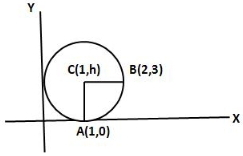
0 likesView Solution
8
MathematicsMediumMCQAIEEE · 2012
An ellipse is drawn by taking a diameter of the circle $(x - 1)^2 + y^2 = 1$ as its semi-minor axis and a diameter of the circle $x^2 + (y - 2)^2 = 4$ as its semi-major axis. If the center of the ellipse is at the origin and its axes are the coordinate axes,then the equation of the ellipse is:
A
$4x^2 + y^2 = 4$
B
$x^2 + 4y^2 = 8$
C
$4x^2 + y^2 = 8$
D
$x^2 + 4y^2 = 16$
Solution
(D) The circle $(x - 1)^2 + y^2 = 1$ has a radius $r_1 = 1$,so its diameter is $2$. Given this is the semi-minor axis,$b = 2$.
The circle $x^2 + (y - 2)^2 = 4$ has a radius $r_2 = 2$,so its diameter is $4$. Given this is the semi-major axis,$a = 4$.
The standard equation of an ellipse centered at the origin with axes along the coordinate axes is $\frac{x^2}{a^2} + \frac{y^2}{b^2} = 1$.
Substituting the values $a = 4$ and $b = 2$,we get $\frac{x^2}{4^2} + \frac{y^2}{2^2} = 1$.
$\Rightarrow \frac{x^2}{16} + \frac{y^2}{4} = 1$.
Multiplying by $16$,we get $x^2 + 4y^2 = 16$.
The circle $x^2 + (y - 2)^2 = 4$ has a radius $r_2 = 2$,so its diameter is $4$. Given this is the semi-major axis,$a = 4$.
The standard equation of an ellipse centered at the origin with axes along the coordinate axes is $\frac{x^2}{a^2} + \frac{y^2}{b^2} = 1$.
Substituting the values $a = 4$ and $b = 2$,we get $\frac{x^2}{4^2} + \frac{y^2}{2^2} = 1$.
$\Rightarrow \frac{x^2}{16} + \frac{y^2}{4} = 1$.
Multiplying by $16$,we get $x^2 + 4y^2 = 16$.
0 likesView Solution
9
MathematicsMediumMCQAIEEE · 2012
Let ${x_1}, {x_2}, \ldots, {x_n}$ be $n$ observations,and let $\bar x$ be their arithmetic mean and ${\sigma ^2}$ be the variance.
Statement-$1$: The variance of $2{x_1}, 2{x_2}, \ldots, 2{x_n}$ is $4{\sigma ^2}$.
Statement-$2$: The arithmetic mean of $2{x_1}, 2{x_2}, \ldots, 2{x_n}$ is $4\bar x$.
Statement-$1$: The variance of $2{x_1}, 2{x_2}, \ldots, 2{x_n}$ is $4{\sigma ^2}$.
Statement-$2$: The arithmetic mean of $2{x_1}, 2{x_2}, \ldots, 2{x_n}$ is $4\bar x$.
A
Statement-$1$ is false,Statement-$2$ is true.
B
Statement-$1$ is true,Statement-$2$ is true; Statement-$2$ is not a correct explanation for Statement-$1$.
C
Statement-$1$ is true,Statement-$2$ is true; Statement-$2$ is a correct explanation for Statement-$1$.
D
Statement-$1$ is true,Statement-$2$ is false.
Solution
(D) Given observations are ${x_1}, {x_2}, \ldots, {x_n}$ with mean $\bar x$ and variance ${\sigma ^2} = \frac{1}{n} \sum_{i=1}^{n} (x_i - \bar x)^2$.
For Statement-$2$: The arithmetic mean of $2{x_1}, 2{x_2}, \ldots, 2{x_n}$ is $\frac{1}{n} \sum_{i=1}^{n} (2x_i) = 2 \left( \frac{1}{n} \sum_{i=1}^{n} x_i \right) = 2\bar x$.
Since the statement claims the mean is $4\bar x$,Statement-$2$ is false.
For Statement-$1$: The variance of $2{x_1}, 2{x_2}, \ldots, 2{x_n}$ is $\frac{1}{n} \sum_{i=1}^{n} (2x_i - 2\bar x)^2 = \frac{1}{n} \sum_{i=1}^{n} 4(x_i - \bar x)^2 = 4 \left( \frac{1}{n} \sum_{i=1}^{n} (x_i - \bar x)^2 \right) = 4{\sigma ^2}$.
Thus,Statement-$1$ is true.
Therefore,Statement-$1$ is true and Statement-$2$ is false.
For Statement-$2$: The arithmetic mean of $2{x_1}, 2{x_2}, \ldots, 2{x_n}$ is $\frac{1}{n} \sum_{i=1}^{n} (2x_i) = 2 \left( \frac{1}{n} \sum_{i=1}^{n} x_i \right) = 2\bar x$.
Since the statement claims the mean is $4\bar x$,Statement-$2$ is false.
For Statement-$1$: The variance of $2{x_1}, 2{x_2}, \ldots, 2{x_n}$ is $\frac{1}{n} \sum_{i=1}^{n} (2x_i - 2\bar x)^2 = \frac{1}{n} \sum_{i=1}^{n} 4(x_i - \bar x)^2 = 4 \left( \frac{1}{n} \sum_{i=1}^{n} (x_i - \bar x)^2 \right) = 4{\sigma ^2}$.
Thus,Statement-$1$ is true.
Therefore,Statement-$1$ is true and Statement-$2$ is false.
0 likesView Solution
10
MathematicsDifficultMCQAIEEE · 2012
The equation $e^{\sin x} - e^{\sin(-x)} - 4 = 0$ has
A
exactly two real roots
B
no real roots
C
infinite number of real roots
D
exactly four real roots
Solution
(B) Given equation is $e^{\sin x} - e^{-\sin x} - 4 = 0$.
Let $e^{\sin x} = t$. Since $e^{\sin x} > 0$,we must have $t > 0$.
The equation becomes $t - \frac{1}{t} - 4 = 0$.
Multiplying by $t$,we get $t^2 - 4t - 1 = 0$.
Using the quadratic formula $t = \frac{-b \pm \sqrt{b^2 - 4ac}}{2a}$,we get $t = \frac{4 \pm \sqrt{16 + 4}}{2} = \frac{4 \pm 2\sqrt{5}}{2} = 2 \pm \sqrt{5}$.
Since $t > 0$,we reject $t = 2 - \sqrt{5}$ (as $2 - \sqrt{5} < 0$).
Thus,$e^{\sin x} = 2 + \sqrt{5}$.
Taking the natural logarithm on both sides,$\sin x = \ln(2 + \sqrt{5})$.
Since $\sqrt{5} \approx 2.236$,$2 + \sqrt{5} \approx 4.236$.
We know that $\ln(e) = 1$ and $e \approx 2.718$.
Since $4.236 > 2.718$,$\ln(2 + \sqrt{5}) > 1$.
However,the range of $\sin x$ is $[-1, 1]$.
Since $\ln(2 + \sqrt{5}) > 1$,there is no real value of $x$ that satisfies this equation.
Therefore,the equation has no real roots.
Let $e^{\sin x} = t$. Since $e^{\sin x} > 0$,we must have $t > 0$.
The equation becomes $t - \frac{1}{t} - 4 = 0$.
Multiplying by $t$,we get $t^2 - 4t - 1 = 0$.
Using the quadratic formula $t = \frac{-b \pm \sqrt{b^2 - 4ac}}{2a}$,we get $t = \frac{4 \pm \sqrt{16 + 4}}{2} = \frac{4 \pm 2\sqrt{5}}{2} = 2 \pm \sqrt{5}$.
Since $t > 0$,we reject $t = 2 - \sqrt{5}$ (as $2 - \sqrt{5} < 0$).
Thus,$e^{\sin x} = 2 + \sqrt{5}$.
Taking the natural logarithm on both sides,$\sin x = \ln(2 + \sqrt{5})$.
Since $\sqrt{5} \approx 2.236$,$2 + \sqrt{5} \approx 4.236$.
We know that $\ln(e) = 1$ and $e \approx 2.718$.
Since $4.236 > 2.718$,$\ln(2 + \sqrt{5}) > 1$.
However,the range of $\sin x$ is $[-1, 1]$.
Since $\ln(2 + \sqrt{5}) > 1$,there is no real value of $x$ that satisfies this equation.
Therefore,the equation has no real roots.
0 likesView Solution
11
MathematicsEasyMCQAIEEE · 2012
The negation of the statement "If $I$ become a teacher,then $I$ will open a school" is
A
$I$ will become a teacher and $I$ will not open a school.
B
Either $I$ will not become a teacher or $I$ will not open a school.
C
Neither $I$ will become a teacher nor $I$ will open a school.
D
$I$ will not become a teacher or $I$ will open a school.
Solution
(A) Let $p$ be the statement "$I$ become a teacher" and $q$ be the statement "$I$ will open a school".
The given statement is in the form of an implication: $p \implies q$.
The negation of an implication $p \implies q$ is given by $\sim(p \implies q) \equiv p \land \sim q$.
Here,$p$ is "$I$ become a teacher" and $\sim q$ is "$I$ will not open a school".
Therefore,the negation is "$I$ will become a teacher and $I$ will not open a school".
The given statement is in the form of an implication: $p \implies q$.
The negation of an implication $p \implies q$ is given by $\sim(p \implies q) \equiv p \land \sim q$.
Here,$p$ is "$I$ become a teacher" and $\sim q$ is "$I$ will not open a school".
Therefore,the negation is "$I$ will become a teacher and $I$ will not open a school".
0 likesView Solution
12
MathematicsDifficultMCQAIEEE · 2012
Two vertices of a triangle are $(5, -1)$ and $(-2, 3)$. If the orthocentre is the origin,then the coordinates of the third vertex are:
A
$(7, 4)$
B
$(-4, 7)$
C
$(4, -7)$
D
$(-4, -7)$
Solution
(D) Let the vertices be $A(5, -1)$,$B(-2, 3)$,and $C(h, k)$. The orthocentre $H$ is $(0, 0)$.
Since $CH \perp AB$,the slope of $AB$ is $m_{AB} = \frac{3 - (-1)}{-2 - 5} = \frac{4}{-7} = -\frac{4}{7}$.
The slope of the altitude $CH$ is $m_{CH} = -\frac{1}{m_{AB}} = \frac{7}{4}$.
Since $CH$ passes through $(0, 0)$ and $(h, k)$,its slope is $\frac{k}{h} = \frac{7}{4}$,which implies $7h - 4k = 0$ ---$(1)$.
Similarly,since $AH \perp BC$,the slope of $BC$ is $m_{BC} = \frac{k - 3}{h - (-2)} = \frac{k - 3}{h + 2}$.
The slope of the altitude $AH$ is $m_{AH} = \frac{0 - (-1)}{0 - 5} = -\frac{1}{5}$.
Since $AH \perp BC$,$m_{BC} \times m_{AH} = -1$,so $\left(\frac{k - 3}{h + 2}\right) \times \left(-\frac{1}{5}\right) = -1$.
$\frac{k - 3}{h + 2} = 5$ $\Rightarrow k - 3 = 5h + 10$ $\Rightarrow 5h - k + 13 = 0$ ---$(2)$.
Solving equations $(1)$ and $(2)$: From $(1)$,$k = \frac{7h}{4}$. Substituting into $(2)$: $5h - \frac{7h}{4} + 13 = 0$.
$\frac{20h - 7h}{4} + 13 = 0$ $\Rightarrow 13h = -52$ $\Rightarrow h = -4$.
Then $k = \frac{7(-4)}{4} = -7$.
Thus,the third vertex is $(-4, -7)$.
Since $CH \perp AB$,the slope of $AB$ is $m_{AB} = \frac{3 - (-1)}{-2 - 5} = \frac{4}{-7} = -\frac{4}{7}$.
The slope of the altitude $CH$ is $m_{CH} = -\frac{1}{m_{AB}} = \frac{7}{4}$.
Since $CH$ passes through $(0, 0)$ and $(h, k)$,its slope is $\frac{k}{h} = \frac{7}{4}$,which implies $7h - 4k = 0$ ---$(1)$.
Similarly,since $AH \perp BC$,the slope of $BC$ is $m_{BC} = \frac{k - 3}{h - (-2)} = \frac{k - 3}{h + 2}$.
The slope of the altitude $AH$ is $m_{AH} = \frac{0 - (-1)}{0 - 5} = -\frac{1}{5}$.
Since $AH \perp BC$,$m_{BC} \times m_{AH} = -1$,so $\left(\frac{k - 3}{h + 2}\right) \times \left(-\frac{1}{5}\right) = -1$.
$\frac{k - 3}{h + 2} = 5$ $\Rightarrow k - 3 = 5h + 10$ $\Rightarrow 5h - k + 13 = 0$ ---$(2)$.
Solving equations $(1)$ and $(2)$: From $(1)$,$k = \frac{7h}{4}$. Substituting into $(2)$: $5h - \frac{7h}{4} + 13 = 0$.
$\frac{20h - 7h}{4} + 13 = 0$ $\Rightarrow 13h = -52$ $\Rightarrow h = -4$.
Then $k = \frac{7(-4)}{4} = -7$.
Thus,the third vertex is $(-4, -7)$.
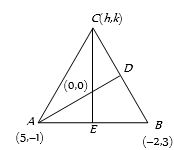
0 likesView Solution
13
MathematicsDifficultMCQAIEEE · 2012
The difference between the fourth term and the first term of a Geometric Progression is $52$. If the sum of its first three terms is $26$,then the sum of the first six terms of the progression is
A
$63$
B
$189$
C
$728$
D
$364$
Solution
(C) Let the terms of the $G.P.$ be $a, ar, ar^2, ar^3, ar^4, ar^5$,where $a$ is the first term and $r$ is the common ratio.
According to the given conditions:
$ar^3 - a = 52 \Rightarrow a(r^3 - 1) = 52 \quad ......(1)$
$a + ar + ar^2 = 26 \Rightarrow a(1 + r + r^2) = 26 \quad ......(2)$
We know that $r^3 - 1 = (r - 1)(r^2 + r + 1)$.
Dividing equation $(1)$ by equation $(2)$:
$\frac{a(r - 1)(r^2 + r + 1)}{a(1 + r + r^2)} = \frac{52}{26}$
$r - 1 = 2 \Rightarrow r = 3$.
Substituting $r = 3$ in equation $(2)$:
$a(1 + 3 + 9) = 26$ $\Rightarrow 13a = 26$ $\Rightarrow a = 2$.
The sum of the first six terms is $S_6 = a(1 + r + r^2 + r^3 + r^4 + r^5) = a(1 + r + r^2)(1 + r^3)$.
$S_6 = 26 \times (1 + 3^3) = 26 \times (1 + 27) = 26 \times 28 = 728$.
According to the given conditions:
$ar^3 - a = 52 \Rightarrow a(r^3 - 1) = 52 \quad ......(1)$
$a + ar + ar^2 = 26 \Rightarrow a(1 + r + r^2) = 26 \quad ......(2)$
We know that $r^3 - 1 = (r - 1)(r^2 + r + 1)$.
Dividing equation $(1)$ by equation $(2)$:
$\frac{a(r - 1)(r^2 + r + 1)}{a(1 + r + r^2)} = \frac{52}{26}$
$r - 1 = 2 \Rightarrow r = 3$.
Substituting $r = 3$ in equation $(2)$:
$a(1 + 3 + 9) = 26$ $\Rightarrow 13a = 26$ $\Rightarrow a = 2$.
The sum of the first six terms is $S_6 = a(1 + r + r^2 + r^3 + r^4 + r^5) = a(1 + r + r^2)(1 + r^3)$.
$S_6 = 26 \times (1 + 3^3) = 26 \times (1 + 27) = 26 \times 28 = 728$.
0 likesView Solution
14
MathematicsDifficultMCQAIEEE · 2012
The value of $k$ for which the equation $(k - 2)x^2 + 8x + k + 4 = 0$ has both roots real,distinct,and negative is
A
$6$
B
$3$
C
$4$
D
$1$
Solution
(B) For the quadratic equation $(k-2)x^2 + 8x + k+4 = 0$ to have real and distinct roots,the discriminant $D > 0$:
$D = 8^2 - 4(k-2)(k+4) > 0$
$64 - 4(k^2 + 2k - 8) > 0$
$16 - (k^2 + 2k - 8) > 0$
$-k^2 - 2k + 24 > 0 \Rightarrow k^2 + 2k - 24 < 0$
$(k+6)(k-4) < 0 \Rightarrow -6 < k < 4$
For the roots to be negative,the sum of roots $\alpha + \beta = -\frac{8}{k-2} < 0$ and the product of roots $\alpha \beta = \frac{k+4}{k-2} > 0$.
From $\alpha + \beta < 0$: $\frac{8}{k-2} > 0 \Rightarrow k > 2$.
From $\alpha \beta > 0$: $\frac{k+4}{k-2} > 0 \Rightarrow k < -4$ or $k > 2$.
Combining all conditions: $(-6 < k < 4)$ $AND$ $(k > 2)$ $AND$ $(k < -4 \text{ or } k > 2)$.
The intersection is $2 < k < 4$.
Among the given options,only $k = 3$ satisfies $2 < k < 4$.
$D = 8^2 - 4(k-2)(k+4) > 0$
$64 - 4(k^2 + 2k - 8) > 0$
$16 - (k^2 + 2k - 8) > 0$
$-k^2 - 2k + 24 > 0 \Rightarrow k^2 + 2k - 24 < 0$
$(k+6)(k-4) < 0 \Rightarrow -6 < k < 4$
For the roots to be negative,the sum of roots $\alpha + \beta = -\frac{8}{k-2} < 0$ and the product of roots $\alpha \beta = \frac{k+4}{k-2} > 0$.
From $\alpha + \beta < 0$: $\frac{8}{k-2} > 0 \Rightarrow k > 2$.
From $\alpha \beta > 0$: $\frac{k+4}{k-2} > 0 \Rightarrow k < -4$ or $k > 2$.
Combining all conditions: $(-6 < k < 4)$ $AND$ $(k > 2)$ $AND$ $(k < -4 \text{ or } k > 2)$.
The intersection is $2 < k < 4$.
Among the given options,only $k = 3$ satisfies $2 < k < 4$.
0 likesView Solution
15
MathematicsDifficultMCQAIEEE · 2012
If the eccentricity of a hyperbola $\frac{x^2}{9} - \frac{y^2}{b^2} = 1,$ which passes through $(K, 2),$ is $\frac{\sqrt{13}}{3},$ then the value of $K^2$ is
A
$18$
B
$8$
C
$1$
D
$2$
Solution
(A) The given equation of the hyperbola is $\frac{x^2}{9} - \frac{y^2}{b^2} = 1.$
Since the hyperbola passes through $(K, 2),$ we have $\frac{K^2}{9} - \frac{4}{b^2} = 1$ $(1).$
The eccentricity $e$ is given by $e = \sqrt{1 + \frac{b^2}{a^2}} = \frac{\sqrt{13}}{3}.$
Here,$a^2 = 9,$ so $\sqrt{1 + \frac{b^2}{9}} = \frac{\sqrt{13}}{3}.$
Squaring both sides,$1 + \frac{b^2}{9} = \frac{13}{9}.$
$\frac{b^2}{9} = \frac{13}{9} - 1 = \frac{4}{9},$ which implies $b^2 = 4.$
Substituting $b^2 = 4$ into equation $(1),$ we get $\frac{K^2}{9} - \frac{4}{4} = 1.$
$\frac{K^2}{9} - 1 = 1 \Rightarrow \frac{K^2}{9} = 2.$
Therefore,$K^2 = 18.$
Since the hyperbola passes through $(K, 2),$ we have $\frac{K^2}{9} - \frac{4}{b^2} = 1$ $(1).$
The eccentricity $e$ is given by $e = \sqrt{1 + \frac{b^2}{a^2}} = \frac{\sqrt{13}}{3}.$
Here,$a^2 = 9,$ so $\sqrt{1 + \frac{b^2}{9}} = \frac{\sqrt{13}}{3}.$
Squaring both sides,$1 + \frac{b^2}{9} = \frac{13}{9}.$
$\frac{b^2}{9} = \frac{13}{9} - 1 = \frac{4}{9},$ which implies $b^2 = 4.$
Substituting $b^2 = 4$ into equation $(1),$ we get $\frac{K^2}{9} - \frac{4}{4} = 1.$
$\frac{K^2}{9} - 1 = 1 \Rightarrow \frac{K^2}{9} = 2.$
Therefore,$K^2 = 18.$
0 likesView Solution
16
MathematicsDifficultMCQAIEEE · 2012
If the number of $5$-element subsets of the set $A = \{a_1, a_2, \dots, a_{20}\}$ of $20$ distinct elements is $k$ times the number of $5$-element subsets containing $a_4$,then $k$ is
A
$5$
B
$\frac{20}{7}$
C
$4$
D
$\frac{10}{3}$
Solution
(C) The set $A = \{a_1, a_2, \dots, a_{20}\}$ contains $20$ distinct elements.
The total number of $5$-element subsets is given by $^{20}C_5$.
The number of $5$-element subsets containing $a_4$ is equivalent to choosing $4$ more elements from the remaining $19$ elements,which is $^{19}C_4$.
According to the problem,$^{20}C_5 = k \times ^{19}C_4$.
Using the formula $^nC_r = \frac{n}{r} \times ^{n-1}C_{r-1}$,we have $^{20}C_5 = \frac{20}{5} \times ^{19}C_4$.
Therefore,$k = \frac{20}{5} = 4$.
The total number of $5$-element subsets is given by $^{20}C_5$.
The number of $5$-element subsets containing $a_4$ is equivalent to choosing $4$ more elements from the remaining $19$ elements,which is $^{19}C_4$.
According to the problem,$^{20}C_5 = k \times ^{19}C_4$.
Using the formula $^nC_r = \frac{n}{r} \times ^{n-1}C_{r-1}$,we have $^{20}C_5 = \frac{20}{5} \times ^{19}C_4$.
Therefore,$k = \frac{20}{5} = 4$.
0 likesView Solution
17
MathematicsDifficultMCQAIEEE · 2012
If the straight lines $x + 3y = 4$,$3x + y = 4$,and $x + y = 0$ form a triangle,then the triangle is
A
scalene
B
equilateral triangle
C
isosceles
D
right angled isosceles
Solution
(C) Let the equations of the lines be:
$L_1: x + 3y = 4$
$L_2: 3x + y = 4$
$L_3: x + y = 0$
Solving the equations to find the vertices:
Intersection of $L_1$ and $L_2$: $x + 3y = 4$ and $3x + y = 4 \implies x = 1, y = 1$. So,$B = (1, 1)$.
Intersection of $L_1$ and $L_3$: $x + 3y = 4$ and $x + y = 0 \implies x = 2, y = -2$. So,$C = (2, -2)$.
Intersection of $L_2$ and $L_3$: $3x + y = 4$ and $x + y = 0 \implies x = 2, y = -2$ (Wait,let's re-calculate).
Correct vertices:
$L_1 \cap L_2: x=1, y=1 \implies (1, 1)$
$L_1 \cap L_3: x+3(-x)=4 \implies -2x=4 \implies x=-2, y=2 \implies (-2, 2)$
$L_2 \cap L_3: 3x+(-x)=4 \implies 2x=4 \implies x=2, y=-2 \implies (2, -2)$
Let $A = (-2, 2)$,$B = (1, 1)$,$C = (2, -2)$.
Lengths of sides:
$AB = \sqrt{(1 - (-2))^2 + (1 - 2)^2} = \sqrt{3^2 + (-1)^2} = \sqrt{9 + 1} = \sqrt{10}$
$BC = \sqrt{(2 - 1)^2 + (-2 - 1)^2} = \sqrt{1^2 + (-3)^2} = \sqrt{1 + 9} = \sqrt{10}$
$AC = \sqrt{(2 - (-2))^2 + (-2 - 2)^2} = \sqrt{4^2 + (-4)^2} = \sqrt{16 + 16} = \sqrt{32}$
Since $AB = BC = \sqrt{10}$,the triangle is isosceles.
$L_1: x + 3y = 4$
$L_2: 3x + y = 4$
$L_3: x + y = 0$
Solving the equations to find the vertices:
Intersection of $L_1$ and $L_2$: $x + 3y = 4$ and $3x + y = 4 \implies x = 1, y = 1$. So,$B = (1, 1)$.
Intersection of $L_1$ and $L_3$: $x + 3y = 4$ and $x + y = 0 \implies x = 2, y = -2$. So,$C = (2, -2)$.
Intersection of $L_2$ and $L_3$: $3x + y = 4$ and $x + y = 0 \implies x = 2, y = -2$ (Wait,let's re-calculate).
Correct vertices:
$L_1 \cap L_2: x=1, y=1 \implies (1, 1)$
$L_1 \cap L_3: x+3(-x)=4 \implies -2x=4 \implies x=-2, y=2 \implies (-2, 2)$
$L_2 \cap L_3: 3x+(-x)=4 \implies 2x=4 \implies x=2, y=-2 \implies (2, -2)$
Let $A = (-2, 2)$,$B = (1, 1)$,$C = (2, -2)$.
Lengths of sides:
$AB = \sqrt{(1 - (-2))^2 + (1 - 2)^2} = \sqrt{3^2 + (-1)^2} = \sqrt{9 + 1} = \sqrt{10}$
$BC = \sqrt{(2 - 1)^2 + (-2 - 1)^2} = \sqrt{1^2 + (-3)^2} = \sqrt{1 + 9} = \sqrt{10}$
$AC = \sqrt{(2 - (-2))^2 + (-2 - 2)^2} = \sqrt{4^2 + (-4)^2} = \sqrt{16 + 16} = \sqrt{32}$
Since $AB = BC = \sqrt{10}$,the triangle is isosceles.
0 likesView Solution
18
MathematicsDifficultMCQAIEEE · 2012
The equation of the circle passing through the point $(1, 2)$ and through the points of intersection of $x^2 + y^2 - 4x - 6y - 21 = 0$ and $3x + 4y + 5 = 0$ is given by
A
$x^2 + y^2 + 2x + 2y + 11 = 0$
B
$x^2 + y^2 - 2x + 2y - 7 = 0$
C
$x^2 + y^2 + 2x - 2y - 3 = 0$
D
$x^2 + y^2 + 2x + 2y - 11 = 0$
Solution
(D) The equation of any circle passing through the intersection of the circle $S = x^2 + y^2 - 4x - 6y - 21 = 0$ and the line $L = 3x + 4y + 5 = 0$ is given by $S + \lambda L = 0$.
$(x^2 + y^2 - 4x - 6y - 21) + \lambda(3x + 4y + 5) = 0$
Since this circle passes through the point $(1, 2)$,we substitute $x = 1$ and $y = 2$ into the equation:
$(1^2 + 2^2 - 4(1) - 6(2) - 21) + \lambda(3(1) + 4(2) + 5) = 0$
$(1 + 4 - 4 - 12 - 21) + \lambda(3 + 8 + 5) = 0$
$-32 + 16\lambda = 0$
$16\lambda = 32 \Rightarrow \lambda = 2$
Substituting $\lambda = 2$ back into the family of circles equation:
$(x^2 + y^2 - 4x - 6y - 21) + 2(3x + 4y + 5) = 0$
$x^2 + y^2 - 4x - 6y - 21 + 6x + 8y + 10 = 0$
$x^2 + y^2 + 2x + 2y - 11 = 0$
Thus,the required equation is $x^2 + y^2 + 2x + 2y - 11 = 0$.
$(x^2 + y^2 - 4x - 6y - 21) + \lambda(3x + 4y + 5) = 0$
Since this circle passes through the point $(1, 2)$,we substitute $x = 1$ and $y = 2$ into the equation:
$(1^2 + 2^2 - 4(1) - 6(2) - 21) + \lambda(3(1) + 4(2) + 5) = 0$
$(1 + 4 - 4 - 12 - 21) + \lambda(3 + 8 + 5) = 0$
$-32 + 16\lambda = 0$
$16\lambda = 32 \Rightarrow \lambda = 2$
Substituting $\lambda = 2$ back into the family of circles equation:
$(x^2 + y^2 - 4x - 6y - 21) + 2(3x + 4y + 5) = 0$
$x^2 + y^2 - 4x - 6y - 21 + 6x + 8y + 10 = 0$
$x^2 + y^2 + 2x + 2y - 11 = 0$
Thus,the required equation is $x^2 + y^2 + 2x + 2y - 11 = 0$.
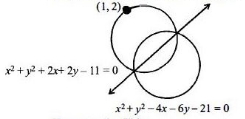
0 likesView Solution
19
MathematicsDifficultMCQAIEEE · 2012
The frequency distribution of daily working expenditure of families in a locality is as follows:
If the mode of the distribution is $Rs. 140$,then the value of $b$ is:
| Expenditure in $Rs. (x)$ | $0-50$ | $50-100$ | $100-150$ | $150-200$ | $200-250$ |
| No. of families $(f)$ | $24$ | $33$ | $37$ | $b$ | $25$ |
If the mode of the distribution is $Rs. 140$,then the value of $b$ is:
A
$34$
B
$31$
C
$26$
D
$36$
Solution
(D) The modal class is the class interval with the highest frequency. Since the mode is $140$,which lies in the interval $100-150$,the modal class is $100-150$.
The formula for mode is:
$Mode = L + \left( \frac{f_1 - f_0}{2f_1 - f_0 - f_2} \right) \times h$
Where:
$L = 100$ (lower limit of modal class)
$f_1 = 37$ (frequency of modal class)
$f_0 = 33$ (frequency of class preceding modal class)
$f_2 = b$ (frequency of class succeeding modal class)
$h = 50$ (class size)
Substituting the values:
$140 = 100 + \left( \frac{37 - 33}{2(37) - 33 - b} \right) \times 50$
$40 = \left( \frac{4}{74 - 33 - b} \right) \times 50$
$40 = \frac{200}{41 - b}$
$40(41 - b) = 200$
$41 - b = 5$
$b = 41 - 5 = 36$
The formula for mode is:
$Mode = L + \left( \frac{f_1 - f_0}{2f_1 - f_0 - f_2} \right) \times h$
Where:
$L = 100$ (lower limit of modal class)
$f_1 = 37$ (frequency of modal class)
$f_0 = 33$ (frequency of class preceding modal class)
$f_2 = b$ (frequency of class succeeding modal class)
$h = 50$ (class size)
Substituting the values:
$140 = 100 + \left( \frac{37 - 33}{2(37) - 33 - b} \right) \times 50$
$40 = \left( \frac{4}{74 - 33 - b} \right) \times 50$
$40 = \frac{200}{41 - b}$
$40(41 - b) = 200$
$41 - b = 5$
$b = 41 - 5 = 36$
0 likesView Solution
20
MathematicsDifficultMCQAIEEE · 2012
The sum of the series $1^2 + 2(2^2) + 3^2 + 2(4^2) + 5^2 + 2(6^2) + \dots + 2(2m)^2$ is
A
$m(2m+1)^2$
B
$m^2(2m+1)$
C
$m(2m+1)(2m+2)$
D
$m(2m+1)^2$
Solution
(A) The given series is $S = (1^2 + 3^2 + 5^2 + \dots + (2m-1)^2) + 2(2^2 + 4^2 + 6^2 + \dots + (2m)^2)$.
Sum of odd squares up to $(2m-1)^2$ is $\sum_{k=1}^{m} (2k-1)^2 = \frac{m(2m-1)(2m+1)}{3}$.
Sum of even squares up to $(2m)^2$ is $2 \times \sum_{k=1}^{m} (2k)^2 = 8 \sum_{k=1}^{m} k^2 = 8 \times \frac{m(m+1)(2m+1)}{6} = \frac{4m(m+1)(2m+1)}{3}$.
Adding these,$S = \frac{m(2m+1)}{3} [ (2m-1) + 4(m+1) ] = \frac{m(2m+1)}{3} [ 2m - 1 + 4m + 4 ] = \frac{m(2m+1)(6m+3)}{3} = m(2m+1)(2m+1) = m(2m+1)^2$.
Sum of odd squares up to $(2m-1)^2$ is $\sum_{k=1}^{m} (2k-1)^2 = \frac{m(2m-1)(2m+1)}{3}$.
Sum of even squares up to $(2m)^2$ is $2 \times \sum_{k=1}^{m} (2k)^2 = 8 \sum_{k=1}^{m} k^2 = 8 \times \frac{m(m+1)(2m+1)}{6} = \frac{4m(m+1)(2m+1)}{3}$.
Adding these,$S = \frac{m(2m+1)}{3} [ (2m-1) + 4(m+1) ] = \frac{m(2m+1)}{3} [ 2m - 1 + 4m + 4 ] = \frac{m(2m+1)(6m+3)}{3} = m(2m+1)(2m+1) = m(2m+1)^2$.
0 likesView Solution
21
MathematicsDifficultMCQAIEEE · 2012
The point of intersection of the lines $(a^3 + 3)x + ay + a - 3 = 0$ and $(a^5 + 2)x + (a + 2)y + 2a + 3 = 0$ (where $a$ is a real number) lies on the $y$-axis for:
A
no value of $a$
B
more than two values of $a$
C
exactly one value of $a$
D
exactly two values of $a$
0 likesView Solution
22
MathematicsDifficultMCQAIEEE · 2012
If two vertical poles of heights $20\,m$ and $80\,m$ stand apart on a horizontal plane,then the height (in $m$) of the point of intersection of the lines joining the top of each pole to the foot of the other is:
A
$16$
B
$18$
C
$50$
D
$15$
Solution
(A) Let the two poles be $OA$ and $BC$ standing on a horizontal plane $OB$. Let $OA = 20\,m$ and $BC = 80\,m$. Let the distance between them be $OB = a$.
We set the coordinates as $O(0, 0)$,$A(0, 20)$,$B(a, 0)$,and $C(a, 80)$.
The line joining the top of the first pole $A(0, 20)$ to the foot of the second pole $B(a, 0)$ has the equation:
$y - 0 = \frac{20 - 0}{0 - a}(x - a) \Rightarrow y = -\frac{20}{a}(x - a) \quad \dots(1)$
The line joining the top of the second pole $C(a, 80)$ to the foot of the first pole $O(0, 0)$ has the equation:
$y - 0 = \frac{80 - 0}{a - 0}(x - 0) \Rightarrow y = \frac{80}{a}x \quad \dots(2)$
To find the intersection point $M$,we equate $(1)$ and $(2)$:
$\frac{80}{a}x = -\frac{20}{a}(x - a)$
$80x = -20x + 20a$
$100x = 20a \Rightarrow x = \frac{a}{5}$
Substituting $x = \frac{a}{5}$ into $(2)$:
$y = \frac{80}{a} \times \frac{a}{5} = 16\,m$.
Thus,the height of the point of intersection is $16\,m$.
We set the coordinates as $O(0, 0)$,$A(0, 20)$,$B(a, 0)$,and $C(a, 80)$.
The line joining the top of the first pole $A(0, 20)$ to the foot of the second pole $B(a, 0)$ has the equation:
$y - 0 = \frac{20 - 0}{0 - a}(x - a) \Rightarrow y = -\frac{20}{a}(x - a) \quad \dots(1)$
The line joining the top of the second pole $C(a, 80)$ to the foot of the first pole $O(0, 0)$ has the equation:
$y - 0 = \frac{80 - 0}{a - 0}(x - 0) \Rightarrow y = \frac{80}{a}x \quad \dots(2)$
To find the intersection point $M$,we equate $(1)$ and $(2)$:
$\frac{80}{a}x = -\frac{20}{a}(x - a)$
$80x = -20x + 20a$
$100x = 20a \Rightarrow x = \frac{a}{5}$
Substituting $x = \frac{a}{5}$ into $(2)$:
$y = \frac{80}{a} \times \frac{a}{5} = 16\,m$.
Thus,the height of the point of intersection is $16\,m$.
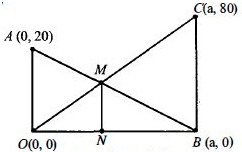
0 likesView Solution
23
MathematicsDifficultMCQAIEEE · 2012
Statement $1$: $y = mx - \frac{1}{m}$ is always a tangent to the parabola $y^2 = -4x$ for all non-zero values of $m$.
Statement $2$: Every tangent to the parabola $y^2 = -4x$ will meet its axis at a point whose abscissa is non-negative.
Statement $2$: Every tangent to the parabola $y^2 = -4x$ will meet its axis at a point whose abscissa is non-negative.
A
Statement $1$ is true,Statement $2$ is true; Statement $2$ is a correct explanation of Statement $1$.
B
Statement $1$ is false,Statement $2$ is true.
C
Statement $1$ is true,Statement $2$ is false.
D
Statement $1$ is true,Statement $2$ is true,Statement $2$ is not a correct explanation of Statement $1$.
Solution
(D) For the parabola $y^2 = -4ax$,the equation of the tangent with slope $m$ is $y = mx + \frac{a}{m}$.
Here,$4a = 4$,so $a = 1$. The parabola is $y^2 = -4x$,so it opens to the left. The standard form is $y^2 = -4ax$ with $a=1$.
The tangent equation is $y = mx - \frac{1}{m}$. Thus,Statement $1$ is true.
For the tangent $y = mx - \frac{1}{m}$,the intersection with the axis $(y=0)$ is $0 = mx - \frac{1}{m}$,which gives $x = \frac{1}{m^2}$.
Since $m^2 > 0$ for all $m \neq 0$,$x = \frac{1}{m^2} > 0$. Thus,the abscissa is always positive (non-negative). Statement $2$ is true.
Statement $2$ describes a property of the tangent,but it is not the logical derivation or explanation for the specific form of the tangent equation given in Statement $1$. Therefore,Statement $2$ is not the correct explanation for Statement $1$.
Here,$4a = 4$,so $a = 1$. The parabola is $y^2 = -4x$,so it opens to the left. The standard form is $y^2 = -4ax$ with $a=1$.
The tangent equation is $y = mx - \frac{1}{m}$. Thus,Statement $1$ is true.
For the tangent $y = mx - \frac{1}{m}$,the intersection with the axis $(y=0)$ is $0 = mx - \frac{1}{m}$,which gives $x = \frac{1}{m^2}$.
Since $m^2 > 0$ for all $m \neq 0$,$x = \frac{1}{m^2} > 0$. Thus,the abscissa is always positive (non-negative). Statement $2$ is true.
Statement $2$ describes a property of the tangent,but it is not the logical derivation or explanation for the specific form of the tangent equation given in Statement $1$. Therefore,Statement $2$ is not the correct explanation for Statement $1$.
0 likesView Solution
24
MathematicsDifficultMCQAIEEE · 2012
Let $Z_1$ and $Z_2$ be any two complex numbers.
Statement $1: |Z_1 - Z_2| \ge |Z_1| - |Z_2|$
Statement $2: |Z_1 + Z_2| \le |Z_1| + |Z_2|$
Statement $1: |Z_1 - Z_2| \ge |Z_1| - |Z_2|$
Statement $2: |Z_1 + Z_2| \le |Z_1| + |Z_2|$
A
Statement $1$ is true,Statement $2$ is true,Statement $2$ is a correct explanation of Statement $1$.
B
Statement $1$ is true,Statement $2$ is true,Statement $2$ is not a correct explanation of Statement $1$.
C
Statement $1$ is true,Statement $2$ is false.
D
Statement $1$ is false,Statement $2$ is true.
Solution
(B) Statement $1$ is the triangle inequality for subtraction,which states $|Z_1 - Z_2| \ge ||Z_1| - |Z_2||$,and since $||Z_1| - |Z_2|| \ge |Z_1| - |Z_2|$,Statement $1$ is true.
Statement $2$ is the standard triangle inequality for addition,which is also a fundamental property of complex numbers and is true.
However,Statement $2$ does not explain Statement $1$ as they are independent properties of the modulus of complex numbers.
Statement $2$ is the standard triangle inequality for addition,which is also a fundamental property of complex numbers and is true.
However,Statement $2$ does not explain Statement $1$ as they are independent properties of the modulus of complex numbers.
0 likesView Solution
25
MathematicsDifficultMCQAIEEE · 2012
If $f(y) = 1 - (y - 1) + (y - 1)^2 - (y - 1)^3 + \dots - (y - 1)^{17}$,then the coefficient of $y^2$ in it is
A
$^{17}C_2$
B
$^{17}C_3$
C
$^{18}C_2$
D
$^{18}C_3$
Solution
(D) The given expression is a finite geometric series with first term $a = 1$, common ratio $r = -(y - 1)$, and $n = 18$ terms.
The sum is given by $f(y) = \frac{1 - (-(y - 1))^{18}}{1 - (-(y - 1))} = \frac{1 - (y - 1)^{18}}{y}$.
Thus, $f(y) = \frac{1}{y} - \frac{(y - 1)^{18}}{y}$.
Expanding $(y - 1)^{18}$ using the binomial theorem: $(y - 1)^{18} = \sum_{k=0}^{18} {^{18}C_k} y^k (-1)^{18-k}$.
Therefore, $\frac{(y - 1)^{18}}{y} = \sum_{k=0}^{18} {^{18}C_k} y^{k-1} (-1)^{18-k}$.
To find the coefficient of $y^2$, we set $k - 1 = 2$, which gives $k = 3$.
The term for $k = 3$ is ${^{18}C_3} y^2 (-1)^{18-3} = -{^{18}C_3} y^2$.
Since $f(y) = \frac{1}{y} - \sum_{k=0}^{18} {^{18}C_k} y^{k-1} (-1)^{18-k}$, the coefficient of $y^2$ is $-(-{^{18}C_3}) = {^{18}C_3}$.
The sum is given by $f(y) = \frac{1 - (-(y - 1))^{18}}{1 - (-(y - 1))} = \frac{1 - (y - 1)^{18}}{y}$.
Thus, $f(y) = \frac{1}{y} - \frac{(y - 1)^{18}}{y}$.
Expanding $(y - 1)^{18}$ using the binomial theorem: $(y - 1)^{18} = \sum_{k=0}^{18} {^{18}C_k} y^k (-1)^{18-k}$.
Therefore, $\frac{(y - 1)^{18}}{y} = \sum_{k=0}^{18} {^{18}C_k} y^{k-1} (-1)^{18-k}$.
To find the coefficient of $y^2$, we set $k - 1 = 2$, which gives $k = 3$.
The term for $k = 3$ is ${^{18}C_3} y^2 (-1)^{18-3} = -{^{18}C_3} y^2$.
Since $f(y) = \frac{1}{y} - \sum_{k=0}^{18} {^{18}C_k} y^{k-1} (-1)^{18-k}$, the coefficient of $y^2$ is $-(-{^{18}C_3}) = {^{18}C_3}$.
0 likesView Solution
26
MathematicsDifficultMCQAIEEE · 2012
$\mathop {\lim }\limits_{x \to 0} \,\left( {\frac{{x - \sin x}}{x}} \right)\,\sin \left( {\frac{1}{x}} \right)$
A
equals $1$
B
equals $0$
C
does not exist
D
equals $-1$
Solution
(B) Let $L = \mathop {\lim }\limits_{x \to 0} \left( {\frac{{x - \sin x}}{x}} \right)\sin \left( {\frac{1}{x}} \right)$.
We can rewrite the expression as:
$L = \mathop {\lim }\limits_{x \to 0} \left( {1 - \frac{\sin x}{x}} \right) \sin \left( {\frac{1}{x}} \right)$.
We know that $\mathop {\lim }\limits_{x \to 0} \frac{\sin x}{x} = 1$,so $\mathop {\lim }\limits_{x \to 0} \left( {1 - \frac{\sin x}{x}} \right) = 1 - 1 = 0$.
The term $\sin \left( {\frac{1}{x}} \right)$ oscillates between $-1$ and $1$ as $x \to 0$,meaning it is a bounded function.
By the Squeeze Theorem,since the limit of the first part is $0$ and the second part is bounded,the product is $0 \times (\text{bounded value}) = 0$.
Therefore,the limit is $0$.
We can rewrite the expression as:
$L = \mathop {\lim }\limits_{x \to 0} \left( {1 - \frac{\sin x}{x}} \right) \sin \left( {\frac{1}{x}} \right)$.
We know that $\mathop {\lim }\limits_{x \to 0} \frac{\sin x}{x} = 1$,so $\mathop {\lim }\limits_{x \to 0} \left( {1 - \frac{\sin x}{x}} \right) = 1 - 1 = 0$.
The term $\sin \left( {\frac{1}{x}} \right)$ oscillates between $-1$ and $1$ as $x \to 0$,meaning it is a bounded function.
By the Squeeze Theorem,since the limit of the first part is $0$ and the second part is bounded,the product is $0 \times (\text{bounded value}) = 0$.
Therefore,the limit is $0$.
0 likesView Solution
27
MathematicsDifficultMCQAIEEE · 2012
The statement that is $TRUE$ among the following is:
A
The contrapositive of $3x + 2 = 8 \Rightarrow x = 2$ is $x \neq 2 \Rightarrow 3x + 2 \neq 8$.
B
The converse of $\tan x = 0 \Rightarrow x = 0$ is $x \neq 0 \Rightarrow \tan x = 0$.
C
$p \Rightarrow q$ is equivalent to $p \vee \sim q$.
D
$p \vee q$ and $p \wedge q$ have the same truth table.
Solution
(A) For option $(A)$: The contrapositive of $p \Rightarrow q$ is $\sim q \Rightarrow \sim p$. Here $p$ is $3x + 2 = 8$ and $q$ is $x = 2$. Thus,$\sim q \Rightarrow \sim p$ is $x \neq 2 \Rightarrow 3x + 2 \neq 8$. This is true.
For option $(B)$: The converse of $p \Rightarrow q$ is $q \Rightarrow p$. The converse of $\tan x = 0 \Rightarrow x = 0$ is $x = 0 \Rightarrow \tan x = 0$. Thus,$(B)$ is false.
For option $(C)$: $p \Rightarrow q$ is equivalent to $\sim p \vee q$,not $p \vee \sim q$. Thus,$(C)$ is false.
For option $(D)$: $p \vee q$ (disjunction) and $p \wedge q$ (conjunction) have different truth tables. Thus,$(D)$ is false.
For option $(B)$: The converse of $p \Rightarrow q$ is $q \Rightarrow p$. The converse of $\tan x = 0 \Rightarrow x = 0$ is $x = 0 \Rightarrow \tan x = 0$. Thus,$(B)$ is false.
For option $(C)$: $p \Rightarrow q$ is equivalent to $\sim p \vee q$,not $p \vee \sim q$. Thus,$(C)$ is false.
For option $(D)$: $p \vee q$ (disjunction) and $p \wedge q$ (conjunction) have different truth tables. Thus,$(D)$ is false.
0 likesView Solution
28
MathematicsDifficultMCQAIEEE · 2012
If $a, b, c, d$ and $p$ are distinct real numbers such that $(a^2 + b^2 + c^2)p^2 - 2p(ab + bc + cd) + (b^2 + c^2 + d^2) \le 0$,then
A
$a, b, c, d$ are in $A.P.$
B
$ab = cd$
C
$ac = bd$
D
$a, b, c, d$ are in $G.P.$
Solution
(D) The given inequality is $(a^2 + b^2 + c^2)p^2 - 2p(ab + bc + cd) + (b^2 + c^2 + d^2) \le 0$.
This can be rearranged as:
$(a^2p^2 - 2abp + b^2) + (b^2p^2 - 2bpc + c^2) + (c^2p^2 - 2pcd + d^2) \le 0$.
This simplifies to:
$(ap - b)^2 + (bp - c)^2 + (cp - d)^2 \le 0$.
Since the sum of squares of real numbers is non-negative,the only way for the sum to be $\le 0$ is if each term is exactly zero:
$ap - b = 0$,$bp - c = 0$,and $cp - d = 0$.
This implies $p = \frac{b}{a} = \frac{c}{b} = \frac{d}{c}$.
Therefore,$a, b, c, d$ are in $G.P.$
This can be rearranged as:
$(a^2p^2 - 2abp + b^2) + (b^2p^2 - 2bpc + c^2) + (c^2p^2 - 2pcd + d^2) \le 0$.
This simplifies to:
$(ap - b)^2 + (bp - c)^2 + (cp - d)^2 \le 0$.
Since the sum of squares of real numbers is non-negative,the only way for the sum to be $\le 0$ is if each term is exactly zero:
$ap - b = 0$,$bp - c = 0$,and $cp - d = 0$.
This implies $p = \frac{b}{a} = \frac{c}{b} = \frac{d}{c}$.
Therefore,$a, b, c, d$ are in $G.P.$
0 likesView Solution
29
MathematicsDifficultMCQAIEEE · 2012
The area of the triangle formed by the lines joining the vertex of the parabola,$x^2 = 8y$,to the extremities of its latus rectum is
A
$2$
B
$8$
C
$1$
D
$4$
Solution
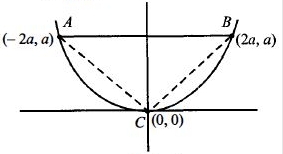
(B) The given equation of the parabola is $x^2 = 8y$.
Comparing this with the standard form $x^2 = 4ay$,we get $4a = 8$,which implies $a = 2$.
The vertex of the parabola is $C = (0, 0)$.
The extremities of the latus rectum are $A = (-2a, a) = (-4, 2)$ and $B = (2a, a) = (4, 2)$.
We need to find the area of the triangle formed by the vertices $A(-4, 2)$,$B(4, 2)$,and $C(0, 0)$.
The area of a triangle with vertices $(x_1, y_1)$,$(x_2, y_2)$,and $(x_3, y_3)$ is given by $\frac{1}{2} |x_1(y_2 - y_3) + x_2(y_3 - y_1) + x_3(y_1 - y_2)|$.
Substituting the coordinates: Area $= \frac{1}{2} |-4(2 - 0) + 4(0 - 2) + 0(2 - 2)|$.
Area $= \frac{1}{2} |-4(2) + 4(-2) + 0| = \frac{1}{2} |-8 - 8| = \frac{1}{2} |-16| = 8$.
Thus,the area of the triangle is $8$ square units.
Comparing this with the standard form $x^2 = 4ay$,we get $4a = 8$,which implies $a = 2$.
The vertex of the parabola is $C = (0, 0)$.
The extremities of the latus rectum are $A = (-2a, a) = (-4, 2)$ and $B = (2a, a) = (4, 2)$.
We need to find the area of the triangle formed by the vertices $A(-4, 2)$,$B(4, 2)$,and $C(0, 0)$.
The area of a triangle with vertices $(x_1, y_1)$,$(x_2, y_2)$,and $(x_3, y_3)$ is given by $\frac{1}{2} |x_1(y_2 - y_3) + x_2(y_3 - y_1) + x_3(y_1 - y_2)|$.
Substituting the coordinates: Area $= \frac{1}{2} |-4(2 - 0) + 4(0 - 2) + 0(2 - 2)|$.
Area $= \frac{1}{2} |-4(2) + 4(-2) + 0| = \frac{1}{2} |-8 - 8| = \frac{1}{2} |-16| = 8$.
Thus,the area of the triangle is $8$ square units.
0 likesView Solution
30
MathematicsDifficultMCQAIEEE · 2012
If in a triangle $ABC$,$\frac{b + c}{11} = \frac{c + a}{12} = \frac{a + b}{13}$,then $\cos A$ is equal to
A
$5/7$
B
$1/5$
C
$35/19$
D
$19/35$
Solution
(B) Let $\frac{b+c}{11}=\frac{c+a}{12}=\frac{a+b}{13}=K$ in a triangle $ABC$.
$\Rightarrow b+c=11K, c+a=12K, a+b=13K$.
Adding these equations: $2(a+b+c) = 36K \Rightarrow a+b+c = 18K$.
Subtracting each equation from the sum:
$a = (a+b+c) - (b+c) = 18K - 11K = 7K$.
$b = (a+b+c) - (c+a) = 18K - 12K = 6K$.
$c = (a+b+c) - (a+b) = 18K - 13K = 5K$.
Using the cosine rule:
$\cos A = \frac{b^2 + c^2 - a^2}{2bc}$.
Substituting the values:
$\cos A = \frac{(6K)^2 + (5K)^2 - (7K)^2}{2(6K)(5K)} = \frac{36K^2 + 25K^2 - 49K^2}{60K^2} = \frac{12K^2}{60K^2} = \frac{1}{5}$.
$\Rightarrow b+c=11K, c+a=12K, a+b=13K$.
Adding these equations: $2(a+b+c) = 36K \Rightarrow a+b+c = 18K$.
Subtracting each equation from the sum:
$a = (a+b+c) - (b+c) = 18K - 11K = 7K$.
$b = (a+b+c) - (c+a) = 18K - 12K = 6K$.
$c = (a+b+c) - (a+b) = 18K - 13K = 5K$.
Using the cosine rule:
$\cos A = \frac{b^2 + c^2 - a^2}{2bc}$.
Substituting the values:
$\cos A = \frac{(6K)^2 + (5K)^2 - (7K)^2}{2(6K)(5K)} = \frac{36K^2 + 25K^2 - 49K^2}{60K^2} = \frac{12K^2}{60K^2} = \frac{1}{5}$.
0 likesView Solution
31
MathematicsDifficultMCQAIEEE · 2012
Statement $1$ : If $A$ and $B$ are two sets having $p$ and $q$ elements respectively,where $q > p$. Then the total number of functions from set $A$ to set $B$ is $q^p$.
Statement $2$ : The total number of selections of $p$ different objects out of $q$ objects is ${}^qC_p$.
Statement $2$ : The total number of selections of $p$ different objects out of $q$ objects is ${}^qC_p$.
A
Statement $1$ is true,Statement $2$ is false.
B
Statement $1$ is true,Statement $2$ is true,Statement $2$ is not a correct explanation of Statement $1$.
C
Statement $1$ is false,Statement $2$ is true.
D
Statement $1$ is true,Statement $2$ is true,Statement $2$ is a correct explanation of Statement $1$.
Solution
(B) Statement-$1$: The number of functions from a set $A$ with $n(A) = p$ elements to a set $B$ with $n(B) = q$ elements is given by $q^p$. This is a standard result in set theory. Thus,Statement-$1$ is true.
Statement-$2$: The number of ways to select $p$ objects from $q$ distinct objects is given by the combination formula ${}^qC_p = \frac{q!}{p!(q-p)!}$. This is a true statement.
However,Statement-$2$ describes the number of combinations,which is a fundamental counting principle,but it does not explain why the number of functions from $A$ to $B$ is $q^p$. The number of functions is derived from the fact that each of the $p$ elements in $A$ has $q$ choices in $B$. Therefore,Statement-$2$ is not the correct explanation for Statement-$1$.
Statement-$2$: The number of ways to select $p$ objects from $q$ distinct objects is given by the combination formula ${}^qC_p = \frac{q!}{p!(q-p)!}$. This is a true statement.
However,Statement-$2$ describes the number of combinations,which is a fundamental counting principle,but it does not explain why the number of functions from $A$ to $B$ is $q^p$. The number of functions is derived from the fact that each of the $p$ elements in $A$ has $q$ choices in $B$. Therefore,Statement-$2$ is not the correct explanation for Statement-$1$.
0 likesView Solution
32
MathematicsDifficultMCQAIEEE · 2012
The number of terms in the expansion of $(y^{1/5} + x^{1/10})^{55}$,in which powers of $x$ and $y$ are free from radical signs are
A
$6$
B
$12$
C
$7$
D
$5$
Solution
(A) The general term of the expansion $(y^{1/5} + x^{1/10})^{55}$ is given by:
$T_{r+1} = ^{55}C_{r} (y^{1/5})^{55-r} (x^{1/10})^{r}$
$T_{r+1} = ^{55}C_{r} y^{\frac{55-r}{5}} x^{\frac{r}{10}}$
For the powers of $x$ and $y$ to be free from radical signs,the exponents $\frac{55-r}{5}$ and $\frac{r}{10}$ must be integers.
$\frac{55-r}{5} = 11 - \frac{r}{5}$ must be an integer,which implies $r$ must be a multiple of $5$.
$\frac{r}{10}$ must be an integer,which implies $r$ must be a multiple of $10$.
Combining these,$r$ must be a multiple of $10$ where $0 \le r \le 55$.
Possible values for $r$ are $0, 10, 20, 30, 40, 50$.
There are $6$ such values of $r$,so there are $6$ terms in the expansion that are free from radical signs.
$T_{r+1} = ^{55}C_{r} (y^{1/5})^{55-r} (x^{1/10})^{r}$
$T_{r+1} = ^{55}C_{r} y^{\frac{55-r}{5}} x^{\frac{r}{10}}$
For the powers of $x$ and $y$ to be free from radical signs,the exponents $\frac{55-r}{5}$ and $\frac{r}{10}$ must be integers.
$\frac{55-r}{5} = 11 - \frac{r}{5}$ must be an integer,which implies $r$ must be a multiple of $5$.
$\frac{r}{10}$ must be an integer,which implies $r$ must be a multiple of $10$.
Combining these,$r$ must be a multiple of $10$ where $0 \le r \le 55$.
Possible values for $r$ are $0, 10, 20, 30, 40, 50$.
There are $6$ such values of $r$,so there are $6$ terms in the expansion that are free from radical signs.
0 likesView Solution
33
MathematicsDifficultMCQAIEEE · 2012
If the point $(1, a)$ lies between the straight lines $x + y = 1$ and $2(x + y) = 3$,then $a$ lies in the interval
A
$\left( \frac{3}{2}, \infty \right)$
B
$\left( 1, \frac{3}{2} \right)$
C
$\left( -\infty, 0 \right)$
D
$\left( 0, \frac{1}{2} \right)$
Solution
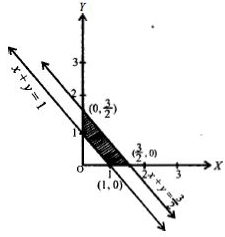
(D) The given lines are $L_1: x + y - 1 = 0$ and $L_2: 2x + 2y - 3 = 0$.
For a point $(1, a)$ to lie between these two parallel lines,the expressions $L_1(1, a)$ and $L_2(1, a)$ must have opposite signs.
Let $f(x, y) = x + y - 1$ and $g(x, y) = 2x + 2y - 3$.
Substituting $(1, a)$ into the equations:
$f(1, a) = 1 + a - 1 = a$
$g(1, a) = 2(1) + 2a - 3 = 2a - 1$
Since the point lies between the lines,$f(1, a) \cdot g(1, a) < 0$.
Therefore,$a(2a - 1) < 0$.
This inequality holds when $a$ is between the roots of $a(2a - 1) = 0$,which are $a = 0$ and $a = 1/2$.
Thus,$a \in \left( 0, \frac{1}{2} \right)$.
For a point $(1, a)$ to lie between these two parallel lines,the expressions $L_1(1, a)$ and $L_2(1, a)$ must have opposite signs.
Let $f(x, y) = x + y - 1$ and $g(x, y) = 2x + 2y - 3$.
Substituting $(1, a)$ into the equations:
$f(1, a) = 1 + a - 1 = a$
$g(1, a) = 2(1) + 2a - 3 = 2a - 1$
Since the point lies between the lines,$f(1, a) \cdot g(1, a) < 0$.
Therefore,$a(2a - 1) < 0$.
This inequality holds when $a$ is between the roots of $a(2a - 1) = 0$,which are $a = 0$ and $a = 1/2$.
Thus,$a \in \left( 0, \frac{1}{2} \right)$.
0 likesView Solution
34
MathematicsMediumMCQAIEEE · 2012
If two vertices of a triangle are $(5, -1)$ and $(-2, 3)$ and its orthocentre is at $(0, 0)$,then the third vertex is:
A
$(4, -7)$
B
$(-4, -7)$
C
$(-4, 7)$
D
$(4, 7)$
Solution
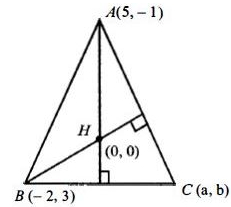
(B) Let the third vertex of $\Delta ABC$ be $C(a, b)$.
Let $A(5, -1)$ and $B(-2, 3)$ be the other two vertices.
The orthocentre $H$ is at $(0, 0)$.
Since $AH \perp BC$,the product of their slopes is $-1$:
$\left( \frac{-1 - 0}{5 - 0} \right) \times \left( \frac{b - 3}{a - (-2)} \right) = -1$
$\Rightarrow \left( \frac{-1}{5} \right) \times \left( \frac{b - 3}{a + 2} \right) = -1$
$\Rightarrow b - 3 = 5(a + 2)$ $\Rightarrow b - 3 = 5a + 10$ $\Rightarrow 5a - b + 13 = 0 \dots (1)$
Similarly,since $BH \perp AC$,the product of their slopes is $-1$:
$\left( \frac{3 - 0}{-2 - 0} \right) \times \left( \frac{b - (-1)}{a - 5} \right) = -1$
$\Rightarrow \left( \frac{3}{-2} \right) \times \left( \frac{b + 1}{a - 5} \right) = -1$
$\Rightarrow 3(b + 1) = 2(a - 5)$ $\Rightarrow 3b + 3 = 2a - 10$ $\Rightarrow 2a - 3b - 13 = 0 \dots (2)$
Multiplying equation $(1)$ by $3$:
$15a - 3b + 39 = 0 \dots (3)$
Subtracting equation $(2)$ from $(3)$:
$(15a - 2a) + (-3b - (-3b)) + (39 - (-13)) = 0$
$13a + 52 = 0 \Rightarrow a = -4$
Substituting $a = -4$ into equation $(1)$:
$5(-4) - b + 13 = 0$ $\Rightarrow -20 - b + 13 = 0$ $\Rightarrow b = -7$
Thus,the third vertex is $(-4, -7)$.
Let $A(5, -1)$ and $B(-2, 3)$ be the other two vertices.
The orthocentre $H$ is at $(0, 0)$.
Since $AH \perp BC$,the product of their slopes is $-1$:
$\left( \frac{-1 - 0}{5 - 0} \right) \times \left( \frac{b - 3}{a - (-2)} \right) = -1$
$\Rightarrow \left( \frac{-1}{5} \right) \times \left( \frac{b - 3}{a + 2} \right) = -1$
$\Rightarrow b - 3 = 5(a + 2)$ $\Rightarrow b - 3 = 5a + 10$ $\Rightarrow 5a - b + 13 = 0 \dots (1)$
Similarly,since $BH \perp AC$,the product of their slopes is $-1$:
$\left( \frac{3 - 0}{-2 - 0} \right) \times \left( \frac{b - (-1)}{a - 5} \right) = -1$
$\Rightarrow \left( \frac{3}{-2} \right) \times \left( \frac{b + 1}{a - 5} \right) = -1$
$\Rightarrow 3(b + 1) = 2(a - 5)$ $\Rightarrow 3b + 3 = 2a - 10$ $\Rightarrow 2a - 3b - 13 = 0 \dots (2)$
Multiplying equation $(1)$ by $3$:
$15a - 3b + 39 = 0 \dots (3)$
Subtracting equation $(2)$ from $(3)$:
$(15a - 2a) + (-3b - (-3b)) + (39 - (-13)) = 0$
$13a + 52 = 0 \Rightarrow a = -4$
Substituting $a = -4$ into equation $(1)$:
$5(-4) - b + 13 = 0$ $\Rightarrow -20 - b + 13 = 0$ $\Rightarrow b = -7$
Thus,the third vertex is $(-4, -7)$.
0 likesView Solution
35
MathematicsDifficultMCQAIEEE · 2012
The sum of the series $\frac{1}{1 + \sqrt{2}} + \frac{1}{\sqrt{2} + \sqrt{3}} + \frac{1}{\sqrt{3} + \sqrt{4}} + \dots$ up to $15$ terms is
A
$1$
B
$2$
C
$3$
D
$4$
Solution
(C) The $n^{th}$ term of the series is $T_n = \frac{1}{\sqrt{n} + \sqrt{n+1}}$.
Rationalizing the denominator,we get:
$T_n = \frac{\sqrt{n+1} - \sqrt{n}}{(\sqrt{n+1} + \sqrt{n})(\sqrt{n+1} - \sqrt{n})} = \frac{\sqrt{n+1} - \sqrt{n}}{(n+1) - n} = \sqrt{n+1} - \sqrt{n}$.
For $n=1$ to $15$,the sum $S_{15} = \sum_{n=1}^{15} (\sqrt{n+1} - \sqrt{n})$.
$S_{15} = (\sqrt{2} - \sqrt{1}) + (\sqrt{3} - \sqrt{2}) + (\sqrt{4} - \sqrt{3}) + \dots + (\sqrt{16} - \sqrt{15})$.
This is a telescoping series where intermediate terms cancel out.
$S_{15} = \sqrt{16} - \sqrt{1} = 4 - 1 = 3$.
Rationalizing the denominator,we get:
$T_n = \frac{\sqrt{n+1} - \sqrt{n}}{(\sqrt{n+1} + \sqrt{n})(\sqrt{n+1} - \sqrt{n})} = \frac{\sqrt{n+1} - \sqrt{n}}{(n+1) - n} = \sqrt{n+1} - \sqrt{n}$.
For $n=1$ to $15$,the sum $S_{15} = \sum_{n=1}^{15} (\sqrt{n+1} - \sqrt{n})$.
$S_{15} = (\sqrt{2} - \sqrt{1}) + (\sqrt{3} - \sqrt{2}) + (\sqrt{4} - \sqrt{3}) + \dots + (\sqrt{16} - \sqrt{15})$.
This is a telescoping series where intermediate terms cancel out.
$S_{15} = \sqrt{16} - \sqrt{1} = 4 - 1 = 3$.
0 likesView Solution
36
MathematicsMediumMCQAIEEE · 2012
If the mean of $4, 7, 2, 8, 6$ and $a$ is $7$,then the mean deviation from the median of these observations is
A
$8$
B
$5$
C
$1$
D
$3$
Solution
(D) Given observations are $4, 7, 2, 8, 6, a$ and the mean is $7$.
We know that Mean $= \frac{4 + 7 + 2 + 8 + 6 + a}{6}$.
$7 = \frac{27 + a}{6}$ $\Rightarrow 42 = 27 + a$ $\Rightarrow a = 15$.
Now,the observations in ascending order are $2, 4, 6, 7, 8, 15$.
Since the number of observations $n = 6$ (even),the median is the average of the $3^{rd}$ and $4^{th}$ observations.
Median $= \frac{6 + 7}{2} = 6.5$.
Mean deviation from median $= \frac{\sum |x_i - 6.5|}{6}$.
$= \frac{|2 - 6.5| + |4 - 6.5| + |6 - 6.5| + |7 - 6.5| + |8 - 6.5| + |15 - 6.5|}{6}$.
$= \frac{4.5 + 2.5 + 0.5 + 0.5 + 1.5 + 8.5}{6} = \frac{18}{6} = 3$.
We know that Mean $= \frac{4 + 7 + 2 + 8 + 6 + a}{6}$.
$7 = \frac{27 + a}{6}$ $\Rightarrow 42 = 27 + a$ $\Rightarrow a = 15$.
Now,the observations in ascending order are $2, 4, 6, 7, 8, 15$.
Since the number of observations $n = 6$ (even),the median is the average of the $3^{rd}$ and $4^{th}$ observations.
Median $= \frac{6 + 7}{2} = 6.5$.
Mean deviation from median $= \frac{\sum |x_i - 6.5|}{6}$.
$= \frac{|2 - 6.5| + |4 - 6.5| + |6 - 6.5| + |7 - 6.5| + |8 - 6.5| + |15 - 6.5|}{6}$.
$= \frac{4.5 + 2.5 + 0.5 + 0.5 + 1.5 + 8.5}{6} = \frac{18}{6} = 3$.
0 likesView Solution
37
MathematicsDifficultMCQAIEEE · 2012
The area of the triangle whose vertices are complex numbers $z, iz, z + iz$ in the Argand diagram is
A
$2|z|^2$
B
$1/2|z|^2$
C
$4|z|^2$
D
$|z|^2$
Solution
(B) Let $z = x + iy$. Then the vertices are $z = (x, y)$,$iz = i(x + iy) = -y + ix = (-y, x)$,and $z + iz = (x - y) + i(x + y) = (x - y, x + y)$.
The area of a triangle with vertices $(x_1, y_1), (x_2, y_2), (x_3, y_3)$ is given by $\frac{1}{2} |x_1(y_2 - y_3) + x_2(y_3 - y_1) + x_3(y_1 - y_2)|$.
Substituting the coordinates:
Area $= \frac{1}{2} |x(x - (x + y)) + (-y)((x + y) - y) + (x - y)(y - x)|$
$= \frac{1}{2} |x(-y) - y(x) + (x - y)(-(x - y))|$
$= \frac{1}{2} |-xy - xy - (x - y)^2|$
$= \frac{1}{2} |-2xy - (x^2 - 2xy + y^2)|$
$= \frac{1}{2} |-2xy - x^2 + 2xy - y^2|$
$= \frac{1}{2} |-x^2 - y^2| = \frac{1}{2} (x^2 + y^2)$.
Since $|z|^2 = x^2 + y^2$,the area is $\frac{1}{2} |z|^2$.
The area of a triangle with vertices $(x_1, y_1), (x_2, y_2), (x_3, y_3)$ is given by $\frac{1}{2} |x_1(y_2 - y_3) + x_2(y_3 - y_1) + x_3(y_1 - y_2)|$.
Substituting the coordinates:
Area $= \frac{1}{2} |x(x - (x + y)) + (-y)((x + y) - y) + (x - y)(y - x)|$
$= \frac{1}{2} |x(-y) - y(x) + (x - y)(-(x - y))|$
$= \frac{1}{2} |-xy - xy - (x - y)^2|$
$= \frac{1}{2} |-2xy - (x^2 - 2xy + y^2)|$
$= \frac{1}{2} |-2xy - x^2 + 2xy - y^2|$
$= \frac{1}{2} |-x^2 - y^2| = \frac{1}{2} (x^2 + y^2)$.
Since $|z|^2 = x^2 + y^2$,the area is $\frac{1}{2} |z|^2$.
0 likesView Solution
38
MathematicsDifficultMCQAIEEE · 2012
If $P_1$ and $P_2$ are two points on the ellipse $\frac{x^2}{4} + y^2 = 1$ at which the tangents are parallel to the chord joining the points $(0, 1)$ and $(2, 0)$,then the distance between $P_1$ and $P_2$ is
A
$2\sqrt{2}$
B
$\sqrt{5}$
C
$2\sqrt{3}$
D
$\sqrt{10}$
Solution
(D) The slope of the chord joining $(0, 1)$ and $(2, 0)$ is $m = \frac{0 - 1}{2 - 0} = -\frac{1}{2}$.
Since the tangents at $P_1$ and $P_2$ are parallel to this chord,their slope is $m = -\frac{1}{2}$.
The equation of a tangent to the ellipse $\frac{x^2}{a^2} + \frac{y^2}{b^2} = 1$ with slope $m$ is $y = mx \pm \sqrt{a^2m^2 + b^2}$.
Here $a^2 = 4, b^2 = 1$,and $m = -\frac{1}{2}$.
Thus,$y = -\frac{1}{2}x \pm \sqrt{4(-\frac{1}{2})^2 + 1} = -\frac{1}{2}x \pm \sqrt{1 + 1} = -\frac{1}{2}x \pm \sqrt{2}$.
Substituting $y = -\frac{1}{2}x + \sqrt{2}$ into the ellipse equation $\frac{x^2}{4} + y^2 = 1$:
$\frac{x^2}{4} + (-\frac{x}{2} + \sqrt{2})^2 = 1$ $\Rightarrow \frac{x^2}{4} + \frac{x^2}{4} - \sqrt{2}x + 2 = 1$ $\Rightarrow \frac{x^2}{2} - \sqrt{2}x + 1 = 0$ $\Rightarrow x^2 - 2\sqrt{2}x + 2 = 0$ $\Rightarrow (x - \sqrt{2})^2 = 0$.
So,$x = \sqrt{2}$,which gives $y = -\frac{1}{2}(\sqrt{2}) + \sqrt{2} = \frac{\sqrt{2}}{2} = \frac{1}{\sqrt{2}}$. Point $P_1 = (\sqrt{2}, \frac{1}{\sqrt{2}})$.
Similarly,for $y = -\frac{1}{2}x - \sqrt{2}$,we get $x = -\sqrt{2}$ and $y = -\frac{1}{\sqrt{2}}$. Point $P_2 = (-\sqrt{2}, -\frac{1}{\sqrt{2}})$.
The distance $P_1P_2 = \sqrt{(\sqrt{2} - (-\sqrt{2}))^2 + (\frac{1}{\sqrt{2}} - (-\frac{1}{\sqrt{2}}))^2} = \sqrt{(2\sqrt{2})^2 + (\sqrt{2})^2} = \sqrt{8 + 2} = \sqrt{10}$.
Since the tangents at $P_1$ and $P_2$ are parallel to this chord,their slope is $m = -\frac{1}{2}$.
The equation of a tangent to the ellipse $\frac{x^2}{a^2} + \frac{y^2}{b^2} = 1$ with slope $m$ is $y = mx \pm \sqrt{a^2m^2 + b^2}$.
Here $a^2 = 4, b^2 = 1$,and $m = -\frac{1}{2}$.
Thus,$y = -\frac{1}{2}x \pm \sqrt{4(-\frac{1}{2})^2 + 1} = -\frac{1}{2}x \pm \sqrt{1 + 1} = -\frac{1}{2}x \pm \sqrt{2}$.
Substituting $y = -\frac{1}{2}x + \sqrt{2}$ into the ellipse equation $\frac{x^2}{4} + y^2 = 1$:
$\frac{x^2}{4} + (-\frac{x}{2} + \sqrt{2})^2 = 1$ $\Rightarrow \frac{x^2}{4} + \frac{x^2}{4} - \sqrt{2}x + 2 = 1$ $\Rightarrow \frac{x^2}{2} - \sqrt{2}x + 1 = 0$ $\Rightarrow x^2 - 2\sqrt{2}x + 2 = 0$ $\Rightarrow (x - \sqrt{2})^2 = 0$.
So,$x = \sqrt{2}$,which gives $y = -\frac{1}{2}(\sqrt{2}) + \sqrt{2} = \frac{\sqrt{2}}{2} = \frac{1}{\sqrt{2}}$. Point $P_1 = (\sqrt{2}, \frac{1}{\sqrt{2}})$.
Similarly,for $y = -\frac{1}{2}x - \sqrt{2}$,we get $x = -\sqrt{2}$ and $y = -\frac{1}{\sqrt{2}}$. Point $P_2 = (-\sqrt{2}, -\frac{1}{\sqrt{2}})$.
The distance $P_1P_2 = \sqrt{(\sqrt{2} - (-\sqrt{2}))^2 + (\frac{1}{\sqrt{2}} - (-\frac{1}{\sqrt{2}}))^2} = \sqrt{(2\sqrt{2})^2 + (\sqrt{2})^2} = \sqrt{8 + 2} = \sqrt{10}$.
0 likesView Solution
39
MathematicsDifficultMCQAIEEE · 2012
The logically equivalent proposition of $p \Leftrightarrow q$ is
A
$(p$ $\Rightarrow q) \wedge (q$ $\Rightarrow p)$
B
$p \wedge q$
C
$(p \wedge q) \vee (q \Rightarrow p)$
D
$(p \wedge q) \Rightarrow (q \vee p)$
Solution
(A) By definition,the biconditional statement $p \Leftrightarrow q$ is logically equivalent to the conjunction of the two conditional statements $p \Rightarrow q$ and $q \Rightarrow p$.
Therefore,$p \Leftrightarrow q \equiv (p$ $\Rightarrow q) \wedge (q$ $\Rightarrow p)$.
Therefore,$p \Leftrightarrow q \equiv (p$ $\Rightarrow q) \wedge (q$ $\Rightarrow p)$.
0 likesView Solution
40
MathematicsDifficultMCQAIEEE · 2012
If the sum of the squares of the roots of the equation $x^2 - (\sin \alpha - 2)x - (1 + \sin \alpha) = 0$ is least,then $\alpha$ is
A
$\frac{\pi}{6}$
B
$\frac{\pi}{4}$
C
$\frac{\pi}{3}$
D
$\frac{\pi}{2}$
Solution
(D) Let the roots of the equation $x^2 - (\sin \alpha - 2)x - (1 + \sin \alpha) = 0$ be $x_1$ and $x_2$.
From the properties of quadratic equations,we have:
$x_1 + x_2 = \sin \alpha - 2$
$x_1 x_2 = -(1 + \sin \alpha)$
We want to minimize $S = x_1^2 + x_2^2$.
$S = (x_1 + x_2)^2 - 2x_1 x_2$
$S = (\sin \alpha - 2)^2 - 2(-(1 + \sin \alpha))$
$S = \sin^2 \alpha - 4 \sin \alpha + 4 + 2 + 2 \sin \alpha$
$S = \sin^2 \alpha - 2 \sin \alpha + 6$
To minimize $S$,let $u = \sin \alpha$,where $u \in [-1, 1]$.
$S(u) = u^2 - 2u + 6 = (u - 1)^2 + 5$.
The minimum value occurs at $u = 1$.
Since $\sin \alpha = 1$,we have $\alpha = \frac{\pi}{2}$.
From the properties of quadratic equations,we have:
$x_1 + x_2 = \sin \alpha - 2$
$x_1 x_2 = -(1 + \sin \alpha)$
We want to minimize $S = x_1^2 + x_2^2$.
$S = (x_1 + x_2)^2 - 2x_1 x_2$
$S = (\sin \alpha - 2)^2 - 2(-(1 + \sin \alpha))$
$S = \sin^2 \alpha - 4 \sin \alpha + 4 + 2 + 2 \sin \alpha$
$S = \sin^2 \alpha - 2 \sin \alpha + 6$
To minimize $S$,let $u = \sin \alpha$,where $u \in [-1, 1]$.
$S(u) = u^2 - 2u + 6 = (u - 1)^2 + 5$.
The minimum value occurs at $u = 1$.
Since $\sin \alpha = 1$,we have $\alpha = \frac{\pi}{2}$.
0 likesView Solution
41
MathematicsDifficultMCQAIEEE · 2012
The equation of the normal to the parabola $x^2 = 8y$ at $x = 4$ is
A
$x + 2y = 0$
B
$x + y = 2$
C
$x - 2y = 0$
D
$x + y = 6$
Solution
(D) Given the parabola equation is $x^2 = 8y$.
When $x = 4$,we substitute into the equation: $4^2 = 8y \Rightarrow 16 = 8y \Rightarrow y = 2$.
So,the point of contact is $(4, 2)$.
Differentiating $x^2 = 8y$ with respect to $x$,we get $2x = 8 \frac{dy}{dx}$,which implies $\frac{dy}{dx} = \frac{2x}{8} = \frac{x}{4}$.
The slope of the tangent at $x = 4$ is $m_t = \left. \frac{x}{4} \right|_{x=4} = 1$.
The slope of the normal $m_n$ is given by $-\frac{1}{m_t} = -\frac{1}{1} = -1$.
The equation of the normal at $(4, 2)$ is $y - y_1 = m_n(x - x_1)$.
Substituting the values: $y - 2 = -1(x - 4)$.
$y - 2 = -x + 4$.
$x + y = 6$.
When $x = 4$,we substitute into the equation: $4^2 = 8y \Rightarrow 16 = 8y \Rightarrow y = 2$.
So,the point of contact is $(4, 2)$.
Differentiating $x^2 = 8y$ with respect to $x$,we get $2x = 8 \frac{dy}{dx}$,which implies $\frac{dy}{dx} = \frac{2x}{8} = \frac{x}{4}$.
The slope of the tangent at $x = 4$ is $m_t = \left. \frac{x}{4} \right|_{x=4} = 1$.
The slope of the normal $m_n$ is given by $-\frac{1}{m_t} = -\frac{1}{1} = -1$.
The equation of the normal at $(4, 2)$ is $y - y_1 = m_n(x - x_1)$.
Substituting the values: $y - 2 = -1(x - 4)$.
$y - 2 = -x + 4$.
$x + y = 6$.
0 likesView Solution
42
MathematicsDifficultMCQAIEEE · 2012
If six students,including two particular students $A$ and $B,$ stand in a row,then the probability that $A$ and $B$ are separated with one student in between them is
A
$\frac{8}{15}$
B
$\frac{4}{15}$
C
$\frac{2}{15}$
D
$\frac{1}{15}$
Solution
(B) Total number of ways to arrange $6$ students in a row is $6! = 720.$
To find the number of arrangements where $A$ and $B$ are separated by exactly one student,we treat the block $(A, X, B)$ or $(B, X, A)$ as a single unit,where $X$ is one of the remaining $4$ students.
Step $1$: Choose one student $X$ from the remaining $4$ students in $4$ ways.
Step $2$: Arrange the block $(A, X, B)$ or $(B, X, A)$ along with the remaining $3$ students. This gives us $4$ units to arrange,which can be done in $4!$ ways.
Step $3$: Since the block can be $(A, X, B)$ or $(B, X, A)$,there are $2$ ways to arrange $A$ and $B$ within the block.
Total favorable arrangements $= 4 \times 4! \times 2 = 4 \times 24 \times 2 = 192.$
Probability $= \frac{192}{720} = \frac{192 \div 48}{720 \div 48} = \frac{4}{15}.$
To find the number of arrangements where $A$ and $B$ are separated by exactly one student,we treat the block $(A, X, B)$ or $(B, X, A)$ as a single unit,where $X$ is one of the remaining $4$ students.
Step $1$: Choose one student $X$ from the remaining $4$ students in $4$ ways.
Step $2$: Arrange the block $(A, X, B)$ or $(B, X, A)$ along with the remaining $3$ students. This gives us $4$ units to arrange,which can be done in $4!$ ways.
Step $3$: Since the block can be $(A, X, B)$ or $(B, X, A)$,there are $2$ ways to arrange $A$ and $B$ within the block.
Total favorable arrangements $= 4 \times 4! \times 2 = 4 \times 24 \times 2 = 192.$
Probability $= \frac{192}{720} = \frac{192 \div 48}{720 \div 48} = \frac{4}{15}.$
0 likesView Solution
43
MathematicsDifficultMCQAIEEE · 2012
The sum of the series $1 + \frac{4}{3} + \frac{10}{9} + \frac{28}{27} + \dots$ up to $n$ terms is
A
$\frac{7}{6}n + \frac{1}{6} - \frac{2}{3 \cdot 2^{n-1}}$
B
$\frac{5}{3}n - \frac{7}{6} + \frac{1}{2 \cdot 3^{n-1}}$
C
$n + \frac{1}{2} - \frac{1}{2 \cdot 3^n}$
D
$n - \frac{1}{3} - \frac{1}{3 \cdot 2^{n-1}}$
Solution
(C) The given series is $S_n = 1 + \frac{4}{3} + \frac{10}{9} + \frac{28}{27} + \dots + n \text{ terms}$.
We can rewrite the terms as:
$S_n = (1) + (1 + \frac{1}{3}) + (1 + \frac{1}{9}) + (1 + \frac{1}{27}) + \dots + n \text{ terms}$.
Grouping the terms,we get:
$S_n = (1 + 1 + 1 + \dots + n \text{ times}) + (\frac{1}{3} + \frac{1}{9} + \frac{1}{27} + \dots + n \text{ terms})$.
$S_n = n + \frac{\frac{1}{3}(1 - (\frac{1}{3})^n)}{1 - \frac{1}{3}}$.
$S_n = n + \frac{\frac{1}{3}(1 - \frac{1}{3^n})}{\frac{2}{3}}$.
$S_n = n + \frac{1}{2}(1 - \frac{1}{3^n})$.
$S_n = n + \frac{1}{2} - \frac{1}{2 \cdot 3^n}$.
We can rewrite the terms as:
$S_n = (1) + (1 + \frac{1}{3}) + (1 + \frac{1}{9}) + (1 + \frac{1}{27}) + \dots + n \text{ terms}$.
Grouping the terms,we get:
$S_n = (1 + 1 + 1 + \dots + n \text{ times}) + (\frac{1}{3} + \frac{1}{9} + \frac{1}{27} + \dots + n \text{ terms})$.
$S_n = n + \frac{\frac{1}{3}(1 - (\frac{1}{3})^n)}{1 - \frac{1}{3}}$.
$S_n = n + \frac{\frac{1}{3}(1 - \frac{1}{3^n})}{\frac{2}{3}}$.
$S_n = n + \frac{1}{2}(1 - \frac{1}{3^n})$.
$S_n = n + \frac{1}{2} - \frac{1}{2 \cdot 3^n}$.
0 likesView Solution
44
MathematicsDifficultMCQAIEEE · 2012
Let $p, q, r \in \mathbb{R}$ and $r > p > 0.$ If the quadratic equation $px^2 + qx + r = 0$ has two complex roots $\alpha$ and $\beta,$ then $|\alpha| + |\beta|$ is:
A
equal to $1$
B
less than $2$ but not equal to $1$
C
greater than $2$
D
equal to $2$
Solution
(C) The given quadratic equation is $px^2 + qx + r = 0$ with $p, q, r \in \mathbb{R}$ and $r > p > 0.$
Since the roots $\alpha$ and $\beta$ are complex,the discriminant $D = q^2 - 4pr < 0.$
This implies $q^2 < 4pr.$
Since the coefficients are real,the complex roots must be conjugates,i.e.,$\beta = \bar{\alpha}.$
Thus,$|\alpha| = |\beta| = \sqrt{\alpha \bar{\alpha}} = \sqrt{\alpha \beta}.$
From the properties of quadratic equations,the product of the roots is $\alpha \beta = \frac{r}{p}.$
Therefore,$|\alpha| = |\beta| = \sqrt{\frac{r}{p}}.$
Given $r > p > 0,$ we have $\frac{r}{p} > 1,$ which implies $\sqrt{\frac{r}{p}} > 1.$
Then,$|\alpha| + |\beta| = 2|\alpha| = 2\sqrt{\frac{r}{p}}.$
Since $\sqrt{\frac{r}{p}} > 1,$ it follows that $2\sqrt{\frac{r}{p}} > 2.$
Hence,$|\alpha| + |\beta| > 2.$
Since the roots $\alpha$ and $\beta$ are complex,the discriminant $D = q^2 - 4pr < 0.$
This implies $q^2 < 4pr.$
Since the coefficients are real,the complex roots must be conjugates,i.e.,$\beta = \bar{\alpha}.$
Thus,$|\alpha| = |\beta| = \sqrt{\alpha \bar{\alpha}} = \sqrt{\alpha \beta}.$
From the properties of quadratic equations,the product of the roots is $\alpha \beta = \frac{r}{p}.$
Therefore,$|\alpha| = |\beta| = \sqrt{\frac{r}{p}}.$
Given $r > p > 0,$ we have $\frac{r}{p} > 1,$ which implies $\sqrt{\frac{r}{p}} > 1.$
Then,$|\alpha| + |\beta| = 2|\alpha| = 2\sqrt{\frac{r}{p}}.$
Since $\sqrt{\frac{r}{p}} > 1,$ it follows that $2\sqrt{\frac{r}{p}} > 2.$
Hence,$|\alpha| + |\beta| > 2.$
0 likesView Solution
45
MathematicsDifficultMCQAIEEE · 2012
If three distinct points $A, B, C$ are given in the $2$-dimensional coordinate plane such that the ratio of the distance from $(1, 0)$ to the distance from $(-1, 0)$ is equal to $\frac{1}{2}$,then the circumcentre of the triangle $ABC$ is at the point
A
$\left( \frac{5}{3}, 0 \right)$
B
$(0, 0)$
C
$\left( \frac{1}{3}, 0 \right)$
D
$(3, 0)$
Solution
(A) Let $P = (1, 0)$ and $Q = (-1, 0)$. Let a point $X = (x, y)$ satisfy the condition $\frac{XP}{XQ} = \frac{1}{2}$.
This implies $2XP = XQ$,or $4XP^2 = XQ^2$.
Substituting the coordinates: $4((x - 1)^2 + y^2) = (x + 1)^2 + y^2$.
Expanding this: $4(x^2 - 2x + 1 + y^2) = x^2 + 2x + 1 + y^2$.
$4x^2 - 8x + 4 + 4y^2 = x^2 + 2x + 1 + y^2$.
$3x^2 + 3y^2 - 10x + 3 = 0$.
Dividing by $3$: $x^2 + y^2 - \frac{10}{3}x + 1 = 0$.
This is the equation of a circle. Since points $A, B, C$ satisfy this condition,they lie on this circle.
The circumcentre of $\Delta ABC$ is the center of this circle.
Comparing with $x^2 + y^2 + 2gx + 2fy + c = 0$,we have $2g = -\frac{10}{3} \Rightarrow g = -\frac{5}{3}$ and $f = 0$.
The center is $(-g, -f) = \left( \frac{5}{3}, 0 \right)$.
This implies $2XP = XQ$,or $4XP^2 = XQ^2$.
Substituting the coordinates: $4((x - 1)^2 + y^2) = (x + 1)^2 + y^2$.
Expanding this: $4(x^2 - 2x + 1 + y^2) = x^2 + 2x + 1 + y^2$.
$4x^2 - 8x + 4 + 4y^2 = x^2 + 2x + 1 + y^2$.
$3x^2 + 3y^2 - 10x + 3 = 0$.
Dividing by $3$: $x^2 + y^2 - \frac{10}{3}x + 1 = 0$.
This is the equation of a circle. Since points $A, B, C$ satisfy this condition,they lie on this circle.
The circumcentre of $\Delta ABC$ is the center of this circle.
Comparing with $x^2 + y^2 + 2gx + 2fy + c = 0$,we have $2g = -\frac{10}{3} \Rightarrow g = -\frac{5}{3}$ and $f = 0$.
The center is $(-g, -f) = \left( \frac{5}{3}, 0 \right)$.
0 likesView Solution
46
MathematicsDifficultMCQAIEEE · 2012
If the line $y = mx + 1$ meets the circle $x^2 + y^2 + 3x = 0$ in two points equidistant from and on opposite sides of the $x$-axis,then
A
$3m + 2 = 0$
B
$3m - 2 = 0$
C
$2m + 3 = 0$
D
$2m - 3 = 0$
Solution
(B) The equation of the circle is $x^2 + y^2 + 3x = 0$.
Its center is $B = \left( -\frac{3}{2}, 0 \right)$ and radius is $\frac{3}{2}$.
The line $y = mx + 1$ intersects the $y$-axis at $A(0, 1)$.
Since the two intersection points are equidistant from and on opposite sides of the $x$-axis,the line must pass through the center of the circle $B$ to maintain symmetry,or the chord must be perpendicular to the $x$-axis (which is not possible here as the line is $y = mx + 1$).
Actually,the condition implies that the line must pass through the center $B\left( -\frac{3}{2}, 0 \right)$ because the points are symmetric with respect to the $x$-axis.
Substituting $B\left( -\frac{3}{2}, 0 \right)$ into $y = mx + 1$:
$0 = m\left( -\frac{3}{2} \right) + 1$
$\frac{3}{2}m = 1$
$3m = 2$
$3m - 2 = 0$.
Its center is $B = \left( -\frac{3}{2}, 0 \right)$ and radius is $\frac{3}{2}$.
The line $y = mx + 1$ intersects the $y$-axis at $A(0, 1)$.
Since the two intersection points are equidistant from and on opposite sides of the $x$-axis,the line must pass through the center of the circle $B$ to maintain symmetry,or the chord must be perpendicular to the $x$-axis (which is not possible here as the line is $y = mx + 1$).
Actually,the condition implies that the line must pass through the center $B\left( -\frac{3}{2}, 0 \right)$ because the points are symmetric with respect to the $x$-axis.
Substituting $B\left( -\frac{3}{2}, 0 \right)$ into $y = mx + 1$:
$0 = m\left( -\frac{3}{2} \right) + 1$
$\frac{3}{2}m = 1$
$3m = 2$
$3m - 2 = 0$.
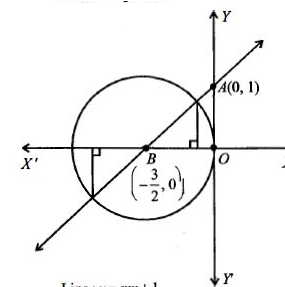
0 likesView Solution
47
MathematicsDifficultMCQAIEEE · 2012
Let $f : [1, 3] \to R$ be a function satisfying $\frac{x}{[x]} \le f(x) \le \sqrt{6 - x}$ for all $x \ne 2$ and $f(2) = 1$,where $R$ is the set of all real numbers and $[x]$ denotes the greatest integer function.
Statement $1$: $\lim_{x \to 2^-} f(x)$ exists.
Statement $2$: $f$ is continuous at $x = 2$.
Statement $1$: $\lim_{x \to 2^-} f(x)$ exists.
Statement $2$: $f$ is continuous at $x = 2$.
A
Statement $1$ is true,Statement $2$ is true,Statement $2$ is a correct explanation for Statement $1$.
B
Statement $1$ is false,Statement $2$ is true.
C
Statement $1$ is true,Statement $2$ is true,Statement $2$ is not a correct explanation for Statement $1$.
D
Statement $1$ is true,Statement $2$ is false.
Solution
(D) Given $\frac{x}{[x]} \le f(x) \le \sqrt{6 - x}$ for $x \ne 2$.
For $x \to 2^-$,$[x] = 1$. Thus,$\lim_{x \to 2^-} \frac{x}{[x]} = \frac{2}{1} = 2$ and $\lim_{x \to 2^-} \sqrt{6 - x} = \sqrt{6 - 2} = 2$.
By the Sandwich Theorem,$\lim_{x \to 2^-} f(x) = 2$. So,Statement $1$ is true.
For $x \to 2^+$,$[x] = 2$. Thus,$\lim_{x \to 2^+} \frac{x}{[x]} = \frac{2}{2} = 1$ and $\lim_{x \to 2^+} \sqrt{6 - x} = 2$.
By the Sandwich Theorem,$1 \le \lim_{x \to 2^+} f(x) \le 2$. Since the left-hand limit is $2$ and the right-hand limit is not necessarily $2$,the limit $\lim_{x \to 2} f(x)$ does not exist.
Since $\lim_{x \to 2} f(x)$ does not exist,$f$ is not continuous at $x = 2$. So,Statement $2$ is false.
For $x \to 2^-$,$[x] = 1$. Thus,$\lim_{x \to 2^-} \frac{x}{[x]} = \frac{2}{1} = 2$ and $\lim_{x \to 2^-} \sqrt{6 - x} = \sqrt{6 - 2} = 2$.
By the Sandwich Theorem,$\lim_{x \to 2^-} f(x) = 2$. So,Statement $1$ is true.
For $x \to 2^+$,$[x] = 2$. Thus,$\lim_{x \to 2^+} \frac{x}{[x]} = \frac{2}{2} = 1$ and $\lim_{x \to 2^+} \sqrt{6 - x} = 2$.
By the Sandwich Theorem,$1 \le \lim_{x \to 2^+} f(x) \le 2$. Since the left-hand limit is $2$ and the right-hand limit is not necessarily $2$,the limit $\lim_{x \to 2} f(x)$ does not exist.
Since $\lim_{x \to 2} f(x)$ does not exist,$f$ is not continuous at $x = 2$. So,Statement $2$ is false.
0 likesView Solution
48
MathematicsDifficultMCQAIEEE · 2012
Let $p$ and $q$ be two statements. Amongst the following,the statement that is equivalent to $p \to q$ is
A
$p \wedge \sim q$
B
$\sim p \vee q$
C
$\sim p \wedge q$
D
$p \vee \sim q$
Solution
(B) The conditional statement $p \to q$ is defined by the truth table where it is false only when $p$ is true and $q$ is false.
This is logically equivalent to the disjunction of the negation of $p$ and $q$.
Therefore,$p \to q \equiv \sim p \vee q$.
This is logically equivalent to the disjunction of the negation of $p$ and $q$.
Therefore,$p \to q \equiv \sim p \vee q$.
0 likesView Solution
49
MathematicsDifficultMCQAIEEE · 2012
If $f(x) = 3x^{10} - 7x^8 + 5x^6 - 21x^3 + 3x^2 - 7$,then $\mathop {\lim }\limits_{\alpha \to 0} \frac{f(1 - \alpha) - f(1)}{\alpha^3 + 3\alpha}$ is
A
$-\frac{53}{3}$
B
$\frac{53}{3}$
C
$-\frac{55}{3}$
D
$\frac{55}{3}$
Solution
(B) Given $f(x) = 3x^{10} - 7x^8 + 5x^6 - 21x^3 + 3x^2 - 7$.
First,find the derivative $f'(x)$:
$f'(x) = 30x^9 - 56x^7 + 30x^5 - 63x^2 + 6x$.
Evaluate $f'(1)$:
$f'(1) = 30(1)^9 - 56(1)^7 + 30(1)^5 - 63(1)^2 + 6(1) = 30 - 56 + 30 - 63 + 6 = -53$.
Now,consider the limit $L = \mathop {\lim }\limits_{\alpha \to 0} \frac{f(1 - \alpha) - f(1)}{\alpha^3 + 3\alpha}$.
Since this is a $\frac{0}{0}$ form,apply $L'\text{Hospital's rule}$:
$L = \mathop {\lim }\limits_{\alpha \to 0} \frac{\frac{d}{d\alpha}(f(1 - \alpha) - f(1))}{\frac{d}{d\alpha}(\alpha^3 + 3\alpha)} = \mathop {\lim }\limits_{\alpha \to 0} \frac{f'(1 - \alpha) \cdot (-1)}{3\alpha^2 + 3}$.
Substitute $\alpha = 0$:
$L = \frac{f'(1) \cdot (-1)}{3(0)^2 + 3} = \frac{-f'(1)}{3} = \frac{-(-53)}{3} = \frac{53}{3}$.
First,find the derivative $f'(x)$:
$f'(x) = 30x^9 - 56x^7 + 30x^5 - 63x^2 + 6x$.
Evaluate $f'(1)$:
$f'(1) = 30(1)^9 - 56(1)^7 + 30(1)^5 - 63(1)^2 + 6(1) = 30 - 56 + 30 - 63 + 6 = -53$.
Now,consider the limit $L = \mathop {\lim }\limits_{\alpha \to 0} \frac{f(1 - \alpha) - f(1)}{\alpha^3 + 3\alpha}$.
Since this is a $\frac{0}{0}$ form,apply $L'\text{Hospital's rule}$:
$L = \mathop {\lim }\limits_{\alpha \to 0} \frac{\frac{d}{d\alpha}(f(1 - \alpha) - f(1))}{\frac{d}{d\alpha}(\alpha^3 + 3\alpha)} = \mathop {\lim }\limits_{\alpha \to 0} \frac{f'(1 - \alpha) \cdot (-1)}{3\alpha^2 + 3}$.
Substitute $\alpha = 0$:
$L = \frac{f'(1) \cdot (-1)}{3(0)^2 + 3} = \frac{-f'(1)}{3} = \frac{-(-53)}{3} = \frac{53}{3}$.
0 likesView Solution
50
MathematicsDifficultMCQAIEEE · 2012
Let $Z$ and $W$ be complex numbers such that $|Z| = |W|$,and $\text{arg } Z$ denotes the principal argument of $Z$.
Statement $1$: If $\text{arg } Z + \text{arg } W = \pi$,then $Z = -\overline{W}$.
Statement $2$: $|Z| = |W|$ implies $\text{arg } Z - \text{arg } \overline{W} = \pi$.
Statement $1$: If $\text{arg } Z + \text{arg } W = \pi$,then $Z = -\overline{W}$.
Statement $2$: $|Z| = |W|$ implies $\text{arg } Z - \text{arg } \overline{W} = \pi$.
A
Statement $1$ is true,Statement $2$ is false.
B
Statement $1$ is true,Statement $2$ is true,Statement $2$ is a correct explanation for Statement $1$.
C
Statement $1$ is true,Statement $2$ is true,Statement $2$ is not a correct explanation for Statement $1$.
D
Statement $1$ is false,Statement $2$ is true.
Solution
(B) Let $|Z| = |W| = r$.
Then $Z = r e^{i\theta}$ and $W = r e^{i\phi}$,where $\theta = \text{arg } Z$ and $\phi = \text{arg } W$.
Given $\theta + \phi = \pi$,we have $\theta = \pi - \phi$.
Thus,$Z = r e^{i(\pi - \phi)} = r e^{i\pi} e^{-i\phi} = -r e^{-i\phi}$.
Since $\overline{W} = r e^{-i\phi}$,we get $Z = -\overline{W}$. So,Statement $1$ is true.
For Statement $2$,$\text{arg } \overline{W} = -\text{arg } W = -\phi$.
Then $\text{arg } Z - \text{arg } \overline{W} = \theta - (-\phi) = \theta + \phi = \pi$.
Thus,Statement $2$ is also true and explains Statement $1$.
Then $Z = r e^{i\theta}$ and $W = r e^{i\phi}$,where $\theta = \text{arg } Z$ and $\phi = \text{arg } W$.
Given $\theta + \phi = \pi$,we have $\theta = \pi - \phi$.
Thus,$Z = r e^{i(\pi - \phi)} = r e^{i\pi} e^{-i\phi} = -r e^{-i\phi}$.
Since $\overline{W} = r e^{-i\phi}$,we get $Z = -\overline{W}$. So,Statement $1$ is true.
For Statement $2$,$\text{arg } \overline{W} = -\text{arg } W = -\phi$.
Then $\text{arg } Z - \text{arg } \overline{W} = \theta - (-\phi) = \theta + \phi = \pi$.
Thus,Statement $2$ is also true and explains Statement $1$.
0 likesView Solution
51
MathematicsEasyMCQAIEEE · 2012
The equation of a plane parallel to the plane $x - 2y + 2z - 5 = 0$ and at a unit distance from the origin is:
A
$x - 2y + 2z - 3 = 0$
B
$x - 2y + 2z + 1 = 0$
C
$x - 2y + 2z - 1 = 0$
D
$x - 2y + 2z + 3 = 0$
Solution
(A) Let the equation of the plane parallel to $x - 2y + 2z - 5 = 0$ be $x - 2y + 2z + k = 0 \dots (i)$
The perpendicular distance from the origin $(0, 0, 0)$ to the plane $(i)$ is given by the formula $d = \frac{|k|}{\sqrt{a^2 + b^2 + c^2}}$.
Given that the distance is $1$,we have:
$\frac{|k|}{\sqrt{1^2 + (-2)^2 + 2^2}} = 1$
$\frac{|k|}{\sqrt{1 + 4 + 4}} = 1$
$\frac{|k|}{\sqrt{9}} = 1$
$\frac{|k|}{3} = 1$
$|k| = 3$
Therefore,$k = 3$ or $k = -3$.
Substituting these values into equation $(i)$,we get the possible equations of the plane as $x - 2y + 2z + 3 = 0$ or $x - 2y + 2z - 3 = 0$.
Comparing this with the given options,the correct equation is $x - 2y + 2z - 3 = 0$.
The perpendicular distance from the origin $(0, 0, 0)$ to the plane $(i)$ is given by the formula $d = \frac{|k|}{\sqrt{a^2 + b^2 + c^2}}$.
Given that the distance is $1$,we have:
$\frac{|k|}{\sqrt{1^2 + (-2)^2 + 2^2}} = 1$
$\frac{|k|}{\sqrt{1 + 4 + 4}} = 1$
$\frac{|k|}{\sqrt{9}} = 1$
$\frac{|k|}{3} = 1$
$|k| = 3$
Therefore,$k = 3$ or $k = -3$.
Substituting these values into equation $(i)$,we get the possible equations of the plane as $x - 2y + 2z + 3 = 0$ or $x - 2y + 2z - 3 = 0$.
Comparing this with the given options,the correct equation is $x - 2y + 2z - 3 = 0$.
0 likesView Solution
52
MathematicsDifficultMCQAIEEE · 2012
If the lines $\frac{x - 1}{2} = \frac{y + 1}{3} = \frac{z - 1}{4}$ and $\frac{x - 3}{1} = \frac{y - k}{2} = \frac{z}{1}$ intersect,then $k$ is equal to:
A
$-1$
B
$\frac{2}{9}$
C
$\frac{9}{2}$
D
$0$
Solution
(C) Let the two lines be represented by parameters $\lambda$ and $\mu$ respectively:
$\frac{x-1}{2}=\frac{y+1}{3}=\frac{z-1}{4}=\lambda \implies x=2\lambda+1, y=3\lambda-1, z=4\lambda+1$
$\frac{x-3}{1}=\frac{y-k}{2}=\frac{z}{1}=\mu \implies x=\mu+3, y=2\mu+k, z=\mu$
If the lines intersect,there must exist a point common to both,so:
$2\lambda+1 = \mu+3 \implies 2\lambda - \mu = 2 \quad (i)$
$3\lambda-1 = 2\mu+k \implies 3\lambda - 2\mu = k+1 \quad (ii)$
$4\lambda+1 = \mu \implies 4\lambda - \mu = -1 \quad (iii)$
Subtracting $(i)$ from $(iii)$:
$(4\lambda - \mu) - (2\lambda - \mu) = -1 - 2
\implies 2\lambda = -3 \implies \lambda = -\frac{3}{2}$
Substituting $\lambda = -\frac{3}{2}$ into $(iii)$:
$4(-\frac{3}{2}) + 1 = \mu \implies -6 + 1 = \mu \implies \mu = -5$
Substituting $\lambda = -\frac{3}{2}$ and $\mu = -5$ into $(ii)$:
$3(-\frac{3}{2}) - 2(-5) = k+1
\implies -\frac{9}{2} + 10 = k+1
\implies k = 9 - \frac{9}{2} = \frac{9}{2}$
$\frac{x-1}{2}=\frac{y+1}{3}=\frac{z-1}{4}=\lambda \implies x=2\lambda+1, y=3\lambda-1, z=4\lambda+1$
$\frac{x-3}{1}=\frac{y-k}{2}=\frac{z}{1}=\mu \implies x=\mu+3, y=2\mu+k, z=\mu$
If the lines intersect,there must exist a point common to both,so:
$2\lambda+1 = \mu+3 \implies 2\lambda - \mu = 2 \quad (i)$
$3\lambda-1 = 2\mu+k \implies 3\lambda - 2\mu = k+1 \quad (ii)$
$4\lambda+1 = \mu \implies 4\lambda - \mu = -1 \quad (iii)$
Subtracting $(i)$ from $(iii)$:
$(4\lambda - \mu) - (2\lambda - \mu) = -1 - 2
\implies 2\lambda = -3 \implies \lambda = -\frac{3}{2}$
Substituting $\lambda = -\frac{3}{2}$ into $(iii)$:
$4(-\frac{3}{2}) + 1 = \mu \implies -6 + 1 = \mu \implies \mu = -5$
Substituting $\lambda = -\frac{3}{2}$ and $\mu = -5$ into $(ii)$:
$3(-\frac{3}{2}) - 2(-5) = k+1
\implies -\frac{9}{2} + 10 = k+1
\implies k = 9 - \frac{9}{2} = \frac{9}{2}$
0 likesView Solution
53
MathematicsDifficultMCQAIEEE · 2012
The area between the parabolas $x^2 = \frac{y}{4}$ and $x^2 = 9y$ and the straight line $y = 2$ is:
A
$20\sqrt{2}$
B
$\frac{10\sqrt{2}}{3}$
C
$\frac{20\sqrt{2}}{3}$
D
$10\sqrt{2}$
Solution
(C) The given parabolas are $x^2 = \frac{y}{4} \implies x = \pm \frac{\sqrt{y}}{2}$ and $x^2 = 9y \implies x = \pm 3\sqrt{y}$.
Since the region is symmetric about the $y$-axis,we calculate the area in the first quadrant and multiply by $2$.
The area $A$ is bounded by $x = 3\sqrt{y}$ (right curve) and $x = \frac{\sqrt{y}}{2}$ (left curve) from $y = 0$ to $y = 2$.
$A = 2 \int_{0}^{2} \left( 3\sqrt{y} - \frac{\sqrt{y}}{2} \right) dy$
$A = 2 \int_{0}^{2} \frac{5\sqrt{y}}{2} dy = 5 \int_{0}^{2} y^{1/2} dy$
$A = 5 \left[ \frac{y^{3/2}}{3/2} \right]_{0}^{2} = 5 \times \frac{2}{3} \left[ y^{3/2} \right]_{0}^{2}$
$A = \frac{10}{3} \left( 2^{3/2} - 0 \right) = \frac{10}{3} \times 2\sqrt{2} = \frac{20\sqrt{2}}{3}$
Since the region is symmetric about the $y$-axis,we calculate the area in the first quadrant and multiply by $2$.
The area $A$ is bounded by $x = 3\sqrt{y}$ (right curve) and $x = \frac{\sqrt{y}}{2}$ (left curve) from $y = 0$ to $y = 2$.
$A = 2 \int_{0}^{2} \left( 3\sqrt{y} - \frac{\sqrt{y}}{2} \right) dy$
$A = 2 \int_{0}^{2} \frac{5\sqrt{y}}{2} dy = 5 \int_{0}^{2} y^{1/2} dy$
$A = 5 \left[ \frac{y^{3/2}}{3/2} \right]_{0}^{2} = 5 \times \frac{2}{3} \left[ y^{3/2} \right]_{0}^{2}$
$A = \frac{10}{3} \left( 2^{3/2} - 0 \right) = \frac{10}{3} \times 2\sqrt{2} = \frac{20\sqrt{2}}{3}$
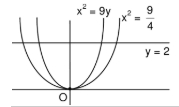
0 likesView Solution
54
MathematicsDifficultMCQAIEEE · 2012
If $g(x) = \int_{0}^{x} \cos 4t \, dt$,then $g(x + \pi) = $
A
$g(x)$
B
$g(x) + g(\pi)$
C
$g(x) - g(\pi)$
D
$g(x) + g(\pi)$ and $g(x) - g(\pi)$
Solution
(D) Given $g(x) = \int_{0}^{x} \cos 4t \, dt$.
Evaluating the integral,we get $g(x) = \left[ \frac{\sin 4t}{4} \right]_{0}^{x} = \frac{\sin 4x}{4}$.
Now,calculate $g(x + \pi) = \frac{\sin 4(x + \pi)}{4} = \frac{\sin(4x + 4\pi)}{4}$.
Since $\sin(4x + 4\pi) = \sin 4x$,we have $g(x + \pi) = \frac{\sin 4x}{4} = g(x)$.
Also,$g(\pi) = \frac{\sin(4\pi)}{4} = 0$.
Since $g(\pi) = 0$,it follows that $g(x) + g(\pi) = g(x) + 0 = g(x)$ and $g(x) - g(\pi) = g(x) - 0 = g(x)$.
Thus,both $g(x) + g(\pi)$ and $g(x) - g(\pi)$ are equal to $g(x)$.
Evaluating the integral,we get $g(x) = \left[ \frac{\sin 4t}{4} \right]_{0}^{x} = \frac{\sin 4x}{4}$.
Now,calculate $g(x + \pi) = \frac{\sin 4(x + \pi)}{4} = \frac{\sin(4x + 4\pi)}{4}$.
Since $\sin(4x + 4\pi) = \sin 4x$,we have $g(x + \pi) = \frac{\sin 4x}{4} = g(x)$.
Also,$g(\pi) = \frac{\sin(4\pi)}{4} = 0$.
Since $g(\pi) = 0$,it follows that $g(x) + g(\pi) = g(x) + 0 = g(x)$ and $g(x) - g(\pi) = g(x) - 0 = g(x)$.
Thus,both $g(x) + g(\pi)$ and $g(x) - g(\pi)$ are equal to $g(x)$.
0 likesView Solution
55
MathematicsMediumMCQAIEEE · 2012
Let $A = \left[ {\begin{array}{*{20}{c}}1&0&0\\2&1&0\\3&2&1\end{array}} \right]$. If $u_1$ and $u_2$ are column matrices such that $A{u_1} = \left[ {\begin{array}{*{20}{c}}1\\0\\0\end{array}} \right]$ and $A{u_2} = \left[ {\begin{array}{*{20}{c}}0\\1\\0\end{array}} \right]$,then $u_1 + u_2$ is equal to:
A
$\left[ {\begin{array}{*{20}{c}}{ - 1}\\0\\0\end{array}} \right]$
B
$\left[ {\begin{array}{*{20}{c}}{ - 1}\\1\\{ - 1}\end{array}} \right]$
C
$\left[ {\begin{array}{*{20}{c}}{ - 1}\\{ - 1}\\0\end{array}} \right]$
D
$\left[ {\begin{array}{*{20}{c}}1\\{ - 1}\\{ - 1}\end{array}} \right]$
Solution
(D) Given $A = \left[ {\begin{array}{*{20}{c}}1&0&0\\2&1&0\\3&2&1\end{array}} \right]$,$A{u_1} = \left[ {\begin{array}{*{20}{c}}1\\0\\0\end{array}} \right]$,and $A{u_2} = \left[ {\begin{array}{*{20}{c}}0\\1\\0\end{array}} \right]$.
Adding the two equations,we get:
$A{u_1} + A{u_2} = \left[ {\begin{array}{*{20}{c}}1\\0\\0\end{array}} \right] + \left[ {\begin{array}{*{20}{c}}0\\1\\0\end{array}} \right]$
$A(u_1 + u_2) = \left[ {\begin{array}{*{20}{c}}1\\1\\0\end{array}} \right]$
Thus,$u_1 + u_2 = A^{-1} \left[ {\begin{array}{*{20}{c}}1\\1\\0\end{array}} \right]$.
First,find $|A| = 1(1-0) - 0 + 0 = 1$.
Next,find $adj(A)$. The cofactors are:
$C_{11} = 1, C_{12} = -2, C_{13} = 1$
$C_{21} = 0, C_{22} = 1, C_{23} = -2$
$C_{31} = 0, C_{32} = 0, C_{33} = 1$
So,$adj(A) = \left[ {\begin{array}{*{20}{c}}1&0&0\\-2&1&0\\1&-2&1\end{array}} \right]$.
Since $|A| = 1$,$A^{-1} = adj(A)$.
$u_1 + u_2 = \left[ {\begin{array}{*{20}{c}}1&0&0\\-2&1&0\\1&-2&1\end{array}} \right] \left[ {\begin{array}{*{20}{c}}1\\1\\0\end{array}} \right] = \left[ {\begin{array}{*{20}{c}}1(1)+0(1)+0(0)\\-2(1)+1(1)+0(0)\\1(1)-2(1)+1(0)\end{array}} \right] = \left[ {\begin{array}{*{20}{c}}1\\-1\\-1\end{array}} \right]$.
Adding the two equations,we get:
$A{u_1} + A{u_2} = \left[ {\begin{array}{*{20}{c}}1\\0\\0\end{array}} \right] + \left[ {\begin{array}{*{20}{c}}0\\1\\0\end{array}} \right]$
$A(u_1 + u_2) = \left[ {\begin{array}{*{20}{c}}1\\1\\0\end{array}} \right]$
Thus,$u_1 + u_2 = A^{-1} \left[ {\begin{array}{*{20}{c}}1\\1\\0\end{array}} \right]$.
First,find $|A| = 1(1-0) - 0 + 0 = 1$.
Next,find $adj(A)$. The cofactors are:
$C_{11} = 1, C_{12} = -2, C_{13} = 1$
$C_{21} = 0, C_{22} = 1, C_{23} = -2$
$C_{31} = 0, C_{32} = 0, C_{33} = 1$
So,$adj(A) = \left[ {\begin{array}{*{20}{c}}1&0&0\\-2&1&0\\1&-2&1\end{array}} \right]$.
Since $|A| = 1$,$A^{-1} = adj(A)$.
$u_1 + u_2 = \left[ {\begin{array}{*{20}{c}}1&0&0\\-2&1&0\\1&-2&1\end{array}} \right] \left[ {\begin{array}{*{20}{c}}1\\1\\0\end{array}} \right] = \left[ {\begin{array}{*{20}{c}}1(1)+0(1)+0(0)\\-2(1)+1(1)+0(0)\\1(1)-2(1)+1(0)\end{array}} \right] = \left[ {\begin{array}{*{20}{c}}1\\-1\\-1\end{array}} \right]$.
0 likesView Solution
56
MathematicsDifficultMCQAIEEE · 2012
Let $P$ and $Q$ be $3 \times 3$ matrices such that $P \neq Q$. If $P^3 = Q^3$ and $P^2Q = Q^2P$,then the determinant $\det(P^2 + Q^2)$ is equal to:
A
$ -2 $
B
$ 1 $
C
$ 0 $
D
$ -1 $
Solution
(C) Given that $P$ and $Q$ are $3 \times 3$ matrices such that $P \neq Q$.
We are given the equations:
$1) P^3 = Q^3$
$2) P^2Q = Q^2P$
Subtracting the second equation from the first,we get:
$P^3 - P^2Q = Q^3 - Q^2P$
Factoring the terms,we have:
$P^2(P - Q) = Q^2(Q - P)$
$P^2(P - Q) = -Q^2(P - Q)$
$(P^2 + Q^2)(P - Q) = 0$
Since $P \neq Q$,the matrix $(P - Q)$ is not necessarily a zero matrix,but the product $(P^2 + Q^2)(P - Q) = 0$ implies that the matrix $(P^2 + Q^2)$ must be singular if $(P - Q)$ is non-zero and the system holds.
Specifically,if $(P^2 + Q^2)(P - Q) = 0$ and $P - Q \neq 0$,it implies that the determinant of the product is zero:
$\det((P^2 + Q^2)(P - Q)) = \det(0) = 0$
$\det(P^2 + Q^2) \cdot \det(P - Q) = 0$
In the context of such matrix problems,this leads to $\det(P^2 + Q^2) = 0$.
We are given the equations:
$1) P^3 = Q^3$
$2) P^2Q = Q^2P$
Subtracting the second equation from the first,we get:
$P^3 - P^2Q = Q^3 - Q^2P$
Factoring the terms,we have:
$P^2(P - Q) = Q^2(Q - P)$
$P^2(P - Q) = -Q^2(P - Q)$
$(P^2 + Q^2)(P - Q) = 0$
Since $P \neq Q$,the matrix $(P - Q)$ is not necessarily a zero matrix,but the product $(P^2 + Q^2)(P - Q) = 0$ implies that the matrix $(P^2 + Q^2)$ must be singular if $(P - Q)$ is non-zero and the system holds.
Specifically,if $(P^2 + Q^2)(P - Q) = 0$ and $P - Q \neq 0$,it implies that the determinant of the product is zero:
$\det((P^2 + Q^2)(P - Q)) = \det(0) = 0$
$\det(P^2 + Q^2) \cdot \det(P - Q) = 0$
In the context of such matrix problems,this leads to $\det(P^2 + Q^2) = 0$.
0 likesView Solution
57
MathematicsDifficultMCQAIEEE · 2012
Let $f: R \to R$ be a function defined by $f(x) = [x] \cos \left( \frac{2x - 1}{2} \pi \right)$,where $[x]$ denotes the greatest integer function. Then $f$ is:
A
discontinuous only at $x = 0$
B
discontinuous only at non-zero integral values of $x$
C
continuous only at $x = 0$
D
continuous for every real $x$
Solution
(D) The function is $f(x) = [x] \cos \left( \frac{2x - 1}{2} \pi \right) = [x] \cos \left( x\pi - \frac{\pi}{2} \right) = [x] \sin(x\pi)$.
We check for continuity at any integer $x = n$,where $n \in \mathbb{Z}$.
The value of the function at $x = n$ is $f(n) = [n] \sin(n\pi) = n \cdot 0 = 0$.
The Left Hand Limit $(LHL)$ as $x \to n^-$ is $\lim_{x \to n^-} [x] \sin(x\pi) = (n - 1) \sin(n\pi) = (n - 1) \cdot 0 = 0$.
The Right Hand Limit $(RHL)$ as $x \to n^+$ is $\lim_{x \to n^+} [x] \sin(x\pi) = n \sin(n\pi) = n \cdot 0 = 0$.
Since $LHL = RHL = f(n) = 0$ for all $n \in \mathbb{Z}$,the function is continuous at all integers.
Since $[x]$ is continuous everywhere except at integers and $\sin(x\pi)$ is continuous everywhere,the product is continuous everywhere.
Thus,$f(x)$ is continuous for every real $x$.
We check for continuity at any integer $x = n$,where $n \in \mathbb{Z}$.
The value of the function at $x = n$ is $f(n) = [n] \sin(n\pi) = n \cdot 0 = 0$.
The Left Hand Limit $(LHL)$ as $x \to n^-$ is $\lim_{x \to n^-} [x] \sin(x\pi) = (n - 1) \sin(n\pi) = (n - 1) \cdot 0 = 0$.
The Right Hand Limit $(RHL)$ as $x \to n^+$ is $\lim_{x \to n^+} [x] \sin(x\pi) = n \sin(n\pi) = n \cdot 0 = 0$.
Since $LHL = RHL = f(n) = 0$ for all $n \in \mathbb{Z}$,the function is continuous at all integers.
Since $[x]$ is continuous everywhere except at integers and $\sin(x\pi)$ is continuous everywhere,the product is continuous everywhere.
Thus,$f(x)$ is continuous for every real $x$.
0 likesView Solution
58
MathematicsMediumMCQAIEEE · 2012
Consider the function $f(x) = |x - 2| + |x - 5|$,$x \in R$.
Statement-$1$: $f'(4) = 0$.
Statement-$2$: $f$ is continuous in $[2, 5]$,differentiable in $(2, 5)$,and $f(2) = f(5)$.
Statement-$1$: $f'(4) = 0$.
Statement-$2$: $f$ is continuous in $[2, 5]$,differentiable in $(2, 5)$,and $f(2) = f(5)$.
A
Statement-$1$ is false,Statement-$2$ is true.
B
Statement-$1$ is true,Statement-$2$ is false.
C
Statement-$1$ is true,Statement-$2$ is true; Statement-$2$ is not a correct explanation for Statement-$1$.
D
Statement-$1$ is true,Statement-$2$ is true; Statement-$2$ is a correct explanation for Statement-$1$.
Solution
(D) The function is defined as $f(x) = |x - 2| + |x - 5|$.
We can express this piecewise as:
$f(x) = \begin{cases} -(x-2) - (x-5) = -2x + 7 & \text{if } x < 2 \\ (x-2) - (x-5) = 3 & \text{if } 2 \le x < 5 \\ (x-2) + (x-5) = 2x - 7 & \text{if } x \ge 5 \end{cases}$
For Statement-$1$:
In the interval $(2, 5)$,$f(x) = 3$. Therefore,$f'(x) = 0$ for all $x \in (2, 5)$.
Since $4 \in (2, 5)$,$f'(4) = 0$. Thus,Statement-$1$ is true.
For Statement-$2$:
$f(x)$ is a sum of continuous functions,so it is continuous everywhere. In $[2, 5]$,$f(x) = 3$,which is a constant function,so it is differentiable in $(2, 5)$.
Also,$f(2) = |2-2| + |2-5| = 3$ and $f(5) = |5-2| + |5-5| = 3$. Thus,$f(2) = f(5)$.
Statement-$2$ is true.
Statement-$2$ describes the conditions of Rolle's Theorem,which implies the existence of a point $c \in (2, 5)$ such that $f'(c) = 0$. Since $f(x)$ is constant on $[2, 5]$,$f'(x) = 0$ for all $x \in (2, 5)$,which confirms Statement-$1$. Thus,Statement-$2$ is a correct explanation for Statement-$1$.
We can express this piecewise as:
$f(x) = \begin{cases} -(x-2) - (x-5) = -2x + 7 & \text{if } x < 2 \\ (x-2) - (x-5) = 3 & \text{if } 2 \le x < 5 \\ (x-2) + (x-5) = 2x - 7 & \text{if } x \ge 5 \end{cases}$
For Statement-$1$:
In the interval $(2, 5)$,$f(x) = 3$. Therefore,$f'(x) = 0$ for all $x \in (2, 5)$.
Since $4 \in (2, 5)$,$f'(4) = 0$. Thus,Statement-$1$ is true.
For Statement-$2$:
$f(x)$ is a sum of continuous functions,so it is continuous everywhere. In $[2, 5]$,$f(x) = 3$,which is a constant function,so it is differentiable in $(2, 5)$.
Also,$f(2) = |2-2| + |2-5| = 3$ and $f(5) = |5-2| + |5-5| = 3$. Thus,$f(2) = f(5)$.
Statement-$2$ is true.
Statement-$2$ describes the conditions of Rolle's Theorem,which implies the existence of a point $c \in (2, 5)$ such that $f'(c) = 0$. Since $f(x)$ is constant on $[2, 5]$,$f'(x) = 0$ for all $x \in (2, 5)$,which confirms Statement-$1$. Thus,Statement-$2$ is a correct explanation for Statement-$1$.
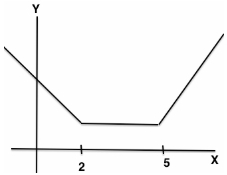
0 likesView Solution
59
MathematicsDifficultMCQAIEEE · 2012
$A$ spherical balloon is filled with $4500\pi$ cubic meters of helium gas. If a leak in the balloon causes the gas to escape at the rate of $72\pi$ cubic meters per minute,then the rate (in meters per minute) at which the radius of the balloon decreases $49$ minutes after the leakage began is:
A
$\frac{9}{7}$
B
$\frac{7}{9}$
C
$\frac{2}{9}$
D
$\frac{9}{2}$
Solution
(C) The initial volume of the balloon is $V_i = 4500\pi \text{ m}^3$.
The rate of change of volume is $\frac{dV}{dt} = -72\pi \text{ m}^3/\text{min}$.
After $t = 49$ minutes,the volume $V$ is:
$V = 4500\pi - (72\pi \times 49) = 4500\pi - 3528\pi = 972\pi \text{ m}^3$.
The volume of a sphere is $V = \frac{4}{3}\pi r^3$.
At $t = 49$ minutes,$972\pi = \frac{4}{3}\pi r^3$,which implies $r^3 = \frac{972 \times 3}{4} = 729$.
Thus,$r = \sqrt[3]{729} = 9 \text{ m}$.
Differentiating $V = \frac{4}{3}\pi r^3$ with respect to $t$,we get $\frac{dV}{dt} = 4\pi r^2 \frac{dr}{dt}$.
Substituting the values: $-72\pi = 4\pi (9)^2 \frac{dr}{dt}$.
$-72\pi = 4\pi (81) \frac{dr}{dt} = 324\pi \frac{dr}{dt}$.
$\frac{dr}{dt} = -\frac{72\pi}{324\pi} = -\frac{2}{9}$.
The rate at which the radius decreases is $\frac{2}{9} \text{ m/min}$.
The rate of change of volume is $\frac{dV}{dt} = -72\pi \text{ m}^3/\text{min}$.
After $t = 49$ minutes,the volume $V$ is:
$V = 4500\pi - (72\pi \times 49) = 4500\pi - 3528\pi = 972\pi \text{ m}^3$.
The volume of a sphere is $V = \frac{4}{3}\pi r^3$.
At $t = 49$ minutes,$972\pi = \frac{4}{3}\pi r^3$,which implies $r^3 = \frac{972 \times 3}{4} = 729$.
Thus,$r = \sqrt[3]{729} = 9 \text{ m}$.
Differentiating $V = \frac{4}{3}\pi r^3$ with respect to $t$,we get $\frac{dV}{dt} = 4\pi r^2 \frac{dr}{dt}$.
Substituting the values: $-72\pi = 4\pi (9)^2 \frac{dr}{dt}$.
$-72\pi = 4\pi (81) \frac{dr}{dt} = 324\pi \frac{dr}{dt}$.
$\frac{dr}{dt} = -\frac{72\pi}{324\pi} = -\frac{2}{9}$.
The rate at which the radius decreases is $\frac{2}{9} \text{ m/min}$.
0 likesView Solution
60
MathematicsDifficultMCQAIEEE · 2012
The population $p(t)$ at time $t$ of a certain mouse species satisfies the differential equation $\frac{dp(t)}{dt} = 0.5p(t) - 450$. If $p(0) = 850$,then the time at which the population becomes zero is:
A
$2 \ln 18$
B
$\ln 9$
C
$\frac{1}{2} \ln 18$
D
$\ln 18$
Solution
(A) Given the differential equation: $\frac{dp(t)}{dt} = 0.5p(t) - 450 = \frac{p(t) - 900}{2}$.
Separating the variables,we get: $\int \frac{dp(t)}{p(t) - 900} = \int \frac{1}{2} dt$.
Integrating both sides: $\ln |p(t) - 900| = \frac{1}{2} t + C$.
Using the initial condition $p(0) = 850$: $\ln |850 - 900| = \frac{1}{2}(0) + C \implies C = \ln 50$.
Thus,the equation is: $\ln |p(t) - 900| = \frac{1}{2} t + \ln 50$.
We want to find $t$ when $p(t) = 0$: $\ln |0 - 900| = \frac{1}{2} t + \ln 50$.
$\ln 900 - \ln 50 = \frac{1}{2} t$.
$\ln \left( \frac{900}{50} \right) = \frac{1}{2} t$.
$\ln 18 = \frac{1}{2} t$.
$t = 2 \ln 18$.
Separating the variables,we get: $\int \frac{dp(t)}{p(t) - 900} = \int \frac{1}{2} dt$.
Integrating both sides: $\ln |p(t) - 900| = \frac{1}{2} t + C$.
Using the initial condition $p(0) = 850$: $\ln |850 - 900| = \frac{1}{2}(0) + C \implies C = \ln 50$.
Thus,the equation is: $\ln |p(t) - 900| = \frac{1}{2} t + \ln 50$.
We want to find $t$ when $p(t) = 0$: $\ln |0 - 900| = \frac{1}{2} t + \ln 50$.
$\ln 900 - \ln 50 = \frac{1}{2} t$.
$\ln \left( \frac{900}{50} \right) = \frac{1}{2} t$.
$\ln 18 = \frac{1}{2} t$.
$t = 2 \ln 18$.
0 likesView Solution
61
MathematicsMediumMCQAIEEE · 2012
Three numbers are chosen at random without replacement from $\{1, 2, 3, 4, 5, 6, 7, 8\}$. The probability that their minimum is $3$,given that their maximum is $6$,is:
A
$\frac{1}{5}$
B
$\frac{1}{4}$
C
$\frac{2}{5}$
D
$\frac{3}{8}$
Solution
(A) Let $S = \{1, 2, 3, 4, 5, 6, 7, 8\}$. We choose $3$ numbers from $S$ without replacement.
Let $A$ be the event that the maximum of the chosen numbers is $6$.
Let $B$ be the event that the minimum of the chosen numbers is $3$.
We want to find the conditional probability $P(B|A) = \frac{P(A \cap B)}{P(A)}$.
For event $A$ (maximum is $6$): The numbers must be chosen from $\{1, 2, 3, 4, 5, 6\}$ such that $6$ is included. The other $2$ numbers must be chosen from $\{1, 2, 3, 4, 5\}$.
Number of ways for $A = \binom{5}{2} = 10$.
For event $A \cap B$ (maximum is $6$ and minimum is $3$): The numbers must be chosen from $\{3, 4, 5, 6\}$ such that $3$ and $6$ are included. The remaining $1$ number must be chosen from $\{4, 5\}$.
Number of ways for $A \cap B = \binom{2}{1} = 2$.
Thus,$P(B|A) = \frac{n(A \cap B)}{n(A)} = \frac{2}{10} = \frac{1}{5}$.
Let $A$ be the event that the maximum of the chosen numbers is $6$.
Let $B$ be the event that the minimum of the chosen numbers is $3$.
We want to find the conditional probability $P(B|A) = \frac{P(A \cap B)}{P(A)}$.
For event $A$ (maximum is $6$): The numbers must be chosen from $\{1, 2, 3, 4, 5, 6\}$ such that $6$ is included. The other $2$ numbers must be chosen from $\{1, 2, 3, 4, 5\}$.
Number of ways for $A = \binom{5}{2} = 10$.
For event $A \cap B$ (maximum is $6$ and minimum is $3$): The numbers must be chosen from $\{3, 4, 5, 6\}$ such that $3$ and $6$ are included. The remaining $1$ number must be chosen from $\{4, 5\}$.
Number of ways for $A \cap B = \binom{2}{1} = 2$.
Thus,$P(B|A) = \frac{n(A \cap B)}{n(A)} = \frac{2}{10} = \frac{1}{5}$.
0 likesView Solution
62
MathematicsMediumMCQAIEEE · 2012
Let $\vec{a}$ and $\vec{b}$ be two unit vectors. If the vectors $\vec{c} = \vec{a} + 2\vec{b}$ and $\vec{d} = 5\vec{a} - 4\vec{b}$ are perpendicular to each other,then the angle between $\vec{a}$ and $\vec{b}$ is:
A
$\frac{\pi}{6}$
B
$\frac{\pi}{2}$
C
$\frac{\pi}{3}$
D
$\frac{\pi}{4}$
Solution
(C) Given that $\vec{a}$ and $\vec{b}$ are unit vectors,we have $|\vec{a}| = 1$ and $|\vec{b}| = 1$.
Since $\vec{c} = \vec{a} + 2\vec{b}$ and $\vec{d} = 5\vec{a} - 4\vec{b}$ are perpendicular,their dot product is zero: $\vec{c} \cdot \vec{d} = 0$.
$(\vec{a} + 2\vec{b}) \cdot (5\vec{a} - 4\vec{b}) = 0$.
Expanding the dot product: $5(\vec{a} \cdot \vec{a}) - 4(\vec{a} \cdot \vec{b}) + 10(\vec{b} \cdot \vec{a}) - 8(\vec{b} \cdot \vec{b}) = 0$.
Since $\vec{a} \cdot \vec{a} = |\vec{a}|^2 = 1$ and $\vec{b} \cdot \vec{b} = |\vec{b}|^2 = 1$,and $\vec{a} \cdot \vec{b} = \vec{b} \cdot \vec{a}$:
$5(1) + 6(\vec{a} \cdot \vec{b}) - 8(1) = 0$.
$6(\vec{a} \cdot \vec{b}) - 3 = 0$.
$6(\vec{a} \cdot \vec{b}) = 3$.
$\vec{a} \cdot \vec{b} = \frac{3}{6} = \frac{1}{2}$.
We know $\vec{a} \cdot \vec{b} = |\vec{a}||\vec{b}| \cos \theta$,where $\theta$ is the angle between $\vec{a}$ and $\vec{b}$.
$1 \cdot 1 \cdot \cos \theta = \frac{1}{2}$.
$\cos \theta = \frac{1}{2} \implies \theta = \frac{\pi}{3}$.
Since $\vec{c} = \vec{a} + 2\vec{b}$ and $\vec{d} = 5\vec{a} - 4\vec{b}$ are perpendicular,their dot product is zero: $\vec{c} \cdot \vec{d} = 0$.
$(\vec{a} + 2\vec{b}) \cdot (5\vec{a} - 4\vec{b}) = 0$.
Expanding the dot product: $5(\vec{a} \cdot \vec{a}) - 4(\vec{a} \cdot \vec{b}) + 10(\vec{b} \cdot \vec{a}) - 8(\vec{b} \cdot \vec{b}) = 0$.
Since $\vec{a} \cdot \vec{a} = |\vec{a}|^2 = 1$ and $\vec{b} \cdot \vec{b} = |\vec{b}|^2 = 1$,and $\vec{a} \cdot \vec{b} = \vec{b} \cdot \vec{a}$:
$5(1) + 6(\vec{a} \cdot \vec{b}) - 8(1) = 0$.
$6(\vec{a} \cdot \vec{b}) - 3 = 0$.
$6(\vec{a} \cdot \vec{b}) = 3$.
$\vec{a} \cdot \vec{b} = \frac{3}{6} = \frac{1}{2}$.
We know $\vec{a} \cdot \vec{b} = |\vec{a}||\vec{b}| \cos \theta$,where $\theta$ is the angle between $\vec{a}$ and $\vec{b}$.
$1 \cdot 1 \cdot \cos \theta = \frac{1}{2}$.
$\cos \theta = \frac{1}{2} \implies \theta = \frac{\pi}{3}$.
0 likesView Solution
63
MathematicsDifficultMCQAIEEE · 2012
Let $ABCD$ be a parallelogram such that $\vec{AB} = \vec{q}$ and $\vec{AD} = \vec{p}$,and $\angle BAD$ is an acute angle. If $\vec{r}$ is the vector that coincides with the altitude directed from the vertex $B$ to the side $AD$,then $\vec{r}$ is given by:
A
$\vec{r} = 3\vec{q} - \frac{3(\vec{p} \cdot \vec{q})}{(\vec{p} \cdot \vec{p})}\vec{p}$
B
$\vec{r} = -\vec{q} + \frac{(\vec{p} \cdot \vec{q})}{(\vec{p} \cdot \vec{p})}\vec{p}$
C
$\vec{r} = \vec{q} - \frac{(\vec{p} \cdot \vec{q})}{(\vec{p} \cdot \vec{p})}\vec{p}$
D
$\vec{r} = -3\vec{q} - \frac{3(\vec{p} \cdot \vec{q})}{(\vec{p} \cdot \vec{p})}\vec{p}$
Solution
(B) Let $E$ be the foot of the perpendicular from vertex $B$ to the side $AD$. The vector $\vec{AE}$ is the projection of $\vec{AB}$ onto $\vec{AD}$.
Thus,$\vec{AE} = \text{proj}_{\vec{p}} \vec{q} = \left( \frac{\vec{q} \cdot \vec{p}}{\vec{p} \cdot \vec{p}} \right) \vec{p}$.
In $\triangle ABE$,by the triangle law of vector addition,we have $\vec{AB} + \vec{BE} = \vec{AE}$.
Given $\vec{AB} = \vec{q}$ and $\vec{BE} = \vec{r}$,we have $\vec{q} + \vec{r} = \vec{AE}$.
Therefore,$\vec{r} = \vec{AE} - \vec{q}$.
Substituting the expression for $\vec{AE}$,we get $\vec{r} = \left( \frac{\vec{q} \cdot \vec{p}}{\vec{p} \cdot \vec{p}} \right) \vec{p} - \vec{q}$.
Thus,$\vec{AE} = \text{proj}_{\vec{p}} \vec{q} = \left( \frac{\vec{q} \cdot \vec{p}}{\vec{p} \cdot \vec{p}} \right) \vec{p}$.
In $\triangle ABE$,by the triangle law of vector addition,we have $\vec{AB} + \vec{BE} = \vec{AE}$.
Given $\vec{AB} = \vec{q}$ and $\vec{BE} = \vec{r}$,we have $\vec{q} + \vec{r} = \vec{AE}$.
Therefore,$\vec{r} = \vec{AE} - \vec{q}$.
Substituting the expression for $\vec{AE}$,we get $\vec{r} = \left( \frac{\vec{q} \cdot \vec{p}}{\vec{p} \cdot \vec{p}} \right) \vec{p} - \vec{q}$.
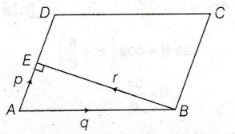
0 likesView Solution
64
MathematicsDifficultMCQAIEEE · 2012
If $A = \begin{bmatrix} \alpha - 1 \\ 0 \\ 0 \end{bmatrix}$ and $B = \begin{bmatrix} \alpha + 1 \\ 0 \\ 0 \end{bmatrix}$ are two matrices,then $AB^T$ is a non-zero matrix for $|\alpha|$ not equal to:
A
$2$
B
$0$
C
$1$
D
$3$
Solution
(C) Given $A = \begin{bmatrix} \alpha - 1 \\ 0 \\ 0 \end{bmatrix}$ and $B = \begin{bmatrix} \alpha + 1 \\ 0 \\ 0 \end{bmatrix}$.
The transpose of matrix $B$ is $B^T = \begin{bmatrix} \alpha + 1 & 0 & 0 \end{bmatrix}$.
Now,calculate the product $AB^T$:
$AB^T = \begin{bmatrix} \alpha - 1 \\ 0 \\ 0 \end{bmatrix} \begin{bmatrix} \alpha + 1 & 0 & 0 \end{bmatrix} = \begin{bmatrix} (\alpha - 1)(\alpha + 1) & 0 & 0 \\ 0 & 0 & 0 \\ 0 & 0 & 0 \end{bmatrix} = \begin{bmatrix} \alpha^2 - 1 & 0 & 0 \\ 0 & 0 & 0 \\ 0 & 0 & 0 \end{bmatrix}$.
For $AB^T$ to be a non-zero matrix,at least one element must be non-zero.
Thus,$\alpha^2 - 1 \neq 0$,which implies $\alpha^2 \neq 1$.
Taking the square root on both sides,we get $|\alpha| \neq 1$.
The transpose of matrix $B$ is $B^T = \begin{bmatrix} \alpha + 1 & 0 & 0 \end{bmatrix}$.
Now,calculate the product $AB^T$:
$AB^T = \begin{bmatrix} \alpha - 1 \\ 0 \\ 0 \end{bmatrix} \begin{bmatrix} \alpha + 1 & 0 & 0 \end{bmatrix} = \begin{bmatrix} (\alpha - 1)(\alpha + 1) & 0 & 0 \\ 0 & 0 & 0 \\ 0 & 0 & 0 \end{bmatrix} = \begin{bmatrix} \alpha^2 - 1 & 0 & 0 \\ 0 & 0 & 0 \\ 0 & 0 & 0 \end{bmatrix}$.
For $AB^T$ to be a non-zero matrix,at least one element must be non-zero.
Thus,$\alpha^2 - 1 \neq 0$,which implies $\alpha^2 \neq 1$.
Taking the square root on both sides,we get $|\alpha| \neq 1$.
0 likesView Solution
65
MathematicsDifficultMCQAIEEE · 2012
If a circular iron sheet of radius $30 \, cm$ is heated such that its area increases at the uniform rate of $6\pi \, cm^2/hr$,then the rate (in $cm/hr$) at which the radius of the circular sheet increases is
A
$1.0$
B
$0.1$
C
$1.1$
D
$2.0$
Solution
(B) Let the radius of the circular sheet be $r$ and its area be $A$.
Given that $A = \pi r^2$.
Differentiating both sides with respect to time $t$,we get:
$\frac{dA}{dt} = 2\pi r \frac{dr}{dt}$.
We are given that $\frac{dA}{dt} = 6\pi \, cm^2/hr$ and $r = 30 \, cm$.
Substituting these values into the equation:
$6\pi = 2\pi (30) \frac{dr}{dt}$.
$6\pi = 60\pi \frac{dr}{dt}$.
$\frac{dr}{dt} = \frac{6\pi}{60\pi} = \frac{1}{10} = 0.1 \, cm/hr$.
Thus,the rate at which the radius of the circular sheet increases is $0.1 \, cm/hr$.
Given that $A = \pi r^2$.
Differentiating both sides with respect to time $t$,we get:
$\frac{dA}{dt} = 2\pi r \frac{dr}{dt}$.
We are given that $\frac{dA}{dt} = 6\pi \, cm^2/hr$ and $r = 30 \, cm$.
Substituting these values into the equation:
$6\pi = 2\pi (30) \frac{dr}{dt}$.
$6\pi = 60\pi \frac{dr}{dt}$.
$\frac{dr}{dt} = \frac{6\pi}{60\pi} = \frac{1}{10} = 0.1 \, cm/hr$.
Thus,the rate at which the radius of the circular sheet increases is $0.1 \, cm/hr$.
0 likesView Solution
66
MathematicsDifficultMCQAIEEE · 2012
Let $y(x)$ be a solution of $\frac{(2 + \sin x) dy}{(1 + y) dx} = \cos x.$ If $y(0) = 2,$ then $y\left( \frac{\pi}{2} \right)$ equals
A
$\frac{5}{2}$
B
$2$
C
$\frac{7}{2}$
D
$3$
Solution
(C) The given differential equation is $\frac{(2 + \sin x)}{(1 + y)} \frac{dy}{dx} = \cos x.$
Separating the variables,we get $\frac{dy}{1 + y} = \frac{\cos x}{2 + \sin x} dx.$
Integrating both sides,we have $\int \frac{dy}{1 + y} = \int \frac{\cos x}{2 + \sin x} dx.$
This yields $\ln(1 + y) = \ln(2 + \sin x) + \ln C.$
Exponentiating both sides,we get $1 + y = C(2 + \sin x).$
Given $y(0) = 2,$ we substitute $x = 0$ and $y = 2$ to find $C$: $1 + 2 = C(2 + \sin 0) \Rightarrow 3 = 2C \Rightarrow C = \frac{3}{2}.$
Now,we find $y\left( \frac{\pi}{2} \right)$ by substituting $x = \frac{\pi}{2}$ and $C = \frac{3}{2}$ into the equation $1 + y = \frac{3}{2}(2 + \sin x).$
$1 + y\left( \frac{\pi}{2} \right) = \frac{3}{2}(2 + \sin \frac{\pi}{2}) = \frac{3}{2}(2 + 1) = \frac{3}{2}(3) = \frac{9}{2}.$
Therefore,$y\left( \frac{\pi}{2} \right) = \frac{9}{2} - 1 = \frac{7}{2}.$
Separating the variables,we get $\frac{dy}{1 + y} = \frac{\cos x}{2 + \sin x} dx.$
Integrating both sides,we have $\int \frac{dy}{1 + y} = \int \frac{\cos x}{2 + \sin x} dx.$
This yields $\ln(1 + y) = \ln(2 + \sin x) + \ln C.$
Exponentiating both sides,we get $1 + y = C(2 + \sin x).$
Given $y(0) = 2,$ we substitute $x = 0$ and $y = 2$ to find $C$: $1 + 2 = C(2 + \sin 0) \Rightarrow 3 = 2C \Rightarrow C = \frac{3}{2}.$
Now,we find $y\left( \frac{\pi}{2} \right)$ by substituting $x = \frac{\pi}{2}$ and $C = \frac{3}{2}$ into the equation $1 + y = \frac{3}{2}(2 + \sin x).$
$1 + y\left( \frac{\pi}{2} \right) = \frac{3}{2}(2 + \sin \frac{\pi}{2}) = \frac{3}{2}(2 + 1) = \frac{3}{2}(3) = \frac{9}{2}.$
Therefore,$y\left( \frac{\pi}{2} \right) = \frac{9}{2} - 1 = \frac{7}{2}.$
0 likesView Solution
67
MathematicsDifficultMCQAIEEE · 2012
If $\int\limits_e^x {t\,f(t)\,dt = \sin x - x\cos x - \frac{{{x^2}}}{2}}$ for all $x \in R - \{0\}$,then the value of $f(\frac{\pi}{6})$ is
A
$1/2$
B
$1$
C
$0$
D
$-1/2$
Solution
(D) Given the equation $\int\limits_e^x {t\,f(t)\,dt = \sin x - x\cos x - \frac{{{x^2}}}{2}}$.
Applying the Leibniz integral rule,we differentiate both sides with respect to $x$:
$\frac{d}{{dx}}\left[ {\int\limits_e^x {t\,f(t)\,dt} } \right] = \frac{d}{{dx}}\left[ {\sin x - x\cos x - \frac{{{x^2}}}{2}} \right]$
Using the product rule on the right side:
$x\,f(x) = \cos x - (\cos x - x\sin x) - x$
$x\,f(x) = \cos x - \cos x + x\sin x - x$
$x\,f(x) = x\sin x - x$
Dividing by $x$ (since $x \neq 0$):
$f(x) = \sin x - 1$
Now,substitute $x = \frac{\pi}{6}$:
$f(\frac{\pi}{6}) = \sin(\frac{\pi}{6}) - 1$
$f(\frac{\pi}{6}) = \frac{1}{2} - 1 = -\frac{1}{2}$.
Applying the Leibniz integral rule,we differentiate both sides with respect to $x$:
$\frac{d}{{dx}}\left[ {\int\limits_e^x {t\,f(t)\,dt} } \right] = \frac{d}{{dx}}\left[ {\sin x - x\cos x - \frac{{{x^2}}}{2}} \right]$
Using the product rule on the right side:
$x\,f(x) = \cos x - (\cos x - x\sin x) - x$
$x\,f(x) = \cos x - \cos x + x\sin x - x$
$x\,f(x) = x\sin x - x$
Dividing by $x$ (since $x \neq 0$):
$f(x) = \sin x - 1$
Now,substitute $x = \frac{\pi}{6}$:
$f(\frac{\pi}{6}) = \sin(\frac{\pi}{6}) - 1$
$f(\frac{\pi}{6}) = \frac{1}{2} - 1 = -\frac{1}{2}$.
0 likesView Solution
68
MathematicsDifficultMCQAIEEE · 2012
If the system of equations $x + y + z = 6$,$x + 2y + 3z = 10$,and $x + 2y + \lambda z = 0$ has a unique solution,then $\lambda$ is not equal to:
A
$1$
B
$0$
C
$2$
D
$3$
Solution
(D) The given system of equations is:
$x + y + z = 6$
$x + 2y + 3z = 10$
$x + 2y + \lambda z = 0$
For a system of linear equations to have a unique solution,the determinant of the coefficient matrix must be non-zero.
Let $D = \begin{vmatrix} 1 & 1 & 1 \\ 1 & 2 & 3 \\ 1 & 2 & \lambda \end{vmatrix} \neq 0$
Expanding the determinant along the first row:
$D = 1(2\lambda - 6) - 1(\lambda - 3) + 1(2 - 2) \neq 0$
$D = 2\lambda - 6 - \lambda + 3 + 0 \neq 0$
$D = \lambda - 3 \neq 0$
Therefore,$\lambda \neq 3$.
$x + y + z = 6$
$x + 2y + 3z = 10$
$x + 2y + \lambda z = 0$
For a system of linear equations to have a unique solution,the determinant of the coefficient matrix must be non-zero.
Let $D = \begin{vmatrix} 1 & 1 & 1 \\ 1 & 2 & 3 \\ 1 & 2 & \lambda \end{vmatrix} \neq 0$
Expanding the determinant along the first row:
$D = 1(2\lambda - 6) - 1(\lambda - 3) + 1(2 - 2) \neq 0$
$D = 2\lambda - 6 - \lambda + 3 + 0 \neq 0$
$D = \lambda - 3 \neq 0$
Therefore,$\lambda \neq 3$.
0 likesView Solution
69
MathematicsDifficultMCQAIEEE · 2012
Let $f(x)$ be an indefinite integral of $\cos^3 x$.
Statement $1$: $f(x)$ is a periodic function of period $\pi$.
Statement $2$: $\cos^3 x$ is a periodic function.
Statement $1$: $f(x)$ is a periodic function of period $\pi$.
Statement $2$: $\cos^3 x$ is a periodic function.
A
Statement $1$ is true,Statement $2$ is false.
B
Both the Statements are true,but Statement $2$ is not the correct explanation of Statement $1$.
C
Both the Statements are true,and Statement $2$ is correct explanation of Statement $1$.
D
Statement $1$ is false,Statement $2$ is true.
Solution
(D) Statement-$2$: $\cos^3 x$ is a periodic function. This is a true statement because $\cos x$ is periodic with period $2\pi$,and any power of a periodic function is also periodic.
Given $f(x) = \int \cos^3 x \, dx$.
Using the identity $\cos 3x = 4\cos^3 x - 3\cos x$,we have $\cos^3 x = \frac{\cos 3x + 3\cos x}{4}$.
$f(x) = \int \left(\frac{\cos 3x}{4} + \frac{3\cos x}{4}\right) dx = \frac{1}{4} \cdot \frac{\sin 3x}{3} + \frac{3}{4} \sin x + C = \frac{1}{12} \sin 3x + \frac{3}{4} \sin x + C$.
The period of $\sin 3x$ is $\frac{2\pi}{3}$ and the period of $\sin x$ is $2\pi$.
The period of the sum of two periodic functions is the least common multiple $(LCM)$ of their individual periods.
Period of $f(x) = \text{LCM}\left(\frac{2\pi}{3}, 2\pi\right) = 2\pi$.
Since the period is $2\pi$ and not $\pi$,Statement-$1$ is false.
Given $f(x) = \int \cos^3 x \, dx$.
Using the identity $\cos 3x = 4\cos^3 x - 3\cos x$,we have $\cos^3 x = \frac{\cos 3x + 3\cos x}{4}$.
$f(x) = \int \left(\frac{\cos 3x}{4} + \frac{3\cos x}{4}\right) dx = \frac{1}{4} \cdot \frac{\sin 3x}{3} + \frac{3}{4} \sin x + C = \frac{1}{12} \sin 3x + \frac{3}{4} \sin x + C$.
The period of $\sin 3x$ is $\frac{2\pi}{3}$ and the period of $\sin x$ is $2\pi$.
The period of the sum of two periodic functions is the least common multiple $(LCM)$ of their individual periods.
Period of $f(x) = \text{LCM}\left(\frac{2\pi}{3}, 2\pi\right) = 2\pi$.
Since the period is $2\pi$ and not $\pi$,Statement-$1$ is false.
0 likesView Solution
70
MathematicsDifficultMCQAIEEE · 2012
The parabola $y^2 = x$ divides the circle $x^2 + y^2 = 2$ into two parts whose areas are in the ratio
A
$9\pi + 2 : 3\pi - 2$
B
$9\pi - 2 : 3\pi + 2$
C
$7\pi - 2 : 2\pi - 3$
D
$7\pi + 2 : 3\pi + 2$
Solution
(B) The intersection points of $y^2 = x$ and $x^2 + y^2 = 2$ are found by substituting $y^2 = x$ into the circle equation: $x^2 + x - 2 = 0$,which gives $(x+2)(x-1) = 0$. Since $x \ge 0$,we have $x = 1$. Thus,the intersection points are $(1, 1)$ and $(1, -1)$.
The area of the circle is $A_{total} = \pi r^2 = 2\pi$.
The area of the region bounded by the parabola and the circle to the right of the $y$-axis is given by:
$A_1 = 2 \int_{0}^{1} \sqrt{x} \, dx + 2 \int_{1}^{\sqrt{2}} \sqrt{2 - x^2} \, dx$
Calculating the first integral:
$2 \int_{0}^{1} x^{1/2} \, dx = 2 \left[ \frac{2}{3} x^{3/2} \right]_{0}^{1} = \frac{4}{3}$.
Calculating the second integral:
$2 \int_{1}^{\sqrt{2}} \sqrt{2 - x^2} \, dx = 2 \left[ \frac{x}{2} \sqrt{2 - x^2} + \frac{2}{2} \sin^{-1} \left( \frac{x}{\sqrt{2}} \right) \right]_{1}^{\sqrt{2}}$
$= 2 \left[ (0 + \sin^{-1}(1)) - (\frac{1}{2} \sqrt{1} + \sin^{-1} \left( \frac{1}{\sqrt{2}} \right)) \right]$
$= 2 \left[ \frac{\pi}{2} - \frac{1}{2} - \frac{\pi}{4} \right] = 2 \left[ \frac{\pi}{4} - \frac{1}{2} \right] = \frac{\pi}{2} - 1$.
So,$A_1 = \frac{4}{3} + \frac{\pi}{2} - 1 = \frac{\pi}{2} + \frac{1}{3} = \frac{3\pi + 2}{6}$.
The other area is $A_2 = A_{total} - A_1 = 2\pi - \frac{3\pi + 2}{6} = \frac{12\pi - 3\pi - 2}{6} = \frac{9\pi - 2}{6}$.
The ratio of the areas is $A_2 : A_1 = \frac{9\pi - 2}{6} : \frac{3\pi + 2}{6} = 9\pi - 2 : 3\pi + 2$.
The area of the circle is $A_{total} = \pi r^2 = 2\pi$.
The area of the region bounded by the parabola and the circle to the right of the $y$-axis is given by:
$A_1 = 2 \int_{0}^{1} \sqrt{x} \, dx + 2 \int_{1}^{\sqrt{2}} \sqrt{2 - x^2} \, dx$
Calculating the first integral:
$2 \int_{0}^{1} x^{1/2} \, dx = 2 \left[ \frac{2}{3} x^{3/2} \right]_{0}^{1} = \frac{4}{3}$.
Calculating the second integral:
$2 \int_{1}^{\sqrt{2}} \sqrt{2 - x^2} \, dx = 2 \left[ \frac{x}{2} \sqrt{2 - x^2} + \frac{2}{2} \sin^{-1} \left( \frac{x}{\sqrt{2}} \right) \right]_{1}^{\sqrt{2}}$
$= 2 \left[ (0 + \sin^{-1}(1)) - (\frac{1}{2} \sqrt{1} + \sin^{-1} \left( \frac{1}{\sqrt{2}} \right)) \right]$
$= 2 \left[ \frac{\pi}{2} - \frac{1}{2} - \frac{\pi}{4} \right] = 2 \left[ \frac{\pi}{4} - \frac{1}{2} \right] = \frac{\pi}{2} - 1$.
So,$A_1 = \frac{4}{3} + \frac{\pi}{2} - 1 = \frac{\pi}{2} + \frac{1}{3} = \frac{3\pi + 2}{6}$.
The other area is $A_2 = A_{total} - A_1 = 2\pi - \frac{3\pi + 2}{6} = \frac{12\pi - 3\pi - 2}{6} = \frac{9\pi - 2}{6}$.
The ratio of the areas is $A_2 : A_1 = \frac{9\pi - 2}{6} : \frac{3\pi + 2}{6} = 9\pi - 2 : 3\pi + 2$.
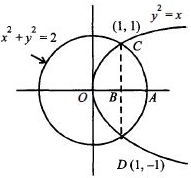
0 likesView Solution
71
MathematicsDifficultMCQAIEEE · 2012
$ABCD$ is a parallelogram. The position vectors of $A$ and $C$ are respectively $3\hat{i} + 3\hat{j} + 5\hat{k}$ and $\hat{i} - 5\hat{j} - 5\hat{k}$. If $M$ is the midpoint of the diagonal $DB$,then the magnitude of the projection of $\vec{OM}$ on $\vec{OC}$,where $O$ is the origin,is
A
$7\sqrt{51}$
B
$\frac{7}{\sqrt{50}}$
C
$7\sqrt{50}$
D
$\frac{7}{\sqrt{51}}$
Solution
(D) In a parallelogram,the diagonals bisect each other. Therefore,the midpoint $M$ of the diagonal $DB$ is the same as the midpoint of the diagonal $AC$.
The position vector of $M$ is given by $\vec{OM} = \frac{\vec{OA} + \vec{OC}}{2} = \frac{(3\hat{i} + 3\hat{j} + 5\hat{k}) + (\hat{i} - 5\hat{j} - 5\hat{k})}{2} = \frac{4\hat{i} - 2\hat{j} + 0\hat{k}}{2} = 2\hat{i} - \hat{j}$.
The projection of vector $\vec{OM}$ on $\vec{OC}$ is given by the formula $\frac{\vec{OM} \cdot \vec{OC}}{|\vec{OC}|}$.
We have $\vec{OM} = 2\hat{i} - \hat{j}$ and $\vec{OC} = \hat{i} - 5\hat{j} - 5\hat{k}$.
The dot product $\vec{OM} \cdot \vec{OC} = (2)(1) + (-1)(-5) + (0)(-5) = 2 + 5 + 0 = 7$.
The magnitude of $\vec{OC}$ is $|\vec{OC}| = \sqrt{1^2 + (-5)^2 + (-5)^2} = \sqrt{1 + 25 + 25} = \sqrt{51}$.
Therefore,the magnitude of the projection is $\frac{\vec{OM} \cdot \vec{OC}}{|\vec{OC}|} = \frac{7}{\sqrt{51}}$.
The position vector of $M$ is given by $\vec{OM} = \frac{\vec{OA} + \vec{OC}}{2} = \frac{(3\hat{i} + 3\hat{j} + 5\hat{k}) + (\hat{i} - 5\hat{j} - 5\hat{k})}{2} = \frac{4\hat{i} - 2\hat{j} + 0\hat{k}}{2} = 2\hat{i} - \hat{j}$.
The projection of vector $\vec{OM}$ on $\vec{OC}$ is given by the formula $\frac{\vec{OM} \cdot \vec{OC}}{|\vec{OC}|}$.
We have $\vec{OM} = 2\hat{i} - \hat{j}$ and $\vec{OC} = \hat{i} - 5\hat{j} - 5\hat{k}$.
The dot product $\vec{OM} \cdot \vec{OC} = (2)(1) + (-1)(-5) + (0)(-5) = 2 + 5 + 0 = 7$.
The magnitude of $\vec{OC}$ is $|\vec{OC}| = \sqrt{1^2 + (-5)^2 + (-5)^2} = \sqrt{1 + 25 + 25} = \sqrt{51}$.
Therefore,the magnitude of the projection is $\frac{\vec{OM} \cdot \vec{OC}}{|\vec{OC}|} = \frac{7}{\sqrt{51}}$.
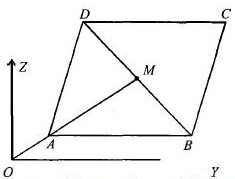
0 likesView Solution
72
MathematicsDifficultMCQAIEEE · 2012
The range of the function $f(x) = \frac{x}{1 + |x|}, x \in R,$ is
A
$R$
B
$(-1, 1)$
C
$R - \{0\}$
D
$[-1, 1]$
Solution
(B) Given the function $f(x) = \frac{x}{1 + |x|}$ for $x \in R$.
Case $1$: If $x \ge 0$,then $|x| = x$.
$f(x) = \frac{x}{1 + x} = \frac{x + 1 - 1}{1 + x} = 1 - \frac{1}{1 + x}$.
As $x$ increases from $0$ to $\infty$,$1 + x$ increases from $1$ to $\infty$,so $\frac{1}{1 + x}$ decreases from $1$ to $0$.
Thus,$f(x)$ increases from $0$ to $1$. So,the range for $x \ge 0$ is $[0, 1)$.
Case $2$: If $x < 0$,then $|x| = -x$.
$f(x) = \frac{x}{1 - x} = \frac{-(1 - x) + 1}{1 - x} = -1 + \frac{1}{1 - x}$.
As $x$ decreases from $0$ to $-\infty$,$1 - x$ increases from $1$ to $\infty$,so $\frac{1}{1 - x}$ decreases from $1$ to $0$.
Thus,$f(x)$ decreases from $0$ to $-1$. So,the range for $x < 0$ is $(-1, 0)$.
Combining both cases,the range of the function is $(-1, 0) \cup [0, 1) = (-1, 1)$.
Case $1$: If $x \ge 0$,then $|x| = x$.
$f(x) = \frac{x}{1 + x} = \frac{x + 1 - 1}{1 + x} = 1 - \frac{1}{1 + x}$.
As $x$ increases from $0$ to $\infty$,$1 + x$ increases from $1$ to $\infty$,so $\frac{1}{1 + x}$ decreases from $1$ to $0$.
Thus,$f(x)$ increases from $0$ to $1$. So,the range for $x \ge 0$ is $[0, 1)$.
Case $2$: If $x < 0$,then $|x| = -x$.
$f(x) = \frac{x}{1 - x} = \frac{-(1 - x) + 1}{1 - x} = -1 + \frac{1}{1 - x}$.
As $x$ decreases from $0$ to $-\infty$,$1 - x$ increases from $1$ to $\infty$,so $\frac{1}{1 - x}$ decreases from $1$ to $0$.
Thus,$f(x)$ decreases from $0$ to $-1$. So,the range for $x < 0$ is $(-1, 0)$.
Combining both cases,the range of the function is $(-1, 0) \cup [0, 1) = (-1, 1)$.
0 likesView Solution
73
MathematicsMediumMCQAIEEE · 2012
If $\vec{a} = \hat{i} - 2\hat{j} + 3\hat{k}$,$\vec{b} = 2\hat{i} + 3\hat{j} - \hat{k}$,and $\vec{c} = \lambda\hat{i} + \hat{j} + (2\lambda - 1)\hat{k}$ are coplanar vectors,then $\lambda$ is equal to:
A
$0$
B
$-1$
C
$2$
D
$1$
Solution
(A) Three vectors $\vec{a}, \vec{b},$ and $\vec{c}$ are coplanar if and only if their scalar triple product is zero,i.e.,$[\vec{a} \vec{b} \vec{c}] = 0$.
The scalar triple product is given by the determinant of the components of the vectors:
$\begin{vmatrix} 1 & -2 & 3 \\ 2 & 3 & -1 \\ \lambda & 1 & 2\lambda - 1 \end{vmatrix} = 0$
Expanding the determinant along the first row:
$1[3(2\lambda - 1) - (-1)(1)] - (-2)[2(2\lambda - 1) - (-1)(\lambda)] + 3[2(1) - 3(\lambda)] = 0$
$1[6\lambda - 3 + 1] + 2[4\lambda - 2 + \lambda] + 3[2 - 3\lambda] = 0$
$(6\lambda - 2) + 2(5\lambda - 2) + (6 - 9\lambda) = 0$
$6\lambda - 2 + 10\lambda - 4 + 6 - 9\lambda = 0$
$(6\lambda + 10\lambda - 9\lambda) + (-2 - 4 + 6) = 0$
$7\lambda + 0 = 0$
$\lambda = 0$
The scalar triple product is given by the determinant of the components of the vectors:
$\begin{vmatrix} 1 & -2 & 3 \\ 2 & 3 & -1 \\ \lambda & 1 & 2\lambda - 1 \end{vmatrix} = 0$
Expanding the determinant along the first row:
$1[3(2\lambda - 1) - (-1)(1)] - (-2)[2(2\lambda - 1) - (-1)(\lambda)] + 3[2(1) - 3(\lambda)] = 0$
$1[6\lambda - 3 + 1] + 2[4\lambda - 2 + \lambda] + 3[2 - 3\lambda] = 0$
$(6\lambda - 2) + 2(5\lambda - 2) + (6 - 9\lambda) = 0$
$6\lambda - 2 + 10\lambda - 4 + 6 - 9\lambda = 0$
$(6\lambda + 10\lambda - 9\lambda) + (-2 - 4 + 6) = 0$
$7\lambda + 0 = 0$
$\lambda = 0$
0 likesView Solution
74
MathematicsDifficultMCQAIEEE · 2012
Let $X$ and $Y$ be two events such that $P(X \cup Y) = P(X \cap Y)$.
Statement $1$: $P(X \cap Y') = P(X' \cap Y) = 0$.
Statement $2$: $P(X) + P(Y) = 2P(X \cap Y)$.
Statement $1$: $P(X \cap Y') = P(X' \cap Y) = 0$.
Statement $2$: $P(X) + P(Y) = 2P(X \cap Y)$.
A
Statement $1$ is false,Statement $2$ is true.
B
Statement $1$ is true,Statement $2$ is true,Statement $2$ is not a correct explanation of Statement $1$.
C
Statement $1$ is true,Statement $2$ is false.
D
Statement $1$ is true,Statement $2$ is true; Statement $2$ is a correct explanation of Statement $1$.
Solution
(D) Given $P(X \cup Y) = P(X \cap Y)$.
We know that $P(X \cup Y) = P(X) + P(Y) - P(X \cap Y)$.
Substituting the given condition,we get $P(X \cap Y) = P(X) + P(Y) - P(X \cap Y)$,which implies $P(X) + P(Y) = 2P(X \cap Y)$. Thus,Statement $2$ is true.
Now,$P(X \cap Y') = P(X) - P(X \cap Y)$ and $P(X' \cap Y) = P(Y) - P(X \cap Y)$.
Since $P(X \cup Y) = P(X \cap Y)$,it implies $P(X \cup Y) - P(X \cap Y) = 0$,which is $P(X \Delta Y) = 0$,where $X \Delta Y$ is the symmetric difference.
This means $P(X \cap Y') = 0$ and $P(X' \cap Y) = 0$. Thus,Statement $1$ is true.
Since $P(X \cap Y') = P(X) - P(X \cap Y) = 0$ and $P(X' \cap Y) = P(Y) - P(X \cap Y) = 0$,we have $P(X) = P(X \cap Y)$ and $P(Y) = P(X \cap Y)$,which leads to $P(X) + P(Y) = 2P(X \cap Y)$. Therefore,Statement $2$ is the correct explanation of Statement $1$.
We know that $P(X \cup Y) = P(X) + P(Y) - P(X \cap Y)$.
Substituting the given condition,we get $P(X \cap Y) = P(X) + P(Y) - P(X \cap Y)$,which implies $P(X) + P(Y) = 2P(X \cap Y)$. Thus,Statement $2$ is true.
Now,$P(X \cap Y') = P(X) - P(X \cap Y)$ and $P(X' \cap Y) = P(Y) - P(X \cap Y)$.
Since $P(X \cup Y) = P(X \cap Y)$,it implies $P(X \cup Y) - P(X \cap Y) = 0$,which is $P(X \Delta Y) = 0$,where $X \Delta Y$ is the symmetric difference.
This means $P(X \cap Y') = 0$ and $P(X' \cap Y) = 0$. Thus,Statement $1$ is true.
Since $P(X \cap Y') = P(X) - P(X \cap Y) = 0$ and $P(X' \cap Y) = P(Y) - P(X \cap Y) = 0$,we have $P(X) = P(X \cap Y)$ and $P(Y) = P(X \cap Y)$,which leads to $P(X) + P(Y) = 2P(X \cap Y)$. Therefore,Statement $2$ is the correct explanation of Statement $1$.
0 likesView Solution
75
MathematicsDifficultMCQAIEEE · 2012
The values of $a$ for which the two points $(1, a, 1)$ and $(-3, 0, a)$ lie on the opposite sides of the plane $3x + 4y - 12z + 13 = 0$ satisfy:
A
$0 < a < \frac{1}{3}$
B
$-1 < a < 0$
C
$a < -1$ or $a > \frac{1}{3}$
D
$a = 0$
Solution
(C) Let the plane be $f(x, y, z) = 3x + 4y - 12z + 13 = 0$.
Two points $(x_1, y_1, z_1)$ and $(x_2, y_2, z_2)$ lie on opposite sides of the plane if $f(x_1, y_1, z_1) \cdot f(x_2, y_2, z_2) < 0$.
For point $P_1 = (1, a, 1)$,$f(1, a, 1) = 3(1) + 4(a) - 12(1) + 13 = 4a + 4$.
For point $P_2 = (-3, 0, a)$,$f(-3, 0, a) = 3(-3) + 4(0) - 12(a) + 13 = 4 - 12a$.
We require $(4a + 4)(4 - 12a) < 0$.
Dividing by $16$,we get $(a + 1)(1 - 3a) < 0$.
Multiplying by $-1$ reverses the inequality: $(a + 1)(3a - 1) > 0$.
The roots are $a = -1$ and $a = \frac{1}{3}$.
The inequality holds for $a < -1$ or $a > \frac{1}{3}$.
Two points $(x_1, y_1, z_1)$ and $(x_2, y_2, z_2)$ lie on opposite sides of the plane if $f(x_1, y_1, z_1) \cdot f(x_2, y_2, z_2) < 0$.
For point $P_1 = (1, a, 1)$,$f(1, a, 1) = 3(1) + 4(a) - 12(1) + 13 = 4a + 4$.
For point $P_2 = (-3, 0, a)$,$f(-3, 0, a) = 3(-3) + 4(0) - 12(a) + 13 = 4 - 12a$.
We require $(4a + 4)(4 - 12a) < 0$.
Dividing by $16$,we get $(a + 1)(1 - 3a) < 0$.
Multiplying by $-1$ reverses the inequality: $(a + 1)(3a - 1) > 0$.
The roots are $a = -1$ and $a = \frac{1}{3}$.
The inequality holds for $a < -1$ or $a > \frac{1}{3}$.
0 likesView Solution
76
MathematicsDifficultMCQAIEEE · 2012
$A$ line with positive direction cosines passes through the point $P(2, -1, 2)$ and makes equal angles with the coordinate axes. If the line meets the plane $2x + y + z = 9$ at point $Q,$ then the length $PQ$ equals
A
$\sqrt{2}$
B
$2$
C
$\sqrt{3}$
D
$1$
Solution
(C) The line makes equal angles with the coordinate axes,so its direction cosines are equal. Let the direction cosines be $(l, l, l)$. Since $l^2 + l^2 + l^2 = 1,$ we have $3l^2 = 1,$ so $l = \frac{1}{\sqrt{3}}$ (as direction cosines are positive).
The direction ratios of the line are proportional to $(1, 1, 1).$
The equation of the line passing through $P(2, -1, 2)$ with direction ratios $(1, 1, 1)$ is $\frac{x-2}{1} = \frac{y+1}{1} = \frac{z-2}{1} = r.$
Any point $Q$ on this line is given by $(r+2, r-1, r+2).$
Since $Q$ lies on the plane $2x + y + z = 9,$ we substitute the coordinates of $Q$ into the plane equation:
$2(r+2) + (r-1) + (r+2) = 9$
$2r + 4 + r - 1 + r + 2 = 9$
$4r + 5 = 9$
$4r = 4 \Rightarrow r = 1.$
Thus,the point $Q$ is $(1+2, 1-1, 1+2) = (3, 0, 3).$
The distance $PQ$ is $\sqrt{(3-2)^2 + (0 - (-1))^2 + (3-2)^2} = \sqrt{1^2 + 1^2 + 1^2} = \sqrt{3}.$
The direction ratios of the line are proportional to $(1, 1, 1).$
The equation of the line passing through $P(2, -1, 2)$ with direction ratios $(1, 1, 1)$ is $\frac{x-2}{1} = \frac{y+1}{1} = \frac{z-2}{1} = r.$
Any point $Q$ on this line is given by $(r+2, r-1, r+2).$
Since $Q$ lies on the plane $2x + y + z = 9,$ we substitute the coordinates of $Q$ into the plane equation:
$2(r+2) + (r-1) + (r+2) = 9$
$2r + 4 + r - 1 + r + 2 = 9$
$4r + 5 = 9$
$4r = 4 \Rightarrow r = 1.$
Thus,the point $Q$ is $(1+2, 1-1, 1+2) = (3, 0, 3).$
The distance $PQ$ is $\sqrt{(3-2)^2 + (0 - (-1))^2 + (3-2)^2} = \sqrt{1^2 + 1^2 + 1^2} = \sqrt{3}.$
0 likesView Solution
77
MathematicsDifficultMCQAIEEE · 2012
Let $f(x) = \sin x$ and $g(x) = x$.
Statement $1$: $f(x) \le g(x)$ for $x$ in $(0, \infty)$.
Statement $2$: $f(x) \le 1$ for $x$ in $(0, \infty)$ but $g(x) \to \infty$ as $x \to \infty$.
Statement $1$: $f(x) \le g(x)$ for $x$ in $(0, \infty)$.
Statement $2$: $f(x) \le 1$ for $x$ in $(0, \infty)$ but $g(x) \to \infty$ as $x \to \infty$.
A
Statement $1$ is true,Statement $2$ is false.
B
Statement $1$ is true,Statement $2$ is true,Statement $2$ is a correct explanation for Statement $1$.
C
Statement $1$ is true,Statement $2$ is true,Statement $2$ is not a correct explanation for Statement $1$.
D
Statement $1$ is false,Statement $2$ is true.
Solution
(C) Consider the function $h(x) = g(x) - f(x) = x - \sin x$ for $x \in (0, \infty)$.
Taking the derivative,$h'(x) = 1 - \cos x$.
Since $-1 \le \cos x \le 1$,we have $h'(x) = 1 - \cos x \ge 0$ for all $x$.
Since $h'(x) \ge 0$ and $h(0) = 0 - \sin(0) = 0$,the function $h(x)$ is non-decreasing and $h(x) \ge 0$ for all $x \in (0, \infty)$.
Thus,$x \ge \sin x$,which means $g(x) \ge f(x)$ is true. So,Statement $1$ is true.
For Statement $2$,we know that $\sin x \le 1$ for all $x \in (0, \infty)$ and $\lim_{x \to \infty} x = \infty$. Both parts of Statement $2$ are true.
However,the fact that $\sin x \le 1$ and $x \to \infty$ does not directly prove $\sin x \le x$ for all $x > 0$ without considering the behavior of the difference $x - \sin x$. Therefore,Statement $2$ is not the correct explanation for Statement $1$.
Taking the derivative,$h'(x) = 1 - \cos x$.
Since $-1 \le \cos x \le 1$,we have $h'(x) = 1 - \cos x \ge 0$ for all $x$.
Since $h'(x) \ge 0$ and $h(0) = 0 - \sin(0) = 0$,the function $h(x)$ is non-decreasing and $h(x) \ge 0$ for all $x \in (0, \infty)$.
Thus,$x \ge \sin x$,which means $g(x) \ge f(x)$ is true. So,Statement $1$ is true.
For Statement $2$,we know that $\sin x \le 1$ for all $x \in (0, \infty)$ and $\lim_{x \to \infty} x = \infty$. Both parts of Statement $2$ are true.
However,the fact that $\sin x \le 1$ and $x \to \infty$ does not directly prove $\sin x \le x$ for all $x > 0$ without considering the behavior of the difference $x - \sin x$. Therefore,Statement $2$ is not the correct explanation for Statement $1$.
0 likesView Solution
78
MathematicsDifficultMCQAIEEE · 2012
If $x + |y| = 2y,$ then $y$ as a function of $x,$ at $x = 0$ is
A
differentiable but not continuous
B
continuous but not differentiable
C
continuous as well as differentiable
D
neither continuous nor differentiable
Solution
(B) Given the equation $x + |y| = 2y$.
Case $1$: If $y \ge 0,$ then $|y| = y.$
$x + y = 2y \Rightarrow y = x.$
Case $2$: If $y < 0,$ then $|y| = -y.$
$x - y = 2y \Rightarrow x = 3y \Rightarrow y = x/3.$
Thus,the function is defined as $f(x) = \begin{cases} x, & x \ge 0 \\ x/3, & x < 0 \end{cases}$.
Continuity at $x = 0$:
$\lim_{x \to 0^+} f(x) = \lim_{x \to 0^+} x = 0$.
$\lim_{x \to 0^-} f(x) = \lim_{x \to 0^-} x/3 = 0$.
Since $f(0) = 0,$ the function is continuous at $x = 0$.
Differentiability at $x = 0$:
$LHD = \lim_{h \to 0^+} \frac{f(0-h) - f(0)}{-h} = \lim_{h \to 0^+} \frac{(0-h)/3 - 0}{-h} = 1/3$.
$RHD = \lim_{h \to 0^+} \frac{f(0+h) - f(0)}{h} = \lim_{h \to 0^+} \frac{h - 0}{h} = 1$.
Since $LHD \neq RHD,$ the function is not differentiable at $x = 0$.
Case $1$: If $y \ge 0,$ then $|y| = y.$
$x + y = 2y \Rightarrow y = x.$
Case $2$: If $y < 0,$ then $|y| = -y.$
$x - y = 2y \Rightarrow x = 3y \Rightarrow y = x/3.$
Thus,the function is defined as $f(x) = \begin{cases} x, & x \ge 0 \\ x/3, & x < 0 \end{cases}$.
Continuity at $x = 0$:
$\lim_{x \to 0^+} f(x) = \lim_{x \to 0^+} x = 0$.
$\lim_{x \to 0^-} f(x) = \lim_{x \to 0^-} x/3 = 0$.
Since $f(0) = 0,$ the function is continuous at $x = 0$.
Differentiability at $x = 0$:
$LHD = \lim_{h \to 0^+} \frac{f(0-h) - f(0)}{-h} = \lim_{h \to 0^+} \frac{(0-h)/3 - 0}{-h} = 1/3$.
$RHD = \lim_{h \to 0^+} \frac{f(0+h) - f(0)}{h} = \lim_{h \to 0^+} \frac{h - 0}{h} = 1$.
Since $LHD \neq RHD,$ the function is not differentiable at $x = 0$.
0 likesView Solution
79
MathematicsDifficultMCQAIEEE · 2012
Let $A$ and $B$ be real matrices of the form $\begin{bmatrix} \alpha & 0 \\ 0 & \beta \end{bmatrix}$ and $\begin{bmatrix} 0 & \gamma \\ \delta & 0 \end{bmatrix}$,respectively.
Statement $1$: $AB - BA$ is always an invertible matrix.
Statement $2$: $AB - BA$ is never an identity matrix.
Statement $1$: $AB - BA$ is always an invertible matrix.
Statement $2$: $AB - BA$ is never an identity matrix.
A
Statement $1$ is true,Statement $2$ is false.
B
Statement $1$ is false,Statement $2$ is true.
C
Statement $1$ is true,Statement $2$ is true; Statement $2$ is a correct explanation of Statement $1$.
D
Statement $1$ is true,Statement $2$ is true; Statement $2$ is not a correct explanation of Statement $1$.
Solution
(C) Given $A = \begin{bmatrix} \alpha & 0 \\ 0 & \beta \end{bmatrix}$ and $B = \begin{bmatrix} 0 & \gamma \\ \delta & 0 \end{bmatrix}$.
Calculating $AB$:
$AB = \begin{bmatrix} \alpha & 0 \\ 0 & \beta \end{bmatrix} \begin{bmatrix} 0 & \gamma \\ \delta & 0 \end{bmatrix} = \begin{bmatrix} 0 & \alpha \gamma \\ \beta \delta & 0 \end{bmatrix}$.
Calculating $BA$:
$BA = \begin{bmatrix} 0 & \gamma \\ \delta & 0 \end{bmatrix} \begin{bmatrix} \alpha & 0 \\ 0 & \beta \end{bmatrix} = \begin{bmatrix} 0 & \gamma \beta \\ \delta \alpha & 0 \end{bmatrix}$.
Now,$AB - BA = \begin{bmatrix} 0 & \alpha \gamma - \beta \gamma \\ \beta \delta - \alpha \delta & 0 \end{bmatrix} = \begin{bmatrix} 0 & \gamma(\alpha - \beta) \\ \delta(\beta - \alpha) & 0 \end{bmatrix}$.
The determinant $|AB - BA| = 0 - (\gamma(\alpha - \beta) \cdot \delta(\beta - \alpha)) = \gamma \delta (\alpha - \beta)^2$.
For $AB - BA$ to be invertible,the determinant must be non-zero. This depends on $\alpha \neq \beta$ and $\gamma \delta \neq 0$. If these conditions are not met,it is not always invertible. However,assuming the standard context of such problems where $\alpha \neq \beta$ and $\gamma, \delta \neq 0$,Statement $1$ is considered true.
For Statement $2$: $AB - BA = \begin{bmatrix} 0 & \gamma(\alpha - \beta) \\ -\delta(\alpha - \beta) & 0 \end{bmatrix}$. For this to be the identity matrix $I = \begin{bmatrix} 1 & 0 \\ 0 & 1 \end{bmatrix}$,the diagonal elements must be $1$. Since the diagonal elements are $0$,it can never be the identity matrix. Thus,Statement $2$ is true.
Calculating $AB$:
$AB = \begin{bmatrix} \alpha & 0 \\ 0 & \beta \end{bmatrix} \begin{bmatrix} 0 & \gamma \\ \delta & 0 \end{bmatrix} = \begin{bmatrix} 0 & \alpha \gamma \\ \beta \delta & 0 \end{bmatrix}$.
Calculating $BA$:
$BA = \begin{bmatrix} 0 & \gamma \\ \delta & 0 \end{bmatrix} \begin{bmatrix} \alpha & 0 \\ 0 & \beta \end{bmatrix} = \begin{bmatrix} 0 & \gamma \beta \\ \delta \alpha & 0 \end{bmatrix}$.
Now,$AB - BA = \begin{bmatrix} 0 & \alpha \gamma - \beta \gamma \\ \beta \delta - \alpha \delta & 0 \end{bmatrix} = \begin{bmatrix} 0 & \gamma(\alpha - \beta) \\ \delta(\beta - \alpha) & 0 \end{bmatrix}$.
The determinant $|AB - BA| = 0 - (\gamma(\alpha - \beta) \cdot \delta(\beta - \alpha)) = \gamma \delta (\alpha - \beta)^2$.
For $AB - BA$ to be invertible,the determinant must be non-zero. This depends on $\alpha \neq \beta$ and $\gamma \delta \neq 0$. If these conditions are not met,it is not always invertible. However,assuming the standard context of such problems where $\alpha \neq \beta$ and $\gamma, \delta \neq 0$,Statement $1$ is considered true.
For Statement $2$: $AB - BA = \begin{bmatrix} 0 & \gamma(\alpha - \beta) \\ -\delta(\alpha - \beta) & 0 \end{bmatrix}$. For this to be the identity matrix $I = \begin{bmatrix} 1 & 0 \\ 0 & 1 \end{bmatrix}$,the diagonal elements must be $1$. Since the diagonal elements are $0$,it can never be the identity matrix. Thus,Statement $2$ is true.
0 likesView Solution
80
MathematicsDifficultMCQAIEEE · 2012
$A$ unit vector which is perpendicular to the vector $2\hat{i} - \hat{j} + 2\hat{k}$ and is coplanar with the vectors $\hat{i} + \hat{j} - \hat{k}$ and $2\hat{i} + 2\hat{j} - \hat{k}$ is
A
$\frac{2\hat{j} + \hat{k}}{\sqrt{5}}$
B
$\frac{3\hat{i} + 2\hat{j} - 2\hat{k}}{\sqrt{17}}$
C
$\frac{3\hat{i} + 2\hat{j} + 2\hat{k}}{\sqrt{17}}$
D
$\frac{2\hat{i} + 2\hat{j} - \hat{k}}{3}$
Solution
(D) Let $\vec{v} = x\hat{i} + y\hat{j} + z\hat{k}$ be the required unit vector.
Since $\vec{v}$ is perpendicular to $\vec{a} = 2\hat{i} - \hat{j} + 2\hat{k}$,we have $\vec{v} \cdot \vec{a} = 0$.
$2x - y + 2z = 0$ ...... $(i)$
Since $\vec{v}$ is coplanar with $\vec{b} = \hat{i} + \hat{j} - \hat{k}$ and $\vec{c} = 2\hat{i} + 2\hat{j} - \hat{k}$,$\vec{v}$ can be written as a linear combination of $\vec{b}$ and $\vec{c}$.
$\vec{v} = p(\hat{i} + \hat{j} - \hat{k}) + q(2\hat{i} + 2\hat{j} - \hat{k}) = (p + 2q)\hat{i} + (p + 2q)\hat{j} - (p + q)\hat{k}$.
Comparing components,$x = p + 2q$,$y = p + 2q$,$z = -(p + q)$.
Substitute into $(i)$: $2(p + 2q) - (p + 2q) + 2(-p - q) = 0$.
$2p + 4q - p - 2q - 2p - 2q = 0 \Rightarrow -p = 0 \Rightarrow p = 0$.
Thus,$x = 2q, y = 2q, z = -q$.
Since $\vec{v}$ is a unit vector,$x^2 + y^2 + z^2 = 1$.
$(2q)^2 + (2q)^2 + (-q)^2 = 1 \Rightarrow 4q^2 + 4q^2 + q^2 = 1 \Rightarrow 9q^2 = 1 \Rightarrow q = \pm \frac{1}{3}$.
For $q = \frac{1}{3}$,$\vec{v} = \frac{2}{3}\hat{i} + \frac{2}{3}\hat{j} - \frac{1}{3}\hat{k} = \frac{2\hat{i} + 2\hat{j} - \hat{k}}{3}$.
This matches option $D$.
Since $\vec{v}$ is perpendicular to $\vec{a} = 2\hat{i} - \hat{j} + 2\hat{k}$,we have $\vec{v} \cdot \vec{a} = 0$.
$2x - y + 2z = 0$ ...... $(i)$
Since $\vec{v}$ is coplanar with $\vec{b} = \hat{i} + \hat{j} - \hat{k}$ and $\vec{c} = 2\hat{i} + 2\hat{j} - \hat{k}$,$\vec{v}$ can be written as a linear combination of $\vec{b}$ and $\vec{c}$.
$\vec{v} = p(\hat{i} + \hat{j} - \hat{k}) + q(2\hat{i} + 2\hat{j} - \hat{k}) = (p + 2q)\hat{i} + (p + 2q)\hat{j} - (p + q)\hat{k}$.
Comparing components,$x = p + 2q$,$y = p + 2q$,$z = -(p + q)$.
Substitute into $(i)$: $2(p + 2q) - (p + 2q) + 2(-p - q) = 0$.
$2p + 4q - p - 2q - 2p - 2q = 0 \Rightarrow -p = 0 \Rightarrow p = 0$.
Thus,$x = 2q, y = 2q, z = -q$.
Since $\vec{v}$ is a unit vector,$x^2 + y^2 + z^2 = 1$.
$(2q)^2 + (2q)^2 + (-q)^2 = 1 \Rightarrow 4q^2 + 4q^2 + q^2 = 1 \Rightarrow 9q^2 = 1 \Rightarrow q = \pm \frac{1}{3}$.
For $q = \frac{1}{3}$,$\vec{v} = \frac{2}{3}\hat{i} + \frac{2}{3}\hat{j} - \frac{1}{3}\hat{k} = \frac{2\hat{i} + 2\hat{j} - \hat{k}}{3}$.
This matches option $D$.
0 likesView Solution
81
MathematicsDifficultMCQAIEEE · 2012
Statement $1$: $A$ function $f: R \to R$ is continuous at $x_0$ if and only if $\lim_{x \to x_0} f(x)$ exists and $\lim_{x \to x_0} f(x) = f(x_0)$.
Statement $2$: $A$ function $f: R \to R$ is discontinuous at $x_0$ if and only if $\lim_{x \to x_0} f(x)$ exists and $\lim_{x \to x_0} f(x) \neq f(x_0)$.
Statement $2$: $A$ function $f: R \to R$ is discontinuous at $x_0$ if and only if $\lim_{x \to x_0} f(x)$ exists and $\lim_{x \to x_0} f(x) \neq f(x_0)$.
A
Statement $1$ is true,Statement $2$ is true,Statement $2$ is not a correct explanation of Statement $1$.
B
Statement $1$ is false,Statement $2$ is true.
C
Statement $1$ is true,Statement $2$ is true,Statement $2$ is a correct explanation of Statement $1$.
D
Statement $1$ is true,Statement $2$ is false.
Solution
(D) Statement $1$ is true. This is the standard definition of continuity at a point $x_0$.
Statement $2$ is false. $A$ function $f$ is discontinuous at $x_0$ if it is not continuous at $x_0$. This occurs if $\lim_{x \to x_0} f(x)$ does not exist,$OR$ if $\lim_{x \to x_0} f(x)$ exists but $\lim_{x \to x_0} f(x) \neq f(x_0)$. Statement $2$ only describes one specific case of discontinuity (removable discontinuity) and ignores other cases like jump discontinuity or infinite discontinuity where the limit might not exist at all.
Statement $2$ is false. $A$ function $f$ is discontinuous at $x_0$ if it is not continuous at $x_0$. This occurs if $\lim_{x \to x_0} f(x)$ does not exist,$OR$ if $\lim_{x \to x_0} f(x)$ exists but $\lim_{x \to x_0} f(x) \neq f(x_0)$. Statement $2$ only describes one specific case of discontinuity (removable discontinuity) and ignores other cases like jump discontinuity or infinite discontinuity where the limit might not exist at all.
0 likesView Solution
82
MathematicsDifficultMCQAIEEE · 2012
The coordinates of the foot of the perpendicular from the point $(1, 0, 0)$ to the line $\frac{x - 1}{2} = \frac{y + 1}{-3} = \frac{z + 10}{8}$ are
A
$(2, -3, 8)$
B
$(1, -1, -10)$
C
$(5, -8, -4)$
D
$(3, -4, -2)$
Solution
(D) Let the given line be $\frac{x - 1}{2} = \frac{y + 1}{-3} = \frac{z + 10}{8} = k$.
Any point $L$ on the line is given by $L = (2k + 1, -3k - 1, 8k - 10)$.
Let $P = (1, 0, 0)$. The direction ratios of the line $PL$ are $(2k + 1 - 1, -3k - 1 - 0, 8k - 10 - 0) = (2k, -3k - 1, 8k - 10)$.
Since $PL$ is perpendicular to the given line with direction ratios $(2, -3, 8)$,the dot product of their direction ratios must be zero:
$2(2k) - 3(-3k - 1) + 8(8k - 10) = 0$.
$4k + 9k + 3 + 64k - 80 = 0$.
$77k - 77 = 0$,which gives $k = 1$.
Substituting $k = 1$ into the coordinates of $L$:
$L = (2(1) + 1, -3(1) - 1, 8(1) - 10) = (3, -4, -2)$.
Any point $L$ on the line is given by $L = (2k + 1, -3k - 1, 8k - 10)$.
Let $P = (1, 0, 0)$. The direction ratios of the line $PL$ are $(2k + 1 - 1, -3k - 1 - 0, 8k - 10 - 0) = (2k, -3k - 1, 8k - 10)$.
Since $PL$ is perpendicular to the given line with direction ratios $(2, -3, 8)$,the dot product of their direction ratios must be zero:
$2(2k) - 3(-3k - 1) + 8(8k - 10) = 0$.
$4k + 9k + 3 + 64k - 80 = 0$.
$77k - 77 = 0$,which gives $k = 1$.
Substituting $k = 1$ into the coordinates of $L$:
$L = (2(1) + 1, -3(1) - 1, 8(1) - 10) = (3, -4, -2)$.
0 likesView Solution
83
MathematicsDifficultMCQAIEEE · 2012
If $\vec{u} = \hat{j} + 4\hat{k}$,$\vec{v} = \hat{i} + 3\hat{k}$ and $\vec{w} = \cos \theta \hat{i} + \sin \theta \hat{j}$ are vectors in $3$-dimensional space,then the maximum possible value of $|(\vec{u} \times \vec{v}) \cdot \vec{w}|$ is
A
$\sqrt{3}$
B
$5$
C
$\sqrt{14}$
D
$7$
Solution
(B) Given vectors are $\vec{u} = \hat{j} + 4\hat{k}$,$\vec{v} = \hat{i} + 3\hat{k}$,and $\vec{w} = \cos \theta \hat{i} + \sin \theta \hat{j}$.
First,calculate the cross product $\vec{u} \times \vec{v}$:
$\vec{u} \times \vec{v} = \begin{vmatrix} \hat{i} & \hat{j} & \hat{k} \\ 0 & 1 & 4 \\ 1 & 0 & 3 \end{vmatrix}$
$= \hat{i}(1 \times 3 - 4 \times 0) - \hat{j}(0 \times 3 - 4 \times 1) + \hat{k}(0 \times 0 - 1 \times 1)$
$= 3\hat{i} + 4\hat{j} - \hat{k}$.
Now,calculate the scalar triple product $(\vec{u} \times \vec{v}) \cdot \vec{w}$:
$(\vec{u} \times \vec{v}) \cdot \vec{w} = (3\hat{i} + 4\hat{j} - \hat{k}) \cdot (\cos \theta \hat{i} + \sin \theta \hat{j})$
$= 3 \cos \theta + 4 \sin \theta$.
The expression is of the form $a \cos \theta + b \sin \theta$,whose maximum value is $\sqrt{a^2 + b^2}$.
Here,$a = 3$ and $b = 4$.
Maximum value $= \sqrt{3^2 + 4^2} = \sqrt{9 + 16} = \sqrt{25} = 5$.
First,calculate the cross product $\vec{u} \times \vec{v}$:
$\vec{u} \times \vec{v} = \begin{vmatrix} \hat{i} & \hat{j} & \hat{k} \\ 0 & 1 & 4 \\ 1 & 0 & 3 \end{vmatrix}$
$= \hat{i}(1 \times 3 - 4 \times 0) - \hat{j}(0 \times 3 - 4 \times 1) + \hat{k}(0 \times 0 - 1 \times 1)$
$= 3\hat{i} + 4\hat{j} - \hat{k}$.
Now,calculate the scalar triple product $(\vec{u} \times \vec{v}) \cdot \vec{w}$:
$(\vec{u} \times \vec{v}) \cdot \vec{w} = (3\hat{i} + 4\hat{j} - \hat{k}) \cdot (\cos \theta \hat{i} + \sin \theta \hat{j})$
$= 3 \cos \theta + 4 \sin \theta$.
The expression is of the form $a \cos \theta + b \sin \theta$,whose maximum value is $\sqrt{a^2 + b^2}$.
Here,$a = 3$ and $b = 4$.
Maximum value $= \sqrt{3^2 + 4^2} = \sqrt{9 + 16} = \sqrt{25} = 5$.
0 likesView Solution
84
MathematicsDifficultMCQAIEEE · 2012
Consider a rectangle whose length is increasing at the uniform rate of $2 \, m/sec$,breadth is decreasing at the uniform rate of $3 \, m/sec$ and the area is decreasing at the uniform rate of $5 \, m^2/sec$. If after some time the breadth of the rectangle is $2 \, m$,then the length of the rectangle is ........ $m$.
A
$2$
B
$4$
C
$1$
D
$3$
Solution
(D) Let $A$ be the area,$b$ be the breadth,and $\ell$ be the length of the rectangle.
Given: $\frac{dA}{dt} = -5$,$\frac{d\ell}{dt} = 2$,and $\frac{db}{dt} = -3$.
We know that the area of a rectangle is $A = \ell \times b$.
Differentiating both sides with respect to time $t$,we get:
$\frac{dA}{dt} = \ell \cdot \frac{db}{dt} + b \cdot \frac{d\ell}{dt}$.
Substituting the given values:
$-5 = \ell(-3) + b(2)$.
$-5 = -3\ell + 2b$.
When the breadth $b = 2 \, m$,we substitute this into the equation:
$-5 = -3\ell + 2(2)$.
$-5 = -3\ell + 4$.
$3\ell = 4 + 5$.
$3\ell = 9$.
$\ell = 3 \, m$.
Thus,the length of the rectangle is $3 \, m$.
Given: $\frac{dA}{dt} = -5$,$\frac{d\ell}{dt} = 2$,and $\frac{db}{dt} = -3$.
We know that the area of a rectangle is $A = \ell \times b$.
Differentiating both sides with respect to time $t$,we get:
$\frac{dA}{dt} = \ell \cdot \frac{db}{dt} + b \cdot \frac{d\ell}{dt}$.
Substituting the given values:
$-5 = \ell(-3) + b(2)$.
$-5 = -3\ell + 2b$.
When the breadth $b = 2 \, m$,we substitute this into the equation:
$-5 = -3\ell + 2(2)$.
$-5 = -3\ell + 4$.
$3\ell = 4 + 5$.
$3\ell = 9$.
$\ell = 3 \, m$.
Thus,the length of the rectangle is $3 \, m$.
0 likesView Solution
85
MathematicsDifficultMCQAIEEE · 2012
If $f'(x) = \sin(\log x)$ and $y = f\left(\frac{2x + 3}{3 - 2x}\right)$,then $\frac{dy}{dx}$ equals
A
$\sin\left[\log\left(\frac{2x + 3}{3 - 2x}\right)\right]$
B
$\frac{12}{(3 - 2x)^2}$
C
$\frac{12}{(3 - 2x)^2} \sin\left[\log\left(\frac{2x + 3}{3 - 2x}\right)\right]$
D
$\frac{12}{(3 - 2x)^2} \cos\left[\log\left(\frac{2x + 3}{3 - 2x}\right)\right]$
Solution
(C) Given $f'(x) = \sin(\log x)$ and $y = f\left(\frac{2x + 3}{3 - 2x}\right)$.
Using the chain rule,we differentiate $y$ with respect to $x$:
$\frac{dy}{dx} = f'\left(\frac{2x + 3}{3 - 2x}\right) \cdot \frac{d}{dx}\left(\frac{2x + 3}{3 - 2x}\right)$.
First,calculate the derivative of the inner function using the quotient rule:
$\frac{d}{dx}\left(\frac{2x + 3}{3 - 2x}\right) = \frac{(3 - 2x)(2) - (2x + 3)(-2)}{(3 - 2x)^2} = \frac{6 - 4x + 4x + 6}{(3 - 2x)^2} = \frac{12}{(3 - 2x)^2}$.
Now,substitute this back into the expression for $\frac{dy}{dx}$:
$\frac{dy}{dx} = \sin\left[\log\left(\frac{2x + 3}{3 - 2x}\right)\right] \cdot \frac{12}{(3 - 2x)^2}$.
Thus,$\frac{dy}{dx} = \frac{12}{(3 - 2x)^2} \sin\left[\log\left(\frac{2x + 3}{3 - 2x}\right)\right]$.
Using the chain rule,we differentiate $y$ with respect to $x$:
$\frac{dy}{dx} = f'\left(\frac{2x + 3}{3 - 2x}\right) \cdot \frac{d}{dx}\left(\frac{2x + 3}{3 - 2x}\right)$.
First,calculate the derivative of the inner function using the quotient rule:
$\frac{d}{dx}\left(\frac{2x + 3}{3 - 2x}\right) = \frac{(3 - 2x)(2) - (2x + 3)(-2)}{(3 - 2x)^2} = \frac{6 - 4x + 4x + 6}{(3 - 2x)^2} = \frac{12}{(3 - 2x)^2}$.
Now,substitute this back into the expression for $\frac{dy}{dx}$:
$\frac{dy}{dx} = \sin\left[\log\left(\frac{2x + 3}{3 - 2x}\right)\right] \cdot \frac{12}{(3 - 2x)^2}$.
Thus,$\frac{dy}{dx} = \frac{12}{(3 - 2x)^2} \sin\left[\log\left(\frac{2x + 3}{3 - 2x}\right)\right]$.
0 likesView Solution
86
MathematicsDifficultMCQAIEEE · 2012
Statement $1$: The degrees of the differential equations $\frac{dy}{dx} + y^2 = x$ and $\frac{d^2y}{dx^2} + y = \sin x$ are equal.
Statement $2$: The degree of a differential equation,when it is a polynomial equation in derivatives,is the highest positive integral power of the highest order derivative involved in the differential equation; otherwise,the degree is not defined.
Statement $2$: The degree of a differential equation,when it is a polynomial equation in derivatives,is the highest positive integral power of the highest order derivative involved in the differential equation; otherwise,the degree is not defined.
A
Statement $1$ is true,Statement $2$ is true,Statement $2$ is not a correct explanation of Statement $1$.
B
Statement $1$ is false,Statement $2$ is true.
C
Statement $1$ is true,Statement $2$ is false.
D
Statement $1$ is true,Statement $2$ is true; Statement $2$ is a correct explanation of Statement $1$.
Solution
(D) For Statement $1$:
Consider the first differential equation: $\frac{dy}{dx} + y^2 = x$. The highest order derivative is $\frac{dy}{dx}$ (order $1$),and its power is $1$. Thus,the degree is $1$.
Consider the second differential equation: $\frac{d^2y}{dx^2} + y = \sin x$. The highest order derivative is $\frac{d^2y}{dx^2}$ (order $2$),and its power is $1$. Thus,the degree is $1$.
Since both equations have a degree of $1$,Statement $1$ is true.
For Statement $2$:
This is the standard definition of the degree of a differential equation. It is a polynomial in derivatives,and the degree is the highest power of the highest order derivative. Thus,Statement $2$ is true.
Conclusion:
Statement $2$ provides the definition used to determine the degrees in Statement $1$,making it the correct explanation. Therefore,the correct option is $D$.
Consider the first differential equation: $\frac{dy}{dx} + y^2 = x$. The highest order derivative is $\frac{dy}{dx}$ (order $1$),and its power is $1$. Thus,the degree is $1$.
Consider the second differential equation: $\frac{d^2y}{dx^2} + y = \sin x$. The highest order derivative is $\frac{d^2y}{dx^2}$ (order $2$),and its power is $1$. Thus,the degree is $1$.
Since both equations have a degree of $1$,Statement $1$ is true.
For Statement $2$:
This is the standard definition of the degree of a differential equation. It is a polynomial in derivatives,and the degree is the highest power of the highest order derivative. Thus,Statement $2$ is true.
Conclusion:
Statement $2$ provides the definition used to determine the degrees in Statement $1$,making it the correct explanation. Therefore,the correct option is $D$.
0 likesView Solution
87
MathematicsDifficultMCQAIEEE · 2012
Statement $1$: If the points $(1, 2, 2), (2, 1, 2), (2, 2, z)$ and $(1, 1, 1)$ are coplanar,then $z = 2$.
Statement $2$: If the $4$ points $P, Q, R$ and $S$ are coplanar,then the volume of the tetrahedron $PQRS$ is $0$.
Statement $2$: If the $4$ points $P, Q, R$ and $S$ are coplanar,then the volume of the tetrahedron $PQRS$ is $0$.
A
Statement $1$ is false,Statement $2$ is true.
B
Statement $1$ is true,Statement $2$ is false.
C
Statement $1$ is true,Statement $2$ is true,Statement $2$ is a correct explanation of Statement $1$.
D
Statement $1$ is true,Statement $2$ is true,Statement $2$ is not a correct explanation of Statement $1$.
Solution
(A) Let the points be $A(1, 2, 2), B(2, 1, 2), C(2, 2, z)$ and $D(1, 1, 1)$.
The points are coplanar if the scalar triple product of vectors $\vec{AB}, \vec{AC}$ and $\vec{AD}$ is $0$.
$\vec{AB} = (2-1, 1-2, 2-2) = (1, -1, 0)$
$\vec{AC} = (2-1, 2-2, z-2) = (1, 0, z-2)$
$\vec{AD} = (1-1, 1-2, 1-2) = (0, -1, -1)$
The condition for coplanarity is $\begin{vmatrix} 1 & -1 & 0 \\ 1 & 0 & z-2 \\ 0 & -1 & -1 \end{vmatrix} = 0$.
Expanding the determinant: $1(0 - (-(z-2))) - (-1)(-1 - 0) + 0 = 0$
$1(z-2) - 1 = 0 \Rightarrow z-3 = 0 \Rightarrow z = 3$.
Since $z=3 \neq 2$,Statement $1$ is false.
Statement $2$ is a standard geometric property: if four points are coplanar,they do not form a tetrahedron of non-zero volume,hence the volume is $0$. Thus,Statement $2$ is true.
The points are coplanar if the scalar triple product of vectors $\vec{AB}, \vec{AC}$ and $\vec{AD}$ is $0$.
$\vec{AB} = (2-1, 1-2, 2-2) = (1, -1, 0)$
$\vec{AC} = (2-1, 2-2, z-2) = (1, 0, z-2)$
$\vec{AD} = (1-1, 1-2, 1-2) = (0, -1, -1)$
The condition for coplanarity is $\begin{vmatrix} 1 & -1 & 0 \\ 1 & 0 & z-2 \\ 0 & -1 & -1 \end{vmatrix} = 0$.
Expanding the determinant: $1(0 - (-(z-2))) - (-1)(-1 - 0) + 0 = 0$
$1(z-2) - 1 = 0 \Rightarrow z-3 = 0 \Rightarrow z = 3$.
Since $z=3 \neq 2$,Statement $1$ is false.
Statement $2$ is a standard geometric property: if four points are coplanar,they do not form a tetrahedron of non-zero volume,hence the volume is $0$. Thus,Statement $2$ is true.
0 likesView Solution
88
MathematicsDifficultMCQAIEEE · 2012
The area enclosed by the curves $y = x^2$,$y = x^3$,$x = 0$,and $x = p$,where $p > 1$,is $1/6$. The value of $p$ is:
A
$8/3$
B
$16/3$
C
$2$
D
$4/3$
Solution
(D) The given curves are $y = x^2$ and $y = x^3$.
The intersection point of $y = x^2$ and $y = x^3$ is found by setting $x^2 = x^3$,which gives $x^2(x - 1) = 0$,so $x = 0$ or $x = 1$.
For $0 < x < 1$,$x^2 > x^3$,and for $x > 1$,$x^3 > x^2$.
Given $p > 1$,the area is the sum of the areas in the intervals $[0, 1]$ and $[1, p]$:
Area $= \int_{0}^{1} (x^2 - x^3) \, dx + \int_{1}^{p} (x^3 - x^2) \, dx = \frac{1}{6}$.
Calculating the first integral:
$\int_{0}^{1} (x^2 - x^3) \, dx = \left[ \frac{x^3}{3} - \frac{x^4}{4} \right]_{0}^{1} = \frac{1}{3} - \frac{1}{4} = \frac{1}{12}$.
Calculating the second integral:
$\int_{1}^{p} (x^3 - x^2) \, dx = \left[ \frac{x^4}{4} - \frac{x^3}{3} \right]_{1}^{p} = \left( \frac{p^4}{4} - \frac{p^3}{3} \right) - \left( \frac{1}{4} - \frac{1}{3} \right) = \frac{p^4}{4} - \frac{p^3}{3} + \frac{1}{12}$.
Summing the areas:
$\frac{1}{12} + \frac{p^4}{4} - \frac{p^3}{3} + \frac{1}{12} = \frac{1}{6}$.
$\frac{p^4}{4} - \frac{p^3}{3} + \frac{2}{12} = \frac{1}{6}$.
$\frac{p^4}{4} - \frac{p^3}{3} + \frac{1}{6} = \frac{1}{6}$.
$\frac{p^4}{4} - \frac{p^3}{3} = 0$.
Multiplying by $12$:
$3p^4 - 4p^3 = 0$.
$p^3(3p - 4) = 0$.
Since $p > 1$,we have $p = 4/3$.
The intersection point of $y = x^2$ and $y = x^3$ is found by setting $x^2 = x^3$,which gives $x^2(x - 1) = 0$,so $x = 0$ or $x = 1$.
For $0 < x < 1$,$x^2 > x^3$,and for $x > 1$,$x^3 > x^2$.
Given $p > 1$,the area is the sum of the areas in the intervals $[0, 1]$ and $[1, p]$:
Area $= \int_{0}^{1} (x^2 - x^3) \, dx + \int_{1}^{p} (x^3 - x^2) \, dx = \frac{1}{6}$.
Calculating the first integral:
$\int_{0}^{1} (x^2 - x^3) \, dx = \left[ \frac{x^3}{3} - \frac{x^4}{4} \right]_{0}^{1} = \frac{1}{3} - \frac{1}{4} = \frac{1}{12}$.
Calculating the second integral:
$\int_{1}^{p} (x^3 - x^2) \, dx = \left[ \frac{x^4}{4} - \frac{x^3}{3} \right]_{1}^{p} = \left( \frac{p^4}{4} - \frac{p^3}{3} \right) - \left( \frac{1}{4} - \frac{1}{3} \right) = \frac{p^4}{4} - \frac{p^3}{3} + \frac{1}{12}$.
Summing the areas:
$\frac{1}{12} + \frac{p^4}{4} - \frac{p^3}{3} + \frac{1}{12} = \frac{1}{6}$.
$\frac{p^4}{4} - \frac{p^3}{3} + \frac{2}{12} = \frac{1}{6}$.
$\frac{p^4}{4} - \frac{p^3}{3} + \frac{1}{6} = \frac{1}{6}$.
$\frac{p^4}{4} - \frac{p^3}{3} = 0$.
Multiplying by $12$:
$3p^4 - 4p^3 = 0$.
$p^3(3p - 4) = 0$.
Since $p > 1$,we have $p = 4/3$.
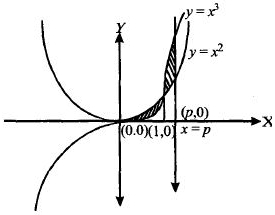
0 likesView Solution
89
MathematicsDifficultMCQAIEEE · 2012
If $f(x) = x e^{x(1-x)}, x \in R$,then $f(x)$ is
A
decreasing on $[-1/2, 1]$
B
decreasing on $R$
C
increasing on $[-1/2, 1]$
D
increasing on $R$
Solution
(C) Given $f(x) = x e^{x(1-x)}$.
Applying the product rule and chain rule,we find the derivative:
$f'(x) = 1 \cdot e^{x(1-x)} + x \cdot e^{x(1-x)} \cdot (1-2x)$
$f'(x) = e^{x(1-x)} [1 + x - 2x^2]$
$f'(x) = -e^{x(1-x)} [2x^2 - x - 1]$
Factoring the quadratic expression:
$f'(x) = -e^{x(1-x)} (2x + 1)(x - 1)$
$f'(x) = -2 e^{x(1-x)} (x + 1/2)(x - 1)$
Since $e^{x(1-x)} > 0$ for all $x \in R$,the sign of $f'(x)$ depends on the expression $-(x + 1/2)(x - 1)$.
For $x \in [-1/2, 1]$,the product $(x + 1/2)(x - 1) \leq 0$.
Therefore,$-(x + 1/2)(x - 1) \geq 0$.
Thus,$f'(x) \geq 0$ for $x \in [-1/2, 1]$.
Hence,$f(x)$ is increasing on $[-1/2, 1]$.
Applying the product rule and chain rule,we find the derivative:
$f'(x) = 1 \cdot e^{x(1-x)} + x \cdot e^{x(1-x)} \cdot (1-2x)$
$f'(x) = e^{x(1-x)} [1 + x - 2x^2]$
$f'(x) = -e^{x(1-x)} [2x^2 - x - 1]$
Factoring the quadratic expression:
$f'(x) = -e^{x(1-x)} (2x + 1)(x - 1)$
$f'(x) = -2 e^{x(1-x)} (x + 1/2)(x - 1)$
Since $e^{x(1-x)} > 0$ for all $x \in R$,the sign of $f'(x)$ depends on the expression $-(x + 1/2)(x - 1)$.
For $x \in [-1/2, 1]$,the product $(x + 1/2)(x - 1) \leq 0$.
Therefore,$-(x + 1/2)(x - 1) \geq 0$.
Thus,$f'(x) \geq 0$ for $x \in [-1/2, 1]$.
Hence,$f(x)$ is increasing on $[-1/2, 1]$.
0 likesView Solution
90
MathematicsDifficultMCQAIEEE · 2012
The integral of $\frac{x^2 - x}{x^3 - x^2 + x - 1}$ with respect to $x$ is:
A
$\frac{1}{2} \log (x^2 + 1) + c$
B
$\frac{1}{2} \log |x^2 - 1| + c$
C
$\log (x^2 + 1 + c)$
D
$\log |x^2 - 1| + c$
Solution
(A) Let $I = \int \frac{x^2 - x}{x^3 - x^2 + x - 1} dx$.
Factor the denominator: $x^3 - x^2 + x - 1 = x^2(x - 1) + 1(x - 1) = (x^2 + 1)(x - 1)$.
Substitute this into the integral: $I = \int \frac{x(x - 1)}{(x^2 + 1)(x - 1)} dx$.
Cancel the common term $(x - 1)$: $I = \int \frac{x}{x^2 + 1} dx$.
Multiply and divide by $2$: $I = \frac{1}{2} \int \frac{2x}{x^2 + 1} dx$.
Let $u = x^2 + 1$,then $du = 2x dx$.
Substituting these into the integral: $I = \frac{1}{2} \int \frac{1}{u} du = \frac{1}{2} \log |u| + c$.
Since $x^2 + 1 > 0$ for all real $x$,we can write: $I = \frac{1}{2} \log (x^2 + 1) + c$.
Factor the denominator: $x^3 - x^2 + x - 1 = x^2(x - 1) + 1(x - 1) = (x^2 + 1)(x - 1)$.
Substitute this into the integral: $I = \int \frac{x(x - 1)}{(x^2 + 1)(x - 1)} dx$.
Cancel the common term $(x - 1)$: $I = \int \frac{x}{x^2 + 1} dx$.
Multiply and divide by $2$: $I = \frac{1}{2} \int \frac{2x}{x^2 + 1} dx$.
Let $u = x^2 + 1$,then $du = 2x dx$.
Substituting these into the integral: $I = \frac{1}{2} \int \frac{1}{u} du = \frac{1}{2} \log |u| + c$.
Since $x^2 + 1 > 0$ for all real $x$,we can write: $I = \frac{1}{2} \log (x^2 + 1) + c$.
0 likesView Solution
91
MathematicsDifficultMCQAIEEE · 2012
If $\left| \begin{array}{ccc} -2a & a+b & a+c \\ b+a & -2b & b+c \\ c+a & b+c & -2c \end{array} \right| = \alpha (a+b)(b+c)(c+a) \neq 0$,then $\alpha$ is equal to
A
$a+b+c$
B
$abc$
C
$4$
D
$1$
Solution
(C) Let $\Delta = \left| \begin{array}{ccc} -2a & a+b & a+c \\ b+a & -2b & b+c \\ c+a & b+c & -2c \end{array} \right|$.
Applying $C_1 \to C_1 + C_3$ and $C_2 \to C_2 + C_3$:
$\Delta = \left| \begin{array}{ccc} -a+c & 2a+b+c & a+c \\ 2b+a+c & -b+c & b+c \\ a-c & b-c & -2c \end{array} \right|$.
Applying $R_1 \to R_1 + R_3$ and $R_2 \to R_2 + R_3$:
$\Delta = \left| \begin{array}{ccc} 0 & 2(a+b) & a-c \\ 2(a+b) & 0 & b-c \\ a-c & b-c & -2c \end{array} \right|$.
Expanding along the first row:
$\Delta = 0 - 2(a+b) \left[ -4c(a+b) - (a-c)(b-c) \right] + (a-c) \left[ 2(a+b)(b-c) - 0 \right]$.
$\Delta = 8c(a+b)^2 + 2(a+b)(a-c)(b-c) + 2(a+b)(a-c)(b-c)$.
$\Delta = 8c(a+b)^2 + 4(a+b)(a-c)(b-c)$.
$\Delta = 4(a+b) \left[ 2c(a+b) + (a-c)(b-c) \right]$.
$\Delta = 4(a+b) \left[ 2ac + 2bc + ab - ac - bc + c^2 \right]$.
$\Delta = 4(a+b) \left[ ac + bc + ab + c^2 \right]$.
$\Delta = 4(a+b) \left[ c(a+c) + b(a+c) \right]$.
$\Delta = 4(a+b)(b+c)(c+a)$.
Comparing with $\alpha(a+b)(b+c)(c+a)$,we get $\alpha = 4$.
Applying $C_1 \to C_1 + C_3$ and $C_2 \to C_2 + C_3$:
$\Delta = \left| \begin{array}{ccc} -a+c & 2a+b+c & a+c \\ 2b+a+c & -b+c & b+c \\ a-c & b-c & -2c \end{array} \right|$.
Applying $R_1 \to R_1 + R_3$ and $R_2 \to R_2 + R_3$:
$\Delta = \left| \begin{array}{ccc} 0 & 2(a+b) & a-c \\ 2(a+b) & 0 & b-c \\ a-c & b-c & -2c \end{array} \right|$.
Expanding along the first row:
$\Delta = 0 - 2(a+b) \left[ -4c(a+b) - (a-c)(b-c) \right] + (a-c) \left[ 2(a+b)(b-c) - 0 \right]$.
$\Delta = 8c(a+b)^2 + 2(a+b)(a-c)(b-c) + 2(a+b)(a-c)(b-c)$.
$\Delta = 8c(a+b)^2 + 4(a+b)(a-c)(b-c)$.
$\Delta = 4(a+b) \left[ 2c(a+b) + (a-c)(b-c) \right]$.
$\Delta = 4(a+b) \left[ 2ac + 2bc + ab - ac - bc + c^2 \right]$.
$\Delta = 4(a+b) \left[ ac + bc + ab + c^2 \right]$.
$\Delta = 4(a+b) \left[ c(a+c) + b(a+c) \right]$.
$\Delta = 4(a+b)(b+c)(c+a)$.
Comparing with $\alpha(a+b)(b+c)(c+a)$,we get $\alpha = 4$.
0 likesView Solution
92
MathematicsDifficultMCQAIEEE · 2012
If $A = \{x \in Z^+ : x < 10\}$ and $x$ is a multiple of $3$ or $4$,where $Z^+$ is the set of positive integers,then the total number of symmetric relations on $A$ is
A
$2^5$
B
$2^{15}$
C
$2^{10}$
D
$2^{20}$
Solution
(B) relation $R$ on a set $A$ is symmetric if $(a, b) \in R \implies (b, a) \in R$ for all $a, b \in A$.
First,we identify the elements of set $A$: $A = \{3, 4, 6, 8, 9\}$. The number of elements $n = 5$.
The total number of ordered pairs in $A \times A$ is $n^2 = 5^2 = 25$.
These $25$ pairs can be categorized into:
$1$. Pairs of the form $(a, a)$: There are $n = 5$ such pairs: $(3, 3), (4, 4), (6, 6), (8, 8), (9, 9)$.
$2$. Pairs of the form $(a, b)$ where $a \neq b$: There are $n^2 - n = 25 - 5 = 20$ such pairs.
For a symmetric relation,if $(a, b)$ is included,$(b, a)$ must also be included. These $20$ pairs form $10$ pairs of the form $\{(a, b), (b, a)\}$.
For each of the $5$ diagonal pairs $(a, a)$,we have $2$ choices (include or exclude).
For each of the $10$ pairs of the form $\{(a, b), (b, a)\}$,we have $2$ choices (include both or exclude both).
Thus,the total number of symmetric relations is $2^5 \times 2^{10} = 2^{5+10} = 2^{15}$.
First,we identify the elements of set $A$: $A = \{3, 4, 6, 8, 9\}$. The number of elements $n = 5$.
The total number of ordered pairs in $A \times A$ is $n^2 = 5^2 = 25$.
These $25$ pairs can be categorized into:
$1$. Pairs of the form $(a, a)$: There are $n = 5$ such pairs: $(3, 3), (4, 4), (6, 6), (8, 8), (9, 9)$.
$2$. Pairs of the form $(a, b)$ where $a \neq b$: There are $n^2 - n = 25 - 5 = 20$ such pairs.
For a symmetric relation,if $(a, b)$ is included,$(b, a)$ must also be included. These $20$ pairs form $10$ pairs of the form $\{(a, b), (b, a)\}$.
For each of the $5$ diagonal pairs $(a, a)$,we have $2$ choices (include or exclude).
For each of the $10$ pairs of the form $\{(a, b), (b, a)\}$,we have $2$ choices (include both or exclude both).
Thus,the total number of symmetric relations is $2^5 \times 2^{10} = 2^{5+10} = 2^{15}$.
0 likesView Solution
93
MathematicsDifficultMCQAIEEE · 2012
If $\frac{d}{{dx}}G(x) = \frac{{{e^{\tan x}}}}{x}$ for $x \in (0, \pi/2)$,then $\int_{1/4}^{1/2} \frac{2}{x} e^{\tan(\pi x^2)} dx$ is equal to
A
$G(\pi/4) - G(\pi/16)$
B
$2[G(\pi/4) - G(\pi/16)]$
C
$\pi[G(1/2) - G(1/4)]$
D
$G(1/\sqrt{2}) - G(1/2)$
Solution
(A) Given $\frac{d}{dx} G(x) = \frac{e^{\tan x}}{x}$ for $x \in (0, \pi/2)$.
Let $I = \int_{1/4}^{1/2} \frac{2}{x} e^{\tan(\pi x^2)} dx$.
Multiply and divide by $\pi$ inside the integral: $I = \int_{1/4}^{1/2} \frac{2\pi x}{\pi x^2} e^{\tan(\pi x^2)} dx$.
Let $t = \pi x^2$. Then $dt = 2\pi x dx$.
When $x = 1/4$,$t = \pi/16$. When $x = 1/2$,$t = \pi/4$.
Substituting these into the integral,we get $I = \int_{\pi/16}^{\pi/4} \frac{e^{\tan t}}{t} dt$.
Since $\frac{d}{dt} G(t) = \frac{e^{\tan t}}{t}$,the integral becomes $[G(t)]_{\pi/16}^{\pi/4} = G(\pi/4) - G(\pi/16)$.
Let $I = \int_{1/4}^{1/2} \frac{2}{x} e^{\tan(\pi x^2)} dx$.
Multiply and divide by $\pi$ inside the integral: $I = \int_{1/4}^{1/2} \frac{2\pi x}{\pi x^2} e^{\tan(\pi x^2)} dx$.
Let $t = \pi x^2$. Then $dt = 2\pi x dx$.
When $x = 1/4$,$t = \pi/16$. When $x = 1/2$,$t = \pi/4$.
Substituting these into the integral,we get $I = \int_{\pi/16}^{\pi/4} \frac{e^{\tan t}}{t} dt$.
Since $\frac{d}{dt} G(t) = \frac{e^{\tan t}}{t}$,the integral becomes $[G(t)]_{\pi/16}^{\pi/4} = G(\pi/4) - G(\pi/16)$.
0 likesView Solution
94
MathematicsDifficultMCQAIEEE · 2012
$A$ number $n$ is randomly selected from the set $\{1, 2, 3, \dots, 1000\}$. The probability that $\frac{\sum_{i=1}^n i^2}{\sum_{i=1}^n i}$ is an integer is:
A
$0.331$
B
$0.333$
C
$0.334$
D
$0.332$
Solution
(C) The given expression is $\frac{\sum_{i=1}^n i^2}{\sum_{i=1}^n i} = \frac{\frac{n(n+1)(2n+1)}{6}}{\frac{n(n+1)}{2}} = \frac{2n+1}{3}$.
For the expression to be an integer,$2n+1$ must be divisible by $3$.
This means $2n+1 \equiv 0 \pmod{3}$,which implies $2n \equiv -1 \equiv 2 \pmod{3}$,so $n \equiv 1 \pmod{3}$.
We need to find the number of values of $n$ in the set $\{1, 2, 3, \dots, 1000\}$ such that $n = 3k+1$ for some integer $k \ge 0$.
For $k=0$,$n=1$. For $k=333$,$n=3(333)+1 = 1000$.
Thus,$k$ can take values from $0$ to $333$,which gives a total of $333 - 0 + 1 = 334$ values.
The total number of possible values for $n$ is $1000$.
Therefore,the required probability is $\frac{334}{1000} = 0.334$.
For the expression to be an integer,$2n+1$ must be divisible by $3$.
This means $2n+1 \equiv 0 \pmod{3}$,which implies $2n \equiv -1 \equiv 2 \pmod{3}$,so $n \equiv 1 \pmod{3}$.
We need to find the number of values of $n$ in the set $\{1, 2, 3, \dots, 1000\}$ such that $n = 3k+1$ for some integer $k \ge 0$.
For $k=0$,$n=1$. For $k=333$,$n=3(333)+1 = 1000$.
Thus,$k$ can take values from $0$ to $333$,which gives a total of $333 - 0 + 1 = 334$ values.
The total number of possible values for $n$ is $1000$.
Therefore,the required probability is $\frac{334}{1000} = 0.334$.
0 likesView Solution
95
MathematicsDifficultMCQAIEEE · 2012
If a straight line $y - x = 2$ divides the region $x^2 + y^2 \le 4$ into two parts,then the ratio of the area of the smaller part to the area of the greater part is
A
$3\pi - 8 : \pi + 8$
B
$\pi - 3 : 3\pi + 3$
C
$3\pi - 4 : \pi + 4$
D
$\pi - 2 : 3\pi + 2$
Solution
(D) The given region is a circle $x^2 + y^2 = 4$ with radius $r = 2$ and center at $(0, 0)$. The line $y = x + 2$ passes through $(-2, 0)$ and $(0, 2)$.
Let $I$ be the smaller portion and $II$ be the greater portion of the circle.
The area of the smaller portion $I$ is given by the integral:
Area of $I = \int_{-2}^{0} [\sqrt{4 - x^2} - (x + 2)] dx$
$= [\frac{x}{2} \sqrt{4 - x^2} + \frac{4}{2} \sin^{-1}(\frac{x}{2})]_{-2}^{0} - [\frac{x^2}{2} + 2x]_{-2}^{0}$
$= [0 + 2 \sin^{-1}(0)] - [(-1) \sqrt{0} + 2 \sin^{-1}(-1)] - [0 - (\frac{4}{2} - 4)]$
$= [0 - 2(-\frac{\pi}{2})] - [0 - (-2)]$
$= \pi - 2$
Now,the area of the greater portion $II$ is:
Area of $II = \text{Area of circle} - \text{Area of } I$
$= 4\pi - (\pi - 2) = 3\pi + 2$
Therefore,the required ratio is:
$\frac{\text{Area of } I}{\text{Area of } II} = \frac{\pi - 2}{3\pi + 2}$
Let $I$ be the smaller portion and $II$ be the greater portion of the circle.
The area of the smaller portion $I$ is given by the integral:
Area of $I = \int_{-2}^{0} [\sqrt{4 - x^2} - (x + 2)] dx$
$= [\frac{x}{2} \sqrt{4 - x^2} + \frac{4}{2} \sin^{-1}(\frac{x}{2})]_{-2}^{0} - [\frac{x^2}{2} + 2x]_{-2}^{0}$
$= [0 + 2 \sin^{-1}(0)] - [(-1) \sqrt{0} + 2 \sin^{-1}(-1)] - [0 - (\frac{4}{2} - 4)]$
$= [0 - 2(-\frac{\pi}{2})] - [0 - (-2)]$
$= \pi - 2$
Now,the area of the greater portion $II$ is:
Area of $II = \text{Area of circle} - \text{Area of } I$
$= 4\pi - (\pi - 2) = 3\pi + 2$
Therefore,the required ratio is:
$\frac{\text{Area of } I}{\text{Area of } II} = \frac{\pi - 2}{3\pi + 2}$
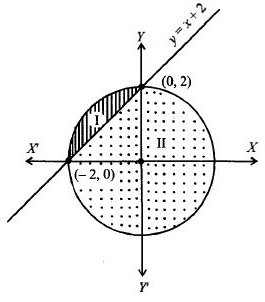
0 likesView Solution
96
MathematicsDifficultMCQAIEEE · 2012
The value of the integral $\int_{0}^{0.9} [x - 2[x]] \, dx$,where $[.]$ denotes the greatest integer function,is
A
$0.9$
B
$1.8$
C
$-0.9$
D
$0$
Solution
(D) Let $I = \int_{0}^{0.9} [x - 2[x]] \, dx$.
Since $0 \le x < 0.9$,the greatest integer function $[x] = 0$.
Substituting $[x] = 0$ into the integral,we get:
$I = \int_{0}^{0.9} [x - 2(0)] \, dx = \int_{0}^{0.9} [x] \, dx$.
Since $0 \le x < 0.9$,$[x] = 0$ for all $x$ in the interval $[0, 0.9)$.
Therefore,$I = \int_{0}^{0.9} 0 \, dx = 0$.
Since $0 \le x < 0.9$,the greatest integer function $[x] = 0$.
Substituting $[x] = 0$ into the integral,we get:
$I = \int_{0}^{0.9} [x - 2(0)] \, dx = \int_{0}^{0.9} [x] \, dx$.
Since $0 \le x < 0.9$,$[x] = 0$ for all $x$ in the interval $[0, 0.9)$.
Therefore,$I = \int_{0}^{0.9} 0 \, dx = 0$.
0 likesView Solution
97
MathematicsDifficultMCQAIEEE · 2012
If $a, b, c$ are non-zero complex numbers satisfying $a^2 + b^2 + c^2 = 0$ and $\left| \begin{array}{ccc} b^2 + c^2 & ab & ac \\ ab & c^2 + a^2 & bc \\ ac & bc & a^2 + b^2 \end{array} \right| = k a^2 b^2 c^2$,then $k$ is equal to
A
$1$
B
$3$
C
$4$
D
$2$
Solution
(C) Let $\Delta = \left| \begin{array}{ccc} b^2 + c^2 & ab & ac \\ ab & c^2 + a^2 & bc \\ ac & bc & a^2 + b^2 \end{array} \right|$.
Multiply $C_1$ by $a$,$C_2$ by $b$,and $C_3$ by $c$,and divide the determinant by $abc$:
$\Delta = \frac{1}{abc} \left| \begin{array}{ccc} a(b^2 + c^2) & ab^2 & ac^2 \\ a^2b & b(c^2 + a^2) & bc^2 \\ a^2c & b^2c & c(a^2 + b^2) \end{array} \right|$.
Take out $a, b, c$ common from $R_1, R_2, R_3$ respectively:
$\Delta = \frac{abc}{abc} \left| \begin{array}{ccc} b^2 + c^2 & b^2 & c^2 \\ a^2 & c^2 + a^2 & c^2 \\ a^2 & b^2 & a^2 + b^2 \end{array} \right| = \left| \begin{array}{ccc} b^2 + c^2 & b^2 & c^2 \\ a^2 & c^2 + a^2 & c^2 \\ a^2 & b^2 & a^2 + b^2 \end{array} \right|$.
Apply $C_1 \to C_1 - C_2 - C_3$:
$\Delta = \left| \begin{array}{ccc} 0 & b^2 & c^2 \\ -2c^2 & c^2 + a^2 & c^2 \\ -2b^2 & b^2 & a^2 + b^2 \end{array} \right| = -2 \left| \begin{array}{ccc} 0 & b^2 & c^2 \\ c^2 & c^2 + a^2 & c^2 \\ b^2 & b^2 & a^2 + b^2 \end{array} \right|$.
Apply $C_2 \to C_2 - C_1$ and $C_3 \to C_3 - C_1$:
$\Delta = -2 \left| \begin{array}{ccc} 0 & b^2 & c^2 \\ c^2 & a^2 & 0 \\ b^2 & 0 & a^2 \end{array} \right| = -2 [ -b^2(c^2 a^2) + c^2(-a^2 b^2) ] = -2 [-a^2 b^2 c^2 - a^2 b^2 c^2] = 4a^2 b^2 c^2$.
Since $\Delta = k a^2 b^2 c^2$,we have $k = 4$.
Multiply $C_1$ by $a$,$C_2$ by $b$,and $C_3$ by $c$,and divide the determinant by $abc$:
$\Delta = \frac{1}{abc} \left| \begin{array}{ccc} a(b^2 + c^2) & ab^2 & ac^2 \\ a^2b & b(c^2 + a^2) & bc^2 \\ a^2c & b^2c & c(a^2 + b^2) \end{array} \right|$.
Take out $a, b, c$ common from $R_1, R_2, R_3$ respectively:
$\Delta = \frac{abc}{abc} \left| \begin{array}{ccc} b^2 + c^2 & b^2 & c^2 \\ a^2 & c^2 + a^2 & c^2 \\ a^2 & b^2 & a^2 + b^2 \end{array} \right| = \left| \begin{array}{ccc} b^2 + c^2 & b^2 & c^2 \\ a^2 & c^2 + a^2 & c^2 \\ a^2 & b^2 & a^2 + b^2 \end{array} \right|$.
Apply $C_1 \to C_1 - C_2 - C_3$:
$\Delta = \left| \begin{array}{ccc} 0 & b^2 & c^2 \\ -2c^2 & c^2 + a^2 & c^2 \\ -2b^2 & b^2 & a^2 + b^2 \end{array} \right| = -2 \left| \begin{array}{ccc} 0 & b^2 & c^2 \\ c^2 & c^2 + a^2 & c^2 \\ b^2 & b^2 & a^2 + b^2 \end{array} \right|$.
Apply $C_2 \to C_2 - C_1$ and $C_3 \to C_3 - C_1$:
$\Delta = -2 \left| \begin{array}{ccc} 0 & b^2 & c^2 \\ c^2 & a^2 & 0 \\ b^2 & 0 & a^2 \end{array} \right| = -2 [ -b^2(c^2 a^2) + c^2(-a^2 b^2) ] = -2 [-a^2 b^2 c^2 - a^2 b^2 c^2] = 4a^2 b^2 c^2$.
Since $\Delta = k a^2 b^2 c^2$,we have $k = 4$.
0 likesView Solution
98
MathematicsDifficultMCQAIEEE · 2012
If $f(x) = \int {\left( {\frac{{{x^2} + {{\sin }^2}x}}{{1 + {x^2}}}} \right)} {\sec ^2}x\,dx$ and $f(0) = 0,$ then $f(1)$ equals
A
$\tan 1 - \frac{\pi}{4}$
B
$\tan 1 + 1$
C
$\frac{\pi}{4}$
D
$1 - \frac{\pi}{4}$
Solution
(A) Given $f(x) = \int \left( \frac{x^2 + \sin^2 x}{1 + x^2} \right) \sec^2 x \, dx$.
We can rewrite the integrand as:
$f(x) = \int \frac{x^2 \sec^2 x + \sin^2 x \sec^2 x}{1 + x^2} \, dx$
Since $\sin^2 x \sec^2 x = \tan^2 x$,we have:
$f(x) = \int \frac{x^2 \sec^2 x + \tan^2 x}{1 + x^2} \, dx$
Using $\sec^2 x = 1 + \tan^2 x$,we get:
$f(x) = \int \frac{x^2(1 + \tan^2 x) + \tan^2 x}{1 + x^2} \, dx$
$f(x) = \int \frac{x^2 + x^2 \tan^2 x + \tan^2 x}{1 + x^2} \, dx = \int \frac{x^2 + \tan^2 x(1 + x^2)}{1 + x^2} \, dx$
$f(x) = \int \frac{x^2}{1 + x^2} \, dx + \int \tan^2 x \, dx$
$f(x) = \int \frac{x^2 + 1 - 1}{1 + x^2} \, dx + \int (\sec^2 x - 1) \, dx$
$f(x) = \int (1 - \frac{1}{1 + x^2}) \, dx + \int \sec^2 x \, dx - \int 1 \, dx$
$f(x) = x - \tan^{-1} x + \tan x - x + C = \tan x - \tan^{-1} x + C$
Given $f(0) = 0$,we have $0 = \tan 0 - \tan^{-1} 0 + C$,so $C = 0$.
Thus,$f(x) = \tan x - \tan^{-1} x$.
Therefore,$f(1) = \tan 1 - \tan^{-1}(1) = \tan 1 - \frac{\pi}{4}$.
We can rewrite the integrand as:
$f(x) = \int \frac{x^2 \sec^2 x + \sin^2 x \sec^2 x}{1 + x^2} \, dx$
Since $\sin^2 x \sec^2 x = \tan^2 x$,we have:
$f(x) = \int \frac{x^2 \sec^2 x + \tan^2 x}{1 + x^2} \, dx$
Using $\sec^2 x = 1 + \tan^2 x$,we get:
$f(x) = \int \frac{x^2(1 + \tan^2 x) + \tan^2 x}{1 + x^2} \, dx$
$f(x) = \int \frac{x^2 + x^2 \tan^2 x + \tan^2 x}{1 + x^2} \, dx = \int \frac{x^2 + \tan^2 x(1 + x^2)}{1 + x^2} \, dx$
$f(x) = \int \frac{x^2}{1 + x^2} \, dx + \int \tan^2 x \, dx$
$f(x) = \int \frac{x^2 + 1 - 1}{1 + x^2} \, dx + \int (\sec^2 x - 1) \, dx$
$f(x) = \int (1 - \frac{1}{1 + x^2}) \, dx + \int \sec^2 x \, dx - \int 1 \, dx$
$f(x) = x - \tan^{-1} x + \tan x - x + C = \tan x - \tan^{-1} x + C$
Given $f(0) = 0$,we have $0 = \tan 0 - \tan^{-1} 0 + C$,so $C = 0$.
Thus,$f(x) = \tan x - \tan^{-1} x$.
Therefore,$f(1) = \tan 1 - \tan^{-1}(1) = \tan 1 - \frac{\pi}{4}$.
0 likesView Solution
99
MathematicsMediumMCQAIEEE · 2012
The general solution of the differential equation $\frac{dy}{dx} + \frac{2}{x}y = x^2$ is
A
$y = cx^{-3} - \frac{x^2}{4}$
B
$y = cx^3 - \frac{x^2}{4}$
C
$y = cx^2 + \frac{x^3}{5}$
D
$y = cx^{-2} + \frac{x^3}{5}$
Solution
(D) The given differential equation is $\frac{dy}{dx} + \frac{2}{x}y = x^2$.
This is a linear differential equation of the form $\frac{dy}{dx} + Py = Q$,where $P = \frac{2}{x}$ and $Q = x^2$.
First,we calculate the integrating factor ($I$.$F$.):
$I.F. = e^{\int P dx} = e^{\int \frac{2}{x} dx} = e^{2 \ln|x|} = e^{\ln(x^2)} = x^2$.
The general solution is given by $y \cdot (I.F.) = \int (Q \cdot I.F.) dx + c$.
Substituting the values,we get $y \cdot x^2 = \int (x^2 \cdot x^2) dx + c$.
$y \cdot x^2 = \int x^4 dx + c$.
$y \cdot x^2 = \frac{x^5}{5} + c$.
Dividing both sides by $x^2$,we get $y = \frac{x^3}{5} + cx^{-2}$.
This is a linear differential equation of the form $\frac{dy}{dx} + Py = Q$,where $P = \frac{2}{x}$ and $Q = x^2$.
First,we calculate the integrating factor ($I$.$F$.):
$I.F. = e^{\int P dx} = e^{\int \frac{2}{x} dx} = e^{2 \ln|x|} = e^{\ln(x^2)} = x^2$.
The general solution is given by $y \cdot (I.F.) = \int (Q \cdot I.F.) dx + c$.
Substituting the values,we get $y \cdot x^2 = \int (x^2 \cdot x^2) dx + c$.
$y \cdot x^2 = \int x^4 dx + c$.
$y \cdot x^2 = \frac{x^5}{5} + c$.
Dividing both sides by $x^2$,we get $y = \frac{x^3}{5} + cx^{-2}$.
0 likesView Solution
100
MathematicsMediumMCQAIEEE · 2012
$A$ value of $\tan^{-1} \left( \sin \left( \cos^{-1} \sqrt{\frac{2}{3}} \right) \right)$ is
A
$\frac{\pi}{4}$
B
$\frac{\pi}{2}$
C
$\frac{\pi}{3}$
D
$\frac{\pi}{6}$
Solution
(D) Let $\theta = \cos^{-1} \sqrt{\frac{2}{3}}$.
Then $\cos \theta = \sqrt{\frac{2}{3}}$.
We know that $\sin \theta = \sqrt{1 - \cos^2 \theta}$.
Substituting the value of $\cos \theta$,we get $\sin \theta = \sqrt{1 - \frac{2}{3}} = \sqrt{\frac{1}{3}} = \frac{1}{\sqrt{3}}$.
Now,the expression becomes $\tan^{-1} (\sin \theta) = \tan^{-1} \left( \frac{1}{\sqrt{3}} \right)$.
Since $\tan \left( \frac{\pi}{6} \right) = \frac{1}{\sqrt{3}}$,we have $\tan^{-1} \left( \frac{1}{\sqrt{3}} \right) = \frac{\pi}{6}$.
Then $\cos \theta = \sqrt{\frac{2}{3}}$.
We know that $\sin \theta = \sqrt{1 - \cos^2 \theta}$.
Substituting the value of $\cos \theta$,we get $\sin \theta = \sqrt{1 - \frac{2}{3}} = \sqrt{\frac{1}{3}} = \frac{1}{\sqrt{3}}$.
Now,the expression becomes $\tan^{-1} (\sin \theta) = \tan^{-1} \left( \frac{1}{\sqrt{3}} \right)$.
Since $\tan \left( \frac{\pi}{6} \right) = \frac{1}{\sqrt{3}}$,we have $\tan^{-1} \left( \frac{1}{\sqrt{3}} \right) = \frac{\pi}{6}$.
0 likesView Solution
Vedclass Products
For Students
Vedclass Test Series
Mock tests in real AIEEE style covering Mathematics with performance analysis. 5-day free trial.
Start Free TrialFor Teachers
Exam Paper Generator
Generate Set A/B/C/D Mathematics papers from 7.5L+ questions in 2 minutes. 3 chapters free.
Try FreeFor Institutes
Online Exam Module
Run live AIEEE mock exams with unlimited students, 360° analytics & white-label branding.
See DemoFrequently Asked Questions
How many Mathematics questions are in AIEEE 2012?
There are 145 Mathematics questions from the AIEEE 2012 paper on Vedclass, each with a detailed step-by-step solution in English.
Are AIEEE 2012 Mathematics solutions available in English?
Yes. All solutions on this page are in English. You can also switch to English or Hindi using the language buttons above the questions.
Can I practice AIEEE 2012 Mathematics as a timed test?
Yes. Use the Vedclass Test Series to attempt a full AIEEE mock test covering Mathematics with time limits and instant score analysis.
Can teachers create Mathematics papers from AIEEE previous year questions?
Yes. The Vedclass Exam Paper Generator lets teachers mix AIEEE Mathematics questions and generate Set A/B/C/D papers in minutes.
For Teachers & Institutes
Build a Custom Mathematics Paper
Pick AIEEE 2012 Mathematics questions, set difficulty, and generate Set A/B/C/D in 2 minutes.