
ChemistryQ101–112 of 189 questions
Page 3 of 3 · English
101
ChemistryDifficultMCQAIEEE · 2012
The relationship among most probable velocity,average velocity,and root mean square velocity is respectively:
A
$ \sqrt{2} : \sqrt{8/\pi} : \sqrt{3} $
B
$ \sqrt{3} : \sqrt{8/\pi} : \sqrt{2} $
C
$ \sqrt{8/\pi} : \sqrt{3} : \sqrt{2} $
D
$ \sqrt{2} : \sqrt{3} : \sqrt{8/\pi} $
Solution
(A) The formula for most probable velocity is $C^* = \sqrt{\frac{2RT}{M}}$.
The formula for average velocity is $\bar{C} = \sqrt{\frac{8RT}{\pi M}}$.
The formula for root mean square velocity is $C = \sqrt{\frac{3RT}{M}}$.
Comparing these values,the ratio is $C^* : \bar{C} : C = \sqrt{2} : \sqrt{\frac{8}{\pi}} : \sqrt{3}$.
The formula for average velocity is $\bar{C} = \sqrt{\frac{8RT}{\pi M}}$.
The formula for root mean square velocity is $C = \sqrt{\frac{3RT}{M}}$.
Comparing these values,the ratio is $C^* : \bar{C} : C = \sqrt{2} : \sqrt{\frac{8}{\pi}} : \sqrt{3}$.
0 likesView Solution
102
ChemistryDifficultMCQAIEEE · 2012
One mole of $O_{2(g)}$ and two moles of $SO_{2(g)}$ were heated in a closed vessel of $1 \, L$ capacity at $1098 \, K$. At equilibrium,$1.6 \, moles$ of $SO_{3(g)}$ were found. The equilibrium constant $K_c$ of the reaction would be
A
$30$
B
$40$
C
$80$
D
$60$
Solution
(C) The balanced chemical equation is: $O_{2(g)} + 2SO_{2(g)} \leftrightarrow 2SO_{3(g)}$
Initial moles: $O_2 = 1, SO_2 = 2, SO_3 = 0$
At equilibrium,moles of $SO_3 = 1.6$. Since $2 \, moles$ of $SO_3$ are produced from $1 \, mole$ of $O_2$ and $2 \, moles$ of $SO_2$,the reaction stoichiometry implies:
$SO_3$ produced = $2x = 1.6 \implies x = 0.8$
Equilibrium moles:
$[O_2] = 1 - 0.8 = 0.2 \, mol/L$
$[SO_2] = 2 - 2(0.8) = 2 - 1.6 = 0.4 \, mol/L$
$[SO_3] = 1.6 \, mol/L$
$K_c = \frac{[SO_3]^2}{[O_2][SO_2]^2} = \frac{(1.6)^2}{(0.2)(0.4)^2}$
$K_c = \frac{2.56}{0.2 \times 0.16} = \frac{2.56}{0.032} = 80$
Initial moles: $O_2 = 1, SO_2 = 2, SO_3 = 0$
At equilibrium,moles of $SO_3 = 1.6$. Since $2 \, moles$ of $SO_3$ are produced from $1 \, mole$ of $O_2$ and $2 \, moles$ of $SO_2$,the reaction stoichiometry implies:
$SO_3$ produced = $2x = 1.6 \implies x = 0.8$
Equilibrium moles:
$[O_2] = 1 - 0.8 = 0.2 \, mol/L$
$[SO_2] = 2 - 2(0.8) = 2 - 1.6 = 0.4 \, mol/L$
$[SO_3] = 1.6 \, mol/L$
$K_c = \frac{[SO_3]^2}{[O_2][SO_2]^2} = \frac{(1.6)^2}{(0.2)(0.4)^2}$
$K_c = \frac{2.56}{0.2 \times 0.16} = \frac{2.56}{0.032} = 80$
0 likesView Solution
103
ChemistryMCQAIEEE · 2012
The first diffraction minimum due to a single slit diffraction is seen at $\theta = 30^o$ for light of wavelength $5000 \, \mathring{A}$ falling perpendicularly on the slit. The width of the slit is
A
$5 \times 10^{-5} \, cm$
B
$2.5 \times 10^{-5} \, cm$
C
$1.25 \times 10^{-5} \, cm$
D
$10 \times 10^{-5} \, cm$
Solution
(D) For a single slit diffraction,the condition for the $n^{th}$ minimum is given by $a \sin \theta = n \lambda$.
For the first minimum,$n = 1$.
Given: $\lambda = 5000 \, \mathring{A} = 5000 \times 10^{-10} \, m = 5 \times 10^{-7} \, m$ and $\theta = 30^o$.
Substituting these values into the formula: $a \sin 30^o = 1 \times (5 \times 10^{-7} \, m)$.
Since $\sin 30^o = 0.5$,we have $a \times 0.5 = 5 \times 10^{-7} \, m$.
$a = \frac{5 \times 10^{-7}}{0.5} = 10 \times 10^{-7} \, m = 10^{-6} \, m$.
Converting to centimeters: $a = 10^{-6} \times 10^2 \, cm = 10^{-4} \, cm = 10 \times 10^{-5} \, cm$.
For the first minimum,$n = 1$.
Given: $\lambda = 5000 \, \mathring{A} = 5000 \times 10^{-10} \, m = 5 \times 10^{-7} \, m$ and $\theta = 30^o$.
Substituting these values into the formula: $a \sin 30^o = 1 \times (5 \times 10^{-7} \, m)$.
Since $\sin 30^o = 0.5$,we have $a \times 0.5 = 5 \times 10^{-7} \, m$.
$a = \frac{5 \times 10^{-7}}{0.5} = 10 \times 10^{-7} \, m = 10^{-6} \, m$.
Converting to centimeters: $a = 10^{-6} \times 10^2 \, cm = 10^{-4} \, cm = 10 \times 10^{-5} \, cm$.
0 likesView Solution
104
ChemistryMCQAIEEE · 2012
$K_1, K_2$ and $K_3$ are the equilibrium constants of the following reactions $(I), (II)$ and $(III)$,respectively :
$(I) \ N_2 + 2O_2 \rightleftharpoons 2NO_2$
$(II) \ 2NO_2 \rightleftharpoons N_2 + 2O_2$
$(III) \ NO_2 \rightleftharpoons \frac{1}{2}N_2 + O_2$
The correct relation from the following is
$(I) \ N_2 + 2O_2 \rightleftharpoons 2NO_2$
$(II) \ 2NO_2 \rightleftharpoons N_2 + 2O_2$
$(III) \ NO_2 \rightleftharpoons \frac{1}{2}N_2 + O_2$
The correct relation from the following is
A
$K_1 = \sqrt{K_2} = K_3$
B
$K_1 = \frac{1}{K_2} = \frac{1}{K_3}$
C
$K_1 = \frac{1}{K_2} = K_3^2$
D
$K_1 = \frac{1}{K_2} = \frac{1}{K_3^2}$
Solution
(D) For reaction $(I): N_2 + 2O_2 \rightleftharpoons 2NO_2$,the equilibrium constant is $K_1 = \frac{[NO_2]^2}{[N_2][O_2]^2}$.
For reaction $(II): 2NO_2 \rightleftharpoons N_2 + 2O_2$,the equilibrium constant is $K_2 = \frac{[N_2][O_2]^2}{[NO_2]^2}$.
Clearly,$K_2 = \frac{1}{K_1}$,which implies $K_1 = \frac{1}{K_2}$.
For reaction $(III): NO_2 \rightleftharpoons \frac{1}{2}N_2 + O_2$,the equilibrium constant is $K_3 = \frac{[N_2]^{1/2}[O_2]}{[NO_2]}$.
Comparing $K_3$ with $K_1$,we see that $K_3 = \sqrt{\frac{[N_2][O_2]^2}{[NO_2]^2}} = \sqrt{\frac{1}{K_1}} = \frac{1}{\sqrt{K_1}}$.
Squaring both sides,$K_3^2 = \frac{1}{K_1}$,so $K_1 = \frac{1}{K_3^2}$.
Thus,the correct relation is $K_1 = \frac{1}{K_2} = \frac{1}{K_3^2}$.
For reaction $(II): 2NO_2 \rightleftharpoons N_2 + 2O_2$,the equilibrium constant is $K_2 = \frac{[N_2][O_2]^2}{[NO_2]^2}$.
Clearly,$K_2 = \frac{1}{K_1}$,which implies $K_1 = \frac{1}{K_2}$.
For reaction $(III): NO_2 \rightleftharpoons \frac{1}{2}N_2 + O_2$,the equilibrium constant is $K_3 = \frac{[N_2]^{1/2}[O_2]}{[NO_2]}$.
Comparing $K_3$ with $K_1$,we see that $K_3 = \sqrt{\frac{[N_2][O_2]^2}{[NO_2]^2}} = \sqrt{\frac{1}{K_1}} = \frac{1}{\sqrt{K_1}}$.
Squaring both sides,$K_3^2 = \frac{1}{K_1}$,so $K_1 = \frac{1}{K_3^2}$.
Thus,the correct relation is $K_1 = \frac{1}{K_2} = \frac{1}{K_3^2}$.
0 likesView Solution
105
ChemistryMCQAIEEE · 2012
$8 \ mol$ of $AB_{3(g)}$ are introduced into a $1.0 \ dm^3$ vessel. If it dissociates as $2AB_{3(g)} \rightleftharpoons A_{2(g)} + 3B_{2(g)}$. At equilibrium,$2 \ mol$ of $A_2$ are found to be present. The equilibrium constant of this reaction is
A
$36$
B
$3$
C
$27$
D
$2$
Solution
(C) The balanced chemical equation is: $2AB_{3(g)} \rightleftharpoons A_{2(g)} + 3B_{2(g)}$
Initial moles: $AB_3 = 8, A_2 = 0, B_2 = 0$
Let $x$ be the extent of reaction. At equilibrium,moles are: $AB_3 = 8 - 2x, A_2 = x, B_2 = 3x$
Given that at equilibrium,$A_2 = 2 \ mol$,so $x = 2$.
Equilibrium moles: $AB_3 = 8 - 2(2) = 4 \ mol$,$A_2 = 2 \ mol$,$B_2 = 3(2) = 6 \ mol$.
Since the volume is $1.0 \ dm^3$,the concentrations are: $[AB_3] = 4 \ M, [A_2] = 2 \ M, [B_2] = 6 \ M$.
The equilibrium constant $K_c$ is given by: $K_c = \frac{[A_2][B_2]^3}{[AB_3]^2}$
$K_c = \frac{(2)(6)^3}{(4)^2} = \frac{2 \times 216}{16} = \frac{432}{16} = 27$.
Initial moles: $AB_3 = 8, A_2 = 0, B_2 = 0$
Let $x$ be the extent of reaction. At equilibrium,moles are: $AB_3 = 8 - 2x, A_2 = x, B_2 = 3x$
Given that at equilibrium,$A_2 = 2 \ mol$,so $x = 2$.
Equilibrium moles: $AB_3 = 8 - 2(2) = 4 \ mol$,$A_2 = 2 \ mol$,$B_2 = 3(2) = 6 \ mol$.
Since the volume is $1.0 \ dm^3$,the concentrations are: $[AB_3] = 4 \ M, [A_2] = 2 \ M, [B_2] = 6 \ M$.
The equilibrium constant $K_c$ is given by: $K_c = \frac{[A_2][B_2]^3}{[AB_3]^2}$
$K_c = \frac{(2)(6)^3}{(4)^2} = \frac{2 \times 216}{16} = \frac{432}{16} = 27$.
0 likesView Solution
106
ChemistryMCQAIEEE · 2012
In Young's double slit experiment,one of the slits is wider than the other,so that the amplitude of the light from one slit is double that from the other slit. If $I_m$ be the maximum intensity,the resultant intensity when they interfere at phase difference $\phi$ is given by:
A
$\frac{I_m}{3} \left( 1 + 2 \cos^2 \frac{\phi}{2} \right)$
B
$\frac{I_m}{5} \left( 1 + 4 \cos^2 \frac{\phi}{2} \right)$
C
$\frac{I_m}{9} \left( 1 + 8 \cos^2 \frac{\phi}{2} \right)$
D
$\frac{I_m}{9} \left( 8 + \cos^2 \frac{\phi}{2} \right)$
Solution
(C) Let the amplitudes be $A_1$ and $A_2$. Given $A_2 = 2A_1$.
Since intensity $I \propto A^2$,we have $I_2 = 4I_1$.
The maximum intensity $I_m$ is given by $I_m = (\sqrt{I_1} + \sqrt{I_2})^2 = (\sqrt{I_1} + 2\sqrt{I_1})^2 = (3\sqrt{I_1})^2 = 9I_1$. Thus,$I_1 = \frac{I_m}{9}$.
The resultant intensity $I$ at phase difference $\phi$ is $I = I_1 + I_2 + 2\sqrt{I_1 I_2} \cos \phi$.
Substituting $I_2 = 4I_1$,we get $I = I_1 + 4I_1 + 2\sqrt{4I_1^2} \cos \phi = 5I_1 + 4I_1 \cos \phi$.
Using the identity $1 + \cos \phi = 2 \cos^2 \frac{\phi}{2}$,we can write $I = I_1 + 4I_1(1 + \cos \phi) = I_1 + 4I_1(2 \cos^2 \frac{\phi}{2}) = I_1(1 + 8 \cos^2 \frac{\phi}{2})$.
Substituting $I_1 = \frac{I_m}{9}$,we get $I = \frac{I_m}{9} (1 + 8 \cos^2 \frac{\phi}{2})$.
Since intensity $I \propto A^2$,we have $I_2 = 4I_1$.
The maximum intensity $I_m$ is given by $I_m = (\sqrt{I_1} + \sqrt{I_2})^2 = (\sqrt{I_1} + 2\sqrt{I_1})^2 = (3\sqrt{I_1})^2 = 9I_1$. Thus,$I_1 = \frac{I_m}{9}$.
The resultant intensity $I$ at phase difference $\phi$ is $I = I_1 + I_2 + 2\sqrt{I_1 I_2} \cos \phi$.
Substituting $I_2 = 4I_1$,we get $I = I_1 + 4I_1 + 2\sqrt{4I_1^2} \cos \phi = 5I_1 + 4I_1 \cos \phi$.
Using the identity $1 + \cos \phi = 2 \cos^2 \frac{\phi}{2}$,we can write $I = I_1 + 4I_1(1 + \cos \phi) = I_1 + 4I_1(2 \cos^2 \frac{\phi}{2}) = I_1(1 + 8 \cos^2 \frac{\phi}{2})$.
Substituting $I_1 = \frac{I_m}{9}$,we get $I = \frac{I_m}{9} (1 + 8 \cos^2 \frac{\phi}{2})$.
0 likesView Solution
107
ChemistryMCQAIEEE · 2012
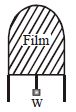
$A$ thin liquid film formed between a $U$-shaped wire and a light slider supports a weight of $1.5 \times 10^{-2} \, N$ (see figure). The length of the slider is $30 \, cm$ and its weight is negligible. The surface tension of the liquid film is (in $, N/m$)
A
$0.025$
B
$0.0125$
C
$0.1$
D
$0.05$
Solution
(A) thin liquid film has two free surfaces,one on each side of the film.
Therefore,the total upward force due to surface tension is $F = 2T\ell$,where $T$ is the surface tension and $\ell$ is the length of the slider.
Given: Weight $W = mg = 1.5 \times 10^{-2} \, N$,length $\ell = 30 \, cm = 0.3 \, m$.
For equilibrium,the upward force must balance the downward weight:
$2T\ell = mg$
$T = \frac{mg}{2\ell}$
$T = \frac{1.5 \times 10^{-2}}{2 \times 0.3}$
$T = \frac{1.5 \times 10^{-2}}{0.6}$
$T = 0.025 \, N/m$.
Therefore,the total upward force due to surface tension is $F = 2T\ell$,where $T$ is the surface tension and $\ell$ is the length of the slider.
Given: Weight $W = mg = 1.5 \times 10^{-2} \, N$,length $\ell = 30 \, cm = 0.3 \, m$.
For equilibrium,the upward force must balance the downward weight:
$2T\ell = mg$
$T = \frac{mg}{2\ell}$
$T = \frac{1.5 \times 10^{-2}}{2 \times 0.3}$
$T = \frac{1.5 \times 10^{-2}}{0.6}$
$T = 0.025 \, N/m$.
0 likesView Solution
108
ChemistryMCQAIEEE · 2012
Which of the following is a polyamide?
A
Nylon
B
Orlon
C
Teflon
D
Terylene
Solution
(A) Polyamides are polymers containing amide linkages $(-CONH-)$ in their backbone.
$Nylon$ (e.g.,$Nylon-6,6$ or $Nylon-6$) is a well-known example of a polyamide.
$Orlon$ is polyacrylonitrile (an addition polymer).
$Teflon$ is polytetrafluoroethylene (an addition polymer).
$Terylene$ is a polyester (containing ester linkages,$-COO-$).
Therefore,the correct answer is $Nylon$.
$Nylon$ (e.g.,$Nylon-6,6$ or $Nylon-6$) is a well-known example of a polyamide.
$Orlon$ is polyacrylonitrile (an addition polymer).
$Teflon$ is polytetrafluoroethylene (an addition polymer).
$Terylene$ is a polyester (containing ester linkages,$-COO-$).
Therefore,the correct answer is $Nylon$.
0 likesView Solution
109
ChemistryMCQAIEEE · 2012
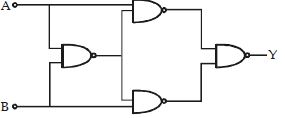
The truth table for the system of four $NAND$ gates as shown in the figure is:
A
| $A$ | $B$ | $Y$ |
| $0$ | $0$ | $0$ |
| $0$ | $1$ | $1$ |
| $1$ | $0$ | $1$ |
| $1$ | $1$ | $0$ |
B
| $A$ | $B$ | $Y$ |
| $0$ | $0$ | $0$ |
| $0$ | $1$ | $0$ |
| $1$ | $0$ | $1$ |
| $1$ | $1$ | $1$ |
C
| $A$ | $B$ | $Y$ |
| $0$ | $0$ | $1$ |
| $0$ | $1$ | $1$ |
| $1$ | $0$ | $0$ |
| $1$ | $1$ | $0$ |
D
| $A$ | $B$ | $Y$ |
| $0$ | $0$ | $0$ |
| $0$ | $1$ | $1$ |
| $1$ | $0$ | $1$ |
| $1$ | $1$ | $1$ |
Solution
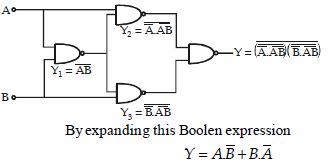
(A) Let the output of the first $NAND$ gate be $Y_1 = \overline{A \cdot B}$.
This $Y_1$ is fed as an input to the next two $NAND$ gates.
The outputs of these two gates are $Y_2 = \overline{A \cdot Y_1} = \overline{A \cdot \overline{A \cdot B}}$ and $Y_3 = \overline{B \cdot Y_1} = \overline{B \cdot \overline{A \cdot B}}$.
These are then fed into the final $NAND$ gate,so $Y = \overline{Y_2 \cdot Y_3} = \overline{\overline{A \cdot \overline{A \cdot B}} \cdot \overline{B \cdot \overline{A \cdot B}}}$.
Using De Morgan's theorem,$Y = \overline{\overline{A \cdot \overline{A \cdot B}}} + \overline{\overline{B \cdot \overline{A \cdot B}}} = (A \cdot \overline{A \cdot B}) + (B \cdot \overline{A \cdot B})$.
$Y = (A \cdot (\overline{A} + \overline{B})) + (B \cdot (\overline{A} + \overline{B})) = (A \cdot \overline{A} + A \cdot \overline{B}) + (B \cdot \overline{A} + B \cdot \overline{B})$.
Since $A \cdot \overline{A} = 0$ and $B \cdot \overline{B} = 0$,we get $Y = A \cdot \overline{B} + \overline{A} \cdot B$,which is the $XOR$ gate operation.
The truth table for $XOR$ is:
- If $A=0, B=0$,then $Y=0$.
- If $A=0, B=1$,then $Y=1$.
- If $A=1, B=0$,then $Y=1$.
- If $A=1, B=1$,then $Y=0$.
This matches option $A$.
This $Y_1$ is fed as an input to the next two $NAND$ gates.
The outputs of these two gates are $Y_2 = \overline{A \cdot Y_1} = \overline{A \cdot \overline{A \cdot B}}$ and $Y_3 = \overline{B \cdot Y_1} = \overline{B \cdot \overline{A \cdot B}}$.
These are then fed into the final $NAND$ gate,so $Y = \overline{Y_2 \cdot Y_3} = \overline{\overline{A \cdot \overline{A \cdot B}} \cdot \overline{B \cdot \overline{A \cdot B}}}$.
Using De Morgan's theorem,$Y = \overline{\overline{A \cdot \overline{A \cdot B}}} + \overline{\overline{B \cdot \overline{A \cdot B}}} = (A \cdot \overline{A \cdot B}) + (B \cdot \overline{A \cdot B})$.
$Y = (A \cdot (\overline{A} + \overline{B})) + (B \cdot (\overline{A} + \overline{B})) = (A \cdot \overline{A} + A \cdot \overline{B}) + (B \cdot \overline{A} + B \cdot \overline{B})$.
Since $A \cdot \overline{A} = 0$ and $B \cdot \overline{B} = 0$,we get $Y = A \cdot \overline{B} + \overline{A} \cdot B$,which is the $XOR$ gate operation.
The truth table for $XOR$ is:
- If $A=0, B=0$,then $Y=0$.
- If $A=0, B=1$,then $Y=1$.
- If $A=1, B=0$,then $Y=1$.
- If $A=1, B=1$,then $Y=0$.
This matches option $A$.
0 likesView Solution
110
ChemistryMCQAIEEE · 2012
$A$ coil is suspended in a uniform magnetic field with the plane of the coil parallel to the magnetic lines of force. When a current is passed through the coil,it starts oscillating and is very difficult to stop. However,if an aluminium plate is placed near the coil,it stops. This is due to:
A
development of air current when the plate is placed
B
induction of electrical charge on the plate
C
shielding of magnetic lines of force as aluminium is a paramagnetic material
D
electromagnetic induction in the aluminium plate giving rise to electromagnetic damping
Solution
(D) When the coil oscillates in the magnetic field,the magnetic flux linked with the nearby aluminium plate changes continuously.
According to Faraday's law of electromagnetic induction,this changing magnetic flux induces eddy currents in the aluminium plate.
According to Lenz's law,these eddy currents oppose the motion that produced them.
This effect is known as electromagnetic damping,which brings the oscillating coil to rest quickly.
According to Faraday's law of electromagnetic induction,this changing magnetic flux induces eddy currents in the aluminium plate.
According to Lenz's law,these eddy currents oppose the motion that produced them.
This effect is known as electromagnetic damping,which brings the oscillating coil to rest quickly.
0 likesView Solution
111
ChemistryMCQAIEEE · 2012
The resistance of a wire is $R$. It is bent at the middle by $180^{\circ}$ and both the ends are twisted together to make a shorter wire. The resistance of the new wire is
A
$2 R$
B
$R / 2$
C
$R / 4$
D
$R / 8$
Solution
(C) The resistance of a wire is given by $R = \rho \frac{l}{A}$,where $\rho$ is the resistivity,$l$ is the length,and $A$ is the cross-sectional area.
When the wire is bent at the middle by $180^{\circ}$ and the ends are twisted together,the length of the new wire becomes $l' = \frac{l}{2}$.
Since the two halves are placed side-by-side,the cross-sectional area of the new wire becomes $A' = 2A$.
The new resistance $R'$ is given by $R' = \rho \frac{l'}{A'} = \rho \frac{l/2}{2A} = \frac{1}{4} \left( \rho \frac{l}{A} \right)$.
Therefore,$R' = \frac{R}{4}$.
When the wire is bent at the middle by $180^{\circ}$ and the ends are twisted together,the length of the new wire becomes $l' = \frac{l}{2}$.
Since the two halves are placed side-by-side,the cross-sectional area of the new wire becomes $A' = 2A$.
The new resistance $R'$ is given by $R' = \rho \frac{l'}{A'} = \rho \frac{l/2}{2A} = \frac{1}{4} \left( \rho \frac{l}{A} \right)$.
Therefore,$R' = \frac{R}{4}$.
0 likesView Solution
112
ChemistryMCQAIEEE · 2012
The pressure of an ideal gas varies with volume as $P = \alpha V$,where $\alpha$ is a constant. One mole of the gas is allowed to undergo expansion such that its volume becomes $m$ times its initial volume. The work done by the gas in the process is
A
$\frac{\alpha V^2}{2}(m^2-1)$
B
$\frac{\alpha V}{2}(m^2-1)$
C
$\frac{\alpha^2 V^2}{2}(m^2-1)$
D
$\frac{\alpha}{2V}(m^2-1)$
Solution
(A) The work done by a gas during expansion is given by the integral $W = \int_{V_1}^{V_2} P dV$.
Given the process $P = \alpha V$,where $V_1 = V$ and $V_2 = mV$.
Substituting the expression for $P$ into the integral:
$W = \int_{V}^{mV} (\alpha V') dV'$
$W = \alpha \left[ \frac{(V')^2}{2} \right]_{V}^{mV}$
$W = \frac{\alpha}{2} [(mV)^2 - V^2]$
$W = \frac{\alpha}{2} [m^2 V^2 - V^2]$
$W = \frac{\alpha V^2}{2} (m^2 - 1)$
Given the process $P = \alpha V$,where $V_1 = V$ and $V_2 = mV$.
Substituting the expression for $P$ into the integral:
$W = \int_{V}^{mV} (\alpha V') dV'$
$W = \alpha \left[ \frac{(V')^2}{2} \right]_{V}^{mV}$
$W = \frac{\alpha}{2} [(mV)^2 - V^2]$
$W = \frac{\alpha}{2} [m^2 V^2 - V^2]$
$W = \frac{\alpha V^2}{2} (m^2 - 1)$
0 likesView Solution
Vedclass Products
For Students
Vedclass Test Series
Mock tests in real AIEEE style covering Chemistry with performance analysis. 5-day free trial.
Start Free TrialFor Teachers
Exam Paper Generator
Generate Set A/B/C/D Chemistry papers from 7.5L+ questions in 2 minutes. 3 chapters free.
Try FreeFor Institutes
Online Exam Module
Run live AIEEE mock exams with unlimited students, 360° analytics & white-label branding.
See DemoFrequently Asked Questions
How many Chemistry questions are in AIEEE 2012?
There are 189 Chemistry questions from the AIEEE 2012 paper on Vedclass, each with a detailed step-by-step solution in English.
Are AIEEE 2012 Chemistry solutions available in English?
Yes. All solutions on this page are in English. You can also switch to English or Hindi using the language buttons above the questions.
Can I practice AIEEE 2012 Chemistry as a timed test?
Yes. Use the Vedclass Test Series to attempt a full AIEEE mock test covering Chemistry with time limits and instant score analysis.
Can teachers create Chemistry papers from AIEEE previous year questions?
Yes. The Vedclass Exam Paper Generator lets teachers mix AIEEE Chemistry questions and generate Set A/B/C/D papers in minutes.
For Teachers & Institutes
Build a Custom Chemistry Paper
Pick AIEEE 2012 Chemistry questions, set difficulty, and generate Set A/B/C/D in 2 minutes.