
In an experiment, electrons are made to pass through a narrow slit of width '$d$' comparable to their de Broglie wavelength. They are detected on a screen at a distance '$D$' from the slit (see figure). Which of the following graphs can be expected to represent the number of electrons '$N$' detected as a function of the detector position '$y$' ($y = 0$ corresponds to the middle of the slit)?
- A
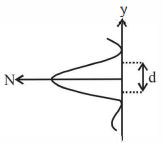
- B
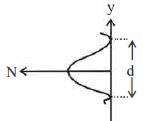
- C
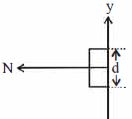
- D
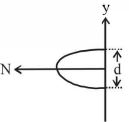
Explore More
Similar Questions
In a Fraunhofer diffraction at a single slit of width $d$ and incident light of wavelength $5500 \text{ Å}$,the first minimum is observed at an angle $30^{\circ}$. The first secondary maxima are observed at an angle $\theta=$
DifficultMHT CET 2022
View SolutionThe angular width of the central maxima in the Fraunhofer diffraction pattern of a slit is measured. The slit is illuminated by light of wavelength $6000 \ \mathring A$. When the slit is illuminated by light of another wavelength,the angular width decreases by $30\%$. The wavelength of this light will be ...... $\mathring A$.
Medium
View Solution$A$ diffraction pattern is obtained by using a beam of red light. What will happen if the red light is replaced by blue light?
Easy
View SolutionIn a diffraction experiment from a single slit,the angular width of the central maximum does $NOT$ depend upon:
$A$ parallel beam of light of wavelength $\lambda$ is incident normally on a single slit of width $d$. Diffraction bands are obtained on a screen placed at a distance $D$ from the slit. The second dark band from the central bright band will be at a distance given by
Vedclass Products
For Students
Vedclass Test Series
Mock tests in real JEE/NEET style with performance analysis. 5-day free trial.
Start Free TrialFor Teachers
Exam Paper Generator
Generate Set A/B/C/D exam papers from 7.5L+ questions in 2 minutes. 3 chapters free.
Try FreeFor Institutes
Online Exam Module
Live online exams with unlimited students, 360° analytics & white-label branding.
See Demo