
Class 11PhysicsSystem of Particles and Rotational MotionMix Example - System of Particles and Rotational Motion
Medium$A$ thin rod of length '$L$' lies along the $x$-axis with its ends at $x = 0$ and $x = L$. Its linear mass density $\lambda$ varies with $x$ as $\lambda = k{\left( {\frac{x}{L}} \right)^n}$,where $n$ is a non-negative constant. If the position $x_{CM}$ of the center of mass of the rod is plotted against '$n$',which of the following graphs best approximates the dependence of $x_{CM}$ on $n$?
- A
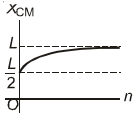
- B
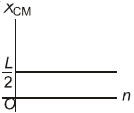
- C
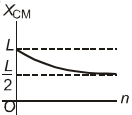
- D
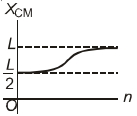
Explore More
Similar Questions
The moment of inertia of a sphere of mass $M$ and radius $R$ is $I$. Which graph represents the variation of $I$ with respect to $R$,keeping $M$ constant?
Easy
View SolutionThe angular momentum of a rigid body of mass $m$ about an axis is $n$ times the linear momentum $(P)$ of the body. The total kinetic energy of the rigid body is:
MediumNEET 2017
View Solution$A$ wheel starting from rest is uniformly accelerated at $2 \, rad/s^2$ for $20 \, s$. It is allowed to rotate uniformly for the next $10 \, s$ and is finally brought to rest in the next $20 \, s$. The total angle rotated by the wheel (in radians) is ............
Medium
View Solution$A$ particle of mass $m$ is moving along the side of a square of side '$a$',with a uniform speed $v$ in the $x-y$ plane as shown in the figure. Which of the following statements is false for the angular momentum $\vec L$ about the origin?
DifficultJEE MAIN 2016
View SolutionThe position vectors of two $1 \ kg$ particles,$(A)$ and $(B),$ are given by $\overrightarrow{r}_{A} = (\alpha_1 t^2 \hat{i} + \alpha_2 t \hat{j} + \alpha_3 \hat{k}) \ m$ and $\vec{r}_B = (\beta_1 t \hat{i} + \beta_2 t^2 \hat{j} + \beta_3 t \hat{k}) \ m$,respectively. Given $\alpha_1 = 1 \ m/s^2, \alpha_2 = 3n \ m/s, \alpha_3 = 2 \ m, \beta_1 = 2 \ m/s, \beta_2 = -1 \ m/s^2, \beta_3 = 4p \ m/s$,where $t$ is time,$n$ and $p$ are constants. At $t = 1 \ s$,$|\overrightarrow{V}_{A}| = |\overrightarrow{V}_{B}|$ and the velocities $\overrightarrow{V}_{A}$ and $\overrightarrow{V}_{B}$ are orthogonal. At $t = 1 \ s$,the magnitude of angular momentum of particle $(A)$ with respect to particle $(B)$ is $\sqrt{L} \ kg \ m^2/s$. The value of $L$ is:
DifficultJEE MAIN 2025
View SolutionVedclass Products
For Students
Vedclass Test Series
Mock tests in real JEE/NEET style with performance analysis. 5-day free trial.
Start Free TrialFor Teachers
Exam Paper Generator
Generate Set A/B/C/D exam papers from 7.5L+ questions in 2 minutes. 3 chapters free.
Try FreeFor Institutes
Online Exam Module
Live online exams with unlimited students, 360° analytics & white-label branding.
See Demo