
Medium
$A$ capillary tube $(A)$ is dipped in water. Another identical tube $(B)$ is dipped in a soap-water solution. Which of the following shows the relative nature of the liquid columns in the two tubes?
- A
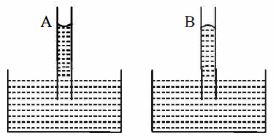
- B
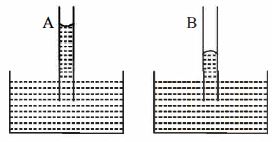
- C
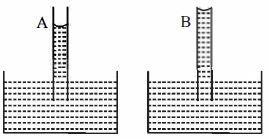
- D
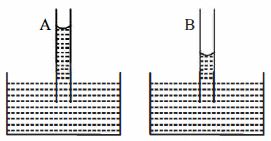
Explore More
Similar Questions
Two cylindrical vessels of equal cross-sectional area of $2 \ m^2$ contain water up to heights of $10 \ m$ and $6 \ m$,respectively. If the vessels are connected at their bottom,then the work done by the force of gravity is (Density of water is $10^3 \ kg/m^3$ and $g = 10 \ m/s^2$):
$A$ cylinder of radius $4 \ cm$ and height $10 \ cm$ is immersed in two liquids as shown. Specific gravity of oil is $0.5$. $2 \ cm$ of the cylinder is in the air. Select the $INCORRECT$ statement. Neglect atmospheric pressure.
Medium
View SolutionDifferent processes are given in Column-$I$ and their reasons are given in Column-$II$. Match them appropriately.
Column-$I$ Column-$II$ $(a)$ Rain drops move downwards with constant velocity. $(i)$ Viscous liquids $(b)$ Floating clouds at a height in air. $(ii)$ Viscosity $(iii)$ Less density
| Column-$I$ | Column-$II$ |
|---|---|
| $(a)$ Rain drops move downwards with constant velocity. | $(i)$ Viscous liquids |
| $(b)$ Floating clouds at a height in air. | $(ii)$ Viscosity |
| $(iii)$ Less density |
Easy
View Solution$A$ table tennis ball has radius $(3 / 2) \times 10^{-2} \text{ m}$ and mass $(22 / 7) \times 10^{-3} \text{ kg}$. It is slowly pushed down into a swimming pool to a depth of $d = 0.7 \text{ m}$ below the water surface and then released from rest. It emerges from the water surface at speed $v$,without getting wet,and rises up to a height $H$. Which of the following option$(s)$ is (are) correct?
[Given: $\pi = 22 / 7, g = 10 \text{ ms}^{-2}$,density of water $= 1 \times 10^3 \text{ kg m}^{-3}$,viscosity of water $= 1 \times 10^{-3} \text{ Pa-s}$.]
$(A)$ The work done in pushing the ball to the depth $d$ is $0.077 \text{ J}$.
$(B)$ If we neglect the viscous force in water,then the speed $v = 7 \text{ m/s}$.
$(C)$ If we neglect the viscous force in water,then the height $H = 1.4 \text{ m}$.
$(D)$ The ratio of the magnitudes of the net force excluding the viscous force to the maximum viscous force in water is $500 / 9$.
[Given: $\pi = 22 / 7, g = 10 \text{ ms}^{-2}$,density of water $= 1 \times 10^3 \text{ kg m}^{-3}$,viscosity of water $= 1 \times 10^{-3} \text{ Pa-s}$.]
$(A)$ The work done in pushing the ball to the depth $d$ is $0.077 \text{ J}$.
$(B)$ If we neglect the viscous force in water,then the speed $v = 7 \text{ m/s}$.
$(C)$ If we neglect the viscous force in water,then the height $H = 1.4 \text{ m}$.
$(D)$ The ratio of the magnitudes of the net force excluding the viscous force to the maximum viscous force in water is $500 / 9$.
Water flows through a frictionless duct with a cross-section varying as shown in the figure. Pressure $p$ at points along the axis is represented by:
Medium
View SolutionVedclass Products
For Students
Vedclass Test Series
Mock tests in real JEE/NEET style with performance analysis. 5-day free trial.
Start Free TrialFor Teachers
Exam Paper Generator
Generate Set A/B/C/D exam papers from 7.5L+ questions in 2 minutes. 3 chapters free.
Try FreeFor Institutes
Online Exam Module
Live online exams with unlimited students, 360° analytics & white-label branding.
See Demo