
ChemistryQ51–85 of 125 questions
Page 2 of 2 · English
51
ChemistryMCQAIEEE · 2005
Which of the following is a polyamide?
A
Bakelite
B
Terylene
C
Nylon-$66$
D
Teflon
Solution
(C) Polyamides are polymers containing amide linkages $(-CONH-)$ in their backbone.
Nylon-$66$ is a condensation polymer formed by the reaction of hexamethylenediamine and adipic acid,which results in the formation of amide bonds.
Bakelite is a phenol-formaldehyde resin.
Terylene is a polyester.
Teflon is a polymer of tetrafluoroethene.
Nylon-$66$ is a condensation polymer formed by the reaction of hexamethylenediamine and adipic acid,which results in the formation of amide bonds.
Bakelite is a phenol-formaldehyde resin.
Terylene is a polyester.
Teflon is a polymer of tetrafluoroethene.
0 likesView Solution
52
ChemistryMCQAIEEE · 2005
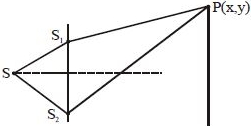
$A$ Young's double slit experiment uses a monochromatic source. The shape of the interference fringes formed on a screen is
A
circle
B
hyperbola
C
parabola
D
straight line
Solution
(B) In a Young's double slit experiment, the condition for constructive or destructive interference at any point $P(x, y)$ on the screen is that the path difference between the waves from the two slits $S_1$ and $S_2$ must be constant.
Mathematically, this is expressed as $|PS_1 - PS_2| = \text{constant}$.
By definition, the locus of a point such that the difference of its distances from two fixed points (the foci, which are the slits $S_1$ and $S_2$) is constant, is a hyperbola.
Therefore, the interference fringes formed on the screen are hyperbolic in shape.
Mathematically, this is expressed as $|PS_1 - PS_2| = \text{constant}$.
By definition, the locus of a point such that the difference of its distances from two fixed points (the foci, which are the slits $S_1$ and $S_2$) is constant, is a hyperbola.
Therefore, the interference fringes formed on the screen are hyperbolic in shape.
0 likesView Solution
53
ChemistryMCQAIEEE · 2005
Heating an aqueous solution of aluminium chloride to dryness will give:
A
$AlCl_3$
B
$Al_2Cl_6$
C
$Al_2O_3$
D
$Al(OH)Cl_2$
Solution
(C) Aqueous solution of $AlCl_3$ undergoes hydrolysis to form $Al(OH)_3$ and $HCl$:
$AlCl_3 + 3 H_2O \rightarrow Al(OH)_3 + 3 HCl$
Upon heating the solution to dryness,the volatile $HCl$ gas escapes,and the remaining $Al(OH)_3$ undergoes thermal decomposition to form aluminium oxide $(Al_2O_3)$:
$2 Al(OH)_3 \xrightarrow{\Delta} Al_2O_3 + 3 H_2O$
Therefore,the final product obtained is $Al_2O_3$.
$AlCl_3 + 3 H_2O \rightarrow Al(OH)_3 + 3 HCl$
Upon heating the solution to dryness,the volatile $HCl$ gas escapes,and the remaining $Al(OH)_3$ undergoes thermal decomposition to form aluminium oxide $(Al_2O_3)$:
$2 Al(OH)_3 \xrightarrow{\Delta} Al_2O_3 + 3 H_2O$
Therefore,the final product obtained is $Al_2O_3$.
0 likesView Solution
54
ChemistryMCQAIEEE · 2005
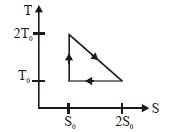
The temperature-entropy $(T-S)$ diagram of a reversible engine cycle is given in the figure. Its efficiency is
A
$0.5$
B
$0.25$
C
$0.33$
D
$0.67$
Solution
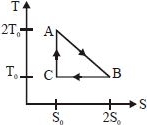
(C) The heat exchanged in a process is given by $Q = \int T \, dS$,which represents the area under the curve in a $T-S$ diagram.
$1$. Heat absorbed $(Q_1)$ from $A$ to $B$: The process $A \rightarrow B$ is a straight line. The area under this line is a trapezoid with parallel sides $2T_0$ and $T_0$ and height $(2S_0 - S_0) = S_0$.
$Q_1 = \text{Area under } AB = \frac{1}{2} (2T_0 + T_0) (2S_0 - S_0) = \frac{3}{2} T_0 S_0$.
$2$. Heat rejected $(Q_2)$ from $B$ to $C$: The process $B \rightarrow C$ is at constant temperature $T_0$. The area under this line is a rectangle.
$Q_2 = \text{Area under } BC = T_0 (2S_0 - S_0) = T_0 S_0$.
$3$. Efficiency $(\eta)$: The efficiency of a heat engine is given by $\eta = 1 - \frac{Q_2}{Q_1}$.
$\eta = 1 - \frac{T_0 S_0}{\frac{3}{2} T_0 S_0} = 1 - \frac{2}{3} = \frac{1}{3} \approx 0.33$.
$1$. Heat absorbed $(Q_1)$ from $A$ to $B$: The process $A \rightarrow B$ is a straight line. The area under this line is a trapezoid with parallel sides $2T_0$ and $T_0$ and height $(2S_0 - S_0) = S_0$.
$Q_1 = \text{Area under } AB = \frac{1}{2} (2T_0 + T_0) (2S_0 - S_0) = \frac{3}{2} T_0 S_0$.
$2$. Heat rejected $(Q_2)$ from $B$ to $C$: The process $B \rightarrow C$ is at constant temperature $T_0$. The area under this line is a rectangle.
$Q_2 = \text{Area under } BC = T_0 (2S_0 - S_0) = T_0 S_0$.
$3$. Efficiency $(\eta)$: The efficiency of a heat engine is given by $\eta = 1 - \frac{Q_2}{Q_1}$.
$\eta = 1 - \frac{T_0 S_0}{\frac{3}{2} T_0 S_0} = 1 - \frac{2}{3} = \frac{1}{3} \approx 0.33$.
0 likesView Solution
55
ChemistryMCQAIEEE · 2005
$A$ gaseous mixture consists of $16 \ g$ of helium and $16 \ g$ of hydrogen. The ratio $\frac{C_p}{C_v}$ of the mixture is
A
$1.46$
B
$1.54$
C
$1.59$
D
$1.62$
Solution
(A) The number of moles of Helium $(He)$ is $n_1 = \frac{16}{4} = 4 \ mol$. Helium is a monoatomic gas,so its degrees of freedom $f_1 = 3$ and $C_{v1} = \frac{3}{2}R$.
The number of moles of Hydrogen $(H_2)$ is $n_2 = \frac{16}{2} = 8 \ mol$. Hydrogen is a diatomic gas,so its degrees of freedom $f_2 = 5$ and $C_{v2} = \frac{5}{2}R$.
The equivalent $C_v$ of the mixture is given by $C_{v,mix} = \frac{n_1 C_{v1} + n_2 C_{v2}}{n_1 + n_2} = \frac{4(\frac{3}{2}R) + 8(\frac{5}{2}R)}{4 + 8} = \frac{6R + 20R}{12} = \frac{26R}{12} = \frac{13}{6}R$.
The equivalent $C_p$ of the mixture is given by $C_{p,mix} = C_{v,mix} + R = \frac{13}{6}R + R = \frac{19}{6}R$.
The ratio $\gamma = \frac{C_{p,mix}}{C_{v,mix}} = \frac{19/6 R}{13/6 R} = \frac{19}{13} \approx 1.46$.
The number of moles of Hydrogen $(H_2)$ is $n_2 = \frac{16}{2} = 8 \ mol$. Hydrogen is a diatomic gas,so its degrees of freedom $f_2 = 5$ and $C_{v2} = \frac{5}{2}R$.
The equivalent $C_v$ of the mixture is given by $C_{v,mix} = \frac{n_1 C_{v1} + n_2 C_{v2}}{n_1 + n_2} = \frac{4(\frac{3}{2}R) + 8(\frac{5}{2}R)}{4 + 8} = \frac{6R + 20R}{12} = \frac{26R}{12} = \frac{13}{6}R$.
The equivalent $C_p$ of the mixture is given by $C_{p,mix} = C_{v,mix} + R = \frac{13}{6}R + R = \frac{19}{6}R$.
The ratio $\gamma = \frac{C_{p,mix}}{C_{v,mix}} = \frac{19/6 R}{13/6 R} = \frac{19}{13} \approx 1.46$.
0 likesView Solution
56
ChemistryMCQAIEEE · 2005
Consider a car moving on a straight road with a speed of $100\, m/s$. The distance at which the car can be stopped is ........ $m$. (Take $g = 10\, m/s^2$ and $\mu_k = 0.5$)
A
$800$
B
$1000$
C
$100$
D
$400$
Solution
(B) Given: Initial velocity $u = 100\, m/s$,Final velocity $v = 0\, m/s$,Coefficient of kinetic friction $\mu_k = 0.5$,Acceleration due to gravity $g = 10\, m/s^2$.
The retardation force acting on the car is $F = \mu_k N = \mu_k mg$.
Using Newton's second law,the retardation $a = \frac{F}{m} = \mu_k g = 0.5 \times 10 = 5\, m/s^2$.
Using the kinematic equation $v^2 - u^2 = 2as$:
$0^2 - (100)^2 = 2(-5)s$
$-10000 = -10s$
$s = \frac{10000}{10} = 1000\, m$.
Therefore,the distance at which the car can be stopped is $1000\, m$.
The retardation force acting on the car is $F = \mu_k N = \mu_k mg$.
Using Newton's second law,the retardation $a = \frac{F}{m} = \mu_k g = 0.5 \times 10 = 5\, m/s^2$.
Using the kinematic equation $v^2 - u^2 = 2as$:
$0^2 - (100)^2 = 2(-5)s$
$-10000 = -10s$
$s = \frac{10000}{10} = 1000\, m$.
Therefore,the distance at which the car can be stopped is $1000\, m$.
0 likesView Solution
57
ChemistryMCQAIEEE · 2005
The locus of a point $P(\alpha, \beta)$ moving under the condition that the line $y = \alpha x + \beta$ is a tangent to the hyperbola $\frac{x^2}{a^2} - \frac{y^2}{b^2} = 1$ is
A
a hyperbola
B
a parabola
C
a circle
D
an ellipse
Solution
(A) The line $y = mx + c$ is a tangent to the hyperbola $\frac{x^2}{a^2} - \frac{y^2}{b^2} = 1$ if $c^2 = a^2m^2 - b^2$.
Given the line $y = \alpha x + \beta$ is a tangent to the hyperbola $\frac{x^2}{a^2} - \frac{y^2}{b^2} = 1$,we substitute $m = \alpha$ and $c = \beta$ into the condition.
Thus,$\beta^2 = a^2\alpha^2 - b^2$.
Replacing $(\alpha, \beta)$ with $(x, y)$ to find the locus,we get $y^2 = a^2x^2 - b^2$.
Rearranging the terms,we have $a^2x^2 - y^2 = b^2$,or $\frac{x^2}{(b/a)^2} - \frac{y^2}{b^2} = 1$.
This equation represents a hyperbola.
Given the line $y = \alpha x + \beta$ is a tangent to the hyperbola $\frac{x^2}{a^2} - \frac{y^2}{b^2} = 1$,we substitute $m = \alpha$ and $c = \beta$ into the condition.
Thus,$\beta^2 = a^2\alpha^2 - b^2$.
Replacing $(\alpha, \beta)$ with $(x, y)$ to find the locus,we get $y^2 = a^2x^2 - b^2$.
Rearranging the terms,we have $a^2x^2 - y^2 = b^2$,or $\frac{x^2}{(b/a)^2} - \frac{y^2}{b^2} = 1$.
This equation represents a hyperbola.
0 likesView Solution
58
ChemistryMCQAIEEE · 2005
$A$ gaseous mixture consists of $16\,g$ of helium and $16\,g$ of oxygen. The ratio $(C_p/C_v)$ of the mixture is
A
$1.4$
B
$1.54$
C
$1.59$
D
$1.62$
Solution
(D) The number of moles for helium $(He)$ is $n_1 = \frac{16\,g}{4\,g/mol} = 4\,mol$. Helium is a monoatomic gas,so $f_1 = 3$,$C_{v1} = \frac{3R}{2}$,and $C_{p1} = \frac{5R}{2}$.
The number of moles for oxygen $(O_2)$ is $n_2 = \frac{16\,g}{32\,g/mol} = 0.5\,mol$. Oxygen is a diatomic gas,so $f_2 = 5$,$C_{v2} = \frac{5R}{2}$,and $C_{p2} = \frac{7R}{2}$.
The ratio of specific heats for the mixture is given by $\gamma_{mix} = \frac{n_1 C_{p1} + n_2 C_{p2}}{n_1 C_{v1} + n_2 C_{v2}}$.
Substituting the values:
$\gamma_{mix} = \frac{4 \times (\frac{5R}{2}) + 0.5 \times (\frac{7R}{2})}{4 \times (\frac{3R}{2}) + 0.5 \times (\frac{5R}{2})}$
$\gamma_{mix} = \frac{10R + 1.75R}{6R + 1.25R} = \frac{11.75R}{7.25R} = \frac{1175}{725} \approx 1.62$.
The number of moles for oxygen $(O_2)$ is $n_2 = \frac{16\,g}{32\,g/mol} = 0.5\,mol$. Oxygen is a diatomic gas,so $f_2 = 5$,$C_{v2} = \frac{5R}{2}$,and $C_{p2} = \frac{7R}{2}$.
The ratio of specific heats for the mixture is given by $\gamma_{mix} = \frac{n_1 C_{p1} + n_2 C_{p2}}{n_1 C_{v1} + n_2 C_{v2}}$.
Substituting the values:
$\gamma_{mix} = \frac{4 \times (\frac{5R}{2}) + 0.5 \times (\frac{7R}{2})}{4 \times (\frac{3R}{2}) + 0.5 \times (\frac{5R}{2})}$
$\gamma_{mix} = \frac{10R + 1.75R}{6R + 1.25R} = \frac{11.75R}{7.25R} = \frac{1175}{725} \approx 1.62$.
0 likesView Solution
59
ChemistryMCQAIEEE · 2005
$A$ mass $m$ moves with a velocity $v$ and collides inelastically with another identical mass initially at rest. After collision,the first mass moves with velocity $\frac{v}{\sqrt{3}}$ in a direction perpendicular to its initial direction of motion. The speed of the second mass after collision is:
A
$\frac{2}{\sqrt{3}}v$
B
$\frac{v}{\sqrt{3}}$
C
$v$
D
$\sqrt{3}v$
Solution
(A) According to the law of conservation of linear momentum: $m_{1} \vec{u}_{1} + m_{2} \vec{u}_{2} = m_{1} \vec{v}_{1} + m_{2} \vec{v}_{2}$.
Let the initial velocity of the first mass be $\vec{u}_{1} = v \hat{i}$ and the second mass be at rest,$\vec{u}_{2} = 0$.
After the collision,the first mass moves with velocity $\vec{v}_{1} = \frac{v}{\sqrt{3}} \hat{j}$ (perpendicular to the initial direction).
Substituting these values into the momentum equation:
$m(v \hat{i}) + m(0) = m(\frac{v}{\sqrt{3}} \hat{j}) + m \vec{v}_{2}$.
Dividing by $m$,we get:
$\vec{v}_{2} = v \hat{i} - \frac{v}{\sqrt{3}} \hat{j}$.
The speed of the second mass is the magnitude of $\vec{v}_{2}$:
$|\vec{v}_{2}| = \sqrt{v^{2} + (-\frac{v}{\sqrt{3}})^{2}} = \sqrt{v^{2} + \frac{v^{2}}{3}} = \sqrt{\frac{4v^{2}}{3}} = \frac{2}{\sqrt{3}}v$.
Let the initial velocity of the first mass be $\vec{u}_{1} = v \hat{i}$ and the second mass be at rest,$\vec{u}_{2} = 0$.
After the collision,the first mass moves with velocity $\vec{v}_{1} = \frac{v}{\sqrt{3}} \hat{j}$ (perpendicular to the initial direction).
Substituting these values into the momentum equation:
$m(v \hat{i}) + m(0) = m(\frac{v}{\sqrt{3}} \hat{j}) + m \vec{v}_{2}$.
Dividing by $m$,we get:
$\vec{v}_{2} = v \hat{i} - \frac{v}{\sqrt{3}} \hat{j}$.
The speed of the second mass is the magnitude of $\vec{v}_{2}$:
$|\vec{v}_{2}| = \sqrt{v^{2} + (-\frac{v}{\sqrt{3}})^{2}} = \sqrt{v^{2} + \frac{v^{2}}{3}} = \sqrt{\frac{4v^{2}}{3}} = \frac{2}{\sqrt{3}}v$.
0 likesView Solution
60
ChemistryMCQAIEEE · 2005
In a potentiometer experiment,the balancing length with a cell is $240\,cm$. On shunting the cell with a resistance of $2\,\Omega$,the balancing length becomes $120\,cm$. The internal resistance of the cell is ................... $\Omega$.
A
$4$
B
$2$
C
$1$
D
$0.5$
Solution
(B) The internal resistance $r$ of a cell is given by the formula:
$r = R \left[ \frac{l_1}{l_2} - 1 \right]$
Where:
$R = 2\,\Omega$ (external shunt resistance)
$l_1 = 240\,cm$ (balancing length without shunt)
$l_2 = 120\,cm$ (balancing length with shunt)
Substituting the values into the formula:
$r = 2 \left[ \frac{240}{120} - 1 \right]$
$r = 2 [2 - 1]$
$r = 2 \times 1 = 2\,\Omega$
Thus,the internal resistance of the cell is $2\,\Omega$.
$r = R \left[ \frac{l_1}{l_2} - 1 \right]$
Where:
$R = 2\,\Omega$ (external shunt resistance)
$l_1 = 240\,cm$ (balancing length without shunt)
$l_2 = 120\,cm$ (balancing length with shunt)
Substituting the values into the formula:
$r = 2 \left[ \frac{240}{120} - 1 \right]$
$r = 2 [2 - 1]$
$r = 2 \times 1 = 2\,\Omega$
Thus,the internal resistance of the cell is $2\,\Omega$.
0 likesView Solution
61
ChemistryMCQAIEEE · 2005
Two point white dots are $1 \, mm$ apart on black paper. They are viewed by an eye with a pupil diameter of $3 \, mm$. Approximately,what is the maximum distance at which these dots can be resolved by the eye? (Take $\lambda = 500 \, nm$)
A
$6$
B
$3$
C
$5$
D
$1$
Solution
(C) The condition for the resolution of two point objects by an optical system (like the human eye) is given by the Rayleigh criterion: $\theta = \frac{1.22 \lambda}{d}$.
Here,$\theta$ is the angular separation,$\lambda$ is the wavelength of light,and $d$ is the diameter of the pupil.
Also,for small angles,the angular separation $\theta$ can be expressed as $\theta = \frac{y}{D}$,where $y$ is the linear separation between the dots and $D$ is the distance from the eye.
Equating the two expressions: $\frac{y}{D} = \frac{1.22 \lambda}{d}$.
Rearranging to solve for $D$: $D = \frac{y \cdot d}{1.22 \cdot \lambda}$.
Given values: $y = 1 \, mm = 1 \times 10^{-3} \, m$,$d = 3 \, mm = 3 \times 10^{-3} \, m$,and $\lambda = 500 \, nm = 500 \times 10^{-9} \, m$.
Substituting these values: $D = \frac{1 \times 10^{-3} \times 3 \times 10^{-3}}{1.22 \times 500 \times 10^{-9}}$.
$D = \frac{3 \times 10^{-6}}{610 \times 10^{-9}} = \frac{3000}{610} \approx 4.918 \, m$.
Rounding to the nearest integer,we get $D \approx 5 \, m$.
Here,$\theta$ is the angular separation,$\lambda$ is the wavelength of light,and $d$ is the diameter of the pupil.
Also,for small angles,the angular separation $\theta$ can be expressed as $\theta = \frac{y}{D}$,where $y$ is the linear separation between the dots and $D$ is the distance from the eye.
Equating the two expressions: $\frac{y}{D} = \frac{1.22 \lambda}{d}$.
Rearranging to solve for $D$: $D = \frac{y \cdot d}{1.22 \cdot \lambda}$.
Given values: $y = 1 \, mm = 1 \times 10^{-3} \, m$,$d = 3 \, mm = 3 \times 10^{-3} \, m$,and $\lambda = 500 \, nm = 500 \times 10^{-9} \, m$.
Substituting these values: $D = \frac{1 \times 10^{-3} \times 3 \times 10^{-3}}{1.22 \times 500 \times 10^{-9}}$.
$D = \frac{3 \times 10^{-6}}{610 \times 10^{-9}} = \frac{3000}{610} \approx 4.918 \, m$.
Rounding to the nearest integer,we get $D \approx 5 \, m$.
0 likesView Solution
62
ChemistryMCQAIEEE · 2005
$A$ bullet fired into a fixed target loses half of its velocity after penetrating $3 \ cm$. How much further will it penetrate before coming to rest,assuming that it faces constant resistance to motion? (in $cm$)
A
$1.5$
B
$1$
C
$3$
D
$2$
Solution
(B) Let the initial velocity be $V$ and the constant retardation be $a$.
Using the equation of motion $v^2 = u^2 + 2as$,where $v = V/2$,$u = V$,and $s = 3 \ cm$:
$(V/2)^2 = V^2 - 2a(3) \implies V^2/4 = V^2 - 6a \implies 6a = 3V^2/4 \implies a = V^2/8$.
Now,let the total distance covered be $S$. When the bullet comes to rest,final velocity $v = 0$:
$0^2 = V^2 - 2aS \implies V^2 = 2(V^2/8)S \implies V^2 = (V^2/4)S \implies S = 4 \ cm$.
The additional distance covered is $S - 3 \ cm = 4 \ cm - 3 \ cm = 1 \ cm$.
Using the equation of motion $v^2 = u^2 + 2as$,where $v = V/2$,$u = V$,and $s = 3 \ cm$:
$(V/2)^2 = V^2 - 2a(3) \implies V^2/4 = V^2 - 6a \implies 6a = 3V^2/4 \implies a = V^2/8$.
Now,let the total distance covered be $S$. When the bullet comes to rest,final velocity $v = 0$:
$0^2 = V^2 - 2aS \implies V^2 = 2(V^2/8)S \implies V^2 = (V^2/4)S \implies S = 4 \ cm$.
The additional distance covered is $S - 3 \ cm = 4 \ cm - 3 \ cm = 1 \ cm$.
0 likesView Solution
63
ChemistryMCQAIEEE · 2005
Which of the following is a polyamide?
A
Bakelite
B
Terylene
C
Nylon-$6,6$
D
Teflon
Solution
(C) polyamide is a polymer containing the amide linkage $(-CONH-)$ in its chain.
$Nylon-6,6$ is a polyamide. It is formed by the condensation polymerisation of hexamethylenediamine $(H_2N(CH_2)_6NH_2)$ and adipic acid $(HOOC(CH_2)_4COOH)$.
Bakelite is a phenol-formaldehyde resin.
Terylene is a polyester formed by the condensation of ethylene glycol and terephthalic acid.
Teflon is a polymer of tetrafluoroethylene $(CF_2=CF_2)$.
$Nylon-6,6$ is a polyamide. It is formed by the condensation polymerisation of hexamethylenediamine $(H_2N(CH_2)_6NH_2)$ and adipic acid $(HOOC(CH_2)_4COOH)$.
Bakelite is a phenol-formaldehyde resin.
Terylene is a polyester formed by the condensation of ethylene glycol and terephthalic acid.
Teflon is a polymer of tetrafluoroethylene $(CF_2=CF_2)$.
0 likesView Solution
64
ChemistryMCQAIEEE · 2005
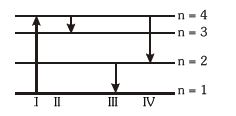
The diagram shows the energy levels for an electron in a certain atom. Which transition shown represents the emission of a photon with the most energy?
A
$III$
B
$IV$
C
$I$
D
$II$
Solution
(A) The energy of an emitted photon is given by $\Delta E = E_{initial} - E_{final}$.
For emission,the electron must move from a higher energy level to a lower energy level.
Transition $I$ is an absorption transition (upward arrow).
Transitions $II$,$III$,and $IV$ are emission transitions (downward arrows).
Comparing the energy gaps:
Transition $II$: $n=4$ to $n=3$
Transition $III$: $n=2$ to $n=1$
Transition $IV$: $n=4$ to $n=2$
The energy difference between levels is given by $E_n = -\frac{13.6}{n^2} \text{ eV}$ (for Hydrogen-like atoms).
The energy gap $\Delta E$ increases as we move to lower $n$ values.
The gap between $n=2$ and $n=1$ (Transition $III$) is the largest among the emission transitions shown.
Therefore,transition $III$ corresponds to the emission of a photon with the most energy.
For emission,the electron must move from a higher energy level to a lower energy level.
Transition $I$ is an absorption transition (upward arrow).
Transitions $II$,$III$,and $IV$ are emission transitions (downward arrows).
Comparing the energy gaps:
Transition $II$: $n=4$ to $n=3$
Transition $III$: $n=2$ to $n=1$
Transition $IV$: $n=4$ to $n=2$
The energy difference between levels is given by $E_n = -\frac{13.6}{n^2} \text{ eV}$ (for Hydrogen-like atoms).
The energy gap $\Delta E$ increases as we move to lower $n$ values.
The gap between $n=2$ and $n=1$ (Transition $III$) is the largest among the emission transitions shown.
Therefore,transition $III$ corresponds to the emission of a photon with the most energy.
0 likesView Solution
65
ChemistryMCQAIEEE · 2005
$A$ Young's double slit experiment uses a monochromatic source. The shape of the interference fringes formed on a screen is
A
straight line
B
parabola
C
hyperbola
D
circle
Solution
(A) In Young's double slit experiment,the path difference between the two waves reaching a point on the screen is given by $\Delta x = d \sin \theta \approx d \tan \theta = d(y/D)$.
For bright fringes,the path difference is $n\lambda$,so $d(y/D) = n\lambda$,which implies $y = (n\lambda D)/d$.
Since $y$ is constant for a given order $n$,the fringes appear as straight lines parallel to the slits on the screen.
Therefore,the shape of the interference fringes is a straight line.
For bright fringes,the path difference is $n\lambda$,so $d(y/D) = n\lambda$,which implies $y = (n\lambda D)/d$.
Since $y$ is constant for a given order $n$,the fringes appear as straight lines parallel to the slits on the screen.
Therefore,the shape of the interference fringes is a straight line.
0 likesView Solution
66
ChemistryMCQAIEEE · 2005
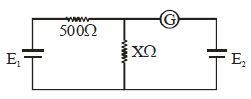
In the adjoining circuit,the battery $E_1$ has an emf of $12 \, V$ and zero internal resistance,while the battery $E_2$ has an emf of $2 \, V$. If the galvanometer $G$ reads zero,then the value of the resistance $X$ (in $\Omega$) is
A
$10$
B
$100$
C
$500$
D
$200$
Solution
(B) Given that the galvanometer $G$ reads zero,no current flows through the branch containing $E_2$ and the galvanometer.
Therefore,the current $I$ flows only through the loop containing $E_1$,the $500 \, \Omega$ resistor,and the resistor $X$.
Using Ohm's law for the circuit:
$I = \frac{E_1}{500 + X}$
The potential difference across the resistor $X$ must be equal to the emf of the battery $E_2$ for the galvanometer to read zero:
$V_X = I \cdot X = E_2$
Substituting the value of $I$:
$\left( \frac{E_1}{500 + X} \right) \cdot X = E_2$
Given $E_1 = 12 \, V$ and $E_2 = 2 \, V$:
$\frac{12 \cdot X}{500 + X} = 2$
$12X = 2(500 + X)$
$12X = 1000 + 2X$
$10X = 1000$
$X = 100 \, \Omega$
Therefore,the current $I$ flows only through the loop containing $E_1$,the $500 \, \Omega$ resistor,and the resistor $X$.
Using Ohm's law for the circuit:
$I = \frac{E_1}{500 + X}$
The potential difference across the resistor $X$ must be equal to the emf of the battery $E_2$ for the galvanometer to read zero:
$V_X = I \cdot X = E_2$
Substituting the value of $I$:
$\left( \frac{E_1}{500 + X} \right) \cdot X = E_2$
Given $E_1 = 12 \, V$ and $E_2 = 2 \, V$:
$\frac{12 \cdot X}{500 + X} = 2$
$12X = 2(500 + X)$
$12X = 1000 + 2X$
$10X = 1000$
$X = 100 \, \Omega$
0 likesView Solution
67
ChemistryMCQAIEEE · 2005
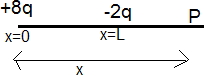
Two point charges $+8q$ and $-2q$ are located at $x = 0$ and $x = L$ respectively. The location of a point on the $x$-axis at which the net electric field due to these two point charges is zero,is
A
$8\,L$
B
$4\,L$
C
$2\,L$
D
$L/4$
Solution
(C) Let the point $P$ be at a distance $x$ from the origin $(x=0)$.
The electric field due to $+8q$ at $P$ is $E_1 = \frac{k(8q)}{x^2}$ (directed away from the origin).
The electric field due to $-2q$ at $P$ is $E_2 = \frac{k(2q)}{(x-L)^2}$ (directed towards the origin).
For the net electric field to be zero at $P$,the magnitudes must be equal: $E_1 = E_2$.
$\frac{k(8q)}{x^2} = \frac{k(2q)}{(x-L)^2}$
$\frac{4}{x^2} = \frac{1}{(x-L)^2}$
Taking the square root on both sides:
$\frac{2}{x} = \frac{1}{x-L}$
$2(x-L) = x$
$2x - 2L = x$
$x = 2L$
Thus,the point is located at $x = 2L$.
The electric field due to $+8q$ at $P$ is $E_1 = \frac{k(8q)}{x^2}$ (directed away from the origin).
The electric field due to $-2q$ at $P$ is $E_2 = \frac{k(2q)}{(x-L)^2}$ (directed towards the origin).
For the net electric field to be zero at $P$,the magnitudes must be equal: $E_1 = E_2$.
$\frac{k(8q)}{x^2} = \frac{k(2q)}{(x-L)^2}$
$\frac{4}{x^2} = \frac{1}{(x-L)^2}$
Taking the square root on both sides:
$\frac{2}{x} = \frac{1}{x-L}$
$2(x-L) = x$
$2x - 2L = x$
$x = 2L$
Thus,the point is located at $x = 2L$.
0 likesView Solution
68
ChemistryMCQAIEEE · 2005
When an unpolarized light of intensity $I_0$ is incident on a polarizing sheet,the intensity of the light which does not get transmitted is
A
zero
B
$I_0$
C
$\frac{1}{2} I_0$
D
$\frac{1}{4} I_0$
Solution
(C) When unpolarized light of intensity $I_0$ passes through a polarizing sheet (polaroid),the transmitted light becomes plane-polarized.
According to Malus's Law and the properties of polarizers,the intensity of the transmitted light is $I_t = \frac{1}{2} I_0$.
The intensity of the light that does not get transmitted (absorbed or reflected) is the difference between the incident intensity and the transmitted intensity.
$I_{not\ transmitted} = I_0 - I_t = I_0 - \frac{1}{2} I_0 = \frac{1}{2} I_0$.
According to Malus's Law and the properties of polarizers,the intensity of the transmitted light is $I_t = \frac{1}{2} I_0$.
The intensity of the light that does not get transmitted (absorbed or reflected) is the difference between the incident intensity and the transmitted intensity.
$I_{not\ transmitted} = I_0 - I_t = I_0 - \frac{1}{2} I_0 = \frac{1}{2} I_0$.
0 likesView Solution
69
ChemistryDifficultMCQAIEEE · 2005
Based on lattice energy and other considerations,which one of the following alkali metal chlorides is expected to have the highest melting point?
A
$NaCl$
B
$KCl$
C
$LiCl$
D
$RbCl$
Solution
(A) The melting point of ionic compounds is primarily determined by their lattice energy.
Lattice energy is inversely proportional to the interionic distance $(U \propto \frac{1}{r_+ + r_-})$.
Among the given alkali metal chlorides,$LiCl$ has the smallest cation size,but it exhibits significant covalent character due to Fajan's rule,which lowers its melting point.
$NaCl$ has a high lattice energy and a stable crystal structure,resulting in the highest melting point among the options provided.
Lattice energy is inversely proportional to the interionic distance $(U \propto \frac{1}{r_+ + r_-})$.
Among the given alkali metal chlorides,$LiCl$ has the smallest cation size,but it exhibits significant covalent character due to Fajan's rule,which lowers its melting point.
$NaCl$ has a high lattice energy and a stable crystal structure,resulting in the highest melting point among the options provided.
0 likesView Solution
70
ChemistryMCQAIEEE · 2005
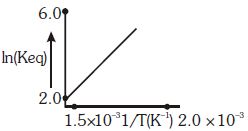
$A$ schematic plot of $\ln K_{eq}$ versus inverse of temperature $(1/T)$ for a reaction is shown below. The reaction must be
A
endothermic
B
exothermic
C
highly spontaneous at ordinary temperature
D
one with negligible enthalpy change
Solution
(A) The van't Hoff equation is given by: $\ln K_{eq} = -\frac{\Delta H^{\circ}}{R} (\frac{1}{T}) + \frac{\Delta S^{\circ}}{R}$.
Comparing this with the equation of a straight line $y = mx + c$,we have $y = \ln K_{eq}$ and $x = 1/T$.
The slope of the line is $m = -\frac{\Delta H^{\circ}}{R}$.
From the given graph,the slope is positive (as $\ln K_{eq}$ increases with $1/T$).
Therefore,$-\frac{\Delta H^{\circ}}{R} > 0$,which implies $\Delta H^{\circ} < 0$.
$A$ negative enthalpy change $(\Delta H^{\circ} < 0)$ indicates an exothermic reaction.
Comparing this with the equation of a straight line $y = mx + c$,we have $y = \ln K_{eq}$ and $x = 1/T$.
The slope of the line is $m = -\frac{\Delta H^{\circ}}{R}$.
From the given graph,the slope is positive (as $\ln K_{eq}$ increases with $1/T$).
Therefore,$-\frac{\Delta H^{\circ}}{R} > 0$,which implies $\Delta H^{\circ} < 0$.
$A$ negative enthalpy change $(\Delta H^{\circ} < 0)$ indicates an exothermic reaction.
0 likesView Solution
71
ChemistryMCQAIEEE · 2005
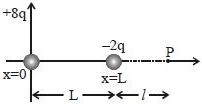
Two point charges $+8q$ and $-2q$ are located at $x = 0$ and $x = L$ respectively. The location of a point on the $x$-axis at which the net electric field due to these two point charges is zero is
A
$8\,L$
B
$4\,L$
C
$2\,L$
D
$\frac{L}{4}$
Solution
(C) The net electric field will be zero at a point outside the charges and closer to the charge which is smaller in magnitude.
Let the point $P$ be at a distance $l$ from the charge $-2q$ at $x = L$. The distance of $P$ from the charge $+8q$ at $x = 0$ is $(L + l)$.
At point $P$,the magnitude of the electric field due to $+8q$ must be equal to the magnitude of the electric field due to $-2q$:
$\frac{k \cdot |8q|}{(L + l)^2} = \frac{k \cdot |2q|}{l^2}$
Simplifying the equation:
$\frac{8}{(L + l)^2} = \frac{2}{l^2}$
$\frac{4}{(L + l)^2} = \frac{1}{l^2}$
Taking the square root on both sides:
$\frac{2}{L + l} = \frac{1}{l}$
$2l = L + l$
$l = L$
The position of point $P$ on the $x$-axis is $x = L + l = L + L = 2L$.
Let the point $P$ be at a distance $l$ from the charge $-2q$ at $x = L$. The distance of $P$ from the charge $+8q$ at $x = 0$ is $(L + l)$.
At point $P$,the magnitude of the electric field due to $+8q$ must be equal to the magnitude of the electric field due to $-2q$:
$\frac{k \cdot |8q|}{(L + l)^2} = \frac{k \cdot |2q|}{l^2}$
Simplifying the equation:
$\frac{8}{(L + l)^2} = \frac{2}{l^2}$
$\frac{4}{(L + l)^2} = \frac{1}{l^2}$
Taking the square root on both sides:
$\frac{2}{L + l} = \frac{1}{l}$
$2l = L + l$
$l = L$
The position of point $P$ on the $x$-axis is $x = L + l = L + L = 2L$.
0 likesView Solution
72
ChemistryMCQAIEEE · 2005
The function $\sin^2(\omega t)$ represents
A
a periodic,but not simple harmonic,motion with a period $2\pi /\omega$
B
a periodic,but not simple harmonic,motion with a period $\pi /\omega$
C
a simple harmonic motion with a period $2\pi /\omega$
D
a simple harmonic motion with a period $\pi /\omega$
Solution
(D) We know that $\sin^2(\omega t) = \frac{1 - \cos(2\omega t)}{2} = \frac{1}{2} - \frac{1}{2}\cos(2\omega t)$.
This expression represents a simple harmonic motion $(SHM)$ because it is of the form $y = A + B\cos(\omega' t)$,where $A$ and $B$ are constants.
The angular frequency of this motion is $\omega' = 2\omega$.
The time period $T$ is given by $T = \frac{2\pi}{\omega'} = \frac{2\pi}{2\omega} = \frac{\pi}{\omega}$.
Therefore,the function represents a simple harmonic motion with a period $\pi /\omega$.
This expression represents a simple harmonic motion $(SHM)$ because it is of the form $y = A + B\cos(\omega' t)$,where $A$ and $B$ are constants.
The angular frequency of this motion is $\omega' = 2\omega$.
The time period $T$ is given by $T = \frac{2\pi}{\omega'} = \frac{2\pi}{2\omega} = \frac{\pi}{\omega}$.
Therefore,the function represents a simple harmonic motion with a period $\pi /\omega$.
0 likesView Solution
73
ChemistryMCQAIEEE · 2005
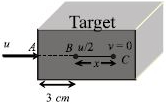
$A$ bullet fired into a fixed target loses half of its velocity after penetrating $3\, cm$. How much further will it penetrate before coming to rest,assuming that it faces constant resistance to motion?.......$cm$
A
$1.5$
B
$1$
C
$3$
D
$2$
Solution
(B) Let the initial velocity of the bullet be $u$.
After penetrating $3\, cm$,its velocity becomes $u/2$.
Using the equation of motion $v^2 = u^2 - 2as$,where $a$ is the retardation due to constant resistance:
$(u/2)^2 = u^2 - 2a(3)$
$u^2/4 = u^2 - 6a$
$6a = 3u^2/4$
$a = u^2/8$
Now,let the bullet penetrate an additional distance $x$ before coming to rest $(v=0)$.
Using the equation of motion $v^2 = u^2 - 2as$ for this segment,with initial velocity $u/2$:
$0^2 = (u/2)^2 - 2ax$
$0 = u^2/4 - 2(u^2/8)x$
$u^2/4 = (u^2/4)x$
$x = 1\, cm$.
Therefore,the bullet will penetrate $1\, cm$ further.
After penetrating $3\, cm$,its velocity becomes $u/2$.
Using the equation of motion $v^2 = u^2 - 2as$,where $a$ is the retardation due to constant resistance:
$(u/2)^2 = u^2 - 2a(3)$
$u^2/4 = u^2 - 6a$
$6a = 3u^2/4$
$a = u^2/8$
Now,let the bullet penetrate an additional distance $x$ before coming to rest $(v=0)$.
Using the equation of motion $v^2 = u^2 - 2as$ for this segment,with initial velocity $u/2$:
$0^2 = (u/2)^2 - 2ax$
$0 = u^2/4 - 2(u^2/8)x$
$u^2/4 = (u^2/4)x$
$x = 1\, cm$.
Therefore,the bullet will penetrate $1\, cm$ further.
0 likesView Solution
74
ChemistryMCQAIEEE · 2005
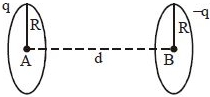
Two thin wire rings,each having a radius $R$,are placed at a distance $d$ apart with their axes coinciding. The charges on the two rings are $+q$ and $-q$. The potential difference between the centres of the two rings is
A
$\frac{qR}{4\pi \varepsilon_0 d^2}$
B
$\frac{q}{2\pi \varepsilon_0} \left[ \frac{1}{R} - \frac{1}{\sqrt{R^2 + d^2}} \right]$
C
Zero
D
$\frac{q}{4\pi \varepsilon_0} \left[ \frac{1}{R} - \frac{1}{\sqrt{R^2 + d^2}} \right]$
Solution
(B) Let the centres of the rings be $A$ and $B$. The potential at the centre of a ring of radius $R$ with charge $Q$ is $V = \frac{1}{4\pi \varepsilon_0} \frac{Q}{R}$.
The potential at centre $A$ due to ring $A$ (charge $+q$) is $V_{A1} = \frac{1}{4\pi \varepsilon_0} \frac{q}{R}$.
The potential at centre $A$ due to ring $B$ (charge $-q$) is $V_{A2} = \frac{1}{4\pi \varepsilon_0} \frac{-q}{\sqrt{R^2 + d^2}}$.
So,$V_A = V_{A1} + V_{A2} = \frac{q}{4\pi \varepsilon_0} \left[ \frac{1}{R} - \frac{1}{\sqrt{R^2 + d^2}} \right]$.
The potential at centre $B$ due to ring $B$ (charge $-q$) is $V_{B1} = \frac{1}{4\pi \varepsilon_0} \frac{-q}{R}$.
The potential at centre $B$ due to ring $A$ (charge $+q$) is $V_{B2} = \frac{1}{4\pi \varepsilon_0} \frac{q}{\sqrt{R^2 + d^2}}$.
So,$V_B = V_{B1} + V_{B2} = \frac{q}{4\pi \varepsilon_0} \left[ -\frac{1}{R} + \frac{1}{\sqrt{R^2 + d^2}} \right] = -V_A$.
The potential difference between the centres is $\Delta V = V_A - V_B = V_A - (-V_A) = 2V_A$.
$\Delta V = 2 \times \frac{q}{4\pi \varepsilon_0} \left[ \frac{1}{R} - \frac{1}{\sqrt{R^2 + d^2}} \right] = \frac{q}{2\pi \varepsilon_0} \left[ \frac{1}{R} - \frac{1}{\sqrt{R^2 + d^2}} \right]$.
The potential at centre $A$ due to ring $A$ (charge $+q$) is $V_{A1} = \frac{1}{4\pi \varepsilon_0} \frac{q}{R}$.
The potential at centre $A$ due to ring $B$ (charge $-q$) is $V_{A2} = \frac{1}{4\pi \varepsilon_0} \frac{-q}{\sqrt{R^2 + d^2}}$.
So,$V_A = V_{A1} + V_{A2} = \frac{q}{4\pi \varepsilon_0} \left[ \frac{1}{R} - \frac{1}{\sqrt{R^2 + d^2}} \right]$.
The potential at centre $B$ due to ring $B$ (charge $-q$) is $V_{B1} = \frac{1}{4\pi \varepsilon_0} \frac{-q}{R}$.
The potential at centre $B$ due to ring $A$ (charge $+q$) is $V_{B2} = \frac{1}{4\pi \varepsilon_0} \frac{q}{\sqrt{R^2 + d^2}}$.
So,$V_B = V_{B1} + V_{B2} = \frac{q}{4\pi \varepsilon_0} \left[ -\frac{1}{R} + \frac{1}{\sqrt{R^2 + d^2}} \right] = -V_A$.
The potential difference between the centres is $\Delta V = V_A - V_B = V_A - (-V_A) = 2V_A$.
$\Delta V = 2 \times \frac{q}{4\pi \varepsilon_0} \left[ \frac{1}{R} - \frac{1}{\sqrt{R^2 + d^2}} \right] = \frac{q}{2\pi \varepsilon_0} \left[ \frac{1}{R} - \frac{1}{\sqrt{R^2 + d^2}} \right]$.
0 likesView Solution
75
ChemistryMCQAIEEE · 2005
$A$ gaseous mixture consists of $16 \, g$ of helium and $16 \, g$ of oxygen. The ratio $(C_p / C_v)$ of the mixture is
A
$1.4$
B
$1.54$
C
$1.59$
D
$1.62$
Solution
(D) Number of moles of Helium $(n_1)$ = $\frac{16 \, g}{4 \, g/mol} = 4 \, mol$. Helium is monoatomic,so $f_1 = 3$,$C_{v1} = \frac{3}{2}R$,$C_{p1} = \frac{5}{2}R$.
Number of moles of Oxygen $(n_2)$ = $\frac{16 \, g}{32 \, g/mol} = 0.5 \, mol$. Oxygen is diatomic,so $f_2 = 5$,$C_{v2} = \frac{5}{2}R$,$C_{p2} = \frac{7}{2}R$.
The equivalent $C_v$ of the mixture is $C_{v,mix} = \frac{n_1 C_{v1} + n_2 C_{v2}}{n_1 + n_2} = \frac{4(\frac{3}{2}R) + 0.5(\frac{5}{2}R)}{4 + 0.5} = \frac{6R + 1.25R}{4.5} = \frac{7.25R}{4.5} = \frac{29R}{18}$.
The equivalent $C_p$ of the mixture is $C_{p,mix} = \frac{n_1 C_{p1} + n_2 C_{p2}}{n_1 + n_2} = \frac{4(\frac{5}{2}R) + 0.5(\frac{7}{2}R)}{4 + 0.5} = \frac{10R + 1.75R}{4.5} = \frac{11.75R}{4.5} = \frac{47R}{18}$.
The ratio $\gamma = \frac{C_{p,mix}}{C_{v,mix}} = \frac{47R/18}{29R/18} = \frac{47}{29} \approx 1.62$.
Number of moles of Oxygen $(n_2)$ = $\frac{16 \, g}{32 \, g/mol} = 0.5 \, mol$. Oxygen is diatomic,so $f_2 = 5$,$C_{v2} = \frac{5}{2}R$,$C_{p2} = \frac{7}{2}R$.
The equivalent $C_v$ of the mixture is $C_{v,mix} = \frac{n_1 C_{v1} + n_2 C_{v2}}{n_1 + n_2} = \frac{4(\frac{3}{2}R) + 0.5(\frac{5}{2}R)}{4 + 0.5} = \frac{6R + 1.25R}{4.5} = \frac{7.25R}{4.5} = \frac{29R}{18}$.
The equivalent $C_p$ of the mixture is $C_{p,mix} = \frac{n_1 C_{p1} + n_2 C_{p2}}{n_1 + n_2} = \frac{4(\frac{5}{2}R) + 0.5(\frac{7}{2}R)}{4 + 0.5} = \frac{10R + 1.75R}{4.5} = \frac{11.75R}{4.5} = \frac{47R}{18}$.
The ratio $\gamma = \frac{C_{p,mix}}{C_{v,mix}} = \frac{47R/18}{29R/18} = \frac{47}{29} \approx 1.62$.
0 likesView Solution
76
ChemistryMCQAIEEE · 2005
Two simple harmonic motions are represented by the equations $y_1 = 0.1 \sin(100\pi t + \frac{\pi}{3})$ and $y_2 = 0.1 \cos(100\pi t)$. The phase difference of the velocity of particle $1$ with respect to the velocity of particle $2$ is
A
$\frac{-\pi}{3}$
B
$\frac{\pi}{6}$
C
$\frac{-\pi}{6}$
D
$\frac{\pi}{3}$
Solution
(C) The velocity $v_1$ is given by the derivative of $y_1$ with respect to time $t$: $v_1 = \frac{dy_1}{dt} = 0.1 \times 100\pi \cos(100\pi t + \frac{\pi}{3}) = 10\pi \cos(100\pi t + \frac{\pi}{3})$.
The velocity $v_2$ is given by the derivative of $y_2$ with respect to time $t$: $v_2 = \frac{dy_2}{dt} = 0.1 \times (-100\pi) \sin(100\pi t) = -10\pi \sin(100\pi t)$.
To compare the phase,we express $v_2$ as a cosine function: $v_2 = 10\pi \cos(100\pi t + \frac{\pi}{2})$.
The phase of $v_1$ is $\phi_1 = 100\pi t + \frac{\pi}{3}$ and the phase of $v_2$ is $\phi_2 = 100\pi t + \frac{\pi}{2}$.
The phase difference $\Delta\phi = \phi_1 - \phi_2 = (100\pi t + \frac{\pi}{3}) - (100\pi t + \frac{\pi}{2}) = \frac{\pi}{3} - \frac{\pi}{2} = -\frac{\pi}{6}$.
The velocity $v_2$ is given by the derivative of $y_2$ with respect to time $t$: $v_2 = \frac{dy_2}{dt} = 0.1 \times (-100\pi) \sin(100\pi t) = -10\pi \sin(100\pi t)$.
To compare the phase,we express $v_2$ as a cosine function: $v_2 = 10\pi \cos(100\pi t + \frac{\pi}{2})$.
The phase of $v_1$ is $\phi_1 = 100\pi t + \frac{\pi}{3}$ and the phase of $v_2$ is $\phi_2 = 100\pi t + \frac{\pi}{2}$.
The phase difference $\Delta\phi = \phi_1 - \phi_2 = (100\pi t + \frac{\pi}{3}) - (100\pi t + \frac{\pi}{2}) = \frac{\pi}{3} - \frac{\pi}{2} = -\frac{\pi}{6}$.
0 likesView Solution
77
ChemistryMCQAIEEE · 2005
$A$ magnetic needle is kept in a non-uniform magnetic field. It experiences
A
$A$ force and a torque
B
$A$ force but not a torque
C
$A$ torque but not a force
D
Neither a torque nor a force
Solution
(A) magnetic needle acts as a magnetic dipole with two poles of equal strength $m$ separated by a distance $2l$.
In a non-uniform magnetic field,the magnetic field strength $B$ varies at different points in space.
Since the force on a magnetic pole is given by $F = mB$,the forces acting on the two poles of the needle will differ in both magnitude and direction because the magnetic field $B$ is not constant.
Because the net force is the vector sum of these unequal forces,the needle experiences a net force.
Because the forces act at different points and are not necessarily collinear,the needle also experiences a net torque.
Therefore,a magnetic needle in a non-uniform magnetic field experiences both a force and a torque.
In a non-uniform magnetic field,the magnetic field strength $B$ varies at different points in space.
Since the force on a magnetic pole is given by $F = mB$,the forces acting on the two poles of the needle will differ in both magnitude and direction because the magnetic field $B$ is not constant.
Because the net force is the vector sum of these unequal forces,the needle experiences a net force.
Because the forces act at different points and are not necessarily collinear,the needle also experiences a net torque.
Therefore,a magnetic needle in a non-uniform magnetic field experiences both a force and a torque.
0 likesView Solution
78
ChemistryMCQAIEEE · 2005
The moment of inertia of a uniform semicircular disc of mass $M$ and radius $r$ about a line perpendicular to the plane of the disc passing through its center is:
A
$\frac{1}{4} M r^2$
B
$\frac{2}{5} M r^2$
C
$M r^2$
D
$\frac{1}{2} M r^2$
Solution
(C) full circular disc of mass $M_{total}$ and radius $r$ has a moment of inertia about an axis perpendicular to its plane passing through its center given by $I = \frac{1}{2} M_{total} r^2$.
Since a semicircular disc is exactly half of a full circular disc,its mass is $M = \frac{M_{total}}{2}$,which implies $M_{total} = 2M$.
Substituting this into the formula for the moment of inertia,we get:
$I = \frac{1}{2} (2M) r^2 = M r^2$.
Therefore,the moment of inertia of the semicircular disc about the specified axis is $M r^2$.
Since a semicircular disc is exactly half of a full circular disc,its mass is $M = \frac{M_{total}}{2}$,which implies $M_{total} = 2M$.
Substituting this into the formula for the moment of inertia,we get:
$I = \frac{1}{2} (2M) r^2 = M r^2$.
Therefore,the moment of inertia of the semicircular disc about the specified axis is $M r^2$.

0 likesView Solution
79
ChemistryMCQAIEEE · 2005
$A$ mass $m$ moves with a velocity $v$ and collides inelastically with another identical mass at rest. After the collision,the $1^{st}$ mass moves with a velocity $\frac{v}{\sqrt{3}}$ in a direction perpendicular to the initial direction of motion. Find the speed of the $2^{nd}$ mass after the collision.
A
$v$
B
$\sqrt{3}v$
C
$\frac{2}{\sqrt{3}}v$
D
$\frac{v}{\sqrt{3}}$
Solution
(C) Let the initial velocity of the $1^{st}$ mass be $\vec{v}_1 = v\hat{i}$. The $2^{nd}$ mass is at rest,so $\vec{v}_2 = 0$.
By the law of conservation of linear momentum: $m\vec{v}_1 + m(0) = m\vec{v}_1' + m\vec{v}_2'$.
Given that the $1^{st}$ mass moves with velocity $\frac{v}{\sqrt{3}}$ in a direction perpendicular to the initial motion (let this be $\hat{j}$),we have $\vec{v}_1' = \frac{v}{\sqrt{3}}\hat{j}$.
Substituting these into the momentum equation: $mv\hat{i} = m(\frac{v}{\sqrt{3}}\hat{j}) + m\vec{v}_2'$.
Dividing by $m$: $\vec{v}_2' = v\hat{i} - \frac{v}{\sqrt{3}}\hat{j}$.
The speed of the $2^{nd}$ mass is the magnitude of $\vec{v}_2'$:
$|\vec{v}_2'| = \sqrt{v^2 + (-\frac{v}{\sqrt{3}})^2} = \sqrt{v^2 + \frac{v^2}{3}} = \sqrt{\frac{4v^2}{3}} = \frac{2}{\sqrt{3}}v$.
By the law of conservation of linear momentum: $m\vec{v}_1 + m(0) = m\vec{v}_1' + m\vec{v}_2'$.
Given that the $1^{st}$ mass moves with velocity $\frac{v}{\sqrt{3}}$ in a direction perpendicular to the initial motion (let this be $\hat{j}$),we have $\vec{v}_1' = \frac{v}{\sqrt{3}}\hat{j}$.
Substituting these into the momentum equation: $mv\hat{i} = m(\frac{v}{\sqrt{3}}\hat{j}) + m\vec{v}_2'$.
Dividing by $m$: $\vec{v}_2' = v\hat{i} - \frac{v}{\sqrt{3}}\hat{j}$.
The speed of the $2^{nd}$ mass is the magnitude of $\vec{v}_2'$:
$|\vec{v}_2'| = \sqrt{v^2 + (-\frac{v}{\sqrt{3}})^2} = \sqrt{v^2 + \frac{v^2}{3}} = \sqrt{\frac{4v^2}{3}} = \frac{2}{\sqrt{3}}v$.
0 likesView Solution
80
ChemistryMCQAIEEE · 2005
$A$ Young's double slit experiment uses a monochromatic source. The shape of the interference fringes formed on a screen is
A
hyperbola
B
circle
C
straight line
D
parabola
Solution
(A) In a Young's double slit experiment, the path difference $\Delta x$ at any point $P$ on the screen is given by the difference in distances from the two slits $S_1$ and $S_2$, i.e., $\Delta x = |S_2P - S_1P|$.
For a constant path difference (which corresponds to a specific fringe), the locus of points $P$ such that $|S_2P - S_1P| = \text{constant}$ represents a hyperbola in three-dimensional space.
When this hyperbolic surface intersects a flat screen placed perpendicular to the plane of the slits, the resulting intersection is a hyperbola.
However, for a screen placed at a large distance $D$ from the slits (where $D \gg d$, with $d$ being the slit separation), the hyperbolic fringes appear as nearly straight lines in the central region of the screen.
For a constant path difference (which corresponds to a specific fringe), the locus of points $P$ such that $|S_2P - S_1P| = \text{constant}$ represents a hyperbola in three-dimensional space.
When this hyperbolic surface intersects a flat screen placed perpendicular to the plane of the slits, the resulting intersection is a hyperbola.
However, for a screen placed at a large distance $D$ from the slits (where $D \gg d$, with $d$ being the slit separation), the hyperbolic fringes appear as nearly straight lines in the central region of the screen.
0 likesView Solution
81
ChemistryMCQAIEEE · 2005
$A$ parachutist after bailing out falls $50\, m$ without friction. When the parachute opens,it decelerates at $2\, m/s^2$. He reaches the ground with a speed of $3\, m/s$. At what height did he bail out?
A
$182$
B
$91$
C
$111$
D
$293$
Solution
(D) Step $1$: Calculate the velocity after falling $50\, m$ freely.
Using $v^2 = u^2 + 2as$,where $u = 0$,$a = g = 9.8\, m/s^2$,and $s = 50\, m$:
$v_1^2 = 0 + 2 \times 9.8 \times 50 = 980\, m^2/s^2$.
Step $2$: Calculate the distance covered during deceleration.
Let $h_2$ be the distance covered after the parachute opens. The initial velocity is $v_1$,final velocity $v_f = 3\, m/s$,and deceleration $a = -2\, m/s^2$.
Using $v_f^2 = v_1^2 + 2ah_2$:
$3^2 = 980 + 2(-2)h_2$
$9 = 980 - 4h_2$
$4h_2 = 980 - 9 = 971$
$h_2 = 971 / 4 = 242.75\, m \approx 243\, m$.
Step $3$: Calculate the total height.
Total height $H = h_1 + h_2 = 50 + 243 = 293\, m$.
Using $v^2 = u^2 + 2as$,where $u = 0$,$a = g = 9.8\, m/s^2$,and $s = 50\, m$:
$v_1^2 = 0 + 2 \times 9.8 \times 50 = 980\, m^2/s^2$.
Step $2$: Calculate the distance covered during deceleration.
Let $h_2$ be the distance covered after the parachute opens. The initial velocity is $v_1$,final velocity $v_f = 3\, m/s$,and deceleration $a = -2\, m/s^2$.
Using $v_f^2 = v_1^2 + 2ah_2$:
$3^2 = 980 + 2(-2)h_2$
$9 = 980 - 4h_2$
$4h_2 = 980 - 9 = 971$
$h_2 = 971 / 4 = 242.75\, m \approx 243\, m$.
Step $3$: Calculate the total height.
Total height $H = h_1 + h_2 = 50 + 243 = 293\, m$.
0 likesView Solution
82
ChemistryMCQAIEEE · 2005
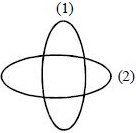
Two concentric coils each of radius equal to $2\pi \, cm$ are placed at right angles to each other. $3\, A$ and $4\, A$ are the currents flowing in each coil respectively. The magnetic induction in $Wb/m^2$ at the centre of the coils will be $(\mu_0 = 4\pi \times 10^{-7} \, Wb/A \cdot m)$.
A
$10^{-5}$
B
$12 \times 10^{-5}$
C
$7 \times 10^{-5}$
D
$5 \times 10^{-5}$
Solution
(D) The magnetic field at the centre of a circular coil is given by $B = \frac{\mu_0 i}{2R}$.
Given,$R = 2\pi \, cm = 2\pi \times 10^{-2} \, m$.
For the first coil with current $i_1 = 3 \, A$:
$B_1 = \frac{\mu_0 \times 3}{2 \times 2\pi \times 10^{-2}} = \frac{4\pi \times 10^{-7} \times 3}{4\pi \times 10^{-2}} = 3 \times 10^{-5} \, T$.
For the second coil with current $i_2 = 4 \, A$:
$B_2 = \frac{\mu_0 \times 4}{2 \times 2\pi \times 10^{-2}} = \frac{4\pi \times 10^{-7} \times 4}{4\pi \times 10^{-2}} = 4 \times 10^{-5} \, T$.
Since the coils are placed at right angles,the resultant magnetic field is $B = \sqrt{B_1^2 + B_2^2}$.
$B = \sqrt{(3 \times 10^{-5})^2 + (4 \times 10^{-5})^2} = \sqrt{9 + 16} \times 10^{-5} = \sqrt{25} \times 10^{-5} = 5 \times 10^{-5} \, Wb/m^2$.
Given,$R = 2\pi \, cm = 2\pi \times 10^{-2} \, m$.
For the first coil with current $i_1 = 3 \, A$:
$B_1 = \frac{\mu_0 \times 3}{2 \times 2\pi \times 10^{-2}} = \frac{4\pi \times 10^{-7} \times 3}{4\pi \times 10^{-2}} = 3 \times 10^{-5} \, T$.
For the second coil with current $i_2 = 4 \, A$:
$B_2 = \frac{\mu_0 \times 4}{2 \times 2\pi \times 10^{-2}} = \frac{4\pi \times 10^{-7} \times 4}{4\pi \times 10^{-2}} = 4 \times 10^{-5} \, T$.
Since the coils are placed at right angles,the resultant magnetic field is $B = \sqrt{B_1^2 + B_2^2}$.
$B = \sqrt{(3 \times 10^{-5})^2 + (4 \times 10^{-5})^2} = \sqrt{9 + 16} \times 10^{-5} = \sqrt{25} \times 10^{-5} = 5 \times 10^{-5} \, Wb/m^2$.
0 likesView Solution
83
ChemistryMCQAIEEE · 2005
Two point white dots are $1\, mm$ apart on a black paper. They are viewed by an eye with a pupil diameter of $3\, mm$. Approximately,what is the maximum distance in $m$ at which these dots can be resolved by the eye? [Take wavelength of light $\lambda = 500\, nm$]
A
$1$
B
$5$
C
$3$
D
$6$
Solution
(B) The condition for the resolution of two point objects is given by the Rayleigh criterion: $\theta \geq 1.22 \frac{\lambda}{d}$,where $\theta = \frac{y}{D}$.
Here,$y = 1\, mm = 10^{-3}\, m$ is the separation between the dots,$d = 3\, mm = 3 \times 10^{-3}\, m$ is the diameter of the pupil,and $\lambda = 500\, nm = 5 \times 10^{-7}\, m$ is the wavelength of light.
Substituting these values into the inequality $\frac{y}{D} \geq 1.22 \frac{\lambda}{d}$,we get:
$D \leq \frac{y d}{1.22 \lambda} = \frac{10^{-3} \times 3 \times 10^{-3}}{1.22 \times 5 \times 10^{-7}}$
$D \leq \frac{3 \times 10^{-6}}{6.1 \times 10^{-7}} = \frac{30}{6.1} \approx 4.918\, m$.
Rounding to the nearest integer,the maximum distance is approximately $5\, m$.
Here,$y = 1\, mm = 10^{-3}\, m$ is the separation between the dots,$d = 3\, mm = 3 \times 10^{-3}\, m$ is the diameter of the pupil,and $\lambda = 500\, nm = 5 \times 10^{-7}\, m$ is the wavelength of light.
Substituting these values into the inequality $\frac{y}{D} \geq 1.22 \frac{\lambda}{d}$,we get:
$D \leq \frac{y d}{1.22 \lambda} = \frac{10^{-3} \times 3 \times 10^{-3}}{1.22 \times 5 \times 10^{-7}}$
$D \leq \frac{3 \times 10^{-6}}{6.1 \times 10^{-7}} = \frac{30}{6.1} \approx 4.918\, m$.
Rounding to the nearest integer,the maximum distance is approximately $5\, m$.
0 likesView Solution
84
ChemistryMCQAIEEE · 2005
$A$ particle of mass $10\, g$ is kept on the surface of a uniform sphere of mass $100\, kg$ and a radius of $10\, cm$. Find the work to be done against the gravitational force between them to take the particle far away from the sphere. (Take $G = 6.67 \times 10^{-11} \, Nm^2/kg^2$)
A
$3.33 \times 10^{-10} \, J$
B
$13.34 \times 10^{-10} \, J$
C
$6.67 \times 10^{-9} \, J$
D
$6.67 \times 10^{-10} \, J$
Solution
(D) The work done to move a particle from the surface of a sphere to infinity is equal to the change in gravitational potential energy,which is the negative of the potential energy at the surface.
$W = U_{\infty} - U_{surface} = 0 - (- \frac{GMm}{R}) = \frac{GMm}{R}$
Given:
$M = 100 \, kg$
$m = 10 \, g = 0.01 \, kg$
$R = 10 \, cm = 0.1 \, m$
$G = 6.67 \times 10^{-11} \, Nm^2/kg^2$
Substituting the values:
$W = \frac{6.67 \times 10^{-11} \times 100 \times 0.01}{0.1}$
$W = \frac{6.67 \times 10^{-11} \times 1}{0.1}$
$W = 6.67 \times 10^{-10} \, J$
$W = U_{\infty} - U_{surface} = 0 - (- \frac{GMm}{R}) = \frac{GMm}{R}$
Given:
$M = 100 \, kg$
$m = 10 \, g = 0.01 \, kg$
$R = 10 \, cm = 0.1 \, m$
$G = 6.67 \times 10^{-11} \, Nm^2/kg^2$
Substituting the values:
$W = \frac{6.67 \times 10^{-11} \times 100 \times 0.01}{0.1}$
$W = \frac{6.67 \times 10^{-11} \times 1}{0.1}$
$W = 6.67 \times 10^{-10} \, J$
0 likesView Solution
85
ChemistryMCQAIEEE · 2005
The time taken by an object to slide down a $45^{\circ}$ rough inclined plane is $n$ times the time it takes to slide down a perfectly smooth $45^{\circ}$ inclined plane. The coefficient of kinetic friction between the object and the inclined plane is:
A
$\sqrt{\frac{1}{1- n ^2}}$
B
$\sqrt{1-\frac{1}{ n ^2}}$
C
$1+\frac{1}{ n ^2}$
D
$1-\frac{1}{ n ^2}$
Solution
(D) Let $L$ be the length of the inclined plane and $\theta = 45^{\circ}$.
For a smooth plane,the acceleration is $a_1 = g \sin \theta = g \sin 45^{\circ} = \frac{g}{\sqrt{2}}$.
The time taken is $t_1 = \sqrt{\frac{2L}{a_1}}$.
For a rough plane with coefficient of kinetic friction $K$,the acceleration is $a_2 = g \sin \theta - Kg \cos \theta = \frac{g}{\sqrt{2}} - \frac{Kg}{\sqrt{2}} = \frac{g}{\sqrt{2}}(1-K)$.
The time taken is $t_2 = \sqrt{\frac{2L}{a_2}}$.
Given $t_2 = n t_1$,so $t_2^2 = n^2 t_1^2$.
Substituting the expressions for $t_1^2$ and $t_2^2$: $\frac{2L}{a_2} = n^2 \frac{2L}{a_1} \implies a_1 = n^2 a_2$.
Substituting the values of $a_1$ and $a_2$: $\frac{g}{\sqrt{2}} = n^2 \left[ \frac{g}{\sqrt{2}}(1-K) \right]$.
$1 = n^2(1-K) \implies 1-K = \frac{1}{n^2}$.
Therefore,$K = 1 - \frac{1}{n^2}$.
For a smooth plane,the acceleration is $a_1 = g \sin \theta = g \sin 45^{\circ} = \frac{g}{\sqrt{2}}$.
The time taken is $t_1 = \sqrt{\frac{2L}{a_1}}$.
For a rough plane with coefficient of kinetic friction $K$,the acceleration is $a_2 = g \sin \theta - Kg \cos \theta = \frac{g}{\sqrt{2}} - \frac{Kg}{\sqrt{2}} = \frac{g}{\sqrt{2}}(1-K)$.
The time taken is $t_2 = \sqrt{\frac{2L}{a_2}}$.
Given $t_2 = n t_1$,so $t_2^2 = n^2 t_1^2$.
Substituting the expressions for $t_1^2$ and $t_2^2$: $\frac{2L}{a_2} = n^2 \frac{2L}{a_1} \implies a_1 = n^2 a_2$.
Substituting the values of $a_1$ and $a_2$: $\frac{g}{\sqrt{2}} = n^2 \left[ \frac{g}{\sqrt{2}}(1-K) \right]$.
$1 = n^2(1-K) \implies 1-K = \frac{1}{n^2}$.
Therefore,$K = 1 - \frac{1}{n^2}$.
0 likesView Solution
Vedclass Products
For Students
Vedclass Test Series
Mock tests in real AIEEE style covering Chemistry with performance analysis. 5-day free trial.
Start Free TrialFor Teachers
Exam Paper Generator
Generate Set A/B/C/D Chemistry papers from 7.5L+ questions in 2 minutes. 3 chapters free.
Try FreeFor Institutes
Online Exam Module
Run live AIEEE mock exams with unlimited students, 360° analytics & white-label branding.
See DemoFrequently Asked Questions
How many Chemistry questions are in AIEEE 2005?
There are 125 Chemistry questions from the AIEEE 2005 paper on Vedclass, each with a detailed step-by-step solution in English.
Are AIEEE 2005 Chemistry solutions available in English?
Yes. All solutions on this page are in English. You can also switch to English or Hindi using the language buttons above the questions.
Can I practice AIEEE 2005 Chemistry as a timed test?
Yes. Use the Vedclass Test Series to attempt a full AIEEE mock test covering Chemistry with time limits and instant score analysis.
Can teachers create Chemistry papers from AIEEE previous year questions?
Yes. The Vedclass Exam Paper Generator lets teachers mix AIEEE Chemistry questions and generate Set A/B/C/D papers in minutes.
For Teachers & Institutes
Build a Custom Chemistry Paper
Pick AIEEE 2005 Chemistry questions, set difficulty, and generate Set A/B/C/D in 2 minutes.