
અ Gujarati
Trigonometry Questions in Gujarati
Competitive Exam Quantitative Aptitude · Trigonometry · Trigonometry
648+
Questions
Gujarati
Language
100%
With Solutions
Showing 50 of 648 questions in Gujarati
401
AdvancedMCQ
જો $\sin \theta = \frac{1}{2} \left( \sqrt{\frac{x}{y}} + \sqrt{\frac{y}{x}} \right)$,જ્યાં $x, y \in R - \{0\}$ હોય,તો:
A
$x = y$
B
$x < y$
C
$x > y$
D
$x + y = 1 \ \forall \ x, y \in R$
Solution
(A) આપણે જાણીએ છીએ કે કોઈપણ ધન વાસ્તવિક સંખ્યાઓ $a$ અને $b$ માટે,સમાંતર મધ્યક એ ગુણોત્તર મધ્યક કરતા મોટો અથવા તેના જેટલો હોય છે ($AM$ $\ge$ $GM$).
$\sqrt{\frac{x}{y}}$ અને $\sqrt{\frac{y}{x}}$ માટે આ લાગુ પાડતા:
$\frac{1}{2} \left( \sqrt{\frac{x}{y}} + \sqrt{\frac{y}{x}} \right) \ge \sqrt{\sqrt{\frac{x}{y}} \cdot \sqrt{\frac{y}{x}}}$
$\Rightarrow \frac{1}{2} \left( \sqrt{\frac{x}{y}} + \sqrt{\frac{y}{x}} \right) \ge \sqrt{1} = 1$
કારણ કે $\sin \theta$ ની કિંમત $1$ થી વધી શકતી નથી,તેથી આ પદાવલિ $1$ ની બરાબર હોવી જોઈએ.
$\sin \theta = 1 \Rightarrow \frac{1}{2} \left( \sqrt{\frac{x}{y}} + \sqrt{\frac{y}{x}} \right) = 1$
આ સમાનતા ત્યારે જ શક્ય છે જ્યારે $\sqrt{\frac{x}{y}} = \sqrt{\frac{y}{x}}$ થાય,જેનો અર્થ છે કે $\frac{x}{y} = 1$,એટલે કે $x = y$.
$\sqrt{\frac{x}{y}}$ અને $\sqrt{\frac{y}{x}}$ માટે આ લાગુ પાડતા:
$\frac{1}{2} \left( \sqrt{\frac{x}{y}} + \sqrt{\frac{y}{x}} \right) \ge \sqrt{\sqrt{\frac{x}{y}} \cdot \sqrt{\frac{y}{x}}}$
$\Rightarrow \frac{1}{2} \left( \sqrt{\frac{x}{y}} + \sqrt{\frac{y}{x}} \right) \ge \sqrt{1} = 1$
કારણ કે $\sin \theta$ ની કિંમત $1$ થી વધી શકતી નથી,તેથી આ પદાવલિ $1$ ની બરાબર હોવી જોઈએ.
$\sin \theta = 1 \Rightarrow \frac{1}{2} \left( \sqrt{\frac{x}{y}} + \sqrt{\frac{y}{x}} \right) = 1$
આ સમાનતા ત્યારે જ શક્ય છે જ્યારે $\sqrt{\frac{x}{y}} = \sqrt{\frac{y}{x}}$ થાય,જેનો અર્થ છે કે $\frac{x}{y} = 1$,એટલે કે $x = y$.
0 likes
View Solution402
AdvancedMCQ
જો $\alpha, \beta, \gamma$ એ ધન સંખ્યાઓ એવી રીતે હોય કે $\alpha + \beta = \pi$ અને $\beta + \gamma = \alpha$,તો $\tan \alpha$ ની કિંમત શોધો - (જ્યાં $\gamma \neq n\pi, n \in I$)
A
$-2\sqrt{\frac{\tan \beta + \tan \gamma}{\tan \gamma}}$
B
$\sqrt{\frac{2\tan \beta + \tan \gamma}{\tan \gamma}}$
C
$-\sqrt{\frac{2\tan \beta + \tan \gamma}{\tan \gamma}}$
D
$\sqrt{\frac{\tan \beta + \tan \gamma}{\tan \gamma}}$
Solution
(C) આપેલ છે કે $\alpha + \beta = \pi$ અને $\beta + \gamma = \alpha$.
$\alpha + \beta = \pi$ પરથી,$\alpha = \pi - \beta$,તેથી $\tan \alpha = \tan(\pi - \beta) = -\tan \beta$.
કારણ કે $\alpha, \beta, \gamma$ ધન છે અને $\alpha + \beta = \pi$,તેથી $\alpha$ બીજા ચરણમાં હશે (કારણ કે $\beta > 0$),તેથી $\tan \alpha < 0$.
$\beta + \gamma = \alpha$ પરથી,$\tan \alpha = \tan(\beta + \gamma) = \frac{\tan \beta + \tan \gamma}{1 - \tan \beta \tan \gamma}$.
સમીકરણમાં $\tan \beta = -\tan \alpha$ મૂકતા:
$\tan \alpha = \frac{-\tan \alpha + \tan \gamma}{1 - (-\tan \alpha) \tan \gamma} = \frac{-\tan \alpha + \tan \gamma}{1 + \tan \alpha \tan \gamma}$.
$\tan \alpha (1 + \tan \alpha \tan \gamma) = -\tan \alpha + \tan \gamma$.
$\tan \alpha + \tan^2 \alpha \tan \gamma = -\tan \alpha + \tan \gamma$.
$\tan^2 \alpha \tan \gamma = -2 \tan \alpha + \tan \gamma$.
આ $\tan \alpha$ માં દ્વિઘાત સમીકરણ છે: $(\tan \gamma) \tan^2 \alpha + (2) \tan \alpha - \tan \gamma = 0$.
દ્વિઘાત સૂત્ર $x = \frac{-b \pm \sqrt{b^2 - 4ac}}{2a}$ નો ઉપયોગ કરતા:
$\tan \alpha = \frac{-2 \pm \sqrt{4 - 4(\tan \gamma)(-\tan \gamma)}}{2 \tan \gamma} = \frac{-2 \pm \sqrt{4 + 4 \tan^2 \gamma}}{2 \tan \gamma} = \frac{-2 \pm 2 \sqrt{1 + \tan^2 \gamma}}{2 \tan \gamma} = \frac{-1 \pm \sec \gamma}{\tan \gamma}$.
વૈકલ્પિક રીતે,$\tan^2 \alpha \tan \gamma = -2 \tan \alpha + \tan \gamma$ પરથી,આપણને મળે $\tan^2 \alpha = \frac{-2 \tan \alpha + \tan \gamma}{\tan \gamma}$. કારણ કે $\tan \alpha = -\tan \beta$,તેથી $\tan^2 \alpha = \frac{2 \tan \beta + \tan \gamma}{\tan \gamma}$.
આમ,$\tan \alpha = -\sqrt{\frac{2 \tan \beta + \tan \gamma}{\tan \gamma}}$ (ઋણ વર્ગમૂળ લેવામાં આવે છે કારણ કે $\tan \alpha < 0$).
$\alpha + \beta = \pi$ પરથી,$\alpha = \pi - \beta$,તેથી $\tan \alpha = \tan(\pi - \beta) = -\tan \beta$.
કારણ કે $\alpha, \beta, \gamma$ ધન છે અને $\alpha + \beta = \pi$,તેથી $\alpha$ બીજા ચરણમાં હશે (કારણ કે $\beta > 0$),તેથી $\tan \alpha < 0$.
$\beta + \gamma = \alpha$ પરથી,$\tan \alpha = \tan(\beta + \gamma) = \frac{\tan \beta + \tan \gamma}{1 - \tan \beta \tan \gamma}$.
સમીકરણમાં $\tan \beta = -\tan \alpha$ મૂકતા:
$\tan \alpha = \frac{-\tan \alpha + \tan \gamma}{1 - (-\tan \alpha) \tan \gamma} = \frac{-\tan \alpha + \tan \gamma}{1 + \tan \alpha \tan \gamma}$.
$\tan \alpha (1 + \tan \alpha \tan \gamma) = -\tan \alpha + \tan \gamma$.
$\tan \alpha + \tan^2 \alpha \tan \gamma = -\tan \alpha + \tan \gamma$.
$\tan^2 \alpha \tan \gamma = -2 \tan \alpha + \tan \gamma$.
આ $\tan \alpha$ માં દ્વિઘાત સમીકરણ છે: $(\tan \gamma) \tan^2 \alpha + (2) \tan \alpha - \tan \gamma = 0$.
દ્વિઘાત સૂત્ર $x = \frac{-b \pm \sqrt{b^2 - 4ac}}{2a}$ નો ઉપયોગ કરતા:
$\tan \alpha = \frac{-2 \pm \sqrt{4 - 4(\tan \gamma)(-\tan \gamma)}}{2 \tan \gamma} = \frac{-2 \pm \sqrt{4 + 4 \tan^2 \gamma}}{2 \tan \gamma} = \frac{-2 \pm 2 \sqrt{1 + \tan^2 \gamma}}{2 \tan \gamma} = \frac{-1 \pm \sec \gamma}{\tan \gamma}$.
વૈકલ્પિક રીતે,$\tan^2 \alpha \tan \gamma = -2 \tan \alpha + \tan \gamma$ પરથી,આપણને મળે $\tan^2 \alpha = \frac{-2 \tan \alpha + \tan \gamma}{\tan \gamma}$. કારણ કે $\tan \alpha = -\tan \beta$,તેથી $\tan^2 \alpha = \frac{2 \tan \beta + \tan \gamma}{\tan \gamma}$.
આમ,$\tan \alpha = -\sqrt{\frac{2 \tan \beta + \tan \gamma}{\tan \gamma}}$ (ઋણ વર્ગમૂળ લેવામાં આવે છે કારણ કે $\tan \alpha < 0$).
0 likes
View Solution403
AdvancedMCQ
જો $\tan \left( \frac{\pi}{4} + \theta \right) + \tan \left( \frac{\pi}{4} - \theta \right) = \lambda \sec 2\theta$ હોય,તો $\lambda$ =
A
$3$
B
$4$
C
$1$
D
$2$
Solution
(D) આપણે જાણીએ છીએ કે $\tan(A + B) = \frac{\tan A + \tan B}{1 - \tan A \tan B}$ અને $\tan(A - B) = \frac{\tan A - \tan B}{1 + \tan A \tan B}$.
આનો ઉપયોગ કરીને,$\tan \left( \frac{\pi}{4} + \theta \right) = \frac{1 + \tan \theta}{1 - \tan \theta}$ અને $\tan \left( \frac{\pi}{4} - \theta \right) = \frac{1 - \tan \theta}{1 + \tan \theta}$.
આ બંને પદોનો સરવાળો કરતા:
$\frac{1 + \tan \theta}{1 - \tan \theta} + \frac{1 - \tan \theta}{1 + \tan \theta} = \frac{(1 + \tan \theta)^2 + (1 - \tan \theta)^2}{(1 - \tan \theta)(1 + \tan \theta)}$
$= \frac{1 + \tan^2 \theta + 2 \tan \theta + 1 + \tan^2 \theta - 2 \tan \theta}{1 - \tan^2 \theta}$
$= \frac{2(1 + \tan^2 \theta)}{1 - \tan^2 \theta}$
કારણ કે $\cos 2\theta = \frac{1 - \tan^2 \theta}{1 + \tan^2 \theta}$,તેથી $\sec 2\theta = \frac{1 + \tan^2 \theta}{1 - \tan^2 \theta}$.
આમ,પદ $2 \sec 2\theta$ બને છે.
તેને $\lambda \sec 2\theta$ સાથે સરખાવતા,આપણને $\lambda = 2$ મળે છે.
આનો ઉપયોગ કરીને,$\tan \left( \frac{\pi}{4} + \theta \right) = \frac{1 + \tan \theta}{1 - \tan \theta}$ અને $\tan \left( \frac{\pi}{4} - \theta \right) = \frac{1 - \tan \theta}{1 + \tan \theta}$.
આ બંને પદોનો સરવાળો કરતા:
$\frac{1 + \tan \theta}{1 - \tan \theta} + \frac{1 - \tan \theta}{1 + \tan \theta} = \frac{(1 + \tan \theta)^2 + (1 - \tan \theta)^2}{(1 - \tan \theta)(1 + \tan \theta)}$
$= \frac{1 + \tan^2 \theta + 2 \tan \theta + 1 + \tan^2 \theta - 2 \tan \theta}{1 - \tan^2 \theta}$
$= \frac{2(1 + \tan^2 \theta)}{1 - \tan^2 \theta}$
કારણ કે $\cos 2\theta = \frac{1 - \tan^2 \theta}{1 + \tan^2 \theta}$,તેથી $\sec 2\theta = \frac{1 + \tan^2 \theta}{1 - \tan^2 \theta}$.
આમ,પદ $2 \sec 2\theta$ બને છે.
તેને $\lambda \sec 2\theta$ સાથે સરખાવતા,આપણને $\lambda = 2$ મળે છે.
0 likes
View Solution404
AdvancedMCQ
$\cot 5^o - \tan 5^o - 2 \tan 10^o - 4 \tan 20^o - 8 \cot 40^o$ ની કિંમત શોધો.
A
$0$
B
$4 \tan 40^o$
C
$8 \tan 40^o$
D
$8 \cot 40^o$
Solution
(A) આપણે ત્રિકોણમિતીય નિત્યસમ $\cot \theta - \tan \theta = 2 \cot 2\theta$ નો ઉપયોગ કરીશું.
પગલું $1$: પ્રથમ બે પદોનું સાદુરૂપ આપતા: $\cot 5^o - \tan 5^o = 2 \cot 10^o$.
પગલું $2$: હવે પદાવલિ $2 \cot 10^o - 2 \tan 10^o - 4 \tan 20^o - 8 \cot 40^o$ બને છે.
પગલું $3$: $2$ સામાન્ય લેતા: $2(\cot 10^o - \tan 10^o) - 4 \tan 20^o - 8 \cot 40^o = 2(2 \cot 20^o) - 4 \tan 20^o - 8 \cot 40^o = 4 \cot 20^o - 4 \tan 20^o - 8 \cot 40^o$.
પગલું $4$: $4$ સામાન્ય લેતા: $4(\cot 20^o - \tan 20^o) - 8 \cot 40^o = 4(2 \cot 40^o) - 8 \cot 40^o = 8 \cot 40^o - 8 \cot 40^o = 0$.
પગલું $1$: પ્રથમ બે પદોનું સાદુરૂપ આપતા: $\cot 5^o - \tan 5^o = 2 \cot 10^o$.
પગલું $2$: હવે પદાવલિ $2 \cot 10^o - 2 \tan 10^o - 4 \tan 20^o - 8 \cot 40^o$ બને છે.
પગલું $3$: $2$ સામાન્ય લેતા: $2(\cot 10^o - \tan 10^o) - 4 \tan 20^o - 8 \cot 40^o = 2(2 \cot 20^o) - 4 \tan 20^o - 8 \cot 40^o = 4 \cot 20^o - 4 \tan 20^o - 8 \cot 40^o$.
પગલું $4$: $4$ સામાન્ય લેતા: $4(\cot 20^o - \tan 20^o) - 8 \cot 40^o = 4(2 \cot 40^o) - 8 \cot 40^o = 8 \cot 40^o - 8 \cot 40^o = 0$.
0 likes
View Solution405
AdvancedMCQ
$E = \frac{25 \sec^4 x - 50 \sec^2 x + 74}{\tan^2 x}$ ની ન્યૂનતમ કિંમત શોધો.
A
$50$
B
$70$
C
$75$
D
$90$
Solution
(B) આપેલ પદાવલિ $E = \frac{25 \sec^4 x - 50 \sec^2 x + 74}{\tan^2 x}$ છે.
આપણે જાણીએ છીએ કે $\sec^2 x = 1 + \tan^2 x$.
આ કિંમત મૂકતા,$E = \frac{25(1 + \tan^2 x)^2 - 50(1 + \tan^2 x) + 74}{\tan^2 x}$ મળે.
ધારો કે $t = \tan^2 x$. તો $E = \frac{25(1 + t)^2 - 50(1 + t) + 74}{t}$.
$E = \frac{25(1 + 2t + t^2) - 50 - 50t + 74}{t} = \frac{25 + 50t + 25t^2 - 50 - 50t + 74}{t}$.
$E = \frac{25t^2 + 49}{t} = 25t + \frac{49}{t}$.
સમાંતર મધ્યક-ભૌમિતિક મધ્યકની અસમતા $(AM \ge GM)$ નો ઉપયોગ કરતા,$\frac{25t + \frac{49}{t}}{2} \ge \sqrt{25t \cdot \frac{49}{t}}$.
$25t + \frac{49}{t} \ge 2 \sqrt{25 \cdot 49} = 2 \cdot 5 \cdot 7 = 70$.
આમ,ન્યૂનતમ કિંમત $70$ છે.
આપણે જાણીએ છીએ કે $\sec^2 x = 1 + \tan^2 x$.
આ કિંમત મૂકતા,$E = \frac{25(1 + \tan^2 x)^2 - 50(1 + \tan^2 x) + 74}{\tan^2 x}$ મળે.
ધારો કે $t = \tan^2 x$. તો $E = \frac{25(1 + t)^2 - 50(1 + t) + 74}{t}$.
$E = \frac{25(1 + 2t + t^2) - 50 - 50t + 74}{t} = \frac{25 + 50t + 25t^2 - 50 - 50t + 74}{t}$.
$E = \frac{25t^2 + 49}{t} = 25t + \frac{49}{t}$.
સમાંતર મધ્યક-ભૌમિતિક મધ્યકની અસમતા $(AM \ge GM)$ નો ઉપયોગ કરતા,$\frac{25t + \frac{49}{t}}{2} \ge \sqrt{25t \cdot \frac{49}{t}}$.
$25t + \frac{49}{t} \ge 2 \sqrt{25 \cdot 49} = 2 \cdot 5 \cdot 7 = 70$.
આમ,ન્યૂનતમ કિંમત $70$ છે.
0 likes
View Solution406
AdvancedMCQ
ત્રિકોણ $ABC$ માં,જો $A = \frac{\pi}{4}$ અને $\tan B \tan C = K$ હોય,તો $K$ એ કઈ શરતનું પાલન કરવું જોઈએ?
A
$K^2 - 6K + 1 \geqslant 0$
B
$K^2 - 6K + 1 = 0$
C
$K^2 - 6K + 1 \leqslant 0$
D
$3 - 2\sqrt{2} < K$
Solution
(A) ત્રિકોણ $ABC$ માં,આપણે જાણીએ છીએ કે $\tan A + \tan B + \tan C = \tan A \tan B \tan C$.
અહીં $A = \frac{\pi}{4}$ હોવાથી,$\tan A = 1$ થાય.
આ કિંમત મૂકતા,$1 + \tan B + \tan C = \tan B \tan C$ મળે.
આપેલ છે કે $\tan B \tan C = K$,તેથી $\tan B + \tan C = K - 1$ થાય.
$\tan B$ અને $\tan C$ એ દ્વિઘાત સમીકરણ $x^2 - (\tan B + \tan C)x + \tan B \tan C = 0$ ના બીજ છે,તેથી $x^2 - (K - 1)x + K = 0$ મળે.
$\tan B$ અને $\tan C$ વાસ્તવિક હોવા માટે,વિવેચક $D \geqslant 0$ હોવો જોઈએ.
$D = (K - 1)^2 - 4K \geqslant 0$.
$K^2 - 2K + 1 - 4K \geqslant 0$.
$K^2 - 6K + 1 \geqslant 0$.
અહીં $A = \frac{\pi}{4}$ હોવાથી,$\tan A = 1$ થાય.
આ કિંમત મૂકતા,$1 + \tan B + \tan C = \tan B \tan C$ મળે.
આપેલ છે કે $\tan B \tan C = K$,તેથી $\tan B + \tan C = K - 1$ થાય.
$\tan B$ અને $\tan C$ એ દ્વિઘાત સમીકરણ $x^2 - (\tan B + \tan C)x + \tan B \tan C = 0$ ના બીજ છે,તેથી $x^2 - (K - 1)x + K = 0$ મળે.
$\tan B$ અને $\tan C$ વાસ્તવિક હોવા માટે,વિવેચક $D \geqslant 0$ હોવો જોઈએ.
$D = (K - 1)^2 - 4K \geqslant 0$.
$K^2 - 2K + 1 - 4K \geqslant 0$.
$K^2 - 6K + 1 \geqslant 0$.
0 likes
View Solution407
AdvancedMCQ
$cosec^2 \theta = \frac{4xy}{(x + y)^2}$ ત્યારે જ સાચું છે જો
A
$x + y \neq 0$
B
$x = y, x \neq 0$
C
$x = y$
D
$x \neq 0, y \neq 0$
Solution
(B) આપણે જાણીએ છીએ કે કોઈપણ વાસ્તવિક સંખ્યાઓ $x$ અને $y$ માટે,સમાંતર મધ્યક એ ગુણોત્તર મધ્યક કરતા મોટો અથવા તેના જેટલો હોય છે,એટલે કે $\frac{x+y}{2} \geq \sqrt{xy}$.
બંને બાજુ વર્ગ કરતા,આપણને $\frac{(x+y)^2}{4} \geq xy$ મળે છે,જેનો અર્થ છે કે $\frac{4xy}{(x+y)^2} \leq 1$.
બધી વાસ્તવિક કિંમતો $\theta$ માટે $cosec^2 \theta \geq 1$ હોવાથી,સમીકરણ $cosec^2 \theta = \frac{4xy}{(x+y)^2}$ ત્યારે જ શક્ય છે જો બંને બાજુ $1$ હોય.
આ માટે $\frac{4xy}{(x+y)^2} = 1$ હોવું જરૂરી છે,જેનું સાદું રૂપ આપતા $4xy = (x+y)^2$ અથવા $(x-y)^2 = 0$ મળે છે,જેનો અર્થ છે કે $x = y$.
વધુમાં,જો છેદ શૂન્ય હોય તો $cosec^2 \theta$ અવ્યાખ્યાયિત થાય છે,તેથી $x+y \neq 0$ હોવું જોઈએ. $x=y$ હોવાથી,આનો અર્થ $2x \neq 0$ થાય છે,એટલે કે $x \neq 0$.
આમ,શરત $x = y$ અને $x \neq 0$ છે.
બંને બાજુ વર્ગ કરતા,આપણને $\frac{(x+y)^2}{4} \geq xy$ મળે છે,જેનો અર્થ છે કે $\frac{4xy}{(x+y)^2} \leq 1$.
બધી વાસ્તવિક કિંમતો $\theta$ માટે $cosec^2 \theta \geq 1$ હોવાથી,સમીકરણ $cosec^2 \theta = \frac{4xy}{(x+y)^2}$ ત્યારે જ શક્ય છે જો બંને બાજુ $1$ હોય.
આ માટે $\frac{4xy}{(x+y)^2} = 1$ હોવું જરૂરી છે,જેનું સાદું રૂપ આપતા $4xy = (x+y)^2$ અથવા $(x-y)^2 = 0$ મળે છે,જેનો અર્થ છે કે $x = y$.
વધુમાં,જો છેદ શૂન્ય હોય તો $cosec^2 \theta$ અવ્યાખ્યાયિત થાય છે,તેથી $x+y \neq 0$ હોવું જોઈએ. $x=y$ હોવાથી,આનો અર્થ $2x \neq 0$ થાય છે,એટલે કે $x \neq 0$.
આમ,શરત $x = y$ અને $x \neq 0$ છે.
0 likes
View Solution408
AdvancedMCQ
જો $\tan 80^{\circ} = a$ અને $\tan 47^{\circ} = b$ હોય,તો $\tan 37^{\circ}$ ની કિંમત કેટલી થાય?
A
$\frac{a - b}{1 + ab}$
B
$\frac{ab + 1}{a - b}$
C
$\frac{ab - 1}{a + b}$
D
$\frac{a + b}{1 - ab}$
Solution
(C) આપેલ છે: $\tan 80^{\circ} = a$ અને $\tan 47^{\circ} = b$.
આપણે જાણીએ છીએ કે $\tan 80^{\circ} = \cot 10^{\circ} = \frac{1}{\tan 10^{\circ}}$,તેથી $\tan 10^{\circ} = \frac{1}{a}$.
આપણે $\tan 37^{\circ}$ શોધવાનું છે.
આપણે $\tan 37^{\circ} = \tan(47^{\circ} - 10^{\circ})$ લખી શકીએ.
સૂત્ર $\tan(A - B) = \frac{\tan A - \tan B}{1 + \tan A \tan B}$ નો ઉપયોગ કરતા:
$\tan 37^{\circ} = \frac{\tan 47^{\circ} - \tan 10^{\circ}}{1 + \tan 47^{\circ} \tan 10^{\circ}}$.
કિંમતો મૂકતા,આપણને મળે છે:
$\tan 37^{\circ} = \frac{b - \frac{1}{a}}{1 + b \cdot \frac{1}{a}}$.
અંશ અને છેદને $a$ વડે ગુણતા,આપણને મળે છે:
$\tan 37^{\circ} = \frac{ab - 1}{a + b}$.
આપણે જાણીએ છીએ કે $\tan 80^{\circ} = \cot 10^{\circ} = \frac{1}{\tan 10^{\circ}}$,તેથી $\tan 10^{\circ} = \frac{1}{a}$.
આપણે $\tan 37^{\circ}$ શોધવાનું છે.
આપણે $\tan 37^{\circ} = \tan(47^{\circ} - 10^{\circ})$ લખી શકીએ.
સૂત્ર $\tan(A - B) = \frac{\tan A - \tan B}{1 + \tan A \tan B}$ નો ઉપયોગ કરતા:
$\tan 37^{\circ} = \frac{\tan 47^{\circ} - \tan 10^{\circ}}{1 + \tan 47^{\circ} \tan 10^{\circ}}$.
કિંમતો મૂકતા,આપણને મળે છે:
$\tan 37^{\circ} = \frac{b - \frac{1}{a}}{1 + b \cdot \frac{1}{a}}$.
અંશ અને છેદને $a$ વડે ગુણતા,આપણને મળે છે:
$\tan 37^{\circ} = \frac{ab - 1}{a + b}$.
0 likes
View Solution409
AdvancedMCQ
પદાવલિ $E = \sin \theta + \cos \theta + \sin 2\theta$ ની મહત્તમ કિંમત છે-
A
$1 + \sqrt{2}$
B
$\tan \frac{\pi}{3}$
C
$\tan \frac{\pi}{8}$
D
$\tan \frac{3\pi}{8}$
Solution
(D) આપેલ પદાવલિ: $E = \sin \theta + \cos \theta + \sin 2\theta$.
આપણે જાણીએ છીએ કે $\sin 2\theta = 2 \sin \theta \cos \theta$.
ધારો કે $t = \sin \theta + \cos \theta$. બંને બાજુ વર્ગ કરતા,$t^2 = \sin^2 \theta + \cos^2 \theta + 2 \sin \theta \cos \theta = 1 + \sin 2\theta$.
તેથી,$\sin 2\theta = t^2 - 1$.
$t = \sin \theta + \cos \theta = \sqrt{2} \sin(\theta + \frac{\pi}{4})$ નો વિસ્તાર $[-\sqrt{2}, \sqrt{2}]$ છે.
$E$ માં $t$ ની કિંમત મૂકતા: $E = t + t^2 - 1 = t^2 + t - 1$.
અંતરાલ $[-\sqrt{2}, \sqrt{2}]$ પર $E$ ની મહત્તમ કિંમત શોધવા માટે,આપણે દ્વિઘાત સમીકરણ $f(t) = t^2 + t - 1$ ની સીમાઓ પર કિંમત ચકાસીએ.
$t = \sqrt{2}$ માટે,$E = (\sqrt{2})^2 + \sqrt{2} - 1 = 2 + \sqrt{2} - 1 = 1 + \sqrt{2}$.
$t = -\sqrt{2}$ માટે,$E = (-\sqrt{2})^2 - \sqrt{2} - 1 = 2 - \sqrt{2} - 1 = 1 - \sqrt{2}$.
આમ,મહત્તમ કિંમત $1 + \sqrt{2}$ છે,જે $\tan \frac{3\pi}{8}$ ની કિંમત છે.
આપણે જાણીએ છીએ કે $\sin 2\theta = 2 \sin \theta \cos \theta$.
ધારો કે $t = \sin \theta + \cos \theta$. બંને બાજુ વર્ગ કરતા,$t^2 = \sin^2 \theta + \cos^2 \theta + 2 \sin \theta \cos \theta = 1 + \sin 2\theta$.
તેથી,$\sin 2\theta = t^2 - 1$.
$t = \sin \theta + \cos \theta = \sqrt{2} \sin(\theta + \frac{\pi}{4})$ નો વિસ્તાર $[-\sqrt{2}, \sqrt{2}]$ છે.
$E$ માં $t$ ની કિંમત મૂકતા: $E = t + t^2 - 1 = t^2 + t - 1$.
અંતરાલ $[-\sqrt{2}, \sqrt{2}]$ પર $E$ ની મહત્તમ કિંમત શોધવા માટે,આપણે દ્વિઘાત સમીકરણ $f(t) = t^2 + t - 1$ ની સીમાઓ પર કિંમત ચકાસીએ.
$t = \sqrt{2}$ માટે,$E = (\sqrt{2})^2 + \sqrt{2} - 1 = 2 + \sqrt{2} - 1 = 1 + \sqrt{2}$.
$t = -\sqrt{2}$ માટે,$E = (-\sqrt{2})^2 - \sqrt{2} - 1 = 2 - \sqrt{2} - 1 = 1 - \sqrt{2}$.
આમ,મહત્તમ કિંમત $1 + \sqrt{2}$ છે,જે $\tan \frac{3\pi}{8}$ ની કિંમત છે.
0 likes
View Solution410
AdvancedMCQ
જો $\tan 3^{\circ} + 2\tan 6^{\circ} + 4\tan 12^{\circ} + 8\cot 24^{\circ} = \cot \theta^{\circ}$ હોય,તો:
A
$\cot (10\theta)^{\circ} = 1$
B
$\cot (15\theta)^{\circ} = 1$
C
$\cot \theta^{\circ} = 0$
D
$\cot (15\theta)^{\circ} = \sqrt{3}$
Solution
(B) આપણે નિત્યસમ $\cot \alpha - \tan \alpha = 2\cot 2\alpha$ નો ઉપયોગ કરીએ છીએ,જેનો અર્થ છે $\tan \alpha = \cot \alpha - 2\cot 2\alpha$.
આપેલ પદાવલિ: $E = \tan 3^{\circ} + 2\tan 6^{\circ} + 4\tan 12^{\circ} + 8\cot 24^{\circ}$.
$\tan 3^{\circ} = \cot 3^{\circ} - 2\cot 6^{\circ}$ મૂકતા:
$E = (\cot 3^{\circ} - 2\cot 6^{\circ}) + 2\tan 6^{\circ} + 4\tan 12^{\circ} + 8\cot 24^{\circ}$.
$2\tan 6^{\circ} = 2(\cot 6^{\circ} - 2\cot 12^{\circ}) = 2\cot 6^{\circ} - 4\cot 12^{\circ}$ મૂકતા:
$E = \cot 3^{\circ} - 2\cot 6^{\circ} + 2\cot 6^{\circ} - 4\cot 12^{\circ} + 4\tan 12^{\circ} + 8\cot 24^{\circ}$.
સાદુરૂપ આપતા:
$E = \cot 3^{\circ} - 4\cot 12^{\circ} + 4\tan 12^{\circ} + 8\cot 24^{\circ}$.
$4\tan 12^{\circ} = 4(\cot 12^{\circ} - 2\cot 24^{\circ}) = 4\cot 12^{\circ} - 8\cot 24^{\circ}$ મૂકતા:
$E = \cot 3^{\circ} - 4\cot 12^{\circ} + 4\cot 12^{\circ} - 8\cot 24^{\circ} + 8\cot 24^{\circ} = \cot 3^{\circ}$.
આમ,$\cot \theta^{\circ} = \cot 3^{\circ}$,તેથી $\theta = 3$.
વિકલ્પો તપાસતા: $\cot (15 \times 3)^{\circ} = \cot 45^{\circ} = 1$.
આપેલ પદાવલિ: $E = \tan 3^{\circ} + 2\tan 6^{\circ} + 4\tan 12^{\circ} + 8\cot 24^{\circ}$.
$\tan 3^{\circ} = \cot 3^{\circ} - 2\cot 6^{\circ}$ મૂકતા:
$E = (\cot 3^{\circ} - 2\cot 6^{\circ}) + 2\tan 6^{\circ} + 4\tan 12^{\circ} + 8\cot 24^{\circ}$.
$2\tan 6^{\circ} = 2(\cot 6^{\circ} - 2\cot 12^{\circ}) = 2\cot 6^{\circ} - 4\cot 12^{\circ}$ મૂકતા:
$E = \cot 3^{\circ} - 2\cot 6^{\circ} + 2\cot 6^{\circ} - 4\cot 12^{\circ} + 4\tan 12^{\circ} + 8\cot 24^{\circ}$.
સાદુરૂપ આપતા:
$E = \cot 3^{\circ} - 4\cot 12^{\circ} + 4\tan 12^{\circ} + 8\cot 24^{\circ}$.
$4\tan 12^{\circ} = 4(\cot 12^{\circ} - 2\cot 24^{\circ}) = 4\cot 12^{\circ} - 8\cot 24^{\circ}$ મૂકતા:
$E = \cot 3^{\circ} - 4\cot 12^{\circ} + 4\cot 12^{\circ} - 8\cot 24^{\circ} + 8\cot 24^{\circ} = \cot 3^{\circ}$.
આમ,$\cot \theta^{\circ} = \cot 3^{\circ}$,તેથી $\theta = 3$.
વિકલ્પો તપાસતા: $\cot (15 \times 3)^{\circ} = \cot 45^{\circ} = 1$.
0 likes
View Solution411
AdvancedMCQ
$x > 0$ માટે સમીકરણ $\tan(e^x) = e^x + e^{-x}$ ના વાસ્તવિક ઉકેલોની સંખ્યા કેટલી છે?
A
$0$
B
$1$
C
$2$
D
આમાંથી કોઈ નહીં
Solution
(D) ધારો કે $f(x) = \tan(e^x)$ અને $g(x) = e^x + e^{-x}$.
આપણે $x > 0$ માટે $y = \tan(e^x)$ અને $y = e^x + e^{-x}$ ના છેદબિંદુઓની સંખ્યા શોધવાની છે.
નોંધો કે $e^x + e^{-x} = 2 \cosh(x)$,જે તમામ વાસ્તવિક $x$ માટે હંમેશા $\ge 2$ હોય છે.
જેમ જેમ $x$ એ $0$ થી $\infty$ સુધી વધે છે,તેમ $e^x$ એ $1$ થી $\infty$ સુધી વધે છે.
વિધેય $\tan(e^x)$ એ $e^x$ ના સંદર્ભમાં આવર્તિત છે અને $e^x = (2n+1)\frac{\pi}{2}$ (જ્યાં $n = 0, 1, 2, \dots$) પર શિરોલંબ અનંતસ્પર્શકો (vertical asymptotes) ધરાવે છે.
જેમ $x$ એ $(0, \infty)$ માં બદલાય છે,તેમ $e^x$ એ $(1, \infty)$ માં તમામ કિંમતો લે છે,તેથી વિધેય $\tan(e^x)$ એ અનંત વખત $-\infty$ અને $+\infty$ ની વચ્ચે દોલન કરશે.
ચોક્કસ રીતે કહીએ તો,દરેક અંતરાલમાં જ્યાં $e^x$ એ $\pi$ જેટલું વધે છે,ત્યાં $\tan(e^x)$ એ $(-\infty, \infty)$ નો વિસ્તાર આવરી લે છે.
કારણ કે $e^x + e^{-x} \ge 2$ છે,તેથી $y = e^x + e^{-x}$ નો આલેખ $\tan(e^x)$ ની દરેક શાખાને ઓછામાં ઓછી એક વાર છેદશે,જ્યાં સુધી તે શાખા $\ge 2$ કિંમતો સુધી પહોંચે.
જેમ $x \to \infty$ થાય છે તેમ આવી અનંત શાખાઓ હોવાથી,અહીં અનંત ઉકેલો મળે છે.
તેથી,સાચો જવાબ 'આમાંથી કોઈ નહીં' છે.
આપણે $x > 0$ માટે $y = \tan(e^x)$ અને $y = e^x + e^{-x}$ ના છેદબિંદુઓની સંખ્યા શોધવાની છે.
નોંધો કે $e^x + e^{-x} = 2 \cosh(x)$,જે તમામ વાસ્તવિક $x$ માટે હંમેશા $\ge 2$ હોય છે.
જેમ જેમ $x$ એ $0$ થી $\infty$ સુધી વધે છે,તેમ $e^x$ એ $1$ થી $\infty$ સુધી વધે છે.
વિધેય $\tan(e^x)$ એ $e^x$ ના સંદર્ભમાં આવર્તિત છે અને $e^x = (2n+1)\frac{\pi}{2}$ (જ્યાં $n = 0, 1, 2, \dots$) પર શિરોલંબ અનંતસ્પર્શકો (vertical asymptotes) ધરાવે છે.
જેમ $x$ એ $(0, \infty)$ માં બદલાય છે,તેમ $e^x$ એ $(1, \infty)$ માં તમામ કિંમતો લે છે,તેથી વિધેય $\tan(e^x)$ એ અનંત વખત $-\infty$ અને $+\infty$ ની વચ્ચે દોલન કરશે.
ચોક્કસ રીતે કહીએ તો,દરેક અંતરાલમાં જ્યાં $e^x$ એ $\pi$ જેટલું વધે છે,ત્યાં $\tan(e^x)$ એ $(-\infty, \infty)$ નો વિસ્તાર આવરી લે છે.
કારણ કે $e^x + e^{-x} \ge 2$ છે,તેથી $y = e^x + e^{-x}$ નો આલેખ $\tan(e^x)$ ની દરેક શાખાને ઓછામાં ઓછી એક વાર છેદશે,જ્યાં સુધી તે શાખા $\ge 2$ કિંમતો સુધી પહોંચે.
જેમ $x \to \infty$ થાય છે તેમ આવી અનંત શાખાઓ હોવાથી,અહીં અનંત ઉકેલો મળે છે.
તેથી,સાચો જવાબ 'આમાંથી કોઈ નહીં' છે.
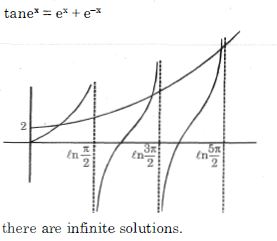
0 likes
View Solution412
AdvancedMCQ
જો $y = \frac{7 + 6 \tan x - \tan^2 x}{1 + \tan^2 x}$ ની મહત્તમ કિંમત $\lambda$ હોય,તો $\log_{\sqrt{2}}(\lambda)$ ની કિંમત શોધો.
A
$0$
B
$6$
C
$8$
D
$1$
Solution
(B) આપેલ છે કે $y = \frac{7 + 6 \tan x - \tan^2 x}{1 + \tan^2 x}$.
$1 + \tan^2 x = \sec^2 x$ હોવાથી,$y = (7 + 6 \tan x - \tan^2 x) \cos^2 x$.
$y = 7 \cos^2 x + 6 \sin x \cos x - \sin^2 x$.
ત્રિકોણમિતીય નિત્યસમ $\cos^2 x = \frac{1 + \cos 2x}{2}$,$\sin^2 x = \frac{1 - \cos 2x}{2}$,અને $\sin x \cos x = \frac{\sin 2x}{2}$ નો ઉપયોગ કરતા:
$y = 7 \left( \frac{1 + \cos 2x}{2} \right) + 6 \left( \frac{\sin 2x}{2} \right) - \left( \frac{1 - \cos 2x}{2} \right)$.
$y = \frac{7 + 7 \cos 2x + 6 \sin 2x - 1 + \cos 2x}{2} = \frac{6 + 8 \cos 2x + 6 \sin 2x}{2} = 3 + 4 \cos 2x + 3 \sin 2x$.
પદ $a \sin \theta + b \cos \theta$ ની મહત્તમ કિંમત $\sqrt{a^2 + b^2}$ થાય છે.
અહીં,$3 \sin 2x + 4 \cos 2x$ ની મહત્તમ કિંમત $\sqrt{3^2 + 4^2} = \sqrt{9 + 16} = 5$ છે.
તેથી,$y$ ની મહત્તમ કિંમત $\lambda = 3 + 5 = 8$ છે.
આપણે $\log_{\sqrt{2}}(\lambda) = \log_{\sqrt{2}}(8)$ શોધવાનું છે.
$8 = 2^3 = (\sqrt{2})^6$ હોવાથી,$\log_{\sqrt{2}}((\sqrt{2})^6) = 6$ મળે.
$1 + \tan^2 x = \sec^2 x$ હોવાથી,$y = (7 + 6 \tan x - \tan^2 x) \cos^2 x$.
$y = 7 \cos^2 x + 6 \sin x \cos x - \sin^2 x$.
ત્રિકોણમિતીય નિત્યસમ $\cos^2 x = \frac{1 + \cos 2x}{2}$,$\sin^2 x = \frac{1 - \cos 2x}{2}$,અને $\sin x \cos x = \frac{\sin 2x}{2}$ નો ઉપયોગ કરતા:
$y = 7 \left( \frac{1 + \cos 2x}{2} \right) + 6 \left( \frac{\sin 2x}{2} \right) - \left( \frac{1 - \cos 2x}{2} \right)$.
$y = \frac{7 + 7 \cos 2x + 6 \sin 2x - 1 + \cos 2x}{2} = \frac{6 + 8 \cos 2x + 6 \sin 2x}{2} = 3 + 4 \cos 2x + 3 \sin 2x$.
પદ $a \sin \theta + b \cos \theta$ ની મહત્તમ કિંમત $\sqrt{a^2 + b^2}$ થાય છે.
અહીં,$3 \sin 2x + 4 \cos 2x$ ની મહત્તમ કિંમત $\sqrt{3^2 + 4^2} = \sqrt{9 + 16} = 5$ છે.
તેથી,$y$ ની મહત્તમ કિંમત $\lambda = 3 + 5 = 8$ છે.
આપણે $\log_{\sqrt{2}}(\lambda) = \log_{\sqrt{2}}(8)$ શોધવાનું છે.
$8 = 2^3 = (\sqrt{2})^6$ હોવાથી,$\log_{\sqrt{2}}((\sqrt{2})^6) = 6$ મળે.
0 likes
View Solution413
AdvancedMCQ
જો $3\cos \theta + 4\sin \theta = 5$ હોય,તો $3\sin \theta - 4\cos \theta$ ની કિંમત શોધો.
A
$1$
B
$-1$
C
$0$
D
$\frac{1}{2}$
Solution
(C) ધારો કે $3\cos \theta + 4\sin \theta = 5$ એ સમીકરણ $(1)$ છે અને $3\sin \theta - 4\cos \theta = x$ એ સમીકરણ $(2)$ છે.
બંને સમીકરણોનો વર્ગ કરીને તેમનો સરવાળો કરતા:
$(3\cos \theta + 4\sin \theta)^2 + (3\sin \theta - 4\cos \theta)^2 = 5^2 + x^2$
$(9\cos^2 \theta + 16\sin^2 \theta + 24\sin \theta \cos \theta) + (9\sin^2 \theta + 16\cos^2 \theta - 24\sin \theta \cos \theta) = 25 + x^2$
$9(\cos^2 \theta + \sin^2 \theta) + 16(\sin^2 \theta + \cos^2 \theta) = 25 + x^2$
આપણે જાણીએ છીએ કે $\sin^2 \theta + \cos^2 \theta = 1$,તેથી:
$9(1) + 16(1) = 25 + x^2$
$25 = 25 + x^2$
$x^2 = 0$
તેથી,$x = 0$.
બંને સમીકરણોનો વર્ગ કરીને તેમનો સરવાળો કરતા:
$(3\cos \theta + 4\sin \theta)^2 + (3\sin \theta - 4\cos \theta)^2 = 5^2 + x^2$
$(9\cos^2 \theta + 16\sin^2 \theta + 24\sin \theta \cos \theta) + (9\sin^2 \theta + 16\cos^2 \theta - 24\sin \theta \cos \theta) = 25 + x^2$
$9(\cos^2 \theta + \sin^2 \theta) + 16(\sin^2 \theta + \cos^2 \theta) = 25 + x^2$
આપણે જાણીએ છીએ કે $\sin^2 \theta + \cos^2 \theta = 1$,તેથી:
$9(1) + 16(1) = 25 + x^2$
$25 = 25 + x^2$
$x^2 = 0$
તેથી,$x = 0$.
0 likes
View Solution414
AdvancedMCQ
જો $\cos A + \cos B = \cos C$ અને $\sin A + \sin B = \sin C$ હોય,તો પદાવલિ $\frac{\sin(A + B)}{\sin 2C}$ ની કિંમત શું થાય?
A
$0$
B
$1$
C
$2$
D
$3$
Solution
(B) આપેલ સમીકરણો:
$1) \cos A + \cos B = \cos C$
$2) \sin A + \sin B = \sin C$
ધારો કે $z_1 = e^{iA}$,$z_2 = e^{iB}$,અને $z_3 = e^{iC}$.
બંને સમીકરણોનો સરવાળો કરતા: $(\cos A + \cos B) + i(\sin A + \sin B) = \cos C + i\sin C$
આથી $e^{iA} + e^{iB} = e^{iC}$ મળે.
સમીકરણોની અનુબદ્ધ (conjugate) કિંમત લેતા:
$\cos A + \cos B = \cos C$
$-\sin A - \sin B = -\sin C$
આનો સરવાળો કરતા $e^{-iA} + e^{-iB} = e^{-iC}$ મળે.
$e^{iA} + e^{iB} = e^{iC}$ પરથી,
બંને અનુબદ્ધ સ્વરૂપોનો ભાગાકાર કરતા:
$\frac{e^{iA} + e^{iB}}{e^{-iA} + e^{-iB}} = \frac{e^{iC}}{e^{-iC}}$
$\frac{e^{iA} + e^{iB}}{e^{-i(A+B)}(e^{iB} + e^{iA})} = e^{2iC}$
$e^{i(A+B)} = e^{2iC}$
કાલ્પનિક ભાગોને સરખાવતા:
$\sin(A + B) = \sin 2C$
તેથી,$\frac{\sin(A + B)}{\sin 2C} = 1$.
$1) \cos A + \cos B = \cos C$
$2) \sin A + \sin B = \sin C$
ધારો કે $z_1 = e^{iA}$,$z_2 = e^{iB}$,અને $z_3 = e^{iC}$.
બંને સમીકરણોનો સરવાળો કરતા: $(\cos A + \cos B) + i(\sin A + \sin B) = \cos C + i\sin C$
આથી $e^{iA} + e^{iB} = e^{iC}$ મળે.
સમીકરણોની અનુબદ્ધ (conjugate) કિંમત લેતા:
$\cos A + \cos B = \cos C$
$-\sin A - \sin B = -\sin C$
આનો સરવાળો કરતા $e^{-iA} + e^{-iB} = e^{-iC}$ મળે.
$e^{iA} + e^{iB} = e^{iC}$ પરથી,
બંને અનુબદ્ધ સ્વરૂપોનો ભાગાકાર કરતા:
$\frac{e^{iA} + e^{iB}}{e^{-iA} + e^{-iB}} = \frac{e^{iC}}{e^{-iC}}$
$\frac{e^{iA} + e^{iB}}{e^{-i(A+B)}(e^{iB} + e^{iA})} = e^{2iC}$
$e^{i(A+B)} = e^{2iC}$
કાલ્પનિક ભાગોને સરખાવતા:
$\sin(A + B) = \sin 2C$
તેથી,$\frac{\sin(A + B)}{\sin 2C} = 1$.
0 likes
View Solution415
AdvancedMCQ
જો $A$ ત્રીજા ચરણમાં હોય અને $3 \tan A - 4 = 0$ હોય,તો $5 \sin 2A + 3 \sin A + 4 \cos A$ ની કિંમત શોધો.
A
$0$
B
$1$
C
$2$
D
આમાંથી કોઈ નહીં
Solution
(A) આપેલ છે કે $3 \tan A - 4 = 0$,તેથી $\tan A = \frac{4}{3}$.
કારણ કે $A$ ત્રીજા ચરણમાં છે,તેથી $\sin A$ અને $\cos A$ બંને ઋણ થશે.
$\tan A = \frac{4}{3}$ નો ઉપયોગ કરીને,કર્ણ $r = \sqrt{3^2 + 4^2} = 5$ મળે છે.
આમ,$\sin A = -\frac{4}{5}$ અને $\cos A = -\frac{3}{5}$.
હવે,આ કિંમતોને $5 \sin 2A + 3 \sin A + 4 \cos A$ પદાવલિમાં મૂકતા:
$5(2 \sin A \cos A) + 3 \sin A + 4 \cos A$
$= 10 \left(-\frac{4}{5}\right) \left(-\frac{3}{5}\right) + 3 \left(-\frac{4}{5}\right) + 4 \left(-\frac{3}{5}\right)$
$= 10 \left(\frac{12}{25}\right) - \frac{12}{5} - \frac{12}{5}$
$= \frac{120}{25} - \frac{24}{5} = \frac{24}{5} - \frac{24}{5} = 0$.
કારણ કે $A$ ત્રીજા ચરણમાં છે,તેથી $\sin A$ અને $\cos A$ બંને ઋણ થશે.
$\tan A = \frac{4}{3}$ નો ઉપયોગ કરીને,કર્ણ $r = \sqrt{3^2 + 4^2} = 5$ મળે છે.
આમ,$\sin A = -\frac{4}{5}$ અને $\cos A = -\frac{3}{5}$.
હવે,આ કિંમતોને $5 \sin 2A + 3 \sin A + 4 \cos A$ પદાવલિમાં મૂકતા:
$5(2 \sin A \cos A) + 3 \sin A + 4 \cos A$
$= 10 \left(-\frac{4}{5}\right) \left(-\frac{3}{5}\right) + 3 \left(-\frac{4}{5}\right) + 4 \left(-\frac{3}{5}\right)$
$= 10 \left(\frac{12}{25}\right) - \frac{12}{5} - \frac{12}{5}$
$= \frac{120}{25} - \frac{24}{5} = \frac{24}{5} - \frac{24}{5} = 0$.
0 likes
View Solution416
AdvancedMCQ
ધારો કે $f(x) = Ax^3 - Bx - \tan x \cdot \text{sgn}(x)$ એ તમામ $x \in \mathbb{R} - \left\{ (2n + 1) \frac{\pi}{2}, n \in \mathbb{Z} \right\}$ માટે યુગ્મ વિધેય છે, જ્યાં $A = \sin^2 \alpha - \sin \alpha + \frac{1}{4}$ અને $B = \tan^2 \alpha + \frac{2}{\sqrt{3}} \tan \alpha + \frac{1}{3}$ છે. તો $\left[ -\frac{3\pi}{2}, 2\pi \right]$ અંતરાલમાં $\alpha$ ના મૂલ્યોની સંખ્યા શોધો (જ્યાં $\text{sgn}(x)$ એ $x$ નું સિગ્નમ વિધેય દર્શાવે છે).
A
$0$
B
$1$
C
$2$
D
$4$
Solution
(C) $f(x)$ યુગ્મ વિધેય હોવા માટે, પ્રદેશના તમામ $x$ માટે $f(x) = f(-x)$ થવું જોઈએ.
આપેલ છે $f(x) = Ax^3 - Bx - \tan x \cdot \text{sgn}(x)$.
આપણે જાણીએ છીએ કે $\tan(-x) = -\tan x$ અને $\text{sgn}(-x) = -\text{sgn}(x)$, તેથી $\tan(-x) \cdot \text{sgn}(-x) = (-\tan x) \cdot (-\text{sgn}(x)) = \tan x \cdot \text{sgn}(x)$.
આમ, $f(-x) = A(-x)^3 - B(-x) - \tan(-x) \cdot \text{sgn}(-x) = -Ax^3 + Bx - \tan x \cdot \text{sgn}(x)$.
$f(x) = f(-x)$ માટે, $Ax^3 - Bx - \tan x \cdot \text{sgn}(x) = -Ax^3 + Bx - \tan x \cdot \text{sgn}(x)$ થવું જોઈએ.
આનું સાદું રૂપ આપતા $2Ax^3 - 2Bx = 0$ મળે, જેનો અર્થ છે કે $A = 0$ અને $B = 0$ એકસાથે થવું જોઈએ.
$A = \sin^2 \alpha - \sin \alpha + \frac{1}{4} = (\sin \alpha - \frac{1}{2})^2 = 0 \implies \sin \alpha = \frac{1}{2}$.
$B = \tan^2 \alpha + \frac{2}{\sqrt{3}} \tan \alpha + \frac{1}{3} = (\tan \alpha + \frac{1}{\sqrt{3}})^2 = 0 \implies \tan \alpha = -\frac{1}{\sqrt{3}}$.
આપણે $\alpha \in [-\frac{3\pi}{2}, 2\pi]$ શોધવાના છે જ્યાં $\sin \alpha = \frac{1}{2}$ અને $\tan \alpha = -\frac{1}{\sqrt{3}}$ બંને સાચા હોય.
$\sin \alpha = \frac{1}{2}$ માટે, $\alpha = \frac{\pi}{6}, \frac{5\pi}{6}, -\frac{7\pi}{6}, -\frac{11\pi}{6}$.
$\tan \alpha = -\frac{1}{\sqrt{3}}$ માટે, $\alpha = \frac{5\pi}{6}, -\frac{\pi}{6}, \frac{11\pi}{6}, -\frac{7\pi}{6}$.
સામાન્ય ઉકેલો $\alpha = \frac{5\pi}{6}$ અને $\alpha = -\frac{7\pi}{6}$ છે.
આમ, કુલ $2$ મૂલ્યો મળે છે.
આપેલ છે $f(x) = Ax^3 - Bx - \tan x \cdot \text{sgn}(x)$.
આપણે જાણીએ છીએ કે $\tan(-x) = -\tan x$ અને $\text{sgn}(-x) = -\text{sgn}(x)$, તેથી $\tan(-x) \cdot \text{sgn}(-x) = (-\tan x) \cdot (-\text{sgn}(x)) = \tan x \cdot \text{sgn}(x)$.
આમ, $f(-x) = A(-x)^3 - B(-x) - \tan(-x) \cdot \text{sgn}(-x) = -Ax^3 + Bx - \tan x \cdot \text{sgn}(x)$.
$f(x) = f(-x)$ માટે, $Ax^3 - Bx - \tan x \cdot \text{sgn}(x) = -Ax^3 + Bx - \tan x \cdot \text{sgn}(x)$ થવું જોઈએ.
આનું સાદું રૂપ આપતા $2Ax^3 - 2Bx = 0$ મળે, જેનો અર્થ છે કે $A = 0$ અને $B = 0$ એકસાથે થવું જોઈએ.
$A = \sin^2 \alpha - \sin \alpha + \frac{1}{4} = (\sin \alpha - \frac{1}{2})^2 = 0 \implies \sin \alpha = \frac{1}{2}$.
$B = \tan^2 \alpha + \frac{2}{\sqrt{3}} \tan \alpha + \frac{1}{3} = (\tan \alpha + \frac{1}{\sqrt{3}})^2 = 0 \implies \tan \alpha = -\frac{1}{\sqrt{3}}$.
આપણે $\alpha \in [-\frac{3\pi}{2}, 2\pi]$ શોધવાના છે જ્યાં $\sin \alpha = \frac{1}{2}$ અને $\tan \alpha = -\frac{1}{\sqrt{3}}$ બંને સાચા હોય.
$\sin \alpha = \frac{1}{2}$ માટે, $\alpha = \frac{\pi}{6}, \frac{5\pi}{6}, -\frac{7\pi}{6}, -\frac{11\pi}{6}$.
$\tan \alpha = -\frac{1}{\sqrt{3}}$ માટે, $\alpha = \frac{5\pi}{6}, -\frac{\pi}{6}, \frac{11\pi}{6}, -\frac{7\pi}{6}$.
સામાન્ય ઉકેલો $\alpha = \frac{5\pi}{6}$ અને $\alpha = -\frac{7\pi}{6}$ છે.
આમ, કુલ $2$ મૂલ્યો મળે છે.
0 likes
View Solution417
AdvancedMCQ
$\log _{\frac{1}{8}\csc^2 \frac{\pi}{8}} \sin^2 \frac{3\pi}{8}$ ની કિંમત શોધો.
A
$0$
B
$\frac{1}{2}$
C
$1$
D
વ્યાખ્યાયિત નથી
Solution
(C) ધારો કે $E = \log_{\frac{1}{8}\csc^2 \frac{\pi}{8}} \sin^2 \frac{3\pi}{8}$.
પ્રથમ,આધારનું સાદું રૂપ આપીએ: $\csc^2 \frac{\pi}{8} = \frac{1}{\sin^2 \frac{\pi}{8}} = \frac{1}{\frac{1-\cos(\pi/4)}{2}} = \frac{2}{1-\frac{1}{\sqrt{2}}} = \frac{2\sqrt{2}}{\sqrt{2}-1} = 2\sqrt{2}(\sqrt{2}+1) = 4+2\sqrt{2}$.
તેથી,આધાર $\frac{1}{8}(4+2\sqrt{2}) = \frac{2+\sqrt{2}}{4} = \frac{\sqrt{2}(\sqrt{2}+1)}{4} = \frac{\sqrt{2}+1}{2\sqrt{2}}$ થાય.
હવે,પદનું સાદું રૂપ આપીએ: $\sin^2 \frac{3\pi}{8} = \frac{1-\cos(3\pi/4)}{2} = \frac{1-(-\frac{1}{\sqrt{2}})}{2} = \frac{1+\frac{1}{\sqrt{2}}}{2} = \frac{\sqrt{2}+1}{2\sqrt{2}}$.
આમ,$E = \log_{\frac{\sqrt{2}+1}{2\sqrt{2}}} \left( \frac{\sqrt{2}+1}{2\sqrt{2}} \right) = 1$.
પ્રથમ,આધારનું સાદું રૂપ આપીએ: $\csc^2 \frac{\pi}{8} = \frac{1}{\sin^2 \frac{\pi}{8}} = \frac{1}{\frac{1-\cos(\pi/4)}{2}} = \frac{2}{1-\frac{1}{\sqrt{2}}} = \frac{2\sqrt{2}}{\sqrt{2}-1} = 2\sqrt{2}(\sqrt{2}+1) = 4+2\sqrt{2}$.
તેથી,આધાર $\frac{1}{8}(4+2\sqrt{2}) = \frac{2+\sqrt{2}}{4} = \frac{\sqrt{2}(\sqrt{2}+1)}{4} = \frac{\sqrt{2}+1}{2\sqrt{2}}$ થાય.
હવે,પદનું સાદું રૂપ આપીએ: $\sin^2 \frac{3\pi}{8} = \frac{1-\cos(3\pi/4)}{2} = \frac{1-(-\frac{1}{\sqrt{2}})}{2} = \frac{1+\frac{1}{\sqrt{2}}}{2} = \frac{\sqrt{2}+1}{2\sqrt{2}}$.
આમ,$E = \log_{\frac{\sqrt{2}+1}{2\sqrt{2}}} \left( \frac{\sqrt{2}+1}{2\sqrt{2}} \right) = 1$.
0 likes
View Solution418
AdvancedMCQ
$\frac{4 \sin 9^{\circ} \sin 21^{\circ} \sin 39^{\circ} \sin 51^{\circ} \sin 69^{\circ} \sin 81^{\circ}}{\sin 54^{\circ}}$ ની કિંમત શોધો.
A
$\frac{1}{16}$
B
$\frac{1}{32}$
C
$\frac{1}{8}$
D
$\frac{1}{4}$
Solution
(C) ધારો કે પદાવલિ $E = \frac{4 \sin 9^{\circ} \sin 21^{\circ} \sin 39^{\circ} \sin 51^{\circ} \sin 69^{\circ} \sin 81^{\circ}}{\sin 54^{\circ}}$ છે.
નિત્યસમ $\sin \theta \sin(60^{\circ}-\theta) \sin(60^{\circ}+\theta) = \frac{1}{4} \sin 3\theta$ નો ઉપયોગ કરીને,પદોને જૂથમાં ગોઠવતા:
$E = \frac{4}{\sin 54^{\circ}} [(\sin 9^{\circ} \sin 51^{\circ} \sin 69^{\circ}) \cdot (\sin 21^{\circ} \sin 39^{\circ} \sin 81^{\circ})]$.
અહીં $\sin 51^{\circ} = \sin(60^{\circ}-9^{\circ})$ અને $\sin 69^{\circ} = \sin(60^{\circ}+9^{\circ})$ હોવાથી,$\sin 9^{\circ} \sin 51^{\circ} \sin 69^{\circ} = \frac{1}{4} \sin(3 \times 9^{\circ}) = \frac{1}{4} \sin 27^{\circ}$ થાય.
તે જ રીતે,$\sin 21^{\circ} \sin 39^{\circ} \sin 81^{\circ} = \sin 21^{\circ} \sin(60^{\circ}-21^{\circ}) \sin(60^{\circ}+21^{\circ}) = \frac{1}{4} \sin(3 \times 21^{\circ}) = \frac{1}{4} \sin 63^{\circ}$ થાય.
આ કિંમતોને $E$ માં મૂકતા:
$E = \frac{4}{\sin 54^{\circ}} \cdot \frac{1}{4} \sin 27^{\circ} \cdot \frac{1}{4} \sin 63^{\circ} = \frac{\sin 27^{\circ} \sin 63^{\circ}}{4 \sin 54^{\circ}}$.
$\sin 63^{\circ} = \cos 27^{\circ}$ હોવાથી,$E = \frac{\sin 27^{\circ} \cos 27^{\circ}}{4 \sin 54^{\circ}} = \frac{2 \sin 27^{\circ} \cos 27^{\circ}}{8 \sin 54^{\circ}} = \frac{\sin 54^{\circ}}{8 \sin 54^{\circ}} = \frac{1}{8}$.
નિત્યસમ $\sin \theta \sin(60^{\circ}-\theta) \sin(60^{\circ}+\theta) = \frac{1}{4} \sin 3\theta$ નો ઉપયોગ કરીને,પદોને જૂથમાં ગોઠવતા:
$E = \frac{4}{\sin 54^{\circ}} [(\sin 9^{\circ} \sin 51^{\circ} \sin 69^{\circ}) \cdot (\sin 21^{\circ} \sin 39^{\circ} \sin 81^{\circ})]$.
અહીં $\sin 51^{\circ} = \sin(60^{\circ}-9^{\circ})$ અને $\sin 69^{\circ} = \sin(60^{\circ}+9^{\circ})$ હોવાથી,$\sin 9^{\circ} \sin 51^{\circ} \sin 69^{\circ} = \frac{1}{4} \sin(3 \times 9^{\circ}) = \frac{1}{4} \sin 27^{\circ}$ થાય.
તે જ રીતે,$\sin 21^{\circ} \sin 39^{\circ} \sin 81^{\circ} = \sin 21^{\circ} \sin(60^{\circ}-21^{\circ}) \sin(60^{\circ}+21^{\circ}) = \frac{1}{4} \sin(3 \times 21^{\circ}) = \frac{1}{4} \sin 63^{\circ}$ થાય.
આ કિંમતોને $E$ માં મૂકતા:
$E = \frac{4}{\sin 54^{\circ}} \cdot \frac{1}{4} \sin 27^{\circ} \cdot \frac{1}{4} \sin 63^{\circ} = \frac{\sin 27^{\circ} \sin 63^{\circ}}{4 \sin 54^{\circ}}$.
$\sin 63^{\circ} = \cos 27^{\circ}$ હોવાથી,$E = \frac{\sin 27^{\circ} \cos 27^{\circ}}{4 \sin 54^{\circ}} = \frac{2 \sin 27^{\circ} \cos 27^{\circ}}{8 \sin 54^{\circ}} = \frac{\sin 54^{\circ}}{8 \sin 54^{\circ}} = \frac{1}{8}$.
0 likes
View Solution419
AdvancedMCQ
ધારો કે $A = \{ \theta : 2\cos^2 \theta + \sin \theta \le 2 \}$ અને $B = \{ \theta : \frac{\pi}{2} \le \theta \le \frac{3\pi}{2} \}$,તો $A \cap B$ શું થાય?
A
$\left\{ \theta : \theta \in \left[ \pi, \frac{3\pi}{2} \right] \right\}$
B
$\left\{ \theta : \theta \in \left[ \frac{\pi}{2}, \frac{7\pi}{6} \right] \right\}$
C
$\left\{ \theta : \theta \in \left[ \frac{\pi}{2}, \frac{\pi}{6} \right] \right\}$
D
$\left\{ \theta : \theta \in \left[ \frac{\pi}{2}, \frac{5\pi}{6} \right] \cup \left[ \pi, \frac{3\pi}{2} \right] \right\}$
Solution
(D) આપેલ છે કે $2\cos^2 \theta + \sin \theta \le 2$.
$\cos^2 \theta = 1 - \sin^2 \theta$ મૂકતા,આપણને મળે $2(1 - \sin^2 \theta) + \sin \theta \le 2$.
$2 - 2\sin^2 \theta + \sin \theta \le 2$.
$-2\sin^2 \theta + \sin \theta \le 0$.
$-1$ વડે ગુણતા,$2\sin^2 \theta - \sin \theta \ge 0$.
$\sin \theta(2\sin \theta - 1) \ge 0$.
આ અસમતા ત્યારે જ સાચી પડે જ્યારે $\sin \theta \le 0$ અથવા $\sin \theta \ge \frac{1}{2}$ હોય.
$\sin \theta \le 0$ માટે,$\theta \in [\pi, 2\pi]$.
$\sin \theta \ge \frac{1}{2}$ માટે,$\theta \in [\frac{\pi}{6}, \frac{5\pi}{6}]$.
આમ,$A = [\frac{\pi}{6}, \frac{5\pi}{6}] \cup [\pi, 2\pi]$.
આપેલ છે કે $B = [\frac{\pi}{2}, \frac{3\pi}{2}]$.
છેદગણ $A \cap B$ લેતા:
$A \cap B = ([\frac{\pi}{6}, \frac{5\pi}{6}] \cup [\pi, 2\pi]) \cap [\frac{\pi}{2}, \frac{3\pi}{2}]$.
$A \cap B = [\frac{\pi}{2}, \frac{5\pi}{6}] \cup [\pi, \frac{3\pi}{2}]$.
$\cos^2 \theta = 1 - \sin^2 \theta$ મૂકતા,આપણને મળે $2(1 - \sin^2 \theta) + \sin \theta \le 2$.
$2 - 2\sin^2 \theta + \sin \theta \le 2$.
$-2\sin^2 \theta + \sin \theta \le 0$.
$-1$ વડે ગુણતા,$2\sin^2 \theta - \sin \theta \ge 0$.
$\sin \theta(2\sin \theta - 1) \ge 0$.
આ અસમતા ત્યારે જ સાચી પડે જ્યારે $\sin \theta \le 0$ અથવા $\sin \theta \ge \frac{1}{2}$ હોય.
$\sin \theta \le 0$ માટે,$\theta \in [\pi, 2\pi]$.
$\sin \theta \ge \frac{1}{2}$ માટે,$\theta \in [\frac{\pi}{6}, \frac{5\pi}{6}]$.
આમ,$A = [\frac{\pi}{6}, \frac{5\pi}{6}] \cup [\pi, 2\pi]$.
આપેલ છે કે $B = [\frac{\pi}{2}, \frac{3\pi}{2}]$.
છેદગણ $A \cap B$ લેતા:
$A \cap B = ([\frac{\pi}{6}, \frac{5\pi}{6}] \cup [\pi, 2\pi]) \cap [\frac{\pi}{2}, \frac{3\pi}{2}]$.
$A \cap B = [\frac{\pi}{2}, \frac{5\pi}{6}] \cup [\pi, \frac{3\pi}{2}]$.
0 likes
View Solution420
AdvancedMCQ
$\frac{\sin 81^\circ + \cos 81^\circ}{\sin 81^\circ - \cos 81^\circ}$ ની કિંમત શોધો.
A
$\cot 9^\circ$
B
$\tan 9^\circ$
C
$\cot 54^\circ$
D
$\tan 54^\circ$
Solution
(D) આપેલ પદાવલિ: $E = \frac{\sin 81^\circ + \cos 81^\circ}{\sin 81^\circ - \cos 81^\circ}$
અંશ અને છેદને $\cos 81^\circ$ વડે ભાગતા:
$E = \frac{\tan 81^\circ + 1}{\tan 81^\circ - 1}$
આપણે જાણીએ છીએ કે $\sin 81^\circ = \cos 9^\circ$ અને $\cos 81^\circ = \sin 9^\circ$ થાય.
તેથી,$E = \frac{\cos 9^\circ + \sin 9^\circ}{\cos 9^\circ - \sin 9^\circ}$
હવે અંશ અને છેદને $\cos 9^\circ$ વડે ભાગતા:
$E = \frac{1 + \tan 9^\circ}{1 - \tan 9^\circ}$
$\tan 45^\circ = 1$ હોવાથી,આ પદાવલિ $\tan(45^\circ + 9^\circ)$ ના સ્વરૂપમાં છે.
$E = \tan 54^\circ$
અંશ અને છેદને $\cos 81^\circ$ વડે ભાગતા:
$E = \frac{\tan 81^\circ + 1}{\tan 81^\circ - 1}$
આપણે જાણીએ છીએ કે $\sin 81^\circ = \cos 9^\circ$ અને $\cos 81^\circ = \sin 9^\circ$ થાય.
તેથી,$E = \frac{\cos 9^\circ + \sin 9^\circ}{\cos 9^\circ - \sin 9^\circ}$
હવે અંશ અને છેદને $\cos 9^\circ$ વડે ભાગતા:
$E = \frac{1 + \tan 9^\circ}{1 - \tan 9^\circ}$
$\tan 45^\circ = 1$ હોવાથી,આ પદાવલિ $\tan(45^\circ + 9^\circ)$ ના સ્વરૂપમાં છે.
$E = \tan 54^\circ$
0 likes
View Solution421
MediumMCQ
વાસ્તવિક કિંમતો $\theta$ માટે $\cos 2\theta + \cos \theta$ ની ન્યૂનતમ કિંમત શું છે?
A
$-9/8$
B
$0$
C
$-2$
D
આમાંથી કોઈ નહીં
Solution
(A) ધારો કે $S = \cos 2\theta + \cos \theta$.
નિત્યસમ $\cos 2\theta = 2\cos^2 \theta - 1$ નો ઉપયોગ કરતા:
$S = 2\cos^2 \theta - 1 + \cos \theta$.
ન્યૂનતમ કિંમત શોધવા માટે,આપણે $\cos \theta$ માં દ્વિઘાત પદાવલિ માટે પૂર્ણવર્ગની રીતનો ઉપયોગ કરીશું:
$S = 2(\cos^2 \theta + \frac{1}{2}\cos \theta) - 1$.
$S = 2(\cos^2 \theta + \frac{1}{2}\cos \theta + \frac{1}{16} - \frac{1}{16}) - 1$.
$S = 2(\cos \theta + \frac{1}{4})^2 - \frac{1}{8} - 1$.
$S = 2(\cos \theta + \frac{1}{4})^2 - \frac{9}{8}$.
કારણ કે વર્ગ વાળું પદ $2(\cos \theta + \frac{1}{4})^2 \geq 0$ છે,તેથી $S$ ની ન્યૂનતમ કિંમત ત્યારે મળે જ્યારે $\cos \theta = -1/4$ હોય.
આમ,ન્યૂનતમ કિંમત $-9/8$ છે.
નિત્યસમ $\cos 2\theta = 2\cos^2 \theta - 1$ નો ઉપયોગ કરતા:
$S = 2\cos^2 \theta - 1 + \cos \theta$.
ન્યૂનતમ કિંમત શોધવા માટે,આપણે $\cos \theta$ માં દ્વિઘાત પદાવલિ માટે પૂર્ણવર્ગની રીતનો ઉપયોગ કરીશું:
$S = 2(\cos^2 \theta + \frac{1}{2}\cos \theta) - 1$.
$S = 2(\cos^2 \theta + \frac{1}{2}\cos \theta + \frac{1}{16} - \frac{1}{16}) - 1$.
$S = 2(\cos \theta + \frac{1}{4})^2 - \frac{1}{8} - 1$.
$S = 2(\cos \theta + \frac{1}{4})^2 - \frac{9}{8}$.
કારણ કે વર્ગ વાળું પદ $2(\cos \theta + \frac{1}{4})^2 \geq 0$ છે,તેથી $S$ ની ન્યૂનતમ કિંમત ત્યારે મળે જ્યારે $\cos \theta = -1/4$ હોય.
આમ,ન્યૂનતમ કિંમત $-9/8$ છે.
0 likes
View Solution422
AdvancedMCQ
જો $\sin \alpha$ અને $\cos \alpha$ એ સમીકરણ $ax^2 + bx + c = 0$ $(c \neq 0)$ ના બીજ હોય,તો:
A
$a^2 - b^2 + 2ac = 0$
B
$(a + c)^2 = b^2 - c^2$
C
$a^2 + b^2 - 2ac = 0$
D
$(a - c)^2 = b^2 + c^2$
Solution
(A) આપેલ છે કે $\sin \alpha$ અને $\cos \alpha$ એ $ax^2 + bx + c = 0$ ના બીજ છે.
દ્વિઘાત સમીકરણના ગુણધર્મો મુજબ,બીજનો સરવાળો $\sin \alpha + \cos \alpha = -\frac{b}{a}$ અને બીજનો ગુણાકાર $\sin \alpha \cos \alpha = \frac{c}{a}$ થાય.
આપણે જાણીએ છીએ કે નિત્યસમ $\sin^2 \alpha + \cos^2 \alpha = 1$ છે.
આને $(\sin \alpha + \cos \alpha)^2 - 2 \sin \alpha \cos \alpha = 1$ તરીકે લખી શકાય.
કિંમતો મૂકતા,આપણને $(-\frac{b}{a})^2 - 2(\frac{c}{a}) = 1$ મળે.
$\frac{b^2}{a^2} - \frac{2c}{a} = 1$.
$a^2$ વડે ગુણતા,આપણને $b^2 - 2ac = a^2$ મળે.
પદોને ગોઠવતા,આપણને $a^2 - b^2 + 2ac = 0$ મળે છે.
દ્વિઘાત સમીકરણના ગુણધર્મો મુજબ,બીજનો સરવાળો $\sin \alpha + \cos \alpha = -\frac{b}{a}$ અને બીજનો ગુણાકાર $\sin \alpha \cos \alpha = \frac{c}{a}$ થાય.
આપણે જાણીએ છીએ કે નિત્યસમ $\sin^2 \alpha + \cos^2 \alpha = 1$ છે.
આને $(\sin \alpha + \cos \alpha)^2 - 2 \sin \alpha \cos \alpha = 1$ તરીકે લખી શકાય.
કિંમતો મૂકતા,આપણને $(-\frac{b}{a})^2 - 2(\frac{c}{a}) = 1$ મળે.
$\frac{b^2}{a^2} - \frac{2c}{a} = 1$.
$a^2$ વડે ગુણતા,આપણને $b^2 - 2ac = a^2$ મળે.
પદોને ગોઠવતા,આપણને $a^2 - b^2 + 2ac = 0$ મળે છે.
0 likes
View Solution423
AdvancedMCQ
જો $A = \sin 45^{\circ} + \cos 45^{\circ}$ અને $B = \sin 44^{\circ} + \cos 44^{\circ}$ હોય,તો
A
$A > B$
B
$A < B$
C
$A = B$
D
આમાંથી કોઈ નહીં
Solution
(A) આપણે જાણીએ છીએ કે $A = \sin 45^{\circ} + \cos 45^{\circ} = \frac{1}{\sqrt{2}} + \frac{1}{\sqrt{2}} = \frac{2}{\sqrt{2}} = \sqrt{2}$.
વૈકલ્પિક રીતે,$A = \sqrt{2} (\frac{1}{\sqrt{2}} \sin 45^{\circ} + \frac{1}{\sqrt{2}} \cos 45^{\circ}) = \sqrt{2} \sin(45^{\circ} + 45^{\circ}) = \sqrt{2} \sin 90^{\circ} = \sqrt{2}(1) = \sqrt{2}$.
હવે,$B = \sin 44^{\circ} + \cos 44^{\circ} = \sqrt{2} (\frac{1}{\sqrt{2}} \sin 44^{\circ} + \frac{1}{\sqrt{2}} \cos 44^{\circ})$.
સૂત્ર $\sin(x + y) = \sin x \cos y + \cos x \sin y$ નો ઉપયોગ કરતા,આપણને મળે છે $B = \sqrt{2} \sin(44^{\circ} + 45^{\circ}) = \sqrt{2} \sin 89^{\circ}$.
કારણ કે $\sin 89^{\circ} < \sin 90^{\circ}$,તેથી $\sqrt{2} \sin 89^{\circ} < \sqrt{2} \sin 90^{\circ}$ થાય.
તેથી,$B < A$ અથવા $A > B$.
વૈકલ્પિક રીતે,$A = \sqrt{2} (\frac{1}{\sqrt{2}} \sin 45^{\circ} + \frac{1}{\sqrt{2}} \cos 45^{\circ}) = \sqrt{2} \sin(45^{\circ} + 45^{\circ}) = \sqrt{2} \sin 90^{\circ} = \sqrt{2}(1) = \sqrt{2}$.
હવે,$B = \sin 44^{\circ} + \cos 44^{\circ} = \sqrt{2} (\frac{1}{\sqrt{2}} \sin 44^{\circ} + \frac{1}{\sqrt{2}} \cos 44^{\circ})$.
સૂત્ર $\sin(x + y) = \sin x \cos y + \cos x \sin y$ નો ઉપયોગ કરતા,આપણને મળે છે $B = \sqrt{2} \sin(44^{\circ} + 45^{\circ}) = \sqrt{2} \sin 89^{\circ}$.
કારણ કે $\sin 89^{\circ} < \sin 90^{\circ}$,તેથી $\sqrt{2} \sin 89^{\circ} < \sqrt{2} \sin 90^{\circ}$ થાય.
તેથી,$B < A$ અથવા $A > B$.
0 likes
View Solution424
DifficultMCQ
જો $0 < \theta < \pi$ હોય,તો $3\sin \theta + \csc^3 \theta$ ની ન્યૂનતમ કિંમત કેટલી થાય?
A
$4$
B
$3$
C
$5$
D
$6$
Solution
(A) અહીં આપણે ચાર ધન પદો $\sin \theta, \sin \theta, \sin \theta$ અને $\csc^3 \theta$ માટે સમાંતર મધ્યક-ભૂમિતિ મધ્યક $(AM \ge GM)$ અસમતાનો ઉપયોગ કરીશું.
$\frac{\sin \theta + \sin \theta + \sin \theta + \csc^3 \theta}{4} \ge \sqrt[4]{(\sin \theta \cdot \sin \theta \cdot \sin \theta \cdot \csc^3 \theta)}$
$\frac{3\sin \theta + \csc^3 \theta}{4} \ge \sqrt[4]{(\sin^3 \theta \cdot \frac{1}{\sin^3 \theta})}$
$\frac{3\sin \theta + \csc^3 \theta}{4} \ge \sqrt[4]{1}$
$3\sin \theta + \csc^3 \theta \ge 4 \times 1$
આમ,ન્યૂનતમ કિંમત $4$ છે.
$\frac{\sin \theta + \sin \theta + \sin \theta + \csc^3 \theta}{4} \ge \sqrt[4]{(\sin \theta \cdot \sin \theta \cdot \sin \theta \cdot \csc^3 \theta)}$
$\frac{3\sin \theta + \csc^3 \theta}{4} \ge \sqrt[4]{(\sin^3 \theta \cdot \frac{1}{\sin^3 \theta})}$
$\frac{3\sin \theta + \csc^3 \theta}{4} \ge \sqrt[4]{1}$
$3\sin \theta + \csc^3 \theta \ge 4 \times 1$
આમ,ન્યૂનતમ કિંમત $4$ છે.
0 likes
View Solution425
AdvancedMCQ
$\cos \frac{\pi}{7} \cos \frac{2\pi}{7} \cos \frac{3\pi}{7} =$
A
$-\frac{1}{8}$
B
$\frac{1}{16}$
C
$\frac{1}{8}$
D
કોઈ નહીં
Solution
(C) ધારો કે $P = \cos \frac{\pi}{7} \cos \frac{2\pi}{7} \cos \frac{3\pi}{7}$.
$2 \sin \frac{\pi}{7}$ વડે ગુણતા અને ભાગતા:
$P = \frac{1}{2 \sin \frac{\pi}{7}} \left( 2 \sin \frac{\pi}{7} \cos \frac{\pi}{7} \right) \cos \frac{2\pi}{7} \cos \frac{3\pi}{7}$
$2 \sin \theta \cos \theta = \sin 2\theta$ સૂત્રનો ઉપયોગ કરતા:
$P = \frac{1}{2 \sin \frac{\pi}{7}} \left( \sin \frac{2\pi}{7} \cos \frac{2\pi}{7} \right) \cos \frac{3\pi}{7}$
$2$ વડે ગુણતા અને ભાગતા:
$P = \frac{1}{4 \sin \frac{\pi}{7}} \left( 2 \sin \frac{2\pi}{7} \cos \frac{2\pi}{7} \right) \cos \frac{3\pi}{7} = \frac{1}{4 \sin \frac{\pi}{7}} \sin \frac{4\pi}{7} \cos \frac{3\pi}{7}$
કારણ કે $\sin \frac{4\pi}{7} = \sin \left( \pi - \frac{3\pi}{7} \right) = \sin \frac{3\pi}{7}$:
$P = \frac{1}{4 \sin \frac{\pi}{7}} \sin \frac{3\pi}{7} \cos \frac{3\pi}{7}$
$2$ વડે ગુણતા અને ભાગતા:
$P = \frac{1}{8 \sin \frac{\pi}{7}} \left( 2 \sin \frac{3\pi}{7} \cos \frac{3\pi}{7} \right) = \frac{1}{8 \sin \frac{\pi}{7}} \sin \frac{6\pi}{7}$
કારણ કે $\sin \frac{6\pi}{7} = \sin \left( \pi - \frac{\pi}{7} \right) = \sin \frac{\pi}{7}$:
$P = \frac{\sin \frac{\pi}{7}}{8 \sin \frac{\pi}{7}} = \frac{1}{8}$.
$2 \sin \frac{\pi}{7}$ વડે ગુણતા અને ભાગતા:
$P = \frac{1}{2 \sin \frac{\pi}{7}} \left( 2 \sin \frac{\pi}{7} \cos \frac{\pi}{7} \right) \cos \frac{2\pi}{7} \cos \frac{3\pi}{7}$
$2 \sin \theta \cos \theta = \sin 2\theta$ સૂત્રનો ઉપયોગ કરતા:
$P = \frac{1}{2 \sin \frac{\pi}{7}} \left( \sin \frac{2\pi}{7} \cos \frac{2\pi}{7} \right) \cos \frac{3\pi}{7}$
$2$ વડે ગુણતા અને ભાગતા:
$P = \frac{1}{4 \sin \frac{\pi}{7}} \left( 2 \sin \frac{2\pi}{7} \cos \frac{2\pi}{7} \right) \cos \frac{3\pi}{7} = \frac{1}{4 \sin \frac{\pi}{7}} \sin \frac{4\pi}{7} \cos \frac{3\pi}{7}$
કારણ કે $\sin \frac{4\pi}{7} = \sin \left( \pi - \frac{3\pi}{7} \right) = \sin \frac{3\pi}{7}$:
$P = \frac{1}{4 \sin \frac{\pi}{7}} \sin \frac{3\pi}{7} \cos \frac{3\pi}{7}$
$2$ વડે ગુણતા અને ભાગતા:
$P = \frac{1}{8 \sin \frac{\pi}{7}} \left( 2 \sin \frac{3\pi}{7} \cos \frac{3\pi}{7} \right) = \frac{1}{8 \sin \frac{\pi}{7}} \sin \frac{6\pi}{7}$
કારણ કે $\sin \frac{6\pi}{7} = \sin \left( \pi - \frac{\pi}{7} \right) = \sin \frac{\pi}{7}$:
$P = \frac{\sin \frac{\pi}{7}}{8 \sin \frac{\pi}{7}} = \frac{1}{8}$.
0 likes
View Solution426
MediumMCQ
જો $\sin \theta_1 + \sin \theta_2 + \sin \theta_3 = 3$ હોય,તો $\cos \theta_1 + \cos \theta_2 + \cos \theta_3 =$
A
$3$
B
$2$
C
$1$
D
$0$
Solution
(D) આપેલ છે કે $\sin \theta_1 + \sin \theta_2 + \sin \theta_3 = 3$.
$\sin$ વિધેયની મહત્તમ કિંમત $1$ હોવાથી,ત્રણ $\sin$ પદોનો સરવાળો $3$ ત્યારે જ શક્ય છે જ્યારે દરેક પદ $1$ હોય.
તેથી,$\sin \theta_1 = 1, \sin \theta_2 = 1,$ અને $\sin \theta_3 = 1$.
આનો અર્થ એ છે કે $\theta_1 = \theta_2 = \theta_3 = \frac{\pi}{2}$.
હવે,આપણે કોસાઇનનો સરવાળો શોધીએ: $\cos \theta_1 + \cos \theta_2 + \cos \theta_3$.
$\cos(\frac{\pi}{2}) = 0$ હોવાથી,$\cos \theta_1 = 0, \cos \theta_2 = 0,$ અને $\cos \theta_3 = 0$.
આમ,$0 + 0 + 0 = 0$.
$\sin$ વિધેયની મહત્તમ કિંમત $1$ હોવાથી,ત્રણ $\sin$ પદોનો સરવાળો $3$ ત્યારે જ શક્ય છે જ્યારે દરેક પદ $1$ હોય.
તેથી,$\sin \theta_1 = 1, \sin \theta_2 = 1,$ અને $\sin \theta_3 = 1$.
આનો અર્થ એ છે કે $\theta_1 = \theta_2 = \theta_3 = \frac{\pi}{2}$.
હવે,આપણે કોસાઇનનો સરવાળો શોધીએ: $\cos \theta_1 + \cos \theta_2 + \cos \theta_3$.
$\cos(\frac{\pi}{2}) = 0$ હોવાથી,$\cos \theta_1 = 0, \cos \theta_2 = 0,$ અને $\cos \theta_3 = 0$.
આમ,$0 + 0 + 0 = 0$.
0 likes
View Solution427
AdvancedMCQ
$\sin^2 \frac{\pi}{8} + \sin^2 \frac{3\pi}{8} + \sin^2 \frac{5\pi}{8} + \sin^2 \frac{7\pi}{8}$ નું મૂલ્ય શું છે?
A
$1$
B
$2$
C
$1\frac{1}{8}$
D
$2\frac{1}{8}$
Solution
(B) આપણે જાણીએ છીએ કે $\sin(\pi - \theta) = \sin \theta$.
તેથી,$\sin \frac{7\pi}{8} = \sin(\pi - \frac{\pi}{8}) = \sin \frac{\pi}{8}$ અને $\sin \frac{5\pi}{8} = \sin(\pi - \frac{3\pi}{8}) = \sin \frac{3\pi}{8}$.
આપેલ પદાવલિ આ મુજબ થશે: $2 \sin^2 \frac{\pi}{8} + 2 \sin^2 \frac{3\pi}{8} = 2 [\sin^2 \frac{\pi}{8} + \sin^2 \frac{3\pi}{8}]$.
કારણ કે $\sin \frac{3\pi}{8} = \sin(\frac{\pi}{2} - \frac{\pi}{8}) = \cos \frac{\pi}{8}$,તેથી $\sin^2 \frac{3\pi}{8} = \cos^2 \frac{\pi}{8}$ થાય.
આ કિંમત પદાવલિમાં મૂકતા: $2 [\sin^2 \frac{\pi}{8} + \cos^2 \frac{\pi}{8}] = 2(1) = 2$.
તેથી,$\sin \frac{7\pi}{8} = \sin(\pi - \frac{\pi}{8}) = \sin \frac{\pi}{8}$ અને $\sin \frac{5\pi}{8} = \sin(\pi - \frac{3\pi}{8}) = \sin \frac{3\pi}{8}$.
આપેલ પદાવલિ આ મુજબ થશે: $2 \sin^2 \frac{\pi}{8} + 2 \sin^2 \frac{3\pi}{8} = 2 [\sin^2 \frac{\pi}{8} + \sin^2 \frac{3\pi}{8}]$.
કારણ કે $\sin \frac{3\pi}{8} = \sin(\frac{\pi}{2} - \frac{\pi}{8}) = \cos \frac{\pi}{8}$,તેથી $\sin^2 \frac{3\pi}{8} = \cos^2 \frac{\pi}{8}$ થાય.
આ કિંમત પદાવલિમાં મૂકતા: $2 [\sin^2 \frac{\pi}{8} + \cos^2 \frac{\pi}{8}] = 2(1) = 2$.
0 likes
View Solution428
AdvancedMCQ
$\frac{3 + \cot 76^{\circ} \cot 16^{\circ}}{\cot 76^{\circ} + \cot 16^{\circ}}$ નું મૂલ્ય શોધો.
A
$\cot 46^{\circ}$
B
$\tan 44^{\circ}$
C
$\tan 2^{\circ}$
D
$\cot 44^{\circ}$
Solution
(D) આપેલ પદાવલિ: $E = \frac{3 + \cot 76^{\circ} \cot 16^{\circ}}{\cot 76^{\circ} + \cot 16^{\circ}}$
$\sin$ અને $\cos$ માં રૂપાંતર કરતા: $E = \frac{3 + \frac{\cos 76^{\circ} \cos 16^{\circ}}{\sin 76^{\circ} \sin 16^{\circ}}}{\frac{\cos 76^{\circ}}{\sin 76^{\circ}} + \frac{\cos 16^{\circ}}{\sin 16^{\circ}}} = \frac{3 \sin 76^{\circ} \sin 16^{\circ} + \cos 76^{\circ} \cos 16^{\circ}}{\cos 76^{\circ} \sin 16^{\circ} + \sin 76^{\circ} \cos 16^{\circ}}$
$\sin A \sin B = \frac{1}{2} [\cos(A-B) - \cos(A+B)]$ અને $\sin(A+B) = \sin A \cos B + \cos A \sin B$ નો ઉપયોગ કરતા:
અંશ: $2 \sin 76^{\circ} \sin 16^{\circ} + (\sin 76^{\circ} \sin 16^{\circ} + \cos 76^{\circ} \cos 16^{\circ}) = 2 \sin 76^{\circ} \sin 16^{\circ} + \cos(76^{\circ} - 16^{\circ}) = 2 \sin 76^{\circ} \sin 16^{\circ} + \cos 60^{\circ} = 2 \sin 76^{\circ} \sin 16^{\circ} + \frac{1}{2}$
છેદ: $\sin(76^{\circ} + 16^{\circ}) = \sin 92^{\circ}$
$2 \sin A \sin B = \cos(A-B) - \cos(A+B)$ નો ઉપયોગ કરતા:
$E = \frac{\cos(76^{\circ}-16^{\circ}) - \cos(76^{\circ}+16^{\circ}) + \frac{1}{2}}{\sin 92^{\circ}} = \frac{\cos 60^{\circ} - \cos 92^{\circ} + \frac{1}{2}}{\sin 92^{\circ}} = \frac{\frac{1}{2} - \cos 92^{\circ} + \frac{1}{2}}{\sin 92^{\circ}} = \frac{1 - \cos 92^{\circ}}{\sin 92^{\circ}}$
અડધા ખૂણાના સૂત્રો $1 - \cos \theta = 2 \sin^2(\frac{\theta}{2})$ અને $\sin \theta = 2 \sin(\frac{\theta}{2}) \cos(\frac{\theta}{2})$ નો ઉપયોગ કરતા:
$E = \frac{2 \sin^2 46^{\circ}}{2 \sin 46^{\circ} \cos 46^{\circ}} = \tan 46^{\circ} = \cot(90^{\circ} - 46^{\circ}) = \cot 44^{\circ}$
$\sin$ અને $\cos$ માં રૂપાંતર કરતા: $E = \frac{3 + \frac{\cos 76^{\circ} \cos 16^{\circ}}{\sin 76^{\circ} \sin 16^{\circ}}}{\frac{\cos 76^{\circ}}{\sin 76^{\circ}} + \frac{\cos 16^{\circ}}{\sin 16^{\circ}}} = \frac{3 \sin 76^{\circ} \sin 16^{\circ} + \cos 76^{\circ} \cos 16^{\circ}}{\cos 76^{\circ} \sin 16^{\circ} + \sin 76^{\circ} \cos 16^{\circ}}$
$\sin A \sin B = \frac{1}{2} [\cos(A-B) - \cos(A+B)]$ અને $\sin(A+B) = \sin A \cos B + \cos A \sin B$ નો ઉપયોગ કરતા:
અંશ: $2 \sin 76^{\circ} \sin 16^{\circ} + (\sin 76^{\circ} \sin 16^{\circ} + \cos 76^{\circ} \cos 16^{\circ}) = 2 \sin 76^{\circ} \sin 16^{\circ} + \cos(76^{\circ} - 16^{\circ}) = 2 \sin 76^{\circ} \sin 16^{\circ} + \cos 60^{\circ} = 2 \sin 76^{\circ} \sin 16^{\circ} + \frac{1}{2}$
છેદ: $\sin(76^{\circ} + 16^{\circ}) = \sin 92^{\circ}$
$2 \sin A \sin B = \cos(A-B) - \cos(A+B)$ નો ઉપયોગ કરતા:
$E = \frac{\cos(76^{\circ}-16^{\circ}) - \cos(76^{\circ}+16^{\circ}) + \frac{1}{2}}{\sin 92^{\circ}} = \frac{\cos 60^{\circ} - \cos 92^{\circ} + \frac{1}{2}}{\sin 92^{\circ}} = \frac{\frac{1}{2} - \cos 92^{\circ} + \frac{1}{2}}{\sin 92^{\circ}} = \frac{1 - \cos 92^{\circ}}{\sin 92^{\circ}}$
અડધા ખૂણાના સૂત્રો $1 - \cos \theta = 2 \sin^2(\frac{\theta}{2})$ અને $\sin \theta = 2 \sin(\frac{\theta}{2}) \cos(\frac{\theta}{2})$ નો ઉપયોગ કરતા:
$E = \frac{2 \sin^2 46^{\circ}}{2 \sin 46^{\circ} \cos 46^{\circ}} = \tan 46^{\circ} = \cot(90^{\circ} - 46^{\circ}) = \cot 44^{\circ}$
0 likes
View Solution429
AdvancedMCQ
$5 \cos \theta + 3 \cos \left( \theta + \frac{\pi}{3} \right) - 1$ ની મહત્તમ કિંમત શોધો.
A
$5$
B
$6$
C
$7$
D
$8$
Solution
(B) આપેલ પદાવલિ: $5 \cos \theta + 3 \cos \left( \theta + \frac{\pi}{3} \right) - 1$
નિત્યસમ $\cos(A + B) = \cos A \cos B - \sin A \sin B$ નો ઉપયોગ કરતા:
$= 5 \cos \theta + 3 \left( \cos \theta \cdot \cos \frac{\pi}{3} - \sin \theta \cdot \sin \frac{\pi}{3} \right) - 1$
$\cos \frac{\pi}{3} = \frac{1}{2}$ અને $\sin \frac{\pi}{3} = \frac{\sqrt{3}}{2}$ મૂકતા:
$= 5 \cos \theta + 3 \left( \frac{1}{2} \cos \theta - \frac{\sqrt{3}}{2} \sin \theta \right) - 1$
$= 5 \cos \theta + \frac{3}{2} \cos \theta - \frac{3\sqrt{3}}{2} \sin \theta - 1$
$= \frac{13}{2} \cos \theta - \frac{3\sqrt{3}}{2} \sin \theta - 1$
આ પદાવલિ $a \cos \theta + b \sin \theta + c$ સ્વરૂપમાં છે,જ્યાં મહત્તમ કિંમત $\sqrt{a^2 + b^2} + c$ થાય.
અહીં,$a = \frac{13}{2}$,$b = -\frac{3\sqrt{3}}{2}$,અને $c = -1$.
મહત્તમ કિંમત $= \sqrt{\left( \frac{13}{2} \right)^2 + \left( -\frac{3\sqrt{3}}{2} \right)^2} - 1$
$= \sqrt{\frac{169}{4} + \frac{27}{4}} - 1$
$= \sqrt{\frac{196}{4}} - 1$
$= \sqrt{49} - 1 = 7 - 1 = 6$.
નિત્યસમ $\cos(A + B) = \cos A \cos B - \sin A \sin B$ નો ઉપયોગ કરતા:
$= 5 \cos \theta + 3 \left( \cos \theta \cdot \cos \frac{\pi}{3} - \sin \theta \cdot \sin \frac{\pi}{3} \right) - 1$
$\cos \frac{\pi}{3} = \frac{1}{2}$ અને $\sin \frac{\pi}{3} = \frac{\sqrt{3}}{2}$ મૂકતા:
$= 5 \cos \theta + 3 \left( \frac{1}{2} \cos \theta - \frac{\sqrt{3}}{2} \sin \theta \right) - 1$
$= 5 \cos \theta + \frac{3}{2} \cos \theta - \frac{3\sqrt{3}}{2} \sin \theta - 1$
$= \frac{13}{2} \cos \theta - \frac{3\sqrt{3}}{2} \sin \theta - 1$
આ પદાવલિ $a \cos \theta + b \sin \theta + c$ સ્વરૂપમાં છે,જ્યાં મહત્તમ કિંમત $\sqrt{a^2 + b^2} + c$ થાય.
અહીં,$a = \frac{13}{2}$,$b = -\frac{3\sqrt{3}}{2}$,અને $c = -1$.
મહત્તમ કિંમત $= \sqrt{\left( \frac{13}{2} \right)^2 + \left( -\frac{3\sqrt{3}}{2} \right)^2} - 1$
$= \sqrt{\frac{169}{4} + \frac{27}{4}} - 1$
$= \sqrt{\frac{196}{4}} - 1$
$= \sqrt{49} - 1 = 7 - 1 = 6$.
0 likes
View Solution430
AdvancedMCQ
જો $A + B + C = \frac{\pi}{2}$ હોય,તો $\tan A \tan B + \tan B \tan C + \tan C \tan A$ નું મૂલ્ય શોધો.
A
$0$
B
$\tan A \tan B \tan C$
C
$1$
D
$-1$
Solution
(C) આપેલ છે કે $A + B + C = \frac{\pi}{2} = 90^\circ$.
તેથી,$A + B = 90^\circ - C$.
બંને બાજુ ટેન્જન્ટ (tangent) લેતા:
$\tan(A + B) = \tan(90^\circ - C)$
નિત્યસમ $\tan(A + B) = \frac{\tan A + \tan B}{1 - \tan A \tan B}$ અને $\tan(90^\circ - C) = \cot C = \frac{1}{\tan C}$ નો ઉપયોગ કરતા,આપણને મળે છે:
$\frac{\tan A + \tan B}{1 - \tan A \tan B} = \frac{1}{\tan C}$
ચોકડી ગુણાકાર કરતા:
$\tan C(\tan A + \tan B) = 1 - \tan A \tan B$
ડાબી બાજુનું વિસ્તરણ કરતા:
$\tan C \tan A + \tan C \tan B = 1 - \tan A \tan B$
પદોને ગોઠવતા:
$\tan A \tan B + \tan B \tan C + \tan C \tan A = 1$.
તેથી,$A + B = 90^\circ - C$.
બંને બાજુ ટેન્જન્ટ (tangent) લેતા:
$\tan(A + B) = \tan(90^\circ - C)$
નિત્યસમ $\tan(A + B) = \frac{\tan A + \tan B}{1 - \tan A \tan B}$ અને $\tan(90^\circ - C) = \cot C = \frac{1}{\tan C}$ નો ઉપયોગ કરતા,આપણને મળે છે:
$\frac{\tan A + \tan B}{1 - \tan A \tan B} = \frac{1}{\tan C}$
ચોકડી ગુણાકાર કરતા:
$\tan C(\tan A + \tan B) = 1 - \tan A \tan B$
ડાબી બાજુનું વિસ્તરણ કરતા:
$\tan C \tan A + \tan C \tan B = 1 - \tan A \tan B$
પદોને ગોઠવતા:
$\tan A \tan B + \tan B \tan C + \tan C \tan A = 1$.
0 likes
View Solution431
AdvancedMCQ
નીચેનામાંથી કયું સાચું છે?
A
$sin1 > sin2 > sin3$
B
$sin1 < sin2 < sin3$
C
$sin1 < sin3 < sin2$
D
$sin3 < sin1 < sin2$
Solution
(D) આપણે જાણીએ છીએ કે $1 \text{ રેડિયન} \approx 57.296^\circ$.
$\sin(1 \text{ rad}) = \sin(57.296^\circ)$
$\sin(2 \text{ rad}) = \sin(114.592^\circ) = \sin(180^\circ - 114.592^\circ) = \sin(65.408^\circ)$
$\sin(3 \text{ rad}) = \sin(171.887^\circ) = \sin(180^\circ - 171.887^\circ) = \sin(8.113^\circ)$
કારણ કે વિધેય $y = \sin x$ એ $[0, \pi/2]$ અંતરાલમાં વધતું વિધેય છે,તેથી આપણે પ્રથમ ચરણમાં ખૂણાઓની સરખામણી કરીએ છીએ:
$8.113^\circ < 57.296^\circ < 65.408^\circ$
તેથી,$\sin(8.113^\circ) < \sin(57.296^\circ) < \sin(65.408^\circ)$.
આમ,$\sin 3 < \sin 1 < \sin 2$.
$\sin(1 \text{ rad}) = \sin(57.296^\circ)$
$\sin(2 \text{ rad}) = \sin(114.592^\circ) = \sin(180^\circ - 114.592^\circ) = \sin(65.408^\circ)$
$\sin(3 \text{ rad}) = \sin(171.887^\circ) = \sin(180^\circ - 171.887^\circ) = \sin(8.113^\circ)$
કારણ કે વિધેય $y = \sin x$ એ $[0, \pi/2]$ અંતરાલમાં વધતું વિધેય છે,તેથી આપણે પ્રથમ ચરણમાં ખૂણાઓની સરખામણી કરીએ છીએ:
$8.113^\circ < 57.296^\circ < 65.408^\circ$
તેથી,$\sin(8.113^\circ) < \sin(57.296^\circ) < \sin(65.408^\circ)$.
આમ,$\sin 3 < \sin 1 < \sin 2$.
0 likes
View Solution432
AdvancedMCQ
જો $\alpha$ અને $\beta$ એ $\sin^2 x + a \sin x + b = 0$ તેમજ $\cos^2 x + c \cos x + d = 0$ ના ઉકેલો હોય,તો $\sin(\alpha + \beta)$ ની કિંમત કેટલી થાય?
A
$\frac{2bd}{b^2 + d^2}$
B
$\frac{a^2 + c^2}{2ac}$
C
$\frac{b^2 + d^2}{2bd}$
D
$\frac{2ac}{a^2 + c^2}$
Solution
(D) આપેલ છે કે $\alpha$ અને $\beta$ એ $\sin^2 x + a \sin x + b = 0$ ના બીજ છે,તેથી $\sin \alpha + \sin \beta = -a$ મળે.
તે જ રીતે,$\cos^2 x + c \cos x + d = 0$ માટે,$\cos \alpha + \cos \beta = -c$ મળે.
સરવાળાને ગુણાકારમાં ફેરવવાના સૂત્રોનો ઉપયોગ કરતા:
$2 \sin \frac{\alpha + \beta}{2} \cos \frac{\alpha - \beta}{2} = -a$ .....$(1)$
$2 \cos \frac{\alpha + \beta}{2} \cos \frac{\alpha - \beta}{2} = -c$ .....$(2)$
સમીકરણ $(1)$ ને $(2)$ વડે ભાગતા:
$\frac{\sin \frac{\alpha + \beta}{2}}{\cos \frac{\alpha + \beta}{2}} = \frac{-a}{-c} \Rightarrow \tan \frac{\alpha + \beta}{2} = \frac{a}{c}$.
નિત્યસમ $\sin \theta = \frac{2 \tan(\theta/2)}{1 + \tan^2(\theta/2)}$ નો ઉપયોગ કરતા,જ્યાં $\theta = \alpha + \beta$:
$\sin(\alpha + \beta) = \frac{2(a/c)}{1 + (a/c)^2} = \frac{2a/c}{(c^2 + a^2)/c^2} = \frac{2ac}{a^2 + c^2}$.
તે જ રીતે,$\cos^2 x + c \cos x + d = 0$ માટે,$\cos \alpha + \cos \beta = -c$ મળે.
સરવાળાને ગુણાકારમાં ફેરવવાના સૂત્રોનો ઉપયોગ કરતા:
$2 \sin \frac{\alpha + \beta}{2} \cos \frac{\alpha - \beta}{2} = -a$ .....$(1)$
$2 \cos \frac{\alpha + \beta}{2} \cos \frac{\alpha - \beta}{2} = -c$ .....$(2)$
સમીકરણ $(1)$ ને $(2)$ વડે ભાગતા:
$\frac{\sin \frac{\alpha + \beta}{2}}{\cos \frac{\alpha + \beta}{2}} = \frac{-a}{-c} \Rightarrow \tan \frac{\alpha + \beta}{2} = \frac{a}{c}$.
નિત્યસમ $\sin \theta = \frac{2 \tan(\theta/2)}{1 + \tan^2(\theta/2)}$ નો ઉપયોગ કરતા,જ્યાં $\theta = \alpha + \beta$:
$\sin(\alpha + \beta) = \frac{2(a/c)}{1 + (a/c)^2} = \frac{2a/c}{(c^2 + a^2)/c^2} = \frac{2ac}{a^2 + c^2}$.
0 likes
View Solution433
DifficultMCQ
જો $\tan A$ અને $\tan B$ એ દ્વિઘાત સમીકરણ $3x^2 - 10x - 25 = 0$ ના બીજ હોય,તો $3 \sin^2 (A + B) - 10 \sin (A + B) \cos (A + B) - 25 \cos^2 (A + B)$ ની કિંમત શોધો.
A
$25$
B
$-25$
C
$-10$
D
$10$
Solution
(B) આપેલ છે કે $\tan A$ અને $\tan B$ એ દ્વિઘાત સમીકરણ $3x^2 - 10x - 25 = 0$ ના બીજ છે.
દ્વિઘાત સમીકરણના ગુણધર્મો મુજબ,$\tan A + \tan B = \frac{10}{3}$ અને $\tan A \tan B = -\frac{25}{3}$ થાય.
આપણે જાણીએ છીએ કે $\tan (A + B) = \frac{\tan A + \tan B}{1 - \tan A \tan B} = \frac{10/3}{1 - (-25/3)} = \frac{10/3}{28/3} = \frac{10}{28} = \frac{5}{14}$.
હવે,પદાવલી $E = 3 \sin^2 (A + B) - 10 \sin (A + B) \cos (A + B) - 25 \cos^2 (A + B)$ છે.
આખી પદાવલીને $\cos^2 (A + B)$ વડે ભાગતા,આપણને મળે $E = \cos^2 (A + B) [3 \tan^2 (A + B) - 10 \tan (A + B) - 25]$.
ચૂકી $\tan (A + B) = \frac{5}{14}$,કૌંસની અંદરનું પદ $3(\frac{5}{14})^2 - 10(\frac{5}{14}) - 25 = 3(\frac{25}{196}) - \frac{50}{14} - 25 = \frac{75}{196} - \frac{700}{196} - \frac{4900}{196} = \frac{-5525}{196}$ થાય.
વળી,$\cos^2 (A + B) = \frac{1}{1 + \tan^2 (A + B)} = \frac{1}{1 + (5/14)^2} = \frac{1}{1 + 25/196} = \frac{196}{221}$ થાય.
તેથી,$E = \frac{196}{221} \times \frac{-5525}{196} = -\frac{5525}{221} = -25$.
દ્વિઘાત સમીકરણના ગુણધર્મો મુજબ,$\tan A + \tan B = \frac{10}{3}$ અને $\tan A \tan B = -\frac{25}{3}$ થાય.
આપણે જાણીએ છીએ કે $\tan (A + B) = \frac{\tan A + \tan B}{1 - \tan A \tan B} = \frac{10/3}{1 - (-25/3)} = \frac{10/3}{28/3} = \frac{10}{28} = \frac{5}{14}$.
હવે,પદાવલી $E = 3 \sin^2 (A + B) - 10 \sin (A + B) \cos (A + B) - 25 \cos^2 (A + B)$ છે.
આખી પદાવલીને $\cos^2 (A + B)$ વડે ભાગતા,આપણને મળે $E = \cos^2 (A + B) [3 \tan^2 (A + B) - 10 \tan (A + B) - 25]$.
ચૂકી $\tan (A + B) = \frac{5}{14}$,કૌંસની અંદરનું પદ $3(\frac{5}{14})^2 - 10(\frac{5}{14}) - 25 = 3(\frac{25}{196}) - \frac{50}{14} - 25 = \frac{75}{196} - \frac{700}{196} - \frac{4900}{196} = \frac{-5525}{196}$ થાય.
વળી,$\cos^2 (A + B) = \frac{1}{1 + \tan^2 (A + B)} = \frac{1}{1 + (5/14)^2} = \frac{1}{1 + 25/196} = \frac{196}{221}$ થાય.
તેથી,$E = \frac{196}{221} \times \frac{-5525}{196} = -\frac{5525}{221} = -25$.
0 likes
View Solution434
DifficultMCQ
નીચેના બે વિધાનો ધ્યાનમાં લો.
વિધાન $p$: સમીકરણ $2 \sin \frac{\theta}{2} = \sqrt{1 + \sin \theta} - \sqrt{1 - \sin \theta}$ માં $\theta = 240^\circ$ લઈને $\sin 120^\circ$ નું મૂલ્ય મેળવી શકાય છે.
વિધાન $q$: કોઈપણ ચતુષ્કોણ $ABCD$ ના ખૂણાઓ $A, B, C$ અને $D$ એ સમીકરણ $\cos \left( \frac{1}{2}(A + C) \right) + \cos \left( \frac{1}{2}(B + D) \right) = 0$ નું પાલન કરે છે.
તો $p$ અને $q$ ના સત્યતા મૂલ્યો અનુક્રમે શું છે?
વિધાન $p$: સમીકરણ $2 \sin \frac{\theta}{2} = \sqrt{1 + \sin \theta} - \sqrt{1 - \sin \theta}$ માં $\theta = 240^\circ$ લઈને $\sin 120^\circ$ નું મૂલ્ય મેળવી શકાય છે.
વિધાન $q$: કોઈપણ ચતુષ્કોણ $ABCD$ ના ખૂણાઓ $A, B, C$ અને $D$ એ સમીકરણ $\cos \left( \frac{1}{2}(A + C) \right) + \cos \left( \frac{1}{2}(B + D) \right) = 0$ નું પાલન કરે છે.
તો $p$ અને $q$ ના સત્યતા મૂલ્યો અનુક્રમે શું છે?
A
$F, T$
B
$T, T$
C
$F, F$
D
$T, F$
Solution
(A) વિધાન $p$ માટે: આપણે જાણીએ છીએ કે $\sin 120^\circ = \frac{\sqrt{3}}{2}$,તેથી $2 \sin 120^\circ = \sqrt{3}$.
જમણી બાજુમાં $\theta = 240^\circ$ મૂકતા: $\sqrt{1 + \sin 240^\circ} - \sqrt{1 - \sin 240^\circ} = \sqrt{1 - \frac{\sqrt{3}}{2}} - \sqrt{1 + \frac{\sqrt{3}}{2}} = \sqrt{\frac{2 - \sqrt{3}}{2}} - \sqrt{\frac{2 + \sqrt{3}}{2}}$.
કારણ કે $\sqrt{2 \pm \sqrt{3}} = \frac{\sqrt{3} \pm 1}{\sqrt{2}}$,આ પદ $\frac{\sqrt{3}-1}{2} - \frac{\sqrt{3}+1}{2} = -1 \neq \sqrt{3}$ થાય છે. આમ,વિધાન $p$ ખોટું છે.
વિધાન $q$ માટે: કોઈપણ ચતુષ્કોણ $ABCD$ માં,$A + B + C + D = 360^\circ = 2\pi$. તેથી,$\frac{A+C}{2} + \frac{B+D}{2} = \pi$. ધારો કે $\alpha = \frac{A+C}{2}$,તો $\frac{B+D}{2} = \pi - \alpha$. સમીકરણ $\cos \alpha + \cos(\pi - \alpha) = \cos \alpha - \cos \alpha = 0$ થાય છે. આમ,વિધાન $q$ સાચું છે.
તેથી,સત્યતા મૂલ્યો $F, T$ છે.
જમણી બાજુમાં $\theta = 240^\circ$ મૂકતા: $\sqrt{1 + \sin 240^\circ} - \sqrt{1 - \sin 240^\circ} = \sqrt{1 - \frac{\sqrt{3}}{2}} - \sqrt{1 + \frac{\sqrt{3}}{2}} = \sqrt{\frac{2 - \sqrt{3}}{2}} - \sqrt{\frac{2 + \sqrt{3}}{2}}$.
કારણ કે $\sqrt{2 \pm \sqrt{3}} = \frac{\sqrt{3} \pm 1}{\sqrt{2}}$,આ પદ $\frac{\sqrt{3}-1}{2} - \frac{\sqrt{3}+1}{2} = -1 \neq \sqrt{3}$ થાય છે. આમ,વિધાન $p$ ખોટું છે.
વિધાન $q$ માટે: કોઈપણ ચતુષ્કોણ $ABCD$ માં,$A + B + C + D = 360^\circ = 2\pi$. તેથી,$\frac{A+C}{2} + \frac{B+D}{2} = \pi$. ધારો કે $\alpha = \frac{A+C}{2}$,તો $\frac{B+D}{2} = \pi - \alpha$. સમીકરણ $\cos \alpha + \cos(\pi - \alpha) = \cos \alpha - \cos \alpha = 0$ થાય છે. આમ,વિધાન $q$ સાચું છે.
તેથી,સત્યતા મૂલ્યો $F, T$ છે.
0 likes
View Solution435
DifficultMCQ
જો $m$ અને $M$ એ $4 + \frac{1}{2} \sin^2 2x - 2 \cos^4 x$ ની ન્યૂનતમ અને મહત્તમ કિંમતો હોય,જ્યાં $x \in R$,તો $M - m$ ની કિંમત શોધો.
A
$\frac{9}{4}$
B
$\frac{15}{4}$
C
$\frac{7}{4}$
D
$\frac{1}{4}$
Solution
(A) ધારો કે $f(x) = 4 + \frac{1}{2} \sin^2 2x - 2 \cos^4 x$.
$\sin^2 2x = 4 \sin^2 x \cos^2 x = 4(1 - \cos^2 x) \cos^2 x$ નો ઉપયોગ કરતા:
$f(x) = 4 + \frac{1}{2} [4(1 - \cos^2 x) \cos^2 x] - 2 \cos^4 x$
$f(x) = 4 + 2 \cos^2 x - 2 \cos^4 x - 2 \cos^4 x$
$f(x) = 4 + 2 \cos^2 x - 4 \cos^4 x$.
ધારો કે $t = \cos^2 x$,જ્યાં $0 \le t \le 1$.
$f(t) = -4t^2 + 2t + 4$.
આ એક નીચેની તરફ ખુલતો પરવલય છે જેનું શિરોબિંદુ $t = -\frac{b}{2a} = -\frac{2}{2(-4)} = \frac{1}{4}$ પર છે.
કારણ કે $\frac{1}{4} \in [0, 1]$,મહત્તમ કિંમત $M$ એ $t = \frac{1}{4}$ પર મળે છે:
$M = f(\frac{1}{4}) = -4(\frac{1}{16}) + 2(\frac{1}{4}) + 4 = -\frac{1}{4} + \frac{1}{2} + 4 = \frac{1}{4} + 4 = \frac{17}{4}$.
ન્યૂનતમ કિંમત $m$ એ સીમાબિંદુઓ $t=0$ અથવા $t=1$ પર મળે છે:
$f(0) = 4$.
$f(1) = -4(1)^2 + 2(1) + 4 = 2$.
આમ,$m = 2$.
$M - m = \frac{17}{4} - 2 = \frac{17 - 8}{4} = \frac{9}{4}$.
$\sin^2 2x = 4 \sin^2 x \cos^2 x = 4(1 - \cos^2 x) \cos^2 x$ નો ઉપયોગ કરતા:
$f(x) = 4 + \frac{1}{2} [4(1 - \cos^2 x) \cos^2 x] - 2 \cos^4 x$
$f(x) = 4 + 2 \cos^2 x - 2 \cos^4 x - 2 \cos^4 x$
$f(x) = 4 + 2 \cos^2 x - 4 \cos^4 x$.
ધારો કે $t = \cos^2 x$,જ્યાં $0 \le t \le 1$.
$f(t) = -4t^2 + 2t + 4$.
આ એક નીચેની તરફ ખુલતો પરવલય છે જેનું શિરોબિંદુ $t = -\frac{b}{2a} = -\frac{2}{2(-4)} = \frac{1}{4}$ પર છે.
કારણ કે $\frac{1}{4} \in [0, 1]$,મહત્તમ કિંમત $M$ એ $t = \frac{1}{4}$ પર મળે છે:
$M = f(\frac{1}{4}) = -4(\frac{1}{16}) + 2(\frac{1}{4}) + 4 = -\frac{1}{4} + \frac{1}{2} + 4 = \frac{1}{4} + 4 = \frac{17}{4}$.
ન્યૂનતમ કિંમત $m$ એ સીમાબિંદુઓ $t=0$ અથવા $t=1$ પર મળે છે:
$f(0) = 4$.
$f(1) = -4(1)^2 + 2(1) + 4 = 2$.
આમ,$m = 2$.
$M - m = \frac{17}{4} - 2 = \frac{17 - 8}{4} = \frac{9}{4}$.
0 likes
View Solution436
DifficultMCQ
જો $A > 0, B > 0$ અને $A + B = \frac{\pi}{6}$ હોય,તો $\tan A + \tan B$ ની ન્યૂનતમ કિંમત શોધો.
A
$2\sqrt{3} - 2$
B
$4 - 2\sqrt{3}$
C
$\frac{2}{\sqrt{3}}$
D
$2 - \sqrt{3}$
Solution
(B) આપેલ છે કે $A + B = \frac{\pi}{6}$. ધારો કે $y = \tan A + \tan B$.
સૂત્ર $\tan(A + B) = \frac{\tan A + \tan B}{1 - \tan A \tan B}$ નો ઉપયોગ કરતા,આપણને મળે છે $\tan(\frac{\pi}{6}) = \frac{y}{1 - \tan A \tan B} = \frac{1}{\sqrt{3}}$.
તેથી,$1 - \tan A \tan B = \sqrt{3}y$,જેનો અર્થ છે કે $\tan A \tan B = 1 - \sqrt{3}y$.
કારણ કે $A, B > 0$ અને $A+B = \frac{\pi}{6}$,તેથી $\tan A$ અને $\tan B$ બંને ધન છે. સમાંતર મધ્યક-ભૌમિતિક મધ્યક $(AM-GM)$ અસમતા મુજબ:
$\frac{\tan A + \tan B}{2} \ge \sqrt{\tan A \tan B}$
$\frac{y}{2} \ge \sqrt{1 - \sqrt{3}y}$
બંને બાજુ વર્ગ કરતા: $\frac{y^2}{4} \ge 1 - \sqrt{3}y \Rightarrow y^2 + 4\sqrt{3}y - 4 \ge 0$.
દ્વિઘાત સૂત્ર $y = \frac{-b \pm \sqrt{b^2 - 4ac}}{2a}$ નો ઉપયોગ કરીને $y^2 + 4\sqrt{3}y - 4 = 0$ ઉકેલતા:
$y = \frac{-4\sqrt{3} \pm \sqrt{48 - 4(1)(-4)}}{2} = \frac{-4\sqrt{3} \pm \sqrt{64}}{2} = -2\sqrt{3} \pm 4$.
કારણ કે $y > 0$,આપણે $y \ge 4 - 2\sqrt{3}$ લઈશું.
આમ,ન્યૂનતમ કિંમત $4 - 2\sqrt{3}$ છે.
સૂત્ર $\tan(A + B) = \frac{\tan A + \tan B}{1 - \tan A \tan B}$ નો ઉપયોગ કરતા,આપણને મળે છે $\tan(\frac{\pi}{6}) = \frac{y}{1 - \tan A \tan B} = \frac{1}{\sqrt{3}}$.
તેથી,$1 - \tan A \tan B = \sqrt{3}y$,જેનો અર્થ છે કે $\tan A \tan B = 1 - \sqrt{3}y$.
કારણ કે $A, B > 0$ અને $A+B = \frac{\pi}{6}$,તેથી $\tan A$ અને $\tan B$ બંને ધન છે. સમાંતર મધ્યક-ભૌમિતિક મધ્યક $(AM-GM)$ અસમતા મુજબ:
$\frac{\tan A + \tan B}{2} \ge \sqrt{\tan A \tan B}$
$\frac{y}{2} \ge \sqrt{1 - \sqrt{3}y}$
બંને બાજુ વર્ગ કરતા: $\frac{y^2}{4} \ge 1 - \sqrt{3}y \Rightarrow y^2 + 4\sqrt{3}y - 4 \ge 0$.
દ્વિઘાત સૂત્ર $y = \frac{-b \pm \sqrt{b^2 - 4ac}}{2a}$ નો ઉપયોગ કરીને $y^2 + 4\sqrt{3}y - 4 = 0$ ઉકેલતા:
$y = \frac{-4\sqrt{3} \pm \sqrt{48 - 4(1)(-4)}}{2} = \frac{-4\sqrt{3} \pm \sqrt{64}}{2} = -2\sqrt{3} \pm 4$.
કારણ કે $y > 0$,આપણે $y \ge 4 - 2\sqrt{3}$ લઈશું.
આમ,ન્યૂનતમ કિંમત $4 - 2\sqrt{3}$ છે.
0 likes
View Solution437
DifficultMCQ
ધારો કે $f$ એ વાસ્તવિક સંખ્યાઓના ગણ પર વ્યાખ્યાયિત એક અયુગ્મ વિધેય છે,જેથી $x \geq 0$ માટે $f(x) = 3 \sin x + 4 \cos x$ છે. તો $x = -\frac{11\pi}{6}$ આગળ $f(x)$ ની કિંમત શોધો.
A
$\frac{3}{2} + 2\sqrt{3}$
B
$-\frac{3}{2} + 2\sqrt{3}$
C
$\frac{3}{2} - 2\sqrt{3}$
D
$-\frac{3}{2} - 2\sqrt{3}$
Solution
(C) આપેલ છે કે $f$ એ અયુગ્મ વિધેય છે,વ્યાખ્યા મુજબ $f(-x) = -f(x)$ થાય.
આપણને $x \geq 0$ માટે $f(x) = 3 \sin x + 4 \cos x$ આપેલ છે.
$f\left(-\frac{11\pi}{6}\right)$ શોધવા માટે,અયુગ્મ વિધેયના ગુણધર્મનો ઉપયોગ કરતા: $f\left(-\frac{11\pi}{6}\right) = -f\left(\frac{11\pi}{6}\right)$.
પ્રથમ,$f\left(\frac{11\pi}{6}\right)$ ની ગણતરી કરીએ:
$f\left(\frac{11\pi}{6}\right) = 3 \sin\left(\frac{11\pi}{6}\right) + 4 \cos\left(\frac{11\pi}{6}\right)$.
અહીં $\frac{11\pi}{6} = 2\pi - \frac{\pi}{6}$ હોવાથી:
$\sin\left(\frac{11\pi}{6}\right) = \sin\left(2\pi - \frac{\pi}{6}\right) = -\sin\left(\frac{\pi}{6}\right) = -\frac{1}{2}$.
$\cos\left(\frac{11\pi}{6}\right) = \cos\left(2\pi - \frac{\pi}{6}\right) = \cos\left(\frac{\pi}{6}\right) = \frac{\sqrt{3}}{2}$.
તેથી,$f\left(\frac{11\pi}{6}\right) = 3\left(-\frac{1}{2}\right) + 4\left(\frac{\sqrt{3}}{2}\right) = -\frac{3}{2} + 2\sqrt{3}$.
અંતે,$f\left(-\frac{11\pi}{6}\right) = -f\left(\frac{11\pi}{6}\right) = -\left(-\frac{3}{2} + 2\sqrt{3}\right) = \frac{3}{2} - 2\sqrt{3}$.
આપણને $x \geq 0$ માટે $f(x) = 3 \sin x + 4 \cos x$ આપેલ છે.
$f\left(-\frac{11\pi}{6}\right)$ શોધવા માટે,અયુગ્મ વિધેયના ગુણધર્મનો ઉપયોગ કરતા: $f\left(-\frac{11\pi}{6}\right) = -f\left(\frac{11\pi}{6}\right)$.
પ્રથમ,$f\left(\frac{11\pi}{6}\right)$ ની ગણતરી કરીએ:
$f\left(\frac{11\pi}{6}\right) = 3 \sin\left(\frac{11\pi}{6}\right) + 4 \cos\left(\frac{11\pi}{6}\right)$.
અહીં $\frac{11\pi}{6} = 2\pi - \frac{\pi}{6}$ હોવાથી:
$\sin\left(\frac{11\pi}{6}\right) = \sin\left(2\pi - \frac{\pi}{6}\right) = -\sin\left(\frac{\pi}{6}\right) = -\frac{1}{2}$.
$\cos\left(\frac{11\pi}{6}\right) = \cos\left(2\pi - \frac{\pi}{6}\right) = \cos\left(\frac{\pi}{6}\right) = \frac{\sqrt{3}}{2}$.
તેથી,$f\left(\frac{11\pi}{6}\right) = 3\left(-\frac{1}{2}\right) + 4\left(\frac{\sqrt{3}}{2}\right) = -\frac{3}{2} + 2\sqrt{3}$.
અંતે,$f\left(-\frac{11\pi}{6}\right) = -f\left(\frac{11\pi}{6}\right) = -\left(-\frac{3}{2} + 2\sqrt{3}\right) = \frac{3}{2} - 2\sqrt{3}$.
0 likes
View Solution438
DifficultMCQ
ધારો કે $\theta$ અને $\phi (\neq 0)$ એવા છે કે જેથી $\sec(\theta + \phi)$,$\sec\theta$,અને $\sec(\theta - \phi)$ એ $A.P.$ માં છે. જો કોઈ $k$ માટે $\cos\theta = k \cos(\frac{\phi}{2})$ હોય,તો $k$ ની કિંમત શોધો.
A
$\pm \sqrt{2}$
B
$\pm 1$
C
$\pm \frac{1}{\sqrt{2}}$
D
$\pm 2$
Solution
(A) આપેલ છે કે $\sec(\theta - \phi)$,$\sec\theta$,અને $\sec(\theta + \phi)$ એ $A.P.$ માં છે.
તેથી,$2 \sec\theta = \sec(\theta - \phi) + \sec(\theta + \phi)$.
$\frac{2}{\cos\theta} = \frac{1}{\cos(\theta - \phi)} + \frac{1}{\cos(\theta + \phi)}$
$\frac{2}{\cos\theta} = \frac{\cos(\theta + \phi) + \cos(\theta - \phi)}{\cos(\theta - \phi) \cos(\theta + \phi)}$
નિત્યસમ $\cos(A+B) + \cos(A-B) = 2 \cos A \cos B$ નો ઉપયોગ કરતા:
$\frac{2}{\cos\theta} = \frac{2 \cos\theta \cos\phi}{\cos^2\theta - \sin^2\phi}$
$\cos^2\theta - \sin^2\phi = \cos^2\theta \cos\phi$
$\cos^2\theta(1 - \cos\phi) = \sin^2\phi$
$\cos^2\theta(1 - \cos\phi) = 1 - \cos^2\phi = (1 - \cos\phi)(1 + \cos\phi)$
અહીં $\phi \neq 0$ હોવાથી,$1 - \cos\phi \neq 0$,તેથી આપણે $(1 - \cos\phi)$ વડે ભાગી શકીએ:
$\cos^2\theta = 1 + \cos\phi = 2 \cos^2(\frac{\phi}{2})$
બંને બાજુ વર્ગમૂળ લેતા:
$\cos\theta = \pm \sqrt{2} \cos(\frac{\phi}{2})$
આને $\cos\theta = k \cos(\frac{\phi}{2})$ સાથે સરખાવતા,આપણને $k = \pm \sqrt{2}$ મળે છે.
તેથી,$2 \sec\theta = \sec(\theta - \phi) + \sec(\theta + \phi)$.
$\frac{2}{\cos\theta} = \frac{1}{\cos(\theta - \phi)} + \frac{1}{\cos(\theta + \phi)}$
$\frac{2}{\cos\theta} = \frac{\cos(\theta + \phi) + \cos(\theta - \phi)}{\cos(\theta - \phi) \cos(\theta + \phi)}$
નિત્યસમ $\cos(A+B) + \cos(A-B) = 2 \cos A \cos B$ નો ઉપયોગ કરતા:
$\frac{2}{\cos\theta} = \frac{2 \cos\theta \cos\phi}{\cos^2\theta - \sin^2\phi}$
$\cos^2\theta - \sin^2\phi = \cos^2\theta \cos\phi$
$\cos^2\theta(1 - \cos\phi) = \sin^2\phi$
$\cos^2\theta(1 - \cos\phi) = 1 - \cos^2\phi = (1 - \cos\phi)(1 + \cos\phi)$
અહીં $\phi \neq 0$ હોવાથી,$1 - \cos\phi \neq 0$,તેથી આપણે $(1 - \cos\phi)$ વડે ભાગી શકીએ:
$\cos^2\theta = 1 + \cos\phi = 2 \cos^2(\frac{\phi}{2})$
બંને બાજુ વર્ગમૂળ લેતા:
$\cos\theta = \pm \sqrt{2} \cos(\frac{\phi}{2})$
આને $\cos\theta = k \cos(\frac{\phi}{2})$ સાથે સરખાવતા,આપણને $k = \pm \sqrt{2}$ મળે છે.
0 likes
View Solution439
DifficultMCQ
$\cos 255^o + \sin 195^o$ નું મૂલ્ય શું છે?
A
$\frac{\sqrt{3} - 1}{2\sqrt{2}}$
B
$\frac{\sqrt{3} - 1}{\sqrt{2}}$
C
$-\frac{\sqrt{3} - 1}{\sqrt{2}}$
D
$\frac{\sqrt{3} + 1}{\sqrt{2}}$
Solution
(C) આપેલ પદાવલિ: $\cos 255^o + \sin 195^o$
આપણે ખૂણાઓને આ રીતે લખી શકીએ:
$\cos 255^o = \cos(270^o - 15^o) = -\sin 15^o$
$\sin 195^o = \sin(180^o + 15^o) = -\sin 15^o$
આ કિંમતો મૂકતા:
$-\sin 15^o - \sin 15^o = -2 \sin 15^o$
આપણે જાણીએ છીએ કે $\sin 15^o = \sin(45^o - 30^o) = \sin 45^o \cos 30^o - \cos 45^o \sin 30^o = \frac{1}{\sqrt{2}} \cdot \frac{\sqrt{3}}{2} - \frac{1}{\sqrt{2}} \cdot \frac{1}{2} = \frac{\sqrt{3} - 1}{2\sqrt{2}}$
તેથી,$-2 \sin 15^o = -2 \left( \frac{\sqrt{3} - 1}{2\sqrt{2}} \right) = -\frac{\sqrt{3} - 1}{\sqrt{2}}$
આપણે ખૂણાઓને આ રીતે લખી શકીએ:
$\cos 255^o = \cos(270^o - 15^o) = -\sin 15^o$
$\sin 195^o = \sin(180^o + 15^o) = -\sin 15^o$
આ કિંમતો મૂકતા:
$-\sin 15^o - \sin 15^o = -2 \sin 15^o$
આપણે જાણીએ છીએ કે $\sin 15^o = \sin(45^o - 30^o) = \sin 45^o \cos 30^o - \cos 45^o \sin 30^o = \frac{1}{\sqrt{2}} \cdot \frac{\sqrt{3}}{2} - \frac{1}{\sqrt{2}} \cdot \frac{1}{2} = \frac{\sqrt{3} - 1}{2\sqrt{2}}$
તેથી,$-2 \sin 15^o = -2 \left( \frac{\sqrt{3} - 1}{2\sqrt{2}} \right) = -\frac{\sqrt{3} - 1}{\sqrt{2}}$
0 likes
View Solution440
DifficultMCQ
કોઈપણ $\theta \in \left( \frac{\pi}{4}, \frac{\pi}{2} \right)$ માટે,પદાવલિ $3(\sin \theta - \cos \theta)^4 + 6(\sin \theta + \cos \theta)^2 + 4\sin^6 \theta$ ની કિંમત શું થાય?
A
$13 - 4\cos^2 \theta + 6\sin^2 \theta \cos^2 \theta$
B
$13 - 4\cos^6 \theta$
C
$13 - 4\cos^2 \theta + 6\cos^4 \theta$
D
$13 - 4\cos^4 \theta + 2\sin^2 \theta \cos^2 \theta$
Solution
(B) ધારો કે પદાવલિ $E = 3(\sin \theta - \cos \theta)^4 + 6(\sin \theta + \cos \theta)^2 + 4\sin^6 \theta$ છે.
આપણે જાણીએ છીએ કે $(\sin \theta - \cos \theta)^2 = 1 - \sin 2\theta$ અને $(\sin \theta + \cos \theta)^2 = 1 + \sin 2\theta$.
તેથી,$E = 3(1 - \sin 2\theta)^2 + 6(1 + \sin 2\theta) + 4\sin^6 \theta$.
પદોનું વિસ્તરણ કરતા: $E = 3(1 - 2\sin 2\theta + \sin^2 2\theta) + 6 + 6\sin 2\theta + 4\sin^6 \theta$.
$E = 3 - 6\sin 2\theta + 3\sin^2 2\theta + 6 + 6\sin 2\theta + 4\sin^6 \theta$.
$E = 9 + 3\sin^2 2\theta + 4\sin^6 \theta$.
$\sin 2\theta = 2\sin \theta \cos \theta$ નો ઉપયોગ કરતા,આપણને મળે $E = 9 + 3(4\sin^2 \theta \cos^2 \theta) + 4\sin^6 \theta = 9 + 12\sin^2 \theta \cos^2 \theta + 4\sin^6 \theta$.
$\sin^2 \theta = 1 - \cos^2 \theta$ મૂકતા:
$E = 9 + 12(1 - \cos^2 \theta)\cos^2 \theta + 4(1 - \cos^2 \theta)^3$.
$E = 9 + 12\cos^2 \theta - 12\cos^4 \theta + 4(1 - 3\cos^2 \theta + 3\cos^4 \theta - \cos^6 \theta)$.
$E = 9 + 12\cos^2 \theta - 12\cos^4 \theta + 4 - 12\cos^2 \theta + 12\cos^4 \theta - 4\cos^6 \theta$.
$E = 13 - 4\cos^6 \theta$.
આપણે જાણીએ છીએ કે $(\sin \theta - \cos \theta)^2 = 1 - \sin 2\theta$ અને $(\sin \theta + \cos \theta)^2 = 1 + \sin 2\theta$.
તેથી,$E = 3(1 - \sin 2\theta)^2 + 6(1 + \sin 2\theta) + 4\sin^6 \theta$.
પદોનું વિસ્તરણ કરતા: $E = 3(1 - 2\sin 2\theta + \sin^2 2\theta) + 6 + 6\sin 2\theta + 4\sin^6 \theta$.
$E = 3 - 6\sin 2\theta + 3\sin^2 2\theta + 6 + 6\sin 2\theta + 4\sin^6 \theta$.
$E = 9 + 3\sin^2 2\theta + 4\sin^6 \theta$.
$\sin 2\theta = 2\sin \theta \cos \theta$ નો ઉપયોગ કરતા,આપણને મળે $E = 9 + 3(4\sin^2 \theta \cos^2 \theta) + 4\sin^6 \theta = 9 + 12\sin^2 \theta \cos^2 \theta + 4\sin^6 \theta$.
$\sin^2 \theta = 1 - \cos^2 \theta$ મૂકતા:
$E = 9 + 12(1 - \cos^2 \theta)\cos^2 \theta + 4(1 - \cos^2 \theta)^3$.
$E = 9 + 12\cos^2 \theta - 12\cos^4 \theta + 4(1 - 3\cos^2 \theta + 3\cos^4 \theta - \cos^6 \theta)$.
$E = 9 + 12\cos^2 \theta - 12\cos^4 \theta + 4 - 12\cos^2 \theta + 12\cos^4 \theta - 4\cos^6 \theta$.
$E = 13 - 4\cos^6 \theta$.
0 likes
View Solution441
DifficultMCQ
$\sin^2 2\theta + \cos^4 2\theta = \frac{3}{4}$ નું સમાધાન કરતા $\theta \in (0, \frac{\pi}{2})$ ના તમામ મૂલ્યોનો સરવાળો કેટલો થાય?
A
$\pi$
B
$\frac{5\pi}{4}$
C
$\frac{\pi}{2}$
D
$\frac{3\pi}{8}$
Solution
(C) આપેલ સમીકરણ: $\sin^2 2\theta + \cos^4 2\theta = \frac{3}{4}$.
નિત્યસમ $\sin^2 2\theta = 1 - \cos^2 2\theta$ નો ઉપયોગ કરતા:
$1 - \cos^2 2\theta + \cos^4 2\theta = \frac{3}{4}$.
ધારો કે $t = \cos^2 2\theta$. તો સમીકરણ $t^2 - t + 1 = \frac{3}{4}$ બને છે,જેનું સાદું રૂપ $t^2 - t + \frac{1}{4} = 0$ થાય છે.
આ $(t - \frac{1}{2})^2 = 0$ છે,તેથી $t = \frac{1}{2}$.
આમ,$\cos^2 2\theta = \frac{1}{2}$,જેનો અર્થ છે કે $\cos 4\theta = 2\cos^2 2\theta - 1 = 2(\frac{1}{2}) - 1 = 0$.
$\theta \in (0, \frac{\pi}{2})$ માટે,$4\theta \in (0, 2\pi)$ થાય.
$\cos 4\theta = 0$ નો અર્થ છે કે $4\theta = \frac{\pi}{2}, \frac{3\pi}{2}$.
તેથી,$\theta = \frac{\pi}{8}, \frac{3\pi}{8}$.
આ મૂલ્યોનો સરવાળો $\frac{\pi}{8} + \frac{3\pi}{8} = \frac{4\pi}{8} = \frac{\pi}{2}$ થાય છે.
નિત્યસમ $\sin^2 2\theta = 1 - \cos^2 2\theta$ નો ઉપયોગ કરતા:
$1 - \cos^2 2\theta + \cos^4 2\theta = \frac{3}{4}$.
ધારો કે $t = \cos^2 2\theta$. તો સમીકરણ $t^2 - t + 1 = \frac{3}{4}$ બને છે,જેનું સાદું રૂપ $t^2 - t + \frac{1}{4} = 0$ થાય છે.
આ $(t - \frac{1}{2})^2 = 0$ છે,તેથી $t = \frac{1}{2}$.
આમ,$\cos^2 2\theta = \frac{1}{2}$,જેનો અર્થ છે કે $\cos 4\theta = 2\cos^2 2\theta - 1 = 2(\frac{1}{2}) - 1 = 0$.
$\theta \in (0, \frac{\pi}{2})$ માટે,$4\theta \in (0, 2\pi)$ થાય.
$\cos 4\theta = 0$ નો અર્થ છે કે $4\theta = \frac{\pi}{2}, \frac{3\pi}{2}$.
તેથી,$\theta = \frac{\pi}{8}, \frac{3\pi}{8}$.
આ મૂલ્યોનો સરવાળો $\frac{\pi}{8} + \frac{3\pi}{8} = \frac{4\pi}{8} = \frac{\pi}{2}$ થાય છે.
0 likes
View Solution442
DifficultMCQ
$\cos \frac{\pi}{2^2} \cdot \cos \frac{\pi}{2^3} \cdot \dots \cdot \cos \frac{\pi}{2^{10}} \cdot \sin \frac{\pi}{2^{10}}$ ની કિંમત શોધો.
A
$\frac{1}{512}$
B
$\frac{1}{1024}$
C
$\frac{1}{256}$
D
$\frac{1}{2}$
Solution
(A) આપણે નિત્યસમ $\cos A \cdot \cos 2A \cdot \cos 4A \cdot \dots \cdot \cos 2^{n-1}A = \frac{\sin(2^n A)}{2^n \sin A}$ નો ઉપયોગ કરીશું.
ધારો કે $A = \frac{\pi}{2^{10}}$. આપેલ પદાવલિ $P = \cos \frac{\pi}{2^2} \cdot \cos \frac{\pi}{2^3} \cdot \dots \cdot \cos \frac{\pi}{2^{10}} \cdot \sin \frac{\pi}{2^{10}}$ છે.
અહીં $\frac{\pi}{2^2} = 2^8 \cdot \frac{\pi}{2^{10}}$,$\frac{\pi}{2^3} = 2^7 \cdot \frac{\pi}{2^{10}}$,વગેરે.
આ પદાવલિ $\cos(2^8 A) \cdot \cos(2^7 A) \cdot \dots \cdot \cos(A) \cdot \sin A$ ને સમાન છે.
ગુણાકારને ગોઠવતા: $(\cos A \cdot \cos 2A \cdot \dots \cdot \cos 2^8 A) \cdot \sin A$.
$n=9$ માટે સૂત્રનો ઉપયોગ કરતા: $\frac{\sin(2^9 A)}{2^9 \sin A} \cdot \sin A = \frac{\sin(2^9 \cdot \frac{\pi}{2^{10}})}{2^9} = \frac{\sin(\frac{\pi}{2})}{512} = \frac{1}{512}$.
ધારો કે $A = \frac{\pi}{2^{10}}$. આપેલ પદાવલિ $P = \cos \frac{\pi}{2^2} \cdot \cos \frac{\pi}{2^3} \cdot \dots \cdot \cos \frac{\pi}{2^{10}} \cdot \sin \frac{\pi}{2^{10}}$ છે.
અહીં $\frac{\pi}{2^2} = 2^8 \cdot \frac{\pi}{2^{10}}$,$\frac{\pi}{2^3} = 2^7 \cdot \frac{\pi}{2^{10}}$,વગેરે.
આ પદાવલિ $\cos(2^8 A) \cdot \cos(2^7 A) \cdot \dots \cdot \cos(A) \cdot \sin A$ ને સમાન છે.
ગુણાકારને ગોઠવતા: $(\cos A \cdot \cos 2A \cdot \dots \cdot \cos 2^8 A) \cdot \sin A$.
$n=9$ માટે સૂત્રનો ઉપયોગ કરતા: $\frac{\sin(2^9 A)}{2^9 \sin A} \cdot \sin A = \frac{\sin(2^9 \cdot \frac{\pi}{2^{10}})}{2^9} = \frac{\sin(\frac{\pi}{2})}{512} = \frac{1}{512}$.
0 likes
View Solution443
DifficultMCQ
ધારો કે $k = 1, 2, 3, ...$ માટે ${f_k}(x) = \frac{1}{k}(\sin^k x + \cos^k x)$ છે. તો તમામ $x \in R$ માટે,$f_4(x) - f_6(x)$ ની કિંમત કેટલી થાય?
A
$\frac{1}{12}$
B
$\frac{1}{4}$
C
$-\frac{1}{12}$
D
$\frac{5}{12}$
Solution
(A) આપેલ છે કે ${f_k}(x) = \frac{1}{k}(\sin^k x + \cos^k x)$.
$k=4$ માટે,${f_4}(x) = \frac{\sin^4 x + \cos^4 x}{4}$.
નિત્યસમ $\sin^4 x + \cos^4 x = (\sin^2 x + \cos^2 x)^2 - 2\sin^2 x \cos^2 x = 1 - 2\sin^2 x \cos^2 x$ નો ઉપયોગ કરતા,આપણને મળે:
${f_4}(x) = \frac{1 - 2\sin^2 x \cos^2 x}{4} = \frac{1}{4} - \frac{1}{2}\sin^2 x \cos^2 x$.
$k=6$ માટે,${f_6}(x) = \frac{\sin^6 x + \cos^6 x}{6}$.
નિત્યસમ $\sin^6 x + \cos^6 x = (\sin^2 x + \cos^2 x)(\sin^4 x - \sin^2 x \cos^2 x + \cos^4 x) = 1 - 3\sin^2 x \cos^2 x$ નો ઉપયોગ કરતા,આપણને મળે:
${f_6}(x) = \frac{1 - 3\sin^2 x \cos^2 x}{6} = \frac{1}{6} - \frac{1}{2}\sin^2 x \cos^2 x$.
હવે,${f_4}(x) - {f_6}(x) = (\frac{1}{4} - \frac{1}{2}\sin^2 x \cos^2 x) - (\frac{1}{6} - \frac{1}{2}\sin^2 x \cos^2 x) = \frac{1}{4} - \frac{1}{6} = \frac{3-2}{12} = \frac{1}{12}$.
$k=4$ માટે,${f_4}(x) = \frac{\sin^4 x + \cos^4 x}{4}$.
નિત્યસમ $\sin^4 x + \cos^4 x = (\sin^2 x + \cos^2 x)^2 - 2\sin^2 x \cos^2 x = 1 - 2\sin^2 x \cos^2 x$ નો ઉપયોગ કરતા,આપણને મળે:
${f_4}(x) = \frac{1 - 2\sin^2 x \cos^2 x}{4} = \frac{1}{4} - \frac{1}{2}\sin^2 x \cos^2 x$.
$k=6$ માટે,${f_6}(x) = \frac{\sin^6 x + \cos^6 x}{6}$.
નિત્યસમ $\sin^6 x + \cos^6 x = (\sin^2 x + \cos^2 x)(\sin^4 x - \sin^2 x \cos^2 x + \cos^4 x) = 1 - 3\sin^2 x \cos^2 x$ નો ઉપયોગ કરતા,આપણને મળે:
${f_6}(x) = \frac{1 - 3\sin^2 x \cos^2 x}{6} = \frac{1}{6} - \frac{1}{2}\sin^2 x \cos^2 x$.
હવે,${f_4}(x) - {f_6}(x) = (\frac{1}{4} - \frac{1}{2}\sin^2 x \cos^2 x) - (\frac{1}{6} - \frac{1}{2}\sin^2 x \cos^2 x) = \frac{1}{4} - \frac{1}{6} = \frac{3-2}{12} = \frac{1}{12}$.
0 likes
View Solution444
DifficultMCQ
કોઈપણ વાસ્તવિક કિંમત $\theta$ માટે $3 \cos \theta + 5 \sin \left( \theta - \frac{\pi}{6} \right)$ ની મહત્તમ કિંમત કેટલી છે?
A
$\sqrt{19}$
B
$\frac{\sqrt{79}}{2}$
C
$\sqrt{34}$
D
$\sqrt{31}$
Solution
(A) ધારો કે $f(\theta) = 3 \cos \theta + 5 \sin \left( \theta - \frac{\pi}{6} \right)$.
નિત્યસમ $\sin(A - B) = \sin A \cos B - \cos A \sin B$ નો ઉપયોગ કરતા:
$f(\theta) = 3 \cos \theta + 5 \left( \sin \theta \cos \frac{\pi}{6} - \cos \theta \sin \frac{\pi}{6} \right)$
$f(\theta) = 3 \cos \theta + 5 \left( \frac{\sqrt{3}}{2} \sin \theta - \frac{1}{2} \cos \theta \right)$
$f(\theta) = \frac{5\sqrt{3}}{2} \sin \theta + \left( 3 - \frac{5}{2} \right) \cos \theta$
$f(\theta) = \frac{5\sqrt{3}}{2} \sin \theta + \frac{1}{2} \cos \theta$.
આ પદ $a \sin \theta + b \cos \theta$ સ્વરૂપમાં છે,જેની મહત્તમ કિંમત $\sqrt{a^2 + b^2}$ થાય છે.
મહત્તમ કિંમત $= \sqrt{\left( \frac{5\sqrt{3}}{2} \right)^2 + \left( \frac{1}{2} \right)^2}$
$= \sqrt{\frac{25 \times 3}{4} + \frac{1}{4}} = \sqrt{\frac{75 + 1}{4}} = \sqrt{\frac{76}{4}} = \sqrt{19}$.
નિત્યસમ $\sin(A - B) = \sin A \cos B - \cos A \sin B$ નો ઉપયોગ કરતા:
$f(\theta) = 3 \cos \theta + 5 \left( \sin \theta \cos \frac{\pi}{6} - \cos \theta \sin \frac{\pi}{6} \right)$
$f(\theta) = 3 \cos \theta + 5 \left( \frac{\sqrt{3}}{2} \sin \theta - \frac{1}{2} \cos \theta \right)$
$f(\theta) = \frac{5\sqrt{3}}{2} \sin \theta + \left( 3 - \frac{5}{2} \right) \cos \theta$
$f(\theta) = \frac{5\sqrt{3}}{2} \sin \theta + \frac{1}{2} \cos \theta$.
આ પદ $a \sin \theta + b \cos \theta$ સ્વરૂપમાં છે,જેની મહત્તમ કિંમત $\sqrt{a^2 + b^2}$ થાય છે.
મહત્તમ કિંમત $= \sqrt{\left( \frac{5\sqrt{3}}{2} \right)^2 + \left( \frac{1}{2} \right)^2}$
$= \sqrt{\frac{25 \times 3}{4} + \frac{1}{4}} = \sqrt{\frac{75 + 1}{4}} = \sqrt{\frac{76}{4}} = \sqrt{19}$.
0 likes
View Solution445
DifficultMCQ
જો $\cos(\alpha + \beta) = \frac{3}{5}$,$\sin(\alpha - \beta) = \frac{5}{13}$ અને $0 < \alpha, \beta < \frac{\pi}{4}$ હોય,તો $\tan(2\alpha)$ ની કિંમત શોધો.
A
$\frac{63}{52}$
B
$\frac{33}{52}$
C
$\frac{63}{16}$
D
$\frac{21}{16}$
Solution
(C) આપેલ છે કે $0 < \alpha, \beta < \frac{\pi}{4}$,તેથી $0 < \alpha + \beta < \frac{\pi}{2}$ અને $-\frac{\pi}{4} < \alpha - \beta < \frac{\pi}{4}$ થાય.
$\cos(\alpha + \beta) = \frac{3}{5}$ હોવાથી,$\tan(\alpha + \beta) = \frac{\sqrt{1 - (3/5)^2}}{3/5} = \frac{4/5}{3/5} = \frac{4}{3}$ મળે.
$\sin(\alpha - \beta) = \frac{5}{13}$ હોવાથી,$\tan(\alpha - \beta) = \frac{5/13}{\sqrt{1 - (5/13)^2}} = \frac{5/13}{12/13} = \frac{5}{12}$ મળે.
હવે,$\tan(2\alpha) = \tan((\alpha + \beta) + (\alpha - \beta))$ થાય.
સૂત્ર $\tan(A + B) = \frac{\tan A + \tan B}{1 - \tan A \tan B}$ નો ઉપયોગ કરતા:
$\tan(2\alpha) = \frac{\frac{4}{3} + \frac{5}{12}}{1 - (\frac{4}{3} \cdot \frac{5}{12})} = \frac{\frac{16+5}{12}}{1 - \frac{20}{36}} = \frac{21/12}{16/36} = \frac{21}{12} \cdot \frac{36}{16} = \frac{21 \cdot 3}{16} = \frac{63}{16}$.
$\cos(\alpha + \beta) = \frac{3}{5}$ હોવાથી,$\tan(\alpha + \beta) = \frac{\sqrt{1 - (3/5)^2}}{3/5} = \frac{4/5}{3/5} = \frac{4}{3}$ મળે.
$\sin(\alpha - \beta) = \frac{5}{13}$ હોવાથી,$\tan(\alpha - \beta) = \frac{5/13}{\sqrt{1 - (5/13)^2}} = \frac{5/13}{12/13} = \frac{5}{12}$ મળે.
હવે,$\tan(2\alpha) = \tan((\alpha + \beta) + (\alpha - \beta))$ થાય.
સૂત્ર $\tan(A + B) = \frac{\tan A + \tan B}{1 - \tan A \tan B}$ નો ઉપયોગ કરતા:
$\tan(2\alpha) = \frac{\frac{4}{3} + \frac{5}{12}}{1 - (\frac{4}{3} \cdot \frac{5}{12})} = \frac{\frac{16+5}{12}}{1 - \frac{20}{36}} = \frac{21/12}{16/36} = \frac{21}{12} \cdot \frac{36}{16} = \frac{21 \cdot 3}{16} = \frac{63}{16}$.
0 likes
View Solution446
DifficultMCQ
$\cos^2 10^\circ - \cos 10^\circ \cos 50^\circ + \cos^2 50^\circ$ નું મૂલ્ય શું છે?
A
$\frac{3}{2}(1 + \cos 20^\circ)$
B
$\frac{3}{4}$
C
$\frac{3}{2}$
D
$\frac{3}{4} + \cos 20^\circ$
Solution
(B) ધારો કે $E = \cos^2 10^\circ - \cos 10^\circ \cos 50^\circ + \cos^2 50^\circ$.
$2$ વડે ગુણતા અને ભાગતા:
$E = \frac{1}{2} [2 \cos^2 10^\circ - 2 \cos 10^\circ \cos 50^\circ + 2 \cos^2 50^\circ]$
નિત્યસમ $2 \cos^2 \theta = 1 + \cos 2\theta$ અને $2 \cos A \cos B = \cos(A+B) + \cos(A-B)$ નો ઉપયોગ કરતા:
$E = \frac{1}{2} [(1 + \cos 20^\circ) - (\cos 60^\circ + \cos(-40^\circ)) + (1 + \cos 100^\circ)]$
$E = \frac{1}{2} [1 + \cos 20^\circ - \frac{1}{2} - \cos 40^\circ + 1 + \cos 100^\circ]$
$E = \frac{1}{2} [\frac{3}{2} + \cos 20^\circ - (\cos 40^\circ - \cos 100^\circ)]$
$\cos C - \cos D = 2 \sin(\frac{C+D}{2}) \sin(\frac{D-C}{2})$ નો ઉપયોગ કરતા:
$\cos 40^\circ - \cos 100^\circ = 2 \sin(\frac{140^\circ}{2}) \sin(\frac{60^\circ}{2}) = 2 \sin 70^\circ \sin 30^\circ = 2 \sin 70^\circ (\frac{1}{2}) = \sin 70^\circ = \cos 20^\circ$.
કિંમત મૂકતા:
$E = \frac{1}{2} [\frac{3}{2} + \cos 20^\circ - \cos 20^\circ] = \frac{1}{2} \times \frac{3}{2} = \frac{3}{4}$.
$2$ વડે ગુણતા અને ભાગતા:
$E = \frac{1}{2} [2 \cos^2 10^\circ - 2 \cos 10^\circ \cos 50^\circ + 2 \cos^2 50^\circ]$
નિત્યસમ $2 \cos^2 \theta = 1 + \cos 2\theta$ અને $2 \cos A \cos B = \cos(A+B) + \cos(A-B)$ નો ઉપયોગ કરતા:
$E = \frac{1}{2} [(1 + \cos 20^\circ) - (\cos 60^\circ + \cos(-40^\circ)) + (1 + \cos 100^\circ)]$
$E = \frac{1}{2} [1 + \cos 20^\circ - \frac{1}{2} - \cos 40^\circ + 1 + \cos 100^\circ]$
$E = \frac{1}{2} [\frac{3}{2} + \cos 20^\circ - (\cos 40^\circ - \cos 100^\circ)]$
$\cos C - \cos D = 2 \sin(\frac{C+D}{2}) \sin(\frac{D-C}{2})$ નો ઉપયોગ કરતા:
$\cos 40^\circ - \cos 100^\circ = 2 \sin(\frac{140^\circ}{2}) \sin(\frac{60^\circ}{2}) = 2 \sin 70^\circ \sin 30^\circ = 2 \sin 70^\circ (\frac{1}{2}) = \sin 70^\circ = \cos 20^\circ$.
કિંમત મૂકતા:
$E = \frac{1}{2} [\frac{3}{2} + \cos 20^\circ - \cos 20^\circ] = \frac{1}{2} \times \frac{3}{2} = \frac{3}{4}$.
0 likes
View Solution447
DifficultMCQ
$\sin 10^\circ \sin 30^\circ \sin 50^\circ \sin 70^\circ$ નું મૂલ્ય શોધો.
A
$\frac{1}{36}$
B
$\frac{1}{32}$
C
$\frac{1}{18}$
D
$\frac{1}{16}$
Solution
(D) આપણે નિત્યસમ $\sin \theta \sin(60^\circ - \theta) \sin(60^\circ + \theta) = \frac{1}{4} \sin 3\theta$ નો ઉપયોગ કરીશું.
આપેલ પદાવલિ: $E = \sin 10^\circ \sin 30^\circ \sin 50^\circ \sin 70^\circ$.
પદોને ગોઠવતા: $E = \sin 30^\circ [\sin 10^\circ \sin(60^\circ - 10^\circ) \sin(60^\circ + 10^\circ)]$.
$\theta = 10^\circ$ માટે નિત્યસમનો ઉપયોગ કરતા: $E = \sin 30^\circ [\frac{1}{4} \sin(3 \times 10^\circ)]$.
કારણ કે $\sin 30^\circ = \frac{1}{2}$,તેથી $E = \frac{1}{2} [\frac{1}{4} \sin 30^\circ]$.
ફરીથી $\sin 30^\circ = \frac{1}{2}$ મૂકતા: $E = \frac{1}{2} [\frac{1}{4} \times \frac{1}{2}] = \frac{1}{2} \times \frac{1}{8} = \frac{1}{16}$.
આપેલ પદાવલિ: $E = \sin 10^\circ \sin 30^\circ \sin 50^\circ \sin 70^\circ$.
પદોને ગોઠવતા: $E = \sin 30^\circ [\sin 10^\circ \sin(60^\circ - 10^\circ) \sin(60^\circ + 10^\circ)]$.
$\theta = 10^\circ$ માટે નિત્યસમનો ઉપયોગ કરતા: $E = \sin 30^\circ [\frac{1}{4} \sin(3 \times 10^\circ)]$.
કારણ કે $\sin 30^\circ = \frac{1}{2}$,તેથી $E = \frac{1}{2} [\frac{1}{4} \sin 30^\circ]$.
ફરીથી $\sin 30^\circ = \frac{1}{2}$ મૂકતા: $E = \frac{1}{2} [\frac{1}{4} \times \frac{1}{2}] = \frac{1}{2} \times \frac{1}{8} = \frac{1}{16}$.
0 likes
View Solution448
EasyMCQ
જો $y = 3\,sin\,x + 4\,cos\,x$ હોય,તો $y$ નું મહત્તમ મૂલ્ય શોધો.
A
$-5$
B
$+5$
C
$7$
D
$1$
Solution
(B) આ પદાવલિ $y = a\,sin\,x + b\,cos\,x$ ના સ્વરૂપમાં છે.
આ પદાવલિનું મહત્તમ મૂલ્ય $\sqrt{a^2 + b^2}$ દ્વારા મળે છે.
અહીં,$a = 3$ અને $b = 4$ છે.
તેથી,મહત્તમ મૂલ્ય $\sqrt{3^2 + 4^2} = \sqrt{9 + 16} = \sqrt{25} = 5$ થાય.
આ પદાવલિનું મહત્તમ મૂલ્ય $\sqrt{a^2 + b^2}$ દ્વારા મળે છે.
અહીં,$a = 3$ અને $b = 4$ છે.
તેથી,મહત્તમ મૂલ્ય $\sqrt{3^2 + 4^2} = \sqrt{9 + 16} = \sqrt{25} = 5$ થાય.
0 likes
View Solution449
DifficultMCQ
ધારો કે $\alpha$ અને $\beta$ એ સમીકરણ $(k+1) \tan ^{2} x-\sqrt{2} \lambda \tan x=(1-k)$ ના બે વાસ્તવિક બીજ છે,જ્યાં $k(\neq-1)$ અને $\lambda$ વાસ્તવિક સંખ્યાઓ છે. જો $\tan ^{2}(\alpha+\beta)=50$ હોય,તો $\lambda$ ની એક કિંમત શોધો:
A
$5$
B
$10$
C
$5\sqrt{2}$
D
$10\sqrt{2}$
Solution
(B) આપેલ સમીકરણ $(k+1) \tan^2 x - (\sqrt{2} \lambda) \tan x + (k-1) = 0$ છે.
ધારો કે $t = \tan x$. દ્વિઘાત સમીકરણ $(k+1)t^2 - (\sqrt{2} \lambda)t + (k-1) = 0$ ના બીજ $\tan \alpha$ અને $\tan \beta$ છે.
દ્વિઘાત સમીકરણના ગુણધર્મો મુજબ,બીજનો સરવાળો $\tan \alpha + \tan \beta = \frac{\sqrt{2} \lambda}{k+1}$ અને બીજનો ગુણાકાર $\tan \alpha \tan \beta = \frac{k-1}{k+1}$ થાય.
ટેન્જન્ટના સરવાળાના સૂત્રનો ઉપયોગ કરતા,$\tan(\alpha + \beta) = \frac{\tan \alpha + \tan \beta}{1 - \tan \alpha \tan \beta}$.
કિંમતો મૂકતા,$\tan(\alpha + \beta) = \frac{\frac{\sqrt{2} \lambda}{k+1}}{1 - \frac{k-1}{k+1}} = \frac{\sqrt{2} \lambda}{k+1 - k + 1} = \frac{\sqrt{2} \lambda}{2} = \frac{\lambda}{\sqrt{2}}$.
આપેલ છે કે $\tan^2(\alpha + \beta) = 50$,તેથી $\left(\frac{\lambda}{\sqrt{2}}\right)^2 = 50$.
$\frac{\lambda^2}{2} = 50 \Rightarrow \lambda^2 = 100 \Rightarrow \lambda = \pm 10$.
આમ,$\lambda$ ની એક શક્ય કિંમત $10$ છે.
ધારો કે $t = \tan x$. દ્વિઘાત સમીકરણ $(k+1)t^2 - (\sqrt{2} \lambda)t + (k-1) = 0$ ના બીજ $\tan \alpha$ અને $\tan \beta$ છે.
દ્વિઘાત સમીકરણના ગુણધર્મો મુજબ,બીજનો સરવાળો $\tan \alpha + \tan \beta = \frac{\sqrt{2} \lambda}{k+1}$ અને બીજનો ગુણાકાર $\tan \alpha \tan \beta = \frac{k-1}{k+1}$ થાય.
ટેન્જન્ટના સરવાળાના સૂત્રનો ઉપયોગ કરતા,$\tan(\alpha + \beta) = \frac{\tan \alpha + \tan \beta}{1 - \tan \alpha \tan \beta}$.
કિંમતો મૂકતા,$\tan(\alpha + \beta) = \frac{\frac{\sqrt{2} \lambda}{k+1}}{1 - \frac{k-1}{k+1}} = \frac{\sqrt{2} \lambda}{k+1 - k + 1} = \frac{\sqrt{2} \lambda}{2} = \frac{\lambda}{\sqrt{2}}$.
આપેલ છે કે $\tan^2(\alpha + \beta) = 50$,તેથી $\left(\frac{\lambda}{\sqrt{2}}\right)^2 = 50$.
$\frac{\lambda^2}{2} = 50 \Rightarrow \lambda^2 = 100 \Rightarrow \lambda = \pm 10$.
આમ,$\lambda$ ની એક શક્ય કિંમત $10$ છે.
0 likes
View Solution450
DifficultMCQ
જો $\frac{\sqrt{2} \sin \alpha}{\sqrt{1+\cos 2 \alpha}}=\frac{1}{7}$ અને $\sqrt{\frac{1-\cos 2 \beta}{2}}=\frac{1}{\sqrt{10}}$ જ્યાં $\alpha, \beta \in (0, \frac{\pi}{2})$ હોય,તો $\tan (\alpha+2 \beta)$ ની કિંમત શોધો.
A
$1$
B
$2$
C
$2.5$
D
$3.5$
Solution
(A) આપેલ છે કે $\frac{\sqrt{2} \sin \alpha}{\sqrt{1+\cos 2 \alpha}} = \frac{1}{7}$.
નિત્યસમ $1+\cos 2 \alpha = 2 \cos^2 \alpha$ નો ઉપયોગ કરતા,$\frac{\sqrt{2} \sin \alpha}{\sqrt{2 \cos^2 \alpha}} = \frac{\sqrt{2} \sin \alpha}{\sqrt{2} \cos \alpha} = \tan \alpha = \frac{1}{7}$ મળે.
આપેલ છે કે $\sqrt{\frac{1-\cos 2 \beta}{2}} = \frac{1}{\sqrt{10}}$.
નિત્યસમ $1-\cos 2 \beta = 2 \sin^2 \beta$ નો ઉપયોગ કરતા,$\sqrt{\frac{2 \sin^2 \beta}{2}} = \sin \beta = \frac{1}{\sqrt{10}}$ મળે.
$\sin \beta = \frac{1}{\sqrt{10}}$ હોવાથી,$\cos \beta = \sqrt{1 - \frac{1}{10}} = \frac{3}{\sqrt{10}}$,તેથી $\tan \beta = \frac{1}{3}$ થાય.
હવે,$\tan 2 \beta = \frac{2 \tan \beta}{1 - \tan^2 \beta} = \frac{2(1/3)}{1 - (1/9)} = \frac{2/3}{8/9} = \frac{2}{3} \times \frac{9}{8} = \frac{3}{4}$.
અંતે,$\tan (\alpha + 2 \beta) = \frac{\tan \alpha + \tan 2 \beta}{1 - \tan \alpha \tan 2 \beta} = \frac{1/7 + 3/4}{1 - (1/7)(3/4)} = \frac{(4+21)/28}{(28-3)/28} = \frac{25}{25} = 1$.
નિત્યસમ $1+\cos 2 \alpha = 2 \cos^2 \alpha$ નો ઉપયોગ કરતા,$\frac{\sqrt{2} \sin \alpha}{\sqrt{2 \cos^2 \alpha}} = \frac{\sqrt{2} \sin \alpha}{\sqrt{2} \cos \alpha} = \tan \alpha = \frac{1}{7}$ મળે.
આપેલ છે કે $\sqrt{\frac{1-\cos 2 \beta}{2}} = \frac{1}{\sqrt{10}}$.
નિત્યસમ $1-\cos 2 \beta = 2 \sin^2 \beta$ નો ઉપયોગ કરતા,$\sqrt{\frac{2 \sin^2 \beta}{2}} = \sin \beta = \frac{1}{\sqrt{10}}$ મળે.
$\sin \beta = \frac{1}{\sqrt{10}}$ હોવાથી,$\cos \beta = \sqrt{1 - \frac{1}{10}} = \frac{3}{\sqrt{10}}$,તેથી $\tan \beta = \frac{1}{3}$ થાય.
હવે,$\tan 2 \beta = \frac{2 \tan \beta}{1 - \tan^2 \beta} = \frac{2(1/3)}{1 - (1/9)} = \frac{2/3}{8/9} = \frac{2}{3} \times \frac{9}{8} = \frac{3}{4}$.
અંતે,$\tan (\alpha + 2 \beta) = \frac{\tan \alpha + \tan 2 \beta}{1 - \tan \alpha \tan 2 \beta} = \frac{1/7 + 3/4}{1 - (1/7)(3/4)} = \frac{(4+21)/28}{(28-3)/28} = \frac{25}{25} = 1$.
0 likes
View SolutionTrigonometry — Trigonometry · Frequently Asked Questions
1Are these Trigonometry questions useful for JEE and NEET?
Yes. All questions in this section are mapped to JEE Main and NEET exam patterns. Previous year questions from JEE Main, NEET, GUJCET and state-level exams are included with full solutions.
2Can I switch to Hindi or Gujarati for these questions?
Yes. Use the language tabs in the hero section or the sidebar to view the same questions and solutions in English, Hindi or Gujarati.
3How do I generate a question paper from this subtopic?
Use the Vedclass Exam Paper Generator — select the chapter and subtopic, set difficulty, and generate Sets A, B, C, D automatically. First 3 chapters of every subject are free.
Vedclass Products
For Students
Vedclass Test Series
Mock tests in real JEE/NEET style with performance analysis. 5-day free trial.
Start Free TrialFor Teachers
Exam Paper Generator
Generate Set A/B/C/D papers from this chapter in 2 minutes. 3 chapters free.
Try FreeFor Institutes
Online Exam Module
Live online exams with unlimited students, 360° analytics & white-label branding.
See DemoFor Teachers & Institutes
Generate a Trigonometry Exam Paper in 2 Minutes
Select subtopic & difficulty — Sets A, B, C, D auto-generated with No Repeat logic.
First 3 chapters of every subject are free — no payment required.