
A English
Mix Example - MOTION Questions in English
Class 9 Science · MOTION · Mix Example - MOTION
247+
Questions
English
Language
100%
With Solutions
Showing 50 of 247 questions in English
101
Medium
Four speed-time graphs are shown below. Which graph represents the following cases?
$(i)$ $A$ ball thrown vertically upwards and returning to the hand of the thrower.
$(ii)$ $A$ body decelerating to a constant speed and then accelerating.
$(i)$ $A$ ball thrown vertically upwards and returning to the hand of the thrower.
$(ii)$ $A$ body decelerating to a constant speed and then accelerating.
Solution
(A) $(i)$ Graph $(a)$ represents this case. The ball starts with an initial velocity,experiences constant retardation due to gravity,and its velocity decreases to become zero at the highest point. Thereafter,the ball falls down,and its velocity increases in the opposite direction until it returns to the hand.
$(ii)$ Graph $(d)$ represents the case of a body decelerating (decreasing speed) to a constant speed and then accelerating (increasing speed).
$(ii)$ Graph $(d)$ represents the case of a body decelerating (decreasing speed) to a constant speed and then accelerating (increasing speed).
0 likes
View Solution102
Medium
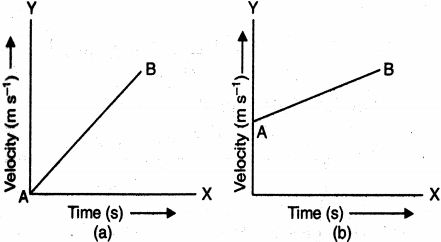
Explain the differences between the two graphs.
Solution
(N/A) This graph represents the uniform acceleration of a body that starts from rest. At time $t = 0$,the velocity of the body is $0 \ m/s$.
$(b)$ This graph represents the uniform acceleration of a body that does not start from rest. At time $t = 0$,the body already possesses an initial velocity represented by the intercept on the velocity axis.
$(b)$ This graph represents the uniform acceleration of a body that does not start from rest. At time $t = 0$,the body already possesses an initial velocity represented by the intercept on the velocity axis.
0 likes
View Solution103
Medium
$A$ body can have zero average velocity but not zero average speed. Justify.
Solution
(N/A) Average velocity is defined as the ratio of total displacement to total time taken,whereas average speed is defined as the ratio of total distance travelled to total time taken.
Displacement is a vector quantity and can be zero if the initial and final positions of an object are the same (e.g.,in circular motion). Since average velocity depends on displacement,it can be zero.
Distance is a scalar quantity representing the total path length covered and is always positive for a moving body. Since average speed depends on total distance,it cannot be zero for a moving body.
Displacement is a vector quantity and can be zero if the initial and final positions of an object are the same (e.g.,in circular motion). Since average velocity depends on displacement,it can be zero.
Distance is a scalar quantity representing the total path length covered and is always positive for a moving body. Since average speed depends on total distance,it cannot be zero for a moving body.
0 likes
View Solution104
Medium
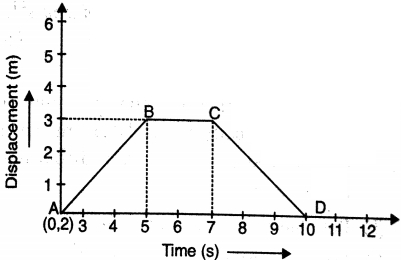
The following displacement-time graph shows the positions of a body at different times. Calculate the velocity of the body as it moves from: $(i) A-B, (ii) B-C, (iii) C-D$.
Solution
(N/A) Velocity is determined by the slope of the displacement-time graph,where $V = \frac{\Delta \text{displacement}}{\Delta \text{time}}$.
$(i)$ For segment $A-B$: The displacement changes from $0 \ m$ to $3 \ m$ in the time interval from $2 \ s$ to $5 \ s$.
$V_{AB} = \frac{3 - 0}{5 - 2} = \frac{3}{3} = 1 \ m \ s^{-1}$.
$(ii)$ For segment $B-C$: The displacement remains constant at $3 \ m$ from $5 \ s$ to $7 \ s$.
$V_{BC} = \frac{3 - 3}{7 - 5} = \frac{0}{2} = 0 \ m \ s^{-1}$.
$(iii)$ For segment $C-D$: The displacement changes from $3 \ m$ to $0 \ m$ in the time interval from $7 \ s$ to $10 \ s$.
$V_{CD} = \frac{0 - 3}{10 - 7} = \frac{-3}{3} = -1 \ m \ s^{-1}$.
$(i)$ For segment $A-B$: The displacement changes from $0 \ m$ to $3 \ m$ in the time interval from $2 \ s$ to $5 \ s$.
$V_{AB} = \frac{3 - 0}{5 - 2} = \frac{3}{3} = 1 \ m \ s^{-1}$.
$(ii)$ For segment $B-C$: The displacement remains constant at $3 \ m$ from $5 \ s$ to $7 \ s$.
$V_{BC} = \frac{3 - 3}{7 - 5} = \frac{0}{2} = 0 \ m \ s^{-1}$.
$(iii)$ For segment $C-D$: The displacement changes from $3 \ m$ to $0 \ m$ in the time interval from $7 \ s$ to $10 \ s$.
$V_{CD} = \frac{0 - 3}{10 - 7} = \frac{-3}{3} = -1 \ m \ s^{-1}$.
0 likes
View Solution105
Medium
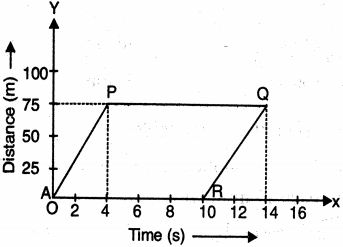
The graph given below is the distance-time graph of an object.
$(i)$ Find the speed of the object during the first four seconds of its journey.
(ii) How long was it stationary?
(iii) Does it represent a real situation? Justify your answer.
$(i)$ Find the speed of the object during the first four seconds of its journey.
(ii) How long was it stationary?
(iii) Does it represent a real situation? Justify your answer.
Solution
(N/A) $(i)$ The segment $OP$ indicates uniform speed.
Speed $v = \frac{\text{Distance}}{\text{Time}} = \frac{75 \ m - 0 \ m}{4 \ s - 0 \ s} = \frac{75}{4} = 18.75 \ m \ s^{-1}$.
(ii) The segment $PQ$ is parallel to the time axis,which indicates that the object is stationary. The duration is from $t = 4 \ s$ to $t = 14 \ s$,so the object was stationary for $14 - 4 = 10 \ s$.
(iii) The segment $QR$ represents a situation where the distance decreases as time increases,which is physically impossible for a single object moving in one dimension. Thus,this does not represent a real situation.
Speed $v = \frac{\text{Distance}}{\text{Time}} = \frac{75 \ m - 0 \ m}{4 \ s - 0 \ s} = \frac{75}{4} = 18.75 \ m \ s^{-1}$.
(ii) The segment $PQ$ is parallel to the time axis,which indicates that the object is stationary. The duration is from $t = 4 \ s$ to $t = 14 \ s$,so the object was stationary for $14 - 4 = 10 \ s$.
(iii) The segment $QR$ represents a situation where the distance decreases as time increases,which is physically impossible for a single object moving in one dimension. Thus,this does not represent a real situation.
0 likes
View Solution106
Easy
$(a)$ Write differences between speed and velocity.
$(b)$ The speed of a moving object is $x \ m \ s^{-1}$. Its velocity is $y \ m \ s^{-1}$. What is the similarity observed?
$(b)$ The speed of a moving object is $x \ m \ s^{-1}$. Its velocity is $y \ m \ s^{-1}$. What is the similarity observed?
Solution
(N/A) Speed is the distance travelled per unit time,whereas velocity is the displacement per unit time.
Speed is a scalar quantity,while velocity is a vector quantity.
Speed can never be zero for a moving object,whereas velocity can be zero if the displacement is zero.
$(b)$ Both speed and velocity have the same $SI$ units,which is $m \ s^{-1}$.
Speed is a scalar quantity,while velocity is a vector quantity.
Speed can never be zero for a moving object,whereas velocity can be zero if the displacement is zero.
$(b)$ Both speed and velocity have the same $SI$ units,which is $m \ s^{-1}$.
0 likes
View Solution107
Medium
$(a)$ Define uniform circular motion.
$(b)$ Is the uniform circular motion an accelerated motion? Give reasons for your answer.
$(b)$ Is the uniform circular motion an accelerated motion? Give reasons for your answer.
Solution
(N/A) Uniform circular motion is defined as the motion of an object traveling along a circular path at a constant speed.
$(b)$ Yes,uniform circular motion is an accelerated motion. Even though the speed of the object remains constant,the direction of its velocity changes continuously at every point along the circular path. Since acceleration is defined as the rate of change of velocity,and velocity is a vector quantity (having both magnitude and direction),the continuous change in direction results in a continuous change in velocity,thereby causing acceleration.
$(b)$ Yes,uniform circular motion is an accelerated motion. Even though the speed of the object remains constant,the direction of its velocity changes continuously at every point along the circular path. Since acceleration is defined as the rate of change of velocity,and velocity is a vector quantity (having both magnitude and direction),the continuous change in direction results in a continuous change in velocity,thereby causing acceleration.
0 likes
View Solution108
Easy
$A$ person travelling in a bus noted the timings and the corresponding distances as indicated on the km stones. $(a)$ Name this type of table. $(b)$ What conclusion do you draw from this data?
| Time | Distance |
| $8.00\, am$ | $10\, km$ |
| $8.15\, am$ | $20\, km$ |
| $8.30\, am$ | $30\, km$ |
| $8.45\, am$ | $40\, km$ |
| $9.00\, am$ | $50\, km$ |
Solution
$(a)$ This is a distance-time table.
$(b)$ The bus is in uniform motion. This conclusion is drawn because the bus covers an equal distance of $10\, km$ in equal intervals of time ($15$ minutes each).
$(b)$ The bus is in uniform motion. This conclusion is drawn because the bus covers an equal distance of $10\, km$ in equal intervals of time ($15$ minutes each).
0 likes
View Solution109
Medium
What is meant by free fall? Two bodies,one of mass $1\,g$ and other of mass $1\,kg$,are dropped from the same height in a vacuum. Compare the two time intervals in which the two bodies will hit the ground.
Solution
(A) Free fall is defined as the motion of an object falling towards the Earth solely under the influence of gravitational force,with no other forces like air resistance acting upon it.
In a vacuum,there is no air resistance. The acceleration experienced by any object falling freely is the acceleration due to gravity $(g)$,which is approximately $9.8\,m/s^2$ near the Earth's surface.
Since the acceleration due to gravity $(g)$ is independent of the mass of the falling object,both bodies will experience the same acceleration.
Using the equation of motion $s = ut + \frac{1}{2}at^2$,where $u = 0$ (initial velocity) and $s = h$ (height),we get $h = \frac{1}{2}gt^2$,which implies $t = \sqrt{\frac{2h}{g}}$.
Since $h$ and $g$ are the same for both bodies,the time taken $(t)$ will be identical for both. Therefore,both bodies will hit the ground at the same time.
In a vacuum,there is no air resistance. The acceleration experienced by any object falling freely is the acceleration due to gravity $(g)$,which is approximately $9.8\,m/s^2$ near the Earth's surface.
Since the acceleration due to gravity $(g)$ is independent of the mass of the falling object,both bodies will experience the same acceleration.
Using the equation of motion $s = ut + \frac{1}{2}at^2$,where $u = 0$ (initial velocity) and $s = h$ (height),we get $h = \frac{1}{2}gt^2$,which implies $t = \sqrt{\frac{2h}{g}}$.
Since $h$ and $g$ are the same for both bodies,the time taken $(t)$ will be identical for both. Therefore,both bodies will hit the ground at the same time.
0 likes
View Solution110
Easy
Define acceleration. State a relationship connecting $u, v, a$ and $t$ for an accelerated motion. Give an example of a motion in which acceleration is uniform.
Solution
(N/A) Acceleration is defined as the rate of change of velocity of an object with respect to time. Mathematically,it is expressed as $a = (v - u) / t$.
The relationship connecting initial velocity $(u)$,final velocity $(v)$,acceleration $(a)$,and time $(t)$ is given by the first equation of motion: $v = u + at$.
An example of motion with uniform acceleration is the motion of a freely falling body under the influence of gravity.
The relationship connecting initial velocity $(u)$,final velocity $(v)$,acceleration $(a)$,and time $(t)$ is given by the first equation of motion: $v = u + at$.
An example of motion with uniform acceleration is the motion of a freely falling body under the influence of gravity.
0 likes
View Solution111
Medium
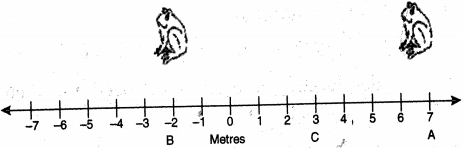
$A$ frog hops along a straight line path from point $A$ to point $B$ in $10 \, s$ and then turns and hops to point $C$ in another $5 \, s$. Based on the provided number line,calculate the average speed and average velocity of the frog for the motion between: $(a)$ $A$ to $B$ $(b)$ $A$ to $C$ (through $B$).
Solution
(N/A) From the number line,the positions are: $A = 7 \, m$,$B = -2 \, m$,$C = 3 \, m$.
$(a)$ For motion from $A$ to $B$:
Total distance $= |(-2) - 7| = 9 \, m$.
Total displacement $= -2 - 7 = -9 \, m$.
Time taken $= 10 \, s$.
Average speed $= \frac{\text{Total distance}}{\text{Total time}} = \frac{9}{10} = 0.9 \, m/s$.
Average velocity $= \frac{\text{Total displacement}}{\text{Total time}} = \frac{-9}{10} = -0.9 \, m/s$.
$(b)$ For motion from $A$ to $C$ through $B$:
Total distance $= |(-2) - 7| + |3 - (-2)| = 9 + 5 = 14 \, m$.
Total displacement $= 3 - 7 = -4 \, m$.
Total time $= 10 + 5 = 15 \, s$.
Average speed $= \frac{14}{15} \approx 0.933 \, m/s$.
Average velocity $= \frac{-4}{15} \approx -0.267 \, m/s$.
$(a)$ For motion from $A$ to $B$:
Total distance $= |(-2) - 7| = 9 \, m$.
Total displacement $= -2 - 7 = -9 \, m$.
Time taken $= 10 \, s$.
Average speed $= \frac{\text{Total distance}}{\text{Total time}} = \frac{9}{10} = 0.9 \, m/s$.
Average velocity $= \frac{\text{Total displacement}}{\text{Total time}} = \frac{-9}{10} = -0.9 \, m/s$.
$(b)$ For motion from $A$ to $C$ through $B$:
Total distance $= |(-2) - 7| + |3 - (-2)| = 9 + 5 = 14 \, m$.
Total displacement $= 3 - 7 = -4 \, m$.
Total time $= 10 + 5 = 15 \, s$.
Average speed $= \frac{14}{15} \approx 0.933 \, m/s$.
Average velocity $= \frac{-4}{15} \approx -0.267 \, m/s$.
0 likes
View Solution112
Easy
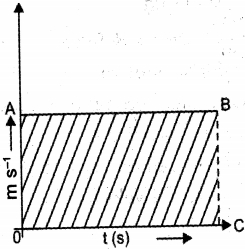
$(a)$ Which type of motion is represented by the velocity-time graph shown below?
$(b)$ Name the physical quantity which can be calculated by the area of rectangle $OABC$.
$(c)$ What does the straight line $AB$ represent?
$(b)$ Name the physical quantity which can be calculated by the area of rectangle $OABC$.
$(c)$ What does the straight line $AB$ represent?
Solution
(N/A) The velocity-time graph shows a constant velocity over time,which represents uniform motion.
$(b)$ The area under a velocity-time graph represents the displacement of the object. Therefore,the area of rectangle $OABC$ represents the displacement.
$(c)$ The straight line $AB$ is parallel to the time axis,which indicates that the velocity of the object remains constant over time,representing uniform motion.
$(b)$ The area under a velocity-time graph represents the displacement of the object. Therefore,the area of rectangle $OABC$ represents the displacement.
$(c)$ The straight line $AB$ is parallel to the time axis,which indicates that the velocity of the object remains constant over time,representing uniform motion.
0 likes
View Solution113
Easy
Answer the following questions:
$(i)$ State the type of motion shown by a freely falling stone.
$(ii)$ When a stone is thrown vertically upwards,its velocity is continuously decreased. Why?
$(iii)$ Give an example of a motion in which average velocity is zero,but the average speed is not zero.
$(i)$ State the type of motion shown by a freely falling stone.
$(ii)$ When a stone is thrown vertically upwards,its velocity is continuously decreased. Why?
$(iii)$ Give an example of a motion in which average velocity is zero,but the average speed is not zero.
Solution
(N/A) $(i)$ $A$ freely falling stone exhibits uniformly accelerated motion because it is under the influence of constant gravitational acceleration $(g \approx 9.8 \ m/s^2)$.
$(ii)$ When a stone is thrown vertically upwards,the earth exerts a gravitational force on it in the downward direction. This force acts against the direction of motion,causing retardation (negative acceleration),which leads to a continuous decrease in velocity.
$(iii)$ An example of such motion is an object moving in a circular path and returning to its starting point. Since the displacement is zero,the average velocity is zero,but the total distance covered is the circumference of the circle,so the average speed is not zero.
$(ii)$ When a stone is thrown vertically upwards,the earth exerts a gravitational force on it in the downward direction. This force acts against the direction of motion,causing retardation (negative acceleration),which leads to a continuous decrease in velocity.
$(iii)$ An example of such motion is an object moving in a circular path and returning to its starting point. Since the displacement is zero,the average velocity is zero,but the total distance covered is the circumference of the circle,so the average speed is not zero.
0 likes
View Solution114
Medium
Explain the following types of motion with one example for each:
$(i)$ Acceleration is positive
$(ii)$ Acceleration is negative
$(iii)$ Acceleration is zero.
$(i)$ Acceleration is positive
$(ii)$ Acceleration is negative
$(iii)$ Acceleration is zero.
Solution
(N/A) $(i)$ Positive acceleration: This occurs when the velocity of an object increases with time. Example: $A$ car accelerating from rest to gain speed on a straight road.
$(ii)$ Negative acceleration (Retardation/Deceleration): This occurs when the velocity of an object decreases with time. Example: Applying brakes to a moving car,causing it to slow down.
$(iii)$ Zero acceleration: This occurs when an object moves with a constant velocity (uniform motion),meaning there is no change in speed or direction. Example: $A$ car moving at a constant speed of $60 \ km/h$ on a straight,level road.
$(ii)$ Negative acceleration (Retardation/Deceleration): This occurs when the velocity of an object decreases with time. Example: Applying brakes to a moving car,causing it to slow down.
$(iii)$ Zero acceleration: This occurs when an object moves with a constant velocity (uniform motion),meaning there is no change in speed or direction. Example: $A$ car moving at a constant speed of $60 \ km/h$ on a straight,level road.
0 likes
View Solution115
Easy
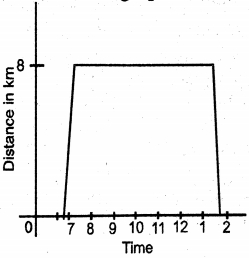
The following table shows the position of Renu, while she is going to her school. Draw a distance-time graph for her motion.
| Time | Distance from her home $(km)$ |
|---|---|
| $06:45 \, am$ | $0$ |
| $07:00 \, am$ | $8$ |
| $01:30 \, pm$ | $8$ |
| $01:45 \, pm$ | $0$ |
Solution
(N/A) To draw the distance-time graph, follow these steps:
$1$. Take the $x$-axis to represent time and the $y$-axis to represent distance in $km$.
$2$. Plot the given points: $(06:45, 0)$, $(07:00, 8)$, $(01:30, 8)$, and $(01:45, 0)$.
$3$. Join the points to obtain the graph. The graph shows that Renu travels $8 \, km$ to reach school, stays there for some time, and then returns home.
The distance-time graph is as shown in the provided image.
$1$. Take the $x$-axis to represent time and the $y$-axis to represent distance in $km$.
$2$. Plot the given points: $(06:45, 0)$, $(07:00, 8)$, $(01:30, 8)$, and $(01:45, 0)$.
$3$. Join the points to obtain the graph. The graph shows that Renu travels $8 \, km$ to reach school, stays there for some time, and then returns home.
The distance-time graph is as shown in the provided image.
1 likes
View Solution116
Medium
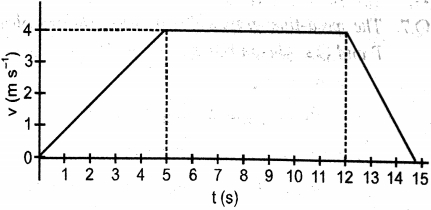
The velocity-time graph of a truck is plotted below.
$(a)$ Calculate the magnitude of displacement of the truck in $15$ seconds.
$(b)$ During which part of the journey was the truck decelerating?
$(c)$ Calculate the magnitude of average velocity of the truck.
$(a)$ Calculate the magnitude of displacement of the truck in $15$ seconds.
$(b)$ During which part of the journey was the truck decelerating?
$(c)$ Calculate the magnitude of average velocity of the truck.
Solution
(N/A) Displacement is equal to the area under the velocity-time graph.
Displacement $= \text{Area of triangle} + \text{Area of rectangle} + \text{Area of triangle}$
$= (\frac{1}{2} \times 5 \times 4) + ((12 - 5) \times 4) + (\frac{1}{2} \times (15 - 12) \times 4)$
$= 10 + 28 + 6 = 44 \text{ m}$
$(b)$ The truck is decelerating when the velocity decreases with time,which occurs between $12 \text{ s}$ and $15 \text{ s}$.
$(c)$ Average velocity $= \frac{\text{Total displacement}}{\text{Total time}}$
$= \frac{44 \text{ m}}{15 \text{ s}} \approx 2.93 \text{ m s}^{-1}$
Displacement $= \text{Area of triangle} + \text{Area of rectangle} + \text{Area of triangle}$
$= (\frac{1}{2} \times 5 \times 4) + ((12 - 5) \times 4) + (\frac{1}{2} \times (15 - 12) \times 4)$
$= 10 + 28 + 6 = 44 \text{ m}$
$(b)$ The truck is decelerating when the velocity decreases with time,which occurs between $12 \text{ s}$ and $15 \text{ s}$.
$(c)$ Average velocity $= \frac{\text{Total displacement}}{\text{Total time}}$
$= \frac{44 \text{ m}}{15 \text{ s}} \approx 2.93 \text{ m s}^{-1}$
0 likes
View Solution117
EasyMCQ
An object is moving with uniform speed in a circle of radius $7 \, m$. Calculate the distance and displacement when it completes half the circle. What type of motion does the object possess?
A
Distance = $22 \, m$, Displacement = $14 \, m$
B
Distance = $44 \, m$, Displacement = $7 \, m$
C
Distance = $11 \, m$, Displacement = $14 \, m$
D
Distance = $22 \, m$, Displacement = $7 \, m$
Solution
(A) When an object completes half of a circular path, the distance covered is equal to half of the circumference of the circle.
Distance $= \pi R = \frac{22}{7} \times 7 = 22 \, m$.
The displacement is the shortest distance between the initial and final positions, which is the diameter of the circle.
Displacement $= 2R = 2 \times 7 = 14 \, m$.
The object possesses uniform circular motion because it moves with a constant speed along a circular path.
Distance $= \pi R = \frac{22}{7} \times 7 = 22 \, m$.
The displacement is the shortest distance between the initial and final positions, which is the diameter of the circle.
Displacement $= 2R = 2 \times 7 = 14 \, m$.
The object possesses uniform circular motion because it moves with a constant speed along a circular path.
0 likes
View Solution118
Easy
$(a)$ When will you say a body is in $(i)$ uniform motion $(ii)$ non-uniform motion?
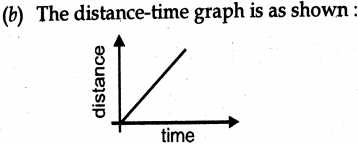
$(b)$ Show the path of an object when it is in uniform motion with the help of a graph.
$(b)$ Show the path of an object when it is in uniform motion with the help of a graph.
Solution
(N/A) $(i)$ $A$ body is said to be in uniform motion if it covers equal distances in equal intervals of time.
$(ii)$ $A$ body is said to be in non-uniform motion if it covers unequal distances in equal intervals of time.
$(b)$ For an object in uniform motion,the distance-time graph is a straight line passing through the origin,as shown below:
[Graph: $A$ straight line starting from the origin $(0,0)$ on a Cartesian plane where the y-axis represents 'distance' and the x-axis represents 'time'.]
$(ii)$ $A$ body is said to be in non-uniform motion if it covers unequal distances in equal intervals of time.
$(b)$ For an object in uniform motion,the distance-time graph is a straight line passing through the origin,as shown below:
[Graph: $A$ straight line starting from the origin $(0,0)$ on a Cartesian plane where the y-axis represents 'distance' and the x-axis represents 'time'.]
0 likes
View Solution119
Medium
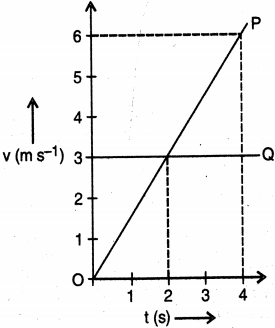
The speed-time graphs of two cars are represented by $P$ and $Q$ as shown below.
$(a)$ Find the difference in the distance travelled by the two cars (in $m$) after $4\, s$.
$(b)$ Do they ever move with the same speed? If so,when?
$(c)$ What type of motion are car $P$ and car $Q$ undergoing?
$(a)$ Find the difference in the distance travelled by the two cars (in $m$) after $4\, s$.
$(b)$ Do they ever move with the same speed? If so,when?
$(c)$ What type of motion are car $P$ and car $Q$ undergoing?
Solution
(N/A) The distance covered by an object is equal to the area under the speed-time graph.
For car $P$,the area is a triangle with base $= 4\, s$ and height $= 6\, m/s$.
Distance $= \frac{1}{2} \times \text{base} \times \text{height} = \frac{1}{2} \times 4\, s \times 6\, m/s = 12\, m$.
For car $Q$,the area is a rectangle with length $= 4\, s$ and width $= 3\, m/s$.
Distance $= \text{length} \times \text{width} = 4\, s \times 3\, m/s = 12\, m$.
The difference in the distance travelled by the two cars is $12\, m - 12\, m = 0\, m$.
$(b)$ Yes,they move with the same speed at the point where the two graphs intersect. This occurs at $t = 2\, s$,where both cars have a speed of $3\, m/s$.
$(c)$ Car $P$ is undergoing uniform acceleration because its speed-time graph is a straight line passing through the origin,indicating a constant rate of change of speed. Car $Q$ is undergoing uniform motion (constant speed) because its speed-time graph is a horizontal line,indicating that its speed does not change with time.
For car $P$,the area is a triangle with base $= 4\, s$ and height $= 6\, m/s$.
Distance $= \frac{1}{2} \times \text{base} \times \text{height} = \frac{1}{2} \times 4\, s \times 6\, m/s = 12\, m$.
For car $Q$,the area is a rectangle with length $= 4\, s$ and width $= 3\, m/s$.
Distance $= \text{length} \times \text{width} = 4\, s \times 3\, m/s = 12\, m$.
The difference in the distance travelled by the two cars is $12\, m - 12\, m = 0\, m$.
$(b)$ Yes,they move with the same speed at the point where the two graphs intersect. This occurs at $t = 2\, s$,where both cars have a speed of $3\, m/s$.
$(c)$ Car $P$ is undergoing uniform acceleration because its speed-time graph is a straight line passing through the origin,indicating a constant rate of change of speed. Car $Q$ is undergoing uniform motion (constant speed) because its speed-time graph is a horizontal line,indicating that its speed does not change with time.
0 likes
View Solution120
Difficult
$A$ piece of stone is thrown vertically upwards. It reaches its maximum height in $3 \ s$. If the acceleration of the stone is $9.8 \ m s^{-2}$ directed towards the ground,calculate the initial velocity of the stone with which it is thrown upwards. Find the maximum height attained by it.
Solution
(A) Given: Time $t = 3 \ s$,Final velocity $v = 0 \ m s^{-1}$ (at maximum height),Acceleration $a = g = -9.8 \ m s^{-2}$ (acting downwards).
To find initial velocity $u$:
Using the first equation of motion: $v = u + at$
$0 = u + (-9.8) \times 3$
$u = 29.4 \ m s^{-1}$.
To find maximum height $h$:
Using the second equation of motion: $h = ut + \frac{1}{2}at^2$
$h = (29.4 \times 3) + \frac{1}{2} \times (-9.8) \times (3)^2$
$h = 88.2 - 44.1$
$h = 44.1 \ m$.
To find initial velocity $u$:
Using the first equation of motion: $v = u + at$
$0 = u + (-9.8) \times 3$
$u = 29.4 \ m s^{-1}$.
To find maximum height $h$:
Using the second equation of motion: $h = ut + \frac{1}{2}at^2$
$h = (29.4 \times 3) + \frac{1}{2} \times (-9.8) \times (3)^2$
$h = 88.2 - 44.1$
$h = 44.1 \ m$.
0 likes
View Solution121
MediumMCQ
Starting from rest,a scooter acquires a velocity of $36 \, km/h$ in $10 \, s$ and then brakes are applied,taking $20 \, s$ to stop. Calculate the acceleration and the total distance travelled.
A
Acceleration = $1 \, m/s^2$,Deceleration = $-0.5 \, m/s^2$,Distance = $150 \, m$
B
Acceleration = $1 \, m/s^2$,Deceleration = $-0.5 \, m/s^2$,Distance = $200 \, m$
C
Acceleration = $1 \, m/s^2$,Deceleration = $-0.5 \, m/s^2$,Distance = $250 \, m$
D
Acceleration = $1 \, m/s^2$,Deceleration = $-0.5 \, m/s^2$,Distance = $300 \, m$
Solution
(A) Part $1$: Acceleration phase
Initial velocity $u = 0 \, m/s$,Final velocity $v = 36 \, km/h = 36 \times (5/18) = 10 \, m/s$,Time $t_1 = 10 \, s$.
Acceleration $a_1 = (v - u) / t_1 = (10 - 0) / 10 = 1 \, m/s^2$.
Distance $s_1 = ut_1 + 0.5 a_1 t_1^2 = 0 + 0.5 \times 1 \times 10^2 = 50 \, m$.
Part $2$: Deceleration phase
Initial velocity $u = 10 \, m/s$,Final velocity $v = 0 \, m/s$,Time $t_2 = 20 \, s$.
Acceleration $a_2 = (v - u) / t_2 = (0 - 10) / 20 = -0.5 \, m/s^2$.
Distance $s_2 = ut_2 + 0.5 a_2 t_2^2 = 10 \times 20 + 0.5 \times (-0.5) \times 20^2 = 200 - 100 = 100 \, m$.
Total distance = $s_1 + s_2 = 50 + 100 = 150 \, m$.
Initial velocity $u = 0 \, m/s$,Final velocity $v = 36 \, km/h = 36 \times (5/18) = 10 \, m/s$,Time $t_1 = 10 \, s$.
Acceleration $a_1 = (v - u) / t_1 = (10 - 0) / 10 = 1 \, m/s^2$.
Distance $s_1 = ut_1 + 0.5 a_1 t_1^2 = 0 + 0.5 \times 1 \times 10^2 = 50 \, m$.
Part $2$: Deceleration phase
Initial velocity $u = 10 \, m/s$,Final velocity $v = 0 \, m/s$,Time $t_2 = 20 \, s$.
Acceleration $a_2 = (v - u) / t_2 = (0 - 10) / 20 = -0.5 \, m/s^2$.
Distance $s_2 = ut_2 + 0.5 a_2 t_2^2 = 10 \times 20 + 0.5 \times (-0.5) \times 20^2 = 200 - 100 = 100 \, m$.
Total distance = $s_1 + s_2 = 50 + 100 = 150 \, m$.
0 likes
View Solution122
DifficultMCQ
$A$ girl of mass $50\, kg$ jumps out of a moving boat of mass $300\, kg$ on to the bank with a horizontal velocity of $3\, m s^{-1}$. With what velocity does the boat begin to move backwards (in $, m s^{-1}$)?
A
$0.5$
B
$0.25$
C
$1.0$
D
$0.75$
Solution
(A) According to the law of conservation of momentum,the total momentum before the jump is equal to the total momentum after the jump.
Initially,the boat and the girl are moving together,so the initial momentum is $0$ (assuming the system starts from rest or considering the relative change).
Let $m_1 = 50\, kg$ be the mass of the girl and $v_1 = 3\, m s^{-1}$ be her velocity.
Let $m_2 = 300\, kg$ be the mass of the boat and $v_2$ be the velocity of the boat.
Using the principle of conservation of linear momentum: $m_1 v_1 + m_2 v_2 = 0$.
Substituting the values: $(50 \times 3) + (300 \times v_2) = 0$.
$150 + 300 v_2 = 0$.
$300 v_2 = -150$.
$v_2 = -\frac{150}{300} = -0.5\, m s^{-1}$.
The negative sign indicates that the boat moves in the opposite direction (backwards) with a velocity of $0.5\, m s^{-1}$.
Initially,the boat and the girl are moving together,so the initial momentum is $0$ (assuming the system starts from rest or considering the relative change).
Let $m_1 = 50\, kg$ be the mass of the girl and $v_1 = 3\, m s^{-1}$ be her velocity.
Let $m_2 = 300\, kg$ be the mass of the boat and $v_2$ be the velocity of the boat.
Using the principle of conservation of linear momentum: $m_1 v_1 + m_2 v_2 = 0$.
Substituting the values: $(50 \times 3) + (300 \times v_2) = 0$.
$150 + 300 v_2 = 0$.
$300 v_2 = -150$.
$v_2 = -\frac{150}{300} = -0.5\, m s^{-1}$.
The negative sign indicates that the boat moves in the opposite direction (backwards) with a velocity of $0.5\, m s^{-1}$.
0 likes
View Solution123
Medium
$A$ body can have zero average velocity but not zero average speed. Justify this statement by giving an example.
Solution
(N/A) Average velocity is defined as the total displacement divided by the total time taken. Since displacement is a vector quantity,if an object returns to its starting point,the total displacement becomes $0$,resulting in an average velocity of $0$.
Average speed is defined as the total distance traveled divided by the total time taken. Since distance is a scalar quantity and represents the total path length,it cannot be $0$ for a moving object.
Example: Consider an object moving along a circular path of radius $r$. If the object completes one full revolution,the total displacement is $0$,so the average velocity is $0$. However,the total distance traveled is equal to the circumference of the circle,which is $2 \pi r$. Thus,the average speed is $\frac{2 \pi r}{t}$,where $t$ is the time taken.
Average speed is defined as the total distance traveled divided by the total time taken. Since distance is a scalar quantity and represents the total path length,it cannot be $0$ for a moving object.
Example: Consider an object moving along a circular path of radius $r$. If the object completes one full revolution,the total displacement is $0$,so the average velocity is $0$. However,the total distance traveled is equal to the circumference of the circle,which is $2 \pi r$. Thus,the average speed is $\frac{2 \pi r}{t}$,where $t$ is the time taken.
0 likes
View Solution124
Difficult
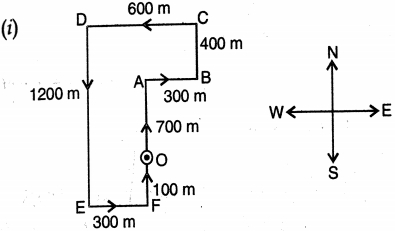
$A$ hiker rides $700\, m$ north,$300\, m$ east,$400\, m$ north,$600\, m$ west,$1200\, m$ south,$300\, m$ east,and finally $100\, m$ north. Draw the path of motion of the hiker. What distance did he cover? What was his displacement?
Solution
(N/A) To calculate the total distance and displacement,we represent the motion on a coordinate system.
$1$. Total Distance:
Distance is the total path length covered by the hiker.
Total Distance $= 700\, m + 300\, m + 400\, m + 600\, m + 1200\, m + 300\, m + 100\, m = 3600\, m$.
$2$. Displacement:
Displacement is the shortest distance between the initial and final positions.
Let the starting point $O$ be $(0, 0)$.
- Move $700\, m$ North: Position $(0, 700)$.
- Move $300\, m$ East: Position $(300, 700)$.
- Move $400\, m$ North: Position $(300, 1100)$.
- Move $600\, m$ West: Position $(300 - 600, 1100) = (-300, 1100)$.
- Move $1200\, m$ South: Position $(-300, 1100 - 1200) = (-300, -100)$.
- Move $300\, m$ East: Position $(-300 + 300, -100) = (0, -100)$.
- Move $100\, m$ North: Position $(0, -100 + 100) = (0, 0)$.
Since the final position $(0, 0)$ is the same as the initial position,the displacement is $0\, m$.
$1$. Total Distance:
Distance is the total path length covered by the hiker.
Total Distance $= 700\, m + 300\, m + 400\, m + 600\, m + 1200\, m + 300\, m + 100\, m = 3600\, m$.
$2$. Displacement:
Displacement is the shortest distance between the initial and final positions.
Let the starting point $O$ be $(0, 0)$.
- Move $700\, m$ North: Position $(0, 700)$.
- Move $300\, m$ East: Position $(300, 700)$.
- Move $400\, m$ North: Position $(300, 1100)$.
- Move $600\, m$ West: Position $(300 - 600, 1100) = (-300, 1100)$.
- Move $1200\, m$ South: Position $(-300, 1100 - 1200) = (-300, -100)$.
- Move $300\, m$ East: Position $(-300 + 300, -100) = (0, -100)$.
- Move $100\, m$ North: Position $(0, -100 + 100) = (0, 0)$.
Since the final position $(0, 0)$ is the same as the initial position,the displacement is $0\, m$.
0 likes
View Solution125
Medium
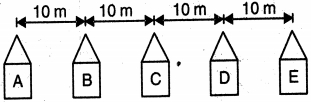
There are $5$ houses on a street,$A, B, C, D$ and $E$. For all cases,assume that positions to the right are positive.
$(i)$ Draw a frame of reference with house $A$ as the origin and the positions of houses $B, C, D$ and $E$.
$(ii)$ You live in house $C$. What is your position relative to house $E$?
$(iii)$ What are the positions of houses $A$ and $D$,if house $B$ is taken as the reference point?
$(i)$ Draw a frame of reference with house $A$ as the origin and the positions of houses $B, C, D$ and $E$.
$(ii)$ You live in house $C$. What is your position relative to house $E$?
$(iii)$ What are the positions of houses $A$ and $D$,if house $B$ is taken as the reference point?
Solution
(N/A) $(i)$ Taking house $A$ as the origin $(0 \ m)$,the positions of the houses are: $A = 0 \ m, B = 10 \ m, C = 20 \ m, D = 30 \ m, E = 40 \ m$.
$(ii)$ Position of house $C = 20 \ m$ and position of house $E = 40 \ m$. The position of $C$ relative to $E$ is $20 \ m - 40 \ m = -20 \ m$. This means house $C$ is $20 \ m$ to the left of house $E$.
$(iii)$ Taking house $B$ as the reference point $(0 \ m)$,the position of house $A$ is $-10 \ m$ and the position of house $D$ is $20 \ m$.
$(ii)$ Position of house $C = 20 \ m$ and position of house $E = 40 \ m$. The position of $C$ relative to $E$ is $20 \ m - 40 \ m = -20 \ m$. This means house $C$ is $20 \ m$ to the left of house $E$.
$(iii)$ Taking house $B$ as the reference point $(0 \ m)$,the position of house $A$ is $-10 \ m$ and the position of house $D$ is $20 \ m$.

0 likes
View Solution126
Medium
The following table shows the position of three persons between $8.00\, am$ to $8.20\, am$.
$(i)$ Who is moving with constant speed?
$(ii)$ Who has travelled the maximum distance between $8.00\, am$ to $8.05\, am$?
$(iii)$ Calculate the average speed of person $A$ in $km\, h^{-1}$.
| Time | Position of Person $A$ $(km)$ | Position of Person $B$ $(km)$ | Position of Person $C$ $(km)$ |
| $8.00\, am$ | $0$ | $0$ | $0$ |
| $8.05\, am$ | $4$ | $5$ | $10$ |
| $8.10\, am$ | $13$ | $10$ | $19$ |
| $8.15\, am$ | $20$ | $15$ | $24$ |
| $8.20\, am$ | $25$ | $20$ | $27$ |
$(i)$ Who is moving with constant speed?
$(ii)$ Who has travelled the maximum distance between $8.00\, am$ to $8.05\, am$?
$(iii)$ Calculate the average speed of person $A$ in $km\, h^{-1}$.
Solution
(N/A) $(i)$ Person $B$ is moving with constant speed because he travels an equal distance of $5\, km$ in equal intervals of time (every $5\, minutes$).
$(ii)$ Person $C$ has travelled the maximum distance, which is $10\, km$ between $8.00\, am$ and $8.05\, am$.
$(iii)$ Average speed of person $A = \frac{\text{Total distance travelled by } A}{\text{Total time taken}}$
$= \frac{25\, km}{20\, min} = \frac{25\, km}{(20/60)\, h} = \frac{25 \times 60}{20}\, km\, h^{-1} = 75\, km\, h^{-1}$.
$(ii)$ Person $C$ has travelled the maximum distance, which is $10\, km$ between $8.00\, am$ and $8.05\, am$.
$(iii)$ Average speed of person $A = \frac{\text{Total distance travelled by } A}{\text{Total time taken}}$
$= \frac{25\, km}{20\, min} = \frac{25\, km}{(20/60)\, h} = \frac{25 \times 60}{20}\, km\, h^{-1} = 75\, km\, h^{-1}$.
0 likes
View Solution127
Medium
Give one example for each of the type of motion when
$(i)$ acceleration is in the direction of motion.
$(ii)$ acceleration is against the direction of motion.
$(iii)$ acceleration is uniform.
$(i)$ acceleration is in the direction of motion.
$(ii)$ acceleration is against the direction of motion.
$(iii)$ acceleration is uniform.
Solution
(N/A) $(i)$ The motion of a car when it starts from rest and increases its velocity at a constant rate in a particular interval of time.
$(ii)$ The motion of a train when it slows down on approaching a station.
$(iii)$ The motion of a ball falling down freely.
$(ii)$ The motion of a train when it slows down on approaching a station.
$(iii)$ The motion of a ball falling down freely.
0 likes
View Solution128
Easy
Name the physical quantities denoted by:
$(i)$ The slope of the distance$-$time graph.
$(ii)$ The area under a velocity$-$time graph.
$(iii)$ The slope of a velocity$-$time graph.
$(i)$ The slope of the distance$-$time graph.
$(ii)$ The area under a velocity$-$time graph.
$(iii)$ The slope of a velocity$-$time graph.
Solution
(N/A) $(i)$ The slope of the distance$-$time graph represents the speed of the object.
$(ii)$ The area under a velocity$-$time graph represents the total displacement or distance covered by the object.
$(iii)$ The slope of a velocity$-$time graph represents the acceleration of the object.
$(ii)$ The area under a velocity$-$time graph represents the total displacement or distance covered by the object.
$(iii)$ The slope of a velocity$-$time graph represents the acceleration of the object.
0 likes
View Solution129
Medium
The slope of the line on a position-time graph reveals information about an object's velocity. What conclusion can you draw regarding the motion of an object,if the graph is a
$(i)$ Horizontal line.
$(ii)$ Straight diagonal line.
$(iii)$ Curved line.
$(i)$ Horizontal line.
$(ii)$ Straight diagonal line.
$(iii)$ Curved line.
Solution
(N/A) $(i)$ $A$ horizontal line indicates that the position of the object does not change with time,meaning the object is at rest.
$(ii)$ $A$ straight diagonal line indicates a constant slope,which means the object is moving with uniform velocity (constant speed).
$(iii)$ $A$ curved line indicates a changing slope,which means the object is moving with non-uniform velocity (variable speed/acceleration).
$(ii)$ $A$ straight diagonal line indicates a constant slope,which means the object is moving with uniform velocity (constant speed).
$(iii)$ $A$ curved line indicates a changing slope,which means the object is moving with non-uniform velocity (variable speed/acceleration).
0 likes
View Solution130
Medium
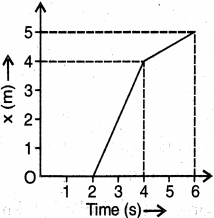
The position-time graph for the motion of a car is given below.
$(i)$ How far did the car travel in the time interval $2 \, s$ to $6 \, s$?
(ii) During which interval of time was its speed greater?
(iii) Calculate the average speed of the car.
$(i)$ How far did the car travel in the time interval $2 \, s$ to $6 \, s$?
(ii) During which interval of time was its speed greater?
(iii) Calculate the average speed of the car.
Solution
(N/A) $(i)$ At $t = 2 \, s$,position $x = 0 \, m$. At $t = 6 \, s$,position $x = 5 \, m$. Therefore,distance traveled $= 5 \, m - 0 \, m = 5 \, m$.
(ii) The speed is represented by the slope of the position-time graph. The slope is steeper between $2 \, s$ and $4 \, s$ compared to the interval between $4 \, s$ and $6 \, s$. Thus,the speed was greater during the interval $2 \, s$ to $4 \, s$.
(iii) Average speed $= \frac{\text{Total distance covered}}{\text{Total time taken}}$.
Total distance $= 5 \, m$.
Total time $= 6 \, s - 2 \, s = 4 \, s$.
Average speed $= \frac{5 \, m}{4 \, s} = 1.25 \, m/s$.
(ii) The speed is represented by the slope of the position-time graph. The slope is steeper between $2 \, s$ and $4 \, s$ compared to the interval between $4 \, s$ and $6 \, s$. Thus,the speed was greater during the interval $2 \, s$ to $4 \, s$.
(iii) Average speed $= \frac{\text{Total distance covered}}{\text{Total time taken}}$.
Total distance $= 5 \, m$.
Total time $= 6 \, s - 2 \, s = 4 \, s$.
Average speed $= \frac{5 \, m}{4 \, s} = 1.25 \, m/s$.
0 likes
View Solution131
Difficult
Derive the equation $v^{2}-u^{2}=2 a S$ graphically.
Solution
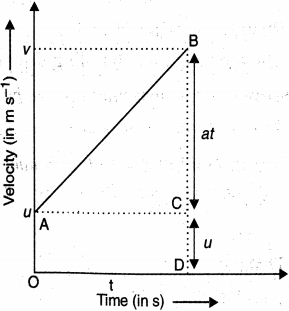
(N/A) Consider the velocity-time graph shown in the figure.
The distance $S$ covered by an object moving with uniform acceleration $a$ is equal to the area under the velocity-time graph,which is the area of the trapezium $OABD$.
Area of trapezium $OABD = \frac{(OA + BD) \times OD}{2}$
From the graph,we have:
$OA = u$ (initial velocity)
$BD = v$ (final velocity)
$OD = t$ (time taken)
Substituting these values,we get:
$S = \frac{(u + v) t}{2}$ --- (Equation $1$)
We know that for uniform acceleration,$v = u + at$,which can be rearranged to find time $t$:
$at = v - u$
$t = \frac{v - u}{a}$ --- (Equation $2$)
Substituting the value of $t$ from Equation $2$ into Equation $1$:
$S = \frac{(u + v)(v - u)}{2a}$
Using the algebraic identity $(a+b)(a-b) = a^2 - b^2$,we get:
$S = \frac{v^2 - u^2}{2a}$
Rearranging the terms,we get the final equation:
$v^2 - u^2 = 2aS$
The distance $S$ covered by an object moving with uniform acceleration $a$ is equal to the area under the velocity-time graph,which is the area of the trapezium $OABD$.
Area of trapezium $OABD = \frac{(OA + BD) \times OD}{2}$
From the graph,we have:
$OA = u$ (initial velocity)
$BD = v$ (final velocity)
$OD = t$ (time taken)
Substituting these values,we get:
$S = \frac{(u + v) t}{2}$ --- (Equation $1$)
We know that for uniform acceleration,$v = u + at$,which can be rearranged to find time $t$:
$at = v - u$
$t = \frac{v - u}{a}$ --- (Equation $2$)
Substituting the value of $t$ from Equation $2$ into Equation $1$:
$S = \frac{(u + v)(v - u)}{2a}$
Using the algebraic identity $(a+b)(a-b) = a^2 - b^2$,we get:
$S = \frac{v^2 - u^2}{2a}$
Rearranging the terms,we get the final equation:
$v^2 - u^2 = 2aS$
0 likes
View Solution132
Medium
$(a)$ Differentiate between distance and displacement.
$(b)$ Under what conditions is the magnitude of average velocity of an object equal to its average speed?
$(b)$ Under what conditions is the magnitude of average velocity of an object equal to its average speed?
Solution
(N/A) Distance is the total path length covered by an object,whereas displacement is the shortest distance between the initial and final positions of an object.
Distance is a scalar quantity,while displacement is a vector quantity.
Distance can never be negative or zero for a moving object,whereas displacement can be positive,negative,or zero.
$(b)$ The magnitude of average velocity is equal to the average speed when an object moves along a straight-line path in a single direction without changing its direction of motion.
Distance is a scalar quantity,while displacement is a vector quantity.
Distance can never be negative or zero for a moving object,whereas displacement can be positive,negative,or zero.
$(b)$ The magnitude of average velocity is equal to the average speed when an object moves along a straight-line path in a single direction without changing its direction of motion.
0 likes
View Solution133
Medium
$(a)$ What is acceleration? Write its $SI$ unit.
$(b)$ Draw velocity-time graphs for an object having:
$(i)$ Uniformly accelerated velocity.
$(ii)$ Uniformly retarded velocity.
$(b)$ Draw velocity-time graphs for an object having:
$(i)$ Uniformly accelerated velocity.
$(ii)$ Uniformly retarded velocity.
Solution
(N/A) Acceleration is defined as the rate of change of velocity of an object with respect to time. Mathematically,$a = \frac{v - u}{t}$. Its $SI$ unit is $m s^{-2}$.
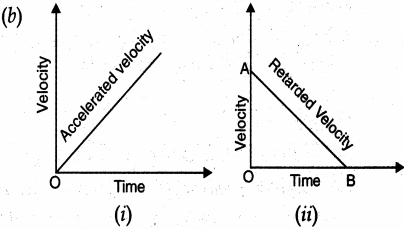
$(b)$ The velocity-time graphs are as follows:
$(i)$ For uniformly accelerated velocity,the graph is a straight line sloping upwards from the origin (or starting from a non-zero initial velocity),indicating that velocity increases at a constant rate over time.
$(ii)$ For uniformly retarded velocity,the graph is a straight line sloping downwards,indicating that velocity decreases at a constant rate over time until it reaches zero.
$(b)$ The velocity-time graphs are as follows:
$(i)$ For uniformly accelerated velocity,the graph is a straight line sloping upwards from the origin (or starting from a non-zero initial velocity),indicating that velocity increases at a constant rate over time.
$(ii)$ For uniformly retarded velocity,the graph is a straight line sloping downwards,indicating that velocity decreases at a constant rate over time until it reaches zero.
0 likes
View Solution134
Medium
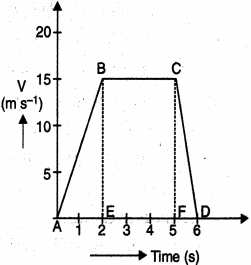
The velocity-time graph of a car is given below. The car weighs $1000 \ kg$.
$(i)$ What is the distance travelled by the car in the first $2 \ s$?
$(ii)$ What is the braking force at the end of $5 \ s$ to bring the car to a stop within one second?
$(i)$ What is the distance travelled by the car in the first $2 \ s$?
$(ii)$ What is the braking force at the end of $5 \ s$ to bring the car to a stop within one second?
Solution
(N/A) The distance travelled by the car in the first $2 \ s$ is equal to the area under the velocity-time graph from $t = 0$ to $t = 2 \ s$,which is the area of $\Delta ABE$.
Distance $= \text{Area of } \Delta ABE = \frac{1}{2} \times \text{base} \times \text{height}$
$= \frac{1}{2} \times 2 \ s \times 15 \ m/s = 15 \ m$.
$(ii)$ To find the braking force,we first calculate the acceleration (deceleration) from $t = 5 \ s$ to $t = 6 \ s$ using the slope of the line $CD$.
Initial velocity at $t = 5 \ s$ is $u = 15 \ m/s$.
Final velocity at $t = 6 \ s$ is $v = 0 \ m/s$.
Time interval $\Delta t = 6 \ s - 5 \ s = 1 \ s$.
Acceleration $a = \frac{v - u}{\Delta t} = \frac{0 - 15 \ m/s}{1 \ s} = -15 \ m/s^2$.
Using Newton's second law of motion,$F = m \times a$.
$F = 1000 \ kg \times (-15 \ m/s^2) = -15000 \ N$.
The negative sign indicates that the force is a braking force acting opposite to the direction of motion. Thus,the magnitude of the braking force is $15000 \ N$.
Distance $= \text{Area of } \Delta ABE = \frac{1}{2} \times \text{base} \times \text{height}$
$= \frac{1}{2} \times 2 \ s \times 15 \ m/s = 15 \ m$.
$(ii)$ To find the braking force,we first calculate the acceleration (deceleration) from $t = 5 \ s$ to $t = 6 \ s$ using the slope of the line $CD$.
Initial velocity at $t = 5 \ s$ is $u = 15 \ m/s$.
Final velocity at $t = 6 \ s$ is $v = 0 \ m/s$.
Time interval $\Delta t = 6 \ s - 5 \ s = 1 \ s$.
Acceleration $a = \frac{v - u}{\Delta t} = \frac{0 - 15 \ m/s}{1 \ s} = -15 \ m/s^2$.
Using Newton's second law of motion,$F = m \times a$.
$F = 1000 \ kg \times (-15 \ m/s^2) = -15000 \ N$.
The negative sign indicates that the force is a braking force acting opposite to the direction of motion. Thus,the magnitude of the braking force is $15000 \ N$.
0 likes
View Solution135
Difficult
Prove that if a body is thrown vertically upward,the time of ascent is equal to the time of descent.
Solution
(N/A) For upward motion:
$v = u - gt$
At the highest point,final velocity $v = 0$.
So,$0 = u - gt_1$,which gives $t_1 = \frac{u}{g}$ $....(1)$
For downward motion:
The body starts from rest at the highest point,so initial velocity $u' = 0$.
Using $s = ut + \frac{1}{2}at^2$,where $s = h$ (maximum height) and $a = g$:
$h = 0 + \frac{1}{2}gt_2^2 \implies t_2 = \sqrt{\frac{2h}{g}}$.
Since $h = \frac{u^2}{2g}$,substituting this gives $t_2 = \sqrt{\frac{2(u^2/2g)}{g}} = \sqrt{\frac{u^2}{g^2}} = \frac{u}{g}$ $....(2)$
Comparing $(1)$ and $(2)$,$t_1 = t_2$. Thus,the time of ascent is equal to the time of descent.
$v = u - gt$
At the highest point,final velocity $v = 0$.
So,$0 = u - gt_1$,which gives $t_1 = \frac{u}{g}$ $....(1)$
For downward motion:
The body starts from rest at the highest point,so initial velocity $u' = 0$.
Using $s = ut + \frac{1}{2}at^2$,where $s = h$ (maximum height) and $a = g$:
$h = 0 + \frac{1}{2}gt_2^2 \implies t_2 = \sqrt{\frac{2h}{g}}$.
Since $h = \frac{u^2}{2g}$,substituting this gives $t_2 = \sqrt{\frac{2(u^2/2g)}{g}} = \sqrt{\frac{u^2}{g^2}} = \frac{u}{g}$ $....(2)$
Comparing $(1)$ and $(2)$,$t_1 = t_2$. Thus,the time of ascent is equal to the time of descent.
1 likes
View Solution136
Medium
$A$ body thrown in the vertically upward direction rises up to a height $h$ and comes back to the position of its start. Calculate: $(a)$ the total distance travelled by the body and $(b)$ the displacement of the body. Under what condition will the magnitude of the displacement be equal to the distance travelled by an object?
Solution
(N/A) Since the body travels a distance $h$ upwards and $h$ downwards,the total distance travelled is $h + h = 2h$.
$(b)$ As the body returns to its starting point,the displacement is $0$.
The magnitude of the displacement is equal to the distance travelled if the object moves along a straight line in a single direction without changing its direction.
$(b)$ As the body returns to its starting point,the displacement is $0$.
The magnitude of the displacement is equal to the distance travelled if the object moves along a straight line in a single direction without changing its direction.
0 likes
View Solution137
Medium
Draw the distance$-$time graph for the following situations:
$(a)$ When a body is stationary.
$(b)$ When a body is moving with a uniform speed.
$(c)$ When a body is moving with non$-$uniform speed.
$(a)$ When a body is stationary.
$(b)$ When a body is moving with a uniform speed.
$(c)$ When a body is moving with non$-$uniform speed.
Solution
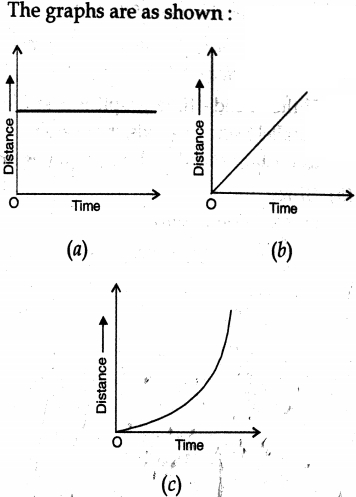
(N/A) When a body is stationary,its distance from the origin does not change with time. The graph is a straight line parallel to the time axis.
$(b)$ When a body is moving with a uniform speed,it covers equal distances in equal intervals of time. The graph is a straight line passing through the origin.
$(c)$ When a body is moving with non$-$uniform speed,it covers unequal distances in equal intervals of time. The graph is a curved line.
$(b)$ When a body is moving with a uniform speed,it covers equal distances in equal intervals of time. The graph is a straight line passing through the origin.
$(c)$ When a body is moving with non$-$uniform speed,it covers unequal distances in equal intervals of time. The graph is a curved line.
0 likes
View Solution138
Medium
Define 'average speed'. An object moves with a uniform speed of $10\, m s^{-1}$ for $5\, s$ and then with a uniform speed of $5\, m s^{-1}$ for $10\, s$. Find its average speed.
Solution
$(6.67\, m s^{-1})$ Average speed of an object is defined as the total distance travelled divided by the total time taken.
Step $1$: Calculate the total distance covered.
Distance for the first part $= 10\, m s^{-1} \times 5\, s = 50\, m$.
Distance for the second part $= 5\, m s^{-1} \times 10\, s = 50\, m$.
Total distance $= 50\, m + 50\, m = 100\, m$.
Step $2$: Calculate the total time taken.
Total time $= 5\, s + 10\, s = 15\, s$.
Step $3$: Calculate the average speed.
Average speed $= \frac{\text{Total distance}}{\text{Total time}} = \frac{100\, m}{15\, s} \approx 6.67\, m s^{-1}$.
Step $1$: Calculate the total distance covered.
Distance for the first part $= 10\, m s^{-1} \times 5\, s = 50\, m$.
Distance for the second part $= 5\, m s^{-1} \times 10\, s = 50\, m$.
Total distance $= 50\, m + 50\, m = 100\, m$.
Step $2$: Calculate the total time taken.
Total time $= 5\, s + 10\, s = 15\, s$.
Step $3$: Calculate the average speed.
Average speed $= \frac{\text{Total distance}}{\text{Total time}} = \frac{100\, m}{15\, s} \approx 6.67\, m s^{-1}$.
0 likes
View Solution139
Medium
What does the odometer of an automobile measure? Which of the following is moving faster? Justify your answer.
$(i)$ $A$ scooter moving with a speed of $300 \, m$ per minute.
$(ii)$ $A$ car moving with a speed of $36 \, km$ per hour.
$(i)$ $A$ scooter moving with a speed of $300 \, m$ per minute.
$(ii)$ $A$ car moving with a speed of $36 \, km$ per hour.
Solution
(B) The odometer of an automobile measures the distance traveled by the vehicle.
To compare the speeds,we convert both into $m \, s^{-1}$:
$(i)$ Speed of scooter $= 300 \, m / 60 \, s = 5 \, m \, s^{-1}$.
$(ii)$ Speed of car $= 36 \, km/h = 36 \times (1000 \, m / 3600 \, s) = 36 \times (5/18) \, m \, s^{-1} = 10 \, m \, s^{-1}$.
Since $10 \, m \, s^{-1} > 5 \, m \, s^{-1}$,the car is moving faster than the scooter.
To compare the speeds,we convert both into $m \, s^{-1}$:
$(i)$ Speed of scooter $= 300 \, m / 60 \, s = 5 \, m \, s^{-1}$.
$(ii)$ Speed of car $= 36 \, km/h = 36 \times (1000 \, m / 3600 \, s) = 36 \times (5/18) \, m \, s^{-1} = 10 \, m \, s^{-1}$.
Since $10 \, m \, s^{-1} > 5 \, m \, s^{-1}$,the car is moving faster than the scooter.
0 likes
View Solution140
Medium
Velocity-time graph for the motion of an object in a straight path is a straight line parallel to the time axis.
$(a)$ Identify the nature of motion of the body.
$(b)$ Find the acceleration of the body.
$(c)$ Draw the shape of distance-time graph for this type of motion.
$(a)$ Identify the nature of motion of the body.
$(b)$ Find the acceleration of the body.
$(c)$ Draw the shape of distance-time graph for this type of motion.
Solution
(N/A) If the velocity-time graph is a straight line parallel to the time axis,the object moves with a constant velocity and the motion is uniform.
$(b)$ Since velocity is constant,the change in velocity is zero. Therefore,acceleration,which is the rate of change of velocity,is zero.
$(c)$ For uniform motion,the distance-time graph is a straight line passing through the origin,as shown in the image.
$(b)$ Since velocity is constant,the change in velocity is zero. Therefore,acceleration,which is the rate of change of velocity,is zero.
$(c)$ For uniform motion,the distance-time graph is a straight line passing through the origin,as shown in the image.
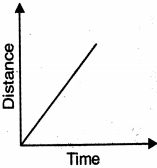
0 likes
View Solution141
Difficult
Draw a velocity-time graph for a body which starts to move with initial velocity $u$ under a constant acceleration $a$ for time $t$. Using this graph,derive an expression for the distance covered $S$ in time $t$.
Solution
(N/A) The velocity-time graph for a body moving with constant acceleration $a$ and initial velocity $u$ is shown in the figure.
The distance covered $S$ by the object in time $t$ is equal to the area under the velocity-time graph.
The area under the graph is the sum of the area of the rectangle $OACD$ and the area of the triangle $ABC$ on top of it.
The area of the rectangle $OACD$ is given by: $\text{Area} = \text{length} \times \text{breadth} = t \times u = ut$.
The area of the triangle $ABC$ is given by: $\text{Area} = \frac{1}{2} \times \text{base} \times \text{height} = \frac{1}{2} \times t \times (v - u)$.
Since the total distance $S$ is the sum of these areas,we have:
$S = ut + \frac{1}{2} \times t \times (v - u)$ $....(1)$
From the first equation of motion,we know that $v = u + at$,which implies $v - u = at$.
Substituting $(v - u) = at$ into equation $(1)$,we get:
$S = ut + \frac{1}{2} \times t \times (at)$
$S = ut + \frac{1}{2}at^{2}$
The distance covered $S$ by the object in time $t$ is equal to the area under the velocity-time graph.
The area under the graph is the sum of the area of the rectangle $OACD$ and the area of the triangle $ABC$ on top of it.
The area of the rectangle $OACD$ is given by: $\text{Area} = \text{length} \times \text{breadth} = t \times u = ut$.
The area of the triangle $ABC$ is given by: $\text{Area} = \frac{1}{2} \times \text{base} \times \text{height} = \frac{1}{2} \times t \times (v - u)$.
Since the total distance $S$ is the sum of these areas,we have:
$S = ut + \frac{1}{2} \times t \times (v - u)$ $....(1)$
From the first equation of motion,we know that $v = u + at$,which implies $v - u = at$.
Substituting $(v - u) = at$ into equation $(1)$,we get:
$S = ut + \frac{1}{2} \times t \times (at)$
$S = ut + \frac{1}{2}at^{2}$
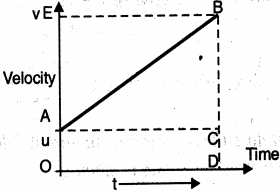
0 likes
View Solution142
Medium
Study the given velocity-time graph and answer the following questions:
$(i)$ Which part of the graph shows accelerated motion?
$(ii)$ Which part of the graph shows retarded motion?
$(iii)$ Calculate the distance travelled by the body in the first $4 \ s$ of the journey graphically.
$(i)$ Which part of the graph shows accelerated motion?
$(ii)$ Which part of the graph shows retarded motion?
$(iii)$ Calculate the distance travelled by the body in the first $4 \ s$ of the journey graphically.
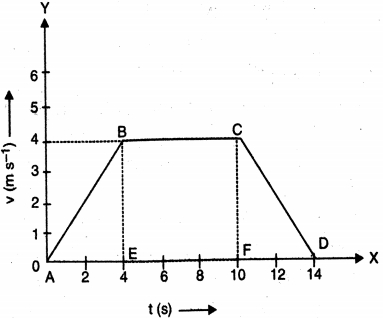
Solution
(N/A) $(i)$ The part $AB$ of the graph shows acceleration,as the velocity increases with time.
$(ii)$ The part $CD$ of the graph shows retardation (deceleration),as the velocity decreases with time.
$(iii)$ The distance travelled is equal to the area under the $v-t$ graph.
For the first $4 \ s$,the area is represented by the triangle $ABE$.
Distance $S = \text{Area of } \Delta ABE = \frac{1}{2} \times \text{base} \times \text{height}$
$S = \frac{1}{2} \times (AE) \times (BE)$
$S = \frac{1}{2} \times 4 \ s \times 4 \ m/s = 8 \ m$.
$(ii)$ The part $CD$ of the graph shows retardation (deceleration),as the velocity decreases with time.
$(iii)$ The distance travelled is equal to the area under the $v-t$ graph.
For the first $4 \ s$,the area is represented by the triangle $ABE$.
Distance $S = \text{Area of } \Delta ABE = \frac{1}{2} \times \text{base} \times \text{height}$
$S = \frac{1}{2} \times (AE) \times (BE)$
$S = \frac{1}{2} \times 4 \ s \times 4 \ m/s = 8 \ m$.
0 likes
View Solution143
Medium
Define distance and displacement. $A$ body covers one complete revolution around a circular park of circumference $176 \, m$ in $4$ minutes. Find the displacement of the body after $6$ minutes.
Solution
(N/A) Distance: It is defined as the total path length covered by a body.
Displacement: It is defined as the shortest distance between the initial and final positions of a body.
Given that the circumference of the circular park is $176 \, m$. The body completes one revolution in $4$ minutes.
After $6$ minutes,the number of revolutions completed $= \frac{6}{4} = 1.5$ revolutions.
Since $1$ revolution brings the body back to the starting point,after $1.5$ revolutions,the body will be at a position diametrically opposite to the starting point.
Given $2 \pi r = 176 \, m$,where $r$ is the radius.
$r = \frac{176}{2 \pi} = \frac{176 \times 7}{2 \times 22} = 28 \, m$.
The displacement after $1.5$ revolutions is the diameter of the circular path.
Displacement $= 2r = 2 \times 28 = 56 \, m$.
Displacement: It is defined as the shortest distance between the initial and final positions of a body.
Given that the circumference of the circular park is $176 \, m$. The body completes one revolution in $4$ minutes.
After $6$ minutes,the number of revolutions completed $= \frac{6}{4} = 1.5$ revolutions.
Since $1$ revolution brings the body back to the starting point,after $1.5$ revolutions,the body will be at a position diametrically opposite to the starting point.
Given $2 \pi r = 176 \, m$,where $r$ is the radius.
$r = \frac{176}{2 \pi} = \frac{176 \times 7}{2 \times 22} = 28 \, m$.
The displacement after $1.5$ revolutions is the diameter of the circular path.
Displacement $= 2r = 2 \times 28 = 56 \, m$.
0 likes
View Solution144
Medium
The velocity$-$time graph of a truck is plotted below.
$(a)$ Calculate the magnitude of displacement of the truck in $15$ seconds.
$(b)$ During which part of the journey was the truck decelerating?
$(c)$ Calculate the magnitude of average velocity of the truck.
$(a)$ Calculate the magnitude of displacement of the truck in $15$ seconds.
$(b)$ During which part of the journey was the truck decelerating?
$(c)$ Calculate the magnitude of average velocity of the truck.
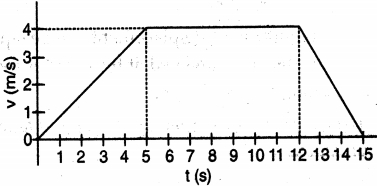
Solution
(N/A) Displacement is equal to the area under the velocity$-$time graph.
The graph consists of a triangle from $t = 0$ to $t = 5$ s, a rectangle from $t = 5$ to $t = 12$ s, and a triangle from $t = 12$ to $t = 15$ s.
Area $= (1/2 \times \text{base} \times \text{height}) + (\text{length} \times \text{breadth}) + (1/2 \times \text{base} \times \text{height})$
Area $= (1/2 \times 5 \times 4) + (7 \times 4) + (1/2 \times 3 \times 4) = 10 + 28 + 6 = 44 \text{ m}$.
$(b)$ Deceleration occurs when the velocity decreases with time. This corresponds to the part of the graph where the slope is negative, which is from $t = 12$ s to $t = 15$ s.
$(c)$ Average velocity $= \text{Total displacement} / \text{Total time} = 44 \text{ m} / 15 \text{ s} = 2.93 \text{ m s}^{-1}$.
The graph consists of a triangle from $t = 0$ to $t = 5$ s, a rectangle from $t = 5$ to $t = 12$ s, and a triangle from $t = 12$ to $t = 15$ s.
Area $= (1/2 \times \text{base} \times \text{height}) + (\text{length} \times \text{breadth}) + (1/2 \times \text{base} \times \text{height})$
Area $= (1/2 \times 5 \times 4) + (7 \times 4) + (1/2 \times 3 \times 4) = 10 + 28 + 6 = 44 \text{ m}$.
$(b)$ Deceleration occurs when the velocity decreases with time. This corresponds to the part of the graph where the slope is negative, which is from $t = 12$ s to $t = 15$ s.
$(c)$ Average velocity $= \text{Total displacement} / \text{Total time} = 44 \text{ m} / 15 \text{ s} = 2.93 \text{ m s}^{-1}$.
0 likes
View Solution145
Medium
The following figure is the speed-time graph for a rocket from the moment when the fuel starts to burn,i.e.,at time $t=0$.
$(a)$ State the acceleration of the rocket at $t=0$.
$(b)$ State what happens to the acceleration of the rocket between $t=5 \, s$ and $t=60 \, s$.
$(c)$ Calculate the acceleration of the rocket at $t=80 \, s$. Give a reason for your answer.
$(d)$ The total mass of the rocket at $t=80 \, s$ is $1.6 \times 10^{6} \, kg$. Calculate the resultant force on the rocket at this time. Give a reason for your answer.
$(a)$ State the acceleration of the rocket at $t=0$.
$(b)$ State what happens to the acceleration of the rocket between $t=5 \, s$ and $t=60 \, s$.
$(c)$ Calculate the acceleration of the rocket at $t=80 \, s$. Give a reason for your answer.
$(d)$ The total mass of the rocket at $t=80 \, s$ is $1.6 \times 10^{6} \, kg$. Calculate the resultant force on the rocket at this time. Give a reason for your answer.
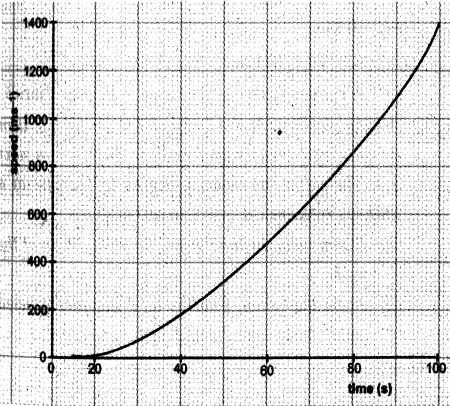
Solution
(N/A) At $t=0$,the speed is $0$ and the slope of the graph is $0$. Therefore,the initial acceleration is $0 \, m/s^2$.
$(b)$ Between $t=5 \, s$ and $t=60 \, s$,the slope of the speed-time graph is increasing. Since the slope of a speed-time graph represents acceleration,the acceleration of the rocket is increasing during this interval.
$(c)$ At $t=80 \, s$,the graph is a straight line. The slope of this line is constant. Calculating the slope between $t=60 \, s$ $(v \approx 480 \, m/s)$ and $t=100 \, s$ $(v = 1400 \, m/s)$: $a = \frac{1400 - 480}{100 - 60} = \frac{920}{40} = 23 \, m/s^2$. The acceleration is constant because the graph is linear in this region.
$(d)$ Using Newton's second law,$F = ma$. Given $m = 1.6 \times 10^{6} \, kg$ and $a = 23 \, m/s^2$,the resultant force $F = 1.6 \times 10^{6} \times 23 = 3.68 \times 10^{7} \, N$. The force is non-zero because the rocket is accelerating.
$(b)$ Between $t=5 \, s$ and $t=60 \, s$,the slope of the speed-time graph is increasing. Since the slope of a speed-time graph represents acceleration,the acceleration of the rocket is increasing during this interval.
$(c)$ At $t=80 \, s$,the graph is a straight line. The slope of this line is constant. Calculating the slope between $t=60 \, s$ $(v \approx 480 \, m/s)$ and $t=100 \, s$ $(v = 1400 \, m/s)$: $a = \frac{1400 - 480}{100 - 60} = \frac{920}{40} = 23 \, m/s^2$. The acceleration is constant because the graph is linear in this region.
$(d)$ Using Newton's second law,$F = ma$. Given $m = 1.6 \times 10^{6} \, kg$ and $a = 23 \, m/s^2$,the resultant force $F = 1.6 \times 10^{6} \times 23 = 3.68 \times 10^{7} \, N$. The force is non-zero because the rocket is accelerating.
0 likes
View Solution146
Medium
$(a)$ Derive graphically the equation for velocity$-$time relation.
$(b)$ Name the device used to measure distance travelled by a vehicle.
$(c)$ Can displacement of a moving object be zero? Give reason.
$(b)$ Name the device used to measure distance travelled by a vehicle.
$(c)$ Can displacement of a moving object be zero? Give reason.
Solution
(N/A) Consider a velocity$-$time graph where an object starts with initial velocity $u$ at time $t=0$ and reaches final velocity $v$ at time $t$. The slope of the velocity$-$time graph represents acceleration $(a)$.
Slope $= \frac{\text{Change in velocity}}{\text{Time taken}} = \frac{v - u}{t}$.
Therefore,$a = \frac{v - u}{t}$,which gives $at = v - u$,or $v = u + at$.
$(b)$ The device used to measure the distance travelled by a vehicle is called an odometer.
$(c)$ Yes,the displacement of a moving object can be zero. This happens if the object returns to its initial starting position after completing its motion,as displacement is the shortest distance between the initial and final positions.
Slope $= \frac{\text{Change in velocity}}{\text{Time taken}} = \frac{v - u}{t}$.
Therefore,$a = \frac{v - u}{t}$,which gives $at = v - u$,or $v = u + at$.
$(b)$ The device used to measure the distance travelled by a vehicle is called an odometer.
$(c)$ Yes,the displacement of a moving object can be zero. This happens if the object returns to its initial starting position after completing its motion,as displacement is the shortest distance between the initial and final positions.
0 likes
View Solution147
Difficult
The velocity-time graph of cars $A$ and $B$ which start from the same place and move along a straight road in the same direction is shown below.
Calculate:
$(a)$ The acceleration of car $B$ between $2 \, s$ and $4 \, s$.
$(b)$ The time at which both the cars have the same velocity.
$(c)$ The distance travelled by the two cars $A$ and $B$ in $8 \, s$.
$(d)$ Which of the two cars is ahead after $8 \, s$ and by how much?
Calculate:
$(a)$ The acceleration of car $B$ between $2 \, s$ and $4 \, s$.
$(b)$ The time at which both the cars have the same velocity.
$(c)$ The distance travelled by the two cars $A$ and $B$ in $8 \, s$.
$(d)$ Which of the two cars is ahead after $8 \, s$ and by how much?
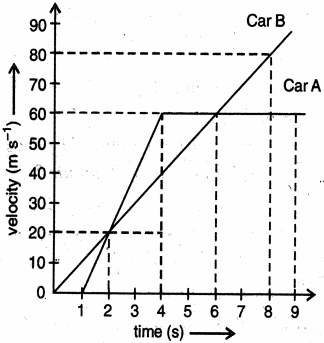
Solution
$(a)$ Acceleration is the slope of the velocity-time graph.
For car $B$, between $t = 2 \, s$ and $t = 4 \, s$, the velocity changes from $20 \, m/s$ to $40 \, m/s$.
$a = \frac{v_2 - v_1}{t_2 - t_1} = \frac{40 - 20}{4 - 2} = \frac{20}{2} = 10 \, m/s^2$.
$(b)$ Both cars have the same velocity where their graphs intersect. Looking at the graph, the intersection point is at $t = 2 \, s$ (velocity $= 20 \, m/s$) and $t = 6 \, s$ (velocity $= 60 \, m/s$).
$(c)$ Distance travelled is the area under the velocity-time graph.
For car $A$: The area is a trapezoid from $t = 1$ to $t = 4$ plus a rectangle from $t = 4$ to $t = 8$.
Area $= (\frac{1}{2} \times (4 - 1) \times 60) + (60 \times (8 - 4)) = (\frac{1}{2} \times 3 \times 60) + (60 \times 4) = 90 + 240 = 330 \, m$.
For car $B$: The area is a triangle from $t = 0$ to $t = 8$.
Area $= \frac{1}{2} \times \text{base} \times \text{height} = \frac{1}{2} \times 8 \times 80 = 320 \, m$.
$(d)$ After $8 \, s$, car $A$ has travelled $330 \, m$ and car $B$ has travelled $320 \, m$.
Therefore, car $A$ is ahead by $330 - 320 = 10 \, m$.
For car $B$, between $t = 2 \, s$ and $t = 4 \, s$, the velocity changes from $20 \, m/s$ to $40 \, m/s$.
$a = \frac{v_2 - v_1}{t_2 - t_1} = \frac{40 - 20}{4 - 2} = \frac{20}{2} = 10 \, m/s^2$.
$(b)$ Both cars have the same velocity where their graphs intersect. Looking at the graph, the intersection point is at $t = 2 \, s$ (velocity $= 20 \, m/s$) and $t = 6 \, s$ (velocity $= 60 \, m/s$).
$(c)$ Distance travelled is the area under the velocity-time graph.
For car $A$: The area is a trapezoid from $t = 1$ to $t = 4$ plus a rectangle from $t = 4$ to $t = 8$.
Area $= (\frac{1}{2} \times (4 - 1) \times 60) + (60 \times (8 - 4)) = (\frac{1}{2} \times 3 \times 60) + (60 \times 4) = 90 + 240 = 330 \, m$.
For car $B$: The area is a triangle from $t = 0$ to $t = 8$.
Area $= \frac{1}{2} \times \text{base} \times \text{height} = \frac{1}{2} \times 8 \times 80 = 320 \, m$.
$(d)$ After $8 \, s$, car $A$ has travelled $330 \, m$ and car $B$ has travelled $320 \, m$.
Therefore, car $A$ is ahead by $330 - 320 = 10 \, m$.
0 likes
View Solution148
Difficult
The following graph describes the motion of a girl going to meet her friend who stays $50 \ m$ from her house.
$(i)$ How much time does she take to reach her friend's house?
$(ii)$ What is the distance travelled by the girl during the time-interval $0$ to $12$ minutes?
$(iii)$ During which time-interval is she moving towards her house?
$(iv)$ For how many minutes was she at rest during the entire journey?
$(v)$ Calculate the speed by which she returned home.
$(i)$ How much time does she take to reach her friend's house?
$(ii)$ What is the distance travelled by the girl during the time-interval $0$ to $12$ minutes?
$(iii)$ During which time-interval is she moving towards her house?
$(iv)$ For how many minutes was she at rest during the entire journey?
$(v)$ Calculate the speed by which she returned home.
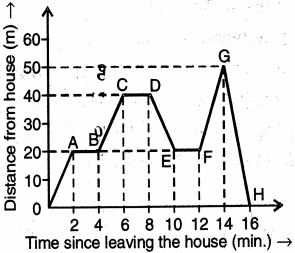
Solution
(N/A) $(i)$ Looking at the graph,the girl reaches the $50 \ m$ mark (friend's house) at $14$ minutes.
$(ii)$ From $0$ to $2$ min,distance $= 20 \ m$. From $2$ to $4$ min,distance $= 0 \ m$. From $4$ to $6$ min,distance $= 40 - 20 = 20 \ m$. From $6$ to $8$ min,distance $= 0 \ m$. From $8$ to $10$ min,distance $= 40 - 20 = 20 \ m$. From $10$ to $12$ min,distance $= 0 \ m$. Total distance $= 20 + 0 + 20 + 0 + 20 + 0 = 60 \ m$.
$(iii)$ She moves towards her house when the distance from the house decreases. This happens during the intervals $8$ to $10$ minutes and $14$ to $16$ minutes.
$(iv)$ She is at rest when the distance remains constant (horizontal line). This occurs during $2-4$ min ($2$ min),$6-8$ min ($2$ min),and $10-12$ min ($2$ min). Total time at rest $= 2 + 2 + 2 = 6$ minutes.
$(v)$ She returns home from $14$ to $16$ minutes. Distance covered $= 50 \ m$. Time taken $= 2$ minutes. Speed $= \frac{\text{Total distance}}{\text{Total time}} = \frac{50 \ m}{2 \ min} = 25 \ m/min$.
$(ii)$ From $0$ to $2$ min,distance $= 20 \ m$. From $2$ to $4$ min,distance $= 0 \ m$. From $4$ to $6$ min,distance $= 40 - 20 = 20 \ m$. From $6$ to $8$ min,distance $= 0 \ m$. From $8$ to $10$ min,distance $= 40 - 20 = 20 \ m$. From $10$ to $12$ min,distance $= 0 \ m$. Total distance $= 20 + 0 + 20 + 0 + 20 + 0 = 60 \ m$.
$(iii)$ She moves towards her house when the distance from the house decreases. This happens during the intervals $8$ to $10$ minutes and $14$ to $16$ minutes.
$(iv)$ She is at rest when the distance remains constant (horizontal line). This occurs during $2-4$ min ($2$ min),$6-8$ min ($2$ min),and $10-12$ min ($2$ min). Total time at rest $= 2 + 2 + 2 = 6$ minutes.
$(v)$ She returns home from $14$ to $16$ minutes. Distance covered $= 50 \ m$. Time taken $= 2$ minutes. Speed $= \frac{\text{Total distance}}{\text{Total time}} = \frac{50 \ m}{2 \ min} = 25 \ m/min$.
0 likes
View Solution149
Medium
The distance-time graph below represents the motion of two buses $A$ and $B$.
$(i)$ What is the distance by which bus $B$ was ahead of bus $A$ initially?
$(ii)$ Do they ever meet each other? If so,when?
$(iii)$ What is the distance travelled by bus $A$ when it overtakes bus $B$?
$(iv)$ Find out the distance by which bus $A$ was ahead of bus $B$ at $t = 12 \ h$.
$(v)$ Which one of them is moving faster? Give reason.
$(i)$ What is the distance by which bus $B$ was ahead of bus $A$ initially?
$(ii)$ Do they ever meet each other? If so,when?
$(iii)$ What is the distance travelled by bus $A$ when it overtakes bus $B$?
$(iv)$ Find out the distance by which bus $A$ was ahead of bus $B$ at $t = 12 \ h$.
$(v)$ Which one of them is moving faster? Give reason.
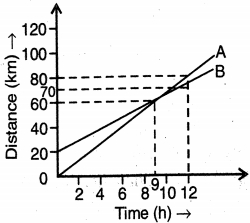
Solution
(N/A) $(i)$ At $t = 0 \ h$,bus $B$ is at $20 \ km$ and bus $A$ is at $0 \ km$. Thus,bus $B$ was ahead by $20 \ km$.
$(ii)$ Yes,they meet at the point where the two lines intersect,which is at $t = 9 \ h$.
$(iii)$ At the point of intersection $(t = 9 \ h)$,the distance on the $y$-axis is $60 \ km$. Thus,bus $A$ has travelled $60 \ km$.
$(iv)$ At $t = 12 \ h$,bus $A$ is at $80 \ km$ and bus $B$ is at $70 \ km$. The difference is $80 \ km - 70 \ km = 10 \ km$.
$(v)$ Bus $A$ is moving faster because the slope of its distance-time graph is steeper than that of bus $B$,indicating a higher speed.
$(ii)$ Yes,they meet at the point where the two lines intersect,which is at $t = 9 \ h$.
$(iii)$ At the point of intersection $(t = 9 \ h)$,the distance on the $y$-axis is $60 \ km$. Thus,bus $A$ has travelled $60 \ km$.
$(iv)$ At $t = 12 \ h$,bus $A$ is at $80 \ km$ and bus $B$ is at $70 \ km$. The difference is $80 \ km - 70 \ km = 10 \ km$.
$(v)$ Bus $A$ is moving faster because the slope of its distance-time graph is steeper than that of bus $B$,indicating a higher speed.
0 likes
View Solution150
Medium
$A$ body moves with a velocity of $2\, m s^{-1}$ for $5\, s$,then its velocity increases uniformly to $10\, m s^{-1}$ in the next $5\, s$. Thereafter,its velocity begins to decrease at a uniform rate until it comes to rest after $5\, s$.
$(i)$ Plot a velocity-time graph for the motion of the body.
$(ii)$ From the graph,find the total distance covered by the body after $2\, s$ and $12\, s$.
$(i)$ Plot a velocity-time graph for the motion of the body.
$(ii)$ From the graph,find the total distance covered by the body after $2\, s$ and $12\, s$.
Solution
(N/A) $(ii)$ According to the velocity-time graph:
Distance moved by the body after $2\, s$ is equal to the area under the graph from $t = 0$ to $t = 2\, s$.
Area $= 2\, m s^{-1} \times 2\, s = 4\, m$.
Distance covered by the body after $12\, s$ is the total area under the graph from $t = 0$ to $t = 12\, s$.
This area consists of the rectangle for the first $5\, s$,the trapezoid for the next $5\, s$,and the trapezoid for the final $2\, s$ (from $t = 10\, s$ to $t = 12\, s$).
Total Distance $= (2\, m s^{-1} \times 5\, s) + \frac{1}{2} \times (2\, m s^{-1} + 10\, m s^{-1}) \times 5\, s + \frac{1}{2} \times (10\, m s^{-1} + 6\, m s^{-1}) \times 2\, s$
$= 10\, m + 30\, m + 16\, m = 56\, m$.
Distance moved by the body after $2\, s$ is equal to the area under the graph from $t = 0$ to $t = 2\, s$.
Area $= 2\, m s^{-1} \times 2\, s = 4\, m$.
Distance covered by the body after $12\, s$ is the total area under the graph from $t = 0$ to $t = 12\, s$.
This area consists of the rectangle for the first $5\, s$,the trapezoid for the next $5\, s$,and the trapezoid for the final $2\, s$ (from $t = 10\, s$ to $t = 12\, s$).
Total Distance $= (2\, m s^{-1} \times 5\, s) + \frac{1}{2} \times (2\, m s^{-1} + 10\, m s^{-1}) \times 5\, s + \frac{1}{2} \times (10\, m s^{-1} + 6\, m s^{-1}) \times 2\, s$
$= 10\, m + 30\, m + 16\, m = 56\, m$.
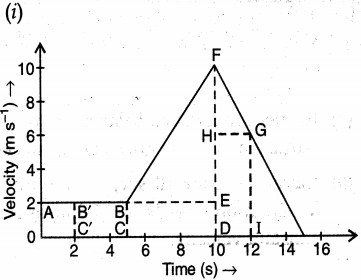
0 likes
View SolutionMOTION — Mix Example - MOTION · Frequently Asked Questions
1Are these MOTION questions useful for JEE and NEET?
Yes. All questions in this section are mapped to JEE Main and NEET exam patterns. Previous year questions from JEE Main, NEET, GUJCET and state-level exams are included with full solutions.
2Can I switch to Hindi or Gujarati for these questions?
Yes. Use the language tabs in the hero section or the sidebar to view the same questions and solutions in English, Hindi or Gujarati.
3How do I generate a question paper from this subtopic?
Use the Vedclass Exam Paper Generator — select the chapter and subtopic, set difficulty, and generate Sets A, B, C, D automatically. First 3 chapters of every subject are free.
Vedclass Products
For Students
Vedclass Test Series
Mock tests in real JEE/NEET style with performance analysis. 5-day free trial.
Start Free TrialFor Teachers
Exam Paper Generator
Generate Set A/B/C/D papers from this chapter in 2 minutes. 3 chapters free.
Try FreeFor Institutes
Online Exam Module
Live online exams with unlimited students, 360° analytics & white-label branding.
See DemoFor Teachers & Institutes
Generate a MOTION Exam Paper in 2 Minutes
Select subtopic & difficulty — Sets A, B, C, D auto-generated with No Repeat logic.
First 3 chapters of every subject are free — no payment required.