
A English
Mix Example - MOTION Questions in English
Class 9 Science · MOTION · Mix Example - MOTION
247+
Questions
English
Language
100%
With Solutions
Showing 50 of 247 questions in English
51
Easy
What is the average velocity of a particle when it returns to the starting point? Can its average speed be zero?
Solution
(N/A) Average velocity is defined as the total displacement divided by the total time taken. When a particle returns to its starting point,the total displacement is $0$. Therefore,the average velocity is $0/t = 0$.
Average speed is defined as the total distance traveled divided by the total time taken. Since distance is a scalar quantity and is always positive for a moving object,the total distance covered cannot be $0$ if the particle has moved. Thus,the average speed cannot be zero.
Average speed is defined as the total distance traveled divided by the total time taken. Since distance is a scalar quantity and is always positive for a moving object,the total distance covered cannot be $0$ if the particle has moved. Thus,the average speed cannot be zero.
0 likes
View Solution52
EasyMCQ
What is the relationship between the distance travelled and the time elapsed for motion with uniform velocity?
A
Distance is directly proportional to time.
B
Distance is inversely proportional to time.
C
Distance remains constant regardless of time.
D
Distance is independent of time.
Solution
(A) For an object moving with uniform velocity,the distance travelled is directly proportional to the time elapsed.
This means that the object covers equal distances in equal intervals of time,no matter how small these intervals are.
Mathematically,this is expressed as $s = v \times t$,where $s$ is distance,$v$ is uniform velocity,and $t$ is time.
This means that the object covers equal distances in equal intervals of time,no matter how small these intervals are.
Mathematically,this is expressed as $s = v \times t$,where $s$ is distance,$v$ is uniform velocity,and $t$ is time.
0 likes
View Solution53
EasyMCQ
If the displacement $-$ time graph for a particle is parallel to the time axis, what is the velocity of the particle?
A
Positive
B
Negative
C
Zero
D
Infinite
Solution
(C) The velocity of a particle is defined as the rate of change of displacement with respect to time, given by the slope of the displacement $-$ time graph.
If the displacement $-$ time graph is parallel to the time axis, it means that the displacement of the particle does not change as time passes.
Since the displacement remains constant, the change in displacement $(\Delta s)$ is $0$.
Therefore, velocity $(v = \frac{\Delta s}{\Delta t})$ is $0$.
If the displacement $-$ time graph is parallel to the time axis, it means that the displacement of the particle does not change as time passes.
Since the displacement remains constant, the change in displacement $(\Delta s)$ is $0$.
Therefore, velocity $(v = \frac{\Delta s}{\Delta t})$ is $0$.
0 likes
View Solution54
Easy
What determines the direction of motion of an object: velocity or acceleration?
Solution
(A) The direction of motion of an object is determined by its velocity. Velocity is a vector quantity that includes both the magnitude (speed) and the direction of motion. Acceleration,on the other hand,represents the rate of change of velocity. While acceleration can change the magnitude or the direction of the velocity,it does not define the current direction of motion itself.
0 likes
View Solution55
EasyMCQ
What does the slope of the velocity$-$time graph represent?
A
Distance
B
Displacement
C
Acceleration
D
Speed
Solution
(C) The slope of a velocity$-$time graph is defined as the change in velocity divided by the change in time.
Mathematically, $\text{Slope} = \frac{\Delta v}{\Delta t}$.
Since the rate of change of velocity with respect to time is defined as acceleration, the slope of the velocity$-$time graph represents the acceleration of the object.
Mathematically, $\text{Slope} = \frac{\Delta v}{\Delta t}$.
Since the rate of change of velocity with respect to time is defined as acceleration, the slope of the velocity$-$time graph represents the acceleration of the object.
0 likes
View Solution56
Easy
$A$ car manufacturer advertises that the brakes are so perfect that the car stops instantaneously. Comment.
Solution
(N/A) The claim made by the manufacturer is scientifically incorrect.
If a car stops instantaneously,the time taken $(t)$ for the change in velocity would be $0$.
According to the formula for acceleration $(a = \frac{v - u}{t})$,if $t = 0$,the acceleration (or retardation) becomes infinite $(a = \infty)$.
In physical reality,it is impossible for any object to experience infinite acceleration or retardation,as it would require an infinite amount of force.
If a car stops instantaneously,the time taken $(t)$ for the change in velocity would be $0$.
According to the formula for acceleration $(a = \frac{v - u}{t})$,if $t = 0$,the acceleration (or retardation) becomes infinite $(a = \infty)$.
In physical reality,it is impossible for any object to experience infinite acceleration or retardation,as it would require an infinite amount of force.
0 likes
View Solution57
Easy
Give an example of a body which covers a certain distance,but its displacement is zero.
Solution
(N/A) An object moving in a circular path and returning to its starting point covers a distance equal to the circumference of the circle $(2 \pi r)$,but its displacement is zero because the initial and final positions are the same.
Another example is the Earth,which covers a very large distance in its rotation about its own axis in $24$ hours,but its displacement is zero because it returns to its original position.
Another example is the Earth,which covers a very large distance in its rotation about its own axis in $24$ hours,but its displacement is zero because it returns to its original position.
0 likes
View Solution58
Easy
Give an example of an accelerated body,moving with a uniform speed.
Solution
(N/A) An object moving in a circular path with a constant speed is an example of an accelerated body. This is because the direction of motion changes at every point along the circular path,which results in a change in velocity. Since acceleration is defined as the rate of change of velocity,the body is considered to be accelerated. $A$ common example is a dust particle on the circumference of a revolving bicycle wheel moving at a constant speed.
0 likes
View Solution59
EasyMCQ
Can the displacement of a particle be zero when the distance travelled is not zero?
A
Yes
B
No
C
Depends on the path
D
Cannot be determined
Solution
(A) Yes,the displacement of a particle can be zero even when the distance travelled is not zero.
This occurs when an object moves along a closed path and returns to its initial position.
For example,if a particle moves in a circular path of radius $r$ and completes one full revolution,the distance travelled is the circumference of the circle $(2\pi r)$,while the displacement is $0$ because the final position coincides with the initial position.
This occurs when an object moves along a closed path and returns to its initial position.
For example,if a particle moves in a circular path of radius $r$ and completes one full revolution,the distance travelled is the circumference of the circle $(2\pi r)$,while the displacement is $0$ because the final position coincides with the initial position.
0 likes
View Solution60
EasyMCQ
Why is the motion of an athlete moving along a circular path considered an accelerated motion?
A
Because the speed of the athlete changes.
B
Because the direction of motion changes continuously.
C
Because the athlete is running on a track.
D
Because the athlete is moving at a constant speed.
Solution
(B) An athlete moving along a circular path is considered to be in accelerated motion because the direction of the athlete's velocity changes at every point along the path.
Even if the speed (magnitude of velocity) remains constant,the change in direction implies a change in velocity.
Since acceleration is defined as the rate of change of velocity,a continuous change in the direction of motion results in continuous acceleration.
Even if the speed (magnitude of velocity) remains constant,the change in direction implies a change in velocity.
Since acceleration is defined as the rate of change of velocity,a continuous change in the direction of motion results in continuous acceleration.
0 likes
View Solution61
Easy
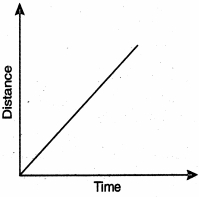
State the type of motion represented by the given graph.
Solution
The graph shows a straight line passing through the origin,representing a distance-time graph where the distance covered is directly proportional to the time taken.
This indicates that the object is moving with a constant speed.
Therefore,the type of motion represented is uniform motion.
This indicates that the object is moving with a constant speed.
Therefore,the type of motion represented is uniform motion.
0 likes
View Solution62
Easy
"The direction in which an object moves is given by the direction of velocity of the object and not by the direction of acceleration." Give an example to justify this statement.
Solution
(N/A) When an object is thrown vertically upwards, its velocity is directed upwards because it is moving away from the ground. However, the acceleration due to gravity $(g)$ acts downwards towards the center of the Earth. Since the object continues to move upwards despite the downward acceleration, it proves that the direction of motion is determined by the velocity and not by the acceleration.
0 likes
View Solution63
EasyMCQ
If the acceleration of the particle is constant in magnitude but not in direction,what type of path does the particle follow?
A
Straight line path
B
Circular path
C
Parabolic path
D
Elliptical path
Solution
(B) When the acceleration of a particle is constant in magnitude but its direction is always perpendicular to the velocity of the particle,the particle follows a circular path. This is the characteristic condition for uniform circular motion,where the centripetal acceleration changes the direction of velocity continuously while keeping the speed constant.
0 likes
View Solution64
Easy
Define velocity.
Solution
(N/A) Velocity is defined as the rate of change of displacement of an object. It is a vector quantity,meaning it has both magnitude and direction. The mathematical formula for velocity $(v)$ is given by $v = \frac{\Delta s}{\Delta t}$,where $\Delta s$ is the change in displacement and $\Delta t$ is the time interval. Its $SI$ unit is meters per second $(m/s)$.
0 likes
View Solution65
MediumMCQ
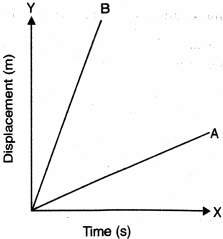
Two cars $A$ and $B$ have their displacement-time graph as given below. Which car has a greater velocity?
A
Car $A$
B
Car $B$
C
Both have equal velocity
D
Cannot be determined
Solution
(B) In a displacement-time graph,the slope of the line represents the velocity of the object.
Since the slope of the line for car $B$ is steeper than the slope of the line for car $A$,the velocity of car $B$ is greater than that of car $A$.
Since the slope of the line for car $B$ is steeper than the slope of the line for car $A$,the velocity of car $B$ is greater than that of car $A$.
0 likes
View Solution66
EasyMCQ
What can you say about the motion of a body if its displacement$-$time graph is a straight line parallel to the time axis?
A
The body is moving with uniform velocity.
B
The body is moving with uniform acceleration.
C
The body is at rest.
D
The body is moving with non-uniform velocity.
Solution
(C) In a displacement$-$time graph,the slope represents the velocity of the body.
If the graph is a straight line parallel to the time axis,the displacement of the body does not change with time.
This means the velocity of the body is $0 \ m/s$.
Therefore,the body is at rest.
If the graph is a straight line parallel to the time axis,the displacement of the body does not change with time.
This means the velocity of the body is $0 \ m/s$.
Therefore,the body is at rest.
0 likes
View Solution67
Easy
State the meaning of uniform circular motion.
Solution
(N/A) Uniform circular motion is defined as the motion of an object traveling along a circular path at a constant speed. In this type of motion,although the speed remains constant,the direction of velocity changes continuously at every point along the path,which means the object is constantly accelerating.
0 likes
View Solution68
Medium
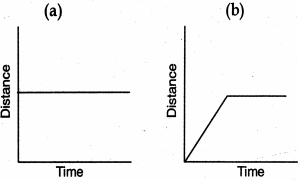
What kind of motion of a body is represented by the graphs given below?
Solution
(N/A) The graph shows a horizontal line parallel to the time axis,which indicates that the distance of the object does not change with time. Therefore,the object is at rest.
$(b)$ The graph shows a straight line for some time (uniform motion) followed by a horizontal line (rest). Since the speed is not constant throughout the entire duration,this represents non-uniform motion.
$(b)$ The graph shows a straight line for some time (uniform motion) followed by a horizontal line (rest). Since the speed is not constant throughout the entire duration,this represents non-uniform motion.
0 likes
View Solution69
EasyMCQ
Name the force which is responsible for change in position or state of an object.
A
Balanced force
B
Unbalanced force
C
Frictional force
D
Gravitational force
Solution
(B) An object remains in its state of rest or uniform motion unless acted upon by an external unbalanced force.
According to Newton's first law of motion,an unbalanced force is required to change the state of rest or the state of uniform motion of an object.
Therefore,the force responsible for the change in position or state of an object is the unbalanced force.
According to Newton's first law of motion,an unbalanced force is required to change the state of rest or the state of uniform motion of an object.
Therefore,the force responsible for the change in position or state of an object is the unbalanced force.
0 likes
View Solution70
Medium
$A$ person is running along a circular path in a park.
$(a)$ At what point does he change his direction while running?
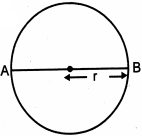
$(b)$ If he covers half of the circular path,what will be his displacement? Draw a diagram showing it.
$(a)$ At what point does he change his direction while running?
$(b)$ If he covers half of the circular path,what will be his displacement? Draw a diagram showing it.
Solution
(N/A) In circular motion,the direction of motion changes at each and every point along the path because the velocity vector is always tangent to the circle at any given point.
$(b)$ Displacement is the shortest distance between the initial and final positions. If a person starts at point $A$ and covers half of the circular path to reach point $B$,the displacement is the straight-line distance between $A$ and $B$,which is equal to the diameter of the circle $(2r)$.
Diagram: The image shows a circle with points $A$ and $B$ at opposite ends of a diameter,with the radius $r$ indicated from the center to point $B$. The displacement is the straight line $AB = 2r$.
$(b)$ Displacement is the shortest distance between the initial and final positions. If a person starts at point $A$ and covers half of the circular path to reach point $B$,the displacement is the straight-line distance between $A$ and $B$,which is equal to the diameter of the circle $(2r)$.
Diagram: The image shows a circle with points $A$ and $B$ at opposite ends of a diameter,with the radius $r$ indicated from the center to point $B$. The displacement is the straight line $AB = 2r$.
0 likes
View Solution71
Medium
Differentiate between distance and displacement.
Solution
(N/A)
| Distance | Displacement |
|---|---|
| $(i)$ It is the actual path length travelled by the body. | $(i)$ It is the shortest distance between the initial and final positions. |
| $(ii)$ It is a scalar quantity. | $(ii)$ It is a vector quantity. |
| $(iii)$ It cannot be zero for a moving body. | $(iii)$ It can be zero,positive,or negative. |
0 likes
View Solution72
Easy
What do you understand by the term acceleration? When is it positive and when is it negative?
Solution
(N/A) $(i)$ The rate of change of velocity with respect to time is called acceleration.
$(ii)$ Acceleration is considered positive if the velocity of an object increases in the direction of motion.
$(iii)$ Acceleration is considered negative (also known as retardation or deceleration) if the velocity of an object decreases,meaning the acceleration is in the direction opposite to the direction of motion.
$(ii)$ Acceleration is considered positive if the velocity of an object increases in the direction of motion.
$(iii)$ Acceleration is considered negative (also known as retardation or deceleration) if the velocity of an object decreases,meaning the acceleration is in the direction opposite to the direction of motion.
0 likes
View Solution73
Medium
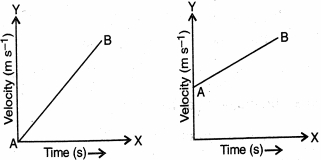
Give one similarity and one dissimilarity between the two graphs.
Solution
(N/A) Similarity: Both graphs are velocity-time graphs.
Dissimilarity: In the first graph,the body starts its journey from rest (initial velocity $u = 0$) with uniform acceleration. In the second graph,the body starts its journey with a specific initial velocity $(u > 0)$ and increases its velocity with uniform acceleration.
Dissimilarity: In the first graph,the body starts its journey from rest (initial velocity $u = 0$) with uniform acceleration. In the second graph,the body starts its journey with a specific initial velocity $(u > 0)$ and increases its velocity with uniform acceleration.
0 likes
View Solution74
Medium
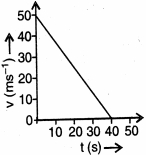
$(i)$ What can be depicted from the graph regarding the motion of the object?
$(ii)$ Find the value of acceleration from the graph.
$(ii)$ Find the value of acceleration from the graph.
Solution
(N/A) $(i)$ The graph shows a straight line with a negative slope,which indicates uniform retardation (deceleration) of the object.
$(ii)$ Acceleration $(a)$ is given by the slope of the velocity-time graph.
$a = \text{Slope} = \frac{v_2 - v_1}{t_2 - t_1}$
From the graph,at $t_1 = 0 \text{ s}$,$v_1 = 50 \text{ m s}^{-1}$ and at $t_2 = 40 \text{ s}$,$v_2 = 0 \text{ m s}^{-1}$.
$a = \frac{0 - 50 \text{ m s}^{-1}}{40 - 0 \text{ s}} = \frac{-50}{40} \text{ m s}^{-2} = -1.25 \text{ m s}^{-2}$
$(ii)$ Acceleration $(a)$ is given by the slope of the velocity-time graph.
$a = \text{Slope} = \frac{v_2 - v_1}{t_2 - t_1}$
From the graph,at $t_1 = 0 \text{ s}$,$v_1 = 50 \text{ m s}^{-1}$ and at $t_2 = 40 \text{ s}$,$v_2 = 0 \text{ m s}^{-1}$.
$a = \frac{0 - 50 \text{ m s}^{-1}}{40 - 0 \text{ s}} = \frac{-50}{40} \text{ m s}^{-2} = -1.25 \text{ m s}^{-2}$
0 likes
View Solution75
EasyMCQ
What is the difference between uniform motion in a straight line and uniform circular motion?
A
Uniform linear motion has constant velocity,while uniform circular motion has changing velocity.
B
Uniform linear motion has zero acceleration,while uniform circular motion has non-zero acceleration.
C
Both have constant speed,but only uniform linear motion has constant direction.
D
All of the above.
Solution
(D)
| Uniform linear motion | Uniform circular motion |
|---|---|
| $(i)$ The body moves along a straight line. | $(i)$ The body moves along a circular path. |
| $(ii)$ Acceleration is zero,as velocity remains constant. | $(ii)$ It is an accelerated motion,due to the continuous change in velocity caused by the change in direction. |
0 likes
View Solution76
Medium
$A$ cheetah can accelerate from rest at the rate of $4 \, m \, s^{-2}$.
$(i)$ What will be the velocity attained by it in $10 \, s$?
$(ii)$ How far will it travel in this duration?
$(i)$ What will be the velocity attained by it in $10 \, s$?
$(ii)$ How far will it travel in this duration?
Solution
(N/A) Initial velocity,$u = 0 \, m \, s^{-1}$.
Acceleration,$a = 4 \, m \, s^{-2}$.
Time,$t = 10 \, s$.
$(i)$ Using the first equation of motion,$v = u + at$:
$v = 0 + (4 \times 10) = 40 \, m \, s^{-1}$.
Thus,the velocity attained is $40 \, m \, s^{-1}$.
$(ii)$ Using the second equation of motion,$s = ut + \frac{1}{2}at^2$:
$s = (0 \times 10) + \frac{1}{2} \times 4 \times (10)^2$
$s = 0 + 2 \times 100 = 200 \, m$.
Thus,the distance traveled is $200 \, m$.
Acceleration,$a = 4 \, m \, s^{-2}$.
Time,$t = 10 \, s$.
$(i)$ Using the first equation of motion,$v = u + at$:
$v = 0 + (4 \times 10) = 40 \, m \, s^{-1}$.
Thus,the velocity attained is $40 \, m \, s^{-1}$.
$(ii)$ Using the second equation of motion,$s = ut + \frac{1}{2}at^2$:
$s = (0 \times 10) + \frac{1}{2} \times 4 \times (10)^2$
$s = 0 + 2 \times 100 = 200 \, m$.
Thus,the distance traveled is $200 \, m$.
0 likes
View Solution77
Medium
When is the acceleration $(i)$ positive and $(ii)$ negative?
Solution
(N/A) $(i)$ If the velocity of a body is increasing with respect to time,the acceleration is said to be positive.
$(ii)$ If the velocity of a body is decreasing with respect to time,the acceleration is said to be negative.
$(ii)$ If the velocity of a body is decreasing with respect to time,the acceleration is said to be negative.
0 likes
View Solution78
Easy
What is the relation between distance and time:
$(i)$ when a body is moving with uniform velocity?
$(ii)$ when a body is moving with variable velocity?
$(i)$ when a body is moving with uniform velocity?
$(ii)$ when a body is moving with variable velocity?
Solution
(N/A) $(i)$ When a body moves with uniform velocity,the distance covered is directly proportional to the time taken $(s \propto t)$. This results in a linear graph.
$(ii)$ When a body moves with variable velocity,the distance covered is not directly proportional to the time taken. The rate of change of distance with respect to time is non-constant,resulting in a non-linear graph.
$(ii)$ When a body moves with variable velocity,the distance covered is not directly proportional to the time taken. The rate of change of distance with respect to time is non-constant,resulting in a non-linear graph.
0 likes
View Solution79
Medium
Mention some uses of velocity-time graphs.
Solution
(N/A) The velocity-time graphs have the following uses:
$(i)$ To determine the total distance travelled by a particle,which is equal to the area under the velocity-time graph.
$(ii)$ To determine the instantaneous velocity of the particle at any given time $t$.
$(iii)$ To determine the acceleration of the object,which is equal to the slope of the velocity-time graph.
$(i)$ To determine the total distance travelled by a particle,which is equal to the area under the velocity-time graph.
$(ii)$ To determine the instantaneous velocity of the particle at any given time $t$.
$(iii)$ To determine the acceleration of the object,which is equal to the slope of the velocity-time graph.
0 likes
View Solution80
Easy
Distinguish between the terms distance and displacement.
Solution
(N/A) Distance is the length of the actual path traversed between the initial and final positions of an object. It is a scalar quantity and can never be negative.
Displacement is the shortest path between the initial and final positions of an object. It is a vector quantity and can be positive,negative,or zero.
Displacement is the shortest path between the initial and final positions of an object. It is a vector quantity and can be positive,negative,or zero.
0 likes
View Solution81
Medium
Distinguish between the terms speed and velocity.
Solution
(N/A) Speed is defined as the rate of change of distance with respect to time. It is a scalar quantity,meaning it has only magnitude and no direction. It is always positive.
Velocity is defined as the rate of change of displacement with respect to time. It is a vector quantity,meaning it has both magnitude and direction. It can be positive,negative,or zero depending on the direction of motion.
Velocity is defined as the rate of change of displacement with respect to time. It is a vector quantity,meaning it has both magnitude and direction. It can be positive,negative,or zero depending on the direction of motion.
0 likes
View Solution82
Medium
How can you find the following?
$(i)$ Velocity from a displacement-time graph.
$(ii)$ Acceleration from a velocity-time graph.
$(iii)$ Displacement from a velocity-time graph.
$(iv)$ Velocity from an acceleration-time graph.
$(i)$ Velocity from a displacement-time graph.
$(ii)$ Acceleration from a velocity-time graph.
$(iii)$ Displacement from a velocity-time graph.
$(iv)$ Velocity from an acceleration-time graph.
Solution
(N/A) $(i)$ By finding the slope of the displacement-time graph, where $v = \frac{\Delta \text{displacement}}{\Delta \text{time}}$.
$(ii)$ By finding the slope of the velocity-time graph, where $a = \frac{\Delta \text{velocity}}{\Delta \text{time}}$.
$(iii)$ By finding the area under the velocity-time graph, where $\text{Displacement} = \text{Area under } v-t \text{ graph}$.
$(iv)$ By finding the area under the acceleration-time graph, where $\Delta v = \text{Area under } a-t \text{ graph}$.
$(ii)$ By finding the slope of the velocity-time graph, where $a = \frac{\Delta \text{velocity}}{\Delta \text{time}}$.
$(iii)$ By finding the area under the velocity-time graph, where $\text{Displacement} = \text{Area under } v-t \text{ graph}$.
$(iv)$ By finding the area under the acceleration-time graph, where $\Delta v = \text{Area under } a-t \text{ graph}$.
0 likes
View Solution83
Medium
Give examples to distinguish:
$(i)$ Distance and displacement.
$(ii)$ Speed and velocity.
$(iii)$ Acceleration and retardation.
$(i)$ Distance and displacement.
$(ii)$ Speed and velocity.
$(iii)$ Acceleration and retardation.
Solution
(N/A) $(i)$ Distance is the total path length covered by an object,while displacement is the shortest distance between the initial and final positions. For example,if a car travels $100 \, m$ along a winding road,the distance is $100 \, m$. However,if the straight-line distance from the start to the end point is $60 \, m$ towards the north,the displacement is $60 \, m$ north.
$(ii)$ Speed is the rate of change of distance,while velocity is the rate of change of displacement. For example,if a body moves in a circular path and returns to its starting point,its displacement is $0$,making its average velocity $0$. However,the total distance covered is not $0$,so the average speed is not $0$.
$(iii)$ Acceleration is the rate of increase of velocity with time,whereas retardation (or deceleration) is the rate of decrease of velocity with time. For example,when a car speeds up to overtake another vehicle,it is accelerating. When the driver applies brakes to stop the car at a traffic signal,the car is undergoing retardation.
$(ii)$ Speed is the rate of change of distance,while velocity is the rate of change of displacement. For example,if a body moves in a circular path and returns to its starting point,its displacement is $0$,making its average velocity $0$. However,the total distance covered is not $0$,so the average speed is not $0$.
$(iii)$ Acceleration is the rate of increase of velocity with time,whereas retardation (or deceleration) is the rate of decrease of velocity with time. For example,when a car speeds up to overtake another vehicle,it is accelerating. When the driver applies brakes to stop the car at a traffic signal,the car is undergoing retardation.
0 likes
View Solution84
Easy
By giving an example,prove that rest and motion are relative terms.
Solution
(N/A) Rest and motion are relative terms because they depend on the frame of reference of the observer.
For example,consider a passenger sitting inside a moving train.
With respect to another passenger sitting in the same compartment,the passenger is in a state of rest because their relative position does not change with time.
However,with respect to an observer standing on the platform outside the train,the same passenger is in a state of motion because their position changes continuously as the train moves.
Thus,the state of rest or motion is not absolute but depends on the observer's frame of reference.
For example,consider a passenger sitting inside a moving train.
With respect to another passenger sitting in the same compartment,the passenger is in a state of rest because their relative position does not change with time.
However,with respect to an observer standing on the platform outside the train,the same passenger is in a state of motion because their position changes continuously as the train moves.
Thus,the state of rest or motion is not absolute but depends on the observer's frame of reference.
0 likes
View Solution85
Easy
What does the slope of a displacement$-$time graph represent? Can a displacement$-$time graph be parallel to the displacement axis? Give a reason for your answer.
Solution
(N/A) The slope of a displacement$-$time graph represents the velocity of the object.
No,a displacement$-$time graph cannot be parallel to the displacement axis.
This is because a line parallel to the displacement axis would imply that the object covers an infinite displacement in zero time,which is physically impossible.
No,a displacement$-$time graph cannot be parallel to the displacement axis.
This is because a line parallel to the displacement axis would imply that the object covers an infinite displacement in zero time,which is physically impossible.
0 likes
View Solution86
Medium
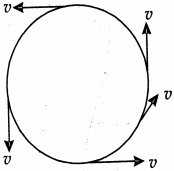
Draw a diagram to show the motion of a body whose speed remains constant but velocity continuously changes.
Solution
(N/A) Uniform circular motion is an example of motion where the speed of the body remains constant,but its velocity changes continuously due to the change in the direction of motion at every point along the circular path.
The diagram below illustrates this motion,where $v$ represents the velocity vector at different points on the circular path. Since the direction of the tangent changes at every point,the velocity vector also changes,even though the magnitude of velocity (speed) remains constant.
The diagram below illustrates this motion,where $v$ represents the velocity vector at different points on the circular path. Since the direction of the tangent changes at every point,the velocity vector also changes,even though the magnitude of velocity (speed) remains constant.
0 likes
View Solution87
Medium
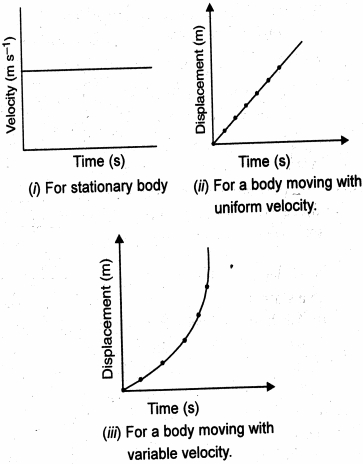
Draw displacement-time graphs for the following situations:
$(i)$ When a body is stationary.
$(ii)$ When a body is moving with uniform velocity.
$(iii)$ When a body is moving with variable velocity.
$(i)$ When a body is stationary.
$(ii)$ When a body is moving with uniform velocity.
$(iii)$ When a body is moving with variable velocity.
Solution
(N/A) $(i)$ When a body is stationary,its displacement does not change with time. Therefore,the displacement-time graph is a straight line parallel to the time axis.
$(ii)$ When a body is moving with uniform velocity,it covers equal displacements in equal intervals of time. Therefore,the displacement-time graph is a straight line inclined to the time axis.
$(iii)$ When a body is moving with variable velocity,it covers unequal displacements in equal intervals of time. Therefore,the displacement-time graph is a curved line.
$(ii)$ When a body is moving with uniform velocity,it covers equal displacements in equal intervals of time. Therefore,the displacement-time graph is a straight line inclined to the time axis.
$(iii)$ When a body is moving with variable velocity,it covers unequal displacements in equal intervals of time. Therefore,the displacement-time graph is a curved line.
0 likes
View Solution88
Medium
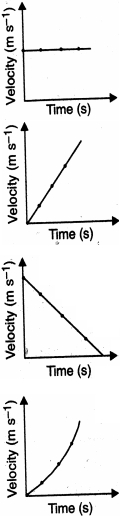
Draw velocity-time graphs for the following situations:
$(i)$ When a body is moving with uniform velocity.
$(ii)$ When a body is moving with variable velocity,but uniform acceleration.
$(iii)$ When a body is moving with variable velocity,but uniform retardation.
$(iv)$ When a body is moving with variable velocity and variable acceleration.
$(i)$ When a body is moving with uniform velocity.
$(ii)$ When a body is moving with variable velocity,but uniform acceleration.
$(iii)$ When a body is moving with variable velocity,but uniform retardation.
$(iv)$ When a body is moving with variable velocity and variable acceleration.
Solution
(N/A) The velocity-time graphs for the given situations are as follows:
$(i)$ For uniform velocity: The graph is a straight line parallel to the time axis,indicating that velocity does not change with time.
$(ii)$ For variable velocity with uniform acceleration: The graph is a straight line inclined to the time axis with a positive slope,indicating a constant rate of increase in velocity.
$(iii)$ For variable velocity with uniform retardation: The graph is a straight line inclined to the time axis with a negative slope,indicating a constant rate of decrease in velocity.
$(iv)$ For variable velocity and variable acceleration: The graph is a curve,indicating that the rate of change of velocity (acceleration) is not constant.
$(i)$ For uniform velocity: The graph is a straight line parallel to the time axis,indicating that velocity does not change with time.
$(ii)$ For variable velocity with uniform acceleration: The graph is a straight line inclined to the time axis with a positive slope,indicating a constant rate of increase in velocity.
$(iii)$ For variable velocity with uniform retardation: The graph is a straight line inclined to the time axis with a negative slope,indicating a constant rate of decrease in velocity.
$(iv)$ For variable velocity and variable acceleration: The graph is a curve,indicating that the rate of change of velocity (acceleration) is not constant.
0 likes
View Solution89
Medium
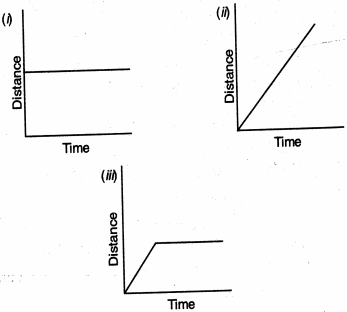
Can you suggest the kind of motion of a body from the following distance-time graphs?
Solution
(N/A) $(i)$ The graph is a horizontal line parallel to the time axis,which indicates that the distance of the body from the origin does not change with time. Therefore,the body is stationary.
$(ii)$ The graph is a straight line passing through the origin,which indicates that the body covers equal distances in equal intervals of time. Therefore,the body is moving with uniform velocity (or uniform speed).
$(iii)$ The graph shows that initially,the distance increases linearly with time,indicating uniform velocity. After a certain point,the graph becomes a horizontal line,meaning the distance remains constant over time. Therefore,the body initially moves with uniform velocity and then stops suddenly.
$(ii)$ The graph is a straight line passing through the origin,which indicates that the body covers equal distances in equal intervals of time. Therefore,the body is moving with uniform velocity (or uniform speed).
$(iii)$ The graph shows that initially,the distance increases linearly with time,indicating uniform velocity. After a certain point,the graph becomes a horizontal line,meaning the distance remains constant over time. Therefore,the body initially moves with uniform velocity and then stops suddenly.
0 likes
View Solution90
Medium
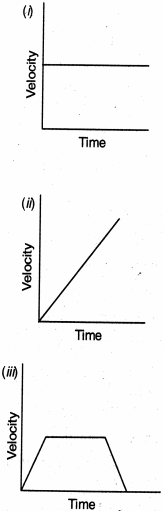
Can you suggest real-life examples of the motion of a body from the following velocity-time graphs?
Solution
(N/A) $(i)$ $A$ car moving with uniform velocity on a straight road.
$(ii)$ $A$ ball dropped from a height,falling freely under the action of gravity.
$(iii)$ $A$ train starting from a station,accelerating to a constant speed,moving with uniform velocity for some time,and then applying brakes to come to rest.
$(ii)$ $A$ ball dropped from a height,falling freely under the action of gravity.
$(iii)$ $A$ train starting from a station,accelerating to a constant speed,moving with uniform velocity for some time,and then applying brakes to come to rest.
0 likes
View Solution91
Medium
Ravi told his friend that his house is $1 \,km$ toward south from the main Post Office. Express the displacement and the distance moved by the friend from the Post Office when he arrives at Ravi's house. Mention the reference point chosen by you.
Solution
(N/A) The reference point chosen is the Post Office,which acts as the origin of the motion.
Since the friend travels in a straight line from the Post Office to Ravi's house,the path length is equal to the shortest distance between the two points.
Distance is the total path length covered,which is $1 \,km$.
Displacement is the shortest distance between the initial position (Post Office) and the final position (Ravi's house),which is $1 \,km$ in the southward direction.
Therefore,both the distance and the magnitude of displacement are $1 \,km$.
Since the friend travels in a straight line from the Post Office to Ravi's house,the path length is equal to the shortest distance between the two points.
Distance is the total path length covered,which is $1 \,km$.
Displacement is the shortest distance between the initial position (Post Office) and the final position (Ravi's house),which is $1 \,km$ in the southward direction.
Therefore,both the distance and the magnitude of displacement are $1 \,km$.
0 likes
View Solution92
Medium
What is meant by uniform motion? Can you think of an example of a body in uniform motion?
Solution
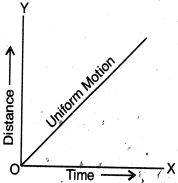
(N/A) body is said to be in uniform motion if it travels equal distances in equal intervals of time,no matter how small these time intervals may be.
For example,a car moving at a constant speed of $10 \ m/s$ will cover equal distances of $10 \ m$ every second,so its motion is uniform.
The distance-time graph for uniform motion is a straight line as shown in the figure.
For example,a car moving at a constant speed of $10 \ m/s$ will cover equal distances of $10 \ m$ every second,so its motion is uniform.
The distance-time graph for uniform motion is a straight line as shown in the figure.
0 likes
View Solution93
EasyMCQ
$A$ body is moving with a velocity of $10 \, m s^{-1}$. If the motion is uniform,what will be its velocity after $10 \, s$ (in $, m s^{-1}$)?
A
$5$
B
$10$
C
$20$
D
$0$
Solution
(B) Uniform motion is defined as the motion of an object in which it travels equal distances in equal intervals of time,implying that the velocity of the object remains constant over time.
Since the initial velocity is $10 \, m s^{-1}$ and the motion is uniform,there is no acceleration $(a = 0)$.
Therefore,the velocity of the body will remain unchanged at $10 \, m s^{-1}$ even after $10 \, s$.
Since the initial velocity is $10 \, m s^{-1}$ and the motion is uniform,there is no acceleration $(a = 0)$.
Therefore,the velocity of the body will remain unchanged at $10 \, m s^{-1}$ even after $10 \, s$.
0 likes
View Solution94
Medium
In a long distance race,the athletes were expected to take four rounds of the track such that the finish line was the same as the start line. Suppose the length of the track was $200 \ m$.
$(a)$ What is the total distance to be covered by the athletes?
$(b)$ What is the displacement of the athletes when they touch the finish line?
$(c)$ Is the motion of the athletes uniform or nonuniform?
$(d)$ Is the displacement of an athlete and the distance moved by him at the end of the race equal?
$(a)$ What is the total distance to be covered by the athletes?
$(b)$ What is the displacement of the athletes when they touch the finish line?
$(c)$ Is the motion of the athletes uniform or nonuniform?
$(d)$ Is the displacement of an athlete and the distance moved by him at the end of the race equal?
Solution
(D) The total distance is $200 \ m \times 4 = 800 \ m$.
$(b)$ Since the athletes return to the starting point,their displacement is $0 \ m$.
$(c)$ Since the velocity of the athletes changes throughout the race,their motion is nonuniform.
$(d)$ No,the displacement $(0 \ m)$ and the distance travelled $(800 \ m)$ are not equal.
$(b)$ Since the athletes return to the starting point,their displacement is $0 \ m$.
$(c)$ Since the velocity of the athletes changes throughout the race,their motion is nonuniform.
$(d)$ No,the displacement $(0 \ m)$ and the distance travelled $(800 \ m)$ are not equal.
0 likes
View Solution95
Easy
Two cars moving in opposite directions cover the same distance $d$ in one hour. If the cars were moving in a north-south direction,what will be their displacement in one hour?
Solution
(D) Displacement is a vector quantity defined as the shortest distance between the initial and final positions of an object in a specific direction.
Since both cars cover the same distance $d$ in one hour in opposite directions (north and south),their displacement will be $d$ towards the north for the first car and $d$ towards the south for the second car.
Since both cars cover the same distance $d$ in one hour in opposite directions (north and south),their displacement will be $d$ towards the north for the first car and $d$ towards the south for the second car.
0 likes
View Solution96
Medium
State which of the following situations are possible and give an example of each of these:
$(a)$ $A$ body moving with constant acceleration but with zero velocity.
$(b)$ $A$ body moving horizontally with an acceleration in the vertical direction.
$(c)$ $A$ body moving with a constant speed in an accelerated motion.
$(a)$ $A$ body moving with constant acceleration but with zero velocity.
$(b)$ $A$ body moving horizontally with an acceleration in the vertical direction.
$(c)$ $A$ body moving with a constant speed in an accelerated motion.
Solution
(A-D) Yes,this is possible at the highest point of a body thrown vertically upwards. At the highest point,the body's velocity is $0 \ m/s$,but it experiences a constant acceleration due to gravity of $9.8 \ m/s^2$ in the downward direction.
$(b)$ Yes,this is possible for a projectile. $A$ projectile fired at an angle has a constant horizontal velocity,but its motion along the vertical direction is subject to a constant downward acceleration due to gravity.
$(c)$ Yes,this is possible when a body moves along a circular path with constant speed. In this situation,the speed is constant,but because the direction of motion changes continuously,the body possesses centripetal acceleration.
$(b)$ Yes,this is possible for a projectile. $A$ projectile fired at an angle has a constant horizontal velocity,but its motion along the vertical direction is subject to a constant downward acceleration due to gravity.
$(c)$ Yes,this is possible when a body moves along a circular path with constant speed. In this situation,the speed is constant,but because the direction of motion changes continuously,the body possesses centripetal acceleration.
0 likes
View Solution97
Easy
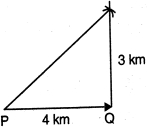
$A$ cyclist travels a distance of $4\, km$ from $P$ to $Q$ and then moves a distance of $3\, km$ at a right angle to $PQ$. Find his resultant displacement graphically.
Solution
(N/A) Graphically,the path forms a right-angled triangle where the base is $4\, km$ and the perpendicular height is $3\, km$.
The resultant displacement is the hypotenuse of this triangle.
Using the Pythagorean theorem:
$S = \sqrt{(4\, km)^2 + (3\, km)^2}$
$S = \sqrt{16 + 9}\, km$
$S = \sqrt{25}\, km$
$S = 5\, km$
Thus,the resultant displacement is $5\, km$.
The resultant displacement is the hypotenuse of this triangle.
Using the Pythagorean theorem:
$S = \sqrt{(4\, km)^2 + (3\, km)^2}$
$S = \sqrt{16 + 9}\, km$
$S = \sqrt{25}\, km$
$S = 5\, km$
Thus,the resultant displacement is $5\, km$.
0 likes
View Solution98
Medium
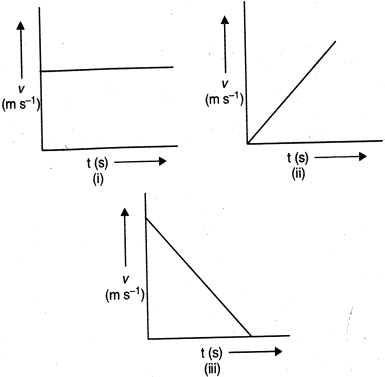
What can you conclude about the motion of a body depicted by the velocity-time graphs $(i)$,$(ii)$ and $(iii)$ given below?
Solution
(N/A) $(i)$ Uniform motion: The velocity of the body remains constant over time,meaning the acceleration is zero.
$(ii)$ Uniformly accelerated motion: The velocity of the body increases linearly with time,indicating a constant positive acceleration.
$(iii)$ Uniformly retarded motion (or deceleration): The velocity of the body decreases linearly with time,indicating a constant negative acceleration.
$(ii)$ Uniformly accelerated motion: The velocity of the body increases linearly with time,indicating a constant positive acceleration.
$(iii)$ Uniformly retarded motion (or deceleration): The velocity of the body decreases linearly with time,indicating a constant negative acceleration.
0 likes
View Solution99
Easy
$(a)$ Define acceleration.
$(b)$ $A$ stone describes a circular path with a constant speed. State the type of motion of the stone.
$(b)$ $A$ stone describes a circular path with a constant speed. State the type of motion of the stone.
Solution
(N/A) Acceleration is defined as the rate of change of velocity of an object with respect to time. Mathematically, it is the ratio of the change in velocity to the time taken for that change: $a = \frac{v - u}{t}$.
$(b)$ When a stone moves in a circular path with a constant speed, its direction of motion changes at every point. Since velocity is a vector quantity (speed with direction), the change in direction implies a change in velocity. This type of motion is known as $\text{Uniform circular motion}$.
$(b)$ When a stone moves in a circular path with a constant speed, its direction of motion changes at every point. Since velocity is a vector quantity (speed with direction), the change in direction implies a change in velocity. This type of motion is known as $\text{Uniform circular motion}$.
0 likes
View Solution100
Easy
Write any two equations of motion for a body having uniform acceleration.
Solution
(N/A) The three equations of motion for a body moving with uniform acceleration are:
$(i)$ $v = u + at$
$(ii)$ $S = ut + \frac{1}{2}at^2$
$(iii)$ $v^2 = u^2 + 2aS$
Where:
$u$ = initial velocity
$v$ = final velocity
$a$ = uniform acceleration
$t$ = time taken
$S$ = displacement covered
Any two of these equations can be provided as the answer.
$(i)$ $v = u + at$
$(ii)$ $S = ut + \frac{1}{2}at^2$
$(iii)$ $v^2 = u^2 + 2aS$
Where:
$u$ = initial velocity
$v$ = final velocity
$a$ = uniform acceleration
$t$ = time taken
$S$ = displacement covered
Any two of these equations can be provided as the answer.
0 likes
View SolutionMOTION — Mix Example - MOTION · Frequently Asked Questions
1Are these MOTION questions useful for JEE and NEET?
Yes. All questions in this section are mapped to JEE Main and NEET exam patterns. Previous year questions from JEE Main, NEET, GUJCET and state-level exams are included with full solutions.
2Can I switch to Hindi or Gujarati for these questions?
Yes. Use the language tabs in the hero section or the sidebar to view the same questions and solutions in English, Hindi or Gujarati.
3How do I generate a question paper from this subtopic?
Use the Vedclass Exam Paper Generator — select the chapter and subtopic, set difficulty, and generate Sets A, B, C, D automatically. First 3 chapters of every subject are free.
Vedclass Products
For Students
Vedclass Test Series
Mock tests in real JEE/NEET style with performance analysis. 5-day free trial.
Start Free TrialFor Teachers
Exam Paper Generator
Generate Set A/B/C/D papers from this chapter in 2 minutes. 3 chapters free.
Try FreeFor Institutes
Online Exam Module
Live online exams with unlimited students, 360° analytics & white-label branding.
See DemoFor Teachers & Institutes
Generate a MOTION Exam Paper in 2 Minutes
Select subtopic & difficulty — Sets A, B, C, D auto-generated with No Repeat logic.
First 3 chapters of every subject are free — no payment required.