
A English
Textbook - MOTION Questions in English
Class 9 Science · MOTION · Textbook - MOTION
31+
Questions
English
Language
100%
With Solutions
Showing 31 of 31 questions in English
1
Medium
An object has moved through a distance. Can it have zero displacement? If yes,support your answer with an example.
Solution
(N/A) Yes,an object can have zero displacement even when it has moved through a distance.
This occurs when the final position of the object coincides with its initial position.
For example,if a person walks around a circular park and returns to the exact starting point,the total distance covered is equal to the circumference of the park,but the displacement is $0$ because the initial and final positions are the same.
This occurs when the final position of the object coincides with its initial position.
For example,if a person walks around a circular park and returns to the exact starting point,the total distance covered is equal to the circumference of the park,but the displacement is $0$ because the initial and final positions are the same.
2 likes
View Solution2
MediumMCQ
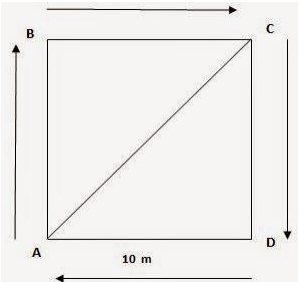
$A$ farmer moves along the boundary of a square field of side $10 \, m$ in $40 \, s$. What will be the magnitude of displacement (in $m$) of the farmer at the end of $2 \, min \; 20 \, s$ from his initial position?
A
$16.14$
B
$14.14$
C
$24.14$
D
$14.41$
Solution
(B) Given, side of the square field $= 10 \, m$.
Perimeter of the square field $= 4 \times 10 \, m = 40 \, m$.
The farmer completes one round of the field in $40 \, s$.
Total time taken $= 2 \, min \; 20 \, s = (2 \times 60) \, s + 20 \, s = 140 \, s$.
Number of rounds completed by the farmer $= \frac{\text{Total time}}{\text{Time for one round}} = \frac{140 \, s}{40 \, s} = 3.5 \, \text{rounds}$.
After $3$ complete rounds, the farmer will be back at the starting position. In the remaining $0.5$ round, the farmer will cover half the perimeter, i.e., $20 \, m$, and will reach the diagonally opposite corner of the square.
Let the starting point be $A$ and the diagonally opposite point be $C$. The displacement is the length of the diagonal $AC$.
Using the Pythagorean theorem, $AC = \sqrt{(10 \, m)^2 + (10 \, m)^2} = \sqrt{100 + 100} \, m = \sqrt{200} \, m = 10\sqrt{2} \, m$.
Taking $\sqrt{2} \approx 1.414$, the displacement $= 10 \times 1.414 \, m = 14.14 \, m$.
Perimeter of the square field $= 4 \times 10 \, m = 40 \, m$.
The farmer completes one round of the field in $40 \, s$.
Total time taken $= 2 \, min \; 20 \, s = (2 \times 60) \, s + 20 \, s = 140 \, s$.
Number of rounds completed by the farmer $= \frac{\text{Total time}}{\text{Time for one round}} = \frac{140 \, s}{40 \, s} = 3.5 \, \text{rounds}$.
After $3$ complete rounds, the farmer will be back at the starting position. In the remaining $0.5$ round, the farmer will cover half the perimeter, i.e., $20 \, m$, and will reach the diagonally opposite corner of the square.
Let the starting point be $A$ and the diagonally opposite point be $C$. The displacement is the length of the diagonal $AC$.
Using the Pythagorean theorem, $AC = \sqrt{(10 \, m)^2 + (10 \, m)^2} = \sqrt{100 + 100} \, m = \sqrt{200} \, m = 10\sqrt{2} \, m$.
Taking $\sqrt{2} \approx 1.414$, the displacement $= 10 \times 1.414 \, m = 14.14 \, m$.
2 likes
View Solution3
MediumMCQ
Which of the following is true for displacement?
A
It cannot be zero.
B
Its magnitude is greater than the distance travelled by the object.
C
It is always equal to the distance travelled.
D
None of the above.
Solution
(D) Displacement is the shortest distance between the initial and final positions of an object.
$1$. Displacement can be zero if the initial and final positions of the object are the same (e.g., in circular motion).
$2$. The magnitude of displacement is always less than or equal to the distance travelled by the object $(|\text{Displacement}| \le \text{Distance})$.
Therefore, both statements $(a)$ and $(b)$ are false. The correct option is $(d)$.
$1$. Displacement can be zero if the initial and final positions of the object are the same (e.g., in circular motion).
$2$. The magnitude of displacement is always less than or equal to the distance travelled by the object $(|\text{Displacement}| \le \text{Distance})$.
Therefore, both statements $(a)$ and $(b)$ are false. The correct option is $(d)$.
1 likes
View Solution4
Easy
Distinguish between speed and velocity.
Solution
(N/A)
| Speed | Velocity |
|---|---|
| Speed is the distance travelled by an object in a given interval of time. | Velocity is the displacement of an object in a given interval of time. |
| $Speed = \frac{\text{distance}}{\text{time}}$ | $Velocity = \frac{\text{displacement}}{\text{time}}$ |
| Speed is a scalar quantity, i.e., it has only magnitude. | Velocity is a vector quantity, i.e., it has both magnitude and direction. |
0 likes
View Solution5
EasyMCQ
Under what condition$(s)$ is the magnitude of average velocity of an object equal to its average speed?
A
When the object moves in a circular path.
B
When the object moves in a straight line without changing direction.
C
When the object is at rest.
D
When the object moves with variable acceleration.
Solution
(B) The magnitude of average velocity is defined as the ratio of the total displacement to the total time taken. The average speed is defined as the ratio of the total distance traveled to the total time taken.
For an object moving in a straight line without changing its direction,the total distance traveled is equal to the magnitude of the total displacement.
Therefore,under the condition of motion in a straight line without changing direction,the magnitude of average velocity is equal to the average speed.
For an object moving in a straight line without changing its direction,the total distance traveled is equal to the magnitude of the total displacement.
Therefore,under the condition of motion in a straight line without changing direction,the magnitude of average velocity is equal to the average speed.
0 likes
View Solution6
EasyMCQ
What does the odometer of an automobile measure?
A
Speed
B
Distance
C
Acceleration
D
Velocity
Solution
(B) The odometer is a device used in automobiles to measure the total distance traveled by the vehicle.
It records the cumulative distance covered from the time the vehicle was manufactured or since the last reset.
It records the cumulative distance covered from the time the vehicle was manufactured or since the last reset.
1 likes
View Solution7
EasyMCQ
What does the path of an object look like when it is in uniform motion?
A
Circular path
B
Straight line path
C
Parabolic path
D
Irregular path
Solution
(B) Uniform motion is defined as the motion of an object in which it travels equal distances in equal intervals of time along a straight line.
Therefore,the path of an object in uniform motion is always a straight line.
Therefore,the path of an object in uniform motion is always a straight line.
1 likes
View Solution8
EasyMCQ
During an experiment, a signal from a spaceship reached the ground station in five minutes. What was the distance of the spaceship from the ground station? The signal travels at the speed of light, that is, $3 \times 10^{8} \, m \, s^{-1}$.
A
$19 \times 10^{10} \, m$
B
$29 \times 10^{10} \, m$
C
$39 \times 10^{10} \, m$
D
$9 \times 10^{10} \, m$
Solution
(D) Given:
Speed of the signal $(v)$ = $3 \times 10^{8} \, m \, s^{-1}$
Time taken $(t)$ = $5 \, \text{minutes} = 5 \times 60 \, \text{seconds} = 300 \, s$
Formula:
Distance $(d)$ = $\text{Speed} \times \text{Time}$
Calculation:
$d = (3 \times 10^{8} \, m \, s^{-1}) \times (300 \, s)$
$d = 3 \times 10^{8} \times 3 \times 10^{2} \, m$
$d = 9 \times 10^{10} \, m$
Therefore, the distance of the spaceship from the ground station is $9 \times 10^{10} \, m$.
Speed of the signal $(v)$ = $3 \times 10^{8} \, m \, s^{-1}$
Time taken $(t)$ = $5 \, \text{minutes} = 5 \times 60 \, \text{seconds} = 300 \, s$
Formula:
Distance $(d)$ = $\text{Speed} \times \text{Time}$
Calculation:
$d = (3 \times 10^{8} \, m \, s^{-1}) \times (300 \, s)$
$d = 3 \times 10^{8} \times 3 \times 10^{2} \, m$
$d = 9 \times 10^{10} \, m$
Therefore, the distance of the spaceship from the ground station is $9 \times 10^{10} \, m$.
0 likes
View Solution9
Medium
When will you say a body is in $(i)$ uniform acceleration? $(ii)$ nonuniform acceleration?
Solution
(N/A) $(i)$ $A$ body is said to be in uniform acceleration if it travels in a straight line and its velocity increases or decreases by equal amounts in equal intervals of time.
$(ii)$ $A$ body is said to be in nonuniform acceleration if the rate of change of its velocity is not constant,meaning its velocity changes by unequal amounts in equal intervals of time.
$(ii)$ $A$ body is said to be in nonuniform acceleration if the rate of change of its velocity is not constant,meaning its velocity changes by unequal amounts in equal intervals of time.
0 likes
View Solution10
MediumMCQ
$A$ bus decreases its speed from $80 \, km \, h^{-1}$ to $60 \, km \, h^{-1}$ in $5 \, s$. Find the acceleration (in $m / s^2$) of the bus.
A
$4.44$
B
$-1.112$
C
$-2.112$
D
$7.77$
Solution
(B) Initial speed of the bus $(u)$ = $80 \times \frac{5}{18} = 22.22 \, m/s$.
Final speed of the bus $(v)$ = $60 \times \frac{5}{18} = 16.66 \, m/s$.
Time taken $(t)$ = $5 \, s$.
Acceleration $(a)$ is given by the formula $a = \frac{v - u}{t}$.
Substituting the values: $a = \frac{16.66 - 22.22}{5} = \frac{-5.56}{5} = -1.112 \, m/s^2$.
Thus,the acceleration of the bus is $-1.112 \, m/s^2$.
Final speed of the bus $(v)$ = $60 \times \frac{5}{18} = 16.66 \, m/s$.
Time taken $(t)$ = $5 \, s$.
Acceleration $(a)$ is given by the formula $a = \frac{v - u}{t}$.
Substituting the values: $a = \frac{16.66 - 22.22}{5} = \frac{-5.56}{5} = -1.112 \, m/s^2$.
Thus,the acceleration of the bus is $-1.112 \, m/s^2$.
0 likes
View Solution11
MediumMCQ
$A$ train starting from a railway station and moving with uniform acceleration attains a speed $40 \, km \, h^{-1}$ in $10$ minutes. Find its acceleration (in $m / s^{2}$).
A
$0.185$
B
$185$
C
$0.0185$
D
$0.00185$
Solution
(C) Initial velocity of the train,$u = 0 \, m/s$.
Final velocity of the train,$v = 40 \, km/h = 40 \times \frac{5}{18} \, m/s = 11.11 \, m/s$.
Time taken,$t = 10 \, min = 10 \times 60 \, s = 600 \, s$.
Using the formula for acceleration,$a = \frac{v - u}{t}$.
Substituting the values,$a = \frac{11.11 - 0}{600} = 0.0185 \, m/s^{2}$.
Hence,the acceleration of the train is $0.0185 \, m/s^{2}$.
Final velocity of the train,$v = 40 \, km/h = 40 \times \frac{5}{18} \, m/s = 11.11 \, m/s$.
Time taken,$t = 10 \, min = 10 \times 60 \, s = 600 \, s$.
Using the formula for acceleration,$a = \frac{v - u}{t}$.
Substituting the values,$a = \frac{11.11 - 0}{600} = 0.0185 \, m/s^{2}$.
Hence,the acceleration of the train is $0.0185 \, m/s^{2}$.
0 likes
View Solution12
Medium
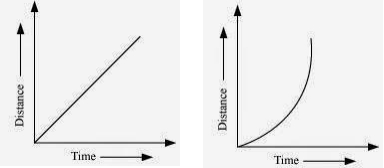
What is the nature of the distance-time graphs for uniform and non-uniform motion of an object?
Solution
(N/A) $1$. For uniform motion: The distance-time graph is a straight line. This indicates that the object covers equal distances in equal intervals of time,meaning the speed is constant.
$2$. For non-uniform motion: The distance-time graph is not a straight line; it is a curve. This indicates that the object covers unequal distances in equal intervals of time,meaning the speed is changing.
$2$. For non-uniform motion: The distance-time graph is not a straight line; it is a curve. This indicates that the object covers unequal distances in equal intervals of time,meaning the speed is changing.
0 likes
View Solution13
Medium
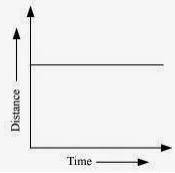
What can you say about the motion of an object whose distance-time graph is a straight line parallel to the time axis?
Solution
If the distance-time graph is a straight line parallel to the time axis,it indicates that the distance of the object from the reference point remains constant as time passes.
This means the object is not changing its position with respect to time.
Therefore,the object is at rest.
This means the object is not changing its position with respect to time.
Therefore,the object is at rest.
0 likes
View Solution14
Medium
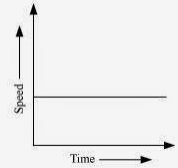
What can you say about the motion of an object if its speed-time graph is a straight line parallel to the time axis?
Solution
(N/A) If the speed-time graph is a straight line parallel to the time axis,it indicates that the speed of the object remains constant over time.
This type of motion is known as uniform motion,where the acceleration of the object is zero.
This type of motion is known as uniform motion,where the acceleration of the object is zero.
1 likes
View Solution15
EasyMCQ
What is the quantity which is measured by the area occupied below the velocity-time graph?
A
Distance
B
Acceleration
C
Velocity
D
Time
Solution
(A) The area under the velocity-time graph represents the displacement or the distance covered by an object moving with a certain velocity over a specific time interval.
0 likes
View Solution16
MediumMCQ
$A$ bus starting from rest moves with a uniform acceleration of $0.1\, m s^{-2}$ for $2\, min$. Find $(a)$ the speed acquired,$(b)$ the distance travelled.
A
$v = 6\, m s^{-1}; s = 360\, m$
B
$v = 12\, m s^{-1}; s = 360\, m$
C
$v = 24\, m s^{-1}; s = 720\, m$
D
$v = 12\, m s^{-1}; s = 720\, m$
Solution
(D) Given:
Initial velocity,$u = 0\, m s^{-1}$
Acceleration,$a = 0.1\, m s^{-2}$
Time,$t = 2\, min = 120\, s$
$(a)$ To find the speed acquired $(v)$:
Using the first equation of motion,$v = u + at$
$v = 0 + (0.1\, m s^{-2} \times 120\, s)$
$v = 12\, m s^{-1}$
$(b)$ To find the distance travelled $(s)$:
Using the second equation of motion,$s = ut + \frac{1}{2}at^2$
$s = (0 \times 120) + \frac{1}{2} \times 0.1 \times (120)^2$
$s = 0 + 0.05 \times 14400$
$s = 720\, m$
Thus,the speed acquired is $12\, m s^{-1}$ and the distance travelled is $720\, m$.
Initial velocity,$u = 0\, m s^{-1}$
Acceleration,$a = 0.1\, m s^{-2}$
Time,$t = 2\, min = 120\, s$
$(a)$ To find the speed acquired $(v)$:
Using the first equation of motion,$v = u + at$
$v = 0 + (0.1\, m s^{-2} \times 120\, s)$
$v = 12\, m s^{-1}$
$(b)$ To find the distance travelled $(s)$:
Using the second equation of motion,$s = ut + \frac{1}{2}at^2$
$s = (0 \times 120) + \frac{1}{2} \times 0.1 \times (120)^2$
$s = 0 + 0.05 \times 14400$
$s = 720\, m$
Thus,the speed acquired is $12\, m s^{-1}$ and the distance travelled is $720\, m$.
0 likes
View Solution17
MediumMCQ
$A$ train is travelling at a speed of $90\, km \,h^{-1}$. Brakes are applied so as to produce a uniform acceleration of $-0.5\, m s^{-2}$. Find how far (in $m$) the train will go before it is brought to rest.
A
$625$
B
$225$
C
$500$
D
$750$
Solution
(A) Initial speed of the train,$u = 90\, km/h = 90 \times \frac{5}{18} = 25\, m/s$.
Final speed of the train,$v = 0\, m/s$ (as the train comes to rest).
Acceleration,$a = -0.5\, m/s^2$.
Using the third equation of motion,$v^2 = u^2 + 2as$.
Substituting the values: $(0)^2 = (25)^2 + 2(-0.5)s$.
$0 = 625 - 1s$.
$s = 625\, m$.
The train will cover a distance of $625\, m$ before it comes to rest.
Final speed of the train,$v = 0\, m/s$ (as the train comes to rest).
Acceleration,$a = -0.5\, m/s^2$.
Using the third equation of motion,$v^2 = u^2 + 2as$.
Substituting the values: $(0)^2 = (25)^2 + 2(-0.5)s$.
$0 = 625 - 1s$.
$s = 625\, m$.
The train will cover a distance of $625\, m$ before it comes to rest.
1 likes
View Solution18
MediumMCQ
$A$ trolley,while going down an inclined plane,has an acceleration of $2 \,m \,s^{-2}$. What will be its velocity (in $cm \,s^{-1}$) $3 \,s$ after the start?
A
$600$
B
$60$
C
$6$
D
$6000$
Solution
(A) Initial velocity of the trolley,$u = 0 \,m \,s^{-1} = 0 \,cm \,s^{-1}$.
Acceleration,$a = 2 \,m \,s^{-2} = 200 \,cm \,s^{-2}$.
Time,$t = 3 \,s$.
Using the first equation of motion,$v = u + at$.
Substituting the values: $v = 0 + (200 \,cm \,s^{-2} \times 3 \,s)$.
$v = 600 \,cm \,s^{-1}$.
Therefore,the velocity of the trolley after $3 \,s$ is $600 \,cm \,s^{-1}$.
Acceleration,$a = 2 \,m \,s^{-2} = 200 \,cm \,s^{-2}$.
Time,$t = 3 \,s$.
Using the first equation of motion,$v = u + at$.
Substituting the values: $v = 0 + (200 \,cm \,s^{-2} \times 3 \,s)$.
$v = 600 \,cm \,s^{-1}$.
Therefore,the velocity of the trolley after $3 \,s$ is $600 \,cm \,s^{-1}$.
0 likes
View Solution19
MediumMCQ
$A$ racing car has a uniform acceleration of $4 \,m s^{-2}$. What distance (in $m$) will it cover in $10 \,s$ after start?
A
$100$
B
$50$
C
$200$
D
$400$
Solution
(C) Initial velocity of the car,$u = 0 \,m s^{-1}$.
Acceleration,$a = 4 \,m s^{-2}$.
Time,$t = 10 \,s$.
We use the second equation of motion: $s = ut + \frac{1}{2}at^2$.
Substituting the values: $s = (0 \times 10) + \frac{1}{2} \times 4 \times (10)^2$.
$s = 0 + \frac{1}{2} \times 4 \times 100$.
$s = 2 \times 100 = 200 \,m$.
Therefore,the distance covered by the car in $10 \,s$ is $200 \,m$.
Acceleration,$a = 4 \,m s^{-2}$.
Time,$t = 10 \,s$.
We use the second equation of motion: $s = ut + \frac{1}{2}at^2$.
Substituting the values: $s = (0 \times 10) + \frac{1}{2} \times 4 \times (10)^2$.
$s = 0 + \frac{1}{2} \times 4 \times 100$.
$s = 2 \times 100 = 200 \,m$.
Therefore,the distance covered by the car in $10 \,s$ is $200 \,m$.
0 likes
View Solution20
DifficultMCQ
$A$ stone is thrown in a vertically upward direction with a velocity of $5 \, m s^{-1}$. If the acceleration of the stone during its motion is $10 \, m s^{-2}$ in the downward direction,what will be the height attained by the stone and how much time will it take to reach there?
A
$t=1 \, s; s=1.25 \, m$
B
$t=0.5 \, s; s=2.25 \, m$
C
$t=1 \, s; s=2.5 \, m$
D
$t=0.5 \, s; s=1.25 \, m$
Solution
(D) Given: Initial velocity $u = 5 \, m s^{-1}$.
Final velocity at maximum height $v = 0 \, m s^{-1}$.
Acceleration $a = -10 \, m s^{-2}$ (since it acts downwards).
Using the equation of motion $v^2 - u^2 = 2as$:
$0^2 - (5)^2 = 2 \times (-10) \times s$
$-25 = -20s$
$s = \frac{-25}{-20} = 1.25 \, m$.
Using the equation of motion $v = u + at$:
$0 = 5 + (-10)t$
$10t = 5$
$t = 0.5 \, s$.
Thus,the height attained is $1.25 \, m$ and the time taken is $0.5 \, s$.
Final velocity at maximum height $v = 0 \, m s^{-1}$.
Acceleration $a = -10 \, m s^{-2}$ (since it acts downwards).
Using the equation of motion $v^2 - u^2 = 2as$:
$0^2 - (5)^2 = 2 \times (-10) \times s$
$-25 = -20s$
$s = \frac{-25}{-20} = 1.25 \, m$.
Using the equation of motion $v = u + at$:
$0 = 5 + (-10)t$
$10t = 5$
$t = 0.5 \, s$.
Thus,the height attained is $1.25 \, m$ and the time taken is $0.5 \, s$.
0 likes
View Solution21
DifficultMCQ
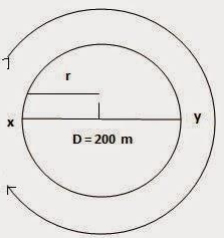
An athlete completes one round of a circular track of diameter $200\, m$ in $40\, s$. What will be the distance covered and the displacement at the end of $2\, min$ $20\, s$?
A
$Distance\, covered=2200\,m;\, Displacement=200\,m$
B
$Distance\, covered=\frac{4400}{7}\,m;\, Displacement=200\,m$
C
$Distance\, covered=\frac{4400}{7}\,m;\, Displacement=100\,m$
D
$Distance\, covered=2200\,m;\, Displacement=100\,m$
Solution
(A) Diameter of circular track $(D) = 200\, m$.
Radius of circular track $(r) = D / 2 = 100\, m$.
Time taken for one round $(t) = 40\, s$.
Total time given $= 2\, min\, 20\, s = 140\, s$.
Number of rounds $= 140 / 40 = 3.5\, rounds$.
Distance covered $= 3.5 \times (2 \pi r) = 3.5 \times 2 \times (22/7) \times 100 = 7 \times (22/7) \times 100 = 2200\, m$.
After $3.5\, rounds$, the athlete will be at the diametrically opposite point of the starting position.
Displacement $= \text{Diameter of the circular track} = 200\, m$.
Radius of circular track $(r) = D / 2 = 100\, m$.
Time taken for one round $(t) = 40\, s$.
Total time given $= 2\, min\, 20\, s = 140\, s$.
Number of rounds $= 140 / 40 = 3.5\, rounds$.
Distance covered $= 3.5 \times (2 \pi r) = 3.5 \times 2 \times (22/7) \times 100 = 7 \times (22/7) \times 100 = 2200\, m$.
After $3.5\, rounds$, the athlete will be at the diametrically opposite point of the starting position.
Displacement $= \text{Diameter of the circular track} = 200\, m$.
0 likes
View Solution22
MediumMCQ
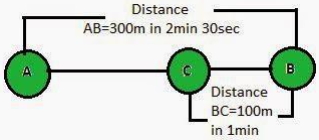
Joseph jogs from one end $A$ to the other end $B$ of a straight $300 \, m$ road in $2 \, min$ $30 \, sec$ and then turns around and jogs $100 \, m$ back to point $C$ in another $1 \, min$. What are Joseph's average speeds and velocities in jogging from $A$ to $B$?
A
$0.2 \, m s^{-1}$ and $2.0 \, m s^{-1}$
B
$2 \, m s^{-1}$ and $2 \, m s^{-1}$
C
$4 \, m s^{-1}$ and $2 \, m s^{-1}$
D
$2 \, m s^{-1}$ and $4 \, m s^{-1}$
Solution
(B) The distance covered from $A$ to $B$ is $300 \, m$.
The time taken to travel from $A$ to $B$ is $2 \, min \, 30 \, sec = (2 \times 60) + 30 = 150 \, s$.
Average speed from $A$ to $B$ is defined as the total distance divided by the total time taken:
$\text{Average Speed} = \frac{\text{Total Distance}}{\text{Total Time}} = \frac{300 \, m}{150 \, s} = 2 \, m s^{-1}$.
Velocity from $A$ to $B$ is defined as the displacement divided by the total time taken. Since the motion is in a straight line from $A$ to $B$,the displacement is equal to the distance $(300 \, m)$:
$\text{Velocity} = \frac{\text{Displacement}}{\text{Total Time}} = \frac{300 \, m}{150 \, s} = 2 \, m s^{-1}$.
Thus,the average speed and velocity from $A$ to $B$ are both $2 \, m s^{-1}$.
The time taken to travel from $A$ to $B$ is $2 \, min \, 30 \, sec = (2 \times 60) + 30 = 150 \, s$.
Average speed from $A$ to $B$ is defined as the total distance divided by the total time taken:
$\text{Average Speed} = \frac{\text{Total Distance}}{\text{Total Time}} = \frac{300 \, m}{150 \, s} = 2 \, m s^{-1}$.
Velocity from $A$ to $B$ is defined as the displacement divided by the total time taken. Since the motion is in a straight line from $A$ to $B$,the displacement is equal to the distance $(300 \, m)$:
$\text{Velocity} = \frac{\text{Displacement}}{\text{Total Time}} = \frac{300 \, m}{150 \, s} = 2 \, m s^{-1}$.
Thus,the average speed and velocity from $A$ to $B$ are both $2 \, m s^{-1}$.
0 likes
View Solution23
DifficultMCQ
Abdul,while driving to school,computes the average speed for his trip to be $20 \, km \, h^{-1}$. On his return trip along the same route,there is less traffic and the average speed is $40 \, km \, h^{-1}$. What is the average speed (in $km \, h^{-1}$) for Abdul's trip?
A
$20$
B
$44$
C
$26.67$
D
$30$
Solution
(C) Let the distance between home and school be $S$.
Time taken to travel from home to school is $t_1 = S / 20$.
Time taken to travel from school to home is $t_2 = S / 40$.
Total distance covered = $S + S = 2S$.
Total time taken = $t_1 + t_2 = S / 20 + S / 40 = (2S + S) / 40 = 3S / 40$.
Average speed = $\text{Total distance} / \text{Total time} = 2S / (3S / 40) = (2S \times 40) / 3S = 80 / 3 = 26.67 \, km \, h^{-1}$.
Time taken to travel from home to school is $t_1 = S / 20$.
Time taken to travel from school to home is $t_2 = S / 40$.
Total distance covered = $S + S = 2S$.
Total time taken = $t_1 + t_2 = S / 20 + S / 40 = (2S + S) / 40 = 3S / 40$.
Average speed = $\text{Total distance} / \text{Total time} = 2S / (3S / 40) = (2S \times 40) / 3S = 80 / 3 = 26.67 \, km \, h^{-1}$.
0 likes
View Solution24
MediumMCQ
$A$ motorboat starting from rest on a lake accelerates in a straight line at a constant rate of $3.0 \, m s^{-2}$ for $8.0 \, s$. How far does the boat travel (in $m$) during this time?
A
$70$
B
$60$
C
$90$
D
$96$
Solution
(D) Given: Initial velocity of the motorboat,$u = 0 \, m s^{-1}$.
Acceleration of the motorboat,$a = 3.0 \, m s^{-2}$.
Time interval,$t = 8.0 \, s$.
We use the second equation of motion: $s = ut + \frac{1}{2}at^2$.
Substituting the given values:
$s = (0 \times 8.0) + \frac{1}{2} \times 3.0 \times (8.0)^2$.
$s = 0 + \frac{1}{2} \times 3.0 \times 64$.
$s = 3.0 \times 32$.
$s = 96 \, m$.
Therefore,the boat travels $96 \, m$ during this time.
Acceleration of the motorboat,$a = 3.0 \, m s^{-2}$.
Time interval,$t = 8.0 \, s$.
We use the second equation of motion: $s = ut + \frac{1}{2}at^2$.
Substituting the given values:
$s = (0 \times 8.0) + \frac{1}{2} \times 3.0 \times (8.0)^2$.
$s = 0 + \frac{1}{2} \times 3.0 \times 64$.
$s = 3.0 \times 32$.
$s = 96 \, m$.
Therefore,the boat travels $96 \, m$ during this time.
0 likes
View Solution25
Difficult
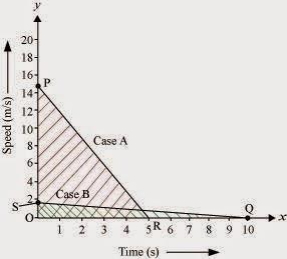
$A$ driver of a car travelling at $52\, km\, h^{-1}$ applies the brakes and accelerates uniformly in the opposite direction. The car stops in $5\, s$. Another driver going at $3\, km\, h^{-1}$ in another car applies his brakes slowly and stops in $10\, s$. On the same graph paper,plot the speed versus time graphs for the two cars. Which of the two cars travelled farther after the brakes were applied?
Solution
(A) First,convert the initial speeds from $km\, h^{-1}$ to $m\, s^{-1}$:
For the first car: $u_1 = 52 \times (1000 / 3600) \, m\, s^{-1} = 14.44 \, m\, s^{-1}$.
For the second car: $u_2 = 3 \times (1000 / 3600) \, m\, s^{-1} = 0.83 \, m\, s^{-1}$.
The distance travelled by a car is equal to the area under the speed-time graph.
Distance travelled by the first car = Area of triangle with base $5\, s$ and height $14.44 \, m\, s^{-1}$.
$= (1 / 2) \times 5 \times 14.44 = 36.1 \, m$.
Distance travelled by the second car = Area of triangle with base $10\, s$ and height $0.83 \, m\, s^{-1}$.
$= (1 / 2) \times 10 \times 0.83 = 4.15 \, m$.
Comparing the two distances,the first car travelled farther after the brakes were applied.
For the first car: $u_1 = 52 \times (1000 / 3600) \, m\, s^{-1} = 14.44 \, m\, s^{-1}$.
For the second car: $u_2 = 3 \times (1000 / 3600) \, m\, s^{-1} = 0.83 \, m\, s^{-1}$.
The distance travelled by a car is equal to the area under the speed-time graph.
Distance travelled by the first car = Area of triangle with base $5\, s$ and height $14.44 \, m\, s^{-1}$.
$= (1 / 2) \times 5 \times 14.44 = 36.1 \, m$.
Distance travelled by the second car = Area of triangle with base $10\, s$ and height $0.83 \, m\, s^{-1}$.
$= (1 / 2) \times 10 \times 0.83 = 4.15 \, m$.
Comparing the two distances,the first car travelled farther after the brakes were applied.
1 likes
View Solution26
Medium
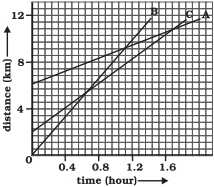
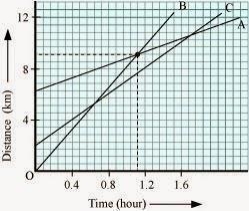
The figure shows the distance-time graph of three objects $A$,$B$,and $C$. Study the graph and answer the following questions:
$(a)$ Which of the three is travelling the fastest?
$(b)$ Are all three ever at the same point on the road?
$(c)$ How far has $C$ travelled when $B$ passes $A$?
$(d)$ How far has $B$ travelled by the time it passes $C$?
$(a)$ Which of the three is travelling the fastest?
$(b)$ Are all three ever at the same point on the road?
$(c)$ How far has $C$ travelled when $B$ passes $A$?
$(d)$ How far has $B$ travelled by the time it passes $C$?
Solution
(B) Object $B$.
$(b)$ No,all three objects $A$,$B$,and $C$ never meet at a single point on the graph.
$(c)$ To find the distance $C$ has travelled when $B$ passes $A$:
$1$. Identify the point where $B$ and $A$ intersect. This occurs at a distance of $9 \, km$ from the origin.
$2$. At this time,look at the position of object $C$ on the graph. Object $C$ is at a distance of approximately $7 \, km$ from the origin.
$3$. Object $C$ started at $2 \, km$ from the origin.
$4$. Therefore,the distance travelled by $C$ is $7 \, km - 2 \, km = 5 \, km$.
$(d)$ To find the distance $B$ has travelled by the time it passes $C$:
$1$. Identify the point where $B$ and $C$ intersect. This occurs at a distance of approximately $9.14 \, km$ from the origin.
$2$. Since object $B$ started from the origin $(0 \, km)$,the distance travelled by $B$ is $9.14 \, km - 0 \, km = 9.14 \, km$.
$(b)$ No,all three objects $A$,$B$,and $C$ never meet at a single point on the graph.
$(c)$ To find the distance $C$ has travelled when $B$ passes $A$:
$1$. Identify the point where $B$ and $A$ intersect. This occurs at a distance of $9 \, km$ from the origin.
$2$. At this time,look at the position of object $C$ on the graph. Object $C$ is at a distance of approximately $7 \, km$ from the origin.
$3$. Object $C$ started at $2 \, km$ from the origin.
$4$. Therefore,the distance travelled by $C$ is $7 \, km - 2 \, km = 5 \, km$.
$(d)$ To find the distance $B$ has travelled by the time it passes $C$:
$1$. Identify the point where $B$ and $C$ intersect. This occurs at a distance of approximately $9.14 \, km$ from the origin.
$2$. Since object $B$ started from the origin $(0 \, km)$,the distance travelled by $B$ is $9.14 \, km - 0 \, km = 9.14 \, km$.
0 likes
View Solution27
MediumMCQ
$A$ ball is gently dropped from a height of $20 \, m$. If its velocity increases uniformly at the rate of $10 \, m s^{-2}$,with what velocity will it strike the ground? After what time will it strike the ground?
A
$v=10 \, m s^{-1}; t=1 \, s$
B
$v=20 \, m s^{-1}; t=1 \, s$
C
$v=20 \, m s^{-1}; t=2 \, s$
D
$v=10 \, m s^{-1}; t=2 \, s$
Solution
(C) Let the final velocity with which the ball strikes the ground be $v$ and the time taken be $t$.
Initial velocity of the ball,$u = 0 \, m s^{-1}$.
Distance or height of fall,$s = 20 \, m$.
Downward acceleration,$a = 10 \, m s^{-2}$.
Using the third equation of motion: $v^2 - u^2 = 2as$.
$v^2 = 2as + u^2$.
$v^2 = 2 \times 10 \times 20 + 0^2 = 400$.
Therefore,final velocity $v = \sqrt{400} = 20 \, m s^{-1}$.
Using the first equation of motion: $v = u + at$.
$20 = 0 + 10 \times t$.
Therefore,time $t = 20 / 10 = 2 \, s$.
Initial velocity of the ball,$u = 0 \, m s^{-1}$.
Distance or height of fall,$s = 20 \, m$.
Downward acceleration,$a = 10 \, m s^{-2}$.
Using the third equation of motion: $v^2 - u^2 = 2as$.
$v^2 = 2as + u^2$.
$v^2 = 2 \times 10 \times 20 + 0^2 = 400$.
Therefore,final velocity $v = \sqrt{400} = 20 \, m s^{-1}$.
Using the first equation of motion: $v = u + at$.
$20 = 0 + 10 \times t$.
Therefore,time $t = 20 / 10 = 2 \, s$.
0 likes
View Solution28
Medium
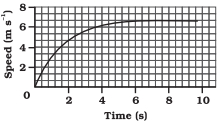
The speed-time graph for a car is shown in the figure.
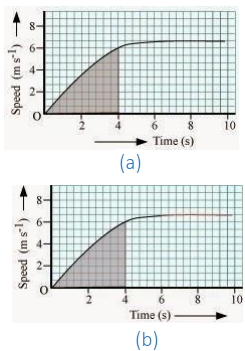
$(a)$ Find how far the car travels in the first $4 \, s$. Shade the area on the graph that represents the distance travelled by the car during this period.
$(b)$ Which part of the graph represents the uniform motion of the car?
$(a)$ Find how far the car travels in the first $4 \, s$. Shade the area on the graph that represents the distance travelled by the car during this period.
$(b)$ Which part of the graph represents the uniform motion of the car?
Solution
(N/A) The distance travelled by the car is equal to the area under the speed-time graph. To find the distance travelled in the first $4 \, s$,we calculate the area under the curve from $t = 0 \, s$ to $t = 4 \, s$. By observing the grid,the area is approximately a triangle with base $4 \, s$ and height $6 \, m/s$. Thus,the distance is $\frac{1}{2} \times \text{base} \times \text{height} = \frac{1}{2} \times 4 \, s \times 6 \, m/s = 12 \, m$.
$(b)$ Uniform motion is represented by a horizontal line in a speed-time graph,where the speed remains constant over time. In this graph,the part from $6 \, s$ to $10 \, s$ is a horizontal line,which represents the uniform motion of the car.
$(b)$ Uniform motion is represented by a horizontal line in a speed-time graph,where the speed remains constant over time. In this graph,the part from $6 \, s$ to $10 \, s$ is a horizontal line,which represents the uniform motion of the car.
0 likes
View Solution29
Medium
State which of the following situations are possible and give an example for each of these:
$(a)$ An object with a constant acceleration but with zero velocity.
$(b)$ An object moving with an acceleration but with uniform speed.
$(c)$ An object moving in a certain direction with an acceleration in the perpendicular direction.
$(a)$ An object with a constant acceleration but with zero velocity.
$(b)$ An object moving with an acceleration but with uniform speed.
$(c)$ An object moving in a certain direction with an acceleration in the perpendicular direction.
Solution
(N/A) Possible.
When a ball is thrown vertically upwards,at its maximum height,its velocity is zero,but it still experiences a constant acceleration due to gravity $(g = 9.8\,m/s^2)$ acting downwards.
$(b)$ Possible.
When an object moves in a circular path with a uniform speed,its velocity changes continuously due to the change in direction. This change in velocity results in a centripetal acceleration directed towards the center of the circle.
$(c)$ Possible.
An object moving in a circular path is a classic example. The velocity of the object is tangential to the path,while the centripetal acceleration acts towards the center of the circle,which is perpendicular to the direction of motion.
When a ball is thrown vertically upwards,at its maximum height,its velocity is zero,but it still experiences a constant acceleration due to gravity $(g = 9.8\,m/s^2)$ acting downwards.
$(b)$ Possible.
When an object moves in a circular path with a uniform speed,its velocity changes continuously due to the change in direction. This change in velocity results in a centripetal acceleration directed towards the center of the circle.
$(c)$ Possible.
An object moving in a circular path is a classic example. The velocity of the object is tangential to the path,while the centripetal acceleration acts towards the center of the circle,which is perpendicular to the direction of motion.
0 likes
View Solution30
MediumMCQ
An artificial satellite is moving in a circular orbit of radius $42250 \, km$. Calculate its speed (in $m s^{-1}$) if it takes $24 \, h$ to revolve around the Earth.
A
$1026$
B
$3074$
C
$2096$
D
$4064$
Solution
(B) The radius of the circular orbit is $r = 42250 \, km = 42250000 \, m$.
The time taken to complete one revolution is $t = 24 \, h = 24 \times 60 \times 60 \, s = 86400 \, s$.
The speed $v$ of an object moving in a circular path is given by the formula $v = \frac{2 \pi r}{t}$.
Substituting the values: $v = \frac{2 \times (22/7) \times 42250000}{86400}$.
$v = \frac{2 \times 22 \times 42250000}{7 \times 86400} \approx 3073.74 \, m s^{-1}$.
Rounding to the nearest whole number,the speed is approximately $3074 \, m s^{-1}$.
The time taken to complete one revolution is $t = 24 \, h = 24 \times 60 \times 60 \, s = 86400 \, s$.
The speed $v$ of an object moving in a circular path is given by the formula $v = \frac{2 \pi r}{t}$.
Substituting the values: $v = \frac{2 \times (22/7) \times 42250000}{86400}$.
$v = \frac{2 \times 22 \times 42250000}{7 \times 86400} \approx 3073.74 \, m s^{-1}$.
Rounding to the nearest whole number,the speed is approximately $3074 \, m s^{-1}$.
0 likes
View Solution31
MediumMCQ
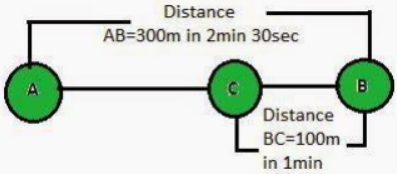
Joseph jogs from one end $A$ to the other end $B$ of a straight $300 \, m$ road in $2 \, min$ $30 \, sec$ and then turns around and jogs $100 \, m$ back to point $C$ in another $1 \, min$. What are Joseph's average speeds and velocities in jogging from $A$ to $C$?
A
$904 \, m s^{-1}$ and $952 \, m s^{-1}$
B
$0.904 \, m s^{-1}$ and $1.952 \, m s^{-1}$
C
$1.904 \, m s^{-1}$ and $0.952 \, m s^{-1}$
D
$0.809 \, m s^{-1}$ and $0.599 \, m s^{-1}$
Solution
(C) Total distance covered from $A$ to $C = AB + BC = 300 \, m + 100 \, m = 400 \, m$.
Total time taken from $A$ to $C = \text{Time for } AB + \text{Time for } BC = (2 \times 60 + 30) \, s + 60 \, s = 150 \, s + 60 \, s = 210 \, s$.
Average speed = $\text{Total distance} / \text{Total time} = 400 \, m / 210 \, s \approx 1.904 \, m s^{-1}$.
Displacement from $A$ to $C = AB - BC = 300 \, m - 100 \, m = 200 \, m$.
Average velocity = $\text{Displacement} / \text{Total time} = 200 \, m / 210 \, s \approx 0.952 \, m s^{-1}$.
Total time taken from $A$ to $C = \text{Time for } AB + \text{Time for } BC = (2 \times 60 + 30) \, s + 60 \, s = 150 \, s + 60 \, s = 210 \, s$.
Average speed = $\text{Total distance} / \text{Total time} = 400 \, m / 210 \, s \approx 1.904 \, m s^{-1}$.
Displacement from $A$ to $C = AB - BC = 300 \, m - 100 \, m = 200 \, m$.
Average velocity = $\text{Displacement} / \text{Total time} = 200 \, m / 210 \, s \approx 0.952 \, m s^{-1}$.
0 likes
View SolutionMOTION — Textbook - MOTION · Frequently Asked Questions
1Are these MOTION questions useful for JEE and NEET?
Yes. All questions in this section are mapped to JEE Main and NEET exam patterns. Previous year questions from JEE Main, NEET, GUJCET and state-level exams are included with full solutions.
2Can I switch to Hindi or Gujarati for these questions?
Yes. Use the language tabs in the hero section or the sidebar to view the same questions and solutions in English, Hindi or Gujarati.
3How do I generate a question paper from this subtopic?
Use the Vedclass Exam Paper Generator — select the chapter and subtopic, set difficulty, and generate Sets A, B, C, D automatically. First 3 chapters of every subject are free.
Vedclass Products
For Students
Vedclass Test Series
Mock tests in real JEE/NEET style with performance analysis. 5-day free trial.
Start Free TrialFor Teachers
Exam Paper Generator
Generate Set A/B/C/D papers from this chapter in 2 minutes. 3 chapters free.
Try FreeFor Institutes
Online Exam Module
Live online exams with unlimited students, 360° analytics & white-label branding.
See DemoFor Teachers & Institutes
Generate a MOTION Exam Paper in 2 Minutes
Select subtopic & difficulty — Sets A, B, C, D auto-generated with No Repeat logic.
First 3 chapters of every subject are free — no payment required.