
A English
Mix Example - MOTION Questions in English
Class 9 Science · MOTION · Mix Example - MOTION
247+
Questions
English
Language
100%
With Solutions
Showing 50 of 247 questions in English
151
Medium
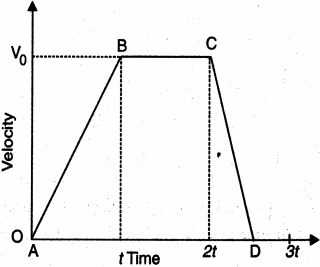
The diagram shows a velocity-time graph for a car starting from rest. The graph has three sections $AB$,$BC$,and $CD$.
$(i)$ From a study of this graph,state how the distance travelled in any section is determined.
$(ii)$ Compare the distance travelled in section $BC$ with the distance travelled in section $AB$.
$(iii)$ In which section does the car have zero acceleration?
$(iv)$ Is the magnitude of acceleration higher or lower than that of retardation? Give a reason.
$(i)$ From a study of this graph,state how the distance travelled in any section is determined.
$(ii)$ Compare the distance travelled in section $BC$ with the distance travelled in section $AB$.
$(iii)$ In which section does the car have zero acceleration?
$(iv)$ Is the magnitude of acceleration higher or lower than that of retardation? Give a reason.
Solution
(N/A) $(i)$ The distance travelled in any section is determined by calculating the area under the velocity-time graph for that specific section.
$(ii)$ Distance in section $AB$ = Area of triangle $OAB = \frac{1}{2} \times \text{base} \times \text{height} = \frac{1}{2} \times t \times V_{0} = \frac{1}{2} V_{0}t$.
Distance in section $BC$ = Area of rectangle under $BC = \text{length} \times \text{breadth} = (2t - t) \times V_{0} = t \times V_{0} = V_{0}t$.
Comparing the two,the distance in section $BC$ is twice the distance in section $AB$ (Ratio $2:1$).
$(iii)$ In section $BC$,the velocity is constant,so the car has zero acceleration.
$(iv)$ The magnitude of acceleration is lower than that of retardation.
Reason: The magnitude of acceleration is the slope of $AB = \frac{V_{0}}{t}$.
The magnitude of retardation is the slope of $CD = \frac{V_{0}}{3t - 2t} = \frac{V_{0}}{t}$? Wait,looking at the graph,$D$ is at $2.5t$ or similar? Let's re-evaluate: The slope of $AB = \frac{V_{0}}{t}$. The slope of $CD = \frac{V_{0}}{0.5t} = 2\frac{V_{0}}{t}$. Thus,retardation is higher.
$(ii)$ Distance in section $AB$ = Area of triangle $OAB = \frac{1}{2} \times \text{base} \times \text{height} = \frac{1}{2} \times t \times V_{0} = \frac{1}{2} V_{0}t$.
Distance in section $BC$ = Area of rectangle under $BC = \text{length} \times \text{breadth} = (2t - t) \times V_{0} = t \times V_{0} = V_{0}t$.
Comparing the two,the distance in section $BC$ is twice the distance in section $AB$ (Ratio $2:1$).
$(iii)$ In section $BC$,the velocity is constant,so the car has zero acceleration.
$(iv)$ The magnitude of acceleration is lower than that of retardation.
Reason: The magnitude of acceleration is the slope of $AB = \frac{V_{0}}{t}$.
The magnitude of retardation is the slope of $CD = \frac{V_{0}}{3t - 2t} = \frac{V_{0}}{t}$? Wait,looking at the graph,$D$ is at $2.5t$ or similar? Let's re-evaluate: The slope of $AB = \frac{V_{0}}{t}$. The slope of $CD = \frac{V_{0}}{0.5t} = 2\frac{V_{0}}{t}$. Thus,retardation is higher.
0 likes
View Solution152
Medium
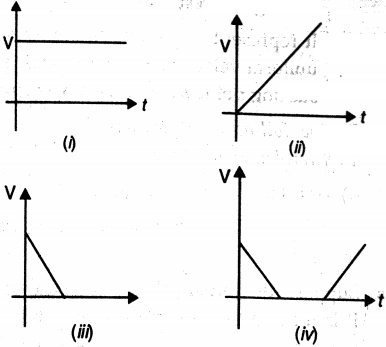
What can we conclude about the motion of a body depicted by the following velocity-time graphs?
Solution
(N/A) $(i)$ The graph shows a horizontal line parallel to the time axis,indicating that the velocity remains constant over time. This represents a body moving with uniform velocity.
$(ii)$ The graph shows a straight line passing through the origin with a positive slope,indicating that the velocity increases linearly with time. This represents a body moving with uniform acceleration.
$(iii)$ The graph shows a straight line with a negative slope,indicating that the velocity decreases linearly with time until it reaches zero. This represents a body moving with uniform retardation (deceleration).
$(iv)$ The graph shows the velocity decreasing linearly to zero (uniform retardation),remaining at zero for a certain time interval (at rest),and then increasing linearly (uniform acceleration).
$(ii)$ The graph shows a straight line passing through the origin with a positive slope,indicating that the velocity increases linearly with time. This represents a body moving with uniform acceleration.
$(iii)$ The graph shows a straight line with a negative slope,indicating that the velocity decreases linearly with time until it reaches zero. This represents a body moving with uniform retardation (deceleration).
$(iv)$ The graph shows the velocity decreasing linearly to zero (uniform retardation),remaining at zero for a certain time interval (at rest),and then increasing linearly (uniform acceleration).
0 likes
View Solution153
MediumMCQ
What is the nature of motion of a particle depicted by the following displacement-time graphs?
A
$(i)$ Uniform velocity,(ii) Rest,(iii) Uniform acceleration,(iv) Non-uniform velocity
B
$(i)$ Rest,(ii) Uniform velocity,(iii) Uniform acceleration,(iv) Non-uniform velocity
C
$(i)$ Rest,(ii) Uniform velocity,(iii) Uniform velocity then rest,(iv) Uniform velocity then return
D
$(i)$ Uniform velocity,(ii) Rest,(iii) Uniform velocity then rest,(iv) Uniform velocity then return
Solution
(C) $(i)$ The graph is a horizontal line parallel to the time axis,indicating that displacement does not change with time; therefore,the particle is at rest.
$(ii)$ The graph is a straight line inclined to the time axis,indicating that displacement changes at a constant rate; therefore,the particle is moving with uniform velocity.
$(iii)$ The graph shows a straight line with a constant slope followed by a horizontal line,indicating the particle moves with uniform velocity and then suddenly comes to rest.
$(iv)$ The graph shows a straight line with a positive slope followed by a straight line with a negative slope returning to the zero displacement axis,indicating the particle moves with uniform velocity and then returns to the starting point with the same speed.
$(ii)$ The graph is a straight line inclined to the time axis,indicating that displacement changes at a constant rate; therefore,the particle is moving with uniform velocity.
$(iii)$ The graph shows a straight line with a constant slope followed by a horizontal line,indicating the particle moves with uniform velocity and then suddenly comes to rest.
$(iv)$ The graph shows a straight line with a positive slope followed by a straight line with a negative slope returning to the zero displacement axis,indicating the particle moves with uniform velocity and then returns to the starting point with the same speed.
0 likes
View Solution154
Difficult
Derive the following equations for a uniformly accelerated motion:
$(i)$ $v = u + at$
$(ii)$ $S = ut + \frac{1}{2}at^2$
$(iii)$ $v^2 - u^2 = 2aS$, where the symbols have their usual meanings.
$(i)$ $v = u + at$
$(ii)$ $S = ut + \frac{1}{2}at^2$
$(iii)$ $v^2 - u^2 = 2aS$, where the symbols have their usual meanings.
Solution
(N/A) Suppose the initial velocity of a body is $u$ and it is moving with uniform acceleration $a$ for time $t$. Let the final velocity be $v$ and the distance covered be $S$.
$(i)$ Acceleration is defined as the rate of change of velocity:
$a = \frac{v - u}{t}$
$at = v - u$
$v = u + at$
$(ii)$ The average velocity for uniform acceleration is given by:
$\bar{v} = \frac{u + v}{2} \quad \dots(1)$
Also, average velocity is total displacement divided by time:
$\bar{v} = \frac{S}{t} \quad \dots(2)$
Equating $(1)$ and $(2)$:
$\frac{u + v}{2} = \frac{S}{t} \implies S = \left( \frac{u + v}{2} \right) t \quad \dots(3)$
Substituting $v = u + at$ into equation $(3)$:
$S = \left( \frac{u + (u + at)}{2} \right) t$
$S = \left( \frac{2u + at}{2} \right) t$
$S = ut + \frac{1}{2}at^2$
$(iii)$ From equation $(3)$, $S = \left( \frac{u + v}{2} \right) t$. From $v = u + at$, we get $t = \frac{v - u}{a}$.
Substituting $t$ in equation $(3)$:
$S = \left( \frac{u + v}{2} \right) \left( \frac{v - u}{a} \right)$
$S = \frac{v^2 - u^2}{2a}$
$v^2 - u^2 = 2aS$
$(i)$ Acceleration is defined as the rate of change of velocity:
$a = \frac{v - u}{t}$
$at = v - u$
$v = u + at$
$(ii)$ The average velocity for uniform acceleration is given by:
$\bar{v} = \frac{u + v}{2} \quad \dots(1)$
Also, average velocity is total displacement divided by time:
$\bar{v} = \frac{S}{t} \quad \dots(2)$
Equating $(1)$ and $(2)$:
$\frac{u + v}{2} = \frac{S}{t} \implies S = \left( \frac{u + v}{2} \right) t \quad \dots(3)$
Substituting $v = u + at$ into equation $(3)$:
$S = \left( \frac{u + (u + at)}{2} \right) t$
$S = \left( \frac{2u + at}{2} \right) t$
$S = ut + \frac{1}{2}at^2$
$(iii)$ From equation $(3)$, $S = \left( \frac{u + v}{2} \right) t$. From $v = u + at$, we get $t = \frac{v - u}{a}$.
Substituting $t$ in equation $(3)$:
$S = \left( \frac{u + v}{2} \right) \left( \frac{v - u}{a} \right)$
$S = \frac{v^2 - u^2}{2a}$
$v^2 - u^2 = 2aS$
0 likes
View Solution155
Medium
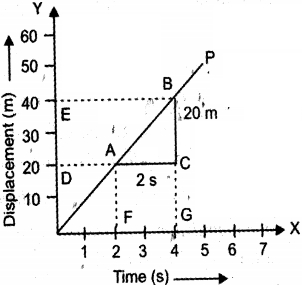
What do you understand by the displacement-time graph? Draw a displacement-time graph for a girl going to school with uniform velocity. How can we calculate the uniform velocity from it?
Solution
(N/A) In the displacement-time graph,the time is taken on the $x$-axis and the displacement of the body is taken on the $y$-axis.
Since $\text{Velocity} = \frac{\text{Displacement}}{\text{Time}}$,the slope of the displacement-time graph gives the velocity.
For a girl going to school on a straight path in a given direction with a uniform speed,the displacement-time graph is a straight line passing through the origin (as shown in the figure).
The velocity of the girl can be obtained by finding the slope of the straight line $OP$.
Using the points $A$ and $B$ on the graph:
$\text{Velocity} (v) = \frac{\text{Change in displacement}}{\text{Change in time}} = \frac{BC}{AC} = \frac{40 \text{ m} - 20 \text{ m}}{4 \text{ s} - 2 \text{ s}} = \frac{20 \text{ m}}{2 \text{ s}} = 10 \text{ m s}^{-1}$.
Since $\text{Velocity} = \frac{\text{Displacement}}{\text{Time}}$,the slope of the displacement-time graph gives the velocity.
For a girl going to school on a straight path in a given direction with a uniform speed,the displacement-time graph is a straight line passing through the origin (as shown in the figure).
The velocity of the girl can be obtained by finding the slope of the straight line $OP$.
Using the points $A$ and $B$ on the graph:
$\text{Velocity} (v) = \frac{\text{Change in displacement}}{\text{Change in time}} = \frac{BC}{AC} = \frac{40 \text{ m} - 20 \text{ m}}{4 \text{ s} - 2 \text{ s}} = \frac{20 \text{ m}}{2 \text{ s}} = 10 \text{ m s}^{-1}$.
0 likes
View Solution156
Difficult
What is a velocity-time graph? State how it can be used to find:
$(i)$ The acceleration of a body.
$(ii)$ The displacement of the body.
$(iii)$ The distance travelled in a given time.
$(i)$ The acceleration of a body.
$(ii)$ The displacement of the body.
$(iii)$ The distance travelled in a given time.
Solution
(N/A) In a velocity-time graph,time is plotted along the $x$-axis and velocity is plotted along the $y$-axis.
$(i)$ Since acceleration $=$ Change in velocity $/$ Time,the slope of the velocity-time graph gives the acceleration. If the slope is positive,it represents accelerated motion; if the slope is negative,it represents retarded motion.
$(ii)$ Since velocity $\times$ time $=$ displacement,the area enclosed between the graph and the time axis represents the displacement. The area above the time axis is considered positive displacement,and the area below the time axis is considered negative displacement. The total displacement is the algebraic sum of these areas.
$(iii)$ The total distance travelled by the body is the arithmetic sum of the magnitudes of the areas enclosed by the velocity-time graph and the time axis (ignoring the sign).
$(i)$ Since acceleration $=$ Change in velocity $/$ Time,the slope of the velocity-time graph gives the acceleration. If the slope is positive,it represents accelerated motion; if the slope is negative,it represents retarded motion.
$(ii)$ Since velocity $\times$ time $=$ displacement,the area enclosed between the graph and the time axis represents the displacement. The area above the time axis is considered positive displacement,and the area below the time axis is considered negative displacement. The total displacement is the algebraic sum of these areas.
$(iii)$ The total distance travelled by the body is the arithmetic sum of the magnitudes of the areas enclosed by the velocity-time graph and the time axis (ignoring the sign).
0 likes
View Solution157
Medium
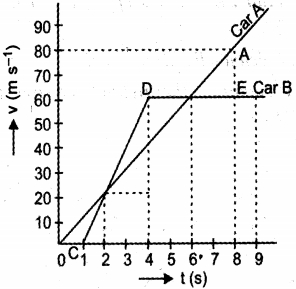
The $v-t$ graph of cars $A$ and $B$ which start from the same place and move along a straight road in the same direction is shown. Calculate:
$(i)$ The acceleration of car $A$ between $0$ and $8\, s$.
$(ii)$ The acceleration of car $B$ between $2\, s$ and $4\, s$.
$(iii)$ The points of time at which both the cars have the same velocity.
$(iv)$ Which of the two cars is ahead after $8\, s$ and by how much?
$(i)$ The acceleration of car $A$ between $0$ and $8\, s$.
$(ii)$ The acceleration of car $B$ between $2\, s$ and $4\, s$.
$(iii)$ The points of time at which both the cars have the same velocity.
$(iv)$ Which of the two cars is ahead after $8\, s$ and by how much?
Solution
(N/A) $(i)$ Acceleration of car $A$ between $0$ and $8\, s$ is the slope of the line:
$a = \frac{v_f - v_i}{t_f - t_i} = \frac{80 - 0}{8 - 0} = 10\, m/s^2$.
$(ii)$ Acceleration of car $B$ between $2\, s$ and $4\, s$ is the slope of the line:
$a = \frac{v_f - v_i}{t_f - t_i} = \frac{60 - 20}{4 - 2} = \frac{40}{2} = 20\, m/s^2$.
$(iii)$ Both cars have the same velocity where the two lines intersect,which occurs at $t = 2\, s$ and $t = 6\, s$.
$(iv)$ Distance travelled is the area under the $v-t$ graph.
Distance travelled by car $A$ in $8\, s$ = Area of triangle with base $8\, s$ and height $80\, m/s$ = $\frac{1}{2} \times 8 \times 80 = 320\, m$.
Distance travelled by car $B$ in $8\, s$ = Area of triangle ($t=1$ to $2$) + Area of trapezium ($t=2$ to $4$) + Area of rectangle ($t=4$ to $8$).
Area = $(\frac{1}{2} \times 1 \times 20) + (\frac{20+60}{2} \times 2) + (4 \times 60) = 10 + 80 + 240 = 330\, m$.
Since $330\, m > 320\, m$,car $B$ is ahead by $330 - 320 = 10\, m$.
$a = \frac{v_f - v_i}{t_f - t_i} = \frac{80 - 0}{8 - 0} = 10\, m/s^2$.
$(ii)$ Acceleration of car $B$ between $2\, s$ and $4\, s$ is the slope of the line:
$a = \frac{v_f - v_i}{t_f - t_i} = \frac{60 - 20}{4 - 2} = \frac{40}{2} = 20\, m/s^2$.
$(iii)$ Both cars have the same velocity where the two lines intersect,which occurs at $t = 2\, s$ and $t = 6\, s$.
$(iv)$ Distance travelled is the area under the $v-t$ graph.
Distance travelled by car $A$ in $8\, s$ = Area of triangle with base $8\, s$ and height $80\, m/s$ = $\frac{1}{2} \times 8 \times 80 = 320\, m$.
Distance travelled by car $B$ in $8\, s$ = Area of triangle ($t=1$ to $2$) + Area of trapezium ($t=2$ to $4$) + Area of rectangle ($t=4$ to $8$).
Area = $(\frac{1}{2} \times 1 \times 20) + (\frac{20+60}{2} \times 2) + (4 \times 60) = 10 + 80 + 240 = 330\, m$.
Since $330\, m > 320\, m$,car $B$ is ahead by $330 - 320 = 10\, m$.
0 likes
View Solution158
Medium
The velocity$-$time graph of an ascending passenger lift is as shown in the figure below.
$(i)$ Identify the kind of motion of the lift represented by lines $OA$ and $BC$.
$(ii)$ Calculate the acceleration of the lift:
$(a)$ During the first two seconds.
$(b)$ Between the $3^{rd}$ and $10^{th}$ second.
$(c)$ During the last two seconds.
$(i)$ Identify the kind of motion of the lift represented by lines $OA$ and $BC$.
$(ii)$ Calculate the acceleration of the lift:
$(a)$ During the first two seconds.
$(b)$ Between the $3^{rd}$ and $10^{th}$ second.
$(c)$ During the last two seconds.
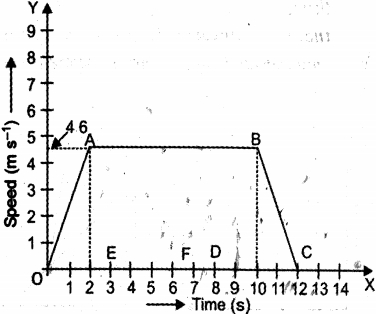
Solution
(N/A) $(i)$ The motion represented by line $OA$ is uniformly accelerated motion,and the motion represented by line $BC$ is uniformly retarded motion (deceleration).
$(ii)$ The acceleration of the lift is calculated as follows:
$(a)$ During the first two seconds (from $OA$):
Initial velocity $u = 0 \ m/s$,final velocity $v = 4.6 \ m/s$,time $t = 2 \ s$.
$a = \frac{v - u}{t} = \frac{4.6 - 0}{2} = 2.3 \ m/s^2$.
$(b)$ Between the $3^{rd}$ and $10^{th}$ second,the graph is a straight line parallel to the time axis,which indicates constant velocity. Therefore,the acceleration is $0 \ m/s^2$.
$(c)$ During the last two seconds (from $BC$):
Initial velocity $u = 4.6 \ m/s$,final velocity $v = 0 \ m/s$,time $t = 12 - 10 = 2 \ s$.
$a = \frac{v - u}{t} = \frac{0 - 4.6}{2} = -2.3 \ m/s^2$.
$(ii)$ The acceleration of the lift is calculated as follows:
$(a)$ During the first two seconds (from $OA$):
Initial velocity $u = 0 \ m/s$,final velocity $v = 4.6 \ m/s$,time $t = 2 \ s$.
$a = \frac{v - u}{t} = \frac{4.6 - 0}{2} = 2.3 \ m/s^2$.
$(b)$ Between the $3^{rd}$ and $10^{th}$ second,the graph is a straight line parallel to the time axis,which indicates constant velocity. Therefore,the acceleration is $0 \ m/s^2$.
$(c)$ During the last two seconds (from $BC$):
Initial velocity $u = 4.6 \ m/s$,final velocity $v = 0 \ m/s$,time $t = 12 - 10 = 2 \ s$.
$a = \frac{v - u}{t} = \frac{0 - 4.6}{2} = -2.3 \ m/s^2$.
0 likes
View Solution159
Medium
$(a)$ Draw velocity-time graphs for the following cases:
$(i)$ When the object is at rest.
$(ii)$ When the object is thrown vertically upwards.
$(b)$ $A$ motorcyclist riding motorcycle $A$ who is travelling at $36 \, km \, h^{-1}$ applies the brakes and stops the motorcycle in $10 \, s$. Another motorcyclist of motorcycle $B$ who is travelling at $18 \, km \, h^{-1}$ applies the brakes and stops the motorcycle in $20 \, s$. Plot the speed-time graph for the two motorcycles. Which of the two motorcycles travelled farther before it came to a stop?
$(i)$ When the object is at rest.
$(ii)$ When the object is thrown vertically upwards.
$(b)$ $A$ motorcyclist riding motorcycle $A$ who is travelling at $36 \, km \, h^{-1}$ applies the brakes and stops the motorcycle in $10 \, s$. Another motorcyclist of motorcycle $B$ who is travelling at $18 \, km \, h^{-1}$ applies the brakes and stops the motorcycle in $20 \, s$. Plot the speed-time graph for the two motorcycles. Which of the two motorcycles travelled farther before it came to a stop?
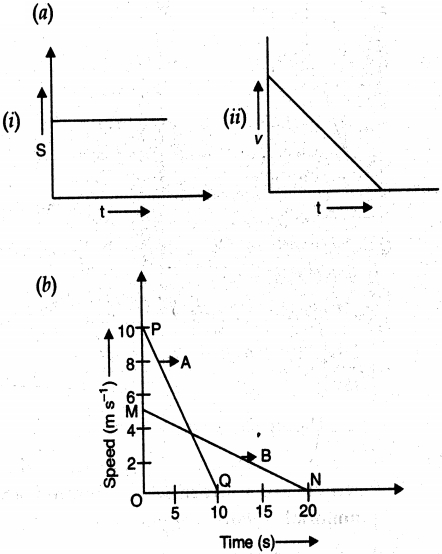
Solution
(N/A) For motorcycle $A$:
Initial velocity $u = 36 \, km \, h^{-1} = \frac{36 \times 5}{18} = 10 \, m \, s^{-1}$.
Final velocity $v = 0 \, m \, s^{-1}$.
Time $t = 10 \, s$.
For motorcycle $B$:
Initial velocity $u = 18 \, km \, h^{-1} = \frac{18 \times 5}{18} = 5 \, m \, s^{-1}$.
Final velocity $v = 0 \, m \, s^{-1}$.
Time $t = 20 \, s$.
Distance travelled is equal to the area under the speed-time graph.
Distance travelled by $A$ before stopping = Area of triangle $OPQ = \frac{1}{2} \times \text{base} \times \text{height} = \frac{1}{2} \times 10 \, s \times 10 \, m \, s^{-1} = 50 \, m$.
Distance travelled by $B$ before stopping = Area of triangle $OMN = \frac{1}{2} \times \text{base} \times \text{height} = \frac{1}{2} \times 20 \, s \times 5 \, m \, s^{-1} = 50 \, m$.
Conclusion: Both motorcycles travelled the same distance before they came to a stop.
Initial velocity $u = 36 \, km \, h^{-1} = \frac{36 \times 5}{18} = 10 \, m \, s^{-1}$.
Final velocity $v = 0 \, m \, s^{-1}$.
Time $t = 10 \, s$.
For motorcycle $B$:
Initial velocity $u = 18 \, km \, h^{-1} = \frac{18 \times 5}{18} = 5 \, m \, s^{-1}$.
Final velocity $v = 0 \, m \, s^{-1}$.
Time $t = 20 \, s$.
Distance travelled is equal to the area under the speed-time graph.
Distance travelled by $A$ before stopping = Area of triangle $OPQ = \frac{1}{2} \times \text{base} \times \text{height} = \frac{1}{2} \times 10 \, s \times 10 \, m \, s^{-1} = 50 \, m$.
Distance travelled by $B$ before stopping = Area of triangle $OMN = \frac{1}{2} \times \text{base} \times \text{height} = \frac{1}{2} \times 20 \, s \times 5 \, m \, s^{-1} = 50 \, m$.
Conclusion: Both motorcycles travelled the same distance before they came to a stop.
0 likes
View Solution160
Medium
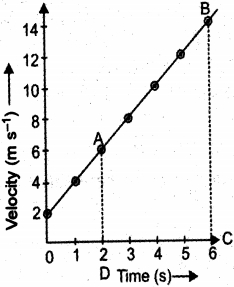
An object is moving along a straight line with uniform acceleration. The following table gives the velocity of the object at various instants of time.
Plot the graph.
From the graph:
$(i)$ Find the velocity of the object at the end of $2.5 \ s$.
$(ii)$ Calculate the acceleration.
$(iii)$ Calculate the distance covered in the last $4 \ s$.
| Time $(s)$ | $0$ | $1$ | $2$ | $3$ | $4$ | $5$ | $6$ |
| Velocity $(m s^{-1})$ | $2$ | $4$ | $6$ | $8$ | $10$ | $12$ | $14$ |
Plot the graph.
From the graph:
$(i)$ Find the velocity of the object at the end of $2.5 \ s$.
$(ii)$ Calculate the acceleration.
$(iii)$ Calculate the distance covered in the last $4 \ s$.
Solution
(N/A) $(i)$ By observing the velocity-time graph, at $t = 2.5 \ s$, the velocity is $7 \ m s^{-1}$.
$(ii)$ Acceleration $(a)$ is the slope of the velocity-time graph.
$a = \frac{v - u}{t} = \frac{14 - 2}{6 - 0} = \frac{12}{6} = 2 \ m s^{-2}$.
$(iii)$ The distance covered in the last $4 \ s$ (from $t = 2 \ s$ to $t = 6 \ s$) is equal to the area under the velocity-time graph between these time intervals.
This area forms a trapezium $ABCD$ where the parallel sides are the velocities at $t = 2 \ s$ $(6 \ m s^{-1})$ and $t = 6 \ s$ $(14 \ m s^{-1})$, and the height is the time interval $(6 - 2 = 4 \ s)$.
$S = \text{Area of trapezium } ABCD = \frac{1}{2} \times (\text{sum of parallel sides}) \times (\text{height})$
$S = \frac{1}{2} \times (6 + 14) \times 4 = \frac{1}{2} \times 20 \times 4 = 40 \ m$.
$(ii)$ Acceleration $(a)$ is the slope of the velocity-time graph.
$a = \frac{v - u}{t} = \frac{14 - 2}{6 - 0} = \frac{12}{6} = 2 \ m s^{-2}$.
$(iii)$ The distance covered in the last $4 \ s$ (from $t = 2 \ s$ to $t = 6 \ s$) is equal to the area under the velocity-time graph between these time intervals.
This area forms a trapezium $ABCD$ where the parallel sides are the velocities at $t = 2 \ s$ $(6 \ m s^{-1})$ and $t = 6 \ s$ $(14 \ m s^{-1})$, and the height is the time interval $(6 - 2 = 4 \ s)$.
$S = \text{Area of trapezium } ABCD = \frac{1}{2} \times (\text{sum of parallel sides}) \times (\text{height})$
$S = \frac{1}{2} \times (6 + 14) \times 4 = \frac{1}{2} \times 20 \times 4 = 40 \ m$.
0 likes
View Solution161
Medium
$(a)$ Define circular motion.
$(b)$ "Uniform circular motion is an accelerated motion". Justify this statement with reason.
$(c)$ An artificial satellite is moving in a circular orbit of radius $42250 \, km$. Calculate its speed if it takes $24 \, h$ to revolve once around the Earth.
$(b)$ "Uniform circular motion is an accelerated motion". Justify this statement with reason.
$(c)$ An artificial satellite is moving in a circular orbit of radius $42250 \, km$. Calculate its speed if it takes $24 \, h$ to revolve once around the Earth.
Solution
$(a)$ When a body moves along a circular path, it is said to be in circular motion.
$(b)$ Uniform circular motion is considered an accelerated motion because the direction of the velocity vector changes at every point along the path, even though the magnitude (speed) remains constant. Since acceleration is defined as the rate of change of velocity, a change in direction constitutes acceleration.
$(c)$ The distance covered in one revolution is the circumference of the circular orbit, given by $2 \pi r$.
Distance $= 2 \times 3.14 \times 42250 \, km = 265330 \, km$.
Time taken $(t) = 24 \, h$.
Speed $= \frac{\text{Distance}}{\text{Time}} = \frac{265330 \, km}{24 \, h} \approx 11055.42 \, km/h$.
$(b)$ Uniform circular motion is considered an accelerated motion because the direction of the velocity vector changes at every point along the path, even though the magnitude (speed) remains constant. Since acceleration is defined as the rate of change of velocity, a change in direction constitutes acceleration.
$(c)$ The distance covered in one revolution is the circumference of the circular orbit, given by $2 \pi r$.
Distance $= 2 \times 3.14 \times 42250 \, km = 265330 \, km$.
Time taken $(t) = 24 \, h$.
Speed $= \frac{\text{Distance}}{\text{Time}} = \frac{265330 \, km}{24 \, h} \approx 11055.42 \, km/h$.
0 likes
View Solution162
Medium
$(a)$ Differentiate acceleration from velocity.
$(b)$ Can a body have acceleration without change in magnitude of velocity? Explain with an example.
$(c)$ $A$ motor boat starting from rest on a lake accelerates in a straight line at a constant rate of $3 \, m s^{-2}$ for $8 \, s$. How far does the boat travel during this time?
$(b)$ Can a body have acceleration without change in magnitude of velocity? Explain with an example.
$(c)$ $A$ motor boat starting from rest on a lake accelerates in a straight line at a constant rate of $3 \, m s^{-2}$ for $8 \, s$. How far does the boat travel during this time?
Solution
(C) Acceleration is the rate of change of velocity,whereas velocity is the rate of change of displacement.
$(b)$ Yes. In uniform circular motion,the magnitude of velocity (speed) remains constant,but the direction changes continuously. Since acceleration is a vector quantity,this change in direction results in centripetal acceleration.
$(c)$ Given: Initial velocity $u = 0 \, m s^{-1}$,acceleration $a = 3 \, m s^{-2}$,time $t = 8 \, s$.
Using the second equation of motion: $S = ut + \frac{1}{2}at^2$
$S = (0 \times 8) + \frac{1}{2} \times 3 \times (8)^2$
$S = 0 + \frac{1}{2} \times 3 \times 64$
$S = 3 \times 32 = 96 \, m$.
The boat travels $96 \, m$ during this time.
$(b)$ Yes. In uniform circular motion,the magnitude of velocity (speed) remains constant,but the direction changes continuously. Since acceleration is a vector quantity,this change in direction results in centripetal acceleration.
$(c)$ Given: Initial velocity $u = 0 \, m s^{-1}$,acceleration $a = 3 \, m s^{-2}$,time $t = 8 \, s$.
Using the second equation of motion: $S = ut + \frac{1}{2}at^2$
$S = (0 \times 8) + \frac{1}{2} \times 3 \times (8)^2$
$S = 0 + \frac{1}{2} \times 3 \times 64$
$S = 3 \times 32 = 96 \, m$.
The boat travels $96 \, m$ during this time.
0 likes
View Solution163
MediumMCQ
List two differences in tabular form between speed and velocity. When is a body said to have: $(a)$ uniform velocity and $(b)$ variable velocity? How is the average velocity of a body calculated when its velocity changes at a non-uniform rate?
A
Speed is a scalar quantity; Velocity is a vector quantity.
B
Speed is the rate of change of distance; Velocity is the rate of change of displacement.
C
Uniform velocity: When a body covers equal displacements in equal intervals of time in a fixed direction.
D
Variable velocity: When a body covers unequal displacements in equal intervals of time or changes its direction of motion.
Solution
(N/A) Differences between speed and velocity:
$1$. Speed is the distance traveled per unit time,whereas velocity is the displacement per unit time.
$2$. Speed is a scalar quantity (has only magnitude),whereas velocity is a vector quantity (has both magnitude and direction).
$(a)$ $A$ body is said to have uniform velocity if it covers equal displacements in equal intervals of time in a fixed direction.
$(b)$ $A$ body is said to have variable velocity if it covers unequal displacements in equal intervals of time or if its direction of motion changes.
When the velocity of a body changes at a non-uniform rate,the average velocity is calculated by taking the arithmetic mean of the initial velocity $(u)$ and the final velocity $(v)$:
$\text{Average Velocity} = \frac{u + v}{2}$
$1$. Speed is the distance traveled per unit time,whereas velocity is the displacement per unit time.
$2$. Speed is a scalar quantity (has only magnitude),whereas velocity is a vector quantity (has both magnitude and direction).
$(a)$ $A$ body is said to have uniform velocity if it covers equal displacements in equal intervals of time in a fixed direction.
$(b)$ $A$ body is said to have variable velocity if it covers unequal displacements in equal intervals of time or if its direction of motion changes.
When the velocity of a body changes at a non-uniform rate,the average velocity is calculated by taking the arithmetic mean of the initial velocity $(u)$ and the final velocity $(v)$:
$\text{Average Velocity} = \frac{u + v}{2}$
0 likes
View Solution164
Medium
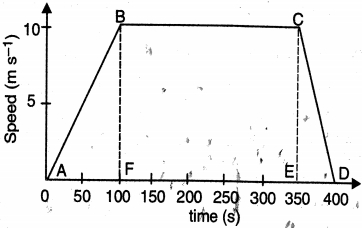
$A$ train starting from rest picks up a speed of $10\, m s^{-1}$ in $100\, s$. It continues to move at the same speed for the next $250\, s$. It is then brought to rest in the next $50\, s$. Plot a speed-time graph for the entire motion of the train and calculate:
$(i)$ acceleration of the train while accelerating,
$(ii)$ retardation of the train while retarding,
$(iii)$ the total distance covered by the train.
$(i)$ acceleration of the train while accelerating,
$(ii)$ retardation of the train while retarding,
$(iii)$ the total distance covered by the train.
Solution
(N/A) The speed-time graph is shown in the figure.
$(i)$ Acceleration is equal to the slope of the graph during the interval $0-100\, s$:
$a = \frac{\text{Change in speed}}{\text{Time taken}} = \frac{10\, m s^{-1} - 0\, m s^{-1}}{100\, s} = 0.1\, m s^{-2}$.
$(ii)$ Retardation is equal to the magnitude of the negative slope of the graph during the interval $350-400\, s$:
$a = \frac{0\, m s^{-1} - 10\, m s^{-1}}{50\, s} = -0.2\, m s^{-2}$.
Thus,retardation is $0.2\, m s^{-2}$.
$(iii)$ The total distance covered is equal to the area under the speed-time graph (Area of trapezium $ABCD$):
$\text{Area} = \frac{1}{2} \times (\text{Sum of parallel sides}) \times \text{Height}$
$\text{Area} = \frac{1}{2} \times (AD + BC) \times BF$
$\text{Area} = \frac{1}{2} \times (400\, s + 250\, s) \times 10\, m s^{-1} = \frac{1}{2} \times 650\, s \times 10\, m s^{-1} = 3250\, m$.
$(i)$ Acceleration is equal to the slope of the graph during the interval $0-100\, s$:
$a = \frac{\text{Change in speed}}{\text{Time taken}} = \frac{10\, m s^{-1} - 0\, m s^{-1}}{100\, s} = 0.1\, m s^{-2}$.
$(ii)$ Retardation is equal to the magnitude of the negative slope of the graph during the interval $350-400\, s$:
$a = \frac{0\, m s^{-1} - 10\, m s^{-1}}{50\, s} = -0.2\, m s^{-2}$.
Thus,retardation is $0.2\, m s^{-2}$.
$(iii)$ The total distance covered is equal to the area under the speed-time graph (Area of trapezium $ABCD$):
$\text{Area} = \frac{1}{2} \times (\text{Sum of parallel sides}) \times \text{Height}$
$\text{Area} = \frac{1}{2} \times (AD + BC) \times BF$
$\text{Area} = \frac{1}{2} \times (400\, s + 250\, s) \times 10\, m s^{-1} = \frac{1}{2} \times 650\, s \times 10\, m s^{-1} = 3250\, m$.
0 likes
View Solution165
Medium
$(a)$ Differentiate between uniform linear motion and uniform circular motion.
$(b)$ Write any four examples of uniform circular motion.
$(c)$ Is uniform circular motion an accelerated motion?
$(b)$ Write any four examples of uniform circular motion.
$(c)$ Is uniform circular motion an accelerated motion?
Solution
(N/A) In uniform linear motion,a body moves along a straight line with constant speed. In uniform circular motion,a body moves along a circular path with constant speed.
$(b)$ $(i)$ Motion of a point on the rim of a rotating wheel.
$(ii)$ Motion of a satellite around a planet.
$(iii)$ Motion of the Moon around the Earth.
$(iv)$ Motion of the tip of the second hand of a clock.
$(c)$ Yes,uniform circular motion is an accelerated motion. Although the speed remains constant,the direction of motion changes continuously at every point along the circular path. Since velocity is a vector quantity (speed with direction),a change in direction implies a change in velocity,which constitutes acceleration.
$(b)$ $(i)$ Motion of a point on the rim of a rotating wheel.
$(ii)$ Motion of a satellite around a planet.
$(iii)$ Motion of the Moon around the Earth.
$(iv)$ Motion of the tip of the second hand of a clock.
$(c)$ Yes,uniform circular motion is an accelerated motion. Although the speed remains constant,the direction of motion changes continuously at every point along the circular path. Since velocity is a vector quantity (speed with direction),a change in direction implies a change in velocity,which constitutes acceleration.
0 likes
View Solution166
Medium
$(a)$ Differentiate between speed and velocity.
$(b)$ When is a body said to have uniform velocity?
$(c)$ How can we describe the position of an object? Illustrate with a suitable example.
$(b)$ When is a body said to have uniform velocity?
$(c)$ How can we describe the position of an object? Illustrate with a suitable example.
Solution
(N/A) Speed is the distance traveled per unit time,whereas velocity is the displacement per unit time. Speed is a scalar quantity and is always positive,while velocity is a vector quantity and can be zero,positive,or negative.
$(b)$ $A$ body is said to have uniform velocity if it covers equal displacements in equal intervals of time,regardless of how small these time intervals may be.
$(c)$ The position of an object is described with respect to a fixed reference point,known as the origin. For example,if a bird is flying,its position can be described relative to a specific tree or the ground (the reference point).
$(b)$ $A$ body is said to have uniform velocity if it covers equal displacements in equal intervals of time,regardless of how small these time intervals may be.
$(c)$ The position of an object is described with respect to a fixed reference point,known as the origin. For example,if a bird is flying,its position can be described relative to a specific tree or the ground (the reference point).
0 likes
View Solution167
Medium
Account for the following:
$(a)$ Name the quantity which is measured by the area occupied below the velocity$-$time graph.
$(b)$ Give an example of an object moving in a certain direction with acceleration in the perpendicular direction.
$(c)$ Under what condition is the magnitude of average velocity of an object equal to its average speed?
$(d)$ Give an example of uniformly accelerated motion.
$(e)$ $A$ body is moving along a circular path of radius $r$. What will be the distance and displacement of the body when it completes half a revolution?
$(a)$ Name the quantity which is measured by the area occupied below the velocity$-$time graph.
$(b)$ Give an example of an object moving in a certain direction with acceleration in the perpendicular direction.
$(c)$ Under what condition is the magnitude of average velocity of an object equal to its average speed?
$(d)$ Give an example of uniformly accelerated motion.
$(e)$ $A$ body is moving along a circular path of radius $r$. What will be the distance and displacement of the body when it completes half a revolution?
Solution
(N/A) The area under a velocity$-$time graph represents the displacement (or distance if the motion is in a straight line).
$(b)$ An example is the motion of a satellite in a circular orbit or uniform circular motion,where the acceleration is directed towards the center (centripetal acceleration) while the velocity is tangential.
$(c)$ The magnitude of average velocity is equal to the average speed when the object moves in a straight line without changing its direction.
$(d)$ The motion of a freely falling body under gravity is an example of uniformly accelerated motion.
$(e)$ For a circular path of radius $r$,after half a revolution,the distance covered is half the circumference,which is $\pi r$. The displacement is the shortest distance between the initial and final points,which is the diameter of the circle,$2r$.
$(b)$ An example is the motion of a satellite in a circular orbit or uniform circular motion,where the acceleration is directed towards the center (centripetal acceleration) while the velocity is tangential.
$(c)$ The magnitude of average velocity is equal to the average speed when the object moves in a straight line without changing its direction.
$(d)$ The motion of a freely falling body under gravity is an example of uniformly accelerated motion.
$(e)$ For a circular path of radius $r$,after half a revolution,the distance covered is half the circumference,which is $\pi r$. The displacement is the shortest distance between the initial and final points,which is the diameter of the circle,$2r$.
0 likes
View Solution168
Medium
Account for the following:
$(a)$ What is the shape of the path of a body when it is in uniform motion?
$(b)$ Give one example of non-uniform motion.
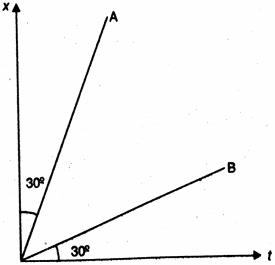
$(c)$ Two cars $A$ and $B$ have their $x-t$ graph as shown in the figure. Which has greater velocity?
$(d)$ What is the quantity which is measured by the area occupied below the velocity-time graph?
$(e)$ $A$ body is moving with a velocity of $10 \, m/s$. If the motion is uniform,what will be the velocity after $10 \, s$?
$(a)$ What is the shape of the path of a body when it is in uniform motion?
$(b)$ Give one example of non-uniform motion.
$(c)$ Two cars $A$ and $B$ have their $x-t$ graph as shown in the figure. Which has greater velocity?
$(d)$ What is the quantity which is measured by the area occupied below the velocity-time graph?
$(e)$ $A$ body is moving with a velocity of $10 \, m/s$. If the motion is uniform,what will be the velocity after $10 \, s$?
Solution
(N/A) The path of a body in uniform motion is a straight line.
$(b)$ An example of non-uniform motion is a car moving on a crowded city road where its speed changes frequently.
$(c)$ The velocity is determined by the slope of the $x-t$ graph. $A$ steeper slope indicates a higher velocity. Since the slope of line $A$ is greater than the slope of line $B$,car $A$ has a greater velocity.
$(d)$ The area under a velocity-time graph represents the magnitude of the displacement of the body.
$(e)$ In uniform motion,the velocity of the body remains constant over time. Therefore,if the body is moving with a velocity of $10 \, m/s$,its velocity after $10 \, s$ will still be $10 \, m/s$.
$(b)$ An example of non-uniform motion is a car moving on a crowded city road where its speed changes frequently.
$(c)$ The velocity is determined by the slope of the $x-t$ graph. $A$ steeper slope indicates a higher velocity. Since the slope of line $A$ is greater than the slope of line $B$,car $A$ has a greater velocity.
$(d)$ The area under a velocity-time graph represents the magnitude of the displacement of the body.
$(e)$ In uniform motion,the velocity of the body remains constant over time. Therefore,if the body is moving with a velocity of $10 \, m/s$,its velocity after $10 \, s$ will still be $10 \, m/s$.
0 likes
View Solution169
Medium
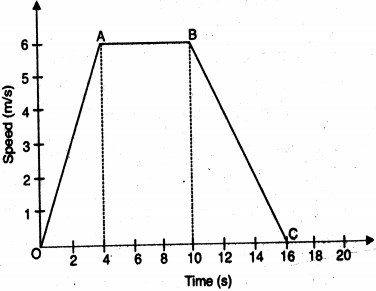
Study the speed-time graph of a body given below and answer the following questions:
$(i)$ What type of motion is represented by $OA$,$AB$ and $BC$?
(ii) Find positive and negative accelerations of the body.
(iii) Find the distance travelled by the body from $A$ to $B$.
$(i)$ What type of motion is represented by $OA$,$AB$ and $BC$?
(ii) Find positive and negative accelerations of the body.
(iii) Find the distance travelled by the body from $A$ to $B$.
Solution
(N/A) $(i)$ $OA$ represents uniform acceleration. $AB$ represents uniform motion (zero acceleration,moving with constant velocity). $BC$ represents negative acceleration (retardation).
(ii) Acceleration is the slope of the graph:
Positive acceleration $(OA)$ = $\frac{6 - 0}{4 - 0} = 1.5 \text{ m s}^{-2}$.
Negative acceleration $(BC)$ = $\frac{0 - 6}{16 - 10} = \frac{-6}{6} = -1 \text{ m s}^{-2}$.
(iii) Distance travelled is the area under the graph between $A$ and $B$:
Distance = $\text{Speed} \times \text{Time} = 6 \text{ m/s} \times (10 - 4) \text{ s} = 6 \times 6 = 36 \text{ m}$.
(ii) Acceleration is the slope of the graph:
Positive acceleration $(OA)$ = $\frac{6 - 0}{4 - 0} = 1.5 \text{ m s}^{-2}$.
Negative acceleration $(BC)$ = $\frac{0 - 6}{16 - 10} = \frac{-6}{6} = -1 \text{ m s}^{-2}$.
(iii) Distance travelled is the area under the graph between $A$ and $B$:
Distance = $\text{Speed} \times \text{Time} = 6 \text{ m/s} \times (10 - 4) \text{ s} = 6 \times 6 = 36 \text{ m}$.
0 likes
View Solution170
Difficult
$(a)$ Derive the second equation of motion $S = ut + \frac{1}{2}at^2$ graphically,where the symbols have their usual meanings.
$(b)$ $A$ car accelerates uniformly from $18 \text{ km h}^{-1}$ to $36 \text{ km h}^{-1}$ in $5 \text{ s}$. Calculate the acceleration and the distance covered by the car in that time.
$(b)$ $A$ car accelerates uniformly from $18 \text{ km h}^{-1}$ to $36 \text{ km h}^{-1}$ in $5 \text{ s}$. Calculate the acceleration and the distance covered by the car in that time.
Solution
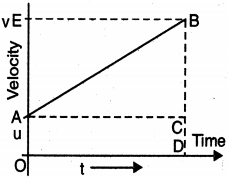
(A) The area under the velocity-time graph represents the distance travelled by the object. As shown in the figure,the area is the sum of the area of the rectangle $OACD$ and the area of the triangle $ABC$.
The area of the rectangle $OACD = \text{length} \times \text{breadth} = OC \times OA = t \times u = ut$.
The area of the triangle $ABC = \frac{1}{2} \times \text{base} \times \text{height} = \frac{1}{2} \times AC \times BC = \frac{1}{2} \times t \times (v - u)$.
Since $v = u + at$,we have $(v - u) = at$. Substituting this into the area of the triangle,we get:
Area of triangle $ABC = \frac{1}{2} \times t \times (at) = \frac{1}{2}at^2$.
Therefore,the total distance $S = \text{Area of rectangle } OACD + \text{Area of triangle } ABC = ut + \frac{1}{2}at^2$.
$(b)$ Given:
Initial velocity $u = 18 \text{ km h}^{-1} = 18 \times \frac{5}{18} \text{ m s}^{-1} = 5 \text{ m s}^{-1}$.
Final velocity $v = 36 \text{ km h}^{-1} = 36 \times \frac{5}{18} \text{ m s}^{-1} = 10 \text{ m s}^{-1}$.
Time $t = 5 \text{ s}$.
Acceleration $a = \frac{v - u}{t} = \frac{10 - 5}{5} = \frac{5}{5} = 1 \text{ m s}^{-2}$.
Distance $S = ut + \frac{1}{2}at^2 = (5 \times 5) + \frac{1}{2} \times 1 \times (5)^2 = 25 + 12.5 = 37.5 \text{ m}$.
The area of the rectangle $OACD = \text{length} \times \text{breadth} = OC \times OA = t \times u = ut$.
The area of the triangle $ABC = \frac{1}{2} \times \text{base} \times \text{height} = \frac{1}{2} \times AC \times BC = \frac{1}{2} \times t \times (v - u)$.
Since $v = u + at$,we have $(v - u) = at$. Substituting this into the area of the triangle,we get:
Area of triangle $ABC = \frac{1}{2} \times t \times (at) = \frac{1}{2}at^2$.
Therefore,the total distance $S = \text{Area of rectangle } OACD + \text{Area of triangle } ABC = ut + \frac{1}{2}at^2$.
$(b)$ Given:
Initial velocity $u = 18 \text{ km h}^{-1} = 18 \times \frac{5}{18} \text{ m s}^{-1} = 5 \text{ m s}^{-1}$.
Final velocity $v = 36 \text{ km h}^{-1} = 36 \times \frac{5}{18} \text{ m s}^{-1} = 10 \text{ m s}^{-1}$.
Time $t = 5 \text{ s}$.
Acceleration $a = \frac{v - u}{t} = \frac{10 - 5}{5} = \frac{5}{5} = 1 \text{ m s}^{-2}$.
Distance $S = ut + \frac{1}{2}at^2 = (5 \times 5) + \frac{1}{2} \times 1 \times (5)^2 = 25 + 12.5 = 37.5 \text{ m}$.
0 likes
View Solution171
Medium
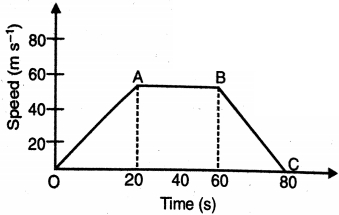
Study the speed-time graph of a car below and answer the following questions:
$(a)$ What type of motion is represented by $OA$?
$(b)$ Find the acceleration from $B$ to $C$.
$(c)$ Calculate the distance covered by the body from $A$ to $B$.
$(a)$ What type of motion is represented by $OA$?
$(b)$ Find the acceleration from $B$ to $C$.
$(c)$ Calculate the distance covered by the body from $A$ to $B$.
Solution
(N/A) The segment $OA$ represents uniform acceleration,as the speed increases linearly with time.
$(b)$ Acceleration is given by the slope of the speed-time graph. For the segment $BC$,the initial speed at $B$ is $60 \ m/s$ at $t = 60 \ s$,and the final speed at $C$ is $0 \ m/s$ at $t = 80 \ s$.
$a = \frac{v - u}{t_2 - t_1} = \frac{0 - 60}{80 - 60} = \frac{-60}{20} = -3 \ m/s^2$.
Thus,the acceleration is $-3 \ m/s^2$ (retardation).
$(c)$ The distance covered is equal to the area under the speed-time graph. For the segment $AB$,the motion is at a constant speed of $60 \ m/s$ from $t = 20 \ s$ to $t = 60 \ s$.
Distance = $\text{Speed} \times \text{Time} = 60 \ m/s \times (60 - 20) \ s = 60 \times 40 = 2400 \ m$.
$(b)$ Acceleration is given by the slope of the speed-time graph. For the segment $BC$,the initial speed at $B$ is $60 \ m/s$ at $t = 60 \ s$,and the final speed at $C$ is $0 \ m/s$ at $t = 80 \ s$.
$a = \frac{v - u}{t_2 - t_1} = \frac{0 - 60}{80 - 60} = \frac{-60}{20} = -3 \ m/s^2$.
Thus,the acceleration is $-3 \ m/s^2$ (retardation).
$(c)$ The distance covered is equal to the area under the speed-time graph. For the segment $AB$,the motion is at a constant speed of $60 \ m/s$ from $t = 20 \ s$ to $t = 60 \ s$.
Distance = $\text{Speed} \times \text{Time} = 60 \ m/s \times (60 - 20) \ s = 60 \times 40 = 2400 \ m$.
0 likes
View Solution172
Medium
$(a)$ Define uniform circular motion.
$(b)$ Ram goes for a morning walk in a circular park daily. He completes one revolution of the park in $4$ minutes. Find his speed if the diameter of the park is $420\, m$.
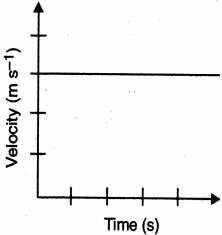
$(c)$ Draw velocity$-$time graph for uniform motion along a straight line. How can you find the distance covered by a body from this graph?
$(b)$ Ram goes for a morning walk in a circular park daily. He completes one revolution of the park in $4$ minutes. Find his speed if the diameter of the park is $420\, m$.
$(c)$ Draw velocity$-$time graph for uniform motion along a straight line. How can you find the distance covered by a body from this graph?
Solution
(N/A) body is said to be in uniform circular motion if it moves along a circular path with a constant speed.
$(b)$ Given:
Time $(t) = 4 \text{ minutes} = 4 \times 60 = 240 \text{ s}$
Diameter $(d) = 420 \text{ m}$
Radius $(r) = d / 2 = 420 / 2 = 210 \text{ m}$
Total distance $(S)$ covered in one revolution $= 2 \pi r = 2 \times (22 / 7) \times 210 = 1320 \text{ m}$
Speed $(v) = \text{Distance} / \text{Time} = 1320 / 240 = 5.5 \text{ m s}^{-1}$
$(c)$ The velocity$-$time graph for uniform motion along a straight line is a straight line parallel to the time axis. The area under the velocity$-$time graph gives the distance covered by an object.
$(b)$ Given:
Time $(t) = 4 \text{ minutes} = 4 \times 60 = 240 \text{ s}$
Diameter $(d) = 420 \text{ m}$
Radius $(r) = d / 2 = 420 / 2 = 210 \text{ m}$
Total distance $(S)$ covered in one revolution $= 2 \pi r = 2 \times (22 / 7) \times 210 = 1320 \text{ m}$
Speed $(v) = \text{Distance} / \text{Time} = 1320 / 240 = 5.5 \text{ m s}^{-1}$
$(c)$ The velocity$-$time graph for uniform motion along a straight line is a straight line parallel to the time axis. The area under the velocity$-$time graph gives the distance covered by an object.
0 likes
View Solution173
Difficult
$(a)$ $A$ car moving with uniform velocity $u$ and uniform acceleration $a$ covers a distance $S$ in time $t$. Draw its velocity-time graph and derive an expression relating all the given physical quantities.
$(b)$ $A$ boy revolves a stone tied to a string $0.7 \, m$ long. Find the distance and displacement covered by the stone in completing two revolutions from the starting point.
$(b)$ $A$ boy revolves a stone tied to a string $0.7 \, m$ long. Find the distance and displacement covered by the stone in completing two revolutions from the starting point.
Solution
(N/A) The velocity-time graph for uniform acceleration is a straight line inclined to the time axis. The area under the velocity-time graph gives the distance covered. By integrating or using the area of a trapezium (or rectangle + triangle),we derive the equation of motion: $S = ut + \frac{1}{2}at^2$.
$(b)$ Given: Radius $r = 0.7 \, m$. Number of revolutions $n = 2$.
Distance is the total path length covered: $\text{Distance} = n \times (2\pi r) = 2 \times 2 \times \frac{22}{7} \times 0.7 = 8.8 \, m$.
Displacement is the shortest distance between the initial and final positions. Since the stone completes two full revolutions,it returns to the starting point. Therefore,$\text{Displacement} = 0 \, m$.
$(b)$ Given: Radius $r = 0.7 \, m$. Number of revolutions $n = 2$.
Distance is the total path length covered: $\text{Distance} = n \times (2\pi r) = 2 \times 2 \times \frac{22}{7} \times 0.7 = 8.8 \, m$.
Displacement is the shortest distance between the initial and final positions. Since the stone completes two full revolutions,it returns to the starting point. Therefore,$\text{Displacement} = 0 \, m$.
0 likes
View Solution174
Medium
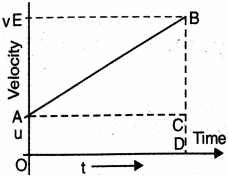
An object starts a linear motion with velocity $u$ and with uniform acceleration $a$,it acquires a velocity $v$ in time $t$.
$(a)$ Draw its velocity-time graph.
$(b)$ Obtain the first equation of motion,$v = u + at$,for the velocity-time relation by using the velocity-time graph.
$(c)$ $A$ body moving with a velocity of $2 \, m s^{-1}$ acquires a velocity of $10 \, m s^{-1}$ in $5 \, s$. Find its acceleration.
$(a)$ Draw its velocity-time graph.
$(b)$ Obtain the first equation of motion,$v = u + at$,for the velocity-time relation by using the velocity-time graph.
$(c)$ $A$ body moving with a velocity of $2 \, m s^{-1}$ acquires a velocity of $10 \, m s^{-1}$ in $5 \, s$. Find its acceleration.
Solution
(N/A) The velocity-time graph is shown in the figure.
$(b)$ The slope of the velocity-time graph gives the acceleration of the motion.
Slope $= \frac{\text{Change in velocity}}{\text{Time taken}} = \frac{v - u}{t - 0} = \frac{v - u}{t}$
Since acceleration $a = \text{slope}$,we have $a = \frac{v - u}{t}$.
Rearranging this gives $at = v - u$,or $v = u + at$.
$(c)$ Given:
Initial velocity $u = 2 \, m s^{-1}$
Final velocity $v = 10 \, m s^{-1}$
Time $t = 5 \, s$
Using the first equation of motion $v = u + at$:
$10 = 2 + a(5)$
$10 - 2 = 5a$
$8 = 5a$
$a = \frac{8}{5} = 1.6 \, m s^{-2}$
Thus,the acceleration is $1.6 \, m s^{-2}$.
$(b)$ The slope of the velocity-time graph gives the acceleration of the motion.
Slope $= \frac{\text{Change in velocity}}{\text{Time taken}} = \frac{v - u}{t - 0} = \frac{v - u}{t}$
Since acceleration $a = \text{slope}$,we have $a = \frac{v - u}{t}$.
Rearranging this gives $at = v - u$,or $v = u + at$.
$(c)$ Given:
Initial velocity $u = 2 \, m s^{-1}$
Final velocity $v = 10 \, m s^{-1}$
Time $t = 5 \, s$
Using the first equation of motion $v = u + at$:
$10 = 2 + a(5)$
$10 - 2 = 5a$
$8 = 5a$
$a = \frac{8}{5} = 1.6 \, m s^{-2}$
Thus,the acceleration is $1.6 \, m s^{-2}$.
0 likes
View Solution175
Medium
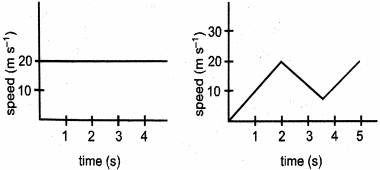
Two graphs for the motion of objects moving along a straight line are shown. State how the speed is changing with time in both cases.
Solution
(N/A) Case $1$: The graph is a horizontal straight line parallel to the time axis. This indicates that the speed of the object remains constant at $20 \text{ m s}^{-1}$ over time.
Case $2$: The graph shows that the speed is changing continuously with time. The speed increases from $0$ to $20 \text{ m s}^{-1}$ between $0$ and $2 \text{ s}$,then decreases to $10 \text{ m s}^{-1}$ at $3.5 \text{ s}$,and finally increases again. Thus,the object is moving with variable speed.
Case $2$: The graph shows that the speed is changing continuously with time. The speed increases from $0$ to $20 \text{ m s}^{-1}$ between $0$ and $2 \text{ s}$,then decreases to $10 \text{ m s}^{-1}$ at $3.5 \text{ s}$,and finally increases again. Thus,the object is moving with variable speed.
0 likes
View Solution176
Medium
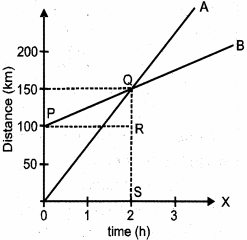
The distance-time graph of two trains is given below. The trains start simultaneously in the same direction.
$(i)$ How much ahead of $A$ is $B$ when the motion starts?
$(ii)$ What is the speed of $B$?
$(iii)$ When and where will $A$ catch $B$?
$(iv)$ What is the difference between the speeds of $A$ and $B$?
$(v)$ Is the speed of either train uniform or non-uniform? Justify your answer.
$(i)$ How much ahead of $A$ is $B$ when the motion starts?
$(ii)$ What is the speed of $B$?
$(iii)$ When and where will $A$ catch $B$?
$(iv)$ What is the difference between the speeds of $A$ and $B$?
$(v)$ Is the speed of either train uniform or non-uniform? Justify your answer.
Solution
(N/A) $(i)$ At $t = 0$,train $A$ is at $0 \ km$ and train $B$ is at $100 \ km$. Thus,$B$ is $100 \ km$ ahead of $A$.
$(ii)$ Speed of $B = \frac{\text{Distance}}{\text{Time}} = \frac{150 \ km - 100 \ km}{2 \ h - 0 \ h} = \frac{50 \ km}{2 \ h} = 25 \ km/h$.
$(iii)$ $A$ catches $B$ at the point of intersection $Q$,which corresponds to $2 \ h$ and $150 \ km$. So,$A$ catches $B$ after $2 \ h$ at a distance of $150 \ km$.
$(iv)$ Speed of $A = \frac{150 \ km - 0 \ km}{2 \ h - 0 \ h} = 75 \ km/h$. Speed of $B = 25 \ km/h$. The difference is $75 \ km/h - 25 \ km/h = 50 \ km/h$.
$(v)$ The speed of both trains is uniform because their distance-time graphs are straight lines,indicating a constant rate of change of distance with respect to time.
$(ii)$ Speed of $B = \frac{\text{Distance}}{\text{Time}} = \frac{150 \ km - 100 \ km}{2 \ h - 0 \ h} = \frac{50 \ km}{2 \ h} = 25 \ km/h$.
$(iii)$ $A$ catches $B$ at the point of intersection $Q$,which corresponds to $2 \ h$ and $150 \ km$. So,$A$ catches $B$ after $2 \ h$ at a distance of $150 \ km$.
$(iv)$ Speed of $A = \frac{150 \ km - 0 \ km}{2 \ h - 0 \ h} = 75 \ km/h$. Speed of $B = 25 \ km/h$. The difference is $75 \ km/h - 25 \ km/h = 50 \ km/h$.
$(v)$ The speed of both trains is uniform because their distance-time graphs are straight lines,indicating a constant rate of change of distance with respect to time.
0 likes
View Solution177
Medium
What can you say about the motion of an object whose distance-time graph is:
$(i)$ a straight line,parallel to the time axis?
$(ii)$ a straight line passing through the origin making an angle with the time axis?
$(i)$ a straight line,parallel to the time axis?
$(ii)$ a straight line passing through the origin making an angle with the time axis?
Solution
(N/A) $(i)$ If the distance-time graph is a straight line parallel to the time axis,it means that the distance of the object from the origin does not change with time. Therefore,the object is stationary (at rest).
$(ii)$ If the distance-time graph is a straight line passing through the origin,it indicates that the object covers equal distances in equal intervals of time. Therefore,the object is in uniform motion.
$(ii)$ If the distance-time graph is a straight line passing through the origin,it indicates that the object covers equal distances in equal intervals of time. Therefore,the object is in uniform motion.
0 likes
View Solution178
Difficult
The graph given below is the distance-time graph of an object.
$(i)$ Find the speed of the object during the first four seconds of its journey.
(ii) How long was it stationary?
(iii) Does it represent a real-life situation? Justify your answer.
$(i)$ Find the speed of the object during the first four seconds of its journey.
(ii) How long was it stationary?
(iii) Does it represent a real-life situation? Justify your answer.
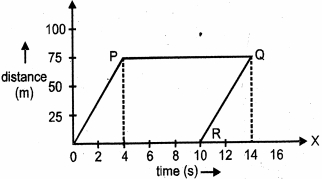
Solution
(N/A) $(i)$ Speed is the slope of the distance-time graph. For the first $4 \ s$,the distance covered is $75 \ m$.
Speed $= \frac{\text{Distance}}{\text{Time}} = \frac{75 \ m}{4 \ s} = 18.75 \ m \ s^{-1}$.
(ii) The object is stationary when the distance remains constant over time. This corresponds to the horizontal line segment $PQ$. The object is stationary from $t = 4 \ s$ to $t = 14 \ s$.
Duration $= 14 \ s - 4 \ s = 10 \ s$.
(iii) No,this graph does not represent a real-life situation. In a real-life scenario,the distance covered by an object cannot decrease with time. The segment $RQ$ shows the object moving from a distance of $0 \ m$ to $75 \ m$ between $10 \ s$ and $14 \ s$,but the graph implies the object was at $75 \ m$ at $t=4 \ s$ and then suddenly appears at $0 \ m$ at $t=10 \ s$,which is physically impossible.
Speed $= \frac{\text{Distance}}{\text{Time}} = \frac{75 \ m}{4 \ s} = 18.75 \ m \ s^{-1}$.
(ii) The object is stationary when the distance remains constant over time. This corresponds to the horizontal line segment $PQ$. The object is stationary from $t = 4 \ s$ to $t = 14 \ s$.
Duration $= 14 \ s - 4 \ s = 10 \ s$.
(iii) No,this graph does not represent a real-life situation. In a real-life scenario,the distance covered by an object cannot decrease with time. The segment $RQ$ shows the object moving from a distance of $0 \ m$ to $75 \ m$ between $10 \ s$ and $14 \ s$,but the graph implies the object was at $75 \ m$ at $t=4 \ s$ and then suddenly appears at $0 \ m$ at $t=10 \ s$,which is physically impossible.
0 likes
View Solution179
Medium
$A$ car is moving on a straight road with uniform acceleration. The following table gives the speed of the car at various instants of time.
$(i)$ Draw the speed-time graph representing the above set of observations.
$(ii)$ Find the acceleration of the car.
| Time $(s)$ | $0$ | $10$ | $20$ | $30$ | $40$ | $50$ |
| Speed $(m s^{-1})$ | $5$ | $10$ | $15$ | $20$ | $25$ | $30$ |
$(i)$ Draw the speed-time graph representing the above set of observations.
$(ii)$ Find the acceleration of the car.
Solution
(N/A) $(i)$ The speed-time graph is plotted by taking time on the $x$-axis and speed on the $y$-axis. By plotting the given points $(0, 5), (10, 10), (20, 15), (30, 20), (40, 25), (50, 30)$, we get a straight line indicating uniform acceleration.
$(ii)$ The acceleration $(a)$ of the car is equal to the slope of the speed-time graph.
$a = \text{slope} = \frac{v_2 - v_1}{t_2 - t_1}$
Taking two points $(10, 10)$ and $(20, 15)$:
$a = \frac{15 - 10}{20 - 10} = \frac{5}{10} = 0.5 \ m s^{-2}$
Thus, the acceleration of the car is $0.5 \ m s^{-2}$.
$(ii)$ The acceleration $(a)$ of the car is equal to the slope of the speed-time graph.
$a = \text{slope} = \frac{v_2 - v_1}{t_2 - t_1}$
Taking two points $(10, 10)$ and $(20, 15)$:
$a = \frac{15 - 10}{20 - 10} = \frac{5}{10} = 0.5 \ m s^{-2}$
Thus, the acceleration of the car is $0.5 \ m s^{-2}$.
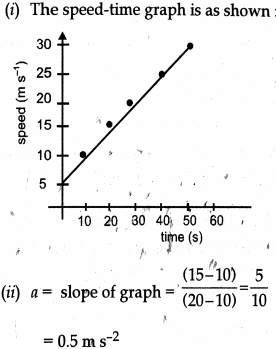
0 likes
View Solution180
Medium
What can you conclude about the motion of a body depicted by the velocity-time graphs $(i)$,$(ii)$ and $(iii)$ given below?
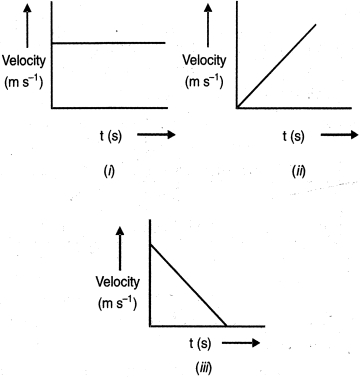
Solution
(N/A) $(i)$ Uniform motion: The velocity-time graph is a straight line parallel to the time axis,indicating that the velocity of the body remains constant over time.
$(ii)$ Uniformly accelerated motion: The velocity-time graph is a straight line passing through the origin (or having a positive slope),indicating that the velocity of the body increases at a constant rate over time.
$(iii)$ Uniformly retarded motion: The velocity-time graph is a straight line with a negative slope,indicating that the velocity of the body decreases at a constant rate over time.
$(ii)$ Uniformly accelerated motion: The velocity-time graph is a straight line passing through the origin (or having a positive slope),indicating that the velocity of the body increases at a constant rate over time.
$(iii)$ Uniformly retarded motion: The velocity-time graph is a straight line with a negative slope,indicating that the velocity of the body decreases at a constant rate over time.
0 likes
View Solution181
Difficult
Explain with reason,which of the following graphs can possibly represent the motion of a particle observed in nature?
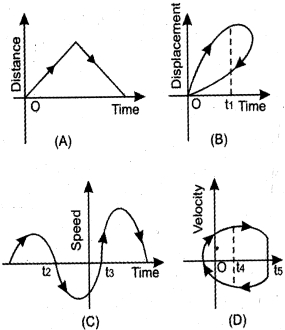
Solution
(NONE) This graph shows that with an increase in time,the distance first increases and then decreases. However,distance is a scalar quantity and can never decrease with time for a moving particle,so this graph is not possible.
$(B)$ This graph shows that at a certain time $t_{1}$,the body is present at two different positions simultaneously. Since a particle cannot be at two places at the same time,this graph is not possible.
$(C)$ This graph shows that speed is negative for some interval of time. Since speed is the magnitude of velocity and is always non-negative,this graph is not possible.
$(D)$ This graph shows that at a given instant of time,the particle has two different velocities. Additionally,it shows that at some time,it has infinite acceleration (where the graph is parallel to the velocity axis). Both these conditions cannot be achieved in practice; therefore,this graph is not possible.
Conclusion: None of the given graphs represent the motion of a particle observed in nature.
$(B)$ This graph shows that at a certain time $t_{1}$,the body is present at two different positions simultaneously. Since a particle cannot be at two places at the same time,this graph is not possible.
$(C)$ This graph shows that speed is negative for some interval of time. Since speed is the magnitude of velocity and is always non-negative,this graph is not possible.
$(D)$ This graph shows that at a given instant of time,the particle has two different velocities. Additionally,it shows that at some time,it has infinite acceleration (where the graph is parallel to the velocity axis). Both these conditions cannot be achieved in practice; therefore,this graph is not possible.
Conclusion: None of the given graphs represent the motion of a particle observed in nature.
0 likes
View Solution182
Medium
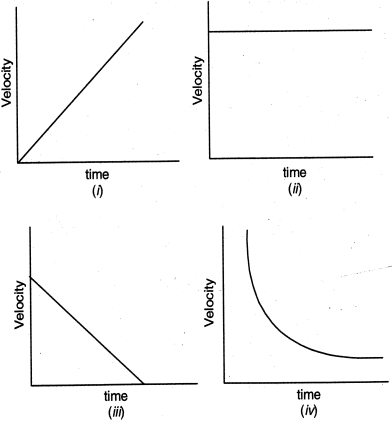
What type of motion is represented by the following graphs?
Solution
(N/A) $(i)$ The velocity-time graph is a straight line passing through the origin,indicating that velocity increases linearly with time. Therefore,it represents uniformly accelerated motion.
$(ii)$ The velocity-time graph is a straight line parallel to the time axis,indicating that velocity remains constant over time. It represents uniform motion (zero acceleration).
$(iii)$ The velocity-time graph is a straight line with a negative slope,indicating that velocity decreases linearly with time. It represents uniformly retarded motion (uniform deceleration).
$(iv)$ The velocity-time graph is a curve with a negative slope,indicating that the rate of decrease of velocity is not constant. It represents non-uniformly retarded motion.
$(ii)$ The velocity-time graph is a straight line parallel to the time axis,indicating that velocity remains constant over time. It represents uniform motion (zero acceleration).
$(iii)$ The velocity-time graph is a straight line with a negative slope,indicating that velocity decreases linearly with time. It represents uniformly retarded motion (uniform deceleration).
$(iv)$ The velocity-time graph is a curve with a negative slope,indicating that the rate of decrease of velocity is not constant. It represents non-uniformly retarded motion.
0 likes
View Solution183
Medium
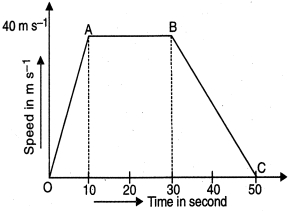
Study the speed-time graph of a car given below and answer the questions that follow:
$(i)$ What type of motion is represented by $OA$?
(ii) What type of motion is represented by $AB$?
(iii) What type of motion is represented by $BC$?
(iv) What is the acceleration of the car from $O$ to $A$?
$(v)$ What is the acceleration of the car from $A$ to $B$?
(vi) What is the retardation of the car from $B$ to $C$?
$(i)$ What type of motion is represented by $OA$?
(ii) What type of motion is represented by $AB$?
(iii) What type of motion is represented by $BC$?
(iv) What is the acceleration of the car from $O$ to $A$?
$(v)$ What is the acceleration of the car from $A$ to $B$?
(vi) What is the retardation of the car from $B$ to $C$?
Solution
(N/A) $(i)$ The speed-time graph is a straight line inclined to the time axis from $O$ to $A$. This represents a uniformly accelerated motion.
(ii) The speed-time graph is a straight line parallel to the time axis from $A$ to $B$. This represents uniform motion (constant speed).
(iii) The speed-time graph is a straight line from $B$ to $C$ having a negative slope. This represents a uniformly retarded motion.
(iv) Change in speed $= 40 - 0 = 40 \ m \ s^{-1}$.
Change in time $= 10 - 0 = 10 \ s$.
Acceleration $a = \frac{\text{Change in speed}}{\text{Change in time}} = \frac{40}{10} = 4 \ m \ s^{-2}$.
$(v)$ Since the motion is uniform (constant speed),the acceleration $a = 0 \ m \ s^{-2}$.
(vi) Change in speed $= 0 - 40 = -40 \ m \ s^{-1}$.
Change in time $= 50 - 30 = 20 \ s$.
Retardation $= -(\text{Acceleration}) = -(\frac{0 - 40}{50 - 30}) = -(\frac{-40}{20}) = -(-2) = 2 \ m \ s^{-2}$.
(ii) The speed-time graph is a straight line parallel to the time axis from $A$ to $B$. This represents uniform motion (constant speed).
(iii) The speed-time graph is a straight line from $B$ to $C$ having a negative slope. This represents a uniformly retarded motion.
(iv) Change in speed $= 40 - 0 = 40 \ m \ s^{-1}$.
Change in time $= 10 - 0 = 10 \ s$.
Acceleration $a = \frac{\text{Change in speed}}{\text{Change in time}} = \frac{40}{10} = 4 \ m \ s^{-2}$.
$(v)$ Since the motion is uniform (constant speed),the acceleration $a = 0 \ m \ s^{-2}$.
(vi) Change in speed $= 0 - 40 = -40 \ m \ s^{-1}$.
Change in time $= 50 - 30 = 20 \ s$.
Retardation $= -(\text{Acceleration}) = -(\frac{0 - 40}{50 - 30}) = -(\frac{-40}{20}) = -(-2) = 2 \ m \ s^{-2}$.
0 likes
View Solution184
Medium
In your everyday life,you come across a range of motions in which
$(a)$ acceleration is in the direction of motion.
$(b)$ acceleration is against the direction of motion.
$(c)$ acceleration is uniform.
$(d)$ acceleration is non$-$uniform.
Can you identify one example each of the above type of motion?
$(a)$ acceleration is in the direction of motion.
$(b)$ acceleration is against the direction of motion.
$(c)$ acceleration is uniform.
$(d)$ acceleration is non$-$uniform.
Can you identify one example each of the above type of motion?
Solution
(N/A) When the speed of a car on a road increases,the acceleration of the car is in the direction of motion.
$(b)$ When brakes are applied to a car in motion,its speed decreases. The acceleration produced in the car is against the direction of motion.
$(c)$ When a body is falling freely under the action of gravity,it has a uniform acceleration $g = 9.8 \ m \ s^{-2}$.
$(d)$ When a car is passing through city traffic,its acceleration or retardation is non$-$uniform depending on the volume of traffic.
$(b)$ When brakes are applied to a car in motion,its speed decreases. The acceleration produced in the car is against the direction of motion.
$(c)$ When a body is falling freely under the action of gravity,it has a uniform acceleration $g = 9.8 \ m \ s^{-2}$.
$(d)$ When a car is passing through city traffic,its acceleration or retardation is non$-$uniform depending on the volume of traffic.
0 likes
View Solution185
Easy
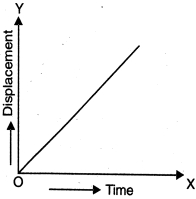
What conclusion can you draw from the displacement$-$time graph of a body shown below?
Solution
(N/A) The displacement$-$time graph is a straight line passing through the origin.
In a displacement$-$time graph,the slope represents the velocity of the body.
Since the slope of a straight line is constant,the velocity of the body is constant.
Therefore,the body is moving with uniform velocity.
In a displacement$-$time graph,the slope represents the velocity of the body.
Since the slope of a straight line is constant,the velocity of the body is constant.
Therefore,the body is moving with uniform velocity.
0 likes
View Solution186
EasyMCQ
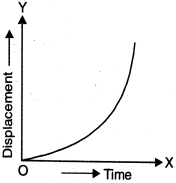
What conclusion can you draw from the displacement$-$time graph of a body as shown below?
A
The body is at rest.
B
The body is moving with uniform velocity.
C
The body is moving with non$-$uniform velocity (accelerated motion).
D
The body is moving with constant acceleration.
Solution
(C) In a displacement$-$time graph,the slope represents the velocity of the body.
For a straight line graph,the slope is constant,which indicates uniform velocity.
However,in the given graph,the curve indicates that the slope is changing at every point.
$A$ changing slope means the velocity of the body is changing over time.
Therefore,a curved displacement$-$time graph represents non$-$uniform motion or accelerated motion.
For a straight line graph,the slope is constant,which indicates uniform velocity.
However,in the given graph,the curve indicates that the slope is changing at every point.
$A$ changing slope means the velocity of the body is changing over time.
Therefore,a curved displacement$-$time graph represents non$-$uniform motion or accelerated motion.
0 likes
View Solution187
EasyMCQ
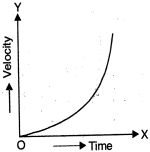
The velocity-time graph of a body is as shown. What type of motion does the body possess?
A
Uniform motion
B
Uniform acceleration
C
Non-uniform acceleration
D
Constant velocity
Solution
(C) The velocity-time graph is a curved line,which indicates that the velocity of the body is changing non-uniformly with time.
Since the rate of change of velocity (acceleration) is not constant,the body is undergoing non-uniform acceleration (also known as variable acceleration).
Since the rate of change of velocity (acceleration) is not constant,the body is undergoing non-uniform acceleration (also known as variable acceleration).
0 likes
View Solution188
Medium
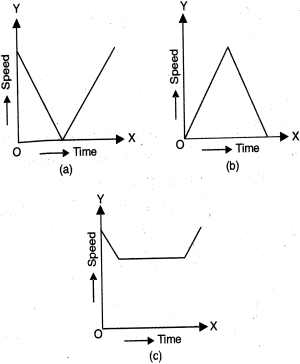
Out of the three speed-time graphs shown below,identify the graph for the following cases:
$(i)$ $A$ ball thrown vertically upwards and returning to the hand of the thrower.
(ii) $A$ body decelerating to a constant speed and then accelerating.
$(i)$ $A$ ball thrown vertically upwards and returning to the hand of the thrower.
(ii) $A$ body decelerating to a constant speed and then accelerating.
Solution
(N/A) $(i)$ Graph $(a)$ shows that the speed of a body decreases with time,becomes zero,and then again starts increasing. This graph,therefore,represents the case of a ball thrown vertically upwards and then caught by the thrower. Initially,the ball is thrown with some speed. As the ball rises up,its speed decreases at a constant rate and becomes zero at the maximum height. The ball then falls with a uniform acceleration until its speed becomes equal to the speed of projection.
(ii) Graph $(c)$ represents the deceleration of the body to some constant speed,and then accelerating after some time.
(ii) Graph $(c)$ represents the deceleration of the body to some constant speed,and then accelerating after some time.
0 likes
View Solution189
Medium
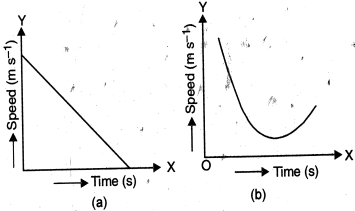
Identify what the graphs shown below indicate.
Solution
(N/A) Graph $(a)$ represents a speed-time graph where the speed decreases linearly with time. This indicates constant retardation (negative acceleration).
Graph $(b)$ represents a speed-time graph where the speed decreases non-linearly and then increases. This indicates non-uniform retardation followed by non-uniform acceleration.
Graph $(b)$ represents a speed-time graph where the speed decreases non-linearly and then increases. This indicates non-uniform retardation followed by non-uniform acceleration.
0 likes
View Solution190
EasyMCQ
$A$ racing car has an acceleration of $4\, m s^{-2}$. What distance will it cover in $20\, s$ after the start (in $, m$)?
A
$400$
B
$800$
C
$1600$
D
$200$
Solution
(B) Given: Initial velocity $u = 0\, m s^{-1}$,acceleration $a = 4\, m s^{-2}$,and time $t = 20\, s$.
To find the distance $S$ covered,we use the second equation of motion:
$S = ut + \frac{1}{2}at^2$
Substituting the given values:
$S = (0 \times 20) + \frac{1}{2} \times 4 \times (20)^2$
$S = 0 + 2 \times 400$
$S = 800\, m$
Therefore,the car will cover a distance of $800\, m$ in $20\, s$.
To find the distance $S$ covered,we use the second equation of motion:
$S = ut + \frac{1}{2}at^2$
Substituting the given values:
$S = (0 \times 20) + \frac{1}{2} \times 4 \times (20)^2$
$S = 0 + 2 \times 400$
$S = 800\, m$
Therefore,the car will cover a distance of $800\, m$ in $20\, s$.
0 likes
View Solution191
MediumMCQ
$A$ cyclist goes once around a circular track of diameter $105 \, m$ in $5 \, minutes$. Calculate his speed. (in $m/s$)
A
$1.1$
B
$2.2$
C
$0.55$
D
$3.3$
Solution
(A) The diameter of the circular track is $D = 105 \, m$. Therefore, the radius $R = \frac{105}{2} = 52.5 \, m$.
The time taken to complete one round is $t = 5 \, minutes = 5 \times 60 \, s = 300 \, s$.
The distance covered in one round is equal to the circumference of the circle, which is $2 \pi R$.
Distance $= 2 \times 3.14 \times 52.5 = 329.7 \, m$.
Speed $= \frac{\text{Distance}}{\text{Time}} = \frac{329.7}{300} = 1.099 \, m/s \approx 1.1 \, m/s$.
The time taken to complete one round is $t = 5 \, minutes = 5 \times 60 \, s = 300 \, s$.
The distance covered in one round is equal to the circumference of the circle, which is $2 \pi R$.
Distance $= 2 \times 3.14 \times 52.5 = 329.7 \, m$.
Speed $= \frac{\text{Distance}}{\text{Time}} = \frac{329.7}{300} = 1.099 \, m/s \approx 1.1 \, m/s$.
0 likes
View Solution192
DifficultMCQ
$A$ train is travelling at a speed of $90\, km\, h^{-1}$. Brakes are applied so as to produce a uniform acceleration of $-0.5\, m\, s^{-2}$. Find how far the train will go before it is brought to rest. (in $, m$)
A
$625$
B
$500$
C
$750$
D
$1000$
Solution
(A) Given:
Initial velocity $u = 90\, km\, h^{-1} = 90 \times \frac{5}{18} = 25\, m\, s^{-1}$.
Final velocity $v = 0\, m\, s^{-1}$ (since the train comes to rest).
Acceleration $a = -0.5\, m\, s^{-2}$ (negative sign indicates retardation).
We need to find the distance $S$.
Using the third equation of motion: $v^{2} - u^{2} = 2aS$.
Substituting the values: $0^{2} - (25)^{2} = 2 \times (-0.5) \times S$.
$-625 = -1 \times S$.
$S = 625\, m$.
Therefore,the train will travel $625\, m$ before coming to rest.
Initial velocity $u = 90\, km\, h^{-1} = 90 \times \frac{5}{18} = 25\, m\, s^{-1}$.
Final velocity $v = 0\, m\, s^{-1}$ (since the train comes to rest).
Acceleration $a = -0.5\, m\, s^{-2}$ (negative sign indicates retardation).
We need to find the distance $S$.
Using the third equation of motion: $v^{2} - u^{2} = 2aS$.
Substituting the values: $0^{2} - (25)^{2} = 2 \times (-0.5) \times S$.
$-625 = -1 \times S$.
$S = 625\, m$.
Therefore,the train will travel $625\, m$ before coming to rest.
0 likes
View Solution193
EasyMCQ
$A$ driver of a train travelling at $40 \, m s^{-1}$ applies the brakes as the train enters a station. The train slows down at a rate of $2 \, m s^{-2}$. The platform is $400 \, m$ long. Will the train stop in time?
A
Yes,it stops exactly at the end of the platform.
B
No,it overshoots the platform.
C
Yes,it stops well before the platform ends.
D
The train does not stop.
Solution
(A) Given: Initial velocity $u = 40 \, m s^{-1}$,Final velocity $v = 0 \, m s^{-1}$,Acceleration $a = -2 \, m s^{-2}$.
Using the third equation of motion: $v^{2} = u^{2} + 2aS$.
Substituting the values: $0^{2} = (40)^{2} + 2(-2)S$.
$0 = 1600 - 4S$.
$4S = 1600$.
$S = 400 \, m$.
Since the calculated stopping distance is $400 \, m$ and the platform length is $400 \, m$,the train will stop exactly at the end of the platform.
Using the third equation of motion: $v^{2} = u^{2} + 2aS$.
Substituting the values: $0^{2} = (40)^{2} + 2(-2)S$.
$0 = 1600 - 4S$.
$4S = 1600$.
$S = 400 \, m$.
Since the calculated stopping distance is $400 \, m$ and the platform length is $400 \, m$,the train will stop exactly at the end of the platform.
0 likes
View Solution194
EasyMCQ
$A$ girl running a race accelerates at $2.5 \, m s^{-2}$ for the first $4 \, s$ of the race. How far does she travel in this time (in $, m$)?
A
$10$
B
$20$
C
$40$
D
$50$
Solution
(B) Given: Initial velocity $u = 0 \, m/s$,acceleration $a = 2.5 \, m s^{-2}$,and time $t = 4 \, s$.
To find the distance traveled $(S)$,we use the second equation of motion:
$S = ut + \frac{1}{2}at^2$
Substituting the given values into the equation:
$S = (0 \times 4) + \frac{1}{2} \times 2.5 \times (4)^2$
$S = 0 + 0.5 \times 2.5 \times 16$
$S = 1.25 \times 16 = 20 \, m$
Therefore,the girl travels $20 \, m$ in this time.
To find the distance traveled $(S)$,we use the second equation of motion:
$S = ut + \frac{1}{2}at^2$
Substituting the given values into the equation:
$S = (0 \times 4) + \frac{1}{2} \times 2.5 \times (4)^2$
$S = 0 + 0.5 \times 2.5 \times 16$
$S = 1.25 \times 16 = 20 \, m$
Therefore,the girl travels $20 \, m$ in this time.
0 likes
View Solution195
Medium
$A$ cyclist driving at $5\, m s^{-1}$ picks up a velocity of $10\, m s^{-1}$ over a distance of $50\, m$. Calculate $(i)$ acceleration $(ii)$ time in which the cyclist picks up the above velocity.
Solution
(N/A) Given: Initial velocity $u = 5\, m s^{-1}$,Final velocity $v = 10\, m s^{-1}$,Distance $S = 50\, m$.
$(i)$ To calculate acceleration $(a)$,we use the third equation of motion: $v^{2} - u^{2} = 2aS$.
Substituting the values: $(10)^{2} - (5)^{2} = 2 \times a \times 50$.
$100 - 25 = 100a$.
$75 = 100a$.
$a = \frac{75}{100} = 0.75\, m s^{-2}$.
$(ii)$ To calculate time $(t)$,we use the first equation of motion: $v = u + at$.
Substituting the values: $10 = 5 + 0.75 \times t$.
$10 - 5 = 0.75t$.
$5 = 0.75t$.
$t = \frac{5}{0.75} = 6.67\, s$.
$(i)$ To calculate acceleration $(a)$,we use the third equation of motion: $v^{2} - u^{2} = 2aS$.
Substituting the values: $(10)^{2} - (5)^{2} = 2 \times a \times 50$.
$100 - 25 = 100a$.
$75 = 100a$.
$a = \frac{75}{100} = 0.75\, m s^{-2}$.
$(ii)$ To calculate time $(t)$,we use the first equation of motion: $v = u + at$.
Substituting the values: $10 = 5 + 0.75 \times t$.
$10 - 5 = 0.75t$.
$5 = 0.75t$.
$t = \frac{5}{0.75} = 6.67\, s$.
0 likes
View Solution196
Medium
An aeroplane lands at $216 \ km \ h^{-1}$ and stops after covering a runway of $2 \ km$. Calculate the acceleration and the time in which it comes to rest.
Solution
(N/A) Given:
Initial velocity $u = 216 \ km \ h^{-1} = 216 \times \frac{5}{18} \ m \ s^{-1} = 60 \ m \ s^{-1}$.
Final velocity $v = 0 \ m \ s^{-1}$ (as it comes to rest).
Distance covered $S = 2 \ km = 2000 \ m$.
$(i)$ To find acceleration $(a)$,we use the equation $v^{2} - u^{2} = 2aS$:
$(0)^{2} - (60)^{2} = 2 \times a \times 2000$
$-3600 = 4000 \times a$
$a = -\frac{3600}{4000} = -0.9 \ m \ s^{-2}$.
$(ii)$ To find the time $(t)$,we use the equation $v = u + at$:
$0 = 60 + (-0.9) \times t$
$0.9t = 60$
$t = \frac{60}{0.9} \approx 66.67 \ s$.
Initial velocity $u = 216 \ km \ h^{-1} = 216 \times \frac{5}{18} \ m \ s^{-1} = 60 \ m \ s^{-1}$.
Final velocity $v = 0 \ m \ s^{-1}$ (as it comes to rest).
Distance covered $S = 2 \ km = 2000 \ m$.
$(i)$ To find acceleration $(a)$,we use the equation $v^{2} - u^{2} = 2aS$:
$(0)^{2} - (60)^{2} = 2 \times a \times 2000$
$-3600 = 4000 \times a$
$a = -\frac{3600}{4000} = -0.9 \ m \ s^{-2}$.
$(ii)$ To find the time $(t)$,we use the equation $v = u + at$:
$0 = 60 + (-0.9) \times t$
$0.9t = 60$
$t = \frac{60}{0.9} \approx 66.67 \ s$.
0 likes
View Solution197
MediumMCQ
$A$ truck running at $90 \text{ km h}^{-1}$ is brought to rest over a distance of $25 \text{ m}$. Calculate the retardation and time for which brakes are applied.
A
Retardation = $12.5 \text{ m s}^{-2}$,Time = $2 \text{ s}$
B
Retardation = $10 \text{ m s}^{-2}$,Time = $2.5 \text{ s}$
C
Retardation = $12.5 \text{ m s}^{-2}$,Time = $4 \text{ s}$
D
Retardation = $25 \text{ m s}^{-2}$,Time = $1 \text{ s}$
Solution
(A) Given: Initial velocity $u = 90 \text{ km h}^{-1} = 90 \times \frac{5}{18} \text{ m s}^{-1} = 25 \text{ m s}^{-1}$.
Final velocity $v = 0 \text{ m s}^{-1}$ (as the truck comes to rest).
Distance $S = 25 \text{ m}$.
$(i)$ To find retardation $(a)$: Using the third equation of motion,$v^{2} - u^{2} = 2aS$.
$(0)^{2} - (25)^{2} = 2 \times a \times 25$.
$-625 = 50a$.
$a = -\frac{625}{50} = -12.5 \text{ m s}^{-2}$.
Retardation is the magnitude of negative acceleration,so retardation = $12.5 \text{ m s}^{-2}$.
(ii) To find time $(t)$: Using the first equation of motion,$v = u + at$.
$0 = 25 + (-12.5) \times t$.
$12.5t = 25$.
$t = \frac{25}{12.5} = 2 \text{ s}$.
Final velocity $v = 0 \text{ m s}^{-1}$ (as the truck comes to rest).
Distance $S = 25 \text{ m}$.
$(i)$ To find retardation $(a)$: Using the third equation of motion,$v^{2} - u^{2} = 2aS$.
$(0)^{2} - (25)^{2} = 2 \times a \times 25$.
$-625 = 50a$.
$a = -\frac{625}{50} = -12.5 \text{ m s}^{-2}$.
Retardation is the magnitude of negative acceleration,so retardation = $12.5 \text{ m s}^{-2}$.
(ii) To find time $(t)$: Using the first equation of motion,$v = u + at$.
$0 = 25 + (-12.5) \times t$.
$12.5t = 25$.
$t = \frac{25}{12.5} = 2 \text{ s}$.
0 likes
View Solution198
Medium
$A$ motorbike running at a speed of $90\, km h^{-1}$ slows down to $18\, km h^{-1}$ in $2.5\, s$. Calculate:
$(i)$ Acceleration
$(ii)$ Distance covered during the deceleration
$(i)$ Acceleration
$(ii)$ Distance covered during the deceleration
Solution
(N/A) Initial velocity $u = 90\, km h^{-1} = 90 \times \frac{5}{18} = 25\, m s^{-1}$.
Final velocity $v = 18\, km h^{-1} = 18 \times \frac{5}{18} = 5\, m s^{-1}$.
Time $t = 2.5\, s$.
$(i)$ Using the first equation of motion $v = u + at$:
$5 = 25 + a \times 2.5$
$5 - 25 = 2.5a$
$-20 = 2.5a$
$a = \frac{-20}{2.5} = -8\, m s^{-2}$.
Thus,the acceleration is $-8\, m s^{-2}$ (which indicates retardation).
$(ii)$ Using the third equation of motion $v^2 - u^2 = 2aS$:
$(5)^2 - (25)^2 = 2 \times (-8) \times S$
$25 - 625 = -16S$
$-600 = -16S$
$S = \frac{600}{16} = 37.5\, m$.
Thus,the distance covered is $37.5\, m$.
Final velocity $v = 18\, km h^{-1} = 18 \times \frac{5}{18} = 5\, m s^{-1}$.
Time $t = 2.5\, s$.
$(i)$ Using the first equation of motion $v = u + at$:
$5 = 25 + a \times 2.5$
$5 - 25 = 2.5a$
$-20 = 2.5a$
$a = \frac{-20}{2.5} = -8\, m s^{-2}$.
Thus,the acceleration is $-8\, m s^{-2}$ (which indicates retardation).
$(ii)$ Using the third equation of motion $v^2 - u^2 = 2aS$:
$(5)^2 - (25)^2 = 2 \times (-8) \times S$
$25 - 625 = -16S$
$-600 = -16S$
$S = \frac{600}{16} = 37.5\, m$.
Thus,the distance covered is $37.5\, m$.
0 likes
View Solution199
DifficultMCQ
$A$ motor bike running at $90 \, km \, h^{-1}$ is slowed down to $54 \, km \, h^{-1}$ by the application of brakes over a distance of $40 \, m$. If the brakes are applied with the same force,calculate $(i)$ the total time in which the bike comes to rest and $(ii)$ the total distance travelled by the bike.
A
$N$/$A$
B
$N$/$A$
C
$N$/$A$
D
$N$/$A$
Solution
(N/A) Case $1$: Initial velocity $u = 90 \, km \, h^{-1} = 90 \times \frac{5}{18} = 25 \, m \, s^{-1}$.
Final velocity $v = 54 \, km \, h^{-1} = 54 \times \frac{5}{18} = 15 \, m \, s^{-1}$.
Distance $S = 40 \, m$.
Using the equation $v^2 - u^2 = 2aS$:
$(15)^2 - (25)^2 = 2 \times a \times 40$
$225 - 625 = 80a$
$-400 = 80a \implies a = -5 \, m \, s^{-2}$.
Case $2$: The bike comes to rest from $90 \, km \, h^{-1}$ $(u = 25 \, m \, s^{-1})$,so $v = 0$.
$(i)$ To find total time $t$,use $v = u + at$:
$0 = 25 + (-5)t$
$5t = 25 \implies t = 5 \, s$.
$(ii)$ To find total distance $S$,use $v^2 - u^2 = 2aS$:
$0^2 - (25)^2 = 2 \times (-5) \times S$
$-625 = -10S \implies S = 62.5 \, m$.
Final velocity $v = 54 \, km \, h^{-1} = 54 \times \frac{5}{18} = 15 \, m \, s^{-1}$.
Distance $S = 40 \, m$.
Using the equation $v^2 - u^2 = 2aS$:
$(15)^2 - (25)^2 = 2 \times a \times 40$
$225 - 625 = 80a$
$-400 = 80a \implies a = -5 \, m \, s^{-2}$.
Case $2$: The bike comes to rest from $90 \, km \, h^{-1}$ $(u = 25 \, m \, s^{-1})$,so $v = 0$.
$(i)$ To find total time $t$,use $v = u + at$:
$0 = 25 + (-5)t$
$5t = 25 \implies t = 5 \, s$.
$(ii)$ To find total distance $S$,use $v^2 - u^2 = 2aS$:
$0^2 - (25)^2 = 2 \times (-5) \times S$
$-625 = -10S \implies S = 62.5 \, m$.
0 likes
View Solution200
Medium
$A$ motor car slows down from $72 \ km \ h^{-1}$ to $36 \ km \ h^{-1}$ over a distance of $25 \ m$. If the brakes are applied with the same force,calculate $(i)$ total time in which the car comes to rest,and $(ii)$ total distance travelled by it until it comes to rest.
Solution
(N/A) Case $1$: Initial velocity $u = 72 \ km \ h^{-1} = 20 \ m \ s^{-1}$; Final velocity $v = 36 \ km \ h^{-1} = 10 \ m \ s^{-1}$; Distance $S = 25 \ m$.
Using the equation of motion $v^{2} - u^{2} = 2aS$:
$(10)^{2} - (20)^{2} = 2 \times a \times 25$
$100 - 400 = 50a$
$-300 = 50a$
$a = -6 \ m \ s^{-2}$.
Case $2$: The car starts from $u = 72 \ km \ h^{-1} = 20 \ m \ s^{-1}$ and comes to rest $(v = 0)$ with the same retardation $a = -6 \ m \ s^{-2}$.
$(i)$ To find total time $t$,use $v = u + at$:
$0 = 20 + (-6)t$
$6t = 20$
$t = 3.33 \ s$.
$(ii)$ To find total distance $S$,use $v^{2} - u^{2} = 2aS$:
$0^{2} - (20)^{2} = 2 \times (-6) \times S$
$-400 = -12S$
$S = 400 / 12 = 33.33 \ m$.
Using the equation of motion $v^{2} - u^{2} = 2aS$:
$(10)^{2} - (20)^{2} = 2 \times a \times 25$
$100 - 400 = 50a$
$-300 = 50a$
$a = -6 \ m \ s^{-2}$.
Case $2$: The car starts from $u = 72 \ km \ h^{-1} = 20 \ m \ s^{-1}$ and comes to rest $(v = 0)$ with the same retardation $a = -6 \ m \ s^{-2}$.
$(i)$ To find total time $t$,use $v = u + at$:
$0 = 20 + (-6)t$
$6t = 20$
$t = 3.33 \ s$.
$(ii)$ To find total distance $S$,use $v^{2} - u^{2} = 2aS$:
$0^{2} - (20)^{2} = 2 \times (-6) \times S$
$-400 = -12S$
$S = 400 / 12 = 33.33 \ m$.
0 likes
View SolutionMOTION — Mix Example - MOTION · Frequently Asked Questions
1Are these MOTION questions useful for JEE and NEET?
Yes. All questions in this section are mapped to JEE Main and NEET exam patterns. Previous year questions from JEE Main, NEET, GUJCET and state-level exams are included with full solutions.
2Can I switch to Hindi or Gujarati for these questions?
Yes. Use the language tabs in the hero section or the sidebar to view the same questions and solutions in English, Hindi or Gujarati.
3How do I generate a question paper from this subtopic?
Use the Vedclass Exam Paper Generator — select the chapter and subtopic, set difficulty, and generate Sets A, B, C, D automatically. First 3 chapters of every subject are free.
Vedclass Products
For Students
Vedclass Test Series
Mock tests in real JEE/NEET style with performance analysis. 5-day free trial.
Start Free TrialFor Teachers
Exam Paper Generator
Generate Set A/B/C/D papers from this chapter in 2 minutes. 3 chapters free.
Try FreeFor Institutes
Online Exam Module
Live online exams with unlimited students, 360° analytics & white-label branding.
See DemoFor Teachers & Institutes
Generate a MOTION Exam Paper in 2 Minutes
Select subtopic & difficulty — Sets A, B, C, D auto-generated with No Repeat logic.
First 3 chapters of every subject are free — no payment required.