
A English
Mix Example - MOTION Questions in English
Class 9 Science · MOTION · Mix Example - MOTION
247+
Questions
English
Language
100%
With Solutions
Showing 47 of 247 questions in English
201
EasyMCQ
$A$ satellite while revolving around the earth completes one revolution in $1$ hour and $30$ minutes. What is the angular speed of the satellite?
A
$1.16 \times 10^{-3} \text{ rad/s}$
B
$2.16 \times 10^{-3} \text{ rad/s}$
C
$3.16 \times 10^{-3} \text{ rad/s}$
D
$4.16 \times 10^{-3} \text{ rad/s}$
Solution
(A) The time taken for one revolution is $t = 1 \text{ hour } 30 \text{ minutes} = 90 \text{ minutes}$.
Converting this into seconds: $t = 90 \times 60 = 5400 \text{ s}$.
The angle covered in one complete revolution is $\theta = 2\pi \text{ radians}$.
The formula for angular speed is $\omega = \frac{\theta}{t}$.
Substituting the values: $\omega = \frac{2\pi}{5400} = \frac{\pi}{2700} \text{ rad/s}$.
Calculating the numerical value: $\omega \approx \frac{3.14159}{2700} \approx 1.1635 \times 10^{-3} \text{ rad/s}$.
Thus,the angular speed is approximately $1.16 \times 10^{-3} \text{ rad/s}$.
Converting this into seconds: $t = 90 \times 60 = 5400 \text{ s}$.
The angle covered in one complete revolution is $\theta = 2\pi \text{ radians}$.
The formula for angular speed is $\omega = \frac{\theta}{t}$.
Substituting the values: $\omega = \frac{2\pi}{5400} = \frac{\pi}{2700} \text{ rad/s}$.
Calculating the numerical value: $\omega \approx \frac{3.14159}{2700} \approx 1.1635 \times 10^{-3} \text{ rad/s}$.
Thus,the angular speed is approximately $1.16 \times 10^{-3} \text{ rad/s}$.
0 likes
View Solution202
Medium
All buses and cars these days are fitted with a speedometer,which shows the velocity of the vehicle. $A$ device called odometer records the distance moved by the vehicle. If the reading on the odometer of a vehicle in the beginning of a trip and after $40 \text{ minutes}$ were $1048 \text{ km}$ and $1096 \text{ km}$ respectively,calculate its average velocity. Will the reading on the speedometer show this velocity when the vehicle is moving? Support your answer with reason.
Solution
(N/A) Average speed is given by the formula:
$V_{av} = \frac{\text{Total Distance Travelled}}{\text{Total Time Taken}}$
The distance travelled by the vehicle is:
$1096 \text{ km} - 1048 \text{ km} = 48 \text{ km} = 48000 \text{ m}$
The time taken is:
$40 \text{ minutes} = 40 \times 60 \text{ s} = 2400 \text{ s}$
Therefore,the average speed is:
$V_{av} = \frac{48000 \text{ m}}{2400 \text{ s}} = 20 \text{ m/s}$
The speedometer measures the instantaneous speed of the vehicle at any given moment,not the average speed over a period of time. Therefore,the speedometer will not show this calculated average velocity.
$V_{av} = \frac{\text{Total Distance Travelled}}{\text{Total Time Taken}}$
The distance travelled by the vehicle is:
$1096 \text{ km} - 1048 \text{ km} = 48 \text{ km} = 48000 \text{ m}$
The time taken is:
$40 \text{ minutes} = 40 \times 60 \text{ s} = 2400 \text{ s}$
Therefore,the average speed is:
$V_{av} = \frac{48000 \text{ m}}{2400 \text{ s}} = 20 \text{ m/s}$
The speedometer measures the instantaneous speed of the vehicle at any given moment,not the average speed over a period of time. Therefore,the speedometer will not show this calculated average velocity.
0 likes
View Solution203
Difficult
The average time taken by a normal person to react to an emergency is $1/15$ of a second and is called the 'reaction time'. If a bus is moving with a velocity of $60 \, km/h$ and its driver sees a child running across the road,how much distance would the bus have moved before he could press the brakes? The reaction time of the people increases when they are intoxicated. How much distance would the bus have moved if the reaction time of the driver were $1/2 \, s$ under the influence of alcohol?
Solution
(N/A) Given: Speed of the bus $= 60 \, km/h = 60 \times (5/18) \, m/s = 16.67 \, m/s$.
$(i)$ For a normal reaction time of $1/15 \, s$:
Distance $=$ Speed $\times$ Time $= 16.67 \times (1/15) = 1.11 \, m$.
$(ii)$ For a reaction time of $1/2 \, s$ under the influence of alcohol:
Distance $=$ Speed $\times$ Time $= 16.67 \times 0.5 = 8.335 \, m$ (approximately $8.34 \, m$).
$(i)$ For a normal reaction time of $1/15 \, s$:
Distance $=$ Speed $\times$ Time $= 16.67 \times (1/15) = 1.11 \, m$.
$(ii)$ For a reaction time of $1/2 \, s$ under the influence of alcohol:
Distance $=$ Speed $\times$ Time $= 16.67 \times 0.5 = 8.335 \, m$ (approximately $8.34 \, m$).
0 likes
View Solution204
MediumMCQ
The brakes applied to a car produce an acceleration of $6 \, m s^{-2}$ in the opposite direction of motion. If the car takes $2 \, s$ to stop after the application of the brakes,calculate the distance it travels during this time. (in $, m$)
A
$12$
B
$24$
C
$6$
D
$36$
Solution
(A) Given: Acceleration $a = -6 \, m s^{-2}$ (negative because it is in the opposite direction of motion),time $t = 2 \, s$,and final velocity $v = 0 \, m s^{-1}$ (since the car stops).
$(i)$ First,find the initial velocity $u$ using the first equation of motion: $v = u + at$.
$0 = u + (-6) \times 2$
$u = 12 \, m s^{-1}$.
$(ii)$ Now,calculate the distance $S$ using the second equation of motion: $S = ut + \frac{1}{2}at^2$.
$S = (12 \times 2) + \frac{1}{2} \times (-6) \times (2)^2$
$S = 24 - 12 = 12 \, m$.
Therefore,the car travels $12 \, m$ before stopping.
$(i)$ First,find the initial velocity $u$ using the first equation of motion: $v = u + at$.
$0 = u + (-6) \times 2$
$u = 12 \, m s^{-1}$.
$(ii)$ Now,calculate the distance $S$ using the second equation of motion: $S = ut + \frac{1}{2}at^2$.
$S = (12 \times 2) + \frac{1}{2} \times (-6) \times (2)^2$
$S = 24 - 12 = 12 \, m$.
Therefore,the car travels $12 \, m$ before stopping.
0 likes
View Solution205
MediumMCQ
An artificial satellite is moving in a circular orbit of radius nearly $42,250 \, km$. Calculate its linear velocity, if it takes $24 \, \text{hours}$ to revolve around the Earth. (in $ km/s$)
A
$3.07$
B
$3.17$
C
$2.97$
D
$3.27$
Solution
(A) Given:
Radius $r = 42,250 \, km = 42,250,000 \, m$
Time period $T = 24 \, \text{hours} = 24 \times 60 \times 60 \, s = 86,400 \, s$
The linear velocity $v$ of an object moving in a circular path is given by the formula:
$v = \frac{2 \pi r}{T}$
Substituting the values:
$v = \frac{2 \times 3.14159 \times 42,250 \, km}{86,400 \, s}$
$v \approx \frac{265,464}{86,400} \, km/s$
$v \approx 3.07 \, km/s$
Thus, the linear velocity of the satellite is approximately $3.07 \, km/s$.
Radius $r = 42,250 \, km = 42,250,000 \, m$
Time period $T = 24 \, \text{hours} = 24 \times 60 \times 60 \, s = 86,400 \, s$
The linear velocity $v$ of an object moving in a circular path is given by the formula:
$v = \frac{2 \pi r}{T}$
Substituting the values:
$v = \frac{2 \times 3.14159 \times 42,250 \, km}{86,400 \, s}$
$v \approx \frac{265,464}{86,400} \, km/s$
$v \approx 3.07 \, km/s$
Thus, the linear velocity of the satellite is approximately $3.07 \, km/s$.
0 likes
View Solution206
Medium
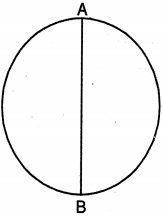
$A$ circular cycle track has a circumference of $314 \ m$ with $AB$ as one of its diameters. $A$ cyclist travels from $A$ to $B$ along the circular path with a velocity of constant magnitude $15.7 \ m s^{-1}$. Find the:
$(a)$ distance moved by the cyclist.
$(b)$ displacement of the cyclist,if $AB$ represents the north-south direction.
$(c)$ the average velocity of the cyclist.
$(a)$ distance moved by the cyclist.
$(b)$ displacement of the cyclist,if $AB$ represents the north-south direction.
$(c)$ the average velocity of the cyclist.
Solution
(N/A) Distance travelled by the cyclist $=$ length of the path $AB$ (semicircle) $=$ half the circumference of the circle.
$S = \frac{314}{2} = 157 \ m$.
$(b)$ The displacement of the cyclist is equal to the diameter $AB$ of the circle.
Since circumference $= 2 \pi r = 314 \ m$,therefore,
$r = \frac{\text{circumference}}{2 \pi} = \frac{314}{2 \times 3.14} = 50 \ m$.
Therefore,displacement of the cyclist $= 2 \times r = 2 \times 50 = 100 \ m$ towards south.
$(c)$ Average velocity is defined as the total displacement divided by the total time taken.
First,find the time taken: $\text{Time} = \frac{\text{Distance}}{\text{Speed}} = \frac{157 \ m}{15.7 \ m s^{-1}} = 10 \ s$.
Average velocity $= \frac{\text{Total Displacement}}{\text{Total Time}} = \frac{100 \ m}{10 \ s} = 10 \ m s^{-1}$ towards south.
$S = \frac{314}{2} = 157 \ m$.
$(b)$ The displacement of the cyclist is equal to the diameter $AB$ of the circle.
Since circumference $= 2 \pi r = 314 \ m$,therefore,
$r = \frac{\text{circumference}}{2 \pi} = \frac{314}{2 \times 3.14} = 50 \ m$.
Therefore,displacement of the cyclist $= 2 \times r = 2 \times 50 = 100 \ m$ towards south.
$(c)$ Average velocity is defined as the total displacement divided by the total time taken.
First,find the time taken: $\text{Time} = \frac{\text{Distance}}{\text{Speed}} = \frac{157 \ m}{15.7 \ m s^{-1}} = 10 \ s$.
Average velocity $= \frac{\text{Total Displacement}}{\text{Total Time}} = \frac{100 \ m}{10 \ s} = 10 \ m s^{-1}$ towards south.
0 likes
View Solution207
EasyMCQ
$A$ bus decreases its speed from $80 \, km \, h^{-1}$ to $50 \, km \, h^{-1}$ in $4 \, s$. Find the acceleration of the bus.
A
$2.083 \, m \, s^{-2}$
B
$-2.083 \, m \, s^{-2}$
C
$1.5 \, m \, s^{-2}$
D
$-1.5 \, m \, s^{-2}$
Solution
(B) Initial velocity $u = 80 \, km \, h^{-1} = 80 \times \frac{5}{18} = \frac{200}{9} \, m \, s^{-1} \approx 22.22 \, m \, s^{-1}$.
Final velocity $v = 50 \, km \, h^{-1} = 50 \times \frac{5}{18} = \frac{125}{9} \, m \, s^{-1} \approx 13.89 \, m \, s^{-1}$.
Time $t = 4 \, s$.
Using the formula for acceleration $a = \frac{v - u}{t}$:
$a = \frac{\frac{125}{9} - \frac{200}{9}}{4} = \frac{-75}{9 \times 4} = \frac{-75}{36} = -2.083 \, m \, s^{-2}$.
The negative sign indicates retardation or deceleration.
Final velocity $v = 50 \, km \, h^{-1} = 50 \times \frac{5}{18} = \frac{125}{9} \, m \, s^{-1} \approx 13.89 \, m \, s^{-1}$.
Time $t = 4 \, s$.
Using the formula for acceleration $a = \frac{v - u}{t}$:
$a = \frac{\frac{125}{9} - \frac{200}{9}}{4} = \frac{-75}{9 \times 4} = \frac{-75}{36} = -2.083 \, m \, s^{-2}$.
The negative sign indicates retardation or deceleration.
0 likes
View Solution208
EasyMCQ
An electric train is moving with a velocity of $120 \, km \, h^{-1}$. How much distance will it cover in $30 \, s$ (in $, km$)?
A
$1$
B
$2$
C
$0.5$
D
$1.5$
Solution
(A) Given velocity $v = 120 \, km \, h^{-1}$.
Time $t = 30 \, s$.
First,convert time into hours: $t = 30 \, s = 30 / 3600 \, h = 1 / 120 \, h$.
Using the formula for distance: $S = v \times t$.
$S = 120 \, km \, h^{-1} \times (1 / 120) \, h = 1 \, km$.
Therefore,the train will cover a distance of $1 \, km$ in $30 \, s$.
Time $t = 30 \, s$.
First,convert time into hours: $t = 30 \, s = 30 / 3600 \, h = 1 / 120 \, h$.
Using the formula for distance: $S = v \times t$.
$S = 120 \, km \, h^{-1} \times (1 / 120) \, h = 1 \, km$.
Therefore,the train will cover a distance of $1 \, km$ in $30 \, s$.
0 likes
View Solution209
Medium
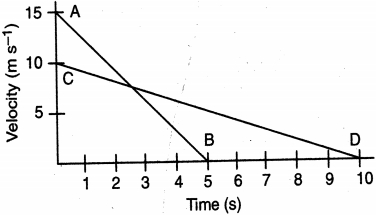
The driver of a train $A$ travelling at a speed of $54\, km\, h^{-1}$ applies brakes and retards the train uniformly. The train stops in $5\, s$. Another train $B$ is travelling on the parallel track with a speed of $36\, km\, h^{-1}$. This driver also applies the brakes and the train retards uniformly. The train $B$ stops in $10\, s$. Plot the speed-time graph for both the trains on the same paper. Also,calculate the distance travelled by each train after the brakes were applied.
Solution
(N/A) For train $A$:
Initial velocity $u_A = 54\, km\, h^{-1} = 54 \times \frac{5}{18} = 15\, m\, s^{-1}$.
Final velocity $v_A = 0\, m\, s^{-1}$.
Time taken $t_A = 5\, s$.
Distance travelled by train $A$ is the area under the velocity-time graph $AB$:
Distance $= \frac{1}{2} \times \text{base} \times \text{height} = \frac{1}{2} \times 5\, s \times 15\, m\, s^{-1} = 37.5\, m$.
For train $B$:
Initial velocity $u_B = 36\, km\, h^{-1} = 36 \times \frac{5}{18} = 10\, m\, s^{-1}$.
Final velocity $v_B = 0\, m\, s^{-1}$.
Time taken $t_B = 10\, s$.
Distance travelled by train $B$ is the area under the velocity-time graph $CD$:
Distance $= \frac{1}{2} \times \text{base} \times \text{height} = \frac{1}{2} \times 10\, s \times 10\, m\, s^{-1} = 50\, m$.
Initial velocity $u_A = 54\, km\, h^{-1} = 54 \times \frac{5}{18} = 15\, m\, s^{-1}$.
Final velocity $v_A = 0\, m\, s^{-1}$.
Time taken $t_A = 5\, s$.
Distance travelled by train $A$ is the area under the velocity-time graph $AB$:
Distance $= \frac{1}{2} \times \text{base} \times \text{height} = \frac{1}{2} \times 5\, s \times 15\, m\, s^{-1} = 37.5\, m$.
For train $B$:
Initial velocity $u_B = 36\, km\, h^{-1} = 36 \times \frac{5}{18} = 10\, m\, s^{-1}$.
Final velocity $v_B = 0\, m\, s^{-1}$.
Time taken $t_B = 10\, s$.
Distance travelled by train $B$ is the area under the velocity-time graph $CD$:
Distance $= \frac{1}{2} \times \text{base} \times \text{height} = \frac{1}{2} \times 10\, s \times 10\, m\, s^{-1} = 50\, m$.
0 likes
View Solution210
Easy
$A$ train $100 \, m$ long is moving with a velocity of $60 \, km/h$. Find the time it takes to cross a bridge $1 \, km$ long.
Solution
(66 S) Length of the train $= 100 \, m = 0.1 \, km$.
Length of the bridge $= 1 \, km$.
Total distance to be covered to cross the bridge $= \text{Length of train} + \text{Length of bridge} = 0.1 \, km + 1 \, km = 1.1 \, km$.
Velocity of the train $= 60 \, km/h$.
Time taken $(t) = \frac{\text{Total distance}}{\text{Velocity}} = \frac{1.1 \, km}{60 \, km/h} = \frac{1.1}{60} \, h$.
To convert time into seconds, multiply by $3600 \, s/h$:
$t = \frac{1.1}{60} \times 3600 \, s = 1.1 \times 60 \, s = 66 \, s$.
Length of the bridge $= 1 \, km$.
Total distance to be covered to cross the bridge $= \text{Length of train} + \text{Length of bridge} = 0.1 \, km + 1 \, km = 1.1 \, km$.
Velocity of the train $= 60 \, km/h$.
Time taken $(t) = \frac{\text{Total distance}}{\text{Velocity}} = \frac{1.1 \, km}{60 \, km/h} = \frac{1.1}{60} \, h$.
To convert time into seconds, multiply by $3600 \, s/h$:
$t = \frac{1.1}{60} \times 3600 \, s = 1.1 \times 60 \, s = 66 \, s$.
0 likes
View Solution211
Medium
An athlete completes one round of a circular track of diameter $49 \,m$ in $20 \,s$. Calculate the distance covered and displacement at the end of $30 \,s$.
Solution
(DISTANCE = 231 M, DISPLACEMENT = 49 M) Given: Diameter $d = 49 \,m$,Time for one round $T = 20 \,s$,Total time $t = 30 \,s$.
First,calculate the number of rounds completed in $30 \,s$:
$n = \frac{t}{T} = \frac{30}{20} = 1.5 \, \text{rounds}$.
Distance covered is the total path length:
$S = n \times (2 \pi r) = n \times (\pi d) = 1.5 \times \frac{22}{7} \times 49 = 1.5 \times 22 \times 7 = 231 \,m$.
Displacement is the shortest distance between the initial and final positions:
After $1.5$ rounds,the athlete is at the point diametrically opposite to the starting point.
Therefore,the displacement is equal to the diameter of the circular track,which is $49 \,m$.
First,calculate the number of rounds completed in $30 \,s$:
$n = \frac{t}{T} = \frac{30}{20} = 1.5 \, \text{rounds}$.
Distance covered is the total path length:
$S = n \times (2 \pi r) = n \times (\pi d) = 1.5 \times \frac{22}{7} \times 49 = 1.5 \times 22 \times 7 = 231 \,m$.
Displacement is the shortest distance between the initial and final positions:
After $1.5$ rounds,the athlete is at the point diametrically opposite to the starting point.
Therefore,the displacement is equal to the diameter of the circular track,which is $49 \,m$.
0 likes
View Solution212
DifficultMCQ
Ali,while driving to school,computes the average speed for his trip to be $20 \, km \, h^{-1}$. On his return trip along the same route,there is less traffic and the average speed is $30 \, km \, h^{-1}$. What is the average speed for Ali's entire trip?
A
$24 \, km \, h^{-1}$
B
$25 \, km \, h^{-1}$
C
$26 \, km \, h^{-1}$
D
$28 \, km \, h^{-1}$
Solution
(A) Let the distance between Ali's home and school be $x$.
During the trip to school:
Distance $= x$,Speed $= 20 \, km \, h^{-1}$.
Time taken $t_1 = \frac{x}{20} \, h$.
During the return trip:
Distance $= x$,Speed $= 30 \, km \, h^{-1}$.
Time taken $t_2 = \frac{x}{30} \, h$.
Average speed is defined as the total distance divided by the total time taken:
Average Speed $= \frac{\text{Total Distance}}{\text{Total Time}} = \frac{x + x}{t_1 + t_2} = \frac{2x}{\frac{x}{20} + \frac{x}{30}}$.
Calculating the denominator:
$\frac{x}{20} + \frac{x}{30} = \frac{3x + 2x}{60} = \frac{5x}{60} = \frac{x}{12}$.
Therefore,Average Speed $= \frac{2x}{x/12} = 2x \times \frac{12}{x} = 24 \, km \, h^{-1}$.
During the trip to school:
Distance $= x$,Speed $= 20 \, km \, h^{-1}$.
Time taken $t_1 = \frac{x}{20} \, h$.
During the return trip:
Distance $= x$,Speed $= 30 \, km \, h^{-1}$.
Time taken $t_2 = \frac{x}{30} \, h$.
Average speed is defined as the total distance divided by the total time taken:
Average Speed $= \frac{\text{Total Distance}}{\text{Total Time}} = \frac{x + x}{t_1 + t_2} = \frac{2x}{\frac{x}{20} + \frac{x}{30}}$.
Calculating the denominator:
$\frac{x}{20} + \frac{x}{30} = \frac{3x + 2x}{60} = \frac{5x}{60} = \frac{x}{12}$.
Therefore,Average Speed $= \frac{2x}{x/12} = 2x \times \frac{12}{x} = 24 \, km \, h^{-1}$.
0 likes
View Solution213
Medium
$A$ motor bike running at $5\, m s^{-1}$,picks up a velocity of $30\, m s^{-1}$ in $5\, s$. Calculate $(i)$ acceleration $(ii)$ distance covered during acceleration.
Solution
(N/A) Given: Initial velocity $u = 5\, m s^{-1}$,Final velocity $v = 30\, m s^{-1}$,Time $t = 5\, s$.
$(i)$ To calculate acceleration $(a)$: Using the first equation of motion,$v = u + at$.
$30 = 5 + a \times 5$
$30 - 5 = 5a$
$25 = 5a$
$a = 5\, m s^{-2}$.
$(ii)$ To calculate distance covered $(S)$: Using the third equation of motion,$v^2 - u^2 = 2aS$.
$(30)^2 - (5)^2 = 2 \times 5 \times S$
$900 - 25 = 10S$
$875 = 10S$
$S = 87.5\, m$.
$(i)$ To calculate acceleration $(a)$: Using the first equation of motion,$v = u + at$.
$30 = 5 + a \times 5$
$30 - 5 = 5a$
$25 = 5a$
$a = 5\, m s^{-2}$.
$(ii)$ To calculate distance covered $(S)$: Using the third equation of motion,$v^2 - u^2 = 2aS$.
$(30)^2 - (5)^2 = 2 \times 5 \times S$
$900 - 25 = 10S$
$875 = 10S$
$S = 87.5\, m$.
0 likes
View Solution214
MediumMCQ
$A$ cyclist driving at $36 \, km \, h^{-1}$ stops his cycle in $2 \, s$ by the application of brakes. Calculate $(i)$ retardation $(ii)$ distance covered during the application of brakes.
A
$5 \, m \, s^{-2}, 10 \, m$
B
$10 \, m \, s^{-2}, 5 \, m$
C
$5 \, m \, s^{-2}, 20 \, m$
D
$2 \, m \, s^{-2}, 10 \, m$
Solution
(A) Given: Initial velocity $u = 36 \, km \, h^{-1} = 36 \times \frac{5}{18} = 10 \, m \, s^{-1}$.
Final velocity $v = 0 \, m \, s^{-1}$ (since the cycle stops).
Time $t = 2 \, s$.
$(i)$ To calculate retardation:
Using the first equation of motion,$v = u + at$:
$0 = 10 + a \times 2$
$2a = -10$
$a = -5 \, m \, s^{-2}$.
Retardation is the negative of acceleration,so retardation $= -(-5 \, m \, s^{-2}) = 5 \, m \, s^{-2}$.
$(ii)$ To calculate distance covered $(S)$:
Using the third equation of motion,$v^2 - u^2 = 2aS$:
$0^2 - (10)^2 = 2 \times (-5) \times S$
$-100 = -10 \times S$
$S = \frac{-100}{-10} = 10 \, m$.
Final velocity $v = 0 \, m \, s^{-1}$ (since the cycle stops).
Time $t = 2 \, s$.
$(i)$ To calculate retardation:
Using the first equation of motion,$v = u + at$:
$0 = 10 + a \times 2$
$2a = -10$
$a = -5 \, m \, s^{-2}$.
Retardation is the negative of acceleration,so retardation $= -(-5 \, m \, s^{-2}) = 5 \, m \, s^{-2}$.
$(ii)$ To calculate distance covered $(S)$:
Using the third equation of motion,$v^2 - u^2 = 2aS$:
$0^2 - (10)^2 = 2 \times (-5) \times S$
$-100 = -10 \times S$
$S = \frac{-100}{-10} = 10 \, m$.
0 likes
View Solution215
Medium
$A$ truck is moving on a straight road with uniform acceleration. The following table gives the speed of the truck at various instants of time.
Draw the speed-time graph by choosing a convenient scale. Determine from it:
$(i)$ The acceleration of the truck.
$(ii)$ The distance travelled by the truck in $50$ seconds.
| Speed $(m s^{-1})$ | $5$ | $10$ | $15$ | $20$ | $25$ | $30$ |
| Time $(s)$ | $0$ | $10$ | $20$ | $30$ | $40$ | $50$ |
Draw the speed-time graph by choosing a convenient scale. Determine from it:
$(i)$ The acceleration of the truck.
$(ii)$ The distance travelled by the truck in $50$ seconds.
Solution
(N/A) The speed-time graph is a straight line starting from $(0, 5)$ to $(50, 30)$.
$(i)$ Acceleration is the slope of the speed-time graph.
Slope $= \frac{\text{Change in speed}}{\text{Change in time}} = \frac{30 - 5}{50 - 0} = \frac{25}{50} = 0.5 \ m s^{-2}$.
$(ii)$ The distance travelled is the area under the speed-time graph.
This area forms a trapezium with parallel sides of length $5 \ m s^{-1}$ and $30 \ m s^{-1}$, and height (time) of $50 \ s$.
Area $= \frac{1}{2} \times (\text{sum of parallel sides}) \times \text{height}$
Area $= \frac{1}{2} \times (5 + 30) \times 50 = \frac{1}{2} \times 35 \times 50 = 35 \times 25 = 875 \ m$.
$(i)$ Acceleration is the slope of the speed-time graph.
Slope $= \frac{\text{Change in speed}}{\text{Change in time}} = \frac{30 - 5}{50 - 0} = \frac{25}{50} = 0.5 \ m s^{-2}$.
$(ii)$ The distance travelled is the area under the speed-time graph.
This area forms a trapezium with parallel sides of length $5 \ m s^{-1}$ and $30 \ m s^{-1}$, and height (time) of $50 \ s$.
Area $= \frac{1}{2} \times (\text{sum of parallel sides}) \times \text{height}$
Area $= \frac{1}{2} \times (5 + 30) \times 50 = \frac{1}{2} \times 35 \times 50 = 35 \times 25 = 875 \ m$.
0 likes
View Solution216
Medium
$A$ scooter starts from rest and moves in a straight line with a constant acceleration,covering a distance of $64 \, m$ in $4 \, s$.
$(i)$ Calculate its acceleration and its final velocity.
$(ii)$ At what time had the scooter covered half the total distance?
$(i)$ Calculate its acceleration and its final velocity.
$(ii)$ At what time had the scooter covered half the total distance?
Solution
(N/A) $(i)$ Given: Initial velocity $u = 0 \, m/s$,Distance $S = 64 \, m$,Time $t = 4 \, s$.
Using the equation of motion $S = ut + \frac{1}{2}at^2$:
$64 = 0(4) + \frac{1}{2} \times a \times (4)^2$
$64 = 8a$
$a = 8 \, m/s^2$.
Using the equation $v = u + at$:
$v = 0 + 8 \times 4 = 32 \, m/s$.
$(ii)$ Half the total distance is $S' = \frac{64}{2} = 32 \, m$.
Using $S' = ut + \frac{1}{2}at^2$:
$32 = 0(t) + \frac{1}{2} \times 8 \times t^2$
$32 = 4t^2$
$t^2 = 8$
$t = \sqrt{8} \approx 2.83 \, s$.
Using the equation of motion $S = ut + \frac{1}{2}at^2$:
$64 = 0(4) + \frac{1}{2} \times a \times (4)^2$
$64 = 8a$
$a = 8 \, m/s^2$.
Using the equation $v = u + at$:
$v = 0 + 8 \times 4 = 32 \, m/s$.
$(ii)$ Half the total distance is $S' = \frac{64}{2} = 32 \, m$.
Using $S' = ut + \frac{1}{2}at^2$:
$32 = 0(t) + \frac{1}{2} \times 8 \times t^2$
$32 = 4t^2$
$t^2 = 8$
$t = \sqrt{8} \approx 2.83 \, s$.
0 likes
View Solution217
EasyMCQ
The branch of Physics which deals with the motion of objects while taking into consideration the cause of motion is
A
dynamics
B
kinematics
C
statics
D
none of these
Solution
(A) Dynamics is the branch of mechanics that deals with the motion of objects and the forces that cause this motion.
Kinematics is the branch of mechanics that describes the motion of objects without considering the forces that cause the motion.
Statics is the branch of mechanics that deals with objects at rest or in equilibrium under the action of forces.
Therefore,the correct branch that considers the cause of motion is dynamics.
Kinematics is the branch of mechanics that describes the motion of objects without considering the forces that cause the motion.
Statics is the branch of mechanics that deals with objects at rest or in equilibrium under the action of forces.
Therefore,the correct branch that considers the cause of motion is dynamics.
0 likes
View Solution218
MediumMCQ
There is an argument about uniform acceleration between $Mr. X$ and $Mr. Y$. $Mr. X$ says,"acceleration means that the farther you go, the faster you go". $Mr. Y$ says,"acceleration means that the longer you go, the faster you go". Whose statement is correct?
A
$Mr. Y$
B
$Mr. X$
C
Both
D
None
Solution
(C) Uniform acceleration is defined as the constant rate of change of velocity with respect to time $(a = \frac{dv}{dt} = \text{constant})$.
$Mr. Y$'s statement,"the longer you go, the faster you go," refers to the time duration $(t)$. Since $v = u + at$, as time $(t)$ increases, velocity $(v)$ increases linearly, which correctly describes uniform acceleration.
$Mr. X$'s statement,"the farther you go, the faster you go," refers to the displacement $(s)$. Using the equation $v^2 = u^2 + 2as$, we can see that as displacement $(s)$ increases, velocity $(v)$ also increases. Therefore, both statements are physically correct descriptions of uniform acceleration.
$Mr. Y$'s statement,"the longer you go, the faster you go," refers to the time duration $(t)$. Since $v = u + at$, as time $(t)$ increases, velocity $(v)$ increases linearly, which correctly describes uniform acceleration.
$Mr. X$'s statement,"the farther you go, the faster you go," refers to the displacement $(s)$. Using the equation $v^2 = u^2 + 2as$, we can see that as displacement $(s)$ increases, velocity $(v)$ also increases. Therefore, both statements are physically correct descriptions of uniform acceleration.
0 likes
View Solution219
DifficultMCQ
Starting from rest at the top of an inclined plane, a body reaches the bottom of the inclined plane in $4$ seconds. In what time does the body cover one-fourth of the distance starting from rest at the top?
A
$1$ second
B
$3$ seconds
C
$2$ seconds
D
$4$ seconds
Solution
(C) For a body starting from rest $(u = 0)$ and moving with constant acceleration $(a)$ along an inclined plane, the distance $(s)$ covered in time $(t)$ is given by the equation of motion: $s = ut + \frac{1}{2}at^2$.
Since $u = 0$, the equation simplifies to $s = \frac{1}{2}at^2$, which implies $s \propto t^2$.
Let the total distance be $S$ and the total time taken be $T = 4$ seconds.
We are asked to find the time $(t')$ taken to cover one-fourth of the distance, i.e., $s' = \frac{S}{4}$.
Using the proportionality $s \propto t^2$, we have the ratio: $\frac{s'}{S} = \frac{(t')^2}{T^2}$.
Substituting the values: $\frac{S/4}{S} = \frac{(t')^2}{4^2}$.
$\frac{1}{4} = \frac{(t')^2}{16}$.
$(t')^2 = \frac{16}{4} = 4$.
$t' = \sqrt{4} = 2$ seconds.
Therefore, the body covers one-fourth of the distance in $2$ seconds.
Since $u = 0$, the equation simplifies to $s = \frac{1}{2}at^2$, which implies $s \propto t^2$.
Let the total distance be $S$ and the total time taken be $T = 4$ seconds.
We are asked to find the time $(t')$ taken to cover one-fourth of the distance, i.e., $s' = \frac{S}{4}$.
Using the proportionality $s \propto t^2$, we have the ratio: $\frac{s'}{S} = \frac{(t')^2}{T^2}$.
Substituting the values: $\frac{S/4}{S} = \frac{(t')^2}{4^2}$.
$\frac{1}{4} = \frac{(t')^2}{16}$.
$(t')^2 = \frac{16}{4} = 4$.
$t' = \sqrt{4} = 2$ seconds.
Therefore, the body covers one-fourth of the distance in $2$ seconds.
0 likes
View Solution220
MediumMCQ
$A$ car travels $100\, km$ east and then $100\, km$ south. Finally,it comes back to the starting point by the south-east route. Throughout the journey the speed is constant at $60\, km\, h^{-1}$. The average velocity for the whole journey if the time taken is $3.3\, h$ is
A
$60\, km\, h^{-1}$
B
$90\, km\, h^{-1}$
C
$180\, km\, h^{-1}$
D
$0\, km\, h^{-1}$
Solution
(D) Average velocity is defined as the total displacement divided by the total time taken.
Displacement is a vector quantity representing the shortest distance between the initial and final positions.
In this problem,the car starts at a point,travels $100\, km$ east,$100\, km$ south,and then returns to the exact same starting point.
Since the final position is the same as the initial position,the total displacement is $0\, km$.
Therefore,the average velocity = $\frac{\text{Total Displacement}}{\text{Total Time}} = \frac{0\, km}{3.3\, h} = 0\, km\, h^{-1}$.
Displacement is a vector quantity representing the shortest distance between the initial and final positions.
In this problem,the car starts at a point,travels $100\, km$ east,$100\, km$ south,and then returns to the exact same starting point.
Since the final position is the same as the initial position,the total displacement is $0\, km$.
Therefore,the average velocity = $\frac{\text{Total Displacement}}{\text{Total Time}} = \frac{0\, km}{3.3\, h} = 0\, km\, h^{-1}$.
0 likes
View Solution221
EasyMCQ
The displacement of a body is proportional to the cube of the time lapsed. The magnitude of the acceleration is
A
increasing with time
B
decreasing with time
C
constant
D
zero
Solution
(A) Given that the displacement $s$ is proportional to the cube of time $t$,we can write $s = kt^3$,where $k$ is a constant.
To find the velocity $v$,we differentiate $s$ with respect to time $t$:
$v = \frac{ds}{dt} = \frac{d}{dt}(kt^3) = 3kt^2$.
To find the acceleration $a$,we differentiate the velocity $v$ with respect to time $t$:
$a = \frac{dv}{dt} = \frac{d}{dt}(3kt^2) = 6kt$.
Since $a = 6kt$,the acceleration $a$ is directly proportional to time $t$. Therefore,the magnitude of the acceleration increases linearly with time.
To find the velocity $v$,we differentiate $s$ with respect to time $t$:
$v = \frac{ds}{dt} = \frac{d}{dt}(kt^3) = 3kt^2$.
To find the acceleration $a$,we differentiate the velocity $v$ with respect to time $t$:
$a = \frac{dv}{dt} = \frac{d}{dt}(3kt^2) = 6kt$.
Since $a = 6kt$,the acceleration $a$ is directly proportional to time $t$. Therefore,the magnitude of the acceleration increases linearly with time.
0 likes
View Solution222
MediumMCQ
$A$ particle accelerates from rest at a constant rate for some time and attains a constant velocity of $8\, m s^{-1}$. Afterwards,it decelerates at a constant rate and comes to rest. If the total time taken is $4\, s$,the distance travelled is:
A
$32\, m$
B
$16\, m$
C
$4\, m$
D
Insufficient data
Solution
(B) Let the time taken for acceleration be $t_1$ and the time taken for deceleration be $t_2$.
Given,total time $T = t_1 + t_2 = 4\, s$.
The velocity-time graph for this motion is a triangle with base $T = 4\, s$ and height $v_{max} = 8\, m s^{-1}$.
The distance travelled is equal to the area under the velocity-time graph.
Area $= \frac{1}{2} \times \text{base} \times \text{height}$.
Area $= \frac{1}{2} \times 4\, s \times 8\, m s^{-1} = 16\, m$.
Thus,the total distance travelled is $16\, m$.
Given,total time $T = t_1 + t_2 = 4\, s$.
The velocity-time graph for this motion is a triangle with base $T = 4\, s$ and height $v_{max} = 8\, m s^{-1}$.
The distance travelled is equal to the area under the velocity-time graph.
Area $= \frac{1}{2} \times \text{base} \times \text{height}$.
Area $= \frac{1}{2} \times 4\, s \times 8\, m s^{-1} = 16\, m$.
Thus,the total distance travelled is $16\, m$.
0 likes
View Solution223
EasyMCQ
$A$ body moves on three quarters of a circle of radius $r$. The displacement and distance The displacement and distance travelled by it are:
A
displacement $= r$, distance $= 3r$
B
distance $= 2r$, displacement $= \frac{3\pi r}{2}$
C
displacement $= \sqrt{2}r$, distance $= \frac{3\pi r}{2}$
D
displacement $= 0$, distance $= \frac{3\pi r}{2}$
Solution
(C) $1$. Distance is the total path length covered by the body. For three-quarters of a circle, the distance is $\frac{3}{4}$ of the circumference $(2\pi r)$.
Distance $= \frac{3}{4} \times 2\pi r = \frac{3\pi r}{2}$.
$2$. Displacement is the shortest straight-line distance between the initial and final positions. If the body starts at point $A$ and moves three-quarters of the circle to point $B$, the angle subtended at the center is $270^{\circ}$ (or $-90^{\circ}$).
$3$. The initial position vector is $(r, 0)$ and the final position vector is $(0, -r)$.
The displacement magnitude is the hypotenuse of a right-angled triangle with sides $r$ and $r$.
Displacement $= \sqrt{r^2 + r^2} = \sqrt{2r^2} = \sqrt{2}r$.
Distance $= \frac{3}{4} \times 2\pi r = \frac{3\pi r}{2}$.
$2$. Displacement is the shortest straight-line distance between the initial and final positions. If the body starts at point $A$ and moves three-quarters of the circle to point $B$, the angle subtended at the center is $270^{\circ}$ (or $-90^{\circ}$).
$3$. The initial position vector is $(r, 0)$ and the final position vector is $(0, -r)$.
The displacement magnitude is the hypotenuse of a right-angled triangle with sides $r$ and $r$.
Displacement $= \sqrt{r^2 + r^2} = \sqrt{2r^2} = \sqrt{2}r$.
0 likes
View Solution224
EasyMCQ
For the motion on a straight line path with constant acceleration,the ratio of the magnitude of the displacement to the distance covered is
A
$\geq 1$
B
$\leq 1$
C
$< 1$
D
$= 1$
Solution
(B) For any motion,the distance covered is always greater than or equal to the magnitude of the displacement.
Mathematically,$\text{Distance} \geq |\text{Displacement}|$.
Therefore,the ratio of the magnitude of the displacement to the distance covered is $\frac{|\text{Displacement}|}{\text{Distance}} \leq 1$.
In a straight-line path,if the motion is unidirectional (no turning back),the distance is equal to the magnitude of the displacement,so the ratio is $1$.
If the motion involves a change in direction,the distance will be greater than the magnitude of the displacement,making the ratio less than $1$.
Thus,the ratio is always less than or equal to $1$.
Mathematically,$\text{Distance} \geq |\text{Displacement}|$.
Therefore,the ratio of the magnitude of the displacement to the distance covered is $\frac{|\text{Displacement}|}{\text{Distance}} \leq 1$.
In a straight-line path,if the motion is unidirectional (no turning back),the distance is equal to the magnitude of the displacement,so the ratio is $1$.
If the motion involves a change in direction,the distance will be greater than the magnitude of the displacement,making the ratio less than $1$.
Thus,the ratio is always less than or equal to $1$.
0 likes
View Solution225
DifficultMCQ
$A$ body moving with uniform acceleration has velocities $20 \, m/s$ and $30 \, m/s$ when passing two points $A$ and $B$. Then the velocity midway between $A$ and $B$ is:
A
$25.5 \, m/s$
B
$25 \, m/s$
C
$24 \, m/s$
D
$10 \sqrt{6} \, m/s$
Solution
(A) Let the velocity at point $A$ be $v_A = 20 \, m/s$ and at point $B$ be $v_B = 30 \, m/s$.
Let the distance between $A$ and $B$ be $s$. The velocity $v$ at the midpoint $M$ can be found using the third equation of motion: $v^2 = u^2 + 2as$.
For the segment $AM$,$v_M^2 = v_A^2 + 2a(s/2) = v_A^2 + as$.
For the segment $MB$,$v_B^2 = v_M^2 + 2a(s/2) = v_M^2 + as$.
From the first equation,$as = v_M^2 - v_A^2$. Substituting this into the second equation:
$v_B^2 = v_M^2 + (v_M^2 - v_A^2) = 2v_M^2 - v_A^2$.
Rearranging for $v_M$:
$2v_M^2 = v_A^2 + v_B^2 \implies v_M = \sqrt{\frac{v_A^2 + v_B^2}{2}}$.
Substituting the values: $v_M = \sqrt{\frac{20^2 + 30^2}{2}} = \sqrt{\frac{400 + 900}{2}} = \sqrt{\frac{1300}{2}} = \sqrt{650} = \sqrt{25 \times 26} = 5 \sqrt{26} \approx 25.49 \, m/s$.
Wait,calculating $\sqrt{650} \approx 25.495$. Let's re-check the options. $10\sqrt{6} = \sqrt{600} \approx 24.49$. Actually,the formula for velocity at the midpoint is $v_M = \sqrt{\frac{v_A^2 + v_B^2}{2}}$. Calculation: $\sqrt{650} \approx 25.5 \, m/s$.
Let the distance between $A$ and $B$ be $s$. The velocity $v$ at the midpoint $M$ can be found using the third equation of motion: $v^2 = u^2 + 2as$.
For the segment $AM$,$v_M^2 = v_A^2 + 2a(s/2) = v_A^2 + as$.
For the segment $MB$,$v_B^2 = v_M^2 + 2a(s/2) = v_M^2 + as$.
From the first equation,$as = v_M^2 - v_A^2$. Substituting this into the second equation:
$v_B^2 = v_M^2 + (v_M^2 - v_A^2) = 2v_M^2 - v_A^2$.
Rearranging for $v_M$:
$2v_M^2 = v_A^2 + v_B^2 \implies v_M = \sqrt{\frac{v_A^2 + v_B^2}{2}}$.
Substituting the values: $v_M = \sqrt{\frac{20^2 + 30^2}{2}} = \sqrt{\frac{400 + 900}{2}} = \sqrt{\frac{1300}{2}} = \sqrt{650} = \sqrt{25 \times 26} = 5 \sqrt{26} \approx 25.49 \, m/s$.
Wait,calculating $\sqrt{650} \approx 25.495$. Let's re-check the options. $10\sqrt{6} = \sqrt{600} \approx 24.49$. Actually,the formula for velocity at the midpoint is $v_M = \sqrt{\frac{v_A^2 + v_B^2}{2}}$. Calculation: $\sqrt{650} \approx 25.5 \, m/s$.
0 likes
View Solution226
EasyMCQ
$A$ moving body is covering a distance directly proportional to the square of time. The acceleration of the body is
A
increasing
B
decreasing
C
zero
D
constant
Solution
(D) Given that the distance $s$ is directly proportional to the square of time $t$,we can write: $s \propto t^2$ or $s = kt^2$,where $k$ is a constant.
To find the velocity $v$,we differentiate the distance with respect to time: $v = \frac{ds}{dt} = \frac{d}{dt}(kt^2) = 2kt$.
To find the acceleration $a$,we differentiate the velocity with respect to time: $a = \frac{dv}{dt} = \frac{d}{dt}(2kt) = 2k$.
Since $k$ is a constant,$2k$ is also a constant.
Therefore,the acceleration of the body is constant.
To find the velocity $v$,we differentiate the distance with respect to time: $v = \frac{ds}{dt} = \frac{d}{dt}(kt^2) = 2kt$.
To find the acceleration $a$,we differentiate the velocity with respect to time: $a = \frac{dv}{dt} = \frac{d}{dt}(2kt) = 2k$.
Since $k$ is a constant,$2k$ is also a constant.
Therefore,the acceleration of the body is constant.
0 likes
View Solution227
EasyMCQ
The area under the velocity$-$time graph gives the value of
A
velocity
B
acceleration
C
distance travelled
D
none of these
Solution
(C) The area under a velocity$-$time graph represents the displacement or the total distance travelled by an object.
Mathematically,for a velocity $v$ and time $t$,the area is calculated as $\int v \, dt$,which corresponds to the displacement of the object over the given time interval.
Mathematically,for a velocity $v$ and time $t$,the area is calculated as $\int v \, dt$,which corresponds to the displacement of the object over the given time interval.
0 likes
View Solution228
EasyMCQ
Which of the following is not a vector?
A
displacement
B
velocity
C
acceleration
D
speed
Solution
(D) vector quantity is a physical quantity that has both magnitude and direction.
Displacement,velocity,and acceleration are all vector quantities because they require both magnitude and direction to be fully described.
Speed is a scalar quantity because it only represents the magnitude of the rate of change of position (distance per unit time) and does not have a specific direction associated with it.
Therefore,speed is not a vector.
Displacement,velocity,and acceleration are all vector quantities because they require both magnitude and direction to be fully described.
Speed is a scalar quantity because it only represents the magnitude of the rate of change of position (distance per unit time) and does not have a specific direction associated with it.
Therefore,speed is not a vector.
0 likes
View Solution229
EasyMCQ
If the average velocity of a body is equal to the mean of its initial velocity and final velocity,then the acceleration of the body is
A
uniform
B
variable
C
zero
D
negative
Solution
(A) The average velocity $(v_{avg})$ of a body is defined as the arithmetic mean of its initial velocity $(u)$ and final velocity $(v)$ only when the acceleration $(a)$ is constant or uniform.
Mathematically,$v_{avg} = \frac{u + v}{2}$.
This formula is derived from the equations of motion under constant acceleration,specifically $v = u + at$.
Substituting $v$ in the average velocity formula: $v_{avg} = \frac{u + (u + at)}{2} = \frac{2u + at}{2} = u + \frac{1}{2}at$.
Since this relationship holds true for motion with constant acceleration,the acceleration of the body must be uniform.
Mathematically,$v_{avg} = \frac{u + v}{2}$.
This formula is derived from the equations of motion under constant acceleration,specifically $v = u + at$.
Substituting $v$ in the average velocity formula: $v_{avg} = \frac{u + (u + at)}{2} = \frac{2u + at}{2} = u + \frac{1}{2}at$.
Since this relationship holds true for motion with constant acceleration,the acceleration of the body must be uniform.
0 likes
View Solution230
EasyMCQ
The speed-time graph of a body is a straight line parallel to the time axis. The body has:
A
uniform acceleration
B
uniform speed
C
variable speed
D
variable acceleration
Solution
(B) In a speed-time graph,the $y$-axis represents speed and the $x$-axis represents time.
If the graph is a straight line parallel to the time axis,it means that the speed of the body remains constant at all points in time.
$A$ constant speed indicates that the body is moving with uniform speed (or constant velocity if the direction is fixed).
Since the speed does not change over time,the acceleration of the body is zero.
If the graph is a straight line parallel to the time axis,it means that the speed of the body remains constant at all points in time.
$A$ constant speed indicates that the body is moving with uniform speed (or constant velocity if the direction is fixed).
Since the speed does not change over time,the acceleration of the body is zero.
0 likes
View Solution231
EasyMCQ
The velocity$-$time graph of a body has a negative slope. The body is undergoing
A
uniform acceleration
B
variable acceleration
C
uniform retardation
D
variable retardation
Solution
(C) In a velocity$-$time graph,the slope represents the acceleration of the body.
If the slope is negative,it indicates that the velocity of the body is decreasing over time.
$A$ constant negative slope implies that the rate of decrease in velocity is uniform.
This phenomenon is known as uniform retardation or uniform deceleration.
Therefore,the correct option is $C$.
If the slope is negative,it indicates that the velocity of the body is decreasing over time.
$A$ constant negative slope implies that the rate of decrease in velocity is uniform.
This phenomenon is known as uniform retardation or uniform deceleration.
Therefore,the correct option is $C$.
0 likes
View Solution232
EasyMCQ
The distance$-$time graph of a body is parallel to the time axis. The body is
A
cannot say
B
in variable motion
C
in uniform motion
D
at rest
Solution
(D) In a distance$-$time graph,the $y$-axis represents the distance covered and the $x$-axis represents time.
If the graph is parallel to the time axis ($x$-axis),it means that as time increases,the distance covered by the body remains constant.
$A$ constant distance indicates that the body is not changing its position with respect to time.
Therefore,the body is at rest.
If the graph is parallel to the time axis ($x$-axis),it means that as time increases,the distance covered by the body remains constant.
$A$ constant distance indicates that the body is not changing its position with respect to time.
Therefore,the body is at rest.
0 likes
View Solution233
EasyMCQ
The distance-time graph of a body is a straight line inclined to the time axis. The body is in:
A
uniform motion
B
uniformly accelerated motion
C
uniformly retarded motion
D
rest position
Solution
(A) In a distance-time graph,the slope of the line represents the speed of the object.
If the graph is a straight line inclined to the time axis,it indicates that the object covers equal distances in equal intervals of time.
This constant slope implies a constant speed.
Therefore,the body is in uniform motion.
If the graph is a straight line inclined to the time axis,it indicates that the object covers equal distances in equal intervals of time.
This constant slope implies a constant speed.
Therefore,the body is in uniform motion.
0 likes
View Solution234
EasyMCQ
The area under a velocity$-$time graph is equal to the
A
speed of the body
B
magnitude of the displacement of the body
C
distance travelled by the body
D
none of these
Solution
(B) The area under a velocity$-$time graph represents the displacement of the object.
Velocity is defined as the rate of change of displacement $(v = \frac{ds}{dt})$.
Therefore,the displacement $(s)$ can be calculated by integrating the velocity with respect to time: $s = \int v \, dt$.
Geometrically,this integral corresponds to the area enclosed between the velocity$-$time curve and the time axis.
If the motion is in a straight line without changing direction,the magnitude of displacement is equal to the distance travelled. However,in general,the area under the velocity$-$time graph represents the magnitude of the displacement.
Velocity is defined as the rate of change of displacement $(v = \frac{ds}{dt})$.
Therefore,the displacement $(s)$ can be calculated by integrating the velocity with respect to time: $s = \int v \, dt$.
Geometrically,this integral corresponds to the area enclosed between the velocity$-$time curve and the time axis.
If the motion is in a straight line without changing direction,the magnitude of displacement is equal to the distance travelled. However,in general,the area under the velocity$-$time graph represents the magnitude of the displacement.
0 likes
View Solution235
EasyMCQ
Area under a speed-time graph is equal to the
A
velocity of the body
B
magnitude of the displacement
C
distance travelled by the body
D
none of these
Solution
(C) The area under a speed-time graph represents the total distance covered by an object.
Since speed is a scalar quantity (distance/time),the area calculated by multiplying speed and time gives the total distance travelled.
In contrast,the area under a velocity-time graph represents the displacement of the body.
Therefore,for a speed-time graph,the correct answer is the distance travelled by the body.
Since speed is a scalar quantity (distance/time),the area calculated by multiplying speed and time gives the total distance travelled.
In contrast,the area under a velocity-time graph represents the displacement of the body.
Therefore,for a speed-time graph,the correct answer is the distance travelled by the body.
0 likes
View Solution236
MediumMCQ
The direction of acceleration of an object moving in a circular path is
A
directed away from the centre of the circle
B
directed upward in the plane of the circle
C
none of these
D
directed towards the centre of the circle
Solution
(D) When an object moves in a circular path at a constant speed,its velocity changes continuously due to the change in direction at every point.
This change in velocity gives rise to an acceleration known as centripetal acceleration.
By definition,centripetal acceleration is always directed towards the centre of the circular path.
Therefore,the correct option is $D$.
This change in velocity gives rise to an acceleration known as centripetal acceleration.
By definition,centripetal acceleration is always directed towards the centre of the circular path.
Therefore,the correct option is $D$.
0 likes
View Solution237
Easy
State whether the following statements are true or false:
$1$. The motion in animals is called locomotion.
$2$. Mechanics deals with the motion of non-living objects.
$1$. The motion in animals is called locomotion.
$2$. Mechanics deals with the motion of non-living objects.
Solution
(B) The first statement is $False$. Locomotion is specifically defined as the ability of an organism to move from one place to another,whereas motion is a general term for any change in position. Not all motion in animals is locomotion (e.g.,movement of internal organs).
The second statement is $False$. Mechanics is a branch of physics that deals with the motion of both living and non-living objects under the action of forces. Therefore,the overall answer is $False$.
The second statement is $False$. Mechanics is a branch of physics that deals with the motion of both living and non-living objects under the action of forces. Therefore,the overall answer is $False$.
0 likes
View Solution238
Easy
State whether the following statement is true or false:
Kinematics deals with the motion of non-living objects without taking into account the cause of their motion.
Kinematics deals with the motion of non-living objects without taking into account the cause of their motion.
Solution
(TRUE) The statement is True.
Kinematics is a branch of mechanics that describes the motion of objects (points,bodies,and systems of bodies) without considering the forces that cause them to move. It focuses on parameters such as position,velocity,acceleration,and time.
Kinematics is a branch of mechanics that describes the motion of objects (points,bodies,and systems of bodies) without considering the forces that cause them to move. It focuses on parameters such as position,velocity,acceleration,and time.
0 likes
View Solution239
Easy
State whether the following statement is true or false:
Motion along a curved line is called translatory or rectilinear motion.
Motion along a curved line is called translatory or rectilinear motion.
Solution
(FALSE) The statement is False.
Rectilinear motion is defined as the motion of an object along a straight line.
Motion along a curved path is known as curvilinear motion.
Translatory motion refers to motion where all parts of a body move in the same direction at the same time,which can occur along a straight or curved path,but it is not synonymous with rectilinear motion.
Rectilinear motion is defined as the motion of an object along a straight line.
Motion along a curved path is known as curvilinear motion.
Translatory motion refers to motion where all parts of a body move in the same direction at the same time,which can occur along a straight or curved path,but it is not synonymous with rectilinear motion.
0 likes
View Solution240
Easy
State whether the following statement is true or false:
$A$ body is said to be at rest if it does not change its position with respect to its reference point.
$A$ body is said to be at rest if it does not change its position with respect to its reference point.
Solution
(TRUE) The statement is True.
Definition: An object is said to be at rest if its position does not change with respect to a fixed reference point (or frame of reference) as time passes.
Definition: An object is said to be at rest if its position does not change with respect to a fixed reference point (or frame of reference) as time passes.
0 likes
View Solution241
Easy
State whether the following statement is true or false:
$A$ quantity which can be represented completely by magnitude alone is called a vector quantity.
$A$ quantity which can be represented completely by magnitude alone is called a vector quantity.
Solution
(B) The statement is False.
Explanation:
$1$. $A$ quantity that is described completely by its magnitude alone is known as a scalar quantity (e.g.,distance,speed,mass).
$2$. $A$ vector quantity requires both magnitude and direction to be completely specified (e.g.,displacement,velocity,force).
$3$. Since the statement defines a scalar quantity as a vector quantity,it is incorrect.
Explanation:
$1$. $A$ quantity that is described completely by its magnitude alone is known as a scalar quantity (e.g.,distance,speed,mass).
$2$. $A$ vector quantity requires both magnitude and direction to be completely specified (e.g.,displacement,velocity,force).
$3$. Since the statement defines a scalar quantity as a vector quantity,it is incorrect.
0 likes
View Solution242
Easy
State whether the following statement is true or false:
$A$ quantity which can be completely specified by magnitude as well as direction is called a scalar quantity.
$A$ quantity which can be completely specified by magnitude as well as direction is called a scalar quantity.
Solution
(B) The statement is False.
$A$ quantity that is specified by both magnitude and direction is known as a vector quantity.
$A$ scalar quantity is a physical quantity that is specified only by its magnitude,such as distance,speed,or mass.
$A$ quantity that is specified by both magnitude and direction is known as a vector quantity.
$A$ scalar quantity is a physical quantity that is specified only by its magnitude,such as distance,speed,or mass.
0 likes
View Solution243
Easy
State whether the following statement is true or false:
Velocity and speed are measured in different units.
Velocity and speed are measured in different units.
Solution
(B) The statement is False.
Speed is defined as the distance traveled per unit time,while velocity is defined as the displacement per unit time.
Both speed and velocity are measured in the same $SI$ unit,which is meters per second $(m/s)$.
Speed is defined as the distance traveled per unit time,while velocity is defined as the displacement per unit time.
Both speed and velocity are measured in the same $SI$ unit,which is meters per second $(m/s)$.
0 likes
View Solution244
Easy
State whether the following statement is true or false:
In one-dimensional motion,the average velocity and the instantaneous velocity are unequal.
In one-dimensional motion,the average velocity and the instantaneous velocity are unequal.
Solution
(FALSE) The statement is False.
In one-dimensional motion with uniform velocity,the average velocity is equal to the instantaneous velocity at any point in time.
Even in non-uniform motion,the average velocity over an interval can be equal to the instantaneous velocity at a specific moment within that interval,so the statement that they are always unequal is incorrect.
In one-dimensional motion with uniform velocity,the average velocity is equal to the instantaneous velocity at any point in time.
Even in non-uniform motion,the average velocity over an interval can be equal to the instantaneous velocity at a specific moment within that interval,so the statement that they are always unequal is incorrect.
0 likes
View Solution245
EasyMCQ
State whether the following statement is true or false:
$A$ motion is said to be uniform if a body undergoes equal displacements in equal intervals of time.
$A$ motion is said to be uniform if a body undergoes equal displacements in equal intervals of time.
A
True
B
False
Solution
(A) The statement is $True$.
Uniform motion is defined as the motion of an object in which the object travels equal distances in equal intervals of time along a straight line. Since displacement is the shortest distance between two points in a specific direction,undergoing equal displacements in equal intervals of time is the fundamental characteristic of uniform motion.
Uniform motion is defined as the motion of an object in which the object travels equal distances in equal intervals of time along a straight line. Since displacement is the shortest distance between two points in a specific direction,undergoing equal displacements in equal intervals of time is the fundamental characteristic of uniform motion.
0 likes
View Solution246
Easy
State whether the following statement is true or false:
$A$ motion is said to be uniform if $x \propto t^{2}$.
$A$ motion is said to be uniform if $x \propto t^{2}$.
Solution
(B) The statement is $False$.
In uniform motion,an object covers equal distances in equal intervals of time,which implies a constant velocity.
For uniform motion,the position $x$ is related to time $t$ by the linear equation $x = vt + x_0$,meaning $x \propto t$.
If $x \propto t^{2}$,the motion represents constant acceleration (non-uniform motion),as the velocity $v = dx/dt$ would be proportional to $t$ $(v \propto t)$.
In uniform motion,an object covers equal distances in equal intervals of time,which implies a constant velocity.
For uniform motion,the position $x$ is related to time $t$ by the linear equation $x = vt + x_0$,meaning $x \propto t$.
If $x \propto t^{2}$,the motion represents constant acceleration (non-uniform motion),as the velocity $v = dx/dt$ would be proportional to $t$ $(v \propto t)$.
0 likes
View Solution247
Easy
State whether the following statement is true or false:
Acceleration is defined as the rate of change of velocity.
Acceleration is defined as the rate of change of velocity.
Solution
(TRUE) The statement is True.
Acceleration is defined as the rate of change of velocity with respect to time. Mathematically,it is expressed as $a = \frac{v - u}{t}$,where $v$ is the final velocity,$u$ is the initial velocity,and $t$ is the time taken.
Acceleration is defined as the rate of change of velocity with respect to time. Mathematically,it is expressed as $a = \frac{v - u}{t}$,where $v$ is the final velocity,$u$ is the initial velocity,and $t$ is the time taken.
0 likes
View SolutionMOTION — Mix Example - MOTION · Frequently Asked Questions
1Are these MOTION questions useful for JEE and NEET?
Yes. All questions in this section are mapped to JEE Main and NEET exam patterns. Previous year questions from JEE Main, NEET, GUJCET and state-level exams are included with full solutions.
2Can I switch to Hindi or Gujarati for these questions?
Yes. Use the language tabs in the hero section or the sidebar to view the same questions and solutions in English, Hindi or Gujarati.
3How do I generate a question paper from this subtopic?
Use the Vedclass Exam Paper Generator — select the chapter and subtopic, set difficulty, and generate Sets A, B, C, D automatically. First 3 chapters of every subject are free.
Vedclass Products
For Students
Vedclass Test Series
Mock tests in real JEE/NEET style with performance analysis. 5-day free trial.
Start Free TrialFor Teachers
Exam Paper Generator
Generate Set A/B/C/D papers from this chapter in 2 minutes. 3 chapters free.
Try FreeFor Institutes
Online Exam Module
Live online exams with unlimited students, 360° analytics & white-label branding.
See DemoFor Teachers & Institutes
Generate a MOTION Exam Paper in 2 Minutes
Select subtopic & difficulty — Sets A, B, C, D auto-generated with No Repeat logic.
First 3 chapters of every subject are free — no payment required.